
By Milad Ghobadibeygvand, BScN (Western University, 2014) — Redtail eBikes. Every price, spec, and legal claim on this page was re-opened at its primary source and re-checked. · Verified September 6, 2026.
2 jurisdictions now require battery certification · 189 bikes price-checked · 48% between $1,000 and $2,000 · 31 federal e-bike recalls read · 7 checks before you pay
Quick Answer: There is no single best place to buy electric bikes. There is a best channel for your situation, and a seller inside it you can verify. Before you pay anyone, run seven checks that take about ten minutes. Online stores carry the widest selection and usually the lowest prices; local bike shops add a test ride, a fitting, and one place to take a warranty claim; big-box shelves and marketplace listings ask the most of you before you pay. Since January 1, 2026, California has also made one of those checks a matter of law: an e-bike may not be sold there unless its battery has been tested by an accredited laboratory. Redtail eBikes is an online store, so the seven checks below apply to us too, and we run them on ourselves in public further down. Browse the full lineup once you know what you are checking for.
Key facts (verified September 6, 2026):
- Certification is now law in two US jurisdictions. California prohibits selling an e-bike whose battery has not been tested by an accredited lab (Cal. Health & Safety Code § 26302(a), operative January 1, 2026). New York City has required it since September 2023 (NYC Admin. Code § 20-610).
- Every marketplace e-bike recall in the federal database is a fire recall. Of the 31 e-bike recalls the CPSC has published since 2015, 4 name a marketplace in the notice — Amazon, Walmart or eBay — and all 4 are battery or wiring fires. Of the other 27, only 4 are fires (our sweep of the CPSC database, September 6, 2026).
- A warranty is only as good as the company behind it. After 31 reported battery fires, one major US brand refused a recall, filed for Chapter 11 on December 15, 2025, and its buyer now states it has no obligation to service anything bought before that date (CPSC release 26-118; Rad Life Mobility warranty).
- Fraud losses are at a record. US consumers filed 3 million fraud reports in 2025 and reported $15.9 billion lost, up from $12 billion in 2024, and reported losses have risen nearly 430% since 2020 (FTC testimony to the Joint Economic Committee, March 25, 2026, p. 3).
- Real prices start around $510. Across the 189 complete e-bikes on our own storefront today, prices run $510 to $4,499, median $1,699 (our price census, pulled September 6, 2026). A current 750W fat-tire bike at $299 is priced below what the parts cost.
How we verified this
Every legal claim here was read at the body with authority over it, in this session. Federal statute comes from the Government Publishing Office's US Code: the $50 cap on unauthorized card use at 15 U.S.C. § 1643(a)(1)(B), and the billing-error window at 15 U.S.C. § 1666(a).
Federal rules come from the Electronic Code of Federal Regulations. California's certification requirement was confirmed against the current code section rather than only the bill that created it, because a bill PDF shows deleted text as though it were still law.
Two numbers on this page are ours. The recall figures come from a sweep of the CPSC's own public database covering 2015 to 2026, filtered so that an e-bike token has to describe the recalled product rather than the recalling company. That filter removed five records, among them two hoverboard recalls filed by a firm called Jetson Electric Bikes.
The price figures come from a census of every complete bike on redtailebikes.com. All 189 of them, rather than a sample.
Corpus: 26 citations on this page rest on 23 distinct sources from 16 issuing bodies, and every one of the 23 was retrieved and read in full, then archived. One further source was sought and not obtained: the Consumer Sentinel Network Data Book for 2025, which the FTC's own reports index does not yet list, so the 2025 loss figure is cited to the Commission's sworn testimony instead.
Demand: 445 queries and questions were harvested from four independent sources — Google autocomplete, the headings of ten pages that rank for this topic, archived Reddit threads, and an eight-prompt AI-search panel. 43 of them are answered on this page. The rest were dropped as off-topic, non-US, or belonging to a sibling guide.
Disclosure: Redtail eBikes sells electric bikes online. The checklist below is written to judge every seller by the same test, so we run all seven on ourselves, in public, including the two we do not fully pass.

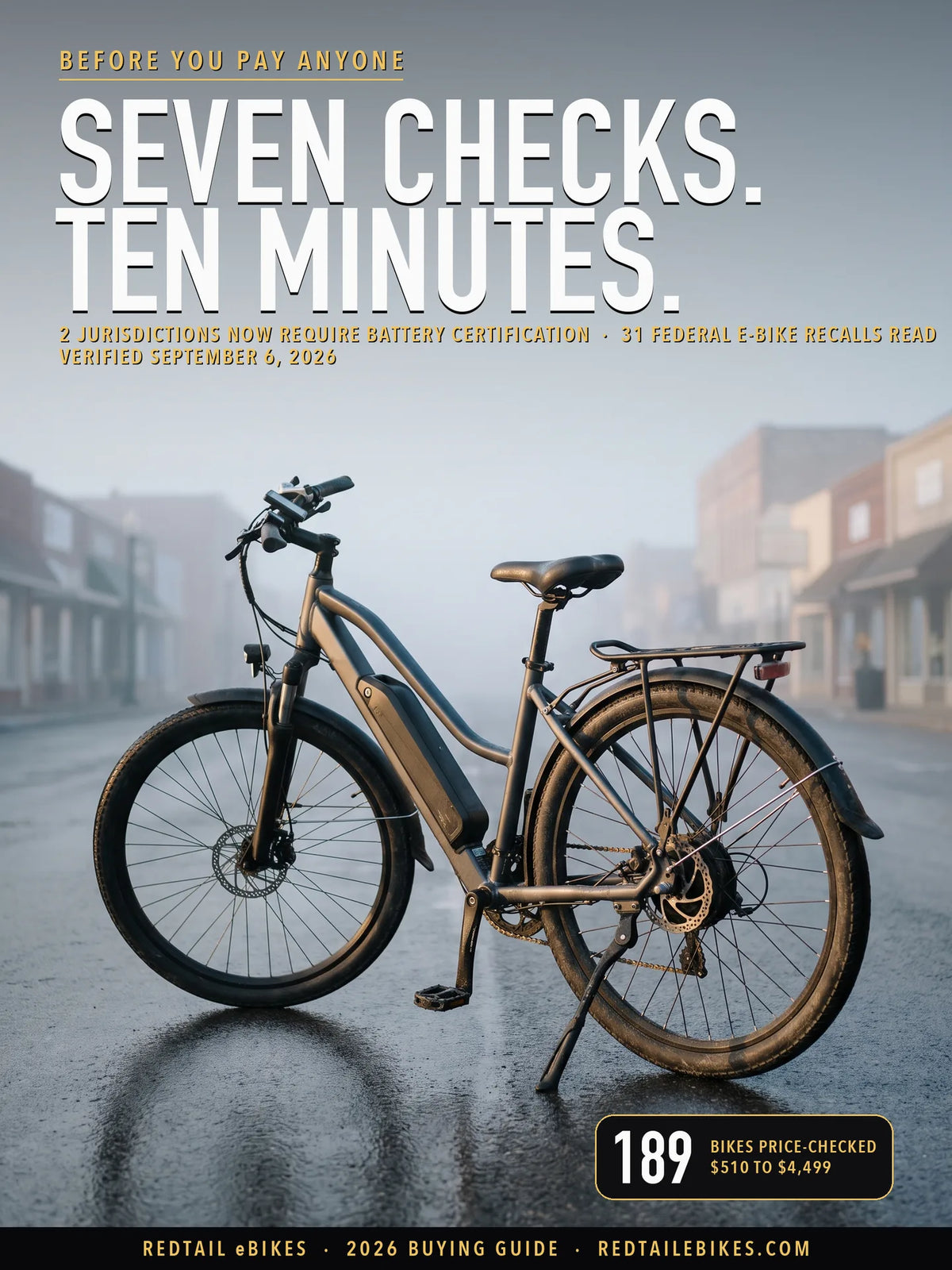
A commuter e-bike on an empty main street at first light. Where it came from decides what happens the day something on it fails.
If you are still choosing which bike to buy, start with our complete guide to choosing an electric bike, or go straight to whichever of our 36 buying guides matches the rider, the budget or the body style you have in mind. This page picks up at the next question: where to buy it, and how to be sure of whoever is selling it.
In this guide
- So what is the best place to buy electric bikes?
- What changed in 2026: certification became the law
- Buying from an online e-bike shop: brand-direct vs multi-brand
- Where can you buy an electric bike in person?
- Is Walmart, Costco, or Amazon a safe place to buy an ebike?
- Is it safe to buy an electric bike from Temu, AliExpress, or Alibaba?
- Buying a used or refurbished e-bike
- The legit e-bike store checklist: 7 checks before you pay
- Red flags: how to spot a sketchy e-bike seller
- What to do if you have already been scammed
- How Redtail scores on its own checklist
- When is the best time to buy an electric bike?
- Know the rules before you buy
- Frequently asked questions about where to buy an electric bike
- The bottom line
- Every guide behind this page
- Limitations
- Source register
- Primary sources
So what is the best place to buy electric bikes?
On January 1, 2026 the answer to this question changed shape. California made an accredited-lab battery test a condition of sale (Health & Safety Code § 26302(a)), so in the largest e-bike market in the country a seller either holds the certification or is breaking the law by taking your money.
Get the channel wrong and you lose a few hundred dollars to a markup or a stiff return policy. Get the seller wrong and you lose the whole purchase: the money is gone, the warranty was never real, and the bike is a fire risk in your hallway. The decision comes in two parts, which of five channels suits how you shop and how to verify the specific seller inside it.
One number frames the money side. Across the 189 complete e-bikes on our own storefront, prices run $510 to $4,499 with a median of $1,699, and 90 of them sit between $1,000 and $2,000 (pulled September 6, 2026). Any channel offering a current 750W fat-tire bike at $299 is not offering a deal.
| Channel | Price | Selection | Test ride and fit | Assembly | After-sale support |
|---|---|---|---|---|---|
| Online brand-direct (DTC) | Often lowest | One brand only | Rare | You do it | Remote, brand-run |
| Multi-brand online store | Competitive | Widest | No | Usually you | Store plus manufacturer |
| Local bike shop | Highest | Floor stock only | Yes | Done for you | In person, one-stop |
| Big-box and marketplace | Low on entry models | Varies | No | You do it | Seller-dependent |
| Used or refurbished | Lowest upfront | Luck of the listing | Sometimes | Varies | Limited or none |

Two of these hand you a finished bike. Two hand you a box and a set of instructions.
Redtail eBikes is a multi-brand online store, so we sit in row two and we score ourselves against the same checks below. The table shows tendencies rather than guarantees. A careful local shop can beat a careless online store on price, and one sloppy marketplace listing can undo the advantage its channel usually carries.
The same split runs inside a single retailer. Of 55 Walmart e-bike listings we read, 10 were sold by Walmart itself and 38 by third-party sellers, and the Walmart seller breakdown shows how to tell the two apart before you pay.
Bottom line Match the channel to your priorities first, then verify the seller with the seven checks. The channel narrows the field; the checklist picks the winner.
What changed in 2026: certification became the law
Ask for the certification mark before you pay, and in two US jurisdictions you are asking the seller to prove something they are legally required to have. California's rule took effect on January 1, 2026 and New York City's has been in force since September 2023. Everywhere else in the country, certification is still a voluntary standard, which makes the mark evidence about the seller rather than proof of compliance.
California's operative sentence is short. Under Health and Safety Code § 26302(a), "A person shall not distribute, sell, lease, or offer for sale or lease an electric bicycle unless the storage battery for the electric bicycle has been tested by an accredited testing laboratory for compliance with a standard referenced in ANSI/CAN/UL 2849 or EN 15194".
The section was added by Stats. 2024, ch. 791 § 1, the act better known as SB 1271. It also requires the laboratory's name or logo and the standard to be "permanently affixed directly on the electric bicycle", and it exempts secondhand sales from that labeling duty under § 26302(e)(2).
New York City's version reaches something more useful to an online shopper. Its Department of Consumer and Worker Protection publishes an inspection checklist for NYC Admin. Code §§ 20-610(a), (d) and (e) telling businesses: "If you distribute, sell, rent, or lease powered bicycles online, you must display the certification or the logo, mark, or name of the accredited testing laboratory on the product page."
A product page selling into New York City with no laboratory named on it is missing something the city requires.
The trap here is the word "tested". UL Solutions is explicit that a test is not a certification: "Certification to these product safety standards can ONLY be issued by an ISO/IEC 17065 accredited product certification body or by an OSHA Nationally Recognized Testing Laboratory" (UL Solutions, August 1, 2023).
A listing that says "tested to UL 2849" has told you about a report someone commissioned. A listing that names the accredited body has told you who is accountable for it.
| Jurisdiction | Requirement | In force | Authority |
|---|---|---|---|
| California | No sale, lease or offer unless the battery is tested by an accredited lab to ANSI/CAN/UL 2849 or EN 15194; lab name and standard permanently affixed | January 1, 2026 | Cal. Health & Safety Code § 26302 |
| New York City | No sale, rent or lease unless the bike is certified to UL 2849 and the battery to UL 2271; online listings must display the mark on the product page | September 16, 2023 | NYC Admin. Code § 20-610 |
| Federal, United States | Proposed only. A CPSC rule would require compliance with the voluntary standards nationwide | Not in force; comments closed August 24, 2026 | 91 FR, CPSC Docket No. CPSC-2025-0012 |
| Every other state | No sale-side certification mandate located. The mark remains voluntary and is evidence about the seller | — | See Limitations, item 2 |
The federal picture is genuinely unsettled, and it is worth knowing which way it is moving. The CPSC published a notice of proposed rulemaking on June 24, 2026 that would make compliance with the micromobility battery standards a federal requirement, and comments closed on August 24, 2026. It has not been finalized.
Commission staff had circulated a briefing package recommending that the same rulemaking be withdrawn on May 13, 2025, more than a year before the proposal published. A reader who treats the federal rule as a formality is assuming too much. As of September 6, 2026 there is no federal certification requirement, and the two jurisdictions above are the whole of the enforceable map.
If you ride in either place, our California e-bike laws guide and New York e-bike laws guide carry the rest of each state's rules alongside this one.
Bottom line In California and New York City, ask for the accredited lab's name and the standard before you pay, because the seller is required to have both. Elsewhere, ask anyway: a seller who cannot name the lab has told you how the bike was built.
Buying from an online e-bike shop: brand-direct vs multi-brand
Online is where selection and price live, and it splits into two shapes that behave differently when something goes wrong. Brand-direct means buying one label straight from the company that makes it. Multi-brand means buying from a store that carries several. Both can be entirely legitimate, and both have to pass the same seven checks.
Buying direct from the brand (DTC)
Buying straight from the manufacturer removes a margin, which can mean real savings, and it puts the bike, the warranty and the support under one roof. One roof is excellent when the company is responsive and solvent, and it is the whole exposure when it is neither.
The trade-offs are predictable. The cheapest direct-to-consumer bikes save on the parts you feel a year later, the brakes and the tires and the finish, and they almost always arrive in a box for you to assemble. Because support is remote, parts availability and response time matter more than they would at a shop down the street.
Direct suits a confident buyer who has done the homework. Price the savings against the service you are giving up, and ask what happens to your warranty if the company changes hands.
Specialist multi-brand e-bike stores
A multi-brand online store gathers several labels into one catalog, so you can compare builds and prices without eight tabs open. The cost is a company sitting between you and each manufacturer. The middle position is a benefit when the store adds US-based support and a single point of contact, and a liability when it is a thin reseller with nothing behind it.
Judge it the way you would judge anyone: does it publish full policy and contact pages, does it answer a pre-sale question, and does it stand behind the manufacturer warranty with real support? Redtail publishes its shipping, return, warranty and contact pages openly, and you can compare all 11 brands Redtail carries in one place. The whole sequence from checkout to first ride, including the military and recovery-program discounts, is written out on how buying from Redtail works.
Bottom line Brand-direct cuts the middleman and hands you more of the work. Multi-brand lets you compare in one place, if the store is real. The seven checks decide either one.
Where can you buy an electric bike in person?
You can buy an electric bike in person at an independent bike shop, at a brand's own retail store, at a warehouse club, or at a general big-box retailer. Only the first two will fit the bike to you.
Searches for buying an e-bike in store, locally, or near you are among the most common on this topic. The honest answer is that the in-person channel is worth its markup for a specific kind of buyer.
A local bike shop's edge is everything a screen cannot deliver: a real test ride, a professional fit, and one counter to walk into when a warranty repair is needed. You pay more, and the selection is whatever is on the floor.
There is a sharper argument for shops than the one usually made, and it is about catching a mistake before you pay for it. A good shop will notice that the frame is too long for you, that the reach puts weight on your wrists, or that the bike you picked is more machine than a flat five-mile commute needs. Nobody online can see you sit on it.
If this is your first e-bike, if you are unsure about fit, if you want hands-on service, or if you would rather not assemble a bike yourself, a shop earns its price. The efficient path is usually hybrid: research online, then test-ride locally before committing.
To find one, start with our US e-bike store directory, which maps every buying channel from dealer locators to independents. We also keep verified city and state directories with addresses, hours and brands checked against each shop's own site, including California, New York City, Los Angeles and Portland.
There are 77 of those directories now, covering ten states. If your city is not named above, find it in the list by state at the end of this guide before you drive anywhere.
If a straightforward commute is the goal, comparing commuter e-bikes online first will narrow the field before you go.
Know you want a simple everyday commuter? Compare models online first, then take a shortlist to a local shop for the fitting and the test ride.
Shop commuter e-bikesFive questions to ask a dealer before you pay
Ask a dealer five things before you pay, and time how long the answers take. The same verification applies in person as online; you simply get to ask a human.
- the battery cell brand, since names like Panasonic or Samsung signal a quality pack;
- the motor's continuous rating rather than its peak wattage;
- the component brands on the brakes and drivetrain, such as Shimano or SRAM;
- the warranty length and who actually handles a claim;
- how fast they respond, which you test by emailing or calling before you buy.
A same-day answer is a good sign. A week of silence means the same thing online or off, and it is the cheapest test on this page.
Getting an online-bought e-bike serviced locally
Some will and some will not, so ask before you buy rather than after. Many shops service online-bought e-bikes but charge premium labor rates for bikes they did not sell, and a few decline them outright over liability and parts availability. Manufacturers increasingly contract local shops and mobile mechanics to cover setup and warranty work, so the brand's own support page is worth reading for a service network before you assume there is none.
Bottom line Buy in person when a test ride, a fitting, hands-on service or done-for-you assembly matters more than price and selection. Ask the five dealer questions in either channel, and settle local servicing before you pay, not after.
Is Walmart, Costco, or Amazon a safe place to buy an ebike?
Big-box and marketplace stores can be safe for an entry-level e-bike with an easy return policy, and the seller of record decides your risk rather than the famous logo at the top of the page. Searches for the cheapest place to buy an e-bike tend to land here, so shop them with your eyes open.
Our own sweep of the federal recall database found something worth carrying into the checkout. The CPSC recall database holds 31 e-bike recalls published since 2015, and four of them name a marketplace in the notice: Amazon, Walmart or eBay. Every one of those four is a battery or wiring fire.
Among the other 27, only four are fires. The rest are forks, stems, fenders, chainring bolts, brake calipers and seat posts. Recalled bikes from bike brands tend to break, and recalled bikes from marketplace listings tend to burn.
The most recent of the four makes the mechanism concrete. Under CPSC recall 25-403 (July 24, 2025), about 100 FENGQS F7 Pro e-bikes sold on Amazon between May and December 2024 for $700 to $1,200 were recalled because "The e-bikes' lithium-ion battery can overheat and ignite, posing serious fire and burn hazards to consumers." The notice records 13 ignition incidents including 2 fires. The remedy was a full refund from a firm in Shenzhen.
| Measure | Count | What it tells a buyer |
|---|---|---|
| Total e-bike recalls published | 31 | The database is small enough to search in two minutes |
| Published in 2025 or 2026 alone | 12 | Recall activity is accelerating rather than settling |
| Whose notice names Amazon, Walmart or eBay | 4 | Marketplace listings are a distinct risk category |
| Of those four, hazard is fire or ignition | 4 of 4 | The marketplace failure mode is the battery |
| Of the other 27, hazard is fire or ignition | 4 of 27 | The bike-brand failure mode is a broken part |
On a marketplace, a listing sold by the brand's own storefront is a different transaction from a third-party listing under the same photograph. Third-party sellers set their own warranty, their own returns, and whether the bike carries certification at all. Read the "sold by" and "ships from" lines, then search the model in the CPSC recall database.
Among big-box chains the split runs roughly like this: warehouse clubs are known for generous returns and member service, while general big-box shelves skew to entry-level components with little fitting help. Either way, the bike is only as backed as its actual seller and manufacturer, so read both before you tap buy.
Treat the returns half of that reputation as something to check rather than assume. Every electric bike Best Buy lists was walked in September 2026, and its own policy names electric bikes as nonreturnable once purchased.
Recall counts read backwards easily. A recall is a record of a company that could be made to act. It is not a mark against them, and a brand with no recall may simply be one nobody could compel. The next section is what that looks like.
Bottom line Big-box and marketplace can work for a first inexpensive e-bike. Confirm the seller of record, search the exact model in the CPSC database, and get the certification in writing before you pay. For the warehouse-club half of that, every e-bike Costco sells in 2026 is listed with its price, its stock across the warehouses reporting it, and the return policy Costco actually publishes.
Is it safe to buy an electric bike from Temu, AliExpress, or Alibaba?
Treat a cross-border platform listing as an unverified seller until proven otherwise, because the two things that protect you on a US purchase are hardest to use there. A warranty claim needs a company that will answer and a jurisdiction you can reach it in, and a recall needs a firm the CPSC can compel. On the FENGQS recall the recalling firm was in Shenzhen and the remedy required contacting it directly.
The certification question is now decisive rather than advisory. If the listing ships into California, the seller may not lawfully sell an e-bike whose battery has not been tested by an accredited laboratory, and if it ships into New York City the mark has to be on the product page. Neither rule stops a listing appearing. Both give you a specific thing to demand and a specific answer to walk away from.
Three questions settle most of these listings quickly. Who is the seller of record, and in which country are they established? Which accredited laboratory certified the battery, by name? What is the return path if the bike arrives damaged, including who pays the freight back?
A seller who answers all three has earned the same consideration as any other. A seller who answers none has told you what the warranty is worth.
Paying by credit card matters more here than anywhere else on this page, for the reason set out in check 7 below: non-delivery is a defined billing error you can dispute in writing, and no dispute path exists at all behind a wire transfer.
Bottom line A cross-border listing is not automatically a scam, and it is automatically unverified. Get the seller of record, the named certifying laboratory and the return path in writing, and pay by credit card.
Buying a used or refurbished e-bike
A used e-bike is a genuinely smart buy when the battery checks out and the bike is not stolen. The battery is the most expensive part to replace and the biggest safety concern on any e-bike, and a stolen frame is unrecoverable, unwarrantable and worth nothing the moment it is identified.
Four checks make a secondhand purchase safe. Confirm the pack is the original certified battery rather than an aftermarket swap, and look at it in daylight for swelling, cracks, impact marks, corrosion at the contacts, or tape holding anything in place.
Run the model through the CPSC recall database. Price a new battery for that model before you negotiate, so you know the real cost if it fails. Then check the frame serial number against a stolen-bike registry.
How do you check whether a used e-bike is stolen?
Find the frame serial number, photograph it, and search it in a free stolen-bike registry before you hand over money. The frame serial is usually stamped under the bottom bracket where the pedals pass through the frame, and it is not the same as the number on the battery or the motor, which most e-bikes also carry. Bike Index is a free nonprofit registry holding over a million bikes and it will take the number directly.
The behavioral tells matter as much as the lookup. Walk away if the serial has been ground off, painted over or covered, if the seller will not let you photograph it before payment, if they refuse to meet in a public place, or if they change the pickup location at the last minute and want a fast cash handoff. Any one of those is a reason to leave.
Certification is worth a separate thought on a used bike. California's labeling duty does not apply to a secondhand sale under § 26302(e)(2), so an unlabeled used bike is not evidence of anything unlawful. It still leaves you without the piece of paper, which is a fair thing to price into the offer.
If a first e-bike is what you are shopping for, buying new from a seller that passes the checklist is the simpler path, and our guide to choosing a first electric bike walks that decision.
Bottom line Used is smart when the pack is the original certified battery, the model is clear in the CPSC database, and the frame serial comes back clean on a registry. Price a replacement battery before you negotiate.
The legit e-bike store checklist: 7 checks before you pay
You can verify almost any e-bike seller, online or local, in about ten minutes. The seven checks below work on a brand's website, a multi-brand shop, a marketplace listing or the store on your corner, and each maps to a source you can open yourself.
Work through them in order and stop when a seller fails one it cannot explain. A legitimate seller passes all seven without flinching.

The pack comes out in about four seconds. Check the lock, the rails and the certification mark on it before you pay for the bike it sits in.
- Search the exact model in the CPSC recall database. The federal recall database is free and covers every US e-bike recall. Two minutes tells you whether your model was pulled for a fire or a mechanical hazard, and there are only 31 e-bike recalls in it to date.
- Get the certifying laboratory by name rather than the standard by name. UL 2849 covers the whole electrical system and UL 2271 covers the battery pack. Certification "can ONLY be issued by an ISO/IEC 17065 accredited product certification body or by an OSHA Nationally Recognized Testing Laboratory" (UL Solutions). Ask which lab, and look for the mark on the battery itself.
- Get the warranty terms in writing before you pay. A federal rule requires sellers to make written warranty text available before sale on anything costing more than $15, by displaying it near the product or "Furnishing it upon request prior to sale" (16 CFR § 702.3). Read the term, the coverage, who handles claims, and whether it survives a change of ownership.
- Read the return policy's fine print, then the shipping promise. Find the window, any restocking fee, who pays return freight, and whether an assembled bike still qualifies. Federal law also requires a seller to ship within the stated time, or "within thirty (30) days after receipt of a properly completed order" if none is stated, and otherwise to offer you the choice to "consent to a delay in shipping or to cancel the buyer's order and receive a prompt refund" (16 CFR § 435.2).
- Confirm a real US contact route and test it before the sale. The Better Business Bureau's guidance is to look for genuine contact information, meaning a street address, an email or a phone number (BBB). Then use it. Email a pre-sale question and time the reply: 24 hours is good and a week of silence is a decision.
- Look the seller up somewhere they do not control. Read complaint history at the BBB, check its Scam Tracker, and search the name with "reviews" and with "complaint". A "Powered by Shopify" badge proves where a site is hosted; Shopify itself runs a report-a-merchant channel with a fraud category.
- Pay by credit card, and sanity-check the price. Under 15 U.S.C. § 1666(a) you may dispute a billing error in writing within sixty days of the statement carrying it, and a bike "not delivered to the consumer or the consumer's designee as agreed" is a defined billing error (12 CFR § 1026.13(a)(3)). Liability for unauthorized use of the card is capped: "the liability is not in excess of $50" (15 U.S.C. § 1643(a)(1)(B)). A real lineup runs from about $510 to $4,499, so a $299 "750W fat-tire" is the price telling on itself. Compare it against real fat-tire e-bike prices.
| # | Check | What a pass proves | Where to verify |
|---|---|---|---|
| 1 | Model in the recall database | No open federal corrective action on this exact model | CPSC recall database |
| 2 | Certifying laboratory named | An accountable accredited body, and lawful sale in CA and NYC | UL Solutions; the mark on the battery |
| 3 | Written warranty pre-sale | The terms exist and you have read them before paying | 16 CFR § 702.3 |
| 4 | Return policy and ship window | A costed exit, and a legal deadline the seller must meet | 16 CFR § 435.2 |
| 5 | Contact route, tested | Somebody answers before they have your money | BBB guidance |
| 6 | Independent reputation | A record the seller does not control | BBB Scam Tracker; off-site search |
| 7 | Credit card and a sane price | A statutory dispute path if the bike never arrives | 15 U.S.C. § 1666; 12 CFR § 1026.13 |
None of these checks is about brand loyalty. They are about evidence, and every one applies to us. The section below runs all seven on Redtail in public, including the two we do not fully pass.
Bottom line Seven lookups, about ten minutes: the recall database, the named laboratory, the written warranty, the return and shipping terms, a tested contact route, an independent reputation check, and a credit card.
Red flags: how to spot a sketchy e-bike seller
The biggest risk in buying an e-bike is a seller who disappears before your warranty claim, and the second is a seller who was never going to ship at all. US consumers filed 3 million fraud reports in 2025 and reported $15.9 billion lost, against $12 billion the year before, with reported losses up nearly 430% since 2020 (FTC testimony, March 25, 2026, p. 3).
Watch for these tells:
- Too-good-to-be-true pricing. A brand-new "750W fat-tire" e-bike at $299 to $399 from an unknown domain is priced below what the parts cost, and the Section 301 tariff on imported lithium-ion batteries other than for passenger vehicles rose to 25% on January 1, 2026, which pushed that floor further up rather than down.
- Fake urgency. Countdown timers that reset, "only 2 left" theatre, and prices that grow with mandatory fees at checkout are documented dark patterns.
- Payment by wire transfer, crypto, or gift cards. The BBB treats these demands as classic fraud tells, and the reason is structural: none of them leaves a dispute path.
- A brand-new domain running a 70%-off clearance. A domain's creation date is public and free to check at ICANN Lookup. A "premium" store registered last month deserves real skepticism.
- No street address and missing policies. No physical address, no privacy, return or terms pages, and broken images or links all point at a storefront built to vanish.
- Only generic five-star reviews and nothing off-site. If every review is a glowing one-liner and the brand name returns nothing on Google, Reddit or Trustpilot, the reviews are decoration.
- A certification claim with no laboratory attached. "Tested to UL 2849" is not "certified by" a named accredited body, and after January 2026 the difference is legal in California.
Does the padlock in the address bar mean a site is safe?
No, and any advice telling you it does is out of date. The padlock means traffic to the site is encrypted, nothing more. Domain-validated certificates are free and issued automatically, so a storefront built last week to take your money shows the padlock exactly as a legitimate store does.
AI search engines are still repeating the padlock as a scam check in 2026, which is worth knowing when you ask one for advice. Check the domain's registration date at ICANN Lookup instead, because that one still discriminates.
Real discounts exist. End-of-season and prior-year bikes get honest markdowns, and the tell is transparency: a legitimate sale shows the regular price beside the sale price rather than a mystery percentage on a week-old domain. Our verified e-bike deals show what an honest markdown looks like.
A legitimate fat-tire e-bike costs more to build than $299. Compare real fat-tire prices before trusting a listing that undercuts the market this far.
Shop fat-tire e-bikesBottom line A too-cheap price, fake urgency, wire-or-crypto-only payment, a fresh domain, missing policies, reviews that exist nowhere else, and a certification claim with no named laboratory are the seven tells worth walking away from.
What to do if you have already been scammed
Act on the payment first, because that is the part with a deadline. Call your card issuer and open a dispute in writing rather than only by phone.
Under 15 U.S.C. § 1666(a) the creditor must receive your written notice within sixty days of transmitting the statement that carried the charge. A bike "not delivered to the consumer or the consumer's designee as agreed" is a billing error by definition (12 CFR § 1026.13(a)(3)), and the creditor must acknowledge your notice within thirty days.

Photograph it just like this, before you move it or open it. A carton that arrives looking like this is the evidence, and the clock on it is short.
Then create the record, in this order:
- Save the evidence before the listing disappears. Screenshot the product page, the checkout total, the confirmation email and every message. Storefronts built to vanish do exactly that.
- Report it to the FTC at ReportFraud.ftc.gov. Reports feed the Consumer Sentinel Network that produced the figures above and are shared with law enforcement.
- Report the merchant to the platform. Shopify runs a report-a-merchant channel with a fraud category; marketplaces have their own.
- File with the BBB Scam Tracker, which is the public record the next buyer will search.
- If the bike arrived and it is the safety that worries you, report the incident to the CPSC at SaferProducts.gov. Consumer reports are the route by which a recall becomes possible at all.
Two limits are worth knowing in advance. A wire transfer, a crypto payment or a gift card has no equivalent of the billing-error process, which is why check 7 exists. And a company that has entered bankruptcy may leave you filing a claim in the case rather than with the company, which is what happened to buyers of one major US brand described below.
Bottom line Dispute in writing inside the sixty-day window, screenshot everything before it vanishes, then report to the FTC, the platform, the BBB and, if it is a safety issue, the CPSC.
How Redtail scores on its own checklist
Fair is fair. Redtail eBikes is a store, so this is how we score on our own seven checks, pulled live from redtailebikes.com on September 6, 2026. Run these yourself rather than taking our word for any of them. Check 1 asks who is behind the seller, and the answer for this one, with the state filing number and the trademark serial you can search, is on our about page.
| # | Check | How we score |
|---|---|---|
| 1 | Recall database | We tell you to search your exact model, including any bike we sell. That check is yours to run |
| 2 | Certifying laboratory | We publish the UL 2849 or UL 2271 status each manufacturer publishes. Confirm it on the product page and the battery label |
| 3 | Written warranty pre-sale | Every bike carries a manufacturer warranty backed by our US-based support. Read the manufacturer's written terms for your model |
| 4 | Returns — our weakest score | Change-of-mind returns only within 72 hours of delivery, unopened and factory-sealed, with a 15% restocking fee and return shipping at your cost. Once a box is opened or a bike is ridden it is no longer eligible. Strict, and stated |
| 5 | Contact route — a partial pass | We publish support@ and sales@redtailebikes.com and a phone line, (213) 444-4020, on every page. We still publish no street address, which is a gap by our own check |
| 6 | Independent reputation | Ours to earn and yours to check, in the same places we send you for everyone else |
| 7 | Payment | Checkout is secure and encrypted in USD. Use a credit card for the protections above |
Two more terms belong on the record because they cost you money in the wrong circumstances. Shipping is free to the contiguous United States and orders are dispatched within one to three business days. Damage claims have a hard window: inspect at delivery, note it with the driver, and email photographs within 48 hours, because "Claims made more than 48 hours after delivery are not accepted."
That is our honest scorecard. Real strengths, one genuinely strict return policy, and one gap we will not paper over. If it clears your bar, shop the full Redtail lineup with free US shipping. If a hands-on fitting matters more to you than price or selection, a good local shop is your better call, and we would rather say so than sell you a bike that does not fit.
Bottom line We pass most of our own checks, our return window is 72 hours and unopened only, and we publish a phone line but no street address. Now hold every other seller to the same seven.
When is the best time to buy an electric bike?
Buy at the end of a model year or the end of a riding season, when last year's stock is genuinely discounted, rather than waiting for prices in general to fall.
One input cost moved in a documented direction this year. The Section 301 tariff on lithium-ion batteries other than those for passenger vehicles rose to 25% on January 1, 2026 under HTSUS 8507.60.0020, the line an e-bike pack sits under. The pack is among the most expensive parts of the bike.
That has a practical consequence for the checklist rather than for your calendar. A price that looked impossible in 2024 is more impossible now, so the too-cheap-to-be-true test has become more reliable, not less. Treat a deep discount on a current-year model from an unknown seller as a stronger signal than it was two years ago.
The honest version of seasonal timing is narrow. Prior-year and end-of-season bikes are real savings on real bikes, and the tell of a legitimate one is that the seller shows you the regular price beside the sale price and still answers a pre-sale question inside a day. If you want to see the shape of the market before you commit, our US e-bike price guide sets out what each budget band actually buys.
Bottom line The savings are in prior-year and end-of-season stock rather than in waiting for the market to drop. Verify a discounted seller as hard as a full-price one.
Know the rules before you buy
Check your state's e-bike rules before you check out, especially for a faster Class 3, which faces the most restrictions. E-bike rules are set by the states rather than by Washington, and class access, speed limits, helmet and minimum-age requirements, and where a Class 3 may legally ride all change from state to state, as our state guides set out.
Two of those state rules now reach the purchase itself rather than only the ride, which is the change described above. For the details where you ride, see our guide to US e-bike laws, and if you want the bike shortlisted before the legal check, our reviews of the bikes we sell carry the published specifications that decide class.
Thirty-one states have a page of their own here, each one read at the statute rather than summarised. Find your state before you check out.
Bottom line The bike is national and the rules are local. Confirm your state's rules before you check out, and in California confirm the battery certification too.
Frequently asked questions about where to buy an electric bike
What is the best place to buy an electric bike for a first-time rider?
For a first-time rider, the best place to buy an electric bike is a local bike shop, if one nearby stocks what you want. You can test-ride it, be fitted to it, and hand off the assembly, and a good shop will catch a size or style mistake before you pay for it. If you buy online instead, choose a store with a real return window, a named certifying laboratory, and US-based support.
Is it better to buy an e-bike online or from a local shop?
Buy online for the widest selection and the lowest prices if you can handle basic assembly, and buy from a local shop for a test ride, a fitting and one-stop warranty service. Redtail sells online, and even so, if you are unsure about fit, a good shop is worth its higher price. The same seller checks apply either way.
Is it safe to buy an e-bike from Amazon or Walmart?
Amazon and Walmart can be safe for entry-level e-bikes once you confirm the seller of record. Marketplace listings carry a distinct risk: all four e-bike recalls in the CPSC database whose notice names a marketplace are battery or wiring fires, including recall 25-403 covering FENGQS e-bikes sold on Amazon. Read the "sold by" line, search the model in the recall database, and get the certifying laboratory by name.
Is it safe to buy an electric bike from Temu or AliExpress?
Treat a cross-border platform listing as unverified until the seller answers three questions: who is the seller of record and where are they established, which accredited laboratory certified the battery, and who pays return freight if the bike arrives damaged. Enforcement and warranty service are both harder to reach across a border, and on the FENGQS recall the refund had to be claimed from a firm in Shenzhen.
What payment method is safest for buying an e-bike online?
A credit card is the safest way to pay, because it is the only method carrying a statutory dispute route. Non-delivery is a defined billing error, and you may dispute it in writing within sixty days of the statement that carried the charge. Avoid any seller demanding a wire transfer, crypto or gift cards.
Do I need a license to buy an electric bike?
No US state requires a driving license to buy a Class 1, 2 or 3 electric bike. Licensing, registration and insurance rules apply to how and where some faster machines may be ridden rather than to the purchase, and minimum-age rules for riding a Class 3 exist in many states. Check your own state's rules in our US e-bike laws guide before you buy a Class 3.
Which states require UL certification to sell an e-bike?
California is the only state with a sale-side certification requirement in force, under Health and Safety Code § 26302(a) from January 1, 2026. New York City has required it since September 2023 under Administrative Code § 20-610, which is a city rule rather than a state one. A federal rule was proposed on June 24, 2026 and has not been finalized.
How do I check that an e-bike is actually certified?
Ask the seller which accredited laboratory issued the certification and to which standard, then look for that laboratory's name or logo on the battery and on the product page. Certification can only be issued by an ISO/IEC 17065 accredited certification body or an OSHA Nationally Recognized Testing Laboratory, so a claim of being "tested to" a standard with no laboratory named is not a certification.
What does UL 2849 cover, and how is it different from UL 2271?
UL 2849 is the standard for the e-bike's whole electrical system, covering the drive train, the battery system and the charger together. UL 2271 covers the battery pack for light electric vehicle use. A bike can carry a certified pack inside an electrical system nobody assessed, which is why the two standards are named separately in both the California and New York City rules.
What warranty should an e-bike come with in the US?
An e-bike should come with a written manufacturer warranty you can read before you pay, because 16 CFR § 702.3 requires sellers to make warranty text available pre-sale on anything over $15. Coverage varies by brand, so check the term, whether labor is included, what the battery is covered for, and whether the warranty transfers to a second owner. At Redtail every bike carries a manufacturer warranty backed by US-based support.
Does an e-bike warranty transfer to a second owner?
Often it does not, and it is worth confirming in the written terms before you buy used. Many manufacturer warranties are limited to the original purchaser, and a transferable warranty is a real part of a used bike's value. Ask the seller for the original proof of purchase, since a claim usually requires it whoever is making it.
Who actually does the work on an e-bike warranty claim?
That depends on the brand and it is the question worth asking before you pay rather than after. Some manufacturers ship a replacement part and expect you to fit it or pay a shop to; others contract local shops or mobile mechanics to do warranty work in your area. Ask who performs the labor, who pays for it, and who pays the freight both ways.
Will a local bike shop service an e-bike I bought online?
Some will and some will not, so call before you buy. Many shops service online-bought e-bikes at premium labor rates for bikes they did not sell, and a few decline them over liability and parts availability. Asking first turns a possible surprise into a known cost.
Should I buy a used e-bike from Facebook Marketplace or Craigslist?
A used e-bike from a classifieds platform can be a good deal when the battery checks out and the frame is not stolen. Confirm the pack is the original certified battery, inspect it in daylight for swelling or corrosion, run the model through the CPSC recall database, check the frame serial against a registry such as Bike Index, and price a replacement battery before you negotiate.
Where is the serial number on an electric bike?
The frame serial number is usually stamped or engraved under the bottom bracket, where the pedals pass through the frame, and you find it by turning the bike over or crouching beside the cranks. Most e-bikes also carry separate serial numbers on the motor and the battery. The frame number is the one a stolen-bike registry wants.
What should I do if an e-bike store will not honor its warranty?
Start with the written terms and a dated written request to the seller, then escalate on the payment if the bike was defective on arrival or never delivered, since that is a billing error you can dispute. File with the BBB and with the FTC at ReportFraud.ftc.gov, and report a safety defect to the CPSC at SaferProducts.gov. If the company has entered bankruptcy, the claim may have to be filed in the bankruptcy case instead.
When is the best time of year to buy an electric bike?
The reliable savings are on prior-year models and end-of-season stock rather than on waiting for e-bike prices generally to fall. The Section 301 tariff on imported lithium-ion batteries other than for passenger vehicles rose to 25% on January 1, 2026, which pushes the floor under legitimate pricing upward. That makes a deep discount on a current-year model from an unknown seller a stronger warning sign than it used to be.
Can I buy an electric bike on payments?
Yes, instalment options are widely offered at checkout by online e-bike sellers, including ours. Read what any instalment plan costs you and what happens to it if you return the bike, and note that paying through an instalment provider is not the same as paying by credit card for the purposes of the billing-error protections described above.
The bottom line
The best place to buy electric bikes is not a store. It is any seller that passes the seven checks, in whichever channel suits how you shop. Online multi-brand stores win on selection and price. Local shops win on the test ride, the fitting and one counter to walk back into.
Big-box and marketplace listings can work for an entry bike once you have confirmed the seller of record, and the recall record says to treat the battery as the thing at risk there. A used bike is smart when the pack checks out and the serial comes back clean. In California, and in New York City, one of these checks is now the seller's legal obligation rather than your request.
The strongest argument for doing all of this is what happens when nobody does. After 31 reported battery fires, one of the largest e-bike sellers in North America refused an acceptable recall, told the CPSC it could not fund replacements or refunds, and filed for Chapter 11 on December 15, 2025. Its buyer's warranty page now says so plainly:
as a result of the bankruptcy procedure by which RLM acquired certain assets of the estate, RLM has no obligation to provide warranty or other service for Products purchased prior to December 15, 2025
Those customers passed no check that would have caught this in advance, because none exists. What the checks do is narrow the odds, and the one that would have mattered most is the one people skip: pay with a card that gives you a statutory route back.
When should you not buy from us? If this is your first e-bike and you want a professional fitting and hands-on setup, a good local shop earns its higher price. If you cannot handle basic assembly, buy where assembly is included. We would rather make the sale, and that is still the honest call.
If online is the right fit, shop the full Redtail lineup with free US shipping, a manufacturer warranty on every bike backed by US-based support, and the strict-but-stated return policy we ran on ourselves above.
Every guide behind this page
Everything below is a page we researched and published ourselves, and every one of them was live on September 8, 2026. Use it the way you would use a shop's back wall: find the aisle first, then the thing you came for.
Choosing the bike: 37 buying guides
Each one screens our own catalog against a published specification and says who the answer is wrong for.
Start with the decision, not the bike
- Electric Bike Buying Guide — How to Choose in 2026
- Your First Entry-Level E-Bike — 10 Decisions
- How Much Is an Electric Bike? 2026 US Price Guide
- Best eBike Brands — 189 Models Verified
- Electric Bike Frame Types — Match Frame to Fit
Matched to who is riding
- Electric Bike for Seniors — 18 Verified Picks
- Electric Bikes for Heavy Adults — 12 Picks
- Electric Bikes for Tall Riders — Measured Picks
- Electric Bikes for Kids and Teens
- Best Electric Bikes for School — 46 Screened
- Best E-Bikes for Delivery — 11 Verified Picks
- Electric Bike for Adults — How to Choose One You Love
Matched to a budget
- Best Electric Bikes Under $1,000 — 50 Screened
- Best Electric Bikes Under $1,500 — 9 Picks
Matched to a body style
- Best Folding Electric Bikes in the USA
- Step-Thru Electric Bikes — All 55, Matched
- Electric Trikes USA — 23 Matched to You
- Best Electric Mountain Bikes in the USA
- Best Electric Dirt Bikes — 8 Picks + Legal Map
- Electric Mopeds in the USA — 17 Bikes, Real Math
- Fat Tire vs Regular Tire eBike — The Measured Answer
Motors, power and suspension
- eBike Motor Guide — Hub vs Mid-Drive, 26 Systems
- Hub-Drive eBikes — 92 Verified, Matched to You
- Dual-Motor and AWD Electric Bikes in the USA
- eBike Suspension — 34 Systems, 651 Bikes Measured
By motor wattage, and where each is legal
- Best 750W eBikes — All 48 We Sell, by Rider
- 1000W Electric Bikes — 45 States Cap at 750 W
- 2000W eBikes — The Number and the 51 Rules
- 3000W eBikes USA — The 4 We Sell, by Rider
- 4000W eBikes — All 9 We Sell, Matched by Use
- 5000W eBikes — The 2 We Sell, and Where to Ride
- 6000W eBikes in the USA — 3 Picks, and Where to Ride
- 7000W eBikes USA — 8 Machines, One Match Grid
- 8000W eBikes in the USA — 193 Bikes, 2 Real
The big-box shelves, walked listing by listing
- Walmart eBikes — Who Actually Sells Them
- Costco eBikes — 7 Listings, 10 Matches
- Best Buy eBikes — 142 Listed, 43 Its Own
The bikes themselves: 29 verified reviews
Every figure is verified against the maker's published specification and recomputed on one rubric, and where an independent outlet has instrumented the bike, its measurements are named and attributed.
Eunorau (15)
- Eunorau EKIDS20 — 37.4 lb, 4-Inch Seatpost
- Eunorau FAT-HD 1.0 Pro — 1,200 Wh, 375 lb
- Eunorau FAT-HD 2.0 — The Hunter X7, $2,399
- Eunorau FAT-HS — 2 Frames, 300 lb Payload
- Eunorau FLASH 2.0 — The 220-Mile Question
- Eunorau FLASH AWD 1.0 — Two Motors, 20 MPH
- Eunorau FLASH LITE 2.0 — 750W, One Gear
- Eunorau FLASH LITE ST — Step-Thru, 20 MPH
- Eunorau META26 — 500 W, 20 MPH, $1,699
- Eunorau NEW-TRIKE 2.0 — 960Wh, $2,499
- Eunorau ONE-TRIKE 2.0 — 440 lb, 36in Wide
- Eunorau R1+ — 59 MPH, No Pedals, $4,499
- Eunorau R1 — 130 lb, 55 MPH, $3,750
- Eunorau SPECTER-S 3.0 — Hunter X9
- Eunorau SPECTER-ST 2.0 — Low Standover
Eahora (8)
- Eahora DL2000 — 1,560Wh, 2 Motors, 330 lb
- Eahora FT-01 Max — 1,440Wh, 330 lb
- Eahora Juliet Pro II — 60 Miles or 220
- Eahora Romeo II — 143 lb, 186 lb Left
- Eahora Romeo Pro II — 4,000W, 500 lb Load
- Eahora Romeo Pro — 2,880 Wh for $1,899
- Eahora Romeo Ultra II — 72.75 Tested Miles
- Eahora Romeo Ultra — The $1,000 Question
Riding'times (3)
- Riding'times GT33 — 330 lb of Load, $899
- Riding'times GT73 Pro — 3,000W, 87 Miles
- Riding'times Z8 Pro — 1,497.6Wh for $899
Freesky (2)
- Freesky Warrior Ultra M-530 — 6000W, 60V, 45 MPH
- Freesky Wild Cat Ultra A-340 — 3000W Step-Thru
Velotric (1)
- Velotric Summit 2 — 750W, 801.6Wh, Tested
The index
- Every review we have published — the index, with our scoring method
The makers: 8 brand profiles
Warranty terms, recall history and lineup, taken from each maker's own published pages.
Brand profiles
- Aventon eBikes — The Verified 2026 Brand Profile
- Eahora eBikes — 23 Bikes Screened
- Eunorau eBikes — Verified Brand Profile
- Himiway eBikes — The Verified 2026 Brand Profile
- Lectric eBikes — Warranty, Returns and Real Price
- Ridstar eBikes — Two CPSC Warnings, Full Lineup
- Super73 eBikes — Models, Prices, Recall Status
- Velotric eBikes — Lineup, Warranty, Recalls
Where to buy in person: 77 verified shop directories
Addresses, phone numbers and hours checked against each shop's own site, city by city.
Florida (27)
- Florida (statewide) — 105 verified stores statewide
- Boca Raton
- Cape Coral
- Clearwater
- Coral Springs
- Davie
- Deltona
- Fort Lauderdale
- Hialeah
- Hollywood
- Jacksonville
- Lakeland
- Miami
- Miami Gardens
- Miramar
- Orlando
- Palm Bay
- Palm Coast
- Pembroke Pines
- Plantation
- Pompano Beach
- Port St. Lucie
- St. Petersburg
- Sunrise
- Tallahassee
- Tampa
- West Palm Beach
Texas (27)
- Texas (statewide) — 98 verified stores statewide
- Amarillo
- Arlington
- Austin
- Brownsville
- Corpus Christi
- Dallas
- Denton
- El Paso
- Fort Worth
- Frisco
- Garland
- Grand Prairie
- Houston
- Irving
- Killeen
- Laredo
- Lewisville
- Lubbock
- McAllen
- McKinney
- Mesquite
- Midland
- Pasadena
- Plano
- San Antonio
- Waco
California (16)
- California (statewide) — 217 verified stores statewide
- Anaheim
- Bakersfield
- Chula Vista
- Fresno
- Irvine
- Long Beach
- Los Angeles
- Oakland
- Riverside
- Sacramento
- San Diego
- San Francisco
- San Jose
- Santa Ana
- Stockton
Arizona (1)
- Arizona (statewide) — 41 verified stores statewide
Colorado (1)
Massachusetts (1)
- Massachusetts (statewide) — 50 verified stores statewide
New York (1)
North Carolina (1)
- North Carolina (statewide) — 77 verified stores statewide
Oregon (1)
Washington (1)
- Washington (statewide) — 111 verified stores statewide
Nationwide
- Every way to find a shop near you — 727 verified US stores
What you may ride once you own it: 32 state law pages
Class rules, speed caps, helmet and age law, read at the statute and re-checked against the current code.
West
- Arizona — 750W Fails Here
- California — Every City, Every Rule
- Colorado — All 335 Checked
- Hawaii — Act 259 and the $30 Rule
- Nevada — No Helmet Law, and Why
- Oregon
- Utah
- Washington — 27 Cities, One Opt-In Rule
Midwest
South
- Florida — Every City Checked
- Georgia
- Maryland — Four Ceilings, One Bike
- North Carolina — 3 Classes Dec 1
- South Carolina — The 20 MPH Line
- Tennessee
- Texas — 60 City Ordinances Checked
- Virginia — 750W Input Decides It
Northeast
- Connecticut — Helmets at Every Age
- Maine — Where 750 Watts Is a Moped
- Massachusetts — There Is No Class 3
- New Hampshire — No Registration
- New Jersey — License, Register, Insure
- New York — Classes & Where to Ride
- Pennsylvania — 16+, 750W, 100 lb
All fifty
- Electric bike laws by state — All 50, One Table
Where to ride it, and who we are: 7 more
Trails and access
- California eBike Trails — Where to Ride
- eBike Trails Near Me — Can You Ride?
- Great American Rail-Trail — 55.5% Built
- Texas eBike Trails — Where You Can Ride
The company and the record
- The History of Electric Bikes in America (1895-2026)
- Meet the Mercers — 3 Generations, 1 California Town
- Welcome to Redtail eBikes — Who We Are
You have the checklist, the law where you ride, and the shops near you. Free US shipping, a manufacturer warranty on every bike, and US-based support when you need it.
Shop the full Redtail lineupLimitations
Seven things on this page are narrower than they may read, and each one is named here so you can weigh it yourself. Two concern our own datasets, three concern what a search can and cannot prove, one concerns the source behind a fraud figure, and the last is a check we do not fully pass.
- Our two first-party datasets are censuses of a defined thing rather than of the market. The price figures cover the 189 complete e-bikes on redtailebikes.com on September 6, 2026 and describe our own storefront. They are not a US market average, and our catalog is weighted toward direct-import value brands.
- "No sale-side certification mandate located" in other states is a search result, not a guarantee. We confirmed California and New York City at their own codes. We did not enumerate all fifty state codes and every municipal code, so the correct reading of that table row is that we located no other in-force requirement, and a local rule may exist that we did not find.
- The recall sweep describes what the CPSC database contains rather than how safe any brand is. A recall records a corrective action a firm agreed to. A brand with no recall may be safer, smaller, or one that could not be compelled — which is precisely the Rad Power case, where the firm refused a recall and the agency issued a warning instead.
- Retailer flags in the recall sweep come from the notice's own wording. A bike sold on a marketplace whose recall notice does not name it is counted as unnamed rather than as not-sold-there, so the marketplace count of four is a floor.
- The 2025 fraud loss figure is cited to sworn FTC testimony rather than to the Consumer Sentinel Data Book, because the 2025 Data Book is not yet listed on the FTC's own reports index. The figure is the Commission's own, and the fuller breakdown is not yet published.
- The AI-search panel was run on an accessible AI-answer instrument rather than on ChatGPT, Perplexity or Google AI Overviews, none of which are reachable to us programmatically. It supports statements about what those questions return in AI search generally, and not about any named commercial engine's behavior.
- We publish no street address. By our own check 5 that is a gap, and it is the reason that row reads as a partial pass rather than a pass.
This page expires on these events, whichever comes first: the CPSC finalises or withdraws the proposed rule in docket CPSC-2025-0012; any further state enacts a sale-side certification requirement; a new e-bike recall is added to the CPSC database; the FTC publishes the 2025 Consumer Sentinel Data Book; or our return, shipping or contact terms change. Absent any of those, this page is re-verified by March 6, 2027.
Source register
Each source below is graded by how close it sits to the authority that made the rule, so you can see at a glance which claims rest on a statute or a federal database and which rest on a manufacturer describing its own product. Nothing graded T5 is cited anywhere on this page.
| Source | Tier | What it supports | Accessed |
|---|---|---|---|
| Cal. Health & Safety Code § 26302 | T1 Primary official | California's sale prohibition, labelling duty and secondhand exemption | 2026-09-06 |
| California SB 1271 enrolled text | T1 Primary official | The act that added the chapter, and its operative date | 2026-09-06 |
| NYC DCWP micromobility inspection checklist | T1 Primary official | NYC Admin. Code § 20-610 duties, including the online product-page mark | 2026-09-06 |
| 15 U.S.C. § 1666 | T1 Primary official | The sixty-day written billing-error window and the thirty-day acknowledgment | 2026-09-06 |
| 15 U.S.C. § 1643 | T1 Primary official | The $50 cap on liability for unauthorized card use | 2026-09-06 |
| 12 CFR § 1026.13 | T1 Primary official | Non-delivery as a defined billing error | 2026-09-06 |
| 16 CFR § 435.2 | T1 Primary official | The thirty-day shipping rule and the refund option | 2026-09-06 |
| 16 CFR § 702.3 | T1 Primary official | Pre-sale availability of written warranty terms above $15 | 2026-09-06 |
| CPSC recall database and its public API | T1 Primary official | The 31-recall corpus and the channel cross-tab | 2026-09-06 |
| CPSC recall 25-403 (FENGQS) | T1 Primary official | Units, hazard, incidents, sale period, price band, remedy | 2026-09-06 |
| CPSC release 26-118 (Rad Power batteries) | T1 Primary official | 31 fires, the refusal to agree to a recall, the inability to fund refunds | 2026-09-06 |
| CPSC NPR, Federal Register 2026-12749 | T1 Primary official | The federal proposal's status, docket and comment deadline | 2026-09-06 |
| FTC testimony to the Joint Economic Committee | T1 Primary official | 2025 fraud reports, losses, and the increase since 2020 | 2026-09-06 |
| ReportFraud.ftc.gov | T1 Primary official | The federal fraud reporting route | 2026-09-06 |
| SaferProducts.gov | T1 Primary official | The consumer route for reporting a product safety incident | 2026-09-06 |
| UL Solutions certification guidance | T3 Standards body | The scope of UL 2849 and UL 2271, and tested-versus-certified | 2026-09-06 |
| Redtail refund policy | T2 Primary institutional | Our 72-hour unopened window, 15% restocking fee, return shipping | 2026-09-06 |
| Redtail shipping policy | T2 Primary institutional | Free contiguous-US shipping, 1–3 day dispatch, the 48-hour damage window | 2026-09-06 |
| Redtail brands page | T2 Primary institutional | The eleven brands we carry | 2026-09-06 |
| Redtail storefront, Shopify Admin API | T2 Primary institutional | The 189-bike price census | 2026-09-06 |
| Rad Life Mobility warranty terms | T2 Primary institutional | The Chapter 11 date and the pre-bankruptcy warranty exclusion | 2026-09-06 |
| Better Business Bureau research guidance | T2 Primary institutional | Contact-information checks and payment-method fraud tells | 2026-09-06 |
| Shopify report-a-merchant | T2 Primary institutional | The platform's own fraud reporting channel | 2026-09-06 |
| USTR Section 301 modification notice | T1 Primary official | The 25% tariff on lithium-ion batteries other than for passenger vehicles, from January 1, 2026 | 2026-09-06 |
| ICANN Lookup | T2 Primary institutional | Public domain creation dates | 2026-09-06 |
| Bike Index | T2 Primary institutional | The free stolen-bike registry and serial lookup | 2026-09-06 |
No T4 journalistic source carries a claim on this page alone, and no T5 source is cited anywhere on it.
Primary sources
Every source below was opened and read in full, then archived, and each one is listed with the section or page the claim actually rests on rather than the publisher's front door. Government bodies and the manufacturers themselves come first; nothing on this page rests on a summary of any of them.
- California Legislature. "Health and Safety Code § 26302." Added by Stats. 2024, ch. 791, § 1; operative January 1, 2026. https://leginfo.legislature.ca.gov/faces/codes_displaySection.xhtml?lawCode=HSC§ionNum=26302 · accessed 2026-09-06.
- California Legislature. "Senate Bill No. 1271 — Electric bicycles, powered mobility devices, and storage batteries." Chaptered 2024. https://leginfo.legislature.ca.gov/faces/billTextClient.xhtml?bill_id=202320240SB1271 · accessed 2026-09-06.
- New York City Department of Consumer and Worker Protection. "Inspection Checklist: Micromobility Devices and Batteries," implementing NYC Admin. Code §§ 20-610(a), (d), (e) (Local Law 39 of 2023). https://www.nyc.gov/assets/dca/downloads/pdf/businesses/DCWP-Inspection-Checklist-Micromobility-Devices-And-Batteries.pdf · accessed 2026-09-06.
- United States Government Publishing Office. "15 U.S.C. § 1666 — Correction of billing errors," 2023 edition. https://www.govinfo.gov/content/pkg/USCODE-2023-title15/html/USCODE-2023-title15-chap41-subchapI-partD-sec1666.htm · accessed 2026-09-06.
- United States Government Publishing Office. "15 U.S.C. § 1643 — Liability of holder of credit card," 2023 edition. https://www.govinfo.gov/content/pkg/USCODE-2023-title15/html/USCODE-2023-title15-chap41-subchapI-partB-sec1643.htm · accessed 2026-09-06.
- Consumer Financial Protection Bureau. "12 CFR § 1026.13 — Billing error resolution," current eCFR. https://www.ecfr.gov/current/title-12/chapter-X/part-1026/subpart-B/section-1026.13 · accessed 2026-09-06.
- Federal Trade Commission. "16 CFR § 435.2 — Mail, Internet, or Telephone Order Merchandise Rule," current eCFR. https://www.ecfr.gov/current/title-16/chapter-I/subchapter-D/part-435/section-435.2 · accessed 2026-09-06.
- Federal Trade Commission. "16 CFR § 702.3 — Pre-sale availability of written warranty terms," current eCFR. https://www.ecfr.gov/current/title-16/chapter-I/subchapter-C/part-702/section-702.3 · accessed 2026-09-06.
- U.S. Consumer Product Safety Commission. "FENGQS Electric Bikes Recalled Due to Fire and Burn Hazards; Sold on Amazon," recall 25-403, July 24, 2025. https://www.cpsc.gov/Recalls/2025/FENGQS-Electric-Bikes-Recalled-Due-to-Fire-and-Burn-Hazards-Risk-of-Serious-Injury-or-Death-Sold-on-Amazon · accessed 2026-09-06.
- U.S. Consumer Product Safety Commission. "CPSC Warns Consumers to Immediately Stop Using Batteries for E-Bikes from Rad Power Bikes Due to Fire Hazard," release 26-118, November 24, 2025. https://www.cpsc.gov/Warnings/2026/CPSC-Warns-Consumers-to-Immediately-Stop-Using-Batteries-for-E-Bikes-from-Rad-Power-Bikes-Due-to-Fire-Hazard-Risk-of-Serious-Injury-or-Death · accessed 2026-09-06.
- U.S. Consumer Product Safety Commission. "Recalls and Product Safety Warnings" database and public REST service. https://www.cpsc.gov/Recalls · accessed 2026-09-06.
- U.S. Consumer Product Safety Commission. "Safety Standard for Lithium-Ion Batteries Used in Micromobility Products," notice of proposed rulemaking, Docket No. CPSC-2025-0012, published June 24, 2026; comments closed August 24, 2026. https://www.federalregister.gov/documents/2026/06/24/2026-12749/safety-standard-for-lithium-ion-batteries-used-in-micromobility-products-and-electrical-systems-of · accessed 2026-09-06.
- Federal Trade Commission. "Prepared Statement of the Federal Trade Commission on The Rising Scam Economy," before the U.S. Congress Joint Economic Committee, March 25, 2026, p. 3. https://www.ftc.gov/system/files/ftc_gov/pdf/ftc-testimony-jec-hearing-on-the-rising-scam-economy.pdf · accessed 2026-09-06.
- Office of the United States Trade Representative. "Notice of Modification: China's Acts, Policies and Practices Related to Technology Transfer, Intellectual Property and Innovation," 89 FR, published September 18, 2024; determination signed September 12, 2024. Lithium-ion non-electrical vehicle batteries, HTSUS 8507.60.0020, rate to 25% in 2026. https://www.federalregister.gov/documents/2024/09/18/2024-21217/notice-of-modification-chinas-acts-policies-and-practices-related-to-technology-transfer · accessed 2026-09-06.
- UL Solutions. "E-Bike/Micromobility Device Safety: Product Certification," August 1, 2023. https://www.ul.com/news/e-bikemicromobility-device-safety-product-certification · accessed 2026-09-06.
- Rad Life Mobility. "Limited Warranty." https://www.radpowerbikes.com/pages/warranty · accessed 2026-09-06.
- Better Business Bureau. "BBB Tip: How to research any business before you buy." https://www.bbb.org/article/tips/21401-bbb-tip-how-to-research-any-business-before-you-buy · accessed 2026-09-06.
- Shopify. "Report a merchant." https://www.shopify.com/legal/tools/report-an-issue/report-a-merchant · accessed 2026-09-06.
- ICANN. "Registration Data Lookup Tool." https://lookup.icann.org/ · accessed 2026-09-06.
- Bike Index. Stolen bicycle registry. https://bikeindex.org/ · accessed 2026-09-06.
- Federal Trade Commission. "Report Fraud." https://reportfraud.ftc.gov/ · accessed 2026-09-06.
- U.S. Consumer Product Safety Commission. "SaferProducts.gov." https://www.saferproducts.gov/ · accessed 2026-09-06.
- Redtail eBikes. "Refund Policy." https://redtailebikes.com/pages/refund-policy · accessed 2026-09-06.
- Redtail eBikes. "Shipping Policy." https://redtailebikes.com/pages/shipping-policy · accessed 2026-09-06.
- Redtail eBikes. "Shop Electric Bikes by Brand." https://redtailebikes.com/pages/brands · accessed 2026-09-06.
Found something we got wrong? Email mehran@redtailebikes.com — verified corrections are published.


Share:
Electric Bike Laws by State (2026): All 50, One Table
Florida Electric Bike Laws 2026: 411 Cities Checked