
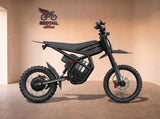
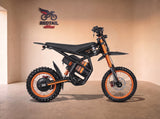
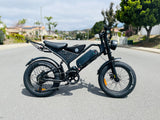
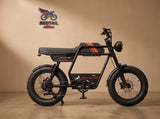
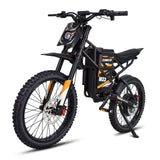


Riding Times GT54 · mini electric dirt bike with footpegs · $699 on November 18, 2026, $599 with code REDTAIL100 through November 30 · 2,000 W peak rear hub motor · 290 N·m · one 48 V 27 Ah pack, 1,296 Wh · 62 miles as Riding'times publishes it · Limited Mode 15.5 mph · 106.5 lb · 220 lb max load · rider height 4'2" to 5'9" · verified November 16, 2026
Quick Answer — At $699, the Riding'times GT54 fits a 2,000 W peak rear hub motor, 290 N·m and a removable 48 V pack of 1,296 Wh into a 106.5 lb mini dirt bike with footpegs. Held at Limited Mode's 15.5 mph cap on the throttle, that pack carries a 180 lb rider about 61 miles across level pavement.
At 20 mph the same charge covers about 46 miles, and at 10 mph up a steady 4% grade it lasts about 21. Riding'times prints 62 miles in its headline strip and 60 on a badge lower on the page; the range section turns your speed, gear, climbing, load, temperature and tires into miles for the ride you have in mind.
No pedals appear on its box list, and the product page gives its top gear 40 mph. The federal e-bike definition opens with "fully operable pedals", so the GT54 falls outside it; the class section explains what that means for where you ride.
On November 18, 2026, our store sold the GT54 for $699, with $1,999 shown as the regular price, and code REDTAIL100 takes $100 off at checkout until 11:59 PM Pacific on November 30: $599. The button applies the code for you. Delivery is free within the contiguous United States, and warranty claims start with our US support desk.
Buy it with code: $599What this review covers
What $699 buys · What it is · Will it fit you · Motor and speed gears · The pack · How far it goes · Brakes, lights and display · Suspension, tires and water · Weight and load · The Mercer fit test · UL · Recalls · The class question · Where to ride it · Green and red flags · The verdict · Checklist · Buying it from us · FAQ · Limitations · The bottom line · References
How we verified this Riding Times GT54 review
We took the figures below from Riding'times, our store and the statutes on September 26, 2026, and again on November 16; our price and the November code were re-read on November 18. The sources are Riding'times' GT54 product page, its product record, the Riding'times FAQ, two of its GT54 blog posts, its warranty page, our listing and the statutes in the class section.
Range and fit are worked out by formula; the last subsection of each shows the arithmetic and a source for every input. Specification-verified means each specification figure was checked against what the maker publishes and recomputed, and the range model had to reproduce the road-cycling benchmark it is built on before it priced a ride. Because the GT54 is one of ours, read its red flags as closely as its green ones.
Written by Milad Ghobadibeygvand, BScN (Western University, 2014). Corrections: support@redtailebikes.com.
What $699 buys
| Riding'times' published figure | |
|---|---|
| Type | "GT54 Electric Mini Dirt Bike for Teenagers and Adults" |
| Motor | "Peak 2000W Rear Hub Motor"; "2000W Peak Power" in the headline strip |
| Torque | 290 N·m; "Wheel Edge Torque: 290N·m" in the launch post of July 31, 2025 |
| Controller | "48V 32A Controller" in the specification table |
| Battery | "21700 / 48V 27Ah Lithium Battery"; "48V27A removable battery" in the FAQ |
| Energy | 48 V × 27 Ah = 1,296 Wh; "1300Wh Battery" in the headline strip |
| Range | "62miles Max Range" in the headline strip; "60 miles Max Range" on a badge lower on the page |
| Top speed | "40 MPH" in the specification table and the headline strip; 39 mph in the page title and the FAQ; "Load capacity of 143 lb measured at 40 MPH" in the GT54 vs GT54 Pro table |
| Gear 1 | 16 mph in the product page's GT54 vs GT54 Pro table and 15 mph in its key-differences block; 15.5 mph (ECO, 25 km/h) in the FAQ |
| Gear 2 | 22 mph on the product page; 28 mph (STD, 45 km/h) in the FAQ |
| Gear 3 | 40 mph on the product page; 39 mph (TURBO, 63 km/h) in the FAQ |
| Limited Mode | 25 km/h (15.5 mph) on every throttle level |
| Charger | One, "54.6V / 3A" |
| Brakes | "Front and rear disc hydraulic brake + electronic brake" |
| Suspension | "All-aluminum Barrel Axle Inverted Fork + Rear Suspension" |
| Front travel | 8.3 in ("Front Suspension Travel 8.3 in") |
| Tires | 60/100-14 front, 60/100-12 rear |
| Lights | "LED headlight + LED taillight + turn signal light" |
| Water resistance | The FAQ gives all models "an IPX5-rated exterior" |
| Weight | 106.5 lb; "About 105lbs (47.8kg)" in the post of July 31, 2025 |
| Max load | 220 lb; "Load Range: 88–220 lbs (40–100 kg)" in the post of July 31, 2025 |
| Size | 59.76 × 26.38 × 39.76 in (L × W × H); the geometry block gives 59.1 in long and 43.3 in high |
| Wheelbase | 41.7 in |
| Seat height | 27.2 in; tail height 31.1 in |
| Pedal ground clearance | 11.0 in |
| Rider height | 4'2" to 5'9" in the geometry block; 140–185 cm in the FAQ |
| Age | "Recommended Age: 10 years and above" (FAQ); "Minimum Age: 16 years" (post of July 31, 2025) |
| In the box | The bike, the 60/100-14 front wheel, the front fender, a 236 × 15 mm front axle, a 54.6 V 3 A charger, the user manual, two open-end wrenches marked "22#" and three hex wrenches (4, 5 and 6 mm) |
| Shipping carton | 55.91 × 11.02 × 31.50 in |
Each row was taken on November 16, 2026, from the GT54 product page, its product record, the FAQ and Riding'times' launch post of July 31, 2025. A row with two figures in it is one where those documents print different numbers for the same thing.
The Riding Times GT54: a 2,000 W mini electric dirt bike with footpegs
Riding'times names it the "GT54 Electric Mini Dirt Bike for Teenagers and Adults", under the line "2000W Peak Power • 48V 27Ah Removable Battery • Compact Mini Electric Dirt Bike". Its FAQ on the same page calls the GT54 "a compact mini electric dirt bike with 2000W peak power and a removable 48V 27Ah battery."

The left side: the orange inverted fork at the front, the pack inside the frame's cradle, the rear disc and its red caliper, and the bench seat running back to the tail light.
Riding'times writes its buyer into the product record: "The Riding'times GT54 is designed for riders looking for a compact and versatile electric bike that makes outdoor adventures simple and enjoyable." Lower down it adds: "Rather than focusing solely on performance numbers, the GT54 emphasizes riding enjoyment and accessibility."
Put next to its own specification, that approachable description sits on a 2,000 W peak motor and a 40 mph top gear. By the page's own list, its ground is "neighborhood riding, gravel paths, packed dirt, campgrounds and permitted recreational riding areas"; which of those near you will admit a machine like this one is the class question.

From the front, right side: the handlebar and display over the number plate with its orange graphics, the kickstand down, and the knobby front tire on its orange rim.
The rider's feet go on footpegs. Nothing for pedaling is on the box list, which runs to the bike, front wheel, front fender, front axle, charger, manual and wrenches, and Riding'times' FAQ keeps the GT54 and GT54 Pro out of the group of four it calls "equipped with pedals". In Riding'times' photographs the peg is a cleated platform, bolted where the frame's lower cradle ends at the back.

The footpeg close up: a cleated black platform on a folding mount at the rear of the frame cradle, with the pack behind it and the swingarm to the left.
One Riding'times document reads differently. Its blog post of May 27, 2026, on pedal conversions says: "The GT54 is a little different, since it comes with pedals but no chain, so it is not set up as a traditional pedal-drive bike." Either way, nothing turns the rear wheel on the GT54 except its motor, and the class section takes that up.
A bent or worn peg can be replaced: the part, "E-Bike Foot Pegs for Riding'times GT54 / GT73 Series", is in our Riding'times parts collection. Our footpeg listing says "all parts and accessories are final sale", so we check the version that fits your GT54 before the order goes in.
GT54 or GT54 Pro?
Riding'times gives both models the same tires, brakes, lights and geometry on the GT54's page. For $200 more on our store, the Pro steps up to a 60 V platform, a higher peak rating, more torque and a bigger pack:
| GT54 | GT54 Pro | |
|---|---|---|
| Motor | "Peak 2000W" | "Peak 3000W" |
| Torque | 290 N·m | 338 N·m |
| Battery | 48 V 27 Ah, 1,296 Wh | 60 V 25 Ah, 1,500 Wh |
| Controller, specification tables | 48 V 32 A | 60 V 40 A |
| Charger | 54.6 V 3 A | 67.2 V 3 A |
| Throttle gears, GT54 vs GT54 Pro table | 16, 22 and 40 mph | 16, 28 and 50 mph |
| Throttle speed modes, key-differences block | 15, 22 and 40 mph | 15, 28 and 50 mph |
| Front suspension, specification tables | "All-aluminum Barrel Axle Inverted Fork" | "Front Hydraulic Double Wishbone Suspension with Adjustable Damping" |
| Weight | 106.5 lb | 102.5 lb |
| Computed, 15.5 mph on the throttle, 180 lb rider | 61 mi | 66 mi |
| Price on our store | $699 | $899 |
The GT54 vs GT54 Pro table and the key-differences block on Riding'times' GT54 page, each model's specification table and our two listings, read November 16, 2026; the GT54 Pro's own page prints gear 1 as 15 mph for both. The computed row runs each bike's published figures through the range model on this page. Our GT54 Pro review covers the Pro in the same depth.
One line of the GT54 page's FAQ sums up the difference: "The GT54 uses a 2000W peak motor and 48V battery platform, while the GT54 Pro moves to a 3000W peak configuration and 60V battery platform with upgraded hardware."
Riding Times GT54 vs GT73
The GT73 is the full-size machine: pedals in the box, 19-inch wheels, two packs and a 330 lb max load, for $650 more.
| GT54 | GT73 | |
|---|---|---|
| Pedals | footpegs; the box list names no pedals | yes, in the box |
| Wheels | 60/100-14 front, 60/100-12 rear | 70/100-19 front and rear |
| Battery | one 48 V 27 Ah pack, 1,296 Wh | two 48 V 18.2 Ah packs, 1,747 Wh |
| Weight | 106.5 lb | 116 lb |
| Max load | 220 lb | 330 lb |
| Rider height, geometry block | 4'2" to 5'9" | 5'3" to 6'3" |
| Computed, 15.5 mph on the throttle, 180 lb rider | 61 mi | 83 mi |
| Price on our store | $699 | $1,349 |
Read November 16, 2026, from both machines' specification tables and geometry blocks on Riding'times' product pages and from our two listings; for the full-size machine, read our GT73 review.
Size is how Riding'times separates them on the GT54's page, where the GT54 "uses a compact, dirt-bike-inspired platform that is smaller and easier to maneuver than the full-size GT73 family."
Will the GT54 fit you?
The GT54's seat does not adjust, and on Riding'times' own photograph its lowest point stands 30.2 inches off the ground, so your inseam sets how a stop feels: seated, 66 of 100 riders at 5'4" and 95 of 100 at 5'6" put both feet flat, and every surveyed rider from 5'9" up does.
The tables test 6,068 bodies from the US Army's 2012 anthropometric survey, each set against Riding'times' published dimensions and its side-profile photograph of the GT54. With footpegs there is no pedal stroke to size; what matters is whether you can touch down at a stop, how high your knees ride on the pegs, and how far you reach for the bars.
Three measurements place you:
- Measure your inseam. Heels against a wall in socks, lift a hardback book squarely up into your crotch, mark the wall along its top, and measure that mark's height from the floor.
- Find your height in the foot-down table. For each height it gives the riders in 100 who stand both feet flat, once with the seat at 30.2 inches and once at 27.2.
- Measure the back of your knee. On a firm chair, thighs level and knees bent square, measure from the floor up to the crease behind your knee; the knee table compares that height with the pegs.
Riding'times sizes the GT54 for riders 4'2" to 5'9" in the product page's geometry block and 140 to 185 cm (4'7" to 6'1") in its FAQ. The tables below set both windows beside the model's rows. Under 5'0" the survey holds too few bodies to fill a row; riders that short should trust their own three measurements.
| What Riding'times publishes | Its figure | On its photograph |
|---|---|---|
| Rider height | 4'2" to 5'9" (geometry block); 140–185 cm (FAQ) | not measurable |
| Seat height | 27.2 in | 30.2 in at the seat's lowest point |
| Tail height | 31.1 in | 31.5 in |
| Pedal ground clearance | 11.0 in | the footpeg's top at 11.6 in |

The geometry drawing from the GT54's product page, shown with the eight figures listed beside it. Scaled by its own wheelbase line, the drawing's heights do not match those figures, so nothing on this page is measured from it.
Is it too small for you? Where your knees sit on the pegs
No, for most riders up to 6'2": the pegs sit 18.6 inches below the seat, more than the median back-of-knee height anywhere in the table, which leaves the thigh level or tipping down toward the knee; at 6'2", 67 of 100 riders still keep a level thigh.
Back-of-knee height is the survey's popliteal height, "the vertical distance from a footrest to the back of the right knee", measured as the subject "sits with the thighs parallel, the knees flexed 90°" (the survey's measurer's handbook, § 6.4.67). Set a seat that far above the footrest and the thigh lies level with the knee at a right angle; bring the two closer and the knee rises.
Here the drop is measured from the seat's lowest point on Riding'times' photograph, 30.2 inches off the ground, down to the top of the footpeg at 11.6 inches. Both sit on the sprung frame, so when the suspension settles under your weight they sink together and the gap between them stays the same.
| Your height | Back of knee to floor, seated | Knee above a level thigh, median rider | Thighs level or lower, of 100 |
|---|---|---|---|
| 5'0" | 13.3–14.9 in | −4.5 in | 100 |
| 5'2" | 13.8–15.4 in | −3.8 in | 100 |
| 5'4" | 14.3–16.1 in | −3.3 in | 100 |
| 5'6" | 15.1–16.9 in | −2.7 in | 100 |
| 5'8" | 15.7–17.4 in | −2.0 in | 100 |
| 5'10" | 16.3–18.1 in | −1.4 in | 99 |
| 6'0" | 16.8–18.8 in | −0.8 in | 90 |
| 6'2" | 17.4–19.1 in | −0.2 in | 67 |
For each height: the 5th-to-95th-percentile spread of back-of-knee heights, how far the median rider's knee sits above a level thigh with the feet on the pegs, and the riders of 100 whose thigh sits level or slopes down; a minus sign puts the knee below the seat's line. Army survey bodies, men and women together.
Between 5'0" and 5'10", the median rider's knee sits 4.5 to 1.4 inches below the line of a level thigh. Taller riders' knees climb toward level, and boots count too: each inch of sole raises the knee by the same inch.
Can I put a foot down at a stop?
That depends on your inseam and on which seat height your GT54 turns out to have: at the photograph's 30.2 inches, 27 of 100 riders at 5'2" put both feet flat and 95 of 100 at 5'6"; at Riding'times' printed 27.2 inches, 99 of 100 at 5'2" do. You stay seated astride when you stop, so your legs have to reach down past the seat.
The geometry block prints the seat at 27.2 inches. Its side-profile photograph, scaled by the published 41.7-inch wheelbase, puts the low point of the seat, where you actually sit, at 30.2 inches. Until you have sat on one, plan around 30.2.
| Your height | Typical inseam | Flat-footed at 30.2 in, of 100 | At 27.2 in, of 100 |
|---|---|---|---|
| 5'0" | 27.1–29.7 in | 2 | 93 |
| 5'2" | 28.0–31.1 in | 27 | 99 |
| 5'4" | 29.1–32.2 in | 66 | 100 |
| 5'6" | 30.2–33.5 in | 95 | 100 |
| 5'8" | 31.1–34.3 in | 100 | 100 |
| 5'10" | 32.2–35.5 in | 100 | 100 |
| 6'0" | 33.2–36.7 in | 100 | 100 |
| 6'2" | 34.3–37.5 in | 100 | 100 |
How many of 100 riders at each height have an inseam at least as long as the seat is high, first at the 30.2 inches measured on Riding'times' photograph, then at the 27.2 its geometry block prints. The typical-inseam column is the survey's crotch height, 5th to 95th percentile.
Will I feel cramped, or stretched?
Upright and close-coupled: every surveyed rider from 5'0" to 6'2" reaches the grips sitting straight, with the median rider's elbows bent 74 to 85 degrees. The grips are 12.0 to 13.4 inches forward of the footpeg and 28.0 to 28.5 inches above its center, near the seat, so your arms bend to meet them, the shortest riders' most of all.
Twenty recreational cyclists who tried three trunk positions rated the most upright the most comfortable (Priego Quesada et al., 2017); every height in the table sits on the GT54 that way.
| Your height | Lean from upright, median rider | Riders who reach the grips sitting upright, of 100 | Elbow bend sitting upright, median rider |
|---|---|---|---|
| 5'0" | 0° | 100 | 74° |
| 5'2" | 0° | 100 | 76° |
| 5'4" | 0° | 100 | 78° |
| 5'6" | 0° | 100 | 80° |
| 5'8" | 0° | 100 | 82° |
| 5'10" | 0° | 100 | 83° |
| 6'0" | 0° | 100 | 84° |
| 6'2" | 0° | 100 | 85° |
For each height: how far the median rider tips forward from vertical to reach the GT54's grips, how many of 100 reach them without tipping at all, and the median elbow angle sitting straight. Every figure uses that body's own measured torso and arms, and the grip position taken from Riding'times' photograph.
How much weight goes through my wrists?
Hardly any: about 6 percent of your body weight for the median rider, back relaxed. In Carahalios's laboratory, ten road racers on the brake hoods put 15% of their weight on the bars (Carahalios, 2015); with the GT54's grips high and close, the median rider's relaxed-back ceiling stays under half of that at every height in the table.
Off the pavement your hands still take every bump, and Riding'times' FAQ puts "Protective gloves" on its safety list.
| Your height | Share of your weight, back relaxed | Median rider's weight | On each hand |
|---|---|---|---|
| 5'0" | 6% (5–8%) | 126 lb | about 4 lb |
| 5'2" | 6% (5–8%) | 139 lb | about 4 lb |
| 5'4" | 6% (5–7%) | 147 lb | about 4 lb |
| 5'6" | 6% (5–8%) | 166 lb | about 5 lb |
| 5'8" | 6% (5–8%) | 179 lb | about 6 lb |
| 5'10" | 6% (5–8%) | 192 lb | about 6 lb |
| 6'0" | 6% (5–8%) | 204 lb | about 6 lb |
| 6'2" | 6% (5–7%) | 216 lb | about 7 lb |
A ceiling on the hands' share with the back relaxed, built from each body's segment weights (Clauser et al., 1969); the bracket spans the seat and grip positions measured on the GT54, and the pounds use the survey's median weight at each height.
How do I set it up when it arrives?
The seat and pegs do not adjust, so setting up means fitting the front end. The box list holds the front wheel, the front fender, a 236 × 15 mm front axle, two open-end wrenches marked "22#" and hex wrenches in 4, 5 and 6 mm, and Riding'times' FAQ lists the "Front wheel", the "Handlebars" and the "Front fender or accessories" among the parts you fit yourself.
Riding'times adds: "Make sure all bolts and fasteners are properly tightened during assembly." After your first few rides, go over the axle, the handlebar clamp and the fender bolts again. Riding'times' advice for buyers who want help with the build is "seeking assistance from a local bike shop or qualified technician."
How we computed fit
Foot-down clearance is inseam minus the seat's height; the knee figure is back-of-knee height minus the seat-to-peg drop; lean is the smallest trunk angle at which a straight arm reaches the grip; hand load is the upper body's weight times its lean, divided by the reach to the grip.
Worked for a 5'8" rider with the survey's median 32.6-inch inseam and median 16.5-inch back-of-knee height: the inseam clears the 30.2-inch seat by 2.5 inches, and on the 18.6-inch drop the thigh slopes 2.0 inches down to the knee.
| Input | Value | Source |
|---|---|---|
| Rider bodies | 6,068 (4,082 men, 1,986 women) | US Army ANSUR II, 2012 |
| Back-of-knee height | the survey's popliteal height: footrest to the back of the knee, thighs level, knees at 90° | Hotzman et al., 2011, § 6.4.67 |
| Seat height | 30.2 in at its lowest point; 27.2 in printed | measured on Riding'times' photograph; its geometry block |
| Footpeg top | 11.6 in | measured on Riding'times' photograph |
| Footpeg center | 11.2 in, its underside placed 0.77 in below the top | Riding'times' photograph; the same peg measured on its GT54 Pro render |
| Grip center | 12.0–13.4 in ahead of the footpeg, 28.0–28.5 in above its center | measured on Riding'times' photograph |
| Segment weights | head and trunk 58.0%, each arm 4.9% of body weight | Clauser et al., 1969 |
Before any measurement was taken from the photograph, it was checked against Riding'times' own figures.
| Dimension | Maker lists | Measured on its photograph | Gap |
|---|---|---|---|
| overall length | 59.1 in | 61.0 in | +3.3% |
| overall height | 43.3 in | 40.7 in | −6.0% |
| seat height | 27.2 in | 30.2 in | +10.9% |
| pedal ground clearance, at the footpeg | 11.0 in | 10.9 in | −1.3% |
| tail height | 31.1 in | 31.5 in | +1.1% |
| overall length, spec table | 59.8 in | 61.0 in | +2.2% |
| overall height, spec table | 39.8 in | 40.7 in | +2.4% |
Every measurement takes its scale from the axle centers on Riding'times' GT54 side profile, set to the published 41.7-inch wheelbase; the spec table's 59.76 and 39.76 inches appear rounded to one decimal. Five of the seven checks land within 3.5 percent of the published figure. The geometry block's overall height and seat height do not, so the seat comes from the photograph and the foot-down table carries both seat figures.
On the border between two rows, or shorter than the tables reach? Email support@redtailebikes.com three numbers, your height, inseam and back-of-knee height, and we will tell you how the GT54's seat and pegs suit them before you order. Our store lists it at $699, with delivery included.
Buy it, delivered freeA 2,000 W peak hub motor, 290 N·m and three speed gears
On the specification table, the motor is a "Peak 2000W Rear Hub Motor" making 290 N·m, behind a "48V 32A Controller"; the headline strip says "2000W Peak Power" again. "Peak" means what the motor can give in a short burst, and Riding'times' launch post of July 31, 2025, labels the torque "Wheel Edge Torque".

The rear hub motor close up, inside the orange rim, with the spokes crossing its case and the rotor and red caliper in front of it.
The page's FAQ places the motor in the rear wheel: "The GT54 uses a rear hub motor that delivers electric power directly to the rear wheel." There is no crank and no chain, so every bit of drive comes through the throttle.
Riding'times splits the speeds into two programs in its FAQ, while the product page carries separate figures for the three gears:
| Setting | Gear 1 | Gear 2 | Gear 3 |
|---|---|---|---|
| Limited Mode | 15.5 mph | 15.5 mph | 15.5 mph |
| Unlimited Mode, FAQ | 15.5 mph (25 km/h, ECO) | 28 mph (45 km/h, STD) | 39 mph (63 km/h, TURBO) |
| Unlimited Mode, product page's GT54 vs GT54 Pro table | 16 mph | 22 mph | 40 mph |
| Unlimited Mode, product page's key-differences block | 15 mph | 22 mph | 40 mph |
Riding'times' FAQ, "What is the speed for each model?", and the GT54 vs GT54 Pro table and key-differences block on the GT54's product page, read November 16, 2026; the kilometer figures and the mile conversions are Riding'times'.
Limited Mode, in the FAQ's description, "is a speed-restricted riding mode designed to comply with local eBike regulations in many regions"; switched on, it means "the maximum speed of the eBike is capped at 25 km/h (15.5 mph) regardless of the selected pedal-assist or throttle level."
At the top end the documents print two figures: "40 MPH" in the specification table and the headline strip, and 39 mph in the page title and in the FAQ's "2000W brushless motor , 39 mph max speed". The GT54 vs GT54 Pro table adds the conditions: "Load capacity of 143 lb measured at 40 MPH".

The cockpit from the seat: the display at the center of the bar, the switch pod with its mode buttons on the left, the ignition key on the right, and the red fork caps below.
One 48 V 27 Ah pack, 1,296 Wh
At 48 V and 27 Ah, the pack holds 1,296 watt-hours, rounded to "1300Wh Battery" in Riding'times' headline strip. Its specification table names "21700 / 48V 27Ah Lithium Battery", and the page adds that "The removable design gives riders the flexibility to charge the battery on or off the bike." Riding'times' launch post puts the pack at "a neat 15lbs".
One charger comes in the box, 54.6 V at 3 A. Refilling all 27 Ah at 3 A takes about 9 hours at the least, so an empty pack is an overnight charge.
Three checks come first in the FAQ before any charge: "The battery power switch is turned OFF", "The eBike is completely powered OFF" and "The charger and charging port are clean and dry". It also asks for "the original charger supplied with the eBike."
For a long layup, the same FAQ recommends a charge between 40% and 60%, a dry indoor spot above 0°C (32°F), a top-up "every 1–2 months", and the pack off the bike where possible, warning that "Long-term storage with a fully depleted battery may reduce battery lifespan."
How far the GT54 goes on one charge
On level pavement a 180 lb rider gets about 61 miles from a full charge at 15.5 mph on the throttle, 46 at 20 mph and 40 at 22 mph, gear 2's cap on the product page. Up an 8% grade at 10 mph, a full pack covers 9 miles.
To estimate your own ride:
- Look up the speed you hold in the speed table, or the gear you ride in the gear table.
- Every 1,000 feet of climbing draws 223 to 288 Wh of the pack's 1,296 (10 mph on the throttle, 4 to 8% grades; the hills table).
- Adjust that for your load and the air temperature, then count on three quarters of it.
Behind every row is a single steady ride, worked out from Riding'times' specification, Bafang's published figures for a comparable geared hub motor, drum measurements of knobby tires, the GT54's own tire size and a cycling-power model validated on an open road. To see the arithmetic for a single ride, step by step, go to the formula subsection.
Does riding faster cut range? Miles at each speed
On level ground, speed matters most: a full charge lasts 84 miles at 10 mph and 27 at 28. Pushing from 15.5 to 20 mph cuts it from 61 miles to 46, since the power spent on the air rises with the cube of speed.
| Speed, flat | Per mile | Full charge | With 25% kept |
|---|---|---|---|
| 10 mph | 15.3 Wh | 84 mi | 63 mi |
| 12 mph | 17.1 Wh | 76 mi | 57 mi |
| 15.5 mph | 21.1 Wh | 61 mi | 46 mi |
| 18 mph | 24.8 Wh | 52 mi | 39 mi |
| 20 mph | 28.2 Wh | 46 mi | 34 mi |
| 22 mph | 32.2 Wh | 40 mi | 30 mi |
| 25 mph | 39.1 Wh | 33 mi | 25 mi |
| 28 mph | 47.7 Wh | 27 mi | 20 mi |
Each row is a steady throttle ride on level pavement, a 180 lb rider in 77 °F air. The right-hand column keeps 25% of the 1,296 Wh in reserve, as the pedelec in Schmitt, Decker and Doppelbauer's test-bench study did to avoid deep discharge. Rows above 15.5 mph need Unlimited Mode, which the class section takes up; 28 mph is the FAQ's STD figure for gear 2.
Which gear should you ride in? Range by speed setting
Each gear's cap limits your pace, and pace sets the range: about 61 miles in Limited Mode, about 60 in gear 1 at its 16 mph cap, and about 40 in gear 2 at 22 mph. There is nothing to pedal, so the throttle carries every mile, and the speed you hold within the gear's cap decides how far the pack goes.
| Mode | Its speed cap | Full charge at the cap | With 25% kept |
|---|---|---|---|
| Limited mode | 15.5 mph | 61 mi | 46 mi |
| Gear 1 | 16 mph | 60 mi | 45 mi |
| Gear 2 | 22 mph | 40 mi | 30 mi |
Level pavement, a 180 lb rider, each setting held at the cap the product page's GT54 vs GT54 Pro table prints. Its key-differences block puts gear 1 at 15 mph; held there, the ride runs a little past Limited Mode's 61 miles, because range rises as speed falls in every row of the speed table.
There is no gear 3 row: with that rider the model's comparable 1,000 W motor tops out near 28.6 mph on the flat, well short of the 40 mph Riding'times rates gear 3 at, so the model cannot price it. The FAQ's 28 mph for gear 2 is the last row of the speed table.
Riding'times' FAQ makes the same point in its cold-weather advice: "Use lower assist levels when possible".
Does going uphill drain the battery faster?
Yes, and more so as the grade steepens: at 10 mph on the throttle, every 1,000 feet the GT54 climbs on a 4 to 8% grade costs 223 to 288 Wh over the same distance on the level. Just 38 to 48% of that extra energy raises you and the bike; the motor and the pack lose the remainder, and they lose more of it the steeper the climb.
Rider and machine together come to 286.5 lb, 180 plus the GT54's 106.5, and lifting that much through 1,000 feet takes 108 Wh at the rear wheel on its own.
At 10 mph up 8%, each 1,000 feet takes 324 Wh, so the full 1,296 Wh would raise you roughly 4,000 feet and leave nothing for level ground. Descents earn nothing back in the model, yet rolling downhill uses less than the same distance on the flat, so a budget drawn from these rows has a little slack in it.
| Grade | Per mile, throttle | Full charge, throttle |
|---|---|---|
| 2% | 36 Wh | 36 mi |
| 4% | 62 Wh | 21 mi |
| 6% | 96 Wh | 14 mi |
| 8% | 136 Wh | 9 mi |
10 mph and a 180 lb rider on the throttle. The model caps the motor's draw at what the "48V 32A Controller" can feed, 48 V × 32 A = 1,536 W. Holding 10 mph up 10% or steeper asks more than that, so those grades are left out: on them the GT54 climbs more slowly.
For a hilly ride, price the level miles, then add the climbing. A 180 lb rider on the throttle draws about 421.7 Wh from the GT54's pack over twenty level miles at 15.5 mph; 1,000 feet of 8% climbing adds about 287.6, for about 709.2 Wh of the 1,296. Real rides cost more again with headwinds, stops and restarts, since the model holds one unbroken pace for every mile.
Does rider weight affect range?
On level ground a heavier load barely shows; on a hill it shows plainly. It makes the tires and the grade harder work while leaving the air's share alone, so the penalty grows as the road climbs.
| You plus your load | 15.5 mph flat, throttle | 20 mph flat, throttle | 8% climb, 10 mph |
|---|---|---|---|
| 100 lb | 72 mi | 51 mi | 15 mi |
| 130 lb | 67 mi | 49 mi | 13 mi |
| 180 lb | 61 mi | 46 mi | 9 mi |
| 220 lb | 57 mi | 44 mi | 8 mi |
The first column is the rider plus everything carried; the model adds the GT54's own 106.5 lb to each row, since the motor hauls the bike as well, and every figure is on the throttle. The 220 lb row is Riding'times' max load, a limit its FAQ applies to "Rider weight", "Passenger weight (if applicable)" and "Cargo and accessories" together.
Loading it to the full 220 lb in place of 180 lb shortens the level 15.5 mph ride from 61 miles to 57. Even fully loaded, the GT54 holds 10 mph up an 8% grade on the throttle for about 8 miles a charge, inside the controller's 1,536 W.
Does cold weather drain the battery?
Yes, and the loss deepens as the temperature falls. A 180 lb rider holding 15.5 mph on the throttle over level pavement gets 61 miles at 77 °F and about 48 at 32 °F, 22% less, within the 10% to 30% cold-weather loss Riding'times' FAQ describes.
| Air | Pack energy vs 77 °F | 15.5 mph flat, throttle |
|---|---|---|
| 95 °F | 99% | 65 mi |
| 77 °F | 100% | 61 mi |
| 68 °F | 98% | 58 mi |
| 50 °F | 93% | 52 mi |
| 41 °F | 91% | 49 mi |
| 32 °F | 89% (80–93) | 48 mi (43–50) |
| 14 °F | 82% (40–83) | 43 mi (21–43) |
Level pavement and a 180 lb rider. The middle figures come from McMaster University's measurements of an LG HG2 cell, recomputed for a 0.5C discharge: the laboratory ran it at 77, 50, 32 and 14 °F, the rows between are interpolated, and the model assumes the cells sit at the air's temperature.
In brackets, the range other published cell data would give. The low figure is the smallest capacity a Samsung data sheet prints at that temperature for a discharge of one to four times the cell's capacity per hour (the 25R and 30Q at 32 °F, the 35E at 14 °F); the high figure is the most energy Casado and colleagues recorded in 2025 at a gentler rate.
Three losses pile up below freezing. At 32 °F the cells deliver about 89% of what they give at 77 °F, and the air is about 9% denser, by the gas law in the U.S. Standard Atmosphere. Tires lose too: the model raises rolling resistance 0.5% per °F below 77 °F, between Rothhämel's fit for a bicycle tire and Bicycle Rolling Resistance's road-tire average, and keeps the 41 °F value for anything colder.
Riding'times' FAQ is relaxed about cold rides and strict about cold storage, warning that "prolonged exposure to freezing temperatures may cause permanent battery damage". At 15 lb by the maker's own figure, the pack is easy to take indoors between winter rides.
Do knobby tires cut range? Tires and riding position
On level ground, the rubber under you costs more range than the way you sit. No 60/100-12 motorcycle tire has been on the bicycle drum the model relies on, so it takes the heaviest-rolling knobby casings Bicycle Rolling Resistance has measured, a coefficient of 0.0126, bracketed by Tengattini and Bigazzi's field average for 138 riders on knobby tires.
| Rolling resistance | 15.5 mph flat, throttle | 20 mph flat, throttle |
|---|---|---|
| 0.0092 · the knobby field average, 138 riders | 71 mi | 51 mi |
| 0.0126 · the heaviest knobby casings on the drum (used) | 61 mi | 46 mi |
| 0.0131 · the field average plus one standard deviation | 60 mi | 45 mi |
Miles from a full pack, 180 lb rider, level pavement. The drum's heaviest-rolling knobby casings, the ones the middle row uses, are Kenda's Juggernaut Pro (0.01262 on the site) and Schwalbe's Hans Dampf at extra-low pressure.
Off the pavement, expect fewer miles than the matching row here: the rolling-resistance drum behind these figures has no reading for sand, loose dirt or wet grass.
The faster you ride, the more your posture counts. The model's drag area, 0.640 m², is what Tengattini and Bigazzi measured on 37 upright cruiser riders; swap in their 0.603 m² for 90 mountain-bike riders and the 20 mph ride stretches from 46 miles to 48.
Riding'times' 62 and 60 miles, matched to a real ride
A 180 lb rider on the throttle reaches Riding'times' 62 miles at a steady 15.4 mph or so on level pavement, and its 60 miles at about 15.9 mph. Both come with a caveat on the product page: "Actual range varies with rider weight, speed, terrain, temperature and riding conditions."
- 62 miles leaves 20.9 Wh a mile: about 15.4 mph on the throttle for a 180 lb rider.
- 60 miles leaves 21.6 Wh a mile: about 15.9 mph on the throttle for a 180 lb rider.
Both figures land within half a mile an hour of Limited Mode's 15.5 mph, and the model's own 15.5 mph ride, 61 miles, sits between them. Riding'times' launch post described its figure as "Up to 62 miles (100km) at steady speed on flat roads", which is the kind of ride the model prices.
Plan each ride on three quarters of its row's figure. Leaving a pack run flat in storage is something Riding'times' FAQ warns against, and one measured pedelec kept a quarter of its pack back. At 15.5 mph on the throttle over level pavement, a 180 lb rider then has 46 of the GT54's 61 miles to plan around.
Keep a quarter of the pack in hand. Each 1,000 feet of climbing at 10 mph takes 223 to 288 Wh of the 1,296. On level pavement a 180 lb rider can then plan on 46 miles at 15.5 mph on the throttle, or 34 at 20.
Twenty level miles at 15.5 mph plus 1,000 feet of 8% climbing use about 709 Wh for a 180 lb rider on the throttle, within the 972 Wh that three quarters of the GT54's pack holds. Tell us the ride you have in mind (distance, climbing, weight with gear, the speed you like) at support@redtailebikes.com, and we will put it through the model before you buy.
Buy the GT54 nowHow every figure here is worked out
Every figure in this section starts from the power the GT54's rear wheel must deliver to hold one speed. Martin and colleagues' model, checked against measurements on an open road in 1998, puts that power in a single equation for a constant speed in still air:
Power at the wheel = v × [ m × g × (Crr × cos θ + sin θ) + ½ × ρ × CdA × v² ]
In it, v is speed; m is the mass of rider, cargo and GT54 together; g is gravity; θ is the slope's angle; Crr is the tires' rolling resistance (0.0126 means a drag equal to 1.26% of the weight on the tires); ρ is the air's density; and CdA, the drag area, measures how much air rider and bike shove aside.
The first term in brackets covers the tires and the grade, the second the air; multiplied by v, the air's term grows with the cube of the speed.
Three steps lie between the wheel and the battery:
- The rear hub motor does all the work, turning with the wheel; with footpegs in place of a crank, the rider adds nothing.
- The motor model borrows a comparable motor's published figures. With no motor maker named by Riding'times, it uses the RM G0H0 geared hub from Bafang's 2021 OEM workbook: n0 510 rpm, nT 426 rpm, 1,000 W rated and an efficiency of "≥ 80" percent. That shape is kept at the GT54's 48 V, with the no-load speed set from Riding'times' own 40 mph, so the comparable's losses carry over unchanged.
- The pack gives up a small share of its energy as internal loss, at the battery efficiency Arango, Lopez and Ceren measured.
Two last lines turn those watts into miles: watt-hours per mile = battery watts ÷ mph, then miles = 1,296 Wh × the share of the pack's energy left at that temperature ÷ watt-hours per mile.
| Input | Value used | Where it comes from |
|---|---|---|
| Bike | 106.5 lb | Riding'times' specification |
| Rider and cargo | 180 lb; the weight table also runs 100, 130 and 220 | 220 lb is Riding'times' max load |
| Battery | 48 V × 27 Ah = 1,296 Wh | Riding'times' specification |
| Motor | one, the RM G0H0's 1,000 W shape at 48 V, no-load speed from the published 40 mph, 80% at the rated point | Bafang OEM workbook 2021; Riding'times' specification |
| Controller cap | 48 V × 32 A = 1,536 W | Riding'times' specification |
| Wheel | 16.72 inches across, the 60/100-12 size code's arithmetic | the size code, checked against Michelin's published StarCross 5 diameters |
| Rolling resistance | 0.0126, the heaviest knobby casings on the drum | Bicycle Rolling Resistance |
| Drag area | 0.640 m², 37 upright cruiser riders | Tengattini and Bigazzi, 2018 |
| Battery losses | 3.2% at 15.5 mph, more at climbing currents | Arango, Lopez and Ceren, 2021 |
| Air | 77 °F at sea-level pressure, 1.184 kg/m³ | U.S. Standard Atmosphere, 1976 |
| Cold | the share of a cell's energy left at each temperature | McMaster University's LG HG2 cell data |
A 15.5 mph ride on the GT54, worked step by step: 180 lb rider, throttle, level pavement. Rolling resistance claims about 112 W and the air about 126 W, 238 W in all at the rear wheel.
At 15.5 mph the 16.72-inch wheel turns 312 rpm. The motor model's constants, 0.570 N·m of torque per amp, a 0.304 Ω winding and a 1.10 A no-load current, are each derived from Bafang's published figures; with them, that load takes 7.3 N·m on 13.9 A, and the motor runs at 75.1% efficiency, short of its 80% because the load is light, drawing 316.5 W.
Add the pack's own losses and the battery must supply 326.8 W, which is 21.08 Wh for each mile at 15.5 mph; 1,296 ÷ 21.08 gives about 61.5 miles, or 46.1 on three quarters of a charge.
Two published benchmarks, recomputed. The road physics and the motor each reproduce the number their source prints:
| Check | Published figure | This model |
|---|---|---|
| Road physics, Martin and colleagues' worked example | 45.7 W for tires and grade, 158.8 W for the air | 45.7 W and 158.8 W |
| The comparable motor at Bafang's rated point | at least 80% efficient | 80% |
The model's self-test reruns Martin and colleagues' Appendix I example, a 90 kg system at 8.36 m/s ground speed on a 0.3% grade, and the RM G0H0's rated point from Bafang's workbook.
Brakes, lights and display
The GT54 stops on a "Front and rear disc hydraulic brake + electronic brake" setup, in Riding'times' specification, and the page describes the system as "designed to give riders predictable control across pavement, gravel and recreational dirt riding", under the labels "Hydraulic Brake" and "Electric Brake Assistant".

The front end close up: the orange fork legs above their silver stanchions, the red hydraulic caliper on the disc, and the knobby 60/100-14 tire.
"Regularly inspect your brakes, tires, and lights before riding," Riding'times' FAQ tells riders. Brake parts for Riding'times machines, when you need replacements, are in our Riding'times parts collection.
Lights are laid out the way a motorcycle's are, with an "LED headlight + LED taillight + turn signal light" for both models in the GT54 vs GT54 Pro table, and the page names a "Smart Display" showing "All Info. At a Glance".
Suspension, tires and water
Riding'times' specification table gives "All-aluminum Barrel Axle Inverted Fork + Rear Suspension", and its geometry block "Front Suspension Travel 8.3 in". By the page's account it is "designed to help manage bumps, uneven pavement, gravel and packed dirt."
Front and rear tires are 60/100-14 and 60/100-12, which the box list sums up as "12/14-inch"; buy replacements by those size codes.

From the front, left side: the number plate and its orange graphics, the pack cradle under the seat, and both knobby tires on their orange rims.
Water: rain is fine, a hose on the electrics is not. Every Riding'times model has "an IPX5-rated exterior", according to the FAQ, meant for "Light rain", "Water splashes" and "Wet roads".
That FAQ also tells riders to "avoid deep water, flooding, or prolonged exposure to heavy rain", and to wash the bike using "A damp cloth", "A soft brush" and "Mild soap and water", keeping water away from the controller, the wiring, the display, the motor's electrics, the battery terminals and the charging ports. Standing water and stream crossings are the conditions it tells you to avoid.
106.5 pounds and a 220-pound max load
The GT54 weighs 106.5 lb by Riding'times' listing, 4 lb more than the GT54 Pro's 102.5, and carries a 220 lb max load. The FAQ breaks that load into "Rider weight", "Passenger weight (if applicable)" and "Cargo and accessories", adding that "The total combined weight should not exceed the recommended limit."
The 220 lb covers everything aboard; the 106.5 lb bike is not part of it. Take a 170 lb rider carrying 25 lb of gear: 195 lb aboard, 25 lb under the limit.
The 143 lb in Riding'times' comparison table is a test condition, not a limit: it reads "Load capacity of 143 lb measured at 40 MPH", the load its top-speed figure was taken with. The limit is the specification table's "MAX LOAD 220LBS", and the launch post of July 31, 2025, gives a load range of "88–220 lbs (40–100 kg)".

Riding'times' own photograph: a rider in a full-face helmet and riding gear on gravel at dusk, the orange fork legs and rims catching the low sun.
Riding'times' dimensions put the bike at 59.76 by 26.38 by 39.76 inches, and its carton at 55.91 × 11.02 × 31.50 inches.
Before ordering, work out where the GT54 will be kept and how you will move it. At 106.5 lb and almost five feet long, it needs ground-level storage such as a garage, and a hitch rack or trailer rated well past its weight.
The Mercer fit test
The Mercers are a family of seven, aged 12 to 63, and this review measures the GT54 against each of them (meet the Mercers).
Every verdict below stands on something Riding'times publishes, whether the max load, the weight, the seat height, the two height windows or the age figures, or on the fit tables' row for that member's height: how many riders that tall stand flat-footed at 30.2 inches, and where their knees fall on the pegs.
| Member | Age · Height | Verdict | The number behind it |
|---|---|---|---|
| Frank Kowalski | 63 · 5'10" | Above the product page's window, inside the FAQ's | 5'10" is above 4'2" to 5'9" and inside 140–185 cm; every rider his height in the survey puts both feet flat at 30.2 inches, and 99 of 100 keep a level or lower thigh on the pegs |
| Ruth Kowalski | 61 · 5'5" | Fits | 5'5" is inside both windows; 85 of 100 riders her height put both feet flat at 30.2 inches, and all 100 keep the thigh level or lower on the pegs |
| Jack Mercer | 48 · 6'1" | Above the product page's window, at the FAQ's top | 6'1" is above 5'9" and at the top of 140–185 cm; the median knee his height sits 0.6 inch below level, 85 of 100 keep a level or lower thigh, and the 220 lb max load counts him and his gear |
| Dana Mercer | 45 · 5'7" | Fits | 5'7" is inside both windows; 99 of 100 riders her height put both feet flat at 30.2 inches, and the 220 lb max load covers her and her gear |
| Maya Torres | 32 · 5'6" | Inside the windows; her commute is the question | 5'6" is inside both windows, and 95 of 100 riders her height put both feet flat at 30.2 inches; for a car-free commute, the class section decides where it may go |
| Cole Mercer | 16 · 5'11" | No | Riding'times' FAQ recommends the GT54 from age 10 and its launch post sets a minimum age of 16; with no working pedals and a 2,000 W peak motor it sits outside the federal definition and California's classes, so your state's rules for that kind of vehicle decide who may ride it, and our answer for a 16-year-old is no |
| Ivy Mercer | 12 · — | No | Riding'times' two age figures disagree, 10 in the FAQ and 16 in the launch post; for a machine outside the e-bike definitions, our answer at 12 is no |
The windows and the ages are where the family splits. At 6'1" Jack is past the product page's window yet the pegs still suit him, with the median rider his height sitting 0.6 inch below a level thigh. At 5'5" Ruth is inside both windows, and 85 of 100 bodies her height reach the ground flat-footed from the photographed seat.
Is it UL certified?
Riding'times says its e-bikes are. Asked "Are Riding'times eBikes UL Certified?", its FAQ replies "Yes" and calls them "certified to applicable UL safety standards, including UL 2272 and UL 2849, depending on the product."
The FAQ also draws the limit of that answer: "UL certification relates to product safety standards. UL certification does not determine whether a vehicle is legal to operate in a specific location." On the GT54's own page the specification table carries no UL line, so the FAQ is where the statement lives.
Has it been recalled?
No. On November 16, 2026, we read every one of the 10,089 recalls in the Consumer Product Safety Commission's recall database, newest November 12, 2026, for the names Riding'times, Riding times, Ridingtimes, ridert, Shenzhen Riding Robot and Riding Robot, and for the model code GT54.
Not one record names the brand, its company or the GT54, and neither do the 389 rows of the CPSC's product safety warnings listing or the 40 recalls in its recall feed.
That empty result counted only because the same read first found records known to be there: recalls naming Ancheer and Specialized in the database, and a known warning in the warnings listing.
The class question: footpegs, 15.5 mph in Limited Mode, 40 mph in gear 3
Settle this before you buy: the GT54 has footpegs rather than working pedals, two speed programs, and a motor figure Riding'times prints above the e-bike lines. The FAQ leaves the law to you: "Riders are responsible for understanding and complying with local laws and regulations."
Under federal law, 15 U.S.C. § 2085(b) describes a low-speed electric bicycle as "a two- or three-wheeled vehicle with fully operable pedals and an electric motor of less than 750 watts (1 h.p.), whose maximum speed on a paved level surface, when powered solely by such a motor while ridden by an operator who weighs 170 pounds, is less than 20 mph."
| The statute's test | The GT54, as Riding'times publishes it |
|---|---|
| Fully operable pedals | none that drive the wheel: the box list names none, the FAQ sets the GT54 models apart from those "equipped with pedals", and the post of May 27, 2026, describes "pedals but no chain" |
| A motor of less than 750 watts | "Peak 2000W Rear Hub Motor"; a 48 V 32 A controller |
| Under 20 mph on motor power alone | 15.5 mph in Limited Mode; gear 1's 16 mph; 22 mph in gear 2 and 40 mph in gear 3 in Unlimited Mode |
Sources: § 2085(b); Riding'times' product page, FAQ and its post of May 27, 2026, read November 16, 2026.
The GT54 falls outside that definition on pedals alone, before speed or watts are even weighed: nothing you do with your legs can turn the rear wheel. Riding'times' own conversion post makes the point about pedals in general: "Decorative or non-functional pedals typically do not satisfy these requirements."
Limited Mode lowers the speed, but the drivetrain and the motor figure stay the same in either program, and your state decides what kind of vehicle the GT54 is on its roads and paths.
The FAQ says the same of the GT54 and GT54 Pro together: "These models are designed with a motorcycle-inspired riding experience and may be subject to different regulations depending on local laws and usage conditions."
California's definition shows how one state draws the line. Its Vehicle Code § 312.5(a), as in force on November 16, 2026, defines an electric bicycle as a bicycle "equipped with fully operable pedals and an electric motor that does not exceed 750 watts of power", and its class 3 "ceases to provide assistance when the bicycle reaches the speed of 28 miles per hour."
| Setting | The speed line | Where the GT54 sits |
|---|---|---|
| Limited Mode 15.5 mph, or gear 1 at 16 mph | Under the federal 20 mph and California's 20 mph class 1 and class 2 lines | Under the speed lines; still without working pedals, and with a motor figure above 750 W |
| Gear 2, 22 mph (28 mph in the FAQ) | Past the 20 mph lines; under class 3's 28 mph, or at it by the FAQ | Past the federal and class 2 speed lines as well |
| Gear 3, 40 mph (39 mph in the FAQ) | Past class 3's 28 mph | Past every speed line as well |
Sources: § 312.5(a), § 2085(b) and Riding'times' FAQ, read November 16, 2026.
For licensing and registration, Riding'times' FAQ sends you to local rules: "Licensing, registration, insurance, and permitted operating areas may vary by jurisdiction." Each state's definition is in our 50-state e-bike law atlas, and our California e-bike law page covers the state's rules and the local rules of the cities and counties it lists.
Buy the GT54 for off-road ground, meaning private land and designated routes, ridden under your state's rules for its kind of vehicle. Read your state's definition before its first ride on a public road or path.
Where you can ride it
Off the pavement, the land manager is the one who says yes or no to the GT54. The two federal land agencies split on this: the Bureau of Land Management requires pedals of an e-bike and holds it to the same 750 W line, while the Forest Service manages every e-bike as a motor vehicle.
BLM's definition, at 43 CFR 8340.0-5, reads "a two- or three-wheeled cycle with fully operable pedals and an electric motor of not more than 750 watts (1 h.p.)"; any other "motorized vehicle capable of, or designed for, travel on or immediately over land" counts there as an off-road vehicle.
Section 8341.1 opens to off-road vehicles "those areas and trails designated as open to off-road vehicle use", and forbids riding one in violation of state laws and regulations "relating to use, standards, registration, operation, and inspection of off-road vehicles."
On National Forest System lands, the Forest Service's directives of March 31, 2022 "provide for managing all classes of e-bikes as motor vehicles", in the words of its notice at 87 FR 41278. Where a Ranger District's designations are printed on its motor vehicle use map, 36 CFR 261.13 prohibits operating a motor vehicle there "other than in accordance with those designations".
| Where you plan to ride | Who decides | What to read |
|---|---|---|
| Private land, yours or with permission | the owner | the owner's say-so |
| A state or county off-highway vehicle area | that agency | its rules on registration and electric machines |
| A campground | its operator | the campground's own vehicle rules |
| A National Forest road or trail | the Ranger District | its motor vehicle use map (36 CFR 261.13) |
| BLM land | the field office | its route designations (43 CFR 8341.1) |
Each kind of ground answers to its own manager and its own rulebook, and the GT54's specification sheet lists none of them.
On BLM land, breaking the use rules in subparts 8341 and 8343 can bring "a fine of not more than $1,000 or imprisonment for not longer than 12 months, or both", under 43 CFR 8340.0-7. The GT54 sits above the 750-watt line, and what a machine like it becomes on federal land is the subject of the watt-line section of our public-land e-bike guide.
If you plan to jump or race it, read one line of Riding'times' warranty page first: coverage excludes issues caused by "Improper use, accidents, stunts, racing, or abuse".
Not sure your trail allows it? Ask before you order. Send the land, trail or campground to support@redtailebikes.com, and we will find the rule that applies there. Shipping to the lower 48 states is free.
Buy the GT54 todayGreen flags / Red flags
Green flags
- A removable 1,296 Wh pack, 48 V and 27 Ah, which computes to 61 miles for a 180 lb rider at 15.5 mph on the throttle, on level pavement.
- 290 N·m from a 2,000 W peak rear hub motor, driven by a 48 V 32 A controller.
- Two speed programs: Limited Mode holds every gear to 15.5 mph, and Unlimited Mode opens gears rated 15 or 16, 22 and 40 mph for private land and designated off-road routes.
- An inverted fork and a rear shock, with 8.3 inches of front travel.
- Hydraulic disc brakes at both wheels plus an electronic brake, with LED lights and turn signals.
- A roomy footpeg position: the pegs keep the thigh level or lower for 90 of 100 riders at 6'0", and every surveyed rider from 5'0" to 6'2" reaches the grips sitting upright.
- The lowest price of the four Riding'times dirt bikes we sell: $699 for 290 N·m, against $899 to $1,849 for the GT54 Pro, the GT73 and the GT73 Pro.
- A clean recall record: the CPSC's 10,089 recalls and its warnings listing name neither the brand nor the GT54, read November 16, 2026.
Red flags
These are fit questions: which riders the GT54 does not suit, and the page that serves them.
- Wrong if your rides are on bike lanes and shared paths. It rides on footpegs and carries a 2,000 W peak motor by Riding'times' figure, so it is not one of the three e-bike classes; our e-bike buying guide sets out the three classes and has picks for commuters, cargo haulers and riders with little space.
- Wrong if you want leg power as a backup. Nothing lets your legs drive the wheel; the GT73 and the GT73 Pro ship with pedals in the box.
- Wrong if rider and gear together pass 220 lb. 220 lb is Riding'times' max load for the GT54, and the GT73 carries up to 330 lb.
- Wrong if you are shorter than 5'4" and insist on a flat-footed stop. From the photographed 30.2-inch seat, 27 of 100 riders at 5'2" reach the ground flat-footed; the foot-down table has your row, or email us your inseam before you order.
- Wrong for anyone under 18, by this page's standard. Riding'times gives 10 and up in its FAQ and 16 in its launch post; each state's rules are in our 50-state law atlas, and our e-bike buying guide covers the three classes and California's under-16 line on class 3.
- Wrong if you want more speed or torque. Riding'times prints 3,000 W peak and 338 N·m for the GT54 Pro, in the same size, for $200 more on our store.
- Wrong if one charge has to go further. One pack gives a computed 61 miles at 15.5 mph, where the GT73's two give 83.
- Wrong if your only storage is up a staircase. At 106.5 lb it should live at ground level; our reviews hub lists lighter machines and gives the maker's published weight wherever there is one.
Buy it if / Buy something else if
Buy it if the cheapest of the four Riding'times dirt bikes we sell suits you: a compact footpeg machine at $699 for private land and designated off-road routes, with a Limited Mode that holds 15.5 mph and, at that speed, a computed 61 miles on the throttle for a 180 lb rider on level pavement.
Three conditions come with it: you and your gear together at 220 lb or less; a height of about 5'4" or more if you want both feet flat from the photographed seat, or a willingness to stop with one foot down; and your state's rules read before the first ride.
The $699 buys a 2,000 W peak hub motor making 290 N·m, a removable 48 V 27 Ah pack, an inverted fork over a rear shock, hydraulic discs backed by an electronic brake, and LED lighting with turn signals.
At $699, the GT54 works out to about $0.54 for each watt-hour of its pack, and charging for 1,000 miles a year at 15.5 mph on the throttle runs about $4 a year at the August 2026 US residential average of 18.16 cents per kWh (EIA), before charger losses.
Buy something else if your riding is on paths and bike lanes, which our e-bike buying guide matches to a class; if you want this size with more power, covered in the GT54 Pro review; or if you need pedals, more range or more load, covered in the GT73 review and the GT73 Pro review.
Our electric dirt bike collection puts the GT54 beside the Eunorau and Smartravel dirt bikes we sell.
If a 750 W Riding'times bike is what you are after, start with the GT33 review or the Z8 Pro review.
Other machines of its kind sit beside the GT54 in our electric dirt bike guide and our hub-drive e-bike guide, and our Riding'times brand page covers the six Riding'times e-bikes we sell.
Before you buy: the checklist
Work through these ten before the $699 order goes in; if any of the first three fails, the GT54 is the wrong machine for you, whatever the other seven say.
- Confirm where it may be ridden: ask the land manager about any trail, campground or off-road area, and read your state's definition for roads and paths.
- Set Riding'times' two ages, 10 and up in the FAQ and 16 in the launch post, against what your state requires for a machine this powerful.
- Weigh the rider with everything they will carry: the total stays at 220 lb or less, and the bike's own 106.5 lb is not part of it.
- Measure your inseam against the foot-down table: from the photographed 30.2-inch seat, 66 of 100 riders at 5'4" and 95 of 100 at 5'6" reach the ground flat-footed.
- Measure the back of your knee; the knee table sets it against the GT54's 18.6-inch drop from seat to pegs.
- Take your usual ride from the range tables, keep a quarter of its miles in reserve, and budget the climbing separately.
- Pick a dry indoor place to charge, and turn off both the pack and the bike before plugging in.
- Bring the pack inside for the winter and leave it at 40% to 60% charge in storage.
- Retighten the axle and handlebar bolts once you have a few rides in (the setup notes).
- Go through the class section before Unlimited Mode goes on anywhere.
Buying it from us
Why buy the GT54 from Redtail
On November 18, 2026, our listing showed the GT54 at $699, against a regular price of $1,999. It is a price match: Riding'times' own store listed the GT54 at the same $699, with the same $1,999 regular price, that day.
Until 11:59 PM Pacific on November 30, code REDTAIL100 takes $100 off at checkout, so the GT54 comes to $599; every buy button on this page applies it. What we do for you starts the day the order ships.
| What you get | The detail |
|---|---|
| Price | $699 on November 18, 2026, the same as Riding'times' own store that day; $599 with code REDTAIL100 at checkout until November 30 |
| Shipping | Free within the contiguous United States, dispatched within 1–3 business days of confirmation, and most e-bikes arrive within 5–10 business days after dispatch. Alaska, Hawaii, US territories, P.O. boxes and remote areas: ask us first |
| Warranty | The manufacturer's two-year warranty, on the manufacturer's terms, with the claim routed through our US support desk; our terms: "We will help facilitate warranty claims with the manufacturer" |
| What the warranty covers | Manufacturing defects in the battery, the motor, the electrical components and other original components; the original battery on "a 2-year prorated warranty"; for wear or misuse outside the warranty, Riding'times "may offer discounts on replacement parts as a goodwill gesture" (Riding'times' warranty page) |
| If it arrives damaged | Note the damage with the carrier, email us photos within 48 hours of delivery, and we file the carrier claim and arrange the repair or replacement |
| A fit answer first | Send your height, inseam and back-of-knee height and we will set them against the fit model before you pay |
| Parts later | GT54 parts, footpegs included, are in our Riding'times parts collection, among them front wheel spacers, a steering bearing set and a motor screw package made for the GT54; we confirm the part fits your GT54 before you order it |
Changing your mind works on different terms: an unopened bike still sealed in its factory packaging, requested within 72 hours of delivery, carries a 15% restocking fee plus return shipping, and canceling an order carries a 3% transaction fee. So send us your fit, range and riding-ground questions first; answering them before you order costs you nothing.
We read the price, the code and the shipping terms above from our own store on November 18, 2026. If the GT54 suits the way you ride, it is one click away at $599 with code REDTAIL100 applied, and a warranty claim comes to us, so we handle Riding'times for you.
Buy yours from our US storeFrequently asked questions
How fast does the GT54 go?
The Riding Times GT54's top speed is "40 MPH" in its specification table and headline strip, a figure its comparison table says was measured with a 143 lb load; the page title and its FAQ give 39 mph. Its three gears are rated 16 mph (15 in the key-differences block), 22 and 40 on the product page, and Limited Mode holds all three to 15.5 mph (the motor section).
What is the range on the GT54?
Riding'times publishes 62 miles in its headline strip and 60 on a badge lower on the page. Our model puts a full charge at about 61 miles at 15.5 mph on the throttle for a 180 lb rider on level pavement, 46 at 20 mph and 40 at 22; hills, load, cold and tires are in the range tables.
Is the Riding Times GT54 street legal?
Not under the federal e-bike definition: 15 U.S.C. § 2085(b) begins with "fully operable pedals", which the GT54 lacks, and its motor figure is 2,000 W peak. On public roads, your state sets what kind of vehicle it is and what you need to ride it there; the class section walks through the lines.
What class is the GT54?
None of the three e-bike classes. California's Vehicle Code § 312.5(a) builds every class on a bicycle "equipped with fully operable pedals and an electric motor that does not exceed 750 watts of power", and the GT54 has footpegs and a 2,000 W peak motor. Plan on private land and designated off-road routes.
Does the Riding Times GT54 have pedals?
Not working ones. No pedals are on the box list on Riding'times' product page, the bike rides on footpegs, and the FAQ groups the GT54 models apart from those "equipped with pedals"; a Riding'times post of May 27, 2026, describes the GT54 as coming "with pedals but no chain". Either way, only the motor drives the rear wheel.
Can I add a pedal kit to the GT54?
Riding'times' post of May 27, 2026, on pedal conversions says a working conversion needs "a complete bicycle drivetrain, not just a chain", and concludes that "For most motorcycle-style electric bikes, a full pedal conversion is not practical." If you want pedals from the start, the GT73 ships with them.
How much does the GT54 weigh?
106.5 lb, as Riding'times lists it, 4 lb more than the GT54 Pro's 102.5. The bike is 59.76 × 26.38 × 39.76 inches, and the carton it arrives in is 55.91 × 11.02 × 31.50.
What is the Riding Times GT54 weight limit?
220 lb max load, from Riding'times' specification table. By Riding'times' FAQ, the rider, any passenger where the bike takes one, and all cargo and accessories come out of that figure. The 143 lb in its comparison table is only the load its top speed was measured with.
What is the GT54's seat height?
The geometry block on Riding'times' product page gives 27.2 inches. Measured on its side-profile photograph against the 41.7-inch wheelbase, the low point of the seat, where you sit, is 30.2 inches up; the foot-down table gives your odds at either height.
What is the recommended height for the GT54?
4'2" to 5'9" in the geometry block on the product page, and 140 to 185 cm in Riding'times' FAQ. Run through the US Army's survey bodies, a 5'8" rider with the median 32.6-inch inseam has about 2.5 inches to spare over the photographed 30.2-inch seat, and every surveyed rider 5'9" or taller stands flat-footed (the fit section).
How many watts is the GT54, and how much torque does it make?
Riding'times lists a "Peak 2000W Rear Hub Motor" with 290 N·m of torque, fed by a "48V 32A Controller". For the GT54 Pro beside it, Riding'times lists a 3,000 W peak motor and 338 N·m.
Is the GT54 a hub motor, and does it have a chain?
A hub motor, and no chain. The FAQ on Riding'times' product page says "The GT54 uses a rear hub motor that delivers electric power directly to the rear wheel", so there is no drivetrain between the motor and the tire.
What battery does the GT54 use, and how long does it take to charge?
One removable 48 V 27 Ah pack, 1,296 Wh, which Riding'times rounds to 1300Wh. The single charger in the box puts out 3 A at 54.6 V, which makes a full refill about 9 hours at the least; before you plug in, Riding'times' FAQ wants the pack switched off and the bike powered down.
Can the GT54 go in water?
Not deep water. Every model, by Riding'times' FAQ, carries "an IPX5-rated exterior" suited to light rain, splashes and wet roads, and riders are asked to "avoid deep water, flooding, or prolonged exposure to heavy rain". The controller, display, battery terminals and charging ports should stay dry.
What size are the GT54's wheels?
Riding'times' specification table lists 60/100-14 up front and 60/100-12 at the back, shortened on its box list to "12/14-inch". Replacement tires go by those two codes.
Is the GT54 good for kids and teens?
Riding'times' FAQ recommends it from age 10 and its launch post sets a minimum of 16. It has no working pedals and a 2,000 W peak motor, which puts it outside the e-bike definitions, and this page's answer for any rider under 18 is no (the Mercer fit test); for the three classes and California's under-16 line on class 3, see our e-bike buying guide.
Is the GT54 good for adults?
The maker's windows top out at 5'9" and 6'1". Among the survey's adults, all riders 5'9" and taller reach the ground flat-footed from the 30.2-inch seat, and at 6'0", 90 of 100 keep the thigh level or lower on the pegs. For an adult the stricter limit is the 220 lb max load, which has to cover the rider and everything carried (the fit section).
What is the difference between the GT54 and the GT54 Pro?
The Pro moves from the GT54's 48 V 27 Ah pack to 60 V 25 Ah, from 2,000 W peak to 3,000 W, from 290 N·m to 338 N·m, and from gears of 16, 22 and 40 mph to 16, 28 and 50, at 102.5 lb to the GT54's 106.5. Our store sells the GT54 for $699 and the Pro for $899 (the comparison).
Is the GT54 worth it?
For $699 it brings a 2,000 W peak motor, 290 N·m, a removable 1,296 Wh pack and a computed 61 miles at 15.5 mph, the lowest price of the four Riding'times dirt bikes on our store. It makes sense if you have private land or designated off-road routes to ride; the verdict points other riders to the machine in our range that suits them.
How much does the GT54 cost, and how can I pay?
$699 on our store on November 18, 2026, with $1,999 shown as the regular price and free delivery within the contiguous United States, and $599 with code REDTAIL100 at checkout until 11:59 PM Pacific on November 30; every buy button on this page applies it. Checkout takes card payment or Klarna, with Shop Pay and Google Pay as express buttons, read November 19, 2026; the store's payment settings list Apple Pay as well.
Limitations of this review
Here are twenty-one questions this review leaves open, each listed so you can judge how much it matters to your ride.
- We sell this bike. Weigh its red flags as heavily as its green ones.
- Every figure on this specification-verified page traces to Riding'times' published documents, a statute, our own store record, research the range and fit sections cite, or arithmetic done on the page itself.
- The range figures assume a steady ride, holding one speed on one grade in still air without stopping. Real rides with stops, restarts and headwinds use more; a tailwind gives some back.
- Bafang's figures stand in for Riding'times' motor. The pages read name no motor maker and give this motor a peak rating with no continuous figure, so the model uses Bafang's published figures for a 1,000 W geared hub, kept at the GT54's 48 V with its no-load speed set from the published 40 mph. At 82% efficiency, two points above Bafang's 80% floor, the 15.5 mph throttle figure grows from 61 miles to 65; Bafang's 750 W version gives 59, and 8 miles on the 8% climb where the model gives 9.
- The model has not been checked against a GT54 ridden to an empty battery. None of the owner reports and videos read on September 26, 2026, gives the rider's weight, the speed and a ride to empty together. Its physics matches Martin and colleagues' worked example, and its motor matches Bafang's 80% at the rated point; with no measured hub-motor map to hand, the motor model's light-load behavior is unchecked.
- The planning column's 25% reserve comes from a measured pedelec studied by researchers at KIT; Riding'times prints no reserve or usable-capacity number for the GT54.
- The tires are modeled with the heaviest-rolling knobby casing measured on a bicycle drum, standing in for the 60/100 motorcycle tires, and the tire table brackets that figure with a field average for knobby tires.
- The cold figures lean on lab tests of one cell type. Riding'times gives the pack's cell format, 21700, without the cell maker, so the central line is built on McMaster University's LG HG2 cell measurements, with other published cell data as the brackets and the cells assumed to sit at air temperature.
- The wheel diameter comes from the size code: 60/100-12 works out to 16.72 inches, and with no 60/100-12 in Michelin's list, the same arithmetic reproduces each metric diameter in Michelin's StarCross 5 range to within 0.4 mm. On Riding'times' side profile, scaled by the published wheelbase, the rear tire measures 19.3 inches across and the front 19.1; swapping that wheel into the model would leave the range where it is, since the no-load speed comes from the published 40 mph.
- Gear 3 is not priced. The comparable motor in the model reaches about 28.6 mph on the flat under a 180 lb rider, below gear 3's 40 mph, so no speed table goes past 28 mph.
- The motor's draw is capped at what the controller is printed to deliver, 48 V × 32 A = 1,536 W, so 10 mph throttle climbs on grades of 10% and up are left out. The motor's printed peak is 2,000 W, and a controller that lets more current through in short bursts could hold those climbs for a time.
- Its documents print two top speeds and three sets of gear speeds: 40 mph in the specification table, the headline strip and the comparison table, and 39 mph in the page title and the FAQ; gears of 16, 22 and 40 mph in the product page's GT54 vs GT54 Pro table, 15, 22 and 40 in its key-differences block and in the comparison on the GT54 Pro's page, and 15.5, 28 and 39 in the FAQ.
- Its documents print two range figures on the product page, 62 miles in the headline strip and 60 on a badge, and "About 60 miles" in its post of August 5, 2025; the range section maps both page figures to a ride.
- Its documents print two weights and two ages: 106.5 lb in the specification table and "About 105lbs" in the launch post of July 31, 2025; "Recommended Age: 10 years and above" in the FAQ and "Minimum Age: 16 years" in the launch post. This review uses the specification table and states both ages.
- Its documents describe the pedals two ways. The box list names none and the FAQ sets the GT54 apart from the models "equipped with pedals", while the post of May 27, 2026, says it "comes with pedals but no chain"; either reading leaves nothing for the legs to drive.
- The 30.2-inch seat height comes from the seat's low point on Riding'times' photograph, while the geometry block says 27.2; the foot-down table carries both, and the knee figures take the photograph's seat and footpeg. Foam that squashes under your weight brings the seat closer to the pegs.
- The footpeg's underside is placed, not measured. At the photograph's 13.3 pixels an inch, the peg's lower edge merges with the black frame behind it, so the model sets it 0.77 inch below the measured top, the height of the same GT54 and GT54 Pro peg on Riding'times' larger GT54 Pro render; the knee figures use the measured top.
- The bodies behind the fit figures are the US Army's ANSUR II survey: 6,068 soldiers aged 17 to 58, measured from 2010 to 2012. They are not the US public, and too few stand under 5'0" to fill a row, so your own inseam and back-of-knee height are what place you. Boots raise the knee figure by the thickness of their soles.
- The grips are read from Riding'times' photograph as it was taken. The handlebar faces the camera there, so the near grip is placed by its round end cap and the stretch of grip visible behind it, on the same frame that gives the seat and the footpeg.
- The hand figure is a ceiling, worked out with the back relaxed. Seated, your back and arms share that load, and standing on the pegs passes it to your legs.
- The UL statement comes from Riding'times' FAQ alone; no UL line appears in the GT54's specification table, and none of the pages read links a certificate. No charging time is printed for this model in the pages read, so the 9-hour figure is our arithmetic. The price and the November code were read on November 18, 2026, and either may move, along with local trail and road access.
The bottom line
The GT54 fits a 2,000 W peak rear hub motor with 290 N·m and a removable 48 V pack of 1,296 Wh into a 106.5 lb mini dirt bike listed at $699, with footpegs, an inverted fork and a rear shock, hydraulic discs with an electronic brake, and LED lights with turn signals.
Held at 15.5 mph on the throttle, a 180 lb rider covers about 61 miles of level pavement, and every 1,000 feet of 4 to 8% climbing at 10 mph costs 223 to 288 Wh.
The rider it suits has private land or designated off-road routes to use and keeps the load at 220 lb or less; from about 5'4" up, most can stand both feet flat from the photographed seat. Riding'times listed the same $699 on its own store on November 18, 2026, and until November 30 code REDTAIL100 takes $100 off our price at checkout.
Settle the class question first: the GT54 gives your legs nothing to drive, its motor figure sits above the 750 W e-bike line, and Riding'times rates gear 3 at 40 mph. Name your riding spots in an email before you order, and we will check each one against its rule.
The 2,000 W peak GT54, $599 with code REDTAIL100 until November 30, delivered free in the contiguous United States. Warranty claims come to our US desk.
Buy at the code price, $599Source register
Each document this review relies on, and what it supports.
T1 is the record itself, read from the party that issued it: a statute, a federal regulation or notice, the maker's own product page, record, FAQ, warranty page and posts, our own store record.
T2 is a party's own publication about its product or its measurements: the maker's parts listing, the motor maker's workbook, the tire maker's published sizes, the research groups' and laboratories' published measurements.
| Source | Tier | What it supports |
|---|---|---|
| Riding'times, GT54 product page and product record | T1 (manufacturer, primary) | Every specification row, the GT54 vs GT54 Pro table, the geometry block and drawing, the box list, the two range figures, the page's FAQ and the record's rider description |
| Riding'times FAQ | T1 (manufacturer, primary) | The speed programs and gears, Limited Mode, the rider windows and ages, the model descriptions, max load, cold weather, water, charging, storage, assembly, UL, the rider's responsibility |
| Riding'times posts: the GT54 launch, July 31, 2025 · pedal conversions, May 27, 2026 | T1 (manufacturer, primary) | The launch figures (weight, minimum age, load range, pack weight, torque wording, range wording); the pedal description and the conversion requirements |
| Riding'times warranty page | T1 (manufacturer, primary) | What the warranty covers, the battery's prorated term, the exclusions, the goodwill note on parts |
| Riding'times, footpeg listing | T2 (manufacturer, own listing) | The replacement footpegs for the GT54 and GT73 series |
| 15 U.S.C. § 2085 · Cal. Veh. Code § 312.5 | T1 (GPO, legislature) | The definitions and class lines, quoted |
| 43 CFR 8340.0-5 · § 8341.1 · § 8340.0-7 · 36 CFR 261.13 · 87 FR 41278 | T1 (federal regulation and notice) | BLM and Forest Service rules and the BLM penalty |
| CPSC recall database · product safety warnings listing · recall feed | T1 (federal agency) | The recall and warning read and its controls |
| Redtail eBikes shipping policy, refund policy, terms of service, our listing and our parts collection | T1 (first party) | Price, checkout payment options, shipping scope, damage window, warranty routing, change-of-mind terms, parts |
| U.S. Energy Information Administration, Electric Power Monthly, Table 5.6.A | T1 (federal statistics) | August 2026's US residential electricity price, the basis of the charging cost |
| Bafang workbook 2021 | T2 (motor maker, primary) | The comparable hub motor's speeds, rating and efficiency floor |
| Michelin, StarCross 5 Mini | T2 (tire maker, own published sizes) | The check on the size-code arithmetic behind the 16.72-inch wheel |
| Martin et al., 1998 | T2 (own validation) | The cycling-power model and its worked example |
| Bicycle Rolling Resistance (Kenda Juggernaut Pro, temperature test) · Rothhämel, 2023 | T2 (own published measurements) | Knobby-tire rolling resistance and its change with temperature |
| Tengattini and Bigazzi, 2018 | T2 (own field measurements) | Drag areas and the knobby-tire field average |
| Arango, Lopez and Ceren, 2021 · Schmitt, Decker and Doppelbauer, 2019 | T2 (own measurements) | Battery efficiency; usable pack energy on a measured pedelec |
| McMaster HG2 data; Samsung 25R sheet; Casado et al., 2025 · U.S. Standard Atmosphere, 1976 | T2 / T1 | Cell energy by temperature and its brackets; air density |
| US Army ANSUR II, 2012 · Hotzman et al., 2011, the survey's measurer's handbook | T1 (federal agency data and method) | The 6,068 bodies behind every fit figure, and the definition of back-of-knee height |
| Priego Quesada et al., 2017 · Carahalios, 2015 · Clauser et al., 1969 | T2 (own published measurements) | Comfort by trunk position, the measured load on the bars, and the segment weights |
Expiry conditions
Re-read this page if Riding'times changes the GT54's price, specification, range figures, speed gears, geometry block, rider windows or age figures on its product page, FAQ or posts, or if the price or the payment options at checkout change on our store.
Re-read it as well if a recall or a CPSC warning is published naming Riding'times or its company, and on January 1, 2027, when California's SB 1167 rewrites Vehicle Code § 312.5. The $599 price ends with code REDTAIL100, at 11:59 PM Pacific on November 30, 2026. Verified November 16, 2026.
References
The full bibliographic record for each document cited above, with the date it was retrieved. Where a document is the publisher's own record of itself (Riding'times' product pages, warranty and posts, Bafang's motor workbook, our store's policies and listing, the CPSC's recall and warning records), it is cited on its own, without a second publisher, as read on the day shown.
- Riding'times, GT54 Electric Mini Dirt Bike for Teenagers and Adults — product page (headline strip, box list, GT54 vs GT54 Pro table, geometry block and drawing, range badge, page FAQ, as rendered in USD). Retrieved November 16, 2026. https://www.ridingtimes.com/products/gt54-electric-motorbike
- Riding'times, GT54 — product record,
body_htmlspecification table and rider description, price and compare-at price. Retrieved November 16, 2026. https://www.ridingtimes.com/products/gt54-electric-motorbike.json - Riding'times, FAQ (About Our Ebikes Q1, Q4, Q7, Q9, Q10 and Q11; Usage and Maintenance; Law and Safety). Retrieved November 16, 2026. https://www.ridingtimes.com/pages/faq
- Riding'times, Riding Times GT54 eBike (short title), blog post, July 31, 2025 (peak power, wheel edge torque, speed, net weight, load range, minimum age, battery weight, endurance). Retrieved November 16, 2026. https://www.ridingtimes.com/blogs/blog/riding-times-gt54-ebike
- Riding'times, Is the Riding Times GT54 the Mini GT73 Pro? Key Differences Explained, blog post, August 5, 2025 (the GT54 vs GT73 Pro table, range "About 60 miles"). Retrieved November 16, 2026. https://www.ridingtimes.com/blogs/blog/is-the-riding-times-gt54-the-mini-gt73-pro
- Riding'times, Converting a Motorcycle-Style Electric Bike to Bicycle Pedals: What It Really Takes, blog post, May 27, 2026 (the GT54 paragraph; Safety and Legal Considerations; Is a Pedal Conversion Worth It?). Retrieved November 16, 2026. https://www.ridingtimes.com/blogs/blog/converting-a-motorcycle-style-electric-bike-to-bicycle-pedals-what-it-really-takes
- Riding'times, Warranty (What Is Covered, What Is Not Covered, Battery Coverage, the goodwill note on replacement parts). Retrieved November 16, 2026. https://www.ridingtimes.com/pages/warranty
- Riding'times, E-Bike Foot Pegs for Riding'times GT54 / GT73 Series, product listing (variants labeled GT54/GT54Pro). Retrieved November 16, 2026. https://www.ridingtimes.com/products/pegs
- US Government Publishing Office, 15 U.S.C. § 2085 — Low-speed electric bicycles, subsection (b). Retrieved November 16, 2026. https://www.govinfo.gov/content/pkg/USCODE-2024-title15/html/USCODE-2024-title15-chap47-sec2085.htm
- California Legislative Information, California Vehicle Code § 312.5, subdivisions (a), (a)(1), (a)(2) and (a)(3), the section in force since January 1, 2025 (Stats. 2024, ch. 791), read from the Legislature's bulk database (pubinfo_2025.zip, LAW_SECTION_TBL). Retrieved November 16, 2026. https://leginfo.legislature.ca.gov/faces/codes_displaySection.xhtml?lawCode=VEH§ionNum=312.5.
- Bureau of Land Management, 43 CFR § 8340.0-5, paragraphs (a) and (j). Retrieved November 16, 2026. https://www.ecfr.gov/current/title-43/subtitle-B/chapter-II/subchapter-H/part-8340/subpart-8340/section-8340.0-5
- Bureau of Land Management, 43 CFR § 8341.1, paragraphs (a), (c) and (d). Retrieved November 16, 2026. https://www.ecfr.gov/current/title-43/subtitle-B/chapter-II/subchapter-H/part-8340/subpart-8341/section-8341.1
- Bureau of Land Management, 43 CFR § 8340.0-7 — Penalties. Retrieved November 16, 2026. https://www.ecfr.gov/current/title-43/subtitle-B/chapter-II/subchapter-H/part-8340/subpart-8340/section-8340.0-7
- Forest Service, US Department of Agriculture, 36 CFR § 261.13 — Motor vehicle use. Retrieved November 16, 2026. https://www.ecfr.gov/current/title-36/chapter-II/subchapter-B/part-261/subpart-A/section-261.13
- US Forest Service, Directive Publication Notice, 87 FR 41278 (July 12, 2022), recording the final e-bike directives issued March 31, 2022. Retrieved November 16, 2026. https://www.federalregister.gov/documents/2022/07/12/2022-14777/directive-publication-notice
- US Consumer Product Safety Commission, Recall database, whole list (10,089 records, newest November 12, 2026), with the product safety warnings listing (389 rows) and the recall feed (40 items), every record read for Riding'times, Riding times, Ridingtimes, ridert, Shenzhen Riding Robot, Riding Robot and GT54, with controls (Ancheer and Specialized recalls, a known warning). Retrieved November 16, 2026. https://www.saferproducts.gov/RestWebServices/Recall?format=json
- Redtail eBikes, Shipping policy. Retrieved November 16, 2026. https://redtailebikes.com/policies/shipping-policy
- Redtail eBikes, Refund policy (48-hour damage window, change-of-mind and cancellation terms). Retrieved November 16, 2026. https://redtailebikes.com/policies/refund-policy
- Redtail eBikes, Terms of service (warranty facilitation). Retrieved November 16, 2026. https://redtailebikes.com/policies/terms-of-service
- Redtail eBikes, GT54 storefront record and checkout (price, compare-at price, the November code REDTAIL100, payment options at checkout). Retrieved November 18, 2026. https://redtailebikes.com/products/gt54-electric-motorbike
- Redtail eBikes, Riding'times parts collection (footpegs, the GT54 front wheel spacers, steering bearing set and motor screw package; the footpeg listing's final-sale term). Retrieved November 16, 2026. https://redtailebikes.com/collections/ridingtimes-parts
- U.S. Energy Information Administration, Electric Power Monthly, Table 5.6.A. Average Price of Electricity to Ultimate Customers by End-Use Sector (residential, U.S. total, August 2026: 18.16 cents per kWh; released October 23, 2026). Retrieved November 16, 2026. https://www.eia.gov/electricity/monthly/epm_table_grapher.php?t=epmt_5_06_a
- BAFANG, Workbook OEM 2021, MOTORS table, RM G0H0 column: n0, nT, rated power, efficiency, maximum torque. Retrieved September 23, 2026. https://www.bafang-e.com/Uploaded/Labels/BAFANG%20Workbook%20OEM%202021.pdf
- Michelin, MICHELIN STARCROSS 5 MINI — Motorcycle Tire, size table, 60/100-14 overall diameter 476 mm; with the StarCross 5 Medium table, the six metric sizes the size-code arithmetic was checked against. Retrieved September 26, 2026. https://www.michelinman.com/motorcycle/tires/michelin-starcross-5-mini
- Martin, J. C., Milliken, D. L., Cobb, J. E., McFadden, K. L. and Coggan, A. R., Validation of a Mathematical Model for Road Cycling Power, Journal of Applied Biomechanics 14(3):276–291 (1998), Eq. 14 and Appendix I; doi 10.1123/jab.14.3.276. Retrieved September 23, 2026. https://collections.lib.utah.edu/dl_files/b4/8e/b48ef26086091662c561e673d7bd990d77868437.pdf
- Bierman, J., Fat Bike Tires Test Results, BicycleRollingResistance.com. Retrieved September 25, 2026. https://www.bicyclerollingresistance.com/fat-bike-reviews
- Bierman, J., Kenda Juggernaut Pro 2016, BicycleRollingResistance.com, rolling-resistance results. Retrieved September 25, 2026. https://www.bicyclerollingresistance.com/fat-bike-reviews/kenda-juggernaut-pro-2016
- Bierman, J., CRR at Different Temperatures: Examining Temperature Dependence of Rolling Resistance, BicycleRollingResistance.com. Retrieved September 23, 2026. https://www.bicyclerollingresistance.com/specials/crr-temperature-test
- Rothhämel, M., On rolling resistance of bicycle tyres with ambient temperature in focus, International Journal of Vehicle Systems Modelling and Testing 17:67–80 (2023); doi 10.1504/IJVSMT.2023.132317. Retrieved September 23, 2026. https://www.inderscience.com/filter.php?aid=132317
- Tengattini, S. and Bigazzi, A. Y., Physical characteristics and resistance parameters of typical urban cyclists, Journal of Sports Sciences 36(20):2383–2391 (2018), Table 4; doi 10.1080/02640414.2018.1458587. Retrieved September 23, 2026. https://civil-reactlab.sites.olt.ubc.ca/files/2022/11/Tengattini_2018_Physical-characteristics-and-resistance-parameters-of-typical-urban-cyclists.pdf
- Arango, I., Lopez, C. and Ceren, A., Improving the Autonomy of a Mid-Drive Motor Electric Bicycle Based on System Efficiency Maps and Its Performance, World Electric Vehicle Journal 12(2):59 (2021), Eq. (40); doi 10.3390/wevj12020059. Retrieved September 23, 2026. https://mdpi-res.com/d_attachment/wevj/wevj-12-00059/article_deploy/wevj-12-00059.pdf
- Schmitt, M., Decker, S. and Doppelbauer, M., Measuring and Characterization of a Pedal Electric Cycle (Pedelec) on a Full System Test-Bench with Full Range Emulation of a Cyclist, EPE'19 ECCE Europe (IEEE, 2019); doi 10.23919/EPE.2019.8915567. Retrieved September 23, 2026. https://publikationen.bibliothek.kit.edu/1000100371/50695920
- Kollmeyer, P. et al., LG 18650HG2 Li-ion Battery Data, Mendeley Data v2, McMaster University; doi 10.17632/b5mj79w5w9.2 (0.5C discharge files, recomputed). Retrieved September 23, 2026. https://doi.org/10.17632/b5mj79w5w9.2
- Samsung SDI, Specification of Product INR18650-25R, § 7.6 Temperature dependence of discharge capacity. Retrieved September 23, 2026. https://e2e.ti.com/cfs-file/__key/communityserver-discussions-components-files/196/4628.130109_5F00_INR18650_2D00_25R-Cell-SPEC-_2800_3_2900_-_2800_1_2900_.pdf
- Samsung SDI, Specification of Product INR18650-30Q, § 7.6 Temperature dependence of discharge capacity. Retrieved September 23, 2026. https://e2e.ti.com/cfs-file/__key/communityserver-discussions-components-files/196/INR18650_2D00_30Q_5F00_datasheet.PDF
- Samsung SDI, Specification of Product INR18650-35E, § 7.5 Temperature Dependence of Discharge Capacity. Retrieved September 23, 2026. https://enerpower.de/wp/wp-content/uploads/2016/03/Technical_Information_INR18650-35E.pdf
- Casado, P., Blanes, J. M., Garrigós, A., Marroquí, D. and Torres, C., Evaluation of commercial Li-Ion 18650 battery cells for deep space applications, Journal of Power Sources 638:236552 (2025), Table 3; doi 10.1016/j.jpowsour.2025.236552. Retrieved September 23, 2026. https://doi.org/10.1016/j.jpowsour.2025.236552
- NOAA, NASA and US Air Force, U.S. Standard Atmosphere, 1976 (NOAA-S/T 76-1562). Retrieved September 23, 2026. https://ntrs.nasa.gov/api/citations/19770009539/downloads/19770009539.pdf
- Redtail eBikes, GT54 range model, the computation set out in the range section of this review, every input and its source in its inputs table; run September 26, 2026. https://redtailebikes.com/blogs/journal/ridingtimes-gt54-review#range
- Redtail eBikes, GT54 fit model, the computation set out in the fit section of this review, every input and its source in its inputs table, the photograph's controls beside it; run September 26, 2026. https://redtailebikes.com/blogs/journal/ridingtimes-gt54-review#fit
- U.S. Army Natick Soldier Research, Development and Engineering Center, 2012 Anthropometric Survey of U.S. Army Personnel (ANSUR II), public data release (4,082 men, 1,986 women). Retrieved September 25, 2026. https://www.army.mil/article/188601/for_good_measure_natick_releases_raw_data_from_army_wide_anthropometric_survey
- Hotzman, J., Gordon, C. C., Bradtmiller, B., Corner, B. D., Mucher, M., Kristensen, S., Paquette, S. and Blackwell, C. L., Measurer's Handbook: US Army and Marine Corps Anthropometric Surveys, 2010–2011, NATICK/TR-11/017, U.S. Army Natick Soldier Research, Development and Engineering Center (August 2011), § 6.1.2 Anthropometric Sitting (p. 74) and § 6.4.67 Popliteal Height (p. 143). Retrieved September 26, 2026. https://tools.openlab.psu.edu/publicData/ANSURII-TR11-017.pdf
- Priego Quesada, J. I., Pérez-Soriano, P., Lucas-Cuevas, A. G., Salvador Palmer, R. and Cibrián Ortiz de Anda, R. M., Effect of bike-fit in the perception of comfort, fatigue and pain, Journal of Sports Sciences 35(14):1459–1465 (2017); doi 10.1080/02640414.2016.1215496. Retrieved September 25, 2026. https://pubmed.ncbi.nlm.nih.gov/27490817/
- Carahalios, A., An Analysis of the Bicycle-Rider Interface Forces in Stationary Road Cycling, MS thesis, Department of Integrative Physiology, University of Colorado (2015). Retrieved September 25, 2026. https://scholar.colorado.edu/downloads/70795789x
- Clauser, C. E., McConville, J. T. and Young, J. W., Weight, Volume, and Center of Mass of Segments of the Human Body, AMRL-TR-69-70, Aerospace Medical Research Laboratory, Wright-Patterson Air Force Base (1969). Retrieved September 25, 2026. https://ntrs.nasa.gov/api/citations/19700027497/downloads/19700027497.pdf
Image credit: every image of the GT54 on this page is Riding'times' own. The cover at the top of this page and the card inside it are Riding'times' photograph of the GT54 on loose gravel with its rider; the machine and rider are the photograph's own pixels.
The sky, bluffs and gravel beyond that photograph's edges are a scene we made around it with Playcut (playcut.ai) to fit the cover, darkened behind the type, which is set in real fonts. The dusk photograph, the studio views, the close-ups and the geometry drawing are Riding'times' product images.


Share:
Riding'times GT54 Pro Review 2026: $899, 1,500 Wh
Riding'times GT33 Review 2026: $899, 330 lb of Load