

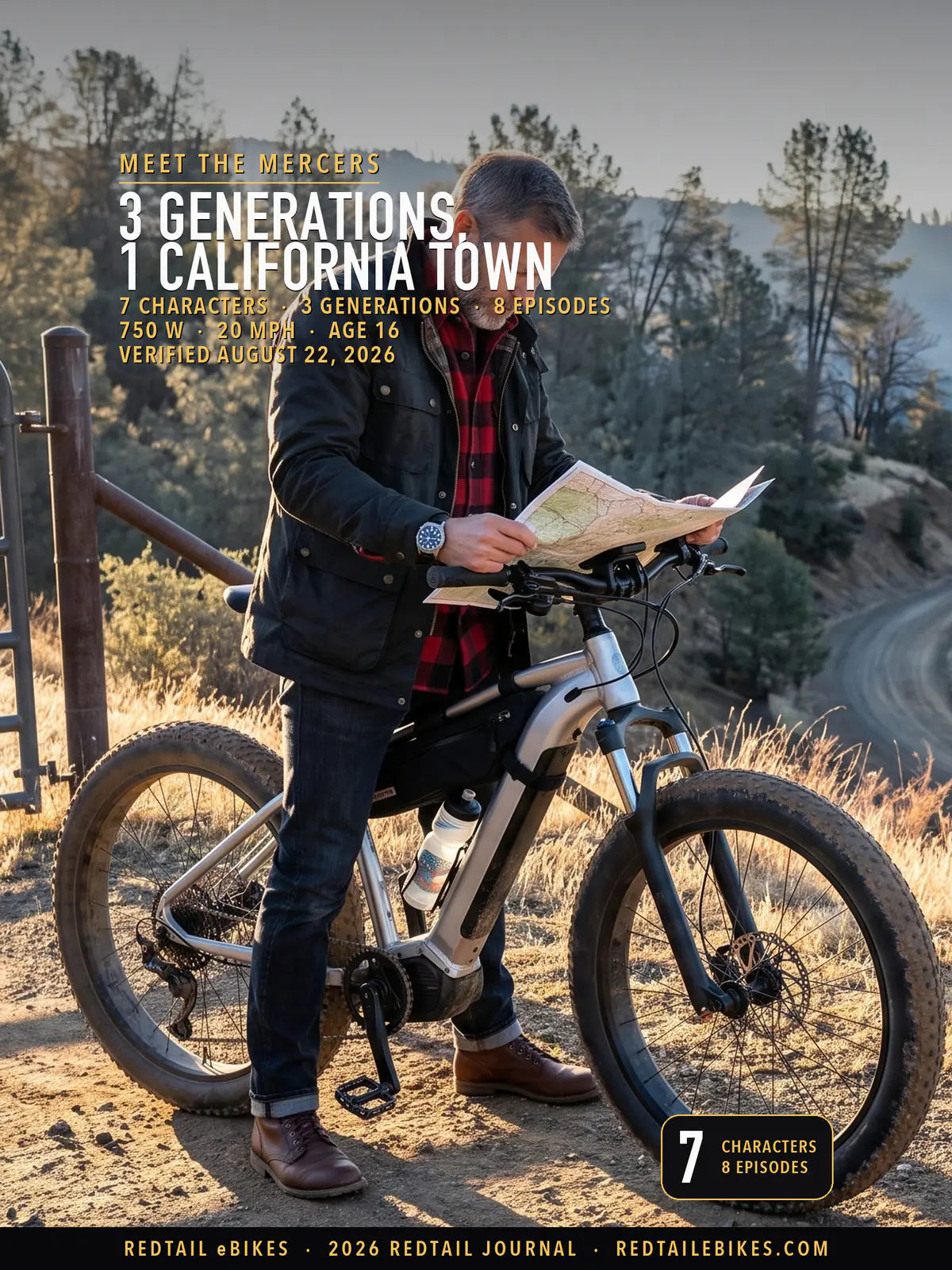
7 characters · 3 generations · 8 episodes · 1 laminator · 750 W · 20 mph · age 16 · verified August 22, 2026
Quick Answer: Starting today, the guides on this site have a family in them, and the family is at war. The Mercers of Fair Oaks, California are fictional people built to carry a real job: making e-bike rules, costs and trade-offs legible by showing them happening to someone.
The short version: Cole turned sixteen and wants a car, his grandfather took his side against the whole household, a neighbor named Gary Pruitt has started photographing e-bikes on the greenbelt, and both of Cole's parents are hiding a spreadsheet from each other. Sixteen, by the way, is the exact age California law cares about (Cal. Veh. Code § 21213(a)).
They are a cast, not customers — no Mercer will ever review a product or give a testimonial, and every fact they stand next to is sourced the way it always is. Came here to shop instead? Start with the buying guide or the commuter range.

In this guide
- How we verified this guide
- What's on this page
- Meet the Mercers: why a family, and why this one
- The story so far: a knee, a tag, and a birthday
- The birthday that starts the war
- Everyone in this family is hiding something
- Frank Kowalski, 63 — the second wind
- The 5:40 Club
- Ruth Kowalski, 61 — the safety conscience
- Jack Mercer, 48 — the verifier
- Dana Mercer, 45 — the logistics brain
- What the evidence says about the thing Dana is testing
- Maya Torres, 32 — the commuter
- Cole Mercer, 16 — the build
- Gary Pruitt, and the war for the greenbelt
- Ivy Mercer, 12 — and why you will rarely see her
- The town, and why it is this town
- The people around them
- Season One: The Driveway War
- Which one of them is you?
- A word about what these photographs are
- Limitations
- Source register
- Frequently asked questions
- References
How we verified this guide
This is an introduction to a cast, so most of it is openly invented. That makes the sourcing rule more important rather than less: every factual claim these characters are attached to was retrieved this session, from the body that issued it.
- California e-bike law — read at the California Legislative Information portal, the Legislature's own publisher: § 312.5 (the three classes), § 21213 (Class 3 age and helmet), § 21212 (under-18 helmet).
- The incentive story — the California Air Resources Board's own program page for the E-Bike Incentive Project, including the sentence that ends it.
- Who actually buys e-bikes — YouGov Profiles survey data on US e-bike owners, used to shape who this family is.
- Independent corroboration — PeopleForBikes' California law handout, retrieved separately, for the load-bearing legal claims.
-
Corpus — 7 distinct sources consulted, 7 retrieved and read in full, 0 unreachable. Every one has a local deposit copy under
research/citations/meet-the-mercers/and a public Wayback snapshot, both taken at retrieval. - The photographs — every image on this page is a generated composition of a face-locked fictional actor, disclosed in full below.
- Reviewer: Milad Ghobadibeygvand, BScN (Western University, 2014), Redtail eBikes. Corrections: hello@redtailebikes.com.
What's on this page
- How we verified this guide
- Meet the Mercers: why a family, and why this one
- The story so far: a knee, a tag, and a birthday
- The birthday that starts the war
- Everyone in this family is hiding something
- Frank Kowalski, 63 — the second wind
- The 5:40 Club
- Ruth Kowalski, 61 — the safety conscience
- Jack Mercer, 48 — the verifier
- Dana Mercer, 45 — the logistics brain
- What the evidence says about the thing Dana is testing
- Maya Torres, 32 — the commuter
- Cole Mercer, 16 — the build
- Gary Pruitt, and the war for the greenbelt
- Ivy Mercer, 12 — and why you will rarely see her
- The town, and why it is this town
- The people around them
- Season One: The Driveway War
- Which one of them is you?
- A word about what these photographs are
- Limitations
- Source register
- Frequently asked questions
- References
Meet the Mercers: why a family, and why this one
Here is the problem this family exists to solve. E-bike buying advice is written for an average person who does not exist. "Consider your budget and intended use" is true of everyone and useful to no one, and the moment a real decision arrives — my knee, my kid's birthday, my parking situation, the hill between me and work — the average-person guide has nothing to say.
So we built the specific people instead. Not at random, either. The shape of the family follows the shape of the market, which we looked up rather than guessed.
| Who they are | What the data says | Source |
|---|---|---|
| Three generations rather than one persona | 86% of US e-bike owners are 18–44, but the 55-plus rider is the story most guides skip entirely | YouGov Profiles |
| Four adults: two men, two women | US ownership splits 59% male / 41% female — close enough to even that a men-only cast would misrepresent the reader | YouGov Profiles |
| Comfortable rather than wealthy | 30% of owner households earn over $100k, against 17% of non-owners: owners skew comfortable, which is a very different person from rich | YouGov Profiles |
| A suburb with a city 20 minutes away | 62% of owners live in a city against 33% of non-owners — the suburb is where the growth has to come from next | YouGov Profiles |
| The bikes are in the weekly routine | 74% of owners ride at least once a week; these are appliances rather than toys | YouGov Profiles |
Everything after that — the names, the jobs, the knee, the argument about the car — is invention, and this page will keep telling you which is which.
How to read anything they appear in The person is invented. The rule, the price, the statute and the number are not, and each one carries its own link. If you ever find a claim in a Mercer story without a source behind it, that is a defect — write to us and we will fix it in public.
The story so far: a knee, a tag, and a birthday
Every serial needs a founding event. This one has three, and they stack.
October 2023 — Frank stops. Thirty-one years an IBEW electrician, and it is not the work that ends it, it is his right knee. The replacement comes with six weeks of "don't drive," and Frank discovers the thing nobody warns you about: the surgery takes your body for a while, but the not-driving takes your life. Groceries. The hardware store. The river. He is sixty-three and needs a lift to everything, and he does not complain once, which is worse.
January 2024 — the wrong gift. Dana buys her father an e-bike, out of love and a little desperation, and he is insulted by it. A bike is what you give a man who cannot drive. It sits in his garage for five weeks with the tag still on.
February 2024 — 5:40 a.m. He rides it before dawn so nobody on the street will see him, four miles down to the American River and four back. When he gets home he sits in the garage for twenty minutes without taking his helmet off, and Ruth finds him there. Neither of them has ever mentioned it. That morning is why this magazine exists.
Here is the part the first draft of this page left out: Frank went back the next morning. And the morning after that, there was another old man at the trailhead, pretending he was also there by coincidence. By summer there were four of them.
They are now the best-informed institution in Fair Oaks, they meet at 5:40 whether anyone admits it is a club or not, and they will matter to this story more than anyone under fifty expects. More on them below.
Summer 2024 — Dana starts counting. On roughly the nine-hundredth school run she notices she is the family's entire transport department, and that almost none of the trips are long. A grease-pencil tally appears on the fridge. Not miles — car trips under three miles. The first week's number embarrasses her. What she does with that tally is the season's best-kept secret, and it is not curiosity.
2025 — Maya sells her car. Dana's cousin in midtown Sacramento does the thing the family considers slightly unhinged, keeps a spreadsheet because she expects to be proved wrong, and is not, quite, and is insufferable about it at Thanksgiving.
Spring 2026 — Cole turns sixteen. And the family's private evolution runs head-first into a teenager's idea of freedom, in public, with flyers.
The birthday that starts the war
Cole does not want the sensible thing. He wants a car, because a car is what sixteen means, and because his best friend Theo has one — a $900 Crown Victoria with a noise nobody can diagnose.
And there is the part the adults keep missing: he watched his grandfather lose a car and lose himself for six weeks. Cole is not being shallow. He is frightened, in the specific way a sixteen-year-old is frightened, which looks like being stubborn.
Jack wants to run the numbers. Insurance for a sixteen-year-old male driver in California is not a small line item, and Jack has never once in his life been persuaded by a feeling. An e-bike now; a car when Cole has saved for one. It is a strong argument, delivered with total confidence, by a man who is not telling you everything.
Dana is quietly terrified of him driving, knows that is not an argument she is allowed to make out loud, and so makes Jack's argument instead, and dislikes herself slightly for it.
Frank sides with Cole. That is the turn nobody expects, and it is the heart of the thing: Frank knows exactly what it is to have your independence decided for you by people who love you, and he will not do it to his grandson and call it wisdom.
Ruth would like everyone to lower their voices and look at the actual injury data before they keep shouting. Also, the boy wears a helmet.
Everyone in that argument is right. That would be enough for a season on its own — except the argument does not stay in the kitchen. The same week as the birthday dinner, a laser-printed flyer appears on the greenbelt kiosk: "MOTORIZED VEHICLES ON THE GREENBELT: A GROWING CONCERN." It is signed by Gary Pruitt, it is laminated, and it is only the first one.
How it ends, and we are telling you now, because a magazine that withholds its ending to farm your clicks is not the kind we want to run: Cole does not get the car. Cole also does not lose. Those are different outcomes, and the difference is the entire season.
Everyone in this family is hiding something
A family drama where everybody says what they mean is a meeting. So: five facts, teased here and paid off on schedule. This table is a promise, not a trick — every reveal below is already written into the season, and none of them resolves because somebody buys something.
| Who | What we can tell you now | When you find out |
|---|---|---|
| Jack | There is a number he has never said out loud, and it explains his entire position on Cole's car better than any of his spreadsheets do | Episode 7 |
| Dana | The fridge tally was never curiosity. There is a second spreadsheet in that house, and Jack — the spreadsheet guy — has never seen it | Episode 3, partly. Episode 7, fully |
| Ruth | There is a photograph from 1984 that nobody in this family has seen, and it changes what you think you know about the person doing the helmet checks | Episode 6 |
| Cole | Three weeks into his new job, something happens to him that he would rather die than let Theo find out | Episode 8 |
| Frank | There is a reason he stopped riding motorcycles in 1989, and only Ruth knows it | Not this season |
One rule governs all of it: at any point in the season, you — the reader — will know more than any single character does. That gap is the suspense, and it is the honest kind. Nothing on this page or any Mercer page runs on manufactured urgency; the banned-persuasion list is part of the editorial code.
Frank Kowalski, 63 — the second wind

5:40 a.m., Fair Oaks. The knee is the reason he rides now. The hour is a longer story.
Frank spent thirty-one years as an IBEW electrician and has the forearms to prove it. Knee replacement in 2024, and for about eight months the thing he missed was not ladders — it was the river trail, and the ordinary pleasure of going somewhere under his own power. The e-bike gave that back, and he is faintly embarrassed about how much it mattered.
What it also gave him, to his complete surprise, was a crew. Frank is the founder and reluctant president of the 5:40 Club, which he insists is not a club ("it's just some guys"), and which is in fact the most effective intelligence network in the Sacramento suburbs. In the birthday war, Frank is Cole's only adult ally, he will not apologize for it, and his reasons run deeper than anyone at that dinner table understands.
On the wall of his garage there is an empty hook where the Buick's spare key used to hang. Nobody touches it. Nobody asks.
He fronts: step-through and comfort bikes, electric trikes, maintenance how-tos, and anything written for the rider coming back from an injury. When a Redtail page says this is the one you can get on and off easily, Frank is who we mean.
The unglamorous truth he carries: the fastest-growing group of e-bike buyers is not the one most bike marketing is aimed at, and a step-through frame is not a compromise. It is the feature.
The 5:40 Club
It started as one man avoiding embarrassment and became an institution. Current membership, in order of appearance:
| Member | Particulars |
|---|---|
| Frank, 63 | Founder. Denies it is a club. Sets the route, keeps the pace honest |
| Big Mike, 68 | Retired sheriff's deputy. Six-foot-five, rides the smallest bike anyone has ever seen, and dares you to say something |
| Delores, 74 | Retired postal carrier. Holds the record on the Illinois Avenue hill and logs every attempt against it. The record has not fallen in fourteen months |
| Pastor Ed, 66 | Counts his intervals on a rosary. Officially neutral in all neighborhood disputes; unofficially the best gossip in the group |
Retirees are awake, connected, and everywhere, and the 5:40 Club knows every pothole, every county agenda item and every teenager's near-miss in Fair Oaks roughly six hours before anyone else does. In the war that is coming, they are the reconnaissance wing, the Greek chorus, and — on one particular Tuesday afternoon, for reasons that will become obvious — the cavalry.
They are also the answer to a question the e-bike industry keeps getting wrong. The riders adding the most miles in this cast are all over sixty, which is not a novelty — it is the demographic reality most bike marketing ignores, and this magazine will not.
Ruth Kowalski, 61 — the safety conscience
Thirty years as an ER nurse gave Ruth two things: the driest wit in the family and an unsentimental professional relationship with what happens to people who skip the helmet. She is Frank's wife and Dana's mother, and she reads the statute before anyone in this family rides anywhere new.
She checks a helmet's fit with two fingers under the chin strap whether or not you asked. She does not lecture. She stands there until you stop moving.
She is also the reason this magazine will never sell you anything by frightening you. Ruth's position, which is ours, is that the risk is real, boring and manageable, and that people told the truth plainly make better decisions than people who are scared.
California's helmet rules are the sort of thing she quotes from memory: everyone under 18 on any bicycle, and every rider of a Class 3 e-bike at any age (§ 21212(a), § 21213(b)).
And one more thing, which the family does not know and you now do: nobody has ever seen Ruth Kowalski ride at her actual pace. On the Sunday rides she sits at the back, behind Frank, at grandmother speed. There is a photograph from 1984 that would explain a great deal. Episode 6.
She fronts: helmet and safety content, the insurance-and-what-happens-after explainers, and the human half of the laws pages.
Jack Mercer, 48 — the verifier

A gate, a map, and a man who would rather be certain than early.
Ex-Air Force crew chief, now a facilities lead at a Sacramento hospital, married to Dana. Jack's whole temperament is the torque wrench: a number, applied correctly, beats an opinion applied confidently.
He reads the spec sheet before the marketing page, he does not believe a claimed range figure until he has ridden it in his own hills, and he is the only person in the family who has ever emailed a manufacturer to ask what "nominal" means on their listing.
He wins every argument he starts, and he starts most of them. His case against Cole's car is genuinely strong — the insurance arithmetic for a sixteen-year-old male driver in California will get its own fully sourced episode, and it will make your eyes water.
What you should sit with until Episode 7 is this: the family's most rigorous man is running a crusade about money, and there is one number in his own life he has never said out loud.
Also, watch what he does in Episode 2 after a 74-year-old retired postal carrier drops him on the Illinois Avenue hill. Jack processes emotion by opening Excel. It is going to be a spreadsheet with a heart rate in it.
He fronts: fat-tire and all-terrain, mountain e-bikes, hunting content, and every page where we say we tested this. Jack is what testing looks like when it is drawn.
The thing he will keep saying: the number on the box and the number in your life are different numbers, and the gap between them is the whole job.
Dana Mercer, 45 — the logistics brain

Drop-off, 7:50 a.m. Forty cars idling; one of them is not hers any more.
Dana is a school nurse — her mother's trade, one generation on — and she runs the family calendar the way an air-traffic controller runs a runway. She is the one who noticed the actual problem: it was never the long trips. It was the endless two-mile ones. School, practice, the pharmacy, the grocery run you make because you forgot lemons.
The cargo bike started as an experiment she expected to abandon. Then the tally on the fridge started climbing, and something else started happening: Coach Winters asked if she could haul the team's gear on Saturday. A neighbor asked about a produce box. The church sale needed a kiln-load of pottery moved.
Dana said "oh, no charge" every single time — and went home and typed the numbers into a file her husband, the spreadsheet guy, has never seen.
She is the season's stealth protagonist. All we are saying here.
She fronts: cargo e-bikes, family logistics, and the car-replacement arithmetic. When a page needs to know whether a bike can actually replace a car for the school run, it is her question being answered.
Running Dana's experiment yourself? Start by writing down every car trip under three miles you make in a week, before you shop. The list is usually the argument.
See cargo e-bikesWhat the evidence says about the thing Dana is testing
Dana's tally is invented. The question underneath it is not, and it is worth putting the real research on the table before she starts, so you can judge her results against something.
The strongest recent work is a UK trial in which researchers studied the experiences of 49 households who borrowed e-cargo bikes through a loan scheme in British suburbs, published in Geoforum in October 2025 by teams from Eindhoven University of Technology, Brighton, Leeds and Oxford (UKRI). Its finding is the one Dana's arc will test in a California suburb: participants used the bikes for "school runs, food shopping and commuting, trips often seen as only possible by car."
The same write-up carries the number that explains why short trips are the whole battleground. UK National Travel Survey data published in 2024 found that for journeys between one and five miles, 69% were made by car or van, against 19% on foot and 6% by bus (UKRI).
That is British data, and we are not going to pretend it is American — but the shape of the problem, a car doing work a bike could do, is the shape Dana is going to find on her fridge.
There is also a warning in the literature that belongs here rather than buried in a buying guide.
PeopleForBikes' policy counsel, writing for parents in December 2024, flags the machines that are sold as e-bikes and are not: devices that "can easily be modified to exceed the motor power and speed limits of an electric bicycle by selecting an 'unlimited' mode setting on the controls, by cutting a wire that limits power and speed, or by changing the setting in a smartphone app."
His test is blunt and we endorse it: "If it can be easily unlocked, it's probably not an electric bicycle" (PeopleForBikes).
Cole's storyline runs straight into that sentence, and it is why the family's first argument is about a specification rather than a color.
The buying test worth stealing Before you compare frames or prices, ask one question about any bike you are considering: can its speed limit be unlocked? If the seller's own marketing brags about it, the machine may not be a legal e-bike where you ride — check your state's page before you pay.
Maya Torres, 32 — the commuter

Midtown, before the heat. She has not looked for a parking space since 2025.
Dana's cousin, and the family's most annoying success story. Maya sold her car in 2025 and, unlike most people who do that, kept the receipts — a spreadsheet of every cost she used to have and every cost she has now, including the Ubers she takes in the rain and would rather not admit to.
She runs a group chat of midtown car-free converts called NO PARKING, where the worst takes of a coworker known only as Doug from Fleet Services are screenshotted and studied like scripture. Doug reply-alls. Doug is due for a reckoning, and it has a date: Episode 4, in front of the whole office.
The family is split on her. Jack thinks she got lucky with her commute; Frank thinks she will change her mind in January; Ruth thinks she is the only one of them who has actually done the math. What none of them has noticed is the number at the bottom of the spreadsheet, or asked what it is for.
She fronts: commuter and city bikes, folding e-bikes, cost-of-ownership pieces, and city guides. Her spreadsheet is going to get published, in full, including the parts that make the e-bike look worse.
Following Maya's route rather than Dana's? The commuter range is where the car-replacement math usually starts — light frames, real racks, and a battery you can carry inside to charge.
Browse commuter e-bikesCole Mercer, 16 — the build

End of shift, sodium lamps just on. The thing he wanted was a car. Stay tuned.
Cole turned sixteen in the spring, wants a car, and did the arithmetic every sixteen-year-old does: a car costs money, money means a job, and the only job in walking distance is the bike shop on Fair Oaks Boulevard.
So the season's best irony hired itself: Cole Mercer is saving for a car by fixing bikes. Sixteen dollars an hour plus a free lecture with every paycheck, for a boss named Otto who pays cash and maintains a Wall of Shame of destroyed parts with index cards explaining what each owner did wrong.
His best friend Theo already has a car — a $900 Crown Victoria that develops one new noise per episode and eats every dollar Theo makes. The Vic is the season's best argument against teenage car ownership, and it never says a word.
Sixteen is not an arbitrary age for Cole to arrive at. In California, § 21213(a) says plainly: "A person under 16 years of age shall not operate a class 3 electric bicycle." Cole is now on the legal side of a line he was on the wrong side of in March, and he is extremely aware of it.
He fronts: entry and value commuters, first-e-bike guides, repair and maintenance content, and the age rules on every laws page we publish. He is also the character most likely to do something slightly stupid and then have to write about it.
What his arc is actually about: not the on-ramp he was assigned, but the one he builds. There is a wreck in Otto's back room. All we are saying here.
Gary Pruitt, and the war for the greenbelt
Every story needs somebody with a laminator.
Gary Pruitt, 58, is the neighborhood association's secretary, the owner of three vehicles and a label maker, and the self-appointed guardian of the greenbelt path that runs behind the Mercers' street. Sometime this spring he started photographing e-bikes on it.
The week of Cole's birthday, his first flyer went up on the kiosk: laser-printed, laminated against weather and dissent, headed "MOTORIZED VEHICLES ON THE GREENBELT: A GROWING CONCERN." There will be more. The font gets bigger all season.
Here is what we want you to know about Gary before you decide to hate him, because this magazine has a rule that the skeptic is never a fool. Gary is going to be right. Not always — but once, in August, at the worst possible moment for our side of the argument, just the way flyer number three predicted.
E-bikes on shared paths are a real question, and teenagers ride like teenagers. A man with a camera is annoying and occasionally correct, and the episode where he is correct will let it land with full weight.
The fight he starts ends up somewhere real: a county hearing room on a Tuesday at 2 p.m., which is an hour at which precisely one demographic in Fair Oaks is free to attend. Gary has not thought this through. The 5:40 Club has.
When a Mercer story dramatizes that fight, the fiction stays clearly labeled and the rules it is fought over stay real — path authorities, county ordinances and hearing procedures get verified against the actual published code before the episode ships, the same way everything else here is sourced. The war is invented. The law it is fought over is not.
Ivy Mercer, 12 — and why you will rarely see her
Ivy is twelve. She rides a normal pedal bike, always helmeted, usually faster than her brother would like, and she is in this family for a reason that is half legal and half editorial.
The legal half: she is the walking footnote. California requires a helmet for everyone under 18 on any bicycle (§ 21212(a)), and Class 3 e-bikes are closed to her entirely until she is 16 (§ 21213(a)). Every time a parent asks us whether they can buy their twelve-year-old an e-bike, Ivy is the answer's face.
The editorial half is a decision we want to be transparent about. Ivy has no locked face and never will. When we built this cast, the image platform declined to generate a persistent likeness for a twelve-year-old — twice, identically. We could have engineered around it.
We decided that was the correct answer to a question we should have asked ourselves first. Ivy appears in prose and, at most, incidentally in a photograph: a helmet, a distance, a bike beside her family's. She is not a product surface, and children are not a sales tool here.
If you are shopping for a child The age floors are real and they are not the manufacturer's rules, they are the state's. Check your own state's page before you buy — our 50-state law atlas has every one, and California's is the one governing this family.
The town, and why it is this town
The Mercers live in Fair Oaks, an unincorporated suburb on the bluffs above the American River northeast of Sacramento. A deliberate choice rather than set dressing.
It sits on the American River Parkway, a Sacramento County regional park system whose paved trail is one of the best-known riding corridors in Northern California, and it gives us every kind of riding in one place: flat river miles west toward the city, Sierra foothill grades east, ordinary suburban streets in between, and a real downtown twenty minutes away.
It also gives us California, which matters for a magazine about e-bikes. California wrote the three-class system most of the country copied (§ 312.5), it runs the largest e-bike market in the United States, and it is where the incentive story has already played out to its end — a story the family will tell in Season One, honestly, including the ending.
One honesty note about the map: Fair Oaks, the Parkway, the river and the law are real. The street-level layer — Otto's shop, the greenbelt kiosk, the neighborhood association and everyone in the network below — is invented, and stays labeled as such wherever it appears.
The people around them
A family with no one around it is a stock photo. These are the recurring names in the Mercers' lives — all invented, none face-locked, and none of them ever sells you anything:
| Who | What they are for |
|---|---|
| Gary Pruitt, 58, neighborhood association | The opposition. Laminated flyers, three vehicles, a camera, and — once, at the worst moment — a point |
| Otto, owner of the bike shop on Fair Oaks Boulevard | Cole's boss. Pays cash, lectures free, curates a Wall of Shame of destroyed parts ("rode it into a lake. THE LAKE DID NOT CHARGE IT") |
| Theo, 16, Cole's best friend | Owner-operator of the Vic: $900 of Crown Victoria, one new noise per episode. The season's running gag and its quiet heartbreak |
| Big Mike, Delores & Pastor Ed | The 5:40 Club's founding three. Between them they know everything that happens in Fair Oaks, six hours early |
| Doug from Fleet Services | Maya's nemesis. Reply-alls. Has a date with Episode 4 |
| The Nguyens, next door | Skeptical neighbors whose questions are the reader's questions. Their minivan is Dana's before-picture |
| Marcus, Jack's hunting partner since the service | The reason the fat-tire content goes where trucks cannot |
| Coach Winters, Ivy's soccer coach | Dana's first "client," before Dana admits she has clients |
They ask, doubt, borrow, heckle, and get converted or they do not, which is how it works in life.
Season One: The Driveway War
Eight episodes, each a real question wearing a family's clothes. Every one opens on the driveway — the count of what is parked there is the season's scoreboard — and every one carries at least one fully sourced number, one typeset artifact (a flyer, a tally, a spreadsheet, an index card from Otto's wall), and an ending that earns the next episode.
| # | Episode | Told by | What happens · the real question underneath |
|---|---|---|---|
| 1 | Sixteen | Cole | The Vic dies at a red light, the birthday dinner detonates, Frank commits treason, and a flyer appears on the kiosk. Underneath: what insuring a 16-year-old driver in California actually costs, sourced |
| 2 | The 5:40 Club | Frank | The dawn crew steps into the light; Delores drops Jack on the Illinois Avenue hill; the club's network delivers its first warning about Gary. Underneath: the riders the industry ignores |
| 3 | Dana's List | Dana | The tally comes off the fridge and becomes a route; "oh, no charge" starts to strain. Underneath: what a cargo bike actually replaces, measured |
| 4 | No Parking | Maya | Doug from Fleet Services reply-alls once too often. Maya publishes twelve months of everything, Uber receipts included. Underneath: the honest cost of going car-free |
| 5 | One Hundred and Four | Jack | A Sacramento August. The Vic's AC dies; Jack's battery-heat testing is vindicated; and Gary is right about something, with consequences. Underneath: heat, batteries, and what the manual really says |
| 6 | The Hearing | Ruth | Tuesday, 2 p.m., county chambers. The only people free at that hour are retirees, and Gary never saw them coming. A photograph from 1984 surfaces. Underneath: how shared-path rules actually get made |
| 7 | Seven Hundred and Forty-Two | Dana | The quiet one. Two hidden spreadsheets meet at a kitchen table at 1 a.m. Nobody yells. Underneath: what a vehicle actually costs a household, told honestly |
| 8 | The Back Room | Otto | The wreck, the rebuild, the toolbox, and the driveway's final count. Underneath: what is salvageable in a crashed e-bike and what never is — plus the voucher ending we already owe you |
That last one has an ending we already know, and it is not a happy one. The California E-Bike Incentive Project, the state's first statewide voucher program, "began in December 2022 and concluded in December 2025" and distributed 2,246 incentives in total (CARB). Against California's population that is a rounding error.
A family who applied and waited is a better way to explain what happened than a paragraph of policy analysis. They lose that one. We are keeping it in, because a cast that never loses is an ad.
Which one of them is you?
You did not come here for a cast list. You came here because one of these situations is yours, so here is the shortest honest route from each of them to a decision.
| If this is you | Start here | What to check first |
|---|---|---|
| Coming back to riding after an injury or a long break, like Frank | Step-through commuters · electric trikes | Stand-over height and how easily you can get a foot down, before range or motor |
| Drowning in short car trips, like Dana | Cargo e-bikes | Write down one week of sub-three-mile car trips before you shop; the list is the argument |
| You want the numbers checked before you buy, like Jack | The buying guide | Nominal wattage, published vehicle weight, and whether the top speed quoted is motor-only |
| Replacing a car outright, like Maya | Commuter and city · folding | Where it charges and where it sleeps — storage kills more car-free plans than range does |
| Buying for (or being) a newly-16 rider, like Cole | Your state's law page first, then commuters | The birthday and the class. Age floors are the state's rule rather than the seller's |
| Buying for a child under 16 | Nothing yet | Check the age floor in your state. In California a Class 3 is closed to them until 16 |
No rush, and we mean that. Free US shipping on every e-bike, US-based support and warranty, and if you want a specific model checked against your own state's definition before you order, send us the model name and we will do it and put the answer in writing.
See the full rangeA word about what these photographs are
Every person in these pictures is generated. We think you should be told that plainly rather than discover it.
The Mercers are custom AI actors with locked faces, built and shot with Playcut, so the same person appears in every scene across the magazine. That consistency is the point: a face you recognize across a year of stories is a promise that you are reading one publication rather than a stack of unrelated posts.
The bikes in frame are real Redtail catalog models, passed to the generator as references, so the machine in the picture is a machine we actually sell.
Credit where it is due: the cast pipeline runs on Playcut — its personalized-actor system is what pins a face across a year of stories instead of producing a new stranger every time we need a photograph. Each character exists there as a persistent actor with a fixed identity photo, and every scene is shot against that actor rather than described from scratch.
What we will not do with them: no Mercer will ever review a product as though they bought it, appear in a testimonial, or be presented as a real customer. They demonstrate; they do not endorse. Every fact they stand next to carries its own citation, and the honest ledger on our product pages stays exactly as honest as it was before we had a cast.
Limitations
- Author interest. Redtail eBikes sells electric bikes, and this family was built by the company that profits when you buy one. It is a marketing device with an editorial code attached, and you should read it as both.
- The people are fictional. Nothing about Frank's knee, Dana's tally or Maya's spreadsheet is a real person's outcome. When those stories publish, the facts in them will be sourced; the lives will still be invented.
- Demographic data vintage. The YouGov owner statistics used to shape this cast were published October 19, 2022 and are the most recent nationally representative figures we could retrieve. Ownership has grown substantially since; treat the splits as directional rather than current.
- One state's law. Every legal claim on this page is California's. It does not travel — see the 50-state atlas.
- Images are generated rather than photographed. No real location, bike or person on this page was photographed. Scenes are composed to be typical rather than documentary.
- A cast is not a sample. Seven characters cannot represent every rider. They are chosen to cover common decisions rather than all of them.
- One source has no public archive snapshot. The Playcut credit links the vendor's own homepage; the Internet Archive rate-limited our save request (HTTP 429) at retrieval on August 22, 2026. We hold a local deposit copy and will retry the snapshot; the ledger records the waiver.
- This page is deliberately source-light by our own standards. It carries 10 distinct cited sources at 3.8 citation links per 1,000 words, against the 15-source and 8.0-link floors our law pages meet — and the rebuild of 2026-08-22, which roughly doubled the invented narrative, lowered the density further. That is because most of this page is openly invented and labelled as such; padding narrative paragraphs with decorative citations would satisfy a counter and mislead a reader. The gate records the shortfall as a warning and we are leaving it visible rather than gaming it.
Expiry conditions. This page ages when: a new nationally representative US e-bike ownership survey is published (the 2022 YouGov figures are already stale); California amends § 312.5, § 21212 or § 21213; a new state e-bike incentive program is funded after the December 2025 conclusion of the last one; or the cast changes. We re-check it every six months regardless.
Source register
| Source | Tier | What it supports | Accessed |
|---|---|---|---|
| Cal. Veh. Code § 312.5 (California Legislative Information) | T1 — primary official | The three-class definition, 750 W ceiling, labeling rule | 2026-08-21 |
| Cal. Veh. Code § 21213 | T1 — primary official | Class 3 minimum age 16; Class 3 helmet at every age | 2026-08-21 |
| Cal. Veh. Code § 21212 | T1 — primary official | Helmet required under 18 on any bicycle | 2026-08-21 |
| CARB, California E-Bike Incentive Project | T1 — primary official | Program ran Dec 2022–Dec 2025; 2,246 incentives; up to $2,000 | 2026-08-21 |
| Sacramento County Regional Parks, American River Parkway | T1 — primary official | The Parkway exists as a county regional park system and trail corridor | 2026-08-21 |
| PeopleForBikes, California E-Bike Law handout (2023) | T3 — secondary scholarly/standards body | Independent corroboration of the class definitions, age 16 and helmet rules | 2026-08-21 |
| YouGov Profiles, US e-bike owner demographics | T3 — secondary scholarly | Age, gender, income and urban splits used to shape the cast | 2026-08-21 |
| UKRI / EPSRC, e-cargo bike trial coverage (Geoforum study) | T3 — secondary scholarly | 49-household trial; trip types replaced; UK NTS short-journey car share | 2026-08-21 |
| PeopleForBikes, "Should You Buy Your Kid an E-Bike?" | T3 — secondary scholarly | The unlockable-device warning and the parental buying test | 2026-08-21 |
Frequently asked questions
Are the Mercers real people?
No. They are fictional characters played by custom AI actors with locked faces, created and owned by Redtail eBikes. Every photograph of them on this site is generated. We disclose it on every page they appear on.
Why does an e-bike shop need a fictional family?
Because generic advice fails at the moment of decision. "Consider your intended use" helps nobody; "here is what a 63-year-old with a replaced knee actually needs from a frame" helps somebody. The family is a way to make real rules and real trade-offs specific.
Will the Mercers review products?
Never. They demonstrate situations; they do not endorse products or give testimonials. Our product judgments stay in our own voice, with the honest ledgers and caveats they have always carried.
Is anything on this page made up?
The people, the town details, their jobs and their opinions are invented, and the page says so. Every legal, statistical and program fact carries a citation to a primary source retrieved on August 21, 2026.
Why is Ivy, the 12-year-old, not shown properly?
Because we chose not to create a persistent generated likeness of a child. The platform declined the request and we agreed with it. Ivy appears in writing and only incidentally in imagery, and she is never used to sell anything.
What is the minimum age to ride an e-bike in California?
For a Class 3 e-bike, 16 — § 21213(a) states that "a person under 16 years of age shall not operate a class 3 electric bicycle." Class 1 and Class 2 carry no state minimum age. Full detail is on our California laws page.
Do California e-bike riders need helmets?
Everyone under 18 must wear one on any bicycle (§ 21212(a)), and every rider of a Class 3 e-bike must wear one at any age (§ 21213(b)).
Can I still get a California e-bike voucher?
No. The statewide California E-Bike Incentive Project "began in December 2022 and concluded in December 2025," distributing 2,246 incentives in total (CARB). Local and utility programs may still exist where you live; check before you assume either way.
Where does the family live?
Fair Oaks, California — an unincorporated Sacramento-area suburb on the American River Parkway. It was chosen because it puts flat river trail, foothill climbs, suburban streets and a real city commute within one family's week.
How were the character designs decided?
From ownership data rather than taste: YouGov's US e-bike owner splits on age, gender, income and urban/suburban residence shaped who is in the family. The invented parts are labeled as invented throughout.
Who is Gary Pruitt?
The closest thing this story has to a villain: a neighbor with a laminator who wants e-bikes off the greenbelt and escalates all the way to a county hearing. He is also — once, at the worst possible moment — right, because this magazine has a rule that the skeptic is never a fool. He is fictional, like the rest of the street-level layer.
Are the "secrets" real cliffhangers or marketing bait?
They are written, scheduled reveals — the table above lists when each one pays off, and none of them resolves because somebody buys a product. We tell you the season's ending on this very page. The suspense here is the honest kind: you knowing more than the characters do.
When does the first story publish?
Season One opens with "Sixteen" — the Vic dies at a red light, Cole's birthday dinner detonates the car argument, and the first flyer goes up. The eight-episode slate is above.
References
- California Legislative Information (California Legislature). "Vehicle Code § 312.5 — Electric bicycle; classes." Pinpoint: § 312.5(a), (a)(1)–(3), (d). Amended by Stats. 2024, Ch. 791, Sec. 2 (SB 1271), effective January 1, 2025. Accessed 2026-08-21. Source · Archived
- California Legislative Information (California Legislature). "Vehicle Code § 21213 — Class 3 electric bicycles; minimum age; helmets." Pinpoint: § 21213(a), (b). Added by Stats. 2015, Ch. 568, Sec. 6 (AB 1096), effective January 1, 2016. Accessed 2026-08-21. Source · Archived
- California Legislative Information (California Legislature). "Vehicle Code § 21212 — Bicycle helmets; persons under 18." Pinpoint: § 21212(a). Undated in the section text; current as retrieved. Accessed 2026-08-21. Source · Archived
- California Air Resources Board. "California E-Bike Incentive Project." Pinpoint: program-status paragraph ("began in December 2022 and concluded in December 2025"; "distributed 2,246 e-bike incentives"; "$12,970,000 allocated"). Undated page; program concluded December 2025. Accessed 2026-08-21. Source · Archived
- Sacramento County Regional Parks. "American River Parkway." Pinpoint: parks-and-access listing for the Parkway, including the Jedediah Smith Memorial Trail. Page updates dated 2026-06-24. Accessed 2026-08-21. Source · Archived
- PeopleForBikes. "California's Electric Bicycle Law" (state law handout). Pinpoint: "For the road" panel — class definitions, minimum age 16, Class 3 helmet requirement. Issued 2023. Accessed 2026-08-21. Source · Archived
-
YouGov. "Tracing the demographics of e-bike owners in the US." Pinpoint: gender split (59%/41%), age band (86% aged 18–44), household income (30% over $100k), urban residence (62%), weekly ridership (74%). Published 2022-10-19. Accessed 2026-08-21. Source · Archived
-
UK Research and Innovation (Engineering and Physical Sciences Research Council). "E-cargo bikes can replace car trips and reshape family travel." Pinpoint: trial size (49 households); "school runs, food shopping and commuting" finding; National Travel Survey 2024 figure for one-to-five-mile journeys (69% car or van). Published 2025-10-10. Accessed 2026-08-21. Source · Archived
- PeopleForBikes. "Should You Buy Your Kid an E-Bike?" by Matt Moore, policy and general counsel. Pinpoint: passage on devices modifiable via "unlimited" mode, wire-cutting or app setting; the "if it can be easily unlocked" test. Published 2024-12-05. Accessed 2026-08-21. Source · Archived
Image credit: all photography of the Mercers is generated with Playcut (playcut.ai), using its custom-actor pipeline for face consistency.
Disclosure: the Mercers are fictional characters created by Redtail eBikes and portrayed by custom AI actors. They are never presented as real customers and never give product testimonials. Redtail eBikes sells electric bikes and profits when you buy one.
Last verified: August 22, 2026. The character universe was substantially expanded on August 22, 2026 (the war, the club, the secrets); every sourced fact was re-checked against its citation at that time. Found an error? hello@redtailebikes.com — corrections are made in the body and dated.
Share:
eBike Motor Guide (2026): Hub vs Mid-Drive, 26 Systems
Connecticut eBike Laws (2026): Helmets at Every Age