

The 100 questions e-bike buyers asked most on Reddit, answered below from 1,973 threads, U.S. law in 51 jurisdictions and a 212-bike shelf census. Cover: mist on the Chesapeake & Ohio Canal towpath, in a scene generated from a National Park Service photograph.
How we verified this guide
We collected 8,606 Reddit posts from July 15, 2026 to October 13, 2026, kept the 1,973 threads that ask a buyer's question with no non-U.S. marker, and answer the 100 asked in the most threads.
"U.S." means not marked non-U.S., and only 11.0 percent of the threads say the asker is new, so the title says buyers. Every answer cites a primary source or a figure computed from one. Written and verified by Milad Ghobadibeygvand, BScN (Western University, 2014), October 14, 2026: method, limits.
Quick answer. Buy for the ride you do most: size the battery to your longest trip with a 25 percent reserve, check your state's class and paperwork rules in Table 4, and buy from a seller that prints the weight, the certification and the warranty. The answers below cover each step.
Ready to shop? Browse by ride: commuter and city, folding, cargo, fat-tire or all e-bikes. Every e-bike ships free to the contiguous United States, and how buying works spells out delivery and returns.
See every e-bike we sellBy Milad Ghobadibeygvand, BScN (Western University, 2014), Redtail eBikes. Last verified October 14, 2026. Corrections: support@redtailebikes.com.
In this guide
- How we verified this guide
- The ten questions first-time e-bike buyers ask most
- Choosing an e-bike for the ride you do
- E-bike types: cargo, folding, fat-tire, trike and off-road
- Fit: you, your family and your weight
- Price: what a budget buys and whether it is worth it
- Where to buy an e-bike and who to trust
- E-bike law: definitions, classes and where you may ride
- Riding rules: age, paperwork and the police
- What changed in 2026, and what starts later
- Battery safety and what to wear
- Range and speed
- Weather, motors and sensors
- Locks, storage, carrying and care
- Where buyers get caught out
- The buyer's checklist
- Frequently asked questions
- The bottom line
- How we verified this guide, in detail
- Source register
- Limitations
- References
The ten questions first-time e-bike buyers ask most
Of the 1,973 threads ranked here, 218 (11.0 percent) say in their own words that the asker is new to e-bikes. The list ranks the ten questions those threads asked most, each linked to the answer you can read below, and 9 of the ten also sit in this page's overall top ten.
- Which e-bike should I buy as a first one? (27 new-buyer threads of 44 in all, 10th overall)
- Which e-bike should I buy? (17 new-buyer threads of 233 in all, 1st overall)
- Which of two e-bikes should I buy? (17 new-buyer threads of 142 in all, 3rd overall)
- Which e-bike is best for commuting? (15 new-buyer threads of 89 in all, 4th overall)
- What should I check before buying an ebike? (15 new-buyer threads of 45 in all, 9th overall)
- Is this e-bike a good buy? (14 new-buyer threads of 190 in all, 2nd overall)
- Which ebike fits a tall or heavy rider? (14 new-buyer threads of 53 in all, 8th overall)
- What can I buy for a set budget? (8 new-buyer threads of 86 in all, 6th overall)
- Which e-bike should I buy for a teen or child? (6 new-buyer threads of 32 in all, 12th overall)
- Is a used or cheap ebike a good deal? (5 new-buyer threads of 55 in all, 7th overall)
If this is your first e-bike, read the top of this list first; every answer stands on its own, so you can jump to any question. The question about a first purchase leads: 27 of its 44 threads come from new buyers, against 7 percent of the threads that ask which e-bike to buy.
The question about a teen or child enters the new-buyer top ten at 9th place, 12th overall, while the conversion-kit question, 5th overall, falls to 12th with 4 new-buyer threads. Ties are broken by overall rank, and 2 questions share the 5 threads of tenth place (the question list carries every question's new-buyer count and rank).
Choosing an e-bike for the ride you do
New Jersey began licensing and registering e-bike riders on June 26, 2026, and Hawaii has required every e-bike to be registered since July 15, so an unchecked purchase can now leave you facing a license, a fee or a citation. Choose the ride first, then the bike that carries it. These nine answers start from watt-hours, weight and class.

Figure 1. What buyers asked, by topic. Threads counted once under the question each asks, July 15, 2026 to October 13, 2026.
Which e-bike should I buy?
Start with the ride before the spec sheet. Your longest regular trip, plus a reserve, sets the battery; the stairs and racks you face set the weight; your state sets the class. Of the 212 pedal e-bikes on our shelf, the 201 that state a battery size run a median 864 Wh, and the 142 that state a weight run a median 87 lb (our shelf census). Table 1 splits the shelf by segment.
Table 1. Segments of our shelf on October 14, 2026 (pack size, stated weight and price are medians; the bracket is how many listings state the figure)
| Segment | Bikes | Pack (Wh) | Stated weight (lb) | Price |
|---|---|---|---|---|
| All pedal e-bikes | 212 | 864 (201) | 87 (142) | $1,599 |
| Tagged commuter | 47 | 720 (40) | 67 (32) | $1,699 |
| Tagged folding | 36 | 720 (35) | 70 (24) | $1,249 |
| Tagged cargo | 55 | 874 (55) | 87 (40) | $1,999 |
| Tagged fat-tire | 68 | 857 (66) | 87 (27) | $1,324 |
| Tagged mountain | 30 | 900 (28) | 83 (19) | $1,949 |
| Tagged trike | 28 | 960 (28) | 112 (21) | $2,399 |
| Under $1,000 | 51 | 720 (49) | 71 (22) | $850 |
| $1,000 to $2,000 | 109 | 874 (101) | 85 (79) | $1,599 |
| Over $2,000 | 52 | 960 (51) | 110 (41) | $2,499 |
A bike can carry several tags, so the tag rows overlap and add up to more than 212; the three price bands do not overlap. A listing that states no weight is left out of that median instead of counting as zero.
Which of two e-bikes should I buy?
Put both on the same four numbers: price per watt-hour, stated weight, the class and top speed the maker prints, and what the warranty covers. Our shelf's median is $1.67 per watt-hour, running from $0.48 to $6.23 across the 201 listings that state a battery size (census).
A bike far above the median needs a reason you can name, such as a mid-drive motor or a lighter frame. One far below it needs a look at the cells and the certification claim before you pay.
Which e-bike is best for commuting?
Size the battery to your round trip, then add hills and weather. The 2022 National Household Travel Survey put the average trip to or from work at 13.5 miles across all travel modes, so the round trip is twice that.
At 15 mph on the level, using 75 percent of the pack, our model plans 21 to 26 miles from 500 Wh and 30 to 37 from 720 Wh (model). Browse the commuter and city range with that arithmetic in hand.
Which e-bike should I buy as a first one?
Buy a Class 1 or Class 2 you can lift, from a seller that prints the weight, the battery and the class. Class 3, with assist to 28 mph, adds rules: 10 jurisdictions require a helmet at every age on one (table in the law section).
Weight bites later. Only 6 of the 142 listings on our shelf that state a weight come in at 51 lb or under, the load constant in NIOSH's lifting equation. Our first e-bike guide walks the purchase step by step.
Can an ebike replace a car for errands?
For short local trips, yes. The 2022 National Household Travel Survey found the average shopping trip was 5.8 miles and the average family or personal errand 8.7 miles across all modes, well inside a 720 Wh pack's modeled 40 to 50 miles at 15 mph.
At the July 2026 U.S. average of 18.31 cents per kilowatt-hour, that pack's electricity costs 0.32 to 0.38 cents a mile after the 85.77 percent efficiency of a tested charger. The IRS's 2026 car rate is 76 cents a mile from July 1, and it covers far more than fuel. Carrying capacity decides the rest.
Which e-bike is best for a long commute?
Buy battery capacity before top speed. The model gives a 960 Wh pack 35 to 43 miles at 20 mph and 18 to 23 at the Class 3 limit of 28 mph, because speed costs energy: 41 to 52 Wh a mile against 15 to 18 at 15 mph (model). A second pack is offered or accepted by 21 of our 212 listings. The long-range guide compares packs.
Which e-bike is best for city riding?
Choose low weight and a bike you can lock and carry. Only 6 of the 142 listings that state a weight come in at 51 lb or under, and the median is 87 lb, so weight removes most of the shelf at once.
If part of your trip is on a train, Amtrak accepts e-bikes only up to 50 lb with tires no wider than 2 in. Fold-up designs are the tagged folding segment in Table 1, at a median 70 lb.
Which e-bike should I buy for speed?
Class sets the ceiling. A Class 3 assists to 28 mph, while the federal low-speed definition covers a motor-only top speed under 20 mph on the level. California's SB 1167 bars selling a moped or motor-driven cycle as an e-bike from January 1, 2027.
Speed drains the pack, with the model needing 43 to 56 Wh a mile at 28 mph against 15 to 18 at 15. In CPSC's injury study, 15 percent of riders were going 20 mph or faster.
Which e-bike is best for paved roads or bike paths?
Choose a Class 1 or 2 if you will share paths.
State law keeps a Class 3 off bicycle paths by default in 16 of 51 jurisdictions (Arizona, Arkansas, Connecticut, Georgia, Indiana, Maine, Maryland, Michigan, New Hampshire, New Mexico, Ohio, Oklahoma, South Dakota, Tennessee, Washington, and West Virginia), and lets a local authority bar one outright in 6 more (Alabama, Louisiana, Mississippi, Missouri, Vermont, and Virginia); the rest allow it or leave the choice to local managers (our path coding, from the state matrix read August 19 to September 6, 2026).
On paved roads a Class 3 is at home where the speed limit allows it.
Takeaway
Decide three things before you compare brands: the ride, your longest round trip and your state's class limit. Those three facts remove most of the shelf.
E-bike types: cargo, folding, fat-tire, trike and off-road
The right type solves your biggest constraint: load, storage, terrain or balance. Each one costs something in return, and the weight shows it: on our shelf the median stated weight runs from 67 lb for commuter-tagged bikes to 112 lb for trikes (census). These ten answers name the trade you make with each type.
Which cargo or family ebike should I buy?
Buy for the load, then read how the maker defines the payload. The 55 cargo-tagged bikes on our shelf run a median 874 Wh and 87 lb, and all 40 that state a weight are above 51 lb (census), so plan where you will park and lift it.
The manual's payload line should say whether the figure includes the bike itself and what the rack or child seat is rated for. See the family section below for passenger law, then browse cargo e-bikes.
Which e-MTB or gravel ebike should I buy?
Choose by the trail first, because the land manager sets access. The National Park Service allows an e-bike only where the superintendent designates and bars it in wilderness, and the Bureau of Land Management excludes e-bikes from its off-road-vehicle definition. The 30 mountain-tagged bikes on our shelf run a median 900 Wh and $1,949 (census). Our trail finder points to local rules.
Is a folding ebike worth it?
Yes when storage or a car trunk is the constraint, and no when you expect a light bike. The 36 folding-tagged listings run a median 70 lb, and all 24 that state a weight are above 51 lb (census), over Amtrak's 50 lb e-bike limit. They cost less: a median $1,249 against $1,599 for the whole shelf. Browse folding e-bikes.
Is a fat-tire ebike worth it?
Fat tires earn their place on sand, snow and loose ground, and they cost range on pavement. For a 720 Wh pack at 15 mph our model gives 35 to 43 miles on the median fat tire against 40 to 50 on commuter tires (model). A lab table of 12 fat-bike tires puts rolling resistance at 8 psi anywhere from 22 to 43 W, so the tire matters as much as the width.
Which moped-style ebike should I buy?
Buy one only if it has fully operable pedals and prints its class. The federal low-speed definition requires fully operable pedals, and California's SB 1167 bars advertising, selling or labeling a moped or motor-driven cycle as an e-bike from January 1, 2027. The 24 cruiser-tagged bikes on our shelf run a median $1,549 and 91 lb (census). See cruiser and moped-style e-bikes.
Which lightweight ebike should I buy?
Light is rare, and it costs more per watt-hour. Only 6 of the 142 listings that state a weight come in at 51 lb or under; they weigh 36 to 48 lb, carry a median 353 Wh and sell at a median $1,449 (census). That is $3.86 per watt-hour against $1.67 for the shelf, so check the range table before you buy light.
Is an electric trike worth it?
A trike is worth it when balance, load or low-speed stability matters more than weight and storage. The 28 trike-tagged bikes on our shelf run a median 960 Wh, 112 lb and $2,399 (census). Federal law covers two- or three-wheeled low-speed electric bicycles, while New Jersey exempts e-trikes from its e-bike law, so check how your state treats one. Browse electric trikes.
Which e-bike is best for hunting or ranch use?
Read the land's rule before the bike's spec. Our 50-state ledger of wildlife-agency rules finds 17 states hold e-bikes to roads like motor vehicles, 6 let them ride where bicycles may, 3 keep them off unless posted or permitted, 12 treat classes differently and 9 are unsettled and the last 3 have area closures, guidance only or two agencies' rules (hunting e-bike laws, built September 25, 2026).
Then size the pack and the cart: our game-cart guide covers hauling.
Which e-bike is best for touring or camping?
Choose range at touring speed and a plan for charging. At 10 mph on the level our model gives a 720 Wh pack 65 to 80 miles and a 960 Wh pack 86 to 106 (model). You cannot fly the pack: a passenger's spare lithium battery is limited to 100 Wh, or 160 Wh with the operator's approval, and our shelf median is 864 Wh.
Which e-bike should I buy for a dog?
Buy for payload and stability, then plan range with the load. Add the dog and its carrier or trailer to your own weight and compare the total with the payload line, which should say whether it includes the bike.
The model shows the cost of weight: on a 720 Wh pack at 15 mph, a 180-lb rider gets 41 to 51 miles on a 45-lb bike and 38 to 47 on a 105-lb one (model). Keep the dog restrained.
Fit: you, your family and your weight
The right e-bike fits the body on it: the maker's rider-height window, the saddle range and the payload rating, with age and passenger rules on top. Of the 212 pedal e-bikes on our shelf, 142 print a rider-height window (fit census). These eight answers cover tall, short, heavy, young, older and shared riders.
Which ebike fits a tall or heavy rider?
Check three printed numbers: the rider-height window, the payload line with its definition, and the saddle range. Of 212 pedal e-bikes on our shelf, 142 print a rider-height window, 58 a saddle-height range and 78 a standover height (fit census).
Heavier riders pay in climbing: at a 750 W draw on a 10% grade the model gives a 250-lb rider 7.1 to 8.6 mph and a 130-lb rider 10.7 to 12.7 (model).
Which e-bike should I buy for a teen or child?
Check the age rule, then buy a Class 1 or 2: 40 of 51 jurisdictions set no minimum age for one. Minnesota and New Jersey set 15 and New York and Pennsylvania 16 for every class. Hawaii, Maine, and Utah set floors or supervision for some classes, and we could not determine Alaska, South Carolina, and the District of Columbia (youth-law table, read August 30, 2026).
From January 1, 2027, Oregon cuts its Class 1 floor from 16 to 14 and Illinois adds a floor of 15. CPSC counted 6 e-bike deaths aged 5 to 14 and 32 aged 15 to 24 from 2017 through 2024. Add a helmet.
Can I carry a child on an ebike?
Only in a seat or trailer made for the child, and the youngest children carry the strictest rules. California requires a separate seat for any bicycle passenger and a protective, retaining one for a child four or younger or 40 lb or under.
Massachusetts bars carrying anyone under one and allows ages one to four only in a harnessed baby seat. Virginia lets an adult carry a child under six in a seat or trailer designed for children. Check the rack or seat rating too.
Which ebike fits a short or small rider?
Match two numbers: the rider-height window to your height, and the standover height to your inseam. Bodies vary more than frame sizes suggest.
In the Army's ANSUR II survey (569 men at 5 ft 8 in) the middle 90 percent had inseams from 31.1 to 34.3 in, and the 329 women at 5 ft 4 in ran 29.2 to 32.3 in; the survey measured Army personnel from 2010 to 2012, not the U.S. public. Only 78 of 212 listings print a standover height, so sit on the bike if you can.
How much does an ebike's weight matter?
It matters most when you lift, store or carry the bike, and least on the road. For a 180-lb rider on a 720 Wh pack at 15 mph the model gives 41 to 51 miles with a 45-lb bike and 38 to 47 with a 105-lb one (model). Lifting is the hard limit: 136 of the 142 stated weights on our shelf exceed the 51-lb load constant in NIOSH's lifting equation.
Can an ebike carry a passenger?
Only if it is built for one. We read the passenger rule in 29 of the 51 jurisdictions: 13 say a bicycle may carry only as many people as it is designed and equipped for, 9 say designed or equipped, 1 says designed, 3 require a seat for each passenger (California, Maryland, and Massachusetts), and 3 had no passenger rule found (passenger-law census). A bike with one saddle and no rated rack is a one-person bike.
Which e-bike should I buy for a partner or a senior?
Buy for the person who will ride it: a standover they can step over, a rider-height window that includes them, a weight they can handle and a seller who answers questions.
Older riders are not exempt from the risks: 75 of the 310 e-bike deaths CPSC counted from 2017 through 2024 were aged 65 or older, so a Class 1 or 2, a helmet and lights are the sensible start. Use the standover height, which 78 of 212 listings print.
Should I buy a step-through or step-over frame?
Choose by how you mount. A step-through frame has a low or no top tube, so you lift your leg less; a step-over frame has a raised top tube.
The number to compare is the standover height, which 78 of 212 listings print (fit census). The federal definition says nothing about frame shape, so the class and the law do not change with it. Try mounting with a loaded rack if you will carry cargo.
Price: what a budget buys and whether it is worth it
A price buys different things at each tier. On our shelf the share of listings that state a UL claim rises from 22% under $1,000 to 62% at $1,000 to $2,000 and 69% above $2,000, while the median price per watt-hour climbs from $1.02 to $1.71 to $2.92 (census). These thirteen answers turn a price into what you get.
Is this e-bike a good buy?
Test it on five numbers: price per watt-hour, stated weight, the class and top speed, the certification claim, and the written warranty. Our shelf's median is $1.67 per watt-hour, from $0.48 to $6.23 (census); the more of those numbers a listing prints, the more you can test. Then compare the maker's own U.S. price, read the return terms, and search CPSC's recall database for the maker and the model.
What can I buy for a set budget?
Match the budget to a band, then the band to your ride. Table 2 shows what each band holds on our shelf on October 14, 2026 (census): how many bikes, the median battery and stated weight, and how many listings state a UL claim. A bigger budget buys a bigger battery and a heavier bike, and more of the paperwork. Pick the ride first with Table 1.
Table 2. What each price band holds on our shelf on October 14, 2026 (pack size and stated weight are medians; the UL column counts listings that state a UL claim, with the share of the band)
| Price band | Bikes | Pack (Wh) | Stated weight (lb) | UL claim |
|---|---|---|---|---|
| Under $1,000 | 51 | 720 | 71 | 11 (22%) |
| $1,000 to $2,000 | 109 | 874 | 85 | 68 (62%) |
| Over $2,000 | 52 | 960 | 110 | 36 (69%) |
| All pedal e-bikes | 212 | 864 | 87 | 115 (54%) |

Figure 2. Listings that state a UL claim, by price band, on our shelf on October 14, 2026.
What should I check before buying an ebike?
Check eight things in this order: your state's class and age rules, the class label and top speed, battery watt-hours against your longest ride, the stated weight against what you can lift, a certification claim that names a standard, the written warranty, the shipping and return terms, and a recall search.
Two places already require the paperwork: California has barred selling an e-bike whose battery is not tested to a standard referenced in UL 2849 or EN 15194 since January 1, 2026, and New York City requires UL 2849 certification.
Are brand-name ebikes better than cheaper ones?
Price tracks the paper trail more reliably than the logo. On our shelf 22% of the bikes under $1,000 state a UL claim against 69% of those above $2,000 (census), and a CPSC store survey in 2023 found 10 of 93 e-bikes displayed a mark from an accredited lab, so ask for the mark by name. A famous name is not a certificate, and CPSC's recall list is the quickest check on any maker.
Are ebikes worth it?
They are worth it when they replace trips you would otherwise drive or skip. Charging costs 0.32 to 0.38 cents a mile at the July 2026 U.S. average of 18.31 cents per kilowatt-hour, and riding counts as exercise: the Compendium of Physical Activities lists e-bike riding at 4.0 METs with high electronic support and 6.8 without.
The risk side is real too, with CPSC counting 155,200 estimated emergency-department visits from 2017 through 2024.
Is this e-bike worth the price?
Judge the listing against its own band. Divide the price by the stated watt-hours and compare with the band's median: $1.02 under $1,000, $1.71 from $1,000 to $2,000 and $2.92 above (census). A gap needs a reason you can name, such as a mid-drive motor, a lighter frame or a named certification. Add the replacement battery: the 23 spare-pack listings on our shelf cost a median $598.80.
What can I buy for under $1,000?
A bike with a median 720 Wh battery and a median stated weight of 71 lb. Of our 212 pedal e-bikes, 51 sit here, 24 can be ordered today, and prices run $340 to $999 with a median $850 (census). That is a median $1.02 per watt-hour, and 11 of the 51 listings state a UL claim. At this price, check the battery's certification claim and the written warranty before anything else.
What can I buy for $1,000 to $2,000?
The widest choice: 109 of our 212 pedal e-bikes, 88 orderable today, with a median battery of 874 Wh and a median stated weight of 85 lb (census). A UL claim appears in 68 of the 109 listings, and the median price per watt-hour is $1.71. Pick the ride from Table 1 first, since every segment from commuter to cargo has bikes in this band. Browse all e-bikes.
Are ebikes worth the price?
Add up three things: the sticker price, the replacement battery and the charging. The median pedal e-bike on our shelf costs $1,599, a spare pack a median $598.80, and a mile of charging 0.32 to 0.38 cents. At the IRS's 76 cents a mile for operating a car, 2,104 miles of driving carry the same value as that median price, though the IRS rate counts far more than fuel.
Is this e-bike reliable?
No official score exists, so use what can be checked: a recall search, the written warranty and the maker's parts and support. In the three years to October 14, 2026, CPSC's database lists 17 recalls and 7 unilateral warnings naming e-bikes, e-trikes or their batteries; 13 of the 17 recalls were for falls or crashes and 4 for fire. Search the exact model before you pay, and keep the receipt.
Is a long ebike warranty worth it?
It is worth what the claim process delivers. Ask for the written warranty before you pay: the FTC's Pre-Sale Availability Rule requires it to be available to you before the sale. Then read who is covered, which parts, what is excluded and who handles a claim when you bought from a retailer. Get that last answer in writing, and keep the receipt and the order confirmation in one place.
Is there a rebate for buying an ebike?
Sometimes, by state and income. Colorado's program is for income-qualified residents, pays $1,000 plus $300 for a cargo or adaptive e-bike by random selection, redeems at a participating retailer, allows one lifetime rebate, and opens its next window October 19 to 26, 2026. California's voucher project, up to $2,000, concluded in December 2025 after 2,246 incentives. Check your state energy office and your utility before you buy.
What can I buy for more than $2,000?
The heaviest and best-documented bikes on our shelf: 52 pedal e-bikes, 48 orderable today, from $2,099 to $3,999 with a median battery of 960 Wh and a median stated weight of 110 lb (census). A UL claim appears in 36 of the 52. Pay for something you can name, such as a mid-drive motor, a larger battery or a lighter frame.
Takeaway
Divide the price by the stated watt-hours and compare the result with the band's median before you compare anything else. A gap needs a reason you can name.
Pick the ride, then shop it. Each segment in Table 1 has its own collection: cargo, mountain, electric trikes, fat-tire, folding and commuter and city bikes. Every e-bike ships free to the contiguous United States.
Browse the shelfWhere to buy an e-bike and who to trust
Buy where someone answers for the bike after the sale, and verify before you pay. Of the 24 e-bike, e-trike and e-bike-battery recalls and warnings CPSC posted in the last three years, 6 name a major online marketplace as a place the product was sold (CPSC warnings). These ten answers cover retailers, marketplaces, used bikes and conversion kits.
Is a conversion kit worth it instead of buying an ebike?
It is worth it only when you already own a frame and brakes that suit the added speed, and you accept the legal and safety work yourself.
A kit makes a bicycle an e-bike only if the finished bike meets the federal definition: fully operable pedals, a motor under 750 W and a motor-only top speed under 20 mph on the level. CPSC's proposed battery rule reaches components sold in conversion kits. Under $1,000 our shelf holds 51 complete bikes at a median $850 (census).
Is a used or cheap ebike a good deal?
Only when you can verify the battery and the bike's history. A pack loses capacity with use: one published cell specification promises at least 80 percent of rated capacity after 500 cycles, and a replacement pack on our shelf costs a median $598.80 (census).
Check the serial number at Bike Index before you pay; its buyer guide calls that the single most important step. A low price proves nothing either way, since Bike Index warns that stolen bikes are often wildly underpriced for a quick sell.
Is this ebike brand or seller legit?
Check the seller before the bike. The FTC advises searching for the site and seller first, paying by credit card, which has legal protections, and not relying on star ratings alone, because some reviews are fake or misleading.
Under the INFORM Consumers Act, online marketplaces must disclose contact information for many third-party sellers of new or unused consumer products. Then search the exact model in CPSC's recall database. A seller with no U.S. address, phone number or written warranty has not earned a deposit.
Before you order from a site you have not used, look it up in our census of the 874 e-bike websites that sell to Americans: it records the company each site's terms name, any government registry match and the age of the domain, so a seller that names no company is visible before you pay.
Are cheap ebikes from online retailers worth buying?
They can be, if you can verify what you are buying. Under $1,000 our shelf holds 51 pedal e-bikes with a median 720 Wh battery, and 11 of the 51 listings state a UL claim (census). A CPSC store survey in 2023 found 10 of 93 e-bikes displayed an accredited-lab mark. Ask the seller for the certification and the lab's name, and pay by credit card, which carries legal protections.
Is a cheap ebike from Amazon or Walmart worth it?
Treat a marketplace listing as a third-party seller until you have read who sells it. In CPSC's three-year record of 24 recalls and warnings about e-bikes, e-trikes and e-bike batteries, Amazon is named in 6, Walmart.com in 4 and AliExpress in 3 (warnings, recalls). Marketplaces must disclose contact information for many third-party sellers. Buy only a model with a named certification, a U.S. warranty contact and a return window.
Where should I buy an ebike?
Buy where someone will answer for the bike after the sale: a maker or retailer with a U.S. address, a written warranty, a return window and a person who handles damage claims.
At Redtail every e-bike ships free to the contiguous United States, leaves the warehouse in 1 to 3 business days, and we file the carrier claim for transit damage reported with photos within 48 hours. Our return terms are in the refund policy. Ask every seller for theirs in writing.
Are ebikes from AliExpress or Alibaba safe to buy?
Treat one as an import from a seller you may never reach. AliExpress is named in 3 of CPSC's 24 recalls and warnings about e-bikes, e-trikes and e-bike batteries since October 2023, including a warning about batteries sold there and on Amazon, DHgate, eBay and Walmart. The FTC advises paying by credit card and checking that the listing includes contact information. Without a named certification and a U.S. warranty contact, pass.
Which conversion kit should I buy?
Pick the kit by its battery and its limits before its power. UL 2849 covers an e-bike's electrical system, drive unit, battery, battery management system, wiring, power inlet and dedicated chargers, and UL 2271 covers battery packs, so ask which one the kit's battery and charger are certified to.
Keep the finished bike inside the federal low-speed limits: under 750 W and a motor-only top speed under 20 mph. A kit that cannot state both is a risk.
Is it safe to buy a used ebike from Facebook Marketplace?
It can be, if you treat it as a private sale with no recourse and check the bike yourself. Bike Index's buyer guide says to check the serial number at stolen.bikeindex.org first, to walk away if the seller refuses the serial, and to meet in a well lit and crowded public place, ideally near a police department.
The FTC adds that star ratings alone are not proof. Bring the charger to test the battery, and ask for the receipt.
What should I check before buying a used ebike?
Check four things: the serial number against Bike Index's stolen-bike reports, the battery's age and certification mark, the receipt, and a test ride for brakes and motor.
A cell's life is finite, since one published specification promises at least 80 percent of rated capacity after 500 cycles, and a replacement pack on our shelf costs a median $598.80. Look for scratches where a lock was forced open and parts that do not match. Our buying guide compares sellers.
E-bike law: definitions, classes and where you may ride
An e-bike is legal when it fits your state's definition: fully operable pedals, a motor under the power limit and a class. Of 51 jurisdictions, 42 use the three-class system (our coding of the state matrix read August 19 to September 6, 2026). These seven answers cover the definition, the classes, Table 4, where to ride, speed and conversion kits.
Is my ebike legal?
Check four things in order: the pedals, the motor power, the speed at which the motor stops helping, and your state's class and age rules. Federal law counts a low-speed electric bicycle as one with fully operable pedals and a motor of less than 750 watts, while the National Park Service writes not more than 750 watts.
States pick their own word: "less than" or "fewer than" in 19 jurisdictions, so a 750 W motor fails the power test there, and "no more than" or similar in 25. The other 7 count horsepower, set no power figure or define no e-bike (power-limb census, read September 24, 2026).
What are the three e-bike classes?
Class 1 gives pedal assistance only and stops assisting at 20 mph. Class 2 has a motor that can propel the bike on its own and stops assisting at 20 mph. Class 3 gives pedal assistance only, up to 28 mph.
The National Park Service writes all three into 36 CFR § 1.4, and 42 of 51 jurisdictions use them, 1 uses two classes, 4 a single tier and 1 its own system; 3 define no e-bike class system. Table 3 repeats the three.
Table 3. The three classes in the National Park Service definition
| Class | How the motor helps | Stops assisting at |
|---|---|---|
| Class 1 | Only while you pedal | 20 mph |
| Class 2 | Can drive the bike on its own (throttle) | 20 mph |
| Class 3 | Only while you pedal | 28 mph |
Which ebikes are legal in my state?
The ones that match your state's definition. Table 4 gives each jurisdiction's paperwork rule, Class 3 helmet and age rules and system, and each state name links to its statute (law coding).
Of the 51 jurisdictions, 38 use three classes and 4 more use them with variations (Hawaii, Minnesota, New York, and Utah); 1 uses two (Massachusetts); 4 have a single tier (Montana, North Carolina, Pennsylvania, and South Carolina); 1 has its own system (New Jersey); 3 define no class system (Alaska, Kentucky, and the District of Columbia). "None found" means the sections we read hold no such rule.
Table 4. E-bike rules in all 51 jurisdictions as read August 19 to September 6, 2026 (dates of changes follow the table)
On a phone, swipe the table sideways to see every column you need.
| State | Register or license | Class 3 helmet | Class 3 age | System |
|---|---|---|---|---|
| Alabama | None found | Every age | 16 | Three classes |
| Alaska | Not determined | Not determined | Not determined | No e-bike definition |
| Arizona | None found | None found | None found | Three classes |
| Arkansas | None found | Under 21 | 16 | Three classes |
| California | None found | Every age | 16 | Three classes |
| Colorado | None found | Under 18 | 16 | Three classes |
| Connecticut | None found | Every age | 16 | Three classes |
| Delaware | None found | Every age | 16 | Three classes |
| Florida | None found | Under 16 | None found | Three classes |
| Georgia | None found | Every age | 15 | Three classes |
| Hawaii | Register | Under 18 | Supervised | Three classes, varied |
| Idaho | None found | None found | None found | Three classes |
| Illinois | None found | None found | 16 | Three classes |
| Indiana | None found | Under 18 | 15 | Three classes |
| Iowa | None found | None found | 16 | Three classes |
| Kansas | None found | None found | 16 | Three classes |
| Kentucky | Not determined | None found | Not determined | No e-bike definition |
| Louisiana | None found | Every age | 12 | Three classes |
| Maine | None found | Under 16 | 16 | Three classes |
| Maryland | None found | Under 16 | 16 | Three classes |
| Massachusetts | None found | Under 17 | No Class 3 | Two classes |
| Michigan | None found | Under 18 | 14 | Three classes |
| Minnesota | None found | None found | 15 | Three classes, varied |
| Mississippi | None found | None found | 16 | Three classes |
| Missouri | None found | None found | 16 | Three classes |
| Montana | None found | None found | None found | Single tier |
| Nebraska | None found | None found | None found | Three classes |
| Nevada | None found | None found | None found | Three classes |
| New Hampshire | None found | Under 18 | 16 | Three classes |
| New Jersey | Both required | Under 17 | 15 | Own system |
| New Mexico | None found | Under 18 | 16 | Three classes |
| New York | None found | Every age | 16 | Three classes, varied |
| North Carolina | None found | None found | None found | Single tier |
| North Dakota | None found | None found | None found | Three classes |
| Ohio | None found | Every age | 16 | Three classes |
| Oklahoma | None found | None found | 16 | Three classes |
| Oregon | None found | Under 16 | 16 | Three classes |
| Pennsylvania | None found | Under 12 | 16 | Single tier |
| Rhode Island | None found | Under 21 | None found | Three classes |
| South Carolina | None found | Not determined | Not determined | Single tier |
| South Dakota | None found | Under 18 | 16 | Three classes |
| Tennessee | None found | Every age | 16 | Three classes |
| Texas | None found | None found | 15 | Three classes |
| Utah | None found | None found | 16 | Three classes, varied |
| Vermont | None found | None found | 16 | Three classes |
| Virginia | None found | Every age | 14 | Three classes |
| Washington | None found | None found | 16 | Three classes |
| West Virginia | None found | Under 15 | None found | Three classes |
| Wisconsin | None found | None found | 16 | Three classes |
| Wyoming | None found | None found | None found | Three classes |
| the District of Columbia | None found | Not determined | Not determined | No e-bike definition |
The dated changes run from Hawaii's labels about November 12, 2026 to Utah's rewrite on May 5, 2027; the table under What changed in 2026, and what starts later lists each one with its source.
Each jurisdiction in Table 4 has its own full guide: Alabama, Alaska, Arizona, Arkansas, California, Colorado, Connecticut, Delaware, Florida, Georgia, Hawaii, Idaho, Illinois, Indiana, Iowa, Kansas, Kentucky, Louisiana, Maine, Maryland, Massachusetts, Michigan, Minnesota, Mississippi, Missouri, Montana, Nebraska, Nevada, New Hampshire, New Jersey, New Mexico, New York, North Carolina, North Dakota, Ohio, Oklahoma, Oregon, Pennsylvania, Rhode Island, South Carolina, South Dakota, Tennessee, Texas, Utah, Vermont, Virginia, Washington, West Virginia, Wisconsin, Wyoming, and the District of Columbia.
Takeaway
Find your state in Table 4 before you buy, read whether its statute says "less than" or "no more than" 750 watts, and keep the bike's class label. Those three habits settle most legal questions.
Where can I ride an ebike?
Where bicycles may go, subject to the class and the land manager. State law keeps a Class 3 off bicycle paths by default in 16 of 51 jurisdictions (path coding). In a national park an e-bike may be allowed only where the superintendent designates, and is barred in wilderness; the Bureau of Land Management excludes e-bikes from its off-road-vehicle definition.
On September 1, 2026 the Park Service proposed letting bicycles and e-bikes use park roads open to motor vehicles; comments close November 2, 2026. Our trail finder lists local rules. The rest of that month's federal, state and local changes are in our September 2026 e-bike news record.
How fast can I ride an ebike legally?
The class names the speed at which the motor stops helping: 20 mph for Class 1 and 2 and 28 mph for Class 3, as the National Park Service definition writes them. Local limits can sit below that: from January 1, 2027 California lets a local authority set 10, 15 or 20 mph limits on bicycle paths. Speed also costs range. The model needs 43 to 56 Wh a mile at 28 mph against 15 to 18 at 15 (model).
Is a conversion kit legal and safe?
Legal is one test and safe is another, and a kit needs both. On safety, CPSC's completed e-bike investigations found 106 of 145 were fire hazards, and its guidance is to use only the charger provided or recommended by the manufacturer and to be present while charging.
It also says to use batteries certified to the applicable voluntary safety standards. Ask the kit's maker for the certification and the lab's name, and read the answer on legality just below.
Is a conversion kit legal?
Only if the finished bike still meets your state's definition. The federal definition needs fully operable pedals, a motor under 750 watts and a motor-only top speed under 20 mph, and the statute's own word decides a 750 W kit: "less than" in 19 jurisdictions, "no more than" or similar in 25 (census).
New Jersey also bars selling modification kits that turn a low-speed e-bike into a motorized bicycle. Check the state's row in Table 4.
Riding rules: age, paperwork and the police
Riding legally also means meeting the age, helmet and paperwork rules, and they differ by state: Hawaii and New Jersey require registration, only New Jersey requires a license, and 25 jurisdictions say in their statutes that an e-bike needs no vehicle insurance. These seven answers cover age, insurance, police, the road, registration, sidewalks and licenses.
Can a teen ride an ebike?
In most places yes, with a helmet and a class limit. For a Class 3, 26 jurisdictions set 16 as the minimum age to operate one, 5 set 15, 2 set 14, Louisiana sets 12 and Hawaii requires supervision under 16 for a Class 2 or 3; the other 16 state no minimum or could not be determined (youth-law table, read at each statute on August 30, 2026).
A helmet is required for minors on a Class 3 in 17 jurisdictions and at every age in 10. New Jersey bars anyone under 15 from any e-bike.
Do I need insurance for an ebike?
Not for a standard e-bike in the jurisdictions we read. In 25 the statutes say that an e-bike is not subject to vehicle insurance, we found no insurance requirement in 24 more, and 2 could not be determined (law coding).
New Jersey is the case to know: it requires insurance for a motorized bicycle but not for a low-speed electric bicycle. Hawaii's Act 259 says nothing in the chapter requires insurance for a road-legal, permitted and classified e-bike.
Will police stop me on an ebike?
Enforcement follows the paperwork your state requires. In Hawaii, failure to register can mean a citation or temporary impoundment, and police may seize a non-road-legal e-bike. Operating a high-speed electric device, a motor over 750 W capable of more than 28 mph, on a road, bike lane or sidewalk is a traffic infraction that may be enforced against a parent or guardian when the rider is under 18.
In New Jersey an officer can check for the two plate stickers on the front fork and the rider's age. Carry the bike's class and top-speed label and your proof of purchase.
What should I know before riding an ebike on the road?
Be seen, wear a helmet and expect cars. In CPSC's injury study 24 percent of injuries involved a motor vehicle, and CPSC staff name motor-vehicle crashes and control issues as the top e-bike hazards. CPSC advises a bicycle helmet, reflectors, a headlamp and a bell. Ride where your state's class rules put you: Table 4 shows each state's Class 3 helmet and age rules. CPSC's own words are the shortest rule on the page:
See and be seen. Most deaths involve motor vehicles.
Do I need to register an ebike?
In two jurisdictions: Hawaii and New Jersey. Hawaii requires every e-bike to be registered for a permanent $30 fee, and operating an unregistered one on a public roadway, sidewalk or bicycle facility is barred.
New Jersey requires every low-speed electric bicycle and motorized bicycle to be registered with the MVC and, under Public Law 2025, chapter 285, waives the fees for one year. In 27 more jurisdictions the statute says an e-bike is not subject to registration, the sections we read state no registration rule in 20 and 2 could not be determined.
Can I ride an ebike on the sidewalk?
It depends on the state and the city. Hawaii lets a Class 1, 2 or 3 e-bike use a sidewalk at no more than ten miles per hour except in business districts or where a county prohibits it, while Illinois bars operating one on a sidewalk from January 1, 2027. Cities add ordinances of their own, so read the municipal code where you ride, and slow to walking pace wherever a sidewalk is open to you.
Do I need a license for an ebike?
Only in New Jersey among the 51 jurisdictions we coded. It requires a valid driver license (any class) at 17 or older, and a moped license (class F) for riders 15 to 17 or without a driver license, and its Motor Vehicle Commission began issuing the e-bike license on June 26, 2026.
In 30 more jurisdictions the statute says an e-bike is not subject to a driver license, the sections we read state no license rule in 18 and 2 could not be determined (law coding).
What changed in 2026, and what starts later
E-bike rules are changing on dated days. The table lists each change in date order, with the place and the source, so you can tell what binds you today and what starts later.
Table 4a. Dated e-bike rule changes, January 1, 2026 to January 1, 2029
| Date | Where | What changes |
|---|---|---|
| January 1, 2026 | California | Selling an e-bike whose battery is not tested to a standard referenced in UL 2849 or EN 15194 has been barred. |
| June 26, 2026 | New Jersey | The Motor Vehicle Commission began issuing e-bike licenses and registrations. |
| July 15, 2026 | Hawaii | Act 259 became law: every e-bike must be registered for a permanent $30 fee. |
| August 24, 2026 | United States (CPSC) | Comments on the proposed battery rule closed; the rule would apply 180 days after a final rule. |
| November 2, 2026 | United States (National Park Service) | Comments close on the proposal to allow bicycles and e-bikes on park roads open to motor vehicles. |
| About November 12, 2026 | Hawaii | The label and point-of-sale rules take effect. |
| December 1, 2026 | North Carolina | Three classes and an under-18 Class 3 helmet rule take effect. |
| January 1, 2027 | California | From January 1, 2027, SB 1167 bars selling a moped or motor-driven cycle as an e-bike, and AB 2346 lets a local authority set 10, 15 or 20 mph limits on bicycle paths. |
| January 1, 2027 | Illinois | A floor of 15 for Class 1 and 2 and 16 for Class 3 starts, and riding on a sidewalk is barred. |
| January 1, 2027 | Oregon | Minimum ages of 14 for Class 1 and 16 for Class 2 and 3 start. |
| January 19, 2027 | New Jersey | The one-year waiver of Motor Vehicle Commission fees ends. |
| May 5, 2027 | Utah | The under-16 rules are rewritten. |
| January 1, 2029 | California | From January 1, 2029, AB 2346 requires a speedometer on every Class 2 and lamps on every e-bike sold. |
Know your state's rules? Now pick the ride: fat-tire for sand, snow and loose ground, mountain for trails, electric trikes for balance, or every e-bike we sell. Each ships free to the contiguous United States, and you can pay by card, Apple Pay, Google Pay or Shop Pay at checkout (how buying works).
Shop e-bikes by rideBattery safety and what to wear
A battery is as safe as its certification, its charger and your charging habits. Of 145 completed CPSC investigations of e-bike incidents, 106 were fire hazards, and CPSC's proposed battery rule, whose comment period closed August 24, 2026, would apply 180 days after a final rule. These twelve answers cover the battery, the charger and the gear you wear.
Which helmet should I wear for an ebike?
Wear a bicycle helmet that meets CPSC's federal standard. 16 CFR part 1203 sets minimum performance criteria for all bicycle helmets and requires labeling, so look for the label.
Where a law names a helmet it names a standard: Alabama requires a CPSC/ASTM helmet at every age on a Class 3 and Arkansas a 16 CFR 1203 helmet for Class 3 riders under 21 (youth-law table). Table 4 shows each state's Class 3 rule. Fit it level and snug before every ride.
How do I charge an ebike battery safely?
Use only the charger provided or recommended by the manufacturer, be present while charging, and never charge while sleeping or away, which is CPSC's guidance. Charge inside the cell's temperature window: one published cell specification allows charging from 0 to 45 °C (32 to 113 °F). CPSC has seen many lithium-ion battery home fires and deaths happen at night while batteries were charging, so do not charge while you sleep.
Are ebike batteries safe?
They are as safe as their certification and care. CPSC knew of 227 incidents from 2019 through 2023 that a proposed rule might have prevented, 90 of them involving 39 deaths and 181 injuries, and a 2023 store survey found 10 of 93 e-bikes displayed an accredited-lab mark.
Ask for the certification and the lab's name, charge with the maker's charger and replace a pack that has been dropped or damaged. UL 2849 and UL 2271 are explained below.
What protective gear do I need for an ebike?
A bicycle helmet, lights and reflectors, and a bell, which is CPSC's list. In a national park, riding between sunset and sunrise without a white light or reflector visible from 500 feet in front and a red one visible from 200 feet behind is prohibited, and that rule covers e-bikes. A helmet is required on a Class 3 at every age in 10 jurisdictions and for minors in 17 more, as Table 4 shows.
How do I make an ebike battery last longer?
Charge inside the cell's temperature window, avoid draining the pack to empty, and store it dry and cool. One cell specification promises at least 80 percent of rated capacity after 500 cycles under its test conditions and recommends dry, low-temperature storage for three months or more. A test-bench report kept 25 percent of the pack in reserve to prevent deep discharge, a habit worth copying on long rides.
Can I use a motorcycle helmet on my ebike?
Check the standard your law names. FMVSS 218 sets performance requirements for helmets designed for motorcyclists and other motor vehicle users, while the federal bicycle standard covers any headgear marketed as a device for protection while riding a bicycle. A statute that names 16 CFR 1203, such as Arkansas' rule for Class 3 riders under 21, is met by a motorcycle helmet only if the helmet also meets that standard (youth-law table). Choose a helmet labeled for bicycles.
Does UL certification matter when buying an ebike?
It is the most direct check on the electrical system, and law is starting to require it. California has barred selling an e-bike whose battery is not tested to a standard referenced in UL 2849 or EN 15194 since January 1, 2026, and New York City requires UL 2849. UL 2849 covers the drive unit, battery, wiring and dedicated chargers and UL 2271 the battery pack; neither judges performance. Of our 212 listings, 62 name one (census).
How long does an ebike battery last?
Count charge cycles first; the years follow from how often you charge. One cell specification promises at least 80 percent of rated capacity after 500 cycles under its test conditions, and a rider who charges twice a week reaches that count in about 4.8 years, a worked example and not a warranty. Plan for a replacement: the 23 spare-pack listings on our shelf cost a median $598.80 (census). Cold and heat change capacity too.
Are ebikes safe?
They carry the risks of cycling at higher speeds. CPSC staff knew of 310 e-bike deaths from 2017 through 2024 and estimated 155,200 emergency-department visits, with motor-vehicle crashes and control issues the top hazards.
In its injury study 40 percent of riders wore a helmet and 25 percent of injuries happened on uphill or downhill surfaces. A helmet, lights, a lower assist level on hills and a Class 1 or 2 for a first bike all address those numbers.
How long does an ebike battery take to charge?
Divide the battery's watt-hours by the charger's watts, then add time for the slower final stage. For example, a 54.6 V, 2 A charger delivers about 109 W, so a 720 Wh pack needs about 6.6 hours before that stage.
In a tested charger the constant-current stage covered 0 to 93 percent, the last 7 percent ran slower as current fell, and total efficiency was 85.77 percent, so the wall supplies more energy than the pack stores.
Is it safe to ride an ebike at night?
It is riskier, so light up. NHTSA counted 1,103 pedalcyclist deaths in 2024, more in the dark (52 percent) than in daylight (44 percent). Use a headlamp, reflectors and a bell as CPSC advises, and note that a national park prohibits riding at night without a white front light or reflector and a red rear one. Keep the speed where your headlamp lets you stop, and prefer routes with street lighting.
Are dual-battery ebikes worth it?
Only if you regularly ride past one pack's range. Two packs double the energy: the model gives 1,440 Wh 81 to 99 miles at 15 mph against 40 to 50 for 720 Wh (model). They are uncommon: two packs ship with 8 of our 212 listings and a second pack is offered or accepted by 21, at a spare-pack median of $598.80.
Takeaway
Charge with the maker's charger, awake and in sight, inside the cell's temperature window, and ask every seller for the certification and the lab by name.
Range and speed
Range is battery watt-hours divided by what each mile costs, and speed changes that cost most. On the level at 15 mph our model gives a 720 Wh pack 40 to 50 miles, and at 28 mph 13 to 17 (model). The model is a wheel-power equation validated against a power meter in 1998. Six answers follow.
How far can an ebike go on one charge?
It depends on the battery, the speed, the rider and the ground. Table 5 gives modeled miles on the level for a 180-lb rider on a 67-lb bike at 77 °F, throttle only; pedaling stretches every figure. Plan on 75 percent of the pack, as a test-bench report did: for 720 Wh at 15 mph that is 30 to 37 miles. Ask the maker for the rider weight, speed and assist level behind any range claim.
Table 5. Modeled miles on the level, low to high, by battery and speed (motor efficiency 65 to 80 percent)
| Battery | 10 mph | 15 mph | 20 mph | 28 mph |
|---|---|---|---|---|
| 400 Wh | 36–44 | 22–27 | 13–17 | 4–7 |
| 500 Wh | 45–55 | 28–34 | 17–22 | 7–10 |
| 720 Wh | 65–80 | 40–50 | 26–32 | 13–17 |
| 960 Wh | 86–106 | 54–66 | 35–43 | 18–23 |
| 1,440 Wh | 129–159 | 81–99 | 53–65 | 29–36 |

Figure 3. Modeled miles for a 720 Wh pack by speed, from the same model as Table 5. Computed, never ridden.
Which ebike has the longest range?
The one with the most usable watt-hours, ridden at an efficient speed and weight. The 201 listings on our shelf that state a pack run from 240 Wh to 4,800 Wh with a median 864 Wh (census). At one speed, miles scale with watt-hours. After the pack, the tires and the weight move the result most (Tables 6 and 7).
Table 6. Modeled miles for a 720 Wh pack at 15 mph by tire (180-lb rider, 67-lb bike)
| Tire | Rolling resistance (Crr) | Modeled miles |
|---|---|---|
| Slick tires, field median | 0.007 | 41–50 |
| Commuter tires, field median | 0.0074 | 40–50 |
| Knobby tires, field median | 0.0092 | 37–46 |
| Fat tires, lowest in the lab table | 0.00696 | 41–50 |
| Fat tires, median of the lab table | 0.01054 | 35–43 |
| Knobby fat tires, highest in the lab table | 0.01263 | 33–40 |
Table 7. Modeled miles for a 720 Wh pack at 15 mph by rider and bike weight
| Rider | 45-lb bike | 65-lb bike | 85-lb bike | 105-lb bike |
|---|---|---|---|---|
| 130 lb | 44–55 | 43–53 | 42–52 | 41–50 |
| 180 lb | 41–51 | 40–50 | 39–48 | 38–47 |
| 250 lb | 38–47 | 37–45 | 36–44 | 35–43 |
Hub motor or mid-drive: which should I choose?
Choose by your hills and how much you pedal. A mid-drive pushes through the bike's gears, so you can keep the motor in its efficient range on a climb; in a published test of one, picking the assist level and chain gear together lowered battery energy use, and the drive subsystem was above 65 percent efficient at most operating points and 80 percent at best.
That test does not rank hub against mid-drive, and the gearing benefit is our reading of it. Table 8 shows what power does on a grade.
Can an ebike climb steep hills?
Yes, at a speed set by power, grade and weight. Table 8 gives modeled steady speed for a 180-lb rider on a 67-lb bike at 77 °F. At a 10% grade a 750 W draw holds 8.8 to 10.7 mph, and a 250-lb rider on the same draw holds 7.1 to 8.6 (model). Pedaling adds to every figure, and a steep climb is where a bigger pack drains fastest.
Table 8. Modeled steady speed in mph on a grade by motor draw, throttle only
| Motor draw | 5% grade | 8% grade | 10% grade | 15% grade |
|---|---|---|---|---|
| 250 W | 5.6–6.7 | 3.8–4.6 | 3.1–3.8 | 2.1–2.6 |
| 500 W | 10.2–12.1 | 7.3–8.8 | 6.0–7.4 | 4.2–5.2 |
| 750 W | 14.0–16.2 | 10.5–12.5 | 8.8–10.7 | 6.3–7.6 |
| 1,000 W | 17.1–19.5 | 13.3–15.7 | 11.4–13.6 | 8.3–10.0 |
How fast should an ebike go?
Fast enough for your route and slow enough to stop from. Speed trades time against range and risk: the model needs 15 to 18 Wh a mile at 15 mph, 22 to 28 at 20 and 43 to 56 at 28 (model), and 15 percent of injured riders in CPSC's study were going 20 mph or faster. Class 1 and 2 stop assisting at 20 mph, Class 3 at 28.
How much motor power do I need?
Less than the rating suggests on the level, more on hills. At 15 mph on the level the model draws 225 to 270 W from the battery, but a 10% grade at 500 W holds 6.0 to 7.4 mph (Table 8). The federal definition caps a low-speed e-bike at less than 750 watts. Compare nominal ratings with nominal ratings, since listings also print peak figures.
Weather, motors and sensors
Weather changes range through the battery: a cold pack delivers less of its energy, heat costs little range, and an IP rating says what water the bike was built for. These seven answers cover cold, rain, heat and the motors and sensors that decide how the assist feels to you.
Can I ride an ebike in snow or cold weather?
Yes, with less range and a pack kept warm. A cold pack delivers less energy: Table 9 shows the McMaster cell test at 14 °F giving 30 to 37 miles from a pack that gives 40 to 50 at 77 °F. Our winter guide finds packed snow cuts miles to 71 percent of the dry figure at 14 °F. Charge indoors, since one cell specification allows charging only from 0 to 45 °C.
Table 9. Modeled miles for a 720 Wh pack at 15 mph by air temperature
| Air temperature | Share of 25 °C cell energy | Modeled miles |
|---|---|---|
| 77 °F (25 °C) | 100% | 40–50 |
| 50 °F (10 °C) | 93% | 36–44 |
| 32 °F (0 °C) | 89% | 34–42 |
| 14 °F (-10 °C) | 82% | 30–37 |
| -4 °F (-20 °C) | 67% | 24–29 |
Can I ride an ebike in the rain?
Within the rating, yes. The IEC's IP code tests water with its second numeral: an oscillating tube or spray nozzle for 3 and 4, a 6.3 mm nozzle for 5, a 12.5 mm nozzle for 6 and temporary immersion for 7.
Of our 212 listings, 66 print an IP code, and the sentence says whether it rates the whole bike or one part, such as the battery, motor or headlight (census). Read it, keep connectors dry and do not pressure-wash a motor.
Can I ride an ebike in rain or snow?
Both are possible if the bike's protection and the pack's temperature allow it. Rain calls for an IP rating you have read; snow adds the cold, and our winter guide puts range at 78 to 79 percent of a dry day's at 32 °F on packed snow and 37 to 39 percent at 14 °F on loose snow about 1 to 2 inches (2 to 5 cm) deep.
Fat tires are a fit for loose ground (Table 6). Bring the pack inside to charge.
Can I ride an ebike in hot weather?
Yes; heat costs little range and a lot of care. The McMaster cell delivered 98 percent of its 25 °C energy at 40 °C (test). The limits matter more: one cell specification allows discharge up to 60 °C and charging only to 45 °C, and its storage recovery window narrows to -20 to 45 °C for three months. Do not leave a pack in a hot car, and let it cool before charging.
Is a torque sensor better than a cadence sensor?
It depends on how you ride, so test both. A torque sensor makes assistance follow how hard you pedal, while a cadence sensor adds assistance when the cranks turn. A test-bench study found a pedelec's drivetrain power depends on the cyclist's torque and cadence through the maker's control algorithm, which differs by manufacturer, so the same hardware can feel different on two bikes. A test ride on your own hill settles it.
How does pedal assist work?
Sensors read your pedaling, a controller decides how much motor power to add at the assist level you chose, and the motor adds it until the class's cutoff speed. Class 1 and 3 give assistance only while you pedal, while a Class 2 can also drive the bike on its own. The control algorithm differs by manufacturer; the mid-drive e-bike in one published test offered nine assist levels with a chain gear to pair them with.
How do ebike motors work?
A battery feeds a controller, which drives a motor that turns the wheel or the crank through reduction gears.
Each step loses energy, and the model carries them: a measured mid-drive's controller, motor and gears were above 65 percent efficient at most points and 80 percent at best, its battery was about 97 percent efficient at low current (Eq. 40) and a chain drive 97.7 percent (Martin et al.). Most of the loss sits in the drive, not in the battery or the chain.
Takeaway
Plan every trip on 75 percent of the modeled range, and expect speed, cold and hills to take more.
Locks, storage, carrying and care
Lock the frame to something fixed, keep the battery indoors and check the bike before every ride. Bike Index puts 59 percent of bike thefts in residential areas, so even a garage needs a lock. These eleven answers cover locks, storage, carrying and care.
Which lock should I buy for an ebike?
Buy a lock whose rating says how long it resists tools, and prefer one rated for powered cycles. Sold Secure grades pedal-cycle locks Diamond, Gold, Silver and Bronze by how long they withstand specific tools and common theft techniques, and recommends a powered-cycle-rated lock for an e-bike. On a high-value bike use two locks of different types, and lock the frame and a wheel to something fixed that cannot be lifted away.
How do I keep my ebike from being stolen?
Lock it every time, even indoors, and register the serial number. Bike Index estimates 2.4 million bikes are stolen a year in the U.S. and advises locking securely even indoors because most thefts happen at home. It also says registered bikes are much more likely to be recovered. Photograph the bike and write the serial number in a place that is not the bike, because the serial is what a buyer or an officer checks.
How do I put an ebike on a car rack or in a trunk?
Match three numbers: the bike's stated weight, the rack's per-bike rating, and what you can lift. Of the 142 stated weights on our shelf, 136 exceed the 51-lb load constant in NIOSH's lifting equation (census), so plan a ramp or a second person, and take the battery off before lifting.
A folding bike is the type built to fit a trunk, and the folding-tagged median is still 70 lb. Strap the frame at the points the manual names.
How do I store an ebike?
Store the bike dry and locked, and keep the battery indoors at moderate temperature. One cell specification recommends dry, low-temperature storage for three months or more and lists storage recovery temperatures of -20 to 23 °C for a year, which is 73 °F at the top.
Charging is the other risk: be present while it charges and use only the charger provided or recommended by the manufacturer. A garage in a hot summer or a freezing winter is not a battery room.
How do I transport a heavy ebike?
Use a ramp or a lift and spare your back. The median stated weight on our shelf is 87 lb and the trike-tagged median is 112 lb, against the 51-lb load constant in NIOSH's lifting equation (census).
A hitch-mounted platform rack, a van with a ramp or a trailer rated for the weight each avoids a lift, and removing the battery first lightens the load. Read the rack's per-bike rating against the bike's stated weight.
Should I use a GPS tracker or AirTag on my ebike?
A tracker helps you find a bike more than it stops a theft, and a visible tag can warn a thief. Apple states that a Find My accessory separated from its owner and seen moving with you over time triggers a notification to you, and a separated AirTag emits a sound when moved. Hide the tag well, register the serial number so recovery is more likely, and give the police the location instead of retrieving the bike yourself.
Where should I lock or store an ebike at home or work?
Lock it to something fixed in a space you control, and bring the battery inside. Because 59 percent of thefts occur in residential areas, a home garage or a shared bike room is a target and needs the same lock as the street. At work, ask for secure indoor parking and an outlet you can see: CPSC's advice to be present and never charge unattended applies to a workplace outlet too.
Can I take an ebike on a train, bus or plane?
On Amtrak, sometimes: it accepts e-bikes certified by a nationally recognized testing laboratory that weigh up to 50 lb, with tires no wider than 2 in, fully operable pedals, a continuous motor output under 750 W and a motor-only top speed of 20 mph, and 6 of our 142 stated weights are at or under 50 lb.
A passenger's spare lithium-ion battery is limited to 100 Wh, or 160 Wh with the operator's approval, against our 864 Wh median. For buses, ask the transit agency.
What maintenance does an ebike need?
Check the bike before every ride and follow the maker's schedule. NHTSA's pre-ride check is A-B-C plus a test ride: air (pressure printed on the sidewall, cuts, tread), brakes (pads, cables, tight quick-release levers) and chain (tight, clean, lubricated, rust-free).
CPSC adds the handlebars, throttle, bell, lights, cables and frame. The checks are a safety matter: 13 of CPSC's 17 e-bike recalls in three years were for fall or crash hazards (recall database).
How do I get a heavy ebike up stairs?
Do not carry it alone. Of the 142 stated weights on our shelf, 136 exceed the 51-lb load constant, so take the battery off first, lift with a second person or use a ramp, and think hard about a ground-floor spot. If stairs are unavoidable, the 6 listings at 51 lb or under are the ones worth a look (census), or a folding model that stores inside.
Does riding an ebike count as exercise?
Yes, at moderate intensity or higher. The Compendium of Physical Activities lists e-bike riding at 6.8 METs without electronic support, 6.0 with light support and 4.0 with high support, and the CDC says adults need at least 150 minutes of moderate-intensity activity a week. A systematic review of 17 studies found moderate evidence that e-cycling is at least moderate-intensity, lower than conventional cycling and higher than walking.
Where buyers get caught out
These twelve mistakes follow from the answers above, and each one pairs a common assumption with the number that corrects it. Check that number against your own listing, your state's statute or the maker's manual before you pay.
- A 750 W motor is not an e-bike everywhere. The statute says "less than" or "fewer than" 750 watts in 19 jurisdictions and "no more than" or similar in 25 (power-limb census); read your state's word in Table 4.
- A Class 3 is not welcome on every path. State law keeps it off bicycle paths by default in 16 of 51 jurisdictions (path coding).
- "UL certified" is not a standard. 115 of our 212 listings state a UL claim and 62 name the standard (census); ask which standard and which lab, because UL 2849 and UL 2271 certify different things.
- Folding is not light. All 24 folding-tagged listings that state a weight exceed the 51-lb load constant.
- Range on the box is not range on your route. The same 720 Wh pack models 40 to 50 miles at 15 mph and 13 to 17 at 28 mph (model).
- A marketplace listing is not a retailer. 6 of CPSC's 24 e-bike recalls and warnings in three years name a major marketplace (warnings).
- A low price is not a missing certificate, and a high price is not a present one. UL claims run from 22% of listings under $1,000 to 69% above $2,000 (census), so read the listing itself.
- A used bike's price says nothing about its owner. Bike Index calls the serial check the single most important step.
- A charger is not interchangeable. CPSC says to use only the charger provided or recommended by the manufacturer.
- A weight limit is not a payload you can assume. CPSC tells riders to identify the weight and age limits in the maker's directions, and the manual should say whether the figure counts the bike.
- Paperwork is not the same in every state. Hawaii registers every e-bike and New Jersey registers and licenses; the other jurisdictions we coded do not require both.
- A sidewalk is not open everywhere. Hawaii allows no more than ten miles per hour on one, and Illinois bars it from January 1, 2027.
The buyer's checklist
Work through these twelve steps in order before you pay. Each step names one check and links to the answer that explains it, so you can stop at any step and read the reasoning before you continue.
- Pick the ride and the longest round trip: Which e-bike should I buy?.
- Find your state's class, age and paperwork rules: Table 4.
- Size the battery to the trip with a reserve: How far can an ebike go on one charge?.
- Compare the stated weight with what you can lift: How much does an ebike's weight matter?.
- Read the power and class words against your law: Is my ebike legal?.
- Ask for the certification and the lab's name: Does UL certification matter when buying an ebike?.
- Read the written warranty before you pay: Is a long ebike warranty worth it?.
- Search the exact model for recalls: Is this e-bike reliable?.
- Check the seller and pay by credit card: Is this ebike brand or seller legit?.
- Buying used? Check the serial number first: What should I check before buying a used ebike?.
- Buy the helmet, lights and a rated lock: What protective gear do I need for an ebike?.
- Charge with the maker's charger, awake and in sight: How do I charge an ebike battery safely?.
Checklist done? Pick the type that fits your ride: cargo e-bikes for loads, folding e-bikes for small spaces, commuter and city e-bikes for daily trips, or every e-bike we sell. All ship free to the contiguous United States, and our buying guide compares where to buy.
Find your rideFrequently asked questions
What are the three e-bike classes?
Class 1 gives pedal assistance up to 20 mph, Class 2 adds a throttle with assistance ending at 20 mph, and Class 3 gives pedal assistance up to 28 mph, as the National Park Service definition writes them. The three-class system is used in 42 of 51 jurisdictions. Full answer.
Do I need insurance for an ebike?
Not for a standard e-bike in the jurisdictions we read: 25 say so in their statutes. New Jersey requires it for a motorized bicycle but not for a low-speed electric bicycle. Full answer.
Do I need to register an ebike?
Only in Hawaii, where registration costs a permanent $30, and New Jersey, where every low-speed electric bicycle and motorized bicycle is registered with the MVC. Full answer.
Do I need a license for an ebike?
Only in New Jersey among the 51 jurisdictions we coded: it requires a driver license, or a moped license for riders 15 to 17 or without a driver license. Full answer.
Can I ride an ebike on the sidewalk?
It depends on the state and city. Hawaii allows up to ten miles per hour outside business districts, and Illinois bars it from January 1, 2027. Full answer.
How fast can I ride an ebike legally?
The class sets where the motor stops helping: 20 mph for Class 1 and 2, 28 mph for Class 3 (definition). Local limits can be lower, such as the 10, 15 or 20 mph path limits California allows from 2027. Full answer.
How far can an ebike go on one charge?
Our model gives a 720 Wh pack 40 to 50 miles at 15 mph and 13 to 17 at 28 mph on the level for a 180-lb rider, throttle only (model). Plan on 75 percent of that. Full answer.
Are ebike batteries safe?
They are as safe as their certification and care: 106 of 145 completed CPSC e-bike investigations were fire hazards. Use a certified pack, the maker's charger and awake charging. Full answer.
How do I charge an ebike battery safely?
Use only the charger provided or recommended by the manufacturer, stay present, and never charge while sleeping or away, per CPSC. Keep the pack inside the cell's 0 to 45 °C charging window. Full answer.
How long does an ebike battery last?
One cell specification promises at least 80 percent of capacity after 500 cycles, about 4.8 years at two charges a week, as a worked example. A spare pack on our shelf costs a median $598.80. Full answer.
Can I ride an ebike in the rain?
Within its IP rating, whose second digit tests water from spray (3 and 4) up to temporary immersion (7). Of our 212 listings, 66 print a code. Full answer.
Which helmet should I wear for an ebike?
A bicycle helmet that meets CPSC's federal standard, 16 CFR part 1203. A Class 3 helmet is required at every age in 10 jurisdictions. Full answer.
Are ebikes worth it?
When they replace trips you would otherwise drive: charging costs 0.32 to 0.38 cents a mile at 18.31 cents per kilowatt-hour, and the Compendium lists e-bike riding at 4.0 to 6.8 METs. Full answer.
Is a used or cheap ebike a good deal?
Only if you can verify the battery and the bike's history: check the serial at Bike Index and price a replacement pack, a median $598.80 on our shelf. Full answer.
What should I check before buying an ebike?
Your state's class and age rules, the class label, battery watt-hours against your longest ride, stated weight, a named certification, the written warranty, the return terms and a recall search. Full answer.
Which lock should I buy for an ebike?
One whose rating names how long it resists tools; Sold Secure grades locks Diamond, Gold, Silver and Bronze and recommends a powered-cycle-rated lock for an e-bike. Full answer.
Does UL certification matter when buying an ebike?
Yes: California has barred selling an e-bike with a battery not tested to a UL 2849-referenced standard since January 1, 2026, and New York City requires UL 2849. Full answer.
Can a teen ride an ebike?
In most places, with a helmet and a class limit: 26 jurisdictions set 16 as the minimum age for a Class 3, and New Jersey bars anyone under 15. Full answer.
Does riding an ebike count as exercise?
Yes: a systematic review found moderate evidence that e-cycling is at least moderate-intensity, and the CDC says adults need 150 minutes of moderate activity a week. Full answer.
How do I keep my ebike from being stolen?
Lock it every time, even indoors, and register the serial number: 59 percent of thefts occur in residential areas, and registered bikes are much more likely to be recovered. Full answer.
The bottom line
Buy for the ride you do most, and check three things before you pay: your state's rules in Table 4, the weight and certification the listing prints, and who answers for the bike after the sale. Table 1 shows what our shelf holds for each ride and Table 2 what each price band buys. You do not have to decide today, and you can email any question to support@redtailebikes.com before you spend.
Why buy here. Every e-bike we sell ships free to the contiguous United States, we file the carrier claim for transit damage you report with photos within 48 hours, and the data behind this page's tables is published for you to check. Start with fat-tire, cargo, folding, commuter and city or every e-bike we sell; how buying works explains delivery and returns.
Browse e-bikes by rideHow we verified this guide, in detail
Every figure on this page is either read from a saved copy of a primary source or computed by a script from one, and the saved copy is what was checked. The sections below give the denominators, the definitions and the routes, so you can trace any number back to the file that produced it.
The questions
We collected 8,606 posts from July 15, 2026 to October 13, 2026 through a public Reddit archive (456 calls, 173 of them refused or failed and retried). The posts sit in r/ebikes (6,692), r/ebike (1,430) and r/ElectricBikes (308), plus 176 from four cycling subreddits: r/bikecommuting, r/bicycling, r/cycling and r/fatbike.
For those four we walked each subreddit's whole listing of the window (1,792, 4,816, 6,657 and 214 posts) and kept the 146 titles that contain "ebike", "e-bike" or "electric bike". r/commuting and r/mountainbike were walked the same way and held 9 and 27 posts, none with a term.
The other 30 came from the archive's own title search, which is a word match. Against the full listings of r/bikecommuting and r/fatbike it missed 7 posts whose titles hold a term and returned 12 that hold none, so a second pass over the listings added 31 posts to the first count.
Two more subreddits, r/ElectricBicycles and r/ebikebeginners, could not be read. The archive holds no post for r/ebikebeginners and none for r/ElectricBicycles after November 26, 2024, and Reddit's own pages refused automated requests, so both count as not looked at and never as empty.
We read 6,340 candidate posts by hand: 3,620 with a question in the title and 2,720 found in the body. Cross-posts and empty stubs were folded into the thread they repeat (505 folded), leaving 5,835 distinct threads.
Table 10. From posts to answers
| Step | Count |
|---|---|
| Reddit posts collected, July 15, 2026 to October 13, 2026 | 8,606 |
| Candidate posts read by hand | 6,340 |
| Distinct threads after folding cross-posts and empty stubs | 5,835 |
| Not buyer questions (repairs, modifications, owner stories, news, scooters) | 3,544 |
| Carried a non-U.S. marker | 318 |
| Ranked threads | 1,973 |
| Distinct questions in the ranked threads | 105 |
| Threads behind the 100 questions answered here | 1,968 |
Of those, 3,544 were not buyer questions (repairs, modifications, owner stories, news, scooters), 318 carried a non-U.S. marker (304 named a non-U.S. place, currency or unit and 14 mixed signals), and 1,973 were ranked into 105 distinct questions.
The top 100 cover 1,968 of the ranked threads, 99.7 percent; 5 questions with one thread each fell below the cut, and 11 questions tie at one thread, 6 of them inside the 100. Ranking only the threads with an explicit U.S. marker overlaps this list on 65 of 100 questions.
Of the 1,973 ranked threads, 218 (11.0 percent) say in their own words that the asker is new, 21 say the asker has bought before, and 1,731 (87.7 percent) do not say. Among the new-buyer threads, 9 of the top 10 questions match the overall top 10, so the answers serve both groups.
Two other sources were read: Google and Bing autocomplete (21 probes from the most frequent word pairs, 42 calls, U.S. settings) and an AI web-search panel of eight prompts whose raw output was saved. The demand ledger holds 133 rows (105 forum, 18 autocomplete, 10 AI panel); 128 are answered here and 5 fell below the cut. No search-volume figure is used, because none was measured (question list).
The shelf census
On October 14, 2026 we read every active listing carrying our e-bike tag: 220. Of those, 1 not published to the online store and 7 without fully operable pedals were set aside, leaving 212 pedal e-bikes, 160 of them orderable that day. Prices are the minimum variant price.
Battery watt-hours, weights and certification claims are read out of the listing text by scripts whose output was compared with the listing sentence for every outlier and a sample of the rest. A listing that states no weight is left out of the weight medians and is never counted as zero. The "tagged" segments use our own type tags and overlap. The census describes our shelf only and is no sample of the U.S. market (census).
The law tables
State rules come from a 51-jurisdiction matrix of statutes read on these dates: 49 rows on August 19, Hawaii on August 29, and Minnesota on September 6, 2026; the California, Connecticut, Hawaii, and Illinois rows were updated again on August 30, 2026 after a currency audit. Each coded column was cross-checked against the text of its matrix cell, and the check convicted mis-codes during the build that were corrected at the source.
Youth rules were read at each statute on August 30, 2026, with Georgia, Illinois and Oregon re-read at the source in September and October. The 750 W boundary words were read from the statutes on September 24, 2026, each quote asserted present in its saved copy, with Connecticut's October 1, 2026 change counted as in force. Passenger rules were read in 29 of the 51 jurisdictions (law coding, youth rules, passenger rules, power limbs).
The range model
Every range, hill, weight, tire and cold figure is computed, never ridden. Wheel power is the sum of rolling resistance, gravity and air drag at a steady speed (the equation validated against a power meter by Martin and colleagues, whose model matched measured power within a standard error of 2.7 W); battery power divides that by a motor efficiency of 0.65 for the low figure and 0.80 for the high one, and by the battery's efficiency.
The scenario is a 180-lb rider on a 67-lb bike (the median stated weight of the commuter-tagged listings), commuter tires, an upright position, 77 °F, level ground unless a grade is named, no wind and a 48 V pack. Throttle-only riding is the low case: pedaling stretches every figure. The inputs and their sources are in the published tables.
The sources
Every sourced figure was read back from a saved copy of its source: a script opens the saved text and fails unless every phrase the figure relies on is in it. The evidence ledger holds 99 such facts from 67 documents we consulted, and the read-back found every one (99 of 99).
This page cites 89 of those facts from 61 documents and links one statute for each of the 51 jurisdictions in Table 4, which makes 110 outside documents in all, plus 9 data files of our own.
Sources are tiered by authority. Tier one is a statute, regulation, agency record or official dataset (44 of the ledger's documents cited here). Tier two is an organization's own publication about itself or its own tests (8).
Tier three is a peer-reviewed study or a standards body, used only as context for the model inputs that Limitations 9 and 10 disclose (9). News, aggregators, law-firm and retailer pages and AI answers are tiers four and five, and none is cited: they were leads, and each figure from one was re-read at the primary source.
On October 14 we tried to retrieve 55 law and safety documents: 41 answered with the text asked for, 4 answered with a page that lacked the phrase we searched for, and 10 were unreachable (7 refused the request, 2 timed out and 1 returned an empty page).
No figure on this page rests on a copy that failed its read-back. Where a document did not answer, the page uses a copy saved on an earlier date, which References dates, or does not use the document.
On the day of publication a script also opened each of the 120 distinct addresses this page links and looked for the provision the citation names. It found that provision at all 81 addresses that name one (63 on the first try and 18 by a second route), and the other 39 name no section number to search for (agency pages and reports, studies, standards, our own data files and one credit link).
A third script read each of the 99 facts back against the live text of the address it is cited from, and all 99 matched; for the CPSC counts the live text is the agency's own data export, and for the two inseam bands computed from Army data files it is the file's hash.
The data published with this guide
The files behind the tables are published without brand, model or listing names, so you can check any table yourself: the 100 questions with their thread counts, the shelf census, the model tables, the law coding, the path coding, the youth rules, the passenger rules, the power limbs and the fit census.
Source register
One row per source: how many of its documents the page cites, its tier, what it supports and when we read it. References, below, lists every document you can open, with its pinpoint.
| Source and tier | What it supports | Read |
|---|---|---|
| California Air Resources Board, 1 document (T1) | The terms of California's E-Bike Incentive Project | October 14, 2026 |
| Centers for Disease Control and Prevention (including NIOSH), 2 documents (T1) | The 150-minute weekly activity guideline and the 51-lb reference load for lifting a bike | October 14, 2026 |
| Colorado Energy Office, 1 document (T1) | The terms and window of Colorado's e-bike rebate | October 14, 2026 |
| Federal Highway Administration (Oak Ridge National Laboratory), 1 document (T1) | Average trip lengths in the 2022 National Household Travel Survey | October 14, 2026 |
| Federal Trade Commission, 3 documents (T1) | Buying from marketplace sellers, the INFORM Consumers Act, the rule that a written warranty be available before a sale | October 14, 2026 |
| Internal Revenue Service, 1 document (T1) | The 2026 business mileage rate, used to put a price on a car mile | October 14, 2026 |
| National Park Service (Federal Register notice), 1 document (T1) | The September 1, 2026 proposal on bicycles and e-bikes on park roads | October 14, 2026 |
| New Jersey Motor Vehicle Commission, 1 document (T1) | New Jersey's age, license, registration and insurance rules for e-bikes | October 14, 2026 |
| Redtail eBikes data files published with this guide, 9 files (T1) | The tables, counts and models on this page, one file per table family | Published October 14, 2026 |
| Redtail eBikes store policy, 1 document (T1) | Our shipping terms | October 13, 2026 |
| State legislatures and the New York City Council, 63 documents (T1) | Table 4's 51 jurisdictions, the dated state changes, the passenger rules and New York City's battery certification rule | August 14, 2026 to October 14, 2026 |
| U.S. Army (ANSUR II public data), 3 documents (T1) | The survey's coverage, and the inseam-by-height bands used in the fit answers | September 25, 2026 |
| U.S. Consumer Product Safety Commission, 6 documents (T1) | Recall and warning counts, the proposed battery rule, incident and injury statistics, charging and micromobility advice, the bicycle helmet standard | August 30, 2026 to October 14, 2026 |
| U.S. Department of Transportation (NHTSA and the CFR), 4 documents (T1) | Cyclist fatality counts, the pre-ride check, the motorcycle helmet standard, the airline limit on spare batteries | October 14, 2026 |
| U.S. Energy Information Administration, 1 document (T1) | The July 2026 U.S. average residential electricity price | October 14, 2026 |
| U.S. Government Publishing Office (CFR and U.S. Code, 2024 editions), 4 documents (T1) | The federal definition of a low-speed electric bicycle, the National Park Service and Bureau of Land Management e-bike rules, the night-riding light rule | October 14, 2026 |
| Amtrak, 1 document (T2) | Which e-bikes may board a train, and their size and weight limits | October 14, 2026 |
| Apple Inc., 1 document (T2) | What an unknown-tracker alert does | October 14, 2026 |
| Bicycle Rolling Resistance (independent tire-testing site), 1 document (T2) | Measured rolling resistance of fat-bike tires | September 25, 2026 |
| Bike Index (non-profit bike registry), 2 documents (T2) | Annual theft estimates, serial-number checks and the value of registering a bike | October 14, 2026 |
| McMaster University (Kollmeyer; Mendeley Data, version 2), 1 document (T2) | How much energy one battery cell delivers at different temperatures | September 23, 2026 |
| Samsung SDI (specification hosted by Texas Instruments E2E), 1 document (T2) | One cell's charge, discharge and storage temperature limits and cycle life | October 4, 2026 |
| Sold Secure (UK security-product certifier), 1 document (T2) | How lock grades are set | October 14, 2026 |
| Compendium of Physical Activities (Arizona State University), 1 document (T3) | The effort of e-bike riding, in METs | October 14, 2026 |
| IEEE / EPE'19 ECCE Europe (Karlsruhe Institute of Technology), 1 document (T3) | A pedelec range test, the source of the 75 percent planning reserve | September 23, 2026 |
| International Electrotechnical Commission, 1 document (T3) | What each digit of an IP rating tests | October 14, 2026 |
| International Journal of Behavioral Nutrition and Physical Activity, 1 document (T3) | A systematic review of e-cycling intensity and health benefits | October 14, 2026 |
| Journal of Applied Biomechanics (Human Kinetics), 1 document (T3) | The wheel-power equation behind the range tables | September 23, 2026 |
| Journal of Sports Sciences (Taylor & Francis), 1 document (T3) | Rolling-resistance and drag values for city cyclists | September 23, 2026 |
| UL Standards & Engagement, 2 documents (T3) | What UL 2849 and UL 2271 cover | October 14, 2026 |
| World Electric Vehicle Journal (MDPI), 1 document (T3) | The drive, battery and charger efficiencies in the range model | September 23, 2026 |
Limitations
Each limit below says what it covers and when it stops being true. The law rows, the shelf census, the model tables and the Reddit snapshot each carry their own read date, so the page goes out of date one limit at a time.
- The law rows are as read between August 19 and September 6, 2026. Statutes passed or taking effect after a row's read date are described only where Table 4's notes date them. This stops being current when any legislature in the table adjourns a session with e-bike bills, and in any case on December 1, 2026, when North Carolina's change takes effect.
- Dated changes are listed and not applied. Hawaii's label rules (about November 12, 2026), North Carolina's three classes (December 1, 2026), the California, Illinois and Oregon acts (January 1, 2027), the end of New Jersey's fee waiver (January 19, 2027) and Utah's rewrite (May 5, 2027) each make the sentence about them out of date on its date.
- Two federal rules are proposals. CPSC's battery rule (comments closed August 24, 2026) and the National Park Service bicycle rule (comments close November 2, 2026) are not final; each answer that mentions one expires when a final rule is published.
- The 750 W counts are the statutes' words as read on September 24, 2026. An amended definition changes the count; Connecticut's change of October 1, 2026 is already counted.
- "None found" means the sections read hold no such rule. It is not a statement about city, county or park ordinances, which add rules that Table 4 does not cover.
- The passenger rules cover 29 of 51 jurisdictions, chosen by an earlier screen; the other 22 were not classified.
- The shelf census is our store on October 14, 2026 and no sample of the market. Counts of what listings state (weights, watt-hours, UL claims, IP codes, fit numbers) count what the listing text prints; a listing that prints nothing is not counted as lacking the thing. It stops being current at the next catalog change.
- Replacement-pack prices are 23 listings priced after the October 4, 2026 parts rule, and change with the next price update.
- The model tables assume throttle-only, steady riding on the level. The tire and drag coefficients come from a field study of 557 cyclists in one non-U.S. city, Vancouver, that included seven e-bikes (field study); the 75 percent planning reserve comes from one test-bench report; the cold figures use one cell model. A ridden measurement that contradicts a table replaces it.
- The cell figures describe one cell. The charge window, the 500-cycle promise and the storage temperatures come from one 21700 cell's specification of 2018, and a listed pack may use another cell.
- The demand is a snapshot of 90 days of public Reddit posts in the subreddits named and no sample of the market; "U.S." means not marked non-U.S.; two subreddits could not be read, and the archive holds only 9 posts of r/commuting and 27 of r/mountainbike for the window, so a search there says little about Reddit as a whole. Demand decays, so the list should be re-harvested after January 13, 2027.
- The ranking is by distinct threads, and the 100th place is a tie (11 questions tied at one thread). The AI panel (eight prompts) is a proxy for what AI search asks and no measurement of it.
- The CPSC counts come from word matches on titles, product names and descriptions of postings from October 15, 2023 to October 14, 2026, with a known recall as the control; they count CPSC postings and cover no other incident. They stop being current on October 14, 2027, when the window moves.
- Prices and rates move. The IRS rate is 76 cents a mile for July 1 to December 31, 2026 and changes on January 1, 2027; the electricity price is July 2026 data; Colorado's rebate window runs October 19 to 26, 2026.
- Store terms were read on October 13, 2026, and warranty terms differ by maker and by where you buy, so this page quotes none; ask the seller for them in writing.
- The Bike Index buyer guide dates from 2015. Its hosted file and the registry's stolen-bike search address both resolved on October 14, 2026, and we did not re-check its advice against the registry's other pages.
References
Each entry names the issuing body, the document, the pinpoint, the date the document was issued and the date we read it. Every link goes to the document itself, so you land on the provision and not on a home page.
Tier one: statutes, regulations, agency data and records, and our own store policy
- California Air Resources Board. California E-Bike Incentive Project. Project description. Current edition; accessed October 14, 2026.
- California Legislature. AB 2346, Vehicles: electric bicycles and speed limits (Ch. 842, Stats. 2026). Legislative Counsel's Digest. Issued September 30, 2026; accessed October 1, 2026.
- California Legislature. Health and Safety Code § 26302 (SB 1271, Stats. 2024, Ch. 791). § 26302(a). Issued September 27, 2024; accessed September 25, 2026.
- California Legislature. SB 1167, Vehicles: electric bicycles (Ch. 846, Stats. 2026). Legislative Counsel's Digest. Issued September 30, 2026; accessed October 1, 2026.
- California Legislature. Vehicle Code § 21204 (bicycle passengers). § 21204(b). Issued 2009 (as amended); accessed October 1, 2026.
- Centers for Disease Control and Prevention. Adult Activity: An Overview. Key points. Issued December 20, 2023; accessed October 14, 2026.
- Colorado Energy Office. Colorado's E-Bike Rebates. Rebate Release Dates; Rebate Amounts. Current edition; accessed October 14, 2026.
- Consumer Product Safety Commission (Federal Register, 91 FR 38162). Safety Standard for Lithium-Ion Batteries in Micromobility Products; proposed rule, docket CPSC-2025-0012. I. Introduction; IV. Preliminary Determinations (compliance survey); DATES; § 1265.1(c). Issued June 24, 2026; accessed October 14, 2026.
- Federal Highway Administration (Oak Ridge National Laboratory). Summary of Travel Trends: 2022 National Household Travel Survey. Table 3-5. Issued 2023; accessed October 14, 2026.
- Federal Trade Commission. Buying From an Online Marketplace. What To Do When You Shop. Current edition; accessed October 14, 2026.
- Federal Trade Commission. The INFORM Consumers Act and online marketplaces: What to know. Consumer Alert, June 14, 2023. Issued June 14, 2023; accessed October 14, 2026.
- Federal Trade Commission (eCFR). 16 CFR Part 702 — Pre-Sale Availability of Written Warranty Terms. § 702.3. Current edition; accessed October 14, 2026.
- Hawaii State Legislature. Act 259 (2026), HB 2021 CD1. § 249-14(b) as amended (Act 259 § 5); HRS § 291C-145(g) as amended (Act 259 § 13); new HRS chapter 291C section, Electric bicycles; insurance exemption (Act 259 § 1); Act 259 § 1 (new HRS chapter 291C section, Operating a high-speed electric device); § 6 (HRS § 249-15, seizure); § 9 (HRS § 291C-1, definition); Section 22 (effective date); Section 2 (labels). Issued 2026; accessed September 7, 2026.
- Hawaii State Legislature. Measure Status Details for HB 2021 (2026). Status history, 7/15/2026. Issued July 15, 2026; accessed September 7, 2026.
- Illinois General Assembly. Public Act 104-0854 (SB 3484, 104th General Assembly). 625 ILCS 5/11-1517(g), (h); Sec. 99. Issued August 26, 2026; accessed October 14, 2026.
- Internal Revenue Service. Standard mileage rates. 2026 mileage rates. Issued July 1, 2026; accessed October 14, 2026.
- Massachusetts Legislature. General Laws c. 85, § 11B (bicycle passengers). § 11B(2)(ii). Current edition; accessed October 1, 2026.
- National Highway Traffic Safety Administration. Bicycle Safety: Pre-Ride Safety Check. A-B-C check. Issued July 2024; accessed October 14, 2026.
- National Highway Traffic Safety Administration. Bicyclists and Other Cyclists: 2024 Data (DOT HS 813 822). Key Findings. Issued 2026; accessed October 14, 2026.
- National Institute for Occupational Safety and Health (CDC). Applications Manual for the Revised NIOSH Lifting Equation, DHHS (NIOSH) Publication No. 94-110 (revised 9/2021). Glossary: Load Constant (LC), p. 74. Issued 1994 (rev. 2021); accessed October 14, 2026.
- National Park Service (Federal Register notice). Bicycle Use in Park Areas; proposed rule, 91 FR 56095 (FR Doc. 2026-17902); comments close November 2, 2026. DATES; Policy and Regulatory Framework. Issued September 1, 2026; accessed October 14, 2026.
- New Jersey Legislature. P.L. 2025, c. 285 (S4834), enacted text. Sections 10, 11 and 13; Section 3, subsection j. Issued January 19, 2026; accessed August 15, 2026.
- New Jersey Motor Vehicle Commission. Motor Vehicle Advisory 2026-02, E-Bike Law Implementation (June 23, 2026). p. 1; License Requirements, p. 1–2; Registration Requirements, p. 2; Insurance Requirements, p. 3; Appendix, p. 6. Issued June 23, 2026; accessed October 14, 2026.
- New York City Council. Local Law 39 of 2023 (Administrative Code § 20-610). § 20-610(a). Issued 2023; accessed August 14, 2026.
- North Carolina General Assembly. Session Law 2026-46 (House Bill 1094). § 19(a), (b), (f); new G.S. 20-171.3(b). Issued July 2026; accessed August 25, 2026.
- Oregon Legislative Assembly. Enrolled House Bill 4007 (2026 Regular Session). ORS 807.020(15) as amended; § 33. Issued 2026; accessed October 14, 2026.
- Redtail eBikes. How Buying from Redtail Works. The numbers that govern your order; Payment methods. Issued September 6, 2026; accessed October 13, 2026.
- U.S. Army Natick Soldier Research, Development and Engineering Center. 2012 Anthropometric Survey of U.S. Army Personnel: Methods and Summary Statistics (ANSUR II), Technical Report NATICK/TR-15/007. Abstract, sample. Issued 2014; accessed September 25, 2026.
- U.S. Army Natick Soldier Research, Development and Engineering Center (public data), computed by Redtail. ANSUR II public data, men, crotch height by measured stature, 1-inch stature bands. Band row male 68 in. Issued 2017; accessed September 25, 2026.
- U.S. Army Natick Soldier Research, Development and Engineering Center (public data), computed by Redtail. ANSUR II public data, women, crotch height by measured stature, 1-inch stature bands. Band row female 64 in. Issued 2017; accessed September 25, 2026.
- U.S. Consumer Product Safety Commission. Micromobility Information Center. Before You Ride; After the Ride; During Your Ride. Current edition; accessed October 14, 2026.
- U.S. Consumer Product Safety Commission. Micromobility Products-Related Deaths, Injuries, and Hazard Patterns: 2017–2024 (April 2026). Executive Summary, E-Bikes; Executive Summary, Special Study on E-bike Injuries; Executive Summary, Associated Hazard Patterns; Deaths associated with micromobility product type and age group (2017–2024 total). Issued April 2026; accessed August 30, 2026.
- U.S. Consumer Product Safety Commission. Product Safety Warnings (unilateral warnings listing, CSV export). Sold At field. Current edition; accessed October 14, 2026.
- U.S. Consumer Product Safety Commission. Recalls (Recall Retrieval Web Services, fetched October 14, 2026). RecallDate October 15, 2023 to October 14, 2026; Retailers field, recalls of July 17 and July 24, 2025. Current edition; accessed October 14, 2026.
- U.S. Consumer Product Safety Commission (eCFR). 16 CFR Part 1203 — Safety Standard for Bicycle Helmets. § 1203.4(b); § 1203.1(a)-(b). Current edition; accessed October 13, 2026.
- U.S. Department of Transportation (eCFR). 49 CFR § 175.10 — Exceptions (passengers and crew members). § 175.10(a)(18)(ii). Current edition; accessed October 14, 2026.
- U.S. Department of Transportation, NHTSA (eCFR). 49 CFR § 571.218 — Standard No. 218; Motorcycle helmets. S1 Scope. Current edition; accessed October 14, 2026.
- U.S. Energy Information Administration. Electric Power Monthly, Table 5.6.A (data for July 2026, released September 24, 2026). U.S. Total, Residential. Issued September 24, 2026; accessed October 14, 2026.
- U.S. Government Publishing Office (CFR, 2024 edition). 36 CFR § 1.4 — Definitions (electric bicycle). § 1.4. Issued 2024; accessed October 14, 2026.
- U.S. Government Publishing Office (CFR, 2024 edition). 36 CFR § 4.30 — Bicycles. § 4.30(i); § 4.30(h)(3) and (i)(5). Issued 2024; accessed October 14, 2026.
- U.S. Government Publishing Office (CFR, 2024 edition). 43 CFR § 8340.0-5 — Definitions. § 8340.0-5(a)(5), (j). Issued 2024; accessed October 14, 2026.
- U.S. Government Publishing Office (U.S. Code, 2024 edition). 15 U.S.C. § 2085 — Low-speed electric bicycles. § 2085(b). Issued 2024; accessed October 14, 2026.
- Utah Legislature. Utah Code § 41-6a-1115.5, version effective May 5, 2027. § 41-6a-1115.5(4)-(6). Effective May 5, 2027; accessed August 26, 2026.
- Virginia General Assembly. Va. Code § 46.2-906 (persons on bicycles). § 46.2-906. Issued 2007 (as amended); accessed October 1, 2026.
Tier two: an organization's own publication about itself or its own tests
- Amtrak. Bring Your Bicycle Onboard — Electric Bikes and Scooters. Electric Bikes and Scooters. Current edition; accessed October 14, 2026.
- Apple Inc. What to do if you get an alert that an AirTag, set of AirPods, Find My network accessory, or compatible Bluetooth location-tracking device is with you. Support article. Current edition; accessed October 14, 2026.
- Bicycle Rolling Resistance (independent tire-testing site). Fat Bike Tires Test Results. Test table, 12 of 12 results. Current edition; accessed September 25, 2026.
- Bike Index (non-profit bike registry). Bike Index's 2025 Annual Bike Theft Report. Key Takeaways; How you can help. Issued January 28, 2025; accessed October 14, 2026.
- Bike Index (non-profit bike registry). How NOT to buy a stolen bike in four easy steps (buyer field guide). Check the Serial; Check the Ad. Issued April 6, 2015; accessed October 14, 2026.
- McMaster University (Kollmeyer; Mendeley Data, version 2). LG 18650HG2 Li-ion Battery Data. Dataset description; Readme file - Description of Experimental Tests (in the dataset files). Current edition; accessed September 23, 2026.
- Samsung SDI (specification hosted by Texas Instruments E2E). Specification of Product INR21700-50E, V1.0. 3.3, 3.11, 3.16; 3.17, 11.1. Issued July 11, 2018; accessed October 4, 2026.
- Sold Secure (UK security-product certifier). Sold Secure Bike Lock Ratings Explained (Pedal Cycle). Pedal cycle ratings. Current edition; accessed October 14, 2026.
Tier three: peer-reviewed studies and standards bodies, used as context for the model inputs
- Compendium of Physical Activities (Arizona State University). Bicycling. codes 01080, 01084, 01088. Current edition; accessed October 14, 2026.
- IEEE / EPE'19 ECCE Europe (Karlsruhe Institute of Technology). Measuring and Characterization of a Pedelec Full System on a Test Bench (Schmitt, Decker and Doppelbauer; DOI 10.23919/EPE.2019.8915567). Section on range measurement; Section on power flow. Issued 2019; accessed September 23, 2026.
- International Electrotechnical Commission. IEC 60529:1989+AMD1:1999+AMD2:2013, Degrees of protection provided by enclosures (IP Code), consolidated edition 2.2, preview pages hosted by iTeh Standards. Table of contents, clauses 14.2.1 to 14.2.9. Issued 2013; accessed October 14, 2026.
- International Journal of Behavioral Nutrition and Physical Activity. Bourne JE et al. (2018) Health benefits of electrically-assisted cycling: a systematic review. Results. Issued 2018; accessed October 14, 2026.
- Journal of Applied Biomechanics (Human Kinetics). Validation of a Mathematical Model for Road Cycling Power (Martin, Milliken, Cobb, McFadden and Coggan; DOI 10.1123/jab.14.3.276). Abstract; Methods, power-measurement validation. Issued 1998; accessed September 23, 2026.
- Journal of Sports Sciences (Taylor & Francis). Physical characteristics and resistance parameters of typical urban cyclists (Tengattini and Bigazzi; DOI 10.1080/02640414.2018.1458587). Abstract; Table 4, bicycle type. Issued 2018; accessed September 23, 2026.
- UL Standards & Engagement. ANSI/CAN/UL 2849, Electrical Systems for eBikes. 1 Scope. Issued December 15, 2022; accessed October 14, 2026.
- UL Standards & Engagement. ANSI/CAN/UL/ULC 2271, Batteries for Use In Light Electric Vehicle (LEV) Applications. 1 Scope. Issued September 14, 2023; accessed October 14, 2026.
- World Electric Vehicle Journal (MDPI). Improving the Autonomy of a Mid-Drive Motor Electric Bicycle Based on System Efficiency Maps and Its Performance (Arango, Lopez and Ceren; DOI 10.3390/wevj12020059). Section 3.1.3, CMRGs group; Section 2.1.2 and Equation (40); Abstract; Section 3.1.1, Charger. Issued 2021; accessed September 23, 2026.
Image credit: the cover's towpath scene on the Chesapeake & Ohio Canal was generated with Nano Banana Pro on Playcut from a National Park Service photograph, and its type was set in-house. No e-bike appears in the cover.
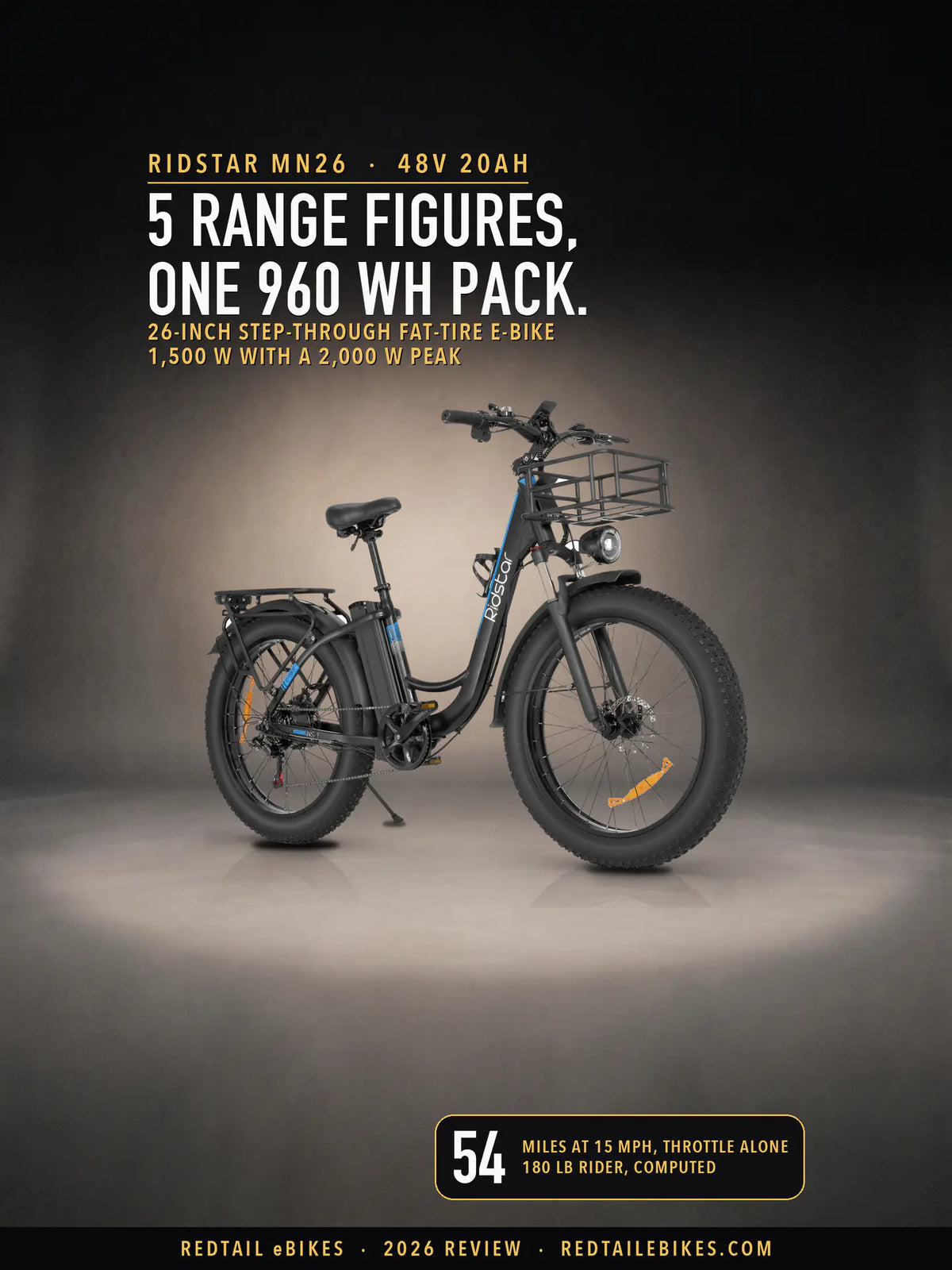
Share:
Electric Bike Maintenance: 5 Habits, 2 Visits
Freesky Warrior Pro Review 2026: 4,000W Peak, 1,440 Wh