
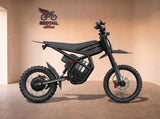
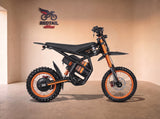
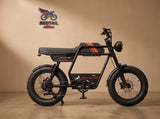
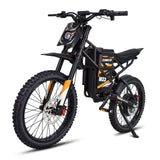
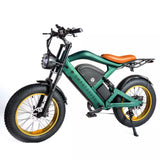

500 W Bafang M600 · 120 N·m · 840 Wh · 40–65 miles · 20 MPH · 61.7 lb · 300 lb payload · $3,399 · verified November 3, 2026
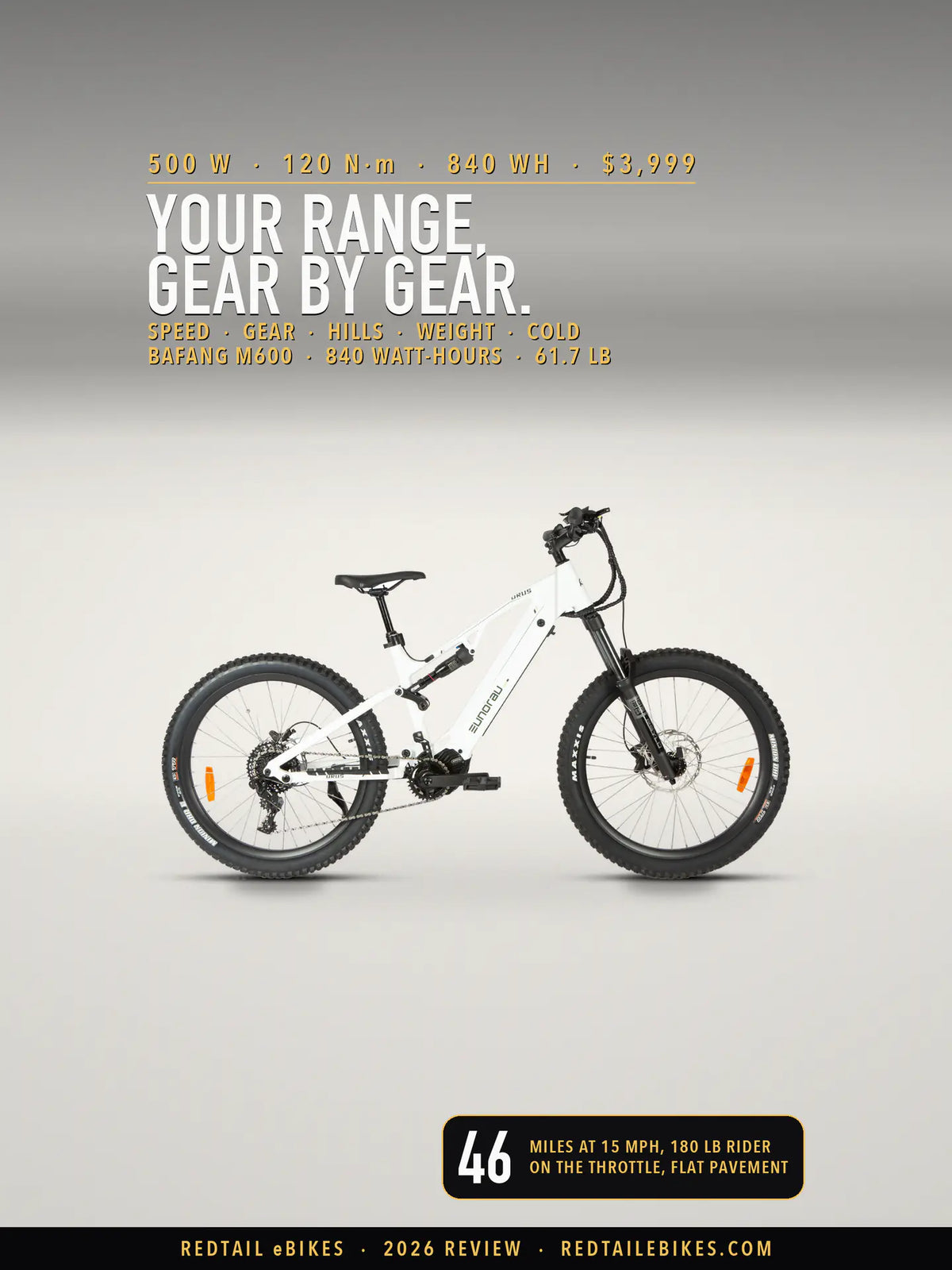
Quick Answer — The Eunorau URUS 2.0 is a $3,399 full-suspension electric mountain bike for fire roads, gravel and your own land: a 500 W Bafang M600 mid-drive, an 840 Wh battery and RockShox suspension. Eunorau publishes 40–65 miles; on flat pavement a 180 lb rider gets about 46 miles at 15 mph on the throttle, or 69 at 15 pedaling easily.
This Eunorau URUS review computes those numbers from Bafang's own data for the M600, the gears and weights Eunorau publishes and the measured rolling resistance of its Maxxis Minion tread, then works them out gear by gear for your speed, grade, weight and temperature. The class is the other thing to settle first: Eunorau publishes a 20 mph top speed and badges the same bike Class 3, and which one you own decides where you may ride it.
Cloud White is the colorway you can order today, in both frame sizes: this button takes the 19″, and the 17″ is here. Read from our own store on September 26, 2026. Free shipping within the contiguous United States, and if it arrives damaged we file the carrier claim ourselves.
Buy the URUS 2.0 — 19″What this review covers
What $3,399 buys · The M600 · Suspension · The 840 Wh battery · How far it goes, gear by gear · Weight and payload · Will it fit you? · The Mercer fit test · Recalls · UL · The class question · Where you can ride it · Buying it from us · Green and red flags · The verdict · Checklist · FAQ · Limitations · The bottom line · References
How we verified this Eunorau URUS review
Every figure here was read from a primary document and recomputed, never repeated. Eunorau publishes the URUS 2.0 across two separate surfaces — a product feed and a rendered product page — and this review reads both, plus our own listing, last on September 26, 2026.
Where they disagree, the page says which surface is being quoted. Statutes are quoted from the state's own code, never from a summary of it. The arithmetic (watt-hours per mile, gear ratios and the range model, which adds Bafang's motor data and published cycling research to Eunorau's numbers) is shown so you can follow it.
This is a specification-verified review: every claim traces to a published figure, a statute or a document we opened. We sell this bike, so read the red flags as carefully as the green.
Written by Milad Ghobadibeygvand, BScN (Western University, 2014). Corrections: support@redtailebikes.com.
What $3,399 buys
| Eunorau's published figure | |
|---|---|
| Motor | 48 V 500 W Bafang M600 mid-drive, up to 120 N·m |
| Battery | 48 V 17.5 Ah removable lithium-ion, Samsung cells |
| Range | Up to 40–65 miles |
| Maximum speed | 20 mph |
| Class badge | "Class 3 · Speed limited · Unlockable" |
| Weight | Approximately 61.7 lb |
| Maximum payload | 300 lb |
| Recommended rider height | 5'3"–6'4" / 160–193 cm |
| Fork | RockShox Psylo 27.5", 150 mm travel, tapered steerer, 15 × 110 mm Boost |
| Rear shock | RockShox Deluxe Select+ RL, 190 × 45 mm |
| Drivetrain | SRAM NX 1 × 11, PG-1130 11–42T cassette, 32T chainring, 170 mm cranks |
| Brakes | TEKTRO HD-E3940 four-piston hydraulic, with motor cut-off sensors |
| Tires | Maxxis Minion DHF front, Minion DHR II rear, 27.5 × 2.8" |
| Display | BC281 color LCD, Bluetooth, EUNORAU GO app |
| Assist | Levels 0–5, thumb throttle, 6 km/h walk mode |
| Dropper post | Remote dropper, included |
| Lights | Not included |
| Charger | 48 V 2 A |
Read from Eunorau's product page for the URUS 2.0 on September 26, 2026, and cross-read against its product feed the same day.
The Bafang M600, and what 120 N·m actually does

The M600 sits at the cranks. Its torque goes through the gears you are already using.
A mid-drive motor drives the chainring instead of a wheel, which means it uses the same eleven gears you do. The whole argument for a mid-drive on a climb follows from it: in the bottom gear, the motor's torque is multiplied by the same ratio your legs get.
The numbers Eunorau publishes let you see how much. The drivetrain is a 32T chainring against an 11–42T cassette, so the lowest gear is a ratio of 0.76 to 1 (32 ÷ 42) and the highest is 2.91 to 1 (32 ÷ 11).
In that bottom gear the rear wheel turns roughly three-quarters of a turn for every full crank revolution, and the motor's 120 N·m works through that reduction rather than against it. A hub motor on the same hill has one gear, whatever the rider is in.

The 11–42T cassette. Against the 32T chainring that is a 0.76:1 bottom gear — the ratio the motor's torque is multiplied through on a climb.
The M600 is also a torque-sensing unit: Eunorau's page describes assistance "perfectly tailored to the pressure of the pedals". In practice that is the difference between assistance that arrives when you push and assistance that arrives a beat after you start pedaling.
Bafang's own figures show how fast the M600 likes to turn. Bafang's 2021 OEM workbook prints two speeds beside the motor's 500 W rating at 48 V, nT 115 rpm and n0 130 rpm. Read the usual way, as the chainring's speed at rated power and as fast as it spins with nothing to push against, they mark the window where the motor works well, and 130 rpm is its limit.
So the gear you choose sets how hard the motor works, which the range section works out cog by cog.
RockShox at both ends — and the specification the internet still gets wrong

RockShox Psylo, 150 mm of travel. The wordmark is legible on Eunorau's own photograph of the bike.
This is the part worth reading twice, because if you research this bike anywhere else you will probably be told something false about what Eunorau actually fits.
Eunorau's current page for the URUS 2.0 publishes a RockShox Psylo 27.5" fork with 150 mm of travel, a tapered steerer and a 15 × 110 mm Boost thru-axle, paired with a RockShox Deluxe Select+ RL rear shock in a 190 × 45 mm configuration with adjustable rebound and lockout. The fork's wordmark is readable in Eunorau's own product photography.
Ask an AI assistant about this bike today and you will likely be told it has an X-Fusion fork with 160 mm of travel instead of what Eunorau publishes. We ran that question on September 22, 2026 and got exactly that answer, sourced entirely from retailer listings.
Those listings are describing an earlier version of the URUS. The bike Eunorau sells now is on RockShox at both ends, and its published travel figure is 150 mm.
Why it matters to you: a fork is expensive to change your mind about after delivery, and "RockShox Psylo with a Boost thru-axle" and "X-Fusion" are different purchases with different service parts. If a retailer's page tells you one and Eunorau's page tells you the other, the maker's current page is the one to buy from.
Before you order from anyone, open the maker's own product page and read the fork line. On this bike the correct answer is RockShox Psylo, 150 mm — and a large share of what is published about the URUS elsewhere is a generation out of date.

Front wheel: a Maxxis Minion DHF in 27.5 × 2.8", the tread Eunorau pairs with a Minion DHR II at the back.
840 watt-hours, and what 40 to 65 miles is really saying
The pack is 48 V × 17.5 Ah, which is 840 watt-hours: Eunorau's two published numbers, multiplied.
Set that against the published range of 40 to 65 miles and you get the efficiency band the range claim assumes:
| Eunorau's range figure | What the 840 Wh pack must deliver |
|---|---|
| 65 miles (the optimistic end) | 12.9 watt-hours per mile |
| 40 miles (the conservative end) | 21.0 watt-hours per mile |
Both numbers are ours, derived here from 840 ÷ 65 and 840 ÷ 40 against Eunorau's own pack and range figures.
Which rides use 12.9 and which use 21.0 is what the range section answers, speed by speed and gear by gear, on the 27.5 × 2.8" Maxxis Minions Eunorau fits.
The pack is removable, with a lock, and charges on a 48 V 2 A charger. Eunorau's product feed gives the charge time as 5–7 hours; at the charger's 2 A rating a 17.5 Ah pack takes about nine hours from empty, and Eunorau's FAQ gives "between 3-8 hours" depending on the battery and charger, so from empty, plan on an overnight charge.
The same FAQ says batteries "typically last 5-6 years" and still deliver "more than 80% of their original capacity after 500 charge cycles".
How far the URUS 2.0 goes: your range, gear by gear
On flat pavement, a 180 lb rider gets about 46 miles from a full charge at 15 mph on the throttle, 33 at 20 mph and 69 pedaling easily at 15. Climb an 8% grade at 8 mph on the throttle and the whole charge lasts 13 miles in the right gear, 7 in the wrong one.
Find your ride in three steps:
- Pick your speed and effort in the first two tables.
- Allow about 120 Wh of the 840 for every 1,000 feet you climb, and shift to the big cogs to do it (the gear tables).
- Adjust for your weight and the temperature, then plan with 85% of the result.
Every figure is computed, one steady ride at a time, from Bafang's own figures for the M600, the drivetrain and weights Eunorau publishes, the measured rolling resistance of the Maxxis Minion tread and a cycling-power model validated on the road. The formula, every input and one ride worked line by line close the section.
Does riding faster cut range? Miles at each speed
On the throttle, speed is the biggest number you control. The same charge that goes 46 miles at 15 mph goes 33 at 20, more than a quarter less, because the air takes 2.4 times the power at 20 mph that it takes at 15.
| Speed, flat | Cheapest gear (chainring rpm) | Per mile | Full charge | With 15% kept |
|---|---|---|---|---|
| 10 mph | 15T (55) | 13.9 Wh | 60 mi | 51 mi |
| 12 mph | 15T (66) | 15.5 Wh | 54 mi | 46 mi |
| 14 mph | 15T (77) | 17.4 Wh | 48 mi | 41 mi |
| 15 mph | 15T (83) | 18.5 Wh | 46 mi | 39 mi |
| 16 mph | 17T (100) | 19.6 Wh | 43 mi | 36 mi |
| 18 mph | 17T (113) | 22.2 Wh | 38 mi | 32 mi |
| 20 mph | 15T (110) | 25.3 Wh | 33 mi | 28 mi |
Throttle only, flat pavement, a 180 lb rider on a 77 °F day. The gear is the cheapest the motor can drive at that speed, and the last column follows Eunorau's advice to recharge while 10–15% remains. Each row prices a speed the throttle holds; which speeds it reaches is the top-speed question the class section covers.
On the flat, pedaling moves the numbers more than any gear can. The tables call 75 W of your own effort easy pedaling and 150 W steady: with the motor off, 75 W would carry this bike at about 9 mph on flat pavement and 150 W at about 13.
If you could hold 9 mph without the motor, read the easy column; 13, the steady one. Above those speeds the motor makes up the difference, and the difference is all the battery pays for.
| Speed, flat | Throttle only | Easy pedaling (75 W) | Steady pedaling (150 W) |
|---|---|---|---|
| 12 mph | 54 mi | 100+ mi | legs alone |
| 14 mph | 48 mi | 80 mi | 100+ mi |
| 15 mph | 46 mi | 69 mi | 100+ mi |
| 16 mph | 43 mi | 61 mi | 100+ mi |
| 18 mph | 38 mi | 49 mi | 71 mi |
| 20 mph | 33 mi | 41 mi | 53 mi |
Miles from a full charge on flat pavement, a 180 lb rider. Easy pedaling at 15 mph costs 12.2 Wh a mile against 18.5 on the throttle. Every figure is a steady ride; above 100 miles the motor is doing so little that stops, wind and your own legs decide the day, so the table stops counting there.
An assist level is the controller's rule for how much to add to your pedaling, so whichever level you ride in, read the row for the speed you hold and the effort you put in.
Found your speed and effort in the tables above? Those rows are a 180 lb rider on flat pavement; the hill, weight and cold tables below adjust them. The button opens checkout for the 17″ frame, and the 19″ is here. Our listing's Shop Pay sample plan is $360.94 a month over 12 months at 15% APR, subject to an eligibility check, and the bike ships free to the 48 contiguous states.
Buy the URUS 2.0 at $3,399What gear should you ride in to save battery?
On flat ground, any gear the motor can turn is within 14% of the best. On a climb, shift to the big cogs and keep the chainring turning at about 75 rpm or faster.
Cogs are named by their teeth: the 42T is the biggest cog at the back and your easiest gear, the 11T the smallest and hardest. The M600 turns the chainring, so every shift changes the motor's own speed, and its speed decides how hard it has to push. If you are pedaling, the chainring's speed is your cadence.
At 15 mph and faster, the cogs the motor can still drive cost within 3 to 5% of each other, and the costliest is the 11T. What the gear decides on flat ground is whether the motor keeps up at all: it loses torque as the chainring nears its 130 rpm limit, so at 20 mph only the three hardest gears, the 11T, 13T and 15T, keep up. In the 17T the chainring would have to spin 125 rpm.
| Speed | Cogs the motor can drive | Chainring rpm | Cheapest to costliest, throttle |
|---|---|---|---|
| 10 mph | 11T to 32T (9 of 11) | 41 to 118 | 13.9 to 15.9 Wh |
| 12 mph | 11T to 28T (8 of 11) | 49 to 124 | 15.5 to 16.8 Wh |
| 15 mph | 11T to 22T (6 of 11) | 61 to 121 | 18.5 to 19.1 Wh |
| 18 mph | 11T to 17T (4 of 11) | 73 to 113 | 22.2 to 23.2 Wh |
| 20 mph | 11T to 15T (3 of 11) | 81 to 110 | 25.3 to 26.6 Wh |
At 10 and 12 mph the costly choice is the biggest cog the motor can still turn. At 10 mph the 32T spins the chainring at 118 rpm and costs 14% more than the cheapest gear.
Uphill, the right gear saves more battery than pedaling does. Holding 8 mph up an 8% grade on the throttle, the 11T turns the chainring at 32 rpm and the motor has to push 112.1 N·m, 3.3 times what it needs in the 36T. More torque takes more current, and the motor's losses grow with the square of the current.
In the 11T that climb costs 116.3 Wh a mile, 7 miles from a full charge; in the 36T it costs 62.7 Wh and gives 13 miles, so the wrong gear uses nearly twice the battery for the same hill at the same speed. Shifting from the 11T to the 36T saves 46% on the throttle; pedaling easily in the 36T saves a further 19%.
| Cog (chainring rpm at 8 mph) | 6% grade, throttle | 8% grade, throttle | 8% grade, easy pedaling |
|---|---|---|---|
| 11T, hardest (32) | 81 Wh · 10 mi | 116 Wh · 7 mi | 83 Wh · 10 mi |
| 15T (44) | 64 Wh · 13 mi | 87 Wh · 10 mi | 65 Wh · 13 mi |
| 19T (56) | 57 Wh · 15 mi | 75 Wh · 11 mi | 57 Wh · 15 mi |
| 25T (74) | 52 Wh · 16 mi | 67 Wh · 13 mi | 53 Wh · 16 mi |
| 28T (82) | 51 Wh · 16 mi | 65 Wh · 13 mi | 52 Wh · 16 mi |
| 32T (94) | 50 Wh · 17 mi | 64 Wh · 13 mi | 51 Wh · 17 mi |
| 36T (106) | 50 Wh · 17 mi | 63 Wh · 13 mi | 51 Wh · 17 mi |
| 42T, easiest (124) | out of rpm | out of rpm | out of rpm |
8 mph, a 180 lb rider, the motor held to its rated 500 W. "Out of rpm" means the chainring would turn too close to the motor's 130 rpm limit for it to make the torque the hill needs.
On a climb, keep the chainring at about 75 rpm or faster. At 8 mph that means the 25T to the 36T, the second- to fifth-easiest gears, all within 7% of the best on the throttle and 4% pedaling easily.
Grind at 44 rpm in the 15T and the same climb costs 39% more on the throttle; in the 11T, 85% more. Skip the 42T at 8 mph: it would spin the chainring at 124 rpm, close to the limit, where the motor runs out of push.
Does going uphill drain the battery faster?
Yes. In the right gear, every 1,000 feet you climb costs about 120 Wh more than the same miles on the flat. At 8 mph the model puts it at 118 to 121 Wh on the throttle on 4, 6, 8 and 10% grades, in the 32T or 36T, because most of it is the work of lifting you and the bike.
Raising 242 lb (a 180 lb rider and the 61.7 lb bike) through 1,000 feet takes 91 Wh at the wheel; with the chain's, the motor's and the pack's losses it takes about 119 Wh from the battery, so the full 840 Wh would lift you about 7,100 feet if it did nothing else.
The battery gets none of it back on the way down: Eunorau's FAQ says a bike "isn’t heavy enough" for regenerative braking to charge it much, and names two other models as the only ones that charge from pedaling; the URUS is not one of them. Descents still cost less than flat miles, so a budget built from these rows errs high.
| Grade | Top speed, throttle | Top speed, easy pedaling | At 8 mph, easy pedaling |
|---|---|---|---|
| 2% | 18.4 mph | 19.8 mph | 13 Wh · 63 mi |
| 4% | 15.0 mph | 16.5 mph | 26 Wh · 32 mi |
| 6% | 12.3 mph | 13.7 mph | 38 Wh · 22 mi |
| 8% | 10.2 mph | 11.5 mph | 51 Wh · 17 mi |
| 10% | 8.6 mph | 9.8 mph | 63 Wh · 13 mi |
| 12% | 7.5 mph | 8.5 mph | 76 Wh · 11 mi |
| 15% | 6.2 mph | 7.1 mph | under 8 mph; 91 Wh · 9 mi at 6 |
A 180 lb rider. The first two columns are the fastest steady speed the motor holds at the 500 W Bafang rates it at: on a 10% grade, 8.6 mph on the throttle alone and 9.8 pedaling easily. The last column is the whole charge spent on that grade at 8 mph.
Budget a hilly ride as flat miles plus climbing. Twenty flat miles at 15 mph on the throttle is about 370 Wh. Add 2,000 feet of climbing at about 120 Wh per 1,000 and the ride uses about 610 of the 840. The model treats every mile as steady, so stops, starts and wind come on top.
Does rider weight affect range?
On the flat a little, on a climb a lot. Weight adds to what the tires and the hill cost but not to what the air costs, so it bites hardest on a climb.
| You plus your load | 15 mph flat, throttle | 20 mph flat, throttle | 8% climb at 8 mph, easy pedaling |
|---|---|---|---|
| 130 lb | 50 mi | 36 mi | 22 mi |
| 180 lb | 46 mi | 33 mi | 17 mi |
| 300 lb (the limit) | 38 mi | 28 mi | 10 mi |
You plus everything on the bike, with the bike's own 61.7 lb added to every row. 300 lb is Eunorau's payload limit, which Eunorau counts as the rider and the load.
Going from 180 lb to Eunorau's 300 costs the flat 15 mph ride 8 miles. The 8% climb falls from 17 miles to 10, because most of the power on a climb goes into lifting weight. At 300 lb, holding 8 mph up 8% on the throttle alone takes more than the motor's rated 500 W, so that column has you pedaling easily.
Does cold weather drain the battery?
Yes: plan from the row nearest the day's temperature. Below 77 °F every step colder costs miles, and at freezing the 15 mph pedaling ride falls from 69 miles to 52. Eunorau's FAQ gives the battery's optimal operating temperature as 10 to 55 °C, which is 50 to 131 °F, and says the battery "may need extra care in extreme weather".
| Air | Pack energy vs 77 °F | 15 mph, easy pedaling | 20 mph, throttle |
|---|---|---|---|
| 95 °F | 99% | 75 mi | 34 mi |
| 77 °F | 100% | 69 mi | 33 mi |
| 68 °F | 98% | 65 mi | 32 mi |
| 50 °F | 93% | 57 mi | 29 mi |
| 41 °F | 91% | 54 mi | 27 mi |
| 32 °F | 89% (80–93) | 52 mi (47–54) | 26 mi (24–28) |
| 14 °F | 82% (40–83) | 47 mi (23–47) | 24 mi (12–24) |
The central figure is the energy recomputed from McMaster University's LG HG2 cell data at a 0.5C discharge (half the cell's rated capacity per hour); the 77, 50, 32 and 14 °F rows are its measured temperatures and the others are interpolated. The table assumes the cells sit at the air temperature.
The brackets run from the lowest capacity Samsung's data sheets print at that temperature, at discharge rates of 1C to 4C (one to four times the rated capacity per hour; the 25R and 30Q at 32 °F, the 35E at 14 °F), to the highest energy measured at a gentler rate: Casado and colleagues' 2025 test of Samsung's 35E at 1 A at 32 °F, and the HG2 itself at 14 °F.
At 32 °F the pack gives about 89% of its 77 °F energy (80 to 93% across the sources), the air is 9% denser and the model holds the tires at 18% harder, its 41 °F value, so the 15 mph pedaling ride loses 25%. Eunorau's own winter guidance says to "Plan for 20-40% less real-world range below 32°F".
Below 77 °F the model raises rolling resistance by 0.5% per °F (0.9% per °C), between Rothhämel's linear fit for 41 to 77 °F on a 42 mm tire and BicycleRollingResistance's road-tire average, and holds the 41 °F value below that. Rothhämel measured down to −22 °F and found the rise steepening in the cold, so the 32 and 14 °F rows are, if anything, generous.
At 95 °F the range is slightly longer than at 77 °F, because thinner air and warmer tires outweigh the 1% the cells give up.
Do knobby tires cut range? Tires and riding position
The URUS rolls on trail tires, and the model uses the measured figure for its rear tread. In ENDURO Mountainbike Magazine's test at Schwalbe's laboratory, a Minion DHR II in MaxxTerra rubber with a DH casing, 29 × 2.50, took 34.3 W to roll at 20 km/h (12.4 mph) under a 50 kg (110 lb) load, a rolling-resistance coefficient of 0.0126.
A second lab lands in the same place: BicycleRollingResistance measured Schwalbe's Hans Dampf trail tire in TrailStar rubber at 0.0127 on a drum built to simulate a road.
| Rolling resistance | 15 mph, throttle | 15 mph, easy pedaling |
|---|---|---|
| 0.0092 · everyday knobby tires, Vancouver bikeways | 51 mi | 84 mi |
| 0.0126 · Minion DHR II, MaxxTerra, DH casing, 29-inch (used here) | 46 mi | 69 mi |
| 0.0134 · Minion DHR II, MaxxTerra, DoubleDown casing | 44 mi | 66 mi |
Miles from a full charge on flat pavement, a 180 lb rider. The top row is the field average for everyday riders on knobby tires of every kind, measured coasting on Vancouver bikeways by Tengattini and Bigazzi. The URUS's 27.5 × 2.8" Minions come in Dual or MaxxTerra rubber with EXO or EXO+ casings (Maxxis's 2026 catalog).
Your own tires, pressure and surface can put you anywhere in this table: 44 to 51 miles at 15 mph on the throttle, and 66 to 84 pedaling easily. Across road, sand and grass, Bertucci and colleagues found a smooth mountain-bike tire rolled with 21% less resistance than a knobby one.
On dirt, the Minions' grip is what you bought them for. Every figure in this section is for pavement or a lab drum and none is measured on dirt or gravel, so before you plan a fire-road ride on these rows, send us the route.
At speed, the air you push decides a lot. Bertucci and colleagues measured mountain-bike cyclists riding seated at 0.357 m² of drag area; the 557 everyday riders Tengattini and Bigazzi measured on their own bikes, 477 of them in casual clothes, averaged 0.603 m² on the 90 mountain bikes among them.
At 20 mph on the throttle that gap is worth 45 miles against 33. Neither study separates posture from clothing and bags, so read it as the distance between a sport rider and an everyday one.
Eunorau's 40 to 65 miles, matched to real-world rides
Eunorau's 40 to 65 miles is a band, and the model shows which steady rides produce each end.
Sixty-five miles from 840 Wh is 12.9 Wh a mile: on flat pavement that is about 15.5 mph pedaling easily, 18.6 mph pedaling steadily or 8.5 mph on the throttle alone. Forty miles is 21.0 Wh a mile, about 17.2 mph on the throttle alone; pedal even easily and 20 mph still gives 41 miles.
Plan with 85% of any figure here, so you come home with the 10 to 15% that Eunorau's FAQ advises keeping in the pack: the 46 miles at 15 mph on the throttle becomes 39. For a loaded backcountry ride, Eunorau's own hunting-range guide keeps "a 20 percent reserve".
Find your ride in the tables, then plan with 85% of it. Allow about 120 Wh of the 840 for every 1,000 feet you climb, and shift to the big cogs on every hill. For a 180 lb rider on flat pavement, that is 39 miles at 15 mph on the throttle and 28 at 20.
Twenty flat miles at 15 mph plus 2,000 feet of climbing uses about 610 of the 840 Wh on the throttle, leaving more than Eunorau's 15%. Email us your distance, climbing, weight with gear and speed before you order, and we will run your ride through the model. Checkout opens on the 19″; the 17″ is here. Shipping to the lower 48 is free, and we file the carrier claim on damage reported within 48 hours.
Buy the URUS 2.0 for your rideHow every figure here is worked out
To hold a steady speed, the rear wheel needs a steady flow of power. Martin and colleagues' model, checked against riders on a real road in 1998, gives it in one line in its steady, no-wind form:
Power at the wheel = v × [ m × g × (Crr × cos θ + sin θ) + ½ × ρ × CdA × v² ]
Here v is your speed, m the mass of you and the bike, g gravity, θ the slope, Crr the tires' rolling resistance (0.0126 means they drag with a force of 1.26% of the weight on them), ρ the density of the air and CdA your drag area (your frontal size times how un-streamlined your shape is).
The first part of the bracket is the tires and the hill; the second is the air, and because it rises with the cube of your speed, the last few miles an hour cost the most.
From the wheel back to the battery takes four more steps:
- The chain passes 97.7% of the motor's work to the wheel, the drivetrain efficiency Martin's team used.
- Your legs: whatever you pedal comes off the top, and the motor supplies the rest.
- The gear sets the motor's speed: the M600 turns the chainring, so the chainring turns at the wheel's rpm × the cog's teeth ÷ 32. Bafang's 2021 OEM workbook prints nT 115 rpm and n0 130 rpm at 48 V, and an efficiency of "≥ 80" percent; read as the chainring's speed at rated power and with nothing to push against, they fix the motor model below, which takes 80% at 500 W and less at lighter loads.
- The pack loses a little more inside itself: 3.4% at 15 mph, from the battery efficiency Arango, Lopez and Ceren measured on a 48 V mid-drive.
Then watt-hours per mile = battery watts ÷ mph, and miles = 840 Wh × the share of the pack's energy the temperature leaves you ÷ watt-hours per mile.
| Input | Value used | Where it comes from |
|---|---|---|
| Bike | 61.7 lb | Eunorau's specification |
| You and what you carry | 180 lb; the tables also run 130 and 300 | 300 lb is Eunorau's payload limit |
| Battery | 48 V × 17.5 Ah = 840 Wh | Eunorau's specification |
| Motor | 500 W at nT 115 rpm; n0 130 rpm; "≥ 80" efficiency, taken as 80% at 500 W; torque capped at 120 N·m, Bafang's max effective torque (its 2023 workbook also prints a 140 N·m peak) | Bafang OEM workbook 2021, M600 column |
| Gears | 32T chainring; 11, 13, 15, 17, 19, 22, 25, 28, 32, 36 and 42T cogs | Eunorau and SRAM's PG-1130 page |
| Wheel | 27.5 × 2.8" tire, 2,279 mm around | Wahoo's tire size chart |
| Rolling resistance | 0.0126, a Minion DHR II in MaxxTerra rubber, DH casing, 29-inch | ENDURO's lab test at Schwalbe |
| Drag area | 0.603 m², the average of 90 everyday riders on mountain bikes | Tengattini and Bigazzi, 2018 |
| Chain | 97.7% | Martin et al., 1998 |
| Battery losses | 3.4% at 15 mph, more at climbing currents | Arango, Lopez and Ceren, 2021 |
| Air | 77 °F at sea-level pressure, 1.184 kg/m³ | U.S. Standard Atmosphere, 1976 |
| Cold | the share of a cell's energy left at each temperature | McMaster University's LG HG2 cell data |
One ride, worked through: 15 mph on flat pavement, throttle only, a 180 lb rider. Rolling resistance takes 90.8 W and the air 107.6 W, so the wheel needs 198.4 W and the chainring 203.1 W.
In the 15T cog the chainring turns 83 rpm, and the motor model (back-EMF 3.526 N·m per amp, 0.425 Ω winding resistance, 1.245 A no-load current, all from Bafang's two speeds) delivers 23.4 N·m at 75.9% efficiency, below its 80% because the push is light, drawing 267.6 W.
The pack's own losses bring that to 276.9 W: at 15 mph, 18.46 Wh a mile, and 840 ÷ 18.46 is 45.5 miles.
61.7 pounds, and the 300 pounds it will carry
Eunorau publishes 61.7 lb / 28 kg for the 17" frame and a 300 lb / 136 kg maximum payload.
The 300 lb is for you and what you carry, with the bike's own 61.7 lb outside it. Eunorau's guide to hauling gear puts it plainly: "Payload covers the rider and anything carried on the bike itself."
Its packing guide runs the same arithmetic, giving a 195 lb rider on a bike "rated for 300 lb total payload" about 105 lb for everything else. So a 250 lb rider can carry 50 lb of pack, tools and water and stay inside Eunorau's rating.
Two notes on that weight. First, 61.7 lb is the published figure for the 17" frame, so read it as the smaller frame's number. Second, 61.7 lb is a number you will meet every time you lift this bike onto a rack or up a step, and no amount of motor changes that.
Weigh yourself with everything you carry against the 300 pounds. Eunorau's payload counts the rider and the load; the bike's own 61.7 lb sits outside it. Every pound also comes out of your range on a climb: at the 300 lb limit an 8% grade at 8 mph, pedaling easily, gets 10 miles from a full charge, against 17 at 180 lb (the weight table).
Will the URUS 2.0 fit you?
Eunorau's own photograph shows the saddle 40.5 inches off the ground, the height the fit formula gives the median 5'7" rider; at 5'8", 72 of 100 riders need it higher, and at 5'10", 96 of 100 do. You lean 13 to 20 degrees from upright to reach the grips, and with your back fully relaxed your hands carry at most 13 to 19 percent of your weight.
Every figure is worked out for the 6,068 measured bodies in the US Army's anthropometric survey, with the saddle at 109% of inseam, on the 19-inch frame as Eunorau photographed it.
Three steps find your fit on this bike:
- Measure your inseam barefoot. Stand against a wall, draw a hardcover book up firmly between your legs as a saddle would sit, and measure from the floor to the book's top edge.
- Find your height in the tables below and check that your inseam falls inside that row's range; a longer inseam reads like the next row up.
- Set the saddle on delivery with the knee and heel checks at the end of this section, then let the dropper post do the rest on the trail.
Eunorau prints two rider windows for the URUS 2.0. The product page gives one for both frames, 5'3" to 6'4". Its frame-size guide places a 19-inch frame in its 5'6"–5'10" and 5'10"–6'1" rows, and a 17-inch frame in its 5'2"–5'6" and 5'6"–5'10" rows.
Will the saddle go high enough for me?
Up to 5'7", the saddle in Eunorau's photograph is already at or above the median rider's formula height; above that, you raise it on the remote dropper post. The formula sets your saddle 109% of your inseam from the pedal axle (Peveler et al., 2005), and published practice reaches down to 106% (Ferrer-Roca et al., 2012).
On the URUS that distance becomes a ground height through a crank axle 12.9 inches up, the 170 mm cranks Eunorau lists and a seat post leaning at 73 degrees.
| Your height | Typical inseam | Saddle height, median rider | Saddle in the photo (40.5 in), median rider | Riders who need it higher, of 100 |
|---|---|---|---|---|
| 5'3" | 28.7–31.6 in | 38.3 in | 2.2 in high | 2 |
| 5'5" | 29.7–32.6 in | 39.3 in | 1.2 in high | 13 |
| 5'6" | 30.2–33.5 in | 40.0 in | 0.5 in high | 30 |
| 5'7" | 30.7–33.9 in | 40.5 in | on the mark | 49 |
| 5'8" | 31.1–34.3 in | 41.0 in | 0.5 in low | 72 |
| 5'10" | 32.2–35.5 in | 42.2 in | 1.7 in low | 96 |
| 5'11" | 32.9–36.1 in | 42.8 in | 2.2 in low | 100 |
| 6'1" | 33.9–37.2 in | 44.1 in | 3.6 in low | 100 |
| 6'3" | 35.3–38.0 in | 45.2 in | 4.7 in low | 100 |
Ground-to-saddle height the formula gives the median rider at each height, where the saddle Eunorau photographed sits against it, and how many riders of 100 at that height need the saddle set higher than the photograph. ANSUR II bodies, men and women together, on the 19-inch frame.
How far the post rises above the photographed setting is the one number to confirm before you order if you are 5'8" or taller. Email your inseam and we will get the dropper's travel from Eunorau in writing. At the short end the 17-inch frame is the one Eunorau's size guide points to, and its seat tube is 51 mm shorter, so its saddle can sit lower.
Can I put a foot down at a stop?
Yes for almost everyone Eunorau sizes the bike for: where the frame rises in line with the saddle's nose it stands 28.6 inches up, and 95 of 100 riders clear it by 1.1 inches at 5'5" and 2.5 inches at 5'8". At 5'3", the bottom of Eunorau's window, that clearance is 0.1 inch, so hold your inseam against the frame before the first ride.
| Your height | Typical inseam | Clearance over the frame |
|---|---|---|
| 5'3" | 30.1 in | 0.1 in or more for 95 of 100 riders |
| 5'5" | 31.0 in | 1.1 in or more for 95 of 100 riders |
| 5'6" | 31.7 in | 1.6 in or more for 95 of 100 riders |
| 5'7" | 32.2 in | 2.1 in or more for 95 of 100 riders |
| 5'8" | 32.6 in | 2.5 in or more for 95 of 100 riders |
| 5'10" | 33.8 in | 3.6 in or more for 95 of 100 riders |
| 5'11" | 34.3 in | 4.3 in or more for 95 of 100 riders |
| 6'1" | 35.6 in | 5.3 in or more for 95 of 100 riders |
| 6'3" | 36.6 in | 6.6 in or more for 95 of 100 riders |
Barefoot inseam minus the frame's height at the saddle's nose, measured on Eunorau's photograph of the 19-inch frame: the clearance 95 of 100 riders at each height have or exceed.
Will I feel cramped, or stretched?
The median rider leans 13 degrees from upright at 5'3" and 20 at 6'3", so the taller you are, the further you reach toward the bars. The grips sit 33.2 to 34.7 inches above the crank axle, and a taller rider's saddle rises with the formula while the bars stay put, so the trunk tips further to reach them.
If comfort on long, easy miles is the goal, sit up where you can: in a 20-rider study, "Upright trunk was found to be the most comfortable position for recreational cyclists" (Priego Quesada et al., 2017).
| Your height | Lean from upright, median rider | Across saddle and grip positions |
|---|---|---|
| 5'3" | 13° | 6–19° |
| 5'5" | 13° | 7–20° |
| 5'6" | 14° | 7–20° |
| 5'7" | 14° | 8–20° |
| 5'8" | 15° | 8–21° |
| 5'10" | 16° | 10–22° |
| 5'11" | 16° | 10–22° |
| 6'1" | 19° | 13–24° |
| 6'3" | 20° | 15–25° |
Lean from vertical for the median rider on the 19-inch frame as photographed, the least a straight arm needs to reach the grips from where the sit bones rest; the range spans the saddle's sit zone and the grip's extent in the photograph.
Eunorau's geometry table shows how the two frames differ at the front end:
| URUS-17 | URUS-19 | |
|---|---|---|
| Seat tube | 432 mm | 483 mm |
| Reach | 424 mm | 444 mm |
| Top tube | 526 mm | 560 mm |
| Stack (Eunorau's figure) | 420 mm | 469 mm |
| Wheelbase | 1,256 mm | 1,276 mm |
| Chain stay | 490 mm | 490 mm |
| Total length | 2,046 mm | 2,066 mm |
Eunorau's Dimensions & Rider Fit table, read September 26, 2026. The 17-inch frame's reach is 20 mm shorter, so a rider between rows leans a little less on it.
How much weight goes through my wrists?
At most 13 to 19 percent of your weight with your back fully relaxed, climbing with height for the same reason the lean does. For scale, 10 road racers pedaling with their hands on the hoods put 15% of their weight on the stem (Carahalios, 2015); on the URUS the relaxed-back ceiling stays under that up to 5'8" and passes it from 5'10".
| Your height | Share of your weight, back relaxed | Median rider's weight | On each hand |
|---|---|---|---|
| 5'3" | 13% (9–16%) | 144 lb | about 9 lb |
| 5'5" | 14% (10–17%) | 157 lb | about 10 lb |
| 5'6" | 14% (10–17%) | 166 lb | about 11 lb |
| 5'7" | 14% (10–17%) | 172 lb | about 12 lb |
| 5'8" | 15% (11–17%) | 179 lb | about 13 lb |
| 5'10" | 15% (12–18%) | 192 lb | about 15 lb |
| 5'11" | 16% (13–19%) | 196 lb | about 16 lb |
| 6'1" | 17% (14–20%) | 206 lb | about 18 lb |
| 6'3" | 19% (16–21%) | 227 lb | about 20 lb |
The most the hands hold with the back relaxed, from each body's segment weights (Clauser et al., 1969); the range spans the saddle and grip positions. Weights are the survey's median at each height.
Holding yourself up with your core carries part of that load, which is why the table reads as a ceiling. On a longer day, padded gloves help too: they cut the pressure over the ulnar nerve by 10 to 28% in a study of 36 experienced cyclists (Slane et al., 2011).
How do I set the saddle when it arrives?
Raise the saddle until your knee keeps a 25 to 35 degree bend with the pedal at its lowest point (Peveler et al., 2007). The quickest way there is the heel method: heel on the low pedal, saddle up until that leg is just straight, which put 70% of 19 trained cyclists inside the range, more than either inseam formula did (Peveler et al., 2005).
Set that height with the dropper post fully extended, since that is where you pedal; the remote lever then drops the saddle out of the way for steep descents and stops.
How we computed fit
The saddle goes 1.09 times your inseam above the pedal axle; the lean is the smallest trunk angle at which a straight arm reaches the grip; the hand load is the upper body's weight carried through that lean, divided by the distance to the grip.
Take a 5'8" rider with the survey's median 32.6-inch inseam. The saddle belongs 35.6 inches from the pedal axle, which is 28.9 inches from the crank axle once the 170 mm crank is taken off (the LeMond route, 88.3% of inseam, gives 28.8). At this frame's 73-degree post that is 41.0 inches from the ground, half an inch above the saddle as Eunorau photographed it.
| Input | Value | Source |
|---|---|---|
| Rider bodies | 6,068 (4,082 men, 1,986 women) | US Army ANSUR II |
| Saddle formula | 109% of inseam; range 106–110.4% | Peveler et al., 2005; Ferrer-Roca et al., 2012 |
| Saddle as photographed | 40.5 in from the ground | measured on Eunorau's drive-side photograph |
| Crank length | 170 mm | Eunorau's specification |
| Crank axle height | 12.9 in (12.9–13.8) | measured on the photograph; Eunorau lists 350 mm, the high end |
| Seat post angle | 73° (72.5–73.5°) | measured on Eunorau's photograph, fitted along the post |
| Grip center | 18.4–20.2 in ahead, 33.2–34.7 in above the crank axle | measured on Eunorau's photograph |
| Frame height at the saddle's nose | 28.6 in | measured on Eunorau's photograph |
| Segment weights | head and trunk 58.0%, each arm 4.9% of body weight | Clauser et al., 1969 |
Before anything was read off the photograph, its scale was checked against Eunorau's own table for the 19-inch frame.
| Dimension | Eunorau lists | Measured on its photograph | Gap |
|---|---|---|---|
| total length (the machine's extent) | 81.3 in | 79.4 in | −2.4% |
| bracket height | 13.8 in | 12.9 in | −6.1% |
| chain stay (rear axle to bottom bracket) | 19.3 in | 18.7 in | −3.3% |
| seat tube (bottom bracket to the top of the seat tube) | 19.0 in | 20.6 in | +8.3% |
| stack (bottom bracket to the top of the head tube, vertical) | 18.5 in | 27.1 in | +46.9% |
| reach (bottom bracket to the top of the head tube, horizontal) | 17.5 in | 18.0 in | +3.0% |
| head tube | 5.9 in | 6.1 in | +3.4% |
Scale from the published 50.2-inch wheelbase of the 19-inch frame, axle center to axle center. Four figures land within 3.5% of Eunorau's; the stack figure in Eunorau's table measures something other than the vertical to the head tube's top, so it is shown and never used, and the model carries the bracket height at both values.
The formula checks out on the survey itself: across its bodies, the LeMond route plus a 170 mm crank lands at 109.0% of inseam from the pedal, against the 109.2 ± 0.9% measured in trained cyclists (Peveler et al., 2005). The hand figure is a ceiling: its only measured anchor is the road racers above, at a far lower posture.
5'8" or taller, or between two rows? Send your height and inseam to support@redtailebikes.com; we will run them through this model and get the dropper's travel from Eunorau in writing before you order. Shorter riders start with the 17″ frame, same price, same Cloud White.
Buy the 19″ URUS — $3,399The Mercer fit test
The Mercers are our editorial cast, a fixed family of seven we hold every bike against so the same questions get asked every time (meet the Mercers). Every verdict below reads a number Eunorau publishes, its rider-height windows, payload ceiling, frame geometry or weight, beside the fit model's row at that height, and for the two youngest, California's age rule.
| Member | Age · Height | Verdict | The number behind it |
|---|---|---|---|
| Frank Kowalski | 63 · 5'10" | Fits the 19-inch frame, saddle raised | Inside Eunorau's 5'3"–6'4" window and its size guide's 5'10"–6'1" row; his formula saddle height, 42.2 in, sits 1.7 in above the saddle in Eunorau's photograph. The caveat is 61.7 lb to lift onto a rack |
| Ruth Kowalski | 61 · 5'5" | Fits the 17-inch frame | Inside the 5'3"–6'4" window; on the 19-inch frame as photographed the saddle already sits 1.2 in above her formula height, and the 17-inch frame's 432 mm seat tube lets it sit lower |
| Jack Mercer | 48 · 6'1" | Fits the 19-inch frame, saddle raised | Inside 5'3"–6'4" and at the top of the size guide's 5'10"–6'1" row; his formula height, 44.1 in, sits 3.6 in above the photographed saddle, so confirm the dropper's travel with us first |
| Dana Mercer | 45 · 5'7" | Fits either frame | On the 19-inch frame as photographed the saddle sits at her formula height, 40.5 in. The 300 lb payload is for her and her load |
| Maya Torres | 32 · 5'6" | Fits, but it is the wrong bike for her | The photographed saddle sits 0.5 in above her formula height. She commutes in a city, and this is a 61.7 lb trail bike with no lights included |
| Cole Mercer | 16 · 5'11" | Fits, helmeted | Inside the window; his formula height, 42.8 in, sits 2.2 in above the photographed saddle. In California, where the Mercers live, class 3 opens at sixteen and every rider under 18 wears a helmet on any class (the age and helmet rules) |
| Ivy Mercer | 12 · — | Not until two gates clear | Eunorau's rider range starts at 5'3". California closes class 3 to riders under 16 and sets no state minimum for class 1 or 2 (the age rules), and which class this throttle bike is stays open in the class section |
The sharpest contrast in that table is Jack and Maya. Jack gets the bike it was designed for: a 6'1" rider on a 150 mm-travel trail machine with a low climbing gear. Maya fits it on paper just as well and should still buy something else, because a 61.7 lb bike with no lights in the box is not a commuter. Fit is not only whether the frame is your size.
Has it been recalled?
No. We queried the Consumer Product Safety Commission's own recall database on September 22, 2026 across a 621-record corpus built from bicycle, e-bike, battery and scooter terms, searching every field rather than titles alone. Eunorau appears in no recall record. For the whole Eunorau range, read our Eunorau brand profile.
The screen was validated before its result was believed: control brands returned their known recalls in the same run (Ancheer 1, Specialized 49, Trek 34), so a null result for Eunorau is a measured absence rather than a query that failed to fire.
Is it UL certified?
Eunorau's product page carries a badge reading "UL CERTIFIED", with the value "Yes".
The Consumer Product Safety Commission reminds consumers "to use micromobility devices and batteries that have been designed, manufactured, and certified for compliance with the applicable voluntary safety standards".
If your apartment building, insurer or city asks for the certificate itself, ask us before you order and we will request it and its standard number from Eunorau in writing, so the document is in your hands before the bike is.
Class 3, 20 mph and a throttle: what Eunorau publishes
Before you buy, settle which class this bike is in the state where you ride.
On one screen, Eunorau's product page for the URUS 2.0 publishes all three of these, and the third of them is also in its product feed:
- a badge reading "CLASS · Class 3 · Speed limited · Unlockable"
- a specification table reading "MAXIMUM SPEED — 20 MPH / 32 KPH"
- a thumb throttle in the controls list
In the states that run the three-class system, those three things do not describe the same vehicle. California wrote the version of that system other states have drawn on, and it is worth quoting exactly. California Vehicle Code § 312.5, read September 22, 2026:
A "class 3 electric bicycle," or "speed pedal-assisted electric bicycle," is a bicycle equipped with a motor that provides assistance only when the rider is pedaling, that is not capable of exclusively propelling the bicycle, except as provided in paragraph (4), and that ceases to provide assistance when the bicycle reaches the speed of 28 miles per hour, and equipped with a speedometer.
Two limbs of that definition decide it. A class 3 bike assists only when the rider is pedaling, and its motor is not capable of exclusively propelling the bicycle. A thumb throttle is a motor that propels the bicycle exclusively.
The same section defines the category a throttle machine does fit. Under § 312.5(a)(2), a class 2 electric bicycle is one "equipped with a motor that may be used exclusively to propel the bicycle, and that is not capable of providing assistance when the bicycle reaches the speed of 20 miles per hour."
So in a state using that text, a 20 mph machine with a throttle is a class 2 electric bicycle, and the "Class 3" on the badge is not the class the statute would assign it.
It is not a California quirk, and it is not only state law. The Bureau of Land Management carries the same definition in federal regulation: under 43 CFR 8340.0-5(j) a class 1 and a class 3 electric bicycle each have a motor "that provides assistance only when the rider is pedaling", while a class 2 is the one whose motor "may be used exclusively to propel the bicycle" and stops assisting at 20 mph.
Colorado writes the same limb into C.R.S. 42-1-102(28.5): a class 1 and a class 3 electrical assisted bicycle each have a motor "that provides assistance only when the rider is pedaling", and the class that "provides assistance regardless of whether the rider is pedaling" is class 2, capped at 20 mph. Two states' codes put the throttle in the same place.
| The authority | What it says a class 3 is | Where a 20 mph throttle machine lands |
|---|---|---|
| 43 CFR 8340.0-5(j) — Bureau of Land Management, federal | assists "only when the rider is pedaling" | Class 2 |
| Cal. Veh. Code § 312.5(a)(2)–(3) — California | assists "only when the rider is pedaling" | Class 2 |
| C.R.S. 42-1-102(28.5) — Colorado | assists "only when the rider is pedaling" | Class 2 |
Three authorities, each retrieved separately, agreeing on the same limb.
Where the 28 comes from. Eunorau's product feed — the data file behind the page, which retailers republish — carries "MAX SPEED: 28 mph / 45 km/h". That figure does not appear anywhere on the rendered page a buyer reads; we checked the page in a browser on September 22, 2026 and found no "28 mph" in its 11,274 characters of visible text.
But it is the figure that has spread. Third-party listings title this bike "Top Speed 28mph", and when we asked an AI assistant what class the URUS is, it reasoned from 28 mph to "Class 3" and never saw the maker's own 20.
On the federal side, 15 U.S.C. § 2085(b) defines a "low-speed electric bicycle" as one with fully operable pedals and a motor of less than 750 watts, "whose maximum speed on a paved level surface, when powered solely by such a motor while ridden by an operator who weighs 170 pounds, is less than 20 mph." That section also makes a low-speed electric bicycle subject to the federal bicycle regulation at 16 CFR part 1512.
The 500 W motor is comfortably inside the wattage limb. The speed limb asks about motor-only speed. Eunorau's product page gives the maximum speed as 20 mph, and whether that is the throttle-only figure is the second thing we will get in writing for you.
What to do with all of this. Let the statute's test decide, whatever the badge says: where the three-class text applies, a 20 mph machine with a throttle is class 2. Ask us which figure ships on the unit you are ordering, and we will get Eunorau's answer in writing before your money moves. It is a five-minute question for us and an expensive one for you to answer after delivery.
Ask us the class question before you order. Email support@redtailebikes.com and we will get Eunorau's written answer on the shipped top speed and the UL certificate. This button takes the 17″ frame; the 19″ is here. Free shipping within the contiguous United States, and US support by phone or email.
Buy the URUS 2.0 — 17″Where you can actually ride it
This is the part the class badge decides, and it is why the badge matters more on a mountain bike than on anything else we sell.
Access to natural-surface trails in the United States is set by the land manager, not by the state vehicle code — the Forest Service district, the BLM field office, the state park system or the county open-space department that owns the trail.
On National Forest land the position is written down. The Forest Service issued its final e-bike directives on March 31, 2022, and its own notice of them (87 FR 41278, July 12, 2022) records what they do.
They "add a definition of e-bikes as a class of motor vehicle, including separate definitions for Class 1, 2 and 3 e-bikes", and they "provide for managing all classes of e-bikes as motor vehicles and require local-level decision-making and environmental analysis to allow use of e-bikes on non-motorized trails."
Read that twice, because it is the whole answer. Every class of e-bike — including a Class 1 — is a motor vehicle on National Forest System land, and a non-motorized trail has to be re-designated before any of them may ride it. Where a district has opened trails, the designation names the classes it admits; check whether yours names Class 1 machines only.
A throttle is what puts this bike outside that Class 1 permission where one exists. It is not a comment on the URUS: it is true of every throttle-equipped e-mountain bike sold in America.
| Where you want to ride | Who writes the rule | What to read |
|---|---|---|
| A National Forest System trail | the Ranger District | its motor vehicle use map — on that land every class of e-bike is managed as a motor vehicle |
| BLM land | the field office | the office's own rule; 43 CFR 8340.0-5(j) supplies the class definitions it uses |
| A state park or county open space | that park system or county department | the class language that system publishes for the specific trail |
Three owners, three different documents. Not one of them is the bike's spec sheet.
So before you buy a trail bike, check the trail. Look up the specific system you ride on its own manager's website, and read the class language, not the word "e-bike".
What getting it wrong costs. Once a Ranger District has published its motor vehicle use map, 36 CFR 261.13 prohibits operating a motor vehicle on National Forest System land "other than in accordance with those designations".
36 CFR 261.1b sets the punishment for breaking any prohibition in that part at "imprisonment of not more than six months or a fine in accordance with the applicable provisions of 18 U.S.C. 3571 or both". That is why the first line of the checklist below is the map and not the machine.
If the answer is Class 1 only, the URUS is a bike for fire roads, OHV routes, gravel and your own property, and it is a very good one for those. If it is a singletrack machine you need and your local network is Class 1, say so when you email us and we will point you at something that fits the rule you actually ride under — including when that means a bike we make less money on.
Check the trail before you check the spec sheet. On a full-suspension mountain bike the class badge decides where you may legally ride, and where e-bikes are admitted to natural-surface trails the permission names the classes it admits. Look up your own land manager's rule first, then email us and we will tell you straight whether this is the right machine for it.
Buying it from us
Why buy the URUS 2.0 from Redtail
You pay Eunorau's own number. Our $3,399 is the figure on the maker's page when we read it on September 26, 2026, so ordering from a US store costs you nothing over ordering direct.
What it adds starts after the carton arrives. Shipping inside the lower 48 is free, and a damaged delivery is a claim we file rather than a form you fill in.
A warranty repair is one we coordinate with Eunorau for you, so you keep one contact from order to repair. On a mid-drive that is worth more than it sounds: an M600 that needs a sensor or firmware diagnosis starts with an email to us, and we take it up with Eunorau.
| What you get | The detail |
|---|---|
| Price | $3,999, the same price Eunorau lists it at — we checked the maker's own page on September 26, 2026 |
| Shipping | Free within the contiguous United States (lower 48). Alaska, Hawaii, US territories, P.O. boxes and remote areas may cost extra or be excluded — ask us first |
| Getting it to you | Prepared and dispatched in 1–3 business days, most e-bikes arriving 5–10 business days after dispatch |
| Paying over time | Shop Pay installments at checkout: our listing shows $360.94 a month over 12 months at 15% APR, total $4,331.28, subject to an eligibility check and provided by Affirm's lending partners. Read September 26, 2026 |
| If it arrives damaged | Note it with the driver, email us photos within 48 hours, and we file the carrier claim and arrange the replacement or repair. We do that; you do not fill in a form |
| If it will not power on | Covered under manufacturer warranty, and we coordinate the repair or replacement with Eunorau, remotely, so you deal with one contact |
| Support | US support by phone or email, before and after you buy: support@redtailebikes.com, typically answered within one business day, or (213) 444-4020, where you can leave a voicemail |

Cloud White, the colorway you can order in both frame sizes on September 26, 2026 — the listing shows both.

The same bike from the other side. Both 17" and 19" can be ordered in this colorway.

Navy — unavailable in both frame sizes as we publish. Tell us if you want it and we will let you know when it returns.

Amethyst, the third colorway Eunorau lists. Also unavailable on our store in both sizes today.
Change of mind is separate from all of the above: unopened and in its factory-sealed packaging, requested within 72 hours of delivery, with a 15% restocking fee and return shipping — which is why we would rather answer your fit and class questions before you order than after.
The specification, price and stock above were read from Eunorau's page and our own store on September 26, 2026. If the bike is right for your riding, the 19" frame is one click away and the 17" is here. Free shipping in the lower 48, and we handle any warranty claim with Eunorau ourselves.
Order the 19-inch frameGreen flags / Red flags
Green flags
- RockShox at both ends — a Psylo fork with 150 mm of travel and a Deluxe Select+ RL rear shock.
- A genuine mid-drive with a 0.76:1 bottom gear, so the motor's 120 N·m is multiplied through the gears on a climb instead of fighting the hill in one ratio.
- Maxxis Minion tires, a DHF in front and a DHR II at the back.
- A 300 lb payload for you and what you carry, as Eunorau counts it.
- A removable, locking battery, so it charges away from the bike and off the floor it is parked on.
- A remote dropper post in the box at $3,399, and not as an upgrade.
- Price parity with the maker — $3,399 on both sides, no compare-at, so there is no invented saving on this page.
Red flags
The red flags are about fit: who this bike is wrong for, and what to read instead.
- Wrong if your trails are Class 1 only. The throttle puts the URUS outside that permission. Email us the trail system you ride and we will match you to a machine its rule allows.
- Wrong if $3,999 is more than you want to spend on full suspension. The Eunorau SPECTER-S and the Eunorau Defender are full-suspension machines in the same family that sit below the URUS on price; read those reviews next, and compare their fork and shock lines with the RockShox Psylo and Deluxe Select+ RL here.
- Wrong as a commuter, at 61.7 lb with no lights in the box. If a city ride is what you actually do, read our Eunorau META26 1.0 review: a 20 mph city bike that ships with front and rear lights, though at 68.4 lb it is no lighter.
- Wrong if you need 65 miles without pedaling. On the throttle alone that is an 8.5 mph ride on flat pavement; pedal easily and 65 miles comes at about 15.5 mph (the range tables). If your ride is longer, tell us the route and we will run it through the model with you before you order.
- Wrong if you wanted Amethyst or Navy today — both read unavailable on our store in both frame sizes on September 26, 2026. Tell us which you want and we will let you know when it lands.
- Wrong if you need lights in the box. Eunorau lists front and rear lights as not included, so budget for them before the first ride after dark — email us and we will tell you what fits this fork and rack mount.
- Wrong if you need a settled top-speed answer before you pay. Eunorau's page publishes 20 mph and badges the bike Class 3; we will get the shipped figure in writing from Eunorau before your money moves.
Buy it if / Buy something else if
Buy it if you ride fire roads, gravel, OHV-legal routes or your own land; you want a mid-drive that climbs in gears instead of on brute hub torque; you are between 5'3" and 6'4"; and you are happy on Cloud White, the colorway you can order today.
At $3,399 you are buying RockShox suspension at both ends, a Bafang M600 and Maxxis Minions — and the installment figure on our listing is $360.94 a month over 12 months at 15% APR, subject to an eligibility check.
Buy something else if your riding is non-motorized singletrack and your local land manager writes Class 1 only: the throttle puts the URUS outside that permission, so email us the trail system and we will point you at a machine its rule allows, or compare the other bikes we have reviewed in our e-bike reviews hub.
Buy something else, too, if you need a commuter — 61.7 lb and no lights are the wrong two numbers for that job; or if the colorway matters more than the timing, in which case tell us and we will let you know when Amethyst or Navy is back.
Before you buy: the checklist
Eight things to settle before you spend $3,399. The first two decide whether this is the right bike for you at all; the rest take a few minutes each and are easier to do now than after the carton arrives.
- Look up your trail system's own e-bike rule and read the class language rather than the word "e-bike".
- Email us the class question. We will get Eunorau's written answer on the shipped top speed before you pay.
- Ask for the UL certificate and standard number if your building, insurer or city rule requires one.
- Measure your height and inseam and send them to us against the reach and stack table above.
- Check Cloud White is the colorway you want, because it is the one orderable today.
- Budget for lights, which are not in the box.
- Weigh yourself with everything you carry against 300 lb, the payload Eunorau counts for rider and load.
- Find your ride in the range tables, by speed, gear, climbing, weight and temperature, and plan to be home with 15% left, the top of the 10 to 15% Eunorau's FAQ says to recharge at.
Frequently asked questions
How fast does the Eunorau URUS 2.0 go?
Eunorau's product page publishes a maximum speed of 20 MPH / 32 KPH. Its product feed — the data file retailers republish — carries 28 mph instead, and that is where the "28 mph" you see on third-party listings comes from. The two disagree, the rendered page is the one Eunorau shows buyers, and we will get the shipped figure in writing for you before you order.
Is the Eunorau URUS 2.0 a Class 3 electric bike?
Eunorau badges it Class 3. Under California Vehicle Code § 312.5 — the version of the three-class system other states have drawn on — a class 3 electric bicycle assists "only when the rider is pedaling" and is "not capable of exclusively propelling the bicycle." The URUS has a thumb throttle, which is a motor that can propel it exclusively, and the same section puts a throttle machine limited to 20 mph in class 2.
Can I ride it on mountain bike trails?
That depends on the land manager, not the state. On National Forest land the Forest Service's final directives manage every class of e-bike as a motor vehicle, and opening a non-motorized trail to any of them takes a local decision.
Where a district has done it, read which classes the designation names: a throttle puts the URUS outside a Class 1-only permission. On fire roads, gravel, OHV-legal routes and private land it is a strong fit. Check your specific trail system's own rule before you buy.
What motor does the Eunorau URUS 2.0 use?
A 48 V 500 W Bafang M600 mid-drive, which Eunorau rates at up to 120 N·m of torque. It drives the chainring rather than a wheel hub, so its torque passes through the 11-speed drivetrain.
How far does the URUS 2.0 go on a charge?
Eunorau publishes 40 to 65 miles from its 840 Wh pack. Computed by Redtail eBikes from Bafang's own M600 figures and Eunorau's specification, a 180 lb rider on flat pavement gets about 46 miles holding 15 mph on the throttle, 33 at 20 mph and 69 pedaling easily at 15. Every 1,000 feet of climbing costs about 120 Wh more, and cold weather takes more again: find your ride in the range tables.
How many miles can the URUS 2.0 go without pedaling?
On the throttle alone, on flat pavement with a 180 lb rider, about 60 miles at 10 mph, 46 at 15 and 33 at 20 from a full charge. Keep 15% in the pack, the top of the 10 to 15% Eunorau advises, and those become 51, 39 and 28.
How many watt-hours per mile does the URUS 2.0 use?
On flat pavement on the throttle, 15.5 Wh a mile at 12 mph, 18.5 at 15 and 25.3 at 20; pedaling easily at 15 mph brings it to 12.2. An 8% climb at 8 mph takes 62.7 Wh a mile on the throttle in the 36T cog. Eunorau's own 40 to 65 miles works out to 12.9 to 21.0 Wh a mile.
Does pedal assist use less battery on the URUS 2.0?
Only by the watts your own legs add. On flat pavement at 15 mph a 180 lb rider gets about 46 miles on the throttle alone and 69 adding 75 W of easy pedaling; at 20 mph it is 33 and 41. An assist level is the controller's rule for how much to add to your pedaling, so the range follows your speed and your effort.
What gear should I use on the URUS 2.0 to save battery?
At 15 mph and faster the gear barely changes the battery on flat ground (within 3 to 5%), and at 20 mph only the 11T, 13T and 15T keep up; at 10 mph the 32T costs 14% more than the best. On an 8% grade at 8 mph on the throttle, keep the chainring at about 75 rpm or faster (the 25T to the 36T) and you are within 7% of the best gear; the 11T costs 85% more.
How much does rider weight affect the URUS 2.0's range?
At 15 mph on the throttle on flat pavement, a 130 lb rider gets about 50 miles, a 180 lb rider 46 and a rider with gear at Eunorau's 300 lb payload limit 38. On an 8% climb at 8 mph, pedaling easily, it is 22, 17 and 10 miles: weight costs most on hills (the weight table).
How cold is too cold for the URUS 2.0's battery?
Below 50 °F the battery is outside the 50 to 131 °F (10 to 55 °C) optimal range in Eunorau's FAQ, which adds that "Battery efficiency can be severely limited outside of these temperatures and should be avoided as much as possible." Its winter guidance plans for riding below freezing, with "20-40% less real-world range below 32°F". Bafang's dealer manual rates the M600 for outdoor temperatures from −4 to 113 °F (−20 to 45 °C).
Range falls as the air cools. In Redtail eBikes' range model a 180 lb rider pedaling easily at 15 mph on flat pavement gets about 57 miles at 50 °F against 69 at 77 °F, about 52 at 32 °F and about 47 at 14 °F, or as little as 23 on the harshest cell data, which was measured at higher currents than this bike draws.
How long does the URUS 2.0 battery take to charge?
Eunorau's product feed gives 5–7 hours on the 48 V 2 A charger; at the charger's 2 A rating, a 17.5 Ah pack takes about nine hours from empty, and Eunorau's FAQ gives "between 3-8 hours" depending on the battery and charger. The pack is removable and locks, so it can charge off the bike, and the FAQ advises charging while 10–15% remains, because it "will significantly extend their lifetime".
How much does the Eunorau URUS 2.0 weigh?
61.7 lb / 28 kg, which is Eunorau's published figure for the 17" frame. Add yourself and everything you carry, up to Eunorau's 300 lb payload, for the weight the range tables work with.
What size rider does it fit?
Eunorau publishes a recommended rider height of 5'3" to 6'4" (160–193 cm) across two frames, and its size guide puts a 17-inch frame at 5'2" to 5'10" and a 19-inch frame at 5'6" to 6'1".
On our fit model, a 5'8" rider with the survey's median 32.6-inch inseam needs the saddle 41.0 inches from the ground on the 19-inch frame, half an inch above where Eunorau's photograph shows it; from 5'10" up, plan on raising the dropper post.
What suspension does it have?
A RockShox Psylo 27.5" fork with 150 mm of travel and a RockShox Deluxe Select+ RL rear shock, 190 × 45 mm, with adjustable rebound and lockout. If you find a listing claiming an X-Fusion fork with 160 mm, that is an earlier version of this bike.
Does it come with lights?
No. Eunorau's specification lists front and rear lights as not included. Budget for them before your first ride after dark.
Has the Eunorau URUS 2.0 been recalled?
No. We searched the CPSC's own recall database across a 621-record corpus on September 22, 2026, every field and not titles alone, and Eunorau appears in no recall record. Control brands returned their known recalls in the same run, so the null result is measured, and not a failed query.
Is the battery UL certified?
Eunorau's page carries a "UL CERTIFIED" badge with the value "Yes". If you need the certificate itself, for an apartment building, an insurer or a city rule, ask us and we will request it and its standard number from Eunorau in writing.
What is the difference between the URUS 2.0 and the older URUS?
The current bike is on RockShox at both ends with 150 mm of fork travel. Listings describing an X-Fusion fork with 160 mm of travel are describing the earlier version. If you are comparing prices across retailers, check the fork line before you compare anything else.
Which colorway can I actually order?
Cloud White, in both 17" and 19" — 2 of 6 variants — read from our own store on September 26, 2026. Amethyst and Navy are unavailable in both sizes as we publish. Tell us if you want one of those and we will let you know when it returns.
Limitations of this review
Twenty things this review cannot settle, set out so you can weigh them yourself rather than take the verdict on trust.
- We sell this bike. Read the red flags as carefully as the green.
- This is a specification-verified review. Every figure comes from Eunorau's published documents, Bafang's motor data, the published research the range section cites, a statute, our own store record or arithmetic shown on this page.
- The UL certification could not be verified to a standard. Eunorau's spec grid reads "UL CERTIFIED" beside "Yes" and publishes no standard, laboratory or file number, so we cannot tell you which standard the certification is to. We re-read every Eunorau product page we have reviewed on September 22, 2026 — 13 pages, all of which returned — and none names a standard. If your building or insurer needs the certificate, email us and we will request it from Eunorau in writing.
- The 19" frame's weight is not published. The 61.7 lb figure on this page is the 17" frame's.
- The top-speed question is open, and this page publishes both figures instead of choosing one. Email us before you order and we will put the question to Eunorau in writing for you.
- Trail access is local. Nothing on this page substitutes for reading your own land manager's rule, which can change and which differs between adjacent systems.
- Stock and price were read on September 26, 2026 and both move.
- Every range figure is computed for a steady ride: a held speed on a constant grade, no wind and no stops. Starting, stopping and headwinds cost more, and a tailwind less. The tables hold the motor to its rated 500 W; on a short, steep pitch Bafang's torque figures, 120 N·m "max effective" and a 140 N·m peak in its 2023 workbook, let it push harder for a moment.
- The motor's efficiency is taken at Bafang's printed floor. Bafang's workbook prints the M600's efficiency as "≥ 80" percent; at 85%, the 15 mph pedaling figure rises from 69 miles to 80, and Bafang's 2018 figures for the earlier M600 give 76.
- The motor model is checked against another motor's map. At seven points read off the efficiency map Arango, Lopez and Ceren measured on a 48 V mid-drive, the model lands within 2.7 points of the printed band. That map stops at 70 N·m, so the climbing figures in the two hardest gears the tables print (82.2 to 112.1 N·m in the 15T and 11T) rest on the model alone.
- The tire figure is for the same tread in another size and casing. The 0.0126 was measured on a 29 × 2.50 Minion DHR II with a DH casing, on a lab drum at 1.5 bar (22 psi). The URUS's 27.5 × 2.8" DHF and DHR II come in Dual or MaxxTerra rubber with EXO or EXO+ casings (Maxxis's catalog), and no measurement of that size was found. The tire table brackets it with 0.0092 and 0.0134.
- The cold figures rest on one cell's lab data. Eunorau names Samsung cells without a model number, so the central line uses McMaster University's measured LG HG2 cell and the brackets run from Samsung's data-sheet capacities at discharge rates of 1C to 4C (one to four times the rated capacity per hour), higher currents than this bike draws, to the highest energy measured at a gentler rate. The model also assumes the cells sit at the air temperature.
- How much of the 840 Wh the battery management system releases is not published. The tables use the full 840 Wh. On one measured pedelec system, a Shimano E8000 with a 504 Wh pack, researchers at KIT found 75% used in a standard range test, with the remaining 25% held back to prevent deep discharge. The 85% planning figure follows Eunorau's own charging advice.
- The payload reading follows Eunorau's own definition. Until September 24, 2026 this page subtracted the bike's 61.7 lb from the 300 lb payload; Eunorau's own guidance counts the rider and the load, and the page now does the same.
- Two of Bafang's figures come without definitions. Bafang prints n0 and nT without saying what they are; the model reads them as the chainring's speed with no load and at rated power. And because the top-speed question in item 5 is open, the throttle rows price each speed on the assumption that the throttle reaches it.
- The fit figures describe Army bodies, not the public. The 6,068 people in the ANSUR II survey are US Army personnel aged 17 to 58, measured in 2010 to 2012; how inseam, torso and arm length vary at a given height carries over to civilians, the exact spread may not.
- The cockpit is the one Eunorau photographed. The grips, the seat post and the saddle were measured on one studio photograph of the 19-inch frame; a different stem, bar or spacer stack moves the lean and hand figures, and where the sit bones rest on this saddle is not published, so the tables span its rear-middle quarter.
- The saddle's range is not published. Eunorau prints no saddle height, seat-post travel or standover for the URUS, so the saddle table compares each height with the saddle as photographed and the standover is read on the photograph at the saddle's nose; the 17-inch frame is not photographed side-on and has no rows of its own.
- The hand figure is a ceiling. It assumes the back is fully relaxed, so the hands hold everything the trunk does not; any core effort lowers it, and its only measured anchor is road racers on the hoods, a lower position than this.
- The formula is a starting point. In 19 trained cyclists, the inseam formulas put 55 to 65% inside the 25 to 35 degree knee range and the heel check 70% (Peveler et al., 2005), so set the final height on the bike.
The bottom line
At $3,399 the URUS 2.0 is a lot of suspension, a real mid-drive and the right tires. RockShox at both ends, a Bafang M600 geared to 0.76:1 at the bottom, Maxxis Minion DHF and DHR II, a remote dropper in the box, 300 lb of payload and a removable locking battery.
On flat pavement a 180 lb rider gets about 46 miles at 15 mph on the throttle and 69 pedaling easily at that speed; the range tables price your own ride. On fire roads, gravel, OHV-legal routes and private land that is a strong bike for the money. The installment figure our own listing shows — $360.94 a month over 12 months at 15% APR, subject to an eligibility check — spreads the price over a year.
The thing to settle before you buy is not the specification. It is the class. Eunorau badges this bike Class 3, publishes 20 mph, and fits a throttle, and those three facts point in different directions under the statute quoted above. On a mountain bike that question decides which trails you may ride, which is the whole purchase.
So: email us before you order. We will get Eunorau's written answer on the shipped top speed and the UL certificate, and we will tell you straight if your local trail rule means you should buy a different bike — including one we make less money on.
Both frame sizes can be ordered today — 19″ and 17″ — at $3,999, the price Eunorau lists it at, or $360.94 a month over 12 months at 15% APR with Shop Pay installments, subject to an eligibility check. Free shipping within the contiguous United States, US support by phone or email, and we file the carrier claim ourselves if it arrives damaged.
Buy Cloud White — $3,399Source register
Every document this review rests on, with the claims each one carries.
T1 is the record itself, read from the party that issued it: a statute, a federal regulation or agency publication, the maker's own product page and feed, our own store record. T2 is a party's own publication about its product, its policy or its measurement: the maker's FAQ and guides, the motor and component makers' documents, and the research groups', laboratories' and test magazines' own published measurements.
No row is a report about a source; every row is the party that created the record.
| Source | Tier | What it supports |
|---|---|---|
| Eunorau, URUS 2.0 product page | T1 (the maker, primary) | Every specification figure, the class badge, the UL badge, geometry |
| Eunorau, URUS 2.0 product feed | T1 (the maker, primary) | The 28 mph figure and the feed/page disagreement |
| 15 U.S.C. § 2085 | T1 (US Government Publishing Office) | The federal low-speed electric bicycle definition |
| Cal. Veh. Code § 312.5 | T1 (California Legislative Information) | The three-class definitions, quoted verbatim |
| CPSC recall database | T1 (federal agency) | The recall screen and its controls |
| Redtail eBikes shipping policy and refund policy | T1 (first party) | Shipping scope, damage window, change-of-mind terms |
| Our own store record for the URUS 2.0 | T1 (first party) | Price, per-variant availability, Shop Pay terms |
| Eunorau guidance: FAQ, frame sizes, payload (packing), hunting range, snow | T2 (the maker's guidance) | Battery temperature, charging and lifetime advice, frame sizing, what payload counts, the 20% reserve, cold range |
| Bafang: workbook 2021, workbook 2023, dealer manual, 2018 page | T2 (motor maker, primary) | The M600's rated and no-load speeds, efficiency floor, torque figures, outdoor temperatures, the 2018 sensitivity |
| SRAM, Wahoo, Maxxis | T2 (component makers, primary) | The eleven cogs; the wheel circumference; the rubber and casings the URUS's tire size is sold in |
| Martin et al., 1998 | T2 (own validation) | The cycling-power model and chain efficiency |
| Tengattini and Bigazzi, 2018; Bertucci et al., 2013 | T2 (measured in the field) | Drag areas and field rolling resistance |
| ENDURO lab test; Bicycle Rolling Resistance, its temperature test | T2 (the authors' published data) | The Minion tread's rolling resistance, its corroboration in magnitude, rolling resistance against temperature |
| Arango, Lopez and Ceren, 2021 | T2 (measured by the authors) | Battery efficiency and the measured mid-drive efficiency map |
| McMaster HG2 data; Samsung sheets (35E, 25R); Casado et al., 2025; NASA JPL | T2 / T1 (JPL) | Cell energy by temperature and the brackets around it |
| U.S. Standard Atmosphere, 1976 · Rothhämel, 2023 | T1 / T2 | Air density; rolling resistance by temperature |
| Schmitt, Decker and Doppelbauer, 2019 | T2 (own test bench) | Usable pack energy on a measured pedelec |
Expiry conditions
This page should be re-read if any of the following happens: Eunorau changes the specification, the class badge or the top-speed figure on its product page; Eunorau answers our written question on the shipped speed or the UL certificate; the price or the buyable colorways change on our store.
It should also be re-read if Bafang publishes new figures for the M600; if Eunorau changes the battery, tires or gearing, or publishes how much of the pack its battery management system releases; or if a recall is published naming Eunorau. Verified September 26, 2026.
References
The full bibliographic record for every document cited above, each with the date it was retrieved.
- US Government Publishing Office, 15 U.S.C. § 2085 — Low-speed electric bicycles, subsection (b). Retrieved September 22, 2026. https://www.govinfo.gov/content/pkg/USCODE-2024-title15/html/USCODE-2024-title15-chap47-sec2085.htm
- California Legislative Information, California Vehicle Code § 312.5, subdivisions (a)(2) and (a)(3). Retrieved September 22, 2026. https://leginfo.legislature.ca.gov/faces/codes_displaySection.xhtml?lawCode=VEH§ionNum=312.5.
- Office of the Federal Register, 16 CFR Part 1512 — Requirements for Bicycles. Retrieved September 22, 2026. https://www.ecfr.gov/current/title-16/chapter-II/subchapter-C/part-1512
- EUNORAU E-BIKE US, URUS 2.0 — product page (specification table, geometry table and class badge, as rendered). Retrieved September 22, 2026; specification rows re-read September 26, 2026. https://eunorau-ebike.com/products/urus
- EUNORAU E-BIKE US, URUS 2.0 — product feed,
body_htmlMAX SPEED and CHARGE TIME rows. Retrieved September 22, 2026; re-read September 26, 2026. https://eunorau-ebike.com/products/urus.json - US Consumer Product Safety Commission, Recall database, full-field search across a 621-record corpus, controls Ancheer / Specialized / Trek. Retrieved September 22, 2026. https://www.saferproducts.gov/
- Redtail eBikes, Shipping policy (scope, processing and delivery windows). Retrieved September 22, 2026. https://redtailebikes.com/policies/shipping-policy
- Redtail eBikes, Refund policy (48-hour damage window, change-of-mind terms, what we cover). Retrieved September 22, 2026. https://redtailebikes.com/policies/refund-policy
- US Forest Service, Directive Publication Notice, 87 FR 41278 (July 12, 2022), recording the final e-bike directives issued March 31, 2022. Retrieved September 22, 2026. https://www.federalregister.gov/documents/2022/07/12/2022-14777/directive-publication-notice
- Colorado General Assembly, Colorado Revised Statutes 2024, Title 42, § 42-1-102(28.5) (the three-class definitions). Retrieved September 22, 2026. https://content.leg.colorado.gov/sites/default/files/images/olls/crs2024-title-42.pdf
- Bureau of Land Management, 43 CFR § 8340.0-5(j) — the federal definition of an electric bicycle and its three classes (85 FR 69223, Nov. 2, 2020). Retrieved September 22, 2026. https://www.ecfr.gov/current/title-43/subtitle-B/chapter-II/subchapter-H/part-8340
- US Consumer Product Safety Commission, Micromobility: E-Bikes, E-Scooters and Hoverboards (consumer guidance on certified batteries). Retrieved September 22, 2026. https://www.cpsc.gov/Safety-Education/Safety-Education-Centers/Micromobility-Information-Center
- Affirm, Affirm's lending partners (the lenders behind Shop Pay Installments, as our listing's installment terms name them). Retrieved September 24, 2026. https://www.affirm.com/lenders
- SRAM / RockShox, Psylo fork series — the fork platform Eunorau fits to this machine. Retrieved September 22, 2026. https://www.sram.com/en/rockshox/series/psylo
-
Redtail eBikes, URUS 2.0 storefront record and Shop Pay terms (per-variant availability, price, installment plans). Retrieved September 22, 2026; re-read September 26, 2026. https://redtailebikes.com/products/eunorau-urus
-
Forest Service, US Department of Agriculture, 36 CFR § 261.13 — Motor vehicle use (the prohibition on operating a motor vehicle other than in accordance with the designations shown on a motor vehicle use map; 70 FR 68291, Nov. 9, 2005). Retrieved September 23, 2026. https://www.ecfr.gov/current/title-36/chapter-II/subchapter-B/part-261/subpart-A/section-261.13
-
Forest Service, US Department of Agriculture, 36 CFR § 261.1b — Penalty (imprisonment of not more than six months or a fine under 18 U.S.C. 3571, or both; as amended 89 FR 92815, Nov. 25, 2024). Retrieved September 23, 2026. https://www.ecfr.gov/current/title-36/chapter-II/subchapter-B/part-261/subpart-A/section-261.1b
-
Martin, J. C., Milliken, D. L., Cobb, J. E., McFadden, K. L. and Coggan, A. R., Validation of a Mathematical Model for Road Cycling Power, Journal of Applied Biomechanics 14(3):276–291 (1998), Eq. 14 and Appendix I; doi 10.1123/jab.14.3.276. Retrieved September 23, 2026. https://collections.lib.utah.edu/dl_files/b4/8e/b48ef26086091662c561e673d7bd990d77868437.pdf
-
BAFANG, Workbook OEM 2021, MOTORS table, M600 (MM G521.500.C) column: n0, nT, rated power, efficiency, maximum torque at 48 V. Retrieved September 23, 2026. https://www.bafang-e.com/Uploaded/Labels/BAFANG%20Workbook%20OEM%202021.pdf
-
BAFANG, Dealer Manual for M600 (MM G521.500.C), BF-DM-C-MM G521-EN (October 2019), § 6.2 Specifications (outdoor temperatures). Retrieved September 23, 2026. https://www.bafang-e.com/uploaded/manual/BF-DM-C-MM%20G521-EN.pdf
-
BAFANG, Workbook OEM 2023, MOTOR table, M600 column: "Max Effective Torque" 120 N·m (" Max torque while riding.") and "Peak Torque" 140 N·m. Retrieved September 23, 2026. https://www.bafang-e.com/Uploaded/Labels/BAFANG%20WORKBOOK%20OEM%202023.pdf
-
BAFANG, MM G521.500 (M600) component page, Specifications › Core Data (n0 125/125 and nT 118/105 rpm for the pre-2019 motor), as archived by the Internet Archive on May 2, 2018. Retrieved September 23, 2026. http://web.archive.org/web/20180502201800/http://www.bafang-e.com:80/en/components/component/motor/mm-g521500.html
-
SRAM LLC, PG-1130 Cassette, CS-PG-1130-A1 — Specifications, cog sizes for the 11–42T. Retrieved September 23, 2026. https://www.sram.com/en/sram/models/cs-pg-1130-a1
-
Wahoo Fitness, Tire Size > Wheel Circumference Chart, row "27.5" / 650B x 2.8" 71-584", read from the Internet Archive capture of April 22, 2026. Retrieved September 23, 2026. https://web.archive.org/web/20260422011919/https://support.wahoofitness.com/hc/en-us/articles/115000738484-Tire-Size-Wheel-Circumference-Chart
-
Tengattini, S. and Bigazzi, A. Y., Physical characteristics and resistance parameters of typical urban cyclists, Journal of Sports Sciences 36(20):2383–2391 (2018), Table 4; doi 10.1080/02640414.2018.1458587. Retrieved September 23, 2026. https://civil-reactlab.sites.olt.ubc.ca/files/2022/11/Tengattini_2018_Physical-characteristics-and-resistance-parameters-of-typical-urban-cyclists.pdf
-
Engmann, L., Rubber under the microscope: What our tire test really uncovered, ENDURO Mountainbike Magazine (2025), rolling-resistance table measured at Schwalbe's laboratory: Minion DHR II 3C MaxxTerra rows. Retrieved September 23, 2026. https://enduro-mtb.com/en/mtb-tire-test-weight-rolling-resistance-puncture-protection-stats/
-
Bierman, J., Schwalbe Hans Dampf TrailStar 2017, BicycleRollingResistance.com, "Rolling Resistance Test Results" (23 psi). Retrieved September 23, 2026. https://www.bicyclerollingresistance.com/mtb-reviews/schwalbe-hans-dampf-trailstar-2017
-
Bierman, J., CRR at Different Temperatures: Examining Temperature Dependence of Rolling Resistance, BicycleRollingResistance.com (20 to 40 °C, road tires). Retrieved September 23, 2026. https://www.bicyclerollingresistance.com/specials/crr-temperature-test
-
Bertucci, W. M., Rogier, S. and Reiser, R. F. II, Evaluation of aerodynamic and rolling resistances in mountain-bike field conditions, Journal of Sports Sciences 31(14):1606–1613 (2013), abstract; doi 10.1080/02640414.2013.792945. Retrieved September 23, 2026. https://pubmed.ncbi.nlm.nih.gov/23713547/
-
Arango, I., Lopez, C. and Ceren, A., Improving the Autonomy of a Mid-Drive Motor Electric Bicycle Based on System Efficiency Maps and Its Performance, World Electric Vehicle Journal 12(2):59 (2021), Eq. (40) and Fig. 5; doi 10.3390/wevj12020059. Retrieved September 23, 2026. https://mdpi-res.com/d_attachment/wevj/wevj-12-00059/article_deploy/wevj-12-00059.pdf
-
Kollmeyer, P. et al., LG 18650HG2 Li-ion Battery Data, Mendeley Data v2, McMaster University; doi 10.17632/b5mj79w5w9.2 (0.5C discharge files, recomputed). Retrieved September 23, 2026. https://doi.org/10.17632/b5mj79w5w9.2
-
Samsung SDI, Specification of Product INR18650-35E, Ver. 1.1 (July 9, 2015), § 7.5 Temperature Dependence of Discharge Capacity. Retrieved September 23, 2026. https://enerpower.de/wp/wp-content/uploads/2016/03/Technical_Information_INR18650-35E.pdf
-
Samsung SDI, Specification of Product INR18650-25R, Version 1.0 (March 2014), § 7.6 Temperature dependence of discharge capacity (10 A). Retrieved September 23, 2026. https://e2e.ti.com/cfs-file/__key/communityserver-discussions-components-files/196/4628.130109_5F00_INR18650_2D00_25R-Cell-SPEC-_2800_3_2900_-_2800_1_2900_.pdf
-
Samsung SDI, Specification of Product INR18650-30Q, § 7.6 Temperature dependence of discharge capacity (10 A). Retrieved September 23, 2026. https://e2e.ti.com/cfs-file/__key/communityserver-discussions-components-files/196/INR18650_2D00_30Q_5F00_datasheet.PDF
-
Casado, S. et al., Evaluation of commercial Li-Ion 18650 battery cells for deep space applications, Journal of Power Sources 638:236552 (2025), Table 3 (energy at 25, 0, −20 and −30 °C); doi 10.1016/j.jpowsour.2025.236552. Retrieved September 23, 2026. https://doi.org/10.1016/j.jpowsour.2025.236552
-
NASA Jet Propulsion Laboratory, Performance of High Energy and High Power Commercial Li-ion Cells for Space Missions (2020), slide 14, "Performance at Different Temperatures". Retrieved September 23, 2026. https://dataverse.jpl.nasa.gov/api/access/datafile/67040
-
NOAA, NASA and US Air Force, U.S. Standard Atmosphere, 1976 (NOAA-S/T 76-1562), sea-level pressure and the composition of dry air. Retrieved September 23, 2026. https://ntrs.nasa.gov/api/citations/19770009539/downloads/19770009539.pdf
-
Rothhämel, M., On rolling resistance of bicycle tyres with ambient temperature in focus, International Journal of Vehicle Systems Modelling and Testing 17:67–80 (2023), Table 1 (temperatures tested) and Table 4 (linearised gradient); doi 10.1504/IJVSMT.2023.132317. Retrieved September 23, 2026. https://www.inderscience.com/filter.php?aid=132317
-
Schmitt, M., Decker, S. and Doppelbauer, M., Measuring and Characterization of a Pedal Electric Cycle (Pedelec) on a Full System Test-Bench with Full Range Emulation of a Cyclist, EPE'19 ECCE Europe (IEEE, 2019), "Distance" section; doi 10.23919/EPE.2019.8915567. Retrieved September 23, 2026. https://publikationen.bibliothek.kit.edu/1000100371/50695920
-
Maxxis, 2026 Bicycle Catalog, Minion DHF and Minion DHR II 27.5X2.80 rows (compound and casing). Retrieved September 23, 2026. https://www.maxxis.com/us/wp-content/uploads/sites/13/2026/04/2026-Maxxis-Bicycle-Catalog-web.pdf
-
EUNORAU E-BIKE US, EUNORAU EBIKES FAQ, "How long does the battery last?", "How long does it take to charge", "Does the battery charge when pedaling and/or braking?" and "WEATHER & the ELEMENTS". Retrieved September 23, 2026. https://eunorau-ebike.com/pages/faqs
-
EUNORAU E-BIKE US, Frame Size Suggestion (rider height against frame size). Retrieved September 26, 2026. https://eunorau-ebike.com/pages/frame-size-suggestion
-
EUNORAU E-BIKE US, Hunting Ebike Trailer Guide: How Much Gear Can You Tow? (May 31, 2026), "Payload covers the rider and anything carried on the bike itself." Retrieved September 24, 2026. https://eunorau-ebike.com/blogs/news/hunting-ebike-trailer-guide-how-much-gear-can-you-tow
-
EUNORAU E-BIKE US, Smart Hunting Ebike Packing Tips for Day Hunts in 2026 (June 9, 2026), "Hunting Ebike Packing Weight Balance". Retrieved September 24, 2026. https://eunorau-ebike.com/blogs/news/smart-hunting-ebike-packing-tips-for-day-hunts-in-2026
-
EUNORAU E-BIKE US, How Far Can a Hunting Ebike Go on One Charge? Real Factors That Affect Range (June 7, 2026), "Real Range Numbers". Retrieved September 24, 2026. https://eunorau-ebike.com/blogs/news/how-far-can-a-hunting-ebike-go-on-one-charge-real-factors-that-affect-range
-
EUNORAU E-BIKE US, Fat Tire Ebikes in Snow: What They Can and Cannot Handle (June 11, 2026), the cold-weather range paragraph. Retrieved September 24, 2026. https://eunorau-ebike.com/blogs/news/fat-tire-ebikes-in-snow-what-they-can-and-cannot-handle
-
Redtail eBikes, URUS 2.0 range model, the computation set out in the range section of this review, with every input and its source in its inputs table; run September 24, 2026. https://redtailebikes.com/blogs/journal/eunorau-urus-review#range
-
Redtail eBikes, URUS 2.0 fit model, the computation set out in the fit section of this review, every input and its source in its inputs table, the photograph's controls beside it; run September 26, 2026. https://redtailebikes.com/blogs/journal/eunorau-urus-review#fit
-
U.S. Army Natick Soldier Research, Development and Engineering Center, 2012 Anthropometric Survey of U.S. Army Personnel (ANSUR II), public data release (4,082 men, 1,986 women). Retrieved September 25, 2026. https://www.army.mil/article/188601/for_good_measure_natick_releases_raw_data_from_army_wide_anthropometric_survey
-
Peveler, W., Bishop, P., Smith, J., Richardson, M. and Whitehorn, E., Comparing Methods for Setting Saddle Height in Trained Cyclists, Journal of Exercise Physiology Online 8(1):51–55 (2005), Methods and Results. Retrieved September 25, 2026. https://www.asep.org/asep/asep/JEPonlineFEBRUARY2005_PevelerSaddle.doc
-
Ferrer-Roca, V., Roig, A., Galilea, P. and García-López, J., Influence of saddle height on lower limb kinematics in well-trained cyclists: static vs. dynamic evaluation in bike fitting, Journal of Strength and Conditioning Research 26(11):3025–3029 (2012); doi 10.1519/JSC.0b013e318245c09d. Retrieved September 25, 2026. https://pubmed.ncbi.nlm.nih.gov/22190163/
-
Peveler, W. W., Pounders, J. D. and Bishop, P. A., Effects of saddle height on anaerobic power production in cycling, Journal of Strength and Conditioning Research 21(4):1023–1027 (2007); doi 10.1519/R-20316.1. Retrieved September 25, 2026. https://pubmed.ncbi.nlm.nih.gov/18076230/
-
Priego Quesada, J. I., Pérez-Soriano, P., Lucas-Cuevas, A. G., Salvador Palmer, R. and Cibrián Ortiz de Anda, R. M., Effect of bike-fit in the perception of comfort, fatigue and pain, Journal of Sports Sciences 35(14):1459–1465 (2017); doi 10.1080/02640414.2016.1215496. Retrieved September 25, 2026. https://pubmed.ncbi.nlm.nih.gov/27490817/
-
Slane, J., Timmerman, M., Ploeg, H. L. and Thelen, D. G., The influence of glove and hand position on pressure over the ulnar nerve during cycling, Clinical Biomechanics 26(6):642–648 (2011); doi 10.1016/j.clinbiomech.2011.03.003. Retrieved September 25, 2026. https://pubmed.ncbi.nlm.nih.gov/21458120/
-
Carahalios, A., An Analysis of the Bicycle-Rider Interface Forces in Stationary Road Cycling, MS thesis, Department of Integrative Physiology, University of Colorado (2015). Retrieved September 25, 2026. https://scholar.colorado.edu/downloads/70795789x
-
Clauser, C. E., McConville, J. T. and Young, J. W., Weight, Volume, and Center of Mass of Segments of the Human Body, AMRL-TR-69-70, Aerospace Medical Research Laboratory, Wright-Patterson Air Force Base (1969). Retrieved September 25, 2026. https://ntrs.nasa.gov/api/citations/19700027497/downloads/19700027497.pdf
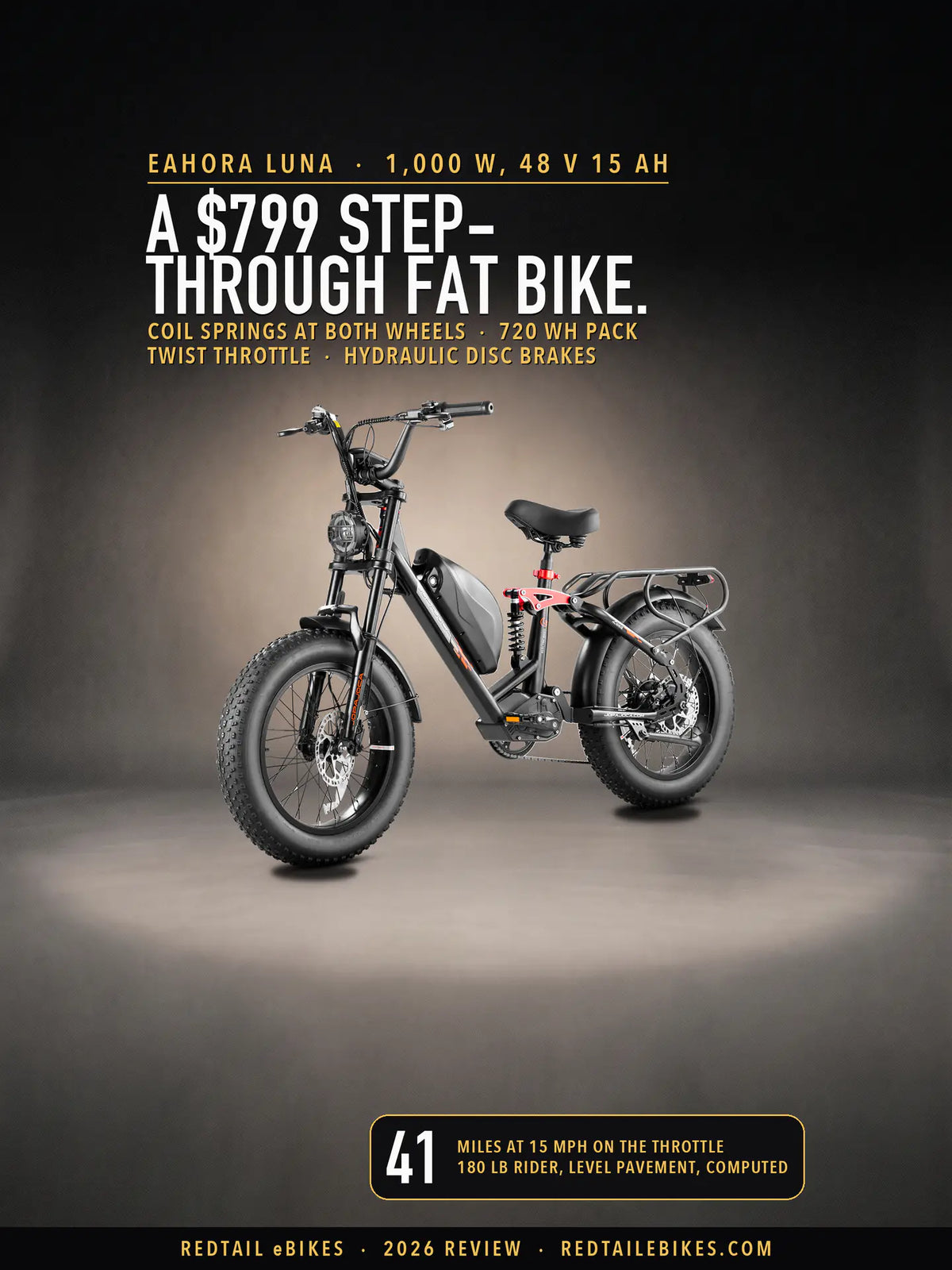

Share:
Addmotor Soletri II Review: 750 W Trike for Two Adults
Eunorau SPECTER-ST 2.0 Review 2026: Low Standover