


Georgia ebike laws get one question wrong more often than any other, and it is the question people search most. You cannot ride on the sidewalk — not in Atlanta, not in Savannah, nowhere in the state.
This is no city rule you can look up and hope to beat. It is state law.
750 W or less · 20 mph Class I and II · 28 mph Class III · 536 municipalities counted · 186 bikes screened, 33 legal. Last verified: August 25, 2026.

Quick Answer. A Georgia electric assisted bicycle is a two- or three-wheeled device with a saddle, fully operative pedals and a motor of not more than 750 watts (§ 40-1-1(15.3)). No license, no registration, no plates, no insurance. A helmet is required under 16 on any bicycle and at every age on a Class III.
No one under 15 may operate a Class III. And sidewalk riding is banned statewide — a city may carve out an exception only for riders 12 and under.
In this guide
- How we verified this guide
- What's on this page
- Can you ride an ebike on the sidewalk in Georgia?
- Georgia ebike laws: what makes an e-bike legal
- The three classes, and the one Georgia writes differently
- Are helmets required for ebikes in Georgia?
- Do you need a license for an ebike in Georgia?
- Where can you ride an ebike in Georgia?
- State parks, WMAs and national forest
- The label, and the font Georgia specifies
- The Atlanta rebate, and what Georgia does not have
- What changed, and when
- Every city we checked
- Not an e-bike: mopeds and motor driven cycles
- What clears Georgia in our own range
- The 60-second self-check: your compliance checklist
- The bottom line
- Source register
- Frequently asked questions
- Limitations
- References
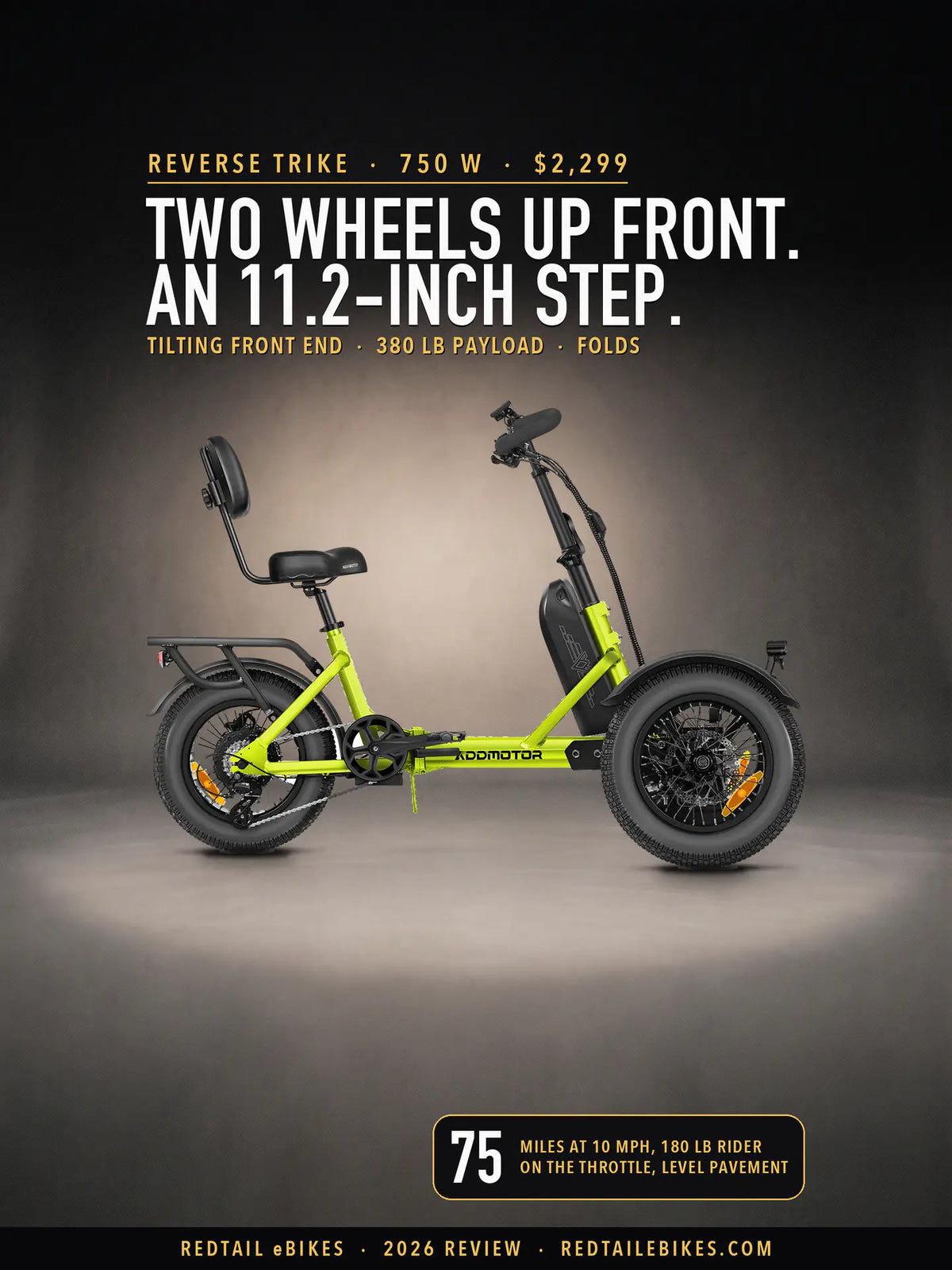
Georgia's definition covers two and three wheels alike. If a trike is what fits, our cargo range includes them — free US shipping, US-based support and warranty.
How we verified this guide
Every legal claim was read in the Georgia Code on 25 August 2026 and links to the subsection that decides it. Where the code text mattered, it was confirmed a second time against the enrolled act as signed — HB 454 (2019), the act that built Georgia's class system.
A note on Georgia's code, because it affects every link on this page. Georgia does not publish its statutes at addressable public URLs. The Official Code of Georgia Annotated is hosted by LexisNexis for the Code Revision Commission behind a session-based viewer that cannot be linked section by section — the arrangement at the heart of Georgia v. Public.Resource.Org.
So the operative language on this page was read in the enrolled acts, which Georgia does publish and which are linked throughout. Section links point to an unofficial full-text mirror for your convenience in reading the current wording. Under our sourcing rules that mirror is a finding aid and carries no claim on its own; where the current text differs from the act, we say so and show both.
Trail and public-land rules come from the agencies that write them: the Department of Natural Resources and the official 2025–2026 Hunting & Fishing Regulations. The municipal denominator — 536 active incorporated municipalities — is the U.S. Census Bureau 2025 Gazetteer.
One warning we will repeat inside, because it cost us an hour. Georgia's e-bike definition was rewritten in 2019, and the old text is still in circulation.
Reading the 2019 bill PDF as plain text shows the deleted words as though they were enacted, because strikethrough does not survive text extraction. Two "findings" died that way before publication. Both are recorded in Limitations.
This is a first-pass page. Every claim here is checked and sourced. Georgia's statute is short, and this guide is short with it — the depth in this subject lives in the local layer, and we add that as we read it.
Written and verified by Milad Ghobadibeygvand, BScN (Western University, 2014). Corrections to corrections@redtailebikes.com.
What's on this page
- Can you ride an ebike on the sidewalk in Georgia?
- Georgia ebike laws: what makes an e-bike legal
- The three classes, and the one Georgia writes differently
- Are helmets required for ebikes in Georgia?
- Do you need a license for an ebike in Georgia?
- Where can you ride an ebike in Georgia?
- State parks, WMAs and national forest
- The label, and the font Georgia specifies
- The Atlanta rebate, and what Georgia does not have
- Every city we checked
- Not an e-bike: mopeds and motor driven cycles
- What clears Georgia in our own range
- The 60-second self-check: your compliance checklist
- The bottom line
- Source register
- Frequently asked questions
- Limitations
- References
Can you ride an ebike on the sidewalk in Georgia?
No. The rule is statewide. Almost every guide to this topic tells you sidewalk access "varies by city" and sends you to look up your local ordinance. That advice is backwards. Georgia already answered it, in a statute filed under a heading nobody searches: § 40-6-144, "Emerging from alley, driveway, or building; driving upon a sidewalk prohibited."
"Except as provided by resolution or ordinance of a local government ... authorizing the operation of bicycles on sidewalks by persons 12 years of age or younger, no person shall drive any vehicle upon a sidewalk or sidewalk area except upon a permanent or duly authorized driveway."
Read the exception as well as the ban. A Georgia city may open its sidewalks — but only to riders 12 and under (§ 40-6-144). The statute grants no power to authorise anyone older.
The sidewalk rule is not a city rule. § 40-6-144 bans riding any vehicle on a Georgia sidewalk statewide, and the only exception it lets a city write is for riders 12 and under. A city can be stricter. On the statute's own terms it cannot be more permissive for an adult.
So the honest answer to "is it legal in my city" is that the ceiling is fixed statewide.
| Who | Sidewalk | Under |
|---|---|---|
| Adult on a bicycle or e-bike | Prohibited | § 40-6-144 |
| Rider 12 or under | Only where the city has passed an ordinance allowing it | § 40-6-144 |
| Rider 13–17 | Prohibited — outside the exception | § 40-6-144 |
This reaches e-bikes because § 40-6-301 gives an e-bike rider "all the rights" and "all the duties applicable to the operator of a bicycle." The duties come with the rights.
What it costs in Atlanta
Atlanta's own enforcement guidance is blunter than any retailer page about the stakes. The city's MOVE SMART officer's guide lists sidewalk riding among the violations it trains officers to write, and states the exposure plainly:
The operative sentence: "Penalties for riding on the sidewalk include a fine up to $1,000 and jail time up to six months. This is the default penalty for all municipal charges. The fine amount is at the discretion of the judge of the Municipal Court."
We have seen "$100" repeated across e-bike blogs as the Atlanta sidewalk fine. We could not locate that figure in any primary source, and the city's own enforcement guide does not use it. The city's own document says $1,000 and six months, at the judge's discretion — a ceiling, not a typical outcome, but not $100 either.
Georgia ebike laws: what makes an e-bike legal
Georgia's definition is one sentence, and it is shorter than it used to be:
The operative sentence (§ 40-1-1(15.3)): "'Electric assisted bicycle' means a device with two or three wheels which has a saddle and fully operative pedals for human propulsion and also has an electric motor having a power output of not more than 750 watts."
| Test | Georgia |
|---|---|
| Wheels | Two or three — Georgia admits trikes by name |
| Pedals | "Fully operative ... for human propulsion" |
| Motor | Not more than 750 watts |
| Registration | Not required |
| Class label | Required on bikes built from 1 Jan 2020 |
"Not more than" is inclusive, and that single word decides more bikes than any other line in this guide. A motor rated at exactly 750 W — by some distance the most common rating on the market — is legal in Georgia. The same bike is outside the definition in Connecticut, Illinois, Ohio and New Hampshire, which all write the same number exclusively.
Georgia sits on the permissive side with North Carolina, Tennessee, Massachusetts, Wisconsin and Utah, which all write the ceiling the same way.
In our own range, 45 of 186 live bikes are rated at exactly 750 W. They pass in Georgia and fail in four of the states we have already covered. One word, seven states, two different answers.
Buying for Georgia? Ask for the nominal motor wattage in writing. 750 W or less clears § 40-1-1(15.3) — and unlike four other states we cover, exactly 750 is fine here. Our commuter and city and fat tire ranges are where the sub-750 builds sit.
Browse commuter e-bikesWhat the definition no longer says
Before 1 July 2019 that definition ran on for five more sentences. It required compliance with the Federal Motor Vehicle Safety Standards, required the motor to cut out when the brakes were applied, and — this is the part still circulating — capped the motor at 1,000 watts and required the device to be incapable of exceeding 20 mph. HB 454 struck all of it.
None of that is current Georgia law — § 40-1-1(15.3) is now one sentence. If a page tells you Georgia allows 1,000 W, it is quoting a definition HB 454 repealed seven years ago.
The three classes, and the one Georgia writes differently
§ 40-6-300 defines the classes — in Roman numerals, which is a small thing until you are searching the code for "class 3" and finding nothing.
| Class | Georgia's words | Ceiling |
|---|---|---|
| Class I | "assistance only when the rider is pedaling ... ceases ... at 20 miles per hour" | 20 mph |
| Class II | "may be used exclusively to propel the vehicle but is not capable of reaching a speed of 20 miles per hour" | under 20 mph |
| Class III | "assistance only when the rider is pedaling ... ceases ... at 28 miles per hour" | 28 mph |
Class II is the outlier, and it is worth reading twice. The national model law says a throttle bike is Class 2 when the motor stops assisting at 20 mph. Georgia instead says the machine must be "not capable of reaching" 20 mph. On the words, a throttle bike that will do exactly 20 is not a Georgia Class II — it is a throttle machine that fits no class in the statute.
We found no Georgia appellate decision construing that phrase, and no agency guidance resolving it. It is a live ambiguity in the drafting, and we flag it rather than paper over it.
Are helmets required for ebikes in Georgia?
Two separate rules apply, and most riders only know one.
| Rider | Helmet | Source |
|---|---|---|
| Anyone on a Class III | Required, every age | § 40-6-303(c)(1) |
| Under 16, any bicycle or e-bike | Required | § 40-6-296(d)(1) |
| 16+ on a Class I or II | Not required | — |
The Class III rule is the one people miss. It is not an age rule at all:
The operative sentence (§ 40-6-303(c)(1)): "No person shall operate or be a passenger on a class III electric assisted bicycle without wearing a bicycle helmet."
Takeaway
Two helmet rules run at once in Georgia. Under 16 on any bicycle. Every age on a Class III. A 45-year-old on a Class III without a helmet is in violation (§ 40-6-303(c)(1)); the same rider on a Class I is not.
The penalty clause almost nobody reports
The under-16 rule carries a sentence that changes what it is:
The operative sentence (§ 40-6-296(d)(6)): "No person under the age of 16 failing to comply with any provision of this subsection shall be fined or imprisoned."
That clause is not a recent reading. It was written in by HB 101 (2011), which we read in the General Assembly's own copy — where the same subsection is lettered (e), not (d). Georgia renumbered it afterwards, which is a small illustration of why the act and the current section both have to be checked.
The child helmet rule is a legal requirement that cannot be punished in the child (§ 40-6-296(d)(6)). Both helmet subsections also state that a violation "shall not constitute negligence per se nor contributory negligence per se or be considered evidence of negligence or liability" — so a missing helmet cannot be used against an injured rider in a civil claim either.
That last clause has been litigated. In Stockert v. Rogers, 361 Ga. App. 276, 864 S.E.2d 116 (2021), the Court of Appeals held these sections "regulated only bicycles and electric bicycles and did not apply in any way to motorized skateboards."
So the helmet-evidence bar did not protect a skateboarder, and excluding the evidence was error. The shield is real, and it is narrow.
The standard Georgia names
Both helmet provisions define a bicycle helmet as headgear meeting the standards of the American National Standards Institute (ANSI) or the Snell Memorial Foundation. Neither is the federal mandatory standard: since 1999 every bicycle helmet sold in the United States must meet 16 C.F.R. Part 1203, the CPSC standard, and ANSI's bicycle helmet standard was withdrawn decades ago.
In practice a helmet bought new in the US is CPSC-certified and the point is academic. On the statute's words, Georgia still names two standards, one of which no longer exists for bicycles.
Do you need a license for an ebike in Georgia?
No — but the way Georgia gets there changed in 2019, and it matters if you are checking the code yourself.
Until HB 454, § 40-6-351 ended with a sentence saying so outright: "No license or permit shall be required for the operation of an electric assisted bicycle." HB 454 deleted that sentence, and in the same stroke removed electric assisted bicycles from the section's under-15 age bar. Today § 40-6-351 is about mopeds and says nothing about e-bikes at all.
So the answer is still no, by a different route:
| Question | Answer | Why |
|---|---|---|
| Driver's license | No | An e-bike is not a "motor vehicle" — § 40-1-1(33) |
| Registration or plate | No | Same exclusion |
| Insurance | Not required for the bike | Same exclusion |
| Minimum age, Class I or II | None statewide | § 40-6-351's age bar no longer reaches e-bikes |
| Minimum age, Class III | 15 | § 40-6-303(b) |
Two things follow that are easy to get wrong. There is no statewide minimum age for a Class I or Class II e-bike in Georgia under § 40-6-351 — a 13-year-old may lawfully ride one. And the under-15 bar that does exist applies only to Class III, and only to operating it: the same statute expressly allows a younger child to ride as a passenger on a Class III built for one.
Where can you ride an ebike in Georgia?
§ 40-6-303(a) sets the path rules, and splits the classes.
| Surface | Class I / II | Class III |
|---|---|---|
| Roadway | Yes | Yes |
| Bicycle lane | Yes | Yes |
| Bicycle path / shared use path | Yes — unless the local authority or state agency prohibits it | No — unless the path is within or adjacent to a highway, or the authority permits it |
| Natural-surface trail | Outside these rules entirely | Outside these rules entirely |
| Sidewalk | No — § 40-6-144 | No |
The Class III path rule in § 40-6-303(a)(2) is a default ban with two exits. A Class III may use a shared use path only where the path runs within or beside a highway, or where the agency with jurisdiction has said yes.
The natural-surface carve-out in subsection (a)(3) is the one that catches mountain bikers. If a path is designated for nonmotorized vehicles and has "a natural surface tread made by clearing and grading the native soil with no added surface materials," the class rules do not reach it at all.
What may be ridden there "may be regulated by the local authority or state agency having jurisdiction" (§ 40-6-303(a)(3)). The trail's manager decides, and the statute will not tell you.
State parks, WMAs and national forest
Public land in Georgia runs three different regimes, and a single ride can cross all three. This is the section the search results get worst, so every line below comes from the agency that wrote it.
| Land | E-bike rule | Source |
|---|---|---|
| State parks | Class 1 only — "allowed on roadways and trails that also allow bicycles" | Georgia DNR |
| WMAs | 750 W or less treated as a pedal bicycle; over 750 W restricted to roads open for vehicular access | 2025–26 Regulations |
| National forest land | Roads open for motor vehicles only — no wattage carve-out | Same |
| Appalachian Trail | Prohibited outright | Same |
Three things are worth pulling out.
State parks are stricter than the statute. § 40-6-303(a)(1) admits Class I and Class II to shared use paths unless a state agency prohibits it. DNR has used that power: its own biking page allows Class 1 on park trails. Class II is legal on paths under the statute and not allowed in the parks. Both statements are true at once, and the park rule is the one enforced at the trailhead.
WMAs are governed by wattage rather than class. The hunting regulations do not mention Class I, II or III. They draw the line at 750 watts:
The operative sentence: "Bicycles may be used on closed roads for the purpose of hunter access. Electric bicycles (750 watts or less) may be used the same as pedal powered bicycles. Those exceeding 750 watts are restricted to roads open for vehicular access."
National forest land flips it. Cross onto the Chattahoochee-Oconee — including WMAs that sit on national forest — and the wattage carve-out disappears:
The operative sentence: "ON NATIONAL FOREST LANDS, horses and bicycles may be used on lands not otherwise closed. Electric bicycles are restricted to roads open for motor vehicles. Horses, bicycles, and electric bicycles are prohibited on the Appalachian Trail."
Georgia's public land runs three rules, not one. State parks: Class 1 only. WMAs: 750 W or less rides as a bicycle. National forest: roads open to motor vehicles, full stop — and never the Appalachian Trail. A 500 W Class 1 treated as an ordinary bicycle on a state WMA loses trail access the moment the boundary changes. Nothing about the bike changed; the landowner did.
Trails also close seasonally for hunts. The regulations close WMA trails all day during firearms deer hunts except to hunters, and before 10:00 a.m. during archery deer and turkey firearms seasons. Check the specific area listing before you drive out.
The label, and the font Georgia specifies
§ 40-6-302 sets the equipment rules, and one of them is unusually specific.
| Requirement | Detail |
|---|---|
| Class label | Permanently affixed, prominent, naming class, motor wattage and top assisted speed |
| Font | At least 9 point Arial |
| Applies to | Bikes manufactured on or after 1 January 2020 |
| Also binds | Manufacturers, distributors, and anyone who alters a bike so its class changes |
| Motor cut-out | Must disengage when the rider stops pedaling or applies the brakes |
| Class III only | Must carry a speedometer in miles per hour |
The alteration clause in § 40-6-302(b) is the one to notice. If you fit a kit that moves a bike from one class to another, the labelling duty lands on you. And a Class III without a working speedometer is non-compliant on its equipment even if everything else about it is legal.
The Atlanta rebate, and what Georgia does not have
There is no statewide Georgia e-bike rebate or tax credit that we could locate, and no e-bike provision in the state's EV incentives. What exists is a city program in Atlanta, and its 2026 window is narrow.
The Atlanta E-Bike Rebate Program is run by the Atlanta Regional Commission with the City of Atlanta and Propel ATL.
| Applications | 8 September 2026 – 22 September 2026 |
| Tier 1 (under 60% AMI) | $1,600 |
| Tier 2 (60–80% AMI) | $1,100 |
| Tier 3 (81–140% AMI) | $550 |
| Eligibility | City of Atlanta resident, 18+, 2025 household income within the thresholds |
| Selection | Randomized lottery — applications are expected to exceed rebates |
| Bike | New Class 1, 2 or 3; two or three wheels; fully operable pedals; 750 W or less; not gas-powered |
And the part we would rather not print. The rebate is point-of-sale at a participating brick-and-mortar bike shop. The program states that online purchases do not qualify. That means it cannot be used on a bike bought from us.
If you live in Atlanta and you qualify for Tier 1 or Tier 2, the rebate is worth more than anything we could offer you — apply for it, and buy from a participating local shop. We would rather tell you that than sell you a bike you could have got $1,600 off.
What changed, and when
Georgia's e-bike law has one hinge date, and almost every out-of-date claim on the internet traces to the wrong side of it.
| Date | Change | Source |
|---|---|---|
| 1 July 2019 | HB 454 rewrites the definition: the 1,000 W motor cap, the 20 mph device cap and the FMVSS requirement are struck, leaving a clean 750 W test | § 40-1-1(15.3) |
| 1 July 2019 | The three classes are created as a new Part 1A | § 40-6-300 |
| 1 July 2019 | E-bikes are removed from the moped age bar, and the express "no license or permit shall be required" sentence is deleted | § 40-6-351 |
| 1 January 2020 | The class label requirement takes effect for bikes manufactured on or after this date | § 40-6-302(a) |
| 10 May 2021 | Housekeeping act deletes "years of age" from the Class III age bar — no substantive change | § 40-6-303(b) |
Nothing since. We found no Georgia act amending the electric-assisted-bicycle provisions after the 2021 Code-revision bill, and no pending measure located in this pass. That is a statement about what we searched on 25 August 2026, and it is the kind of claim this page will re-check rather than assume — see Limitations.
Georgia's stability here is worth contrasting with its neighbors. Alabama, immediately west, writes its ceiling as "less than 750 watts" and turns the machine above it into a motor-driven cycle needing a Class M license. North Carolina rewrote its definition and class rules effective 1 December 2026, and New Jersey built an entirely different three-category structure. Georgia has left its 2019 settlement alone for seven years.
Across the Savannah River the shape of the law changes entirely. South Carolina never adopted classes at all: one category, a motor of no more than 750 watts, and a top motor-powered speed that must be less than 20 mph. Georgia's Class 3 helmet duty has no analogue there, because South Carolina has no Class 3 and no helmet requirement at any age.
Every city we checked
Georgia has 536 active incorporated municipalities — 429 cities, 102 towns and 5 other designations — counted from the U.S. Census Bureau 2025 Gazetteer place file, filtered to Georgia and to active status. That number is the denominator for everything below, and we publish it because a municipal claim without one is an anecdote.
What we searched. All 404 Georgia code libraries on Municode and the single Georgia library
on eCode360 (City of Albany), for nine phrases: electric assisted bicycle, electric-assisted
bicycle, electric bicycle, electric bike, e-bike, ebike, motorized bicycle, micromobility, and two
older phrasings some codes still carry. The sweep is saved at
research/state-laws/georgia/ga-municode-hits_20260826.csv.
What we found: 132 phrase-confirmed hits across 42 municipalities. Georgia's municipal e-bike layer is not thin, and it is not where you would expect it. The state's biggest cities have almost nothing. A planned golf-cart town of 39,000 has the most developed e-bike code in Georgia.
| Municipality | What its code does | Key sections |
|---|---|---|
| Peachtree City | The deepest e-bike code in the state. Its own class definitions; helmet mandate; a Class I-only rule on trails and boardwalks with mandatory signage; authorization and insurance-disclosure rules for the path network | §§ 78-91, 78-96, 78-96.1, 78-97, 70-40 to 70-42 |
| Jekyll Island Authority | Its own e-bike definition — and "E-bike tours and rentals are prohibited" on the island | §§ 24-31(5), 24-32, 24-34 |
| Athens-Clarke County | Class I, II and III written into county code; rights and duties; parking; a signed sidewalk prohibition | §§ 3-10-1 to 3-10-4 |
| Peachtree Corners | Permit-based pilot for shared micromobility; unlawful to deploy without a permit | §§ 14-531 to 14-534 |
| Douglas | Its own electric-assisted-bicycle definition; motorized-vehicle restrictions that name e-bikes | §§ 28-1, 28-8 |
| Atlanta | No e-bike provision in the code itself; its 2019 Shareable Dockless Mobility Devices ordinance governs shared scooters and e-bikes | — |
| Savannah | Unchecked — see below | — |
Peachtree City is the one to read
Peachtree City built roughly a hundred miles of shared-use paths for golf carts, and it has written e-bikes into that system rather than around it. Two rules there are stricter or stranger than the state's.
Its helmet rule is broader than Georgia's. § 78-96 requires that riders of "bicycles, electric scooters and personal electric vehicles under the age of 15, and all users of class III electric bicycles shall wear a properly fitted and fastened bicycle helmet which meets the standards of the American National Standards Institute or the Snell Memorial Foundation's Standards for Protective Headgear for Use in Bicycling or a motorcycle helmet while operating an electric bicycle on the paths."
Read the end of that sentence. Peachtree City will accept a motorcycle helmet on its paths. No provision of Georgia law does.
Its trails are Class I only. § 70-40 limits the trails and boardwalks it governs to "bicycles, adaptive cycles or a class I rated electric bicycle," and requires every entrance to be signed with the devices allowed. § 78-96(j) restates the Class III age bar: "No one under the age of 15 shall operate a class III electric bicycle." And § 70-41 carries an ordinance adopted on 19 March 2026 — the most recent e-bike-touching municipal enactment we located anywhere in Georgia.
Jekyll Island is the other one. If you were planning to rent an e-bike there, § 24-32 says plainly: "E-bike tours and rentals are prohibited." Bring your own.
How we separated a real "no ordinance" from a broken search
Every named city was searched with quoted phrases and then re-run with control terms — "bicycle", "sidewalk", "vehicle" — that any municipal code must contain. A city returning hits on the controls and zero on the e-bike phrases is a sourced negative. Atlanta, Augusta-Richmond County, Columbus and Macon-Bibb County are all in that category: their codes are readable and contain no e-bike provision.
Savannah is not. It returned zero for "bicycle" and "vehicle" as well, which proves only that we could not read its code. We report it as unchecked, because a failed search is a hole in our method rather than a finding about the city.
The denominator, honestly. 404 of Georgia's 536 municipalities publish on Municode and were swept; one publishes on eCode360 and was searched. That leaves 131 municipalities — 24% of the state — that publish their codes somewhere else, or not online at all. They are unchecked. If you ride somewhere not named on this page, the state rules above are the floor, and your city may have added to them.
Not an e-bike: mopeds and motor driven cycles
| Machine | Georgia category | Source |
|---|---|---|
| Moped | Own category; license required, no one under 15 | § 40-6-351 |
| Motor driven cycle | "every bicycle with a motor attached, and every moped" | § 40-1-1(30) |
| Over 750 W | Outside the e-bike definition | § 40-1-1(15.3) |
Georgia's "motor driven cycle" definition is broad enough to be interesting: it includes "every bicycle with a motor attached." An over-spec machine fails the electric-assisted-bicycle definition, and § 40-1-1(33) excludes only electric assisted bicycles from "motor vehicle" — so the exclusion stops protecting it.
Georgia has written no catch-all clause of the kind New Hampshire put in RSA 215-A:1, VI, which sweeps an over-spec pedal machine into a named category by force of statute. Exactly where a 1,000 W pedal bike lands in Georgia is not resolved on the face of the code, and we located no decision or agency opinion resolving it. We are not going to guess for you.
What clears Georgia in our own range
We screened the live catalog against the 750 W inclusive ceiling and the class speed limits on
25 August 2026 (scripts/screen_georgia_legal.py).
| Verdict | Bikes |
|---|---|
| Legal as Class I or II on published specs | 33 |
| Outside the Georgia definition | 100 |
| Specs not published in the listing | 53 |
| Total screened | 186 |
Two honest notes about that table. 53 listings do not publish a nominal wattage or a top speed, and that is a disclosure gap in our own catalog rather than a verdict on the bikes. An undisclosed spec is reported as unknown and never counted as a pass.
And no bike in the range screened as a Class III. The Class III helmet-at-every-age rule and the 15-year-old minimum do not currently apply to anything we sell into Georgia.
Of the 186, 45 are rated at exactly 750 W — the rating Georgia admits and four of our other covered states reject.
The 60-second self-check: your compliance checklist
- ☐ Motor rated 750 W or less? Exactly 750 is fine in Georgia.
- ☐ Two or three wheels, a saddle, fully operative pedals?
- ☐ Built after 1 Jan 2020 — does it carry a class label in 9-point Arial or larger?
- ☐ Class III? Helmet at every age, a working speedometer, and no operator under 15.
- ☐ Rider under 16 on any e-bike? Helmet.
- ☐ Staying off the sidewalk? Statewide, unless you are 12 or under and the city allows it.
- ☐ Riding a shared use path on a Class III? Only if it hugs a highway or the agency permits it.
- ☐ Heading to a state park? Class 1 only.
- ☐ Crossing onto national forest land? Roads open to motor vehicles only, and never the Appalachian Trail.
Riding Georgia dirt? State parks take Class 1 only, and national forest land keeps e-bikes on roads open to motor vehicles. A Class 1 build is the one that travels furthest across Georgia's three public-land regimes — our mountain and folding ranges are the place to start.
See trail-ready e-bikesThe bottom line
Georgia is a permissive state for e-bikes and a strict one about sidewalks, and most riders have that backwards. There is no license, no registration, no plate, no insurance and — for Class I and Class II — no minimum age at all. The 750 W ceiling is inclusive, which quietly makes Georgia legal ground for the most common bike on the market.
Then there is the sidewalk. It is banned by state statute, the only exception a city may write is for riders 12 and under, and in Atlanta the exposure runs to $1,000 and six months rather than the $100 you will read elsewhere. Ride in the road or the bike lane.
If you buy a Class III, buy the helmet with it and check for the speedometer, because both are equipment requirements rather than suggestions. Riders crossing state lines should read our Florida, Texas and Illinois guides, or the all-50-states table. And if you live in Atlanta and your household is under 80% of area median income, put 8 September in your calendar and buy from a participating local shop instead of from us.
Source register
| Source | Tier | What it supports | Retrieved |
|---|---|---|---|
| O.C.G.A. § 40-1-1 | T1 | The definition, the 750 W ceiling, motor-vehicle and motor-driven-cycle status | 2026-08-25 |
| O.C.G.A. § 40-6-144 | T1 | The statewide sidewalk prohibition and the 12-and-under local exception | 2026-08-25 |
| O.C.G.A. § 40-6-296 | T1 | The under-16 helmet rule, the ANSI/Snell standard, the no-penalty clause | 2026-08-25 |
| O.C.G.A. Part 1A, §§ 40-6-300 to 40-6-303 | T1 | Classes, rights and duties, label and speedometer, paths, age, Class III helmet | 2026-08-25 |
| O.C.G.A. § 40-6-351 | T1 | That the moped age bar and the express no-license sentence no longer reach e-bikes | 2026-08-25 |
| HB 454, 2019, as signed | T1 | The enacted act behind every section above; the pre-2019 text that was struck | 2026-08-25 |
| Georgia DNR — Biking in Georgia State Parks | T1 | Class 1 only on state park trails | 2026-08-25 |
| Georgia 2025–26 Hunting & Fishing Regulations | T1 | WMA 750 W rule, national forest rule, Appalachian Trail prohibition, seasonal closures | 2026-08-25 |
| City of Atlanta — MOVE SMART enforcement guide | T1 | The sidewalk penalty and the shareable-device ordinance | 2026-08-25 |
| Atlanta Regional Commission — 2026 E-Bike Rebate Program | T1 | Window, tiers, eligibility, lottery, brick-and-mortar condition | 2026-08-25 |
| HB 101, 2011, as passed | T1 | The enacted helmet subsection, the ANSI/Snell standard and the no-penalty clause | 2026-08-25 |
| Georgia Governor's Office of Highway Safety | T1 | That e-bikes as defined in § 40-1-1 may be operated on bicycle paths | 2026-08-25 |
| eCFR — 16 C.F.R. Part 1203 | T1 | The federal CPSC helmet standard Georgia's statute does not name | 2026-08-25 |
| Stockert v. Rogers, 361 Ga. App. 276, 864 S.E.2d 116 (2021) | T1 | The scope of the helmet-evidence bar | 2026-08-25 |
| Municode Library — 404 GA libraries | T1 | The municipal sweep | 2026-08-25 |
| eCode360 — City of Albany | T1 | The only Georgia eCode360 library; no e-bike ordinance located | 2026-08-25 |
| U.S. Census Bureau 2025 Gazetteer | T1 | The 536 denominator | 2026-08-25 |
| Redtail eBikes catalog via Shopify Admin API | T2 | The first-party screen | 2026-08-25 |
No tier-five source is cited anywhere on this page.
Frequently asked questions
Are electric bikes legal in Georgia?
Yes. An electric assisted bicycle with a motor of not more than 750 watts, two or three wheels, a saddle and fully operative pedals is legal statewide under § 40-1-1(15.3), and its rider has the rights and duties of a bicycle rider under § 40-6-301.
Do you need a license for an ebike in Georgia?
No. An electric assisted bicycle is excluded from the definition of "motor vehicle" in § 40-1-1(33), so no driver's license, registration, plate or insurance is required. The sentence that used to say so expressly was deleted from § 40-6-351 in 2019; the result is unchanged.
Can you ride an ebike on the sidewalk in Georgia?
No. § 40-6-144 prohibits driving any vehicle on a sidewalk statewide. A local government may authorise sidewalk riding only for "persons 12 years of age or younger." In Atlanta the stated penalty runs to a fine of up to $1,000 and up to six months' jail, at the municipal judge's discretion.
What is the minimum age to ride an ebike in Georgia?
There is no statewide minimum age for a Class I or Class II. For a Class III, § 40-6-303(b) bars operation by anyone under 15, though a younger child may ride as a passenger on a Class III built to carry one.
Do you need a helmet on an ebike in Georgia?
Two rules apply. Anyone under 16 must wear a helmet on any bicycle or e-bike (§ 40-6-296(d)), and everyone — at any age — must wear one on a Class III (§ 40-6-303(c)(1)).
Are electric bikes allowed in Georgia state parks?
Class 1 only. Georgia DNR states that "Class 1 e-bikes are allowed on roadways and trails that also allow bicycles" (gadnr.org). That is narrower than the statute, which would admit Class II to shared use paths unless a state agency prohibits it — DNR has.
Can you ride an ebike on a Georgia WMA?
Yes, if it is 750 watts or less: the state's hunting regulations say such bikes "may be used the same as pedal powered bicycles." Above 750 watts you are limited to roads open for vehicular access. On national forest land the rule is stricter — roads open to motor vehicles only — and e-bikes are prohibited on the Appalachian Trail.
Does Georgia have an ebike rebate?
Not statewide. The City of Atlanta runs one through the Atlanta Regional Commission, with 2026 applications open 8–22 September 2026 and rebates of $550 to $1,600 by household income, awarded by lottery. It is point-of-sale at a participating brick-and-mortar shop, so online purchases — including ours — do not qualify.
Can a Class 3 ebike use a bike path in Georgia?
Usually not. § 40-6-303(a)(2) bars a Class III from a bicycle path or shared use path unless the path is within or adjacent to a highway, or the local authority or state agency with jurisdiction permits it.
Does an ebike need a label in Georgia?
Yes, if it was manufactured on or after 1 January 2020. § 40-6-302(a) requires a permanently affixed label naming the class, the motor wattage and the top assisted speed, printed in at least 9-point Arial. The duty also falls on anyone who alters a bike so that its class changes.
Are electric dirt bikes legal in Georgia?
Not as e-bikes. § 40-1-1(15.3) requires "fully operative pedals for human propulsion," so a pedal-less electric dirt bike is outside the electric-assisted-bicycle definition entirely and none of the class rules, path rights or license exemptions on this page reach it.
Do Savannah, Augusta, Columbus or Macon have their own ebike rules?
We located none in Augusta-Richmond County, Columbus or Macon-Bibb County — each code returned hits on control terms and zero on every e-bike phrase. Savannah is unchecked: its Municode library returned zero for "bicycle" and "vehicle" too, which tells us the index failed rather than that no ordinance exists.
Does Athens have its own ebike ordinance?
Yes — the only one we found in Georgia's largest cities. Athens-Clarke County Code ch. 3-10 defines Class I, II and III electric assisted bicycles in § 3-10-4, applies the traffic ordinances to e-bike riders in § 3-10-1, sets parking rules in § 3-10-2, and runs a signed sidewalk prohibition in § 3-10-3.
Can you ride an ebike on a 45 mph road in Georgia?
Yes. § 40-6-301 grants an e-bike rider "all the rights ... applicable to the operator of a bicycle," and Georgia sets no speed-limit ceiling above which a bicycle or e-bike loses road access. The duties come with the rights, including riding with traffic.
Can you ride an ebike on the Atlanta BeltLine?
The BeltLine is a shared use path, so the state path rules in § 40-6-303(a) govern. Class I and II are permitted unless the authority with jurisdiction prohibits them; Class III is barred unless the path is beside a highway or the authority permits it.
We located no published BeltLine class rule or numeric speed limit on the BeltLine's own materials. The figures circulating on retailer blogs — 15 mph, 8–10 mph, 20 mph, a $100 fine — trace to no primary source we could find.
Does Georgia require insurance for an ebike?
No. An electric assisted bicycle is excluded from "motor vehicle" by § 40-1-1(33), and Georgia's financial-responsibility requirements attach to motor vehicles.
Limitations
- Two findings died in verification, and the method that killed them matters. Reading the 2019 act as extracted text showed a 1,000 W motor cap and a 20 mph device cap inside the current definition, and an under-15 age bar reaching all e-bikes. Both were deleted text that strikethrough formatting does not survive extraction. Retrieving the current sections separately corrected both. Any Georgia e-bike claim sourced only to that bill PDF should be treated as suspect.
- The municipal sweep was incomplete at publication. The Municode pass over 404 Georgia libraries was still running. Cities not named in the table are unchecked, not clear.
- Municode and eCode360 are not the whole municipal universe. A Georgia city that publishes its code elsewhere, or not online, is invisible to both sweeps regardless of how long they run.
- Class II's "not capable of reaching 20 miles per hour" is unresolved. We located no appellate decision or agency guidance construing it, and we have not resolved it here.
- Where an over-750 W pedal machine lands in Georgia is not resolved on the face of the code, and we found no authority settling it.
- The catalog screen reads published listing text. 53 of 186 listings publish no wattage or top speed; that is a disclosure finding about our listings, never a compliance finding about the bikes.
- No search-volume figure appears on this page. Our keyword API balance was exhausted; demand was harvested from autocomplete, an AI-engine panel and competitor headings, and is unpriced.
- Georgia has no addressable official code URL, so current-text confirmation rests on a mirror. The enrolled acts are official and are cited for every operative sentence. The current wording of each section — including the 2021 housekeeping amendment — was confirmed against an unofficial full-text mirror because the official LexisNexis viewer cannot be linked or fetched per section. This is the weakest link in the page's sourcing and we name it rather than hide it.
- This page expires on legislative change. It states Georgia law as read on 25 August 2026.
References
- Georgia General Assembly. Official Code of Georgia Annotated § 40-1-1 (definitions). Accessed 25 Aug 2026. https://law.justia.com/codes/georgia/title-40/chapter-1/article-1/section-40-1-1/
- Georgia General Assembly. O.C.G.A. § 40-6-144, "Emerging from alley, driveway, or building; driving upon a sidewalk prohibited." Accessed 25 Aug 2026. https://law.justia.com/codes/georgia/title-40/chapter-6/article-7/section-40-6-144/
- Georgia General Assembly. O.C.G.A. § 40-6-296 (bicycle equipment and helmets). Accessed 26 Aug
- https://law.justia.com/codes/georgia/title-40/chapter-6/article-13/part-1/section-40-6-296/
- Georgia General Assembly. O.C.G.A. Part 1A, §§ 40-6-300 to 40-6-303 (electric assisted bicycles). Accessed 25 Aug 2026. https://law.justia.com/codes/georgia/title-40/chapter-6/article-13/part-1a/
- Georgia General Assembly. O.C.G.A. § 40-6-351 (mopeds; license). Accessed 25 Aug 2026. https://law.justia.com/codes/georgia/title-40/chapter-6/article-13/part-4/section-40-6-351/
- Georgia General Assembly. House Bill 454 (2019), as passed House and Senate; Ga. L. 2019, p. 264. Accessed 25 Aug 2026. https://gov.georgia.gov/document/signed-legislation/hb-454pdf/download 6a. Georgia General Assembly. House Bill 101 (Senate Substitute), 2011–2012 session; Ga. L. 2011, p. 426, § 3. Accessed 25 Aug 2026. https://www.legis.ga.gov/api/legislation/document/20112012/115917
- Georgia Department of Natural Resources. "Biking in Georgia State Parks." Accessed 25 Aug 2026. https://gadnr.org/Biking
- Georgia Department of Natural Resources, Wildlife Resources Division. 2025–2026 Georgia Hunting & Fishing Regulations and Seasons, "Horses and Bicycles." Accessed 25 Aug 2026. https://georgiawildlife.com/regulations
- City of Atlanta, Office of Mobility Planning. MOVE SMART: An Enforcement Officer's Guide to Creating Safer Streets for People Who Walk, Bike, or Scoot in Atlanta. Accessed 25 Aug 2026. https://www.atlantaga.gov/home/showdocument?id=42502
- Atlanta Regional Commission. "2026 Atlanta E-Bike Rebate Program." Accessed 25 Aug 2026. https://atlantaregional.org/what-we-do/mobility-services/2026-atlanta-e-bike-rebate-program/
- Georgia Governor's Office of Highway Safety. "Laws Pertaining to Bicycles and Bicycling." Accessed 25 Aug 2026. https://www.gahighwaysafety.org/laws-pertaining-to-bicycles-and-bicycling/
- U.S. Consumer Product Safety Commission. 16 C.F.R. Part 1203, "Safety Standard for Bicycle Helmets." Accessed 25 Aug 2026. https://www.ecfr.gov/current/title-16/chapter-II/subchapter-C/part-1203
- Stockert v. Rogers, 361 Ga. App. 276, 864 S.E.2d 116 (Ga. Ct. App. 2021).
- City of Peachtree City, Georgia. Code of Ordinances, §§ 70-40 to 70-42, 78-91, 78-96, 78-96.1, 78-97. Accessed 25 Aug 2026. https://library.municode.com/ga/peachtree_city/codes/code_of_ordinances
- Jekyll Island Authority. Code of Ordinances, §§ 24-31, 24-32, 24-34. Accessed 25 Aug 2026. https://library.municode.com/ga/jekyll_island_authority/codes/code_of_ordinances
- Athens-Clarke County, Georgia. Code of Ordinances, ch. 3-10. Accessed 25 Aug 2026. https://library.municode.com/ga/athens-clarke_county/codes/code_of_ordinances
- U.S. Census Bureau. 2025 National Gazetteer Files, places. Accessed 25 Aug 2026. https://www2.census.gov/geo/docs/maps-data/data/gazetteer/2025_Gazetteer/


Share:
eBike Shops in Mesquite, TX (2026): The Honest Map
Wisconsin eBike Laws (2026)