

2×2,000 W hubs · 240 N·m combined · 3,640 Wh · 46 mph published · 500 lb max load · $2,599 · verified August 29, 2026
Quick Answer — The Eahora Romeo Pro II 2026 is a $2,599 all-wheel-drive moped-style electric bike: two 2,000-watt hub motors, 120 N·m at each wheel, and a 52V 70Ah battery. It is the pick when you want two driven wheels without the Ultra II's $3,599 price.
It sits between the single-motor Romeo Ultra and the 4,800 Wh Romeo Ultra II. Three cautions belong in the decision: Eahora sells two different bikes under this name (untangled below), and at 4,000 watts the law section comes first.
AWD traction, 240 N·m combined, 3,640 Wh, full suspension. Three colorways orderable on 29 August 2026, $700 under the $3,299 compare-at both stores print, free contiguous-US shipping.
See the Romeo Pro II — $2,599Four numbers and one warning label decide this purchase.
- Two Pro IIs exist, and most of the internet reviews the old one. Eahora still sells a 2×1,500 W / 3,120 Wh Romeo Pro II beside this 2026 build (2×2,000 W / 3,640 Wh). The tester complaints in circulation — wheel-skid takeoffs, an overheating controller, assist cutouts — were reported on the older build, and nobody has published a test of this one that we could find.
- 240 N·m across two wheels is this machine's argument: traction the single-hub Ultra cannot offer at the same $2,599.
- The 6-to-7.5-hour charge claim fails its own arithmetic. The included 58.8V 7A charger delivers 411.6 watts; 7.5 hours of that is 3,087 Wh against a 3,640 Wh pack. Budget nine hours, and read the range section for the working.
- 4,000 watts is 5.3 times the 750-watt line where the electric-bicycle definitions end — California's at "does not exceed 750", the federal texts at "less than 750".
- The paperwork disagrees with itself in ways we can point to: the listing's own share metadata describes the old 3,000 W build and 203mm brakes this one does not have, and a third-party Amazon listing names UL2849 while the maker's site names no standard. The records section has the table.
What's on this page
- Which Romeo Pro II this is
- Who the Romeo Pro II is for
- How we verified this review
- Eahora Romeo Pro II specifications
- Range and the charge-time arithmetic
- Two motors, and what the record says about them
- Fit: the geometry table and the bench
- The Mercer fit test
- What this machine is under the law
- Is it UL certified? The listings disagree
- The paper trail, conflict by conflict
- Pro II, Ultra, or Ultra II
- Warranty
- Ordering, shipping and support
- The honest ledger
- Who should buy it
- Before you buy: the checklist
- Limitations of this review
- The source register
- Frequently asked questions
- The bottom line
- Primary sources
Which Romeo Pro II this is

Two machines named Romeo Pro II sell side by side; this review is about the newer one, and the card's ×2 is that warning.
Eahora's US site sells two machines called Romeo Pro II at the same time, and the confusion in everything written about this bike starts there: the 2026 build this page reviews — two 2,000 W motors, 52V 70Ah, 3,640 Wh — and an older build still listed with two 1,500 W motors and a 52V 60Ah, 3,120 Wh pack.
Nearly everything written about "the Romeo Pro II" attaches to the older machine. The professional tester findings name the 3,000 W build, the one buyer thread asking for reviews says 3,000 W in its title, and even the 2026 listing's own share metadata still describes "a 52V 3000W AWD system".
When you compare quotes, specs, or complaints, check which bike the sentence is about. Every quote below names which bike it describes.
Who the Romeo Pro II is for
Riders whose ground argues back: loose climbs, sand, wet grass, rutted two-track — the places where one driven wheel spins and two keep moving. Eahora's layout puts 120 N·m at each end, a motor switch on the display for front, rear or both, and the moped bench-and-twist-throttle posture over 26×4.0" rubber.
It is also the AWD entry point of the Romeo family: the Ultra II does everything this bike does with more battery and more voltage, and costs $1,000 more doing it. Shop the family by ground and budget; the family section below is that table.
Who it is not for: anyone who needs a machine the e-bike definitions recognize (the law section explains why that matters at 4,000 watts), and anyone under the published 5'6" floor with a short inseam — the bench is fixed at 34.3 inches and the fit section runs that math.

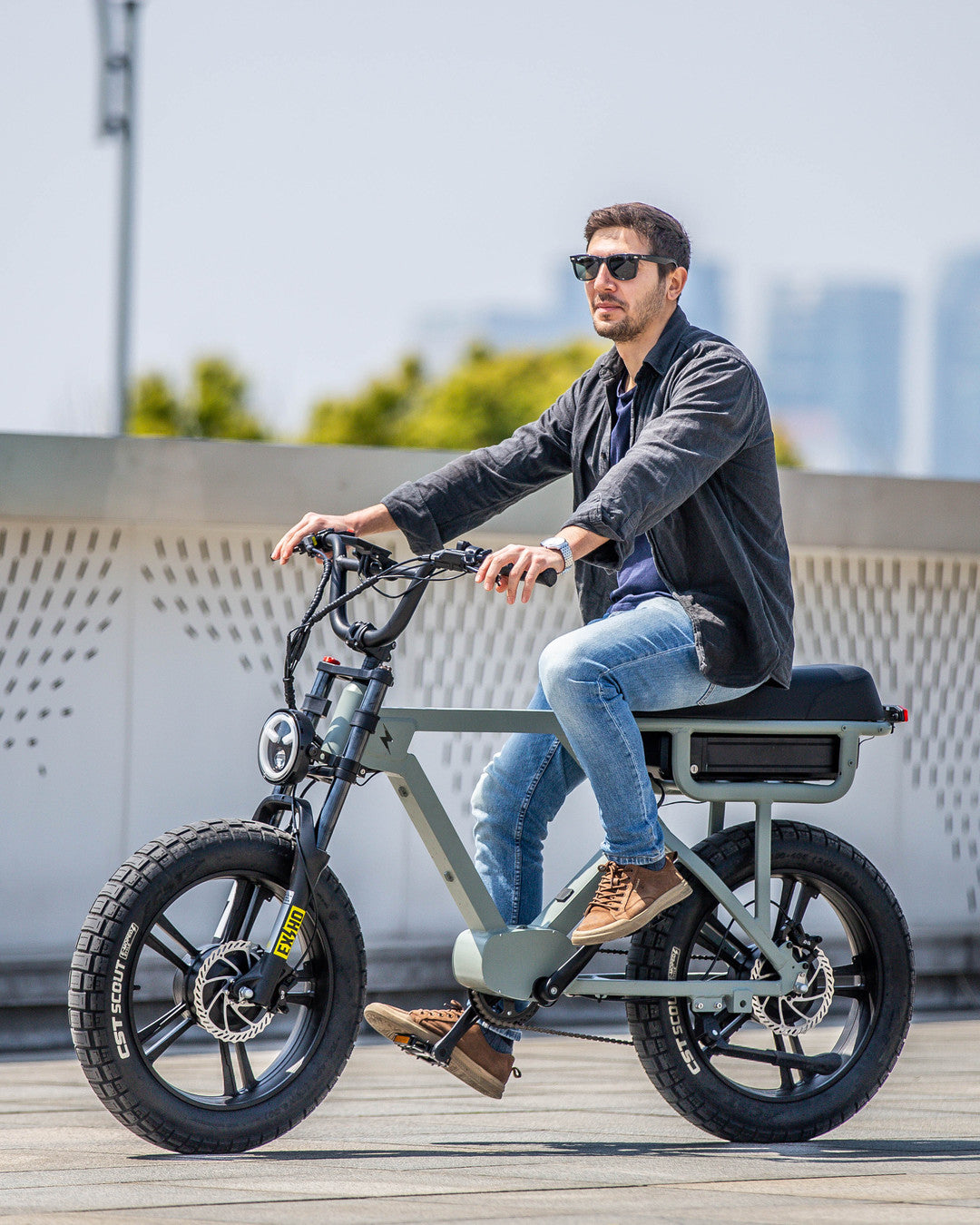
Eahora's own riding shot. The posture is the moped brief: bench seat, feet forward, twist throttle.
Two driven wheels for loose ground, 3,640 Wh for long days. Free contiguous-US shipping, and if the crate arrives wrong, we file the claim.
Check it out — $2,599, AWDHow we verified this review
What we did. We archived both Pro II listings, the EU variant, Eahora's Romeo-series comparison guide and its Pro II explainer page on 29 August 2026, and read every figure from those deposit copies. The professional summary covering the older builds, the buyer forum thread, one Amazon listing, and two affiliate write-ups were retrieved and deposited the same day. Every image used here was opened at full size.
What we computed. Pack energy for both generations, the consumption each range claim implies, the charge-window arithmetic that the listing's own claim fails, and dollars-per-watt-hour across the family. Script and dataset published and re-runnable; the source register names both.
How this was verified. Every figure is the manufacturer's own published specification for the 2026 build, confirmed at its page and recomputed. Every tester observation on this page is attributed and labeled with the build it describes.
On the recall check. Before trusting a zero we made the database prove it could say yes: a generic "bicycle" query returned 431 records that session. Only then did we run "Eahora" through the title, manufacturer and product-name fields; all three came back empty on 29 August 2026. No CPSC recall for Eahora existed in that database on that date.
Single-publisher facts — a spec only Eahora prints — are flagged SOLE-PUBLISHER in the ledger rather than dressed up with a second source.
Neutrality. We stock this bike and profit when you buy it here; the ledger, the records section and the law section exist so that fact never edits the findings. Corrections: corrections@redtailebikes.com.
Reviewed by the Redtail editorial desk. Verified 29 August 2026.
Eahora Romeo Pro II specifications
Transcribed from the 2026 listing's specification block, deposit copy of 29 August 2026.
| Spec | Published value |
|---|---|
| Motors | "2 x 2,000 Watt" dual hub, brushless, IPX6 |
| Torque | "2 x 120 Newton·meter (max)" |
| Battery | 52V 70Ah, "3,640 Watt·hour", lithium-ion pouch cells, Grade A |
| Battery lifespan | "≥ 1,200 charge cycles to 80% of capacity" |
| Top speed | "28+ Mph(46mph) for both pedal-assist and throttle" |
| Range | "104 - 200 miles with PAS, or 70 - 76 miles w/o PAS" |
| Max load | "≤ 500 lbs" |
| Rider height | 5'6" - 6'4", or inseam ≥ 28.7" |
| Weight | 160.94 lbs with the 36.6 lb battery installed |
| Charger | "58.8V 7A Quick charger, 6-7.5H charge time" |
| Assist | 5 PAS levels, cadence sensor; 5-level twist throttle, "slightly delayed response (safe design)"; motor switch on the display |
| Display | 4" color LCD, Bluetooth, USB charge port |
| Drivetrain | Shimano 7-speed, 14–28T freewheel, 44T chainring, RD-TY300 derailleur |
| Brakes | Hydraulic disc, 240mm × 3.0mm steel rotors, 2-piston calipers, motor cutoff |
| Frame | High-carbon steel, full suspension; the listing claims a "Complete Frame System Upgrade" for 2026 |
| Fork / shock | 100mm adjustable air fork; 50mm air shock with damping |
| Tires | 26" × 4.0" with tube, 28–33 psi |
| Lights | 2,000-lumen (20W) LED headlight with horn; brake-signal taillight |
| Extras | Cruise control, 6 km/h walk mode, IPX6, fenders included |
The description and the spec block disagree about what 4,000 watts means: the description calls this "a peak 4000W dual-motor system", while the spec block prints "2 x 2,000 Watt" as rated figures. We cite the spec block: 4,000 watts is the sum of two rated figures, and the spec block prints no separate peak figure.

The front end carries both a motor and a 240mm rotor — the two halves of the AWD trade in one frame.
Range and the charge-time arithmetic
The battery is 52 volts by 70 amp-hours: 3,640 Wh, recomputed by us from the pack's own electrical figures. Eahora's claim is 104–200 miles with assist, 70–76 without. Run each end backwards and the claim names its own assumptions:
| Scenario | Implied consumption |
|---|---|
| 200 mi with PAS | 18.2 Wh/mi — light pedaling, one motor, low speed |
| 104 mi with PAS | 35.0 Wh/mi |
| 76 mi throttle | 47.9 Wh/mi |
| 70 mi throttle | 52.0 Wh/mi |
No measured range of this build exists in the record our searches surfaced (the records section counts what does), so treat the table as planning arithmetic and nothing more. Two motors drawing together will live at the hungry end of it: at the claim's own 50-ish Wh/mi throttle band you get about 73 miles, and dual-motor hill work spends faster still.
The included charger cannot honor the printed charge window. It is 58.8 volts at 7 amps: 411.6 watts. Seven and a half hours of 411.6 watts is 3,087 Wh — 553 Wh short of the pack — so the printed "6-7.5H charge time" cannot cover a dead-to-full charge even with zero losses.
The lossless floor is about 8.8 hours, from the committed arithmetic. Charge it overnight and the discrepancy never costs you anything; plan a mid-day top-up around the printed window and it will.

The rear of the pair, behind a 14–28T Shimano freewheel. The front wheel carries its twin.
Plan on real triple-digit PAS days, charge it overnight, keep $700 against the compare-at. Shop Pay installments at checkout.
See the 3,640 Wh buildTwo motors, and what the record says about them
The layout is the sell: 120 N·m at each wheel, selectable from the display — front for loose descents, rear for pavement, both for the climb that beat your last bike. Physics favors it on traction; every published criticism of it comes from the older build, and honesty requires both halves of that sentence.
The professional summary of the Romeo line, published November 2024 on the pre-2026 builds, records a tester of the 3,000 W Pro II "skidding upon takeoff and loss of front wheel traction at low speeds", two testers noting it "pulls to the right while riding", one controller overheating into protective power reduction, and an assist cutout mid-ride.
The same page carries the compliment that survives: a Pro II tester "enjoys the responsive throttle", and across the line experts praise the climbing and the ability to keep up with traffic.
Whether the 2026 revision answers those reports is unanswered anywhere our searches reached. The listing claims a redesigned frame and rear triangle; it says nothing about the controller or the takeoff behavior. We stock the bike and we will say it plainly: the old build's record is the only tester record there is, and you should read it as history with an unproven fix, not as a verdict on this machine.
The pedal side is plain transport: a 7-speed Shimano 14–28T behind a 44T ring, with assist the sheet itself describes as "slightly delayed response (safe design)". On a machine with this much throttle, the pedals are for range and legality of effort, and the tester note that assist takes about two seconds to arrive belongs in your expectations.

The 2026 frame Eahora says was redesigned. Whether it changes the older build's tester reports is unpublished, as far as our searches reached.
Fit: the geometry table and the bench
The bench is fixed at 34.3 inches and nothing on the bike lowers it. That row decides the purchase; the rest of Eahora's 12-row geometry table is context:
| Dimension | Published |
|---|---|
| Rider height | 5'6"–6'4", or inseam ≥ 28.7" |
| Seat height | 34.3" — fixed. "No Actual Seatpost", "No Actual Seat Tube" |
| Standover | 26.4" |
| Wheelbase | 50.4" |
| Total length | 79.1" |
| Handlebar height | 44.5" |
| Reach | 21.3" |
| Chainstay | 22.0" |
| Top tube | 28.0" |
| Bike width | 28.7" |

The rear shock under the fixed bench — 50mm of travel, and the seat height you see is the one you get.
The bench does not adjust, so 34.3 inches against your inseam is the whole exam. Read the tall end carefully too: one tester on the professional page thinks riders over 5'10" won't pedal comfortably on Romeo builds rated to 6'4", because the bench-forward posture shortens the effective cockpit even when the height range says you fit.
At 160.94 lb, plan every lift as a two-person job and every hill push as the walk mode's job. The 500 lb max load is the family's biggest — a rating for rider plus cargo rather than an invitation to test the ceiling.

Eahora's geometry legend. The letters resolve to values in the listing's written table, transcribed above — and the silhouettes' own 5.4-and-6.2-foot labels sit outside the written 5'6"–6'4" range, one more disagreement for the records table.
Fit, in one test. Nothing on this bike adjusts downward, so the fixed 34.3-inch bench either clears your inseam or the search continues at the moped guide.
The Mercer fit test
Every review on this site runs the same seven Mercers against the sheet — published numbers and the statutes only, since no one here has ridden it.
| Member | Verdict | The number behind it |
|---|---|---|
| Jack Mercer, 48, 6'1" | The AWD case fits him best of all seven. | His riding is loose-surface acreage miles, which is the one job two driven wheels exist for. 6'1" sits inside the range with the tester caveat noted above. |
| Dana Mercer, 45, 5'7" | Fits on paper; the bench is her checkpoint. | An inch over the floor, so the fixed bench against her inseam decides it at the driveway, before any money moves. |
| Frank Kowalski, 63, 5'10" | Fits the chart; should not buy it. | 160.94 lb with no step-through is the disqualifier; his shortlist lives on the moped guide's easier-mount rows. |
| Ruth Kowalski, 61, 5'5" | An inch under the floor. | The published range opens at 5'6", and we take the sheet at its word. Same guide, same rows. |
| Maya Torres, 32, 5'6" | The wattage rules her routes out. | Bike-lane commuting and a 4,000 W machine do not intersect in the definitions this page reads. Trail weekends fit the machine; her weekdays belong to the commuter rows of our moped guide. |
| Cole Mercer, 16, 5'11" | No, and the reason is the category. | Before any age rule applies, this is not an e-bike under the quoted definitions — what a 16-year-old may legally ride in his state is the state guide's question. |
| Ivy Mercer, 12 | No. | A fixed 34.3" bench on 160.94 lb of machine settles it without reaching the wattage. |
One machine, one natural buyer: the AWD case is Jack's, and everyone else in the family does better elsewhere — most of them on machines we also sell, which is what the family table is for.
One fit question: does your inseam clear a bench bolted at 34.3 inches? Give us height, inseam and the ground it will ride and we will match the machine to the rider, in writing.
Check the fitWhat this machine is under the law
On private land and motorized trails, nothing in this section limits you. What the machine is elsewhere follows from definitions with numbers in them, and this motor pair sits far outside all of them.
We read California as the model text, and its definition needs only one sentence. From Cal. Veh. Code § 312.5(a), Internet Archive capture of 24 August 2026:
An “electric bicycle” is a bicycle equipped with fully operable pedals and an electric motor that does not exceed 750 watts of power.
Four thousand watts is 5.3 times that figure. The federal texts sit at nearly the same line with different words — "less than 750 watts" at 15 U.S.C. § 2085(b) and 16 C.F.R. § 1512.2(a)(2) — and the class system in § 312.5(a)(1)–(3) never reaches a machine the definition already excludes.
States write their own versions; our state-law hub is where yours is, and our moped guide covers registration routes where they exist.
Eahora's own catalog carries a 250-watt Romeo Pro II for its European storefront: the same silhouette at a fraction of the wattage.
When a buyer asked the community about this category at 46 mph, one forum answer suggested "a motorcycle with motorcycle components." That answer is part of the record, and you should buy this class of machine knowing what it is. If that answer is yours, the family table's Escape Pro row keeps the silhouette inside the definitions.
Settle the ground before the color. No definition quoted above admits a 4,000-watt pair, so treat this as a private-land and motorized-trail machine until your state's own text tells you something more generous.
Is it UL certified? The listings disagree
Nobody will show you the certificate. Eahora's own listing names no UL standard, no certificate and no issuing laboratory anywhere in our full-page read of 29 August 2026, while a third-party Amazon listing for the model (seller of record JopaJoca, titled as the 2025 version, unavailable at retrieval) carries "UL2849" in its title.
A certification either exists on paper or it does not, and neither listing shows the paper: no certificate number, no issuer, no scope. So this page asserts nothing in either direction and treats the question as open.
For orientation, UL 2849 covers the whole electrical system and UL 2271 the battery, so "which standard, certified by whom" is the whole question. It sits in our written list for Eahora, dated 29 August 2026 and unanswered as this page went up.
The charging practice for any large pack, this one included: charge it on concrete, be in the house for the first full cycle, and after that let it drink overnight, per the range section's arithmetic.
The paper trail, conflict by conflict
We read every surface Eahora publishes for this machine, and the surfaces disagree in ways worth a table. The spec block wins each row because it is the most specific document.
| Claim | The listing's spec block | The conflicting surface |
|---|---|---|
| Motor system | "2 x 2,000 Watt" rated | The listing's own description: "peak 4000W dual-motor system"; its share metadata: "52V 3000W AWD system" — the old build's figure |
| Brakes | 240mm rotors | The share metadata: "203mm hydraulic brakes" |
| Battery voltage | 52V 70Ah | A third-party Amazon listing's title: "70AH/60V" |
| Certification | None named | A third-party Amazon listing's title: "UL2849" |
| Which bike is which | This is the 4,000 W 2026 build | A second Romeo Pro II (2×1,500 W, 3,120 Wh) sells beside it under the same name |
| Brake calipers | "2-Piston calipers" | The listing's own description copy: "4-piston calipers" and "4-finger brake levers" |
| Front fork | "Adjustable air suspension" | The description copy: "100mm travel hydraulic fork" |
| Rear shock | "Air suspension with damping" | The listing's own photography shows a coil-over unit |
Why it matters beyond tidiness: search engines and AI answer layers read metadata and marketplace titles, and the answers we sampled for this review blend the two generations and the conflicting figures into one imaginary machine. The AI-search layer we sampled quoted a 41–46 mph spread assembled from both builds and resellers. Buy from the spec block. The full conflict table above is in our written question list for Eahora, dated 29 August 2026 and unanswered so far.
The independent record, counted: one professional summary of the older builds, one buyer thread asking for reviews and receiving category advice instead, and affiliate write-ups that describe rather than measure. Even the most careful of the affiliates labels itself research-based under its own methodology note. A measured test of the 2026 build has not surfaced in our searches; not proven absent, and this page will link one the day it exists.

Eahora's city shot. The machine photographs like a commuter; the statutes quoted above read it differently, and they win.
Pro II, Ultra, or Ultra II
Three Romeo-family machines sit on our floor at two price points, and the split is clean enough to put in four rows:
| Your ground | Buy | Because |
|---|---|---|
| Loose, steep, sandy — traction is the problem | Romeo Pro II, $2,599 | The Romeo family's AWD option: 240 N·m across two wheels, 3,640 Wh behind them |
| Flats, rollers and maximum distance per dollar | Romeo Ultra, $2,599 | One hub but 4,200 Wh — more battery than this bike for the same money, with a measured ~90-mile test on record |
| Everything above, harder and heavier | Romeo Ultra II, $3,599 | AWD plus 4,800 Wh at 60 volts — our review measures what the $1,000 buys |
| The same shape for $700 less, on one motor | Romeo Pro, $1,899 | 2,880 Wh and 120 N·m from a single 1,200 W hub — our review works out where its gearing stops helping |
| The silhouette, inside the e-bike definitions | Himiway Escape Pro, $1,499 | 750 W, 720 Wh, full suspension — the moped look sized to the wattage line the law section quotes |

Green, one of three colorways. Same sheet in Black and Grey; all three orderable with us.
On dollars per watt-hour, computed from the three Romeo sheets: this bike at $0.71/Wh, the Ultra at $0.62, the Ultra II at $0.75. The Ultra wins the battery math; this bike wins traction. Pick the one your ground rewards.
Warranty
Eahora's cover, in its own words: "Our limited 1-YEAR warranty covers all Eahora bikes. All components and parts are promised zero material, quality, and workmanship defective." Replacement parts are the remedy, and the period begins when you receive the bike. Twelve months on a dual-motor 52-volt machine is the term to weigh against the price advantage.
Buying from us changes who does the paperwork: describe the fault to our support desk and the Eahora side of the claim is our job, not yours.
Ordering, shipping and support
| Question | Answer, verified 29 August 2026 |
|---|---|
| Price | $2,599 at our store and Eahora's, both against the same $3,299 compare-at — street price and anchor checked the same day at both |
| Colorways | Black, Green and Grey, all orderable with us. No live unit count is published, so none is quoted |
| Delivery | Free to the contiguous US per our shipping policy; Eahora's own logistics page quotes 3–9 days with no overnight option |
| Financing | Shop Pay installments at checkout |
| Returns | Our refund policy: change-of-mind only while the crate is unopened and factory-sealed; a 48-hour photographic window for transit damage. Given the older builds' delivery record, photograph everything before the box is fully open |
| Recall status | Zero CPSC records for Eahora on 29 August 2026, checked against a validated, working service |
AWD · 3,640 Wh · 500 lb max load · fenders and lights in the box. Free contiguous-US shipping, Shop Pay installments, and the warranty claim is ours to run.
Order the Romeo Pro II — $2,599
The gray build from the front: dual-crown fork, 2,000-lumen light, and the front half of the AWD pair in the hub.
The honest ledger
Green flags, each with a source:
- AWD with real battery behind it — two rated 2,000 W hubs, a display switch between them, and 3,640 Wh in the frame. Our floor carries cheaper dual-motor machines (from $719 on 29 August 2026, per our own screen); what this one buys over them is the Romeo pack, payload and format.
- 3,640 Wh of pouch-cell battery, the arithmetic of its own 52V × 70Ah figures, with a published ≥1,200-cycle lifespan claim.
- A full 12-row geometry table with an inseam floor and honest no-seatpost rows — documentation most of this category's sheets skip.
- 500 lb max load, the largest figure in the Romeo family's US sheets.
- The 2026 revision is real on paper: bigger motors, bigger pack, and a claimed frame redesign over the build still sold beside it.
Red flags, each with a source:
- 4,000 watts is 5.3 times the 750-watt line the e-bike definitions this page quotes draw; where you can ride it is a before-purchase question.
- Every published tester criticism of the Pro II — takeoff wheel-skid, right-pull, controller overheating, assist cutouts — attaches to the older build, and no test of the 2026 fix exists either way.
- The charge-time claim fails arithmetic: 6–7.5 h printed, ~8.8 h lossless floor from the charger's own figures.
- The certification story splits by listing: nothing named on the maker's site, "UL2849" in a third-party Amazon title, paper shown in neither place. The same split runs through the Juliet Pro II, where the UL 2849 claim comes from an AI answer instead of a listing.
- The paper trail conflicts — metadata describing the old build, a 203mm brake figure the sheet contradicts, a 60V Amazon title on a 52V bike — itemized above.
- QC and support complaints on the older builds' record are the reason the ordering row above treats the unboxing as evidence-gathering.
Who should buy it
Buy it if your riding lives on ground where traction fails first — loose climbs, sand, mud-season two-track — and you have somewhere legal to use 4,000 watts. Add one measurement: an inseam that clears the fixed 34.3" bench. The Romeo Pro II's AWD case is specific and real, and $700 under the compare-at with the family's biggest load rating sweetens it further.
Buy something else if the ground is smooth or the definitions matter. Distance on pavement: the Romeo Ultra carries more battery for the same money. Harder loads and more headroom: the Ultra II. A machine your bike lane recognizes: the Escape Pro at $1,499. Short of the 5'6" floor: the moped guide's easier-fit rows are all stocked here.
New: our Eahora brand profile answers the brand-level questions this page does not — who owns the trademark, where the bikes ship from, the federal safety record, the warranty terms, and all 23 models we stock screened against the 750-watt line.
Before you buy: the checklist
- ☐ Confirm the ground: private land, motorized trails, or a state route your state's page actually describes for a 4,000 W machine
- ☐ Measure your inseam against the fixed 34.3" bench and the published 28.7" floor
- ☐ Decide AWD honestly: if your riding is pavement, the Ultra's bigger pack is the better $2,599
- ☐ Plan charging around nine hours, whatever the sheet's window says — the arithmetic is in the range section
- ☐ If certification decides your purchase, ask us first — the certificate question is already in our written list for Eahora
- ☐ Photograph the crate and every component within 48 hours of delivery, per our refund policy
- ☐ Line up the muscle before the crate lands: 160.94 lb never gets lifted alone
Every box above maps to a section of this page. Free contiguous-US shipping, Shop Pay installments, and the warranty paperwork lands on our desk.
Checklist clear? Order it — $2,599Limitations of this review
- Every figure for the 2026 build is Eahora's own, confirmed at its page and recomputed.
- Every tester observation quoted is from the pre-2026 builds, labeled as such where it appears; whether the 2026 revision changes them is unknown in both directions.
- The range table is arithmetic on published inputs, never a measurement.
- The legal analysis reads California as the model text plus the two federal definitions; no other state's rule is asserted.
- The UL question is open, not answered: two channels disagree and neither shows paper; we assert nothing.
- The Amazon deposit is one listing of several; other marketplace listings may carry other figures we have not read.
- The recall zero is scoped: the CPSC database, three query fields, 29 August 2026, validated against a positive control.
- Trustpilot and other review aggregators were not retrieved for this page; nothing from them is used or characterized.
- The dollars-per-watt-hour comparison prices our own floor only; the wider market is unpriced here.
- Expiry: re-verify if either Pro II listing changes, the metadata is corrected, certification paper appears, prices move from $2,599/$3,599, or a test of the 2026 build is published.
The source register
| Source | Tier | Used for |
|---|---|---|
| Eahora Romeo Pro II 2026 listing, deposit 29 Aug 2026, photography opened at full size | T2 — manufacturer primary | Every specification, geometry, warranty text, the metadata and description conflicts |
| Eahora Romeo Pro II (older build) listing, deposit 29 Aug 2026 | T2 — manufacturer primary | The two-generations finding: 2×1,500 W, 52V 60Ah, 3,120 Wh |
| Eahora EU Romeo Pro II (250 W) · Romeo-series comparison guide · Pro II explainer, deposits 29 Aug 2026 | T2 — manufacturer primary | The compliance-version fact and family positioning |
| A third-party Amazon listing (seller: JopaJoca), deposit 29 Aug 2026 | T3 — marketplace listing | The "UL2849" and "70AH/60V" title claims, quoted as marketplace conflicts only |
| BikeRide, Eahora Romeo summary, Nov 2024, deposit 29 Aug 2026 | T4 — review publication | Tester findings on the pre-2026 builds, labeled as such throughout |
| EBR forum thread 56758, Sep 2024, deposit 29 Aug 2026 | T4 — community forum | The review-seeking demand and the quoted category advice |
| GoEBikeLife Pro II article, deposit 29 Aug 2026 | T4 — affiliate, research-based by its own note | Cited only for what it is: the state of the non-measured record |
| Cal. Veh. Code § 312.5, Internet Archive capture 24 Aug 2026 | T1 — state statute | The definition, quoted verbatim |
| 15 U.S.C. § 2085 · 16 C.F.R. § 1512.2 | T1 — federal statute and regulation | The federal 750-watt line |
| UL 2849 · UL 2271 | T3 — standards body | Standard scopes; context only, no certification claim rests on them |
| CPSC recall database, queried + deposited 29 Aug 2026 with a positive control | T1 — federal agency | The validated zero-recall finding |
| Redtail store record, refund / shipping policies; our Romeo Ultra and Ultra II reviews | T2 — first party | Prices, orderability, our terms, the family comparison figures |
Our own computation (scripts/romeo_pro_ii_math.py) |
First-party dataset, disclosed | Pack energy both generations, implied consumption, the charge-window finding, $/Wh |
Frequently asked questions
Is the Eahora Romeo Pro II a good electric bike?
For loose-ground riding on legal terrain, its case is real: AWD traction, 3,640 Wh, and a 500 lb load rating at $2,599. Three asterisks: every published tester criticism describes the older 3,000 W build, no print test of the 2026 build surfaced in our searches, and the wattage decides where it can go.
Which Romeo Pro II am I actually looking at?
Check the motor row. The 2026 build prints "2 x 2,000 Watt" and 52V 70Ah (3,640 Wh); the older build still on sale prints 2×1,500 W and 52V 60Ah (3,120 Wh). Most reviews, forum posts and marketplace pages describe the older one without saying so.
How fast is the Eahora Romeo Pro II?
Eahora publishes "28+ Mph(46mph) for both pedal-assist and throttle". No independent measurement of the 2026 build exists in the record we found — and a machine capable of 46 mph is a registration question before it is a speed brag, per the law section.
What is the real range?
Unmeasured, so far as our searches reached. The claim spans 104–200 miles with assist and 70–76 on throttle; our arithmetic puts mixed dual-motor riding near the claim's own 35–52 Wh/mi band, which is roughly 70 to 104 miles. The 200 figure assumes the lightest single-motor pedaling the sheet can imagine.
How long does it really take to charge?
Longer than the sheet says. The printed window is 6–7.5 hours, but the included 58.8V 7A charger makes 411.6 watts, and 3,640 Wh divided by 411.6 W is about 8.8 hours before any losses. Overnight is the honest plan.
Is the Romeo Pro II UL certified?
Open question. Eahora's site names no standard or certificate; a third-party Amazon listing titles the model "UL2849". Neither shows paper, this page asserts nothing, and the question is in our written list for Eahora.
Is a 4,000-watt electric bike street legal?
No definition quoted on this page reaches it: California caps the category at 750 watts and the federal texts stop just short of the same number, so at 4,000 watts this machine was never in the category to begin with. What your streets allow instead is written in your state's own code; private land and motorized trails are unaffected, and the moped guide covers states with registration routes.
Does the front motor cause traction problems?
On the older build, testers said yes at takeoff: wheel-skid and front traction loss at low speeds, and a pull to the right. The 2026 build's answer is unpublished. The mitigations are in your hands either way: launch in rear-only mode and save both-motor mode for the ground that needs it.
Why does pedal assist feel delayed?
Eahora's own sheet calls the throttle response "slightly delayed response (safe design)", and a tester of the pre-2026 Pro II reported assist arriving about two seconds after pedaling starts. Deliberate on the throttle, measured on the assist — plan your hill starts accordingly.
Will it fit me?
Two numbers to clear: the published 5'6"–6'4" range with its 28.7" inseam floor, and the fixed 34.3" bench with no seatpost. One tester expects riders over 5'10" to be cramped for pedaling on these frames despite the rated ceiling, so a 6-footer who pedals a lot should weigh that opinion before ordering — the full geometry is above.
How heavy is the Romeo Pro II?
160.94 lb with the 36.6 lb battery in, per the sheet. That is a two-person lift, a ramp for every pickup bed, and a 6 km/h walk mode doing the pushing on hills.
What about Eahora's quality control?
The older builds' record includes defective deliveries and slow support — history, and we treat it procedurally rather than as prophecy: the 48-hour photo window in the checklist exists because of that record, and when you buy here the claim itself lands on our desk.
Should I buy the Pro II or the Romeo Ultra for the same $2,599?
By ground. Loose and steep: this bike — two driven wheels are the point. Paved and long: the Ultra, which carries 560 more watt-hours and the family's only measured range test. Same price, cleanly different jobs.
Has the Eahora Romeo Pro II been recalled?
No. We searched the CPSC's public recall database three ways on 29 August 2026 — by title, by manufacturer, by product name — and Eahora appears nowhere in it. The database itself was working: a generic bicycle query returned 431 records the same session.
The bottom line
The machine's case is real: 240 N·m across two driven wheels, 3,640 Wh behind them, 500 lb of headroom, $2,599 — the Romeo family's cheaper route onto AWD. Around it sits tangled paperwork: two bikes sharing a name, metadata describing the wrong one, a charge window its own charger cannot honor, and a UL question the maker's page and a marketplace listing answer differently.
Its 500 lb rating is the highest published load rating in our review corpus, which sets every published rating side by side.
This page put every conflict on the record so the bike you order is the bike you meant. If your ground is loose and your inseam clears the fixed bench, order it; if either test fails, the family table already named your machine.
Two driven wheels, 3,640 Wh, full suspension, fenders and lights included. Free contiguous-US shipping and Shop Pay installments. Unsure between this, the Ultra, or the II? Name your ground and we will name the bike.
Order the Romeo Pro II — $2,599Written by Milad Ghobadibeygvand, BScN (Western University, 2014), Redtail eBikes. Every figure traces to the source register above; corrections to corrections@redtailebikes.com reach a human.
Primary sources
- Eahora. Romeo Pro II 2026 — product listing: specification block, Size & Geometry, warranty, description and share metadata. eahoraebike.com/products/eahora-romeo-pro-ii. Retrieved 29 August 2026; deposit copy and product photography archived.
- Eahora. Romeo Pro II (older build) — product listing. eahoraebike.com/products/eahora-romeo-pro-ii-copy. Retrieved 29 August 2026, deposit copy archived; source of the 2×1,500 W / 3,120 Wh figures.
- Eahora. Romeo Pro II EU (250 W) (eahoraebike.com/products/eahora-romeo-pro-ii-eur), EAHORA ROMEO Series Comparison (blog) and Explore More About Romeo Pro II (page). All retrieved 29 August 2026, deposits archived.
- JopaJoca (third-party Amazon seller). Romeo Pro II listing carrying "UL2849" and "70AH/60V" in its title (titled as the 2025 version; unavailable at retrieval). amazon.com/dp/B0F4XCR5LQ. Retrieved 29 August 2026, deposit copy archived; quoted only as a marketplace conflict.
- Ashour, Reda / BikeRide. 21 Reasons to/NOT to Buy Eahora Romeo (the three pre-2026 builds). bikeride.com/eahora-romeo. Published 20 November 2024; retrieved 29 August 2026 after five refused attempts, deposit copy archived.
- Electric Bike Review forums. "Reviews about Romeo Pro II 3000W Dual Motor Ebike", thread 56758, September 2024. forums.electricbikereview.com. Retrieved 29 August 2026, deposit copy archived.
- GoEBikeLife. EAhora Romeo Pro II E-Bike Review (research-based per its own methodology note; affiliate-disclosed). goebikelife.com. Retrieved 29 August 2026, deposit copy archived.
- California. Vehicle Code § 312.5 — Electric bicycle. Pinpoint § 312.5(a); effective 1 January 2025 (Stats. 2024, Ch. 791). Internet Archive capture of 24 August 2026, web.archive.org.
- United States. 15 U.S.C. § 2085(b) (govinfo.gov) and 16 C.F.R. § 1512.2(a)(2) (eCFR). Deposits archived (shared statute chain).
- UL Standards & Engagement (context only). UL 2849 and UL 2271.
- U.S. Consumer Product Safety Commission. Recall database (saferproducts.gov/PublicSearch), queried 29 August 2026: Eahora title/manufacturer/product-name queries all empty; positive-control bicycle query returned 431 records. All responses deposited.
- Redtail eBikes. Romeo Pro II store record (redtailebikes.com/products/eahora-romeo-pro-ii), refund policy, shipping policy, and our live Romeo Ultra and Romeo Ultra II reviews. First party.
- Redtail eBikes editorial desk. Romeo Pro II battery, charge-window and family computation.
scripts/romeo_pro_ii_math.py; dataset atresearch/eahora-romeo-pro-ii/datasets/battery-range_20260829.csv. Computed 29 August 2026. First-party dataset, method stated in the file header.

Share:
Eahora Romeo Ultra Review 2026: The $1,000 Question
Electric Bike for Seniors (2026): 18 Verified Picks