
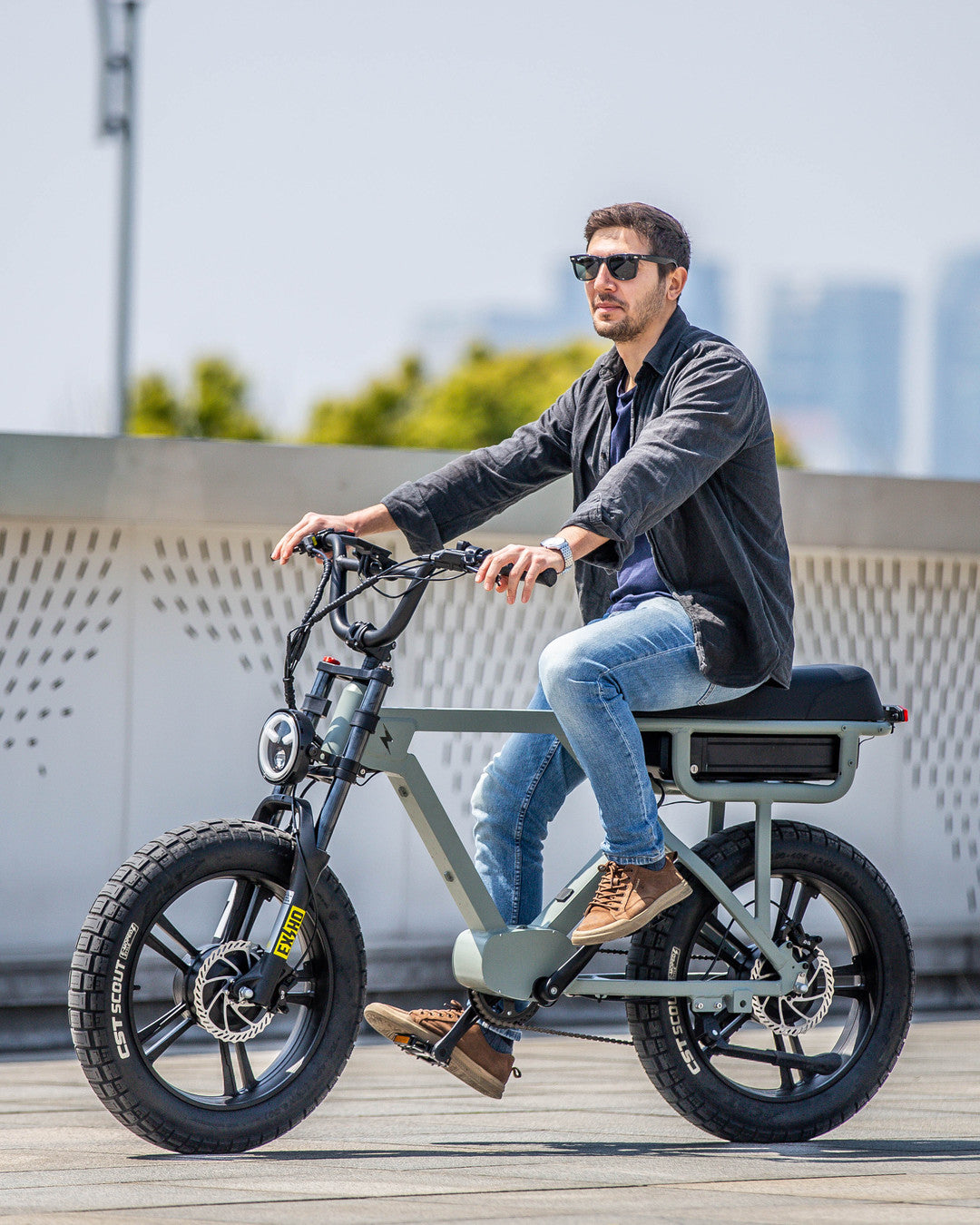

14 picks · 8 brands · 51 jurisdictions screened · $599 to $2,799 · 4 ridden in snow on our own camera · range computed at 32°F and 14°F · every deciding spec read off the maker's own US page on October 4, 2026
The 14 e-bikes for snow, ice and the cold below are sorted by the winter you ride: plowed streets in the dark, snow and ice on your own street, deep snow on land you own, or three wheels on slick roads. We rode four of them through snow on our own camera, and each ride plays in that bike's card.
Quick answer. The best electric bike for snow and ice on your own streets is the VTUVIA SX20, $1,299, on 4-inch fat tires, or the 500 W Qiolor TIGER JR, $899, where your state's e-bike definition excludes a 750 W motor. For a plowed-road winter commute, buy the VTUVIA Zeal LT7, $1,099.
Then plan your range for the cold: at 14°F on packed snow, riding 12 mph on the throttle, a full charge covers about 71% of what the same bike covers on a dry 77°F road (the range section, from our published range model).
The other winter e-bikes split by the ground under you:
- Plowed roads and a dark commute: the Zeal LT7, $1,099, with Logan hydraulic brakes on 180 mm rotors, a 120 lux headlight, fenders and a torque sensor. Under $600, the Samebike CY20 Pro, $599, folds, so it comes inside to charge.
- Snow and ice on streets and paths: the SX20, $1,299, on 20 × 4 fat tires with hydraulic brakes, a step-through frame and a fold. For the biggest pack in this group, the 960 Wh Addmotor Soletan M-66X, $1,799, with full suspension and a long bench seat.
- Deep snow on private land: the two-motor Tesway X5 AWD, $1,799, with a 3,120 Wh pack for days at or above 32°F, the floor of Tesway's battery window, or the Smartravel Raptor ST202 Pro, $1,699.99, which we rode down a snowy trail. Neither fits any state's e-bike definition, so this guide sends them to private ground.
- Three wheels on slick roads: the Eunorau ONE-TRIKE 2.0, $1,799, a 500 W trike with Logan hydraulic brakes, or the Addmotor Arisetan II M-360, $2,499, which we rode through snowy woods.

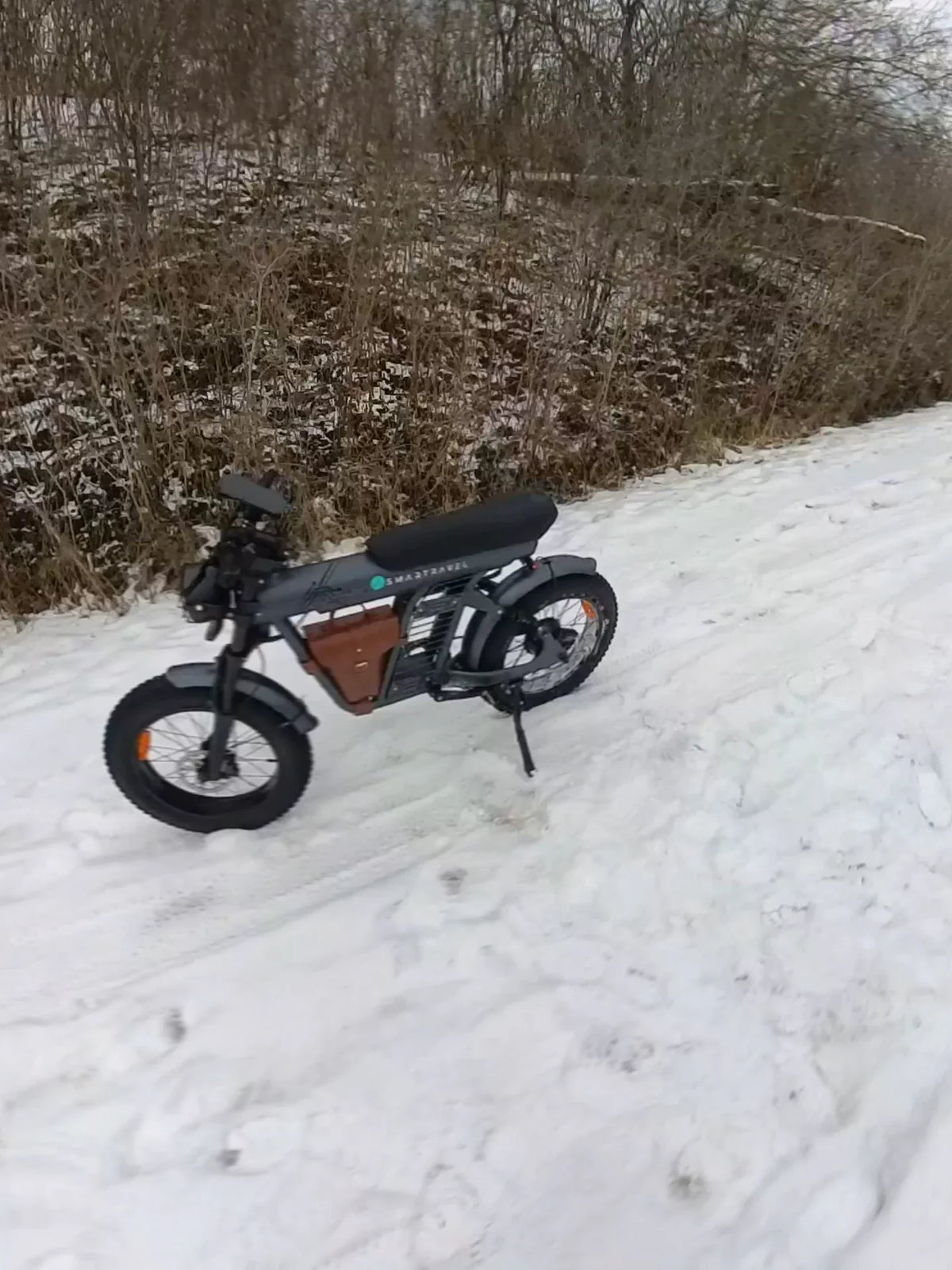
Our own Rocket ST201F, parked in fresh snow on the January 2025 ride that plays in its card. It is one of four picks we rode through snow on our own camera.
| Price tier | The pick | Price | Winter job | An e-bike under state law in |
|---|---|---|---|---|
| Under $1,000 | Samebike CY20 Pro | $599 | Plowed-road commute | 48 jurisdictions |
| Under $1,000 | Qiolor TIGER JR | $899 | Snow and ice, any state's watt line | 48 jurisdictions |
| $1,000 to $1,500 | VTUVIA Zeal LT7 | $1,099 | Plowed-road commute | 48 jurisdictions |
| $1,000 to $1,500 | VTUVIA SX20 | $1,299 | Snow and ice | 29 jurisdictions |
| $1,500 and up | Eunorau ONE-TRIKE 2.0 | $1,799 | Three wheels | 39 jurisdictions |
| $1,500 and up | Tesway X5 AWD | $1,799 | Deep snow, private land | none: outside every definition |
Last verified October 4, 2026. Every motor rating, battery, weight, tire, brake and light below was read off the manufacturer's own US pages that day, 121 figures quoted from the product pages alone, and every price, colorway and buy link was read off our store and checked against the maker's price the same day.
Every cold figure comes from a measured battery cell, a peer-reviewed winter road study or a 30-year NOAA climate normal, and the data behind each table is published with this guide.
By Milad Ghobadibeygvand, BScN (Western University, 2014), Redtail eBikes. Corrections: support@redtailebikes.com.
How we verified this guide
Every figure on this page traces to a primary source: the makers' own US pages, read on October 4, 2026, the state statutes, NOAA's 1991–2020 climate normals, and published measurements of battery cells and winter roads.
- The shortlist. On October 4, 2026 we listed 224 e-bikes, and 119 passed three screens: a brand our guides recommend, a version you can buy that day, and pedals. Each winter below then got picks at budget, mid and luxury prices, chosen on the specs that decide that winter and on the states whose e-bike definitions each one fits.
- The machines. Every pick's motor, battery, weight, tires, brakes and lights were read on the maker's own US page on October 4, 2026, and each of the 121 quoted figures was matched to a saved copy of that page. Where a maker prints two figures for one thing, the pick card prints both.
- The rides. We have ridden ten machines through snow on our own camera, and four of them are picks here: the Rocket ST201F, the Raptor ST202 Pro, the mid-drive FLASH that Eunorau now lists as the FLASH 2.0, and the Arisetan II M-360. What those rides showed comes before the picks. Every other figure is verified from the maker's specification and recomputed.
- The cold. Range comes from cell measurements at 0°C, −10°C and −20°C, winter road surfaces measured on a bicycle in Norway, and the road-cycling power model behind every range table on this site (the range section).
- The law. Each pick was screened against the e-bike definition of every state and DC, from the maker's own power, speed, throttle, weight and wheel figures (the law section).
In this guide
Find your bike · Ridden in snow · Plowed-road commuting · Snow and ice · Deep snow on private land · Three wheels · All 14 at a glance · Range in the cold · Your state's winter · Riding in snow · Studded tires · Cold batteries · Keeping the battery warm · Storage and salt · The 750-watt line · Where riders get caught out · Checklist · Why buy here · The honest ledger · Limitations · FAQ · Bottom line
The best electric bike for snow and winter, by the winter you ride
Start from the ground under your tires in January. A plowed street, a packed-snow side street, a field of loose powder and an icy bike path each call for a different machine, and the price ladder runs inside each kind of winter.
| Your winter | Budget | Mid | Luxury |
|---|---|---|---|
| Plowed roads and a dark commute | CY20 Pro (spoked), $599 | Zeal LT7, $1,099 | META275 1.0, $1,699 |
| Snow and ice on streets and paths | TIGER JR, $899 | SX20 Folding, $1,299 | Soletan M-66X, $1,799 |
| Deep snow on private land | Rocket ST201F, $749.99 | Raptor ST202 Pro, $1,699.99 · X5 AWD, $1,799 | FLASH 2.0, $2,499 · DEFENDER-S 2.0, $2,799 |
| Three wheels on slick roads | ONE-TRIKE 2.0, $1,799 | MG1703, $1,999 | Arisetan II M-360, $2,499 |
Four questions settle which row is yours:
- Is your route plowed? If the streets and paths you ride are cleared and salted, the commuting row is enough, and fenders, lights and brakes matter more than tire width.
- Do you ride on snow that stays? If snow sits on your street for weeks, take a 4-inch fat tire from the snow-and-ice row. In 17 of the 51 principal cities measured below, a normal winter keeps at least an inch of snow on the ground on 25.2 or more of the 90 days from December to February, and Boston's 37.7 inches of December-to-February snowfall puts it with them (your state's winter).
- Is the deep snow on land you own or manage? The deep-snow machines are rated at 1,000 to 2,400 W and fit no state's e-bike definition, or a handful at most, so they belong on private ground (the law section).
- Does balance worry you more than speed? Three wheels stand up on their own at a stop, which is the reason to choose the trike row.
Then check the state line. A 750 W motor sits inside the e-bike definition in 29 jurisdictions and outside it in 20: 17 states write the limit as less than 750 watts, Texas and West Virginia write fewer than, and New Jersey's definition admits no throttle, which takes all 14 picks outside it there (the law section).
Each pick below carries its maker's own figures, the winter it suits, who it is wrong for, and a buy link at the maker's own price or below.
See the 14 picks by winterRidden in snow: what our winter rides showed
There are 18 snow rides on our YouTube channel, on ten machines. Four of those machines are picks in this guide, and each one's ride plays in its own card below: the Rocket ST201F, the Raptor ST202 Pro, the mid-drive FLASH and the Arisetan II M-360 trike.
What the rides showed, in the rider's words on camera:
- Ice under snow stops a tire before it stops a motor. On a steep park hill in heavy, layered snow, both of the Raptor's hub motors kept pulling until the tires reached ice: "See it's ice underneath. There's no traction." The rider's own fix was tread: "I'm sure if I had knobby tires." On ice, grip comes from the tire (studded tires).
- A bike that puts your weight forward wants studs on ice. On the Rocket: "You lean forward on this bike. So because of that there is more weight on the front wheel. You have to be more careful," and "Having studded tires would really help with stability on this bike."
- The cold takes range. Also on the Rocket: "winter and cold weather really impacts your battery life," after a trike ride where the battery had not been charged: "Oh my god I ran out of juice." How much it takes, pick by pick, is in the range section.
Five more of the rides are below, two on our picks and three on bikes this guide does not pick, each labeled with the bike in the clip.


Himiway is a brand we carry and do not pick in our guides; its rides stay here as snow footage. For the same moto-style ride on 4-inch tires, the picks are the TIGER JR on streets and paths and the Rocket ST201F on private land. Who may ride a machine like these on a given trail is the land manager's call, which the deep-snow section explains.
Best e-bikes for a plowed-road winter commute
The rider. You ride to work through the winter on streets and paths your city plows and salts. In 33 of the 51 principal cities measured below, the average January morning at 7 a.m. sits at or below freezing, so the commute starts cold even where snow melts off (your state's winter).
What decides it. Brakes that bite in wet salt slush, a headlight for the dark half of the day, fenders against road spray, and a battery you can carry inside to charge, because the makers' own charging floors start at 32°F (cold batteries).
All three commuters here are rated at 500 W, which keeps them inside the e-bike definition in 48 jurisdictions (our legal matrix). The three exceptions are New Jersey, whose definition admits no throttle, and Alaska and Kentucky, which write no definition at all (the law section).
Budget: Samebike CY20 Pro (spoked), $599

Samebike's own studio photograph of the CY20 Pro Spoked in Black; the TÜV SÜD badge in the corner is Samebike's. It folds to come inside, where the pack charges warm.
Why it's here. The lowest price on this page, $599, for a folding bike Samebike rates IP64 from motor to display.
Samebike publishes a 500 W motor with 800 W peak, a 48V 13Ah battery, 20 × 3.0 tires, mechanical disc brakes, a 32 km/h (19.9 mph) top speed and a 31 kg weight. The same page folds it to 880 × 490 × 850 mm without its front basket, small enough for a hallway, so the battery charges at room temperature instead of in a cold garage.
On water, Samebike's page states that "the entire bike meets the IP64 standard, including the motor, battery and display." At 14°F on packed snow, its 624 Wh pack covers 30 miles on a full charge, or 23 with a quarter kept in reserve, for a 180 lb rider at 12 mph on the throttle (the range section).
Who it is wrong for. A commute through slush that wants hydraulic stopping: the Zeal LT7 runs Logan hydraulics on 180 mm rotors. Snow that stays on your street calls for the 4-inch tires of the TIGER JR.
Add the CY20 Pro to your cart · specification and photos · our CY20 Pro Spoked review
$599, Samebike's own price against its $899 list, in Black or White. It ships free to the lower 48, and Shop Pay splits it into four interest-free payments of $149.75.
Mid: VTUVIA Zeal LT7, $1,099

VTUVIA's own photograph of the Zeal LT7 in Lemon Yellow, with the fenders and rack it is sold with.
Why it's here. For $500 more than the CY20 Pro, hydraulic brakes for wet slush and an IP67 rating, on a 500 W bike that is an e-bike in 48 jurisdictions.
VTUVIA lists a 48V 500W rear hub with 750 W peak, its V-Adapt torque sensor, a 48V 13Ah (624 Wh) battery, 27.5 × 2.6 tires, Logan hydraulic disc brakes on 180 mm rotors, a 120 lux headlight and a rear light, with a rear rack and fenders on the bike as weighed. It fits riders from 5'3" to 6'2" and carries 350 lb in total.
The winter line on VTUVIA's page is direct: the bike "is built to the IP67-rated standard, making it suitable for riding through creeks, mud, and snow," and the same sentence asks riders to avoid prolonged or intentional immersion.
VTUVIA prints two weights, 62 lb in the product page's table and 65 lb in its March 2026 commuter roundup, and our range figures plan on the heavier: 30 miles at 14°F on packed snow, 23 with a quarter in reserve.
Who it is wrong for. Snow that stays for weeks, which wants the 4-inch tires of the SX20. A round trip longer than one 624 Wh pack covers in the cold, which is the META275 1.0's case with its optional second pack.
Add the Zeal LT7 to your cart · specification and photos · our Zeal LT7 review
$1,099 against VTUVIA's $1,299 list, in Lemon Yellow or Olive Green, with free shipping to the lower 48. Shop Pay offers 12 monthly payments of $99.19 at 15% APR.
Luxury: Eunorau META275 1.0, $1,699

Eunorau's own photograph of the META275 1.0 in Black. With its optional second pack, our arithmetic stretches a 14°F packed-snow ride from 30 miles to about 65, for a 180 lb rider at 12 mph on the throttle.
Why it's here. It takes an optional second battery, for a round trip longer than one pack covers in the cold.
Eunorau publishes a 48V 500W rear hub with 65 N·m, a torque sensor, a 48V 13Ah battery with "Optional Second Battery 15Ah", 27.5 × 2.6 tires, 180 mm hydraulic disc brakes, LED lights front and rear powered by the main pack, and a 68.3 lb weight. It fits riders from 5'6" to 6'1" and carries 286 lb.
That second pack is the winter case for the $600 over the Zeal LT7. With both packs fitted, the same arithmetic gives about 65 miles at 14°F on packed snow, against 30 on the standard pack. Eunorau sells that second pack as an option for this bike; email us before you order, and we will confirm it for your META275.
Who it is wrong for. Riders under 5'6", for whom the Zeal LT7 starts at 5'3". Unplowed side streets, which the fat-tire SX20 handles.
Add the META275 1.0 to your cart · specification and photos · our META275 1.0 review
$1,699 against Eunorau's $1,799 list, in Black or Gray, shipped free to the lower 48. Shop Pay spreads it over 12 monthly payments of $153.35 at 15% APR.
Logan hydraulics on 180 mm rotors, a 120 lux headlight, fenders and a rack, on a 500 W bike that is an e-bike in 48 jurisdictions.
Buy the Zeal LT7 for $1,099Best electric bikes for snow and ice on streets and paths
The rider. Your street keeps its snow. The plow comes through, but the side streets, the bike path and the last block home stay white for weeks, packed down by cars and boots, with ruts that freeze overnight. You want to keep riding on that, and to get a foot down quickly when the bike slides.
What decides it. Four-inch fat tires, which spread your weight over more snow; a low frame you can step through in boots; brakes you can modulate on a slick surface; and a battery big enough for the cold. Packed snow alone costs about 9% more energy per mile than dry pavement, and at 14°F the pack gives 82% of its warm energy (the range section).
The state line matters most in this group. The 500 W TIGER JR is an e-bike in 48 jurisdictions, and the two 750 W picks in 28 or 29, because 19 states' definitions exclude a 750 W motor (the law section; the legal matrix).
Budget: Qiolor TIGER JR, $899

Qiolor's own photograph of the TIGER JR in black: 4-inch tires on a 500 W motor, the fat-tire pick where your state's e-bike definition excludes a 750 W motor.
Why it's here. 4-inch fat tires on a 500 W motor, which keeps it an e-bike in 48 jurisdictions, and it fits riders from 5'1".
Qiolor lists a 48V 500W rear motor with 750 W peak and 63 N·m, CHAOYANG 20 × 4.0 fat tires, a 160 lux headlight with a horn, front and rear fenders, an 87 lb weight and a 400 lb maximum load, set as a Class II e-bike at 20 mph by default. Its rider range is 5'1" to 5'9", which makes it the short rider's fat-tire pick.
Qiolor prints the battery two ways on that page, "15AH" in the summary and "48V 13 / 15AH" in the specification table, and the brakes two ways as well, "Hydraulic disc brake" in the summary and "Mechanical disc brakes" in the table. Ask us which your bike ships with before you order if either decides it for you.
On the 15 Ah pack, our arithmetic gives 33 miles at 14°F on packed snow (29 on 13 Ah). Qiolor's own figure is "40 miles using just the throttle," and its page names "weather conditions" among the factors that change any e-bike's range.
Who it is wrong for. Riders above 5'9", who fit the SX20 up to 6'2". Anyone who wants a long ride between charges in the deep cold: the Soletan M-66X carries 960 Wh.
Add the TIGER JR to your cart · specification and photos
$899 against Qiolor's $1,399 list, in black or blue. Free shipping to the lower 48, and Shop Pay splits it into four interest-free payments of $224.75.
Mid: VTUVIA SX20 Folding, $1,299

VTUVIA's own photograph of the SX20 in Teal Blue: a 13.8-inch step-through for boots, and a fold that lets a 70 lb fat bike sleep indoors.
Why it's here. A fat-tire bike you can step through in boots and fold to bring inside, with hydraulic brakes and fenders, for $1,299.
VTUVIA lists a 750 W motor, a 672 Wh LG battery, 20 × 4 fat tires, torque and cadence assist modes, hydraulic brakes, a hydraulic front fork, and fenders and a rear rack, as a Class 2 e-bike. The step-through frame stands 13.8 inches high over the bar, the seat drops to 30.7 inches, and riders from 5'0" to 6'2" fit it, so a boot reaches the snow without a hop.
It folds to 35.4 × 20.9 × 28.3 inches on the same page, which lets a 70 lb fat bike sleep indoors, and VTUVIA says its brakes give "strong and responsive braking power, ensuring safety and control in all weather conditions."
At 14°F on packed snow, its pack covers 32 miles, or 24 with a quarter in reserve. VTUVIA's own figure is 40 miles on the throttle alone, and the cold and the snow account for the gap (the range section).
Who it is wrong for. Riders in the 19 states whose definitions exclude a 750 W motor, who should take the 500 W TIGER JR for the same tire width. Riders who want the biggest pack in this group, which the Soletan M-66X carries.
Add the SX20 to your cart · specification and photos · our SX20 review
$1,299 against VTUVIA's $1,599 list, in Teal Blue, Red, Cream White or Silvery, shipped free to the lower 48. Shop Pay offers 12 monthly payments of $117.25 at 15% APR.
Luxury: Addmotor Soletan M-66X, $1,799

Addmotor's own photograph of the Soletan M-66X in Orange, whose 960 Wh is the biggest pack among the snow-and-ice picks.
Why it's here. The biggest pack in this group, 960 Wh, on full suspension, 4-inch tires and a long bench seat.
Addmotor lists a 750 W rear brushless motor, a Samsung 48V*20Ah battery (960 Wh) under UL 2271, mechanical brakes, a 20 mph top speed and a 300 lb payload on a full-suspension frame with Kenda 20 × 4.0 fat tires and a long bench seat. It fits riders from 5'2" to 6'2", over a 17-inch standover.
In the cold that pack covers 42 miles at 14°F on packed snow, 32 with a quarter in reserve. Addmotor prints the weight two ways, 99 lb "excluding battery" in its technical table, which with the pack's 13.2 lb makes 112.2 lb as ridden, and 83.8 lb in an April 2025 post; at the lighter figure the same ride reaches 45 miles.
Who it is wrong for. Pennsylvania riders: the state's definition covers "a vehicle weighing not more than 100 pounds," and the Soletan as ridden weighs more, so the SX20 is the 750 W pick there. Riders who want hydraulic brakes: the SX20 has them.
Add the Soletan M-66X to your cart · specification and photos · our Soletan M-66X review
$1,799 against Addmotor's $2,599 list, in Black, Orange or Pearl White, with free shipping to the lower 48. Shop Pay spreads it over 12 monthly payments of $162.37 at 15% APR.
Four-inch fat tires, hydraulic brakes and a 13.8-inch step-through, on a bike that folds to sleep indoors.
Buy the SX20 for $1,299Best winter machines for deep snow on private land
The rider. The snow you ride is deep and loose: a farm lane after a storm, a ranch track, the trail to a cabin, a lease you hunt in December. You own the ground or have the owner's leave, and you want a machine that keeps moving when the snow is over the rims.
What decides it. Power that reaches the snow, from two hub motors or a mid-drive through gears; a big pack, because loose snow over 5 cm deep costs about three times the energy per mile of dry pavement; 4-inch tires; and a place you are allowed to ride it (the range section).
Where these belong. All five are rated at 1,000 W or more. The Rocket, the Raptor and the X5 AWD sit inside no state's e-bike definition, the FLASH 2.0 inside four and the DEFENDER-S 2.0 inside three, so outside those, the e-bike rules do not cover them (the law section).
On public land the manager decides: the Forest Service counts every e-bike as a motor vehicle under 36 CFR § 212.1, so in a national forest it rides only the routes its Motor Vehicle Use Map shows open (our public-land guide).
Off those routes, 36 CFR § 261.13 prohibits riding one, and § 261.1b punishes a violation with up to six months' imprisonment, a fine, or both; 18 U.S.C. § 3571(b)(6) sets that fine at up to $5,000 for an individual.
Budget: Smartravel Rocket ST201F, $749.99

A frame from our own January ride on the Rocket ST201F, on a snow-covered trail. The specifications beside it are Smartravel's.
Why it's here. The least expensive machine on this page on 4-inch tires with hydraulic brakes, and one we rode through fresh snow in January on our own camera.
Smartravel lists a rear hub rated "1200W (sustained), 1500W (peak)" with 86 N·m, 20 × 4 fat tires, hydraulic disc brakes front and rear, a rear rack and fenders, UL 2849 certification, a 32 mph top speed and a 104.1 lb weight. It comes in two versions: the 1200 W with a 48V 18.2Ah pack, and the 1500 W with 48V 25.6Ah (1,228.8 Wh).

On the 1200 W version's 873.6 Wh, the arithmetic gives 39 miles at 14°F on packed snow, or 29 with a quarter kept back, and the 1500 W version's pack stretches that to 55.
Who it is wrong for. Anyone who needs an e-bike for public roads, since no state's definition covers it. Deep powder on a long route, where the Raptor ST202 Pro carries two motors and 2,600 Wh.
Add the Rocket ST201F to your cart · specification and photos · our Rocket ST201F review
$749.99 for the 1200 W version and $1,149.99 for the 1500 W, against Smartravel's $1,599.99 list on the 1200 W, shipped free to the lower 48. Shop Pay splits the 1200 W into four interest-free payments of $187.50.
Mid: Smartravel Raptor ST202 Pro, $1,699.99

Smartravel's own photograph of the Raptor ST202 Pro in White. The Raptor we rode in snow is the green one.
Why it's here. A hub motor in each wheel and a 2,600 Wh pack, and we took it up a steep, snow-covered park hill on our own camera.
Smartravel lists two hub motors at 1200 W continuous and 1500 W peak each, 3,000 W peak in all, a 52V 50Ah (2,600 Wh) battery, 20 × 4 fat tires, hydraulic disc brakes front and rear, UL 2849 certification, a 35 mph top speed and a 123.7 lb weight. Both wheels can drive, which is the point in loose snow.

In that clip both motors pull through heavy, layered snow until the tires reach ice beneath it. The 2,600 Wh pack is the second biggest on this page; the arithmetic gives it 112 miles at 14°F on packed snow, 59 in 2 to 5 cm of loose snow, and 84 on packed snow with a quarter in reserve.
Who it is wrong for. Anyone who has to lift it: 123.7 lb is the heaviest published weight on this page. Riders who want the motor itself to climb through the gears, which the mid-drive FLASH 2.0 does; the Raptor's Shimano 7-speed serves your pedaling.
Add the Raptor ST202 Pro to your cart · specification and photos · our Raptor ST202 Pro review
$1,699.99 against Smartravel's $2,699.99 list, in green, grey or White, with free shipping to the lower 48. Shop Pay offers 12 monthly payments of $153.44 at 15% APR.
Mid: Tesway X5 AWD, $1,799

Tesway's own photograph of the X5 AWD in Dark Green, carrying the biggest pack on this page: 3,120 Wh, or 149 miles on level packed snow at 32°F, the floor of Tesway's battery window, for a 180 lb rider at 12 mph on the throttle.
Why it's here. The biggest pack on this page, 3,120 Wh, behind two motors, for long days in deep snow at or above 32°F, the floor of Tesway's battery window.
Tesway lists two motors rated 2,000 W together on 52 V, with a 3,600 W peak, a 52V 60Ah battery (3,120 Wh), Kenda 20 × 4.0 fat tires, dual suspension, four-piston hydraulic brakes, front and rear fenders in the box, a 38 mph top speed, a 119 lb weight and a 400 lb payload, with a Shimano 7-speed for your pedaling.
Tesway's X5/X7 AWD manual says the battery is "intended to be used, stored and charged" between 0°C and 40°C (32°F to 104°F), and "Never charge the battery when ambient temperatures are outside this range."
At the bottom of that window the pack does the most work of any pick: 149 miles at 32°F on packed snow, 112 with a quarter in reserve, and 78 in 2 to 5 cm of loose snow. Its 14°F rows in the range tables are arithmetic below the window Tesway sets.
Who it is wrong for. Riders who want the motor itself to climb through the gears, which is the mid-drive FLASH 2.0's job. Anyone who will ride or store it below 32°F, outside the window Tesway sets for its battery (the makers' cold lines).
Add the X5 AWD to your cart · specification and photos · our Tesway X5 AWD review
$1,799 against Tesway's $2,699 list, in Black, Gray or Dark Green, shipped free to the lower 48. Shop Pay spreads it over 12 monthly payments of $162.37 at 15% APR.
Luxury: Eunorau FLASH 2.0, $2,499

Eunorau's own photograph of the FLASH 2.0 in Moon Black. Our snow climb on the mid-drive FLASH, the model Eunorau now lists as the FLASH 2.0, plays below.
Why it's here. A 1,000 W mid-drive on an 8-speed Shimano for steep snow climbs, and we rode the mid-drive FLASH up a snow-covered hill track on our own camera.
The mid-drive turns the rear wheel through the gears, so you can shift down for a steep snow climb.

Eunorau prints its speed two ways on that page, a "Class 3" badge in the summary and a "Maximum Speed" of "20 MPH" in the specification table, and the class only matters where the 1,000 W motor fits a state's definition at all: DC, Montana, Oregon and Rhode Island (the law section).
It also prints the weight as a range, "82-92 lbs," and at the heavier figure the 832 Wh pack covers 37 miles at 14°F on packed snow, 28 with a quarter in reserve.
Who it is wrong for. Riders after the most range for the money: the X5 AWD carries nearly four times the pack for $700 less. Fenders are not in the box; email us before you order and we will find you a set that fits.
Add the FLASH 2.0 to your cart · specification and photos · our FLASH 2.0 review
$2,499, Eunorau's own price, in Moon Black or Lunar Dust, with free shipping to the lower 48. Shop Pay offers 12 monthly payments of $225.56 at 15% APR.
Luxury: Eunorau DEFENDER-S 2.0, $2,799

Eunorau's own photograph of the DEFENDER-S 2.0 in Moon Black, on the largest wheels of the deep-snow group: 26 × 4.0, with a motor in each hub.
Why it's here. Two-wheel drive on 26 × 4.0 tires, the largest wheels in this group, with full suspension and 203 mm hydraulic rotors, from a maker that pitches it for winter traction.
Eunorau lists two 48V 750W hub motors, 1,500 W combined, with 85 N·m, a removable 48V 17Ah battery, 26 × 4.0 tires, hydraulic brakes on 203 mm rotors, full suspension, an 89.3 lb weight and a 300 lb payload counting rider and cargo, for riders from 160 to 193 cm (about 5'3" to 6'4"). It starts in Class 2, assisted to 20 mph, by default.
Eunorau's own page makes the winter case under the heading "Added Traction for Winter Surfaces": "The fat-tire platform and two-wheel drive add confidence as conditions become soft or slippery." Its 816 Wh pack gives 38 miles at 14°F on packed snow, 28 with a quarter in reserve.
Who it is wrong for. Riders who want the biggest range in this group, which is the X5 AWD. Anyone who wants fenders included: we sell its rack-and-fender set for $178.80.
Add the DEFENDER-S 2.0 to your cart · specification and photos · our DEFENDER-S 2.0 review
$2,799, Eunorau's own price, in Moon Black, Dry Grass Camo or Army Green, with a 17- or 19-inch frame, shipped free to the lower 48. Shop Pay offers 12 monthly payments of $252.63 at 15% APR.
Best three-wheel e-bikes for slick winter roads
The rider. A fall on ice worries you more than a slow ride does. You want to stop at a corner on a slick road without putting a foot down, and to roll on with something to carry. Three wheels give you that: a trike stands on its own when you stop.
What decides it. A differential, so both rear wheels drive through a turn on slush; brakes on more than one wheel; a parking brake for a stop on a frozen slope; and a pack sized for the cold.
The wheel count is a legal question of its own. Some state definitions say an e-bike has two or three wheels, some say two, and in a few the words leave three unsettled, so the 500 W ONE-TRIKE 2.0 is an e-bike in 39 jurisdictions, and the two 750 W trikes in 25 each (the law section; the legal matrix).
Budget: Eunorau ONE-TRIKE 2.0, $1,799

Eunorau's own photograph of the ONE-TRIKE 2.0 in Deep Crimson, a 500 W trike that is an e-bike in 39 jurisdictions.
Why it's here. It fits the most state definitions of the three trikes, 39 jurisdictions, and its differential keeps both rear wheels driving through a slushy turn.
Eunorau lists a 500 W rear-drive motor with 80 N·m, a rear differential, a 48V 14.5Ah battery, 20 × 2.6 tires, Logan hydraulic disc brakes, full fenders and a cargo rack, an 85.98 lb weight and a 440 lb payload, for riders from 5'2" to 6'1". Its differential, in Eunorau's words, lets the rear wheels "adapt to varying speeds and terrains, minimizing slippage and hopping during turns."
At 36.22 inches across, measure the door to wherever it will spend the winter before you order. Its 696 Wh pack covers 32 miles at 14°F on packed snow, or 24 with a quarter in reserve. Its tires are 2.6 inches wide, so it is a trike for plowed roads and packed paths more than for fresh snow.
Who it is wrong for. Snow that stays deep on your street, which the fat-tire MG1703 and Arisetan II handle. Riders taller than 6'1", who fit the Arisetan II up to 6'6".
Add the ONE-TRIKE 2.0 to your cart · specification and photos · our ONE-TRIKE 2.0 review
$1,799, Eunorau's own price, in Deep Crimson, Dark Charcoal or Snow White, shipped free to the lower 48. Shop Pay offers 12 monthly payments of $162.37 at 15% APR.
Mid: DWMEIGI MG1703, $1,999

DWMEIGI's own photograph of the MG1703 in White, with baskets front and rear on 4-inch tires.
Why it's here. Fat tires on three wheels for $500 less than the Arisetan II, with fenders, a rack, two baskets and a detachable battery you can carry in to charge.
The load is printed two ways on that page, "330 Lbs Max Load" at the top and "We recommend a max weight of 400lbs" in its answers, so plan on the lower figure.
Our range figure for it is computed at 300 lb moving in all, rider, cargo and trike together: 38 miles at 14°F on packed snow, 28 with a quarter in reserve. Its manual says the charger "is designed for indoor use only" and that a battery left unused should be charged "at least one time per month."
Who it is wrong for. Riders in the 19 states whose definitions exclude a 750 W motor, who should look at the 500 W ONE-TRIKE 2.0. Riders taller than 6'3", who fit the Arisetan II up to 6'6".
Add the MG1703 to your cart · specification and photos
$1,999 in White, against DWMEIGI's $2,499 list, with free shipping to the lower 48. Shop Pay offers 12 monthly payments of $180.43 at 15% APR.
Luxury: Addmotor Arisetan II M-360, $2,499

Addmotor's own photograph of the Arisetan II M-360 in Green, the colorway we rode; our ride through snowy woods plays below.
Why it's here. Three wheels on 4-inch fat tires with a differential and a parking brake, and one we rode through snowy woods on our own camera.
Addmotor lists a 750 W rear-drive motor with 90 N·m and 1,400 W peak, a Samsung 48V*20Ah battery under UL 2271 and 2849, a torque sensor, a speed differential, a parking brake system, a disc brake on each wheel, 20 × 4.0 fat tires and a 280+100 lb payload on a semi-recumbent frame, where you sit back with your feet forward.
The Standard fits riders from 5'7" to 6'6"; the Mini, on 16 × 4.0 tires, from 5'6" to 6'5".

Its 960 Wh pack gives 42 miles at 14°F on packed snow, 32 with a quarter in reserve, at the 110 lb Addmotor gives for the Standard. The parking brake earns its place in winter: it holds the trike still at a frozen curb while you load it.
Who it is wrong for. Riders under 5'6", who fit the ONE-TRIKE 2.0 from 5'2". Anyone who wants to stand on the pedals: the seat is set back.
Add the Arisetan II to your cart · specification and photos · our Arisetan II M-360 review
$2,499 for the Standard against Addmotor's $3,299 list, in Green, Blue, Pearl White, Orange, Gulf Blue or Mint Green; the Mini is $2,399. Free shipping to the lower 48, and Shop Pay offers 12 monthly payments of $225.56 at 15% APR.
A rear differential, Logan hydraulic brakes and full fenders, on a 500 W trike that is an e-bike in 39 jurisdictions.
Buy the ONE-TRIKE 2.0 for $1,799All 14 winter e-bikes at a glance
The first figure is the one to plan on: miles on a full charge at 14°F on packed snow, for a 180 lb rider at 12 mph on the throttle, with the planning figure in brackets keeping a quarter of the pack in reserve. The last column counts the 51 jurisdictions, the 50 states and DC, whose e-bike definition the maker's own figures sit inside.
| Pick | 14°F, packed snow: full charge (planning) | Price | Battery · weight | An e-bike in |
|---|---|---|---|---|
| CY20 Pro (spoked) (commute) | 30 mi (23 mi) | $599 | 624 Wh · 68.3 lb | 48 of 51 |
| Zeal LT7 (commute) | 30 mi (23 mi) | $1,099 | 624 Wh · 62 or 65 lb | 48 of 51 |
| META275 1.0 (commute) | 30 mi (23 mi) | $1,699 | 624 Wh · 68.3 lb | 48 of 51 |
| TIGER JR (snow and ice) | 33 mi (25 mi) | $899 | 720 Wh · 87 lb | 48 of 51 |
| SX20 Folding (snow and ice) | 32 mi (24 mi) | $1,299 | 672 Wh · 70 lb | 29 of 51 |
| Soletan M-66X (snow and ice) | 42 mi (32 mi) | $1,799 | 960 Wh · 99 lb + 13.2 lb pack | 28 of 51 |
| Rocket ST201F (deep snow) | 39 mi (29 mi) | $749.99 | 874 Wh · 104.1 lb | 0 of 51 |
| Raptor ST202 Pro (deep snow) | 112 mi (84 mi) | $1,699.99 | 2,600 Wh · 123.7 lb | 0 of 51 |
| X5 AWD (deep snow) | 135 mi (102 mi) | $1,799 | 3,120 Wh · 119 lb | 0 of 51 |
| FLASH 2.0 (deep snow) | 37 mi (28 mi) | $2,499 | 832 Wh · 82 to 92 lb | 4 of 51 |
| DEFENDER-S 2.0 (deep snow) | 38 mi (28 mi) | $2,799 | 816 Wh · 89.3 lb | 3 of 51 |
| ONE-TRIKE 2.0 (trike) | 32 mi (24 mi) | $1,799 | 696 Wh · 86 lb | 39 of 51 |
| MG1703 (trike) | 38 mi (28 mi) | $1,999 | 874 Wh | 25 of 51 |
| Arisetan II M-360 (trike) | 42 mi (32 mi) | $2,499 | 960 Wh · 110 lb | 25 of 51 |
The DWMEIGI MG1703's range is computed for 300 lb moving in all, rider, cargo and trike together (Limitations, item 9). The published picks dataset carries every figure here with its source.
How far does an e-bike go in the cold?
Less far, for two reasons you can plan around. A cold battery gives up less of the energy it holds, and snow takes more energy to roll through, so the two losses multiply. At 14°F on packed snow, riding 12 mph on the throttle, a full charge covers about 71% of the miles the same bike covers on a dry road at 77°F, range computed at 32°F and 14°F for every pick below.
Takeaway
Plan your winter range on a cold morning on packed snow: 78% to 79% of a warm, dry day's miles at 32°F and 71% at 14°F, on every one of the 14 picks. Loose snow 2 to 5 cm deep cuts that to 37% to 39% at 14°F, so on fresh snow, plan on a little over a third of your summer range.
The battery: energy left at each temperature
A lithium-ion cell delivers less of its energy as it cools. The central figures below come from an LG 18650HG2 cell discharged at half its capacity per hour at each temperature in McMaster University's published test data, and recomputed from those raw files. The spread comes from the other cell measurements we read.
| Air and pack temperature | Energy the pack gives, of its 77°F figure | Spread across the cell data read |
|---|---|---|
| 77°F (25°C) | 100% | — |
| 50°F (10°C) | 93% | — |
| 32°F (0°C) | 89% | 80% to 93% |
| 14°F (−10°C) | 82% | 40% to 83% |
| −4°F (−20°C) | 67% | 33% to 82% |

At 14°F the central cell gives 82% of its warm energy; the spread below freezing comes from sources that disagree, so both ends are printed.
The spread widens below freezing because the sources disagree. At 14°F, the low end is Samsung's own specification for its 35E cell, 40% of capacity at a full 1C draw, a harder draw than a 12 mph ride on packed snow puts on any pack here, which our arithmetic puts at 0.07C to 0.32C.
At −4°F, Casado and colleagues measured the same 35E cell at 81.6% of its warm energy, at a 1 A draw, while NASA's Jet Propulsion Laboratory measured 47% at 0.58 A. Both are printed, because neither settles it.
These figures describe a pack that has cooled to the air. A battery that spent the night indoors starts warmer and loses less on a short ride, which is why the makers' storage advice in the cold-battery section matters as much as the chemistry.
The road: energy per mile on each winter surface
Snow takes energy to push through, and how much depends on what kind. Fenre and Klein-Paste measured rolling resistance on 103 sections of Trondheim's streets and cycleways in the winter of 2019 with an instrumented bicycle on 42 mm studded tires at 2 bar. Their medians, run through the same arithmetic for the SX20 at 32°F:
| Surface, as Fenre and Klein-Paste measured it | Rolling resistance | Energy per mile, against dry asphalt | SX20 at 32°F, full charge |
|---|---|---|---|
| Dry asphalt | 0.012 | the base | 39 mi |
| Compact snow | 0.014 | +9% | 35 mi |
| Slush under 2 cm on asphalt | 0.016 | +18% | 33 mi |
| Loose snow under 2 cm on compact snow | 0.020 | +36% | 28 mi |
| Loose snow 2 to 5 cm on compact snow | 0.035 | +103% | 19 mi |
| Loose snow over 5 cm | 0.056 | +202% | 13 mi |

Packed snow costs 9% more energy a mile than dry asphalt; 2 to 5 cm of loose snow costs 103% more, and over 5 cm 202% more.
Two things stand out. Packed snow costs little, about 9% more energy per mile than dry pavement, so a plowed and packed street is a normal ride. Loose snow is the cost: 2 to 5 cm of it on packed snow doubles the energy per mile, and over 5 cm triples it, which the study's authors compare to riding up a 4.6% grade.
Every pick, in miles
Full charge, 180 lb rider dressed for winter, 12 mph on the throttle, level ground, no wind, the pack at air temperature. The DWMEIGI MG1703 is computed at 300 lb moving in all.
| Pick | 14°F, packed snow | Battery | 32°F, packed snow | 14°F, 2 to 5 cm of loose snow |
|---|---|---|---|---|
| CY20 Pro (spoked) | 30 mi | 624 Wh | 33 mi | 16 mi |
| Zeal LT7 | 30 mi | 624 Wh | 33 mi | 16 mi |
| META275 1.0 | 30 mi | 624 Wh | 33 mi | 16 mi |
| TIGER JR | 33 mi | 720 Wh | 37 mi | 18 mi |
| SX20 Folding | 32 mi | 672 Wh | 35 mi | 17 mi |
| Soletan M-66X | 42 mi | 960 Wh | 46 mi | 22 mi |
| Rocket ST201F | 39 mi | 874 Wh | 43 mi | 21 mi |
| Raptor ST202 Pro | 112 mi | 2,600 Wh | 123 mi | 59 mi |
| X5 AWD | 135 mi | 3,120 Wh | 149 mi | 71 mi |
| FLASH 2.0 | 37 mi | 832 Wh | 41 mi | 20 mi |
| DEFENDER-S 2.0 | 38 mi | 816 Wh | 41 mi | 20 mi |
| ONE-TRIKE 2.0 | 32 mi | 696 Wh | 35 mi | 17 mi |
| MG1703 | 38 mi | 874 Wh | 41 mi | 20 mi |
| Arisetan II M-360 | 42 mi | 960 Wh | 47 mi | 22 mi |

The X5 AWD's 3,120 Wh covers 135 miles and the CY20 Pro's 624 Wh covers 30, for the same rider, speed and cold. Tesway and Eunorau set their batteries' cold lines above 14°F, so the bars for their five bikes are arithmetic outside those lines.
Pedaling stretches every figure, since the motor does less of the work; the throttle-only rows are the floor. To keep a margin, plan on three quarters of each figure: Schmitt, Decker and Doppelbauer measured a pedelec using "376 Wh or 75 % of the nominal battery capacity" in a standard range test, with "the remaining 25 %" kept back "to prevent deep discharge of the battery."
Two makers among these picks also draw cold lines for use. Tesway says the X5 AWD's battery is "intended to be used, stored and charged" between 0°C and 40°C (32°F to 104°F), and Eunorau calls 10℃ to 55℃ (50°F to 131°F) the optimal operating temperature for its batteries, so the 14°F rows for the X5 AWD and the four Eunorau picks are arithmetic outside those lines (the cold-battery section).
How the figures are computed
Each figure is the pack's usable energy divided by the energy a mile takes:
- Energy a mile takes is the power to roll and to push air, from the road-cycling model Martin and colleagues validated in 1998: speed × (total mass × gravity × rolling resistance + ½ × air density × drag area × speed²).
- Rolling resistance is the Fenre and Klein-Paste median for each surface, and drag area is 0.640 m², the average Tengattini and Bigazzi measured for 37 riders on upright cruiser bicycles. Air density comes from the temperature, as in the U.S. Standard Atmosphere.
- Motor efficiency is 75.2%, the median our review models compute for these motors at 12 mph on the throttle, bracketed by the 65% to 80% that Arango, Lopez and Ceren measured across a 48 V e-bike drive. Battery efficiency is their measured equation, about 97% at these draws.
- Usable energy is the maker's volts × amp-hours × the cell fraction for the temperature, from the table above.
As a check, the same arithmetic applied to a published warm-weather ride to near-empty on a Raptor ST202 Pro, 46.95 miles averaging 21.6 mph with 2,766 feet of climbing, predicts 1,880 to 1,972 Wh used, against 2,080 to 2,600 Wh read off the bike's five-bar gauge with one bar left.
The real ride had stops, a 40.1 mph top speed and hills, each of which costs more than a steady ride does. The model, its inputs and every row are in the published range dataset.
What the arithmetic leaves out
- A warm start. The cell data describe a pack cooled to the air, so a pack carried out of a warm house does better on a short ride than these rows show.
- Your tires. The surface figures were measured on a 42 mm studded tire, and the arithmetic applies them unchanged to every tire here, the 4-inch fat tires included.
- Wind, hills and stops, each of which costs energy the steady, level rows do not count. The state tables add each city's average January morning wind.
- Colder days. The surfaces were measured with the air between about 25°F and 40°F, and the rows hold rolling resistance at those medians at every colder temperature.
- The heaters. Heated grips and lights draw from the same pack.
Your state's winter, measured: all 50 states and DC
Winter is a different job in each state: a January commute at 7 a.m. keeps 95% of a warm, dry day's range in Honolulu and 63% in Fargo, where the morning averages 7.5°F and the ride is on packed snow. Each row below measures the state's most populous city at its NOAA weather station, from the 1991–2020 climate normals, so it describes that city, not every corner of the state.
- Picks its law admits for that winter. Snow and ice winters list the snow-and-ice picks, cold and mild winters the commuters, each only where the state's e-bike definition admits it (the law section).
- Its winter. Snow means at least an inch of snow on the ground on 25.2 or more of the 90 days from December to February, on the 30-year average, the top third of the cities that report it; Boston's station reports snowfall only, so its 37.7 inches decides. Ice means the top third for freeze-thaw days, nights below freezing whose afternoons climb above it, when meltwater refreezes. Cold means a January 7 a.m. average at or below 32°F; mild is the rest.
- 7 a.m. in January. The hourly normal for that hour, averaged over the month, with the wind chill beside it.
- Range kept at that hour. The share of its calm, dry, 77°F range that a 180 lb rider on a 70 lb, 672 Wh fat-tire e-bike keeps at 12 mph on the throttle, at that temperature, the station's elevation and its average 7 a.m. wind; on packed snow in snow winters. In brackets, the same ride straight into that wind.

Anchorage, Alaska, keeps snow on the ground 85.5 of the 90 days; Denver, Colorado, 25.2. Boston's station reports snowfall only, so it is not drawn.
Shipping is free to the lower 48. Alaska and Hawaii may carry extra charges or be excluded under our shipping policy, so ask us before you order. The full state model is published with this guide.
Northeast
Snow country, five of nine snow winters. Burlington, Vermont, keeps snow on the ground 65.8 days and has the region's coldest January morning, 17.8°F, which leaves 70% of the range, or 49% into the wind (the state model).
In Maine, New Hampshire and Vermont, whose definitions read "less than 750 watts", the 500 W TIGER JR is the one snow-and-ice pick that counts as an e-bike (the legal matrix). New Jersey admits none of the 14, all of which carry a throttle.
| State (city measured) | Picks its law admits for that winter | Its winter, December to February | 7 a.m. in January (wind chill) | Range kept at that hour (into the wind) |
|---|---|---|---|---|
| Connecticut (Bridgeport) | TIGER JR · SX20 Folding · Soletan M-66X | Snow on the ground 27.1 days | 27.9°F (20.5°F) | 74% (52%), packed snow |
| Maine (Portland) | TIGER JR | Snow on the ground 54.7 days | 19.7°F (11.9°F) | 72% (53%), packed snow |
| Massachusetts (Boston) | TIGER JR · SX20 Folding · Soletan M-66X | 37.7 in of snowfall | 27.3°F (17.6°F) | 71% (44%), packed snow |
| New Hampshire (Manchester) | TIGER JR | Snow on the ground 55.9 days | 21.6°F (15.2°F) | 73% (57%), packed snow |
| New Jersey (Newark) | None of the 14 as sold, all of which carry a throttle: the law section | Cold mornings, 24.6 in of snow | 29.6°F (21.6°F) | 80% (53%), dry road |
| New York (New York) | CY20 Pro (spoked) · Zeal LT7 · META275 1.0 | Cold mornings, 23.6 in of snow | 31.6°F (23.0°F) | 78% (48%), dry road |
| Pennsylvania (Philadelphia) | TIGER JR · SX20 Folding | Ice: 47 freeze-thaw days | 30.9°F (23.7°F) | 81% (54%), dry road |
| Rhode Island (Providence) | TIGER JR · SX20 Folding · Soletan M-66X | Ice: 55 freeze-thaw days | 26.5°F (18.8°F) | 79% (54%), dry road |
| Vermont (Burlington) | TIGER JR | Snow on the ground 65.8 days | 17.8°F (9.0°F) | 70% (49%), packed snow |
Midwest
The hardest winter on the list: eight of twelve snow winters, and Fargo, North Dakota, at the bottom of all 51 cities, with a 7.5°F morning, a −5.5°F wind chill, 75 days of snow on the ground and 63% of the range kept, 41% into the wind.
Wichita, Kansas, freezes and thaws on 59 days, the region's most (the state model). Illinois, Kansas and Missouri admit only the TIGER JR among the snow-and-ice picks.
| State (city measured) | Picks its law admits for that winter | Its winter, December to February | 7 a.m. in January (wind chill) | Range kept at that hour (into the wind) |
|---|---|---|---|---|
| Illinois (Chicago) | TIGER JR | Snow on the ground 38.4 days | 23.4°F (13.9°F) | 72% (48%), packed snow |
| Indiana (Indianapolis) | CY20 Pro (spoked) · Zeal LT7 · META275 1.0 | Cold mornings, 21.2 in of snow | 25.6°F (16.6°F) | 79% (51%), dry road |
| Iowa (Des Moines) | TIGER JR · SX20 Folding · Soletan M-66X | Snow on the ground 43.5 days | 19.0°F (8.8°F) | 71% (48%), packed snow |
| Kansas (Wichita) | TIGER JR | Ice: 59 freeze-thaw days | 26.8°F (18.4°F) | 80% (52%), dry road |
| Michigan (Detroit) | TIGER JR · SX20 Folding · Soletan M-66X | Snow on the ground 39 days | 23.5°F (14.3°F) | 72% (49%), packed snow |
| Minnesota (Minneapolis) | TIGER JR · SX20 Folding · Soletan M-66X | Snow on the ground 68.6 days · deep cold | 13.3°F (2.7°F) | 69% (48%), packed snow |
| Missouri (Kansas City) | TIGER JR | Ice: 51 freeze-thaw days | 24.7°F (15.3°F) | 79% (51%), dry road |
| Nebraska (Omaha) | TIGER JR · SX20 Folding · Soletan M-66X | Snow on the ground 33.6 days | 19.4°F (9.5°F) | 71% (48%), packed snow |
| North Dakota (Fargo) | TIGER JR · SX20 Folding · Soletan M-66X | Snow on the ground 75 days · deep cold | 7.5°F (−5.5°F) | 63% (41%), packed snow |
| Ohio (Columbus) | CY20 Pro (spoked) · Zeal LT7 · META275 1.0 | Cold mornings, 22.2 in of snow | 27.1°F (19.8°F) | 81% (56%), dry road |
| South Dakota (Sioux Falls) | TIGER JR · SX20 Folding · Soletan M-66X | Snow on the ground 54.6 days · deep cold | 13.8°F (3.7°F) | 70% (48%), packed snow |
| Wisconsin (Milwaukee) | TIGER JR · SX20 Folding · Soletan M-66X | Snow on the ground 48.2 days | 21.0°F (10.8°F) | 71% (47%), packed snow |
South
Mostly mild, 12 of 17, and the ice line runs through the middle: Baltimore freezes and thaws on 56 days, and Delaware, Oklahoma and West Virginia join it. Every southern city keeps at least 81% of the range at a January 7 a.m. (the state model). Kentucky writes no e-bike definition, so no pick sits inside or outside one there.
| State (city measured) | Picks its law admits for that winter | Its winter, December to February | 7 a.m. in January (wind chill) | Range kept at that hour (into the wind) |
|---|---|---|---|---|
| Alabama (Huntsville) | CY20 Pro (spoked) · Zeal LT7 · META275 1.0 | Mild: 42 nights below freezing | 36.7°F (32.2°F) | 85% (62%), dry road |
| Arkansas (Little Rock) | CY20 Pro (spoked) · Zeal LT7 · META275 1.0 | Mild: 41 nights below freezing | 36.2°F (31.7°F) | 85% (63%), dry road |
| Delaware (Wilmington) | TIGER JR · SX20 Folding · Soletan M-66X | Ice: 47 freeze-thaw days | 30.9°F (23.7°F) | 81% (54%), dry road |
| District of Columbia (Washington) | CY20 Pro (spoked) · Zeal LT7 · META275 1.0 | Mild: 48 nights below freezing | 33.1°F (26.6°F) | 82% (56%), dry road |
| Florida (Jacksonville) | CY20 Pro (spoked) · Zeal LT7 · META275 1.0 | Mild: 13 nights below freezing | 46.3°F (44.4°F) | 88% (70%), dry road |
| Georgia (Atlanta) | CY20 Pro (spoked) · Zeal LT7 · META275 1.0 | Mild: 30 nights below freezing | 38.6°F (33.3°F) | 85% (59%), dry road |
| Kentucky (Louisville) | CY20 Pro (spoked) · Zeal LT7 · META275 1.0 (the state writes no e-bike definition: the law section) | Cold mornings, 10.8 in of snow | 31.6°F (25.4°F) | 83% (58%), dry road |
| Louisiana (New Orleans) | CY20 Pro (spoked) · Zeal LT7 · META275 1.0 | Mild: 5 nights below freezing | 49.2°F (46.6°F) | 87% (61%), dry road |
| Maryland (Baltimore) | TIGER JR · SX20 Folding · Soletan M-66X | Ice: 56 freeze-thaw days | 30.1°F (25.0°F) | 83% (63%), dry road |
| Mississippi (Jackson) | CY20 Pro (spoked) · Zeal LT7 · META275 1.0 | Mild: 32 nights below freezing | 40.9°F (38.0°F) | 87% (67%), dry road |
| North Carolina (Charlotte) | CY20 Pro (spoked) · Zeal LT7 · META275 1.0 | Mild: 43 nights below freezing | 36.0°F (32.3°F) | 86% (68%), dry road |
| Oklahoma (Oklahoma City) | TIGER JR · SX20 Folding · Soletan M-66X | Ice: 49 freeze-thaw days | 32.0°F (24.3°F) | 81% (52%), dry road |
| South Carolina (Charleston) | CY20 Pro (spoked) · Zeal LT7 · META275 1.0 | Mild: 20 nights below freezing | 43.0°F (39.7°F) | 86% (63%), dry road |
| Tennessee (Nashville) | CY20 Pro (spoked) · Zeal LT7 · META275 1.0 | Mild: 49 nights below freezing | 34.6°F (29.6°F) | 85% (62%), dry road |
| Texas (Houston) | CY20 Pro (spoked) · Zeal LT7 · META275 1.0 | Mild: 9 nights below freezing | 47.4°F (45.2°F) | 88% (66%), dry road |
| Virginia (Virginia Beach) | CY20 Pro (spoked) · Zeal LT7 · META275 1.0 | Mild: 34 nights below freezing | 38.5°F (33.3°F) | 83% (56%), dry road |
| West Virginia (Charleston) | TIGER JR | Ice: 48 freeze-thaw days | 30.9°F (27.4°F) | 85% (69%), dry road |
West
The widest spread of any region. Anchorage, Alaska, keeps snow on the ground 85.5 days, the most of all 51 cities, while Honolulu keeps 95% of its range, the most. Albuquerque, New Mexico, freezes and thaws on 68 days, the most anywhere, and Billings, Montana, has the windiest January morning measured, 13.3 mph (the state model). Idaho and Wyoming admit only the TIGER JR among the snow-and-ice picks, and Alaska writes no e-bike definition.
| State (city measured) | Picks its law admits for that winter | Its winter, December to February | 7 a.m. in January (wind chill) | Range kept at that hour (into the wind) |
|---|---|---|---|---|
| Alaska (Anchorage) | TIGER JR · SX20 Folding · Soletan M-66X (the state writes no e-bike definition: the law section) | Snow on the ground 85.5 days | 16.9°F (9.7°F) | 71% (55%), packed snow |
| Arizona (Phoenix) | CY20 Pro (spoked) · Zeal LT7 · META275 1.0 | Mild: 1 night below freezing | 47.6°F (46.1°F) | 91% (73%), dry road |
| California (Los Angeles) | CY20 Pro (spoked) · Zeal LT7 · META275 1.0 | Mild: 0 nights below freezing | 52.1°F (51.5°F) | 90% (72%), dry road |
| Colorado (Denver) | TIGER JR · SX20 Folding · Soletan M-66X | Snow on the ground 25.2 days | 25.1°F (16.1°F) | 78% (55%), packed snow |
| Hawaii (Honolulu) | CY20 Pro (spoked) · Zeal LT7 · META275 1.0 | Mild: 0 nights below freezing | 68.8°F (68.8°F) | 95% (72%), dry road |
| Idaho (Boise) | TIGER JR | Ice: 56 freeze-thaw days | 28.5°F (23.2°F) | 86% (66%), dry road |
| Montana (Billings) | TIGER JR · SX20 Folding · Soletan M-66X | Snow on the ground 37.6 days | 23.1°F (12.1°F) | 72% (44%), packed snow |
| Nevada (Las Vegas) | CY20 Pro (spoked) · Zeal LT7 · META275 1.0 | Mild: 9 nights below freezing | 41.5°F (38.1°F) | 89% (68%), dry road |
| New Mexico (Albuquerque) | TIGER JR · SX20 Folding · Soletan M-66X | Ice: 68 freeze-thaw days | 29.1°F (23.4°F) | 90% (69%), dry road |
| Oregon (Portland) | CY20 Pro (spoked) · Zeal LT7 · META275 1.0 | Mild: 24 nights below freezing | 39.1°F (34.4°F) | 84% (57%), dry road |
| Utah (Salt Lake City) | TIGER JR · SX20 Folding · Soletan M-66X | Snow on the ground 38.1 days | 26.8°F (21.0°F) | 80% (62%), packed snow |
| Washington (Seattle) | CY20 Pro (spoked) · Zeal LT7 · META275 1.0 | Mild: 20 nights below freezing | 39.9°F (35.2°F) | 85% (60%), dry road |
| Wyoming (Cheyenne) | TIGER JR | Snow on the ground 25.4 days | 25.1°F (14.8°F) | 76% (49%), packed snow |
Can you ride an e-bike in the snow?
Yes, on the right tires and at the right speed, and the makers say so in their own words: VTUVIA's Zeal LT7 page calls the bike "suitable for riding through creeks, mud, and snow," and Eunorau's DEFENDER-S 2.0 page heads its winter case "Added Traction for Winter Surfaces." What changes in snow is grip, the energy each mile takes, and how far ahead you need to see.
Match the tire to the snow. A packed street is close to a dry road in effort, about 9% more energy per mile on the Trondheim measurements, and any of the commuters handles it. Loose snow is different work: 2 to 5 cm doubles the energy per mile and more than 5 cm triples it, and a 4-inch tire spreads your weight over more of it (the range section).
Ease into the power. Start from a stop in the lowest assist level and add more once the bike is rolling, so the rear tire keeps what grip the snow gives it. Eunorau's own advice for its snow-ready DEFENDER-S 2.0 is to "Adjust speed and tire pressure for the conditions."
Brake early, with the bike upright. On ice, the Swedish National Road and Transport Research Institute's tests measured braking friction up to 2.5 times higher on a studded tire than on a regular one with the wheel locked, and concluded that "the braking distance will then be less than half," which is the case for studs in the next section.
Dress for your own speed. Riding makes wind. The National Weather Service's wind chill formula gives about 0°F on your face when you ride 12 mph through calm 14°F air, and the same page warns that at a −19°F wind chill "exposed skin can freeze in 30 minutes." Cover your face, ears and fingers before you cover distance.
Do you need studded tires on an e-bike?
If your winter means ice, yes. The Swedish National Road and Transport Research Institute (VTI) tested two regular and four studded bicycle tires on smooth ice at −3°C in its indoor tire-test track and concluded that cyclists should be advised to ride on studded tires in winter conditions.
What the ice tests found:
| Finding | What it means for you |
|---|---|
| With a locked wheel, friction was up to 2.5 times higher on a studded tire than on the regular reference tire | Studs stop you in less than half the distance on ice |
| Some studded tires gave a steering force twice that of the regular reference tire when the bike was tilted | Studs hold a turn on ice |
| "A larger number of studs is not necessarily related to a better grip on ice" | Choose a tire on its tests, not its stud count |
| A lower tire pressure slightly increased braking and steering forces, in general | Run your tires toward the low end of the maker's range in winter |
Two limits on those findings: VTI tested 28-inch tires, not 4-inch fat tires, and said that "only a limited number of measurements have been performed." And studs cost energy on bare pavement: Fenre and Klein-Paste measured a higher rolling resistance on dry asphalt than on wet, and wrote that the most important reason for the seemingly high rolling resistance they measured on bare asphalt "was probably the fact that the tires had steel studs."
So fit studs for ice, and keep the pressure in the maker's range: Tesway's X5/X7 AWD manual says to "Ensure tires are inflated to the recommended PSI," and Eunorau's DEFENDER-S 2.0 page to "Adjust speed and tire pressure for the conditions."
Where your route is packed snow with little ice, studs have less to prove, since every VTI measurement was made on ice; start from a 4-inch tire on one of the snow-and-ice picks. Ask us which studded tire fits your pick before you buy one; email us with the model.
Studs are for ice. On VTI's smooth-ice track, a studded tire with a locked wheel gripped up to 2.5 times as hard as a regular one. On packed snow with little ice, start from a 4-inch tire.
How cold is too cold for an e-bike battery?
Charging is the hard line: do not charge the pack below freezing, because every charging range in the documents below starts at or above 32°F. Riding is softer: how far below freezing a pack may be used is its maker's call, and every degree colder costs range.
Samsung SDI's specification for its INR21700-50E cell puts the two side by side, a charge range of "0 to 45°C" and a discharge range of "-20 to 60°C."
The makers of these picks put their own lines in writing:
| Maker (document) | What it says about cold |
|---|---|
| Tesway (X5/X7 AWD manual) | The battery is "intended to be used, stored and charged" between 0°C and 40°C (32°F to 104°F); "Never charge the battery when ambient temperatures are outside this range" |
| Eunorau (its FAQ) | "The optimal operating temperature for the EUNORAU batteries is 10℃ to 55℃" (50°F to 131°F) |
| Addmotor (its battery maintenance guide) | "Charge the battery at room temperature (between 10 and 25 degrees Celsius) and avoid extreme heat or cold" |
| DWMEIGI (MG1703 manual) | The charger "is designed for indoor use only" |
Every charging line in that table starts at or above freezing, and in 33 of the 51 principal cities in the state tables, the average January morning at 7 a.m. is at or below 32°F. A battery that spends the night in an unheated garage there wakes up below every charging floor here, so bring it inside the evening before you ride.
Riding below freezing is a separate question from charging below it, and the makers differ on it. The cell specification above allows discharge down to −20°C (−4°F), and Eunorau writes that "Battery efficiency can be severely limited outside of these temperatures and should be avoided as much as possible."
Tesway sets its use window at 32°F and up, and its troubleshooting table, for a bike whose range falls short after a full charge, lists "Temperature is too low" among the causes and "Warm the battery above 0℃ (32℉)" among the fixes. Follow your own bike's manual, and plan on less range (the range section).
Charge it warm. Every charging range in the makers' documents here starts at or above 32°F, so a pack that spent the night below freezing comes inside and warms to the room before it charges.
How do you keep an e-bike battery warm in winter?
Keep it indoors until you ride. If your pack comes off the bike, bring it in: the cell figures in the range section describe a pack that has cooled to the air, so a battery that slept in the kitchen starts the ride with more of its energy than one that slept in the shed.
- Store and charge it inside, at room temperature, as Addmotor's battery guide puts it: "Charge the battery at room temperature (between 10 and 25 degrees Celsius)."
- Put it on the bike just before you leave. The less time it sits outside before the ride, the warmer it starts.
- Charge it when you are home and awake. The U.S. Consumer Product Safety Commission says to "Always be present when charging micromobility products. Never charge them while sleeping or when you are not at home," and to use "the charger provided with or recommended by the manufacturer."
- After a cold ride, let it reach room temperature before you charge it, since every charging range in the makers' documents starts at 32°F or above.
Insulated battery covers are sold for the ride itself. A cover holds in warmth the pack already has and adds none of its own, so it pays most on a pack that starts the ride warm.
Can you leave an e-bike outside in winter?
Not the battery, and the bike only under cover. Tesway's X5/X7 AWD manual is the plainest of the makers' documents: "Avoid parking your E-bike outside when there is rain or snow. At the end of a trip where there was rain or snow, bring the E-bike inside and use a clean, dry towel to eliminate any wetness."
The care that keeps a winter e-bike running, from the makers' own pages:
- Dry it after every wet ride. The towel line above is Tesway's; the same manual asks you to keep the bike "dry, clean and the moving parts well lubricated," and its checklist to make sure "the chain is oiled, clean." Slush from salted roads dries on the chain, so wipe it and oil it.
- Never pressure-wash it. Tesway again: "Do not use high-pressure water streams to clean your E-bike, as water might seep inside the motor or the wiring compartment and cause rusting of electrical parts or short circuits."
- Keep it away from corrosive air. Samebike's CY20 Pro manual asks owners to "avoid storage in places with high temperature or corrosive gas," which it says damages plated parts, paint and electrical parts.
For the months you do not ride, the makers agree on keeping the battery charged and disagree on how full:
| Maker (document) | Storing the battery for the season |
|---|---|
| Tesway (X5/X7 AWD manual) | "charge it fully and recharge it every month," and "Store it in a cool place" |
| Addmotor (battery maintenance guide) | Store the battery off the bike, in a dry place between 50°F and 77°F (10°C to 25°C), and "Charge it to 40-60% before storage, and recharge it every two months to prevent deep discharge" |
| DWMEIGI (MG1703 manual) | "the battery should be charged at least one time per month," and never left "in a fully discharged state for long periods of time" |
Follow the manual for your own bike when they differ. A closet at room temperature meets all three; an unheated shed in a city whose January mornings sit at or below freezing does not, and the state tables show 33 such cities.
The 750-watt line, and which picks are e-bikes where you ride
Whether a winter machine counts as an e-bike in your state turns on the maker's own figures: the motor's rated watts, the top assisted speed, the throttle, and for a trike the wheel count, with one state also weighing the machine. We screened every pick against the e-bike definition of all 50 states and DC, and the full matrix is published, state by state with the words that decide each one.
| Pick | An e-bike in | Rated power, top speed (the maker's figures) | Outside the definition in | Not settled or no definition |
|---|---|---|---|---|
| CY20 Pro (spoked) | 48 | 500 W, 19.9 mph | 1 | 2 |
| Zeal LT7 | 48 | 500 W, 20 mph | 1 | 2 |
| META275 1.0 | 48 | 500 W, 20 mph | 1 | 2 |
| TIGER JR | 48 | 500 W, 20 mph | 1 | 2 |
| SX20 Folding | 29 | 750 W, 20 mph | 20 | 2 |
| Soletan M-66X | 28 | 750 W, 20 mph | 21 | 2 |
| Rocket ST201F | 0 | 1,200 W, 32 mph | 49 | 2 |
| Raptor ST202 Pro | 0 | 2,400 W, 35 mph | 49 | 2 |
| X5 AWD | 0 | 2,000 W, 38 mph | 49 | 2 |
| FLASH 2.0 | 4 | 1,000 W, 20 mph | 45 | 2 |
| DEFENDER-S 2.0 | 3 | 1,500 W, 20 mph | 46 | 2 |
| ONE-TRIKE 2.0 | 39 | 500 W, 20 mph | 5 | 7 |
| MG1703 | 25 | 750 W, 20 mph | 22 | 4 |
| Arisetan II M-360 | 25 | 750 W, 20 mph | 23 | 3 |
Check the line before you buy. The 500 W two-wheelers here are e-bikes in 48 jurisdictions, the 750 W two-wheelers in 28 or 29, the trikes in 25 to 39, and the machines rated 1,000 W and up in four at most.
Motor power and the throttle
The watt line. Seventeen states write the limit as less than 750 watts and two, Texas and West Virginia, as fewer than 750 watts, which takes a 750 W motor outside and keeps a 500 W one inside: that is why the TIGER JR and the ONE-TRIKE 2.0 reach further than the SX20, the Soletan and the 750 W trikes.
No watt figure. Four jurisdictions write no watt figure at all: the District of Columbia, Montana, Oregon, which dropped its cap in 2024, and New Jersey. In the first three the 1,000 W FLASH 2.0 and the 1,500 W DEFENDER-S 2.0 fit at their 20 mph default, and New Jersey's throttle rule, below, keeps every pick out.
Horsepower. Rhode Island asks for "an electric motor rated not more than two (2) (S.A.E.) horsepower," which the five motor-output horsepower conversions in NIST SP 811 put between 1,471 W and 1,492 W, so it admits the FLASH and not the DEFENDER-S.
The throttle. Every pick here has one, and New Jersey's P.L.2025, c.285 puts a throttle-equipped bike outside its e-bike definition, so none of the 14 is an e-bike there as sold (our New Jersey law page).
Weight, wheel count and missing definitions
The weight. Pennsylvania's definition covers "A vehicle weighing not more than 100 pounds with two or three wheels more than 11 inches in diameter." The Soletan as ridden and the Arisetan II weigh more by their makers' figures, so neither is an e-bike there; for the MG1703, Pennsylvania is not settled (Limitations, item 9).
The wheels. Some definitions describe two wheels, some two or three, and in a few the words leave a three-wheeler unsettled, so the ONE-TRIKE 2.0 is not settled in five jurisdictions (Arkansas, Connecticut, Missouri, New York and Vermont) and the two 750 W trikes in Connecticut.
No definition at all. Alaska and Kentucky write no e-bike definition, so no pick sits inside or outside one there.
A change this winter. North Carolina's three e-bike classes take effect on December 1, 2026, under S.L. 2026-46, which writes the line as "an electric motor of no more than 750 watts"; none of the counts in this table changes on that date.
Outside a definition, the e-bike rules no longer cover the machine, and the state's other vehicle rules decide what it is and where it may go, which is why the deep-snow machines in this guide belong on private land. Your state's own page sets out the rest, age limits and helmet rules included: our 50-state e-bike law atlas.
Where winter riders get caught out
The garage charge. Plugging in a battery that spent the night at 15°F in an unheated garage. Every charging range in the makers' documents we read starts at 32°F or above, so bring the pack in and let it warm first.
The summer number. Planning a January ride on the range you got in July. At 14°F on level packed snow, at 12 mph on the throttle, the same charge covers about 71% of a dry 77°F ride, and in 2 to 5 cm of fresh snow between 37% and 39% (the range section).
The 750-watt surprise. Buying a 750 W fat bike in one of the 19 states whose definitions exclude a 750 W motor, where the 500 W TIGER JR on the same 4-inch tires is the e-bike (the law section).
The throttle in New Jersey. All 14 picks carry a throttle, and New Jersey's definition admits no throttle, so none of them is an e-bike there as sold.
The public trail on a private-land machine. Taking a deep-snow machine onto a public trail. In a national forest the Forest Service treats every e-bike as a motor vehicle, so it rides only the routes the forest's Motor Vehicle Use Map shows open (our public-land guide).
The pressure washer. Blasting the salt off with a pressure washer, which Tesway's manual warns can push water into the motor or the wiring and "cause rusting of electrical parts or short circuits." A towel and chain oil do the job (storage and salt).
The empty pack in March. Leaving a battery flat for the off-season. DWMEIGI's manual warns against a pack left "in a fully discharged state for long periods of time," and every maker in the storage table asks for a charge at least every two months.
The winter riding checklist
Ten steps carry a bike and its battery through the season: five before the first snow, three on every ride and two after each wet one.
Before the first snow:
- Pick for your ground: plowed streets, snow that stays, deep snow on your own land, or three wheels (find your bike).
- Check your state's line for the motor you are buying (the law section).
- Plan your range on a cold morning: about 71% of your summer miles at 14°F on level packed snow, at 12 mph on the throttle (the range section).
- Fit studded tires if your route ices (studded tires), and keep the pressure in the maker's range.
- Set up a warm place to charge, indoors, where you will be home and awake while it charges (keeping the battery warm).
Every ride:
- Bring the battery out last and put it on the bike just before you leave.
- Start in a low assist level and brake early, with the bike upright.
- Cover your face, ears and fingers: at 14°F, your own 12 mph makes a wind chill near 0°F.
After every wet ride:
- Towel the bike dry, oil the chain, and never pressure-wash it (storage and salt).
- Let the pack reach room temperature before you charge it.
Why buy your winter e-bike here
Buying from us adds more than the bike: the maker's own price or less, free shipping to the lower 48, damage claims we take up with the carrier, payment over time, and a US desk for winter questions.
- The maker's own price or less. Every one of the 14 was checked against its maker's US store on October 4, 2026, and each sells here at the maker's own price or below it.
- Free shipping to the lower 48. Our shipping policy covers every electric bike in the contiguous United States, and orders are prepared and dispatched within 1 to 3 business days. Alaska and Hawaii: ask us first.
- Damage claims filed for you. If a box arrives damaged, note it with the carrier and send us photos within 48 hours, and we take it from there with the carrier.
- Pay over time. Shop Pay splits the CY20 Pro, the TIGER JR and the 1200 W Rocket into four interest-free payments, and offers 12 monthly payments at 15% APR on every pick from $1,000.
- Eight brands, more on the shelf. Each maker here has more of its bikes with us: Samebike · VTUVIA · Eunorau · Qiolor · Addmotor · Smartravel · Tesway · DWMEIGI.
- A US desk that answers winter questions. Which studded tire fits your pick, whether the META275's second pack fits your bike, which version suits your state: email us before you order, and we check it with you.
Not sure which winter you ride? Answer a few questions in the finder, or email us your route and we will match it to a pick.
Use the eBike FinderThe honest ledger
What each of the 14 picks does best in winter, and, for the rider it does not suit, which of our other picks to read instead.
| Pick | Why it wins in winter | Who should read another pick |
|---|---|---|
| CY20 Pro, $599 | Folds to come inside and charge; IP64 by Samebike's statement | Hydraulic-brake buyers: Zeal LT7 |
| Zeal LT7, $1,099 | Logan hydraulics on 180 mm rotors, 120 lux headlight; VTUVIA calls it suitable for snow | Snow that stays: SX20 |
| META275 1.0, $1,699 | An optional second pack: about 65 miles at 14°F on level packed snow (180 lb rider, 12 mph, throttle) | Riders under 5'6": Zeal LT7 |
| TIGER JR, $899 | 4-inch tires at 500 W: an e-bike in 48 jurisdictions | Riders over 5'9": SX20 |
| SX20, $1,299 | Fat tires, hydraulic brakes, a 13.8-inch step-through, and a fold | Riders in the 19 states that exclude a 750 W motor: TIGER JR |
| Soletan M-66X, $1,799 | 960 Wh, the biggest pack among the snow-and-ice picks | Pennsylvania riders: SX20 |
| Rocket ST201F, $749.99 | Deep-snow capability for the least money, ridden by us in snow | Long routes in powder: Raptor ST202 Pro |
| Raptor ST202 Pro, $1,699.99 | Two motors and 2,600 Wh, ridden by us up a snowy hill | A motor that climbs through the gears: FLASH 2.0 |
| X5 AWD, $1,799 | 3,120 Wh, the most range on the page, at or above Tesway's 32°F battery floor | Steep snow climbs in a low gear: FLASH 2.0 |
| FLASH 2.0, $2,499 | 220 N·m through an 8-speed, ridden by us up a snowy hill | Most range for the money: X5 AWD |
| DEFENDER-S 2.0, $2,799 | Two motors on 26 × 4.0 tires with full suspension | Most range in the group: X5 AWD |
| ONE-TRIKE 2.0, $1,799 | A differential and Logan hydraulics; an e-bike in 39 jurisdictions | Snow that stays, on three wheels: MG1703 |
| MG1703, $1,999 | Fat tires, baskets front and rear, 873.6 Wh | Riders over 6'3": Arisetan II |
| Arisetan II, $2,499 | Parking brake, a disc on each wheel, ridden by us in snowy woods | Riders under 5'6": ONE-TRIKE 2.0 |
Limitations
- Every range figure is computed. The figures use a cell measured in a laboratory, rolling resistance measured on Norwegian winter streets, and the road-cycling model behind every range table on this site, with each input named in the range section.
- The rider and the ride are a scenario. A 180 lb rider, 12 mph, throttle only, level ground, no wind and no stops. Pedaling adds range; hills, wind, stops, heated grips and lights take it away.
- The pack is at air temperature. The cell data describe a battery that has cooled to the air. A pack carried out of a warm house does better on a short ride than the tables show.
- The surfaces were measured on one tire. Fenre and Klein-Paste rode a 42 mm studded tire at 2 bar, with the air between about 25°F and 40°F on their test days. The arithmetic applies their medians to every pick, whatever its tire width.
- Motor efficiency is a central figure. The 75.2% central value is the median of our review models at 12 mph, inside a measured 65% to 80% bracket, and the same figure is applied to every motor here.
- The cold-cell data disagree below freezing. At −4°F the sources we read range from 33% to 82% of warm energy, and the central figure follows one cell's measured curve, the LG 18650HG2 at half its capacity per hour.
- One city describes each state. The state tables use the most populous city's NOAA station, so a statewide reading is a reading of that city; Delaware's row is read at the Philadelphia airport station, the nearest FAA hub airport within 40 km of Wilmington.
- The legal screen uses the maker's figures. Rated watts, the default top speed and the throttle as each maker publishes them; where a maker prints two speeds, the specification table decides, and the pick card prints both.
- One weight is not published. DWMEIGI publishes no weight for the MG1703, so its range is computed at 300 lb moving in all and Pennsylvania's weight line is not settled for it.
- The rides are footage, not tests. Ten of the 14 picks were chosen on their makers' published specifications, the range arithmetic and the legal screen; the other four were also ridden in snow on our own camera. Those rides show each machine moving on snow, and the lessons in the ride section are the rider's words; they are not range or braking measurements. The Raptor we rode was green, while its card shows Smartravel's own photograph of the White.
- Studded-tire findings come from 28-inch tires on smooth indoor ice in Sweden, and VTI itself wrote that "only a limited number of measurements have been performed."
- Prices, stock and payment terms were read on October 4, 2026, from our store and each maker's US store. Re-check them at checkout.
This guide is due for re-reading by November 4, 2026, and at once if a maker changes a pick's motor, pack or price, if a state changes its e-bike definition, or on North Carolina's December 1, 2026 change.
Frequently asked questions
What is the best electric bike for snow?
For snow and ice on your streets, the VTUVIA SX20 at $1,299: 20 × 4 fat tires, hydraulic brakes, a 13.8-inch step-through and a fold. Where your state's e-bike definition excludes a 750 W motor, the 500 W Qiolor TIGER JR at $899 has the same 4-inch width. For deep snow on land you own, the Tesway X5 AWD at $1,799, on days at or above Tesway's 32°F battery floor.
What is the best e-bike for winter commuting?
On plowed and salted roads, the VTUVIA Zeal LT7 at $1,099: Logan hydraulic brakes on 180 mm rotors, a 120 lux headlight, fenders and a rack, and an e-bike in 48 jurisdictions. At $599, the Samebike CY20 Pro folds to come inside and charge. For long round trips, the Eunorau META275 1.0 takes a second pack: about 65 miles at 14°F on level packed snow, for a 180 lb rider at 12 mph on the throttle.
Do electric bikes work in the cold?
Yes, with less range and one firm rule. For a 180 lb rider at 12 mph on the throttle on level packed snow, our arithmetic keeps 78% to 79% of a warm, dry day's miles at 32°F and 71% at 14°F. The firm rule is charging: every charging range in the makers' documents we read starts at 32°F or above. How far below freezing you may ride is your maker's call.
Can I charge my e-bike battery in a cold garage?
Not when the garage is below freezing. Tesway's X5/X7 AWD manual sets a charging window of 32°F to 104°F and says, "Never charge the battery when ambient temperatures are outside this range," and Addmotor asks for room temperature, 10 to 25°C (50°F to 77°F). Bring the pack inside, let it warm to the room, and charge it while you are home and awake, as the Consumer Product Safety Commission advises.
How much range does an e-bike lose in winter?
On level packed snow, about a fifth at 32°F and nearly three tenths at 14°F; in 2 to 5 cm of fresh snow at 14°F, more than three fifths. On the SX20's 672 Wh pack, for a 180 lb rider at 12 mph on the throttle, that is 45 miles on a dry 77°F road, 32 on packed snow at 14°F and 17 in the fresh snow. The range data covers all 14 picks.
Can a fat-tire e-bike go in snow?
Yes, and for snow that stays on the ground it is the tire to choose. A 4-inch tire spreads your weight over more snow, and loose snow is where the work is: by our arithmetic on the Trondheim measurements, 2 to 5 cm doubles the energy each mile takes and more than 5 cm triples it. Ten of the 14 picks here ride on 4-inch tires.
Are studded tires worth it on an e-bike?
On ice, yes. On smooth ice, Sweden's VTI measured braking friction up to 2.5 times higher on a studded bicycle tire than on a regular one with the wheel locked, and concluded that "the braking distance will then be less than half." On bare pavement studs cost energy: the Trondheim study's authors judged steel studs the probable main reason for the high rolling resistance they measured on bare asphalt.
Is it safe to ride an e-bike in snow?
It can be, if you ride for the surface: start from a stop in the lowest assist level so the rear tire keeps its grip, brake early with the bike upright, and fit studded tires where your route ices. On a dark winter morning, ride with the lights on; the Zeal LT7 carries a 120 lux headlight and the TIGER JR a 160 lux one.
What should I wear to ride an e-bike in winter?
Dress for the wind you make. Riding 12 mph through calm 14°F air puts a wind chill near 0°F on your face by the National Weather Service's formula, and the Weather Service warns that at a −19°F wind chill, "exposed skin can freeze in 30 minutes." Cover your face, ears and fingers first, with gloves that still let you work the brake levers.
How do I store my e-bike battery over the winter?
Off the bike, indoors, and charged. Addmotor asks for a 40% to 60% charge in a dry place between 50°F and 77°F, topped up every two months; Tesway for a full charge, recharged every month, in a cool place; DWMEIGI for a charge at least once a month, never a pack left flat. Where they differ, your own maker's manual decides.
Do battery covers keep an e-bike battery warm?
An insulated cover holds in the warmth the pack already has and makes no heat of its own. So it helps most on a battery that spent the night indoors and went on the bike just before you left, and little on one that slept in a cold garage. Store and charge the pack inside first, and the cover carries that warmth into the ride.
Is my winter e-bike street legal in my state?
It turns on the motor's rated watts and your state's words (the law section; the legal matrix). The four 500 W two-wheelers here are e-bikes in 48 jurisdictions and the two 750 W ones in 28 or 29, because 19 states' definitions exclude a 750 W motor. Machines rated 1,000 W and up fit four at most. New Jersey's definition admits no throttle, so none of the 14 qualifies there.
Are fat-tire e-bikes legal on public trails?
The tire does not decide it; whoever manages the land does. In a national forest, the Forest Service counts every e-bike as a motor vehicle under 36 CFR § 212.1, so it rides only the routes the forest's Motor Vehicle Use Map shows open. Off them, 36 CFR § 261.1b allows up to six months' imprisonment, a fine, or both. Our public-land guide covers BLM land, national parks and wildlife refuges as well.
Can an electric trike handle snow?
On plowed and packed roads, yes, and a trike stays upright when you stop on a slick road. For snow that stays, pick 4-inch tires: the DWMEIGI MG1703, or the Addmotor Arisetan II, which we rode through snowy woods, with a parking brake and a disc on each wheel. The Eunorau ONE-TRIKE 2.0 rides 2.6-inch tires for plowed roads, and Eunorau says its differential cuts down "slippage and hopping during turns."
How do I protect my e-bike from road salt?
Wipe it dry and oil the chain after every salted ride, and keep high-pressure water off it. Tesway's manual asks for a towel after rain or snow and a chain "oiled, clean," and warns that water from a high-pressure stream "might seep inside the motor or the wiring compartment."
The bottom line
Buy for the ground under your wheels, then plan your range for the cold. For a plowed-road commute, the VTUVIA Zeal LT7 at $1,099. For snow and ice that stays on your street, the VTUVIA SX20 at $1,299, or the Qiolor TIGER JR at $899 where your state's e-bike definition excludes a 750 W motor.
For deep snow on land you own, the Tesway X5 AWD at $1,799 on days at or above 32°F, the floor of Tesway's battery window, and for three wheels on slick roads, the Eunorau ONE-TRIKE 2.0 at $1,799.
Whichever you choose, charge it indoors, plan on 71% of your summer range at 14°F on level packed snow at 12 mph on the throttle, and fit studded tires if your route ices. Every pick ships free to the lower 48, and from $1,000, Shop Pay spreads the price over 12 monthly payments at 15% APR.
Buy the SX20, $1,299 · Buy the Zeal LT7, $1,099 · Buy the TIGER JR, $899 · or send us your route and we will match it to one of the 14.
Image credit: the cover photograph is a frame of our own January 2025 snow ride on the Rocket ST201F, its type set in Playcut Brush from Playcut as a hand-written SVG with no image model. The bikes on thirteen of the pick cards are their makers' own photographs, scaled only; the frame on the Rocket's card and the ride clips come from our own snow footage, and the charts are drawn from the page's own data.
Source register
Every source in the references below sits in one of five tiers, and this page cites only the top two: primary law and government data, and makers, standards bodies and peer-reviewed science.
| Tier | What it is | Where it is used on this page |
|---|---|---|
| T1 — primary law, regulator and government data | each state's e-bike statute, the U.S. Code and the Code of Federal Regulations, NOAA's climate normals, the National Weather Service, the Consumer Product Safety Commission, NIST's unit conversions, and the first-party datasets built from them and published with this guide | every legal statement, the state tables, every temperature, snow, freeze-thaw and wind figure, the wind chill, and the charging advice |
| T2 — manufacturer, standards body and peer-reviewed | the makers' own US product pages and manuals, the cell makers' specifications, NASA's Standard Atmosphere, and peer-reviewed studies, datasets and research reports | every specification, cold limit and storage line on every pick, and the battery, road-surface, studded-tire and physics inputs |
| T3 — reference collections and volunteer data | none cited | — |
| T4 — secondary | none cited | — |
| T5 — aggregators, forums, AI summaries | never cited on this page; forum threads and AI answers were read only to find the questions riders ask | — |
References
Each entry gives the source, its publisher and the part of it the page relies on, in the order it first appears. The ledger with every retrieval date, archive copy and corroborating source is published with this guide.
- CY20 PRO Spoked Wheel Portable Commuter Powerful Peak 800W Electric Bike (product page) — Samebike (US store); specification table; the folding-size and IP64 lines. Retrieved October 4, 2026.
- Zeal LT7 (product page) — VTUVIA; specification table; the water-resistance paragraph. Retrieved October 4, 2026.
- Best Affordable Commuter Electric Bike in 2026: Ride Smarter, Spend Less — VTUVIA; the Zeal LT7 entry. Retrieved October 4, 2026.
- Eunorau META275 1.0 City eBike product page — Eunorau; specification table; the battery option. Retrieved October 4, 2026.
- Qiolor TIGER JR product page (US store) — Qiolor; summary bullets and specification table; the range paragraph. Retrieved October 4, 2026.
- VTUVIA SX20 Antelope Step-Thru Folding Fat Tire Electric Bike 750 Watt (product page) — VTUVIA (US store); specification table; the brake and fold sections. Retrieved October 4, 2026.
- Addmotor Soletan: Full-Suspension eBike With Banana Seat (product page) — Addmotor (US store); Technical tab. Retrieved October 4, 2026.
- Addmotor blog: best fat tire electric bikes for adventure — Addmotor Tech (addmotor.com, US store); the Soletan entry. Retrieved October 4, 2026.
- 36 C.F.R. § 212.1 — Travel Management; definitions — US Government Publishing Office (eCFR); 36 CFR 212.1, definition of 'Motor vehicle'. Retrieved October 4, 2026.
- 36 CFR § 212.51, Designation of roads, trails, and areas — USDA Forest Service, via the Electronic Code of Federal Regulations; 36 CFR 212.51(a). Retrieved October 4, 2026.
- 36 CFR § 261.13, Motor vehicle use — USDA Forest Service, via the Electronic Code of Federal Regulations; § 261.13, introductory paragraph. Retrieved October 4, 2026.
- 36 CFR § 261.1b, Penalties — USDA Forest Service, via the Electronic Code of Federal Regulations; § 261.1b. Retrieved October 4, 2026.
- United States Code, 2024 edition, title 18 — U.S. Government Publishing Office; 18 U.S.C. § 3571(b)(6). Retrieved October 4, 2026.
- Smartravel Rocket ST201F 1500W Fat Tire Electric Bike for Adults — product page — Smartravel (smartravelor.myshopify.com, US market); specification table; the version selector. Retrieved October 4, 2026.
- Smartravel Raptor ST202 Pro Dual Motor and Battery eBike — product page — Smartravel (smartravelor.myshopify.com, US market); specification table. Retrieved October 4, 2026.
- X5 AWD — product page — TESWAY (Tesway US store); specification table. Retrieved October 4, 2026.
- TESWAY X5/X7 AWD Manual (English section) — TESWAY; battery chapter; care and storage; troubleshooting table. Retrieved October 4, 2026.
- FLASH 2.0 product page — Eunorau; summary, specification table and accessories. Retrieved October 4, 2026.
- DEFENDER-S Dual Motor Ebike with Dual Suspension (product page) — Eunorau; specification table; the winter section. Retrieved October 4, 2026.
- ONE-TRIKE 2.0 product page — Eunorau; specification table; the differential paragraph. Retrieved October 4, 2026.
- DWMEIGI MG1703 product page (US store) — DWMEIGI; the headline figures, description and FAQ. Retrieved October 4, 2026.
- MG1703 user manual — DWMEIGI; charger and battery chapters. Retrieved October 4, 2026.
- Arisetan II M-360 Semi-Recumbent eTrike — product page — Addmotor Tech (addmotor.com, US store); Technical tab; the version selector. Retrieved October 4, 2026.
- LG 18650HG2 Li-ion Battery Data and Example Deep Neural Network xEV SOC Estimator Script — McMaster University (Kollmeyer et al.), Mendeley Data; the 0.5C discharge files at each temperature. Retrieved October 4, 2026.
- Specification of Product INR18650-35E, Ver. 1.1 — Samsung SDI; temperature characteristics chart. Retrieved October 4, 2026.
- Evaluation of commercial Li-Ion 18650 battery cells for deep space applications — Casado, Blanes, Garrigós, Marroquí and Torres; Journal of Power Sources; the −20°C discharge result. Retrieved October 4, 2026.
- Performance of High Energy and High Power Commercial Li-ion Cells for Space Missions (2020 Virtual MRS Fall Meeting) — NASA Jet Propulsion Laboratory; the −20°C discharge record. Retrieved October 4, 2026.
- Bicycle rolling resistance under winter conditions — Fenre, Mathis Dahl, and Alex Klein-Paste (Norwegian University of Science and Technology); Table of medians by surface; the discussion of dry asphalt. Retrieved October 4, 2026.
- Schmitt M, Decker S, Doppelbauer M. Measuring and Characterization of a Pedal Electric Cycle (Pedelec) on a Full System Test-Bench — IEEE / EPE'19 ECCE Europe (Karlsruhe Institute of Technology authors); the range-test method section. Retrieved October 4, 2026.
- Validation of a Mathematical Model for Road Cycling Power (Martin JC, Milliken DL, Cobb JE, McFadden KL, Coggan AR), J Appl Biomech 14(3):276-291 — Journal of Applied Biomechanics (Human Kinetics); the model equations. Retrieved October 4, 2026.
- Physical characteristics and resistance parameters of typical urban cyclists (Tengattini S, Bigazzi AY) — Journal of Sports Sciences (Taylor & Francis); the drag-area table by bicycle type. Retrieved October 4, 2026.
- U.S. Standard Atmosphere, 1976 (NOAA-S/T 76-1562; NASA TM-X-74335) — NOAA, NASA, US Air Force; the sea-level density relation. Retrieved October 4, 2026.
- Arango I, Lopez C, Ceren A. Improving the Autonomy of a Mid-Drive Motor Electric Bicycle Based on System Efficiency Maps and Its Performance — World Electric Vehicle Journal (MDPI); the efficiency results and Eq. 40. Retrieved October 4, 2026.
- U.S. Climate Normals — NOAA National Centers for Environmental Information; hourly HLY-TEMP-NORMAL and HLY-WIND-AVGSPD at hour 07 in January; monthly snow-depth and temperature-threshold day counts. Retrieved October 4, 2026.
- Can studded tyres reduce the number of single bicycle accidents? Friction measurements of bicycle tyres in the VTI tyre test facility (VTI rapport 862) — Swedish National Road and Transport Research Institute (VTI); Mattias Hjort and Anna Niska; summary, results and conclusions. Retrieved October 4, 2026.
- Wind Chill Chart — National Weather Service (NOAA); the wind chill chart and its frostbite example. Retrieved October 4, 2026.
- Specification of Product INR21700-50E, V1.0 — Samsung SDI (specification hosted by Texas Instruments E2E); operating temperature rows. Retrieved October 4, 2026.
- EUNORAU EBIKES FAQ — EUNORAU E-BIKE US; the battery temperature answer. Retrieved October 4, 2026.
- Addmotor blog: a complete guide to ebike battery maintenance — Addmotor Tech (addmotor.com, US store); the charging and storage sections. Retrieved October 4, 2026.
- Micromobility: E-Bikes, E-Scooters and Hoverboards (Micromobility Information Center) — U.S. Consumer Product Safety Commission; the charging safety tips. Retrieved October 4, 2026.
- CY20 Pro user manual — Samebike; maintenance and storage. Retrieved October 4, 2026.
- D.C. Code § 50-2201.02 — Definitions — Council of the District of Columbia; § 50-2201.02(11A). Retrieved October 4, 2026.
- MCA § 61-8-102(7) — Montana legislature (official publisher); MCA § 61-8-102(7). Retrieved October 4, 2026.
- ORS 801.258, Electric assisted bicycle — Oregon State Legislature; (1)-(4); history 2024 c.12 §1. Retrieved October 4, 2026.
- R.I. Gen. Laws § 31-1-3(g) — Rhode Island legislature (official publisher); R.I. Gen. Laws § 31-1-3(g). Retrieved October 4, 2026.
- NIST Guide to the SI, Appendix B.9: Factors for units listed by kind of quantity or field of science — National Institute of Standards and Technology; Appendix B.9, Power. Retrieved October 4, 2026.
- P.L.2025, c.285 (amending R.S. 39:1-1) — New Jersey Legislature; the definitions of low-speed electric bicycle and motorized bicycle. Retrieved September 24, 2026.
- 75 Pa.C.S. § 102 — Pennsylvania legislature (official publisher); 75 Pa.C.S. § 102. Retrieved October 4, 2026.
- AS 28.90.990(a)(20)-(22) — Alaska legislature (official publisher); AS 28.90.990(a)(20)-(22). Retrieved October 4, 2026.
- KRS 189.010 — Kentucky legislature (official publisher); KRS 189.010. Retrieved October 4, 2026.
- Session Law 2026-46 (House Bill 1094) — North Carolina General Assembly; § 19(a) and § 19(f). Retrieved September 16, 2026.
- Claude Code Image Generation, Free - Playcut Brush — Playcut; the closing image-credit line. Retrieved October 4, 2026.
- Playcut — Playcut; the closing image-credit line. Retrieved October 4, 2026.

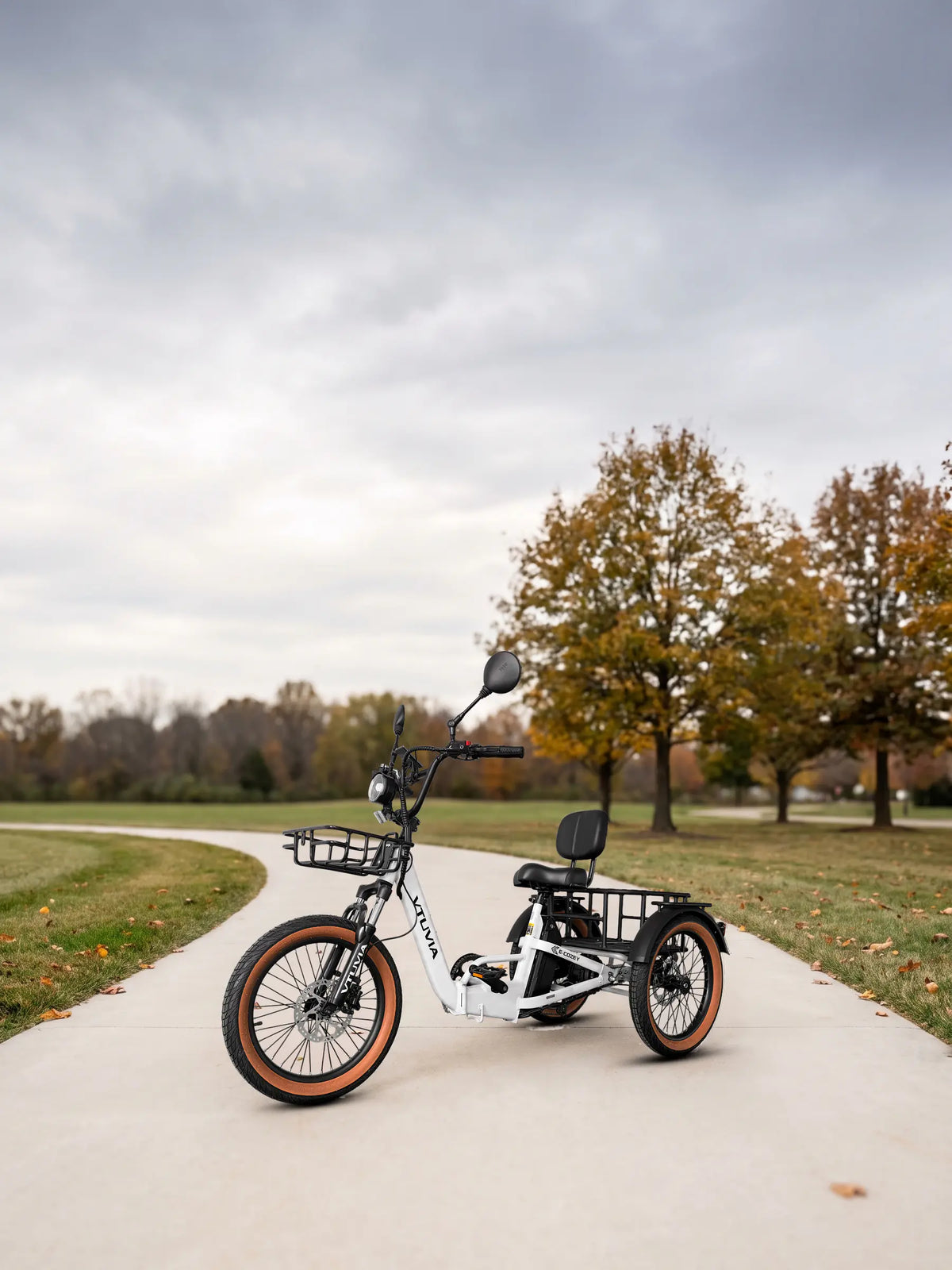

Share:
Lectric Return Policy (2026): 14 Days, Unridden Only
Lectric eBike Dealers Near Me: 206 Locations (2026)