
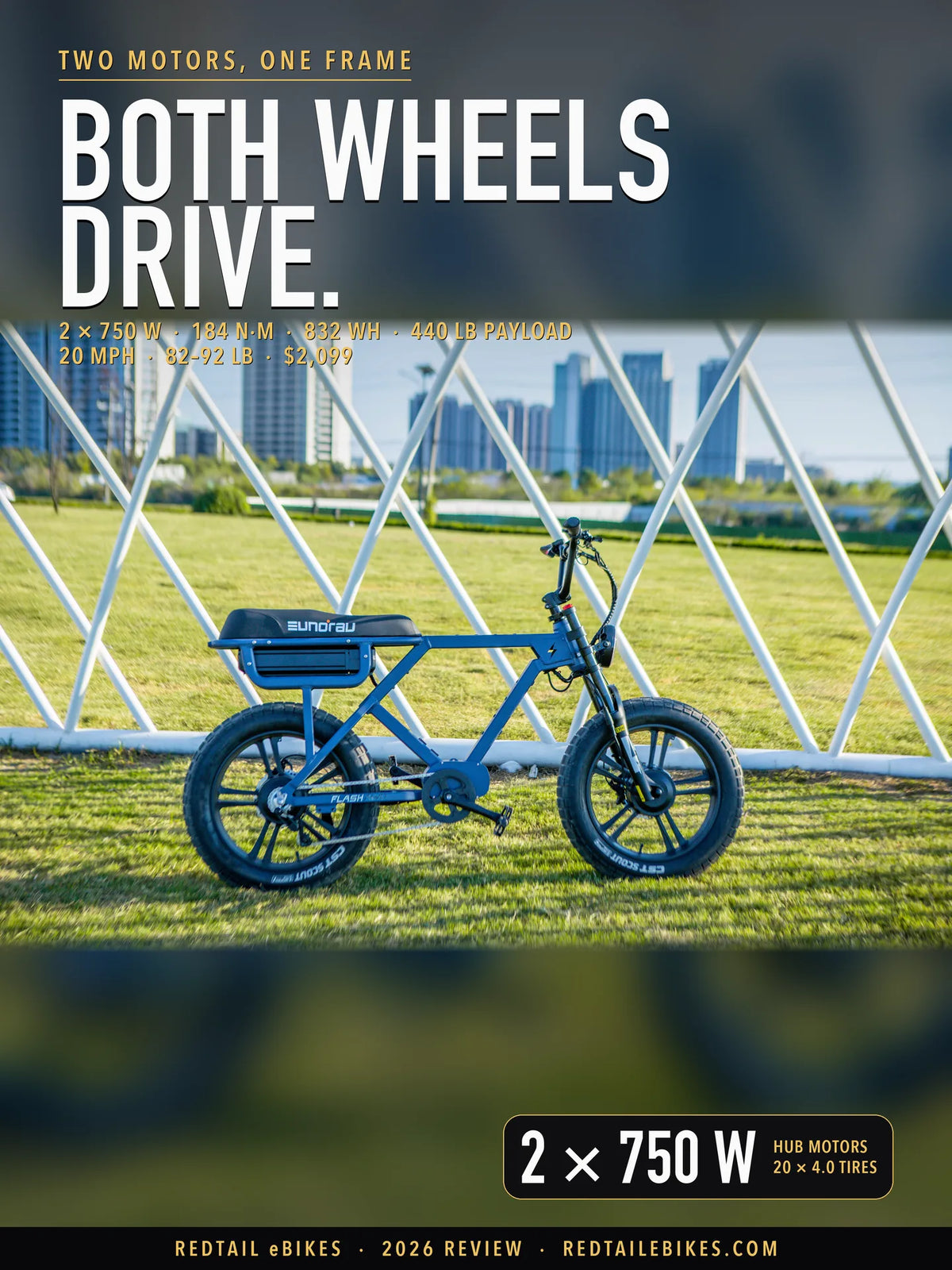
2 × 750 W hubs · 184 N·m combined · 832 Wh in the box · 2,808 Wh with all three packs · 20 mph on the spec table · 440 lb payload · $2,099 · verified September 5, 2026
Quick Answer — The Eunorau FLASH AWD 1.0 is a $2,099 moto-style e-bike with two 52V 750 W hub motors, 184 N·m combined, on a hardtail 20-inch fat-tire frame with three battery bays. Buy it for traction on snow, sand and gravel at a published 20 mph. Its one differentiator: both wheels drive, and it is the only FLASH trim that does.
Below: what a second hub motor changes on this frame, which of the two top-speed figures Eunorau publishes to plan around, and how two 750-watt motors read against your state's definition.
Moon Black and Lunar Dust, 25 units each, both orderable on 5 September 2026. Free contiguous-US shipping, and every warranty claim runs through us.
See the FLASH AWD 1.0 — $2,099Takeaway
- Both wheels drive, for $200 over the single-hub FLASH LITE 2.0. Same frame, same three battery bays, same 440 lb payload. The front hub is the whole difference, and grip is the reason to pay for it.
- Plan around 20 mph. Eunorau's product page publishes 20; its product feed for the same bike publishes 28. Both documents are linked in the speed section, and the 2023 launch coverage reported 28.
- Two 750 W motors is 750 W or 1,500 W, and no statute says which. Read per motor, the bike meets 25 of 51 US definitions; read combined, it meets 3. Both readings are screened below.
- The 220-mile headline needs $1,298 of batteries and carries the maker's own caveat that using both motors "will generally consume more battery power".
- It is a hardtail — an 80 mm fork and no rear shock, whatever an AI answer tells you.
- Bought here, the warranty claim comes to us, and we confirm the speed setting and the drivetrain on your unit before it ships if you ask.
What's on this page
- Who the FLASH AWD 1.0 is for
- How we verified this Eunorau FLASH AWD 1.0 review
- Eunorau FLASH AWD 1.0 specifications
- Two motors, one frame: what all-wheel drive buys on a 20-inch bike
- A shared range table, and the sentence Eunorau adds for this trim
- 20 mph or 28 mph? The maker publishes both
- Hardtail: the suspension the AI answers get wrong
- 1,500 watts, or 750 twice? Every state's definition, read both ways
- Warranty, returns, and what changes when we sell it
- Weight, fit and the two-up question
- The Mercer fit test
- Has it been recalled?
- Is it UL certified?
- Ordering, shipping and support
- The honest ledger
- Who should buy it
- Before you buy: the checklist
- Limitations of this review
- The source register
- Frequently asked questions
- The bottom line
Who the FLASH AWD 1.0 is for

The Moon Black AWD, photographed by Eunorau in front of a lattice fence with a city skyline behind it. The color Eunorau calls Moon Black reads as a deep slate blue in every frame the maker publishes.
Buy it if the surface under you is the problem. Snow-packed side streets, a sandy access track, a gravel climb that spins a rear wheel — a second motor in the front hub is the direct answer to that, and it is the only thing this trim has that the two single-motor FLASH bikes do not.
The marketing pitches it wider than that, and the wide pitch is where buyers get the wrong bike. Eunorau's own page frames the AWD as "a versatile dual-motor e-bike designed for solo rides and two-person cruising" with "dependable power for hills, added passenger weight, and changing road conditions."
All of that is true of the whole FLASH platform. What separates this one is the front hub, and a front hub is worth $200 over the FLASH LITE 2.0 ($1,899 on our store, 5 September 2026) only if your riding puts grip in doubt. What the single-hub trim gives up, charger included, is costed in our FLASH LITE 2.0 review.
Look at a different trim if your problem is the hill rather than the surface, because the mid-drive's gearing wins that contest; if you want a rear shock; or if you want a top-speed figure the maker states once. Each has its own section below. Still choosing a category? Start with our electric bike buying guide, and the fat-tire collection shows the 20 × 4.0 machines we stock side by side.
Dual 52V 750 W hubs · 184 N·m combined · 20 × 4.0 fat tires · 440 lb payload · three battery bays. Free shipping in the lower 48, and we handle any warranty claim ourselves.
Check it out — $2,099How we verified this Eunorau FLASH AWD 1.0 review
No one at Redtail has ridden this bike, and every review of it anywhere was written by someone who sells it. We looked: the two single-model searches we ran on 5 September 2026 returned Eunorau's own pages in three countries, six retailer listings, one retailer blog about the whole FLASH platform, and a 2023 launch report from Electrek. Coverage that thin decides what this page may claim. Every figure below traces to a document you can open.
Two manufacturer documents, both saved. The rendered product page and its specification table were retrieved and archived on 5 September 2026, and so was Eunorau's product feed for the same handle — the machine-readable record behind the page, which carries its own specification block. Where the two disagree, both figures are printed here with the source beside each. Prices and stock come from our own listing through the Shopify Admin API the same day.
We measured the demand this page answers. The harvest holds 1,525 rows across seven sources — 1,038 Google and Bing autocomplete completions, 215 headings from the pages currently ranking, 147 related searches, 77 Reddit threads and comments, 39 Search Console queries from our own property, five rows from an AI-search panel and four from Google Trends. Every question heading below maps to one of those rows; the few we added because a review of a powered machine owes them anyway are marked as our additions in the demand record behind this page.
The arithmetic is ours and it is reproducible. The feed-versus-page census is a script that reads every product in Eunorau's own feed, fetches the rendered page for each, and compares the maximum-speed row on both. It reports three states — agree, disagree, and could not compare — and never counts a missing row as agreement. The 51-jurisdiction screen reads the published wattage and throttle speed against each state's statutory definition, and it was run three times on this bike, because there are three defensible inputs.
What we could not establish is stated where it belongs. The recall position is under has it been recalled?, the certification position under is it UL certified?, and the speed question — two figures from the same maker — under the speed section.
Questions or a correction: support@redtailebikes.com. We publish corrections on the page itself.
Eunorau FLASH AWD 1.0 specifications
Every row is Eunorau's published figure, retrieved 5 September 2026. Two rows carry a second figure from Eunorau's product feed, retrieved the same day, and are marked.
| Specification | Published figure |
|---|---|
| Motor | Dual 52V 750 W hub motors, "dual 92 N·m" (specification row) · "1500W" (page header block) · "52V1500W Dual 750W Motor with 184 N.m Torque" (feed) |
| Maximum speed | 20 MPH (page) · 28 MPH (feed) — see the speed section |
| Class (Eunorau's wording) | "Class 3 · Speed limited · Unlockable" |
| Battery, as shipped | 52V 16Ah LG cells (832 Wh) |
| Second pack (top tube, optional) | 52V 21Ah (1,092 Wh) |
| Third pack (down tube, optional) | 52V 17Ah (884 Wh) |
| Range, one / two / three packs | 65 / 135 / 220 miles |
| Frame | Aluminum alloy 6061, 20-inch |
| Suspension | Front only — "Rear Shock: AWD: None" (page) · "Hard Tail" (feed) |
| Fork | EXSHO STRONG-DH, 80 mm travel |
| Brakes | Hydraulic disc, 180 mm rotors front and rear |
| Brake levers | Motor cutoff switch |
| Drivetrain | Single speed — "AWD: Single Speed" · "Cassette: 44T / 36T" · 170 mm forged alloy cranks · spring-loaded chain tensioner in the photographs |
| Tires | CST 20 × 4.0 |
| Rims | 20-inch black alloy, stainless spokes |
| Display | BC281 LCD, with EUNORAU GO app connectivity |
| Throttle | Thumb throttle |
| Pedal assist | 0–5 levels |
| Charger | US standard 4.0 A smart charger |
| Lights | Battery-powered headlight; brake-activated taillight |
| Weight | 82–92 lb |
| Total payload | 440 lb |
| Recommended rider height | 5'2" – 6'4" |
| Standover height | 780 mm / 30.7 in |
| Seat height | 840 mm / 33.1 in |
| Reach | 280 mm / 11 in |
| Wheelbase | 1,090 mm / 43 in |
| Total length | 1,740 mm / 68.5 in |
| Colorways | Moon Black, Lunar Dust |
| Price | $2,099 |

The tell that this is the AWD and not its siblings is the black hub at the center of the front wheel. The chainstay badge reads FLASH AWD. Everything behind the head tube is the shared FLASH frame.
One geometry row does not add up. Eunorau prints "Handlebar height 108mm/42.5in"; 42.5 inches is 1,080 mm, so one of the two figures has lost a digit. It is the only row on the table with that problem, and it is the kind of thing worth a glance at before you trust any single number from any maker's table.
Two motors, one frame: what all-wheel drive buys on a 20-inch bike
A second motor is a traction device before it is a power device. Our dual-motor and AWD guide applies that test across every two-motor bike we sell, and says which ground actually rewards it. Eunorau's own FAQ for this bike makes the same distinction: the dual system "provide[s] stronger acceleration, improved climbing support, and better traction than a typical single-motor e-bike", and then adds the sentence a buyer should read twice — "Actual performance will depend on rider weight, passenger load, terrain, battery level, and riding conditions." Two motors pull from two contact patches. When the rear spins on packed snow or loose gravel, the front is still pulling, and the front hub is what the extra $200 buys.

The front hub is the $200 on this bike's price over the FLASH LITE 2.0. It also puts a motor's weight on the wheel that steers, which is why a hub-front AWD feels different in the hands from a single rear hub.
The torque figure is worth reading carefully, because Eunorau publishes it two ways. The rendered page says "dual 92 N·m"; the feed says "184 N.m". Those are the same number written as per-motor and combined, and the second one is what the AI answers quote.
Both are hub-motor torque, delivered at the wheel with no gearing to multiply it. That is the mechanical difference from the FLASH 2.0's 220 N·m mid-drive, whose torque runs through an 8-speed cassette and gets multiplied on every downshift. On a steep loaded climb the mid-drive has more leverage. On a surface that will not hold a single tire, the AWD has the second tire.
The drivetrain is a single speed with a chain tensioner, and the specification says so. Eunorau's specification reads "Shifter: AWD: Single Speed" and "Cassette: 44T / 36T" — a 44-tooth chainring driving one 36-tooth sprocket on the rear hub. Behind that sprocket in Eunorau's studio photographs sits a spring-loaded arm carrying two small pulleys, which is a chain tensioner keeping a single chain taut on a frame with fixed dropouts; Eunorau's single-speed FLASH LITE 2.0 shows the same part. There is no cassette and no shift cable.

Eunorau's own product photograph, cropped: the rear hub motor, one sprocket, and below it the tensioner arm and pulleys that keep a single-speed chain tight. The same part appears on the single-speed FLASH LITE 2.0.
One ratio matters to exactly one kind of rider on a bike sold with a thumb throttle and five assist levels: someone who pedals it unassisted for any distance. On a throttle-and-assist machine ridden the way moto-style bikes are ridden, a single fixed ratio is the normal configuration, and 44/36 is a low one, suited to pedalling along with the motors.
What the second motor costs you is weight and money. Eunorau publishes the weight as 82 to 92 lb — the same range it prints for the mid-drive FLASH 2.0, so the maker is not claiming a penalty, and we cannot measure one. The money is clearer: $2,099 against $1,899 for the FLASH LITE 2.0, the same frame with a rear hub only. Per published watt the AWD works out at $1.40, against $2.53 on the LITE 2.0 and $2.50 on the FLASH 2.0 — the cheapest watts on the platform, if watts are what you are buying.
A shared range table, and the sentence Eunorau adds for this trim
The FLASH 2.0, the LITE 2.0 and the AWD carry the same range table, and the second motor does not change a line of it. Eunorau publishes 65 miles on one pack, 135 on two and 220 on three for the AWD — the identical figures on the FLASH 2.0's page and the LITE 2.0's, because the packs, the bays and the watt-hours are the same.
The packs are 52V 16Ah in the box (832 Wh), an optional 52V 21Ah on the top tube (1,092 Wh) and an optional 52V 17Ah in the down tube (884 Wh) — 2,808 Wh all in.
Divide each claimed range by its watt-hours and the assumption underneath it appears: 12.80 Wh/mi on one pack (832 Wh), 14.25 on two (1,924 Wh), 12.76 on three (2,808 Wh). Those are Eunorau's assumptions about how you ride, in the one unit that lets you check them.
The page also states the condition its table omits. With all three batteries the bike "is said to achieve a range of 220 miles (354 km) on pedal assist 1", in Eunorau's own words — the lowest assist level, on a bike sold with five.

The pack that ships rides in the rack under the bench, and the brake-activated taillight is built into the end of its box. The two optional packs bolt to the top tube and into the down tube.
The sentence that makes this trim different was written by Eunorau, in its own FAQ for the bike, under "How far can the FLASH AWD travel on one charge?":
Actual range varies depending on motor use, assist level, rider and passenger weight, terrain, speed, temperature, tire pressure, and riding style. Using both motors frequently or carrying a passenger will generally consume more battery power.
Set that beside the 65-mile row. The specification says 65; the FAQ for the same bike says the feature you paid $200 for uses more power, and publishes no figure for how much. Both are Eunorau's words, and the FAQ is the more useful of the two.
Work from your own rate, and give the front motor a share of it. On flat pavement with light assist a rider will land near the maker's 12.8 Wh/mi and see the 65 miles. Ride with both hubs pulling on soft ground and the rate climbs: at 20 Wh/mi the shipped pack is good for about 42 miles and all three packs for about 140; at 25 Wh/mi, 33 and 112. The AWD sits higher on that scale than its single-motor siblings whenever the front wheel is doing work the rear could not, which is exactly the moment you bought it for.
What the miles cost
| What you buy | Price | Claimed miles | Cost per claimed mile |
|---|---|---|---|
| Bike as shipped | $2,099 | 65 | $32.29 |
| + 52V 21Ah top-tube pack, $699 | $2,798 | 135 | $20.73 |
| + 52V 17Ah down-tube pack, $599 | $3,397 | 220 | $15.44 |
Each extra claimed mile from the two optional packs costs $8.37, against $32.29 for each mile in the box: the packs are the bargain and the bike is the price of admission, which holds on all three trims that share the packs. Loaded to 220 claimed miles the AWD is $3,397, $400 under the mid-drive FLASH 2.0 loaded the same way.
Charging. Eunorau publishes a "US standard 4.0 A smart charger" and no charge time for this bike. At the pack's nominal 52 volts, 4 amps is 208 watts, so the 832 Wh pack needs 4.0 hours before losses and taper, and all three packs together need about 13.5. Treat those as floors.
Neither optional pack is in our inventory. Eunorau sells the 21Ah and the 17Ah on its own store, and the only Eunorau battery we stock is a 48V 15Ah unit for a different platform that will not fit this frame. If the third bay is the point of the purchase, write to support@redtailebikes.com before you order: we will say where the packs are in stock that week, and if the straight answer is a store that puts bike and packs in one cart, we will say that too.
20 mph or 28 mph? The maker publishes both
Plan around 20, because 20 is what Eunorau's current product page says the bike does. The specification table row reads "Maximum Speed 20 MPH". Our own listing says the same, and so does the maker's second regional storefront.
Then open the machine-readable record Eunorau publishes for the same product. Eunorau's storefront serves a product feed at products.json, and the feed's description block for this handle — retrieved and archived on 5 September 2026 — carries its own short specification list. That list reads, verbatim, "MAXIMUM SPEED: 28 MPH". Same bike, same maker, same day, eight miles per hour apart.
This is not a new contradiction. When Electrek reported the FLASH launch in April 2023, it wrote that "all of the models come with a 28 mph (45 km/h) speed limit" and that the limit "can apparently be further unlocked using the e-bike's display".
Eunorau's page today carries the class row "Class 3 · Speed limited · Unlockable", which reads as the same machine described from the other side: it ships limited to 20, and the display can raise it.

The speed limit lives in the display on these bars. Whether it reads 20 or 28 when the crate opens is the question Eunorau's two documents answer differently.
How unusual is this on Eunorau's own shelf?
A contradiction on one product means little until you know whether the maker's feed is generally reliable, so we compared the two surfaces across the whole catalog: every product in Eunorau's feed, its rendered page fetched the same day, and the maximum-speed line read on both. A missing row on either side counts as unresolved, never as agreement.
Of 34 Eunorau products carrying a motor row on 5 September 2026: 24 publish a top speed on both surfaces. 21 agree. 3 disagree. The three are the FLASH AWD 1.0, the FLASH LITE 2.0, and the URUS 2.0 mountain bike — every one of them 28 mph in the feed and 20 on the page. Ten products could not be compared, because one surface or the other publishes no speed row, or publishes one in a form our comparison could not read; those are recorded as unresolved, never as agreement.
| Product | Feed | Rendered page |
|---|---|---|
| FLASH AWD 1.0 | 28 MPH | 20 MPH |
| FLASH LITE 2.0 | 28 MPH | 20 MPH |
| URUS 2.0 | 28 mph / 45 km/h | 20 MPH / 32 KPH |
| FLASH 2.0 | 20 MPH | 20 MPH |
| FLASH LITE ST | 20 MPH | 20 MPH |
| 21 products agreeing, 10 unresolved | — | — |
So Eunorau's feed is right 21 times out of 24, and the exceptions cluster on two FLASH hub trims. The likeliest reading is that the page was updated when the platform was re-limited to 20 and the feed text was not, and that is our inference.
The documented position is plainer: a buyer who reads the page plans for 20, a buyer who reads a listing built from the feed plans for 28, and the same crate arrives for both.
Why it matters more here than on most bikes. The speed figure is one of the two inputs to every state definition of an electric bicycle, starting with the federal one. Eight miles per hour is the difference between a machine that clears a 20 mph throttle ceiling and one that does not — which is why the legal section below runs the screen on both figures.
Takeaway
- The page says 20, the feed says 28, the launch coverage said 28. Plan for 20; ask before you order.
- Measured across Eunorau's own shelf: 21 of 24 comparable products agree; this bike is one of 3 that do not.
- The speed figure decides your state's answer, so both figures go through the screen below.
Ask us which speed setting ships on your unit before you order, and we check and answer the same day. Two 750 W hubs, 832 Wh in the box, free contiguous-US shipping and Shop Pay installments at checkout.
See the FLASH AWD 1.0 — $2,099Hardtail: the suspension the AI answers get wrong
This bike has a suspension fork and no rear shock. Eunorau's specification reads "Front Fork: EXSHO STRONG-DH 80mm Travel Fork" and "Rear Shock: AWD: None". Its product feed says the same thing in two words: "Hard Tail".
Ask an AI engine about the FLASH AWD and you may be told otherwise. In our panel, run on 5 September 2026, the answer to a plain review query stated that "its full-suspension design and hydraulic disc brakes provide a smooth and comfortable ride."
That is the FLASH 2.0's rear shock being lent to a trim that does not have one. The engine is summarizing a platform, and the platform has three drive systems and two suspension layouts.

Eighty millimeters of travel with compression adjustment and lockout, per Eunorau's copy. The fork is the only suspension on this trim; the rear triangle is rigid.
On the road the fork takes the front-wheel hits, the 20 × 4.0 tires take the rest, and the bench saddle is the third spring. On packed snow and gravel at the speeds this bike ships at, that is a normal configuration for the category.
On a rutted trail it is a different bike from the full-suspension FLASH 2.0, and the trade is direct: the second motor for $400 less than the mid-drive, and no rear shock to get there.
The same panel answer also credited the bike with "4-piston hydraulic disc brakes". Eunorau's page says "Hydraulic Disc Brakes" with 180 mm rotors and publishes no piston count. We report the rotor size and the cutoff switch in the levers, because those are on the page; the piston count is not.

The rear rotor and caliper, 180 mm like the front, with motor cutoff in both levers — the right specification for a bike this heavy with two motors to interrupt. Eunorau publishes the rotor size and the cutoff, and no piston count.
1,500 watts, or 750 twice? Every state's definition, read both ways
Read your state's wattage line before its class line, and then ask how it counts two motors. The federal reference point is 15 U.S.C. § 2085(b), which defines a low-speed electric bicycle as "a two- or three-wheeled vehicle with fully operable pedals and an electric motor of less than 750 watts (1 h.p.), whose maximum speed on a paved level surface, when powered solely by such a motor while ridden by an operator who weighs 170 pounds, is less than 20 mph."
Notice the phrase "an electric motor". The statute is written in the singular, and nothing in it says how two motors are added. Eunorau publishes both readings on the page itself — its header block reads "MOTOR · AWD · 1500W" and its specification row reads "Dual 52V750W Hub Motor" — and its feed prints the combined form, "52V1500W Dual 750W Motor". A buyer, a police officer and a trail manager can each pick a number, and the statute does not tell them which.
So we ran every US definition against each reading — the 51-jurisdiction check every review on this site runs, which the tables below call the screen — three times, because Eunorau's documents supply three inputs:
| Input read from Eunorau's documents | QUALIFIES | OUTSIDE DEFINITION | NO STATUTORY DEFINITION |
|---|---|---|---|
| 1,500 W combined, 20 mph throttle (the page header's motor figure, the page's speed) | 3 — DC, Montana, Oregon | 46 | 2 — Alaska, Kentucky |
| 750 W per motor, 20 mph throttle (the specification row's motor figure and speed) | 25 | 23 | 2 — plus Hawaii, not read |
| 1,500 W combined, 28 mph throttle (both feed figures) | 0 | 49 | 2 |
The three jurisdictions that clear the combined reading are the three with no wattage cap in their definition at all: Oregon's ORS 801.258 sets no watt figure, and neither does Montana's MCA § 61-8-102(7) nor the District's § 50-2201.02(11A). Every other state writes a number, and the number is 750 in nearly all of them.
The per-motor reading is where the boundary word does its work. Twenty-one definitions — Alabama, Arizona, Arkansas, Connecticut, Florida, Idaho, Illinois, Kansas, Louisiana, Maine, Mississippi, Missouri, New Hampshire, New Jersey, New York, Ohio, Tennessee, Texas, Vermont, West Virginia and Wyoming — write "less than 750 watts" or "fewer than 750 watts", and a 750-watt motor is not less than 750 watts.
Twenty-five write "750 watts or less", "not more than 750 watts" or an equivalent, which a 750-watt motor meets.
Two more fail the per-motor reading for their own reasons. Pennsylvania rates "an electric motor system", and two 750 W motors are a 1,500 W system; California is counted outside under a subsection quoted below. Hawaii's definition could not be re-read at its publisher on 5 September 2026 and is counted as not read, never as a pass.
The National Park Service writes its own definition at 36 CFR § 1.4 with "not more than 750 watts", which a single 750-watt motor clears; two federal definitions, two boundary words.
Eunorau's documents do not settle which reading applies, and no statute we found does either. What the screen shows is the shape of the question. Under the per-motor reading this bike meets 25 definitions. Under the combined reading it joins every other dual-motor machine — including the Eahora Juliet Pro II at 2 × 1,250 W — outside nearly every definition. And under the feed's 28 mph, the speed alone fails it everywhere a definition exists, because a throttle-driven 28 clears no state's 20 mph motor-only ceiling.
What the AI answers say, and what they cite
Asked whether a dual-motor 1,500 W e-bike is street legal in the United States, the engine in our panel answered that "1500W motors remain legal on street eBikes because federal and state laws focus on continuous power output under 750W, assisted speeds, and pedal functionality—not peak wattage labels", and that once a bike "hits 28 mph … the bike is legally a motorcycle."
Every source behind that answer was a retailer or brand blog. It cites no statute. The 750-watt figure in § 2085(b) is not described as continuous or peak; it is a motor rating, and the engine's reassurance that 1,500 W "remain[s] legal" rests on a distinction the statute does not draw.
"Legally a motorcycle" is the engine's phrase, and it is wrong in the states our screen names. Where a definition says what a non-qualifying e-bike becomes — California, Maine, New Jersey, South Carolina and Virginia in our table — it is a moped or motorized-bicycle class with its own rules, which is a different thing from a motorcycle; California's § 406 is the example most people meet.
Look your state up in our state-by-state e-bike law table. Read the wattage line, then ask the agency that wrote it how it counts a second motor — in writing, if you plan to ride on public roads. In California the definition at Vehicle Code § 312.5 uses 750 watts, and a newer subsection puts a question to this bike before the wattage does. Since 1 January 2025, § 312.5(d)(1) says that "a vehicle with two or three wheels powered by an electric motor that is intended by the manufacturer to be modifiable to attain a speed greater than 20 miles per hour on motor power alone or to attain more than 750 watts of power" is not an electric bicycle and "shall not be advertised, sold, offered for sale, or labeled" as one. Eunorau's header for this bike reads "Speed limited · Unlockable" and its feed publishes 28 mph. Whether a limit a display can raise is what the subsection means by "intended by the manufacturer to be modifiable" is the state's question to answer; until it is answered our screen counts California outside on every reading, the question is on the list we put to Eunorau, and a California buyer should read our California page before anything else on this one. Under the combined reading the bike may also fall within the motorized-bicycle definition at § 406. In Oregon, there is no wattage line to argue about and the 20 mph figure does the work.
Then ask whoever manages the surface. A county trail system or a state park writes its own e-bike rule inside the state's, and the Park Service definition at 36 CFR § 1.4 is the one many of them copy; a bike read as 1,500 W may be turned away from a path that admits a 750 W one. Ask before the ride.
Takeaway
- Two 750 W motors is 750 W or 1,500 W, and the statute does not say which. Screened both ways: 25 of 51 definitions accept the per-motor reading; 3 accept the combined one.
- Twenty-one definitions say "less than 750 watts", and 750 is not less than 750. The boundary word decides the per-motor count; Pennsylvania rates the system, and California's rule on maker-modifiable limits removes one more.
- The feed's 28 mph fails everywhere. If that figure is what arrives, the bike sits outside every definition that exists.
- Ask your state how it sums motors, then ask the land manager before you take it on a path.
Warranty, returns, and what changes when we sell it
Two motors do not change the terms: the same twenty-four months covers battery, motor and electrical components across the range. The Eunorau brand profile puts this bike's cover beside every other model we stock.
Eunorau's current warranty covers the frame for ten years and the battery, motor and electrical components for 24 months, for bikes bought in the US "on or after August 1st, 2023." Our listing reproduces those terms, and they matched Eunorau's policy page line for line on 5 September 2026.
Two clauses on that page are worth reading before a two-motor bike. Labor is excluded: "Labor charges for part replacement or changeover" sit in the uncovered list, and the frame cover is "a replacement/repair frame only" with changeover labor "not included."
Commercial use halves the term: products "purchased by a business for commercial use (e.g., rental fleets, delivery services, sharing programs) are subject to a 50% reduction of the standard Warranty period." A dual-motor cargo hauler is exactly the bike a small delivery operation buys, and that clause is the one it should read.
A superseded warranty page is still live on Eunorau's site, with a five-year frame, a prorated two-year battery and twelve months on the motor. The current page governs, and the change was announced by Eunorau itself as effective 1 August 2023.
Eunorau's own return window is seven calendar days, and it is strict: the policy accepts a return only if "customers must receive the product in 100% new, Re-sellable condition", says "Merchandise is not eligible for a refund if it has been assembled, ridden, worn, used, abused, damaged in any way", and puts return shipping on the buyer. Those are the terms of a direct purchase from the maker.
Bought from us, the claim comes to us. You send us the problem, we take it up with Eunorau, and the labor clause above is ours to argue, on a bike with two controllers and two motors to argue about. Our return terms are not the reason to buy here, and we will not dress them up as one: our refund policy takes a change-of-mind return only on an unopened, factory-sealed crate, requested within 72 hours of delivery, with a 15% restocking fee and return freight on you — a tighter window than Eunorau's seven calendar days on the same unopened condition. Where a dealer earns its keep is the 48-hour window for transit damage: send us the photographs and we file the carrier claim.

Eunorau's Lunar Dust colorway, a pale sage green, on a stationary frame from the maker's own shoot. Eunorau reuses its FLASH photography across trims; this frame shows the front hub, so it is the AWD.
Weight, fit and the two-up question
Published at 82 to 92 lb, it lives wherever you can roll it, which means the ground floor. The range is the one Eunorau prints for the FLASH 2.0 too, so the maker claims no penalty for the second motor; we have not put it on a scale and will not estimate one. Either end of the range rules out stairs and turns a car rack into a two-person job.
The frame is smaller than the weight suggests. A 30.7 in standover and a 33.1 in seat height on a 43 in wheelbase, with a published rider range of 5'2" to 6'4", is what 20-inch wheels buy you: the whole frame sits low. Eunorau publishes the seat height as a single figure and lists no seatpost, so read 33.1 as fixed.
Eunorau does not say whether the 440 lb payload includes the bike. It labels the figure "Total Payload Capacity"; if that includes a machine of up to 92 lb, about 348 lb is left for rider, passenger and cargo, and if it does not, the full 440 is. On a bike sold for two-up riding, that is a question worth an email before you plan around it.
Can it carry two people?
Two-up riding is the feature Eunorau spends the most words on. The product page describes "a versatile dual-motor e-bike designed for solo rides and two-person cruising", says the extended saddle "can accommodate a single rider or have a companion for a laidback cruise", and, in its FAQ, that "the extended plush saddle is designed to accommodate a rider and a passenger. Always stay within the bike's specified payload limit and use the appropriate passenger equipment. Riders should also check local regulations regarding passengers on e-bikes."

The bench Eunorau sells for two, with the battery box beneath it — the FLASH platform's shared saddle, photographed by the maker on this trim's frame. No seat-length figure and no passenger rating are published for it, and "appropriate passenger equipment" is named without being specified.
Hold three facts together. The payload arithmetic supports two adults. Eunorau publishes no passenger weight rating, no seat-length figure and no foot-peg load rating. And whether a passenger may ride on an e-bike at all is written state by state, so check your state's passenger rule in our law table before you buy the second helmet.
The Mercer fit test
The Mercers are the seven fixed American archetypes we hold every bike against, so that "will it fit me?" gets the same measuring stick on every review. You can meet them here. They are not testers and none of them has ridden anything; every verdict is read off a published number or a rule, and where Eunorau publishes nothing, the row says so.
The numbers in play, all Eunorau's: a 5'2"–6'4" rider range, 30.7 in standover, 33.1 in fixed seat height, 82–92 lb, 440 lb total payload, two 750 W motors, and 20 mph on the page against 28 in the feed.

Both feet flat at a standstill on a 30.7 in standover — the geometry that makes this frame usable across a fourteen-inch span of rider height. From Eunorau's own shoot, on a parked bike.
| Member | Verdict | The number behind it |
|---|---|---|
| Frank Kowalski, 63, 5'10" | Fits, and the front hub is the one thing on this bike his other FLASH options lack. Two driven wheels is the published configuration; what it does for him on a wet street is a judgment, and it is his. The 82–92 lb is the same objection it is on every FLASH. | Inside 5'2"–6'4"; 30.7 in standover; two published motors; weight is the only caveat. |
| Ruth Kowalski, 61, 5'5" | Fits; the weight and the fixed saddle are her questions. 33.1 in is the only seat height published and it does not lower. Whether she can lift a 90 lb bike upright alone is something to try with a second pair of hands on delivery day, before the crate is opened — an unopened crate is the only kind we can take back. | 5'5" inside the range; 33.1 in fixed; 82–92 lb. |
| Jack Mercer, 48, 6'1" | Fits, and it is closer to his kind of bike than the other FLASH trims. All-wheel drive on 20 × 4.0 tires is the trail-access argument; the 80 mm fork and no rear shock are the limits of it. A hardtail moto-style bike is not an all-terrain machine, and he should read the FAT-AWD 2.0 line in the verdict. | 6'1" inside 5'2"–6'4"; hardtail; front hub. |
| Dana Mercer, 45, 5'7" | Strong fit for the school run and the grocery haul, with one number missing. The 440 lb total payload and the bench saddle are built for a passenger. What Eunorau does not publish is a passenger rating, and that is the number she needs before a child rides pillion. | 5'7" mid-range; 440 lb total; no passenger rating published. |
| Maya Torres, 32, 5'6" | Fits, and the speed row is her decision. As shipped at 20 mph on 750 W motors, this is a bike-lane machine wherever the per-motor reading holds. The "Unlockable" class row and the feed's 28 mph are the two things that can change that, and a city commuter should leave the setting where it ships. | 5'6" mid-range; 20 mph on the page; 28 in the feed. |
| Cole Mercer, 16, 5'11" | Height fits; the wattage reading decides the rest, and his state decides the reading. Read per motor he is on a 750 W bike shipped at 20 mph, which 25 state definitions accept. Read combined he is on a 1,500 W machine, which five states in our screen — California, Maine, New Jersey, South Carolina and Virginia — give a class of its own (with a license rule in California and New Jersey), and the rest treat as whatever their code says. Read your state's page with him before the purchase. | 5'11" inside the range; 750 W or 1,500 W by reading; 25 or 3 of 51. |
| Ivy Mercer, 12 | No. Two motors and a throttle on a 90 lb machine put it beyond her age whichever way the wattage is read. Where a state writes a minimum age for a throttle e-bike she is under it, and where a state writes none, our answer stands. | Below every minimum age our state pages record; 82–92 lb; throttle to 20. |
The sharpest contrast on this bike is between Jack and Dana, and both of their missing pieces sit on the same product page. Jack wants the second motor for where it takes him and finds the frame under it is a street bike with an 80 mm fork. Dana wants the frame — low, benched, 440 lb of payload — and finds the number she needs for a passenger is the one Eunorau has not written down.
Has it been recalled?
No CPSC recall names Eunorau or the FLASH AWD 1.0, checked 5 September 2026 with a query we proved was working the same day. We ran the recall search for Aventon first, because Aventon carries recall 24075 from January 2024 and a working query has to return it; it did, with the unit count and the six acceleration reports intact. Then we ran Eunorau: zero rows. A second, independent route — a search restricted to the Commission's own domains — surfaced ten genuine e-bike actions from Trek, Santa Cruz, FENGQS, Pacific Cycle, Lectric, Gyroor, Ancheer and Specialized, and no Eunorau entry.
A "no recall found" is not a clean bill. The CPSC keeps recalls and safety warnings on separate lists, and the warnings list we could read only in part — ten notices from a paged index, none naming Eunorau, which tells you where we looked and not that nothing is there. The record as of 5 September 2026: two places searched, nothing found, and no claim beyond that.
Is it UL certified?
Eunorau prints "UL CERTIFIED: Yes" in the header of this bike's page and names no standard there. The only place we found the standard named is a March 2023 announcement that "all of our ebikes have passed the UL 2849 testing" — the whole-system standard for e-bike electrical systems — and that its batteries passed UL 2271. For this model itself, nothing further is published anywhere we could reach — no certificate number, no laboratory, no file number, no date.
We report that position as it stands and draw no inference from it in either direction.
A 2023 statement covering "all of our ebikes" predates the current product record for this trim, which Eunorau created in November 2025, although the AWD itself was announced at the platform's April 2023 launch. If certification matters where you charge it — a building or an insurer that asks for a UL listing — ask us and we will request the certificate for this model from Eunorau in writing.
Ordering, shipping and support
| Question | Answer, with the document behind it |
|---|---|
| What does it cost, and where? | $2,099 on our store and $2,099 on Eunorau's, both read 5 September 2026. One retailer listing surfaced in our searches at $1,999; we do not match a price we cannot verify, and what the $100 buys here is a dealer who files the warranty claim, free freight to the lower 48, stock on hand and monthly payments at checkout. |
| Is it in stock? | Yes on 5 September 2026 — 25 in Moon Black and 25 in Lunar Dust, read from our own inventory record that day. |
| How does it ship? | Free to the contiguous US, per our shipping policy: dispatched in 1–3 business days, most e-bikes arriving 5–10 business days later by parcel or LTL freight, signature possible. Eunorau's own policy ships e-bikes "to the lower 48 States" and charges "+500USD" to Alaska and Hawaii; bought from us, contact us before ordering to those two. |
| Which top speed ships? | Eunorau's page says 20 mph and its feed says 28 — see the speed section. Ask before you order and we confirm the setting on the unit we ship you, in writing. |
| Can I get the extra batteries here? | No. Neither FLASH pack is in our inventory, and the one Eunorau battery we do carry is a 48V 15Ah unit for another frame. Tell us which bay you want filled and we will say where that pack is in stock that week. |
| What is left to assemble? | Eunorau's page does not say how much of the bike arrives built. Ask us in writing while the crate is still sealed — opening it is what ends a change-of-mind return. |
| Who services it? | A warranty claim on a bike bought here is our job to run. Past the warranty, brakes and tires are work any bike shop does; the two hub motors and their two controllers are not, and those questions come back to us. |
| Can I pay monthly? | Yes — Shop Pay installments at checkout. |
| Returns | Our refund policy: change-of-mind returns only on an unopened, factory-sealed crate, requested within 72 hours of delivery, with a 15% restocking fee and return freight on you. Assembled or ridden ends it. Transit damage: photographs to us within 48 hours and we file the carrier claim. Eunorau's direct-purchase window is seven calendar days on "100% new, Re-sellable condition", buyer pays freight; ours is the one that applies to a bike bought here. |
| Still deciding? | Send support@redtailebikes.com the surface you ride and the distance you need. If the honest fit is the mid-drive FLASH 2.0, the cheaper LITE 2.0, or nothing on our shelf, that is the reply you will get. |
| What this page does not promise | A ride we have not taken, a recall search we could only partly run, a certificate we have not seen, and a shipping speed the maker's own documents leave open. The last of those is the first question on the list we put to Eunorau for you. |
The honest ledger
Green flags
- Two driven wheels for $200 over the single-hub trim, on a platform whose frame, bays and range table are otherwise identical — the cheapest published watts on the FLASH range at $1.40 each.
- The maker's own FAQ is candid about the trade: two motors "will generally consume more battery power", in Eunorau's words, on Eunorau's page.
- One frame size that fits from 5'2" to 6'4" and carries 440 lb, on a 30.7 in standover that most riders clear flat-footed.
- Three battery bays with a documented $1,298 path to 2,808 Wh, and each added claimed mile at $8.37.
- Ten years on the frame and a flat 24 months on battery, motor and electricals, with no proration, and a dealer purchase routes the claim through us.
- Both levers cut the motors, and both wheels stop on 180 mm hydraulic rotors — two motors are two reasons to want that.
- No recall on the federal database as of 5 September 2026, found with a query that returned a known recall the same day, and corroborated on the Commission's own domains.
Red flags
- Two published top speeds. 20 mph on the page, 28 in the feed, and the difference decides the legal answer in every state with a throttle ceiling.
- Two readings of the wattage, and the statute picks neither. 25 of 51 definitions on one reading; 3 on the other.
- In California, a 2025 rule on maker-modifiable limits puts a question to the "Unlockable" header before the wattage does. Quoted in the legal section; the state decides the answer.
- No rear suspension, on a bike the AI answers describe as full-suspension.
- The 220-mile figure is a $3,397 configuration whose packs we cannot sell you, and the maker's own FAQ says the second motor eats into it.
- No passenger rating, seat-length figure or foot-peg rating on a bike sold for two-up riding.
- "UL CERTIFIED: Yes" with no standard, certificate or laboratory named on the product page; the standards live in a 2023 announcement that predates this trim.
Who should buy it
Buy it if your riding puts grip in doubt — snow, sand, wet gravel, a loose driveway climb — and you want two driven wheels on the FLASH frame for $2,099; if you have checked how your state counts two motors and can live with the answer; if the bike stores on the ground floor; and if 20 mph as shipped is the speed you want, because that is the figure the maker's page stands behind.
Buy something else if the hill is the problem and the surface is not: the FLASH 2.0 puts 220 N·m through an 8-speed cassette and carries a rear shock, for $400 more. If traction is the real question but this frame is wrong — you want 26-inch wheels and a bike built for dirt — Eunorau's FAT-AWD 2.0 at $1,699 and FAT-AWD 3.0 pair a 500 W front hub with a 500 W rear on a fat-tire mountain frame, which is the same summing question at a lower number, and they are the AWD models people search for most. If you want a step-through on this platform with the shortest legal conversation, the FLASH LITE ST has one 750 W motor. And if you want the most battery and power a dual-motor step-through can carry, we reviewed the Eahora Juliet Pro II, a different class of machine.
Buy neither if the bike has to climb a flight of stairs, most of your miles are on shared paths, or you want a machine with one published top speed and a class label the law already recognizes. The buying guide sorts the categories, the reviews index lines up every bike we have reviewed, and the cruiser and moped collection holds every bench-seat machine we stock beside this one.

Moon Black left, Lunar Dust right. Identical hardware at $2,099; the blue reads darker in daylight than in the studio.
Free contiguous-US shipping · Shop Pay installments · warranty claims handled by us. Moon Black or Lunar Dust.
Buy the FLASH AWD 1.0 — $2,099Before you buy: the checklist
Eleven questions. Each one is a two-line email, and each one closes a gap this page found open.
- Your state's wattage line — read it in our state table, then ask the agency that wrote it how two motors are counted.
- The boundary word — if your state says "less than 750 watts", a 750-watt motor does not meet it; twenty-one do, Pennsylvania rates the whole system, and California adds a rule on limits a maker intends to be modifiable.
- The speed setting on your unit — 20 or 28; we confirm it in writing before we ship if you ask.
- The assist sensor — Eunorau publishes five assist levels and no sensor type for this trim; ask if the feel of the assist matters to you.
- The surface you ride most — the trail system or park manager sets its own rule inside the state's; a 1,500 W reading can close a path a 750 W one opens.
- Your pack count — $2,099 for one, $3,397 for three; the two extra packs come from Eunorau's store and we do not stock them, so price and source them first.
- Your own Wh/mi — 832 ÷ 20 or ÷ 25, with the front motor's share added, is the number to plan a day around; 12.8 is the maker's.
- A ground-floor home for 82–92 lb — and a hitch rack rated for it.
- What arrives assembled — in writing, because the change-of-mind window ends when the crate is opened.
- A passenger's seat and peg ratings — Eunorau publishes none; get them before the second helmet.
- The UL certificate for this model — request it through us if your building or insurer asks.
Limitations of this review
- We sell this bike. Read the red flags as carefully as the green ones; nothing here is independent of that interest, which is why every figure is tied to a document you can open.
- Nobody has ridden it — not us, and not any publication that does not sell it. Every performance number is Eunorau's, and the arithmetic tests those numbers for consistency with each other, never for truth.
- Which top speed ships is not established. Eunorau's page and its feed disagree, we have not opened a crate, and both figures are printed rather than one chosen.
- Eunorau has not yet been asked. The questions for the maker — which top speed ships, how it reads California's rule on modifiable limits against its own "Unlockable" header, and the certificate for this model — are listed under ordering and in the California paragraph. Their answers, or the date we asked and heard nothing, will be published on this page.
- The feed-versus-page census reads published rows only, across 34 Eunorau products; ten could not be compared because one surface publishes no speed row, and those are unresolved, never agreement. It measures what a maker's two documents say, never what a bike does.
- The 51-jurisdiction screen reads published figures against statutory definitions. It is not legal advice and it does not know how your state sums two motors. On the per-motor reading it applies each statute's own boundary word — "less than 750" fails a 750 W motor, "750 or less" passes it — counts Pennsylvania's system rating and California's § 312.5(d)(1) as outside, and counts Hawaii as not read because its publisher refused every route we tried on 5 September 2026. Twenty of the definitions were re-read at their publishers or from our deposits that day; Georgia and South Dakota were read once. The Oregon row's evidence string in our rule table quotes the state's moped definition rather than ORS 801.258 itself; the conclusion for Oregon was re-read at the statute on 5 September 2026.
- "No recall found" is the whole of the recall claim. The Commission's warnings list was read only in part. Detail is in the section.
- We found no UL certificate for this model, and we read nothing into that either way.
- Eunorau publishes no passenger rating, no assembly state, no seat-length figure, no charge time and no piston count. Those rows say "not published", and the questions to put to the maker are under ordering.
- The AI-search panel ran on one instrument, a US web-search answer engine, and is labelled as such in our records. ChatGPT, Perplexity and Google AI Overviews were not reachable and were not run.
- No search-volume figure appears anywhere on this page. Our paid keyword instrument is unavailable and the Google product that reports absolute volume is not accessible with our credentials. Demand is described by what was observed, never by a number we could not measure.
- Every figure expires. Prices, stock, policies and law change. This page was verified on 5 September 2026 and each volatile claim carries that date in the sentence.
The source register
| Tier | What it means | Used here for |
|---|---|---|
| T1 | Statute, regulation or federal agency record | The federal e-bike definition; the National Park Service definition; the Oregon, Montana, District of Columbia and California codes; the CPSC recall record |
| T2 | The manufacturer's own published documents | Every specification, the product feed, the range table, both warranty policies, the return and shipping policies, the UL announcement, the accessory prices |
| T2 | Our own live store data, read through the Shopify Admin API | Price, colorways, inventory |
| T2 | Our own measurement of the manufacturer's documents | The 34-product feed-versus-page census; the 51-jurisdiction screen, run three times |
| T4 | An independent news report | Electrek's April 2023 launch report on the FLASH platform's 28 mph limit — history, never a specification |
| T2 (our record) of T5 output | The AI-search panel: our own dated record of what one engine answered | Reported only as what the engine said; never cited for a fact, which is why the T5 row below stays empty |
| T4 | Retailer listings | Named only as evidence of a differing price and of wattages that differ between storefronts. Never relied on for a fact |
| T5 | Aggregators, AI summaries, content farms | Not cited anywhere on this page |
Frequently asked questions
Is the Eunorau FLASH AWD 1.0 a dual-motor e-bike?
Yes. Eunorau specifies "Dual 52V750W Hub Motor with dual 92N.m Torque" — one hub motor in each wheel, which is what all-wheel drive means on a bicycle. The combined figures, 1,500 W and 184 N·m, appear in Eunorau's product feed for the same bike.
How fast does the Eunorau FLASH AWD 1.0 go?
Eunorau's product page publishes 20 mph. Eunorau's product feed for the same bike publishes 28 mph, and the class row reads "Class 3 · Speed limited · Unlockable". Plan around 20, which is the maker's current statement of what ships, and ask before you order.
Are dual-motor e-bikes faster?
Not by themselves. Top speed on an e-bike is set by the controller's limit, and on this bike that limit is published at 20 mph with the same figure on the single-motor FLASH trims. What a second motor changes is acceleration and traction from a stop — Eunorau's own FAQ names "stronger acceleration, improved climbing support, and better traction", not a higher top speed.
Are dual-motor e-bikes worth it?
They are worth it when the surface is the problem. Two driven wheels keep pulling when one loses grip on snow, sand or wet gravel, and on this bike that costs $200 over the single-hub FLASH LITE 2.0. They cost you battery — Eunorau writes that using both motors "will generally consume more battery power" — and, in most states, legal headroom, because two 750 W motors may be read as 1,500 W.
Are dual-motor e-bikes legal in the United States?
The federal definition at 15 U.S.C. § 2085(b) uses "an electric motor of less than 750 watts" and says nothing about how two motors are added. Screened against all 51 jurisdictions, this bike meets 25 definitions read per motor and 3 read as 1,500 W combined. Which reading applies is your state's call; our state table carries each definition.
Are dual-motor e-bikes legal in California?
California's definition at Vehicle Code § 312.5 caps an electric bicycle at 750 watts, and since 2025 its subsection (d)(1) also excludes any vehicle "intended by the manufacturer to be modifiable" beyond 20 mph or 750 W. Eunorau publishes a "Speed limited · Unlockable" header and a 28 mph feed figure, so our screen counts California outside on every reading; how the state reads a display-adjustable limit is its decision.
What is the real-world range of the FLASH AWD?
No one has measured it independently. Eunorau publishes 65 miles on the 832 Wh pack, which assumes 12.8 watt-hours per mile, and states the 220-mile figure as reached "on pedal assist 1"; and its own FAQ adds that two motors and a passenger "will generally consume more battery power". At 20 Wh/mi the same pack gives about 42 miles; at 25, about 33. Redo the division with your own rate.
How does a dual-motor e-bike work?
Each wheel has its own hub motor and the controller sends power to both. On this bike the page publishes a thumb throttle and five levels of pedal assist driving "Dual 52V750W Hub Motor", and its feed describes the pair as a 1,500 W system. Eunorau does not publish whether the front motor can be switched off independently; some dual-motor bikes offer that, and Eunorau's documents do not say whether this one does.
Does the FLASH AWD 1.0 have suspension?
Front only. Eunorau lists an "EXSHO STRONG-DH 80mm Travel Fork" and, for the rear, "AWD: None"; its feed calls the bike a "Hard Tail". AI answers describing it as full-suspension are describing the FLASH 2.0, a different trim on the same frame.
How much does the Eunorau FLASH AWD 1.0 weigh?
Eunorau publishes 82 to 92 lb, the same range it prints for the mid-drive FLASH 2.0, without saying what moves the figure or what the second motor adds. It is a ground-floor bike at either end of that range.
How much does the Eunorau FLASH AWD 1.0 cost?
Our price and Eunorau's were the same $2,099 on 5 September 2026, with one battery in the box. Reaching the advertised 220 miles means adding Eunorau's 52V 21Ah pack at $699 and its 52V 17Ah pack at $599, which brings the configuration to $3,397.
Can the FLASH AWD carry two people?
Eunorau markets it for two — "designed for solo rides and two-person cruising" — and a 440 lb total payload leaves room for two adults. Three numbers a second rider would want are missing from the page — a passenger weight limit, the bench's length and a peg rating — and whether a passenger may ride at all is written state by state.
Can the FLASH AWD handle hills?
Eunorau's answer, from its own FAQ, is that "the dual-motor system provides additional support for climbing compared with a single-motor e-bike" and that performance "will still depend on the gradient, surface conditions, total load, battery level, and rider input." Two hub motors add pulling wheels; they do not add gearing. For a long steep climb under load, the mid-drive FLASH 2.0 has the mechanical advantage.
What batteries does the FLASH AWD 1.0 take?
The bike ships with a 52V 16Ah pack (832 Wh) in the rack. Its second and third bays are sized for Eunorau's 52V 21Ah top-tube pack, $699, and its 52V 17Ah down-tube pack, $599, for 2,808 watt-hours with all three fitted. Both optional packs are sold by Eunorau; neither is in our inventory.
What type of rider is the FLASH AWD designed for?
Eunorau's own answer: riders "who want extra power, comfortable everyday riding, and the option to carry a passenger", with the dual motors making it "suitable for hills, heavier loads, commuting, and relaxed two-person rides." Our narrower answer is the rider whose surface is unreliable, because that is the one thing the second motor does that the cheaper FLASH trims cannot.
How long do e-bike hub motors last?
Eunorau publishes no service-life figure for these motors. What it does publish is a 24-month motor warranty, which is the only lifetime number the maker will stand behind in writing. Two hub motors are two sealed units with no chain running through them, which is the maintenance argument for a hub layout over a mid-drive.
What warranty does Eunorau give on the FLASH AWD 1.0?
The frame carries a ten-year term and everything electrical a 24-month one — battery, motors and controllers alike — for bikes bought on or after 1 August 2023. Labor to change a part is not covered, and a bike bought for commercial use gets half the term. Buy it here and the claim is ours to run.
Has the Eunorau FLASH AWD 1.0 been recalled?
Not as of 5 September 2026: the federal recall database returned nothing for Eunorau on a query that returned a known Aventon recall minutes earlier, and a search of the Commission's own domains agreed. Safety warnings are a separate list that could only be read in part, so the position is "no recall found", never "no recall exists".
Is the Eunorau FLASH AWD 1.0 UL certified?
Eunorau's page carries the words "UL CERTIFIED: Yes" and no standard beside them. The standards — UL 2849 for the system, UL 2271 for the battery — appear only in a March 2023 announcement covering all Eunorau bikes of that date, and this trim's product record dates from November 2025. We will request the certificate for this model if you ask us.
What is the difference between the FLASH AWD 1.0 and the FLASH 2.0?
The drive system and the rear suspension. The AWD 1.0 runs two 750 W hub motors on a hardtail frame for $2,099; the 2.0 runs a 1,000 W Truckrun mid-drive with a rear shock and an 8-speed cassette for $2,499. Frame, bays, 20 mph limit and range table are common to both; the drive system and the shock are the $400.
The bottom line
Buy it for the front hub, and for nothing else. The frame, the bench, the bays and the range table are the FLASH platform's, available for $200 less with one motor; what $2,099 buys here is a second driven wheel, and a second driven wheel is worth exactly what your worst surface says it is worth.
One thing about this bike is left open by its maker's own paperwork: the top speed, 20 on the page and 28 in the feed. It is not a reason to walk away. It is a question to put in writing before the crate ships, and we put it for you.
The wattage question is bigger than this bike and this maker. Two 750-watt motors is either one motor rating twice or one system at 1,500 watts, and the federal statute, written in the singular, does not choose. Twenty-five definitions accept one reading, three accept the other, and your state decides which one it applies to you.
What remains is a hardtail moto-style bike documented more completely than most in its price band, backed by a warranty longer than the old policy page still circulating, and sold by a maker candid enough to write on its own product page that the feature you are paying for uses more battery.
Two 750 W hubs · 832 Wh in the box · 440 lb payload · free contiguous-US shipping. Not sure it is the right bike? Write to support@redtailebikes.com with where you ride, and we will answer straight — including when the better buy is a different machine.
See the FLASH AWD 1.0 — $2,099Reviewed by Milad Ghobadibeygvand, BScN (Western University, 2014), Redtail eBikes. Verified 5 September 2026. We sell this bike, and that interest is why every figure on this page is tied to a document you can open and why the maker's two documents are printed where they disagree. Corrections go to support@redtailebikes.com and are published here, on the page.
Primary sources
- Eunorau. FLASH AWD 1.0 product page and specification table. Retrieved 5 September 2026. https://eunorau-ebike.com/products/flash-awd-1-0
-
Eunorau. FLASH AWD 1.0 product feed record (
products/flash-awd-1-0.json,body_htmlspecification block). Retrieved 5 September 2026. https://eunorau-ebike.com/products/flash-awd-1-0.json -
Eunorau. Product feed, all products (
products.json), the basis of the feed-versus-page census. Retrieved 5 September 2026. https://eunorau-ebike.com/products.json - Eunorau. 24-Month+ Limited Warranty (current policy). Retrieved 5 September 2026. https://eunorau-ebike.com/pages/warranty
- Eunorau. Warranty Policy (superseded page, still live). Retrieved 5 September 2026. https://eunorau-ebike.com/pages/eunorau-warranty
- Eunorau. "Great News: Eunorau E-Bikes Now Come with a 2-Year Warranty!" Effective 1 August 2023. Retrieved 5 September 2026. https://eunorau-ebike.com/blogs/news/great-news-eunorau-e-bikes-now-come-with-a-2-year-warranty
- Eunorau. "We are UL 2849 tested and UL 2271 tested!" 5 March 2023. Retrieved 5 September 2026. https://eunorau-ebike.com/blogs/news/we-are-ul-2849-tested-and-ul-2271-tested
- Eunorau. Return Policy. Retrieved 5 September 2026. https://eunorau-ebike.com/pages/return-policy
- Eunorau. Shipping Information. Retrieved 5 September 2026. https://eunorau-ebike.com/pages/shipping-information
- Eunorau. 52V 21Ah Secondary Battery for FLASH Ebike, $699. Retrieved 5 September 2026. https://eunorau-ebike.com/products/eunorau-52v21ah-secondary-battery-for-flash-ebike
- Eunorau. 52V 17Ah Third Battery for FLASH Ebike, $599. Retrieved 5 September 2026. https://eunorau-ebike.com/products/eunorau-flash-third-52v17ah-battery
- United States Code. 15 U.S.C. § 2085(b), definition of "low-speed electric bicycle". Retrieved 5 September 2026. https://www.law.cornell.edu/uscode/text/15/2085
- Code of Federal Regulations. 36 CFR § 1.4, definition of "electric bicycle". Retrieved 5 September 2026. https://www.ecfr.gov/current/title-36/chapter-I/part-1/section-1.4
- Oregon Legislative Assembly. ORS 801.258, "electric assisted bicycle". Retrieved 5 September 2026. https://www.oregonlegislature.gov/bills_laws/ors/ors801.html
- Montana Legislature. MCA § 61-8-102(7), "electrically assisted bicycle". Retrieved 5 September 2026. https://archive.legmt.gov/bills/mca/title_0610/chapter_0080/part_0010/section_0020/0610-0080-0010-0020.html
- Council of the District of Columbia. D.C. Code § 50-2201.02(11A). Retrieved 5 September 2026. https://code.dccouncil.gov/us/dc/council/code/sections/50-2201.02
- California Legislative Information. Vehicle Code § 312.5, "electric bicycle", including subsection (d)(1) as amended by SB 1271. Deposited 13 August 2026; re-read from the deposit 5 September 2026, the publisher being unreachable that day. https://leginfo.legislature.ca.gov/faces/codes_displaySection.xhtml?lawCode=VEH§ionNum=312.5
- California Legislative Information. Vehicle Code § 406, "motorized bicycle" / moped. Deposited 13 August 2026. https://leginfo.legislature.ca.gov/faces/codes_displaySection.xhtml?lawCode=VEH§ionNum=406
- U.S. Consumer Product Safety Commission. Recall 24075, Ride Aventon folding e-bicycles recalled for crash and injury hazards, 4 January 2024 — the positive control validating our recall query. Retrieved 5 September 2026. https://www.cpsc.gov/Recalls/2024/Ride-Aventon-Recalls-Sinch2-Folding-E-Bicycles-Due-to-Crash-and-Injury-Hazards
-
U.S. Consumer Product Safety Commission. Recall database,
saferproducts.govREST service, queried for Eunorau. Retrieved 5 September 2026. https://www.saferproducts.gov/RestWebServices/Recall - Electrek. Micah Toll, "Eunorau Flash launched as 220-mile triple battery e-bike, and it's as ridiculous as it looks", 13 April 2023. Retrieved 5 September 2026. https://electrek.co/2023/04/13/eunorau-flash-launched-as-220-mile-triple-battery-e-bike/
- Redtail eBikes. Shipping policy. Retrieved 5 September 2026. https://redtailebikes.com/policies/shipping-policy
- Redtail eBikes. Refund and return policy. Retrieved 5 September 2026. https://redtailebikes.com/policies/refund-policy
- Redtail eBikes. Eunorau FLASH AWD 1.0 product listing — price, colorways and inventory. Retrieved 5 September 2026. https://redtailebikes.com/products/eunorau-flash-awd-1
- Redtail eBikes. Eunorau FLASH LITE 2.0 product listing — price read 5 September 2026. https://redtailebikes.com/products/eunorau-flash-lite-2
- Redtail eBikes. Eunorau FLASH 2.0 product listing — price read 5 September 2026. https://redtailebikes.com/products/eunorau-flash-2
- Redtail eBikes. Eunorau FAT-AWD 2.0 product listing — price and motor rows read 5 September 2026. https://redtailebikes.com/products/eunorau-fat-awd-2
Related reading on this site (not primary sources): the Eunorau FLASH 2.0 review, the mid-drive sibling, and the Eahora Juliet Pro II review, the dual-motor comparison.



Share:
Iowa eBike Laws (2026): 750W Became Legal on 1 July
Best Electric Bikes Under $1,500 (2026): 9 Picks