
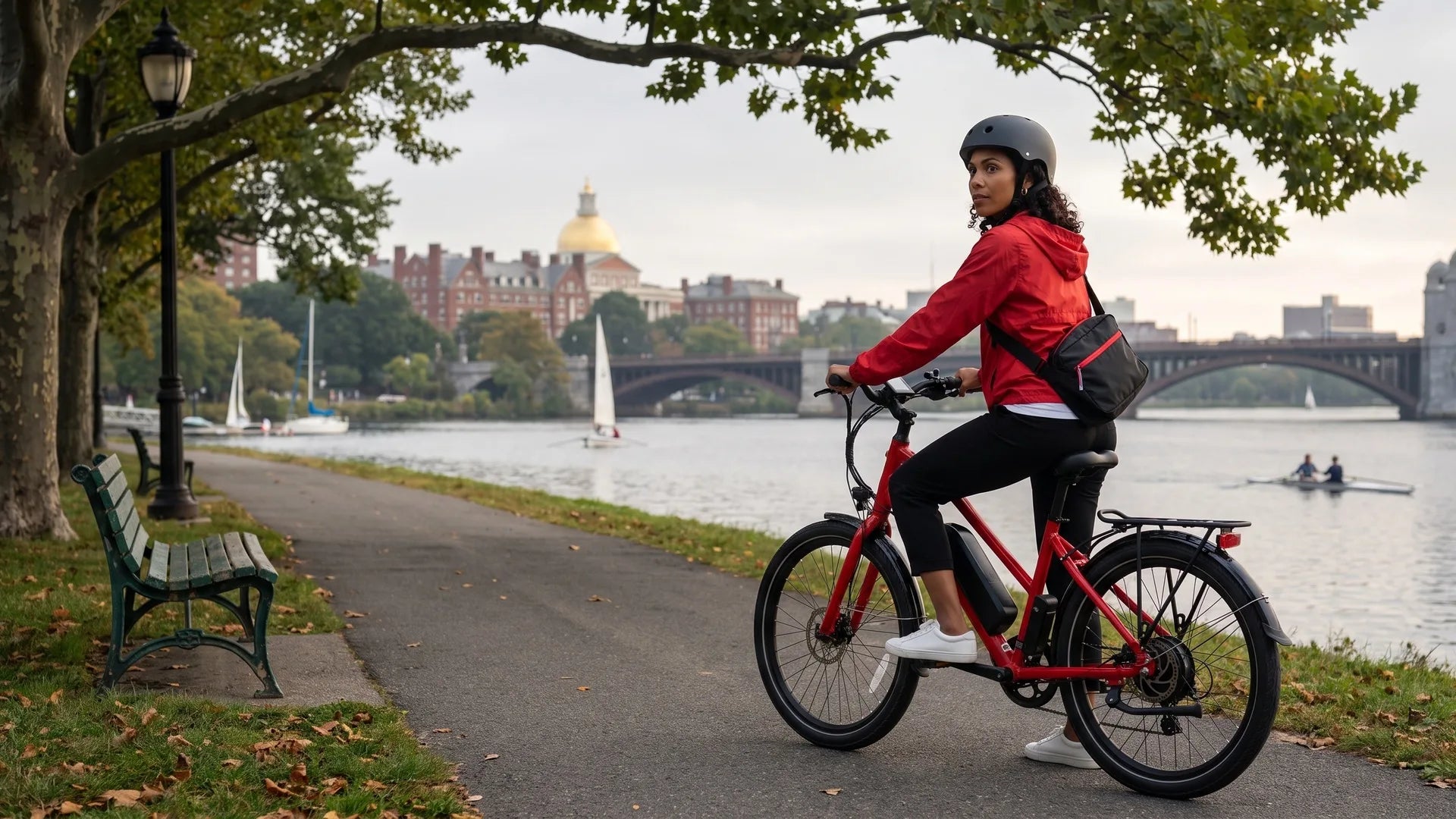
Massachusetts ebike laws contain a hole most riders never hear about until they own the wrong bike. The state recognizes two classes of electric bicycle. The industry sells three.
A 28 mph pedal-assist machine — a Class 3 anywhere else in New England — has no category in Massachusetts at all. Not an electric bicycle. Not a moped. Not anything the Registry has a form for.
750 W ceiling, inclusive · 20 mph cap · 2 classes · 351 cities and towns checked · 43 with e-bike language · 6 with a real rule · 27 of 175 bikes screened legal. Last verified: August 24, 2026.

Quick Answer. A Massachusetts e-bike is a bicycle or tricycle with working pedals and a motor of 750 watts or less, in Class 1 (pedal-assist to 20 mph) or Class 2 (throttle to 20 mph). No license, no registration, no insurance, and no helmet if you are 17 or older. You may ride roads and paved paths; never a sidewalk; and never a natural-surface trail unless that land's authority has voted to allow it.
How we verified this guide
Every legal claim below was retrieved from the issuing body's own publication on 24 August 2026 and links to the section that decides it.
Corpus. This page links 35 distinct external sources, every one retrieved and read in this session, plus one first-party dataset. Several refused direct automated requests — mass.gov answers 403 to scripts, and DCR's two e-bike explainer pages now return 404 — so both governing regulations, 302 CMR 11.00 and 302 CMR 12.00, were pulled in full through a reader proxy and read end to end rather than summarised from an agency page. A 403 is a wall, never a dead page.
Method for the state layer. Massachusetts's entire e-bike framework arrived in a single act. We retrieved that act in full — St. 2022, c.176, approved 10 August 2022 — and then read each section it created or amended in the General Laws themselves rather than trusting the act's own text to still be current.
Method for the local layer. We searched 184 municipal code libraries across the three platforms that host them in Massachusetts, pulled the full text of all 54 matching documents, and classified each by reading it, because a keyword match is not a rule. We then ran the result against an independent government source — the Special Commission's own ordinance review — which caught a municipality we had missed. That correction is reported in full below rather than quietly absorbed.
Method for the questions. The questions this page answers were harvested rather than imagined:
375 terms from three independent sources — Google autocomplete, the H2 and H3 headings of the
pages currently ranking, and related searches — filed at
keywords/harvest/massachusetts-ebike-laws_20260824.csv. 46 are answered on this page, 11 were
deliberately dropped with a stated reason, and exactly one heading is an editorial addition
nobody was observed asking — the label rule, which the statute imposes whether or not anyone
searches for it. The whole ledger, including the drops, ships as demand.csv beside the article.
What this page does not have. No search-volume figure appears anywhere on it. Our Semrush balance was exhausted when it was written, and a stale volume is worse than none.
Reviewer and contact. Written and verified by Mehran G. for Redtail eBikes, whose research method and the family behind it are described in Meet the Mercers. Corrections to corrections@redtailebikes.com.
The 30-second answer
In Massachusetts an electric bicycle is a bicycle or tricycle with fully operable pedals and an electric motor of 750 watts or less, meeting Class 1 or Class 2 — and those are the only two classes the state defines (G.L. c.90 §1). You get the rights and duties of a cyclist, minus the sidewalk (G.L. c.85 §11B¾).
The trap: "750 watts or less" is inclusive here, and 20 mph is the ceiling for both classes. A 750 W motor passes in Massachusetts and fails in Connecticut, whose statute says "fewer than seven hundred fifty watts" (C.G.S. §14-1(31)). Meanwhile a 28 mph bike is legal in Connecticut, New Hampshire and Rhode Island — and categoryless the moment it crosses into Massachusetts.
Takeaway
Two numbers decide almost everything here: 750 watts and 20 mph. If your bike's assist cuts out at 28, it is not an electric bicycle in Massachusetts, no matter what the sticker says or which state you bought it in.
Shopping while you read? Our commuter and city e-bikes and folding e-bikes are the two categories where 20 mph builds are still the norm, and kids' e-bikes is where the under-16 helmet rule below matters most.
What's on this page
- The 30-second answer
- Massachusetts ebike laws: what makes an e-bike legal here
- The missing class, and what a 28 mph bike actually is
- What you do not need — and the helmet rule that is real
- Where you can ride: the three-surface split
- DCR: Class 1, eight feet, and no natural surface
- Boston regulates the delivery fleet, and only the fleet
- Every municipality we checked
- The local layer, town by town
- The commission the Legislature built, and what it found
- The bill that would create Class 3 — and much more
- The label rule and the tampering rule
- Not an e-bike: mopeds, scooters, out-of-class machines
- Fines and enforcement
- The rebate that closed
- Taking an e-bike on the T
- What clears Massachusetts in our own range
- Massachusetts against its neighbours
- The 60-second self-check: your compliance checklist
- If you are stopped: the police-stop playbook
- Limitations, and when this page expires
- The bottom line
- Source register
- Frequently asked questions
- References
Massachusetts ebike laws: what makes an e-bike legal here
An e-bike is legal in Massachusetts when it satisfies one definition and one operating section. The definition sits in the motor-vehicle chapter at G.L. c.90 §1; the operating rules sit in the ways-and-bridges chapter at G.L. c.85 §11B¾.
The operative words are worth reading rather than paraphrasing. Section 1 defines an electric bicycle as "a bicycle or tricycle equipped with fully operable pedals and an electric motor of 750 watts or less that meets the requirements of a class 1 electric bicycle or a class 2 electric bicycle" (c.90 §1).
| The rule | What it actually means | Source |
|---|---|---|
| Pedals must be "fully operable" | A throttle-only machine is not an e-bike here | c.90 §1 |
| Motor "750 watts or less" | Inclusive: 750 W passes. Connecticut's exclusive wording fails the same bike | c.90 §1 |
| Tricycles are included by name | A three-wheeler is an electric bicycle here — no separate category for it | c.90 §1 |
| Class 1 — assist only while pedaling, cuts out at 20 mph | The only class DCR allows on its trails | c.90 §1 |
| Class 2 — throttle allowed, cuts out at 20 mph | Legal on roads and most paths; barred from DCR trails | c.90 §1 |
| There is no Class 3 | The statute lists two classes and stops | c.90 §1 |
| Rights and duties of a cyclist | Except where §11B¾ says otherwise | c.85 §11B¾(b) |
| Must meet CPSC bicycle requirements | The federal construction standard, incorporated | c.85 §11B¾(e) |
Where the authority comes from. The General Court holds the traffic power. Section 11B¾(c) and (d) delegate a slice of it to "a municipality, local authority or state agency with jurisdiction over" a path or trail — but only after public notice and a public hearing, which is a materially higher bar than most states impose on a local e-bike rule. Subsection (h) gives the Secretary of Transportation rulemaking power, subject to filing proposed regulations with the House and Senate clerks 30 days before they take effect.
Enforcement. An e-bike inherits the bicycle penalty scheme: violations of c.85 §11B carry "a fine of not more than twenty dollars," a parent or guardian may not authorize a minor's violation, and a bicycle ridden by someone under 18 in violation "may be impounded by the police department … for a period not to exceed fifteen days." Citations run through the bicycle-specific procedure at §11E, which expressly protects your driving record: a bicycle citation "shall not affect the status of the bicyclist's license to operate a motor vehicle nor … the bicyclist's status in the safe driver insurance plan."
History. Before 10 August 2022, Massachusetts had no e-bike category and riders fell into the "motorized bicycle" moped rules by default. St. 2022, c.176 changed that in one stroke: §14 inserted §11B¾, §§15–16 wrote the definitions, §17 expressly excluded e-bikes from "motorized bicycle," §§18–19 excluded them from "motorized scooter" and "motor vehicles," and §21 excluded them from titling under c.90D. Section 63 delayed the label requirement to 1 January 2023.
What is scheduled to change. One bill is moving. S.3168 would insert a Class 3 definition into this very section of c.90 §1 and build a speed-tier system around it; it cleared the Transportation committee on 6 July 2026 and sits in Senate Ways and Means. The Secretary's own §11B¾(h) regulations have not been promulgated as far as we could establish — that part is a failure to find, which is a different thing from proof of absence.
What is contested. The two-class definition is the unsettled edge, and it is a large one — see the next section.
The missing class, and what a 28 mph bike actually is
A 28 mph pedal-assist bike is not an illegal e-bike in Massachusetts. It is not an e-bike at all, and the statutes do not say what it is instead.
Work the definitions in order. Section 1 requires Class 1 or Class 2, both capped at 20 mph, so a 28 mph machine is out.
It is not a "motorized bicycle" either. That definition requires "a cylinder capacity not exceeding fifty cubic centimeters" — a measurement an electric motor does not have — and the same section says it "shall not include an electric bicycle." Nor is it a motor vehicle: those "shall not include electric bicycles or motorized bicycles" (c.90 §1).
The answer everyone gives, and why we do not give it
Search this question and you will be told, confidently and almost everywhere, that a Class 3 in Massachusetts is a motorized bicycle — annual RMV registration, a driver's license or learner's permit, a DOT helmet. We ran the question through AI search on 24 August 2026 and got exactly that answer, sourced to a stack of retailer guides and one municipal page.
Read the definition before you accept it. A motorized bicycle is "a pedal bicycle which has a helper motor, or a non-pedal bicycle which has a motor, with a cylinder capacity not exceeding fifty cubic centimeters, an automatic transmission, and which is capable of a maximum speed of no more than thirty miles per hour" (c.90 §1). Cylinder capacity is a measurement an electric motor does not have.
And here is the evidence that settles which reading is stronger. S.3168 §7 would strike that definition and replace it with one reading "with either a cylinder capacity not exceeding 50 cubic centimeters or the hybrid or electric powered equivalent." A legislature does not amend a statute to add what the statute already says. The amendment is an admission that the present text does not reach an electric machine.
| The two readings | What it rests on | Consequence |
|---|---|---|
| It is a motorized bicycle | The 50cc figure is read as inapplicable to an electric motor rather than as a bar | Registration, license, DOT helmet, banned from bike paths |
| It is nothing | "Cylinder capacity not exceeding fifty cubic centimeters" is a requirement the machine cannot meet | No category, no rules, no permission either |
Neither has been tested in a Massachusetts court, and we found no Registry determination applying the first reading to Class 3 e-bikes as a class. We are not going to pretend that is settled. The practical advice is the same under both readings and is the only advice worth taking: do not buy a 28 mph machine for a Massachusetts address.
Who decides, and who enforces. Nobody, so far. The Registry may determine "in doubtful cases … whether or not any particular vehicle is a motor vehicle," and may then require registration — a discretionary power written for an era before this problem existed.
Why it happened. The Legislature adopted a two-class scope in 2022 even though DCR's own 2019 regulations had already written all three classes into 302 CMR 11.02 and 12.02. The narrower definition was a choice the drafters made with the wider one already in front of them.
What is scheduled to change. S.3168 §1 would add "Class 3 e-bikes" to c.90 §1 in terms, and its House companion H.3758 is titled "An Act relative to class 3 electric bicycles." Neither has passed. The gap has been open for four years and has been the subject of a bill in every session since.
What is contested — and this is the sharpest example in the state. The Town of Nantucket's bylaw defines all three classes, including "CLASS 3: SPEED PEDELEC … activated by pedaling which ceases to provide assistance once the e-bike reaches 28 mph," and then defines "electric bicycle" the way the state does, as Class 1 or Class 2 only (Nantucket §57-14E). One island bylaw contains both the class the state omits and the definition that omits it.
Takeaway
If you are shopping for a Massachusetts address, treat 20 mph as a hard specification rather than a preference. A Class 3 is not a faster legal option here — it is an undefined object, and the uncertainty is yours to carry.
What you do not need — and the helmet rule that is real
Massachusetts asks nothing of an adult e-bike rider that it does not ask of a cyclist (c.85 §11B¾(b)). The helmet rule is the exception, and it is genuinely enforceable.
| What you might expect | Massachusetts answer | Why |
|---|---|---|
| Driver's license | Not required | "Motor vehicles" expressly excludes electric bicycles (c.90 §1) |
| Registration or plate | Not required | Same exclusion; §21 of the 2022 act also excluded e-bikes from c.90D titling |
| Insurance | Not required by the state | No provision reaches an e-bike; Boston requires it of delivery riders only |
| Helmet, 17 and over | Not required | c.85 §11B(2)(iii) reaches only riders "16 years of age or younger" |
| Helmet, 16 and under | Required, operator or passenger, CPSC-standard, strapped | c.85 §11B(2)(iii) |
| Minimum age to ride | None in state law for an e-bike | §11B¾ sets no age; the moped rules that do set 16 expressly exclude e-bikes |
Enforcement, and its deliberate limits. A helmet violation is the one bicycle offense the Legislature carved out of the general $20 fine — §11B punishes "any provision of this section except violations of subclause (iii) of clause (2)," the helmet clause. And both the helmet and child-carrying rules come with an evidentiary shield: a violation "shall not be used as evidence of contributory negligence in any civil action."
Who else is bound. Retailers. Section 11D requires every shop selling or renting bicycles to post a conspicuous sign stating the under-16 helmet rule, and every rental business to make a CPSC-conforming helmet available with each bike.
History. The helmet rule predates e-bikes by decades and reached them automatically in 2022 through §11B¾(b), which imports the duties "set forth in sections 11B and 11B½."
What is scheduled to change. Nothing located.
What is unsettled. Insurance. Nothing requires it and nothing provides it: whether a homeowner's or renter's policy treats an e-bike as covered property or covered liability is a question Massachusetts law does not answer. Ask your insurer in writing before assuming either way.
Where you can ride: the three-surface split
Section 11B¾ sorts riding surfaces into three buckets with three different defaults, and the third one catches people.
Roads and bike lanes: yes. Section 11B gives every cyclist "the right to use all public ways in the commonwealth except limited access or express state highways where signs specifically prohibiting bicycles have been posted," and §11B¾(b) hands that right to e-bikes.
Bike paths, lanes and routes: yes by default, closeable by vote. Section 11B¾(c) lets a municipality, local authority or state agency with jurisdiction "adopt ordinances or regulations prohibiting or otherwise regulating the operation of electric bicycles on such paths, including … the imposition of speed limits" — but only "after public notice and a public hearing." Because c.90E defines "bikeway" to include bike lanes and shared bike routes, that power reaches painted lanes and signed roadways too (c.90E §1).
Natural-surface trails: no by default, openable by vote. This is the reversal. Section 11B¾(d) bans e-bikes outright from any trail "designated for nonmotorized traffic … if such trail has a natural surface tread made by clearing and grading the soil and no surfacing materials have been added," unless that authority has affirmatively voted to permit them.
Sidewalks: never. Section 11B¾(b) closes with the flat words "provided, however, that electric bicycles shall not be ridden or operated on sidewalks."
| Surface | Class 1 | Class 2 | Source |
|---|---|---|---|
| Roadway, bike lane | Yes | Yes | c.85 §11B, §11B¾(b) |
| Paved bike path / bikeway | Yes unless the authority has voted to restrict | Same | §11B¾(c) |
| Natural-surface trail | No unless the authority has voted to permit | No | §11B¾(d) |
| Sidewalk | No | No | §11B¾(b) |
| DCR trails | Only improved, ≥8 ft | No | 302 CMR 12.12(4) |
| DCR roadways and bike lanes | Yes | Yes | 302 CMR 12.12(5) |
The sidewalk trap, stated plainly. Section 11B allows pedal bicycles on sidewalks "outside business districts when necessary in the interest of safety, unless otherwise directed by local ordinance." Section 11B¾ removes that permission from e-bikes entirely. On the same stretch of concrete, the pedal bike beside you may be legal and you are not.
Who enforces, and how. Municipal police, through the §11E bicycle citation procedure, with fines capped at $20 by §11B unless a local bylaw sets its own.
History. All three defaults arrived together in 2022; there was no prior e-bike trail rule to amend.
What is contested. "Natural surface tread made by clearing and grading the soil and no surfacing materials have been added" is a definition that decides trail access, and no Massachusetts agency we could find publishes a list of which trails meet it. In practice a rider is asked to classify the trail's construction method by looking at it.
DCR: Class 1, eight feet, and no natural surface
The Department of Conservation and Recreation manages the state's largest trail and parkway network, and it wrote its own e-bike rules into regulation. Two chapters carry them, in nearly identical words: 302 CMR 11.00 for parkways and roadways, 302 CMR 12.00 for parks and trails.
The operative sentence is 302 CMR 12.12(4): "The use of electric bicycles is prohibited on sidewalks and on improved or natural surface trails, regardless of trail width or other conditions, except that Class 1 electric bicycles are permitted as follows: (a) on improved DCR trails of 8 feet in width or greater."
Two more carve-outs follow: "(b) in places where vehicular traffic is permitted and bicycles are not otherwise prohibited; and (c) in bicycle lanes on DCR roadways." Section 11.12(15) repeats all three for parkways.
| Where you are, on DCR land | Class 1 | Class 2 | Class 3 | Source |
|---|---|---|---|---|
| Improved trail 8 ft or wider | Yes | No | No | 12.12(4)(a) |
| Improved trail under 8 ft | No | No | No | 12.12(4) |
| Natural-surface trail, any width | No | No | No | 12.12(4) |
| DCR roadway where cars may go | Yes | Yes | Yes | 12.12(4)(b), (5)(a) |
| Bicycle lane on a DCR roadway | Yes | Yes | Yes | 12.12(4)(c), (5)(b) |
| Sidewalk | No | No | No | 12.12(4) |
| Appalachian Trail | No, except at designated crossings | No | No | 12.05(2) |
Read the Class 2 and Class 3 row twice. The common summary — "DCR allows Class 1 only" — is half the rule. Class 2 and Class 3 are permitted on DCR roadways and in DCR bike lanes under 12.12(5); what they are barred from is trails. The class distinction governs trails only, and never becomes a property-wide ban.
And the eight-foot figure is a floor rather than a promise. A Class 1 on a seven-foot paved DCR path is prohibited by the same sentence that permits it on a nine-foot one. The rider is expected to judge the width.
DCR bike lanes belong to e-bikes by definition. 302 CMR 11.02 defines a bicycle lane as "designated in such a way as to alert all road users that a portion of the roadway is for exclusive use by bicyclists and riders of electric bicycles."
Four more DCR duties most riders have never read. Trail users must alert others with "audible signals such as by voice, bell or horn" when passing (12.12(6)); must stop at all intersections and obey pavement markings (12.12(7)); riding after dark requires a white front light and a red rear light "visible from 500 feet or more" (12.12(8)); and "children younger than 17 years old must wear a helmet when riding or operating a bicycle or other wheeled vehicle on DCR property" (12.12(9)). Reckless riding, or riding "at a speed which may be considered unreasonable or improper for existing conditions," is separately prohibited by 12.12(10).
Where the authority comes from. Both chapters cite M.G.L. c.21 §1; c.92 §§33, 34B, 35, 35A, 37, 38, 41 and 95A; c.132A §7; St. 2003, c.41; and St. 2011, c.68 §29. The Commissioner may make any provision "more stringent than that set forth in the particular provision" (12.01(2)), and DCR may close any trail temporarily "when the Department determines that such continued use would be detrimental to the environment due to extremely wet or dry conditions or for any other appropriate reason" (12.12(12)).
Enforcement, with a gap worth naming. DCR Rangers, other DCR personnel and law-enforcement officers may issue citations for violations of either chapter; payment is due within 21 days or "the fine may be increased"; and in lieu of paying you may request a hearing "at the District Court of the Commonwealth with jurisdiction over the matter" (12.20(2), (5)–(7)). DCR may also ban a person from its property for up to one year after written notice and an opportunity to be heard (12.20(3)).
Here is the gap. 302 CMR 11.12 publishes a dollar figure for nineteen parking offences — $40 for a bicycle lane, $100 for a crosswalk, $150 for a fire hydrant — and no dollar figure at all for riding an e-bike where the regulation forbids it.
Section 12.20(4) says only that a violator "is subject to a fine, as may be provided by law." So a rider on a natural-surface trail can be cited, evicted and banned for a year under a rule that never says what the ticket costs. That is our reading of the two chapters; DCR has published no statement of it.
History, and how contested it was. The amendments went through notice-and-comment in 2019 — notice in the Massachusetts Register on 14 June, hearings in Holyoke on 27 June and Brighton on 2 July, comments open 25 June to 24 July. DCR's published response records the split: it "received 171 comments opposed to the proposed amendments and 98 comments supportive" (DCR Response to Comments).
What is contested — the sharpest conflict on this page. Both DCR chapters define "Electric Bicycle" as "a two- or three-wheeled vehicle that: (i) is equipped with fully operable pedals, a seat or saddle for the rider and an electric motor of no more than 750 watts; and (ii) is a Class 1, Class 2 or Class 3 electric bicycle," and then define Class 3 as ceasing assistance "when the bicycle reaches or exceeds 28 miles per hour" (11.02, 12.02). A Massachusetts regulation defines the class that the Massachusetts statute does not. DCR adopted the three-class model in 2019; the Legislature adopted a two-class model in 2022; neither has been reconciled, and DCR told commenters it "would prefer to allow the judicious use of e-bikes now and revisit the regulations if enacted legislation renders it necessary."
What is scheduled to change. That revisit. It has not been published, and DCR's own e-bike web page has since been replaced — mass.gov/info-details/e-bikes-in-dcr-parks and mass.gov/info-details/electric-bicycles both return 404 as of 24 August 2026 — which is why this section is cited to the regulations themselves rather than to an agency explainer.
Boston regulates the delivery fleet, and only the fleet
Boston is the only Massachusetts municipality on American Legal Publishing, and its only codified e-bike provisions — Chapter 17-22 — are about commerce rather than commuting.
Ordinance 2025 c.3 built a third-party delivery regime into Chapter 17-22 of the Boston Municipal Code. Its definition of a delivery vehicle expressly includes "non-motorized bicycles, electric bicycles, motorized scooters" and more.
The bite is in the insurance section. Section 17-22.5 requires a provider's policy to carry "not less than $100,000 for damages arising out of bodily injury sustained by all persons injured in an accident, and $30,000 for all damages arising out of damage to or destruction of property."
That coverage must reach "operators using all modes of transportation for which registration is required by M.G.L. Chapter 90, Section 1A, as well as electric bicycles and motorized bicycles"
Who it binds. Delivery providers — the platforms — not individual riders and not commuters. Enforcement runs through the Boston Transportation Department Commissioner, who may seek an injunction against an unpermitted provider.
Where the power comes from. Boston's home rule authority over licensing and the public way.
History and timing. The ordinance was passed in 2025 and §17-22.9 provides that "this Section shall take effect nine months after passage."
What is contested. Nothing in Boston's code regulates a private e-bike commuter differently from a cyclist. Boston's separate micromobility definition, in §2-1, names "electric-assist bicycles and electric scooters" for administrative purposes rather than as an operating rule.
Every municipality we checked
Massachusetts has 351 cities and towns — 293 towns and 58 cities. Every square foot of the commonwealth sits inside one of them; there is no unincorporated land. The count comes from the U.S. Census Bureau 2025 Gazetteer Files, merging the active county-subdivision records (the towns) with the active place records (the cities), and it matches the figure every Massachusetts agency uses.
We searched 184 municipal code libraries against that 351 denominator: 164 on eCode360, 19 on Municode, and one on American Legal Publishing — which is Boston.
| Coverage, 24 August 2026 | Municipalities | Share |
|---|---|---|
| E-bike or micromobility language located | 43 | 12.3% |
| Searched on a platform, nothing located | 139 | 39.6% |
| Unresolved — no searchable code found, so unchecked | 169 | 48.1% |
| Total | 351 | 100% |
Those 169 are not clean. They are unchecked — mostly small towns that publish no code on any of the three platforms, though every one of them exists in the Census denominator.
Nine of them started in that bucket wrongly. They had a code library, but their first-pass search timed out, and a timeout is not a result. Each was re-run individually and came back clean on four queries, which is why the searched column reads 139 rather than 130.
What those 43 codes actually say
Finding a phrase is not finding a rule — and Massachusetts's own statutory exclusion of mopeds is exactly what a keyword sweep cannot see. We pulled the full text of all 54 matching documents and read each one rather than classifying from the search snippet. They fall into three very different groups:
| Group | Municipalities | What it means |
|---|---|---|
| A real e-bike operating rule | 6 | Northampton, Salisbury, Nantucket, Agawam, Haverhill, and Boston's delivery ordinance |
| Planning or zoning references | 4 | Lexington, Westborough, Freetown, Wrentham — bike parking, shared-transport kiosks, plan documents |
| "Motorized bicycle" or "motorized scooter" only | 33 | Moped and e-scooter provisions, which state law says are not e-bikes |
That last row is the important one. Thirty-three of the forty-three matched only because their codes regulate mopeds or stand-on scooters, and Massachusetts law says in terms that a moped "shall not include an electric bicycle." Counting those as e-bike ordinances would have inflated the finding sevenfold.
Two examples of why reading beats matching. Marlborough appears in every keyword sweep and in the state Commission's own report — but its Chapter 503 governs motorized bicycles and motorized scooters and never mentions an electric bicycle.
Freetown's hit turned out to be a copy of St. 2022, c.176 — the state act itself — hosted in the town's document library. Neither is a local e-bike rule.
The check that caught our own sweep
We then tested the sweep against an independent source: the Special Commission on Micromobility's final report, which contains its own review of selected local ordinances. It named towns our sweep had not. Chasing each one produced this:
| The Commission named | What we found on checking | Verdict |
|---|---|---|
| Agawam | Ord. TOR-2025-6, approved 8 July 2025 — a full e-bike article | Our sweep missed it. Added above |
| Marlborough | Ch. 503 regulates mopeds and stand-on scooters only | Commission describes a moped rule; our call stands |
| Fall River | Its provision reaches e-scooters only | Our call stands |
| Malden | A 2023 multi-use-trail rule with a 5-inch tire limit, per the Commission | Not in Malden's published code — unresolved |
| Foxborough | A police bicycle-registration plate scheme, per the Commission | Not in Foxborough's published code — unresolved |
| Hanover | A police-chief impoundment practice rather than an ordinance | Correctly outside a code sweep |
| (not named by the Commission) | Haverhill §193-23, surfaced only by our second sweep | Our first sweep missed it too. Added above |
Agawam was missed for a specific, fixable reason: eCode360 carries recently adopted ordinances as standalone PDFs that render without a code-section URL, and our first pass parsed only code sections.
So we ran the whole state again against the platform's native search endpoint, which returns those. That second pass caught Agawam's ordinance — and Haverhill's §193-23, which no source had pointed us at. Two of the six local rules on this page exist only because the first method was checked rather than trusted.
The Malden and Foxborough entries we could not confirm at all — which is the honest state of them, and further evidence that a code-platform sweep undercounts rather than overcounts.
So treat the 6 as a floor. In Illinois, a hand-check of the same kind of classification agreed only 8 times out of 11. Here, an independent government source found at least one rule we had not, and pointed at two more we still cannot see.
The local layer, town by town
Six municipalities have something real to say. Each was read in its own code, in full.
| Municipality | What it adds | Source |
|---|---|---|
| Northampton | Bans motor vehicles from multiuse trails but expressly carves out low-speed electric bicycles, defining them by the federal standard — and declares its section "shall supersede any state law or requirement … to the extent that such state law … is more stringent" | §312-78A |
| Salisbury | Its parks-and-trails motorized-vehicle ban excludes e-bikes and e-scooters, then imposes conduct duties on them; $100 first offense, $200 thereafter, plus towing | §170-26 |
| Nantucket | 20 mph limit on multi-use paths naming e-bikes, plus a passing rule: within 10 feet of another user, no more than 5 mph faster than the pedestrian; audible signal before overtaking. Defines Class 3 — which the state does not. Amended 3 May 2025, approved 10 Dec 2025 | §57-14 |
| Haverhill | Its conservation-area article, rewritten 15 April 2025, permits Class 1, 2 and 3 across 14 conservation areas (~2,081 acres) and prohibits "Class 4 bicycles" — a category no Massachusetts law defines. $50/$100/$300 | §193-23 |
| Agawam | A whole e-bike article adopted 8 July 2025: helmet required at every age, a flat ban on tampering, no sidewalks, no riding more than two abreast, $50 fine | Ord. TOR-2025-6 |
| Boston | Delivery-fleet insurance mandate, $100k/$30k, expressly covering electric bicycles | §17-22.5 |
Northampton is the one to read twice. A city ordinance asserting that it supersedes state law where state law is more stringent inverts the usual direction of preemption, and it does so by anchoring to 15 U.S.C. §2085 — the federal product standard, which governs what may be sold as a low-speed electric bicycle rather than where one may be ridden. Whether a municipality can do that is not a question any Massachusetts decision we retrieved answers. We flag it rather than resolve it.
Haverhill wrote the strangest sentence in the state. Its conservation-area article — adopted in 1992 and "amended in its entirety" on 15 April 2025 by Doc. 54 — bans "motorized vehicles of any kind," then provides: "Class 1, 2, and 3 electric pedal assist bicycles may be used within Conservation Areas. The use of Class 4 bicycles is prohibited" (§193-23). Two things are wrong with that on its face, and both are instructive. It permits Class 3, which Massachusetts law does not define. And it prohibits Class 4, which no Massachusetts statute, no Massachusetts regulation and no industry standard defines either — the term circulates informally for out-of-class e-motos. The article governs 14 named conservation areas totalling about 2,081 acres, from the 550-acre Winnekenni Park around Kenoza Lake down to the 26.6-acre Rurak Point, and carries a fine "of not more than $300 per day" on a schedule of $50 first offense, $100 second, $300 third or subsequent.
Three Massachusetts authorities now regulate a Class 3: DCR by regulation, Nantucket by bylaw, and Haverhill by ordinance. The Legislature is the one that has not.
Agawam is the one that will actually change your ride. Ordinance TOR-2025-6 inserts Article V into Chapter 169, and §169-32(E) reads: "Any person operating an electric bicycle or being carried as a passenger on an electric bicycle on a public way, bicycle path or on any other public right-of-way shall wear a helmet." No age qualifier. Massachusetts requires a helmet at 16 and under; Agawam requires one at 47. Its §169-31 also states flatly that "no person shall operate an electric bicycle that has been tampered with or modified to affect the motor-powered speed capability" — dropping the state's relabeling escape hatch. Violations are $50. Its definition is narrower than the state's, too: Class 1 and Class 2, "an electric motor of less than 750 watts (1 horsepower), whose maximum speed is less than 20 miles per hour" — the exclusive wording, which puts a 750 W bike outside the Agawam article even though it passes under c.90 §1.
Where the local power comes from. Section 11B¾(c) and (d), and only after public notice and a public hearing. That procedural requirement is why Massachusetts has a handful of local e-bike rules where Illinois — whose statute grants the power freely — has dozens.
What is scheduled to change. Nothing located; no pending municipal action was searchable through the code platforms.
What is contested. Whether Northampton's supersession clause and Nantucket's Class 3 definition survive contact with the 2022 statute. Both were written by towns acting in good faith; neither has been tested.
Riding somewhere with its own bylaw? Two of the six local rules on this page — Nantucket's path limit and Agawam's helmet mandate — apply to any e-bike regardless of class, and both towns are places people arrive with a bike rather than buy one. A folding build that fits a car trunk or an MBTA rush-hour restriction is the practical answer to a patchwork.
See folding e-bikesThe commission the Legislature built, and what it found
Massachusetts did not leave the Class 3 gap unexamined. In November 2024 the Legislature created a Special Commission on Micromobility in St. 2024, c.238, §306, directing it to study "(i) a review of current state and local laws and regulations for micro-mobility vehicles; (ii) recommendations to regulate micro mobility vehicles, including on bike paths, sidewalks and shared use paths; and (iii) recommendations to support the expansion of micro-mobility vehicle use."
The Commission — 15 members chaired by MassDOT's Interim Secretary, including the chairs of the Joint Committee on Transportation and DCR's Director of Trails and Greenways — met five times and delivered a final report dated 30 January 2026, filed with the Senate on 2 February 2026. It makes 16 recommendations in four groups.
| Group | Recommendations | The ones that would change this page |
|---|---|---|
| Core framework | 1–3 | A speed-based classification schema replacing the class labels, plus a "Micro ID" |
| Safety and enforcement | 4–9 | Police training · crash and vulnerable-user data · a default maximum speed on paths · a model municipal ordinance |
| Infrastructure | 10–12 | Design guidance, integration, funding for upgrades |
| Growth | 13–16 | Expand bikeshare · fund more e-bike subsidies · commercial-use study · presumed-liability study |
The Massachusetts numbers in it are the ones worth carrying. The Commission reports that in 2024 there were 10 fatal crashes involving bicycles and a motor vehicle in Massachusetts, against 349 deaths in all motor-vehicle-involved crashes that year — and says plainly that for micromobility crashes not involving a motor vehicle, "we do not have a reliable publicly available dataset." It cites CPSC findings that micromobility injuries have risen "an estimated average 23 percent annually" since 2017, and that children 14 and younger accounted for 36% of micromobility injuries from 2017 to 2022 while making up 18% of the population.
Three Massachusetts incidents are named in the report as the reason the work was urgent: a 13-year-old in Plymouth catastrophically injured in June 2025 when his e-moto hit a car; a 64-year-old Braintree man struck in Copley Square in August 2025 by a delivery rider on an e-bike, who died of his injuries weeks later; and a 13-year-old in Stoneham killed in November 2025 when the electric dirt bike he was riding hit a car.
Two of those three involved machines that are not e-bikes under Massachusetts law at all, and the Commission says so itself. Off-road e-motos "often have weights closer to mopeds than traditional bicycles."
They "are also often conflated in reporting and broadly grouped together in common parlance with Class 1 and Class 2 e-bikes that operate at much slower speeds and with smaller motors" (Final Report). We sell e-bikes, so read that as an interested party quoting a disinterested one.
Who has to act on it. Nobody, mechanically — a commission reports, it does not legislate. What it produced instead is a drafting template, and the Senate has already picked it up.
The bill that would create Class 3 — and much more
There are live bills, one of them is moving, and one of them has already been shelved — the Governor's. Two bills carry the identical title, "An Act to enhance the safe use of micromobility devices," and the difference between what happened to them is the story.
| Bill | Who filed it | What happened | Status, 24 Aug 2026 |
|---|---|---|---|
| S.3077 | Gov. Maura T. Healey — "Message from Her Excellency the Governor" | Referred to Transportation 4 May 2026; hearing 28 May 2026; 22 July 2026 "Accompanied a study order (under JR10)" | Sent to study |
| S.3194 | The Transportation committee | The Order authorizing the committee "to make an investigation and study" of the Governor's bill | Discharged to Senate Rules, 23 Jul 2026 |
| S.3168 | The Transportation committee | Reported favourably 6 July 2026 as a new draft of S.2347, S.2373 and S.2432 | In Senate Ways and Means |
| H.3758 | Rep. Steven Owens, with Sen. Bruce Tarr | Reporting date extended twice, last to 31 July 2026 | In Transportation |
Read the dates in order. The Governor filed her framework on 4 May. The committee reported its own new draft of three legislators' bills on 6 July. Sixteen days later, on 22 July, it sent the Governor's bill to study — which in Massachusetts practice is how a bill is shelved for the session, not how it is advanced.
The surviving vehicle is S.3168, and what follows describes that text as reported out of committee.
Here is what S.3168 would do, section by section, as reported out of committee.
| Section | What it changes | Effect |
|---|---|---|
| §1 | Inserts "Class 3 e-bikes" into c.90 §1 — pedal-assist ceasing at 28 mph | Closes the gap this page is built around |
| §3 | Adds Class 3 to the "electric bicycle" definition | A 28 mph bike becomes a legal category |
| §7 | Rewrites "motorized bicycle" to add "the hybrid or electric powered equivalent" of 50cc | Closes the orphan a 1,000 W pedal machine falls into |
| §8 | Strikes the "motorized scooter" definition entirely | Replaced by the tier system |
| §12 | "Motorized bicycles shall be excluded from operating on bike lanes and off-street recreational bicycle paths" | Mopeds out of the bike network |
| §13 | No moped registration without compulsory liability insurance | Insurance where there was none |
| §18 | Creates c.90 §64 — the maximum designed speed tier classification system | The whole framework |
| §24 | 20 mph maximum for micromobility devices on shared use paths, statewide, unless a municipality decides otherwise | A default speed limit where there is none |
| §25 | A ten-member working group reporting by 31 December 2027 | Registration, licensure, fines still to be designed |
| §26 | §§7, 10, 13, 14 and 16–22 take effect 1 January 2028 | A staged commencement |
The tier system in §18 is the part that would reorganize everything:
| Tier | Speed | Includes | What attaches |
|---|---|---|---|
| Speed Tier 0 | up to 20 mph | Unpowered devices, Class 1 and Class 2 e-bikes, mobility aids | Rights and duties of a bicycle under c.85 §§11B, 11B½; helmet at 16 and under |
| Speed Tier 1 | 21–30 mph | Class 3 e-bikes | Rights and duties of an electric bicycle under §11B¾; helmet at every age; no purchase, rental or operation under 16 |
| Speed Tier 2 | 31–40 mph | Faster powered devices | Banned from sidewalks, bike lanes, bike paths, bike routes and shared use paths |
| Speed Tier 3 | above 40 mph | Everything faster | Same bans, motor-vehicle lighting and horn standards |
Four provisions in §18 would reach directly into what we sell and what you ride:
- UL 2849 becomes mandatory for e-bikes. "Electric bicycles sold, leased, rented or operated in the commonwealth shall meet or exceed a battery safety standard of UL 2849, as certified by a nationally recognized testing laboratory" (§18(c)). Other powered micromobility devices get UL 2271 and UL 2272; mopeds on lithium-ion get UL 2850.
- A hard floor of 14 to purchase, rent, lease or operate any powered micromobility device, and 16 for anything in Tier 1 or above (§18(e)(3)–(4)).
- Derestriction becomes flatly unlawful: "It shall be unlawful to make any aftermarket modifications to a micromobility device to increase either (i) the manufacturer designed speed or propulsion power … or (ii) the manufacturer designed passenger capacity" (§18(e)). No relabeling escape.
- The speed tier is set by the higher of the two numbers — "maximum manufacturer assisted or designed speed, whichever is higher" — which would put a bike advertised with a 28 mph unlocked mode into Tier 1 even if it ships limited to 20.
Takeaway
Nothing above is law. A bill in Senate Ways and Means in August of an election-year session is a long way from an act, and the 2022 framework took three sessions of attempts before it passed. Treat S.3168 as the shape of the argument. It is no kind of date to plan around.
The label rule and the tampering rule
Two duties ride along with every Massachusetts e-bike under §11B¾(f) and (g), and one of them lands on the seller rather than on you.
Since 1 January 2023 — the delayed effective date set by §63 of the 2022 act — "[m]anufacturers and distributors of electric bicycles shall apply a label that shall be permanently affixed, in a prominent location, to each electric bicycle containing the classification number, top assisted speed and motor wattage" (§11B¾(f)).
The tampering rule is subsection (g): "No person shall tamper with or modify an electric bicycle so as to change the motor-powered speed capability or engagement … unless the person appropriately replaces the label."
Read that carefully. Massachusetts does not ban derestriction outright. It bans derestricting without relabeling — and since the only lawful labels here read Class 1 or Class 2 at 20 mph, an honestly relabeled fast bike documents its own exit from the definition.
Who it binds and who enforces. The label duty runs against manufacturers and distributors; the tampering rule runs against "no person." Both are enforced through the ordinary bicycle penalty route, which caps at $20 for most violations.
History. The nine-month runway between the act's approval and the label rule's effect was deliberate, giving the trade time to comply.
What is contested. The statute never says what happens to a bike sold before 2023 with no label, or one imported privately. Neither the statute nor any regulation we retrieved makes an unlabeled e-bike unlawful to ride.
Not an e-bike: mopeds, scooters, out-of-class machines
Four machines get confused with e-bikes here, and the moped is the expensive mistake.
| Machine | Massachusetts category | The rule | Source |
|---|---|---|---|
| Motorized bicycle (moped) | Pedal or non-pedal bicycle with a helper motor, ≤50cc, ≤30 mph | 16+, driver's license or learner's permit required, helmet at every age, 25 mph limit, banned from off-street recreational bike paths | c.90 §1B |
| Motorized scooter | Handlebars, stood or sat upon, electric or gas | Its own category; expressly excludes electric bicycles | c.90 §1 |
| Class 3 / 28 mph machine | No category | Undefined — see above | c.90 §1 |
| Over 750 W | Not an electric bicycle | Falls out of the definition on wattage alone | c.90 §1 |
The moped row is where money changes hands. A moped rider needs a license and a helmet at any age, and is banned from the very rail trails an e-bike may use (c.90 §1B).
The 2022 act's §17 exists precisely to keep e-bikes out of that regime, which is why the exclusion appears in the statute in so many words.
Two Boston-specific machines round out the confusion. A gas-powered scooter, powerboard or mini-motorbike is banned from Boston sidewalks outright, and from streets unless the rider is 16 or older and carrying a valid license — $25 first offence, $50 after (§16-12.38). An EPAMD — a Segway-type self-balancing two-wheeler — is prohibited "on all public property in the city," expressly including "public ways, sidewalks, parks, plazas, bicycle paths and shared use paths," outside licensed tour operations and disability use, at $50 then $100 (§16-12.38A.2). Neither rule touches an electric bicycle. Both get quoted at e-bike riders anyway.
And Boston's own helmet ordinance, §16-15.6, requires headgear of "all persons operating a motorized bicycle" — the moped definition, which by state law "shall not include an electric bicycle." It does not reach you on an e-bike.
Enforcement and history. The moped rules carry escalating fines — "not more than twenty-five dollars for the first offense, not less than twenty-five nor more than fifty dollars for a second offense, and not less than fifty nor more than one hundred dollars for subsequent offenses" — and predate the e-bike framework by decades.
What is contested. A machine over 750 W with working pedals fits neither the e-bike definition nor the moped definition's cylinder-capacity test. It is the same orphan as the Class 3 problem, arriving from a different direction.
Fines and enforcement
The state's numbers are small, deliberately — §11B caps most of them at $20 — and the local ones are larger.
| Violation | Penalty | Source |
|---|---|---|
| Most bicycle/e-bike rule violations | Not more than $20 | c.85 §11B |
| Under-16 helmet violation | Carved out of the fine provision entirely | c.85 §11B |
| Rider under 18 in violation | Bicycle impoundable up to 15 days | c.85 §11B |
| Salisbury trail violation | $100 first, $200 subsequent, plus towing | §170-26 |
| Agawam e-bike article violation | $50 | §169-33 |
| Haverhill conservation-area violation | $50 / $100 / $300, capped at $300 per day | §193-23 |
| DCR trail or sidewalk violation | No published amount — "a fine, as may be provided by law", plus eviction and a ban up to one year | 302 CMR 12.20 |
| Moped violations | $25 / $25–50 / $50–100 escalating | c.90 §1B |
| Boston delivery provider, unpermitted | Injunction plus per-order penalties | §17-22.7 |
The protections are as notable as the penalties. Section 11E bars arrest without a warrant for any bicycle traffic violation except refusing to give your name, requires the citation to state on its face that the violator is a bicyclist — "failure to do so shall be a defense to the violation" — and keeps the whole thing off your driving record and out of your insurance rating. All fines collected go back into local bicycle safety programs.
History and trajectory. The $20 ceiling has not been indexed since it was set, and nothing located proposes changing it.
What is contested. Whether a municipality's own trail bylaw fine — Salisbury's $200, for instance — is limited by §11B's $20 ceiling or stands on independent bylaw authority. The statutes do not address the interaction.
The rebate that closed
Massachusetts funded an e-bike rebate, ran it, and closed it. Any page telling you to apply today is out of date.
The money came from the same 2022 act, which directed rebates "up to $500 for general consumers and up to $750 for low-income and moderate-income consumers and not more than 40 percent of retail price for the purchase of new and used electric bicycles" (St. 2022, c.176).
The Massachusetts Clean Energy Center ran it as the Statewide E-Bike Voucher Program. Its own page, retrieved 24 August 2026, says: "The 2025 Statewide E-Bike Voucher Program is now closed and not expected to re-open in 2026." (MassCEC).
The program paid more than the statute authorized, and almost nobody reports this. The 2022 act set $500 for general consumers and $750 for low- and moderate-income consumers. What MassCEC actually offered, per its own launch announcement of 14 April 2025, was an Enhanced Voucher "Up to $1,200" for applicants below 225% of the Federal Poverty Line, a Standard Voucher "Up to $800" at or below 400%, and an Equipment Voucher "up to $150" for helmets, lights and a lock that every selected applicant received (MassCEC).
| The 2025 program, as run | Detail | Source |
|---|---|---|
| Enhanced voucher (below 225% FPL) | Up to $1,200 | MassCEC |
| Standard voucher (at or below 400% FPL) | Up to $800 | MassCEC |
| Equipment voucher, all recipients | Up to $150 | MassCEC |
| Total vouchers | ≈3,000, about 500 a month | MassCEC |
| How you got one | Lottery — "randomly select applicants" | MassCEC |
| When you could apply | A two-week window each month, April–September | MassCEC |
| Status, 24 Aug 2026 | Closed; not expected to reopen in 2026 | MassCEC |
| Statutory authority | Still on the books, unfunded | St. 2022, c.176 |
| Retailer participation | Contact route still published | MassCEC |
A lottery is the detail worth carrying into any future round: eligibility never guaranteed anyone a voucher, and roughly 500 a month were drawn from everyone who applied in that month's window.
Who administers it, and what that means for its return. MassCEC — a quasi-public agency whose programs run on appropriations — rather than the Registry or DCR. The statutory authority survives the closure; the appropriation did not.
What is contested. Whether "not expected to re-open in 2026" forecloses 2027. MassCEC says further updates will be posted on that page, which is the honest reading: the program is dormant, not repealed.
For states running live programs today, see Colorado, Minnesota and Washington.
Taking an e-bike on the T
The MBTA's rules are written around size and power source, not around e-bike classes, which makes them easy to get wrong in both directions.
| On the T | Rule | Source |
|---|---|---|
| Folding bikes and folding devices | Allowed broadly | MBTA |
| Non-folding bikes and large devices "that cannot be carried in one hand" | Not allowed during rush hours | MBTA |
| Green Line and Mattapan Trolley | Not allowed, non-folding | MBTA |
| Park Street, Downtown Crossing, Government Center platforms | Not allowed, non-folding | MBTA |
| Anything with a combustion engine | Never, at any time | MBTA |
The rule that catches people is the last one, and it catches them backwards. "Vehicles or devices with combustion engines are not allowed on the T at any time" (MBTA) — an electric bike is not caught by it, a gas one is.
Riders hear "no motorized vehicles," assume the battery is the problem, and leave a legal e-bike at home.
Where the authority comes from. The MBTA sets its own conditions of carriage as the operator of its system; nothing in c.85 or c.90 reaches transit carriage, and the T's rules are not part of the two-class scheme this page is otherwise about.
Enforcement. By MBTA personnel at the point of boarding, as a condition of carriage, rather than by citation. Refusal of carriage is the sanction.
History. The size-and-fold framing predates e-bikes entirely — it was written for touring bikes at rush hour — which is why a 60 lb Class 2 and a 22 lb road bike are treated identically as long as neither folds.
What is scheduled to change. Nothing we located in the MBTA's published policy. If S.3168 passes, its §25 working group is directed to recommend "travel allowances" across modes, which is the nearest thing to a transit review on the table.
What is contested. Battery safety. New York City's transit authority and several US systems have moved on lithium-ion carriage, and the Special Commission spent time with New York City's former Fire Commissioner on exactly this hazard, noting the city "has had over 30 deaths from battery related fires since 2022" (Final Report). The MBTA's published page does not address battery certification, and we found no proposal that it should.
What clears Massachusetts in our own range
We screened the live catalog against the two Massachusetts numbers on 24 August 2026:
175 bikes · 27 meet the definition on published specs · 80 fall outside · 68 cannot be
established (scripts/screen_massachusetts_legal.py).
Massachusetts is more permissive than Illinois on wattage and stricter on speed, and the effect is visible. The inclusive 750 W ceiling lets more bikes through the first gate; the 20 mph cap then removes every Class-3-style machine at the second.
| Approved brands with a Massachusetts-legal model | Models passing | Brand range |
|---|---|---|
| Eunorau | 15 | Eunorau |
| Samebike | 2 | Samebike |
| Qiolor | 1 | — |
This is the first state in the campaign where three approved brands qualify, which means a picks module here can span three brands with no waiver at all. Where a brand's build quality and warranty sit is a separate question from whether it is street-legal — our best e-bike brands comparison and the individual profiles for Ridstar, Himiway, Velotric, Aventon, Lectric and Super73 cover it. Those picks are proposed and awaiting the operator's ruling; until that ruling lands, this page names no model, because a recommendation is a decision we do not make unilaterally.
Two of our own long-form reviews sit on the other side of that line: a 1,500-watt fat-tire build and a 3,000-watt off-road machine. Neither is an electric bicycle in Massachusetts, and both are worth reading for exactly that reason — they show what the definition excludes and why.
One screen finding is worth stating on its own. Several listings publish a peak wattage far above their nominal rating — 1,500 W peak on a 500 W motor, in one case.
The statute reads "an electric motor of 750 watts or less." That is a rating. A peak figure measures something else entirely, and a spec sheet quoting point at, and no Massachusetts document we retrieved says which number governs.
Buying for a Massachusetts address? Ask two questions in writing before you pay: what is the nominal motor wattage, and at what speed does the assist cut out? If the answer to the second is 28, the bike has no legal category in this state — whatever the listing says. The commuter and city and cargo ranges are where 20 mph builds are still the default; the on-sale list is worth checking against the same two questions.
Browse commuter e-bikesMassachusetts against its neighbours
Massachusetts is the only state in its neighborhood without a Class 3, and the contrasts at the border are sharp.
| State | Motor limit, as written | Classes | Source |
|---|---|---|---|
| Massachusetts | "an electric motor of 750 watts or less" | Class 1 and 2 only | G.L. c.90 §1 |
| Connecticut | "fewer than seven hundred fifty watts" — exclusive | Three | C.G.S. §14-1(31) |
| New Hampshire | "an electric motor of less than 750 watts" | Three | RSA 259 |
| Rhode Island | "an electric motor rated not more than two (2) S.A.E. horsepower", max 28 mph | No class system | R.I.G.L. §31-1-3 |
Rhode Island is the outlier in the other direction: roughly 1,500 watts and 28 mph, written before the three-class model existed (R.I.G.L. §31-1-3). Ride from Providence into Massachusetts on a machine Rhode Island defines in terms, and you arrive somewhere it has no definition at all.
For the national picture see our state-by-state e-bike laws hub, and the individual guides for Connecticut, New York, Pennsylvania, Illinois, California, Florida and New Jersey.
The 60-second self-check: your compliance checklist
- Where does the assist cut out? 20 mph or below. If 28, there is no Massachusetts category for your bike.
- What is the nominal wattage? 750 or less passes — inclusive, unlike Connecticut.
- Do the pedals work? "Fully operable pedals" is on the face of the definition.
- Is there a label? Class, top assisted speed, motor wattage — required on bikes since January 2023.
- Anyone 16 or under riding? Helmet, CPSC-standard, strapped. That one is enforced.
- Never the sidewalk. Statewide, both classes.
- Natural-surface trail? Assume no unless that authority has voted yes.
- DCR land? Class 1 only, improved paths 8 feet or wider.
Takeaway
The single most useful habit for a Massachusetts rider is reading the surface rather than the sign. Pavement eight feet wide on DCR land is usually fine on a Class 1; the same trail in dirt is closed to every class, and neither will necessarily be posted.
If you are stopped: the police-stop playbook
- Know which layer you are in. A sidewalk stop is state law. A trail stop is probably DCR or a town bylaw. An age or helmet stop is §11B.
- Show the label. It answers class, speed and wattage at a glance, and it is the document the statute itself asks for.
- The citation must say you were on a bicycle. Section 11E requires it, and "failure to do so shall be a defense to the violation."
- It should not touch your license or insurance. Section 11E says a bicycle citation "shall not affect the status of the bicyclist's license to operate a motor vehicle nor … the bicyclist's status in the safe driver insurance plan."
- You cannot be arrested without a warrant for a bicycle traffic violation — except for refusing to give your true name and address.
- Under 18? The bike can be impounded for up to fifteen days, and a parent or guardian may be the one held responsible.
What changed, and when
Massachusetts's e-bike law is four years old. Almost everything on this page has a date attached, and most of the dates are recent.
| Date | What changed | Source |
|---|---|---|
| 10 Aug 2022 | St. 2022, c.176 approved — creates the e-bike definition, §11B¾, and the moped/scooter/motor-vehicle exclusions | Acts of 2022, c.176 |
| 1 Jan 2023 | The manufacturer label duty takes effect (delayed by §63 of the act) | c.85 §11B¾(f) |
| Nov 2024 | The Legislature creates the Special Commission on Micromobility | St. 2024, c.238 §306 |
| 15 Apr 2025 | Haverhill rewrites its conservation-area article — permits Classes 1–3, bans "Class 4" | §193-23 |
| 3 May 2025 | Nantucket amends §57-14 (approved 10 Dec 2025) — 20 mph path limit, 5 mph passing differential | §57-14 |
| 8 Jul 2025 | Agawam adopts an e-bike article: helmet at every age, tampering ban, $50 | Ord. TOR-2025-6 |
| 17 Nov 2025 | Agawam adds a separate motorized-scooter article | Ord. TOR-2025-10 |
| 30 Jan 2026 | The Commission reports, with 16 recommendations | Final Report |
| 4 May 2026 | Gov. Healey files her own micromobility speed-framework bill | S.3077 |
| 6 Jul 2026 | S.3168 reported out of Transportation, referred to Senate Ways and Means | S.3168 |
| 22 Jul 2026 | The Governor's bill is sent to study — shelved for the session | S.3194 |
| Sometime in 2026 | DCR's two e-bike explainer pages start returning 404; the regulations stay in force | 302 CMR 12.00 |
| 24 Aug 2026 | This page verified: 351 cities and towns, 34 sources, 175 bikes screened | This page |
What has not changed since 2022: the two-class definition, the 750-watt ceiling, the 20 mph cap, the sidewalk ban, and the $20 fine. Every proposal to change the first of those has died in committee.
What about other states?
It is stricter than most on classes and looser than most on paperwork. Our state-by-state e-bike laws hub carries all fifty in one table.
The nearest comparisons: Connecticut requires a helmet at every age; New York confines Class 3 to New York City; New Jersey makes some machines register and insure; Pennsylvania adds a 100 lb weight test; and Illinois writes its watt limit exclusively.
Elsewhere the money and the local layer differ. Minnesota, Colorado and Washington run live rebate programs; California, Florida and Texas leave far more to their cities than Massachusetts does.
Are there ebike trails in Massachusetts?
Trail access is decided trail by trail, so it needs its own research. Our e-bike trail atlas covers all fifty states, and the California and Texas guides show the depth a single state gets. In Massachusetts the deciding question is almost always whether the surface is improved and at least eight feet wide.
Which e-bike is legal to ride in Massachusetts?
Two numbers and one document: the nominal wattage, the cut-off speed, and the label required since January 2023. Get those right and Massachusetts law is finished with you.
Everything else is a buying question rather than a legal one. Our electric bike buying guide covers the decisions the statute does not touch, the motor guide explains how nominal and peak wattage are actually rated, and the suspension guide matters more than most buyers expect on Boston's road surfaces.
If this is your first e-bike, start with the first e-bike guide. If you would rather test-ride, eBike shops near me explains how to judge a local store, and eBike shops in NYC shows the format for a nearby metro.
Limitations, and when this page expires
Author and interest. Redtail eBikes sells electric bicycles. That is a commercial interest in this subject, and it is why the catalog screen above reports the numbers that cut against us. This page is not legal advice.
Limitations.
- 169 of 351 municipalities are unresolved — unchecked, which is a different thing from clear. That is 48.1% of the state and the largest single limit on this page.
- A code-platform sweep undercounts, and we measured it. The Special Commission's report names an e-bike rule in Malden and a bicycle-registration scheme in Foxborough that we could not find in either town's published code. It named Agawam, whose ordinance we had missed and have now added. Two remain unconfirmed. Read our count of five as a floor.
- Of the 43 flagged codes, all 54 matching documents were retrieved and read in full. Where a town's rule lives outside its codified code — a board regulation, a recent uncodified ordinance, a police-department practice — this method cannot see it.
- No Massachusetts case law was retrieved. The contested points — Northampton's supersession clause, the Class 3 orphan, whether §11B's $20 ceiling limits a local bylaw fine — are flagged as unresolved. We could not answer them.
- The DCR fine gap is our reading of two regulations. No agency has stated it. We found no published dollar amount for a non-parking e-bike violation on DCR land; DCR may apply one we could not locate.
- S.3168 is a bill and nothing more. Every description of it here is of the text as reported out of committee on 6 July 2026 and may be amended or die in Senate Ways and Means.
- The catalog screen parses listing text. A specification absent from a listing is recorded as unknown, never as a pass. It reads the nominal rating and does not sum the motors on a dual-motor bike — a limitation we hit in Illinois and fixed for this screen, but which still depends on the listing disclosing both figures.
- No search-volume figure appears on this page. The Semrush balance was exhausted at the time of writing, so rather than quote a stale number we quote none.
- The demand harvest ran three of the available sources. People-Also-Ask, Search Console and the AI engines were not run — the first two by tooling limits, the third for want of an API credential. 375 terms is a floor on demand and no kind of census.
Expiry conditions.
- Any movement on S.3168 out of Senate Ways and Means. It would create Class 3, mandate UL 2849, set a statewide 20 mph shared-path limit and impose age floors — the single change that would most alter this page.
- Any reporting of H.3758, whose reporting date was last extended to 31 July 2026.
- Any revival of the Governor's S.3077 out of the study order it was given on 22 July 2026.
- Any promulgation of the Secretary's §11B¾(h) regulations — the statute contemplates them and none has appeared.
- Any DCR revisit of 302 CMR 11 and 12, which the agency said it would consider once the Legislature acted. It acted in 2022.
- MassCEC's voucher page changing its status line from "not expected to re-open in 2026."
- The §25 working group's report, due 31 December 2027 if S.3168 passes.
- Rolling: municipal ordinances, each of which needs a public hearing and is therefore visible in advance.
We re-verify this page at least every six months, and immediately on any of the above.
Source register
| Source | Tier | What it supports | Retrieved |
|---|---|---|---|
| Massachusetts General Court — G.L. c.85 §§11B, 11B½, 11B¾, 11D, 11E | T1 primary official | Every operating rule, the helmet rule, penalties, citation procedure | 2026-08-24 |
| Massachusetts General Court — G.L. c.90 §§1, 1B; c.90E §1 | T1 | Definitions, the two-class scheme, moped rules | 2026-08-24 |
| Massachusetts General Court — St. 2022, c.176 | T1 | The entire framework and its effective dates | 2026-08-24 |
| DCR — 302 CMR 11.00, Parkways, Traffic, and Pedestrian Rules | T1 | Definitions, §§11.02, 11.04, 11.11, 11.12 | 2026-08-24 |
| DCR — 302 CMR 12.00, Parks and Recreation Rules | T1 | Definitions, §§12.01, 12.05, 12.12, 12.20 | 2026-08-24 |
| DCR — Response to Comments on 302 CMR 11/12 | T1 | Rulemaking history and comment tallies | 2026-08-24 (via Internet Archive) |
| mass.gov — E-Bikes on DCR Property | T1 | DCR's published Class 1 position | 2026-08-24 (via Internet Archive) |
| Special Commission on Micromobility — Final Report, 30 Jan 2026 | T1 | Crash and injury figures, local-ordinance review, 16 recommendations | 2026-08-24 |
| Massachusetts General Court — S.3168, S.2373, H.3758 (text and bill history) | T1 | The pending framework and its status | 2026-08-24 |
| Town of Agawam — Ord. TOR-2025-6 and TOR-2025-10 | T1 | The Agawam e-bike and scooter articles | 2026-08-24 |
| MBTA — Bikes and micromobility | T1 | Transit carriage rules | 2026-08-24 |
| MassCEC — Statewide E-Bike Voucher pages | T2 primary institutional | Program status and closure | 2026-08-24 |
| U.S. Census Bureau — 2025 Gazetteer Files | T1 | The 351 denominator | 2026-08-24 |
| Municipal codes: Boston (American Legal); Northampton, Salisbury, Nantucket, Agawam, Haverhill (eCode360) | T1 | Every local rule cited, each read in full | 2026-08-24 |
| Connecticut, New Hampshire, Rhode Island legislatures | T1 | The neighbour comparison | 2026-08-24 |
| Redtail eBikes catalog via Shopify Admin API | T2 | The first-party screen | 2026-08-24 |
No tier-five source is cited anywhere on this page, for anything.
Frequently asked questions
Are electric bikes legal in Massachusetts?
Yes, if they meet the definition: fully operable pedals and a motor of 750 watts or less, in Class 1 or Class 2 — both capped at 20 mph (G.L. c.90 §1). A bike that assists past 20 mph does not qualify.
What are the e-bike rules in Massachusetts?
You get a cyclist's rights and duties, minus sidewalks. Roads and bike lanes are open, paved paths are open unless the authority has voted to restrict them, natural-surface trails are closed unless that authority has voted to open them, and sidewalks are closed everywhere (c.85 §11B¾).
Do you need a license to drive an electric bike in Massachusetts?
No. "Motor vehicles" in c.90 §1 expressly excludes electric bicycles, so the license requirement does not reach them. A moped is different: that needs a license or learner's permit and a rider aged 16 or over (c.90 §1B).
Are there age restrictions for operating e-bikes in Massachusetts?
State law sets no minimum age to ride an electric bicycle. It does require a helmet for any rider or passenger 16 years of age or younger (c.85 §11B(2)(iii)).
Is wearing a helmet mandatory for e-bike operators in Massachusetts?
Under state law, only at 16 and under — then it is mandatory, must fit, must be strapped, and must meet the CPSC standard (c.85 §11B).
Two rules run stricter. On DCR property the threshold is under 17 (302 CMR 12.12(9)), and in Agawam every e-bike rider and passenger must wear one at any age (Ord. TOR-2025-6 §169-32(E)). Shops must post a sign stating the state rule (c.85 §11D).
Is Massachusetts changing its e-bike laws?
It is trying to. S.3168 cleared the Joint Committee on Transportation on 6 July 2026 and sits in Senate Ways and Means. It would create Class 3, replace the class labels with a four-tier speed system, mandate UL 2849 battery certification, set a 20 mph default on shared use paths, and bar anyone under 16 from a 28 mph machine. It has passed one committee and nothing else.
Can e-bikes be operated on sidewalks in Massachusetts?
No. Section 11B¾(b) states that "electric bicycles shall not be ridden or operated on sidewalks." Pedal bicycles may use sidewalks outside business districts; e-bikes may not (c.85 §11B¾).
Can e-bikes be used on natural surface trails in Massachusetts?
Not by default. Section 11B¾(d) bans them from natural-surface trails designated for nonmotorized traffic unless the authority with jurisdiction has voted, after a public hearing, to permit them (c.85 §11B¾). On DCR land the ban is absolute, "regardless of trail width or other conditions" (302 CMR 12.12(4)).
Where can you ride your e-bike in Massachusetts?
Roads, bike lanes and paved bikeways (c.85 §11B¾(b)-(c)), plus DCR improved trails 8 feet or wider on a Class 1 (302 CMR 12.12(4)). Never sidewalks; natural-surface trails only where the authority has expressly allowed them.
What is a class 2 e-bike?
A bike whose motor "may be used exclusively to propel the bicycle" — a throttle — and which stops assisting at 20 mph (c.90 §1). It is legal on Massachusetts roads but not on DCR trails.
Does Massachusetts have a Class 3 e-bike category?
No. The statute defines Class 1 and Class 2 and stops there. A 28 mph pedal-assist machine fits no Massachusetts category at all: it fails the e-bike test, the moped test and the motor-vehicle test alike. DCR's regulations and three municipalities define one anyway.
What are the consequences if an e-bike exceeds the Class 1 or 2 definitions?
It stops being an electric bicycle, so §11B¾'s rights do not apply to it. What it becomes instead is genuinely unresolved: the moped definition requires a cylinder capacity an electric motor does not have, and expressly excludes e-bikes.
Does Massachusetts have an e-bike rebate program?
Not currently. MassCEC ran a statewide voucher program in 2025 and its own page states the program "is now closed and not expected to re-open in 2026" (MassCEC).
Is there a tax credit for electric bikes in Massachusetts?
None that we could locate. The state's mechanism was the MassCEC voucher, now closed; no Massachusetts tax credit for e-bike purchases was found in the General Laws.
Do local rules differ within Massachusetts?
Yes, but less than in most states, because §11B¾(c)-(d) requires public notice and a public hearing before a municipality may regulate. We located real e-bike rules in six: Northampton, Salisbury, Nantucket, Agawam, Haverhill and Boston.
What special e-bike rules apply in Boston?
For private riders, none beyond state law. Boston's e-bike provisions are its 2025 third-party delivery ordinance, which requires delivery providers to carry $100,000/$30,000 liability coverage expressly including electric bicycles (§17-22.5).
What are the penalties for breaking e-bike laws in Massachusetts?
Most violations carry a fine of not more than $20, and a bicycle ridden by someone under 18 in violation may be impounded for up to 15 days (c.85 §11B). Local bylaws can be steeper — Salisbury charges $100 then $200.
Can e-bikes go on DCR trails?
Class 1 only, and only on improved trails "of 8 feet in width or greater." No class may use a natural-surface trail "regardless of trail width or other conditions." Class 2 and Class 3 are still permitted on DCR roadways and in DCR bike lanes — the class restriction is a trail rule, not a property-wide ban (302 CMR 12.12(4)–(5)).
Are e-bikes allowed on the MBTA?
Folding devices travel broadly; non-folding bikes are restricted at rush hour, on the Green Line and Mattapan Trolley, and at three downtown platforms. Combustion-engine devices are banned outright (MBTA).
Does an e-bike need a label in Massachusetts?
Yes. Since 1 January 2023 manufacturers and distributors must permanently affix a label showing the classification number, top assisted speed and motor wattage (c.85 §11B¾(f)).
The bottom line
Buy for 20 mph and read the surface you ride on. Those two habits cover almost everything Massachusetts law asks of you.
If you commute in Boston or the inner suburbs: a Class 1 or Class 2 under 750 W is legal on every road and bike lane you will use, and the only thing that will catch you is the sidewalk rule. Our commuter and city e-bikes and cruiser e-bikes are where those builds live.
If you ride trails: Class 1, and check whether the surface is improved and eight feet wide before you assume DCR allows it. Dirt is closed to every class — which is worth knowing before you shop mountain e-bikes or fat tire e-bikes for Massachusetts riding.
If you are shopping across a state line: a 28 mph bike bought in Connecticut, New Hampshire or Rhode Island is legal there and categoryless here. That is the single most expensive mistake available in this state. If you carry a bike between states, the folding e-bikes and e-trikes — which c.90 §1 covers by name — are the two categories worth comparing first, and all e-bikes lists everything we stock.
If you would rather buy in person than online, best place to buy electric bikes compares every route honestly, and how e-bikes got here explains why the class system exists at all.
Questions about a specific bike or a specific town? Talk to us — we answer with the section number, and we say so when we do not know.
References
- Massachusetts General Court. "General Laws, Part I, Title XIV, Chapter 85, Section 11B¾ — Electric bicycles; rights, privileges, duties; regulations." Inserted by St. 2022, c.176 §14; subsection (f) effective 1 Jan 2023. Accessed 24 Aug 2026. https://malegislature.gov/Laws/GeneralLaws/PartI/TitleXIV/Chapter85/Section11B3~4
- Massachusetts General Court. "General Laws, Chapter 90, Section 1 — Definitions." Accessed 24 Aug 2026. https://malegislature.gov/Laws/GeneralLaws/PartI/TitleXIV/Chapter90/Section1
- Massachusetts General Court. "General Laws, Chapter 85, Section 11B — Bicycles; operation and equipment." Accessed 24 Aug 2026. https://malegislature.gov/Laws/GeneralLaws/PartI/TitleXIV/Chapter85/Section11B
- Massachusetts General Court. "General Laws, Chapter 85, Section 11B½ — Mandatory helmet use for persons 16 years of age or younger." Accessed 24 Aug 2026. https://malegislature.gov/Laws/GeneralLaws/PartI/TitleXIV/Chapter85/Section11B1~2
- Massachusetts General Court. "General Laws, Chapter 85, Section 11D — Bicycle helmets; display of sign." Accessed 24 Aug 2026. https://malegislature.gov/Laws/GeneralLaws/PartI/TitleXIV/Chapter85/Section11D
- Massachusetts General Court. "General Laws, Chapter 85, Section 11E — Traffic law violations by bicyclist." Accessed 24 Aug 2026. https://malegislature.gov/Laws/GeneralLaws/PartI/TitleXIV/Chapter85/Section11E
- Massachusetts General Court. "General Laws, Chapter 90, Section 1B — Motorized bicycles; operation regulations." Accessed 24 Aug 2026. https://malegislature.gov/Laws/GeneralLaws/PartI/TitleXIV/Chapter90/Section1B
- Massachusetts General Court. "General Laws, Chapter 90E, Section 1 — Definitions." Accessed 24 Aug 2026. https://malegislature.gov/Laws/GeneralLaws/PartI/TitleXIV/Chapter90E/Section1
- Massachusetts General Court. "Acts of 2022, Chapter 176 — An Act relative to Massachusetts's transportation resources and climate," §§14–21, 63. Approved 10 Aug 2022. Accessed 24 Aug 2026. https://malegislature.gov/Laws/SessionLaws/Acts/2022/Chapter176
- Massachusetts Department of Conservation and Recreation. "302 CMR 11.00: Parkways, Traffic, and Pedestrian Rules," §§11.02, 11.04, 11.11, 11.12. Regulatory authority: M.G.L. c.21 §1; c.92 §§33, 34B, 35, 35A, 37, 38, 41, 95A; c.132A §§2D, 7, 7A; St. 1981 c.746 §12A; St. 2003 c.41; St. 2011 c.68 §29. Accessed 24 Aug 2026. https://www.mass.gov/doc/parkways-traffic-and-pedestrian-rules/download
- Massachusetts Department of Conservation and Recreation. "302 CMR 12.00: Parks and Recreation Rules," §§12.01, 12.02, 12.05, 12.12, 12.20. Accessed 24 Aug 2026. https://www.mass.gov/doc/302-cmr-1200-parks-and-recreation-rules/download
- Special Commission on Micromobility. "Final Report to the Massachusetts Legislature." 30 January 2026; filed with the Senate 2 February 2026. Established by St. 2024, c.238, §306. Accessed 24 Aug 2026. https://malegislature.gov/Reports/29877/Special%20Commission%20on%20Micromobility_Final%20Report%2030%20January%202026.pdf
- Massachusetts General Court. "S.3168 — An Act to enhance the safe use of micromobility devices," 194th General Court. Reported from Transportation and referred to Senate Ways and Means, 6 July 2026. New draft of S.2347, S.2373 and S.2432. Accessed 24 Aug 2026. https://malegislature.gov/Bills/194/S3168
- Massachusetts General Court. "H.3758 — An Act relative to class 3 electric bicycles," 194th General Court. Referred to Transportation 27 Feb 2025; reporting date extended to 31 July 2026. Accessed 24 Aug 2026. https://malegislature.gov/Bills/194/H3758
- City of Agawam. "Ordinance No. TOR-2025-6 — An Ordinance to Add Article V to Chapter 169 … to Provide for the Safe Operation of Electric Bicycles." Approved 8 July 2025. Accessed 24 Aug 2026. https://ecode360.com/AG1041/laws/LF2532207.pdf
- City of Agawam. "Ordinance No. TOR-2025-10 — … Safe Operation of Motorized Scooters." Signed 17 November 2025. Accessed 24 Aug 2026. https://ecode360.com/AG1041/laws/LF2532204.pdf
- Massachusetts Department of Conservation and Recreation. "Response to Comments on Amendments to 302 CMR 11, 302 CMR 12." 2019. Accessed 24 Aug 2026 via the Internet Archive. https://web.archive.org/web/2026/https://www.mass.gov/doc/dcr-response-to-comments/download
- Massachusetts Department of Conservation and Recreation. "E-Bikes on DCR Property." Accessed 24 Aug 2026 via the Internet Archive. https://web.archive.org/web/2026/https://www.mass.gov/e-bikes-on-dcr-property
- Massachusetts Bay Transportation Authority. "Bikes on the T." Accessed 24 Aug 2026. https://www.mbta.com/bikes
- Massachusetts Clean Energy Center. "Electric Bicycles" and "Massachusetts E-Bike Incentive." Accessed 24 Aug 2026. https://goclean.masscec.com/clean-energy-solutions/electric-bicycles/ and http://ma-ebikes.masscec.com/
- U.S. Census Bureau. "2025 Gazetteer Files — County Subdivisions and Places, National." Vintage 2025. Accessed 24 Aug 2026. https://www2.census.gov/geo/docs/maps-data/data/gazetteer/2025_Gazetteer/
- City of Boston. "Boston Municipal Code," §§17-22.2, 17-22.5, 17-22.7, 17-22.9. Ord. 2025 c.3. Accessed 24 Aug 2026. https://codelibrary.amlegal.com/codes/boston/latest/boston_ma/0-0-0-16441
- City of Northampton. "Code of Ordinances," §312-78A. Amended 5 Apr 2018 by Ord. No. 18.043. Accessed 24 Aug 2026. https://ecode360.com/11956701
- Town of Salisbury. "General Bylaws," §170-26. Accessed 24 Aug 2026. https://ecode360.com/14637351
- Town of Nantucket. "Code," ch. 57 art. IV, §57-14. Accessed 24 Aug 2026. https://ecode360.com/37917464
- City of Haverhill. "Code of the City of Haverhill," §193-23 (ch. 193 art. IV, Conservation Areas). Adopted 26 May 1992 by Doc. 72; amended in its entirety 15 April 2025 by Doc. 54. Accessed 24 Aug 2026. https://ecode360.com/47060478
- Connecticut General Assembly. "General Statutes, 2026 Supplement, Chapter 246," §14-1(31). Accessed 24 Aug 2026. https://www.cga.ct.gov/2026/sup/chap_246.htm
- New Hampshire General Court. "RSA Chapter 259 — Definitions," electric bicycle. Accessed 24 Aug 2026. https://www.gencourt.state.nh.us/rsa/html/XXI/259/259-mrg.htm
- Rhode Island General Assembly. "General Laws §31-1-3 — Vehicle definitions." Accessed 24 Aug 2026. http://webserver.rilegislature.gov/Statutes/TITLE31/31-1/31-1-3.HTM
Share:
Your First Entry-Level E-Bike (2026): 10 Decisions