
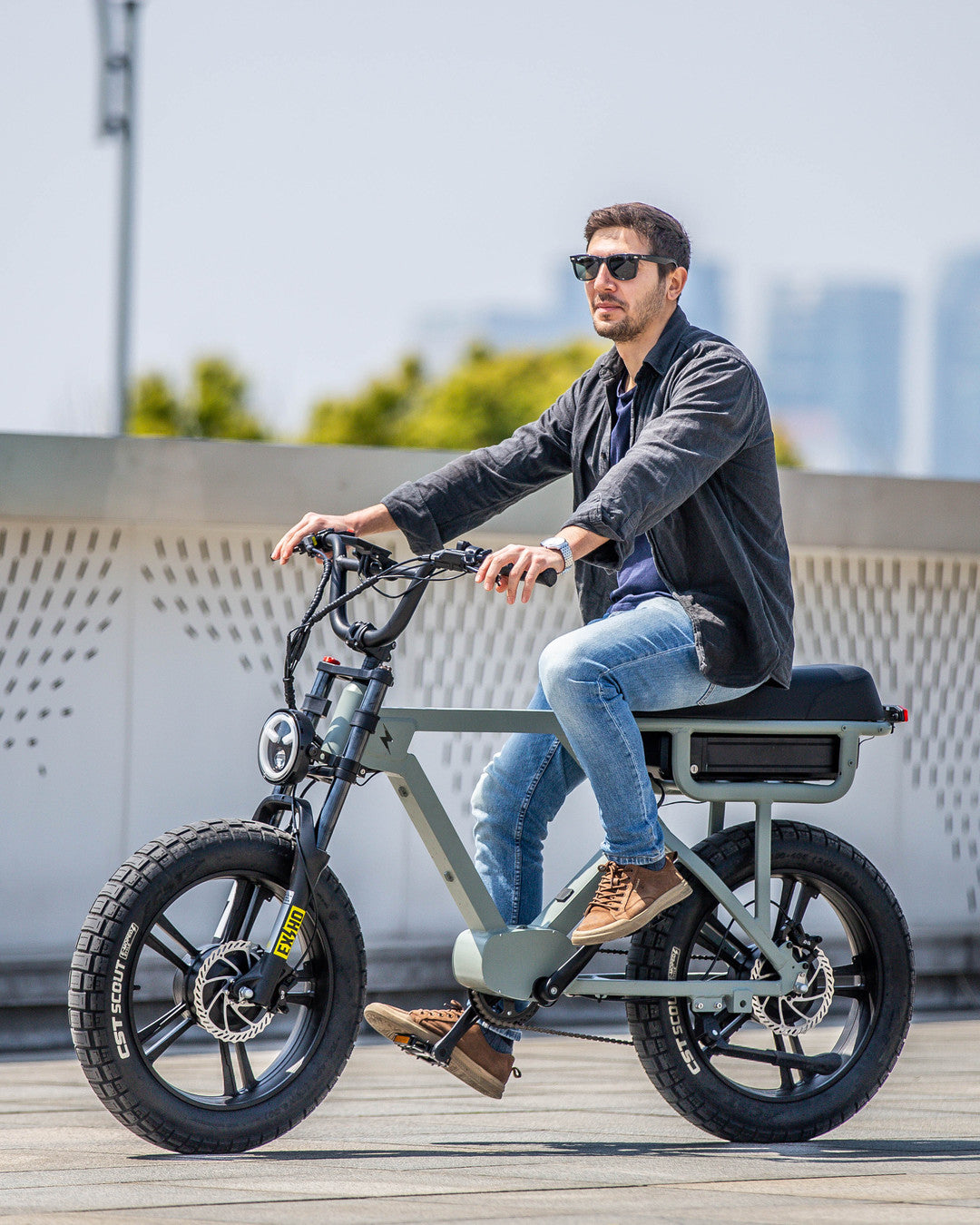

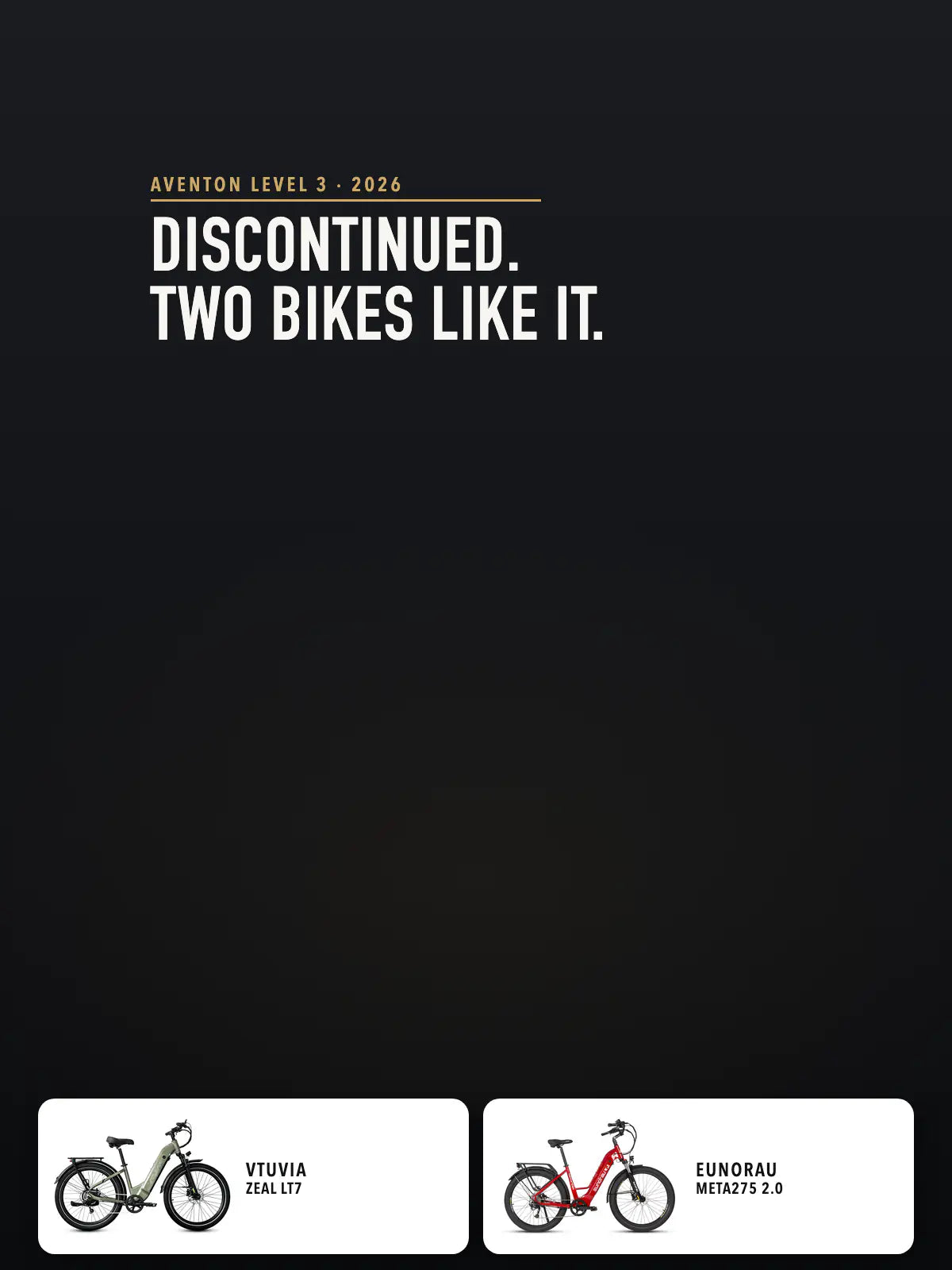

The Level 3 as Aventon prints it on October 4, 2026, its range and fit computed from those figures, and the two bikes on our shelf built the same way.
Quick Answer The Aventon Level 3 is a Class 2 commuter with a 500 W rear hub motor, a torque sensor and a 733 Wh battery, at 67 lb and $1,699. A 180 lb rider covers about 46 miles at 15 mph on the throttle on a full charge. When read on October 4, 2026, Aventon's store tagged it discontinued.
The same charge gives about 31 at 20 mph, and about 77 at 15 mph with easy pedaling, on flat ground (computed below). None of its eight frame, size and color options could be ordered from Aventon that day, and its motor peaks at 864 W in Boost.
We do not sell Aventon. Two bikes we sell are built the same way, a 500 W rear hub with a torque sensor: the $1,099 VTUVIA Zeal LT7 and the $1,699 Eunorau META275 2.0, compared below.
How we verified this review. On October 4, 2026 we opened both Level 3 listings, step-over and step-through, as a US shopper is served them and saved every row of the spec, geometry and size tables. The range and fit figures are computed from those rows with published physics, every input linked. We do not sell Aventon; we sell the two bikes named here, and that is our interest in this page.
By Milad Ghobadibeygvand, BScN (Western University, 2014), Redtail eBikes. Verified October 4, 2026. Part of our guide to all 16 Aventon models.
The Aventon Level 3 on paper: its specification
The Level 3 is a 67 lb commuter with a 500 W rear hub motor, a torque sensor, a 733 Wh battery and a rack, sold in a step-over and a step-through frame. Each frame comes in Regular and Large, and each size in two colors: Matte Black or Matte Aurora on the step-over, Sandstone or Glacier Mint on the step-through.
Every row below is printed on Aventon's step-over page and its step-through page, read October 4, 2026. Where the two pages differ, both are given.
| Row | What Aventon prints |
|---|---|
| Price | $1,699, with $1,899 struck through |
| Class | "Class 2 Ebike"; the page's top strip reads "Top Speed Max 28 MPH" |
| Motor | 36 V, 500 W sustained, 864 W peak; 60 Nm |
| Sensor | "Double Sided Bottom Bracket Torque Sensor" |
| Throttle | Left-hand, on the handlebar |
| Battery | Removable, internal; 36 V, 20 Ah, 733 Wh; LG 21700 cells; 8.7 lb |
| Charger and time | 42 V, 4 A; 5 hours from empty to full |
| Range claim | "Up to 70 Miles", for a 165 lb rider in Eco Mode on flat pavement |
| Weight and limit | 67 lb; 300 lb total; the rear rack 60 lb |
| Rider height | Step-over 5'3" to 6'4"; step-through 4'11" to 6'1" |
| Wheels and tires | 27.5 in; Kenda Kwick Seven-5 Sport, 27.5 x 2.20 |
| Brakes | Magura AT-2 or Tektro HD-E3520 hydraulic discs, 180 mm rotors |
| Gears | Shimano Altus, 8 speeds, 12-32T cassette, 48T chainring, 170 mm cranks |
| Suspension | 80 mm coil fork with lockout; 50 mm suspension seatpost |
| Water | Step-through table: "Bike - IPX5 // Components - IPX6" |
| Certification | UL 2849 for the bike system; UL 2271 for the battery |
One row needs a second look. The spec table lists only a torque sensor, while a feature tile further down the same page offers a "Sensor Switch" to "choose between using a Torque or Cadence sensor". The Level 4 REC's table prints "Sensor Switch Compatible (Cadence & Torque)" in the row where the Level 3 prints a torque sensor alone. If cadence mode matters to you, ask Aventon or a dealer before you count on it.
The step-over's table lists fenders and a rear rack as included. The step-through's table omits those two rows and keeps the 60 lb rack limit.
Discontinued: what that means if you still want one
Aventon tags both Level 3 listings "DISCONTINUED" and "EOL", and on October 4, 2026 none of the eight frame, size and color options could be ordered from it. The price stayed at $1,699 against a struck $1,899, and Aventon's product record lists every option as unavailable.
If you still want one, three routes remain. A dealer may hold stock: the Level 3 page carries Aventon's badge for "1,800+ Bike Shops for maintenance, service, and repairs". A used bike is the second route, and our Aventon guide's warranty section sets out Aventon's terms. The third is a newer model or a bike built the same way, both covered further down.
The same page promises a "2 Year Warranty from the date of purchase" and a "Lifetime Frame Warranty *with ebike registration". Ask any seller for the purchase date and whether the bike was registered, because both terms run from them.
Bottom line Aventon no longer sells the Level 3 new. If you want the same kind of bike shipped new with a warranty that starts on your delivery day, the two built the same way were in stock at their makers on October 4, 2026.
How far the Level 3 goes: range by speed, hill, load and cold
With 180 lb aboard on flat ground, a full Level 3 battery covers about 46 miles at 15 mph on the throttle, about 31 at 20 mph, and about 77 at 15 mph with easy pedaling. Hold 10 mph up a steady 8% grade on the throttle and the same charge lasts about 9 miles.
To find your own figure:
- Find your speed and how much you pedal in the speed tables.
- Then the climbing: each 1,000 feet of gain at 10 mph on the throttle costs about 147 to 173 Wh on grades from 4 to 8% (the hills table).
- Correct for your weight and load and the temperature, then plan on three-quarters of the pack.
Each figure is one steady ride computed from Aventon's own rows, a Bafang rear hub motor rated at the same 36 V and 500 W, rolling resistance measured on 273 commuters' tires and a cycling power model checked against power meters on an open road. The arithmetic is worked through at the end.

Computed miles on one charge, flat ground, 77 °F, 180 lb aboard. The pale bars add 75 W of easy pedaling.
Does speed cut the Level 3's range? Miles at each speed
Yes, sharply near the top: about 67 miles at 10 mph on the throttle and about 31 at 20 mph. Going from 15 to 20 mph alone takes 15 of those miles away, 46 at the slower pace and 31 at the faster.
Air resistance does most of that. The force grows with the square of your speed and the power it takes grows with the cube, so each mile an hour you add near 20 costs more than the one before it.
| Speed, flat | Per mile | Full charge | With 25% kept |
|---|---|---|---|
| 10 mph | 10.9 Wh | 67 mi | 50 mi |
| 12 mph | 12.7 Wh | 58 mi | 43 mi |
| 15 mph | 16.0 Wh | 46 mi | 34 mi |
| 18 mph | 20.3 Wh | 36 mi | 27 mi |
| 20 mph | 23.8 Wh | 31 mi | 23 mi |
180 lb aboard and the motor doing all the work, on flat ground at 77 °F, up to the 20 mph the Level 3 ships at. The last column keeps a quarter of the pack in reserve, the share researchers at KIT found unused on one measured pedelec, since Aventon publishes no reserve of its own.
Pedal easily, about 75 W, and the 15 mph ride stretches from 46 miles to 77. In these tables 75 W is easy and 150 W is steady. With the motor off, 75 W from your legs holds about 10.2 mph on the Level 3 and 150 W about 14.1 mph, so pick the column nearest the way you ride without help.
| Speed, flat | Throttle only | Easy pedaling (75 W) | Steady pedaling (150 W) |
|---|---|---|---|
| 15 mph | 46 mi | 77 mi | 197 mi |
| 18 mph | 36 mi | 50 mi | 77 mi |
| 20 mph | 31 mi | 39 mi | 54 mi |
Miles on one charge, flat ground, 180 lb aboard. Read the 197-mile cell as the least certain: at 15 mph a steady rider does most of the work, and no source read here prints the motor's efficiency at so light a load (Limitations, item 6).
Aventon's app can raise pedal assist to 28 mph (see the class section). Those speeds cost far more.
| Speed, flat | Easy pedaling (75 W) | Steady pedaling (150 W) |
|---|---|---|
| 24 mph | 26 mi | 32 mi |
| 28 mph | not held | not held |
At 28 mph the model's motor, held to its rated 500 W, cannot keep the speed even with 150 W from your legs; Aventon's Boost lifts the peak to 864 W for up to 30 seconds at a time.
Do gears or pedaling save battery on the Level 3?
Pedaling saves battery; changing gear on its own does not. The motor sits in the rear hub, outside the chain, so the gear you pick sets how fast your legs turn and not how hard the motor works. At a fixed speed and grade, only more of your own effort lowers what the pack spends.
| Your ride | Throttle only | Easy pedaling (75 W) | Steady pedaling (150 W) |
|---|---|---|---|
| 15 mph, flat | 16.0 Wh | 9.5 Wh | 3.7 Wh |
| 20 mph, flat | 23.8 Wh | 18.6 Wh | 13.7 Wh |
| 12 mph, 4% grade | 47.3 Wh | 34.8 Wh | 23.9 Wh |
| 12 mph, 8% grade | — | — | 64.8 Wh |
Watt-hours a mile, 180 lb aboard, at the motor's rated 500 W. A dash means the motor at its rating cannot hold that speed on that grade with that much help; the next table lets it use its peak.
The 48T chainring and the 12-32T cassette still matter: the gears let your legs keep a comfortable cadence from a standing start to 20 mph, and that is what keeps your 75 W or 150 W coming.
How much battery does a climb cost?
On a steady 8% grade at 10 mph on the throttle, the pack spends 84 Wh a mile and lasts about 9 miles; pedal easily and it lasts about 11. Each 1,000 feet of climbing on the throttle costs about 147 Wh at 4%, 159 Wh at 6% and 173 Wh at 8%, against 93 Wh to lift a 180 lb rider and the 67 lb bike that far with no losses at all.

Computed for 180 lb aboard at 10 mph, the pack's draw capped at Aventon's 864 W peak and the motor's torque at the comparable's 50 N·m.
| Grade | Wh a mile | Miles, throttle | Miles, easy pedaling | Top steady speed |
|---|---|---|---|---|
| 2% | 26 Wh | 28 mi | 48 mi | 20.0 mph |
| 4% | 42 Wh | 17 mi | 25 mi | 18.3 mph |
| 6% | 61 Wh | 12 mi | 16 mi | 14.7 mph |
| 8% | 84 Wh | 9 mi | 11 mi | 11.4 mph |
| 10% | past the peak | — | 8 mi | 8.3 mph |
| 12% | past the peak | — | — | 5.5 mph |
Throttle-only rows at 10 mph; the top steady speed is the fastest the motor holds on that grade on the throttle alone, 180 lb aboard.
Past 8%, plan to pedal. On a 10% grade the motor alone holds about 8.3 mph, and on 12% about 5.5 mph, in this model. Aventon prints 60 Nm and a Boost of up to 120% of torque and peak power for 30 seconds, so short ramps can go faster than these steady rows (Limitations, item 3).
How much does a heavier rider or a full rack cost?
Every 50 lb you add costs about 3 miles at 15 mph on the flat; on an 8% climb it decides whether the motor can hold 10 mph at all. Count yourself, your bag and whatever rides on the rack: the 300 lb limit covers all of it.
| You plus your load | 15 mph flat, throttle | 20 mph flat, throttle | 8% climb, 10 mph |
|---|---|---|---|
| 130 lb | 49 mi | 32 mi | 12 mi |
| 180 lb | 46 mi | 31 mi | 9 mi |
| 230 lb | 43 mi | 29 mi | past the motor's peak |
| 280 lb | 40 mi | 28 mi | past the motor's peak |
| 300 lb | 40 mi | 28 mi | past the motor's peak |
Throttle only, full pack, 77 °F. "Past the motor's peak" means the model's motor cannot hold 10 mph on that grade at its torque cap: pedal, or take the grade slower.
How much range does the cold take?
At freezing, the same 15 mph ride drops from about 46 miles to about 36, and at 14 °F to about 33. The cells hold less usable energy when cold, and the air gets denser.
| Air | Pack energy vs 77 °F | 15 mph flat, throttle |
|---|---|---|
| 95 °F | 99% | 47 mi |
| 77 °F | 100% | 46 mi |
| 68 °F | 98% | 44 mi |
| 50 °F | 93% | 39 mi |
| 41 °F | 91% | 38 mi |
| 32 °F | 89% (80–93) | 36 mi (33–38) |
| 14 °F | 82% (40–83) | 33 mi (16–33) |
Computed from McMaster University's LG cell data at 0.5C, with the spread across other published cell data in brackets. Aventon names LG 21700 cells but no cell model (Limitations, item 4).
Aventon's own battery advice on the same page is to "Avoid extreme temperatures" and to store and charge the pack in "a climate-controlled area". Bring it indoors on cold nights, and it starts the morning warm.
Do the tires and your posture cost range?
A slower-rolling tire costs about 6 miles at 15 mph; leaning further forward gains about 2. The Level 3 ships on Kenda Kwick Seven-5 Sport tires, and no rolling-resistance drum test of that tire was found, so the model uses field figures for everyday riders' tires.
| Rolling resistance | 15 mph flat, throttle | 20 mph flat, throttle |
|---|---|---|
| 0.0070 · slick tires, 137 everyday riders | 47 mi | 31 mi |
| 0.0074 · commuter tires, 273 everyday riders (used) | 46 mi | 31 mi |
| 0.0107 · commuter tires, one standard deviation up | 40 mi | 28 mi |
Rolling resistance from Tengattini and Bigazzi, 2018, measured by coast-down on riders' own bikes. Keep the tires at the pressure on their sidewall; a soft tire rolls like the bottom row.
The model seats you like the upright cruiser riders in the same study. Leaning like their mountain-bike riders gains about 2 miles at 15 mph and about 1 at 20.
Aventon's 70 miles, as a steady ride
Aventon's "Up to 70 Miles" matches a steady ride of about 15.8 mph with easy pedaling for its stated 165 lb rider, or about 9.9 mph on the throttle alone. Its footnote sets the conditions: "a rider weighing 165 lbs (75 kg) on a paved, flat road, in Eco Mode, with Ride Tune set to the default settings".
| Aventon's figure | Throttle only | Easy pedaling (75 W) | Steady pedaling (150 W) |
|---|---|---|---|
| 70 miles, 165 lb rider | about 9.9 mph | about 15.8 mph | about 18.7 mph |
Each cell is the steady speed at which the model spends the full 733 Wh over 70 miles on flat ground at 77 °F.
Eco is the lowest of the three assist levels, and the torque sensor matches the motor's help to your pedaling, so a figure built on easy pedaling is the likely reading. On the throttle alone, 70 miles would need about 10 mph the whole way.
Two independent figures sit near the model. Electric Bike Report rode its Level 3 to empty twice on paved trails in St. George, Utah, and reported "44.2 and 80.6 miles (in Turbo and Eco modes, respectively)". It publishes neither its speed nor its rider's weight for those rides, so the table gives what the model needs to match each distance at 180 lb.
| Tester's distance | Throttle only | Easy pedaling (75 W) | Steady pedaling (150 W) |
|---|---|---|---|
| Electric Bike Report, Eco (lowest assist), 80.6 miles | about 7.2 mph | about 14.8 mph | about 17.8 mph |
| Electric Bike Report, Turbo (highest assist), 44.2 miles | about 15.5 mph | about 19.1 mph | about 21.4 mph |
Steady speeds at which the model spends the full pack over each distance, flat, 180 lb, 77 °F.
Speeds near 15 mph in Eco and near 19 mph in Turbo, with a rider pedaling, are commuting speeds, so the tester's distances and the model agree in kind. They cannot agree in number without the speed and weight the test leaves out (Limitations, item 7).
Planning a daily commute? Send your distance, your speed, your weight and the worst hill on the way to support@redtailebikes.com, and we will run it through this model for the Level 3 and for the bikes we sell, before you buy anything.
See the Zeal LT7, $1,099The range formula, worked through
Range is the battery's energy divided by what each mile costs, and each mile's cost is the power to roll, to push the air and to climb, divided by your speed and by the motor's and the battery's losses. The power at the rear wheel comes from Martin and colleagues' 1998 model:
P = v × [ m × g × (Crr × cos θ + sin θ) + ½ × ρ × CdA × v² ]
Here v is your speed, m the mass of rider, load and bike, g gravity and θ the slope; Crr is the tires' rolling resistance, ρ the air's density and CdA the drag area you show the wind.
| Input | Value used | Where it comes from |
|---|---|---|
| Bike | 67 lb; 733 Wh pack | Aventon's spec table |
| Rolling resistance (Crr) | 0.0074 | Tengattini and Bigazzi, 2018, commuter tires |
| Drag area (CdA) | 0.64 m² | Tengattini and Bigazzi, 2018, upright riders |
| Air density (ρ) | 1.184 kg/m³ at 77 °F | U.S. Standard Atmosphere, 1976 |
| Chain, your share | 97.7% | Martin et al., 1998 |
| Motor | 80% at its 500 W rating | Bafang OEM workbook, 2021, RM G360.500.DC |
| Battery losses | 3.4% at 15 mph | Arango, Lopez and Ceren, 2021 |
| Reserve kept | 25% | Schmitt, Decker and Doppelbauer, 2019 |
One ride, worked through: 15 mph on the flat on the throttle, 180 lb aboard.
- Mass. 180 lb of rider and 67 lb of bike make 112.0 kg.
- Rolling. Speed × mass × gravity × rolling resistance: 6.71 m/s × 112.0 kg × 9.81 × 0.0074 = 54.5 W.
- Air. ½ × air density × drag area × speed cubed: ½ × 1.184 × 0.64 × 6.71³ = 114.2 W.
- At the wheel. 54.5 W + 114.2 W = 168.8 W.
- The motor. Aventon names no motor maker and prints no efficiency, so the model takes the Bafang RM G360.500.DC, a rear gear hub rated at 36 V and 500 W, at Bafang's 80% efficiency floor. At this speed it runs at 72.6%, drawing 232.4 W from the pack.
- The battery. The pack loses 3.4% of that inside itself at this current, so the cells deliver 240.5 W.
- Per mile. 240.5 W ÷ 15 mph = 16.0 Wh a mile.
- Range. 733 Wh ÷ 16.0 Wh = 45.7 miles on a full pack; keep a quarter in reserve and plan on 34.3.
Why that Bafang motor: its workbook row lists two speed pairs, and only the faster one (423 rpm with no load, 380 at its rating) turns a 27.5 x 2.20 wheel past Aventon's 28 mph. The row lists 50 N·m against Aventon's 60 Nm, so the model caps the torque at 50 and runs Aventon's figure as a check: on the flat it changes nothing, and the climbs are where Limitations item 3 applies.
Will the Level 3 fit you? Frame, size and saddle
Pick the frame first, then the size: Aventon sizes the step-through from 4'11" to 6'1" and the step-over from 5'3" to 6'4", each split into Regular and Large. Then set the saddle so the knee stays slightly bent at the bottom of each stroke: about 28.9 inches from the crank axle for a typical 5'8" rider.
To find your fit:
- Find your height in Aventon's size windows, charted below, to choose the frame and size.
- Measure your inseam (barefoot, floor to crotch) and find your saddle height in the saddle table.
- Set it with the heel check on the first ride.

Aventon's own height and inseam windows for each frame and size, read from its size tool on October 4, 2026.
How high should my saddle go?
For a typical rider at 5'7", the saddle's top sits about 28.4 inches from the crank axle, measured along the seat tube; at 6'1" about 32.1 inches. That is 109% of your inseam from the pedal axle with the crank in line with the seat tube, the standard cycling formula, minus the Level 3's 170 mm (6.7 in) crank.
| Your height | Typical inseam | Crank axle to saddle top | At 106% | At 110.4% |
|---|---|---|---|---|
| 4'11" | 26.8–29.3 in | 23.9 in | 23.0 in | 24.3 in |
| 5'1" | 27.7–30.3 in | 25.1 in | 24.3 in | 25.6 in |
| 5'3" | 28.7–31.6 in | 26.1 in | 25.2 in | 26.5 in |
| 5'5" | 29.7–32.6 in | 27.1 in | 26.2 in | 27.6 in |
| 5'7" | 30.7–33.9 in | 28.4 in | 27.4 in | 28.8 in |
| 5'9" | 31.7–34.8 in | 29.4 in | 28.4 in | 29.9 in |
| 5'11" | 32.9–36.1 in | 30.7 in | 29.7 in | 31.2 in |
| 6'1" | 33.9–37.2 in | 32.1 in | 31.1 in | 32.6 in |
| 6'3" | 35.3–38.0 in | 33.2 in | 32.1 in | 33.8 in |
Inseams of the US Army's ANSUR II survey bodies at each height, the middle 90% shown; the saddle columns are for the median body. The 106% and 110.4% columns bracket the published range of the formula. Use your own inseam over the table's when you know it.
Aventon's size tool prints its own inseam windows beside each height window: 24 to 29 inches for the step-through Regular, 29 to 33 for the Large, 26 to 31 for the step-over Regular and 31 to 35 for the Large. The survey's inseams run longer at the same heights, so use both figures beside each other and trust your own tape measure over either.
Can I put my feet down at a stop?
Yes on either frame for nearly everyone Aventon sizes it for: the step-through's top tube sits 17.4 inches up, and the step-over's 27.0 inches on the Regular and 27.4 on the Large. Every rider from 5'3" up in the survey clears all three with a barefoot inseam.
| Your height | Typical inseam | Clear the step-through, of 100 | Clear the Regular step-over, of 100 | Clear the Large step-over, of 100 |
|---|---|---|---|---|
| 4'11" | 28.1 in | 100 | 84 | 75 |
| 5'1" | 29.2 in | 100 | 99 | 99 |
| 5'3" | 30.1 in | 100 | 100 | 100 |
| 5'5" | 31.0 in | 100 | 100 | 100 |
| 5'7" | 32.2 in | 100 | 100 | 100 |
| 5'9" | 33.1 in | 100 | 100 | 100 |
| 5'11" | 34.3 in | 100 | 100 | 100 |
| 6'1" | 35.6 in | 100 | 100 | 100 |
| 6'3" | 36.6 in | 100 | 100 | 100 |
Riders of 100 at each height in the survey whose barefoot inseam clears each frame's published standover (687, 695 and 442 mm). Shoes add clearance.
Below 5'3", Aventon points you to the step-through, and the table agrees: it clears everyone.
How upright will I sit?
Aventon publishes the frame's stack and reach but not where the grips sit, so how far you lean is not computed here. On the Regular step-over the stack is 620 mm and the reach 420 mm, both measured from the crank axle to the top of the head tube; the grips sit beyond that on a stem and a bar whose length, angle and rise the spec table does not print.
Aventon's description says the Level 3 pairs "Comfortable geometry" with "an adjustable stem", so the bar can be raised and pulled back after delivery. If you ride upright by preference, check the stem's adjustment range with the seller before you buy.
How much weight rests on my wrists?
The load on your hands depends on the grip position, and the grip position is not published, so it is not computed here. What Aventon does print: a 74° seat angle, a 680 mm bar and an adjustable stem. Bringing the grips closer and higher moves weight off your hands and onto the saddle.
For a yardstick, Carahalios (2015) measured riders on an ergometer with their hands on road-bike brake hoods at 2 W/kg, and found 15% of their body weight on the stem. How much a Level 3 rider carries depends on the grip position this page cannot place.
If your wrists ache on a bike now, set the stem up and back on the first day, then ride a week before you change anything else.
How do I set the saddle when it arrives?
Set it so your heel just reaches the pedal at the bottom of the stroke with your leg straight; on the ball of your foot that leaves the slight bend the formula aims for. Then check the number against the saddle table.
- Stand the bike against a wall and sit on it with your heel on the pedal at its lowest point.
- Raise or lower the 30.9 mm seatpost until that leg is straight with the heel on the pedal.
- Ride with the ball of your foot on the pedal. Your knee should stay a little bent at the bottom, never locked.
- If your hips rock side to side, the saddle is too high; drop it 5 mm at a time.
The Level 3's seatpost has 50 mm of suspension travel, so set the height with your weight on the saddle, not with the bike empty.
The fit arithmetic
| Input | Value | Source |
|---|---|---|
| Rider windows | Step-through 4'11" to 5'7" and 5'7" to 6'1"; step-over 5'3" to 5'10" and 5'10" to 6'4" | Aventon's size tool, both frames |
| Inseam windows | 24 to 29, 29 to 33, 26 to 31 and 31 to 35 in | Aventon's size tool |
| Standover | 687 and 695 mm step-over; 442 mm step-through | Aventon's geometry table |
| Crank | 170 mm (6.7 in) | Aventon's spec table |
| Bodies | 6,068 US Army personnel, women and men | ANSUR II |
| Saddle formula | 109% of inseam from the pedal axle; range 106% to 110.4% | Peveler et al., 2005; Ferrer-Roca et al., 2012 |
Saddle height from the crank axle = 1.09 × inseam − crank length. For the survey's median 5'8" rider, with an inseam of 32.6 inches: 1.09 × 32.6 = 35.6 inches from the pedal axle to the saddle top, and minus the 6.7-inch crank, 28.9 inches from the crank axle.
The formula is Hamley and Thomas's 109% of inseam, which Peveler and Green found sets the knee near the 25 to 35° bend they recommend, and LeMond's 88.3% from the crank axle gives the same saddle within a tenth: 28.8 inches. The published range runs from 106% to 110.4%, which for that rider is 27.9 to 29.3 inches.
Between sizes, or under 5'3"? Send your height and inseam to support@redtailebikes.com. We will tell you, in writing, which frame and size of each bike fits before you order.
See the META275 2.0, $1,699Speed, class and where you may ride
The Level 3 ships as a Class 2 e-bike: throttle and pedal assist both stop helping at 20 mph. Aventon's spec table reads "Class 2 Ebike", and its top strip reads "Top Speed Max 28 MPH".
Aventon's support article explains the pair: "Out of the box, the bike ships as a class 2 Ebike (20mph max for throttle and PAS) and specific models (as advertised) can be unlocked into a class 3 configuration (20mph max for throttle & 28mph max for PAS)."
The class you ride in decides where you may ride, and our 50-state e-bike law guide quotes each state's rule. If you change the setting, read the rule for every path on your route first.
Federal land carries penalties of its own. In a national park, 36 CFR 4.30(i) leaves the superintendent to designate "the areas open to electric bicycles, or specific classes of electric bicycles", and it bars "using the electric motor exclusively to move an electric bicycle for an extended period of time without pedaling" where cars may not go.
A violation there falls under 36 CFR 1.3, which applies 18 U.S.C. § 1865(a): an offender "shall be imprisoned not more than 6 months, fined under this title, or both". Read the park's compendium for your class before you ride its trails, and our public-land e-bike guide covers each federal agency.
Security, the app and Boost
The Level 3's control unit adds GPS tracking, a rear-wheel lock, an alarm and remote shutdown, and the 4G half of it becomes a paid subscription after the first year. Aventon's footnote says so: "A complimentary 4G connection subscription is included for the first year, beginning from the product service registration date", and "After the first year, a paid 4G connection subscription will be required to maintain access to these services."
What the page lists, in Aventon's words:
- Rear-wheel lock. "An integrated rear wheel lock adds an extra layer of security by immobilizing your bike when parked", controlled "through the Aventon app or directly on the bike display".
- Report lost. "With 4G subscription, the motor assistance can be disabled from the Aventon app, and the bike's motor will stop functioning."
- Startup password. An optional code "on the bike's display, helping to prevent unauthorized use of your bike".
- Boost. "up to 120% of specced torque and peak power for up to 30 seconds at a time", which on the Level 3 is the 864 W peak in its top strip.
- Walk and Hold. "Release the Walk Mode button to activate Hold Mode for up to 30 seconds at a time", which keeps the bike from rolling back on a slope.
- Ride Tune. Lets you "customize torque, assistance, and pedal response in each of the three assist modes".
If you buy a used Level 3, ask the seller to remove it from their Aventon app account before you pay. Ask too whether the 4G plan is active, because the tracking and remote features depend on it.
Certificates and recalls
The Level 3 page links a UL Solutions certificate for the bike's electrical system to UL 2849 and a UL certificate for its 36 V battery to UL 2271, and no federal recall names the Level 3. Both certificates are issued to Ride Aventon Inc. of Brea, California.
| Document | Certificate | Standard | Issued |
|---|---|---|---|
| Bike electrical system, "LEVEL Pedelecs and E-Bikes" | UL-US-2557601-0 | UL 2849:2022A | February 25, 2025 |
| 36 V battery pack, a UL Recognized Component | UL-US-2440268-0 | UL 2271:2023 | October 14, 2024 |
A third link on the same page opens the certificate for the Abound SR and LR, a different model.
The Consumer Product Safety Commission's recall database held one Aventon recall when it was read on October 3, 2026: the Sinch.2 folder in January 2024, fixed by a software update. None names the Level 3.
Level 3 or Level 4 REC?
The Level 4 REC is the Level 3's in-stock successor in Aventon's hub-motor line: same battery, same frame sizes, a 750 W motor and regenerative braking, at $1,999 on October 3, 2026. Choose it over a Level 3 if you climb a lot or want the cadence mode the Level 4 REC's table lists.
| Level 3 | Level 4 REC | |
|---|---|---|
| Price | $1,699, discontinued | $1,999, in stock on October 3, 2026 |
| Motor | 500 W, 864 W peak in Boost, 60 Nm | 750 W, 1,188 W peak (1,440 W in Boost), 80 Nm |
| Battery | 733 Wh, 36 V | 733 Wh, 36 V |
| Sensor | Torque | "Sensor Switch Compatible (Cadence & Torque)" |
| Regenerative braking | Not listed | Listed: "Charge on Descents" |
| Range claim | Up to 70 miles | Up to 75 miles |
| Weight | 67 lb | 68.5 lb |
Both from Aventon's own tables: the Level 3 on October 4 and the Level 4 REC on October 3, 2026. Both read "Class 2" as shipped, carry 300 lb and size riders the same way.
Where the Level 4 REC is the better buy: a 750 W motor with 80 Nm climbs harder, regenerative braking returns some energy on descents, and a dealer can let you ride one first. Its 750 W counterpart on our shelf is the VTUVIA Zeal XT8 at $1,399.
Bottom line The Level 4 REC adds 250 W and regenerative braking for $300 over the Level 3's last price. If you climb often, that is the trade to make; if you ride mostly flat, the speed table shows the 500 W motor holding every speed up to the 20 mph the Level 3 ships at, on the throttle alone.
Two bikes we sell that match it
Two bikes on our shelf are built the way the Level 3 is: a 500 W rear hub motor, a torque sensor and a step-through frame, with 624 to 720 Wh of battery against the Level 3's 733. Both are in stock at their makers, VTUVIA and Eunorau, and at the makers' own prices, read October 4, 2026, and both ship free.
VTUVIA Zeal LT7
$1,099 · maker's list $1,299For $600 under the Level 3's last price, the LT7 keeps the same layout: a torque sensor driving a 500 W rear hub with 65 N·m, by VTUVIA's spec table, and a step-through frame with an 18.5-inch standover. It weighs 62 lb with its rack and fenders.
The trade is battery: its 624 Wh pack holds 109 Wh less than the Level 3's. In return you carry 5 lb less and can load 350 lb against 300, and VTUVIA fits it to riders from 5'3" to 6'2".
Our Zeal LT7 review computes its range the same way this page computes the Level 3's.
Ships free to the lower 48 · we run any warranty claim for you · Shop Pay: $99.19 a month over 12 months at 15% APR

VTUVIA's own photograph of the Zeal LT7 in Olive Green, with the rack and fenders it ships with.
Eunorau META275 2.0
$1,699Same price as the Level 3, and 13 Wh short of its battery: Eunorau's table gives the META275 2.0 a 48 V 15 Ah pack (720 Wh), a 500 W rear hub with 55 N·m run by a torque sensor, and a 20 mph top speed, at 68.4 lb. Eunorau also offers a second battery as an option for longer days.
Measure yourself against two of its figures first: Eunorau fits it to riders from 5'6" to 6'1", and it carries 286 lb in all, 14 lb under the Level 3's 300.
Our META275 2.0 review covers its fit and range in full.
Ships free to the lower 48 · we run any warranty claim for you · Shop Pay: $153.35 a month over 12 months at 15% APR

Eunorau's own photograph of the META275 2.0 in Deep Crimson.
Which one: if you want the lower price and a higher load limit, the LT7. If battery comes first, the META275 2.0's 720 Wh sits 13 Wh under the Level 3's 733, and its optional second battery goes further. Under 5'3", neither maker sizes these two for you, so write to us before you order.
Bottom line Lowest price: the Zeal LT7 at $1,099. Most battery at the Level 3's own price: the META275 2.0's 720 Wh. Both are 500 W rear-hub bikes with torque sensors, and both ship free to the lower 48.
Buying one of these from us
Order either bike and it ships free anywhere in the contiguous United States, with support@redtailebikes.com answering for it from the first question to the last repair. By our shipping policy, it leaves within 1 to 3 business days and usually reaches you 5 to 10 business days later.
| If this happens | What we do |
|---|---|
| The box arrives damaged | Note it with the driver and email us photos within 48 hours; we file the carrier claim |
| The bike shows an error or will not charge | It is covered by the maker's warranty, and we coordinate the repair or replacement |
| You are unsure of the size | Send your height and inseam, and we answer in writing before you pay |
| You want to spread the cost | Shop Pay offers 3, 6 or 12 monthly payments at 15% APR |
Settle the fit before you order, because returns are tight: under our refund policy a bike comes back only in its unopened factory box, requested within 72 hours of delivery, less 15% and the shipping back.
Green flags, and who the Level 3 fits
Green flags, each from the record:
- A 733 Wh battery of LG 21700 cells, removable, 8.7 lb on its own (specs).
- A torque sensor, three assist levels and Ride Tune to adjust each (security and app).
- Hydraulic disc brakes on 180 mm rotors, an 80 mm fork with lockout and a suspension seatpost (specs).
- A UL 2849 certificate for the bike's electrical system and a UL 2271 certificate for its battery (certificates).
- No federal recall naming the Level 3 (recalls).
- Two frames in two sizes each, sized by Aventon from 4'11" to 6'4" (fit).
- About 46 miles at 15 mph on the throttle, computed for 180 lb (range).
Who it fits, and who should read on:
| If you | Then |
|---|---|
| Want a new bike with Aventon's warranty from day one | Read the Level 4 REC row; the Level 3 is discontinued |
| Climb steep grades often or ride above 230 lb | Read the hills table and consider 750 W, such as the Zeal XT8 |
| Want the lowest price for the same kind of bike | Read the Zeal LT7 at $1,099 |
| Want the most battery at the Level 3's price | Read the META275 2.0 at $1,699 |
| Are under 5'3" | Aventon's step-through Regular starts at 4'11"; ask us about sizing before you buy ours |
| Want to ride before you buy | A dealer: Aventon's badge counts 1,800+ shops |
Torn between the two? Tell us the miles you ride, the hills on the way and your height at support@redtailebikes.com, and we will say which one suits the ride before you check out.
Order the META275 2.0Frequently asked questions
Is the Aventon Level 3 discontinued?
Yes. Aventon's product records tag both Level 3 listings "DISCONTINUED" and "EOL", and on October 4, 2026 none of the eight frame, size and color options could be ordered. The page still shows $1,699 against a struck $1,899. A dealer may hold stock; the hub-motor Level Aventon had in stock on October 3 was the Level 4 REC at $1,999.
What is the top speed of the Aventon Level 3?
20 mph as shipped, on both the throttle and pedal assist. Aventon's support article says specific models "can be unlocked into a class 3 configuration (20mph max for throttle & 28mph max for PAS)", and the Level 3 page's top strip reads "Top Speed Max 28 MPH". In this review's model, holding 28 mph on the flat needs more than the 500 W rating plus 150 W from your legs.
What class is the Aventon Level 3?
Class 2: its spec table reads "Class 2 Ebike", with a throttle to 20 mph. Aventon's app setting moves pedal assist to 28 mph, which is Class 3 territory, so check your state's rule and your trail's before you change it. Our state law guide has each state's wording.
How much does the Aventon Level 3 weigh?
67 lb by Aventon's spec table, and the battery alone 8.7 lb. The total weight limit is 300 lb and the rear rack's 60 lb. Electric Bike Report weighed its test bike at 67.5 lb.
How far can the Aventon Level 3 go on one charge?
Aventon says "Up to 70 Miles" for a 165 lb rider in Eco on flat pavement. Computed for a 180 lb rider on the flat with a full 733 Wh pack: about 46 miles at 15 mph on the throttle, 31 at 20 mph, and 77 at 15 mph with easy pedaling. Plan on three-quarters of those figures to keep a reserve.
How long does the Level 3 battery take to charge, and is it removable?
Five hours from empty to full on the 42 V, 4 A charger, by Aventon's table, and yes: the pack is "Removable Internal Lithium-ion". Aventon's advice is to charge it regularly, keep it out of extreme heat and cold, and store it at 75% charge.
Does the Aventon Level 3 have a throttle?
Yes, on the left of the handlebar, working to 20 mph. The class section covers the 28 mph pedal-assist setting.
Does the Aventon Level 3 have turn signals?
Aventon's October 4 table lists "Front and rear lights integrated" and no turn signals. Electric Bike Report's February 2025 review listed "Integrated LED with turn signals" and noted no brake light. Look at the taillight of the bike you are buying.
Does the Aventon Level 3 have regenerative braking?
Aventon's Level 3 spec table and feature list do not list it. The Level 4 REC's page lists "Regenerative Braking" with the line "Charge on Descents", so if you want it, that is the Level to look at.
What is the difference between the Aventon Level 3 and Level 4?
The Level 4 REC keeps the 733 Wh battery and the frame sizes and adds a 750 W motor with 80 Nm, regenerative braking and a cadence mode, at 68.5 lb and $1,999. The comparison table sets them side by side.
What is the difference between the Aventon Level 3 and Level 2?
The Level 2 is also discontinued, and its two listings on Aventon's under-$1,500 page open the Level 3 page. Its catalog card gives $999 for the step-through and $1,499 for the step-over, a 500 W motor and Class 2, and no battery, weight or weight limit.
Is the Aventon Level 3 waterproof?
No. Aventon's FAQ says its bikes are "built to the IPX5 water-resistant standard", which allows riding "in light to moderate rain or through small puddles", that "IPX5 does not mean waterproof", and to avoid "a pressure washer or high-pressure sprayer".
What size Aventon Level 3 do I need?
By Aventon's size tool: step-through Regular 4'11" to 5'7", Large 5'7" to 6'1"; step-over Regular 5'3" to 5'10", Large 5'10" to 6'4". For the saddle, take 109% of your inseam and subtract the 6.7-inch crank: about 28.9 inches from the crank axle at 5'8" (fit).
Is a used Aventon Level 3 worth buying?
It can be, with three checks. Ask for the purchase date and the registration, because the two-year warranty runs from the purchase and the lifetime frame cover depends on registration. Have the seller remove the bike from their Aventon app, and ask whether its 4G plan is still paid. Then compare the price with the two bikes built the same way.
What are the alternatives to the Aventon Level 3?
Inside Aventon, the Level 4 REC. On our shelf, the VTUVIA Zeal LT7 at $1,099 and the Eunorau META275 2.0 at $1,699, each a 500 W rear hub motor with a torque sensor on a step-through frame, in stock at their makers on October 4, 2026.
Is the Aventon Level 3 worth it?
At $1,699 it came with a 733 Wh battery, hydraulic brakes, a torque sensor, GPS security and two certificates. Discontinued, it is worth it only at a used price below the bikes built the same way, with its warranty status known. A new LT7 costs $1,099.
The bottom line
The Level 3 is a complete commuter that Aventon no longer sells new. It came with a 733 Wh battery, hydraulic brakes, a torque sensor and GPS security, and on the throttle alone it covers about 46 miles at 15 mph, computed for 180 lb on the flat.
If you can ride one first and a dealer still has one, buy it with the warranty date in writing. If you want the same kind of bike shipped new to your door, the Zeal LT7 at $1,099 costs $600 less, and the META275 2.0 at $1,699 matches its battery most closely. If you would rather climb on 750 W, read the Level 4 REC row and the Zeal XT8.
Corrections: write to support@redtailebikes.com. Image credit: the cover was designed in Playcut Brush, a design tool from Playcut (playcut.ai), as a hand-written SVG with no image model. Every bike on this page, the two on the cover included, is its maker's own photograph, cropped and scaled only, and the charts are drawn from the computed figures.
Limitations
- Steady rides only. Every range figure holds one speed on one grade with no wind, stops or starts. City riding with lights and stops spends more.
- A comparable motor. Aventon names no motor maker and prints no efficiency or speed curve. The model uses a Bafang rear hub at the same 36 V and 500 W, at Bafang's 80% efficiency floor; the Level 3's own motor may be more or less efficient.
- Torque on climbs. The comparable's workbook lists 50 N·m and Aventon 60 Nm, with a Boost of 120% for 30 seconds. The model caps torque at 50 N·m, so on steep grades the real bike can hold more speed for short spells than the hills table shows.
- Cells at air temperature. The cold table assumes the pack is as cold as the air and uses an LG 18650 cell's data; Aventon names LG 21700 cells without a model. A pack kept indoors starts warmer.
- The tire. No drum measurement of the Kenda Kwick Seven-5 Sport was found, so field figures for everyday commuter tires stand in for it, bracketed in the tires table.
- Light loads. Where your pedaling does most of the work, the motor runs at a light load whose efficiency no source read here prints, so the steady-pedaling cells at 15 mph are the least certain.
- The independent distances. Electric Bike Report gives distance and assist level but no speed or rider weight, so the model can show what speed matches each distance, not confirm it.
- The reserve. Aventon prints no planning reserve; the 25% kept is a researcher's measurement on another pedelec.
- The survey's bodies. The fit tables use the US Army's ANSUR II survey: 6,068 soldiers aged 17 to 58, measured in 2010 to 2012, who are not the general public. Your own inseam decides your row.
- The knee range. The saddle formula aims at the 25 to 35° knee bend Peveler and Green recommend. A rider outside that range by preference or injury sets the saddle by the heel check and comfort instead.
- Fit without grips. Aventon prints no grip position, so lean and hand load are not computed; the saddle and standover rows use the survey's barefoot inseams, which run longer than Aventon's inseam windows at the same heights.
- The sensor. The spec table and a feature tile on the same page disagree on whether the Level 3 offers a cadence mode; this page prints both.
- The turn signals. Aventon's current table and a 2025 review disagree; this page prints both.
- Prices and stock move. Aventon's status and price were read October 4, 2026, the Level 4 REC's on October 3, and ours on October 4. Any of them can change.
This page expires when Aventon relists, reprices or removes the Level 3 or changes its spec table, when VTUVIA or Eunorau changes the price or stock of the two bikes named here, or on January 4, 2027, whichever comes first; each of those events triggers a re-check before the page is republished.
Source register
Each document behind this review, the tier it sits in under our sourcing rules, what it supports and the day it was read.
| Source | Tier | Supports | Read |
|---|---|---|---|
| Aventon Level 3, step-over page | T1 | Specs, price, status, features, size tool, FAQ | October 4, 2026 |
| Aventon Level 3, step-through page | T1 | Step-through rows and sizes | October 4, 2026 |
| Aventon support: pedal assist and throttle | T1 | Class 2 as shipped, the Class 3 setting | October 3, 2026 |
| Aventon Level 4 REC page | T1 | The comparison | October 3, 2026 |
| UL certificate UL-US-2557601-0 and battery certificate | T1 | Certification | October 3, 2026 |
| CPSC recall database | T1 | Recall record | October 3, 2026 |
| 36 CFR 4.30, 36 CFR 1.3, 18 U.S.C. § 1865 | T1 | Federal land rules and penalties | October 4, 2026 |
| Martin et al., 1998; Tengattini and Bigazzi, 2018; Arango, Lopez and Ceren, 2021 | T2 | The range model | September 23, 2026 |
| Bafang OEM workbook, 2021 | T1 | The comparable motor | September 23, 2026 |
| Peveler et al., 2005; Peveler and Green, 2007; Ferrer-Roca et al., 2012; ANSUR II | T2 | The fit model | September 25, 2026 |
| Electric Bike Report review and its method | T3 | Independent distances, measured weight | October 4, 2026 |
| VTUVIA Zeal LT7 page; Eunorau META275 2.0 page | T1 | The two alternatives | October 4, 2026 |
References
The full record of every document cited here, numbered, with its publisher and the date it was retrieved.
- Ride Aventon Inc., Level 3 Ebike (step-over). aventon.com. Retrieved October 4, 2026.
- Ride Aventon Inc., Level 3 Step-Through Ebike. aventon.com. Retrieved October 4, 2026.
- Ride Aventon Inc., Pedal Assist and Throttle Function (support article). rideaventon.zendesk.com. Retrieved October 3, 2026.
- Ride Aventon Inc., Level 4 REC Ebike. aventon.com. Retrieved October 3, 2026.
- Ride Aventon Inc., eBikes under $1,500 (catalog page with the Level 2 cards). aventon.com. Retrieved October 3, 2026.
- UL Solutions, Certificate of Compliance UL-US-2557601-0 (LEVEL Pedelecs and E-Bikes), UL 2849:2022A. PDF. Issued February 25, 2025. Retrieved October 3, 2026.
- UL Solutions, Certificate UL-US-2440268-0 (battery pack, Recognized Component), UL 2271:2023. PDF. Issued October 14, 2024. Retrieved October 3, 2026.
- U.S. Consumer Product Safety Commission, Recalls API, title "Aventon". saferproducts.gov. Retrieved October 3, 2026.
- U.S. Consumer Product Safety Commission, Ride Aventon Recalls Sinch.2 Folding E-Bicycles Due to Crash and Injury Hazards, January 2024. cpsc.gov. Retrieved October 3, 2026.
- 36 CFR 4.30, Electric bicycles, paragraph (i). eCFR. Retrieved October 4, 2026.
- 36 CFR 1.3, Penalties. eCFR. Retrieved October 4, 2026.
- 18 U.S.C. § 1865(a), 2024 edition. GovInfo. Retrieved October 4, 2026.
- Martin, J. C., Milliken, D. L., Cobb, J. E., McFadden, K. L. and Coggan, A. R., Validation of a Mathematical Model for Road Cycling Power, Journal of Applied Biomechanics 14:276–291 (1998). PDF. Retrieved September 23, 2026.
- Tengattini, S. and Bigazzi, A., Physical characteristics and resistance parameters of typical urban cyclists, Journal of Sports Sciences 36(20):2383–2391 (2018), Table 4. PDF. Retrieved September 23, 2026.
- Arango, I., Lopez, C. and Ceren, A., Improving the Autonomy of a Mid-Drive Motor Electric Bicycle Based on System Efficiency Maps, World Electric Vehicle Journal 12:59 (2021), Eq. (40). PDF. Retrieved September 23, 2026.
- Schmitt, Decker and Doppelbauer, pedelec full-system test bench, EPE'19 ECCE Europe (2019). KIT. Retrieved September 23, 2026.
- NOAA, NASA and USAF, U.S. Standard Atmosphere, 1976. NASA NTRS. Retrieved September 23, 2026.
- Kollmeyer, P., LG 18650HG2 Li-ion Battery Data, McMaster University (Mendeley Data). doi:10.17632/b5mj79w5w9.2. Retrieved September 23, 2026.
- Bafang, OEM Workbook 2021, H630 RM G360.350.DC / RM G360.500.DC. PDF. Retrieved September 23, 2026.
- Peveler, W. W., Pounders, J. D. and Bishop, P. A., Effects of Saddle Height on Anaerobic Power Production in Cycling, Journal of Exercise Physiology online (February 2005). ASEP. Retrieved September 25, 2026.
- US Army, For good measure: Natick releases raw data from Army-wide anthropometric survey (ANSUR II, 2012). army.mil. Retrieved September 25, 2026.
- Electric Bike Report, Aventon Level.3 Review, February 24, 2025. electricbikereport.com. Retrieved October 4, 2026.
- Electric Bike Report, How We Test Electric Bikes. electricbikereport.com. Retrieved October 4, 2026.
- VTUVIA, Zeal LT7 Step-Through Commuter Electric Bike. vtuviaebike.com. Retrieved October 4, 2026.
- Eunorau, META275 2.0. eunorau-ebike.com. Retrieved October 4, 2026.
- Peveler, W. W. and Green, J. M., Comparison of saddle height selection methods, PubMed 18076230 (2007). PubMed. Retrieved September 25, 2026.
- Ferrer-Roca, V., Roig, A., Galilea, P. and García-López, J., Influence of saddle height on lower limb kinematics in well-trained cyclists: static vs. dynamic evaluation in bike fitting, Journal of Strength and Conditioning Research 26(11):3025–3029 (2012). PubMed. Retrieved September 25, 2026.
- Carahalios, A., An Analysis of the Bicycle-Rider Interface Forces in Stationary Road Cycling, MS thesis, Department of Integrative Physiology, University of Colorado (2015). CU Scholar. Retrieved September 25, 2026.

Share:
Aventon eBikes (2026): 16 Models and Our Alternatives
Eunorau ONE-TRIKE 2.0 Review 2026: 500W, 440 lb, $1,799