


Alabama writes one of the shortest e-bike statutes in the country and hangs an unusual amount on it. One section, eleven subsections, and a definition that borrows its first word from somewhere else in the code.
Get that definition right and almost nothing applies to you. Miss it by a single watt and you are riding a machine the state calls a motor-driven cycle, which needs a Class M license, a helmet and — this is in the statute — shoes.
Under 750 W, strictly · 5 helmet rules · 463 incorporated places · 67 counties · 107 city codes searched · 212 bikes screened · 23 inside the definition · no state or utility rebate
Author: Milad Ghobadibeygvand, BScN (Western University, 2014), Redtail eBikes. Corrections: mehran@redtailebikes.com. Last verified: September 8, 2026.
Quick Answer
E-bikes are legal in Alabama with no license, no registration, no title, no plate and no insurance, under Ala. Code § 32-5A-267(b).
An electric bicycle here is a bicycle with working pedals, a seat, and an electric motor of less than 750 watts, in one of three classes. Class 3 riders must be 16 or older, and everyone on a Class 3 wears a helmet at any age. Under-16s wear a helmet on any class. A machine rated at 750 watts on the nose is not an electric bicycle in Alabama.
If you only take one number from this page, take 750. Alabama's definition reads "less than 750 watts", so the bike you want publishes a nominal rating below that figure, on two wheels larger than 14 inches. Every listing in our full range shows its nominal motor rating, and the class label § 32-5A-267(c) makes your seller fit lets you check the bike against the listing the day it arrives. Shipping is free to any Alabama address, the warranty is US-based, and the person answering your email is in the US.
See the e-bikes that clear Alabama's lineIn this guide
- What Alabama ebike laws count as an electric bicycle
- Five helmet rules, all in force at once
- The helmet rule that is a crime, and the one that is a $50 ticket
- What happens at exactly 750 watts
- Age: the statute's one rule, and the city that added another
- License, registration, insurance, title, plates
- Where you may ride
- The sidewalk answer, and the section that actually decides it
- Alabama still has a mandatory sidepath rule
- When a city may close a path to you
- One trail, two cities, opposite rules
- State parks answer on designation, not on class
- Gulf Shores set a helmet age the state does not have
- Do you have to wear a helmet on a bicycle in Alabama?
- Are e-bikes street legal in Alabama?
- What are the e-bike rules in Birmingham, Huntsville, Montgomery and Mobile?
- Equipment: lights, brakes, label, speedometer
- Renting one, and renting one out
- Carrying a child
- What changed, and what nearly changed
- Rebates
- Which bikes on our shelf are Alabama legal
- Which bike for which Alabama ride
- The 60-second checklist
- Frequently asked questions
How we verified this guide
Every rule below was read at the publisher. None of it is summarised from another guide.
The statutes come from ALISON, the Alabama Legislature's own Code of Alabama service, through the GraphQL API its website uses. Its public pages render client-side and return nothing to a plain fetch.
The state park rules come from the Legislature's administrative-code service, as the PDF it serves. Municipal ordinances come from each city's own code or its own website. Where a city's rule exists but has not reached its published code, this page says so rather than reporting the code's silence as the city's position.
The bill history was swept across the 2024, 2025 and 2026 sessions on both bill title and subject, against session totals of 1,353, 1,632 and 1,647 instruments — so the absence reported below is measured against a denominator rather than assumed. The sweep was checked first against the 2021 act that created this law, because a search that cannot find what is certainly there cannot be trusted when it finds nothing.
5 different helmet rules are in force in Alabama today — five helmet rules, all at once — which is the headline finding on this page and the reason it leads with helmets rather than with legality. The rest of Alabama e-bike law is unusually generous by comparison: no license, no registration, no plate, and Class 3 from age 16.
What Alabama ebike laws count as an electric bicycle
The definition is one sentence, and it carries three separate numbers.
"ELECTRIC BICYCLE. A bicycle equipped with fully operable pedals, a saddle or seat for the rider, and an electric motor of less than 750 watts that meets the requirements of one of the following three classes" — Ala. Code § 32-1-1.1(16)
Read the first word. It says bicycle, and that is a defined term four subdivisions earlier:
"BICYCLE. Every device propelled by human power upon which any individual may ride, having two tandem wheels either of which is more than 14 inches in diameter." (Ala. Code § 32-1-1.1(4))
So to be an electric bicycle in Alabama a machine has to clear all three:
| Limb | The words | Where it bites |
|---|---|---|
| Motor | "an electric motor of less than 750 watts" | Exactly 750 fails. That is the commonest nominal rating on the American market |
| Wheels | "two tandem wheels" | A three-wheeled machine cannot be an electric bicycle in Alabama, whatever its motor |
| Wheel size | "either of which is more than 14 inches in diameter" | A wheel measuring 14 inches flat is out. Some small-wheel folders and kids' bikes sit here |
Plus fully operable pedals, a saddle or seat, and one of the three classes.
| Class | What the motor does | Cut-off |
|---|---|---|
| Class 1 | Assists only while you pedal | 20 mph |
| Class 2 | May propel the bike on its own | 20 mph |
| Class 3 | Assists only while you pedal | 28 mph |
Two things follow that most Alabama guides miss.
Alabama rules out a trike by incorporation rather than by silence. Nevada writes "two or three wheels" into its own definition and settles it. Missouri says nothing. Alabama says two, in a definition written for pedal bicycles in 1980 and then borrowed wholesale by a 2021 e-bike law. So an adult electric trike is not an "electric bicycle" as § 32-1-1.1(16) uses the term, and the exemptions in § 32-5A-267(b) are not written for it.
Which raises the question the other state pages do not have to answer: what is it instead? Follow the same definitions and there is a route, and it is worth walking, because it decides whether you need a license.
§ 32-1-1.1(35) makes every self-propelled vehicle a motor vehicle, excepting only an electric personal assistive mobility device and an electric bicycle. A trike is neither of those.
§ 32-1-1.1(36) then makes every motor vehicle "having a seat or saddle for the use of the rider and designed to travel on not more than three wheels" a motorcycle, again excluding only an electric bicycle. A three-wheeled machine with a saddle sits inside that sentence.
From there § 32-1-1.1(37) softens the landing for most of them. A motorcycle "with a motor that produces not more than five brake horsepower ... and weighs less than 200 pounds fully equipped" is a motor-driven cycle, which is the Class M-with-restriction category described further down rather than a full motorcycle.
Five brake horsepower is about 3,700 watts, so an ordinary electric trike clears that limb comfortably, and most weigh well under 200 pounds fully equipped.
Two things about that chain are genuinely unsettled, and no Alabama authority resolving either was located. The first is the middle limb of § 32-1-1.1(37): it also asks that the motor not exceed "150 cubic centimeter engine displacement", and an electric motor has no displacement at all, so it is a test written for petrol engines that a battery machine neither passes nor fails. The second is weight: a heavily built cargo trike that goes over 200 pounds fully equipped falls out of § 32-1-1.1(37) and is left in § 32-1-1.1(36) as a motorcycle outright.
The advice that survives either reading. If stability is what you are buying and you want the simplest legal position in Alabama, a two-wheeled step-through under 750 watts is an electric bicycle here and a trike is not. If a trike is the right machine for you anyway, and for many riders it is the only one that works, then buy it knowing what you are riding in this state: carry a Class M license with the motor-driven cycle restriction, wear headgear meeting § 32-12-41 and wear shoes, and keep the machine under 200 pounds fully equipped so the softer category applies. None of that makes a trike a poor buy. It makes it a different licensing question, and Alabama is one of the few states where the difference is written down clearly enough to plan around.
The wattage word is "less than", and Alabama is not alone in choosing it. 15 U.S.C. § 2085(b) defines a low-speed electric bicycle as one with "an electric motor of less than 750 watts (1 h.p.)", so the federal consumer-product line and the Alabama traffic line fall in the same place, and manufacturers build to the number that both of them exclude.
The one number to check before you buy for Alabama. The definition says "less than 750 watts", so a bike whose published nominal rating reads 750 is outside it — and outside means a Class M license, a motorcycle-standard helmet and shoes. Look for a rating below 750, two wheels, and wheels over 14 inches. The class label your seller has to fit under § 32-5A-267(c) carries the wattage, so you can check it the day the bike arrives.
Five helmet rules, all in force at once
Ask whether Alabama has a helmet law and you will get a yes or a no, and both answers are wrong. Alabama has five, they operate at the same time, and which one is yours depends on the class you ride, your age, and the city or trail you are on.
| Where you are | Who must wear one | The authority |
|---|---|---|
| Anywhere in Alabama, Class 1 or 2, aged 16 or over | Nobody | No provision exists |
| Anywhere in Alabama, Class 1 or 2, under 16 | The rider, and a passenger | § 32-5A-283(1) reaching e-bikes through § 32-5A-267(a) |
| Anywhere in Alabama, Class 3, any age | Every operator and every passenger | § 32-5A-267(j) |
| Gulf Shores | Every rider under 18 | City ordinance adopted 26 January 2026 |
| The Chief Ladiga Trail inside Jacksonville | All bike riders and skaters, any age | City trail rule 8 |
And there is a sixth for the machine that misses the definition, covered further down: headgear and shoes, every rider, every age.
The Class 3 rule is the one adults get wrong. Subsection (j) is not an under-18 rule and it does not stop at the operator:
§ 32-5A-267(j): "All operators and passengers of Class 3 electric bicycles shall wear a properly fitted and fastened protective bicycle helmet that meets the standards provided by either the United States Consumer Product Safety Commission or the American Society for Testing and Materials"
A 45-year-old commuting on a Class 3 in Huntsville is inside that sentence. So is the adult on the back.
The under-16 rule reaches every class, and the bridge is written into the statute. Alabama's bicycle helmet law is the Brad Hudson-Alabama Bicycle Safety Act of 1995, and it predates the e-bike definition by twenty-six years. It still applies, because § 32-5A-267(a) says an electric bicycle and its operator are "subject to all of the duties, of a bicycle or the operator of a bicycle". § 32-5A-283(1) then makes it unlawful:
§ 32-5A-283(1): "For any person under the age of 16 years to operate or be a passenger on a bicycle unless at all times the person wears a protective bicycle helmet of good fit, fastened securely upon the head with the straps of the helmet."
Two limits worth knowing. It is place-bound: the section opens by reaching "a public roadway, public bicycle path, other public rights-of-way, state, city, or county public park". And it reaches the adult too — § 32-5A-283(3) makes it unlawful for a parent or legal guardian to knowingly permit the breach.
A detail worth a moment before you buy the helmet. The 1995 article defines a protective bicycle helmet as one meeting the impact standard "set by the American National Standards Institute (ANSI) or the Snell Memorial Foundation, or which is otherwise approved by the Alabama Department of Public Safety" (§ 32-5A-281(5)). The Class 3 rule twenty-two sections earlier names CPSC or ASTM instead. Any helmet sold for bicycle use in the United States has to meet the CPSC standard, so a current helmet satisfies the newer rule on its face and reaches the older one through its catch-all. It is a drafting seam rather than a trap, and it is the kind of thing worth knowing before somebody at a trailhead tells you otherwise.
The helmet rule that is a crime, and the one that is a $50 ticket
This is where Alabama's two helmet regimes stop looking similar, and the result runs opposite to what almost everyone assumes.
The two rules live in different articles of the same chapter, and the article decides the penalty. § 32-5A-267 sits in Article 12, Bicycles and Play Vehicles. § 32-5A-283 sits in Article 13, Bicycle Safety.
Article 12 is backed by the criminal law. § 32-5A-266(a): "It is a misdemeanor for any person to do any act forbidden or fail to perform any act required in this article." Everything in § 32-5A-267 is in that article — the all-ages Class 3 helmet rule, the under-16 Class 3 operating ban, the speedometer, the anti-tampering rule. § 32-5A-8(b) sets what that costs: a first conviction is "a fine of not more than $100.00 or by imprisonment for not more than 10 days", a second within a year up to $200 or 30 days, a third up to $500 or three months.
Article 13 is backed by a counseling program. § 32-5A-285 sets out four steps for a breach of the under-16 helmet rule, and they are worth reading in full because nothing else in American e-bike law looks like them. First offense: the officer counsels the child and hands over written information for the child to take to a parent. Second: a warning citation, given to the child to give to the parent. Third: the officer confiscates the bicycle and takes the child home, then returns the bicycle with a warning ticket. Fourth: confiscation again, and a $50 citation to the parent or guardian, with "No court costs nor fees" added — and the fine "shall be waived or suspended" if proof of buying a helmet or a restraining seat is produced by the court date. The money is earmarked for the local school system's safety education or for the municipality to buy helmets for people who cannot afford them.
So the adult riding a Class 3 without a helmet is exposed to a misdemeanor conviction. The 14-year-old on a Class 1 without one gets a conversation, and their parent eventually gets a fifty-dollar ticket they can make go away by buying a helmet.
One more wrinkle, and it cuts the other way. § 32-5A-267(j) closes with: "A violation of this subsection is not admissible as evidence of negligence or negligence per se in any action." A Class 3 helmet breach can be a misdemeanor in a criminal court and inadmissible on the question of fault in a civil one.
And here is the same machine, read twice:
| Question | If it is an electric bicycle | If it is a motor-driven cycle |
|---|---|---|
| Driver's license | None (§ 32-5A-267(b)) | Class M with a motor-driven cycle restriction, from age 14 |
| Registration, title, plate | None | Required of a motor-driven cycle |
| Insurance / financial responsibility | None | Required |
| Helmet | Class 3 at any age; under 16 on any class | Every rider, every age, to the 1967 § 32-12-41 spec |
| Shoes | Not mentioned anywhere | Required by § 32-5A-245(b) |
| Riding at 1 a.m. aged 17 | Lawful | Barred by § 32-6-7.2 through § 32-12-22(b)(2) |
| Bike lanes and multi-use paths | Named in § 32-5A-267(g) | Not a bicycle, so the permission does not reach it |
| The Chief Ladiga Trail in Anniston | Expressly excluded from the ban | A motor vehicle: banned, $100 first offense |
The helmet answer in one line. Class 3: everyone, every age. Any class, under 16: yes. Class 1 or 2 at 16 and over: no state rule — unless you are in Gulf Shores, where the floor is 18, or on the Chief Ladiga inside Jacksonville, where it is everyone. Carrying a helmet covers all five without needing to work out which one you are under.
What happens at exactly 750 watts
Most state pages stop at "it is not an e-bike". Alabama says what the machine becomes, in the very act that created the e-bike law.
§ 32-12-20, as amended by Act 2021-134 § 3:
§ 32-12-20, as amended by Act 2021-134 § 3: "As used herein, the term motor-driven cycle shall include every motorcycle weighing when fully equipped less than 200 pounds and every bicycle with motor attached, excluding an electric bicycle, and every motor scooter."
The exclusion is keyed to the defined term. Clear § 32-1-1.1(16) and it protects you. Miss it — by three wheels, by a fourteen-inch wheel, or by one watt — and "every bicycle with motor attached" is a description of the machine you are sitting on. That limb carries no wattage figure and no weight limit of its own, so it does not matter how far outside you are.
Alabama then treats a motor-driven cycle like this:
A license, from age 14. § 32-12-22(b)(1): a Class M motorcycle license with a motor-driven cycle restriction "shall be issued to any person 14 years and older if the person has passed a motorcycle knowledge test designated by the Alabama Law Enforcement Agency or if the individual has successfully completed an Alabama Traffic Safety Center/Alabama Motorcycle Safety Program, Motorcycle Safety Foundation, Basic Riders Course."
Night-time and passenger limits under 18. § 32-12-22(b)(2) puts a rider aged 17 or younger under the operating hours of § 32-6-7.2 — no riding between midnight and 6 a.m. absent a listed exception, a passenger limit, and no handheld device.
A helmet, and shoes. § 32-5A-245: "(a) No person shall operate or ride upon a motorcycle or motor-driven cycle unless he or she is wearing protective headgear that complies with standards established by Section 32-12-41. (b) No person shall operate or ride upon a motorcycle or motor-driven cycle unless he or she is wearing shoes." Every rider, every age. And subsections (e) and (f) put the parent or guardian on the hook for permitting a juvenile to do either.
The headgear standard is its own curiosity. § 32-12-41 is a 1967 design specification rather than a reference to a testing standard — a hard non-shattering outer shell, a shock-absorbent cradle, impact padding, a permanently attached adjustable chin strap that must be fastened whenever the machine is moving, and any visor limited to a quarter-inch projection. A bicycle helmet does not meet it. It describes a motorcycle helmet, because that is what it was written for.
Why this matters more in Alabama than almost anywhere. Of the 212 active bikes on our own shelf, 77 carry a published rating of 750 watts — more than a third of them, one watt outside the definition, and every one of those riders is on the motor-driven cycle side of this section in Alabama.
Age: the statute's one rule, and the city that added another
The state's age rule is a single subsection and it is about Class 3 only.
"An individual under the age of 16 years may not operate a Class 3 electric bicycle. An individual under the age of 16 years may ride as a passenger on a Class 3 electric bicycle if the bicycle is designed to accommodate passengers." (§ 32-5A-267(i))
There is no state minimum age for Class 1 or Class 2 anywhere in Ala. Code § 32-5A-267. A ten-year-old may lawfully operate either one anywhere in Alabama, subject to the under-16 helmet rule and to whatever the local authority has done.
Note what § 32-5A-267(i) permits as well as what it forbids. A child under 16 may ride as a passenger on a Class 3, provided the bike is built to carry one. Several state statutes leave that question open; Alabama answers it.
Then the local layer moves the line. Gulf Shores prohibits any rider under 18 from operating without a helmet, under an ordinance its council passed on 26 January 2026. A 17-year-old riding a Class 1 down the coast is compliant under state law for the whole drive and in breach the moment they cross into Gulf Shores.
License, registration, insurance, title, plates
For a machine that meets the definition, Alabama's answer is a list, and it is unusually complete:
"An electric bicycle or individual operating an electric bicycle is not subject to the requirements of this title relating to driver's licenses, registration, certificates of title, off-road vehicles, all-terrain vehicles, motor vehicle dealers, license tags or plates, financial responsibility, or motor vehicle insurance." (§ 32-5A-267(b))
Nine exemptions, named individually in § 32-5A-267(b). No license, no registration, no title, no plate, no financial-responsibility filing, no motor-vehicle insurance — and the off-road and all-terrain vehicle rules are switched off as well, which matters because those are the regimes an e-bike is most often wrongly filed under.
Three definitional exclusions back it up. An electric bicycle is expressly carved out of motor vehicle (§ 32-1-1.1(35)), out of motorcycle (36), and out of motor-driven cycle (37). Each of those exclusions names the defined term and nothing else, which is why the definition does so much work in this state.
Everything in this section evaporates for a machine that is not an electric bicycle. The section above is why.
Where you may ride
The permission is written as a list rather than left to be inferred:
"An electric bicycle may be ridden in places where bicycles are allowed, including, but not limited to, streets, roadways, highways, shoulders, bicycle lanes, and bicycle or multi-use paths." (§ 32-5A-267(g))
Six surfaces named in § 32-5A-267(g), and the list is open-ended. Note the one place it does not name: the sidewalk. That omission is not the reason sidewalk riding is restricted in Alabama, but it is the first sign of it.
Alongside the permission comes the rest of the bicycle rulebook, because § 32-5A-267(a) hands an e-bike rider every duty a cyclist has. The ones riders meet:
- Right side of the roadway "as near to the right side of the roadway as practicable" (§ 32-5A-263(a)).
- No more than two abreast, except on a path or a part of the roadway set aside for bicycles (§ 32-5A-263(b)).
- A permanent regular seat, and no more riders than the machine is designed and equipped for (§ 32-5A-261).
- One hand on the handlebars at all times, so nothing you carry may prevent it (§ 32-5A-264).
- No hitching a ride off another vehicle (§ 32-5A-262).
There is a friendly detail in the signalling rule. § 32-5A-263(d) lets a rider signal a right turn by extending the right arm horizontally, and then adds that "a child under the age of sixteen shall not be required to comply with the right side signalling."
What each rule costs if you get it wrong
Alabama's penalties are scattered across four different schemes, and they do not line up with how serious each rule feels.
| The rule you broke | Where it lives | What it carries |
|---|---|---|
| Class 3 helmet, any age | § 32-5A-267(j), Article 12 | Misdemeanor: up to $100 or 10 days (first), $200 or 30 days (second within a year), $500 or 3 months (third) |
| Under-16 operating a Class 3 | § 32-5A-267(i), Article 12 | The same misdemeanor scale |
| No speedometer on a Class 3 | § 32-5A-267(k), Article 12 | The same misdemeanor scale |
| Modifying past the class without relabelling | § 32-5A-267(d), Article 12 | The same misdemeanor scale |
| Riding a sidewalk | § 32-5A-52, read with § 32-1-1.1(88) | The same misdemeanor scale |
| Ignoring the mandatory sidepath rule | § 32-5A-263(c), Article 12 | The same misdemeanor scale |
| No front lamp or rear reflector at night | § 32-5A-265, Article 12 | The same misdemeanor scale |
| Under-16 without a helmet on any class | § 32-5A-283(1), Article 13 | Counseling, then a warning, then confiscation, then a $50 citation to the parent, waivable on proof of buying a helmet |
| A passenger under 40 lb or 40 in without a restraining seat | § 32-5A-283(2), Article 13 | The same four-step ladder |
| Riding a state park trail not designated for bicycles | Ala. Admin. Code r. 220-5-.04 | Misdemeanor: up to $500 or six months, plus costs (§ 9-2-9(4)) |
| A motor vehicle on the Chief Ladiga Trail in Anniston | Anniston Code § 15.14 | $100, then $250, then $500, excluding court costs |
| No helmet or no shoes on a motor-driven cycle | § 32-5A-245 | Misdemeanor under § 32-5A-8(b) |
The sidewalk answer, and the section that actually decides it
Ask the search engines and you get the right answer for the wrong reason. The reason matters, because the wrong one cannot be checked and the right one can.
There is no bicycle sidewalk section in Alabama. Every section in Title 32 containing the word "sidewalk" was listed at the publisher and read — ten of them — and none is about bicycles. The one that reaches you is general:
"No person shall drive any vehicle upon a sidewalk or sidewalk area except upon a permanent or duly authorized temporary driveway." (§ 32-5A-52)
And the bridge is in the definitions:
"VEHICLE. ... provided, that for the purposes of this title, a bicycle, an electric bicycle, or a ridden animal shall be deemed a vehicle, except those provisions of this title, which by their very nature can have no application." (§ 32-1-1.1(88))
An electric bicycle is a vehicle for the purposes of Title 32. § 32-5A-52 is in Title 32 and forbids driving a vehicle on a sidewalk. Breach is a misdemeanor under § 32-5A-8(b), which is up to $100 or ten days on a first conviction.
Two sections elsewhere in the same title confirm the reading rather than merely being consistent with it.
The police exemption presupposes the rule. § 32-5A-93 lets a sworn officer operate "a motorized bicycle or moped or any two-wheeled or three-wheeled device having fully operative pedals for propulsion by human power ... upon the streets and highways of this state and upon sidewalks", and it says so "[n]otwithstanding any other provision of this title". A legislature does not write a sidewalk exemption for police unless there is a sidewalk rule to exempt them from.
And Alabama wrote the opposite permission for a different electric machine. § 32-19-1(a): "Nothing in this title or in Alabama law shall be construed to limit the operation of an electric personal assistive mobility device on public highways, sidewalks, and bike ways of this state". A self-balancing scooter has an express statutory right to the sidewalk in Alabama. An electric bicycle does not, and the same chapter is where you can see the difference.
In practice. Cities regulate their own sidewalks, and some Alabama cities designate particular sidewalks for wheeled use — Gulf Shores does, below. Where a city has done that, you have a municipal permission sitting on top of a state prohibition, which is a genuinely awkward place to be. The safe read is that the state section governs, and the practical advice is the same either way: ride the roadway, the bike lane or the path, and treat a designated sidewalk as a place you may be tolerated rather than a place you are entitled to be.
Where this leaves you when you are actually choosing. Class 3 is the fast one and it is also the exposed one: a helmet on every rider at every age, no operator under 16, a speedometer required, and the one class an Alabama city may shut out of a path without making any safety finding. Class 1 and Class 2 carry none of that. If your riding mixes streets with the paths in Huntsville, Birmingham or along the coast, the quieter buy is a Class 1 or Class 2 under 750 watts — and it costs less to insure your weekend against a rule you did not know about. Our commuter and city range is where most Alabama riders start, and it ships free with a US warranty behind it.
Alabama still has a mandatory sidepath rule
Most states repealed these decades ago. Alabama did not.
"Wherever a usable path for bicycles has been provided adjacent to a roadway, bicycle riders shall use such path and shall not use the roadway." (§ 32-5A-263(c))
No exception for your speed, for how crowded the path is, for debris, or for an upcoming left turn. "Usable" is not defined anywhere in the chapter. It reaches e-bike riders through § 32-5A-267(a), and a breach is a misdemeanor under § 32-5A-266(a).
This is the rule most likely to surprise a Class 3 commuter. A 28 mph machine on a shared path beside a road is not a comfortable combination for anyone, and the statute as written points you onto the path anyway.
There is a genuine unresolved question here, and it deserves saying plainly rather than smoothing over. § 32-5A-267(h)(1)b lets a city prohibit Class 3 e-bikes from a bicycle or multi-use path. Suppose it does, and that path runs beside a road. § 32-5A-263(c) then directs you onto a path the ordinance bars you from. Two readings are available: the ban makes the path not "usable" by you and the duty falls away, or the duty is keyed to the path's physical condition and survives the ban. No Alabama authority resolving it was located, having read Article 12, Article 13 and § 32-5A-267 in full.
The advice survives either reading. On a Class 3 in a town that has closed its paths to Class 3, ride the roadway, keep as near the right as is practicable, and be able to say which ordinance sent you there.
When a city may close a path to you
Alabama gives its local authorities one specific power over e-bikes, and it is narrower than most people assume.
§ 32-5A-267(h)(1) opens: "Following notice and a public hearing, a county, municipality, or other political subdivision of the state that has jurisdiction over a bicycle or multi-use path may do both of the following".
Then paragraph a of § 32-5A-267(h)(1): "Prohibit the operation of Class 1 or Class 2 electric bicycles on bicycle or multi-use paths if the entity finds that the prohibition is needed for safety reasons or compliance with other laws or legal obligations." And paragraph b, in full: "Prohibit the operation of Class 3 electric bicycles on bicycle or multi-use paths."
Three things a rider can use.
The procedure is the same for every class; the substance is not. Notice and a public hearing are required before any of it. But closing a path to Class 1 or Class 2 also requires the body to find that the prohibition is needed for safety or legal compliance. Closing it to Class 3 requires no finding at all. Virginia keys its equivalent asymmetry on the procedure and Nevada keys its on who is acting; Alabama keys its on the finding.
The grant is about paths, and only paths. It says nothing about streets, sidewalks or parks. Alabama's general limit on local traffic power, § 32-5-1, bars local authorities from requiring an extra license, from excluding drivers from the public highway, and from regulating "motor vehicles or their speed contrary to the provisions of this chapter" — and an electric bicycle is expressly not a motor vehicle, so that shield is not written for you. What a city does to e-bikes on its streets rests on general municipal power rather than on anything in Title 32. It is why the local layer on this page had to be read city by city rather than reasoned out.
Natural-surface trails are carved out entirely. § 32-5A-267(h)(2): the subsection "does not apply to a trail that is specifically designated as non-motorized and that has a natural surface tread that is made by clearing and grading the native soil with no added surface materials." On that kind of trail the manager is not working under this grant at all.
One trail, two cities, opposite rules
The Chief Ladiga Trail is Alabama's flagship rail-trail: a paved former rail corridor through Calhoun and Cleburne counties linking Anniston, Weaver, Jacksonville and Piedmont, and joining Georgia's Silver Comet Trail at the state line to form what the City of Anniston calls "the longest paved pedestrian pathway in the United States". The two cities that publish rules for it do not agree about e-bikes.
Anniston lets you ride it, and says so in the code. Anniston's § 15.14, "Operating motor vehicles on Chief Ladiga Trail" (Ord. No. 25-O-5, adopted 17 June 2025), copies the state's electric-bicycle definition word for word and then defines the thing it is banning:
Anniston Code § 15.14(a)(4), from its published code: "Motor vehicles shall mean all vehicles driven or propelled by any motor or engine, whether by use of gas or electricity, including automobiles, trucks, motorcycles, four-wheelers, go-carts, all-terrain vehicles, and utility terrain vehicles, excluding electric bicycles and electric personal assistive mobility devices."
Subsection (b) of Anniston § 15.14 makes operating a motor vehicle on the Trail unlawful; subsection (c) sets fines of $100, $250 and $500 for a first, second and third offense, excluding court costs. So an electric bicycle is expressly outside the ban.
And the same ordinance closes the trail to the machine at 750 watts. Anniston adopted the state's definition, so its ceiling is exclusive too. A bike rated at 750 watts flat is not an electric bicycle in Anniston, is therefore a vehicle "propelled by any motor or engine, whether by use of gas or electricity", and is banned from the Chief Ladiga Trail at a $100 first offense. No other consequence of the wattage line bites this concretely anywhere in Alabama.
Jacksonville publishes sixteen rules for the same trail, and two of them cut differently. From the City of Jacksonville's own trail page:
Rule 2, from the City of Jacksonville's own trail rules: "No motorized vehicles shall be permitted on the 'Trail' at any time. Exception: Maintenance and Emergency and Patrol Vehicles."
Rule 8: "Approved safety helmets are required for all bike riders and skaters." And rule 1: "The 'Trail' may be utilized only during daylight hours."
Jacksonville does not define "motorized vehicles", so whether the term reaches an electric bicycle is unanswered on the face of its own rules — where Anniston answered the same question by writing an exclusion. And rule 8 is an all-ages helmet requirement for every bike rider, on a trail where state law would only reach a rider under 16.
Worth noting alongside it: § 32-5A-267(h)(1) requires notice and a public hearing before a local authority prohibits any class of e-bike from a bicycle or multi-use path, and a finding of safety necessity before it closes one to Class 1 or Class 2.
What to do on the Chief Ladiga. Ride it, wear a helmet for the whole length regardless of your age or class, ride in daylight, and keep the bike under 750 watts. That combination is compliant in both cities without needing either question resolved. The two cities also publish different lengths for the trail — Anniston says approximately 39.5 miles after its 2025 extension, Jacksonville's page says 33 miles — and both are the cities' own figures.
State parks answer on designation, not on class
Alabama's state park rule never uses the words "electric bicycle" and never mentions a class. It answers a different question, and once you see which question, the park layer becomes simple.
Ala. Admin. Code r. 220-5-.04, Department of Conservation and Natural Resources, State Parks Division:
Ala. Admin. Code r. 220-5-.04, subsection (4): "Motor bikes, minibikes, motorcycles, motor scooters, go-carts, any other type motorized vehicle and bicycles shall not be driven in any areas or on any trails not designated for their use."
The same subsection adds: "Only licensed vehicles shall be allowed to be utilized by the public on Park roads." And subsection (5), in full: "No motorized vehicles of any kind or bicycles shall be allowed on horse trails, hiking trails or beach areas in any State Park, except where specifically permitted."
The rule puts an ordinary pedal bicycle in the same sentence as a go-cart and then decides everything by designation. So the question in an Alabama state park is not "is my bike Class 1" — it is "is this trail designated for bicycle use". A Class 1 e-bike and a 1970s ten-speed get the same answer on the same trail.
Two consequences riders actually hit. The first: bicycles are barred from beach areas in any state park unless specifically permitted, which answers the beach question for the whole coast.
The second is that the penalty here is the harshest on this page. § 9-2-9(4) makes a person who violates a rule promulgated under it "guilty of a misdemeanor ... punished by a fine of not more than $500.00 or imprisonment for not more than six months, or both, and may be adjudged to pay all costs of the proceedings."
Against $100 and ten days for a first road offense, a park trail is the expensive place in Alabama to get this wrong.
The disability route is written into the same rule, and almost nothing else published about Alabama trails carries it. Subsection (10): "Notwithstanding any provision above, individuals with a mobility disability may use any motorized vehicle or other power-driven mobility device to access the parks' amenities as provided in and subject to the provisions of the Americans with Disabilities Act of 1990, as amended, and 28 C.F.R. § 35.137."
And the park people actually ask about publishes no e-bike rule at all. Alabama State Parks' own trails page for Gulf State Park gives hours of "Dawn to dusk 7 days a week", says "No unauthorized motorized vehicles or golf carts allowed on the trails", describes 29 miles of paved trail and boardwalk in the Hugh S. Branyon Backcountry Trail system, and says only that "Most of our trails are suitable for walking, running, and biking." It contains no e-bike rule and no class rule. The binding text is r. 220-5-.04, and the practical answer is that the paved multi-use trails there are designated for bicycles and the hiking trails and the beach are not.
Before you load the car. Alabama state parks decide on designation rather than class, so the question is whether the trail is signed for bicycles — and beaches are out in every state park. The penalty there runs to $500 or six months under § 9-2-9(4), which is five times the first-offense ceiling on the road.
Gulf Shores set a helmet age the state does not have
The Gulf Coast is where Alabama's e-bike questions get asked most, because it is where most people rent one.
The City of Gulf Shores publishes an e-bike page recording that "[o]n January 26, 2026, the Gulf Shores City Council passed an ordinance regulating the operation of electric bicycles and similar mobility devices on public property and private property open to the public." From that page:
- The three classes, as the state defines them.
- A rider under 18 may not operate without a helmet. The state's floor is 16 on a Class 1 or 2.
- 10 mph on "designated multi-use paths and sidewalks approved by the City".
- Riding on sidewalks not designated for mobility devices is unlawful.
- Tampering with speed settings or motor classifications is prohibited, which mirrors § 32-5A-267(d).
Read the sidewalk line against the state section. Gulf Shores designates certain sidewalks for these machines; § 32-5A-52 bars any vehicle from a sidewalk statewide and § 32-1-1.1(88) makes an electric bicycle a vehicle. A city permission sitting over a state prohibition is the situation the section above describes, and the same advice applies: prefer the path or the roadway.
Gulf Shores also runs a separate and stricter regime for motorized scooters — a 14-year floor, a helmet requirement regardless of age, and a bar on renting one to anyone under 14 (§§ 21-50 and 21-52) — and bars motor vehicles, motor-driven cycles and motorized scooters from the Gulf Place City Beachfront outside designated travelways (§ 6-18(4)).
One honest note on the city's own code. Gulf Shores' published code carries no "electric bicycle" term at all: the January 2026 ordinance is adopted but has not yet reached the codified supplement. The city's own page is the authority for it today.
Alabama's local layer: what 107 city codes actually say
The denominator first. Alabama has 463 incorporated places and 67 counties, holding 5,157,699 people between them. 1,955,872 of them — 37.9% — live outside any incorporated place, so for more than a third of the state the local authority is the county. That matters here because § 32-5A-267(h)(1) names "a county, municipality, or other political subdivision" and hands the path power to whichever of them owns the path.
Then how much of it is readable. 108 of the 463 places publish a code online through Municode or General Code — 23.3% of the places, and 82.9% of everyone who lives in an incorporated Alabama place, because every one of the 25 largest cities publishes. American Legal publishes no Alabama region at all; its own page for one returns "Page not found", while the same route returns 62 codes for California.
What the search found. All 107 city codes searched on this page came from Municode, and every one was queried, a control word first on every one so a silent failure could not read as a clean result: 68 with no e-bike term, 27 with hits, 12 unresolved, and 119 matching passages read individually rather than counted.
And what a zero in that column actually means. Gulf Shores is the proof. Its council passed an e-bike ordinance in January 2026, its code supplement is dated May 2026, its control word returns results — and searching that code for "electric bicycle" returns nothing. The ordinance is adopted and not codified. So a "no e-bike term" result on this page means the codified supplement does not carry one, never that the city has no rule. The supplement dates make the same point from the other side: Birmingham's is dated 10 March 2021, before Alabama's own e-bike act took effect.
What the codes actually say
Twenty-five cities carry motor-driven cycle ordinances, which is the layer that reaches the over-750-watt machine, and 76 of the 119 passages are these. They run to titles like Alexander City's § 86-7, "Operation of motor-driven cycles by underage persons"; a chapter elsewhere running §§ 19-60 Definition, 19-61 Maximum capacity, 19-62 Helmets and 19-64 "Violation; constitutes misdemeanor"; and Birmingham's § 10-8-18, "Driving by persons under 16 years of age".
Birmingham regulates shared systems rather than private riders. Its chapter 12-22 governs shared micromobility device systems and defines an electric bicycle as one "activated by pedaling and deactivates when not in use" — narrower than the state's, because a throttle-only Class 2 is not activated by pedaling. It is a fleet-operator rule; it does not change what you may ride on a Birmingham street.
Pelham adopts the state's vehicle definition verbatim at § 14-40, which carries § 32-5A-52's sidewalk consequence straight into the city's own code.
Selma, Jasper, Foley, Monroeville, Brewton, Andalusia, Montgomery, Daphne, Fairhope, Madison, Opelika, Decatur, Dothan, Huntsville, Mobile, Millbrook, Pleasant Grove, Rainbow City, Russellville, Sylacauga and Wetumpka each returned matching passages as well, most of them the motor-driven cycle and micromobility provisions above rather than an e-bike rule of their own.
Do you have to wear a helmet on a bicycle in Alabama?
Under 16, yes, and it is the same rule that reaches a Class 1 or Class 2 e-bike.
§ 32-5A-283(1) makes it unlawful for anyone under 16 to operate or ride as a passenger on a bicycle without a properly fastened helmet, on a public roadway, a public bicycle path, another public right-of-way, or a state, city or county public park. At 16 and over there is no Alabama helmet rule for an ordinary bicycle at all.
The rule that catches adults is the Class 3 one at § 32-5A-267(j), and it exists because a Class 3 assists to 28 mph. It has no equivalent for a pedal bicycle, however fast you ride one.
Are e-bikes street legal in Alabama?
Yes, if the bike meets the § 32-1-1.1(16) definition. § 32-5A-267(g) names streets, roadways, highways, shoulders, bicycle lanes and bicycle or multi-use paths, and § 32-5A-267(b) removes the license, registration, title, plate and insurance requirements.
A machine outside the definition is a motor-driven cycle. It is still lawful to own and ride, but it needs a Class M license, registration and a helmet before it is street legal, and it is not entitled to the bike lane.
What are the e-bike rules in Birmingham, Huntsville, Montgomery and Mobile?
None of Alabama's four largest cities publishes an e-bike ordinance of its own.
Birmingham's chapter 12-22 regulates shared micromobility fleets rather than private riders, and each of the four carries motor-driven cycle provisions that reach a machine above 750 watts. On their streets the state rules govern, including the § 32-5A-52 sidewalk prohibition and the § 32-5A-263(c) sidepath rule.
Birmingham's code supplement is dated 10 March 2021, which is before Alabama's e-bike act took effect, so its silence on the subject is a fact about the supplement rather than a decision by the city.
Equipment: lights, brakes, label, speedometer
Four requirements, and two of them fall on your seller rather than on you.
Lights and a brake, at night. § 32-5A-265 requires a white front lamp "visible from a distance of at least 500 feet to the front" and an approved red rear reflector visible from 100 to 600 feet. A red rear lamp visible at 500 feet is permitted "in addition to the red reflector" — read that carefully, because a rear light does not replace the reflector in Alabama. Subsection (b) requires "a brake which will enable the operator to make the braked wheels skid on dry, level, clean pavement."
The label, and it is the seller's job. § 32-5A-267(c): since 1 January 2022 manufacturers and distributors "shall apply a label that is permanently affixed in a prominent location to each electric bicycle", carrying the classification number, the top assisted speed and the motor wattage, "printed in a typeface and font legible to the operator". That label is the fastest way to check a bike against this page.
A speedometer on Class 3. § 32-5A-267(k): every Class 3 "shall be equipped with a speedometer that displays the speed the bicycle is traveling in miles per hour."
Do not modify past the class without relabelling. § 32-5A-267(d) bars tampering with or modifying an e-bike "so as to change the motor-powered speed capability or engagement" unless the class label required by (c) is replaced afterwards. And two construction rules sit alongside: the motor must cut out when you stop pedaling or apply the brakes ((f)), and the bike must comply with the federal bicycle requirements at 16 C.F.R. Part 1512 ((e)).
Renting one, and renting one out
Alabama puts statutory duties on anyone in the business of renting bicycles, and they reach e-bike rentals through § 32-5A-267(a). Coastal visitors meet this rule more than any other on the page.
§ 32-5A-284 requires a rental business to take the renter's signature acknowledging a written explanation of the helmet article and its penalties, plus a statement of whether a person under 16 will be riding.
Subsection (b) goes further: the business "shall provide a helmet to any person who will operate the bicycle in an area requiring a helmet, if the person does not already have a helmet in his or her possession", and may charge a reasonable fee for it. Subsection (c) gives a complying business immunity from civil liability for injuries caused by a rider's failure to wear one.
If you are renting on the coast, § 32-5A-284 means the shop owes you a helmet for anyone under 16 in your party, and you can ask for it.
Carrying a child
One rule, and it is about weight and height rather than age.
"For any person to operate a bicycle with a passenger who weighs less than 40 pounds or is less than 40 inches in height unless the passenger is properly seated in and adequately secured in a restraining seat." (§ 32-5A-283(2))
§ 32-5A-281(8) defines a restraining seat broadly enough to include "a bicycle trailer or similar product that is fastened securely to the frame of the bicycle and is adequately equipped to restrain the passenger in the seat and protect the passenger from the moving parts of the bicycle."
So on a cargo e-bike in Alabama, reading § 32-5A-283 with § 32-5A-267 together: a child under 40 pounds or under 40 inches needs a proper seat or a trailer, a child under 16 needs a helmet, and if it is a Class 3 the child needs a helmet whatever their age and the bike has to be built to carry passengers before they may ride it at all.
What changed, and what nearly changed
Alabama's e-bike law arrived in one piece and has not moved since.
Act 2021-134 added § 32-5A-267, amended § 32-1-1.1 to insert the definition and the three exclusions, and amended § 32-12-20 to keep electric bicycles out of the motor-driven cycle category. § 32-5A-267's entire amendment history is that one act.
Twice the legislature tried to change the two rules this page spends the most words on, and twice it failed. A 2022 Senate bill on "electric bicycles, age and equipment requirements" passed its house of origin and died in the second. A 2023 Senate bill to amend § 32-5A-267 "to further provide minimum age ... use of helmets, further provided" was read a second time in the second house and went no further.
And since then, nothing. The 2024, 2025 and 2026 sessions were swept on both bill title and subject across twenty-one e-bike, moped, motor-driven cycle, scooter, helmet and micromobility terms, against session totals of 1,353, 1,632 and 1,647 instruments. The only match in three years is a 2025 Senate bill that would have let certain older insured riders ride a motorcycle without a helmet, indefinitely postponed in its house of origin on 6 May 2025. Two 2026 bills address autocycle headgear.
The sweep reads bill titles and subjects, which is what the Legislature's own instrument service exposes; a bill named for neither the machine nor a related term would not surface in it. The code's own amendment history is carried beside it for that reason, and it agrees.
So the rules governing an Alabama rider in September 2026 are the rules written in 2021, and the legislature has not returned to them for three sessions.
Rebates
There is no Alabama e-bike rebate, and no Alabama utility found publishing one.
The finding rests on enumerations rather than on failing to find something. Alabama has 61 distinct electric utilities on the federal EIA-861 return for 2024, and Alabama Power alone serves 59 of the state's 67 counties.
Alabama Power publishes its residential offers as a list: a smart thermostat rebate, a heat pump water heater rebate, a high-SEER heat pump rebate, an EV home charger rebate, EV charging rewards and a night-charging discount. No bicycle entry appears on it.
TVA EnergyRight, the wholesaler behind north Alabama's municipal utilities, publishes its own list — insulation and air sealing, duct sealing and HVAC tune-up, central air conditioning, geothermal, mini split, heat pump and thermostat rewards. No bicycle entry there either.
Twenty utilities were checked and are named; sixteen were read with no bicycle term; four did not answer and are recorded as unchecked (Alabama Rural Electric Association, Black Warrior EMC, the City of Florence and Sheffield Utilities). Forty-one of the 61 were not read at all, and that is stated rather than folded into the answer. If an Alabama cooperative launches one, it will most likely be a co-op, and it will most likely not appear in any national registry for a while.
Which bikes on our shelf are Alabama legal
Every active listing on our store went through all three numeric limbs of § 32-1-1.1(16) read with § 32-1-1.1(4) — 212 bikes screened. Alabama is the only state we have screened on more than the motor, because it is the only one whose definition borrows a wheel count and a wheel diameter from somewhere else in the code.
The motor figure taken from each listing is the nominal rating it publishes, never the largest number printed somewhere on the page: a peak figure and a rating are two different measurements set in the same size type.
| Verdict | Bikes | What it means in Alabama |
|---|---|---|
| Clears all three limbs | 23 | An electric bicycle under § 32-1-1.1(16). Every exemption in § 32-5A-267(b) is yours |
| Outside on at least one limb | 155 | Not an electric bicycle. § 32-12-20 makes it a motor-driven cycle: Class M license, helmet, shoes |
| Not determinable from our listing | 15 | Our page does not yet publish the figure the limb needs. Email us the model and we will confirm it before you order |
77 of the 212 carry a published rating of 750 watts on the nose — the single most common rating in the catalog, and one watt outside the Alabama definition.
Fifteen of our listings do not publish everything Alabama's three limbs need. The gap is in our own record rather than in anything about the bikes, and most of the fifteen are missing a wheel diameter, which no other state's definition asks for.
If the bike you want is one of them, email mehran@redtailebikes.com with the model. We will confirm the figure against the maker's own specification and put it on the listing before you order.
One cross-check worth publishing, because it is the kind of number a reader can catch us on. Our Kansas guide applies the same "less than 750 watts" ceiling and reports 30 bikes inside it. Alabama reports 23 from the same catalog on the same day. The seven-bike difference is entirely the two extra limbs: two are electric trikes that clear the motor test and fail the two-wheel test, and five move to "not determinable" because we do not publish a wheel diameter for them. Nothing qualifies in Alabama that failed in Kansas.
What to buy for Alabama. A two-wheeled bike with a published nominal rating below 750 watts and wheels larger than 14 inches. Prefer Class 1 or Class 2 if your riding includes state park trails or the Chief Ladiga, and treat Class 3 as a road-and-bike-lane machine, because it is the class a city may close a path to without making any finding at all.
The motor rating is one number on a spec sheet, and the electric bike buying guide covers everything Alabama's definition does not ask about. The 750-watt guide traces how that one figure came to divide the country, and where to buy an electric bike compares the places selling them.
Alabama's neighbors do not agree with it or with each other: Georgia and Tennessee each write their own definitions and path rules, Florida writes a different one again, and the national e-bike law guide sets all fifty-one side by side. Cross the Chattahoochee or the Tennessee line and the answer to every question on this page can change.
Alabama's ceiling is exclusive, so the number to look for is under 750 watts — and it should be printed on the label § 32-5A-267(c) requires your seller to fit, alongside the class and the top assisted speed. Our range is not filtered by wattage, so read the motor rating on each listing. Start with the full range, or go straight to commuter and city e-bikes for Birmingham, Huntsville and Montgomery streets, folding e-bikes for apartment and condo storage on the coast, fat tire e-bikes for gravel and the Talladega foothills, cargo builds if you are carrying children under the § 32-5A-283(2) restraining-seat rule, and kids' e-bikes where the under-16 helmet rule and the Class 3 age bar are what matter. For the 500-foot front lamp and the red rear reflector § 32-5A-265 requires at night, see accessories and e-bike parts. Every order ships free inside the US, and the warranty and the support desk are here too.
Browse the full e-bike rangeWhich bike for which Alabama ride
Alabama does not have one right answer, because the state default, the state parks and the two Chief Ladiga cities each screen on something different. Match the ride first and the class falls out of it — on a law page the picks are classes rather than models, because the class is what the statute and the trail managers actually test.
| Your ride | What screens you | What to look for |
|---|---|---|
| Streets and bike lanes in Birmingham, Huntsville, Montgomery or Mobile | The state default only | Any class, under 750 W, two wheels. § 32-5A-267(g) names streets, shoulders and bike lanes expressly |
| A city's paved multi-use paths | § 32-5A-267(h), if the city has used it | Class 1 or 2. Class 3 is the class a city may close a path to with no safety finding at all |
| The Chief Ladiga Trail | Anniston § 15.14 and Jacksonville's trail rules together | Under 750 W, and a helmet for every rider at every age. Daylight hours |
| An Alabama state park trail | r. 220-5-.04's designation test | Whether the trail is designated for bicycles. The class does not enter into it, and the beach is out |
| The Gulf Coast around Gulf Shores | The city's January 2026 ordinance | A helmet for anyone under 18, and 10 mph on designated paths and sidewalks |
| Riding with a teenager | § 32-5A-267(i) and § 32-5A-283(1) | Under 16 means no Class 3 operation, and a helmet on any class |
| Carrying a small child | § 32-5A-283(2) | A proper restraining seat or a trailer for anyone under 40 lb or 40 in. See cargo builds |
| Stability over everything | The two-tandem-wheel limb | An electric trike is lawful to own and ride, and is not an "electric bicycle" under § 32-1-1.1(16). See electric trikes |
If you are still deciding on the machine rather than the class, the electric bike buying guide works through fit, range and drive type, and how much an electric bike costs sets the budget before the law does.
For stability there are electric bikes for seniors and electric trikes — remembering that a trike is not an "electric bicycle" in Alabama. For storage, best folding e-bikes. For the Talladega and Bankhead foothills, best electric mountain bikes and fat tire versus regular tire. For a rider over six feet, best e-bikes for tall riders.
On price, best electric bikes under $1,000 and under $1,500 both sit below the wattage line Alabama draws. On power, the 1000W guide explains what you give up in this state by going above it, and the e-bike motor guide explains nominal against peak — the distinction the Alabama definition turns on. Best hub-drive electric bikes covers the drive type that keeps the wattage question simplest.
For families, electric bikes for kids and teens covers the under-16 rules in depth and best electric bikes for school covers the commute. If you are shopping around, best e-bike brands, how buying works, Costco e-bikes and Best Buy e-bikes weigh the alternatives.
If what you actually want is a machine that will never meet the Alabama definition, read best electric mopeds and best electric dirt bikes first, then this page's motor-driven cycle section, because that is the regime you will be riding under. For delivery work, best e-bikes for delivery.
Still choosing the machine rather than the class? Alabama's three limbs decide whether a bike is an "electric bicycle" here, but they say nothing about whether it fits you, how far it goes, or which drive type suits your riding. Our electric bike buying guide works through fit, range, motor type and battery sizing, and the 750-watt guide explains why the number Alabama excludes is the number the whole industry builds to. Shipping is free across the US, and the warranty and the people answering the email are in the US as well.
Read the e-bike buying guideThe 60-second checklist
- Is the nominal motor rating below 750 watts? Not at, below. Check the label § 32-5A-267(c) requires.
- Two wheels, either bigger than 14 inches? A trike is lawful to ride and is not an "electric bicycle" here.
- Working pedals and a seat? Both are in the definition.
- Which class is on the label? Class 3 brings an all-ages helmet rule and a speedometer requirement.
- Anyone under 16 riding? Helmet on any class, and no operating a Class 3.
- Riding a Class 3? Helmet on, every rider and every passenger, whatever their age.
- Front lamp visible at 500 feet and a red rear reflector, for anything after dark.
- Path beside the road? § 32-5A-263(c) still tells you to use it.
- Sidewalk? Prefer the roadway, the bike lane or the path.
- State park? Ask whether the trail is designated for bicycles. Not the beach.
- Gulf Shores? Helmet under 18, 10 mph on designated paths.
- Chief Ladiga? Helmet for everyone, daylight only, under 750 watts.
Why buy an Alabama-legal e-bike from us
Three things about this page are the same three things about the order.
We publish the numbers that decide it. Every listing carries its nominal motor rating, and where fifteen of ours do not yet publish everything Alabama's three limbs need, this page says so by name rather than leaving you to find out. Alabama requires your seller to fit a label with the class, the top assisted speed and the wattage on it, so you can check the bike against the listing the day it arrives.
Shipping is free to any Alabama address, and so is the help afterwards. Nothing is added for freight at checkout, the warranty is administered in the US, and the person who answers your email is in the US rather than nine time zones away.
A bigger motor is the wrong thing to sell an Alabama rider. The bike that clears an Alabama street, a designated park trail and both ends of the Chief Ladiga is a two-wheeled Class 1 or Class 2 under 750 watts, and that is what we would tell a friend in Birmingham to buy. If your riding is different — cargo, a trike, gravel in the foothills — say so and we will point you at the one that fits rather than the one at the top of the page.
If something on this page does not settle your question, write to mehran@redtailebikes.com before you order and we will work it out with you.
The bottom line
Alabama is an easy state to own an electric bike in and a surprisingly easy one to fall out of by accident.
The easy part is real and it is written down: no license, no registration, no title, no plate, no insurance, and a statutory right to streets, shoulders, bike lanes and multi-use paths. Nine exemptions listed by name in one subsection is more than most states give you, and the state has not touched any of it since 2021.
The accidents come from three places.
The definition borrows its first word, so a wheel count and a wheel diameter written for 1980 pedal bicycles decide whether a 2026 electric trike is an "electric bicycle". The ceiling excludes the number the industry builds to, so a third of the bikes on our own shelf sit one watt outside it, and outside means a Class M license, a motorcycle helmet and shoes.
And the helmet answer depends on where you are standing: no rule, an under-16 rule, an all-ages Class 3 rule, an under-18 rule in Gulf Shores, and an everyone rule on the Chief Ladiga inside Jacksonville.
Buy a two-wheeled bike under 750 watts, put a helmet on anyone under 16 and on everyone riding a Class 3, carry lights, and check whether the trail you want is designated for bicycles before you load the car. That covers Alabama end to end.
The source register
| Source | Tier | What it supports here | Retrieved |
|---|---|---|---|
| ALISON, the Alabama Legislature's Code of Alabama service | T1 primary | Every Code of Alabama section quoted on this page | 2026-09-08 |
| Alabama Administrative Code, Legislature's admincode service | T1 primary | Ala. Admin. Code r. 220-5-.01, -.02 and -.04 | 2026-09-08 |
| ALISON legislative instrument records | T1 primary | The 2020, 2021, 2022 and 2023 e-bike bills and the 2024-2026 sweep | 2026-09-08 |
| City of Anniston, Code § 15.14 via its own code publisher | T1 primary | The Chief Ladiga Trail ordinance and its fines | 2026-09-08 |
| City of Jacksonville, Alabama, official trail page | T1 primary | The sixteen Chief Ladiga Trail rules | 2026-09-08 |
| City of Gulf Shores, official E-Bike Safety page | T1 primary | The 26 January 2026 ordinance and its rules | 2026-09-08 |
| Municipal codes of 107 Alabama cities via Municode | T1 primary | The local-layer sweep and every ordinance named | 2026-09-08 |
| Alabama State Parks (alapark.com), Gulf State Park trails page | T1 primary | Park hours, mileage and the absence of an e-bike rule | 2026-09-08 |
| Alabama Power, residential savings page | T1 primary | The enumerated rebate list with no bicycle entry | 2026-09-08 |
| TVA EnergyRight, residential page | T1 primary | The enumerated rebate list with no bicycle entry | 2026-09-08 |
| U.S. Census Bureau, SUB-EST2024 | T1 primary | 463 places, 67 counties, the population split | 2026-09-02 deposit |
| U.S. Energy Information Administration, Form EIA-861 (2024) | T1 primary | The 61-utility denominator | 2026-09-08 |
| U.S. Code and the eCFR | T1 primary | 15 U.S.C. § 2085(b), 16 C.F.R. Part 1512, 28 C.F.R. § 35.137 | 2026-09-08 |
| Our own catalog screen | First-party | The 212-bike screen and the 77 at exactly 750 W | 2026-09-20 |
No retailer blog, no law-firm summary and no AI answer is cited as authority anywhere on this page. Where an AI answer is mentioned, it is reported as something the engines said, and checked against the section.
Limitations
- The local sweep reads codified supplements rather than council minutes. 68 of 107 Alabama city codes carry no e-bike term. Gulf Shores proves what that means and does not mean: it has an ordinance and its code does not carry it. Expires when a city's supplement catches up, which for Birmingham would mean its first update since March 2021.
- 355 of Alabama's 463 incorporated places publish no code online at all, so nothing is known here about their ordinances either way. They are 17.1% of the incorporated population.
- The county layer is not swept. 37.9% of Alabamians live outside any municipality, and § 32-5A-267(h) names counties expressly. County codes were not searched for this edition.
- The bill sweep reads titles and subjects. ALISON's instrument records do not expose full bill text, so a 2024-2026 bill named for neither the machine nor a related term would not appear. The code's own amendment history is carried beside it and agrees. Expires at the next session.
- Forty-one of Alabama's 61 electric utilities were not read, and four more did not answer. The rebate finding is an enumeration over the twenty that were checked, weighted by Alabama Power's 59-county footprint. It is not a census of the state.
- The sidepath-versus-local-ban question at § 32-5A-263(c) is genuinely unresolved and is published both ways. It expires if an Alabama court or Attorney General addresses it.
- Whether Jacksonville's "motorized vehicles" reaches an electric bicycle is unanswered on the face of its own rules. Anniston answered the same question expressly; Jacksonville has not.
- Seventeen of our own 212 listings do not publish everything the three limbs need, mostly a wheel diameter. The gap is in our record, and we are closing it listing by listing.
- The two published lengths of the Chief Ladiga Trail differ — 39.5 miles from Anniston, 33 miles from Jacksonville. Both are the cities' own figures and neither has been reconciled here.
- Ala. Admin. Code r. 220-5-.04 was last amended in 1998, twenty-three years before Alabama defined an electric bicycle. Its designation test is technology-neutral, which is why it still answers cleanly, but no state-park rule written for e-bikes exists.
Sources
- Alabama Legislature. Code of Alabama 1975, § 32-1-1.1, Definitions. ALISON. https://alison.legislature.state.al.us/code-of-alabama?section=32-1-1.1 (retrieved 8 September 2026).
- Alabama Legislature. Code of Alabama 1975, § 32-5A-267, Operation and Regulation of Electric Bicycles. Act 2021-134, § 2. https://alison.legislature.state.al.us/code-of-alabama?section=32-5A-267 (retrieved 8 September 2026).
- Alabama Legislature. Code of Alabama 1975, § 32-5A-283, Unlawful for Person to Use Bicycle Under Certain Conditions. Acts 1995, No. 95-198, § 4. https://alison.legislature.state.al.us/code-of-alabama?section=32-5A-283 (retrieved 8 September 2026).
- Alabama Legislature. Code of Alabama 1975, § 32-5A-285, Statewide Bicycle Safety Education Program; Manner Violations Handled. https://alison.legislature.state.al.us/code-of-alabama?section=32-5A-285 (retrieved 8 September 2026).
- Alabama Legislature. Code of Alabama 1975, § 32-5A-266, Violations of Article as Misdemeanor. https://alison.legislature.state.al.us/code-of-alabama?section=32-5A-266 (retrieved 8 September 2026).
- Alabama Legislature. Code of Alabama 1975, § 32-5A-8, Violations as Misdemeanor; Penalties. https://alison.legislature.state.al.us/code-of-alabama?section=32-5A-8 (retrieved 8 September 2026).
- Alabama Legislature. Code of Alabama 1975, § 32-5A-52, Driving Upon Sidewalk. https://alison.legislature.state.al.us/code-of-alabama?section=32-5A-52 (retrieved 8 September 2026).
- Alabama Legislature. Code of Alabama 1975, § 32-5A-263, Riding on Roadways and Bicycle Paths. https://alison.legislature.state.al.us/code-of-alabama?section=32-5A-263 (retrieved 8 September 2026).
- Alabama Legislature. Code of Alabama 1975, § 32-5A-265, Lamps and Other Equipment on Bicycles. https://alison.legislature.state.al.us/code-of-alabama?section=32-5A-265 (retrieved 8 September 2026).
- Alabama Legislature. Code of Alabama 1975, § 32-12-20, Definition; Parent or Guardian Not to Authorize or Permit Violations. Act 2021-134, § 3. https://alison.legislature.state.al.us/code-of-alabama?section=32-12-20 (retrieved 8 September 2026).
- Alabama Legislature. Code of Alabama 1975, § 32-12-22, License Requirements of Persons Operating Motor-Driven Cycles. https://alison.legislature.state.al.us/code-of-alabama?section=32-12-22 (retrieved 8 September 2026).
- Alabama Legislature. Code of Alabama 1975, § 32-12-41, Specifications. Acts 1967, Ex. Sess., No. 171, § 2. https://alison.legislature.state.al.us/code-of-alabama?section=32-12-41 (retrieved 8 September 2026).
- Alabama Legislature. Code of Alabama 1975, § 32-5A-245, Headgear and Shoes Required for Motorcycle or Motor-Driven Cycle Riders. https://alison.legislature.state.al.us/code-of-alabama?section=32-5A-245 (retrieved 8 September 2026).
- Alabama Legislature. Code of Alabama 1975, § 32-19-1, Use of Electric Personal Assistive Mobility Device. Act 2003-342, § 2. https://alison.legislature.state.al.us/code-of-alabama?section=32-19-1 (retrieved 8 September 2026).
- Alabama Legislature. Code of Alabama 1975, § 32-5A-93, Law Enforcement Officers Authorized to Operate Motorized Bicycle, Mopeds, Etc. https://alison.legislature.state.al.us/code-of-alabama?section=32-5A-93 (retrieved 8 September 2026).
- Alabama Legislature. Code of Alabama 1975, § 32-5A-284, Duties of Person Regularly Engaged in Business of Renting Bicycles. https://alison.legislature.state.al.us/code-of-alabama?section=32-5A-284 (retrieved 8 September 2026).
- Alabama Legislature. Code of Alabama 1975, § 32-5A-281, Definitions (Brad Hudson-Alabama Bicycle Safety Act of 1995). https://alison.legislature.state.al.us/code-of-alabama?section=32-5A-281 (retrieved 8 September 2026).
- Alabama Legislature. Code of Alabama 1975, § 9-2-9, Commissioner of Conservation and Natural Resources — Powers and Duties as to State Parks. https://alison.legislature.state.al.us/code-of-alabama?section=9-2-9 (retrieved 8 September 2026).
- Alabama Department of Conservation and Natural Resources. Alabama Administrative Code r. 220-5-.04, Operation of Vehicles. Filed 30 September 1982; amended filed 14 April 1998, effective 19 May 1998. https://admincode.legislature.state.al.us/api/rule/220-5-.04 (retrieved 8 September 2026).
- City of Anniston, Alabama. Code of Ordinances § 15.14, Operating Motor Vehicles on Chief Ladiga Trail. Ord. No. 25-O-5, § 1, adopted 17 June 2025. https://library.municode.com/al/anniston/codes/code_of_ordinances (retrieved 8 September 2026).
- City of Jacksonville, Alabama. Chief Ladiga Trail — rules and regulations. https://www.jacksonville-al.org/parksrec/page/chief-ladiga-trail (retrieved 8 September 2026).
- City of Anniston, Alabama. Chief Ladiga Trail. https://annistonal.gov/chief-ladiga/ (retrieved 8 September 2026).
- City of Gulf Shores, Alabama. E-Bike Safety. https://gulfshoresal.gov/1848/E-Bike-Safety (retrieved 8 September 2026).
- Alabama State Parks. Gulf State Park — Hiking and Biking Trails. https://www.alapark.com/parks/gulf-state-park/trails (retrieved 8 September 2026).
- Alabama Power Company. Save Money and Energy — residential rebates and incentives. https://www.alabamapower.com/residential/save-money-and-energy.html (retrieved 8 September 2026).
- Tennessee Valley Authority. TVA EnergyRight — residential rebates. https://energyright.com/residential/ (retrieved 8 September 2026).
- U.S. Census Bureau. Annual Estimates of the Resident Population for Incorporated Places, SUB-EST2024, vintage 2024 (deposit of 2 September 2026).
- U.S. Energy Information Administration. Form EIA-861, Service Territory file, 2024. https://www.eia.gov/electricity/data/eia861/ (retrieved 8 September 2026).
- United States Code. 15 U.S.C. § 2085(b), Low-speed electric bicycles. https://www.govinfo.gov/content/pkg/USCODE-2023-title15/html/USCODE-2023-title15-chap47-sec2085.htm (retrieved 8 September 2026).
- Code of Federal Regulations. 16 C.F.R. Part 1512, Requirements for Bicycles. https://www.ecfr.gov/current/title-16/chapter-II/subchapter-C/part-1512 (retrieved 8 September 2026).
- Code of Federal Regulations. 28 C.F.R. § 35.137, Mobility devices. https://www.ecfr.gov/current/title-28/chapter-I/part-35/subpart-D/section-35.137 (retrieved 8 September 2026).
- U.S. Census Bureau. SUB-EST2024 dataset file. https://www2.census.gov/programs-surveys/popest/datasets/2020-2024/cities/totals/sub-est2024.csv (deposit of 2 September 2026).
- Redtail eBikes. Alabama legal product screen, 212 active listings, 20 September 2026 — first-party data, screened against Ala. Code § 32-1-1.1(16) read with § 32-1-1.1(4). The listings themselves: https://redtailebikes.com/collections/all-ebikes (retrieved 20 September 2026).
Frequently asked questions
Are e-bikes legal in Alabama?
Yes. Ala. Code § 32-5A-267 gives an electric bicycle the rights and duties of a bicycle and exempts it from driver's licenses, registration, titles, plates, financial responsibility and motor-vehicle insurance. The machine has to meet the § 32-1-1.1(16) definition first.
Do you need a license to ride an e-bike in Alabama?
No, for a machine that meets the definition. § 32-5A-267(b) names driver's licenses in its exemption list. A machine outside the definition is a motor-driven cycle and does need one — a Class M motorcycle license with a motor-driven cycle restriction, under § 32-12-22(b)(1).
Is a 750-watt e-bike legal in Alabama?
Not as an electric bicycle. § 32-1-1.1(16) says "an electric motor of less than 750 watts", so 750 on the nose is outside. It is still lawful to own and ride, but § 32-12-20 makes it a motor-driven cycle, which brings a Class M license, a motorcycle-standard helmet and shoes.
Does Alabama require a helmet on an e-bike?
Sometimes, and it depends on three things. Every operator and passenger of a Class 3 wears one at any age (§ 32-5A-267(j)). Anyone under 16 wears one on any class (§ 32-5A-283(1)). Adults on a Class 1 or Class 2 do not, unless a city or a trail says otherwise — Gulf Shores requires one under 18, and the Chief Ladiga Trail inside Jacksonville requires one for every rider.
What is the minimum age to ride an e-bike in Alabama?
Class 1 and Class 2 carry no state age floor at all. For Class 3 you must be 16 to operate one, though a child under 16 may ride as a passenger if the bike is designed to carry one (§ 32-5A-267(i)).
Do you have to register an e-bike in Alabama?
No. § 32-5A-267(b) exempts an electric bicycle from registration, certificates of title and license tags or plates. A machine outside the definition does not get those exemptions.
Can I ride an e-bike on the sidewalk in Alabama?
Generally no. There is no bicycle-specific sidewalk section, but § 32-5A-52 bars driving "any vehicle" on a sidewalk, and § 32-1-1.1(88) deems an electric bicycle a vehicle for the purposes of Title 32. Some cities designate particular sidewalks for wheeled use; the safer course is the roadway, the bike lane or the path.
Are e-bikes allowed in Alabama state parks?
It depends on the trail rather than the class. Ala. Admin. Code r. 220-5-.04 bars bicycles and motorised vehicles alike from "any trails not designated for their use", and bars both from horse trails, hiking trails and beach areas except where specifically permitted. Ask whether the trail is designated for bicycles.
Can I ride an e-bike on the beach in Alabama?
Not in a state park. Rule 220-5-.04(5) puts beach areas out of bounds to bicycles as well as motorised vehicles unless specifically permitted, and a breach can cost up to $500 or six months under § 9-2-9(4). Gulf Shores separately bars motor vehicles and motorized scooters from the Gulf Place City Beachfront outside designated travelways.
Are electric trikes legal in Alabama?
They are lawful to own and ride, but they are not "electric bicycles" as the code uses the term. § 32-1-1.1(16) defines an electric bicycle as a bicycle with a motor, and § 32-1-1.1(4) defines a bicycle as having "two tandem wheels". The exemptions in § 32-5A-267(b) are written for the two-wheeled machine.
Can I ride an e-bike on the Chief Ladiga Trail?
Anniston says yes expressly: its § 15.14 bans motor vehicles from the Trail and excludes electric bicycles from that ban. Jacksonville's rules bar "motorized vehicles" without defining the term, and require a helmet for every bike rider at any age, and daylight-hours use. Ride it under 750 watts, in daylight, with a helmet, and both cities are satisfied.
Is there an e-bike rebate in Alabama?
None was found. Alabama Power, which serves 59 of the state's 67 counties, publishes an enumerated list of residential rebates with no bicycle entry, and TVA EnergyRight publishes another. Twenty of Alabama's 61 electric utilities were checked; 41 were not, and are recorded as unchecked rather than counted as absent.
Does my e-bike need a label in Alabama?
Yes, and it is the seller's duty rather than yours. § 32-5A-267(c) requires manufacturers and distributors to permanently affix a label carrying the class number, the top assisted speed and the motor wattage, legible to the operator, on every electric bicycle since 1 January 2022.
What happens if I modify my e-bike in Alabama?
§ 32-5A-267(d) makes it unlawful to tamper with or modify an e-bike so as to change its motor-powered speed capability or engagement unless the class label is replaced afterwards. Gulf Shores prohibits the same thing under its own ordinance.
Does an e-bike need lights in Alabama?
At night, yes. § 32-5A-265 requires a white front lamp visible at 500 feet and an approved red rear reflector visible from 100 to 600 feet. A red rear lamp is permitted in addition to the reflector, not instead of it. A brake capable of skidding the wheel on dry pavement is required at all times.
Do I have to use a bike path instead of the road in Alabama?
Alabama still has a mandatory sidepath rule. § 32-5A-263(c): "Wherever a usable path for bicycles has been provided adjacent to a roadway, bicycle riders shall use such path and shall not use the roadway." There is no exception for speed or crowding, and "usable" is undefined.
Can a city ban e-bikes from its paths in Alabama?
Yes, within limits. § 32-5A-267(h)(1) lets a county, municipality or other political subdivision with jurisdiction over a bicycle or multi-use path do it after notice and a public hearing — and closing a path to Class 1 or Class 2 also requires a finding that it is needed for safety or legal compliance. Closing one to Class 3 requires no finding.
Does Alabama have a helmet law for adults on bicycles?
Not for an ordinary bicycle or a Class 1 or Class 2 e-bike. The one all-ages state helmet rule that reaches a bicycle rider is § 32-5A-267(j), and it applies only to Class 3 electric bicycles. A motor-driven cycle — anything outside the e-bike definition — is a different regime again, and requires headgear and shoes at every age.
Did Alabama pass any new e-bike law in 2026?
No. The 2024, 2025 and 2026 sessions were swept on bill title and subject across twenty-one relevant terms, against totals of 1,353, 1,632 and 1,647 instruments, and no e-bike bill appears in any of them. Two earlier attempts to change the age and helmet rules, in 2022 and 2023, both died.
Can my child ride on the back of my e-bike in Alabama?
Yes, with conditions. A passenger under 40 pounds or under 40 inches needs a proper restraining seat or a trailer (§ 32-5A-283(2)). A passenger under 16 needs a helmet, and on a Class 3 every passenger needs a helmet whatever their age. On a Class 3 the bike also has to be "designed to accommodate passengers" before a child under 16 may ride at all.


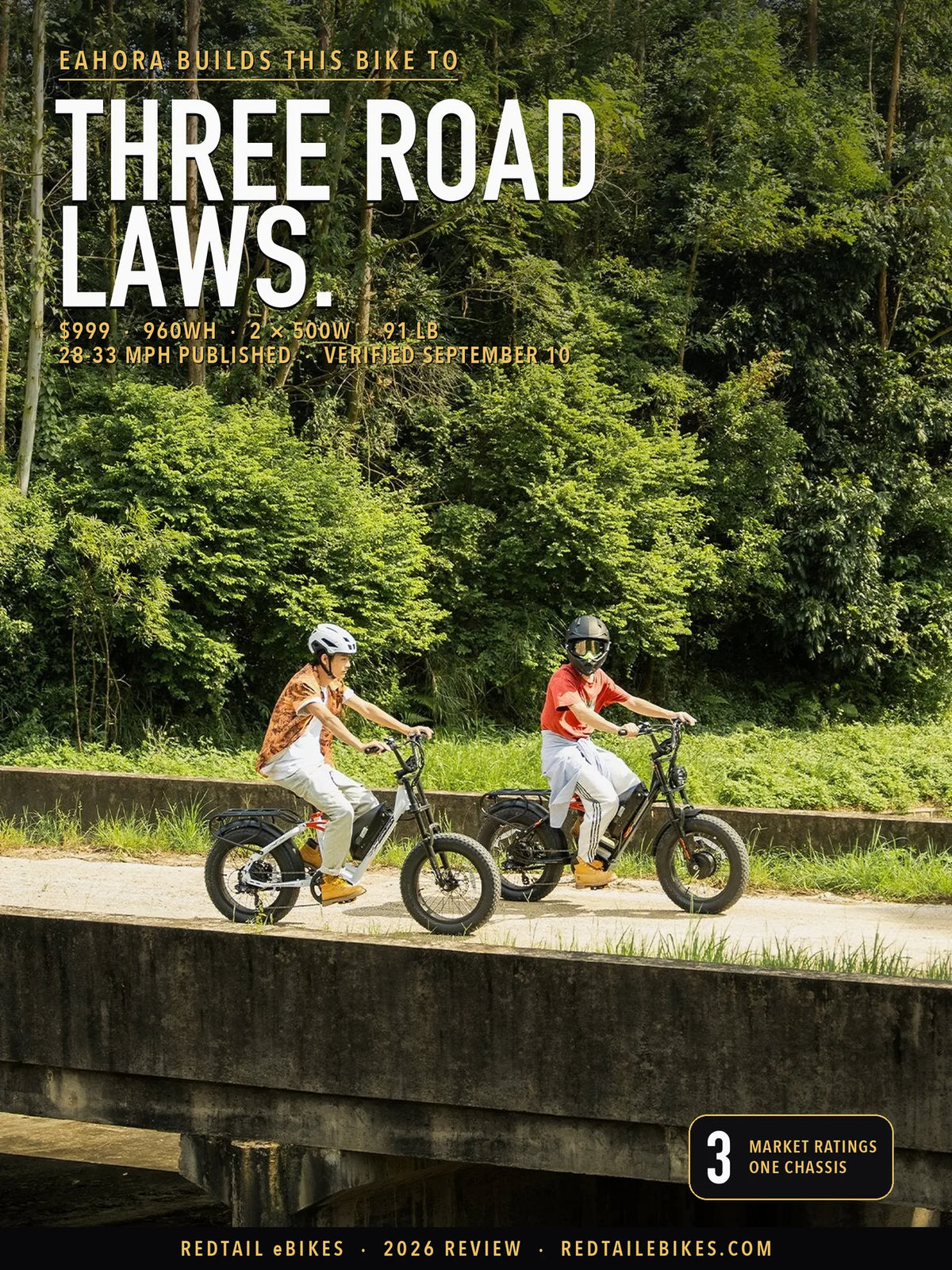
Share:
Eunorau FAT-AWD 3.0 Review 2026: 2 Motors, 375 lb
Eunorau META24 Review 2026: 61.7 lb, 500 W, $1,699