
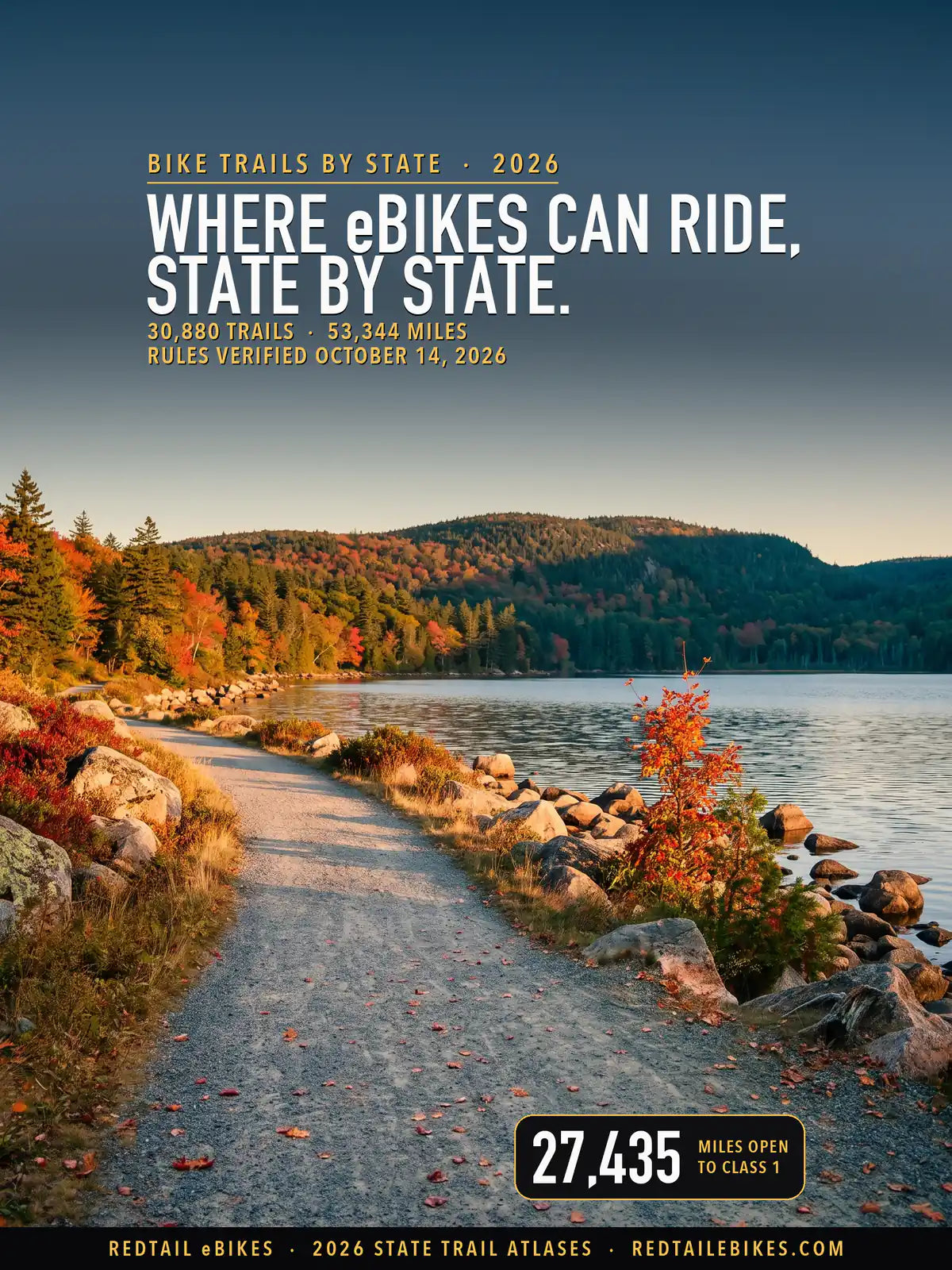
6 states · 30,880 trails · 53,344 miles in 419 counties · a Class 1 may ride 51% of them, a Class 3 30% · Rules verified October 14, 2026
Quick Answer: A Class 1 e-bike may ride 51% of the 53,344 trail miles mapped in six states, a Class 2 39% and a Class 3 30%. A Class 1's share runs from 34% in New York to 73% in Florida. Each trail's manager sets its own rule, so check the manager before you ride.

A carriage road in Acadia National Park, where the Park Service permits Class 1 e-bikes and not Class 2 or 3, in a scene generated with Playcut from a National Archives photograph of the road.
This page indexes Redtail's state trail atlases. Each atlas maps one state trail by trail and colors every line by the e-bike rule of the manager who runs the land. Read across them here to see how the same Class 1, 2 or 3 e-bike you ride gets a different answer from a state park, a national forest and a city path.
Check the manager, then the class. A state's law sets a default, and the agency that runs the trail can open it, close it or cap your speed. On these 53,344 mapped miles, a Class 1 reaches 11,648 more miles than a Class 3, so your bike's class matters.
Every e-bike in our full range ships free in the contiguous United States.
In this guide
- Bike trails by state: pick your state
- How the six states compare
- The three classes in the agencies' words
- What each state's law says before the manager does
- Who holds the miles in each state
- State parks, state by state
- National forests, BLM land and national parks
- Six trails, six answers
- Six ways a rule catches riders out
- What changed and what changes next in 2026
- If your state is not mapped yet
- Choosing an e-bike for the trails you ride
- Frequently asked questions
- The bottom line
- How we verified this page
- Limitations
- Source register
- References
Bike trails by state: pick your state
Six states have a trail-by-trail e-bike atlas so far: Florida, New York, Washington, Texas, Colorado and Michigan. If you ride in one of the other 44 states or the District of Columbia, find your state in the 50-state grid, which links each one to its e-bike law guide.
Find your state below, then open its atlas for the manager and rule behind every trail you might ride. Each row shows how much of the state's mapped trail a Class 1 and a Class 3 may ride, and how much is closed to both.
Check the date on any rule you rely on. The Florida Forest Service's amended rule takes effect October 20, 2026 (Rule 5I-4.006(7)), and New York State Parks' policy, effective June 4, 2026, bars every Class 3 e-bike from every State Parks facility and warns that failing to obey an officer's order or a posted sign "could result in a disorderly conduct violation" (OPR-POL-032).

Where the trail atlases stand on October 14, 2026: six states have an atlas, California has a guide in an older format, and the other 43 states and the District of Columbia are not mapped yet. The tiles are a schematic, not a geographic map.
| State | Trails | Mapped miles | Class 1 | Class 3 | Closed | Atlas |
|---|---|---|---|---|---|---|
| Colorado | 12,316 | 17,006 | 48% | 24% | 39% | Open the Colorado atlas |
| Florida | 1,017 | 7,738 | 73% | 47% | 4% | Open the Florida atlas |
| Michigan | 3,848 | 8,214 | 61% | 30% | 17% | Open the Michigan atlas |
| New York | 2,820 | 6,242 | 34% | 3% | 49% | Open the New York atlas |
| Texas | 5,052 | 5,433 | 43% | 42% | 27% | Open the Texas atlas |
| Washington | 5,827 | 8,711 | 47% | 35% | 30% | Open the Washington atlas |
| All six | 30,880 | 53,344 | 51% | 30% | 29% | Combined |
Source: each state atlas, figures as printed on its page and re-read October 14, 2026. Percentages are shares of the atlas's mapped miles, rounded once, half-up; the last row adds the registers.
Florida: a Class 1 reaches 73% of 7,738 mapped miles

Open where bicycles ride, unless the manager says no. Florida law lets an operator "ride an electric bicycle where bicycles are allowed", and lets the agency or government that runs a path or trail network restrict it (Fla. Stat. § 316.20655(7) and (1)). State Parks opens its designated trails to electric bicycles (Florida State Parks).
From October 20, 2026 the Florida Forest Service permits Class 1 wherever traditional bicycles ride and limits Class 2 and 3 to designated roads open to licensed vehicles (Rule 5I-4.006(7)).
Of 7,738 mapped miles in 66 counties, a Class 1 reaches 73%, a Class 3 47%, and 4% are closed. Open the Florida atlas to see the manager and rule on the trail you plan to ride, or download its register.
New York: a Class 1 reaches 34% of 6,242 mapped miles

Closed until someone opens it. New York starts from no: "No person shall operate a bicycle with electric assist on any public lands or property, other than a highway", unless a state agency or a city, town or village designates the land, which the statute lets it do "upon written request for such designation by any person" (N.Y. Veh. & Traf. Law § 1242(4)).
State Parks authorizes Class 1 and 2 on paved and improved trails, Class 1 on natural-surface trails, and prohibits Class 3 at every facility (policy OPR-POL-032). On the land DEC manages, e-bikes may use public roads and are prohibited off-road (DEC).
In New York City, a Parks Department pilot lets e-bikes use park drives and greenways through December 31, 2026 (NYC Parks).
Of 6,242 mapped miles in 62 counties, a Class 1 reaches 34%, a Class 3 3%, and 49% are closed. Open the New York atlas to find your trail on the trail-by-trail map, or download its register.
Washington: a Class 1 reaches 47% of 8,711 mapped miles

Class 1 and 2 on shared-use paths, Class 3 only where a locality allows. RCW 46.61.710 lets Class 1 and 2 ride "a shared-use path", with state agencies and local jurisdictions free to restrict them, and keeps Class 3 off shared-use paths "except where local jurisdictions may allow" it (RCW 46.61.710(7) and (8)).
State Parks lists Class 1 and Class 3 for its long-distance trails and for single-track trails that allow conventional bicycles (Washington State Parks). As of October 14, 2026 the Department of Natural Resources lists a Class 1 pilot in the Darrington/North Mountain trail system (DNR). Of 8,711 mapped miles in 39 counties, Class 1 reaches 47%, Class 2 34% and Class 3 35%, and 30% are closed. Open the Washington atlas to find your county.
Texas: a Class 1 reaches 43% of 5,433 mapped miles

Open where bicycles ride, except on natural-surface paths closed to motor vehicles. Texas bars the department and local authorities from prohibiting an electric bicycle "in an area in which the operation of a nonelectric bicycle is permitted", unless the area is a path that is not open to motor vehicles and has a natural surface tread (Transportation Code § 551.106(a)).
Texas Parks and Wildlife publishes its own rule for state parks: "Electric bicycles are not allowed on park trails. This includes all classes of e-bikes." (Texas Parks and Wildlife).
Of 5,433 mapped miles in 117 counties, a Class 1 reaches 43%, a Class 3 42%, and 27% are closed, including 1,045 miles of state park trail. Open the Texas atlas to find your county, or download its register.
Colorado: a Class 1 reaches 48% of 17,006 mapped miles

Class 1 and 2 where bicycles are authorized, Class 3 only by exception. C.R.S. § 42-4-1412(14) lets a person ride a Class 1 or 2 "on a bike or pedestrian path where bicycles are authorized to travel", lets "a local authority" prohibit them, and bars a Class 3 from those paths unless "the path is within a street or highway" or the local authority permits it (C.R.S. § 42-4-1412(14)).
State parks admit Class 1 and 2 on multi-use trails open to non-motorized biking, and in State Wildlife Areas "e-bikes are allowed on designated roads and within designated camping or parking areas where motorized vehicles are allowed" (Colorado Parks and Wildlife). Of 17,006 mapped miles in 55 counties, Class 1 reaches 48%, Class 3 24% and 39% are closed; 77% of the closed miles are national forest trail. Open the Colorado atlas to find your region.
Michigan: a Class 1 reaches 61% of 8,214 mapped miles

Class 1 on improved-surface and rail trails, unless the manager says no. Michigan law lets an individual "operate a class 1 electric bicycle on a linear trail that has an asphalt, crushed limestone, or similar surface, or a rail trail", lets the local authority or state agency that runs the trail regulate or prohibit it, and admits Class 2 and 3 there only where that authority allows (MCL 257.662a(8) and (9)).
A nonmotorized natural-surface trail is closed to every class until its manager allows e-bikes (MCL 257.662a(10)). Michigan's DNR admits Class 1 on the state park, recreation area and state forest trails that permit traditional bicycles, except congressionally authorized trails such as the North Country Trail and three named pathways, Class 2 with its free mobility permit, and no Class 3 on any state-managed trail (Michigan DNR).
Of 8,214 mapped miles in 80 counties, a Class 1 reaches 61%, a Class 3 30%, and 17% are closed. Open the Michigan atlas to see the manager and rule on the trail you plan to ride, or download its register.
How to read an atlas's map
Each atlas colors a line by the e-bike rule of the manager who runs the land, and prints its key beside the map. All six draw an open trail in green, a Class 1 and 2-only trail in blue, a trail closed by a published rule in dashed red, and an unsettled or unknown rule in gray.
Florida, New York, Washington, Colorado and Michigan add amber for Class 1 only. Washington adds teal for Class 1 and 3. New York and Washington add dotted purple for public land whose answer turns on a designation.
Below the map, each atlas lists the trails by region with their managers and rules, and links the downloadable register behind its figures. Match the color of the trail you plan to ride against the key before you go.
How the six states compare
Across the six registers a Class 1 may ride 51% of 53,344 mapped miles, a Class 2 39% and a Class 3 30%. Between states, a Class 1's share varies by 39 points, from 34% in New York to 73% in Florida. Between classes, the combined shares vary by 21 points. The numbers are in a downloadable CSV, one row per atlas.
| State | Mapped miles | Class 1 | Class 2 | Class 3 | Closed | Other |
|---|---|---|---|---|---|---|
| Florida | 7,738 | 73% | 49% | 47% | 4% | 23% |
| Michigan | 8,214 | 61% | 31% | 30% | 17% | 23% |
| Colorado | 17,006 | 48% | 45% | 24% | 39% | 12% |
| Washington | 8,711 | 47% | 34% | 35% | 30% | 23% |
| Texas | 5,433 | 43% | 43% | 42% | 27% | 30% |
| New York | 6,242 | 34% | 22% | 3% | 49% | 17% |
| All six (combined) | 53,344 | 51% | 39% | 30% | 29% | 20% |
Class 1, 2 and 3 overlap, so the first three columns do not sum to 100. Closed and Other do not overlap with Class 1: Class 1, Closed and Other sum to 100 before rounding. Source: the atlases' printed figures, October 14, 2026.

Share of each atlas's mapped miles open to Class 1, Class 2 and Class 3 e-bikes, and closed to every class, as the atlases print them, re-read on October 14, 2026. The first three panels overlap, so a mile can count in more than one.
Each atlas maps the trails that public sources record for bicycles, colors every line by the e-bike rule its manager publishes, and states its own sources and method on its page. "Class N" is the miles whose rule lets that class ride. "Closed" is the miles every class is barred from. "Other" is the rest: rules that are unsettled, unread or tied to a designation.
Class 3 is where the states part ways. A Class 3 reaches 3% of New York's miles and 47% of Florida's, a 44-point spread against 39 points for a Class 1 and 27 for a Class 2. Texas is the nearest to class-blind: a Class 1 reaches 43% of its mapped miles and a Class 3 42%, only 82 miles apart, and the subsection that sets its default (§ 551.106(a)) names no class.
Washington is the one state where a Class 3 outruns a Class 2. The atlas counts 3,074 miles for a Class 3 against 2,957 for a Class 2. Of the 1,060 miles open to Class 1 and Class 3 but not Class 2, 899 are State Parks trails, where the agency's sheet reads "Class 1 and Class 3 pedal-assist e-bikes are allowed on state park non-motorized long-distance trails." (Washington State Parks)
New York's 49% is a default as much as a decision. The statute (§ 1242(4)) closes public land until an agency designates it, so the closed share includes 670 mapped miles whose managers have designated nothing. It also includes 2,109 miles of DEC trail, where the agency's page says "Off-road use (including trails, roads, or terrain other than a public road or parking area) of E-bikes is prohibited." (DEC)
The "other" column is not a ranking. It holds the miles a register left unsettled, unread or tied to a designation, and each atlas decides those cases by the method on its own page. Read the column for the state you ride in.
| Measure | Highest | Lowest |
|---|---|---|
| Trails mapped | Colorado: 12,316 | Florida: 1,017 |
| Miles mapped | Colorado: 17,006 | Texas: 5,433 |
| Counties | Texas: 117 | Washington: 39 |
| Class 1 share of miles | Florida: 73% | New York: 34% |
| Class 2 share of miles | Florida: 49% | New York: 22% |
| Class 3 share of miles | Florida: 47% | New York: 3% |
| Closed share of miles | New York: 49% | Florida: 4% |
Source: the atlases' printed figures, October 14, 2026. Shares are of each atlas's mapped miles, rounded once, half-up.
Florida holds the highest Class 1, 2 and 3 shares and the lowest closed share. New York holds the lowest of all three class shares and the highest closed share. Colorado maps the most trails and miles, and Texas the most counties. The CSV holds every figure, so you can check any of them.
The three classes in the agencies' words
The Bureau of Land Management defines a Class 1 as a bike whose motor assists only while you pedal and stops assisting at 20 mph, a Class 2 as one whose motor may be used exclusively to propel the bicycle and stops assisting at 20 mph, and a Class 3 as one whose motor assists only while you pedal and stops assisting at 28 mph (BLM).
Florida's statute (§ 316.003(23)(c)) and Washington's Department of Natural Resources (DNR) give a Class 3 the same 28 mph limit. New York defines its Class 3 differently.
| Agency | Class | Its definition, in its words |
|---|---|---|
| Bureau of Land Management | Class 1 | "Class 1 e-bikes are equipped with a motor that provides assistance only when the rider is pedaling, and that ceases to provide assistance when the bicycle reaches the speed of 20 mph." |
| Bureau of Land Management | Class 2 | "Class 2 e-bikes are equipped with a motor that may be used exclusively to propel the bicycle, and that ceases to provide assistance when the bicycle reaches the speed of 20 mph." |
| Bureau of Land Management | Class 3 | "Class 3 e-bikes are equipped with a motor that provides assistance only when the rider is pedaling, and that ceases to provide assistance when the bicycle reaches the speed of 28 mph." |
| Florida, Fla. Stat. § 316.003(23)(c) | Class 3 | A Class 3 "means an electric bicycle equipped with a motor that provides assistance only when the rider is pedaling and that ceases to provide assistance when the electric bicycle reaches the speed of 28 miles per hour" |
| Washington Department of Natural Resources | Class 3 | "A bicycle equipped with a motor that provides assistance only when the rider is pedaling and ceases to assist when the bicycle reaches a top speed of 28 mph and is equipped with a speedometer." |
| New York, Veh. & Traf. Law § 102-c(c) | Class 3 | "Solely within a city having a population of one million or more, a bicycle with electric assist having an electric motor that may be used exclusively to propel such bicycle, and that is not capable of providing assistance when such bicycle reaches a speed of twenty-five miles per hour" |
Each definition is quoted from the page or statute linked in its row. Retrieved October 14, 2026.
New York's Class 3 differs in three ways: its assistance stops at 25 mph, its motor may be used exclusively to propel the bicycle, and the statute (§ 102-c(c)) recognizes it solely within a city of one million or more people. Read the class on your label against the definition in the state you ride in.
The class on your label decides which of these miles you can ride. The guide walks through how you will ride, then your legal class.
Read the e-bike buying guideWhat each state's law says before the manager does
Florida (§ 316.20655), Washington (RCW 46.61.710), Colorado (§ 42-4-1412(14)) and Texas (§ 551.106(a)) open trails to e-bikes by default; New York (§ 1242(4)) closes public land until an agency or local government opens it. Michigan (MCL 257.662a) opens improved-surface and rail trails to a Class 1 and keeps every class off nonmotorized natural-surface trails until the manager allows them.
Washington and Colorado add a separate Class 3 rule for shared-use paths, Michigan admits Class 2 and 3 on its improved-surface trails only where the trail's authority allows, and New York recognizes a Class 3 only inside a city of one million or more.
| State | The default, in the statute's words | Who can change it | Class 3 | Statute |
|---|---|---|---|---|
| Florida | "An operator may ride an electric bicycle where bicycles are allowed, including, but not limited to, streets, highways, roadways, shoulders, bicycle lanes, and bicycle or multiuse paths." | A municipality, county or state agency with jurisdiction over a path or trail network may restrict or prohibit e-bikes on it ("from restricting or prohibiting the operation of an electric bicycle on a bicycle path, multiuse path, or trail network"). | Not named in subsections (1) and (7) | Fla. Stat. § 316.20655(7), (1) |
| New York | "No person shall operate a bicycle with electric assist on any public lands or property, other than a highway", unless the land is designated and posted | A state agency, and a city, town or village, "may designate any appropriate public lands and properties under its jurisdiction" | Exists only: "Solely within a city having a population of one million or more" (§ 102-c(c)) | N.Y. Veh. & Traf. Law § 1242(4) |
| Washington | Class 1 and 2: "may be operated on a shared-use path or any part of a highway designated for the use of bicycles, but local jurisdictions or state agencies may restrict or otherwise limit the access of electric-assisted bicycles" | Local jurisdictions or state agencies (the same sentence) | "Class 3 electric-assisted bicycles may not be operated on a shared-use path, except where local jurisdictions may allow the use of class 3 electric-assisted bicycles." | RCW 46.61.710(7), (8) |
| Texas | "The department or a local authority may not prohibit the operation of an electric bicycle: (1) on a highway that is used primarily by motor vehicles; or (2) in an area in which the operation of a nonelectric bicycle is permitted, unless the area is a path that: (A) is not open to motor vehicles; and (B) has a natural surface tread made by clearing and grading the native soil without adding surfacing materials." | The statute names the department and local authorities | Not named in § 551.106(a) | Tex. Transp. Code § 551.106(a) |
| Michigan | Class 1: "An individual may operate a class 1 electric bicycle on a linear trail that has an asphalt, crushed limestone, or similar surface, or a rail trail." A nonmotorized natural-surface trail: "an individual shall not operate an electric bicycle on a trail that is designated as nonmotorized and that has a natural surface tread that is made by clearing and grading the native soil with no added surfacing materials." |
The local authority or state agency with jurisdiction over the trail: "A local authority or agency of this state having jurisdiction over a trail described in this subsection may regulate or prohibit the operation of a class 1 electric bicycle on that trail." | Class 2 and 3 need the trail's authority: "An individual may operate a class 2 or class 3 electric bicycle on a linear trail that has an asphalt, crushed limestone, or similar surface, or a rail trail if authorized by the local authority or agency of this state having jurisdiction over the trail." | MCL 257.662a(8)-(10) |
| Colorado | Class 1 and 2: "A person may ride a class 1 or class 2 electrical assisted bicycle on a bike or pedestrian path where bicycles are authorized to travel." | "A local authority may prohibit the operation of a class 1 or class 2 electrical assisted bicycle on a bike or pedestrian path under its jurisdiction." | "A person shall not ride a class 3 electrical assisted bicycle on a bike or pedestrian path unless: (I) The path is within a street or highway; or (II) The local authority permits the operation of a class 3 electrical assisted bicycle on a path under its jurisdiction." | C.R.S. § 42-4-1412(14) |
A state's default tells you where to start, and the manager's rule tells you where to stop. The full statute and its local ordinances are in each state's law guide: Florida, New York, Washington, Texas, Colorado and Michigan. Read each statute at its source: Florida, New York, Washington, Texas, Colorado and Michigan. For all fifty states on one page, read electric bike laws by state.
A rule can cost more than a turned-back ride. In Colorado the section that holds the path rule says "Any person who violates any provision of this section commits a class 2 misdemeanor traffic offense" (C.R.S. § 42-4-1412(12)(a)), and the Class 3 path rule is part of that section.
Who holds the miles in each state
In Colorado, New York and Washington, the largest block of mapped miles is closed to every class. It is national forest trail off the motor vehicle routes in Colorado and Washington, and DEC trail in New York. In Florida and Texas the largest block is local trail with no e-bike rule of its own, so the state default applies. Look up the manager of the trail you ride before you read its class list.
That block holds 34% of New York's mapped miles, 30% of Colorado's, 27% of Texas's, 19% of Washington's and 19% of Florida's. Michigan is the exception: its largest block, 30% of its mapped miles, is national forest routes the motor vehicle use map opens, where all three classes may ride. The three largest rows of each state are below, in the words of each atlas.
| State | Who manages the miles | Mapped miles | Share of the state | What e-bikes may do, as the atlas prints it |
|---|---|---|---|---|
| Florida | Counties and cities with no e-bike rule for that trail | 1,465 | 19% | Florida's default: an e-bike may ride where bicycles may; on the 2 inside FWC wildlife management areas (27 mi), Class 2 and 3 only on named or numbered roads |
| Florida | Florida State Parks (state trails and parks) | 1,337 | 17% | Class 1, 2 and 3 on trails designated for bicycles; on the 2 inside FWC wildlife management areas (39 mi), Class 2 and 3 only on named or numbered roads |
| Florida | St. Johns River, Suwannee River and South Florida WMD lands | 974 | 13% | Unsettled: the rules bar unlicensed motorized vehicles and never name e-bikes; on the 25 inside FWC wildlife management areas (518 mi), Class 2 and 3 only on named or numbered roads |
| New York | DEC: trails on Forest Preserve, state forest and other DEC land | 2,109 | 34% | Closed: DEC allows e-bikes on its public roads, not its trails |
| New York | NYS Parks: natural-surface trails, and trails whose surface is not recorded | 630 | 10% | Class 1 where bicycles may ride; Class 2 not allowed |
| New York | Manager not recorded in any dataset read | 532 | 9% | Gray: if the land is public, closed unless designated; if private, the owner decides |
| Washington | National forests: non-motorized trails | 1,685 | 19% | Closed: an e-bike is a motor vehicle on national forest land |
| Washington | National forests: trails open to motor vehicles | 1,597 | 18% | Class 1, 2 and 3 (motor vehicles allowed) |
| Washington | Public land under state law alone (the manager's code read, no e-bike rule) | 911 | 10% | Class 1 and 2 on shared-use paths; natural trails turn on their designation |
| Texas | City and county trails under state law alone (code read, no e-bike rule) | 1,479 | 27% | Open: a city or county may not ban e-bikes where bicycles ride, except on natural-surface trails |
| Texas | Texas Parks and Wildlife: state parks, natural areas and trailways | 1,047 | 19% | Closed on every trail, every class; open on park roads |
| Texas | Austin, San Antonio and Dallas park and trail rules | 686 | 13% | Open with speed rules (Austin, Dallas, the Butler and Katy trails); unsettled in San Antonio parks |
| Colorado | National forests: every other trail | 5,178 | 30% | Closed: the Forest Service treats an e-bike as a motor vehicle |
| Colorado | Other cities, counties and districts with a rule that reaches e-bikes | 3,105 | 18% | From open to closed: see each government below |
| Colorado | National forests: routes open to motor vehicles | 3,088 | 18% | Class 1, 2 and 3, on routes the motor vehicle use map opens |
| Michigan | National forests: routes open to motor vehicles | 2,431 | 30% | Class 1, 2 and 3, on routes the motor vehicle use map opens |
| Michigan | State parks, recreation areas and state trails | 1,572 | 19% | Class 1 on trails open to bikes; Class 2 with a disability permit; Class 3 never |
| Michigan | National forests: every other trail | 936 | 11% | Closed: the Forest Service treats an e-bike as a motor vehicle |
Source: the Who-decides table on each state's atlas, as printed and re-read October 14, 2026. A row's miles are counted once; the three largest rows of each state are shown, and the atlas lists every manager. DEC is New York's Department of Environmental Conservation, NYS Parks the New York State Office of Parks, Recreation and Historic Preservation, FWC the Florida Fish and Wildlife Conservation Commission and WMD a Florida water management district.
These are the largest blocks, not every manager; the linked atlas lists them all, so find the one that manages your trail.
State parks, state by state
No two of the six state park systems give the same answer: Florida opens designated trails to electric bicycles (Florida State Parks), Texas closes park trails to every class (Texas Parks and Wildlife), and Colorado admits Class 1 and 2 on multi-use trails (Colorado Parks and Wildlife).
Washington admits Class 1 and 3 on its long-distance trails and on in-park trails that allow bicycles (Washington State Parks), and New York admits Class 1 and 2 on paved trails and Class 1 alone on natural surface (OPR-POL-032).
Michigan's DNR admits Class 1 on trails that permit traditional bicycles, Class 2 with its free mobility permit, and no Class 3 on any state-managed trail (Michigan DNR). The order behind that page says a person "may operate a class-1 electric bicycle on a trail open to bicycle use on any parks and recreation division administered lands, except for congressionally authorized trails, such as the North Country Trail" (Land Use Order 5.27(1)).
| State | The agency | What it says | Class 3 | State park trail miles in the atlas |
|---|---|---|---|---|
| Florida | Florida State Parks | "Bicycles, including electric bicycles, may be used on designated trails within the park system, consistent with section 316.20655, F.S." | Not separately named | 1,337 |
| New York | NYS Office of Parks, Recreation and Historic Preservation |
Paved and improved trails: "Class 1 and 2 electric bicycles may be operated on (i) boardwalks and (ii) shared use or multi-use trails and paths that are paved or improved" "The maximum speed limit for electric and non-electric bicycles is 15 mph on boardwalks and paved and improved trails and paths." Natural-surface trails: "Class 1 electric bicycles may be operated on unimproved, natural surface trails that currently allow for the use of non-electric bicycles" "Class 2 electric bicycles are prohibited on all unimproved and/or natural surface trails." |
"Class 3 electric bicycles are strictly prohibited at all OPRHP facilities including parkways." | 287 paved and improved, 630 natural surface |
| Washington | Washington State Parks |
Long-distance trails: "Class 1 and Class 3 pedal-assist e-bikes are allowed on state park non-motorized long-distance trails." Park roads: "All classes of e-bikes are allowed on roads within State Parks." |
Allowed on those long-distance trails | 899 |
| Texas | Texas Parks and Wildlife |
Trails: "Electric bicycles are not allowed on park trails. This includes all classes of e-bikes." Roads: "You may use an electric bicycle on state park roads where a regular bicycle is allowed." |
Closed on trails, like every class | 1,047 mapped (1,045 closed to every class) |
| Colorado | Colorado Parks and Wildlife | "Class 1 and 2 e-bikes are allowed on roadways and designated bike lanes and on multi-use trails and other areas (e.g., campgrounds) that are open to non-motorized biking." | Not named | 599 |
| Michigan | Michigan Department of Natural Resources |
Class 1: "Allowed on all state park, recreation area and state forest trails/pathways that permit traditional bicycles." Class 2: "If a cyclist has a DNR-issued permit (no cost) for mobility issues, Class 2 e-bikes are allowed in all areas open to Class 1 e-bikes." Roads: "You can ride Class 1, 2 and 3 e-bikes on all roads where a non-electric bicycle can be ridden" |
"Class 3 e-bikes are not allowed on any state-managed trail." | 1,572 (state parks, recreation areas and state trails) |
The matrix below reads each agency's text by class. A cell says "Not named" when the agency's page never mentions that class. Find the park system you ride in, then read across to your class.
| State park system | Class 1 | Class 2 | Class 3 |
|---|---|---|---|
| Florida State Parks | Not named. The page lets electric bicycles use designated trails | Not named. The page lets electric bicycles use designated trails | Not named. The page lets electric bicycles use designated trails |
| New York State Parks | Paved and improved trails: yes. Natural-surface trails: yes. |
Paved and improved trails: yes. Natural-surface trails: prohibited. |
Prohibited at all facilities. |
| Washington State Parks | Long-distance trails: yes. In-park natural-surface trails that allow bicycles: yes. Park roads: yes. |
Park roads: yes. Not on the sheet's lists of trails. |
Long-distance trails: yes. In-park natural-surface trails that allow bicycles: yes. Park roads: yes. |
| Texas Parks and Wildlife | Trails: no. Park roads: yes, where a regular bicycle is allowed. |
Trails: no. Park roads: yes, where a regular bicycle is allowed. |
Trails: no. Park roads: yes, where a regular bicycle is allowed. |
| Colorado Parks and Wildlife | Multi-use trails open to non-motorized biking: yes. Roadways and designated bike lanes: yes. |
Multi-use trails open to non-motorized biking: yes. Roadways and designated bike lanes: yes. |
Not named on the page. |
| Michigan Department of Natural Resources | Trails that permit traditional bicycles: yes. Roads open to bicycles: yes. |
With the DNR's free mobility permit: yes, wherever Class 1 may ride. Roads open to bicycles: yes. |
State-managed trails: no. Roads open to bicycles: yes. |
Each cell is the agency's own text, read by class and quoted in the table above. State parks only: wildlife areas and state forests have their own rules. Retrieved October 14, 2026.
Texas splits roads from trails. The Texas Parks and Wildlife page says "You may use an electric bicycle on state park roads where a regular bicycle is allowed." The Texas atlas maps 1,045 miles of state park trail that are closed to every class.
New York and Washington sort their trails by class. New York writes that "Class 2 electric bicycles are prohibited on all unimproved and/or natural surface trails." (OPR-POL-032). Washington's sheet (Washington State Parks) lists Class 1 and Class 3 for its trails and all classes for its park roads. Read the class on your label against the agency's list.
Hiking-only trails stay off the list. Washington's sheet states "E-bikes are not allowed on single-track, non-motorized natural surface hiking-only trails", and Colorado Parks and Wildlife admits Class 1 and 2 on multi-use trails and other areas "open to non-motorized biking".
Dirt trails sort riders by class. New York State Parks admits Class 1 and not Class 2 on natural-surface trails, Washington State Parks lists Class 1 and 3, Colorado admits Class 1 and 2, and Texas closes its park trails to every class. Know your class before you pick a dirt trail.
Natural-surface trails are where the state park rules above sort riders by class. Our e-mountain bike guide compares the bikes, so you can match your class to the trail.
Compare e-mountain bikesNational forests, BLM land and national parks
Each federal land agency writes one national e-bike rule, and a local manager decides which routes it reaches. The Forest Service identifies e-bikes "under three classes of motor vehicles" and allows them on motorized trails and roads (Forest Service), the BLM allows them on roads and trails open to off-highway vehicle use (BLM), and the National Park Service lets each superintendent designate the areas open to them (36 C.F.R. § 4.30(i)).
| Agency | The rule | Where an e-bike may ride |
|---|---|---|
| Forest Service and 36 C.F.R. § 261.13 | The Forest Service "identifies e-bikes under three classes of motor vehicles". The regulation: "it is prohibited to possess or operate a motor vehicle on National Forest System lands in that administrative unit or Ranger District other than in accordance with those designations" |
"Class 1, 2, and 3 e-bikes are allowed on motorized trails and roads on national forests and grasslands." "Local Forest Service officials may consider new opportunities for e-bike use on non-motorized trails and in non-motorized areas by utilizing a designation process in accordance with the Travel Management Rule" |
| Bureau of Land Management | E-bikes follow the off-highway vehicle designations of the land use plan. | "Currently, e-bikes are allowed on all roads and trails open to OHV use and in all area designated as OHV open under applicable land use plans." "E-bikes are allowed on roads and trails limited to bicycles and non-motorized travel ONLY IF a BLM Manager has issued a written decision authorizing e-bike use" |
| National Park Service, 36 C.F.R. § 4.30(i) | Each superintendent designates the roads and trails. | "The use of an electric bicycle may be allowed on park roads, parking areas, and administrative roads and trails that are otherwise open to bicycles. The Superintendent will designate the areas open to electric bicycles, or specific classes of electric bicycles" "Possessing an electric bicycle in a wilderness area established by Federal statute is prohibited." |
National forest trail is where one rule produces different totals. Texas, Colorado, Washington and Michigan split national forest trail by motor vehicle use map status (Forest Service): the routes that map opens to motor vehicles are 32% of Texas's mapped national forest trail miles, 37% of Colorado's, 42% of Washington's and 72% of Michigan's.
Colorado shows what the motor vehicle rule costs. The Colorado atlas lists 5,178 miles of national forest trail outside the routes its motor vehicle use map opens, and marks every one closed to e-bikes. If you ride Colorado's national forest trail, check that map before you go.
The Forest Service identifies e-bikes "under three classes of motor vehicles", and 36 C.F.R. § 261.13 prohibits possessing or operating a motor vehicle on National Forest System lands other than in accordance with the designations. The Forest Service says "more than 60,000 miles of trails and thousands of miles of roads on national forests and grasslands are currently open to e-bike use".
The motor vehicle prohibition carries a penalty, and 36 C.F.R. § 261.1b states it: "Unless otherwise provided by law, the punishment for violation of any prohibition in or order issued under this part shall be imprisonment of not more than six months or a fine in accordance with the applicable provisions of 18 U.S.C. 3571 or both."
In a national park the superintendent designates the areas open to e-bikes, and the regulation adds: "Possessing an electric bicycle in a wilderness area established by Federal statute is prohibited." Acadia National Park shows how narrowly a designation can be drawn: "Class 1 E-bikes are permitted on carriage roads. Class 2 and 3 are not allowed." (Acadia National Park). For the other agencies and all fifty states, read e-bikes in national forests and on public land.
A person convicted of violating a Park Service regulation, including § 4.30, "shall be subject to the criminal penalties provided under 18 U.S.C. 1865" (36 C.F.R. § 1.3(a)). That statute says the person "shall be imprisoned not more than 6 months, fined under this title, or both, and be adjudged to pay all cost of the proceedings" (18 U.S.C. § 1865(a)).
Six trails, six answers
The six trails below give six different answers: two admit Class 1 and one other class, one admits Class 1 alone, one permits electric bikes under 10 mph, one excepts electric bikes from its motor-vehicle ban, and one national park admits them on roads and on no trail. Each comes from its atlas's section on trails riders ask about, and each row quotes the manager's own words. Find the one closest to your ride.
| Trail | State | Manager | The answer |
|---|---|---|---|
| Palouse to Cascades State Park Trail | Washington | Washington State Parks | Named among the trails where "Class 1 and Class 3 pedal-assist e-bikes are allowed on state park non-motorized long-distance trails." Class 2 is not on the list. |
| Erie Canalway Trail | New York | New York State Canal Corporation | "Class 1 and 2 E-bikes (those that are not capable of peddle-assist beyond 20 MPH) are permitted" "Maximum Trail Speed limit of 15MPH must not be exceeded" "No Class 3 E-bikes (those that provide peddle assist propulsion beyond 20 MPH)" |
| Pinellas Trail | Florida | Pinellas County | "Motorized vehicles (except EPAMD, electric bikes, electric wheelchairs, maintenance, law enforcement and emergency vehicles) are prohibited." |
| Ann and Roy Butler Hike-and-Bike Trail (Austin) | Texas | City of Austin rules, published by The Trail Conservancy | "Electric bikes are permitted under 10 MPH." |
| Big Bend National Park | Texas | National Park Service | "Bicycling (including e-bikes) is allowed on any road within Big Bend National Park, but is not allowed off-road or on any trail." |
| Summit County Recpath | Colorado | Summit County | "On April 23, 2019, at a public hearing, the BOCC approved a resolution to allow Class 1 e-bikes on the Recpath; all Class 2, Class 3 and unclassified e-bikes remain prohibited on the Recpath." |
The Erie Canalway Trail states the class rule outright. The Canal Corporation's list of trail rules permits Class 1 and 2, caps speed at 15 mph and bans Class 3. The New York atlas maps 259.9 miles of the trail.
Big Bend opens its roads and no trail. The park's page says "Bicycling (including e-bikes) is allowed on any road within Big Bend National Park, but is not allowed off-road or on any trail." The Park Service's rule has the superintendent designate the areas open to electric bicycles (36 C.F.R. § 4.30(i)).
The Summit County Recpath shows that a county can say Class 1 only. The county board's resolution of April 23, 2019 (Summit County) opened the Recpath to Class 1 and kept Class 2, Class 3 and unclassified e-bikes off it.
Six ways a rule catches riders out
A state's e-bike law is not a trail's rule. New York's default is closed and Texas's is open, yet New York State Parks opens its paved trails to Class 1 and 2 while Texas Parks and Wildlife closes its park trails to every class. Read your state's default in the table above, then find the manager of your trail.
A rule can cover the road and not the trail. Texas state parks allow e-bikes on park roads where a regular bicycle is allowed (Texas Parks and Wildlife) and on none of 1,045 mapped miles of park trail. Check whether the rule you read covers the trail or only the road.
Class 3 faces its own path rule. Colorado (C.R.S. § 42-4-1412(14)(b)) and Washington (RCW 46.61.710(8)) keep it off shared-use paths unless a locality allows it, New York recognizes it only in a city of one million or more, New York State Parks prohibits it at every facility, and the Canal Corporation bans it on the Erie Canalway Trail. If you ride a Class 3, read your state's path rule first.
A trail that bicycles use can still be closed to your e-bike. The Forest Service identifies e-bikes "under three classes of motor vehicles", and its officials consider e-bike use on non-motorized trails through a designation process (Forest Service).
Class 2 can cost you the singletrack. New York State Parks prohibits Class 2 on natural-surface trails, and Washington's State Parks sheet lists Class 1 and Class 3 for trails. On dirt, a Class 1 is the class that New York, Washington, Colorado and Michigan state parks all admit.
Dates move rules. The Florida Forest Service's amended rule takes effect October 20, 2026 (Rule 5I-4.006(7)), and NYC Parks says its pilot "is in effect from June 20, 2023 through December 31, 2026" (NYC Parks). Read the agency's page again before you ride in a new season.
What changed and what changes next in 2026
Three agency rules on this page change on a known date this year, and one more is a listed pilot. A date is when a trailhead sign and a page like this one can disagree, so read the agency's page again after each date below and before you ride.
| Date | Where | What changes | In the agency's words |
|---|---|---|---|
| December 31, 2026 | New York City | NYC Parks' pilot that lets e-bikes use park drives and greenways is scheduled to end. It began June 20, 2023. | "The pilot program is in effect from June 20, 2023 through December 31, 2026." NYC Parks |
| October 20, 2026 | Florida state forests | The Florida Forest Service's amended rule 5I-4.006(7) takes effect: Class 1 where traditional bicycles ride, Class 2 and 3 only on designated roads open to licensed vehicles. | "Class 1 electric bicycles, as defined in section 316.003, F.S., are permitted in the same locations as traditional bicycles. Class 2 and Class 3 electric bicycles, as defined in section 316.003, F.S., are not permitted on designated trails and are only permitted on designated roads open to licensed vehicular traffic." Rule 5I-4.006(7), effective October 20, 2026 |
| June 4, 2026 | New York State Parks | Policy OPR-POL-032 takes effect: Class 3 is prohibited at every facility and Class 2 on natural-surface trails. | "Class 3 electric bicycles are strictly prohibited at all OPRHP facilities including parkways." "Class 2 electric bicycles are prohibited on all unimproved and/or natural surface trails." OPR-POL-032 |
| Listed October 14, 2026 | Washington trust land | The Department of Natural Resources lists a Class 1 pilot in the Darrington/North Mountain trail system. | "Currently, there is a Class 1 e-bike pilot project in the Darrington/North Mountain trail system." DNR |
If your state is not mapped yet
The other 44 states and the District of Columbia have no trail atlas yet, but each has an e-bike law guide, and the same four questions find a trail's rule anywhere. Ask them in this order: who manages the land under your wheels, what does the state's default say, has the manager written a rule for your class, and does a city or county add its own?
Look for the manager on the trailhead sign or the trail's own page: a state park system, a national forest, a county parks department or a rail-trail authority. The default is in your state's law guide below. The manager's rule is on the manager's website, and a city or county rule is in its code. The five-minute checklist for finding a trail's manager works anywhere.
California has a trail guide in an older format, linked in the grid; the Great American Rail-Trail guide covers the cross-country route.
If your state is not mapped and you want it, email support@redtailebikes.com with the state and the trails you ride most.
Choosing an e-bike for the trails you ride
The class on the label decides how much of this map is yours: across the six registers a Class 1 may ride 27,435 mapped miles, a Class 2 20,643 and a Class 3 15,787. Read the class on a bike's label before you buy it.
| Your bike's class | Mapped miles it may ride | Against a Class 1 |
|---|---|---|
| Class 1: assist while you pedal, to 20 mph | 27,435 | The most of any class |
| Class 2: motor may propel the bike alone, to 20 mph | 20,643 | 6,792 fewer |
| Class 3: assist while you pedal, to 28 mph | 15,787 | 11,648 fewer |
For dirt, start with the class. Class 1 is the class that New York (OPR-POL-032), Washington (State Parks sheet), Colorado (CPW) and Michigan (Michigan DNR) state parks all admit on their trails. Our e-mountain bike guide read 35 manufacturer pages on September 26, 2026 and found one that publishes a Class 1 setting, so check the class before you order.
A Class 1 reaches the most mapped miles. The guide covers the class line that decides where you ride.
Compare e-mountain bikesFor paved rail-trails and greenways, read the trail's class list first. The Erie Canalway Trail admits Class 1 and 2 (Canal Corporation), the Summit County Recpath admits Class 1 alone (Summit County), and New York State Parks admits Class 1 and 2 on paved trails (OPR-POL-032).
Once you know the trail's class, our commuter e-bike guide compares bikes for daily riding.
Compare commuter e-bikesWhy buy your trail e-bike from us
- Free shipping. Your e-bike ships free within the contiguous United States. Orders are dispatched within 1 to 3 business days of confirmation, and most arrive within 5 to 10 business days of dispatch (shipping policy).
- Card or wallet. Pay with Apple Pay, Google Pay, Shop Pay or a major credit card.
- A damaged delivery is our claim to make. If your e-bike arrives damaged, note it with the driver and send photos within 48 hours of delivery; we file the carrier claim and arrange a replacement or repair (refund policy).
- A fault on arrival is handled through us. If your bike will not power on or charge, shows an error code or has a faulty component, the maker's warranty covers it, and we coordinate the repair or replacement remotely (refund policy).
- Support from a US team. You can email support@redtailebikes.com or call (213) 444-4020.
Not sure which class your trail needs? Email the trail and state to support@redtailebikes.com, then shop every e-bike we sell.
Frequently asked questions
Are e-bikes allowed on bike trails?
Partly, and your bike's class decides how much: across 53,344 trail miles mapped in six states, a Class 1 may ride 51%, a Class 2 39% and a Class 3 30%. A state's law only sets the starting point: Florida's § 316.20655 lets the manager restrict a trail, and New York's § 1242(4) closes public land until it is designated. The five-minute checklist finds the manager of any trail you want to ride.
Where are e-bikes allowed to ride?
Where your state's default and the trail manager's rule both admit your class: Florida, Washington, Colorado and Texas open trails to e-bikes by default, Michigan opens improved-surface and rail trails to a Class 1, and New York closes public land until it is designated. A Class 1's share of the mapped miles runs from 34% in New York to 73% in Florida. Then read your trail manager's rule, starting from the state index.
Which state has the most bike trails?
Of the six mapped states, Colorado maps the most trails (12,316) and the most miles (17,006), and Texas reaches the most counties (117). Each count follows that atlas's own sources, and the other 44 states have no atlas yet. The leaders table and the downloadable CSV list the highest and lowest of each measure.
Which state has the strictest e-bike rules for trails?
Of the six mapped states, New York closes the most: 49% of its mapped miles are closed to every class, against 4% in Florida. New York's statute (§ 1242(4)(a)) closes public land until an agency designates it. For the laws themselves, read electric bike laws by state.
Are e-bikes allowed in state parks?
Yes in all six mapped states: five park systems open some trails to e-bikes, and Texas allows them on park roads and on no park trail (TPWD).
Florida opens designated trails (Florida State Parks), Colorado admits Class 1 and 2 on multi-use trails (CPW), Washington admits Class 1 and 3 on its long-distance and in-park trails (State Parks), New York admits Class 1 and 2 on paved trails (OPR-POL-032), and Michigan admits Class 1 on trails that permit bicycles, and Class 2 with a free mobility permit (Michigan DNR).
Are e-bikes allowed in national forests?
Class 1, 2 and 3 e-bikes are allowed on motorized trails and roads, because the Forest Service identifies e-bikes "under three classes of motor vehicles" (Forest Service). For a non-motorized trail, local officials consider e-bike use through a designation process, so check the forest's motor vehicle use map before you ride. The federal land table gives the rule, and 36 C.F.R. § 261.13 is the regulation behind it.
Are e-bikes allowed in national parks?
Only where the superintendent designates the area (36 C.F.R. § 4.30(i)). The regulation says e-bike use "may be allowed on park roads, parking areas, and administrative roads and trails that are otherwise open to bicycles", and it prohibits possessing one in a wilderness area established by Federal statute. Big Bend allows e-bikes on any road and on no trail; Acadia admits Class 1 on its carriage roads and not Class 2 or 3.
Are e-bikes allowed on rail trails?
Yes when the trail's manager admits your class. Michigan's statute names rail trails: a Class 1 may ride one unless the local authority or state agency that runs it regulates or prohibits it (MCL 257.662a(8)).
Three trails these atlases quote answer three ways: the Erie Canalway Trail permits Class 1 and 2 (Canal Corporation), the Summit County Recpath permits Class 1 only (Summit County), and the Pinellas County trail guide excepts electric bikes from its ban on motorized vehicles (Pinellas County). The Great American Rail-Trail guide covers the cross-country route state by state.
Are e-bikes allowed on bike paths?
Yes by default in most of the mapped states, unless the path's manager restricts them: a Class 1 or 2 in Washington (RCW 46.61.710(7)) and Colorado (§ 42-4-1412(14)), a Class 1 on Michigan's improved-surface and rail trails (MCL 257.662a(8)), and wherever bicycles are allowed in Florida (§ 316.20655(7), (1)). New York closes public land until it is designated (§ 1242(4)). See the defaults table for your state.
Are Class 3 e-bikes allowed on bike paths and trails?
Less often than a Class 1: a Class 3 may ride 30% of the mapped trail miles, from 3% in New York to 47% in Florida, against 51% for a Class 1.
Colorado and Washington keep it off shared-use paths unless a locality allows it (§ 42-4-1412(14)(b), RCW 46.61.710(8)), New York State Parks prohibits it (OPR-POL-032), Michigan's DNR bars it from every state-managed trail (Michigan DNR), and the Erie Canalway Trail bans it (Canal Corporation).
What is the difference between Class 1, 2 and 3 e-bikes?
A Class 1 motor assists only while you pedal and stops assisting at 20 mph; a Class 2 motor may be used exclusively to propel the bicycle and stops assisting at 20 mph; a Class 3 motor assists only while you pedal and stops assisting at 28 mph (BLM). New York's Class 3 stops assisting at 25 mph and exists only within a city of one million or more (§ 102-c(c)). See the three classes.
Are e-bikes allowed on mountain bike and hiking trails?
Not on hiking-only trails: Washington State Parks' sheet says e-bikes are not allowed on single-track, non-motorized natural surface hiking-only trails (State Parks). On bike trails the answer turns on class and manager. New York State Parks admits Class 1 on natural-surface trails (OPR-POL-032), Colorado admits Class 1 and 2 on multi-use trails open to non-motorized biking (CPW), and Texas state parks close their trails to every class (TPWD).
Why are e-bikes banned on some trails?
Because the trail's manager closes it to e-bikes or has not opened it: the Forest Service identifies e-bikes "under three classes of motor vehicles", so a non-motorized national forest trail opens to them only through a designation process (Forest Service). New York's statute closes public land until an agency designates it (§ 1242(4)), and Texas Parks and Wildlife states that e-bikes are not allowed on park trails (TPWD).
What should I do if I am unsure about a trail's rule?
Find the manager, read its page and follow the posted sign. New York State Parks says it "is authorized to prohibit or regulate electric bicycle use in a manner that is specific to each OPRHP park road, boardwalk, trail, or path" (OPR-POL-032). If a rule is missing, ask the manager before you ride; in New York the statute lets any person ask in writing for land to be designated.
The bottom line
Pick your state, find your trail's manager, then match your class to the manager's list. A Class 1 is welcome on 51% of the miles mapped in six states and a Class 3 on 30%, and the class on your label and the manager's list decide which side of that gap your ride falls on.
If you are shopping, choose the class first: compare e-mountain bikes for dirt or commuter e-bikes for paved paths.
Free shipping in the contiguous United States on every e-bike.
Shop every e-bikeHow we verified this page
Every figure here is an atlas's own printed number and every rule is a quotation checked against a saved copy. The box says how, and the paragraph after it says where the questions came from.
How we verified this page
Every number is an atlas's own printed figure, re-read from the live atlas on October 14, 2026. Every rule in a table is quoted from the statute, regulation or agency page beside it and checked word for word against a copy saved that day. 33 primary sources are cited: 29 read by plain request, 3 through a rendered browser and 1 from an Internet Archive capture. The Census Bureau's county adjacency file backs the combined totals.
How the questions were chosen. The questions were harvested, not assumed: 5,487 Google and Bing completions, 351 headings from 24 ranking pages, 615 forum threads, 7,877 Search Console queries and 10 AI-answer prompts. Of the completions, 112 are generic access questions this page answers, 31 name a park, forest or trail, 2,853 route to an atlas or a sibling guide and 2,491 are dropped with a reason.
By Milad Ghobadibeygvand, BScN (Western University, 2014), Redtail eBikes. Rules verified October 14, 2026. Found a rule that has changed since? Email the trail's name and a link to the new rule to support@redtailebikes.com, and we will read that trail's row in its atlas again.
Limitations
These are the limits of this page, numbered so each can be checked: whose interest the page carries, what the data can and cannot compare, how the rules were read, and the dates on which it expires.
Interest
- Redtail sells e-bikes in all three classes. This page recommends no model; the buying guides it links hold the picks and state their own methods.
Data
- The figures are each atlas's own, as printed and re-read on October 14, 2026: Colorado, Florida and New York October 12, Texas October 11, Washington October 10 and 12, Michigan October 14. A state atlas republished after that date can move its row until this page is rebuilt.
- Each atlas maps the trails that its public sources record for bicycles, so a share describes those miles and not every trail in the state.
- Each atlas states how much of its state's local code it read, and the shares differ: the Colorado atlas, for one, read 111 of 164 local governments' rules, covering 64.6% of local trail miles. The "Other" column, the miles left unsettled or unread, therefore cannot be compared across states.
- The Texas atlas prints two figures for Texas Parks and Wildlife: 1,047 miles in its manager table and 1,045 miles closed to every class in its opening text. Its register shows why: 5 OHV and ATV trails at Eisenhower State Park, 2 miles, read as unsettled. This page uses 1,045 where it says closed.
- Summing a downloadable register's class columns does not reproduce every printed figure. New York's and Washington's sums sit within 0.7% of the printed ones, Colorado's Class 1 and Class 2 sums run 2.1% and 2.3% above the printed figures, Florida's Class 2 sum runs 3.8% below, Michigan's Class 1 sum runs 8.3% above (414 miles of trail whose local rule the Michigan atlas could not read, which its register marks with the state law's default and its printed figure leaves out), and Texas's sums match to within 0.4 mile. This page prints the atlases' figures, which follow each atlas's own status codes.
- Michigan's "Other" share includes 22 miles on Mackinac Island, where a rider with a mobility disability may use a Class 1, or a three-wheeled Class 2, by city permit. The Michigan atlas draws those trails in an open color; this page counts them with the miles whose answer turns on something beyond the class.
- The combined row adds the six registers. That is exact only while no two of the states share a border, and the Census Bureau's county adjacency file lists none among these.
Method
- State law is restated from the statute text retrieved on October 14, 2026, and a law enacted after that date can change a rule. Colorado's text is the 2024 compilation; the 2025 and 2026 compilations were not posted at the same address on October 14, 2026. This page did not search for new bills of its own, and each atlas states what it checked on its verification date.
- Florida State Parks' page refused automated requests on October 14, 2026, so its sentence was read from an Internet Archive capture of March 10, 2026. The Florida atlas read the live page on October 8, 2026.
- Agency pages carry no issue date, so "Accessed" is the date each was read. A posted sign can be stricter than the policy behind it, and the sign governs.
- The national forest shares use the four atlases that split national forest trail by motor vehicle use map status. The Florida atlas does not split its 482 national forest miles that way, and the New York table has no national forest row.
- A superintendent's compendium can restrict e-bikes in a national park further than 36 C.F.R. § 4.30(i), and the park's own page governs.
- No search volume, difficulty or demand ranking is stated: the volume tool answered "API UNITS BALANCE IS ZERO" on October 14, 2026, and a question missing from the harvest may still be asked.
- The penalties quoted here are the ones stated in the section that holds the rule: Colorado's C.R.S. § 42-4-1412(12)(a), the Forest Service's 36 C.F.R. § 261.1b, and the Park Service's 36 C.F.R. § 1.3(a) with 18 U.S.C. § 1865(a). A manager's own order or a local ordinance can add others, and this page reads none of them.
When this page expires
- October 20, 2026: the Florida Forest Service's amended rule 5I-4.006 takes effect, and the Florida figures here are re-run after the Florida atlas is rebuilt.
- December 31, 2026: NYC Parks' e-bike pilot is scheduled to end. Read its page again before riding in 2027.
- Any republish of a state atlas, and any change to a quoted statute or agency page.
Source register
Sources are tiered. T1 is a statute, regulation or an agency's own publication. T2 is an organization's own publication about itself, here Redtail's six registers and one trail conservancy's rules page. Each agency is the sole publisher of its own rule.
| Source | Tier | What it supports | Accessed |
|---|---|---|---|
| BLM, e-bikes FAQ | T1 | the BLM's rule and its class definitions | 2026-10-14 |
| 36 CFR § 1.3(a) | T1 | the Park Service's penalty route | 2026-10-14 |
| 36 CFR § 261.13 | T1 | the motor vehicle prohibition | 2026-10-14 |
| 36 CFR § 261.1b | T1 | the Forest Service's penalty | 2026-10-14 |
| 36 CFR § 4.30(i) | T1 | the National Park Service's rule | 2026-10-14 |
| 18 U.S.C. § 1865(a) | T1 | the penalty that route leads to | 2026-10-14 |
| Forest Service, e-bikes | T1 | the Forest Service's rule | 2026-10-14 |
| NYC Parks pilot | T1 | NYC Parks' pilot dates | 2026-10-14 |
| Rule 5I-4.006 history | T1 | the Florida Forest Service rule's effective date | 2026-10-14 |
| Rule 5I-4.006(7) | T1 | the Florida Forest Service's amended text | 2026-10-14 |
| DEC, biking | T1 | DEC's rule on its land | 2026-10-14 |
| DNR, e-bike rules | T1 | DNR's Class 3 definition and Class 1 pilot | 2026-10-14 |
| Colorado Parks and Wildlife, biking | T1 | Colorado state parks' and wildlife areas' rule | 2026-10-14 |
| Florida State Parks, biking | T1 | Florida State Parks' rule | 2026-10-14 (archive capture) |
| Michigan DNR, e-bikes | T1 | Michigan state parks' rule, class by class | 2026-10-14 |
| Michigan DNR Land Use Order 5.27 | T1 | the Michigan DNR order behind its state parks page | 2026-10-14 |
| OPR-POL-032 | T1 | New York State Parks' policy | 2026-10-14 |
| Texas Parks and Wildlife, specialty vehicles | T1 | Texas state parks' rule | 2026-10-14 |
| Washington State Parks e-bike sheet | T1 | Washington State Parks' rule and the Palouse to Cascades row | 2026-10-14 |
| C.R.S. § 42-4-1412(14) | T1 | Colorado's default and Class 3 rule | 2026-10-14 |
| Fla. Stat. § 316.20655 | T1 | Florida's default | 2026-10-14 |
| Fla. Stat. § 316.003 | T1 | Florida's definition of an electric bicycle | 2026-10-14 |
| MCL 257.662a | T1 | Michigan's default and its Class 2 and 3 rule | 2026-10-14 |
| N.Y. Veh. & Traf. Law § 1242 | T1 | New York's default | 2026-10-14 |
| N.Y. Veh. & Traf. Law § 102-c | T1 | New York's Class 3 definition | 2026-10-14 |
| Tex. Transp. Code § 551.106 | T1 | Texas's default | 2026-10-14 |
| RCW 46.61.710 | T1 | Washington's default and Class 3 rule | 2026-10-14 |
| Summit County, e-bikes | T1 | the Summit County Recpath row | 2026-10-14 |
| Pinellas County trail guide | T1 | the Pinellas Trail row | 2026-10-14 |
| NPS, Acadia bicycling | T1 | the Acadia carriage roads rule | 2026-10-14 |
| Canal Corporation, cycling | T1 | the Erie Canalway Trail row | 2026-10-14 |
| NPS, Big Bend biking | T1 | the Big Bend row | 2026-10-14 |
| The Trail Conservancy, Butler Trail rules | T2 | the Butler Trail row | 2026-10-14 |
| U.S. Census Bureau, county adjacency file | T1 | that no two of the six states share a border, so the combined totals cannot double-count | 2026-10-14 |
| Colorado trail register | T2 | Colorado's printed figures (Redtail's own dataset) | 2026-10-14 |
| Florida trail register | T2 | Florida's printed figures (Redtail's own dataset) | 2026-10-14 |
| Michigan trail register | T2 | Michigan's printed figures (Redtail's own dataset) | 2026-10-14 |
| New York trail register | T2 | New York's printed figures (Redtail's own dataset) | 2026-10-14 |
| Texas trail register | T2 | Texas's printed figures (Redtail's own dataset) | 2026-10-14 |
| Washington trail register | T2 | Washington's printed figures (Redtail's own dataset) | 2026-10-14 |
Image credits. The six state images are scenes generated with Playcut, each credited on its own atlas:
- Florida: the Shark Valley Tram Road in Everglades National Park, from National Park Service photographs of the tower and the road
- New York: the Walkway Over the Hudson, from photographs of the bridge
- Washington: the Beverly Bridge on the Palouse to Cascades State Park Trail, from photographs of the bridge
- Texas: the Glenn Springs Road in Big Bend National Park, from a National Park Service photograph of the road
- Colorado: Trail Ridge Road in Rocky Mountain National Park, from a National Park Service photograph of the road
- Michigan: the Sleeping Bear Heritage Trail in Sleeping Bear Dunes National Lakeshore, from a National Park Service photograph of the trail
The cover scenes of the carriage road were generated with Nano Banana Pro on Playcut from a National Archives photograph of Acadia's carriage roads (Wikimedia Commons file page, public domain); their type was set in-house.
References
Every source below is linked to the deepest page that carries the quoted rule and dated October 14, 2026, with the pinpoint that was read and an Internet Archive link where a capture could be made.
- Bureau of Land Management. E-bikes: frequently asked questions. BLM, E-bikes FAQ, What is the difference between the classes of e-bikes?. Issued: undated. Accessed: 2026-10-14. URL: https://www.blm.gov/programs/recreation/e-bikes/faq Archive: https://web.archive.org/web/20261014131800/https://www.blm.gov/programs/recreation/e-bikes/faq (this capture shows 0 of 5 of the quoted passages; the copy saved October 14, 2026 is the record)
- Colorado Office of Legislative Legal Services. C.R.S. title 42 (2024), § 42-4-1412(14). C.R.S. § 42-4-1412(12)(a); C.R.S. § 42-4-1412(14)(a)(I); C.R.S. § 42-4-1412(14)(a)(II); C.R.S. § 42-4-1412(14)(b). Issued: Colorado Revised Statutes 2024 compilation. Accessed: 2026-10-14. URL: https://content.leg.colorado.gov/sites/default/files/images/olls/crs2024-title-42.pdf#page=600 Archive: none could be made on October 14, 2026; a copy saved that day is on file
- Colorado Parks and Wildlife. Biking, hiking and horseback riding. Colorado Parks and Wildlife, biking, hiking and horseback riding. Issued: undated. Accessed: 2026-10-14. URL: https://cpw.state.co.us/activities/biking-hiking-and-horseback-riding Archive: https://web.archive.org/web/20261014125446/https://cpw.state.co.us/activities/biking-hiking-and-horseback-riding (this capture shows 0 of 2 of the quoted passages; the copy saved October 14, 2026 is the record)
- Florida Department of Agriculture and Consumer Services, Florida Forest Service. Rule 5I-4.006. Fla. Admin. Code r. 5I-4.006, rule history. Issued: rule history; effective 2026-10-20. Accessed: 2026-10-14. URL: https://www.flrules.org/gateway/RuleNo.asp?id=5I-4.006 Archive: none could be made on October 14, 2026; a copy saved that day is on file
- Florida Department of Agriculture and Consumer Services, Florida Forest Service. Rule 5I-4.006, Recreational Activities and Facilities (final adopted text, notice 31440530). Fla. Admin. Code r. 5I-4.006(7), as amended effective 10/20/2026. Issued: filed 2026-09-30; effective 2026-10-20. Accessed: 2026-10-14. URL: https://www.flrules.org/gateway/readFile.asp?sid=0&tid=31440530&type=1&file=5I-4.006.doc Archive: https://web.archive.org/web/20261014133107/https://flrules.org/gateway/readFile.asp?sid=0&tid=31440530&type=1&file=5I-4.006.doc
- Florida Senate. Fla. Stat. § 316.20655 (Electric bicycles). Fla. Stat. § 316.20655(1); Fla. Stat. § 316.20655(7). Issued: 2026 Florida Statutes. Accessed: 2026-10-14. URL: https://www.flsenate.gov/Laws/Statutes/2026/316.20655 Archive: none could be made on October 14, 2026; a copy saved that day is on file
- Florida Senate. Fla. Stat. § 316.003 (Definitions). Fla. Stat. § 316.003(23)(c). Issued: 2026 Florida Statutes. Accessed: 2026-10-14. URL: https://www.flsenate.gov/Laws/Statutes/2026/316.003 Archive: none could be made on October 14, 2026; a copy saved that day is on file
- Florida State Parks (FDEP Division of Recreation and Parks). Biking the Cross Florida Greenway. Florida State Parks, biking page. Issued: undated page; read live 2026-10-08, Internet Archive capture of 2026-03-10 read 2026-10-14. Accessed: 2026-10-14. URL: https://www.floridastateparks.org/learn/biking-cross-florida-greenway Archive: none could be made on October 14, 2026; a copy saved that day is on file
- Michigan Department of Natural Resources. E-bikes on DNR-managed lands. Michigan DNR, E-bikes on DNR-managed lands (Class 1); Michigan DNR, E-bikes on DNR-managed lands (Class 2); Michigan DNR, E-bikes on DNR-managed lands (Class 3); Michigan DNR, E-bikes on DNR-managed lands (roads). Issued: undated. Accessed: 2026-10-14. URL: https://www.michigan.gov/dnr/things-to-do/hike-and-bike/ebikes Archive: none could be made on October 14, 2026; a copy saved that day is on file
- Michigan Department of Natural Resources. Land Use Orders of the Director, Chapter V: State Parks and Recreation Areas (Order 5.27). LUOD Chapter V, Order 5.27(1). Issued: Order 5.27 issued 2024-08-08. Accessed: 2026-10-14. URL: https://www.michigan.gov/dnr/-/media/Project/Websites/dnr/Documents/Orders/Land-Use-Orders/LUOD_Chap_V_State_Parks_Rec_Areas.pdf?rev=a6bf8b4a66fb4bfb9485aa174d21f43a&hash=D9813C937FE0E7D7BB35E6CCCC92930B Archive: none could be made on October 14, 2026; a copy saved that day is on file
- Michigan Legislature. Michigan Vehicle Code, MCL 257.662a (electric bicycles). MCL 257.662a(10); MCL 257.662a(8); MCL 257.662a(9). Issued: Michigan Compiled Laws, current on 2026-10-14. Accessed: 2026-10-14. URL: https://www.legislature.mi.gov/Laws/MCL?objectName=MCL-257-662a Archive: none could be made on October 14, 2026; a copy saved that day is on file
- National Park Service, Acadia National Park. Bicycling. Acadia National Park, Bicycling, carriage roads. Issued: undated. Accessed: 2026-10-14. URL: https://www.nps.gov/acad/planyourvisit/bicycling.htm Archive: none could be made on October 14, 2026; a copy saved that day is on file
- National Park Service, Big Bend National Park. Biking. National Park Service, Big Bend National Park, biking. Issued: undated. Accessed: 2026-10-14. URL: https://home.nps.gov/bibe/planyourvisit/biking.htm Archive: https://web.archive.org/web/20261014131451/https://home.nps.gov/bibe/planyourvisit/biking.htm (this capture shows 0 of 1 of the quoted passages; the copy saved October 14, 2026 is the record)
- New York City Department of Parks and Recreation. E-bikes. NYC Parks, Electric Micromobility Pilot. Issued: pilot June 20, 2023 through December 31, 2026. Accessed: 2026-10-14. URL: https://www.nycgovparks.org/things-to-do/e-bikes Archive: none could be made on October 14, 2026; a copy saved that day is on file
- New York State Canal Corporation. Cycling and paddling. New York State Canal Corporation, cycling. Issued: undated. Accessed: 2026-10-14. URL: https://www.canals.ny.gov/Recreation-and-Events/Cycling-and-Paddling Archive: https://web.archive.org/web/20261014135838/https://www.canals.ny.gov/Recreation-and-Events/Cycling-and-Paddling (this capture shows 0 of 3 of the quoted passages; the copy saved October 14, 2026 is the record)
- New York State Department of Environmental Conservation. Biking. DEC, Biking. Issued: undated. Accessed: 2026-10-14. URL: https://dec.ny.gov/things-to-do/biking Archive: none could be made on October 14, 2026; a copy saved that day is on file
- New York State Office of Parks, Recreation and Historic Preservation. Policy: bicycles, electric assist. OPR-POL-032, Violations; OPR-POL-032, boardwalks and paved and improved trails; OPR-POL-032, unimproved and natural surface trails; OPRHP policy OPR-POL-032 (effective 06/04/2026). Issued: effective 2026-06-04. Accessed: 2026-10-14. URL: https://parks.ny.gov/documents/inside-our-agency/PublicDocuments/GuidancePolicies/OPRHPPolicyBicyclesElectricAssist.pdf Archive: https://web.archive.org/web/20250618052231/https://parks.ny.gov/documents/inside-our-agency/PublicDocuments/GuidancePolicies/OPRHPPolicyBicyclesElectricAssist.pdf (this capture shows 0 of 8 of the quoted passages; the copy saved October 14, 2026 is the record)
- New York State Senate. Vehicle and Traffic Law § 1242. N.Y. Veh. & Traf. Law § 1242(4)(a); N.Y. Veh. & Traf. Law § 1242(4)(b). Issued: consolidated laws, current on 2026-10-14. Accessed: 2026-10-14. URL: https://www.nysenate.gov/legislation/laws/VAT/1242 Archive: https://web.archive.org/web/20251107163922/https://www.nysenate.gov/legislation/laws/VAT/1242
- New York State Senate. Vehicle and Traffic Law § 102-c. N.Y. Veh. & Traf. Law § 102-c(c). Issued: consolidated laws, current on 2026-10-14. Accessed: 2026-10-14. URL: https://www.nysenate.gov/legislation/laws/VAT/102-C Archive: https://web.archive.org/web/20260506175358/https://www.nysenate.gov/legislation/laws/VAT/102-C (this capture shows 0 of 2 of the quoted passages; the copy saved October 14, 2026 is the record)
- Pinellas County. Pinellas County trail guide. Pinellas County, trail guide, basic trail rules. Issued: undated. Accessed: 2026-10-14. URL: https://pinellas.gov/pinellas-county-trail-guide/ Archive: none could be made on October 14, 2026; a copy saved that day is on file
- Summit County Government (Colorado). E-bikes on Summit County open space and trails. Summit County, e-bikes. Issued: resolution of 2019-04-23; page undated. Accessed: 2026-10-14. URL: https://www.summitcountyco.gov/services/community_development/open_space_trails/e-bikes.php Archive: https://web.archive.org/web/20261014131104/https://www.summitcountyco.gov/services/community_development/open_space_trails/e-bikes.php (this capture shows 0 of 2 of the quoted passages; the copy saved October 14, 2026 is the record)
- Texas Legislature Online. Transportation Code § 551.106. Tex. Transp. Code § 551.106(a)(2). Issued: Texas Statutes, current on 2026-10-14. Accessed: 2026-10-14. URL: https://statutes.capitol.texas.gov/Docs/TN/htm/TN.551.htm#551.106 Archive: none could be made on October 14, 2026; a copy saved that day is on file
- Texas Parks and Wildlife Department. State parks: specialty vehicles. Texas Parks and Wildlife, specialty vehicles. Issued: undated. Accessed: 2026-10-14. URL: https://tpwd.texas.gov/state-parks/park-information/specialty-vehicles Archive: https://web.archive.org/web/20261014125941/https://tpwd.texas.gov/state-parks/park-information/specialty-vehicles (this capture shows 0 of 4 of the quoted passages; the copy saved October 14, 2026 is the record)
- The Trail Conservancy (Austin). Frequently asked questions. The Trail Conservancy, Butler Trail rules and FAQs. Issued: undated. Accessed: 2026-10-14. URL: https://thetrailconservancy.org/visit/faqs/ Archive: none could be made on October 14, 2026; a copy saved that day is on file
- U.S. Forest Service. E-bikes. Forest Service, Electric Bicycle Use. Issued: undated. Accessed: 2026-10-14. URL: https://www.fs.usda.gov/visit/e-bikes Archive: none could be made on October 14, 2026; a copy saved that day is on file
- U.S. Government Publishing Office (U.S. Code). 18 U.S.C. § 1865 National Park Service. 18 U.S.C. § 1865(a). Issued: U.S. Code, 2024 edition, read 2026-10-14. Accessed: 2026-10-14. URL: https://www.govinfo.gov/content/pkg/USCODE-2024-title18/html/USCODE-2024-title18-partI-chap91-sec1865.htm Archive: none could be made on October 14, 2026; a copy saved that day is on file
- U.S. Government Publishing Office (eCFR). 36 CFR § 1.3 Penalties. 36 C.F.R. § 1.3(a). Issued: current eCFR, read 2026-10-14; amended at 89 FR 96550 (Dec. 5, 2024). Accessed: 2026-10-14. URL: https://www.ecfr.gov/current/title-36/chapter-I/part-1/section-1.3 Archive: none could be made on October 14, 2026; a copy saved that day is on file
- U.S. Government Publishing Office (eCFR). 36 CFR § 261.13 Motor vehicle use. 36 C.F.R. § 261.13. Issued: current eCFR, read 2026-10-14. Accessed: 2026-10-14. URL: https://www.ecfr.gov/current/title-36/section-261.13 Archive: none could be made on October 14, 2026; a copy saved that day is on file
- U.S. Government Publishing Office (eCFR). 36 CFR § 261.1b Penalty. 36 C.F.R. § 261.1b. Issued: current eCFR, read 2026-10-14; added at 89 FR 92815 (Nov. 25, 2024). Accessed: 2026-10-14. URL: https://www.ecfr.gov/current/title-36/chapter-II/part-261/subpart-A/section-261.1b Archive: none could be made on October 14, 2026; a copy saved that day is on file
- U.S. Government Publishing Office (eCFR). 36 CFR § 4.30 Bicycles. 36 C.F.R. § 4.30(i)(1); 36 C.F.R. § 4.30(i)(4). Issued: current eCFR, read 2026-10-14; amended at 85 FR 69188 (Nov. 2, 2020). Accessed: 2026-10-14. URL: https://www.ecfr.gov/current/title-36/chapter-I/part-4/section-4.30 Archive: none could be made on October 14, 2026; a copy saved that day is on file
- Washington State Department of Natural Resources. E-bike rules and regulations. DNR, E-bike Rules and Regulations. Issued: undated; page footer 2025. Accessed: 2026-10-14. URL: https://dnr.wa.gov/recreation/recreation-planning/e-bike-rules-and-regulations Archive: https://web.archive.org/web/20261014133450/https://dnr.wa.gov/recreation/recreation-planning/e-bike-rules-and-regulations (this capture shows 0 of 2 of the quoted passages; the copy saved October 14, 2026 is the record)
- Washington State Legislature. RCW 46.61.710. RCW 46.61.710(7); RCW 46.61.710(8). Issued: Revised Code of Washington, current on 2026-10-14. Accessed: 2026-10-14. URL: https://app.leg.wa.gov/RCW/default.aspx?cite=46.61.710 Archive: https://web.archive.org/web/20261014131003/https://app.leg.wa.gov/RCW/default.aspx?cite=46.61.710
- Washington State Parks and Recreation Commission. E-Bike Information Sheet. Washington State Parks, E-Bike Information Sheet. Issued: undated sheet; file dated 2024-07. Accessed: 2026-10-14. URL: https://parks.wa.gov/sites/default/files/2024-07/E-Bike%20Information%20Sheet.pdf Archive: none could be made on October 14, 2026; a copy saved that day is on file
- U.S. Census Bureau, Geography Division. County adjacency file. Used to derive state adjacency. Issued: undated. Accessed: 2026-10-14. URL: https://www2.census.gov/geo/docs/reference/county_adjacency.txt Archive: none could be made on October 14, 2026; a copy saved that day is on file
- Redtail eBikes. Colorado e-bike trail register. The register behind /blogs/journal/colorado-ebike-trails; figures printed there on October 12, 2026. Issued: 2026-10-13. Accessed: 2026-10-14. URL: https://cdn.shopify.com/s/files/1/1032/8847/1835/files/colorado-ebike-trail-register_20261012.csv?v=1791811720 Archive: none; a first-party dataset on this store's CDN, SHA-256 50a5179bc36e1894
- Redtail eBikes. Florida e-bike trail register. The register behind /blogs/journal/florida-ebike-trails; figures printed there on October 12, 2026. Issued: 2026-10-10. Accessed: 2026-10-14. URL: https://cdn.shopify.com/s/files/1/1032/8847/1835/files/florida-ebike-trail-register_20261008_2b130cd8-89b4-47c8-a28d-189a8674c43b.csv?v=1791869598 Archive: none; a first-party dataset on this store's CDN, SHA-256 5b4341f5f0e7598b
- Redtail eBikes. Michigan e-bike trail register. The register behind /blogs/journal/michigan-ebike-trails; figures printed there on October 14, 2026. Issued: 2026-10-14. Accessed: 2026-10-14. URL: https://cdn.shopify.com/s/files/1/1032/8847/1835/files/michigan-ebike-trail-register_20261014_3a322204-c116-4089-8393-00853c222b29.csv?v=1792008585 Archive: none; a first-party dataset on this store's CDN, SHA-256 4fa7571e16a15ba9
- Redtail eBikes. New York e-bike trail register. The register behind /blogs/journal/new-york-ebike-trails; figures printed there on October 12, 2026. Issued: 2026-10-10. Accessed: 2026-10-14. URL: https://cdn.shopify.com/s/files/1/1032/8847/1835/files/new-york-ebike-trail-register_20261010_0b7d1da8-8d71-4bff-acaa-f1a108bdaaf4.csv?v=1791813893 Archive: none; a first-party dataset on this store's CDN, SHA-256 1859d537b209fed9
- Redtail eBikes. Texas e-bike trail register. The register behind /blogs/journal/texas-ebike-trails; figures printed there on October 11, 2026. Issued: 2026-10-12. Accessed: 2026-10-14. URL: https://cdn.shopify.com/s/files/1/1032/8847/1835/files/texas-ebike-trail-register_20261011_bc04a7bc-b7e0-4fd5-bbd1-be0fb435f813.csv?v=1791762711 Archive: none; a first-party dataset on this store's CDN, SHA-256 290fe826336c3c76
- Redtail eBikes. Washington e-bike trail register. The register behind /blogs/journal/washington-ebike-trails; figures printed there on October 10 and 12, 2026. Issued: 2026-10-11. Accessed: 2026-10-14. URL: https://cdn.shopify.com/s/files/1/1032/8847/1835/files/washington-ebike-trail-register_20261010_26d18000-5407-499f-82bc-21aed40c2fa9.csv?v=1791812875 Archive: none; a first-party dataset on this store's CDN, SHA-256 de708399c0af31aa
Share:
Michigan Bike Trails Map 2026: Where eBikes Can Ride
Ridstar Q50 Review: 1,200 Wh in One Pack