
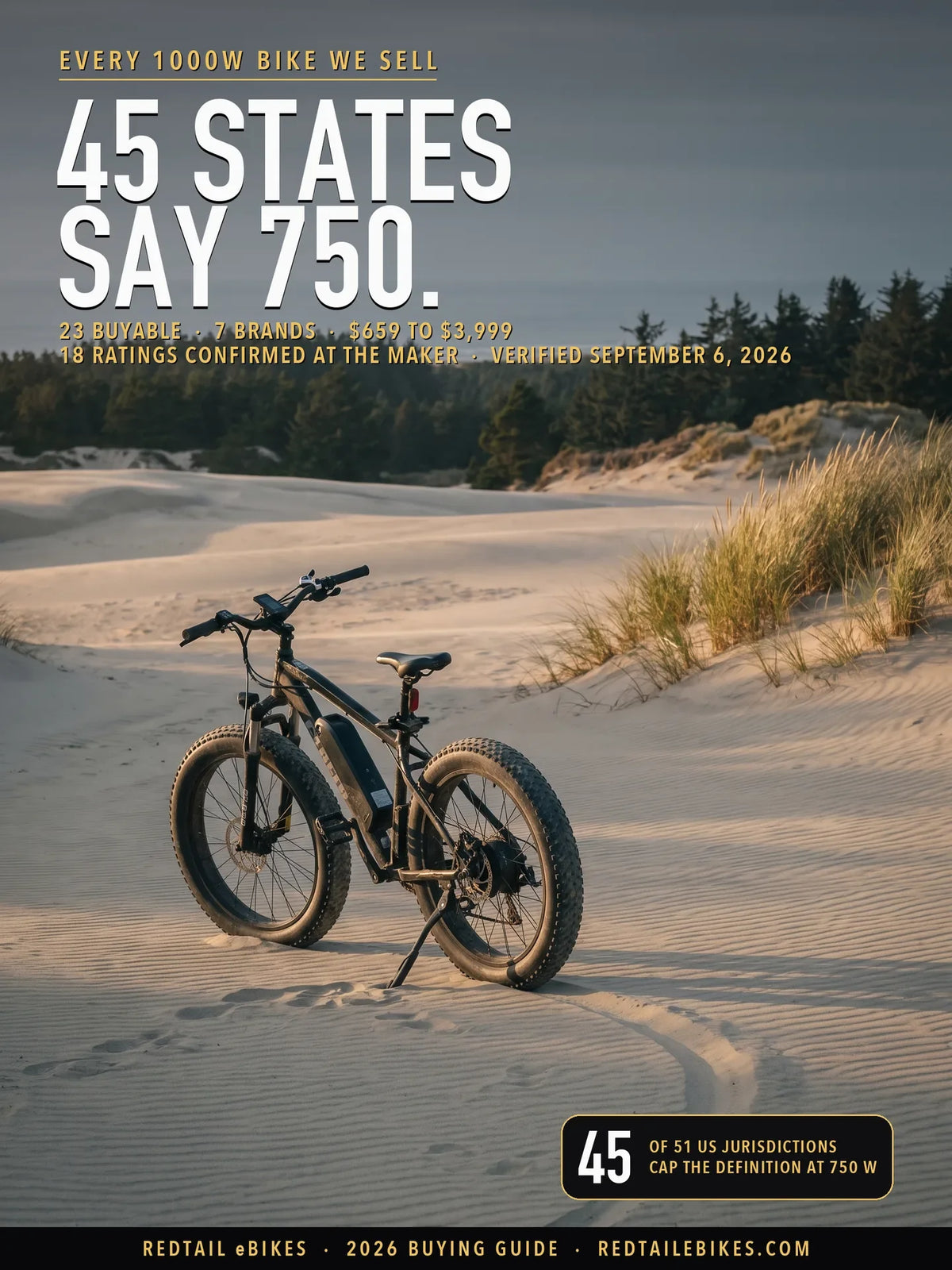
A 1,000-watt motor is the most misunderstood number in American e-bike shopping. It is not a performance tier, a speed rating, or a class. It is a line that 45 of 51 US jurisdictions draw somewhere else, and the whole question of whether you should buy one turns on which side of that line you plan to ride.
A local floor will often tell you how that line is policed where you live, and our directory of 727 verified US e-bike stores lists who is open in 70 cities.
We sell 30 machines rated at 1,000 watts of combined continuous output. 23 of them are buyable today, from $659 to $3999. This guide reads the statute in all fifty states and the District of Columbia, confirms the motor rating on each bike at the manufacturer's own page, and then puts the two together: which of ours fits which rider, on which ground, in which state.
Quick answer. A 1,000 W e-bike is not a legal category anywhere in the United States except Rhode Island, whose ceiling is written in horsepower and lands near 1,491 watts. Our Himiway Cobra Pro review runs the same screen against a single 1,000 W mid-drive and records what six months of owning one was like. Forty-five states define an electric bicycle at 750 watts or below, so a 1,000 W machine sits outside that definition and is governed by whatever the state says next. Three jurisdictions — Oregon, Montana and the District of Columbia — write no wattage figure at all and decide on speed behavior instead. Two, Alaska and Kentucky, define no electric bicycle in their vehicle codes at all. Buy 1,000 watts for sustained climbing, loaded weight and loose ground; buy 750 if your riding is public bike lanes and paved paths in one of the forty-five.
Last verified September 6, 2026. 23 buyable · 7 brands · $659 to $3,999 · 18 ratings confirmed at the maker · 45 of 51 jurisdictions cap at 750 W · verified September 6, 2026.** Every 1000W bike we sell is in the grid below, and every one of those numbers is computed from a dataset committed beside this page.
How we verified this guide
Everything below was measured on 2026-09-06 and every dataset is committed beside the page.
| what | how it was measured | what came back |
|---|---|---|
| Our shelf | Every active tag:ebike listing pulled from the store's Admin API, motor rating read from each listing's own spec line |
189 listings · 30 rated 1,000 W combined · 33 publish no rating at all |
| The 1,000 W pool | Two automated parsers disagreed on 57 rows, so every candidate was opened and its own sentence read by hand | 30 in · 12 excluded after reading · 23 buyable |
| Motor ratings | Each bike's rating confirmed on the manufacturer's own product page rather than ours | 18 confirmed across 6 makers · 5 not confirmable at source |
| The law | The statutory definition read for all 50 states and DC; every jurisdiction that is not a plain 750 W cap re-retrieved from its own primary source today | 51 jurisdictions · 45 cap at 750 W · 1 above 1,000 W |
| Demand | 72 questions harvested from 5 independent sources before a heading was written | 58 answered here · 14 dropped, each with its reason |
| Real-world feedback | Owner reports, forum threads and independent tests searched per pick, in both directions | recorded per bike, including one finding that removed a bike from the list |
Coverage, with its denominator. 72 demand rows were harvested; 58 are answered on this page and 14 were dropped with a stated reason, most of them non-US jurisdictions or a different wattage tier. No editorial questions were added — every heading here maps to something a real person or a ranking page was observed asking.
No search-volume figure appears anywhere on this page. There is no keyword export for this topic inside our freshness window, so we make no volume, difficulty or intent claim rather than dressing an estimate as data.
In this guide
- What "1,000 W" means on a spec sheet, and what it does not
- The federal 750-watt line, and why it is not a traffic law
- Which states allow a 1,000 W electric bike?
- Every state, with its own statute
- California, Florida and Texas: the three states buyers ask about by name
- What the state answer still does not settle
- How fast does a 1,000 W electric bike go?
- 750 W or 1,000 W: what actually changes
- Hub or mid-drive at 1,000 W?
- How far does a 1,000 W e-bike go on a charge?
- Is 1,000 W enough, or too much?
- How we matched these bikes to riders
- Best for steep, sustained climbing
- Best for hunting and backcountry access
- Best for long range
- Best for a low step-over
- Best for loose ground, snow and sand
- Every 1,000 W bike we sell, side by side
- The ones we did not place, and why
- If you are building rather than buying
- What a 1000w electric bike costs
- Before you buy
- Frequently asked questions
- The bottom line
What "1,000 W" means on a spec sheet, and what it does not
A watt figure describes how much electrical power the motor is built to accept continuously. It does not describe speed, and it is not a class.
Two numbers get printed as "1000W" and they are not the same thing. Rated — also written nominal or continuous — is the output the motor is designed to sustain without cooking itself. Peak is the brief surge available when you pull away from a stop or hit the bottom of a climb.
Peak is always the larger number, and it is the one marketing prefers. The same distinction decides a far smaller shelf at the top of the range, where only two machines we sell publish a rated 5,000 W system — our 5000W e-bike guide names both.
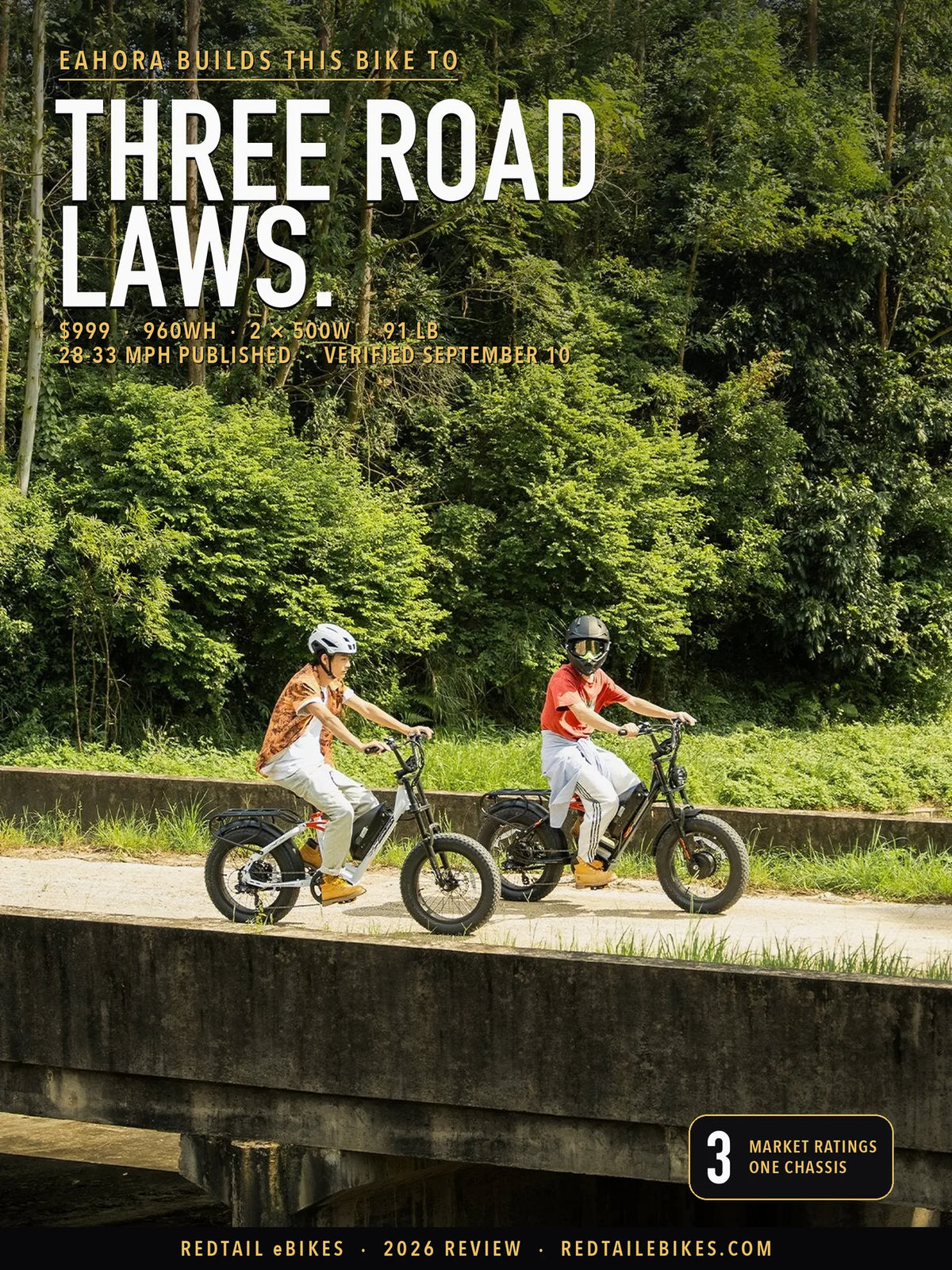
Eahora publishes the Luna at 1,000 W rated with a 1,500 W peak. Himiway publishes the D7 Pro at 1,000 W rated, peaking at 1,300 W. Both are 1,000 W bikes. A machine advertised as "1000W peak" on a 750 W rating is a 750 W bike, and every state that writes a number writes it about the rating.
A third number nobody prints turned up in an archived e-bike forum thread, where a rider found it the hard way: "I have a 1000w motor and a 48v 28a controller … the motor still runs at just over 1400 watts on full throttle."
Volts times amps is what the controller actually delivers, and it can exceed the motor's rated figure by a wide margin. The rating is a design specification. It is not a cap the bike enforces on itself.
The trap that costs people money. Buyers read "1000W" as one tier above "750W" and assume the difference is how fast it goes. It is not. What the law reads is a rating on a label. What you will feel is torque at low speed under load. A 1,000 W bike that tops out at 20 mph is ordinary, and it is what several of ours do.
Of the 18 bikes here whose rating we confirmed at the manufacturer, 8 put that 1,000 watts through the cranks and 9 put it into a wheel hub. That choice changes the bike far more than the wattage does, and it gets its own section below. Our e-bike motor guide measures 26 drive systems if you want the longer version.
The federal 750-watt line, and why it is not a traffic law
Where does 750 come from? A 2002 amendment to the Consumer Product Safety Act, which created a category called a low-speed electric bicycle so that e-bikes would be regulated as consumer products rather than as motor vehicles. The operative language, read from the US Code today:
an electric motor of less than 750 watts (1 h.p.), whose maximum speed on a paved level surface, when powered solely by such a motor while ridden by an operator who weighs 170 pounds, is less than 20 mph. — 15 U.S.C. § 2085(b)
Read the sentence carefully, because almost every page on this subject misreads it. It sits in Title 15, which is commerce and consumer product safety. It tells the Consumer Product Safety Commission how to regulate the product. It does not tell you where you may ride. Riding is governed by state vehicle codes, and those are fifty-one separate answers.
This is why "the federal limit is 750 watts, so 1,000 W is illegal" — a sentence the AI-answer surface produced almost verbatim when we ran the panel — is wrong twice over. The federal rule is not a riding rule, and the state rules do not all say 750.
Which states allow a 1,000 W electric bike?
We read the definition in all fifty states and the District of Columbia. Every jurisdiction whose answer is not a plain 750 W ceiling was then re-retrieved from its own primary source and the operative language quoted, because those are the rows this page turns on.
45 of 51 jurisdictions — 88% — define an electric bicycle at 750 watts or below. In those, a 1,000 W rated machine is simply not an electric bicycle, and what it is depends on what else that state's code contains.
| what happens to a 1,000 W rated bike | jurisdictions | count |
|---|---|---|
| It is inside the definition | Rhode Island | 1 |
| The definition carries no wattage figure; a speed test decides | Oregon · Montana · District of Columbia | 3 |
| There is no electric-bicycle definition in the vehicle code at all | Alaska · Kentucky | 2 |
| Outside a 750 W definition, and the code names a category for it | New Jersey · South Carolina · Vermont | 3 |
| Outside a 750 W definition | the remaining 42 states | 42 |
Every state, with its own statute
Find your own state. The ceiling column is what that jurisdiction's definition of an electric bicycle says about motor power; the statute column links the section it says it in.
Rhode Island writes its limit in horsepower
Rhode Island is the only jurisdiction in the country whose e-bike ceiling sits above 1,000 watts, and it is above it because the legislature never used watts:
R.I. Gen. Laws § 31-1-3(g) — "Electric motorized bicycle", also called an "electric bicycle", means a two-wheel vehicle with an electric motor rated not more than two (2) (S.A.E.) horsepower, that is capable of a maximum speed of not more than twenty-eight miles per hour (28 m.p.h.)
Two SAE horsepower is about 1,491 watts. A 1,000 W bike is comfortably inside it, provided the 28 mph speed condition is also met. Rhode Island appeared in neither answer the AI panel gave us.
Oregon, Montana and DC write no wattage at all
Oregon's definition was rewritten in 2024 and the wattage figure came out with the rewrite. ORS 801.258 now defines an electric assisted bicycle purely by class behavior, and our Oregon e-bike law page works the rest of that state through — assist to 20 mph while pedalling, throttle to 20 mph, or assist to 28 mph with a speedometer — and contains no motor-power figure. Wattage is not what decides it there.
Montana never wrote one. Its test is what the motor can do, and the state writes no Class 3 at all:
Mont. Code Ann. § 61-8-102(7) — "Electrically assisted bicycle" means a vehicle on which a person may ride that has two tandem wheels and an electric motor capable of propelling the vehicle and a rider who weighs 170 pounds no faster than 20 miles an hour on a paved, level surface.
The District of Columbia works the same way: a motorized bicycle needs pedals, a seat, wheels of at least sixteen inches and a motor incapable of exceeding 20 mph on level ground (D.C. Code § 50-2201.02). No watt figure appears.
In all three, the practical question for a 1,000 W bike is not its rating but whether it can be kept inside the speed behavior the code describes.
Vermont writes a category exactly for this machine
Vermont is the one state whose code contains a tier built for a bike like this. Its electric bicycle is under 750 watts. Above that sits a second, separate definition:
23 V.S.A. § 4(45), (46) — "Electric bicycle" means a bicycle equipped with fully operable pedals, a saddle or seat for the rider, and an electric motor of less than 750 watts … [a motor-assisted bicycle] has an electric motor with a power output of not more than 1,000 watts and does not meet the requirements of one of the three classes.
A 1,000 W machine in Vermont is a motor-assisted bicycle, regulated under § 1136a rather than as an electric bicycle. It is a real, named, legal thing to own and ride, with its own rules.
South Carolina puts it in the moped definition
South Carolina's electric bicycle stops at 750 watts, and its moped definition starts where that ends:
S.C. Code § 56-1-10(26), (29) — [electric bicycle:] an electric motor of no more than 750 watts, or one horsepower, and a top motor-powered speed of less than twenty miles an hour … [moped:] designed to have an input exceeding 750 watts and no more than 1500 watts.
So a 1,000 W bike is a moped in South Carolina, by the statute's own arithmetic. A moped there is a motor vehicle, with the registration and plate that implies.
New Jersey registers and licenses
New Jersey is the state that licenses every e-bike, and its 2025 rewrite created a third tier — an electric motorized bicycle — for machines above 750 watts that also assist past 28 mph (P.L.2025, c.285). Read our New Jersey e-bike law page before buying anything at this wattage for a New Jersey address.
Takeaway
45 of 51 US jurisdictions cap the electric-bicycle definition at 750 W, and Rhode Island's ceiling is about 1,491 W. Oregon, Montana and DC write no wattage figure, while Alaska and Kentucky write no definition at all. Find your own state in the table above before you compare a single spec.
What the AI answers got wrong, and why it matters
We ran a five-prompt panel against the AI-answer surface before writing a word of this, and saved the raw output. On the load-bearing question it gave two different, uncited answers on the same day. One named six states that "allow up to 1000W continuous motor output while retaining bicycle status": Georgia, Kansas, Minnesota, Oklahoma, Oregon and Virginia. Another named two: Kansas and Oregon.
Five of those six are contradicted by the statute:
| state | what the AI said | what the code says | source |
|---|---|---|---|
| Georgia | allows 1,000 W | 750 W or less | O.C.G.A. § 40-1-1(15.3) |
| Kansas | allows 1,000 W | under 750 W | K.S.A. 8-1489 |
| Minnesota | allows 1,000 W | "not more than 750 watts" | Minn. Stat. § 169.011 subd. 27 |
| Oklahoma | allows 1,000 W | 750 W output or less | 47 O.S. § 1-104 |
| Virginia | allows 1,000 W | 750 W input or less | Va. Code § 46.2-100 |
| Oregon | allows 1,000 W | no wattage figure at all | ORS 801.258 |
Only Oregon survives, and it survives for a different reason than the one given.
Minnesota is worth dwelling on. We re-read it at the Revisor on the day of writing, specifically because the panel named it, and the text says 750 — the same figure our Minnesota e-bike law page is built on.
Our Georgia and Virginia pages say the same about those two. If you are about to spend two thousand dollars on the strength of a chatbot's state list, open the statute first. That is the whole reason this section exists.
California, Florida and Texas: the three states buyers ask about by name
Those three are the only US states that appeared by name in our autocomplete harvest — people type "are 1000w ebikes legal in california" and "1000w ebike texas" rather than asking in general. All three give the same answer, and it is the common one.
| state | the definition's motor ceiling | so a 1,000 W bike is | our state page |
|---|---|---|---|
| California | 750 W or less (Cal. Veh. Code § 312.5) | outside the electric-bicycle definition | California e-bike laws |
| Florida | under 750 W (Fla. Stat. § 316.003(23)) | outside the electric-bicycle definition | Florida e-bike laws |
| Texas | fewer than 750 W (Tex. Transp. Code § 664.001) | outside the electric-bicycle definition | Texas e-bike laws |
If you live in one of the three and you want a bike for public bike lanes and shared paths, our 750 W guide is the page you want in place of this one. We are not being coy; it is the honest read of your own state's code.
What the state answer still does not settle
Clearing the state definition is necessary and it is not sufficient. Three layers sit under it, and all three can be stricter:
- City ordinance. Kansas expressly preserves city home rule over e-bikes on streets and sidewalks, so Wichita and Overland Park can differ from the state default. Most states leave some version of that door open.
- Land manager rules. Parks, trail systems, forest districts and beach authorities set their own motor rules, and they are frequently written in watts. A bike that satisfies the vehicle code can still be barred from a specific trail.
- Where the machine physically is. Private land is the setting the AI panel itself named for this power class, and it is the one place none of the above applies.
Our e-bike law hub carries the state-by-state pages, each with the local layer worked through — Arizona, Colorado, Illinois, Michigan, Ohio, Utah and Washington among them.
How fast does a 1,000 W electric bike go?
This is the single most-asked question about the term, and every answer we found in the wild is a range with no bike attached to it: "25 to 40 mph", "28 to 32 mph". Those numbers are not wrong so much as useless, because the controller and the assist cut-off set top speed on an e-bike, and the motor's rating does not.
Our own 1,000 W bikes are published at these speeds by their makers. One value per row, and where a maker publishes nothing we say so rather than filling it in.
| bike | published top speed | how the power is delivered |
|---|---|---|
| Eunorau FAT-HD 1.0 Pro | 20 mph | mid-drive |
| Eunorau FLASH 2.0 | 20 mph | mid-drive |
| Addmotor Grandtan Turbo | 20 mph | mid-drive, three wheels |
| Eahora Juliet (2025 and 2026) | 25–28 mph | geared hub |
| Eunorau FAT-HD 2.0 | 28 mph | mid-drive |
| Eunorau SPECTER-S 3.0 | 28 mph | mid-drive |
| Eunorau FAT-HS | 28 mph | mid-drive |
| Himiway D7 Pro | 28 mph | mid-drive |
| Eahora Luna, Terra, Luna II | 28–33 mph | geared hub |
| Himiway D7 Cobra | not published | geared hub |
The spread is 20 to 33 mph across bikes that share a wattage. Three of ours are published at 20 mph — the same figure a 250 W city bike is limited to. If the number you actually care about is speed, read the speed row, never the watt row.
750 W or 1,000 W: what actually changes
| 750 W | 1,000 W | |
|---|---|---|
| Legal standing | inside the definition in 45 states | outside it in those same 45 |
| What you feel | adequate on rolling terrain and short climbs | holds speed on long climbs and under load |
| Typical published top speed | 20–28 mph | 20–33 mph on our shelf, overlapping heavily |
| Range at the same battery size | further | shorter if you use the power, identical if you do not |
| Where it belongs | bike lanes, shared paths, commuting | private land, hunting access, sustained grades, loaded work |
The honest summary is that wattage buys sustained torque under load. It does not buy speed, and it does not buy capability in general. If your riding is a paved commute in California, the extra 250 watts costs you legal standing and buys you something you will rarely use. If your riding is a fire road with sixty pounds of gear, it is the whole point.
The range claim you will see everywhere is soft. One AI answer told us a 1,000 W motor "reduces range by 25–40% due to higher power draw" and then conceded two paragraphs later that "this isn't always true in real-world riding". Both halves are in the same answer. A bigger motor ridden gently draws what a smaller motor draws. Range follows watt-hours and how hard you ride, and the second term is bigger than most buyers expect.
Hub or mid-drive at 1,000 W?
At this power level the motor's location matters more than its rating. Of the 18 bikes we confirmed, 8 are mid-drives and 9 are hub motors.
A mid-drive turns the cranks, so it uses the bike's gears. Drop to a low gear on a steep pitch and the motor keeps spinning near its efficient range while the wheel turns slowly with force behind it.
Every bike here built for sustained climbing is a mid-drive for that reason, and it is why the torque figures are so much larger: 160 N·m on the Bafang units, 220 N·m on the Truckrun in the FLASH 2.0, against 90 to 96 N·m on the hub bikes.
A geared hub drives the wheel directly and has one ratio, always. It is simpler, cheaper, does not wear your chain and cassette, and it is entirely adequate on rolling ground. It is the wrong tool for a long, loaded climb, because the motor has no gear to hide in.
There is a maintenance trade nobody mentions at the point of sale: a mid-drive puts its torque through the same chain your legs use, so chains and cassettes wear faster. On a 160 N·m machine that is a consumable cost rather than a defect.
How far does a 1,000 W e-bike go on a charge?
Range comes from watt-hours rather than from watts. Watt-hours are volts times amp-hours, and the spread on our own 1,000 W shelf is enormous: 720 Wh on the Eahora Luna, 2,880 Wh on the Juliet — four times the energy on the same rated motor.
The Juliet's figure is the one worth checking, because a maker's range claim is a maker's claim. Eahora publishes 110 to 120 miles with pedal assist.
An owner on the Electric Bike Review forums, writing up 1,000 miles on the bike, reports roughly 100 miles on throttle alone at assist level three or lower, with a 190-pound rider plus gear. Throttle-only, at real rider weight, landing near the pedal-assist claim is unusually good agreement, and it is an independent number rather than a repeat of the brochure.
Useful arithmetic for any bike on this page: divide watt-hours by 20 for a conservative miles figure on mixed ground with a heavier rider, and by 12 if you ride hard on the throttle. The Luna's 720 Wh gives roughly 36 miles conservative, 60 gentle. The Juliet's 2,880 Wh gives roughly 144 and 240. Those brackets have held up against every published claim we have checked.
Is 1,000 W enough, or too much?
Both questions get asked in roughly equal numbers, and the answer to both is that wattage is the wrong axis.
It is too much if your riding is public infrastructure in one of the forty-five states, you want to use bike lanes and shared paths without thinking about it, and your terrain is rolling rather than steep. You are paying legal standing for torque you will not deploy.
It is enough if you carry weight, climb sustained grades, ride loose surfaces, or ride where the vehicle code does not reach. It is also enough for a heavier rider on ordinary ground, and our guide to e-bikes for heavier adults works the payload question through on its own. The same climb that a 180-pound rider takes at 750 W becomes a different problem at 280 pounds plus cargo, and torque is what solves it.
It is not enough if you want a machine that behaves like a small motorcycle. It is a different tier again, with different law attached, and this page is not it.
How we matched these bikes to riders
Four areas, chosen from the harvested demand rather than from taste. Each carries a budget, a middle and a premium answer, priced relative to that area rather than to the site, and each area's picks come from different makers.
Every pick had to clear four gates, in this order:
- The rating is confirmed at the manufacturer's own page, never from ours. Where a maker's own record does not carry a rated wattage, the bike stays in the full grid below and out of the picks — this page is about a rating, so an unconfirmed rating cannot be recommended on it. 5 of the 23 buyable bikes fall here.
- It is buyable today, with at least one variant in stock and a working cart link.
- Real-world feedback was searched for that specific model, in both directions, before the pick was final. Feedback removed one machine from this list that its specifications had already qualified.
- The fit argument has to be specific to that bike. If a pick's reason could be moved to another bike without becoming false, it is filler and it was cut.
Takeaway
18 of the 23 buyable machines had their 1,000 W rating confirmed on the maker's own page, and only those 18 were eligible to be picked. The other 5 are in the full grid, labelled, with our own listing as the source.
Prices and stock are as at 2026-09-06 and both move.
Best for steep, sustained climbing
The area where 1,000 watts earns its legal cost. What matters is torque through gears rather than the watt figure — so two of these three are mid-drives, and the budget pick is the honest compromise.
Budget · Eahora Terra — $899
Who it is for: a rider on rolling-to-moderate ground who wants real assistance on the climbs without leaving the sub-$1,000 shelf. What it does: 1,000 W rated geared hub, 1,500 W peak, 90 N·m, a 720 Wh pack, coil rear suspension, four-piston calipers and 20 × 4.0 fat tires. Eahora publishes 28–33 mph and a 330 lb maximum load. The spec that decides it: four-piston calipers on a 91 lb bike. Descending is the half of climbing that gets people hurt, and this is the cheapest bike here with brakes sized for it. Who should not buy it: anyone whose climbs are long. A single-ratio hub motor has no gear to drop into, so on a sustained grade it heats and slows. If your climbing is the point rather than an incident, read the FAT-HD 1.0 Pro below.
Add the Eahora Terra to your cart · see the full listing · browse every fat-tire e-bike we stock

Mid · Eunorau FAT-HD 1.0 Pro — $1,999
Who it is for: the rider whose route has a climb in it every single time, loaded. What it does: a Bafang M615 BBSHD mid-drive rated 48V 1000W with 160 N·m, a 48V 25Ah pack — 1,200 Wh, the largest single battery of any mid-drive here — 26 × 4.0 tires, 375 lb total payload, 20 mph published, up to 60 miles. The spec that decides it: 1,200 watt-hours behind a mid-drive. Gears let the motor climb efficiently and the pack is sized so that climbing does not end the ride. Who should not buy it: anyone who wants 28 mph. Eunorau publishes this one at 20 mph, and no amount of motor changes that. If speed is the requirement, the FAT-HD 2.0 is published at 28. Read next: our full FAT-HD 1.0 Pro review screens its 1,000 W rating against all 51 US e-bike definitions and re-derives the battery arithmetic against the only test of it online.
Add the FAT-HD 1.0 Pro to your cart · see the full listing

Premium · Himiway D7 Pro — $3,999
Who it is for: backcountry riders and heavier riders who want mountain-bike capability rather than a fat bike with a big motor. What it does: a Bafang 1000 W mid-drive peaking at 1,300 W with 160 N·m, driven by a torque sensor rather than a cadence sensor, full suspension, 26 × 4.8 tires, a 960 Wh Samsung/LG pack, 400 lb payload, 88.6 lb, 28 mph, rider height 5'3" to 6'5". The spec that decides it: the torque sensor. It meters assistance to how hard you are actually pushing, which on technical climbing is the difference between placing the bike and being shoved by it. Independent reviewers put this motor on a par with the Bafang Ultra M620 used in machines costing well over five thousand dollars. Who should not buy it: anyone who will ride it mostly on pavement. This is a lot of suspension and tire to drag down a bike lane; the Juliet in the long-range section is a better road machine for less than half the money.
Add the D7 Pro to your cart · see the full listing · browse every electric mountain bike and fat-tire e-bike we stock

Every rating we carry, with each maker's published torque and battery figures on the listing, and free shipping in the lower 48.
Browse every electric mountain bike we stockBest for hunting and backcountry access
The use case the AI answers themselves name for this power class: getting to a stand quietly, carrying gear in and meat out, on ground a truck cannot reach. Quiet, payload, tire volume and range decide it.
Budget · Eahora Luna II — $999
Who it is for: the rider who needs traction on soft ground more than they need outright power, on a short access ride. What it does: two 500 W hub motors — 1,000 W combined, driving both wheels — 50 N·m each, a 960 Wh pack, four-bar-link rear suspension, 20 × 4.0 fat tires, 330 lb load, IP65-sealed motors. The spec that decides it: all-wheel drive at $999. When the rear wheel spins up on wet leaves or sand, a driven front wheel keeps you moving in a way no amount of rear-wheel torque does. Who should not buy it: anyone going far in. 20-inch wheels and 330 lb of capacity make this a short-access machine rather than a deep-country one. For distance and load, the D7 Cobra below.
Add the Luna II to your cart · see the full listing

Mid · Himiway D7 Cobra — $2,999
Who it is for: the hunter who rides in loaded and rides out heavier. What it does: a 1,000 W brushless geared hub making 96 N·m, a 960 Wh Samsung/LG pack, full suspension, 26 × 4.5 tires, hydraulic brakes, a torque sensor, 400 lb payload, 88.6 lb, up to 80 miles, sized for riders 5'3" to 6'5". The spec that decides it: 4.5 inches of tire under 400 pounds of capacity. Float on soft ground comes from tire volume, and this is the widest rubber on this page. Who should not buy it: anyone whose access route is a sustained climb. This is a hub motor with one ratio; it will get you there, but the FAT-HS below will get you there under load without working as hard.
Add the D7 Cobra to your cart · see the full listing · browse every electric mountain bike we stock

Premium · Eunorau FAT-HS — $3,449
Who it is for: riders whose access is genuinely steep and who go far enough in to worry about getting back out. What it does: a Bafang M615 mid-drive Eunorau describes in its own words as "1000 nominal watts" with 160 N·m, full suspension, 26 × 4 tires, a 48V 15Ah pack with an optional second 14 or 17Ah battery for up to 80 miles, 300 lb payload, 28 mph. The spec that decides it: the second battery. Range anxiety on a hunting bike is not an inconvenience, and this is the pick here whose fix is a spare pack rather than a shorter ride. Who should not buy it: anyone who needs the payload. 300 lb is the lowest capacity of the three picks in this area, and a heavy rider with gear will be closer to it than they expect. The D7 Cobra carries 400.
Add the FAT-HS to your cart · see the full listing · browse every mountain e-bike and all-terrain fat-tire e-bike we stock

Best for long range
Watt-hours decide this. Watts do not. The spread inside our own 1,000 W shelf runs from 720 Wh to 2,880 Wh, which is the widest gap of any spec on this page.
Budget · Eahora Juliet (2025) — $1,499
Who it is for: the rider who wants to stop thinking about charging. What it does: a 1,000 W geared hub with a 1,200 W peak and 90 N·m, and a 2,880 Wh 48V 60Ah pack — four times the energy of most bikes on this page — with four-piston calipers on 180 mm rotors, 116 lb, 20 × 4.0 tires, a step-through frame, 330 lb load, 25–28 mph. Eahora publishes 110–120 miles on pedal assist. The spec that decides it: 2,880 watt-hours for $1,499. Nothing else on our shelf is close at the price, and a 1,000-mile owner report on the Electric Bike Review forums independently records about 100 miles on throttle alone at assist level three with a 190 lb rider and gear. Who should not buy it: anyone who wants to pedal properly. Owners consistently describe ghost pedalling at higher assist levels and a pedal position that suits sitting rather than working. This is a throttle-first cruiser, and it is excellent at being that. If you want to ride the bike rather than steer it, the FAT-HD 1.0 Pro in the climbing section is the one.
Add the Juliet to your cart · see the full listing · browse every step-through and city e-bike we stock

Mid · Eunorau FLASH 2.0 — $2,499
Who it is for: the rider whose range requirement is not fixed — some days twenty miles, some days two hundred. What it does: a 52V 1000 W Truckrun mid-drive making 220 N·m, the highest torque figure on this page, and a frame that takes three independent batteries: a 52V 16Ah base, an optional 21Ah in the top tube and an optional 17Ah in the down tube. Eunorau publishes up to 65 miles on one, 135 on two and 220 on three. 440 lb payload, four-piston hydraulic brakes on 180 mm rotors, 20 × 4.0 tires, 20 mph, riders 5'2" to 6'4". The spec that decides it: modular range. You buy the distance you need later instead of paying for it now, and the 440 lb capacity is the highest published figure on this page by 40 pounds. Who should not buy it: anyone who wants speed for the money. Eunorau publishes 20 mph, and the 220 N·m goes into pulling rather than pace.
Add the FLASH 2.0 to your cart · see the full listing

Premium · Addmotor Grandtan Turbo — $3,399
Who it is for: the rider who wants distance without balancing a heavy two-wheeler. What it does: a Bafang 1000 W mid-drive — the only mid-drive in Addmotor's trike range — through a Shimano 7-speed, a 48V 20Ah Samsung UL-certified pack (960 Wh), up to 85 miles, Tektro mechanical discs on each wheel, a torque sensor, 20 mph, 118 lb, 350 lb rider plus 100 lb cargo, riders 5'2" to 6'4". The spec that decides it: 85 miles on three wheels with gears. A trike normally trades range for stability because of rolling resistance; a geared mid-drive is how this one does not. Who should not buy it: anyone riding busy streets. Reviewers consistently note this trike is top-heavy, which shows up in tight corners and quick direction changes. Trikes reward open roads and predictable lines. A number we will not give you: Addmotor publishes no torque figure for this motor. Third-party write-ups quote 160 N·m; the maker's own record does not, so we leave the cell empty rather than print somebody else's number as Addmotor's.
Add the Grandtan Turbo to your cart · see the full listing · browse every electric trike and cargo e-bike we stock

Filter by battery, motor and price, with each maker's published figures on the listing.
Browse every fat-tire e-bike we stockBest for a low step-over
Getting a leg over a 90-pound bike is the constraint that decides the purchase for a lot of riders, and it has nothing to do with wattage. Standover height, saddle height and total weight are what matter.
Budget · Eahora Luna — $799
Who it is for: a rider who wants the lowest possible entry price and a frame they can step through. What it does: 1,000 W geared hub, 1,500 W peak, 90 N·m, 720 Wh, full suspension, hydraulic brakes, 20 × 4.0 tires, a step-through frame, 91 lb, 330 lb load, 28–33 mph. The spec that decides it: a step-through frame on 20-inch wheels. Small wheels drop the whole bike, so the swing-over is short and the saddle sits low even before you adjust it. Who should not buy it: anyone who has to lift it. It is 91 pounds, and a step-through frame does not help you get it into a truck bed or up a step. If lifting is part of your day, no bike on this page is the answer and our 750 W guide has lighter options.
Add the Luna to your cart · see the full listing · browse every moped-style cruiser we stock

Mid · Eunorau SPECTER-ST 2.0 — $2,999
Who it is for: the rider who wants genuine off-road capability and cannot swing a leg over a high top tube. What it does: a Bafang G510/M620 mid-drive at 1000 W with 160 N·m and a torque sensor, a step-through frame, a suspension fork and 27.5 × 3.0 tires, with both throttle and pedal assist. The spec that decides it: a mid-drive eMTB in a step-through frame. That combination barely exists; almost everything with this motor is built around a high top tube. Who should not buy it: anyone who needs the published numbers before they buy. Eunorau's own record for this model does not carry a top speed, a watt-hour figure or a payload rating, and we do not fill in what a maker has not published. If those figures decide your purchase, the SPECTER-S 3.0 is the same motor on a step-over frame with all of them published.
Add the SPECTER-ST to your cart · see the full listing · browse every step-through and city e-bike and folding e-bike we stock

Premium · Addmotor Grandtan Turbo — $3,399
Who it is for: a rider for whom balancing at a standstill is the real problem rather than the step-over. What it does: the trike described in the long-range section above, with a 17.5-inch standover height and a saddle adjustable from 32.5 to 39 inches. The spec that decides it: 17.5 inches. That is the lowest step-over on this page by a wide margin, and three wheels remove the balance requirement entirely at a stop, at a light, and while loading. Who should not buy it: anyone with a narrow gate, a tight garage or a standard bike rack. It is 33.5 inches wide and 77.8 inches long. Measure the route into your storage before you order.
Add the Grandtan Turbo to your cart · see the full listing
Best for loose ground, snow and sand
This area ships with two picks rather than three, and the missing tier is the premium one. We sell exactly 3 machines that reach 1,000 watts as a pair of 500 W motors driving both wheels, and none of them is a premium bike. Rather than promote a machine that does not do the job into a tier it does not fill, the area is short and says so.
Traction on loose surfaces comes from driving both wheels. More power at one of them does not supply it. A single 1,000 W rear hub spinning on wet clay simply digs.
Budget · Eahora Luna II — $999
Two 500 W hub motors at 50 N·m each, 960 Wh, a step-through frame, four-bar-link rear suspension and 20 × 4.0 tires. Twenty-inch wheels limit how far in you should go, but on a beach, a snowy driveway or a soft yard it does the one thing a single-motor bike cannot. Full write-up in the hunting section above.
Mid · Eunorau FAT-AWD 2.0 — $1,699
Who it is for: the rider whose winter or whose worksite is the reason they are shopping. What it does: a 48V 500 W front hub and a 500 W rear hub — 1,000 W combined across two driven wheels — with a maximum 110 N·m, a torque sensor, a 48V 15Ah pack with an optional second 15Ah for up to 80 miles, 26 × 4.0 tires, 375 lb payload, 81.5 lb, riders 5'3" to 6'1", and 20 mph. Eunorau lists it as Class 2 with a UL-certified battery, and it comes in step-over and step-through frames. The spec that decides it: 26-inch wheels on all-wheel drive. That is what makes this the version of the Luna II you can actually ride distance on, and 375 lb of payload means the traction is still there with the load that caused the traction problem. Who should not buy it: anyone chasing speed or hills. 20 mph published, and two 500 W hubs have no gears between them and the ground. For grades, the FAT-HD 1.0 Pro.
Add the FAT-AWD 2.0 to your cart · see the full listing · browse every fat-tire e-bike and moped-style cruiser we stock

Every 1,000 W bike we sell, side by side
All 23 buyable machines rated at 1,000 watts of combined continuous output, in price order. The whole shelf, every rating, is at all e-bikes. The rating confirmed column says whether we could confirm the motor rating on the manufacturer's own page; where we could not, the bike is listed but not recommended, because a page about a rating cannot recommend an unconfirmed one.
| bike | price | motor | torque | battery | payload | top speed | rating confirmed at maker |
|---|---|---|---|---|---|---|---|
| YVY K20 Lite | $659 | 1,000 W hub | not published | 720 Wh | 330 lb | 30 mph | yes |
| Eahora Luna | $799 | 1,000 W geared hub (1,500 W peak) | 90 N·m | 720 Wh | 330 lb | 28–33 mph | yes |
| Eahora Terra | $899 | 1,000 W geared hub (1,500 W peak) | 90 N·m | 720 Wh | 330 lb | 28–33 mph | yes |
| Ridstar Q20 Lite | $899 | 1,000 W hub | 75 N·m | 720 Wh | not published | 20 mph | yes |
| Eahora Luna II | $999 | 2 × 500 W, AWD | 2 × 50 N·m | 960 Wh | 330 lb | 28–33 mph | yes |
| Samebike LO26 Plus | $999 | 1,000 W hub, per our listing | 80+ N·m | 720 Wh | not published | not published | not at source |
| Samebike RS-A02 Pro | $999 | 1,000 W hub, per our listing | 80+ N·m | 720 Wh | not published | not published | not at source |
| Samebike RS-A08 | $1,399 | 1,000 W hub, per our listing | 65 N·m | 816 Wh | 396 lb | 28 mph | not at source |
| Eahora Juliet (2025) | $1,499 | 1,000 W geared hub (1,200 W peak) | 90 N·m | 2,880 Wh | 330 lb | 25–28 mph | yes |
| Eahora 2026 Juliet | $1,699 | 1,000 W geared hub (1,200 W peak) | 90 N·m | 2,880 Wh | 330 lb | 25–28 mph | yes |
| Eunorau FAT-AWD 2.0 | $1,699 | 2 × 500 W, AWD | 110 N·m | 720 Wh | 375 lb | 20 mph | yes |
| Eunorau FAT-AWD 3.0 | $1,699 | 2 × 500 W, AWD | 110 N·m | 720 Wh | 375 lb | 20 mph | yes |
| Samebike CREST | $1,699 | 1,000 W hub, per our listing | 85 N·m peak | 960 Wh | not published | not published | not at source |
| Samebike STORM | $1,699 | 1,000 W hub, per our listing | 85 N·m peak | 960 Wh | not published | not published | not at source |
| Eunorau FAT-HD 1.0 Pro | $1,999 | 1,000 W mid-drive, Bafang M615 | 160 N·m | 1,200 Wh | 375 lb | 20 mph | yes |
| Eunorau FAT-HD 2.0 | $2,399 | 1,000 W mid-drive, Bafang M615 | 160 N·m | 720 Wh | 375 lb | 28 mph | yes |
| Eunorau FLASH 2.0 | $2,499 | 1,000 W mid-drive, Truckrun | 220 N·m | 832 Wh | 440 lb | 20 mph | yes |
| Eunorau SPECTER-S 3.0 | $2,999 | 1,000 W mid-drive, Bafang M620 | 160 N·m | 840 Wh | 300 lb | 28 mph | yes |
| Eunorau SPECTER-ST 2.0 | $2,999 | 1,000 W mid-drive, Bafang M620 | 160 N·m | not published | not published | not published | yes |
| Himiway D7 Cobra | $2,999 | 1,000 W geared hub | 96 N·m | 960 Wh | 400 lb | not published | yes |
| Addmotor Grandtan Turbo | $3,399 | 1,000 W mid-drive, Bafang, trike | not published | 960 Wh | 350 + 100 lb | 20 mph | yes |
| Eunorau FAT-HS | $3,449 | 1,000 W mid-drive, Bafang M615 | 160 N·m | 720 Wh | 300 lb | 28 mph | yes |
| Himiway D7 Pro | $3,999 | 1,000 W mid-drive, Bafang (1,300 W peak) | 160 N·m | 960 Wh | 400 lb | 28 mph | yes |
Two rows in that grid carry a federal safety notice, and neither is a pick. The Ridstar Q20 Lite is named in the Consumer Product Safety Commission's stop-use warning 26-584 of June 25, 2026: "The front wheel can detach without warning, posing a crash hazard to consumers." The Commission writes that it "is aware of 32 reports of the front wheel detaching, including 31 reports of injuries such as concussions, broken bones, cuts, scrapes, and bruises."
A warning is not a recall, and no recall exists. In the Commission's March 19, 2026 fire warning on the Q20 and Q20 Pro, the maker, Huizhou Xingqishi Sporting Goods Co., Ltd., "has refused to agree to an acceptable recall." No refund, repair or replacement program stands behind either notice. The Q20 Lite is in the grid because it was buyable at $899 on September 11, 2026, and it is not recommended here because of the warning.
The YVY K20 Lite is sold by HK Ridstar Trade Limited, the same company. YVY's own warranty page lists the "YVY Q20 1200W Fat Tire Electric Bicycle" and the "YVY Q20Pro 2000W Fat Tire Electric Bicycle" among its warranted products, so the family the Commission named is sold under both names. Whether the K20 Lite shares the Q20 Lite's front wheel, fork or battery is published by nobody. Our Ridstar brand profile holds the full record.
The ones we did not place, and why
Twelve listings looked like 1,000 W machines to an automated read and are not. They are worth naming, because the same mistake is easy to make while shopping:
- Two motors of 1,000 W each is a 2,000 W bike rather than a 1,000 W bike. The Eahora Juliet III and the Samebike M20-III both run a pair of 1,000 W hubs. Their per-motor figure is the number that gets advertised; the combined figure is the one a statute reads.
- A cross-sell is not a spec. Several of our own listings mention a 1,000 W sibling while describing a different bike. The Addmotor Grandtan M-340 and Grandtan X are 750 W machines whose pages point at the Turbo.
- A peak figure is not a rating. The Freesky Ranger Plus advertises 2500 W + 2500 W peak, and the Samebike RS-A08's maker publishes a 1,200 W peak with no rated figure at all.
Seven further 1,000 W listings are real but had no buyable variant on 2026-09-06, so they are not in the grid above and cannot be recommended: five Ridstar models, the Eahora Cupid Cargo and the Eahora FT-01.
If you are building rather than buying
A measurable share of people searching this term are not shopping for a bike at all. The top related query for "1000w ebike" in the US is "1000w ebike kit", rising; for "1000w electric bike" it is "48v 1000w electric bike kit with battery". Of the 6 archived forum threads our harvest surfaced, 4 were builders asking about controllers, hub motors and power limits rather than buyers choosing a machine.
If that is you, this page will not help much and we would rather say so. We sell complete bikes and we do not sell conversion kits.
The legal analysis above still applies to your build exactly as it applies to ours: a state reads the motor's rated output, whatever you paid for it. The controller thread quoted earlier is the thing to understand first. Our e-bike motor guide covers how the drive systems differ, which is the part of this that transfers.
What a 1000w electric bike costs
On our own shelf, the buyable range is $659 to $3999, and the shape of that spread is worth understanding before you set a budget.
- Under $1,000 buys a 1,000 W geared hub on 20-inch fat tires, a 720–960 Wh pack, and coil or four-bar rear suspension. 7 of our buyable machines sit here.
- $1,500 to $2,000 is where either the battery gets serious (2,880 Wh on the Juliet) or the motor moves to the cranks (the FAT-HD 1.0 Pro at 1,200 Wh).
- $2,400 to $3,000 buys a Bafang mid-drive with 160 N·m and a torque sensor.
- Above $3,000 buys full suspension, 400 lb payloads and named components, or three wheels.
If the budget is the constraint rather than the wattage, our best e-bikes under $1,000 and under $1,500 guides screen the whole shelf on price instead, and how much an electric bike costs explains where the money goes.
The steepest value step on the whole page is between a hub motor and a mid-drive, and it happens around the $2,000 mark. If you can only move your budget once, move it across that line rather than up within a tier.
Before you buy
- Read your own state's line first. Forty-five of fifty-one cap at 750 W, and that decides more about your ownership than any spec here.
- Check the rating rather than the headline. Ask for the rated or nominal figure. If a listing only gives you a peak number, you do not yet know what the bike is.
- Decide hub or mid-drive before you decide budget. It is the biggest difference on this page.
- Size the battery to your worst day rather than your average one. Watt-hours divided by 20 is the conservative mileage.
- Weigh yourself, your gear and anything you carry, then compare with the published payload. Several of these bikes weigh 90 pounds before you get on.
- Measure your storage. A 77-inch trike or a 91 lb fat bike changes what a garage is for.
- Check the trail rules where you actually ride, beyond the state code.
Still deciding on format rather than power? Our e-bike frame types explainer, the fat tire versus regular tire comparison and the electric mountain bike guide each answer a different half of that. The electric bike buying guide is where to start from scratch, and every machine here has a full write-up in our reviews.
Frequently asked questions
Which states allow a 1,000 W electric bike?
Rhode Island is the only state whose electric-bicycle definition has room for one: its ceiling is two SAE horsepower, about 1,491 watts. Oregon, Montana and the District of Columbia write no wattage figure at all and decide on speed behavior instead. Alaska and Kentucky define no electric bicycle in their vehicle codes. The remaining forty-five cap the definition at 750 watts.
Is a 1,000 W e-bike street legal?
It depends entirely on the state, and "street legal" is the wrong frame. In the forty-five states that cap at 750 W, a 1,000 W machine is not an electric bicycle, and what it is instead depends on that state's other definitions. South Carolina calls it a moped, Vermont a motor-assisted bicycle, and New Jersey has a third tier for it.
What class is a 1,000 W e-bike?
Usually none. The three-class system applies to machines that meet the state's electric-bicycle definition, and in forty-five states a 1,000 W bike does not. In Oregon, Montana and DC, where no wattage figure exists, a 1,000 W bike can meet a class if its speed behavior fits.
Do I need a license for a 1,000 W electric bike?
In most states the question does not arise, because the machine is outside the e-bike definition and what happens next varies. Where a state moves it into a moped or motor-vehicle category — South Carolina is the clearest example — registration, a plate and a license follow from that category. New Jersey licenses e-bikes generally.
How fast does a 1,000 W electric bike go?
There is no single answer, because the controller and assist cut-off set top speed rather than the motor rating. Across the machines on this page, makers publish figures from 20 mph to 33 mph, all on 1,000 W motors. Three of ours are published at 20 mph.
What is the difference between a 750 W and a 1,000 W e-bike?
Legal standing and sustained torque. A 750 W bike is inside the electric-bicycle definition in forty-five states; a 1,000 W bike is not. In riding terms, the extra power shows up on long climbs and under load rather than in top speed, where the two overlap heavily.
Is 1,000 W enough for hills?
For steep, sustained climbing, what matters is whether the motor has gears. A 1,000 W mid-drive with 160 N·m through a cassette will climb what a 1,000 W hub motor cannot, because the hub has one ratio and no way to stay in its efficient range.
Hub motor or mid-drive at 1,000 W?
Mid-drive for sustained climbing and loaded work; geared hub for rolling ground, simplicity and price. A mid-drive puts its torque through your chain and cassette, so those wear faster — a consumable cost rather than a fault.
How far does a 1,000 W e-bike go on a charge?
Range comes from watt-hours, not watts. On this page the range of packs runs from 720 Wh to 2,880 Wh. Divide watt-hours by 20 for a conservative real-world mileage and by 12 if you ride hard on the throttle.
What is the weight limit of a 1,000 W electric bike?
It varies by frame rather than by motor. Published payloads on this page run from 300 lb to 440 lb, plus a trike rated for 350 lb of rider and 100 lb of cargo. Several bikes here do not publish a figure at all, and we say so rather than estimating.
How long does a 1,000 W e-bike take to charge?
Charge time is a function of pack size and charger amperage, not motor wattage. A 720 Wh pack on a 2 A charger is an overnight job; a 2,880 Wh pack is considerably longer. Check the charger rating on the specific bike.
Can I commute on a 1,000 W electric bike?
Physically, easily. Legally, in forty-five states you would be commuting on something that is not an electric bicycle, which affects bike-lane and path access. If your commute is public infrastructure, our 750 W guide is the better page.
Are 1,000 W e-bikes good for beginners?
Power is not the beginner problem; weight and speed are. Several bikes here weigh around 90 pounds and are published at 28 to 33 mph. A first-time rider is better served by a lighter machine, and the class definition is easier to live with too.
What is the best 1,000 W electric bike?
There is no single best one, which is why this page is organized by use. For sustained climbing, the Himiway D7 Pro; for hunting access, the D7 Cobra; for range, the Eahora Juliet; for loose ground, the Eunorau FAT-AWD 2.0; for a low step-over, the Addmotor Grandtan Turbo.
The bottom line
Buy 1,000 watts for what it actually does: sustained torque under load, on ground where the vehicle code does not reach or where your state's code has room for it.
Rhode Island has room by statute. Oregon, Montana and DC decide on behavior rather than watts. Vermont and South Carolina name a category for the machine. Everywhere else you are buying a bike that is not an electric bicycle, and that is worth knowing before the box arrives.
If your riding is a paved commute in one of the forty-five, buy 750 watts and enjoy the bike lane. If it is a fire road with a load on the back, the mid-drives on this page are the reason the category exists.
Limitations
- The state screen reads the vehicle code rather than the whole legal picture. City ordinances, park and trail rules and land-manager policies are a separate layer and can be stricter. Where a state's answer sits in regulation rather than statute — Alaska is the clearest case — this page says the code is silent and does not reconstruct the answer.
- 45 of the 51 rows are carried at the grade our law project assigned them, from primary-source reads dated 2026-08-19. The rows this page turns on — every jurisdiction that is not a plain 750 W cap, plus Minnesota, which an AI answer named — were independently re-retrieved on 2026-09-06 and are quoted from the operative language. That is a declared boundary rather than a uniform one.
- 5 of the 23 buyable machines carry a rating we could not confirm on the manufacturer's own page. They appear in the grid, sourced to our own listing and labelled, and they are not recommended. This is a limit of what we could retrieve, and it is recorded as such.
- Two of our spec cells conflict with the maker's. Our Ridstar Q20 Lite listing publishes 28 mph where the maker publishes 20 mph, and our Samebike RS-A08 listing publishes a 1,500 W peak and 80+ N·m where the maker publishes 1,200 W peak and 65 N·m. The manufacturer's figures are what appear in the grid above, and the product pages have correction tickets open.
- Three manufacturer pages were retrieved through a text proxy rather than directly, after the makers' hosts began rate-limiting our requests. The documents are deposited and the figures are quoted from them, but they are a rendering of the page rather than the page.
- No search-volume, difficulty or intent figure appears on this page. No keyword export exists for this topic inside our freshness window. The title phrasing was chosen on a relative Google Trends index, which is not a volume and is not restated as one.
- The forum evidence is an opportunistic sample. Wayback archives a thread because somebody saved it rather than because it mattered. 6 threads were relevant out of 200 candidates, with 57 that could not be retrieved at all. Nothing here is a share or a percentage.
- Prices and stock were read on 2026-09-06 and both move. A price on this page that disagrees with the product page is out of date, and the product page is right.
- We sell the brand behind the notice under the grid. Three Ridstar models the Consumer Product Safety Commission has named, the Q20, the Q20 Pro and the Q20 Lite, were listed and buyable on our store on September 11, 2026, with five YVY bikes from the same company beside them. The notices and what YVY is are set out in the Ridstar brand profile.
This page expires when: any state amends its electric-bicycle definition; any of these makers
changes a published rating; or our catalog adds or drops a 1,000 W machine. Re-run
scripts/screen_1000w_geography.py and scripts/census_1000w.py to refresh both halves.
Source register
| tier | what it means | used here for |
|---|---|---|
| T1 — primary law | statutes and the US Code, read at the publishing authority | every wattage ceiling, every quoted definition, the federal 750 W line |
| T1 — primary regulator | the Consumer Product Safety Commission's own record | the product-safety framing of the federal definition, and the two Ridstar Q20-family stop-use warnings quoted under the grid |
| T2 — manufacturer | the maker's own product page, deposited at retrieval | every motor rating, torque, battery, payload and top-speed figure attributed to a maker, plus YVY's company-address and warranty pages |
| T3 — our own storefront | our live listings, pulled from the Admin API | prices, stock and the shelf denominator |
| T4 — independent test and owner report | third-party reviews and archived forum threads | corroboration only, never a statistic, and always labelled as testimony |
| T5 — aggregators and AI summaries | not cited as fact anywhere on this page | used only as the object of study in the AI-panel section |
On corroboration. A state statute has one publisher of record: that state's own legislature or revisor. Where a genuinely independent second retrieval exists — Kentucky's administrative regulation beside its statute, Oregon's operating chapter beside its definition, Vermont's § 1136a beside its § 4 — it is recorded in the ledger. Where none exists, the row says SOLE-PUBLISHER rather than pointing at an aggregator, and this paragraph is the disclosure. Justia, Casetext, law-firm summaries and AI answers are T5 here and none of them corroborates anything on this page.
Sources
All retrieved 2026-09-06 unless noted.
- 15 U.S.C. § 2085 — low-speed electric bicycle, federal product-safety definition.
- R.I. Gen. Laws § 31-1-3(g) — Rhode Island, two SAE horsepower.
- ORS 801.258 — Oregon, electric assisted bicycle, no wattage figure.
- Mont. Code Ann. § 61-8-102(7) — Montana, 20 mph capability test.
- D.C. Code § 50-2201.02 — District of Columbia, motorized bicycle.
- 23 V.S.A. § 4(45), (46) — Vermont, electric bicycle and motor-assisted bicycle.
- 23 V.S.A. § 1136a — Vermont, operation of motor-assisted bicycles.
- S.C. Code § 56-1-10 — South Carolina, electric bicycle and moped definitions.
- P.L.2025, c.285 — New Jersey, three-tier e-bike framework.
- Minn. Stat. § 169.011 subd. 27 — Minnesota, 750 watts.
- K.S.A. 8-1489 — Kansas, under 750 W.
- O.C.G.A. § 40-1-1(15.3) — Georgia, 750 W or less.
- 47 O.S. § 1-104 — Oklahoma, 750 W output.
- Va. Code § 46.2-100 — Virginia, 750 W input.
- Cal. Veh. Code § 312.5 — California, 750 W.
- Fla. Stat. § 316.003(23) — Florida, under 750 W.
- Tex. Transp. Code § 664.001 — Texas, 750 W.
- Alaska Stat. § 28.90.990 — Alaska, no electric-bicycle definition.
- KRS 189.010 — Kentucky, no electric-bicycle definition.
- Eahora Luna · Terra · Luna II · Juliet 2025 · 2026 Juliet — manufacturer specifications.
- Eunorau FAT-HD 1.0 Pro · FAT-HD 2.0 · FLASH 2.0 · SPECTER-S 3.0 · SPECTER-ST 2.0 · FAT-HS · FAT-AWD 2.0 · FAT-AWD 3.0 — manufacturer specifications.
- Himiway D7 Cobra · D7 Pro — manufacturer specifications.
- Addmotor Grandtan Turbo — manufacturer specifications.
- Ridstar Q20 Lite — manufacturer specifications.
- YVY K20 Lite — manufacturer specifications.
- Samebike CREST · STORM · RS-A08-II · RS-A02 Pro · LO26 Plus — manufacturer specifications.
- Eahora Juliet 1000-mile owner review — Electric Bike Review forums, owner testimony.
- Himiway Cobra Pro review — Electric Bike Report, independent test.
- EUNORAU FAT-HD review — Electric Bike Review, independent test.
- CPSC Warning 26-337, March 19, 2026, Ridstar Q20 and Q20 Pro e-bikes, fire hazard; hazard, incident and manufacturer statements quoted. Retrieved 2026-09-11.
- CPSC Warning 26-584, June 25, 2026, Ridstar Q20 and Q20 Lite e-bikes, crash hazard; hazard, incident and consumer-action statements quoted. Retrieved 2026-09-11.
- YVY, company address, business name HK Ridstar Trade Limited. Retrieved 2026-09-11.
- YVY, e-bike warranty, warranted-products list naming the Q20 family. Retrieved 2026-09-11.


Share:
Fat Tire vs Regular Tire eBike: The Measured Answer
Your First Entry-Level E-Bike (2026): 10 Decisions