

296 models priced · 9 picks across 8 brands · 19.6% under $1,000 · 750 W federal line · median $1,599 · verified August 29, 2026
Quick Answer: The median new electric bike in the United States costs $1,599, measured across 296 current models on 22 manufacturers' own storefronts on August 28, 2026. Half the market sits between $1,200 and $2,099.
Under $1,000 buys a real bike but rarely a certified battery; $1,500 to $2,500 is where hydraulic brakes, a torque sensor and a warranty you can actually claim start appearing together. Above $3,000 you are usually buying a mid-drive motor or a cargo frame, and only 3.4% of models sell there. Start from all e-bikes or the commuter and city range.
The trap almost everyone falls into is budgeting for the sticker and forgetting the rebate conditions. Colorado will take $225 off at the till, but only if the bike carries UL 2849 or EN 15194 certification, which many sub-$1,000 machines do not — our under-$1,000 buying guide counts how many: 32 of the 50 budget listings we stock never mention UL at all.

In this guide
- How we verified this guide
- How much is an electric bike in 2026?
- What 206 bikes on our own shelf cost
- Why every average e-bike price you have read is unfalsifiable
- The five price tiers, and what each one actually buys
- What actually drives the price of an e-bike
- Are electric bikes getting more expensive?
- Do tariffs make your e-bike more expensive?
- The out-the-door price: tax, shipping and assembly
- What your state pays you back
- What it costs to charge an electric bike
- What an e-bike costs to run for a year
- The replacement battery, the cost nobody quotes
- What e-bike insurance costs
- What $500 to $1,000 actually buys
- Is an electric bike cheaper than a car?
- Where buyers get caught out
- How much should you spend? A budget by rider
- The 12-point price checklist
- Frequently asked questions
- The bottom line
- Limitations
- Source register
- Primary sources
How we verified this guide
Two price datasets were built for this page, and both are published in full. The first is a census of every complete e-bike on the Redtail storefront on September 20, 2026: 206 bikes, after excluding 361 listings that are parts, batteries or accessories. The second reaches outside our own shelf: 296 current models across 22 brands, each price taken from that manufacturer's own online store on the same day.
The market figures deliberately exclude a class of bike. Specialized, Trek, Giant, Cannondale and most bike-shop brands do not publish a machine-readable catalog, so they are absent. Those brands sit at the premium end, which means the $1,599 median here is lower than a true whole-market median would be. The method carries that limit, and it belongs up here where you can weigh it.
Everything that is not a price comes from the body with authority over it. Electricity rates are the U.S. Energy Information Administration's monthly series, and price trends are Bureau of Labor Statistics consumer price indexes.
Import duty is the United States International Trade Commission's tariff schedule. Every rebate figure is read at the agency that runs the program, and the ones that have closed are reported as closed.
Corpus: 31 distinct sources consulted, 27 retrieved and read in full, 4 unreachable behind bot protection and named in Limitations. The nine recommended bikes were confirmed buyable, and their specs re-read from their own product pages, on August 29, 2026. Verified August 29, 2026 by Milad Ghobadibeygvand, BScN (Western University, 2014)
How much is an electric bike in 2026?
The median new electric bike in the US costs $1,599, and half the market falls between $1,200 and $2,099. That is 296 current models, priced on 22 manufacturers' own storefronts on August 28, 2026. The mean is higher at $1,769, pulled up by a thin tail of cargo bikes and mid-drive commuters above $3,000.
The distribution matters more than the midpoint, because the shape tells you where the choice actually is. Almost three quarters of everything sold sits under $2,000, and the band from $1,500 to $2,000 is the single most crowded stretch of the market (our picks for that exact band are verified at the manufacturer).
A big-box shelf sits lower again: across the 142 e-bikes Best Buy listed in September 2026 the median was $899, and 30 of them were under $500.
| Price band | Models (market) | Share | Models (our shelf) | Share |
|---|---|---|---|---|
| Under $1,000 | 58 | 19.6% | 50 | 24.3% |
| $1,000–$1,500 | 77 | 26.0% | 37 | 18.0% |
| $1,500–$2,000 | 82 | 27.7% | 66 | 32.0% |
| $2,000–$2,500 | 37 | 12.5% | 24 | 11.7% |
| $2,500–$3,500 | 32 | 10.8% | 19 | 9.2% |
| $3,500 and up | 10 | 3.4% | 10 | 4.9% |
| Total | 296 | 100% | 206 | 100% |

Two datasets, built from different sources on the same day, disagree by one band and agree everywhere else. The crowding at $1,500 to $2,000 is the shape worth remembering.
Two independent counts landing $100 apart is worth more than either alone. The market sweep says $1,599; our own catalog says $1,699. They were built from different sources on the same day and they agree.
| Statistic | Market (296 models) | Redtail shelf (206 bikes) |
|---|---|---|
| Cheapest | $499 | $510 |
| 10th percentile | $899 | $759 |
| 25th percentile | $1,200 | $1,099 |
| Median | $1,599 | $1,699 |
| Mean | $1,769 | $1,740 |
| 75th percentile | $2,099 | $2,099 |
| 90th percentile | $2,949 | $2,799 |
| Dearest | $5,999 | $4,499 |
Takeaway
Budget $1,500 to $2,100 and you are shopping the middle half of the entire US market. Below $1,200 you are in the cheapest quarter; above $2,949 you are in the top tenth. Walmart sits almost entirely inside that cheapest quarter: across 48 priced listings we verified, the median was $579 and the range ran $174.99 to $2,499. The Walmart price ladder sets out what each band buys.
Prices in the tables above are list. The discounts move weekly.
See this week's price cutsWhat 206 bikes on our own shelf cost
Our own catalog runs from $510 to $4,499, with a median of $1,699 and a mean of $1,713. The median and the mean sitting $14 apart is unusual and it says something specific: our shelf has no long luxury tail. Nothing on it passes $4,499.
Per-brand medians vary more than most buyers expect, and the spread within a single brand is often wider than the gap between brands.
| Brand (our shelf) | Bikes | Median |
|---|---|---|
| Ridstar | 21 | $719 |
| YVY | 5 | $769 |
| Hitway | 11 | $800 |
| Samebike | 10 | $1,099 |
| Riding'times | 6 | $1,124 |
| Qiolor | 3 | $1,599 |
| Eunorau | 31 | $1,699 |
| Freesky | 10 | $1,724 |
| Eahora | 23 | $1,799 |
| Velotric | 20 | $1,949 |
| Himiway | 6 | $1,999 |
| Addmotor | 28 | $2,499 |
Read that column as a map of what each brand is built to do, and never as a quality ranking. A $719 median means a catalog of folding and compact commuters; a $2,499 median means trikes and cargo frames, which cost more because there is more of them.
The same pattern holds across the wider market, where 22 brands span a range of medians from under $800 to well past $4,000. How those brands compare on things other than price is the subject of our brand rankings.
| Brand (manufacturer storefronts) | Models | Median | Range |
|---|---|---|---|
| Nakto | 14 | $795 | $529–$3,996 |
| Samebike | 14 | $809 | $619–$1,599 |
| KBO | 5 | $1,199 | $999–$1,699 |
| Sixthreezero | 45 | $1,300 | $800–$4,000 |
| Lectric | 24 | $1,355 | $999–$1,822 |
| Heybike | 33 | $1,399 | $799–$2,698 |
| Denago | 17 | $1,599 | $499–$3,399 |
| Qiolor | 5 | $1,599 | $1,399–$2,499 |
| Velotric | 10 | $1,749 | $1,099–$2,499 |
| Espin | 6 | $1,749 | $799–$1,999 |
| Eunorau | 30 | $1,749 | $799–$3,999 |
| Vvolt | 16 | $1,799 | $999–$2,999 |
| Aventon | 13 | $1,899 | $1,499–$5,999 |
| Rad Power Bikes | 8 | $1,949 | $1,499–$2,299 |
| Himiway | 7 | $1,999 | $999–$2,999 |
| Troxus | 20 | $1,999 | $1,599–$3,199 |
| Blix | 12 | $2,100 | $2,100–$4,250 |
| Ariel Rider | 4 | $2,649 | $1,799–$3,199 |
| Priority Bicycles | 3 | $4,656 | $2,539–$5,644 |

Nineteen brands, sorted by what they actually charge. The gold bars sit below the market median and the red bars at or above it.
Why every average e-bike price you have read is unfalsifiable
Ask the major AI search engines what an e-bike costs and you get three different averages and no method behind any of them. Running a seven-prompt panel on August 28, 2026 returned $1,500, $2,000 and $2,200 as "the average", alongside at least seven mutually incompatible ranges. Not one figure carried a sample size, a sample date, or a description of what was counted.
The sourcing explains the disagreement. Nearly every cited page was an e-bike brand's own marketing blog. Across all seven prompts there was not a single citation to the Bureau of Labor Statistics, the Census Bureau, the International Trade Commission or the Consumer Product Safety Commission. One cited source was an e-bike listicle hosted on a university biology department's server.
| What gets published as "the average" | What evidence accompanies it |
|---|---|
| "about $2,000" | no sample, no date, no method |
| "approximately $2,200 for mid-tier" | no sample, no date, "mid-tier" undefined |
| "$800–$2,500, average around $1,500" | no sample, no date, three figures in one clause |
| "$500 to $3,000+" | a range so wide it excludes nothing |
| "entry $600–$1,000 / mid $1,200–$2,500" | bands asserted, membership never counted |
| $1,599 (this page) | 296 models, 22 brands, priced August 28, 2026, dataset published |
An average without a denominator cannot be checked, and a number nobody can check is not a measurement. The figure on this page can be wrong, which is the point: the model list, the exclusions and the pull date are all published, so anyone can re-run it and say so.
Takeaway
When a price guide gives you an average, look for three things: how many bikes, which bikes, and what date. If any is missing, the number is decoration.
The five price tiers, and what each one actually buys
Tiers are only useful if the boundaries mean something mechanical. These are drawn where components actually change, and the share column is measured from the 296-model market dataset.
| Tier | Price | Share of market | What changes at this price |
|---|---|---|---|
| Entry | $499–$999 | 19.6% | Cadence sensor, mechanical disc brakes, unbranded cells, often no third-party battery certification |
| Value | $1,000–$1,499 | 26.0% | Hydraulic brakes appear, larger packs (600–720 Wh), integrated lighting, UL 2849 or EN 15194 becomes common |
| Core | $1,500–$1,999 | 27.7% | Torque sensor, name-brand controllers, real suspension forks, longer warranty terms |
| Premium | $2,000–$3,499 | 23.3% | Mid-drive motors, cargo and trike frames, better sealing, dealer service networks |
| Flagship | $3,500+ | 3.4% | Belt drive, internally geared hubs, automatic shifting, integrated ABS |
The single most consequential jump is from cadence sensing to a torque sensor, and it usually happens between the value and core tiers. A cadence sensor asks whether the pedals are turning; a torque sensor measures how hard you are pushing. That is why cheaper bikes feel like a switch and dearer ones feel like a stronger version of you.
Weight moves the other direction from what buyers expect. Spending more often buys a heavier bike, because the money goes into cargo capacity, suspension and bigger batteries. Lightness is a flagship feature, priced accordingly.
The e-bike finder leaves price out of its score: it ranks the machines that fit your height, weight, town and state law, then shows each match's live price, so you can see which tier your best fit falls in.
The core tier, $1,500 to $2,000, is where most riders should start looking. For the shelf immediately below it, our best electric bikes under $1,500 reads all 84 listings at that ceiling and verifies every decisive figure at the manufacturer.
Browse commuter e-bikesWhat actually drives the price of an e-bike
Four components account for most of the difference between a $700 bike and a $2,500 one, and the battery is the largest single line. The rest of the frame, wheels and finishing kit vary far less across the range than the electrical system does.
| Cost driver | Cheap implementation | Expensive implementation | Why it costs more |
|---|---|---|---|
| Battery | 360–480 Wh, unbranded cells | 720–1,000 Wh, name-brand cells, UL 2849 certified | Cells are priced per watt-hour, and certification is a real testing expense |
| Motor + sensing | Rear hub, cadence sensor | Mid-drive, torque sensor | Mid-drives use the gears, which needs a stronger frame and drivetrain; the motor guide compares 26 systems |
| Brakes | Mechanical disc | Hydraulic disc, larger rotors | A 70 lb bike at 28 mph needs more stopping power than a bicycle |
| Frame and fork | Unbranded aluminum, coil fork | Hydroformed frame, air fork or full suspension | Tooling and tuning, where the money goes before any metal is cut |
| Support | Email only, no US parts | US warranty, stocked spares, dealer network | Holding inventory and staffing service costs money before you buy |
A useful check when comparing two bikes is dollars per watt-hour of battery. It will not tell you which bike is better, but it exposes when a price difference is buying capacity, which is the most common reason two similar-looking bikes are $400 apart.
Cargo bikes and trikes deserve their own note. They cost more because they are more bike: longer frames, heavier tubing, stronger brakes and often two motors' worth of load on one. Browse cargo and electric trikes with that in mind, and do not compare them to a commuter. If a trike is on your list because balance is the reason, our electric bike for seniors guide prices that decision at three levels.
Are electric bikes getting more expensive?
Over seven years bicycles got cheaper in real terms; over the last twelve months they have been rising almost twice as fast as everything else. Both halves come from the same Bureau of Labor Statistics consumer price index series, pulled August 28, 2026.
| Period | Bicycles (CUUR0000SERC01) | All items (CUUR0000SA0) | Difference |
|---|---|---|---|
| June 2019 → June 2026 | +16.6% | +30.4% | 13.8 points cheaper |
| June 2025 → June 2026 | +6.2% | +3.5% | 2.7 points dearer |
| June 2025 → July 2026 | +6.7% | +3.5% | 3.2 points dearer |

The red line spent four years below the grey one. The last twelve months are the first sustained move back toward it.
Deflated against general inflation and indexed to June 2019, the bicycle price level in June 2026 sits at 89.4. A bike today costs about a tenth less in real money than the same category did seven years ago.
The recent reversal is the part that should affect your timing. Bicycle prices rose 6.2% in the year to June 2026 while consumer prices generally rose 3.5%. The long trend has been your friend; the short one is not.
A caution on what this index is. The BLS series covers bicycles as a category and is not an e-bike-only index. It is the best published US price series that touches this market, and it should be read as the direction of travel rather than as the price of any particular machine.
Takeaway
If you are choosing between buying now and waiting a season, the twelve-month trend argues for now. Bicycle prices are currently climbing faster than general inflation.
Do tariffs make your e-bike more expensive?
The base US import duty on an electric bicycle is zero. Under the Harmonized Tariff Schedule, heading 8711.60.00 covers cycles "with electric motor for propulsion", and its general rate of duty is Free. The schedule splits it into 8711.60.00.50 for motors "of an output not exceeding 250 W" and 8711.60.00.90 for everything else, which is where nearly all US-market e-bikes land.
That matters because tariff cost on an e-bike does not come from the tariff schedule. It comes from trade actions layered on top of it, which are set separately and change on their own timetable. The 10% figure that appears in the "other" column of the schedule is the rate for countries without normal trade relations, and it does not apply to the ordinary supply chain.
We are not publishing a current Section 301 rate on this page. The figures circulating for 2026 come from freight brokers and trade blogs, never from the Federal Register or the Trade Representative.
A duty rate quoted from a secondary source is the kind of claim that turns out to be a year out of date. What the primary schedule does support is the part buyers get wrong most often: the tariff line for e-bikes is not itself a cost.
The out-the-door price: tax, shipping and assembly
Add roughly 6% to 10% to the sticker for sales tax, and budget separately for assembly if you are not comfortable finishing the build. Sales tax is charged on the pre-rebate price in at least one state that runs a rebate: Colorado's own program page states that "the purchaser is responsible for paying the full sales tax on the e-bike", so the $225 discount does not reduce the tax base.
The rebate program states the same rule from the other side: "Sales tax is calculated on the listed retail price, not the discounted price after the rebate is applied" (Colorado Energy Office).
| Cost after the sticker | Typical range | Notes |
|---|---|---|
| State and local sales tax | ~0%–10% of price | Set by your own state and county; a few states levy none statewide, and local add-ons vary within a state |
| Shipping | $0 on many direct brands | Free US shipping is standard on our catalog |
| Assembly | $0 self, ~$75–$200 at a shop | Direct-to-consumer bikes ship ~85% assembled |
| Helmet, lock, lights | $100–$300 | A quality U-lock alone is often $80+ |
| Rack, fenders, bags | $0–$250 | Frequently already fitted at the core tier and above |
Registration is worth a sentence because buyers search for it and the answer is usually reassuring. In most states an e-bike meeting the three-class definition is regulated as a bicycle and needs no registration, no plate and no driver's license.
The exceptions are specific, and they are covered state by state in our electric bike laws guide. The rules that most often surprise buyers sit in New York, New Jersey, Pennsylvania and Illinois, and the big-population baselines are Texas and Florida.
Accessories are the line most often underestimated. If you are buying at the entry tier, assume the true out-the-door number is the sticker plus tax plus about $150, and shop accessories deliberately, well before checkout.
What your state pays you back
Rebates are the largest single discount available on an e-bike, and the programs open, close and expire faster than most guides update. Five of the best-known US programs were checked at the administering agency on August 28, 2026. Two are open, two have ended, and one runs on a rolling application window.
| Program | Amount | Status on 2026-08-28 | Source |
|---|---|---|---|
| Colorado statewide tax-credit discount (state rules) | $225 off at the till, one per resident per calendar year | Open, at participating retailers | Colorado Energy Office |
| Colorado income-qualified rebate | $1,000 base, +$300 e-cargo, +$300 adaptive | Registration window open now, closes August 31, 2026 at 12:00 PM MT | Colorado Energy Office |
| Washington WE-Bike (state rules) | $300 or $1,200 by income, age 16+ | Open — applications run March 30, 2026 to March 29, 2027, selected monthly at random | WSDOT |
| Denver (shops) | $675 standard, income-qualified; adaptive $625 or $1,175 | Open in release windows; next release September 8, 2026 | City and County of Denver |
| Minnesota (state rules) | was 75% of expenses, capped at $750 | Expired June 30, 2026 by the statute's own terms | Minn. Stat. § 289A.51 |
| California E-Bike Incentive Project (state rules) | was up to $2,000 | Concluded December 2025; 2,246 vouchers issued | California Air Resources Board |
A rebate is not the same as a discount you can count on. Washington's 2025 pilot offered rebates to 6,861 people out of 37,751 applicants, which is roughly one applicant in five (WSDOT, March 20, 2026). The Legislature appropriated $7 million for the 2025–2027 biennium. Apply, but do not build the budget around winning.
Two of those deserve emphasis because guides published earlier this year still describe them as live.
Minnesota's rebate did not run out of money. It ended because the statute said it would:
This section expires June 30, 2026.
That is Minn. Stat. § 289A.51, subd. 9. The same section set the rebate at "the lesser of: (1) 75 percent of eligible expenses paid by an eligible individual; or (2) $750" at subdivision 3(a), with income ceilings of $78,000 for joint filers, $62,000 for head of household and $41,000 otherwise at subdivision 3(c). If you have seen $1,500 quoted for Minnesota, that figure was never in the statute.
California's program is finished too. The Air Resources Board records that it "began in December 2022 and concluded in December 2025", having issued 2,246 incentives of up to $2,000.
What stacks, and what does not
This is the part guides get wrong, and getting it wrong costs real money. Colorado runs two separate programs, and they combine with each other but not with everything.
| Combination | Allowed? | Source |
|---|---|---|
| State $225 tax-credit discount + state $1,000 income-qualified rebate | Yes, if the retailer is registered for both | Colorado Energy Office |
| Denver's $675 voucher + state $225 tax-credit discount | Yes, $900 total | City and County of Denver |
| State $1,000 rebate + a local program such as Denver's | No — never on the same bike | Colorado Energy Office |
The state's own wording is unambiguous: Coloradans in cities with local programs "may register for the statewide rebate, but rebate recipients may not combine the state rebate with these local incentives on the same single e-bike purchase."
Registration is a lottery, not a queue. Colorado selects registrants at random when each window closes, and the remaining 2026–27 windows are October 19–26, January 11–18 and March 15–22. Only one e-bike rebate is allowed per person for life.
The condition that disqualifies cheap bikes
Colorado does not pay out on just any e-bike. The program requires that the machine "must meet independent UL certification standards", specifically UL 2849 or EN 15194, that its motor is 750 W or less, and that it has two or three wheels with fully operable pedals.
The income-qualified rebate adds two more conditions that catch buyers out. A standard e-bike must have a maximum purchase price of $5,000, and full-suspension mountain e-bikes are not eligible at all (Colorado Energy Office). An e-cargo bike qualifies for the extra $300 only if it has an extended frame with a published cargo capacity of at least 100 lb.
There is a second exclusion that catches a popular category. Colorado's definition, as the program page describes it, "does not include any vehicle designed with a mode (sometimes advertised as an 'off-road' mode) exceeding the three class system or propelling the vehicles faster than 20 MPH with a throttle alone." A bike advertised with an unlockable off-road mode can be a fine machine and still fail the rebate test.
Takeaway
Before you count a rebate into your budget, confirm two things with the retailer: that they are registered with the program, and that the specific model carries UL 2849 or EN 15194 certification. Both conditions are checkable before you pay.
What it costs to charge an electric bike
Charging a typical e-bike costs about 15 cents, and a year of regular riding costs roughly $15 in electricity. The US average residential electricity price was 18.34 cents per kilowatt-hour in June 2026, published in the Energy Information Administration's Electric Power Monthly, Table 5.3, released August 26, 2026.
The arithmetic is short enough to check. A 720 Wh battery is 0.72 kWh. Charging is not perfectly efficient, so assume about 10% loss at the charger, giving roughly 0.79 kWh drawn from the wall for a full charge. At 18.34 cents that is about 14.5 cents.
| Battery size | Energy from the wall | Cost per full charge | 100 charges/year |
|---|---|---|---|
| 360 Wh | 0.40 kWh | $0.07 | $7 |
| 480 Wh | 0.53 kWh | $0.10 | $10 |
| 720 Wh | 0.79 kWh | $0.15 | $15 |
| 1,000 Wh | 1.10 kWh | $0.20 | $20 |
Where you live changes the answer by more than double. Using the EIA's state table for the same month, a full 720 Wh charge costs about 12 cents in Washington and about 28 cents in California.
| State | Residential price, June 2026 | Cost per 720 Wh charge |
|---|---|---|
| Washington | 14.91¢/kWh | $0.12 |
| Florida | 15.10¢/kWh | $0.12 |
| Texas | 15.94¢/kWh | $0.13 |
| Colorado | 17.13¢/kWh | $0.14 |
| Minnesota | 17.52¢/kWh | $0.14 |
| US average | 18.34¢/kWh | $0.15 |
| New York | 29.49¢/kWh | $0.23 |
| California | 34.74¢/kWh | $0.28 |

California charges nearly two and a half times what Washington does for the same kilowatt-hour, and it still comes to less than a coffee per month.
These calculations are ours. The agency publishes the electricity price; the charge costs above are that price applied to battery sizes with a stated 10% charging loss. The assumption is ours and a different charger will move the number a cent or two.
Per mile, charging is close to irrelevant. A 720 Wh pack that carries you 35 miles costs about 0.4 cents per mile in electricity. The costs that actually matter are further down this page.
What an e-bike costs to run for a year
Plan on $150 to $400 a year in running costs for a bike you ride regularly, with tires and brake pads doing most of the spending. Electricity is a rounding error next to consumables and the occasional shop visit.
| Annual cost | Self-maintained | Shop-maintained | Notes |
|---|---|---|---|
| Electricity | $10–$20 | $10–$20 | At 18.34¢/kWh, EIA June 2026 |
| Tires | $60–$120 | $90–$180 | E-bikes are heavy and fast, so tires wear faster than on a bicycle |
| Brake pads | $20–$50 | $60–$120 | Two sets a year is normal for a daily commuter |
| Chain and drivetrain | $30–$60 | $70–$140 | Torque from a motor accelerates chain stretch |
| Annual service | $0 | $80–$150 | Bearings, cables, bolt torque, brake bleed |
| Total | $120–$250 | $310–$610 | Excludes the battery reserve below |
The self-maintained column assumes you own a set of hex keys and are willing to watch a video. Nothing in the list requires special tools except a brake bleed, which is the one job worth paying for.
Set aside a battery reserve separately. A pack is not an annual cost, but it is the largest predictable expense in an e-bike's life and treating it as a surprise is how owners end up abandoning a working bike.
The replacement battery, the cost nobody quotes
Replacement packs on our own shelf run $379 to $899 with a median of $470, and most packs are usable for three to five years of regular charging. Amortized, that is roughly $95 to $190 a year, comfortably the largest line in the true cost of ownership.
That median comes from all 13 replacement packs we stock, priced August 28, 2026. It is a narrow window on the market: ten of the thirteen are one brand, so read it as what a mid-market pack costs rather than as an industry average. Packs for premium mid-drive systems sit well above it.
The reason it varies so much is that batteries are priced roughly per watt-hour, and packs differ by more than a factor of two in capacity. A 360 Wh pack and a 1,000 Wh pack are not the same purchase.
| Pack size | Typical replacement cost | Per year over 4 years |
|---|---|---|
| 360–480 Wh | $379–$470 | $95–$118 |
| 500–720 Wh | $469–$580 | $117–$145 |
| 750–1,000 Wh | $580–$899 | $145–$225 |
Two things protect that money and neither costs anything. Store the bike indoors and charge it between about 20% and 80% for daily use, saving full charges for days you need the range. Heat and sitting at 100% are what age lithium cells fastest.
The buying decision this creates is worth stating plainly, because it inverts the usual advice. Check that replacement packs for your model are actually sold before you buy the bike, not after. A bike whose battery cannot be replaced is a bike with an expiry date, and that is a far more expensive problem than a $200 price difference at purchase. Spares for the brands we carry live in e-bike parts.
Takeaway
Add $95 to $190 a year to your mental budget for the battery, and confirm replacement packs are available for your specific model before you pay.
What e-bike insurance costs
Standalone e-bike insurance typically runs $100 to $300 a year, and for many riders a homeowner's or renter's policy already covers theft. The question worth asking is not whether to insure but which of three routes fits.
Homeowner's and renter's policies usually cover a bicycle as personal property, subject to your deductible and often to a sub-limit that a $2,500 e-bike can exceed. Call and ask two questions: what the sub-limit for bicycles is, and whether the policy treats an e-bike as a bicycle or as a motor vehicle. The second answer is the one that occasionally produces an unwelcome surprise.
| Route | Typical annual cost | Covers | Gap to watch |
|---|---|---|---|
| Existing home/renter policy | $0 extra | Theft, sometimes damage | Sub-limits; deductible often exceeds the claim |
| Rider added to that policy | $30–$100 | Theft and damage at agreed value | Usually excludes liability while riding |
| Standalone e-bike policy | $100–$300 | Theft, damage, often liability and roadside | Read the definition of "e-bike" in the policy |
Liability is the coverage most riders overlook and the one with the largest downside. A Class 3 bike at 28 mph can injure someone, and a homeowner's policy that classifies your bike as a motor vehicle may decline exactly that claim. Where your bike is Class 3, check this before you need it.
What $500 to $1,000 actually buys
Under $1,000 buys a genuine, rideable electric bike, and it is 19.6% of the market — but it is also where battery certification stops being standard. That single fact should shape the decision more than any spec on the page.
Federal law defines a low-speed electric bicycle as one with "fully operable pedals and an electric motor of less than 750 watts (1 h.p.)", whose top speed on motor power alone with a 170 lb rider is under 20 mph (Pub. L. 107-319, 116 Stat. 2776). Every bike in this band sits inside that definition.
At this price you can reasonably expect a 350 to 500 W rear hub motor, a cadence sensor, mechanical disc brakes, a 360 to 480 Wh battery and a steel or basic aluminum frame. That combination will carry an average rider several miles at 20 mph without complaint. It is a real bike.
What you are usually giving up is less visible: third-party battery certification, hydraulic braking, a torque sensor, and a support operation that can send you a part in two years. The last one is the one that ends bikes.
| At $500–$1,000 you get | At $500–$1,000 you often do not get |
|---|---|
| A working 350–500 W hub motor | UL 2849 or EN 15194 battery certification |
| 360–480 Wh battery, 20–35 miles realistic | Hydraulic disc brakes |
| Mechanical disc brakes | A torque sensor |
| Basic lighting, rack mounts | Stocked US spare parts |
| A 20 mph Class 2 machine | A rebate you can claim in Colorado |
That last row is the trap, and it is a money trap rather than a safety one. In Colorado a bike without UL 2849 or EN 15194 certification is not eligible for the $225 discount. A $950 uncertified bike and a $1,175 certified one cost the same after the rebate, and only one of them has a tested battery.
Big-box and warehouse-club e-bikes belong in the same conversation. They are often decent machines at fair prices, and the thing to check is not the bike but the aftermath: who supplies a replacement battery in year four, and who answers when a controller fails. Our honest take on where to buy is in best place to buy electric bikes, and current reductions are grouped in on sale.
For the physical side of that decision, the directory of 727 verified US e-bike stores sets out the five kinds of store and what each one charges you for.
Costco's seven 2026 listings are priced against the bike we sell at the same money, so you can see what the club price does and does not buy.
One category deserves separating out here, because it is priced like an e-bike and regulated like something else. Moped-style machines with pedals can look identical to a Class 2 bike on a product page while carrying different licensing consequences, which is why they have their own guide in electric mopeds USA.
Certified batteries at the value tier are the sweet spot for most first-time buyers.
See what's on saleIs an electric bike cheaper than a car?
For trips under about 10 miles, an e-bike costs a small fraction of driving, and the purchase price is usually recovered inside two years of replaced car trips. The comparison is only honest if it is made against the trips an e-bike can actually take, so this table is built on a 2,000-mile riding year, well short of a full household mileage.
| Cost over 5 years, 2,000 miles/year | Electric bike | Second car |
|---|---|---|
| Purchase | $1,599 | $15,000+ |
| Energy | ~$75 | $1,700+ |
| Maintenance and consumables | $750–$1,500 | $3,000+ |
| Battery or major service reserve | $470 | included above |
| Insurance | $0–$1,500 | $6,000+ |
| Registration and licensing | $0 in most states | $500+ |
| Five-year total | $2,900–$5,200 | $26,000+ |
The car column is deliberately labelled a second car, because that is the only comparison most households can actually act on. Replacing a first car with an e-bike is a bigger life change than a price table can capture, and a guide that pretends otherwise is selling rather than helping.
The trips an e-bike actually replaces are shorter than people assume. In the 2022 National Household Travel Survey, the average shopping trip ran 5.8 miles and the average family or personal errand 8.6 miles, against 13.4 miles for the commute (FHWA, Table 3-3). Errands and shopping are squarely inside e-bike range.
The honest limits are worth naming. An e-bike does not carry four people, does not work for every commute in every winter, and does not remove the need for a car in most of the country. What it reliably replaces is the short trip, and those are the trips where a car is least efficient.
Where buyers get caught out
Five mistakes account for most of the money lost on an e-bike purchase, and all five are avoidable before you pay.
Budgeting for the sticker instead of the out-the-door price. Tax, a lock, a helmet and lights are not optional, and they add roughly $150 to $400 to a first purchase. Build them into the number you compare bikes with.
Counting a rebate you are not eligible for. Programs carry certification requirements, residency proof, income ceilings and retailer registration. Colorado requires UL 2849 or EN 15194; Washington's WE-Bike selects applicants at random, so applying early buys you nothing.
Reading a rebate figure from an out-of-date guide. Minnesota's program expired on June 30, 2026 and California's concluded in December 2025, yet both still appear as live in guides published this year.
Buying a bike whose battery cannot be replaced. This is the single most expensive mistake on the list, because it converts a repairable machine into a disposable one. Confirm pack availability first.
Buying without a local shop that will touch it. Direct-to-consumer bikes are cheaper partly because service is not included, and a shop that refuses to work on an unfamiliar brand turns a $60 job into a problem. Our city directories, including Portland and New York, list which stores service what.
Treating advertised range as a budget input. Range figures are measured under favourable conditions. If range decides your purchase, size the battery against your actual round trip and add margin; the arithmetic is in our entry-level e-bike guide.
How much should you spend? A budget by rider
Match the budget to the trip rather than to the spec sheet. These bands come from the measured market distribution above, paired with the requirement that actually binds for each rider.
| If you are | Budget | Because | Start with |
|---|---|---|---|
| Riding a flat commute under 5 miles | $900–$1,400 | A 480 Wh pack and mechanical brakes are genuinely sufficient | Eahora Luna, TIGER JR |
| Commuting 5–15 miles, some hills | $1,500–$2,100 | Torque sensor and hydraulic brakes start here; this is the market's middle half | META26, Discover 3 |
| Carrying loads or a passenger | $900–$3,200 | Longer frame, stronger brakes, higher payload | GT33 |
| Riding trails or rough ground | $1,400–$3,000 | Suspension and sealing cost real money | Rocky Pro A-320, FAT-HD 2.0 |
| Wanting the lightest possible bike | $2,800+ | Light is a premium feature, priced accordingly | — none of our nine qualifies; that band is honest to leave open |
| Buying a first bike to find out if you like it | $599–$1,000 | Enough bike to be honest, little enough to be a low-risk test | CY20 Pro, MN26 |
Nine bikes off our own shelf, one for every budget
The selection method is published so you can re-run it. Every bike below was confirmed buyable on August 29, 2026, every spec is read from its own product page, and the nine spread across all eight of our brands with stock — no brand supplies more than two. Prices are the checkout price on the day stated.
Before the cards, a pattern worth seeing: only two of these nine publish the UL 2849 certification Colorado's rebate requires. If a rebate is part of your budget, that column decides more than the price does.

Manufacturer's photograph. The solid-wheel version — the spoked variant costs the same.
Samebike CY20 Pro — $599
The cheapest buyable bike on our shelf, and one of the few at any price that sits fully inside the federal definition: 500 W rated (800 W peak), 20 mph, 36V 13Ah. If you are testing whether an e-bike fits your life before committing real money, this is that test. The honest catch: no UL 2849 or UL 2271 certification is published for it, so it cannot claim Colorado's $225. See the CY20 Pro.

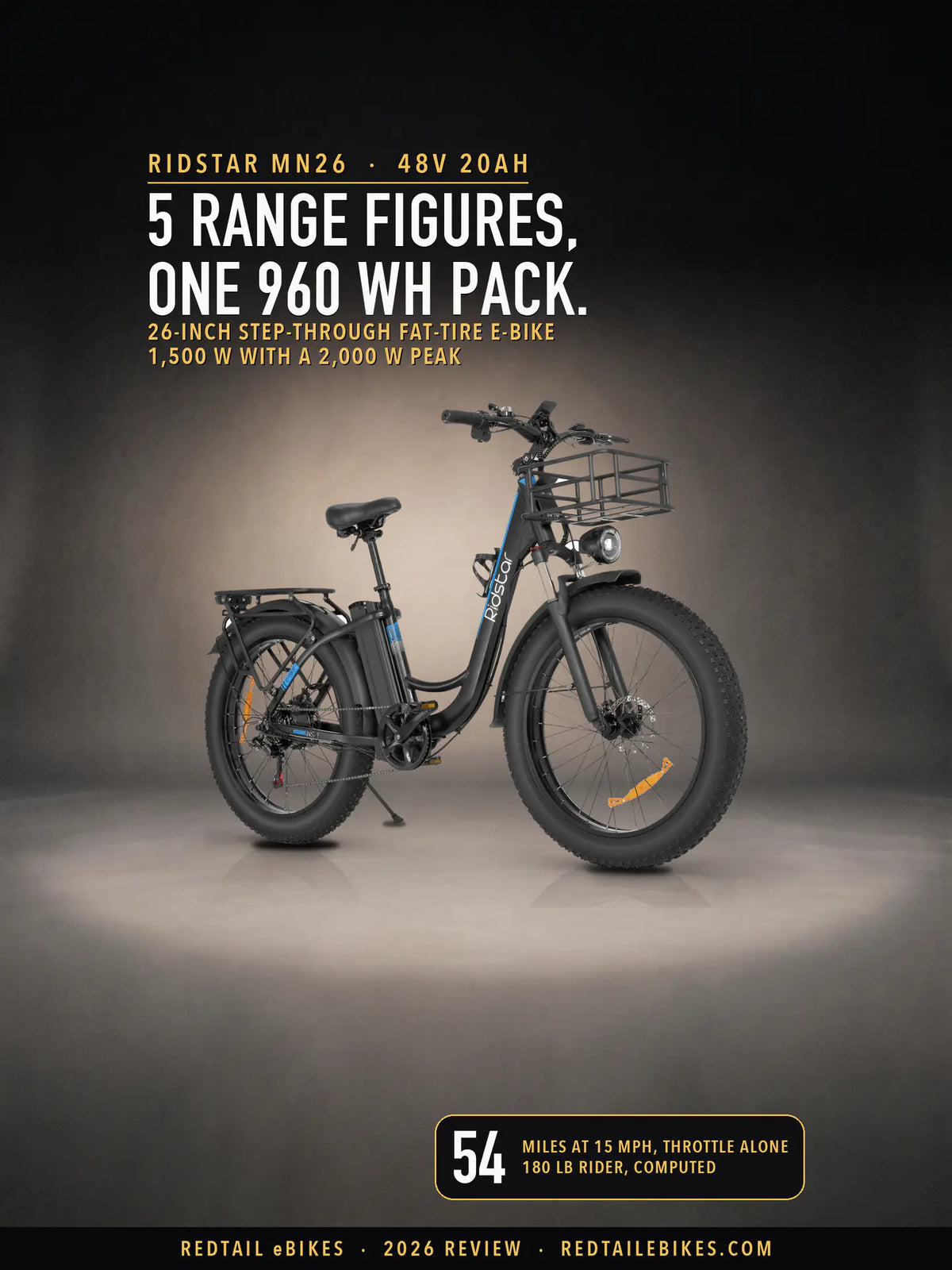
Our studio photograph. A 960 Wh pack at a $690 price is the whole argument.
Ridstar MN26 — $690
Ninety-one dollars more than the CY20 Pro buys more than twice the battery: 48V 20Ah works out to 960 Wh, on 26×4.0 fat tires. It is also a 1,500 W machine claiming 28 mph, which puts it above the 750 W federal line — check your state's rules before riding it on public roads, and count it out of any rebate. See the MN26.
The maker's record. Know the builder before you pay. The MN26 sits in no regulator's notice as of September 11, 2026, but on March 19, 2026 the US Consumer Product Safety Commission warned that on the same maker's Q20 and Q20 Pro "The e-bikes' batteries and wires can ignite, posing a fire hazard to consumers," citing 11 fire reports, one burn injury, five smoke-inhalation reports and over $40,000 in damage.
A second warning on June 25, 2026 named the Q20 and Q20 Lite: "The front wheel can detach without warning, posing a crash hazard to consumers," with 32 detachment reports and 31 injury reports. A warning carries no remedy, and a recall would; CPSC says the manufacturer "has refused to agree to an acceptable recall," so nobody is fixing, refunding or replacing those bikes.
The cost picture widens abroad and in court. The UK's product-safety regulator rated three Ridstar models' chargers a serious fire risk in June 2025, recording that "The import has been rejected at the border." Two 2026 lawsuits, one naming Amazon and one naming Walmart, allege a Ridstar front wheel came off under a rider; courts have decided neither.
On the running-cost side, one MN26 owner's Trustpilot review reports "it only lasted 15 miles" against the 70-95 miles the website claimed, a replacement battery that "arrived after 21 days and was the wrong one," and that Ridstar "refused my request" for a return. Treat it as a single account. The brand's whole record is in our Ridstar brand profile, and it belongs in the price you are weighing.

Manufacturer's photograph. The step-through frame is the point — no leg swing, no dismount drama.
Eahora Luna — $799
The best battery-per-dollar under $1,000 in a commuter shape: a 720 Wh pack, a step-through frame and a claimed 58 miles for $799.
It runs a 1,000 W rated hub (1,500 W peak) at up to 28 mph, so it sits above the federal low-speed line — legal in many states as a Class 3-adjacent machine, but that is a check to make before you ride it to work. Eahora publishes no certificate number against its UL-compliance claim. See the Luna.

Manufacturer's photograph. The rear deck is rated for a passenger, which is rare at this price.
Riding'times GT33 — $899
The cheapest way we sell to move loads: a cargo deck, a 48V 27Ah dual-battery-ready system and 258 N·m of torque for $899.
Be clear-eyed about what it is. Riding'times gives 31 mph in its spec table and 34 mph in its product description, and either figure puts it outside the three-class system entirely, which makes it an off-road and private-land machine in most states. Its battery is listed as UL 2849 compliant. As a farm, yard or acreage hauler it is unmatched at the price. See the GT33.

Manufacturer's photograph. The retro tank frame hides a plain, sensible commuter underneath.
Qiolor TIGER JR — $899
The comfort pick of the value band: 500 W, 48V 13Ah, 20 mph — inside the federal definition, styled like something friendlier than a spec sheet. It claims 70 miles on paper; treat that as a best-case ceiling, the way this page treats every range claim. No certification is published, so the same rebate caveat applies. See the TIGER JR.

Manufacturer's photograph. The one Freesky builds with a torque sensor.
Freesky Rocky Pro A-320 — $1,499
The paperwork Colorado asks for is on this one: a UL 2849 complete-system certificate that names this model on its face, linked as a PDF from its page — one of just two bikes in these nine that can say so. It is also the only Freesky with a torque sensor, and it is rated to carry 400 lb.
The trade sits on the spec sheet. Freesky publishes peak wattage only (2,500 W) and a 33 mph top speed, which parks it outside the three-class framework on public roads in most states. Trail and private-land riders get the certificate and the sensor; commuters should look one card up or down. Our Rocky Pro review works out whether its saddle fits your height and how far a charge goes. See the Rocky Pro A-320.

Our studio photograph. The market median, as a machine you can ride.
Eunorau META26 — $1,699
Priced at the literal median of the 296-model market this page measured, and shaped like what the median buyer needs: a 500 W hub, 48V 15Ah, 20 mph as a Class 2, with a 286 lb payload. Eunorau publishes "UL certified" without naming a standard, so we treat certification as not established — the same standard of proof this page applies to everyone. See the META26.

Manufacturer's photograph — and the bike on this page's cover.
Velotric Discover 3 — $1,999
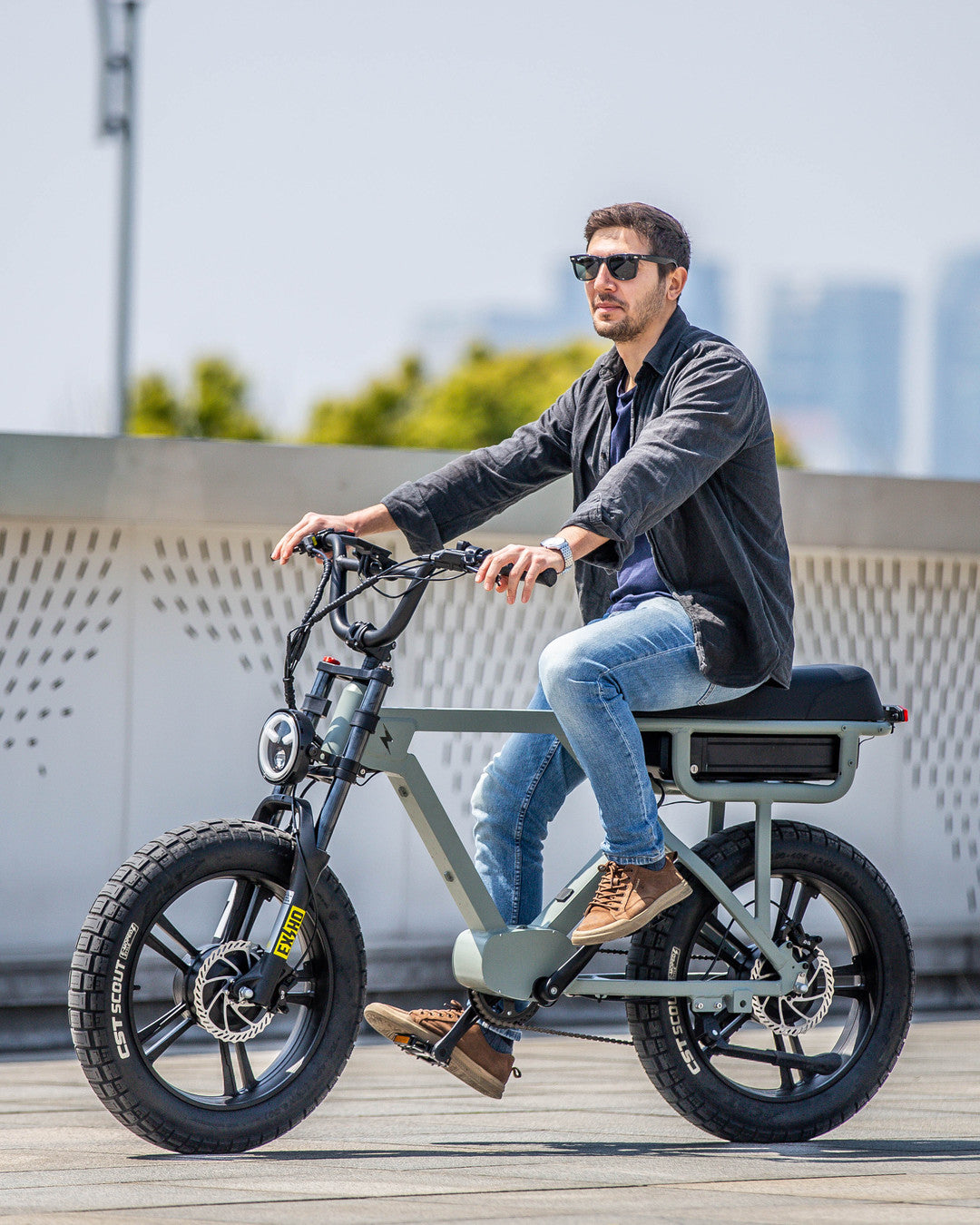
The bike photographed at the top of this page, and the cleanest legal story of the nine: 750 W nominal, torque-sensed, shipped at 20 mph with an adjustable range. Velotric states UL 2849 for the complete system and UL 2271 for the battery — a claim from its spec sheet, labelled as such.
A 730 Wh pack and a quoted 80 assisted miles make it the core-band pick for a daily commute. It is also the dearest commuter here, which is what the certification, the sensor and the finish cost. See the Discover 3.

Our studio photograph. Mid-drive torque is what the extra money buys.
Eunorau FAT-HD 2.0 — $2,399
The premium-band demonstration of where money goes above $2,000: a 48V 1,000 W Bafang mid-drive at 160 N·m, built as a hunting and backcountry machine. The wattage puts it above the federal line for public-road riding in many states, so read your state's rule before it goes on a road; Eunorau's own spec strip reads "UL CERTIFIED: Yes". For private land, it is the most capable machine in these nine. See the FAT-HD 2.0.
Every price on the shelf, filterable by type — the nine above are entry points into a 206-bike shelf.
Browse all 206 bikesThe collections are organized the way the budget table is: commuter and city, fat tire, mountain and off-road, cargo, folding, electric trikes, cruiser and moped and kids. Prices for a child are a different band and a different decision — the kids and teens guide works it from wheel size and bike weight.
The 12-point price checklist
Work through this before you pay. Every item is checkable in advance and each one has cost somebody money.
- Confirm the out-the-door number: sticker, sales tax, shipping, assembly.
- Check whether your state or city runs a rebate, and whether it is open today.
- Confirm the retailer is registered with that program if one applies.
- Confirm the model carries UL 2849 or EN 15194 certification.
- Confirm the bike has no off-road mode that voids rebate eligibility.
- Confirm replacement batteries are sold for this exact model.
- Ask the price of that replacement pack, in dollars, today.
- Check the watt-hours, not the advertised range.
- Confirm whether the bike uses a cadence or torque sensor.
- Confirm the brakes are hydraulic if the bike is over 60 lb or Class 3.
- Check the warranty term and, more importantly, who honors it.
- Check the class rules where you ride before you buy the class.
Frequently asked questions
How much is an electric bike?
The median new e-bike in the US costs $1,599, measured across 296 models on 22 manufacturers' own storefronts on August 28, 2026. Half the market falls between $1,200 and $2,099, and roughly three quarters of models sell for under $2,000.
What is the average price of an electric bike?
The mean across those 296 models is $1,769, higher than the $1,599 median because a small number of cargo and flagship bikes above $3,000 pull the average up. For budgeting, the median is the more useful figure.
How much does it cost to charge an e-bike?
About 15 cents for a full 720 Wh charge at the US average residential rate of 18.34 cents per kilowatt-hour in June 2026. A year of regular riding costs roughly $15 in electricity, ranging from about $12 in Washington to $28 in California for the same charging pattern.
How much does an e-bike battery cost to replace?
$379 to $899 across the 13 replacement packs we stock, with a median of $470, and packs typically last three to five years of regular charging. That works out to roughly $95 to $190 a year, which makes it the largest single line in the real cost of owning an e-bike.
How much does e-bike insurance cost?
Standalone policies typically run $100 to $300 a year. Many riders are already covered for theft under a homeowner's or renter's policy, subject to a bicycle sub-limit worth checking. Liability while riding is the coverage most often missing.
How much does an e-bike cost to maintain per year?
$120 to $250 if you do the work yourself, or $310 to $610 at a shop, excluding the battery reserve. Tires, brake pads and chains account for most of it, because an e-bike is heavier and faster than a bicycle and wears consumables accordingly.
Why are electric bikes so expensive?
Most of the difference between a $700 and a $2,500 bike is the electrical system and the brakes. Batteries are priced per watt-hour, third-party certification costs real money to obtain, torque sensors cost more than cadence sensors, and hydraulic brakes cost more than mechanical ones. Frame and wheels vary far less across the range.
How much is a good electric bike?
$1,500 to $2,100 buys the middle half of the US market, and it is where a torque sensor, hydraulic brakes, a 600 Wh or larger certified battery and a claimable warranty first appear together. Below $1,200 you are in the cheapest quarter of everything sold.
Are cheap electric bikes worth it?
Often yes, with one condition. Under $1,000 buys a genuine 20 mph machine, but battery certification stops being standard, and in Colorado an uncertified bike cannot claim the $225 discount. A $950 uncertified bike and a $1,175 certified one can cost the same after the rebate.
How much does an e-bike cost per mile?
Electricity is about 0.4 cents per mile for a 720 Wh pack covering 35 miles. Including consumables and a battery reserve, a realistic all-in figure is closer to 10 to 20 cents per mile at 2,000 miles a year, which is still a fraction of driving.
How much is a used electric bike?
Expect 40% to 60% of the original price for a bike two to three years old, and treat the battery as the whole question. A used e-bike with a tired pack is a new bike price in disguise once you add a $500 replacement, so ask for the charge count or the pack's age before you negotiate.
Can you finance an electric bike?
Yes. Instalment options at checkout are common on direct-to-consumer stores, and they split the purchase across several payments. Read the terms under the monthly figure: what matters is the total repaid and whether any interest applies. The instalment plans Redtail's own checkout publishes, band by band, are on how buying works, alongside discounts of up to $1,000 for service members and for people in recovery.
How much does an e-bike conversion kit cost?
Conversion kits are cheaper than a complete bike, and the honest comparison includes the bike you are converting, the battery, and your own labour. A conversion makes most sense when you already own a bicycle worth keeping and can do the work.
Do you pay sales tax on an electric bike?
In most states, yes, at the ordinary retail rate. Rebates do not usually reduce the taxable amount: Colorado's program states plainly that "the purchaser is responsible for paying the full sales tax on the e-bike" even when the $225 discount is applied.
The bottom line
Budget $1,599 and you are buying at the exact middle of the US e-bike market; budget $1,500 to $2,100 and you are shopping its middle half. That is measured across 296 current models on 22 manufacturers' own storefronts, and our own 174-bike catalog independently puts the median at $1,699.
Spend less than $1,200 and you are buying a real bike with real compromises, the important one being battery certification rather than performance. Spend more than $2,949 and you are in the top tenth of the market, where the money buys mid-drive motors, cargo capacity or lightness.
Three things deserve a place in the budget that most buyers leave out: about $150 to $400 of tax and essential accessories at purchase, $95 to $190 a year of battery reserve, and a check on whether your state pays part of the bill. Colorado and Washington currently do. Minnesota and California no longer do.
If you want to decide slowly, that is the right instinct on a purchase this size. Compare the full range against the budget table above, check the laws where you ride, and read the buying guide before you shortlist. Nothing on this page expires this week.
Every bike we sell ships free in the lower 48 with US support behind it, and the nine picks were confirmed in stock on August 29, 2026. If one sells out before you decide, its band neighbors in the table above stand in — the bands were built from the market, and the market restocks.
Limitations
- The market dataset excludes bike-shop brands. Specialized, Trek, Giant, Cannondale and similar names do not publish machine-readable catalogs and are absent. They sit at the premium end, so the $1,599 median is lower than a whole-market median would be.
- Seven brands were not collected. Ride1Up, Juiced Bikes, Eahora, Wallke, Tern, Gazelle and Ridstar returned errors or no usable listings on August 28, 2026. Their absence is a collection outcome and says nothing about what they charge.
- Advertised prices, before anything is negotiated. Both datasets record advertised entry prices before tax, shipping, discounting and rebates. What buyers actually pay differs.
- Colorways collapsed to models. Where a brand lists each color separately, those listings are counted once at the lowest price, so 296 counts models rather than listings.
- One listing in the market dataset is a customer-specific order rather than a catalog product. It is priced identically to the standard model and does not move the median.
- The BLS series covers bicycles as a category and does not isolate e-bikes. It is the closest published US price index to this market and is used for the direction of travel, and never for the price of any particular machine.
- Charge costs are our arithmetic. The EIA publishes electricity prices; the per-charge figures apply those prices to battery sizes assuming a 10% charging loss. That assumption is ours.
- The battery figures are our own shelf, and ten of the thirteen packs are a single brand. Read $470 as a mid-market pack price rather than an industry median. Pack service life of three to five years is market observation and carries no first-party measurement. Running-cost ranges are likewise observation. They are presented as ranges for that reason and carry less evidential weight than the price tables.
- No Section 301 tariff rate is published here. The circulating 2026 figures come from secondary sources, and the primary record was not retrieved in time.
- Four sources were unreachable behind bot protection: the CPSC recalls API, the Minnesota Department of Revenue program page, Efficiency Vermont, and the CBP rulings database. Where a claim depended on one of them, it was sourced elsewhere or is not made.
- Rebate coverage is not all fifty states. Five programs were checked. Others exist, particularly at utility and city level, and their absence here is not evidence they do not exist.
- The MN26's maker is a brand we stock, warnings included. Ridstar and YVY bikes are listed on our store, and on September 11, 2026 the listings included the Q20, Q20 Pro and Q20 Lite, the three Q20-family models CPSC's 2026 warnings name. The record on the MN26 card is there so the price is weighed with it.
Expiry conditions. Re-check this page when any of these occur: the EIA publishes a new Electric Power Monthly (monthly); BLS publishes the next CPI release (monthly); Denver's September 8, 2026 voucher release opens or closes; Washington's application window closes on March 29, 2027; the Minnesota legislature acts on a successor to the expired § 289A.51; or either price dataset passes 90 days from its August 28, 2026 pull.
Source register
| Source | Tier | What it supports | Accessed |
|---|---|---|---|
| U.S. Energy Information Administration, Electric Power Monthly Tables 5.3 and 5.6.A | T1 | Residential electricity prices, national and by state | 2026-08-28 |
| U.S. Bureau of Labor Statistics, CPI series CUUR0000SERC01 and CUUR0000SA0 | T1 | Bicycle and all-items price trends | 2026-08-28 |
| U.S. International Trade Commission, Harmonized Tariff Schedule | T1 | Duty rate and classification for e-bikes | 2026-08-28 |
| Colorado Energy Office, E-Bike Tax Credit program page | T1 | $225 discount, certification and eligibility conditions | 2026-08-28 |
| Minnesota Revisor of Statutes, Minn. Stat. § 289A.51 | T1 | Rebate amount, income limits, expiry | 2026-08-28 |
| Washington State Department of Transportation, WE-Bike program | T1 | Rebate amounts, window, selection method | 2026-08-28 |
| City and County of Denver, Climate Action, Sustainability and Resiliency | T1 | Denver voucher amounts and release dates | 2026-08-28 |
| California Air Resources Board, E-Bike Incentive Project | T1 | Program conclusion date and totals | 2026-08-28 |
| 22 manufacturers' own online storefronts | T2 | The 296-model market price dataset | 2026-08-28 |
| Redtail eBikes storefront | T2 | The 206-bike first-party price census | 2026-09-20 |
| U.S. Consumer Product Safety Commission, consumer warnings 26-337 and 26-584 | T1 | The Q20-family stop-use warnings on the MN26 card | 2026-09-11 |
| UK Office for Product Safety and Standards, Product Safety Report 2506-0011 | T1 | The charger fire-risk finding on the MN26 card | 2026-09-11 |
| U.S. District Court dockets, D. Oregon 3:26-cv-00692 and S.D. Florida 9:26-cv-81045 (via CourtListener) | T1 | What two 2026 complaints allege, and nothing more | 2026-09-11 |
| Trustpilot, one owner review of the Ridstar MN26 | T4 | One owner's account on the MN26 card, quoted as testimony only | 2026-09-11 |
No T5 source (aggregator, competitor retailer blog, law-firm marketing or AI summary) is cited anywhere on this page. Where the AI-search panel is described, it is reported as an object of measurement rather than used as evidence for any price.
Primary sources
- U.S. Energy Information Administration. "Electric Power Monthly, Table 5.3: Average Price of Electricity to Ultimate Customers: Total by End-Use Sector." Data for June 2026, released August 26, 2026. Accessed 2026-08-28. https://www.eia.gov/electricity/monthly/epm_table_grapher.php?t=epmt_5_3
- U.S. Energy Information Administration. "Electric Power Monthly, Table 5.6.A: Average Price of Electricity to Ultimate Customers by End-Use Sector, by State." Data for June 2026, released August 26, 2026. Accessed 2026-08-28. https://www.eia.gov/electricity/monthly/epm_table_grapher.php?t=epmt_5_6_a
- U.S. Bureau of Labor Statistics. "Consumer Price Index for All Urban Consumers: Bicycles in U.S. City Average," series CUUR0000SERC01. Latest observation July 2026. Accessed 2026-08-28. https://data.bls.gov/timeseries/CUUR0000SERC01
- U.S. Bureau of Labor Statistics. "Consumer Price Index for All Urban Consumers: All Items in U.S. City Average," series CUUR0000SA0. Latest observation July 2026. Accessed 2026-08-28. https://data.bls.gov/timeseries/CUUR0000SA0
- U.S. International Trade Commission. "Harmonized Tariff Schedule of the United States," heading 8711.60.00 and subheadings 8711.60.00.50 and 8711.60.00.90. Accessed 2026-08-28. https://hts.usitc.gov/
- Colorado Energy Office. "E-Bike Tax Credit." Undated; status current as accessed. Accessed 2026-08-28. https://energyoffice.colorado.gov/ebike-tax-credit
- Minnesota Revisor of Statutes. "289A.51 Electric-Assisted Bicycle Rebate," subdivisions 3(a), 3(c), 4(d) and 9. Enacted 2023 c 68 art 4 s 78; amended 1Sp2025 c 8 art 2 s 64–66. Accessed 2026-08-28. https://www.revisor.mn.gov/statutes/cite/289A.51
- Washington State Department of Transportation. "E-bike rebate program." Accessed 2026-08-28. https://wsdot.wa.gov/travel/bicycling-walking/bicycling-washington/e-bike-rebate-program
- City and County of Denver, Office of Climate Action, Sustainability and Resiliency. "E-Bike Rebates." Accessed 2026-08-28. https://www.denvergov.org/Government/Agencies-Departments-Offices/Agencies-Departments-Offices-Directory/Climate-Action-Sustainability-and-Resiliency/Sustainable-Transportation/Electric-Bike-Rebates
-
California Air Resources Board. "California E-Bike Incentive Project." Project concluded December 2025. Accessed 2026-08-28. https://ww2.arb.ca.gov/our-work/programs/california-e-bike-incentive-project
-
Redtail eBikes. "Live storefront catalog, all active complete e-bikes." First-party dataset, n=206, published at
research/catalog/shelf-recount_20260920.json. Pulled 2026-09-20. https://redtailebikes.com/collections/all-ebikes - Colorado Energy Office. "Colorado's E-Bike Rebates." Rebate amounts, registration windows, eligibility and stacking rules. Undated; status current as accessed. Accessed 2026-08-28. https://energyoffice.colorado.gov/ebike-rebates
- Washington State Department of Transportation. "Washington's e-bike rebate program opening second application round March 30." News release, March 20, 2026. Accessed 2026-08-28. https://wsdot.wa.gov/about/news/2026/washingtons-e-bike-rebate-program-opening-second-application-round-march-30
- United States Congress / U.S. Government Publishing Office. "Public Law 107-319, An Act to amend the Consumer Product Safety Act to provide that low-speed electric bicycles are consumer products subject to such Act." Sec. 1, adding CPSA § 38(b); 116 Stat. 2776. Issued 2002-12-04. Accessed 2026-08-28. https://www.govinfo.gov/content/pkg/PLAW-107publ319/html/PLAW-107publ319.htm
- Federal Highway Administration, U.S. Department of Transportation. "Summary of Travel Trends: 2022 National Household Travel Survey." Table 3-3, Average Person Trip Length by Trip Purpose. Accessed 2026-08-28. https://nhts.ornl.gov/assets/2022/pub/2022_NHTS_Summary_Travel_Trends.pdf
- Redtail eBikes. "Replacement battery packs, live storefront." First-party dataset, n=13, published at
research/ebike-cost-usa/battery-prices_20260828.csv. Pulled 2026-08-28. https://redtailebikes.com/collections/e-bike-parts - Twenty-two e-bike manufacturers. "Public product catalogs." First-party collection from each maker's own storefront, n=296, published at
research/ebike-cost-usa/market-prices_20260828.csv. Pulled 2026-08-28. https://www.aventon.com/collections/ebikes - U.S. Consumer Product Safety Commission. Consumer warning 26-337, "Ridstar Q20 and Q20 Pro e-bikes," fire hazard; the manufacturer "has refused to agree to an acceptable recall." Issued 2026-03-19. Accessed 2026-09-11. https://www.cpsc.gov/Warnings/2026/CPSC-Warns-Consumers-to-Immediately-Stop-Using-Ridstar-E-Bikes-Due-to-Fire-Hazard-Risk-of-Serious-Injury-or-Death
- U.S. Consumer Product Safety Commission. Consumer warning 26-584, "Ridstar Q20 and Q20 Lite e-bikes," crash hazard, front wheel detaching. Issued 2026-06-25. Accessed 2026-09-11. https://www.cpsc.gov/Warnings/2026/CPSC-Warns-Consumers-to-Stop-Using-Ridstar-E-Bikes-Immediately-Due-to-Crash-Hazard-Risk-of-Serious-Injury-or-Death
- UK Office for Product Safety and Standards. Product Safety Report 2506-0011, "Ridstar E-Bikes Q20-Plus, Q20-Mini, E26 Pro and Chargers," risk level Serious, risk type Fire. Issued 2025-06-19. Accessed 2026-09-11. https://www.gov.uk/product-safety-alerts-reports-recalls/product-safety-report-ridstar-e-bikes-and-chargers-2506-0011
- U.S. District Court for the District of Oregon. Cunanan v. Amazon.com Services LLC, No. 3:26-cv-00692, complaint filed 2026-04-07; docket via CourtListener (allegations only, undecided). Accessed 2026-09-11. https://www.courtlistener.com/docket/73159439/cunanan-v-amazoncom-services-llc/
- U.S. District Court for the Southern District of Florida. L.E., a minor, v. Walmart Inc., No. 9:26-cv-81045, filed in Palm Beach County Circuit Court 2026-07-30 and removed 2026-08-24; docket via CourtListener (allegations only, undecided). Accessed 2026-09-11. https://www.courtlistener.com/docket/74691512/le-v-walmart-inc/
- Trustpilot. One owner review of the Ridstar MN26 (ridstar.uk profile), quoted as that owner's account. Undated. Accessed 2026-09-11. https://www.trustpilot.com/reviews/67c845128f9899cf4d749bd9
Found something we got wrong? Email mehran@redtailebikes.com — verified corrections are published.


Share:
Electric Bikes for Heavy Adults (2026): 12 Picks
Fat Tire vs Regular Tire eBike: The Measured Answer