
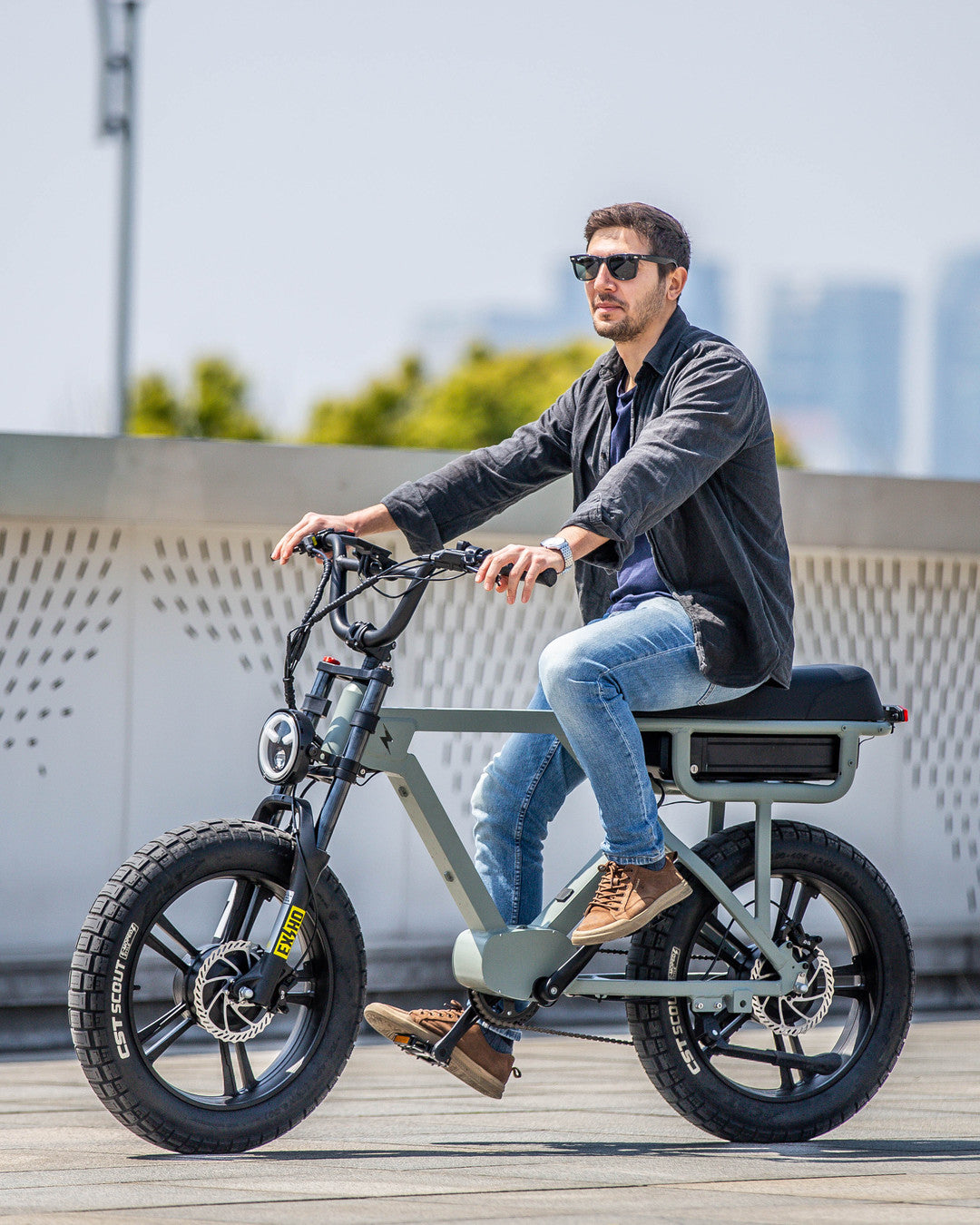

Oregon ebike laws are widely misreported, and the error is always the same number. Oregon has no wattage limit on an electric bike. Not 750 watts, not 1,000 — none at all.
The cap everyone quotes is real. It belongs to a different vehicle.
No wattage cap · 20 mph Class 1 and 2 · 28 mph Class 3 · 240 cities counted · 219 bikes screened, 138 legal on published specs. Law last verified: September 12, 2026; our shelf screened October 4, 2026.

The riders on the cover and in the three inline photographs are the Mercers, our fictional cast — meet the family. The cover was shot for this page on a Willamette Valley river path; the inline photographs are reused from our 50-state law guide.
Quick Answer. An Oregon electric assisted bicycle is a bicycle with an electric motor that is Class 1, 2 or 3, and that is the entire definition (ORS 801.258). No wattage limit, no license, no registration, no plates, no insurance. You must be 16 to ride any class today, and e-bikes are barred from every Oregon sidewalk.
Then the calendar matters. On January 1, 2027 the age rule splits three ways — 14 for a Class 1, 16 for a Class 2 or 3, any age inside a bicycle safety program — and Oregon starts holding sellers to a certified battery and an honest class label. Helmets are required under 16 only, there is no statewide rebate (Portland runs the big one), and a Portland park holds you to 12 mph.
Oregon sets no wattage limit, but it does read the top speed, and most of our listings print it. All 33 bikes on our commuter and city shelf print a nominal motor rating and 32 print the assisted top speed that decides the class here — 25 of the 32 screen as Class 1 or 2 — with free shipping across the lower 48 and US support that walks a warranty claim through the maker for you.
46 of the 49 bikes on our commuter and city shelf print a nominal motor rating and 35 print the assisted top speed that decides the class here — every one of the 35 screens as Class 1 or 2 — with free shipping across the lower 48 and US support that walks a warranty claim through the maker for you.
In this guide
- How we verified this guide
- Does Oregon have a wattage limit for ebikes?
- Oregon ebike laws: what makes an e-bike legal
- Can you ride an ebike on the sidewalk in Oregon?
- What is the minimum age to ride an ebike in Oregon?
- What changes on January 1, 2027
- Do you need a license or a helmet in Oregon?
- Does Oregon have an ebike rebate?
- Every city we checked
- Who manages the trail decides the rule
- Portland runs its parks at 12 miles an hour
- Not an e-bike: mopeds and motor assisted scooters
- What clears Oregon in our own range
- What changed in Oregon e-bike law and access
- Which class is the right one for Oregon riding
- Why buy an Oregon-legal e-bike from us
- The 60-second self-check: your compliance checklist
- The bottom line
- Source register
- Frequently asked questions
- Limitations
- References
How we verified this guide
Every legal claim was read in the Oregon Legislature's own publication of the Oregon Revised Statutes on August 25, 2026, and confirmed a second time against the enrolled act that put it there — HB 4103 (2024) and HB 4007 (2026), with deposit copies saved locally.
Oregon is unusually easy to check, and that is worth saying. Its bills mark deleted text in square brackets, which survives text extraction intact. We can show you exactly what was struck rather than asking you to trust us, and we do, below.
The municipal denominator — 240 incorporated cities — is the U.S. Census Bureau 2025 Gazetteer.
Oregon's definition is unusually spare — no wattage line at all — so this guide is spare where the state is silent and detailed where it does impose something: the sidewalk, the age, the trail manager and the 2027 seller rules. The 2026 session's bill list was re-read on September 12, 2026 — 304 measures, one touching e-bikes, HB 4007, already on this page — and the catalog screen below was re-run on the live store the same day.
Written and verified by Milad Ghobadibeygvand, BScN (Western University, 2014). Corrections to support@redtailebikes.com.
Does Oregon have a wattage limit for ebikes?
No. The whole of the operative definition, from ORS 801.258(4):
"'Electric assisted bicycle' means a bicycle that is equipped with an electric motor and that is a Class 1 electric assisted bicycle, a Class 2 electric assisted bicycle or a Class 3 electric assisted bicycle."
No watts. Oregon regulates behavior, meaning the speed at which assistance cuts out, and not hardware (ORS 801.258).
It did not always. Until January 1, 2025 the definition carried a 1,000 W ceiling and a flat 20 mph cap on the whole machine. HB 4103 struck both, and because Oregon brackets deleted text you can read the deletion yourself:
The struck language: "[(a) Has a power output of not more than 1,000 watts; and] [(b) Is incapable of propelling the vehicle at a speed of greater than 20 miles per hour on level ground.]"
Where the "1,000 watt Oregon cap" actually comes from
It is a real number in Oregon law, attached to a different vehicle. ORS 801.348 defines a motor assisted scooter as one whose power source "is incapable of propelling the vehicle at a speed of greater than 24 miles per hour on level ground and ... if the power source is electric, has a power output of not more than 1,000 watts" (ORS 801.348).
That is a scooter rule. Applying it to bicycles is the error this page opened with — Oregon's moped definition keeps the two categories apart on purpose.
Oregon is the permissive outlier on hardware. A 1,500 W motor breaks no Oregon rule, provided assistance cuts out at the class ceiling and the machine has pedals. Our 50-state table counts seven jurisdictions with no 750-watt test; in the other 44 the same bike is outside the definition.
Oregon ebike laws: what makes an e-bike legal
Five rows, four of them tests, and only one test is about the motor's behavior.
| Test | Oregon | Where it lives |
|---|---|---|
| Motor wattage | No limit | Nowhere — ORS 801.258 sets none |
| Pedals | Required | ORS 801.150(6) |
| Class ceiling | 20 mph (Class 1 and 2), 28 mph (Class 3) | ORS 801.258(1)–(3) |
| Speedometer | Required on Class 3 | ORS 801.258(3)(c) |
| Registration, plates, insurance | Not required | ORS 814.405 |
The pedal requirement is the easy one to miss, because it sits outside the e-bike definition. HB 4103 § 2 added "(6) Is equipped with pedals" to the base bicycle definition in ORS 801.150. An e-bike is "a bicycle that is equipped with an electric motor," so the pedal test reaches it from there.
The same list also says a bicycle "is propelled exclusively by human power," which an e-bike plainly is not; ORS 801.258 resolves that by defining the electric assisted bicycle as a bicycle with a motor, ORS 814.405 by deeming it a bicycle, and the pedal clause is the limb the definition keeps.

The machine on the right has foot pegs and no pedals. Oregon asks that question before it asks anything else: ORS 801.150(6) makes pedals part of being a bicycle, and an e-bike is a bicycle first.
| Class | Oregon's words | Ceiling |
|---|---|---|
| Class 1 | "Provides assistance only when the rider is pedaling" | 20 mph |
| Class 2 | "May be propelled by its motor without a rider pedaling" | 20 mph |
| Class 3 | Pedal-assist only, and "is equipped with a speedometer" | 28 mph |
Read the Class 3 line carefully. The speedometer is not an accessory or an equipment rule you can be ticketed for separately — ORS 801.258(3)(c) puts it inside the definition.
A 28 mph pedal-assist machine with no speedometer is not a Class 3 in Oregon, and if it fits no class it is not an electric assisted bicycle at all.
An e-bike is a bicycle under the Vehicle Code, and the statute says so in one sentence. ORS 814.405: "An electric assisted bicycle shall be considered a bicycle, rather than a motor vehicle, for purposes of the Oregon Vehicle Code, except when otherwise specifically provided by statute."
Buying for Oregon? Wattage is not your problem here — the two questions that matter are whether assistance cuts out at 20 or 28 mph, and whether a 28 mph build ships with a speedometer. Our commuter and city shelf is the one to start on: 25 of its 33 listings screen as Class 1 or 2 on their printed top speed, and every one ships free across the lower 48.
Browse commuter e-bikesCan you ride an ebike on the sidewalk in Oregon?
No, and this is the rule that catches people, because a pedal bike beside you may be legal.
ORS 814.410(1) creates the offense of unsafe operation of a bicycle on a sidewalk. Paragraphs (a) through (d) are conduct rules for ordinary cyclists: don't dart off a curb, give an audible warning, don't be careless, slow to a walk at crossings. Then comes paragraph (e).
The operative sentence: "(e) Operates an electric assisted bicycle on a sidewalk."
That is the whole paragraph. No conduct element, no exception, no city opt-out. Riding an e-bike on any Oregon sidewalk is the offense, and it is a Class D traffic violation — a $115 presumptive fine under ORS 153.019(1)(d), before any surcharge.
| Rider | Oregon sidewalk |
|---|---|
| Pedal bicycle, ridden carefully | Allowed, subject to (a)–(d) |
| Electric assisted bicycle | Prohibited outright |
What counts as a sidewalk is defined too. Under ORS 801.485, on a highway with a shoulder a sidewalk is "that portion of the highway between the outside lateral line of the shoulder and the adjacent property line capable of being used by a pedestrian."
A bicycle path — under ORS 801.160 "a public way, not part of a highway, that is designated by official signs or markings for use by persons riding bicycles" — is not a sidewalk, which is why a shared-use path and Tilikum Crossing's path are open to you.
Portland's downtown box is a red herring for e-bike riders
Portland has a well-known sidewalk-riding ban in the core, at PCC 16.70.320, covering the area "bounded by and including SW Jefferson, Front Ave, NW Hoyt and 13th Ave."
It never mentions e-bikes, and it does not need to. State law already bans them from every sidewalk in Oregon, in Burns as much as in downtown Portland. Portland's box is a rule for pedal bikes.
What is the minimum age to ride an ebike in Oregon?
16, for all three classes — until the end of 2026. And the way Oregon writes it is worth understanding, because it is not a prohibition.
ORS 807.020(15) is a list of people granted driving privileges without a license. Subsection (15) reads: "A person may operate the following without any grant of driving privileges if the person is 16 years of age or older: (a) A Class 1 electric assisted bicycle; (b) A Class 2 electric assisted bicycle; or (c) A Class 3 electric assisted bicycle."
The subsection is an exemption; it bans nothing. A 15-year-old is simply not inside it. There is no separate offense of "under-age e-bike riding" in ORS chapter 814: every occurrence of "electric assisted bicycle" in the chapter concerns status, equipment or the sidewalk, and none sets a minimum riding age.
The age rule applies to all three classes equally today. Oregon does not do what most states do and leave Class 1 open to younger riders. Under 16 is under 16, whatever the class, and that changes on January 1, 2027.
What changes on January 1, 2027
HB 4007 passed the House on March 3, 2026 and the Senate on March 5, 2026.
It now carries a chapter number — Oregon Laws 2026, chapter 101 — and § 33 makes the parts below operative on January 1, 2027.
| What | Today | From Jan 1, 2027 |
|---|---|---|
| Class 1 minimum age | 16 | 14 |
| Class 2 minimum age | 16 | 16 |
| Class 3 minimum age | 16 | 16 |
| Safety-program route | none | Any age on Class 1 or 2 while participating in a bicycle safety program |
| Child helmet offense | ORS 814.485, on the child | Repealed — rebuilt on the adult in 814.486 |
| Battery certification at sale | none | Required, with a permanently affixed lab mark |
| Selling a mislabeled e-bike | none | An offense, and an unlawful trade practice |
The age rule splits three ways
The operative sentence (HB 4007 § 8): "A person may operate a Class 1 electric assisted bicycle or a Class 2 electric assisted bicycle without any grant of driving privileges if the person is participating in a bicycle safety program as described in ORS 802.325."
Otherwise the floor is 14 for a Class 1, and 16 for a Class 2 or a Class 3 (HB 4007 § 8).
Note the verb. It is "is participating in" rather than "has completed", and the safety-program route covers Class 1 and Class 2 rather than Class 1 alone.
The child helmet offense is repealed and rebuilt on the adult
Section 17 repeals ORS 814.485 — the offense committed by the under-16 rider — along with 814.487 and 814.488.
What survives is ORS 814.486, renamed "endangering a vehicle operator or passenger," which lands on the person carrying the child or on "the parent, legal guardian or person with legal responsibility for the safety and welfare of a child under 16 years of age." Presumptive fine $25, waived on a first conviction if you prove you own approved headgear.
One drafting detail is worth watching. The new 814.486(2) lists the vehicles it covers — bicycles, motor assisted scooters, electric personal assistive mobility devices, powered micromobility devices, and skateboards, nonmotorized scooters or in-line skates — and electric assisted bicycles are not named. They should be caught by "bicycles" through ORS 814.405's deeming rule, so a parent should assume the adult duty applies to an e-bike until a court or the agency says otherwise.
It is still an odd omission in a list that troubles to name four other powered categories.
And Oregon starts regulating the seller as well as the rider
Two new offenses, both operative January 1, 2027, both aimed at us rather than at you.
Improper sale or lease of a vehicle (§ 19). The storage battery or charging system must be certified by an accredited testing laboratory — one recognized by OSHA or the CPSC, or certified by an accrediting body — against nationally recognized battery standards. And "a clear, legible indicia of the accredited testing laboratory ... permanently affixed on the vehicle or the storage battery or charging system." Used sales are exempt, and a violation is a Class D traffic violation.
Selling an impostor vehicle (§ 20). It becomes an offense to advertise or sell a machine as an electric assisted bicycle when it does not meet ORS 801.258, or where the machine "is designed, manufactured or intended by the manufacturer or seller to be configured or modified" out of its class.
The act spells out what that includes: "a mechanical switch or button", a change to the motor or drive system, or "the use of an application to increase or override the electric drive system." Derestriction apps are the target.
This one carries a second barrel. A violation is a Class D traffic violation and an unlawful practice under Oregon's Unlawful Trade Practices Act at ORS 646.608 — which brings the Attorney General and private actions with it.
From January 1, 2027 Oregon starts checking the seller as well as the rider. A certified battery with a permanently affixed testing-lab mark, an honest class label, and no machine built to be switched out of its class (HB 4007 §§ 19–20). Breaking the second one is an unlawful trade practice as well as a traffic ticket.
In our own range, 69 of 219 live listings name a battery safety standard for the bike itself. That is a count of what the listings say, not a judgment on the other 150 bikes. From January 1, 2027 the statement on the listing is part of what Oregon requires of the seller.
Do you need a license or a helmet in Oregon?
No license. An e-bike is not a motor vehicle (ORS 814.405), and ORS 807.020(15) grants the privilege of operating one without any grant of driving privileges.
Helmets, today: required under 16, on a bicycle or an e-bike, under ORS 814.485. Two features of the Oregon rule are unusual and worth knowing:
- A first conviction carries no fine if you prove to the court that you own approved headgear.
- ORS 814.489 bars evidence of a missing helmet from being used to reduce damages or as a defense in a civil claim. Not wearing one cannot be turned against you if a driver hits you.
From January 1, 2027 the under-16 duty moves onto the adult, as described above.
Does Oregon have an ebike rebate?
There is no statewide Oregon e-bike rebate, and the rebate is the single most common specific ask behind this page: 45 of the 294 distinct search terms mention a rebate, voucher or incentive.
The State of Oregon runs its own incentives clearinghouse — Go Electric Oregon — and its e-bike entries are three local utility programs and nothing statewide.
| Program | Amount | Who runs it |
|---|---|---|
| City of Ashland | $300–$600 | City of Ashland |
| Eugene Water & Electric Board | $300 | EWEB, for its customers |
| Forest Grove Light and Power | $200, first e-bike | Forest Grove Light and Power |
The Oregon Clean Vehicle Rebate Program that comes up in every search for this is administered by DEQ and is for electric cars; it does not cover bicycles.
Portland runs the biggest e-bike rebate in the state, and the state's list does not carry it
Portland Rides is the Portland Clean Energy Community Benefits Fund's e-bike rebate: a $20 million commitment over five years, paid as an instant discount at approved local bike shops rather than a check you wait for.
| What it covers | Up to |
|---|---|
| Standard e-bike (Class 1 and Class 2) | $1,600 |
| Cargo e-bike built for heavier loads or passengers | $2,350 |
| Accessories — helmet, lock, lights | $300 |
| Adaptive e-bikes | $8,500, and $2,800 for an adaptive conversion — a separate track at 80% of area median income, rolling rather than drawn, and closed to new applications when read on September 12, 2026 |

A cargo e-bike at the Portland Farmers Market at PSU. Portland Rides pays up to $2,350 toward one — Class 1 or 2 only, as an instant discount at an approved Portland shop.
Who qualifies: Portlanders aged 18 or over at or below 60% of Area Median Income for the standard and cargo tracks (80% for adaptive). Selection is by automated random draw rather than first-come, and successful applicants get an email explaining how to redeem.
What qualifies is narrower than the state's definition. The program's own list for the standard and cargo tracks: a new, fully assembled Class 1 or 2 with a motor of 750 W or smaller, tires of 20 inches or larger and a UL 2271 battery; Class 3 machines, electric mountain bikes and conversion kits are excluded. On a page whose headline is the missing wattage cap, that 750 W line is the one to read twice.
Status as of September 12, 2026. The first application round ran from April 6 to July 24, 2026. The program's applicant page now says the application is open year-round, closing only briefly on release dates; rebates go out three times a year by random draw, and an application that is not drawn stays in the pool for every later draw through 2029 without re-applying. The most recent release it announced was dated August 17, 2026.
The program grew out of a September 2025 pilot with Portland Community College students that placed more than 100 e-bikes.
If you live in Portland, the biggest rebate in Oregon is a city program, income-tested, paid out by draw three times a year. If you live in Ashland, Eugene or Forest Grove, your utility runs a smaller one you can apply for directly. Everywhere else in Oregon, there is nothing statewide to apply for, and that is worth knowing before you spend an evening looking.
One more thing worth knowing about the Portland program
Portland Rides is not only a discount. The program is built with safety training and education attached, it runs a separate adaptive e-bike track for riders whose needs a standard or cargo bike cannot meet — announced for April 20, 2026 and, on the program's own page, offered as of June 1, 2026.
It is delivered through named partners — Resource Innovations as administrator, APTIM as rebate processor, and Portland State University's Transportation Research and Education Center as third-party evaluator.
That last detail matters if you are deciding whether to wait for a later round: a program with a university evaluation attached and five years of committed funding is one that intends to keep running.
Outside Portland, or not drawn yet? Portland Rides pays only as an instant discount at its approved Portland shops, so a bike bought from us is bought at the listing price and ships free across the lower 48. Waiting on a draw? The cargo shelf is where to look meanwhile: 41 of 64 listings screen as Class 1 or 2, and the program's own list caps the motor at 750 W — read that line first.
See cargo e-bikesEvery city we checked
Oregon has 240 incorporated cities, counted from the U.S. Census Bureau 2025 Gazetteer place file, filtered to Oregon's active places.
Why the table is short. Oregon's cities publish their codes on three different platforms. All 55 Oregon libraries on Municode — 50 cities and 5 counties — were read, and Portland's code was read directly; Eugene's code chapters sit on the ICC platform, so what was read for Eugene is the city's own Safety and Laws page.
The 104 Oregon jurisdictions hosted by ICC Code Solutions — Bend, Beaverton, Medford and McMinnville among them — appear below as unchecked rather than as clear.
| City | What its code or published rules do | Source |
|---|---|---|
| Portland | Parks are separate. PCC 20.12.170(C) puts "electric-assisted bicycles as defined in ORS 801.258" under the parks administrative rules made under § 20.04.040, which "may restrict or limit the time, place, and manner of use" and impose permits | City code |
| Portland | PCC 16.70.320 downtown sidewalk box — a pedal-bike rule; e-bikes are already banned statewide | City code |
| Eugene | Publishes a 12 mph shared-path speed "when other path users are present," and 20 mph "on open stretches only when there are no people around" | City guidance |
| Hillsboro | Bike-share permitting reaches e-bikes by name (§ 8.28.120) | Municode |
| Sandy | Defines "Class I e-bike" in its own code (§ 12.12.005) | Municode |
| King City | Its moped definition expressly excludes an e-bike "as defined in ORS 801.258" (§ 10.04.020) | Municode |
| Bend, Beaverton, Medford, McMinnville | Unchecked — code hosted on ICC Code Solutions; see Limitations 1 | — |
Eugene's speed figures are guidance and not an ordinance. The city publishes them on its Safety and Laws page and attributes e-bike rules to its bicycle code chapters rather than to a numbered speed limit. Treat 12 mph as what Eugene asks of you on a busy path, and ORS 814.410 as the thing that carries a fine.
The denominator. 50 cities swept on Municode, plus Portland's code and Eugene's published guidance, is 52 of 240 — 22%. The other 188 sit outside the sweep; treat them as unknown, and treat the state rules on this page as the floor your city may have built on.
Who manages the trail decides the rule
Oregon's statute tells you what an e-bike is. It does not tell you where you may ride one, because that answer belongs to whoever owns the ground under your tires — and in Oregon that is usually not the legislature.
Oregon State Parks changed its rule on July 1, 2025
New e-bike rules took effect across Oregon State Parks and the ocean shore on July 1, 2025. The default is easy to remember: if bikes are not allowed, e-bikes are not either.
Where they are allowed covers most of what you would want:
- Paved and unpaved multi-use trails
- Campgrounds and park roads
- Some beaches — with a condition that catches almost everybody, below
Out-of-class machines get no benefit from any of it. An e-bike that does not meet one of the three classes, or has been modified so it no longer does, is a motor vehicle for these rules and is barred from state park trails and beaches unless the beach is open to motor vehicles.
Four parks wrote their own bans on top, and they are named rather than implied:
| Park | What is closed to e-bikes |
|---|---|
| Elijah Bristow State Park | Every trail |
| Willamette Mission State Park | All equestrian trails, and the Vision Trail |
| Clyde Holliday State Recreation Site | The Riverside Trail |
| Emigrant Springs State Natural Area | The Lewis and Clark Trail |
The beach rule: wet sand only, and a bird that closes it
Oregon's ocean shore is a state recreation area, so the beach carries a rule, and it is a specific one.
E-bikes may use the firm, wet sand near the waves. They are strictly prohibited on dry sand — which the state defines as everything above that firm wet strip: soft sand, dunes with or without vegetation, and the wrack line where seaweed and debris wash up.
Then the rule tightens seasonally. In snowy plover management areas the closure runs from March 15 to September 15 and includes the wet sand. That is half the year, on the parts of the coast that matter to a nesting shorebird, and it does not care what class your bike is.
If you are planning a coast ride between spring and autumn, the plover map is the page to check before the tide table.
Federal ground and the Cascades
Most of Oregon's celebrated singletrack is not state land. It sits on national forest — the Deschutes above Bend, the Willamette around Oakridge, Mt. Hood east of Portland — and the Forest Service does not use the state's rulebook.
The Forest Service treats an e-bike as a motor vehicle, so it belongs only on routes the forest's Motor Vehicle Use Map marks as motorized; the per-trail answer lives on that map. Check the MVUM for the specific forest before you ride, and check it again the next season.
The consequence is the reverse of most people's intuition: Oregon's state park system is more open to e-bikes than the national forest next door. A Class 1 bike welcome on an unpaved state park trail can be barred from a Forest Service trail a few miles away, and the trailhead sign is often the only thing that tells you which one you are standing on.
What the rules ask of you once you are riding
Access is only half of what these rules do. Both the state and Portland attach duties to the ride itself, and some of them sit inside an enforceable rule — in a Portland park that means yielding, an audible signal, 5 mph on the approach and dismounting where a sign says so, set out in the next section.
Oregon State Parks frames its expectations as etiquette rather than citation: yield to pedestrians, horses and slower users, announce yourself when passing, slow near pets, children and equestrians, stay on designated trails, and leave more following distance because an e-bike is heavier and usually faster than the bike beside it.
The heavier-and-faster point is the one worth internalizing. Every access rule on this page was written by somebody weighing a shared path against a machine that arrives sooner than a pedestrian expects. Riding as though that were true is also the most reliable way to keep the access we have.
Portland runs its parks at 12 miles an hour
A third of what people search for around Oregon e-bikes names Portland — 99 of the 294 distinct search terms behind this page, more than Bend and Eugene together. It also has the most specific park rule in the state, adopted as an administrative rule effective July 13, 2025.
Where. E-bikes and e-scooters may operate only on paved pathways and roadways in a Portland park. They may not be taken into a building, an enclosure or any covered facility, or anywhere signed against bicycles. Soft-surface trails and off-road riding are out, except in designated off-road cycling areas — Gateway Green is the one the city names.
How fast. The limits are specific, and they are low:
| Situation | Limit |
|---|---|
| On a park pathway | 12 mph, unless posted otherwise |
| Approaching other people on a pathway | 5 mph |
| Where signage says dismount | Get off and wheel it |
You also have to yield to pedestrians and give an audible signal before passing. Medical mobility devices are exempt from the pathway restriction and the dismount rule.
And Portland draws a line the state does not. The park rule defines an "electric bicycle or scooter" to include any electric assisted bicycle as defined in ORS 801, and separately any other electric wheeled device on one or two wheels under 1,000 watts; a scooter or moped at 1,000 watts or greater is a motor vehicle.
A bike that fits an Oregon class is an electric bicycle in a Portland park at any wattage; the 1,000-watt line falls on the machine that fits no class.
If you ride a machine that fits no class, that is the threshold that decides your day in a city park. Oregon is one of the few states where a 2,000 W machine can meet the e-bike definition — our 50-state table counts seven jurisdictions with no 750-watt test — and our 2000W e-bike guide works through what that buys you.
Rental operators are held to it too: shared-scooter permittees must geofence every park so their vehicles cannot exceed the park speed limit inside one.
Not an e-bike: mopeds and motor assisted scooters
| Machine | Oregon category | Source |
|---|---|---|
| Motor assisted scooter | Own category; 1,000 W cap, 24 mph ceiling | ORS 801.348 |
| Moped | Own category; expressly not an e-bike or a motor assisted scooter | ORS 801.345 |
| No pedals | Not a bicycle, so not an e-bike | ORS 801.150(6) |
| Assistance past 28 mph | Fits no class, so not an e-bike | ORS 801.258(3) |
Oregon's moped definition does the same work in reverse: a moped is a powered bicycle-like vehicle "other than an electric assisted bicycle as defined in ORS 801.258 or a motor assisted scooter as defined in ORS 801.348." The categories are drawn to exclude one another, which is why the 1,000 W scooter number cannot be borrowed for a bicycle.
From January 1, 2027 there will be a fourth box: powered micromobility device, defined in HB 4007 § 2 as a vehicle with a propulsion system, a maximum speed of 28 mph and an unloaded weight under 100 pounds — and expressly not including electric assisted bicycles.
What clears Oregon in our own range
The live catalog was screened against Oregon's class ceilings and pedal requirement on October 4, 2026. There is no wattage test to run. Three stand-up scooters — one of them typed as an e-bike in the catalog — and an accessory kit sit outside the count.
| Verdict | Bikes |
|---|---|
| Legal as Class 1 or 2 on published specs | 85 |
| Legal as Class 3 on published specs | 53 |
| Outside the Oregon definition | 54 |
| Specs not published in the listing | 27 |
| Total screened | 219 |
78 of the 219 e-bikes we list print a rating above 750 watts, and Oregon's definition never asks about any of them. The wattage that puts a bike outside the definition in Georgia, North Carolina, Ohio and New Hampshire is simply not a question Oregon asks. Our all-50-states table lines them up beside each other.
Of the 78, 39 clear a class on their published top speed, 37 fall outside on speed alone, and 2 publish no top speed to test.
None of the 53 listings that screen as Class 3 names a speedometer; 4 say their display shows speed. In most states that would be an equipment gap. In Oregon the speedometer is written into the class definition, so a listing that is silent on it has not settled the class, and all 53 sit in the Class 3 row on their top speed alone. Ask for the speedometer line before you buy any 28 mph machine, ours included.
27 of 219 listings print no assisted top speed, and those sit in the unknown row rather than the pass rows; the top speed is the line ORS 801.258 reads. The other 192 were screened on the figure their listing prints.
Riding Oregon dirt? Oregon State Parks opens its unpaved multi-use trails to every class, the Forest Service opens only the routes its Motor Vehicle Use Map marks motorized, and a Portland park keeps you on pavement at 12 mph. Start on our mountain shelf with the top-speed line: 12 of its 43 listings screen at 20 mph — shipped free across the lower 48, with the maker's warranty behind it and US support to file the claim.
See trail-ready e-bikesWhat changed in Oregon e-bike law and access
Oregon's e-bike rules have moved three times in three years, a fourth change is dated for 2027, and two of the three so far were not the legislature at all. Every row below comes from enacted text or the agency's own rule, dated from the day it began to bind.
| Date | What changed | Who did it |
|---|---|---|
| 2024 | HB 4103 rewrote the definition and the age rule | Legislature |
| Jul 1, 2025 | State parks and ocean shore e-bike rules take effect — wet sand only, dry sand and plover areas closed, four parks add bans | Oregon Parks and Recreation Department |
| Jul 13, 2025 | Portland park rule PRK-1.23 takes effect — paved pathways only, 12 mph, 5 mph passing, 1,000-watt line | City of Portland |
| Apr 6, 2026 | Portland Rides e-bike rebate opens, up to $2,350 | City of Portland / PCEF |
| Jul 24, 2026 | Portland Rides first application round closes | City of Portland / PCEF |
| Aug 17, 2026 | The standard and cargo rebate release Portland Rides most recently announced — draws now run three times a year on a year-round application | City of Portland / PCEF |
| Jan 1, 2027 | The changes described above take effect | Legislature |
The statute moves slowly and the land managers move fast, which tells you where to look next. If you want to know what changed for your ride this year, the legislature is usually the wrong place to check.
What to watch, and why. Oregon Parks and Recreation says plainly why it moved: more e-bikes on the trails and beaches meant the old rules needed updating, and the state had redefined the class system underneath them. A land manager was reacting to volume, and the volume is still climbing.
Portland's rebate commits $20 million over five years, which will put more e-bikes on exactly the paths its 12 mph park rule governs. Expect the access rules and the purchase incentives to keep moving against each other — one making riding cheaper, the other making the conditions more specific. Check the date on any Oregon e-bike page you read, this one included.
Which class is the right one for Oregon riding
Oregon does not test wattage, which makes the class label do more work here than in most states. Every access rule above turns on it.

Tilikum Crossing, Portland. TriMet opens the deck to transit, cyclists and walkers and closes it to private cars, and under ORS 814.405 an e-bike crosses it as a bicycle.
Class 1 asks the fewest questions. No land manager on this page draws a class line — the state park system admits every class where it admits e-bikes, Portland's rule draws none, the Forest Service distinguishes routes rather than classes — and a Class 1 carries no speedometer rule while riding everything the other two ride.
For Oregon trail riding the mountain shelf is where to start, and the top-speed line is the first thing to read there: 12 of its 35 listings print 20 mph or less and screen as Class 1 or 2, 10 print a top speed between 21 and 28 mph and screen as Class 3 on that line alone, 7 print more than 28 mph and fall outside the definition, and 6 print no speed.
The fat-tire shelf runs 24, 22, 21 and 0 of 67 on the same four lines, and it is the one built for wet sand and the coast's soft shoulders.
| Shelf (listings) | Class 1 or 2 | Class 3 by speed | Outside | No speed printed |
|---|---|---|---|---|
| Commuter and city (33) | 25 | 6 | 1 | 1 |
| Electric trikes (28) | 25 | 2 | 0 | 1 |
| Cargo (64) | 41 | 7 | 15 | 1 |
| Mountain (35) | 12 | 10 | 7 | 6 |
| Fat tire (67) | 24 | 22 | 21 | 0 |
Class 2 rides everything on this page that Class 1 rides. The state park system admits all three classes where it admits e-bikes at all, and Portland's paved pathways take a Class 2 too.
The electric trikes are the cleanest 20 mph shelf we have — 25 of 28 listings screen as Class 1 or 2 and none falls outside — and the commuter and city shelf (25 of 33) and cargo bikes (41 of 64) follow.
Class 3 is legal on the same ground, and it is a road machine. The state park system admits it, a Portland park pathway holds it to 12 mph like everything else, and on a road or in a bike lane its 28 mph assist is the whole point: the longer the commute, the more it earns its speedometer — which the listing has to name, because without one it is not a Class 3 here.
And the out-of-class machine is the one to avoid. A bike that does not meet a class, or has been modified so it no longer does, is a motor vehicle for the state park rules, and in a Portland park it is a motor vehicle from 1,000 watts up.
It is the buying mistake that costs the most here: a moped or a motorcycle in the eyes of the Vehicle Code, with everything that brings, and barred from every trail and beach.
Two more reads before the spec sheet: the electric bike buying guide and the motor guide decode what a listing is telling you, best e-bike brands compares the makers' Class 1 and Class 3 line-ups, and your first electric bike is the place to begin if this is the first one.
A folding e-bike or an electric trike answers an apartment hallway or a garage with no floor to spare; if you are hauling, the cargo shelf is also the category Portland Rides' standard and cargo tracks pay the most toward. Every listing in the full range is on the shelf the screen above read, and the sale shelf is where the marked-down listings sit.
Riding beyond Oregon
Oregon regulates behavior where almost every other state regulates watts, so a bike that is legal here can fail a definition a few hours away. Our all-50-states table lines every state up in one table, and the guides nearest Oregon are Washington, California, Utah, Colorado, Arizona, Texas, Minnesota, Michigan, Illinois, Wisconsin, Florida, Pennsylvania, New York, New Jersey, Massachusetts, Connecticut and New Hampshire.
The 50-state trail atlas shows where each land manager has opened e-bike routes, state by state; two states have atlases of their own, California and Texas. The Portland shop directory lists the shops selling under these rules in the city itself and names which of them take Portland Rides; anywhere else in the country, start at the national e-bike stores near me guide.
Why buy an Oregon-legal e-bike from us
Oregon reads two lines on a listing, and ours print them where it counts. ORS 801.258 asks where assistance stops and, on a 28 mph machine, whether there is a speedometer. 192 of the 219 e-bikes we list print the assisted top speed, 195 print a nominal motor rating, and every verdict in the table above came from a printed figure, never from a model name.
Your freight bill to Oregon is zero on a standard delivery. Shipping is free on every e-bike across the lower 48 states, with the policy's P.O.-box and remote-area exceptions printed on the page it links; the warranty is the maker's, the claim goes through our US support desk, and a question about a rule comes back with the rule's own page linked.
Portland Rides pays by draw, three times a year; an installment plan does not wait for a draw. If the next draw is a season off and you need the bike this month, Shop Pay offers installments at checkout, so the program's calendar does not have to be yours.
For nearly every Oregon rider the right machine is a Class 1 or 2, and neither carries a speedometer rule. Every land manager on this page admits both where it admits e-bikes at all, Portland Rides pays only for those two classes, and the 12 mph and 5 mph limits on a Portland park pathway make a Class 3's extra speed unusable there.
The 20 mph builds on our commuter, trike and cargo shelves are where to start — 25 of 33, 25 of 28 and 41 of 64 listings screen as Class 1 or 2 on their printed top speed. A 28 mph machine is a different decision: the Class 3 speedometer line is the rule it is held to, and it is worth reading before the spec sheet.
Oregon's rules move at the land manager's pace, and this page carries the date it was last verified for that reason. If that date is more than a season old when you read it, write to support@redtailebikes.com first and the rule is re-checked before you pay for anything; if the rule says the bike you want is a motor vehicle here, the reply says that, and we keep the sale for another day.
The 60-second self-check: your compliance checklist
Eight questions, each one a rule on this page.
- ☐ Does the bike have pedals? A real test in Oregon, and wattage is not.
- ☐ Does assistance cut out at 20 mph (Class 1 or 2) or 28 mph (Class 3)?
- ☐ Class 3 — is there a working speedometer? Without one it is not a Class 3.
- ☐ Are you 16 or older? All three classes, until December 31, 2026.
- ☐ Staying off every sidewalk? Statewide, no exceptions, no city opt-out.
- ☐ Riding in a Portland park? The parks administrative rules govern there, in place of the road rules.
- ☐ On a busy Eugene path? The city asks for 12 mph.
- ☐ Buying after January 1, 2027 — does the battery carry a permanently affixed testing-lab mark?
The bottom line
Oregon regulates the riding and leaves the machine alone, which is why it is easy to be legal here and just as easy to be caught out: the trap is never the motor. It is the sidewalk, the age and the land manager.
Bring whatever motor you like. There is no cap, and a 1,500 W build that sits outside the definition across most of the country is fine here so long as it has pedals and its assistance stops on time.
Then stay off the sidewalk — every sidewalk, in every city. The rule Oregon actually enforces against e-bikes, and the one a pedal cyclist beside you does not share.
Two dates matter. Today the age is 16 for all three classes.
On January 1, 2027 Class 1 drops to 14, a safety-program route opens at any age for Class 1 and 2, the child helmet offense moves onto the adult, and from that date the certified-battery mark and the class label are the seller's to get right before the bike reaches you (Or. Laws 2026 ch. 101). If you are buying for a 14-year-old, that date is the whole answer.
The order can wait for the calendar, and it can also go in today. If the rider is 14, the bike is a Class 1 and the first ride is January 1, 2027; if the rider is 16 or older, nothing on this page is stopping you.
Two short pages carry the rest: how buying works walks the order from cart to doorstep, and the refund policy prices a return before you make one. Shop Pay's installment plan is one click past the cart, and the commuter shelf is where 25 of 33 listings already screen as Class 1 or 2 on their printed top speed.
Source register
| Source | Tier | What it supports | Retrieved |
|---|---|---|---|
| Oregon Legislature — ORS ch. 801 | T1 primary official | The definition, the classes, the absence of any wattage cap, pedals, moped and scooter definitions; the sidewalk and bicycle-path definitions (§§ 801.485, 801.160) | 2026-08-25; §§ 801.485, 801.160 on 2026-09-12 |
| Oregon Parks and Recreation Department — E-bikes in Oregon State Parks and the ocean shore | T1 | The July 1, 2025 rules: paved and unpaved trails, wet sand only, the four park closures, out-of-class machines as motor vehicles | 2026-08-28 |
| Portland Parks & Recreation — PRK-1.23 Motorized Wheeled Vehicles in Parks | T1 | Paved pathways only, 12 mph, 5 mph passing, the 1,000-watt definitions, geofencing | 2026-08-28 |
| Portland Parks & Recreation — Park Rules | T1 | Soft-surface trails closed except designated off-road cycling areas | 2026-08-28 |
| State of Oregon — Snowy plover information | T1 | The March 15–September 15 management-area closures | 2026-08-28 |
| City of Portland — Portland Rides launch release | T1 | $20 million over five years, the amounts, the first round's dates, the partners, the PCC pilot | 2026-08-28 |
| Oregon Legislature — ORS ch. 814 | T1 | Bicycle status, the sidewalk offense, helmets, the civil-evidence bar | 2026-08-25 |
| Oregon Legislature — ORS ch. 807 | T1 | The age rule, written as a license exemption | 2026-08-25 |
| HB 4103 (2024), enrolled | T1 | The struck 1,000 W ceiling and 20 mph cap; the added pedal requirement | 2026-08-25 |
| HB 4007 (2026), enrolled | T1 | The 2027 age split, the helmet repeal, the seller offenses, the Jan 1, 2027 operative date | 2026-08-25 |
| OLIS — HB 4007 measure overview | T1 | That HB 4007 is Oregon Laws 2026 ch. 101 | 2026-08-25 |
| Go Electric Oregon — Incentives & Rebates | T1 | That there is no statewide e-bike rebate, and the three local programs | 2026-08-25 |
| City of Portland — PCC 20.12.170 | T1 | E-bikes in Portland parks run under administrative rules | 2026-08-25 |
| City of Portland — PCC 16.70.320 | T1 | The downtown sidewalk box, and that it never mentions e-bikes | 2026-08-25 |
| City of Eugene — Safety and Laws | T2 | Eugene's published 12 mph shared-path guidance | 2026-08-25 |
| Municode Library — 55 OR libraries (50 cities, 5 counties) | T1 | The municipal sweep | 2026-08-26 |
| ICC Code Solutions text library | T2 | The 104-jurisdiction Oregon roster we could not sweep | 2026-08-26 |
| Oregon Legislature — ORS ch. 646 | T1 | The Unlawful Trade Practices Act the 2027 seller offense hooks into | 2026-08-25 |
| Oregon DEQ — Clean Vehicle Rebate Program | T1 | That DEQ's rebate is for electric cars, not bicycles | 2026-08-25 |
| U.S. Census Bureau 2025 Gazetteer | T1 | The 240 denominator | 2026-08-26 |
| Redtail eBikes catalog via Shopify Admin API | T2 | The first-party screen | 2026-09-12 |
| Portland Rides — Standard/Cargo applicants | T1 | Year-round application, three releases a year, the 2026–2029 pool rule, the eligibility list (750 W cap, 20-inch tires, UL 2271); the adaptive amounts and terms from the program home page | 2026-09-12 |
| Oregon Legislature — 2026 Regular Session bills | T1 | The 2026 session sweep: 304 measures, HB 4007 the only e-bike act | 2026-09-12 |
| Oregon Legislature — ORS ch. 153 | T1 | The $115 presumptive fine for a Class D violation, § 153.019(1)(d) | 2026-09-12 |
| 36 CFR 212.51 and 212.56 (eCFR) | T1 | Forest Service travel management: motor vehicle use limited to designated routes, published on a Motor Vehicle Use Map | 2026-09-12 |
No tier-five source is cited anywhere on this page.
Frequently asked questions
Are electric bikes legal in Oregon?
Yes. A bicycle with an electric motor that meets Class 1, 2 or 3 is an electric assisted bicycle under ORS 801.258, and ORS 814.405 makes it a bicycle rather than a motor vehicle for the whole Oregon Vehicle Code.
Does Oregon have a wattage limit for ebikes?
No. ORS 801.258 sets no wattage limit at all. HB 4103 removed the old 1,000 W ceiling effective January 1, 2025. The 1,000 W figure still widely quoted for Oregon belongs to ORS 801.348, the motor assisted scooter definition, which is a different vehicle.
Can you ride an ebike on the sidewalk in Oregon?
No. ORS 814.410(1)(e) makes it the offense of unsafe operation of a bicycle on a sidewalk to operate an electric assisted bicycle on a sidewalk — anywhere in the state, with no conduct element and no local exception. It is a Class D traffic violation. A pedal bicycle may use a sidewalk under the same section.
What is the minimum age to ride an ebike in Oregon?
16 for all three classes through December 31, 2026, under ORS 807.020(15). From January 1, 2027, Class 1 drops to 14 while Class 2 and Class 3 stay at 16, and any age may ride a Class 1 or Class 2 while participating in a bicycle safety program described in ORS 802.325.
Do you need a license for an ebike in Oregon?
No. An electric assisted bicycle is not a motor vehicle (ORS 814.405) and ORS 807.020(15) lets a person 16 or older operate one without any grant of driving privileges.
Are helmets required for ebikes in Oregon?
Yes, under 16. A first conviction carries no fine if you prove to the court that you own approved headgear, and ORS 814.489 stops a missing helmet being used to reduce your damages in a civil claim. From January 1, 2027 the offense moves onto the parent, guardian or the adult carrying the child.
Does Oregon have an ebike rebate?
Not statewide, but Portland runs a large city one. Portland Rides pays up to $1,600 on a standard Class 1 or 2 e-bike, up to $2,350 on a cargo e-bike and up to $300 on accessories, for households at or below 60% of area median income. Its first round ran April 6 to July 24, 2026; the application is now open year-round, with rebates drawn three times a year.
Elsewhere, the state's clearinghouse lists three local utility programs — Ashland ($300–$600), Eugene Water & Electric Board ($300) and Forest Grove Light and Power ($200). The DEQ rebate people find when searching is the Oregon Clean Vehicle Rebate Program, which is for electric cars.
Does a Class 3 ebike need a speedometer in Oregon?
Yes, and it matters more than in most states. ORS 801.258(3)(c) puts "is equipped with a speedometer" inside the definition of a Class 3 electric assisted bicycle, so a 28 mph pedal-assist machine without one does not fit any Oregon class.
What changes for Oregon ebikes in 2027?
Oregon Laws 2026 ch. 101 (HB 4007) takes effect for these purposes on January 1, 2027. The age rule splits to 14 for Class 1 and 16 for Classes 2 and 3, with a safety-program route at any age for Class 1 and 2.
The child helmet offense in ORS 814.485 is repealed and rebuilt on the adult, and sellers must supply a certified battery with a permanently affixed testing-lab mark and may not sell a machine as an e-bike that does not meet the definition (§§ 19–20).
Can you ride an ebike in Portland parks?
Yes, on paved pathways and roadways only, at 12 mph or less, dropping to 5 mph when you approach anyone, and off every soft-surface trail except designated off-road cycling areas such as Gateway Green. PCC 20.12.170(C) puts electric-assisted bicycles under administrative rules adopted under § 20.04.040, and PRK-1.23 is that rule; a park's own sign can add to it.
Is there a speed limit for ebikes on Eugene paths?
Eugene publishes guidance rather than a numbered ordinance: 12 mph "when other path users are present" and up to 20 mph "on open stretches only when there are no people around". The enforceable statewide rule is ORS 814.410, which keeps e-bikes off sidewalks entirely.
Are e-bikes allowed in Oregon State Parks?
Yes, on the same footing as bicycles. Since July 1, 2025 the state parks rule is that if bikes are allowed, e-bikes are too, unless a specific restriction says otherwise — paved and unpaved multi-use trails, campgrounds and park roads all count. Four parks add their own bans: Elijah Bristow, Willamette Mission, Clyde Holliday and Emigrant Springs.
Can you ride an e-bike on the Oregon coast?
On the firm wet sand, yes. E-bikes are strictly prohibited on dry sand — soft sand, dunes and the wrack line — and snowy plover management areas close to e-bikes from March 15 to September 15, including the wet sand. Check the plover map before a spring or summer coast ride.
What are Portland's e-bike rules?
Stricter than the state's, and specific. Under Portland's park rule an e-bike may use only paved pathways and roadways in a park, at a maximum of 12 mph, dropping to 5 mph when approaching other people. Soft-surface trails are out except at designated off-road cycling areas such as Gateway Green.
Is there an e-bike speed limit in Portland parks?
Yes — 12 mph on park pathways unless posted otherwise, and 5 mph when you approach anyone else. Rental operators must geofence every park so their bikes cannot exceed it.
Is there a Portland e-bike rebate?
Yes, and it is the largest in Oregon. Portland Rides pays up to $1,600 on a standard Class 1 or 2 e-bike, up to $2,350 on a cargo e-bike and up to $300 on accessories, as an instant discount at approved shops.
You must be at or below 60% of area median income, and selection is a random draw. The application is open year-round, rebates are released three times a year, and an application not drawn stays in the pool through 2029.
Are e-bikes allowed on Bend's trails?
Most of the singletrack around Bend is national forest rather than state or city land, and the Forest Service treats an e-bike as a motor vehicle — which means motorized routes only. Check the forest's Motor Vehicle Use Map for the specific trail rather than assuming the state park rule travels with you.
Does an out-of-class e-bike count as a motor vehicle in Oregon?
For land-manager purposes, yes. Oregon State Parks treats an e-bike that does not meet a class, or has been modified so it no longer does, as a motor vehicle and bars it from park trails and beaches. In a Portland park the same out-of-class machine is a motor vehicle from 1,000 watts up.
Which class of e-bike can I ride in the most places in Oregon?
Any of the three, on the managers this page covers: the state park system admits every class where it admits e-bikes, Portland's rule draws no class line, and the Forest Service distinguishes routes rather than classes. The practical answer is a Class 1 or 2 — no speedometer rule, and the only classes Portland Rides pays for; a Class 3's 28 mph belongs on the road, since a Portland park pathway caps everyone at 12 mph.
Do e-bikes have to yield on Oregon paths?
Yes, and in Portland it is written into the rule rather than left to manners. A Portland park rider must yield to pedestrians, sound an audible signal before passing, slow to 5 mph on the approach, and dismount where signage requires it. Oregon State Parks asks the same of riders as etiquette, adding extra following distance because an e-bike is heavier and faster than the bicycle next to it.
Limitations
Ten limits on what this page can tell you.
- The municipal layer is 22% complete. 50 of Oregon's 240 cities were swept on Municode (55 libraries, 5 of them counties), Portland's code was read directly, and Eugene's published guidance stands in for its code chapters (EC 5.395–5.420, unread). The 104 Oregon jurisdictions on ICC Code Solutions publish through a search that could not be swept; those cities — Bend, Beaverton, Medford and McMinnville among them — are unchecked, not clear.
- Eugene's 12 mph figure is city guidance and not a quoted ordinance. We link the page that publishes it and label it as guidance rather than presenting it as an enforceable limit.
- Portland's park rules are delegated rather than codified. PCC 20.12.170(C) points at administrative rules under § 20.04.040, and PRK-1.23 is the one read for this page; a park-specific rule or sign can add to it.
- The 2027 changes are enacted but not yet operative. HB 4007 carries chapter 101 and an operative date of January 1, 2027. Everything described under that date is future law, and we have marked it as such throughout rather than blending it with today's rules.
- Whether a 15-year-old with an Oregon instruction permit may operate an e-bike is unresolved. ORS 807.020(15) is framed as an exemption from needing driving privileges rather than a prohibition. We located no case or agency opinion construing it and have not resolved it here.
- 814.486(2)'s omission of electric assisted bicycles from its 2027 vehicle list is flagged, not resolved. We think ORS 814.405 carries e-bikes in through "bicycles". We have not found anything confirming that reading.
- The catalog screen reads published listing text. 27 of 219 listings publish no top speed and none of the 53 Class 3 machines names a speedometer, though 4 say their display shows the speed; both are disclosure findings about our listings, never compliance findings about the bikes. Where a listing prints two top speeds, the higher one is the figure screened. Three stand-up scooters, one of them typed as an e-bike in the catalog, and an accessory kit are excluded from every count above. The shelf was screened on October 4, 2026; the law on this page was last verified on September 12, 2026.
- No search-volume figure appears on this page. Demand was harvested from autocomplete, an AI-engine panel and competitor headings, and is unpriced.
- This page expires on legislative change, and it has a known expiry: January 1, 2027.
- No forest-by-forest travel order was read. The Forest Service framework above is the agency's general rule; no Motor Vehicle Use Map for a named Oregon forest was opened, so a specific trail's status comes from that forest's map; this page does not carry it.
References
Every source below was read at the address given on the date shown.
- Oregon Legislative Assembly. Oregon Revised Statutes ch. 801, §§ 801.150, 801.160, 801.258, 801.345, 801.348, 801.485. Accessed Aug 25, 2026; §§ 801.160 and 801.485 on Sep 12, 2026. https://www.oregonlegislature.gov/bills_laws/ors/ors801.html
- Oregon Legislative Assembly. Oregon Revised Statutes ch. 814, §§ 814.405, 814.410, 814.485, 814.486, 814.489. Accessed Aug 25, 2026. https://www.oregonlegislature.gov/bills_laws/ors/ors814.html
- Oregon Legislative Assembly. Oregon Revised Statutes ch. 807, § 807.020(15). Accessed Aug 25, 2026. https://www.oregonlegislature.gov/bills_laws/ors/ors807.html
- Oregon Legislative Assembly. Enrolled House Bill 4103 (2024 Regular Session); Or. Laws 2024 ch. 12. Accessed Aug 25, 2026. https://olis.oregonlegislature.gov/liz/2024R1/Downloads/MeasureDocument/HB4103/Enrolled
- Oregon Legislative Assembly. Enrolled House Bill 4007 (2026 Regular Session); Or. Laws 2026 ch. 101. Accessed Aug 25, 2026. https://olis.oregonlegislature.gov/liz/2026R1/Downloads/MeasureDocument/HB4007/Enrolled
- Oregon Legislative Information System. "HB 4007 Measure Overview," 2026 Regular Session. Accessed Aug 25, 2026. https://olis.oregonlegislature.gov/liz/2026R1/Measures/Overview/HB4007
- State of Oregon. "Go Electric Oregon — Incentives & Rebates." Accessed Aug 25, 2026. https://goelectric.oregon.gov/incentives-rebates
- City of Portland. Portland City Code § 20.12.170, "Use of Certain Devices or Equipment." Accessed Aug 25, 2026. https://www.portland.gov/code/20/12/170
- City of Portland. Portland City Code § 16.70.320, "Bicycle Operating Rules." Accessed Aug 25, 2026. https://www.portland.gov/code/16/70/320
- City of Eugene. "Safety and Laws." Accessed Aug 25, 2026. https://www.eugene-or.gov/491/Safety-Laws
- Oregon Legislative Assembly. Oregon Revised Statutes ch. 646, § 646.608 (Unlawful Trade Practices Act). Accessed Aug 25, 2026. https://www.oregonlegislature.gov/bills_laws/ors/ors646.html
- Oregon Department of Environmental Quality. "Oregon Clean Vehicle Rebate Program." Accessed Aug 25, 2026. https://www.oregon.gov/deq/aq/programs/pages/zev-rebate.aspx
- U.S. Census Bureau. 2025 National Gazetteer Files, places. Accessed Aug 26, 2026. https://www2.census.gov/geo/docs/maps-data/data/gazetteer/2025_Gazetteer/
- City of Portland, Portland Clean Energy Community Benefits Fund. "Portland Rides E-Bike Rebate Program — Standard/Cargo Applicants," and the program home page. Accessed Sep 12, 2026. https://portlandebikerebate.com/standard-cargo-applicants/
- Oregon Legislative Assembly. "2026 Regular Session — Bills." Accessed Sep 12, 2026. https://www.oregonlegislature.gov/bills_laws/listbills/2026R1SessionBills.html
- Oregon Legislative Assembly. Oregon Revised Statutes ch. 153, § 153.019 (presumptive fines). Accessed Sep 12, 2026. https://www.oregonlegislature.gov/bills_laws/ors/ors153.html
- USDA Forest Service. Travel Management, 36 CFR §§ 212.51 (designation of roads, trails and areas for motor vehicle use) and 212.56 (the Motor Vehicle Use Map). Accessed Sep 12, 2026. https://www.ecfr.gov/current/title-36/chapter-II/part-212/subpart-B/section-212.51
- Oregon Parks and Recreation Department. "E-bikes in Oregon State Parks and the ocean shore." Accessed Aug 28, 2026. https://stateparks.oregon.gov/index.cfm?do=v.page&id=131
- Portland Parks & Recreation. PRK-1.23 Motorized Wheeled Vehicles in Parks (administrative rule, effective July 13, 2025). Accessed Aug 28, 2026. https://www.portland.gov/policies/parks-and-recreation/park-uses/prk-123-motorized-wheeled-vehicles-parks
- Portland Parks & Recreation. "Park Rules." Accessed Aug 28, 2026. https://www.portland.gov/parks/rules
- State of Oregon. "Oregon snowy plover information." Accessed Aug 28, 2026. https://www.oregon.gov/plovers
- City of Portland, Bureau of Planning and Sustainability. "City of Portland announces launch of Portland Rides E-Bike Rebate Program," April 6, 2026. Accessed Aug 28, 2026. https://www.portland.gov/bps/cleanenergy/news/2026/4/6/city-portland-announces-launch-portland-rides-e-bike-rebate-program
Image credit: the cover photograph and the three inline photographs are generated with Playcut (Nano Banana Pro), using its custom-actor pipeline for face consistency, and the cover card's type is set in real fonts and composited in-house. Tilikum Crossing and the Portland Farmers Market at PSU were verified against primary sources before their prompts were written.

Share:
Utah eBike Laws (2026)
Tennessee eBike Laws (2026)