
17 picks · 6 brands · $899–$3,599 · 750 W and 20 mph decide 49 states · every range claim re-done in watt-hours · Verified August 26, 2026

Quick answer. An "electric moped" in the US market is almost always a moped-style electric bike, and the single number that decides where you can ride it is the motor's rated wattage. At 750 W and 20 mph it rides as a bicycle in most states, no license needed; above that, it is an off-road machine unless your state offers a registration route. This guide matches 17 moped-style models we sell to the riders they actually fit.
Every range claim on the page is also re-done in arithmetic you can check. Skip to the bikes or browse the full range.
In this guide: What an electric moped is · License & registration · The range formula · Match the bike to the rider · The 17 bikes · Side by side · Traps · Running costs · FAQ
How we verified this guide
Every specification below was pulled from the live product listing on 2026-08-26, and the numbers a manufacturer publishes elsewhere were retrieved at the manufacturer's own site the same day. The federal definition is quoted from 15 U.S.C. § 2085, retrieved verbatim from the Government Publishing Office on 2026-08-22 and archived.
The state-by-state positions come from our 51-jurisdiction statute file (each state's electric-bicycle definition read at its own legislature's publisher and re-retrieved for corroboration), the same dataset behind our 50-state e-bike law guide.
Range figures are where guides usually go soft, so we did the opposite: every bike's card carries its battery arithmetic, computed from the pack the listing publishes, with the formula printed in the open. Where a listing publishes no range or no top speed, the card says "not published"; we do not fill gaps with guesses.
Prices and stock were pulled from our own store and every claim on this page was last verified August 26, 2026, with models awaiting restock marked as such.
Written by the Redtail editorial team. Corrections: support@redtailebikes.com. Verified 2026-08-26.
What "electric moped" actually means in the USA
Three different machines wear the same word, and the difference decides your legal life, so it is worth thirty seconds before the picks.
A moped-style electric bike is a bicycle in the statute's eyes wearing motorcycle looks: bench seat, fat tires, a long low frame. If its motor is rated under 750 W and it stops assisting at the legal speed, it is an e-bike, and in most states it needs no license, no registration, and no insurance. The bench seat changes nothing; the wattage does.
An out-of-definition moped-style bike looks identical but carries a motor rated above 750 W, a throttle that runs past the class ceilings, or both. It is not a criminal object. It is simply outside the electric-bicycle definition, which means the bicycle rules stop applying and the vehicle rules of your state take over. For most owners that makes it a private-land and off-road machine.
A true moped, in DMV language, is a registered motor vehicle with a plate, a VIN, and in many states an insurance requirement. Almost nothing sold as an "electric moped" online is this. That mismatch between the marketing word and the DMV word is the single most common trap in this category: the word "moped" on a listing is a styling claim, and your state's definition file rather than the product name decides what you are riding.
The one number to check first Find the motor's rated (continuous) wattage on the spec sheet, never the peak figure in the headline. Under 750 W with a 20 mph limit, you are shopping for a bicycle. Above it, you are shopping for a private-land machine unless your state gives it a registration route. Our motor guide explains rated vs peak in depth.
The license, registration and insurance question
This is the question American buyers actually type before purchase. "Do you need a license to drive an electric moped" outranks every other question phrasing in US search for this category, so the answer follows with its edges shown.
For a bike that meets the electric-bicycle definition (rated under 750 W, assisting to 20 mph, or 28 mph pedal-assist-only in Class 3 states), the general rule across the large majority of states is: no driver's license, no registration, no insurance requirement.
The federal side is product law rather than traffic law: 15 U.S.C. § 2085(b) defines a low-speed electric bicycle as:
"A two- or three-wheeled vehicle with fully operable pedals and an electric motor of less than 750 watts (1 h.p.), whose maximum speed on a paved level surface, when powered solely by such a motor while ridden by an operator who weighs 170 pounds, is less than 20 mph."
The same section hands regulation to the CPSC as a consumer product.
The trap inside that federal quote is subsection (d): its preemption covers product safety requirements only. It does not make a 750 W bike street-legal anywhere: where you may ride is state traffic law, varying by state and sometimes by city. Our 50-state guide carries every state's definition with the statute linked; the state pages for California, Texas, New York, Florida, Illinois, Pennsylvania, Connecticut, Minnesota, Colorado, Washington, New Jersey go city by city.
For a bike outside the definition, the honest general answer is: it has no automatic road status. A few states offer a moped or motor-driven-cycle registration route with a license and sometimes insurance attached; many offer no route at all for a machine without DOT equipment. Ride it on private land, on OHV areas that allow it, or check your own state's registration chapter before buying it for the street.
Two states, Alaska and Kentucky, publish no electric-bicycle definition at all, so nothing in this paragraph maps onto them; there, the general vehicle code governs from the start.
Insurance is never federally required for an in-definition e-bike, and standard homeowners or renters policies sometimes cover them, but policies differ on motor size, so a buyer at the powerful end of this list should ask their insurer the wattage question directly, in writing.
Before you buy, in one minute Open your state's page in our law guide, read the definition line, and compare it with the rated wattage and top speed on the bike's spec table. If the bike fits the definition, you ride like a bicyclist. If it does not, plan for private land, or for your state's registration route if it has one.
Real-life range: the formula, then the math for every bike
Manufacturer range claims in this category run from conservative to optimistic, and the reason is simple: a range figure without a speed attached is a scenario, not a measurement. A 90-lb fat-tire moped at 28 mph pushes several times the air that the same bike pushes at 12 mph in low assist. So instead of repeating claims, every bike's card below carries the same arithmetic, and here is the whole model, in the open:
Step 1, pack energy. Watt-hours = volts × amp-hours. A 52V 30Ah pack is 52 × 30 = 1,560 Wh. This is the one number on a spec sheet that cannot be argued with.
Step 2, usable energy. We plan at 85% of the printed figure: packs cut off before true zero, cold weather taxes them, and capacity fades with age. 1,560 × 0.85 = 1,326 Wh usable.
Step 3, divide by how you ride. These are our planning rates for heavy fat-tire moped-style bikes (roughly 90–165 lb machines on 4-inch rubber), stated as planning assumptions rather than measurements:
| Riding style | Planning rate |
|---|---|
| Relaxed pedal assist, ~15 mph | 20 Wh per mile |
| Throttle cruising, ~20 mph | 30 Wh per mile |
| Throttle at 28 mph and up | 45 Wh per mile |
Drag rises with the square of speed, which is why the fast column costs more than twice the assist column. Your own number moves with rider weight, hills, wind and tire pressure, but it moves around these rates, and a claim that implies 10 Wh per mile on a 100-lb fat bike is a lowest-assist laboratory scenario rather than a commute.
Worked example. The 1,560 Wh pack above: 1,326 ÷ 30 = 44 miles of 20-mph throttle riding, or 1,326 ÷ 45 = 29 miles at full speed. When a card below says "plan on 44/29," that is the whole calculation.
Read range claims with a speed attached Divide the battery's watt-hours by 30 for a realistic throttle figure at ~20 mph. If the claimed range needs a divisor under 15 to be true, it is a low-assist scenario: real, just not the ride you are picturing. The same arithmetic works on any e-bike on any site.
How to match the bike to the rider
Six situations cover almost everyone shopping this category. Each links to the picks it points at.
| You are… | What matters | Start with |
|---|---|---|
| Commuting in bike lanes, no license conversations, charging indoors | In-definition status, UL-certified pack | FLASH LITE ST, FLASH LITE 2.0, Z8 Pro |
| Riding two-up or carrying serious weight | Payload rating, bench length, brakes | Soletri II trike, Romeo II, C3 |
| Replacing car errands | Cargo capacity, torque sensor, stability | C3, GT33, Soletri II |
| Private land, acreage, off-road days | Torque, suspension, dual packs | GT73 Pro, GT73, M20-III |
| Shorter riders, step-through mounting | Standover, saddle height, geometry | FLASH LITE ST, Escape Pro, Romeo II |
| Chasing maximum real miles | Watt-hours, not claims | Romeo II (3,120 Wh), GT73 Pro (2,160 Wh) |
The 17 mopeds, matched to riders
Two honest framings before the cards. First, the bikes are grouped by where they are built to be ridden: street-and-bike-lane machines that fit the electric-bicycle definition, then high-power moped-style machines built for private land and off-road use, whose wattage places the whole group outside most states' bicycle definitions. That is a category fact about how this segment is engineered, and the group header says it once so no single bike has to.
Second, we stock every machine on this page — disclosed here rather than discovered later.
Prices and stock were pulled 2026-08-26, and every photo opens full-size when tapped. Bike photographs are the manufacturers' own studio images of the exact models sold — used deliberately, so the machine you see is the machine that ships. If you would rather browse than read, the Eunorau FLASH collection holds the street group's core and the Eahora range the power group's.
Street and bike-lane mopeds
These fit the 750 W / 20 mph frame — browse the brands directly at Eunorau, Himiway, Addmotor and Riding'times. Ridden stock, they are bicycles in the great majority of states: bike lanes, no license, no registration.
Eunorau FLASH LITE ST — the step-through commuter

Eunorau FLASH LITE ST
$1,899What makes it special. The one bike on this page that combines a genuine step-through frame, a 52V 750 W motor held to 20 mph, and a UL-certified LG-cell pack you can charge indoors with a clear conscience. It ships set to Class 2, with the class configurable to match your state. That is the listing's own wording, and it is the right way round: the bike adapts to the law.
The range math. 52V × 16Ah = 832 Wh; × 0.85 = 707 usable. Plan on 35 miles of relaxed assist, 24 miles of 20-mph throttle. Eunorau's 100-mile figure is a dual-battery number; with the optional second 17Ah pack fitted (1,716 Wh total), the same arithmetic gives 73/49, and 100 becomes reachable in low assist.
For: riders in skirts, work clothes, or with a hip that has opinions about swinging over a top tube; anyone whose building manager asks about battery certifications; commuters who want the legal question permanently boring. Not for: anyone chasing speed (20 mph is the whole point of it), or riders over the 440-lb payload wanting margin for cargo on top.
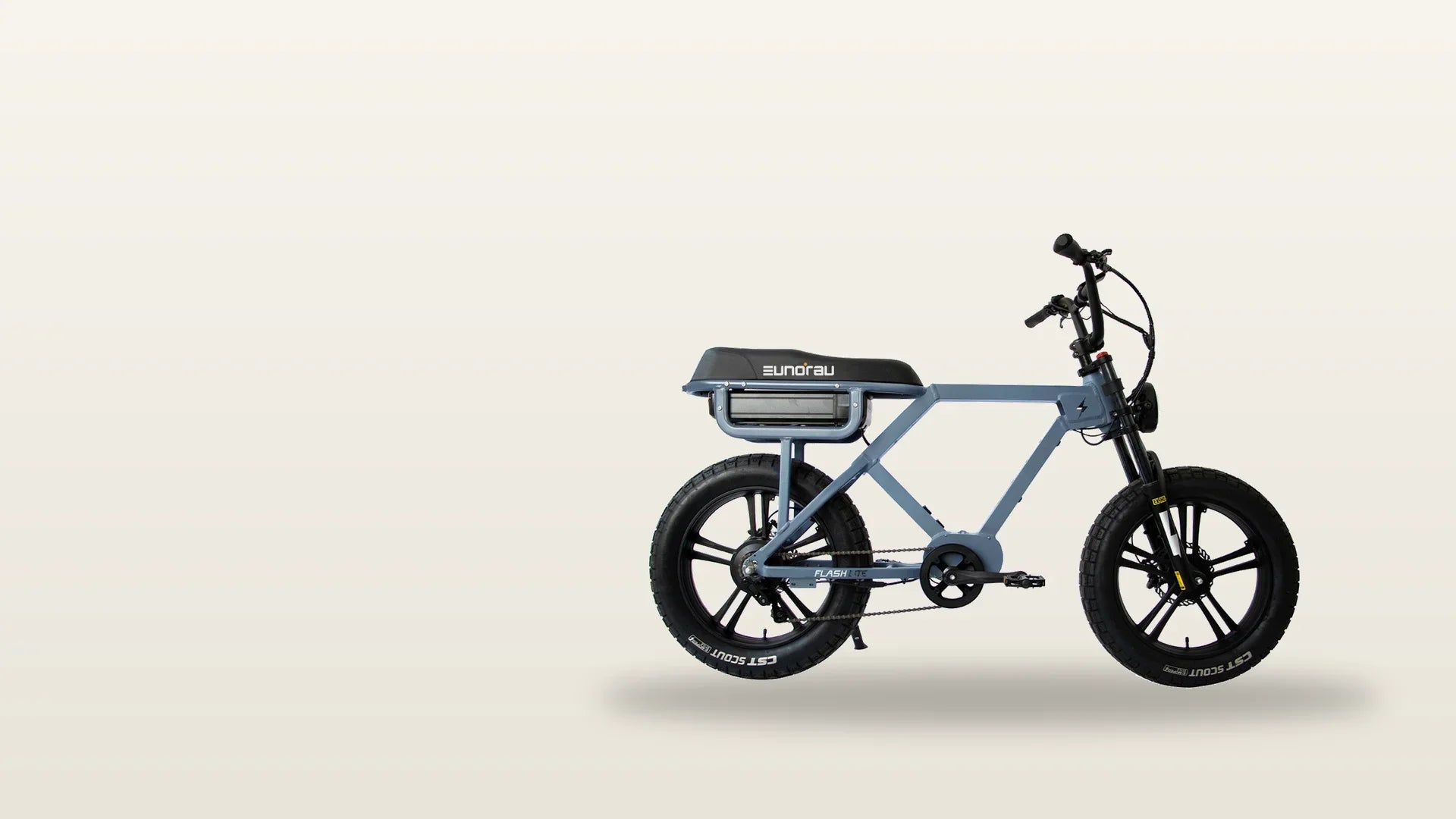
Eunorau FLASH LITE 2.0 — the moto-styled twin

Eunorau FLASH LITE 2.0
$1,899What makes it special. The same 52V 750 W / 20 mph running gear as the LITE ST in the moto-tank silhouette this whole category is named for. Same class-configurable assist, same 440-lb payload, hydraulic discs on 180 mm rotors, and a battery bay that takes a second and third pack; Eunorau quotes 65 miles standard and 135/220 with the extra batteries.
The range math. The identical 832 Wh pack: plan on 35 / 24 / 16 miles (assist / 20-mph throttle / flat-out). The 65-mile claim implies ~13 Wh per mile, a genuine low-assist figure; buy the second battery if your days run long.
For: the rider who wanted the motorcycle look and the bike-lane rulebook at the same time; single-speed fans (nothing to shift, nothing to tune). Not for: riders who pedal for exercise (the single speed tops out its usefulness at assist speeds), or anyone who wants their machine to out-accelerate traffic, which this deliberately will not.
Eunorau FLASH AWD 1.0 — traction in all weather

Eunorau FLASH AWD 1.0
$2,099What makes it special. A motor in each wheel, two 52V 750 W hubs of 92 N·m apiece, still governed to 20 mph. When sand, wet leaves or a gravel climb breaks the rear wheel loose, the front keeps pulling. No other configuration in this price range does that.
The range math. Same 832 Wh pack feeding two motors: plan on 35 / 24 / 16 miles, and expect the lower end of each figure when both hubs work hard; AWD spends energy on traction. Dual- and triple-battery options lift it the same way as its siblings.
For: riders whose commute includes weather, sand or unpaved shortcuts; anyone who has felt a single-drive fat bike spin its wheel on a wet climb.
Worth knowing before you buy: its two motors are 750 W each. Statutes typically say "an electric motor of less than 750 watts," and states differ on whether twin motors are summed. That is a genuinely unsettled reading, which we flag rather than decide. Riders who need the question settled should pick the single-motor LITE models instead.
Eunorau FLASH 2.0 — the mid-drive torque pick

Eunorau FLASH 2.0
$2,499What makes it special. The only mid-drive on this page: a 52V 1,000 W Truckrun motor rated at 220 N·m, more than twice the torque of any hub bike here, driving through a Shimano 8-speed. Mid-drives climb through the gears, so a 15% grade that stalls a hub bike is this machine's ordinary work. Top speed is still 20 mph.
The range math. 832 Wh again, but mid-drives use gearing efficiently on hills: plan on 35 / 24 miles and expect the assist figure to hold up better in steep country than any hub bike's would.
For: riders in genuinely hilly places; anyone hauling a trailer up grades; drivetrain enthusiasts who want gears that matter. Not for: buyers in exclusive-750 W states: the 1,000 W rating places it outside definitions written as "less than 750 watts," so check your state's line in the law guide first. Also not for the maintenance-averse, since a mid-drive works its chain far harder than a hub.
Himiway Escape Pro — the value moped silhouette

Himiway Escape Pro
$1,499What makes it special. The classic moped-style package (48V 750 W geared hub, bench seat, 20×4 Kendas on cast wheels, front fork plus a 290 mm dual-coil rear shock) at $1,499 with Samsung/LG cells. Full suspension and a real shock at this price is the headline; most rivals give you a rigid rear.
The range math. 48V × 15Ah = 720 Wh; × 0.85 = 612 usable. Plan on 31 miles of assist, 20 miles of 20-mph throttle: the smallest pack on this page, honestly stated. Our listing publishes no range claim for it, so the arithmetic above is the planning number.
For: first moped-style buyers who want the look, the legal simplicity of 750 W, and a suspension that irons out bad pavement; shorter riders, thanks to the step-through frame. Not for: long-haul riders (20 throttle miles is a town figure), or anyone who wants hydraulic brakes, which this trims to mechanical discs to hit its price. Awaiting restock at press time.
Himiway C3 — the family workhorse

Himiway C3
$1,499What makes it special. A long-tail cargo frame with a genuine 440-lb payload and, rare at $1,499, a torque sensor, which meters assist by how hard you pedal instead of whether you pedal. Loaded cargo bikes live and die by that difference: a cadence bike surges with a child on the back; a torque bike just feels like stronger legs.
The range math. 48V × 20Ah = 960 Wh; × 0.85 = 816 usable. Plan on 41 / 27 / 18 miles, and note that a loaded long-tail runs nearer the fast column's consumption even at modest speed. School-run plus errands fits comfortably; a loaded 30-mile day does not.
For: households replacing second-car trips; riders carrying children or weekly shopping; anyone who valued the torque-sensor feel at twice this price. Not for: riders wanting the moped look (this is a tool, shaped like one), or anyone needing the 20×3 tires to double as trail rubber. Awaiting restock at press time.
Addmotor Soletri II / Herotri II — two seats, three wheels

What makes it special. A full-suspension electric trike: 48V 750 W, 20 mph, three wheels, a 23.5-inch banana seat with footrest boards, and a 450-lb payload, sold as two frames at one price: the 17-inch step-through Soletri or the 24-inch step-over Herotri. Named components throughout (Tektro Aries calipers, Kenda GIGAS rubber, UL-certified Samsung pack) where this price class usually generalizes. Being three-wheeled matters legally too: the federal definition covers "two- or three-wheeled" vehicles, so it keeps bicycle status.
The range math. 48V × 20Ah = 960 Wh; × 0.85 = 816 usable. Plan on 41 / 27 miles; Addmotor's own 40–85-mile figure is labelled an estimate at lowest assist by Addmotor itself, the kind of honesty we wish were standard.
For: riders for whom balance is the real constraint: two-up short rides, riders returning after years off a bike, anyone whose alternative was giving up riding; big riders, thanks to the 450-lb rating. Not for: narrow bike-lane commuting (it is wide), fast riders, or tight storage, since a trike claims real floor space. Awaiting restock at press time.
Addmotor Soletan M-66X — the plush two-wheeler

Addmotor Soletan M-66X
$1,899What makes it special. The Soletri's running gear on two wheels: 750 W, 20 mph, full front-and-rear suspension, a two-up-capable banana seat, and the same UL 2271-listed 48V 20Ah Samsung pack. It is the most suspension-per-dollar in the street group, and one of the few bikes here a passenger can genuinely share.
The range math. 960 Wh × 0.85 = 816 usable, so plan on 41 / 27 miles. Addmotor's 105-mile claim implies about 9 Wh per mile: a lowest-assist estimate by their own labelling, so plan with our columns and treat anything more as a bonus.
For: comfort-first riders, cruiser fans, couples doing short two-up loops. Not for: riders who stand and sprint (the long saddle geometry resists it), or anyone who wants gears for real hills at speed. Awaiting restock at press time.
Riding'times Z8 Pro — the configurable commuter

Riding'times Z8 Pro
$899What makes it special. At $899, a dual-battery moped-style bike, two 48V 15.6Ah packs totalling 1,498 Wh, with a 750 W rated motor and a class-limit setting in the display: it ships able to run to 32 mph, and can be set to Class 1, 2 or 3 to match your state. That is the largest battery per dollar on this page by a wide margin.
The range math. 48V × 31.2Ah = 1,498 Wh; × 0.85 = 1,273 usable. Plan on 64 / 42 / 28 miles. The budget bike outlasts machines at twice its price, because watt-hours are watt-hours.
For: long-commute riders on a budget; anyone who wants one bike to be street-limited on weekdays and quicker on private land at weekends: set the limiter accordingly, and know that its street status holds only while it is limited. Not for: riders over the 220-lb load rating (the honest low ceiling on this page), or anyone who wants hydraulic brakes and premium parts, which an $899 price necessarily trims. Awaiting restock at press time.
High-power moped-style machines
The brand shelves for this group: Eahora, Samebike and Riding'times.
Everything in this group carries a motor rated above 750 W, a top speed past the class ceilings, or both. That is the point of them, and it also means the whole group sits outside the electric-bicycle definition in the 49 states that publish one. Treat them as private-land, acreage and off-road machines, or check whether your state offers a moped or motor-driven-cycle registration route before planning street miles.
That sentence applies to all eight bikes below equally; it is how this end of the segment is engineered, industry-wide.
Eahora DL2000 — the single-speed twin-motor

Eahora DL2000
$2,299What makes it special. Two 800 W hubs (2,000 W peak combined), 240 mm hydraulic rotors (the biggest brakes in Eahora's range), 20×4.5 rubber, and no gears at all. Nothing to shift, bend, stretch or tune. Its published 28 mph top speed is modest for the hardware, and its 5.5–6.5-hour charge is the quickest in Eahora's moped family.
The range math. 52V × 30Ah = 1,560 Wh; × 0.85 = 1,326 usable. Plan on 44 miles of 20-mph throttle, 29 at 28 mph. Eahora's claim is 40–50 throttle miles, one of the few claims on this page that matches the arithmetic, and worth crediting for it.
For: riders who want dual-motor grunt with single-speed simplicity; short-loop property riders; anyone who has bent one derailleur too many. Not for: riders under 5'7" (Eahora's own fit range starts there), pedal-first riders, or anyone needing street status; see the group note above. In stock at press time.
Eahora Romeo II — the range monster

Eahora Romeo II
$2,299What makes it special. A 3,120 Wh pack, 52V 60Ah of pouch cells and double anything else here, feeding two 1,250 W hubs through four-piston hydraulic calipers, on a 20-inch frame that fits riders from 5'4". At 143 lb it is also the lightest of Eahora's dual-motor mopeds, which is the sentence that tells you how heavy this class runs. One disclosure: Eahora prints the top speed as "28+ Mph(40mph)" — two figures in one cell; our table and screen use the lower one.
The range math. 3,120 × 0.85 = 2,652 usable Wh. Plan on 88 miles of 20-mph throttle, 59 flat-out, 133 in relaxed assist. Eahora claims 78–120 depending on mode; for once the claim brackets the arithmetic instead of floating above it. This is the one bike here where a genuinely long day needs no second battery.
For: all-day property and trail riders; shorter riders shut out of 26-inch mopeds; anyone whose buying logic is watt-hours per dollar (1.36 Wh/$ is the best on this page). Not for: street-status shoppers (group note), or weight-critical storage, since 143 lb still needs a ramp rather than a lift. In stock at press time.
Eahora FT-01 Max — the lean commuter shape

Eahora FT-01 Max
$1,799What makes it special. The stripped-back one: a single 1,500 W hub, 1,440 Wh pack, single-speed drive, and 90.6 lb, light for this group by 25 to 70 pounds, with a 330-lb load rating and IP65 sealing throughout. Honesty note a reader deserves: Eahora publishes no top speed for this model, and its claimed figures run unusually conservative.
The range math. 48V × 30Ah = 1,440 Wh; × 0.85 = 1,224 usable. Plan on 41 miles of 20-mph throttle, 27 ridden hard. Eahora's own claim of 43 assist and 28 throttle implies 33–51 Wh per mile, above our planning rates. That is a manufacturer under-promising, which we note because it is rare enough to be a feature.
For: riders who want power-group performance at a weight one person can actually manage up a step, and minimalists. Not for: two-up riding (single bench, lean frame), tall-rider comfort at speed, or anyone who needs a published top speed before buying, because it does not have one. Awaiting restock at press time.
Samebike M20 — the $999 entry ticket

Samebike M20
$999What makes it special. Hydraulic brakes and full suspension at $999, both usually the first deletions at this price, under a retro moto tank, with a 1,800 W peak motor and a 32.5-inch saddle height that suits riders a 26er never fit. The mid-frame cargo bay is a genuinely useful oddity: groceries go where a fake tank usually sits. A disclosure the spec-sheet reader should have: Samebike publishes only the peak figure for this motor; the rated (continuous) wattage is unpublished.
The range math. 48V × 18Ah = 864 Wh; × 0.85 = 734 usable. Plan on 24 miles of 20-mph throttle, 37 in assist. The 87-mile claim implies under 10 Wh per mile, a lowest-assist scenario, so plan with our columns.
For: budget buyers who want the silhouette and real brakes; shorter riders; errand-runners charmed by the cargo bay. Not for: range-first buyers (734 usable Wh is honest but small), or anyone whose state screens by rated wattage and wants a number to point at, which this listing does not publish. Awaiting restock at press time.
Samebike M20-III — the dual-everything upgrade

Samebike M20-III
$1,499What makes it special. The M20 idea doubled: two 1,000 W hubs (3,000 W peak combined), two switchable 48V 18Ah packs (1,728 Wh), a 396-lb payload, the highest in Samebike's line, and a true bench saddle. All-wheel drive plus dual batteries at $1,499 is a spec sheet nothing else on this page matches for the money.
The range math. 1,728 Wh × 0.85 = 1,469 usable. Plan on 49 miles of 20-mph throttle, 33 ridden hard, 73 in assist. The 149-mile claim implies ~12 Wh per mile, again a lowest-assist figure, so the arithmetic is the planning number.
For: heavier riders and gear-haulers on loose ground; private-land days long enough to need the second pack; anyone who wanted the FLASH AWD idea with more headroom and less concern for street definitions. Not for: street-status shoppers (group note), or riders who want one number for the motor: the page quotes peak figures in more than one place, which we flag rather than reconcile. Awaiting restock at press time.
Riding'times GT73 — the dirt-bike gateway

Riding'times GT73
$1,499What makes it special. A genuine small dirt-bike format: 2,400 W rear hub, motorcycle rubber (70/100-19), inverted fork, dual removable 48V 18.2Ah packs that are UL 2849 compliant, and certification at this end of the market is scarce enough to headline. Riding'times quotes 28–37 mph depending on load, and full-twist throttle, no pretence of pedal-first manners.
The range math. 48V × 36.4Ah = 1,747 Wh; × 0.85 = 1,485 usable. Plan on 50 miles of 20-mph riding, 33 ridden the way people actually ride dirt bikes. The claimed 155 PAS miles implies ~11 Wh per mile, which is lab assist; use the throttle column.
For: riders stepping up from kick-scooters or down from gas dirt bikes; families with acreage; anyone who wants certified batteries in an off-road toy. Not for: street riding of any kind (this group's note applies at full strength), or riders over its 286-lb load ceiling, the lower of the two GT73s. Awaiting restock at press time.
Riding'times GT73 Pro — the torque flagship

Riding'times GT73 Pro
$1,999What makes it special. The serious one: 3,000 W rear hub, 338 N·m — the highest torque figure on this page — a 60V 40A Fardriver controller, dual 60V 18Ah UL 2849 packs (2,160 Wh), 230 mm hydraulic rotors with EABS, and a quoted 37–46 mph. Spec-for-spec it reads like a small electric motorcycle, and that is exactly how to think about owning one.
The range math. 60V × 36Ah = 2,160 Wh; × 0.85 = 1,836 usable. Plan on 61 miles at a 20-mph pace, 41 ridden hard. Hard riding is what it is for, so 41 is the planning number. The 87-mile throttle claim implies ~25 Wh per mile, close to our band, and worth crediting.
For: experienced off-road riders wanting gas-bike hills without gas-bike maintenance; hunters and land managers covering real distance off-grid. Not for: first-time riders (338 N·m does not forgive learning-day mistakes), or anyone without private land or OHV access to use it on. Awaiting restock at press time.
Riding'times GT33 — cargo with a cafe-racer face

Riding'times GT33
$899What makes it special. An $899 machine that refuses to pick a lane: cafe-racer styling, cargo capacity, full suspension, a 48V 27Ah battery that is dual-battery ready, and 258 N·m of quoted torque. Riding'times publishes 50–100 miles of range and, on the maker's page, a 31 mph top speed, while our own listing quotes 34. We show both because that is what the record says, and flag the gap rather than pick a number.
The range math. 48V × 27Ah = 1,296 Wh; × 0.85 = 1,102 usable. Plan on 37 miles of 20-mph riding, 24 ridden hard, 55 in assist, which makes the maker's 50–100 read as an assist-mode bracket.
For: property utility work with style; budget buyers who want torque for loaded climbs; tinkerers eyeing the second battery bay. Not for: street errands (its speed places it in this group), or riders wanting big-name components at a price where nothing big-name fits. Awaiting restock at press time.
Seventeen machines is a lot of scrolling. If you would rather filter by price, wheel size or brand and compare listings side by side, the full catalog is one tap away.
Browse every e-bike we stockElectric moped vs seated electric scooter
The other machine buyers cross-shop is the seated electric scooter — the step-through platform with a saddle bolted on. The differences that matter: a moped-style e-bike has operable pedals, which is what lets it into the electric-bicycle definition and the bike lane; a seated scooter without pedals is regulated under each state's separate e-scooter rules, usually stricter about roads and never granting bike-lane status by default.
Range math works identically on both — watt-hours do not care about the frame. If your route has bike lanes, the pedals are worth having; if it is all low-speed neighborhood streets, a seated scooter can be the cheaper answer.
Riding two-up: what actually qualifies
A bench seat is an invitation, but the payload column is the law of physics underneath it. Genuine two-up machines on this page: the Soletri II trike (450 lb, footrest boards, backrest) and the Soletan on two wheels; the M20-III carries the payload (396 lb) with a true bench. Everything else here is a solo machine wearing a two-seat silhouette — 330 lb ratings disappear fast under two adults.
Check your state's passenger rule too: several require a dedicated passenger seat and footrests before a second rider is legal at any weight.
What changed in 2024–2026, dated
The definition lines this page keeps pointing at are moving, and three changes matter to moped-style buyers specifically. Each was read at the state's own publisher for our 50-state guide, where the full what-changed table lives.
| Effective | Where | What changed for this category | Source |
|---|---|---|---|
| Jul 1, 2026 | Tennessee | Class 3 minimum age raised from 14 to 16 | Public Chapter 651 |
| Dec 1, 2026 | North Carolina | The single 20-mph definition becomes the three-class model; a 28-mph pedal-assist bike is not an e-bike in NC until that date | S.L. 2026-46 § 19 |
| Jan 1, 2026 | Illinois | E-bikes may only be sold with UL 2849 / EN 15194 drive systems and UL-certified batteries; our Illinois page covers the phase-in | 625 ILCS 3610/15 |
The pattern behind all three is the same: states are tightening who may ride fast e-bikes and what certification the battery must carry, while the 750 W definition line itself has barely moved. Buy against the line as written today, and re-check your state before a fast bike changes hands to a teenager.
All 17, side by side
Every number below is from the live listing, pulled 2026-08-26; "plan mi" is our arithmetic (85% of pack ÷ 30 Wh/mi throttle band), so the column compares like with like. "Definition fit" is the bike's position against the electric-bicycle definitions of the 49 states that publish one, screened at the listing's rated wattage and top speed.
| Bike | Price | Motor (rated) | Pack | Plan mi (throttle) | Top speed | Payload | Definition fit |
|---|---|---|---|---|---|---|---|
| FLASH LITE ST | $1,899 | 750 W | 832 Wh | 24 | 20 mph | 440 lb | Fits, 49 of 49 |
| FLASH LITE 2.0 | $1,899 | 750 W | 832 Wh | 24 | 20 mph | 440 lb | Fits, 49 of 49 |
| FLASH AWD 1.0 | $2,099 | 2 × 750 W | 832 Wh | 24 | 20 mph | 440 lb | Contested — see card |
| FLASH 2.0 | $2,499 | 1,000 W mid | 832 Wh | 24 | 20 mph | 440 lb | Outside in exclusive-750 W states |
| Escape Pro | $1,499 | 750 W | 720 Wh | 20 | not published | 330 lb | Fits on wattage; speed row unpublished |
| C3 | $1,499 | 750 W | 960 Wh | 27 | not published | 440 lb | Fits on wattage; speed row unpublished |
| Soletri II / Herotri II | $2,799 | 750 W | 960 Wh | 27 | 20 mph | 450 lb | Fits, 49 of 49 |
| Soletan M-66X | $1,899 | 750 W | 960 Wh | 27 | 20 mph | — | Fits, 49 of 49 |
| Z8 Pro | $899 | 750 W | 1,498 Wh | 42 | 32 mph unlocked | 220 lb | Fits while class-limited; outside at 32 mph |
| DL2000 | $2,299 | 2 × 800 W | 1,560 Wh | 44 | 28 mph | 330 lb | Outside, 49 of 49 |
| Romeo II | $2,299 | 2 × 1,250 W | 3,120 Wh | 88 | 28+ mph | 330 lb | Outside, 49 of 49 |
| FT-01 Max | $1,799 | 1,500 W | 1,440 Wh | 41 | not published | 330 lb | Outside on wattage |
| M20 | $999 | not published (1,800 W peak) | 864 Wh | 24 | 31 mph | — | Not screenable — rated W unpublished |
| M20-III | $1,499 | 2 × 1,000 W | 1,728 Wh | 49 | 31 mph | 396 lb | Outside, 49 of 49 |
| GT73 | $1,499 | 2,400 W | 1,747 Wh | 50 | 28–37 mph | 286 lb | Outside, 49 of 49 |
| GT73 Pro | $1,999 | 3,000 W | 2,160 Wh | 61 | 37–46 mph | 330 lb | Outside, 49 of 49 |
| GT33 | $899 | 750 W (1,350–1,500 W peak quoted) | 1,296 Wh | 37 | 31–34 mph (two figures published) | 330 lb | Outside on speed |
Shop by brand: Eunorau · Eahora · Samebike · Himiway · Addmotor · Riding'times · everything
Alaska and Kentucky publish no electric-bicycle definition, which is why the column's denominator is 49 rather than 51 — in those two states the general vehicle code is the starting point for every machine on this page.
Where buyers get caught out
Five traps account for most of the regret in this category, and every one is avoidable at the spec-sheet stage.
Peak watts wearing the headline. Marketing leads with the biggest number the motor can touch for a few seconds; statutes read the rated figure. When a listing publishes only a peak, as one bike on this page does, you cannot place it against your state's line at all. Ask for the rated number in writing before you buy on it.
Range with no speed attached. As the math sections show, claims on this page imply consumption from 8 to 51 Wh per mile. Neither end is a lie; they are different scenarios. Divide watt-hours by 30 and you have a number you can plan a commute on.
"Street legal" in the listing title. Street status is your state's decision, made by definition lines; a product title cannot grant it. A limiter helps only where the rated wattage also fits — a 1,500 W motor governed to 20 mph remains a 1,500 W motor in states that screen by wattage.
The dual-motor summing question. Two 750 W motors read as compliant per-motor and as 1,500 W combined, and states have not settled which reading governs. If your riding depends on the answer, buy a single-motor bike and skip the question.
The moped registration mirage. Buyers assume an out-of-definition bike can simply be registered as a moped. Many states require DOT equipment these machines do not carry; some offer no route at all. Confirm the route exists in your state's code before the purchase rather than after; the state pages in our law guide are the place to start.
The FLASH family above is the shortest path to a moped that rides as a bicycle: every listing shows the pack voltage and amp-hours, so you can run this guide's math on each one before you decide.
Shop the street-legal Eunorau rangeThe 30-second pre-purchase check
Run any moped-style listing, ours included, through these six questions before money moves. Every answer should exist on the page; each "no" is a question for the seller, in writing.
- Is the rated (continuous) wattage published, separately from the peak figure? No rated number means no way to place the bike against your state's definition.
- Is there a top speed in mph, and is it the motor's ceiling or the limiter's? A limiter can be a setting; the rating is the machine.
- Volts and amp-hours printed? Multiply them. If the claimed range needs less than 15 Wh per mile from the resulting pack, the claim is a lowest-assist scenario.
- Is the battery certified — UL 2271 for the pack or UL 2849 for the system — and does the listing name which? Illinois already requires it at sale, New York City requires it to sell or rent, and insurers increasingly ask.
- Does the payload rating cover you plus cargo plus a passenger, if two-up riding is the plan? Bench seats invite passengers that payload columns sometimes do not.
- Does your state's definition line, read today, cover this bike as specified? One page answers this per state: the 50-state guide.
Frequently asked questions
Do you need a license to drive an electric moped?
Not for a moped-style bike that meets the electric-bicycle definition: rated under 750 W, assisting to the class speed limits. In the large majority of states those ride as bicycles: no license, no registration. A machine above those limits has no automatic road status, and a license becomes relevant only where your state offers a moped or motor-driven-cycle registration route. State by state detail: our 50-state guide, verified against each legislature's own publisher.
What is an electric moped?
In US retail, it is a styling term for an electric bicycle built with a bench seat, fat tires and a motorcycle silhouette. It is not the DMV's word; legally the machine is either an electric bicycle (if it fits the definition), or an unclassified motor vehicle (if it does not). The DMV category "moped" (plated, registered, sometimes insured) is a third thing that almost nothing sold under this name actually is.
Are moped-style e-bikes legal?
The style is legal everywhere; the drivetrain decides the rest. A moped-style bike rated under 750 W and speed-limited to its class rides as a bicycle in the 49 states that define electric bicycles. Above those numbers, it is legal to own and to ride on private land, and street use depends on your state's registration options.
Do you have to register an electric moped?
Not if it meets the electric-bicycle definition — no state registers in-definition e-bikes as motor vehicles. Outside the definition, registration is either required for street use or unavailable entirely, depending on the state, and the machine stays a private-land ride where no route exists.
Do you need insurance for an electric moped?
No state requires insurance for an in-definition electric bicycle. For out-of-definition machines ridden under a state moped registration, some states do require it. Separately: homeowner and renter policies differ on whether they cover e-bike theft and liability by motor size — riders at the powerful end of this page should ask their insurer in writing.
How fast can electric mopeds go?
On this page, published top speeds run from 20 mph for the street group, by design, up to a quoted 37 to 46 mph (the GT73 Pro). The street-legal ceiling for throttle riding is 20 mph in most states, 28 mph for pedal-assist Class 3; anything faster belongs on private land.
How far can an electric moped really go?
Divide the battery's watt-hours by 30 for a planning figure at roughly 20 mph throttle. On this page that spans 20 miles (Himiway Escape Pro, 720 Wh) to 88 miles (Eahora Romeo II, 3,120 Wh). Claimed figures often use lowest-assist scenarios; the formula section above shows the whole calculation so you can run it on any bike.
How do you charge an electric moped, and what does it cost?
From a wall outlet, using the charger in the box; charge times on this page run about 5.5 to 10 hours. At the US average residential rate of 18.44 cents per kWh (EIA, May 2026), filling the largest pack here (3,120 Wh ≈ 3.1 kWh) costs about 58 cents; the smallest, about 13.
Charge removable packs indoors on a hard surface, and prefer UL-certified packs — several bikes above carry UL 2271 or UL 2849 listings, noted on their cards.
What is a moped-style e-bike best for?
Short, frequent trips where a car is overkill: commutes under the battery math above, school runs and errands (the cargo picks), and, at the high-power end, private-land riding that would otherwise need a gas machine. The bench seat and step-through frames also fit riders that diamond-frame bikes exclude.
Can two people ride one?
Only on machines built for it: on this page the Addmotor Soletri II and Soletan (banana seats, 450-lb payload, footrests) and the bench-seated Samebike M20-III (396 lb) are the honest two-up candidates. Check your state's passenger rule — several require a dedicated passenger seat, and no in-definition e-bike carries a passenger where the payload rating says otherwise.
Do electric mopeds have pedals?
Every machine on this page has operable pedals — that is a requirement of the electric-bicycle definition. On the high-power group the pedals are what separate them from electric motorcycles in kind, if not in state paperwork. How usable the pedals feel varies: single-speeds pedal adequately to their assist ceiling; the moto-format bikes pedal like what they are.
Which electric moped is best for the money?
By the arithmetic rather than by grade: the Z8 Pro carries the most watt-hours per dollar of the street group (1,498 Wh at $899), and the Romeo II the most on the page (3,120 Wh at $2,299). "Best" beyond that depends on which rider row in the matching table is yours.
The bottom line
Buy the definition first, the bike second. Decide whether you need a machine your state treats as a bicycle; if yes, the street group above is your whole list, and the FLASH LITE ST is its most complete all-rounder. If your riding is genuinely private-land, the power group rewards honesty about that: the Romeo II for distance, the GT73 Pro for capability, the M20 for the cheapest way in.
Run the range formula on whatever you shortlist (85% of the watt-hours, divided by 30) and let the arithmetic rather than the adjective set your expectations.
What one actually costs to run
The purchase price is the loud number; the quiet ones decide how the ownership feels. The running-cost arithmetic below uses the same show-your-work rule as the range model.
Energy. A full charge costs watt-hours ÷ 1,000 × your electric rate. At the US average of 18.44 cents per kWh (EIA, May 2026), the mid-size 1,560 Wh pack costs about 29 cents to fill and, at 30 Wh per mile, moves you about 44 planning miles: about two-thirds of a cent per mile. A 30-mpg car at $4.09 a gallon (EIA weekly retail, Aug 24, 2026) spends 13.6 cents per mile on fuel alone, roughly twenty times as much.
The battery is the real consumable. Packs on this page are rated between 1,000 and 1,200 charge cycles to 80% capacity where the maker states a figure. Take the Romeo II: 1,200 cycles × 88 planning miles is roughly 105,000 pack-miles before capacity fades to 80%, which in practice means years. The smaller packs cycle more often for the same miles, which is the hidden argument for buying watt-hours you think you do not need.
Everything else is bicycle economics. Tires in the 20×4 sizes, brake pads, a chain where there is one. The single-speed bikes on this page (DL2000, FT-01 Max, the FLASH LITE pair) were chosen by their makers partly to shrink this line to almost nothing. The exception is honest: the moto-format machines wear motorcycle-pattern tires, and hard off-road riding consumes them like the sport it is.
Insurance and registration: usually zero. For the street group, no state requires either, which is a recurring saving the car comparison never gets to skip.
Limitations and expiry
Institutional honesty means naming what this page cannot claim. Six limitations, numbered, then what will age it.
- The range model is arithmetic, not a road test. The 20/30/45 Wh-per-mile planning rates and the 85% usable factor are our stated assumptions for this weight class, published in full above. No bike on this page has been through an instrumented range test by us; "plan mi" figures are the model's output, nothing more.
- Specifications are the sellers' published numbers. Every spec is quoted from the live listing (pulled 2026-08-26), and no independent dynamometer or scale has verified them. Where a listing and its manufacturer disagree — the GT33's top speed — both figures are shown rather than one chosen.
- Two listings publish incomplete decisive specs. The Samebike M20 publishes no rated (continuous) wattage and the Eahora FT-01 Max no top speed; the Himiway pair publish no range row on our listing. Those cards run on what exists and say so; nothing was filled in.
- The state-law layer summarizes definitions, not every duty. The 49-state screen tests wattage and speed against each definition; helmet, age and path rules vary beyond it and live on the state pages. Two states publish no definition at all, and local ordinances can add rules everywhere.
- The dual-motor summing question is genuinely unsettled. We flag it on the FLASH AWD card and decide nothing; a state ruling either way would change that card's street framing.
- Stock and price are a snapshot. Both were pulled 2026-08-26 and both move; "awaiting restock" cards were in that state at press time only.
What will age this page, with dates: North Carolina's three-class conversion (2026-12-01) shifts one row of the what-changed table from future to present; 2027 legislative sessions (most convene January 2027) can rewrite definitions; manufacturer model-year refreshes typically land between fall and spring; and our own re-verification cadence re-checks every claim at most 6 months out — due again by 2027-02-26. Past that date, ask us before relying on the numbers.
Source register
Every source this page rests on, tiered by authority — T1 primary official, T2 primary institutional (a seller's or maker's own published page), T3 vendor estimate (never load-bearing). Full records with archive snapshots follow in Primary sources.
| Source | Tier | What it supports here | Accessed |
|---|---|---|---|
| GPO / U.S. Code, 15 U.S.C. § 2085 | T1 | The federal definition, quoted; the preemption reading | 2026-08-22 |
| 51 state legislatures' own publishers (via our law-guide dataset) | T1 | The 49-state definition screen; the what-changed rows | 2026-08-19/21 |
| Tennessee Secretary of State (Public Chapter 651) | T1 | Class 3 age change, 2026-07-01 | 2026-08-19 |
| North Carolina General Assembly (S.L. 2026-46) | T1 | Three-class conversion, 2026-12-01 | 2026-08-19 |
| Illinois General Assembly (815 ILCS 361/15) | T1 | UL certification sale law | 2026-08-22 |
| US EIA (Electric Power Monthly; weekly gasoline) | T1 | Charging-cost and fuel-comparison arithmetic | 2026-08-26 |
| redtailebikes.com live listings (17 products) | T2 | Every spec, price and stock statement on the cards | 2026-08-26 |
| ridingtimes.com (GT33 listing) | T2 | The GT33's maker-published range and speed | 2026-08-26 |
| Redtail range model (first-party arithmetic) | T2 | All "plan mi" figures — sole publisher, formula printed above | 2026-08-26 |
Primary sources
Numbered records: issuing body · title · pinpoint · dates · link · archive. Deposit copies of retrievals are held in our research archive. Specifications are quoted from our own listings — the sole publisher of what we sell — and the range model is our own work, disclosed and printed in full above; both are marked sole-publisher in our citation ledger.
- United States Government Publishing Office, "15 U.S.C. § 2085 — Low-speed electric bicycles," subsections (a)–(d), 2023 ed.; enacted Dec. 4, 2002 (Pub. L. 107-319); accessed 2026-08-22. govinfo.gov · archive · operative language corroborated at Cornell LII the same day.
- State electric-bicycle definitions, all 51 US jurisdictions, each read at its legislature's own publisher with corroborating re-retrieval, 2026-08-19/21 — the dataset behind our 50-state guide, where every statute is individually linked and archived.
- Tennessee Secretary of State, "Public Chapter 651 (2026), SB 1782," Class 3 age provision, effective 2026-07-01; accessed 2026-08-19. tnsosfiles.com
- North Carolina General Assembly, "Session Law 2026-46, § 19 (H.B. 1094)," three-class conversion effective 2026-12-01; accessed 2026-08-19. ncleg.gov
- Illinois General Assembly, "815 ILCS 361 — Micromobility Fire Safety Act," Sec. 15(a), (c), effective 2026-01-01; accessed 2026-08-22. ilga.gov · corroborated at the Illinois SoS micromobility page.
- US Energy Information Administration, "Electric Power Monthly," Table 5.6.A, US residential average 18.44¢/kWh, May 2026 data; accessed 2026-08-26. eia.gov
- US Energy Information Administration, "Gasoline and Diesel Fuel Update," US regular $4.085/gal, week of 2026-08-24; accessed 2026-08-26. eia.gov
- Riding'times, "GT33 Cargo Electric Bike," specification section; accessed 2026-08-26. ridingtimes.com · corroborating second retrieval for the GT33 card beside our own listing.
- Redtail eBikes, 17 live product listings (specification tables, prices, stock), pulled via our store API 2026-08-26; per-bike extraction preserved in our research archive as
approved-specs_20260826.json. Sole publisher of what we sell. Where the manufacturer publishes the same model on its own site, that page is the corroborating second retrieval, each checked live 2026-08-26: Eunorau FLASH LITE ST, FLASH LITE 2.0, FLASH AWD 1.0, FLASH 2.0; Eahora DL2000, Romeo II, FT-01 Max; Riding'times GT73 Pro, GT73, GT33, Z8 Pro. The Samebike, Himiway and Addmotor models could not be matched to a single manufacturer page without version ambiguity (several official Samebike sites publish different M20 variants), so those six cards rest on our listing alone — stated in Limitations 2 and 3. - Redtail eBikes, "REDTAIL-008 range model" — the formula and planning rates printed in the range section above, applied per bike; dataset
range-math_20260826.json, 2026-08-26. Sole publisher; assumptions stated in the body.
Every bike on this page is sold by Redtail eBikes; this guide is our own work and no manufacturer reviewed it before publication. Corrections to support@redtailebikes.com — we correct in public and date the change.
Share:
Georgia eBike Laws (2026)