
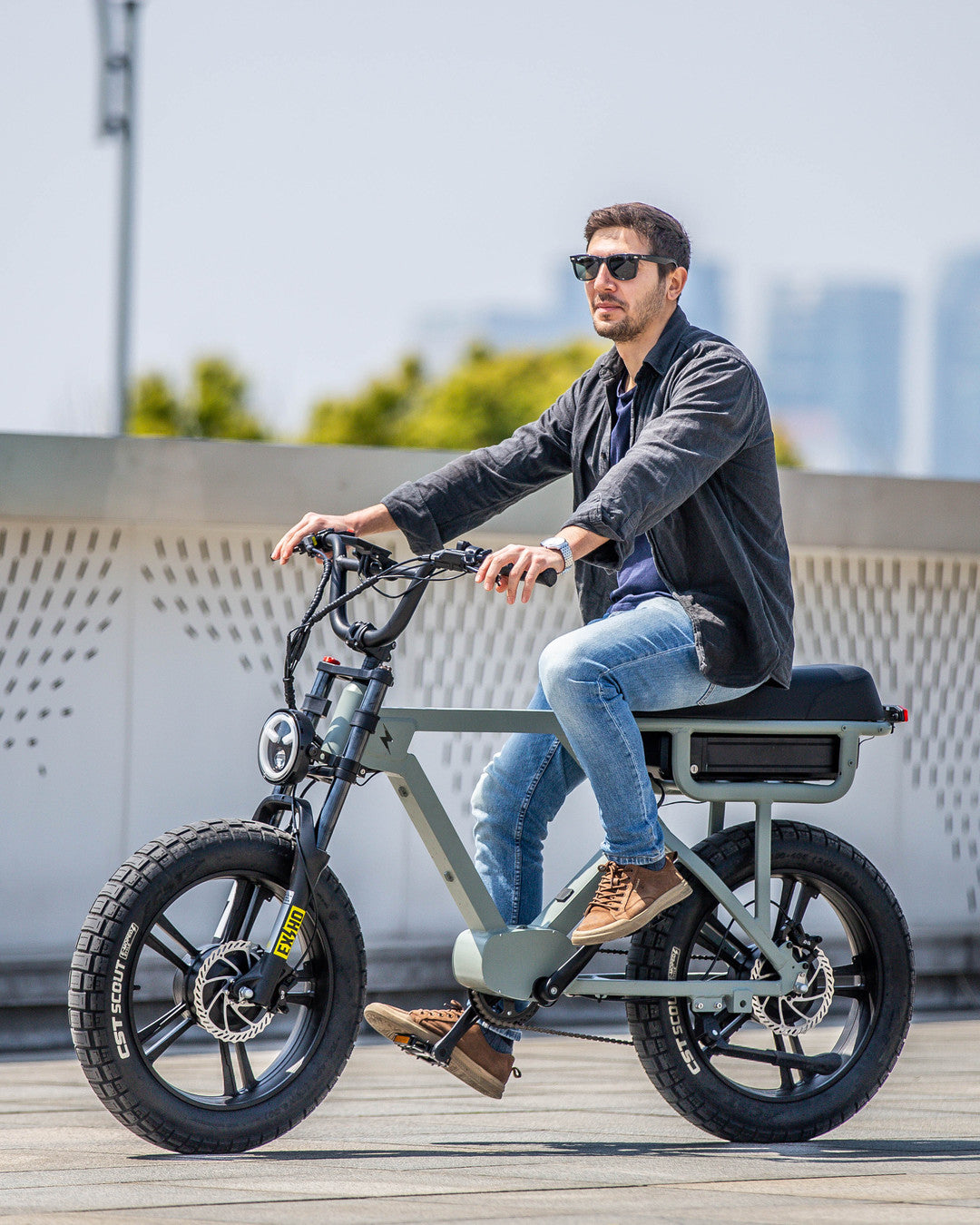

4,800 Wh · 2 × 2,500 W · 28 mph as delivered · 174 lb · 500 lb load · $3,599 · verified August 28, 2026
Quick Answer — The Eahora Romeo Ultra II 2026 is a $3,599 moped-style machine with two 2,500 W hub motors and a 4,800 Wh pack. At 5,000 watts it is not a low-speed electric bicycle under 15 U.S.C. § 2085(b) and fits no state e-bike class. Buy it for private land or registered road use, not for a bike lane.
Eahora Romeo Ultra II 2026 at a glance — motors 2 × 2,500 W dual hub · battery 60V 80Ah (4,800 Wh) · top speed published as "28+ Mph(50mph)" · range claimed 104–235 mi, measured 72.75 mi · weight 174.17 lb published / 177.8 lb weighed · payload disputed, 500 lb published vs 330 lb told to a reviewer · brakes hydraulic 240 mm · charger 67.2V 7A, 8–12 h · warranty 1 year · price $3,599 · verified 28 August 2026.
Takeaway
- 5,000 watts is 6.7× the federal ceiling. 15 U.S.C. § 2085(b) stops at "less than 750 watts". Two 2,500 W motors put this outside the definition before you touch the throttle.
- The claimed range and the tested range are not close. Eahora publishes 104–235 miles. BikeRide measured 72.75 miles with both motors on assist level 5. That is 31% of the top claim.
- It ships capped at 28 mph and the cap comes off in the display. Leaving it on does not make the machine a bicycle; taking it off makes a 50 mph vehicle.
- Eahora's own site says its e-bikes "belong to Class 3". Class 3 tops out at 28 mph, has no throttle above 20, and this model's own spec row prints 50.
- Two of the published dimensions do not convert to their own metric figures, and the torque is published as 125 N·m once and 120 N·m twice.
What's on this page
- Who the Romeo Ultra II is for
- How we verified this review
- Eahora Romeo Ultra II specifications
- What this machine is under the law
- "28+ Mph(50mph)": the number with two answers
- What it measured against what it claims
- Range: 235 claimed, 72.75 tested
- Ultra to Ultra II: what changed
- Three published numbers that disagree with themselves
- Brakes, weight and stopping
- Is the battery UL certified?
- Fit: standover, seat height and 174 pounds
- The Mercer fit test
- Warranty
- Ordering, shipping and support
- The honest ledger
- Who should buy it
- Which machine matches your situation
- Before you buy: the checklist
- Limitations of this review
- The source register
- Frequently asked questions
- The bottom line
Who the Romeo Ultra II is for

The Romeo Ultra II in Black, the one colorway with stock on 28 August 2026. The pack in the frame triangle is 4,800 watt-hours — about four times what a typical commuter e-bike carries.
Someone who wants motorcycle performance, has private land or legal off-highway trails to use it on, and is willing to treat registration and insurance as part of the purchase and not as a surprise.
It suits you if you want a 4,800 Wh pack, two motors you can run separately or together, air suspension at both ends and a 500 lb load rating — and if the 174 lb curb weight is something you ride and not something you lift.
It is the wrong machine if you wanted a bicycle. If that is what you are after, start with our electric bike buying guide or the moped-style roundup this review sits under. Not in the loose sense — in the legal sense, worked through below. It is also wrong if you have no way to store or transport 174 lb, or if you expected the published range to be the range you get. If it was the fat tires that drew you, our fat tire e-bike guide sets the Romeo Ultra II beside twelve fat-tire bicycles, chosen by the ground you ride.

Where the narration and Eahora's own documents differ, go by the documents. The 6,000 W named at 0:11 is the peak in Eahora's feature copy; each motor is rated 2,500 W, 5,000 W together, and the specifications work from that. The battery named at 0:14 is the 60 V, 80 Ah pack: 4,800 Wh.
The 500 lb payload at 0:17 is the rating Eahora publishes, and the disputed-numbers section explains why the lower figure is the one to load to. The 80 km/h "out of the box" at 0:22 is about 50 mph, the figure in brackets in Eahora's speed row, where the machine is delivered at 28 mph; the speed section covers both.

Inverted fork, motorcycle saddle, no seatpost, a disc at each end. Every design cue here is borrowed from a motorcycle, and so is the paperwork.
Two 2,500 W motors, 4,800 Wh, 500 lb load rating, air suspension front and rear. Free contiguous-US shipping and warranty claims handled by us. Tell us your state and how you plan to ride it and we will tell you what it takes to do that legally — ask us before you order.
See the Romeo Ultra II — $3,599How we verified this review
What we did. We archived Eahora's live Romeo Ultra II 2026 page on 28 August 2026 and read every published figure from that deposit copy, including the full Technical Specifications table and the A-to-M geometry list printed beside the geometry diagram. We downloaded and opened all 32 images the page links.
How we got the independent numbers. BikeRide tested this machine and published measured results. Its live review returned HTTP 403 to us, so we retrieved the Internet Archive's capture of 18 October 2025 and corroborated it against BikeRide's own video listing of 25 September 2025, whose chapter list names the same four tests. Every figure attributed to BikeRide below belongs to BikeRide and not to us.
What we computed. Pack energy, watt-hours per mile implied by each range figure, charge time from the published charger, and every inch-to-centimeter conversion in the geometry list. Script and dataset saved and re-runnable.
How this was verified. Every figure below is the manufacturer's own published specification, confirmed at its page and recomputed, and every verdict reads a published number. On the recall check. The CPSC recall service returned errors on every route we tried on 28 August 2026, including a control query that had returned 431 records earlier the same day. We therefore do not know this brand's recall status and do not claim it is clear. We will publish the result when the service is reachable.
Why this page reads the statute rather than quoting a reviewer. Every other account of this machine's legal status we could find cites another review. This one derives it from 15 U.S.C. § 2085(b), 16 CFR § 1512.2(a)(2) and 49 U.S.C. § 30102(a)(7) with pinpoint citations, so you can check it yourself.
Neutrality. Redtail sells this machine. The honest ledger carries what does not flatter it. Corrections: corrections@redtailebikes.com.
Reviewed by the Redtail editorial desk. Verified 28 August 2026.
Eahora Romeo Ultra II specifications
Quoted from Eahora's published specification and its geometry list, retrieved 28 August 2026. Watt-hour and charge figures marked as ours are our arithmetic.
| Price | $3,599 Black and Gray · $3,699 Blue |
| Motors | 2 × 2,500 W dual hub, brushless, IPX6 |
| Peak output | 6,000 W (Eahora's feature copy) |
| Torque | 2 × 125 N·m in the spec table; 2 × 120 N·m in the feature copy and FAQ — see below |
| Battery | 60V 80Ah, 4,800 Wh, Grade A lithium-ion pouch cells |
| Battery life | ≥ 1,200 charge cycles to 80% of capacity |
| Top speed | "28+ Mph(50mph) for both pedal-assist and throttle" — see below |
| Range | 104–235 mi with assist; 70–76 mi without (claimed — tested figure below) |
| Charger | 67.2V 7A, published 8–12 h charge |
| Charge, computed | 10.2 hours (our arithmetic: 4,800 Wh ÷ 470 W) |
| Brakes | Hydraulic disc, 240mm rotors, 2-piston calipers, motor cutoff |
| Frame | High-carbon steel, 26" × 18" |
| Fork | Adjustable air suspension, 100mm travel |
| Shock | Air with damping, 50mm travel |
| Tires | 26" × 4.0", 28–33 psi |
| Drivetrain | Shimano Tourney RD-TY300, 7-speed, 14–28T |
| Sensor | Cadence |
| Display | KDS986TFT 4" color LCD, Bluetooth, USB port |
| Gradeability | 25°–45° |
| Load capacity | Disputed. Eahora's page says ≤ 500 lb; Eahora told BikeRide 330 lb — see below |
| Weight | 174.17 lb with the 40.5 lb battery installed |
| Standover | Disputed. Eahora publishes 26.4" / 67 cm; BikeRide records 34" / 864 mm — see below |
| Seat height | 34.6" / 88 cm |
| Total length | 79.1" / 201 cm · width 28.7" / 73 cm |
| Rider height | 5'6" – 6'4", or inseam ≥ 28.7" |
| Assembly | Ships 85% assembled in three boxes |
| Class | None published — see below |
| Certification | None published on the product page — see below |
4,800 Wh, two motors, 500 lb rating, 25 in stock in Black on 28 August 2026. Free contiguous-US shipping, we handle warranty claims, and Shop Pay installments are available at checkout.
Order the Romeo Ultra II — $3,599What this machine is under the law
Settle this before anything else, because it changes what you are buying. It is the question buyers ask about this brand more than any other, and it has a clear answer.
Federal law defines the product category. 15 U.S.C. § 2085(b) says a low-speed electric bicycle is "a two- or three-wheeled vehicle with fully operable pedals and an electric motor of less than 750 watts (1 h.p.), whose maximum speed on a paved level surface, when powered solely by such a motor while ridden by an operator who weighs 170 pounds, is less than 20 mph."
16 CFR § 1512.2(a)(2) repeats that wording for the Consumer Product Safety Commission's bicycle rules.
Two 2,500 W motors is 5,000 watts nominal — 6.7 times the federal figure — and Eahora publishes a delivered top speed of 28 mph. Either element on its own puts the machine outside the definition. Both do.

The pack sits where a fuel tank would. That is 4,800 watt-hours of lithium in a steel frame, which is why the certification question later on this page is worth your attention.
The three-class system does not rescue it either. The three classes were written for machines that already sit inside the federal definition, so a 5,000-watt motor is outside all three before speed is considered at all. Our state-by-state guide carries each state's statutory wording if you want to read the tier definitions yourself — New York and Washington are two worth reading before you order a machine like this. The same definition test, run at 1000 watts, is in our SPECTER-S 3.0 review.
And the group behind the model law says so itself. PeopleForBikes, whose electric-bicycle policy work is built around the three classes, keeps a section headed "Vehicles that are not Class 1, 2, or 3 Electric Bicycles" and states plainly: "We do not support alteration of the three classes of low-speed electric bicycles to include other types of devices." A machine outside the classes is not an unclassified e-bike. It is a different kind of vehicle.
So what is it? In most state vehicle codes a throttle machine above the e-bike thresholds falls into a motorcycle, moped or off-highway category, each with its own license, registration, insurance, helmet and equipment rules. Federal motor-vehicle standards use a separate test — 49 U.S.C. § 30102(a)(7) reaches a vehicle "manufactured primarily for use on public streets, roads, and highways" — and Eahora describes this machine's ideal use as "off-road / mountain / urban riding", which does not settle that question one way or the other.
BikeRide reached the same place from the riding side. Its review states that "the high motor power and top speed also mean it's not actually an electric bicycle under the law, so a license, insurance, and possibly registration are required to use it on the road", and adds that "mirrors and turn signals could be required, both of which the Romeo lacks."
This is not a reason nobody should buy it. Plenty of people own machines that need a plate, and PeopleForBikes says as much when it tells makers of those devices to build "appropriate regulatory frameworks that are designed for their specific products and their uses." It is a reason to find out what your state asks before you pay, because the answer changes the total cost and the places you can ride.
The one-line version. At 5,000 watts and 28 mph as delivered, the Romeo Ultra II is not an electric bicycle under federal law and does not fit any of the three state classes. Treat it as a registerable vehicle or an off-highway machine, and settle which before you order.
"28+ Mph(50mph)": the number with two answers
Eahora's spec table prints the top speed as a single row: "Top Speed 28+ Mph(50mph) for both pedal-assist and throttle."

The cockpit: display center, twin fork crowns with red rebound adjusters, a full twist throttle on the right grip. That throttle is what puts the machine outside every state e-bike class.
Read literally, that is one figure and a second in brackets. Eahora does not explain the bracket anywhere on the page, and nothing on it uses the words cap, limiter or factory setting.
What the independent record adds is narrower than the bracket suggests. BikeRide reports the 50 mph as Eahora's claim — "Eahora says the bike's dual 2,500W motors and massive 60V, 80Ah battery can power it to 50mph" — and its own riding notes describe "speeds above 40mph". It publishes no measured top speed of its own and never mentions a speed cap.
People search for how to raise it, and we are not going to publish that. What is worth saying is the consequence, which those searches do not surface:
- At the lower of Eahora's own two figures, the machine is already past every US e-bike threshold. No setting changes that, because the wattage alone decides it.
- At the higher figure, you are riding something most state codes treat as a motorcycle, on a frame with no mirrors and no turn signals.
- Your insurance position changes with it. A claim after an accident is decided on what the vehicle was rather than on how it was sold.
Ride it as delivered and register it, or ride it where registration is not the question. Those are the two clean answers. The messy middle — a 50 mph vehicle on a public road with bicycle equipment — is the one that gets expensive.

The KDS986TFT display, in Eahora's own illustration. Note the readout is in km/h — the speed cap and the units both live in this menu.
What it measured against what it claims
Before you read any test of this machine, including this page, know this. Several hands-on accounts of the Romeo Ultra II are published, and every one we could find — the review below, the video channels, and this page — has a commercial relationship with the seller. That is ordinary across this category rather than unusual, and it does not make a measurement wrong. It is a reason to prefer numbers that were measured over numbers that were claimed, whoever published them.
BikeRide is the account that publishes instrumented results, so it is the one this page uses. It ran four tests and reported them in writing and on video. Its reviewer scored the machine 65/100; the 71/100 on its listing page is BikeRide's site-wide aggregate across four expert reviews.
| Test | BikeRide's measured result | Their context |
|---|---|---|
| Range, both motors, assist 5 | 72.75 mi, 3,128 ft climbed, 22.2 mph average | "the longest range we've had from any e-bike we've tested" |
| Braking from 20 mph | 22.5 ft | "Most e-bikes we've reviewed take 18 to 20 feet to stop from 20mph, and the best need just 15 feet" |
| 0–20 mph | 6 seconds on one motor, 4 seconds on both | — |
| Hill climb, longer test | 1:35, averaging 36.9 mph | "50% faster than the bikes we typically test" |
| Weight | 177.8 lb | "3.6lb heavier than the claimed weight of 174.17lb" |

Eahora's own photograph, on a public street, with the rider in a bicycle-style helmet. BikeRide's review says a machine at this power needs a motorcycle helmet and a plate — worth holding both pictures in your head at once.
Two things stand out, and they point in opposite directions.
The performance is real. Four seconds to 20 mph and a hill climbed at an average of 36.9 mph are motorcycle numbers, and BikeRide's own framing — the most powerful machine it has tested — is not a small statement from a site that tests a lot of e-bikes.
The stopping is not. 22.5 feet from 20 mph on a 178 lb machine is longer than the 18-to-20 feet BikeRide records for most of what it tests, measured the same way on the same test. The distance is physics and not negligence, and it is the number to plan your following distance around.
Range: 235 claimed, 72.75 tested
Eahora publishes 104–235 miles with pedal assist and 70–76 without. BikeRide measured 72.75 miles with both motors on the highest assist setting, over 3,128 feet of climbing, at a 22.2 mph average.
The gap is easier to read as consumption than as miles. The arithmetic below runs off the published 4,800 Wh pack.
| Watt-hours per mile | What it implies | |
|---|---|---|
| Eahora's 235-mile claim | 20.4 Wh/mi | Light assist, flat ground, low speed |
| Eahora's 104-mile claim | 46.2 Wh/mi | Mixed riding |
| BikeRide's measured 72.75 mi | 66.0 Wh/mi | Both motors, assist 5, 22.2 mph average, 3,128 ft climbed |
The 235-mile figure needs this machine to be 3.2 times more efficient than it was measured to be. It is not a small rounding difference, and it is no criticism of the test — BikeRide rode it hard, which is how most buyers of a 5,000 W machine will ride it.
Plan on 70 to 100 miles if you use the power you paid for, and treat the upper claim as what the pack could do at a speed nobody buys this bike to travel at. The honest way to read Eahora's own numbers is that the bottom of its no-assist band, 70 miles, is the closest published figure to what a tester actually got.

One of the two 2,500 W hub motors, with the seven-speed cassette beside it. The derailleur is a Shimano Tourney — the entry-level group, on a $3,599 machine.
Twenty-five in Black on 28 August 2026, with Gray and Blue on the same listing. Free contiguous-US shipping, warranty claims handled here, and Shop Pay installments at checkout. Tell us your riding and we will tell you the range to plan on.
Check stock — $3,599Ultra to Ultra II: what changed
Eahora still sells the first Romeo Ultra alongside this one, at $2,599. Both pages were retrieved on 28 August 2026, and the comparison is more interesting than the marketing suggests.
| Romeo Ultra | Romeo Ultra II 2026 | |
|---|---|---|
| Motor | 3,000 W single rear hub (3,800 W peak) | 2 × 2,500 W dual hub (6,000 W peak) |
| Torque | 120 N·m | 2 × 120 N·m (spec table says 125) |
| Battery | 60V 70Ah — 4,200 Wh (the same pack the Juliet Pro II runs, in a step-through) | 60V 80Ah — 4,800 Wh |
| Top speed | "28+ Mph(42mph)" | "28+ Mph(50mph)" |
| Max load | 330 lb | 500 lb |
| Weight | 160.5 lb (battery 36.6 lb) | 174.17 lb (battery 40.5 lb) |
| Range claimed | 104–235 mi / 70–76 mi | 104–235 mi / 70–76 mi — identical |
| Charger | 67.2V 7A, 8–12 h | 67.2V 7A, 8–12 h — unchanged |
| Brakes, fork, shock, frame, tires, geometry | — | every figure unchanged |
The table repays a close read.
The pack grew 14.3% and the motor system grew 66.7%, and the published range did not move at all. Not approximately — the band is identical to the mile at both ends, and so is the no-assist band. For the II to reach the same 235 miles while carrying 66.7% more nominal power, it would have to be 14.3% less efficient per mile and still land on the same number. A range figure that survives that much change to the drivetrain is a platform figure carried across a family, and not a measurement of either machine.
The load rating went up 51.5% with no published change to the frame. 330 lb to 500 lb, on the same high-carbon steel 26" × 18" frame, the same fork, the same shock and the same geometry, by Eahora's own two spec sheets. That may reflect testing rather than a part; the pages do not say, and we are not going to guess which.
Every geometry figure is identical, including standover, seat height, wheelbase and width — while the machine gained 13.7 lb and a second hub motor in the front wheel. The published numbers describe the frame, and the frame did not change.

The 100 mm air fork carried over unchanged from the first generation, now with a 2,500 W motor in the wheel below it.
Five numbers you should not take at face value
Two of these decide whether the machine is safe for you to load and whether you can get a leg over it. Check both before you order.
Eahora's own documents disagree with each other in three places, and Eahora's published figures disagree with what it told an independent reviewer in two more. The conversions below are ours; the disagreements are Eahora's. Nine of its eleven published dimensions convert cleanly to the metric figure printed beside them, and the rest is here.
The two that matter: payload and standover
| Figure | Eahora's product page | What BikeRide records | The gap |
|---|---|---|---|
| Load capacity | 500 lb | 330 lb — "Eahora confirmed to us that the bike can carry up to 330lb, as this isn't clearly stated on the product web page" | 170 lb |
| Standover height | 26.4" / 67 cm | 34" / 864 mm | 7.6 in |
On the payload, load to the lower number until Eahora resolves it. BikeRide's review says it asked Eahora directly and was told 330 lb, and its spec block records 330 lb. Eahora's own page prints 500 lb, and its first-generation page printed 330 lb for a machine 14 lb lighter. We do not know which figure is current and we are not going to pick one for you — but a payload rating is a structural limit, and the safe reading of two numbers is the smaller one.
On the standover, measure before you buy. BikeRide's geometry block agrees with Eahora to the millimetre on reach, top tube, saddle height and wheelbase, and then differs by 7.6 inches on this one figure. That is the number that decides whether you can stand over a 174 lb machine at a stop, and the two sources are not close.
Ask us and we will put both questions to Eahora in writing before you pay.
Three the page disagrees with itself about
| The published figure | Converts to | The page prints | Off by |
|---|---|---|---|
| Rim diameter 24" | 61.0 cm | 57.5 cm | 3.5 cm — and the tire row says 26" |
| Rider height 6'4" | 193.0 cm | 195 cm | 2.0 cm |
| Torque | — | 125 N·m in the spec table, 120 N·m in the feature copy and the FAQ | one of the two |
The rim row is the one that matters, because it is wrong twice: 24 inches does not convert to 57.5 cm, and the specification table for the same machine lists 26" × 4.0" tires on a 26" frame. BikeRide's spec sheet also records 26". The rim callout appears to be inherited from a different model.
None of this changes the machine. It changes how much weight to put on a number that has not been checked, which is why the figures we lean on in this review are the ones two documents agree on, and why we say when they do not.

The geometry diagram both generations share. The lettered callouts are printed as a list beside it instead of inside the image, which is where the standover and seat height come from. Tap to open it full size.
Brakes, weight and stopping
Eahora publishes hydraulic disc brakes with 240mm rotors and 2-piston calipers, with motor cutoff on the levers. On paper that is a lot of rotor.
BikeRide measured 22.5 feet to stop from 20 mph, and set it against the 18-to-20 feet most e-bikes it reviews need and the 15 feet the best manage.
For scale, 16 CFR § 1512.5(b)(1) holds a bicycle to "no greater than 4.57 m (15 ft) from the actual test speed as determined by the equivalent ground speed specified in § 1512.18(d)(2)(vi)."
The two distances are not measured from the same speed. The federal test speed is set by that cross-reference and is lower than 20 mph, so read the regulation as evidence that a regulator thinks hard about stopping distance — not as a comparison with BikeRide's result.
The weight is the reason and it is worth respecting. 178 pounds as weighed, with a 40.5 lb battery and, in BikeRide's account, a 30 lb front wheel. Braking distance scales with mass, and so does everything else about handling a machine at a standstill. BikeRide's testers found the front hub motor and the weight together made cornering "a disconcerting experience", which is a handling note we cannot confirm and would not dismiss. Our guide to e-bike suspension covers what the fork and shock can and cannot do about that.
What this means for you is simple. Leave more room than you would on any bicycle, and rehearse an emergency stop somewhere safe before you need one on a road.

Lever, reservoir and rotor, in Eahora's own composite. Hydraulic on 240 mm discs is real hardware; the 22.5 feet is what 178 pounds does to it.
Is the battery UL certified?
Eahora's product page for this model makes no certification claim at all. The word does not appear on it, and neither does any class designation, helmet, license or minimum-age statement.
Its site-wide FAQ does make a claim, and the wording is worth reading closely. It says Eahora's batteries "are meticulously chosen for their exceptional quality and are fully compliant with the rigorous UL certification standards."
Compliant with a standard and certified to it are different things. Eahora's wording is the first of the two. Certification means a listed body tested the product and issued a file; compliance is the manufacturer's own assessment. UL 2849 covers the complete electrical system and UL 2271 covers the battery pack alone, and the FAQ names neither.
BikeRide reached the harder conclusion, writing that the machine "lacks UL safety certification" and calling that "a major concern, given the 60V electrical system, two powerful motors, and massive battery."
Our position is narrower than theirs. We found no certificate and no standard number, and Eahora asserts compliance rather than certification. If a named standard matters to your insurer, your building or your own comfort with a 4,800 Wh pack charging indoors, ask us and we will request the certificate from Eahora before you pay.
Fit: standover, seat height and 174 pounds
Eahora publishes a full geometry list for this machine, which is more than much of this category offers — with the two caveats in the disputed-figures section.
The numbers Eahora publishes that decide it: standover 26.4" (67 cm), seat height 34.6" (88 cm), total length 79.1", width 28.7", and a recommended rider height of 5'6" to 6'4" with an inseam of at least 28.7".
Seat height is the figure to measure yourself against. At 34.6 inches the saddle is high, and the machine weighs 174 lb before you add a rider. Getting a foot down at a stop is the moment that decides whether it suits you.
And 174 lb is not a number you can work around. BikeRide's testers put the front wheel alone at 30 lb and the battery at 40.5 lb, and concluded that "very few people will be capable of lifting this bike, and forget about taking it upstairs."

There is no seatpost. The saddle bolts to the frame, which is why seat height is fixed at 34.6 inches and why the fit question is settled before you order, then fixed. Ground-floor storage and a trailer or a truck with a proper ramp are part of the purchase, and our guide to e-bike motors explains why a hub motor puts so much of that weight in the wheels.
The Mercer fit test
The Mercers are our editorial cast — a fixed group of American riders of different ages, heights and lives that every machine on this site is measured against. Every verdict reads a published number, confirmed at the manufacturer's page.
The numbers each verdict reads: the published 5'6"–6'4" rider range, the 34.6" seat height, 174 lb, the 500 lb load rating, and the legal position set out above.
| Member | Verdict | The number behind it |
|---|---|---|
| Jack Mercer, 48, 6'1" | Yes, and he is the reason this page exists. | 6'1" sits mid-range in the published 5'6"–6'4". He rides off-road, has somewhere legal to do it, and the 4-second run to 20 mph is what he is paying for. The registration question is his to settle and not a reason to say no. |
| Dana Mercer, 45, 5'7" | Fits the frame; the wrong machine for her use. | 5'7" clears the 5'6" minimum. But she buys for errands and cargo, and this is a 174 lb vehicle that is not legal in a bike lane. |
| Maya Torres, 32, 5'6" | No, on the law rather than the fit. | 5'6" is the published minimum, so the frame works. Her riding is a city commute on bike infrastructure, which is exactly where this machine may not go. |
| Frank Kowalski, 63, 5'10" | No. | Height is fine. A 34.6" seat on a 174 lb machine is the opposite of the low step-through he shops for, and he has to hold it up at every stop. |
| Ruth Kowalski, 61, 5'5" | No. | 5'5" is below the published 5'6" minimum, before the weight and seat height are considered. |
| Cole Mercer, 16, 5'11" | No, and this one is not close. | The frame fits. A 5,000 W vehicle capable of 50 mph is not a machine a sixteen-year-old should be on, and in most states it is one he could not legally ride without a license he does not hold. |
| Ivy Mercer, 12 | No. | Adult sizing, 174 lb and motorcycle performance. Nothing about this machine is for a twelve-year-old. |
Read Jack's row against Frank's. Both clear the published rider range, and the machine is a yes for one and a flat no for the other. Jack has ground to ride it on and wants what 5,000 watts does. Frank shops for a frame he can step through and get a foot down on, and a 34.6-inch saddle on a 174 lb machine is the opposite of that. Six of the seven are turned down, and the reasons split three ways: three on fit, two on the law, one on use.

For scale: the bars sit at 45.3 inches and the saddle at 34.6. This is a large machine, and it is the size as much as the law that decides who it suits.
Buying a 5,000 W machine is a legal decision as much as a spending one. Tell us your state and where you plan to ride, and we will tell you what registration, licensing and insurance look like for it — including when the answer is that a different bike suits you better. Ask us before you order.
Talk to us first — $3,599Warranty
Eahora publishes a one-year limited warranty on this machine, stated on the product page as "Our limited 1-YEAR warranty".
One year is the term to read before you buy, on a $3,599 vehicle with two motors, a 60V system and a 4,800 Wh pack. We are not going to rank it against other brands — our brand guide says in terms that we do not score warranties, because a length compared across sites and retailers looks like a measurement without being one. What matters here is the date it runs out and what happens after it.
What we do about it: warranty claims on anything bought from us are handled by us, and our return terms are set out below. You send us the fault, we deal with Eahora.
Ordering, shipping and support
| Question | What we can tell you today |
|---|---|
| How does it ship? | Free to the contiguous US. Eahora ships this model in three boxes, 85% assembled — bike, front wheel and fender, and battery. Confirm carrier and whether delivery is curbside before you order |
| What is left to assemble? | Eahora's package list puts the bike in Box A at 85% assembled with the charger, headlight, pedals, toolkit and manual; Box B holds the front wheel set and front fender; Box C holds the battery and two keys. So the front wheel, front fender, headlight and pedals are the fitting work |
| How long does delivery take? | Eahora publishes 3–9 days and states it does not support overnight delivery |
| Can I pay monthly? | Yes — Shop Pay installments are available at checkout on this machine |
| Do I need a license or plate? | Probably, and it depends on your state. Ask us with your state and we will work it through with you before you buy |
| Who services or repairs it? | We handle every warranty claim on anything bought from us — you send us the fault and we deal with Eahora. Outside warranty, hydraulic brakes, a Shimano 7-speed and air suspension are ordinary bike-shop work; the 60V electrics and the hub motors are not, so ask us for parts rather than a local shop |
| What if it arrives damaged? | Photograph the boxes before you open them and send us the pictures within 48 hours. That window is ours and it is the reason to photograph first and unpack second |
| Returns | Our refund policy takes change-of-mind returns only while the crate is unopened and factory-sealed, with a restocking fee and return freight on you. Assembled or ridden ends it. Transit damage has a 48-hour photographic window |
The honest ledger
What this page could not settle. Two figures are disputed between sources that both trace to Eahora: the payload, 500 lb published against 330 lb told to a reviewer, and the standover, 26.4 inches against 34. Eahora publishes no class, no certification and no licensing guidance, and its site-wide FAQ claims a Class 3 designation this model's own spec row contradicts. The recall service was unreachable on our verification date, so that position is unknown rather than clear. Every one of those is a question to settle before you pay.
Green flags
- Performance that measures up to the claim. 4 seconds to 20 mph on both motors and a hill climbed at 36.9 mph average, both measured by BikeRide.
- A 4,800 Wh pack, four times what a typical commuter e-bike carries, with a published life of ≥ 1,200 cycles to 80%.
- Two motors you can run independently or together, with a display switch.
- Air suspension at both ends — 100mm fork, 50mm shock, both adjustable.
- 240mm hydraulic rotors with motor cutoff on the levers.
- A full published geometry list, including the standover and seat height most of this category leaves out.
- 500 lb load rating, up from 330 lb on the first generation.
- A published battery weight — 40.5 lb — which is the figure that tells you whether you can carry the pack indoors to charge.
Red flags
- It is not an electric bicycle in law, and Eahora's page says nothing about what that means for you.
- The published range is 3.2× the tested one on a watt-hours-per-mile basis.
- 22.5 feet to stop from 20 mph, against 15 feet for the best e-bikes BikeRide has tested.
- A one-year warranty on a $3,599 machine with a 60V system.
- No certification claim on the product page, and a site-wide FAQ that asserts compliance rather than certification.
- 174 lb published, 177.8 lb weighed, with a 30 lb front wheel.
- The payload rating is disputed — 500 lb on Eahora's page, 330 lb in what Eahora told BikeRide.
- The recall check could not be completed on our verification date.
Who should buy it
Buy it if you want motorcycle acceleration and hill speed for well under motorcycle money, you have private land or legal off-highway riding, and you are content to register and insure the Romeo Ultra II if you take it on a road.
Buy something else if the second motor is not what you are after. It is $1,000 less, 14 lb lighter, and the published range band is the same — our full first-generation review runs its numbers — though its 330 lb load rating is well below the II's.
Do not buy it if you wanted something you can ride in a bike lane, if you need to lift or carry it, if a sixteen-year-old will ride it, or if the published range was the reason you were interested.
Ask first if you are not certain how your state treats a 5,000 W throttle machine — Colorado and Michigan are two that answer it differently. That answer decides whether this is a good buy or an expensive mistake, and it takes us one email to work through with you.
Which machine matches your situation
Six of the seven Mercers were turned down above, on a mix of fit, law and use. So here are our picks answered as a table: what you want, and which machine actually does it — including the two rows where the honest answer is nothing on this page.
| If this is your situation | The machine | Why |
|---|---|---|
| You have private land or legal off-highway trails and want the most performance per dollar | Romeo Ultra II, $3,599 | 4 seconds to 20 mph on both motors and a hill climbed at a 36.9 mph average, both measured by BikeRide. Nothing else here is close |
| You want the same character for less and can live with one motor | Romeo Ultra, $2,599 | 3,000 W, 4,200 Wh, 14 lb lighter, the same published range band — and the same legal position, so it solves the money and not the paperwork; the dual-motor Romeo Pro II splits the difference at the same $2,599 |
| You want the power but need it to be a bicycle in law | Nothing in this family | Any machine that stays inside 15 U.S.C. § 2085(b) is capped at 750 W and 20 mph. The trade is fixed, and no amount of shopping removes it |
| You want a fast, legal commuter | Browse the e-bikes that stay inside the federal definition | Under 750 W and under 20 mph on the motor alone is what keeps a machine a bicycle in law, and it is the only configuration with bike-lane access |
| You are buying for a rider under 18 | Nothing on this page | Both machines here are outside the e-bike definition, and the vehicle category they fall into needs a license |
If your row says "nothing here", tell us anyway. Email us with what you actually want to do and we will point you at the machine that does it, including when that machine is not one of ours.
If your row above is the first one, this is your machine. 4,800 Wh, two 2,500 W motors, air suspension at both ends, 25 in stock in Black on 28 August 2026. Free contiguous-US shipping, every warranty claim handled by us, and Shop Pay installments at checkout.
Order the Romeo Ultra II — $3,599New: our Eahora brand profile answers the brand-level questions this page does not — who owns the trademark, where the bikes ship from, the federal safety record, the warranty terms, and all 23 models we stock screened against the 750-watt line.
Before you buy: the checklist
- ☐ Settle the legal question for your state before you order — ask us and we will work it through.
- ☐ Plan for 70 to 100 miles, not 235.
- ☐ Measure your inseam against a 34.6" seat height.
- ☐ Confirm ground-floor storage — 174 lb does not go up steps.
- ☐ Work out how it gets transported before it arrives, well ahead of delivery day.
- ☐ Budget for registration, insurance and a motorcycle helmet if it will see a road — and ask your state DMV three questions before you order: what category a 5,000-watt throttle vehicle falls into, whether it will title one without a manufacturer's certificate of origin, and what equipment it requires. Those three answers decide the whole purchase.
- ☐ Leave more braking distance than any bicycle you have ridden.
- ☐ Ask us to request the UL certificate if a named standard matters to you.
- ☐ Photograph the boxes at delivery; damage has a 48-hour window.
- ☐ Note that an assembled or ridden machine is not returnable.
Limitations of this review
- Every figure on this page is the manufacturer's own, verified at its page and recomputed.
- Every measured figure on this page is BikeRide's, not ours. Its range, braking, acceleration, hill and weight results are reported as that publisher's measurements, and we have not reproduced any of them.
- BikeRide's written review was retrieved from an Internet Archive capture dated 18 October 2025, because the live page returned HTTP 403 to us. We corroborated it against BikeRide's own video listing of 25 September 2025, which names the same four tests.
- The payload and standover figures are disputed between two sources that both trace to Eahora. We report both, we do not adjudicate, and we tell you to work to the safer number.
- The recall check could not be completed. Every CPSC route errored on 28 August 2026, including a control query. We do not know this brand's recall status and we do not claim it is clear.
- Eahora publishes no figure for the speed cap's removal, and neither do we.
- The state-law position is general. No individual state's rule is asserted on this page; the state guides carry the statutes.
- The watt-hours-per-mile figures are ours, computed from the published pack and the published or tested miles. They are arithmetic and not a measurement of consumption.
- The load-rating change between generations is reported and not explained. Neither Eahora page says what changed to support 500 lb.
- No search-volume figures appear here. We do not publish numbers we cannot source.
- Expiry: re-verify if Eahora publishes a class, a UL certificate or a revised range figure, if the CPSC service returns a result, or if the price moves.
The source register
| Source | Tier | Used for |
|---|---|---|
| Eahora Romeo Ultra II 2026 product page, deposit copy 28 Aug 2026 | T2 — manufacturer primary | Every specification, the geometry list, the speed wording, the absence of any class or certification claim |
| Eahora Romeo Ultra product page, deposit copy 28 Aug 2026 | T2 — manufacturer primary | Every first-generation figure in the comparison |
| Eahora FAQ, deposit copy 28 Aug 2026 | T2 — manufacturer primary | The site-wide "belong to Class 3" and UL-compliance claims |
| BikeRide, Eahora Romeo Ultra II, archived 18 Oct 2025 · video listing, 25 Sep 2025 | T3 — independent review site | Every measured figure, and its own legal and certification conclusions, always attributed |
| 15 U.S.C. § 2085 · 16 CFR § 1512.2 · 16 CFR § 1512.5 · 49 U.S.C. § 30102 | T1 — statute and federal regulation | The federal definitions and the braking yardstick |
| UL 2849 · UL 2271 | T1 — standards bodies | What each standard covers |
| Redtail store record and refund policy | T2 — first party | Price, colorways, stock, our return terms |
Our own computation (scripts/romeo_ultra_ii_math.py) |
T1 — first-party dataset | Pack energy, watt-hours per mile, charge time, every geometry conversion |
| Our ride on YouTube, published September 25, 2026 | T1 — first-party footage | The ride video under who it is for; no figure on this page is taken from it |
| CPSC SaferProducts | T1 — federal agency | Unreachable on 28 Aug 2026 across every route we tried. No recall claim is made on this page |
Frequently asked questions
Is the Eahora Romeo Ultra II street legal?
Not as an electric bicycle. Two 2,500 W motors is 5,000 watts against the federal ceiling of "less than 750 watts", and the delivered 28 mph is above the 20 mph in the same definition.
It also falls outside all three state classes, because the classes were written for machines already inside that federal definition and 5,000 watts is not — PeopleForBikes, whose policy work is built around the three classes, keeps a separate section for devices that do not meet them. In most states that makes it a registerable vehicle or an off-highway machine — check your state's statute and ask us before you order.
How fast is the Eahora Romeo Ultra II?
Eahora prints one top-speed row: "28+ Mph(50mph) for both pedal-assist and throttle", and explains the bracket nowhere on the page. BikeRide reports the 50 mph as Eahora's claim and describes "speeds above 40mph" in its own riding, publishing no measured top speed of its own. We publish no instructions for changing any setting.
What is the real range of the Eahora Romeo Ultra II?
Eahora claims 104–235 miles with assist. BikeRide measured 72.75 miles with both motors on assist level 5, over 3,128 feet of climbing at a 22.2 mph average. On the published 4,800 Wh pack that is 66 watt-hours per mile against the 20.4 the 235-mile claim requires. Plan on 70 to 100 miles if you use the power.
How much does the Eahora Romeo Ultra II weigh?
Eahora publishes 174.17 lb with the 40.5 lb battery installed. BikeRide weighed it at 177.8 lb and noted the front wheel alone is about 30 lb.
Does the Eahora Romeo Ultra II have a UL certificate?
Not one that we could find. The product page makes no certification claim at all — the word does not appear on it — and Eahora's site-wide FAQ says its batteries are "fully compliant with the rigorous UL certification standards", which is a compliance statement rather than a certification to a named standard. BikeRide states the machine lacks UL certification. Ask us and we will request the certificate before you buy.
What class is the Eahora Romeo Ultra II?
Eahora publishes no class for this model. Its site-wide FAQ says "our ebikes belong to Class 3", but the three classes describe machines inside the federal 750-watt definition and this one is not — its own spec row prints 5,000 watts of motor. A class is a legal conclusion under your state's statute, so we do not assign one.
What is the difference between the Romeo Ultra and the Romeo Ultra II?
The II runs two 2,500 W motors against the original's single 3,000 W, carries 4,800 Wh against 4,200 Wh, raises the load rating from 330 lb to 500 lb, and prints a 50 mph unlocked figure where the first prints 42. It is 13.7 lb heavier.
The charger, brakes, fork, shock, frame, tires and every geometry figure are unchanged — and so is the published range band, which is identical to the mile on both machines.
How long does the Eahora Romeo Ultra II take to charge?
Eahora publishes 8–12 hours on the supplied 67.2V 7A charger. That checks out: 67.2 × 7 is 470 watts, and a 4,800 Wh pack at 470 watts computes to 10.2 hours, which sits inside the published band and is a floor because lithium charging tapers.
Does the Eahora Romeo Ultra II need a license and insurance?
In most states, yes, if you ride it on a road. It is not an electric bicycle under federal law and does not fit any state e-bike class, so the vehicle category it lands in brings the license, registration, insurance and helmet rules with it. BikeRide reaches the same conclusion and notes the machine has no mirrors or turn signals. Tell us your state and we will work it through with you.
How much assembly does the Eahora Romeo Ultra II need?
Eahora ships it 85% assembled in three boxes. Its own box list leaves the front wheel, front fender, headlight, tail light, pedals and rear shock to fit. BikeRide's tester also had to adjust the headset bearing gap on arrival.
Has the Eahora Romeo Ultra II been recalled?
We do not know. The CPSC recall service returned errors on every route we tried on 28 August 2026, including a control query that had worked earlier the same day, so we could not complete the check. We will publish the answer when the service is reachable, and we are not going to state a recall position we have not verified.
What is the warranty on the Eahora Romeo Ultra II?
Eahora publishes a one-year limited warranty on this machine. Warranty claims on anything bought from us are handled by us.
Can a teenager ride the Eahora Romeo Ultra II?
No. A 5,000 W machine capable of 50 mph is not a machine for a rider under 18, and in most states the vehicle category it falls into requires a license a minor does not hold. Our state guides set out the minimum-age rules where they exist.
The bottom line
The Romeo Ultra II delivers on the part of its claim that can be tested. BikeRide put it at 4 seconds to 20 mph on both motors and up a hill at a 36.9 mph average, and called it the most powerful machine it has tested. If that is what you came for, it is here.
This is one of the reviews whose recall check could not be completed on the day; the reviews index keeps that open list current and shows which checks did clear with a same-day control.
The parts that do not survive testing are the range and the framing. 235 claimed miles measured as 72.75, and a machine sold in the e-bike aisle is not an electric bicycle in any US sense — 5,000 watts against a 750 watt ceiling, 28 mph as delivered against 20, and no class published anywhere on its own page.
Two numbers to plan around. 22.5 feet to stop from 20 mph, which is half again the best e-bikes manage and is what 178 pounds costs you. And one year of warranty on a $3,599 machine with a 60V system and two motors.
Buy it if you want motorcycle performance at a fraction of motorcycle money and you have somewhere legal to use it. Settle the registration question first, plan on 70 to 100 miles, and give it room to stop.
4,800 Wh · two 2,500 W motors · 500 lb load · air suspension front and rear. Free contiguous-US shipping, warranty claims handled by us, Shop Pay installments at checkout. Not sure how your state treats it? Ask us and we will give you the honest answer, up to and including that this is not your machine.
Buy the Romeo Ultra II — $3,599Primary sources
- Eahora. Romeo Ultra II 2026 — product specification and geometry list. eahoraebike.com/products/eahora-romeo-ultra-ii-2026. Retrieved 28 August 2026; deposit copy and all 32 linked images archived.
- Eahora. Romeo Ultra — product specification. eahoraebike.com/products/eahora-romeo-ultra. Retrieved 28 August 2026; deposit copy archived. Source of every first-generation figure.
- Eahora. FAQ. eahoraebike.com/pages/faq. Retrieved 28 August 2026. Source of the "our ebikes belong to Class 3" and UL-compliance statements.
- BikeRide. Eahora Romeo Ultra II — 19 Reasons to/NOT to Buy. Written review captured by the Internet Archive on 18 October 2025; the live page returned HTTP 403 on 28 August 2026. Video review published 25 September 2025. Source of every measured figure on this page.
- United States. 15 U.S.C. § 2085 — Low-speed electric bicycles. Pub. L. 92–573 § 38, added Pub. L. 107–319 § 1, 4 December 2002, 116 Stat. 2776. Pinpoint § 2085(b). law.cornell.edu/uscode/text/15/2085; independently retrieved from the official U.S. Code print at govinfo.gov. Both retrieved 28 August 2026; the operative sentence agrees word for word.
- U.S. Consumer Product Safety Commission. 16 CFR § 1512.2 — Definitions. Pinpoint § 1512.2(a)(2). law.cornell.edu/cfr/text/16/1512.2. Retrieved 28 August 2026.
- U.S. Consumer Product Safety Commission. 16 CFR § 1512.5 — Requirements for braking system. Pinpoint § 1512.5(b)(1). law.cornell.edu/cfr/text/16/1512.5. Retrieved 28 August 2026.
- United States. 49 U.S.C. § 30102 — Definitions. Pinpoint § 30102(a)(7). law.cornell.edu/uscode/text/49/30102. Retrieved 28 August 2026.
- PeopleForBikes. Electric Bike Policies and Laws, section "Vehicles that are not Class 1, 2, or 3 Electric Bicycles." peopleforbikes.org/electric-bikes/policies-and-laws. Retrieved 28 August 2026; deposit copy archived. The trade association that authored the model three-class legislation.
- UL Standards & Engagement. UL 2849 and UL 2271. Retrieved 28 August 2026.
- Redtail eBikes. Romeo Ultra II store record (redtailebikes.com/products/eahora-romeo-ultra-ii-2026) and refund policy. Retrieved 28 August 2026.
- U.S. Consumer Product Safety Commission. SaferProducts recall database. saferproducts.gov/PublicSearch. Unreachable on 28 August 2026 — every route returned HTTP 404 or 403, including a control query that returned 431 records earlier the same day. Routes recorded in
tracking/BLOCKERS.md. No recall position is stated on this page. - Redtail eBikes editorial desk. Romeo Ultra generation and geometry computation.
scripts/romeo_ultra_ii_math.py; dataset atresearch/eahora-romeo-ultra-ii/datasets/generation-and-geometry_20260828.csv. Computed 28 August 2026. - Redtail Electric Bikes USA. I Rode a 5,000W Moped-Style eBike | Eahora Romeo Ultra II. Video, 5:06, 2160 × 3836. Published September 25, 2026 on our YouTube channel; read October 1, 2026 and archived the same day. Our own ride, embedded under who it is for.


Share:
eBike Shops in Lewisville TX (2026): The Honest Map
eBike Shops in Arizona (2026): 41 Verified Stores