
By Milad Ghobadibeygvand, BScN (Western University, 2014) — Redtail eBikes. Every model, spec, price, and safety record here is researched and verified against primary sources. · Verified September 11, 2026.

2 CPSC stop-use warnings · 43 incidents in the Commission's counts · 0 recalls accepted · 21 models listed · 4 of 21 listings named by a regulator · $549 to $1,369 · 2 lawsuits filed
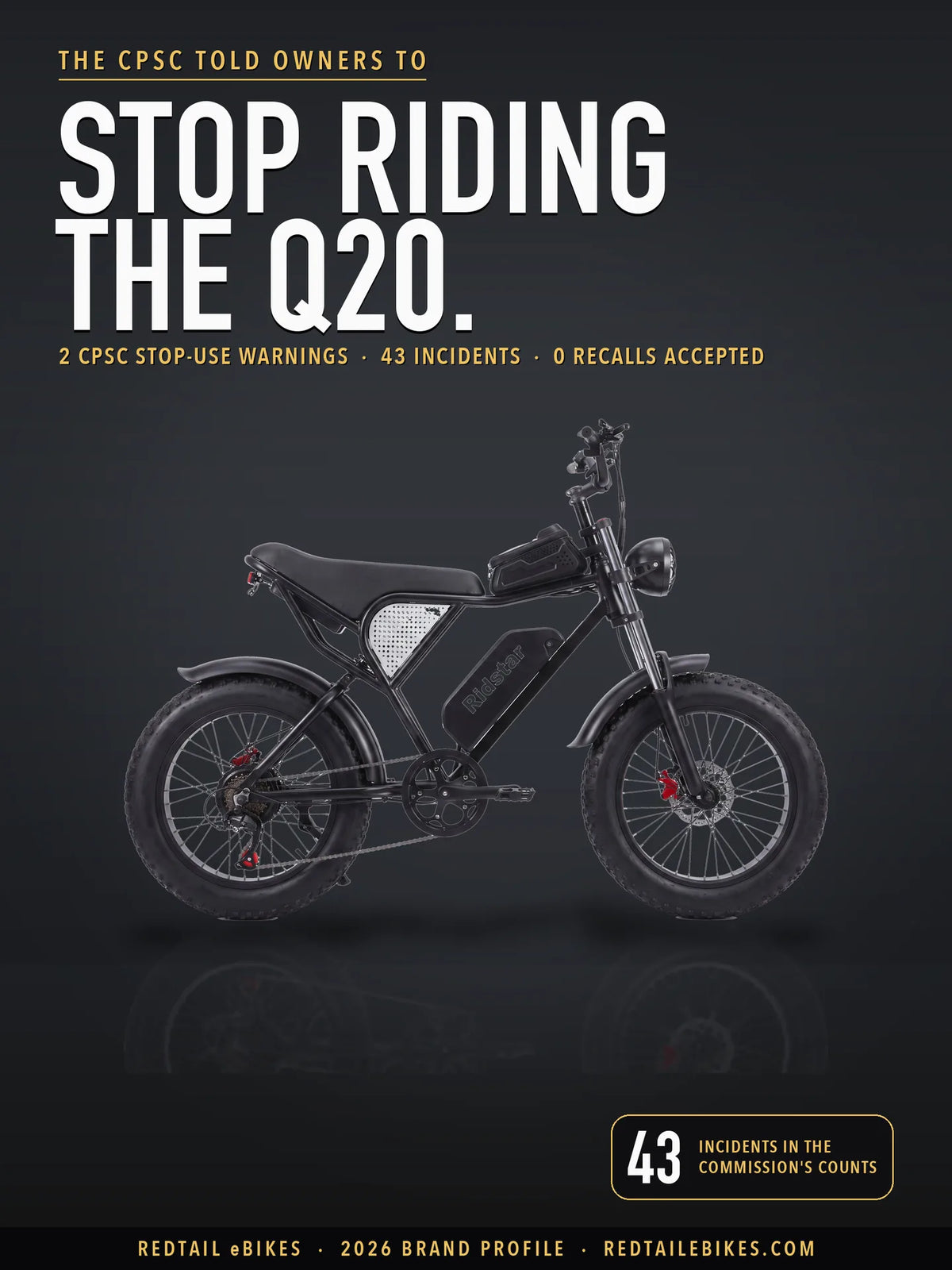
Quick Answer: A Ridstar ebike is a fat-tire electric bike from a Chinese maker. Per the US CPSC, owners must stop using the Q20, Q20 Pro (fire) and Q20 Lite (front wheel); the maker "has refused to agree to an acceptable recall." A UK regulator rejected a shipment in 2025, two suits were filed in 2026, and YVY is the same company.
Our Ridstar ebike review verdict is short: the spec-for-price is real, and the safety record is worse than the price. (Disclosure: we stock Ridstar and YVY. See below.)
Key facts (verified September 11, 2026):
- Maker: Huizhou Xingqishi Sporting Goods Co., Ltd. (Guangdong, China), the entity CPSC named in both 2026 warnings. YVY (yvyebike.com) is operated by HK Ridstar Trade Limited and serves the same maker's test report.
- Made in: China, by a manufacturer registered in Huizhou, Guangdong, on a direct-to-consumer import model
- Where sold: Amazon, Walmart, AliExpress, ridstar.net, ridstar.com, ridstar.eu, ridstar-ebike.com, and US retailers including us
- Price range (our live USD): $549–$1,369 across 21 Ridstar bikes; $659–$1,399 across 5 YVY bikes (read live September 11, 2026)
- US safety record: two open CPSC stop-use warnings (Q20, Q20 Pro, Q20 Lite); no accepted recall; the maker "refused to agree to an acceptable recall" and later "has been unresponsive"
- UK safety record: Product Safety Report 2506-0011, 19 June 2025, Q20-Plus, Q20-Mini, E26 Pro and chargers, risk level "Serious", "The import has been rejected at the border."
- Lawsuits: Cunanan v. Amazon (D. Or., filed April 7, 2026) and L.E. v. Walmart (Palm Beach County, filed July 30, 2026; removed to S.D. Fla. August 24, 2026), both alleging a front wheel detached
- Owner ratings: Trustpilot 2.5 / 5 for ridstar.net (7 reviews), 2.6 for ridstar.eu (47), 2.9 for ridstar.com (2), 2.8 for ridstar-ebike.com (3) and 3.2 for ridstar.uk (1), read September 11, 2026
- Warranty: one year on the motor, battery and charger on the Q20 trims per ridstar.net; ridstar.com's banner says "Two-Year Warranty on Every E-Bike"
If you buy from us, any bike ships free in the lower 48, Shop Pay installments are available at checkout, and we coordinate the manufacturer's warranty claim for you. Every listing carries its maker's record, so you can compare this one against the rest before you decide.
Compare every e-bike we sellHow we verified this profile: Both CPSC warnings were read from the Commission's own published warning listing on September 11, 2026, and every incident figure is the Commission's. The UK report was read on gov.uk and its PDF saved. Both lawsuits were read from the court's own filed complaints through the RECAP archive.
Owner ratings and quotations were read on Trustpilot the same day and each is linked. Prices came from our own live catalog through the storefront's product feed on September 11, 2026. Warranty and return language was read from ridstar.net, ridstar.com and yvyebike.com directly.
Disclosure: Redtail eBikes stocks and sells Ridstar and YVY models, including three of the models CPSC named. We wrote this profile to the standard we would apply to a brand we do not carry, and it names our own listings where the record touches them. Our goal is an accurate buy-or-skip call rather than a sale.
In this guide
- Who makes Ridstar, and the "official site" confusion
- Ridstar and YVY are the same company
- Where Ridstar e-bikes are made
- The safety record: two 2026 CPSC warnings and no recall
- Warning, recall, refund: what the three words mean
- The UK report: a shipment rejected at the border
- The lawsuits: two detached front wheels in court
- The two failures on the record, and what they look like
- What we sell, and what CPSC says about it
- The lineup, prices, and US e-bike classes
- What Ridstar publishes about its own bikes
- The warranty reality: read past the marketing
- Reputation, reliability, and the battery-support catch
- The honest ledger: green flags vs red flags
- FAQ
- Why buy from us, if you buy at all
- What changed on this page
- The bottom line: who should buy, who should skip
Who makes Ridstar, and the "official site" confusion
Ridstar is a budget, factory-direct fat-tire e-bike brand made in China and sold mainly through Amazon, Walmart, AliExpress and its own retail sites. The company named by the CPSC in both 2026 warnings is Huizhou Xingqishi Sporting Goods Co., Ltd., registered in Huizhou, Guangdong. There is no verified US headquarters, and five retail domains carry the brand.
It changes who you buy from, who honors the warranty, where a replacement battery ships from, and who answers when a regulator asks a question.
The manufacturer behind the brand
Ridstar's listings lead with motor wattage and fat-tire spec at prices below the established US brands, and it sells factory-direct.
Huizhou Xingqishi Sporting Goods is the entity CPSC identified as responsible for the warned products, and the same name appears as applicant and manufacturer on the EN 15194 test report that YVY's website serves from every page. Those two documents are the strongest link between the badge and a legal maker.
Is ridstar.com the real website? Sorting the domains
Five domains sell under the name, and they do not say the same things. ridstar.net serves USD and calls itself "the only official website of ridstar". ridstar.com is a separate live Shopify store whose active currency is EUR and whose catalog carries YVY- and RAYZEPH-branded bikes alongside Ridstar's own. ridstar.eu, ridstar-ebike.com and ridstar.uk also trade under the name, and each of the five has its own Trustpilot profile.
The two main sites publish different warranty headlines for the same brand, which the warranty section below sets out side by side. We could not verify which domain is the single canonical corporate site, so we will not assert one.
When the maker, the warranty desk and the "official" storefront are this hard to pin down, a return or a safety claim gets harder too. The CPSC's June notice records that the manufacturer "has been unresponsive to CPSC's requests for information", and a federal agency has more leverage than a customer.

Google's own autocomplete completes "which ridstar" with "website is the real one," and our Search Console shows readers arriving on "is ridstar.net legit" and "is ridstar.com legit." Two of the sites call themselves official on their own pages, two more trade under the name, and no public record settles it.
Buy from a US retailer with US support and the domain question becomes that retailer's problem instead of yours, the same logic as our guide on how to vet an e-bike seller before you buy.
Takeaway
Ridstar is a Chinese factory-direct brand made by Huizhou Xingqishi. The maker is verifiable through the CPSC record and a UK test report; the "official" domain is not. Treat the seller rather than the badge as what you are actually trusting.
Ridstar and YVY are the same company
The business behind yvyebike.com is HK Ridstar Trade Limited, the same company that sells the Q20 family the CPSC has warned about, and every piece of evidence for that is published on YVY's own website rather than inferred from a name.
Six first-party facts establish it, and the sixth is the one that matters for safety. YVY's company-address page names the business as "HK RIDSTAR TRADE LIMITED". Its warranty page routes service to support@ridstar.net and says the warranty start date "will be verified by Ridstar".
Every one of its 61 pages links the Ridstar trade-mark registration certificate from the EU intellectual property office. ridstar.com runs its own "YVY Ebikes" collection of seven bikes. And YVY's spare-part fitment codes are Ridstar model codes: H20, DC26, MN26, E26, E26 Pro, FM001.
YVY's own warranty page lists its "Warranted Products" as the "YVY Q20 1200W Fat Tire Electric Bicycle", the "YVY Upgraded Q20 1500W Fat Tire Electric Bicycle" and the "YVY Q20Pro 2000W Fat Tire Electric Bicycle". Those are the Q20 family, the models the CPSC named, under the YVY name.
On published specifications, the YVY K20 (1500 W, 48 V 20 Ah, 20-inch fat tire, $769) matches the Ridstar Q20 Luxe 1500W on every published spec we could compare: motor, voltage, capacity, wheel size and price. The YVY K20 Pro matched our Ridstar Q20 Pro listing to the dollar at $1,399 on August 25, 2026; today our Q20 Pro is $1,369 and the K20 Pro $1,399.
What nobody has published, in either name, is whether a K-badged bike shares the front wheel, fork or battery that the Commission's warnings describe.
Takeaway
YVY is HK Ridstar Trade Limited. Its warranty page names the Q20, Upgraded Q20 and Q20Pro as YVY products, and its K20 matches the Ridstar Q20 Luxe on every published spec. Whether the K-line shares the warned parts is published by no one, so a YVY buyer carries the same open question a Ridstar buyer does.
Where Ridstar e-bikes are made
Ridstar e-bikes are made in China by a manufacturer registered in Huizhou, Guangdong, and imported direct to consumers. There is no US assembly or US parts operation that we could verify. Most of the trade-offs in this profile follow from that single fact.
Direct-from-China import is why parts, support lead times and battery logistics can be slow, and the June notice records that the maker "has been unresponsive to CPSC's requests for information."
A removable battery that fails is only as convenient as the nearest replacement. When packs ship from overseas, a simple swap can turn into weeks of downtime. We return to that specific catch in the reputation section, because it is the practical cost of the price.
Takeaway
Made in Guangdong, sold direct. That model buys you the low sticker price and hands you the import trade-offs on parts, support, batteries, and accountability.
The safety record: two 2026 CPSC warnings (and no recall)
On March 19 and June 25, 2026 the US Consumer Product Safety Commission issued two separate product safety warnings on Ridstar e-bikes, and neither is a recall.
A query of the CPSC recall database returns zero recall records for the brand. That is consistent rather than reassuring: a warning is a different instrument and does not appear there.
A recall comes with a remedy the firm has agreed to, which is why the Aventon and Super73 recalls this site covers each ended in a remedy the maker funded. Neither Ridstar notice carries a remedy, and the March notice records that the manufacturer "has refused to agree to an acceptable recall."

Warning 1: battery fire hazard (Q20 and Q20 Pro, March 19, 2026)
The CPSC warning of March 19, 2026 states, of the Ridstar Q20 and Q20 Pro: "The e-bikes' batteries and wires can ignite, posing a fire hazard to consumers." The agency records 11 reports of fire, including one burn injury, five reports of smoke inhalation, and two reports of property damage totaling over $40,000.
The notice says these sold on Amazon.com, Ridstar.net and Walmart.com, and that the bikes were manufactured in China. The consumer action asked for is not a repair: "remove the battery from the e-bike immediately and dispose of the battery following local hazardous waste disposal procedures. Do not sell or give away these hazardous batteries."
On the notice itself: "The manufacturer, Huizhou Xingqishi Sporting Goods Co., Ltd., of China, has refused to agree to an acceptable recall." Under section 6(b) of the Consumer Product Safety Act the Commission must publish the firm's response, and it records that the company "objects to this press release."
Warning 2: front-wheel detachment (Q20 and Q20 Lite, June 25, 2026)
The second warning, dated June 25, 2026, covers the Ridstar Q20 and Q20 Lite: "The front wheel can detach without warning, posing a crash hazard to consumers." The Commission records 32 reports of the front wheel detaching, including 31 reports of injuries such as concussions, broken bones, cuts, scrapes and bruises.
"CPSC urges consumers to stop using the e-bikes immediately and dispose of them. Do not sell or give away these hazardous e-bikes," and the Q20 batteries from the earlier warning "must be disposed of following local hazardous waste disposal procedures." This notice adds AliExpress.us to the list of sales channels.
On the maker's position the wording changed between March and June. In the second notice, Huizhou Xingqishi Sporting Goods "has been unresponsive to CPSC's requests for information about these products or a recall."
What this means if you own or want a Ridstar
Three model names appear across the two warnings: the Q20, the Q20 Pro, and the Q20 Lite. Models not named in either warning are not covered by them, but "not named" is not the same as "independently proven safe," and the maker that built the named ones built the rest.
"No accepted recall" has a concrete meaning for you. There is no free fix and no refund program, so a warned bike is not something a remedy will make whole. The CPSC told owners to stop riding the Q20 immediately, pull the battery, and put both through a local hazardous-waste program. The notice also says not to sell it or give it away.
Takeaway
Two open 2026 CPSC warnings hit the Q20, Q20 Pro and Q20 Lite, per CPSC the maker "refused to agree to an acceptable recall" and later "has been unresponsive," and there is no remedy. If you own one, the federal instruction is to stop riding it. If you want one, that instruction is the answer.
Warning, recall, refund: what the three words mean for your money
The most-asked question about this brand is a version of "why did Ridstar get recalled", and the honest answer starts by correcting the premise. Ridstar was not recalled. Two federal warnings were published about it, and a warning and a recall are different instruments with different consequences for you.
A recall is an agreement. A warning is what happens without one
The remedies a recall can carry are set out in the Consumer Product Safety Act at 15 U.S.C. § 2064(d), under the heading "Repair; replacement; refunds; action plan": to "repair the defect in such product", to "replace such product with a like or equivalent product", or to refund the purchase price. Each of the three requires the firm to do something.
A unilateral warning is what the Commission publishes instead when a firm will not. It carries the hazard, the model names and an instruction to consumers, and it carries none of those three remedies, because every one of them needs a company to fund it.
The March 19, 2026 notice records exactly that: the manufacturer "has refused to agree to an acceptable recall." The June 25 notice records that the same manufacturer "has been unresponsive to CPSC's requests for information about these products or a recall."
What that costs you in practice
| If it had been a recall | What the warning gives you | |
|---|---|---|
| Free repair | Yes, funded by the firm | None offered |
| Replacement bike | Usually an option | None offered |
| Refund from the maker | Usually an option | None offered |
| Registered remedy to track | Yes | None exists |
| An instruction to follow | Yes | Yes: stop using it, dispose of it |
Nothing is being "honored" because nothing was ever agreed. An owner writing on Trustpilot in April 2026 put it as "the Ridstar Q20 has been recalled and Ridstar will not honor this recall." No recall was agreed, so no remedy was created for anyone to honor.
So where does a refund actually come from?
Not from the warning. If you are owed money, it comes from the contract you made with the seller, and that is a different question with a much better answer.
- Start with the retailer, in writing. Your purchase contract is with whoever sold you the bike, and a US retailer's own return policy is the term that binds. Ask by email so the date is recorded.
- Check the platform's window if you bought on a marketplace. Amazon's A-to-Z Guarantee and Walmart's marketplace protections are time-limited, and the clock runs from delivery rather than from the date of a warning.
- Pay attention to the card you used. A chargeback is a separate route with its own deadline, and the bank does not need the maker's cooperation to run it.
- Keep the receipt with the model number on it. The CPSC's own notice says the model number "may be located on the purchase receipt", and the model number is what every one of these processes keys on.
If you bought from us, our return terms are the terms that apply to you, and they are on our refund policy page rather than on a maker's site in another country.
Takeaway
Ridstar has not been recalled; two CPSC warnings were published because the maker would not agree to a recall, and a warning creates no repair, no replacement and no refund. Any money back comes from the seller, the marketplace or your card issuer, each on its own clock. Ask the retailer in writing and keep the receipt with the model number on it.
The UK report: a shipment rejected at the border
The US warnings were not the first regulator action against the brand. On 19 June 2025, nine months before the CPSC's first notice, the UK Office for Product Safety and Standards published Product Safety Report 2506-0011, "Ridstar E-Bikes Q20-Plus, Q20-Mini, E26 Pro and Chargers", with a risk level of Serious and a risk type of fire.
The finding is about the charger rather than the battery. In the report's words: "The product presents a serious risk of fire as the charger has poor quality soldering, and the transformer does not meet the minimum requirements for creepage and clearance distances." It adds that "if the product was left plugged in overnight, the charger and plug could overheat, causing a fire," and that the products fail the UK's machinery-safety and plug-safety regulations.
The corrective measure was not a recall either. "The import has been rejected at the border." The notifier was a local Trading Standards authority, and the country of origin is recorded as China.
Two of the three model names are not on our shelf, and neither company publishes whether "Q20-Plus" and "Q20-Mini" are the Q20 and Q20 Lite under UK names. The third, the E26 Pro, is a model we list. It is out of stock today, and its product page now carries this report.
Takeaway
A UK regulator found the Ridstar Q20-Plus, Q20-Mini and E26 Pro chargers a serious fire risk in June 2025 and turned the shipment back at the border. That predates both US warnings by nine months.
The lawsuits: two detached front wheels in court
One suit was filed in Oregon in April 2026 and one in Florida in July 2026, each over a Ridstar front wheel. Neither has been decided, the manufacturer is not a defendant in either, and everything below is what the complaints allege.
Cunanan v. Amazon.com Services LLC, U.S. District Court for the District of Oregon, No. 3:26-cv-00692, filed April 7, 2026. The complaint alleges that the plaintiff bought a "Ridstar Q20" on Amazon on August 14, 2025 as a gift for a teenage step-son, followed the included instructions, and took the shim-and-nut order from a YouTube video because, it says, the instructions gave none.
It alleges the front wheel is "held on exclusively by the open-dropout fork frame, a shaft, shim, lock washer, tab washer, and a nut."
It alleges the design "does not include a 'Wheel quick release adjustment' component" and that the plaintiff suffered "severe injuries including, but not limited to, numerous facial fractures, disfigurement, dental deformity, and maxillofacial deformity." The complaint reproduces Amazon owner reviews, among them "Dangerous bike – wheel fell off!" and "Front wheel fell off while riding just over one month after purchase."
L.E., a minor, v. Walmart Inc., filed in the Circuit Court for Palm Beach County, Florida on July 30, 2026 and removed to the U.S. District Court for the Southern District of Florida, No. 9:26-cv-81045, on August 24, 2026. The complaint alleges a "Ridstar Electric Bike, Peak 1500W30MPH,48V 15.6Ah Electric Bicycle, Full Suspension Mountain Bike UL2849" bought through Walmart.com on August 29, 2025.
It alleges that on November 1, 2025 "the bicycle suddenly and catastrophically failed when the front wheel unexpectedly detached during normal operation," throwing the child "forward onto the pavement suffering severe and permanent injuries."
Both incidents, as alleged, happened before the CPSC's June 2026 wheel-detachment warning, and the Walmart complaint cites both federal warnings as later confirmation.
Takeaway
Two filed suits, one in Oregon and one in Florida, allege a Ridstar front wheel detached and injured a rider, one of them a minor. They are allegations, and no court has made a finding. The failure they allege is the one the CPSC described in June 2026.
The two failures on the record, and what they look like
Two hazards have been described in federal notices about this brand, and both are mechanical enough to recognize. If you own a Ridstar of any model, this is what the record says went wrong on the named ones.
The front wheel: an open dropout held by a nut
The June 25, 2026 warning says the front wheel on the Q20 and Q20 Lite "can detach without warning", and records 32 reports of the front wheel detaching, including 31 reports of injuries.
The Oregon complaint describes the retention as the plaintiff found it: the wheel is "held on exclusively by the open-dropout fork frame, a shaft, shim, lock washer, tab washer, and a nut", and the design "does not include a 'Wheel quick release adjustment' component."
An open dropout is a fork end with a slot rather than a closed hole, so the axle sits in a channel that is open at the bottom. It is an ordinary bicycle design and it is not unsafe in itself. What holds the wheel in is the clamping force of the nuts, plus a secondary retention device — on most bicycles, the tabbed washers that engage the fork.
That is the assembly the complaints put in issue, and it is the one an owner can look at. Assembly is the moment it is decided, and both complaints turn on what the buyer was told to do at that moment.
The battery: the component in the first warning
The March 19, 2026 warning says of the Q20 and Q20 Pro that the "batteries and wires can ignite", and records 11 reports of fire, one burn injury, five reports of smoke inhalation, and two reports of property damage totaling over $40,000.
The Commission's instruction on this one is not an inspection. It is to "remove the battery from the e-bike immediately and dispose of the battery following local hazardous waste disposal procedures."
The UK finding nine months earlier was about the charger rather than the pack: "the charger has poor quality soldering, and the transformer does not meet the minimum requirements for creepage and clearance distances", and "if the product was left plugged in overnight, the charger and plug could overheat, causing a fire."
Those are two different components with the same outcome, and the practical consequence is the same either way: do not leave one charging unattended, and never overnight.
General charging discipline, whatever you ride
This part is not specific to Ridstar, and it is worth doing on any e-bike you own.
- Charge where a fire would be survivable. Not in a hallway, not against a door, not in the only exit path from a bedroom.
- Charge while you are awake and in the building. Overnight charging is the pattern that turns a fault into a fire.
- Use the charger that came with the bike, and stop using a charger that buzzes, smells hot, or has a plug that runs hot to the touch.
- Stop charging a pack that has been dropped, crushed, soaked or swollen. A deformed case is a reason to stop using the pack. Treat it as a fault rather than a blemish.
- Report a failure at saferproducts.gov. The incident counts in both notices are built from reports like yours, and 43 of them are why this page exists.
Takeaway
The two hazards on the record are a front wheel retained by nuts and washers on an open dropout, and a battery-and-wire fire risk whose UK counterpart was traced to the charger. For a warned Q20 the federal instruction is to stop riding and remove the pack; inspection is beside the point there. On any e-bike, charge awake, charge where a fire would be survivable, and report what happens to saferproducts.gov.
What we sell, and what CPSC says about it
On September 11, 2026 our store listed 21 Ridstar bikes and 5 YVY bikes. Five of the Ridstar listings are Q20-family models, and three of those are buyable today under the exact names the Commission printed.
| Our listing | Price | Buyable today | What the record says |
|---|---|---|---|
| Ridstar Q20 1500W Fat Tire Electric Bike, 48V 20Ah | $909 | Yes | "Q20": named in both CPSC warnings |
| Ridstar Q20 Pro Dual-Motor Fat Tire Electric Bike, 52V 20Ah | $1,369 | Yes | "Q20 Pro": named in the March fire warning |
| Ridstar Q20 Lite 1000W Fat Tire Electric Motorcycles | $899 | Yes | "Q20 Lite": named in the June crash warning |
| Ridstar Q20 Luxe 1500W 48V 20Ah Fat Tire Electric Bike | $709 | No | "Luxe" is not a name CPSC used; unresolved |
| Ridstar Q20 Luxe Lite 1000W Fat Tire Electric Bike | $629 | No | "Luxe Lite" is not a name CPSC used; unresolved |
| Ridstar E26 Pro Dual-Motor Fat Tire Electric Bike, 48V 23Ah | $719 | No | named in UK report 2506-0011 |
The Commission's words on the June notice are "Do not sell or give away these hazardous e-bikes." Every one of those product pages now carries that sentence, the notice it comes from and a link to it, as the first thing in the description.
Those three listings are live today with the Commission's instruction printed on them. If you are deciding on one, the instruction is the answer.
Every other Ridstar model, and every YVY model, is named in no regulator's notice as of September 11, 2026. Each of their product pages carries the CPSC record anyway, because a buyer choosing between the H26 Pro and something else deserves to know how the company that built it answered the Commission.
Takeaway
We list five Q20-family bikes and three are buyable under the names CPSC printed. Their pages now open with the Commission's own instruction. The rest of the range is unnamed in any notice, and every page says who made it.
The Ridstar ebike lineup, prices, and US e-bike classes
Ridstar's range is wide and almost entirely fat-tire, spanning folding commuters, hardtail-style mountain builds, and high-wattage cruisers. In our store the line runs from $549 to $1,369 across 21 bikes, read live on September 11, 2026.
Most models claim a 28 mph top speed (33 of the 93 listings on ridstar.net print it) and carry a throttle, which pushes them past the usual Class 2 and even Class 3 speed lines, a legality point we cover below.
The Ridstar Q20 ebike family is the volume seller, so it gets its own comparison after the table.

The full model lineup at a glance
Ridstar organizes its bikes into a handful of overlapping fat-tire families. The Q20 line includes the Q20, plus Lite, Pro, Luxe, and Luxe Lite trims. The Q30 line mirrors it with Lite, Pro, Luxe, and Luxe Lite variants.
Around those sit the compact Q16, the high-capacity Q50, the H20 and H26 Pro mountain builds, the E26 and E26 Pro, the DC26 folder, the MN20 and MN26, and the FM001 two-seater. It is a lot of names for what are mostly variations on one fat-tire platform.
On ridstar.net the DC26 and the H26 Pro carry byte-identical 15-row specification tables and description text that is 99.79% the same, at $649 and $699.
Live USD prices in our store, and which models a warning names
Every price below is from our own catalog, read through the storefront's product feed on September 11, 2026. The right-hand column is the part to read first. The three CPSC-named models and the UK-named E26 Pro are listed by name only, with no buy link.
| Model | Our price (USD) | Named in a regulator's notice? |
|---|---|---|
| E26 1000W Fat Tire Electric Bike, 48V 15.6Ah | $549 | No |
| FM001 2-Seater Fat Tire Electric Bike | $569 | No |
| Q30 Luxe Lite 1500W Fat Tire Electric Bike | $599 | No |
| H20 1000W Fat Tire Electric Mountain Bike | $600 | No |
| MN20 Folding Fat Tire Electric Bike, 48V 15Ah | $600 | No |
| MN26 1500W Fat Tire Mountain Electric Bike | $600 | No |
| Q20 Luxe Lite 1000W Fat Tire Electric Bike | $629 | Unclear, see note |
| DC26 2000W Folding Fat Tire Mountain Electric Bike | $649 | No |
| H26 Pro 2000W Folding Fat Tire Mountain Electric Bike | $699 | No |
| Q20 Luxe 1500W 48V 20Ah Fat Tire Electric Bike | $709 | Unclear, see note |
| E26 Pro Dual-Motor Fat Tire Electric Bike, 48V 23Ah | $719 | Yes: UK report 2506-0011, serious fire risk (charger) |
| Q30 Luxe 2000W Fat Tire Electric Bike | $719 | No |
| Q50 2000W 48V 25Ah Fat Tire Electric Bike | $799 | No |
| Q30 2000W 48V 20Ah Fat Tire Electric Bike | $819 | No |
| Q16 1500W 16-Inch Fat Tire Electric Bike | $849 | No |
| Q30 2000W 48V 25Ah Fat Tire Electric Bike | $849 | No |
| Q30 Lite 1500W Fat Tire Electric Bike | $899 | No |
| Q20 Lite 1000W Fat Tire Electric Motorcycles | $899 | Yes: CPSC crash warning |
| Q20 1500W Fat Tire Electric Bike, 48V 20Ah | $909 | Yes: both CPSC warnings |
| Q30 Pro Dual-Motor Fat Tire Electric Bike, 52V 20Ah | $1,269 | No |
| Q20 Pro Dual-Motor Fat Tire Electric Bike, 52V 20Ah | $1,369 | Yes: CPSC fire warning |
On the two "unclear" rows. The CPSC names the "Q20", the "Q20 Pro" and the "Q20 Lite". Ridstar's storefronts list a "Q20Luxe" (both sites) and a "Q20Luxe Lite" (ridstar.net) as SKUs distinct from the Q20, and a "Q20 Lite" appears only on ridstar.com, so we cannot tell from published sources whether the warnings reach the Luxe trims.
YVY's warranty page, meanwhile, lists a "YVY Q20 1200W" and an "Upgraded Q20 1500W" that match neither name exactly. Nobody at the company has said which chassis is which, and the June notice records that the company has stopped answering the regulator. Treat a Luxe trim as unresolved. Nothing on the public record has cleared it.
Motor wattage is taken from each model's name, because the name and the listing text often disagree. The H20 page describes both a 1000 W and a 1200 W motor, and the Q50 page carries "2000W Motor" in its specification block and "a 1500W brushless motor" in its description. The next section sets out which figure to plan around.
The table prints no range column, because the makers' range claims are best-case figures and the watt-hour arithmetic in our guides is the better planning number.
The maker's own site does something else worth knowing. ridstar.net lists the Q30 Pro twice, at $899 and $1,269, with identical text and photographs, and publishes different top speeds for the same bike on its two storefronts: 28 mph for the DC26 on ridstar.net against 37 mph on ridstar.com, and 28 against 34 mph for the Q20 Pro.
Ridstar Q20 vs Q20 Pro, and YVY K20 vs Ridstar Q20
On paper the split is clean. The Q20 1500W runs a 48V 20Ah pack, hydraulic disc brakes, and a claimed 50–75 mile range at roughly 28 mph. The Q20 Pro steps up to two motors totaling 2000W and two 52V 20Ah packs, the same brakes, and a claimed range of "up to 180 miles in pedal-assist mode" on ridstar.net.
The trim comparison is beside the point. The Q20 is named in both 2026 warnings and the Q20 Pro in the March one, and neither has a recall behind it. Our answer to "Q20 or Q20 Pro" is neither.
The YVY K20 is the other half of that search, and the YVY section above answers it: the same company, the same platform family, and an open question the company has not closed.
What e-bike class is a Ridstar? US legality
Most Ridstars are high-power, throttle-equipped fat-tire bikes with a claimed 28 mph top speed. Under the three-class definitions most states use, a throttle that works past 20 mph takes a bike outside Class 2, and Class 3 assistance stops at 28 mph. In plain terms, a stock high-wattage Ridstar may sit outside all three classes; our state-by-state page has the statute where you ride.
On its own published figures, a 1,500 W Ridstar with a 28 mph throttle is not an e-bike under the federal consumer-product definition, which stops at 750 W and under 20 mph on motor power alone. What it is instead, a moped, a motor-driven cycle or something with no category at all, is your state's call. Dirt bikes with pedals are sold under the same badge, and the same sentence applies to them.
What follows from that is your state's call, and California shows how much can follow. An "electric bicycle" there is capped at 750 watts by CVC § 312.5(a): "a bicycle equipped with fully operable pedals and an electric motor that does not exceed 750 watts of power."
Every Ridstar in our table is rated above that. A pedal-equipped machine that misses the definition lands in CVC § 406(a) instead, as a "motorized bicycle" or "moped", and three things arrive with that label.
- A license, registration and plate. The e-bike exemptions in CVC § 24016 ride on the machine being an electric bicycle. Lose the definition and you lose the exemption, and the license, registration and insurance requirements arrive with the new one. Our California e-bike law page works the chain through.
- The bike path closes. Since January 1, 2023, the path-and-trail ban in CVC § 21207.5 applies to motorized bicycles. A moped is barred by state default from the paths a Class 1, 2 or 3 e-bike may use — which is where many buyers intend to ride.
- Your insurance may not follow. CVC § 406(b) makes the manufacturer tell buyers "that their existing insurance policies may not provide coverage for these bicycles" and to check with their insurer. Riding one uninsured and unregistered is a citation waiting on a traffic stop, and a much larger problem after a crash.
California is one state and the analysis is different in each. Check the statute where you ride on our state-by-state e-bike law page before you buy, because the wattage that makes these bikes attractive is the same wattage that decides this question.
Takeaway
Ridstar sells a broad, mostly fat-tire lineup from $549 to $1,369, but the headline power and 28 mph claims can push these bikes outside the three-class system, and the maker's own listings contradict themselves on wattage and speed. Verify legality where you ride, and treat a "Long" range claim and a badge wattage as marketing rather than specification.
Before you weigh the warranty terms below, see how the twelve other brands we carry compare on the same questions: who answered their regulator, what they publish, and what ships free with US support behind it.
See every brand's record side by sideWhat Ridstar publishes about its own bikes
Every figure in this section comes from Ridstar's and YVY's own pages, read and deposited on August 26, 2026. Before you weigh a Ridstar against anything else, weigh the numbers themselves, because on this brand the same machine is described differently depending on which page you open.
The model name is the peak, and the text is often lower
This is the single most useful thing to know about a Ridstar spec sheet. The wattage in the model name is generally the peak figure, and the body text on the same listing frequently carries a lower nominal figure. The nominal number is the one most state statutes turn on.
| Listing | Name says | The listing text says | The gap |
|---|---|---|---|
| Q16 1500W | 1500 W | "Motor : 1200W Motor(PEAK 1500W)" | Nominal is 1200 W |
| Q50 2000W | 2000 W | "2000W Motor" in the spec block, "a 1500W brushless motor" in the description | Two figures, one page |
| H20 1000W | 1000 W | "a 1000W(1500W) motor" and "Equipped with a 1200W (PEAK 1500W) brushless motor" | Two nominal figures, one page |
| MN20 1000W | 1000 W | "Equipped with a 1000W motor (peak 1500W)" | Consistent; peak is 1.5× nominal |
| FM001 | — | "1000W Motor" with a 1500 W peak | Peak is 1.5× nominal |
Plan around the lower figure in every row. A bike sold as "1500W" whose listing describes a 1200 W motor is a different bike in the eyes of a statute that sets its ceiling at a continuous rating, and our state-by-state law page has the wording where you ride.
The Q16 listing carries one more thing worth catching: the specification block names the model number as "Q16 Lite", on a page sold as the Q16 1500W.
The same bike, two different top speeds
Ridstar runs two storefronts selling the same models, and on two of them the published top speed does not match. Both pairs were read on the same day.
| Model | ridstar.net says | ridstar.com says |
|---|---|---|
| DC26 | "Max Speed 28+++ mph" | "Max Speed 37 mph" |
| Q20 Pro | "a top speed of 28+++mph" | "Max Speed 34 MPH" |
The gap is not cosmetic. Twenty-eight miles an hour is the Class 3 ceiling in most state statutes, and 34 and 37 are not inside any class at all. The number decides whether the machine is legal on your local path, and the company publishes two answers to it.
Two models, one specification table
The DC26 and the H26 Pro carry byte-identical 15-row specification tables and description text that is 99.79% the same. They are sold as different bikes, at $649 and $699, with different photographs.
The Q30 Pro is listed twice on the same storefront, at $899 and at $1,269, with identical text and identical photographs.
If you are cross-shopping two Ridstar models against each other, the specification tables may not be telling you what separates them. Compare price, battery capacity in amp-hours and wheel size from the table above, and read the rest as copy.
What the listings do not carry
Two numbers that decide a purchase are absent from the brand's pages, and each has something you can do about it.
- Bike weight and rider height are published for the DC26 and the H26 Pro, and for no other model. If the bike has to go on a car rack or up a flight of stairs, ask the seller in writing for the weight before you order.
- A certificate document is published for no Ridstar model. The pages make no UL 2849, UL 2271, UL 2580 or UN 38.3 claim, and no certificate is on file to open.
A certificate does exist inside the group, and what it covers is worth reading closely. All 61 pages on yvyebike.com link an EN 15194:2017 test report, report number ATS240329142LR, issued April 2, 2024 by Shenzhen ATS Testing Technology Co., Ltd.
Its applicant and manufacturer are both "Huizhou Xingqishi Sporting Goods Co.,Ltd." — the company CPSC names. Its "Test item description" reads "Cargo electric bicycle" and its "Model/Type reference" reads "FM-002, CDDA20".
None of the bikes YVY sells appears on it. It is a genuine test report, served from every page on the site, for a model that is not on sale.
The same 61 pages also serve a EUIPO trade mark registration certificate for the mark "Ridstar", number 018609888, registered March 16, 2022. A YVY page serving Ridstar's trade mark certificate is the fifth first-party proof that the two names are one company.
Takeaway
Read the lower wattage rather than the one in the model name: the Q16 sold as 1500 W describes a 1200 W motor, and the H20 describes both 1000 W and 1200 W on one page. The two storefronts publish different top speeds for the DC26 and the Q20 Pro. Weight is published for two models, and no certificate document is published for any. Get the figure that decides your purchase from the seller in writing before you order.
The warranty reality: read past the marketing
The term you are quoted depends on which Ridstar site you land on, and both sites are live. Both pages were read on the same day, and they say different things.
| Where you buy | What the site says |
|---|---|
| ridstar.net, which calls itself "the only official website of ridstar" | Banner: "One year warranty on all products." Its warranty page then lists terms model by model. The Q20 1000W gets "a one-year warranty on the motor, battery, and charger, 1-year manufacturer warranty" and the Q20 1500W line reads the same with an "and"; the DC26 gets one year; the G20 gets "two-year warranty, including a 1-year warranty on the motor, battery, and charger" |
| ridstar.com | Site banner: "Prime Protection: Two-Year Warranty on Every E-Bike" |
| yvyebike.com | "Warranted Products": the YVY Q20 1200W, Upgraded Q20 1500W and Q20Pro 2000W, each "one year warranty, including a 1-year warranty on the motor, battery, and charger". None of the five YVY bikes we list appears on it |
Plan around the shorter figure and the model-specific one. On the volume-selling Q20 trims, both sites' detail pages land in the same place: one year on the motor, battery and charger, which are the three most expensive things that can fail.
Three clauses on the ridstar.com warranty page matter more than the headline number. Coverage "applies only to the original owner", and the page states it "will not provide warranty service for second vehicle owners", so it does not survive a resale.
It is also "limited to a one-time replacement of defective parts" at the company's sole discretion. And it excludes "owners who have not purchased from RIDSTAR.COM or an authorized dealer," so ask any seller, including us, to confirm in writing that its Ridstar stock carries the maker's warranty before you order.
There is one genuinely useful provision buried in the same page: Ridstar says it "can also authorize reimbursement for repairs at local bike shops up to $200" where its mechanic agrees. Get that authorization in writing before any work starts: the page says unauthorized repairs "are not covered," and unauthorized alterations "void the warranty."
Per the ridstar.com refund policy, canceling an e-bike order before it ships costs a 10% processing fee, so you get 90% back.
A change-of-mind return has to be started within 15 days of receipt with the bike unused and in its original packaging, and you pay $200 in return shipping. A return has to be started within 15 days; after 30 days the page says no product change is accepted "under any circumstances." A confirmed quality problem inside 15 days is different: the label is arranged for you and you pay nothing.
No warranty term pays for a new pack after the first year, which is why the battery section below matters. Then there is the record of what the warranty is worth when a claim is made, which the owners in the next section describe in their own words.
Bottom line Plan for one year on the motor, battery and charger, not the "two-year" banner. It covers the first owner only, once, at Ridstar's discretion, and a dealer purchase only if Ridstar authorizes the dealer. Canceling costs 10%, and a change of mind costs $200 in return shipping. A US retailer's own return policy applies on top; read it before assuming it is more generous.
Reputation, reliability, and the battery-support catch
Are Ridstar e-bikes good? The honest answer is mixed, and the public record is poorer than the spec sheet. Owners praise the value and the raw spec-for-price, and the linked reviewers report motor failures, battery failures, slow parts, and warranty claims they could not collect on.
The owners below are quoted as themselves and linked, and the platform scores are as of September 11, 2026.

What owners praise (value, power, spec-for-price)
The pattern is consistent: for the money, you get a lot of bike. Full suspension, hydraulic disc brakes, and fat tires at sub-$1,000 are genuinely hard to match. For a budget-first buyer, that spec sheet is the entire appeal, and the owners who are happy are happy for that reason.
What owners report when something breaks
The Trustpilot record across the brand's domains, read on September 11, 2026, scores ridstar.net at 2.5 out of 5 ("Poor", 7 reviews), ridstar.eu at 2.6 (47 reviews), ridstar.com at 2.9 (2 reviews), ridstar-ebike.com at 2.8 (3 reviews) and ridstar.uk at 3.2 (1 review).
Three of the five profiles hold three reviews or fewer, so read the scores as small samples, and Trustpilot's own note applies to all of them: it does not verify the claims in a review. What it does show is what people who went looking for help say happened next.
One owner of a Q20 Lite, reviewing ridstar.net: "We bought a Q20 Lite as a Christmas gift. It suffered a total mechanical failure of the motor just three months after we received it. We then spent two months waiting for a replacement motor to clear customs."
A second, on April 17, 2026: "Now, the Ridstar Q20 has been recalled and Ridstar will not honor this recall. It has a battery defect." The reviewer's word is "recalled". The Commission's instrument is a warning, and the reason there is nothing to honor is that the maker refused the recall.
A third, on May 14, 2026: "My bike exploded and still under warranty but Amazon and Ridstar/YVY are not interested in helping me, DO NOT BUY THESE BRANDS".
The MN26, the cheapest full-size fat bike from the brand that is buyable in our store today, has this on the ridstar.uk profile: "The website stated that the bike could travel 70-95 miles on a full charge, but it only lasted 15 miles before the battery completely drained."
The same owner, writing in December 2024, says a replacement battery "arrived after 21 days and was the wrong one." The return, the review says, was "delayed" and then "refused".
Each of these is one person's account, printed because the pattern they describe, a failed part and a slow overseas queue behind it, is the pattern the price buys.
The battery-support catch: no US inventory
A Ridstar ebike battery replacement generally ships from China, because there is no US battery inventory we could confirm. A pack failure can therefore mean weeks of downtime waiting on an overseas shipment, and the owner quoted above says a replacement arrived after 21 days and was the wrong one.
For a bike whose whole value proposition is cheap power, a slow, costly battery pipeline is a real ownership risk, especially once that one-year coverage window closes. And on the Q20 family, the battery is the component the CPSC told owners to remove and dispose of.
Takeaway
Owners praise the spec-for-price and rate the brand between 2.5 and 3.2 out of 5 on Trustpilot's five Ridstar profiles. Plan for the failures owners describe, a warranty four linked reviewers say they could not collect on, and a China-only battery pipeline that turns a dead pack into weeks of downtime.
The honest ledger: green flags vs red flags
The balanced case, both ways: what the record supports about a Ridstar as a machine for the money, and what the same record says about the company behind it, the warranty, and the parts pipeline.
Green flags
- Very low entry prices: the line starts at $549 in our store, read live on September 11, 2026.
- Wide fat-tire, folding, and mountain lineup covering most budget use cases.
- Hydraulic disc brakes and full suspension on upper models, uncommon at these prices.
- Removable packs that Ridstar's listings describe as BMS-protected; no certificate is published (see the red flags).
- A published 330 lb load rating on 27 of the 93 listings on ridstar.net, useful for heavier or cargo-carrying riders.
- Strong spec-for-price on paper for a budget fat-tire build.
Red flags
- Two open 2026 CPSC stop-use warnings on the Q20, Q20 Pro and Q20 Lite, with no accepted recall: 11 fires and 32 wheel detachments with 31 injuries in the Commission's counts.
- Per CPSC, the manufacturer "has refused to agree to an acceptable recall" and "has been unresponsive to CPSC's requests for information about these products or a recall."
- A UK regulator rated the Q20-Plus, Q20-Mini and E26 Pro chargers a serious fire risk in June 2025 and rejected the import at the border.
- Two filed product-liability suits, in Oregon and Florida, allege a front wheel detached and injured a rider, one a minor.
- Trustpilot scores of 2.5 to 3.2 across five brand domains, with owners describing failed motors, a bike that "exploded", and a warranty they could not collect on.
- YVY is the same company under a second name, and its warranty page lists the Q20 family as YVY products; whether the K20 shares the warned parts is published by no one.
- China-only battery replacement with no US stock we could confirm, and one owner's account of a 21-day wait for the wrong pack.
- Inconsistent warranty terms: one year on the buy page versus "two years" on the other storefront's banner.
- Inconsistent wattage labeling: one listing prints three motor ratings, and the two storefronts publish different top speeds for the same bike.
- Two domains calling themselves official and three more trading under the name, which muddies who honors support and returns.
- No UL, EN or other certificate document published for any model on ridstar.net; YVY's sitewide EN 15194 report covers a cargo bike none of its stores sell.
Before you buy any Ridstar or YVY: the checklist
Run every line below before money moves, whoever the seller is, because each one comes from a notice, a complaint, a warranty page or an owner account quoted earlier on this page.
- Read the model name on the listing against the two CPSC notices. "Q20", "Q20 Pro" and "Q20 Lite" are named. A seller who cannot say whether a "Luxe" trim or a YVY K20 shares those parts has told you what you need to know.
- Ask which company will answer a warranty claim, in writing. ridstar.net, ridstar.com and yvyebike.com publish different terms, and the maker has not answered the CPSC.
- Confirm the charger's certification with the seller. The UK report is about the charger. Ask for the document, and ask which model it names.
- Check the front-wheel retention before the first ride, and after the first ten miles. The June notice and both complaints describe the front wheel; an open-dropout fork held by a nut and washers is what the Oregon complaint describes.
- Ask where a replacement battery ships from and how long it takes. No US inventory was confirmable, and one owner waited 21 days for the wrong pack.
- Price the return before you need it. A change-of-mind return costs $200 in shipping and closes at 15 days on the maker's own terms; a US retailer's terms replace those, so read the retailer's.
- Save the receipt with the model number printed on it. The CPSC says the model number "may be located on the purchase receipt", and it is what the notices key on.
- Read your state's e-bike law before you ride. A 1,500 W, 28 mph throttle bike is outside the federal e-bike definition, and the state decides what it is. Where it lands in the moped category, registration and a plate come before the first public road, and the citation for skipping them is written to the rider rather than to the seller.
- Price the downside at the full purchase price. On a warned model the Commission's instruction is to dispose of the bike, and not to sell it or give it away. No recall stands behind it, so there is no repair, no replacement and no refund from the maker. The penalty for buying the wrong trim is the whole $549 to $1,369.
If you already own a warned Q20: the playbook
The Commission's instruction is specific, it applies to the Q20, Q20 Pro and Q20 Lite by name, and it is the only instruction on record because the maker agreed to no recall and offered no remedy of its own.
- Stop riding it. Both notices say "immediately".
- Remove the battery and dispose of it through your municipal household hazardous-waste collection, never in the trash or a store's battery box. The March notice spells that out.
- Dispose of the bike itself under the June notice, and do not sell it or give it away. Those are the Commission's words.
- Report what happened at saferproducts.gov, the CPSC's public incident database. The Commission's counts come from reports like yours.
- Keep the receipt, the box and any photographs of the failure. Both filed complaints turn on the purchase record and the assembly instructions.
- Ask the seller, not the maker, for your money back, and ask in writing. A US retailer's return terms are the terms that apply to you.
Situation-matched picks: where our guides send each rider instead
This profile recommends no Ridstar or YVY model. The guides below carry our picks, chosen across brands; where a guide picks a Ridstar model, the maker's record sits beside the pick.
| Your situation | Read this first | What the money buys elsewhere |
|---|---|---|
| Under $1,000 and want a fat tire | Best electric bikes under $1,000 | Seven picks from $599 to $999, two of them Ridstar (MN26, H26 Pro), each with the record beside it |
| Want a folding fat bike | Best folding electric bikes | Nine picks, four of them Ridstar, with the record beside each and the folded sizes measured |
| Want two motors | Dual-motor e-bikes | Twelve picks by terrain, with the 51-state legal map |
| Want range first | Best long-range electric bikes | Eight picks with every range claim verified at the maker |
| Heavier rider, 300 lb and up | Electric bikes for heavy adults | Ratings to 560 lb, each read on the maker's page |
| A first e-bike, budget first | Your first entry-level e-bike | Ten decisions, then 19 picks across five brands |
| Moto-style shape for the least money | Best eBike brands | Every brand we carry, with its record beside its prices |
Frequently asked questions
Are Ridstar e-bikes safe?
Per the US CPSC, the Q20 and Q20 Pro were warned over a battery fire hazard (March 19, 2026), and the Q20 and Q20 Lite over front-wheel detachment (June 25, 2026). Neither is a recall, so there is no free fix, and the Commission's instruction to owners is to stop using the bikes and dispose of them.
A UK regulator separately rated the Q20-Plus, Q20-Mini and E26 Pro chargers a serious fire risk in June 2025. Models not named in any notice are not covered by them, but that is not the same as being independently proven safe, and the maker is the same.
Are Ridstar e-bikes recalled? Why did Ridstar get "recalled"?
No, and that is the problem. As of September 11, 2026, there is no accepted Ridstar recall. There are two separate 2026 CPSC product safety warnings, which is a weaker status for buyers: a recall comes with a mandated free remedy, while a warning does not.
The Commission's March notice says why: the manufacturer "has refused to agree to an acceptable recall." Owners who searched "why did ridstar get recalled" are describing the warnings, and there is no refund, repair or replacement program attached to either one.
Will Ridstar give a refund for the recall?
There is no recall and no remedy program, so there is nothing for the company to honor. The CPSC's March notice records that the manufacturer "has refused to agree to an acceptable recall," and the June notice records that it "has been unresponsive." One owner who asked put it this way on Trustpilot: "Ridstar will not honor this recall."
If you bought a warned model from a US retailer, read that retailer's return policy; ours accepts change-of-mind returns only unopened, within 72 hours of delivery, so an assembled bike is outside it.
Is there a Ridstar lawsuit?
Two product-liability suits were filed in 2026 over detached front wheels: Cunanan v. Amazon.com Services LLC in the District of Oregon (April 7, 2026) and L.E. v. Walmart Inc., filed in Palm Beach County, Florida (July 30, 2026) and removed to federal court in August.
Both allege severe injuries, and neither has been decided. The manufacturer is not a defendant in either; both complaints name the retailer.
Is YVY the same as Ridstar? Ridstar Q20 vs YVY K20?
Yes. YVY's own company-address page names the business as HK Ridstar Trade Limited, its warranty desk is support@ridstar.net, and its warranty page lists the Q20, Upgraded Q20 1500W and Q20Pro 2000W as YVY products. On published specifications the YVY K20 is the Ridstar Q20 Luxe 1500W.
No CPSC notice names a K20, and no statement from the company says whether the K-line shares the parts the CPSC described. Same company, same platform family, open question.
Are Ridstar e-bikes good?
Mixed, and the public record leans the other way. For the price, you get strong components: hydraulic brakes, full suspension, fat tires, and high claimed wattage. Against that sit two federal stop-use warnings, a UK border rejection, two lawsuits, Trustpilot scores between 2.5 and 3.2, and owner accounts of failed motors and unhonored warranties. Good value on paper, with a safety and support record that the paper does not show.
Where are Ridstar e-bikes made, and who owns Ridstar?
Ridstar e-bikes are made in China by a manufacturer registered in Huizhou, Guangdong. The entity the CPSC named in both 2026 warnings is Huizhou Xingqishi Sporting Goods Co., Ltd., which also appears as manufacturer on the EN 15194 test report YVY publishes. The Hong Kong company behind yvyebike.com is HK Ridstar Trade Limited. We could not verify a US headquarters or a single canonical corporate website.
How fast does a Ridstar go?
Most Ridstars claim a top speed of about 28 mph, and ridstar.com publishes higher figures for the same bikes (37 mph for the DC26, 34 mph for the Q20 Pro). Treat any of them as a claimed ceiling rather than a measured one. A 28 mph throttle claim sits outside the Class 2 definition most states use; check the statute for your state before riding.
How long does a Ridstar battery last, and can I replace it in the US?
Ridstar publishes no cycle-life figure for its packs. The catch is replacement: we could not confirm any US battery inventory, so a new pack ships from China, and one owner reports a 21-day wait for the wrong one. On the Q20 and Q20 Pro, the CPSC's instruction is to remove the battery and dispose of it through hazardous-waste collection rather than replace it.
Ridstar Q20 vs Q20 Pro: which should I buy?
Neither. The Q20 is named in both 2026 CPSC warnings and the Q20 Pro in the fire warning, the maker refused a recall, and the Commission's instruction to owners is to stop riding them. If you want the platform, the models not named in any notice were built by the same company, and the record above is the record you are buying into.
Is ridstar.com the official site?
Two sites call themselves official on their own pages, ridstar.net (USD, "the only official website of ridstar") and ridstar.com (EUR, "Ridstar Official Website"), and ridstar.eu, ridstar-ebike.com and ridstar.uk also trade under the name.
Each has its own Trustpilot profile, scored between 2.5 and 3.2. We could not verify a single canonical corporate site, so we do not assert one. Buy from a US retailer with real support and the question stops being yours.
Are Ridstar e-bikes street legal? What class is a Ridstar Q20?
Ridstar publishes no class for any model we read. A Q20 1500W with a 28 mph throttle sits outside the federal 750 W, 20 mph definition, so it is not a Class 1, 2 or 3 e-bike on its own figures. Whether your state treats it as a moped, a motor-driven cycle or nothing it recognizes is set by state law, and several states register or license the category it falls into.
Do Ridstar e-bikes explode or catch fire?
The CPSC's March 19, 2026 notice records 11 reports of fire on the Q20 and Q20 Pro, with one burn injury, five reports of smoke inhalation and property damage over $40,000, and says the "batteries and wires can ignite." A UK regulator separately found the chargers on three models a serious fire risk.
A Trustpilot reviewer wrote in May 2026 that a bike "exploded" under warranty. No regulator's fire notice names any other model, and none of that is a test of the ones it does not name.
Where are Ridstar e-bikes sold?
Amazon.com, Walmart.com, AliExpress.us and Ridstar.net are the channels the CPSC names in its notices. ridstar.com, ridstar.eu and ridstar-ebike.com also sell under the name, and US retailers including us list the brand. The Oregon and Florida lawsuits were filed over an Amazon purchase and a Walmart.com purchase respectively.
What is the Ridstar warranty?
One year on the motor, battery and charger on the Q20 trims per ridstar.net, against a "Two-Year Warranty on Every E-Bike" banner on ridstar.com. It covers the original owner only, once, at the company's discretion, and a dealer purchase only if the dealer is one Ridstar authorizes. YVY's warranty page carries the same one-year term and lists only the Q20 family. Buy from a US retailer and that retailer's terms apply instead.
How much does a Ridstar cost?
In our store the 21 listed Ridstar models run from $549 to $1,369, read live on September 11, 2026, with eight buyable that day. The three CPSC-named models sit at $899, $909 and $1,369. ridstar.net's own prices match ours on the Q20 at $909, and its EUR storefront prices the same bikes differently.
How do I reach Ridstar customer service?
ridstar.net lists support@ridstar.net and ridstar.com lists service@ridstar.com, and YVY routes its warranty service to the ridstar.net address. The CPSC's June notice records that the manufacturer "has been unresponsive to CPSC's requests for information", and owners on Trustpilot describe stalled claims. If you bought from a US retailer, that retailer's support desk is your first call, and ours files the claim for you.
Why buy from us, if you buy at all
If you decide on a model no regulator has named, the seller you choose decides what the next two years look like. Buy from us and the bike ships free in the lower 48, Shop Pay installments split the price at checkout, and a warranty claim goes through our support desk, which coordinates it with the maker so you are not the one waiting on a Chinese time zone.
Our return terms are printed rather than promised: a change-of-mind return is accepted unopened within 72 hours of delivery, and a damaged or defective delivery is dealt with on the photos you send inside 48 hours.
Every Ridstar and YVY listing on our store now carries the maker's record you have just read, so what you see on the product page is what you have seen here. If you want a second opinion before you order, email us the model you are looking at and the state you ride in, and you will get the maker's published numbers and the statute, nothing else.
What changed on this page, and when to re-check
Since the August 28, 2026 version, this page gained the UK safety report, the two filed lawsuits, the YVY identity section, the shelf table with live buyable status, the Trustpilot scores and owner testimony, the checklist and the playbook. Every count on the page was re-derived on September 11, 2026.
Re-check before you rely on it if any of these move: a CPSC recall or remedy, a further notice from any regulator, a decision in either lawsuit, a change to a warranty or return term, or a change to what our store lists. The expiry conditions in the Limitations section name each one.
The bottom line: who should buy, who should skip
Buy a Ridstar if you are a budget-first rider who wants maximum fat-tire power and spec per dollar, you accept import-style support, you have read the record above, and you choose a model that no regulator has named. On that basis the spec sheet is genuinely strong for the price, and you can browse Redtail's fat-tire e-bikes to compare what else the money buys.
Do not buy a Q20, Q20 Pro or Q20 Lite. Those three trims carry open 2026 CPSC warnings with no recall to fix them, the Commission has told owners to stop riding them and not to sell or give them away, and two lawsuits allege what a detached front wheel did. That is a safety instruction rather than a preference, and it applies wherever you shop and whoever you buy from, including here.
Skip the brand entirely if you need reliable US-based battery support, a settled warranty you can collect on, or a maker that answers a regulator. Those are real gaps, and no price makes them disappear. We stock Ridstar and YVY, and this verdict stands regardless.
If the safety record gives you pause, that is a rational response, and our best e-bike brands guide shows what else the same money buys from a maker with a clean record. Email us your budget and how you ride, and we will tell you which bike we would send.
Every bike we sell ships free in the lower 48, and we coordinate the manufacturer's warranty claim for you. Compare the whole shelf, with each maker's record on its own page, before you spend the money.
Compare every e-bike we sellIf the appeal was the price rather than the fat tires, compare what a commuter build costs before you decide, because the warranty, support and safety records differ far more than the sticker does.
Shop commuter e-bikesNext steps: start with our guide on picking the right e-bike for how you ride, weigh a moto-style alternative in our verified SUPER73 profile or a long-range fat-tire option in our Himiway profile, and when you have read all of the above, the Ridstar collection shows what we list, with the maker's record on every page.
See how Ridstar stacks up against the whole field in our best eBike brands guide.
Where Ridstar and YVY appear across our guides
The guides below name Ridstar or YVY, as a pick, as a screened-out brand, or as a wattage line on a law page. Where a model is picked, the maker's record sits beside it. The full set, so you can read the one that fits your ride:
- Power tiers: 1,000 W · 2,000 W · 3,000 W · 4,000 W · 6,000 W · 8,000 W
- Formats: fat tire · fat tire vs regular tire · folding · step-thru · frame types · dual motor · dual battery · mountain · cargo
- Riders: tall riders · heavy adults · adults · first e-bike · delivery riders · long range · pedal assist vs throttle
- Money: under $1,000 · how much an e-bike costs · Walmart e-bikes · Best Buy e-bikes · best place to buy · every brand we carry · our reviews index
- Law: all 50 states · California · Texas · Florida · New York · Illinois · Iowa · Virginia
Found something we got wrong? Email mehran@redtailebikes.com — verified corrections are published.
Limitations
- Redtail sells Ridstar and YVY, and this page names models we list, including three the CPSC named. The lineup table and the shelf table flag every model a regulator has named, because a reader deciding on a Q20 should see that beside the price rather than after it. Those rows carry no buy link.
- The incident figures are the Commission's own. Both warnings were read from CPSC's own published warning listing on September 11, 2026; the CPSC-stated counts are 11 fire reports and 32 wheel-detachment reports, and only those are used here.
- Two rows in the price table are marked unclear, and they stay that way. The CPSC names the "Q20", "Q20 Pro" and "Q20 Lite". Ridstar's storefronts list a "Q20Luxe" and a "Q20Luxe Lite" as separate SKUs, and YVY's warranty page lists a "Q20 1200W" and an "Upgraded Q20 1500W". No published source resolves which chassis is which, so the page says so instead of guessing in either direction.
- The lawsuits are allegations. Both complaints were read from the court's filed documents. Neither case has been decided, no court has found a defect, and the manufacturer is a defendant in neither. Every sentence about them says "alleges".
- The UK report names two models we do not list. Whether "Q20-Plus" and "Q20-Mini" are the Q20 and Q20 Lite under UK names is published by nobody, and the page does not assume it. The E26 Pro is on our shelf and its page carries the report.
- Trustpilot scores are a platform's aggregate over small samples. trustpilot.com returns 403 to a direct request; the pages were read through a text renderer on September 11, 2026, which returned ridstar.net (2.5, 7 reviews), ridstar.eu (2.6, 47), ridstar.com (2.9, 2), ridstar-ebike.com (2.8, 3) and ridstar.uk (3.2, 1). No profile content was returned for yvyebike.com. Trustpilot does not verify a reviewer's claims, and each quotation here is one person's account, linked.
- A warning is not a recall, and the absence of a recall record is not clearance. The CPSC recall database returns zero rows for the brand, which is exactly what it should return: warnings are a different instrument and are published elsewhere. Nothing in that null says the range has been examined and cleared.
-
Prices are ours, read live, and they move. The tables came from our own storefront's product feed on September 11, 2026 and are saved to
research/brands/ridstar/live-listings_20260911.csv. Every linked row points at the product page, which is the only place current availability is authoritative. - Currency was checked. ridstar.net serves USD; ridstar.com serves EUR. No price on this page comes from the EUR storefront. Its warranty and refund clauses are quoted from ridstar.com and attributed to it; ridstar.net's own return page sets different terms, a 15% fee on cancellation after shipment, a 10-mile mileage cap on refunds and the same $200 return shipping.
- The YVY-to-Q20 equivalence is a specification match rather than a company statement. The K20 matches the Q20 Luxe 1500W on motor, voltage, capacity, wheel size and price; the K20 Pro matches the Q20 Pro on price only. Whether any K-badged bike shares the warned front wheel or battery is not published anywhere, and the page says exactly that.
- Motor wattage is a nameplate, and the nameplate is the peak. The lineup table takes wattage from each model's name because the name and the listing text often disagree, and the name generally carries the peak figure. Where a listing publishes both, the nominal figure is the lower one and is the number a statute turns on: the Q16 sold as 1500 W reads "1200W Motor(PEAK 1500W)", the H20 reads both "1000W" and "1200W (PEAK 1500W)", and the Q50 reads "2000W Motor" in its specification block and "a 1500W brushless motor" in its description. An earlier version of this limitation described the MN20 as printing three separate ratings; its "750W" is a comparison to a different motor rather than a rating of that bike, and the figure was removed from the page on September 11, 2026. The table carries no range column.
-
Battery logistics are stated as an unconfirmed absence. We could not confirm any US replacement-pack inventory. That is a failure to find evidence of one and no proof that none exists, and it is why the page tells you to ask before you buy rather than asserting a lead time.
-
A Ridstar blog post titled "Ridstar to YVY: Same Trusted Ebikes, Fresh Brand" still surfaces in search results and is not cited. It returns a 404 and has no archived copy, so the YVY relationship rests on the documents YVY serves today.
This page expires when any of these change: the CPSC publishes a recall, a remedy or a further warning; the manufacturer responds; either lawsuit is decided or settled; the UK report is updated; Ridstar or YVY changes a warranty or return term; the Q20 Luxe or YVY K-line question is resolved by a published source; or our own listings change.
Source register
| Source | Tier | What it supports | Retrieved |
|---|---|---|---|
| US Consumer Product Safety Commission, product safety warning 26-337, March 19, 2026 | T1 | The fire hazard on the Q20 and Q20 Pro, the incident and injury counts, the sales channels, "Do not sell or give away", and the manufacturer's refusal to agree to a recall | 2026-09-11 |
| US Consumer Product Safety Commission, product safety warning 26-584, June 25, 2026 | T1 | The front-wheel detachment hazard on the Q20 and Q20 Lite, 32 reports and 31 injuries, the stop-use and disposal instruction, and the manufacturer's unresponsiveness | 2026-09-11 |
US Consumer Product Safety Commission, recall API, query RecallTitle=Ridstar
|
T1 | That no recall is on record for the brand | 2026-09-11 |
| UK Office for Product Safety and Standards, Product Safety Report 2506-0011, 19 June 2025 | T1 | The serious fire risk finding on the Q20-Plus, Q20-Mini and E26 Pro chargers and the border rejection | 2026-09-11 |
| U.S. District Court, D. Oregon, Cunanan v. Amazon.com Services LLC, No. 3:26-cv-00692, complaint filed April 7, 2026 | T1 | The Oregon allegations: purchase, front-wheel design, injuries, reproduced owner reviews | 2026-09-11 |
| U.S. District Court, S.D. Florida, L.E. v. Walmart Inc., No. 9:26-cv-81045, state complaint filed July 30, 2026, removed August 24, 2026 | T1 | The Florida allegations: purchase, the November 1, 2025 detachment, injuries to a minor | 2026-09-11 |
| yvyebike.com, company address, warranty, and sitewide EN 15194 report and trade-mark certificate | T2 | That YVY is HK Ridstar Trade Limited, the Q20-family warranty list, the maker's name on the test report | 2026-08-25 |
| ridstar.net, Ebike Warranty and site banner | T2 | The per-model warranty terms, the one-year Q20 figure, and the "only official website" claim | 2026-08-26 |
| ridstar.com, Warranty | T2 | The two-year banner, the original-owner limit, the one-time-replacement limit, the dealer-purchase exclusion and the $200 local-repair authorization | 2026-08-26 |
| ridstar.com, Refund Policy | T2 | The 10% cancellation fee, the 15-day window, the $200 return shipping and the 30-day cut-off | 2026-08-26 |
| ridstar.net and ridstar.com product catalogs, archived | T2 | The identical DC26 / H26 Pro spec tables, the double Q30 Pro listing, the multiple wattages per listing, the two storefronts' top speeds, the absence of a certificate document | 2026-08-26 |
| Trustpilot, profiles for ridstar.net, ridstar.eu, ridstar.com, ridstar-ebike.com, ridstar.uk, and four individual reviews | T4 (testimony, quoted as the reviewer's own and linked; never a statement of fact about a bike) | The platform scores and the four owner accounts | 2026-09-11 |
| Redtail eBikes, our own storefront product feed | T2 | Every price, the buyable status of each listing, and the 21-bike and 5-bike counts | 2026-09-11 |
cpsc.gov returns HTTP 403 to a direct request, so both warnings were read from the Commission's published machine-readable warning listing, which carries the full text of each notice. Court complaints were read from the RECAP archive of the federal courts' own filings. Trustpilot was read through a text renderer and every score is printed with its review count.
Redtail sells Ridstar and YVY, disclosed above. No T5 source appears anywhere on this page: the plaintiff-firm pages that dominate search results for these warnings, and the press coverage that repeats them, are cited nowhere.
References
Every source below is linked to the page or document actually cited, with the date it was retrieved, and the two regulators, the two courts and the two companies are cited from their own publications rather than from press or law-firm summaries.
- US Consumer Product Safety Commission, CPSC Warns Consumers to Immediately Stop Using Ridstar E-Bikes Due to Fire Hazard; Risk of Serious Injury or Death, warning 26-337 — cpsc.gov. Dated March 19, 2026. Retrieved September 11, 2026.
- US Consumer Product Safety Commission, CPSC Warns Consumers to Stop Using Ridstar E-Bikes Immediately Due to Crash Hazard; Risk of Serious Injury or Death, warning 26-584 — cpsc.gov. Dated June 25, 2026. Retrieved September 11, 2026.
- US Consumer Product Safety Commission, recall database query for "Ridstar" — saferproducts.gov. Queried September 11, 2026; zero records.
- UK Office for Product Safety and Standards, Product Safety Report: Ridstar E-Bikes Q20-Plus, Q20-Mini, E26 Pro and Chargers (2506-0011) — gov.uk, report PDF. Published 19 June 2025. Retrieved September 11, 2026.
- Cunanan v. Amazon.com Services LLC, No. 3:26-cv-00692 (D. Or.), complaint filed April 7, 2026 — docket, CourtListener. Retrieved September 11, 2026.
- L.E. v. Walmart Inc., No. 9:26-cv-81045 (S.D. Fla.), notice of removal with state-court complaint, filed August 24, 2026 — docket, CourtListener. Retrieved September 11, 2026.
- YVY, Company Address — yvyebike.com. Retrieved August 25, 2026.
- YVY, Ebike Warranty — yvyebike.com. Retrieved August 25, 2026.
- Ridstar, YVY Ebikes collection — ridstar.com. Retrieved August 25, 2026.
- Ridstar, Ebike Warranty — ridstar.net. Retrieved August 26, 2026.
- Ridstar, Warranty — ridstar.com. Retrieved August 26, 2026.
- Ridstar, Refund Policy — ridstar.com. Retrieved August 26, 2026.
- Ridstar, storefront home pages — ridstar.net (USD) and ridstar.com (EUR). Retrieved August 26, 2026.
- Trustpilot, Ridstar Reviews — ridstar.net, ridstar.eu, ridstar.com, ridstar-ebike.com, ridstar.uk; individual reviews 6a1ee7d1, 69e22ab6, 6a188369, 67c84512. Read September 11, 2026.
- Redtail eBikes, own storefront product feed — products.json, saved to
research/brands/ridstar/live-listings_20260911.csv. Read September 11, 2026. - Ridstar, catalog feeds and product pages, archived — ridstar.net (93 products) and ridstar.com (52 products). Retrieved August 26, 2026.
Image credit: the cover is a studio product cover built from Ridstar's own photograph of the Q20 1500W, the model named in both 2026 CPSC warnings; its type is composited afterwards in real fonts. The remaining photographs on this page are generated with Playcut (playcut.ai), carry no brand marking of any kind, and depict no identified model.



Share:
Pedal Assist vs Throttle (2026): 21 Bikes Measured
Best Electric Bike Los Angeles: All 114 Neighborhoods