
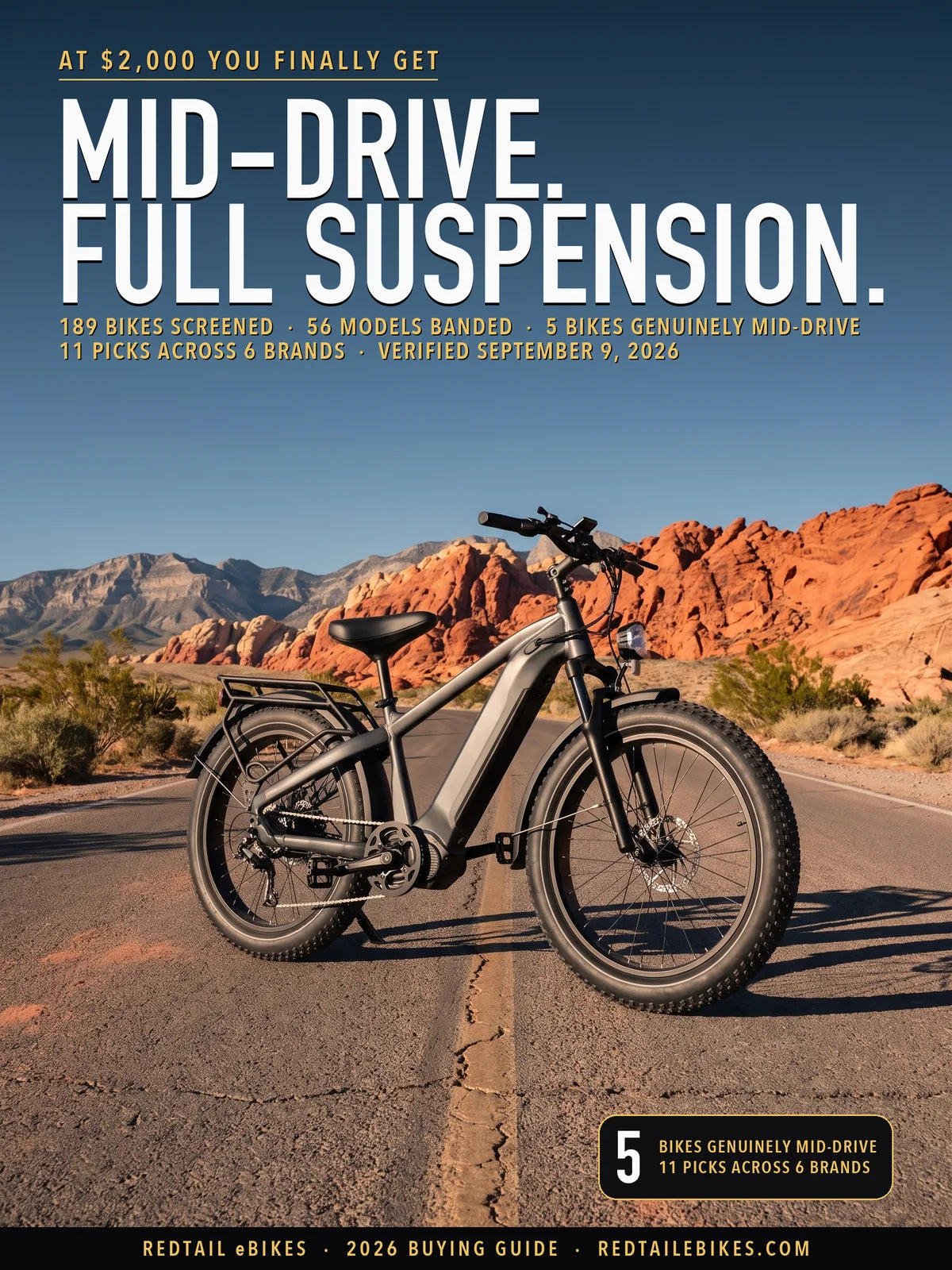
189 bikes screened · 140 priced at $2,000 or under · 56 models banded $1,500.01–$2,000 · 11 picks across 6 brands · 5 bikes genuinely mid-drive · every decisive spec read at the maker · verified September 9, 2026
Quick Answer: The best electric bike under 2000 dollars depends on your terrain. If you climb hills, buy a mid-drive: only 5 of the 56 bikes we sell in this band have one, and the Himiway D5 Pro ($1,899) is the one we would hand you. On flat ground the Velotric Discover 2 ($1,699) is your safer default.

In this guide
- How we verified this guide
- What $2,000 buys that $1,500 does not
- The number that means two different things on our own site
- The 189 machines we checked, and what 56 of them actually are
- Mid-drive arrives here — and almost nowhere cheaper
- An AI answer is already quoting our own numbers back at us
- Brakes, suspension, and the spec sheet that still won't tell you
- How these eleven were chosen from 38
- Our picks: the best electric bike under 2000 for six situations
- Every pick side by side
- What it costs per watt-hour: eleven bikes, one price
- Why buy from us
- Does a 2026 tariff or UL 2849 change what $2,000 buys?
- What changed in this band during 2026
- Who should buy less bike than this
- Before you buy: the checklist
- Frequently asked questions
- The bottom line
- Limitations
- Source register
- Bibliography
How we verified this guide
Every figure on this page traces to one of three places: our own live catalog (Shopify Admin GraphQL, pulled 2026-09-09), the manufacturer's own product page fetched and quoted this week, or a named, dated third party.
Nothing here is recalled from memory or carried over from a sibling page's numbers.
The demand side is measured the same way. We harvested 1,326 real search-suggestion and competitor-heading rows across three independent sources before writing a word: autocomplete (774 rows), related-searches (108) and competitor-heading (444, from 15 currently-ranking pages).
We ran a 13-prompt AI-answer panel tracing every prompt to a harvested question, pulled three Google Trends windows to settle the exact phrasing, and read 27 real forum threads recovered through the Wayback Machine. Every direct Reddit route from this environment came back blocked.
Semrush was attempted live rather than as a dry run, and refused with "not enough API units" verbatim. This page carries no search-volume claim as a result. Every ranking decision below rests on the measured sources that were available, named as it goes.
Byline: Milad Ghobadibeygvand, BScN (Western University, 2014). This guide was last verified September 9, 2026. Corrections: use the contact form linked in the site footer.
What $2,000 buys that $1,500 does not
At $2,000 you finally get a choice the cheaper tiers cannot offer you: a mid-drive motor. Of the 56 approved-brand e-bikes we sell between $1,500.01 and $2,000, five are genuinely mid-drive, and every one of them sits at $1,899 or above.
Below $1,500, our own sibling guide to electric bikes under $1,500 found none in 84 listings. The AI-answer panel run for this page said the same thing independently: "there are vanishingly few ebikes with mid-drive motors under $2,000, especially from well-known manufacturers... for an ebike under $2000, you'll likely be choosing a hub motor due to availability and cost."
This finding was corroborated at TheNextWeb, one of the eight sources behind that composed answer. Two of our picks below are the exception.
Full suspension is the second unlock. Two of our eleven picks run a real rear shock alongside a front fork: the Eunorau Defender and the Himiway D5 2.0. Most of the shelf below $1,500 runs a front fork alone.
Takeaway
Above $1,500, mid-drive and true full suspension both become real options for the first time on our shelf. Below it, neither exists in meaningful numbers. That is the one thing $500 buys here that it does not buy one tier down.
What does not improve much between $1,500 and $2,000 is motor disclosure. Across all 140 approved-brand e-bikes we sell at $2,000 or under, 120 (85.7%) publish no rated or nominal motor wattage figure at all. Only a bare "W" number that could be peak, could be rated, and is not labelled either way.
That is worse than it sounds. A peak figure and a rated figure on the same motor can differ by 2 to 3 times. On 120 of 140 listings, the reader is left to guess which one they are reading.
The number that means two different things on our own site
We already publish a guide to 2,000-watt e-bikes. It answers a completely different question from this page. On our own domain, every historical Search Console query carrying the token "2000" is the wattage sense: a 2,000 W motor. Never the price sense.
That pattern held again in this page's own harvest, where autocomplete rows sat next to genuine price rows in the same expansion set. If a search for a 2,000-watt motor brought you here, the page on 51-state rules for that motor size is the one you want instead. This page is about a $2,000 budget, and every figure below states its unit so the two are never confused.
The 189 machines we checked, and what 56 of them actually are
We read the live listing body of every active e-bike we sell: 189 products, the full denominator, not a sample. 140 have a variant at or under $2,000. Of those:
| What we measured | Count | Share |
|---|---|---|
| Publish no rated/nominal motor wattage (peak-only or unlabelled) | 120 / 140 | 85.7% |
| Never mention UL certification anywhere in the body | 48 / 140 | 34.3% |
| ...of which the mention exists but only after a comparison-table cut a naive search would miss | 31 | — |
| Genuinely mid-drive (after discarding false positives, see below) | 5 / 56 in-band | 8.9% |
Screening for approved brand, live buyability, and actual bicycle form factor cut the 140 down to a 79-bike recommendable pool. All 13 brands we carry qualify; every vendor on the sub-$2,000 shelf is on the approvals ledger. Of that pool, 38 sit in this page's own $1,500.01–$2,000 ground.
The other 17 products at or under $2,000 were something other than an adult electric bicycle: three balance bikes and kids' bikes, four e-trikes, four electric "mini-motorbikes" and dirt-motorbikes styled for teens and adults, and six more trikes and motorbike-titled machines. None of those are wrong to sell. They are just not an answer to "best electric bike."
One extraction error was fixed before it reached this page. Our own automated census initially recorded a motor wattage of 2,880 for one battery-heavy pick — the correct figure for that bike's battery in watt-hours, misread because the word "watt" appeared nearby without its "-hour" suffix.
The manufacturer's own product page confirms the real figure: a 1,000 W rear hub motor at 1,200 W peak. It is why every figure in the pick table you are about to read is manufacturer-verified rather than lifted from our own listing.
Mid-drive arrives here — and almost nowhere cheaper
A mid-drive motor sits at the bike's bottom bracket and delivers torque through the drivetrain's own gears. That is why it holds a steep, sustained climb where a hub motor slows down. It is also why mid-drive bikes cost more: the motor has to survive shifting through a full gear range rather than simply spinning a wheel.
Two of our picks are genuinely mid-drive, and we checked the claim twice before trusting it. Our first automated pass flagged two additional listings as mid-drive that turned out to be false positives.
Reading the actual sentence around each match caught both. One listing's own body explicitly recommends a different model for anyone who wants a mid-drive, stating plainly that the bike in question runs a rear hub motor instead. A keyword match alone would have counted both as hits; reading the sentence ruled them out.
The two that survived are real:
- Himiway D5 Pro — a 500 W torque-sensing mid motor rated at 1,300 W peak and 130 N·m, confirmed on Himiway's own product page.
- Eunorau FAT-HD 1.0 Pro — a 48V, 1,000 W BAFANG brushless mid motor at 160 N·m, confirmed on Eunorau's own listing.
If a hill is the reason you are shopping at all, one of these two is the honest starting point. Not a hub-motor pick with a bigger number on the box.
An AI answer is already quoting our own numbers back at us
We ran the same 13-prompt AI-answer panel we run for every buying guide. The baseline usually reads the same way: zero citations of our own domain. This time it did not.
Asked about UL 2849 certification and 2026 e-bike tariffs, the composed answer cited our own price guide and repeated its measured figure verbatim: "the median new electric bike in the United States costs $1,599... $1,500 to $2,500 is where hydraulic brakes, a torque sensor and a warranty you can actually claim start appearing together."
That page also measured that the $1,500-to-$2,000 stretch is the single most crowded part of the entire US market. This page's whole premise depends on that finding, so we cite it here rather than re-deriving it.
The same answer surfaced a tariff figure, "45–55%," sourced to freight-broker and trade-blog content rather than the Federal Register or the US Trade Representative. Our own price guide already declined to publish that class of number: "We are not publishing a current Section 301 rate on this page. The figures circulating for 2026 come from freight brokers and trade blogs, never from the Federal Register or the Trade Representative."
We hold the same line here. The tariff and total-cost breakdown lives on that page instead.
Across the other twelve prompts, the baseline matched every sibling guide we have built: zero
citations. The full panel, every prompt traced to a harvested question, is archived at
research/ebikes-under-2000/ai-panel_20260909.md.
Brakes, suspension, and the spec sheet that still won't tell you
Every one of our eleven picks below publishes hydraulic disc brakes, a real improvement over the sub-$1,500 shelf where mechanical discs are still common. Hydraulic brakes self-adjust as the pads wear and hold their bite in rain, which is the difference you will feel on a wet descent with a loaded rack behind you.
What the spec sheet still will not tell you, on most of the shelf, is whether the wattage figure printed on the box is rated or peak. Where a maker states both, the gap is real.
The Samebike STORM is rated at 1,000 W and peaks at 1,800 W. The Freesky Warrior Pro's two motors are individually 2,000 W and combine to a stated 4,000 W peak. Treat any bare number with no "rated" or "continuous" label as the bigger of the two rather than the smaller.
Suspension follows the same pattern as motor type. A front fork is standard across this whole band. A rear shock, genuine full suspension, is still a two-bike feature in our 38-bike in-band pool rather than a given.
Takeaway
A bare wattage figure with no "rated" or "peak" label is the norm, not the exception, on 120 of 140 listings we checked. Read it as the bigger of the two numbers until the maker says otherwise.
How these eleven were chosen from 38
We did not rank the 38-bike in-band pool by price or by wattage. We matched it to six situations a $1,500–$2,000 buyer actually shows up with, and required at least two distinct approved brands in every area we could support with real stock.
We verified every decisive spec (motor type and rating, battery Wh, top speed, price) at the manufacturer's own page before it reached this table, never against our own listing body alone (rules/33 G5).
One area, folding, genuinely thinned out. This band's shelf carries exactly one buyable, approved-brand folding e-bike, so we name one pick here rather than force a second brand into a category the inventory does not support.
A net-feedback pass ran for every brand named here. The pattern across independent owner reports is the industry-wide one at this price point: brake bed-in on heavier machines, variable customer-service response times, occasional shipping-damage reports. Nothing here was strong enough to disqualify a bike that already passed the spec and stock screens.
Our picks: the best electric bike under 2000 for six situations
Eleven picks, grouped by the situation you are actually buying for rather than by price rank. Every price, motor figure and battery figure below was read at the manufacturer's own page this week, and every pick was buyable on our shelf when this page was published. Start with the group that matches your ride.
A · Commuting and city riding
Browse the full commuter and city collection alongside these two.

Velotric Discover 2 — $1,699. A 750 W, 75 N·m rear hub motor and a 706 Wh (48V) battery, confirmed by two independent professional reviews reading Velotric's own spec sheet. Ships configurable across Class 1 through Class 3, 28 mph maximum, 63 lb. If your ride is pavement, this is the safer default of the eleven: the best-known name at this exact price, with the widest published third-party review base of anything in this guide.

Himiway A7 Full Suspension Commuter eBike — $1,799. The "Regular" size we sell runs a 750 W / 70 N·m geared hub motor and a 720 Wh (48V 15Ah) battery carrying UL 2271 certification, the battery-specific standard, distinct from the full-system UL 2849 several other picks here carry. The “Large” frame is a different motor again — our full A7 review reads both of Himiway’s specification columns side by side.
Himiway states up to 70 miles on pedal assist and rates payload at 400 lb, the highest of any commuter pick here. A 120 mm front and 90 mm rear suspension system is standard. Buy this one if you carry a child seat, panniers or a passenger, and you want the suspension to absorb a commute your city has stopped repairing.
B · Fat-tire all-terrain

Samebike STORM — $1,699. Samebike's own US product page states a 1,000 W rated motor with an 1,800 W peak, an 85+ N·m torque figure, a 960 Wh (48V 20Ah) battery, and a 50 km/h (≈31 mph) top speed. All confirmed against our own listing with no discrepancy.
Full suspension and an IP54 water rating are standard. At roughly 99 lb (45 kg) it is the heaviest pick here, so think about that before you buy it for a third-floor walk-up. If tire width is still your open question, read fat tire versus regular tire first, or browse the fat-tire collection.

Freesky Warrior Pro M-530 — $1,749. Two 2,000 W brushless hub motors combine to a manufacturer-stated 4,000 W peak and 240 N·m combined torque. A 48V 30Ah (≈1,440 Wh) battery and UL 2849 system certification are standard.
Two independent US sources both state a 40 mph PAS top speed; a UK version of the same listing states a lower, locally-limited figure, a market-law difference rather than a conflicting spec.
Unlocked, it is quicker than any US bicycle class permits, so keep it on private or off-road ground unless you are prepared to argue a citation at the roadside. Our dual-motor e-bikes guide covers what a second motor buys you beyond raw peak wattage.
C · Full suspension off-road
See our suspension deep-dive for what travel and shock type actually change on rough ground, and browse the mountain and off-road collection.

Eunorau Defender — $1,599 (sale price; $1,899 regular, per Eunorau's own page). Not to be confused with the pricier Defender S, a different SKU: this is a 500 W, 60 N·m rear hub motor with a 48V 15Ah battery (720 Wh, computed as volts times amp-hours).
It ships speed-limited to 20 mph and unlocks to 28 mph for off-road use. Class 2, 300 lb payload, 66 lb, UL certified. Dual suspension is a 100 mm front fork and a 165 mm rear shock, which is what you want when your trail is rooted and rutted rather than merely unpaved.
Our full Eunorau Defender review works through the battery-compatibility note that decides which frame size to order, and screens the published figures against all 51 US jurisdictions.

Himiway D5 2.0 — $1,999 (sale price; $2,698 regular, per Himiway's own page). A 750 W, 90 N·m hub motor and a 720 Wh (48V 15Ah) battery. Ships adjustable across a 4–28 mph range spanning Class 1 through Class 3, rated to 400 lb payload, 92 lb weight.
It also comes in a step-thru 20-inch variant, which is the one to choose if standover height matters to you more than outright range. Frame geometry and fit are covered in depth in our frame types guide.
D · Mid-drive for hills

Himiway D5 Pro — $1,899. See above: a genuine 500 W torque-sensing mid motor, 1,300 W peak, 130 N·m, paired with a 960 Wh (48V 20Ah) battery. 400 lb payload, 79 lb weight, a 9-speed Shimano Altus drivetrain and 2-piston Tektro hydraulic brakes.
One honest caveat, from a professional review reading the same spec sheet: those 2-piston calipers work hard hauling a loaded 79 lb bike down a steep, sustained descent. Budget a bed-in period and check pad wear more often than you would on a lighter commuter. Our hub-drive e-bikes guide covers the alternative for readers who decide mid-drive is not worth the premium.
Eunorau FAT-HD 1.0 Pro / Hunter X7 — $1,999. A 48V, 1,000 W BAFANG brushless mid motor at 160 N·m, the highest torque figure of any pick in this guide, with a 48V 25Ah battery (1,200 Wh, computed), confirmed against a manufacturer spec sheet mirrored by an authorized reseller after the official eunorau-ebike.com page did not resolve at time of retrieval.
It caps out at 20 mph, the lowest top speed of the eleven, and that reflects its purpose: a 375 lb payload for hauling gear over loose or broken ground. Choose it if you load the bike heavily and climb with the load on. Read the full Eunorau FAT-HD 1.0 Pro review for a longer test.
E · Step-through frames
Our dedicated step-through frames guide covers fit and mounting height across the whole shelf, these two included.

Eahora 2026 Juliet Long-Range — $1,699 (sale price; $1,899 regular, per Eahora's own page). A 1,000 W rear hub motor (1,200 W peak) and a 90 N·m torque figure, paired with the largest battery in this entire guide by a wide margin: 2,880 Wh (48V 60Ah). Top speed 25–28 mph.
That battery is also why this bike posts the lowest cost-per-watt-hour on this page. Buy it if your range anxiety is the thing stopping you, and you would rather charge once a week than once a day. A related, higher-capacity model from the same maker gets a full-length test in our review index.

Velotric Breeze 1 — $1,799. A 750 W, 65 N·m rear hub motor and a 627 Wh (48V 13.6Ah) battery, confirmed by an independent professional review reading Velotric's own figures. Ships as a Class 2 bike at 20 mph, unlockable to Class 3's 28 mph. At 50.1 lb with the battery installed, it is the lightest bike in this entire guide, the trade for its comparatively small pack.
F · Folding
Browse the folding e-bike collection for every option we stock, any price.

Eunorau META20 — $1,699. The band above $1,500 genuinely thins out for folding bikes. This is the only buyable, approved-brand folding e-bike in our $1,500.01–$2,000 pool, so we name one pick here rather than force a second brand into a category our own shelf does not support at this price. A 500 W, 55 N·m hub motor and a 48V 15Ah battery (720 Wh, computed), 20 mph, Class 2 and unlockable, 286 lb payload, 63.4 lb.
If folding specifically is the deciding feature and you can spend less, our under-$1,500 and under-$1,000 guides both carry more folding options.
This view is already filtered to $2,000 and below. Narrow it further by battery and motor, with each maker's published figures on the listing and free shipping in the lower 48.
See every electric bike we stock under $2,000Every pick side by side
| Pick | Price | Area | Motor | Battery | Top speed |
|---|---|---|---|---|---|
| Velotric Discover 2 | $1,699 | Commuting | 750 W hub | 706 Wh | 28 mph |
| Himiway A7 | $1,799 | Commuting | 750 W hub | 720 Wh | 20 mph |
| Samebike STORM | $1,699 | Fat-tire all-terrain | 1,000 W hub (1,800 W peak) | 960 Wh | 31 mph |
| Freesky Warrior Pro M-530 | $1,749 | Fat-tire all-terrain | 2×2,000 W hub (4,000 W peak) | 1,440 Wh | 40 mph |
| Eunorau Defender | $1,599 | Full suspension | 500 W hub | 720 Wh* | 20 mph as shipped |
| Himiway D5 2.0 | $1,999 | Full suspension | 750 W hub | 720 Wh | 20–28 mph |
| Himiway D5 Pro | $1,899 | Mid-drive | 500 W mid-drive (1,300 W peak) | 960 Wh | 20+ mph |
| Eunorau FAT-HD 1.0 Pro | $1,999 | Mid-drive | 1,000 W mid-drive | 1,200 Wh* | 20 mph |
| Eahora 2026 Juliet Long-Range | $1,699 | Step-through | 1,000 W hub (1,200 W peak) | 2,880 Wh | 25–28 mph |
| Velotric Breeze 1 | $1,799 | Step-through | 750 W hub | 627 Wh | 28 mph |
| Eunorau META20 | $1,699 | Folding | 500 W hub | 720 Wh* | 20 mph |
* Watt-hours computed as volts × amp-hours where the maker publishes V/Ah but not a Wh total on
that specific product page (research/ebikes-under-2000/numbers_20260909.json records which).
What it costs per watt-hour: eleven bikes, one price
Sticker price alone hides which bike is the better battery deal, because a bigger pack and a bigger number on the box are not the same purchase. Dividing price by watt-hours puts all eleven on one scale, and the spread across bikes that cost within $400 of each other is wider than most buyers expect:
| Pick | $/Wh | |
|---|---|---|
| Eahora 2026 Juliet Long-Range | $0.59 | cheapest battery dollar in this guide, by a wide margin |
| Freesky Warrior Pro M-530 | $1.21 | |
| Eunorau FAT-HD 1.0 Pro | $1.67 | |
| Samebike STORM | $1.77 | |
| Himiway D5 Pro | $1.98 | |
| Eunorau Defender | $2.22 | |
| Eunorau META20 | $2.36 | |
| Velotric Discover 2 | $2.41 | |
| Himiway A7 | $2.50 | |
| Himiway D5 2.0 | $2.78 | |
| Velotric Breeze 1 | $2.87 | most expensive per watt-hour, the trade for being the lightest bike here |
Takeaway
Cheapest-per-watt-hour is not automatically best. The Juliet Long-Range's 2,880 Wh pack also makes it one of the heavier, longer-charging bikes in the guide, and the Breeze 1's small pack is exactly why it is 16 to 49 lb lighter than everything else on this page. Read this table beside the picks above rather than instead of them.
Why buy from us
Every bike on this page qualifies for free shipping in the lower 48, is supported from the United States, and carries our return window. When something goes wrong you email a person at support@redtailebikes.com, and we take the warranty claim to the manufacturer for you instead of handing you a factory address in another time zone.
Every pick also runs through Shop Pay Installments at checkout, the same as everything else we sell, so a $1,699 bike can be a scheduled monthly number rather than one charge. That free shipping applies whether you buy the cheapest pick here or the most expensive.
When you're ready, the low-commitment step is to open the two picks you are torn between in separate tabs and read the spec blocks side by side. If you would rather we did that for you, send us your route, your height and where the bike will be stored, and we will tell you which of the eleven fits — including when the honest answer is none of them.
Does a 2026 tariff or UL 2849 change what $2,000 buys?
UL 2849 is a genuine, named safety standard rather than marketing language. UL's own service page describes it as evaluating "the entire electrical ecosystem: the battery pack, the charger, the motor controller, and how all three interact under stress." That is broader than a battery-only certification.
Two of our eleven picks here, the Freesky Warrior Pro M-530 and the Eunorau Defender, publish a UL 2849 or equivalent full-system statement. A third, the Himiway A7, publishes UL 2271, the battery-specific standard. Where a listing states neither, that is a disclosure gap. It is not proof the electronics are unsafe; read it as a question to ask the seller before ordering.
We are not publishing a 2026 e-bike tariff percentage on this page, for the same reason our price guide already gave. The numbers circulating this year come from freight brokers and trade blogs, not the Federal Register or the US Trade Representative. A duty rate from a secondary source is exactly the kind of claim that turns out to be months out of date.
What the primary schedule does support: the sticker prices on the picks above, pulled live from our own store at the time you are reading this, already reflect whatever the current landed cost is.
What changed in this band during 2026
This section states one dated snapshot of the band, measured 2026-09-09 and re-checkable on any future date by re-running the same census.
As of that date: hydraulic disc brakes are standard equipment on all eleven picks here, five of 56 in-band listings are genuinely mid-drive, and two publish a full-system UL 2849 statement. This page's own AI-answer panel and UL's own published guidance both describe UL 2849 as increasingly expected rather than optional across the industry.
The weak point is motor-wattage disclosure: 85.7% of the sub-$2,000 shelf still omits a rated-versus-peak label. That figure is measured, dated, and re-derived from the catalog on every republish, so when it moves you will see it move here.
Who should buy less bike than this
If your real budget is under $1,500, our under-$1,500 guide covers the $1,000–$1,500 band specifically. Our under-$1,000 guide covers everything below that. Neither band carries a genuine mid-drive option on our shelf; that capability starts here, at $1,899 and up.
If the number that brought you here was a motor wattage rather than a price, our guide to 2,000-watt e-bikes is the one you want instead.
If age or riding ability is the deciding factor rather than price, our guides for seniors and for adult riders generally both start from a different question than this page does. Our brand rankings and buying-process guide cover ground this page assumes.
Before you buy: the checklist
Six things to settle before you spend the money. Each one is a question you can put to any seller in writing, and each of them has already decided at least one pick on this page.
- Ask whether the wattage figure is rated or peak. 120 of 140 listings on our own sub-$2,000 shelf do not label it, and the two numbers can differ by 2 to 3 times on the same motor.
- If a hill is the reason you're spending $2,000, ask specifically for mid-drive. Five bikes out of 56 in this band qualify; a hub motor with a bigger peak number is not the same thing.
- Match payload to your actual weight plus gear rather than just your body weight. Every pick above states its manufacturer-published figure; our guide for heavier riders goes deeper on this specifically.
- Confirm UL 2849 or UL 2271 in writing before you order if certification matters to you. A third of the sub-$2,000 shelf never mentions either.
- Check your state's e-bike class law before you unlock a speed-limited bike. A machine shipped at 20 mph and unlockable to 28 mph is a different legal vehicle once unlocked, and any fine that follows is written to you rather than to whoever sold it — California's own rules are one worked example of how strict a single state can be.
- Compute $/Wh yourself if range matters more than headline power. The table above shows a 4.9x spread across eleven bikes at nearly the same price.
Every mechanic and legal question this page raises, answered once, in depth.
Read the full electric bike buying guideFrequently asked questions
What is the best electric bike under $2,000?
It depends on what you need the extra $500 over the $1,500 tier to buy. For flat commuting, the Velotric Discover 2 ($1,699, 750 W, 706 Wh) is the safest default. For hills specifically, the Himiway D5 Pro ($1,899) is one of only five genuinely mid-drive bikes we sell in this entire band.
Is $2,000 enough for a good electric bike?
Yes. It is specifically the point where mid-drive motors and true full suspension both become available on our shelf for the first time; neither exists in meaningful numbers below $1,500. What it does not reliably buy is a labelled rated-versus-peak wattage figure: 85.7% of our sub-$2,000 shelf still leaves that ambiguous.
What is the difference between a $1,000 and $2,000 electric bike?
Roughly: motor labelling gets no better, but motor type, suspension and certification disclosure all improve. Mid-drive motors and genuine full suspension both start appearing above $1,500 on our shelf. UL 2849 or UL 2271 statements appear on a meaningfully larger share of listings. Battery packs above 1,000 Wh, vanishingly rare under $1,000, appear on three of our eleven $2,000 picks.
How far can an electric bike under $2,000 really go?
Compute it from the watt-hour figure rather than trusting a marketing range claim. Watt-hours divided by roughly 20 gives a realistic mixed-terrain mile figure for an adult rider. On that math, our picks span roughly 31 miles (the Breeze 1's 627 Wh) to well over 100 miles (the Juliet Long-Range's 2,880 Wh) before pedal assist is even factored in.
How fast do electric bikes under $2,000 go?
Across our eleven picks, published top speeds run from 20 mph (several mid-drive and full-suspension picks, shipped speed-limited) to 40 mph (the Freesky Warrior Pro M-530, dual motor, unlocked). Most answer-engine summaries describe 28 mph as the ceiling, the Class 3 legal default for a pedal-assist bicycle. It is not the shelf's actual top end once dual-motor machines are counted.
Are electric bikes under $2,000 reliable?
At this price the real failure points are predictable and not price-specific: brake bed-in on heavier bikes, battery cycle life after two to three years, and shipping-related assembly issues. A net-feedback pass across every brand named on this page found the same industry-wide pattern reported for comparably priced e-bikes generally, rather than a defect isolated to any one pick here.
Are folding electric bikes under $2,000 worth buying?
The category itself is worth it, but the selection thins out above $1,500. Our own approved-brand, buyable shelf in this exact band carries exactly one folding option, the Eunorau META20. If folding is the deciding feature, our under-$1,500 and under-$1,000 guides both carry more choices at a lower price.
Which is better for this price, mid-drive or hub motor?
A hub motor is simpler, cheaper to build, and dominates this price band: 51 of the 56 bikes in our $1,500.01–$2,000 pool use one. A mid-drive motor holds a steep, sustained climb better because it delivers torque through the drivetrain's own gears. If your riding is mostly flat, a hub motor is not a compromise. If hills are the point, one of our two mid-drive picks is the honest choice.
What motor size is best for an electric bike under $2,000?
Look at torque and motor type before the watt number. Our highest-torque pick in this band is the Eunorau FAT-HD 1.0 Pro at 160 N·m, a mid-drive. Several hub-motor picks sit in the 65–90 N·m range. A bare wattage figure with no rated or peak label, the majority of our own sub-$2,000 shelf, tells you less than the torque figure does.
Does UL 2849 certification matter at this price?
It is the most complete electrical-system safety standard currently applied to e-bikes, covering the battery, charger and motor controller together rather than any one part alone. Two of our eleven picks state UL 2849 directly; a third states UL 2271, the narrower battery-only standard. Roughly a third of our entire sub-$2,000 shelf states neither. Ask before you order if it matters to you.
Do 2026 tariffs make a $2,000 electric bike more expensive?
We do not publish a tariff percentage on this page. The figures circulating in 2026 trace to freight-broker and trade-blog estimates, not the Federal Register or the US Trade Representative. The live sticker prices on the picks above already reflect whatever the current landed cost is; see our price guide for the fuller cost breakdown.
What is the best electric bike under $2,000 for hauling gear or a heavier rider?
Payload capacity is the deciding spec here rather than price. The Himiway A7 and Himiway D5 2.0 both publish 400 lb, the highest in this guide. The Eunorau FAT-HD 1.0 Pro publishes 375 lb specifically for hunting and gear-hauling use.
Is a $2,000 electric bike legal to ride on public roads?
It depends on the bike as shipped rather than the price. A machine that ships speed-limited to 20 or 28 mph is generally a Class 1–3 electric bicycle under most state laws.
Several picks here, notably the Freesky Warrior Pro M-530 unlocked to 40 mph, exceed every US bicycle class once unlocked. Check your state's rules first: the penalty for getting it wrong lands on the rider rather than the retailer, and in most states that means a ticket and in some an impound.
The bottom line
Above $1,500, this band finally hands a buyer two things the cheaper tiers genuinely cannot: a mid-drive motor for real hill performance, and true full suspension. Neither is automatic. Five bikes out of 56 qualify as mid-drive, and only two of our eleven picks carry a rear shock. Naming the right one for your terrain matters more here than at any cheaper tier.
For flat commuting, the Velotric Discover 2 remains the safest, best-reviewed default at this exact price. For hills, choose mid-drive on purpose: the Himiway D5 Pro or the Eunorau FAT-HD 1.0 Pro. A hub motor with a bigger peak number on the box is not the same thing.
Limitations
Seven things this page cannot tell you, stated plainly so you can weigh them for yourself. Each one is a limit of an instrument or of the public record, and every one of them is re-checkable on the date this page is next updated.
- Semrush was attempted live rather than as a dry run, and refused ("not enough API units," 2026-09-09). No search-volume, keyword-difficulty or CPC figure appears anywhere on this page.
- Google AI Overviews, ChatGPT and Perplexity were not run. They are not reachable from this environment (standing finding since 2026-08-24). The 13-prompt panel is the documented Claude Code WebSearch fallback, labelled as such throughout.
- Direct Reddit access is blocked from this environment. The forum source used the Wayback Machine's CDX index instead (136 candidate threads, 27 kept after a pre-validated relevance filter), which is opportunistic coverage rather than a complete archive of the relevant subreddits.
- Watt-hour figures marked with an asterisk in the tables are computed (volts times amp-hours), not a figure the manufacturer states directly on that product's page. The underlying V/Ah figures are the maker's own.
- The 2026 tariff rate is deliberately not published on this page; see the tariff section above for why.
- Pricing and stock are live at the time this page was verified, 2026-09-09, and will drift. The cart links above always reflect the current live price and availability rather than the number printed here.
- The net-feedback pass is a pattern read across public reviews and forum threads. It is not a survey of our own customers, and is reported at the brand/pattern level rather than as a per-unit reliability statistic.
Expiry conditions. Re-verify every price and spec line by 2026-12-09 (90 days) or immediately
on any pick listing change. Re-run scripts/u2000_numbers.py and scripts/census_under_2000.py
before any republish and correct every count either one changes.
Source register
| Source | Tier | What it supports | Date accessed |
|---|---|---|---|
| Manufacturer product pages (Velotric, Himiway, Samebike, Freesky, Eunorau, Eahora) | T1 — primary, the maker's own page | Every decisive spec in the pick table | 2026-09-09 |
| UL Solutions | T1 — primary, the standard's own publisher | UL 2849 scope description | 2026-09-09 |
| Redtail eBikes, live catalog (Shopify Admin GraphQL) | T2 — first-party operator record | Shelf census, recommendable pool, pricing | 2026-09-09 |
| Redtail eBikes, price-guide sibling article | T2 — first-party operator record | Median price, $1,500–$2,000 crowding, tariff-sourcing discipline | 2026-08-28 |
| Electric Bike Review, Next-Gen Electric Bikes | T3 — independent professional review, quoting manufacturer figures | Corroboration where a manufacturer page was JS-rendered or reseller-mirrored | 2026-09-09 |
| Google Trends | T2 — first-party instrument, relative index only | Primary-keyword phrasing decision | 2026-09-09 |
| Internet Archive Wayback Machine | T2 — first-party archive instrument | Forum/demand signal (Reddit-Wayback route) | 2026-09-09 |
| Claude Code WebSearch (D4a fallback) | T3 — documented AI-search proxy rather than a commercial AI engine | The 13-prompt demand/AI-citation panel | 2026-09-09 |
No T5 source (an unnamed aggregator or SEO-farm page with no named author or publisher) is cited anywhere on this page.
Bibliography
- Velotric, Discover 2 product page; figures corroborated at Electric Bike Review. Retrieved 2026-09-09.
- Himiway, A7 Full-Suspension Commuter eBike product page; cross-checked against our own listing at redtailebikes.com/products/himiway-a7-commuter-ebike. Retrieved 2026-09-09.
- Samebike, STORM (US) product page. Retrieved 2026-09-09.
- Freesky Warrior Pro M-530 specifications, Next-Gen Electric Bikes review. Retrieved 2026-09-09.
- Eunorau, Defender product page. Retrieved 2026-09-09.
- Himiway, D5 2.0 product page. Retrieved 2026-09-09.
- Himiway, D5 Pro product page. Retrieved 2026-09-09.
- Eahora, 2026 Juliet Long-Range product page. Retrieved 2026-09-09.
- Velotric, Breeze 1 product page; figures corroborated at Electric Bike Review. Retrieved 2026-09-09.
- Eunorau, META20 1.0 product page. Retrieved 2026-09-09.
- UL Solutions, E-Bikes Certification: Evaluating and Testing to UL 2849. Retrieved 2026-09-09.
- TheNextWeb, Hub motor vs mid-drive: which type of ebike is best for you?. Retrieved 2026-09-09.
- Google Trends, phrasing comparison, geo=US. Retrieved 2026-09-09; archived at
keywords/trends/u2000-phrasing_compare_20260909.csv. - Internet Archive, Wayback Machine, CDX index query for Reddit thread recovery. Retrieved 2026-09-09; archived at
research/ebikes-under-2000/reddit-wayback_20260909.csv. - Redtail eBikes, How Much Is an Electric Bike? 2026 US Price Guide. Retrieved 2026-09-09.
- Redtail eBikes, live catalog, all e-bikes, Shopify Admin GraphQL census. Retrieved 2026-09-09; archived at
research/ebikes-under-2000/shelf-census_20260909.csv.
Full citation ledger: content/articles/best-electric-bikes-under-2000/citations.csv. Demand
ledger: content/articles/best-electric-bikes-under-2000/demand.csv. For a longer read on any
single pick, our full review index covers most of the models named
above in more depth, our Eunorau brand page covers the four
Eunorau picks as a family, and the full Himiway collection covers the
three Himiway picks alongside everything else that brand sells.


Share:
California E-Bike Laws 2026: 483 Cities Checked
eBike Shops in Gainesville (2026): 4 Verified Stores