
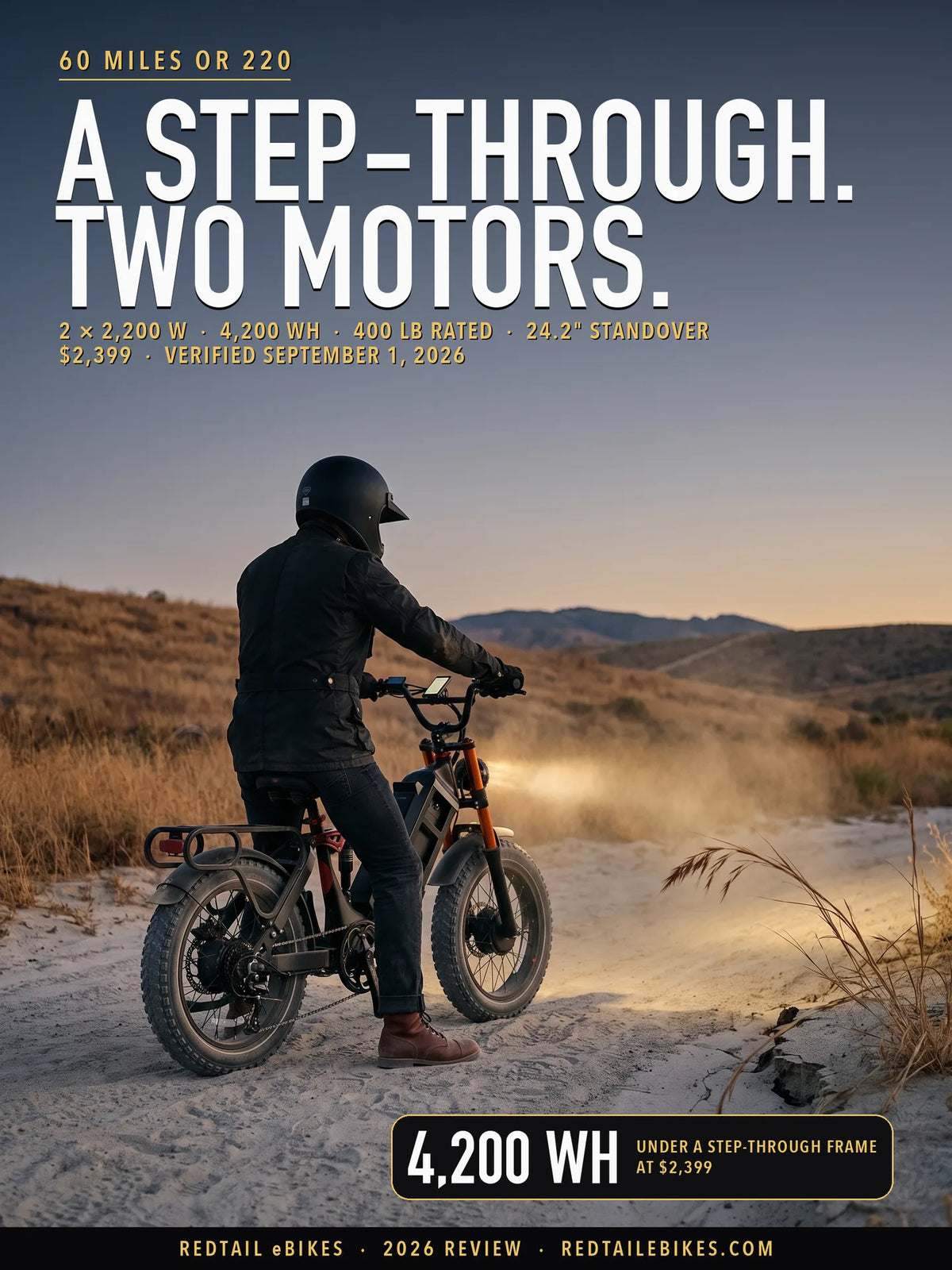
60V · 2 × 2,200 W · 2 × 110 N·m · 4,200 Wh · 43 mph published · 400 lb rated · 148.15 lb · 24.2" standover · $2,399 · verified September 1, 2026
Quick Answer — The Eahora Juliet Pro II is a $2,399 all-wheel-drive step-through carrying two 2,200 W hub motors, a 4,200 Wh pack and a published 43 mph. The line that decides your purchase is the range, because Eahora prints two of them in the same block.
Its own spec block reads 120–220 miles with pedal assist, and 60–65 miles without it. Same battery, same bike. Plan on the second figure if you ride on the throttle, and the first only if you pedal.
Black and White both orderable on 1 September 2026. Free contiguous-US shipping, and every warranty claim handled by us.
See the Juliet Pro II — $2,399Takeaway
- The two range figures are 3.7× apart, and both are Eahora's. Its spec block reads "120 - 220 miles with PAS, or 60 - 65 miles w/o PAS". Divide the 4,200 Wh pack by each and the claim assumes 19.1 Wh per mile at the top and 70.0 Wh per mile at the bottom.
- 19.1 Wh/mi is a more careful claim than most of our shelf makes. Across the 87 e-bikes we sell that publish both a base pack and a range belonging to it, the median claim assumes 12.69 Wh/mi. The Juliet Pro II's headline is heavier — and therefore more believable — than 62 of those 87.
- Ask what it weighs and the answer moved. Eahora publishes 148.15 lb. BikeRide's summary, published 24 June 2025, reports an expert weighing the Pro II "20lb heavier than Eahora's claim" and lists 168 lb in its own facts table.
- The rider-height range is published three times on one page, and two of the three agree. The specification block says 5'7" – 6'4". The geometry diagram, drawn beside two scale figures, is labelled 5.7 FT and 6.4 FT. The geometry table's text row is the outlier at 5'4" – 6'5". Take the majority and the 32.6" minimum saddle height together: plan on 5'7" as the floor.
- One bike, five published wattages. Eahora's own page title says 4400 W. Its spec block says 2 × 2,200 W nominal and peak 2 × 2,600 W. Its Amazon listings say "Peak 5400W" on two SKUs and "2000W/5200W" on a third.
- Nothing about certification is published for this bike, and the AI answers say otherwise. Eahora's site search returns 0 results for "UL 2849" and 57 for "Juliet"; both of its certification pages return 404. Asked about this bike on 1 September 2026, an AI answer told us it has "UL2849 certification … included without upcharges."
- The safety record is clean, and we checked it properly. Eahora appears in 0 of the 359 rows of the CPSC's complete Product Safety Warning listing, and the recall API returns nothing for it. Both checks passed a positive control in the same run.
- Screened against every US e-bike definition, the published 4,400 W and 43 mph sit outside 49 of 51. Two states publish no definition at all. This is a machine to plan around, and the planning is easy once the numbers are in front of you.
What's on this page
- Who the Juliet Pro II is for
- How we verified this Eahora Juliet Pro II review
- Eahora Juliet Pro II specifications
- 60 miles or 220, and the arithmetic underneath both
- How many watts is it?
- What 60 volts actually buys
- Charging it, and what a charge costs
- How much does the Juliet Pro II weigh?
- Does it fit? Read the height range three times
- The Mercer fit test
- 4,400 watts, 43 mph, and all 51 states
- Is the Juliet Pro II UL certified?
- Has it been recalled?
- Brakes, suspension and the parts you can check
- What owners and testers report
- The warranty, and who files the claim
- Buying it from us
- The honest ledger
- Who should buy it
- Before you buy: the checklist
- Limitations of this review
- The source register
- References
- Frequently asked questions
- The bottom line
Who the Juliet Pro II is for

Buy this bike if you have somewhere to ride it fast and something heavy to carry. It is a step-through frame with a 24.2-inch standover and a 400 lb load rating, and it moves that load with two hub motors instead of one. That combination is rare, and at $2,399 it is rarer still.
If the step-through is the part you can do without, the Eahora DL2000 is the dual-motor machine on this shelf at $2,299, with a fixed bench instead of a 24.2-inch standover.
Do not buy it as a first e-bike, and do not buy it expecting a bicycle. Eahora publishes 43 mph and 4,400 watts, and a machine built to those numbers is regulated as something other than an electric bicycle almost everywhere in the United States. The section on all 51 jurisdictions below gives you the specific answer for your state, with the statute cited.
Three questions decide it, and this page answers all three from documents: how far it really goes, whether it fits your body, and where you are allowed to ride it.

Eahora's own photograph of the bike. The front wheel carries a hub motor of its own — that is what the "AWD" in the product title means, and it is the single reason this bike accelerates the way it does.
How we verified this Eahora Juliet Pro II review
Nobody here has ridden this bike, and we do not pretend otherwise. Everything below is read from a document, and every document is linked.
-
The manufacturer's page was retrieved three ways on 1 September 2026 — the rendered product page, the
.jsproduct endpoint and the.jsonrecord — and all three were archived. Where the rendered page and the JSON disagree, the page is quoted, because the page is what a buyer reads. - Every figure comes from Eahora's own published specification block, quoted verbatim, including its own spelling and spacing.
- The legality screen is statutory. Eahora's published wattage and top speed were screened against the electric-bicycle definition in all 51 US jurisdictions, each row carrying its own citation.
- The safety check was validated before it was believed. A tool that returns nothing has told you about the tool. Both CPSC routes were run against a brand known to carry warnings first, and both found them.
- Third-party findings are attributed to whoever made them, with the date they were published. We ran no test of our own.
- We sell this bike. Read the red flags as carefully as the green ones, and email corrections to support@redtailebikes.com — we publish them.
Written by Milad Ghobadibeygvand, BScN (Western University, 2014), Redtail eBikes. Verified 1 September 2026.
Eahora Juliet Pro II specifications
Every row is Eahora's own published value, quoted from its specification block as read on 1 September 2026.
| Specification | Published value |
|---|---|
| Motor | "2 x 2,200W, or peak 2 x 2,600W" — dual hub motors, brushless, IPX6 |
| Torque | "2 x 110 Newton·meter (max)" — per motor; the two act on different wheels and are not additive |
| Battery | "4,200 Watt·hour (60V 70Ah)", Grade A lithium-ion pouch cells |
| Battery life | "≥ 1200 charge cycles to 80% of capacity" |
| Top speed | "28+ mph(43Mph) for both pedal-assist and throttle" |
| Range | "120 - 220 miles with PAS, or 60 - 65 miles w/o PAS" |
| Charger | "67.2V 7A Quick charger, 8-10H charge time" |
| Bike weight | "148.15 lbs with the battery (36.6 lbs) installed" |
| Max load | "≤ 400 lbs to ensure the performance and safety" |
| Rider height (spec block) | "5'7" - 6'4", or inseam ≥ 26.8"" |
| Rider height (geometry table row) | "5'4" - 6'5" or 162CM - 195CM" |
| Rider height (geometry diagram) | Labelled 5.7 FT – 6.4 FT beside the scale figures |
| Standover | 24.2" |
| Seat height | 32.6" – 40.5" |
| Frame | "High-carbon steel 20" x 15" frame" |
| Front fork | "Adjustable hydraulic suspension, 100mm travel" |
| Rear shock | "4-Bar-Link coil suspension, 50mm travel" |
| Brakes | "Hydraulic disc brakes with motor cutoff", 4-piston, 203 mm rotors |
| Tires | "20" x 4.0" tires with tube (28-33 psi)" |
| Drivetrain | Shimano 7-speed, RD-TY300 derailleur, MF-TZ500-7 14–28T, 44T chainring |
| Display | "4" color LCD motors switch, Bluetooth, USB charge port" |
| Lighting | "2,000 Lumens (20W) LED with built-in horn"; taillight with brake blinker |
| Assist | 5 PAS levels with cadence sensor; 5-level twist throttle |
| Colorways | Black, White — both $2,399 |
Both colorways showed available on 1 September 2026, at the same price Eahora charges on its own store.
Check stock and colorway — $2,39960 miles or 220, and the arithmetic underneath both
Eahora's range line reads, in full: "120 - 220 miles with PAS, or 60 - 65 miles w/o PAS". Read it twice, because it is doing two jobs.
The first half describes riding with the pedals turning. The second half describes riding on the throttle. Between them sits a factor of 3.7.
The way to test a range claim without a dynamometer is to divide the pack the claim runs on by the miles it promises. That quotient is the energy consumption the claim assumes, in watt-hours per mile, and it can be compared across an entire shelf.

Our arithmetic on Eahora's numbers. The bar a throttle rider should plan around is the one on the right.
| Eahora's claim | What it assumes, per mile |
|---|---|
| 220 miles with pedal assist | 19.09 Wh/mi |
| 120 miles with pedal assist | 35.00 Wh/mi |
| 65 miles without pedal assist | 64.62 Wh/mi |
| 60 miles without pedal assist | 70.00 Wh/mi |
Most reviews get this backwards. 19.09 Wh per mile is a careful assumption, and an optimistic claim would be a smaller number. We ran the same division across every e-bike on our own shelf on 1 September 2026. Of 189 active models, 87 publish both a base pack and a range that belongs to that pack; 29 publish a range for a different battery and were excluded instead of estimated; 73 publish neither. Across those 87, the median claim assumes 12.69 Wh per mile. The Juliet Pro II's headline assumes 19.09, which is heavier consumption — and therefore a more conservative promise — than 62 of the 87.
So the 220-mile figure is not the problem. The problem is that it belongs to a riding style most buyers of a 43 mph dual-motor bike will not adopt. If you buy this to twist a throttle, Eahora's own answer is 60 to 65 miles, and that is the number to plan a day around.
Neither figure survives one contact with the record: nobody has range-tested it, on either the product record created in February 2025 or since. BikeRide's summary of every published review notes that "The Juliet II's range impresses reviewers, though none does a full range test." Two years of coverage, no measured mile.
How many watts is it?
Five published answers, all of them Eahora's.
| Where it is published | The figure |
|---|---|
| Eahora's own product page title | "20" 4400W AWD Ebike" |
| Eahora's specification block, same page | "2 x 2,200W, or peak 2 x 2,600W" — 4,400 W nominal, 5,200 W peak |
| Amazon listing B0DXJXGPRT | "Dual Motor Peak 5400W 43MPH" |
| Amazon listing B0DY1ZZ1GY | *"Peak 5400W Dual Motor |
| Amazon listing B0DZ6CMV1F | "2000W/5200W 34/43MPH" |
This is a category habit before it is one brand's decision, and no US rule reaches it — 15 U.S.C. § 2085(b) names nominal wattage and nothing else.
Nominal and peak wattage are different measurements, marketplaces reward the larger one, and nothing forces a maker to publish either consistently. What it costs a buyer is comparability: you cannot rank two bikes on a number that is defined differently in each listing.
The figure to hold Eahora to is the specification block: 4,400 W nominal, 5,200 W peak. It is the only one that publishes both measurements side by side, which is the only way the pair can be checked. It is also the figure the legality screen below uses, because nominal wattage is what the statutes name.
What 60 volts actually buys
Voltage is the specification people ask about most and understand least. Volts multiplied by amps gives you watts, so a higher-voltage system can deliver the same power at lower current, and lower current means less heat in the controller and the wiring. On a heavy bike with two motors, that headroom is the whole point.
The Juliet Pro II runs 60 V against the 48 V and 52 V that dominate the category. Its 70 Ah at 60 V gives 4,200 Wh, and Eahora prints that figure instead of leaving you to multiply. We checked it anyway: 60 × 70 = 4,200 exactly.
What 60 volts does not buy is a different legal status, a lighter bike, or a longer real-world range on its own. The pack is 36.6 lb of the bike's 148.15 lb, and the extra voltage is why this bike accelerates hard instead of why it goes far — distance comes from the amp-hours.

The pack sits in the downtube and locks out for charging. At 36.6 lb it is roughly a quarter of the bike's published weight, which matters when you are lifting the bike without it.
Charging it, and what a charge costs
Eahora publishes a "67.2V 7A Quick charger" and an "8-10H charge time". Both halves check out against each other, which is less common than it should be — the same maker's Romeo II publishes a charge window its own charger cannot reach.
A 67.2 V, 7 A charger delivers 470.4 watts at full output. A 4,200 Wh pack divided by 470.4 W is 8.93 hours — inside the published 8-to-10-hour window, with room for the taper at the top of the charge that every lithium pack does. The charging claim is arithmetically consistent with the charger in the box.
The cost is smaller than the internet thinks. A full charge is 4.2 kWh, and at the US residential average of 18.34 cents per kilowatt-hour for June 2026 that is 77 cents to fill it. Spread over Eahora's 220-mile figure that is 0.35 cents per mile; spread over the 60-mile throttle figure it is 1.28 cents.
An AI answer we ran on 1 September 2026 put it at "roughly $0.04 per mile", which is about eleven times the arithmetic at the top figure and three times it at the bottom.
Two practical notes. Eight to ten hours means overnight, every time — this is not a pack you top up over lunch. And Eahora's warranty asks you to "Use only Eahora-approved parts and chargers", so the charger that arrives with the bike is the one to keep using.
How much does the Juliet Pro II weigh?
After "review", weight is the thing people most often add to this bike's name in a search box. Eahora publishes 148.15 lb with the battery (36.6 lb) installed.
That figure is contested, and by the only party that has put the bike on a scale. BikeRide's summary of the published reviews, dated 24 June 2025, reports that "an expert weighs the Juliet Pro II at 20lb heavier than Eahora's claim", and its own facts table lists 168 lb. Both numbers go on the page: Eahora publishes 148.15 lb, and the one independent weighing on record says about 168.
The gap matters for exactly one reason, and it is not pride. A 20 lb difference is the difference between a bike that fits many hitch racks and a bike that fits few of them. Size your rack against 168 lb rather than 148, and take the 36.6 lb battery out before you load it.
For scale against the rest of what we sell, all read from the same maker's own pages: the Eahora Romeo Ultra II is heavier again, the Juliet Long-Range is a lighter single-motor bike on the same family lines, and the Luna II is a step-through you can move around a garage on your own.
The payload arithmetic
Eahora publishes a 400 lb max load, which is 70 lb above the 330 lb that most of its own range carries. Subtract the published 148.15 lb bike and 251.85 lb is left for rider and cargo.
That subtraction carries the honest caveat this category always carries: Eahora does not define whether "max load" includes the machine. Read one way you have 400 lb for rider and gear; read the other you have 251.85. On a bike sold with a rear rack and photographed carrying a delivery bag, that is a question worth an email before you load it to the number, and it is one we will put to Eahora for you.
Does it fit? Read the height range three times
This is the section to read before the one about watts, because a bike that does not fit you cannot be ridden fast or slowly.
Plan on 5'7" as the floor. Eahora publishes the rider-height range in three places on this one page, and two of the three agree on it.
| Where it is published | The range |
|---|---|
| Specification block | "5'7" - 6'4", or inseam ≥ 26.8"" |
| Geometry diagram, drawn beside two scale figures | 5.7 FT – 6.4 FT |
| Size & geometry table, text row | "5'4" - 6'5" or 162CM - 195CM" |
The text row is the outlier, and it is the one an AI answer or a spec-scraper is most likely to lift, because it is the row in the table. A fourth figure exists in the record: BikeRide read "5'4" to 6'1"" when it summarised the bike in June 2025, so the published range has also moved at least once.

Eahora's own geometry drawing. The two figures top right are labelled 5.7 FT and 6.4 FT, which is the specification block's range and not the table row's.
The saddle settles the argument. Eahora publishes a seat height of 32.6" at its lowest setting. A rider at 5'4" typically has an inseam near 29 to 30 inches, which is below that saddle even fully dropped. BikeRide arrived at the same place from the same direction, writing that "With a 32.3" minimum saddle height, this bike is unlikely to fit riders at the lower end of the stated height range."
What to do with that, practically. The 24.2-inch standover is genuinely low and genuinely helpful — you can step over this frame easily at 5'4". Standing over a bike and pedalling it are different tests, and the saddle height governs the second one. If you are under about 5'7", ask us for the standover-to-saddle measurements in writing before you order, and look at the Juliet Long-Range or the 24-inch-wheeled Eahora P5 II instead.

The published minimum seat height is 32.6 inches and the maximum is 40.5. That 7.9-inch span is generous at the top and short at the bottom.
The three numbers to settle before you order. - Your inseam against 32.6 inches. That is Eahora's published minimum saddle height, and it decides fit more than any height range on the page does. - Your rack's rating against 168 lb. Eahora publishes 148.15; the one independent weighing on record says about 20 lb more. - Your state's row in our e-bike law guide. The published 4,400 W and 43 mph sit outside 49 of 51 definitions.
The Mercer fit test
The Mercers are our editorial cast: seven fixed people of known age and height that we hold every bike against, so that "does it fit?" gets the same test every time. They are fit archetypes, never testers. Every verdict below reads a published number or an age rule, and none of them has ridden this bike.
| Member | Verdict | The number behind it |
|---|---|---|
| Frank Kowalski, 63, 5'10" | Fits the frame, and the wrong bike for him | Inside every published height range. But 148.15 lb published — 168 lb weighed — is a bike he cannot lift, and a 43 mph machine is not what he asked for. |
| Ruth Kowalski, 61, 5'5" | No | Two inches below the 5'7" floor that two of Eahora's three published ranges give, and below the 32.6" minimum saddle height on any of them. |
| Jack Mercer, 48, 6'1" | The rider this bike is built for | Inside every published range with room. At his weight plus gear he is well under the 251.85 lb that remains after the bike, on either reading of the load rating. |
| Dana Mercer, 45, 5'7" | Fits, at the exact edge | 5'7" is the published floor precisely, in two of the three places Eahora states it. Get the saddle measurement in writing before ordering; the 32.6" minimum is the constraint rather than the 24.2" standover. |
| Maya Torres, 32, 5'6" | Not on the published numbers | One inch under the floor, and below the minimum saddle height. Her commute is also the wrong use for a bike whose published figures sit outside 49 of 51 state definitions. |
| Cole Mercer, 16 | No | The published 43 mph and 4,400 W put this outside the electric-bicycle definition in 49 jurisdictions, so the operator rules that apply are the ones for whatever class each state assigns it — licensing, registration and minimum ages included. Our state-by-state guide has his state. |
| Ivy Mercer, 12 | No, and it is not close | Off the table at her age on every published figure this bike carries. Her row exists to say so. |
The contrast that matters is Jack and Ruth. They are married into the same family, they shop from the same page, and this bike is right for one of them and wrong for the other on Eahora's own numbers — three inches of height and 148 pounds decide it. If the person buying is closer to Ruth than to Jack, the honest answer is a different bike, and we will tell you which one.
Found your row and it says yes? Both colorways were orderable on 1 September 2026, and if your row says no, email us and we will name the bike that fits instead.
Check your fit — Juliet Pro II, $2,3994,400 watts, 43 mph, and all 51 states
This is the section that decides where the bike can be ridden, so it is built from statutes on top of the federal definition, and every one of them is cited.
Eahora publishes 4,400 W nominal — the figure in its own page title and its own specification block — a 43 mph maximum speed, and a twist throttle. Those three facts were screened against the electric-bicycle definition in all 51 US jurisdictions on 1 September 2026, using a table in which every row carries its own statutory citation.
The federal reference point is 15 U.S.C. § 2085(b), which defines a low-speed electric bicycle as one with a motor of less than 750 watts and a top motor-powered speed under 20 mph on level ground with a 170-pound rider. That statute decides how the Consumer Product Safety Commission treats a machine. Where you may ride it is decided by your state.
The result: 0 QUALIFIES · 49 OUTSIDE DEFINITION · 2 NO STATUTORY DEFINITION.
The two are Alaska, which publishes no e-bike definition in AS 28.90.990(a)(20)-(22), and Kentucky, which publishes none in KRS 189.010. In those two there is nothing for the figures to sit inside or outside. Everywhere else, at least one published figure sits outside the definition — in 45 of the 49 it is the wattage against a 750 W ceiling, and in the rest it is the speed.
Sitting outside a definition is not the same as being unusable. It means the machine is regulated as whatever else that state's code covers, and those codes differ: California, Texas and Florida each set a 750 W ceiling.
New York caps assisted speed at 25 mph, Pennsylvania and Massachusetts at 20, and Rhode Island writes its ceiling as 1,492 watts. That is why bikes like this are sold for private land, permitted trail and off-road use, and why our state-by-state e-bike law guide exists.
This is a category fact before it is an Eahora fact. Every dual-motor bike at this power level — from every maker who builds one — meets the same 750 W ceiling and fails it. Even the smallest pairing we stock, the two 750 W hubs on the Eunorau FLASH AWD 1.0, clears only three of the 51 US definitions when the motors are read as 1,500 W combined.
What separates makers is whether they publish the numbers that let you check. Eahora publishes both, in its own page title, which is more than much of the segment does.
What the AI engines tell buyers, and what the statutes say
Asked "are dual motor e bikes legal" on 1 September 2026, the engines answer from retailer blogs — em3ev, Wildeway, Qlifebike, PUJH and thewearify were the sources returned. Their summary is broadly right in direction: dual-motor bikes "often exceed these limits, which can make them illegal to ride on public roads or bike paths without registration." None of them cites the statute that sets the limit.
What no engine gives you is your state's citation — not California's, not New York's, not Rhode Island's 1,492-watt outlier. The table this page is built from does, for all 51, and the two states with no definition at all are the kind of detail a summary written from retailer blogs never surfaces.
Is the Juliet Pro II UL certified?
Eahora publishes nothing about certification for this bike. Not on the product page. Not in the specification block. Not in the geometry block. No standard is named, no certificate number, no issuing body.
We looked properly instead of concluding from one empty page, because a search that fails and a fact that is absent look identical from the outside:
- Eahora's own site search returns 0 results for "UL 2849", 0 for "UL 2271" and 0 for "UN38.3". The same search returns 57 results for "Juliet", so the instrument works.
-
eahoraebike.com/pages/certificationreturns HTTP 404. So doeseahoraebike.com/pages/ul-certification. - The only certification sentence anywhere on the site is a single line in an FAQ post dated 12 April 2024: "Yes, all our batteries have passed UL certification, so you can use them safely without safety concerns."
That sentence is the whole record. UL 2849 covers the electrical drive system of an e-bike; UL 2271 covers the battery pack itself. They are different certifications, granted separately, and "UL certification" with no standard named cannot be checked against either.
Now the part worth your attention. Asked about this bike on 1 September 2026, an AI answer reported that "UL2849 certification, four-piston dual hydraulic disc brakes, a 2,000-lumen dual-mode headlight, and app connectivity are all included without upcharges." Three of those four are published on Eahora's page. The certification is not. A buyer who asks an engine instead of the maker gets told this bike carries a standard nothing supports.
This is a documentation gap, and we refuse both inferences it invites. It does not mean the pack is uncertified, and it does not mean it is certified. It means a buyer cannot check, and the only party who can close that is Eahora, by naming the standard and the certificate. Our buying guide explains what to ask for.
Has it been recalled?
No, and this one is a checked absence and never a failed search.
- The CPSC's complete Product Safety Warning listing — all 359 rows, downloaded on 1 September 2026 — contains no row naming Eahora. The same file returns two rows for Ridstar, a brand that carries open warnings, so the file and the match were both working when they returned nothing.
- The CPSC recall API returns 0 records for Eahora. The same endpoint returns 19 records for a control query, so it was answering.
Both routes ran a positive control in the same session — the warning listing returns rows for a brand that carries two open warnings, and the recall endpoint returns nineteen for a control query — which is the only reason this paragraph is publishable. A brand can carry warnings and still return zero recalls — they are separate instruments — so both were run.
Recalls and warnings are issued continuously. Check cpsc.gov/Recalls yourself before buying any e-bike; this page reports the record as it stood on 1 September 2026.
What the safety record says, and what it does not. - No recall, no warning. Eahora appears in none of the 359 rows of the CPSC's complete warning listing, and the recall API returns nothing. Both checks passed a control in the same run. - No certification is published for this model. That is a gap in the record and not a finding about the pack, and only Eahora can close it by naming the standard. - A published interlock. The 30-second P-stop needs a one-second brake pull before the throttle wakes, which is the right design on a 5,200-peak-watt machine.
Brakes, suspension and the parts you can check
The specification block is unusually detailed for this price, and several of the parts are named instead of described — which means you can look them up.
Brakes are the strongest thing on the bike. Eahora publishes "Hydraulic disc brakes with motor cutoff" on 4-piston calipers and 203 mm rotors, front and rear. On its own FAQ Eahora explains the choice: "4 pistons are more wear-resistant, have stronger oil pressure, and have better braking effect." The fluid is mineral oil, which Eahora also publishes — useful, because mixing DOT fluid into a mineral-oil system destroys the seals. On a bike this heavy at these speeds, 203 mm four-piston stoppers are the right hardware and not a given at $2,399.

Eahora's photograph of the front brake. The published specification is four-piston calipers on 203 mm rotors at both ends; the rotor diameter and the mineral-oil fluid type are both printed on the page, which is more than most listings at this price bother to.
Suspension is the weaker half. The fork is "Adjustable hydraulic suspension, 100mm travel" and the rear is a "4-Bar-Link coil suspension, 50mm travel". Fifty millimetres at the rear is comfort travel rather than terrain travel, and a tester quoted by BikeRide reports the rear on a Pro II being squeaky. On 20 × 4.0 tires at 28–33 psi, most of the compliance you feel will come from the tires.

One hundred millimetres up front, fifty at the rear. The tires do more of the work than either number suggests.
The drivetrain is entry-level and honest about it. Shimano's RD-TY300 derailleur and MF-TZ500-7 freewheel are the parts you find on department-store bicycles, paired here with a 44T chainring and 170 mm cranks. On a bike that does most of its work on the throttle that is a defensible saving, and both parts are cheap and universally available when they wear.

A Shimano MF-TZ500-7 freewheel, 14–28T. Replacements cost less than a tank of fuel and every bike shop stocks them.
Lighting is over-specified in a good way. A 2,000-lumen, 20 W headlight with a built-in horn, and a taillight with a brake blinker. BikeRide's summary contains the counterweight: a reviewer found the taillight dim and the brake light hard to see in daylight.

Two thousand lumens is a genuine driving light, not a be-seen light, and the horn is built into the same housing.
One safety feature deserves naming, because it is unusual and Eahora explains it in its own words: the display has a "P-stop function. If the bike is not used for more than 30 seconds, it will automatically turn on the safety protection function. If you want to start the bike, just press the brake lever for 1 second." On a bike with 5,200 peak watts under a twist throttle, a mandatory brake-pull before the throttle wakes up is the right design.

Twenty by four inches, running 28 to 33 psi. Note the pressure range: most of this bike's ride comfort is set here rather than at the shock.
What owners and testers report
This section is other people's words, attributed to each source.
The published third-party record is one summary and three video reviews. BikeRide aggregated them on 24 June 2025 and scores the bike 70/100, with an expert score of 74 from a single rated review. Its eight reasons to buy include that both builds "handle steep inclines with ease", that "Pro II riders can easily switch between motors, and the all-wheel drive setting has low and high-power modes", and that the display carries a USB-C port. Its eleven reasons not to buy include jerky pedal assist, pedals that "can scrape over bumps or in turns", ghost pedalling at 20 mph, frequent tire punctures, a display that "occasionally fails to power on, especially in cold weather" on one test bike, and a manual an expert found "confusing and poorly written".
Its bottom line is worth quoting whole, because it is the most sceptical assessment published: "High weight, jerky pedal assist, meager pedal clearance, puncture-prone tires, and cheap suspension count against the Juliet II."
Eahora's own review wall reads differently, and should be read as what it is — reviews hosted by the seller. Twenty-five reviews, a 5.0 average, and 100% saying they would recommend it. One verified reviewer, posting after buying in June 2026, writes: "This eBike is very fast (50+MPH) and has enormous battery range and excellent battery management … Removing the speed limit puts me at a max speed of 53MPH on flat roads."
That last sentence needs a straight answer from us. Eahora publishes 43 mph. An owner reports 53 with the limiter removed. We have measured neither, we are not telling you how to do it, and we would point out the obvious: a machine already outside 49 of 51 e-bike definitions does not become easier to place by going faster. The reason it appears here at all is that it is on the maker's own page, where any buyer researching this bike will find it, and a review that quietly omits what the product page says is not a review.
Another verified reviewer on the same page reports the after-sales side: "I did have a crash and needed a few replacement parts, but Eahora's customer service made it easy … Communication was smooth and support was responsive the whole way." Parts availability is a real purchase factor on a bike this specialised, and that is one data point in its favour.
The warranty, and who files the claim
Eahora's warranty page has a section headed "1. Warranty Coverage & Duration". It lists exclusions, and it states no duration.
The only period published anywhere on the page sits at the bottom: "Claims deadline: 1 year from purchase date", alongside the site header's "1 Year Warranty".
The clauses a buyer should know before ordering, quoted:
| Clause | Eahora's words |
|---|---|
| Term | "Claims deadline: 1 year from purchase date." |
| Who is covered | "No coverage for: Secondhand owners or commercial use." |
| Consumables | "Normal wear and tear (tires, brake pads, chains, etc.)" excluded |
| Parts and chargers | "Use only Eahora-approved parts and chargers." |
| Shipping damage | "Report within 10 days of delivery. Include photos, signed Bill of Lading, and retain packaging." |
| If you decline a repair | "If the customer rejects cooperating to repair, a 30% depreciation fee will be applied and the customer is also responsible for the round-trip freight cost." |
| Conduct | "Rude or abusive behavior may result in terminated support, voided warranties, or account cancellation." |
| Chargebacks | "Warranty services pause if a credit card chargeback is filed while the customer retains the product." |
None of those clauses is unusual for the category, and several are sensible. The one to plan around is the shipping-damage window: ten days from delivery, with photographs and a signed bill of lading. Freight damage on a 148 lb crate is the single most common thing that goes wrong with an e-bike purchase, and the clock starts the day it lands.
Our own window is shorter and our own job is bigger. We ask you to inspect within 48 hours, and if something is damaged in transit we file the carrier claim ourselves instead of handing you a form.
Buying it from us
Every row here cites the document behind it, and one row says what we will not claim.
| What you get | The document |
|---|---|
| $2,399, matching Eahora's own price | Eahora lists $2,399 with a $2,699 compare-at on its product page and in its own product record; we list the same pair. Checked 1 September 2026. |
| Free shipping in the contiguous US, where Eahora's own header promises the same | Our shipping policy: "free shipping on every electric bike", dispatched in 1–3 business days, most arriving 5–10 business days after dispatch. |
| We file the carrier claim | Our refund policy: damage reported within 48 hours with photos and "we file the carrier claim and arrange a replacement or repair". |
| Warranty handled by us, in the US | You email us rather than an overseas address. The manufacturer's terms still govern what is covered; we do the chasing. |
| Both colorways confirmed orderable | Black and White both returned available on 1 September 2026, and both cart links resolved. |
| What this page rests on | The maker's published figures, confirmed at its page and recomputed; owner and reviewer testimony is quoted as theirs. |
And the reverse sell, which we mean. Email support@redtailebikes.com with your height, your state and what you want to do with it, and we will tell you straight — including when the answer is a different bike. On this particular model the answer is a different bike more often than usual, because of the saddle height and the 148 lb.
Know this before you order: change-of-mind returns are unopened-only, within 72 hours, with a 15% restocking fee, because these ship by freight. If you are not sure this is the bike, ask us first — that is what the email is for, and it costs nothing.
Free contiguous-US shipping, and we file the carrier claim if it arrives damaged.
Order the Juliet Pro II — $2,399The honest ledger
What the record supports:
- A 4,200 Wh pack that recomputes exactly — 60 V × 70 Ah — and a charger whose own arithmetic lands inside the published charge window.
- A range claim more conservative than most of our shelf: 19.09 Wh/mi assumed at the top figure, against a median of 12.69 across the 87 comparable bikes we sell.
- Brake hardware above the price: four-piston hydraulic calipers on 203 mm rotors at both ends, with the fluid type published.
- A genuine 24.2-inch standover with a 400 lb load rating, which is a combination the step-through category rarely offers.
- A clean CPSC record, checked against the complete 359-row warning listing and the recall API, both with passing controls.
- A published safety interlock — the 30-second P-stop that requires a brake pull before the throttle wakes.
- Published numbers in unusual depth: rotor diameter, fluid type, freewheel part number, tire pressure range, cell chemistry and cycle life all appear on the page.
What counts against it:
- The rider-height range is published three times and one of the three disagrees by three inches at the bottom — and the outlier is the table row a scraper reads first.
- The one independent weighing on record is 20 lb above the published weight, and 168 lb changes which racks and which stairwells are possible.
- Five published wattages across the maker's own channels make the bike hard to compare against anything.
- Nothing about certification is published for this model, and the AI answers filling that silence are asserting a standard the record does not support.
- The published 4,400 W and 43 mph sit outside 49 of 51 state e-bike definitions, which constrains where it can be ridden.
- Fifty millimetres of rear travel is comfort suspension on a bike whose speed suggests otherwise, and a tester reports it squeaking.
- No full range test exists anywhere, on either published figure, two years after launch.
- The warranty's "Coverage & Duration" section publishes no duration; the term has to be read off the claims deadline at the bottom of the page.
Who should buy it
Buy it if you are 5'7" or taller, you have private land or permitted trail to ride it on, and you want two motors and 4,200 watt-hours for $2,399. Nothing else on our shelf puts that much battery and that much power under a step-through frame at this price, and the brake hardware is genuinely good.
Buy something else if you want a Juliet you can ride more places. The Juliet Long-Range is a single-motor bike on the same family lines and a lighter machine to live with.
Look at the Luna II if the number that worries you is 148 lb. It is a step-through commuter you can move around a garage alone.
Look at the Eahora P5 II if you are under 5'7". Twenty-four-inch wheels and a lower cockpit make the fit question answerable instead of marginal.
And if you want more of the same idea, the Romeo Ultra II is the bigger machine above it, with the same legality homework to do first — our review of it works through the 500 lb rating and the register-and-insure question this frame raises too.
New: our Eahora brand profile answers the brand-level questions this page does not — who owns the trademark, where the bikes ship from, the federal safety record, the warranty terms, and all 23 models we stock screened against the 750-watt line.
Before you buy: the checklist
- ☐ Measure your inseam against 32.6 inches. That is the published minimum saddle height, and it decides fit more than the height range does.
- ☐ Read your state's row in our e-bike law guide before you order rather than after it.
- ☐ Check your rack's rating against 168 lb, the independently weighed figure, rather than the published 148.15.
- ☐ Plan on 60 to 65 miles if you ride on the throttle. That is Eahora's own number for throttle-only riding.
- ☐ Plan the charge overnight — 8 to 10 hours, from a 470 W charger into a 4,200 Wh pack.
- ☐ Photograph the crate before you cut it open, and report any damage to us within 48 hours.
- ☐ Ask us for the certification documents before you order if that matters to you, and let us tell you what we get back.
- ☐ Email us your height, your state and your use. We will tell you if this is the wrong bike.
Limitations of this review
- We sell this bike. Every figure here is traceable to a document you can open, which is the only guard against that conflict that actually works.
- Nobody at Redtail has ridden, weighed or range-tested this machine. Every performance number on this page is a published claim or another party's measurement, attributed.
- The 168 lb weight is a single third-party measurement, reported by BikeRide in June 2025 from an expert review. We have not reproduced it.
- The Wh-per-mile figures are arithmetic on published claims, not measurements of any bike's real consumption, and they are presented as the assumption inside a claim.
- One Amazon listing could not be retrieved. Three of the four Eahora Amazon listings we cite were fetched and archived; a fourth returned an anti-bot page on every attempt, so its title is reported only as it appeared in search results.
- No search-volume or difficulty figure appears anywhere on this page. Our keyword tool has no dated export inside the freshness window, so the demand behind this page is recorded as observed strings rather than priced numbers.
- The certification finding is about what is published, not about what exists. Eahora may hold certificates it does not publish.
- Expiry conditions. This page should be re-checked if Eahora changes the specification block, publishes a certificate, republishes the rider-height ranges, or if any independent range or weight test appears.
The source register
| Source | Tier | What it supports |
|---|---|---|
| Eahora, Juliet Pro II product page | T2 — manufacturer, primary for its own claims | Every specification, geometry and price figure |
| 15 U.S.C. § 2085(b) | T1 — federal statute | The low-speed electric bicycle definition |
| State statutes, 51 jurisdictions | T1 — statutes | The legality screen, each row separately cited |
| CPSC Product Safety Warning listing | T1 — federal agency dataset | The 359-row denominator behind the recall answer |
| CPSC recall API | T1 — federal agency | The recall query and its control |
| EIA Electric Power Monthly, Table 5.6.A | T1 — federal agency | The 18.34 ¢/kWh residential average, June 2026 |
| BikeRide, "19 Reasons to/NOT to Buy Eahora Juliet Pro II" | T3 — aggregated third-party reviews | The 168 lb weighing, the tester findings, the 70/100 score |
| Eahora FAQ, "The Most Frequently Asked Questions" | T2 — manufacturer | The only certification sentence Eahora publishes |
| Eahora warranty page | T2 — manufacturer | Every warranty clause quoted |
| Amazon listings B0DXJXGPRT, B0DY1ZZ1GY, B0DZ6CMV1F | T3 — marketplace listings by the maker | The competing published wattages |
| Our own Shopify catalog, 189 active e-bikes | T2 — first-party dataset | The Wh-per-mile census and its denominator |
T5 sources — AI summaries, content farms and unattributed spec aggregators — are not cited anywhere on this page. Where an AI answer appears above, it is reported as a measured artefact of what buyers are being told, never as evidence of a fact.
References
- Eahora. Juliet Pro II product page. Retrieved 1 September 2026. eahoraebike.com/products/eahora-juliet-pro-ii — every specification, geometry and price figure on this page.
- Eahora. Warranty. Retrieved 1 September 2026. eahoraebike.com/pages/warranty — all quoted warranty clauses.
- Eahora. Expert Q & A: The Most Frequently Asked Questions About Eahora E-bikes. 12 April 2024. eahoraebike.com/blogs/news/… — the "all our batteries have passed UL certification" sentence.
- United States Code. 15 U.S.C. § 2085(b), Low-speed electric bicycles. law.cornell.edu/uscode/text/15/2085 — under 750 W and under 20 mph.
- Alaska Statutes. AS 28.90.990(a)(20)-(22). akleg.gov/basis/statutes.asp — no e-bike definition published.
- Kentucky Revised Statutes. KRS 189.010. apps.legislature.ky.gov/law/statutes/… — no e-bike definition published.
- US Consumer Product Safety Commission. Product Safety Warning listing (complete). Downloaded 1 September 2026. cpsc.gov/s3fs-public/recall-data/… — 359 rows, none naming Eahora.
- US Consumer Product Safety Commission. Recall REST service. Queried 1 September 2026. saferproducts.gov/RestWebServices/Recall — 0 records for Eahora.
- US Energy Information Administration. Electric Power Monthly, Table 5.6.A. June 2026 data. eia.gov/electricity/monthly/… — 18.34 cents per kilowatt-hour, US residential average.
- BikeRide. 19 Reasons to/NOT to Buy Eahora Juliet Pro II. Published 24 June 2025 by Amar Punekar. bikeride.com/eahora-juliet-ii — the 168 lb weighing, the 32.3" saddle finding and the tester reports.
- Amazon. eAhora Juliet Pro II Electric Bike — Dual Motor Peak 5400W 43MPH. Retrieved 1 September 2026. amazon.com/dp/B0DXJXGPRT.
- Amazon. 2026 eAhora Juliet Pro 2 Electric Bike for Adults, Peak 5400W Dual Motor. Retrieved 1 September 2026. amazon.com/dp/B0DY1ZZ1GY.
- Amazon. eAhora Juliet Pro-II Electric Bike — 2000W/5200W 34/43MPH. Retrieved 1 September 2026. amazon.com/dp/B0DZ6CMV1F.
- Redtail eBikes. Shipping policy. redtailebikes.com/policies/shipping-policy — free contiguous-US shipping, 1–3 day dispatch.
- Redtail eBikes. Refund policy. redtailebikes.com/policies/refund-policy — the 48-hour inspection window and the carrier-claim commitment.
- Eahora. Juliet Pro II product JSON record. Retrieved 1 September 2026. eahoraebike.com/products/eahora-juliet-pro-ii.json — the second independent retrieval of price and availability.
Frequently asked questions
How far will the Eahora Juliet Pro II actually go on one charge?
Eahora publishes two figures: 120–220 miles with pedal assist, and 60–65 miles without. Plan on the second if you ride on the throttle. The 220-mile figure divides the 4,200 Wh pack down to 19.09 watt-hours per mile, which is a low-assist number. No independent range test of this bike exists.
How fast is the Eahora Juliet Pro II?
Eahora publishes "28+ mph(43Mph) for both pedal-assist and throttle" — a 28 mph default with a 43 mph maximum. Those published figures sit outside the electric-bicycle definition in 49 of the 51 US jurisdictions we screened, so check your state before you plan a route.
How much does the Eahora Juliet Pro II weigh?
Eahora publishes 148.15 lb with the 36.6 lb battery installed. BikeRide, summarising the published reviews in June 2025, reports an expert weighing it about 20 lb heavier and lists 168 lb. Size any rack against 168 lb.
Is a 4,000-watt electric bike street legal?
Not as an electric bicycle. The federal definition in 15 U.S.C. § 2085(b) caps a low-speed electric bicycle at under 750 watts and under 20 mph, and 45 of the 49 states with a definition set a 750 W ceiling of their own. A 4,400 W machine is regulated as whatever else your state's vehicle code covers, which usually means registration, licensing and no bike-path access.
Is the Eahora Juliet Pro II UL certified?
Eahora publishes nothing about certification for this model. Its site search returns no results for UL 2849 or UL 2271, and both of its certification pages return 404. A single 2024 FAQ line says its batteries "have passed UL certification" without naming a standard. That is the whole record, and it is not enough to check.
What is the difference between the Juliet II and the Juliet Pro II?
The Juliet II is the single-motor build — one 1,500 W motor and a 3,120 Wh pack, per BikeRide's facts table. The Pro II is the all-wheel-drive build: two 2,200 W motors and 4,200 Wh. Both share the frame, the step-through geometry and the 20 × 4.0 tires.
Is 60 V better than 48 V on an electric bike?
Higher voltage lets the system deliver the same power at lower current, which means less heat in the controller and wiring — useful on a heavy dual-motor bike. It does not, on its own, mean more range. Range comes from watt-hours, and this bike's 4,200 Wh comes from 70 amp-hours as much as from the 60 volts.
Are dual-motor e-bikes worth it?
They are worth it for traction, loaded climbing and acceleration, and they cost you weight, complexity and legal headroom. On this bike the second motor is the reason it will pull 400 lb up a grade, and also part of the reason its published figures sit outside 49 state definitions.
Does the Juliet Pro II fit a shorter rider?
Eahora publishes the range three times and two of the three say 5'7"–6'4": the specification block and the geometry diagram, labelled 5.7 FT and 6.4 FT. The geometry table row is the outlier at 5'4"–6'5". The deciding number is the 32.6-inch minimum saddle height, which sits above the inseam of a typical 5'4" rider.
How long does the Eahora Juliet Pro II take to charge?
Eahora publishes 8–10 hours from the 67.2 V, 7 A charger in the box. That charger delivers 470 watts, and 4,200 watt-hours divided by 470 watts is 8.93 hours, so the two published figures agree with each other.
What does it cost to charge?
A full charge is 4.2 kWh. At the EIA's June 2026 US residential average of 18.34 cents per kilowatt-hour, that is about 77 cents — roughly 0.35 cents per mile at Eahora's 220-mile figure, and 1.28 cents per mile at its 60-mile throttle figure.
Has the Eahora Juliet Pro II been recalled?
No. Eahora appears in none of the 359 rows of the CPSC's complete Product Safety Warning listing as downloaded on 1 September 2026, and the CPSC recall API returns no records for it. Both checks were validated against a brand known to carry warnings before the zero was believed.
What brakes does the Juliet Pro II have?
Hydraulic disc brakes with motor cutoff, on four-piston calipers and 203 mm rotors front and rear, running mineral oil. Eahora publishes the rotor diameter and the fluid type, which matters — mineral-oil systems are destroyed by DOT fluid.
What is the P-stop function?
Eahora's own answer: "If the bike is not used for more than 30 seconds, it will automatically turn on the safety protection function. If you want to start the bike, just press the brake lever for 1 second." It stops a bump of the twist throttle from launching a 5,200-peak-watt machine.
What is the Juliet Pro II's payload capacity?
Eahora publishes a 400 lb maximum load, 70 lb above the 330 lb most of its range carries. Subtracting the published 148.15 lb bike leaves 251.85 lb. Eahora does not state whether the rating includes the machine, so ask before loading to the number.
Does the Juliet Pro II come with a rack and lights?
Yes. Eahora publishes a rear rack, front and rear plastic fenders, a 2,000-lumen headlight with a built-in horn, and a taillight with a brake blinker. A basket is listed as optional.
The bottom line
The Eahora Juliet Pro II is a $2,399 all-wheel-drive step-through with 4,200 watt-hours, four-piston brakes on 203 mm rotors, and a 400 lb load rating — and the honest sentence about it is that its own spec block contains the answer to almost every question a buyer has, if you read the whole thing rather than the headline.
If the standover is what brought you here, the reviews index tabulates every published standover, weight and load rating we have collected, so this frame can be read against the rest.
Read the range line twice: 220 miles is a pedalling number and 60 to 65 is a throttle number. Measure your inseam against 32.6 inches before you look at anything else. Check your state before you plan a route, because 4,400 published watts sits outside 49 of 51 definitions. And size your rack against 168 lb rather than 148.
If those four answers come back in your favour, this is a lot of bike for the money and we will ship it free.
Black and White, both orderable. Free contiguous-US shipping, US warranty support, and we file the carrier claim if it arrives damaged.
Order the Juliet Pro II — $2,399Written by Milad Ghobadibeygvand, BScN (Western University, 2014), Redtail eBikes. Verified 1 September 2026. We sell this bike; every claim on this page links to the document behind it. Corrections to support@redtailebikes.com — we publish them.



Share:
Eunorau FAT-HS Review 2026: 2 Frames, 300 lb Payload
eBike Shops in Long Beach (2026): 7 Verified Stores