


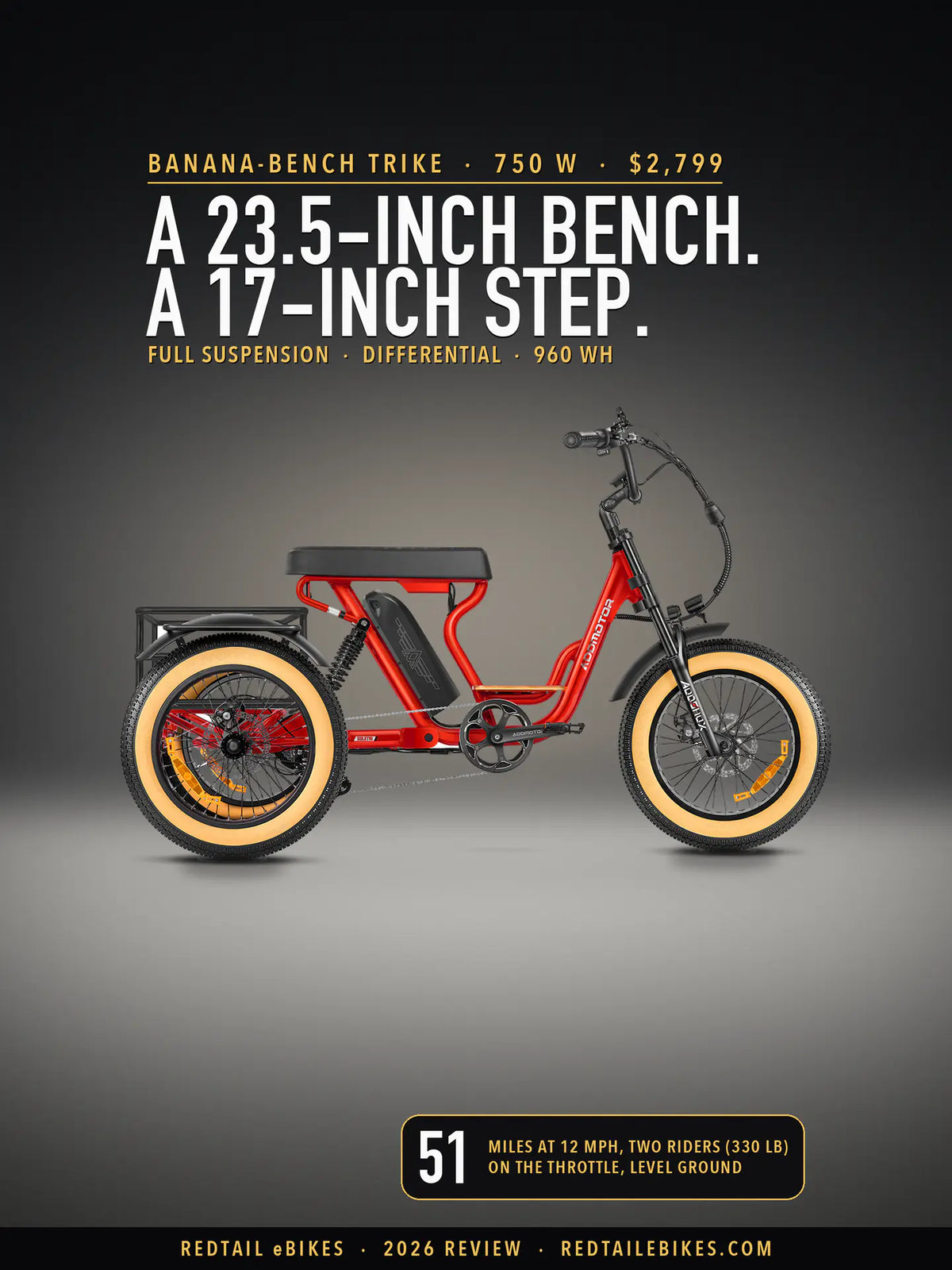

Banana-bench trike for two · 750 W rear-mounted motor, torque sensor, half-twist throttle · 48 V 20 Ah Samsung pack, 960 Wh · a 23.5-inch banana bench · 17-inch step on the Soletri II, 24-inch on the Herotri II · an 80 mm fork and two rear shocks · differential and parking brake · 450 lb payload · 20 mph · $2,799 · verified October 1, 2026
Quick Answer — Addmotor's Soletri II M-366X is a $2,799 trike seating two adults on a 23.5-inch banana bench over a 17-inch step, with full suspension, a differential and a 750 W rear-mounted motor. On level pavement at 12 mph on the throttle, a charge computes to about 65 miles for one 180 lb rider and 51 with two riders totaling 330 lb.
The Herotri II M-365X is the same trike on a 24-inch step-over frame. The bench does not adjust, and Addmotor prints its height two ways, 32.5 and 34 inches, so find your row in the fit tables first; who may ride behind you is your state's call, set out in the passenger section.
On October 1, 2026 our store listed the Soletri II at $2,799 in every colorway, with $3,099 shown as the regular price. This button orders Red, the trike on the cover; Orange, Yellow and Pearl White are the same price, and the rest are in the buying table. Delivery is free to the lower 48, and if the freight carrier damages it, we file the claim.
Buy the Soletri II in RedWhat this review covers
The specification · The bench and the step · Soletri II or Herotri II · Fit · The motor · The battery · Range · Carrying two · Brakes and lights · Suspension and tires · Weight and width · The Mercer fit test · Recalls · Class · Passengers · Trails · Green and red flags · The verdict · Checklist · Buying it from us · FAQ · Limitations · The bottom line · References
How we verified this Addmotor Soletri II review
Every specification comes from Addmotor's Soletri II and Herotri II page, its tabs re-read on October 1, 2026, its size drawing, the trike's question board and Addmotor's posts about both frames. Our price, colorways, stock and Shop Pay plans were read the same day.
Range and fit are computed, and every formula shows its inputs. The review is specification-verified: each figure traces to Addmotor, a statute, our store or arithmetic on this page. We sell this trike, so weigh the red flags as carefully as the green.
Written by Milad Ghobadibeygvand, BScN (Western University, 2014). Corrections: support@redtailebikes.com.
Addmotor's Soletri II and Herotri II specification
Addmotor sells both frames on one page, with one motor, pack and drivetrain, and a Size & Fit table that prints a column for each.
| Soletri II M-366X | Herotri II M-365X | |
|---|---|---|
| Frame | step-through | step-over |
| Rider height | 5'2" to 6'2" | 5'2" to 6'2" |
| Standover | 17 in | 24 in |
| Seat height | 32.5 in | 32.5 in |
| Saddle size | 23.5 × 8.5 in | 23.5 × 8.5 in |
| Handlebar height | 42 in | 46 in |
| Handlebar width | 30 in | 30 in |
| Reach | 11.8 in | 11.8 in |
| Wheelbase | 54 in | 54 in |
| Total length | 76.7 in | 76.7 in |
| Total width | 32.7 in | 31.5 in |
| Bottom bracket height | 12.4 in | 11.8 in |
| Rear basket | 20.5 × 16 × 9.5 in | 21 × 17 × 9.8 in |
| Tires | 20 × 4.0 in | 20 × 4.0 in |
Addmotor's Size & Fit tab, both columns, read October 1, 2026. The Soletri's frame is a "Step-Thru Frame with Wooden Footrest" in the Performance tab, and its 17-inch standover is measured to that footboard on the size drawing.
| As Addmotor publishes it | |
|---|---|
| Motor | "48V*750W Rear-Mounted Motor"; "750W Rear-Drive Motor (1400W Peak,90Nm Torque)" in Addmotor's comparison image |
| Pedal assist | "Intelligent 7 Levels Pedal Assist, Torque Sensor (7 PAS)" |
| Throttle | "Variable Speed Control - 1/2 Twist Throttle With Power-Cut Switch" |
| Controller | "Addmotor EB 2.0 25A Controller, Upgraded to A Chip Type" |
| Battery | "48V*20Ah Samsung UL-certified Battery", 960 Wh; "UL 2271" in the page's stat strip |
| Charger | "48V*2.0A 5 Pins Short Plug US Standard DC Charger 5 Pins With Auto Magnetic Suction" |
| Range | "85 miles" |
| Max speed | "20 Mph" |
| Payload | "450 LBS" in the Technical tab; "350+100 LBS" in the stat strip |
| Fork | "ADDSHOX 20" Oil Spring Dual-Crown Suspension Fork, Triple Clamp, 32.5mm Steel Stanchions, 80 mm Travel, Preload Adjust" |
| Brakes | "Tektro Aries Mechanical Disc with 180 mm Rotors, Tektro Four-Finger Levers with Rubberized Edge and Motor Inhibitors" |
| Parking brake | "Yes" |
| Differential | "Yes" |
| Gearing | "7 Speed 1x7 Shimano Altus Derailleur, Shimano MF-TZ500-7 Cassette 14-28 Tooth" |
| Cranks | "Ounce, Alloy, 170 mm Length, 42 Tooth Chainring" |
| Saddle | "Banana Seat (23" x 8.5"), Faux Leather, Black" |
| Stem | "Promax, Alloy, Adjustable Angle (-10º to 100º), Alloy, 110 mm Length, Four 10 mm Spacers" |
| Handlebar | "Adjustable U Style Curved Handlebar, Adjust The Angle and Height" |
| Tires | "Kenda GIGAS Puncture-resistant 20" X 4.0" Inches Durable Tires" |
| Display | "Addmotor EB 2.0 Multi-Function LCD Display (Increase to 7 PAS)" |
| Headlight | "Supplies a brightness of 40 lumens, a visible distance of 200m, and a 180° side view." |
| Taillight | "UL certificate, With driving light, left and right turn signals, danger light, flashlight, brake light" |
| Horn | "Included Electric Horn, 108 Maximum Decibel" |
| Fenders | "Aluminum, Front Fender and Rear Fender Included" |
| Weight | none in the tabs; "about 130LBS (Include Battery)" in Addmotor's answer of October 27, 2025; "~121 lb" in its September 5, 2025 overview |
Addmotor's Technical and Performance tabs, read October 1, 2026. The Size & Fit tab gives the bench as 23.5 by 8.5 inches and the Performance tab as 23 by 8.5; both are printed here.
A 23.5-inch bench for two, over a 17-inch step
The Soletri II is a trike you sit on like a long motorcycle seat: one banana bench, 23.5 inches from end to end, with room for a second adult behind you. Addmotor's page names it a "Rear Drive Full Suspension Electric Trike for Two Adults", and its feature copy says the bench is "designed to seat two riders comfortably", "wider at the rear, narrower at the front".

Pearl White, on tan-wall tires, in Addmotor's studio photograph.
Under the bench the frame drops to a wooden footboard. You step onto that board, 17 inches off the ground on the size drawing, turn and sit, and the pedals turn below the front of the bench.
The bench is fixed. Asked whether it adjusts, Addmotor answered on April 15, 2023: "The seat is not adjustable." What does move is the cockpit: the stem's angle runs from −10° to 100°, and the U-shaped bar adjusts in angle and height.
The name covers two machines. Addmotor's post of November 21, 2023 describes a Soletri with "a powerful 48V750W brushless front wheel motor", and its 2023 page for that trike, "SOLETRI M-366X Etrike 2023 New Version", is still served with "48V750W Front-Mounted Motor" on it.
The trike on sale today has the motor at the back: asked in 2024 whether "the 2024 upgraded rear motor" came with a differential, Addmotor answered on April 28, 2024: "Yes, Soletri 2024 has a rear speed differential."
If you are comparing listings or buying used, that is the fact to check. A page that describes a front motor describes the earlier trike, and every figure in this review is the current page's.
Soletri II or Herotri II: the step is the difference
Pick the Soletri II if you want to step over a low board, the Herotri II if you would rather swing a leg over a higher frame. Addmotor's product FAQ puts it in one line: "The Soletri II features a low 17" step-thru electric adult tricycle frame, while the Herotri II has a 24" standover height and slightly narrower body for a sportier ride."

The Herotri II in Pearl White, its frame rising to the head tube where the Soletri's drops to a footboard.
The Size & Fit table gives the two frames the same rider window, bench, wheelbase, length and tires. Five rows differ: the standover (17 against 24 inches), the handlebar (42 against 46), the width (32.7 against 31.5), the bottom bracket (12.4 against 11.8) and the rear basket (20.5 × 16 × 9.5 against 21 × 17 × 9.8).
The 24-inch frame asks for more leg. Subtract it from a barefoot inseam and the room left over is seven inches less than the Soletri's at every height:
| Your height | Typical inseam | Room over the Herotri II's 24-inch frame |
|---|---|---|
| 4'11" | 28.1 in | 2.8 in or more for 95 of 100 riders |
| 5'2" | 29.5 in | 4.0 in or more for 95 of 100 riders |
| 5'6" | 31.7 in | 6.2 in or more for 95 of 100 riders |
| 5'10" | 33.8 in | 8.2 in or more for 95 of 100 riders |
| 6'2" | 36.0 in | 10.3 in or more for 95 of 100 riders |
Barefoot inseam less Addmotor's 24-inch standover, from the same 6,068 bodies as the fit section: the inseam column is each height's median, and the room column the figure 95 of every 100 riders of that height meet or beat. Addmotor publishes no drawing of the Herotri, so its other fit figures are not measured here.
Addmotor lists the Herotri II in Pearl White. Its page offered one Herotri combination on October 1, 2026, in stock. For a Herotri in any colorway, email us before you order and we will confirm it, and its price, with Addmotor.
Does the fixed bench fit you? Fit at 32.5 and 34 inches
The bench sits below the height a pedaling formula sets for nearly every rider in Addmotor's 5'2" to 6'2" window: at its listed 32.5 inches it suits 5 of every 100 riders at 4'11" and 1 at 5'0", and at the 34 inches of Addmotor's 2023 answer, 30 at 4'11", 21 at 5'0" and 2 at 5'2". Addmotor's own window sits beside those figures in the tables below.
The formula is the saddle 109% of your inseam from the pedal, the height Peveler and colleagues found most powerful for pedaling. On a bench below it, your knee stays more bent at the bottom of each stroke; a fixed bench trades that against a seat you sit down onto, with no post to set.
Addmotor prints the bench's height in two places: "Seat Height 32.5''" in the Size & Fit table, and "Seat height: 34''" in its answer of April 15, 2023. Both figures run through the model, and the controls table shows which one the drawing measures closer to.
Three steps tell you what the bench means for you:
- Measure your inseam barefoot. Back against a wall, slide a hardcover book up between your legs until it presses like a saddle, and measure from the floor to its spine.
- Find your height in both tables below and read how far the bench sits from your row's formula height.
- Decide how you will ride it: on the throttle and easy assist your legs do little of the work; for long stretches of hard pedaling, the gap is the number to weigh.

Addmotor's size drawing over its studio photograph of the Orange Soletri II. Its bottom bracket, bench length, front tire and total length agree with the photograph within 3.5 percent at the wheelbase's scale; the controls table prints every comparison.
How high does my saddle go?
It stays where Addmotor set it, so the table measures each rider against the bench. The bodies are the 6,068 of the US Army's anthropometric survey, placed on the geometry measured from Addmotor's drawing.
| Your height | Typical inseam | Formula saddle height, median rider | The 32.5 in seat, median rider | Riders it suits, of 100 |
|---|---|---|---|---|
| 4'11" | 26.8–29.3 in | 35.3 in | 2.8 in low | 5 |
| 5'0" | 27.1–29.7 in | 35.8 in | 3.3 in low | 1 |
| 5'2" | 28.0–31.1 in | 37.0 in | 4.5 in low | 0 |
| 5'4" | 29.1–32.2 in | 38.1 in | 5.6 in low | 0 |
| 5'6" | 30.2–33.5 in | 39.4 in | 6.9 in low | 0 |
| 5'8" | 31.1–34.3 in | 40.5 in | 8.0 in low | 0 |
| 5'10" | 32.2–35.5 in | 41.8 in | 9.3 in low | 0 |
| 6'0" | 33.2–36.7 in | 43.0 in | 10.5 in low | 0 |
| 6'2" | 34.3–37.5 in | 44.3 in | 11.8 in low | 0 |
Floor-to-bench height the formula sets for the median rider at each height, how far the 32.5-inch bench of Addmotor's Size & Fit table sits from it, and how many of 100 riders have the bench inside their 106 to 110.4% band (Ferrer-Roca and colleagues). Typical inseam spans the middle 90 of every 100 bodies; men and women pooled.
| Your height, 2023 answer | Typical inseam | Formula saddle height, median rider | The 34.0 in seat, median rider | Riders it suits, of 100 |
|---|---|---|---|---|
| 4'11" | 26.8–29.3 in | 35.3 in | 1.3 in low | 30 |
| 5'0" | 27.1–29.7 in | 35.8 in | 1.8 in low | 21 |
| 5'2" | 28.0–31.1 in | 37.0 in | 3.0 in low | 2 |
| 5'4" | 29.1–32.2 in | 38.1 in | 4.1 in low | 0 |
| 5'6" | 30.2–33.5 in | 39.4 in | 5.4 in low | 0 |
| 5'8" | 31.1–34.3 in | 40.5 in | 6.5 in low | 0 |
| 5'10" | 32.2–35.5 in | 41.8 in | 7.8 in low | 0 |
| 6'0" | 33.2–36.7 in | 43.0 in | 9.0 in low | 0 |
| 6'2" | 34.3–37.5 in | 44.3 in | 10.3 in low | 0 |
The same rows with the bench at the 34 inches of Addmotor's April 15, 2023 answer, the figure the drawing measures closest to.
At 32.5 inches the bench matches the 109% setting for an inseam of 25.6 inches, or 26.3 at 106%; at 34 inches, 26.9 and 27.7. A longer leg meets the pedal with more bend in the knee; the median 5'8" rider is 8.0 inches below the formula on the listed bench and 6.5 on the answered one.
A low bench brings the ground within reach. Seated on it at 32.5 inches, a barefoot inseam reaches the floor flat-footed for 56 of 100 riders at 5'8" and 90 at 5'10"; at 34 inches, 9 and 40.
Can I step through it at a stop?
Yes, at every height from 4'11" to 6'2". The footboard sits 17 inches off the ground, so 95 of every 100 riders clear it by 9.8 inches or more even at 4'11".
| Your height | Typical inseam | Clearance over the frame |
|---|---|---|
| 4'11" | 28.1 in | 9.8 in or more for 95 of 100 riders |
| 5'0" | 28.4 in | 10.1 in or more for 95 of 100 riders |
| 5'2" | 29.5 in | 11.0 in or more for 95 of 100 riders |
| 5'4" | 30.5 in | 12.1 in or more for 95 of 100 riders |
| 5'6" | 31.7 in | 13.2 in or more for 95 of 100 riders |
| 5'8" | 32.6 in | 14.1 in or more for 95 of 100 riders |
| 5'10" | 33.8 in | 15.2 in or more for 95 of 100 riders |
| 6'0" | 34.9 in | 16.2 in or more for 95 of 100 riders |
| 6'2" | 36.0 in | 17.3 in or more for 95 of 100 riders |
Barefoot inseam less Addmotor's 17-inch standover. The inseam column is each height's median; the clearance column is the figure 95 of every 100 riders of that height meet or beat.
The frame has no top tube to lift a leg over: you stand on the board between the bench and the bars, then sit back. The Herotri II's 24-inch frame is the one to swing a leg across, and its own table prints the room it leaves.
Will I lean forward to reach the bars?
No: every rider in the table reaches the grips sitting straight up, elbows bent. On Addmotor's drawing the grips sit 7.0 to 8.5 inches ahead of the crank axle and 31.2 to 32.9 inches above it, close to a rider on the bench.
| Your height | Lean from upright, median rider | Riders who reach the grips sitting upright, of 100 | Elbow bend sitting upright, median rider |
|---|---|---|---|
| 4'11" | 0° | 100 | 85° |
| 5'0" | 0° | 100 | 84° |
| 5'2" | 0° | 100 | 86° |
| 5'4" | 0° | 100 | 88° |
| 5'6" | 0° | 100 | 90° |
| 5'8" | 0° | 100 | 91° |
| 5'10" | 0° | 100 | 93° |
| 6'0" | 0° | 100 | 93° |
| 6'2" | 0° | 100 | 94° |
With the bench at the listed 32.5 inches: the lean is the smallest trunk angle at which a straight arm meets the grip, the middle column counts riders who reach it sitting straight up, and the last gives the median elbow bend among them.
The bars come to you, so the arms fold. An elbow bent to about a right angle is a cruiser's posture, and in Priego Quesada and colleagues' 2017 comparison, twenty recreational cyclists rated the most upright of three trunk positions the most comfortable. The stem's −10° to 100° angle range lets you move the grips forward if your elbows want more room.
How much weight goes through my hands?
About 6 to 7 percent of your body weight with the back relaxed, four to seven pounds on each hand. Ten road racers on their brake hoods in Carahalios's 2015 laboratory study carried 15% on the bars; an upright rider here carries under half of that.
| Your height | Share of your weight, back relaxed | Median rider's weight | On each hand |
|---|---|---|---|
| 4'11" | 6% (5–8%) | 128 lb | about 4 lb |
| 5'0" | 6% (5–8%) | 126 lb | about 4 lb |
| 5'2" | 6% (5–8%) | 139 lb | about 4 lb |
| 5'4" | 6% (5–8%) | 147 lb | about 5 lb |
| 5'6" | 7% (6–8%) | 166 lb | about 5 lb |
| 5'8" | 7% (6–8%) | 179 lb | about 6 lb |
| 5'10" | 7% (6–8%) | 192 lb | about 6 lb |
| 6'0" | 7% (6–8%) | 204 lb | about 7 lb |
| 6'2" | 7% (6–8%) | 216 lb | about 7 lb |
Computed body by body from the segment weights Clauser and colleagues published in 1969, with the bench at 32.5 inches: the arms' weight goes forward onto the grips, which makes each figure an upper bound. The bracket covers every grip position measured on the drawing.
Across 36 riders, Slane and colleagues found padded gloves cut palm pressure by 10 to 28%, worth having on a long ride with the stitched faux-leather grips Addmotor fits.
How do I set the saddle at home?
The bench has no setting, so the setup is where you sit on it and where the bars sit. Addmotor's 23.5-inch bench leaves you room to slide: sitting farther back stretches your leg a little toward the pedal, and leaves less of the bench for a passenger.
Sit with the pedal at the bottom of its stroke and check your knee: Peveler and colleagues put a pedaling knee at 25 to 35 degrees of bend. Then set the stem's angle so your hands meet the grips with relaxed shoulders, and ride a few blocks before moving anything again.
The fit arithmetic, step by step
Every figure above rests on three rules: a seat 1.09 times your inseam above the pedal, a lean equal to the least trunk angle that lets a straight arm meet the grip, and a hand load equal to the upper body's weight carried forward over the reach.
Take a 5'8" rider on the median 32.6-inch inseam: the formula puts the seat 35.6 inches from the pedal at the bottom of its stroke, and less Addmotor's 170 mm crank, that is 28.9 inches from the crank axle.
The sitting point is 6.7 inches behind the crank axle on the drawing, so that distance is read on the slant: above a crank axle 12.4 inches off the ground, the formula wants the bench top 40.5 inches up.
LeMond's rule, 88.3% of inseam from the crank axle, gives 28.8 inches for the same rider, and with the 170 mm crank added back it averages 109.0% of inseam from the pedal across the survey's bodies, inside the 109.2 ± 0.9% Peveler and colleagues report.
| Input | Value | Source |
|---|---|---|
| Rider bodies | 6,068 (4,082 men, 1,986 women) | US Army ANSUR II, 2012 |
| Saddle formula | 109% of inseam; range 106–110.4% | Peveler et al., 2005; Ferrer-Roca et al., 2012 |
| Seat height | 32.5 in; 34 in in Addmotor's 2023 answer | Addmotor's Size & Fit tab; Addmotor, April 15, 2023 |
| Sitting point | 6.7 in behind the crank axle (bracketed 2.5 in each way) | measured on Addmotor's size drawing |
| Crank length | 170 mm | Addmotor's Performance tab |
| Crank axle height | 12.4 in (12.0–12.8) | Addmotor's size drawing |
| Grip center | 7.0–8.5 in ahead of, 31.2–32.9 in above the crank axle | measured on Addmotor's size drawing |
| Standover | 17 in | Addmotor's Size & Fit tab |
| Segment weights | head and trunk 58.0%, each arm 4.9% of body weight | Clauser et al., 1969 |
Addmotor prints a fixed seat height and no seat angle, so the drawing is scaled by its 54-inch wheelbase, hub center to hub center. The near rear wheel stands closer to the camera than the front, so its hub is carried back onto the trike's centerline before the wheelbase is read, and Addmotor's other published lengths then check the scale:
| Dimension | Addmotor lists | Measured on its size drawing | Gap |
|---|---|---|---|
| bottom bracket height | 12.4 in | 12.7 in | +2.5% |
| bench length | 23.5 in | 24.1 in | +2.7% |
| front tire diameter (20 x 4.0, nominal) | 24.0 in | 24.0 in | −0.0% |
| total length | 76.7 in | 78.0 in | +1.7% |
| seat height (Size & Fit table) | 32.5 in | 34.3 in | +5.5% |
| seat height (Addmotor's answer of April 15, 2023) | 34.0 in | 34.3 in | +0.8% |
| standover (the footboard top) | 17.0 in | 18.3 in | +7.5% |
| handlebar height (the drawn grip) | 42.0 in | 44.8 in | +6.6% |
The bottom bracket, bench length, front tire and total length agree with Addmotor's figures within 3.5 percent, across eight of nine combinations of camera center, grip offset and ground reading the measurement was run over. The bench top measures nearest the 34 inches of Addmotor's 2023 answer; the footboard and the drawn grip measure higher than their labels, and Addmotor's April 15, 2023 answer prints the handlebar at 46.9 inches.
Email your height and barefoot inseam to support@redtailebikes.com before you pay, and we will reply with where the bench sits for you at both of Addmotor's heights. Orange, the trike on the size drawing, is on this button; Red, Yellow and Pearl White are the same $2,799.
Buy it in OrangeA 750 W rear-mounted motor, a torque sensor and a throttle
Addmotor rates the motor at 750 W and mounts it at the rear, driving the back wheels through a differential. The Technical tab lists "48V*750W Rear-Mounted Motor", and the page's comparison image adds "(1400W Peak,90Nm Torque)".

The motor between the rear frame tubes, with one of the two rear shocks above it, in Addmotor's close-up.
Addmotor's post of November 21, 2023, about the front-motor Soletri, gives "a torque of 80N.M". The range model takes the 90 N·m of the current page, and both figures sit side by side in Limitations.
The torque sensor reads how hard you push, across seven assist levels, and the half-twist throttle moves the trike with your feet still. Asked "can you throttle without pedaling", Addmotor answered on December 5, 2023: "Yes, you can."

The EB 2.0 display, cropped from Addmotor's key-components image.
Your pedaling runs through a Shimano Altus 7-speed with a 14-28 cassette and a 42-tooth chainring on 170 mm cranks. The range model treats the motor as driving the axle apart from your chain, so the gear you pick sets your cadence; drop low to start two riders from a stop. The class section covers how your state treats 750 W at 20 mph.
The 960 Wh Samsung battery
Forty-eight volts at 20 amp-hours makes 960 watt-hours, in a pack Addmotor lists as "48V*20Ah Samsung UL-certified Battery" and describes in its feature copy as "UL2271-certified". The pack rides in the frame below the bench, and asked whether it comes out, Addmotor answered on October 21, 2025: "Yes, the battery is removable."

The pack in the frame below the bench, in Addmotor's close-up.
From low, a full charge takes about eight to ten hours on the 2-amp charger. Addmotor's post of November 21, 2023, written about the front-motor trike on the same 20 Ah pack, says it "takes 8-10 hours to fully charge", and the arithmetic agrees: 20 amp-hours at 2 amps is ten hours from empty, and 20 to 80% is six.
Addmotor's pack care comes down to a few numbers. Its battery-health post says to recharge "when it has a 10%-15% charge left", and its maintenance guide says to "keep your battery charge between 20% and 80% for the best lifespan" and charge "at room temperature (between 10 and 25 degrees Celsius)", 50 to 77 °F.
A second pack is the way to ride farther in a day: Addmotor's accessories menu lists its 20 Ah Samsung pack for models up to "SPYTAN, SOLETRI and CITYTRI Series". Ask us to quote one with your order.
Range: how far a charge takes the Soletri II
On level pavement with the throttle alone, a full pack carries one 180 lb rider about 65 miles at 12 mph and 39 at 20 mph, and two riders totaling 330 lb about 51 miles at 12 mph. Easy pedaling at 12 mph stretches the one-rider figure to 125 miles; a steady 8% climb at 10 mph on the throttle cuts it to about 10.
Three steps turn your ride into miles:
- Find the row for your pace and the column for your effort in the first two tables, and for a passenger, the load table.
- For each 1,000 feet of climbing at 10 mph on 4 to 10% grades, add 171 to 223 Wh on the throttle or 155 to 202 Wh with easy pedaling (the hills table).
- Adjust for the temperature, and plan on 85% of the pack.
A row is a single steady ride. Its inputs are Addmotor's figures, a comparable motor's published data, drum measurements of ten fat tires and a cycling-power model validated on an open road, and the formula subsection carries one ride through by hand.
The trike weighs about 130 lb in Addmotor's 2025 answer, and every table carries that weight. The Triketan M-330 runs the same 750 W motor and 960 Wh pack at 112 lb, and for the same 180 lb rider at 12 mph on the throttle its model gives 67 miles to this trike's 65.
How many miles does each speed give, and how much do your legs add?
On the throttle, pace decides: 80 miles at 8 mph, 65 at 12, 39 at 20. The air's share of the work grows with the cube of speed, so from 12 to 20 mph the power spent on it rises about 4.6 times.
| Speed, flat | Per mile | Full charge | With 15% kept |
|---|---|---|---|
| 8 mph | 12.0 Wh | 80 mi | 68 mi |
| 10 mph | 13.2 Wh | 73 mi | 62 mi |
| 12 mph | 14.8 Wh | 65 mi | 55 mi |
| 15 mph | 17.9 Wh | 54 mi | 46 mi |
| 18 mph | 21.8 Wh | 44 mi | 37 mi |
| 20 mph | 24.8 Wh | 39 mi | 33 mi |
One rider of 180 lb, throttle only, level pavement, 77 °F air. The last column keeps back the 15% Addmotor names as its recharge point, the top of its "10%-15%" advice.
Pedaling adds to every row. Easy pedaling here is 75 W and steady pedaling 150 W; with no motor, those efforts alone would hold a 180 lb rider on this trike at about 8.3 and 12.5 mph on the flat, a guide to which column you can keep up.
| Speed, flat | Throttle only | Easy pedaling (75 W) | Steady pedaling (150 W) |
|---|---|---|---|
| 12 mph | 65 mi | 125 mi | legs alone |
| 15 mph | 54 mi | 79 mi | 146 mi |
| 18 mph | 44 mi | 57 mi | 79 mi |
| 20 mph | 39 mi | 47 mi | 60 mi |
One 180 lb rider, level pavement, a full pack. "Legs alone" means 150 W from you holds that speed without the motor. The 125-mile and 146-mile cells lean on the motor's light-load losses, the model's least-checked part (Limitations item 6).
Pick your speed and your effort; the assist level only decides how the work is shared. Pace is the biggest lever you hold, and Addmotor's trike-range post says so: "Riding a little slower can lessen the wind drag, allowing increased range."
Does shifting gears save battery?
Only through your legs. The motor turns the axle apart from your chain, so at a given speed and grade the draw on the pack falls only as your own effort rises:
| Your ride | Throttle only | Easy pedaling (75 W) | Steady pedaling (150 W) |
|---|---|---|---|
| 12 mph, flat | 14.8 Wh | 7.7 Wh | 0.0 Wh |
| 15 mph, flat | 17.9 Wh | 12.1 Wh | 6.6 Wh |
| 12 mph, 4% grade | 50.1 Wh | 40.3 Wh | 31.3 Wh |
| 12 mph, 8% grade | 97.8 Wh | 84.4 Wh | 72.1 Wh |
Watt-hours from the pack per mile, one 180 lb rider, 77 °F air. On the flat at 12 mph a steady 150 W from your legs holds the pace alone, so the motor draws nothing.
Choose the gear for a cadence you can hold. Addmotor's range post singles out the start from a stop: "When you accelerate after coming to a stop, it uses a lot of energy." A low gear lets your legs share that push, which matters more with a passenger aboard.
What does a climb cost the pack?
A 1,000-foot climb at 10 mph takes 171 to 223 Wh more than the same miles on the flat when the grade runs 4 to 10% and the throttle does the work, or 155 to 202 with easy pedaling. Lifting rider and trike is 52 to 68% of the throttle figure, and the rest is heat in the motor and pack.
A 180 lb rider on the 130 lb trike makes 310 lb to lift, and 1,000 feet of height takes 117 Wh at the wheels. Up 8% at 10 mph on the throttle the pack spends 203 Wh per 1,000 feet, so all 960 Wh would lift that load about 4,700 feet with nothing left for the flat; the model gives nothing back on the descent, which keeps it on the careful side.
| Grade | Per mile, throttle | Full charge, throttle | Full charge, easy pedaling |
|---|---|---|---|
| 2% | 30 Wh | 32 mi | 49 mi |
| 4% | 49 Wh | 19 mi | 26 mi |
| 6% | 72 Wh | 13 mi | 17 mi |
| 8% | 99 Wh | 10 mi | 12 mi |
| 10% | 130 Wh | 7 mi | 9 mi |
All at 10 mph with one 180 lb rider; the last column adds 75 W of easy pedaling. At 12%, holding 10 mph asks more torque than the model's motor gives, with or without easy pedaling, so the trike slows to the speeds in the next table.
Two riders climb slower, not farther. The motor's torque sets the speed it can hold on a grade, and the heavier the load, the lower that speed:
| Grade | 180 lb | 330 lb | 330 lb, easy pedaling | 450 lb |
|---|---|---|---|---|
| 4% | 18 mph | 14 mph | 15 mph | 12 mph |
| 6% | 15 mph | 11 mph | 12 mph | 9 mph |
| 8% | 12 mph | 9 mph | 10 mph | 7 mph |
| 10% | 10 mph | 7 mph | 8 mph | 6 mph |
| 12% | 9 mph | 6 mph | 7 mph | past the model's motor |
The fastest steady speed the model's motor holds on each grade with one rider of 180 lb, two riders totaling 330 lb, or Addmotor's 450 lb limit aboard, throttle only except the third column, from the same model as the range tables. "Past the model's motor" means the grade asks more torque than the model's 90 N·m allows at any speed; with 450 lb aboard on 12%, pedal hard or walk the trike up.
Asked about hills, Addmotor answered on May 5, 2023 that "Power losing depends on the slope of the mountain, and the weight of the rider". The table puts numbers on both.
Plan a hilly day as flat miles plus climbing. Say twenty level miles at 12 mph on the throttle, about 297 Wh, plus 1,000 feet of 8% grade at about 203 Wh: the day needs about 500 Wh, 61% of the 816 Wh in 85% of the pack, before wind and stops.
How far does a passenger take the range?
On the flat, a second rider costs about a fifth of the miles; on a climb, much more. Weight adds to the tires' work and the grade's and none to the air's, so the gap between one rider and two widens as the road tips up.
| You plus your load | 12 mph flat, throttle | 15 mph flat, throttle | 8% climb, 10 mph |
|---|---|---|---|
| 100 lb | 75 mi | 60 mi | 14 mi |
| 130 lb | 71 mi | 58 mi | 12 mi |
| 180 lb | 65 mi | 54 mi | 10 mi |
| 220 lb | 60 mi | 51 mi | 8 mi |
| 260 lb | 57 mi | 48 mi | 7 mi |
| 330 lb | 51 mi | 44 mi | past the model's motor |
| 400 lb | 46 mi | 40 mi | past the model's motor |
| 450 lb | 44 mi | 38 mi | past the model's motor |
The weight column counts everyone aboard and everything carried; the model adds the trike's own 130 lb, and every cell is throttle only. From 330 lb up, 10 mph on 8% asks more torque than the model's motor gives, and the climbing table gives the speed it holds instead.
From one 180 lb rider to two totaling 330 lb, the 12 mph ride drops from 65 miles to 51 and the 15 mph ride from 54 to 44. At Addmotor's full 450 lb, 44 and 38.
Addmotor prints two weights for the trike, and they move the figures by a mile at most. Its answer of October 27, 2025 gives "about 130LBS (Include Battery)"; its September 5, 2025 overview gives "~121 lb" for the Soletri II, as its answer of April 15, 2023 gave "121 lbs" for the earlier machine. Both run through the model:
| Ride, throttle | At 130 lb (Addmotor's 2025 reply) | At 121 lb (its 2023 reply) |
|---|---|---|
| 12 mph, flat | 65 mi | 66 mi |
| 15 mph, flat | 54 mi | 54 mi |
| 10 mph, 8% climb | 10 mi | 10 mi |
One 180 lb rider. Every other table on this page uses the 130 lb of the 2025 answer.
How much range does cold weather take away?
Expect about a fifth less at freezing. A 12 mph throttle ride good for 65 miles in 77 °F air comes to about 51 miles at 32 °F and about 46 at 14 °F.
| Air | Pack energy vs 77 °F | 12 mph flat, throttle |
|---|---|---|
| 95 °F | 99% | 68 mi |
| 77 °F | 100% | 65 mi |
| 68 °F | 98% | 61 mi |
| 50 °F | 93% | 55 mi |
| 41 °F | 91% | 52 mi |
| 32 °F | 89% (80–93) | 51 mi (46–53) |
| 14 °F | 82% (40–83) | 46 mi (22–46) |
Level ground, one 180 lb rider, the cells at the air's temperature. The middle figure in each row comes from the LG HG2 cell McMaster University measured at a 0.5C discharge at 77, 50, 32 and 14 °F, with the rows between interpolated; Addmotor names Samsung as the cell maker, so the brackets use Samsung data sheets.
The brackets span from the lowest capacity any Samsung data sheet gives at that temperature, for discharges of one to four capacities an hour (25R and 30Q at 32 °F, 35E at 14 °F), to the most energy Casado and colleagues recorded in 2025 at a gentler rate.
Three losses stack in cold air. At freezing the cells return about 89% of their 77 °F energy, 80 to 93% across sources, and the air is about 9% denser by the U.S. Standard Atmosphere's gas law.
The tires stiffen as well: the model raises their rolling resistance 0.5% for each °F below 77 °F (0.9% per °C), between Rothhämel's fit for a 42 mm tire and Bicycle Rolling Resistance's road-tire average, and holds it at its 41 °F value below that.
Bring the pack inside to charge. Addmotor's cold-weather post says to "Always charge your battery indoors at room temperature because cold weather can harm the battery cell if you charge it at lower temperatures"; the pack comes out of the frame, so it can.
Does the tire or the riding position change the range?
On the flat, the tire matters most. Ten 26 × 4.00 fat tires drew 23.2 to 42.1 W on Bicycle Rolling Resistance's drum at 12 psi, 18 mph and a 94 lb load. The ten are 26-inch and the Soletri's 20-inch, so the model takes the median of the ten, a coefficient of 0.0105, with the lowest and highest as brackets.
| Rolling resistance | 12 mph flat, throttle | 15 mph flat, throttle |
|---|---|---|
| 0.0070 · the lowest of ten fat tires | 79 mi | 63 mi |
| 0.0105 · the median of ten fat tires (used) | 65 mi | 54 mi |
| 0.0126 · the highest of ten fat tires | 58 mi | 49 mi |
Full-charge miles, one 180 lb rider, level ground. The highest coefficient is Kenda's Juggernaut Pro, 0.01262 on its own measurement page.
Grass, gravel and sand are off these pavement tables, so send us your route and we will price its paved miles and climbs. For the air, Tengattini and Bigazzi measured a drag area of 0.640 m² across 37 upright cruiser riders, the posture the bench sets and the value used here; their 0.603 m² for 90 mountain-bike riders would add a mile to the 15 mph throttle ride, 54 to 55.
Addmotor's 85 and 40 to 55 miles, as steady rides
Addmotor's distances read as steady rides in the model. The Technical tab prints "85 miles", and the product FAQ adds: "On PAS 1, it reaches 85 miles. Heavy cargo hauling or throttle-only mode will reduce the actual range of this cargo tricycle electric to 40-55 miles."
| Addmotor's figure | Throttle only | Easy pedaling | Steady pedaling |
|---|---|---|---|
| 85 mi on PAS 1 | 6.6 mph | 14.5 mph | 17.6 mph |
| 55 mi, throttle-only | 14.6 mph | 18.4 mph | — |
| 40 mi, throttle-only | 19.5 mph | — | — |
For each of Addmotor's distances, the steady level-ground speed at which the model uses all 960 Wh with one 180 lb rider: 11.3, 17.5 and 24.0 Wh a mile, top row to bottom. Easy pedaling is 75 W and steady pedaling 150 W; a blank cell means that effort covers the row's distance with charge to spare even at 20 mph.
Read that way, Addmotor's 85 miles is an unhurried ride with your legs helping, about 15 mph with 75 W from you, and its 40 to 55 miles on the throttle is 14.6 to 19.5 mph with no pedaling. Hold 12 mph on the throttle and the model's 65 miles lands between them.
Plan on 85% of the row that fits your ride, since Addmotor advises recharging "when it has a 10%-15% charge left": at 12 mph on the throttle, 55 of the 65 miles.
To spare the cells, ride inside the 20–80% band. That window, 60% of the pack or 576 Wh, is what Addmotor's maintenance guide means by "keep your battery charge between 20% and 80% for the best lifespan":
| Speed, flat | 20–80% band, throttle | 20–80% band, easy pedaling |
|---|---|---|
| 8 mph | 48 mi | legs alone |
| 10 mph | 44 mi | 123 mi |
| 12 mph | 39 mi | 75 mi |
| 15 mph | 32 mi | 48 mi |
| 18 mph | 26 mi | 34 mi |
| 20 mph | 23 mi | 28 mi |
Miles inside the band, one 180 lb rider, level ground. At 8 mph the easy-pedaling cell reads "legs alone" because 75 W by itself holds this rider at about 8.3 mph on the flat.
Find your row, keep 15% of the pack back, then add the climbing. Each 1,000 feet at 10 mph adds 171 to 223 Wh on the throttle with one rider. On level ground the planning figures are 55 miles at 12 mph and 33 at 20 for one 180 lb rider, throttle only.
Twenty flat miles at 12 mph and a 1,000-foot climb at 8% come to about 500 Wh on the throttle, 61% of the 816 Wh in 85% of the pack. Email your distance, climbing, both riders' weights and your usual speed to support@redtailebikes.com and we will run your ride before you order. Yellow is on this button, with Pearl White at the same $2,799.
Order it in YellowThe formula behind the range tables
The power the rear wheels need at a constant speed in still air comes from the model Martin and colleagues validated on an open road in 1998:
P = v × [ m × g × (Crr × cos θ + sin θ) + ½ × ρ × CdA × v² ]
P is power at the wheels and v road speed; m is the combined mass of trike, riders and load, g is gravity and θ the slope's angle; Crr is the tires' rolling resistance, ρ the air's density and CdA the rider's drag area. The Crr and θ term carries the tires and the slope; the ρ term carries the air. Three stages sit between the wheels and the pack:
- Your pedaling reaches the wheels through the chain at 97.7% efficiency, the chain figure Martin and colleagues measured, and the motor supplies the remainder.
- The motor borrows the curve of a comparable motor with published figures: for its RM G0H0, Bafang's 2021 OEM workbook lists 510 rpm unloaded, 426 rpm at rated load at 48 V, and "≥ 80" percent efficiency. Working from Addmotor's 20 mph top speed, the model holds that curve at Addmotor's 48 V and 750 W and places the unloaded speed at 21.8 mph, where one 180 lb rider on the throttle just reaches 20 mph on the flat.
- The pack loses a small share as heat, at the efficiency Arango, Lopez and Ceren measured on a 48 V pack.
Dividing battery watts by mph gives watt-hours per mile, and the miles follow: 960 Wh × the share of pack energy usable at that temperature ÷ watt-hours per mile.
| Input | Value used | Where it comes from |
|---|---|---|
| Trike | 130 lb; 121 lb as a check | Addmotor's answer of October 27, 2025; its answer of April 15, 2023 |
| Riders and load | 180 lb; the weight table also runs 100, 130, 220, 260, 330, 400 and 450 | 450 lb is the Technical tab's payload, "350+100 LBS" in the page's stat strip |
| Battery | 48 V × 20 Ah = 960 Wh | Addmotor's Technical tab |
| Motor | 750 W at its rated speed, 21.8 mph unloaded, 80% at the rated point, torque capped at 90 N·m | Bafang OEM workbook 2021, RM G0H0; Addmotor's 750 W, 20 mph and 90 N·m |
| Wheel | 24.0 in (609 mm) across, the 20 × 4.0 tire's nominal diameter | Addmotor's tire size; the 406 mm bead seat of a 20-inch decimal tire in Sheldon Brown's ISO size chart, plus twice the 4.0-inch tire |
| Rolling resistance | 0.0105, the median of ten 26 × 4.00 fat tires at 12 psi | Bicycle Rolling Resistance |
| Drag area | 0.640 m², 37 upright cruiser riders | Tengattini and Bigazzi, 2018 |
| Chain | 97.7%, your pedaling only | Martin et al., 1998 |
| Battery losses | 3.0% at 12 mph, more at climbing currents | Arango, Lopez and Ceren, 2021 |
| Air | 77 °F at sea-level pressure, 1.184 kg/m³ | U.S. Standard Atmosphere, 1976 |
| Cold | the share of a cell's energy left at each temperature | McMaster University's LG HG2 cell data |
One ride worked from the wheels back to the pack: one 180 lb rider, 12 mph on the throttle, level pavement. Rider and trike come to 140.6 kg, and the wheels need 136.5 W, 78.0 W of it for rolling resistance and 58.5 W for the air.
At 12 mph the 24-inch rear wheels make 168 turns a minute. Fitted to Bafang's published figures, the motor model has a torque constant of 1.50 N·m per amp, a 0.405 Ω winding and a 0.83 A no-load current; this ride asks it for 7.7 N·m on 6.0 A, which it delivers at 79% efficiency, a point under the rated 80% because the load is light.
With the pack's internal losses added, the cells deliver 178.2 W; at 12 mph that is 14.85 Wh a mile, and 960 ÷ 14.85 is about 64.6 miles, 55.0 with the 15% reserve held back.
Two published benchmarks, reproduced before any figure was computed:
| Check | Published figure | This model |
|---|---|---|
| Road physics, Martin and colleagues' worked example | 45.7 W for tires and grade, 158.8 W for the air | 45.7 W and 158.8 W |
| The comparable motor at Bafang's rated point | at least 80% efficient | 80% |
Before the tables were run, the model reproduced Appendix I of Martin and colleagues (8.36 m/s, a 90 kg system, a 0.3% grade) and the rated point of Bafang's RM G0H0. A motor at 82% instead of Bafang's 80% floor would lift the 12 mph throttle ride from 65 miles to 71 (Limitations item 5).
No measured ride on the Soletri II with the rider's weight and speed stated was found to set beside the model. The 32 answered questions on Addmotor's board for the trike and Addmotor's posts about both frames were read on October 1, 2026; their range figures state no speed or rider weight.
Carrying two: a 450 lb budget, a bench and a rear basket
The 450 lb counts both riders and everything you carry. Addmotor prints the load as "350+100 LBS" in the page's stat strip and as "Payload: 450 LBS" in the Technical tab, and asked whether all 450 lb could be the rider, it answered on October 16, 2023: "Hi, yes, it can. But that means you can't carry anything."
Two riders totaling 330 lb leave 120 lb for the basket and whatever you wear; two totaling 400 lb leave 50. Before the first ride, total the two riders and the cargo, and keep that sum at or under 450 lb.

The rear basket with its storage bag, in Addmotor's image.
The basket behind the bench carries the bags. The feature copy says the trike "comes equipped with a rear basket with a waterproof storage bag", 20.5 × 16 × 9.5 inches on the Soletri and 21 × 17 × 9.8 on the Herotri. The trike ships with its battery and charger: "Our bikes and trikes are come with both the battery and charger," Addmotor answered on March 17, 2026.
The passenger rides without a backrest. Asked for one, Addmotor answered on October 17, 2025: "Sorry, currently we do not offer a backrest compatible with this model." A passenger who needs a back to lean on, or a seat of their own, is better served by the Greattan L, from $3,899 on our store.
Addmotor's September 5, 2025 overview sums up the Greattan L's seating as a "Rear passenger seat with seatbelt, rear footrest board and footpegs"; for a passenger who pedals too, the M-380 tandem seats two riders, each on their own saddle, from $4,099.
Brakes, parking brake, differential and lights
A disc on each wheel, a parking brake, and a differential between the rear wheels. The Performance tab lists Tektro Aries mechanical discs with 180 mm rotors and "Four-Finger Levers with Rubberized Edge and Motor Inhibitors"; Addmotor answered on April 28, 2024 that "Soletri has three disc brakes which means each wheel has a disc brake."

A brake lever with its parking-brake button, beside the Shimano shifter.
The parking brake holds the trike while your passenger climbs on. Addmotor's September 5, 2025 overview says it "keeps it steady when loading passengers", and the feature copy describes it as "a simple squeeze of the handbrake and press of the button", for "parking the electric trike on slopes"; set it before your passenger sits down and release it once you are both settled.
Turn slowly. Addmotor's product FAQ asks riders to "slow down below 10 mph before turning for maximum safety", and Addmotor's post for new trike riders suggests a first route with "no obstacles or tight turns".
Two lights come fitted. The Performance tab gives the headlight "a brightness of 40 lumens, a visible distance of 200m, and a 180° side view", and Addmotor's answer of June 10, 2026 describes "one LED taillight that functions as a brake light and includes left/right turn signals"; the same answer notes the trike "does not have a reverse function".

The headlight and front reflector, in Addmotor's light-system image.
An 80 mm fork, two rear shocks and 4-inch tires
The name says "Full-Suspension", and the trike carries a fork and two rear shocks. Up front is an "ADDSHOX 20" Oil Spring Dual-Crown Suspension Fork" with "80 mm Travel" and preload adjustment; at the back, Addmotor's September 5, 2025 overview lists "front 80 mm fork plus rear dual shocks".

The two rear coil shocks, cropped from Addmotor's suspension image.
A passenger sits over the two rear shocks, on 20 × 4.0 tires. The Performance tab lists "Kenda GIGAS Puncture-resistant" tires, and asked about tire color, Addmotor answered on January 22, 2024: "We are currently unable to choose your tire color".
In Addmotor's studio photographs the Orange and Yellow trikes ride on black tires and the Red, Pearl White, Neptune Blue and Army Green on tan-wall tires, so the colorway you choose brings its tire look.
Water-resistant wiring, and no submerging. The Performance tab lists "Water-Resistant Connectors and Wiring Harness", and Addmotor's maintenance guide adds: "Never submerge the battery in water or use high-pressure sprays." Cold costs range, as the cold table shows.
130 pounds, 32.7 inches wide, 76.7 inches long
Plan for about 130 lb, 32.7 inches of width and 76.7 inches of length, the 2025 answer's weight and the Size & Fit table's width and length for the Soletri II; the Herotri II measures 31.5 inches across.
Measure the doorway before the delivery. Asked about the rear wheels, Addmotor answered on June 12, 2023 that "the outer width of rear wheels is around 31.8'' (81cm)", a little under the table's 32.7 for the whole trike. Use the larger figure, and where a door falls short, a garage or a wide side gate becomes the trike's way in.
At about 130 lb the trike belongs at ground level, rolled in on its own wheels. To lock it, Addmotor answered on October 21, 2025: "We recommend using a high-quality heavy-duty chain or U-lock to secure the trike's main frame to a fixed, immovable object like a bike rack or a sturdy post."
Clear a 33-inch door and a ground-level spot before it arrives. At about 130 lb and 76.7 inches long, the Soletri II rolls in on its own wheels and stays on the ground floor; a heavy-duty chain or U-lock to a fixed post is Addmotor's own advice for securing it.
The Mercer fit test
The Mercers, the same seven people in every review we publish, are measured against this trike so you can compare fit answers from page to page. Each verdict reads a figure Addmotor publishes, its rider window, standover, bench and payload, or the fit tables built on them.
| Member | Age · Height | Verdict | The number behind it |
|---|---|---|---|
| Frank Kowalski | 63 · 5'10" | Inside Addmotor's window; a rider for easy assist | Window 5'2" to 6'2"; the listed bench sits 9.3 in below his height's formula setting for the median rider, 7.8 in at 34 in |
| Ruth Kowalski | 61 · 5'5" | Inside the window; the low step suits her | Window 5'2" to 6'2"; the listed bench sits 6.2 in below her height's formula setting, and she clears the 17-inch footboard by 12.7 in or more, as 95 of 100 riders her height do |
| Jack Mercer | 48 · 6'1" | Inside the window; his knees will stay bent | Window 5'2" to 6'2"; the listed bench sits 11.3 in below his height's formula setting |
| Dana Mercer | 45 · 5'7" | Inside the window; with Ruth aboard, 450 lb is the budget | Window 5'2" to 6'2"; the listed bench sits 7.5 in below her height's formula setting, and Addmotor's limit is 450 lb in all |
| Maya Torres | 32 · 5'6" | Inside the window | Window 5'2" to 6'2"; the listed bench sits 6.9 in below her height's formula setting, and she reaches the grips sitting upright |
| Cole Mercer | 16 · 5'11" | Set by his state | His state's age rule for e-bikes decides whether a 16-year-old may operate it; inside the 5'2" to 6'2" window, the listed bench sits 9.9 in below his height's formula setting |
| Ivy Mercer | 12 · — | As a passenger, her state's rule decides | The passenger section quotes each state's words; as a rider, her state's age rule decides |
Ruth, Dana and Maya fit the window and the step, and Frank and Jack fit the window with their knees more bent than a pedaling formula sets. Two of them together on the bench, Frank at about 192 lb and Ruth at about 157 lb in the survey's medians for their heights, come to about 349 lb before the basket.
Has it been recalled?
No. On October 1, 2026, the Consumer Product Safety Commission's recall data held no recall naming Addmotor, the Soletri, the Herotri or the M-366X or M-365X.
The search ran the title, product-name and manufacturer fields for Addmotor, ADDMOTOR, Add Motor, Addmotor Tech, Motan and Addrider and 19 Addmotor model families, Soletri and Herotri among them, and read every field of a 623-record corpus of bicycle, e-bike, battery and scooter recalls for the brand and its model codes.
An empty answer counts only because the search finds recalls that exist: on the same queries, Ancheer returned 1, Specialized 54 and Trek 24.
Class and road rules: where a 750 W trike for two lands
Your state's words decide how the trike is classed. Addmotor's page publishes 750 W, a throttle and a 20 mph top speed, the three figures the federal definition draws its lines at.
15 U.S.C. § 2085(b) defines a low-speed electric bicycle as "a two- or three-wheeled vehicle with fully operable pedals and an electric motor of less than 750 watts (1 h.p.)" whose top speed on the motor alone, with a 170-pound rider on a paved level surface, is "less than 20 mph".
| The federal definition asks for | The Soletri II, in Addmotor's figures |
|---|---|
| Two or three wheels | three |
| Fully operable pedals | pedals, a chain and a Shimano 7-speed |
| A motor of less than 750 watts | "48V*750W Rear-Mounted Motor" |
| Less than 20 mph on motor power, 170 lb rider | "Max Speed: 20 Mph" |
Both columns read October 1, 2026: the statute from § 2085(b), the trike from Addmotor's page.
Addmotor's 750 W and 20 mph each sit exactly on a line the statute draws at "less than". Addmotor's 20 mph is its own figure, not the statute's motor-only test with a 170-pound rider aboard, and no spec table can say where the trike lands on that test.
California draws its line inclusively. California Vehicle Code § 312.5(a) defines an electric bicycle with "an electric motor that does not exceed 750 watts of power", and § 231 gives a bicycle "one or more wheels" and states "An electric bicycle is a bicycle."
Across the 50 states and DC, screened on watt wording, throttle rule, top speed, wheel count and Pennsylvania's weight limit, Addmotor's published figures sit inside 25 jurisdictions' e-bike definitions and outside 23 on October 1, 2026. Alaska and Kentucky publish no e-bike definition, and Connecticut's leaves a three-wheeler unsettled.
| Addmotor's figures fall… | Jurisdictions |
|---|---|
| Inside the e-bike definition (25) | CA, CO, DC, DE, GA, HI, IA, IN, MA, MD, MI, MN, NC, ND, NE, NM, NV, OK, OR, SC, SD, UT, VA, WA, WI |
| Outside it (23) | AL, AR, AZ, FL, ID, IL, KS, LA, ME, MO, MS, MT, NH, NJ, NY, OH, PA, RI, TN, TX, VT, WV, WY |
| Unsettled for a three-wheeler (1) | CT |
| No e-bike definition (2) | AK, KY |
Screened October 1, 2026 against each state's definition in our state law atlas. Nineteen of the 23 set the motor limit at "less than" or "fewer than" 750 watts, a line a 750 W motor does not pass; New Jersey's turns on its throttle rule; Montana and Rhode Island define an e-bike on two wheels; and Pennsylvania's caps the vehicle at "not more than 100 pounds".
Two rows inside carry words the screen does not test. South Carolina's sets "a top motor-powered speed of less than twenty miles an hour when operated by a rider weighing one hundred seventy pounds", the federal line again; the District of Columbia's § 50-2201.02(11A) asks for "A post mounted seat or saddle for each person that the device is designed and equipped to carry", and two riders share one bench. Email us first for either.
Connecticut's new wording, in force from October 1, 2026 under Public Act 26-24 § 26, sets a motor of "not more than seven hundred fifty watts", but § 14-1 defines no "bicycle", so how it counts wheels is open; ask us and our reply will say how Connecticut treats a three-wheeler.
North Carolina rewrites its definition into three classes on December 1, 2026; Session Law 2026-46 keeps "two or three wheels" and "no more than 750 watts", and its class 2 motor "may propel the bicycle without pedaling but ceases to assist once the bicycle reaches a speed of 20 miles per hour", so the trike's row stays inside.
Where a state leaves the Soletri II outside its e-bike definition, it still decides how the trike is treated, as a moped, a motor vehicle or otherwise, and what that asks of you. Each state's answer is in our 50-state e-bike law atlas, with a California page of its own for that state's detail.
Find your state in the table, then read its own page before the first ride. In 25 jurisdictions Addmotor's figures sit inside the e-bike definition; for anywhere else, tell us where you will ride and we will answer with that state's rule before you order.
Carrying a passenger: what your state's bicycle code says
In 24 of the 25 jurisdictions whose definitions take in this trike, the code carries its bicycle rules over to an e-bike, and in 20 of the 25 the passenger rule counts riders against what the machine was built to carry. We read the passenger rule in each of those 25, and on October 1, 2026 checked every quote against the statute's text as we deposited it.
Addmotor builds and sells the Soletri II for two: the page calls it a trike "for Two Adults", and its feature copy says the banana bench is "designed to seat two riders comfortably". The table puts each state's words beside that.
| What the rule asks | Jurisdictions |
|---|---|
| No more persons than the bicycle is "designed and equipped" for (12) | GA, HI, IA, IN, MI, ND, NE, NM, NV, OK, SC, WA |
| No more than it is "designed or equipped" for (7) | CO, DC, DE, MN, OR, UT, VA |
| No more than it is "designed" for (1) | WI |
| A seat for the passenger (3) | CA, MA, MD |
| No passenger count in the sections read (2) | NC, SD |
Each rule was read in the jurisdiction's official text, on October 1, 2026 or from a copy we deposited between August and September 29, 2026; Georgia's and New Mexico's were read in a FindLaw copy of the code.
Indiana adds a seat rule to its count. In the sections read, New Mexico places an e-bike inside "bicycle" only for its helmet act, so whether its bicycle passenger rule reaches this trike is open; the row prints that rule as written.
Three states ask for a seat, and their words are what to read before carrying anyone. California's § 21204(b) has a passenger ride "upon or astride a separate seat attached thereto"; Massachusetts's c. 85, § 11B(2)(i) "upon or astride a permanent and regular seat attached to the bicycle"; Maryland's § 21-1203(b) "a seat securely attached to it for each passenger".
Whether one shared bench is that seat is a question those words leave open. Read one way, the bench is a seat attached to the trike and long enough for two; read the other, "separate" and "for each passenger" ask for a seat the passenger has alone. If you ride in one of these three, ask the state's motor vehicle agency how it reads a shared bench, or choose the Greattan L, whose passenger seat is its own.
The District of Columbia's rule counts riders against what the vehicle "is equipped to carry" (18 DCMR § 1201.5), and its definition asks for a post-mounted seat or saddle for each person, quoted under the class table. Indiana's IC 9-21-11-3 asks for a passenger "seated upon a firmly attached and regular seat on the bicycle".
Oregon makes too many riders "a Class D traffic violation" under ORS 814.460. Children carry their own rules in several states: California's § 21204(b) asks for a seat that retains and protects a passenger four or younger or 40 lb or less, and Massachusetts a harnessed "baby seat" for a child aged one to four.
Tell us your state and who will ride behind you, and our reply will quote that state's passenger rule before you order. Write to support@redtailebikes.com. This button orders the Soletri II in Pearl White at $2,799, on tan-wall tires; Red is the same price.
Order the Pearl WhiteTrails and public land: whose rule applies
Off pavement, the agency that manages the land decides where the trike may go. The Bureau of Land Management defines an e-bike with its own 750 W line, and the Forest Service settles e-bikes one district at a time.
On BLM land, 43 CFR 8340.0-5 defines an e-bike as "a two- or three-wheeled cycle with fully operable pedals and an electric motor of not more than 750 watts (1 h.p.)", which takes in the Soletri's 750 W.
A field office can decide that e-bikes ride as bicycles, which lifts the off-road vehicle rules, and the lift holds only while "the motor is not exclusively propelling the e-bike for an extended period of time".
A long throttle stretch meets that condition head on. Riding a mile with your feet still is the motor propelling the trike alone, and where the exception does not apply, 43 CFR 8341.1 keeps an off-road vehicle to land designated "open to off-road vehicle use".
In National Forests, the directives of March 31, 2022 handle e-bikes by "managing all classes of e-bikes as motor vehicles", as the notice at 87 FR 41278 records, and where a Ranger District has published a motor vehicle use map, 36 CFR 261.13 prohibits riding "other than in accordance with those designations".
| Where you plan to ride | Who decides | What to read |
|---|---|---|
| Private land | the owner | the owner's permission |
| A city or county park path | the park agency | its posted e-bike rule |
| A National Forest road or trail | the Ranger District | its motor vehicle use map (36 CFR 261.13) |
| BLM land | the field office | its e-bike decision and its open, limited and closed designations (43 CFR 8341.1) |
The land manager's own document settles each row.
For a violation on BLM land, 43 CFR 8340.0-7 sets "a fine of not more than $1,000" or imprisonment "for not longer than 12 months", or both. Our public-land e-bike guide goes through each agency's rules.
Green flags / Red flags
Green flags
- A 23.5-inch banana bench for two, on a trike Addmotor builds and sells for two adults.
- A 17-inch step onto a wooden footboard that 95 of 100 riders clear by 9.8 inches or more even at 4'11".
- An 80 mm fork and two rear shocks, the shocks under the passenger.
- A differential, a disc on each wheel and a parking brake for corners, stops and two people climbing on.
- A 960 Wh Samsung pack that carries one 180 lb rider about 65 miles on level pavement at 12 mph on the throttle, and two riders totaling 330 lb about 51.
- A torque sensor, seven assist levels and a half-twist throttle on a 750 W rear-mounted motor.
- An upright cockpit: no lean at any height, with 6 to 7% of body weight on the hands.
- Two frames: a 24-inch step-over Herotri II for riders who prefer to swing a leg over.
- A rear basket with a waterproof bag behind the bench.
Red flags
Each one is about fit: who the Soletri II is wrong for, and what to do instead.
- Wrong if you want a seat you can raise for long pedaling. The bench sits below the formula's height for the median rider at every height in the fit tables; the Triketan M-330 has a 31 to 38-inch post, at $2,399 on our store.
- Wrong if your passenger needs a backrest or a seat of their own. The Greattan L has a rear passenger seat, from $3,899.
- Wrong if your passenger wants to pedal too. The M-380 tandem gives each rider pedals, from $4,099.
- Wrong if two riders and cargo top 450 lb. Email us the sum, and our reply names a trike on our shelf rated for it.
- Wrong if your rides climb 8% or steeper with two aboard and you want to hold 10 mph. With 330 lb up, the model holds 9 mph on 8% and 7 on 10%; for steep ground, our Grandtan Turbo review runs the numbers on a 1,000 W mid-drive.
- Wrong if your door is under 33 inches wide and there is no garage or wide gate to use. Email us the width and we will match it to a trike we sell.
- Wrong if you would rather recline with your feet forward. The Arisetan II M-360 is Addmotor's semi-recumbent, at $2,799.
Buy it if / Buy something else if
Buy it if you want two adults on one trike: a long bench, a step onto a low footboard, suspension at both ends with the shocks under the passenger, a differential and a parking brake for the moment two people climb on, and about 51 miles at 12 mph on the throttle with 330 lb aboard.
It asks for riders inside Addmotor's window, 5'2" to 6'2", who are content with a bench below a pedaling formula's height, a combined load at or under 450 lb, a state whose words take in the trike and a passenger, and a ground-level spot behind a door of about 33 inches.
For $2,799 you get a 750 W rear-mounted motor, 90 N·m in Addmotor's figures, a 960 Wh Samsung pack, an 80 mm fork, two rear shocks, a differential, a disc on each wheel, a parking brake, seven Shimano gears, a rear basket and a storage bag. Shop Pay's 12-month sample plan on our listing works out to $252.63 a month at 15% APR, $3,031.56 in all.
Buy something else if you want a seat that rises for long pedaling, where the Triketan M-330 is $2,399; if your passenger needs a backrest, where the Greattan L is from $3,899; or if your passenger wants to pedal, where the M-380 tandem is from $4,099.
Our Addmotor brand profile sets the Soletri II beside every other Addmotor on our shelf, and our e-bike reviews hub collects our reviews of other makers' trikes and bikes.
Before you buy: the checklist
Ten checks before you spend $2,799; the first three settle who can ride it, with whom, and where.
- Find your state's row in the class table and its passenger rule in the passenger table, then read its page in our law atlas.
- Check every trail and park on your list with the agency that runs it.
- Add both riders and the cargo and keep the total at or under 450 lb.
- Measure your inseam and read your row in both bench tables.
- Choose the frame: the Soletri II's 17-inch step or the Herotri II's 24-inch step-over.
- Measure the door and the parking spot for about 33 inches of width and 76.7 inches of length.
- Find your ride in the range tables, using the load table for two, price the climbing, and keep 15% of the pack in reserve.
- Pick where it will charge: indoors at 50 to 77 °F, with eight to ten hours from low.
- Plan the lock: a heavy-duty chain or U-lock to a fixed post.
- Practice turns alone in an empty lot before your first ride with a passenger, under 10 mph as Addmotor's product FAQ asks.
Buying it from us
Why buy the Soletri II from Redtail
Our listing priced the Soletri II at $2,799 on October 1, 2026, with $3,099 shown as the regular price, in six colorways. Our part starts when you order.
| What you get | The detail |
|---|---|
| Price | $2,799 for the Soletri II in every colorway, read October 1, 2026 |
| Shipping | Free within the contiguous United States: prepared within 1–3 business days, then 5–10 business days in transit, with an adult signature at delivery. For Alaska, Hawaii, US territories, P.O. boxes and remote areas, ask us first; Addmotor has paused shipments to New York City's five boroughs, so we cannot deliver the trike there |
| Paying over time | Shop Pay's sample plans on our listing: $252.63 a month over 12 months at 15% APR, $3,031.56 in all, or $956.42 a month over 3 months, $2,869.26 in all. Rates run 0 to 36% APR by eligibility. Read October 1, 2026 |
| If something fails | Send photos and your order number: we open the claim with Addmotor and see it through, and our listing says "Redtail coordinates repair or replacement remotely at no cost to the customer" |
| If it arrives damaged | Note it with the carrier, email us photos within 48 hours, and we file the carrier claim and arrange a replacement or repair |
| Answers first | Send your heights, inseams, combined load, state and route, and we will run the fit, range and passenger answers before you pay |
Each colorway has its own button. Addmotor's page showed Neptune Blue and Army Green as preorders on October 1, 2026, so for those two, and for the Herotri II in any colorway, email us first and we will confirm a date with Addmotor.
| Colorway | Soletri II, $2,799 | Herotri II |
|---|---|---|
| Red | Buy the Soletri II | email us first |
| Orange | Buy the Soletri II | email us first |
| Yellow | Buy the Soletri II | email us first |
| Pearl White | Buy the Soletri II | email us first |
| Neptune Blue | email us first | email us first |
| Army Green | email us first | email us first |
Every button puts that colorway of the Soletri II in your cart at the price our store listed on October 1, 2026.

Orange, on black tires, the trike on Addmotor's size drawing.

Neptune Blue, on tan-wall tires; email us first for this colorway.

Army Green, on tan-wall tires; email us first for this colorway.
Change your mind, and our refund policy takes back a trike still sealed in its factory packaging when you ask within 72 hours of delivery, less a 15% restocking fee and return shipping; canceling an order carries a 3% transaction fee. We would rather settle your fit, load and passenger questions first.
Every price, colorway and term above is our store's, as read on October 1, 2026. If anything fails, you deal with us and we deal with Addmotor; Orange is the same $2,799.
Buy in Yellow for $2,799Frequently asked questions
How far can the Addmotor Soletri II go on one charge?
Addmotor's figure is 85 miles on assist level 1. On the throttle over level pavement, the model gives one 180 lb rider about 65 miles at 12 mph and 39 at 20 mph, and two riders totaling 330 lb about 51 at 12 mph; every 1,000 feet of climbing at 10 mph takes another 171 to 223 Wh with one rider aboard (the range tables).
What is the difference between the Soletri II M-366X and the Herotri II M-365X?
The frame. The Soletri II steps through over a 17-inch footboard and the Herotri II has a 24-inch step-over frame, slightly narrower at 31.5 inches; Addmotor gives both the same motor, pack, bench, wheelbase and 5'2" to 6'2" window (Soletri II or Herotri II). Addmotor lists the Herotri II in Pearl White, so email us first for it.
Can two adults ride the Soletri II together?
Addmotor builds it for that: the page calls it a trike "for Two Adults", with a bench "designed to seat two riders comfortably". The two of you and your cargo share Addmotor's 450 lb, and your state's bicycle code decides whether and how you may carry a passenger, quoted state by state in the passenger section.
Can the 450 lb payload all be the rider?
Yes, by Addmotor's own answer of October 16, 2023: "Hi, yes, it can. But that means you can't carry anything." The limit covers everyone aboard and everything carried; at the full 450 lb, the model gives about 44 miles at 12 mph on the throttle over level pavement (the load table).
How much does the Soletri II weigh?
About 130 lb with the battery, in Addmotor's answer of October 27, 2025; its September 5, 2025 overview prints about 121 lb, the figure its April 15, 2023 answer gave for the earlier machine. The Size & Fit and Technical tabs print no weight, and both figures run through the range model.
Is the seat on the Soletri II adjustable?
No. Addmotor answered on April 15, 2023: "The seat is not adjustable." Its table lists the bench at 32.5 inches and that answer at 34; your inseam's row in the bench tables shows where it sits for you, and the stem's angle and the bar's height are what you set.
What height do you need to ride the Soletri II?
Addmotor sizes both frames for riders 5'2" to 6'2". The bench is fixed, so your inseam decides how it rides: the median 5'8" rider, on a 32.6-inch inseam, sits 8.0 inches below a pedaling formula's height on the listed bench, and every rider in the survey from 4'11" to 6'2" reaches the grips sitting upright (the fit section).
Are banana seat electric trikes comfortable?
The Soletri II's bench puts you upright with no lean at any height in the table and 6 to 7% of your weight on your hands, over an 80 mm fork and two rear shocks. Addmotor's feature copy shapes the bench "wider at the rear, narrower at the front"; Addmotor offers no backrest for it (the cockpit table).
How fast does the Soletri II go?
Addmotor publishes "20 Mph", and its answer of November 20, 2023 says the same: "the top speed of the Soletri M-366X electric trike is 20 mph". With two riders totaling 330 lb, the model holds 14 mph on a 4% grade and 9 on 8% (the climbing table).
Can you ride the Soletri II on the throttle without pedaling?
Yes. Asked whether you can pedal without assist and throttle without pedaling, Addmotor answered on December 5, 2023: "Yes, you can." The half-twist throttle carries a power-cut switch, and the range tables print throttle-only miles for every speed (the motor).
Is the Soletri II waterproof?
Wet roads are fine, and submerging the electrics is not. The Performance tab lists "Water-Resistant Connectors and Wiring Harness", and Addmotor's maintenance guide says to "Never submerge the battery in water or use high-pressure sprays" (suspension and tires).
Is the battery of the Soletri II removable?
Yes: "Yes, the battery is removable," Addmotor answered on October 21, 2025. Take it inside to charge at 50 to 77 °F; a charge from low takes about eight to ten hours on the 2 A charger (the battery section).
Does the Soletri II have reverse?
No. Addmotor's answer of June 10, 2026 says the trike "does not have a reverse function", so plan to back it out of a parking spot by hand; the parking brake holds it while you load (brakes and lights).
Can I add a backrest for the passenger?
Addmotor says no: "Sorry, currently we do not offer a backrest compatible with this model," its answer of October 17, 2025. A passenger who needs back support is better matched to the Greattan L, whose rear seat is its own (carrying two).
Is the Soletri II street legal, and what class is it?
Your state's words decide. Addmotor's 750 W and 20 mph sit inside the e-bike definitions of 25 jurisdictions on October 1, 2026, California's "does not exceed 750 watts" among them, and outside 23; Connecticut's leaves a three-wheeler unsettled (the class table). Email us your state and we will send back its rule, quoted.
How wide is the Soletri II for doorways?
32.7 inches for the Soletri II and 31.5 for the Herotri II, in Addmotor's Size & Fit table; Addmotor's June 12, 2023 answer puts the rear wheels at "around 31.8'' (81cm)". Your door needs at least the larger figure, and at about 130 lb the trike is best kept at ground level (width and weight).
Is the Soletri II worth it?
For two adults who want to share one trike, it puts a 23.5-inch bench, full suspension, a differential, a parking brake and a 960 Wh pack together for $2,799, or $252.63 a month over 12 months at 15% APR on Shop Pay's sample plan. If you ride alone and pedal hard, the Triketan M-330's adjustable post suits you better (the verdict).
What warranty does the Soletri II have?
When you buy from us, a fault comes to us first: we file the claim with Addmotor and stay on it until the trike is fixed, and our listing puts the repair or replacement "at no cost to the customer". For Addmotor's written terms on your order, email us before checkout and we will have them confirmed.
Limitations of this review
Twenty-five points this review cannot settle, listed so you can weigh them.
- We sell this trike. Give the red flags the same care as the green.
- This review is specification-verified. Its figures come from Addmotor's published documents, statutes, our own store record, the published research the range and fit sections cite, or arithmetic on this page.
- Each range figure is one steady ride: one speed, one grade, no wind and no stops. Stops, starts, headwind and soft ground cost more, and starting two riders from a stop costs more again.
- Bafang's figures stand in for Addmotor's motor. Addmotor gives its rating, peak and torque but not its motor speeds or its gearing to the differential.
- At 82% efficiency, above Bafang's 80% floor, the 12 mph throttle ride would run 71 miles instead of 65.
- At light motor load the model has no measured check. Where your legs supply the larger share of the power, as in the steady-pedaling column at 15 mph, the answer rests on motor losses we could not check against a published motor map.
- The motor's unloaded speed is fitted to Addmotor's top speed, where one 180 lb rider on the throttle just reaches 20 mph; with a passenger the same motor tops out lower on the flat, and the climbing table carries the load.
- Addmotor has printed two weights and two torques for the trike. Its answer of October 27, 2025 gives about 130 lb; its September 5, 2025 overview gives about 121 lb, as its answer of April 15, 2023 did for the earlier machine, and 121 lb adds about one mile at 12 mph. The comparison image gives 90 N·m; its post of November 21, 2023, about the front-motor trike, gives 80. The tables use the current figures.
- No measured range day on the Soletri II was found. The routes read are listed at the end of the formula section.
- Every figure assumes all 960 Wh are usable. The documents read here do not say how much of the pack the battery management releases; on one measured pedelec, researchers at KIT found 75% in use during a standard range test.
- The tire coefficient is the median of ten 26 × 4.00 fat tires at 12 psi, a different size from the Soletri's 20 × 4.0, and the tire table brackets it.
- The cold figures rest on one cell's laboratory data. Addmotor names Samsung cells without a model number, so the central line uses McMaster University's measured LG HG2 cell, bracketed by Samsung and other published cell data.
- Addmotor prints the bench at 32.5 inches in its table and 34 inches in its April 15, 2023 answer. Both run through the fit model, and the drawing measures the bench top at 34.3 inches.
- The geometry is measured on Addmotor's size drawing, scaled by the 54-inch wheelbase and corrected for the camera's distance, with the bottom bracket, bench length, tire and total length agreeing within 3.5%; the footboard and the drawn grip measure 7.5% and 6.6% above their labels, and the controls table prints every gap.
- Where a rider sits on the bench is an assumption. The model puts you 5.5 inches behind the bench's front edge, bracketed 2.5 inches either way, which leaves the rear of the bench to a passenger.
- The Herotri II's fit is not measured beyond its standover. Addmotor publishes no Herotri drawing; its table gives the Herotri a 46-inch handlebar and an 11.8-inch bottom bracket, and the standover table on this page uses its 24 inches.
- The fit figures use the US Army's ANSUR II bodies: 6,068 soldiers aged 17 to 58, measured in 2010 to 2012, who are not the US public, so your own inseam decides your row.
- The hand figure is a ceiling with a relaxed back, and no passenger's weight is counted on the bars.
- The certification is as Addmotor describes it: a "UL2271-certified" battery and "UL 2271" in the page's stat strip. No certificate number was read; where a building or an insurer asks for one, email us and we will request Addmotor's documents in writing.
- Several of Addmotor's answers quoted here date from 2023, before the 2024 rear-motor upgrade, and Addmotor still serves 2023 pages for the front-motor Soletri M-366X and Herotri M-365X; each answer is quoted with its date, and the specification rows are the current page's.
- Addmotor's September 5, 2025 overview lists a "passenger safety belt" for the Herotri II, and the product page's tabs do not, so email us to confirm what ships with a Herotri.
- The class and passenger tables read each state's words as our atlas and the October 1, 2026 census record them. A state can change its words, as Connecticut does on October 1, 2026 and North Carolina on December 1; Georgia's and New Mexico's passenger rules were read in a FindLaw copy of the code.
- Colorways, prices and stock were read on October 1, 2026, and each can change, as can the Shop Pay terms, Addmotor's preorder dates and its New York City shipping pause.
- What ships with the trike is from Addmotor's answers and feature copy: the battery, the charger, the rear basket and its storage bag. Email us before you order and we will confirm in writing what ships with an order placed here.
- The tire's name differs between Addmotor's records. The Performance tab lists Kenda GIGAS tires; the tan-wall tires in Addmotor's studio photographs of the Red, Pearl White, Neptune Blue and Army Green trikes carry the INNOVA name. Email us and we will confirm with Addmotor which tire ships on your colorway.
The bottom line
At $2,799, the Soletri II M-366X puts a 750 W rear-mounted motor, a torque sensor and a 960 Wh Samsung pack under a 23.5-inch bench for two, with a 17-inch step, an 80 mm fork, two rear shocks, a differential, a disc on each wheel, a parking brake and a 450 lb payload; the Herotri II puts the same trike on a 24-inch step-over frame.
The model puts one 180 lb rider on level pavement at about 65 miles at 12 mph on the throttle and 125 with easy pedaling, and two riders totaling 330 lb at about 51; climbing costs 171 to 223 Wh per 1,000 feet at 10 mph on the throttle with one rider.
The right owners are two adults who want to ride together, step on rather than over, sit upright on a fixed bench, keep their combined load at or under 450 lb, store the trike at ground level behind a door of about 33 inches, and live where their state's words take in a 750 W trike and its passenger.
Paid over twelve months on Shop Pay's sample plan, that is $252.63 a month at 15% APR.
Three answers are worth having from us before checkout: where the bench sits for each rider's inseam, how far your route runs with both of you aboard, and what your state says about a passenger. Send us your heights, your weights and your state, and our reply will cover all three.
Every Soletri II colorway is $2,799: Red on this button, Yellow at the same price, and the rest in the buying table. Spread over 12 months on Shop Pay, it runs $252.63 a month at 15% APR; delivery is free to the lower 48, and a trike that arrives damaged is our carrier claim to file.
Buy your Soletri II for $2,799
Yellow, on black tires with the wooden footboard under the bench.
Source register
What each document behind this review supports.
T1 is the record itself, read from whoever issued it: a statute, a federal regulation or notice, the maker's own product pages, drawing, question board and posts, and our own store record.
T2 is a party's own publication about its product or its measurements: the motor maker's workbook and research groups' and laboratories' published measurements.
| Source | Tier | What it supports |
|---|---|---|
| Addmotor, Soletri II M-366X / Herotri II M-365X product page, its specification tabs, feature copy, stat strip, comparison image and product FAQ | T1 (manufacturer, primary) | Every specification row, both frames, the range figures, top speed, payload, the colorways, stock and prices |
| Addmotor, Soletri II size drawing | T1 (manufacturer, primary) | The rider window, the printed dimensions and the geometry the fit model measures |
| Addmotor, Soletri II comparison image | T1 (manufacturer, primary) | The motor's peak and torque in the image's own words |
| Addmotor, Soletri question board | T1 (manufacturer, primary) | Addmotor's dated answers: weight, the fixed bench and its height, payload as the rider's, the passenger backrest, the rear motor and differential, the three discs, throttle without pedaling, top speed, hills, the removable pack, rear width, tire color, the lock, the lights, reverse, what ships |
| Addmotor posts: battery health, battery maintenance, trike range, cold weather, new riders, the September 5, 2025 overview, the November 21, 2023 post · the 2023 Soletri page · spare battery | T1 (manufacturer, primary) | The reserve and lifespan bands, charging temperatures and time, range advice, winter charging, turning practice, the rear shocks, the Greattan L's passenger seat, the Herotri's belt and weight in the overview, the earlier front-motor machine, the spare pack |
| 15 U.S.C. § 2085 · Cal. Veh. Code § 312.5 · Cal. Veh. Code § 231 · Conn. Public Act 26-24 · N.C. Session Law 2026-46 | T1 (legislature, GPO) | The definitions and class lines, quoted; Connecticut's October 1 and North Carolina's December 1, 2026 changes |
| Our 50-state e-bike law atlas and the state definitions it records | T1 (statutes, as read into our atlas) | Each state's watt wording, throttle rule, speed, wheel count and weight limit, screened for the class table |
| State passenger rules: Cal. Veh. Code § 21204 · M.G.L. c. 85, § 11B · Md. Transp. § 21-1203 · ORS 814.460 · IC 9-21-11-3 · 18 DCMR § 1201.5 · D.C. Code § 50-2201.02 and the rest of the 25 in the census | T1 (statutes and regulations) | Each jurisdiction's passenger rule, quoted, and the passenger table's groups |
| 43 CFR 8340.0-5 · 43 CFR 8341.1 · 43 CFR 8340.0-7 · 36 CFR 261.13 · 87 FR 41278 | T1 (federal regulation and notice) | BLM and Forest Service rules for e-bikes and motorized vehicles, and the penalty |
| CPSC recall data | T1 (federal agency) | The recall search and its controls |
| Redtail eBikes shipping policy, refund policy, our Soletri II listing and the listings of the trikes named in the verdict | T1 (first party) | Price, colorways, Shop Pay terms, shipping scope and times, the New York City pause, the damage window, claim handling, change-of-mind terms, the other trikes' prices |
| Bafang workbook 2021 | T2 (motor maker, primary) | The comparable motor's speeds, rating, efficiency floor and torque |
| Martin et al., 1998 | T2 (own validation) | The cycling-power model, its worked example and chain efficiency |
| Bicycle Rolling Resistance (Kenda Juggernaut Pro, temperature test) · Rothhämel, 2023 | T2 (own published measurements) | Fat-tire rolling resistance and its change with temperature |
| Tengattini and Bigazzi, 2018 | T2 (own field measurements) | Drag areas, upright and mountain-bike |
| Arango, Lopez and Ceren, 2021 · Schmitt, Decker and Doppelbauer, 2019 | T2 (own measurements) | Battery efficiency; usable pack energy on a measured pedelec |
| McMaster HG2 data; Samsung sheets (25R, 30Q, 35E); Casado et al., 2025 · U.S. Standard Atmosphere, 1976 | T2 / T1 | Cell energy by temperature and its brackets; air density |
| US Army ANSUR II, 2012 | T1 (federal agency data) | The 6,068 bodies behind every fit figure |
| Peveler et al., 2005 · Peveler et al., 2007 · Ferrer-Roca et al., 2012 | T2 (peer-reviewed measurements) | The saddle formula, its published range and the knee target |
| Priego Quesada et al., 2017 · Slane et al., 2011 · Carahalios, 2015 · Clauser et al., 1969 | T2 (own published measurements) | Comfort by trunk position, glove padding, the measured load on the bars, and the segment weights |
Expiry conditions
Re-read this page if Addmotor changes the Soletri II's or Herotri II's price, specification, motor, battery, range figure, top speed, weight, payload, bench height, size drawing, colorways, preorder dates, product FAQ or question-board answers; if Addmotor lifts or changes its New York City shipping pause; or if the colorways, prices, stock or Shop Pay terms change on our store.
Re-read it too if a state changes its e-bike definition or its passenger rule, once North Carolina's December 1, 2026 change is read into our atlas, or if a recall is published naming Addmotor, the Soletri, the Herotri, the M-366X or the M-365X. Verified October 1, 2026.
References
The full bibliographic record for each document cited above, with the date it was retrieved.
- Addmotor Tech, Soletri II M-366X / Herotri II M-365X Full-Suspension eTrike — product page (Size & Fit, Technical, Performance and Delivery tabs, feature copy, stat strip, comparison image, product FAQ, version and colorway options, stock and prices, as served for the United States). Retrieved September 28, 2026; tabs, prices and stock re-read October 1, 2026. https://www.addmotor.com/products/soletri
- Addmotor Tech, Soletri II M-366X size drawing (m-366x-sise), on the product page. Retrieved September 28, 2026. https://www.addmotor.com/u_file/2602/photo/m-366x-sise_1772272661.png
- Addmotor Tech, Soletri II M-366X comparison image (m-366x-vs-other), on the product page. Retrieved September 28, 2026. https://www.addmotor.com/u_file/2602/photo/m-366x-vs-other_1772272661.png
- Addmotor Tech, Soletri M-366X question board, Addmotor's dated answers cited here: q2829 (June 10, 2026), q2638 (March 17, 2026), q2553 (October 27, 2025), q1625 and q1769 (October 21, 2025), q2398 (October 17, 2025), q1994 and q2006 (April 28, 2024), q1888 (January 22, 2024), q1858 (December 5, 2023), q1846 (November 20, 2023), q1702 (October 16, 2023), q1548 (June 12, 2023), q1510 (May 5, 2023), q1478 and q1480 (April 15, 2023). Retrieved October 1, 2026. https://www.addmotor.com/question_p326/
- Addmotor Tech, SOLETRI M-366X Etrike 2023 New Version (the earlier front-motor machine's page, still served). Retrieved October 1, 2026. https://www.addmotor.com/products/soletri-m-366x-387
- Addmotor Tech, Addmotor Electric Trike Redefines Personal Transportation – Part 2 (blog, September 5, 2025), the passenger-trike comparison and spotlights. Retrieved October 1, 2026. https://www.addmotor.com/blog/addmotor-electric-trike-redefines-personal-transportation-part-2-expanded-models-for-diverse-lifestyles
- Addmotor Tech, Experience the joy of riding together with the Addmotor Soletri M-366x Electric Tricycle (blog, November 21, 2023). Retrieved October 1, 2026. https://www.addmotor.com/blog/experience-the-joy-of-riding-together-with-the-addmotor-soletri-m-366x-electric-tricycle
- Addmotor Tech, 7 Tips for Electric Bike Battery Health (blog). Retrieved September 28, 2026. https://www.addmotor.com/blog/7-tips-for-electric-bike-battery-health
- Addmotor Tech, A Complete Guide to Ebike Battery Maintenance (blog). Retrieved September 28, 2026. https://www.addmotor.com/blog/a-complete-guide-to-ebike-battery-maintenance
- Addmotor Tech, 9 Tips to Improve the Range of Your Electric Trike (blog). Retrieved September 28, 2026. https://www.addmotor.com/blog/9-tips-to-improve-the-range-of-your-electric-trike
- Addmotor Tech, 4 Tips For Riding Electric Tricycle in Cold Weather (blog). Retrieved September 28, 2026. https://www.addmotor.com/blog/4-tips-for-riding-electric-tricycle-in-cold-weather
- Addmotor Tech, Tips for New Addmotor Electric Tricycle Riders (blog). Retrieved September 28, 2026. https://www.addmotor.com/blog/tips-for-new-addmotor-electric-tricycle-riders
- Addmotor Tech, 20Ah Samsung UL-Certified Battery (spare pack listing). Retrieved September 28, 2026. https://www.addmotor.com/products/20ah-kirin-battery
- US Government Publishing Office, 15 U.S.C. § 2085 — Low-speed electric bicycles, subsection (b). Retrieved September 28, 2026. https://www.govinfo.gov/content/pkg/USCODE-2024-title15/html/USCODE-2024-title15-chap47-sec2085.htm
- California Legislative Information, California Vehicle Code § 312.5, subdivision (a). Retrieved September 28, 2026. https://leginfo.legislature.ca.gov/faces/codes_displaySection.xhtml?lawCode=VEH§ionNum=312.5.
- California Legislative Information, California Vehicle Code § 231. Retrieved September 28, 2026. https://leginfo.legislature.ca.gov/faces/codes_displaySection.xhtml?lawCode=VEH§ionNum=231.
- California Legislative Information, California Vehicle Code § 21204, subdivision (b). Retrieved October 1, 2026. https://leginfo.legislature.ca.gov/faces/codes_displaySection.xhtml?lawCode=VEH§ionNum=21204.
- Massachusetts Legislature, General Laws c. 85, § 11B, clause (2)(i). Retrieved October 1, 2026. https://malegislature.gov/Laws/GeneralLaws/PartI/TitleXIV/Chapter85/Section11B
- Maryland General Assembly, Transportation § 21-1203, subsection (b). Retrieved October 1, 2026. https://mgaleg.maryland.gov/mgawebsite/Laws/StatuteText?article=gtr§ion=21-1203&enactments=false
- Oregon Legislature, ORS 814.460 — Unlawful passengers on bicycle. Retrieved October 1, 2026. https://www.oregonlegislature.gov/bills_laws/ors/ors814.html
- Indiana General Assembly, Indiana Code, Title 9 (2026 edition), IC 9-21-11-3 and 9-21-11-4. Retrieved September 16, 2026. https://iga.in.gov/ic/2026/Title_9.html#9-21-11-3
- District Department of Transportation, District of Columbia Municipal Regulations, Title 18, § 1201.5; and Council of the District of Columbia, D.C. Code § 50-2201.02(11A). Retrieved September 15, 2026. https://dcregs.dc.gov/Common/DCMR/SectionList.aspx?SectionNumber=18-1201 · https://code.dccouncil.gov/us/dc/council/code/sections/50-2201.02
- Connecticut General Assembly, Public Act 26-24, section 26 (C.G.S. § 14-1(31), effective October 1, 2026). Retrieved September 28, 2026. https://www.cga.ct.gov/2026/ACT/PA/PDF/2026PA-00024-R00SB-00413-PA.PDF
- North Carolina General Assembly, Session Law 2026-46, section 19(a) and (f) (G.S. 20-4.01(7a), effective December 1, 2026). Retrieved September 16, 2026. https://www.ncleg.gov/EnactedLegislation/SessionLaws/HTML/2025-2026/SL2026-46.html
- Bureau of Land Management, 43 CFR § 8340.0-5 — Definitions, paragraphs (a)(5) and (j) (85 FR 69223, Nov. 2, 2020). Retrieved September 28, 2026. https://www.ecfr.gov/current/title-43/subtitle-B/chapter-II/subchapter-H/part-8340/subpart-8340/section-8340.0-5
- Bureau of Land Management, 43 CFR § 8341.1 — Regulations governing use. Retrieved September 28, 2026. https://www.ecfr.gov/current/title-43/subtitle-B/chapter-II/subchapter-H/part-8340/subpart-8341/section-8341.1
- Bureau of Land Management, 43 CFR § 8340.0-7 — Penalties. Retrieved September 28, 2026. https://www.ecfr.gov/current/title-43/subtitle-B/chapter-II/subchapter-H/part-8340/subpart-8340/section-8340.0-7
- Forest Service, US Department of Agriculture, 36 CFR § 261.13 — Motor vehicle use. Retrieved September 28, 2026. https://www.ecfr.gov/current/title-36/chapter-II/subchapter-B/part-261/subpart-A/section-261.13
- US Forest Service, Directive Publication Notice, 87 FR 41278 (July 12, 2022), recording the final e-bike directives issued March 31, 2022. Retrieved September 28, 2026. https://www.federalregister.gov/documents/2022/07/12/2022-14777/directive-publication-notice
- US Consumer Product Safety Commission, Recall data, title, product-name and manufacturer queries for Addmotor, ADDMOTOR, Add Motor, Addmotor Tech, Motan, Addrider and 19 Addmotor model families including Soletri and Herotri, a full-field read of a 623-record corpus for the brand and its model codes, and controls Ancheer / Specialized / Trek. Retrieved October 1, 2026. https://www.saferproducts.gov/
- Redtail eBikes, Shipping policy and Refund policy. Retrieved October 1, 2026. https://redtailebikes.com/policies/shipping-policy · https://redtailebikes.com/policies/refund-policy
- Redtail eBikes, Addmotor Soletri II M-366X / Herotri II M-365X listing (prices, colorways, orderability, Shop Pay plans, shipping and claim terms), and the listings of the Triketan M-330, Greattan L, M-380, Arisetan II M-360 and Grandtan Turbo. Retrieved October 1, 2026. https://redtailebikes.com/products/addmotor-soletri-ii-m-366x-herotri-ii-m-365x-full-suspension-etrike
- BAFANG, Workbook OEM 2021, MOTORS table, RM G0H0 column: n0, nT, rated power, efficiency, maximum torque at 48 V. Retrieved September 23, 2026. https://www.bafang-e.com/Uploaded/Labels/BAFANG%20Workbook%20OEM%202021.pdf
- Martin, J. C., Milliken, D. L., Cobb, J. E., McFadden, K. L. and Coggan, A. R., Validation of a Mathematical Model for Road Cycling Power, Journal of Applied Biomechanics 14(3):276–291 (1998), Eq. 14 and Appendix I; doi 10.1123/jab.14.3.276. Retrieved September 23, 2026. https://collections.lib.utah.edu/dl_files/b4/8e/b48ef26086091662c561e673d7bd990d77868437.pdf
- Bierman, J., Fat Bike Tires Test Results, BicycleRollingResistance.com, rolling resistance at 12 psi, 28.8 km/h, 42.5 kg. Retrieved September 25, 2026. https://www.bicyclerollingresistance.com/fat-bike-reviews
- Bierman, J., Kenda Juggernaut Pro 2016, BicycleRollingResistance.com, rolling-resistance results. Retrieved September 25, 2026. https://www.bicyclerollingresistance.com/fat-bike-reviews/kenda-juggernaut-pro-2016
- Bierman, J., CRR at Different Temperatures: Examining Temperature Dependence of Rolling Resistance, BicycleRollingResistance.com. Retrieved September 23, 2026. https://www.bicyclerollingresistance.com/specials/crr-temperature-test
- Rothhämel, M., On rolling resistance of bicycle tyres with ambient temperature in focus, International Journal of Vehicle Systems Modelling and Testing 17:67–80 (2023); doi 10.1504/IJVSMT.2023.132317. Retrieved September 23, 2026. https://www.inderscience.com/filter.php?aid=132317
- Tengattini, S. and Bigazzi, A. Y., Physical characteristics and resistance parameters of typical urban cyclists, Journal of Sports Sciences 36(20):2383–2391 (2018), Table 4; doi 10.1080/02640414.2018.1458587. Retrieved September 23, 2026. https://civil-reactlab.sites.olt.ubc.ca/files/2022/11/Tengattini_2018_Physical-characteristics-and-resistance-parameters-of-typical-urban-cyclists.pdf
- Arango, I., Lopez, C. and Ceren, A., Improving the Autonomy of a Mid-Drive Motor Electric Bicycle Based on System Efficiency Maps and Its Performance, World Electric Vehicle Journal 12(2):59 (2021), Eq. (40); doi 10.3390/wevj12020059. Retrieved September 23, 2026. https://mdpi-res.com/d_attachment/wevj/wevj-12-00059/article_deploy/wevj-12-00059.pdf
- Schmitt, M., Decker, S. and Doppelbauer, M., Measuring and Characterization of a Pedal Electric Cycle (Pedelec) on a Full System Test-Bench with Full Range Emulation of a Cyclist, EPE'19 ECCE Europe (IEEE, 2019); doi 10.23919/EPE.2019.8915567. Retrieved September 23, 2026. https://publikationen.bibliothek.kit.edu/1000100371/50695920
- Kollmeyer, P. et al., LG 18650HG2 Li-ion Battery Data, Mendeley Data v2, McMaster University; doi 10.17632/b5mj79w5w9.2 (0.5C discharge files, recomputed). Retrieved September 23, 2026. https://doi.org/10.17632/b5mj79w5w9.2
- Samsung SDI, Specification of Product INR18650-25R, § 7.6 Temperature dependence of discharge capacity. Retrieved September 23, 2026. https://e2e.ti.com/cfs-file/__key/communityserver-discussions-components-files/196/4628.130109_5F00_INR18650_2D00_25R-Cell-SPEC-_2800_3_2900_-_2800_1_2900_.pdf
- Samsung SDI, Specification of Product INR18650-30Q, discharge characteristics by temperature. Retrieved September 23, 2026. https://e2e.ti.com/cfs-file/__key/communityserver-discussions-components-files/196/INR18650_2D00_30Q_5F00_datasheet.PDF
- Samsung SDI, Technical Information INR18650-35E, discharge by temperature. Retrieved September 23, 2026. https://enerpower.de/wp/wp-content/uploads/2016/03/Technical_Information_INR18650-35E.pdf
- Casado, C. et al., Temperature-dependent capacity of lithium-ion cells, Journal of Power Sources (2025); doi 10.1016/j.jpowsour.2025.236552. Retrieved September 23, 2026. https://doi.org/10.1016/j.jpowsour.2025.236552
- NOAA, NASA and USAF, U.S. Standard Atmosphere, 1976 (NOAA-S/T 76-1562). Retrieved September 23, 2026. https://ntrs.nasa.gov/api/citations/19770009539/downloads/19770009539.pdf
- US Army, For good measure: Natick releases raw data from Army-wide anthropometric survey (ANSUR II, 2012). Retrieved September 25, 2026. https://www.army.mil/article/188601/for_good_measure_natick_releases_raw_data_from_army_wide_anthropometric_survey
- Peveler, W. W., Pounders, J. D. and Bishop, P. A., Effects of saddle height on anaerobic power production in cycling, Journal of Exercise Physiology Online (2005). Retrieved September 25, 2026. https://www.asep.org/asep/asep/JEPonlineFEBRUARY2005_PevelerSaddle.doc
- Peveler, W. W. and Green, J. M., Effects of saddle height on economy and anaerobic power in well-trained cyclists, Journal of Strength and Conditioning Research (2007). Retrieved September 25, 2026. https://pubmed.ncbi.nlm.nih.gov/18076230/
- Ferrer-Roca, V. et al., A comparison of static and dynamic methods for measuring knee angle during cycling (2012). Retrieved September 25, 2026. https://pubmed.ncbi.nlm.nih.gov/22190163/
- Priego Quesada, J. I. et al., Effect of bike-fit in the perception of comfort, fatigue and pain (2017). Retrieved September 25, 2026. https://pubmed.ncbi.nlm.nih.gov/27490817/
- Slane, J. et al., The influence of glove and hand position on pressure over the ulnar nerve during cycling (2011). Retrieved September 25, 2026. https://pubmed.ncbi.nlm.nih.gov/21458120/
- Carahalios, A., Handlebar load in road cycling (University of Colorado, 2015). Retrieved September 25, 2026. https://scholar.colorado.edu/downloads/70795789x
- Clauser, C. E., McConville, J. T. and Young, J. W., Weight, Volume, and Center of Mass of Segments of the Human Body (NASA/AMRL, 1969). Retrieved September 25, 2026. https://ntrs.nasa.gov/api/citations/19700027497/downloads/19700027497.pdf

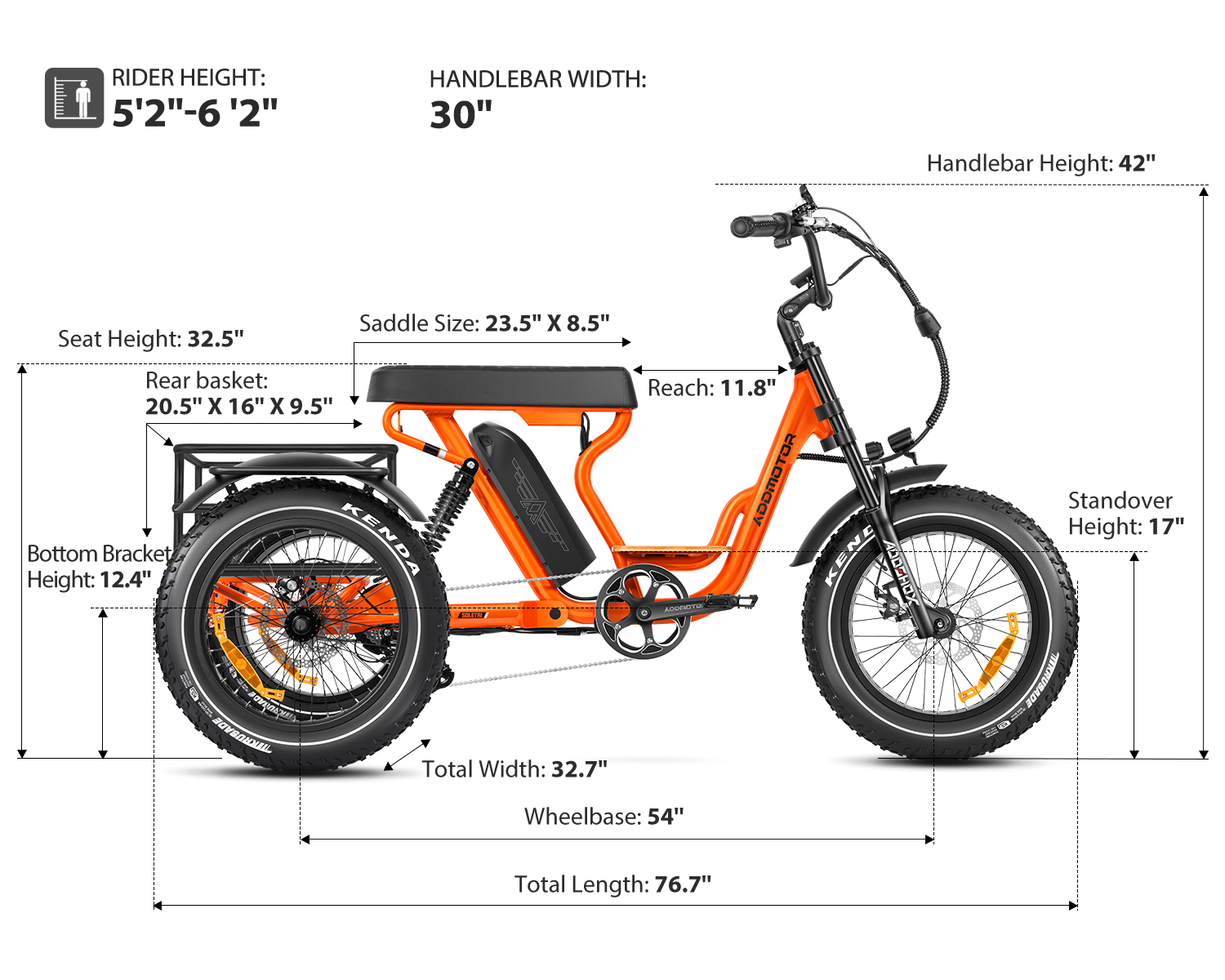
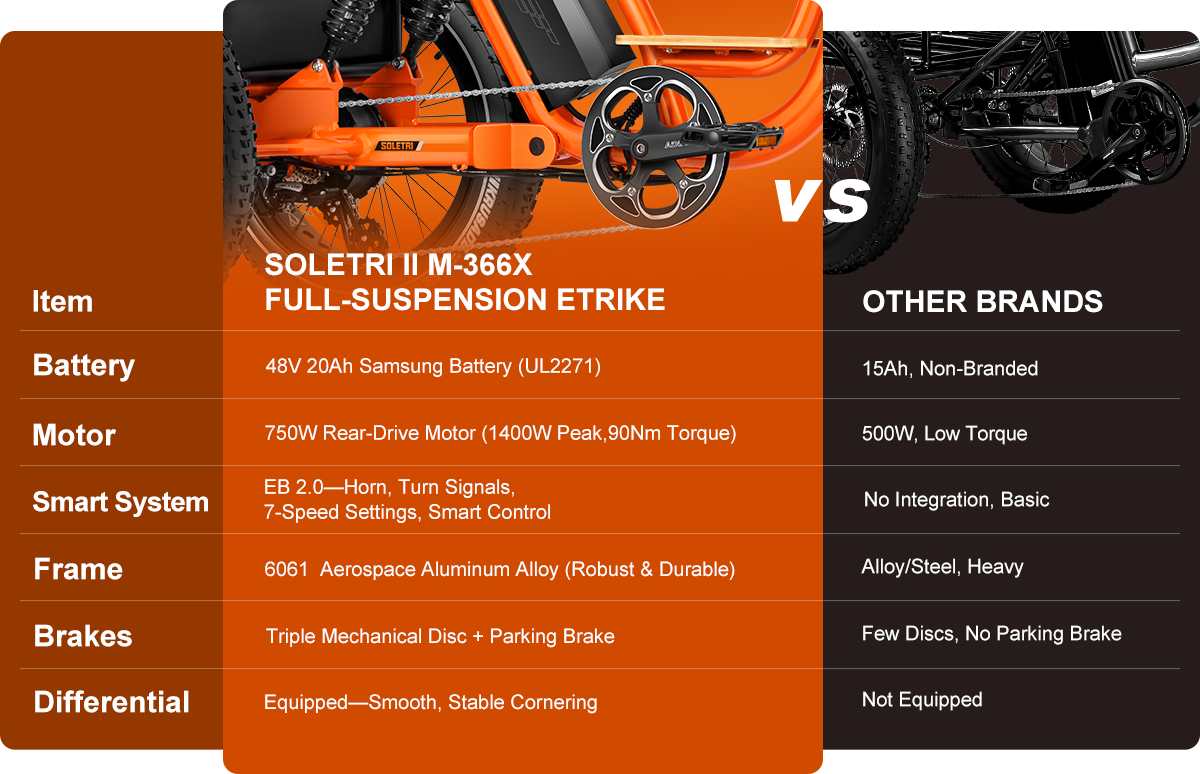
Share:
Bike Shops in Concord CA: 1 Verified eBike Store
Eunorau URUS 2.0 Review 2026: Range by Gear, $3,999