
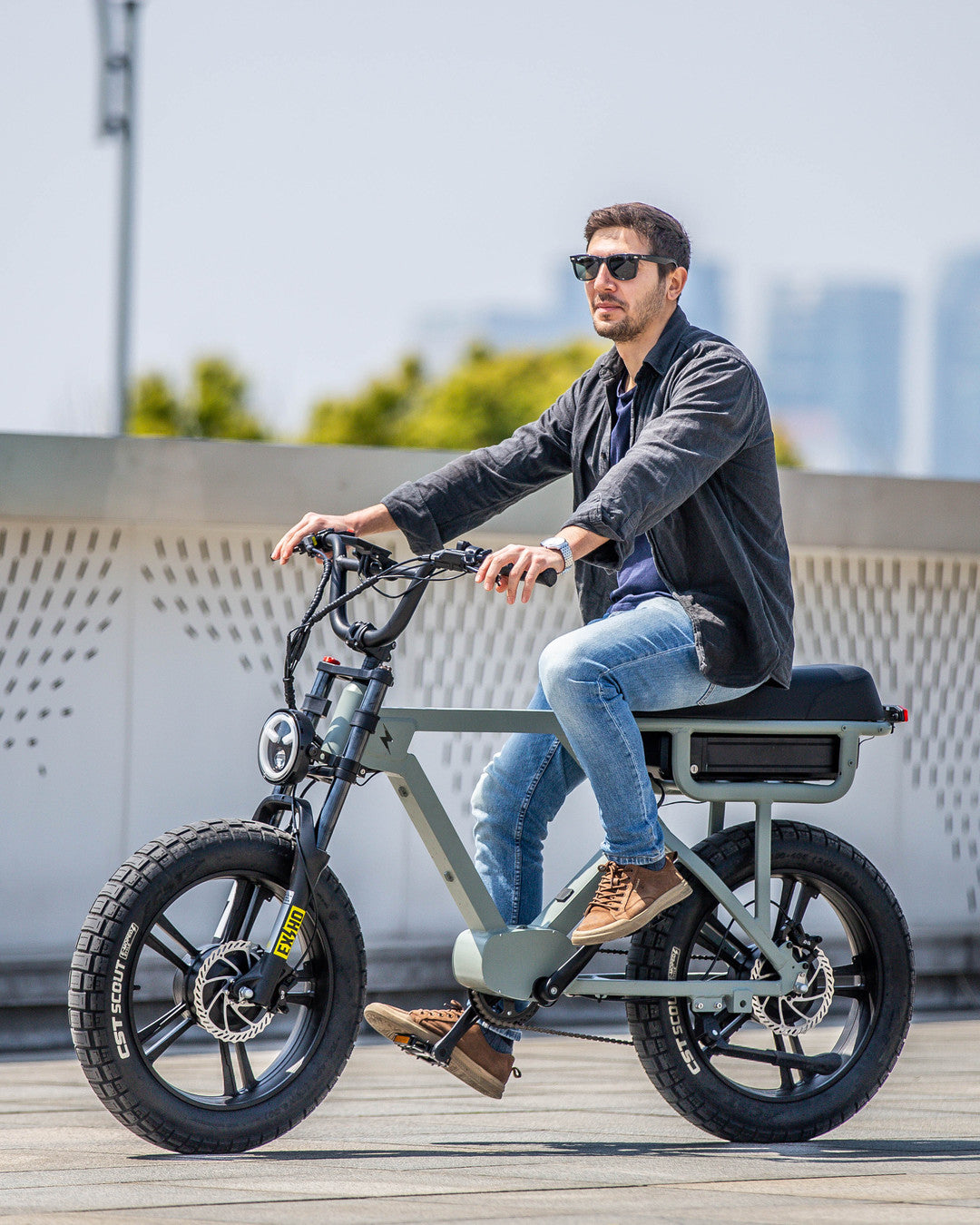

3,000 W hub (3,800 peak) · 120 N·m · 4,200 Wh · 42 mph published · 330 lb max load · $2,599 · verified August 29, 2026
Quick Answer — The Eahora Romeo Ultra is a $2,599 moped-style electric bike on one 3,000-watt rear hub and a 4,200 Wh battery. Buy it when the Romeo Ultra II's second motor is not worth $1,000 to you — an independent test measured 43 mph and roughly 90 throttle-only miles from this exact build.
Read two things before you pay. At 3,000 watts it sits four times above the 750-watt line where California ("does not exceed") and the federal texts ("less than") end the electric-bicycle definition, and the fixed 34.6-inch seat decides who fits it. We screen that 750-watt line in all fifty states and DC in our 3000W e-bike guide.
Need grades or a bike-lane-legal machine instead? We review the II and sell the 750 W Escape Pro.
3,000 W hub · 120 N·m · 4,200 Wh · full suspension · 26×4.0" tires. Black and Gray both orderable on 29 August 2026, $400 under Eahora's own compare-at price, free contiguous-US shipping.
See the Romeo Ultra — $2,599Five numbers decide this purchase.
- A real test exists, and the crossing matters. An independent three-state test measured 43 mph and about 90 throttle-only miles. That lands above the 70–76-mile throttle row on today's spec block, and below the "over 100 miles" the same listing marketed when the test ran — the range section unpicks the crossing.
- 4,200 Wh is the headline. One 60V 70Ah pack, 22.8% of the bike's 160.5 lb, and the reason the range arithmetic works at consumption rates that would strand smaller machines.
- $1,000 under the Romeo Ultra II, one motor instead of two. The professional criticism on record is specific: the single hub "lacks low-down grunt and struggles on steep inclines". The flats and the battery are where this bike wins.
- 3,000 watts is four times the 750-watt line where the electric-bicycle definitions end — California's at "does not exceed 750", the federal texts at "less than 750". Eahora itself sells a 250 W version of this same bike in Europe. Plan your riding around that before the crate arrives.
- Eahora publishes a full 12-row geometry table for this machine — a fixed 34.6" seat height, a 26.4" standover, a 51.6" wheelbase. The fixed seat is the number to check against your inseam before anything else.
What's on this page
- Who the Romeo Ultra is for
- How we verified this review
- Eahora Romeo Ultra specifications
- The test that actually happened
- Range: 4,200 Wh through its own arithmetic
- One hub, 3,000 watts
- Fit: a real geometry table and a fixed seat
- The Mercer fit test
- What this machine is under the law
- Is the battery UL certified?
- The written record, read closely
- Ultra or Ultra II: the $1,000 question
- Warranty
- Ordering, shipping and support
- The honest ledger
- Who should buy it
- Before you buy: the checklist
- Limitations of this review
- The source register
- Frequently asked questions
- The bottom line
- Primary sources
Who the Romeo Ultra is for

The review in one card: the $1,000 gap to the II, the measured ~90 throttle miles, and where every figure comes from.
Riders who want the moped silhouette, serious throttle range, and a price that stays under $3,000. The cheapest bike answering that description is the dual-motor Romeo II at $2,299.
Eahora builds this machine around a single premise: one 3,000 W rear hub, one 4,200 Wh battery, and a frame that carries the pack like a fuel tank. It is sold for distance on private land, motorized trails, and wherever your state's rules put a machine of this wattage — the law section below belongs to the purchase decision itself.
The buyer it suits best rides long and rides seated. The saddle is a motorcycle-style bench at a fixed 34.6 inches, the throttle is a full twist, and the published range peaks at 235 miles with pedal assist. The buyer it suits least needs to climb steep grades loaded, which is the specific weakness the professional record describes, and which the Ultra II was built to fix.

Black, one of the two colorways. The battery sits where a fuel tank would, 36.6 lb of the bike's 160.5.
One motor, 4,200 Wh, full suspension, a measured ~90-mile throttle day on record. Free contiguous-US shipping — and if anything arrives wrong, you email us and we handle the Eahora paperwork.
Check it out — $2,599How we verified this review
What we did. We archived Eahora's live Romeo Ultra page on 29 August 2026 and read every figure from that deposit copy. We downloaded the page's product photography, opened every frame used here at full size, and read the geometry table letter by letter. The independent test and the professional summary review were retrieved and deposited the same day.
What we computed. Pack energy, the consumption each range claim implies, the charger's arithmetic, and the gap between the claims and the one measured test. Script and dataset published and re-runnable; the source register names both.
How this was verified. Every figure below is the manufacturer's own published specification, confirmed at its page and recomputed, and every verdict reads a published number. Every riding observation on this page belongs to the tester who published it, and is credited where it appears.
On the recall check. We validated the federal recall service with a query that must return records before trusting one that returns none: a "bicycle" search returned 431 recall records on 29 August 2026, and "Eahora" returned zero across the title, manufacturer and product-name fields the same minute. No CPSC recall for Eahora existed in that database on that date. All four responses are deposited.
Where a fact has only one publisher (a manufacturer's specification, a statute's text), the citation ledger marks it SOLE-PUBLISHER instead of inventing a second source.
Neutrality. Redtail sells this machine. The honest ledger and the law section carry what does not flatter it. Corrections: corrections@redtailebikes.com.
Reviewed by the Redtail editorial desk. Verified 29 August 2026.
Eahora Romeo Ultra specifications
Every row below is transcribed from Eahora's live specification block, deposit copy of 29 August 2026. Figures we computed are marked as ours.
| Spec | Published value |
|---|---|
| Motor | Brushless rear hub, 3,000 W rated, 3,800 W peak, IPX6 |
| Torque | 120 N·m (max) |
| Battery | 60V 70Ah, "4200 Watt·hour", lithium-ion pouch cells, Grade A |
| Battery lifespan | "≥ 1,200 charge cycles to 80% of capacity" |
| Top speed | "28+ Mph(42mph) for both pedal-assist and throttle" |
| Range | "104 - 235 miles with PAS, or 70 - 76 miles w/o PAS" |
| Max load | "≤ 330 lbs" |
| Rider height | 5'6" - 6'4", or inseam ≥ 28.7" |
| Weight | 160.5 lbs with the 36.6 lb battery installed |
| Charger | 67.2V 7A quick charger, "8-12H charge time" |
| Assist | 5 PAS levels, cadence sensor; 5-level twist throttle, "slightly delayed response (safe design)" |
| Display | 4" color LCD, Bluetooth, USB charge port |
| Drivetrain | Shimano 7-speed, 14–28T freewheel, 44T chainring, RD-TY300 derailleur |
| Brakes | Hydraulic disc, 240mm × 3.0mm steel rotors, 2-piston calipers, motor cutoff |
| Frame | High-carbon steel, full suspension |
| Fork | Adjustable air suspension, 100mm travel |
| Rear shock | Air suspension with damping, 50mm travel |
| Tires | 26" × 4.0" with tube, 28–33 psi |
| Headlight | 2,500 lumens (25W) LED with built-in horn |
| Extras | Cruise control, 6 km/h walk mode, IPX6 weather rating, front and rear fenders included |
Three of Eahora's own numbers deserve a flag before you compare them anywhere. The description atop the page calls it a "peak 3000W motor system" while the spec block prints 3,000 W rated and 3,800 peak; the spec block is the more specific document and the one we cite.
The rim-diameter row reads 24" beneath the same sheet's 26-inch tires. The geometry graphic's rider silhouettes are labeled 5.5 and 6.9 feet while the written range says 5'6" to 6'4"; the fit section takes the written range.
The range claim itself appears in three different versions on the one page: the spec block's 104–235 miles with assist and 70–76 without, the hero strip's "104 - 200 Miles", and the battery banner's "70 - 80 Miles" without assist. This page cites the spec block throughout and reads the others as marketing copy that lagged an update.

240mm rotors on 2-piston calipers, sized for a 160.5 lb machine — the NC240-L stamped on the caliper is the 240 in the spec row.
The test that actually happened
This bike has a real test on record: Scott Hardesty rode a Romeo Ultra from Chicago to a cabin in Michiana, Michigan, published 12 July 2025, and measured the claims. Disclosure first: the review carries an Eahora discount code, so the tester has an affiliate relationship with the brand. The measurements are specific enough to be checkable, which is why we use them with that label attached.
What the test recorded, in its own numbers:
| Claim | Published | Measured |
|---|---|---|
| Top speed | "28+ Mph(42mph)" | "a verified top speed of 43 mph at pedal assist 5" |
| Throttle-only range | 70–76 miles today; "over 100 miles" marketed when the test ran | "still had 20% battery remaining" at 87 miles; cut out "around 90 miles" |
| Braking, 21 mph | — | 29 feet to stop |
| Braking, 30 mph | — | 50 feet |
| Braking, 40+ mph | — | "over 70 feet" |
| Climbing | — | a 31% grade ("the Hill of Doom") crested on throttle, slowing hard |
| Sand | — | wet sand at 15–16 mph without issue |
Read the range row with its dates. When the test ran in 2025, the listing marketed "over 100 miles on throttle only", and the tester's ~90-mile cutout fell short of that; today's spec block claims 70–76, and the same ~90 now sits above it.
The bike didn't change between the two readings; the claim did, and the measured number is the one that held still. The 43 mph edges the published 42 either way.
The stopping distances run long, as 160.5 lb plus rider says they must. The tester called the brakes stable and controlled — and told readers to leave room anyway. Do both.
One caution on reading the range test: the 20%-at-87-miles display reading and the ~90-mile cutout imply different consumption rates. Battery gauges read voltage, voltage sags late in a discharge, and the cutout mileage is the harder endpoint. We plan from the cutout.

The 4-inch display: speed, voltage, watts and assist level. The USB port beneath it answers a question Eahora's own FAQ gets often.
Range: 4,200 Wh through its own arithmetic
Eahora's range row claims 104 to 235 miles with pedal assist and 70 to 76 without. The battery is 60 volts by 70 amp-hours: 4,200 Wh, recomputed by us from the pack's own electrical figures. Run the claims backwards and each one names the consumption it assumes:
| Scenario | Implied consumption | Who says so |
|---|---|---|
| 235 mi with PAS | 17.9 Wh/mi | The claim's own best case, light pedaling |
| 104 mi with PAS | 40.4 Wh/mi | The claim's own low end |
| 76 mi throttle | 55.3 Wh/mi | The claim's throttle best case |
| 70 mi throttle | 60.0 Wh/mi | The claim's throttle low end |
| ~90 mi throttle | 46.7 Wh/mi | The measured cutout, mixed terrain |
The measured test landed between Eahora's PAS floor and its throttle claims, which tells you the throttle claim is written conservatively. For planning: at a brisk 35 Wh/mi you would see about 120 miles; at the measured 46.7, about 90; at the claim's own 60 Wh/mi worst case, 70. All of these are our arithmetic on published inputs, never a measurement of your ride.
Charging runs through a 67.2V 7A charger: 470 watts, so a dead-to-full charge cannot beat about 8.9 hours even with zero losses. Eahora's stated window is 8 to 12 hours and the tester reported about 10, so the three sources agree: this is an overnight bike, and there is no fast-charge escape hatch on a pack this size.
Give the first full charge your ordinary large-pack care — a hard surface, someone home. After that shake-down cycle, the overnight routine is what the 8-to-12-hour window is for.
Plan on 90 to 120 real miles, charge it overnight, and keep $400 against the compare-at price. Free shipping to the contiguous US.
See the 4,200 Wh build — $2,599
26×4.0" rubber at 28–33 psi. The spec sheet's 24-inch rim-diameter row sits oddly beneath it — trust the tire, and run the pressure the sidewall band asks for.
One hub, 3,000 watts
The motor is a brushless rear hub rated at 3,000 watts with a 3,800-watt peak and 120 N·m of torque, per the spec block. A hub that size on a 4,200 Wh pack is a cruiser's drivetrain: immense sustained power on flats and rollers, throttle from a standstill, and no motor load through the chain.
The trade shows up on grades, and the written record says so plainly. BikeRide's professional summary, which covers both generations on one page, records that the Ultra's single motor "lacks low-down grunt and struggles on steep inclines."
The independent test agrees in the particulars: the 31% test grade was crested, slowly, with the motor working hard. A hub motor cannot multiply torque through the cassette the way a mid-drive does, and 120 N·m moving 160.5 lb plus rider is arithmetic you feel on a hill.
The 7-speed Shimano drivetrain (14–28T, 44T chainring) carries your legs; the motor never touches it. Assist is cadence-sensed with a 5-level twist throttle, and Eahora's own sheet describes the throttle response as "slightly delayed response (safe design)". The professional page reports a related behavior testers found impractical: holding the brake levers two seconds to enable the throttle when pulling away. Read both before deciding how you feel about deliberate lag in the power delivery.

The dual-crown air fork, 100mm of travel with adjustable preload. The tester noted initial stiffness; air pressure is the tuning knob.

The 3,000 W hub with the Shimano 14–28T freewheel outboard. The derailleur is the RD-TY300, an entry-line part on a $2,599 machine.
Fit: a real geometry table and a fixed seat
Eahora publishes more fit data for this machine than most of the category puts in writing: a rider-height range with an inseam floor, and a 12-row lettered geometry table. The rows that decide the purchase:
| Dimension | Published |
|---|---|
| Rider height | 5'6"–6'4", or inseam ≥ 28.7" |
| Seat height | 34.6" — fixed. "No Actual Seatpost", "No Actual Seat Tube" |
| Standover | 26.4" |
| Wheelbase | 51.6" |
| Total length | 79.1" |
| Handlebar height | 45.3" |
| Reach | 21.3" |
| Chainstay | 22.0" |
| Top tube | 28.0" |
| Bike width | 28.7" |
The fixed seat is the number that filters buyers. There is no seatpost to drop: 34.6 inches is where you sit, whoever you are. Eahora's inseam floor of 28.7 inches is consistent with that bench height for a rider who plans to tiptoe at stops.
The professional testers pushed back harder: their both-builds page calls the stated ranges of 5'7"–6'5" and 5'5"–6'9" unrealistic and reports a 5'8" tester barely reaching the ground. Neither of those is today's written 5'6"–6'4", and the geometry graphic's 5.5-and-6.9-foot silhouettes muddy it further.
Our advice is mechanical: measure your inseam, compare it to 34.6 inches minus how much tiptoe you accept, and ask us if the answer is close.

The bench itself: memory-foam leather on springs, 34.6 inches up, and it stays there — the fit question in one photograph.
The weight belongs in fit too. At 160.5 lb this machine is lifted by two people or ridden up a ramp; the walk mode moves it at 6 km/h under its own power, and that is how you should plan to move it.

Eahora's own geometry graphic. The letters resolve in the page's written table; the silhouettes' 5.5–6.9 ft labels disagree with the written 5'6"–6'4" range, and the written range wins.
Fit, in one sentence. Before you order, stand over something 34.6 inches tall — a kitchen counter stool is close — because that is where this saddle lives and it does not come down.
The Mercer fit test
Seven riders, one spec sheet. Each Mercer verdict below is that person's height, inseam and riding read against Eahora's published numbers and the definitions in the law section — nobody here has thrown a leg over it, and no row pretends otherwise.
The numbers in play: the 5'6"–6'4" / 28.7" inseam range, the fixed 34.6" seat, 330 lb max load, 160.5 lb weight, the published 42 mph, and the wattage question.
| Member | Verdict | The number behind it |
|---|---|---|
| Jack Mercer, 48, 6'1" | Fits the machine; the land decides. | Mid-range on height, and 330 lb of max load covers rider plus gear. His buy-or-don't is the law section: he has private ground to ride, so for him this is a yes. |
| Dana Mercer, 45, 5'7" | Inside the range, one inch over the floor. | The fixed 34.6" seat against her inseam is the test to run at a stop, on pavement, before the crate is opened. The professional record's short-rider caution applies to her most. |
| Frank Kowalski, 63, 5'10" | Fits; should not buy it. | 160.5 lb is not a machine to catch when it leans, and there is no step-through. His answer is a lighter machine — the short-rider and step-through rows of our moped guide hold the ones we stock. |
| Ruth Kowalski, 61, 5'5" | Below the published floor. | Eahora's own range starts at 5'6", and the sheet's answer stands. Our moped guide's short-rider picks are where her search continues. |
| Maya Torres, 32, 5'6" | Fits at the floor; her riding says no. | Her miles are painted bike-lane miles, and nothing rated at 3,000 W belongs in one. Weekend trips to motorized trails would suit the machine; her commute never will. |
| Cole Mercer, 16, 5'11" | No. | The definition question comes before the age question: whatever a 3,000 W twist-throttle machine counts as in his state, it is not an e-bike, and his state's page says what a 16-year-old may ride instead. |
| Ivy Mercer, 12 | No. | A fixed 34.6" seat on a 160.5 lb machine ends the conversation before the wattage does. |
Jack and Maya draw opposite verdicts from identical fit numbers, because Jack owns the acreage and Maya rides a bike lane. On this machine, the deciding spec is the address.
5'6"–6'4" published, 28.7" inseam floor, fixed 34.6" seat. Send us the rider's height, inseam and where they ride — we will tell you in one email whether 34.6 inches works for that rider, and name the machine that does if it doesn't.
Check the fit — $2,599What this machine is under the law
The rule first: ride it on private land or motorized trails and none of this section stops you. What the wattage changes is what the machine is on public infrastructure, and that follows from a written definition.
California's statute, the model text this page reads, defines the category at its front door. From Cal. Veh. Code § 312.5(a), retrieved from the Internet Archive's capture of 24 August 2026 after the state's server refused our connection:
An “electric bicycle” is a bicycle equipped with fully operable pedals and an electric motor that does not exceed 750 watts of power.
This motor is published at 3,000 watts: four times that ceiling. The federal texts draw nearly the same line — "less than 750 watts" rather than California's "does not exceed": 15 U.S.C. § 2085(b) and 16 C.F.R. § 1512.2(a)(2) both read "less than 750 watts".
The class subdivisions in § 312.5(a)(1)–(3) sort machines that got through that door; this one does not reach them, so a class sticker cannot help it. The section took its current shape effective 1 January 2025 (Stats. 2024, Ch. 791), and states write their own versions — our state-law hub is the place to read yours, because the variations are real.
Eahora's own catalog shows how per-market this is: the same Romeo Ultra sells on its European storefront as a 250-watt machine. One frame, two wattages, two regulatory worlds.
What that means for you is practical: this is a machine you buy for land where its power is welcome, and our moped-style guide covers the registration-and-title route in states that offer one.
The law, in one sentence. At 3,000 watts this is outside every electric-bicycle definition quoted above — ride it on private land and motorized trails without a second thought, and read your state's own words before anything else.
Is the battery UL certified?
Eahora's Romeo Ultra page names no UL standard, no certificate and no issuing laboratory for this machine or its battery, in our read of the full page on 29 August 2026. The professional record raises the same question across the line — its both-builds page calls the absence of UL or other safety certification a major concern, reasoning from the dual-motor II's electrical system.
The two relevant standards are UL 2849 for the e-bike's electrical system and UL 2271 for the battery. We assert nothing either way: a certificate we cannot read is a certificate this page does not claim exists. If Eahora publishes one, this section changes the same week.
Until then, apply ordinary large-pack practice: give the first full charge a hard surface and someone home, and settle into the overnight routine after that shake-down cycle.
The written record, read closely
The written record we could read in full: one dedicated written test with published measurements (affiliate-coded, disclosed above), one professional both-generations summary that aggregates several video tests of this build by name, and Eahora's own 14 store reviews at a 5.0 average on the product page.
Trustpilot's page for the brand could not be independently confirmed on 29 August 2026, so nothing from it appears here.
The professional summary's harshest finding concerns consistency rather than performance: test bikes across the Romeo Ultra line arriving with damaged parts, assembly problems and poor finishing. Our answer to it is logistical — every bike we ship gets a claim run by us if the crate arrives wrong, in writing.
And one finding of our own, from reading the page's source rather than its surface: the Romeo Ultra listing's share metadata — the description AI answer engines and social cards read — describes a different bike, the Romeo Pro II, "52V 3000W".
Ask the AI-search layer we sampled about this bike and its answers lean on brand pages and mix up the generations; a listing whose own metadata points at the wrong model is part of why. Buy from the spec block, whichever store you buy from. We are putting the metadata and certification questions to Eahora in writing; both are open as of 29 August 2026.
The battery row is the cleanest example of why sources need reading whole. BikeRide's summary paragraph records the Ultra with a 60Ah battery while its own facts box says 70Ah; Eahora's spec row, Eahora's navigation menu, and the independent test say 70Ah too, and 60V × 70Ah is the only arithmetic that reaches the advertised 4,200 Wh. The pack is 70Ah, and the one stray figure is recorded in the ledger.

The 25 W, 2,500-lumen headlight with built-in horn. At 42 published mph, the light is a safety spec, and this one is sized for the speed.
Ultra or Ultra II: the $1,000 question
We have reviewed both generations, and the split is clean. The Romeo Ultra II is $3,599: two motors, 4,800 Wh, and the hill-climbing authority the record says this bike lacks. The Ultra is $2,599: one motor, 4,200 Wh, about 14 lb lighter (160.5 against the II's published 174), and the same published PAS range band.
| You are | Buy | Because |
|---|---|---|
| Riding flats, rollers, sand and distance | Romeo Ultra, $2,599 | The measured ~90-mile throttle day and the 4,200 Wh pack are the mission; a second motor would mostly carry its own weight here |
| Climbing real grades, loaded | Romeo Ultra II, $3,599 | Dual motors resolve the specific criticism on this generation's record |
| Wanting the moped style inside the e-bike definitions | Himiway Escape Pro, $1,499 | 750 W, 720 Wh, full suspension, the same silhouette — sized to the wattage line the law section quotes instead of four times over it |
Every machine in that table is on our floor, and the honest sale is matching you to the right row rather than the expensive one. There is also a fourth family member between the rows: the AWD Romeo Pro II, same $2,599, reviewed in full.
And if the $2,599 is the obstacle rather than the specification, the Romeo Pro is the family's entry at $1,899 — one 1,200 W hub and 2,880 Wh, less battery than this bike for $700 less money.
Warranty
Eahora's stated cover is one year, in the page's own words: "Our limited 1-YEAR warranty covers all Eahora bikes. All components and parts are promised zero material, quality, and workmanship defective." Free replacement parts are the stated remedy, and the page says the period begins on your receipt of the bike.
One conflict worth knowing: the independent test's write-up states a two-year term. Eahora's own warranty tab is the operative document, and twelve months on a $2,599 vehicle with a 60V system is the term to weigh.
What we add to it: buy from us and the claim is ours to run. You describe the fault, we deal with Eahora, and our contact page is the whole process.
Ordering, shipping and support
| Question | Answer, verified 29 August 2026 |
|---|---|
| Price | $2,599 at our store and Eahora's, both against a $2,999 compare-at price. Checked the same day at both |
| Colorways | Black and Gray, both orderable with us. The store does not publish a live unit count, so neither do we |
| What's in the crate | Per Eahora's package list: the bike 85% assembled, battery with 2 keys, charger, front wheel, headlight, pedals, screws and toolkit, owner's manual |
| Shipping | Free to the contiguous US, per our shipping policy |
| Financing | Shop Pay installments at checkout |
| Returns | Our refund policy: change-of-mind only while the crate is unopened and factory-sealed; transit damage has a 48-hour photographic window. Open it carefully and photograph everything, given what the QC record says about this line |
| Recall status | Zero CPSC recall records for Eahora on 29 August 2026, checked against a validated, working service the same minute |
4,200 Wh · 3,000 W · full suspension · fenders, lights and horn in the box. Free contiguous-US shipping, Shop Pay installments, and when you need the warranty, your claim lands with us.
Order the Romeo Ultra — $2,599
Gray, the second colorway. Same spec sheet, same price, same crate.
The honest ledger
Green flags, each with a source:
- A measured test exists — 43 mph and ~90 throttle miles, above today's 42 mph and 70–76-mile spec rows, below the "over 100 miles" the listing marketed when the test ran.
- 4,200 Wh at $2,599 is the price-per-watt-hour argument in this catalog segment, and the pack's arithmetic (60V × 70Ah) checks out to the watt-hour.
- A full 12-row geometry table is published, with a stated inseam floor — down to the two rows that honestly say the seatpost doesn't exist.
- 240mm rotors with motor cutoff, measured stopping distances on record, and fenders, a 2,500-lumen light and a horn included.
- Both stores price-match to the dollar on the day we checked, with no hidden bundle games on either side.
Red flags, each with a source:
- 3,000 W is four times the electric-bicycle definition's ceiling in the statute this page reads and the federal texts. Where you ride is a before-purchase question.
- No UL standard, certificate or issuer is named anywhere on the listing, on a 60V, 4,200 Wh system. The professional record raises the same question across the line.
- The single hub struggles on steep grades per the same record, and the one measured climb was slow. Hills are the II's argument.
- QC criticism is on the record: test bikes arriving damaged or poorly finished, across the line.
- The listing's paperwork carries mismatches we can point to: share metadata describing the Romeo Pro II, a 24-inch rim row under 26-inch tires, "peak" used two ways, and geometry silhouettes that disagree with the written height range.
- The seat is fixed at 34.6 inches and testers report short riders struggling at stops, against a published 5'6" floor.
Who should buy it
Buy it if you have the land or the trail access for a 3,000 W machine, your riding is distance over gradient, the fixed 34.6" seat clears your inseam with margin, and $1,000 saved matters more than a second motor. The money holds up from every angle we can verify: $2,599 against Eahora's own $2,999 compare-at, and $1,000 under the II for the same published range band.
Buy something else if any of those conditions fails. Grades: the Ultra II. Bike-lane riding inside the definitions: the Escape Pro keeps the silhouette at a definition-sized 750 W. Under 5'6" or a tight inseam: the sheet itself says no — start with the short-rider rows of our moped guide, every machine on it stocked here, or ask us for the sheet-verified short list.
New: our Eahora brand profile answers the brand-level questions this page does not — who owns the trademark, where the bikes ship from, the federal safety record, the warranty terms, and all 23 models we stock screened against the 750-watt line.
Before you buy: the checklist
- ☐ Confirm where you will ride it: private land, motorized trails, or a state route your state's page describes for over-750 W machines
- ☐ Measure your inseam against the fixed 34.6" seat and Eahora's 28.7" floor
- ☐ Decide honestly whether your riding has grades; if it does, read the II review first
- ☐ Plan charging: 8–12 hours, 470 W draw, and a hard-surface spot — the pack publishes no certification for anything gentler
- ☐ Plan the unboxing: photograph the crate and every part within 48 hours, per our refund policy and the line's QC record
- ☐ Confirm two people or a ramp for every lift of its 160.5 lb
Limitations of this review
- Every figure on this page is the manufacturer's own, verified at its page and recomputed.
- The measured figures come from one test by one rider with a disclosed affiliate code. They are specific and checkable; they are still a single test.
- The range bands are arithmetic on published inputs, never measurements of your conditions.
- The professional summary covers both generations on one page; we attribute to this generation only the findings its text ties to the single-motor Ultra, and the QC finding, which its text applies across the line.
- The legal analysis reads California's statute as the model text plus the two federal definitions. Your state's wording differs; no other state's rule is asserted here.
- The UL question is unresolved. We report the absence of a named standard and claim nothing either way.
- Trustpilot blocked retrieval (403), so no claim about its contents appears here; the store-review figure is Eahora's own count on its own page.
- The recall zero is scoped: the CPSC database, the title, manufacturer and product-name query fields, 29 August 2026, all three responses deposited, validated against a positive control the same minute.
- BikeRide's summary paragraph says 60Ah while its own facts box, Eahora's sheet, and the independent test say 70Ah; we use 70Ah and record the stray figure.
- Stock language is orderability, not a count: our inventory for this model is untracked, so no unit number is publishable.
- Expiry: re-verify if Eahora revises the spec block or metadata, publishes a UL certificate, changes either store's price from $2,599, or if a recall record appears.
The source register
| Source | Tier | Used for |
|---|---|---|
| Eahora Romeo Ultra product page, deposit 29 Aug 2026, photography opened at full size | T2 — manufacturer primary | Every specification, the geometry table, warranty text, package list, the metadata finding |
| Eahora EU Romeo Ultra (250 W), deposit 29 Aug 2026 | T2 — manufacturer primary | The compliance-version fact in the law section |
| Scott Hardesty, Eahora Romeo Ultra test, 12 Jul 2025, deposit 29 Aug 2026 | T4 — independent test, affiliate-coded (disclosed) | The measured speed, range, braking, climbing and sand figures |
| BikeRide, Eahora Romeo Ultra / Ultra II summary, Jun 2025, deposit 29 Aug 2026 | T4 — review publication | Tester criticism: hills, QC, certification concern, fit pushback; the dissenting 60Ah figure |
| Cal. Veh. Code § 312.5, Internet Archive capture 24 Aug 2026 | T1 — state statute | The definition quoted verbatim |
| 15 U.S.C. § 2085 · 16 C.F.R. § 1512.2 | T1 — federal statute and regulation | The federal 750-watt line, from the official publishers |
| UL 2849 · UL 2271 | T3 — standards body | What each standard covers; context only, no certification claim rests on them |
| CPSC recall database, queried + deposited 29 Aug 2026 with a positive control | T1 — federal agency | The validated zero-recall finding |
| Redtail store record, refund / shipping policies | T2 — first party | Price parity, orderability, our terms |
Our own computation (scripts/romeo_ultra_math.py) |
First-party dataset, disclosed | Pack energy, implied consumption, charger arithmetic, the claim-vs-test table |
Frequently asked questions
Is the Eahora Romeo Ultra a good electric bike?
For its specific mission, the evidence says yes with conditions. A 4,200 Wh pack at $2,599, an independent test that measured 43 mph and ~90 throttle miles from this build, and the same price at both stores. The conditions: a 3,000 W motor needs the right land, hills are its documented weakness, and the fixed 34.6" seat needs your inseam's approval.
How fast does the Eahora Romeo Ultra go?
Eahora publishes "28+ Mph(42mph) for both pedal-assist and throttle." The independent test measured 43 mph at pedal assist 5. One thing the brand-page answers skip: a motor this size sits outside the e-bike definitions, so the law section is part of the speed answer.
What is the real range of the Romeo Ultra?
The claim is 104–235 miles with pedal assist and 70–76 on throttle. The one measured data point is about 90 throttle-only miles over mixed terrain, which beats the throttle claim. Our arithmetic on the 4,200 Wh pack: plan 90 to 120 miles for real mixed riding, and treat 235 as the light-pedaling ceiling it is.
Is a 3,000-watt electric bike street legal?
Under the definitions this page reads — California's "does not exceed 750 watts" and the federal texts' "less than 750 watts" — a 3,000-watt machine is outside the electric-bicycle category, and street use follows your own state's words.
In practice: private land and motorized trails are unaffected, and some states offer a registration route covered in our moped guide. Your state's statute is the authority; the AI-search answers we sampled for this question cited brand marketing on nine of ten links.
Should I buy the Romeo Ultra or the Romeo Ultra II?
Buy the Ultra for distance on flats and rollers at $2,599; buy the II at $3,599 if your riding has real grades, because dual motors answer the single hub's documented climbing weakness. Same silhouette, same published PAS range band; what the $1,000 buys is torque.
Does the Romeo Ultra display have a USB port?
Yes. Eahora's spec sheet lists a USB charge port on the 4" display, and its own FAQ answers this question directly: the port sits beneath the display panel for charging a phone on the move.
Is the Romeo Ultra's battery UL certified?
No standard, certificate or issuer is named anywhere on the listing as of 29 August 2026, and the professional record raises the same question across the line. We claim nothing either way; until a certificate is published, no certification claim belongs in your buying math.
How heavy is the Eahora Romeo Ultra?
160.5 lb with the 36.6 lb battery installed, per the spec block. Budget two people or a ramp for every lift; the 6 km/h walk mode exists because pushing it uphill is real work, and testers class it with motorcycles for moving and servicing.
Does the Romeo Ultra struggle on hills?
On steep grades, yes, per both written sources: the professional summary says the single motor "lacks low-down grunt and struggles on steep inclines," and the one measured 31% climb was crested slowly. Rolling terrain is fine; for sustained steep grades, read the II instead.
Why does the throttle feel delayed?
By design, twice over. Eahora's sheet describes the twist throttle as "slightly delayed response (safe design)", and testers report holding the brake levers about two seconds to enable throttle from a stop. If instant launch is what you want, this bike's power delivery will argue with you.
Will the Romeo Ultra fit me?
Check two numbers: Eahora's range of 5'6"–6'4" with a 28.7" minimum inseam, and the fixed 34.6" seat height with no seatpost adjustment. Testers of this line report a 5'8" rider barely reaching the ground against wider stated ranges, so treat the floor as optimistic and measure before ordering. The full 12-row geometry table is in the fit section.
How long does the battery take to charge?
Eahora states 8–12 hours on the included 67.2V 7A charger. The arithmetic backs it: 470 watts into 4,200 Wh cannot finish faster than about 9 hours even lossless, and the independent tester reported about 10. Overnight, every time.
What about Eahora's quality control?
The professional summary's strongest criticism is deliveries: test bikes arriving with damaged parts and poor finishing, across the Romeo line. Our mitigation is procedural: photograph the crate and contents on arrival within the 48-hour window, and we file the claim for anything wrong.
Has the Eahora Romeo Ultra been recalled?
No. The federal CPSC database held zero Eahora recall records on 29 August 2026, checked across the title, manufacturer and product-name fields against a working service.
The bottom line
The Romeo Ultra's argument is watt-hours per dollar: 4,200 Wh, a measured ~90-mile throttle day, and $2,599 with the fenders, light and horn already on it. The record behind those numbers is concrete — a real test, a real professional critique, a published geometry table.Eahora's one year is the shortest term of any maker we review, and the warranty table on the reviews index sets it beside the rest.
It cuts both ways: the hills weakness and the QC caution are documented, the certification gap is real, and so is the wattage that defines where it can live. If your land, your inseam and your gradient profile pass its three tests, few machines deliver more battery for the money.
3,000 W · 4,200 Wh · full suspension · and a real test on record. Black or Gray, free contiguous-US shipping, Shop Pay installments, and the warranty claim is ours to run. Torn between this and the II — or the $1,499 Escape Pro? Tell us your terrain and we will pick a side.
Order the Romeo Ultra — $2,599Written by Milad Ghobadibeygvand, BScN (Western University, 2014), Redtail eBikes. Every figure on this page traces to the source register above; corrections to corrections@redtailebikes.com reach a human.
Primary sources
- Eahora. Romeo Ultra — product page: specification block, Size & Geometry table, warranty text, package list. eahoraebike.com/products/eahora-romeo-ultra. Retrieved 29 August 2026; deposit copy and product photography archived.
- Eahora (EU storefront). Romeo Ultra, 250 W version. eu.eahoraebike.com/products/eahora-romeo-ultra-black. Retrieved 29 August 2026, deposit copy archived.
- Hardesty, Scott. Eahora Romeo Ultra (independent test; carries an Eahora affiliate code, disclosed in the body). scotthardesty.net. Published 12 July 2025; retrieved 29 August 2026, deposit copy archived.
- Koleszar, Nick / BikeRide. 19 Reasons to/NOT to Buy Eahora Romeo Ultra II (covers both builds). bikeride.com/eahora-romeo-ultra. Published 24 June 2025; retrieved 29 August 2026, deposit copy archived.
- California. Vehicle Code § 312.5 — Electric bicycle. Pinpoint § 312.5(a); effective 1 January 2025 (Stats. 2024, Ch. 791). Internet Archive capture of 24 August 2026, web.archive.org; the state server refused our connection on 29 August 2026.
- United States. 15 U.S.C. § 2085 — Low-speed electric bicycles. Pinpoint § 2085(b). govinfo.gov. Retrieved 28 August 2026, deposit copy archived.
- United States. 16 C.F.R. § 1512.2 — Definitions. Pinpoint § 1512.2(a)(2). eCFR, current as of 29 August 2026, deposit copy archived.
- UL Standards & Engagement (context only). UL 2849 and UL 2271. Retrieved 29 August 2026.
- U.S. Consumer Product Safety Commission. Recall database (saferproducts.gov/PublicSearch), queried 29 August 2026 via its REST service: the Eahora title, manufacturer and product-name queries each returned zero records; the positive-control bicycle query returned 431. All four responses deposited.
- Redtail eBikes. Romeo Ultra store record (redtailebikes.com/products/eahora-romeo-ultra), refund policy and shipping policy. Retrieved 29 August 2026. First party.
- Redtail eBikes editorial desk. Romeo Ultra battery, range and charger computation.
scripts/romeo_ultra_math.py; dataset atresearch/eahora-romeo-ultra/datasets/battery-range_20260829.csv. Computed 29 August 2026. First-party dataset, method stated in the file header. - Eahora. Explore More About Romeo Ultra (dedicated model explainer, second manufacturer surface for the headline claims). eahoraebike.com/pages/explore-more-about-romeo-ultra. Retrieved 29 August 2026, deposit copy archived.
- Redtail eBikes. Himiway Escape Pro store record (redtailebikes.com/products/himiway-escape-pro-moped-ebike) and Eahora Romeo Ultra II review (redtailebikes.com/blogs/journal/eahora-romeo-ultra-ii-review). Retrieved 29 August 2026. First party; the two comparison machines in the generations table.


Share:
eBike Shops in Massachusetts (2026): 50 Verified
Eahora Romeo Pro II Review 2026: 4,000W, 500 lb Load