


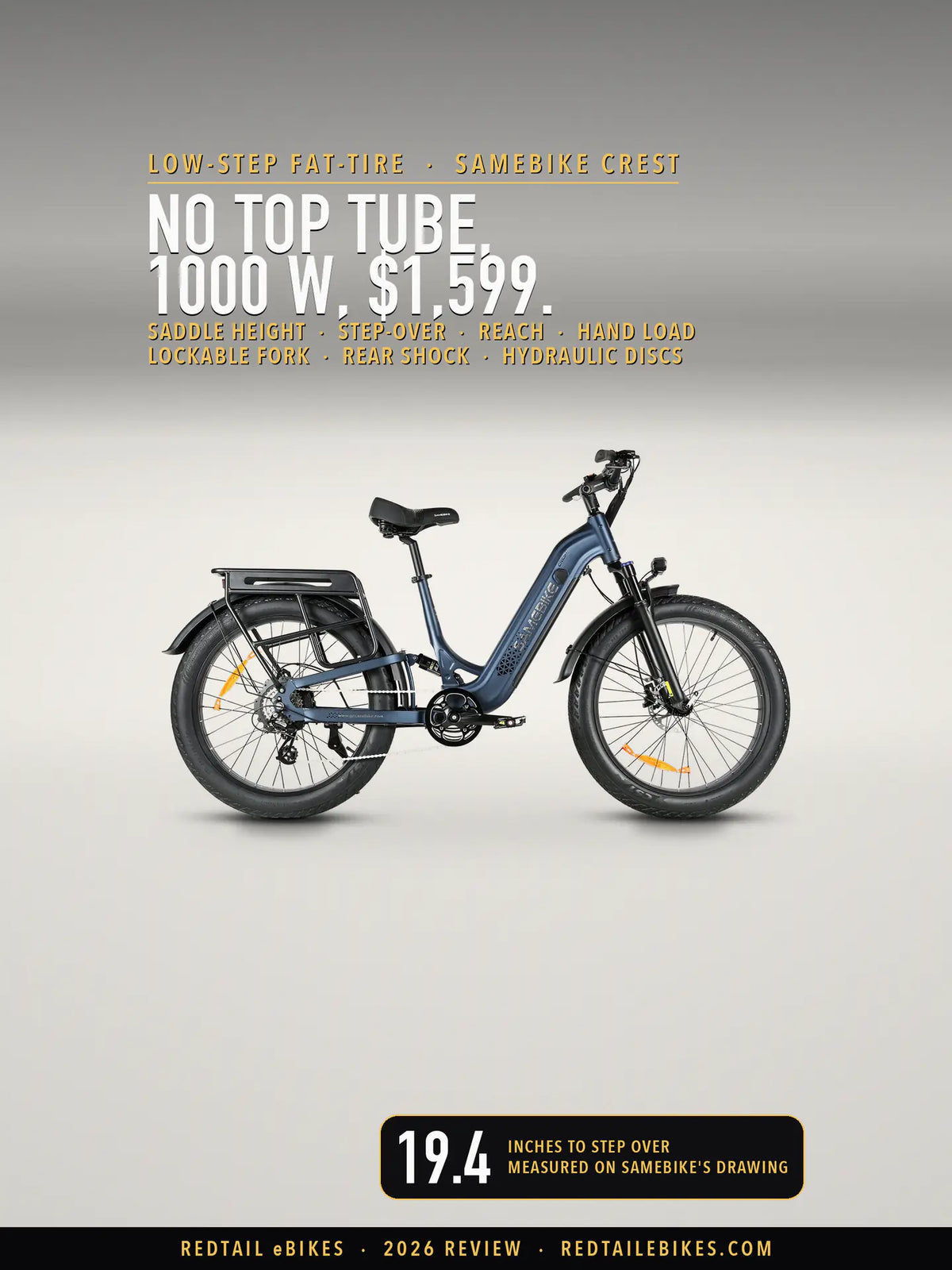

A low-step frame with no top tube · one 1000 W rear hub, 1800 W at peak · "High 70+Nm Torque" · 960 Wh from a removable 48 V 20 Ah pack · hydraulic discs, a lockable fork and a rear shock · Shimano 8-speed on 26 × 4.0 tires · $1,599 · verified September 29, 2026
Quick Answer — The Samebike CREST is a $1,599 low-step fat-tire e-bike with no top tube: a 1000 W rear hub motor (1800 W peak), a removable 960 Wh pack, a lockable fork, a rear shock and hydraulic discs. A 180 lb rider holding 15 mph on the throttle over level pavement gets a computed 54 miles per charge.
Pedal along at an easy 75 W and this review's model stretches the same charge to 83 miles; Samebike's specification table prints 160 km (99 miles) as the maximum. Measured on Samebike's drawing, the frame leaves 19.4 inches to step over, which every row of the step-over table clears, and the saddle table shows the post suiting riders from about 5'7" up.
Our price is $1,599, matching the listed price on Samebike's own US store on September 29, 2026, where $1,999 appears as the regular price. Black and White sell for the same money, and we ship it free anywhere in the contiguous United States.
Buy the CREST in NavyWhat this review covers
The specification · The low-step frame · Fit · Motor · Battery · Range · Brakes, lights and controls · Suspension and tires · Weight and load · The Mercer fit test · UL · Recalls · Class · Where to ride · Green and red flags · Verdict · Checklist · Buying from us · FAQ · Limitations · Bottom line · References
How we verified this Samebike CREST review
Every CREST figure here was read on September 29, 2026 from Samebike's US product page, with its specification table, stat strip, feature panels, size list, drawing and gallery, from the product record, the CREST user manual and our listing. Range and fit are computed from those inputs, and each section names where its numbers come from.
We checked each figure against Samebike's published specification and recomputed it, or cite it where it stands, so this is a specification-verified review. We also sell the CREST, so give its red flags the same attention as its green ones.
Written by Milad Ghobadibeygvand, BScN (Western University, 2014). Corrections: support@redtailebikes.com.
The CREST's specification, figure by figure
| Samebike's published figure | |
|---|---|
| Frame | High carbon steel, on the specification table and in the manual; a low-step frame with no top tube; "Foldable: No" |
| Motor | one hub motor, in the rear wheel: 1000 W with an 1800 W peak on the specification table; "High-performance 1000W (Peak 1800W)" on the motor panel; "Peak 1800w High Speed Motor" on gallery image 28 |
| Torque | "High 70+Nm Torque" under the US page's title; the thumb-throttle panel says it delivers "70+Nm of power" |
| Battery | 48 V 20 Ah, 960 Wh, removable: "REMOVABLE 48V 20AH LITHIUM-ION BATTERY" on gallery image 29; a "960Wh seat-integrated battery" on the battery panel |
| Charge time | 6–8 hours on the specification table, gallery image 29 and in the manual; the charger is rated 54.6 V, 3 A |
| Top speed | 50 km/h (31.1 mph) on the specification table, stat strip, motor panel and gallery image 28 |
| Range | 160 km "Max Range" on the specification table; 70–160 km on the stat strip; "UP TO 160KM Pas 1 Mode Range" and "over 75km range in mild electric mode" on the battery panel; 140–160 km on gallery image 29; 87–99 miles (140–160 km) pedal assist and 43–46 miles (50–55 km) pure electric in the manual |
| Climbing | "Max Angle of Climb 40 degrees" in the manual; "40° Max Gradient" on gallery image 28 |
| Assist | 5 pedal-assist levels; "3 RIDING MODES" (electric, assist and cycling) on gallery image 26 |
| Throttle | "Detachable throttle" on the specification table; a thumb throttle on its own panel; labeled below the left grip on gallery image 21 |
| Brakes | Hydraulic disc brakes, "front and rear 180mm" on the brake panel |
| Suspension | "Dual-shock front fork" on the specification table and "Fork&Shock" on the stat strip; the fork lockable on gallery image 27, with "100mm Distance traveled"; a rear shock with "30mm Distance traveled" |
| Gears | Shimano 8-speed |
| Tires | 26 × 4.0; CST on the sidewalls in Samebike's photographs |
| Display | "LCD display" on the specification table; "Colorful display" on its panel: speed, battery, distance and 5 pedal-assist levels |
| Lights, signals, horn and USB | LED headlight and tail light; turn signals on gallery images 19 and 21; electric horn; USB port, 5 V 1 A |
| Rack and fenders | an "Extended rear seat rack" on its panel; fenders front and rear in the photographs and the manual's fender step |
| Weight | 45 kg (99.2 lb) on the specification table; 99 lb on the drawing and gallery image 25; 99 lb (45 kg) in the manual |
| Load capacity | 150 kg (330 lb) on the specification table, stat strip, drawing, gallery image 25 and the manual's specification table; 120 kg (265 lb) in the manual's safety precautions |
| Size | 200 × 71 × 105 cm on the specification table; 2000 × 670 × 1030 mm (78.7 × 26.4 × 40.6 in) in the manual |
| Seat height, as listed | 35.4–40.5 in on the size list, drawing and gallery image 25 |
| Handlebar | "Unadjustable" on the specification table; an "ADJUSTABLE RISER" and "Handlebar height 40.5"" on gallery image 25; total height 39.3–41.7 in on the size list and drawing; 28 in wide |
| Wheelbase | 50 in (1270 mm) |
| Rider height | 6'6"–7'9" on the size-and-fit drawing and gallery image 25 |
| Water resistance | IP64 for the entire bike in the page's FAQ; IP54 in the manual |
| Colors | Black, White and Navy; our listing carries all three |
Each row was taken on September 29, 2026 from Samebike's product page, meaning its title line, specification table, stat strip, feature panels, size list, drawing, gallery and FAQ, and from the manual's specification page. When two Samebike documents give different figures, the row carries both, the section that relies on the figure says which one it plans on, and Limitations item 15 collects every pair.
The STORM's drivetrain in a frame you step through
Think of a fat-tire trail bike with the top tube taken out: the frame dips low between the seat tube and the down tube, the pack runs along the down tube, a rack sits behind the saddle, a fork carries the front wheel and a shock sits under the seat, with one hub motor turning the back wheel.
Samebike's US store lists it as the "CREST Large Battery Fat Tire Powerful Peak 1800W Mountain Electric Bike", and its European blog puts the idea plainly: "By removing the top tube, the Crest allows you to step right through the frame."

Gallery image 6 on Samebike's CREST page: the White CREST on a park path. White, Black and Navy are all on our listing.
Below the frame, the CREST and the STORM share their parts. Samebike's US pages for the STORM and the CREST each list a 1000 W rear hub with an 1800 W peak, "High 70+Nm Torque", a 48 V 20 Ah pack and 26 × 4.0 tires. The European blog's comparison table sets the difference in one row: a "High Top-Tube (Aggressive)" for the STORM and "No Top-Tube (Low-Step Style)" for the CREST.

Gallery image 15 on the CREST page: the White CREST, its frame dipping low between the wheels, beside a Black STORM with a top tube.
The two manuals put them a pound apart, 99 lb (45 kg) for the CREST against 100 lb (45.5 kg) for the STORM, and they list the CREST 20 mm shorter in height, 1030 mm to 1050. Both cost $1,599 on our store; the CREST's third color is Navy where the STORM's is Green.
Samebike's European store sells a CREST as well, printing its own figures ("100+Nm", a 70–140 km range) and a SteelBlue color in place of Navy; this review follows the US store, which is the one our listing matches.
Will the CREST fit you?
Getting on is easy for nearly everyone; a full pedaling height suits riders from about 5'7" up.
Measured on Samebike's drawing, the frame's lowest edge is 19.4 inches off the ground, so even the shortest-legged rider in twenty at 5'0" steps over it with 7.7 inches to spare, while the post, whose saddle top runs from 39.4 to 44.6 inches, reaches the formula height for 79 of every 100 riders at 5'7", 89 at 5'8" and 100 at 5'10".
The shares set all 6,068 people measured in the US Army's 2012 anthropometric survey against the bike in Samebike's size-and-fit drawing. Check yourself in three steps:
- Measure your barefoot inseam: stand with your back against a wall, press a hardcover book up between your legs the way a saddle would sit, and read the distance from the floor to the book's top edge.
- Find your height's row in the saddle table and see whether your inseam falls in its typical range.
- Read the same row in the step-over table and the reach table.
Samebike prints one rider-height window for the CREST: 6'6" to 7'9", on its size-and-fit drawing and again on gallery image 25. The tables that follow read riders from 5'0" to 6'2" against the bike in that drawing, and this table sets Samebike's printed dimensions beside what the drawing measures:
| What Samebike publishes | Its figure | On its drawing, at the wheelbase scale |
|---|---|---|
| Recommended height | 6'6"–7'9", drawing and gallery image 25 | not drawn |
| Seat height | 35.4–40.5 in | 35.4 and 40.6 in to the seat clamp; 39.4 and 44.6 in to the saddle top |
| The frame at its lowest | no top tube ("No Top-Tube (Low-Step Style)", European blog) | 19.4 in to the frame's top edge |
| Total height | 39.3–41.7 in on the size list and drawing; 105 cm on the specification table; 1030 mm in the manual; handlebar height 40.5 in on gallery image 25 | 45.9 in to the grip center at the lower bar, 48.0 in at the higher |
| Total length | 78.7 in | 79.7 in |
| Wheelbase | 50 in | the scale itself |

Samebike's CREST drawing at its published 50-inch wheelbase: the listed length and both seat heights, read to the clamp, measure within 1.3 percent on it, while the drawn grips stand 15 to 17 percent above the listed total height, a gap Limitations sets out.
Will the saddle sit at the right height for me?
Yes for most riders between 5'7" and 6'1": the formula height lies inside the post's range for 79 in 100 at 5'7", 89 at 5'8", 100 at 5'10", 92 at 6'0" and 77 at 6'1".
Shorter riders meet the post's floor, since the lowest drawn saddle top, 39.4 inches off the ground, already stands above the formula height for 42 of 100 riders at 5'6" and 84 of 100 at 5'4".
The formula places the saddle top at 109% of inseam above the pedal axle, the height Peveler et al., 2005 compared against knee angle, and the well-trained cyclists in Ferrer-Roca et al., 2012 support settings as low as 106%. Measured on Samebike's drawing, the crank axle stands 12.6 inches up, each crank arm runs about 172 mm, and the seat post leans back at 78 degrees.
| Your height | Typical inseam | Saddle height, median rider | At 109% | At 106% |
|---|---|---|---|---|
| 5'0" | 27.1–29.7 in | 36.1 in | 0 of 100 | 0 of 100 |
| 5'2" | 28.0–31.1 in | 37.3 in | 3 of 100 | 0 of 100 |
| 5'4" | 29.1–32.2 in | 38.3 in | 16 of 100 | 3 of 100 |
| 5'6" | 30.2–33.5 in | 39.5 in | 58 of 100 | 23 of 100 |
| 5'8" | 31.1–34.3 in | 40.6 in | 89 of 100 | 61 of 100 |
| 5'10" | 32.2–35.5 in | 41.8 in | 100 of 100 | 93 of 100 |
| 6'0" | 33.2–36.7 in | 43.0 in | 92 of 100 | 97 of 100 |
| 6'2" | 34.3–37.5 in | 44.2 in | 60 of 100 | 90 of 100 |
Riders per 100 at each height whose formula saddle height, at 109% and at the 106% low end, falls within the post's reach, beside the median rider's 109% height above the ground; the survey's men and women pooled. The post runs from 39.4 to 44.6 inches to the saddle top, the lowest and highest settings Samebike draws.
The reason to aim for the formula height: at it, the knee bends 25 to 35 degrees at the bottom of each stroke (Peveler et al., 2007). Below 5'7" the post cannot go low enough: even its lowest setting leaves the saddle above that height, so the leg has to stretch farther than the formula wants to reach the pedal at its lowest point.
At the tall end, 40 of 100 riders at 6'2" would want the saddle higher than the post's 44.6 inches, by a median of about 0.5 inch.
Under 5'6" and after a step-through that sits lower? Our CY20 Pro review finds its post at the formula height for 96 to 99 of every 100 riders from 5'4" to 5'8", on 20-inch wheels.
Can I step through it at a stop?
Yes, from 5'0" up: the frame's lowest edge stands 19.4 inches off the ground on Samebike's drawing, and even the shortest-legged rider in twenty at 5'0" clears it by 7.7 inches barefoot. At 5'8" that margin grows to 11.8 inches, and at 6'2" to 15.0.
With no top tube, a stop on the CREST means sliding forward off the saddle and standing over the dip in the frame, and every row below clears it. The 19.4 inches is read where the frame's top edge runs lowest, between the seat tube and the down tube.
| Your height | Typical inseam | Clearance at 19.4 in |
|---|---|---|
| 5'0" | 28.4 in | 7.7 in |
| 5'2" | 29.5 in | 8.7 in |
| 5'4" | 30.5 in | 9.7 in |
| 5'6" | 31.7 in | 10.8 in |
| 5'8" | 32.6 in | 11.8 in |
| 5'10" | 33.8 in | 12.9 in |
| 6'0" | 34.9 in | 13.8 in |
| 6'2" | 36.0 in | 15.0 in |
The clearance of the rider with the shortest inseam in twenty at each height, barefoot, over the frame's lowest edge; the inseam column is the median rider's. Shoes add to every figure.
Mount it the way the frame invites: stand beside the bike, put one foot through the low point of the frame and sit back onto the saddle; at a stop, slide forward and plant both feet with the frame between your knees.
Would you rather have a top tube to grip with your knees? The STORM puts the same motor, pack and tires under a top tube Samebike lists at 32.3 inches, which its review finds 95 of 100 riders at 5'10" clearing.
Will I feel cramped, or stretched?
Neither for most, and you sit fairly upright: with the bar where Samebike draws it, the median rider leans 18 to 23 degrees from vertical at every height from 5'0" to 6'2". On the drawing the grips stand 32.4 to 34.2 inches above the crank axle and 17.3 to 22.8 inches ahead of it.
Given three trunk angles to try, the twenty recreational cyclists in Priego Quesada et al., 2017 rated the most upright the most comfortable. The table's lean is the least a rider must tip forward, from the sit bones, before a straight arm meets the grip, calculated body by body from each surveyed rider's torso and arm lengths.
| Your height | Lean from upright, median rider | Across saddle and grip positions |
|---|---|---|
| 5'0" | 23° | 11–34° |
| 5'2" | 21° | 10–31° |
| 5'4" | 19° | 8–29° |
| 5'6" | 18° | 7–28° |
| 5'8" | 18° | 8–28° |
| 5'10" | 19° | 9–28° |
| 6'0" | 20° | 10–29° |
| 6'2" | 21° | 11–29° |
Median lean with the bar as drawn; the range spans every place you might sit on the saddle and every point along the grip.
Samebike prints the handlebar more than one way. The specification table calls it "Unadjustable"; gallery image 25 draws an "ADJUSTABLE RISER" and gives a handlebar height of 40.5 inches; the size list and drawing give a total height of 39.3 to 41.7 inches, while the grips as drawn measure 45.9 to 48.0.
If the grips sit at Samebike's listed 39.3 inches, the median rider leans 31 to 35 degrees, so tell us before you order if a lower bar would not suit you and we will ask Samebike for the delivered height.
For a posture closer to a chair, the M20 review's reach table puts its median 5'8" rider just 4 degrees off vertical.
How much weight goes through my wrists?
With the back relaxed and the bar as drawn, the median rider carries 16 to 19 percent of body weight on the grips, about 11 to 20 pounds a hand between 5'0" and 6'2". In a laboratory study, ten road racers on their brake hoods put 15% of their weight through the bars (Carahalios, 2015).
Among 36 riders measured by Slane et al., 2011, pressure over the ulnar nerve where it crosses the palm was greatest in the longest, most-leaned position.
| Your height | Share of your weight, back relaxed | Median rider's weight | On each hand |
|---|---|---|---|
| 5'0" | 18% (13–21%) | 126 lb | about 11 lb |
| 5'2" | 17% (12–21%) | 139 lb | about 12 lb |
| 5'4" | 17% (11–20%) | 147 lb | about 12 lb |
| 5'6" | 16% (10–20%) | 166 lb | about 13 lb |
| 5'8" | 16% (11–20%) | 179 lb | about 14 lb |
| 5'10" | 17% (12–20%) | 192 lb | about 16 lb |
| 6'0" | 18% (13–21%) | 204 lb | about 18 lb |
| 6'2" | 19% (14–21%) | 216 lb | about 20 lb |
An upper bound: the back fully relaxed and the bar where Samebike draws it, built from each body's segment weights (Clauser et al., 1969) and the survey's median weight at each height; the bracket covers every saddle position and grip point.
If the bar arrives at Samebike's listed 39.3 inches, the share climbs to 23 to 27 percent, so riders with tender wrists should mention it when they order.
How do I set it up when it arrives?
Five parts go on out of the box (the handlebar and stem, the front wheel with its headlight, the fenders, the saddle and the pedals), and the pack wants a full charge and the brakes a squeeze test before the first ride. The CREST manual walks through each: loosen the stem's screws, turn the bar into position, tighten them "to fix the handlebar angle", and set the stem so the bar sits square to the front wheel.
The front wheel slides into the fork with its rotor in the caliper slot and locks with a quick-release lever, and the headlight and front fender bolt to the fork's lock holes with shared screws. The pedals and crank arms carry matching L and R marks, and the manual says a pedal on the wrong side can slide out of the crank.
Set the saddle by the manual's rule, then prove it with your heel: the manual recommends the cushion sit "level with the user's pelvis when standing naturally" and says the post must stay below its safety line.
Put your heel on the pedal at the bottom of the stroke and your leg should be straight; for the 19 cyclists in Peveler et al., 2005, that heel method put the knee inside the 25-to-35-degree range 70% of the time.

Gallery image 2: the White CREST from the drive side, its pack cover running down the front of the frame and its rear shock tucked behind the seat tube.
To switch it on, the manual's step 3.3 has you turn the battery key, open the battery cover and press its power switch, then hold the display's power button. Packed with the bike: the charger, two keys, a toolkit and a quick-release skewer.
How we computed fit
The section rests on four calculations: the formula saddle height, 1.09 × inseam above the pedal axle, against the post's range; step-over clearance, barefoot inseam minus the frame's lowest edge; lean, the least trunk tilt that lets a straight arm reach the grip; and hand load, the upper body's weight set against where the grips stand.
Take a 5'8" rider with the median 32.6-inch inseam. The formula calls for 35.6 inches from the pedal, or 28.8 from the crank axle along the seat post's line (88.3% of inseam gives the same 28.8), which lands the saddle top 40.6 inches off the ground, inside the post's 39.4 to 44.6.
| Input | Value | Source |
|---|---|---|
| Rider bodies | 6,068 (4,082 men, 1,986 women) | US Army ANSUR II, 2012 |
| Saddle formula | 109% of inseam; range 106–110.4% | Peveler et al., 2005; Ferrer-Roca et al., 2012 |
| Saddle top | 39.39 in at the lowest drawn setting; 44.56 in at the highest | measured on Samebike's drawing; Samebike lists 35.4–40.5 in, which the drawing matches at the clamp |
| Crank axle height | 12.63 in (12.3–12.96) | measured on Samebike's drawing |
| Crank length | 172 mm | measured on Samebike's drawing, crank bolt to the pedal's body |
| Seat post | 78° from horizontal, 6.73 in behind the crank axle at the lowest saddle top | measured on Samebike's drawing |
| Grips | 17.34–22.84 in ahead, 32.39–34.22 in above the crank axle | measured on Samebike's drawing |
| Frame at its lowest | 19.37 in to the top edge | measured on Samebike's drawing |
| Segment weights | head and trunk 58.0%, each arm 4.9% of body weight | Clauser et al., 1969 |
Before any measurement came off the drawing, it was held against Samebike's own listed dimensions:
| Dimension | Samebike lists | Measured on its drawing | Gap |
|---|---|---|---|
| total length (the bike's own extent, rear fender tip to front tire) | 78.7 in | 79.7 in | +1.3% |
| seat height, lowest, read to the seat clamp | 35.4 in | 35.4 in | +0.0% |
| seat height, highest, read to the seat clamp | 40.5 in | 40.6 in | +0.2% |
| total height, lowest bar, read to the grip center | 39.3 in | 45.9 in | +16.9% |
| total height, highest bar, read to the grip center | 41.7 in | 48.0 in | +15.2% |
| seat height, lowest, read to the saddle top | 35.4 in | 39.4 in | +11.3% |
| seat height, highest, read to the saddle top | 40.5 in | 44.6 in | +10.0% |
Samebike's published 1270 mm (50-inch) wheelbase sets the scale, between axle centers found by fitting circles to each tire. The listed seat heights match the drawing at the clamp, as on Samebike's other drawings, and the model reads the saddle top as drawn; the drawn grips stand above the listed total height, and the reach section prints the lean at both.
Under 5'7", or above 6'1"? Send your height and barefoot inseam to support@redtailebikes.com and we will check them against the saddle range, the step-over and the reach before you order. Black costs $1,599, as do White and Navy.
Buy the CREST in BlackThe motor: 1000 W in the rear hub, 1800 W at peak
Samebike's specification table rates the CREST's motor at 1000 W with an 1800 W peak, and its "Brushless Hub Motor" panel reads: "High-performance 1000W (Peak 1800W) Featuring a lightweight and compact design, this motor provides great speed and acceleration while keeping efficiency." Gallery image 28 labels it a "Peak 1800w High Speed Motor".
Under the page title sits "High 70+Nm Torque", and the thumb-throttle panel says the throttle delivers "70+Nm of power". Samebike's European CREST page prints "100+Nm", and its European blog "85+ Nm Peak Torque"; the range model holds the motor to 70 N·m, the bottom of the US figure.

The rear hub photograph Samebike prints on the CREST page, the caliper to one side of the hub and the freewheel to the other.
The manual's overall view marks the motor at the rear hub, beside the flywheel and the chain.
Throttle, pedals, or both together. The display's assist runs "0-5" in the manual, gallery image 26 names "3 RIDING MODES" (electric, assist and cycling), and the battery panel says the motor is "Paired with a torque sensor".
Choose gears for your legs; the pack pays by the watt. A hub motor spins with the wheel in every gear, so the battery's draw follows what you add at the pedals, and the gear table prices each effort.
The battery: 48 V × 20 Ah = 960 Wh
Multiply 48 volts by 20 amp-hours and you get 960 watt-hours, the capacity every range figure below divides into. Gallery image 29 calls it a "REMOVABLE 48V 20AH LITHIUM-ION BATTERY" and an "Upgraded 960Wh Large Capacity" pack.
Samebike's US battery panel describes a "960Wh seat-integrated battery"; gallery image 29 draws the pack inside the down tube, and the studio photographs show its cover running down the front of the frame under the SAMEBIKE wordmark.
Taking it out, per the CREST manual, goes key first: turn it and the pack pops out slightly, rotate the retaining clip, then press the top of the pack with both hands and pull it free. You can charge it in the frame or on a counter, through a port under a rubber cover.
The charger is rated 54.6 V and 3 A in the manual; 20 Ah at 3 A is about 6.7 hours by straight division, which falls inside the 6 to 8 hours Samebike prints on its specification table, on gallery image 29 and in the manual. Plug it in at night.
Split into 960 Wh, each of Samebike's range figures reveals the watt-hours per mile it assumes:
| Samebike's figure | Watt-hours per mile it allows |
|---|---|
| 160 km (99 miles), "Max Range" and "UP TO 160KM Pas 1 Mode Range" | 9.7 |
| 140–160 km (87–99 miles), pedal assist, gallery image 29 and the manual | 9.7–11.0 |
| over 75 km (47 miles), "mild electric mode", the battery panel | 20.6 |
| 43–46 miles, pure electric, the manual's miles | 20.9–22.3 |
| 70 km (43 miles), the stat strip's low end | 22.1 |
| 50–55 km (31–34 miles), pure electric, the manual's kilometers | 28.1–30.9 |
Each row is 960 Wh divided by Samebike's distance; the range section finds the steady ride that matches it. The manual prints "43-46miles" beside "50-55 km" on its pure-electric line, two distances that do not agree, so each has a row.
How far the CREST goes on one charge
For a 180 lb rider on level pavement, a full pack gives about 54 miles at 15 mph on the throttle, 39 at 20 mph, and 83 at 15 mph with easy pedaling. Hold a 4% climb at 10 mph on the throttle and the same charge lasts about 20 miles.
Work out your own ride in three steps:
- Read your cruising speed and pedaling effort off the first two tables.
- For every 1,000 feet of climbing, add 172 to 234 Wh, the throttle's cost at 10 mph in the hill table.
- Correct for your weight and the air temperature, then plan on three-quarters of the result.
One steady-state calculation produces every number here, built on Samebike's specifications, a comparable Bafang hub motor's published curve, ten fat tires measured on a drum and a cycling-power model validated against riders on an open road; the formula subsection carries one mile through it.
Does riding faster cut range? Miles at each speed
Sharply. At 10 mph on the throttle a full charge runs 75 miles; at 20 mph it runs 39, since the power the air takes grows with the cube of your speed.
| Speed, flat | Per mile | Full charge | With 25% kept |
|---|---|---|---|
| 10 mph | 12.8 Wh | 75 mi | 56 mi |
| 12 mph | 14.5 Wh | 66 mi | 50 mi |
| 15 mph | 17.7 Wh | 54 mi | 41 mi |
| 18 mph | 21.7 Wh | 44 mi | 33 mi |
| 20 mph | 24.9 Wh | 39 mi | 29 mi |
| 25 mph | 35.1 Wh | 27 mi | 21 mi |
Throttle only, level pavement, 77 °F air, 180 lb aboard a bike of 99.2 lb, Samebike's own 45 kg. The last column keeps a quarter of the pack in hand, the share one pedelec held back in a standard laboratory range test (Schmitt, Decker and Doppelbauer, 2019).
Pedaling moves the number most: add 75 W at 15 mph and a full charge goes from 54 miles to 83. Easy here means 75 W and steady means 150 W; with the motor switched off, those outputs alone would carry this bike across flat ground at about 8.7 and 12.8 mph, which tells you which column you ride in.
| Speed, flat | Throttle only | Easy pedaling (75 W) | Steady pedaling (150 W) |
|---|---|---|---|
| 15 mph | 54 mi | 83 mi | 165 mi |
| 18 mph | 44 mi | 58 mi | 84 mi |
| 20 mph | 39 mi | 48 mi | 62 mi |
| 25 mph | 27 mi | 31 mi | 36 mi |
Full-pack miles on level pavement with 180 lb aboard. At 15 mph, easy pedaling leaves the pack 11.5 Wh a mile to supply, against 17.7 on the throttle alone. The 165-mile cell leans hardest on your own steady output and on the motor's losses at light load, the model's least certain input (Limitations item 4).
Whatever assist level you choose, the distance in this model depends on two things, the speed you hold and the watts you give, so find the row that sounds like your usual ride.
Which gear saves battery?
Shift for comfort, because only your pedaling saves the pack. The rear hub turns with the wheel in all eight gears, so the battery's draw moves only with the watts you contribute:
| Your ride | Throttle only | Easy pedaling (75 W) | Steady pedaling (150 W) |
|---|---|---|---|
| 15 mph, flat | 17.7 Wh | 11.5 Wh | 5.8 Wh |
| 20 mph, flat | 24.9 Wh | 20.1 Wh | 15.5 Wh |
| 12 mph, 4% grade | 49.5 Wh | 38.6 Wh | 28.7 Wh |
| 12 mph, 8% grade | 99.4 Wh | 83.7 Wh | 69.6 Wh |
What each mile costs the battery, in watt-hours, with a 180 lb rider.
On a hill the cogs earn their place indirectly: 150 W from your legs at 12 mph on a 4% grade drops the battery's bill from 49.5 Wh a mile to 28.7, and only a low gear lets you hold 150 W at that speed.
Does going uphill drain the battery faster?
Much faster: on the throttle at 10 mph, each 1,000 feet of climbing on a 4 to 10% grade uses 172 to 234 Wh more than the same distance on the flat. Lifting 279.2 lb of rider and bike through 1,000 feet takes about 105 Wh at the wheel, and the motor's and the pack's losses make up the rest.
| Grade | Per mile, throttle | Full charge, throttle | Full charge, easy pedaling |
|---|---|---|---|
| 2% | 29 Wh | 33 mi | 53 mi |
| 4% | 49 Wh | 20 mi | 27 mi |
| 6% | 73 Wh | 13 mi | 17 mi |
| 8% | 101 Wh | 9 mi | 12 mi |
| 10% | 136 Wh | 7 mi | 9 mi |
| 12% | 178 Wh | 5 mi | 6 mi |
Every row at 10 mph with 180 lb aboard: the throttle alone in the middle columns, easy pedaling (75 W) added in the last. The table stops at 12% because on a 15% grade the modeled motor, held to the 70 N·m bottom of Samebike's "70+Nm", would have to slow below 10 mph (Limitations item 6).
Cost a hilly ride in two pieces and add them. A commute of 10 flat miles at 15 mph with a 500-foot climb at 6% comes to about 177 Wh plus about 95, or some 272 of the pack's 960; the model holds one steady speed, so stop-and-go traffic and headwinds add to it.
Does rider weight affect range?
A little on the flat and a lot on hills. Extra pounds load the tires and the climb but leave the air's share unchanged, so they count for more the steeper the road.
| You plus your load | 15 mph flat, throttle | 20 mph flat, throttle | 8% climb, 10 mph |
|---|---|---|---|
| 100 lb | 62 mi | 42 mi | 15 mi |
| 130 lb | 59 mi | 41 mi | 12 mi |
| 180 lb | 54 mi | 39 mi | 9 mi |
| 220 lb | 51 mi | 37 mi | 8 mi |
| 265 lb | 48 mi | 35 mi | 6 mi |
Rider plus cargo on the 99.2 lb bike, throttle only. The bottom row is 265 lb, the rider limit in the manual's safety precautions and the lower of Samebike's two load figures.
Moving from 180 lb to 265 lb trims the 15 mph level ride from 54 miles to 48, and the 10 mph climb at 8% from 9 miles to 6.
Does cold weather drain the battery?
Yes: freezing air takes the 15 mph throttle ride from 54 miles to about 43, and 14 °F takes it to about 39.
| Air | Pack energy vs 77 °F | 15 mph flat, throttle |
|---|---|---|
| 95 °F | 99% | 57 mi |
| 77 °F | 100% | 54 mi |
| 68 °F | 98% | 51 mi |
| 50 °F | 93% | 46 mi |
| 41 °F | 91% | 44 mi |
| 32 °F | 89% (80–93) | 43 mi (38–45) |
| 14 °F | 82% (40–83) | 39 mi (19–39) |
Level pavement, 180 lb, throttle only. The central line interpolates McMaster University's LG HG2 cell measurements at 0.5C discharge with the cells at air temperature, and the brackets carry the spread of other published cell tests, which widens below freezing (Limitations item 9).
Three things shift together in the cold. At 32 °F the pack delivers about 89% of its 77 °F energy, and the air is about 9% denser by the gas law behind the U.S. Standard Atmosphere.
The tires stiffen too. For every degree Celsius of cooling the model adds about 0.9% to rolling resistance, a rate between Rothhämel's fit for a 42 mm tire and the road-tire average in Bicycle Rolling Resistance's temperature test, and keeps it level below 41 °F.
Do the fat tires cut range?
The tire alone spreads a 15 mph level ride across 13 miles: 50 on the stickiest of ten measured fat tires, 63 on the freest-rolling. Bicycle Rolling Resistance's drum ran ten 26 × 4.00 tires at 12 psi, reading 23.2 to 42.1 W, and the model takes their median.
| Rolling resistance | 15 mph flat, throttle | 20 mph flat, throttle |
|---|---|---|
| 0.0070 · the lowest of ten fat tires | 63 mi | 43 mi |
| 0.0105 · the median of ten fat tires (used) | 54 mi | 39 mi |
| 0.0126 · the highest of ten fat tires | 50 mi | 36 mi |
Full-pack miles for 180 lb on the throttle over level pavement. Kenda's Juggernaut Pro needed the most power of the ten on the drum and Schwalbe's Jumbo Jim LiteSkin the least; the CST tires in the CREST's photographs are not in the drum's set (Limitations item 8).
On pressure, the manual points you to the tire itself: "According to the actual information on the tire." Read your sidewall before you pump, since a soft 26 × 4.0 costs miles.
How you sit counts for more as speed rises. Tengattini and Bigazzi measured drag areas at the roadside, 0.640 m² for 37 upright cruiser riders (the figure used here) and 0.603 m² for 90 everyday mountain-bike riders; riding like the second group adds about 1.7 miles at 20 mph (38.5 to 40.2 miles before rounding).
Samebike's 160 km and 75 km, turned into rides
Samebike prints eight range figures for the CREST across its page, its gallery and its manual, and each one fits a different steady ride. Its battery panel ties the 160 km to "Pas 1 Mode" and the 75 km to "mild electric mode".
- 160 km (99 miles), the specification table's "Max Range" and the battery panel's "UP TO 160KM Pas 1 Mode Range", allows 9.7 Wh a mile: easy pedaling at about 13.8 mph, or steady pedaling near 17.1. The throttle alone does not stretch that far at any speed from 5 mph up.
- 140 km (87 miles), the low end of the pedal-assist band on gallery image 29 and in the manual, allows 11.0 Wh a mile: easy pedaling near 14.7 mph, steady near 17.8, or the throttle alone below about 7 mph.
- Over 75 km (47 miles), the battery panel's "mild electric mode" figure, allows 20.6 Wh a mile: about 17.3 mph on the throttle alone.
- The manual's 43 to 46 pure-electric miles, and the stat strip's low end of 70 km (43 miles), need 20.9 to 22.3 Wh a mile: a steady 17.5 to 18.4 mph on the throttle.
- That manual line's kilometers, 50 to 55 (31 to 34 miles), need 28.1 to 30.9 Wh a mile, about 21.8 to 23.2 mph on the throttle.
The manual gives the conditions behind its figures, "with a 75kg load, at 86°F(30'C), 70% humidity, on a level road, in pure electric riding mode", but names no speed; here its longest figures fit gentle pedaling and its shortest a brisk ride on the throttle.
Plan on three-quarters of any full-charge number. Measured on a full-system test bench, one pedelec released 75% of its rated energy and kept the rest in reserve (Schmitt, Decker and Doppelbauer, 2019); treat the 54-mile throttle ride at 15 mph the same way and it becomes a 41-mile plan.
Pick your row and leave a quarter of the pack in it. On the throttle at 10 mph each 1,000 feet of climbing adds 172 to 234 Wh, and pedaling trims that. It gives a 180 lb rider a planning figure of about 41 flat miles at 15 mph on the throttle, and about 62 with easy pedaling at the same speed.
A 10-mile flat ride at 15 mph with 500 feet of 6% climbing uses about 272 Wh on the throttle, 38% of the 720 Wh a 75% plan leaves. Tell us your route's length, climbing and pace and what you weigh with cargo at support@redtailebikes.com, and we will run it through this model before you buy the CREST at $1,599 in White, Black or Navy.
Buy the White CRESTThe formula behind every range figure
Holding a steady speed means supplying steady power at the rear wheel. Martin and colleagues (1998) set that power, in still air, as one equation and checked it against the output of riders on an open road:
Wheel power at a steady speed: P = v × [ m·g·(Crr·cos θ + sin θ) + ½·ρ·CdA·v² ]
In it, v is speed; m is rider, cargo and bike together, g is gravity and θ the slope; Crr is the tires' rolling resistance, with 0.0105 meaning a drag of 1.05% of the load they carry; ρ is the density of the air; and CdA is the drag area, how big a hole the rider punches through the air.
Between the wheel and the battery the power passes four stages:
- Your legs drive through a chain that Martin and colleagues measured at 97.7% efficiency, and the motor makes up the balance.
- The motor is modeled on published data for a comparable one: in Bafang's 2021 OEM workbook, the RM G0H0 geared hub turns 510 rpm unloaded and 426 rpm at its rated point, where it is at least 80% efficient. The model rescales that curve to the CREST's 48 V and 1000 W, puts its unloaded speed at 31.1 mph from Samebike's 50 km/h, and holds torque to 70 N·m.
- The pack loses a few percent of its energy as heat inside the cells, a loss Arango, Lopez and Ceren measured on a 48 V e-bike battery.
- Watt-hours per mile are the battery's output in watts divided by the speed in mph, and the miles are the 960 Wh, corrected for temperature, divided by that.
| Input | Value used | Where it comes from |
|---|---|---|
| Bike | 99.2 lb (45 kg), the weight on Samebike's specification table and in the manual | the CREST manual |
| Rider and cargo | 180 lb; the weight table runs 100 to 265 lb | 265 lb is the rider limit in the manual's safety precautions |
| Battery | 48 V × 20 Ah = 960 Wh | Samebike's specification table and gallery image 29 |
| Motor | one, 1000 W rated at 48 V, 31.1 mph unloaded, 80% at the rated point, torque capped at 70 N·m | Bafang OEM workbook 2021, RM G0H0, rebased to Samebike's figures; the cap is the low end of "70+Nm" |
| Wheel | 29.92 inches across | the STORM's size chart, "F: Wheel Diameter 760 mm", for the same 26 × 4.0 tire; the CREST's drawing measures 28.6 inches |
| Rolling resistance | 0.0105, the median of ten 26 × 4.00 fat tires at 12 psi | Bicycle Rolling Resistance |
| Drag area | 0.640 m², 37 upright cruiser riders | Tengattini and Bigazzi, 2018 |
| Chain | 97.7%, your pedaling only | Martin et al., 1998 |
| Battery losses | about 3% at 15 mph, more on climbs | Arango, Lopez and Ceren, 2021 |
| Air | 77 °F at sea-level pressure, 1.184 kg/m³ | U.S. Standard Atmosphere, 1976 |
| Cold | the share of a cell's energy left at each temperature | McMaster University's LG HG2 cell data |
| Reserve | 25% kept in the pack | Schmitt, Decker and Doppelbauer, 2019 |
One mile worked out by hand: 15 mph on the throttle, level pavement, 180 lb aboard. Rolling resistance claims 87.78 W and the air 114.23 W, so the wheel needs 202.01 W.
The 29.92-inch wheel turns 169 rpm at that speed. Rebased from Bafang's data to 48 V and 1000 W, the model's motor has 1.313 N·m of torque per amp, 0.304 Ω in its windings and 1.10 A of no-load current, so the 11.45 N·m the wheel asks for draws 9.82 A at 79% motor efficiency.
Add the pack's own losses and the cells deliver 265.30 W, which is 17.69 Wh a mile at 15 mph: 960 ÷ 17.69 gives 54.3 miles, or 40.7 with a quarter kept back.
How the model was checked. Every link reproduces a number its own source published:
| Check | Published figure | This model |
|---|---|---|
| Road physics, Martin and colleagues' worked example | 45.7 W for tires and grade, 158.8 W for the air | 45.7 W and 158.8 W |
| The comparable motor at Bafang's rated point | at least 80% efficient | 80% |
| Samebike's own pure-electric figure | 43–46 miles, in the manual | 43 to 46 miles at a steady 18.4 to 17.5 mph on the throttle |
One benchmark per link: Martin and colleagues' Appendix I example for the road physics (8.36 m/s, a 90 kg system on a 0.3% grade), Bafang's rated point for the RM G0H0, and the manual's pure-electric miles for the whole chain.
The documents read for this review include no ride of a CREST to an empty pack with its speed and load written down, and Limitations item 5 sets out what that leaves open.
Brakes, lights, signals and the cockpit
Hydraulic discs front and rear, 180 mm each. Samebike's specification table lists "Hydraulic disc brakes", and its brake panel adds "front and rear 180mm disc brakes" that give "reliable stopping power for your bike with less maintenance."
The display in the manual shows real-time speed, the odometer, the assist level, trip distance and time, and five bars of battery, and turns itself off after 10 idle minutes. Its "Boost mode", started with a 2-second hold, "can only be used when the user is pushing the electric bike", the manual says.

Samebike's "Colorful display" photograph from the CREST page; the specification table calls it an LCD.
Built in: turn signals, a brake light, a horn and a USB port. Gallery image 19 shows "LED headlights and turn signals" up front and "Brake and turn signals" at the back, gallery image 21 labels left and right turn signals on the display and a "USB Charging" port by the left grip, and the manual lists an electric horn and a 5 V, 1 A USB output.

The "Extended rear seat rack", which Samebike says is "Lengthened and thickened for greater usable space", with the tail light below it.
Gallery image 21 also labels "AI AUTOMATIC SENSING HEADLIGHTS" and says the system "automatically turns on the daytime lights"; the manual gives the headlight its own button, held down to switch it on or off.

Right-hand controls: the brake lever above the Shimano eight-speed shifter.
Fork, rear shock, saddle and 4-inch tires
Suspension at both ends, plus a sprung saddle. The specification table says "Dual-shock front fork" and the stat strip "Fork&Shock"; gallery image 27 shows the fork's dial marked OPEN and LOCK under the words "Lockable Function", and the page gives the fork "100mm Distance traveled".
Samebike's "Rear Shock" panel lists "30mm Distance traveled", and in the studio photographs the shock sits behind the seat tube where the rear swingarm pivots. Gallery image 16 on the CREST page calls the rear unit a "CENTRALLY MOUNTED HYDRAULIC SHOCK ABSORBER". Gallery image 17, headed "SEAT SUSPENSION", draws coil springs under the saddle and describes the seat as "combined with a shock absorption system".

The "Ergonomic Saddle", which Samebike describes as "specially made for pressure relief".
The tires are 26 × 4.0 on the specification table, with CST on the sidewalls in Samebike's photographs. The tire panel calls them "more resistant to punctures" with "fluorescent reflective strips" along their edges, gallery image 22 lists gravel roads, snowy terrain, muddy trails and city streets, and the tire table turns them into miles.
Weight, load and the space it needs
Samebike prints the CREST's weight in four places and the numbers agree: 45 kg (99.2 lb) on the specification table, 99 lb on the drawing and on gallery image 25, and 99 lb (45 kg) in the manual, where the carton weighs 121 lb (55 kg). The range figures use 99.2 lb.
Plan on 265 lb as the rider limit. A 150 kg (330 lb) maximum load appears on the specification table, the stat strip, the drawing, gallery image 25 and the manual's specification table, while the manual's safety precautions caution against riders "whose weight exceeds the max load limit (max load is 120KG/265lb)". Over 265 lb? Email us and we will ask Samebike which figure applies before you order.
The carton is 1640 × 320 × 910 mm (64.6 × 12.6 × 35.8 inches) per the manual, a job for two people at the curb. The CREST does not fold, and at 2000 × 670 × 1030 mm (78.7 × 26.4 × 40.6 inches) in the manual, or 200 × 71 × 105 cm on the specification table, it wants a garage, hallway or hitch rack that takes it whole.
Measure the parking spot and line up a second pair of hands. The CREST runs 78.7 inches long and 40.6 to 41.7 inches tall across Samebike's documents, and at about 99 lb it is a two-person lift onto a car rack or up a stairway.
The Mercer fit test
Our seven Mercers (meet the Mercers) are archetype riders who stand in for the people we sell to, and each row seats one of them on the CREST, reading Samebike's published height window, seat range and load figures through the fit tables built on its drawing.
Samebike's one printed window for the CREST starts at 6'6", so every adult Mercer stands below it; the last column shows what the fit tables compute for each height beside that window.
| Member | Age · Height | Verdict | The number behind it |
|---|---|---|---|
| Frank Kowalski | 63 · 5'10" | Below Samebike's 6'6" window; saddle and reach in range by the tables | The post reaches the formula height for 100 of 100 riders his height; the median rider leans 19° with 17% of body weight on the hands, and the shortest-legged in twenty steps over with 12.9 in to spare |
| Ruth Kowalski | 61 · 5'5" | Below the window; steps through easily, and the saddle sits high | 34 of 100 riders her height reach the formula height, and for the other 66 the lowest saddle is already above it; the CY20 Pro is a step-through built lower |
| Jack Mercer | 48 · 6'1" | Below the window; saddle in range for most | The post reaches the formula height for 77 of 100 riders his height, and 23 would want it higher; the median rider leans 21° |
| Dana Mercer | 45 · 5'7" | Below the window; saddle in range for most | The post reaches the formula height for 79 of 100 riders her height; the median rider leans 18° |
| Maya Torres | 32 · 5'6" | Below the window; check the saddle first | 58 of 100 riders her height reach the formula height, and 42 find the lowest saddle above it |
| Cole Mercer | 16 · 5'11" | The manual's age line and his state's rule come first | The manual says "user must be over 16 years old"; by body, the post suits 96 of 100 riders his height |
| Ivy Mercer | 12 · — | Below the manual's age line | The manual sets the rider's age "over 16 years old", and our 50-state atlas prints each state's own minimum |
Ruth and Maya show where the CREST asks something of shorter riders. Neither has any trouble stepping through, but the saddle's lowest top, 39.4 inches up, sits above the formula height for 66 of 100 riders at 5'5"; that saddle is the one fit question to settle before ordering, and the saddle table answers it from your inseam.
Is it UL certified?
The CREST manual closes with the mark "EPAC EN 15194". UL 2849, the standard UL Solutions certifies e-bikes to, examines the electrical drive train, battery and charger working together.
Need a certificate for a landlord, a building manager or an insurer? Tell us before the bike ships and we will ask Samebike for the CREST's certification record.
Has it been recalled?
No. On September 29, 2026, the CPSC's recall database returned nothing for Samebike, Same bike, Samebikes, Sameway or Guangzhou Sameway across recall titles, product names and manufacturers, while known recalls from three other brands came back as controls. None of the 623 bicycle, e-bike, battery and scooter recalls saved on September 25 names a Samebike CREST; the two records that carry the word "crest" describe other makers' bicycles.
The CPSC's site search, which carries its consumer warnings as well, answered "No Results." for Samebike and for Sameway the same day, while a brand with warnings on file brought them up.
Which class? Your state reads the 1000 W figure
Samebike's US page assigns the CREST no class, so the definition in your state's law settles it. Those definitions weigh the numbers Samebike publishes: 1000 W with an 1800 W peak, 50 km/h (31.1 mph) on the specification table, stat strip, motor panel and gallery image 28, and a throttle that drives the bike without pedaling.
At the federal level, 15 U.S.C. § 2085 places low-speed electric bicycles under the CPSC's bicycle rules, and its subsection (b) reads: "a two- or three-wheeled vehicle with fully operable pedals and an electric motor of less than 750 watts (1 h.p.), whose maximum speed on a paved level surface, when powered solely by such a motor while ridden by an operator who weighs 170 pounds, is less than 20 mph."
| What the definitions test | What Samebike publishes for the CREST | Where Samebike prints it |
|---|---|---|
| Motor power | 1000 W, 1800 W peak | the specification table, title and stat strip; the motor panel; gallery image 28 |
| Top speed | 50 km/h (31.1 mph) | the specification table, stat strip and motor panel; gallery image 28 |
| Throttle | a "Detachable throttle" that moves the bike without pedaling | the specification table; the thumb-throttle panel; gallery image 21 |
Read September 29, 2026: 15 U.S.C. § 2085, Samebike's CREST page and the CREST manual.
If your state's wording hangs on watts or top speed, email us before ordering, and we will get the delivered bike's figures from Samebike in writing. The manual's first safety precaution asks riders to "obey national and local regulations", and our 50-state e-bike law atlas sets out each state's definition.
Look up your state before the first ride on a public road. Its definition, in our atlas, will be applied to the figures above: 1000 W rated, 1800 W at peak, 50 km/h on Samebike's table, and a throttle that moves the bike on its own.
Where you can ride it
A trail posted for class 1 e-bikes only is closed to the CREST, because it has a throttle. Under 43 CFR 8340.0-5(j)(1), a class 1 motor "provides assistance only when the rider is pedaling"; beyond that, whoever manages the land writes the rule.
Bureau of Land Management rules at 43 CFR 8340.0-5 build their three classes around a motor "of not more than 750 watts (1 h.p.)", and whether e-bikes may use an area is for the authorized officer to decide in writing.
| Where you want to ride | Who sets the rule | The document to read |
|---|---|---|
| A street or bike lane | your state, then your city | the state's e-bike definition (our atlas) |
| A multi-use path or park trail | the park or trail agency | the class wording posted at the trailhead |
| BLM land | the field office | its e-bike decision; 43 CFR 8340.0-5 holds the definitions |
| A National Forest trail | the Ranger District | the motor vehicle use map (36 CFR 261.13) |
Four kinds of ground, four rulebooks, and not one of them reads the specification sheet.
National Forest trails follow the motor vehicle use map, and riding a trail the map closes to motor vehicles breaks a federal rule that carries a penalty.
36 CFR 261.2 counts as a motor vehicle "any vehicle which is self-propelled", and 36 CFR 261.1b punishes a breach of any Part 261 rule with "imprisonment of not more than six months", a fine under 18 U.S.C. 3571, or both; get the district's map before you ride.
Samebike sells the CREST as a "Mountain Electric Bike" built for "All-terrain" riding, and the manual's safety precautions warn: "This product is not professional off-road bike, do not use this product according to off-road standards." Our public-land guide lays out each federal land agency's e-bike rules.
Riding one trail network most weekends? Email its name to support@redtailebikes.com: we will go through its posted e-bike rules together, tell you whether throttle bikes are welcome, and ask Samebike for any figure the answer hinges on. The CREST is $1,599 on our listing in Black, White or Navy, shipped free.
Order the CREST, $1,599Green flags / Red flags
Green flags
- $1,599 on our listing, matching Samebike's US store on September 29, 2026, where $1,999 appears as the regular price.
- No top tube to clear: the frame's lowest edge measures 19.4 inches, and every row from 5'0" to 6'2" steps over it with room to spare.
- A 1000 W rear hub, 1800 W at peak, with "High 70+Nm Torque" on the US page.
- One removable 960 Wh pack: a computed 83 miles at 15 mph with easy pedaling for a 180 lb rider.
- Suspension front and rear: a lockable fork, a rear shock and a sprung saddle.
- Hydraulic discs and eight Shimano gears, both on the specification table.
- Turn signals, a brake light, a horn and USB, shown on the gallery panels and listed in the manual.
- A fairly upright seat: the median rider leans 18 to 23 degrees with the bar as drawn.
- Free shipping, and damage claims we file for you: delivery costs nothing in the contiguous United States, and transit damage reported within 48 hours becomes our claim with the carrier.
- About 18 cents a full charge, at July 2026's average US household electricity price.
Red flags
Each of these is about fit, and each sends you to a page or a bike that solves it.
- Wrong if you are under about 5'6" and want the saddle at the formula height. The lowest saddle top already sits above the formula height for 84 of 100 riders at 5'4"; the CY20 Pro, also a step-through, suits 96 to 99 of 100 riders from 5'4" to 5'8".
- Wrong if you like a top tube to brace against with your knees. The STORM keeps the CREST's motor, pack and tires on a high-step frame, at the same $1,599.
- Wrong if you weigh more than 265 lb. That is the rider limit in the manual's safety precautions; the RS-A08 II also rolls on 26 × 4.0 tires and its drawing and manual print a 330 lb load capacity, and we will confirm the governing figure with Samebike before you buy.
- Wrong if it has to fold into a trunk or a closet. Samebike's table lists "Foldable: No"; the RS-A02 Plus folds and carries an 816 Wh pack for $1,199.
- Wrong for trails posted class 1 only. A throttle bike is barred there; our public-land guide covers each federal agency's rule, and we will read your trail's sign with you.
- Wrong for a rider 16 or younger. The manual requires users "over 16 years old"; tell us the rider's age and we will point you to a bike we sell that suits it.
Buy it if / Buy something else if
Buy it if you want a fat-tire bike you can step into, with a 1000 W motor, a 960 Wh pack, suspension at both ends, hydraulic brakes and turn signals, for throttle riding and pedaling alike; you stand about 5'7" or taller, where the saddle table puts most riders at the formula height; and you have room to store it full length.
The CREST's $1,599 buys a 1000 W rear hub (1800 W peak) with "High 70+Nm Torque", a removable 960 Wh pack, hydraulic discs, a lockable fork and a rear shock, 26 × 4.0 tires, eight Shimano gears, a throttle and five assist levels, turn signals, a brake light, a horn, a rear rack and fenders, all on a frame with no top tube.
Spreading the cost? Shop Pay on our CREST listing quoted two sample plans on September 29, 2026: $144.32 a month for 12 months at 15% APR ($1,731.84 all told), or $546.38 a month for 3 months at the same rate ($1,639.14), either one after an eligibility check.
Buy something else if you need the saddle lower than 39.4 inches, where the CY20 Pro is a step-through built smaller; if you prefer a top tube, where the STORM carries the same motor and pack; if it has to fold, where the RS-A02 Plus does; or if you want to sit almost upright, where the M20 does.
Our reviews of the STORM, the M20, the M20-III, the RS-A08 II, the RS-A02 Plus, the RS-A02 Pro, the LO26 Plus and the CY20 Pro work from the same two models, so their tables line up with these. For the whole range, our Samebike brand profile sets the ten models we carry side by side, and the e-bike reviews hub arranges every brand's bikes by riding style, rider and budget.
Before you buy: the checklist
Run down these eight before paying $1,599; numbers 1 to 3 decide whether the CREST fits you and the places you plan to ride.
- Measure your barefoot inseam and read your height's row in the saddle table and the step-over table.
- Check your state's e-bike definition and minimum age in our atlas, along with the class signs on the paths you mean to use.
- Price your usual ride in watt-hours with the range tables, keeping a quarter of the 960 in reserve.
- Measure the storage spot for 78.7 inches of length and about 41 inches of height; the frame does not fold.
- Line up a second person for delivery: the carton weighs 121 lb.
- Keep the rider at or under 265 lb, the manual's limit, and write to us if you are near it.
- Plan where it charges: 6 to 8 hours per full charge, with the pack on the bike or carried indoors.
- Check with your home or renter's insurer whether an e-bike is covered.
Buying it from us
Why buy the CREST from Redtail
Ordering the CREST from us costs the same $1,599 that Samebike's US store listed on September 29, 2026, in all three colors, and adds the following.
| What you get | The detail |
|---|---|
| Price | $1,599 in Black, White or Navy, the price Samebike listed on September 29, 2026, with $1,999 shown as its regular price |
| Shipping | Free within the contiguous United States: orders leave within 1–3 business days and most e-bikes arrive 5–10 business days later. For Alaska, Hawaii, US territories, P.O. boxes and remote areas, contact us first |
| Paying over time | Shop Pay: sample plans from $144.32 a month for 12 months at 15% APR ($1,731.84 in total), or $546.38 a month for 3 months ($1,639.14), subject to an eligibility check through Affirm's lending partners; read September 29, 2026 |
| If it arrives damaged | Note it with the driver and email us photos within 48 hours; we file the freight claim and arrange the repair or replacement |
| A range answer first | Send your usual distance, climbing and speed, and we will run your ride through the range model before you pay |
| Parts later | Email the part and your order number, and we will confirm it fits your CREST before you buy it |
| If something fails | Send photos or video with your order number and we take the claim to Samebike for you. Samebike's warranty policy lists 3 years on the frame and 1 year on "batteries, motors and other accessories", with a prorated credit toward a new battery after the first year |
Change of heart after delivery? Our refund policy needs the box unopened and factory-sealed and your request within 72 hours, and charges a 15% restocking fee plus return shipping; canceling an order costs 3%. Fit and route questions cost nothing, so ask them before you order.
Navy, Black or White at $1,599, shipped free, and if anything fails under warranty we take the claim to Samebike for you. Shop Pay sample plans begin at $144.32 a month for buyers who qualify.
Buy the CREST for $1,599Frequently asked questions
How far can the Samebike CREST go on one charge?
About 54 miles at 15 mph on the throttle for a 180 lb rider on level pavement, computed from a full pack. Pedal easily and you stretch that to about 83; ride 20 mph on the throttle and you get about 39; hold a 4% climb at 10 mph and it falls to about 20. Samebike's specification table lists 160 km (99 miles) as its maximum, and the range tables adjust every figure for your weight, climbing and temperature.
What is the top speed of the Samebike CREST?
50 km/h (31.1 mph), on Samebike's specification table, stat strip and motor panel and on gallery image 28; the manual's specification page lists none. If your state's rule turns on top speed, email us and you will have Samebike's written figure for the bike you would receive.
What's the difference between the CREST and the STORM?
The frame. Samebike's US pages for the CREST and the STORM give both a 1000 W rear hub with an 1800 W peak, "High 70+Nm Torque", a 48 V 20 Ah pack and 26 × 4.0 tires, and both cost $1,599 on our listings; the CREST has no top tube, while you step over the STORM's, which Samebike lists at 820 mm (32.3 in).
You choose among Black, White and Navy for the CREST, and Black, White and Green for the STORM.
Is a step-through frame worse for off-road riding?
Samebike's European blog says the STORM's horizontal top tube "maximizes frame rigidity" and names the STORM the pick "If you crave the ultimate sporty rigidity of a traditional mountain rig"; it pitches the CREST for "Quick mounting & open comfort".
Both share the 100 mm fork, the rear shock and the 26 × 4.0 tires, and the CREST manual says the bike "is not professional off-road bike", so if rough singletrack is your main ride, look at the STORM review too.
Is the CREST street legal, and what class is it?
Your state decides, since Samebike gives the CREST no class. The wording you will meet turns on motor power, top speed and whether the throttle moves the bike without pedaling, and for the CREST those read 1000 W with an 1800 W peak, 50 km/h on the specification table, and yes. You can find your state's wording in our 50-state atlas, and the class section quotes the federal definition in full.
How much does the Samebike CREST weigh?
99.2 lb (45 kg) on Samebike's specification table, 99 lb on its drawing and gallery image 25, and 99 lb (45 kg) in the manual, where the carton weighs 121 lb. You will want two people for the box and for any lift onto a rack.
What is the CREST's weight limit?
Samebike prints two figures, and you should plan on the lower one: a 150 kg (330 lb) maximum load on its specification table, stat strip, drawing, gallery image 25 and the manual's specification table, and a 120 kg (265 lb) rider limit in the manual's safety precautions. If you weigh more than 265 lb, email us and we will get Samebike's answer before you order.
How much torque does the CREST have?
"High 70+Nm Torque", on Samebike's US page, where the thumb-throttle panel also promises "70+Nm of power". Samebike's European CREST page prints "100+Nm" and its European blog "85+ Nm Peak Torque"; the range model holds the motor to 70 N·m, the bottom of the US figure, so your hill figures lean conservative.
What battery does the CREST use, and can you remove it?
One removable 48 V 20 Ah pack of 960 Wh, which gallery image 29 draws inside the down tube. You take it out with its key: turn it until the pack pops out, rotate the retaining clip, then press the top and pull, per the manual. Samebike's warranty policy repairs or replaces a battery that fails in its first year and afterward gives a prorated credit toward a new one; for a spare, email us your order number.
How long does the CREST take to charge?
6 to 8 hours, on Samebike's specification table, gallery image 29 and in the manual; the charger's printed 3 A fills the 20 Ah pack in about 6.7 hours by simple division. Plug it in when you get home and it is ready by morning.
What does a full charge of the CREST cost?
About 18 cents: 960 Wh priced at 18.31 cents per kilowatt-hour, the national household average for July 2026 in data from the U.S. Energy Information Administration, with the charger's own losses on top. At 15 mph on the throttle you use 17.7 Wh a mile, about a third of a cent, and a full charge runs from about 12 cents in Louisiana to about 46 in Hawaii.
Does the CREST fit tall riders?
Up to about 6'1" for most: the post's highest drawn saddle top, 44.6 inches, reaches the formula height for 77 of 100 riders at 6'1" and 60 of 100 at 6'2", where the median barefoot inseam is 36.0 inches and 40 of 100 riders would want the saddle about 0.5 inch higher.
Samebike's own window on its size-and-fit drawing runs 6'6" to 7'9"; the Army survey behind these tables holds too few riders that tall to fill a row, so set the post's 44.6-inch top against your own inseam.
Is the CREST a good step-through for older riders?
Its low frame is what answers that: the lowest edge measures 19.4 inches off the ground on Samebike's drawing, so you step through instead of swinging a leg over.
Two things to weigh are the roughly 99 lb you will sometimes push or turn by hand, and the saddle's lowest top at 39.4 inches, which suits riders from about 5'7"; below that, the CY20 Pro sits lower. If balance or joints are the question, a clinician's advice comes first.
Does the Samebike CREST have a throttle?
Yes: the specification table lists a "Detachable throttle", Samebike's thumb-throttle panel says it "provides full electric drive", gallery image 21 labels it below the left grip, and you also get five pedal-assist levels. The range tables show what the throttle, or pedaling alongside it, does to your miles.
Can you ride the CREST in the rain?
Samebike's FAQ says its bikes "are designed to handle wet conditions" but asks you to avoid heavy rain, which "may affect battery life and reduce traction", and rates the entire bike IP64, while the manual prints IP54. Ride with care in the wet, never charge from a wet charger, and let the bike dry before you plug it in, as the manual's precautions ask.
Is the CREST good in snow?
Samebike's gallery image 22 lists "Snowy Terrain" among the surfaces its 26 × 4.0 tires are built for, and the manual asks you to "ride carefully in snow, rain, wet road, ice and other bad weather". Cold also costs you range: the cold table shows the 15 mph throttle ride falling from 54 miles to about 43 at 32 °F.
Does the CREST have full suspension?
It has suspension at both ends: a fork with a lockout and "100mm Distance traveled", and a rear shock with "30mm Distance traveled", per Samebike's US page, whose specification table names the fork a "Dual-shock front fork"; Samebike's European page calls the bike "Full Suspension". You lock the fork for smooth pavement and open it for rough ground; the suspension section pictures each part.
Where do I find the CREST manual?
The product page's FAQ and Samebike's "Manuals and Guides" page both link the CREST user manual, an 18-page PDF. In it you will find the specifications, assembly, battery removal and charging, the display and its error codes, and the warranty.
Can I pay for the CREST in installments?
Yes. On September 29, 2026 our listing's Shop Pay quoted sample plans of $144.32 a month for 12 months at 15% APR ($1,731.84 in total) and $546.38 a month for 3 months ($1,639.14 in total); your approval depends on an eligibility check by Affirm's lending partners.
Is Samebike a legit brand?
Samebikes are made by Guangzhou Sameway Electric Bicycle Co., Ltd., which its about page says was established in 2004, and the CREST manual prints the company's Guangzhou address. On September 29, 2026 neither the CPSC's recall database nor its site search listed a recall or warning for Samebike, and every figure you read here traces to Samebike's US store and its manual.
Limitations of this review
What this review cannot settle on its own, numbered, with what would settle it where that is known.
- We sell this bike. Weigh the red flags as heavily as the green ones.
- The review is specification-verified: each figure traces to Samebike's published documents, a federal text, our store record, a study cited in the range or fit sections, or arithmetic set out here.
- Each range number describes one steady ride: one speed on one grade in still air. Real stops, starts and headwinds cost more, and a tailwind less.
- Bafang's published motor stands in for Samebike's. Samebike's documents give no maker, unloaded speed or efficiency curve for the CREST's motor, so the model builds it on the shape of Bafang's RM G0H0 at 48 V and 1000 W, unloaded at 31.1 mph. Raising the efficiency from 80% to 82% lifts the 15 mph throttle figure from 54 miles to 58; rating the comparable at 750 W leaves 54 there and trims the 8% climb at 10 mph from 9 miles to 8.
- No measured ride checks the whole chain. Three parts are checked separately (the physics against Martin and colleagues' worked example, the motor against Bafang's rated 80%, and the whole model against the manual's 43 to 46 pure-electric miles, which a steady 17.5 to 18.4 mph on the throttle reproduces); only a CREST ridden until its pack ran out, with speed, load and weather recorded, would check it end to end.
- The torque ceiling is the low end of Samebike's "70+Nm", a figure that states a floor; a higher ceiling changes only the steepest climbs, where the model's motor runs at its cap, and it is why the hill table stops at 12%.
- The model assumes the full 960 Wh. The documents read here do not say how much of the pack the battery management system releases; the 25% reserve comes from one measured pedelec that released 75% in a standard test (researchers at KIT).
- The tire and wheel figures are borrowed. Rolling resistance is the median of ten 26 × 4.00 tires Bicycle Rolling Resistance measured at 12 psi, bracketed in the tire table, and the CST tires in the CREST's photographs are not among them. The CREST's pages print no wheel diameter, so the 29.92-inch wheel is the STORM's listed "F: Wheel Diameter 760 mm" for the same 26 × 4.0 tire; the tire circles on the CREST's drawing read 28.6 inches, 4.4 percent less.
- One cell's laboratory data carries the cold figures. The CREST's pages and manual name no cell model, so the central line follows McMaster University's LG HG2 data with the cells at air temperature, and other published cells set the brackets.
- The fit figures rest on a measured drawing. Samebike's size-and-fit image is a drawing with dimension lines, scaled by its 50-inch wheelbase; the listed total length and both seat heights, read to the clamp, measure within 1.3 percent on it, while the drawn grips stand 15.2 to 16.9 percent above the listed total height of 39.3 to 41.7 inches.
- The saddle top sits 4.0 inches above the clamp. Samebike's listed seat heights match the drawing at the seat clamp, so the model reads the saddle's top as drawn, 39.4 inches at the lowest setting and 44.6 at the highest.
- The handlebar is printed several ways. The specification table says "Unadjustable"; gallery image 25 draws an "ADJUSTABLE RISER" and gives a handlebar height of 40.5 inches; the size list and drawing give a total height of 39.3 to 41.7 inches; and the drawn grips measure 45.9 to 48.0 inches. The tables use the drawn grips; with the grips at 39.3 inches, the median rider leans 31 to 35 degrees and carries 23 to 27 percent of body weight on the hands.
- The riders are soldiers. All 6,068 bodies were measured for the Army's 2012 ANSUR II survey, which holds 6 riders at 6'6" and none taller, so Samebike's 6'6"–7'9" window lies beyond what it can model; the tables stop at 6'2".
- The hand load is an upper bound. It assumes the arms hold up a fully relaxed torso; bracing your core lowers it.
- Samebike's documents give two or more values for several things. Each set is in the table below the list, and if you email us we will ask Samebike which figure holds for the bike you order.
- Which load figure governs is open. The manual prints 330 lb as the maximum load and 265 lb as the rider limit; this review plans on 265 until Samebike answers.
- Certification. The CREST manual shows "EPAC EN 15194". Samebike's US CREST page, product record and manual print no UL 2849 mark or certificate number, and the corners of the CREST's own studio photographs carry no badge. TÜV SÜD's public Certificate Explorer, searched September 28, 2026, lists eight Sameway attestations to the European standard EN 15194 for other Samebike models and none for the CREST.
- The gallery mixes models. Gallery images 16 to 20 on Samebike's CREST page are the same five images its STORM page carries, and a fork photograph among the CREST page's feature images shows a frame lettered STORM; this review quotes those panels' words and uses none of them as a photograph of the CREST.
- The recall search reads the CPSC's US record for the names listed, so a recall filed under a different company name would not appear.
- Price and stock change. We read both on our listing and on Samebike's US store on September 29, 2026.
- The charge cost uses one month's national average. EIA marks its July 2026 residential figure of 18.31 cents per kWh as preliminary, your own utility charges its own rate, and the charger's losses, which no document read here states, come on top.
| What | One Samebike document | Another |
|---|---|---|
| Load | 150 kg (330 lb): specification table, stat strip, drawing, gallery image 25, the manual's specification table | 120 kg (265 lb), the manual's safety precautions |
| Range | 160 km, specification table; 70–160 km, stat strip; up to 160 km in PAS 1 and over 75 km in mild electric mode, battery panel; 140–160 km, gallery image 29 | 87–99 miles (140–160 km) pedal assist and 43–46 miles (50–55 km) pure electric, manual |
| Torque | "High 70+Nm Torque", US page title; "70+Nm of power", thumb-throttle panel | "100+Nm", European page; "85+ Nm Peak Torque", European blog |
| Handlebar | "Unadjustable", specification table | "ADJUSTABLE RISER" and handlebar height 40.5 in, gallery image 25; total height 39.3–41.7 in, size list and drawing |
| Size | 200 × 71 × 105 cm, specification table | 2000 × 670 × 1030 mm, manual |
| Water resistance | IP64, the page's FAQ | IP54, manual |
| Battery location | "seat-integrated", the US battery panel | inside the down tube, gallery image 29 and the studio photographs; "tube-integrated", European page |
| Display | "LCD display", specification table | "Colorful display", its panel |
| Warranty | 3 years frame, 1 year batteries, motors and other accessories: warranty policy | "12 Months Warranty", the product page's policy block; 12 months product and labor, manual |
Samebike's own wording for each set, read September 29, 2026; wherever the review had to choose, it used the first column, except the load, where it plans on the lower figure.
The bottom line
For $1,599, the CREST puts a 1000 W rear hub with an 1800 W peak and "High 70+Nm Torque", a removable 960 Wh pack, hydraulic discs, a lockable fork and a rear shock, 26 × 4.0 tires, eight Shimano gears, a throttle, turn signals, a brake light, a rack and fenders on a frame you step through.
A 180 lb rider gets about 54 level miles at 15 mph on the throttle, or 83 with easy pedaling, and a full charge costs about 18 cents at the national average. With 1000 W, 50 km/h on the specification table and no class from Samebike, your state decides where it may go.
The saddle suits riders from about 5'7" to 6'1" best, and the low frame lets riders well below that mount and stop without effort; under 5'6", read the saddle table before ordering. Shop Pay on our listing quoted plans from $144.32 a month for buyers who qualify.
Send us your height, barefoot inseam and usual ride before you order. We will tell you where the saddle lands, how the ride prices out in watt-hours of the 960, and how the trails you name treat a throttle bike.
One price in three colors: the CREST at $1,599 in Black, White or Navy. Shipping in the lower 48 is free, Shop Pay plans start at $144.32 a month for qualifying buyers, and if the bike arrives damaged, the carrier claim is ours to file.
Order the Navy CRESTSource register
The tier beside each source names the authority behind it: T1 is law, regulation or government data, T2 is an organization's own publication about its products, terms or measurements, and T3 is peer-reviewed research or a standards body.
| Source | Tier | What it supports | Date read |
|---|---|---|---|
| Samebike, CREST product page · product record | T2 | Every specification row, the title line, the stat strip, the feature panels, the size list and drawing, the gallery's panels, the price, the range figures, the FAQ | Sep 29, 2026 |
| Samebike, CREST user manual | T2 | Weight, load, rider limit, charger, range by mode and its test conditions, climbing angle, frame material, IP rating, the box, the overall view, assembly, battery removal, charging, the display, boost mode, turn signals, horn, the age line, the warranty, the certification mark | Sep 29, 2026 |
| Samebike, warranty policy · about page · STORM product page | T2 | Warranty terms; the maker's name and founding year; the STORM's motor, pack, tires and price, and the wheel diameter the range model borrows | Sep 29, 2026 |
| Samebike EU, CREST product page · Storm vs Crest blog post | T2 | The European figures for torque, range and battery; the frame comparison | Sep 28–29, 2026 |
| 15 U.S.C. § 2085 | T1 | The federal low-speed electric bicycle definition, quoted | Sep 26, 2026 |
| 43 CFR 8340.0-5 · 36 CFR 261.13 · 36 CFR 261.2 · 36 CFR 261.1b | T1 | BLM and Forest Service e-bike rules; the Forest Service's motor vehicle definition and the penalty for breaking its rules | Sep 26, 2026 |
| CPSC recall database · CPSC site search | T1 | The recall and warning searches and their controls | Sep 29, 2026 |
| EIA Electric Power Monthly, Table 5.6.A | T1 | The average residential electricity price behind the charge cost | Sep 28, 2026 |
| Redtail eBikes listing · shipping policy · refund policy · terms of service | T2 | Price, stock, Shop Pay terms, shipping, the damage window and claim, change-of-mind terms | Sep 29, 2026 |
| Affirm's lending partners | T2 | The lenders behind Shop Pay Installments | Sep 28, 2026 |
| TÜV SÜD Certificate Explorer | T2 | The Sameway attestations it lists and the searches behind Limitations item 17 | Sep 28, 2026 |
| Bafang workbook 2021 | T2 | The comparable hub motor's speeds, rating and efficiency floor | Sep 23, 2026 |
| Bicycle Rolling Resistance, fat tires · Kenda Juggernaut Pro · temperature test | T2 | Fat-tire rolling resistance, and its change with temperature | Sep 23–25, 2026 |
| Redtail eBikes range model · fit model | T2 | Every computed range and fit figure on this page | Sep 29, 2026 |
| U.S. Standard Atmosphere, 1976 · US Army ANSUR II · Clauser et al., 1969 | T1 | Air density; the 6,068 rider bodies; segment weights | Sep 23–26, 2026 |
| UL Solutions, UL 2849 | T3 | What UL 2849 certification examines | Sep 26, 2026 |
| Martin et al., 1998 · Rothhämel, 2023 · Tengattini and Bigazzi, 2018 · Arango, Lopez and Ceren, 2021 · Schmitt, Decker and Doppelbauer, 2019 · McMaster HG2 data | T3 | The cycling-power model and chain efficiency; rolling resistance in the cold; drag areas; battery efficiency; usable pack energy; cell energy by temperature | Sep 23–26, 2026 |
| Peveler et al., 2005 · Ferrer-Roca et al., 2012 · Peveler et al., 2007 · Carahalios, 2015 · Slane et al., 2011 · Priego Quesada et al., 2017 | T3 | The saddle formulas and knee angle; hand load and posture | Sep 25–26, 2026 |
Expiry conditions
Any of these would date the page: a new price, specification, range figure, drawing or size list on Samebike's US CREST page; a revised CREST manual; Samebike's written answer on the load figure, the handlebar, a certificate, or the delivered bike's speed and power; new price, stock or Shop Pay terms on our listing; or a newer month of EIA residential electricity prices.
So would a change at the federal level: an amendment to 15 U.S.C. § 2085, a class Samebike assigns the CREST, or a CPSC recall or warning naming Samebike or Sameway. Verified September 29, 2026.
References
Each document cited on this page, with its publisher, title, the part relied on and the date it was retrieved; the two computations of this review are listed last, with the sections that set them out.
- SAMEBIKE US (Guangzhou Sameway Electric Bicycle Co., Ltd.), CREST Large Battery Fat Tire Powerful Peak 1800W Mountain Electric Bike — product page (Specifications table; title line; stat strip; feature panels; Size and Fit list and drawing; gallery; FAQ; policy block). Retrieved September 29, 2026. https://us.samebike.com/products/crest-large-battery-fat-tire-powerful-1000w-mountain-electric-bike
- SAMEBIKE US (Shopify product record), CREST — product record (.json) (variants[].price, compare_at_price, sku; images[]; created_at; body_html). Retrieved September 29, 2026. https://us.samebike.com/products/crest-large-battery-fat-tire-powerful-1000w-mountain-electric-bike.json
- Guangzhou Sameway Electric Bicycle Co., Ltd. (SAMEBIKE), User Manual, Model: CREST (Safety precautions; 1.1 Product Information; 1.2 Main Spare Parts; 1.3 Overall View; 1.4 Handlebar Parameter; 2.1-2.7 Assemble Steps; 3.1-3.3 Display Operation; Warranty and Service). Retrieved September 29, 2026. https://cdn.shopify.com/s/files/1/0684/9173/9372/files/CREST.pdf?v=1775021701
- SAMEBIKE US, Warranty Policy ('Frame warranty for 3 years, batteries, motors and other accessories warranty for 1 year'; 'Batteries'). Retrieved September 29, 2026. https://us.samebike.com/pages/warranty-policy
- SAMEBIKE US, About Us (company paragraph). Retrieved September 29, 2026. https://us.samebike.com/pages/about-us
- SAMEBIKE US, STORM Large Battery Fat Tire Powerful Peak 1800W Mountain Electric Bike — product page (title line; stat strip; Size Chart (F, G)). Retrieved September 29, 2026. https://us.samebike.com/products/storm-large-battery-fat-tire-powerful-1000w-peak-1800w-electric-bike
- SAMEBIKE EU, SAMEBIKE CREST 26*4.0" High Torque Off Road E-Bike | SAMEBIKE EU (title line; stat strip; feature panels; FAQ; variants). Retrieved September 29, 2026. https://samebike.com/products/crest-fat-tire-mountain-e-bike
- SAMEBIKE EU, The Reign of All-Terrain Beasts: Meet the Aggressive Storm and the Low-Step Crest E-Bike ('Uncompromising Off-Road DNA' list; the comparison table; 'Choosing your style'). Retrieved September 28, 2026. https://samebike.com/blogs/ebikes/storm-vs-crest-fat-tire-electric-mountain-bike
- US Government Publishing Office, 15 U.S.C. § 2085 — Low-speed electric bicycles (subsections (a) and (b)). Retrieved September 26, 2026. https://www.govinfo.gov/content/pkg/USCODE-2024-title15/html/USCODE-2024-title15-chap47-sec2085.htm
- Bureau of Land Management, Department of the Interior, 43 CFR Part 8340 — Off-Road Vehicles, § 8340.0-5 (§ 8340.0-5(a)(5)(iii) and (j)(1)). Retrieved September 26, 2026. https://www.ecfr.gov/current/title-43/subtitle-B/chapter-II/subchapter-H/part-8340
- Forest Service, Department of Agriculture, 36 CFR Part 261 — Prohibitions (§ 261.13). Retrieved September 26, 2026. https://www.ecfr.gov/current/title-36/chapter-II/subchapter-B/part-261/subpart-A/section-261.13
- U.S. Department of Agriculture, Forest Service (Office of the Federal Register, eCFR), 36 CFR 261.2 Definitions (§ 261.2, 'Motor vehicle'). Retrieved September 26, 2026. https://www.ecfr.gov/current/title-36/chapter-II/part-261/subpart-A/section-261.2
- U.S. Department of Agriculture, Forest Service (Office of the Federal Register, eCFR), 36 CFR 261.1b Penalty (§ 261.1b). Retrieved September 26, 2026. https://www.ecfr.gov/current/title-36/chapter-II/part-261/subpart-A/section-261.1b
- US Consumer Product Safety Commission, CPSC Recall REST service, saferproducts.gov (RecallTitle, ProductName and Manufacturer queries; 623-record corpus). Retrieved September 29, 2026. https://www.saferproducts.gov/
- US Consumer Product Safety Commission, cpsc.gov site search (queries Samebike and Sameway, with a known-positive control). Retrieved September 29, 2026. https://www.cpsc.gov/search?search_api_fulltext=Samebike
- U.S. Energy Information Administration, Electric Power Monthly, Table 5.6.A: Average Price of Electricity to Ultimate Customers by End-Use Sector, by State, July 2026 and 2025 (Residential, July 2026 column: U.S. Total, Louisiana, Hawaii). Retrieved September 28, 2026. https://www.eia.gov/electricity/monthly/epm_table_grapher.php?t=epmt_5_6_a
- Redtail eBikes, Samebike CREST Fat Tire Mountain Electric Bike — product listing (price, variants, Shop Pay installments block). Retrieved September 29, 2026. https://redtailebikes.com/products/samebike-crest
- Redtail eBikes, Shipping policy (Processing & delivery; Receiving & damage claims; Where we ship). Retrieved September 29, 2026. https://redtailebikes.com/policies/shipping-policy
- Redtail eBikes, Refund policy (Change-of-mind returns; Order cancellations). Retrieved September 29, 2026. https://redtailebikes.com/policies/refund-policy
- Redtail eBikes, Terms of service (delivery inspection paragraph). Retrieved September 29, 2026. https://redtailebikes.com/policies/terms-of-service
- Affirm, Inc., Affirm's lending partners (lending partners page). Retrieved September 28, 2026. https://www.affirm.com/lenders
- TUV SUD, Certificate Explorer (API /api/v1/certifications: SearchText and CertificateHolder Sameway; controls). Retrieved September 28, 2026. https://www.tuvsud.com/en-us/customer-hub/ps-cert
- BAFANG, BAFANG Workbook OEM 2021 (PDF p.23, MOTORS table, H640 column (RM G0H0.750.DC / RM G0H0.1000.DC)). Retrieved September 23, 2026. https://www.bafang-e.com/Uploaded/Labels/BAFANG%20Workbook%20OEM%202021.pdf
- Bicycle Rolling Resistance (Jarno Bierman), Fat Bike Tires Test Results ('Rolling Resistance 12 psi (default)' column, the 26 x 4.00 rows). Retrieved September 25, 2026. https://www.bicyclerollingresistance.com/fat-bike-reviews
- Bicycle Rolling Resistance (Jarno Bierman), Kenda Juggernaut Pro 2016 (Rolling Resistance Test Results). Retrieved September 25, 2026. https://www.bicyclerollingresistance.com/fat-bike-reviews/kenda-juggernaut-pro-2016
- CRR at Different Temperatures: Examining Temperature Dependence of Rolling Resistance. Bicycle Rolling Resistance (Jarno Bierman), results paragraph. Retrieved September 23, 2026. https://www.bicyclerollingresistance.com/specials/crr-temperature-test
- U.S. Standard Atmosphere, 1976 (NOAA-S/T 76-1562). NOAA, NASA, US Air Force, Table 3 (composition); sea-level values (1976-10). Retrieved September 23, 2026. https://ntrs.nasa.gov/api/citations/19770009539/downloads/19770009539.pdf
- 2012 Anthropometric Survey of U.S. Army Personnel (ANSUR II), public data release 2017. U.S. Army Natick Soldier Research, Development and Engineering Center, public data files (male 4,082 rows, female 1,986 rows); TR15-007 tables (2017). Retrieved September 26, 2026. https://www.army.mil/article/188601/for_good_measure_natick_releases_raw_data_from_army_wide_anthropometric_survey
- Clauser, McConville & Young, Weight, volume, and center of mass of segments of the human body, AMRL-TR-69-70. Aerospace Medical Research Laboratory, Wright-Patterson AFB, segment weight and center-of-mass tables (13 cadavers) (1969-08). Retrieved September 25, 2026. https://ntrs.nasa.gov/api/citations/19700027497/downloads/19700027497.pdf
- UL Solutions, E-Bikes Certification: Evaluating and Testing to UL 2849 (service summary). Retrieved September 26, 2026. https://www.ul.com/services/e-bikes-certificationevaluating-and-testing-ul-2849
- Martin JC, Milliken DL, Cobb JE, McFadden KL, Coggan AR. Validation of a Mathematical Model for Road Cycling Power. Journal of Applied Biomechanics (Human Kinetics), 14(3):276-291, Eq. 14 and Appendix I; 'chain drive system (Ec) was 97.698' (1998-08-01). Retrieved September 23, 2026. https://collections.lib.utah.edu/dl_files/b4/8e/b48ef26086091662c561e673d7bd990d77868437.pdf
- Rothhamel M. On rolling resistance of bicycle tyres with ambient temperature in focus. International Journal of Vehicle Systems Modelling and Testing (Inderscience), volume 17, pages 67 to 80; Table 1 and Table 4 (2023). Retrieved September 23, 2026. https://www.inderscience.com/filter.php?aid=132317
- Tengattini S, Bigazzi AY. Physical characteristics and resistance parameters of typical urban cyclists. Journal of Sports Sciences (Taylor & Francis), 36(20):2383-2391, Table 4 (2018). Retrieved September 23, 2026. https://civil-reactlab.sites.olt.ubc.ca/files/2022/11/Tengattini_2018_Physical-characteristics-and-resistance-parameters-of-typical-urban-cyclists.pdf
- Arango I, Lopez C, Ceren A. Improving the Autonomy of a Mid-Drive Motor Electric Bicycle Based on System Efficiency Maps. World Electric Vehicle Journal (MDPI), 12(2):59, Eq. (40) (2021). Retrieved September 23, 2026. https://mdpi-res.com/d_attachment/wevj/wevj-12-00059/article_deploy/wevj-12-00059.pdf
- Schmitt M, Decker S, Doppelbauer M. Measuring and Characterization of a Pedal Electric Cycle (Pedelec) on a Full System Test-Bench. IEEE / EPE'19 ECCE Europe (Karlsruhe Institute of Technology authors), 'Distance' section and Fig. 7 (2019). Retrieved September 26, 2026. https://publikationen.bibliothek.kit.edu/1000100371/50695920
- LG 18650HG2 Li-ion Battery Data. McMaster University (Kollmeyer et al.), Mendeley Data, raw cycler files Dis_0p5C at -20, -10, 0, 10, 25, 40 C, recomputed (2020). Retrieved September 23, 2026. https://doi.org/10.17632/b5mj79w5w9.2
- Peveler W, Bishop P, Smith J, Richardson M, Whitehorn E. Comparing Methods For Setting Saddle Height In Trained Cyclists. JEPonline 8(1):51-55. Journal of Exercise Physiology Online (American Society of Exercise Physiologists), Methods (the Hamley and LeMond paragraph); Results (the 25-35 degree accuracies, n=19) (2005-02). Retrieved September 26, 2026. https://www.asep.org/asep/asep/JEPonlineFEBRUARY2005_PevelerSaddle.doc
- Ferrer-Roca V, Roig A, Galilea P, Garcia-Lopez J. Influence of saddle height on lower limb kinematics in well-trained cyclists: static vs. dynamic evaluation in bike fitting. J Strength Cond Res 26(11):3025-9; doi 10.1519/JSC.0b013e318245c09d. Journal of Strength and Conditioning Research (NSCA), abstract (2012-11). Retrieved September 25, 2026. https://pubmed.ncbi.nlm.nih.gov/22190163/
- Peveler, Pounders & Bishop, Effects of saddle height on anaerobic power production in cycling, JSCR 21(4):1023-7. Journal of Strength and Conditioning Research (NSCA), abstract, first sentences (2007-11). Retrieved September 25, 2026. https://pubmed.ncbi.nlm.nih.gov/18076230/
- Carahalios A. An Analysis of the Bicycle-Rider Interface Forces in Stationary Road Cycling (MS thesis, Department of Integrative Physiology, University of Colorado). University of Colorado Boulder (MS thesis), abstract: baseline 2 W/kg, 90 rpm, hoods; 10 USAC Category 3 or better riders (2015). Retrieved September 25, 2026. https://scholar.colorado.edu/downloads/70795789x
- Slane J, Timmerman M, Ploeg HL, Thelen DG. The influence of glove and hand position on pressure over the ulnar nerve during cycling. Clin Biomech 26(6):642-8; doi 10.1016/j.clinbiomech.2011.03.003. Clinical Biomechanics (Elsevier), abstract (2011-07). Retrieved September 25, 2026. https://pubmed.ncbi.nlm.nih.gov/21458120/
- Priego Quesada JI, Perez-Soriano P, Lucas-Cuevas AG, Salvador Palmer R, Cibrian Ortiz de Anda RM. Effect of bike-fit in the perception of comfort, fatigue and pain. J Sports Sci 35(14):1459-65; doi 10.1080/02640414.2016.1215496. Journal of Sports Sciences (Taylor & Francis), abstract (2017). Retrieved September 25, 2026. https://pubmed.ncbi.nlm.nih.gov/27490817/
- Redtail eBikes, CREST range model, the computation set out in the range section of this review, every input and its source in its inputs table; run September 29, 2026. https://redtailebikes.com/blogs/journal/samebike-crest-review#range
- Redtail eBikes, CREST fit model, the computation set out in the fit section of this review, every input and its source in its inputs table; run September 29, 2026. https://redtailebikes.com/blogs/journal/samebike-crest-review#fit
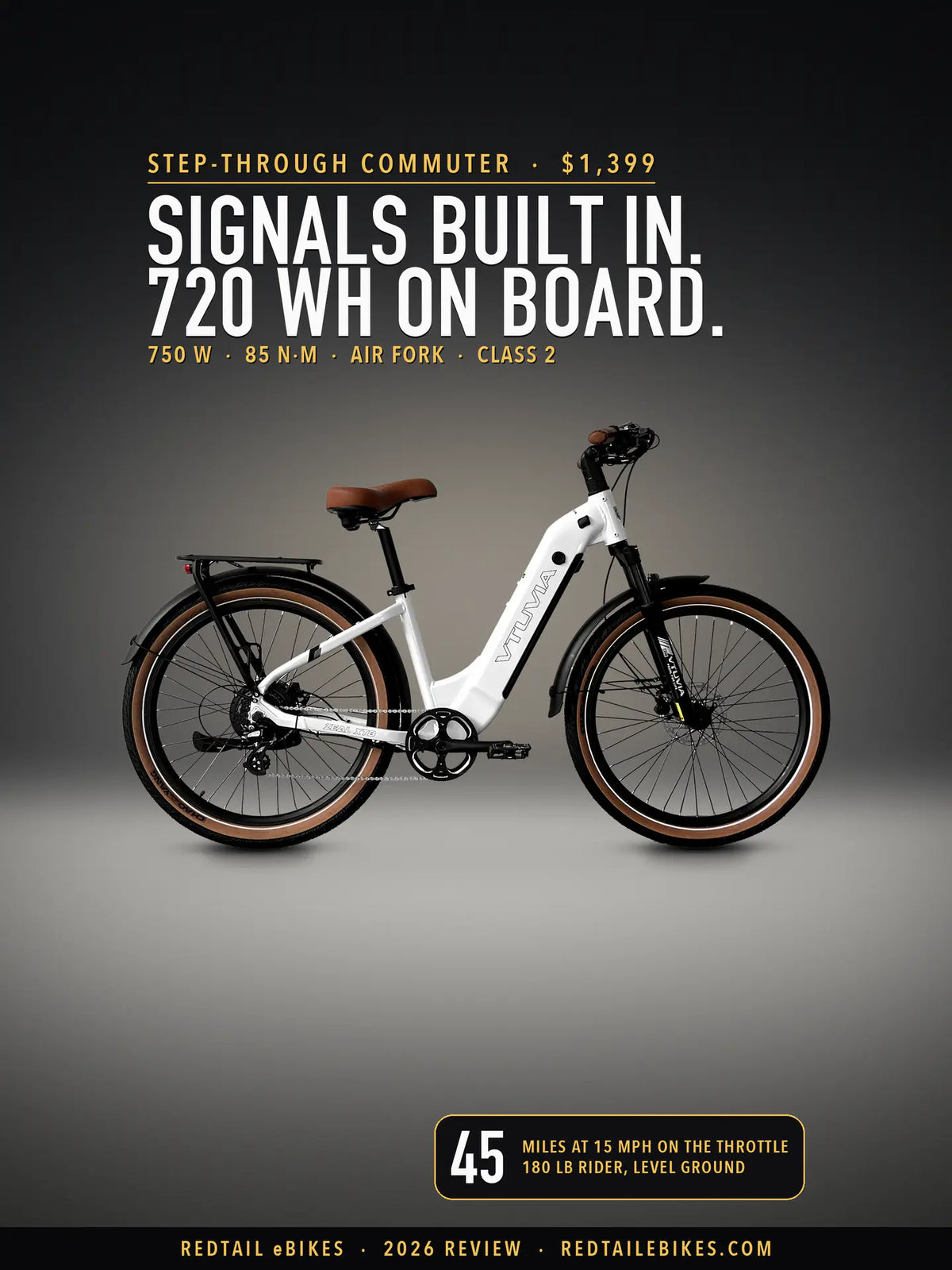
Share:
Can an E-Bike Pull a Deer? 15 Trailers and Carts Rated
Eunorau G30-CARGO Review 2026: 440 lb, $1,699