


1 of 51 jurisdictions · 750 W exclusive ceiling until 1 Oct 2026 · 750 W inclusive since 1 Oct 2026 · 20 mph Class 2 cap · 28 mph Class 3 cap · $90 infraction · 3 picks · verified August 30, 2026
Connecticut is the only state in the country where an adult must wear a helmet to ride an electric bike. Not a Class 3. Any class, any age, operator or passenger (§ 14-289k(f)). Since 1 October 2025 it has been an infraction rather than a technicality (§ 14-289k(h)).
That single sentence is the reason this page exists, and it is the rule most riders crossing into Connecticut from Massachusetts, Rhode Island or New York get wrong.
Quick Answer. In Connecticut an e-bike is a bicycle with working pedals and a motor of not more than 750 watts in Class 1, 2 or 3 (C.G.S. § 14-1(31), as amended by P.A. 26-24 § 26 from 1 October 2026). No license, registration or insurance.
Every rider and every passenger wears a helmet, at every age (§ 14-289k(f)), and Class 3 stays off every trail and path in the state (§ 14-289k(c)).
On 1 October 2026 that ceiling turned inclusive. Until 30 September the definition said fewer than 750 watts, so a motor rated at exactly 750 W was a motor-driven cycle here; since 1 October it is an electric bicycle. Since 1 October 2025 a bare head is an infraction (§ 14-289k(h)). Your town can add rules on top, and four of them have.
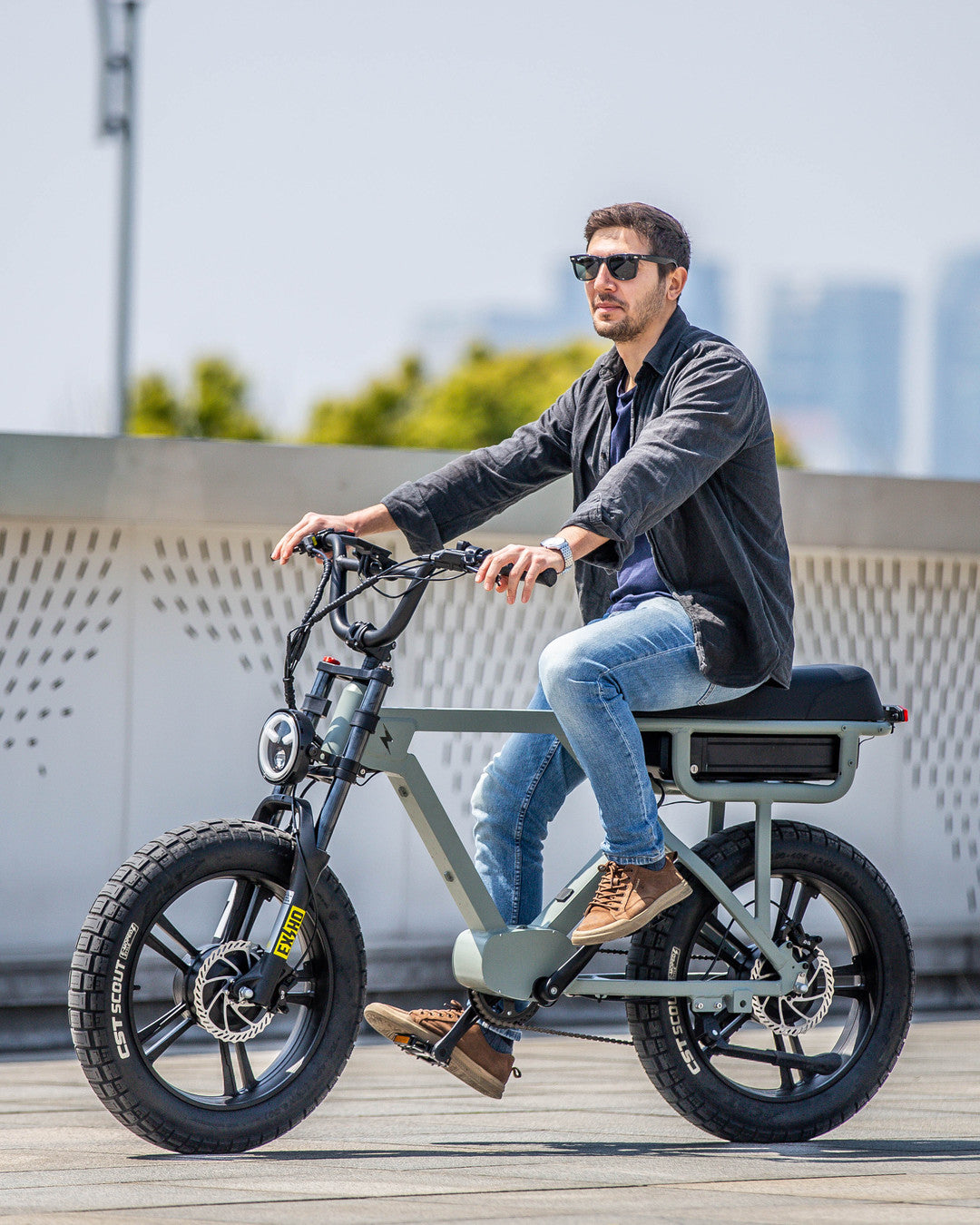
The riders pictured on this page are the Mercers, our fictional cast — meet the family. The cover was shot for this page on the Connecticut River in Hartford; the four inline photographs are reused from our 50-state law guide, and their captions describe only what each picture shows.

In this guide
- How we verified this guide
- What's on this page
- Connecticut eBike Laws: the four rules that decide everything
- Does Connecticut really require a helmet at every age?
- Is a 750-watt e-bike legal in Connecticut?
- What changes on 1 October 2026
- What changed on 1 October 2025
- Where you may ride
- Class 3 is banned from every trail in Connecticut
- The new seller-disclosure law nobody is talking about
- When your bike is 750 watts or more
- What a ticket actually costs
- Can your Connecticut town make its own e-bike rules?
- Every Connecticut municipality we checked
- State parks: what DEEP does not say
- The CHEAPR voucher, and why we cannot take it
- We screened our own shop against this statute
- Our picks for Connecticut
- The honest ledger
- The 7-point Connecticut compliance checklist
- The bottom line
- Connecticut against its neighbors
- Limitations
- Frequently asked questions
- Source register
- References
Buying where a helmet is mandatory at every age? Budget for one, and browse commuter and city e-bikes that publish class and assisted top speed openly — free US shipping, US-based support and warranty.
How we verified this guide
Everything below was read at its source between 19 and 21 August 2026, and the 2026 session's Public Act 26-24 was read on 30 August 2026. No claim on this page rests on a summary, an aggregator, or anyone's recollection.
What we read. The Connecticut General Statutes at the General Assembly's own publisher — and specifically the 2026 Supplement rather than the "current" file. Public Act 25-159 itself, as enacted. Two Office of Legislative Research reports. The Department of Transportation's own e-bike guide. Three Department of Energy and Environmental Protection trail pages. The CHEAPR eBike Incentive Program's own pages. Eighty-nine municipal codes. The U.S. Census Bureau's 2025 Gazetteer for the municipal denominator.
Corpus: 42 distinct sources consulted · 39 retrieved and read in full · 3 unreachable and named as such in the Limitations section. Every source has a local deposit copy and, where one could be made, a public archive snapshot.
What we computed ourselves. Two things. We classified the e-bike helmet rule of all 50 states and DC to test whether Connecticut is genuinely alone — it is, 1 of 51. And we ran all 186 live bikes in our own shop against C.G.S. § 14-1(31) and § 14-289n. 122 failed. Both methods, and both sets of limitations, are published below.
What would age this page. Public Act 26-24 lands on 1 October 2026 and changes the wattage ceiling — that one is enacted, dated and unavoidable. After it, the General Assembly's 2027 regular session convenes in February 2027. DEEP has announced no successor round of the eBike voucher. Either event changes this page.
Corrections: hello@redtailebikes.com. We publish corrections in the body, dated, rather than editing quietly.
What's on this page
Every section below is linked, and the order runs from the four state rules that decide everything to the town rules that decide the rest, with three picks and the voucher that pays for one in between.
- Connecticut eBike Laws: the four rules
- Does Connecticut require a helmet at every age?
- Is a 750-watt e-bike legal in Connecticut?
- What changes on 1 October 2026
- What changed on 1 October 2025
- Where you may ride
- Class 3 is banned from every trail
- The new seller-disclosure law
- When your bike is 750 watts or more
- What a ticket actually costs
- Can your town make its own rules?
- Every municipality we checked
- State parks: what DEEP does not say
- The CHEAPR voucher
- We screened our own shop
- Our picks
- Limitations
- Source register
- References
Connecticut eBike Laws: the four rules that decide everything
Connecticut's e-bike law is short. Four provisions do almost all of the work, and a rider who knows these four is right far more often than one who has read a competitor's summary.
| # | The rule | Where it lives | What it means on the road |
|---|---|---|---|
| 1 | Motor fewer than 750 W until 30 Sept 2026, then not more than 750 W | § 14-1(31) · P.A. 26-24 § 26 | A bike labeled 750 W on the nose is outside the definition today, and inside it from 1 Oct 2026 |
| 2 | Helmet, every rider, every age | § 14-289k(f) | Adults included. Passengers included |
| 3 | Class 3 on no trail or path, anywhere | § 14-289k(c) | No local opt-in exists for this one |
| 4 | Any violation of § 14-289k is an infraction | § 14-289k(h) | New on 1 Oct 2025. Older guides say "$50 maximum" |
What Connecticut does not require is as important. There is no license, no registration, no insurance mandate, and no minimum age at all for Class 1 and Class 2. The Office of Legislative Research puts it plainly: "E-bike riders do not need a driver's license, and e-bikes are not registered with DMV." (OLR 2024-R-0154)
Does Connecticut really require a helmet at every age?
What the statute says. § 14-289k(f) is one sentence and it admits no exception for adults:
"No person shall ride or sit as a passenger on an electric bicycle unless such person is wearing protective headgear that conforms to the minimum specifications established for bicycle helmets by the American National Standards Institute, the United States Consumer Product Safety Commission, the American Society for Testing and Materials or the Snell Memorial Foundation's Standard for Protective Headgear for Use in Bicycling, as amended from time to time."
Read the subjects: no person, and ride or sit as a passenger. A 45-year-old commuting on a Class 1 pedal-assist is covered. So is the child on the back.
Where the power comes from. The requirement was created by Public Act 18-165 § 1, the act that built Connecticut's whole e-bike framework, and survived the 2019 and 2025 amendments untouched. (P.A. 18-165)
What breaking it costs. Until 1 October 2025 the section carried no penalty of its own, so it fell to the chapter's residual clause — § 14-296, "not more than fifty dollars." P.A. 25-159 § 37 added subsection (h): "Violation of any provision of this section shall be an infraction." Connecticut's infraction schedule sets bicycle-type infractions at $90 plus surcharges.
| Who | Which helmet | Since | Breaking it |
|---|---|---|---|
| Every rider and every passenger, at any age, on any class | One meeting ANSI, CPSC, ASTM or Snell | P.A. 18-165, 2018 | An infraction since 1 October 2025 — $90 (§ 14-289k(h)) |
The history, and the contrast that gives the rule away. Connecticut's bicycle helmet law points the other way. § 14-286d(b) covers only children fifteen and under — and then disarms itself:
"Failure to comply with this section shall not be a violation or an offense."
A police officer "may issue a verbal warning to the parent or guardian" (§ 14-286d(c)). So on the same street, the same rider, on the same head: a bicycle helmet rule that is expressly unenforceable, and an e-bike helmet rule that is now an infraction. The General Assembly wrote both.
What happens next. The 2025 session considered and passed the penalty change. The 2026 regular session convened 4 February 2026 and adjourned 6 May 2026; we found no enacted 2026 amendment to § 14-289k. The next opportunity is the 2027 session.
Where this is unsettled. Two things, honestly. First, the statute names four standards bodies but gives no marking or date, so a helmet certified to an older CPSC revision is arguably compliant; nobody has litigated it.
Second — and this matters more — the DOT's own rider guide states the rule flatly ("Unlike bicycles, all e-bike riders are required to wear helmets") (CT DOT, Connecticut's E-Bike Information Guide) while Connecticut has no public enforcement statistics we could retrieve, so how often it is actually ticketed is unknown to us.
Is Connecticut really the only state? We checked all 51.
Claiming a superlative without checking every comparator is how pages get things wrong, so we classified the e-bike helmet rule in all 50 states and the District of Columbia from our own statute matrix.
| Bucket | Count | Share |
|---|---|---|
| Helmet at every age, on every class | 1 | 2% |
| Every age, but Class 3 only | 10 | 20% |
| Tied to Class 3 and/or an age threshold | 5 | 10% |
| Minors only | 11 | 22% |
| No e-bike-specific helmet rule found | 24 | 47% |
Connecticut is the single row in the top bucket. The ten in the second — Alabama, California, Delaware, Georgia, Louisiana, New York, Ohio, South Dakota, Tennessee and Virginia — all reach every age, but only on a Class 3. Ride a Class 1 in any of them bare-headed and you have broken no state law. Do it in Connecticut and you have.
Method: scripts/analyze_helmet_rules.py over our 51-jurisdiction statute matrix, statutes read
19 August 2026. Denominator 51, zero rows left unclassified. Limitations in the
Limitations section, item 4.
Is a 750-watt e-bike legal in Connecticut?
The operative text. § 14-1(31), as amended by P.A. 26-24 § 26 from 1 October 2026, defines the vehicle:
"'Electric bicycle' means a bicycle equipped with operable foot pedals and an electric motor of not more than seven hundred fifty watts of power that is either a class 1, class 2 or class 3 bicycle. 'Electric bicycle' does not include a dirt bike or an all-terrain vehicle."
| Class | Motor engages | Motor cuts out | Ceiling |
|---|---|---|---|
| 1 (§ 14-1(13)) | only when you pedal | when you stop pedalling, or at 20 mph | 20 mph |
| 2 (§ 14-1(14)) | may propel the bike alone | when the brakes are applied, or at 20 mph | 20 mph |
| 3 (§ 14-1(15)) | only when you pedal | when you stop pedalling, or at 28 mph | 28 mph |
Now read the wattage again. Until 30 September 2026 that sentence said fewer than seven hundred fifty watts, the exclusive word. Pennsylvania says "not more than 750 watts." (75 Pa.C.S. § 102) Minnesota, Colorado and most three-class states cap at 750 W inclusive, and since 1 October 2026 Connecticut does too.
Bottom line Until 30 September 2026 a motor rated at exactly 750 W sat outside Connecticut's definition; since 1 October it sits inside. Read the nominal rating on the listing — the peak figure answers no statute.
750 W is the single most common nominal rating printed on an e-bike sold in America. Until 30 September 2026, on the face of the statute, a bike whose label said "750W" was not an electric bicycle in Connecticut: one watt outside a definition that Massachusetts and Rhode Island would have let it inside. Since 1 October it is inside.
Who wrote it, and under what power. The wording comes from P.A. 18-165 and stood unamended for eight years, until P.A. 26-24 § 26 replaced it effective 1 October 2026. The Office of Legislative Research reproduces it as "less than 750 watts" in both its 2024 and 2025 reports, which is the same exclusive reading. (OLR 2024-R-0154; OLR 2025-R-0128)
Who enforces it. The definition is not itself a penalty provision — it is the gate. Fall outside it and you do not get a fine for "being over 750 watts"; you stop being a bicycle and pick up the motor-driven cycle duties described below, including the driver's license. The one direct penalty in this area falls on the manufacturer and on anyone who modifies a bike: § 14-289l(c), up to $100 for a first offense and $100 to $300 after.
Where this went — and it has moved. The 2025 session reopened almost every neighboring definition and left the 750 W figure alone. The 2026 session did not. Public Act 26-24 § 26 struck the word fewer and substituted not more than, effective 1 October 2026. Since that date a motor rated at exactly 750 W is an electric bicycle in Connecticut, and the trap described above is closed; the paragraphs above that describe the exclusive word describe the law until 30 September 2026.
The unsettled edge, now closed. We found no Connecticut case, DMV ruling or agency guidance interpreting "fewer than" at the 750 W boundary before it was repealed, and no enforcement record. This was our reading of the statutory text, not a determination by any court or agency.
A rider stopped on a 750 W bike before 1 October 2026 would have had a real argument under § 14-1(31) that the legislature meant the common industry ceiling, against the words then printed in the statute. Since 1 October the words and the industry ceiling agree.
What changes on 1 October 2026
Connecticut has done it again, in the same place and the same way: an omnibus Department of Motor Vehicles act, this one running to 64 pages, whose title reaches car rental classifications and the local bridge program before it reaches electric bicycles. Public Act 26-24 — Substitute Senate Bill 413 — was signed in the 2026 regular session, and three of its definitions landed on 1 October 2026.
| What | Until 30 Sept 2026 | From 1 Oct 2026 | Section |
|---|---|---|---|
| The wattage ceiling | "an electric motor of fewer than seven hundred fifty watts" — exclusive | "an electric motor of not more than seven hundred fifty watts" — inclusive | § 26, amending § 14-1(31) |
| Motor-driven cycle | Caught a machine under 50 cc, or not exceeding 3,700 W, or producing five brake horsepower or less | The brake-horsepower limb is deleted; the cc and 3,700 W tests decide it | § 27, amending § 14-1(59) |
| Electric scooter | A device weighing not more than one hundred pounds, still excluding an electric bicycle | Weight limit raised to one hundred ten pounds; the e-bike exclusion is unchanged | § 4, amending § 14-1(32) |
The one that matters is the first. One word — fewer becomes not more than — and the single most common nominal rating printed on an American e-bike moved from outside Connecticut's definition to inside it. Nothing else about the bike changes. No class boundary moves, no speed cap moves, the helmet rule is untouched.
What it does not do. It does not touch the all-ages helmet duty (§ 14-289k(f)), the Class 3 trail ban (§ 14-289k(c)), the seller-disclosure regime at § 14-289n, or your town's veto over sidewalks. A 750 W bike that became a legal e-bike on 1 October is still a bike you must wear a helmet on, at any age, and still may not go on a trail if it is a Class 3.
If you are buying a 750 W bike for Connecticut, it is an electric bicycle here since 1 October 2026. Until 30 September the statute's text put the same machine outside the definition, as a motor-driven cycle that needed a driver's license. Nothing about the machine changed; the sentence that governs it did, and a ride before 1 October was governed by the old one.
What is contested. The act does not say what happens to a rider cited before 1 October for a bike that would be legal after it, and we found no transitional provision in the act's text addressing machines already owned.
On its face the amendment is prospective and the earlier text governs conduct before the effective date. We are reading the act here, not reporting a ruling — no court or agency has addressed it — and it is the question to put to the DMV if you are the person holding the ticket.
What changed on 1 October 2025
Public Act 25-159 is the most consequential thing to happen to Connecticut e-bike law since 2018, and most published guides have not caught up.
Part of the reason is where it lives. The e-bike provisions sit inside an omnibus Department of Motor Vehicles act whose title reaches drunk-boating penalties and "move over" fines before it gets to electric bicycles. Every change below took effect 1 October 2025, confirmed from the act itself. (P.A. 25-159)
| What | Before | After 1 Oct 2025 | Section |
|---|---|---|---|
| Class 1 on natural-surface trails | barred unless a town allowed it | permitted | § 37, deleting "class 1 or" from § 14-289k(d) |
| Penalty for helmet / trail / under-16 breaches | residual $50 (§ 14-296) | infraction | § 37, new § 14-289k(h) |
| Modifying an e-bike's speed | not addressed | label must be changed or removed; $100–$300 | § 35, new § 14-289l(b),(c) |
| Selling a non-conforming vehicle as an "e-bike" | not addressed | prohibited, with a mandatory written disclosure | § 36, new § 14-289n |
| Over-750 W electric two-wheelers | legally undefined | motor-driven cycle, driver's license required | § 39, amending § 14-1 |
How to spot a stale guide. If a page tells you Connecticut e-bike violations carry "a fine of up to $50," or that Class 1 e-bikes are barred from natural-surface trails, it is describing the law as it stood before 1 October 2025. Both statements were correct in 2024. Neither is correct now.
That trap is easy to fall into, and we nearly did. The URL a search engine hands you for
Connecticut's statutes — cga.ct.gov/current/pub/
— is revised only to 1 January 2025, and says so in its own header.
It does not contain the 2025 session. The current text lives in the 2026 Supplement, and every statutory citation on this page points there.
The trap that catches out-of-state riders. Three things Connecticut does differently from its neighbors: the helmet rule reaches every adult, Class 3 is barred from every trail with no local exception, and your town keeps a veto over sidewalks. A fourth, a wattage ceiling exclusive of 750 W, ended on 30 September 2026. Get those three right and the rest of Connecticut's law is ordinary bicycle law.
Where you may ride
The provision itself. § 14-289k(a) gives an e-bike rider "the same rights and privileges" and "the same duties as the rider of a bicycle." § 14-289k(b) then sets the default:
"Except as provided in this section or where prohibited by local ordinance, an electric bicycle may be ridden where bicycles are permitted to travel."
 Connecticut gives an e-bike rider the same rights and duties as any other vehicle driver on the road — and, unlike every other state, asks for a helmet whatever your age.
Roads. § 14-286a(a) grants every rider "all of the rights" and "all of the duties applicable to the driver of any vehicle." Riding slower than traffic, you keep right "as is safe, as judged by such person" — Connecticut puts that judgment expressly in the rider's hands — with six enumerated exceptions covering passing, left turns, hazards, right-turn lanes, one-way streets and dedicated bike lanes (§ 14-286b(a)). Two abreast is allowed; more is not (§ 14-286b(b)).
Sidewalks. This is where Connecticut differs from most of its neighbors. § 14-286(a) permits e-bikes on sidewalks and crosswalks by default:
"Each person operating a bicycle, an electric bicycle or an electric foot scooter upon and along a sidewalk or across any roadway upon and along a crosswalk shall yield the right-of-way to any pedestrian and shall give an audible signal within a reasonable distance before overtaking and passing a pedestrian."
The same subsection (§ 14-286(a)) then hands the veto to your town: no one may ride on a sidewalk "if such operation is prohibited by any ordinance of any city, town or borough" or by an Office of the State Traffic Administration regulation. Four Connecticut towns have used that power, and we name them below.
Lights and brakes. § 14-288 applies to e-bikes just as it does to bicycles: a white front lamp visible at 500 feet, a rear reflector or reflecting lens visible at 600 feet, side-visible reflective material at 600 feet, and brakes that stop you within 25 feet from 10 mph on dry level pavement. A bell is fine; a siren or whistle is prohibited. Violation is an infraction (§ 14-288(b)).
| On the | The rule | Where |
|---|---|---|
| Road | Every right and duty of a vehicle driver; keep right as safe "as judged by such person"; two abreast, never more | § 14-286a(a), § 14-286b(a)–(b) |
| Sidewalk and crosswalk | Permitted by state default, yielding to every pedestrian; your town may prohibit it by ordinance | § 14-286(a) |
| Any bike, in the dark | White lamp visible at 500 ft, rear reflector at 600 ft, side reflectors, brakes that stop within 25 ft from 10 mph | § 14-288 |
| Trail or path | Class 1 and 2 as a bicycle; Class 3 never, with no local exception | § 14-289k(b)–(d) |
The authority chain. State grant (§ 14-289k(b)) → the specific trail bans in (c) and (d) → local ordinance power (§ 14-289, § 14-286(a)) → the individual town's code. Each link is cited on this page, because a rule is only enforceable if the body that made it had the power to make it.
How it got here. None of these operating rules were written for e-bikes. § 14-288's lighting figures date to 1949 and were last substantively revised in 1977; § 14-286a comes from 1965.
What P.A. 18-165 did in 2018 was insert "electric bicycle" into each of them, and P.A. 19-162 and P.A. 25-159 later did the same for scooters. Connecticut chose to fold e-bikes into the existing bicycle rules rather than write new ones — which is why the rules of the road feel familiar and the helmet rule does not.
What is pending. The 2025 act renamed "electric foot scooter" to "electric scooter" throughout this group of sections and raised that vehicle's weight limit to 100 pounds, but changed none of the operating rules that apply to e-bikes. Nothing pending that we could find would alter them.
What nobody has resolved. § 14-286a(b) — the subsection that gives sidewalk riders the legal status of pedestrians — applies by its terms to "every person operating a bicycle solely by hand or foot power." An e-bike under motor power is not that. So an e-bike may lawfully use a sidewalk under § 14-286(a), while arguably not inheriting the pedestrian rights § 14-286a(b) confers on a pedal cyclist. We could find no authority resolving it. It would matter in a crash.
 The trailhead board is where Connecticut's rules actually bite. The statute bans Class 3 outright; the sign tells you what the local authority has done on top.
If you are looking for somewhere to ride rather than a rule to check, our e-bike trails near me guide covers how to read a trail designation before you drive to it.
A Class 2 rides every paved path the state opens to bicycles, and the four towns that have said otherwise are named on this page; a Class 3 rides none of them. Each listing on this shelf shows the nominal rating and top speed the maker publishes; hold them against § 14-1(31) before you order. Free shipping and a US warranty on every one.
Shop Class 1 and 2 commutersClass 3 is banned from every trail in Connecticut
The rule, § 14-289k(c), in full:
"A class 3 electric bicycle shall not be ridden on a bicycle trail or path or multiuse trail or path."
Read what is missing. Subsection (d), the neighboring provision, opens "Except where permitted by local ordinance." Subsection (c) has no such clause. Every other trail restriction in Connecticut law can be switched off by a town. This one cannot.
| Trail type | Class 1 | Class 2 | Class 3 |
|---|---|---|---|
| Paved bike path / multi-use path | Yes | Yes | No |
| Natural-surface, non-motorized trail | Yes (since 1 Oct 2025) | No, unless the town permits it | No |
| Road | Yes | Yes | Yes |
| Sidewalk | Yes, unless the town bans it | Yes, unless the town bans it | Yes, unless the town bans it |
The enabling act. P.A. 18-165 § 1 created (c) and (d); P.A. 25-159 § 37 deleted "class 1 or" from (d), which is why Class 1's natural-surface row flipped to Yes.
How it is enforced. An infraction since 1 October 2025 (§ 14-289k(h)). Before that, the residual $50. The exemption in (g) covers only police officers, firefighters and EMTs on duty.
Why this is the buying decision rather than a footnote. A Class 3 is the fastest legal e-bike in Connecticut and the least usable one. It is barred from every bike path and multi-use trail in the state, and no one under 16 may ride it (§ 14-289k(e)). If your riding is the Farmington Canal Heritage Trail or the Airline Trail, a Class 3 buys you 8 mph you may not legally use where you actually ride.
What is moving. The 2025 session moved the Class 1 line and deliberately left the Class 3 line alone: the bill analysis records that "Existing law, unchanged by the bill, prohibits class 3 e-bikes from all bicycle and multi-use trails or paths." That is a legislature looking directly at the provision and choosing to keep it. Treat the Class 3 trail ban as settled policy rather than an oversight awaiting correction.
Where we are less certain. The statute does not define "bicycle trail or path or multiuse trail or path," and Connecticut has no statewide register of which facilities are which. A paved shoulder signed as a bike route is probably not a "path"; a separated greenway plainly is. Between those two, nobody has drawn the line.
The new seller-disclosure law nobody is talking about
Section 36 of P.A. 25-159 created § 14-289n, effective 1 October 2025. It is aimed squarely at sellers, and it is the most commercially significant e-bike provision any state passed in 2025.
What the law actually says.  The machine on the right has no pedals. Under § 14-289n it is not an electric bicycle in Connecticut, whatever the listing called it.
A vehicle with an electric motor is not an electric bicycle if it:
- does not meet § 14-1 "as sold or offered for sale";
- "has one or more operating modes, is equipped with a throttle and is capable of exceeding twenty miles per hour on motorized propulsion alone in any mode when the throttle is engaged"; or
- "has been configured or modified by any person or is designed, manufactured or intended by the manufacturer, importer or seller to be configured or modified" out of the definition, by "(A) the inclusion of a mechanical switch or button, (B) a modification or change in the software controlling the electric drive system, (C) the use of a mobile application, or (D) any other means."
Clause 3 is the one with teeth. A bike advertised with an unlockable speed limiter is, on the face of the statute, described by its own seller as designed to be configured out of the definition.
The disclosure. A seller who calls such a vehicle an "electric bicycle", "electric bike", "e-bike" "or other similar term" must give the buyer, before sale and in every advertisement including social media and email, a written statement in this exact language:
"This vehicle is not an 'electric bicycle' as defined in section 14-1 of the Connecticut General Statutes. It is instead a type of motor vehicle and subject to applicable motor vehicle laws if used on public roads or public lands. Your insurance policies might not provide coverage for accidents involving the use of this vehicle. You should contact your insurance company or agent for available property damage and liability insurance coverage in connection with your use of this vehicle."
Bottom line If a listing advertises an unlock, § 14-289n reads the bike as designed to leave the definition, and the seller owes you that written statement before the sale and in every advertisement. A listing that carries the statement is telling you it is selling a motor vehicle.
The enforcement — and a trap we nearly fell into ourselves. The Office of Legislative Research's analysis of sHB 6862 records that breaching these provisions would be "an unfair or deceptive trade practice under the Connecticut Unfair Trade Practices Act" (OLR analysis of sHB 6862). CUTPA carries restitution, cease-and-desist powers and private rights of action, and that is what most coverage of this law reports.
But sHB 6862 is not the bill that passed. Its provisions were carried into Substitute House Bill 7160, which became P.A. 25-159 — and we read the enacted act and the codified section line by line. Neither contains a CUTPA provision. § 14-289n as enacted has no penalty clause of any kind: no fine, no infraction, no unfair-trade-practice designation.
So what does a breach cost? § 14-289n sits in chapter 248, which means the chapter's residual clause applies — § 14-296, "not more than fifty dollars." That is our reading, and it is the layer of this page we would most like corrected if we have it wrong. What we can state flatly is the negative: the enacted text contains no CUTPA language, and any page telling you otherwise is describing a bill rather than a law.
What to watch. § 14-289n is ten months old at the time of writing and we found no reported Connecticut enforcement action under it, no Department of Consumer Protection guidance interpreting it, and no amendment pending. A duty with no stated penalty is also an obvious candidate for a follow-up bill, and the CUTPA language that dropped out between sHB 6862 and P.A. 25-159 is the most likely thing to come back. Watch the session convening February 2027.
What is contested, and we have a stake in it. Subdivisions (a)(1) and (a)(3) point in different directions. (a)(1) tests the vehicle as sold — a bike delivered limited to 20 mph does meet the definition on delivery. (a)(3) separately catches a vehicle designed to be modified out of it.
Which controls a bike that ships compliant but advertises an unlock is not settled by the text, and no Connecticut authority has resolved it. Our reading is that (a)(3) was written precisely to reach that case, because otherwise it would do no work that (a)(1) does not already do.
That is an inference, clearly labeled. It is not a ruling, and we sell e-bikes, so weigh it accordingly.
When your bike is 750 watts or more
For years this was Connecticut's open question. In September 2024 the Office of Legislative Research wrote: "It is unclear how an e-bike with a motor of 750 watts or more would be classified under Connecticut law." (OLR 2024-R-0154) The 2025 session answered it.
The governing words. § 14-1(59), as amended by P.A. 25-159 § 39, now defines "motor-driven cycle" to include vehicles with a "gasoline, electric or hybrid motor" having "a capacity of less than fifty cubic centimeters piston displacement or a wattage not exceeding three thousand seven hundred watts or that produces five brake horsepower or less," with a seat at least 26 inches high — covering "a bicycle with attached motor, except an electric bicycle."
So a 1,000 W throttle machine that fails § 14-1(31) does not fall into a void. It lands in motor-driven cycle, and that carries consequences:
| Electric bicycle | Motor-driven cycle | |
|---|---|---|
| Driver's license | No | Yes (§ 14-286(b)) |
| DMV registration | No | No (OLR 2025-R-0128) |
| Sidewalks | Yes, unless the town bans it | Never (§ 14-286(b)) |
| Limited-access highway | n/a | Never (§ 14-286(b)) |
| Helmet | Every age (§ 14-289k(f)) | Under 21 (§ 14-289g, raised from 18 by P.A. 25-65) |
Before you shop, it is worth knowing which side of that line a bike sits on. Our moped-style e-bike review sets out the specifications that decide it, for one popular model.
Machines built well past that line are sold as off-road equipment rather than e-bikes — our electric dirt bike review works through what that means for where you can ride. The category as a whole — including which machines Connecticut's dirt-bike exclusion actually catches — is mapped in our guide to electric dirt bikes and where they are legal to ride.
Connecticut's DOT states the practical result for riders: e-bikes "with motors 750 watts and above will be classified as motor-driven cycles and require a driver's license to operate them." (CT DOT, Connecticut's E-Bike Information Guide)
That guide predates P.A. 26-24 § 26. Since 1 October 2026 the statute puts a motor rated exactly 750 W inside the e-bike definition, so only a motor above 750 W takes the motor-driven-cycle route, and where the guide and the statute differ, the statute governs.
Where it goes from here — and it moved again in 2026. This category was rewritten once in 2025 specifically because it did not handle electric power, and P.A. 26-24 § 27 touched it again: from 1 October 2026 the "produces five brake horsepower or less" limb is deleted, leaving the under-50 cc test and the 3,700 W test to decide the category.
More important for a buyer, the entry point moved the same day: because a 750 W bike stopped failing the e-bike definition, it stopped arriving in this category at all. Since 1 October the motor-driven cycle route begins above 750 W rather than at it.
The part no one has settled. Above 3,700 W, or with a seat under 26 inches, the machine falls out of motor-driven cycle too — and then it is a motorcycle or a mini-motorcycle, with registration and endorsement consequences we did not trace to their conclusion. If you are shopping in that range, ask the DMV directly rather than trusting any retailer's page, including this one.
A 500 W motor sits a third under the line on either side of 1 October, so the "fewer than" trap never reaches it. Read the nominal rating on the listing — the peak figure is marketing — and you have answered the wattage question § 14-1(31) asks of a single-motor bike.
Shop 500-watt commutersWhat a ticket actually costs
| Breach | Penalty | Source |
|---|---|---|
| No helmet, any age, any class | Infraction | § 14-289k(h) |
| Class 3 on a trail or path | Infraction | § 14-289k(c), (h) |
| Under-16 riding a Class 3 | Infraction | § 14-289k(e), (h) |
| No lights / no adequate brakes | Infraction | § 14-288(b) |
| Modifying an e-bike without fixing the label | ≤$100 first, $100–$300 after | § 14-289l(c) |
| Manufacturer duties breached | ≤$100 first, $100–$300 after | § 14-289l(c) |
| Anything in ch. 248 with no stated penalty | ≤$50 | § 14-296 |
| Bicycle helmet, child ≤15 | No violation, no offense — verbal warning only | § 14-286d(b), (c) |
| Ridgefield: motored transport on any path or sidewalk | $250 | Ridgefield § 128-1(C) |
| Branford: e-bike in an Open Space Authority preserve | ≤$200 | Branford § 190-11(B) |
| Winchester: e-bike on the Main Street sidewalk | $90 municipal infraction | Winchester § 186-4 |
| Bethlehem: e-bike on a municipal sidewalk | ≤$50, doubled if unpaid | Bethlehem § 128-11(C) |
Where it gets its force. State penalties come from three places: the specific infraction clause added by P.A. 25-159 § 37 (§ 14-289k(h)), the specific fines in § 14-289l(c), and the chapter's residual clause, § 14-296 — "Any person who violates any provision of this chapter for which no other penalty is provided or is not designated an infraction shall be fined not more than fifty dollars." Municipal fines come from § 14-289's grant of "appropriate penalties," or from the general municipal-powers statute, C.G.S. § 7-148.
What comes next. Every state-level penalty in this table except § 14-296 was created or changed in the 2025 session. This is the most recently rewritten part of Connecticut's e-bike law and the part most likely to be reported wrongly elsewhere.
What remains arguable. Connecticut publishes an infractions schedule that sets the payable amount for each designated infraction, but § 14-289k(h) simply says "shall be an infraction" without naming a figure. We have cited the statute rather than guessing a dollar amount, and we could not retrieve a schedule entry created specifically for § 14-289k. If you have received one of these tickets, the amount printed on it is better evidence than anything on this page, and we would like to see it.
Note the ordering. The most expensive e-bike ticket in Connecticut is not a state one. It is Ridgefield's $250, and it is written to reach every public pathway, trail and sidewalk in the town.
Can your Connecticut town make its own e-bike rules?
The text. § 14-289 is unusually generous to municipalities:
"Each town, city and borough shall have authority to make any ordinance not inconsistent with section 14-286 or 14-288 or any regulation of the Office of the State Traffic Administration … respecting governing and controlling the use of bicycles, electric bicycles and electric scooters within such town, city or borough, with appropriate penalties for violation thereof, which ordinances may include provisions requiring annual licensing of bicycles, electric bicycles or electric scooters …"
Read that twice. Under § 14-289, a Connecticut town may lawfully require you to license your e-bike annually; the same sentence, quoted in full in the FAQ below, lets it register each sale and change of ownership. We found no town currently doing it. The power is on the books.
Connecticut is the mirror image of Texas and Pennsylvania. Texas Transportation Code § 551.106 preempts most local e-bike bans outright. Pennsylvania's 75 Pa.C.S. § 6101 does much the same and adds a Liquid Fuels funding penalty for towns that ignore it. Connecticut does the opposite: the state grants the right to ride "except … where prohibited by local ordinance" (§ 14-289k(b)), permits local sidewalk bans (§ 14-286(a)), and hands towns an express ordinance power (§ 14-289).
There is a second, separate grant. Ridgefield's 2025 ordinance was adopted not under § 14-289 but under C.G.S. § 7-148(c)(7)(H)(xii), the general municipal-powers statute. So a town that wants to regulate e-bikes has two independent doors into the power, which is worth knowing if you are arguing a ticket.
Where the text runs out. § 14-289 limits ordinances to those "not inconsistent with section 14-286 or 14-288." Ridgefield's blanket ban on "any motored form of transportation" on every public sidewalk is broader than § 14-286(a)'s framework, which contemplates a conditional sidewalk permission. We are not aware of any challenge. We note the tension rather than resolve it.
Every Connecticut municipality we checked
Connecticut has no county government — it was abolished in 1960 — so unlike Pennsylvania or Minnesota there is no county layer between the state and your town (Census 2025 Gazetteer). There is one layer, and it is the town.
The denominator. From the U.S. Census Bureau's 2025 Gazetteer: 169 towns, which between them cover every square foot of the state, plus 19 cities and 10 boroughs that sit within or coterminous with them. 198 ordinance-capable bodies at the outside; 169 is the figure Connecticut's own government uses for general-purpose municipalities. We publish both rather than quietly picking the flattering one.
What we did. General Code's eCode360 hosts 89 of Connecticut's municipal codes — 53% of the towns. We searched every one of the 89 on 21 August 2026 for ebike, electric bicycle, micromobility and scooter, then read the actual code text of every hit rather than trusting a chapter title.
| Status | Count | What it means |
|---|---|---|
| ORDINANCE | 4 | Code text read; it regulates e-bikes by name or by unambiguous class |
| NONE FOUND | 75 | Code searched in full; no e-bike provision returned |
| LEAD-ONLY | 16 | A committee minute or agenda mentions e-bikes — evidence of discussion, not an enacted ordinance |
| UNRESOLVED | 103 | Never reached. Not on eCode360, or the fetch failed |
| Total | 198 |
103 of 198 are unresolved, and we are not going to round that off. They are not "no rule." They are "we have not read this town's code." If your town is in that group, the ordinance search on your town clerk's site is the answer, and we would be glad to be sent it.
One town, Griswold, was dropped to UNRESOLVED after its search returned an HTTP 429 rate limit. A failed fetch is not an absence, and we will not let one masquerade as one.
Full row-by-row ledger: ct-municipalities_20260821.csv in our research repository, with the source
URL and the reasoning on every row.
The four towns with e-bike rules, and what each actually says
| Town | What it does | Fine | Adopted | Source |
|---|---|---|---|---|
| Ridgefield | "No person shall use any motored form of transportation on any public pathway, trail and sidewalk." Separately bars reckless riding of an "E-bike" in any public area | $250 per offense | amended 17 Sep 2025 | § 128-1 |
| Bethlehem | Sidewalks are "intended exclusively for pedestrian use"; no motor-driven vehicle "including … electrically-powered bicycles (e-bikes)" may travel along a municipal sidewalk | ≤$50, doubled if unpaid | adopted 29 Jan 2026 | § 128-11 |
| Winchester | Adopts the § 14-1 definitions; bars electric bicycles from the Main Street sidewalk between Park Place West and Munro Place; yield + audible signal elsewhere | $90 municipal infraction | Ch. 186 Art. I | § 186-1 |
| Branford | In Park and Open Space Authority preserves, "All motorized vehicles, both gas and electric powered, are prohibited, including … e-bikes" | ≤$200 per offense | Ch. 190 Art. III | § 190-11 |
Two of the four were enacted within the last twelve months, and Bethlehem's is seven months old. Connecticut's local layer is moving right now, which is the strongest argument for checking your own town rather than trusting any state-level summary — including this one.
Two ordinances that look like e-bike bans and are not
This is the part most pages skip, and it is where a careless search does real damage.
North Haven (Ch. 190 Art. II, adopted 27 Oct 2025) and Orange (Ch. 366 Art. IV, adopted 12 Nov 2025) both enacted "Illegal Use of Motorized Recreational Vehicles and Street Takeovers" ordinances under Public Act 25-80. Both surfaced in our search on the phrase "electric bicycle." Both carry vehicle seizure and forfeiture powers.
Neither regulates e-bikes.
North Haven's "motorized recreational vehicle" is defined as covering "all-terrain vehicle, dirt bike, mini-motorcycle, motor-driven cycle, and snowmobile" — e-bikes are not on the list — and its own "motor-driven cycle" definition expressly excludes "an electric bicycle." The phrase matched our search only because the code names e-bikes in order to leave them out.
Orange reaches the same result by a different route: its "motor-driven cycle" is defined purely by "piston displacement," which no electric motor has. Worth noting for anyone reading Orange's code closely: unlike North Haven, Orange did not copy the state's express e-bike carve-out. It gets there by physics rather than by drafting.
Had we recorded these two from their search hits, this page would have told riders in two towns that their e-bikes were subject to seizure. They are not.
Four of the 95 Connecticut codes this page could read carry an e-bike rule, and 103 of 198 could not be read, so ride the state rule until your town tells you otherwise: fewer than 750 W until September 30 and 750 W or less from October 1, 2026, a helmet at every age, Class 3 off every trail. Free US shipping and a US warranty on every order.
See every e-bike we ship to ConnecticutState parks: what DEEP does not say
This is a gap, and we are stating it as one.
Connecticut's Department of Energy and Environmental Protection manages the state parks and forests. Its Recreational Trail Use Information page says trails "are open to non-motorized, multiple use activities (foot travel, mountain biking, equestrian) unless posted closed." (DEEP, Recreational Trail Use Information) It does not mention electric bicycles.
Bottom line DEEP publishes no e-bike trail policy, and § 14-289k applies on state land as it applies anywhere: a Class 1 or 2 rides where bicycles ride, a Class 3 stays off every trail, and a posted closure beats both.
We checked three DEEP pages on 21 August 2026 — Biking (retrieved twice, directly and through a reader proxy, because a thin extraction is not proof of anything), Recreational Trail Use Information, and Mountain Biking. Zero mentions of "electric", "ebike" or "e-bike" on any of them.
So: we could not find a published DEEP e-bike policy. That is not the same sentence as "there is no policy," and we will not write the second one. What we can say is that a rider looking for written guidance on whether a Class 1 e-bike is welcome on a state forest trail will not find it where they would reasonably look.
The contrast is instructive. Pennsylvania's DCNR publishes an explicit e-bike policy naming the conditions and the trails. Connecticut's equivalent agency, so far as we can retrieve, publishes none — while the statute simultaneously legalized Class 1 on natural-surface trails in October 2025.
What happens if you ignore it. Whatever DEEP does or does not publish, § 14-289k applies on state land as it does anywhere else, and since 1 October 2025 a breach of it is an infraction. Separately, DEEP's own trail rules are enforceable as agency regulation, and its published etiquette asks that "Cyclists and motorized users yield to pedestrians and equestrians."
What it replaced. DEEP's trail framework predates the e-bike entirely — its language distinguishes "non-motorized" recreation from registered motor vehicles, a division drawn when the only electric bike was a curiosity. The 2018 statute created a vehicle that is neither, and the trail pages have not been rewritten to account for it.
What is still in play. October 2025 widened the gap rather than closing it, by legalizing Class 1 on the very natural-surface trails DEEP manages most of. A published policy is the obvious next step; DEEP has announced none that we could retrieve.
What this means in practice. § 14-289k still governs on DEEP land: Class 3 is barred from any trail or path, Class 1 is permitted on natural-surface non-motorized trails, and Class 2 is not unless a local ordinance allows it — though a state forest is not a municipality, which makes subsection (d)'s local-ordinance escape hatch of no use there. Ask the park supervisor. DEEP's State Parks Division publishes a contact line for this.
The CHEAPR voucher, and why we cannot take it
Connecticut runs a real e-bike incentive, and it is one of the more generous in the country.
| Standard voucher | $500 |
| Voucher+ (stackable) | +$750 — $1,250 total |
| Who qualifies for Voucher+ | income under 300% of the Federal Poverty Level, a state or federal income-qualifying program, or residence in an Environmental Justice community or Distressed Municipality |
| Program funding | $1.5 M across three years; $750,000 per round |
| The bike must have | MSRP under $3,000 · 1-year frame and component warranty · active UL 2849 or EN 15194 certification |
| Where you may redeem it | participating brick-and-mortar retailers located in Connecticut |
| Authority | C.G.S. §§ 22a-201c, 22a-202e |
The honest part: you cannot use it with us. Redtail is an online retailer. The voucher is redeemable only at participating Connecticut brick-and-mortar shops, and we are not one. If you qualify for the $1,250, the right move is to take it to a participating local shop — our e-bike stores near me directory is a starting point, the Connecticut e-bike shop directory lists the verified stores town by town, and DEEP publishes the enrolled-retailer list itself. We would rather tell you that than have you find out at checkout.
The penalty. The program is not policed by ticket but by eligibility: the voucher is issued before purchase, redeemed at an enrolled retailer, and DEEP states it will "check to ensure compliance with program requirements" after the redemption window closes. The binding conditions are the bike's own — MSRP under $3,000, a one-year warranty and a live UL 2849 or EN 15194 certification — and a bike that fails them cannot be put on the Eligible eBike List in the first place.
Current status, stated precisely. DEEP's own eBike Incentive Program page says "The application period for Round 2 is now closed," and its footer reads "Content last updated February 19, 2025." Round 2 ran 17 September to 1 October 2024, with awards notified by 16 December 2024. As of 21 August 2026 we could not establish that any successor round is open.
DEEP's page announces none
and directs people to a mailing list; drivecheapr.org/ebikes returned a 404 to us. We are labelling
this a gap rather than declaring the program dead — sign up to DEEP's list and check the source.
A note on the program's own data, because it is a model of honesty. DEEP publishes voucher statistics and warns readers directly that the three Voucher+ qualifying paths "are not mutually exclusive," so the table "should not be read to mean that only 5 approved applicants had household income at or below 300% of the federal poverty level."
371 approved vouchers came through the Environmental Justice path, which DEEP notes "required the least paperwork." That is a government agency telling you not to add up its own columns. More organizations should.
We screened our own shop against this statute
Most retailers publish a state law page and then recommend whatever they happen to stock. We ran the test the other way round.
On 21 August 2026 we took all 186 live bikes in our catalog and screened each one against C.G.S. § 14-1(31) and § 14-289n, from the live storefront data rather than a spreadsheet.
| Verdict | Count |
|---|---|
| Meets Connecticut's definition on published specs | 9 |
| Outside Connecticut's definition | 122 |
| Unknown — a required spec is not published | 55 |
122 of our own 186 bikes did not clear Connecticut on 21 August 2026. That was the strictest result of any state we had screened; Minnesota, the previous record-holder, failed 69. All three counts in the table above are measurements of the law until 30 September 2026.
We screened all 223 live bikes again on 2 October 2026, under both texts (the October screen). Under the amended text 26 meet the definition on their published specifications, 132 are outside it and 47 are unknown. Another 18 are trikes that pass every other test; we count none as meeting it, because Connecticut has not said whether a trike is a bicycle (the trike note). The old text gives 3, 196 and 23, plus one trike.
Why they failed:
| Reason | Count |
|---|---|
| Motor rated exactly 750 W — outside "fewer than 750" | 45 |
| Throttle plus an advertised speed above 20 mph (§ 14-289n(a)(2)) | 33 |
| Derestriction language in the listing (§ 14-289n(a)(3)) | 16 |
| Other wattage failures | 70 |
| Advertised speed above the 28 mph Class 3 ceiling | 14 |
Reasons overlap — one bike can fail on several — so the column sums past 122 by design. Do not add it up.
The 45 was the finding, and it has expired. On 21 August 2026, 45 bikes we sell that are legal e-bikes in Pennsylvania, Colorado and most of the country were outside Connecticut's definition on their exactly-750 W rating, 40 of them on that single word alone: fewer. Ridden in Connecticut before 1 October 2026, the statute's text said they were not electric bicycles.
On 1 October 2026 those forty stopped failing. P.A. 26-24 § 26 replaced fewer with not more than, and the 40 that failed only on the exactly-750 W test stopped failing it that morning; the five that also failed another test still fail that one.
The screen above is a measurement of the law as it stood until 30 September; the other failure reasons in the table — throttle above 20 mph, derestriction language, wattage genuinely over 750 W, speed above the Class 3 ceiling — are untouched by the amendment and survive it.
And the 16 include a problem of our own making. Sixteen listings carry a specification line reading "Speed limited: Unlockable." Under § 14-289n(a)(3), a vehicle the seller describes as configurable out of the definition is not an electric bicycle in Connecticut — and § 14-289n(c) would require us to hand a Connecticut buyer that written disclosure. We found this by running the statute against ourselves, we are publishing it before anyone asked, and we are fixing the listings.
Method and full row-by-row output: scripts/screen_connecticut_legal.py →
ct-legal-product-screen_20260821.csv. It reads published specifications rather than bikes on a
dynamometer — see Limitations item 2. "Unknown" is never counted as legal.
Our picks for Connecticut
Three bikes that pass the watt, speed and throttle tests of § 14-1(31) and § 14-289n on their published specifications, chosen for how people actually ride in Connecticut: two of the 26 two-wheelers that meet the definition on the October screen, and one trike, whose place in the definition is the open question under the table. All are Class 2 or below, all are under 750 W, none carries an unlock claim.
Read the voucher rule first. CHEAPR requires UL 2849 or EN 15194 for the battery and electrical system, and it redeems only at a Connecticut brick-and-mortar shop, so it does not reach an order placed here. Connecticut law asks nothing of the battery — § 14-1 says nothing about standards — but a landlord or insurer may, so read the certification line on any listing.
| Bike | Motor | Top speed | Price | Why it suits Connecticut |
|---|---|---|---|---|
| Eunorau META275 1.0 | 500 W | 20 mph | $1,699 | A straightforward city bike for Hartford or New Haven commuting; Class 2, so every paved path the state opens to bicycles is open to it |
| Eunorau META275 2.0 | 500 W | 20 mph | $1,699 | The same platform with a bigger build. 68.4 lb — irrelevant in Connecticut, which sets no weight limit, unlike Pennsylvania's 100 lb rule |
| Eunorau NEW-TRIKE 2.0 | 500 W | 20 mph | $2,499 | A folding trike for riders who want stability, with the "operable foot pedals" § 14-1(31) requires; read the trike note below this table first |
Riding a trike? Ask the DMV in writing first: Connecticut has not said whether three wheels count. § 14-1(31) makes an electric bicycle "a bicycle equipped with operable foot pedals", and § 14-1 never defines bicycle. § 14-286d(a) does, for its own sections only: "any vehicle propelled by the person riding the same by foot or hand power", with no wheel count, and § 14-286(e) says the same of "all vehicles".
Both readings hold up, and we found no court or agency ruling. § 14-1(32) writes "two or three wheels" for an electric scooter, so the legislature names a wheel count when it means one. Read one way, the NEW-TRIKE 2.0 and our 17 other trikes that pass the watt and speed tests are electric bicycles; read the other, the everyday two-wheel sense of bicycle leaves them out. Keep the DMV's reply with the trike.
What we deliberately left off. On the 21 August screen two more bikes cleared the statute on wattage but advertised 25 and 28 mph, which is Class 3 territory: banned from every trail and path in Connecticut and barred to riders under 16. Legal, and the wrong tool for this state, so we left them off rather than sell you the faster number. None of the 26 that meet the definition on the October screen advertises above 20 mph.
A third runs two 500 W motors, one in each wheel. § 14-1(31) says "an electric motor of not more than seven hundred fifty watts" (since 1 October 2026; "fewer than" before) and does not say how to count two; no Connecticut court or agency has. If you already own a two-motor bike, the wattage on its § 14-289l label is the figure an officer reads; put the counting question to the DMV in writing.
Browse by shape: commuter and city, folding, fat-tire, cargo, electric trikes, mountain, cruiser and moped-style, what is on sale, or the full range — then check the wattage against the ceiling above.
Until 30 September 2026 Connecticut's wattage ceiling ruled out more of that range than any other state's we had screened. Since 1 October it is the common inclusive one, and the over-750 W, throttle and derestriction tests are what rule bikes out, so check before you fall for a bike.
Comparing brands rather than shapes? We have written up Aventon, Lectric, Velotric, Himiway, Ridstar and Super73 — and the wattage caveat above applies to every one of them in Connecticut.
Not sure which class your current bike is? Look for the label § 14-289l(a)(2) requires: it must state the classification, the maximum speed and the motor wattage, in type no smaller than nine-point. If your bike has no such label, it was not built for the Connecticut market — and that is worth knowing before an officer asks.
Browse commuter e-bikesRiding into Connecticut this weekend? The one thing to fix before you go is the helmet — it is the rule most visitors break without knowing, and since October 2025 it carries an infraction rather than a shrug. Everything else on this page can wait until you are home.
See the full e-bike rangeWhy buy a Connecticut-legal e-bike from us
Connecticut's label law tells you what to read. § 14-289l(a)(2) wants class, top assisted speed and motor wattage on the frame. All three picks above publish a 500 W nominal rating and a 20 mph top speed — the two figures § 14-1(31) reads — a third under the line on either side of 1 October, so you can hold each one against the statute before it is yours.
The helmet is the first thing to add to the basket. Every ride here needs one that meets ANSI, CPSC, ASTM or Snell, and an infraction since October 2025 is the cost of forgetting it. Budget for the helmet with the bike, and split the price through Shop Pay at checkout when you're ready.
Shipping is free to every Connecticut address, and the warranty never leaves the country. No freight line for Stamford, Hartford or New London, and the warranty and the support desk both sit in the US; ask about § 14-289k(f) and you get the subsection back.
A Class 2 commuter answers most of Connecticut. It rides every paved path the state opens to bicycles — the four towns that said otherwise are named on this page — with no age floor and no trail ban. A folding Class 2 does the same from an apartment hallway; an electric trike may qualify too (the trike note). If 28 mph is the point, read the Class 3 rules first; they are the rules you would actually ride under.
Email support@redtailebikes.com with the listing and the section number, and the reply quotes the subsection, even when it means a different bike.
The honest ledger
Green flags — Connecticut gets these right
- One clean definition and three classes that match the national standard, so a bike bought in Massachusetts is legible here.
- No license, no registration, no insurance, and no minimum age at all for Class 1 and Class 2.
- Since October 2025, one of the most detailed consumer-protection provisions in the country against machines sold as "e-bikes" that are not — though, as we found on reading the act, it carries no penalty of its own.
- Class 1 on natural-surface trails, a genuine liberalisation that most states have not made.
- A real voucher worth up to $1,250 with actual safety criteria (UL 2849 / EN 15194) attached.
Red flags — where Connecticut will catch you out
- The all-ages helmet rule. Nobody expects it, and it is now an infraction.
- A Connecticut guide written before 1 October 2026 has the old wattage line: "fewer than 750 watts" became "not more than" that day, and the industry's most common rating is now inside.
- Class 3 is banned from every trail and path, with no local opt-in.
- No published DEEP e-bike policy for state parks, so the one landowner with the most trail mileage in Connecticut gives riders nothing in writing.
- The voucher only works at physical Connecticut shops, which excludes most online buying.
- Your town can require annual licensing of your e-bike, and four towns already regulate them.
The 7-point Connecticut compliance checklist
Connecticut asks less of you than most states on paper and more of you at the roadside, because the helmet rule reaches every age and the trail rule reaches every Class 3. Seven things to settle before you ride:
- Helmet on. Every ride, every rider, every age. ANSI, CPSC, ASTM or Snell. Passengers too.
- Check the wattage label. Since 1 October 2026 a label reading 750 W or less is inside the definition and only above 750 W is outside (P.A. 26-24 § 26); until 30 September 2026 the line sat just below 750 W.
- Know your class, and if you are on a Class 3, stay off every trail and path in the state.
- Under 16? Class 1 and Class 2 only. You may ride as a passenger on a Class 3.
- Lights after dark: white front visible at 500 ft, rear reflector at 600 ft, side reflective material. Brakes that stop you in 25 ft from 10 mph.
- Check your town. Four have e-bike ordinances; 103 of 198 municipalities we could not reach. Your town clerk can answer in one call.
- Buying? Ask for the § 14-289l label, and ask whether the seller considers the bike an electric bicycle under § 14-1. If it has an unlockable limiter, ask for the § 14-289n disclosure in writing.
The bottom line
Connecticut is an easy state to ride an e-bike in and a surprisingly easy one to break the law in, and the two facts have the same cause: the rules are simple but they are not the rules you expect.
No license, no registration, no insurance, no minimum age for the classes most people buy — that is about as permissive as American e-bike law gets. Then the state asks one thing almost nobody anticipates: put a helmet on, whoever you are. And it draws one hard line that competitors' pages still get wrong: Class 3 belongs on no trail in the state. Its other well-known line, a motor of fewer than 750 watts, ran until 30 September 2026.
On 1 October 2026 that line moved to not more than 750 watts (P.A. 26-24 § 26), and the 750 W bike everyone sells became a Connecticut e-bike.
If you are buying for Connecticut, buy a Class 1 or Class 2 with a motor comfortably under the ceiling, get the label, and wear the helmet. That covers the state layer completely. Then spend five minutes on your town's ordinances, because Connecticut hands your town more power over your e-bike than Texas or Pennsylvania hands theirs — including a power to license it annually that no town has used yet.
And if a page tells you a Connecticut e-bike violation costs "up to $50," close it. That page is describing a law that changed on 1 October 2025.
Crossing into Connecticut from a state with no helmet rule? Pack the helmet, and know that a folding Class 2 carries a bicycle's rights on every paved path the state opens, and that the four towns which closed theirs are named on this page. Ships free, US warranty, US support.
Shop folding e-bikesConnecticut against its neighbors
Connecticut is small and its riders cross state lines constantly. What changes when you do: Every row links to the state's own statute.
| Wattage ceiling | Helmet | Class 3 on paths | Local bans | |
|---|---|---|---|---|
| Connecticut | not more than 750 W since 1 Oct 2026 (fewer than until 30 Sept) | Every rider, every age, every class | Banned everywhere, no opt-in | Permitted — towns may even license e-bikes |
| New York | less than 750 W | Under 18 on a Class 3 | Varies locally | Permitted |
| New Jersey | none in the definition; assist must stop at 20 mph | Under 17 on a low-speed e-bike | Varies locally | Permitted |
| Pennsylvania | 750 W or less, plus a 100 lb limit | Under 12 only, $25 cap | No class system at all | Preempted by 75 Pa.C.S. § 6101 |
| Massachusetts | 750 W or less — inclusive, the same as Connecticut since 1 Oct 2026 | 16 or younger | There is no Class 3 in Massachusetts law | Permitted, but only after public notice and a hearing |
| Rhode Island e-bike law | 2 S.A.E. hp, about 1,490 W | to age 21 | Varies locally | Permitted |
Until 30 September 2026 Connecticut was not alone in that wording. Illinois still writes the exclusive test — "an electric motor of less than 750 watts" — so a 750 W bike that has been an e-bike in Connecticut since 1 October 2026 fails there; our Illinois e-bike laws guide screens the whole catalog against it.
Ohio writes it that way in all three of its class definitions, so a 750 W bike is outside the definition there as well. Our Ohio e-bike laws guide reads 479 municipal codes on top of the statute.
Three crossings are worth spelling out. Until 30 September 2026 a 750 W bike ridden from Massachusetts into Connecticut stopped being an e-bike at the border — Massachusetts writes "750 watts or less" and Connecticut wrote "fewer than." That crossing disappeared on 1 October 2026, when Connecticut adopted the same inclusive wording (P.A. 26-24 § 26).
Our Massachusetts guide screens the catalog against the inclusive version. Ride the other way on a 28 mph machine and it lands somewhere with no category at all.
Ride from Rhode Island into Connecticut and the helmet rule stops being about your age and starts being about everyone. Ride from Pennsylvania into Connecticut and your 750 W bike stays inside the definition, as it has since 1 October 2026 (before then it fell outside), while the 100 lb weight limit that constrained you in Pennsylvania disappears entirely.
Where else are you riding?
E-bike law is state law, and it changes at every border Connecticut has. Our state guides:
Massachusetts · New York · New Jersey · Pennsylvania · California · Texas · Florida · Washington · Colorado · Minnesota · and the 50-state table for everything else.
Buying rather than checking the law? Start with the electric bike buying guide, the best e-bike brands rundown, or where to buy an electric bike. If you want to know what a rated watt actually measures — the number Connecticut's whole definition turns on — the ebike motor guide explains it.
Limitations
We would rather you knew where this page is soft. Numbered, so you can cite the specific one.
Author and interest
- We sell electric bikes. This page recommends three of them. Our reading of § 14-289n(a)(3) in particular is a reading that cuts against our own catalog — we published it anyway — but it is still our reading rather than an agency's or a court's, and you should weigh it accordingly.
Method
- The catalog screen reads published specifications rather than measured output. A listing that under-states or over-states a motor rating produces a wrong verdict here. "Unknown" — 55 of 186 bikes on 21 August 2026, 47 of 223 on 2 October 2026 — is never counted as legal, but neither is it counted as illegal.
- Reasons in the failure table overlap. One bike can fail several clauses. The column sums past 122 by design; it is not a count of bikes.
-
The 51-jurisdiction helmet comparison is derived from our own statute matrix, whose rows were
read at source on 19 August 2026 — a different date from the rest of this page. Rows we graded
below
SOURCEcarry that grade into the comparison. Three jurisdictions (Alaska, DC, South Carolina) are recorded as gaps in that matrix rather than as confirmed absences, and they sit in the "no rule found" bucket, which slightly overstates that bucket's certainty. - We got this table wrong once before publishing it. Our first run classified the "every age, Class 3 only" bucket at eight jurisdictions. Checking it against our own 50-state hub page showed the classifier had missed New York ("at every age") and Delaware ("ALL operators and passengers") because neither phrase matched its keyword pattern. The corrected count is ten. Connecticut's position — alone in the every-age, every-class bucket — did not change, but the comparison figures did, and the fix is recorded in the script rather than quietly applied.
Data and coverage
- 103 of 198 Connecticut municipalities are unresolved. We have not read their codes. Nothing on this page should be read as saying those towns have no e-bike rules.
- eCode360 covers 89 towns — 53% of the state. Our local layer is therefore biased toward towns that use one commercial code host. That is a limitation of our method rather than a fact about Connecticut.
- "LEAD-ONLY" means a committee discussed e-bikes, nothing more. Sixteen towns are in that group and none of them is counted as having an ordinance.
- We could not establish the current status of the CHEAPR eBike voucher. DEEP's page describes a closed Round 2 and was last updated 19 February 2025.
- We could not find a published DEEP e-bike trail policy. That is a failure to find; it is no finding of absence.
- The Office of Legislative Research hedged that sidewalk restrictions in Greenwich and West Hartford "presumably" extend to e-bikes. We did not verify either code directly and are not repeating the presumption as fact.
Legal
- This is not legal advice. It is a sourced reading of published law, current to the date shown. If money, injury or a citation is at stake, talk to a Connecticut lawyer and read the statute yourself — we have linked every section so you can.
- One statement on this page was wrong until 30 August 2026. It said the next chance to change the 750 W figure was "the session convening in February 2027." The 2026 session had already changed it: P.A. 26-24 § 26 turned the ceiling inclusive on 1 October 2026. The prediction is replaced by the enacted act above.
- Whether a trike is an electric bicycle in Connecticut is unsettled, and this page holds it open. § 14-1(31) says a bicycle, and chapters 246 and 248 define the word only for §§ 14-286, 14-286d and 14-286e, with no wheel count. Until 2 October 2026 this page counted the trikes that pass the watt and speed tests among the bikes meeting the definition and said a pedal trike sits inside it; both now state the question. If the DMV or a court answers it, the 18 trikes in the October screen move with the answer.
Expiry conditions, with dates
- 1 October 2026 — the big one, now past. The wattage ceiling turned inclusive, the exactly-750 W bike became a legal Connecticut e-bike, and the 45-model result in our catalog screen stopped being true; the October screen replaced it. Every passage on this page that turns on the word fewer carries that date with it — the four-rules table, the compliance checklist, the red-flag ledger, the neighbour comparison, the two FAQ answers and the bottom line each state both readings.
- 1 October 2026 — the motor-driven cycle definition lost its brake-horsepower limb, and its entry point moved from 750 W to above 750 W.
- February 2027 — the next regular session convenes; the boundary between e-bikes, scooters and mopeds has been reopened in each of the last three sessions.
- Rolling — municipal ordinances, DEEP's unpublished trail policy, and any DMV or court answer on whether a trike is a bicycle.
What would age this page
| Trigger | When | What it changes |
|---|---|---|
| 2027 Connecticut regular session | convenes Feb 2027 | Any amendment to § 14-289k, § 14-289l or § 14-289n |
| A new CHEAPR eBike round | unannounced | The entire voucher section |
| DEEP publishing an e-bike trail policy | unannounced | The state parks gap closes |
| A town adopting an e-bike ordinance | continuous — two of our four are under a year old | The local table |
| Our next municipal sweep | targeted for the 103 unresolved | The coverage denominator |
Frequently asked questions
Are electric bikes legal in Connecticut?
Yes. An electric bicycle is legally a bicycle in Connecticut, with "the same rights and privileges" and "the same duties as the rider of a bicycle" (§ 14-289k(a)). It must have operable foot pedals, a motor of not more than 750 watts, and fit Class 1, 2 or 3 (§ 14-1(31), as amended by P.A. 26-24 § 26 from 1 October 2026); until 30 September 2026 the motor had to be fewer than 750 watts.
Do you need a helmet to ride an e-bike in Connecticut?
Yes, at every age. § 14-289k(f): "No person shall ride or sit as a passenger on an electric bicycle unless such person is wearing protective headgear" meeting ANSI, CPSC, ASTM or Snell specifications. Adults and passengers are both included, and Connecticut is the only state whose e-bike helmet mandate reaches every age on every class.
Is the Connecticut e-bike helmet law actually enforced with a penalty?
Since 1 October 2025, yes. Public Act 25-159 § 37 added § 14-289k(h): "Violation of any provision of this section shall be an infraction." Before that date the section carried no penalty of its own and fell back on the chapter's residual $50 cap in § 14-296.
Do you need a license or registration for an e-bike in Connecticut?
No to both, and no insurance either. The Office of Legislative Research states it directly: "E-bike riders do not need a driver's license, and e-bikes are not registered with DMV." An electric bicycle is expressly excluded from "motor vehicle" by § 14-1(60).
What is the minimum age to ride an e-bike in Connecticut?
There is no minimum age for Class 1 or Class 2. For Class 3, § 14-289k(e) provides: "No person under the age of sixteen shall ride a class 3 electric bicycle." A rider under 16 may still sit as a passenger on one if it is built to carry a passenger.
Is a 750-watt e-bike legal in Connecticut?
Yes, since 1 October 2026. P.A. 26-24 § 26 struck fewer from § 14-1(31) and substituted not more than, so a motor rated at exactly 750 W is inside the definition, as it is in 25 of the 44 jurisdictions that set a 750 W line.
Until 30 September 2026 the text read "an electric motor of fewer than seven hundred fifty watts," and a bike rated at exactly 750 W fell outside it. We found no Connecticut case or agency guidance interpreting the old boundary — this is our reading of the text.
Can you ride a Class 3 e-bike on a bike path in Connecticut?
No, and there is no local exception. § 14-289k(c): "A class 3 electric bicycle shall not be ridden on a bicycle trail or path or multiuse trail or path." Unlike the neighboring subsection, it contains no "except where permitted by local ordinance" clause.
Can Class 1 e-bikes use natural-surface trails in Connecticut?
Yes, since 1 October 2025. P.A. 25-159 § 37 deleted the words "class 1 or" from § 14-289k(d), which previously barred both Class 1 and Class 2 from natural-surface non-motorized trails. Class 2 is still barred unless a local ordinance permits it.
Can you ride an e-bike on the sidewalk in Connecticut?
By default yes, subject to your town. § 14-286(a) permits sidewalk and crosswalk use provided you yield to pedestrians and give an audible signal before passing — but the same subsection bars it where "prohibited by any ordinance of any city, town or borough." Ridgefield, Bethlehem and Winchester have all used that power.
Which Connecticut towns have e-bike ordinances?
Four that we verified by reading the code text: Ridgefield (§ 128-1, $250), Bethlehem (§ 128-11, adopted January 2026), Winchester (Ch. 186 Art. I, $90) and Branford (§ 190-11, ≤$200). We searched 95 of Connecticut's 198 municipal codes; 103 remain unread and are published as unresolved rather than as "no rule."
Can a Connecticut town require you to license your e-bike?
Yes. § 14-289 expressly authorises ordinances "requiring annual licensing of bicycles, electric bicycles or electric scooters and providing for registration of any sale of, or change of ownership in" one. We found no town currently exercising it, but the power exists.
Are e-bikes allowed in Connecticut state parks?
The statute permits Class 1 on natural-surface non-motorized trails and bars Class 3 from all trails and paths. But we checked three DEEP pages on 21 August 2026 and found no published e-bike policy — DEEP's trail rules speak only of "non-motorized" use without addressing electric bicycles. Ask the park supervisor rather than assuming.
What happens if my e-bike is over 750 watts in Connecticut?
Until 30 September 2026 that includes a bike rated at 750 W on the nose; from 1 October 2026 the motor-driven cycle route begins above 750 W, because P.A. 26-24 § 26 brings the 750-W-on-the-nose machine inside the e-bike definition.
A motor-driven cycle under § 14-1(59) covers electric motors "not exceeding three thousand seven hundred watts" with a seat at least 26 inches high. That requires a driver's license and bars you from sidewalks and limited-access highways, though it does not require DMV registration. The same act deletes that definition's "five brake horsepower or less" limb on 1 October 2026.
Is there an e-bike rebate in Connecticut?
Connecticut runs the CHEAPR eBike Incentive Program — a $500 standard voucher plus a $750 Voucher+ for income-qualifying residents, $1,250 in total, authorized by C.G.S. §§ 22a-201c and 22a-202e. As of 21 August 2026 we could not establish that a round is open: DEEP's page says Round 2 is closed and was last updated 19 February 2025.
Can I use the Connecticut e-bike voucher on an online purchase?
No. The program issues the incentive at the point of sale "directly from participating brick-and-mortar retailers located in Connecticut." An online retailer cannot redeem it — including us.
What does a Connecticut e-bike ticket cost?
Any breach of § 14-289k — helmet, trails, under-16 Class 3 — is an infraction. Lighting and brake breaches are infractions under § 14-288(b). Modifying a bike without correcting its label costs up to $100 for a first offense and $100 to $300 after (§ 14-289l(c)). Municipal fines can be higher: Ridgefield's is $250.
 The label § 14-289l(a)(2) requires: class, maximum speed and motor wattage, in type no smaller than nine-point. If your bike has none, it was not built for this market.
Does Connecticut require a label on an e-bike?
Yes, on the manufacturer. § 14-289l(a)(2) requires "a conspicuous label" carrying "the classification, maximum speed and motor wattage" of the bike "in print not smaller than nine-point type size", the type-size wording having been added by P.A. 25-159, and Class 3 bikes must also carry a speedometer.
Is it illegal to derestrict an e-bike in Connecticut?
Since 1 October 2025 there are consequences. § 14-289l(b) prohibits modifying an e-bike's speed capability or motor engagement unless you remove or replace the label to match, with a fine of up to $100 first and $100 to $300 after. Separately, § 14-289n(a)(3) provides that a vehicle designed or intended to be configured out of the definition is not an electric bicycle at all.
What must a Connecticut seller tell me if a bike is not legally an e-bike?
Under § 14-289n(c), a written statement, before sale and in every advertisement, that the vehicle "is not an 'electric bicycle' as defined in section 14-1" and "is instead a type of motor vehicle."
Note that the enacted section carries no penalty of its own. The unfair-trade-practice consequence widely reported for this law appears in the analysis of sHB 6862, not in P.A. 25-159 as passed.
Do Connecticut e-bikes need lights and brakes?
Yes, the same rules as bicycles under § 14-288: a white front lamp visible at 500 feet, a rear reflector visible at 600 feet, side-visible reflective material at 600 feet, and brakes that stop the bike within 25 feet from 10 mph on dry level pavement. A siren or whistle is prohibited. Violation is an infraction.
On corroboration, stated plainly. Most rows in this page's citation ledger carry the value
SOLE-PUBLISHER rather than a second link. That is not a gap: for the authoritative words of a
statute there is no independent second publisher — the legislature publishes its own text. Where a
second, independent retrieval was genuinely available we recorded it, and the ledger shows which
rows have one.
Source register
Every source below was retrieved and read on the date shown. Tiers: T1 primary official · T2 primary institutional · T3 secondary scholarly. We cite no aggregators, law-firm marketing, competitor retailers or AI summaries anywhere on this page.
| Source | Tier | What it supports here | Read |
|---|---|---|---|
| C.G.S. ch. 246, 2026 Supplement | T1 | Definitions: e-bike, the three classes, motor-driven cycle, motor vehicle | 2026-08-21 |
| C.G.S. ch. 248, 2026 Supplement | T1 | § 14-286, 14-286a–d, 14-288, 14-289, 14-289k, 14-289l, 14-289n, 14-296 | 2026-08-21 |
| C.G.S. ch. 246 & 248, "current" edition (rev. 1 Jan 2025) | T1 | Pre-2025 text, used only to document what changed | 2026-08-21 |
| Public Act 26-24 (SB-413), as enacted | T1 | The 1 Oct 2026 amendments: § 26 the wattage ceiling, § 27 motor-driven cycle, § 4 electric scooter | 2026-08-30 |
| Public Act 25-159, as enacted | T1 | Section numbers and the 1 Oct 2025 effective dates | 2026-08-21 |
| Public Act 18-165, as enacted | T1 | Origin of the framework | 2026-08-21 |
| CT DOT, E-Bike Information Guide | T1 | Independent agency confirmation of the all-ages helmet rule; the 750 W reclassification | 2026-08-21 |
| CT DEEP, Recreational Trail Use Information · Biking · Mountain Biking | T1 | The absence of a published e-bike trail policy | 2026-08-21 |
| CT DEEP / CHEAPR, eBike Incentive Program + Program Statistics | T1 | Voucher amounts, eligibility, certification requirement, Round 2 status | 2026-08-21 |
| U.S. Census Bureau, 2025 Gazetteer | T1 | The municipal denominator: 169 towns, 19 cities, 10 boroughs | 2026-08-21 |
| Municipal codes: Ridgefield, Bethlehem, Winchester, Branford, North Haven, Orange | T1 | Local ordinance text, read in full | 2026-08-21 |
| OLR Report 2024-R-0154 (27 Sep 2024) | T3 | Corroboration of the helmet and definition readings; the pre-2025 penalty position | 2026-08-21 |
| OLR Report 2025-R-0128 (26 Sep 2025) | T3 | The motor-driven cycle amendment and its effective date | 2026-08-21 |
| OLR Bill Analysis, sHB 6862 (7 Apr 2025) | T3 | The CUTPA consequence of § 14-289n | 2026-08-21 |
| Redtail statute matrix, 51 jurisdictions | first-party | The helmet comparison | statutes read 2026-08-19 |
| Redtail live catalog screen, 186 bikes | first-party | The screen result: 122 fail, 9 pass, 55 unknown | 2026-08-21 |
| October 2 catalog screen, 223 bikes, both texts | first-party | From 1 October: 26 meet, 18 trikes held open, 132 outside, 47 unknown | 2026-10-02 |
References
- C.G.S. § 14-1 — Definitions (2026 Supplement) — Connecticut General Assembly. Subdivisions (13), (14), (15) class definitions; (31) "electric bicycle"; (59) "motor-driven cycle"; (60) "motor vehicle"; (61) "motorcycle". Revised to 1 January 2026. Accessed 2026-08-21.
- C.G.S. § 14-286 — Use of bicycles, electric bicycles, electric foot scooters, motor-driven cycles — Connecticut General Assembly. Subsection (a) sidewalks and crosswalks; (b) motor-driven cycle license requirement. Accessed 2026-08-21.
- C.G.S. § 14-286a — Rights and duties of person riding a bicycle, electric bicycle or electric foot scooter — Connecticut General Assembly. Accessed 2026-08-21.
- C.G.S. § 14-286b — Operation on roadways — Connecticut General Assembly. Subsection (a)(1)–(6) keep-right exceptions; (b) riding two abreast. Accessed 2026-08-21.
- C.G.S. § 14-286d — Protective headgear, children — Connecticut General Assembly. Subsection (b) "shall not be a violation or an offense"; (c) verbal warning. Accessed 2026-08-21.
- C.G.S. § 14-288 — Lights, reflectors and brakes — Connecticut General Assembly. 500 ft lamp, 600 ft reflector, 25 ft braking; (b) infraction. Accessed 2026-08-21.
- C.G.S. § 14-289 — Regulation of use by municipality (2026 Supplement) — Connecticut General Assembly. Municipal ordinance power, including annual licensing. Accessed 2026-08-21.
- C.G.S. § 14-289k — Rights of electric bicycle riders; headgear; penalty (2026 Supplement) — Connecticut General Assembly. Subsections (a)–(h); (f) helmet; (h) infraction, added by P.A. 25-159 § 37. Accessed 2026-08-21.
- C.G.S. § 14-289l — Duties of manufacturers; modification; fines (2026 Supplement) — Connecticut General Assembly. (a)(2) nine-point label; (b) modification; (c) $100–$300. Accessed 2026-08-21.
- C.G.S. § 14-289n — Vehicle not an electric bicycle; written statement to consumer (2026 Supplement) — Connecticut General Assembly. New section, P.A. 25-159 § 36. Accessed 2026-08-21.
- C.G.S. § 14-296 — General penalty — Connecticut General Assembly. "not more than fifty dollars." Accessed 2026-08-21.
- Public Act No. 25-159 (Substitute House Bill No. 7160) — Connecticut General Assembly, 2025 session. Full title: "AN ACT IMPLEMENTING THE RECOMMENDATIONS OF THE DEPARTMENT OF MOTOR VEHICLES AND CONCERNING PENALTIES FOR OPERATING A MOTOR VEHICLE AND VESSEL WHILE UNDER THE INFLUENCE OF INTOXICATING LIQUOR OR ANY DRUG, TECHNICAL CORRECTIONS TO THE MOTOR VEHICLE STATUTES, VIDEO PRESENTATION UPON LICENSE RENEWAL, THE HIGHWAY WORK ZONE AND ROADSIDE VEHICLE SAFETY AWARENESS PROGRAM, YELLOW AND BLUE ENVELOPES, ELECTRIC SCOOTERS, ELECTRIC BICYCLES, MOTOR-DRIVEN CYCLES, INSTALLMENT PAYMENT PLANS, LOW-SPEED VEHICLE DEALERS AND FINES FOR VIOLATIONS OF "MOVE OVER" LAW AND AGGRAVATED ENDANGERMENT OF A HIGHWAY WORKER". §§ 35, 36, 37 and 39 each headed "(Effective October 1, 2025)". Accessed 2026-08-21.
- Public Act 18-165, "An Act Revising Motor Vehicle Statutes" — Connecticut General Assembly, 2018 session. Created the e-bike framework. Accessed 2026-08-21.
- Heather Poole, "Electric Bicycle and Motor-Driven Cycle Laws," Report 2024-R-0154 — Connecticut General Assembly, Office of Legislative Research, 27 September 2024. Pages 2–5. Accessed 2026-08-21.
- "Motor Scooter and Similar Vehicle Laws," Report 2025-R-0128 — Connecticut General Assembly, Office of Legislative Research, 26 September 2025. Connecticut row, Table 2. Accessed 2026-08-21.
- OLR Bill Analysis, sHB 6862, "An Act Concerning Electric Scooters, Electric Bicycles and Motor-Driven Cycles" — Office of Legislative Research, 7 April 2025. CUTPA consequence; trail change; penalties. Accessed 2026-08-21.
- Connecticut's E-Bike Information Guide — Connecticut Department of Transportation, Safe Routes to School. Undated. Accessed 2026-08-21.
- Recreational Trail Use Information — Connecticut Department of Energy and Environmental Protection, State Parks Division. Accessed 2026-08-21.
- Biking — Connecticut State Parks — Connecticut DEEP. Accessed 2026-08-21.
- Mountain Biking — Connecticut State Parks and Forests — Connecticut DEEP. Accessed 2026-08-21.
- CHEAPR — Electric Bicycles (eBike Incentive Program) — Connecticut DEEP. Content last updated 19 February 2025. Accessed 2026-08-21.
- eBike — Program Statistics — Connecticut DEEP. Accessed 2026-08-21.
- 2025 Gazetteer Files — County Subdivisions and Places — U.S. Census Bureau, 2025 vintage. Connecticut: 169 towns, 19 cities, 10 boroughs. Accessed 2026-08-21.
- Town of Ridgefield Code § 128-1, "Use of public areas and sidewalks restricted" — Town of Ridgefield, Connecticut. Chapter adopted 9 December 1998; § 128-1 amended 17 September 2025. Accessed 2026-08-21.
- Town of Bethlehem Code § 128-11, "Unlawful Traffic, Use, or Obstruction of Sidewalks" — Town of Bethlehem, Connecticut. Article II adopted 29 January 2026. Accessed 2026-08-21.
- Town of Winchester Code ch. 186 art. I §§ 186-1 to 186-4 — Town of Winchester, Connecticut. Code current to 22 June 2026. Accessed 2026-08-21.
- Town of Branford Code § 190-11, "Use rules and regulations; penalties for offenses" — Town of Branford, Connecticut. Code current to 8 October 2025. Accessed 2026-08-21.
- Town of North Haven Code ch. 190 art. II §§ 190-16, 190-17 — Town of North Haven, Connecticut. Adopted 27 October 2025 under Public Act 25-80. Cited here to show e-bikes are excluded. Accessed 2026-08-21.
- Town of Orange Code ch. 366 art. IV §§ 366-11, 366-12 — Town of Orange, Connecticut. Adopted 12 November 2025. Cited here to show e-bikes are not captured. Accessed 2026-08-21.
- 75 Pa.C.S. § 102 — Definitions — Pennsylvania General Assembly. Used only for the "750 watts or less" contrast. Accessed 2026-08-21.
- Public Act No. 26-24 (Substitute Senate Bill No. 413), as enacted — Connecticut General Assembly, 2026 session. § 26 amending C.G.S. § 14-1(31) ("an electric motor of [fewer] not more than seven hundred fifty watts"); § 27 amending § 14-1(59) motor-driven cycle; § 4 amending § 14-1(32) electric scooter. All three effective 1 October 2026. Accessed 2026-08-30.
Written by Milad Ghobadibeygvand, BScN (Western University, 2014) — who we are and how we work. Every statutory citation above was opened and read in the 2026 Supplement to the Connecticut General Statutes on 21 August 2026, not recalled and not taken from a summary. Corrections to hello@redtailebikes.com — we publish them in the body, dated.


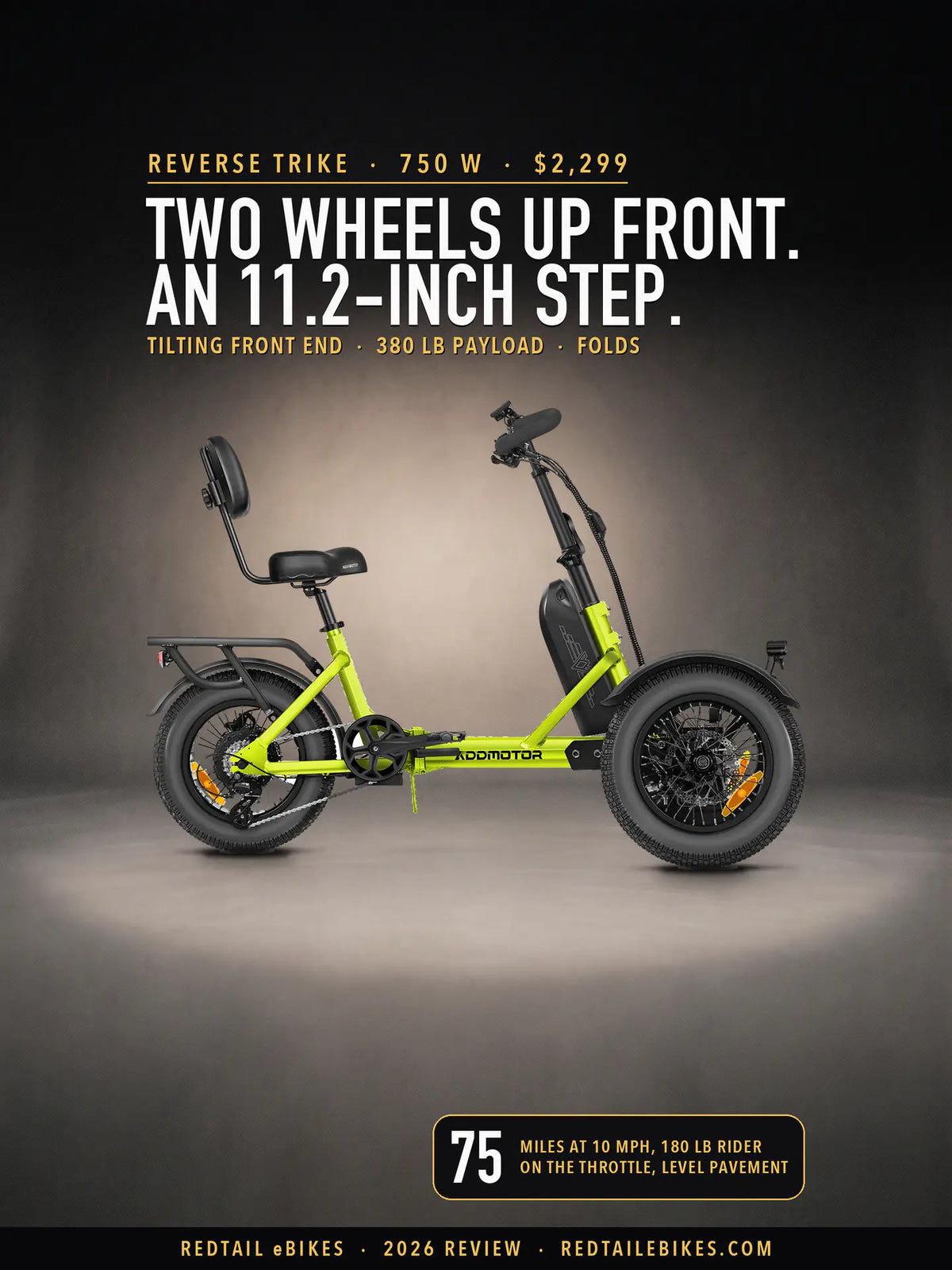
Share:
Meet the Mercers: 3 Generations, 1 California Town
Eahora FT-01 Max Review 2026: 1,440Wh, 330 lb