
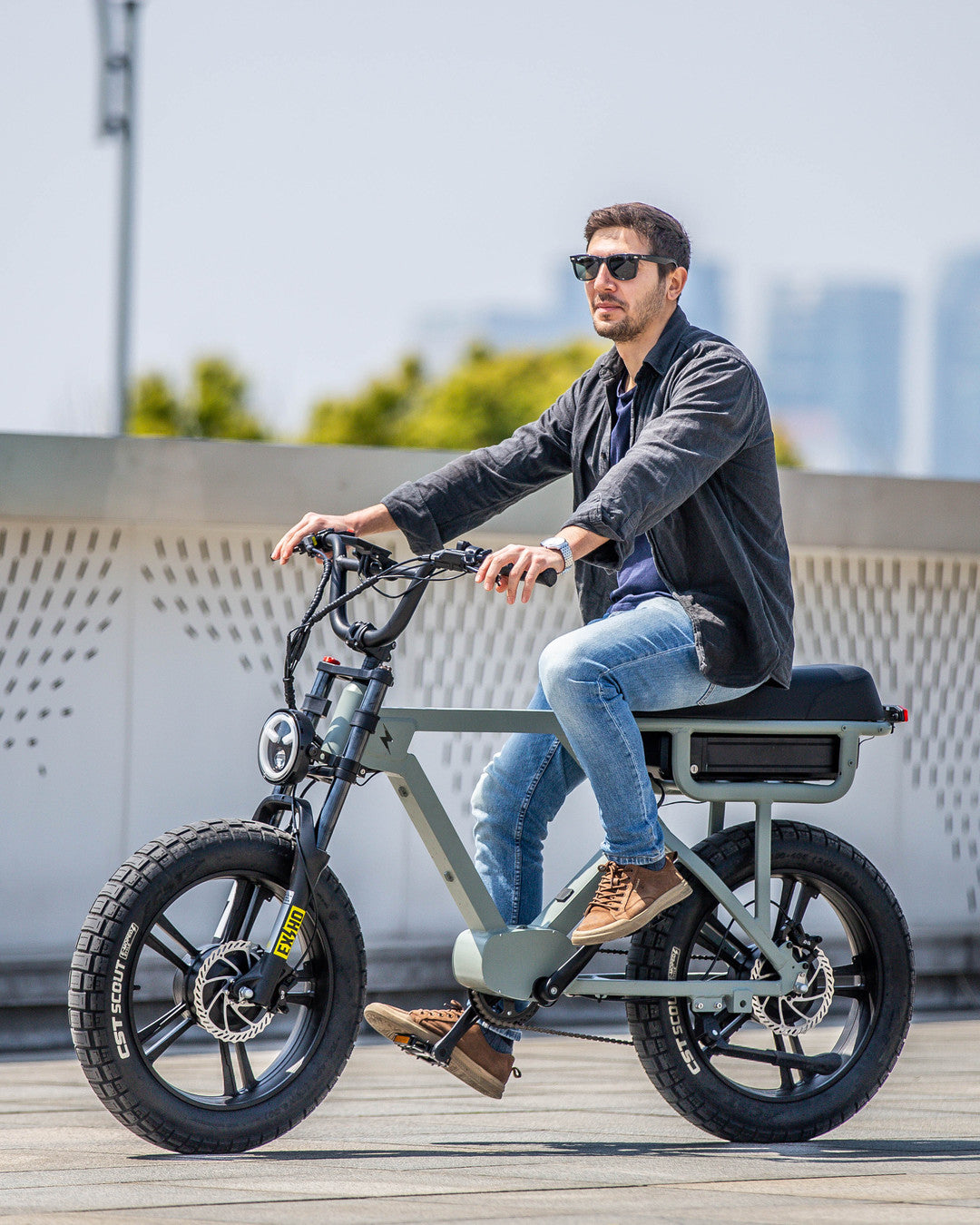


Quick Answer: Minnesota treats an electric-assisted bicycle as a bicycle: no license, plate, registration or insurance, and no helmet requirement at any age under state law. It has four e-bike categories — Class 1, 2, 3 and multiple mode (§ 169.011 subds. 15a–15c, 45a) — and the minimum age is 15 for every class. The state rebate is closed.
Then your county and your city decide the rest. Every one of Minnesota's 87 counties and every code platform hosting its 2,631 cities and townships was swept: 26 cities and 10 counties have a real local e-bike rule, from Nicollet County's outright ban to Stearns County's explicit permission.
State statutes re-read at the Revisor on August 18, 2026; the county and municipal sweep was completed August 15, 2026.

In this guide
- How we verified this guide
- What's on this page
- Minnesota eBike Laws: what the state actually says
- Minnesota has four e-bike classes, not three
- Three traps hidden inside the definition
- Minnesota-legal picks: what clears the definition, $1,599 to $1,799
- Age 15, every class — no exceptions
- Equipment rules that apply to the bike itself
- Where can you ride? Minnesota's "presumption of access"
- Trails: the DNR, Three Rivers, and Minneapolis's silent code
- Minnesota's 87 counties: from an outright ban to explicit permission
- Local ordinances: 26 Minnesota cities, checked and sourced
- Which cities require a helmet under 18?
- The stale-statute trap: which three cities cite the wrong rule?
- When the website and the code disagree: Cottage Grove and Chisago County
- The Minnesota e-bike rebate is closed
- What's changing next: SF 3236
- How this sweep was done — and its limits
- Where do riders get caught out?
- The honest ledger
- The 6-point Minnesota compliance checklist
- Which e-bike for which Minnesota rider
- Source register
- Limitations
- The bottom line
- Frequently asked questions
- Primary sources
Four statutory categories make the spec sheet matter more here than almost anywhere. Our commuter and city e-bikes publish wattage, class and assisted top speed — free US shipping, US-based support and warranty.
How we verified this guide
Every legal claim below was read at the source that issued it — not recalled, and not taken from another guide. This page went through two research passes: an initial sweep, then a full expansion that checked every Minnesota county and every code-hosting platform, followed by an adversarial verification pass where a second, independent researcher tried to refute every finding from the first.
- State statutes: retrieved from the Minnesota Office of the Revisor of Statutes, the state's official publisher, and quoted from the enacted text.
- The rebate: the Minnesota Department of Revenue's own program page, plus an independent second retrieval of the authorizing statute, Minn. Stat. § 289A.51, across its 2023, 2024 and 2025 versions to date the amounts correctly.
- Pending legislation: the Minnesota Legislature's own bill record for SF 3236, including its full action history and floor vote.
- The municipal and county denominators: built programmatically from the U.S. Census Bureau 2025 Gazetteer Files, cross-checked against the Minnesota House Research Department's Classification of Cities.
- Local ordinances: full-text searched across every code platform hosting a Minnesota government (Municode, eCode360, American Legal Publishing), plus direct checks of every county and every major city not on any platform. The operative sentence was retrieved and read before any jurisdiction was listed — never a search snippet alone.
- Adversarial verification. Every ordinance below was re-checked by an independent pass whose only job was to try to prove it wrong: re-fetch the primary source, check the date, check whether the quoted text says what we claimed. Two findings were refuted and removed as a result — see the methodology section for what changed and why.
- Reviewer: Milad Ghobadibeygvand, BScN (Western University, 2014), Redtail eBikes. Corrections: support@redtailebikes.com.
Where we could not verify something, this page says so and names the gap. Nothing here rests on "most states do X," and nothing ships because it seemed plausible.
What's on this page
Every section below is linked, in the order a Minnesota rider needs them: the four categories and the battery rule first, then the 87 counties and the 26 cities that wrote their own rule, with the five bikes that clear the definition in between.
- How we verified this guide
- What Minnesota law actually says
- Minnesota has four e-bike classes, not three
- Three traps hidden inside the definition
- Minnesota-legal picks: what clears the definition
- Age 15, every class — no exceptions
- Equipment rules that apply to the bike itself
- Where you can ride: Minnesota's "presumption of access"
- Trails: the DNR, Three Rivers, and Minneapolis's silent code
- Minnesota's 87 counties: from an outright ban to explicit permission
- Local ordinances: 26 Minnesota cities, checked and sourced
- Cities that require a helmet under 18
- The stale-statute trap: three cities citing the wrong rule
- When the website and the code disagree: Cottage Grove and Chisago County
- The Minnesota e-bike rebate is closed
- What's changing next: SF 3236
- How this sweep was done — and its limits
- Where riders get caught out
- The honest ledger
- The 6-point Minnesota compliance checklist
- Which e-bike for which Minnesota rider
- The bottom line
- Frequently asked questions
Minnesota eBike Laws: what the state actually says
Minnesota puts e-bikes inside the definition of "bicycle." Minn. Stat. § 169.011 subd. 4(a) says plainly: "Bicycle includes an electric-assisted bicycle, as defined in subdivision 27."
That one sentence does most of the work. Because an e-bike is a bicycle, it inherits every bicycle right in Chapter 169 — road use, shoulders, bike lanes, bike routes. And three separate subdivisions push it out of the heavier vehicle categories:
| The rule | What it actually means for you |
|---|---|
| § 169.011 subd. 42(b) — "Motor vehicle does not include an electric-assisted bicycle" | No driver's license needed, no motor-vehicle sales tax on the purchase |
| § 169.011 subd. 44 — motorcycle "does not include … electric-assisted bicycles as defined in subdivision 27" | No motorcycle endorsement, no motorcycle helmet law |
| § 169.011 subd. 45 — "Motorized bicycle does not include an electric-assisted bicycle as defined in subdivision 27" | The moped rules — permit, helmet under 18, sidewalk ban — do not reach your e-bike |
So the state layer, in one line each, every item read at the statute:
- No registration. Minn. Stat. § 168.012 subd. 2d.
- No title, no license plate. §§ 168A.03 subd. 1; 169.79 subd. 3.
- No driver's license or permit.
- No insurance requirement. § 65B.43 subds. 2, 13.
- No helmet requirement, at any age. The word "helmet" does not appear in § 169.222 at all. The Minnesota House Research Department's Low-Power and Unconventional Vehicles brief, February 2026, states it affirmatively: "Helmets are not mandatory for e-bike use."
- Minimum operator age 15, for every class. § 169.222 subd. 6a(e).
Bottom line In Minnesota an e-bike is legally a bicycle. Nothing to register, nothing to insure, no license, no state helmet mandate — but a hard floor of age 15, and a definition with sharper edges than most states.
Minnesota has four e-bike classes, not three
Nearly every national guide will tell you Minnesota uses "the standard three-class system." That is wrong, and it has been wrong since the legislature added a fourth category.
| Category | Statute | The operative text |
|---|---|---|
| Class 1 | § 169.011 subd. 15a | assistance "only when the rider is pedaling," ceases at 20 mph |
| Class 2 | § 169.011 subd. 15b | "capable of propelling the bicycle without the rider pedaling," ceases at 20 mph |
| Class 3 | § 169.011 subd. 15c | assistance "only when the rider is pedaling," ceases at 28 mph |
| Multiple mode | § 169.011 subd. 45a | "equipped with switchable or programmable modes that provide for operation as two or more of a class 1, class 2, or class 3 electric-assisted bicycle in conformance with the definition and requirements under this chapter for each respective class" |
The trap sits in the switch. If your bike has a mode switch, pedal-assist-only in one mode and throttle in another, it is probably not a "Class 2 that also does Class 1." Under Minnesota law it is its own category, a multiple mode e-bike, and it carries two extra obligations that a plain Class 1 or Class 2 does not:
- It must have a speedometer (§ 169.222 subd. 6b(d)).
- If it has a throttle, it "must not be capable of exceeding 20 miles per hour on motorized propulsion alone in any mode when the throttle is engaged" (§ 169.222 subd. 6b(e)).
That second rule is the one to read twice. A switchable bike may legally assist to 28 mph while you pedal — but the moment it is moving on throttle alone, 20 mph is the ceiling, in every mode, including its Class 3 mode.
Multiple mode also matters for where you ride. Under § 169.222 subd. 6a, Class 1 and Class 2 get the stronger trail protection; Class 3 and multiple mode are grouped together in the weaker category that a local authority can simply prohibit. Buying a switchable bike quietly moves you into the more restricted group.
Three traps hidden inside the definition
Minn. Stat. § 169.011 subd. 27 is where Minnesota gets stricter than its reputation. The full definition requires a bicycle with two or three wheels that:
- "has a saddle and fully operable pedals for human propulsion"
- "meets the requirements for bicycles under Code of Federal Regulations, title 16, part 1512"
- "is equipped with an electric motor that has a power output of not more than 750 watts"
- "meets the requirements of a class 1, class 2, class 3, or multiple mode electric-assisted bicycle"
- "has a battery or electric drive system that has been tested to an applicable safety standard by a third-party testing laboratory"
All five have to be true at once. Fail any one of them and the machine is not an electric-assisted bicycle in Minnesota, whatever the box says.
Trap 1 — an untested battery means it is not an e-bike at all
Clause (5) is unusual: Minnesota put third-party battery safety testing inside the definition itself. Most states treat battery certification, if they address it, as a separate product-safety rule.
Do not read this as "an e-bike with an uncertified battery is a non-compliant e-bike." Read it literally. A bike that fails clause (5) is not an electric-assisted bicycle in Minnesota.
It therefore is not a "bicycle" under subd. 4(a) either, and it does not inherit any of the bicycle rights above. Ask the seller which laboratory tested the pack and to which standard, and keep the answer.
Trap 2 — "unlockable" bikes are excluded by what the seller built in
Paragraphs (b) and (c) of the same subdivision close that door. Paragraph (b) reads: "A vehicle is not an electric-assisted bicycle if it is designed, manufactured, or intended by the manufacturer or seller to be configured or modified to not meet the requirements for an electric-assisted bicycle or operate within the requirements for an electric-assisted bicycle class."
And "configured or modified" is defined to include "(1) a mechanical switch or button; (2) a modification or change to the electric motor or the electric drive system; (3) the use of an application to increase or override the electric drive system."
The test is what the manufacturer or seller intended and built in — not whether you ever used it. A bike marketed with an app-based "unlock" or an off-road speed switch can fall outside Minnesota's e-bike definition while it is still in the box.
Trap 3 — the "motorized bicycle" rules you will find by searching are the wrong rules
Search "Minnesota motorized bicycle law" and you will find a helmet requirement until age 18, a driver's license or moped permit, and a flat sidewalk ban. All of that is real — and none of it applies to your e-bike.
Those rules live in § 169.223, which governs motorized bicycles: a separate class defined at § 169.011 subd. 45 as a 50cc-or-less machine capable of no more than 30 mph. That subdivision expressly excludes electric-assisted bicycles.
Getting this backwards is the single most common error we found in Minnesota e-bike content — and, as it turns out, in Minnesota's own local codes. Three cities make this same mistake in their own ordinances; see the stale-statute trap below.
Minnesota-legal picks: what clears the definition, $1,599 to $1,799
The picks below are five models that cleared a 186-bike screen against § 169.011 subd. 27.
Because clause (5) puts battery testing inside Minnesota's definition, the buying question here is narrower than in other states — Michigan, one lake over, asks only wattage, pedals and class. A bike has to clear four things at once: 750 watts or under, fully operable pedals, a class it can actually meet, and a battery tested by a third-party laboratory. We ran every e-bike we sell against that test before writing this section.
For a single bike's specification set out in full, see our moped-style e-bike review.
Our own screen, and it is not flattering. On August 18, 2026 we put all 186 e-bike listings in the Redtail catalog through Minn. Stat. § 169.011 subd. 27. 69 of them fail it: 67 are rated above 750 watts, 26 advertise a motor-driven top speed above the 28 mph ceiling that the fastest Minnesota class allows, and 3 have no pedals at all. Some fail on more than one count.
The screen and its raw output are ours, and the method is described in how this sweep was done.
Every Riding'times model we stock is rated above the 750-watt line. Every one is over Minnesota's 750-watt ceiling: the GT54 Pro and GT73 Pro are rated 3,000W, the GT73 and the G63 dual-motor 2,400W, the GT54 2,000W, the GT33 1,350W.
The Z8 Pro is the instructive one. Its 750W nominal rating clears the wattage ceiling, but it advertises a 32 mph top speed, and no Minnesota class permits motor assistance past 28. Those are capable machines on private land. They are not electric-assisted bicycles in Minnesota, and this page will not pretend otherwise to sell one.
| Model | Price | Motor | Class | Battery standard published | Best for the rider who… |
|---|---|---|---|---|---|
| Eunorau Defender | $1,599 | 500W, 20 mph | Class 2 | UL, as published by Eunorau | Rides gravel and frozen ruts and wants full suspension under them |
| Eunorau META20 | $1,699 | 500W, 20 mph | Class 2 | UL, as published by Eunorau | Folds it into an apartment and charges it indoors |
| Eunorau META26 | $1,699 | 500W, 20 mph | Class 2 | UL, as published by Eunorau | Commutes on pavement and wants a torque sensor doing it |
| Eunorau G30-CARGO 2.0 | $1,699 | 500W, 20 mph | Class 2 | UL, as published by Eunorau | Runs the school run and the grocery load on a 440 lb payload |
| Eunorau ONE-TRIKE 2.0 | $1,799 | 500W | Class 2 | UL, as published by Eunorau | Wants no balancing at a stop; § 169.011 subd. 27 covers three-wheelers too |
Why every pick is Class 1 or Class 2, deliberately. Under § 169.222 subd. 6a, Class 1 and Class 2 get Minnesota's stronger trail protection, while Class 3 and multiple mode sit in the weaker group a local authority may simply prohibit. Buying the faster class costs you access in the exact places Minnesotans ride.
The caveat that works against us. "UL, as published by Eunorau" means Eunorau states the battery is UL certified. We have not held the certificate or looked the listing up in UL's own database, so on our own source-grading rules that is a manufacturer claim rather than a verified fact. Clause (5) makes it definitional in Minnesota, so ask us for the laboratory and the standard before you order, and keep the answer.
The Samebike models the screen leaves out. The Pilot SE, Pilot SR, Pilot EX and RS-A02 are rated 1,000 W or more, above the 750 W limb of the definition, so none of them is an electric-assisted bicycle in Minnesota.
Before you buy in Minnesota Ask the seller two questions and write down the answers: which laboratory tested the battery and to which standard, and what the motor's nominal rating is. Peak wattage is a marketing number; § 169.011 subd. 27 tests the nominal one.
Every Eunorau model above is rated 500W, labeled Class 2 by the manufacturer, and sits inside Minnesota's statutory definition on wattage, class, and pedals — and every one ships free with a US warranty.
See the Minnesota-legal Eunorau rangeAge 15, every class — no exceptions

Fifteen for every class — Minnesota's floor reaches Class 1 and Class 3 alike.
Minn. Stat. § 169.222 subd. 6a(e) is one sentence: "A person under the age of 15 must not operate an electric-assisted bicycle."
Most states that set an age floor set it at 16 and apply it to Class 3 only. Minnesota does neither.
- A 14-year-old may not ride a Class 1 pedal-assist e-bike, even the slowest one sold.
- A 15-year-old may legally ride a Class 3 at 28 mph assisted.
The Minnesota Department of Public Safety states the same rule on its bicycle and pedestrian laws page: "Even legal e-bikes may not be operated by anyone under the age of 15." Two independent sources, same answer.
If you are buying an e-bike for a young teenager in Minnesota, 15 is the number that matters, and it applies to the cheapest Class 1 commuter just as much as to a fast Class 3.
Equipment rules that apply to the bike itself

Motor rating, class, speedometer, battery test — the four checks inside § 169.011 subd. 27.
Section 169.222 subd. 6b puts obligations on the bike, and some of them on the seller rather than you:
- A permanent label is mandatory. The manufacturer or distributor must affix it in a prominent location showing class number, top assisted speed, and motor wattage, "printed in a legible font with at least 9-point type." A multiple mode bike must label every class it can operate in. Check for this label before you buy.
- Motor cut-off. The motor must disengage or cease when the brakes are applied, and (except for Class 2, or multiple mode running in class 2 mode) when you stop pedaling.
- Speedometer on Class 3 and multiple mode.
- Modification is regulated rather than banned. You may change your bike's speed capability, but subd. 6b(b) requires you to replace the label with the revised information — or, if it no longer meets any class, remove the e-bike labeling entirely.
Lighting follows the ordinary bicycle rules in subd. 6: a white front lamp visible at 500 feet at night, a rear red reflector, pedal and side reflective material, and working brakes able to skid the wheel on dry pavement.
Where can you ride? Minnesota's "presumption of access"

Presumption of access: a governing body may not restrict e-bikes on a bikeway unless it finds the operation unsafe.
This is the part almost no other guide gets to, and Minnesota's model is genuinely different from the other big states we've covered.
California works agency-by-agency. Texas actively preempts most local e-bike bans. Minnesota does neither. It creates a presumption of access that a local body can rebut only by making a finding.
Three parallel statutes use materially identical language:
"A governing body may not prohibit or otherwise restrict operation of an electric-assisted bicycle … on any bikeway, roadway, or shoulder, unless the governing body determines that operation of the electric-assisted bicycle is not consistent with (1) the safety or general welfare of bikeway, roadway, or shoulder users; or (2) the terms of any property conveyance."
— Minn. Stat. § 160.263 subd. 2(b)
The same two-ground test binds the DNR commissioner on state trails (§ 85.015 subd. 1d) and local units of government on grant-in-aid trails (§ 85.018 subd. 2(d)). A Minnesota city cannot simply decide it dislikes e-bikes on its bikeways; it has to determine that access is inconsistent with safety, general welfare, or a property conveyance.
But the presumption does not cover everything. Three levers carry no findings requirement at all, and they are exactly where local rules bite:
| Lever | Statute | What a local authority can do |
|---|---|---|
| Class 3 and multiple mode on paths and trails | § 169.222 subd. 6a(c) | Simply "prohibits the operation" — no findings language |
| Natural-surface nonmotorized trails and bike parks | § 169.222 subd. 6a(d) | "may regulate" e-bike operation, unconditioned |
| Sidewalks | § 169.222 subd. 4(d) | "Local authorities may prohibit the operation of bicycles on any sidewalk or crosswalk under their jurisdiction" |
So the practical rule for a Minnesota rider: Class 1 and Class 2 on paved public bikeways are strongly protected statewide. Class 3, multiple mode, singletrack, and sidewalks are where you must check locally.
Bottom line Minnesota does not preempt local e-bike bans, and it does not make cities opt in. It presumes access and makes a local authority find a reason to take it away — except on sidewalks, natural-surface trails, and for Class 3 and multiple mode on paths, where no finding is required.
Class 1 and Class 2 commuters give you the widest, least contestable access in Minnesota — protected on paved bikeways statewide, with none of the extra equipment rules a switchable bike carries.
Browse commuter e-bikesOne more sidewalk rule that catches people: under § 169.222 subd. 4(d) you may not ride a bicycle, e-bike included, on a sidewalk within a business district unless local authorities permit it. A statewide default rather than a local ordinance, and it applies in every downtown in Minnesota.
Trails: the DNR, Three Rivers, and Minneapolis's silent code
Because subd. 6a(c)–(d) hands trail authorities the sharpest powers, the land managers matter as much as the cities.
Minnesota DNR state trails. The DNR's state trails page permits e-bikes meeting the § 169.011 subd. 27 definition, across all classes. Its own caveat is worth carrying with you: "Note: these rules pertain to uses on Minnesota state trails. State forests, wildlife management areas, and other DNR-managed public lands may have different rules."
Three Rivers Park District, the largest suburban park system in the Twin Cities, goes further than it had to. Its e-bike policy states e-bikes "can be used wherever traditional bicycles are allowed, including regional trails, paved in-park trails and singletrack trails."
Under § 169.222 subd. 6a(d), Three Rivers had explicit statutory power to regulate e-bikes on natural-surface trails and chose not to exercise it. Its one firm line: "A motorized bicycle that does not meet this definition is not allowed on any Park District trail."
Bottom line The DNR and Three Rivers open their trails to any bike that meets the state definition — 750 watts or less, a third-party-tested battery, a class it meets — and the county's row sets the speed. Where a manager's code never mentions e-bikes, its bicycle definition is the rule until it writes one.
Minneapolis Park & Recreation Board is genuinely silent — and we reached its code to confirm it rather than assume it. MPRB is an independently elected body that manages most of Minneapolis's trail miles and is one of Minnesota's ten official Metropolitan Regional Parks implementing agencies (Minn. Stat. § 473.351). Its full 459-section Code of Ordinances contains zero e-bike-specific language — no definition of "electric bicycle," no class distinctions, nothing.
Its governing definitions were never updated for motor-assist: "Biker" means someone on a device "propelled by human power," and "Vehicle" is defined broadly enough that a motor-assisted bike could arguably fall on either side of that line, depending on which definition you read first.
What MPRB's code does have is a flat 10 mph speed cap on all park pathways, dating to a 1981 ordinance, well under the state's 20/28 mph motor-assist thresholds and applying to every trail user rather than to e-bikes alone.
MPRB officials have acknowledged this gap publicly, though not recently. A 2019 Star Tribune report quoted a parks design manager saying the board had "ambitions to 'remove the ambiguity out on the trails,'" with no timeline given.
A 2025 Star Tribune follow-up reported the gap was still open — Minneapolis relies on the general 10 mph pathway cap, signage, and rider education rather than an e-bike-specific rule. We could not retrieve either article's full text directly (both sit behind access blocks); this paragraph is labeled accordingly and should not be cited as a primary-source quote.
Bottom line Minnesota's biggest trail managers land on very different points of a spectrum. The DNR and Three Rivers both went more permissive than the statute required. Minneapolis's park board has never written an e-bike rule at all — riders there fall back on the general 10 mph pathway cap and a genuinely ambiguous "human power" definition.
Three Rivers Park District opens its singletrack to any e-bike that meets Minnesota's definition, so the spec sheet is what decides whether you can ride there. The trail sign does not.
See trail-ready e-bikes
The statute protects the bikeway. It does not protect the speed you take it at: Three Rivers caps you at 20 mph, the regional-park counties at 15.
Minnesota's 87 counties: from an outright ban to explicit permission

Eighty-seven counties, ten with a rule — the sign at the county park entrance is where Nicollet's ban and Stearns's permission show up.
No other Minnesota e-bike guide checks the county layer. We checked all 87.
Of Minnesota's 87 counties, 10 have a real local e-bike rule we located and read in an enacted ordinance; 71 were searched, their park, trail, or ATV ordinances read in full, with no e-bike-specific rule found; 6 could not be checked in this pass and are unresolved. 10 + 71 + 6 = 87.
Six Minnesota counties are Metropolitan Regional Parks implementing agencies: Anoka, Carver, Dakota, Ramsey, Scott, and Washington. Minn. Stat. § 473.351 names them as jointly running the Twin Cities' regional park system, alongside Minneapolis, St. Paul, Bloomington, and Three Rivers Park District.
Four of the six have adopted an e-bike rule we could locate and read. Carver and Scott have not. Scott's full 22-page parks ordinance was read end to end and Carver was checked directly; neither contains e-bike-specific language.
Three of those four regulate by speed — Ramsey below 20 mph, Dakota and Anoka at 15 — all well under the state's 28 mph Class 3 ceiling. Washington County works differently, restricting where you may ride and banning motors over 1,000 watts instead of setting a speed limit.
| County | Rule | Cite | Adopted |
|---|---|---|---|
| Nicollet | Total ban — "The use of electric-assisted bicycles (e-bikes) are strictly prohibited in a park." Confirmed by two independent provisions in the same ordinance, no exceptions found anywhere. | Parks Ordinance, Sec. 6.7 | 2025-08-12 |
| Washington | Bars operating an "electric recreational vehicle" (defined to include e-bikes) off designated trails/roadways, or with a motor over 1,000 watts | Parks Ord. No. 218, Ch. VI § 13 | 2024-05-21 |
| Isanti | Class 1 and 2 e-bikes exempted from the general motor-vehicle ban in Parks (age 16+, ≤20mph, ≤750W) — but all bicycles, e-bikes included, are separately banned outright in the county's distinct "Park Preserve" land class | Park Ordinance No. 24-0000-01, Ch. 4 §1(a) / Ch. 6 §4 | 2024-09-17 |
| Wright | Bars any e-bike lacking operational pedals or a valid Minnesota statutory class | Code § 92.05(F)(4) | passed 2025-10-21, eff. 2025-10-22 |
| Sherburne | E-bikes exempted from the "motorized bicycle" park ban (permitted as bicycles); all bicycles incl. e-bikes capped at 20 mph | Park Regulations Ord. No. 270 § 6.G | eff. 2025-08-05 |
| Ramsey | "Electric bicycles are allowed on paved trails, and must be operated safely at speeds below 20 mph." Governs the Bruce Vento, Rice Creek, Lake Links and Trout Brook regional trails. | Parks & Rec. Ordinance § 13(e) | undated in body; file metadata 2022 |
| Dakota | E-bikes ("Electric Powered Devices") capped at 15 mph in parks, must yield to pedestrians and non-motorized traffic; Class 1 e-mountain-bikes affirmatively allowed on designated mountain-biking trails (Class 2 and 3 not addressed either way) | Park Ordinance No. 107 §§ 1.5, 7.4 | approved 2023-05-23, eff. 2023-10-15 |
| Anoka | All bicycles, e-bikes included, capped at 15 mph in county parks | Amended & Restated Ord. #2018-01, Ch. VI § 8 | 2024-07-23 |
| Stearns | Explicitly permits e-bikes on county recreational trails (classified as "non-motorized," not restricted); all trail users capped at 20 mph | Ordinance No. 594 §§ 2.4–2.5, 8 | 2019-12-17 |
| Marshall | 10 mph e-bike cap at Florian Park — a park policy manual rather than a numbered ordinance; single-sourced | Park at Florian Policy Manual | "created March 2026" |
Nicollet's ban is the strictest single rule found anywhere in this sweep — stricter than any city ordinance on this page.
Isanti's rule needs unpacking, because it looks self-contradictory and is not. The ordinance's own chapter headers settle it: Chapter 5 governs "All Parks (Not Preserves)" and Chapter 6 governs "All Park Preserves (Not Parks)" — two coordinate, mutually exclusive land classes, never one nested inside the other.
In an ordinary county Park, Chapter 4's conditional e-bike exception applies (Class 1/2, age 16+, capped speed and wattage). In a Park Preserve, a distinct and more protected land class, Chapter 6's unconditional bicycle ban applies instead, and because e-bikes are legally bicycles under state law, even a fully compliant Class 1 e-bike is caught by it. Both rules are true; they just govern different land.
Dakota's mountain-trail rule needs one honest caveat. Its ordinance affirmatively allows Class 1 e-mountain-bikes on designated trails — it never says Class 2 or 3 are banned there. Reading Class 2/3 as excluded is a reasonable inference from the ordinance's general framework, and the text does not state it outright.
Bottom line Three of the six county park agencies in the metro — Anoka and Dakota at 15 mph, Ramsey below 20 — have adopted their own e-bike speed cap, and Sherburne caps at 20 next door, every one below the state's 28 mph Class 3 ceiling. If you ride county trails in the Twin Cities metro, the county's cap is very likely the binding number, ahead of the class rating on your bike's label.
The other 77 counties resolve to NONE FOUND (71, genuinely searched and clear) or UNRESOLVED (6: Aitkin, Becker, Lyon, Meeker, Otter Tail, and Roseau — every one blocked by a site outage, a bot wall, or genuinely ambiguous webpage language we would not force into a rule). Hennepin County, home to Minneapolis and Three Rivers Park District, runs no park system of its own; its regional trails belong to Three Rivers, a legally separate special district already covered above.

Twenty-six cities have written an e-bike rule. The other 2,605 municipalities are the reason this page publishes a denominator instead of a headline.
Local ordinances: 26 Minnesota cities, checked and sourced
We reached 249 of Minnesota's 2,631 cities and townships across four separate code-hosting platforms plus direct checks of major cities on no platform at all. Twenty-six have a real local e-bike rule; 132 were searched with none found; 91 were reached but could not be fully resolved; 2,382 were never reached in this pass. 26 + 132 + 91 + 2,382 = 2,631.
That last figure is 90.5% of the state, and we are not going to dress it up. Read the methodology section before relying on an absence anywhere on this page.
The denominator. Minnesota has 856 cities and 1,775 townships with active governments — 2,631 general-purpose municipal governments, from the U.S. Census Bureau's 2025 Gazetteer Files. Townships are counted because they are separate general-purpose governments under Minn. Stat. ch. 365/368, and because § 160.263 subd. 2 grants bikeway powers to "the governing body of any political subdivision."
Every city where we found and read a real local e-bike rule:
| City | Cite | Adopted | What it does |
|---|---|---|---|
| Bloomington | Tretbaugh Bike Skills Park rule | eff. 2025-10-07 | E-bikes barred at one specific skills park only, with no citywide rule |
| Brooklyn Park | Code § 125.18 | Ord. 2021-1263, 2021-05-10 | Shared/rental e-bike parking rules (business-licensing scope only) |
| Champlin | Sec. 42-24(a) | Ord. 907, Jan 13 2025 | Under-18 helmet mandate; no e-bike on turf/playfield/playground/court/rink in a park |
| Cottage Grove | §§ 6-5-1, 6-5-3 | — | E-bikes named in parking/unattended-vehicle rules — not a helmet mandate, see below |
| Crystal | Code § 1310.13 | doc. eff. 2026-04-03 | Shared/rental e-bike parking rules (business scope only) |
| Deephaven | § 710.03 | undated | Stale statute cross-reference — see below |
| Duluth | Ch. 9 §§ 9-1 to 9-6 | Ord. 10619 (2019); Ord. 10817 (2022) | Dedicated e-bike chapter; 10 mph limit on the Lakewalk (Rose Garden to Canal Park) |
| Elk River | Sec. 54-35(B) | Ord. 26-09, passed Feb 2 2026 | 20 mph cap on paved city trails, expressly overriding Class 3's statutory 28 mph; unpaved trails/grass/playgrounds off-limits except Hillside Park, Class 1 only |
| Excelsior | Sec. 32-2(g) | Ord. 667, Jun 3 2024 | Under-18 helmet mandate; named-street sidewalk bans |
| Fairfax | §§ 85-1, 85-12 | — | Code internally conflicts — see below |
| Hopkins | Secs. 38-226–38-230 | Ord. 2022-1179, Feb 15 2022 | No e-bike on any sidewalk except to enter/leave adjacent property |
| La Crescent | § 94.37(J) | Ord. 559, 2022-07-11 | Permissive — e-bikes exempted from a skateboard-type bridge ban |
| Lakeville | Title 7 Ch. 8 | ordinance # not published | Class 1 allowed (weather caveat), Class 2 and 3 barred on the West Lake Marion Trail; 15 mph cap; sidewalk restriction |
| Maple Grove | City e-bike requirements; park code at § 22-21 and § 22-25 | — | Motor capped at 750 watts, no speed modification; Class 1/2/3 allowed on sidewalks/trails/streets, riders 15+; in a park or parkway, ridden only in a prudent and careful manner |
| Minnetonka | § 1135.020(8)–(12) | eff. 2025-05-19 | E-bikes affirmatively exempted from the park motor-vehicle ban; 15 mph park cap |
| Moorhead | § 5-6-3 | Ord. 2024-05, 2024-06-24 | 15 mph cap on multi-use trails (triple-independently confirmed) |
| North Saint Paul | § 92.05 | unconfirmed | Bars securing e-bikes to trees/light posts — search-snippet only, see caveat |
| Otsego | § 8-7-3 | Ord. 2024-11, 2024-11-12 | Permissive — explicitly authorizes Class 1/2/3 e-bikes on paved trails/parks |
| Owatonna | Ord. 1683 §71.100; Ch. 121 Ord. 1631 | 2026-03-17; 2022-04-05 | E-bikes excluded from the new ATV/golf-cart permit regime; separate bike-share licensing chapter |
| Rogers | Sec. 42-163 | — | Under-18 helmet mandate, any class |
| Scandia | § 91.03(Q) | Ord. 21-03, 2021-11-16 | E-bikes on sidewalks/private property declared a public nuisance |
| Shorewood | Ch. 614 | Ord. 609, 2024-10-15 | Under-18 helmet mandate; park-surface riding ban |
| Wayzata | Sec. 301.15 | Ord. 850, May 20 2025 | Under-18 helmet mandate, emergency ordinance |
| Woodbury | Secs. 14-35, 14-38 | Ord. 2076, Mar 25 2026 | E-bikes in public sites only "in a prudent and careful manner"; bars "e-motos" |
| Becker (city, Sherburne Co.) | § 70.05 | Ord. 297, 2025-10-11 | Under-18 helmet mandate; 15 mph cap off bike lane/roadway |
| Battle Lake | §§ 73.15–73.17 | Ord. passed 2024-10-08 | Class 1/2/3 definitions, general trail-use rules, and equipment/age rules: motorized foot scooters barred under age 12, riders under 18 must wear a helmet |
Woodbury's ordinance, adopted March 25, 2026, is the most recent city-level enactment we located — and it is notable for naming "e-motos" as their own problem class, separate from e-bikes.
Two entries need an honest single-source caveat. Rogers and Hopkins were captured from Municode's own search database with real section text — but a same-day independent re-verification attempt found Municode completely unreachable and could not confirm them a second time.
Maple Grove has two layers, and both are real. Its park code, § 22-21 and § 22-25, admits an e-bike to a park or parkway only when ridden "in a prudent and careful manner and maintaining effective control"; the city's own e-bike page adds the rules for its trails and streets — a 750-watt cap with no speed modification, Class 1, 2 and 3 on sidewalks, trails and streets, riders 15 and up. Read the code for parks, the page for the rest.
Cities where we checked and found nothing
Well over 200 additional cities and townships were searched on their official code platform, with the operative text read where any hit appeared, and no e-bike-specific rule was found. The recurring false-positive traps, seen repeatedly:
- Statutory restatement. A city adopting § 169.011 subd. 27 by reference, with no local addition, is not a local enactment.
- The "motorized bicycle" trap. A hit on that term alone is the separate, excluded 50cc/30mph moped class — unless the text explicitly reaches e-bikes too.
- The "motorized foot scooter" trap. Also a distinct, excluded class.
- Pedicab and business-fee traps. Several large cities (Minneapolis, Rochester, St. Paul) only mention "electric-assisted bicycle" inside a pedicab-licensing definition — not a riding rule.
Minneapolis is worth stating explicitly. Minnesota's largest city returned no local e-bike riding ordinance in its own municipal code. Its park system, the more consequential body for trail access, is covered separately above; its code is genuinely silent on e-bikes, confirmed directly rather than merely unreached.
Which cities require a helmet under 18?
Six Minnesota cities now require riders under 18 to wear a helmet on an e-bike, where state law requires none at any age: Champlin, Excelsior, Wayzata, Rogers, Shorewood, and Becker.
A note on geography, checked carefully rather than assumed: three of the six, Excelsior, Wayzata, and Shorewood, genuinely border Lake Minnetonka, and moved within about eighteen months of each other. Minnetonka (the city) touches the lake only at one bay (Gray's Bay) and is not itself a helmet-mandate city.
Champlin, Rogers, and Becker are not Lake Minnetonka communities at all — Champlin sits on the Mississippi River, Rogers borders the Crow River, and Becker is 46 miles from the Twin Cities in a different part of the state entirely. The pattern is real for three cities; the other three are independent, unrelated instances of the same trend, and they form no lakeshore cluster.
- Excelsior: Ord. 667, adopted June 3, 2024, independently confirmed via the city's own council minutes. Reported as an emergency ordinance developed with the South Lake Police Department after complaints about fast, helmetless riding downtown.
- Wayzata: Ord. 850, adopted May 20, 2025, passed 5–0 as an emergency ordinance, effective immediately, bypassing the usual two-reading process.
- Shorewood: Ord. 609, adopted October 15, 2024, confirmed from the city's own signed ordinance.
- Champlin: Ord. 907, adopted January 13, 2025, bundled with park-surface restrictions.
- Rogers: Sec. 42-163(b), covering an e-bike of any class.
- Becker (Sherburne County): Ord. 297, adopted October 11, 2025, bundled with a 15 mph local speed cap.
All six require headgear approved for bicycle riding by the U.S. Department of Transportation or ANSI. This is a genuinely fast-moving pattern — a statewide version, SF 3236, has already passed the Senate; see below.
Buying for a rider under 18 in Minnesota? Six cities already require a helmet, and a statewide bill just cleared the Senate — get one with the bike.
Shop e-bikes with a helmet bundleThe stale-statute trap: which three cities cite the wrong rule?
Minnesota renumbered its vehicle statutes at some point after these cities last touched their codes, and three of them never caught up — each now cites § 169.011 subd. 27 as if it still means "motorized bicycle," when subd. 27 currently defines electric-assisted bicycle (motorized bicycle moved to subd. 45).
- Fairfax (Renville County): § 85-1 defines "motorized bicycle" to include an electric-assisted bicycle, treating it as a motor vehicle capped at 1,000 watts and 20 mph. A separate section, § 85-12, contradicts that: "Electric bicycles... shall be prohibited from traveling wherever bicycles are prohibited, and shall be subject to all rules and regulations governing bicycles." The same code treats e-bikes as motor vehicles in one place and ordinary bicycles in another.
- Deephaven: § 710.03 bans "'motorized bicycle' as defined in Minnesota Statutes, Section 169.011, Subd. 27" from bike lanes. Read literally, that citation now points at electric-assisted bicycle instead of the moped class the ordinance's drafters meant.
We are not telling you either city bans or exempts e-bikes on the strength of this, and you should not read it that way. A local definition that contradicts the current state statute is not a reliable rule either direction. We found no court decision or Attorney General opinion resolving either, so we publish both as open questions and warnings, and never as rules a rider may safely rely on.
When the website and the code disagree: Cottage Grove and Chisago County
Cottage Grove's public-facing page states, in plain terms, that riders under 18 must wear a helmet on an e-bike, citing "Ordinance 1112." We could not find that ordinance anywhere in the city's own records — and when we read the actual codified helmet section, it says something different.
Section 6-5-6 (Helmets) applies only to a "recreational motor vehicle." Section 6-5-1, the definitions section, expressly excludes electric-assisted bicycles from that term. Chained together, Cottage Grove's own current code does not require an e-bike rider of any age to wear a helmet — despite what the city's own public page tells residents.
A secondary source that appeared to corroborate the helmet claim turned out to describe a different Cottage Grove — in Wisconsin. That is the kind of wrong-jurisdiction contamination this project's fact-check standard exists to catch: a plausible-looking source, for the wrong government entirely.
The lesson generalizes: a city's own FAQ page is not always a reliable statement of its own code. Where the two conflict, this page follows the codified ordinance, and says so.
Chisago County: a real trail rule that is not in the county's code
Chisago County publishes a rule that would change your ride, and it is not an ordinance. Its own Recreation page, under MOTORIZED VEHICLE RULES, states: "NO motorized vehicles or throttle assist electric bikes allowed" and "NO Class II or Class III electric bicycles allowed on the trail." Read on August 18, 2026.
Taken at face value that is one of the strictest county e-bike rules in Minnesota: it shuts every throttle bike and every Class 2 and Class 3 machine out of the county's mountain bike trail, leaving Class 1 as the only way in.
We do not count it as an ordinance, because it is not in one. The county's codified park ordinance defines "bicycle" without any class distinction and carries no e-bike-specific provision, so this rule lives on a webpage and a trailhead sign rather than in enacted law. Why Chisago sits in our none-found column while Cottage Grove's helmet claim, which contradicts its own code, is refuted outright.
Ride it as though it binds you anyway. Whether or not a webpage is enforceable, it is what the trail steward believes and what a ranger will tell you, and no rider wins that argument at the trailhead. If you ride a Class 2 or a throttle-equipped bike in Chisago County, call the parks office at the number on that page before you load the car.
The Minnesota e-bike rebate is closed
If you take one commercial fact from this page, take this one.
The Minnesota e-Bike Rebate is over. The Department of Revenue's own program page says it in these words: "All rebate certificates have been allocated and this program is now closed," and "The program is now ended, and there will not be any future application periods."
We confirmed that independently against the authorizing statute rather than trusting a single page. Minn. Stat. § 289A.51 subd. 4(d) caps certificates at "more than $2,000,000 in each of calendar years 2024 and 2025."
The authorization runs to those two calendar years by its own terms, with no allocation beyond them.
And the amount changed partway through, which is why other pages disagree with each other. We pulled all three statutory vintages:
| Year | Maximum rebate | How it worked |
|---|---|---|
| 2024 | $1,500 | 75% of eligible expenses, sliding down one point per $4,000 of income above $50,000 (joint) / $25,000 (other), to a 50% floor |
| 2025 | $750 | flat 75% of eligible expenses, hard income cut-offs of $78,000 joint / $62,000 head of household / $41,000 otherwise |
| 2026 | none | program closed |
So a page telling you Minnesota pays "up to $1,500" is describing 2024 rules. A page telling you "up to $750" is describing 2025. Both describe a program that is no longer accepting applicants. We found live pages advertising a 2026 Minnesota e-bike rebate, including one promising "$2,025 back," at the same time the administering agency was saying the program had ended.
While it ran, the program was genuinely well designed: eligibility began at age 15, matching the riding age, and "qualifying accessories" expressly included a bicycle helmet, lights, lock, luggage rack, basket, bag, fenders and reflective clothing.
What this means if you are buying now. Budget the full price. We found no Xcel Energy e-bike rebate and no current Minneapolis or Saint Paul municipal e-bike rebate — but we were not able to sweep every Minnesota utility and city program, so treat that as "none located," not "none exists."
What's changing next: SF 3236

SF 3236 is a proposal; the Revisor's text is the rule.
A statewide under-18 helmet mandate is closer than most riders realize, and reporting it as "a bill was introduced" would be materially misleading.
Senate File 3236 (94th Legislature) is titled in part "requiring helmets for operators of electric-assisted bicycles under the age of 18." Chief author: Johnson Stewart. House companion: HF 2811. Its action history, from the Legislature's own record:
- April 2, 2025: introduction and first reading, referred to Transportation
- April 13, 2026: committee report to pass as amended, re-referred to Finance
- May 13, 2026: committee report to pass as amended; second reading
- May 15, 2026 — third reading, PASSED the Senate 34–33
- May 16, 2026: received in the House, referred to Transportation Finance and Policy
It has already cleared a chamber by a single vote. It is not law, and as of this writing it sits in House committee — but "still in committee" describes only its current posting and says nothing about its history.
Two other provisions in the bill would matter to buyers if it passes. It would redefine "micromobility device," dropping the speed threshold from 30 to 20 mph and the weight limit from 500 to 100 pounds. It would also make a bicycle with a motor of at least 1,500 watts, or capable of more than 30 mph, a motorcycle.
Given that six cities have already moved on the exact question this bill answers, its odds of passage look real. We will re-check its status at the next scheduled review of this page.
How this sweep was done — and its limits
Publishing 26 city ordinances and 10 county ordinances without publishing the method would be dishonest, so below is what we did, what we caught ourselves getting wrong, and where it still falls short.
What we searched. Every Minnesota municipality hosted on Municode Library (96 city/township clients), eCode360 (5 clients), and American Legal Publishing (140 municipality clients, enumerated via a static ICC library page that a prior session's tooling had missed).
Every one of Minnesota's 87 counties, checked directly against its own ordinances, park department pages, or county board records. Twenty-four of Minnesota's largest cities not reached by any platform, checked directly. And Minneapolis Park & Recreation Board's actual code, reached via its underlying content API after its public pages blocked every direct request.
Adversarial verification — what changed. Every ordinance was re-checked by an independent pass instructed to try to refute it rather than confirm it. Two findings did not survive:
- Edina's sidewalk ban was real — and then reversed within about a year, ordinance number for both moves. Ordinance 2025-04 banned e-bikes from Edina sidewalks outright, adopted April 16, 2025. A Transportation Commission review recommended repeal that November; the Council directed a rewrite in March 2026; Ordinance 2026-07 repealed the ban and folded e-bikes into the same 10 mph sidewalk rule that already governed ordinary bicycles, adopted May 5, 2026 and published May 14, 2026. We removed the ban from the ordinance table rather than publish outdated law — Edina now belongs with the cities that do not restrict e-bike sidewalk use.
- A claimed conflict in Anoka's city code could not be independently re-confirmed, and Anoka's own current official page states the opposite of the original claim — that e-bikes are treated as ordinary bicycles, consistent with state law. We dropped it rather than publish an unresolved, likely-superseded claim.
Two other findings were corrected in the opposite direction. Minnetonka and Brooklyn Park were originally checked and cleared — but the "clear" result turned out to be a false negative. Both cities' codes sit behind a Cloudflare challenge page that our first search tooling was grepping instead of the real content, producing a genuine "0 hits" on garbage rather than on the actual code.
A second, independently built search route found real ordinances in both. We are naming this specific failure mode because it looks exactly like a clean negative result until someone checks twice.
What we still could not do:
- 2,382 of Minnesota's 2,631 cities and townships were never reached in this pass. Roughly 94 additional American Legal-hosted municipalities returned a search hit that could not be independently confirmed before publication — they remain unresolved rather than cleared.
- Council agendas were not systematically searched. An ordinance exists in a council packet before it appears in any codified chapter; a city that acted last month may not show up in any code search yet.
- County road authority and most county park systems beyond the 87 we checked as a whole were not exhaustively swept for every possible sub-jurisdiction (joint-powers trail authorities, watershed districts, and similar special bodies exist alongside counties and were not separately enumerated).
Verification confidence, stated plainly, city by city and county by county: the great majority of ordinances above carry either an independent second source or survived a dedicated adversarial re-check this session. A handful of them (Rogers, Hopkins, Marshall County's park policy, and North Saint Paul) rest on a single retrieval or a search-snippet only, and are labeled as such in their table rows. Treat those specifically as leads to confirm locally rather than as settled fact.
La Crescent's rule is confirmed and current, but a city council packet shows a councilmember asking about this exact question in May 2026, with staff replying that a dedicated trail-system section is being drafted — worth a check before this page's next scheduled review.
Where do riders get caught out?

The battery certificate is the Minnesota question nobody expects at the rack.
The mistakes that actually cost Minnesota riders a citation, a trail or a rebate:
- Assuming 16, like most states. It is 15, and it applies to your Class 1 as much as your Class 3.
- Assuming three classes. If your bike switches modes it is a multiple mode e-bike: it needs a speedometer, its throttle is capped at 20 mph in every mode, and it sits in the group local authorities can bar from paths outright.
- Assuming "no state helmet law" means no helmet law. Six cities say otherwise for under-18s, and a statewide bill has already passed the Senate.
- Assuming a rebate is waiting for you. It closed after 2025. Pages still advertising it are stale.
- Assuming your bike's class rating is the trail speed limit. Four counties — Anoka, Dakota, Ramsey and Sherburne — cap all e-bikes at 15–20 mph on their own trails — below the 28 mph a Class 3 bike is rated for.
- Assuming a city's own FAQ page states its actual code. Cottage Grove's public page claims a helmet mandate its codified ordinance does not support, and the ordinance is what you would be cited under.
The honest ledger

No state helmet law at any age — and a short list of cities that wrote their own.
Green flags — where Minnesota is genuinely good for e-bike riders
- E-bikes are bicycles: no license, plate, registration, insurance or state helmet mandate.
- The presumption-of-access statutes make casual local bans on bikeways legally harder than in most states.
- The DNR and Three Rivers Park District both permit e-bikes even on singletrack, going beyond what the statute required.
- Otsego and Stearns County both explicitly welcome e-bikes rather than merely tolerating them.
- Three wheels are in the definition, so your cargo trike is covered.
Red flags — where it is stricter or messier than you would expect
- Age 15 is a hard floor for every class.
- Third-party battery testing sits inside the definition; fail it and your bike is not an e-bike at all.
- Four counties and several cities cap trail speed well below a Class 3 bike's statutory 28 mph.
- Six cities require a helmet if you are under 18, and one county (Nicollet) bans e-bikes outright.
- The rebate is gone, and much of the internet has not noticed.
- 90.5% of Minnesota's cities and townships are unchecked on this page — a real number and not a rounding error.
The 6-point Minnesota compliance checklist
Minnesota asks you three questions no neighbouring state asks — how old you are on every class, whether your battery carries a third-party certificate, and which of four categories your bike sits in — so the checklist starts there:
- Read the label and the battery certification. Motor 750 watts or less, a class number, and a third-party safety-tested battery — without the last one the bike is outside § 169.011 subd. 27 entirely.
- Confirm you, or whoever rides it, are 15 or older, for every class (§ 169.222 subd. 6a(e)).
- Decide Class 1/2 vs Class 3 vs multiple mode by how you ride; Class 3 and multiple-mode bikes need a speedometer.
- Check your county's row — Nicollet bans e-bikes from county parks outright, so a ride there ends in a citation written under the parks ordinance; Stearns expressly permits them.
- Check your city's row for sidewalks (business districts are closed unless the city opens them, § 169.222 subd. 4(d)) and any under-18 helmet rule.
- Skip the rebate line in your budget — the state program is closed with no future application periods.
Which e-bike for which Minnesota rider
The four categories and the battery rule decide the bike before any spec sheet does, so the picks below start from where you ride. The five screened Eunorau picks above are the approved models for this page; every collection linked lists class, rated wattage and assisted top speed.
| Your situation | The class Minnesota law points to | Why | Where to look |
|---|---|---|---|
| Twin Cities commute (Midtown Greenway, river parkways) | Class 1 or 2 | Presumption of access on bikeways (§ 160.263); Three Rivers permits e-bikes wherever bicycles go | Commuter & city |
| Long suburban commute | Class 3 | Legal at 15+ (same floor as every class), speedometer required, no helmet rule | Commuter & city |
| Rider who wants modes | Multiple mode | Minnesota's fourth category — speedometer required, throttle capped at 20 mph | Commuter & city |
| Winter and gravel | Class 2 fat-tire | Road and bikeway rights; trail managers decide natural surface | Fat-tire |
| State trails and DNR land | Class 1 or 2 | DNR permits e-bikes meeting the state definition on state trails | Mountain · Trails guide |
| Family hauling | Class 1 or 2 cargo | Same bikeway rights as a bicycle | Cargo |
| Apartment, no storage | Folding Class 2 | Storage is the constraint | Folding |
| Retiree, three wheels | Class 1 or 2 trike or cruiser | Definition covers "electric-assisted bicycle" with operable pedals; check the county park rule | Trikes · Cruiser & comfort |
| Budget first | Class 1 or 2 on sale — with a certified battery | The battery rule is inside the definition | On sale · All e-bikes |
If a brand is already on your list, our profiles of Lectric, Aventon, Velotric, Super73, Ridstar and Himiway name each model's class, rated wattage and battery certification.
The best e-bike brands is where those numbers are compared side by side, and the buying guide and where to buy cover warranty and returns.
Crossing state lines? Minnesota's nearest big-city ride is Chicago, and Illinois bans every class of e-bike from the sidewalk and caps the motor below 750 W. Also see California, Texas, Florida, New York, New Jersey, Pennsylvania, Washington, Colorado and the 50-state table.
The dealers who sell under these rules are in the e-bike stores near me guide and the Denver, Portland, Los Angeles, San Diego and New York City directories.
The California and Texas trail atlases map federal land the way the trails section above does for Minnesota.

Four categories, one battery rule, age 15 for all — the frame is your choice; the definition is the state's.
Why buy a Minnesota-legal e-bike from us
Clause (5) is the question, and every pick above answers it on its listing. § 169.011 subd. 27 makes a third-party battery certificate part of the definition itself; each of the five picks carries Eunorau's published UL line for it, and each publishes the 500 W rating and the Class 2 label. Check those three lines on any listing before you buy, ours included.
Fifteen is the age, on every class, so a family buys once. A parent and a fifteen-year-old can ride the same Class 2 under the same rule (§ 169.222 subd. 6a(e)), and no helmet law follows either of them across a county line unless a city has written one — except in an Isanti County park, where the exception starts at 16, the one county row on this page that moves the number.
No rebate is coming, so the listing price is the price — and it ships free. Nothing added for freight to Duluth, Rochester or Moorhead, a US warranty behind the bike, and a US support desk that sends Eunorau's published battery line and the words of clause (5) in the same email. Shop Pay breaks the price into instalments at checkout.
Class 2 is the Minnesota default. On a paved bikeway a city must make the § 160.263 finding before it can keep a Class 2 off, where a Class 3 can be prohibited with no finding at all (§ 169.222 subd. 6a(c)), and a Class 2 never needs a speedometer. Natural-surface trails are different: Lakeville's West Lake Marion Trail and Chisago's mountain-bike trail take Class 1 only. If modes are the point, the multiple-mode rules are your rules; this paragraph is not.
A county row and a county sign will sometimes disagree. Send the photograph to support@redtailebikes.com with the county's name and the ordinance comes back with its section number, whichever way it cuts.
Source register
This page rests on 52 distinct cited locations across 27 publishers, and
the full machine-readable ledger ships with the article as citations.csv. The most-cited are
listed here.
| Source | Tier | What it supports | Retrieved |
|---|---|---|---|
| codelibrary.amlegal.com | T2 | 12 cited provisions | 2026-08-18 |
| www.revisor.mn.gov | T1 | 8 cited provisions | 2026-08-18 |
| library.municode.com | T2 | 7 cited provisions | 2026-08-18 |
| www.house.mn.gov | T1 | 2 cited provisions | 2026-08-18 |
| www.revenue.state.mn.us | T2 | 1 cited provision | 2026-08-18 |
| dps.mn.gov | T1 | 1 cited provision | 2026-08-18 |
| www.dnr.state.mn.us | T2 | 1 cited provision | 2026-08-18 |
| www.threeriversparks.org | T2 | 1 cited provision | 2026-08-18 |
| nicolletcountymn.gov | T1 | 1 cited provision | 2026-08-18 |
| www.washingtoncountymn.gov | T1 | 1 cited provision | 2026-08-18 |
| www.isanticountymn.gov | T1 | 1 cited provision | 2026-08-18 |
| www.wrightcountymn.gov | T1 | 1 cited provision | 2026-08-18 |
| www.co.sherburne.mn.us | T2 | 1 cited provision | 2026-08-18 |
| assets.ramseycountymn.gov | T1 | 1 cited provision | 2026-08-18 |
| dakotacountymn.gov | T1 | 1 cited provision | 2026-08-18 |
| www.anokacountymn.gov | T1 | 1 cited provision | 2026-08-18 |
| content.govdelivery.com | T2 | 1 cited provision | 2026-08-18 |
| www.marshallcountymn.gov | T1 | 1 cited provision | 2026-08-18 |
| www.bloomingtonmn.gov | T1 | 1 cited provision | 2026-08-18 |
| www.crystalmn.gov | T1 | 1 cited provision | 2026-08-18 |
No tier-five source is cited anywhere on this page.
Limitations
Seven things about this page are narrower than they may read, and you should weigh each before you rely on a row: the read date, how the ledger was built, what corroboration means for a statute, the 90.5% of municipalities left unchecked, what "no rule located" proves, when the page expires, and the county count, which was corrected the day the page went live.
- This page states Minnesota law as we read it on 2026-08-18. A statute amended after that date is not reflected until the page is re-verified.
- The citation ledger was backfilled on 27 August 2026 from the sources the page already cited. It records where each claim came from; it did not change any claim.
-
Corroboration is mostly
SOLE-PUBLISHER. For the words of a statute the legislature is the only publisher, so most rows carry that value rather than a second link — stated above rather than buried in the ledger. - Municipal law is not fully swept on this page. City and county rules routinely differ from the state position, and where this page names a city it names only the ones we read.
- "No rule located" is not "no rule exists." Where this page says a state's e-bike section carries no helmet, age or path rule, that is a statement about the section read — not proof that nothing sits elsewhere in the code or in a local ordinance.
- The county count was corrected on 18 August 2026, the day this page went live. The first version said 11 counties had a rule and that six regional-park agencies did; the table says 10 and four. Chisago County's Class 2 and 3 restriction lives on the county's website rather than in an enacted ordinance and is described in the Cottage Grove and Chisago section; Washington County's rule is a wattage and off-trail restriction; it caps no speed.
- This page expires on legislative change. Where a dated change is already enacted, it is named in the body with its effective date.
The bottom line
Buy Class 1 or Class 2 if you want the widest, least contestable access in Minnesota — those are the classes the presumption-of-access statutes protect most strongly, and they avoid the multiple-mode speedometer and throttle-cap rules entirely. Check for the statutory label (class, top assisted speed, wattage, 9-point type) and get the battery's third-party test standard in writing before you pay.
Do not buy on the assumption of a rebate. There isn't one in 2026.
If you are buying for a rider under 18, or you ride in the Twin Cities metro, budget for a helmet and check the local trail speed cap — six cities already require the helmet, six regional-park counties already cap trail speed below your bike's rated top end, and the statewide helmet bill has passed the Senate.
And if your city is one of the 2,382 we could not check, spend five minutes on its code before you commit to a daily route.
For the national picture, see our electric bike laws guide; for choosing the bike itself, our electric bike buying guide covers class, motor and battery decisions in detail. Riders comparing states may also want New York's rules, which take a very different approach to class access.
Minnesota's winters and gravel shoulders also shape the buy. Our fat-tire e-bikes hold a line on packed snow and loose surfaces, while the commuter and city range is built around the Class 1 and Class 2 access this page describes.
Frequently asked questions
Do I need a license or registration for an e-bike in Minnesota?
No — you need neither. An electric-assisted bicycle is expressly excluded from "motor vehicle" (Minn. Stat. § 169.011 subd. 42(b)). No driver's license, no registration (§ 168.012 subd. 2d), no title or plate (§§ 168A.03 subd. 1; 169.79 subd. 3), and no insurance (§ 65B.43). General sales tax applies to the purchase, but not motor-vehicle sales tax.
How old do you have to be to ride an e-bike in Minnesota?
Fifteen, for every class, so your fourteen-year-old is over the line on a Class 1 too. Minn. Stat. § 169.222 subd. 6a(e): "A person under the age of 15 must not operate an electric-assisted bicycle." Unlike most states, this is not a Class 3-only rule — a 14-year-old may not ride even a Class 1.
Does Minnesota require a helmet on an e-bike?
Not under state law, at any age, so the choice is yours outside the six cities below — confirmed by the Minnesota House Research Department's February 2026 brief: "Helmets are not mandatory for e-bike use." But Champlin, Excelsior, Wayzata, Rogers, Shorewood, and Becker each require riders under 18 to wear one locally, and SF 3236, a statewide under-18 mandate, passed the Senate 34–33 on May 15, 2026.
What is a "multiple mode" e-bike?
A fourth Minnesota category (§ 169.011 subd. 45a): a bike with switchable or programmable modes that can operate as two or more of Class 1, 2 or 3. It must carry a speedometer, its throttle may not exceed 20 mph on motor power alone in any mode, and it is grouped with Class 3 for trail-access purposes.
Is the Minnesota e-bike rebate still available in 2026?
No — nothing is waiting for you. The Department of Revenue states: "All rebate certificates have been allocated and this program is now closed… there will not be any future application periods." It was worth up to $1,500 in 2024 and up to $750 in 2025.
Which Minnesota county has the strictest e-bike rule?
Nicollet County, which bans electric-assisted bicycles outright from every county park — the strictest single rule found anywhere in this sweep, city or county. Four other counties — Anoka and Dakota at 15 mph, Ramsey and Sherburne at 20 — cap trail speed rather than banning outright; Washington's rule is a wattage and off-trail limit and Wright's a pedals-and-class test.
Can I ride an e-bike on a sidewalk in Minnesota?
Not in a business district, unless your city permits it (§ 169.222 subd. 4(d)) — and local authorities may prohibit bicycles on any sidewalk under their jurisdiction. Hopkins allows sidewalk riding only to enter or leave adjacent property; Scandia treats sidewalk riding as a public nuisance violation.
Can I ride an e-bike on Minnesota state trails and mountain-bike trails?
On DNR state trails, yes — the DNR permits e-bikes meeting the state definition. Three Rivers Park District permits e-bikes "wherever traditional bicycles are allowed, including regional trails, paved in-park trails and singletrack trails." Minneapolis Park & Recreation Board's own code has no e-bike-specific rule at all — riders there fall back on a general 10 mph pathway speed cap.
Is a 1,000-watt e-bike legal in Minnesota?
No. Minn. Stat. § 169.011 subd. 27(3) caps the motor at 750 watts, so your 1,000 W machine is a motor vehicle here. Fairfax and a stale reading of Deephaven's code both suggest otherwise, but neither is a reliable local exception — see the stale-statute trap.
What happens if my e-bike's battery isn't safety tested?
Under § 169.011 subd. 27(5) your bike is not an "electric-assisted bicycle" at all, which means it is not a "bicycle" under subd. 4(a) and does not get bicycle rights. Ask which third-party laboratory tested the battery or drive system and to which standard, and keep the answer in writing.
What are Minnesota's four e-bike categories?
Four, and your bike's label says which: Class 1 (pedal-assist to 20 mph), Class 2 (throttle to 20 mph), Class 3 (pedal-assist to 28 mph) and "multiple mode" (switchable between them), all with a motor of 750 watts or less and a third-party-tested battery (Minn. Stat. § 169.011 subds. 15a–15c, 27, 45a).
Do I need insurance for an e-bike in Minnesota?
No — you carry none. An electric-assisted bicycle is excluded from "motor vehicle" and the insurance statutes that attach to one; no state insurance requirement exists for any class.
Are throttle e-bikes legal in Minnesota?
Yes. Your Class 2 may use a throttle to 20 mph, and a multiple-mode bike's throttle may not exceed it (§ 169.011 subd. 45a).
Can you ride a Class 3 e-bike on a bike path in Minnesota?
State law starts from a presumption of access in your favor — a governing body may not restrict e-bikes on bikeways, roadways or shoulders unless it determines the operation is unsafe (§ 160.263 subd. 2(b)) — and then lets local authorities act on that finding; the county and city tables above show who has.
Can a 14-year-old ride an e-bike in Minnesota?
No. Fifteen is the floor for every class, Class 1 included, so your fourteen-year-old waits a year (§ 169.222 subd. 6a(e)).
Which Minnesota cities require a helmet under 18?
Champlin, Excelsior, Wayzata, Rogers, Shorewood and Becker, each for riders under 18 and each read at its own code; state law requires none at any age.
Can you ride an e-bike in Minneapolis parks?
The Minneapolis Park and Recreation Board's code carries no e-bike text at all — only a 1981 10 mph pathway cap — so the state definition and the general bicycle rules govern; see the trails section.
What does SF 3236 propose?
The pending bill and its full action history are covered in the what's-changing section; as of August 2026 it is a proposal rather than law.
Is a Sur-Ron or electric dirt bike legal in Minnesota?
Not as an e-bike: no operable pedals and a motor far over 750 watts fail the definition on every count, so you are on a motor vehicle, and a battery without third-party testing fails it again (§ 169.011 subd. 27).
How does Minnesota compare with neighboring states?
Cross into Wisconsin and every bikeway owner may restrict your e-bike by rule; Iowa caps Class 3 at 20 mph on paths and made its 750-watt ceiling inclusive on 1 July 2026; North Dakota writes almost no class-specific rules; the 50-state table puts them side by side.
*Statutory layer re-verified August 18, 2026; county and municipal layers verified August 15, 2026, against Minnesota Statutes as published by the Office of the Revisor of Statutes, the Minnesota Department of Revenue, the Minnesota Department of Public Safety, the Minnesota House Research Department, the Minnesota DNR, Three Rivers Park District, the Minneapolis Park & Recreation Board, every named county, and every named city's official code.
This page is general information rather than legal advice; local rules change and 2,382 Minnesota cities and townships remain unchecked here. Found an error? Tell us at support@redtailebikes.com and we will correct it in public and date the correction.*
Written by Milad Ghobadibeygvand, BScN (Western University, 2014) — Redtail eBikes. Redtail sells e-bikes in the United States; we have stated Minnesota's rules as the statutes, county ordinances, and city codes actually read, including the rules that make bikes harder to sell here.
Primary sources
Numbered bibliography
Full records for all 52 cited locations ship with this article in citations.csv. Every
publisher is listed here, each pointing at a provision on that host rather than a bare root.
- assets.ramseycountymn.gov — 1 cited provision. Accessed 2026-08-18. https://assets.ramseycountymn.gov/files/2025-08/2022%20Parks%20and%20Recreation%20Ordinance.pdf
- codelibrary.amlegal.com — 12 cited provisions. Accessed 2026-08-18. https://codelibrary.amlegal.com/codes/brooklynpark/latest/brooklynpark_mn/0-0-0-46514
- content.govdelivery.com — 1 cited provision. Accessed 2026-08-18. https://content.govdelivery.com/attachments/STEARNS/2022/08/30/file_attachments/2257590/Ordinance%20594%20%28Trails%29.pdf
- dakotacountymn.gov — 1 cited provision. Accessed 2026-08-18. https://dakotacountymn.gov/content/dam/site/main/documents/public-safety/CountyOrdinance107.pdf
- dps.mn.gov — 1 cited provision. Accessed 2026-08-18. https://dps.mn.gov/divisions/ots/safe-driving-information-and-laws/traffic-safety-laws/bicycle-and-pedestrian-laws
- ecode360.com — 1 cited provision. Accessed 2026-08-18. https://ecode360.com/9700499
- library.municode.com — 7 cited provisions. Accessed 2026-08-18. https://library.municode.com/mn/champlin/codes/code_of_ordinances
- nicolletcountymn.gov — 1 cited provision. Accessed 2026-08-18. https://nicolletcountymn.gov/DocumentCenter/View/9308
- www.anokacountymn.gov — 1 cited provision. Accessed 2026-08-18. https://www.anokacountymn.gov/DocumentCenter/View/4498/Park-Ordinances
- www.bloomingtonmn.gov — 1 cited provision. Accessed 2026-08-18. https://www.bloomingtonmn.gov/pr/parks/tretbaugh-bike-skills-park
- www.chisagocountymn.gov — 1 cited provision. Accessed 2026-08-18. https://www.chisagocountymn.gov/446/Recreation
- www.co.sherburne.mn.us — 1 cited provision. Accessed 2026-08-18. https://www.co.sherburne.mn.us/DocumentCenter/View/10736
- www.crystalmn.gov — 1 cited provision. Accessed 2026-08-18. https://www.crystalmn.gov/UserFiles/Servers/Server_10879634/File/Government/City%20Code/CityCode.pdf
- www.dnr.state.mn.us — 1 cited provision. Accessed 2026-08-18. https://www.dnr.state.mn.us/state-trails/other-trail-uses.html
- www.elkrivermn.gov — 1 cited provision. Accessed 2026-08-18. https://www.elkrivermn.gov/
- www.house.mn.gov — 2 cited provisions. Accessed 2026-08-18. https://www.house.mn.gov/hrd/pubs/cityclass.pdf
- www.isanticountymn.gov — 1 cited provision. Accessed 2026-08-18. https://www.isanticountymn.gov/DocumentCenter/View/175/Park-Ordinance-PDF
- www.lakevillemn.gov — 1 cited provision. Accessed 2026-08-18. https://www.lakevillemn.gov/1498/E-bikes-E-scooters-Motorized-Bicycles-Of
- www.maplegrovemn.gov — 1 cited provision. Accessed 2026-08-18. https://www.maplegrovemn.gov/547
- www.marshallcountymn.gov — 1 cited provision. Accessed 2026-08-18. https://www.marshallcountymn.gov/Florian%20Park/Marshall%20County%20Park%20Policy%20Manual%20public%20.pdf
- www.otsegomn.gov — 1 cited provision. Accessed 2026-08-18. https://www.otsegomn.gov/AgendaCenter/ViewFile/Item/166?fileID=1165
- www.owatonna.gov — 1 cited provision. Accessed 2026-08-18. https://www.owatonna.gov/DocumentCenter/View/12257
- www.revenue.state.mn.us — 1 cited provision. Accessed 2026-08-18. https://www.revenue.state.mn.us/electric-assisted-bicycle-e-bike-rebate
- www.revisor.mn.gov — 8 cited provisions. Accessed 2026-08-18. https://www.revisor.mn.gov/statutes/cite/169.011
- www.threeriversparks.org — 1 cited provision. Accessed 2026-08-18. https://www.threeriversparks.org/page/e-bikes-segways-and-other-low-powered-vehicle-use
- www.washingtoncountymn.gov — 1 cited provision. Accessed 2026-08-18. https://www.washingtoncountymn.gov/DocumentCenter/View/14341
- www.wrightcountymn.gov — 1 cited provision. Accessed 2026-08-18. https://www.wrightcountymn.gov/DocumentCenter/View/29932



Share:
Colorado eBike Laws (2026): All 335 Checked
Pennsylvania eBike Laws (2026): 16+, 750W, 100 lb