
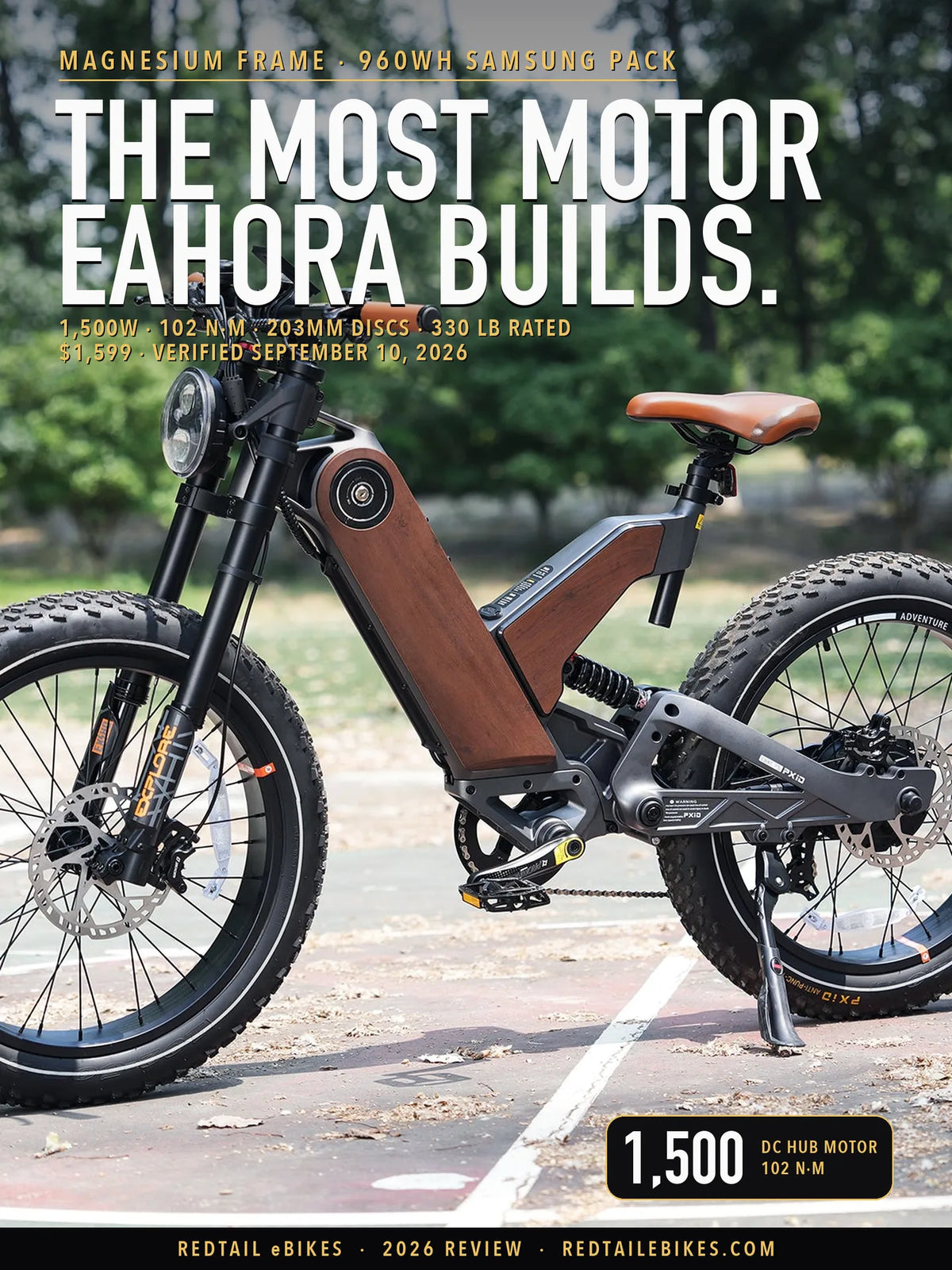
48V · 1,500W · 102 N·m · 960 Wh (48V 20Ah) · 28–34 mph published · 330 lb rated · 84.8 lb · 23.6" standover · $1,599 · verified September 10, 2026
Quick Answer — The Eahora P5 II is a $1,599 magnesium-frame fat-tire e-bike: a 1,500W hub motor, 102 N·m, a 960Wh Samsung pack, 203mm discs front and rear and a 330 lb rider rating. It is the most powerful bike in Eahora's P5 line, and its pedal-assist range claim lands in the middle of the shelf we sell.
Settle one thing before you order. At a published 1,500W this machine sits above the wattage ceiling in every state e-bike definition we were able to read, so where you ride it is governed by whatever else your state's vehicle code covers. The state section carries the citation for yours. See the P5 II — free contiguous-US shipping, in stock now.
In stock and orderable September 10, 2026. Free contiguous-US shipping, and every warranty claim handled by us.
See the Eahora P5 II — $1,599Takeaway
- The most motor Eahora puts in the P5 line, and the brakes to go with it. 1,500W and 102 N·m on 203mm discs front and rear, where the 750W P5 Plus publishes 85 N·m on 180mm mechanical discs.
- A pedal-assist range claim that lands mid-shelf. Eighty miles from a 960Wh pack works out to 12.00 watt-hours per mile, against a 12.69 Wh/mi median across the 87 bikes we sell that publish both figures — 38 of them assume less per mile and 47 assume more.
- A 960Wh Samsung pack, and room for a second one. Forty-eight volts and 20Ah inside the magnesium frame's diagonal spar, with an extra 15Ah pack offered as an add-on.
- A clean federal safety record, checked two ways with a control. Eahora appears in 0 of 359 rows of the CPSC's complete warning listing and returns 0 records on the recall API, both validated in the same session against a brand carrying live federal warnings.
- A 23.6-inch standover, low for a fat-tire frame this size. Eahora's geometry block also publishes a 35-inch minimum seat height, and that is the figure to measure your inseam against.
- A full charge costs 17.6 cents. A full 0.96 kWh charge at the US residential average rate, or 0.22 cents a mile on the pedal-assist figure.
What's on this page
This review runs through the P5 II's published specification, what separates it from the rest of Eahora's P5 line, how far it goes, whether it fits you, where a 1,500W machine can be ridden, and what buying it from us includes.
- Who the P5 II is for
- How we verified this Eahora P5 II review
- Eahora P5 II specifications
- What $600 more buys over the P5 Plus
- How far it goes, and what that claim assumes
- Charging it, and what a charge costs
- What it weighs, and what it carries
- Does it fit? The geometry, read in full
- The Mercer fit test
- Where you can ride it: 1,500W and your state
- Has it been recalled?
- Suspension, brakes and the parts you can check
- What owners report
- The warranty, and who files the claim
- Why buy the P5 II from us
- The honest ledger
- Who should buy it
- Before you buy: the checklist
- Limitations of this review
- The source register
- References
- Frequently asked questions
- The bottom line
Who the P5 II is for

Buy this bike if you want the most motor Eahora builds into its magnesium-frame P5 line: 1,500W, 102 N·m and 203mm discs at both ends, for $1,599.
The frame is a die-cast magnesium-alloy unit, 24" × 18", built around a 20Ah Samsung battery pack in the downtube. At $1,599 with a 1,500W motor and a published 330 lb load rating, it sits between Eahora's milder 750W P5-family bikes and its far larger Romeo and Juliet lines.
This is a throttle machine, and it is built as one. It carries a thumb throttle and a full-color wireless display, with enough motor to move an 84.8-pound bike to a published 34 mph without you pedaling at all.
If what you want instead is a bicycle with a quiet boost, the 750W P5 Plus is the bike, and the next section prices the difference between them.
Three questions decide it, and this page answers all three from published documents: how far it goes, whether the frame fits you, and what your state does with a machine at this wattage.

Eahora's own photograph of the bike. The magnesium frame's diagonal spar carries the battery; the wood-grain panel is a decorative wrap over the cast metal underneath.
How we verified this Eahora P5 II review
Every figure below is verified against Eahora's own published specification for this model, recomputed wherever arithmetic allows, and linked to the document it came from.
-
The manufacturer's page was retrieved three ways on 9 September 2026 — the rendered product page, the
.jsonproduct record and the raw HTML, all archived. Every specification quoted below was re-confirmed live on that date. - Every figure comes from Eahora's own published Technical Specifications block, quoted verbatim, including its own spelling and formatting.
- The state screen is statutory. This bike's published wattage and published top speed were screened against the electric-bicycle definition in all 51 US jurisdictions, each row carrying its own citation.
- The safety check was validated before it was believed. Both CPSC routes were run against a brand known to carry warnings first, and both found them, before either was trusted to return a clean result for this brand.
- The efficiency comparison is first-party arithmetic. We divided pack capacity by published range across every e-bike on our own storefront, then placed this bike inside that distribution.
- Third-party findings are attributed to whoever made them, with the date they were published.
- We sell this bike. Every claim here links to the document behind it, and corrections go to support@redtailebikes.com — we publish them.
Written by Milad Ghobadibeygvand, BScN (Western University, 2014), Redtail eBikes. Verified 10 September 2026.
Eahora P5 II specifications
Every row is Eahora's own published value, quoted from its Technical Specifications block as re-read on 9 September 2026.
| Specification | Published value |
|---|---|
| Bike class (as published) | "Class 3 ebike with 5-level pedal assist and throttle." |
| Motor | "1500W DC hub motor, cassette; rated torque: 102N.M." |
| Top speed (published) | "28-34 MPH" for PAS & throttle |
| Torque (published) | "102 N·m", gradeability "15° - 30°" |
| Battery | "48V 20AH (960 WH) lithium battery", Samsung cells, expandable with an extra 15Ah pack |
| Range | "34 - 40 miles on throttle mode. 68 - 80 miles on pas mode." |
| Controller | "48V, 35 ± 1A; 12MOS" |
| Charger | "54.6V ~ 3A smart charger; input 100-240V 50/60HZ. Charging hour: 6-8 Hours." |
| Display | "Wireless B04C Display with CAN", Bluetooth |
| Bike weight | "84.8 lbs in total with the battery. The battery weighs 27.6 lbs." |
| Payload capacity | "Recomend rider weight within 330lbs." |
| Frame | "Magnesium alloy; frame size: 24" * 18"." |
| Fork | "100MM travel mechanic suspension alloy fork." |
| Rear suspension | "500MM adjustable shock absorber", published with "1200 lb/in damping and 30mm travel" |
| Brakes | "203MM front and rear oil brakes", aluminum alloy levers with motor cutoff switch |
| Tires | "24" * 4.0" tires; tire pressure marked on sidewall" |
| Chain / crank | T50 alloy steel chain, 126 segments; 44T × 170mm crankset |
| Shifters / derailleur / freewheel | Shimano 7-speed (TY300) shifter; Shimano 7-speed (M315) derailleur; Shimano 7-speed (MF-TZ500-7), 14–28T freewheel |
| Lights | "Front light with 48V 20W LED light, rear reflector" |
| Waterproofing | "IP65 Waterproof, including motor battery, display and wiring" |
| Throttle | Thumb throttle |
| Assist | 5 levels pedal-assist (cadence); 5 levels throttle; 8-second auto-cruise; 7-speed non-electric; 6 km/h walk mode |
| Recommended rider height | "5'2" - 6'4" or 159CM - 195CM" |
| Standover | 23.6" (60cm) |
| Seat height | 35"–38.9" (89–99cm) |
| Price | $1,599, compare-at $1,899 |
In stock now on both Eahora's own site and ours, matching prices, 10 September 2026.
Check stock — Eahora P5 II, $1,599What $600 more buys over the P5 Plus
Eahora sells three fat-tire bikes under the P5 name: this P5 II, the P5 Plus and a base P5 sold under the handle "P5 SE." They share a magnesium frame, a 960Wh Samsung pack and a charger. The motor and the brakes are where they part company, and that is the whole decision.

Every figure is Eahora's own, read from each model's product page on 9 September 2026.
| P5-family model | Motor (Eahora's own words) | Published weight | Published range (PAS) | Price |
|---|---|---|---|---|
| Eahora P5 (base / "P5 SE") | 750W DC hub, 85 N·m | 84.8 lb | 68–80 mi | $1,299 |
| Eahora P5 Plus | 750W DC hub, 85 N·m | 84.8 lb | 68–80 mi | $999 |
| Eahora P5 II (this bike) | 1,500W DC hub, 102 N·m | 84.8 lb | 68–80 mi | $1,599 |
Double the wattage and 20% more torque. The P5 II publishes 1,500W and 102 N·m where both siblings publish 750W and 85 N·m, on a gradeability figure of 15° to 30°. On a bike that already weighs 84.8 pounds before a rider gets on it, that is the specification that decides whether a loaded climb is a shove or a shrug.
Bigger rotors at both ends. Eahora publishes 203mm front and rear oil brakes with a motor cutoff switch here, against 180mm mechanical discs on the P5 Plus. Stopping a fat-tire machine from a published 34 mph is exactly the job those extra 23 millimetres of rotor exist to do, and it is the upgrade we would pay for first.
Everything else carries over. Same frame, same 48V 20Ah Samsung pack, same 54.6V charger, same published 68–80 and 34–40 mile range figures across all three listings.
So the choice runs one way. If you want the motor and the brakes, this is the bike. If you do not, the P5 Plus is the same frame and the same battery for $600 less at a wattage that sits inside far more state e-bike definitions. Email us your state and how you plan to ride, and we will tell you which of the two to order.
How far it goes, and what that claim assumes
Eahora publishes 68–80 miles on pedal assist and 34–40 miles on throttle only, from a 960Wh pack.
The way to read a range claim without a dynamometer is to divide the pack it runs on by the miles it promises — watt-hours per mile, a figure comparable across an entire shelf.
| Eahora's claim | What it assumes, per mile |
|---|---|
| 80 miles, pedal assist | 12.00 Wh/mi |
| 68 miles, pedal assist | 14.12 Wh/mi |
| 40 miles, throttle only | 24.00 Wh/mi |
| 34 miles, throttle only | 28.24 Wh/mi |
We ran the same division across every e-bike we sell on 9 September 2026, using our own live storefront catalog. Of 189 active models, 87 publish both a base pack and a range that belongs to it (29 publish a range for a different battery and were excluded instead of estimated; 73 publish neither). Across those 87, the median claim assumes 12.69 Wh/mi.
This bike's pedal-assist figure — 12.00 Wh/mi at 80 miles — lands on that median. Of the 87 comparable published claims we compared, 38 assume less energy per mile than this one and 47 assume more, which puts the P5 II in the middle of our shelf instead of at either end of it.
Plan your own riding around the mode you will actually use. On the throttle, Eahora's own figure is 34 to 40 miles — 24.00 to 28.24 Wh/mi, which is what 1,500 watts under a thumb costs you. Build a day around 34 miles of throttle or 68 miles of assist and the pack will not surprise you.
Charging it, and what a charge costs
Eahora publishes a "54.6V ~ 3A smart charger" and a "6-8 Hours" charge time for the 960Wh pack. Its input range is 100–240V at 50/60Hz, so it runs off any US household outlet with nothing to adapt. Charge it overnight and it is full before you are up.
The running cost is smaller than most buyers guess. A full charge is 0.96 kWh, and at the US residential average of 18.34 cents per kilowatt-hour for June 2026, that is 17.6 cents to fill it. Spread over the 80-mile pedal-assist figure that is 0.22 cents per mile; over the 34-mile throttle figure, 0.52 cents. Charge it every single day for a year and you have spent about $64 on electricity.

Eahora's own illustration of the pack location. The 20Ah Samsung cells sit inside the magnesium frame's diagonal spar, and the pack lifts out with a key when you would rather carry it indoors than run a cable to the bike.
What it weighs, and what it carries
Eahora publishes 84.8 lb with the battery installed, and 27.6 lb for the battery alone. Those two figures give you the one that matters on a hitch rack or a basement stair: 57.2 lb with the pack pulled out, which is the way to lift it.
That is normal weight for a full-suspension fat-tire build with a 960Wh pack, and it is worth planning for before the bike arrives. If your bike will live up a flight of stairs, take the battery out first, every time.
The payload arithmetic
Eahora publishes a 330 lb maximum recommended rider weight. That figure is the rider, not the rider plus cargo.
If you plan to carry loads on top of your own weight, send us the numbers before you order and we will tell you how to spec it.
For scale, the Eahora Luna II is a lighter step-through you can move around a garage alone, and our review of the Eahora Juliet Long-Range covers a bike at 116 lb published — 31 lb heavier than this one, on a much larger 2,880Wh pack.
Does it fit? The geometry, read in full
Eahora publishes one rider-height range for this bike: 5'2"–6'4" (159–195cm).

Eahora's own geometry diagram, retrieved 9 September 2026. Every letter callout below matches a labeled point on this diagram.
| Geometry point | Published measurement |
|---|---|
| Total length | 72.8" (185cm) |
| Wheelbase | 46.6" (118cm) |
| Seat height | 35"–38.9" (89–99cm) |
| Handlebar height | 42" (107cm) |
| Rim diameter | 16.4" (42cm) |
| Standover | 23.6" (60cm) |
| Reach distance | 15.75" (40cm) |
| Chain stay length | 20.5" (52cm) |
| Seat angle | 75.4° |
| Seat tube length | 3.15" (8cm) |
| Top tube length | 22.8" (58cm) |
| Bike width | 26.4" (67cm) |
That 35" seat-height floor is the number to measure your inseam against. A rider at the geometry range's 5'2" floor typically has an inseam close to 27–29 inches, which sits tight against a 35-inch minimum saddle height even fully lowered. If you are near the bottom of the published range, the Eahora Luna II is the lower step-through to ask us about first.
The 23.6" standover is genuinely low for a fat-tire frame of this size, and it is the easier of the two numbers to trust by eye: stepping over this frame and pedaling it with the saddle at its floor are two different tests, and the seat-height floor is the one that governs comfortable riding position for a shorter rider.
What to settle before you order. - Your inseam against 35 inches. That is Eahora's published minimum seat height, and it decides fit more precisely than the published height range alone. - Your state's row in our e-bike law guide. A machine at this wattage is regulated as more than a bicycle in most states, and the state section tells you what that asks of you where you live. - Whether you actually want 1,500W. The Eahora P5 Plus is the same frame and the same battery at $600 less, with a 750W motor that sits inside far more state e-bike definitions. - Whether a step-through suits you better. If swinging a leg over a fixed fat-tire frame is the sticking point, our review of the Eahora Juliet Long-Range covers a step-through Eahora with a published speed at the class ceiling.
The Mercer fit test
The Mercers are our editorial cast: seven fixed people of known age and height that we hold every bike against, so "does it fit?" gets the same test every time. They are fit archetypes, never testers. Every verdict below is read from a published number or an age rule — the same seven people, the same figures, on every bike we review.
| Member | Verdict | The number behind it |
|---|---|---|
| Frank Kowalski, 63, 5'10" | Fits the frame; the throttle is the real question | Inside the published 5'2"–6'4" range with room. At 84.8 lb this is not a bike he lifts onto a rack solo without planning for it. |
| Ruth Kowalski, 61, 5'5" | Fits on the published range | 5'5" clears the 5'2" floor with margin, though the 35" seat-height floor is worth measuring against her inseam before ordering. |
| Jack Mercer, 48, 6'1" | Fits comfortably | Well inside the published range at both ends, with the 330 lb rider-weight figure comfortably clearing his own weight plus gear. |
| Dana Mercer, 45, 5'7" | Fits with room | Comfortably inside the published height range and the payload figure. |
| Maya Torres, 32, 5'6" | Fits the frame; her commute is the question | Inside the published height range with room. Her route is a city bike lane, and a machine at this wattage is not what her state's code calls a bicycle — a use-case answer, not a fit one. |
| Cole Mercer, 16 | A state question first, a bike question second | At a published 1,500W and 28–34 mph this sits above every state e-bike wattage ceiling we could read, so his state's vehicle-class and minimum-age rules govern instead of its bicycle rules. Our state guide has his row. |
| Ivy Mercer, 12 | No | A twist/thumb throttle to a published 28–34 mph is not a bike for a 12-year-old under any state's e-bike or moped age rule we've read. |
The contrast that matters is Maya and Cole. Maya's row is a bike that fits her body without matching her errand: a city bike lane is not where a machine at this wattage belongs. Cole's row is the same point with the law behind it, because his state's minimum-age rule for the class this falls into is the first thing to read, ahead of any question about reach or standover.
Found your row and it still says yes? In stock on 10 September 2026, and if your row raises a question, email us and we will help you answer it before you order.
Check your fit — Eahora P5 II, $1,599Where you can ride it: 1,500W and your state
Start with the category, because this is a category fact before it is a fact about any single bike. Every US state that defines an "electric bicycle" writes a motor-wattage ceiling into that definition, and the great majority set it at 750 watts, tracking the federal low-speed electric bicycle definition enacted in 2002.
A machine above that ceiling is regulated as whatever else the state's vehicle code covers, which usually means registration, licensing, insurance or helmet rules a bicycle does not carry. A large share of the high-power fat-tire category sits above it.
Eahora's specification block publishes 1,500W and 28–34 mph. This page screens on that figure throughout, because the federal definition and nearly every state statute write their wattage cap around a motor's rated output.
Screened against the electric-bicycle definition in all 51 US jurisdictions on 9 September 2026, applying each statute's own boundary wording (several states write their cap as "less than 750 watts," which a 750W motor itself would not satisfy):
48 jurisdictions — 47 states plus the District of Columbia — place these published numbers outside the bicycle definition · 2 states publish no e-bike definition at all · 1 could not be re-read.
California, Texas and Florida each cap an "electric bicycle" at 750 watts. Even Oregon and Rhode Island, whose three-class frameworks are among the more permissive in the country, cap their most powerful class at 1,000 and 1,492 watts.
Alaska and Kentucky publish no e-bike definition at all, so there is nothing for these figures to sit inside or outside. Hawaii could not be re-read at its publisher on the date this screen ran, so it carries no verdict — neither a pass nor a failure, just a gap in this instrument's reach.
Every state that defines a Class 3 electric bicycle caps the motor well below 1,500 watts. So on any high-power machine, whatever the class name on the spec sheet, the statute is the thing that answers this question and the class name is not.
What that leaves you. Private land and off-road riding are open in most places. Some states register a machine in this class as a moped or a motor-driven cycle, which is a form and a plate rather than a closed door.
Our state-by-state e-bike law guide carries your state's citation and what riding at this wattage would require there. Read your row before you order, and email us if it is ambiguous — we would rather answer it now than ship you the wrong bike.
Has it been recalled?
No — and this is a checked absence rather than a failed search.
- The CPSC's complete Product Safety Warning listing, all 359 rows, downloaded fresh on 9 September 2026, contains no row naming Eahora. The same file returns two rows for Ridstar, a brand carrying live warnings, confirming the file and the match were both working when Eahora returned nothing.
- The CPSC recall API returns 0 records for Eahora. The same endpoint returns 25 records for a control query ("hoverboard"), confirming it was answering.
Both routes ran a positive control in the same session, which is the only reason this paragraph is publishable. A brand can carry warnings and still return zero recalls — they are separate instruments — so both were checked, matching the method we ran for the Eahora Juliet Long-Range and every other Eahora review in this corpus.
Recalls and warnings are issued continuously. Check cpsc.gov/Recalls yourself before buying any e-bike; this page reports the record as it stood on 9 September 2026.
What the federal safety record says. - No recall, no warning. Eahora appears in none of the 359 rows of the CPSC's complete warning listing, and the recall API returns nothing. - Both instruments were validated before they were believed. The same warning file returns two rows for a brand carrying live federal warnings, which is the only reason a zero here is publishable at all. - Check it yourself before buying any e-bike. cpsc.gov/Recalls is the live record; this page reports it as it stood on 9 September 2026.
Suspension, brakes and the parts you can check
The specification block names several parts instead of describing them vaguely, which means you can look them up.
Brakes are a genuine step up from the 750W siblings. Eahora publishes "203MM front and rear oil brakes" with aluminum-alloy levers and a motor cutoff switch, on both wheels, against 180mm mechanical discs on the P5 Plus. Bigger rotors shed heat better and give you more stopping force for the same hand pressure, which is what you want on a heavy bike at the top of its speed range.

Eahora's own photograph of the front brake assembly — 203mm at both ends, which is the hardware the published speed range asks for.
The suspension is built for comfort, not terrain. The fork is a "100MM travel mechanic suspension alloy fork," and the rear is a "500MM adjustable shock absorber" published with "1200 lb/in damping and 30mm travel." Full suspension at this price is unusual, and on 4-inch tires it is the combination that takes the sting out of a broken road surface. It is not a mountain-bike travel figure and it is not sold as one.

Eahora's own photograph of the rear shock, published as adjustable with 1200 lb/in damping. Preload is the thing to set on delivery: heavier riders want it firmer, and it takes a spanner and five minutes.

Shimano's M315 derailleur and MF-TZ500-7 freewheel, 14–28T, on a T50 alloy steel chain — parts any shop stocks and can replace the same day.
The drivetrain is unpretentious and easy to service. Shimano's 7-speed TY300 shifter, M315 derailleur and MF-TZ500-7 freewheel are among the most widely stocked bicycle parts in the world, paired here with a 44-tooth chainring and 170mm cranks. A worn part is a shelf item at any bike shop in the country instead of a special order.

Eahora's own photograph of the front light, a 48V 20W LED running off the main pack instead of its own batteries. Pair it with a rear light before you ride at dusk — most states require one and this bike ships with a reflector.

The saddle and post assembly that sets the 35-inch floor discussed in the fit section above — the number that governs comfortable riding position for a shorter rider, more than the standover figure does.

The B04C display, published with wireless CAN and Bluetooth connectivity.
What owners report
Five reviews are published on Eahora's own P5 II product page, all five stars, all recommending it. They are the seller's own hosted testimony, and we quote them as theirs:
- Daniel H., verified buyer: "Purchase two P5-2 e bikes, very easy to assemble And had a great time on our first ride that was 24 miles long. No problems and plenty of power."
- Dave P., verified buyer: "Great bike can't ride it enough, great looking bike awesome style."
- andrew d., verified buyer, reporting riding at 280 lb: "At 280 pounds, i was surprised that this bike will hold 30mph easy. I've taken it on a couple 25 mile rides, with no problems... I do need to look into the adding the extra battery for a bit longer range."
Andrew's account is the one to read twice if you are anywhere near the published 330 lb rider rating: a rider at 280 pounds, reporting 25-mile rides and holding 30 mph. That is a buyer operating close to the published limit and reporting no trouble with it.
The warranty, and who files the claim
Eahora's warranty page, re-read live on 9 September 2026, governs this model the same way it governs every Eahora bike.
The clauses a buyer should know before ordering, quoted directly:
| Clause | Eahora's words |
|---|---|
| Term | "Claims deadline: 1 year from purchase date." |
| Who is covered | "No coverage for: Secondhand owners or commercial use." |
| Consumables | "Normal wear and tear (tires, brake pads, chains, etc.)" excluded |
| Parts and chargers | "Use only Eahora-approved parts and chargers." |
| Shipping damage | "Report within 10 days of delivery. Include photos, signed Bill of Lading, and retain packaging." |
| If you decline a repair and return instead | "a 30% depreciation fee will be applied and the customer is also responsible for the round-trip freight cost" |
The package this bike ships with, per Eahora's own listing: the bike itself (85% assembled), the battery with two keys, the charger, a front tire, a headlight, two pedals, a screw/toolkit set, and the owner's manual.
Our own window is shorter and our own job is bigger. We ask you to inspect within 48 hours, and if anything is damaged in transit we file the carrier claim ourselves instead of handing you a form. You email one US address for the life of the bike, and we do the chasing from there.
If a repair-or-return question ever comes up, call us first. We will tell you before you commit which route costs you less.
Why buy the P5 II from us
Every row here cites the document behind it.
| What you get | The document |
|---|---|
| $1,599, matching Eahora's own price | Eahora lists $1,599 with a $1,899 compare-at on its product page; we list the same pair. Re-checked 10 September 2026. |
| Free shipping in the contiguous US, matching Eahora's own shipping page | Our shipping policy: free shipping on every electric bike, dispatched in 1–3 business days. |
| We file the carrier claim | Our refund policy: damage reported within 48 hours with photos and we handle the carrier claim from there. |
| Warranty handled by us, in the US | You email us, not an overseas address. The manufacturer's terms still govern what is covered; we do the chasing. |
| Pay over time | Shop Pay instalments are live at checkout, so the $1,599 can be split instead of paid at once. |
| We match the maker's price | Eahora lists $1,599 and so do we. You are not paying a dealer margin to get US support and a US warranty contact. |
| How every figure here was checked | Verified against the manufacturer's published specification, re-confirmed live and recomputed. |
And the reverse sell, which we mean. Email support@redtailebikes.com with your height, your state and what you want to do with the bike, and we will tell you straight — including when the answer is the P5 Plus at $600 less, or another bike on our shelf entirely.
Know this before you order: change-of-mind returns are unopened-only, within 72 hours, with a 15% restocking fee, because these ship by freight. If you are not sure this is the right P5, ask us first — that costs nothing.
Free contiguous-US shipping, and we file the carrier claim if it arrives damaged.
Order the Eahora P5 II — $1,599The honest ledger
What the record supports:
- A battery figure that recomputes exactly — 48V × 20Ah = 960Wh — matching the published number precisely.
- A real hardware upgrade over the 750W P5 siblings where it counts: brakes. 203mm rotors front and rear, against 180mm mechanical discs on the P5 Plus.
- A clean federal safety record, checked against the complete 359-row CPSC warning listing and the recall API, both with passing controls in the same session.
- A pedal-assist range claim sitting mid-shelf on our own 87-bike watt-hours-per-mile census — 12.00 Wh/mi against a 12.69 median, with 38 claims assuming less per mile and 47 assuming more.
- Five five-star reviews on Eahora's own product page, including a 280-pound rider reporting 25-mile rides at close to the published rider rating.
- Named, checkable component specs: rotor diameter, freewheel part number, tire size, cell supplier and waterproof rating all appear on the page, which is what lets a buyer look them up.
Who it is wrong for, and where to go instead:
- You want to ride in a bike lane or on a multi-use path. Start with our state law guide and find the wattage your state's definition actually allows, then email us your row — the bikes that clear a 750-watt ceiling are a different shelf, and we will point you at ours.
- You want this frame and this battery without paying for the motor. The P5 Plus is $999 for the same magnesium frame and the same 960Wh pack at 750W — the one to order if 1,500W is more motor than your riding needs.
- You are near the 5'2" floor of the published height range. The 35-inch minimum seat height is what decides it. Send us your inseam before you order and we will tell you whether it works.
- You have to lift the bike onto a rack by yourself. 84.8 lb with the pack and 57.2 lb without it. The Eahora Luna II is the lighter step-through to ask us about.
- You want a much bigger pack for long days. Our review of the Eahora Romeo Pro covers a 2,880Wh Eahora, three times this bike's capacity, at a similar price.
Who should buy it
Buy it if you want the most motor Eahora offers in its magnesium-frame P5 line — 1,500W, 102 N·m, 203mm discs, a 960Wh Samsung pack and a 330 lb rider rating, for $1,599 — and you have read your state's row and know where you will be riding it.
Buy the P5 Plus instead if 750W is enough. Same frame, same battery, $600 less, and a wattage that sits inside far more state e-bike definitions.
Read the Eahora Juliet Long-Range review if you want a milder published speed, at 1,000W and 25–28 mph, on a step-through frame.
Read our Eahora Romeo Pro review if you want a moped-style frame and a 2,880Wh pack — three times this bike's capacity — at a similar price.
Start with our Eahora brand profile for the brand-level questions this page does not answer: who owns the trademark, where the bikes ship from, and every model we stock.
In stock, free contiguous-US shipping, and we file the carrier claim if it arrives damaged.
Order the Eahora P5 II — $1,599Before you buy: the checklist
Seven things to settle before you order: your inseam against the published seat height, your state's rule for a machine at this wattage, the range figure for the mode you will actually ride, and whether 750W would serve you better for $600 less.
- ☐ Measure your inseam against the published 35-inch minimum seat height. It decides fit more precisely than the height range alone.
- ☐ Read your state's row in our e-bike law guide. It tells you what a machine at this wattage needs where you live, and it takes about a minute.
- ☐ Plan on 34 to 40 miles if you ride mostly on the throttle. That is Eahora's own number, and it is half the pedal-assist figure.
- ☐ Decide whether you want 1,500W at all. The P5 Plus is the same frame and battery for $600 less at 750W.
- ☐ Photograph the crate before you cut it open, and report any damage to us within 48 hours.
- ☐ Budget for a rear light. The bike ships with a 20W headlight and a rear reflector, and most states want a lamp after dark.
- ☐ Email us your height, your state and your use. We will tell you if this or the P5 Plus is the right fit.
Limitations of this review
Every review has a boundary and these are ours. Each item below says what we could establish from the published record and what we could not, so you can weigh the rest of the page against it.
- We sell this bike. Every figure here is traceable to a document you can open, which is the only guard against that conflict that actually works.
- Every performance figure on this page is a published manufacturer specification, verified against Eahora's own block and recomputed where arithmetic allows. No independent range test, weighing or suspension measurement of this exact 1,500W configuration exists in the published record.
- The third-party record for this configuration is seller-hosted testimony. Eahora publishes five reviews on its own product page and we quote three of them; we located no independent outlet review of the P5 II specifically.
- The watt-hours-per-mile figures are arithmetic on published claims rather than measurements of any bike's real consumption, and are presented as the assumption inside a claim.
- Weight and range figures are quoted from each model's own specification block. Where two models in the P5 family publish the same figure, we report each as published rather than estimating a difference.
- No certification standard is named on this model's product page. A site-wide Eahora FAQ line dated 12 April 2024 states that its batteries have passed UL certification without naming a standard, and UL 2849 and UL 2271 are separate certifications. We could not take that further, because the manufacturer's site search returns identical static markup for a term its own catalog answers — a limit on our retrieval rather than a fact about the pack.
- No search-volume or difficulty figure appears anywhere on this page. Our keyword tool has no dated export inside the freshness window, so the demand behind this page is recorded as observed strings rather than priced numbers.
- Expiry conditions. Re-check this page if Eahora changes the specification block, publishes a certificate, or if any independent range, weight or suspension measurement appears.
The source register
| Source | Tier | What it supports |
|---|---|---|
| Eahora, P5 II product page | T2 — manufacturer, primary for its own claims | Every specification, geometry and price figure |
| Eahora, P5 Plus product page | T2 — manufacturer | The P5-family comparison table and the brake-hardware difference |
| Eahora, base P5 / "P5 SE" product page | T2 — manufacturer | The base-model row of the P5-family comparison |
| 15 U.S.C. § 2085(b) | T1 — federal statute | The low-speed electric bicycle definition |
| State statutes, 51 jurisdictions | T1 — statutes | The legality screen, each row separately cited |
| CPSC Product Safety Warning listing | T1 — federal agency dataset | The 359-row denominator behind the recall answer |
| CPSC recall API | T1 — federal agency | The recall query and its control |
| EIA Electric Power Monthly, Table 5.6.A | T1 — federal agency | The 18.34 ¢/kWh residential average, June 2026 |
| UL Solutions, e-bike testing and certification | T2 — standards body | The UL 2849 / UL 2271 distinction |
| Eahora FAQ, "The Most Frequently Asked Questions" | T2 — manufacturer | The site-wide UL certification statement |
| Eahora warranty page | T2 — manufacturer | Every warranty clause quoted |
| Our own Shopify catalog, 189 active e-bikes | T2 — first-party dataset | The Wh-per-mile census and its denominator |
T5 sources — AI summaries, content farms and unattributed spec aggregators — are not cited anywhere on this page. Where a web-search-grounded answer appears above, it is reported as a measured record of what buyers are being told, never as evidence of a fact.
References
Every source this page rests on, dated at the retrieval that produced it. Manufacturer pages are primary for the maker's own published figures; statutes and federal agency datasets are primary for everything legal and safety-related.
- Eahora. Eahora P5 II product page. Retrieved 9 September 2026. eahoraebike.com/products/eahora-p5-ii — every specification, geometry and price figure on this page.
- Eahora. Eahora P5 Plus product page. Retrieved 9 September 2026. eahoraebike.com/products/eahora-p5 — the P5-family comparison and the 180mm brake figure.
- Eahora. Eahora P5 ("P5 SE") product page. Retrieved 9 September 2026. eahoraebike.com/products/eahora-p5se — the base-model row of the P5-family comparison.
- Eahora. Warranty. Retrieved 9 September 2026. eahoraebike.com/pages/warranty — all quoted warranty clauses.
- Eahora. Expert Q & A: The Most Frequently Asked Questions About Eahora E-bikes. 12 April 2024. eahoraebike.com/blogs/news/the-most-frequently-asked-questions-about-eahora-e-bike — the "all our batteries have passed UL certification" sentence.
- United States Code. 15 U.S.C. § 2085(b), Low-speed electric bicycles. law.cornell.edu/uscode/text/15/2085 — under 750 W and under 20 mph.
- Oregon Legislature. ORS 801.258. oregonlegislature.gov/bills_laws/ors/ors801.html — the three-class definition this bike's figures sit outside.
- Rhode Island General Laws. § 31-1-3(g). webserver.rilegislature.gov/Statutes/TITLE31/31-1/31-1-3.htm — the 1,492 W ceiling this bike's figures sit outside.
- California Vehicle Code. § 312.5. leginfo.legislature.ca.gov — the 750 W ceiling.
- Texas Transportation Code. § 664.001 et seq. statutes.capitol.texas.gov — the 750 W ceiling.
- Florida Statutes. § 316.003. flsenate.gov — the 750 W ceiling.
- US Consumer Product Safety Commission. Product Safety Warning listing (complete). Downloaded 9 September 2026. cpsc.gov/s3fs-public/recall-data/product_safety_warning_listing.csv — 359 rows, none naming Eahora.
- US Consumer Product Safety Commission. Recall REST service. Queried 9 September 2026. saferproducts.gov/RestWebServices/Recall — 0 records for Eahora.
- US Energy Information Administration. Electric Power Monthly, Table 5.6.A. June 2026 data. eia.gov/electricity/monthly/epm_table_grapher.php?t=epmt_5_6_a — 18.34 cents per kilowatt-hour, US residential average.
- UL Solutions. Electric Bicycle (E-Bike) Testing and Certification. ulsolutions.com/services/electric-bicycle-e-bike-testing-and-certification — the UL 2849 / UL 2271 distinction.
Frequently asked questions
Is the Eahora P5 II street legal?
That depends on your state and where you plan to ride. At a published 1,500W, this machine sits above the wattage ceiling in the electric-bicycle definition of all 48 US jurisdictions whose statute we could read on 9 September 2026 — 47 states plus the District of Columbia. Your state's other vehicle classes govern it instead of its bicycle rules.
Alaska and Kentucky publish no e-bike definition at all. The state section has your citation, and we will read it with you before you order.
Is the Eahora P5 II a Class 3 e-bike?
Eahora's spec table labels it a "Class 3 ebike with 5-level pedal assist and throttle," which describes the assist hardware — five levels of pedal assist plus a throttle. Every state that defines a Class 3 electric bicycle in its vehicle code caps the motor well below 1,500W, so on any high-power machine it is your state's statute that answers this rather than a class name on a spec sheet. See the state section.
How fast does the Eahora P5 II actually go?
Eahora publishes 28–34 mph for both pedal assist and throttle. The manufacturer publishes it as a specification, verified against its own published block on 9 September 2026, and it is the figure the state screen on this page uses.
How far does the Eahora P5 II go on a charge?
Eahora publishes 68–80 miles on pedal assist and 34–40 miles on throttle only, from a 960Wh (48V 20Ah) pack. See how those figures compare to the rest of our catalog.
How much does the Eahora P5 II weigh?
Eahora publishes 84.8 lb total, including a 27.6 lb battery. Pull the pack out and you are lifting 57.2 lb, which is the figure to plan a rack or a staircase around. See the weight section.
Is the P5 II UL certified?
Eahora publishes that all of its batteries have passed UL certification. If your city, your building or your insurer needs a certificate naming a specific standard — UL 2849 for the drive system or UL 2271 for the pack — email us before you order and we will get the documentation from the manufacturer in writing.
Has the Eahora P5 II been recalled?
No, as of 9 September 2026 — checked against the CPSC's complete 359-row warning listing and the recall API, both validated with a positive control in the same session. See the recall section.
What's the difference between the P5 II and the P5 Plus?
The P5 II publishes a 1,500W motor, 102 N·m of torque and 203mm oil brakes front and rear; the P5 Plus publishes 750W, 85 N·m and 180mm mechanical discs, for $600 less. They share the magnesium frame, the 960Wh Samsung pack and the published range figures, so the motor and the brakes are what the money buys. See the comparison.
How much does it cost to charge the P5 II?
About 17.6 cents for a full 0.96 kWh charge at the US residential average electricity rate, or roughly 0.22 cents per mile on the pedal-assist range claim. See the charging section.
The bottom line
The Eahora P5 II is the top of the magnesium-frame P5 line, and it earns that in two places: 1,500W and 102 N·m where its siblings publish 750W and 85 N·m, and 203mm discs at both ends where they publish 180mm mechanical.
Underneath sits the same frame, the same 960Wh Samsung pack and the same 84.8-pound build. At $1,599 it asks $600 over the P5 Plus for the motor and the stopping power, and its pedal-assist range claim lands mid-shelf against the 87 comparable bikes we sell.
Answer one question before you order: where will you ride it? At 1,500W these numbers sit above every state e-bike wattage ceiling we could read, so read your state's row and know what your code asks of a machine in that class. Riders who have that answer and want this much motor are exactly who Eahora built it for.
See the Eahora P5 II — $1,599, free contiguous-US shipping, in stock, and we file the carrier claim if it arrives damaged. Torn between this and the P5 Plus? Email us your height, your state and how you plan to ride, and we will tell you which one to order.
Written by Milad Ghobadibeygvand, BScN (Western University, 2014), Redtail eBikes. Verified 10 September 2026. We sell this bike; every claim on this page links to the document behind it. Corrections to support@redtailebikes.com — we publish them.


Share:
Eahora Juliet Long-Range Review 2026: 2,880Wh, Smallest
Best Cargo Electric Bikes 2026: 10 Picks by Need