
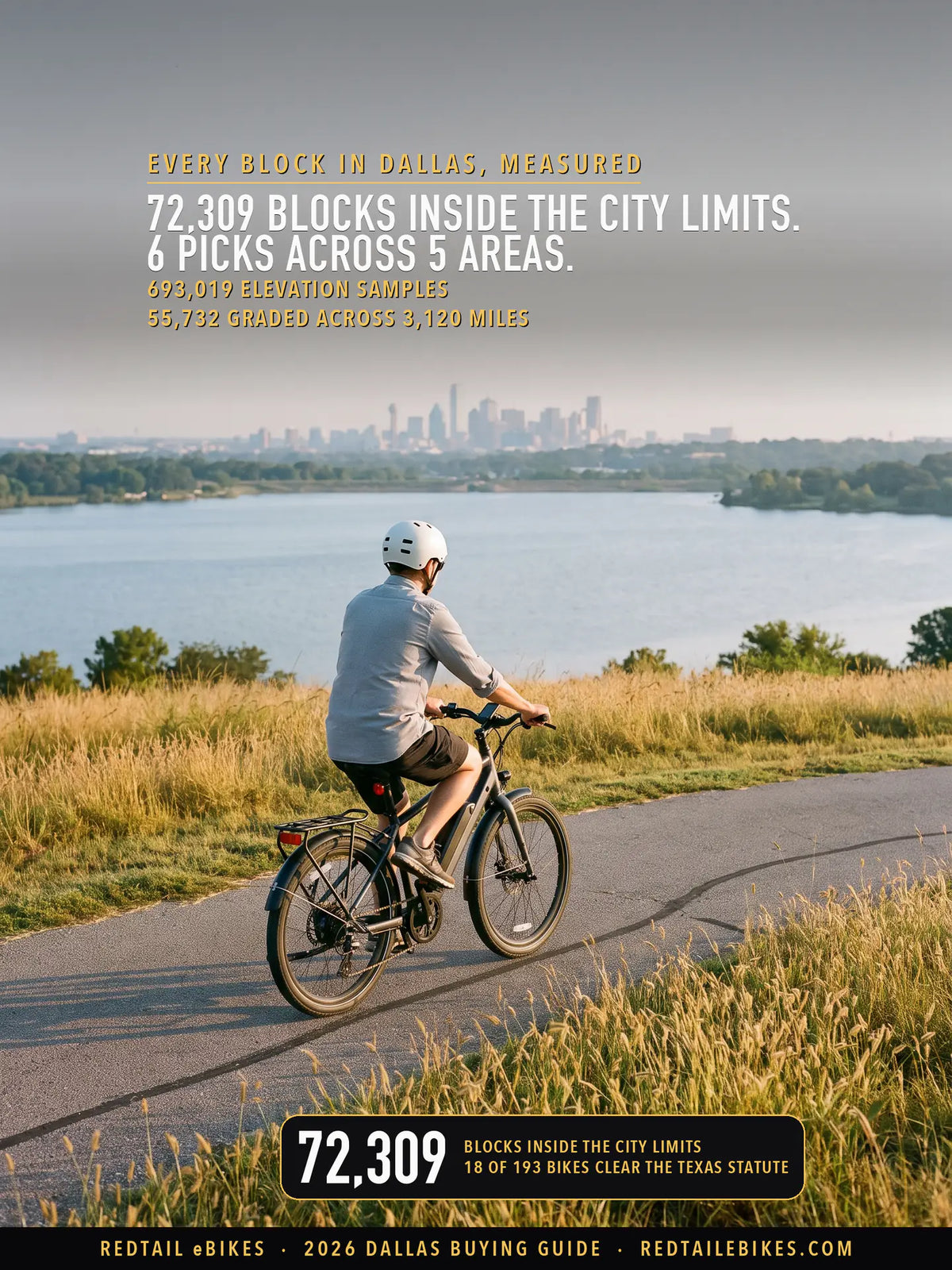

The best electric bike Dallas riders can buy is decided by two facts that pull against each other. This city is flat enough that most of it needs no torque at all — and it has an escarpment running through Oak Cliff and the hills around it, steep enough that one block off Fort Worth Avenue pitches at 19.5%.
We measured every street block inside the city limits to find out which of those is your fact, then measured ten years of weather to find out what the summer does to the answer.
Quick Answer. Dallas's median block climbs 0.93%, so shop for heat, weight and theft before you shop for climbing power — and check your address against the 5.43% of blocks that pitch at 6% or more. All-year commute: the Eunorau META24 1.0 at $1,699, the joint-lightest published weight in this guide at 61.7 lb.
Tightest budget: the Samebike CY20 Pro at $599. Texas's own wattage line is stricter than California's, and it leaves 18 of the 193 bikes we sell inside the definition; the Texas e-bike law guide walks the statute clause by clause.
Two bikes answer most of Dallas. The Eunorau META24 1.0 at $1,699 — a maker-published 61.7 lb, torque sensor, hydraulic discs — or the Samebike CY20 Pro at $599 if it has to fold and come up the stairs. Free shipping anywhere in the lower 48, dispatched within one to three business days, and Shop Pay installments at checkout for buyers who qualify.
Buy the META24 1.0 — $1,699The six picks at a glance:
| Area | Pick | Price | Decides it |
|---|---|---|---|
| Commute | META24 1.0 | $1,699 | 61.7 lb, torque sensor |
| Commute, apartment | CY20 Pro | $599 | folds, 68.3 lb |
| Errands | Citytan M-315, 500 W | $1,199 | three wheels |
| Errands | G30-CARGO 2.0 | $1,699 | 440 lb payload |
| Trail | CY20 Pro Spoked | $599 | 48V pack |
| Trail, Oak Cliff | URUS 2.0, 17-inch | $3,999 | mid-drive, 120 N·m |
Every block in Dallas, measured. 151,822 street centerline segments read against USGS elevation data, 98% of graded blocks on the 1-meter laser survey · 72,309 blocks inside the city limits, 693,019 elevation samples · 55,732 graded across 3,120 miles · median pitch 1.44% on the 49,426 with a measurable pitch · steepest 19.5% · 18 of 193 bikes clear the Texas statute · 350 decision-matrix cells · 6 picks across 5 areas. Verified September 16–17, 2026.
In this guide
- Dallas is flat until it isn't
- The wind is the other hill
- What a Dallas summer does to a ride and to a battery
- What your own body changes on a Dallas mile
- Texas says "fewer than 750 watts", and means it
- Where you may actually ride
- The two towns inside Dallas that want a permit
- Bikes and DART
- Theft, and the room it actually happens in
- Best electric bike Dallas: the decision matrix
- The Dallas commute
- Groceries and the errand run
- The Katy Trail, White Rock and the long flat ride
- The apartment, the stairs and the bike room
- Riding out of Oak Cliff
- Every council district, measured
- Where those neighborhood names actually are
- Dallas's 93.6 completed bikeway miles
- Is there a Dallas e-bike rebate?
- How we verified every block
- Where every figure comes from
- The honest ledger
- Why buy it here
- The bottom line
- Questions Dallas riders ask
- Limitations
- References
How we verified this guide. Every street block inside Dallas, 72,309 of them, was sampled every 10 meters on USGS elevation data (98% of graded blocks on 1-meter lidar) and checked against 233 National Geodetic Survey ground marks. Ten years of hourly NOAA weather came from Love Field, Dallas Executive and DFW. Theft counts are distinct Dallas Police incidents, classified by reading each narrative.
Every bike weight, payload and rider-height figure is the maker's own, and every legal line is quoted from the Texas Transportation Code and the Dallas, Highland Park and University Park codes. Store prices, stock and checkout links: verified September 17, 2026. The full method follows the neighborhood tables.
Dallas is flat until it isn't
Check your street before you buy climbing power. The median Dallas block climbs 0.93%, and on it the 500 W META24 holds 18.9 to 20 mph on the motor alone for riders from 130 lb to 250 lb. Six council districts, 3, 4, 10, 8, 1 and 9, have more than 6% of their blocks pitching at 6% or more, and their riders are the buyers a torque sensor and a mid-drive are for.
Across 55,732 graded blocks, the median Dallas street climbs 0.93% end to end, and its steepest sustained 30-meter stretch is 1.44%. A 500-watt bike barely registers it: the META24 holds 18.9 mph or better there on the motor alone for every rider weight modeled below.
The distribution is where the city actually lives:
| Graded Dallas blocks | End-to-end grade (55,732) | Steepest 30 m (49,426 with a pitch) |
|---|---|---|
| Median | 0.93% | 1.44% |
| 90th percentile | 3.24% | 4.64% |
| 99th percentile | 7.03% | 9.41% |
| Steepest | 17.06% | 19.47% |
| Share at or above 4% | 6.49% | — |
| Share at or above 6% | 2.01% | 5.43% |
| Share at or above 8% | — | 2.02% |
| Share at or above 10% | — | 0.71% |
5.43% of Dallas blocks pitch at 6% or more somewhere along them, and 0.71% at 10% or more. Those blocks add up to about 199 miles of street where a rider on a heavy bike will feel it, and 149 of those miles, 74.8%, sit in six council districts: 3, 4, 8, 10, 9 and 1.
The geology behind the steepest of it is the White Rock Escarpment, the western edge of the Austin Chalk. It runs roughly north–south through Dallas County and shows most plainly south of the Trinity in Oak Cliff (Bryan, Geology of the Oak Cliff Quadrangle, SMU Field & Laboratory).
Northeast Dallas's steep blocks sit along White Rock Creek and its tributaries instead. The block measurement finds them either way.
On individual streets it looks like this:
| Steepest ordinary street blocks in Dallas | Sustained 30 m pitch | End to end | Length | Where |
|---|---|---|---|---|
| Seale St | 19.5% | 14.4% | 86 m | the Fort Worth Avenue corridor, District 6 |
| Whitehurst Dr | 19.3% | 5.7% | 98 m | Lake Highlands, District 10 |
| Jennie Lee Ln | 18.9% | 5.9% | 111 m | Bruton Terrace, District 5 |
| Kleberg Rd | 18.9% | 4.0% | 166 m | Kleberg, District 8 |
| Deep Hill Cir | 18.8% | 4.2% | 344 m | Hideaway Valley, District 3 |
| Allison Dr | 17.9% | 14.2% | 58 m | East Kessler Park, District 1 |
| Cleveland Rd | 17.9% | 2.0% | 840 m | District 8 |
| Navaro St | 17.2% | 15.2% | 39 m | the Fort Worth Avenue corridor, District 6 |
Read the two columns together. Seale Street and Allison Drive climb about as hard end to end as they do at their worst (USGS 1 m lidar), 14.4% and 14.2%, which means the whole block is the hill and there is no crest to freewheel from.
Cleveland Road is 9.8 times longer than Seale Street and 14.5 times longer than Allison Drive, and finishes 2.0% up, so its 17.9% is a short wall inside an otherwise ordinary half-mile.
The first kind decides what bike you buy. The second decides which way you ride around your block.
And the district totals are the part you can actually act on:
| Council district | Blocks pitching ≥6% | Relief | Where people say it is |
|---|---|---|---|
| 3 | 13.45% | 373 ft | Mountain Creek, Woods–Sugarberry, Glenview, Singing Hills |
| 4 | 10.38% | 234 ft | Zoo Creek Park, Heart of Oak Cliff, Kiest Park, Oak Park Estates |
| 10 | 10.04% | 211 ft | White Rock Valley, Lake Highlands Estates, Northwood Estates |
| 8 | 7.83% | 358 ft | Kleberg, Rylie, Highland Hills, south-east Dallas |
| 1 | 6.75% | 315 ft | Elmwood, Kidd Springs, East Kessler Park, Winnetka Heights |
| 9 | 6.72% | 246 ft | Lakewood, Old Lake Highlands, Lochwood, Forest Hills |
| 6 | 2.35% | 170 ft | Bachman/NW Highway, Fort Worth Ave, Ledbetter, Elm Thicket–Northpark |
| 5 | 2.29% | 175 ft | Urbandale, Pleasant Grove, Bruton Terrace |
| 13 | 0.91% | 216 ft | Schreiber, Glen Meadow, Caruth Hills, Northaven Park |
Districts 3, 4 and 10 carry more than ten times the steep-block share of District 13 (council areas), so a rider in District 3 and a rider in District 13 are shopping for different bikes.
What to do with that. If you live in District 3, 4, 10, 8, 1 or 9, or anywhere the ground falls away toward the Trinity or one of the creeks, read the Oak Cliff section and treat torque and a torque sensor as the specification that decides it.
If you are north of Northwest Highway or east of Buckner on the flats, you have already answered the climbing question, and your money is better spent on the heat, the lights and the lock.
The wind is the other hill
Ten years of hourly observations at Love Field say something a Dallas rider can use immediately: the prevailing wind is out of the south in all twelve months of the year. Not most months. All of them, with the southerly share running from 14.9% of January hours to 32.3% of July hours.
That has a consequence for the spec sheet. A Dallas commute that runs north–south, along Central, Preston, Hillcrest, Lancaster or Lamar, has a headwind in one direction on most days of the year, in every season.
A headwind is easier to judge as the thing riders do have an intuition for: the equivalent grade, the slope that would demand the same extra power at the same road speed on the same bike.
| At Love Field | Wind | Equivalent grade, 170 lb rider + 60 lb bike |
|---|---|---|
| Annual mean | 8.7 mph | — |
| Commute hours (7–8 a.m., 5–6 p.m.), mean | 8.8 mph | — |
| Commute hours, 90th percentile | 15.0 mph | 4.27% |
| April, 4 p.m., 90th percentile | 20.8 mph | 6.71% |
| Share of all hours at 10 mph or more | 38.5% | — |
| Share of all hours at 15 mph or more | 8.8% | — |
A windy April afternoon in Dallas is a 6.71% grade that lasts the whole ride. Only 1.27% of graded Dallas blocks climb 6.71% or more end to end. For most of this city, most of the time, the air is a bigger hill than the ground.
Heavier riders and the south wind
The power a headwind costs you is spread over whatever mass is moving, and the crank power a rider brings scales with their body weight. So in the rider-fit model, at an easy untrained effort on the META24, the same 120 lb of extra rider costs 2.5 mph on a 4.64% pitch and gains 0.9 mph on the flat into a 20.8 mph headwind.
Gravity punishes mass. The air rewards the watts that come with it. If your ride is flat and windy — most of District 13, District 6, District 12 — a heavier machine and a heavier rider are not the handicap they are on a hill, and the money is better spent on battery capacity, because a long ride into a headwind draws on the pack the way a climb does, and climbing torque on the flat sits unused.
What a Dallas summer does to a ride and to a battery
In a Dallas August, read the motor-only column. 33.7% of August hours at Love Field sit at or above 90 °F, and 5.0% carry a heat index of 105 °F or more, inside the band the National Weather Service classes as Danger. Charge the pack indoors, and choose a bike that holds its speed on the motor.
Riding early is a scheduling tip. Choosing the bike needs a count, and ten years of hourly readings at Love Field give one:
| Month | ≥90° | ≥100° | HI ≥105° | ≤32° |
|---|---|---|---|---|
| Jan | 0.0% | 0.0% | 0.00% | 10.5% |
| Feb | 0.0% | 0.0% | 0.00% | 9.5% |
| Mar | 0.0% | 0.0% | 0.00% | 0.8% |
| Apr | 0.3% | 0.0% | 0.00% | 0.0% |
| May | 3.0% | 0.0% | 0.05% | 0.0% |
| Jun | 20.8% | 0.7% | 2.22% | 0.0% |
| Jul | 33.5% | 4.6% | 3.78% | 0.0% |
| Aug | 33.7% | 5.6% | 5.00% | 0.0% |
| Sep | 14.4% | 0.7% | 0.41% | 0.0% |
| Oct | 1.6% | 0.0% | 0.00% | 0.0% |
| Nov | 0.1% | 0.0% | 0.00% | 0.7% |
| Dec | 0.0% | 0.0% | 0.00% | 3.2% |
Temperatures in °F; HI is the heat index. Share of all hours in the month at Love Field, 2016–2025.
Across the whole ten years, 9.0% of all hours at Love Field sat at or above 90 °F and 1.0% at or above 100 °F, the highest air temperature recorded was 111 °F, and the highest heat index — computed from each hour's own temperature and dewpoint using the National Weather Service's published regression — was 115.9 °F.
The hours the heat index enters the Danger band
On 5.0% of August hours the heat index at Love Field is at or above 105 °F, roughly one hour in twenty across the month. The National Weather Service classes a heat index of 103 to 124 °F as Danger, its chart reading "Heat cramps or heat exhaustion likely, and heat stroke possible with prolonged exposure and/or physical activity."
That is why the speed tables here print a motor-only column beside the pedaling ones: it is the speed the bike holds with no effort from you. In June, July and August it is the column to read, and it is the plainest case for an electric bike in this city.
What the heat does to the pack
Your bike's manual gives the temperature range its pack should be charged in, and it is worth finding before your first August. In a Dallas summer the practical way to meet it is to charge indoors, in an air-conditioned room, rather than in a carport.
That makes a pack that comes off the bike a useful specification here. The Samebike CY20 Pro, in both wheel versions, the Eunorau G30-CARGO, the Addmotor Citytan and the Eunorau URUS 2.0 are described as removable on their makers' pages; for any other bike, check its manual for how the pack comes out, or bring the bike in to charge. For machines that fold small enough to bring in whole, see our folding e-bike guide.
The Dallas summer, as a shopping list. A pack you can charge indoors · a throttle or a high assist level you are not embarrassed to use, because the motor-only column is the August column · light-colored, vented everything · and a bottle mount you will actually use. The specification that matters least in this city is climbing torque, unless your own street is one of the 5.43% that pitch at 6% or more.
And Dallas does have a winter, which is harder to shop for than a reliable one
10.5% of January hours sit at or below freezing, and the coldest reading in the ten-year record is 3 °F. It is harder to shop for in one specific way: a city with a reliable winter makes you buy for it, and a city with an occasional one lets you not bother, so the ice storm arrives and finds you with no fenders and no plan.
In January the manual's charging range matters for the opposite reason: let a cold pack warm up indoors before it goes on the charger.
What your own body changes on a Dallas mile
Two riders on the same street on the same bike are not having the same ride. The arithmetic below runs across every rung of Dallas's own measured grade ladder.
The model is ordinary physics, written so it can be checked:
P = m·g·v·sin(atan(G)) + Crr·m·g·v·cos(atan(G)) + ½·ρ·CdA·(v+w)²·v
where m is rider plus bike — and the bike's half is always the manufacturer's own published weight, never a round number we chose — G is the measured grade, w is the measured headwind and ρ is the air density computed from each hour's own temperature, dewpoint and pressure at Love Field.
CdA is taken as 0.55 m² for an upright city rider and Crr as 0.008. Those two are stated assumptions rather than measurements, and they are the numbers a reader might reasonably want to change.
Weight, with the watts held constant
On the Eunorau META24 — a maker-published 61.7 lb, 500 W, no wind:
| lb | Flat | 0.93% | 4.64% | 9.41% | 19.47% |
|---|---|---|---|---|---|
| 130 | 20.0 | 20.0 | 14.8 | 9.7 | 5.2 |
| 160 | 20.0 | 20.0 | 13.6 | 8.5 | 4.5 |
| 190 | 20.0 | 19.9 | 12.6 | 7.6 | 4.0 |
| 220 | 20.0 | 19.4 | 11.6 | 6.9 | 3.6 |
| 250 | 20.0 | 18.9 | 10.8 | 6.2 | 3.2 |
Rider weight in lb; speed in mph on the motor alone, capped at 20 mph. Columns: the median block (0.93%), the 90th- and 99th-percentile pitch (4.64%, 9.41%) and Seale Street (19.47%).
The first two columns and the last three describe two different cities. On the median Dallas block every rider from 130 lb to 250 lb holds 18.9 mph or better, because the ground asks little of the bike. On the 90th-percentile pitch the spread opens to 4.0 mph, and on Seale Street the 250 lb rider is doing 3.2 mph on the motor — walking pace, into a hill, on a bike.
Fitness, with the weight held constant
The rider's own legs are in the model too, from published critical-power values: 4.17 ± 0.60 W/kg trained, 3.19 ± 0.35 W/kg untrained (Chorley and colleagues, European Journal of Applied Physiology, 2020). Those values travel with four limits:
- Critical power is the hardest effort a rider can hold, far above a commuting pace. The "easy" columns in this guide use half of it, a choice made for this guide rather than a result of the study.
- The study's untrained group still played sport every week, so a new rider may sit below it.
- Its twenty participants were men with a mean age of 39; carrying their watts per kilogram to other riders is an extrapolation.
- From June to August in Dallas, the motor-only column outranks all of it.
With those limits stated, the comparison is this. At an easy effort, a fixed 190 lb on the 90th-percentile Dallas pitch, going from untrained legs to trained legs buys 0.8 mph. Going from 250 lb to 130 lb on the same pitch, same bike, same easy untrained effort, buys 2.5 mph.
On that pitch, what you weigh moves the speed about three times as much as how fit you are. It points at a specification: a heavier rider on a Dallas hill should buy more torque.
Height, which is the one that decides what you can buy at all
Each row is the maker's own published rider-height range. A dash is left empty rather than estimated.
| Pick | Maker's published rider height |
|---|---|
| Eunorau META24 1.0 | 5′3″ – 6′2″ |
| Eunorau G30-CARGO 2.0 | 5′1″ – 6′2″ |
| Eunorau URUS 2.0 | 5′3″ – 6′4″ |
| Addmotor Citytan M-315 | 5′1″ – 5′9″ |
| Samebike CY20 Pro | — |
| Samebike CY20 Pro Spoked | — |
That table does more work in the decision matrix than any other column. Across all 350 cells, the maker's published height range is the largest single cause of elimination, 1,050 of them, and the rider it removes most often is the tall one. A 6′2″ rider sits outside the published range of six of the eleven Texas-legal Eunorau models, and the Addmotor trike's 5′9″ ceiling rules it out for any taller rider.
Tall riders have their own guide to e-bikes for tall riders. Dallas sits fifth-flattest of the thirteen cities we have graded, and that page ranks its wind and heat against the other twelve. The Austin guide does the same block-by-block work for the city at the other end of I-35, where the Balcones Escarpment splits the map.
Age, and what it does and does not change
Age enters this page in exactly three places, and two of them are law.
Texas Transportation Code § 551.107(c): "A person may not operate a Class 3 electric bicycle, as defined by Section 664.001, unless the person is at least 15 years of age. This subsection does not prohibit a person who is under 15 years of age from riding on a Class 3 bicycle as a passenger." All six picks list a maximum speed of 20 mph (32 km/h) in their makers' specification tables, below the Class 3 band.
The Eunorau URUS 2.0 is labeled Class 3 by its maker and described as reaching 28 mph; its card sets out how Texas's own class definitions read it.
Highland Park requires a helmet for anyone under 21 on an e-bike, and University Park's code sets two ages, under 16 in one section and under 21 in another; the Park Cities section quotes both. Dallas's bicycle helmet ordinance defines a minor as under 18 and never uses the words "electric bicycle", while other sections of the same chapter do, so whether it reaches e-bikes is unsettled.
Beyond the law, age enters this guide as two practical questions rather than a claim about anyone's body: what you want to hold up at a stop, and what you want to carry up a flight. Both are answered with a machine.
A 96 lb trike stands on its own three wheels at a red light and is a ground-floor machine; a 61.7 lb two-wheeler is the one to carry. Both questions are worked through in our e-bike guide for seniors.
Light beats strong on a Dallas hill. The Eunorau META24 1.0 is fastest or tied among the five hub-drive bikes modeled on every steep rung at a maker-published 61.7 lb, with a torque sensor and hydraulic discs, for $1,699. Free shipping in the lower 48.
Buy a META24 1.0 now — $1,699Texas says "fewer than 750 watts", and means it
Texas defines an electric bicycle in one sentence:
"Electric bicycle" means a bicycle: (A) equipped with: (i) fully operable pedals; and (ii) an electric motor of fewer than 750 watts; and (B) with a top assisted speed of 28 miles per hour or less. — Texas Transportation Code § 664.001(4)
Fewer than. California's Vehicle Code § 312.5(a) says a motor that "does not exceed 750 watts", which admits a 750-watt machine. Texas's wording excludes it. And 750 W is the most common motor rating on our own shelf, 67 of 193 bikes, so that one word moves a large share of it across a legal line.
The definition was added by H.B. 2188, effective September 1, 2019. Screened on September 16, 2026 against every limb of the definition, our own shelf sorts like this:
| Verdict | Bikes | What it means |
|---|---|---|
| WITHIN | 18 | fewer than 750 W, pedals, assisted top speed at or under 28 mph |
| ON THE LINE | 45 | rated exactly 750 W, and clearing every other limb |
| OUTSIDE | 91 | over 750 W, or assisting above 28 mph |
| UNDETERMINED | 39 | our own listing states no top assisted speed |
| of which rated exactly 750 W | 67 | 45 of them clear every other limb; 22 fail one |
The middle row is not settled. On the statute's own words, a machine rated exactly 750 watts is not an electric bicycle in Texas (§ 664.001(4)).
Read the other way, the rating on a label is a nominal figure rather than a measurement, and a machine labeled 750 W could be argued to sit at the line rather than over it. We found no Texas court ruling that settles which reading is right, so the screen reports the row as its own verdict. The picks in this guide follow the literal reading: no 750-watt machine is recommended here.
Buy under the line. A bike rated exactly 750 W is outside § 664.001(4) on the statute's own words, and all six picks in this guide are rated 500 W. If you already own a 750 W bike, the label on its frame is where the question starts.
What the definition decides
Transportation Code § 551.107(a) is the exemption that makes an e-bike an ordinary bicycle in Texas:
"Subtitles A, B, and D and Chapter 551A do not apply to the operation of an electric bicycle."
Subtitle A is the Code's "Certificates of Title and Registration of Vehicles". A machine outside § 664.001 does not get that exemption, and how the Code then treats it depends on the machine and the Code's other vehicle definitions, which is a question for that specific bike.
If you choose a machine inside the definition, the question never comes up for you.
Two more duties sit in the same chapter and are worth knowing before you shop. § 664.002 requires the maker or seller to fix a permanent label showing the class, the top assisted speed and the motor wattage, in Arial at 9 point or larger, and § 664.002(b) requires anyone who changes a bike's motor-powered speed capability to replace that label with accurate figures.
§ 664.004 requires the maker or seller of a Class 3 machine to fit a speedometer.
And § 551.107(b) requires that the motor cut out either when you stop pedaling or when you brake.
Where you may actually ride
Texas settles most of this at the state level.
"The department or a local authority may not prohibit the operation of an electric bicycle: (1) on a highway that is used primarily by motor vehicles; or (2) in an area in which the operation of a nonelectric bicycle is permitted, unless the area is a path that: (A) is not open to motor vehicles; and (B) has a natural surface tread made by clearing and grading the native soil without adding surfacing materials." — Texas Transportation Code § 551.106(a)
Read the exception carefully, because it is the whole geography of off-road riding in this state. Where ordinary bicycles are allowed, a surfaced path cannot be closed to e-bikes. A natural-surface path, graded native soil with nothing added on top, can be.
The City's own trail inventory records the Katy Trail as concrete, the Santa Fe Trail as concrete, the White Rock Lake loop as asphalt and the Trinity Levee Trail as crushed stone (the Texas e-bike trails guide covers the rest of the state) — every one of them surfaced, which puts them inside limb (2) and out of the exception. A natural-surface trail is its land manager's decision.
What a local authority may do sits in § 551.106(b): prohibit bicycles on a sidewalk, and set speed limits on paths. Dallas uses the first inside its Central Business District.
Sidewalks, and the downtown box
Dallas City Code § 9-1 permits sidewalk riding almost everywhere, and then draws a box downtown where it does not:
"it shall not be unlawful to ride a bicycle or an electric bicycle on a public sidewalk anywhere in the city outside of the central business district; said district being formed by the following street lines: The south line of Young Street from Houston Street to Hawkins Street. The west line of Hawkins Street from Young Street to Pacific Avenue."
"The north line of Pacific Avenue from Hawkins Street to Pearl Street. The east line of Pearl Street from Pacific Avenue to Ross Avenue. The north line of Ross Avenue from Pearl Street to Austin Street. The west line of Austin Street from Ross Avenue to Pacific Avenue. The north line of Pacific Avenue from Austin Street to Houston Street. The west line of Houston Street from Pacific Avenue to Young Street." — Dallas City Code § 9-1 (Ord. Nos. 13686; 31403)
Eight street lines make up the actual legal boundary (§ 9-1). Young, Hawkins, Pacific, Pearl, Ross, Austin, Pacific again, Houston: inside it, a sidewalk is off-limits to a bicycle and to an electric bicycle alike. Outside it, across the rest of the city, the sidewalk is legal, with two conditions the same section attaches:
"Any person riding a bicycle or an electric bicycle upon a sidewalk shall yield the right-of-way to any pedestrian and shall give audible signal before overtaking and passing such pedestrian."
A bell is the easy way for you to give that signal.
And § 9-1 opens by adopting the state's own definition by reference: "In this section, ELECTRIC BICYCLE has the same meaning as it does in Section 664.001 of the Texas Transportation Code." So the machine Dallas regulates on its sidewalks is the machine the Legislature defined, and the 750-watt question decides both at once.
Dallas's helmet ordinance and e-bikes
Dallas has a bicycle helmet ordinance — Chapter 9, Article II, Ordinance Nos. 22764 and 29373. Two things in it matter to an e-bike rider.
Section 9-7(a)(4) says "MINOR means any person under 18 years of age." Section 9-8(a) says "A minor commits an offense if he operates or rides upon a bicycle or any side car, trailer, child carrier, seat, or other device attached to a bicycle without wearing a helmet."
The first is straightforward, and under § 9-8(b) the offense reaches the parent or guardian too. The penalty is small, a fine of up to $10 for a first offense, up to $25 for a second and up to $50 thereafter under § 9-10, and there is a first-offense defense if you buy a helmet before your court date.
The word "electric" appears nowhere in Article II — not once across §§ 9-7 to 9-10. Meanwhile § 9-1, in the same chapter of the same code, says "bicycle or an electric bicycle" in clause after clause and defines the term by reference to state law.
Whether a court would read "bicycle" in Article II to include an electric one is unsettled; we found no ruling on it.
In Highland Park and University Park the e-bike helmet rules are written down, and they are the next section.
The two towns inside Dallas that want a permit
Highland Park and University Park cover 5.93 square miles between them, 2.24 and 3.69 in the Census 2025 gazetteer, and form an enclave surrounded by the City of Dallas. A ride from Uptown to SMU, up Preston Road or along Mockingbird Lane crosses into and out of them.
Riding into the Park Cities? Get the permit first. Both towns require a town permit, a valid driver's license and an in-person inspection before an e-bike is ridden on their streets, and both keep e-bikes off their sidewalks.
Both towns require a permit, issued by their own police or public-safety department, before an electric bicycle may be operated on their streets — and a valid driver's license to get it.
"(d) Permit required. (1) No person shall operate, cause to be operated, or allow the operation of an E-bike on any authorized public street, parking area, or traffic way unless a valid permit has been issued by the Town" — Town of Highland Park, Code of Ordinances § 12.09.009(d)(1) (Ordinance 2138, adopted October 15, 2024)
The requirements to obtain one, from § 12.09.009(b), read like a shopping list as much as a legal test:
- the operator holds a valid driver's license — and the ordinance is explicit that an instruction or learner's permit does not count;
- a permanent manufacturer's label showing the class, top speed and motor wattage;
- a speedometer, if it is a Class 3;
- a front lamp visible from 500 feet and a rear lamp visible from 500 feet;
- operable front and rear brakes "capable of making a braked wheel skid on dry, level, clean pavement";
- at least two side reflectors, one visible from each side;
- no alterations that would put the machine outside the Texas Transportation Code;
- and a town-issued emblem affixed to the left-hand side of the frame.
Getting the emblem means showing up in person. The application takes your name, address, telephone number and driver's license number, the street address where the e-bike will be kept, and the year, make, model, color and serial number of the bike — and then a person designated by the Director of Public Safety physically inspects it before the permit is issued.
Highland Park does this at the Department of Public Safety lobby, 7:30 a.m. to 4:30 p.m. on any normal business day.
University Park's § 12.08.011 is near-identical. The permit comes from the city's police department, inspections run from 8 a.m. to 4:30 p.m., and § 12.08.011(e) attaches a penalty: "Any person who violates any provision of this section shall be deemed guilty of a misdemeanor, and upon conviction thereof, shall be fined a sum not exceeding two hundred dollars ($200.00)."
University Park also sets a hard ceiling that Dallas does not. Section 12.08.010(a): "in no event shall a person ride a bicycle or electric bicycle at a speed greater than thirty (30) miles per hour."
Both towns then add operating rules that go further than Dallas's:
- no riding on any sidewalk, pedestrian walkway, jogging path or park trail — University Park adds "park" to that list outright;
- no lane-splitting and no passing within the same lane;
- no portable electronic device in your hand while riding;
- riders limited to the factory seating;
- and, in Highland Park's words, "Any person under the age of twenty-one (21) years must wear a helmet."
University Park's helmet rule is written twice, with two different ages. Its permit section, § 12.08.011(c)(8), says "Any person under the age of twenty-one (21) must wear a helmet." Its general e-bike section, § 12.08.010(c)(2)–(3), says helmets "are required for all riders under the age of sixteen years" and that a person sixteen or older "is encouraged but not required" to wear one.
Both sections are in force. A rider under 21 who wears a helmet satisfies both readings, and that is the way to ride there until the city reconciles them.
The permit belongs to the bike: it is valid until ownership transfers, must be reported within ten business days if the bike changes hands or changes address, and can be revoked by the chief of police or Director of Public Safety.
A permit rule beside the state statute
Texas Transportation Code § 551.106(a) says a local authority "may not prohibit the operation of an electric bicycle ... on a highway that is used primarily by motor vehicles". Both ordinances say no person shall operate one on a public street without a permit.
Whether a permit requirement is a prohibition-with-an-exception, and therefore outside what § 551.106(a) leaves to a local authority, or a lawful regulation of the manner of operation, is a real question. Both readings are available on the words, and we found no Texas court ruling on it.
The same list sits beside a second state line. Both towns bar e-bikes from any "park trail" and any place "not open to motor vehicles", while § 551.106(a)(2) bars a local authority from prohibiting e-bikes where ordinary bicycles may ride unless the path is natural-surface. The two readings are available there too, and the practical answer is the same: ride the streets with a permit.
Until a court answers it, get the permit before you ride an e-bike on Highland Park or University Park streets at all. Check your own bike against the ordinance's list before the inspection: a permanent class, speed and wattage label, a front lamp and a rear lamp each visible from 500 feet, front and rear brakes, and two side reflectors. Lamps and reflectors can be added where a bike does not already carry them.
Bikes and DART
Dallas Area Rapid Transit sets its own rules for bicycles on trains and buses rather than the city doing it by ordinance, and those rules change; read DART's current policy before you plan a commute around it.
The specification the question turns on is fold and weight, and it matters more here because of the wind: the prevailing wind in Dallas blows from the south in all twelve months, so a rider whose commute runs broadly north–south has a headwind one way on most working days of the year.
A bike-and-train combination lets you choose which leg you pedal. Ride out with the wind and take the train home into it, and you have converted a daily 4.27% equivalent grade at the commute-hour ninetieth percentile into a tailwind.
A machine that folds small and lifts easily is what gives you that choice at all. It is one of the reasons the Samebike CY20 Pro, in one wheel version or the other, appears in three of the five areas below.
Theft, and the room it actually happens in
The Dallas Police Department publishes its own incident file, and it answers the neighborhood question for bicycle theft directly.
The word "bicycle" turns up in police narratives about collisions, getaway vehicles, abandoned property and traffic citations as often as about theft, and the file carries a separate row for each person involved in a report. Counted as distinct incidents, each classified from the offense and its narrative together, here is what happens to bicycles in this city:
| Outcome | Distinct incidents |
|---|---|
| Theft of a bicycle | 2,326 |
| Found or abandoned property | 160 |
| Rider injured, no offense recorded | 112 |
| Ridden by a suspect | 79 |
| Damage to a bicycle | 73 |
| Collision involving a bicycle | 73 |
| Robbery of a rider | 42 |
| Bicycle equipment or riding citation | 35 |
| A bicycle used as a weapon | 23 |
| Attempted taking | 13 |
| Not classified | 32 |
| Not a bicycle (motorbike, dirt bike, mini bike) | 114 |
The finding that should change what you buy
Most Dallas bike theft happens at home. 43.5% of Dallas bike thefts are on apartment property and 5.7% on a street. A bike light enough, or folding enough, to live inside your unit answers that better than a heavier lock.
By the premise the officer recorded, those 2,326 thefts happened in these places:
| Premise | Thefts | Share |
|---|---|---|
| Apartment complex or building | 642 | 27.6% |
| Single family residence, occupied | 375 | 16.1% |
| Outdoor area, public or private | 248 | 10.7% |
| Apartment residence | 200 | 8.6% |
| Apartment parking lot | 156 | 6.7% |
| Highway, street, alley etc. | 132 | 5.7% |
| Parking lot, all others | 127 | 5.5% |
| Parking, business | 71 | 3.1% |
| Storage facility | 38 | 1.6% |
| Retail store | 32 | 1.4% |
| Parking lot, apartment | 14 | 0.6% |
Shown: the ten largest named premise codes and the smaller apartment parking code. Not shown: 53 thefts coded "Other", 25 at restaurants and the smaller codes.
Add the four apartment rows together and 1,012 of 2,326 Dallas bicycle thefts, 43.5%, happen on apartment property. Only 5.7% happen on a street.
That inverts the usual picture of bike theft: a bike locked to a rack outside a coffee shop. The premise codes put it at the apartment complex, the apartment residence and the apartment parking lot. The lock you buy for the coffee shop is not the thing that protects it.
What protects it is a machine that comes inside — through a door, up a stairwell, into a unit — and that is a weight specification and a fold specification rather than a security accessory. It is why the apartment section exists as its own area on this page rather than as a paragraph. If you would rather buy from a shop you can walk into, our Dallas e-bike shop directory lists them.
Where, by district
| Council district | Bicycle thefts | Where that is |
|---|---|---|
| 14 | 709 | Downtown, Uptown, Lower Greenville, Vickery Place, Bryan Place |
| 2 | 457 | Downtown, the Cedars, Deep Ellum, Love Field West |
| 9 | 216 | Lakewood, Old Lake Highlands, Lochwood, Forest Hills |
| 11 | 150 | Northern Hills, Hillcrest Forest, Forest Court |
| 6 | 140 | Bachman/NW Highway, Fort Worth Ave, Ledbetter |
| 10 | 125 | White Rock Valley, Lake Highlands Estates, Northwood Estates |
Districts 14 and 2 between them account for 1,166 of 2,326 thefts — half the city's total on 7.2% of its land. District 14 also has the most completed bikeway in Dallas, and the two carry the most city-owned street lighting, 3,182 and 2,855 lights, which fits: they are where the bikes are.
And a number that is moving
Records whose narrative specifically says "e-bike" or "electric bicycle": 1 in 2017, 2 in 2019, 1 in 2020, 1 in 2021, 4 in 2022, 2 in 2023, 9 in 2024, 17 in 2025 and 17 already in 2026.
Treat those figures as a floor rather than a count: most theft narratives say only "bicycle". The direction is still clear, and several of the recent ones are recorded by the Department under "MOTOR VEHICLE THEFT" and "UNAUTHORIZED USE OF MOTOR VEHICLE" rather than as bicycle theft, which is worth knowing before you file a claim.
A bike that sleeps inside. The Samebike CY20 Pro folds, weighs a maker-published 68.3 lb and costs $599 against an $899 list price. Free shipping in the lower 48, and Shop Pay installments at checkout for buyers who qualify.
Buy a CY20 Pro folder — $599Best electric bike Dallas: the decision matrix
The decision matrix runs 350 cells, 14 council districts × 5 uses × 5 rider profiles, and every cell is resolved by elimination rules that are printed rather than felt. A machine that fails one is out:
| Rule | What it tests | Where the number comes from |
|---|---|---|
| E1 | fewer than 750 W, fully operable pedals, assisted top speed ≤ 28 mph | Transportation Code § 664.001(4) |
| E2 | the brand is not on the city-guide exclusion list | our own standing list |
| E3 | the rider is inside the maker's published rider-height range; a bike with no published range is not eliminated | the manufacturer's own product page |
| E4 | the rider's weight alone is under the maker's published payload ceiling | the manufacturer's own product page |
| E5 | the bike comes indoors, and its published weight is under 70 lb | the manufacturer's own published weight |
| E6 | the product is live, orderable and has a working checkout link | our store, read September 16 and 17, 2026 |
And what those rules did to the 193 bikes we sell:
| Gate | Bikes remaining |
|---|---|
| Everything we sell | 193 |
| E1 — inside Texas § 664.001 | 18 |
| E2 — after the city-guide exclusion list | 15 |
| E6 — live and orderable on September 16–17, 2026 | 15 |
Then, across the 350 cells, the fit rules bite in a way that is worth seeing:
- 1,050 eliminations on the maker's published rider-height range. It is by a wide margin the largest single cause, and it mostly removes machines from tall riders. The 6′2″ rider is outside the published range of six of the eleven Eunorau models; the Addmotor trike's published 5′9″ ceiling rules it out for the three tallest riders.
- 476 eliminations on weight, every one of them in a use where the bike has to come indoors.
- No eliminations on payload. The heaviest rider modeled is 250 lb, and every published ceiling among the 15 is 286 lb or more, with one exception: the Citytan's 230 lb rider limit, and the only rider over it, the 250 lb rider at 6′2″, is already outside its 5′9″ height ceiling. A rider carrying cargo should add it to their own weight before reading a ceiling.
The median cell leaves ten eligible machines, the tightest six, and no cell is empty.
Nine axes, and what each one changes
| Axis | Measured how | What it changes about the bike |
|---|---|---|
| Slope | 55,732 blocks on 1 m lidar, grade and pitch per block | torque, and whether a torque sensor is worth paying for |
| Topography | 373 ft of relief in District 3, 170 ft in District 6 | which side of the city you shop as |
| Season | 33.7% of August hours ≥ 90 °F; 10.5% of January hours ≤ 32 °F | a removable battery, and reading the motor-only column |
| Wind | prevailing south in 12 of 12 months; 4.27% equivalent grade at the commute-hour p90 | battery capacity over climbing torque |
| Rider weight | in the physics; 2.5 mph across 130–250 lb on a 4.64% pitch, easy effort | torque, and the maker's payload ceiling |
| Rider height | the maker's published range, or an empty cell | which machines exist for you at all |
| Fitness | published critical power, with all four caveats | 0.8 mph — less than any other axis here |
| Age | § 551.107(c) Class 3 at 15+; Park Cities helmet rules at 21, and 16 in one University Park section | class, and what you can hold up and carry |
| Safety | 2,326 thefts, 43.5% on apartment property; 93.6 completed bikeway miles | weight, fold, fitted lights |
The Dallas commute
Six miles each way, five days a week, often into the south wind. Three numbers decide this commute: your street's pitch, the August heat index, and the speed the bike holds on the motor when you would rather not pedal hard.
Samebike CY20 Pro
$599 (list $899)The budget commuter, at $599 against an $899 list price: 500 W nominal, 800 W peak, assist to 32 km/h (20 mph), a removable 36V 13Ah pack, a detachable throttle, Shimano 7-speed, a front suspension fork and mechanical disc brakes.
On the median Dallas block it holds 19.8 mph on the motor alone for a 190 lb rider, and it folds, so the train can carry the leg that runs into the wind. What decides it: the price and the fold.
Who should not buy it: anyone whose daily ride includes one of the 5.43% of blocks pitching at 6% or more; the Oak Cliff section, where a mid-drive does the climbing, is that rider's section.

Eunorau META24 1.0
$1,699A maker-published 61.7 lb, the joint-lightest weight in this guide, with a torque sensor rather than a cadence sensor, hydraulic discs, 55 N·m, a 286 lb payload ceiling and a published rider-height range of 5′3″ to 6′2″.
Of the five hub-drive bikes run through the rider-fit arithmetic (this one, the CY20 Pro, the G30-CARGO, the Citytan and one more from our shelf), it is fastest or tied on every rung of the Dallas grade ladder: all five are rated 500 W, so the lighter machine climbs faster.
What decides it: 61.7 lb and a torque sensor. The first matters on the stairs at either end of the ride; the second makes the assist follow your own effort. Our Eunorau META24 review goes through the rest of it.
Who should not buy it: riders under 5′3″ or over 6′2″, on Eunorau's own published range — the G30-CARGO 2.0 opens at 5′1″ and the URUS 2.0 closes at 6′4″.
No luxury tier here. Every Texas-legal machine this guide can recommend above $1,699 is either a three-wheeler or the URUS 2.0, a full-suspension mountain bike, so this area has two picks rather than a third that fails the use.
The speed you will actually hold. On a median Dallas block the META24 holds 18.9 to 20 mph for riders from 130 lb to 250 lb, on the motor alone, with no pedaling at all. In July, it is the number that matters.
Groceries and the errand run
Two and a half miles each way, two or three times a week, carrying something. This is the area where Dallas's payload findings pay off: every total ceiling published among the 15 bikes this guide can recommend is at least 286 lb, and the two here publish 310 lb and 440 lb.

Addmotor Citytan M-315, 500 W
$1,199 (list $1,499)Three wheels, which removes the balance question at a stop light and at walking pace with a full basket, at $1,199, which is what Addmotor charges for it too. Choose the 500 W version, in cyan, red or orange: Addmotor also sells a 750 W version, which sits on the Texas line.
Addmotor publishes a payload of 230 lb of rider plus 80 lb of cargo, "500W Version (1100W Peak)" rear drive, a 48V 13.5Ah pack, a published rider-height range of 5′1″ to 5′9″, a standover of 14.1 inches and a saddle that adjusts between 28.7 and 34.6 inches.
It folds, though at a published 96 lb that is a fold for a car trunk or a ground-floor garage rather than for a staircase. What decides it: the third wheel and the 14.1-inch standover. Who should not buy it: anyone over 5′9″ or over 230 lb, on Addmotor's own published figures, and anyone whose bike has to live above the ground floor — read the apartment section instead.

Eunorau G30-CARGO 2.0
$1,699The highest published payload ceiling on this page: 440 lb for rider, passenger and cargo together, on two wheels. It adds 65 N·m, hydraulic discs, a published weight of 78 lb, and a rider-height range of 5′1″ to 6′2″, tied with the URUS 2.0 for the widest span here.
On a 2.5-mile errand at Dallas's median grade the weight costs you nothing. It is a school-run and warehouse-store-run machine, and the ceiling is the reason it is in this area.
Our Eunorau G30-CARGO review covers the rest of the machine.
What decides it: 440 lb, and the fact that it is a two-wheeler, so it fits through a normal gate and down a normal side passage where a trike does not. Who should not buy it: anyone who has to lift it, since 78 lb is over this guide's 70 lb carry line, and anyone who wants the stability of three wheels, which is the Citytan above.
The luxury tier is unfilled in this area and the reason is structural. The only machine on our shelf above $1,699 that clears Texas § 664.001 and carries cargo comes from the same maker as the G30-CARGO — which would put two of three picks in this area with one brand, and no brand supplies more than half of any area in this guide. So the area has two picks from two makers.
The Katy Trail, White Rock and the long flat ride
Twelve miles, on weekends, on surfaced path. Texas § 551.106(a) protects your right to be there: where ordinary bicycles are allowed, a surfaced shared-use path cannot be closed to an electric bicycle.
The City's trail inventory records the Katy Trail at 3.55 miles of concrete, the Santa Fe Trail at 4.03 miles of concrete, the White Rock Lake loop at 9.46 miles of asphalt and the White Rock Creek Trail at 7.72 miles of concrete — all of them surfaced, all of them protected.
What a local authority can do under § 551.106(b)(2) is set a speed limit on a path, so read the posted figure at the trailhead.
Dallas has 124.0 miles of existing city trail inside its city limits: 99.1 miles of concrete, asphalt or crushed stone and 24.9 miles of natural surface. The natural-surface mileage is the part a land manager may close to you; the hard-surfaced mileage is not.
No mid tier on the trail. The machines that fill the middle elsewhere, the META24 and the G30-CARGO, come from Eunorau, as does the URUS 2.0 below, and a third pick from Eunorau here would put one maker over half the area. The META24 in the commute section is still a good trail bike for a rider who wants the middle price.

Samebike CY20 Pro, Spoked Wheel
$599 (list $899)The same folding commuter as the solid-wheel version, with a removable 48V 13Ah pack in place of the solid wheel's 36V 13Ah. At the same amp-hours that is a third more stored energy, which on a flat 12-mile ride out and back is the difference between watching the gauge and forgetting it. It has front and rear 160 mm disc brakes and front and rear LED lights, at $599 against an $899 list price.
What decides it: the 48-volt pack at $599. Who should not buy it: a rider who wants hydraulic brakes for long rides; the META24 has them.
Eunorau URUS 2.0
$3,999Orderable in Cloud White with a 17-inch or 19-inch frame; Eunorau publishes one 5′3″–6′4″ rider range across both and a size guide on its page.
A mid-drive with a torque sensor and two speed sensors, 120 N·m, and a maker-published 61.7 lb, the same as the META24, which makes the two of them the joint-lightest published weights in this guide. It carries a 300 lb payload ceiling and the tallest published rider-height ceiling here, 5′3″ to 6′4″.
A mid-drive puts its torque through the gears instead of straight to the hub. On a long ride that lets the motor work at an efficient cadence instead of lugging.
What decides it: the torque sensor and the mid-drive, which together are why a 12-mile ride on this feels like riding rather than being pushed. Who should not buy it: a rider on flat pavement who does not need a mid-drive; the META24 weighs the same 61.7 lb for $2,300 less.
How Texas's classes read it. Eunorau's specification block for the URUS 2.0 reads "CLASS Class 3 Speed limited Unlockable", its specification table gives a maximum speed of "20 MPH / 32 KPH", and it lists a "Thumb throttle"; its description speaks of 28 mph. Texas's classes are narrower than that label.
A Class 3 machine assists "only when the rider is pedaling" and stops at "more than 20 but less than 28 miles per hour", so a throttle bike set to 20 mph fits Class 2, and set to 28 mph it fits none of the three classes while staying inside § 664.001(4)'s 28 mph ceiling.
Eunorau's META24 and G30-CARGO carry the same "Speed limited Unlockable" wording. Under § 664.002(b), whoever changes a bike's motor-powered speed capability must replace its label with accurate figures, and § 551.107(c)'s minimum age of 15 applies to any Class 3 machine.
The apartment, the stairs and the bike room
Four miles, most days, and the bike absolutely does not stay outside. This area exists because of a single measured fact: 1,012 of 2,326 Dallas bicycle thefts, 43.5%, happen on apartment property. The premise codes are apartment complexes, apartment residences and their parking lots. The street accounts for 5.7%.
If you rent in Uptown, the Cedars, Deep Ellum, Lower Greenville or anywhere in Districts 14 and 2 — which between them account for half of all bicycle theft in Dallas on 7.2% of its land — the most important specification on your list is not a lock.
It is a weight you can carry and a shape you can get through your door.

Samebike CY20 Pro
$599 (list $899)Samebike publishes 31 kg, 68.3 lb, and a folded size of 88 × 49 × 85 cm, so the bike that would otherwise wait in the bike room, where the premise codes put most Dallas thefts, comes through your own door. The pack is removable, so the most expensive part is never the part left in the garage.
At $599 against an $899 list price, it is the cheapest way in this guide to make "the bike lives in the apartment" true. What decides it: the fold, and then the price — because the second bike you buy after the first one is stolen costs $599 too.
Who should not buy it: riders on a steep street; see Oak Cliff.
Eunorau META24 1.0
$1,699At a maker-published 61.7 lb, the META24 shares the lowest published weight in this guide with the URUS 2.0 and is 6.6 lb lighter than the folder, which is the number that decides whether carrying it up two flights is a thing you keep doing in August or a thing you did twice.
Add the torque sensor and hydraulic discs. What decides it: 61.7 lb.
Who should not buy it: anyone who has to get the bike through a turnstile, a narrow stairwell or into a car trunk, where the folder's fold matters more than its weight.
No luxury tier here. The URUS 2.0 clears this guide's 70 lb carry line at 61.7 lb, but at $3,999 it buys suspension and a mid-drive that a flat ride home to an apartment does not use, and the META24 weighs the same.
A locked ground-floor bike room changes the answer. If your building has one, buy on the terrain and the heat instead: the weight specification solves a storage problem, and without that problem there is no reason to pay for the solution.
Riding out of Oak Cliff
Five miles, daily, in both directions — and one of them is uphill. This is the smallest area on the page and the one where the shelf runs out, so it gets a single pick and an explanation.
If you live in District 3 (13.45% of blocks pitching at 6% or more), District 4 (10.38%) or District 1 (6.75%) in and around Oak Cliff, or in District 10 (10.04%), District 8 (7.83%) or District 9 (6.72%) on other sides of the city, a Dallas commute is not the flat ride most of the city has.
On the city's 90th-percentile pitch, 4.64%, a 250 lb rider on the 500 W META24 is doing 10.8 mph on the motor alone (Love Field air density), and those six districts' own 90th-percentile pitches run steeper, from 4.90% to 6.61%.
On Seale Street, where the grade end to end is almost as steep as the 19.47% pitch, so there is no crest to recover on, it is 3.2 mph.

Eunorau URUS 2.0
$3,999120 N·m through a mid-drive with a torque sensor, which is the combination that answers a sustained 10%-plus pitch rather than surviving it.
Orderable in Cloud White with a 17-inch or 19-inch frame.
A hub motor at 500 W has one gear and no way to trade speed for force; a mid-drive puts the same 500 W through the cassette, so on a street like Allison Drive you can trade speed for force. 61.7 lb, a 300 lb payload ceiling, 5′3″ to 6′4″ published rider height.
What decides it: the mid-drive; it is the only one among the bikes this guide can recommend. Who should not buy it: anybody whose own street is flat — which, measured, is most of Dallas. Check your block before you spend this, and if the answer is District 13 or 6 or 12, the META24 or the CY20 Pro is the honest recommendation.
One pick, and why. Texas's "fewer than 750 watts" leaves 18 of the 193 bikes we sell inside the definition. Our standing city-guide brand screen then leaves 15, and of those 15 the URUS 2.0 is the only mid-drive. With no second mid-drive from another brand, this area has one pick rather than a hub-drive fat bike promoted into a job it does not do.
If the URUS is out of budget, the mid-price route is the META24: at 61.7 lb it is fastest or tied among the five hub-drive bikes modeled on every steep rung, and its torque sensor follows your own effort.
Pair it with a better route; the block table is how you find yours. Every block in your district is graded, so the parallel street one over that pitches at 3% instead of 17% is a lookup rather than a guess.
Every council district, measured
The City's neighborhood-association map covers 41.4% of Dallas, so the complete frame is its 14 council districts, which tile it exactly — 384.12 square miles summed against a city-limits polygon of 384.06, the difference being shared boundary lines digitized twice — and every one of the 72,309 blocks on this page falls in one.
The City's 239 neighborhood associations are the names people actually use, but they cover 159.13 square miles, 41.4% of the city, and 38,031 blocks, 52.6%, sit inside none of them.
So this table uses the frame that is complete, and names the associations whose streets fill each district, measured from the blocks themselves rather than from a list. The ground comes first:
| District | Relief | Median grade | p90 pitch | Blocks ≥6% |
|---|---|---|---|---|
| 1 | 315 ft | 1.38% | 5.07% | 6.75% |
| 2 | 202 ft | 0.68% | 3.26% | 2.91% |
| 3 | 373 ft | 1.63% | 6.61% | 13.45% |
| 4 | 234 ft | 1.47% | 6.05% | 10.38% |
| 5 | 175 ft | 0.64% | 3.11% | 2.29% |
| 6 | 170 ft | 0.44% | 2.60% | 2.35% |
| 7 | 203 ft | 0.66% | 3.45% | 2.88% |
| 8 | 358 ft | 1.11% | 5.32% | 7.83% |
| 9 | 246 ft | 0.98% | 4.90% | 6.72% |
| 10 | 211 ft | 1.34% | 6.01% | 10.04% |
| 11 | 199 ft | 1.07% | 4.40% | 3.57% |
| 12 | 201 ft | 0.84% | 3.57% | 2.42% |
| 13 | 216 ft | 0.81% | 2.91% | 0.91% |
| 14 | 212 ft | 0.96% | 3.77% | 2.61% |
The street, district by district:
| District | Thefts | Bikeway | Sep’d | Trail | No walk |
|---|---|---|---|---|---|
| 1 | 101 | 14.5 mi | 5.4 mi | 4.2 mi | 25.3% |
| 2 | 457 | 7.1 mi | 1.0 mi | 6.8 mi | 21.4% |
| 3 | 17 | 5.3 mi | 1.4 mi | 13.8 mi | 37.3% |
| 4 | 39 | 0.8 mi | 0.0 mi | 8.2 mi | 29.7% |
| 5 | 46 | 1.6 mi | 0.0 mi | 3.4 mi | 36.5% |
| 6 | 140 | 11.8 mi | 3.9 mi | 20.4 mi | 42.7% |
| 7 | 82 | 6.9 mi | 0.0 mi | 5.2 mi | 23.7% |
| 8 | 29 | 1.8 mi | 0.0 mi | 10.4 mi | 45.7% |
| 9 | 216 | 4.3 mi | 0.0 mi | 10.5 mi | 30.6% |
| 10 | 125 | 0.3 mi | 0.3 mi | 4.5 mi | 21.5% |
| 11 | 150 | 7.5 mi | 0.3 mi | 12.3 mi | 38.4% |
| 12 | 86 | 0.7 mi | 0.0 mi | 8.7 mi | 13.1% |
| 13 | 117 | 9.2 mi | 0.0 mi | 5.7 mi | 54.5% |
| 14 | 709 | 21.9 mi | 2.3 mi | 8.9 mi | 9.7% |
Sep’d is the physically separated part of the completed bikeway; no walk is the share of the City's Sidewalk Master Plan frontage recorded as missing; trail is existing City trail clipped to each district, which is why the column sums to about 123 miles rather than the city-limits total of 124.0. The theft column covers 2,314 of the 2,326 thefts; 12 carry no location the district boundaries can place.
Where each district is, by its size and the neighborhood associations with the most blocks in it:
| District | Land · blocks | Largest associations |
|---|---|---|
| 1 | 16.0 sq mi · 5,277 | Elmwood, Kidd Springs, Kessler Neighbors United |
| 2 | 17.7 sq mi · 5,511 | Downtown Residents Council, Cedars, East Dallas Coalition for Affordable Housing |
| 3 | 48.4 sq mi · 5,161 | Woods - Sugarberry, Mountain Creek, Glenview |
| 4 | 21.1 sq mi · 5,821 | Zoo Creek Park, Heart of Oak Cliff, Kiest Park Community Group |
| 5 | 21.1 sq mi · 4,076 | Urbandale, Pleasant Grove "A Community Striving to Thrive", Bruton Terrace |
| 6 | 41.8 sq mi · 6,719 | Bachman/NW Highway Community, Fort Worth Ave Development Group, Ledbetter |
| 7 | 23.6 sq mi · 5,356 | Buckner Terrace HOA, Bexar Street Connection, Pleasant Grove "A Community Striving to Thrive" |
| 8 | 54.6 sq mi · 5,474 | Kleberg, Rylie, South East Dallas Civic, Inc. |
| 9 | 59.7 sq mi · 4,932 | Lakewood, Old Lake Highlands, Lochwood |
| 10 | 16.5 sq mi · 4,124 | Vickery Together, White Rock Valley, Northwood Estates |
| 11 | 15.2 sq mi · 4,373 | Northern Hills, Hillcrest Forest, Forest Court |
| 12 | 14.7 sq mi · 4,775 | Highlands of McKamy, Preston Port Estates Crime Watch, Frankford Meadows |
| 13 | 24.1 sq mi · 6,244 | Vickery Together, Schreiber Community Volunteer, Northwest Dallas Improvement League, Inc. |
| 14 | 9.7 sq mi · 4,466 | Downtown Residents Council, Lower Greenville, Hollywood Santa Monica |
Bike thefts are distinct incidents from the Dallas Police Department file, classified by reading each narrative.
Four readings that change what you buy. District 3 carries the most steep blocks in the city (13.45%), 1.4 miles of protected bikeway on 48.4 square miles and 37.3% of its sidewalk frontage missing — which makes it a torque-and-lights district.
District 14 has the most completed bikeway in Dallas (21.9 miles on 9.7 square miles), the fewest missing sidewalks (9.7%) and the most bike theft (709) — which is a fold-and-carry district.
District 13 — Schreiber, Glen Meadow, Caruth Hills, Northaven Park — has the lowest steep-block share in the city (0.91%) and the highest missing-sidewalk share (54.5%) — which means the street is where you will ride, so lights matter more than climbing. And District 8 has 358 feet of relief, 45.7% of its sidewalk missing and 1.8 miles of completed bikeway across 54.6 square miles.
Where those neighborhood names actually are
The names you and your neighbors use for parts of Dallas — Deep Ellum, Bishop Arts, Lower Greenville, Lake Highlands, the Design District — mostly do not appear on any City map that tiles the city, and a lot of them do not respect council district lines either. So we resolved each name to the street blocks it actually covers and counted which districts those blocks fall in.
418 names across three vocabularies — the City's 239 neighborhood associations, 120 OpenStreetMap place names and 59 ZIP codes clipped to the city limits — and 115 of them straddle more than one district. One association, Meridian at Kessler Park, contains no block midpoint of its own and is published with a zero. A name that straddles is published with every district and its share, because collapsing it to one would be an invention.
The OpenStreetMap place names that fall inside the city, each with at least 40 blocks within a kilometer of the named point. The last column counts those blocks:
| Name | Council districts | Blocks ≥6% | Median grade | Blocks |
|---|---|---|---|---|
| Arcadia Park | D3 62%; D6 34%; D1 3% | 17.12% | 1.22% | 264 |
| Arts District | D14 96%; D2 4% | 4.06% | 0.95% | 998 |
| Asian Trade District | D6 100% | 3.39% | 0.41% | 157 |
| Audelia | D10 100% | 3.76% | 0.98% | 243 |
| Bishop Arts District | D1 100% | 3.29% | 1.07% | 543 |
| Bonton | D7 100% | 4.26% | 0.43% | 368 |
| Bouchard | D10 92%; D11 8% | 9.39% | 1.52% | 317 |
| Cole | D3 100% | 0.0% | 0.95% | 40 |
| Cypress Waters | D6 100% | 1.8% | 1.0% | 118 |
| Deep Ellum | D2 74%; D14 17%; D7 9% | 2.85% | 0.59% | 592 |
| Design District | D6 66%; D2 33%; D14 1% | 10.47% | 0.5% | 349 |
| Downtown | D14 51%; D2 49% | 5.45% | 0.76% | 816 |
| Eagle Ford | D6 100% | 0.0% | 0.24% | 234 |
| Fair Park | D7 75%; D2 25% | 0.72% | 0.56% | 491 |
| Fruitdale | D4 100% | 1.18% | 0.73% | 280 |
| Gifford | D10 44%; D11 30%; D13 26% | 9.16% | 1.47% | 288 |
| Harwood District | D14 69%; D2 22%; D6 9% | 8.75% | 1.19% | 637 |
| Hi Line | D6 52%; D2 44%; D14 4% | 11.84% | 0.64% | 308 |
| Inwood | D11 53%; D13 47% | 10.28% | 0.7% | 326 |
| Joppa | D7 95%; D8 5% | 6.14% | 0.45% | 125 |
| Kenwood | D3 55%; D1 45% | 1.63% | 1.46% | 213 |
| Kleberg | D8 100% | 5.3% | 0.6% | 146 |
| Knox | D14 99%; D2 1% | 2.69% | 0.89% | 341 |
| Lake Highlands | D10 100% | 16.43% | 1.68% | 333 |
| Lakewood | D9 50%; D14 50% | 1.88% | 1.49% | 345 |
| Lower Greenville | D14 100% | 0.0% | 1.05% | 382 |
| Lowest Greenville | D14 92%; D2 8% | 0.0% | 1.03% | 442 |
| Meaders | D13 100% | 0.98% | 0.68% | 269 |
| North Lake Highlands | D10 100% | 1.42% | 0.92% | 261 |
| Oak Cliff | D4 87%; D1 13% | 20.59% | 1.67% | 461 |
| Oak Lawn | D14 93%; D2 7% | 4.03% | 0.83% | 439 |
| Old East Dallas | D2 57%; D14 43% | 0.0% | 0.69% | 492 |
| Oldham | D6 100% | 0.72% | 0.52% | 169 |
| Prestonwood | D12 67%; D11 33% | 5.6% | 0.86% | 414 |
| Rawlins | D9 100% | 9.42% | 1.19% | 303 |
| Reinhardt | D9 54%; D2 46% | 0.28% | 0.47% | 393 |
| Renner | D12 100% | 0.99% | 1.13% | 360 |
| Roseland Commmunity | D14 90%; D2 10% | 3.23% | 0.78% | 957 |
| Roseland Neighborhood | D14 78%; D2 22% | 3.05% | 0.73% | 807 |
| Rylie | D8 88%; D5 12% | 10.0% | 0.46% | 149 |
| Sargent | D4 100% | 10.47% | 0.85% | 109 |
| South Dallas | D7 99%; D2 1% | 1.3% | 0.56% | 530 |
| South Side | D2 86%; D1 14%; D4 1% | 17.46% | 0.86% | 569 |
| Sunset Acres | D3 100% | 6.38% | 1.37% | 54 |
| Swiss Avenue Historic District | D14 95%; D2 5% | 0.0% | 1.06% | 461 |
| Tenth Street Historic District | D4 77%; D1 23% | 21.12% | 1.95% | 500 |
| The Village | D9 58%; D13 42% | 8.94% | 1.22% | 347 |
| University Crossing | D9 56%; D14 44% | 4.18% | 1.09% | 301 |
| University Place | D12 100% | 1.29% | 0.96% | 184 |
| Uptown | D14 100% | 5.02% | 1.02% | 805 |
| Vickery Meadows | D13 92%; D9 8% | 24.1% | 1.87% | 93 |
| West End Historic District | D14 42%; D2 34%; D6 23%; D1 1% | 9.52% | 0.75% | 887 |
| Westwood Park | D3 100% | 18.12% | 1.74% | 319 |
| Wheatley Place Historic District | D7 100% | 0.41% | 0.5% | 526 |
| Whispering Hills | D10 100% | 0.0% | 0.77% | 165 |
| Winnetka Heights Historic District | D1 100% | 2.1% | 1.02% | 587 |
| Zacha Junction | D9 100% | 0.0% | 0.5% | 92 |
56 of the 120 OpenStreetMap names in the city's bounding box, Addison Circle and Las Colinas among them, sit outside the Dallas city limits entirely, in the suburbs around it, and are left off the table above rather than being given a Dallas district they do not have.
Four more are left off because they are not neighborhoods at all: Giants of the Savana, Wilds of Africa, Zoo North and the Lacerte Family Children's Zoo are exhibits inside the Dallas Zoo that somebody tagged as places, and a buyer searching for their neighborhood is not searching for a giraffe enclosure.
Where one name was tagged at two points, the point covering more blocks is kept (1 duplicate removed), and two names with fewer than 40 blocks within a kilometer, Highland (28) and Ledbetter Hills (30), are left to the full crosswalk.
The full 418-row crosswalk, including every neighborhood association and every ZIP code, is published with this guide's data.
Dallas's 93.6 completed bikeway miles
The City of Dallas Transportation and Public Works facility layer lists 729 bikeway records: 93.6 completed miles in the layer itself, 93.7 when summed across the council districts. Read the status column before believing the length column, because most of them are not there yet:
| Status | Miles |
|---|---|
| Completed | 93.6 |
| Funded | 29.7 |
| Planned | 459.0 |
Of the 93.6 completed miles, 14.5 are physically separated from traffic. In the layer, 91.8 completed miles are on-street and 1.8 are off-street. Across a city of 384 square miles and 4,073 centerline miles, that is about one completed bikeway mile for every four square miles, and one physically separated mile for every twenty-six.
Separately, the City's park trail inventory lists 124.0 miles of existing trail inside the city limits, 99.1 miles of it concrete, asphalt or crushed stone and 24.9 miles natural surface. The two inventories are different datasets and a trail can appear in both, so the two totals are never added together here.
What that means for the bike you buy. Outside District 14 and parts of Districts 1, 2 and 6, most of your Dallas mileage will be on a street shared with cars, and 32.4% of the City's own inventoried sidewalk frontage is recorded as missing.
That makes fitted front and rear lights, a bell for the audible signal § 9-1 requires on a sidewalk, and brakes you trust at 20 mph in traffic more important in Dallas than in a city with a protected network. Every pick on this page has disc brakes.
Is there a Dallas e-bike rebate?
Of the Texas e-bike incentives we could read on September 16–17, 2026, none is open to Dallas residents. The utility and state program pages we could not read are listed in the limitations.
What does exist in Texas is two utility programs open only to their own customers: Austin Energy's E-Ride Rebate and Denton Municipal Electric's GreenSense E-Bike Rebate. If you live in Dallas, neither applies to you.
The honest money advice for Dallas is therefore not a rebate at all. It is the theft arithmetic above: a $599 folding bike that comes indoors is cheaper than a $1,699 bike plus the $1,699 bike that replaces it after a theft, and 812 of Dallas's 2,326 reported bike thefts, 34.9%, were coded to an apartment complex or its parking lot rather than to a residence.
How we verified every block
The ground, and the three checks on it
Dallas is covered by one bare-earth elevation survey finer than two meters: USGS 3DEP 1-meter lidar, project TX_Pecos_Dallas_2018_D19, published November 18, 2021.
Two USGS catalogs were asked on September 16, 2026 — the 3DEP mosaic catalog at a 7 × 7 grid of points across the city's bounding box, and the National Map's products API over the same box — and they agree: one 1-meter survey, no rival, over all 25 of the 10-kilometer tiles the city polygon touches.
The chain from a longitude and latitude to a height passes through a projection, a tile index and a vertical datum, and any one of the three can be wrong in a way that looks like terrain. So:
- Against USGS's own point service. Five published Dallas locations, read through the Elevation Point Query Service: City Hall, Dealey Plaza, the White Rock Lake spillway, the Kessler Park ridge and the Pleasant Grove flats. Worst disagreement, 3.3 centimeters. The service draws on the same USGS program, so this checks the chain from coordinates to height rather than the survey.
- Against a different agency altogether. The National Geodetic Survey publishes orthometric heights derived from leveling and GPS — a different program, a different instrument, in places a different decade. We pulled every NGS mark inside the city's bounding box that carries a NAVD 88 height, read each mark's own datasheet to find out what it is set in, and compared only the 233 that are set in the ground and carry a survey-grade height. Median disagreement, 0.479 m; ninetieth percentile, 1.553 m.
- The control that proves it is bare earth. The 158 marks set in bridge abutments, culvert headwalls and building foundations disagree more — median 0.948 m, worst 18.4 m. A bare-earth model is supposed to report the ground beside a disk on a bridge pier, and the fact that it does is the evidence that this is bare earth and not a canopy-height surface.
A grade is a difference divided by a distance, so a constant datum offset cancels out of every figure on this page. The half-meter matters for "how high is White Rock Lake"; it does not touch "how steep is your street".
Every block, and the ones we held
We took the City of Dallas street centerline file — 151,822 segments — kept the 72,309 whose midpoint falls inside the city limits, and sampled each one every 10 meters. Where the pinned 1-meter request returned no value, the point was read from the same USGS service's best-available surface and labeled as such: 1,181 of the 55,732 graded blocks, 86.6 miles, 950 of them in District 6. Each block gets two numbers, never one:
- Grade, end to end: the rise over the length, which is what the block costs you in total.
- Pitch: the steepest sustained 30-meter stretch inside it, which is what it feels like at the worst moment. A published "steepest street" figure is usually a pitch, and comparing a published pitch against a block average produces arguments nobody wins.
55,732 blocks — 3,120 miles — came through as ordinary graded street. The rest were held, and counted, and the reasons are worth knowing because each one is a place where a bare-earth survey and a road are two different things.
A bare-earth model reports the ground. It cannot see a road built above the ground, so the Houston
Street Viaduct reads as the Trinity floodway underneath it. The City's own file answers part of
that: every segment carries F_ZLEV and T_ZLEV fields, and 2,120 blocks carry a non-zero value
at one end or both — the City stating, in its own data, that the road is carried above or below
grade.
Freeway frontage is the other half. Roads such as L B J SERV EB, N CENTRAL HOV NB and S R L THORNTON SERV SB ramp up over a cross street and back down without any z-level flag, and their lidar profile is the embankment rather than the pavement; they are named as frontage and ramps in the City's own street names, and that naming is what classifies them.
A block that pitches hard and finishes where it started has usually gone over something — Park Bridge Ct pitches at 19.9% and ends 0.4% above where it began — so a named bridge or tunnel carrying the same street within 30 meters classifies that block too.
Every block ends with one verdict, classified by positive evidence of what the road is rather than by what happens to be near it:
| Verdict | Blocks | What it means |
|---|---|---|
| GRADED | 55,732 | an ordinary street block; every published grade figure comes from these |
| PRIVATE-ROAD | 6,628 | the file's own PRIVATE class |
| FREEWAY-RAMP | 4,070 | the file's own RAMP class |
| FREEWAY-FRONTAGE-OR-RAMP | 2,417 | named … SERV …, … HOV … — the City naming the road's function |
| GRADE-SEPARATED-CITY-ZLEV | 2,120 | the City's own z-level flag |
| TRAIL | 531 | the file's own TRAIL class |
| PAPER-STREET | 302 | platted, and not there on the ground |
| GRADE-SEPARATED-OSM-NAMED | 227 | a named bridge or tunnel carrying the same street name within 30 m |
| WALKWAY | 112 | the file's own WALKWAY class |
| DRAFTING-ARTIFACT | 86 | residue from the file's drafting layers |
| HELD-NEAR-UNNAMED-STRUCTURE | 48 | an unnamed structure runs with the block, within 12 m and 25° |
| HELD-IMPLAUSIBLE | 21 | above 20% and not otherwise explained — held for a person to look at |
| HIGHWAY | 15 | the file's own highway classes |
An unnamed structure is only ever allowed to hold a block, never to decide it, and only when it runs along the block rather than across it. A stairway crossing a street at right angles carries a different route and says nothing about the street it crosses.
One field in that file is not what its name suggests. The CLASS column reads "MINOR ARTERIAL" on
132,633 of 151,822 segments — 87%, residential cul-de-sacs included — which makes it a default value
rather than a functional class, and nothing on this page rests on it.
The steepest blocks, re-read at 10 meters
The five steepest blocks were re-measured on the USGS 10-meter National Elevation Dataset, read through the OpenTopoData public service, and all five read above 8% there too. This is a coarser product from the same federal program rather than an independent survey. The 1-meter survey reads steeper because a 30-meter pitch on a 10-meter grid is smoothed by the grid.
| Block | 1 m lidar | 10 m NED |
|---|---|---|
| Seale St, off Fort Worth Ave | 19.5% | 14.3% |
| Whitehurst Dr, Lake Highlands | 19.3% | 11.1% |
| Jennie Lee Ln, Bruton Terrace | 18.9% | 8.4% |
| Kleberg Rd, Kleberg | 18.9% | 11.2% |
| Deep Hill Cir, Hideaway Valley | 18.8% | 16.7% |
The weather, and the specifications it decides
Ten years of hourly observations, FM-15 reports only, from three first-order stations rather than one: KDAL (Dallas Love Field, inside the city, north-central), KRBD (Dallas Executive, inside the city, south of the Trinity) and KDFW (DFW International, outside the city limits).
They are reported separately and never averaged into one number, so every figure on this page can say which station it belongs to. 87,536 usable reports at Love Field, 99.97% of the FM-15 records it filed, from January 2016 through December 2025. They are read from NOAA's Global Historical Climatology Network hourly, which NOAA names as the replacement for its Integrated Surface Database, and air density uses each hour's own station pressure.
Where every figure comes from
| Figure | Source | Retrieved | Tier |
|---|---|---|---|
| Block grades and pitches | USGS 3DEP 1 m bare-earth lidar, project TX_Pecos_Dallas_2018_D19, via the 3DEP ImageServer pinned by name | 2026-09-16 | T1 |
| Elevation cross-check | NOAA National Geodetic Survey datasheets, 511 NAVD 88 marks | 2026-09-16 | T1 |
| Street centerlines, z-levels | City of Dallas GIS, street centerline layer | 2026-09-16 | T1 |
| Council districts, neighborhood associations | City of Dallas GIS | 2026-09-16 | T1 |
| Bikeways, trails, sidewalks, street lights | City of Dallas Transportation and Public Works; Park and Recreation; Sidewalk Master Plan (June 2021) | 2026-09-16 | T1 |
| Bicycle thefts and incidents | Dallas Police Department, Police Incidents dataset | 2026-09-16 | T1 |
| Temperature, heat index, wind | NOAA NCEI Global Historical Climatology Network hourly, KDAL / KRBD / KDFW, 2016–2025 | 2026-09-17 | T1 |
| Heat index categories | National Weather Service, heat index chart | 2026-09-17 | T1 |
| Steepest blocks at 10 m | USGS 10 m National Elevation Dataset via OpenTopoData | 2026-09-16 | T1 |
| Park Cities land area | U.S. Census Bureau, 2025 Gazetteer | 2026-09-16 | T1 |
| Texas e-bike definition and duties | Texas Transportation Code §§ 551.106, 551.107, 664.001–664.004, current code, and H.B. 2188 (86th Leg., R.S.) with its enactment record | 2026-09-16 | T1 |
| Dallas sidewalk and helmet rules | Dallas City Code Ch. 9, §§ 9-1, 9-7, 9-8, 9-10 | 2026-09-16 | T1 |
| Park Cities permit rules | Highland Park Code § 12.09.009; University Park Code §§ 12.08.010, 12.08.011 | 2026-09-16 | T1 |
| Critical power | Chorley et al., Eur J Appl Physiol 2020;120(11):2349–2359 | — | T1 |
| Bike weight, payload, rider height, motor | each manufacturer's own product page, read in its product record and its served or rendered page | 2026-09-16 | T2 |
| Price, stock, checkout, shipping | our own live store | 2026-09-17 | T2 |
| Owner and third-party feedback | Electrek; BikeRide; Ride Review; Metapress — used to choose, never to state a fact | 2026-09-16 | T3 |
The honest ledger
You should know what this guide does well and where it is thinner, so here are both, side by side: the checks that make its numbers trustworthy on the left, and the limits you should weigh on the right.
| Why a Dallas buyer should trust this page | Where this page is thinner than it looks |
|---|---|
| Every block in the city measured, with no sampling, and the held blocks counted and named | The 1 m survey was collected under a 2018 USGS project and published in November 2021; a street regraded since then reads as it was |
| The five steepest blocks re-read at 10 m, and 233 ground-set survey marks compared | Bicycle-theft counts are what was reported to police; unreported theft is invisible to us |
| Theft deduplicated by incident, and classified by reading each narrative rather than counting a word | The e-bike theft trend is a floor, because most narratives say only "bicycle" |
| Every decisive spec read on the maker's own page, in its product record and its rendered page | Speeds are computed from published specs with stated drag and rolling-resistance figures |
| Texas's "fewer than 750 W" line published both ways rather than resolved for you | No Texas court has settled the 750 W reading that we could find |
| A heavier rider's advantage into the wind printed even though it cuts against the usual advice | Hours are counted, and nobody rides every hour |
| An area with too few qualifying machines has fewer picks and says why | Six picks come from three makers; Texas's wattage line and our brand screen leave 15 recommendable bikes |
Why buy it here
If you buy one of these six bikes from us, here is what you get beyond the bike itself, and every line is something you can check at checkout.
- Free shipping on every electric bike anywhere in the contiguous United States, under our shipping policy, dispatched within one to three business days; most e-bikes arrive within 5–10 business days.
- Shop Pay installments at checkout for buyers who qualify.
- The manufacturer's warranty on every bike, with the claim walked through our US-based support team rather than left between you and a factory. Call (213) 444-4020.
- Every pick in this guide is inside Texas's electric-bicycle definition as of September 16, 2026. We screened all 193 bikes we sell against § 664.001 so that you do not have to, and we did not recommend a single 750-watt machine in a state whose statute says "fewer than".
- One checkout link per bike, straight to the cart. Every recommendation above goes to a working cart permalink checked on September 17, 2026.
Still deciding? The Eunorau META24 1.0 at $1,699 is the answer for most of Dallas, at the joint-lightest published weight in this guide. If it has to fold, the Samebike CY20 Pro is $599, against an $899 list price. If your street is one of the steep ones, the Eunorau URUS 2.0 is $3,999.
Buy the 61.7 lb bike — $1,699What is next for this guide. Prices, stock and the Texas legal screen are re-checked whenever a pick changes, and every block is regraded when USGS publishes a newer 1-meter survey over Dallas. The expiry list at the end of this page names every change that would send you back here.
The bottom line
Buy the Eunorau META24 1.0 if you are like most people in Dallas. Your street is flat, your summer is hot, and your bike may have to come inside. Every pick in this guide is rated 500 W, so among the hub-drive picks the lighter bike climbs faster, and at 61.7 lb the META24 shares the lowest published weight here.
Buy the Samebike CY20 Pro if you rent, and especially if you rent in Districts 14 or 2. Almost half of all reported bicycle theft in Dallas happens on apartment property, and half of all reported theft is in those two districts. A $599 folding bike that comes up the stairs is not the compromise option there. It is the correct one.
Buy the Eunorau URUS 2.0 if your own street is steep, or if long weekend trail rides are the point and the budget allows. Look it up in the district table.
If your district's 90th-percentile pitch is above 4.5%, buy the Eunorau URUS 2.0: a mid-drive with a torque sensor, and the only mid-drive among the bikes this guide can recommend. If it is not, and the trail is not the point, you would be paying $2,300 for a hill you do not have.
Buy the Addmotor Citytan M-315 or the Eunorau G30-CARGO 2.0 if what you carry matters more than how fast you go. The trike if you are under 5′9″ and want three wheels under you at a stop; the G30-CARGO if you need 440 lb of published capacity and a bike that goes through a normal gate.
And whatever you buy, charge it indoors in July.
Ready? Eunorau META24 1.0 — $1,699 · Samebike CY20 Pro — $599 · Eunorau URUS 2.0 — $3,999. Free shipping in the lower 48.
Buy a META24 today — $1,699Questions Dallas riders ask
Are electric bikes legal in Texas?
Yes, if the machine fits the definition. Texas Transportation Code § 664.001(4) requires fully operable pedals, an electric motor of fewer than 750 watts, and a top assisted speed of 28 mph or less.
A machine that meets that is exempt, under § 551.107(a), from Subtitles A, B and D, Subtitle A being vehicle titles and registration, and § 551.002 applies the bicycle provisions of Subtitle C, the Rules of the Road, to it, other than those that by their nature cannot apply.
Note the word "fewer": a bike rated exactly 750 watts sits on the line in Texas, where it would qualify in California.
Are e-bikes legal in Dallas?
Yes. Dallas City Code § 9-1 adopts the state definition by reference: "ELECTRIC BICYCLE has the same meaning as it does in Section 664.001 of the Texas Transportation Code".
Two things change inside the city: you may not ride on a sidewalk inside the downtown Central Business District, and two enclaves Dallas surrounds, Highland Park and University Park, require a permit to ride an e-bike on their streets.
Do electric bikes need to be registered in Texas?
No, for a machine inside § 664.001. Transportation Code § 502.143 says an owner may not register an electric bicycle for operation on a public highway, and § 551.107(a) exempts it from the subtitles where registration and licensing live. A machine outside the definition loses that exemption. And in Highland Park and University Park, a separate town permit is required to ride on their streets — that is a local permit rather than a state registration.
Can you ride an e-bike on the sidewalk in Dallas?
Almost everywhere, yes. Dallas City Code § 9-1 makes sidewalk riding lawful "anywhere in the city outside of the central business district", the box bounded by Young, Hawkins, Pacific, Pearl, Ross, Austin and Houston streets. On any sidewalk you must yield to pedestrians and "give audible signal before overtaking and passing". Highland Park and University Park ban e-bikes from their sidewalks, walkways, jogging paths and park trails altogether.
Do you have to wear a helmet on a bicycle in Texas?
The Texas bicycle chapter, Transportation Code Chapter 551, contains no helmet requirement — the word does not appear in it. Dallas's own ordinance, Chapter 9 Article II, requires a helmet for anyone under 18 riding a bicycle, with a fine of up to $10 for a first offense — but that article never uses the words "electric bicycle", while the neighboring § 9-1 does, so whether it reaches an e-bike is genuinely unsettled.
Highland Park and University Park write it down for their own streets. Highland Park requires a helmet for anyone under 21 on an e-bike; University Park's code says under 21 in its permit section and under 16 in its general e-bike section, so a rider under 21 should wear one there.
Is Dallas bike friendly?
It depends which Dallas. The City has 93.6 miles of completed bikeway, 14.5 of them physically separated, and 459.0 more planned — across 384 square miles. District 14, covering Uptown and Lower Greenville, has 21.9 completed miles on under ten square miles; District 10 has 0.3. The ground is kinder than the network: the median block climbs under 1%, though 5.43% of blocks pitch at 6% or more.
Can you bike on the Katy Trail in Dallas?
Yes, and on an e-bike too. The City records the Katy Trail as 3.55 miles of concrete, and Texas Transportation Code § 551.106(a) bars a local authority from prohibiting e-bikes on a surfaced path where ordinary bicycles are allowed. What a local authority may do, under § 551.106(b)(2), is set a speed limit on a path, so read the posted figure at the trailhead.
Can you bike around White Rock Lake?
Yes. The City's trail inventory records the White Rock Lake loop as 9.46 miles of asphalt, which makes it a surfaced path that, where ordinary bicycles are allowed, Texas law does not let a local authority close to e-bikes. The same inventory lists the White Rock Creek Trail at 7.72 miles of concrete and the Santa Fe Trail at 4.03 miles.
How many watts does an e-bike need in Dallas?
Fewer than 750, if it is to be a legal electric bicycle in Texas, and every pick in this guide is rated 500 W. The median of 55,732 measured Dallas blocks climbs 0.93%. On that block the 500-watt META24 holds 18.9 to 20 mph for riders from 130 lb to 250 lb on the motor alone.
Where more is needed, on the steepest streets, the answer is a mid-drive's gearing.
What is the best electric bike for seniors in Dallas?
The one that answers two practical questions: what you want to hold up at a stop, and what you want to lift. For stability at walking pace, the Addmotor Citytan M-315 trike has three wheels and a published 14.1-inch standover, for riders its maker lists as 5′1″ to 5′9″ and up to 230 lb.
For a bike that has to be lifted, the Eunorau META24 1.0 shares the lowest published weight among this guide's picks, at 61.7 lb.
How should you store an e-bike battery in Dallas?
Indoors. Love Field logged 33.7% of August hours at or above 90 °F and a highest reading of 111 °F across 2016–2025, so charge and store the pack in an air-conditioned room, within the temperature range in your bike's manual. A removable pack, as described for the Samebike CY20 Pro (both wheel versions), the G30-CARGO, the Citytan and the Eunorau URUS 2.0, can come in on its own.
In January, when 10.5% of hours sit at or below freezing, let a cold pack warm up indoors before charging.
Limitations
Every measurement here has an edge, and you should know where each one is before you lean on a number. These are the ones that matter most for your decision.
- The elevation survey has a date. USGS project TX_Pecos_Dallas_2018_D19 was collected under a 2018 project and published on November 18, 2021. A street regraded, rebuilt or newly cut since then reads as it was when surveyed.
- Not every block is on the 1-meter survey. 1,181 graded blocks (2.1%, 86.6 miles, 950 in District 6) were read from USGS's best-available surface where the pinned 1-meter request returned no value; a block is labeled best-available if any part of its request fell back, so 1,181 is an upper bound, and the source is recorded per block in the published data.
- A bare-earth survey reads the ground, not the road. 4,764 blocks are held under a named road-surface verdict — freeway frontage and ramps by name, the City's own z-level flag, or a named bridge or tunnel — and excluded from every grade statistic, and 48 more are held beside an unnamed structure. 21 blocks above 20% that no rule explains are held unpublished for inspection.
- Two of the elevation checks share the survey's program. The point-service check and the 10-meter re-read of the steepest blocks both come from USGS and confirm the chain rather than resurvey the ground; the National Geodetic Survey comparison below is the independent one.
- The elevation cross-check against NOAA geodetic control agrees to a median 0.479 m on 233 ground-set marks with a survey-grade height. That bounds absolute elevation; it does not affect a grade, which is a difference between two points on the same survey.
- Bicycle-theft figures are reported crime. Theft that was never reported to the Dallas Police Department does not appear. The e-bike figures are a floor, because most narratives say only "bicycle". Theft is counted across the whole span of the file and is not a rate.
- Neighborhood associations cover 41.4% of the city's land. 38,031 blocks sit inside none of them, which is why every complete statistic on this page uses the 14 council districts.
- Rider-height and weight cells. For the Samebike CY20 Pro, in both wheel versions, no rider-height range, and for the spoked version no separate weight, was found on the pages read on September 16, 2026; none is estimated. Battery figures are given as voltage and amp-hours.
- Charging temperature. No charging-temperature range was found on the three makers' product pages read on September 16, 2026; the figure for your own bike is in its manual.
- The physics model's drag area (0.55 m²) and rolling resistance (0.008) are stated assumptions, and rider power is not scaled for heat, because no coefficient could be applied across a 111 °F range without inventing one.
- Critical-power values come from a study of twenty men with a mean age of 39. Applying them to other riders is an extrapolation.
- Rebate status was read on September 16–17, 2026. Oncor's residential programs page and the Take a Load Off Texas site could not be read on those dates and are not described here.
- Prices, stock and checkout links were verified on September 16–17, 2026 and change.
- Weather hours are clock hours. The shares count every hour of 2016–2025, day and night, and a rider's own hours on the bike are a subset of them.
- This guide expires, and is re-verified, when any of these happens: the Texas Legislature amends Transportation Code § 551.106, § 551.107 or Chapter 664; a Texas court rules on whether a machine rated exactly 750 W is an electric bicycle; Highland Park amends § 12.09.009 or University Park amends § 12.08.010 or § 12.08.011; a court rules on a Park Cities permit against § 551.106(a); Dallas amends Chapter 9 of its City Code; USGS publishes a newer 1-meter lidar project over Dallas; Oncor or the City of Dallas launches an e-bike incentive; or any pick changes price, stock or published specification.
References
- U.S. Geological Survey. 3D Elevation Program 1-Meter Digital Elevation Model, project TX_Pecos_Dallas_2018_D19, published November 18, 2021. 3DEP ImageServer · TNM Access products API. Retrieved September 16, 2026.
- U.S. Geological Survey. Elevation Point Query Service, five published Dallas locations. epqs.nationalmap.gov. Retrieved September 16, 2026.
- NOAA National Geodetic Survey. NGS Data Explorer, datasheets for 511 NAVD 88 control marks in the Dallas city bounding box. geodesy.noaa.gov. Retrieved September 16, 2026.
- U.S. Census Bureau. 2025 Gazetteer Files, Places — Texas, Dallas city (GEOID 4819000): land 339.685 sq mi, water 43.966 sq mi; Highland Park and University Park, 2.243 and 3.689 sq mi. census.gov gazetteer. Retrieved September 16, 2026.
- City of Dallas GIS Services. Street centerlines; City Limits; Council Areas; Neighborhood Associations; Bike Facilities — Existing, Funded, Planned; City Trails; Street Lights; Sidewalk Master Plan (June 2021). City of Dallas ArcGIS services. Retrieved September 16, 2026.
- Dallas Police Department. Police Incidents, Dallas OpenData dataset qv6i-rri7, 1,523,739 records. dallasopendata.com/d/qv6i-rri7. Retrieved September 16, 2026.
- NOAA National Centers for Environmental Information. Global Historical Climatology Network hourly (GHCNh), by-year files for USW00013960 (KDAL), USW00003971 (KRBD) and USW00003927 (KDFW), 2016–2025. KDAL 2025 file. Retrieved September 17, 2026.
- National Weather Service. The Heat Index Equation (Rothfusz regression and adjustments). wpc.ncep.noaa.gov. And National Weather Service Amarillo, Heat Index, classification chart. weather.gov/ama/heatindex. Retrieved September 17, 2026.
- Texas Legislature. Transportation Code §§ 502.143, 551.106, 551.107, 664.001–664.004, current text. tcss.legis.texas.gov — Chapter 551 · Chapter 664 · Chapter 502. Retrieved September 16, 2026.
- Texas Legislature. H.B. 2188, 86th Legislature, Regular Session, enrolled, effective September 1, 2019. Enrolled text · Bill history. Retrieved September 16, 2026.
- City of Dallas. Dallas City Code, Chapter 9, § 9-1; Article II, §§ 9-7 to 9-10. § 9-1 · § 9-7 · § 9-8. Retrieved September 16, 2026.
- Town of Highland Park. Code of Ordinances § 12.09.009, Ordinance 2138 (adopted October 15, 2024). eCode360 HI6531. Retrieved September 16, 2026.
- City of University Park. Code of Ordinances §§ 12.08.010 and 12.08.011, Ordinances 23-016 (adopted August 1, 2023) and 24-040 (adopted November 19, 2024). eCode360 UN6503. Retrieved September 16, 2026.
- Chorley A, Bott RP, Marwood S, Lamb KL. "Physiological and anthropometric determinants of critical power, W′ and the reconstitution of W′ in trained and untrained male cyclists." European Journal of Applied Physiology 2020;120(11):2349–2359. doi:10.1007/s00421-020-04459-6.
- Eunorau. META24 1.0, G30-CARGO 2.0, URUS 2.0 product specifications. META24 · G30-CARGO · URUS. Retrieved September 16, 2026.
- Samebike US. CY20 Pro Solid Wheel and CY20 Pro Spoked Wheel product specifications. Solid wheel · Spoked wheel. Retrieved September 16, 2026.
- Addmotor. Citytan M-315 Folding eTrike product specifications. addmotor.com/products/citytan. Retrieved September 16, 2026.
- Bryan, Wilson. "Geology of the Oak Cliff Quadrangle, Dallas County, Texas." Field & Laboratory, Southern Methodist University, vol. 21, no. 1. scholar.smu.edu. Retrieved September 16, 2026.
- Austin Energy. E-Ride Rebate. austinenergy.com. Retrieved September 16, 2026.
- City of Denton. Sustainability Incentives. cityofdenton.com. Retrieved September 16, 2026.
- California Legislature. Vehicle Code § 312.5(a). leginfo.legislature.ca.gov. Retrieved September 8, 2026.
- U.S. Geological Survey. National Elevation Dataset, 1/3 arc-second (10 m), read through the OpenTopoData public API for the five steepest blocks. api.opentopodata.org. Retrieved September 16, 2026.
- Redtail eBikes. Shipping policy, processing and delivery. redtailebikes.com/policies/shipping-policy. Retrieved September 17, 2026.
Verified September 16–17, 2026, by Milad Ghobadibeygvand, BScN (Western University, 2014). Every figure on this page was computed from the named source on the date shown. Found something we got wrong? Email support@redtailebikes.com — verified corrections are published on the page and dated.
Image credit: the cover and the six pick photographs were generated with Nano Banana Pro on Playcut, each pick from its maker's own product photograph, and the cover type was composited in-house; every table on this page is measured from the sources in the register above.

Share:
eBike Shops in Rancho Cucamonga, CA: 4 Verified Stores
eBike Shops in Garden Grove, CA: 2 Verified Stores