


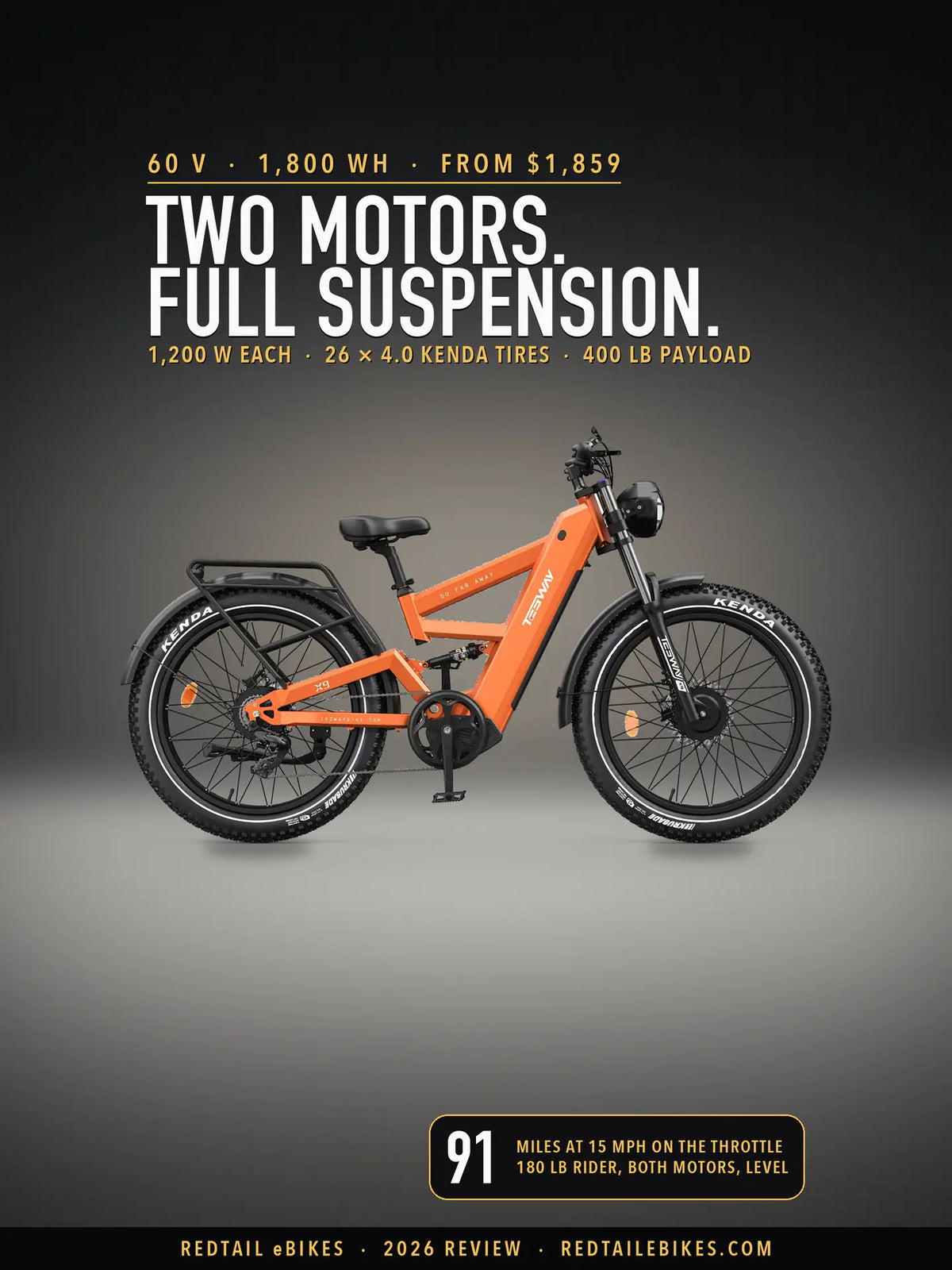

$1,859 to $1,999 · two hub motors: 1,200 W each rated, 2,000 W each at peak, 240 N·m together · a 60 V 30 Ah pack of 1,800 Wh; 1,500 Wh in the Orange 25 Ah build · Tesway's range 70–100 miles on one motor, 50–70 on two · ships at 15 mph, 43 mph published · 117 or 139 lb, 400 lb payload · full suspension on 26 × 4.0 tires · verified September 26, 2026
Quick Answer — The X9 Ultra is Tesway's 60 V, full-suspension fat-tire bike: two hub motors rated at 1,200 W each on 26 × 4.0 Kenda tires, from $1,859. With both motors on and a 180 lb rider on the throttle at its delivered 15 mph over level pavement, the 1,800 Wh pack computes to about 91 miles.
Add light pedaling at that 15 mph and the figure reaches 130 miles; 20 mph on the throttle brings it to 67. Tesway's specification gives 70 to 100 miles on one motor and 50 to 70 on two, which the range tables turn into rides.
Check the fit first: the seat runs 32 to 38 inches, and the saddle reaches the formula height for 88 of 100 riders at 5'4" but 13 at 5'8" (the fit section). Each motor is rated above the 750 W in the federal and California definitions (the class section).
All four orderable builds were on our store on September 26, 2026, against a regular price of $2,599: Black here or Blue at $1,899, Camouflage at $1,999, and Orange with the 25 Ah pack at $1,859. Delivery costs nothing inside the contiguous United States, and Tesway's rear rack and full fenders, listed at $159.99, and its X9 Ultra Free Value Pack, listed at $152.95, ship with an order placed here.
Buy the X9 Ultra in BlackWhat this review covers
The specification · What it is · Fit · The motors · The battery · Range · Brakes and lights · Suspension and tires · Weight and load · The Mercer fit test · UL · Recalls · Class · Trails · Green and red flags · The verdict · Checklist · Buying it from us · FAQ · Limitations · The bottom line · References
How we verified this Tesway X9 Ultra review
Each number here was taken on September 26, 2026 from the X9 Ultra's US product page, its product record, Tesway's X9 Ultra manual, the dimension drawing that page shows, our listing and the statutes in the class section. Range and fit are computed, and each formula names its inputs.
The review is specification-verified: every figure traces to Tesway, a statute or arithmetic shown here, and the range model reproduces its published benchmarks first. We sell the X9 Ultra, so weigh the red flags as heavily as the green.
Written by Milad Ghobadibeygvand, BScN (Western University, 2014). Corrections: support@redtailebikes.com.
The X9 Ultra on paper: Tesway's specification
| As Tesway publishes it | |
|---|---|
| Frame | aluminum alloy, full suspension |
| Motors | two hub motors, front and rear: "Rated Power 60V 1200W x 2", "Peak Power 60V 2000W x 2" |
| Torque | 240 N·m in the table; 120 N·m for each motor in the detail block |
| Battery | 60 V 30 Ah, Samsung cells in Tesway's words; the Orange build also comes with 60 V 25 Ah |
| Range | 70–100 miles in single motor mode; 50–70 miles in dual motor mode |
| Top speed, published | 43 mph |
| Speed as delivered | "Default Speed -15mph" |
| Pedal assist | five levels, and 0 for none |
| Drive modes | single or dual, chosen on the display's Info key |
| Throttle | half-twist, with cruise control |
| Walk assist | 6 km/h while the minus key is held |
| Charger | 67.2 V 3 A |
| Charge time | "About 7 hours" on the product page; 6 hours from empty in the manual |
| Brakes | four-piston hydraulic at both wheels; rotors given as 180 mm × 2.3 mm and as 203 × 2.3 mm |
| Fork | hydraulic, 120 mm of travel, with a hydraulic lockout |
| Rear suspension | a rear shock, sold by Tesway as an adjustable air shock |
| Tires | 26 × 4.0 Kenda fat tires |
| Gears | Shimano 7-speed; a 52T chainring behind a double guard |
| Display | full-color LCD with an NFC lock and a USB charging port |
| Lights | a 900-lumen headlight with a built-in horn; front and rear lights |
| Weight | 117 lb in the table and the drawing; 139 lb (63 kg) in the detail block |
| Payload | 400 lb (180 kg) |
| Rider height | 5'3" to 6'5", on Tesway's drawing |
| Seat height | 32 to 38 in, on the same drawing |
| Length and wheelbase | 78 in overall, 49 in between the axles |
| In the box | the bike, battery, charger, manual, toolkit, headlight, display, both fenders, horn, seat, two reflectors, two NFC cards and pedals; the detail block adds two keys |
The rows are Tesway's own, as they read on September 26, 2026: the specification table, detail block, feature text and FAQ of the X9 Ultra page, the drawing for heights and lengths, the manual for the assist levels, drive modes, walk assist and 6-hour charge, and Tesway's shock listing in our parts collection. The 1,800 Wh is 60 V times 30 Ah.
Three figures come in pairs. Tesway prints two weights, two rotor sizes and two charge times for the X9 Ultra; this page sets each pair side by side, and plans on the heavier weight and the longer charge.
Two motors, 60 V and full suspension on 26-inch wheels
The X9 Ultra is the 26-inch Tesway, on two motors and 60 V. Its three siblings on our shelf with two motors, the X7 AWD, X5 AWD and C5 AWD, run 20-inch wheels on 52 V packs (our Tesway brand profile), and Tesway's listing for its 165 mm air shock names only the two X9 models.
Tesway's FAQ describes the step up from the earlier X9: "The latest X9 Ultra has been upgraded to a 60V high-voltage system, delivering stronger torque, faster acceleration, improved climbing performance, and more efficient power delivery compared to previous versions." That earlier bike was a 48 V build, and our parts collection still stocks its 48 V 30 Ah spare beside the Ultra's 60 V pack.

Black, from the front left: the caged headlight at the fork crown, the pack set into the down tube, the shock tucked under the top tube and the rack over the rear fender.
Against the two-motor X7 AWD on Tesway's X7 AWD page, the published differences run this way:
| X9 Ultra | X7 AWD | |
|---|---|---|
| Motors | two hubs, 1,200 W each rated | two hubs, 2,000 W together rated |
| Peak, torque | 4,000 W, 240 N·m | 3,600 W, 200 N·m |
| Pack | 60 V 30 Ah, 1,800 Wh | 52 V 60 Ah, 3,120 Wh |
| Wheels | 26 × 4.0 | 20 × 4.0 |
| Rear suspension | air shock | coil shock |
| Top speed, published | 43 mph | 38 mph |
| Weight | 117 or 139 lb | 119 lb |
| Payload | 400 lb | 400 lb (350 lb on its size guide) |
| Price on our store | $1,859 to $1,999 | $1,799 to $1,849 |
Both columns as Tesway's two product pages printed them on September 26, 2026, and prices from our listings the same day. The X9 Ultra trades pack size for voltage, wheel size and suspension.
The suspension is amazing.
The closing words of one of seventeen owner reviews on Tesway's X9 Ultra page, quoted as written.

Orange, from the drive side: the guarded chainring, the swingarm lettered X9, and the front hub motor behind the disc.
Tesway pitches the machine as "Built around a powerful 60V dual-motor system", and the parts that make it different from the other four sit where you can see them: a pivoting rear end, 26-inch wheels and a motor in each hub. On paper, then, the X9 Ultra is two motors, 60 V and suspension at both ends, on a frame whose seat post suits riders up to about 5'6" best, as the next section measures.
Does the X9 Ultra fit you? Saddle, step-over and reach
The 32 to 38-inch seat range puts the saddle at the fit formula's height for at least 96 of every 100 riders from 5'0" to 5'3", 88 at 5'4", 49 at 5'6" and 13 at 5'8", and for none from 5'10" up; Tesway recommends the bike for riders from 5'3" to 6'5".
Both limits matter on this frame: the post runs out early for long legs, and the drawing's 28-inch standing height asks more of a short rider at a stop than any other Tesway we sell (our brand profile's fit table).
Every figure below comes from placing each of the 6,068 bodies in the US Army's 2012 anthropometric survey on the X9 Ultra's geometry, with each saddle at 109% of inseam.
Your own row takes three steps:
- Measure your inseam with bare feet. Stand against a wall, draw a hardcover book up snugly between your legs as a saddle would sit, and have a helper measure from the floor to its spine.
- Find your height in the tables and check that your inseam falls inside its range; past a 31.6-inch inseam the saddle is already at the top of its post.
- Settle the exact height at home, using the heel and knee checks in the setup answer.
Seven figures on the drawing bear on fit.
| What the drawing gives | Tesway's figure |
|---|---|
| Recommended heights | 5'3" to 6'5" |
| Seat height | 32 to 38 in |
| "Standing height" | 28 in |
| Handlebar height | 40 in |
| "Arm distance" | 23.6 in |
| Wheelbase | 49 in |
| Load capacity | 400 lb |

Tesway's X9 Ultra drawing. Scaled to its 49-inch wheelbase on Tesway's side photograph, the tire, the overall length, the standing height and the chainstay all agree with the photograph within 3.5 percent.
Is the seat post long enough for my legs?
For almost every rider up to 5'3", and for most at 5'4"; at 5'6" about half reach the formula height, at 5'8" about one in eight, and from 5'10" up the post runs short for everyone in the survey.
The formula sets the saddle top at 109% of inseam, measured from the pedal axle (Peveler et al., 2005); 106% appears in the published work as the low end of the accepted range (Ferrer-Roca et al., 2012).
Where that lands above the floor depends on three figures Tesway does not print, each read from its side photograph: a crank axle 12.5 inches up, a 7.5-inch crank, and a seat post at 71.0° to the horizontal.
| Your height | Typical inseam | Saddle height, median rider | At 109% | At 106% |
|---|---|---|---|---|
| 5'0" | 27.1–29.7 in | 34.7 in | 100 of 100 | 99 of 100 |
| 5'2" | 28.0–31.1 in | 35.8 in | 98 of 100 | 100 of 100 |
| 5'4" | 29.1–32.2 in | 36.9 in | 88 of 100 | 98 of 100 |
| 5'6" | 30.2–33.5 in | 38.0 in | 49 of 100 | 80 of 100 |
| 5'8" | 31.1–34.3 in | 39.1 in | 13 of 100 | 44 of 100 |
| 5'10" | 32.2–35.5 in | 40.2 in | 0 of 100 | 10 of 100 |
| 6'0" | 33.2–36.7 in | 41.4 in | 0 of 100 | 1 of 100 |
| 6'2" | 34.3–37.5 in | 42.5 in | 0 of 100 | 0 of 100 |
The median rider's floor-to-saddle height at each height, and how many of 100 riders have 109% and 106% settings inside Tesway's 32 to 38 inches, men and women of the Army survey together. Where the post runs out, the median shortfall is about 0.8 inches at 5'6", 1.3 at 5'8", 2.2 at 5'10", 3.4 at 6'0" and 4.5 at 6'2".
With the post fully raised, the saddle suits a 31.6-inch inseam at 109% and a 32.5-inch one at 106%. A longer leg keeps the saddle at its stop, so the knee stays more bent at the bottom of the stroke than the formula would set it.
At the bottom of the post, the 32-inch minimum equals 109% of a 25.8-inch inseam, well below the survey's shortest rows, so short riders meet the standover limit in the next answer before they meet this one.
How much room is there over the top tube at a stop?
From 5'3" up, 95 of 100 riders clear the drawing's 28-inch "Standing height" by 0.7 inches or more; at 5'0" only 65 of 100 clear it at all. The frame's lowest top edge measures 27.4 inches on Tesway's photograph, about half an inch under the drawing's figure, so both columns are printed.
| Your height | Typical inseam | Clearance at 28.0 in | At 27.4 in |
|---|---|---|---|
| 5'0" | 28.4 in | −0.9 in | −0.3 in |
| 5'2" | 29.5 in | 0.0 in | 0.6 in |
| 5'4" | 30.5 in | 1.1 in | 1.6 in |
| 5'6" | 31.7 in | 2.2 in | 2.8 in |
| 5'8" | 32.6 in | 3.1 in | 3.7 in |
| 5'10" | 33.8 in | 4.2 in | 4.8 in |
| 6'0" | 34.9 in | 5.2 in | 5.7 in |
| 6'2" | 36.0 in | 6.3 in | 6.9 in |
Barefoot inseam less the drawing's 28 inches, and less the 27.4 inches measured at the lowest top edge on Tesway's photograph. Each cell is the clearance that 95 of every 100 riders at that height reach or beat; a minus sign means the frame stands taller than the inseam.
Below 5'2", straddling the bike at a stop gets tight, and a rider there should put a foot down beside the frame rather than over it. The step-through X5 AWD stands 22.8 inches on Tesway's drawing, lower than the X9's 28.
How far do I lean to reach the bars?
Not far: measured from the crank axle, the grips sit 13.1 to 16.1 inches forward and 29.4 to 31.1 inches up, which leans the median rider 8 to 12 degrees off vertical. Twenty recreational riders in Priego Quesada and colleagues' 2017 study rated the most upright of three trunk angles the most comfortable.
The lean in each row is the smallest trunk angle at which a straight arm meets the grip from the sit bones, built from the torso and arm lengths of each survey body. Sliding back on the saddle or reaching for the ends of the grips moves it toward the top of the last column.
| Your height | Lean from upright, median rider | Across saddle and grip positions |
|---|---|---|
| 5'0" | 10° | 0–21° |
| 5'2" | 11° | 0–21° |
| 5'4" | 12° | 1–22° |
| 5'6" | 12° | 2–22° |
| 5'8" | 12° | 1–21° |
| 5'10" | 10° | 0–20° |
| 6'0" | 9° | 0–18° |
| 6'2" | 8° | 0–17° |
The median rider's lean from vertical at each height, seated mid-saddle; the last column spans the saddle positions and the measured bracket on where the grips sit.
Will my hands and wrists take much weight?
About 11 to 14 percent of body weight at most, with the back relaxed. That sits under the 15% a laboratory study of 10 road racers measured on the brake hoods (Carahalios, 2015), at every height in the table.
Lean further and the load moves to the heel of the hand, over the ulnar nerve: in a study of 36 riders, pressure there peaked in the most stretched hand position, and padded gloves cut palm pressure by 10 to 28% (Slane et al., 2011).
| Your height | Share of your weight, back relaxed | Median rider's weight | On each hand |
|---|---|---|---|
| 5'0" | 12% (5–17%) | 126 lb | about 7 lb |
| 5'2" | 13% (5–18%) | 139 lb | about 9 lb |
| 5'4" | 13% (6–18%) | 147 lb | about 10 lb |
| 5'6" | 14% (6–18%) | 166 lb | about 11 lb |
| 5'8" | 13% (6–18%) | 179 lb | about 12 lb |
| 5'10" | 13% (5–17%) | 192 lb | about 12 lb |
| 6'0" | 12% (5–17%) | 204 lb | about 12 lb |
| 6'2" | 11% (5–16%) | 216 lb | about 11 lb |
With the back relaxed: the most weight the hands take, computed from each body's segment weights (Clauser et al., 1969) and shown at the survey's median weight for each height; the bracket covers the saddle and grip positions.
What is the quickest way to set the saddle?
Set it so the knee keeps a 25 to 35 degree bend with the pedal at the bottom (Peveler et al., 2007). The X9 Ultra manual's safety list simply asks you to "Check that the seat is adjusted properly", which leaves the number to you.
For a first setting, rest your heel on the lower pedal and raise the saddle until that leg is just straight. In a group of 19 cyclists, the heel method put 70% of them inside the target range, ahead of both inseam formulas in the same study (Peveler et al., 2005).
The fit arithmetic
The section uses three rules. The saddle sits at 1.09 × inseam above the pedal axle; the lean is the smallest trunk angle that lets a straight arm reach the grip; and the load on the hands is the upper body's weight times that lean, divided by the reach.
Take a 5'8" rider with the median 32.6-inch inseam: the formula wants 35.6 inches from the pedal, which sits 28.0 inches above the crank axle after the 7.5-inch crank and 39.1 inches off the floor, just past the post's 38.
LeMond's rule asks for a higher saddle on this frame. Its 88.3% of inseam from the crank axle comes to 28.8 inches, or 111.6% of inseam from the pedal once the long crank is added, against the 109.2 ± 0.9% Peveler and colleagues report; the 7.5-inch crank read off the photograph is the reason.
| Input | Value | Source |
|---|---|---|
| Rider bodies | 6,068 (4,082 men, 1,986 women) | US Army ANSUR II, 2012 |
| Saddle formula | 109% of inseam; range 106–110.4% | Peveler et al., 2005; Ferrer-Roca et al., 2012 |
| Seat height | 32–38 in, from the ground | Tesway's drawing |
| Crank length | 7.5 in (7.3–7.8) | measured on Tesway's side photograph |
| Crank axle height | 12.5 in (12.2–12.7) | measured on Tesway's side photograph |
| Seatpost angle | 71.0° (68.0–74.0°) | measured on Tesway's side photograph |
| Grip center | 13.1–16.1 in ahead, 29.4–31.1 in above the crank axle | measured on Tesway's side photograph |
| Standover | 28 in listed; 27.4 in measured | Tesway's drawing; measured on its photograph |
| Segment weights | head and trunk 58.0%, each arm 4.9% of body weight | Clauser et al., 1969 |
Tesway prints no crank length, crank height, seatpost angle or grip position, so the model reads all four off Tesway's side photograph of the Black X9 Ultra, scaled by the 49-inch wheelbase, after checking that photograph against Tesway's own lengths:
| Dimension | Tesway lists | Measured on its photograph (white studio background) | Gap |
|---|---|---|---|
| tire (wheel) diameter | 29.0 in | 28.9 in | −0.5% |
| total length | 78.0 in | 78.7 in | +0.9% |
| standover (drawing 'Standing height') | 28.0 in | 27.4 in | −2.1% |
| handlebar height, grip-center mean | 40.0 in | 42.7 in | +6.8% |
| handlebar height, top of the cockpit | 40.0 in | 46.0 in | +15.0% |
| chainstay (rear axle to crank spindle) | 21.6 in | 21.0 in | −3.0% |
The tire, the overall length, the standing height and the chainstay, four of Tesway's lengths, agree with the photograph to within 3.5 percent. The drawing's 40-inch handlebar height matches neither the grips, at 42.7 inches on the photograph, nor the top of the cockpit, at 46.0; it is not counted, and the cockpit figures use the grips where the photograph shows them.
Between rows, or taller than 5'6"? Write to support@redtailebikes.com with your height and inseam, and we will send back your saddle and reach figures from this model before you pay; for riders past the post's reach, the C5 AWD Cargo posts the best tall-rider figures of the five in our brand profile's fit table. Blue is $1,899, the same as Black.
Buy the Blue X9 UltraThe motors: 1,200 W each, one or both at the press of a key
Tesway's detail block rates each motor at "Rated Power 60V 1200W x 2 | Peak Power 60V 2000W x 2", with "-120N.m x 2" of torque, and the specification table adds the pair together as "60V 2400W | Peak 60V 4000W" and 240 N·m. The rated figure is what each hub carries steadily, the one the class section weighs; the peak is the short burst the system allows on top.
A key on the display decides how many of them work. The manual says: "Press the Info key to switch between Single and Dual Drive modes." Its operating section describes the bike as "equipped with dual motors at both the front and the rear for driving".

The front wheel in Tesway's photograph: the second hub motor, the lettered fork leg and the Kenda tire, which Tesway sizes at 26 × 4.0.
Which mode to use turns on the ground. At 12 to 20 mph on level pavement, the model puts one motor and two within 2.4% of each other per mile; on a 6% grade, sharing the work cuts the pack's draw by 18 to 21%, because each motor runs nearer its efficient load:
| Your ride | Both motors | One motor | Both motors vs one |
|---|---|---|---|
| 12 mph, flat | 16.8 Wh | 16.4 Wh | +2% |
| 12 mph, 6% grade | 79.0 Wh | 99.8 Wh | −21% |
| 15 mph, flat | 19.9 Wh | 19.7 Wh | +1% |
| 15 mph, 6% grade | 79.6 Wh | 98.4 Wh | −19% |
| 20 mph, flat | 26.8 Wh | 27.4 Wh | −2% |
| 20 mph, 6% grade | 85.7 Wh | 104.2 Wh | −18% |
| 25 mph, flat | 36.1 Wh | 37.8 Wh | −5% |
| 25 mph, 6% grade | 97.4 Wh | past one motor's rating | — |
Pack watt-hours per mile for a 180 lb rider on the throttle at 77 °F, from the X9 Ultra's range model; the model shares torque evenly between the two hubs, which Tesway does not describe.
So ride the flat on whichever you prefer, and switch to both before a climb. On a 12% grade one motor cannot hold 10 mph in the model, while the pair holds about 23.7 mph (the hills table).
Tesway's FAQ credits the 60 V system with "faster acceleration (0–31 mph in 8 seconds)"; that sprint needs a setting well past the 15 mph the bike leaves the box at. The chain does not pass through either hub, so the seven gears set your cadence and nothing else, and our e-bike motor guide sets hub motors against mid-drives.
The half-twist throttle moves the bike without pedaling. In the manual's words, cruise control "will be triggered by long-press the minus key to activate in the pure electric mode", and braking, pedaling or throttling releases it. Pedal assist runs "0/1/2/3/4/5", and walk assist pushes the bike at "a constant speed of 6 km/h", about 3.7 mph, while you hold the minus key.
The battery: 60 V × 30 Ah = 1,800 Wh, and the 25 Ah Orange
Sixty volts times thirty amp-hours gives 1,800 watt-hours to run both motors, the lights and the display. Tesway's feature text calls it "a high-capacity 60V 30Ah Samsung battery", set into the down tube and removable. The Orange colorway also comes with a 60 V 25 Ah pack, which holds 1,500 Wh, five-sixths as much.

Tesway's photograph of the pack coming out of the down tube, the key still in its lock above.
The pack is keyed and double-latched. The manual has you turn the key counterclockwise and then "push up on the safety pin to unlock again", holding the lower end as it comes free: "Be careful not to drop the battery." Copy the second key early, because "If you lost both keys, you will be unable to remove the battery from the E-bike."
Plug in at about 20 percent. The manual recommends starting "when the power is less than 20 percent", allows overnight charging, "Leaving it connected for overnight charging is OK", and still asks: "Don't charge in unattended condition for a long time." For a pack left unused, it says to "charge it fully and recharge it every month".
The charge times disagree: "About 7 hours" on the product page and 6 hours from empty in the manual. The charger's own rating settles the planning figure: 67.2 V at 3 A is 201.6 W, so the manual's 20-to-100% refill, 1,440 Wh, takes about 7.1 hours, and an empty 1,800 Wh pack about 8.9, before any charger losses.
The manual expects the pack to last "600 charging and discharging cycles" under normal use. The same manual sets one band for use, storage and charging alike, 0 to 40 °C (32 to 104 °F), and advises warming a pack that falls short in the cold "above 0℃ (32℉)".
On September 26, 2026, our Tesway parts collection held the 60 V 30 Ah X9 spare at $699 and the 67.2 V 3 A charger at $189. Match the voltage on your pack's label before ordering either: the same listing sells a 48 V pack for the earlier X9.
How far the X9 Ultra goes: range by speed, hill, load and cold
With both motors on level pavement, a full pack takes a 180 lb rider about 91 miles at 15 mph on the throttle, 67 at 20 mph, and 130 at 15 mph with easy pedaling. Up a steady 8% grade at 10 mph on the throttle, the same pack runs out after about 16 miles.
Three steps give your own figure:
- Pick your speed and your pedaling effort from the first two tables.
- Count the climbing: on the throttle at 10 mph, every 1,000 feet gained draws 189 Wh on a 4% grade and 243 Wh on a 10% grade, and pedaling lowers both (the hills table).
- Allow for load and temperature, and plan on 80% of the pack.
Each figure is one steady ride, built from Tesway's specifications, a comparable hub motor's published figures, drum measurements of ten 26-inch fat tires and a cycling-power model validated on the road. The formula subsection walks one ride through and sets the nearest measured day beside it.
Does speed cut the X9 Ultra's range? Miles at each speed
Sharply: on the throttle, 10 mph stretches a charge to 119 miles and 20 mph ends it at 67. Between 15 and 20 mph the figure falls from 91 miles to 67, because the air's share of the work climbs with the cube of speed: (20 ÷ 15)³ is about 2.37, so 20 mph asks more than twice the air power of 15.
| Speed, flat | Per mile | Full charge | With 20% kept |
|---|---|---|---|
| 10 mph | 15.2 Wh | 119 mi | 95 mi |
| 12 mph | 16.8 Wh | 107 mi | 86 mi |
| 15 mph | 19.9 Wh | 91 mi | 73 mi |
| 16 mph | 21.1 Wh | 85 mi | 68 mi |
| 18 mph | 23.7 Wh | 76 mi | 61 mi |
| 20 mph | 26.8 Wh | 67 mi | 54 mi |
| 25 mph | 36.1 Wh | 50 mi | 40 mi |
| 28 mph | 42.9 Wh | 42 mi | 34 mi |
| 32 mph | 54.1 Wh | 33 mi | 27 mi |
Both motors on the throttle alone, 180 lb aboard, level pavement, 77 °F air. The bike ships set to 15 mph, and every faster row assumes a setting past that default, a step the class section weighs. At their 1,200 W ratings the two motors hold about 37.2 mph on the flat in the model, so the table stops at 32. The last column holds back the 20% at which the manual suggests charging.
At 15 mph, 75 W from your legs raises the figure from 91 miles to 130. Easy pedaling here means 75 W and steady pedaling 150 W; with the motors off, 75 W alone would carry this bike at about 8.2 mph on level ground and 150 W at about 12.4, so pick the column you could hold unaided.
| Speed, flat | Throttle only | Easy pedaling (75 W) | Steady pedaling (150 W) |
|---|---|---|---|
| 15 mph | 91 mi | 130 mi | 222 mi |
| 16 mph | 85 mi | 117 mi | 181 mi |
| 18 mph | 76 mi | 97 mi | 131 mi |
| 20 mph | 67 mi | 81 mi | 102 mi |
| 25 mph | 50 mi | 56 mi | 63 mi |
| 28 mph | 42 mi | 46 mi | 50 mi |
| 32 mph | 33 mi | 35 mi | 38 mi |
Miles on a full pack, level ground, 180 lb aboard, both motors. At 15 mph the pack spends 13.8 Wh a mile when you pedal easily and 19.9 on the throttle alone. The 222-mile cell has your legs doing most of the work, which leans on the least-checked part of the model, its motor losses at light load (Limitations item 5).
Whatever assist level is showing, the pack pays for the speed and the effort in your row. The manual puts it plainly: "Frequent changes in speed will consume more energy."
Do gears or pedaling save battery on the X9 Ultra?
Gears change what your legs feel; pedaling changes what the pack spends. Both motors turn with their wheels, so a shift moves your cadence and leaves the motors' load alone, and at a given speed and grade the draw falls only as your own effort grows:
| Your ride | Throttle only | Easy pedaling (75 W) | Steady pedaling (150 W) |
|---|---|---|---|
| 15 mph, flat | 19.9 Wh | 13.8 Wh | 8.1 Wh |
| 20 mph, flat | 26.8 Wh | 22.1 Wh | 17.7 Wh |
| 12 mph, 4% grade | 55.2 Wh | 44.9 Wh | 35.2 Wh |
| 12 mph, 8% grade | 106.1 Wh | 92.5 Wh | 79.7 Wh |
Pack watt-hours per mile, 180 lb aboard, 77 °F, both motors; easy pedaling is 75 W from you and steady pedaling 150 W.
Use the seven gears to keep your cadence comfortable, and drop into the low ones before a start or a steep pitch. The 52T chainring sits behind what Tesway calls a "52T double chain guard".
How much battery does a climb cost?
Climbing 1,000 feet at 10 mph takes 189 Wh of the pack on a 4% grade and 243 Wh on a 10% grade with the throttle alone, and 170 to 222 Wh if you pedal easily. Lifting you and the bike accounts for 50 to 63% of the throttle figure, and motor and pack losses make up the rest; among the manual's range drains, "Rough road conditions and hilly terrain will consume more energy."
Rider and bike together, 180 lb plus 139, weigh 319 lb; raising that 1,000 feet needs 120 Wh at the wheels alone.
At 8% and 10 mph on the throttle, each 1,000 feet takes 224 Wh from the pack, so all 1,800 Wh would lift you about 8,000 feet with nothing left for the flat. The model regains nothing on the way down, which keeps a climbing budget on the careful side.
| Grade | Wh a mile | Miles, throttle | Miles, easy pedaling | Top steady speed |
|---|---|---|---|---|
| 2% | 33 Wh | 54 mi | 80 mi | 36.2 mph |
| 4% | 55 Wh | 33 mi | 43 mi | 33.8 mph |
| 6% | 80 Wh | 22 mi | 28 mi | 31.0 mph |
| 8% | 109 Wh | 16 mi | 20 mi | 28.3 mph |
| 10% | 143 Wh | 13 mi | 15 mi | 25.9 mph |
| 12% | 181 Wh | 10 mi | 11 mi | 23.7 mph |
| 15% | 248 Wh | 7 mi | 8 mi | 20.8 mph |
Every row at 10 mph with 180 lb aboard and both motors; the second and third columns are throttle only and the fourth adds 75 W of easy pedaling. The last column is the fastest steady speed both motors hold on the throttle on that grade in the model, within their ratings and the 2,000 W peak per motor Tesway publishes.
Climb on both motors. The pair keeps a 15% grade at 20.8 mph within its peak in the model; one motor alone cannot hold 10 mph from 12% up, which is what the Info key's dual mode is for.
Level miles and climbing add up. Take a day of 30 level miles at 15 mph on the throttle, about 596 Wh, plus 1,500 feet of 8% climbing, another 336 Wh or so: that is about 932 Wh, 52% of the pack. Headwinds and stops cost extra on top, since the model rides every mile at one steady speed.
How much does a heavier rider or load cost?
A heavier load hurts most on the climbs. Extra pounds raise tire drag and the work of lifting and leave air drag unchanged (the power equation), so the gap between a light and a heavy load widens with the grade. The manual's line: "Carrying more weight on the E-bike will consume more energy."
| You plus your load | 15 mph flat, throttle | 20 mph flat, throttle | 8% climb, 10 mph |
|---|---|---|---|
| 130 lb | 97 mi | 71 mi | 20 mi |
| 180 lb | 91 mi | 67 mi | 16 mi |
| 230 lb | 85 mi | 64 mi | 14 mi |
| 280 lb | 80 mi | 61 mi | 11 mi |
| 400 lb | 70 mi | 55 mi | 8 mi |
The first column is you and everything you carry; every row also adds the bike's 139 lb, the heavier of the two weights Tesway prints. Both motors, throttle only; Tesway's 400 lb payload is the last row.
Loading up from 180 lb to the full 400 lb shortens the level 15 mph ride from 91 miles to 70 and the 8% climb from 16 miles to 8. A full load costs nearly a quarter of the flat range and about half of the climbing range, since every added pound has to be raised on a grade (the hills section).
How much range does the cold take?
Colder air means fewer miles. The 15 mph throttle ride worth 91 miles at 77 °F comes to about 72 at 32 °F, the bottom of the manual's band for using, storing and charging the pack.
| Air | Pack energy vs 77 °F | 15 mph flat, throttle | Inside Tesway's 32–104 °F range |
|---|---|---|---|
| 95 °F | 99% | 94 mi | yes |
| 77 °F | 100% | 91 mi | yes |
| 68 °F | 98% | 86 mi | yes |
| 50 °F | 93% | 78 mi | yes |
| 41 °F | 91% | 74 mi | yes |
| 32 °F | 89% (80–93) | 72 mi (65–75) | yes |
| 14 °F | 82% (40–83) | 65 mi (32–65) | no: below it |
Level ground, 180 lb aboard, both motors. Each row's central figure is McMaster University's measured LG HG2 cell, recomputed at a 0.5C discharge from the lab's 77, 50, 32 and 14 °F runs; rows between those temperatures are interpolated, and the cells are assumed to be at air temperature.
The bracketed ranges mark how far the published cell data spread. At the low end is the smallest capacity a Samsung data sheet gives for that temperature over a one-to-four-hour discharge (25R and 30Q at 32 °F, 35E at 14 °F); at the high end, the most energy Casado and colleagues measured in 2025 at a slower rate.
In freezing air three losses pile up. At 32 °F the cells deliver about 89% of the energy they give at 77 °F, 80 to 93% depending on the source, and the gas law in the U.S. Standard Atmosphere makes the air about 9% denser, so moving through it takes more push.
Tires stiffen in the cold as well, so rolling resistance goes up 0.5% in the model for every °F under 77 °F (0.9% per °C); that rate sits between Rothhämel's fit for a 42 mm tire and Bicycle Rolling Resistance's road-tire average, and below 41 °F the model holds it flat.
The 14 °F row falls outside the manual's band. Between winter rides, keep the pack indoors; for the whole bike, the manual says "Avoid parking your E-bike outside when there is rain or snow".
Do the fat tires cost range, and does posture matter?
On the flat, your tires matter more to range than your posture. On Bicycle Rolling Resistance's drum, ten 26 × 4.00 fat tires took between 23.2 and 42.1 W each to roll at 18 mph under a 94 lb load at 12 psi.
That is the X9 Ultra's own tire size, though its Kenda has no drum reading, so the model uses the middle of the ten, a coefficient of 0.0105, and takes the heaviest-rolling Kenda on the drum as the slow case.
| Rolling resistance | 15 mph flat, throttle | 20 mph flat, throttle |
|---|---|---|
| 0.0070 · the lowest of ten fat tires on the drum | 106 mi | 75 mi |
| 0.0105 · the median of ten fat tires (used) | 91 mi | 67 mi |
| 0.0126 · a Kenda Juggernaut Pro, the heaviest-rolling Kenda fat tire on the drum | 83 mi | 63 mi |
Level ground, 180 lb aboard, both motors, a full pack; the Juggernaut Pro's own test page gives 0.01262 as its coefficient.
For pressure, the manual sends you to the tire: "Refer to the tire’s sidewall for the pressure range." It also notes that "Keeping the tires properly inflated and keeping the E-bike clean and well lubricated will save energy." The drum figures above were measured at 12 psi.
Posture counts for more as the speed climbs. The model uses the 0.640 m² drag area Tengattini and Bigazzi measured on 37 upright cruiser riders; their 90 everyday mountain-bike riders came in at 0.603 m², enough to stretch the 20 mph throttle ride from 67 miles to 70. Loose dirt and sand fall outside every row here, so send us your trail and we will model it.
Tesway's 50 to 100 miles, as steady rides
Each of Tesway's range figures matches a steady ride in the model, and the two bands describe two speeds. The specification gives 70 to 100 miles in single motor mode and 50 to 70 in dual motor mode.
| Tesway's figure | Throttle only | Easy pedaling (75 W) | Steady pedaling (150 W) |
|---|---|---|---|
| Single motor, low, 70 miles | about 19.1 mph | about 21.8 mph | about 23.8 mph |
| Single motor, high, 100 miles | about 13.6 mph | about 18 mph | about 20.5 mph |
| Dual motor, low, 50 miles | about 25 mph | about 26.7 mph | about 28.1 mph |
| Dual motor, high, 70 miles | about 19.4 mph | about 21.9 mph | about 23.9 mph |
The level-ground speed that would empty all 1,800 Wh over exactly Tesway's distance for a 180 lb rider, read on one motor for the single-motor figures and on both for the dual; 100 miles means 18.0 Wh a mile, 70 miles 25.7 and 50 miles 36.0.
Read this way, Tesway's one-motor band is the throttle at about 13.6 to 19.1 mph, and its two-motor band the throttle at about 19.4 to 25 mph. From 12 to 20 mph on the flat the two modes spend within 2.4% of each other (the modes table), so the gap between Tesway's two bands is mostly a gap in speed.
Plan on 80% of your row. The manual suggests plugging in "when the power is less than 20 percent", so keeping a fifth in reserve simply follows it: at 15 mph on the throttle, the plan is 73 miles of the full 91.
Pick your row, hold back a fifth of the pack, and add the climbing. Every 1,000 feet of climbing at 10 mph adds 189 to 243 Wh on the throttle, and less if you pedal. For 180 lb on the flat with both motors, the planning figures are 73 miles at 15 mph on the throttle and 54 at 20.
A day of 30 flat miles at 15 mph with 1,500 feet of 8% climbing needs about 932 Wh on the throttle, under two-thirds of the 1,440 Wh in 80% of the pack. Send us your distance, climbing, weight with gear and usual speed, and we will run the ride before you order. Camouflage is $1,999; Black and Blue are $1,899.
Buy the X9 Ultra in CamouflageThe range formula, worked through
All the figures above start from one equation. Martin and colleagues' 1998 model, checked on an open road, gives the power the wheels must deliver to hold a constant speed in still air:
P = v × [ m × g × (Crr × cos θ + sin θ) + ½ × ρ × CdA × v² ]
The symbols: P, the power the wheels deliver; v, road speed; m, the combined mass of rider, cargo and bike; g, gravity; θ, the angle of the slope; Crr, rolling resistance (at 0.0105 the tires drag with 1.05% of the weight they carry); ρ, air density; and CdA, the drag area, a measure of how much air the rider has to shove aside.
In the equation, the first bracketed term carries the tires and the slope and the second the air; multiplied by v, the air's share grows with the cube of speed.
Between the wheels and the pack sit four stages:
- Pedaling: the chain passes 97.7% of your effort to the rear wheel (Martin and colleagues' figure), and the motors supply the rest.
- Both hub motors share the motors' part equally in dual mode, and one hub carries all of it in single mode.
- Each motor is modeled on a published stand-in, Bafang's RM G0H0 hub, listed in the 2021 OEM workbook at 510 rpm unloaded and 426 rpm at its rating, with an efficiency of "≥ 80" percent. The model scales it to 1,200 W at 60 V, sets the unloaded speed at Tesway's published 43 mph, keeps Bafang's ratio of rated to unloaded speed, takes 80% at the rated point and lets efficiency fall as the load lightens; each motor's draw is capped at the 2,000 W peak Tesway publishes.
- The pack gives up a little energy as heat inside, at the efficiency Arango, Lopez and Ceren measured on a 48 V pack.
Divide the pack's watts by the speed for Wh per mile; then divide the energy the pack can give at that temperature, 1,800 Wh times the fraction left, by Wh per mile for miles.
| Input | Value used | Where it comes from |
|---|---|---|
| Bike | 139 lb | Tesway's detail block |
| Rider and cargo | 180 lb; the weight table also runs 130, 230, 280 and 400 | 400 lb is the payload in Tesway's detail block |
| Battery | 60 V × 30 Ah = 1,800 Wh | Tesway's specification |
| Motors | two, 1,200 W each at the rated speed, 43 mph unloaded, 80% at the rated point, torque capped at 120 N·m each, draw capped at 2,000 W each | Bafang OEM workbook 2021, RM G0H0; Tesway's 43 mph, 120 N·m and 2,000 W |
| Wheel | 29 inches across | the "Tire diameter" on Tesway's drawing |
| Rolling resistance | 0.0105, the median of ten 26 × 4.00 fat tires at 12 psi | Bicycle Rolling Resistance |
| Drag area | 0.640 m², 37 upright cruiser riders | Tengattini and Bigazzi, 2018 |
| Chain | 97.7%, your pedaling only | Martin et al., 1998 |
| Battery losses | 3.0% at 15 mph, more at climbing currents | Arango, Lopez and Ceren, 2021 |
| Air | 77 °F at sea-level pressure, 1.184 kg/m³ | U.S. Standard Atmosphere, 1976 |
| Cold | the share of a cell's energy left at each temperature | McMaster University's LG HG2 cell data |
One ride, worked through: 180 lb aboard, 15 mph on level pavement, both motors, throttle only. Holding that speed takes 214.5 W at the wheels, of which 100.3 W rolls the tires and 114.2 W pushes through the air.
The 29-inch wheels turn at 174 rpm at 15 mph. From Bafang's published figures the model derives 1.150 N·m of torque per amp, a 0.395 Ω winding and a 1.06 A no-load current; at this load each hub turns out 5.9 N·m on 6.2 A at 74% efficiency, and the pair draws 288.9 W.
Adding the pack's own losses, the battery supplies 297.9 W, or 19.86 Wh a mile at 15 mph; 1,800 ÷ 19.86 gives about 90.6 miles, or 72.5 with 20% held back.
Two published benchmarks come first. The model reproduces both before it computes anything:
| Check | Published figure | This model |
|---|---|---|
| Road physics, Martin and colleagues' worked example | 45.7 W for tires and grade, 158.8 W for the air | 45.7 W and 158.8 W |
| The comparable motor at Bafang's rated point | at least 80% efficient | 80% |
The model's self-test reproduces both: Martin and colleagues' Appendix I case (8.36 m/s, a 90 kg system on a 0.3% grade) and the RM G0H0's rated point from Bafang's workbook. The X9 Ultra's unloaded speed is set at Tesway's 43 mph, where Bafang's own 510 rpm scaled to 60 V on this wheel would give 55.0; Limitations item 6 shows what that choice moves.
The nearest measured day is on the earlier X9. Eight X9 videos were read for this review, and the five on the 60 V X9 Ultra include no run to empty. The one ride that ends near empty is on the 48 V X9 AWD that came before it, a 1,440 Wh pack: Papa's Product Reviews rode it "Full bore pretty much all-wheel drive the whole trip" at 230 lb over steep, windy country roads.
That ride ended at about 25 miles, with the display showing 10% and the pack at 42.7 V. Spending energy at that rate, the X9 Ultra's 1,800 Wh would cover about 31 miles, which falls between the model's 230 lb rows for an 8% climb at 10 mph, 14 miles, and 20 mph on the flat, 64.
Treat that day as a floor for hard, hilly riding, not as a check of the 60 V model: the pack, the motors and the pedaling all differ.
Brakes, lights and the NFC display
Both wheels stop on four-piston hydraulic brakes, and Tesway gives the rotor size two ways. Its detail block, a feature heading and a component card say 180 mm, while two feature paragraphs describe "203 × 2.3 mm rotors".

Tesway's close-up of the front brake: the rotor carries a "180" stamp, and the four-piston caliper sits on the fork leg.
The photograph on the same page shows a front rotor stamped "180". Tesway lists its pads by model, the X9 Ultra's by name; a replacement rotor is another matter, so send us a photo of yours before ordering one. X9 Ultra pads were $20.99 a pair, or $39.99 for two, in our Tesway parts collection on September 26, 2026.
The manual's pre-ride check asks you to "Check brake pads and ensure the brake pad material isn’t thinner than the backing plate it attaches to."

The caged round headlight on its fork bracket, which Tesway rates at 900 lumens.
Tesway writes that "The 900-lumen headlight and integrated horn keep you visible and safe during night rides", and lists front and rear lights in the detail block.

The color display in Tesway's photograph: assist level at the left, speed in the dial, trip and odometer beneath.
The console, in Tesway's words, features "tap-to-ride NFC unlocking and a USB charging port". The manual has you "Press the power button or use the NFC card to turn on the display"; two cards come in the box, and the display switches itself off "after 10 minutes of inactivity".

The half-twist throttle on the right grip, beside the brake lever.
Fork, air shock, tires and seven gears
Up front, Tesway describes a hydraulic fork in which "120mm of travel absorbs bumps and rough terrain for a smoother, more controlled ride, while hydraulic lockout improves efficiency when climbing or riding on smoother surfaces". At the back, "The performance-tuned rear shock absorbs bumps and helps keep the tires planted".
That rear shock is an air unit. Tesway's own listing for it, carried in our parts collection as the "Tesway 165MM Air Shock Absorber", fits the X9 Ultra and reads "Factory Pressure: 150 PSI Maximum Pressure: 275 PSI"; you add air for a firmer ride and let some out for a softer one.
The tires are 26 × 4.0 Kendas, which Tesway says "offer durability and enhanced safety". The drivetrain is Shimano 7-speed, shifter and derailleur, behind the 52T guarded chainring, and the saddle is what Tesway calls an "Extra-Large Thick Seat".
On September 26, 2026, our Tesway parts collection carried X9 Ultra tires ($89.00), 26 × 4.0 inner tubes ($30.99), a 7-speed chain ($25.99) and the air shock ($159).
117 to 139 pounds, a 400-pound payload and one rider
Tesway prints two weights for the X9 Ultra: 117 lb in its specification table, which the drawing repeats, and "EBike Weight -139LBS(63kg)" in its detail block. The range tables assume the heavier 139 lb; on the 117 lb figure the 15 mph throttle ride would add about two miles, reaching 93.
Tesway prints one payload figure throughout: "400LBS" on the highlights strip, 400 lb on the drawing, and "Max. Payload Capacity -400 LBS(180kg)" in the detail block. The cautious reading counts it as you plus everything you carry; total it before you load the rack, and keep each tire inside the pressure and load its own sidewall prints.
Tesway's FAQ answers the heavy-rider question directly: "The dual-motor AWD system, combined with the reinforced frame and high-torque output, makes it suitable for heavy riders, cargo transport, and demanding terrain." The manual adds that the bike "is designed for regular country road use for a single person", so the rack is for cargo, and a second rider waits on Tesway's written answer, which we will get for you.
For hauling, the Tesway Cargo Trailer in our Tesway accessories names the X9 Ultra among its fits, with a maximum load of 100 kg (220 lb). One owner on Tesway's page reports: "I have used it to tow a trailer which it does really well".
For the garage and the car, Tesway's drawing gives 78 inches of length and a handlebar 29 inches across.
Measure the door, the stairs and the car rack before you order. At 117 to 139 lb and 78 inches long, the X9 Ultra wants a ground-floor spot, and a rack or a lift has to be rated above the full weight plus whatever it carries.
The Mercer fit test
The same seven people, the Mercers, meet every bike we review, so the fit questions are asked the same way each time (meet the Mercers). Behind every verdict is one of three things: a figure Tesway publishes (its height window, seat range, standing height or payload), the manual's line about children, or a row of the fit tables.
| Member | Age · Height | Verdict | The number behind it |
|---|---|---|---|
| Frank Kowalski | 63 · 5'10" | Inside the window, with the saddle below the formula | At 5'10" the post reaches the formula height for 0 of 100 riders at 109% and 10 at 106%; he clears the 28-inch standing height by 4.2 inches or more |
| Ruth Kowalski | 61 · 5'5" | Fits | The post reaches the formula height for 71 of 100 riders at 5'5" and 94 at 106%, and she clears the top tube by 1.7 inches or more |
| Jack Mercer | 48 · 6'1" | Inside the window, with the saddle well short of the formula | Tesway's 5'3"–6'5" includes him, but at 6'1" the median rider's saddle sits about 4.1 inches below the formula height |
| Dana Mercer | 45 · 5'7" | Inside Tesway's window; her saddle is the check | Tesway's 5'3"–6'5" includes her, and the post reaches the formula height for 25 of 100 riders at 5'7" and 64 at 106% |
| Maya Torres | 32 · 5'6" | Inside Tesway's window; her saddle is the check | Tesway's 5'3"–6'5" includes her, and the post reaches the formula height for 49 of 100 riders at 5'6" and 80 at 106% |
| Cole Mercer | 16 · 5'11" | His state decides | The manual says "Prohibit children to use it for safety" and gives no age; with each motor rated at 1,200 W, his state's rule for such a machine decides whether a 16-year-old may ride it; at 5'11", inside Tesway's 5'3"–6'5" window, the post reaches 106% of inseam for 1 of 100 riders |
| Ivy Mercer | 12 · — | No | The manual's "Prohibit children to use it for safety" rules her out at 12, whatever her height |
Of this household, Ruth fits the X9 Ultra best, and from 5'7" up the 38-inch top of the post sets how everyone else sits. Each Mercer with a height in the table stands 5'5" or taller, where the step-over table clears the 28-inch standing height, so the saddle, not the top tube, is the limit for them.
Is it UL certified?
Tesway says so: its page states that "The X9 Ultra e-bike system is UL 2849 certified by TÜV, with a UL 2271 certified battery".
They are separate standards. UL 2271 is titled "Batteries for Use In Light Electric Vehicle (LEV) Applications", while UL 2849, "Electrical Systems for eBikes", reaches wider, naming "the drive unit, battery, battery management system (BMS)" in its scope. If a building manager or insurer wants paperwork, email us and we will ask Tesway for the certificates in writing.
Has it been recalled?
No. The Consumer Product Safety Commission's recall data was searched on September 26, 2026: its recall-title, product-name and manufacturer fields under Tesway, TESWAY, teswaybike and Tesgo, the parent company that Tesway's European About page names, followed by a read of every field in a 623-record corpus of bicycle, e-bike, battery and scooter recalls.
Not one record names Tesway, and the model code X9 appears in none of them. The same search first had to find recalls known to exist, and it returned Ancheer 1, Specialized 54 and Trek 24.
The class question: 1,200 W a motor, 15 mph as delivered
Answer this one before you order. Tesway publishes a motor rating, a default speed and a top speed for the X9 Ultra, and an e-bike definition tests more than one of them.
The federal definition in 15 U.S.C. § 2085(b) asks three things of a low-speed electric bicycle: "fully operable pedals", a motor "of less than 750 watts (1 h.p.)", and, on motor power alone with a 170-pound rider, a top speed "less than 20 mph".
| What the definition asks | The X9 Ultra, in Tesway's figures |
|---|---|
| Fully operable pedals | "Left & Right Pedals" in the box |
| A motor under 750 watts | "Rated Power 60V 1200W x 2", "Peak Power 60V 2000W x 2" |
| Under 20 mph on motor power | 15 mph as delivered; 43 mph published |
The statute's words from § 2085(b) and Tesway's figures from the X9 Ultra page, each as read on September 26, 2026.
Each of the two motors is rated at 1,200 W, above the 750 W in the definition, and together they are rated at 2,400 W. The 15 mph default is a speed setting; the definition's motor test is written around the motor itself, which is why the answer below routes to your state.
California draws its line at the same place: Vehicle Code § 312.5(a), read on September 26, 2026, builds its definition on "an electric motor that does not exceed 750 watts of power", and ends class 3 assistance at 28 miles per hour.
A speed setting can move the X9 Ultra across a speed line, but the motors' rating stays where it is. The manual treats its full power mode the same way, telling riders they "should check against local laws to ensure full power mode is permitted", and warns that local laws "may differ depending on the area you are living".
| Setting | The speed line | Where the X9 Ultra lands |
|---|---|---|
| As delivered, 15 mph | Under the federal 20 mph and California's class 2 throttle line | Under the speed lines; each motor rated at 1,200 W |
| At the 43 mph Tesway publishes | Class 3 assist stops at 28 mph and a class 2 throttle at 20 | Past the speed lines too |
Each row rests on § 312.5(a), § 2085(b) or the X9 Ultra manual, each read on September 26, 2026.
How your state treats the X9 Ultra on its roads and paths, and what riding it there takes, is the state's call. The state definitions are laid out in our 50-state e-bike law atlas, and California's in detail on our California e-bike law page.
Start from the rating on the motors. Each is rated at 1,200 W, past the 750 W the definitions name, so your state's rule for such a machine is the one to plan around; tell us the state and we will send the rule before you order.
Trails and public land: who decides
Once you leave the road, whoever owns or manages the land decides whether the X9 Ultra may go, and the federal land agencies draw their e-bike line at 750 W as well.
On Bureau of Land Management ground, 43 CFR 8340.0-5 limits the e-bike definition to a motor "of not more than 750 watts (1 h.p.)", so a machine rated above that is an off-road vehicle there, and 43 CFR 8341.1 keeps such a vehicle to land the field office has designated "open to off-road vehicle use".
The Forest Service's directives of March 31, 2022 put e-bikes under its motor vehicle rules, "managing all classes of e-bikes as motor vehicles" in its notice at 87 FR 41278. Where a Ranger District publishes a motor vehicle use map, 36 CFR 261.13 prohibits riding "other than in accordance with those designations".
| Where you plan to ride | Who decides | What to read |
|---|---|---|
| Private land, yours or with permission | the owner | the owner's permission |
| A state or county off-highway vehicle area | that agency | its registration and equipment rules |
| A National Forest road or trail | the Ranger District | its motor vehicle use map (36 CFR 261.13) |
| BLM land | the field office | its open, limited and closed designations (43 CFR 8341.1) |
The deciding document in each row is the land manager's; Tesway's specification decides none of them.
Under the BLM's penalty provision, 43 CFR 8340.0-7, a violation can bring "a fine of not more than $1,000" or imprisonment "for not longer than 12 months", or both. Our public-land e-bike guide walks through each agency in turn. Off the pavement, keep the manual's caution in mind: it advises against "extreme maneuvers, such as extreme off-road use, jumping, or carrying an excessive load".
Name the trail or the land before you order. Send the name to support@redtailebikes.com, and the reply will say which rule applies there. Orange with the 25 Ah pack is $1,859; Black with the 30 Ah pack is $1,899.
Buy the Orange X9 Ultra, 25 AhGreen flags / Red flags
Green flags
- Two 1,200 W hub motors on 60 V, 240 N·m in all, with a key that switches between one motor and both.
- Suspension at both ends: a 120 mm hydraulic fork with a lockout, and an air shock at the rear that Tesway fills to 150 PSI and rates to 275.
- 26 × 4.0 Kenda tires, where the other four Tesways we sell ride 20-inch wheels (the lineup).
- Climbing on both motors: the pair holds 20.8 mph up a 15% grade within its peak in the model, and draws 18 to 21% less per mile than one motor on a 6% grade.
- Four-piston hydraulic brakes at both wheels, with pads on our shelf.
- A 400 lb payload, the same on the strip, the detail block and the drawing.
- Four orderable builds from $1,859, with Tesway's rack and fenders shipped free.
- Parts on our shelf: pads, the 67.2 V 3 A charger, a 60 V spare pack, the air shock, tires and a controller.
Red flags
Each one is about fit: who the X9 Ultra is wrong for, and what to do instead.
- Wrong for riders from about 5'8" who want the formula's saddle height. The post reaches it for 13 of 100 riders at 5'8" and none from 5'10"; email us your inseam, and look at the C5 AWD Cargo, which posts the best tall-rider figures of the five in our brand profile's fit table.
- Wrong if you stand under about 5'1" and need to straddle the frame at stops. At 5'0", 65 of 100 riders clear the 28-inch standing height; the step-through X5 AWD stands 22.8 inches.
- Wrong if range per charge matters most. Its 1,800 Wh is the smallest pack of the five (the lineup); the X7 PRO and X7 AWD carry 3,120 Wh.
- Wrong if home means carrying it up steps. At 117 to 139 lb it is a two-person lift; tell us about the stairs or the car rack and we will suggest a lighter bike we sell.
- Wrong where your riding must stay inside your state's e-bike classes. Each motor is rated at 1,200 W; send us your state and roads, and we will suggest a class-compliant bike from our range.
- Wrong for trails open to Class 1 bikes alone. The throttle rules it out, and so does the rating; send us the trail's name, or read our public-land guide for the agency to ask.
- Wrong for carrying a second rider. The manual describes a bike for "a single person"; the rack is for cargo, and we will get Tesway's answer in writing if you ask.
- Not for children. The manual says "Prohibit children to use it for safety"; state age rules are laid out in our 50-state law atlas.
Buy it if / Buy something else if
Buy it if you want two motors, 60 V and suspension at both ends on 26-inch wheels, and your rides mix gravel, grass, sand and climbs on private land or wherever your state allows a machine rated above 750 W: about 91 miles computed at 15 mph on the throttle for a 180 lb rider, and about 20.8 mph held up a 15% grade on both motors in the model.
It asks for an adult who fits the frame: inside Tesway's 5'3" to 6'5" window, with an inseam under about 31.6 inches for the formula's saddle height, a ground-level home for a bike of up to 139 lb, and about 9 hours to charge from empty.
For $1,899 you get two hub motors rated at 1,200 W each, 240 N·m, a removable 1,800 Wh pack, a 120 mm lockout fork and an air rear shock, four-piston hydraulic brakes, seven Shimano gears and a 900-lumen headlight. On our listing's Shop Pay plan the $1,899 build comes to $171.40 a month for 12 months at 15% APR, $2,056.80 altogether.
On Tesway's page, X9 Ultra owners had left 17 reviews by September 26, 2026: sixteen at five stars and one at four. One owner put it this way: "Recently purchased an X9 Ultra, and I am totally blown away by this bike."
Buy something else if you need a machine inside your state's e-bike classes, which we will match to your state by email; if range per charge comes first, which the 3,120 Wh X7 PRO answers; or if you are 5'8" or taller, where the C5 AWD Cargo seats taller riders better. Our Tesway brand profile sets all five side by side, from $1,549 to $2,199.
Reviews of other machines we sell are collected on our e-bike reviews hub.
Before you buy: the checklist
Go through these ten before spending $1,859 to $1,999; where the X9 Ultra may be ridden comes first.
- Know which rules govern your riding: your state's e-bike definition for roads, and the land manager's rules for trails.
- Hold the bike against that rule: Tesway rates each motor at 1,200 W.
- An adult rides it, as the manual's line on children says.
- Take your inseam and read your row in the fit tables; the post is at full height past 31.6 inches.
- Check the standing height: at 5'2" and under, a 28-inch frame is tight at a stop.
- Add up rider and cargo and keep the total at or under Tesway's 400 lb payload, inside the tires' sidewall ratings.
- Plan storage and lifting for a 117 to 139 lb, 78-inch bike plus its load.
- Pick your build: Orange also comes with the 25 Ah pack at $1,859, 1,500 Wh against 1,800.
- Look up your ride in the range tables, count the climbing, and leave a fifth of the pack unused.
- Choose a charging spot you can keep an eye on, with about 9 hours to spare from empty on the 3 A charger.
Buying it from us
Why buy the X9 Ultra from Redtail
Our listing priced the X9 Ultra at $1,899 in Black and Blue, $1,999 in Camouflage and $1,859 in Orange with the 25 Ah pack on September 26, 2026, with $2,599 as the regular price, the same as Tesway's page that day. What we do for you starts at the order.

Blue, one of the two colorways at $1,899.
| What you get | The detail |
|---|---|
| Price | $1,859 to $1,999 by colorway and pack, four builds orderable on September 26, 2026 |
| Shipping | Free within the contiguous United States: prepared within 1–3 business days, then 5–10 business days in transit. Alaska, Hawaii, US territories, P.O. boxes and remote areas: ask us first |
| Tesway's gift | The rear rack and full fenders (listed at $159.99), the X9 Ultra Free Value Pack (listed at $152.95) and the five-piece kit Tesway's banner names, "Phone Mount • Rear Bag • Bike Lock • Brake Pads • Rearview Mirror", all advertised on Tesway's page on September 26, 2026, come with an order here |
| Paying over time | Shop Pay installments: $171.40 a month over 12 months at 15% APR on the $1,899 build, $2,056.80 in total; 3- and 6-payment plans run at the same APR. Read September 26, 2026 |
| If something fails | Send photos and your order number; we open the claim with Tesway and stay with it, and our listing says "Redtail coordinates the repair or replacement remotely at no cost to you" |
| If it arrives damaged | Note it with the carrier, email us photos within 48 hours, and we file the carrier claim and arrange the repair or replacement |
| A fit answer first | Send your height and inseam, and we will run them through the fit model before you pay |
| Parts and add-ons | Pads, the 3 A charger, the 60 V spare pack, the air shock, tires and a controller in our Tesway parts collection, and a large rear rack basket, a foldable rear platform and the Cargo Trailer that name the X9 Ultra in our Tesway accessories |

Camouflage, the $1,999 colorway.
A change of mind works differently. We take back a bike still sealed in its factory packaging if you ask within 72 hours of delivery, less a 15% restocking fee and the return shipping, and an order canceled before it ships carries a 3% transaction fee; put the fit, range and trail questions to us before you buy.
Every line of that table is our own store's offer, read on September 26, 2026. Warranty claims come to us and we take them up with Tesway on your behalf; Blue is $1,899 as well.
Order the Black X9 UltraFrequently asked questions
How far can the Tesway X9 Ultra go on one charge?
Tesway gives 70 to 100 miles in single motor mode and 50 to 70 in dual (its specification). For a 180 lb rider on level pavement with both motors, the full pack computes to about 91 miles at 15 mph on the throttle, 67 at 20 mph and 130 at 15 mph with easy pedaling; each 1,000 feet climbed at 10 mph costs 189 to 243 Wh on the throttle (the range tables).
What is the top speed of the Tesway X9 Ultra?
The published figure is 43 mph, and the bike arrives set to its 15 mph default (Tesway's page). In the model the two motors hold about 37.2 mph on level ground at their 1,200 W ratings for a 180 lb rider, and any setting above the default raises the class question.
Is the Tesway X9 Ultra street legal, and which class is it?
Where a law caps e-bikes at 750 W, as the federal and California definitions do, each of the X9 Ultra's 1,200 W motors is past that line. Delivered at 15 mph, it sits under the speed lines in those definitions, and your state decides how it is treated on the road (the class section).
Is the Tesway X9 Ultra dual motor, and can it run on one?
Yes to both. The manual describes "dual motors at both the front and the rear" and says to "Press the Info key to switch between Single and Dual Drive modes". At 12 to 20 mph on level ground the two modes spend within 2.4% of each other per mile in the model; on a 6% climb, both motors draw 18 to 21% less (the motors section).
Tesway X9 Ultra vs X9 AWD: what changed?
The voltage. Tesway's FAQ says "The latest X9 Ultra has been upgraded to a 60V high-voltage system", and our parts collection sells the earlier bike's 48 V 30 Ah spare beside the Ultra's 60 V 30 Ah pack. We sell the 60 V X9 Ultra; if you already own the 48 V bike, send us the pack's label before buying a part.
Tesway X9 Ultra vs X7 AWD and X5 AWD: which should I buy?
The X9 Ultra brings 60 V, full suspension with an air shock and 26 × 4.0 tires on 1,800 Wh. The X7 AWD and the step-through X5 AWD put two motors on 20-inch wheels with 3,120 Wh and a coil shock, at $1,799 to $1,849 on our store. Choose the X9 for rough ground at your height; the X7 or X5 for range per charge.
How much does the Tesway X9 Ultra weigh?
Tesway prints 117 lb in its specification table and drawing and 139 lb (63 kg) in its detail block, so the bike weighs 117 or 139 lb depending on which figure you take. Size a car rack or a lift for the full 139 lb plus anything you carry (the weight section).
How much weight can the Tesway X9 Ultra carry?
400 lb, the same on Tesway's highlights strip, detail block and drawing, and Tesway's FAQ calls it "suitable for heavy riders". Count your own weight in that total along with the cargo, read the pressure and load on each tire's own sidewall, and see the weight table for the range a full load costs.
What height rider does the Tesway X9 Ultra fit?
Tesway's drawing gives 5'3" to 6'5". The 32 to 38-inch seat gets at least 96 of every 100 riders from 5'0" to 5'3" to the formula's saddle height, 49 at 5'6" and 13 at 5'8"; if your inseam is above 31.6 inches, you will find the saddle at its top (the fit section).
What battery does the Tesway X9 Ultra use, and how long does it take to charge?
A 60 V 30 Ah pack of 1,800 Wh, or 60 V 25 Ah and 1,500 Wh in the Orange 25 Ah build, charged by a 67.2 V 3 A charger. Tesway gives "About 7 hours" and the manual 6 hours from empty; at the charger's rated 201.6 W, a 20-to-100% refill takes about 7.1 hours and a full one about 8.9 (the battery section).
What colors does the Tesway X9 Ultra come in?
Four builds were orderable on September 26, 2026: Black and Blue with the 30 Ah pack at $1,899, Camouflage with the 30 Ah pack at $1,999, and Orange with the 25 Ah pack at $1,859. Orange with the 30 Ah pack was sold out at Tesway and on our listing that day.
What accessories fit the Tesway X9 Ultra?
Tesway's rear rack and full fenders come with an order placed here. In our Tesway accessories, the large rear rack basket, the foldable rear platform and the Cargo Trailer name the X9 Ultra in the compatibility lines Tesway wrote for them; the trailer's load limit is 220 lb. Email us before buying any other add-on and we will confirm the fit.
How hard is the Tesway X9 Ultra to assemble?
The manual calls it "quite easy as most of the parts are already assembled", and walks through the front wheel with the bike upside down, the handlebar, the headlight, charging and fitting the pack, the saddle, the pedals and the tires. One owner on Tesway's page wrote: "The assembly was particularly easy, and the quality is exceptional."
Can the Tesway X9 Ultra carry a passenger?
The manual describes a bike "designed for regular country road use for a single person", and the rack Tesway includes is a cargo rack. Email us before anyone rides along, and we will get Tesway's written answer, including the load limit with a second person counted. If you need to carry more, our Tesway C5 AWD review works through Tesway's 450 lb longtail, loaded range included.
Can I replace the X9 Ultra's controller or other parts?
Yes. On September 26, 2026, our Tesway parts collection listed an X9 Ultra controller at $159, along with the X9 Ultra seat post ($59), handlebar ($179) and main cable ($69.99). The manual's error table runs from E02 to E10; send us the code on your display and we will confirm the part.
What brake pads does the Tesway X9 Ultra use?
Pads for its four-piston hydraulic calipers: X9 Ultra pads were $20.99 a pair in our Tesway parts collection on September 26, 2026, and the five-piece kit Tesway advertised that day, which ships with an order placed here, includes brake pads.
What warranty does the Tesway X9 Ultra have?
A fault on an order placed with us comes to us under our policies: send photos and the order number, and we open the claim with Tesway and see it through, and our listing says Redtail coordinates the repair or replacement "at no cost to you". For Tesway's own terms on an order placed here, ask before you buy and we will get them confirmed in writing.
Is the Tesway X9 Ultra worth it?
At $1,859 to $1,999 on our store on September 26, 2026, against a $2,599 regular price, with free shipping in the contiguous United States, it pairs two 1,200 W motors on 60 V with full suspension, 26 × 4.0 tires and four-piston brakes. It suits adults who fit its 32 to 38-inch seat, want traction and suspension more than range, and ride where a machine rated over 750 W is allowed (the verdict).
Can I finance the Tesway X9 Ultra?
Yes. Our listing's Shop Pay plan on September 26, 2026 came to $171.40 a month for 12 months at 15% APR on the $1,899 build, $2,056.80 in all, with 3- and 6-payment options at the same rate.
Limitations of this review
Twenty-five points this review cannot settle, listed so you can weigh them.
- We sell this bike. Read the red flags with the same care as the green.
- This review is specification-verified. Its figures come from Tesway's published documents, statutes, our own store record, the published research the range and fit sections cite, or arithmetic on this page.
- Each range figure is one steady ride: one speed, one grade, no wind and no stops. Stops, starts, headwinds and soft ground cost more.
- Bafang's figures stand in for Tesway's motors. Tesway gives the rated and peak power and the torque, and its documents read here do not say whether the hubs are geared or direct drive. At 82% efficiency instead of Bafang's 80% floor, the 15 mph throttle figure rises from 91 miles to 101.
- At light motor load the model has no measured check. Where your legs do most of the work, as in the steady-pedaling column at 15 mph, the answer rests on motor losses we could not check against a published hub-motor map.
- The unloaded speed is Tesway's 43 mph. If that is a controller's limit and the motors would turn at the comparable motor's 55.0 mph unloaded, the 15 mph throttle ride comes to 89 miles, the 20 mph ride to 65, and the 8% climb to 13 miles.
- The rating used is 1,200 W a motor. Read as 2,000 W a motor, the peak figure, the 15 mph throttle ride comes to 84 miles and the 8% climb to 19.
- The steep rows assume the controller delivers Tesway's full peak on a climb. Tesway publishes no controller current; a controller that delivers less holds a slower speed on a steep grade than the hills table shows.
- The model splits torque evenly between the two hubs in dual mode. Tesway does not describe how its controller shares the work.
- The nearest measured day is on the earlier 48 V X9 AWD, with a smaller pack, other motors and unmeasured pedaling, grades and wind; it is a floor for hard riding, not a check of this model. The record is in the range model's validation file.
- Every figure assumes all 1,800 Wh are usable. The documents read here do not say how much of the pack the battery management releases; on one measured pedelec, researchers at KIT found 75% in use during a standard range test.
- The tire coefficient is the median of ten 26 × 4.00 fat tires at 12 psi, the X9 Ultra's size but not its Kenda, and the tire table brackets it.
- The cold figures rest on one cell's laboratory data. Tesway names Samsung cells for the pack without a cell model, so the central line uses McMaster University's measured LG HG2 cell, bracketed by Samsung and other published cell data.
- Tesway prints two weights, 117 lb and 139 lb; the page plans on 139, and at 117 the 15 mph throttle ride gains about two miles.
- Tesway gives two charge times, "About 7 hours" and 6 hours from empty; the charger's rated 201.6 W refills 20 to 100% in about 7.1 hours and an empty pack in about 8.9, and the page plans on the longer.
- Tesway gives two rotor sizes, 180 mm and 203 × 2.3 mm; its own close-up shows a front rotor stamped 180.
- The Orange 25 Ah build carries 1,500 Wh. Its range is five-sixths of each row: about 75 miles at 15 mph on the throttle with both motors, for 180 lb on level pavement.
- The UL statement is Tesway's. The product page read here links no certificate, so no certificate number is printed.
- Trail access is set locally. The land manager's rule decides, it can change, and neighboring systems differ.
- The recall search covers the CPSC's US database under the names listed; a recall filed under another company name would need that name searched.
- Colorways and prices were read on September 26, 2026, and both can change, as can Tesway's gift offer and our parts prices.
- The fit figures use the US Army's ANSUR II bodies: 6,068 soldiers aged 17 to 58, measured in 2010 to 2012, who are not the US public, so your own inseam decides your row.
- The cockpit is measured on Tesway's photograph. The crank, crank height, seatpost angle and grips are read at the 49-inch wheelbase scale, with four published lengths agreeing within 3.5%; the drawing's 40-inch handlebar height matches neither the grips nor the top of the cockpit.
- The hand figure is a ceiling with a relaxed back. On a real ride your back and arms carry part of the load, and we found no study that measures hand load on a bike set up like this one.
- The 109% formula is a starting point. In 19 trained cyclists it put 55 to 65% inside the 25-to-35-degree knee range and the heel check 70%, so the knee range and the heel check should settle the saddle.
The bottom line
At $1,859 to $1,999, the X9 Ultra puts two 1,200 W hub motors, 240 N·m and a 60 V pack that lifts out on a full-suspension frame, with a 120 mm lockout fork, an air rear shock, 26 × 4.0 Kenda tires, four-piston hydraulic brakes and seven Shimano gears.
For a 180 lb rider on flat pavement with both motors, the model gives about 91 miles at 15 mph on the throttle, or 130 with light pedaling, and each 1,000 feet of climbing at 10 mph costs 189 to 243 Wh; the pair holds about 20.8 mph up a 15% grade in the model.
The right owner is an adult who fits the frame, with an inseam under about 31.6 inches for the formula's saddle, a ground-floor home for a bike of up to 139 lb, and rides on gravel, trails that allow it or private land, who wants suspension and traction more than the longest range of the five.
Paid through Shop Pay on our listing, the $1,899 build runs $171.40 a month over 12 months at 15% APR.
Settle the class question first: Tesway rates each motor at 1,200 W, and the 15 mph default answers only the speed test. Tell us the roads and trails you have in mind before you order, and our reply will name the rule for each.
Black and Blue cost $1,899, Camouflage $1,999, and Orange with the 25 Ah pack $1,859: this Black one, or Blue, Camouflage or Orange. Shop Pay spreads the $1,899 build over 12 months at $171.40 and 15% APR, delivery is free inside the contiguous United States, and if the bike arrives damaged the carrier claim is ours to file.
Buy your X9 Ultra for $1,899Source register
What each document behind this review supports.
T1 is the record itself, read from whoever issued it: a statute, a federal regulation or notice, the maker's own product pages, record, drawing, manual and part listings, and our own store record.
T2 is a party's own publication about its product or its measurements: the motor maker's workbook, research groups' and laboratories' published measurements, and riders' recorded rides.
| Source | Tier | What it supports |
|---|---|---|
| Tesway, X9 Ultra product page and product record | T1 (manufacturer, primary) | Every specification row, the range figures, the default and top speeds, the weights and payload, the FAQ, the UL statement, the brake, light, display, suspension and tire descriptions, the gift offer, the owner reviews |
| Tesway, X9 Ultra dimension drawing | T1 (manufacturer, primary) | The height window, seat range, standing height, handlebar height, lengths, weight and load capacity |
| Tesway, X9 Ultra manual | T1 (manufacturer, primary) | The two motors and the drive-mode key, assist levels, throttle, cruise, walk assist, charging, battery removal and keys, cycle life, the temperature band, range tips, assembly, the single-person and children lines, the full power note, the error codes |
| Tesway, X7 AWD product page · Tesway EU About page | T1 / T2 (manufacturer) | The X7 AWD's figures in the comparison; the parent name searched in the recall data |
| UL 2849 · UL 2271 | T1 (standards body) | The titles and scopes of the two standards Tesway names |
| Cal. Veh. Code § 312.5 · 15 U.S.C. § 2085 | T1 (legislature, GPO) | The definitions and class lines, quoted |
| 43 CFR 8340.0-5 · 43 CFR 8341.1 · 43 CFR 8340.0-7 · 36 CFR 261.13 · 87 FR 41278 | T1 (federal regulation and notice) | BLM and Forest Service rules for e-bikes and motorized vehicles, and the penalty |
| CPSC recall data | T1 (federal agency) | The recall search and its controls |
| Redtail eBikes shipping policy, refund policy, our X9 Ultra listing, parts and accessories | T1 (first party) | Price, builds, Shop Pay terms, shipping scope and times, the damage window, claim handling, change-of-mind terms, part prices, Tesway's shock and trailer listings |
| Bafang workbook 2021 | T2 (motor maker, primary) | The comparable hub motor's speeds, rating, efficiency floor and torque |
| Martin et al., 1998 | T2 (own validation) | The cycling-power model, its worked example and chain efficiency |
| Bicycle Rolling Resistance (Kenda Juggernaut Pro, temperature test) · Rothhämel, 2023 | T2 (own published measurements) | Fat-tire rolling resistance and its change with temperature |
| Tengattini and Bigazzi, 2018 | T2 (own field measurements) | Drag areas, upright and mountain-bike |
| Arango, Lopez and Ceren, 2021 · Schmitt, Decker and Doppelbauer, 2019 | T2 (own measurements) | Battery efficiency; usable pack energy on a measured pedelec |
| McMaster HG2 data; Samsung sheets (25R, 30Q, 35E); Casado et al., 2025 · U.S. Standard Atmosphere, 1976 | T2 / T1 | Cell energy by temperature and its brackets; air density |
| A rider's recorded ride: Papa's Product Reviews, a range day on the 48 V X9 AWD | T2 (own recorded measurements) | The nearest measured day, set beside the range model |
| US Army ANSUR II, 2012 | T1 (federal agency data) | The 6,068 bodies behind every fit figure |
| Peveler et al., 2005 · Peveler et al., 2007 · Ferrer-Roca et al., 2012 | T2 (peer-reviewed measurements) | The saddle formula, its published range, the knee target and the heel method |
| Priego Quesada et al., 2017 · Slane et al., 2011 · Carahalios, 2015 · Clauser et al., 1969 | T2 (own published measurements) | Comfort by trunk position, hand pressure, the measured load on the bars, and the segment weights |
Expiry conditions
Re-read this page if Tesway changes the X9 Ultra's price, specification, motor rating, range figures, default speed, weights, payload, rotor size, drawing or FAQ; if Tesway answers our written questions on passengers or the warranty for orders placed with us; or if the builds, the prices, the gift offer, the parts prices or the Shop Pay terms change on our store.
Re-read it too if a recall is published naming Tesway or Tesgo. Verified September 26, 2026.
References
The full bibliographic record for each document cited above, with the date it was retrieved.
- TESWAY, X9 Ultra — product page (X9 Ultra Specifications table, Specifications detail block, highlights strip, feature sections, FAQs, customer reviews, gift banner, as rendered for the US market). Retrieved September 26, 2026. https://teswaybike.com/products/tesway-x9-ultra
- TESWAY, X9 Ultra — product record, variant prices, compare-at prices and availability by colorway and pack. Retrieved September 26, 2026. https://teswaybike.com/products/tesway-x9-ultra.json
- TESWAY, X9 Ultra — dimension drawing, on the product page's slideshow below the specifications. Retrieved September 26, 2026. https://teswaybike.com/cdn/shop/files/X9-Ultra-Dimensions_Mobile_f078c5aa-96b9-4000-80e5-75e44ac19ec3.webp
- TESWAY, X9 Ultra Manual: Introduction, Important Safety Instructions, Safety Check, Assembling Your New E-bike, Operating Your New E-bike, Maximizing the Riding Range, LCD Display, Error Code, Care and Maintenance, Trouble Shooting. Retrieved September 26, 2026. https://cdn.shopify.com/s/files/1/0837/8318/8755/files/TESWAY_X9_Ultra_MANUAL_New_Dispaly.pdf?v=1775614586
- TESWAY, X7 AWD — product page, the X5/X7 AWD Specifications table and feature text. Retrieved September 26, 2026. https://teswaybike.com/products/tesway-x7-awd
- TESWAY Europe, About Us ("Tesway, a branch of Tesgo"). Retrieved September 26, 2026. https://eu.teswaybike.com/pages/about-us
- California Legislative Information, California Vehicle Code § 312.5, subdivisions (a) and (a)(3). Retrieved September 26, 2026. https://leginfo.legislature.ca.gov/faces/codes_displaySection.xhtml?lawCode=VEH§ionNum=312.5.
- US Government Publishing Office, 15 U.S.C. § 2085 — Low-speed electric bicycles, subsection (b). Retrieved September 26, 2026. https://www.govinfo.gov/content/pkg/USCODE-2024-title15/html/USCODE-2024-title15-chap47-sec2085.htm
- Bureau of Land Management, 43 CFR § 8340.0-5 — Definitions, paragraphs (a) and (j) (85 FR 69223, Nov. 2, 2020). Retrieved September 26, 2026. https://www.ecfr.gov/current/title-43/subtitle-B/chapter-II/subchapter-H/part-8340/subpart-8340/section-8340.0-5
- Bureau of Land Management, 43 CFR § 8341.1 — Regulations governing use, paragraphs (a) and (d). Retrieved September 26, 2026. https://www.ecfr.gov/current/title-43/subtitle-B/chapter-II/subchapter-H/part-8340/subpart-8341/section-8341.1
- Bureau of Land Management, 43 CFR § 8340.0-7 — Penalties. Retrieved September 26, 2026. https://www.ecfr.gov/current/title-43/subtitle-B/chapter-II/subchapter-H/part-8340/subpart-8340/section-8340.0-7
- Forest Service, US Department of Agriculture, 36 CFR § 261.13 — Motor vehicle use. Retrieved September 26, 2026. https://www.ecfr.gov/current/title-36/chapter-II/subchapter-B/part-261/subpart-A/section-261.13
- US Forest Service, Directive Publication Notice, 87 FR 41278 (July 12, 2022), recording the final e-bike directives issued March 31, 2022. Retrieved September 26, 2026. https://www.federalregister.gov/documents/2022/07/12/2022-14777/directive-publication-notice
- US Consumer Product Safety Commission, Recall data, title, product-name and manufacturer queries for Tesway, TESWAY, Tesgo and teswaybike, a full-field read of a 623-record corpus including the model code X9, and controls Ancheer / Specialized / Trek. Retrieved September 26, 2026. https://www.saferproducts.gov/
- Redtail eBikes, Shipping policy (processing and transit times, contiguous US scope). Retrieved September 26, 2026. https://redtailebikes.com/policies/shipping-policy
- Redtail eBikes, Refund policy (48-hour damage window, change-of-mind and cancellation terms). Retrieved September 26, 2026. https://redtailebikes.com/policies/refund-policy
- Redtail eBikes, Tesway X9 Ultra storefront record and Shop Pay terms (price, compare-at price, availability by colorway and pack, repair terms, the gift offer, installment plans). Retrieved September 26, 2026. https://redtailebikes.com/products/tesway-x9-ultra
- Redtail eBikes, Tesway parts and accessories listings: Brake Pads, Battery Charger, E-bike Controller, X9 Spare Battery, Fat Tire, Inner Tube 26" × 4.0", 7 Speed Chain, 165MM Air Shock Absorber, Seat Post, Handlebar, Main Cable, Large Rear Rack Basket, Foldable Rear Platform, Cargo Trailer (compatibility, price, availability). Retrieved September 26, 2026. https://redtailebikes.com/collections/tesway-parts
- BAFANG, Workbook OEM 2021, MOTORS table, RM G0H0 column: n0, nT, rated power, efficiency, maximum torque at 48 V. Retrieved September 23, 2026. https://www.bafang-e.com/Uploaded/Labels/BAFANG%20Workbook%20OEM%202021.pdf
- Martin, J. C., Milliken, D. L., Cobb, J. E., McFadden, K. L. and Coggan, A. R., Validation of a Mathematical Model for Road Cycling Power, Journal of Applied Biomechanics 14(3):276–291 (1998), Eq. 14 and Appendix I; doi 10.1123/jab.14.3.276. Retrieved September 23, 2026. https://collections.lib.utah.edu/dl_files/b4/8e/b48ef26086091662c561e673d7bd990d77868437.pdf
- Bierman, J., Fat Bike Tires Test Results, BicycleRollingResistance.com, rolling resistance at 12 psi, 28.8 km/h, 42.5 kg. Retrieved September 25, 2026. https://www.bicyclerollingresistance.com/fat-bike-reviews
- Bierman, J., Kenda Juggernaut Pro 2016, BicycleRollingResistance.com, rolling-resistance results. Retrieved September 25, 2026. https://www.bicyclerollingresistance.com/fat-bike-reviews/kenda-juggernaut-pro-2016
- Bierman, J., CRR at Different Temperatures: Examining Temperature Dependence of Rolling Resistance, BicycleRollingResistance.com. Retrieved September 23, 2026. https://www.bicyclerollingresistance.com/specials/crr-temperature-test
- Rothhämel, M., On rolling resistance of bicycle tyres with ambient temperature in focus, International Journal of Vehicle Systems Modelling and Testing 17:67–80 (2023); doi 10.1504/IJVSMT.2023.132317. Retrieved September 23, 2026. https://www.inderscience.com/filter.php?aid=132317
- Tengattini, S. and Bigazzi, A. Y., Physical characteristics and resistance parameters of typical urban cyclists, Journal of Sports Sciences 36(20):2383–2391 (2018), Table 4; doi 10.1080/02640414.2018.1458587. Retrieved September 23, 2026. https://civil-reactlab.sites.olt.ubc.ca/files/2022/11/Tengattini_2018_Physical-characteristics-and-resistance-parameters-of-typical-urban-cyclists.pdf
- Arango, I., Lopez, C. and Ceren, A., Improving the Autonomy of a Mid-Drive Motor Electric Bicycle Based on System Efficiency Maps and Its Performance, World Electric Vehicle Journal 12(2):59 (2021), Eq. (40); doi 10.3390/wevj12020059. Retrieved September 23, 2026. https://mdpi-res.com/d_attachment/wevj/wevj-12-00059/article_deploy/wevj-12-00059.pdf
- Schmitt, M., Decker, S. and Doppelbauer, M., Measuring and Characterization of a Pedal Electric Cycle (Pedelec) on a Full System Test-Bench with Full Range Emulation of a Cyclist, EPE'19 ECCE Europe (IEEE, 2019); doi 10.23919/EPE.2019.8915567. Retrieved September 23, 2026. https://publikationen.bibliothek.kit.edu/1000100371/50695920
- Kollmeyer, P. et al., LG 18650HG2 Li-ion Battery Data, Mendeley Data v2, McMaster University; doi 10.17632/b5mj79w5w9.2 (0.5C discharge files, recomputed). Retrieved September 23, 2026. https://doi.org/10.17632/b5mj79w5w9.2
- Samsung SDI, Specification of Product INR18650-25R, § 7.6 Temperature dependence of discharge capacity. Retrieved September 23, 2026. https://e2e.ti.com/cfs-file/__key/communityserver-discussions-components-files/196/4628.130109_5F00_INR18650_2D00_25R-Cell-SPEC-_2800_3_2900_-_2800_1_2900_.pdf
- Samsung SDI, Specification of Product INR18650-30Q, discharge characteristics by temperature. Retrieved September 23, 2026. https://e2e.ti.com/cfs-file/__key/communityserver-discussions-components-files/196/INR18650_2D00_30Q_5F00_datasheet.PDF
- Samsung SDI, Technical Information INR18650-35E, discharge by temperature. Retrieved September 23, 2026. https://enerpower.de/wp/wp-content/uploads/2016/03/Technical_Information_INR18650-35E.pdf
- Casado, C. et al., Temperature-dependent capacity of lithium-ion cells, Journal of Power Sources (2025); doi 10.1016/j.jpowsour.2025.236552. Retrieved September 23, 2026. https://doi.org/10.1016/j.jpowsour.2025.236552
- NOAA, NASA and USAF, U.S. Standard Atmosphere, 1976 (NOAA-S/T 76-1562). Retrieved September 23, 2026. https://ntrs.nasa.gov/api/citations/19770009539/downloads/19770009539.pdf
- Papa's Product Reviews, TESWAY X9 AWD EBIKE | Follow Up Review | RANGE SPEED HILL CLIMB (YouTube), transcript read. Retrieved September 26, 2026. https://www.youtube.com/watch?v=9GsCN9W-f8A
- US Army, For good measure: Natick releases raw data from Army-wide anthropometric survey (ANSUR II, 2012). Retrieved September 25, 2026. https://www.army.mil/article/188601/for_good_measure_natick_releases_raw_data_from_army_wide_anthropometric_survey
- Peveler, W. W., Pounders, J. D. and Bishop, P. A., Effects of saddle height on anaerobic power production in cycling, Journal of Exercise Physiology Online (2005). Retrieved September 25, 2026. https://www.asep.org/asep/asep/JEPonlineFEBRUARY2005_PevelerSaddle.doc
- Peveler, W. W. and Green, J. M., Effects of saddle height on economy and anaerobic power in well-trained cyclists, Journal of Strength and Conditioning Research (2007). Retrieved September 25, 2026. https://pubmed.ncbi.nlm.nih.gov/18076230/
- Ferrer-Roca, V. et al., A comparison of static and dynamic methods for measuring knee angle during cycling (2012). Retrieved September 25, 2026. https://pubmed.ncbi.nlm.nih.gov/22190163/
- Priego Quesada, J. I. et al., Effect of bike-fit in the perception of comfort, fatigue and pain (2017). Retrieved September 25, 2026. https://pubmed.ncbi.nlm.nih.gov/27490817/
- Slane, J. et al., The influence of glove and hand position on pressure over the ulnar nerve during cycling (2011). Retrieved September 25, 2026. https://pubmed.ncbi.nlm.nih.gov/21458120/
- Carahalios, A., Handlebar load in road cycling (University of Colorado, 2015). Retrieved September 25, 2026. https://scholar.colorado.edu/downloads/70795789x
- Clauser, C. E., McConville, J. T. and Young, J. W., Weight, Volume, and Center of Mass of Segments of the Human Body (NASA/AMRL, 1969). Retrieved September 25, 2026. https://ntrs.nasa.gov/api/citations/19700027497/downloads/19700027497.pdf
- UL Standards & Engagement, UL 2849, Electrical Systems for eBikes. Retrieved September 26, 2026. https://www.shopulstandards.com/ProductDetail.aspx?productId=UL2849
- UL Standards & Engagement, UL 2271, Batteries for Use In Light Electric Vehicle (LEV) Applications. Retrieved September 26, 2026. https://www.shopulstandards.com/ProductDetail.aspx?productId=UL2271
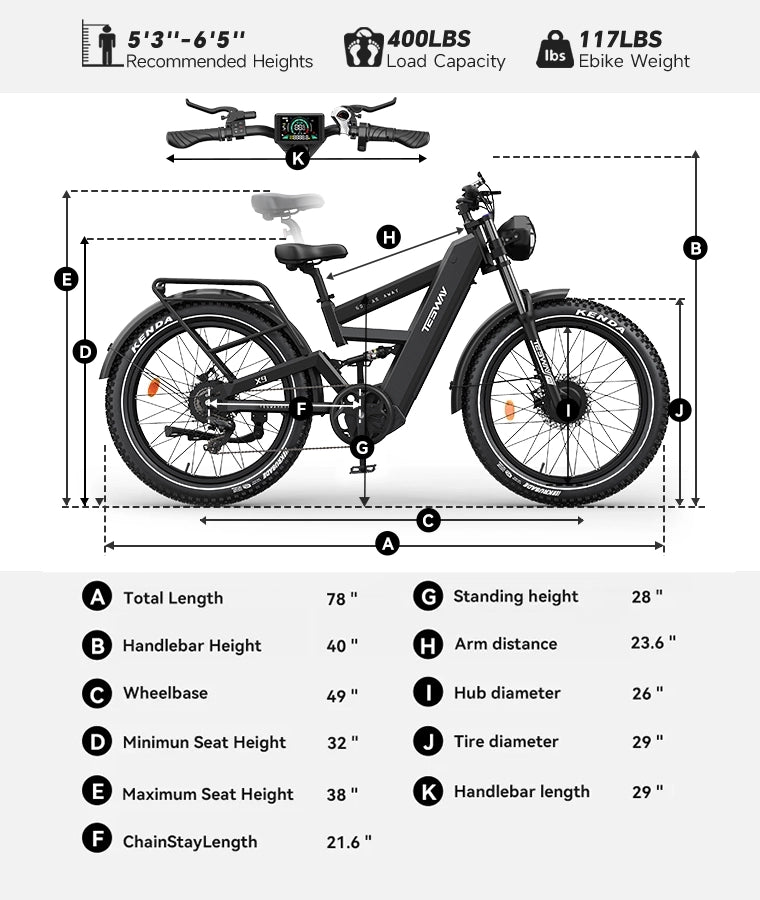
Share:
Samebike Electric Bikes 2026: All 10 We Sell, 0 Recalls
Eunorau FAT-HD 1.0 Pro Review (2026): 1,200 Wh, 375 lb