
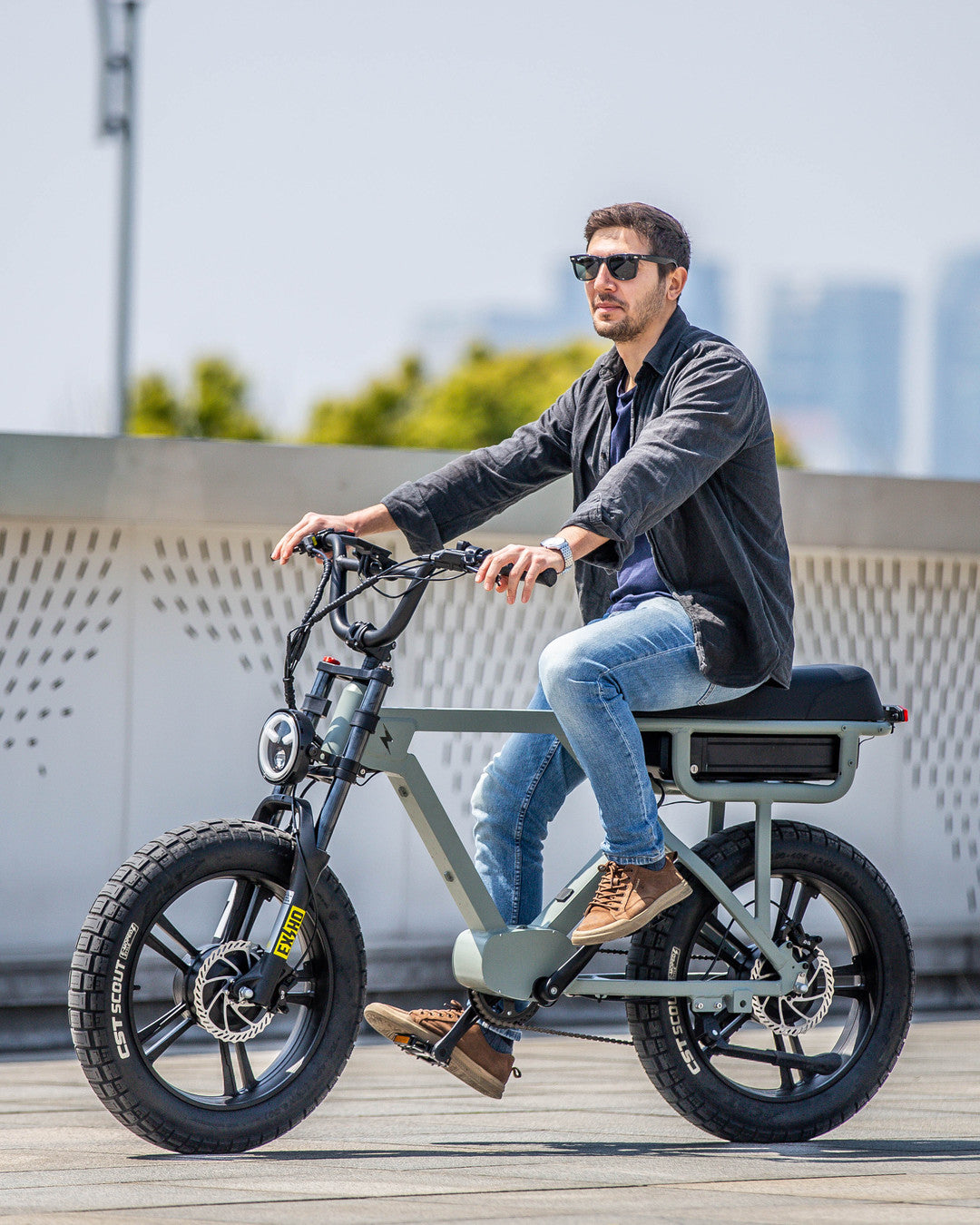


750 W inclusive · 20 mph class 2 · 28 mph class 3 · age 14 for class 3 · 533 cities counted, 461 codes searched

Quick Answer: Michigan ebike laws treat a class 1, 2 or 3 electric bicycle as a bicycle (no license, no registration, no insurance) with a motor of not greater than 750 watts and working pedals. Class 3 riders must be 14 or older; under-18 class 3 riders and passengers need helmets. Sidewalks are legal with pedestrian-yield duties.
Rail-trails default open to class 1 only, and Mackinac Island bans e-bikes outright.
Michigan wrote its three-class e-bike law in one package in 2017 (PA 138–140) and has barely touched it since. What it wrote differs from its neighbors in ways that decide real purchases: one preposition in the wattage line makes bikes legal here that are illegal across the Ohio border, and one subsection built the only place in America where an e-bike needs a disability permit and $3.50 to exist at all.
We read the statute, the enrolled acts behind it, the DNR's own trail rules, Mackinac Island's ordinance, and the published codes of every Michigan municipality we could reach — then screened our own catalog against the definition and printed the result, whichever way it fell.
In this guide
- How we verified this guide
- The 30-second answer
- What's on this page
- Michigan ebike laws: what counts as a legal e-bike here
- The word that doubles the market: 750 W inclusive
- Do you need a license, plate or insurance in Michigan?
- Age and helmets: what class 3 changes
- Where can you ride an e-bike in Michigan?
- Sidewalks: legal, with duties
- The public-hearing rule nobody uses
- DNR land: broader than the statute
- Mackinac Island: the $3.50 permit
- Every municipality we checked
- The towns that wrote their own rules
- What do Michigan's biggest cities add?
- Fines and enforcement
- Not an e-bike: mopeds, scooters, e-motos
- The rebate that died
- Our own catalog, screened against Michigan law
- Michigan against its neighbors
- Where riders get caught out
- The 60-second self-check: your Michigan compliance checklist
- If you are stopped: the police-stop playbook
- Limitations, and when this page expires
- Source register
- What changed, 2017–2026
- Frequently asked questions
- References
- The bottom line
How we verified this guide
Every statutory claim here was read in the Michigan Vehicle Code at legislature.mi.gov, the Legislature's own publisher, on August 25, 2026. The e-bike definitions were verified a second time against the enrolled text of 2017 Public Act 139, the act that created them.
The local layer comes from full-text searches of the Michigan municipal codes hosted on American Legal Publishing (85 clients), Municode (317, including charter townships) and eCode360 (53), run August 25, 2026, and because those searches returned only a few hundred hits, every hit was read in full at its published code. No sampling, no classifier. The denominator (533 active incorporated places) is the U.S. Census Bureau's 2025 Gazetteer count.
Park rules come from the DNR's own e-bike page and Mackinac Island's park and city pages.
Last verified: August 25, 2026 by Milad Ghobadibeygvand, BScN (Western University, 2014), Redtail eBikes editorial. Corrections: content@redtailebikes.com — if a rule here no longer matches the section it links to, the section wins, and we want to know.
The 30-second answer
A class 1, 2 or 3 e-bike is a bicycle in Michigan (MCL 257.662a(1)): no license, registration or insurance, full road rights wherever bicycles go. The motor ceiling is 750 watts, inclusive (MCL 257.13e): a bike rated at exactly 750 W qualifies. Class 3 needs a rider 14 or older, and any class 3 rider or passenger under 18 needs a CPSC or ASTM helmet (§ 662a(4)).
Where you ride is the strict part. Paved and crushed-limestone rail-trails default open to class 1 only — class 2 and 3 need the trail authority's yes (§ 662a(8)–(9)). Dirt singletrack defaults closed to everyone ((10)). And no authority may touch any of it without first holding a public hearing ((12)).
The trap to walk in knowing: the "Michigan e-bike rebate" that shopping sites still advertise does not exist. The bill behind it, HB 4491, passed the House in December 2024 and died in a Senate committee when the session ended.
What's on this page
- In this guide
- How we verified this guide
- The 30-second answer
- What's on this page
- Michigan ebike laws: what counts as a legal e-bike here
- The word that doubles the market: 750 W inclusive
- Do you need a license, plate or insurance in Michigan?
- Age and helmets: what class 3 changes
- Where can you ride an e-bike in Michigan?
- Sidewalks: legal, with duties
- The public-hearing rule nobody uses
- DNR land: broader than the statute
- Mackinac Island: the $3.50 permit
- Every municipality we checked
- The towns that wrote their own rules
- What do Michigan's biggest cities add?
- Fines and enforcement
- Not an e-bike: mopeds, scooters, e-motos
- The rebate that died
- Our own catalog, screened against Michigan law
- Michigan against its neighbors
- Where riders get caught out
- The 60-second self-check: your Michigan compliance checklist
- If you are stopped: the police-stop playbook
- Limitations, and when this page expires
- Source register
- What changed, 2017–2026
-
Frequently asked questions
- Are electric bikes legal in Michigan?
- What are Michigan's e-bike classes?
- Is a 750W e-bike legal in Michigan?
- Do you need a license or registration for an e-bike in Michigan?
- What is the minimum age to ride an e-bike in Michigan?
- Do you need a helmet on an e-bike in Michigan?
- Can a 13-year-old ride a class 2 e-bike in Michigan?
- Are e-bikes allowed on Michigan bike trails?
- Why does Michigan restrict class 2 from bike paths when most states allow it?
- Are electric bikes allowed in Michigan state parks?
- What are the Michigan DNR e-bike rules?
- Can you ride an e-bike on Mackinac Island?
- Are e-bikes allowed on sidewalks in Michigan?
- Is it legal to modify an e-bike to go faster in Michigan?
- Are Sur-Ron and Talaria e-motos legal in Michigan?
- What are the penalties for breaking e-bike laws in Michigan?
- Is there a Michigan e-bike rebate?
- Is Michigan changing its e-bike laws?
- Do local rules differ within Michigan?
- Where can each class ride in Michigan?
- References
- The bottom line
- Michigan ebike laws: what counts as a legal e-bike
- The word that doubles the market: 750 W inclusive
- Do you need a license, plate or insurance?
- Age and helmets: what class 3 changes
- Where can you ride an e-bike in Michigan?
- Sidewalks: legal, with duties
- The public-hearing rule nobody uses
- DNR land: broader than the statute
- Mackinac Island: the $3.50 permit
- Every municipality we checked
- The towns that wrote their own rules
- What do Michigan's biggest cities add?
- Fines and enforcement
- Not an e-bike: mopeds, scooters, e-motos
- The rebate that died
- Our own catalog, screened
- Michigan against its neighbors
- Where riders get caught out
- Checklist, police-stop playbook, FAQ
Michigan ebike laws: what counts as a legal e-bike here
A Michigan electric bicycle is a device with a seat or saddle, fully operable pedals, and an electric motor of not greater than 750 watts, falling into one of three classes (MCL 257.13e, created by 2017 PA 139). Miss any element and the machine is not an e-bike anywhere in the state.
| Class | The statute's test | Cut-off | Throttle? |
|---|---|---|---|
| Class 1 | Motor "provides assistance only when the rider is pedaling" — 13e(b)(i) | 20 mph | No |
| Class 2 | Motor "propels the electric bicycle... whether the rider is pedaling or not," and "disengages... when the brakes are applied" — 13e(b)(ii) | 20 mph | Yes |
| Class 3 | Assistance only while pedaling — 13e(b)(iii) | 28 mph | No |
Two details in that definition matter more than the rest. The class 2 test requires the motor to cut when the brakes are applied: a mechanical requirement some budget throttle bikes fail even at legal wattage. And the seat requirement is its own element: a pedal-equipped machine ridden standing, BMX-style, with no saddle fitted, has left the definition.
Since January 1, 2018, every e-bike sold in Michigan must carry a permanent label stating its class, top assisted speed and wattage, and the statute specifies the typography: "Arial font... at least 9-point type" (§ 662a(2)). Michigan is the only state we have surveyed that legislated a typeface.
Takeaway
Check three things on any listing before anything else: nominal wattage ≤ 750, a class number, and pedals. Every bike in our full range publishes wattage and class on the product page.
The word that doubles the market: 750 W inclusive
Michigan's ceiling is "not greater than 750 watts" (MCL 257.13e(a)(iii)) — inclusive. Ohio's otherwise-identical definition says "less than seven hundred fifty watts" — exclusive. One preposition, and it splits the single most common motor rating in America down a state line.
We measured what that word is worth against our own storefront on August 25, 2026 (screen dataset): of 186 live listings, 33 meet Michigan's definition on published specs and only 17 meet Ohio's. The difference is almost entirely bikes rated at a flat 750 W nominal — legal here, motorcycles there.
The modification rule guards the same line from the other side. Tampering with speed capability or motor engagement without re-labeling is prohibited, and § 662a(3) adds the sharper sentence: a device "shall not be considered an electric bicycle if the motor is modified" past 13e's criteria "or if the motor exceeds 750 watts." Unlock past the line and you have not created a fast e-bike. You have created something else — see what, below.
Do you need a license, plate or insurance in Michigan?
No, no, and no. An individual riding an e-bike "is subject to the same requirements... as an individual riding a bicycle" (MCL 257.662a(1)), and Michigan requires nothing of bicycle riders by way of licensing, registration or insurance. The Vehicle Code's registration and insurance chapters attach to motor vehicles, and MCL 257.33 expressly excludes an electric bicycle from "motor vehicle."
The confusion, as everywhere, comes from the moped. Michigan mopeds need registration and a license under their own rules, and MCL 257.32b(2) ends the argument in seven words: "Moped does not include an electric bicycle." A moped here is defined by a 100cc piston engine; no electric machine of any wattage can ever be one.
One caveat is genuinely local: a handful of cities license bicycles as such, and Mackinac Island licenses everything with pedals — its own section below.
Age and helmets: what class 3 changes
State law sets no age floor and no helmet rule for class 1 and class 2, at any age. Class 3 changes both: no one under 14 may operate one, and every class 3 operator or passenger under 18 must wear a properly fitted CPSC- or ASTM-standard helmet (MCL 257.662a(4)).
Both halves of that rule have edges worth knowing. An under-14 child may legally ride as a passenger on a class 3 built to carry one — (4)(a) bans only the operating half. And the helmet duty expires at 18: an adult on a 28-mph class 3 is helmet-free in the statute's eyes, where Ohio requires one at every age.
Fourteen is the youngest class 3 floor in the region — Indiana says 15, Ohio says 16. If you are buying for a young teenager, Michigan is the rare state where the fast bike is lawful at 14; whether it is wise at 14 is a different question, and the helmet is mandatory either way until 18.
Takeaway
Under 14 in Michigan: class 1 or 2 only. Fourteen to seventeen: any class, helmet on a class 3. Our commuter range and kids' range mark class on every listing.
Where can you ride an e-bike in Michigan?
On any road open to bicycles, all three classes may ride — including bike lanes and shoulders (MCL 257.662a(6)). Trails are where Michigan splits the classes, and its split is stricter than most riders assume:
| Surface | Class 1 | Class 2 & 3 | Source |
|---|---|---|---|
| Paved / crushed-limestone linear trail, rail-trail | Open by default — the authority may regulate or prohibit | Closed by default — open only "if authorized" | § 662a(8)–(9) |
| Natural-surface nonmotorized trail | Closed by default | Closed by default | § 662a(10) |
| Road, bike lane, shoulder | Open | Open | § 662a(6) |
Read the rail-trail row of § 662a twice, because it catches the most people. A class 2 (the ordinary throttle commuter) is not entitled to Michigan's signature rail-trails by default.
It rides there only where the managing authority has said yes, and many have, which is why you check the specific trail rather than the vibe. The DNR said yes broadly for its own land; local authorities go both ways, and Flushing said no to everyone.
Two more lines complete the map. Subsection (13) lifts (6)–(10) on "a congressionally authorized public trail system" — the North Country Trail runs on its own federal rules. And a city that bans nonemergency motor vehicles entirely can keep e-bikes out unless its council votes them in ((7)): a clause written for a single island, covered below.
Sidewalks: legal, with duties
Michigan and Ohio answer the sidewalk question in opposite directions, and riders who cross that border get it wrong in both. In Michigan, an e-bike on a sidewalk is legal by default: the rider must yield the right-of-way to pedestrians and give an audible signal before passing (MCL 257.660c, applied to e-bikes by § 662a(1)), and is barred only where "an official traffic control device" says so.
The Vehicle Code's own sidewalk prohibition proves the point by omission. MCL 257.660(7) bans mopeds, low-speed vehicles and commercial quadricycles from sidewalks, and does not name electric bicycles. The Legislature knew how to exclude machines from sidewalks and chose not to exclude these.
Local rules still bite. Lansing requires a permit to ride on downtown Zone A sidewalks; Marshall bans riding where signs say so; and one city's ordinance claims state law itself bans sidewalk e-bikes: a claim we could not verify against any section of the Code, detailed below.
The public-hearing rule nobody uses
Before any Michigan city, township, county or state agency may "prohibit, authorize, or regulate" e-bikes on its paths, MCL 257.662a(12) requires it to hold a public hearing on the matter. No other state we have surveyed writes a procedural gate like this into its e-bike law.
The practical consequence of (12) runs in the rider's favor. A trail closure that appeared without a hearing is procedurally suspect, and if you are cited under a local e-bike rule, the first document worth requesting is the hearing record behind it. We read a dozen Michigan local e-bike ordinances for this page; none recites its hearing in the code text itself, which proves nothing either way, but the question is always worth asking.
The hearing rule also means trail access here is not settled quietly. If your local rail-trail is closed to class 2 and you want that changed, the mechanism is a petition for a hearing: the statute forces the conversation into the open.
DNR land: broader than the statute
The Department of Natural Resources has used its authority under § 662a to open more than the statute's default. Per the DNR's own e-bike page, read August 25, 2026:
| Where | Rule |
|---|---|
| All state park, recreation area and state forest trails/pathways that permit bicycles | Class 1 allowed — including natural surface |
| The same trails | Class 2 allowed with a free DNR permit, issued for mobility limitations |
| Class 3 | Not approved on DNR trails |
| Exceptions, named | State game and wildlife areas; congressionally authorized trails (North Country Trail); High Country, Shingle Mill and Pickerel Lake pathways in Pigeon River Country |
That first row is bigger than it looks: the statute closes natural-surface trail to everyone by default, and the DNR — the state's largest trail manager — affirmatively reopened it for class 1. Michigan singletrack on state land is class 1 legal as the rule rather than the exception. The mobility permit for class 2 is free and issued by the DNR; carry it, because the bike looks identical either way.
Riding DNR trails? A class 1 is the key that opens almost all of them. Our mountain and off-road e-bikes list class and wattage on every product page — pick the one that says class 1 — fat-tire class 1 builds handle crushed limestone particularly well.
See class 1 trail e-bikesMackinac Island: the $3.50 permit
Mackinac Island has excluded motor vehicles since 1898, and the e-bike era ran straight into that history — the park's own page calls the absence of them "uniquely effective" at keeping the island what it is. The result is the strangest e-bike law in America, built in three layers, each read at its own source for this page.
The statute starts it: no one may operate an e-bike "within a city that prohibits the use of nonemergency motor vehicles" without a council resolution, nor "within the Mackinac Island State Park" without the Park Commission's authorization (MCL 257.662a(7)). The city ordinance answers: "The use of electric bicycles/tricycles is prohibited in the city" — with an accommodation for riders whose mobility disability makes one necessary (City of Mackinac Island code, Art. IV, read August 25, 2026).
The park's page and the city's licensing page fill in the machinery. A person with a mobility disability, "as that term is defined in 42 USC 12102," may use a class 1 e-bike or a class 2 e-tricycle.
The license application goes to the Island's police department at least 14 days before your trip; a city permit is honored in the state park; the license costs $3.50, cash or check. Throttle two-wheelers are not allowed for anyone, and an unlabeled bike may prove its class.
One island charges $3.50 and two weeks' paperwork for the only e-bike permit in America that exists to preserve the sound of horses.
If you are planning the trip: pedal bicycles rent everywhere on the island and need no permit — the e-bike rule only binds you if you need the motor. The ferry companies publish their own e-bike carriage policies, which are private rules on top of the law.
Every municipality we checked
Michigan has 533 active incorporated places — 280 cities and 253 villages (U.S. Census Bureau, 2025 Gazetteer). We ran full-text searches across the three commercial code platforms that host Michigan municipal law on August 25, 2026:
| Platform | Michigan codes searched | Hit rows |
|---|---|---|
| Municode | 317 (including charter townships) | 65 |
| American Legal Publishing | 85 | 95 |
| eCode360 | 53 | 9 — two towns with real rules |
| Coverage | ~461 of 533 places reachable | 169 hit rows — every one read in full |
Because the whole state produced only a few hundred hits against the 533-place denominator, we read every hit document at its published code — no sampling, no classifier, no fragment-counting. A stronger claim than we could make for larger states, and it is why the table below can say "no local rule" and mean it for every searched town.
The honest remainder: municipalities not hosted on any of the three platforms are unresolved, not clear — their codes may say anything. And Michigan's ~1,240 townships are only partially covered (the Municode roster carries charter townships; the rest are outside this survey), which matters here more than in most states because Michigan townships hold e-bike path authority and at least one has used it.
The towns that wrote their own rules
Fourteen jurisdictions wrote their own rules. Every row below was read in the municipality's own published code on August 25, 2026.
| Jurisdiction | What it adds | Source |
|---|---|---|
| Flushing | "No person shall operate class 1, 2 and/or 3 electric bicycles on any linear trail within the jurisdiction" — a total municipal trail ban, all classes | Flushing code |
| Harrison Charter Twp. | Class 3 prohibited township-wide; its own bicycle/e-bike article governs class 1–2 on streets and paths including Lake St. | Harrison Twp. code |
| Mackinac Island | E-bikes prohibited citywide; disability accommodation + $3.50 license, 14 days' notice | City code + license page |
| Lansing | Principal Shopping District: riding on a Zone A sidewalk requires a permit | Lansing code |
| South Lyon | Bans riding downtown and in the historic district; opens park linear trails to all three classes; asserts a sidewalk ban "pursuant to the Michigan Vehicle Code" | South Lyon code |
| Petoskey | Non-motorized trails: allows "assisted pedal power (pedelec electric bicycle)" in one clause and prohibits "electric bicycles" in the next | Petoskey code |
| Mt. Pleasant | Its own Chapter 72, "Bicycles and Electric Bicycles": all classes permitted on city paved trails; mandatory use of adjacent paths where provided; sign-based sidewalk bans; equipment duties on rental agencies | Mt. Pleasant Ch. 72 |
| Clio | Class 1 allowed on the city bike path; class 2 and 3 prohibited on it | Clio code |
| Ionia | Parks: class 1 and 2 expressly allowed | Ionia code |
| Shelby Charter Twp. | Its own e-bike article: posted speed limits on non-road paths bind e-bike riders | Shelby Twp. code |
| Marshall | Bicycles and e-bikes banned in three named parks (Carver, Brooks Memorial Fountain, Riverwalk except paved areas) | Marshall code |
| Detroit | Shared-mobility permit regime for rental fleets; no rule against private e-bikes | Detroit code |
| Coldwater | E-bike speed limits: 15 mph along U.S. 12, 10 mph in the Central Business District; mandatory dismount-and-walk zones on named downtown sidewalks (Ord. 875, amended 8-11-2025) | Coldwater § 430.02 |
| Park Township | Defines an e-bike as "less than 750 watts" — narrower than the state's own inclusive line | Park Twp. § 28-19 |
Two of these earn a closer look. Harrison Charter Township's class 3 ban is the strongest township e-bike rule we found anywhere, and townships are the layer most state-law guides never search, because most states' townships cannot regulate this at all. Michigan's can, by name, under § 662a.
And South Lyon's sidewalk clause states a rule we cannot find in state law. Its ordinance reads "Pursuant to the Michigan Vehicle Code, no person shall ride an electric bicycle upon a sidewalk", but § 660(7)'s sidewalk ban names mopeds, low-speed vehicles and quadricycles and omits e-bikes, while § 660c affirmatively regulates bicycles on sidewalks.
The city can ban sidewalk riding under its own power; the statute it cites does not contain the rule. Our reading of the texts, stated as such, and in South Lyon, obey the ordinance while it stands.
Park Township raises the same genus of question from the other side: its definition admits only motors "less than 750 watts," excluding the flat-750 bikes the state definition includes. Whether a township may narrow the state's definition for its own paths is untested anywhere we could find — on Park Township paths, the safe reading is the ordinance's.
What do Michigan's biggest cities add?
Less than the internet says, and we can be specific because we searched each code on August 25, 2026.
| City | E-bike-specific rule? | What actually governs you |
|---|---|---|
| Detroit | Shared-fleet permits only (code) | State law for private riders |
| Grand Rapids | None found — zero hits for any e-bike term | State law; see the note below |
| Ann Arbor | None found | State law |
| Lansing | Zone A sidewalk permit (Ch. 812) | State law plus the permit zone |
The Grand Rapids note earns its space. Retailer guides repeat that Grand Rapids bans riding "in the Downtown Improvement District", and its code does contain that ban, in Chapter 165, enacted 2015. Read it and the prohibited machines are skateboards, long boards, roller skates and inline skates. E-bikes appear nowhere in it, and no e-bike term returns a single hit anywhere in the city's code.
So the claim circulating about Michigan's second city describes a skateboard ordinance. If Grand Rapids restricts e-bikes anywhere, it does so through signage or a rule outside its published code, and per § 660c, absent those, the sidewalk default is legal-with-duties there like everywhere else.
If you ride the big-city trail systems, our trail finder covers where to start, and the Iron Belle Trail — Michigan's 2,000-mile flagship — follows DNR rules on DNR segments and each local authority's rules elsewhere, which is § 662a's design working as written: one trail, many authorities, ask each one.
The township layer deserves its own paragraph, because Michigan is one of the few states where it legally matters. § 662a hands path authority to "a local authority or agency of this state", and charter townships, which govern more Michiganders than villages do, use it.
Harrison Charter Township banned class 3 outright; Shelby Charter Township wrote a speed-limit article; Park Township adopted a stricter wattage definition than the state's; Canton codified the defaults. A rider who checks the city code and skips the township next door has checked half the map.
Our third platform pass — the 53 Michigan codes on eCode360, mostly townships — returned exactly two jurisdictions with e-bike text of their own (Coldwater and Park Township, both below) and zeros everywhere else. The pattern held: Michigan's local e-bike law concentrates in a handful of ambitious jurisdictions, and everywhere else the statute stands alone.
That concentration is itself the finding. In Ohio, boilerplate adoption puts state-mirroring text in hundreds of village codes; in Michigan, most towns never mention e-bikes at all, and silence means the state default.
Fines and enforcement
Michigan enforces its e-bike rules as civil infractions, the same category as most bicycle violations — MCL 257.656 sets the frame for the bicycle provisions the e-bike sections ride on. There is no jail exposure for an ordinary path or age violation, and a bicycle citation puts no points on a driver's license.
Local schedules stack on top. Mackinac Island treats an unpermitted e-bike as a civil infraction and its officers may impound the bike; municipal park bans carry each city's own fine table. The practical enforcement pattern in Michigan is concentrated where the rules are: rail-trails with posted class limits, downtown sidewalk zones, and the Island.
The exception that is not civil: impaired riding. Michigan's OWI statute reaches vehicles, and nothing in the e-bike sections shelters an intoxicated rider — the ride home from the bar on a throttle bike is the one place this chapter of the Vehicle Code turns criminal.
Not an e-bike: mopeds, scooters, e-motos
| Machine | Michigan's definition | License/registration? | Where defined |
|---|---|---|---|
| Electric bicycle | Saddle + pedals + motor ≤ 750 W, three classes | No | MCL 257.13e |
| Moped | 2–3 wheels, ≤ 100cc piston displacement, ≤ 30 mph, no gear shifting — "does not include an electric bicycle" | Yes — registration + license | MCL 257.32b |
| Electric skateboard | Its own defined device, own rules | No | MCL 257.660 |
| Motorcycle | Motor vehicle with a saddle, ≤ 3 wheels — where an over-750W machine lands | Yes — endorsement, registration, insurance | MCL 257.31 |
The chain for an over-750W machine runs the same way it does everywhere the class system exists, and Michigan closes it cleanly. Too big for 13e means not an electric bicycle, and MCL 257.33 excludes only genuine electric bicycles from "motor vehicle."
It cannot be a moped — a piston-displacement test cannot describe an electric motor. What remains is § 31: a motorcycle.
That is the honest answer to every Sur-Ron and Talaria question asked in Michigan riding groups: no pedals and several kilowatts make a motorcycle, and riding one unplated on a public road stacks equipment, license and registration violations. Off-road machines belong on ORV trails under ORV rules — a different legal universe with its own sticker.
The rebate that died
Michigan has no statewide e-bike rebate, voucher or tax credit as of August 25, 2026, and the one the internet remembers was real, passed one chamber, and died. We read the full record at the Legislature.
House Bill 4491 — the "Michigan e-bike transportation incentive program act," introduced April 27, 2023 by Rep. Julie M. Rogers — would have issued vouchers of $500 or 90% of the bike's price, rising to $1,250 for SNAP-qualified residents, through the Michigan Economic Development Corporation. Its House budget companion carried nearly $3 million.
The record then tells its own story: reported from committee May 22, 2024 · passed the House December 13, 2024, on Roll Call 516 — 56 yeas, 0 nays, and 54 members not voting, a lame-duck margin · received by the Senate and referred to its Government Operations committee December 18, 2024 · and there it sat when the 102nd Legislature adjourned, which killed it. We found no reintroduction in the 2025–26 session.
The named trap: shopping aggregators still list "Michigan: up to $1,200 back." Every version of that claim we traced leads to this dead bill. If a retailer's checkout page promises you a Michigan rebate today, the money does not exist, and if a new bill revives it, this page's expiry conditions will catch it before we will repeat the mistake.
Our own catalog, screened against Michigan law
We ran all 186 live listings on our storefront against MCL 257.13e's tests on August 25, 2026, by script, on published specs:
| Verdict | Count | Share |
|---|---|---|
| Meets Michigan's definition on published specs | 33 | 17.7% |
| Outside the definition | 102 | 54.8% |
| Cannot tell from the listing | 51 | 27.4% |
The comparison that matters is with the same screen run against Ohio one day earlier: 33 pass here, 17 pass there, and nearly the whole difference is machines rated at a flat 750 W nominal — legal under Michigan's "not greater than," illegal under Ohio's "less than."
The 51 "cannot tell" listings deserve their own sentence, because the category is not one thing. Some publish a wattage but no top speed, some the reverse, and a few publish neither, and Michigan's brake-cutoff requirement for class 2 (13e(b)(ii)) is disclosed by almost nobody, ours included. A listing that fails to state the fields the label must carry is asking the buyer to trust the sticker they have not seen yet.
Our least favorite number is again our own: 108 of 186 listings publish no class designation, the very field § 662a(2) has required on the bike's label since 2018. A disclosure gap in our copy rather than a verdict on any bike, and it is the information a Michigan buyer needs first. The 33 that pass on published specs span our full catalog, including current sale listings.
Takeaway
Buying for Michigan: a 750 W-nominal bike is fine here — the statute says "not greater than." Crossing into Ohio with it is a different story. Check both pages if you ride both states.
Shopping the inclusive line? Our fat-tire and commuter ranges list nominal wattage on every product page — free US shipping and US-based support on all of them.
Browse fat-tire e-bikesMichigan against its neighbors
| State | Motor ceiling | Class 3 age | Class 3 helmet | Sidewalks |
|---|---|---|---|---|
| Michigan | ≤ 750 W (inclusive) | 14 | Under 18 | Legal, yield + signal |
| Ohio | < 750 W (exclusive) | 16 | Every age | Motor off, statewide |
| Indiana | ≤ 750 W | 15 | Under 18 | Local |
| Wisconsin | ≤ 750 W | 16 (class 3) | None | Local |
| Illinois | < 750 W | 16 | None statewide | Banned by many municipalities |
Every row from our 51-jurisdiction national survey, re-verified for Michigan and Ohio at source this week.
For each neighbor in full, see Ohio, Illinois, Pennsylvania, New York, Minnesota, Colorado, Connecticut, Texas, Washington, Florida, California and New Jersey. The pattern for a rider in the corner where Michigan, Ohio and Indiana meet: the same bike and the same teenager can be legal, age-barred, or helmet-bound depending on which line on the map they crossed — the classes match; the edges never do.
Where riders get caught out
Five mistakes account for most Michigan e-bike trouble, and each one is a correct belief from somewhere else applied here.
The border inversion. A rider who learned the rules in Ohio knows 750 W fails and sidewalks need the motor off. Both beliefs are wrong in Michigan — 13e admits the flat-750 bike and 660c welcomes it to the sidewalk with duties. The reverse trip is worse: every habit Michigan permits becomes a citation in Ohio, where the same bike is a motorcycle and the same sidewalk requires a dead motor.
The rail-trail assumption. Riders reason that a 20-mph throttle bike is the gentlest thing on the path, so surely it is allowed. Michigan's default says otherwise: only class 1 rides linear trails by right; a class 2 needs that trail's authorization. Where the authority has said yes nothing happens, and where it has not, the friendliest-looking machine on the trail is the one that is not supposed to be there.
Arriving at Mackinac with the bike. The ferry will carry what the island will not let you ride. The ban is total for anyone without a mobility-disability license arranged 14 days ahead — there is no on-arrival permit, and impoundment is the published remedy. Plan the paperwork or plan on pedaling.
The checkout rebate. Shopping pages still promise "up to $1,200 back in Michigan." The bill behind that number died in December 2024. Any discount math that depends on a Michigan state incentive is fiction until a new bill passes — price the bike at its sticker.
Trusting a local ordinance's summary of state law. South Lyon's code asserts a statewide sidewalk ban the Vehicle Code does not contain; Grand Rapids' famous "downtown ban" turns out to govern skateboards. Local codes bind you within their limits, but when one describes state law, verify against the statute itself, because the drafters are not always right about Lansing.
The 60-second self-check: your Michigan compliance checklist
- Wattage at or under 750 nominal? Michigan's line is inclusive — a flat 750 passes (MCL 257.13e).
- Pedals and a saddle fitted and working? Both are definition elements rather than accessories.
- Class label on the frame? Class, top assisted speed, wattage — required on every bike sold here since 2018 (§ 662a(2)).
- Class 3? Rider 14 or older, and a CPSC/ASTM helmet on anyone under 18, operator or passenger ((4)).
- Rail-trail today? Class 1 rides by default; class 2 and 3 need that trail's yes ((8)–(9)) — the DNR has said yes to class 1 everywhere bikes go, class 2 by free mobility permit.
- Dirt singletrack? Closed unless the land manager opened it ((10)) — on DNR land, class 1 is open.
- Mackinac trip? No e-bike without the disability license — 14 days ahead, $3.50, police department.
If you are stopped: the police-stop playbook
- Lead with class and wattage. "Class 1, 500 watts, label's on the frame" — the answer is identical on a trike or a cruiser; classes ignore wheel count and silhouette answers the whole stop; the label is the document the statute created for this moment.
- No license, registration or insurance exists for an e-bike (§ 662a(1), § 257.33) — there is nothing to produce, and that is the correct answer.
- On a trail dispute, ask what authorization governs. Class 2/3 on a linear trail rides on the authority's yes ((9)); a prohibition rides on a public hearing having been held ((12)). Either way there is a document, and asking for it politely is not an argument.
- Sidewalk stops: yield-and-signal duties are real (§ 660c); a ban must come from a posted device or a local ordinance, and no section of the Vehicle Code bans e-bikes from sidewalks statewide.
- On Mackinac Island, produce the license — impoundment is the published consequence of not having one.
Limitations, and when this page expires
Coverage 1. We could reach the published codes of roughly 461 of Michigan's 533 municipalities across three platforms; the remainder are unresolved, not clear. 2. Michigan's ~1,240 townships hold path authority under § 662a and are only partially covered — charter townships on Municode were searched; the rest were not. Harrison Charter Township's class 3 ban shows what this layer can contain. 3. County road commissions and metro authorities (Huron-Clinton Metroparks among them) set their own trail rules and are outside this survey.
Method 4. Every search hit was read in full, but a rule phrased without any of our nine search terms would not surface — a searched-clean town is clean against the vocabulary rather than against every possible drafting. 5. The catalog screen reads published listing copy; "cannot tell" is a disclosure finding about listings, never a compliance finding about bikes. 6. The DNR page carries no revision date; its rules are quoted as read on August 25, 2026.
Expiry conditions 7. Any reintroduction of the HB 4491 voucher program in the 2025–26 session. 8. Any amendment to MCL 257.662a — unchanged since 2017 as of this writing. 9. The next revision of the DNR e-bike rules or the Mackinac Island license procedure. 10. Local ordinances move constantly; the twelve towns in our table were current at their hosts on August 25, 2026.
We re-verify this page at least every six months. Corrections: content@redtailebikes.com.
On corroboration, stated plainly. Most rows in this page's citation ledger carry the value
SOLE-PUBLISHER rather than a second link. That is not a gap: for the authoritative words of a
statute there is no independent second publisher — the legislature publishes its own text. Where a
second, independent retrieval was genuinely available we recorded it, and the ledger shows which
rows have one.
Source register
| Source | Tier | What it supports | Accessed |
|---|---|---|---|
| MCL 257.13e | T1 — primary official | Definition, classes, the inclusive 750 W line | 2026-08-25 |
| MCL 257.662a | T1 | Label, tampering, age, helmet, roads, trails, Mackinac clause, public hearing | 2026-08-25 |
| MCL 257.660, 660c, 660d | T1 | Sidewalk rules and the omission that decides them | 2026-08-25 |
| MCL 257.31, 257.32b, 257.33 | T1 | Motorcycle/moped/motor-vehicle chain | 2026-08-25 |
| 2017 PA 139 (enrolled) | T1 | Second retrieval of the definitions | 2026-08-25 |
| 2023 HB 4491 status + history | T1 | The dead voucher program, vote counts, dates | 2026-08-25 |
| Michigan DNR e-bikes page | T1 | DNR trail access, class 2 mobility permit, named exceptions | 2026-08-25 |
| Mackinac State Historic Parks e-bike page | T2 — primary institutional | Park rules, disability exception, label proof | 2026-08-25 |
| City of Mackinac Island license page | T2 | $3.50 licenses, 14-day lead time, application route | 2026-08-25 |
| U.S. Census 2025 Gazetteer | T1 | The 533-place denominator | 2026-08-25 |
| Municipal codes: Flushing, Harrison Twp., Mackinac Island, Lansing, South Lyon, Petoskey, Mt. Pleasant, Clio, Ionia, Shelby Twp., Marshall, Detroit | T1 — each body's own published code | Every local rule above | 2026-08-25 |
| Redtail live storefront data | T2 | The 186-bike screen | 2026-08-25 |
| Bridge Michigan (budget coverage) | T4 — journalistic | Lead only — every claim re-verified at the Legislature | 2026-08-25 |
No T5 source is cited anywhere on this page.
What changed, 2017–2026
| When | What | Instrument |
|---|---|---|
| Oct 2017 | The three-class system, the definitions and § 662a arrive together | 2017 PA 138–140 |
| Jan 1, 2018 | The manufacturer label duty takes effect | § 662a(2) |
| 2019–2023 | The DNR opens class 1 to its bicycle trails statewide, class 2 by mobility permit | DNR e-bike rules |
| Dec 13, 2024 | The HB 4491 voucher program passes the House, 56–0–54 | HB 4491 record |
| Dec 2024 | ...and dies in Senate Government Operations at session end | same record |
| 2025–26 | No e-bike bill located in the current session; § 662a unchanged since enactment | checked 2026-08-25 |
The stability is the story: nine years on one statute, while the local layer — Flushing's trail ban, Harrison Township's class 3 ban, Lansing's sidewalk permits — does the moving. In Michigan, watch your city council, not the Capitol.
Frequently asked questions
Are electric bikes legal in Michigan?
Yes. A class 1, 2 or 3 electric bicycle is treated as a bicycle (MCL 257.662a(1)) — no license, registration or insurance, with full access to roads open to bicycles. The machine must have a saddle, working pedals and a motor of not greater than 750 watts.
What are Michigan's e-bike classes?
Class 1 is pedal-assist to 20 mph; class 2 adds a throttle, cuts at 20 mph, and must disengage when the brakes are applied; class 3 is pedal-assist to 28 mph (MCL 257.13e(b)). All three share the 750-watt ceiling.
Is a 750W e-bike legal in Michigan?
Yes — and this is Michigan's most consequential word. The definition says "not greater than 750 watts," so a motor rated at exactly 750 W qualifies. Ohio's "less than" excludes the same bike, which is why our identical catalog screen passes 33 bikes here and 17 there.
Do you need a license or registration for an e-bike in Michigan?
No — nothing exists to get. E-bikes are excluded from "motor vehicle" (MCL 257.33) and from "moped" (MCL 257.32b(2)), so no Vehicle Code licensing or registration chapter reaches them. A few cities license bicycles municipally, and Mackinac Island licenses everything with pedals.
What is the minimum age to ride an e-bike in Michigan?
None for class 1 or class 2. For class 3, the operator must be at least 14 — the youngest class 3 floor in the region — and an under-14 child may still ride as a passenger on a class 3 built for one (MCL 257.662a(4)(a)).
Do you need a helmet on an e-bike in Michigan?
Only on a class 3, and only under 18: every class 3 operator or passenger under 18 must wear a CPSC- or ASTM-standard helmet (§ 662a(4)(b)). No state helmet rule touches class 1 or 2 at any age, or any adult on any class.
Can a 13-year-old ride a class 2 e-bike in Michigan?
Yes, under state law — Michigan sets no age floor for class 1 or class 2, and no helmet rule for them either. The age line only exists for class 3, at 14. Local park rules can be stricter; check the table above for your town.
Are e-bikes allowed on Michigan bike trails?
Class 1: yes by default on paved and crushed-limestone linear trails and rail-trails. Class 2 and 3: only where the trail's managing authority has authorized them (§ 662a(8)–(9)). Natural-surface nonmotorized trails are closed to all classes unless opened ((10)).
Why does Michigan restrict class 2 from bike paths when most states allow it?
Because the 2017 act copied the model legislation's stricter trail option: it grants the default only to class 1 and leaves class 2 and 3 to each authority's affirmative yes. The practical fix is that many authorities — the DNR included, for class 2 by permit — have said yes; the legal default just never presumes it.
Are electric bikes allowed in Michigan state parks?
Class 1, yes — on every state park, recreation area and state forest trail that permits bicycles, including natural surface, per the DNR's own rules. Class 2 is allowed in the same places with a free DNR mobility permit. Class 3 is not approved on DNR trails. Named exceptions: game areas, the North Country Trail, and three Pigeon River Country pathways.
What are the Michigan DNR e-bike rules?
See above — the DNR page is the operative document: class 1 wherever bicycles go on DNR land, class 2 with the free mobility-limitation permit, class 3 nowhere on its trails, all three on DNR roads as ordinary bicycles.
Can you ride an e-bike on Mackinac Island?
Not unless you need one. E-bikes are prohibited in both the city and the state park; a person with a mobility disability (42 USC 12102's definition) may license a class 1 e-bike — or a class 2 e-tricycle — for $3.50 through the Island's police department, applying at least 14 days ahead. The permit works in both jurisdictions. Everyone else rides a pedal bike.
Are e-bikes allowed on sidewalks in Michigan?
Yes, by default, statewide: yield to pedestrians and give an audible signal before passing (MCL 257.660c). A sidewalk becomes off-limits only by posted traffic control device or local ordinance — Lansing's downtown permit zone is the strongest local example.
Is it legal to modify an e-bike to go faster in Michigan?
Changing the speed capability or motor engagement without replacing the label is prohibited — and a machine modified past the class criteria, or past 750 watts, stops being an electric bicycle entirely (MCL 257.662a(3)). Past the line it is a motorcycle with everything that follows.
Are Sur-Ron and Talaria e-motos legal in Michigan?
Not as e-bikes: no operable pedals and motors far over 750 watts fail the definition twice. On public roads they are motorcycles needing endorsement, registration and insurance; off-road they live under ORV rules with their own licensing.
What are the penalties for breaking e-bike laws in Michigan?
Bicycle-family violations are civil infractions — fines, no points, no jail. The sharp edges are local: Mackinac Island can impound an unpermitted e-bike, and cities enforce their own park and sidewalk schedules. Impaired riding is the exception that turns criminal.
Is there a Michigan e-bike rebate?
No. HB 4491 — vouchers up to $1,250 — passed the House in December 2024 and died in a Senate committee at session end. Aggregator sites still advertising a Michigan rebate are describing a dead bill; we found no successor in the current session.
Is Michigan changing its e-bike laws?
Not at the state level as of August 25, 2026 — § 662a stands as enacted in 2017 and no live bill amends it. The movement is municipal: the newest rules in our sweep (Flushing's trail ban, Lansing's permit zone) are local ordinances, which is where the public-hearing requirement gives riders a voice.
Do local rules differ within Michigan?
Substantially — and townships count here. Twelve municipalities in our 461-code sweep wrote their own rules, from Flushing's all-class trail ban to Harrison Charter Township's township-wide class 3 ban to Mt. Pleasant's full bicycle-and-e-bike chapter. The table above carries every one, each read at its published code.
Where can each class ride in Michigan?
Class 1: roads, sidewalks (with duties), rail-trails by default, and nearly all DNR trails. Class 2: roads and sidewalks everywhere; trails only where authorized — which includes all DNR class 1 terrain if you carry the free mobility permit. Class 3: roads and sidewalks, age 14 and helmeted under 18; trails only where expressly authorized, and never on DNR trails.
References
All sources retrieved 2026-08-25 unless stated. Deposit copies of every page below are held in this project's research archive.
- Michigan Legislature. "MCL Section 257.13e — 'Electric bicycle' defined." Michigan Vehicle Code, Act 300 of 1949. Added by 2017 PA 138. https://www.legislature.mi.gov/Laws/MCL?objectName=MCL-257-13e
- Michigan Legislature. "MCL Section 257.662a — Electric bicycle; rights; label; tampering; class 3 requirements; operation; trails; public hearing." Subsections (1)–(13). https://www.legislature.mi.gov/Laws/MCL?objectName=MCL-257-662a
- Michigan Legislature. "MCL Section 257.660 — Operation of certain vehicles; sidewalk prohibitions." Subsection (7). https://www.legislature.mi.gov/Laws/MCL?objectName=MCL-257-660
- Michigan Legislature. "MCL Section 257.660c — Bicycle on sidewalk or crosswalk; duties." https://www.legislature.mi.gov/Laws/MCL?objectName=MCL-257-660c
- Michigan Legislature. "MCL Section 257.31 — 'Motorcycle' defined." https://www.legislature.mi.gov/Laws/MCL?objectName=MCL-257-31
- Michigan Legislature. "MCL Section 257.32b — 'Moped' defined." Subsection (2). https://www.legislature.mi.gov/Laws/MCL?objectName=MCL-257-32b
- Michigan Legislature. "MCL Section 257.33 — 'Motor vehicle' defined." https://www.legislature.mi.gov/Laws/MCL?objectName=MCL-257-33
- Michigan Legislature. "Enrolled 2017 Public Act 139." Second retrieval of the class definitions. https://www.legislature.mi.gov/documents/2017-2018/publicact/pdf/2017-PA-0139.pdf
- Michigan Legislature. "2023 House Bill 4491 — Michigan e-bike transportation incentive program act; bill record and history." Introduced 2023-04-27; House passage 2024-12-13 (Roll Call 516); referred Senate Government Operations 2024-12-18; died at session end. https://www.legislature.mi.gov/Bills/Bill?ObjectName=2023-HB-4491
- Michigan Department of Natural Resources. "E-bikes on DNR-managed lands." Undated page; quoted as read 2026-08-25. https://www.michigan.gov/dnr/things-to-do/hike-and-bike/ebikes
- Mackinac State Historic Parks. "E-Bikes." Disability exception under 42 USC 12102; label proof rule. https://www.mackinacparks.com/visit/plan/e-bikes/
- City of Mackinac Island, Police Department. "Forms & Documents — Pedal Cycle and E-Cycle Licenses." $3.50 licenses; 14-day application lead. https://www.cityofmi.org/police-department/page/forms-documents
- U.S. Census Bureau. "2025 Gazetteer Files — Places (National)." Michigan active incorporated places; N = 533. https://www.census.gov/geographies/reference-files/time-series/geo/gazetteer-files.2025.html
- City of Flushing. "Code of Ordinances" — linear-trail e-bike prohibition. https://library.municode.com/mi/flushing/codes/code_of_ordinances
- Charter Township of Harrison. "Code of Ordinances," Art. VII — class 3 prohibition; bicycle and e-bike article. https://library.municode.com/mi/harrison_charter_township,_%28macomb_co.%29/codes/code_of_ordinances
- City of Mackinac Island. "Code of Ordinances," Art. IV — citywide e-bike prohibition and accommodation. via Municode. https://library.municode.com/mi
- City of Lansing. "Codified Ordinances," Ch. 812 Principal Shopping District — Zone A sidewalk permit. https://library.municode.com/mi/lansing/codes/code_of_ordinances
- City of South Lyon. "Code of Ordinances," Arts. III–IV — district riding bans; park trail rule; the contested sidewalk clause. https://library.municode.com/mi/south_lyon/codes/code_of_ordinances
- City of Petoskey. "Code of Ordinances" — non-motorized trail provision. https://library.municode.com/mi/petoskey/codes/code_of_ordinances
- City of Mt. Pleasant. "Codified Ordinances," Ch. 72 Bicycles and Electric Bicycles. https://codelibrary.amlegal.com/codes/mtpleasant/latest/overview
- City of Clio. "Codified Ordinances," § 55.123 — bike path class rule. https://codelibrary.amlegal.com/codes/cliomi/latest/overview
- City of Ionia. "Codified Ordinances," § 1062.08 — parks e-bike allowance. https://codelibrary.amlegal.com/codes/ionia/latest/overview
- Charter Township of Shelby. "Code of Ordinances," Art. IV Electric Bicycles. https://library.municode.com/mi/shelby_charter_township,_%28macomb_co.%29/codes/code_of_ordinances
- City of Marshall. "Code of Ordinances," Ch. 70 — named park prohibitions. https://library.municode.com/mi/marshall/codes/code_of_ordinances
- City of Detroit. "Code of Ordinances" — shared-mobility permit provisions. https://library.municode.com/mi/detroit/codes/code_of_ordinances
- Redtail eBikes. "Live storefront listing data — Michigan legal screen, 186 listings." Dataset and script committed with this page's research hub. https://redtailebikes.com
- Bridge Michigan. "Michigan Dems OK $3M for e-bike discounts..." Journalistic lead; all program claims re-verified at the Legislature (ref. 9). https://bridgemi.com/michigan-government/michigan-dems-ok-3m-e-bike-discounts-gop-says-plan-rails/
The bottom line
Michigan is the friendliest state in its region to buy an e-bike in and one of the fussiest to ride one in. The buying side is one generous word: "not greater than 750 watts" admits the very bikes Ohio's "less than" throws out, no helmet touches an adult, and a fourteen-year-old can legally run a class 3.
The riding side is where the care goes: rail-trails default to class 1 only, dirt defaults to no one, and the best-known destination in the state bans the bikes outright for anyone who can pedal without one.
So the Michigan decision is really a trail decision. If your riding is roads and sidewalks, any class clears the state with room to spare. If it is rail-trails and state land, buy a class 1 and the DNR has already opened nearly everything to you — or carry the free mobility permit on a class 2. And if it is Mackinac, bring a regular bicycle and $3.50 worth of humility.
Where you buy matters as much as what: our where-to-buy guide, the shop directories for Portland, NYC, LA, San Diego and Denver, and the brand profiles for Velotric, Himiway, Ridstar, Aventon, Lectric and Super73 cover the market side — and how US e-bike law got here explains why 750 watts is the number every state argues about.
Still choosing the bike itself? Our buying guide, motor guide, suspension guide and brand comparison do the spec work, and meet the team explains who tests what.
Check the statute's own text before believing a rule you read anywhere else — including here. Every section this page relies on is one click away, which is the entire point.
Share:
Arizona eBike Laws (2026): 750W Fails Here
eBike Shops in McKinney (2026): 4 Verified Stores