

By Milad Ghobadibeygvand, BScN (Western University, 2014) — Redtail eBikes. Every spec in this guide was pulled from the motor maker's own published page, and every computed number shows its method. Verified August 21, 2026.
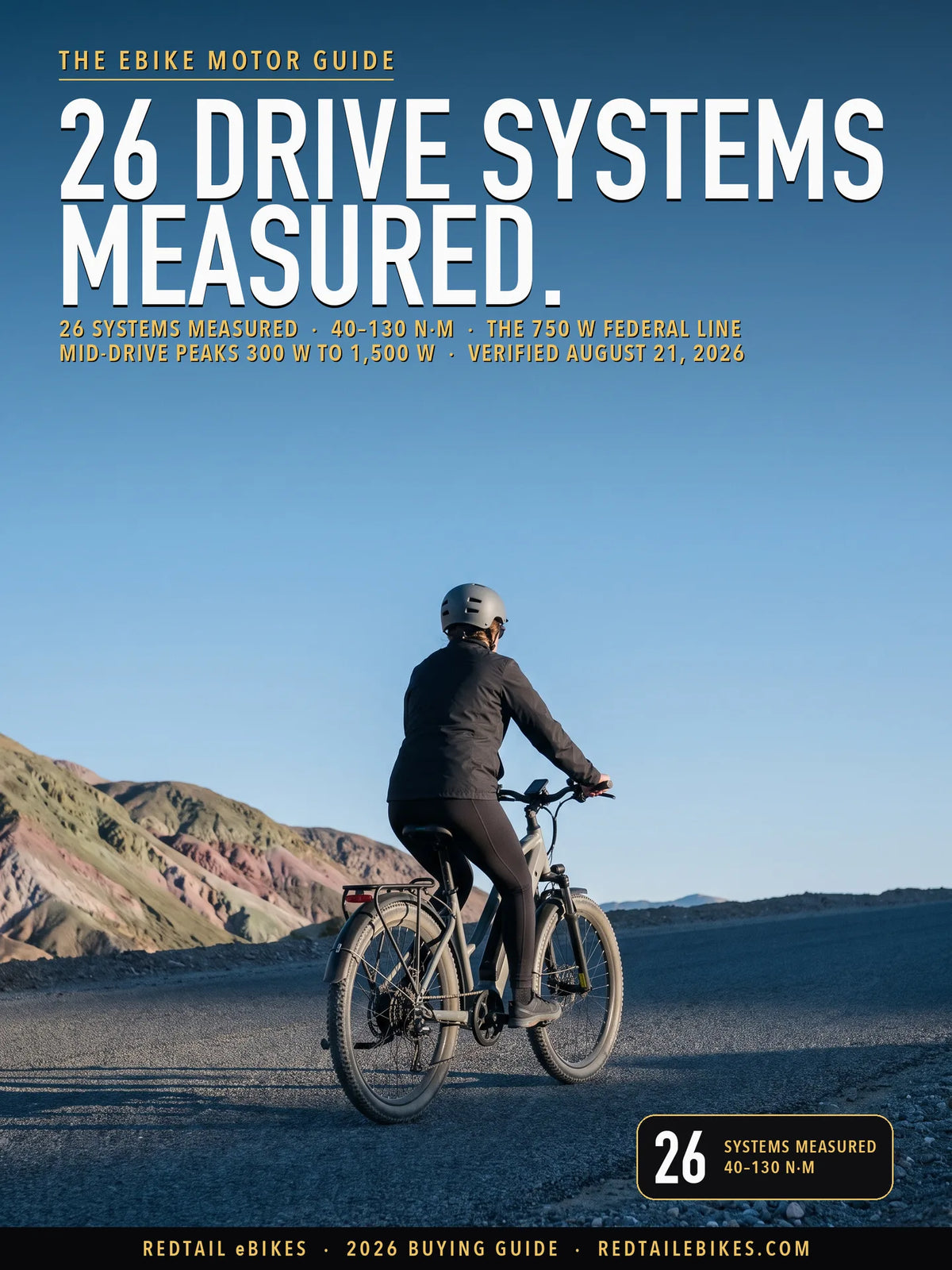
26 systems measured · mid-drive peaks 300 W to 1,500 W · the 750 W federal line · 20 mph motor-only cap · 40–130 N·m
Quick Answer: The ebike motor decides how a bike feels more than any other part, and the choice comes down to three questions. Hub or mid-drive: hub motors are simpler and cheaper; mid-drives climb better because they use your gears (our SPECTER-ST 2.0 review is the worked example, at 160 N·m through an 11-42T cassette).
Torque, not watts: a 60 N·m motor and a 130 N·m motor can both advertise the same wattage.
Sensor: torque sensors feel natural, cadence sensors feel like cruise control. This guide reads the published spec of 26 drive systems from 10 manufacturers, explains the physics in plain English, and matches a motor to the way you actually ride. If you want to skip straight to bikes, start with our full e-bike lineup or jump to which motor is right for you.
Key numbers on this page (all computed August 21, 2026; methods linked where each appears):
- 26 drive systems measured from 10 manufacturers' own spec pages
- Torque density spread: 13.8 to 50.2 N·m per kg — a 3.6× gap between the gentlest and densest systems in our census
- The "250 W rated" mid-drives we measured peak between 300 W and 1,500 W — the rated number tells you almost nothing
- Federal legal line: "less than 750 watts", 15 U.S.C. § 2085

One decision, three layers. The whole guide, one card.
In this guide
- How we verified this guide
- What's on this page
- Why the motor is the whole decision
- How does an e-bike motor actually work?
- Hub motor vs mid-drive: what actually differs
- Geared vs direct-drive: which hub motor do you have?
- What do e-bike motor watts actually mean?
- Torque: the number that predicts how a bike feels
- Torque sensor vs cadence sensor: the control decision
- How to read a motor spec sheet: a worked example
- Does battery voltage matter? 36V vs 48V
- The 2026 eBike motor census: every major drive system
- The census, ranked: torque per kilogram
- Are e-bikes motorized vehicles? Motors and US law
- Motor safety and UL 2849
- Efficiency: what the measurements actually show
- Reliability: what actually wears out
- Conversion kits: the honest take
- Which motor is right for you? 6 rider scenarios
- Where e-bike motors are going next
- Where motor shoppers get caught out
- The pre-purchase motor checklist
- Frequently asked questions
- The bottom line
- Limitations and expiry
- Source register
- Primary sources
How we verified this guide
Every motor specification in this guide was retrieved from the manufacturer's own published page on August 21, 2026 — Bosch's US drive-unit comparison, Avinox's drive-unit specs, Shimano's EP801 page, Yamaha's e-bike systems site, and their peers, each cited where its number appears.
The physics sections cite Grin Technologies' engineering references and a peer-reviewed transmission-efficiency study. The torque-density ranking is our own computation from those published specs, with the method stated beside the table.
The corpus, counted: 24 distinct sources were consulted for this page, of which 21 were retrieved and read in full this session, 1 (the federal statute) was reused from our own two-retrieval record of August 14, 2026, and 2 (Bafang and the hub-motor OEMs Shengyi/Aikema) were unreachable — each named below where it matters, with the full source register at the foot of the page.
A gap worth disclosing rather than papering over: Bafang's own specification site was unreachable across six attempts on verification day, so Bafang units are cited only where a bike maker publishes the spec itself. Corrections: mehran@redtailebikes.com.
What's on this page
- Why the motor is the whole decision
- How does an e-bike motor actually work?
- Hub motor vs mid-drive: what actually differs
- Geared vs direct-drive: which hub motor do you have?
- What do e-bike motor watts actually mean?
- Torque: the number that predicts how a bike feels
- Torque sensor vs cadence sensor
- How to read a motor spec sheet: a worked example
- Does battery voltage matter? 36V vs 48V
- The 2026 eBike motor census
- The census, ranked: torque per kilogram
- Are e-bikes motorized vehicles? Motors and US law
- Motor safety and UL 2849
- Efficiency: what measurements actually show
- Reliability: what actually wears out
- Conversion kits: the honest take
- Which motor is right for you? 6 rider scenarios
- Where e-bike motors are going next
- Where motor shoppers get caught out
- The pre-purchase motor checklist
- FAQ
- The bottom line
- Primary sources
Why the motor is the whole decision
The 2026 market split into two arms races at once. DJI's entry pushed peak power past 1,500 watts on the Avinox M2S, while the lightweight class raced downward to systems under 2 kg like the TQ HPR50.
Choose wrong and you feel it every ride, on every hill, for years — frames rarely wear out, and the motor defines the bike. This guide walks the one decision that sorts everything else: which motor architecture, at which torque, with which control system, actually fits your riding.
The part most buying advice skips is that the motor is not one choice but three stacked choices: the architecture (hub or mid-drive), the output (torque and real power, never the sticker wattage), and the control system (how the motor decides when to help). Get those three right and the brand names mostly take care of themselves. Get any one wrong and no brand name will save the purchase.
Start here Three choices, in order: architecture (hub vs mid-drive), output (torque in N·m, never sticker watts), control (torque vs cadence sensor). Every section below feeds one of the three.
How does an e-bike motor actually work?
Nearly every e-bike motor sold in 2026 is a brushless permanent-magnet DC motor: a ring of magnets and a set of copper windings, with electronics switching the current so the magnetic field drags the rotor around. Feed in more current and torque rises in direct proportion.
That architecture is old: Ogden Bolton's US patent for a hub motor in a bicycle wheel was granted in 1895, and the history of electric bikes in America traces how little the core idea has changed. That single linear relationship (torque proportional to current) is the physics under every spec sheet in this guide, per Grin Technologies' motor reference, the Vancouver engineering shop whose published primers this guide leans on throughout.
Two more facts complete the picture. A spinning motor generates a voltage of its own, called back-EMF, that grows with speed and pushes against the battery; when the two voltages nearly match, the motor stops accelerating. And a motor's dominant losses are heat in the copper windings, which rise with the square of current. Ask for lots of torque at low speed and the motor makes heat instead of miles.
That heat rule explains almost everything about motor design. A small motor spinning fast through a gear reduction produces the same power as a big motor spinning slowly, with far less copper and weight, because power density scales with the speed between magnets and windings (Grin's reference walks the math). Every design in this guide is one answer to the same question: where do you put the gearing?
A persistent forum myth dies to the same physics. Rewinding a motor with more turns of thinner wire raises its torque per amp, which sounds like a free upgrade; it also raises resistance in proportion, so the heat cost of any given torque is unchanged.
Grin's reference treats this at length: winding count changes what voltage and current the motor wants, and changes its fundamental capability not at all. A "high-torque wind" is a gearing decision made in copper.
The trap to avoid here: "brushless" is not a feature that separates motors — effectively every current e-bike motor is brushless. A listing that leads with "brushless motor!" is telling you nothing that distinguishes it from any rival.
The answer changes with the job. For stop-and-go delivery work, where power from a standstill matters more than climbing, our delivery e-bike guide works the same comparison through a courier's duty cycle.
Hub motor vs mid-drive: what actually differs
A hub motor lives in the wheel and pushes it directly (our Romeo Ultra review is the worked example at 3,000 W); a mid-drive sits at the pedals and pushes through your chain and gears. That placement also decides how much work the suspension has to do, because a hub motor's mass sits below the spring.
That one placement decision drives nearly every real-world difference — climbing, weight distribution, maintenance, and price. Mid-drives multiply their torque through the cassette the same way your legs do; hub motors get one fixed ratio, forever.
| The spec-sheet line | What it actually means for you |
|---|---|
| "Rear hub motor" | Motor in the wheel. One gear ratio. Simple, affordable, and the wheel is heavier to remove when you flat. |
| "Mid-drive motor" | Motor at the cranks, driving the chain. Shifting gears changes the motor's leverage too — this is why mid-drives climb. |
| "Front hub motor" | Motor in the front wheel. Rare on quality bikes; traction is weakest where the weight isn't. |
| "Dual motor / AWD" | A hub motor in each wheel. Twice the traction and combined torque, at the cost of weight and complexity. |
| "Up to 160 Nm at the rear wheel" (Pinion's phrasing) | Wheel torque after gear multiplication, not motor torque. Compare motor-to-motor, or wheel-to-wheel, never across. |
The mechanics deserve one plain paragraph. In a low gear, a mid-drive's chainring-to-cassette ratio multiplies its torque several times before it reaches the pavement; Pinion states its 85 N·m motor delivers "up to 160 Nm of torque on rear wheel" in the first four gears.
A hub motor has no gears to borrow. To climb the same wall it must be built bigger or driven harder, and driving a motor hard at low speed is precisely the condition that turns current into heat instead of motion.
A second hub splits that load: our Tesway X7 AWD review computes that its two hubs draw 17 to 19% less per mile than one up a 6% grade at 12 to 16 mph, and stay within 4% of one on level ground.
Hub motors answer back with three real advantages. No motor load on your chain, so drivetrain wear stays near ordinary-bicycle levels. Independence from the drivetrain, so a snapped chain can still leave you a throttle ride home where a throttle is fitted and legal.
Whether to use that throttle day to day is a separate question: our pedal assist vs throttle comparison puts both published range figures side by side for 21 machines. And price: a geared hub system is mechanically simpler than a mid-drive and consistently cheaper at the same build quality.
The market's own behavior confirms the split is honest rather than a quality tier. Bosch (the reference name in mid-drives for a decade) added a 45 N·m Hub Line to its 2026 US lineup, and Mahle built its whole premium road-bike business on rear hubs. Hubs are not the budget option; they are the flat-terrain option that also happens to start cheaper.
Choose the architecture by terrain Flat-to-rolling commutes: a hub motor does the job for less money. Which hub bike, for which rider and which state, is our hub-drive e-bike guide: 92 verified hub drives of the 191 bikes we sell, 21 matched to a use. Real hills, cargo, trail: the mid-drive's gear leverage is the honest answer. Loose surfaces and winter: dual-hub AWD exists for a reason.

Terrain is the honest tiebreaker. These grades are where architecture starts to matter.
Geared vs direct-drive: which hub motor do you have?
Almost every hub motor on a 2026 e-bike is a geared hub: a small, fast motor spinning through internal planetary gears, with a freewheel so the wheel rolls clean when the motor is off (Grin's reference describes both constructions). Direct-drive hubs (the big, heavy, silent ring motors) survive mainly on high-power builds and where regenerative braking matters. If the hub is roughly pancake-sized and the bike coasts freely, it is geared.
| Geared hub | Direct-drive hub | |
|---|---|---|
| How it drives | Small fast motor through planetary gears | The wheel is the rotor — no gears at all |
| Weight for the same power | Roughly half — Grin's reference puts geared hubs at "about 50% less than an equivalently powerful direct drive machine" (source) | Heavy; magnets and steel scale with torque |
| Coasting drag | Near zero — internal freewheel | Always engaged; drag torque of roughly 0.3–1 N·m (Grin) |
| Regenerative braking | Not possible — the freewheel disconnects the motor | Yes, on any direct drive with the right controller |
| Noise | Audible gear whir | Nearly silent |
| Wear points | Nylon/composite planet gears, freewheel clutch | Almost none — bearings only |
Regen deserves a named caveat because it sells bikes it shouldn't. Our reading of the physics: on a vehicle this light, the braking energy available to recover is small, so the case for direct drive is braking control (drag-free descending, zero gear wear on long downhills) rather than meaningful range gain. A vendor pitching regen as a range feature on a 60 lb commuter is selling the wrong benefit of a real technology.
Where this goes wrong: "gearless means nothing to break" cuts both ways. A direct-drive hub also means the motor's magnetic drag rides with you on every pedal stroke past the assist cutoff, which is where US Class 1 and 2 riders spend time above 20 mph.
Your answer to "How you ride" in the e-bike finder applies this table to every machine it covers: stop and go favors the geared hub, one long steady ride the direct-drive hub, a mid-drive scores full marks for both, and on hilly ground the hubs lose ground to it.

A hub motor in plain sight, doing everything its one gear ratio allows.
What do e-bike motor watts actually mean?
Watt-hours are the number that actually predicts how far you go, which is why we lead with them in reviews — our electric moped guide re-does every pack's range claim from its watt-hours, bike by bike.
For the same relationship at the opposite end of the power range, our 3,000 W electric dirt bike review works through a 338 N·m machine and what that torque actually buys off-road.
Almost nothing on their own, and that is a measured claim rather than a slogan. Federal law defines a low-speed electric bicycle by "an electric motor of less than 750 watts," quoting 15 U.S.C. § 2085, yet the systems in our census that describe themselves as 250 W rated publish peak outputs from 300 W to 1,500 W.
The number on the sticker is a regulatory label. The number that moves you is peak power, and makers bury it at wildly different depths.
Watch how the honest end of the market words it. Bosch's own US comparison page carries this footnote on its strongest units: "Actual power is marginally less than 750 W to ensure regulatory compliance" — retrieved August 21, 2026. Meanwhile Avinox publishes 1,000–1,500 W peak against the same "250 W rated" line, with the 1,500 W figure requiring specific batteries.
Same category, same rated wattage, a five-fold spread in delivered peak. The spread is widest at the top of the range: our 4000W e-bike guide quotes every 4,000 W machine we sell in its maker's own wording so the two figures stay apart.
| The number you'll see | What it is | What it's worth when choosing |
|---|---|---|
| "250 W rated" | The continuous-duty figure European regulation certifies | Almost nothing — nearly every quality mid-drive says this |
| "750 W" | The US federal definitional ceiling (§ 2085) | A legal line rather than a performance tier |
| "1000 W peak!" | Marketing's favorite; sometimes real, rarely qualified | Only comparable when the maker states the conditions |
| Peak W on the maker's spec page | The real short-burst output | Useful — compare across makers' own pages, as our census does |
| Torque (N·m) | Rotational force at the motor | The number to compare. Next section. |
Grin Technologies has argued this for years in a reference literally titled the "futility of motor power ratings": the same physical motor can wear different wattage labels in different markets without a component changing, because a "rating" is a certification statement, never a measurement. Our census bears it out — rated watts cluster at the legal lines while real outputs spread across a 5× range.
The failure mode: comparing a hub bike's "750 W" against a mid-drive's "250 W" and concluding the hub bike is three times stronger. The hub figure is usually a peak; the mid-drive figure is a regulatory rating. Pull both makers' peak numbers, or compare torque instead.
Every bike in our lineup lists the motor's real wattage and torque on the product page, pulled from the manufacturer's spec sheet.
Browse e-bikes with published motor specsTorque: the number that predicts how a bike feels
Torque (twisting force, in newton-meters) is the spec that maps to what your body feels: how hard the bike shoves away from a stop, how it holds speed on a grade, how it behaves with 60 lb of groceries aboard. Across our census the spread runs from 40 N·m (Bosch Active Line) to 130 N·m regular-mode on the Avinox M2S.
As a working scale for a full-power bike: under 50 N·m is gentle city assist, 60–85 N·m is the all-round band, and 100 N·m and up is cargo, steep-grade, and off-road territory.
Boost figures need their own sentence, because 2026 spec sheets increasingly quote two torque numbers. Avinox lists 130 N·m in regular modes and 150 N·m for up to 60 seconds in Boost mode; Yamaha's PW-X4 quotes its 100 N·m as "peak torque (boost mode)". Those are honest numbers with a time limit attached.
Compare regular-mode to regular-mode, and treat any torque figure without a mode label as the marketing department's choice of the bigger one.
Remember the architecture multiplier before you cross-shop torque between hub and mid-drive bikes. A 100 N·m hub motor delivers 100 N·m at the wheel, full stop. An 85 N·m mid-drive in first gear can put nearly double that into the same wheel — Pinion's published 85-to-160 N·m figures are that multiplication in print. Hub torque and mid-drive torque are different currencies at different exchange rates.

Sixty pounds of groceries is where torque stops being abstract.
Torque sensor vs cadence sensor: the control decision
A torque sensor measures how hard you press the pedals and scales the motor to match, continuously — the pedal-force half of Yamaha's published triple-sensor system; a cadence sensor only notices that the pedals are turning and switches assistance on. The difference on the road is unmistakable. Torque-sensed bikes feel like your legs got stronger. Cadence-sensed bikes feel like a tailwind with an on/off switch — a beat of lag at the start, then a surge.
Neither is simply better; they serve different riders. Cadence systems cost less and let you spin lazily while the motor does the work, which is honestly what some commuters want. Torque systems reward riding like a cyclist: instant response at the crank, natural feel in traffic, better range because the motor works only as hard as you do.
The premium makers describe their own control stacks in exactly these terms — Shimano's EP801 spec table lists torque, crank-position, speed, and cadence sensors together, Yamaha runs a triple-sensor system reading pedal force, speed, and crank rotation, and Bosch's Hub Line footnote describes assistance "based on intelligent sensor fusion" (Bosch US).
Yamaha's pedal-force sensing goes back to its first drive unit: our Yamaha motor history traces it to the 1993 PAS.
Torque sensing has also reached the value end: Mahle's X20 offers selectable PAS or torque sensing, and two of the four bikes we stock and recommend below carry true torque sensors under $1,700. In 2026, a cadence-only bike above roughly $1,500 should have to justify itself.
What buyers get wrong here: "5 levels of pedal assist" says nothing about the sensor. A five-level cadence bike and a five-level torque bike share a spec line and nothing else about how they ride. Ask which sensor, in writing, before you buy.
The sensor rule Test-ride tell: pedal one soft half-stroke from a stop. Instant proportional push = torque sensor. A pause, then a surge = cadence. If you can't test-ride, the spec page either names a torque sensor or it isn't one.

Ask it out loud before money moves: which sensor is in this bike?
How to read a motor spec sheet: a worked example
Take Shimano's published EP801 specification — one of the few spec sheets that publishes nearly every number this guide says to demand — and read it the way this guide reads all of them. Every line below is from Shimano's own page, retrieved August 21, 2026, with the translation beside it.
| Shimano's line | The translation |
|---|---|
| "Brushless motor, Position: Midship" | A mid-drive. "Midship" is spec-sheet dialect for the bottom bracket. |
| "Continuous rated power (Watt): 250" | The regulatory rating — the number that means almost nothing alone. |
| "Maximum power output: 600 W" | The real short-burst output. This is the number to cross-shop. |
| "Maximum torque: 85 N·m" | The all-round band's upper edge; strong climbing through the gears. |
| "Rated voltage: 36 V DC" | The system voltage — see the next section for why rivals moved to 48 V. |
| "Maximum support bike speed: 20 mph / 28 mph" with the footnote "US Class 3 (comply with California) only" | The maker itself builds to US class law — and flags that 28 mph configuration is a specific legal variant rather than the default. |
| "Torque sensor ✔, Crank arm position sensor ✔, Bike speed sensor ✔, Cadence sensor ✔" | A full measurement stack: this is what "natural feel" looks like as hardware. |
| "Lightweight magnesium body: 2.7 kg" | Divide torque by this: 31.5 N·m/kg, mid-pack in our density ranking below. |
Two lessons transfer to every other sheet you will read. First, when a maker publishes both rated and maximum power, believe both and use the maximum for comparison; when a maker publishes only one number, find out which kind it is before it means anything.
Second, the legal footnotes are load-bearing — Shimano tying its 28 mph mode to California-compliant Class 3 configuration tells you the maker expects the law to reach the motor's firmware, which matches what our state law research finds from the statute side.

The rating plate answers half this section. The maker's spec page answers the rest.
Does battery voltage matter? 36V vs 48V
Voltage is the census's quiet dividing line: Shimano's EP801 runs 36 V while Yamaha, ZF, and the newest systems run 48 V, and Yamaha is unusually specific about why. Its PW-X4 page quantifies the gain over its own 36 V predecessor: "higher torque (by approx. 10 Nm) at 70 rpm and above achieved with 48V expansion" and roughly 10% more power in the same range.
Higher voltage moves the back-EMF ceiling, which lets the same motor keep pulling at higher cadence.
For a shopper the practical reading is narrow but real. At low speeds and low cadence, voltage barely matters; torque and current decide everything. Where 48 V systems earn their keep is sustained high-cadence riding (fast commuting and spirited climbing) where a 36 V motor starts running out of electrical headroom. That is why the 28 mph commuter class and the newest performance systems (ZF's 48 V CentriX, Yamaha's 48 V pair) cluster on the higher voltage.
The misreading to avoid: voltage is not power. A "48V 500W" hub bike is not stronger than a "36V" premium mid-drive; the voltage tells you about the system's speed headroom instead of its force. Read torque for force, peak watts for output, voltage for where in the speed range the motor stays lively.
What volts, amp-hours and watt-hours each measure on a battery label, and why watt-hours is the figure that compares range, is set out in our e-bike battery types guide.
The 2026 eBike motor census: every major drive system
We read the manufacturer's own published specification for 26 drive systems from 10 makers — every brand-name system with a published US-relevant spec page we could retrieve on August 21, 2026. Every number below traces to the linked page, retrieved that day.
Scope, stated honestly: this is the branded-system market. The white-label hub motors on many direct-to-consumer bikes publish no maker spec page at all and enter this guide only through bike makers' own published specs, in the rider-scenarios section.
| Maker / system | Type | Torque (regular) | Peak power | Weight | Source, retrieved 2026-08-21 |
|---|---|---|---|---|---|
| DJI Avinox M2S | Mid | 130 N·m (150 boost) | 1,500 W¹ | 2.59 kg | avinox-ebike.com |
| DJI Avinox M2 | Mid | 110 N·m (125 boost) | 1,100 W | 2.65 kg | avinox-ebike.com |
| DJI Avinox M1 | Mid | 105 N·m (120 boost) | 1,000 W | 2.52 kg | avinox-ebike.com |
| Bosch Performance Line CX | Mid | 120 N·m | 750 W² | 6.2 lb | bosch-ebike.com/us |
| Bosch Performance CX-R | Mid | 120 N·m | 750 W² | 6.0 lb | bosch-ebike.com/us |
| Bosch Cargo Line | Mid | 120 N·m | 750 W² | 6.2 lb | bosch-ebike.com/us |
| Bosch Performance Speed | Mid (28 mph) | 100 N·m | 750 W² | 6.2 lb | bosch-ebike.com/us |
| Bosch Performance Sport | Mid (28 mph) | 90 N·m | 700 W | 6.4 lb | bosch-ebike.com/us |
| Bosch Performance Line | Mid | 75 N·m | 600 W | 6.2 lb | bosch-ebike.com/us |
| Bosch Performance SX | Mid | 60 N·m | 600 W | 4.4 lb | bosch-ebike.com/us |
| Bosch Active Line Plus | Mid | 60 N·m | 600 W | 6.0 lb | bosch-ebike.com/us |
| Bosch Active Line | Mid | 40 N·m | 586 W | 6.4 lb | bosch-ebike.com/us |
| Bosch Hub Line | Hub | 45 N·m | 400 W | 5.1 lb³ | bosch-ebike.com/us |
| Brose Drive3 Peak | Mid | 105 N·m | 800 W | n.p. | brose-ebike.com |
| Brose Drive3 Power | Mid | 90 N·m | 700 W | n.p. | brose-ebike.com |
| Yamaha PW-X4 | Mid | 100 N·m (boost) | n.p. | 2.6 kg | yamaha-motor.com |
| Yamaha PW-S3 | Mid | 85 N·m (boost) | n.p. | 2.85 kg | yamaha-motor.com |
| ZF CentriX 90 | Mid | 90 N·m | 600 W | 2.5 kg | zf.com |
| ZF CentriX 75 | Mid | 75 N·m | 450 W | 2.5 kg | zf.com |
| Shimano EP801 | Mid | 85 N·m | 600 W | 2.7 kg | bike.shimano.com |
| Pinion MGU E1.12 | Mid + 12-sp gearbox | 85 N·m (160 at wheel) | 600/800 W | 4.1 kg⁴ | pinion.eu |
| Pinion MGU E1.9 | Mid + 9-sp gearbox | 85 N·m (160 at wheel) | 600/800 W | 4.0 kg⁴ | pinion.eu |
| Fazua Ride 60 | Mid | 60 N·m | 450 W | 1.96 kg | fazua.com |
| TQ HPR60 | Mid | 60 N·m | 350 W | 1.92 kg | tq-ebike.com |
| TQ HPR50 | Mid | 50 N·m | 300 W | 1.85 kg | tq-ebike.com |
| Mahle X20 | Hub | 65 N·m⁵ | 275 W | 1.39 kg | mahle-smartbike.com |
¹ Avinox's footnote: 1,500 W requires the FP700 or RS800 battery. ² Bosch's footnote: "Actual power is marginally less than 750 W to ensure regulatory compliance." ³ Bosch's footnote: motor only, excluding control unit and cadence sensor. ⁴ Includes the integrated gearbox — no other row carries its shifting hardware. ⁵ Mahle's footnote: "Compared to a 65 Nm mid drive."
For the 32 drive units in Bosch's own records since 2011, with their codes, torque and dates, see our history of Bosch e-bike motors.
Three census absences, named per our verification policy rather than silently skipped. Bafang, the OEM name that recurs across direct-to-consumer spec sheets, had its official specification site unreachable across six attempts on August 21, 2026; its motors appear in this guide only where a bike maker publishes the spec itself.
Specialized and other bike brands running proprietary motors publish bike-level pages rather than motor spec pages, which puts them outside a motor-page census by definition. White-label hub OEMs (the unbranded motors on most sub-$1,500 bikes) publish no retrievable spec pages at all, which is itself worth knowing when a listing claims numbers no manufacturer stands behind.
The census, ranked: torque per kilogram
Torque density — newton-meters of regular-mode torque per kilogram of published drive-unit weight — is the fairest single lens we found for comparing 2026 systems. DJI publishes its own figure (up to 57.9 N·m/kg counting boost torque); nobody publishes it comparably across brands, so we computed it for all 24 systems that publish both inputs.
Method first, so you can refute it: regular-mode torque only (boost excluded, so systems without a boost mode aren't penalized), makers' published weights, Bosch's pounds converted at 0.4536 kg/lb, and Pinion flagged because its weight includes a gearbox every other row would need to add.
| Rank | System | Type | N·m/kg | W/kg (peak) |
|---|---|---|---|---|
| 1 | DJI Avinox M2S | Mid | 50.2 | 579 |
| 2 | Mahle X20⁵ | Hub | 46.8 | 198 |
| 3 | Bosch Performance CX-R | Mid | 44.1 | 276 |
| 4 | Bosch Performance CX | Mid | 42.7 | 267 |
| 4 | Bosch Cargo Line | Mid | 42.7 | 267 |
| 6 | DJI Avinox M1 | Mid | 41.7 | 397 |
| 7 | DJI Avinox M2 | Mid | 41.5 | 415 |
| 8 | Yamaha PW-X4 | Mid | 38.5 | n.p. |
| 9 | ZF CentriX 90 | Mid | 36.0 | 240 |
| 10 | Bosch Performance Speed | Mid | 35.6 | 267 |
| 11 | Shimano EP801 | Mid | 31.5 | 222 |
| 12 | TQ HPR60 | Mid | 31.2 | 182 |
| 13 | Bosch Performance Sport | Mid | 31.0 | 241 |
| 14 | Fazua Ride 60 | Mid | 30.6 | 230 |
| 15 | Bosch Performance SX | Mid | 30.1 | 301 |
| 16 | ZF CentriX 75 | Mid | 30.0 | 180 |
| 17 | Yamaha PW-S3 | Mid | 29.8 | n.p. |
| 18 | TQ HPR50 | Mid | 27.0 | 162 |
| 19 | Bosch Performance Line | Mid | 26.7 | 213 |
| 20 | Bosch Active Line Plus | Mid | 22.0 | 220 |
| 21 | Pinion MGU E1.9⁴ | Mid+gearbox | 21.2 | 200 |
| 22 | Pinion MGU E1.12⁴ | Mid+gearbox | 20.7 | 195 |
| 23 | Bosch Hub Line | Hub | 19.5 | 173 |
| 24 | Bosch Active Line | Mid | 13.8 | 202 |
Two findings we did not expect. First, the density race's top tier is no longer exclusively mid-drive: Mahle's X20 hub outscores everything except DJI, though its torque figure carries Mahle's own mid-drive-equivalence caveat.
Second, weight class predicts ride character better than brand: the 1.85–2.0 kg systems cluster at 27–31 N·m/kg regardless of maker, and the 2.5–2.9 kg full-power class clusters at 36–44. Where a system lands on this table tells you more about its intended bike than its logo does.
A five-fold spread in peak power and a 3.6× spread in torque density all wear the same "250 W rated" label.
Are e-bikes motorized vehicles? Motors and US law
Under federal law, no — a compliant e-bike is a consumer product regulated like a bicycle, not a motor vehicle. The operative text of 15 U.S.C. § 2085 defines a "low-speed electric bicycle" as "a two- or three-wheeled vehicle with fully operable pedals and an electric motor of less than 750 watts," with motor-only speed under 20 mph, and assigns it to the Consumer Product Safety Commission rather than to motor-vehicle law.
Your motor choice is what keeps a bike inside that definition.
The state layer is where motor specs meet the road. Most states sort compliant e-bikes into three classes (pedal-assist to 20 mph, throttle to 20 mph, pedal-assist to 28 mph) and hang access rules off the class.
Our 50-state law hub reads every state's statute in one table, with deep dives for California, New York, Texas, Florida, Colorado, Washington, Minnesota, and New Jersey.
Two motor-relevant patterns from that research: many states write the 750 W ceiling directly into their definition, and a bike ridden above its class (or re-flashed past its limiter) can fall out of e-bike status entirely, into moped or motorcycle law.
Minnesota shows how deep the definition can reach. Minnesota's definition requires that an e-bike "has a battery or electric drive system that has been tested to an applicable safety standard by a third-party testing laboratory" — Minn. Stat. § 169.011, subd. 27(a)(5) (2025 Statutes, read at the Revisor August 21, 2026).
Our Minnesota law page documents it in full; screening our own catalog against it disqualified dozens of listed bikes. The motor and its electronics are not just a performance choice; in some states they are the legal identity of the machine.
Where the marketing misleads: a speed limiter does not launder wattage. In states that cap motor power in the definition itself, a 1,000 W-rated bike limited to 20 mph can still fail the definition on watts alone — the limiter changes speed while the rating stays.
Check your state's definition instead of the marketing page. Where you plan to ride matters too: our trail-access atlas tracks which land managers admit which classes (California, Texas).

No pedals, no e-bike. The definition draws the line here; styling doesn't move it.
Motor safety and UL 2849
UL 2849 is the safety standard covering the e-bike's whole electrical drive system — motor, controller, battery, battery-management system, wiring, and charging — with UL Solutions certifying systems to it as an OSHA-recognized testing laboratory. The standard treats the drive system as one electrical chain rather than certifying parts in isolation — which is why a "certified motor" claim, alone, means little. When a spec page says "UL 2849," it is talking about the system, never the motor alone.
For a motor shopper the standard matters in one practical way: system integration. A certified system was tested as a matched set — this motor, this controller, this battery. Mixing components after purchase, or buying from brands that certify nothing, exits the tested envelope. And as the Minnesota example above shows, certification language has begun migrating from best practice into statutory definitions; our state law pages track where it has entered law.

System safety starts before the ride does.
Efficiency: what the measurements actually show
Two measured findings from the engineering literature are worth more than every efficiency claim in a sales page. First, a peer-reviewed dynamometer study of e-bike power transmission (Sustainability 13(19):10988, 2021) found that friction losses in the chain, sprockets, and bearings dominate transmission losses, while inertia effects are negligible.
Translation: drivetrain condition, tire pressure, and load do more to your range than the motor's nameplate efficiency, and a well-maintained modest system can out-deliver a neglected premium one.
Second, from Grin's motor references: a permanent-magnet motor's efficiency collapses exactly where riders need it most (high torque at low speed, the grind up a steep hill) because copper losses rise with the square of current. Grin's rule of thumb puts a PM motor's happy zone around 80% of its unloaded speed.
This is the physics behind the mid-drive's climbing reputation: by downshifting you keep the motor spinning fast where it is efficient, while a hub motor lugging the same grade at low RPM converts an outsized share of your battery into heat.
| If your riding is… | Efficiency reality | What to buy |
|---|---|---|
| Flat commuting, moderate speeds | Any healthy system runs near its sweet spot | Geared hub; spend the savings on battery |
| Rolling hills, mixed | Hub efficiency dips on every climb, recovers between | Torque-sensed hub or entry mid-drive |
| Sustained steep grades, cargo | Low-speed hub operation = heat, range collapse, thermal risk | Mid-drive, and gears you actually use |
| Range-obsessed | Transmission friction and tire drag dominate (MDPI study) | Whichever architecture — then maintain it |

A long grade finds a motor's efficiency map fast.
Reliability: what actually wears out
Motors themselves rarely die; their neighborhoods do. On mid-drives, motor torque flows through the chain, so chains and cassettes wear meaningfully faster than on unpowered bikes — the tax on borrowing the drivetrain as a gearbox. On geared hubs the consumables are internal: nylon planetary gears and the freewheel clutch.
Direct drives have almost nothing to wear, which is why the heavy old workhorses refuse to die. Pinion's answer is to seal the whole transmission in oil: its MGU specifies a 10-minute oil change every 10,000 km and nothing else.
Budget the wear honestly instead of pretending any option is free. A mid-drive commuter should expect chain replacements at shorter intervals and one cassette in the bike's first years; a hub commuter should expect spoke attention on the motor wheel and, eventually, a freewheel.
Water is the quiet killer on both: connectors rather than windings are where "dead motors" usually begin. The census's published ingress ratings (Avinox lists IP66) are worth a look before a rainy-climate purchase.
Nobody publishes motor lifespan. No maker in our census states a design life in miles, so any "lasts 10,000 miles" claim you meet is folklore. What is documented is serviceability — bearings, gears, and sensors are replaceable on branded systems, while white-label hubs are commonly swapped whole, which costs less than it sounds and is how budget bikes stay on the road.

Rain doesn't kill motors. It finds the connector someone didn't seal.
Conversion kits: the honest take
Kits convert a bike you love into an e-bike you might. Mechanically it works, and hub kits in particular are an accessible weekend project; the questions people actually search (how to wire a controller, whether a mid-drive kit fits) have workable answers. We still point most riders to a purpose-built bike, for three reasons we'd rather state than imply.
First, certification: UL 2849 applies to tested systems, and a self-assembled kit plus marketplace battery is precisely the untested combination the standard exists to prevent; some insurers and buildings now care about this specific combination. Second, structure: mid-drive kits feed motor torque through cranks and frames that were never engineered for it.
Third, law: it is the finished machine, whatever the donor was, that must meet your state's definition — wattage, speed, and in some states certification itself. If you build anyway, buy the battery from a maker who publishes real certification documents, and treat the checklist below as your parts list.

Most riding looks like this. Buy for the rides you'll actually take.
Which motor is right for you? 6 rider scenarios
Match the rider, then the architecture, then the bike. We stock the four bikes below, chose them to span the four motor archetypes this guide describes, and pulled every spec from the supplier's published sheet (fetched August 13–14, 2026; prices re-checked live on our store August 21, 2026). Disclosure, per our standing policy: we sell these. Read the trade-offs in each card as if we didn't.
| Your situation | The motor answer | The bike we'd point at |
|---|---|---|
| Daily flat-to-rolling commute, want natural feel | 500 W torque-sensed rear hub | META26 |
| Real hills or hunting loads on backcountry grades (our Hunter X9 review is the deep dive) | High-torque mid-drive | FAT-HD 2.0 |
| Technical trail riding on a legal Class 1 | Mid-drive tuned inside the limits | URUS 2.0 |
| Sand, snow, loose fire roads — traction first | Dual-hub AWD | FAT-AWD 3.0 |
| Longest range per dollar, easy terrain | Hub + the biggest battery the budget allows | META26 with second battery |
| Heaviest riders and cargo | Torque through gears beats watts | FAT-HD 2.0, or a purpose-built cargo e-bike |
The commuter hub, torque-sensed
Eunorau META26 City eBike
$1,699A 48V 500 W rear hub with a published 55 N·m and (the reason it's in this guide) a true torque sensor, per Eunorau's spec sheet. That sensor puts its ride feel a class above cadence-switched hubs at this price. Hydraulic brakes with motor cutoff; supplier-listed range to 100 miles with the optional second battery, which we'd treat as the sunny-day figure it is.
The mid-drive workhorse
A 48V 1,000 W Bafang mid-drive with a supplier-published 160 N·m — the highest torque figure of anything we stock, delivered through a 9-speed drivetrain so it multiplies further in low gears (Eunorau's spec sheet).
This is the fat-tire load-hauler archetype: hunting camps, steep private land, heavy riders. Check your state's power definition first (our 50-state table); at 1,000 W rated it sits outside some states' e-bike definitions, and that is a fact to plan around rather than a footnote.
The legal-trail mid-drive
A Bafang M600 mid-drive at 500 W and up to 120 N·m, full suspension, 11-speed SRAM drivetrain, 20 mph assist ceiling per the supplier sheet.
The architecture argument on singletrack is centered weight: the motor rides low at the cranks instead of in either wheel. Where Class 1 access rules bind (trail atlas), its 20 mph pedal-assist configuration is the right side of most land-manager lines. More mid-drive trail options live in our mountain e-bike collection.
The all-wheel-drive answer
Eunorau FAT-AWD 3.0
$1,699Two 500 W hub motors, front and rear, with a combined published 110 N·m and a torque sensor (Eunorau's spec sheet). Dual-hub AWD is the architecture no mid-drive can imitate: drive at both contact patches, which on sand, snow, and washboard gravel is worth more than any single-motor torque figure. The trade is weight and two motors' worth of connectors to keep dry — re-read the reliability section before choosing it as a daily.
Filter by motor type, torque, and sensor — every listing carries the supplier's published numbers instead of our paraphrase.
See every bike with its motor spec
Loose sand punishes single-wheel drive first.
Where e-bike motors are going next
Reading 26 spec sheets in one sitting makes the market's direction unusually clear, and naming it helps you buy a bike that stays current. Four movements, each anchored to a maker's own published page.
Density is compounding: DJI's three units all exceed 41 N·m/kg where the establishment's flagships sit in the low 40s, and its M2S adds a dual-meshing gear design and a published ≤45 dBA noise figure — the arms race now includes acoustics.
Software became the product: Brose's 2026 units gained power by over-the-air update (Drive3 Peak to 800 W and 105 N·m, per its German-language product page), which means the motor you buy may not be the motor you own in a year.
Third, the categories are cross-pollinating. Bosch shipped its first hub drive while hub specialist Mahle pushed density past most mid-drives; Pinion absorbed the entire transmission into the motor housing, deleting the derailleur. Fourth, the lightweight class is standardizing around 50–60 N·m at under 2 kg (TQ, Fazua), betting that many riders prefer a bike that rides like a bicycle.
None of this changes this guide's decision order (architecture, output, control) but it does mean the spec sheet you read next year will quote density, decibels, and software versions alongside watts.
Where motor shoppers get caught out
Six traps, named, each a real pattern from listings and forums rather than a hypothetical. This is the section to re-read the night before you buy.
- The wattage shell game. Comparing one brand's peak watts against another's rated watts. The census table above is the antidote: same source type, same day, linked.
- "Brushless high-performance motor." Every modern e-bike motor is brushless. A listing leading with it usually has nothing else to say.
- Torque without a mode label. If the number doesn't say regular or boost, assume boost — and assume a timer, like Avinox's 60-second boost window, attached.
- Regen sold as range. Direct-drive regen is a braking feature. On bicycle-class vehicles the recoverable energy is small; buy it for descents and brake wear, never for miles.
- "5 levels of assist" standing in for a sensor spec. Levels are a menu; the sensor is the kitchen. Cadence and torque systems both come in five levels.
- The limiter assumption. Believing a software speed cap makes any wattage street-legal everywhere. Colorado wrote the opposite into its definition in 2025, and our 2000W e-bike guide quotes the sentence. State definitions can cap motor power itself — check yours before the bike ships, and sanity-check the whole purchase against our buying guide while you're at it.
The pre-purchase motor checklist
Ten minutes with this list beats a return shipment. Fill it from the maker's spec page rather than the marketplace listing — and if a number can't be found on any manufacturer page, treat that absence as your answer about the brand.
- ☐ Architecture identified: hub (geared or direct?) or mid-drive
- ☐ Torque in N·m, with mode label (regular vs boost)
- ☐ Peak power from the maker's page instead of the listing headline
- ☐ Rated power vs your state's definition (50-state table)
- ☐ Sensor named in writing: torque or cadence
- ☐ Class 1/2/3 designation and where you'll legally ride it (trail atlas)
- ☐ UL 2849 (or equivalent system certification) claimed by the brand and verifiable
- ☐ Ingress rating if you ride in rain (IP65/IP66)
- ☐ Wear budget accepted: chain/cassette (mid) or spokes/freewheel (hub)
- ☐ Spare-parts path exists: can you actually buy a replacement motor, controller, sensor?
- ☐ Where you'll buy: a store you can walk into, or a direct brand with real US support
Frequently asked questions
Which is better, a hub motor or a mid-drive e-bike?
Neither is better; they are tuned for different lives. Mid-drives climb and handle better because they drive through your gears and center their weight. Hub motors cost less, wear the drivetrain less, and are entirely adequate on flat-to-rolling terrain. Buy for the hill profile you actually ride rather than the one in the ad.
How does an e-bike motor work?
A ring of permanent magnets and copper windings, switched electronically so the magnetic field pulls the rotor around. Torque scales with current; top speed is limited by the voltage the spinning motor generates against the battery (back-EMF). Everything else (hub vs mid, geared vs direct) is packaging around that one mechanism, per Grin's reference.
How does a hub motor work?
The motor is built into the wheel itself, per Grin's reference. In a direct drive, the wheel shell is the rotor. In a geared hub, a small fast motor spins planetary gears that turn the wheel slower and harder, with a freewheel so you can coast without drag.
How does a mid-drive e-bike work?
The motor sits at the bottom bracket and adds its torque to the crank spindle, so motor power flows through the chain and cassette. Shifting changes the motor's leverage the same way it changes yours, which is why mid-drives climb so well.
What do e-bike motor watts actually mean?
Very little alone. "Rated" watts are a regulatory label (Grin's analysis calls ratings a certification statement, never a measurement); peak watts are the real short-burst output; the two differ by up to five-fold in our census of makers' own pages. Compare peak-to-peak or torque-to-torque, never a rated number against a peak number.
Is a 750-watt e-bike legal?
Federal law's e-bike definition requires a motor "of less than 750 watts" (15 U.S.C. § 2085), and most states carry a 750 W ceiling in their own definitions. Above that, many states treat the machine as a moped or motorcycle.
Every 750 W bike we sell, read at its maker and placed by the rider it fits, is on our 750W e-bike rider grid. State by state: our law hub.
Is an e-bike considered a motorized vehicle?
Not federally, if it meets the § 2085 definition — it is regulated as a consumer product, like a bicycle. States overwhelmingly follow with three-class systems that keep compliant e-bikes out of motor-vehicle law. Exceed the definition, on power or speed, and motor-vehicle rules can attach.
What is a torque sensor on an e-bike?
A sensor measuring how hard you press the pedals, so assistance scales with your effort in real time. It is the single spec most responsible for a "natural" ride feel, and the main feel difference between two otherwise identical hub bikes.
What is the difference between torque and cadence sensors?
Torque sensors measure pedal force and respond proportionally and instantly, the way Yamaha's sensor stack describes reading "pedaling power." Cadence sensors detect only that the cranks turn, switching assist on after a beat. Torque = amplified legs; cadence = tailwind with a switch.
What is a dual-motor e-bike?
One hub motor in each wheel — all-wheel drive. The gain is traction on loose surfaces and combined torque; the cost is weight, complexity, and doubled connectors. Worth it for sand, snow, and steep loose grades; unnecessary for pavement commuting. Our dual-motor and AWD guide matches all 23 of the two-motor machines we sell to a rider, a use and a place.
Are dual-motor e-bikes legal?
Legality tracks power and speed rather than motor count. A dual-motor bike whose combined rating exceeds a state's power ceiling, or that exceeds class speed limits, falls outside that state's e-bike definition. Check your state's definition against the bike's combined rating.
Are hub motors reliable?
Broadly yes — fewer load paths than a mid-drive and no chain torque. Their real failure points are connectors and water, then freewheels and (on geared hubs) the internal gears Grin's reference lists as the wearing parts. Direct drives have the fewest wearing parts of any e-bike motor type: bearings, and little else.
Do mid-drive motors wear out chains faster?
Yes. Motor torque rides the same chain your legs use, so chains and cassettes wear on a shorter cycle than on unpowered bikes. Budget for it; it is the known tax on the architecture's climbing advantage.
Are Bafang motors good?
Bafang is the OEM name US direct-to-consumer spec sheets cite most often in our reading, and the mid-drive units on bikes we stock publish competitive numbers through the bike makers' spec sheets — the M600 on our trail pick, the 1,000 W unit on our workhorse pick. One honesty note: Bafang's own spec site was unreachable when we verified this guide (August 21, 2026), so we cite its motors only through bike-maker-published specs.
Are e-bike motors interchangeable?
Between brands, generally no — mounts, controllers, batteries, and software are matched systems, and certification (UL 2849) applies to the tested set. Within a brand's ecosystem, dealers can often swap or update units. Assume no cross-brand transplants without expert confirmation.
What is the most powerful e-bike motor?
Among branded systems publishing specs, the DJI Avinox M2S leads our 2026 census: 130 N·m regular mode, 150 N·m boost, 1,500 W peak with the required battery. Street-legal use in most states still means class limits, whatever the peak.
Unbranded off-road motors go far higher, and our 6000W e-bike guide works through what a peak figure at that tier is actually measuring. Higher still, our 7000W e-bike guide shows a single machine publishing 5,000 W rated against a 17,000 W peak, a factor of 3.4 on one motor.
What is the quietest e-bike motor?
No standard test exists, so treat quietness claims as maker-published. Avinox publishes a ≤45 dBA sound-pressure figure; direct-drive hubs are mechanically the quietest architecture, having no gears at all. Geared hubs whir; most riders stop noticing within a week.
How long do e-bike motors last?
No manufacturer in our census publishes a design life, so the honest answer is: undocumented. Documented instead is serviceability — branded systems support bearing, gear, and sensor service; white-label hubs are usually swapped whole; and Pinion seals its unit with a 10,000 km oil-change interval.
Do you have to pedal a mid-drive e-bike?
On most, yes — mid-drives are predominantly pedal-assist because the motor drives through the crank. Some US-market mid-drives add throttles, but Class 1 and 3 definitions are pedal-assist-only, and trail access usually assumes it.
Can I convert my regular bike with a motor kit?
Mechanically yes, and hub kits are the accessible end. Three cautions from the conversion section: a converted bike carries no system-level UL 2849 certification, mid-drive kit torque can exceed what older frames were designed for, and your state's definition applies to the finished machine. For most riders a purpose-built bike is the better total cost.
The bottom line
Buy the architecture for your terrain, the torque for your load, and the sensor for how you want riding to feel — in that order, from the maker's own numbers. Flat commutes: a torque-sensed geared hub is the value answer, and the META26 is how we'd spec it. Hills, loads, trails: mid-drive, sized honestly against your state's rules — FAT-HD 2.0 for muscle, URUS 2.0 for legal singletrack.
Loose surfaces: dual-hub AWD does what single motors can't. The census table above is yours to keep: 26 systems, every number from its maker, every link live as of August 21, 2026.
No pressure path from us: bikes ship free in the lower 48, our US support line answers before and after you buy, and every product page publishes the supplier's spec sheet so you can re-run this guide's logic yourself. If a question here isn't answered, email mehran@redtailebikes.com and we'll add it — with a source.
Found something we got wrong? Email mehran@redtailebikes.com — verified corrections are published.
Limitations and expiry
Institutional honesty means naming what this page cannot claim. Seven limitations, numbered, then the events that will age it.
- Census scope. The 26-system census covers branded drive systems with a published, retrievable US-relevant spec page. White-label hub motors — most sub-$1,500 bikes — publish no maker specs and are structurally excluded; that absence is a finding, but it means this census is not the whole motor market.
- Bafang. A major OEM name is missing because its official site failed across six retrieval attempts on August 21, 2026 (server error, then blocks on three routes). Bafang figures here come only from bike makers' published sheets.
- Maker-published, not lab-measured. Every census number is the manufacturer's own claim. No independent dynamometer corpus covering these 26 systems exists in public; treat small cross-brand differences accordingly.
- Comparability caveats. Yamaha publishes only boost-mode torque; Pinion's weight includes its gearbox; Bosch's Hub Line weight excludes its control unit; Mahle's X20 torque carries its own mid-drive-equivalence footnote. Each is flagged where it appears, and the density ranking inherits them.
- Source vintages. The efficiency section rests on a 2021 peer-reviewed study and Grin references whose hub-motor page flags its own 2007–09 examples; the physics is stable, the product examples there are not current.
- Pick data. The four recommended bikes' specs are their supplier's published sheets (fetched August 13–14, 2026); prices were re-checked on our store August 21, 2026. We avoid "in stock" language because storefront availability flags are not stock proof.
- Sole-publisher and translation notes. Minnesota's statute is cited to the Office of the Revisor of Statutes, its sole official publisher; Brose's product page was read in German and the translation is ours.
What would age this page, with dates: model-year 2027 drive-system launches (announcement season began June 2026 and runs through fall); Brose's 2026 over-the-air power update, which changes live units after purchase; 2027 state legislative sessions (most convene January 2027), which can rewrite wattage and certification definitions our law pages track; and our own re-verification cadence — every claim here is re-checked at most 6 months out, due again by February 21, 2027.
If today is past that date and this line hasn't moved, re-check us before relying on the numbers.
Source register
Every source this page rests on, tiered by authority — T1 primary official (statute, regulation), T2 primary institutional (the maker's own published page), T3 secondary scholarly (peer-reviewed work, standards bodies). Load-bearing claims ride only on T1/T2. Full bibliographic records with archive snapshots follow in Primary sources.
| Source | Tier | What it supports here | Accessed |
|---|---|---|---|
| GPO / U.S. Code, 15 U.S.C. § 2085 | T1 | Federal e-bike definition; the quoted "less than 750 watts" | 2026-08-14 |
| Minnesota Office of the Revisor of Statutes, § 169.011 | T1 | Certification-in-definition example | 2026-08-18 |
| Bosch eBike Systems (US site) | T2 | 13 drive-unit rows; compliance footnote | 2026-08-21 |
| Avinox (DJI) | T2 | M1/M2/M2S specs, boost windows, IP66, dBA | 2026-08-21 |
| Shimano (en-US product page) | T2 | EP801 full spec; California Class 3 footnote | 2026-08-21 |
| Brose (German-language product page) | T2 | Drive3 Peak/Power specs; 2026 OTA boost | 2026-08-21 |
| Yamaha Motor (global e-bike systems + US site) | T2 | PW-X4/PW-S3 specs; 48 V deltas; sensor system | 2026-08-21 |
| ZF Micromobility | T2 | CentriX 90/75 specs | 2026-08-21 |
| Pinion | T2 | MGU specs; 160 N·m wheel torque; oil interval | 2026-08-21 |
| Fazua | T2 | Ride 60 specs | 2026-08-21 |
| TQ E-Bike | T2 | HPR50/HPR60 specs | 2026-08-21 |
| Mahle SmartBike | T2 | X20/XS hub-system specs | 2026-08-21 |
| Eunorau (supplier storefront) | T2 | The four picks' motor specs | 2026-08-13, re-verified 2026-08-21 |
| Grin Technologies (ebikes.ca) | T2 | PM motor physics; power-ratings analysis | 2026-08-21 |
| Sustainability 13(19):10988 (MDPI, 2021) | T3 | Friction-dominates-losses finding | 2026-08-21 |
| UL Solutions | T3 | UL 2849 scope and NRTL status | 2026-08-21 |
Our computation (motor_census_stats, method published above) |
— | Torque-density and W/kg table | 2026-08-21 |
Primary sources
Numbered records: issuing body · "official title" · pinpoint · date issued · date we accessed it · link · archive snapshot. Deposit copies of every retrieval are held in our research archive.
- United States Government Publishing Office, "15 U.S.C. § 2085 — Low-speed electric bicycles," § 2085(b), 2024 ed. pp. 1770–1771; enacted Dec. 4, 2002 (Pub. L. 107-319); accessed 2026-08-14. govinfo.gov · archive · corroborated against the 2011 GPO edition.
- Minnesota Office of the Revisor of Statutes, "Minn. Stat. § 169.011" (2025 Minnesota Statutes), subd. 27(a)(5), subd. 27 last amended 2024 c 127 art 3 s 40; accessed 2026-08-21. revisor.mn.gov · archive · sole official publisher.
- Robert Bosch GmbH (Bosch eBike Systems), "Drive units," US comparison table (torque / max power / weight rows and footnotes), undated; accessed 2026-08-21. bosch-ebike.com · archive
- Avinox (SZ DJI Technology Co., Ltd.), "Avinox Drive System — Drive Units," Specs Comparison section and boost footnote, undated; accessed 2026-08-21. avinox-ebike.com · archive
- Shimano Inc., "EP8 DRIVE UNIT DU-EP801," Product Specification table, undated; accessed 2026-08-21. bike.shimano.com · archive
- Brose Antriebstechnik GmbH & Co. KG, "Produkte" (German-language), Drive3 Peak/Power spec lines and 2026 power-boost note, undated; accessed 2026-08-21. brose-ebike.com · archive
- Yamaha Motor Co., Ltd., "PW-X4," features and 36 V-vs-48 V comparison, undated; accessed 2026-08-21. global.yamaha-motor.com · archive
- Yamaha Motor Co., Ltd., "PW-S3," spec paragraph and features, undated; accessed 2026-08-21. global.yamaha-motor.com · archive
- Yamaha Motor Corporation, USA, "Technology," triple-sensor system section, undated; accessed 2026-08-21. yamahabicycles.com · archive
- ZF Friedrichshafen AG, "CentriX — Drive Unit," Key Facts block, undated; accessed 2026-08-21. zf.com · archive
- Pinion GmbH, "Pinion Motor.Gearbox.Unit," Hard Facts table, 160 Nm and maintenance banners, undated; accessed 2026-08-21. pinion.eu · archive
- FAZUA GmbH, "RIDE 60," drive-unit spec block, undated; accessed 2026-08-21. fazua.com · archive
- TQ-Systems GmbH, "HPR50: Be the lightest system," spec strip, undated; accessed 2026-08-21. tq-ebike.com · archive
- TQ-Systems GmbH, "HPR60: More torque, more driving pleasure," spec strip, undated; accessed 2026-08-21. tq-ebike.com · archive
- MAHLE SmartBike Systems, "MAHLE X20 System," drive-unit spec lines and torque footnote, undated; accessed 2026-08-21. mahle-smartbike.com · archive
- MAHLE SmartBike Systems, "MAHLE XS System," drive-units paragraph, undated; accessed 2026-08-21. mahle-smartbike.com · archive
- Grin Technologies Ltd., "Hub Motors," Technical Refresher and drive-type sections, page last modified 2026-06-24 (examples flagged 2007–09); accessed 2026-08-21. ebikes.ca · archive
- Grin Technologies Ltd., "The Futility of Motor Power Ratings," undated; accessed 2026-08-21. ebikes.ca · archive
- MDPI, "Efficiency Evaluation of Electric Bicycle Power Transmission Systems," Sustainability 13(19):10988, Conclusions, 2021; accessed 2026-08-21. mdpi.com · archive
- UL Solutions, "E-Bikes Certification: Evaluating and Testing to UL 2849," scope paragraphs, undated; accessed 2026-08-21. ul.com · archive
- EUNORAU, "META26 1.0 Electric Commuter Bicycle," MOTOR/SENSOR spec rows, undated; fetched 2026-08-13, re-verified 2026-08-21. eunorau-ebike.com · archive
- EUNORAU, "FAT-HD 2.0 (Hunter X7)," MOTOR spec row, undated; fetched 2026-08-13, re-verified 2026-08-21. eunorau-ebike.com · archive
- EUNORAU, "URUS 2.0 Full-Suspension eMTB," Motor/Maximum Speed spec rows, undated; fetched 2026-08-13, re-verified 2026-08-21. eunorau-ebike.com · archive
- EUNORAU, "FAT-AWD 3.0 All-Wheel-Drive Fat eBike," Motor/Sensor spec rows, undated; fetched 2026-08-13, re-verified 2026-08-21. eunorau-ebike.com · archive

Share:
Pennsylvania eBike Laws (2026): 16+, 750W, 100 lb
Meet the Mercers: 3 Generations, 1 California Town