
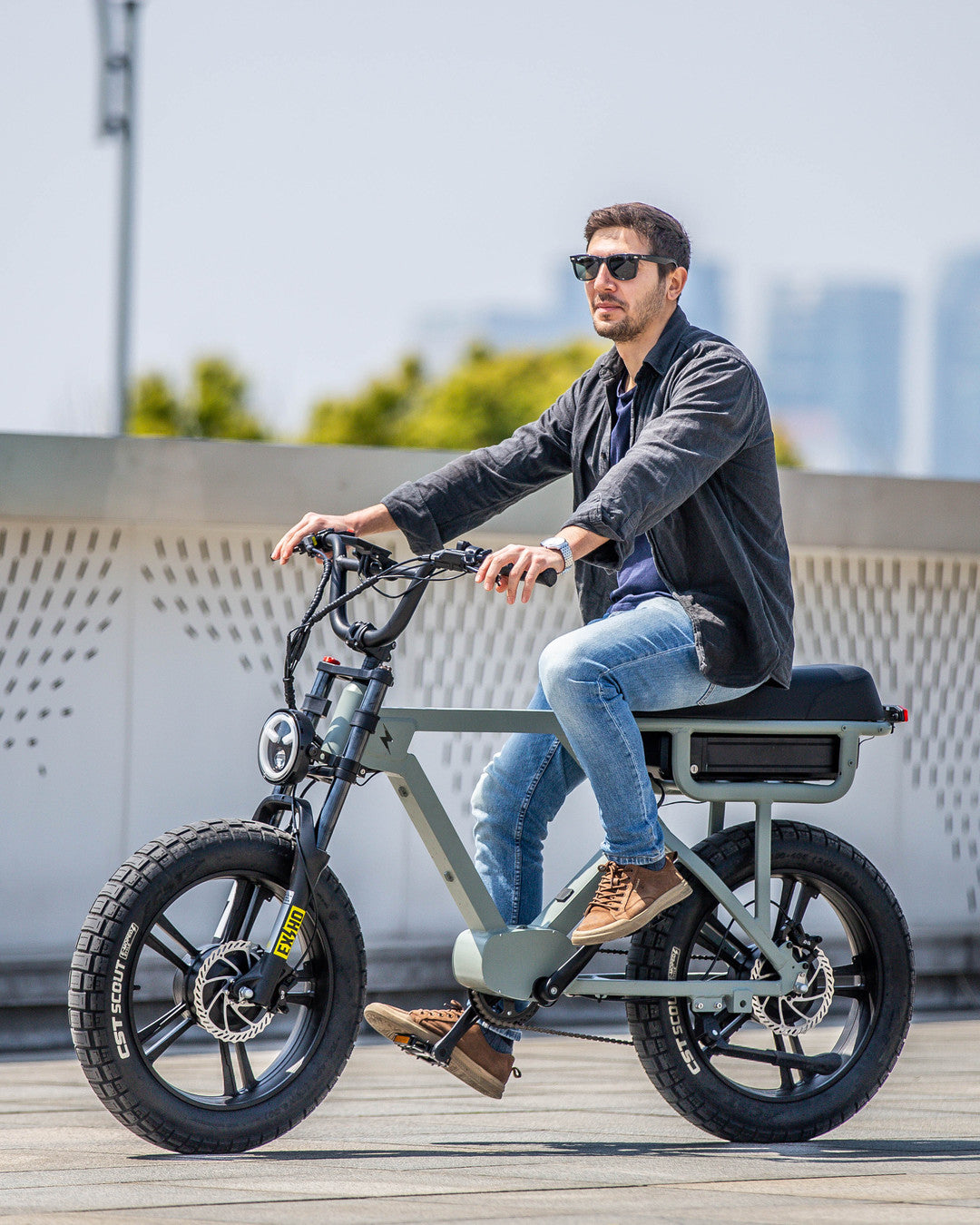

750 W nominal (1,300 W peak) · 100 N·m · 801.6 Wh · UL 2849 + UL 2271 + ISO 4210 · Class 1/2/3 switchable · 440 lb payload · $2,099 · ridden on video · verified September 25, 2026
Quick Answer — The Velotric Summit 2 is a $2,099 hybrid that works as a hardtail trail bike and a road-legal commuter: 750 W nominal, an 801.6 Wh UL 2271 battery, Shimano CUES, hydraulic discs, Class 1/2/3 switchable. For a 180 lb rider pedaling easy at 15 mph on flat ground, our model gives about 81 miles; Velotric quotes 95.
The fuller sheet: 1,300 W peak and 100 N·m, Samsung/LG cells, Shimano MT200 hydraulic brakes on 180 mm rotors, 20 mph out of the box and up to 28 mph if your state allows it, a 440 lb capacity and a fit range of 5'2" to 6'5" across two frame sizes; the fit tables show which one your inseam suits.
Velotric's own owner's manual puts the warranty with the dealer you buy from, so buy the Summit 2 from us and it is ours. Free US shipping, or browse the Velotric range.

The Jedediah Smith Memorial Trail on Sacramento's American River Parkway, the paved half of the Summit 2's brief. The cover is generated, with the bike locked to Velotric's own photographs; the credit is at the foot of the page.
$2,099, free shipping in the contiguous US. Three colors, two frame sizes, UL 2849 certified.
See the Summit 2In this guide
- What's on this page
- Who the Summit 2 is for
- We rode it: singletrack, gravel and a steep climb
- How we verified this review
- Velotric Summit 2 specifications
- How far the Summit 2 goes on one charge
- Will the Summit 2 fit you?
- The certification stack, and why it matters
- Motor, torque and the Class 1/2/3 switch
- What independent testing measured
- Battery, range and charging
- Brakes, fork and drivetrain
- Fit, weight and payload
- The Mercer fit test
- Where you can ride it
- What the warranty actually covers
- The safety record, as far as it can be checked
- The honest ledger
- Who should buy the Summit 2
- Buying it from us
- Before you buy: the checklist
- Limitations of this review
- The source register
- Frequently asked questions
- The bottom line
- Primary sources
What's on this page
Who it is for and the ride on video come first, then the specification, how far it goes and whether it fits, the law, the warranty and the buying terms.
- Who the Summit 2 is for
- The ride, on video
- How we verified this review
- Full specification, every figure sourced
- Range at your speed, weight and grade
- Fit by height and inseam
- The certification stack, and why it matters
- Motor, torque and the Class 1/2/3 switch
- What independent testing measured
- Battery, range and charging
- Brakes, fork and drivetrain
- Fit, weight and payload
- Where you can ride it
- What the warranty actually covers
- The safety record, as far as it can be checked
- The honest ledger · Who should buy it
- Buying it from us · Before you buy: the checklist
- FAQ · The bottom line · Sources
Who the Summit 2 is for
An e-bike can ask you to pick a life. A commuter is embarrassing on a fire road; a mountain bike is miserable in traffic with no lights and no fenders. The hybrid category exists because a lot of people ride both ways in the same week, and until recently the compromise cost you something real at both ends.
What you lose by choosing wrong is not usually the bike. It is the second bike you end up buying eighteen months later.
So this review answers three questions: whether the Summit 2 is good at both jobs, what independent testing measured rather than what the brochure claims, and whether it fits you.
The short version is that Velotric spent the budget on parts a buyer can check: the battery certification, the brakes, the fork and the drivetrain are all name-brand and specified, and the numbers hold up when somebody else measures them.
The one-line version. A properly certified, name-brand-component hybrid that is legal on the path and capable on the trail, for a rider between 5'2" and 6'5".
We rode it: singletrack, gravel and a steep climb
We took the Summit 2 out on camera on summer rides: forest singletrack, gravel, a very steep hill and paved country road. The rider, who also wrote this review, is 6'1" and rode the Large, inside Velotric's 5'7"–6'5" window for that size.
Three videos came out of those rides, and all three are in this section. How the bike feels is ours to report; the speed, range and stopping figures elsewhere on the page are Velotric's or Electric Bike Report's, and each one says so where it appears.
The climb, in boost mode
He switched to boost for the hills, BOOST in Velotric's owner's manual, where it is listed after ECO, TOUR, TRAIL and SPORT. Then he rode down a very steep one, turned around at the bottom, said "let me show you how powerful this thing is," and rode it back to the top. At 4:41, with the hill behind him, he says he "should probably power down now."
Earlier on the trail, from 1:14 of the long video, he calls the motor's 100 N·m "a ton of power" and picks out how it arrives: "response is really good," and "it's very quiet, which is awesome."
For numbers on the same kind of effort, Electric Bike Report clocked the Summit 2 up its test hill at a 19.1 mph average on pedal assist and 17.8 mph on the throttle; the full set is under independent testing.
SensorSwap, switched mid-ride
The Short shows SensorSwap doing what Velotric says it does. At 0:18 he swaps the sensor from torque to cadence, which the owner's manual puts on a long press of the remote, and the assist stops reading how hard he pushes and starts reading whether the cranks turn: "as long as the pedal is moving," he says, "we're going to put maximum effort from the motor to the wheels."
Velotric's own guidance draws the same line, calling cadence "better suited for long-distance, higher-speed riding" and crediting torque with "smoother and more natural power delivery, especially when riding on uneven or rough terrain." On pavement, with the limit set to Class 3, he reaches 28 mph "rather quickly without struggle," and in cadence he takes a gravel hill with "no problem."
What the ride settles about setting it up
- Class 3 has no throttle. He says so at 5:03 of the long video, and Velotric's page agrees: an optional Custom Mode, turned on in the Velotric app "where permitted by local regulations" and not supported in California, is what lets a rider "unlock the throttle in Class 3." Switch to Class 2 when you want the trigger, and check where each class may go.
- How hard the motor pulls is a setting. His "level of aggression you want" from the motor is what Velotric calls Ride Tuning, which "lets you fine-tune motor output and PAS."
- The seat post is the upgrade he would make. "I could use a hydraulic seat post," he says in the Short. Velotric's FAQ gives the post as 31.6 mm by 350 mm, names a suspension post (Velotric's own among the options) and a dropper, and says the frame has "a pre-reserved internal cable routing port," so either kind fits.
- Battery size is not the whole range story. That is his advice to first-time buyers near the end of the long video, and this page's own numbers bear it out: the same 801.6 Wh pack went 78.1 miles on minimum eco and 35.1 on maximum power in Electric Bike Report's test, and the range tables put your own speed, weight and hills on it.
The bike on camera is a Large in Glacial Silver. Regular fits 5'2"–5'10", and all six size-and-color pairs are $2,099, shipped free in the contiguous US.
Get the one in the videosHow we verified this review
Written by Milad Ghobadibeygvand, BScN (Western University, 2014), who rode the Summit 2 in the videos above. Verification basis: ridden, with every specification confirmed at the manufacturer.
On August 24, 2026 we read and archived, and on September 25, 2026 re-read, Velotric's published specification, took price and sizing from our own listing, and read Electric Bike Report's instrumented test, the most complete independent measurement of this bike we could find; we publish all of it. Each figure is labeled with whose it is: Velotric's, the test's, or the ride's.
Corpus: 40 sources, all 40 retrieved and read at the section cited, the three videos through their complete transcripts.
Found something we got wrong? Email mehran@redtailebikes.com. Verified corrections get published, dated, in the body.
Velotric Summit 2 specifications
Every figure below is transcribed from the specification table on Velotric's Summit 2 product page, read on August 24, 2026 and again, row by row, on September 25, 2026. Where an independent test measured the same parameter differently, both numbers appear.
| Specification | Velotric Summit 2 |
|---|---|
| Price | $2,099 |
| Motor | Hub, 48 V, 750 W nominal (1,300 W peak), inner rotor |
| Torque | 100 N·m |
| Battery | 48 V, 16.7 Ah (801.6 Wh), IPX7, certified to UL 2271 |
| Cells | Samsung/LG 21700, certified to UL 2580 |
| Whole-bike certification | UL 2849 & UL 2271; frame to ISO 4210 |
| Charger | 48 V, 3 A fast charger |
| Sensor | SensorSwap™ — torque and cadence, switchable |
| Max speed (default) | 20 mph |
| Max speed (adjustable) | 12–28 mph, Class 1/2/3 |
| Range, throttle | 70 miles |
| Range, pedal assist | 95 miles |
| Brakes | SHIMANO MT200 hydraulic disc |
| Rotors | 180 mm front and rear |
| Brake levers | Aluminum alloy, with power cutoff |
| Fork | RST Air Suspension, 120 mm travel, lock-out, rebound adjustable |
| Frame | Triple-butted aluminum alloy |
| Rear derailleur | SHIMANO Cues, 9-speed |
| Cassette | 9-speed, 11–46T |
| Chain | KMC XGlide 9-speed |
| Chainring | BCD 104, 40T narrow-wide |
| Crankset | Aluminum alloy, 165 mm |
| Tires | Kenda 27.5 × 2.4" MTB puncture-resistant |
| Rims | Double-wall aluminum alloy |
| Front hub | NOVATEC alloy, 15 × 110 mm thru-axle |
| Display | 2.0" left-mounted full-color, Bluetooth, NFC |
| Throttle | Trigger-control, removable |
| Riding modes | 4 modes + Pulse Mode |
| Front light | 500 lm integrated LED, adjustable angle |
| Rear light | Brake highlight + turn signal |
| Security | Apple Find My™ & Android Find Hub, NFC card unlock |
| USB | USB-C phone charging |
| Water resistance | IPX6 bike / IPX7 battery |
| Fenders | Plastic, front and rear full coverage, included |
| Kickstand | Aluminum alloy, included |
| Rear rack | Optional, rated 66 lb |
| Bike weight | 57 lb (excl. fenders, kickstand, pedals) |
| Max load | 440 lb |
| Sizes | Regular 5'2"–5'10" · Large 5'7"–6'5" (fit by inseam) |
| Colors | Galaxy Purple · Ocean Blue · Glacial Silver |

Triple-butted alloy frame, RST air fork, full-coverage fenders and a kickstand in the box. The commuter half of the brief is fitted as standard.
750 W nominal · 801.6 Wh UL 2271 pack · Shimano brakes and drivetrain · free contiguous-US shipping. Buy from us and the dealer warranty is ours, on Velotric's own manual terms.
Order the Summit 2 — $2,099How far the Summit 2 goes on one charge
A 180 lb rider on level pavement can plan on about 81 miles at 15 mph with easy pedaling (65 with the last 20% kept in the pack), 50 at 15 mph on the throttle alone and 35 at 20 mph on the throttle. A steady 8% climb at 10 mph on the throttle spends the same charge in about 9 miles.
Every figure in this section is computed from Velotric's own numbers and published physics, and it lines up with the rides others have measured: Electric Bike Report's maximum-power run used 22.8 Wh a mile, and the model gives 22.8 for the throttle alone at 20 mph.
To find your ride:
- Pick your speed and effort in the first table. Easy pedaling is 75 watts, enough to move this bike at 9.9 mph with the motor off.
- Adjust for hills, your weight, the cold and your tires in the tables after it.
- Plan with Velotric's reserve. The owner's manual says the battery gauge turns yellow below 20% "to remind you to get the battery charged," so the planning column keeps that 20% in the pack.
Does riding faster cut range? Miles at each speed
Yes, and steeply: going from 15 to 20 mph on the throttle takes a full charge from 50 miles to 35. Air resistance rises with the square of your speed, so the power it takes rises with the cube; at 15 mph the air already takes 103.3 of the 170.1 watts the rear wheel needs.
| Speed, flat | Throttle | Easy, 75 W | Steady, 150 W | Easy, 20% kept |
|---|---|---|---|---|
| 12 mph | 61 mi | 142 mi | legs alone | 113 mi |
| 15 mph | 50 mi | 81 mi | 188 mi | 65 mi |
| 18 mph | 40 mi | 55 mi | 84 mi | 44 mi |
| 20 mph | 35 mi | 45 mi | 60 mi | 36 mi |
| 25 mph | — | 29 mi | 34 mi | 23 mi |
| 28 mph | — | 23 mi | 25 mi | 18 mi |
Level pavement, a 180 lb rider, 77 °F, no wind, the full 801.6 Wh. Easy is 75 W of pedaling, steady 150 W; the last column is easy pedaling with 20% kept in the pack. 20 mph is the default limit; the throttle works to 20 mph (Class 2), and Class 3 is pedal assist to 28 mph. "Legs alone": 150 W moves the bike to 14.0 mph without the motor.
Pedaling pays most at commuting speeds: at 15 mph, easy pedaling lifts a full charge from 50 to 81 miles, and at 12 mph your 75 W carries most of the load by itself, which is why that row runs so long. Above 20 mph the air takes over, and at 25 mph even steady pedaling gets about 34.
Which gear saves battery? On a hub motor, your effort does
The Summit 2's motor sits in the rear hub, so shifting changes how fast your legs turn while the motor's speed stays tied to the wheel. What saves battery is the effort you add: at 15 mph, easy pedaling cuts the charge used per mile by 38%.
| Your ride | Throttle only | Easy pedaling (75 W) | Steady pedaling (150 W) |
|---|---|---|---|
| 15 mph, flat | 16.2 Wh | 9.9 Wh | 4.3 Wh |
| 20 mph, flat | 22.8 Wh | 17.9 Wh | 13.3 Wh |
| 12 mph, 4% grade | 44.3 Wh | 33.2 Wh | 23.4 Wh |
| 10 mph, 8% grade | 90.6 Wh | 70.7 Wh | 53.4 Wh |
Battery watt-hours per mile, a 180 lb rider, 77 °F, no wind.
Choose the gear that keeps your legs turning at a comfortable cadence. The 11–46T cassette's lowest gear is there for the steep grades in the next table, where the motor slows on its own and your legs carry more of the load.
Does going uphill drain the battery faster?
Yes: at 10 mph on the throttle, a full charge lasts about 31 miles of steady 2% grade, 9 of 8% and 5 of 12%. Each 1,000 feet of climbing takes 152 to 210 Wh from the pack at 10 mph on the throttle, or 130 to 180 Wh with easy pedaling, against 92 Wh of pure lifting at the wheel for a 180 lb rider.
| Grade | Fastest steady, throttle | Per mile, 10 mph | Full charge, throttle | Full charge, easy pedaling |
|---|---|---|---|---|
| 2% | 23.8 mph | 26 Wh | 31 mi | 54 mi |
| 4% | 20.4 mph | 44 Wh | 18 mi | 27 mi |
| 6% | 17.5 mph | 65 Wh | 12 mi | 17 mi |
| 8% | 15.0 mph | 91 Wh | 9 mi | 11 mi |
| 10% | 12.9 mph | 122 Wh | 7 mi | 8 mi |
| 12% | 11.3 mph | 161 Wh | 5 mi | 6 mi |
| 15% | 9.5 mph | — | — | 4 mi |
A 180 lb rider, 77 °F, no pedaling unless the column says so. "Fastest steady" is what the motor holds on its 750 W rating; the other columns ride each grade at 10 mph. On a 15% grade the motor alone holds 9.5 mph, so 10 mph there needs your legs.
Short climbs run faster than this table. Electric Bike Report timed the Summit 2 up a half-mile, 8% hill at 17.8 mph on the throttle. For a 180 lb rider that takes about 938 W at the rear wheel, above the motor's 750 W rating and within its 1,300 W peak, so read the table as what the motor sustains on a long climb.
To price a hilly ride, add the climbing to the level miles. Twenty miles at 15 mph with easy pedaling take about 199 Wh, and 1,000 feet of 8% grade, climbed at 10 mph on the throttle, adds about 187 Wh over riding the same distance level: 386 Wh together, 60% of the 641 Wh you plan with.
Does rider weight affect range?
Yes, and most on a climb: on a 6% grade at 10 mph with easy pedaling, a 130 lb rider gets about 23 miles and a rider at the limit about 6. On level pavement at 15 mph the same two riders get 91 and 55 miles.
Velotric's manual counts the bike inside its 440 lb limit, so at the 63.3 lb Electric Bike Report weighed, 377 lb is the most you and your cargo can add.
| You plus your load | 15 mph, easy pedaling | 20 mph, throttle | 6% climb at 10 mph, easy |
|---|---|---|---|
| 130 lb | 91 mi | 37 mi | 23 mi |
| 180 lb | 81 mi | 35 mi | 17 mi |
| 220 lb | 74 mi | 34 mi | 13 mi |
| 300 lb | 63 mi | 31 mi | 9 mi |
| 377 lb (the limit) | 55 mi | 29 mi | 6 mi |
You plus everything you carry, on the 63.3 lb bike, at 77 °F. The last row is Velotric's 440 lb total less the bike.
Does cold weather drain the battery?
Yes: at 32 °F the pack delivers about 89% of the energy it gives at 77 °F, and at 14 °F about 82%, so 81 miles at 15 mph with easy pedaling becomes about 61 and 55. Cold air is denser (U.S. Standard Atmosphere) and cold tires roll harder (Bicycle Rolling Resistance's temperature test), and the model counts both.
| Air | Pack energy vs 77 °F | 15 mph, easy pedaling | 20 mph, throttle |
|---|---|---|---|
| 95 °F | 99% | 86 mi | 36 mi |
| 77 °F | 100% | 81 mi | 35 mi |
| 68 °F | 98% | 76 mi | 34 mi |
| 50 °F | 93% | 67 mi | 30 mi |
| 41 °F | 91% | 63 mi | 29 mi |
| 32 °F | 89% (80–93) | 61 mi (55–64) | 28 mi (25–29) |
| 14 °F | 82% (40–83) | 55 mi (27–55) | 25 mi (12–25) |
A 180 lb rider on level pavement. The central figures use McMaster University's LG HG2 cell data, an LG cell like the "Samsung/LG 21700" cells Velotric lists, though not confirmed as the same model; the brackets at 32 °F and 14 °F are the spread across published cell tests, from Samsung's 35E data sheet to Casado et al., 2025.
Velotric's manual asks you to "Charge the battery in an environment from 50–86°F (10–30°C)" and says the pack won't charge below 32 °F, so bring it indoors to charge after a cold ride.
Do the tires cut range? Tires and riding position
The tires move a full charge at 15 mph with easy pedaling between about 74 and 90 miles. Velotric fits Kenda 27.5 × 2.4" "MTB Puncture Resistant" tires with a knobby tread and does not name the model, and its photograph shows only the Kenda name on the sidewall, so the model runs the field average for knobby tires, bracketed by drum measurements.
| Rolling resistance | 15 mph, easy pedaling | 20 mph, throttle |
|---|---|---|
| 0.0073 · lab median of 33 tires | 90 mi | 37 mi |
| 0.0092 · field average (used here) | 81 mi | 35 mi |
| 0.0106 · Kenda Booster Pro 2.4 | 74 mi | 34 mi |
A 180 lb rider on level pavement at 77 °F. Low: the median of 33 mountain-bike tires 2.35 to 2.5 inches wide on Bicycle Rolling Resistance's drum, most of them race tires. Central: the knobby tires of 138 everyday riders, measured on bikeways (Tengattini and Bigazzi, 2018). High: Kenda's own Booster Pro 2.4, a heavier trail casing, on the same drum.
How you sit changes less. With the drag area of the 37 upright cruiser riders in the same study, the 15 mph figure is about 74 miles, against 81 for the everyday hybrid rider the model uses. Velotric's manual adds one habit that protects all of these numbers: "Check tire pressure before every ride."
Where does Velotric's 95 miles come from? Both figures, matched to rides
Velotric's 95 miles on pedal assist fits a 187 lb rider in Eco at 12.7 mph adding about 57 watts of pedaling, and its 70 miles on the throttle fits about 9.3 mph on the throttle alone. Both come with one condition on Velotric's page: "*A 187-lb rider using Eco mode on flat roads."
Eco tops out at 12.7 mph on the torque sensor in Electric Bike Report's speed test, and 57 watts is light work: riding this bike at 9.4 mph with the motor off, the speed their tester reached unassisted, takes about 69 watts.
Their minimum-Eco run went 78.1 miles, which the model matches at the same 12.7 mph with about 36 watts from the rider. At that speed the gap between 78.1 and 95 miles is the rider's own pedaling: 36 watts against 57.
At steadier efforts, 95 miles on the full 801.6 Wh means holding 13.9 mph with easy pedaling or 17.3 mph with steady pedaling.
Tell us your ride and we will run it through this model. Email your weight, speed, distance and the climbs on your route to support@redtailebikes.com, and we will reply with the miles before you order. $2,099, free to the lower 48.
Get the 801.6 Wh Summit 2How every figure here is worked out
Riding at a steady speed means feeding the rear wheel a steady stream of power. The road-cycling model Martin and colleagues validated in 1998 writes that power as one line, for a constant speed in still air:
Power at the wheel = v × [ m × g × (Crr × cos θ + sin θ) + ½ × ρ × CdA × v² ]
In it, v is your speed; m is you, your cargo and the bike together; g is gravity; θ is the slope's angle; Crr is the tires' rolling resistance; ρ is air density; and CdA, the drag area, measures how much air you push aside.
From the wheel back to the battery, four things happen:
- Your legs drive the rear wheel through the chain at 97.7% efficiency (Martin et al.), and the motor supplies the rest.
- The rear hub motor turns with the wheel, so your speed sets its speed.
- The motor is modeled on a comparable one's published figures, because Velotric names no motor maker. The rule, fixed before any result: of the 48 V geared rear hubs rated 750 W in Bafang's 2021 OEM workbook, the one whose rated speed on this wheel sits closest above 28 mph. That is the RM G062, rated at 29.3 mph and unloaded at 33.4 mph here, 85 N·m, and at least 80% efficient.
- The pack loses a little energy inside itself, at the battery efficiency Arango, Lopez and Ceren measured on a 48 V pack.
Divide the battery's watts by your speed for watt-hours per mile; divide the pack's 801.6 Wh, times the share left at that temperature, by it for miles.
| Input | Value used | Where it comes from |
|---|---|---|
| Bike | 63.3 lb with fenders, kickstand and pedals | Electric Bike Report's weighing; Velotric lists 57 lb without them |
| Rider and cargo | 180 lb; the weight table runs 130 to 377 | 377 lb is Velotric's 440 lb limit less the bike |
| Battery | 48 V × 16.7 Ah = 801.6 Wh | Velotric's specification |
| Motor | one hub, 750 W at 350 rpm, 400 rpm unloaded, 80% at the rated point, torque capped at 85 N·m | Bafang OEM workbook 2021, RM G062 |
| Wheel | 28.1 inches across, 2,242 mm around | the tires on Velotric's side view, at its wheelbase scale |
| Rolling resistance | 0.0092, the field average for knobby tires | Tengattini and Bigazzi, 2018 |
| Drag area | 0.579 m², 181 everyday hybrid riders | Tengattini and Bigazzi, 2018 |
| Chain | 97.7%, your pedaling only | Martin et al., 1998 |
| Battery losses | 3.0% at 15 mph with easy pedaling | Arango, Lopez and Ceren, 2021 |
| Air | 77 °F at sea-level pressure, 1.184 kg/m³ | U.S. Standard Atmosphere, 1976 |
| Cold | the share of a cell's energy left at each temperature | McMaster University's LG HG2 cell data |
| Reserve | 20% kept, where the gauge turns yellow | Velotric's owner's manual |
A worked ride: 180 lb aboard, 15 mph on level pavement, easy pedaling at 75 W. Rolling takes 66.8 W and the air 103.3 W, 170.1 W at the rear wheel. Your 75 W reaches it as 73.3 W through the chain, which leaves 96.8 W for the motor.
At 15 mph the 28.1-inch wheel turns at 179 rpm. In the motor model (1.146 N·m of torque per amp, a 0.307 Ω winding and a 1.67 A no-load current, each worked out from Bafang's published figures), the motor makes 5.2 N·m on 6.2 A at 67% efficiency and draws 144.6 W.
With the pack's own 3.0% loss (Arango, Lopez and Ceren's model), the battery supplies 149.1 W: 9.94 Wh a mile, and 801.6 ÷ 9.94 comes to about 80.6 miles, or 64.5 with 20% kept.
Five checks, recomputed. Three are measurements of this bike by Electric Bike Report; two are published benchmarks each half of the model reproduces:
| Check | Measured or published | This model |
|---|---|---|
| Electric Bike Report, maximum power, held to 20 mph | 35.1 miles, 22.8 Wh a mile | 22.8 Wh a mile on the throttle at 20 mph, −0.2% |
| Electric Bike Report, minimum Eco | 78.1 miles, 10.3 Wh a mile | matched at Eco's 12.7 mph with 36 W from the rider |
| Electric Bike Report, half a mile at 8% | 17.8 mph on the throttle | 15.0 mph held on the 750 W rating; 938 W at the wheel for 17.8 |
| Road physics, Martin and colleagues' worked example | 45.7 W for tires and grade, 158.8 W for the air | 45.7 W and 158.8 W |
| The comparable motor at Bafang's rated point | at least 80% efficient | 80% |
The first three rows are Electric Bike Report's range and hill tests of the Summit 2, which do not state the rider's weight; the model uses 180 lb. The last two are recomputed by the model's self-test: Appendix I of Martin and colleagues, and the RM G062's rated point in Bafang's workbook.
Swapping the stand-in motor moves the 15 mph, easy-pedaling figure: 75 miles on Bafang's 1,000 W G062, 88 at an 82% efficiency and 90 on its faster-wound G0H0. Velotric's 57 lb weight, without fenders, kickstand and pedals, gives 82.
Will the Summit 2 fit you?
On the Large, the saddle reaches the fit formula's height for 96 of every 100 riders at 5'7" and 41 at 5'11"; at 6'1" the count is 6 of 100, inside Velotric's Large window of 5'7" to 6'5". On the Regular, sized for 5'2" to 5'10", the count runs from 100 of 100 at 5'2" to 4 at 5'10".
The median rider leans 17 to 20 degrees forward of upright on either frame, and with the back fully relaxed the hands carry 17 to 19 percent of body weight.
Behind every figure are the 6,068 bodies the US Army measured for its 2012 survey, each set on Velotric's published geometry with the saddle at 109% of inseam.
To find your size:
- Take your inseam in socks. Back against a wall, press a hardcover book up between your legs as a saddle would sit, and have someone measure from the floor to the top of its spine.
- Find your height in both size tables and check that your inseam sits inside that row's range. Between 5'7" and 5'10" both windows include you, and the Large's taller seat post reaches the formula for more riders there.
- Set the saddle when it arrives with the knee and heel checks at the end of this section.
Velotric publishes a geometry table for each size, in millimeters.
| What Velotric publishes | Regular | Large |
|---|---|---|
| Rider height | 5'2" to 5'10" | 5'7" to 6'5" |
| Saddle height, lowest to highest | 790–1,000 mm (31.1–39.4 in) | 830–1,050 mm (32.7–41.3 in) |
| Stand-over | 720 mm (28.3 in) | 720 mm (28.3 in) |
| Handlebar height | 1,000 mm | 1,050 mm |
| Reach | 446 mm | 459 mm |
| Wheelbase | 1,210 mm | 1,224 mm |
Will the saddle go high enough (or low enough) for me?
On the Regular, nearly every rider reaches the formula up to 5'4"; at 5'8" the post gets there for 28 of 100 riders. On the Large it is nearly everyone to 5'8", and by 6'2" it is 3 of 100.
The target is a saddle top 109% of your inseam from the pedal axle at the bottom of the stroke (Peveler et al., 2005), and the published range reaches down to 106% (Ferrer-Roca et al., 2012).
The height off the floor then depends on the 12.4-inch crank axle measured on Velotric's photograph, the 165 mm cranks in its specification and the seat post's 70.5° angle.
| Your height, Regular | Typical inseam | Saddle height, median rider | At 109% | At 106% |
|---|---|---|---|---|
| 5'2" | 28.0–31.1 in | 36.6 in | 100 of 100 | 100 of 100 |
| 5'4" | 29.1–32.2 in | 37.6 in | 95 of 100 | 100 of 100 |
| 5'6" | 30.2–33.5 in | 38.8 in | 70 of 100 | 90 of 100 |
| 5'8" | 31.1–34.3 in | 39.8 in | 28 of 100 | 66 of 100 |
| 5'10" | 32.2–35.5 in | 41.0 in | 4 of 100 | 22 of 100 |
| Your height, Large | Typical inseam | Saddle height, median rider | At 109% | At 106% |
|---|---|---|---|---|
| 5'8" | 31.1–34.3 in | 39.8 in | 93 of 100 | 99 of 100 |
| 5'10" | 32.2–35.5 in | 41.0 in | 65 of 100 | 90 of 100 |
| 6'0" | 33.2–36.7 in | 42.2 in | 20 of 100 | 55 of 100 |
| 6'2" | 34.3–37.5 in | 43.3 in | 3 of 100 | 17 of 100 |
| 6'4" | 36.3–39.1 in | 45.0 in | 0 of 100 | 0 of 100 |
Floor-to-saddle height for the typical rider at each height, and how many of 100 at that height have 109% and 106% heights inside each frame's published saddle range; Army survey bodies, men and women together. A rider the post cannot reach sits with the saddle at its top, 39.4 inches on the Regular and 41.3 on the Large. The survey holds too few riders at 6'5" for a row.
Velotric prints no inseam range. On the model, the top of the Regular's post meets 109% of inseam at a 32.2-inch inseam and 106% at 33.1; the Large's does at 34.1 and 35.1 inches. Past that inseam the saddle is at its top, and each pedal stroke ends with more bend in the knee than the formula asks for.
At the short end the question is the lowest saddle. The Regular's suits a 109% inseam of 24.1 inches and the Large's one of 25.7, so on either frame a short rider meets the stand-over, next, before the lowest saddle.
Can I put a foot down at a stop?
At 5'4" and up, 95 of 100 riders clear Velotric's listed 28.3-inch stand-over barefoot, and the top tube dips to about 26.9 inches where it meets the seat tube. Velotric's manual sets its own test, done in riding shoes: "There should be a clearance of 1 inch to 2 inches (25.4 mm to 50.8 mm) between your crotch and the top tube of the eBike."
| Your height | Typical inseam | Clearance at 28.3 in | At 26.9 in |
|---|---|---|---|
| 5'0" | 28.4 in | −1.3 in | 0.2 in |
| 5'2" | 29.5 in | −0.3 in | 1.1 in |
| 5'4" | 30.5 in | 0.7 in | 2.1 in |
| 5'6" | 31.7 in | 1.9 in | 3.3 in |
| 5'8" | 32.6 in | 2.8 in | 4.2 in |
| 5'10" | 33.8 in | 3.9 in | 5.3 in |
| 6'0" | 34.9 in | 4.8 in | 6.2 in |
Barefoot inseam minus each figure: 28.3 inches from Velotric's Geometry table, the same on both sizes, and 26.9 measured at the top tube's lowest point on its photograph. Each cell is the clearance that 95 of 100 riders at that height have or exceed.
Near the bottom of the Regular's window, check the clearance in your riding shoes, as Velotric's manual asks, before you commit, and stand just ahead of the saddle, where the top tube sits lowest.
Will I feel cramped, or stretched?
A moderate lean: the median rider leans 18 to 20 degrees forward on the Regular and 17 to 20 on the Large, with the grips anywhere from Velotric's listed handlebar height to the raised stem in its photograph.
One tester wanted a little more stretch: Electric Bike Report's wrote "I’d have liked a bit more reach." When Priego Quesada and colleagues had 20 cyclists ride three trunk angles, the recreational riders rated the most upright one the most comfortable.
Each angle below is the smallest forward lean at which a straight arm reaches the grip from where the sit bones rest, computed from that body's own torso and arm lengths.
| Your height, Regular | Lean from upright, median rider | Across saddle and grip positions |
|---|---|---|
| 5'2" | 18° | 9–27° |
| 5'4" | 19° | 10–28° |
| 5'6" | 20° | 11–29° |
| 5'8" | 20° | 11–29° |
| 5'10" | 19° | 10–27° |
| Your height, Large | Lean from upright, median rider | Across saddle and grip positions |
|---|---|---|
| 5'8" | 19° | 12–27° |
| 5'10" | 20° | 13–27° |
| 6'0" | 20° | 13–27° |
| 6'2" | 19° | 12–26° |
| 6'4" | 17° | 10–24° |
Trunk lean from vertical for the middle rider at each height; the spread covers where the sit bones rest on the saddle and the grip from Velotric's listed handlebar height to its photograph's raised stem.
How much weight goes through my wrists?
Up to about 17 to 19 percent of your body weight with a fully relaxed back; the table gives the pounds on each hand. For scale, 10 road racers riding a trainer with their hands on the brake hoods put 15% of their weight through the bars in Carahalios's 2015 study; the Summit 2's relaxed-back ceiling sits a little above that, and any tension in your back lifts some of it off your hands.
The load lands on the heel of the hand, over the ulnar nerve, and Slane and colleagues found that padded gloves lowered that pressure by 10 to 28% in 36 riders.
| Your height, Regular | Share of your weight, back relaxed | Median rider's weight | On each hand |
|---|---|---|---|
| 5'2" | 17% (11–21%) | 139 lb | about 11 lb |
| 5'4" | 17% (12–22%) | 147 lb | about 13 lb |
| 5'6" | 18% (13–22%) | 166 lb | about 15 lb |
| 5'8" | 18% (13–22%) | 179 lb | about 16 lb |
| 5'10" | 18% (12–22%) | 192 lb | about 17 lb |
| Your height, Large | Share of your weight, back relaxed | Median rider's weight | On each hand |
|---|---|---|---|
| 5'8" | 18% (13–21%) | 179 lb | about 16 lb |
| 5'10" | 18% (14–22%) | 192 lb | about 18 lb |
| 6'0" | 19% (15–22%) | 204 lb | about 19 lb |
| 6'2" | 18% (14–21%) | 216 lb | about 19 lb |
| 6'4" | 17% (13–21%) | 220 lb | about 18 lb |
The most the hands carry with a relaxed back, computed from each body's segment weights (Clauser et al., 1969) at the survey's median weight for that height; the range spans the saddle and grip positions.
How do I set the saddle when it arrives?
Aim for 25 to 35 degrees of bend in the knee with the pedal at its lowest point (Peveler et al., 2007).
The quickest check needs no tape measure: put your heel on the lower pedal and raise the saddle until that leg is just straight. In Peveler and colleagues' 2005 test, that heel method landed 70% of 19 cyclists in the target range, more than either inseam formula.
How we computed fit
The section rests on three calculations: a saddle 1.09 × inseam from the pedal axle, the smallest trunk lean at which a straight arm reaches the grip, and the share of upper-body weight that lean puts on the hands with the back relaxed.
A 5'8" rider with the survey's median 32.6-inch inseam needs 35.6 inches from the pedal, or 29.1 inches from the crank axle (LeMond's 88.3% gives 28.8). On this frame that is 39.8 inches off the floor: about half an inch above the Regular's 39.4-inch top of the post and inside the Large's 41.3.
| Input | Value | Source |
|---|---|---|
| Rider bodies | 6,068 (4,082 men, 1,986 women) | US Army ANSUR II, 2012 |
| Saddle formula | 109% of inseam; range 106–110.4% | Peveler et al., 2005; Ferrer-Roca et al., 2012 |
| Saddle height | 31.1–39.4 in Regular, 32.7–41.3 in Large, from the ground | Velotric's Geometry table |
| Crank length | 165 mm | Velotric's specification |
| Crank axle height | 12.4 in (12.2–12.5) | measured on Velotric's photograph |
| Seat post angle | 70.5° (70.3–70.6) | measured on Velotric's photograph |
| Grip center | 15.3–17.5 in ahead, 27.0–32.3 in above the crank axle | Velotric's handlebar heights and its photograph |
| Stand-over | 28.3 in listed; 26.9 in at the top tube's lowest point | Velotric's Geometry table; measured on its photograph |
| Segment weights | head and trunk 58.0%, each arm 4.9% of body weight | Clauser et al., 1969 |
Velotric's photograph was held against its own published lengths before anything was measured on it. It does not say which size it shows, so it was scaled by each size's wheelbase in turn:
| Dimension, Regular scale | Velotric lists | Measured on its photograph | Gap |
|---|---|---|---|
| total length, rear fender to front tire | 76.0 in | 75.9 in | −0.1% |
| reach, crank axle to the top of the head tube | 17.6 in | 17.4 in | −1.1% |
| seat post, 31.6 mm across, as it crosses the photo at its angle | 1.3 in | 1.3 in | −1.3% |
| Dimension, Large scale | Velotric lists | Measured on its photograph | Gap |
|---|---|---|---|
| total length, rear fender to front tire | 76.5 in | 76.8 in | +0.4% |
| reach, crank axle to the top of the head tube | 18.1 in | 17.6 in | −2.8% |
| seat post, 31.6 mm across, as it crosses the photo at its angle | 1.3 in | 1.3 in | −0.1% |
Every length is scaled from the wheelbase Velotric publishes for that size, measured between the axle centers. The frame points the model uses (the crank axle, the seat post and the saddle) lie on the frame's center line; the grips sit about a foot out to the side, where a photograph can shift them, so the cockpit figures carry a range.
Between sizes, or 6'1" and up? Send your height and inseam to support@redtailebikes.com and we will run them through this model and answer before you order. Both sizes come in all three colors at $2,099.
Choose Regular or LargeThe certification stack, and why it matters
This is the part of the Summit 2 that is genuinely uncommon, and it is the reason to trust the rest.
Velotric publishes four separate certifications for this bike:
| Standard | What it covers |
|---|---|
| UL 2849 | The whole electrical system — battery, charger, motor and controller tested together |
| UL 2271 | The battery pack itself |
| UL 2580 | The Samsung/LG 21700 cells inside the pack |
| ISO 4210 | The bicycle frame and fork, mechanically |
Publishing the system, the pack, the cells and the frame standard is a complete chain, and it is checkable rather than adjectival.
A wording detail is worth reading carefully, because it is the manufacturer's own. Velotric's certification page states that "Most Velotric e-bikes are both UL 2271 Recognized and UL 2849 Certified."
Recognition and certification are different UL outcomes. A Recognized Component is judged as a part destined for a larger system; Certification covers the finished product. On this bike the finished-product mark is the UL 2849 one, and that is the mark the city rules below name.
Velotric also publishes an ingress rating on its safety page: IPX6 for the bike and IPX7 for the battery. That covers rain and spray, never submersion, and it is one more figure you can hold the maker to.
It also has practical consequences you may run into. New York City permits the sale of powered bicycles only where they are certified to UL 2849, and California made accredited-lab certification a condition of sale statewide from January 1, 2026. If your building, your insurer or your city asks, this bike has an answer.
What to do with this. If you are cross-shopping, ask the other bike's maker which standard its battery is certified to and who made the cells. A brand that cannot answer in one sentence is telling you something.
Motor, torque and the Class 1/2/3 switch
Velotric specifies a 750 W nominal hub motor peaking at 1,300 W, with 100 N·m of torque: an inner-rotor design, which packages a higher-speed motor with reduction gearing to make torque without a huge hub shell.

Velotric's own photography of the Summit 2. Apart from the cover and the banner, every photograph on this page is theirs, cropped and lightly graded.
The number with legal force is 750 W. That is the nominal, continuous figure, and it is the figure the federal definition of a low-speed electric bicycle at 15 U.S.C. § 2085(b) and every state three-class system are written around. A peak figure is what the system can draw in bursts; it is not what defines the bike.

The inner-rotor hub. Velotric's packaging choice here is what lets a 750 W nominal motor peak at 1,300 W without the sag a cheaper layout shows.
The Class 1/2/3 switch is the feature that makes this bike work in two lives. Out of the box it is set to 20 mph, and it is adjustable between 12 and 28 mph. Set it to Class 1 for a path that requires pedal-assist only; Class 2 to use the throttle; Class 3 for 28 mph where your state permits it.

Left-mounted color display, trigger throttle, and the RST air fork's rebound adjuster and lock-out. The class setting lives on that display.
SensorSwap™ lets you choose between torque and cadence sensing. Torque sensing reads how hard you push and feels natural on a trail; cadence sensing delivers steadier power and suits a flat commute. The swap itself, mid-ride, is on video in the SensorSwap Short.

Throttle and display share the bar. The speed readout is the number the class switch changes.
The throttle is trigger-controlled and removable — worth knowing, because removing it is one way to make the bike unambiguously Class 1 for a trail system that requires it.
What independent testing measured
Velotric's numbers are Velotric's. Electric Bike Report put the Summit 2 through an instrumented test, and we publish what they found in full.
| Test | Claimed | Measured | Read it as |
|---|---|---|---|
| Weight | 57 lb (excl. fenders, kickstand, pedals) | 63.3 lb (with fenders, kickstand, pedals) | The claim leaves out fenders, kickstand and pedals and says so; the two figures reconcile. Plan around 63 lb |
| Range, max power | — | 35.1 miles | Held to 20 mph; the model gives 35 on the throttle at 20 |
| Range, minimum eco | 95 miles (187 lb rider, Eco, flat roads) | 78.1 miles | Both fit Eco's 12.7 mph; the gap is 21 W of pedaling (matched) |
| Hill climb, throttle | — | 1:42, 17.8 mph average | Holds nearly full speed up the test hill on throttle alone |
| Hill climb, pedal assist | — | 1:35, 19.1 mph average | Torque sensing beat the throttle by seven seconds |
| Braking | — | 20' 9" average stop | About a foot shorter than the all-e-bike average in their testing |
Two of those deserve calling out.
The braking result is a genuine win. Twenty feet nine inches, roughly a foot better than the average e-bike they have tested, is what Shimano MT200 hydraulics on 180 mm rotors buy you, and on a 63 lb bike it is the figure that counts most.
The range spread is about how you ride. From 801.6 Wh, 78.1 miles works out to 10.3 watt-hours per mile and 35.1 miles to 22.8, our arithmetic from their measurements. Assist level, speed and your own pedaling decide which you get, and the range section puts a number on each, Velotric's 95 included.
Battery, range and charging
The pack is 48 V, 16.7 Ah — 801.6 watt-hours, which reconciles exactly with the voltage and amp-hours Velotric publishes. It carries an IPX7 rating, which is the highest ingress figure on the bike and covers temporary immersion. How far a charge takes you at your speed, weight, grade and temperature is in the range tables.
Charging runs from a 48 V 3 A fast charger, which is 144 watts. Divide 801.6 Wh by 144 W and a full charge calculates to 5.6 hours — our arithmetic. An overnight charge or a working afternoon.

Shimano CUES 9-speed, an 11–46T cassette and the inner-rotor hub. The 46-tooth low gear is what lets you keep pedaling when the assist tapers.
Brakes, fork and drivetrain
This is a name-brand parts list, which at $2,099 is not a given.

The MT200 caliper on its 180 mm rotor: the hardware behind the 20' 9" measured stop.
Braking is Shimano MT200 hydraulic discs on 180 mm rotors front and rear, with levers that carry a power cutoff so the motor drops the moment you brake. Independent testing measured that system at 20' 9".
Suspension is an RST air fork with 120 mm of travel, lock-out and rebound adjustment. Air is the important word: you set the pressure to your body weight, and the owner's manual gives a chart from 50–70 psi for an 88–132 lb rider to 120–140 psi at 243–265 lb. The lock-out firms it up for road riding.

CUES is Shimano's current mid-tier line — the 46-tooth big sprocket is the one you will care about on a climb.
The drivetrain is Shimano CUES 9-speed with an 11–46T cassette, a KMC XGlide chain and a 40T narrow-wide chainring on 165 mm cranks. That 46-tooth sprocket is a genuinely low climbing gear, which earns its keep when you crest the assist ceiling on a steep pitch.
Wheels are double-wall alloy rims on Kenda 27.5 × 2.4" puncture-resistant MTB tires, with a 15 × 110 mm thru-axle front hub — a stiffer, more secure standard than a quick-release, and the same one modern mountain bikes use.
Fit, weight and payload

The other half of the brief. Same bike, switched down a class, on the way home.
Two frame sizes cover 5'2" to 6'5": Regular for 5'2"–5'10", Large for 5'7"–6'5". Between 5'7" and 5'10" both windows include you, and the fit tables show which one your inseam suits.
The 440 lb maximum load pairs with the air fork: because you set fork pressure to your weight, a heavier rider gets suspension that works rather than one that sits bottomed out.
Independent testing put the real weight at 63.3 lb with fenders, kickstand and pedals fitted. Velotric's 57 lb figure excludes those and states the exclusion, so the two agree, but 63 lb is what you will lift onto a rack or carry up a step.
Velotric's owner's manual counts the bike inside the 440 lb: "The total maximum weight capacity (including bike, rider, passenger, clothes, cargo, accessories) is 440 lbs." At the 63.3 lb Electric Bike Report weighed, that leaves about 377 lb for you and everything you carry.
The cockpit helps: 740 mm handlebars on an adjustable 60 mm stem, so you can raise the grips without buying parts. The fit model puts the median rider 17 to 20 degrees forward of upright across the stem's range.
The Mercer fit test
The Mercers are our editorial cast — three generations of one American family, with fixed heights, ages and lives — and we hold every bike we review against them. They are archetypes, not testers: every verdict below reads a published number, and where the maker publishes nothing, the row says so.
Velotric publishes a height window, a saddle range and a stand-over for each of its two sizes, so every row here reads a published number, and the fit section runs each size through measured bodies.
| Member | Verdict | The number behind it |
|---|---|---|
| Frank, 63 · 5'10" | Fits both sizes — but mind the top tube | 5'10" sits at the top of Regular and inside Large; this is a high-step frame, and his easier mount at 63 is a step-thru — the fit works, the swing-over is the question |
| Ruth, 61 · 5'5" | Fits Regular — raise the stem first | Mid-range on the published 5'2"–5'10"; she rides upright, and the adjustable stem is how she gets there (cockpit angles) |
| Jack, 48 · 6'1" | Fits Large | Inside 5'7"–6'5"; at his height the saddle rides near the top of its post, so he checks his inseam against the Large table; trail-plus-pavement is his week |
| Dana, 45 · 5'7" | Fits either size — the family's best match | In the overlap, choose by reach; the 440 lb rating, bike included, carries her and a loaded rear rack (Velotric rates its own at 66 lb), and the Class 1/2/3 switch fits errands and towpath alike |
| Maya, 32 · 5'6" | Fits Regular | In range; 63 lb is the friction for a walk-up apartment — her lighter commuter day is elsewhere, her weekend day is this |
| Cole, 16 · 5'11" | Fits Large — set the class first | Inside the Large range; ridden as Class 1 or 2 he is clear in most states at 16, and Class 3 typically needs 16+ with a helmet — your state's page has the wording |
| Ivy, 12 | No | The 28 mph-capable settings and adult sizing put it off the table at her age — the smallest frame starts at 5'2" |
The sharpest contrast is Dana and Frank. The same bike that is the single best fit in the family for Dana — in the size overlap, payload to spare, class-switchable around her week — asks Frank to swing a leg over a high top tube every time he rides. Fit on paper and fit at the bike rack are different tests, and the step-thru Wild Cat Ultra answers the second one.
Where you can ride it
The answer depends on the class you set, and the Summit 2 lets you set it from the display.
At 750 W nominal with a 20 mph default, the Summit 2 sits inside the federal definition of a low-speed electric bicycle at 15 U.S.C. § 2085(b) and inside the three-class system nearly every state uses.
| Where you ride | The Summit 2's position |
|---|---|
| Bike lanes and roads | Legal as a Class 1, 2 or 3 e-bike in the states that use the class system |
| Multi-use paths | Usually yes as Class 1 or 2 — set the bike to match the posted rule |
| Mountain bike trails | Depends on the land manager; switch to Class 1 where the rule says pedal-assist only |
| National Park Service land | 36 C.F.R. § 1.4 admits an electric bicycle at "not more than 750 watts" — this bike qualifies |
| Class-3-restricted paths | Switch it down to Class 1 or 2 and you comply |
That switchability is the practical point. A bike locked at 28 mph is shut out wherever the posted rule stops at Class 2; a bike you can set to 20 mph is not.
Set the class before you ride. The Summit 2 ships switchable between Class 1, 2 and 3. Match it to the posted rule on the path you are on — the 750 W nominal rating keeps it inside the federal definition either way.
Your own state's wording is in our state guides — California, Texas, Florida, New York, New Jersey, Pennsylvania, Washington, Colorado, Minnesota and Connecticut — with the national picture in our 50-state guide.
One bike for the path and the road, with the class set from the display. $2,099, free contiguous-US shipping, three colors, two sizes. We handle warranty coordination.
Order the Summit 2What the warranty actually covers
Read the coverage table before you read the marketing, because the periods differ by component and the Summit 2 sits in an unusual spot in it.
Velotric's published warranty policy (retrieved 2026-08-24) sets these periods from the date of delivery:
| Category | Period | What is inside it |
|---|---|---|
| Structure | 5 years | "Frame, rigid fork for Velotric T1, Velotric T1ST, T1ST Plus, Breeze, and Tempo" |
| Electrical parts | 2 years | Motor, throttle, PAS control panel, controller, wiring harness, front and rear light, IOT module, sensor, fingerprint module, Find My module, charger, display |
| Battery | 2 years | Warranted to "retain up to 75% of their original capacity during that time" |
| Other essential components | 1 year | Suspension forks, stem, handlebar, headset, brakes excluding brake pads, bottom bracket, crankset, pedals, kickstand, rims, wheel hub, freewheel, cassette, derailleur, shifter |
| Accessories | 1 year | From date of delivery |
There is a second table, and it does not say the same thing. Velotric also publishes a Warranty Policy in its support center, last updated August 21, 2026 — three days before this review. Side by side:
| Term | velotricbike.com policy | Support-center policy |
|---|---|---|
| Structure, 5 years | "Frame, rigid fork for Velotric T1, Velotric T1ST, T1ST Plus, Breeze, and Tempo" | "Frame, rigid fork (for Velotric T1 & Velotric T1ST only)" |
| Battery | 2 years; "retain up to 75% of their original capacity" | "up to 300 charging cycles, whichever occurs first"; same 75% figure |
| First owner | Component-specific periods | "Conditioned & limited 2 years" |
The battery row is the one with the most money riding on it, because the two documents describe different things. A calendar term runs out on a date. A 300-cycle term runs out when you have charged the bike 300 times — which, on an 801.6 Wh pack ridden most days, can arrive well inside two years. Neither document says which one governs a given sale.
We are not the first to find this. Our own Velotric brand profile recorded the cycle limit in July 2026 from a separate reading of Velotric's terms, and it lines up.
There is a third document, and it is the one that ships in the box. The Summit 2 owner's manual (Limited Warranty Terms, p. 100) states the base term as two (2) years.
It lists the Covered Components as "a defective lithium ion battery, frame, forks, motor, motor controller, display, throttle, brake, front light, rear light and charger." That puts the frame, the fork and the brakes inside a 2-year term — broader than the website's 1-year row, and at odds with the website clause excluding third-party brakes and suspension outright.
The manual itself anticipates the divergence, and says which way to resolve it: "Velopower, Inc. will revise our warranty terms in response to market performance and user requirements. Please refer to the most current warranty information available on our website." So the website governs, and the website is the pair of documents above that disagree with each other.
A clause in the manual answers the question buyers actually ask us. It reads: "Only the first owner (original purchaser) of an eBike purchased from Velopower, Inc.'s online or physical storefront is covered by this Limited Warranty. Please note that bikes purchased from authorized dealers are covered by the warranty provided by the respective dealer." That is consistent across all three documents — the website warranty page and the support-center policy both scope coverage to purchases from velotricbike.com.
Read plainly: if you buy a Summit 2 from us, your warranty is ours. We are the dealer, and the manual says the dealer's warranty applies.
Our refund and service policy is the document that governs your purchase. We coordinate repair or replacement remotely on a bike that will not power on, will not charge, shows an error code or has a faulty component. Ask us for the terms in writing before you order — we would rather you had them on paper than assume them.
Three further things in the coverage table are worth naming plainly.
On delivery terms, our shipping policy is the one that governs a Redtail order: free shipping on every e-bike within the contiguous United States, 1–3 business days to dispatch and typically 5–10 in transit, with Alaska, Hawaii, US territories and PO boxes excluded or surcharged. Velotric's own policy excludes the same states from its shipments and ships warranty parts only within the lower 48.
Neither 5-year structure row includes the Summit 2. One names five bikes — T1, T1ST, T1ST Plus, Breeze and Tempo — and the support-center version narrows it further, to "Velotric T1 & Velotric T1ST only." On the frame period for a Summit 2 specifically, both documents are silent. Ask for it in writing before you buy rather than assuming the 5-year figure carries across: an unpublished term is not a term.
The suspension fork sits in the 1-year row, not the 5-year one. The policy says so twice: suspension forks are listed under other essential components, and the limitations section adds that "suspension forks and suspension parts are not included in the definition of frame or frameset." On a bike whose fork is a selling point, that is the figure to hold onto.
Two clauses point different ways on third-party parts. The 1-year row covers "brakes excluding brake pads… derailleur, and shifter," while the limitations section states that "third-party components, such as drivetrain, brakes, or suspension parts, are not covered by this Warranty," directing owners to the component maker instead.
On the Summit 2 the brakes are Shimano, the drivetrain is Shimano and the fork is RST, so on this particular bike, which clause governs is not a detail. Get the answer in writing.
Two further terms apply to everyone. Coverage is not transferable: a second owner is outside the warranty, though Velotric says its support team will still help. And consumables are excluded in the ordinary way: tires, tubes, brake pads, cables and housing, grips, chain, spokes, bearings, sprockets.
Before you order, get four answers in writing: the frame period for the Summit 2 specifically, whether the battery term is two calendar years or 300 charge cycles, who handles a Shimano or RST part in year one, and where warranty parts ship from. Our team will get them for you — that is what the coordination line on the product page means.
The safety record, as far as it can be checked
We ran the check rather than asserting a result, and the honest report is that the authoritative route was down on the day.
The CPSC's SaferProducts recall API, which we normally query directly by manufacturer name, returned an "Under Construction — Page Unavailable" notice on 2026-08-24 and served no data. A domain-scoped search of cpsc.gov the same day surfaced e-bike recalls for seven other brands and none for Velotric.
That is a search-grade result, not an authoritative one, and this page does not claim that no Velotric recall exists — only that a search did not surface one while the authoritative database was unavailable. Limitation 7 records the condition for re-checking it.

The NFC card: tap to unlock, one of the fitted-as-standard items in the ledger below.
The honest ledger
What it does well
- A complete certification chain — UL 2849 system, UL 2271 pack, UL 2580 Samsung/LG cells, ISO 4210 frame.
- Named components throughout — Shimano MT200 brakes, Shimano CUES 9-speed, KMC chain, Kenda tires, RST air fork, NOVATEC hub.
- Measured braking of 20' 9", about a foot better than the all-e-bike average in independent testing.
- Class 1/2/3 switchable, 12–28 mph, so one bike complies with different path rules.
- SensorSwap™ torque or cadence, switched from the remote mid-ride.
- An air fork with lock-out and rebound, set to your weight from the manual's chart, 88 to 265 lb.
- 440 lb payload and a 5'2"–6'5" fit range across two sizes.
- A published ingress rating — IPX6 bike, IPX7 battery, on the maker's own safety page.
- Buying from us puts the warranty with us — the owner's manual says dealer-purchased bikes are covered by the dealer, so there is one place to call rather than a hand-off.
- Fitted as standard: full fenders, kickstand, 500 lm light, brake-and-turn-signal rear light, USB-C charging, NFC unlock and Apple Find My.
What to know before you order
- Plan on 63 lb, not 57. The claim excludes fenders, kickstand and pedals and says so, but 63 is the number you lift.
- Plan range at your own speed. Velotric's 95 miles is a 187 lb rider in Eco on flat roads; at 20 mph on the throttle the model gives a 180 lb rider about 35 (the range tables).
- The position leans forward a little. The fit model puts the median rider 17 to 20 degrees from upright (cockpit); to sit bolt upright, the adjustable stem is the first change.
- The stock pedals are plastic, and Electric Bike Report's tester would have liked pedals "a bit more dirt-ready." Cheap to replace, worth budgeting.
- A rear rack is a separate order if you plan to carry loads.
- Three published warranty documents disagree — on the 5-year frame model list, on whether the battery term runs 2 years or 300 charge cycles, and on whether frame, forks and brakes sit in a 2-year or a 1-year term.
- The battery may be cycle-limited to 300 charges under the support-center policy, which can fall well inside two years of daily riding.
- No published frame-warranty period for the Summit 2 — the 5-year structure row names five other models.
- The fork is warranted for 1 year — suspension sits outside the frame definition in Velotric's policy.
- Coverage is not transferable to a second owner.
Who should buy the Summit 2
Buy it if you genuinely ride both ways — trail on the weekend, road or path in the week — and you want one bike that is legal and capable in both. Buy it if the certification chain is what you are shopping for, if you need a 440 lb load rating (about 377 lb for you and your cargo once the bike is counted), or if you are a rider whose height usually falls outside a single-size range.
Buy something else if you want a fully upright riding position, if 63 lb is more than you can handle on a rack or stairs, or if you only ever ride pavement — in which case a lighter commuter from our commuter and city collection will serve you better for less.
If the weekend half is what you actually care about and the commute is incidental, start in our mountain e-bike collection instead, where the suspension and gearing are chosen for trail work first.
Paying over time. On September 25, 2026, Shop Pay Installments on our listing showed sample plans for $2,099 of $189.45 a month for 12 months at 15% APR, $2,273.40 in all, or $717.23 a month for three months at the same rate. Rates run from 0% to 36% APR, and every plan is subject to an eligibility check.
Not sure? Email support@redtailebikes.com with your height, your weight and how you ride. We would rather point you at the right bike than process a return.
Buying it from us
We sell this bike, and this section is the argument for buying it here rather than anywhere else. Judge it on the sourcing, same as the rest of the page.
| What you get | The document behind it |
|---|---|
| The warranty sits with us | Velotric's owner's manual, p. 100: "bikes purchased from authorized dealers are covered by the warranty provided by the respective dealer" |
| Free shipping, contiguous US | Our shipping policy — 1–3 business days to dispatch, typically 5–10 in transit |
| Service coordinated remotely | Our refund and service policy — won't power on, won't charge, error code or faulty component |
| $2,099, the same as the brand's own price | Our product page, checked against velotricbike.com the same day |
The first row is the one that actually costs you money if you get it wrong. A Summit 2 bought from a marketplace seller who is not an authorized dealer sits outside both routes — Velotric's warranty is scoped to its own website, and there is no dealer standing behind the sale.
What this page rests on: Velotric's published figures, confirmed at its page. We do not stock a service van, and a warranty claim still ends with parts from Velotric. What we do is own the process so you are not the one chasing it.

Three colors, two sizes, one specification. Ocean Blue and Galaxy Purple both shift in the light.
Free shipping in the contiguous US · three colors · two frame sizes. Buy from us and the warranty sits with us, on Velotric's own dealer terms. Not sure on size? Email support@redtailebikes.com with your height and we will tell you straight.
Order from us — $2,099Before you buy: the checklist
Eleven checks, in the order you will meet them, from frame size to the two return windows.
- Pick your size — Regular for 5'2"–5'10", Large for 5'7"–6'5". In the overlap, choose by reach.
- Plan for 63 lb on racks, stairs and car carriers.
- Set the class to match where you ride most, and know how to switch it.
- Choose your sensor mode — torque for trail feel, cadence for steady commuting.
- Set the fork pressure to your body weight on day one. This is the single biggest ride-quality change you can make.
- Budget for pedals if you plan real off-road use. If the weekend is the whole point and public paths are not, the out-of-class alternative is our Freesky Warrior Ultra M-530 review, or the step-through Wild Cat Ultra A-340 if getting on and off matters more than top speed.
- Add a rear rack at order time if you will carry anything.
- Get the frame-warranty period in writing for the Summit 2 specifically — Velotric's published 5-year structure row names five other models.
- Ask whether the battery term is 2 years or 300 charge cycles — Velotric's two published policies say different things.
- Ask who handles a Shimano or RST part in year one, because the policy points two ways on third-party components.
- Read both return windows — ours and Velotric's — before the box arrives. Accept the delivery and start a return through the proper channel if you need one; a package sent back unopened carries a $200 restocking fee per item under Velotric's published policy.
Limitations of this review
- Redtail eBikes sells this bike. We have a commercial interest in you buying it. Read "what to know before you order" as carefully as the green flags.
- The ride was filmed, never instrumented. The videos show one rider, 6'1" on the Large, on singletrack, gravel, one steep climb and pavement. Distance, rider weight, temperature and the ride dates were not logged, so every speed, range and stopping figure on this page is Velotric's, Electric Bike Report's or computed by our range model, and each says which.
- Manufacturer figures are Velotric's claims, verified only as to what Velotric publishes and when.
- The independent test figures belong to Electric Bike Report. We did not replicate their method, and we link their write-up so you can read it.
- The Wh/mi and charge-time calculations are ours, derived from published figures and shown inline.
- The certification statements are Velotric's published claims. We have not held the certificates or looked up the listings.
- The recall check is search-grade only. The CPSC SaferProducts API was unavailable on 2026-08-24. This page does not claim that no Velotric recall exists. Re-check when the API returns.
- Velotric publishes no frame-warranty period for the Summit 2 in either of its two warranty documents, and we did not obtain one. The review reports the gap rather than filling it.
- The three warranty documents conflict and none states which governs. We quote all three and resolve none, because resolving it is Velotric's job.
- Velotric's published warranty is scoped to purchases made on velotricbike.com, and the owner's manual states that dealer-purchased bikes are covered by the dealer's warranty. This review reports those published terms; it does not reproduce Redtail's own warranty terms, which buyers should request from us in writing before ordering.
- Legal classification is summarized rather than adjudicated. Use the linked state guides, or ask us.
- The range model assumes steady riding: no stops, no wind, cells at air temperature. Stop-and-go riding costs more than the tables show.
- The motor in the range model is a comparable. Velotric names no motor maker, so the model uses Bafang's published RM G062; swapping the stand-in moves the 15 mph, easy-pedaling figure from 75 to 90 miles.
- The range model's tires are a field average for knobby tires, because Velotric does not name the Kenda tread; the tire table brackets it.
- The model's cold figures use LG HG2 cell data; Velotric lists "Samsung/LG 21700" cells without a model.
- The model's hill speeds hold the motor to its 750 W rating. Short climbs at the 1,300 W peak run faster, as Electric Bike Report's timed hill shows.
- The fit model's bodies are the US Army's ANSUR II survey, 6,068 soldiers aged 17 to 58, measured in 2010–2012; your own measured inseam beats any survey row.
- The fit model measures the crank axle, seat post and grips on Velotric's studio photograph, which does not say which size it shows; the grips sit off the frame's center line, so the cockpit figures carry a range, and the hand figure is a ceiling with the back relaxed.
- The saddle formula is a starting point. The knee range and the heel check at the end of the fit section settle it on the bike.
- A disclosure about our own data: our product listing for this bike carried a "1300W" headline where 750 W is the nominal figure, and a tire spec of "15x11" that was actually the front thru-axle dimension mis-parsed. Both are corrected. Every spec on this page is transcribed from Velotric's own table — never from our listing.
When this page needs re-checking: any change to Velotric's published specification, geometry or price, and in any case by September 25, 2027.
The source register
Every source behind this review, with its tier, what it supports here and the date it was retrieved.
| Source | Tier | What it supports here | Read on |
|---|---|---|---|
| Velotric product page and full specification table | T2 | Every manufacturer specification and certification claim | 2026-08-24 |
| Redtail eBikes storefront listing | T2 | Price, sizes and colors | 2026-08-24 |
| Electric Bike Report instrumented test | T4 | Measured weight, range, hill and brake figures, and the checks on the range model — attributed, never presented as ours | 2026-08-24; re-read 2026-09-25 |
| 15 U.S.C. § 2085(b), Government Publishing Office | T1 | The 750 W federal definition | 2026-08-24 |
| 36 C.F.R. § 1.4, Government Publishing Office | T1 | National Park Service access | 2026-08-24 |
| NYC DCWP checklist; California Health & Safety Code § 26302 | T1 | Where UL 2849 is a condition of sale | 2026-08-24 |
| Velotric warranty policy | T2 | Component coverage periods, transferability, exclusions | 2026-08-24 |
| Velotric UL-certification page and safety page | T2 | The Recognized and Certified wording; IPX6 and IPX7 ratings | 2026-08-24 |
| Velotric refund policy and Redtail refund policy | T2 | Return windows and the refused-delivery fee | 2026-08-24 |
| CPSC micromobility safety pages | T1 | The recall check, reported as search-grade | 2026-08-24 |
| Redtail shipping policy | T2 | Free contiguous-US shipping, dispatch and transit windows | 2026-08-24 |
| UL 2849 official standard record | T1 | That the standard named on the bike exists as published | 2026-08-24 |
| Our three ride videos, Redtail Electric Bikes USA channel | T2 | The ride: boost on a steep climb, SensorSwap to cadence, 28 mph in Class 3, no throttle in Class 3, 6'1" on the Large | 2026-09-25 |
| Velotric Summit 2 owner's manual | T2 | Warranty terms, the 440 lb definition, the riding-mode names, the sensor swap on the remote, the 20% battery reminder, the charging temperatures, the stand-over check and the fork pressure chart | 2026-09-25 |
| Velotric product page feature copy and FAQ | T2 | Custom Mode, Ride Tuning, torque-versus-cadence guidance, the seat post | 2026-09-25 |
| Shop Pay Installments on our listing | T2 | The monthly figures at the verdict and the bottom line | 2026-09-25 |
| Velotric's Geometry table and studio side view | T2 | Both sizes' rider windows, saddle range, stand-over, handlebar height, reach and wheelbase; the photograph the crank axle, seat post, grips and tires are measured on | 2026-09-25 |
| Bafang OEM workbook 2021 | T2 | The comparable hub motor behind the range model | 2026-09-23 |
| Martin et al., 1998 · Tengattini and Bigazzi, 2018 · Bicycle Rolling Resistance (temperature test) | T2 | The cycling-power model and chain efficiency; drag areas and field rolling resistance; drum-measured tires and their change with temperature | 2026-09-23 |
| Arango, Lopez and Ceren, 2021 · McMaster HG2 data · Samsung 35E · Casado et al., 2025 · U.S. Standard Atmosphere, 1976 | T2 / T1 | Battery losses; cell energy by temperature and its bracket; air density | 2026-09-23 |
| US Army ANSUR II, 2012 | T1 | The 6,068 bodies behind every fit figure | 2026-09-25 |
| Peveler et al., 2005 · Peveler et al., 2007 · Ferrer-Roca et al., 2012 · Priego Quesada et al., 2017 · Slane et al., 2011 · Carahalios, 2015 · Clauser et al., 1969 | T2 | The saddle formula and its range, the knee target and heel method, comfort by trunk angle, hand pressure, the load on the bars, segment weights | 2026-09-25 |
| Marketplace listings and review aggregators | T5 | Not cited anywhere in this review | — |
Frequently asked questions
Is the Velotric Summit 2 a Class 3 e-bike?
It can be. It ships set to 20 mph and is adjustable between 12 and 28 mph, so you can run it as Class 1, Class 2 or Class 3 depending on where you are riding. The motor is 750 W nominal, which is inside the definition every class system is built on.
How fast does the Velotric Summit 2 go?
20 mph as delivered, up to 28 mph if you raise the limit and your state permits Class 3. Independent hill testing recorded a 19.1 mph average on pedal assist and 17.8 mph on throttle up a test climb.
What is the real range of the Velotric Summit 2?
Velotric publishes 95 miles on pedal assist and 70 on throttle, both for a 187 lb rider in Eco on flat roads. Our range model gives a 180 lb rider on level pavement about 81 miles at 15 mph with easy pedaling (65 with 20% kept in the pack) and 35 miles at 20 mph on the throttle. Electric Bike Report measured 78.1 miles on minimum eco and 35.1 on maximum power.
How much does the Velotric Summit 2 weigh?
Velotric publishes 57 lb excluding fenders, kickstand and pedals. Electric Bike Report weighed a complete bike at 63.3 lb. Both are correct; 63 lb is the number you feel when you lift it.
Is the Velotric Summit 2 battery UL certified?
Yes, and unusually thoroughly. Velotric publishes UL 2849 for the whole electrical system, UL 2271 for the battery pack, and UL 2580 for the Samsung/LG 21700 cells inside it, plus ISO 4210 for the frame. We report these as Velotric's published claims.
What size Velotric Summit 2 should I buy?
Regular fits 5'2" to 5'10"; Large fits 5'7" to 6'5". Let your inseam decide in the overlap: a 5'10" rider with the survey's median 33.8-inch inseam needs the saddle 41.0 inches off the floor at 109% of inseam, inside the Large's 32.7–41.3 inches and above the Regular's 39.4. The fit tables cover every height.
What is SensorSwap on the Velotric Summit 2?
It lets you switch the bike between torque sensing and cadence sensing. Torque sensing responds to how hard you pedal and feels natural on varied terrain; cadence sensing gives steadier output and suits flat commuting. The swap is a long press on the remote, so you can change it mid-ride.
Does the Velotric Summit 2 have a throttle?
Yes — a trigger-control throttle, and it is removable. Taking it off is one way to make the bike unambiguously Class 1 for a trail system that requires pedal-assist only.
What brakes does the Velotric Summit 2 use?
Shimano MT200 hydraulic disc brakes on 180 mm rotors, front and rear, with levers that cut motor power when you brake. Independent testing measured an average stop of 20 feet 9 inches, about a foot better than the all-e-bike average in that outlet's testing.
How long does the Velotric Summit 2 take to charge?
Velotric ships a 48 V 3 A charger, which is 144 watts into an 801.6 Wh pack — about 5.6 hours to full by our calculation. Velotric describes it as a fast charger.
Does the Summit 2 come with fenders and a rack?
Fenders and a kickstand are included; full front and rear coverage. A rear rack is optional and is not in the box, so add it at order time if you plan to carry anything.
Can I ride the Velotric Summit 2 on mountain bike trails?
Usually, in Class 1 — and our electric mountain bike guide maps that rule across the whole shelf: of 43 manufacturer pages we read, only 6 publish a Class 1 setting, and Velotric supplies five of them. Trail access is set by the land manager, so read the posted rule; where it names Class 1, the Summit 2 complies once switched.
On National Park Service land, 36 C.F.R. § 1.4 admits an electric bicycle at "not more than 750 watts," which this bike meets.
What tires does the Velotric Summit 2 use?
Kenda 27.5 × 2.4" puncture-resistant MTB tires on double-wall alloy rims, with a 15 × 110 mm thru-axle front hub.
How much weight can the Velotric Summit 2 carry?
Velotric publishes a 440 lb maximum load, and its owner's manual counts the bike inside it, so at the 63.3 lb Electric Bike Report weighed, you and your cargo have about 377 lb. Because the fork is air-sprung, you can also set spring rate to your own weight, which counts for more on a heavy-rider bike than the headline number does.
What colors does the Velotric Summit 2 come in?
Galaxy Purple, Ocean Blue and Glacial Silver, all three in both frame sizes.
The bottom line
The Summit 2 does both jobs it claims, and the reason is where Velotric spent the money: the certified battery, the Shimano brakes and drivetrain, and the air fork. At 57 lb as Velotric lists it, it is the lightest adult machine among the bikes we have reviewed.
The certification chain is the clearest signal: UL 2849 for the system, UL 2271 for the pack, UL 2580 for the Samsung/LG cells, ISO 4210 for the frame.
Around that sit Shimano MT200 brakes that independently tested a foot better than average and Shimano CUES 9-speed with a genuinely low 46-tooth climbing gear. Add an RST air fork you tune to your own weight, and a Class 1/2/3 switch that lets the same bike be legal on a restricted path and quick on the road.
The honest caveats are small and worth knowing. It weighs 63 lb ready to ride. Plan range at your own speed: about 81 miles at 15 mph with easy pedaling, and 35 at 20 mph on the throttle, for a 180 lb rider on flat ground. The position leans forward a little, and the stock pedals are the first thing to replace.
Buy it if you ride trail and pavement in the same week, if you want a certified battery and name-brand parts at $2,099 ($189.45 a month for 12 months at 15% APR through Shop Pay, for buyers who qualify), or if you need a 440 lb load rating, about 377 lb of it for you and your cargo, and a fit range that goes from 5'2" to 6'5".
Buy something else if you want upright comfort above all, or if 63 lb is more bike than you can lift.
And if you do buy it, buy it somewhere that owns the aftermath. Velotric's manual puts a dealer-bought bike under the dealer's warranty, so ordering from us means we handle the claim rather than routing you back to the brand.
If you are unsure, email support@redtailebikes.com with your height, weight and typical ride, and we will tell you straight — including when the answer is a different bike.
$2,099 · 801.6 Wh · UL 2849 certified · Shimano brakes and drivetrain · free contiguous-US shipping. Or browse the full Velotric range.
Order the Velotric Summit 2Reviewed by Milad Ghobadibeygvand, BScN (Western University, 2014), Redtail eBikes. Redtail eBikes sells the Velotric Summit 2. Verified September 25, 2026. Found an error? Email mehran@redtailebikes.com — verified corrections are published in the body, with their date.
Image credit: the cover and the banner photograph were generated with Nano Banana Pro on Playcut, with the bike locked to two of Velotric's own product photographs, on a scene drawn from the Jedediah Smith Memorial Trail; the type is composited in-house. Every other photograph on this page is Velotric's own.
Primary sources
The forty documents this review cites, numbered, with the section read and the date of access.
- Velotric. "Velotric Summit 2 | High-Performance Hybrid Ebike," full specification table, accessed 2026-08-24; One-Touch Class Switching and Smart Tuning feature copy and the FAQ entries "How to Enable Custom Mode in the Velotric App?", "What is the seatpost specification?" and "When should I use torque sensor mode vs cadence sensor mode?", read 2026-09-25; the Geometry table for both sizes, the Speed & Range note "*A 187-lb rider using Eco mode on flat roads." and the studio side view, read 2026-09-25. velotricbike.com
- Redtail eBikes. "Velotric Summit 2 eBike," price, sizes and colors, accessed 2026-08-24; Shop Pay Installments sample plans for $2,099, read 2026-09-25. redtailebikes.com
- Electric Bike Report. "Velotric Summit 2 Review," instrumented speed, range, hill and brake testing. Accessed 2026-08-24; the Speed Test, Range Test and Hill Test sections re-read 2026-09-25. electricbikereport.com
- United States Congress. "Low-speed electric bicycles," 15 U.S.C. § 2085(b). Pub. L. 107–319, December 4, 2002. Accessed 2026-08-24. Government Publishing Office (PDF)
- United States National Park Service. "Definitions — Electric bicycle," 36 C.F.R. § 1.4, 7-1-24 edition. Accessed 2026-08-24. Government Publishing Office (PDF)
- New York City Department of Consumer and Worker Protection. "Inspection Checklist — Micromobility Devices and Batteries," implementing Local Law 39 of 2023. Accessed 2026-08-24. nyc.gov (PDF)
-
California Legislature. "Health and Safety Code § 26302" (added by SB 1271, 2024). Accessed 2026-08-24. leginfo.legislature.ca.gov
-
Velotric (Velopower, Inc.). "Warranty Policy," Coverage Components table; Ownership & Duration of Coverage; Limitations. Accessed 2026-08-24. velotricbike.com
- Velotric (Velopower, Inc.). "Velotric E-Bikes: Ride Confidently with Safety Certification," Q1–Q2. Accessed 2026-08-24. velotricbike.com
- Velotric (Velopower, Inc.). "Velotric E-Bike Safety: UL 2271 & UL 2849 Tips & Resources," ingress-rating statement. Accessed 2026-08-24. velotricbike.com
- Velotric (Velopower, Inc.). "Refund policy," 14-day return window; refused-delivery restocking fee. Accessed 2026-08-24. velotricbike.com
- Redtail eBikes. "Refund policy," manufacturer-warranty coordination clause. Accessed 2026-08-24. redtailebikes.com
- United States Consumer Product Safety Commission. "Micromobility: E-Bikes, E-Scooters and Hoverboards." Accessed 2026-08-24. cpsc.gov
- Redtail eBikes. "Shipping policy," Processing & delivery; Where we ship. Accessed 2026-08-24. redtailebikes.com
- UL Standards & Engagement. "UL 2849 — Standard for Electrical Systems for eBikes," official standard record. Accessed 2026-08-24. shopulstandards.com
- Velotric (Velopower, Inc.). "Warranty Policy," support-center edition, updated August 21, 2026. Coverage Components; Warranty Region. Accessed 2026-08-24. velotric.zendesk.com
- Velotric (Velopower, Inc.). "Velotric Summit 2 Owner's Manual and Quick Start Guide," Limited Warranty Terms, p. 100; This Limited Warranty Does Not Cover; Ride Tuning Setting; the remote diagram; Battery Indicator; Battery & Charging; Tire Pressure Check; Standover Height; the suspension fork pressure table. Updated March 3, 2026. Accessed 2026-08-24, re-read 2026-09-25. velotric.zendesk.com
- Redtail Electric Bikes USA. "I Took a 100 N·m eBike Up a Steep Hill | Velotric Summit 2," 10:39, our own footage with chapters, published September 24, 2026. Accessed 2026-09-25. youtube.com
- Redtail Electric Bikes USA. "Velotric Summit 2 Review," 3:49, our own footage, published September 10, 2026. Accessed 2026-09-25. youtube.com
- Redtail Electric Bikes USA. "Testing the Velotric Summit 2," 2:37, our own footage, published September 9, 2026. Accessed 2026-09-25. youtube.com
- Martin JC, Milliken DL, Cobb JE, McFadden KL, Coggan AR. "Validation of a Mathematical Model for Road Cycling Power." Journal of Applied Biomechanics 14(3):276–291, 1998; Eq. 14 and Appendix I. Accessed 2026-09-23. collections.lib.utah.edu (PDF)
- BAFANG. "BAFANG Workbook OEM 2021," MOTORS tables, the RM G062.750/1000.D/DC and RM G0H0.750/1000.DC columns. Accessed 2026-09-23. bafang-e.com (PDF)
- Tengattini S, Bigazzi AY. "Physical characteristics and resistance parameters of typical urban cyclists." Journal of Sports Sciences 36(20):2383–2391, 2018; Table 4. Accessed 2026-09-23. UBC REACT Lab (PDF)
- Bicycle Rolling Resistance. "Mountain Bike Tires Test Results," the rolling-resistance column at low air pressure. Accessed 2026-09-23. bicyclerollingresistance.com
- Bicycle Rolling Resistance. "CRR at Different Temperatures: Examining Temperature Dependence of Rolling Resistance," results. Accessed 2026-09-23. bicyclerollingresistance.com
- Arango I, Lopez C, Ceren A. "Improving the Autonomy of a Mid-Drive Motor Electric Bicycle Based on System Efficiency Maps." World Electric Vehicle Journal 12(2):59, 2021; Eq. (40). Accessed 2026-09-23. mdpi-res.com (PDF)
- McMaster University (Kollmeyer et al.). "LG 18650HG2 Li-ion Battery Data," Mendeley Data, 2020; the 0.5C discharge files at -20 to 40 °C. Accessed 2026-09-23. doi.org
- Samsung SDI. "Specification of Product INR18650-35E," Ver. 1.1; discharge at temperature. Accessed 2026-09-23. enerpower.de (PDF)
- Casado S et al. "Evaluation of commercial Li-Ion 18650 battery cells for deep space," Journal of Power Sources, 2025; the 35E at 0 °C and -20 °C. Accessed 2026-09-23. doi.org
- NOAA, NASA, US Air Force. "U.S. Standard Atmosphere, 1976" (NOAA-S/T 76-1562); sea-level values. Accessed 2026-09-23. ntrs.nasa.gov (PDF)
- US Army Natick Soldier Research, Development and Engineering Center. "2012 Anthropometric Survey of U.S. Army Personnel (ANSUR II)," public data files, 2017. Accessed 2026-09-25. army.mil
- Peveler W, Bishop P, Smith J, Richardson M, Whitehorn E. "Comparing Methods For Setting Saddle Height In Trained Cyclists." JEPonline 8(1):51–55, 2005; Methods and Results. Accessed 2026-09-25. asep.org
- Peveler WW, Pounders JD, Bishop PA. "Effects of saddle height on anaerobic power production in cycling." J Strength Cond Res 21(4):1023–7, 2007; abstract. Accessed 2026-09-25. pubmed.ncbi.nlm.nih.gov
- Ferrer-Roca V, Roig A, Galilea P, García-López J. "Influence of saddle height on lower limb kinematics in well-trained cyclists: static vs. dynamic evaluation in bike fitting." J Strength Cond Res 26(11):3025–9, 2012; abstract. Accessed 2026-09-25. pubmed.ncbi.nlm.nih.gov
- Priego Quesada JI et al. "Effect of bike-fit in the perception of comfort, fatigue and pain." J Sports Sci 35(14):1459–65, 2017; abstract. Accessed 2026-09-25. pubmed.ncbi.nlm.nih.gov
- Slane J, Timmerman M, Ploeg HL, Thelen DG. "The influence of glove and hand position on pressure over the ulnar nerve during cycling." Clin Biomech 26(6):642–8, 2011; abstract. Accessed 2026-09-25. pubmed.ncbi.nlm.nih.gov
- Carahalios A. "An Analysis of the Bicycle-Rider Interface Forces in Stationary Road Cycling," MS thesis, University of Colorado Boulder, 2015; abstract. Accessed 2026-09-25. scholar.colorado.edu
- Clauser CE, McConville JT, Young JW. "Weight, volume, and center of mass of segments of the human body," AMRL-TR-69-70, 1969; segment tables. Accessed 2026-09-25. ntrs.nasa.gov (PDF)
- Redtail eBikes. Velotric Summit 2 range model, the computation set out in the range section of this review, every input and its source in its inputs table, checked against Electric Bike Report's measured runs; run September 25, 2026. https://redtailebikes.com/blogs/journal/velotric-summit-2-review#range
- Redtail eBikes. Velotric Summit 2 fit model, Regular and Large, the computation set out in the fit section of this review, every input and its source in its inputs table, the photograph's controls beside it; run September 25, 2026. https://redtailebikes.com/blogs/journal/velotric-summit-2-review#fit

Share:
Velotric Discover M Review 2026: 100 N·m, $2,399
Qiolor eBikes (2026): All 5 on Our Shelf, 0 Recalls