
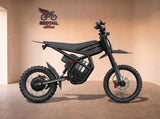
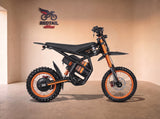
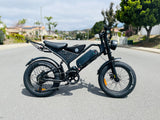
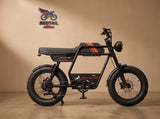
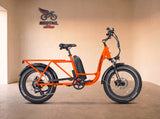


$999 · 24 V 250 W · 7.5 / 11 / 15.5 mph · 44.1 lb · 24-inch wheels · 50 mm fork · 200 lb payload · Ages 8 and above
Verified October 2, 2026 against Eunorau's specification and geometry drawing, our listing, the CPSC recall database and the statutes of all 51 US jurisdictions; fit computed from 3,853 measured US children, range from Eunorau's printed figures. Reviewed by Milad Ghobadibeygvand, BScN (Western University, 2014).
Your child rides well, is getting long in the leg for a 20-inch bike, and you want a motor for the longer rides. This Eunorau EKIDS24 review settles the four things a parent checks before the order: the height at which it fits, how fast and how far it goes, what the suspension fork adds, and what the law allows where you live.
Eunorau builds the EKIDS24 with pedals, a cadence sensor, a half-twist throttle and a 50 mm suspension fork, the only fork of its kind in the EKIDS family.
Quick answer: the EKIDS24 in a minute
Quick Answer — The Eunorau EKIDS24 is an $899, 44.1 lb pedal e-bike on 24-inch wheels with a 50 mm suspension fork, a 250 W rear hub, three speed limits and two disc brakes. In our model a 73 lb child riding the throttle at a steady 7.5 mph on level pavement goes about 34 miles.
Buy it if your child already rides confidently and stands about 4'8" or taller. Measured on Eunorau's own geometry drawing and photographs, the saddle bottoms out near 27 inches, and among 3,853 measured US children 50 of 100 at 4'8" and 94 of 100 at 4'10" sit on it with both feet flat (the fit section).
What you are buying is your child's step between a 20-inch kids' bike and an adult frame, with the speed set at the handlebar.
Obsidian and Cloud White were both in stock on October 2, 2026 at Eunorau's own $899, or four Shop Pay payments of $224.75 with no interest. Delivery to the lower 48 is free, and if a warranty claim comes up, filing it with Eunorau is our job.
Compare both colors — $899Takeaway
Eunorau prints a 3'5" to 5'5" rider window and "Ages 8 and above". The window holds 100.0% of US children at 8 on the CDC's stature chart, but only 2 of 100 measured eight-year-olds sit flat-footed at the EKIDS24's 27-inch lowest saddle, against 40 of 100 ten-year-olds and 89 of 100 twelve-year-olds (the ages table).
Eunorau's own sizing guide puts 24-inch wheels at 4'5" to 5'0", a narrower span than the EKIDS24 page prints, and closer to where the measured floor puts feet on the ground.
Eunorau's printed figures fit the e-bike definitions of 48 of 51 US jurisdictions, and eight states set an operating age that reaches a bike like this one, with New Jersey's at 15 and New York's and Pennsylvania's at 16 (the age rules).
Eunorau's specification banner reads "UL CERTIFIED Yes", and no federal recall or product warning names Eunorau or the EKIDS24, read October 2, 2026.
What's on this page
Each figure links to Eunorau's product page for the EKIDS24 or to a primary source listed in the register at the bottom.
Method · Specification · Who it's for · Fit · Geometry · Speeds · Pediatric guidance · Suspension fork · Throttle and pedals · Brakes · Battery · Range · Weight · Mercer fit test · UL · Recalls · Federal law · All 51 jurisdictions · Age rules · Green and red flags · Verdict · Checklist · Buying from us · FAQ · Limitations · Bottom line · Sources
How we verified this Eunorau EKIDS24 review
On October 2, 2026 each specification figure on this page was checked against Eunorau's EKIDS24 page, both as rendered and in the storefront's product feed, and any figure that comes from arithmetic was worked again. Every statement of law links to its provision and quotes the words it turns on.
The fit figures rest on the 3,853 children in Snyder et al. (1977) and the lowest saddle on Eunorau's own geometry drawing; the age shares come from the CDC's stature chart, the miles from Martin et al.'s road-power equation (1998), and the recall answer from the CPSC's database and its warning listing.
Milad Ghobadibeygvand, BScN (Western University, 2014), writes and reviews the machines in this catalog. Send corrections to support@redtailebikes.com; each one is published on this page.
The published specification
These rows are Eunorau's, taken from the Specification and Components tables on its EKIDS24 page on October 2, 2026 and checked against the storefront feed. The feed repeats the figures but leaves the rider-height row blank and carries no age guideline or saddle row, so those three come from the page as it renders.
| Row | Eunorau publishes |
|---|---|
| Motor | 24 V 250 W rear motor |
| Battery | 24 V 10 Ah, Eunorau-designed battery casing |
| Battery type | Lithium-ion |
| Charger | US standard 2.0 A smart charger |
| Charging time | 4–5 hours |
| Range | Up to 20 miles |
| Maximum speed | 3 speed limits on the handlebar (7.5, 11, 15.5 mph) |
| Throttle | Half-twist throttle, activated after reaching 1.86 mph |
| Sensor | Cadence sensor |
| Crank | 140 mm forged aluminum alloy |
| Chainring and freewheel | 32T chainring, 16T single-speed freewheel |
| Shifter | Single speed |
| Brakes | Disc brake levers with motor cutoff switch; 160 mm rotors, front and rear |
| Frame | Aluminum alloy 6061 |
| Fork | 50 mm travel suspension fork |
| Tires | 24 × 1.95", front and rear integral wheel |
| Saddle | Height to ground 15.0"–30.7" |
| Display | No display equipped |
| Light | Wheel reflector |
| Standoff | Included |
| Weight | 44.1 lb |
| Total payload capacity | 200 lb |
| Recommended rider heights | 3'5" ~ 5'5" |
| Age guideline | Ages 8 and above |
| Box dimensions | 54.33 L × 9.45 W × 25.98 H in |
| Accessory box | Tool kit, repainting solution, pedals, warranty card and charger |
| UL certified | Yes |
| Colorways | Cloud White · Obsidian |
| Price | $999 |

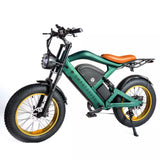
Eunorau's drive-side photograph of the Cloud White EKIDS24: a black chain guard over the chainring, five-spoke cast wheels on block-knob tires, the suspension fork's silver stanchions and the battery casing below the down tube.
Who the EKIDS24 is for
Of Eunorau's three EKIDS sizes the EKIDS24 is the largest and the only one with suspension. The EKIDS16 has no pedals and teaches balance; the EKIDS20 adds a crank and chain on 20-inch wheels; the EKIDS24 keeps that drivetrain and adds 24-inch wheels, a 50 mm fork and a window to 5'5".
Your child rides it as a bicycle first. The cadence sensor watches the cranks, the half-twist throttle adds the hub's push once the bike moves, and a selector on the bars caps the top speed at 7.5, 11 or 15.5 mph.
It suits your child if they already handle a pedal bike well and stand about 4'8" or taller, where both feet reach the ground from the lowest saddle. If your child reaches the pedals but not yet the ground, the EKIDS20, with its saddle from 22.4 inches, is the size below.

The non-drive side of the Cloud White bike: discs front and rear, the kickstand folded down, and the black saddle on its post above the seat clamp.
This opens checkout with Obsidian chosen; Cloud White checks out the same way at the same $899.
Buy in Obsidian — $899Will the EKIDS24 fit your child?
Eunorau's EKIDS24 page sizes it for riders 3'5" to 5'5"; measured on its own geometry drawing and photographs, the saddle bottoms out at about 27 inches off the ground, and among 3,853 measured US children, 50 of 100 at 4'8" and 94 of 100 at 4'10" reach the ground with both feet flat from there.
Two numbers decide whether a pedal bike fits your child. Seated at a stop, both of your child's feet should find the ground; pedaling, the leg should come close to straight with the pedal at its lowest point. Raising the saddle helps the second and hurts the first, so both are worked out here, inch of height by inch of height, on children who were actually measured.
Those children are the 3,853 in Snyder et al., 1977, a body-dimension survey of US children made for the Consumer Product Safety Commission, with its raw records released by UMTRI. The 2,951 between 3'5" and 5'5" ranged from 4.8 to 16.5 years old (5th to 95th percentile), with a median of 10.4.
Find your child's row in three steps:
- Measure the inseam with your child in socks, heels to a wall, a hardback book drawn up firmly between the legs; floor to the top of the book is the inseam.
- Find their height in the tables and hold the inseam against that row's typical range: toward the top of the range means more leg than the median child, toward the bottom less.
- Confirm it on the bike in shoes, on flat ground (the setup steps): feet at a stop, and the knee with a pedal at the bottom.
How low does the EKIDS24's saddle go?
About 27 inches above the ground, read from Eunorau's geometry drawing and its two side photographs, where the components table prints 15.0 inches.
Eunorau's components rows give the saddle as "height to ground 15.0” - 30.7”". The geometry drawing on the same page prints row A, a 342 mm seat tube drawn from the crank axle to the seat clamp, and row E, a 285 mm bracket height.
The seat post rides inside that tube, and on both of Eunorau's side photographs its axis leans at 68.9 degrees from level, measured by fitting a line to the post's edges. That puts the top of the seat tube 285 mm plus 342 mm × sin 68.9°, about 604 mm or 23.8 inches, above the ground (the drawing).
A saddle cannot go below the clamp it is held in. With the post pushed fully down, its head and the saddle stand about 3.1 to 3.4 inches above the clamp on the photographs, so the lowest setting sits at about 27 inches: 26.7 to 27.8 across the drawing and the Cloud White photograph, which reproduces Eunorau's printed wheelbase, length, tire size and bracket height to within 2.0%.
The tables below set the lowest saddle at 27 inches, because if your child reaches the ground or the pedals at 27 inches, they also reach them at any lower setting the bike may turn out to have. If your child's fit turns on the 15.0-inch figure, email us their inseam and we will put the question to Eunorau before your order ships.
How high should the saddle sit for pedaling?
Hamley's formula sets the saddle at 109% of the inseam above the pedal at its lowest point, and in a study whose short-inseam riders were all children it fit short inseams better than the 88.5% method, with the knee 30 to 40 degrees from straight at the bottom of the stroke as the test (Millour et al., 2021).
Measured from the crank axle, with the EKIDS24's 140 mm cranks, the formula's saddle climbs from 13.9 inches for the median child at 3'5" to 28.4 inches at 5'5".
| Your height | Typical inseam | Crank axle to saddle top | At 106% | At 110.4% |
|---|---|---|---|---|
| 3'5" | 16.9–19.3 in | 13.9 in | 13.4 in | 14.2 in |
| 3'6" | 17.8–19.5 in | 14.6 in | 14.1 in | 14.9 in |
| 3'7" | 18.1–20.4 in | 15.3 in | 14.7 in | 15.5 in |
| 3'8" | 18.8–20.5 in | 15.9 in | 15.3 in | 16.2 in |
| 3'9" | 19.4–21.2 in | 16.4 in | 15.8 in | 16.7 in |
| 3'10" | 19.9–21.8 in | 17.0 in | 16.4 in | 17.3 in |
| 3'11" | 20.6–22.5 in | 17.8 in | 17.1 in | 18.1 in |
| 4'0" | 20.9–23.1 in | 18.5 in | 17.8 in | 18.8 in |
| 4'1" | 21.4–23.4 in | 19.0 in | 18.3 in | 19.3 in |
| 4'2" | 22.3–24.3 in | 19.8 in | 19.1 in | 20.1 in |
| 4'3" | 22.8–25.1 in | 20.4 in | 19.7 in | 20.8 in |
| 4'4" | 23.5–25.9 in | 21.3 in | 20.5 in | 21.6 in |
| 4'5" | 23.9–26.1 in | 21.9 in | 21.1 in | 22.2 in |
| 4'6" | 24.8–26.8 in | 22.6 in | 21.8 in | 22.9 in |
| 4'7" | 25.3–27.4 in | 23.1 in | 22.4 in | 23.5 in |
| 4'8" | 25.8–28.4 in | 24.0 in | 23.1 in | 24.3 in |
| 4'9" | 26.5–28.8 in | 24.3 in | 23.5 in | 24.7 in |
| 4'10" | 26.8–29.4 in | 25.1 in | 24.3 in | 25.5 in |
| 4'11" | 27.2–30.2 in | 25.5 in | 24.7 in | 25.9 in |
| 5'0" | 27.6–30.4 in | 26.3 in | 25.4 in | 26.7 in |
| 5'1" | 27.9–31.0 in | 26.6 in | 25.7 in | 27.0 in |
| 5'2" | 28.5–31.1 in | 26.9 in | 26.0 in | 27.3 in |
| 5'3" | 28.6–32.2 in | 27.5 in | 26.6 in | 27.9 in |
| 5'4" | 29.4–32.6 in | 27.9 in | 26.9 in | 28.3 in |
| 5'5" | 29.8–33.2 in | 28.4 in | 27.5 in | 28.9 in |
For the median child of each height: the crank-axle-to-saddle-top distance along the seat that Hamley's formula sets, and the two ends of the 106% to 110.4% band around it (Peveler et al., 2005; Ferrer-Roca et al., 2012). The children are Snyder et al.'s (1977), with inseams estimated from leg length (the formula section), on Eunorau's 140 mm crank.
Over the 285 mm (11.2 in) bracket, the 27-inch floor leaves the saddle top 15.8 inches above the crank axle, straight up, and Eunorau's printed 30.7-inch top leaves it 19.5 inches.
Along the leaning seat tube, the distance your child's leg needs is longer than that straight rise, by a margin set by the angle. The pedaling verdicts here use only what holds at every angle, so no verdict rests on the angle measured from a photograph (Limitations):
| Your height | Typical inseam | Lowest saddle surely too high, of 100 | Top saddle surely high enough, of 100 |
|---|---|---|---|
| 3'5" | 16.9–19.3 in | 97 | 100 |
| 3'6" | 17.8–19.5 in | 95 | 100 |
| 3'7" | 18.1–20.4 in | 77 | 100 |
| 3'8" | 18.8–20.5 in | 42 | 100 |
| 3'9" | 19.4–21.2 in | 10 | 100 |
| 3'10" | 19.9–21.8 in | 1 | 100 |
| 3'11" | 20.6–22.5 in | 0 | 98 |
| 4'0" | 20.9–23.1 in | 0 | 90 |
| 4'1" | 21.4–23.4 in | 0 | 79 |
| 4'2" | 22.3–24.3 in | 0 | 28 |
| 4'3" | 22.8–25.1 in | 0 | 7 |
| 4'4" | 23.5–25.9 in | 0 | 0 |
| 4'5" | 23.9–26.1 in | 0 | 0 |
| 4'6" | 24.8–26.8 in | 0 | 0 |
| 4'7" | 25.3–27.4 in | 0 | 0 |
| 4'8" | 25.8–28.4 in | 0 | 0 |
| 4'9" | 26.5–28.8 in | 0 | 0 |
| 4'10" | 26.8–29.4 in | 0 | 0 |
| 4'11" | 27.2–30.2 in | 0 | 0 |
| 5'0" | 27.6–30.4 in | 0 | 0 |
| 5'1" | 27.9–31.0 in | 0 | 0 |
| 5'2" | 28.5–31.1 in | 0 | 0 |
| 5'3" | 28.6–32.2 in | 0 | 0 |
| 5'4" | 29.4–32.6 in | 0 | 0 |
| 5'5" | 29.8–33.2 in | 0 | 0 |
"Surely too high": the formula's distance for that child is shorter than the lowest setting's straight rise, which no seat angle can shorten. "Surely high enough": the formula's distance is within the top setting's straight rise, which every seat angle reaches. Whatever else a row holds depends on the angle. Snyder et al.'s (1977) children; the lowest saddle as measured on Eunorau's drawing, the top and the bracket as Eunorau prints them.
Reading the two columns: at the 27-inch floor, the saddle sits above the formula's height for 97 of 100 children at 3'5", 42 at 3'8", 10 at 3'9" and 1 at 3'10", at any seat angle; from 3'11" no child in the survey is in that position.
If your child is under 3'8", the bound puts even the lowest setting above the formula's height for most children that height, and the EKIDS20, whose saddle starts at 22.4 inches, is the size built for that leg.
Where the column turns fastest, the inseam estimate matters: with either Army survey's offset in place of the midpoint, the share at 3'8" runs from 25 to 60 of 100.
At the other end, Eunorau's 30.7-inch top covers the formula's height for every child up to 3'10", 90 of 100 at 4'0", 28 at 4'2" and 7 at 4'3".
From 4'4" the median child's formula distance, 21.3 inches, passes the top setting's 19.5-inch straight rise, so the printed figures alone cannot show the top reaches it, and your knee check at the bike gives the answer (the setup steps).
In the same study, children choosing for themselves set the saddle too low, so judge by the knee rather than by how comfortable a low seat feels.
Which ages fit the window?
Beside its 3'5" to 5'5" window Eunorau prints "Ages 8 and above". On the CDC's 2000 stature-for-age chart, through the chart's own LMS transform, 100.0% of US boys and of US girls fall inside that window at every age from 7 to 10, and 99.8% of both at 11.
The window's ceiling arrives later than on the 20-inch bike: on the same chart 98.0% of boys and 97.0% of girls are inside at 12, 86.4% and 87.1% at 13, and 54.8% and 75.9% at 14. Below Eunorau's age guideline the window already holds 98.8% of boys and 98.7% of girls at 6.
A height inside the window does not yet mean your child's feet reach the ground at the lowest saddle. The same children, read against the 27-inch floor, by age, so you can find your child's year:
| Age | Children measured | Inside 3'5" to 5'5", of 100 | Both feet flat at 27 in, of 100 |
|---|---|---|---|
| 6 | 219 | 100 | 0 |
| 7 | 223 | 100 | 0 |
| 8 | 214 | 100 | 2 |
| 9 | 271 | 100 | 13 |
| 10 | 252 | 100 | 40 |
| 11 | 279 | 99 | 65 |
| 12 | 307 | 97 | 89 |
| 13 | 288 | 86 | 97 |
| 14 | 269 | 70 | 99 |
Children of each whole year of age in Snyder et al., 1977, girls and boys together, inseams estimated from leg length at the calibration midpoint. The calibration's two ends put the flat-foot share at 30 and 48 of 100 at 10, and at 56 and 73 at 11.
At Eunorau's starting age of 8, then, 2 of 100 measured children sit with both feet flat at the lowest setting; at 10 it is 40 of 100, and at 12, 89.
Can your child put both feet down?
At a stop, the reach this page works out is from the saddle to the ground, with the saddle at its 27-inch floor.
| Your height | Typical inseam | Inseam minus the 27.0 in seat, median rider | Riders flat-footed astride it, of 100 |
|---|---|---|---|
| 3'5" | 16.9–19.3 in | −9.2 in | 0 |
| 3'6" | 17.8–19.5 in | −8.5 in | 0 |
| 3'7" | 18.1–20.4 in | −7.9 in | 0 |
| 3'8" | 18.8–20.5 in | −7.4 in | 0 |
| 3'9" | 19.4–21.2 in | −6.9 in | 0 |
| 3'10" | 19.9–21.8 in | −6.3 in | 0 |
| 3'11" | 20.6–22.5 in | −5.6 in | 0 |
| 4'0" | 20.9–23.1 in | −5.0 in | 0 |
| 4'1" | 21.4–23.4 in | −4.5 in | 0 |
| 4'2" | 22.3–24.3 in | −3.8 in | 0 |
| 4'3" | 22.8–25.1 in | −3.2 in | 0 |
| 4'4" | 23.5–25.9 in | −2.4 in | 0 |
| 4'5" | 23.9–26.1 in | −1.9 in | 0 |
| 4'6" | 24.8–26.8 in | −1.2 in | 3 |
| 4'7" | 25.3–27.4 in | −0.7 in | 14 |
| 4'8" | 25.8–28.4 in | 0.0 in | 50 |
| 4'9" | 26.5–28.8 in | 0.3 in | 78 |
| 4'10" | 26.8–29.4 in | 1.1 in | 94 |
| 4'11" | 27.2–30.2 in | 1.5 in | 96 |
| 5'0" | 27.6–30.4 in | 2.2 in | 98 |
| 5'1" | 27.9–31.0 in | 2.5 in | 100 |
| 5'2" | 28.5–31.1 in | 2.7 in | 100 |
| 5'3" | 28.6–32.2 in | 3.3 in | 100 |
| 5'4" | 29.4–32.6 in | 3.6 in | 100 |
| 5'5" | 29.8–33.2 in | 4.1 in | 100 |
At each height, the median child's barefoot inseam less the 27-inch lowest saddle, and how many of 100 children of that height have at least that much inseam. Snyder et al.'s (1977) children, inseams estimated from leg length; the range in each row runs from the 5th to the 95th percentile at that height. The saddle is the lowest setting measured on Eunorau's drawing, unloaded.
With both feet flat on the lowest setting: 3 of 100 children at 4'6", 14 at 4'7", 50 at 4'8", 78 at 4'9", 94 at 4'10", and every child from 5'1". If your child is shorter, they stop on tiptoe or by leaning the bike to one side.
The inseam estimate moves this column most at 4'8" and 4'9": with either Army survey's offset in place of the midpoint, 4'8" runs from 33 to 68 of 100, and 4'9" from 53 to 87.
How far is the reach to the bars?
Eunorau's drawing prints the frame's reach, 350 mm (13.8 in), and stack, 499 mm (19.6 in), both measured from the crank axle to the top of the head tube; the stretch from saddle to grips also needs the saddle's position behind that axle, so the lean is not computed for the EKIDS24 (Limitations).
Seat your child with hands on the grips and elbows soft, and watch their arms. Straight, locked arms say the bars are still a reach; elbows meeting the knees say the frame is being outgrown.
How much of your child's weight sits on the bars?
That share depends on the same saddle position, so it is not computed for this bike. For scale, and no more, so you can picture it: road racers on the brake hoods put about 15% of their body weight through the stem in Carahalios, 2015, a far longer, lower position than a child upright on a 24-inch bike.
Most of the body's weight is head and trunk, by Clauser et al., 1969, and an upright rider carries that on the saddle. On your child's longer rides, padded gloves help: they cut pressure over the ulnar nerve in the palm by 10 to 28% across 36 experienced cyclists (Slane et al., 2011).
Setting it up before the first ride
Drop the saddle all the way, put your child on the EKIDS24 in shoes on level ground, and check two things: the feet when the bike is stopped, and a slight bend still left in the knee with a pedal at the bottom.
If your child can stand astride the frame in front of the saddle with both feet flat, they can stop by sliding forward off the saddle; check that with them at the bike before the first ride. If your child reaches the ground from the saddle only on tiptoe, as most children under about 4'8" do, have them practice starting and stopping at walking pace with the motor off.
As your child grows, raise the saddle in small steps and look at the knee each time; once the knee stays well bent at the bottom of the stroke with the saddle at its top mark, your child has reached the end of the EKIDS24's range.
Eunorau lists a "Half-twist throttle, activated after reaching 1.86 MPH", so your child pedals the first yards of every ride; begin at the 7.5 mph setting.
How the fit figures are computed
For the feet, each child's estimated barefoot inseam minus the 27-inch lowest saddle; for pedaling, 109% of that inseam minus the 140 mm crank, which is the saddle's distance above the crank axle along the seat.
The median 4'10" child in the survey has a 28.1-inch inseam: 1.1 inches more than the 27-inch saddle, so both feet go flat. To pedal, 109% of 28.1 is 30.6 inches from pedal to saddle top, and taking off the 5.5-inch crank leaves 25.1 inches above the crank axle, past the top setting's 19.5-inch straight rise.
The survey recorded standing and sitting height, not the crotch height that fit tables call the inseam and that you measure at the wall.
Each child's inseam is therefore the leg length, standing less sitting height, plus an offset that two Army surveys measured on the same soldiers: −5.5 mm across 3,982 soldiers in ANSUR 1988 and +8.8 mm across 6,068 in ANSUR II. The tables take the midpoint; the text gives both ends wherever a share moves.
The children were also checked against themselves: for 1,231 of them the survey has gluteal furrow height, which ANSUR 1988 links to crotch height by +25.1 mm on average, and that route sits 7.2 mm above the first, next to the ANSUR II end.
| Input | Value | Source |
|---|---|---|
| Saddle height, as printed | 15.0 to 30.7 in to the ground | the components rows on Eunorau's EKIDS24 page |
| Lowest saddle used | 27.0 in to the ground (26.7 to 27.8 measured) | seat tube and bracket rows on Eunorau's drawing, the post angle and the stack above the clamp measured on its photographs |
| Top saddle used | 30.7 in to the ground | the same components rows |
| Crank | 140 mm (5.5 in) | the same rows, "Crank: 140mm forged aluminum alloy" |
| Bracket height | 285 mm (11.2 in) | row E of Eunorau's geometry drawing |
| Seat tube | 342 mm (13.5 in), crank axle to clamp | row A of the same drawing |
| Seat post angle | 68.9°, measured | a line fitted to the post's edges on two of Eunorau's photographs; used for the floor only |
| Rider window | 3'5" to 5'5" | Eunorau's EKIDS24 page |
| Bodies | 3,853 US children with standing and sitting height, measured 1975 to 1977 | Snyder et al., 1977 |
| Leg length to inseam | +1.7 mm (midpoint of −5.5 and +8.8 mm) | ANSUR 1988 and ANSUR II |
| Saddle formula | 109% of inseam, pedal to saddle top | Peveler et al., 2005; compared on children's short inseams in Millour et al., 2021 |
No figure past the saddle is computed: no lean to the bars and no load on the hands (Limitations).
4'10" or taller? 94 of 100 children that height sit with both feet flat at the 27-inch lowest setting. This orders the EKIDS24 in Obsidian at $999; Cloud White is $999 too. Under 4'8"? The EKIDS20 review covers the next size down, with its saddle from 22.4 inches.
Get the EKIDS24 in ObsidianThe geometry Eunorau publishes
Among its product images, Eunorau prints the EKIDS24's geometry as a dimensioned side view. Its rows, as printed:
| Ref | Dimension | Metric | Imperial |
|---|---|---|---|
| A | Seat tube | 342 mm | 13.5 in |
| B | Reach | 350 mm | 13.8 in |
| C | Head tube | 110 mm | 4.3 in |
| D | Chainstay | 417 mm | 16.4 in |
| E | Bracket height | 285 mm | 11.2 in |
| F | Wheelbase | 991 mm | 39 in |
| G | Top tube | 517 mm | 20.4 in |
| H | Stack | 499 mm | 19.6 in |
| I | Total length | 1601 mm | 63 in |
| J | Weight | 20 kg | 44.1 lb |

Eunorau's geometry drawing. Rows A and E, the seat tube from the crank axle to the clamp and the bracket height, set the lowest saddle in the fit section.
For your garage and car the length matters most: the EKIDS24 is 63 inches long, a little over five feet, so check the cargo floor before the first outing; the carton Eunorau ships it in is 54.33 × 9.45 × 25.98 inches.
63 inches long and 44.1 pounds, in Obsidian here or Cloud White.
Buy the 44.1 lb EKIDS24 — $899Three speed limits on the bars: 7.5, 11 and 15.5 mph
Eunorau's specification gives the top speed as "3 speed limits on the handlebar ( 7.5, 11, 15.5 MPH )", and its description says "The gear selector provides riders with 3 speed options". Settle the limit with your child before you set off, since the selector sits within their reach.
At 7.5 mph your child covers a mile in eight minutes, the pace of the row "Running, 7.5 mph (8 min/mile)" in the Compendium of Physical Activities; a parent on foot has to run to stay level.
At 11 mph it is five and a half minutes a mile, the Compendium's "Running, 11 mph (5.5 min/mile)"; at this setting the parent is on a bike too.
At 15.5 mph your child is faster than any runner the Compendium lists, its quickest row being "Running, 14 mph (4.3 min/mile)". Save the top limit for open, familiar ground with nobody on foot nearby.

The Cloud White EKIDS24 from the front on the drive side: the fork's stanchions above the black lowers, the front disc, the kickstand and the chain guard.
The pediatric line on age and speed
Two children's-health publishers draw a speed line for parents, and both credit it to the Consumer Product Safety Commission.
On the American Academy of Pediatrics' family site, a page by Phyllis Agran, MD, FAAP, updated August 21, 2026, reads: "The Consumer Product Safety Commission recommends that children age 9 through 12 years should not operate any product that travels faster than 10 mph. That means no e-bikes under 12 years." For older children it adds: "If your child is 12-15 years old and you determine that they are ready, only choose a Class 1 bike."
Nemours KidsHealth, in a page medically reviewed by Michael J. Stoner, MD, in July 2025, words it this way: "the CPSC says that e-bikes are not recommended for kids younger than age 9. For kids ages 9 to 12, they should not operate anything that travels faster than 10 mph, as higher speeds are linked to injuries."
Read against the EKIDS24, that line meets Eunorau's age guideline of 8 and above and its three limits: the 7.5 mph setting sits below 10 mph, and the 11 and 15.5 mph settings above it.
The choice of age and setting stays with you, and the AAP's page sends the legal side of it to "the vehicle code in your state and regulations in your community", which the age table further down sets out state by state.
The 50 mm suspension fork
Eunorau lists the fork as "50mm travel Suspension Fork", the only suspension in the EKIDS line: the EKIDS20's fork is printed as "Integrated die-cast aluminum alloy". In its own words, the EKIDS24 offers "smooth and comfortable rides with its 50mm suspension fork", and "Whether cruising through the park or tackling rougher paths, the suspension absorbs bumps".
The 50 mm is how far the front wheel can move up into the fork, and the ground to ride it on is the ground Eunorau names: your park, and "rougher paths".

The fork on the Cloud White bike: silver stanchions sliding into black lowers below the crown, the front disc rotor at the hub, and the coiled cable guard running down from the bars.
Pedals first, throttle from 1.86 mph
The Components table on Eunorau's page reads "Half-twist throttle, activated after reaching 1.86 MPH", and the description puts the same rule in metric: "The throttle activates once the speed reaches 3km/h, ensuring a safe and gradual acceleration."
In practice the throttle gives your child nothing at a standstill: your child pedals or scoots the bike into motion, and the hub joins in only once it rolls. Turning the grip while waiting at a curb leaves the bike where it is.
The pedals drive a single gear: 140 mm cranks on a 32-tooth chainring to a 16-tooth freewheel, with a cadence sensor reading whether the cranks turn. What that pedaling is worth in battery is in the range section's pedaling table.

The Obsidian bike's drivetrain: the rear hub motor with the chain on its 16-tooth freewheel, the black chain guard over the chainring, and the 140 mm crank with an amber reflector on the pedal.
Pedals first, power from 1.86 mph, three limits on the bars and a fork for the bumps. Obsidian by default; Cloud White is the same price.
Buy with a 50 mm fork — $899Front and rear discs, each lever with a motor cutoff
Eunorau describes "a front and rear dual-disc 160mm brake system", and its Components rows list "160mm disc brake rotors" and "Disc brakes levers with motor cutoff switch". So each wheel carries a disc, and each lever carries the cutoff switch that the row names.
Before the first ride, have your child reach each lever with their fingers and squeeze it to a firm stop while you walk the bike alongside. A child who cannot yet put both feet down from the saddle (under about 4'8", the height table) needs those stops practiced at walking pace first.

Eunorau's rear three-quarter photograph from the brake side: the rear disc and caliper beside the hub, the kickstand, the battery casing under the down tube, and the fork at the front.
The 240 Wh pack and its 2.0 A charger
The battery is 24 V at 10 Ah, 240 watt-hours, held in what Eunorau calls a "EUNORAU-designed battery casing" below the down tube; its description says the pack is "housed in a patented, custom-designed casing for extra durability and style".
The charger Eunorau lists is a "US standard 2.0 A smart charger", and the stated charging time is 4–5 hours. The arithmetic matches: 10 Ah at 2.0 A takes five hours to fill from empty, so an evening plug-in is ready by morning.
With no display on the bike, the charge shows on a battery indicator Eunorau fits "for clear visibility", so your child can read it without help.

The Obsidian colorway: the same frame, fork and wheels, the same $999.
EKIDS24 range: the miles in a 240 Wh pack
Held at the 7.5 mph setting on the throttle over level pavement, a 73 lb child rides about 34 miles on one charge of the EKIDS24's 24V 10Ah pack in our model, at 7.1 Wh a mile; at the 15.5 mph top setting the charge lasts about 16 miles.
Eunorau's own figure is "Up to 20 Miles", which the model reaches at a steady 13.5 mph on the flat (the ride behind the 20 miles).
Every row but the weight table carries a 73 lb child, the middle weight of the 2,949 weighed children 3'5" to 5'5" tall in Snyder et al., 1977, 72.8 lb rounded, the same survey the fit tables read. If your child is lighter or heavier, the weight table has your row.
A row is one pace held without a stop on smooth pavement and in still air. Your child's real rides brake, turn and cross grass, which all cost energy, so treat each figure as the ceiling for that pace.
The starting point is Eunorau's EKIDS24 rows: a "24V 250W rear motor", a "24V 10Ah" battery, 44.1 lb of bike and "24*1.95"" tires. The formula section lists every other input beside its source.
Find your child's ride in three steps:
- Pick the setting in the speed table, 7.5, 11 or 15.5 mph on the handlebar selector, with 13 mph added as a pace on the top setting.
- Adjust for the ground and the load: the hill rows climb from 2% to 8%, the weight rows run from a 38 lb child to the 200 lb payload Eunorau prints, and the pedaling table gives back what the legs supply.
- Keep 15% in hand for getting home, and expect less than the row on grass or gravel.
How far does each speed setting go?
About 34 miles at 7.5 mph, 25 at 11, 21 at 13 and 16 at 15.5: the air's share of the work climbs with the cube of the speed, while the tires' share rises in step with it (Martin et al., 1998).
| Speed, flat | Per mile | Full charge | With 15% kept |
|---|---|---|---|
| 7.5 mph | 7.1 Wh | 34 mi | 29 mi |
| 11 mph | 9.6 Wh | 25 mi | 21 mi |
| 13 mph | 11.5 Wh | 21 mi | 18 mi |
| 15.5 mph | 14.7 Wh | 16 mi | 14 mi |
Throttle only with the feet still, a 73 lb child, flat pavement, calm air at 77 °F and a fully charged 24V 10Ah pack. The right-hand column keeps 15% in the battery, the top of the "10-15%" Eunorau's FAQ gives for recharging. Nothing runs past 15.5 mph, the highest limit Eunorau sets.
What the hub does, and what the pedals save
One gear drives the EKIDS24, a 32-tooth chainring to a 16-tooth freewheel, and the rear hub can carry any of its paces by itself; the model's hub delivers 70% of what it draws to the wheel at 7.5 mph and 81% at 15.5 mph. Eunorau's components rows name a "24V 250W rear motor", a cadence sensor and a half-twist throttle.
| Speed, flat | Motor efficiency | Power at the rear wheel | Per mile |
|---|---|---|---|
| 7.5 mph | 70% | 36 W | 7.1 Wh |
| 11 mph | 76% | 77 W | 9.6 Wh |
| 13 mph | 79% | 113 W | 11.5 Wh |
| 15.5 mph | 81% | 172 W | 14.7 Wh |
The modeled hub on its own on flat ground, with a 73 lb child. Motor efficiency divides the power at the rear wheel by the power the hub takes from the battery; the per-mile column adds the battery's internal losses.
Your child's pedaling takes work off the hub. The table below runs a what-if of 25 W at the cranks, held steady; nothing cited here measured how long a child sustains a given wattage. As a yardstick and no more, the PANIC study recorded a maximal ergometer workload averaging 3.8 W per kilogram of fat-free mass for boys and 3.6 W for girls among 410 Finnish children aged 6 to 8.
| Your child's ride | Pedal turns a minute | Throttle only | With 25 W from the legs |
|---|---|---|---|
| 7.5 mph, flat | 53 | 7.1 Wh | 3.2 Wh |
| 11 mph, flat | 77 | 9.6 Wh | 6.9 Wh |
| 7.5 mph, 4% grade | 53 | 20.5 Wh | 15.4 Wh |
| 11 mph, 4% grade | 77 | 23.0 Wh | 19.4 Wh |
25 W at the cranks through a chain that Martin et al., 1998 measured at 97.7% efficiency; the hub makes up the rest. The cadence column comes from 32/16 gearing on a 607 mm wheel. A 73 lb child, a charged battery, calm air.
On the flat at 7.5 mph, those 25 W bring the hub's cost down from 7.1 to 3.2 Wh a mile. At 15.5 mph your child would have to spin the cranks about 109 times a minute, above the 90 to 100 that riders settled on for themselves in Marsh and Martin, 1997, so at the top limit the hub carries the load.
What does a climb cost, and how fast does the EKIDS24 go up it?
At 10 mph on a paved climb, every 1,000 feet of height costs about 63 Wh beyond flat riding on a 4% grade and about 74 Wh on an 8% grade. 44 Wh of it is the bare work of raising child and bike, 117.1 lb between them, by 1,000 feet; the rest goes as heat in the hub and the battery.
| Grade | Per mile, throttle | Full charge, throttle |
|---|---|---|
| 2% | 15 Wh | 16 mi |
| 4% | 22 Wh | 11 mi |
| 6% | 30 Wh | 8 mi |
| 8% | 40 Wh | 6 mi |
A 73 lb child on the throttle at 10 mph up each paved grade, a charged battery, calm air. From 10% up, the modeled 250 W hub cannot keep 10 mph with this child, so the table stops at 8%; the next table gives the pace it can hold.
The fastest steady pace the model manages up each grade, so you can find your child's weight:
| Grade | 38 lb aboard | 73 lb aboard | 126 lb aboard |
|---|---|---|---|
| 4% | 14.8 mph | 13.5 mph | 11.3 mph |
| 6% | 13.7 mph | 11.6 mph | 9.1 mph |
| 8% | 12.3 mph | 10.0 mph | 7.5 mph |
| 10% | 11.1 mph | 8.7 mph | 6.3 mph |
| 12% | 10.0 mph | 7.6 mph | not on the throttle alone |
Throttle only, calm air, the 44.1 lb bike plus each child, the hub kept within its 250 W rating and the comparable hub's 28 N·m at the wheel (the formula section). 38, 73 and 126 lb mark the 5th percentile, the median and the 95th percentile of the window's children by weight. No row passes 15.5 mph, the highest limit.
In the model a 73 lb child keeps 10.0 mph up an 8% grade and 7.6 mph up a 12% grade. On smooth pavement those are the best case your child will see.
Does a heavier child get fewer miles?
On the flat, a few miles; on a climb, most of them: at 7.5 mph a 38 lb child rides about 40 miles and a 200 lb load about 21, while at 10 mph up an 8% grade a 38 lb child gets about 9 miles and a 126 lb child cannot keep the pace.
| You plus your load | 7.5 mph flat, throttle | 11 mph flat, throttle | 8% climb, 10 mph |
|---|---|---|---|
| 38 lb | 40 mi | 28 mi | 9 mi |
| 73 lb | 34 mi | 25 mi | 6 mi |
| 126 lb | 27 mi | 21 mi | past the model's motor |
| 200 lb | 21 mi | 17 mi | past the model's motor |
Child plus anything carried, on the 44.1 lb bike, with a charged battery and calm air. The 200 lb row is Eunorau's "Total Payload Capacity"; 38, 73 and 126 lb mark the 5th percentile, the median and the 95th percentile of the 2,949 weighed children in the window. "Past the model's motor" means the 250 W hub cannot hold 10 mph on that climb.
What does a cold morning cost?
At 7.5 mph the 34 miles shrink to about 27 at 32 °F and 24 at 14 °F. Against a 77 °F day, freezing air changes three things: the cells return about 89% of their energy, the air is 9% denser, and the tires roll 18% harder (Rothhämel, 2023).
| Air | Pack energy vs 77 °F | 7.5 mph flat, throttle |
|---|---|---|
| 95 °F | 99% | 35 mi |
| 77 °F | 100% | 34 mi |
| 68 °F | 98% | 32 mi |
| 50 °F | 93% | 29 mi |
| 41 °F | 91% | 28 mi |
| 32 °F | 89% (80–93) | 27 mi (24–28) |
| 14 °F | 82% (40–83) | 24 mi (12–24) |
Throttle only at 7.5 mph on the flat, a 73 lb child, a charged battery. The central figures use McMaster University's tests of the LG HG2 cell at each temperature; at 32 °F and 14 °F the brackets run between Samsung's 35E data sheet and Casado et al., 2025 (Limitations).
Eunorau's FAQ gives 10℃ to 55℃ (50 °F to 131 °F) as the batteries' best range and cautions that "Battery efficiency can be severely limited outside of these temperatures"; if your child rides on frosty mornings, read the 32 °F row.
How much do the knobby tires cost?
No lab has published a rolling-resistance figure for a 24 x 1.95 knobby that we could find, so the model uses the slowest-rolling knobby casings on Bicycle Rolling Resistance's drum; over the plausible spread, 7.5 mph gives about 33 to 39 miles. Eunorau prints "24*1.95"" and photographs a block-knob tread.
| Rolling resistance | 7.5 mph flat, throttle | 11 mph flat, throttle |
|---|---|---|
| 0.0092 · the knobby field average, 138 riders | 39 mi | 28 mi |
| 0.0126 · the heaviest knobby casings on the drum (used) | 34 mi | 25 mi |
| 0.0131 · the field average plus one standard deviation | 33 mi | 25 mi |
Throttle only on flat pavement, a 73 lb child, a charged battery. A coefficient of 0.0126 is a drag equal to 1.26% of the weight on the tires. The 0.0092 knobby average and its spread were measured in the field on 138 everyday riders by Tengattini and Bigazzi, 2018.
All three coefficients come from hard surfaces; if your child rides over lawn, sand or loose gravel, expect fewer miles than any row shows.
Where does Eunorau's 20 miles come from?
Eunorau prints "Up to 20 Miles"; the model uses the whole 240 Wh in 20 miles when a 73 lb child holds 13.5 mph on level pavement, or 11 mph up a steady 0.9% grade (Eunorau's EKIDS24 page).
Covering 20 miles on 240 Wh means 12.0 Wh a mile, a spend the hub reaches on the flat between the 11 mph setting and the 15.5 mph top.
Whichever figure you plan from, keep the same 15% reserve: the model's 34 miles at 7.5 mph become 29, and its 16 miles at 15.5 mph become 14.
Plan a long day on Eunorau's 20 miles; the 34 miles at 7.5 mph is the model's figure for a 73 lb child on smooth, flat pavement with nothing kept back. Each 1,000 feet of climbing at 10 mph adds about 63 to 74 Wh, and a 15% reserve takes the 34 miles down to 29.
About 34 model miles at 7.5 mph for a 73 lb child from a 240 Wh pack, $999 in Obsidian. Cloud White is $999 as well. Send your child's weight and the route to support@redtailebikes.com, and we will put that ride through this model for you.
Order the EKIDS24 in ObsidianHow the range figures are computed
Each row starts with the power the rear wheel must deliver to hold one pace, from the road-power equation that Martin and colleagues validated on measured riders in 1998:
Wheel power = v × [ m × g × (Crr × cos θ + sin θ) + ½ × ρ × CdA × v² ]
Here v is the speed, m the mass of child, load and bike together, g gravity, θ the slope's angle, Crr the tires' rolling-resistance coefficient, ρ the air's density and CdA the drag area.
From the wheel the model works back to the cells:
- The hub motor. It sits in the EKIDS24's rear wheel, and the model uses the published curve of Bafang's RM G383.220.D, a rear hub listed for 16 and 20 inch wheels: 335 rpm unloaded and 290 rpm at rated load at 36 V, "≥ 80" percent efficient at rated load, 28 N·m at most, rescaled to the EKIDS24's 24 V and 250 W.
- The top limit. The hub's unloaded speed is tuned so a 73 lb child just reaches Eunorau's 15.5 mph on flat pavement; it comes out at 17.1 mph. Raise the hub to 82%, above the comparable's printed minimum, and the 7.5 mph row grows to about 37 miles from 34.
- The child's pedaling. Only the pedaling table puts 25 W through the chain; the hub covers the rest.
- The battery. Some of the cells' energy turns to heat inside the pack, 3.1% at 7.5 mph, from Arango, Lopez and Ceren's tests on a 48 V pack.
- Miles. The cells' output over the speed is the watt-hours a mile; the 240 Wh, less any cold loss, over that is the distance.
| Input | Value used | Where it comes from |
|---|---|---|
| Bike | 44.1 lb | Eunorau's weight row and geometry row J |
| Child and load | 73 lb; the weight rows run 38 to 200 lb | the middle weight of children 3'5" to 5'5" in Snyder et al., 1977; the 200 lb payload in Eunorau's rows |
| Battery | 24 V × 10 Ah = 240 Wh | Eunorau's battery row |
| Motor | 250 W at 24 V, 15.5 mph highest limit, 80% at rated load, 28 N·m at the wheel | Bafang OEM workbook 2021, RM G383.220.D, set to Eunorau's figures |
| Wheel | 23.90 in across: a 24 x 1.95 at 607 mm | the size's nominal diameter, a 507 mm bead seat plus twice the 50 mm section (Sheldon Brown's tire sizing); circles fitted on Eunorau's Cloud White photograph read 600.8 and 599.9 mm |
| Gearing | 32T chainring, 16T freewheel, 140 mm cranks | Eunorau's components rows |
| Rolling resistance | 0.0126, the slowest-rolling knobby casings on the drum | Bicycle Rolling Resistance |
| Drag area | 0.640 m², adults riding upright | Tengattini and Bigazzi, 2018 |
| Chain | 97.7% efficient, the pedaling table only | Martin et al., 1998 |
| Battery losses | 3.1% at 7.5 mph, more on climbs | Arango, Lopez and Ceren, 2021 |
| Air | 77 °F at sea-level pressure, 1.184 kg/m³ | U.S. Standard Atmosphere, 1976 |
| Cold | the share of a cell's energy left at each temperature | McMaster University's LG HG2 cell data |
| Reserve | 15% kept back, the top of Eunorau's "10-15%" | Eunorau's FAQ |
One ride worked through: a 73 lb child holding 7.5 mph on flat pavement on the throttle. The rear wheel needs 36.3 W, of which the tires take 22.1 W and the air 14.3 W.
Holding 7.5 mph takes 105.5 turns a minute from the 23.90-inch wheel. The modeled hub (0.955 N·m per amp, 0.248 Ω, 0.99 A unloaded) produces 3.3 N·m on 4.4 A, 70% efficient at this light load.
The hub takes 51.6 W, and after the battery's own losses the cells supply 53.3 W, which is 7.1 Wh a mile (7.10 unrounded). 240 ÷ 7.10 gives 33.8 miles, or 28.7 with 15% kept back.
The checks the model passes:
| Check | Published figure | This model |
|---|---|---|
| Road physics, the worked example in Martin and colleagues | 45.7 W for the tires and the grade, 158.8 W for the air | 45.7 W and 158.8 W |
| The comparable hub's rated point | at least 80% efficient | 80% |
| Eunorau's own range figure | "Up to 20 Miles" | 34 miles at 7.5 mph; 20 miles at a steady 13.5 mph |
The first row is Appendix I of Martin and colleagues (90 kg, a 0.3% grade, 8.36 m/s); the second the RM G383.220.D's rated point in Bafang's workbook; the third sets the model next to Eunorau's one printed range figure, which is no independent measurement (Limitations).
44.1 pounds to lift, 200 pounds to carry
Eunorau gives 44.1 lb (20 kg) both in the specification and as row J of the geometry drawing. You lift that weight into a trunk, and your child rolls it up a ramp.
Across the family, the EKIDS16 weighs 28.6 lb at $799 and the EKIDS20 37.4 lb at $899, both listed on our store on October 2, 2026, which makes the EKIDS24 15.5 lb heavier than the smallest and 6.7 lb heavier than the middle size.
Eunorau's total payload capacity is 200 lb. Of the 2,949 weighed children 3'5" to 5'5" tall in the survey behind the fit tables, 1 weighed more than 200 lb, and 95 of 100 weighed under 125.9 lb.
The Mercer fit test
The verdicts below read Eunorau's published figures, the 3'5" to 5'5" window, "Ages 8 and above", the 30.7-inch printed top and the 200 lb payload, with the 27-inch lowest saddle and the measured children from the fit section, and, for a minor, the age law.
The Mercers are the standing editorial cast every machine is read against, so each family question is put the same way on every review and you can start from the row closest to yours.
| Member | Verdict on the EKIDS24 | The number behind it |
|---|---|---|
| Ivy Mercer, 12 | A good height for it, and her feet reach. | 98.0% of 12-year-old boys and 97.0% of girls are inside the window on the CDC chart, and 89 of 100 measured twelve-year-olds sit flat-footed at the 27-inch saddle. In New Jersey she may not ride an e-bike until 15, and in New York and Pennsylvania until 16. |
| Cole Mercer, 16, 5'11" | Past the window. His questions are an adult frame and his state's rules. | 71 inches, six over the 65-inch ceiling. |
| Maya Torres, 32, 5'6" | Buying for an eight-year-old: the EKIDS20 first. | 2 of 100 measured eight-year-olds sit flat-footed at the EKIDS24's 27-inch lowest saddle; at the EKIDS20's 22.4 inches, 87 of 100 do. |
| Dana Mercer, 45, 5'7" | Buying for a ten-year-old: measure the inseam against 27 inches. | 100.0% of ten-year-olds are inside the window on the CDC chart, and 40 of 100 measured ten-year-olds sit flat-footed at the lowest saddle. |
| Jack Mercer, 48, 6'1" | Buying for a six-year-old: not this size. The EKIDS16 starts at 3'0". | 0 of 100 measured six-year-olds reach the ground flat at the 27-inch lowest saddle. |
| Ruth Kowalski, 61, 5'5" | The lift is the grandparent's question. 44.1 lb is a two-handed load into a trunk. | 6.7 lb more than the EKIDS20 and 15.5 lb more than the EKIDS16. |
| Frank Kowalski, 63, 5'10" | Bring a bike to the park. | At 11 mph the Compendium's matching row is a 5.5-minute running mile. |
Maya's and Dana's rows show where the decision turns. Eunorau's age guideline admits an eight-year-old, but the saddle's floor decides it: in the ages table both feet reach for 40 of 100 children at 10 and 89 of 100 at 12, so measure the inseam before the birthday counts.
Choose the color here: Obsidian on this button, or Cloud White.
Buy for riders from about 4′8″Is it UL certified?
Yes, on Eunorau's banner. The specification strip on Eunorau's EKIDS24 page shows the row "UL CERTIFIED Yes" with its own icon.
Eunorau's company post of March 5, 2023 states: "We are UL 2849 tested and UL 2271 tested", naming the standard for an e-bike's electrical system and the standard for its battery, and calling both certifications voluntary.
If a school, a building manager or an insurer asks for the certificate itself, let us know before you order; we will request the document from Eunorau and send on whatever it provides.
Has it been recalled?
No. Read on October 2, 2026, the federal record holds no recall naming Eunorau or the EKIDS24 you would be buying.
Searched as recall titles in the CPSC's database, eight e-bike terms (electric bicycle, electric bike, e-bike, ebike, their plurals, pedal assist and electric scooter) return 51 distinct federal recalls between them, and no title among the 51 names the brand or this model.
Because a recall titled by brand alone would escape those terms, the same database was queried with "Eunorau" and with "EKIDS" as title terms, which match anywhere in a title and so would catch "EKIDS24"; both returned nothing, as did "Eunorau" in the description and product-name fields.
Then every one of the 373 rows in the CPSC's product safety warning listing was read for "Eunorau", "EKIDS24", "EKIDS 24", "EKIDS-24" and "EKIDS", with no match.
As of October 2, 2026, no federal recall or product warning names Eunorau or the EKIDS24 under any of those searches.
No federal recall or warning names it, as of October 2, 2026. Obsidian is one tap away.
Buy in Cloud White — $899Where federal law puts the EKIDS24
On Eunorau's printed figures, the EKIDS24 is a federal low-speed electric bicycle. 15 U.S.C. § 2085(b) defines that as "a two- or three-wheeled vehicle with fully operable pedals and an electric motor of less than 750 watts (1 h.p.), whose maximum speed on a paved level surface, when powered solely by such a motor while ridden by an operator who weighs 170 pounds, is less than 20 mph."
Eunorau prints an answer to each part: 140 mm cranks on a 32-tooth chainring for the pedals, 250 W for the motor and 15.5 mph for the top limit. Those same words appear in the CPSC's bicycle regulation at § 1512.2(a)(2), which brings the bike under it.
The same regulation sets a smaller category apart. Under § 1512.2(b) a "sidewalk bicycle" has a seat height "no more than 635 mm (25.0 in)", "measured with the seat adjusted to its highest position". The EKIDS24's printed top is 30.7 inches, well over that line, so Part 1512 does not treat it as a sidewalk bicycle.
A second federal frame applies because the bike is made and sold for children. 15 U.S.C. § 2052(a)(2) calls a "children's product" "a consumer product designed or intended primarily for children 12 years of age or younger", listing the maker's own statement of intended use as the first factor; Eunorau's box list reads "Kids eBike x 1", beside an age guideline of 8 and above.

The Obsidian EKIDS24 from the front on the drive side: the fork below the head tube, the front disc, the battery casing and the chain guard.
Inside the federal e-bike definition, and over the sidewalk-bicycle line. Pedals, a 250 W motor and a 15.5 mph limit meet every part of 15 U.S.C. § 2085(b), and a 30.7-inch printed top saddle clears the 25.0-inch sidewalk-bicycle ceiling. Where your child may ride is then up to your state and your city.
Whose e-bike definition the EKIDS24 fits: all 51, screened
On October 2, 2026 Eunorau's printed figures for the EKIDS24, 250 W, 15.5 mph, a throttle and 44.1 lb, were run against the e-bike definition in every US jurisdiction's own code. 48 of the 51 definitions take the EKIDS24 in.
Three come out differently:
New Jersey's definition covers pedal assistance and nothing else. Under P.L.2025, c.285, approved January 19, 2026 and effective at once except for one insurance section, a low-speed electric bicycle has a motor that "provides assistance only when the rider is pedaling". A throttle moves a bike out of that class and into the act's "motorized bicycle", which the act makes subject to registration and a licensed rider; for either, the age floor is 15.
Alaska has no electric bicycle definition. None appears in AS 28.90.990(a), and House Bill 8 of the 33rd Legislature, which proposed one, is recorded as vetoed on July 20, 2023.
Kentucky has none either, and another category takes the EKIDS24 in. KRS 189.010, as amended effective July 15, 2026, defines no bicycle, but its subsection (26) defines an "electric low-speed scooter":
| KRS 189.010(26): a device that | The EKIDS24, on Eunorau's figures |
|---|---|
| (a) Weighs less than one hundred (100) pounds | 44.1 lb |
| (b) Is equipped with wheels | 24 × 1.95" |
| (c) Is equipped with handlebars | yes |
| (d) Is equipped with a brake adequate enough to stop and park the device | front and rear disc brakes |
| (e) Is designed to be stood or sat upon | saddle |
| (f) Is propelled by an electric motor, human power, or both | 250 W motor and pedals |
| (g) Is designed to operate at a maximum speed of twenty (20) miles per hour | 15.5 mph |
KRS 189.289(1) continues: "A person sixteen (16) years of age or older, may operate an electric low-speed scooter on a highway, bicycle lane, or bicycle path." The section speaks to riders of 16 and up and says nothing of younger riders on those three surfaces, so a Kentucky family planning a bike-path ride should check with the city first.
Pennsylvania's definition also weighs the bike. 75 Pa.C.S. § 102 describes "A vehicle weighing not more than 100 pounds with two or three wheels more than 11 inches in diameter", and the EKIDS24's 44.1 lb and 24-inch wheels sit inside that limb as well as the power and speed limbs.
On a path posted for some classes only, compare the sign with the throttle. Arizona's code is an example: a Class 1 electric bicycle has a motor that "provides assistance only when the rider is pedaling", and a Class 2 one whose motor "may be used exclusively to propel the bicycle or tricycle". The EKIDS24 has both a cadence sensor and a half-twist throttle, so read your own state's and trail's wording.
Your state's definition comes first, then its age rule, then the sidewalk and path rules where your child rides. Email us your zip code and we will help you find the local rule.
Read your state's e-bike lawThe age rules that reach a child on the EKIDS24
On October 2, 2026, eight states' operating-age rules, each re-read at its publisher that day, reach a child on a bike like the EKIDS24. For the remaining 43 jurisdictions, read August 19, 2026 with Georgia read again on October 2, the age rule covers Class 3 bikes only or none was found; for Alaska, the District of Columbia and South Carolina we located no operating-age provision in either direction.
| State | The rule, in the statute's words | Citation |
|---|---|---|
| Hawaii | "No person under the age of sixteen shall operate a class 2 or class 3 electric bicycle unless under the direct supervision of a parent or guardian" | HRS § 291C-143.5(a), as amended by Act 259 (2026) § 12 |
| Maine | "A person under 16 years of age may not operate a Class 2 or Class 3 electric bicycle" | 29-A M.R.S. § 2063(14)(H)(1) |
| Minnesota | "A person under the age of 15 must not operate an electric-assisted bicycle" | Minn. Stat. § 169.222, subd. 6a(e) |
| New Jersey | "No person who is under 15 years of age shall be permitted to operate a low-speed electric bicycle or motorized bicycle" | N.J.S.A. 39:4-14.3(c)(1), as amended by P.L.2025, c.285, § 5 |
| New York | "No person less than sixteen years of age shall operate a bicycle with electric assist" | N.Y. Veh. & Traf. Law § 1242(2) |
| Oregon | Through December 31, 2026, 16 or older to operate a Class 1, 2 or 3 "without any grant of driving privileges" | ORS 807.020(15) |
| Pennsylvania | "No person under 16 years of age shall operate a pedalcycle with electric assist" | 75 Pa.C.S. § 3514 |
| Utah | Until May 5, 2027, under 14 only "under the direct supervision of the individual's parent or guardian" with the motor engaged on public property, a highway, path or sidewalk, and under 8 not at all | Utah Code § 41-6a-1115.5(5)-(6) |
Hawaii's and Maine's floors apply to Class 2 and Class 3, and each state defines a Class 2 as a bike whose motor can move it without pedaling (Hawaii, Act 259; Maine, 29-A M.R.S. § 101(22-B)). In Hawaii's act, "direct supervision" means a parent, guardian or adult "physically present and in reasonable proximity to observe and control" the ride.
Laws already passed move three of these on fixed dates:
- On January 1, 2027 Illinois becomes the ninth. Public Act 104-0854, approved August 26, 2026, rewrites 625 ILCS 5/11-1517(h) to read: "A person may operate a Class 1 or Class 2 low-speed electric bicycle only if the person is 15 years of age or older."
- On January 1, 2027 Oregon sets two floors. Under House Bill 4007, Oregon Laws 2026 chapter 101, a Class 1 rider must be 14 and a Class 2 or 3 rider 16, and a child of any age may ride a Class 1 or 2 "if the person is participating in a bicycle safety program".
- On May 5, 2027 Utah's rule changes. The text of § 41-6a-1115.5 in force from that date allows a child of 8 to 15 to ride with the motor engaged on a highway under the direct supervision of a parent or another responsible adult, or with a personal electric vehicle safety certificate, and still keeps children under 8 off the highway.
Measured from the 5th to the 95th percentile, the EKIDS24's window runs from about 4.8 to 16.5 years old in the survey, so in the states above most of its riders, whose median age is 10.4, are under the floor. Your city's ordinances can add rules of their own, and your state's law page is the place for you to begin.
Green flags / Red flags
The first list is what the record shows: Eunorau's specification and drawing, the measured children, the statutes and the recall database. The second is about fit, meaning who this bike suits less well and where to look instead.
Green flags
- A suspension fork, alone in the family. 50 mm of travel on the front wheel, where the EKIDS16 and EKIDS20 are rigid.
- Both feet down from about 4'8". From the 27-inch lowest saddle, both feet reach flat for 50 of 100 measured children at 4'8", 94 of 100 at 4'10" and all from 5'1".
- Room to grow. On the CDC chart 98.0% of boys and 97.0% of girls are still inside the 3'5" to 5'5" window at 12, and 54.8% and 75.9% at 14.
- Two disc brakes, each lever with a motor cutoff. 160 mm rotors front and rear.
- Power waits for a rolling bike. Below 1.86 mph the throttle does nothing, so your child makes the first move.
- Three speed limits on the bars. 7.5, 11 and 15.5 mph, and the lowest is under the 10 mph line the AAP and Nemours both cite.
- A real single-speed bicycle under the motor. 140 mm cranks, 32/16 gearing and a cadence sensor; at 7.5 mph, 25 W of pedaling cuts the hub's spend from 7.1 to 3.2 Wh a mile in the model.
- No federal recall or product warning names the brand or the model, read October 2, 2026.
- "UL CERTIFIED Yes" on Eunorau's specification banner.
- Charge time and range that agree with the pack. 10 Ah at 2.0 A is five hours, inside the printed 4–5, and the model reaches Eunorau's 20 miles at a steady 13.5 mph on the flat.
- The same price as Eunorau. $999 in both colorways at Eunorau and here, read October 30, 2026.
Red flags
- A child under about 4'8" who needs both feet down at a stop. From the 27-inch lowest saddle, 0 of 100 measured children up to 4'5" sit flat-footed, 3 at 4'6" and 14 at 4'7". Sit your child on it in shoes, read the height table, and look at the EKIDS20 review, whose saddle starts at 22.4 inches.
- A child under about 3'8", even with a bike behind them. The formula puts the pedaling height below the 27-inch floor for 97 of 100 measured children at 3'5" and 42 at 3'8" (the pedaling table); the EKIDS20 is the size for them.
- A taller child whose knee stays bent at the top mark. From 4'4" the printed top cannot be shown to reach the formula's height, so check the knee at the bike (the setup steps); a child past the top of the range is ready for an adult frame, and our kids and teens guide carries those.
- A family in one of the eight states with an age floor, and a child below it. New Jersey sets 15, New York and Pennsylvania 16; the age table has each statute, and we will go through your state's rule with you by email.
- A rider who wants gears for long climbs. With a single gear, the modeled 250 W hub keeps a 73 lb child at 10.0 mph up an 8% grade. For a steeper route, send it to us and we will run it before you order.
Buy it if / Buy something else if
Buy it if your child rides a pedal bike confidently, stands about 4'8" to 5'5", and rides paths and parks where a fork earns its place. At 4'8" half the measured children, and at 4'10" 94 of 100, sit flat-footed at the lowest saddle (the height table).
Pay for it at once or split it: Shop Pay divides the $899 into four interest-free payments of $224.75, or 12 monthly payments of $81.14 at 15% APR, and on the CDC chart most children are still inside the window at 14, 54.8% of boys and 75.9% of girls.
Buy something else if your child is under about 4'8" and needs both feet down, or is still learning to balance: the EKIDS20, $809, puts the saddle at 22.4 inches for riders 3'5" to 5'0", and the EKIDS16, $719, is the pedal-less balance bike for 3'0" to 4'5".
Checkout opens in Obsidian, and Cloud White costs the same. Shipping to the lower 48 is on us, and a carton that arrives damaged is our claim to file.
Buy for $899 or 4 × $224.75Before you buy: the checklist
Work through these before the carton arrives; none takes long.
- Measure your child's height. Eunorau's window runs from 41 to 65 inches.
- Measure the inseam against a wall with a book (the three fit steps). 27 inches or more puts both feet flat at the lowest saddle; the height table shows how many of 100 children of your child's height get there.
- Read your state's age rule. The age table names the eight states whose floor reaches this bike, and your state's law page has the path and sidewalk rules.
- Agree the first speed setting. Begin at 7.5 mph and move up when your child shows they are ready.
- Check the brake levers against the hand. Your child should be able to squeeze each one to a firm stop.
- Choose where it charges. Five hours on the 2.0 A charger, in a room your household is happy to charge in.
- Get the helmet before the bike. Fitting it first makes it part of the routine from the first ride, and Maine's § 2063(14)(H)(3), for example, requires one for every rider under 16.
Buying it from us
Why buy here instead of from Eunorau? You pay the same price, shipping to the lower 48 costs nothing, we handle Eunorau's warranty on your behalf, and a carton damaged in transit is our claim with the carrier. Each row below links the document you can check.
| What you get | The detail |
|---|---|
| The same price | $999, Eunorau's own figure, checked against Eunorau's product feed on October 2, 2026. |
| Free shipping | Within the contiguous US on this bike; our shipping policy lists the exceptions for P.O. boxes and remote areas. |
| Pay over time | Four interest-free Shop Pay payments of $224.75, or 3, 6 or 12 monthly payments at 15% APR (12 × $81.14), on our listing on October 2, 2026; PayPal, Apple Pay and Google Pay at checkout as well. |
| Eunorau's warranty, handled by us | 24 months on the battery, motor and electrical components and 10 years on the frame, per Eunorau's warranty policy read October 2, 2026. If the bike will not switch on or charge, shows an error, or has a failed part, we arrange the repair or replacement. |
| We file the freight claim | Look over the carton within 48 hours and send us photos of any damage; the carrier claim is ours to make. |
| A straight answer on size | Send a height and an inseam and we will tell you whether this is the right size, including when the EKIDS20 is the better fit. |
| Both colorways in stock | Obsidian and Cloud White at one price, both in stock on our listing on October 2, 2026. |
A return for a change of mind must be unopened and within 72 hours of delivery, with a 15% restocking fee and the return shipping, and a canceled order carries a 3% transaction fee; our refund policy has the full terms, and the size check above is the way to order once.

The Obsidian bike from behind on the brake side: the rear disc and caliper, the kickstand, and the battery casing under the down tube.
We print no figure Eunorau has not published or that we have not computed from one it has. Specification figures are Eunorau's, checked at the source; the lowest saddle names the drawing rows and photographs it comes from; modeled figures say so and list their inputs; survey figures name the survey.
Or check out in Obsidian, also at $899.
Buy Cloud White — ships freeFrequently asked questions
What height is a 24 inch bike for?
For the EKIDS24, Eunorau prints 3'5" to 5'5", and its own sizing guide puts 24-inch wheels in general at 4'5" to 5'0".
The decider for your child is the lowest saddle, about 27 inches on Eunorau's drawing and photographs: an inseam of 27 inches or more puts both feet flat on it, and 50 of 100 measured children at 4'8" and 94 of 100 at 4'10" have one that long (the height table).
Can an 8 year old ride a 24 inch bike?
If your child is eight, they are almost certainly inside the EKIDS24's window, 100.0% on the CDC chart, but few eight-year-olds reach the ground from it: 2 of 100 measured eight-year-olds sit flat-footed at the 27-inch lowest saddle. For your eight-year-old, the EKIDS20, whose saddle starts at 22.4 inches, is the size to start with.
What size e-bike for a 10 year old?
Size your ten-year-old by their inseam. 40 of 100 measured ten-year-olds have the 27 inches of inseam for both feet flat on the EKIDS24's lowest saddle, so if yours measures under 27 inches, the EKIDS20 puts their feet down from 22.4 inches; at 27 inches or more, the EKIDS24 fits.
What size electric bike for a 12 year old?
For your twelve-year-old, most likely the EKIDS24: 98.0% of boys and 97.0% of girls of 12 are inside its window on the CDC chart, and 89 of 100 measured twelve-year-olds sit flat-footed at its lowest saddle. If your twelve-year-old is already near 5'5", they are close to the top of its range; check their knee at the top mark (the setup steps).
Is a 24 inch bike for adults?
Not this one, if you are an adult: Eunorau's window ends at 5'5", the payload is 200 lb, and the box list reads "Kids eBike x 1". Its 63-inch length and 30.7-inch top saddle are sized for growing riders, and if you are under 5'5", you would still be riding a frame built and sold for children.
How old do you have to be to ride an electric bike?
That depends on where you and your child live. Of the 51 US jurisdictions, eight set an age that reaches the EKIDS24: Minnesota and New Jersey at 15; New York, Pennsylvania and, through 2026, Oregon at 16; Maine at 16 for Class 2 and 3; Hawaii at 16 without a parent's supervision on Class 2 and 3; and Utah, until May 5, 2027, a supervision rule under 14 (the age table). Illinois adds 15 from January 1, 2027.
Are e-bikes legal for 10 year olds?
In 43 of the 51 jurisdictions, as read for this page, we found no operating age that reaches a 10-year-old on a bike like the EKIDS24; in the eight in the age table one does. If you live in New Jersey, its law also places any throttle bike outside its e-bike class (the 51-jurisdiction screen), and your city may restrict paths and sidewalks.
Are electric bikes safe for 12 year olds?
The AAP's page tells parents of children 12 to 15 who judge them ready to "only choose a Class 1 bike", and both it and Nemours cite the CPSC's line that children 9 to 12 should not ride anything faster than 10 mph (the pediatric guidance). On the EKIDS24 that means you start your child at the 7.5 mph setting, with both brakes checked, a fitted helmet and familiar ground.
Do electric bikes have suspension?
Some do and many do not; the EKIDS24 you would buy here does. Eunorau lists a "50mm travel Suspension Fork", the only fork with travel among its three EKIDS sizes, and no rear suspension (the fork section).
How long does the battery last, and how far does it go?
For a 73 lb child on the EKIDS24's 240 Wh pack, our model gives about 34 miles at a steady 7.5 mph on level pavement on the throttle, about 25 at 11 mph and about 16 at 15.5 mph; Eunorau prints "Up to 20 Miles". Your child's hills, weight and cold mornings all take miles off, and the range section has a row for each.
Can a 24 inch bike fit in a car?
The EKIDS24 is 63 inches long on Eunorau's drawing and weighs 44.1 lb, so measure the load floor of your trunk or hatch against 63 inches with your seats folded. The carton it ships in is 54.33 × 9.45 × 25.98 inches.
How do I measure bike seat height?
Measure straight up from the ground to the top of the saddle, the way Eunorau prints the EKIDS24's range, 15.0 to 30.7 inches; on its drawing and photographs the lowest the saddle reaches is about 27 inches (the fit section). Set that against your child's inseam, which you take in socks with a book at a wall: an inseam at least as long as the saddle height puts both of your child's feet flat.
What age is a size 24 bike for?
Eunorau's guideline for the EKIDS24 is "Ages 8 and above". By the saddle, your child is most likely older when it fits: 40 of 100 measured ten-year-olds, 65 of 100 eleven-year-olds and 89 of 100 twelve-year-olds sit flat-footed at its lowest setting (the ages table).
How much are electric bikes for 10 year olds?
The EKIDS24 is $999, at Eunorau and here, read October 30, 2026, or four interest-free Shop Pay payments of $224.75. If you are comparing sizes, the EKIDS20 is the same $899, and the EKIDS16 balance bike $799.
Are Eunorau bikes good?
On the record for the EKIDS24: Eunorau's banner reads "UL CERTIFIED Yes", no federal recall or warning names the brand (the recall check), and its warranty policy gives 24 months on the battery, motor and electrical parts and 10 years on the frame. Fit is the question for you to settle for your child, and our other Eunorau reviews read each model the same way.
Limitations of this review
Numbered, so that a later correction can point to one.
- We sell this bike, so weigh the red flags as carefully as the green. Every specification figure is Eunorau's own, checked at the source and recomputed where arithmetic is involved, and our evidence on this machine is data and math.
- Each share describes a population. A count of children at one height or age predicts nothing about a single child; measure yours.
- The flat-foot and pedaling shares come from children measured in 1975 to 1977 (Snyder et al., 1977), and the age shares from the CDC's 2000 growth charts; the fit tables are read by height.
- None of those children had an inseam measured. Each one is estimated from leg length with an offset from two adult Army surveys that differ by 14.3 mm (ANSUR 1988 and ANSUR II); the tables use the midpoint, and the fit section prints both ends where they change a share.
- The cross-check on that estimate also leans on adults. The 1,231 children with a gluteal furrow height come out 7.2 mm above the first route, through an offset taken from ANSUR 1988.
- The lowest saddle is our measurement. Eunorau's components table prints 15.0 inches; the 27 inches used here comes from its drawing's 342 mm seat tube and 285 mm bracket height, the 68.9° post angle and the 3.1 to 3.4 inches of post head and saddle above the clamp, both read on its photographs, and falls between 26.7 and 27.8 inches across the drawing and the Cloud White photograph. A minimum-insertion mark or a bend in the tube could only raise it.
- The top setting is Eunorau's printed 30.7 inches. Eunorau's photographs show the saddle set higher than that; the post's minimum-insertion mark is not visible in them, so the printed figure is kept as the top.
- The saddle heights are unloaded, set against a barefoot inseam. Shoes add a little reach, and the tables leave them out.
- The pedaling verdicts use only the straight rise above the crank axle. The post angle measured on the photographs sets the clamp height and nothing else, so the lean to the bars, the grip position and the load on the hands are not computed.
- The saddle formula was studied on few children. Millour et al., 2021 measured 26 cyclists, and only the short-inseam group were children.
- Each range row holds a single steady pace on smooth, level or evenly graded pavement in still air. Stops, turns and grass cost more, so each row is the most a charge gives at that pace.
- The motor is modeled on a comparable. The model uses Bafang's published RM G383.220.D curve set to Eunorau's 24 V, 250 W and 15.5 mph top limit; at 82% efficiency in place of the workbook's 80% floor, the 7.5 mph row reads about 37 miles.
- The pedaling table is a what-if. 25 W is a chosen input, not a measurement of a child; the PANIC figures are a maximal effort on an ergometer, given for scale only.
- The drag area was measured on upright adult riders by Tengattini and Bigazzi, 2018; a child presents a smaller frontal area, which would add miles, more so at the faster settings.
- We found no laboratory rolling-resistance figure for a 24 × 1.95 knobby, so the tires are bracketed between the slowest-rolling knobby casings on Bicycle Rolling Resistance's drum and the field average of Tengattini and Bigazzi.
- The wheel is the size's nominal 607 mm. Circles fitted on Eunorau's Cloud White photograph read 600.8 and 599.9 mm at the scale of its printed wheelbase, 1.0% and 1.2% under the nominal figure the model keeps.
- Battery losses come from a 48 V pack (Arango, Lopez and Ceren, 2021) and the cold rows from McMaster University's LG HG2 cell, bracketed by Samsung's 35E data sheet and Casado et al., 2025.
- The model's central rider, 73 lb, is the median child 3'5" to 5'5" tall in the 1975–1977 survey; the weight table runs from 38 lb to Eunorau's 200 lb.
- The CPSC's own wording of the pediatric guidance was not located. The AAP and Nemours both attribute it to the Commission; its Micromobility Information Center, its electric-scooter page and its 2021 micromobility podcast transcript were searched, cpsc.gov refuses scripted reads, and so the guidance is quoted as each publisher states it.
- The 51-jurisdiction screen answers whether Eunorau's printed figures fit each definition, as read from each state's code on August 21, 2026 (Pennsylvania's weight limb on August 19) and screened October 2; it does not test the class a state would assign the bike.
- The age rules were read on two dates. The eight that reach this bike, and the dated changes in Illinois, Oregon and Utah, were re-read at their publishers on October 2, 2026; the other 43 jurisdictions' rules were read on August 19, 2026, and only Georgia's was re-read, in its 2025 code and in HB 454 (2019) as signed. Hawaii's was read in Act 259 itself, because the compiled code still printed the 2019 text, and New Jersey's in the enacted act through the Internet Archive's copy of August 22, 2026, after the Legislature's site refused the read.
- City and county rules are not in the age table. A city can limit where a child rides, and some do.
- The recall answer is a fact about a date. It was read October 2, 2026, after a term that must return rows returned 31 and a nonsense term returned none; the database's manufacturer-name field ignores its query and was not used.
- UL certification is reported as Eunorau publishes it. The banner row says Yes; we did not obtain the certificate itself and will request it for any buyer who needs it.
- Eunorau's sizing guide gives a general rule for 24-inch wheels, published December 12, 2025, and does not name the EKIDS24; it is printed beside the EKIDS24's own window and does not replace it.
- This page has named expiry dates. It is re-read on January 1, 2027 (Illinois and Oregon), on May 5, 2027 (Utah), on any final rule in CPSC Docket No. CPSC-2024-0008, and on any change to Eunorau's specification.
The bottom line
The Eunorau EKIDS24 is a $899 pedal e-bike with a 50 mm suspension fork on 24-inch wheels, sized by Eunorau for riders 3'5" to 5'5". Its lowest saddle, about 27 inches on Eunorau's own drawing and photographs, is the number that decides it: 50 of 100 measured children at 4'8" and 94 of 100 at 4'10" sit on it with both feet flat, and every child from 5'1".
It weighs 44.1 pounds, stops on discs front and rear with a motor cutoff on each lever, and limits its speed to 7.5, 11 or 15.5 mph from the handlebar. In our model one charge takes a 73 lb child about 34 miles at a steady 7.5 mph on level pavement, and covers Eunorau's 20 miles at a steady 13.5 mph.
Most children reach that saddle between 10 and 12, and on the CDC chart most are still inside the window at 14; Shop Pay splits the $899 into four interest-free payments of $224.75.
The law depends on your state. Eunorau's figures fit 48 of 51 US e-bike definitions, and eight states set an operating age that reaches a bike like this one; New Jersey's is 15 and New York's and Pennsylvania's 16, so read the age table before you order.
Buy the EKIDS24 for a confident rider of about 4'8" to 5'5". For a shorter child, the EKIDS20; for one still learning to balance, the EKIDS16. If you are between sizes, send us a height and an inseam and we will say which, and if none of the three fits, our kids and teens guide has picks across the brands we sell.
In stock on October 2, 2026, and delivered free to the lower 48. This button buys Obsidian; Cloud White is one tap away.
Buy the EKIDS24 — $899References and sources
61 entries from 61 distinct addresses. 31 are T1 — statutes, session laws, federal regulations, the Federal Register, federal surveys and first-party government data. 26 are T2 — the manufacturer's own published surfaces, our own records, two pediatric publishers' own guidance pages, a component maker's workbook and peer-reviewed measurements. 4 are T3 — the Compendium of Physical Activities, a tire-test laboratory, a thesis and a tire-sizing reference. Each was retrieved between September 11 and October 2, 2026.
No T5 source is cited. Every deposit path is in this page's citations.csv.
- [T1] United States Code, 15 U.S.C. § 2085, "Low-speed electric bicycles", Government Publishing Office, read September 11, 2026. https://www.govinfo.gov/content/pkg/USCODE-2023-title15/html/USCODE-2023-title15-chap47-sec2085.htm
- [T1] United States Code, 15 U.S.C. § 2052, "Definitions", Government Publishing Office, read September 11, 2026. https://www.govinfo.gov/content/pkg/USCODE-2023-title15/html/USCODE-2023-title15-chap47-sec2052.htm
- [T1] 16 C.F.R. § 1512.2, "Definitions" — paragraph (a)(2), the bicycle with an electric motor, and paragraph (b), the sidewalk bicycle and how its seat height is measured, eCFR, read September 11, 2026. https://www.ecfr.gov/current/title-16/chapter-II/subchapter-C/part-1512
- [T1] US Consumer Product Safety Commission, "Electric Bicycles; Advance Notice of Proposed Rulemaking; Request for Comments and Information", 89 Fed. Reg. 18861 (March 15, 2024), Docket No. CPSC-2024-0008, docket re-read through the Federal Register API October 2, 2026. https://www.federalregister.gov/documents/2024/03/15/2024-05472/electric-bicycles-advance-notice-of-proposed-rulemaking-request-for-comments-and-information
- [T1] Centers for Disease Control and Prevention, 2000 CDC Growth Charts, stature-for-age, 2-20 years, data file, deposited September 11, 2026 and found identical to the Internet Archive copy on October 2, 2026. https://www.cdc.gov/growthcharts/data/zscore/statage.csv
- [T1] US Consumer Product Safety Commission, SaferProducts.gov recall search — eight e-bike title terms returning 51 distinct federal recalls, none naming Eunorau or the EKIDS24, and "Eunorau" and "EKIDS" queried as title terms, with "Eunorau" in the description and product-name fields, read October 2, 2026. https://www.saferproducts.gov/PublicSearch
- [T1] US Consumer Product Safety Commission, product safety warning listing (complete CSV), 373 warnings, read October 2, 2026; deposit copy archived. https://www.cpsc.gov/s3fs-public/recall-data/product_safety_warning_listing.csv
- [T1] New Jersey Legislature, P.L.2025, c.285, amending R.S. 39:1-1 ("Low-speed electric bicycle", "Motorized bicycle") and C.39:4-14.3, approved January 19, 2026, read October 2, 2026 through the Internet Archive capture of August 22, 2026; enacted text also on file from August 15, 2026. https://pub.njleg.gov/Bills/2024/PL25/285_.HTM
- [T1] Alaska Statutes § 28.90.990, "Definitions for title", Alaska State Legislature, print view, read September 12, 2026. https://www.akleg.gov/basis/statutes.asp?media=print&secStart=28.90.990&secEnd=28.90.990
- [T1] Alaska State Legislature, House Bill 8 (33rd Legislature), bill detail and status "VETOED BY GOVERNOR", July 20, 2023, read September 11, 2026. https://www.akleg.gov/basis/Bill/Detail/33?Root=HB%208
- [T1] Kentucky Revised Statutes § 189.010, "Definitions for chapter", effective July 15, 2026, subsection (26), Kentucky General Assembly, read October 2, 2026. https://apps.legislature.ky.gov/law/statutes/statute.aspx?id=57661
- [T1] Kentucky Revised Statutes § 189.289(1), Kentucky General Assembly, read October 2, 2026. https://apps.legislature.ky.gov/law/statutes/statute.aspx?id=48629
- [T1] Arizona Revised Statutes § 28-101(28), the Class 1, Class 2 and Class 3 definitions, Arizona State Legislature, read October 2, 2026. https://www.azleg.gov/ars/28/00101.htm
- [T1] Hawaii State Legislature, Act 259 (2026), HB 2021 CD1 — § 5 (the class definitions in HRS § 291C-1), § 12 (HRS § 291C-143.5, operator age and "direct supervision") and § 22 (effective upon approval), approved July 15, 2026, read October 2, 2026. https://www.capitol.hawaii.gov/sessions/session2026/bills/HB2021_CD1_.HTM
- [T1] Maine Revised Statutes, Title 29-A § 2063(14)(H), age restrictions for electric bicycles, Maine Legislature, read October 2, 2026. https://legislature.maine.gov/statutes/29-A/title29-Asec2063.html
- [T1] Maine Revised Statutes, Title 29-A § 101(22-B), "Electric bicycle" and its three classes, Maine Legislature, read October 2, 2026. https://legislature.maine.gov/statutes/29-A/title29-Asec101.html
- [T1] Minnesota Statutes § 169.222, subdivision 6a(e), Office of the Revisor of Statutes, read October 2, 2026. https://www.revisor.mn.gov/statutes/cite/169.222
- [T1] New York Vehicle and Traffic Law § 1242(2), New York State Senate, read October 2, 2026 in a rendered browser. https://www.nysenate.gov/legislation/laws/VAT/1242
- [T1] Oregon Revised Statutes § 807.020(15), the text in force through December 31, 2026, Oregon Legislative Assembly, read October 2, 2026. https://www.oregonlegislature.gov/bills_laws/ors/ors807.html
- [T1] Oregon Legislative Assembly, Enrolled House Bill 4007 (2026), § 8 amending ORS 807.020(15) and § 33 making it operative January 1, 2027; chaptered as Oregon Laws 2026, chapter 101 on the Legislature's measure record, both read October 2, 2026. https://olis.oregonlegislature.gov/liz/2026R1/Downloads/MeasureDocument/HB4007/Enrolled
- [T1] 75 Pa.C.S. § 3514, "Operation of pedalcycles with electric assist", Pennsylvania General Assembly, read October 2, 2026. https://www.palegis.us/statutes/consolidated/view-statute?txtType=HTM&ttl=75&div=0&chapter=35§ion=3514
- [T1] Utah Code § 41-6a-1115.5, the version effective May 1, 2024, subsections (4) to (6), Utah State Legislature, read October 2, 2026. https://le.utah.gov/xcode/Title41/Chapter6A/41-6a-S1115.5.html
- [T1] Utah Code § 41-6a-1115.5, the version effective May 5, 2027, subsections (4) to (6), Utah State Legislature, read October 2, 2026. https://le.utah.gov/xcode/Title41/Chapter6A/41-6a-S1115.5.html?v=C41-6a-S1115.5_2026050620270505
- [T1] Illinois General Assembly, SB 3484 (104th General Assembly), enrolled text amending 625 ILCS 5/11-1517(h), Public Act 104-0854, approved August 26, 2026, effective January 1, 2027, text and bill status read October 2, 2026. https://www.ilga.gov/legislation/104/SB/10400SB3484enr.htm
- [T1] Georgia General Assembly, House Bill 454 (2019), as passed House and Senate and published by the Office of the Governor, § 5 amending O.C.G.A. § 40-6-351, read October 2, 2026. https://gov.georgia.gov/document/signed-legislation/hb-454pdf/download
- [T1] Snyder, R. G., Schneider, L. W., Owings, C. L., Reynolds, H. M., Golomb, D. H. and Schork, M. A., Anthropometry of Infants, Children, and Youths to Age 18 for Product Safety Design, Highway Safety Research Institute, University of Michigan, for the U.S. Consumer Product Safety Commission (1977) — stature, erect sitting height, gluteal furrow height, weight and age, read October 1, 2026. https://mreed.umtri.umich.edu/mreed/downloads/anthro/child/Snyder_1977_Child.pdf
- [T1] University of Michigan Transportation Research Institute, anthropometric data downloads — the raw records of Snyder et al. (1977) and of the 1988 Anthropometric Survey of U.S. Army Personnel (ANSUR 1988), read October 1, 2026; data and definitions deposited. https://mreed.umtri.umich.edu/mreed/downloads.html
- [T1] U.S. Army Natick Soldier Research, Development and Engineering Center, 2012 Anthropometric Survey of U.S. Army Personnel (ANSUR II), public data release, read September 25, 2026. https://www.army.mil/article/188601/for_good_measure_natick_releases_raw_data_from_army_wide_anthropometric_survey
- [T1] NOAA, NASA and US Air Force, U.S. Standard Atmosphere, 1976 (NOAA-S/T 76-1562) — sea-level pressure and the composition of dry air, read September 23, 2026. https://ntrs.nasa.gov/api/citations/19770009539/downloads/19770009539.pdf
- [T1] Clauser, C. E., McConville, J. T. and Young, J. W., Weight, Volume, and Center of Mass of Segments of the Human Body, AMRL-TR-69-70 (1969), read September 25, 2026. https://ntrs.nasa.gov/api/citations/19700027497/downloads/19700027497.pdf
- [T2] EUNORAU, "EKIDS-24 Kids eBikes 24 Inch", EKIDS24 1.0 product page — Specification and Components tables, highlight banner, feature text, gallery and the geometry drawing (rows A to J), read October 2, 2026; the drawing deposited. https://eunorau-ebike.com/products/ekids-24
- [T2] EUNORAU, EKIDS24 1.0 storefront product feed — both variants at $999, read October 30, 2026. https://eunorau-ebike.com/products/ekids-24.json
- [T2] EUNORAU, "We are UL 2849 tested and UL 2271 tested!", company post, March 5, 2023, read September 11, 2026. https://eunorau-ebike.com/blogs/news/we-are-ul-2849-tested-and-ul-2271-tested
- [T2] EUNORAU, "24-Month+ Limited Warranty" — 10 years on the frame, 24 months on the battery, motor and electrical components, read October 2, 2026. https://eunorau-ebike.com/pages/warranty
- [T2] EUNORAU, "EUNORAU EBIKES FAQ" — the 10-15% recharging advice and the 10℃ to 55℃ battery operating range, read September 26 and 30, 2026; deposit copies archived. https://eunorau-ebike.com/pages/faqs
- [T2] Redtail eBikes, Eunorau EKIDS24 product record, both colorways in stock, and its Shop Pay terms, read October 2, 2026. https://redtailebikes.com/products/eunorau-ekids-24
- [T2] Redtail eBikes, first-party instruments held with this page — the lowest-saddle measurement on Eunorau's drawing and photographs, the 51-jurisdiction definition screen, the youth age-floor census and its October 2 re-read of eight states, the youth fit model and the CDC age computation, the range model, the recall and warning screens and the AI answer panel, all of October 2, 2026. https://redtailebikes.com/blogs/journal/eunorau-ekids24-review
- [T2] Martin, J. C., Milliken, D. L., Cobb, J. E., McFadden, K. L. and Coggan, A. R., "Validation of a Mathematical Model for Road Cycling Power", Journal of Applied Biomechanics 14(3):276–291 (1998), Eq. 14, the chain efficiency and Appendix I, read September 23, 2026. https://collections.lib.utah.edu/dl_files/b4/8e/b48ef26086091662c561e673d7bd990d77868437.pdf
- [T2] Bafang, Workbook OEM 2021, MOTORS table, RM G383.220.D column — rated voltage and power, n0, nT, maximum torque, efficiency and wheel sizes, column read October 2, 2026; deposit copy archived. https://www.bafang-e.com/Uploaded/Labels/BAFANG%20Workbook%20OEM%202021.pdf
- [T2] Tengattini, S. and Bigazzi, A. Y., "Physical characteristics and resistance parameters of typical urban cyclists", Journal of Sports Sciences 36(20):2383–2391 (2018), Table 4, read September 23, 2026. https://civil-reactlab.sites.olt.ubc.ca/files/2022/11/Tengattini_2018_Physical-characteristics-and-resistance-parameters-of-typical-urban-cyclists.pdf
- [T2] Arango, I., Lopez, C. and Ceren, A., "Improving the Autonomy of a Mid-Drive Motor Electric Bicycle Based on System Efficiency Maps and Its Performance", World Electric Vehicle Journal 12(2):59 (2021), Eq. (40), read September 23, 2026. https://mdpi-res.com/d_attachment/wevj/wevj-12-00059/article_deploy/wevj-12-00059.pdf
- [T2] Kollmeyer, P. et al., "LG 18650HG2 Li-ion Battery Data", Mendeley Data v2, McMaster University, the 0.5C discharge files, read September 23, 2026. https://doi.org/10.17632/b5mj79w5w9.2
- [T2] Rothhämel, M., On rolling resistance of bicycle tyres with ambient temperature in focus, International Journal of Vehicle Systems Modelling and Testing 17:67–80 (2023), Tables 1 and 4, read September 23, 2026. https://www.inderscience.com/filter.php?aid=132317
- [T2] Samsung SDI, Specification of Product INR18650-35E, Ver. 1.1 (July 9, 2015), § 7.5 Temperature Dependence of Discharge Capacity, read September 23, 2026. https://enerpower.de/wp/wp-content/uploads/2016/03/Technical_Information_INR18650-35E.pdf
- [T2] Casado, S. et al., "Evaluation of commercial Li-Ion 18650 battery cells for deep space applications", Journal of Power Sources 638:236552 (2025), Table 3, read September 23, 2026. https://doi.org/10.1016/j.jpowsour.2025.236552
- [T2] Millour, G., Duc, S., Puel, F. and Bertucci, W., "Comparison of two static methods of saddle height adjustment for cyclists of different morphologies", Sports Biomechanics 20(4):391–406 (2021), PMID 30689526, abstract read October 2, 2026 through NCBI E-utilities; deposit archived. https://pubmed.ncbi.nlm.nih.gov/30689526/
- [T2] Peveler, W., Bishop, P., Smith, J., Richardson, M. and Whitehorn, E., "Comparing Methods for Setting Saddle Height in Trained Cyclists", Journal of Exercise Physiology Online 8(1):51–55 (2005), read September 25, 2026. https://www.asep.org/asep/asep/JEPonlineFEBRUARY2005_PevelerSaddle.doc
- [T2] Ferrer-Roca, V., Roig, A., Galilea, P. and García-López, J., "Influence of saddle height on lower limb kinematics in well-trained cyclists: static vs. dynamic evaluation in bike fitting", Journal of Strength and Conditioning Research 26(11):3025–3029 (2012), read September 25, 2026. https://pubmed.ncbi.nlm.nih.gov/22190163/
- [T2] Collings, P. J., Westgate, K., Väistö, J. et al., "Cross-Sectional Associations of Objectively-Measured Physical Activity and Sedentary Time with Body Composition and Cardiorespiratory Fitness in Mid-Childhood: The PANIC Study", Sports Medicine 47(4):769–780 (2017), Table 1, full text read October 2, 2026 through NCBI E-utilities; deposit archived. https://pmc.ncbi.nlm.nih.gov/articles/PMC5357249/
- [T2] Marsh, A. P. and Martin, P. E., "Effect of cycling experience, aerobic power, and power output on preferred and most economical cycling cadences", Medicine and Science in Sports and Exercise 29(9):1225–1232 (1997), read September 30, 2026. https://pubmed.ncbi.nlm.nih.gov/9309635/
- [T2] Slane, J., Timmerman, M., Ploeg, H. L. and Thelen, D. G., "The influence of glove and hand position on pressure over the ulnar nerve during cycling", Clinical Biomechanics 26(6):642–648 (2011), read September 25, 2026. https://pubmed.ncbi.nlm.nih.gov/21458120/
- [T2] American Academy of Pediatrics, HealthyChildren.org, Phyllis Agran, MD, FAAP, "Are Electric Bikes (E-Bikes) Safe for Children?", last updated August 21, 2026, read October 2, 2026; deposit archived. https://www.healthychildren.org/English/tips-tools/ask-the-pediatrician/Pages/are-electric-bikes-e-bikes-safe-for-children.aspx
- [T2] Nemours KidsHealth, "Are E-Bikes Safe?", medically reviewed by Michael J. Stoner, MD, July 2025, read October 2, 2026; deposit archived. https://kidshealth.org/en/parents/ebike-safe.html
- [T3] 2024 Adult Compendium of Physical Activities, "Running", the 7.5, 11 and 14 mph rows, read September 13, 2026. https://pacompendium.com/running/
- [T3] Bicycle Rolling Resistance, fat-bike tire tests — the knobby casings measured on the drum, read September 25, 2026; deposit copy archived. https://www.bicyclerollingresistance.com/fat-bike-reviews
- [T3] Carahalios, A., An Analysis of the Bicycle-Rider Interface Forces in Stationary Road Cycling, MS thesis, University of Colorado (2015), read September 25, 2026. https://scholar.colorado.edu/downloads/70795789x
- [T3] Sheldon Brown and John Allen (Harris Cyclery), "Tire Sizing Systems", the ISO/E.T.R.T.O. chart: "24 x 1.5-24 x 2.125 | 507 mm", read September 28, 2026; deposit copy archived. https://www.sheldonbrown.com/tire-sizing.html
- [T2] EUNORAU, EKIDS-16 product page — "Weight: 28.6 lbs" and "Recommended Rider Heights: 3'0" ~ 4'5"", read October 2, 2026. https://eunorau-ebike.com/products/ekids-16
- [T2] EUNORAU, EKIDS-20 product page — "Weight: 37.4 lbs", "Recommended Rider Heights: 3'5" ~ 5'0"", the saddle's "height to ground 22.4"-26.4"" and "Fork: Integrated die-cast aluminum alloy", read October 2, 2026. https://eunorau-ebike.com/products/ekids-20
- [T2] EUNORAU, "How to Choose the Best E-Bike for 10-Year-Olds", company post, December 12, 2025 — "24-inch wheels: For kids between 4’5” and 5’0” (about 135-152 cm)", read October 2, 2026 in a rendered browser after a 429 to a script; deposit archived. https://eunorau-ebike.com/blogs/news/how-to-choose-the-best-e-bike-for-10-year-olds
- [T1] 75 Pa.C.S. § 102, "Pedalcycle with electric assist" — "A vehicle weighing not more than 100 pounds with two or three wheels more than 11 inches in diameter", Pennsylvania General Assembly, read August 19, 2026; deposit archived. https://www.palegis.us/statutes/consolidated/view-statute?txtType=HTM&ttl=75&div=0&chapter=1§ion=102


Share:
Eunorau EKIDS20 Review 2026: 20-Inch E-Bike, Ages 8+
Addmotor Greattan L Review: $3,699 Trike for Two