



Quick Answer
Our e-bike finder ranks our bikes by fit to your law, your body and your hills, with price left out. It sets aside every machine your state's law, the maker's limits or your body rules out, then scores the rest on ten published measures. Price is not an input, and neither are margin or brand (how the finder decides).
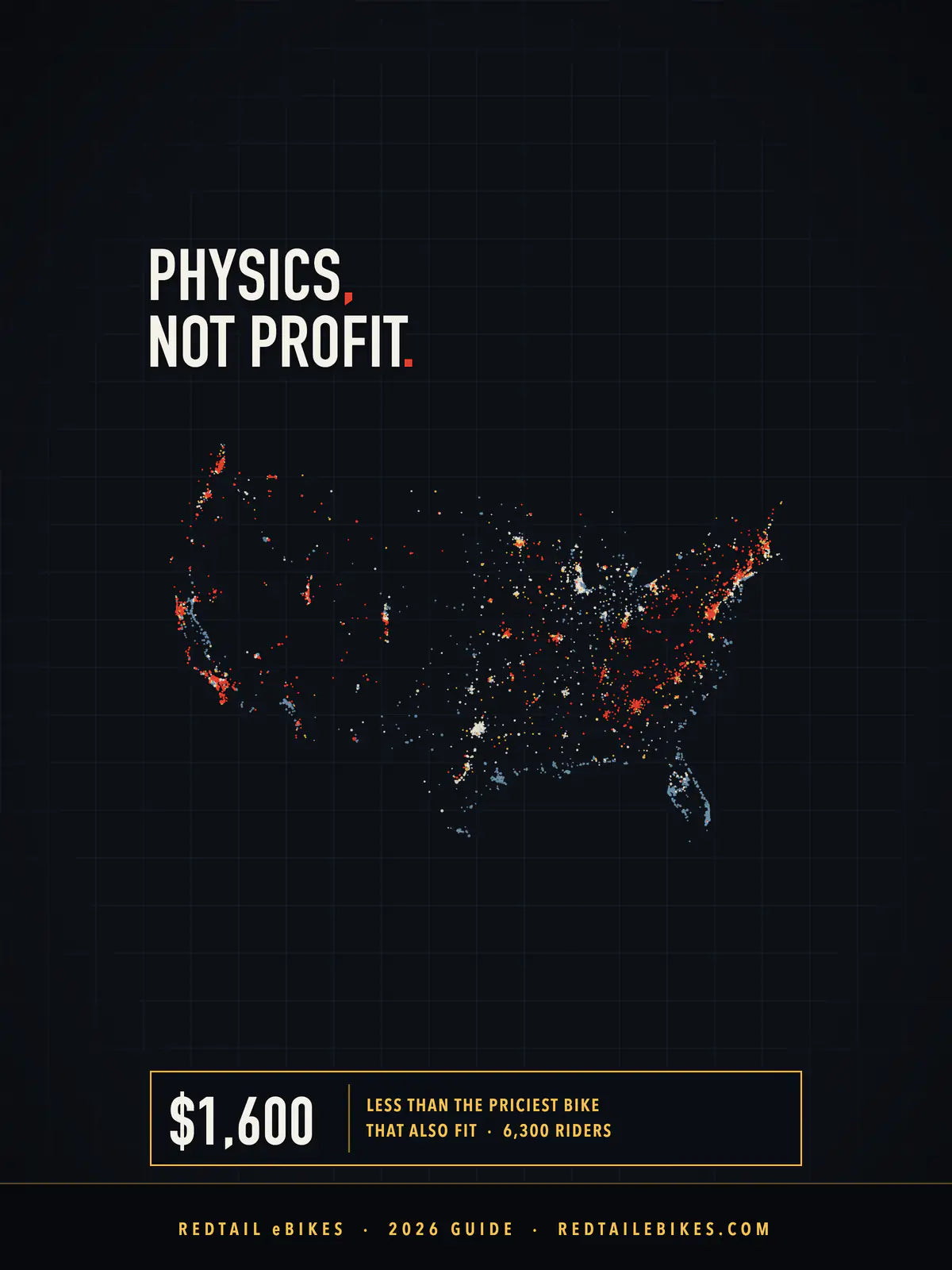
We checked that against our own prices. Across 6,300 rider profiles run through the finder's own engine on October 2, 2026, its best match was the most expensive bike that fit in 5.7% of them, and it cost a median $1,600 less than the priciest bike that also fit (the data).
Want your own answer? Enter your state, height and weight, press Calculate, and the finder names your best match with the reasons it fits. Every bike it shows ships free within the contiguous United States.
Open the e-bike finderIn this guide
- How we verified this
- Why most eBike recommendations know so little about you
- What makes an e-bike recommendation unbiased?
- Forum, quiz, AI answer or calculator: what each one knows
- How the e-bike finder decides
- The science under each score
- What never enters the score
- We checked it against our own prices
- How 24 other e-bike finders choose
- Four riders, four answers
- Where the finder falls short
- Six questions to ask any e-bike recommendation
- Why buy your match from us
- FAQ · Limitations · Sources
How we verified this
By Milad Ghobadibeygvand, BScN (Western University, 2014), writer and reviewer, Redtail eBikes. Verified October 2, 2026.
Every figure here was measured on October 2, 2026. The finder's scoring was read in its own code, the same file the live page runs, and that code ranked 11,934 rider profiles against the prices our store showed that day (the numbers).
We tried 24 other e-bike finders and quizzes in a browser and recorded every question of the 15 we could read in full (the census). Thirteen AI search answers were saved word for word (the panel). Corrections go to support@redtailebikes.com.
Why most eBike recommendations know so little about you
Most e-bike recommendations are written before you arrive. A best-of list gives every reader the same few bikes, and of the 15 e-bike finders and quizzes we read in full on October 2, 2026, one asked the rider's weight and none asked their town or checked their state's law (the census). The finder starts from those facts.
Where you live can change what a bike is. New Jersey's P.L.2025, c.285, in effect since its approval on January 19, 2026, keeps the low-speed electric bicycle for motors that provide "assistance only when the rider is pedaling." A bike with a throttle is a motorized bicycle there, which must be registered and insured.
On October 2, 2026, the low-speed category admitted none of the finder's 128 machines; the median state's e-bike definition admitted 55 (every state's count, recounted that day).
Getting the law wrong has a price. A bike outside your state's e-bike definition is regulated as another vehicle there, and in New Jersey a rider who cannot show the license, insurance card and registration certificate the act requires "shall be subject to a fine not exceeding $50" (P.L.2025, c.285).
Our own terms add a second reason to get it right: a bike that has been ridden is no longer eligible for a change-of-mind return under our refund policy, so the fit check belongs before the order.
The cost of a generic answer is a bike that fits someone else. Of thirteen AI search answers we saved on October 2, the four that recommended models gave one list for every reader, and none of the 13 used a rider's weight, height, town or state to reach a recommendation (the panel).
The e-bike finder works the other way round. It asks which bikes your law allows, which of those fit your body and your load, and which of those climb your hills and cover your miles. The rest of this page shows how it answers, and how we checked that price stays out of it.
What makes an e-bike recommendation unbiased?
An unbiased recommendation uses your facts, shows its working and tells you who benefits from it. Federal rules require the last part of endorsers: under 16 CFR § 255.5(a), a connection to the seller "that might materially affect the weight or credibility of the endorsement," and that the audience would not expect, "must be disclosed clearly and conspicuously."
We are the seller, not an endorser, and we state our connection anyway. We sell the bikes the finder recommends, and it recommends only bikes we sell: 128 e-bikes and trikes from 11 brands, every brand we carry except five the finder never shows (the finder's method). We choose the shelf. The math chooses your bike.
Inside that shelf, three tests separate a recommendation from an advertisement. The ranking reads facts about you and nothing about our margin. Its rules are published, so you can check any result. And it says so when nothing fits, instead of steering you to something it sells anyway.
The finder meets all three in the open. Its ten scores and their weights are printed on the finder's own page, every result card opens to show how its score was built, and on October 2 it told a New Jersey rider that no machine fit the state's low-speed category, with the reason beside every one.
Ask who pays. A recommendation that earns a commission or sells you the bike should say so, and a good one shows the rule that put each bike first. If you cannot see the working, treat the list as an advertisement.
Forum, quiz, AI answer or calculator: what each one knows
Each kind of recommendation knows a different amount about you. A forum knows what owners liked, a brand quiz knows its own catalog, an AI answer knows what the web says most often, and a calculator knows what you tell it and what it can measure. Use each one for what it knows.
| Source | What it knows about you | What it knows about the bikes | Where it falls short |
|---|---|---|---|
| Forum thread | What you choose to post | Owners' experience, unverified | Replies come from riders in other towns and other states |
| Brand quiz | Three to eleven answers you choose | Its own catalog | 10 of the 15 finders we read in full showed only their maker's bikes |
| AI search answer | The words of your question | What ranks on the web | 0 of 13 answers we saved used a rider's weight, height, town or state |
| The e-bike finder | Your state, height and weight, plus up to 19 more answers | Each deciding spec, read off the maker's own page | Only bikes we sell, and only what makers print |
Sources: the census of 24 finders, the 13 AI answers and the finder's method, all read October 2, 2026.
Forum advice is worth reading for what no spec sheet prints, such as how a seller handled a warranty claim. It cannot tell you whether a bike is legal in your state or how it climbs your street with you on it. The finder covers that half, and our reviews and owner forums cover the rest.
The trap is a confident answer mistaken for a measured one. An AI answer we saved called a 500 W motor "a practical middle ground for commuting and moderate hills" without asking what the rider weighs or how steep "moderate" is (P4 in the panel). The finder computes that sentence instead of writing it.
How the e-bike finder decides
The finder decides in two passes. First it sets aside every machine a hard fact rules out for you; then it scores what is left out of 100 on ten published parts. Every card shows which part earned which points, and every machine it sets aside is listed with its reason (the full rules).

Step 1 asks three things: your state, your height and your weight. The other 19 questions are optional (every finder's questions).
The first pass is a list of hard stops, each tied to a record you can check. Your state's e-bike definition comes first, read in the statute (the 128 × 51 legal matrix), and a machine sold for off-road use is set aside for public roads. Then come your state's age rule for the bike's class, the maker's minimum age, and how easily you get on.
The rest are the maker's limits and your life: a passenger the maker does not name, the maker's payload and rider-height range (every machine's printed limits), stairs you carry the bike up, a fold you need and suspension you require. If you have not ridden in years, the finder shows only machines that stand on their own at a stop, such as our electric trikes (the rule).
The second pass is the fit score. Twenty points go to how fast the bike climbs your hill with you aboard, 16 to whether its range covers your day, and 10 each to the payload left over and to how much the bike weighs. Eight each go to your riding surface, the motor type, the riding position and your height inside the maker's range; snow tires take 7 and top speed 5 (the score).

Your hill and your range carry 36 of the 100 points; price, margin and brand carry none (the weights).
When two bikes tie, the faster climber ranks first, then the one with more range, then the lighter one, and only then alphabetical order. Because the parts and weights are published, you can disagree with them, and each card shows every part's points so you can weigh them your own way.
Read the card, not just the rank. Every result opens to show how its score was built. If the part you care most about scores low, the runner-up may be your bike.
The science under each score
The finder's physics comes from published measurement, and each source is named on the finder's page. Your hill speed and range come from a validated cycling power model, the drag and rolling figures from riders measured on city streets, and your town's hills and weather from federal data.
| What it computes | The published source | What it supplies |
|---|---|---|
| Speed up your hill, range on a charge | Martin et al. (1998), Journal of Applied Biomechanics | The power needed against gravity, rolling resistance and air |
| Drag and rolling resistance by bike type | Tengattini and Bigazzi (2018), Journal of Sports Sciences | Coast-down measurements on urban riders |
| Your own easy pedaling | Chorley et al. (2020), European Journal of Applied Physiology | Critical power: 3.19 W/kg untrained, 4.17 W/kg trained |
| Battery in the cold | McMaster University's LG HG2 cell data | Usable energy from -20 °C to 40 °C |
| Your town's hills | USGS 3D Elevation Program | The ground slope around each of 4,197 towns |
| Your town's mornings and wind | NOAA 1991–2020 Climate Normals | 8 a.m. temperature, commute-hour wind, snow |
| Snow tires | Minnesota DNR and the USDA Forest Service | Tires "wider than 3.7 inches" for deep snow |
| Balance at a stop | Meijaard et al. (2007), Proceedings of the Royal Society A | The speed window in which a bicycle steadies itself |
Two of the finder's choices are judgment, and it labels them so. The easy effort it credits to your legs is half the critical power Chorley's study measured, a definition the finder sets for itself, and that study measured twenty men in a laboratory. The motor is credited with 80% efficiency, the floor printed on all nine motor tables of Bafang's 2021 OEM workbook.
A modeled figure is a computation, never a ride. Each card's range carries its conditions: on the throttle alone, at the speed you chose, on a morning in the coldest season you ride.
What never enters the score
Price, margin, brand and stock never enter the fit score. Its ten parts read the bike's published specs and your answers, and nothing else (the score). Price appears on each card after the ranking is done, read live from our store when you press Calculate.
Two store facts do change what you see, and both are stated on the page. A bike that is sold out moves to a separate list below your matches, because a recommendation you cannot buy is no help. And the shelf is ours: the finder cannot recommend a bike we do not sell.
The finder also asks for no email address and no budget. Of the 15 rival finders we read in full, six asked for an email address along the way, six asked about budget or price, and a seventh offered a price filter (the census). The finder leaves the budget to you, with the live price on every card.
Price comes after fit. Run the finder, then compare the live prices of the bikes that fit you. Shop Pay Installments, subject to an eligibility check, are offered on our product pages, and every bike ships free within the contiguous United States.
See your matches and their pricesWe checked it against our own prices
A ranking that leaned on price would put the most expensive bike that fits first again and again. The finder's did not. In 6,300 rider profiles run on October 2, 2026, its best match was the priciest bike that fit in 359 (5.7%), and it cost a median $1,600 less than the priciest bike that also fit (the numbers).
The check ran the finder's own engine on the largest town in each of the 51 jurisdictions the finder covers, nine heights from 5 feet to 6 feet 4 inches, seven weights from 120 to 300 pounds and both fitness levels, 6,426 profiles in all. Every other answer stayed at the finder's default, and prices and stock were read from our store that day (all 6,426 profiles).
Twenty-eight of the 6,300 had matches that all cost the same, which makes the best match the priciest by default. Counting only the 6,272 profiles whose matches had different prices, it was the priciest in 331 (5.3%). The 126 New Jersey profiles had no match at all (the counts).

Two in three best matches sat in the cheapest two-fifths of their price range: 4,176 of the 6,272 profiles whose matches had different prices.
The median best match cost $1,399. In 4,778 of the 5,726 profiles with five or more matches (83%), the finder's higher scores went with lower prices. The best matches were light, too: a median 60 pounds, against 91 for the 105 in-stock bikes that print a weight, and weight to lift and push is worth 10 of the 100 points (the medians).
A second set changed the answers that decide which bikes can win: riding surface, a 50-pound child passenger, and whether the rider can lift a leg over the frame, at three heights and three weights, 5,508 profiles in all (the second set). Of the 5,400 with a match, 1,035 had only one bike that fit.
Across the other 4,365, the best match was the priciest in 193 (4.4%), and the median gap to the priciest fit was $2,500 (the numbers).
Fit does concentrate the winners, and we publish that too. In the default profiles, 15 bikes from 5 brands took first place, and one 60-pound mid-drive bike was the best match in 39% of them; when the answers changed, 14 bikes from 4 brands did (the numbers). The finder does not rotate its winners to spread them across brands.
Cheaper often fits better. In the default check the best match cost a median $1,399, and the priciest bike that fit ranked first in 5.7% of profiles. Spend more when a part of the score you care about says so.
How 24 other e-bike finders choose
Of 24 other e-bike finders and quizzes we tried on October 2, 2026, we could read every question of 15. None of the 15 used the rider's actual town, none screened a state's e-bike law, and none computed how fast a bike climbs with the rider aboard (the census).
The 24 were the finders that six US web searches turned up that day, such as "ebike finder quiz" and "AI ebike finder recommendation tool," plus those AI search answers named on September 29 and October 2. Each was run in a browser, or its question file was read where a quiz loaded one. Two were read in part and seven could not be read, one because its address now opens an e-bike event site (the census).
| What the finder asks or does | Rival finders that do it (of 15 read in full) | Ours |
|---|---|---|
| Your height | 5, four of them in bands | Exact, checked against the maker's range |
| Your weight | 1, as an option for a battery estimate | Required, checked against the maker's payload |
| Where you ride | 12: 11 ask you to describe it, 1 asks your region | Your town's measured hills and weather |
| Your state's e-bike law | 0 (2 offer a class filter) | Every bike screened against your statute |
| Climbing speed for you | 0 | Computed for every match |
Eleven of the 15 asked riders to describe their own terrain or hills, with answers such as "All Flat" and "So. Many. Hills." The finder reads the slope around your town from federal elevation data instead, and lets you set your own level when your routes differ (what each asked).
Some rivals do things the finder does not. The Velo Index finder compares more than 3,000 bikes across brands and states that "No bike is promoted, excluded, or given priority based on commercial relationships," and ARI Bikes' finder asks which US region you ride in. A wide catalog and a narrow, deep one answer different questions.
Four riders, four answers
The same finder gives different riders different bikes, and none of the answers below follows price. Each row is a run of the finder's engine on October 2, 2026, with the town, height and weight shown; open the link to see the bikes, the reasons and that day's prices in the finder itself.
| Rider | Bikes that fit, in stock | Best match costs | Where the priciest fit ranks |
|---|---|---|---|
| 5′10″, 185 lb, Denver | 40 | $1,299 | 33rd of 40 |
| 5′9″, 185 lb, San Francisco | 50 | $1,399 | 29th of 50 |
| 6′0″, 220 lb, Atlanta | 40 | $1,399 | 24th of 40 |
| 5′10″, 180 lb, Newark | 0 | No match | None fit |
Computed with the finder's default for every answer not shown: rode in the last year, 10 miles a day, pavement, relaxed 15 mph, spring to fall (the runs). Prices change, and the finder reads them live.
In Denver, the priciest bike that fits, at $4,099, ranks 33rd. The best match holds its 20 mph assist limit up the 3.08% grade the finder uses for Denver's rolling ground, with the rider pedaling easily. In San Francisco and Atlanta, where the finder reads the ground as steep, the best match holds 13.1 and 12.4 mph up a 6.24% grade (the runs).
The Newark rider sees no match. New Jersey's low-speed electric bicycle must be pedal-assist only, 126 of the 128 machines carry a throttle, and the finder sets aside all 127 it can place, each with its reason, and names the 128th as one it could not place.
A throttle bike with a motor-powered top speed of no more than 28 mph can still be ridden on New Jersey's roads as a registered, insured motorized bicycle, and our New Jersey guide sets out that paperwork.
Where the finder falls short
The finder is strong where measurement is possible and silent where it is not. It checks law, fit and physics on every bike it shows, but it cannot ride the bike, it knows only the bikes we sell, and it trusts each maker's printed figures.
| Where the finder is strong | Where to use something else |
|---|---|
| Screens every bike against your state's e-bike definition, in the statute's own words | Local rules on paths and trails: read your city and land manager, starting from the e-bike laws hub |
| Checks your height and load against each maker's printed range and payload | A bike whose maker prints no range: ask us to confirm the fit before you order |
| Computes climbing speed and range for your weight, town and season | How a bike feels to ride: read our reviews, which set each figure beside its source |
| Prints the reasons and the score for every match | Comparing every brand on the market: a wide independent catalog does that job |
| Shows no match when nothing fits | Reliability over years: warranty terms, set out in How Buying Works |
The weights in the fit score are our judgment, published so you can weigh them differently. A rider who cares only about range can read the range line on each card and set the rest of the score aside.
Six questions to ask any e-bike recommendation
Before you trust any list, quiz or answer, ask it six questions. A recommendation that answers all six is worth acting on; one that answers none is advertising.
- Did it ask about you? Height, weight and where you ride change the answer.
- Did it check your state's law? A bike outside your state's e-bike definition is regulated as another vehicle there.
- Does it show its working? Look for the rule or the numbers behind the first pick.
- Who gets paid? An endorser must disclose a material connection under 16 CFR § 255.5, and a store should say so too.
- Can it say "nothing fits"? A tool that always has an answer is not screening.
- Are its numbers dated? Prices, stock and laws change, and an undated figure may be stale.
Run the six on us. The finder asks about you, screens your law, shows each score, discloses that we sell the bikes, can return no match, and dates its data. If any answer falls short for you, write to support@redtailebikes.com.
Why buy your match from us
Every bike the finder recommends ships free within the contiguous United States, is dispatched within 1 to 3 business days, and most arrive within 5 to 10 business days after that (shipping policy, read October 2, 2026). If a bike arrives damaged, email photos within 48 hours and we file the carrier claim for you (refund policy).
Questions before you order go to support@redtailebikes.com, and How Buying Works sets out payment, delivery and warranty in one place. If your height sits at the edge of a maker's range, send it to us before you order and we will check the fit.
Start with your three numbers. State, height and weight, then Calculate. The finder names your best match, shows the runners-up and gives the reason behind each one.
Find the bike that fits youFrequently asked questions
How does the e-bike finder work?
It works in two passes. First it sets aside every bike your state's law, the maker's limits or your body rules out, each with its reason; then it scores the rest out of 100 on ten published measures, led by hill climbing at 20 points and range at 16. Price, margin and brand are not among them (the full rules).
Is there an e-bike recommendation that isn't paid for?
No store's recommendation is free of interest, so look for one that states its interest and shows its working. We sell the bikes our finder recommends, and we say so; the ranking itself reads fit alone, with price, margin and brand left out, and every result shows how its score was built.
What's the best e-bike to buy right now?
The one that fits your body, your town and your state's law. In our October 2 check of 6,300 rider profiles, the best match cost a median $1,399, and the priciest bike that fit ranked first in 5.7% (the data). Enter your state, height and weight in the e-bike finder to see yours.
How do I know which e-bike to buy?
Start with your state's e-bike law, then your height and weight against each maker's range and payload, then your hills and daily miles. The e-bike finder does all three at once, and the electric bike buying guide explains each choice in depth.
What is the cheapest e-bike to buy?
The cheapest one that fits you. The finder does not sort by price, because price is not part of fit, but every match shows its live price so you can compare. In our default check the best match was also the cheapest bike that fit in 5.4% of profiles, and it cost a median $1,399 (the data).
Should I trust e-bike recommendations on Reddit?
Trust them for what owners know: how a bike held up and how a seller treated them. A thread cannot know your state's law, your weight or your hills, so check any bike it names against those three in the e-bike finder before you buy.
Which e-bike is the most reliable?
The finder does not score reliability, because none of its inputs measures it. For that, compare warranty terms, which How Buying Works sets out for our bikes, and read our reviews of the bikes the finder matches.
Can an AI bike-fit app tell me which e-bike to buy?
Not on its own. The AI bike-fit tools in the answer we saved analyze a video or photo of you riding to set up your position (P8 in our panel). Choosing a new bike starts from each maker's printed rider-height range, which the finder checks for you.
Is the e-bike finder AI?
No. It is a calculator: fixed formulas from published physics, each state's statute and each maker's printed specs, which give the same ranking every time for the same answers. The Federal Trade Commission's chair said in 2024 that "there is no AI exemption from the laws on the books" (FTC, September 25, 2024), and we describe the finder as what it is.
The bottom line
An e-bike recommendation is only as good as what it knows about you. The finder asks for your state, height and weight, reads your town's hills and weather, screens your state's law, and ranks with price, margin and brand left out. Checked against our own prices, it picked the priciest bike that fit 5.7% of the time (the data).
We choose which bikes we sell. The finder chooses which one fits you, shows why, and says so when none does. Open the e-bike finder and start with your three numbers.
Limitations
Every figure on this page holds under the conditions below. Each limit says what the finder or our check cannot see, and where to look instead when it matters to you.
- The shelf is ours. The finder ranks only the 128 bikes we sell from 11 brands, and five brands we carry are never shown. It cannot recommend a bike from another store.
- Specs are as makers print them. Where a maker prints no rider range, payload or weight, the finder cannot check that limit and says so on the card (the finder's limitations).
- The price check models riders; it does not record buyers. It used the finder's default answers for everything but the inputs listed, and prices and stock from October 2, 2026, which change daily.
- The census is a snapshot of October 2, 2026, read from a network outside the United States with US store settings, so one quiz served a non-US version. Two finders were read in part, and seven could not be read, one of them because its address now opens an event site (the census).
- The AI panel ran on one engine. The 13 answers came from one AI web-search engine; Google AI Overviews, ChatGPT and Perplexity were not queried (the panel).
- Computed, never ridden. Climbing speed and range are physics from published inputs, with an easy effort the finder defines for itself.
- This page expires with the finder's data. The finder's law data is re-checked at least monthly, next by October 29, 2026; this page's counts are those of October 2, 2026 and are recomputed when it is next updated.
Source register
Every source on this page is graded by tier, from primary law and government data down to forums and AI summaries, which were read only as the questions riders ask and never cited as fact.
| Tier | What it is | Used for |
|---|---|---|
| T1: primary law and government data | Federal regulation (16 CFR § 255.5), New Jersey's P.L.2025, c.285 and its Motor Vehicle Commission, the FTC's own release, USGS elevation and NOAA climate data | The disclosure rule, the New Jersey example, the AI question, towns' hills and weather |
| T2: peer-reviewed research and datasets | Martin et al. (1998), Tengattini and Bigazzi (2018), Chorley et al. (2020), Meijaard et al. (2007), McMaster University's cell data | The physics behind every computed figure |
| T3: makers' and agencies' own publications | Bafang's OEM workbook, Minnesota DNR, the USDA Forest Service, our store's policies | Motor efficiency, snow tires, shipping and damage claims |
| T4: first-party measurements | Our price check, our census of 24 finders, our saved AI answers, the finder's published data | Every count and median on this page |
| T5: aggregators, forums, AI summaries | Never cited as a fact; forum threads and AI answers were read only as the questions riders ask | None |
Sources
- 16 CFR § 255.5, Disclosure of material connections. Federal Trade Commission, Guides Concerning the Use of Endorsements and Testimonials in Advertising, eCFR, paragraph (a). Retrieved October 2, 2026.
- FTC Announces Crackdown on Deceptive AI Claims and Schemes. Federal Trade Commission press release, September 25, 2024, quoting Chair Lina M. Khan. Retrieved October 2, 2026.
- P.L.2025, c.285. New Jersey Legislature, amending R.S.39:1-1 ("Low-speed electric bicycle"; "Motorized bicycle") and section 13 (effective date); approved January 19, 2026. Enacted text retrieved August 15, 2026.
- E-Bike Requirements. New Jersey Motor Vehicle Commission, "Registration & Insurance" ("Only motorized bicycles are required to have insurance coverage"). Retrieved October 2, 2026.
- Martin, Milliken, Cobb, McFadden and Coggan (1998), Validation of a Mathematical Model for Road Cycling Power. Journal of Applied Biomechanics 14(3): 276–291. Record read October 2, 2026.
- Tengattini and Bigazzi (2018), Physical characteristics and resistance parameters of typical urban cyclists. Journal of Sports Sciences 36(20): 2383–2391, Table 4. Record read October 2, 2026.
- Chorley, Bott, Marwood and Lamb (2020), Physiological and anthropometric determinants of critical power, W′ and the reconstitution of W′ in trained and untrained male cyclists. European Journal of Applied Physiology 120(11): 2349–2359, Table 1. Record read October 2, 2026.
- LG 18650HG2 Li-ion Battery Data and Example Deep Neural Network xEV SOC Estimator Script. McMaster University (Kollmeyer et al.), Mendeley Data, version 2. Retrieved September 23, 2026.
- Meijaard, Papadopoulos, Ruina and Schwab (2007), Linearized dynamics equations for the balance and steer of a bicycle: a benchmark and review. Proceedings of the Royal Society A 463(2084): 1955–1982. Record read October 2, 2026.
- 3D Elevation Program, 3DEPElevation ImageServer. U.S. Geological Survey. Retrieved September 29, 2026.
- U.S. Climate Normals, 1991–2020. NOAA National Centers for Environmental Information. Retrieved September 28, 2026.
- Winter fat bike riding. Minnesota Department of Natural Resources, standard equipment guidelines for a fat bike ridden on snow. Retrieved September 29, 2026.
- Recreation Opportunity: Biking, Superior National Forest. USDA Forest Service. Retrieved September 29, 2026.
- BAFANG Workbook OEM 2021. BAFANG, "Efficiency (%) ≥ 80" on all nine motor tables. Retrieved September 23, 2026.
- E-Bike Finder. The Velo Index. Run October 2, 2026.
- The e-bike finder price check, default profiles and varied profiles. Redtail eBikes, first-party datasets, run October 2, 2026, with every number on this page.
- Census of 24 e-bike finders and quizzes. Redtail eBikes, first-party dataset, read October 2, 2026.
- Thirteen AI search answers, saved word for word. Redtail eBikes, first-party record, October 2, 2026.
- Shipping policy and refund policy. Redtail eBikes. Read October 2, 2026.
Share:
Eunorau EKIDS16 Review 2026: Balance Bike for Ages 5+
Bike Shops in Berkeley CA: 10 Verified eBike Stores