


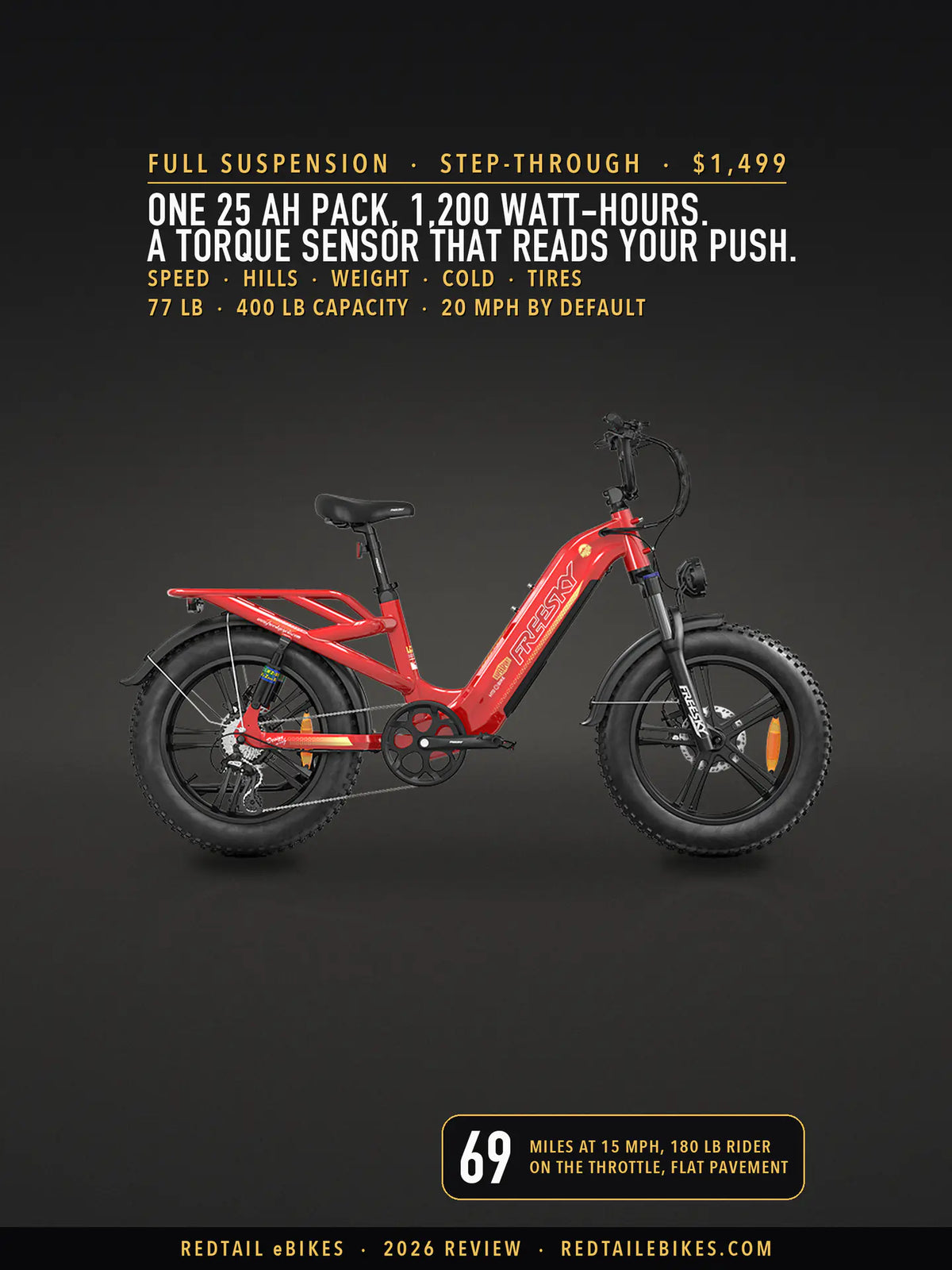

Full suspension · step-through · one 2,500 W peak rear hub motor · 120 N·m · torque sensor · one 48 V 25 Ah pack, 1,200 Wh · 45–90 miles on pedal assist · 20 mph by default · 77 lb · 400 lb capacity · Freesky's rider range 5'1" to 5'11" · $1,499 · verified September 25, 2026
Quick Answer — The Freesky Rocky Pro A-320 is a $1,499 full-suspension step-through on 20 × 4 fat tires, with a 2,500 W peak rear hub motor, a torque sensor and one 48 V 25 Ah pack, 1,200 Wh. On level pavement with a 180 lb rider, a full charge computes to 69 miles at 15 mph on the throttle.
Hold 20 mph and that charge gives about 49 miles; add easy pedaling at 15 mph and it reaches 110. Freesky rates it at 45 to 90 miles on pedal assist, and the range section prices your own ride by speed, climbing, load, air temperature and tires.
Freesky publishes 33 mph on pedal assist, while its FAQ holds its bikes to 20 mph by default and attaches anything faster to "a license, license plates, and insurance"; the class section sets that beside the statutes.
On September 25, 2026 Red and Blue were orderable on our store at $1,499, with $1,899 shown as the regular price. Black and Green were not orderable that day; email us to hear the day they are. Freesky lists the Rocky Pro as a pre-order with a U.S. shipping estimate of October 31, 2026; email us for your delivery date before you order. We deliver free anywhere in the contiguous United States.
Buy the Rocky Pro in RedWhat this review covers
What $1,499 buys · What it is · Will it fit you · The motor · The battery · How far it goes · Brakes and lights · Suspension and tires · Weight and load · The Mercer fit test · UL · Recalls · The class question · Where to ride it · Green and red flags · The verdict · Checklist · Buying it from us · FAQ · Limitations · The bottom line · References
How we verified this Freesky Rocky Pro A-320 review
Every figure here was read on September 25, 2026 from Freesky's Rocky Pro A-320 product page, its product record, the Rocky Pro manual that page links, the two UL certificates it links, our listing or the statutes quoted in the class section. The range and fit figures are computed, and each section's formula names its inputs and their sources.
This review is specification-verified: each number is Freesky's, a statute's, or arithmetic shown on this page, and the range model reproduces the published benchmarks it rests on. We sell the Rocky Pro, so give the red flags the weight you give the green ones.
Written by Milad Ghobadibeygvand, BScN (Western University, 2014). Corrections: support@redtailebikes.com.
What $1,499 buys
| Freesky's published figure | |
|---|---|
| Frame | "Upgraded 6061 Aluminum", a full-suspension step-through |
| Motor | "2500W Brushless Peak Motor", one rear hub motor |
| Torque | 120 N·m |
| Assist sensor | "Torque + Cadence Sensor", with a torque mode and a speed-sensor mode |
| Battery | 48 V 25 Ah, "Samsung / LG Cells Lithium Battery", one removable pack |
| Range | 45–90 miles on pedal assist |
| Top speed, published | 33 mph on pedal assist; 20 mph with the throttle |
| Speed limit as delivered | 20 mph by default, in Freesky's FAQ |
| Pedal assist | Levels 0–5 |
| Throttle | Thumb throttle |
| Charger | A US-standard 3 A smart charger |
| Charge time | 4–6 hours |
| Brakes | 180 mm four-piston hydraulic discs, front and rear |
| Fork | 120 mm oil-sprung suspension fork |
| Rear suspension | "Dual Air Rear Shock" |
| Tires | 20 × 4" fat tires |
| Gears | Shimano 8-speed rear derailleur |
| Chain | KMC |
| Seat post | 30.9 × 300 mm alloy |
| Weight | 77 lb |
| Load capacity | 400 lb |
| Rider height | 5'1"–5'11" |
| Inseam | 25"–35" |
| Seat height | 30.7"–37" |
| Standover | 17.7" on the Geometry table, the figure the Size & Fit table gives as the chain stay |
| Headlight | 800-lumen LED |
| Turn signals | Switched from the handlebar |
| Display | LCD color display |
| Kickstand | Adjustable heavy-duty aluminum |
| In the box | Front and rear mudguards; the manual's box list adds a charger, two keys, the saddle, the pedals, a skewer and the tools |
Every row was read on September 25, 2026 from Freesky's product page and its product record. The charge time comes from the comparison chart on that page, the headlight rating from the record's feature list, and the keys, charger and tools from the box list in the manual. The pack's energy, 1,200 Wh, is 48 V × 25 Ah.
A full-suspension step-through on 20 × 4 tires
Freesky pitches the Rocky as "a versatile and user-friendly e-bike" whose "step-through frame offers easy access for riders of all ages and abilities", in the words of its product page. Under that promise sit a low aluminum frame, a fork and an air shock, 20 × 4-inch tires, one motor in the rear wheel and one 25 Ah pack in the down tube.

From the front three-quarter: the round headlight on the fork crown, the 120 mm fork and the pack along the down tube.
The sensor is the part Freesky leads with. Its page describes "a torque sensor that instantly adapts to your pedaling", and its hunting-bike guide of September 8, 2026 tells riders who want a more natural feel that "the Rocky Pro A-320 offers a torque-sensor setup." In short, a torque sensor that reads your push, on a frame you step through.

From behind: the rack that is part of the frame, the rear mudguard, the hub motor behind the cassette, and the shock above the chainstay.
A note on the page records the rest of the upgrade: "This version has been upgraded with a SHIMANO 8-speed drivetrain, along with upgraded chainring, cassette, and a DR-208 display, improving overall performance and configuration." Freesky's listing for the bike, created on March 5, 2024, has carried more than one build, so every figure here comes from that listing as it read on September 25, 2026.

On grass in Freesky's own photograph; the black wire basket on the rack is an accessory Freesky sells separately.
Will the Rocky Pro fit you?
On Freesky's listed seat, the saddle gets to the fit formula's height for 100 of every 100 riders at 5'0" and 84 of 100 at 5'2"; at 5'4" the count is 54 of 100, and at 5'6" it is 13 of 100, inside a published window of 5'1" to 5'11".
The median rider sits within 6 to 11 degrees of upright, and with the back fully relaxed the hands carry 9 to 13 percent of body weight.
The model places the 6,068 bodies the US Army measured for its 2012 survey on Freesky's own geometry and sets each saddle at 109% of inseam.
To find your place on this frame:
- Measure your inseam in socks. Stand with your back to a wall, pull a hardcover book up firmly between your legs where a saddle would sit, and measure from the floor to its spine.
- Find your height in the tables below and check that your inseam sits inside that row's range; above a 30.6-inch inseam, the saddle rides at the top of its post.
- Fine-tune on delivery with the knee and heel checks at the end of this section.
Freesky's page prints one frame, one rider window and one inseam range, and it prints two of its lengths under two labels each.
| What Freesky publishes | Its figure | On its drawing |
|---|---|---|
| Rider height | 5'1" to 5'11" | not drawn |
| Inseam | 25 to 35 in | not drawn |
| Seat height, lowest | 30.7 in | 32.3 in |
| Seat height, highest | 37 in | 38.5 in |
| Standover | 17.7 in on the Geometry table; the Size & Fit table gives 17.7 in as the chain stay | 15.4 in at the step-over |

The drawing, scaled to Freesky's published 45.8-inch wheelbase. The reach, the front-center and the chain stay agree with the tables to within 3 percent; the total length, the total height and both seat lines measure longer than their labels, and the lines marked standover and wheel diameter span other lengths.
Will the saddle go high enough for me?
Up to 5'2", yes for most riders; around 5'4" it is close to even, and from 5'6" up most riders run out of seat post before they reach the formula's height. The formula puts the top of the saddle at 109% of your inseam, measured from the pedal axle (Peveler et al., 2005), and published work accepts settings as low as 106% (Ferrer-Roca et al., 2012).
The height off the floor then depends on the 10.8-inch crank axle, the 152 mm cranks Freesky lists for the Rocky in its parts store, and the 73° seat tube.
| Your height | Typical inseam | Saddle height, median rider | At 109% | At 106% |
|---|---|---|---|---|
| 5'0" | 27.1–29.7 in | 34.8 in | 100 of 100 | 100 of 100 |
| 5'2" | 28.0–31.1 in | 35.9 in | 84 of 100 | 97 of 100 |
| 5'4" | 29.1–32.2 in | 37.0 in | 54 of 100 | 82 of 100 |
| 5'6" | 30.2–33.5 in | 38.1 in | 13 of 100 | 40 of 100 |
| 5'8" | 31.1–34.3 in | 39.2 in | 1 of 100 | 9 of 100 |
| 5'10" | 32.2–35.5 in | 40.4 in | 0 of 100 | 0 of 100 |
| 6'0" | 33.2–36.7 in | 41.6 in | 0 of 100 | 0 of 100 |
Floor-to-saddle height for the typical rider at each height, and how many of 100 at that height have 109% and 106% heights inside Freesky's 30.7 to 37 inches of seat travel; Army survey bodies, men and women together.
Freesky's inseam range runs to 35 inches, while the top of the post lines up with 109% of inseam at 30.6 inches, and with 106% at 31.4. Beyond that, the saddle stays at its highest and your knee bends further at the bottom of each stroke than the formula would set it.
At the short end the question is the lowest seat. At the 32.3 inches Freesky's drawing marks, the lowest saddle suits a 109% inseam of 26.0 inches, a little above the 25-inch minimum Freesky prints; at the listed 30.7 inches it would suit 24.5. If your inseam is close to 26 inches, check the saddle against both figures.
Can I put a foot down at a stop?
Easily: for 95 of 100 riders at every height in the table, the 17.7 inches Freesky's Geometry table gives as standover clears by 9.4 inches or more, and the 15.4-inch step-over at the frame's low point on its drawing clears by more.
This is the frame's strong suit. You step through the gap in front of the saddle; nothing asks you to swing a leg over the back.
| Your height | Typical inseam | Clearance at 17.7 in | At 15.4 in |
|---|---|---|---|
| 5'0" | 28.4 in | 9.4 in | 11.7 in |
| 5'2" | 29.5 in | 10.3 in | 12.6 in |
| 5'4" | 30.5 in | 11.4 in | 13.7 in |
| 5'6" | 31.7 in | 12.5 in | 14.8 in |
| 5'8" | 32.6 in | 13.4 in | 15.7 in |
| 5'10" | 33.8 in | 14.5 in | 16.8 in |
| 6'0" | 34.9 in | 15.5 in | 17.8 in |
Barefoot inseam minus each figure: 17.7 inches from Freesky's Geometry table and 15.4 measured at the step-through's lowest point on its drawing at the wheelbase scale. Each cell is the clearance that 95 of 100 riders at that height have or exceed.
Will I feel cramped, or stretched?
Neither: the median rider sits 6 to 11 degrees from upright, because the grips sit 32.4 to 34.2 inches above the crank axle and 14.3 to 16.5 inches ahead of it.
Twenty recreational cyclists, asked to rank three trunk positions, found the most upright one the most comfortable (Priego Quesada et al., 2017). Each angle below is the least lean that lets a straight arm meet the grip from the sit-bone position, worked out from that body's measured torso and arm.
| Your height | Lean from upright, median rider | Across saddle and grip positions |
|---|---|---|
| 5'0" | 10° | 2–18° |
| 5'2" | 11° | 3–18° |
| 5'4" | 11° | 3–18° |
| 5'6" | 10° | 2–17° |
| 5'8" | 8° | 1–15° |
| 5'10" | 7° | 0–14° |
| 6'0" | 6° | 0–13° |
Trunk lean from vertical for the middle rider at each height; the spread covers where the sit bones rest on the saddle and the length of the grip on Freesky's drawing.
How much weight goes through my wrists?
Up to 9 to 13 percent of your body weight with a fully relaxed back. In a lab study, 10 road racers pedaling with their hands on the hoods put 15% of their weight through the bars (Carahalios, 2015); on the Rocky Pro's tall grips the median rider's relaxed-back ceiling stays below that figure at every height in the table.
A forward lean moves the load onto the heel of the hand, over the ulnar nerve, and in 36 riders that pressure was highest in the most stretched-out hand position (Slane et al., 2011). Padded gloves cut the palm pressure by 10 to 28% in the same study.
| Your height | Share of your weight, back relaxed | Median rider's weight | On each hand |
|---|---|---|---|
| 5'0" | 12% (6–16%) | 126 lb | about 7 lb |
| 5'2" | 12% (7–16%) | 139 lb | about 8 lb |
| 5'4" | 13% (7–16%) | 147 lb | about 9 lb |
| 5'6" | 12% (7–16%) | 166 lb | about 10 lb |
| 5'8" | 11% (5–15%) | 179 lb | about 10 lb |
| 5'10" | 10% (5–14%) | 192 lb | about 9 lb |
| 6'0" | 9% (5–13%) | 204 lb | about 9 lb |
The most the hands carry with a relaxed back, computed from each body's segment weights (Clauser et al., 1969) at the survey's median weight for that height; the range spans the saddle and grip positions.
How do I set the saddle when it arrives?
Set it so the knee still bends 25 to 35 degrees with the pedal at the bottom (Peveler et al., 2007). The Rocky Pro manual describes the same check with the ball of the foot on the low pedal: "Your leg should be almost fully extended(not locked out) with a slight bend at the knee."
With the heel on the low pedal and the saddle raised until that leg just straightens, the heel method put 70% of 19 cyclists in range, more than either inseam formula did (Peveler et al., 2005). The manual adds a limit for the saddle's slide on its rails: "Do not exceed the limit markings on the seat rail".
How we computed fit
Three rules drive this section: the saddle sits 1.09 × inseam above the pedal axle, the lean is the least trunk angle that lets a straight arm reach the grip, and the hand load is the upper body's weight times its lean divided by the reach to the grip.
Take a 5'8" rider with the median 32.6-inch inseam: the formula needs 35.6 inches from the pedal, which is 29.6 inches from the crank axle (88.3% of inseam gives 28.8), a floor-to-saddle height of 39.2 inches, about two inches above the 37.0-inch top of the post.
| Input | Value | Source |
|---|---|---|
| Rider bodies | 6,068 (4,082 men, 1,986 women) | US Army ANSUR II, 2012 |
| Saddle formula | 109% of inseam; range 106–110.4% | Peveler et al., 2005; Ferrer-Roca et al., 2012 |
| Seat height | 30.7–37 in, from the ground | Freesky's Size & Fit table |
| Crank length | 152 mm | Freesky's crank set listing |
| Crank axle height | 10.8 in (10.5–11.0) | measured on Freesky's drawing |
| Seatpost angle | 73° (73–76.8° on the drawing) | Freesky's Size & Fit table; measured on its drawing |
| Grip center | 14.3–16.5 in ahead, 32.4–34.2 in above the crank axle | measured on Freesky's drawing |
| Standover | 17.7 in listed; 15.4 in at the step-over on the drawing | Freesky's Geometry table; measured on its drawing |
| Segment weights | head and trunk 58.0%, each arm 4.9% of body weight | Clauser et al., 1969 |
Before any length was taken from the drawing, the drawing was held against Freesky's own figures.
| Dimension | Freesky lists | Measured on its drawing | Gap |
|---|---|---|---|
| total length (the drawn line) | 67.7 in | 71.5 in | +5.7% |
| seat height at the highest setting (the drawn line) | 37.0 in | 38.5 in | +4.0% |
| seat-tube angle | 73.0° | 75.9° | +4.0% |
| total height (the drawn line) | 40.9 in | 45.7 in | +11.9% |
| standover (the drawn line) | 17.7 in | 25.6 in | +44.6% |
| wheel diameter (the drawn line) | 28.2 in | 25.2 in | −10.6% |
| seat height at the lowest setting (the drawn line) | 30.7 in | 32.3 in | +5.1% |
| reach (the drawn line) | 18.5 in | 19.0 in | +2.7% |
| front-center (crank bolt to front axle) | 28.2 in | 28.4 in | +0.7% |
| chain stay (crank bolt to rear axle) | 17.7 in | 17.5 in | −1.3% |
Every length is scaled from the published 45.8-inch wheelbase, measured between the axle centers. The Geometry table prints the front-center's 28.2 inches as "Wheel Diameter" and the chain stay's 17.7 inches as "Standover Height", so the model takes the crank axle, seatpost and grips from the drawing, keeps Freesky's listed seat range, and prints both standover figures.
Between two rows, or 5'6" and up? Send your height and inseam to support@redtailebikes.com and we will put them through this model and answer before you buy. Blue is $1,499, the same as Red.
Order it in BlueOne 2,500 W peak rear hub motor with a torque sensor
Freesky's page describes "a 2500W high-performance peak motor and high-speed rear hub" that "delivers 120 N·m of climbing power". A peak figure is the brief burst a motor can give; what it holds for long stretches is its continuous rating, which the class section comes back to.

Freesky's drawing of the torque sensor inside the bottom bracket, captioned "Upgraded Torque Sensor", on a Blue frame.
The sensor has two modes, and the display switches between them. Freesky's FAQ gives the control in its own words: "Short press the O button on the display to switch between Torque Mode and Speed Sensor Mode." Torque Mode works by "adjusting motor assistance based on your pedaling force"; Speed Sensor Mode "Provides consistent motor assistance based on your pedaling speed."
Freesky's August 14, 2026 torque explainer keeps the two ideas apart: "the FREESKY Rocky Pro A-320 uses a torque sensor and is rated at 120 N·m of torque." The first describes how the bike listens to your legs, the second how hard its motor can push.

The rear wheel's hub motor behind the cassette, with the derailleur marked Altus below it.
The hub turns with the wheel, so a shift changes your cadence and leaves the motor's speed alone. At a given road speed, the battery responds to how hard you pedal, and the effort table prices it. The thumb throttle moves the bike without pedaling.
For how torque and cadence sensing differ on any bike, our e-bike motor guide lays out both, and our hub-drive picks set rear-hub bikes side by side.
The manual's first ride is a gentle one: a spacious area, "a low gear (1 or 2)" and pedal assist "set to level 0 or 1". It also gives the reason: "the pedal-assist mode will cause a rapid increase in speed that might catch you off guard."
One 48 V 25 Ah pack, 1,200 Wh
48 V × 25 Ah is 1,200 watt-hours, so one 25 Ah pack, 1,200 watt-hours, runs everything on this bike. On the pack's own certificate the figures are 47.19 V nominal and 24.5 Ah, or 1,156.2 Wh; every range table here uses Freesky's 1,200.

The pack sits in the down tube, below the FREESKY lettering.
The key releases the pack. Under "Remove the battery", the manual has you turn the key counterclockwise to open the lock and hold the battery with one hand, and it lets you charge "With the battery on or off the bike", so the pack can come indoors while the bike stays in the garage.
Charge it somewhere dry, at 50 to 77 °F. The manual asks you to "Charge and store bike and battery in a dry location, between 50 °F – 77 °F (10 °C – 25 °C)."
Freesky's chart gives 4–6 hours on the 3 A charger in the box. When a ride will not need the whole pack, Freesky's summer charging guide, which lists the Rocky Pro, notes that "charging to 80–90% can reduce thermal and chemical stress."
How far the Rocky Pro goes on one charge
A 180 lb rider on level pavement can expect about 69 miles from a full pack at 15 mph on the throttle, 49 at 20 mph, and 110 at 15 mph with easy pedaling. An 8% grade at 10 mph on the throttle brings the same charge down to 12 miles.
Three steps turn these tables into your figure:
- Choose a speed and an effort level from the first two tables.
- Set aside 168 to 229 Wh of the pack for each 1,000 feet you climb at 10 mph on the throttle on 4 to 10% grades, or 143 to 199 with easy pedaling (the hills table).
- Correct for your load and the air temperature, and plan the trip on 80% of what is left.
Each table computes one steady ride at a time from Freesky's specifications, Bafang's published figures for a comparable 48 V geared hub motor, drum readings for ten fat tires, the tires as Freesky draws them, and a cycling-power model checked on a real road. The last subsection shows the formula and walks one ride through it.
Does riding faster cut range? Miles at each speed
Speed is the first thing to settle: on the throttle, a full charge runs 97 miles at 10 mph and 49 at 20. From 15 mph to 20, the figure drops from 69 miles to 49, because the power the air takes rises with the cube of your speed: 20 mph needs about 2.4 times the air power of 15, which is (20 ÷ 15)³.
| Speed, flat | Per mile | Full charge | At an 80% charge |
|---|---|---|---|
| 10 mph | 12.4 Wh | 97 mi | 78 mi |
| 12 mph | 14.1 Wh | 85 mi | 68 mi |
| 15 mph | 17.3 Wh | 69 mi | 55 mi |
| 18 mph | 21.5 Wh | 56 mi | 45 mi |
| 20 mph (the default limit) | 24.7 Wh | 49 mi | 39 mi |
On the throttle alone, on level pavement, with a 180 lb rider in 77 °F air. The table stops at 20 mph, the throttle's top on Freesky's product page. The last column is what an 80% charge gives, the point at which Freesky's summer charging guide suggests stopping a charge if the ride will not use the whole pack.
Easy pedaling pays off quickly on the flat: 75 W from your legs at 15 mph takes a full charge from 69 miles to 110. In these tables easy pedaling is 75 W and steady pedaling 150 W. With the motor idle, 75 W alone would move this bike at about 9.0 mph on level ground and 150 W at about 13.1, so pick the column you could hold without help.
| Speed, flat | Motor only | Easy pedaling (75 W) | Steady pedaling (150 W) |
|---|---|---|---|
| 12 mph | 85 mi | 191 mi | legs alone |
| 15 mph | 69 mi | 110 mi | 234 mi |
| 18 mph | 56 mi | 75 mi | 110 mi |
| 20 mph | 49 mi | 61 mi | 80 mi |
| 25 mph | 34 mi | 39 mi | 45 mi |
| 28 mph | 28 mi | 31 mi | 35 mi |
Full-pack miles on level pavement for a 180 lb rider. At 15 mph, easy pedaling draws 11.0 Wh a mile against 17.3 on the throttle.
"Motor only" is the throttle up to 20 mph; above 20 it is pedal assist with your legs adding next to nothing, at speeds past the default limit that the class section covers.
In the 191- and 234-mile cells your legs push harder than the motor, so those two lean most on the model's weakest part, its motor losses at light load (Limitations item 5). "Legs alone" marks a speed that 150 W from the rider holds with no help from the motor.
In Torque Mode the assist level sets how much the motor adds for the force you put in; in these sums it changes nothing else, so read the row for the speed you hold and the effort you give. The manual's range advice points the same way: "Ride at a lower PAS level" and "Use lower PAS levels and pedal when climbing hills."
Which gear saves battery? On a hub motor, your effort does
Choose the gear for your knees and pedal for the battery. The motor spins with the rear wheel in every gear, so a shift alters your cadence and leaves the motor's load where it was. Hold the speed and the grade constant, and the draw drops as you push harder:
| Your ride | Motor only | Easy pedaling (75 W) | Steady pedaling (150 W) |
|---|---|---|---|
| 15 mph, flat | 17.3 Wh | 11.0 Wh | 5.1 Wh |
| 20 mph, flat | 24.7 Wh | 19.7 Wh | 15.0 Wh |
| 12 mph, 4% grade | 48.2 Wh | 36.6 Wh | 26.3 Wh |
| 10 mph, 8% grade | 99.3 Wh | 78.6 Wh | 60.4 Wh |
Pack watt-hours per mile for a 180 lb rider in 77 °F air, with 75 W from the rider for easy pedaling and 150 W for steady.
Up an 8% grade at 10 mph, the throttle alone takes 99.3 Wh a mile; easy pedaling cuts that to 78.6 and steady pedaling to 60.4. Each watt you put into the pedals is one the motor does not supply, along with the heat the motor and the pack would have lost making it.
Keep the eight gears for a comfortable cadence, the low ones for starts and climbs as the manual suggests for a first ride, and let the torque sensor turn your effort into range.
Does going uphill drain the battery faster?
Much faster: at 10 mph on the throttle up 4 to 10% grades, every 1,000 feet you climb costs 168 to 229 Wh beyond the same distance on the level, or 143 to 199 with easy pedaling. Lifting you and the bike accounts for 42 to 58% of the throttle figure, and the motor and the pack lose the rest, a share that grows as the road steepens.
A 180 lb rider on the 77 lb Rocky Pro weighs 257 lb together, and raising 257 lb through 1,000 feet takes 97 Wh at the wheel.
On an 8% grade at 10 mph on the throttle, the pack pays 207 Wh for each 1,000 feet, so the full 1,200 Wh would climb about 5,811 feet with none left for the flat. The model takes no credit for descents; coasting downhill costs less than riding the same distance on the level, so a budget built from these rows keeps a margin.
| Grade | Per mile, motor only | Full charge, motor only | Full charge, easy pedaling |
|---|---|---|---|
| 2% | 28 Wh | 42 mi | 73 mi |
| 4% | 48 Wh | 25 mi | 36 mi |
| 6% | 71 Wh | 17 mi | 22 mi |
| 8% | 99 Wh | 12 mi | 15 mi |
| 10% | 132 Wh | 9 mi | 11 mi |
| 12% | 172 Wh | 7 mi | 8 mi |
| 15% | 248 Wh | 5 mi | 6 mi |
All at 10 mph with a 180 lb rider; the last column adds 75 W of easy pedaling. The model holds the motor to a comparable motor's rated 1,000 W, so it prices a climb's energy; how fast the Rocky Pro climbs a grade depends on a motor Freesky rates at 2,500 W peak, so no climbing speed is printed.
To budget a hilly ride, add its level miles to its climbing. Twenty level miles at 15 mph on the throttle use about 347 Wh, and 1,000 feet of 8% climbing adds about 207, near 554 Wh of the 1,200 in all. Wind, stops and starts come on top, because each mile in the model is ridden at an even pace.
Does rider weight affect range?
Extra weight costs a little on the flat and a lot on a hill. Weight adds to the work of the tires and the grade and nothing to the air's share, so the gap widens as the road tilts up.
| You plus your load | 15 mph flat, throttle | 20 mph flat, throttle | 8% climb, 10 mph |
|---|---|---|---|
| 130 lb | 75 mi | 52 mi | 16 mi |
| 180 lb | 69 mi | 49 mi | 12 mi |
| 220 lb | 65 mi | 46 mi | 10 mi |
| 300 lb | 58 mi | 42 mi | 7 mi |
| 400 lb | 50 mi | 38 mi | 4 mi |
The rider plus whatever they carry; the bike's own 77 lb is added to every row as well, since the motor moves it too. Throttle only. The 400 lb row is Freesky's load capacity, and Freesky's guidance counts that figure as rider plus cargo.
Moving from 180 lb to 300 lb takes 11 miles off the level 15 mph ride, from 69 to 58, and cuts the 8% climb from 12 miles to 7. At the full 400 lb, the level 15 mph ride still covers about 50 miles, but the 8% climb falls to 4, because on a grade most of the wheel's power goes into lifting the load.
Does cold weather drain the battery?
Yes, and it costs more with each colder row. The easy-pedaling 15 mph ride that covers 110 miles at 77 °F comes to about 82 at 32 °F and 73 at 14 °F.
| Air | Pack energy vs 77 °F | 15 mph, easy pedaling | 20 mph, throttle |
|---|---|---|---|
| 95 °F | 99% | 118 mi | 50 mi |
| 77 °F | 100% | 110 mi | 49 mi |
| 68 °F | 98% | 103 mi | 46 mi |
| 50 °F | 93% | 90 mi | 42 mi |
| 41 °F | 91% | 85 mi | 40 mi |
| 32 °F | 89% (80–93) | 82 mi (73–86) | 38 mi (34–40) |
| 14 °F | 82% (40–83) | 73 mi (36–73) | 34 mi (17–34) |
Level ground, 180 lb aboard. The middle figure in each row comes from McMaster University's LG HG2 cell data, recomputed at a 0.5C discharge; the lab measured 77, 50, 32 and 14 °F, the rows between are interpolated, and the cells are assumed to sit at air temperature.
The figures in brackets show how far published cell data sets disagree. Each low end is the smallest capacity Samsung's data sheets give at that temperature for a cell discharged at one to four times its capacity per hour (the 25R and 30Q at 32 °F, the 35E at 14 °F); each high end is the most energy Casado and colleagues measured in 2025 at a slower rate.
Three losses add up at freezing. The cells give back about 89% of their 77 °F energy (80 to 93%, depending on the source), and the air is about 9% denser under the gas law in the U.S. Standard Atmosphere.
Cold rubber is the third: the model raises rolling resistance 0.5% for each °F below 77 °F (0.9% per °C) and lowers it at the same rate above, between Rothhämel's fit for a 42 mm tire and Bicycle Rolling Resistance's road-tire average, and holds the 41 °F value below 41 °F.
On a 95 °F day the model comes out slightly ahead of 77 °F, since warm tires and thin air save more than the cells give up. Whatever the air on the ride, the manual wants the charging done in the dry at 50 to 77 °F, so a winter rider brings the pack inside to warm before plugging it in.
Do fat tires cut range? Tires and riding position
On level ground the tire matters more to range than how you sit. Bicycle Rolling Resistance's drum measured ten 26 × 4.00 fat tires at 23.2 to 42.1 W at 12 psi, 18 mph and a 94 lb load.
The drum has no reading for a 20 × 4 tire or for the CST BFT 20x4.0 printed on the Rocky's sidewalls, so the model takes the middle of the ten, a coefficient of 0.0105, as a stand-in.

Freesky's photograph of the rear wheel: "CST BFT 20x4.0" on the sidewall, the shock above it, the Shimano derailleur and the chainring.
| Rolling resistance | 15 mph, throttle | 15 mph, easy pedaling | 20 mph, throttle |
|---|---|---|---|
| 0.0070 · lowest of ten | 81 mi | 138 mi | 54 mi |
| 0.0105 · median of ten (used here) | 69 mi | 110 mi | 49 mi |
| 0.0126 · highest of ten | 64 mi | 98 mi | 46 mi |
Miles from a full pack for a 180 lb rider on level ground. Schwalbe's Jumbo Jim LiteSkin rolled easiest of the ten and Kenda's Juggernaut Pro hardest, which the site lists at 0.01262.
Run the tires where the manual puts them, "Freesky recommends 16-20 PSI for the stock tires", which is firmer than the drum's 12 psi. Sand, dirt and grass have no drum reading at all; send us a route and we will run the ride through the model.
Posture starts to count as speed rises. Tengattini and Bigazzi recorded 0.640 m² of drag area for 37 upright cruiser riders, the value used here for a frame whose median rider sits 6 to 11 degrees from upright, and 0.603 m² for 90 everyday mountain-bike riders, which would lift the 20 mph throttle ride from 49 miles to 51.
Freesky's 45 to 90 miles, matched to real rides
Freesky publishes two range figures for the Rocky Pro, and both map onto steady rides. Its product page gives 45 to 90 miles on pedal assist, and its June 12, 2026 charging guide lists "Up to 105 miles range". The manual says what any published range is: "The listed range and top speed of the bike are estimates, not guarantees of performance."
- 105 miles allows 11.4 Wh per mile, which on level pavement means about 8.7 mph on the throttle, 15.3 mph with easy pedaling or 18.3 with steady pedaling.
- 90 miles allows 13.3 Wh per mile: roughly 11.2 mph on the throttle, 16.5 with easy pedaling or 19.3 with steady pedaling.
- 45 miles allows 26.7 Wh per mile: about 21.1 mph with the motor alone, 23.4 with easy pedaling or 25.1 with steady pedaling.
So the top of Freesky's band fits easy pedaling in the mid-teens, "up to 105" fits a throttle ride under 9 mph or easy pedaling near 15, and the bottom fits riding at or above the 20 mph default. The model's 15 mph throttle ride, 69 miles, falls inside the band, and easy pedaling at 15 mph, 110 miles, runs past both of Freesky's figures.
Owners on Freesky's page write about their riding in their own words. An owner who bought one for a spouse wrote in April 2026: "She has around 500 miles so far with no problems." Another, on a second e-bike, wrote in August 2026: "I ride all year long."
Base your plans on 80% of whichever figure fits your ride. Freesky's charging guide suggests stopping a charge there when the ride will not need all of it, and planning on it leaves 20% in the pack as a reserve. On the throttle at 15 mph, that is 55 miles of the full 69.
Find your row, then plan on four-fifths of it. Every 1,000 feet of climbing at 10 mph costs 168 to 229 Wh on the throttle, less when you pedal. On level pavement with 180 lb aboard, the plan comes to 55 miles at 15 mph on the throttle and 39 at 20.
Twenty level miles at 15 mph and 1,000 feet of 8% climbing use about 554 of the 1,200 Wh on the throttle, well inside the 960 Wh an 80% charge holds. Email us your distance, your climbing, your weight with gear and your usual speed, and we will price the ride before you order; Red costs $1,499, as does Blue.
Buy it in Red for $1,499How every figure here is worked out
Holding a steady speed takes a steady flow of power at the rear wheel. Martin and colleagues' 1998 model, validated on an open road, gives that power in one line for a constant speed in still air:
Power at the wheel = v × [ m × g × (Crr × cos θ + sin θ) + ½ × ρ × CdA × v² ]
Here v is speed, m the combined mass of rider, cargo and bike, g gravity, θ the angle of the slope, Crr the tires' rolling resistance (0.0105 is a drag of 1.05% of the weight on the tires), ρ the density of the air and CdA the drag area, a measure of how much air the rider pushes aside.
The first bracketed term covers the tires and the grade and the second the air; multiplied by v, the air term grows with the cube of the speed.
Four steps lie between the wheel and the battery:
- Your legs drive the rear wheel through the chain at 97.7% efficiency, Martin and colleagues' figure, and the motor makes up the difference.
- The rear hub motor does all of the motor's pushing, turning with the wheel.
- The motor is modeled on a comparable motor's published figures. In Bafang's 2021 OEM workbook, the RM G0H0, a 48 V geared hub, has an n0 of 510 rpm, an nT of 426 rpm, a rating of 1,000 W and an efficiency of "≥ 80" percent. Read as the no-load and rated speeds, those come to 35.3 and 29.5 mph on the Rocky's 23.3-inch tires; the modeled motor tops out at 29.2 mph on the flat, so no row here goes past 28 mph. The model uses 80% at the rated point and lets efficiency fall at lighter loads.
- The pack loses some energy inside itself, at the battery efficiency Arango, Lopez and Ceren measured on a 48 V pack.
Then watt-hours per mile = battery watts ÷ mph, and miles = 1,200 Wh × the share of the pack's energy left at that temperature ÷ watt-hours per mile.
| Input | Value used | Where it comes from |
|---|---|---|
| Bike | 77 lb | Freesky's specification |
| Rider and cargo | 180 lb; the weight table also runs 130, 220, 300 and 400 | 400 lb is Freesky's load capacity |
| Battery | 48 V × 25 Ah = 1,200 Wh | Freesky's specification |
| Motor | one, 1,000 W at 426 rpm, 510 rpm unloaded, 80% at the rated point, torque capped at 90 N·m | Bafang OEM workbook 2021, RM G0H0 |
| Wheel | 23.3 inches across, 1,855 mm around | the tires on Freesky's drawing, at its wheelbase scale |
| Rolling resistance | 0.0105, the median of ten 26 × 4.00 fat tires at 12 psi | Bicycle Rolling Resistance |
| Drag area | 0.640 m², 37 upright cruiser riders | Tengattini and Bigazzi, 2018 |
| Chain | 97.7%, your pedaling only | Martin et al., 1998 |
| Battery losses | 3.1% at 15 mph, more at climbing currents | Arango, Lopez and Ceren, 2021 |
| Air | 77 °F at sea-level pressure, 1.184 kg/m³ | U.S. Standard Atmosphere, 1976 |
| Cold | the share of a cell's energy left at each temperature | McMaster University's LG HG2 cell data |
One ride, worked through: 180 lb aboard, 15 mph, level pavement, throttle only. Rolling takes 80.8 W and the air 114.2 W, which adds up to 195.0 W at the rear wheel.
At that speed the 23.3-inch wheel spins at 217 rpm. In the motor model (0.899 N·m of torque per amp, a 0.304 Ω winding and a 1.10 A no-load current, each worked out from Bafang's published figures), the motor makes 8.6 N·m on 10.7 A at 77% efficiency, under its 80% because the load is light, and draws 252.0 W.
With the pack's own losses added, the battery supplies 260.0 W: 17.33 Wh a mile at 15 mph, and 1,200 ÷ 17.33 comes to about 69.2 miles, or 55.4 from an 80% charge.
Two published benchmarks, recomputed. Each half of the model reproduces the figure its source prints:
| Check | Published figure | This model |
|---|---|---|
| Road physics, Martin and colleagues' worked example | 45.7 W for tires and grade, 158.8 W for the air | 45.8 W and 158.8 W |
| The comparable motor at Bafang's rated point | at least 80% efficient | 80% |
Recomputed by the model's self-test: the worked example in Appendix I of Martin and colleagues (8.36 m/s ground speed, a 90 kg system, a 0.3% grade) and the RM G0H0's rated point in Bafang's workbook.
Brakes and lights
Freesky specifies "180MM 4-piston Hydraulic Brakes" on both wheels, to stop a 77 lb bike rated for 400 lb of rider and cargo. The manual's advice under "Use Both Brakes" is plain: "Relying only on the rear brake will significantly increase your stopping distance."

The front caliper on the fork leg, over the rotor.
The product record lists an "800 Lumen LED Headlight", and the page's "Steering Light" is a turn-signal system "Integrated into the handlebars" that works "with a simple press of a button."

The tail light, tucked under the end of the rack.
The display, in Freesky's description, "clearly shows 5 PAS levels, headlight status, speed, battery power, and mileage". To switch on, the manual has you turn the battery on first and then wake the display with the NFC swipe or the power button and the code the manual prints.
A 120 mm fork, an air rear shock and 20 × 4 tires
Freesky specifies a "120 mm Oil-Sprung Front Fork" and a "Dual Air Rear Shock", and says the pair "absorbs bumps and impacts for a smoother, more stable ride."

The fork under the round headlight, with the front mudguard over a 20 × 4 tire.

The rear shock, mounted between the frame and the swingarm above the rear tire.
The tires are 20 × 4" fat tires, run at 16 to 20 psi under the manual, firmer than the 12 psi in the tire table. Around them sit a Shimano 8-speed derailleur, a KMC chain, an "Upgraded 6061 Aluminum" frame, a rack built into the frame behind the saddle, and an adjustable heavy-duty aluminum kickstand.
77 pounds and a 400-pound capacity
Freesky lists 77 lb for the Rocky Pro in its specification, with a 400 lb load capacity.
The 400 lb covers the rider and everything the bike carries; the 77 lb bike is outside it. Freesky's hunting-bike guide says so directly: "Remember that total payload includes the rider and cargo." A 200 lb rider with 40 lb of shopping on the rack comes to 240 lb, which leaves 160 lb in hand.
Size a hitch rack, a lift or a stair plan for the 77 lb Freesky lists plus whatever rides on the bike, and for the 67.7 inches of length and 40.9 of height its Size & Fit table gives.
Settle where the Rocky Pro will live and how it will travel before it arrives. A garage, a ground-floor room or a hitch rack rated for its 77 lb with a margin suits it better than a daily carry up the stairs.
The Mercer fit test
Each review we publish puts the bike in front of the same seven people, the Mercers, so every machine answers the same fit questions (meet the Mercers). Each verdict below rests on a figure Freesky publishes (the height range, the seat heights, the standover figure, the weight, the load capacity) or on the age line in the manual, or on the fit tables computed from them.
| Member | Age · Height | Verdict | The number behind it |
|---|---|---|---|
| Frank Kowalski | 63 · 5'10" | Inside the range, with the saddle at its top | 5'10" sits inside 5'1"–5'11", and the post stops at 37 inches, short of the formula height for every rider his height in the survey |
| Ruth Kowalski | 61 · 5'5" | Inside the range; the saddle is her check | Between the 5'4" and 5'6" rows, where the post reaches the formula height for 54 and then 13 of 100 riders; the low step-through suits her |
| Jack Mercer | 48 · 6'1" | Outside the range | 6'1" is two inches past the 5'11" top of Freesky's window |
| Dana Mercer | 45 · 5'7" | Inside the range, with the saddle at its top | Between the 5'6" and 5'8" rows, where the post reaches the formula height for 13 and then 1 of 100 riders |
| Maya Torres | 32 · 5'6" | Inside the range; the saddle is her check | At 5'6" the post reaches the formula height for 13 of 100 riders, and 40 of 100 at the 106% end of the published range |
| Cole Mercer | 16 · 5'11" | Not until 18 | He sits at the top of the window, where the post reaches the formula height for no rider his height in the survey, and the manual says: "Riders must be at least 18 years old." |
| Ivy Mercer | 12 · — | No | The manual's 18-year minimum; she is on the table so the answer is here |
For this family the saddle is the question, never the step-over. The standover table clears Freesky's 17.7 inches by 9.4 inches or more at every height, while the 37-inch top of the post decides how Maya, Dana and Frank, at 5'6" to 5'10", sit.
Is it UL certified?
Yes: Freesky links a UL 2849 certificate for the A-320 and a UL 2271 certificate for its 25 Ah pack. TÜV SÜD America issued both, and the badges on Freesky's page read "UL2849 Certified by TÜV" and "UL2271 Certified by TÜV".
| Certificate | What it names | Dated |
|---|---|---|
| UL 2849 certificate, No. U14 128702 0007 Rev. 00 | "Electrical Systems for E-Bikes", brand FREESKY, model A-320, rated voltage 47.19 V DC | July 24, 2025 |
| UL 2271 certificate, No. U10 128702 0003 Rev. 00 | "Batteries (Rechargeable Li-ion Battery)", model FP4825R0, 47.19 V, 24.5 Ah | April 3, 2025 |
Both read September 25, 2026 from the PDFs linked on the Rocky Pro page; each names GuangZhou Yansan Science & Technology Co., Ltd. as the holder.
UL 2849 is the standard for the complete electrical system, which Freesky's summary describes as "batteries, motors, controllers, and wiring". The UL 2849 certificate also rates a battery charger at 54.6 V DC, 3.0 A output, the rating of the 3 A charger Freesky specifies. Should a landlord, a building manager or an insurer want the certificates, email us and we will request them from Freesky in writing.
Has it been recalled?
No. Our September 25, 2026 search of the Consumer Product Safety Commission's recall database read every field of a 623-record corpus gathered under bicycle, e-bike, battery and scooter terms, and put Freesky straight into the title, description, product-name and manufacturer fields. No record names Freesky, Yansan, the A-320 or the Rocky Pro.
Of the ten records that contain the word "Rocky", nine concern Rocky Mountain, a different bicycle maker, and one names a children's mountain bike model called Rocky Ridge.
Before its empty answer counted, the search had to find recalls known to exist, and it did: Ancheer 1, Specialized 49, Trek 34.
The class question: 20 mph by default, 33 mph published
Settle this before you order, because Freesky gives the Rocky Pro more than one top speed. Its product page describes "reaching speeds of 33 MPH with pedal assist and 20 MPH with the accelerator", while the product record's feature list reads "33 MPH by Pedal Assist or Throttle". Further down the same page, the FAQ says:
All Freesky eBikes are limited to a maximum speed of 32 km/h (20 mph) by default, which complies with local e-bike regulations. If you wish to exceed this speed, you will need to obtain a license, license plates, and insurance for your eBike.
So one carton holds two machines: the Rocky Pro as delivered, whose help ends at 20 mph, and the 33 mph machine on the spec sheet, which Freesky's FAQ ties to a license, plates and insurance.
California's definition, in Vehicle Code § 312.5(a) as read on September 25, 2026, requires a bicycle "equipped with fully operable pedals and an electric motor that does not exceed 750 watts of power".
Its class lines follow in the same section: a class 2 bicycle's motor "is not capable of providing assistance when the bicycle reaches the speed of 20 miles per hour", and a class 3 bicycle helps "only when the rider is pedaling" and "ceases to provide assistance when the bicycle reaches the speed of 28 miles per hour".
The federal definition of a low-speed electric bicycle, 15 U.S.C. § 2085(b), covers "a two- or three-wheeled vehicle with fully operable pedals and an electric motor of less than 750 watts (1 h.p.), whose maximum speed on a paved level surface, when powered solely by such a motor while ridden by an operator who weighs 170 pounds, is less than 20 mph."
| Setting | The speed line | Where the Rocky Pro sits |
|---|---|---|
| As delivered, help ending at 20 mph by default | A class 2 throttle stops at 20 mph in California | On the class 2 speed line; the watt line is the open question below |
| At the 33 mph Freesky publishes | Class 3 assist stops at 28 mph, a class 2 throttle at 20 | Past both speed lines, where Freesky's FAQ asks for a license, plates and insurance |
From § 312.5(a)(2) and (a)(3), Freesky's product page and its product record, each read on September 25, 2026.
Ask for the motor's continuous rating, in writing. Freesky's figure, "2500W Brushless Peak Motor", is a peak. California's wording is "does not exceed 750 watts of power" and the federal wording "less than 750 watts", and neither says whether it means a peak figure or a continuous one.
Where a watt line applies to you, email us and we will get the continuous rating from Freesky in writing before you order. Our 50-state e-bike law atlas prints each state's definition, and the manual leaves the checking to you: "It is your responsibility to determine if you can ride the bike safely."
Look at your insurance as well. The manual warns that "your insurance policies may not provide coverage for accidents involving Freeksy eBikes" and says to "contact your insurance company or agent" to find out.
As delivered, the Rocky Pro's help stops at 20 mph by default, and Freesky's FAQ ties anything faster to a license, plates and insurance. Before the first ride, read your state's definition and your trail manager's rule, and where a 750 W line applies, have us get the continuous rating in writing.
Where you can ride it
Once you leave the pavement, whoever manages the land decides whether the Rocky Pro may go there, and federal managers start from the e-bike classes, so the 20 mph default and the watt line both count.
The Forest Service's final e-bike directives, issued March 31, 2022, "provide for managing all classes of e-bikes as motor vehicles and require local-level decision-making and environmental analysis to allow use of e-bikes on non-motorized trails", as its notice at 87 FR 41278 puts it.
Where a Ranger District has published a motor vehicle use map, 36 CFR 261.13 bars operating a motor vehicle "other than in accordance with those designations".
On Bureau of Land Management land, 43 CFR 8340.0-5 builds the three classes around "an electric motor of not more than 750 watts (1 h.p.)" and treats an e-bike as a non-motorized bicycle only where "the authorized officer has expressly determined" so.
| Where you plan to ride | Who decides | What to read |
|---|---|---|
| A National Forest road or trail | the Ranger District | its motor vehicle use map (36 CFR 261.13) |
| BLM land | the field office | its e-bike decision; 43 CFR 8340.0-5 holds the definitions |
| A state park, county open space or city path | that agency | the class wording posted at the trailhead |
| Private land, your own or with permission | the owner | the owner's say-so |
Four landowners, four rules; the spec sheet settles none of them.
On a National Forest, 36 CFR 261.1b puts the price of breaking the part's prohibitions at "imprisonment of not more than six months or a fine in accordance with the applicable provisions of 18 U.S.C. 3571 or both". Our public-land e-bike guide goes through the agencies one at a time.

On a city street in Freesky's photograph; the wire basket on the rack is sold separately.
Tell us which paths or land you plan to ride before you order. Email support@redtailebikes.com for a plain answer on whether the Rocky Pro fits the rule there, plus Freesky's continuous motor rating in writing if a watt line applies. Blue is ready to order, with Red at the same $1,499.
Get the Blue Rocky ProGreen flags / Red flags
Green flags
- A torque sensor that answers the force on the pedals, with a speed-sensor mode a short press away.
- One removable 1,200 Wh pack: a computed 69 miles at 15 mph on the throttle for a 180 lb rider, 110 with easy pedaling.
- Full suspension: a 120 mm oil-sprung fork and an air rear shock.
- Hydraulic brakes with four pistons front and rear, on 180 mm rotors.
- Lighting: an 800-lumen headlight, a tail light under the rack, and turn signals on the handlebar.
- An 8-speed Shimano drivetrain and a rack built into the frame.
- Published UL certificates: UL 2849 for the A-320 and UL 2271 for its 25 Ah pack.
- A low step-through: every row in the standover table clears Freesky's 17.7 inches by 9.4 inches or more.
- The saddle reaches most riders from 5'0" to 5'2": 100 and 84 of 100 at 5'0" and 5'2".
Red flags
These are about fit: who the Rocky Pro is wrong for, and where to look instead.
- Wrong if you want full leg extension with an inseam over 30.6 inches. At that inseam the 37-inch top of the post meets the fit formula; check the fit tables for your row before you order.
- Wrong if you are taller than 5'11". That is the top of Freesky's window; send us your height and we will point you to a larger frame from our range.
- Wrong for a daily carry up the stairs. At the 77 lb Freesky lists, stairs and hitch racks may need a second person; tell us about the stairs or the hitch rack and we will suggest a lighter bike from our range.
- Wrong if you need the most miles a charge can buy. A 1,200 Wh pack computes to 69 miles at 15 mph on the throttle; our long-range picks collect bikes built around bigger batteries.
- Not for riders younger than 18. The manual's minimum riding age is 18; our 50-state law atlas lists each state's age rules.
- Wrong if you intend to ride public roads past 20 mph without a license. Freesky's FAQ ties anything past 20 mph to a license, plates and insurance; email us and we will point you to a bike that stays inside your state's classes.
- Wrong if loose ground calls for two driven wheels. Only the rear wheel is driven here; our dual-motor guide covers bikes with a motor at each end.
- Wrong for Class 1-only trails. A throttle rules it out there; our public-land guide quotes each agency's rule, and we will check your trail with you.
Buy it if / Buy something else if
Buy it if you want a low step-through with full suspension and a torque sensor that covers a computed 69 miles at 15 mph on the throttle from one pack, for errands, beach paths, bike lanes where the class allows it, gravel and your own land.
It also asks that you be 18 or older and inside Freesky's 5'1" to 5'11", with the saddle at its 37-inch top if your inseam runs past 30.6 inches, and that you can keep a 77 lb bike dry and charge it at 50 to 77 °F.
For $1,499 you get a 2,500 W peak rear hub motor, a removable 1,200 Wh pack, full suspension, four-piston hydraulic brakes, eight Shimano gears, lights and turn signals, and a rack built into the frame. On our listing, Shop Pay's sample plan works out to $135.30 a month for 12 months at 15% APR, $1,623.60 in all, subject to an eligibility check.
Owners on Freesky's page rated the bike 4.9 out of 5 across 51 reviews as of September 25, 2026, reviews written over the builds the listing has carried since 2024.
Buy something else if you need the longest range a battery can give, which our long-range picks cover; if you want a motor in each wheel for loose ground, which our dual-motor guide covers; or if your trails allow Class 1 bikes only, in which case email us the trail system and we will match a bike to its rule. Our e-bike reviews hub collects every review we have published.
Before you buy: the checklist
Ten checks before you spend $1,499; the first three settle whether the Rocky Pro is yours to ride at all.
- Read the rule for your riding: your state's e-bike definition on roads and paths, the land manager's on trails.
- Confirm the rider is 18 or older, as the manual requires.
- Ask us for the continuous motor rating in writing wherever a watt line applies.
- Measure your inseam and find your row in the fit tables; above 30.6 inches the saddle runs at its highest setting.
- Check your height against Freesky's 5'1" to 5'11" window.
- Add up the rider and all the cargo and stay at or under 400 lb; the bike's 77 lb is separate.
- Plan the storage and the lift for a 77 lb, 67.7-inch bike, plus whatever you carry on it.
- Look up your ride in the range tables, plan on 80% of it and add the climbing.
- Pick a charging spot that stays dry at 50 to 77 °F, with time for Freesky's 4–6 hours.
- Read the class section before any ride above 20 mph.
Buying it from us
Why buy the Rocky Pro from Redtail
Our listing priced the Rocky Pro at $1,499 in Red and Blue on September 25, 2026, with $1,899 shown as the regular price. Our part starts the day the order goes in.
| What you get | The detail |
|---|---|
| Price | $1,499 in Red or Blue, both orderable on September 25, 2026; Black and Green by email when they return |
| Shipping | Free within the contiguous United States. Freesky lists it as a pre-order shipping in the U.S. from an estimated October 31, 2026, so email us for a delivery date before you order. Alaska, Hawaii, US territories, P.O. boxes and remote areas: ask us first |
| Paying over time | Shop Pay installments: $135.30 a month for 12 months at 15% APR, $1,623.60 in total, subject to an eligibility check and provided by Affirm's lending partners. Read September 25, 2026 |
| If something fails | Send photos or video of the fault with your order number; on our listing's own terms, warranty claims come to us and "Redtail coordinates repair or replacement remotely at no cost to the customer" |
| If it arrives damaged | Note the damage with the driver, email us photos within 48 hours, and we file the carrier claim and arrange the repair or replacement |
| A fit answer first | Send your height and inseam and we will run them through the fit model before you pay |
| Parts later | Freesky replacement parts are in our Freesky parts collection, and we will confirm a part fits your Rocky Pro before you order it |
Changing your mind works another way: an unopened bike still sealed in its factory packaging, requested within 72 hours of delivery, carries a 15% restocking fee plus return shipping, and canceling an order carries a 3% transaction fee. We would rather settle your fit, range and trail questions before the order goes in.
We read the price, the colorways and the shipping terms above from our own store on September 25, 2026. If the Rocky Pro suits your riding it is one click away, and a warranty claim comes to us, so we deal with Freesky for you. Red costs the same $1,499.
Buy in Blue for $1,499Frequently asked questions
How far can the Freesky Rocky Pro go on one charge?
Freesky publishes 45 to 90 miles on pedal assist, and its June 12, 2026 charging guide "Up to 105 miles range". Computed for a 180 lb rider on flat pavement, a full charge covers about 69 miles at 15 mph on the throttle, 49 at 20 and 110 at 15 with easy pedaling; climbing at 10 mph up 4 to 10% grades adds 168 to 229 Wh per 1,000 feet on the throttle (the range tables).
What is the top speed of the Freesky Rocky Pro?
Out of the box, 20 mph: Freesky's FAQ caps its bikes at 20 mph by default. Freesky's page publishes 33 mph on pedal assist and 20 mph on the throttle, and its FAQ says going past 20 mph requires "a license, license plates, and insurance".
Is the Freesky Rocky Pro street legal, and what class is it?
By default its help stops at 20 mph, the line where a California class 2 throttle has to stop; each definition also draws a 750 W line and Freesky lists peak output, so ask us for the continuous rating in writing. At the 33 mph Freesky publishes, it passes every class's speed line, the point where Freesky's FAQ asks for a license, plates and insurance.
How do I switch the Rocky Pro between torque mode and speed sensor mode?
Freesky's FAQ answers it directly: "Short press the O button on the display to switch between Torque Mode and Speed Sensor Mode." Torque Mode sets the help by how hard you press on the pedals, and Speed Sensor Mode by how fast you turn them (the motor section).
What changed on the 2026 Freesky Rocky Pro?
The note on Freesky's page reads: "This version has been upgraded with a SHIMANO 8-speed drivetrain, along with upgraded chainring, cassette, and a DR-208 display, improving overall performance and configuration." The specification pairs that with a torque and cadence sensor, 120 N·m and a 2,500 W peak motor; Limitations sets out the figures Freesky published for earlier builds.
How long does it take to charge the Rocky Pro battery?
Freesky's comparison chart gives 4–6 hours for the Rocky Pro, on the US-standard 3 A charger in the box. The manual asks you to charge in a dry place at 50 to 77 °F, and the pack can charge on or off the bike.
Can you replace the Rocky Pro's battery?
Yes: the key opens the pack's lock and the pack comes off the bike under the "Remove the battery" steps in the manual, and Freesky's store lists an "Extra Battery Pack" among its accessories. As general guidance, Freesky's battery guide gives most lithium-ion e-bike batteries "three to five years or approximately 500 to 1,000 charge cycles"; email us before buying a spare and we will have Freesky confirm the fit.
Is the Freesky Rocky Pro good for winter riding?
It rides in the cold, with less range: at 32 °F the pack returns about 89% of its 77 °F energy, 80 to 93% across published cell data, so the easy-pedaling 15 mph ride drops from 110 miles to about 82, and to about 73 at 14 °F. Charge it indoors, since the manual asks for a dry spot at 50 to 77 °F (the cold table).
Can the Freesky Rocky Pro handle hills and mountains?
It can climb, and the battery pays for it: at 10 mph on the throttle, each 1,000 feet costs 168 to 229 Wh on 4 to 10% grades, so the full 1,200 Wh would lift a 180 lb rider about 5,811 feet up an 8% grade. Pedaling with the torque sensor cuts the cost to 143 to 199 Wh (the hills table).
How much does the Freesky Rocky Pro weigh?
77 lb, in Freesky's specification. Plan racks and lifts for that plus whatever rides on the bike; its 400 lb load capacity counts the rider and cargo only (the weight section).
Is the Freesky Rocky suitable for riders under 5'4"?
Yes, down to Freesky's 5'1" floor: the saddle reaches the fit formula's height for 100 of 100 riders at 5'0" and 84 of 100 at 5'2", and the frame's 17.7-inch standover figure clears every row by 9.4 inches or more. The fit section has the rows, and the lowest seat, 30.7 inches listed, suits an inseam near 25 inches.
Is a 20-inch fat tire better than a 26-inch one?
On the Rocky Pro the 20 × 4 tire is what lets the frame sit low: its step-over measures 15.4 inches on Freesky's drawing, and the tires themselves 23.3 inches across. The model has no drum reading for a 20 × 4 tire, so the tire table brackets the rolling resistance with ten measured 26 × 4.00 tires.
Is the Freesky Rocky Pro UL certified?
Yes. Freesky links a UL 2849 certificate naming model A-320, dated July 24, 2025, and a UL 2271 certificate for the 25 Ah pack, dated April 3, 2025, both from TÜV SÜD America (the UL section).
Is the Freesky Rocky Pro worth buying?
At $1,499 on our store on September 25, 2026, with $1,899 shown as the regular price and free shipping within the contiguous United States, it puts a torque sensor, full suspension, 1,200 Wh, eight gears and four-piston hydraulic brakes on a low step-through frame. It suits riders 18 and over inside Freesky's 5'1" to 5'11" window, with the saddle at its top past a 30.6-inch inseam (the verdict).
Can I finance the Freesky Rocky Pro?
Yes. On September 25, 2026 our listing's Shop Pay sample plan was $135.30 a month for 12 months at 15% APR, $1,623.60 in all, subject to an eligibility check by Affirm's lending partners. The plan you qualify for is shown before you pay.
What warranty does the Rocky Pro have?
Bought from us, a fault comes to us: send photos or video with your order number, and our listing says that "Redtail coordinates repair or replacement remotely at no cost to the customer" (buying it from us). Email us before ordering and we will get Freesky's warranty terms for your order confirmed in writing.
Where do I find the Rocky Pro's settings and manual?
Freesky's product page links it under "Download User Manual": the Rocky Pro PDF quoted throughout this review, covering assembly, the display and its five assist levels, tire pressure, charging and the warranty. The torque and speed-sensor modes are in Freesky's FAQ on the same page.
What do owners say about the Freesky Rocky Pro?
On Freesky's page the Rocky Pro carries 4.9 out of 5 across 51 reviews as of September 25, 2026. In April 2026 an owner who bought one for a spouse wrote, "She has around 500 miles so far with no problems," and in August 2026 an owner on a second e-bike wrote, "I ride all year long."
Limitations of this review
Twenty-one things this review cannot settle, listed so you can weigh them.
- We sell this bike. Read the red flags as closely as the green.
- This is a specification-verified review. Its figures come from Freesky's published documents, statutes, our own store record, the published research the range and fit sections cite, or arithmetic on this page.
- Each range figure is for a steady ride: one speed on one grade with no wind and no stops. Stops, starts and headwinds cost more, and a tailwind less.
- Bafang's figures stand in for Freesky's motor. Freesky gives peak output, 2,500 W, and 120 N·m; the model uses Bafang's published figures for a 1,000 W 48 V geared hub, reading its n0 and nT as the no-load and rated speeds, 35.3 and 29.5 mph on the 23.3-inch tires. Freesky's documents read here do not say whether the hub is geared or direct drive. At 82% efficiency in place of Bafang's 80% floor the 15 mph throttle figure moves from 69 miles to 74; on Bafang's 750 W version it is 68.
- No ride of this model to an empty battery checks the model. A YouTube search under four phrasings found a UK ride of the 2026 build, a specification summary, a narration of marketplace reviews and a speed short, and none carries a ride to empty with the rider's weight and speed stated; the 51 owner reviews on Freesky's page mention partial rides. The physics reproduces Martin and colleagues' worked example and the motor reproduces Bafang's 80% at the rated point; no measured hub-motor map was available to check the motor model at light loads.
- Every figure assumes Freesky's 1,200 Wh. On the pack certificate's 47.19 V and 24.5 Ah the pack holds 1,156.2 Wh, which would shorten each full-charge figure by about 3.7%. The documents read here do not say how much of the pack the battery management releases; on one measured pedelec, researchers at KIT found 75% used in a standard range test.
- The tire coefficient is the median of ten 26 × 4.00 fat tires at 12 psi, a stand-in for the CST BFT 20x4.0 on the bike, and the tire table brackets it with the lowest and highest of the ten.
- The wheel is measured from Freesky's drawing. Its Geometry table prints "Wheel Diameter 28.2"", the length its Size & Fit table gives as the front-center, and the drawn wheel-diameter line measures 25.2 inches; the model uses the tires as drawn, 23.3 and 23.2 inches across at the wheelbase scale.
- The cold figures rest on one cell's laboratory data. Freesky's page names Samsung or LG cells without a model, so the central line uses McMaster University's measured LG HG2 cell, bracketed by other published cell data, with the cells assumed to be at air temperature.
- Freesky publishes two range figures: 45 to 90 miles on the product page and "Up to 105 miles range" in its June 12, 2026 charging guide. The range section maps both.
- Freesky publishes two throttle speeds. The product page gives "20 MPH with the throttle" and the product record's feature list "33 MPH by Pedal Assist or Throttle"; the throttle table follows the page and stops at 20 mph.
- Where Freesky's documents differ, this review follows the product page read on September 25, 2026. Freesky's own posts of September 19, 2025 and September 22, 2025 list the Rocky Pro A-320 with an 1,800 W motor ("1800W Peak" in the first, "1800W motor" in the second), the first with a "48V 25Ah Samsung" battery and the second with a "48V 23Ah battery". On request we will get any of these confirmed by Freesky in writing.
- The manual differs from the page on two rows. The page lists 20 × 4" tires and a thumb throttle, while the manual says "The ROCKY PRO employs 26"×4"rubber tires with inner tubes" and describes "rotating the throttle backward toward the rider". Freesky's photograph shows "CST BFT 20x4.0" on the sidewall. No range figure depends on the throttle row.
- The owner reviews span builds. The 51 reviews on Freesky's page carry no build name; 45 were written before 2026. The two owners quoted wrote in 2026, and the reviews are not used for fit.
- Trail access is set locally. Your land manager's rule decides, it can change, and neighboring systems differ; this page does not replace it.
- The recall search covers the CPSC's US database under the names listed; a recall filed under another company name would need that name searched.
- Colorways and price were read on September 25, 2026, and both can change.
- The fit figures use the US Army's ANSUR II bodies: 6,068 soldiers aged 17 to 58, measured in 2010 to 2012, who are not the US public, so your own inseam decides your row.
- The cockpit is the one in Freesky's drawing. The crank-axle height, the seatpost and the grips are measured on it, and the point where your sit bones rest on the saddle is bracketed from the saddle's shape; where the drawing and the Size & Fit table disagree, the model keeps the table's seat range.
- The hand figure is a ceiling with a relaxed back. On a real ride your back and arms carry part of it, and we found no study that measures the hand load on a bike set up like this one.
- The 109% formula is a starting point. In 19 trained cyclists it put 55 to 65% inside the 25-to-35-degree knee range and the heel check put 70%, so the knee range and the heel check set the saddle.
The bottom line
For $1,499, the Rocky Pro puts a 2,500 W peak rear hub motor, a torque sensor and a removable 1,200 Wh pack on a full-suspension step-through, with four-piston hydraulic brakes, eight Shimano gears, lights and turn signals, and a rack built into the frame.
A 180 lb rider on level pavement can count on about 69 miles at 15 mph on the throttle, or 110 with easy pedaling, and every 1,000 feet of climbing at 10 mph on the throttle costs 168 to 229 Wh.
It suits errands, paths and rough ground for riders 18 and over inside Freesky's 5'1" to 5'11" window who can store a 77 lb bike; past a 30.6-inch inseam the saddle rides at its top. Through Shop Pay on our listing, that comes to $135.30 a month for 12 months at 15% APR, $1,623.60 in all, subject to an eligibility check.
Sort out the class before you pay: by default the bike stops helping at 20 mph, Freesky publishes 33, and Freesky's own FAQ says anything faster needs a license, plates and insurance. Tell us where you ride before ordering, and if a watt line applies there we will get Freesky's continuous motor rating in writing.
Red and Blue share one price: Red here, Blue beside it. Spread it over 12 months with Shop Pay at $135.30 a month and 15% APR, subject to an eligibility check; shipping is free to the contiguous United States, and if the bike arrives damaged we file the carrier claim.
Order yours — $1,499Source register
Each document this review relies on, and what it supports.
T1 is the record itself, read from the party that issued it: a statute, a federal regulation or notice, a certificate, the maker's own product page, record and manual, our own store record.
T2 is a party's own publication about its product or its measurements: the maker's guides and posts, the motor maker's workbook, the research groups' and laboratories' published measurements.
| Source | Tier | What it supports |
|---|---|---|
| Freesky, Rocky Pro A-320 product page and product record | T1 (manufacturer, primary) | Every specification row, the Size & Fit and Geometry tables, the drawing, the comparison chart, the range band, the 20 mph default and its FAQ, the sensor modes, the lights, display, suspension and battery descriptions, the owner reviews |
| Freesky, Rocky Pro user manual | T1 (manufacturer, primary) | Minimum age, the box list, first-ride advice, battery removal, the throttle, tire size and pressure, charging temperatures, brake advice, saddle setup, the insurance note, the maker's name |
| UL 2849 certificate U14 128702 0007 · UL 2271 certificate U10 128702 0003 | T1 (TÜV SÜD America) | What each certificate names, and when; the pack's certified voltage and capacity and the charger's rating |
| Cal. Veh. Code § 312.5 · 15 U.S.C. § 2085 | T1 (legislature, GPO) | The definitions and class lines, quoted |
| 43 CFR 8340.0-5 · 36 CFR 261.13 · 36 CFR 261.1b · 87 FR 41278 | T1 (federal regulation and notice) | BLM and Forest Service e-bike rules and the penalty |
| CPSC recall database | T1 (federal agency) | The recall search and its controls |
| Redtail eBikes shipping policy, refund policy and our listing | T1 (first party) | Price, colorways, Shop Pay terms, shipping scope, damage window, claim handling, change-of-mind terms |
| Freesky guidance: hunting-bike guide, charging guide, battery guide, torque explainer, and its posts of September 19, 2025 and September 22, 2025 | T2 (manufacturer, own guidance and posts) | The torque-sensor description, the payload definition, the 80–90% charging advice and the second range figure, battery life, and the earlier figures in Limitations |
| Freesky, Crank Set parts listing | T1 (manufacturer, primary) | The 152 mm crank the fit model uses |
| Bafang workbook 2021 | T2 (motor maker, primary) | The comparable hub motor's speeds, rating, efficiency floor and torque |
| Martin et al., 1998 | T2 (own validation) | The cycling-power model, its worked example and chain efficiency |
| Bicycle Rolling Resistance (Kenda Juggernaut Pro, temperature test) · Rothhämel, 2023 | T2 (own published measurements) | Fat-tire rolling resistance and its change with temperature |
| Tengattini and Bigazzi, 2018 | T2 (own field measurements) | Drag areas, upright and mountain-bike |
| Arango, Lopez and Ceren, 2021 · Schmitt, Decker and Doppelbauer, 2019 | T2 (own measurements) | Battery efficiency; usable pack energy on a measured pedelec |
| McMaster HG2 data; Samsung sheets (25R, 30Q, 35E); Casado et al., 2025 · U.S. Standard Atmosphere, 1976 | T2 / T1 | Cell energy by temperature and its brackets; air density |
| US Army ANSUR II, 2012 | T1 (federal agency data) | The 6,068 bodies behind every fit figure |
| Peveler et al., 2005 · Peveler et al., 2007 · Ferrer-Roca et al., 2012 | T2 (peer-reviewed measurements) | The saddle formula, its published range, the knee target and the heel method |
| Priego Quesada et al., 2017 · Slane et al., 2011 · Carahalios, 2015 · Clauser et al., 1969 | T2 (own published measurements) | Comfort by trunk position, hand pressure, the measured load on the bars, and the segment weights |
Expiry conditions
Re-read this page if Freesky changes the Rocky Pro's price, specification, range band, 20 mph default, sensor modes, Size & Fit or Geometry table, or geometry drawing on its product page; if Freesky answers our written questions on the continuous motor rating; or if the colorways, the price or the Shop Pay terms change on our store.
Re-read it as well if a recall is published naming Freesky or Yansan Technology. Verified September 25, 2026.
References
The full bibliographic record for each document cited above, with the date it was retrieved.
- FREESKY, Rocky Pro A-320 — product page (Technical Specification, Size & Fit, Geometry, More Features, comparison chart, FAQ, customer reviews, as rendered). Retrieved September 25, 2026. https://www.freeskycycle.com/products/rocky-pro-a-320
- FREESKY, Rocky Pro A-320 — product record,
body_htmlfeature list, variant prices, compare-at prices, SKUs and creation date. Retrieved September 25, 2026. https://www.freeskycycle.com/products/rocky-pro-a-320.json - FREESKY / YANSAN Technology Co., Ltd., Rocky Pro electric bike user manual: Your First Ride, Operating Instructions, What's in the Box, How to Turn on the Battery, Saddle Assembly, Tire Inflation and Replacement, safety instructions, Bike Performance Disclaimer, Warranty. Retrieved September 25, 2026. https://cdn.shopify.com/s/files/1/0605/5188/9131/files/Rocky_Pro_A-320_user_manual.pdf
- TÜV SÜD America, Inc., Certificate No. U14 128702 0007 Rev. 00, UL 2849:2020/R:2022-12, Electrical Systems for E-Bikes, brand FREESKY, model A-320, dated July 24, 2025. Retrieved September 25, 2026. https://cdn.shopify.com/s/files/1/0605/5188/9131/files/UL2849-Rocky-Pro-A320.pdf
- TÜV SÜD America, Inc., Certificate No. U10 128702 0003 Rev. 00, UL 2271:2018, Batteries (Rechargeable Li-ion Battery), model FP4825R0, 47.19 V, 24.5 Ah, dated April 3, 2025. Retrieved September 25, 2026. https://cdn.shopify.com/s/files/1/0605/5188/9131/files/UL2271-Rocky-Pro-A320-25Ah.pdf
- California Legislative Information, California Vehicle Code § 312.5, subdivisions (a), (a)(2) and (a)(3). Retrieved September 25, 2026. https://leginfo.legislature.ca.gov/faces/codes_displaySection.xhtml?lawCode=VEH§ionNum=312.5.
- US Government Publishing Office, 15 U.S.C. § 2085 — Low-speed electric bicycles, subsection (b). Retrieved September 25, 2026. https://www.govinfo.gov/content/pkg/USCODE-2024-title15/html/USCODE-2024-title15-chap47-sec2085.htm
- Bureau of Land Management, 43 CFR § 8340.0-5, paragraphs (a)(5) and (j) (85 FR 69223, Nov. 2, 2020). Retrieved September 25, 2026. https://www.ecfr.gov/current/title-43/subtitle-B/chapter-II/subchapter-H/part-8340
- Forest Service, US Department of Agriculture, 36 CFR § 261.13 — Motor vehicle use. Retrieved September 25, 2026. https://www.ecfr.gov/current/title-36/chapter-II/subchapter-B/part-261/subpart-A/section-261.13
- Forest Service, US Department of Agriculture, 36 CFR § 261.1b — Penalty (89 FR 92815, Nov. 25, 2024). Retrieved September 22, 2026. https://www.ecfr.gov/current/title-36/chapter-II/subchapter-B/part-261/subpart-A/section-261.1b
- US Forest Service, Directive Publication Notice, 87 FR 41278 (July 12, 2022), recording the final e-bike directives issued March 31, 2022. Retrieved September 24, 2026. https://www.federalregister.gov/documents/2022/07/12/2022-14777/directive-publication-notice
- US Consumer Product Safety Commission, Recall database, full-field search across a 623-record corpus, controls Ancheer / Specialized / Trek, direct title, description, product-name and manufacturer queries for Freesky, and a name screen for Yansan, the A-320 and the Rocky Pro. Retrieved September 25, 2026. https://www.saferproducts.gov/
- Redtail eBikes, Shipping policy. Retrieved September 25, 2026. https://redtailebikes.com/policies/shipping-policy
- Redtail eBikes, Refund policy (48-hour damage window, change-of-mind and cancellation terms). Retrieved September 25, 2026. https://redtailebikes.com/policies/refund-policy
- Redtail eBikes, Freesky Rocky Pro A-320 storefront record and Shop Pay terms (price, compare-at price, availability by colorway, warranty and repair terms, sample plans). Retrieved September 25, 2026. https://redtailebikes.com/products/freesky-rocky-pro-a-320
- Affirm, Affirm's lending partners (the lenders behind Shop Pay Installments, as our listing names them). Retrieved September 25, 2026. https://www.affirm.com/lenders
- FREESKY, Best Hunting E-Bikes: Which FREESKY Electric Bike Is Right for Your Outdoor Adventure? (September 8, 2026), the payload paragraph and the torque-sensor line on the Rocky Pro A-320. Retrieved September 25, 2026. https://www.freeskycycle.com/blogs/news/best-hunting-e-bikes-which-freesky-electric-bike-is-right-for-your-outdoor-adventure
- FREESKY, Summer High-Temperature Charging Guide: How to Charge Your eBike Safely in Hot Weather (June 12, 2026), including its Rocky Pro entry. Retrieved September 25, 2026. https://www.freeskycycle.com/blogs/news/summer-high-temperature-charging-guide-how-to-charge-your-ebike-safely-in-hot-weather
- FREESKY, 7 Signs Your E-Bike Battery Needs Replacement: Lifespan, Warning Signs and Solutions (March 6, 2026). Retrieved September 25, 2026. https://www.freeskycycle.com/blogs/news/7-signs-your-e-bike-battery-needs-replacement-lifespan-warning-signs-and-solutions
- FREESKY, E-Bike Torque Explained: What It Means and How Much Torque Do You Actually Need? (August 14, 2026). Retrieved September 25, 2026. https://www.freeskycycle.com/blogs/news/e-bike-torque-explained-how-much-torque-do-you-need
- FREESKY, 7 Best Full Suspension Fat Tire Electric Mountain Bikes in 2025 (September 19, 2025), its Rocky Pro A-320 entry. Retrieved September 25, 2026. https://www.freeskycycle.com/blogs/news/7-best-full-suspension-fat-tire-electric-mountain-bikes-in-2025
- FREESKY, Freesky Full Suspension Fat Tire Electric Mountain Bikes Buying Guide (September 22, 2025), its Rocky Pro A-320 entry. Retrieved September 25, 2026. https://www.freeskycycle.com/blogs/news/freesky-full-suspension-fat-tire-electric-mountain-bikes-buying-guide
- BAFANG, Workbook OEM 2021, MOTORS table, RM G0H0 column: n0, nT, rated power, efficiency, maximum torque at 48 V. Retrieved September 23, 2026. https://www.bafang-e.com/Uploaded/Labels/BAFANG%20Workbook%20OEM%202021.pdf
- Martin, J. C., Milliken, D. L., Cobb, J. E., McFadden, K. L. and Coggan, A. R., Validation of a Mathematical Model for Road Cycling Power, Journal of Applied Biomechanics 14(3):276–291 (1998), Eq. 14 and Appendix I; doi 10.1123/jab.14.3.276. Retrieved September 23, 2026. https://collections.lib.utah.edu/dl_files/b4/8e/b48ef26086091662c561e673d7bd990d77868437.pdf
- Bierman, J., Fat Bike Tires Test Results, BicycleRollingResistance.com, rolling resistance at 12 psi, 28.8 km/h, 42.5 kg. Retrieved September 25, 2026. https://www.bicyclerollingresistance.com/fat-bike-reviews
- Bierman, J., Kenda Juggernaut Pro 2016, BicycleRollingResistance.com, rolling-resistance results. Retrieved September 25, 2026. https://www.bicyclerollingresistance.com/fat-bike-reviews/kenda-juggernaut-pro-2016
- Bierman, J., CRR at Different Temperatures: Examining Temperature Dependence of Rolling Resistance, BicycleRollingResistance.com. Retrieved September 23, 2026. https://www.bicyclerollingresistance.com/specials/crr-temperature-test
- Rothhämel, M., On rolling resistance of bicycle tyres with ambient temperature in focus, International Journal of Vehicle Systems Modelling and Testing 17:67–80 (2023); doi 10.1504/IJVSMT.2023.132317. Retrieved September 23, 2026. https://www.inderscience.com/filter.php?aid=132317
- Tengattini, S. and Bigazzi, A. Y., Physical characteristics and resistance parameters of typical urban cyclists, Journal of Sports Sciences 36(20):2383–2391 (2018), Table 4; doi 10.1080/02640414.2018.1458587. Retrieved September 23, 2026. https://civil-reactlab.sites.olt.ubc.ca/files/2022/11/Tengattini_2018_Physical-characteristics-and-resistance-parameters-of-typical-urban-cyclists.pdf
- Arango, I., Lopez, C. and Ceren, A., Improving the Autonomy of a Mid-Drive Motor Electric Bicycle Based on System Efficiency Maps and Its Performance, World Electric Vehicle Journal 12(2):59 (2021), Eq. (40); doi 10.3390/wevj12020059. Retrieved September 23, 2026. https://mdpi-res.com/d_attachment/wevj/wevj-12-00059/article_deploy/wevj-12-00059.pdf
- Schmitt, M., Decker, S. and Doppelbauer, M., Measuring and Characterization of a Pedal Electric Cycle (Pedelec) on a Full System Test-Bench with Full Range Emulation of a Cyclist, EPE'19 ECCE Europe (IEEE, 2019); doi 10.23919/EPE.2019.8915567. Retrieved September 23, 2026. https://publikationen.bibliothek.kit.edu/1000100371/50695920
- Kollmeyer, P. et al., LG 18650HG2 Li-ion Battery Data, Mendeley Data v2, McMaster University; doi 10.17632/b5mj79w5w9.2 (0.5C discharge files, recomputed). Retrieved September 23, 2026. https://doi.org/10.17632/b5mj79w5w9.2
- Samsung SDI, Specification of Product INR18650-25R, § 7.6 Temperature dependence of discharge capacity. Retrieved September 23, 2026. https://e2e.ti.com/cfs-file/__key/communityserver-discussions-components-files/196/4628.130109_5F00_INR18650_2D00_25R-Cell-SPEC-_2800_3_2900_-_2800_1_2900_.pdf
- Samsung SDI, Specification of Product INR18650-30Q, § 7.6 Temperature dependence of discharge capacity. Retrieved September 23, 2026. https://e2e.ti.com/cfs-file/__key/communityserver-discussions-components-files/196/INR18650_2D00_30Q_5F00_datasheet.PDF
- Samsung SDI, Specification of Product INR18650-35E, § 7.5 Temperature Dependence of Discharge Capacity. Retrieved September 23, 2026. https://enerpower.de/wp/wp-content/uploads/2016/03/Technical_Information_INR18650-35E.pdf
- Casado, S. et al., Evaluation of commercial Li-Ion 18650 battery cells for deep space applications, Journal of Power Sources 638:236552 (2025), Table 3; doi 10.1016/j.jpowsour.2025.236552. Retrieved September 23, 2026. https://doi.org/10.1016/j.jpowsour.2025.236552
- NOAA, NASA and US Air Force, U.S. Standard Atmosphere, 1976 (NOAA-S/T 76-1562), sea-level pressure and the gas constant for dry air. Retrieved September 23, 2026. https://ntrs.nasa.gov/api/citations/19770009539/downloads/19770009539.pdf
- Redtail eBikes, Rocky Pro A-320 range model, the computation set out in the range section of this review, every input and its source in its inputs table; run September 25, 2026. https://redtailebikes.com/blogs/journal/freesky-rocky-pro-a-320-review#range
- Redtail eBikes, Rocky Pro A-320 fit model, the computation set out in the fit section of this review, every input and its source in its inputs table, the drawing's controls beside it; run September 25, 2026. https://redtailebikes.com/blogs/journal/freesky-rocky-pro-a-320-review#fit
- FREESKY, Crank Set (parts listing), the 152 mm set it lists as compatible with the Rocky. Retrieved September 25, 2026. https://www.freeskycycle.com/products/crank-set
- U.S. Army Natick Soldier Research, Development and Engineering Center, 2012 Anthropometric Survey of U.S. Army Personnel (ANSUR II), public data release (4,082 men, 1,986 women). Retrieved September 25, 2026. https://www.army.mil/article/188601/for_good_measure_natick_releases_raw_data_from_army_wide_anthropometric_survey
- Peveler, W., Bishop, P., Smith, J., Richardson, M. and Whitehorn, E., Comparing Methods for Setting Saddle Height in Trained Cyclists, Journal of Exercise Physiology Online 8(1):51–55 (2005), Methods and Results. Retrieved September 25, 2026. https://www.asep.org/asep/asep/JEPonlineFEBRUARY2005_PevelerSaddle.doc
- Ferrer-Roca, V., Roig, A., Galilea, P. and García-López, J., Influence of saddle height on lower limb kinematics in well-trained cyclists: static vs. dynamic evaluation in bike fitting, Journal of Strength and Conditioning Research 26(11):3025–3029 (2012); doi 10.1519/JSC.0b013e318245c09d. Retrieved September 25, 2026. https://pubmed.ncbi.nlm.nih.gov/22190163/
- Peveler, W. W., Pounders, J. D. and Bishop, P. A., Effects of saddle height on anaerobic power production in cycling, Journal of Strength and Conditioning Research 21(4):1023–1027 (2007); doi 10.1519/R-20316.1. Retrieved September 25, 2026. https://pubmed.ncbi.nlm.nih.gov/18076230/
- Priego Quesada, J. I., Pérez-Soriano, P., Lucas-Cuevas, A. G., Salvador Palmer, R. and Cibrián Ortiz de Anda, R. M., Effect of bike-fit in the perception of comfort, fatigue and pain, Journal of Sports Sciences 35(14):1459–1465 (2017); doi 10.1080/02640414.2016.1215496. Retrieved September 25, 2026. https://pubmed.ncbi.nlm.nih.gov/27490817/
- Slane, J., Timmerman, M., Ploeg, H. L. and Thelen, D. G., The influence of glove and hand position on pressure over the ulnar nerve during cycling, Clinical Biomechanics 26(6):642–648 (2011); doi 10.1016/j.clinbiomech.2011.03.003. Retrieved September 25, 2026. https://pubmed.ncbi.nlm.nih.gov/21458120/
- Carahalios, A., An Analysis of the Bicycle-Rider Interface Forces in Stationary Road Cycling, MS thesis, Department of Integrative Physiology, University of Colorado (2015). Retrieved September 25, 2026. https://scholar.colorado.edu/downloads/70795789x
- Clauser, C. E., McConville, J. T. and Young, J. W., Weight, Volume, and Center of Mass of Segments of the Human Body, AMRL-TR-69-70, Aerospace Medical Research Laboratory, Wright-Patterson Air Force Base (1969). Retrieved September 25, 2026. https://ntrs.nasa.gov/api/citations/19700027497/downloads/19700027497.pdf
Share:
Samebike CY20 Pro Review 2026: $599, 468 Wh, Folds
Tesway X7 AWD Review 2026: $1,799, 3,120 Wh