

Quick Answer
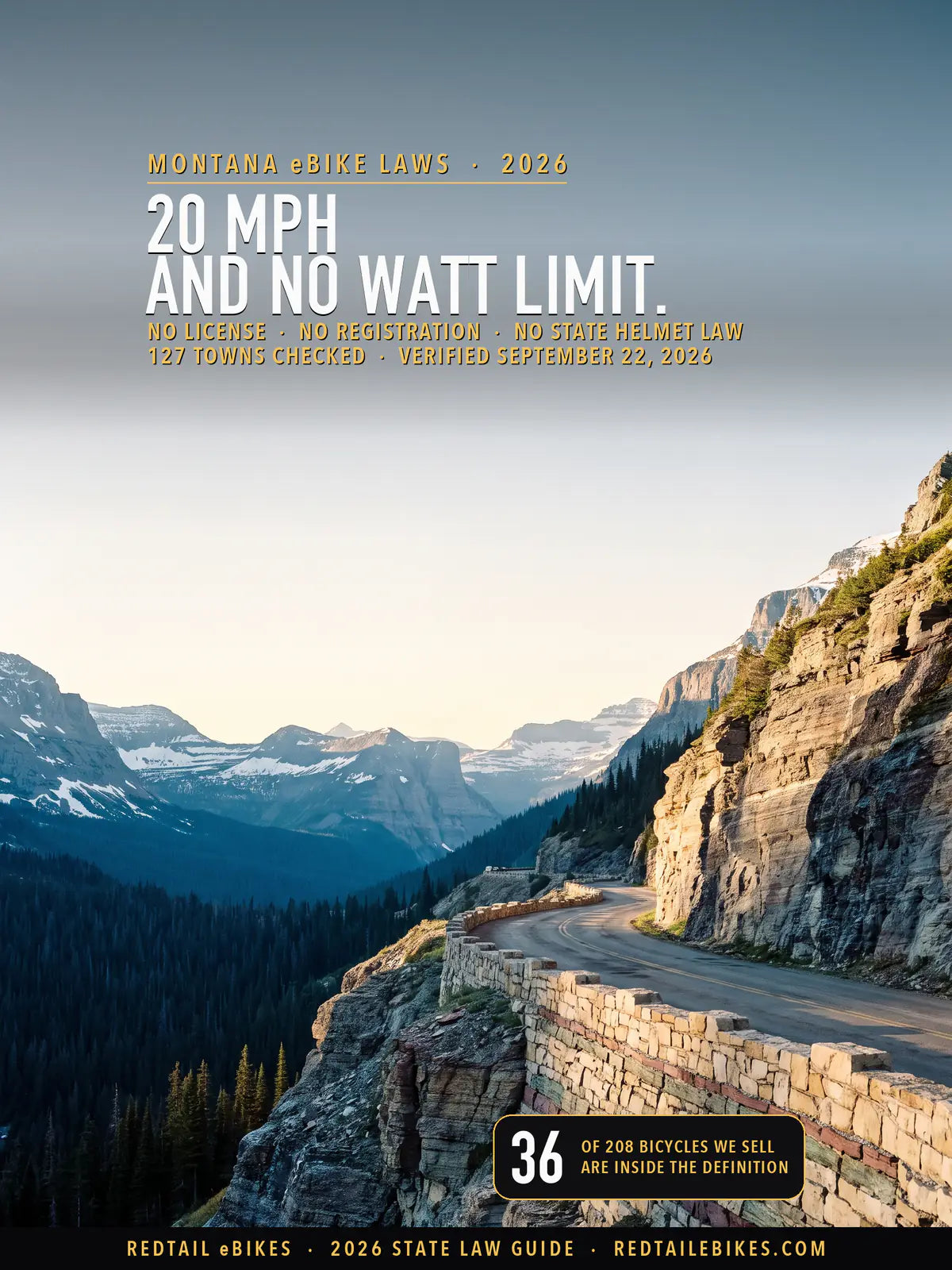
Montana calls your e-bike a bicycle, and it never asks what the motor is rated at. The whole test is in one sentence of MCA § 61-8-102(7): two tandem wheels, an electric motor, and it cannot push you and a 170-pound rider faster than 20 miles an hour on flat pavement.
No wattage figure. No Class 1, 2 or 3. No requirement that it even have pedals.
Clear that line and you need no license, no registration, no insurance and no plate, because § 61-1-101(41)(b) says a motor vehicle "does not include a bicycle." There is no state helmet duty for you at any age. You may use a sidewalk under power — a moped and a motorized scooter may not.
The catch is that the statute is the most permissive layer in the state and the least decisive one. Glacier wants under 750 watts and pedaling, and Yellowstone designates classes Montana law does not have. Every national forest treats your e-bike as a motor vehicle, and Montana's own two land agencies disagree with each other about what it is.
Shopping first, reading second? Thirty-six of the 208 bikes we sell clear § 61-8-102(7), and 22 of those 36 are rated 750 watts or higher — still ordinary bicycles here, with no license, no plate and no registration. Most of the country will not let you do that. All 36 ship free anywhere in the US, with US support behind them.
See the bikes inside Montana's 20 mph lineIn this guide
- Are e-bikes legal in Montana?
- What Montana counts as an electric bicycle
- The bill that would have changed all this, and died
- What your bike becomes on the far side of 20 mph
- License, registration, insurance — and the town that can still ask
- Helmets: Montana's word is "headgear"
- Lights, brakes and the equipment rule
- Where you may ride, including the sidewalk
- Montana's own two land agencies disagree
- The Department of Natural Resources and Conservation says the opposite
- Federal land: 29.1% of Montana
- Glacier and Yellowstone give the same bike two answers
- 127 Montana towns: 59 have a rule that reaches your e-bike
- The rebate, and how far it reaches
- Our shelf against Montana's line
- Not an e-bike: mopeds, scooters and dirt bikes
- Montana eBike laws at a glance
- Which Montana rule applies to you
- What the AI answers get wrong about Montana
- What a Montana e-bike ticket costs
- A Montana e-bike checklist
- Where to read next
- The bottom line
- How Montana compares with its neighbors
- If an officer stops you in Montana
- Renting an e-bike in Montana
- Why buy a Montana-legal e-bike from us
- What changed, 2015 to 2026
- Frequently asked questions
- Riding with a disability
- What this page does not cover
How we verified this guide
Every rule here was read in the Montana Code Annotated 2025, updated August 2026, at the Legislature's own host. Every figure on this page was recomputed rather than repeated: the motor ratings and assisted speeds come from our own listings, screened against the statute's own limb and counted on September 22, 2026.
The local layer is a census. Every one of the 127 municipalities was checked. All 127 incorporated municipalities the Census Bureau lists for Montana were put to their own published codes, and each one resolves to a rule found, a code searched with nothing in it, or a code we could not reach, named either way.
Are e-bikes legal in Montana?
Yes, and with less paperwork than almost anywhere else. Montana folds the electric bicycle into its ordinary bicycle definition and then exempts bicycles from the machinery of motor-vehicle law.
§ 61-8-102(2) does the folding:
A "bicycle", says § 61-8-102(2), "means a vehicle propelled solely by human power on which any person may ride, irrespective of the number of wheels, except scooters, wheelchairs, and similar devices." Then the sentence that carries everything: "The term includes an electrically assisted bicycle."
It means every bicycle rule in Montana's traffic code reaches your e-bike without the word "e-bike" appearing anywhere, and it is why a town that has never debated electric bikes may still have rules that govern yours.
What Montana counts as an electric bicycle
Montana puts the whole test in one sentence, and it is shorter than the test in any other state: two tandem wheels, an electric motor, and a speed it must not be able to beat. What it leaves out is the interesting part — no wattage figure, no classes, and no requirement that the machine have pedals at all.
"'Electrically assisted bicycle' means a vehicle on which a person may ride that has two tandem wheels and an electric motor capable of propelling the vehicle and a rider who weighs 170 pounds no faster than 20 miles an hour on a paved, level surface." — MCA § 61-8-102(7)
Three limbs in § 61-8-102(7), and not one of them is a number on a motor.
There is no wattage cap. Most states copy the federal 750-watt figure and argue about whether "less than" excludes a bike badged at exactly 750.
Montana never wrote a watt line at all, so a 1,000-watt motor and a 250-watt motor are judged by the same question: how fast can it push you.
Montana and Oregon are the only two states whose definition sets no motor-power figure of any kind.
Three other jurisdictions come close and stop short: Rhode Island caps the motor in horsepower instead, New Jersey leaves wattage out of the e-bike limb while its code still draws a 750-watt line for the tier above, and the District of Columbia — not a state — writes none either. Alaska and Kentucky define no electric bicycle at all, so they set no figure to omit.
There are no classes. Search the whole of Title 61 for "Class 1", "Class 2" or "Class 3" applied to a bicycle and you will find nothing, because Montana never adopted the three-class model the rest of the country runs on. That matters more than it sounds: when a Montana city, a park or a trail sign tells you "Class 1 only", it is using a vocabulary the state statute does not define.
Pedals are not mentioned. The definition asks for two tandem wheels and an electric motor. A throttle-only two-wheeler that tops out at 20 mph reads as inside it on the words — which is not true in most states, where "fully operable pedals" is an express limb.
The 170-pound rider is doing real work
The test measures what the machine does, and never what its spec sheet says. The statute picks a standard rider of 170 pounds and a standard surface, paved and level, then asks what the motor can do underneath them.
So the number that decides your bike under § 61-8-102(7) is the assisted top speed, and that is the figure to check on a spec sheet before you buy. A bike advertised at "up to 28 mph" is not an electrically assisted bicycle in Montana whatever its motor is rated at, and a 1,500-watt machine geared to cut assist at 20 mph is.
Two tandem wheels, and what that does to a trike
"Two tandem wheels" is the one limb that closes rather than opens. An electric trike has three, so it is not an electrically assisted bicycle under (7).
Nor is it rescued by the bicycle definition. Subsection (2) of § 61-8-102 covers a vehicle "propelled solely by human power … irrespective of the number of wheels" and then expressly adds the electrically assisted bicycle. A powered trike is neither of those things: it is not solely human-powered, and it is not an electrically assisted bicycle. It falls out of both.
Where it lands is the moped definition, and that is the next section.
This is a genuine tension in the code rather than a settled answer, because subsection (2) goes out of its way to say wheel count does not matter, and subsection (7) then makes it matter. The practical advice survives either reading: if you ride three wheels in Montana, ride them expecting moped rules rather than bicycle rules.
The whole state test in one line. Two wheels, an electric motor, and it cannot push a 170-pound rider past 20 mph on flat pavement. The motor's rating is not part of it — which is why a 1,000-watt bike is a bicycle in Montana and is not one in most of the country.

The bill that would have changed all this, and died
If you have read anywhere that Montana has Class 1, 2 and 3 e-bikes and a 750-watt ceiling, you have read Senate Bill 387, and it is not law.
SB 387 of the 2025 session was titled "Generally revise electric bicycle laws." It would have installed the three-class framework and a 750-watt cap, and the Senate voted it down.
It cleared second reading on March 5, 2025, and on March 6 the Legislature's own record marks the third reading BILL NOT PASSED. The two entries that follow — missing the general bill transmittal deadline on March 12, and dying in process on May 23 — are the clerk's disposition of a bill already dead on the floor. It carries no chapter number.
The trap is not that the bill nearly passed. It is that the printed bill reads as though it had.
The strikethrough that marks the old text for deletion does not survive into the plain PDF, so in SB 387 the existing definition and the proposed one run together into a single sentence that reads like enacted law describing a 750-watt three-class regime. Read that PDF without the Senate's vote beside it and Montana looks like a three-class state. It is not, and it has never been.
Montana's definition has not changed in substance since 2015, when House Bill 280 created it. The 2025 session did amend § 61-8-102 twice, and neither amendment touched the e-bike test:
| Act | Bill | Signed | What it did |
|---|---|---|---|
| Ch. 23, L. 2025 | HB 43 | 27 Mar 2025 | Renumbered the definitions — the e-bike moved from (2)(g) to (7) — and rewrote § 61-8-605 to let you ride on a paved shoulder, two abreast |
| Ch. 693, L. 2025 | HB 588 | May 13, 2025 | Created "motorized scooter" and wrote it through the whole bicycle part, while expressly carving e-bikes out of it at § 61-8-102(15)(b) |
Both took effect on October 1, 2025. Montana's Legislature meets in regular session only in odd-numbered years under Article V, § 6 of the state constitution, and there has been no special session since 2017. The next chance for any of this to change is January 4, 2027.
What your bike becomes on the far side of 20 mph
Failing § 61-8-102(7) is only half an answer. The useful half is what the machine turns into, because that decides whether your teenager needs headgear and whether the sidewalk is open.
A two-wheeler that assists past 20 mph is not an electrically assisted bicycle, and therefore not a bicycle. It walks into § 61-8-102(14):
A moped in § 61-8-102(14) "means a vehicle equipped with two or three wheels, foot pedals to permit muscular propulsion, and an independent power source providing a maximum of 2 brake horsepower", and that power source "may not be capable of propelling the device, unassisted, at a speed exceeding 30 miles an hour on a level surface."
Two brake horsepower is 1,491 watts. So the moped door is wide: a pedal-equipped machine rated anywhere up to about 1,491 watts, incapable of more than 30 mph, is a moped in Montana, and note that this limb reads "two or three wheels", which is where the electric trike lands.
The moped definition adds one more condition, that the power drive system "functions directly or automatically only and does not require clutching or shifting by the operator after the drive system is engaged." Whether a derailleur defeats that is not settled by those words — a derailleur shifts the human drivetrain, not the power drive system, and we found no Montana decision resolving it. Treat the moped route as the likely answer rather than the certain one.
Above 1,491 watts or above 30 mph, the moped door closes too, and nothing in § 61-1-101 keeps the machine out of "motor vehicle" — the exclusion at (41)(b) covers only a bicycle, a motorized scooter and a moped.
If 28 mph is the point for you, that is a perfectly legitimate choice in Montana — you are buying a moped, and the consequences are headgear under 18 and no sidewalk or bike path under power. Our electric moped guide is the shelf for that decision.
Your bike cannot take the "motorized scooter" route either: § 61-8-102(15) defines that as "a vehicle without a seat", and (15)(b) adds that the term "does not include an electrically assisted bicycle."

License, registration, insurance — and the town that can still ask
At state level there is nothing to do on a road. No license, no registration, no plate, no title, no insurance requirement, no minimum age. (Off-road recreation on public land raises one open question about an OHV decal, which is below.) All of it follows from one exclusion in § 61-1-101(41)(b):
A motor vehicle, it says, "does not include a bicycle, a motorized scooter, or a moped as defined in 61-8-102, an electric personal assistive mobility device, a motorized nonstandard vehicle, or a motorized wheelchair" or similar device for a person with a disability.
Registration, titling and driver licensing in Montana all attach to a motor vehicle, and § 61-1-101(41)(b) takes your bike out of that term. Take the machine out of that term and the duties have nothing to bite on. The same exclusion runs through "motorcycle" at (43)(e) and "motor-driven cycle" at (44)(b), so a moped escapes them as well.
Then there is the part almost nobody publishes. § 61-12-101(1)(h) hands your town a power the state declined to use:
Nothing in the traffic chapters, it says, prevents local authorities "with respect to sidewalks, streets, and highways under their jurisdiction and within the reasonable exercise of the police power" from "regulating the operation of bicycles or mopeds, as defined in 61-8-102, and requiring the registration and licensing of bicycles or mopeds, including requiring a registration fee".
Under § 61-12-101(1)(h) a Montana city may lawfully require you to register and license a bicycle and charge you for it, and your e-bike is a bicycle. "No registration in Montana" is true of the state and is not a promise about the town you live in. None of the 127 municipal codes read for this page currently runs such a scheme, but the authority is sitting there.
The general grant is narrower than it looks in one respect worth knowing. § 61-8-103 makes the traffic chapter "applicable and uniform throughout this state", bars any local rule "in conflict" with it, and then allows local authorities to "adopt additional traffic regulations which are not in conflict". Your town can add to the state floor. It cannot lower it.
Helmets: Montana's word is "headgear"
There is no state helmet law for an adult or a child on a bicycle in Montana, and the way to prove that is to search the statute for the word it actually uses.
Read across all 1,086 sections of Title 61, "helmet" appears in exactly one — § 61-8-607(1)(a), and only to permit one: you may mount your front lamp on your helmet instead of the bike. "Headgear" also appears in exactly one section, and that section is the whole of Montana's protective-headwear law:
MCA § 61-9-417 requires that "an operator and passenger under 18 years of age of a motorcycle, moped, motorized scooter, or quadricycle operated on the streets or highways of this state shall wear protective headgear on the head."
Four machines are named in § 61-9-417. A bicycle is not among them, and your electrically assisted bicycle is a bicycle.
The rule that switches on at 20 mph
Now put that beside the moped chain, because this is the single most consequential thing on this page for a parent.
A moped is named in § 61-9-417. A machine that assists past 20 mph is not a bicycle, and if it has pedals and sits under 1,491 watts and 30 mph, it is a moped. So the under-18 headgear duty attaches to exactly the bikes that fall out of the e-bike definition.
Buy your fifteen-year-old a 20 mph e-bike and Montana asks nothing of either of you under § 61-9-417. Buy the 28 mph version of the same frame and the state requires protective headgear meeting Department of Justice standards every time they ride on a street or highway. The bike looks identical in the driveway. The duty is not.
One honest caveat on that chain. § 61-8-102 opens "As used in this chapter" — chapter 8 — and § 61-9-417 sits in chapter 9.
Chapter 9's own definitions section imports three chapter-8 terms by name and does not import "moped", and § 61-1-101 defines the other three machines § 61-9-417 names but never defines "moped" standing alone. So whether the headgear rule's "moped" is the chapter-8 moped is arguable rather than settled, and we found no Montana decision resolving it.
It does not change what to do. On either reading the safe course is identical: headgear on any rider under 18 whose machine assists past 20 mph. We flag it because the page tells you elsewhere exactly where a duty is certain, and this one is not.
Wear a helmet regardless. But if you want to know where the legal line actually sits, it sits at the assisted top speed, and it sits there for headgear as much as for everything else.
The 20 mph line decides more than you think. It decides whether you have a bicycle or a moped, and with it whether a rider under 18 needs headgear at all. Every bike in our commuter and city range publishes its assisted top speed on the listing, so you can check it against § 61-8-102(7) before you buy rather than after.
Shop bikes that stop at 20 mphLights, brakes and the equipment rule
§ 61-8-607 applies to your e-bike as a bicycle, and it is more demanding than most riders expect — note that it bites at dawn and dusk as well as after dark:
| Requirement | The statute's words |
|---|---|
| Front lamp | "a lamp on the front emitting a white light visible from a distance of at least 500 feet to the front" — or an equivalent lamp on your helmet, facing forward |
| Rear | "either a lamp emitting a red light visible from a distance of at least 500 feet to the rear or a red reflector" visible at 500 feet under low beams |
| Sides | "reflective material large and reflective enough to be visible from the left and right sides from a distance of at least 500 feet" |
| Brake | must stop the bike "within no more than 25 feet from a speed of 10 miles an hour on dry, level, clean pavement" |
Montana requires no label, no speedometer and no class sticker anywhere in Title 61, because it has no classes to sticker. The convenience is genuine, and it is also why a Montana rider arriving at a trailhead with a class-based sign has nothing on the bike to point at.
Two more that ride along: you may not carry anything that stops you "keeping at least one hand on the handlebars" (§ 61-8-606), and you may not hitch a ride by holding onto a vehicle, though "a bicycle trailer may be attached to a bicycle" (§ 61-8-604).
Where you may ride, including the sidewalk
Roads and shoulders. § 61-8-605 opens with "A person may operate a bicycle on a roadway or a paved shoulder", and since October 1, 2025 it adds that riders on a paved shoulder "may ride two abreast." Ride in the right-hand lane or the shoulder when you are slower than traffic, with named exceptions for passing, left turns, right-turn-only lanes and hazards.
On the roadway itself the default is single file — subsection (4) — with named exceptions for bike paths, overtaking, a parking lane, and a multi-lane road where two abreast does not impede traffic. And you are not required to ride "over or through hazards at the edge of a roadway or a paved shoulder", which is the clause that lets you leave a gravel-strewn shoulder without argument.
Sidewalks, and this is the one to know. § 61-8-608 sets the state default, and it treats your e-bike very differently from the machines beside it:
Subsection (3)(b) of § 61-8-608 reads: "A moped or motorized scooter may be operated on and along a sidewalk or a bicycle path only under human propulsion and may not be operated on or along a sidewalk or bicycle path if the moped or motorized scooter is under power from an independent power source."
Read the subjects.
A moped may not use a sidewalk or a bicycle path under power, and neither may a motorized scooter. A bicycle is not named in that prohibition, and your e-bike is a bicycle.
Two duties still bind you under subsections (1) and (2): yield to any pedestrian, give an audible signal before you pass one, and stay off where "official traffic control devices" prohibit it.
So Montana's statewide default permits an e-bike on a sidewalk under power. Few states write it that way, most summaries say the opposite, and it is the rule your town is likeliest to have overridden, which is what the local sweep below is for.
In a state this size, there is also this: § 61-8-111 puts forest development roads "subject to the traffic laws of this state", with the highway patrol and county sheriffs holding jurisdiction on them. On a Forest Service road, Montana's traffic code is live even though the land is federal.
Montana's own two land agencies disagree
This is the finding that decides more Montana rides than the statute does. Neither agency's rules contain the word "e-bike" anywhere. Both answers come from a definition of "motorized vehicle", and the two definitions are not the same definition.
Fish, Wildlife & Parks says your e-bike is non-motorized. ARM 12.12.102(15) defines a motorized vehicle by pointing at "a 'motor vehicle' as defined in 61-1-101, MCA" — the section that excludes a bicycle. So on FWP ground your e-bike is a non-motorized vehicle, and ARM 12.12.115 lets you ride it on authorized routes, subject to posted restrictions, at "15 miles per hour" in a developed area and "25 miles per hour" elsewhere.
That one rule set covers state parks, fishing access sites and wildlife management areas alike, because ARM 12.12.102(20) defines "public use sites" to include all three.
The limb that could undo the FWP answer
ARM 12.12.102(15) has two limbs, and the one above is the first. In full it reads that a motorized vehicle "means a 'motor vehicle' as defined in 61-1-101, MCA, and includes motorcycles, snowmobiles, off-highway vehicles, trailers, and motorhomes."
Montana defines an off-highway vehicle at MCA § 23-2-801(1) as "a self-propelled vehicle used for recreation or cross-country travel on public lands, trails, easements, lakes, rivers, or streams", including "any other means of land transportation deriving motive power from any source other than muscle or wind". An e-bike ridden for recreation on public land answers those words.
§ 23-2-804 then requires a serially numbered decal, paid for as a registration fee, before an off-highway vehicle may be used for off-road recreation on public lands. The exemptions at § 23-2-802 reach federal and out-of-state vehicles and licensed motorcycles near a designated road, and none of them reaches a bicycle.
Set against that, FWP is the agency that writes ARM 12.12 and the agency that would enforce a decal, and its rule reaches an e-bike through the first limb, which excludes a bicycle. Its published public-use guidance treats e-bikes as non-motorized.
Federally the same argument runs the other way: BLM's own Information Bulletin IB 2023-050 states that e-bikes "are motorized vehicles… and, therefore, fall within the definition of off-road (off-highway) vehicle at 43 CFR 8340.0-5."
We publish the conflict because it is real and nobody has resolved it. The advice that survives either reading: if you are riding off-road for recreation on Montana public land, ask the county treasurer or your FWP region whether your machine needs an OHV decal before you go. On a road, a path or a fishing access site you are not in this question at all.
The Department of Natural Resources and Conservation says the opposite
In its own words:
Its Bikes and E-Bikes page says so plainly: "Electric Bikes, aka peddle assist bikes, are considered to be motorized vehicles within the context of recreational use of trust lands. They are allowed on public roads, and roads signed as 'open' by DNRC."
DNRC's rule does it by writing its own definition rather than borrowing the statute's. ARM 36.25.1202(15) calls a motorized vehicle "a vehicle powered by a motor", with no cross-reference to § 61-1-101 at all. On roughly 5.2 million surface acres of state trust land, a plain bicycle may use "trails, roads, and off-road" and your e-bike is confined to open roads.
So the same machine, ridden across a boundary fence, changes legal character. Montana's own respondents noticed: DNRC's rule-review record says they "consistently called for DNRC to align its e-bike definitions and enforcement approach with Montana Fish, Wildlife and Parks (FWP) and with federal land managers."
DNRC's rules were replaced on November 8, 2025, and a further e-bike review closes for comment on September 25, 2026. This is the paragraph on this page most likely to move first.
Federal land: 29.1% of Montana
27,168,417 of Montana's 93,271,040 acres are federally owned — 29.1%, per Table 1 of the Congressional Research Service's Federal Land Ownership: Overview and Data, version 23, updated September 14, 2026. The composition is what matters here: the Forest Service holds 17,254,317 of those acres, 63.5% of the federal total, and the Forest Service is the agency that calls an e-bike a motor vehicle.
On a national forest, your e-bike is a motor vehicle. The definition at 36 CFR 212.1 carries no e-bike exception.
The agency has said so in its own voice: the 2022 rulemaking at 87 FR 41278 set out to "add a definition of e-bikes as a class of motor vehicle", and Forest Service Manual 7705 defines an electric bicycle as "a type of motor vehicle with two or three wheels, fully operable pedals, and an electric motor of not more than 750 watts".
Note what the federal definition carries that Montana's does not: a pedal requirement and a watt ceiling. A 1,000-watt Montana-legal bicycle does not even meet the Forest Service's definition of the thing it is regulating.
The practical effect is simple and it surprises people: a trail open to bicycles is not open to your e-bike unless it is also open to motor vehicles.
BLM land needs an express decision. The carve-out at 43 CFR 8340.0-5(a)(5) joins its three conditions with "and", the third requiring a land-use decision that actually opens the route. BLM said as much when it made the rule: it "does not, by itself, open any non-motorized trails to e-bike use." No Montana-specific BLM e-bike designation was located.
A live proceeding to watch. 91 FR 54686 (August 24, 2026) is a Forest Service notice of intent that would exempt class 1 e-bikes from the motor-vehicle designation requirement. Comments are due by September 23, 2026 — today, as this page is published. It is a notice of intent to prepare an environmental impact statement, that analysis will also consider keeping class 1 machines as motor vehicles, and nothing about today's rule has changed.

The eight forest units, and the one that regulates by order
The Forest Service administers Montana's National Forest System land through eight administrative units covering eleven proclaimed forests. Seven of the eight publish an e-bike position and all seven agree with the national rule; the Bitterroot publishes none, so the national rule governs there by default.
| Administrative unit | Publishes an e-bike position | Note |
|---|---|---|
| Custer Gallatin | Yes | The only Montana forest regulating bicycles by order — Order 07-11-00-10 enumerates 89 route descriptions across 121 trail numbers |
| Flathead | Yes | Agrees with the national rule |
| Lolo | Yes | Agrees with the national rule |
| Helena–Lewis and Clark | Yes | Agrees with the national rule |
| Beaverhead–Deerlodge | Yes | Order 01020025-02 bars wheeled vehicles used to transport people across 13 Recommended Wilderness Areas |
| Kootenai | Yes | Agrees with the national rule |
| Idaho Panhandle | Yes | Administers 457,132 Montana acres through the Kaniksu, in Lincoln County |
| Bitterroot | No published position located | Twelve pages read in full; the national rule governs by default |
The sharpest consequence sits in Custer Gallatin's 2026 Hyalite–Porcupine–Buffalo Horn interim order. It reopens seventeen trails to bicycles and defines a bicycle as one "propelled by foot pedals" — so all seventeen stay closed to an e-bike even as they open to the bike beside it in your garage.
One currency trap worth knowing if you go looking yourself: Region 1 order R1-2025-02 is rescinded and terminated, and it still surfaces first in a search.
Wilderness closes to everything, and no local decision reopens it
Montana's national forests hold twelve wilderness areas totalling 3,430,950 acres — 19.9% of the state's National Forest System land. A plain bicycle is already barred there, and an e-bike is caught three times over: by the bicycle prohibition, by the motor-vehicle prohibition, and by the Wilderness Act's bar on "other form of mechanical transport". No forest supervisor, no county and no state agency can open it.
The Park Service goes one step further inside its own wilderness: 36 CFR 4.30(i)(4) prohibits possessing an electric bicycle there, so walking one through is not a workaround.
Before a federal trailhead, ask three questions. Who manages this ground — Park Service, Forest Service or BLM? Is this route open to motor vehicles, because on a national forest that is the test your e-bike has to meet? And is any part of it designated wilderness, where a bicycle is already barred and an e-bike may not even be carried through?
Glacier and Yellowstone give the same bike two answers
The Park Service runs on an opt-in rule that catches almost everyone out. Under 36 CFR 4.30(i)(2), "The use of an electric bicycle is prohibited in locations not designated by the Superintendent under paragraph (i)(1) of this section." Your e-bike is not automatically welcome where a bicycle is welcome — a superintendent has to say so. Subsection (i)(4) goes further and prohibits even possessing one in designated wilderness, so pushing it counts.
And one paragraph of that section reaches every park in the country, which almost no guide carries. Subsection (i)(3): "Except where use of motor vehicles by the public is allowed, using the electric motor exclusively to move an electric bicycle for an extended period of time without pedaling is prohibited." Throttle-only riding is barred in every National Park Service unit in Montana, not only in the two that publish a rule about it.
Then each park answers for itself, and Montana's two headline parks answer differently.
| Glacier | Yellowstone | |
|---|---|---|
| Wattage | Under 750 W | Not stated |
| Throttle | Motor "engaged only while pedaling" | Class 1 and 3 designated; class 2 unnamed |
| Where | Where bicycles are allowed | Established roads, parking areas, designated routes |
| Season | Going-to-the-Sun timing bans through Sept 27 | Summer, when open to motor vehicles |
| Everywhere | No throttle-only riding — 36 CFR 4.30(i)(3) | No throttle-only riding — 36 CFR 4.30(i)(3) |
Glacier publishes a wattage rule Montana's statute does not have: "Electric bicycles (e-bikes) are allowed if the motor is less than 750 watts (1 hp) and engaged only while pedaling."
Two conditions, and both are foreign to state law: an exclusive 750-watt ceiling, and pedal-assist only. A throttle is fine on a Montana highway and not fine in Glacier. Going-to-the-Sun Road adds a seasonal timing rule on top — bicycles are prohibited from Apgar to Logan Pass eastbound between noon and 6 pm, and from Logan Pass to Apgar westbound between 3 pm and 6 pm.
Yellowstone publishes a class rule Montana's statute does not have either: "Mountain bikes, road bikes, and e-bikes (class 1 and 3) are permitted on established public roads, parking areas, and designated routes in Yellowstone National Park when open to motor vehicles during the summer season."
Read the parenthesis. Class 1 and class 3 are designated. Class 2 — the throttle class — is not named, and a rider arriving from a state with no classes has nothing on the bike that answers the question. All bikes are prohibited on backcountry trails and boardwalks.
So one machine can be a lawful electrically assisted bicycle on the highway outside the park, non-motorized on FWP land, motorized on DNRC land, and a motor vehicle on the forest.
The same bike is inside Glacier's rule if it is under 750 watts and pedaling, and outside Yellowstone's designation if it is a throttle bike.
Nothing about the bike changed.
Buy on the state line, plan the ride on the land. Montana's statute is the most permissive layer you will meet and the least decisive. Before a trip, ask one question — who owns this ground — and you will have your answer: FWP non-motorized, DNRC motorized, Forest Service motor vehicle, and each national park its own published rule.

127 Montana towns: 59 have a rule that reaches your e-bike
We checked all 127 incorporated municipalities the Census Bureau lists for Montana, including Butte-Silver Bow, the consolidated city-county an ordinary municipal list drops. 59 have a rule that reaches an e-bike, 23 publish a code with nothing in it, and 45 could not be reached — no online code, a dead host, or a challenge page.
Every one of the 45 is listed below by name, because a town nobody could check is not a town with no rule.
Those 127 towns hold 621,144 of Montana's 1,137,233 residents, so 45.4% of Montanans live outside any municipality, where no town ordinance reaches them at all. Of the people who do live in one, the status of 604,769 — 97.4% — is resolved.
Only 10 of the 59 write an electric bicycle into the code by name. The other 49 have a rule that was never about e-bikes and catches yours anyway, because § 61-8-102(2) makes an electrically assisted bicycle a bicycle. A town that adopts Title 61 wholesale and writes nothing local still has an e-bike rule.
The newest and most detailed: Columbia Falls
Columbia Falls passed a package of five ordinances on December 15, 2025, each taking effect thirty days later, and it is the most complete municipal e-bike scheme in the state:
Section 10.72.050(D), from Ord. 839, reaches "a bicycle, as defined in Montana Code Annotated §61-8-102, a moped, motorized scooter, skateboard, or any other wheeled device, whether electrically or motor assisted or not", and allows it on "a public sidewalk, public path, or within a public park only under human propulsion".
Its second limb then bars the device where it is "solely under power from an independent power source" — and those two limbs do not say the same thing. On the ordinance's own words a rider pedaling with assist is arguably outside the prohibition limb while still outside the permission limb. Ride a Columbia Falls sidewalk under your own legs and no reading of it catches you.
Read strictly, that reverses the state default inside the city. Ord. 840 adds a helmet mandate for everyone under 18 on a roadway, sidewalk or public path — a duty the state imposes on nobody — and § 10.72.080 sets fines of $50, $100 and $175 with impoundment.
Carry this detail with you: the ordinances cite "§61-8-102(2)(g)" and "§61-8-102(2)(b)". Those subsection letters were replaced by HB 43 on October 1, 2025, ten weeks before the vote. The definitions they point at now live at (7) and (2), and the substance is unchanged.
Whitefish, and a vocabulary the state does not have
Whitefish repealed its dedicated electric-bicycle chapter on May 4, 2026 and moved the substance into general traffic:
Section 6-1-11(C), from Ord. 26-05, says that "No person may operate a non-motorized vehicle or type 1 or type 2 electric bicycle of any character on any of the shared use paths in excess of fifteen (15) mph."
"Type 1 or type 2" is not a Montana category. Neither is Missoula's "Class 1 and Class 2 electrically assisted bicycles", which may use a sidewalk "only under human propulsion". Both towns are legislating in a vocabulary the state statute never defines, and a rider with no class sticker — because Montana requires none — has nothing to show an officer. Follow the town's rule where you are, and expect the class question to have no clean answer.
Whitefish also bans every wheeled thing from the Central Avenue sidewalk between Railway Street and East Third Street, electric bicycles named expressly.
The rest of the big towns
| Town | Section | What it does |
|---|---|---|
| Billings | § 24-602(a) | No bicycle on a sidewalk "within a business district" |
| Missoula | MMC § 10.42.160(C)–(D) | Sidewalks only under human propulsion; downtown ban where a device says so |
| Great Falls | § 12.11.020 | Sidewalk riding unlawful except on the River's Edge Trail segments |
| Bozeman | § 36.10.110(B) | "No person over the age of 15 years shall ride any bicycle upon any sidewalk" |
| Butte-Silver Bow | § 10.84.110 | Sidewalk barred where traffic-control devices prohibit it |
| Helena | § 7-9-7 | No bicycle on the pedestrian mall |
| Kalispell | § 17-114 | A flat city-wide sidewalk ban |
| Red Lodge | §§ 6-1-6, 8-12-6 | Sidewalk ban — and its trails chapter expressly authorizes e-bikes |
| Lewistown | § 10-11-10 | Headgear under 18 on "power driven two or three wheel vehicles" |
Red Lodge is the instructive one. The same town bans bicycles from its sidewalks and, in a different chapter, authorizes every non-motorized user on its trails with an e-bike written into the definition. Two surfaces, two answers, one town.
45 towns with no published code — ring the clerk
The largest are Eureka (1,561), Fort Benton (1,422), Plains (1,244), Pinesdale (876) and St. Ignatius (830). Some publish no code at all; Fort Benton's sits behind a challenge page; Pinesdale runs town-meeting government and does not publish ordinances.
For most of them the only remaining route is the paper ordinance book at the clerk's office, which MCA § 7-5-4201(2) requires every Montana town to keep. If you live in one, ring the clerk before you assume the sidewalk is open.
Montana runs no state database of filed local ordinances. They are recorded with the town clerk instead, and the Code shows the drafting was deliberate: it does impose a state-filing duty for interlocal contracts at § 7-11-107, so Montana writes such duties when it means to.

The rebate, and how far it reaches
There is no Montana rebate to wait for, and one small co-operative programme that a few thousand households can reach. Montana has no state e-bike rebate, voucher or tax credit. That is an affirmative finding rather than a failure to find one.
The Legislature's own subject index has no bicycle heading at all, MCA Title 15, chapter 30, part 23 lists twelve live individual income-tax credits and none is for a vehicle or a bicycle, and the alternative-fuel vehicle conversion credit that used to sit at § 15-30-2320 was repealed by Ch. 503, L. 2021. Montana's Department of Environmental Quality publishes its incentive list and no entry on it mentions a bicycle.
There is no federal e-bike purchase credit either. The E-BIKE Act was not reintroduced in the current Congress.
A single program is reachable by some Montanans, and it is worth naming precisely. Big Horn Rural Electric Cooperative, through Tri-State Generation and Transmission, pays 25% of the cost of an e-bike up to $150, and Big Horn adds its own 50% match on top — $225 at the maximum — $150 plus a $75 match.
E-bikes are exempt from the co-op's one-rebate-per-product limit, within a $300 aggregate per member account, and you must claim within 90 days of purchase.
The qualifier matters more than the amount. Big Horn REA serves Big Horn and Carbon counties, and federal energy data puts its Montana side at 71 metered accounts. This is a real, open program and it is not "a Montana rebate" — it reaches a very small number of Montana households. If you are not one of them, no utility in the state offers an e-bike rebate; all 35 retail utilities serving Montana were read.
No rebate to wait for means the price you see is the price. With no state program to apply for, the thing that actually saves a Montana buyer money is free US shipping and a warranty we handle for you. Our fat-tire range is where the gravel-road and snow bikes live, every one shipped free.
See the fat-tire bikes built for MontanaOur shelf against Montana's line
We screened all 208 bicycles we sell against § 61-8-102(7) on September 22, 2026, reading each listing's published assisted top speed and wheel count — the statute's own limbs — rather than a product-type field. Five listings that are not bicycles at all (two scooters, a stand-up scooter, a balance bike and an accessories kit) are excluded from that count and named below.
| Verdict against § 61-8-102(7) | Bikes |
|---|---|
| Inside the definition | 36 |
| Outside — assists past 20 mph | 105 |
| Outside — three wheels | 29 |
| Our listing publishes no top speed | 38 |
Thirty-six of 208 bicycles we sell are inside the definition on those limbs. If the bike you want is one of the 38 that publish no assisted top speed, write to us with the model and we will read the figure off the maker's own specification before you order.
The number worth pausing on is the next one: 22 of the 36 are rated 750 watts or higher. Three of them are rated 1,000 watts or more, and two of those are rated 1,500 watts.
In the 44 jurisdictions whose definitions cap the motor at 750 watts, those machines are outside the e-bike definition on their rating alone. In Montana the rating is not a limb, so a 1,000-watt mid-drive that assists to 20 mph is an electrically assisted bicycle, and so a bicycle, with no license, no registration and no plate.
That is the single biggest practical difference between shopping for an e-bike in Montana and shopping for one anywhere else, and it is worth using deliberately. A higher-rated motor at the same 20 mph ceiling buys you torque for a gravel climb rather than speed you are not allowed to use, which is why our fat-tire and mountain range suits this state better than a lightweight commuter does.

Four bikes that fit Montana
Eunorau FAT-HD 1.0 Pro Mid-Drive Fat eBike
From $1,999A 1,000-watt mid-drive that assists to 20 mph. Montana asks what the motor can do rather than what it is rated at, so this clears § 61-8-102(7) on the same limb a 250-watt commuter does — and the extra torque goes into a forest-road grade or a foot of snow instead of into speed.
Mid-drive power through the gears is the reason to pick it for Montana specifically: on a loose climb the motor works with your cassette rather than fighting it at the hub.
We have been over this machine spec by spec in our Eunorau FAT-HD 1.0 Pro review.
Where it does not go: Glacier's own rule stops at "less than 750 watts", so this bike stays outside the park. If your riding is mostly inside Glacier, the TIGER JR below is the one to buy. In Gray and Camo; the Camo is $2,099.
750 watts, 20 mph, fat tires, built around hunting season. Montana's national forests are 63.5% of its federal land, and § 61-8-111 keeps Montana's traffic code live on forest development roads — so the road network is where this bike earns its keep.
Remember the forest rule before you plan a trip around it: the Forest Service treats an e-bike as a motor vehicle, so ride it where motor vehicles are allowed rather than on every trail open to bicycles.
In Camo. Free US shipping.
500 watts, 20 mph, commuter geometry. It is the lowest-rated bike on this list and that is precisely why it is here: Glacier National Park allows an e-bike only if the motor is "less than 750 watts (1 hp) and engaged only while pedaling", and 500 watts sits comfortably inside that line where a 750-watt badge does not.
It is also the right shape for a Montana college town, where your real constraints are a sidewalk ordinance and a 15 mph shared-path cap rather than open highway. In the park, leave the throttle alone — Glacier asks for the motor to be engaged only while pedaling, which is a riding choice rather than a hardware problem.
We have ridden this bike's sibling and published the dash readings, so you can see how a Qiolor behaves before you commit: read our ridden Qiolor review. In black and blue.
750 watts, 20 mph, and it folds — which matters in a state where the ride often starts an hour's drive from the house. Throw it behind the seat, drive to the trailhead or the forest road, and ride from there.
Montana's distances are the argument for this one. A folding frame turns a bike that would otherwise live in town into one that goes wherever the truck goes, and at 750 watts inside a 20 mph ceiling it stays an electrically assisted bicycle the whole time.
Five colorways — Sky Blue, Olive Green, Red, Yellow and White. Free US shipping, US support, and we handle the maker's warranty.
Check the speed, not the sticker. Montana issues no class sticker and requires no label, so the only figure that answers the legal question is the manufacturer's published assisted top speed. Keep it bookmarked, and if your bike has a switchable speed setting, leave it where the published figure is honest.
Each of the four is linked here as well as on its card, because on this page the decisive spec is the assisted top speed and every one of these listings publishes it.
They are the Eunorau FAT-HD 1.0 Pro at 1,000 W, the Vtuvia SN100 and the Addmotor Foldtan M-160 at 750 W, and the Qiolor TIGER JR at 500 W — all four geared to stop assisting at 20 mph, and so all four inside § 61-8-102(7) on the limb that decides it.
If you would rather browse than be told, the whole set sits in our commuter and city range, our fat-tire range and our mountain range, and most listings in all three print the assisted top speed; 38 of the 208 do not yet, and those are the ones to ask us about.
Not an e-bike: mopeds, scooters and dirt bikes
Mopeds. Two or three wheels, foot pedals, no more than 2 brake horsepower (1,491 W), and incapable of more than 30 mph unassisted. A moped is excluded from "motor vehicle" too, so it needs no registration — but it is named in the under-18 headgear rule, and § 61-8-608(3)(b) bars it from a sidewalk or bicycle path under power.
Motorized scooters. § 61-8-102(15) defines these as "a vehicle without a seat" with a power source incapable of more than 30 mph. If your machine has a saddle it is not one, and (15)(b) expressly excludes an electrically assisted bicycle in any case.
Electric dirt bikes and anything over 1,491 watts without pedals. No pedals closes the moped door; over 2 brake horsepower closes it too. What is left is a motor vehicle, with everything that implies — and if it has a saddle and handlebars it is a motorcycle under § 61-1-101(43), or a motor-driven cycle under (44) at 5 horsepower or less.
Montana eBike laws at a glance
Every rule on this page in one table, with the provision behind it. If you read nothing else, read the first four rows: they are the ones that decide whether the machine in your garage is a bicycle in Montana at all.
| Question | Montana's answer | Authority |
|---|---|---|
| Is it a bicycle? | Yes, if two wheels and it cannot assist a 170 lb rider past 20 mph on the flat | MCA § 61-8-102(2), (7) |
| Wattage ceiling | None. Montana writes no watt figure at all | § 61-8-102(7) |
| Classes | None. One category, and you are in it or you are not | § 61-8-102(7) |
| Pedals required | Not by the definition | § 61-8-102(7) |
| Three wheels | Outside the e-bike definition; falls to the moped provision. Unsettled — see Limitations | § 61-8-102(7), (14) |
| Driver's license | Not required | § 61-1-101(41)(b) |
| Registration or plate | Not required by the state; a city may require one | § 61-1-101(41)(b), § 61-12-101(1)(h) |
| Insurance | Not required | § 61-1-101(41)(b) |
| Minimum age | None statewide | no provision in §§ 61-8-601 to 61-8-609 |
| Helmet or headgear | None for a bicycle at any age | § 61-9-417 |
| Headgear over 20 mph | Required under 18 once the machine is a moped — arguable, not settled; wear one either way | § 61-8-102(14), § 61-9-417 |
| Roadway | Permitted, plus the paved shoulder, two abreast there | § 61-8-605 |
| Sidewalk | Permitted under power unless signed or a town says otherwise | § 61-8-608 |
| Bike path | Permitted; a moped and a motorized scooter are not, under power | § 61-8-608(3)(b) |
| Lights and brake | Required at dawn, dusk and night | § 61-8-607 |
| Label or speedometer | Not required | no provision in Title 61 |
| State park, FAS, WMA | Non-motorized; authorized routes; 15 mph developed, 25 elsewhere | ARM 12.12.115 |
| State trust land | Motorized; open roads only; license from age 12 | ARM 36.25.1202(15), 36.25.1204(3)(a); license ARM 36.25.1203(1) |
| National forest | A motor vehicle | 36 CFR 212.1 |
| Designated wilderness | Prohibited | 36 CFR 261.18, 16 U.S.C. § 1133(c) |
| Glacier National Park | Under 750 W, pedaling only | Glacier NP, Bicycling |
| Yellowstone National Park | Class 1 and 3 designated | Yellowstone NP, Bicycling |
| State rebate | None | MCA Title 15, ch. 30, pt. 23 |
| Penalty | Misdemeanor under the bicycle part; local fines vary | § 61-8-601(1) |
Which Montana rule applies to you
Find your machine and your ground, and the row tells you the answer and the provision it comes from. The rows that carry an unsettled reading say so rather than pretending otherwise.
| Your situation | The answer | Where it comes from |
|---|---|---|
| 20 mph bike, any wattage, two wheels | An electrically assisted bicycle. No license, registration, insurance or plate | § 61-8-102(7), § 61-1-101(41)(b) |
| 28 mph bike with pedals, under 1,491 W | Likely a moped. Under-18 riders need headgear; no sidewalk or bike path under power | § 61-8-102(14), § 61-9-417, § 61-8-608(3)(b) |
| Electric trike | Not an electrically assisted bicycle. Falls to the moped definition, which reads "two or three wheels" — an unsettled reading | § 61-8-102(7) and (14) |
| Riding a sidewalk, no local rule | Permitted under power. Yield to pedestrians, signal before passing | § 61-8-608(1)–(3) |
| Riding a sidewalk in Kalispell, or Whitefish's Central Avenue | Prohibited | Local ordinance |
| Riding a sidewalk in Columbia Falls | Human propulsion only; the ordinance's two limbs do not align, so pedal it | Columbia Falls MC § 10.72.050(D) |
| State park, fishing access site or WMA | Non-motorized. Authorized routes, 15 mph developed / 25 mph elsewhere | ARM 12.12.102(15), ARM 12.12.115 |
| DNRC state trust land | Motorized. Public roads and DNRC-signed-open roads only; recreational use license from age 12 | ARM 36.25.1202(15), 36.25.1203(1), § 77-1-804(6)(c) |
| Off-road recreation on public land | An open question: you may owe an OHV decal. Ask the county treasurer before you go | § 23-2-801(1), § 23-2-804; ARM 12.12.102(15) |
| National forest trail | A motor vehicle. Only where motor vehicles are allowed | 36 CFR 212.1, FSM 7705 |
| Designated wilderness | Prohibited, and possession is prohibited in a national park's wilderness | 36 CFR 261.18, 16 U.S.C. § 1133(c), 36 CFR 4.30(i)(4) |
| Glacier National Park | Under 750 W and pedaling only, where bicycles are allowed | Glacier NP, Bicycling |
| Yellowstone National Park | Class 1 and 3 designated, on roads and designated routes in summer | Yellowstone NP, Bicycling |
| Under 18 on a 20 mph e-bike | No state headgear duty — unless your town wrote one, as Columbia Falls and Lewistown did | § 61-9-417 |
What the AI answers get wrong about Montana
Ask an AI-backed search for Montana's wattage limit and you can get two opposite answers on the same day. We put ten prompts through one on September 22, 2026 — Claude Code's US web search, because Perplexity, ChatGPT and Google's AI Mode all refused automated retrieval that day — and kept every answer verbatim.
Two answers contradicted each other on the most commercially important question on the subject. Asked whether Montana caps wattage, one answered that "the statute does not impose a numeric watt cap — a bike could in principle have a 1,000-watt motor and still qualify."
Asked whether a 1,000 W e-bike is legal in Montana, another answered: "A 1000W e-bike is NOT legal in Montana under state law." Same day, same instrument, and six of the nine hosts they cited were the same.
The first is right. The second reaches its answer by deciding a speed test with a power figure — "A 1000W motor would typically exceed this 20 mph speed limit" — which is a guess about gearing dressed as a rule.
Several answers reported SB 387's three-class, 750-watt scheme as Montana law. The Senate voted it down on March 6, 2025 and it died on May 23.
Not one of the ten answers cited Montana's current code. The only Legislature host anywhere in the panel was a 2019 interim-committee PDF on the archive server. Six of the seven most-cited hosts were retailers writing law pages.
A fourth answer mixed legal systems without saying so, stating that Montana has no class framework and then that "Class 1, 2, and 3 e-bikes are allowed on motorized trails and roads on national forests." Both sentences are defensible; they belong to different bodies of law, and a reader with a bike and a map needs to be told which is which.
What a Montana e-bike ticket costs
Breaching the bicycle part is a misdemeanor: § 61-8-601(1) makes it "a misdemeanor for any person to do any act forbidden or fail to perform any act required in this part." Local penalties are set locally — Columbia Falls publishes $50, $100 and $175 for successive offenses, with impoundment available. On FWP land, a rule breach is a misdemeanor under § 23-1-106(2), punishable by a fine of up to $500 or up to six months.
A Montana e-bike checklist
Eight things to settle before you ride in Montana, in the order they are likely to matter. The first one decides all the others, because everything in § 61-8-102(7) turns on the assisted top speed.
- Check the assisted top speed, not the motor rating. 20 mph on the flat with a 170-pound rider is the whole state test.
- Two wheels. A trike is outside the e-bike definition and into the moped one.
- Lights and a brake. White to 500 feet front, red lamp or reflector to 500 feet rear, side reflectors, and a brake that stops you in 25 feet from 10 mph — at dawn and dusk as much as at night.
- Look up your town. Ten Montana towns name e-bikes; 49 more have bicycle rules that reach yours anyway.
- Know whose land you are on. FWP non-motorized, DNRC motorized, Forest Service motor vehicle, and each park its own.
- Under 750 watts and pedaling for Glacier. Class 1 or 3 for Yellowstone.
- Headgear under 18 if the bike assists past 20 mph, because that machine is a moped — and wear one anyway, because that chain is arguable rather than settled.
- Riding off-road on public land? Ask the county treasurer whether you owe an OHV decal. It is an open question and nobody has resolved it.
- If you want the Montana-specific answer, the FAT-HD 1.0 Pro is the bike this state's law makes possible and most others do not — and the TIGER JR is the one to take through a Glacier entrance station.
Where to read next
The law, state by state. Montana is one of fifty-one answers, and the differences between them are sharper than any summary suggests — a machine that is an ordinary bicycle here stops being one the moment it crosses a state line that carries a watt figure.
- Electric Bike Laws by State — the national table, all 50 states and DC
- Oregon — the only other state whose definition sets no motor-power figure at all
- Idaho — the neighbour we have covered; Wyoming and the Dakotas are not yet written
- Washington — excludes a bike "easily configured" past the limits, the opposite drafting choice
- Massachusetts — defines only Class 1 and Class 2, so a 28 mph bike is unrecognized
- South Carolina — like Montana, one category and no classes at all
- Vermont — keeps a 1,000 W class of its own
- Utah · Colorado · Wisconsin — the other public-land states, where the land manager decides more than the statute
- California · Texas · New York · Florida — the four biggest markets, for comparison
- Arkansas · Nebraska · Kansas · Iowa — the plains states either side of the divide
- Minnesota · Michigan · Illinois · Ohio — the upper Midwest
- Nevada · New Mexico · Arizona — the rest of the Mountain West we have covered
Because Montana writes no watt line. These are the guides that matter more here than anywhere else, since the machines in them can be ordinary bicycles in this state if they assist to 20 mph.
- 750W eBikes — the rating most of the country draws its line at
- 1000W eBikes — outside the definition wherever a 750-watt line is written, inside it here
- 2000W eBikes · 3000W eBikes — where the moped chain starts to matter
- Dual-motor eBikes — two motors, and what that does to a wattage reading
- Hub-drive vs mid-drive · eBike motor guide — what a rating actually buys you
- Electric trikes — the three-wheel question this page leaves unsettled
Riding Montana.
- Best hunting eBikes — the use case the forest-road layer is really about
- Best fat-tire eBikes — gravel, snow and forest road
- Best electric mountain bikes — and where the Forest Service will let you take one
- Best long-range electric bikes — for a state this size
- Best cargo electric bikes · Best commuter electric bikes — Bozeman and Missoula riding
- Best folding eBikes — the ones that go in the truck
- Step-thru eBikes · Electric bikes for seniors
- Electric bikes for heavy adults · eBikes for tall riders
Buying.
- Electric bike buying guide — start here if this is your first
- First electric bike · How much is an electric bike
- Best eBike brands — who makes what, and who we will and will not recommend
- Best electric bikes under $1,000 · under $1,500
- Electric bikes for adults · for kids and teens — the age question, from the other side
- Fat tire vs regular tire · eBike frame types · eBike suspension
- Electric mopeds — what the machine over 20 mph may actually be
- Electric dirt bikes — and why they are not e-bikes anywhere
The bottom line
Montana is one of the easiest states in the country to own an e-bike in and one of the harder ones to ride it everywhere you want to.
The statute asks a single question — can it push a 170-pound rider past 20 mph on the flat — and if the answer is no, you have a bicycle, with no license, no registration, no insurance, no plate, no helmet duty and a sidewalk you are allowed to use. The motor's rating never enters it, which is why a 1,000-watt mid-drive is a bicycle here and is not one in most of the country.
Everything difficult happens after you leave the pavement. Twenty-nine per cent of Montana is federal, the Forest Service holds nearly two-thirds of that and calls your bike a motor vehicle, and the two great parks each publish a rule the state statute does not contain.
Buy on the 20 mph line, then plan the ride around the landowner. In that order, the state will not be the thing that stops you — and if you want the shortest version of that advice, the Eunorau FAT-HD 1.0 Pro is the machine Montana's missing watt line makes possible, the Vtuvia SN100 is the one for the forest roads, and the Qiolor TIGER JR is the one that clears Glacier's own rule.
How Montana compares with its neighbors
Montana is surrounded by states that took the model bill it declined, and the contrast is sharper than it looks: cross any of the four borders on a 1,000-watt machine and you stop being a bicycle.
| State | Classes | Watt ceiling | Helmet |
|---|---|---|---|
| Montana | None — one category | None | None by state law |
| Idaho | Class 1, 2, 3 | 750 W | None statewide for a bicycle |
| Wyoming | Class 1, 2, 3 | 750 W | None statewide for a bicycle |
| North Dakota | Class 1, 2, 3 | 750 W | None statewide for a bicycle |
| South Dakota | Class 1, 2, 3 | 750 W | None statewide for a bicycle |
Ride across the Idaho line on a 1,000-watt bike and the machine that was a bicycle in Montana stops being an electric bicycle in Idaho, whatever it does at 20 mph. Montana's simplicity carries that cost: the state is permissive, and it is permissive alone.

If an officer stops you in Montana
You have nothing to produce, because Montana issues nothing — no class sticker, no label duty, no speedometer requirement, no registration document. That cuts both ways: there is also nothing on the bike that proves it is inside the definition.
The question an officer is actually asking is the statutory one: what can this motor do with a rider on it. The useful answer is the manufacturer's published assisted top speed, so it is worth keeping the spec page bookmarked on your phone. If your bike has a switchable speed setting, the setting it is in is the thing that matters — leave it where the published figure is honest.
On FWP land the enforcement is a warden and the rules are posted at the site. On DNRC trust land you also need the recreational use license required from age 12 under ARM 36.25.1203(1).
Renting an e-bike in Montana
Rental fleets in Whitefish, Bozeman, Missoula and the park gateways are the commonest way visitors meet a Montana e-bike, and the rental counter is not the authority on where you may ride it. Ask which of the two park rules your machine meets before you take it toward a gate: Glacier wants under 750 watts and pedaling, Yellowstone designates class 1 and class 3.
A rented bike is in the same legal position as one you own. Nothing in Montana's definition turns on ownership.
Why buy a Montana-legal e-bike from us
Most of our listings print the assisted top speed, which is the one figure Montana's definition actually turns on — so you can check the statute yourself before you buy rather than after an officer asks. The 36 figure above is rebuilt from the live catalog every time this page is touched, so it is the shelf as it stands today.
Shipping is free anywhere in the US, Shop Pay instalments are available at checkout, and support is US-based. If you want a recommendation for your particular corner of the state — a Bozeman commute, a Flathead forest road, a hunting season in the Custer Gallatin — write to us and say where you ride, and we will answer with a model and the reason.
Ready when you are. Thirty-six of the 208 bikes we sell clear § 61-8-102(7), 22 of them at 750 watts or more. Free US shipping on every one, Shop Pay instalments at checkout, and US support behind it.
See the 36 bikes inside Montana's lineWhat changed, 2015 to 2026
Montana's e-bike definition has not moved in substance since 2015. What has moved is everything around it — the numbering, the bicycle part of the traffic code, the local layer, and one bill that tried to replace the whole thing and failed.
| Date | What happened |
|---|---|
| 2015 | HB 280 (Ch. 255) creates "electrically assisted bicycle" — the 170-pound, 20 mph test still in force |
| March 6, 2025 | SB 387 is defeated on Senate third reading — Class 1/2/3 and a 750 W cap voted down |
| March 27, 2025 | HB 43 signed (Ch. 23) — renumbers the definitions, opens the paved shoulder, allows two abreast there |
| May 13, 2025 | HB 588 signed (Ch. 693) — creates "motorized scooter", carves e-bikes out of it |
| May 23, 2025 | SB 387 dies in process. Montana keeps its single category |
| October 1, 2025 | HB 43 and HB 588 take effect |
| 8 Nov 2025 | DNRC's replacement trust-land rules take effect |
| 15 Dec 2025 | Columbia Falls adopts the state's most detailed municipal e-bike package |
| May 4, 2026 | Whitefish repeals its electric-bicycle chapter, moves the rules into general traffic |
| 4 Jan 2027 | Next regular legislative session convenes |
Frequently asked questions
Are e-bikes legal in Montana?
Yes. An electrically assisted bicycle is a bicycle under MCA § 61-8-102(2), and you need no license, registration, insurance or plate to ride one.
What is the legal motor watt limit for e-bikes in Montana?
There is none. Montana's definition at § 61-8-102(7) sets no wattage figure at all — it asks only whether the motor can push a 170-pound rider faster than 20 mph on flat pavement. Montana and Oregon are the only two states whose definition sets no motor-power figure of any kind. Rhode Island caps in horsepower, New Jersey leaves wattage out of the e-bike limb, and the District of Columbia writes none either.
What is the legal e-bike speed limit in Montana?
Twenty miles an hour, and it is a definitional limit rather than a speed limit. A motor that cannot exceed 20 mph with a 170-pound rider on paved, level ground keeps the machine inside the e-bike definition. Riding faster downhill under your own legs does not take you outside it.
Does Montana have a helmet law?
Not for bicycles, and your e-bike is a bicycle. Montana's only protective-headwear statute, § 61-9-417, requires headgear for riders and passengers under 18 on a motorcycle, moped, motorized scooter or quadricycle. Some towns add their own: Columbia Falls requires it under 18, and Lewistown requires it under 18 on power-driven two- and three-wheel vehicles.
Is Montana a helmet-law state?
Not for adults on any vehicle, and not for bicycles at any age. The under-18 duty at § 61-9-417 reaches motorcycles, mopeds, motorized scooters and quadricycles only.
Do I need a license or registration to ride an e-bike in Montana?
No. Registration, titling and driver licensing attach to a "motor vehicle", and § 61-1-101(41)(b) says that term "does not include a bicycle". Note that § 61-12-101(1)(h) lets a city require bicycle registration and charge a fee for it, so check your town.
Do I need insurance to ride an e-bike in Montana?
No. Montana's compulsory insurance requirement runs with motor-vehicle registration, and your e-bike is not a motor vehicle.
What is the minimum age for riding an e-bike in Montana?
The state sets none. There is no minimum operating age anywhere in the bicycle part of the traffic code. Towns may set their own rules, and Bozeman's sidewalk rule turns on age from the other direction: no one over 15 may ride a bicycle on a city sidewalk.
Are there any age restrictions to riding an electric bike in Montana?
Not at state level. The age rules that do exist are local, or attach to mopeds rather than bicycles — which is why a bike that assists past 20 mph brings the under-18 headgear duty with it.
Can I ride an e-bike on a Montana sidewalk?
Under state law, yes, under power. § 61-8-608 bars a moped or motorized scooter from a sidewalk under power and does not bar a bicycle, though you must yield to pedestrians and give an audible signal before passing.
Many towns override that, and the local rule wins where it is stricter, because § 61-8-103 lets local authorities "adopt additional traffic regulations which are not in conflict" with the state chapter. Kalispell bans bicycles from every sidewalk, Columbia Falls allows only human propulsion, and Billings and Darby ban it in the business district.
Where can you ride an e-bike in Montana?
Roadways and paved shoulders by right, sidewalks and bike paths unless a local rule or a traffic control device says otherwise, and FWP state parks, fishing access sites and wildlife management areas on authorized routes. DNRC trust land is open roads only. National forest trails are open only where motor vehicles are.
Are e-bikes allowed on bike trails in Montana?
It depends entirely on who owns the trail. On FWP land your e-bike is non-motorized and may use authorized routes at 15 mph in developed areas and 25 mph elsewhere. On a national forest it is a motor vehicle and may not use a bicycle-only trail. Red Lodge expressly authorizes e-bikes on its city trails; Whitefish caps them at 15 mph on shared-use paths.
Are ebikes considered motorized vehicles in Montana?
The state traffic code says no — an electrically assisted bicycle is a bicycle and is excluded from "motor vehicle". Montana's own two land agencies then disagree with each other: FWP treats it as non-motorized, DNRC treats it as motorized on state trust land.
Are e-bikes allowed on Montana DNRC state trust lands?
Only on public roads and roads DNRC has signed open. DNRC's page states it plainly: e-bikes "are considered to be motorized vehicles within the context of recreational use of trust lands." A plain bicycle may use trails, roads and off-road. A recreational use license is required from age 12.
Can you ride ebikes in Glacier National Park?
Yes, where bicycles are allowed, if the motor is "less than 750 watts (1 hp) and engaged only while pedaling" — Glacier's own published rule. Going-to-the-Sun Road adds seasonal time bans: eastbound Apgar to Logan Pass between noon and 6 pm, westbound between 3 pm and 6 pm.
Can I ride an e-bike in Yellowstone?
Yellowstone permits "e-bikes (class 1 and 3)" on established public roads, parking areas and designated routes when open to motor vehicles in summer. Class 2 is not named. All bikes are prohibited on backcountry trails and boardwalks.
Are E-Bikes Allowed in Montana National Forests?
On roads and trails open to motor vehicles, yes; on a trail open only to bicycles, no. The Forest Service defines an e-bike as a type of motor vehicle, and 36 CFR 212.1 carries no e-bike exception. Wilderness is closed to bicycles and e-bikes alike.
Are 28 mph e-bikes legal in Montana?
They are legal to own and ride, but not as an electrically assisted bicycle. A machine that assists past 20 mph falls out of § 61-8-102(7); with pedals, under 1,491 watts and incapable of more than 30 mph it is a moped, which brings the under-18 headgear duty and a bar on sidewalks and bike paths under power.
Are Class 2 throttle e-bikes legal in Montana?
Yes, on Montana's own roads. The definition never mentions pedals or throttles, so a throttle machine that stops assisting at 20 mph is an electrically assisted bicycle.
Federal land is where it bites: 36 CFR 4.30(i)(3) prohibits using the motor "exclusively ... for an extended period of time without pedaling" in every National Park Service unit, Glacier separately requires the motor be "engaged only while pedaling", and Yellowstone designates class 1 and class 3 without naming class 2.
Where can I ride a Class 3 e-bike in Montana?
Montana has no Class 3, so the question has to be answered by performance. If the bike assists to 28 mph it is outside the state e-bike definition and is treated as a moped: roads yes, sidewalks and bike paths not under power, headgear under 18.
That is the law. Here is the shelf. Thirty-six of the 208 bikes we sell clear § 61-8-102(7), and 22 of those are rated 750 watts or more — machines most states will not call bicycles. Start with the FAT-HD 1.0 Pro if you want the one Montana's missing watt line makes possible, or the TIGER JR if Glacier is where you ride. Free US shipping on every one, Shop Pay instalments at checkout, US support behind it.
See the 36 bikes inside Montana's lineRiding with a disability
If you use an e-bike as a mobility device rather than as recreation, there is a federal route most guides omit entirely, and it treats your request as a civil-rights question rather than a recreation one.
BLM's Information Bulletin IB 2023-050 (August 1, 2023) instructs its state directors, district managers and accessibility coordinators that a request to use an e-bike as an other power-driven mobility device "should [be] construe[d] … as one for a 'reasonable modification' under section 504", and states that "Compliance with section 504 is not discretionary."
Under 43 CFR 17.550(a)(3) the agency carries the burden of proving a fundamental alteration or an undue burden, and that determination is made by the agency head with a written statement of reasons. Wilderness and wilderness study areas are expressly excluded.
Four of the six non-flagship National Park Service units in Montana publish an accommodation for other power-driven mobility devices, and all four publish it in the superintendent's compendium rather than on the accessibility page.
Grant-Kohrs Ranch sets four conditions and Fort Union caps speed at 8 mph. No Montana unit publishes a form or a decision timeline, and no compendium treats an e-bike itself as a mobility device, so the request has to be made as one.
Note which law applies to whom: the Americans with Disabilities Act Title II rule at 28 CFR 35.137 binds public entities — FWP, DNRC, your county — and does not reach the Park Service, Forest Service or BLM, which are reached through section 504 instead.
What this page does not cover
County ordinances. Montana's 56 counties were outside the scope of this sweep, which covered incorporated municipalities. Tribal law on the seven reservations is its own sovereign system and is not state law.
Private land, ski areas and homeowner associations set their own terms. And this is guidance for riders; it is not legal advice for a specific dispute.
How we verified this guide, in detail
Written by Milad Ghobadibeygvand, BScN (Western University, 2014), who buys and sells these machines for a living and reads the statutes because the answers change what we are willing to sell into a state.
Our evidence on this page is data and math. Every figure about our own bikes is verified against the manufacturer's published specification and recomputed against the statute's own limbs on the date stated.
Every rule is quoted from the primary source — the Montana Code Annotated, the Administrative Rules of Montana, the Code of Federal Regulations, a park's own compendium or published page, or a municipality's own code — and never from a summary, a competitor's guide or an AI answer.
Three instruments back this page and all three are re-runnable: a sweep of all 1,086 sections of MCA Title 61, a screen of all 208 bicycles we sell against § 61-8-102(7), and a census of all 127 Montana municipalities against their own published codes.
Corrections go to support@redtailebikes.com and we publish them.
Last verified: September 22, 2026. Montana Code Annotated 2025, updated August 2026.
The source register
| Source | Tier | What it supports | Read |
|---|---|---|---|
| MCA § 61-8-102 | T1 statute | The definitions of bicycle, electrically assisted bicycle, moped, motorized scooter | 22 Sep 2026 |
| MCA § 61-1-101 | T1 statute | Motor vehicle, motorcycle and motor-driven cycle exclusions | 22 Sep 2026 |
| MCA § 61-8-605 | T1 statute | Roadway and paved-shoulder riding, two abreast | 22 Sep 2026 |
| MCA § 61-8-607 | T1 statute | Lamps, reflectors and the braking standard | 22 Sep 2026 |
| MCA § 61-8-608 | T1 statute | Sidewalks and bike lanes, and the moped/scooter bar | 22 Sep 2026 |
| MCA § 61-9-417 | T1 statute | The under-18 headgear duty and the four machines it names | 22 Sep 2026 |
| MCA § 61-12-101 | T1 statute | Local power to regulate and to require bicycle registration | 22 Sep 2026 |
| MCA § 61-8-103 | T1 statute | Statewide uniformity and the additional-regulation carve-out | 22 Sep 2026 |
| Montana Legislature bill records | T1 legislative record | SB 387's death; HB 43 and HB 588 enactment and effective dates | 22 Sep 2026 |
| ARM 12.12.115 | T1 regulation | The 15 mph developed / 25 mph elsewhere speed rule on FWP land | 22 Sep 2026 |
| ARM 12.12.102 | T1 regulation | Why an e-bike is non-motorized on FWP public use sites | 22 Sep 2026 |
| DNRC, Bikes and E-Bikes | T1 agency | E-bikes as motorized vehicles on state trust land | 22 Sep 2026 |
| 36 CFR 4.30 | T1 federal regulation | NPS designation requirement and the wilderness possession bar | 22 Sep 2026 |
| 36 CFR 212.1 | T1 federal regulation | Forest Service motor-vehicle definition with no e-bike exception | 22 Sep 2026 |
| Glacier National Park, Bicycling | T1 land manager | The 750 W and pedal-only rule; Going-to-the-Sun timing | 22 Sep 2026 |
| Yellowstone National Park, Bicycling | T1 land manager | Class 1 and 3 designation; backcountry and boardwalk bans | 22 Sep 2026 |
| CRS R42346, Federal Land Ownership | T1 federal report | 27,168,417 of 93,271,040 acres; the agency split | 22 Sep 2026 |
| Big Horn Rural Electric Cooperative | T1 utility | The e-bike rebate, its amount, conditions and status | 22 Sep 2026 |
| Municipal codes, 127 municipalities | T1 local law | Every ordinance quoted, at the municipality's own publisher | 22 Sep 2026 |
| Our own catalog screen | First-party | 208 bikes against § 61-8-102(7); 36 inside, 22 of them ≥750 W | 22 Sep 2026 |
First-party datasets published with this guide:
-
research/state-laws/montana/mt-local-sweep_20260922.csv— all 127 municipalities, verdict, method, section, quote -
research/state-laws/montana/mt-legal-product-screen_20260922.csv— all 208 bikes against the statute's limbs -
research/state-laws/montana/mt-mca-title61-sweep_20260923.json— the Title 61 term sweep, all 1,086 sections read -
research/state-laws/montana/mt-incentives_20260922.csv— every utility, city and state program checked -
keywords/harvest/montana-ebike-laws_20260922.csv— the 1,197-row demand harvest behind this page's questions
Limitations
What this page could not settle, and what would settle it. Each item names the condition that retires it, so a reader can tell a gap in the record from a gap in our research.
- Forty-five of Montana's 127 municipalities could not be read. They are named individually in our published dataset. They hold 16,375 people — 2.6% of the state's municipal population — and their status is unresolved rather than clean. Expires when those codes are published or reached by another route.
- Thirty-eight of the 208 bikes we sell do not publish an assisted top speed on our listing, and speed is the only performance limb Montana writes, so those machines cannot be placed on either side of the line from our own listing. Expires as those listings are completed from the makers' specifications.
- The moped's "clutching or shifting" limb is unsettled. § 61-8-102(14) requires a power drive system that "does not require clutching or shifting by the operator after the drive system is engaged." Whether a derailleur — which shifts the human drivetrain — defeats that is not answered by the words, and no Montana decision resolving it was located. Expires on a Montana appellate decision or an amendment.
- The electric trike's status is unsettled. § 61-8-102(2) says wheel count does not matter; § 61-8-102(7) requires two tandem wheels. We follow the specific definition and route trikes to the moped provision, and we publish the tension rather than resolving it. Expires on an amendment or a decision.
- Two live proceedings may move parts of this page. The Forest Service's notice of intent at 91 FR 54686, which would exempt class 1 e-bikes from the motor-vehicle designation requirement, is open for comment until September 23, 2026 — the day this page was published. DNRC's own e-bike rule review closes for comment on September 25, 2026. Neither has changed any rule stated here. Expires when either agency issues a decision.
- Per-forest motor vehicle use maps were not obtained. No Montana national forest publishes a direct PDF of its map, so whether any individual forest has designated an e-bike-specific route is undetermined; the forest rules stated here come from the national regulation and the agency's own directives. Expires when the maps are published in a retrievable form.
- Montana's nine BLM resource management plans could not be read — the planning portal refused every route tried. The BLM position stated here rests on the text of 43 CFR 8340.0-5(a)(5) and BLM's own published statement about it, not on a Montana-specific plan. Expires on access to the plans.
- Reddit was not read. Six retrieval routes refused, so the community-question layer behind this page's FAQ comes from autocomplete, People Also Ask, related searches, competitor headings, forum threads and the AI panel. Nothing here should be read as a finding that Montana riders are not asking questions there. Expires when a working route is found.
- Municipal code currency varies by town. Kalispell's copy runs through August 2026 and West Yellowstone's through September 2025, so a "nothing found" is only as current as the town's own last supplement. Expires at each town's next codification.
- Counties, tribal law and private land are outside this sweep and are named in the scope section above.
References
Every source below was retrieved and read on the date stated. Montana Code Annotated citations point at the Legislature's own current host; its /bills/mca_toc/ tree is a frozen 2015 archive and is not cited here.
- Montana Legislative Services Division. Montana Code Annotated 2025 (updated August 2026), § 61-8-102(7) (Ch. 255, L. 2015; renumbered Ch. 23, L. 2025). https://mca.legmt.gov/bills/mca/title_0610/chapter_0080/part_0010/section_0020/0610-0080-0010-0020.html — accessed 2026-09-22.
- Montana Legislative Services Division. Montana Code Annotated 2025 (updated August 2026), § 61-1-101(41)(b) (Ch. 267, L. 1947 as amended). https://mca.legmt.gov/bills/mca/title_0610/chapter_0010/part_0010/section_0010/0610-0010-0010-0010.html — accessed 2026-09-22.
- Montana Legislative Services Division. Montana Code Annotated 2025 (updated August 2026), § 61-9-417(1)(a) (Ch. 398, L. 1973; amd. Ch. 693, L. 2025). https://mca.legmt.gov/bills/mca/title_0610/chapter_0090/part_0040/section_0170/0610-0090-0040-0170.html — accessed 2026-09-22.
- Montana Legislative Services Division. Montana Code Annotated 2025 (updated August 2026), § 61-12-101(1)(h) (Ch. 263, L. 1955 as amended). https://mca.legmt.gov/bills/mca/title_0610/chapter_0120/part_0010/section_0010/0610-0120-0010-0010.html — accessed 2026-09-22.
- Montana Legislative Services Division. Montana Code Annotated 2025 (updated August 2026), § 61-8-103 (Ch. 263, L. 1955; amd. Ch. 201, L. 1957). https://mca.legmt.gov/bills/mca/title_0610/chapter_0080/part_0010/section_0030/0610-0080-0010-0030.html — accessed 2026-09-22.
- Montana Legislative Services Division. Montana Code Annotated 2025 (updated August 2026), § 61-8-608(3)(b), (1), (2) (Ch. 450, L. 1983; amd. Ch. 693, L. 2025). https://mca.legmt.gov/bills/mca/title_0610/chapter_0080/part_0060/section_0080/0610-0080-0060-0080.html — accessed 2026-09-22.
- Montana Legislative Services Division. Montana Code Annotated 2025 (updated August 2026), § 61-8-605(1) (Ch. 23, L. 2025). https://mca.legmt.gov/bills/mca/title_0610/chapter_0080/part_0060/section_0050/0610-0080-0060-0050.html — accessed 2026-09-22.
- Montana Legislative Services Division. Montana Code Annotated 2025 (updated August 2026), § 61-8-607(1)-(2) (Ch. 263, L. 1955; amd. Ch. 693, L. 2025). https://mca.legmt.gov/bills/mca/title_0610/chapter_0080/part_0060/section_0070/0610-0080-0060-0070.html — accessed 2026-09-22.
- Montana Legislative Services Division. Montana Code Annotated 2025 (updated August 2026), § 61-8-111 (Ch. 139, L. 1971). https://mca.legmt.gov/bills/mca/title_0610/chapter_0080/part_0010/section_0110/0610-0080-0010-0110.html — accessed 2026-09-22.
- Montana Legislative Services Division. Montana Code Annotated 2025 (updated August 2026), § 61-8-601(1) (Ch. 263, L. 1955; amd. Ch. 693, L. 2025). https://mca.legmt.gov/bills/mca/title_0610/chapter_0080/part_0060/section_0010/0610-0080-0060-0010.html — accessed 2026-09-22.
- Montana Legislative Services Division. Montana Legislature bill records, 69th Legislature (2025), SB 387, status row 2025-03-06: (S) 3rd Reading, result BILL_NOT_PASSED; sessionLawChapter null (2025). https://bills.legmt.gov/#/laws/bill/2/LC1821 — accessed 2026-09-22.
- State of Montana. Constitution of the State of Montana, Art. V, § 6 (Sessions), as listed in the Article V contents (1972). https://mca.legmt.gov/bills/mca_toc/CONSTITUTION_V_V.htm — accessed 2026-09-22.
- Montana Fish, Wildlife & Parks. Administrative Rules of Montana, ARM 12.12.102(15)-(16), 12.12.115, 12.12.102(20) (2024 MAR p. 45, eff. 1/13/24). https://rules.mt.gov/viewer/policy-library/aec52c46-128e-4279-9068-8af5d5432d74/policies/8709f887-2558-49ae-a724-ea95874c8dd8 — accessed 2026-09-22.
- Montana Department of Natural Resources and Conservation. DNRC, Bikes and E-Bikes; Administrative Rules of Montana, DNRC, Bikes and E-Bikes: e-bikes 'are considered to be motorized vehicles' (eff. 11/8/25). https://dnrc.mt.gov/TrustLand/public-use/BikesandEbikes — accessed 2026-09-22.
- National Park Service. Code of Federal Regulations, 36 CFR 4.30(i)(2), (i)(4) (current). https://www.ecfr.gov/current/title-36/chapter-I/part-4/section-4.30 — accessed 2026-09-22.
- National Park Service. Glacier National Park, Bicycling, e-bike paragraph; Going-to-the-Sun Road timing (2026 season). https://www.nps.gov/glac/planyourvisit/bicycling.htm — accessed 2026-09-22.
- National Park Service. Yellowstone National Park, Bicycling, e-bike paragraph (2026 season). https://www.nps.gov/yell/planyourvisit/bicycling.htm — accessed 2026-09-22.
- USDA Forest Service. Code of Federal Regulations; Forest Service Manual, 36 CFR 212.1; FSM 7705; 87 FR 41278 (2022). https://www.ecfr.gov/current/title-36/chapter-II/part-212 — accessed 2026-09-22.
- Congressional Research Service. Federal Land Ownership: Overview and Data, Table 1, p. 10, version 23 (2026-09-14). https://www.congress.gov/crs-product/R42346 — accessed 2026-09-22.
- Montana Legislative Services Division. MCA Title 15, ch. 30, pt. 23; Montana DEQ incentive list, § 15-30-2320 (repealed, Ch. 503, L. 2021) (2021). https://mca.legmt.gov/bills/mca/title_0150/chapter_0300/part_0230/sections_index.html — accessed 2026-09-22.
- Big Horn Rural Electric Cooperative. Tri-State rebate schedule (November 2025 copy) and Big Horn REA member pages, e-bike line; $300 aggregate; 90-day claim (2025-11). https://www.bighornrea.com/ — accessed 2026-09-22.
- U.S. Census Bureau; Redtail eBikes (first-party municipal census). Montana municipal code census, all 127 municipalities (2026-09-22). https://redtailebikes.com/blogs/journal/montana-ebike-laws — accessed 2026-09-22.
- City of Columbia Falls. Columbia Falls Municipal Code, § 10.72.050(D), § 10.72.030(B), § 10.72.080 (Ords. 836-840, adopted 15 December 2025). https://www.columbiafallsmt.gov/ — accessed 2026-09-22.
- City of Whitefish. Whitefish City Code, § 6-1-11(C), § 6-1-12(C) (Ord. 26-05, 4 May 2026). https://codelibrary.amlegal.com/codes/whitefishmt/latest/whitefish_mt/0-0-0-27610 — accessed 2026-09-22.
- Montana Legislative Services Division. Montana Code Annotated 2025 (updated August 2026), § 61-8-606 (Ch. 693, L. 2025). https://mca.legmt.gov/bills/mca/title_0610/chapter_0080/part_0060/section_0060/0610-0080-0060-0060.html — accessed 2026-09-22.
- Montana Legislative Services Division. Montana Code Annotated 2025 (updated August 2026), § 61-8-604 (Ch. 693, L. 2025). https://mca.legmt.gov/bills/mca/title_0610/chapter_0080/part_0060/section_0040/0610-0080-0060-0040.html — accessed 2026-09-22.
- Montana Legislative Services Division. Montana Code Annotated 2025 (updated August 2026), § 7-5-4201(2) (Title 7 as amended). https://mca.legmt.gov/bills/mca/title_0070/chapter_0050/part_0420/section_0010/0070-0050-0420-0010.html — accessed 2026-09-22.
- Montana Legislative Services Division. Montana Code Annotated 2025 (updated August 2026), § 23-1-106(2) (Title 23 as amended). https://mca.legmt.gov/bills/mca/title_0230/chapter_0010/part_0010/section_0060/0230-0010-0010-0060.html — accessed 2026-09-22.
- USDA Forest Service; US Congress. Code of Federal Regulations; United States Code, 36 CFR 261.18(b); 16 U.S.C. § 1133(c) (current). https://www.ecfr.gov/current/title-36/chapter-II/part-261 — accessed 2026-09-22.
- US Congress. United States Code, 16 U.S.C. § 1133(c) (1964). https://uscode.house.gov/view.xhtml?req=granuleid:USC-prelim-title16-section1133 — accessed 2026-09-22.
- Bureau of Land Management. Code of Federal Regulations, 43 CFR 8340.0-5(a)(5) (2020). https://www.ecfr.gov/current/title-43/subtitle-B/chapter-II/subpart-8340 — accessed 2026-09-22.
- USDA Forest Service. Federal Register, 91 FR 54686 (2026-08-24). https://www.federalregister.gov/documents/2026/08/24/2026-17211/travel-management-national-forest-system-lands — accessed 2026-09-22.
- Montana Legislative Services Division. Montana Code Annotated 2025 (updated August 2026), Title 61 chapter 8 table of contents, Title 61, ch. 8, parts 1-9 (2025). https://mca.legmt.gov/bills/mca/title_0610/chapter_0080/parts_index.html — accessed 2026-09-22.
- Montana Department of Natural Resources and Conservation. Administrative Rules of Montana, Title 36, chapter 25, subchapter 12, ARM 36.25.1202(15), (16); ARM 36.25.1204(3)(a) (eff. 11/8/25). https://rules.mt.gov/viewer/policy-library/aec52c46-128e-4279-9068-8af5d5432d74/policies/71c50510-5ad4-43ca-9d55-7cc40cf2f11a — accessed 2026-09-22.
- Montana Legislative Services Division. Montana Code Annotated 2025 (updated August 2026), § 23-2-801(1), (2) (Title 23 as amended). https://mca.legmt.gov/bills/mca/title_0230/chapter_0020/part_0080/section_0010/0230-0020-0080-0010.html — accessed 2026-09-23.
- Montana Legislative Services Division. Montana Code Annotated 2025 (updated August 2026), § 23-2-804(1); § 23-2-802 (Title 23 as amended). https://mca.legmt.gov/bills/mca/title_0230/chapter_0020/part_0080/section_0040/0230-0020-0080-0040.html — accessed 2026-09-23.
- Bureau of Land Management. Information Bulletin IB 2023-050, IB 2023-050, addressees and the section 504 instruction (2023-08-01). https://www.blm.gov/policy/ib-2023-050 — accessed 2026-09-23.
- Montana Legislative Services Division. Montana Code Annotated 2025 (updated August 2026), § 77-1-804(6)(c) (Title 77 as amended). https://mca.legmt.gov/bills/mca/title_0770/chapter_0010/part_0080/section_0040/0770-0010-0080-0040.html — accessed 2026-09-23.
- Montana Department of Natural Resources and Conservation. Administrative Rules of Montana, ARM 36.25.1203(1) (eff. 11/8/25). https://rules.mt.gov/viewer/policy-library/aec52c46-128e-4279-9068-8af5d5432d74/policies/82f0f149-2328-4c0f-8264-641bd63bf1cc — accessed 2026-09-23.
- US Department of the Interior. Code of Federal Regulations, 43 CFR 17.550(a)(3) (current). https://www.ecfr.gov/current/title-43/subtitle-A/part-17/subpart-E/section-17.550 — accessed 2026-09-23.
- US Department of Justice. Code of Federal Regulations, 28 CFR 35.137 (current). https://www.ecfr.gov/current/title-28/chapter-I/part-35/subpart-B/section-35.137 — accessed 2026-09-23.
Image credit: cover photography generated with Nano Banana Pro on Playcut and composited in-house; the scene is the Going-to-the-Sun Road at the Garden Wall, Glacier National Park, built only from features the National Park Service's own Historic Landmark record confirms.
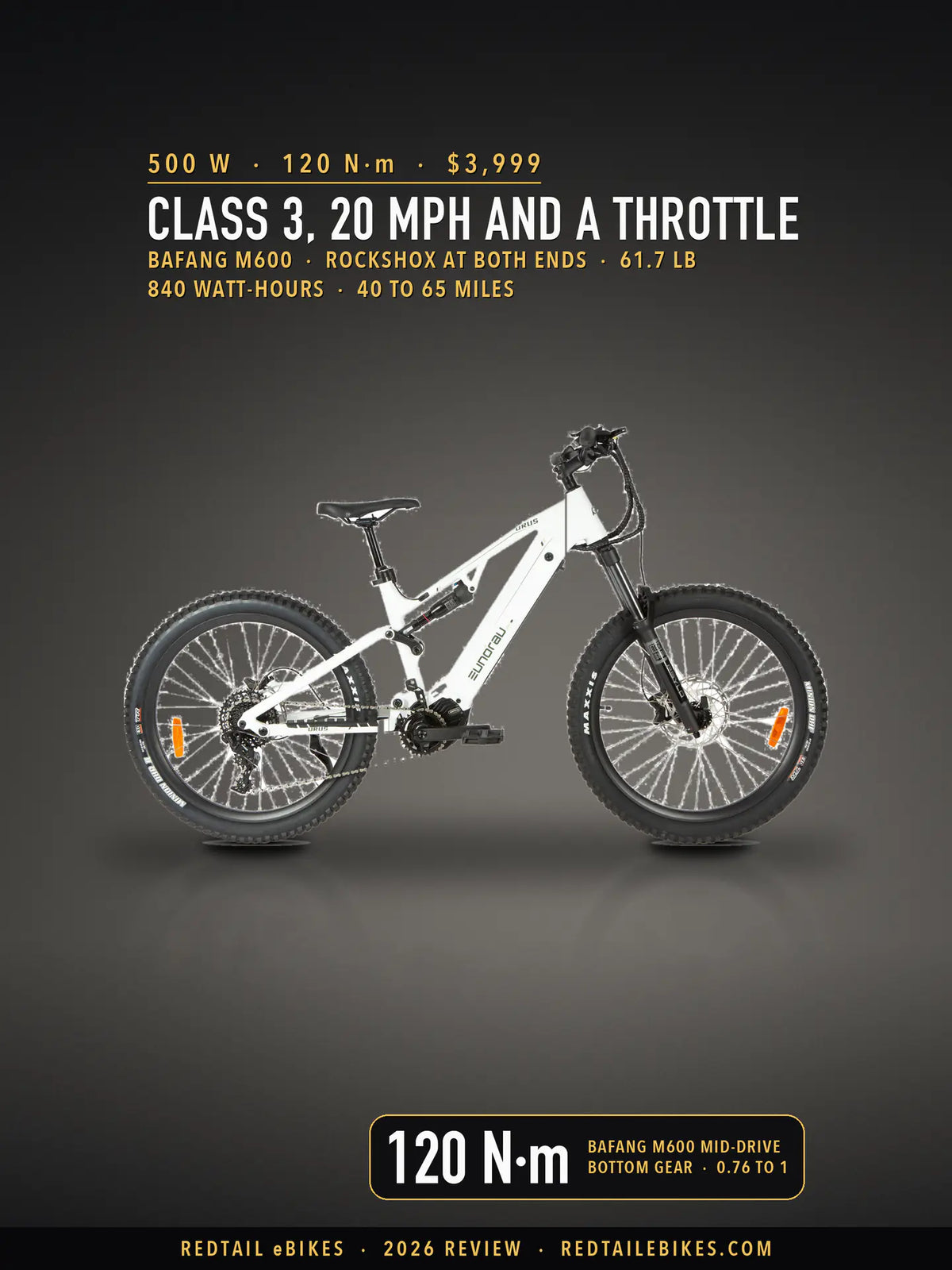
Share:
Eunorau URUS 2.0 Review 2026: 120 N·m, 61.7 lb, $3,999