
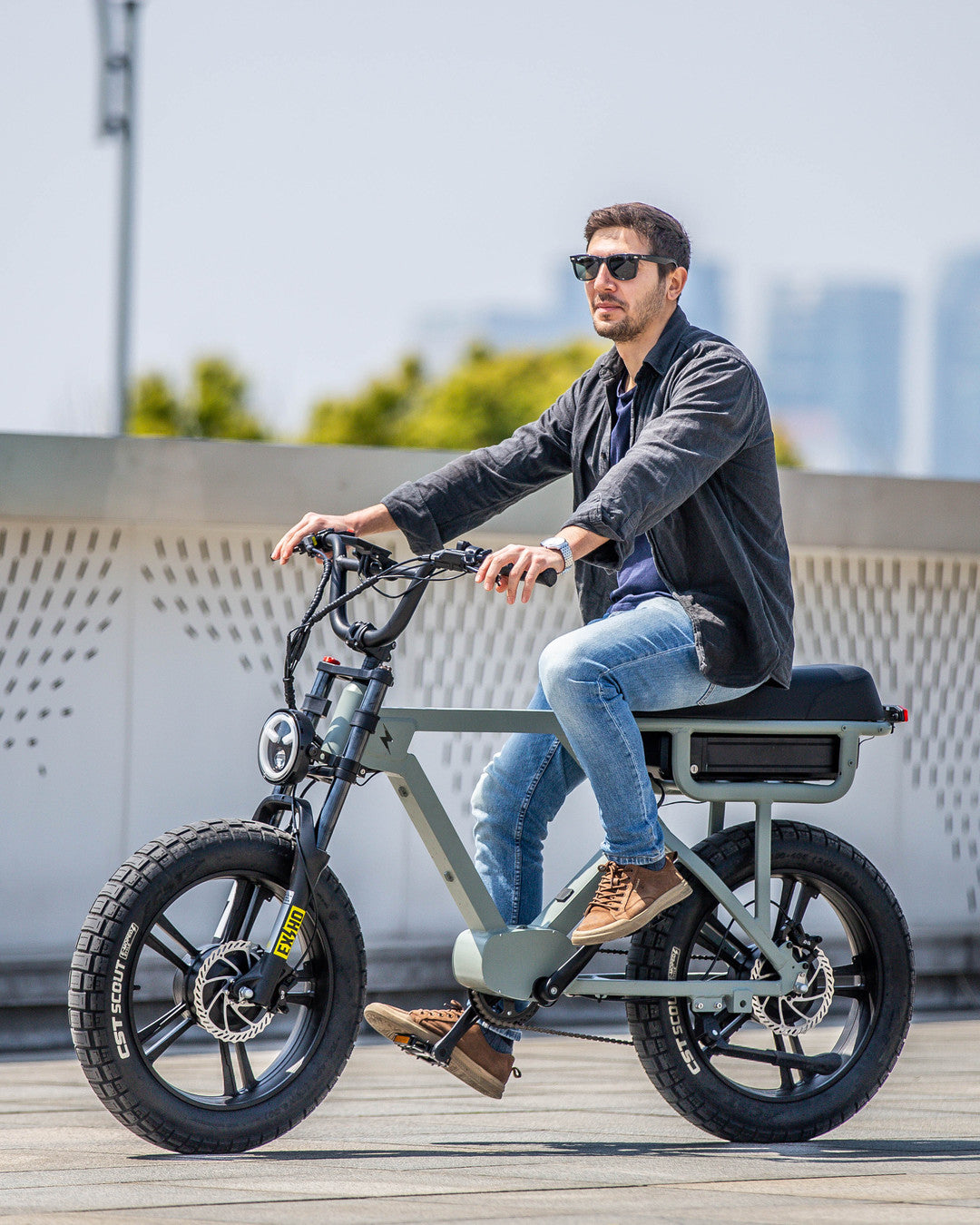


One Utah act rewrote the state's e-bike rules on two different dates, and almost every page you will find has the wrong half in force. The safety certificate everyone is writing about is not in force yet. The helmet rule almost nobody mentions is.
Since May 6, 2026, every rider under 21 must wear a helmet on a Utah highway.
750 W or less · 20 mph Class 1 and 2 · 28 mph Class 3 · helmet under 21 · 255 municipalities counted · 219 bikes screened, 79 legal as Class 1 or 2 on published specs. Law last verified: September 14, 2026; our shelf screened October 4, 2026.

The riders on the cover and in the three inline photographs are the Mercers, our fictional cast — meet the family. The cover was shot for this page on a canyon trail under sandstone; the inline photographs are reused from our 50-state law guide.
Quick Answer. A Utah electric assisted bicycle has a motor of not more than 750 watts, fully operable pedals, cranks fitted at original manufacture, must ride as a bicycle with the motor off, and must be Class 1, 2 or 3 (§ 41-6a-102(21)). No license, no registration, no insurance. Under 21 needs a helmet on a highway.
Then the ages: no one under 16 may ride a Class 3, under 14 needs a parent alongside with the motor on, under 8 may not use the motor at all, and a police officer may hold a minor's e-bike and release it only to a parent. The safety certificate everyone writes about is not in force until May 5, 2027; the helmet rule has been in force since May 6, 2026.
Utah reads the motor rating first, and ours print it. On our commuter and city shelf, 11 of 33 listings print exactly 750 W — the inclusive line Utah draws — and pass Utah's class test; 13 more pass at 250 or 500 W. Shipping is free across the lower 48, and a warranty claim goes through our US support desk to the maker.
In this guide
- How we verified this guide
- What changed in 2026, and what has not changed yet
- Do you need a helmet on an ebike in Utah?
- Utah ebike laws: what makes an e-bike legal
- What is the minimum age to ride an ebike in Utah?
- Can police take your kid's ebike in Utah?
- Does Utah require an ebike safety certificate?
- Where can you ride an ebike in Utah?
- Who manages the trail decides the rule
- Park City and the Snyderville Basin: one trail network, two rulebooks
- Wasatch County wrote a helmet rule the state does not have
- The label, and the disclosure aimed at fake e-bikes
- Does Utah have an ebike rebate?
- Every city we checked
- Not an e-bike: high power electric devices
- What clears Utah in our own range
- Which class is the right one for Utah riding
- Why buy a Utah-legal e-bike from us
- The 60-second self-check: your compliance checklist
- The bottom line
- Source register
- Frequently asked questions
- Limitations
- References
How we verified this guide
Utah publishes its code at le.utah.gov with a version banner on every section — "Effective 5/6/2026", "Superseded 5/5/2027" — and that banner is the reason this page disagrees with most of what is written about Utah.
Utah Laws 2026, chapter 334 split its own changes across two dates. Part of it landed on May 6, 2026. The rest lands on May 5, 2027.
Read one version of a section and you get the wrong answer for today. So every rule below was read on the version-stamped page for the date it applies, and each one says which side of the line it sits on.
One section has two 2026 acts behind it. The definition at § 41-6a-102 carries a history line naming chapter 295 — HB 57, a Motor Vehicle Division cleanup — while the e-bike act's own sections name chapter 334. This page quotes the code, version stamp and all.
The municipal denominator — 255 incorporated municipalities — is the U.S. Census Bureau 2025 Gazetteer.
Utah's definition asks more of the machine's construction than any other on our 50-state table, so this guide spends its length there and not on generalities. The 2026 act was re-read on September 14, 2026 from the enrolled text of HB 381 and the Legislature's own chapter index, and the live catalog was screened the same day.
Written and verified by Milad Ghobadibeygvand, BScN (Western University, 2014). Corrections to support@redtailebikes.com.
What changed in 2026, and what has not changed yet
One act, two dates. This table is the whole reason to read this page rather than another one.
| Rule | Status on September 14, 2026 |
|---|---|
| Helmet for every rider under 21 on a highway | IN FORCE since May 6, 2026 (§ 41-6a-1505) |
| Police may hold a minor's e-bike | IN FORCE since May 6, 2026 (§ 41-6a-1115.6) |
| Under 16 on a Class 3; under 14 without a parent; under 8 with the motor on | IN FORCE until May 5, 2027, when the rewrite replaces all three (§ 41-6a-1115.5) |
| DPS safety certificate for riders 8–15 | NOT IN FORCE. Effective May 5, 2027 (§ 41-6a-1512) |
| Rewritten § 41-6a-1115.5 age structure | NOT IN FORCE. Effective May 5, 2027 |
If you read one thing about Utah, read the dates. HB 381 of the 2026 General Session — Utah Laws 2026 ch. 334 — is one act with two effective dates. Its helmet rule and its police hold took effect May 6, 2026; its safety certificate, § 41-6a-1512, carries the Legislature's own banner Effective 5/5/2027. The answer engines that date the certificate to May 2026 have the right bill and the wrong half of it.
Do you need a helmet on an ebike in Utah?
Yes, if you are under 21 — the highest helmet age on our 50-state table, matched only by Rhode Island.
The operative sentence (§ 41-6a-1505(1)): "An individual under 21 years old may not operate or ride the following on a highway unless the individual is wearing protective headgear that complies with specifications adopted under Subsection (4): (a) a motorcycle; (b) an electric assisted bicycle; (c) a motor assisted scooter; (d) a high power electric device; or (e) an autocycle that is not fully enclosed."
| Detail | Utah |
|---|---|
| Age | Under 21 |
| Where | On a highway |
| Standard | 16 C.F.R. Part 1203 for bicycles; 49 C.F.R. 571.218 for motorcycles |
| Exception | Does not apply to a Class 1 e-bike or motor assisted scooter rented from a business |
| Penalty | Infraction; fine capped at $25 on an e-bike or scooter |
| Civil effect | Not contributory or comparative negligence, and inadmissible in civil litigation |
| Adult incentive | A court shall waive $8 of a moving-violation fine if the rider was 21+ and helmeted |
Three of those rows are worth pausing on.
The rental carve-out. Subsection (3) exempts a Class 1 e-bike or motor assisted scooter rented from a business or corporate entity. Rent a Class 1 in Moab at nineteen and the helmet rule does not reach you. Buy the same bike and it does.
The fine is $25. Utah made the duty real and the penalty small — an infraction with a cap that is less than the helmet.
And it cannot be used against you. Subsection (6) says failure to wear headgear "does not constitute contributory or comparative negligence" and "may not be introduced as evidence in any civil litigation." If a driver hits you, your bare head is not their defense.
Utah ebike laws: what makes an e-bike legal
Utah asks more of the machine than any other state on our 50-state table. Five tests, and two of them appear in no other definition on that table.
The operative sentence (§ 41-6a-102(21)(a)): "'Electric assisted bicycle' means a bicycle with an electric motor that: (i) has a power output of not more than 750 watts; (ii) has fully operable pedals; (iii) has permanently affixed cranks that were installed at the time of the original manufacture; (iv) is fully operable as a bicycle without the use of the electric motor; and (v) is one of the following [Class 1, 2 or 3]."
| Test | Utah |
|---|---|
| Motor | Not more than 750 watts — inclusive, so exactly 750 passes |
| Pedals | Fully operable |
| Cranks | Permanently affixed, installed at original manufacture |
| Unpowered | Must be fully operable as a bicycle with the motor off |
| Class | Must be Class 1, 2 or 3 |
| Class 3 extra | Speedometer, inside the definition (§ 41-6a-102(13)(c)) |
Tests (iii) and (iv) are the interesting ones, and they exist to catch conversions. A bicycle that became an e-bike through a kit does not have cranks "installed at the time of original manufacture", and a machine that cannot be pedaled home with a flat battery is not "fully operable as a bicycle without the use of the electric motor".
"Not more than" is inclusive, which puts Utah on the permissive side of the sharpest line in American e-bike law. Exactly 750 W passes in Utah, as it does in Georgia, Wisconsin and North Carolina; Ohio and Tennessee write "less than" and fail it.
Buying for Utah? Ask two questions before anything else: the nominal wattage, which must be 750 W or under, and whether the bike rides normally with the motor off — Utah puts both in the definition. Start on the commuter and city shelf: 11 of its 33 listings print a 750 W rating and pass Utah's class test, 13 more pass at 250 or 500 W, and each one ships free to your door in the lower 48.
Browse full-build e-bikesWhat is the minimum age to ride an ebike in Utah?
Three thresholds, all in force today.
The operative sentences (§ 41-6a-1115.5(4)–(6)):
"(4) An individual under 16 years old may not operate a class 3 electric assisted bicycle. (5) An individual under 14 years old may not operate an electric assisted bicycle with the electric motor engaged on any public property, highway, path, or sidewalk unless the individual is under the direct supervision of the individual's parent or guardian."
"(6) An individual under eight years old may not operate an electric assisted bicycle with the electric motor engaged on any public property, highway, path, or sidewalk."
| Age | What they may do today |
|---|---|
| Under 8 | May not use the motor on public property, a highway, a path or a sidewalk — at all |
| 8 to 13 | May use the motor only under the direct supervision of a parent or guardian |
| 14 and 15 | May ride Class 1 and Class 2 unsupervised; no Class 3 |
| 16 to 20 | Any class — helmet required |
| 21 and over | Any class, no helmet requirement |
Note that subsection (5) reaches paths and sidewalks as well as roads. A 12-year-old riding a Class 2 on a neighborhood path with the motor on needs a parent beside them in Utah.
And the owner of the bike commits a violation by letting it happen — subsection (7) makes it an offense to "authorize or knowingly permit" it.
What changes on May 5, 2027. The rewritten § 41-6a-1115.5 drops the Class 3 age bar and stops reaching onto paths and sidewalks. In its place a rider 8 to 15 may use the motor on a highway with a parent or responsible adult alongside or with the safety certificate; a rider 16 or over needs neither; under 8 may not use the motor on a highway at all.
Can police take your kid's ebike in Utah?
Yes. This is new, it is in force, and it is easy to miss.
The operative sentence (§ 41-6a-1115.6, effective May 6, 2026): "If a peace officer observes an individual under 18 years old commit a violation of this chapter and the violation occurred while the individual was operating a personal electric vehicle, the peace officer may hold the personal electric vehicle." And: "the peace officer may release the personal electric vehicle to only the individual's parent or guardian."
"Hold" is defined in the section as "an action by a peace officer to take into custody and retain an individual's personal electric device."
So an officer who sees a 15-year-old commit any chapter violation — riding a Class 3, no helmet, a traffic offense — may take the bike, and the child cannot get it back. A parent must collect it. The statute turns on what the officer observes, so a complaint phoned in later is not the same thing.
Utah gave officers a roadside remedy against minors, not just a citation. § 41-6a-1115.6 has been in force since May 6, 2026 and applies to any violation of the traffic chapter by a rider under 18. If you are buying an e-bike for a teenager in Utah, this is the rule that will actually bite.
Does Utah require an ebike safety certificate?
Not yet. It is coming on May 5, 2027.
This is the most-written-about Utah rule and the most misdated. The certificate is created by § 41-6a-1512, enacted by HB 381 as part of Utah Laws 2026 ch. 334, and the Legislature's version banner reads Effective 5/5/2027. Utah's Highway Safety Office says the course itself "will be ready in Spring 2027."
| From May 5, 2027 | Detail |
|---|---|
| Who needs it | An individual 8 or older and under 16 operating a personal electric vehicle on a highway |
| The alternative | Or be under direct supervision of a parent or responsible adult |
| What a PEV is | An electric assisted bicycle, high power electric device, or motor assisted scooter |
| Who runs it | The Department of Public Safety, online |
| Cost | A fee of $10 or less |
| Under 16 on a high power electric device | Prohibited on a highway outright — no certificate cures it |
| Renting to a minor | A person may not provide a PEV to someone under 16 without the certificate or supervision |
| Penalty | Infraction, fine not exceeding $150 |
Read the operating condition carefully. The reporting gets it wrong. The statute says the individual "obtains a personal electric vehicle safety certificate" or "is under direct supervision of a parent or responsible adult." It is a two-limb test, and a supervised child never needs the certificate.
Where can you ride an ebike in Utah?
The operative sentence (§ 41-6a-1115.5(2)–(3)): "(2) An individual may operate an electric assisted bicycle on a path or trail designated for the use of a bicycle. (3)(a) A local authority or state agency may adopt an ordinance or rule to regulate or restrict the use of an electric assisted bicycle, or a specific classification of an electric assisted bicycle, on a sidewalk, path, or trail within the jurisdiction of the local authority or state agency."
| Surface | Rule |
|---|---|
| Path or trail designated for bicycles | Permitted by statute |
| Sidewalk, path or trail | A local authority or state agency may restrict, by class |
| Non-motorized state and local trails | Allowed unless prohibited (Utah Highway Safety Office) |
| Non-motorized federal trails | Closed unless that agency has opened them |

The Pa'rus Trail in Zion: a Class 1 rides it at 15 mph or less, and no other class rides it at all (Zion bicycling page).
That last row is the one that catches Utah riders, because so much of the riding here is on federal land. Utah's own Highway Safety Office states that e-bikes are "not allowed on non-motorized federal trails" — and Utah has more of those than almost anywhere. That is the default rather than the last word: an agency can open particular trails, and the BLM's Moab office did in 2026.
There is also a provision worth knowing if you or someone you ride with has a disability. Subsection (3)(b) requires that when a local authority or state agency makes rules about a pathway or soft-surface trail — or plans or builds one — it "shall consider accommodations and increased trail access by a person with a mobility disability."
Who manages the trail decides the rule
Utah's statute hands the real decision away. § 41-6a-1115.5(3)(a) lets a local authority or state agency regulate or restrict e-bikes — or one class of them — on any sidewalk, path or trail it controls. So the question that decides your ride is not "what does Utah say," it is "who owns this trail."
That matters more here than in most states. 63.1% of Utah is federally owned — 33.3 million of its 52.7 million acres, per the Congressional Research Service's federal land ownership tables — and the federal agencies do not answer the question the same way.
The federal rule that changed nothing on its own
In December 2020 the BLM amended its off-road-vehicle regulations at 43 CFR 8340.0-5 to define Class 1, 2 and 3 e-bikes, and to let an authorized officer allow them on non-motorized roads and trails. Read the agency's own summary of what that did, though, because it is the part riders skip: the rule "does not result in any immediate on-the-ground changes or site-specific allowances."
It is permission to decide rather than a decision. Every mile of BLM singletrack you can legally ride an e-bike on in Utah traces to a separate, later, local decision — which is why Moab took until 2025 to make one.
The Forest Service has not made the same move: on USFS land an e-bike counts as a motor vehicle, confined to the routes the forest's Motor Vehicle Use Map opens to motorized travel. Utah's own outdoor-recreation office states it plainly: e-bikes there are "generally considered motorized vehicles and are restricted to motorized trails."
Moab: nearly 200 miles that opened on March 1, 2026
The BLM's Moab Field Office — 1.8 million acres, over 197 miles of mountain-bike trail and 12 trail systems — issued its decision in September 2025 after a public scoping period, and the access took effect March 1, 2026.
Class 1 only. These are the systems and trails the BLM lists as open:
| Open to Class 1 e-bikes, Moab Field Office |
|---|
| Athena · 7-Up · Gold Bar Rim · Portal · Baby Steps · Jackson · Hunter Canyon Rim · Pipe Dream |
| Horsethief · Navajo Rocks · Gemini Bridges Area · Klondike Bluffs · Klonzo · Moab Brands · Amasa Back |
| Raptor Route: Hawks Glide, Falcon Flow, Kestrel Run |
| Kokopelli — the 1.7-mile non-motorized singletrack section |
And these stay open to mountain bikes but closed to e-bikes, which is the list worth screenshotting:
Lower Porcupine Singletrack (LPS) · Eagle Eye · Porcupine Rim Singletrack · Fisher Mesa · Mill Creek Rim / Old Mail Trail · Hidden Valley · Zephyr
The BLM's own list names seven, Mill Creek Rim/Old Mail Trail and Zephyr among them.
Slickrock is a separate case and a happy one: it is open to motorcycles, so it is open to every class of e-bike.
If you ride because of a disability, there is a documented route rather than a shrug. A person
with a disability may request a reasonable modification under
Section 504 of the Rehabilitation Act to use an
e-bike as an other power-driven mobility device on non-motorized mountain-bike trails in the Moab
Field Office, by writing to blm_ut_mb_srp@blm.gov. Very few land managers publish an address for
this. This one does.
The rest of the federal patchwork
| Where | What Utah's outdoor-recreation office reports |
|---|---|
| BLM Cedar City | Class 1 allowed on all trails that allow mountain bikes on Iron Hills National Recreation Trail System, Thunderbird Canyons, Evil Water, Three Peaks and Beaver Bench (Enoch Bench proposed). Class 2 and 3 are not. |
| St. George | BLM and USFS limit e-bikes to motorized routes or ones specifically designated |
| Salt Lake City foothills | Class 1 generally allowed on the non-USFS trails |
| Heber Valley | Class 1 generally allowed on mountain-bike trails — and that stops the moment you cross into Park City or onto non-motorized USFS trail |
| Utah wildlife management areas | No Class 2 or Class 3 e-bikes, and many WMAs carry seasonal closures on top |
These five rows come from a single state source, so treat them as a starting point and confirm with the field office before a long drive; the Moab list above is the BLM's own.
The Mighty 5, and the park where your bicycle is legal but your e-bike is not
Every national park sets its own rule through a superintendent's compendium, so five parks in one state give five different answers.
| Park | E-bikes | The pinpoint |
|---|---|---|
| Zion | Class 1 only, in the same places as a bicycle: the Pa'rus Trail and park roads. 15 mph on the Pa'rus | Bicycling in Zion |
| Bryce Canyon | Roads and the Shared-Use Path, same as a bicycle — but off motor-vehicle areas the motor may not propel you without pedaling | Laws & Policies |
| Arches | All paved and unpaved roads; Class 1 only on two short paved trails — the visitor-center connector and the in-park sections of the Moab Canyon Pathway | Compendium § 4.30(i)(1), (i)(7) |
| Canyonlands | Park roads and parking areas open to motor vehicles. No singletrack anywhere in the park | Compendium § 4.30(i)(1) |
| Capitol Reef | Classes 1, 2 and 3 on roads and lots — and barred from every trail in the park | Compendium § 4.30(a) |
Capitol Reef is the one to read twice. Traditional bicycles are allowed on two trails there — the visitor-center-to-campground link and the Fremont River Trail as far as Hattie's Field — and the compendium puts e-bikes on "paved/unpaved roads and/or parking lots that are open to public vehicular traffic" and prohibits them "from all administrative use roads and all trails within the park."
So at Capitol Reef the bike is legal on the Fremont River Trail and the e-bike is not. Same rider, same trail, different machine.

Zion Canyon Scenic Drive. The park's bicycling page opens its roads and the Pa'rus Trail to Class 1 only, single file at the road's edge.
Zion has a practical trap of its own that has nothing to do with legality: e-bikes do not fit the shuttle's bike racks. Ride the Zion Canyon Scenic Drive and you are riding it both ways.
Riding Moab or the Mighty 5? Class 1 is the only class the BLM opened around Moab and the only one Zion allows, so the class label decides your trip before the tire size does. If that is the ride you are buying for, 10 of 35 mountain listings and 21 of 67 fat-tire listings pass on their printed figures, and they ship free to your door.
Browse Class 1 trail buildsPark City and the Snyderville Basin: one trail network, two rulebooks
Park City is the most-searched place behind this page: 29 of the 271 distinct search terms name it, ahead of Salt Lake (26) and St. George (22). It is also the clearest example in Utah of why you read the ordinance rather than the summary.
What the ordinance actually says
Park City Municipal Code § 10-1-4.5 makes it unlawful to operate an electric assisted bicycle on a natural surface trail, then carves out five exceptions. Two of them are the ones riders actually use:
- Class 1, rider aged 65 or older. No conditions attached.
- Class 1 and Class 2 on natural surface trails wider than five feet — but only where the local highway authority has identified the trail as an official transportation corridor and marked it with a traffic control device.
There is also a route for mobility disabilities: the prohibition does not reach a person using a power-driven mobility device as a substitute for walking or biking, and the code's definition of that term expressly includes electric-assisted bicycles.
On the paved side the code flips: on a multi-use pathway — defined as "no less than eight (8') feet in width" with a concrete or asphalt surface, separated from the roadway — the class that is prohibited is Class III. Classes 1 and 2 are fine.
Violations are an infraction, and the Park City Police Department investigates and issues the citations.
Where the city's own page and the city's own code part company
Park City's e-bikes page tells riders that e-bike use "is permitted on soft-surface trails wider than five feet and all paved multi-use pathways." Read beside § 10-1-4.5, that sentence drops both halves of the condition: the five-foot allowance reaches only trails designated as an official transportation corridor and signed as such, and it covers Classes 1 and 2 rather than every e-bike.
The same page runs a courtesy tag program for riders 65+ or with a mobility disability. The code says the opposite in one line: "None of the exceptions listed under subsections (B)(1) and (B)(2) require registration or a courtesy tag."
A summary written for visitors does a different job from a codified ordinance, and the ordinance is what a citation is written under; where the two differ, this page follows the code and says so.
Cross the line into the Basin and the numbers change
The Snyderville Basin Special Recreation District, which manages the trails immediately outside Park City, adopted its own regulations in August 2024 after a 2023 community survey run jointly with Park City. Its rules are close to Park City's and not identical:
| Park City § 10-1-4.5 | Snyderville Basin | |
|---|---|---|
| Pathway width that admits e-bikes | 8 ft, paved | 8 ft or wider, paved or soft-surface |
| Singletrack | Prohibited, five exceptions | Prohibited |
| The 65+/mobility exception | Class 1 | Class 1 |
| Courtesy tag | Not required by the code | Not required |
| Speed limit | 15 mph | 15 mph on commuter multi-use pathways |
| Named as not-an-e-bike | — | Sur-Ron and Talaria, by brand |
Basin Recreation also publishes the enforcement chain, which almost nobody does: rangers educate, then report non-compliance to the Summit County Sheriff's Office, and non-compliance "may result in fines or other penalties." Staff, law enforcement and emergency services are exempt under Summit County Ordinance 981.
Ten years and four ordinances
Park City did not arrive at this rule in one go, and the legislative history on the section reads like a decade of argument:
| Ordinance | Date | |
|---|---|---|
| 15-10 | April 16, 2015 | filed as an e-bike pilot |
| 2016-29 | June 30, 2016 | |
| 2019-46 | August 29, 2019 | |
| 2024-14 | June 28, 2024 | the version in force |
A town that has rewritten the same trail section four times in nine years is a town that will rewrite it again. Check the date on whatever page you are reading, including this one.
Wasatch County wrote a helmet rule the state does not have
Utah's statewide helmet rule reaches every rider under 21, and only on a highway. Wasatch County's e-bike ordinance, adopted in August 2025, requires a helmet for every rider under 18 on any class.
The rest of the county's rule, in its own words:
- Class II and Class III e-bikes may not be operated on soft-surface trails.
- Speed: 20 mph on improved multi-use trails, 15 mph on soft-surface trails and sidewalks.
- Passengers only where the manufacturer intended them.
- Ride on trails and sidewalks — "stay off the grass in public parks."
- Violations are punishable as an infraction.
The county names Heber City, Midway and Park City as also carrying their own rules, so a Heber Valley ride can cross three rulebooks in an afternoon.
Midway is unresolved. Its Municode library carried no e-bike chapter when it was read on August 26, 2026, and an October 2024 city council packet sets out only a draft — an under-18 helmet rule, a 15 mph cap and a stay-off-the-grass provision, with open questions still written into it ("Jurisdiction?", "Warnings? Impound?"). A draft is not an ordinance, so Midway is listed as unresolved rather than reported.
The label, and the disclosure aimed at fake e-bikes
Utah runs two labeling duties, and the second is one of the toughest anti-impostor provisions in the country.
| Requirement | Detail |
|---|---|
| Class label | Permanently affixed, prominent: class number, top assisted speed, motor wattage |
| Font | Arial, 9-point or larger |
| Since | January 1, 2017 |
| Programmable bikes | A conspicuous label showing every class the bike can be set to |
| Not-an-e-bike disclosure | Required since May 1, 2024 on any sub-four-wheel electric vehicle that is not an e-bike |
The second one is the interesting one. Since May 1, 2024, a seller of any new or used vehicle with fewer than four wheels powered by an electric motor that is not an electric assisted bicycle must give this, in bold capitals, at the point of sale and in every advertisement, website and social post:
"THIS VEHICLE IS NOT AN "ELECTRIC ASSISTED BICYCLE" AS DEFINED BY UTAH MOTOR VEHICLE CODE AND IS INSTEAD A TYPE OF MOTOR VEHICLE AND SUBJECT TO APPLICABLE MOTOR VEHICLE LAWS IF USED ON PUBLIC ROADS OR PUBLIC LANDS. YOUR INSURANCE POLICIES MAY NOT PROVIDE COVERAGE FOR ACCIDENTS INVOLVING THE USE OF THIS VEHICLE. TO DETERMINE IF COVERAGE IS PROVIDED YOU SHOULD CONTACT YOUR INSURANCE COMPANY OR AGENT."
And the teeth: knowingly advertising or selling such a vehicle as an "electric bicycle", "electric assisted bicycle", "electric bike" or "e-bike" without that disclosure is prima facie evidence of a deceptive trade practice under Utah Code § 13-11a-3.
That is a seller's problem rather than a rider's, and it is ours as much as anyone's. It is also the clearest signal on our 50-state table that Utah's legislature knows what is being sold as an e-bike and is not amused.
Does Utah have an ebike rebate?
Yes — a real state voucher, and the 2026 round is closed with every slot taken.
The Utah DEQ E-Bike Program is run by the Division of Air Quality on an EPA grant.
| Standard voucher | $400 toward a new e-bike |
| Income-qualified | $800 if household income is at or below 60% of AMI |
| Age | 18 or older |
| Counties | Davis, Salt Lake, Tooele, Weber or Utah |
| 2026 applications | Opened June 1, 2026, approved first-come, first-served, 2,000 slots, now closed with every slot full |
| After the voucher | Buy from an approved store within 2 weeks |
| Bike must be | 750 W or less, operable pedals, Class 1, 2 or 3 |
| Where you buy | An approved store only |
Utah's voucher beats any discount we can offer, and it cannot be spent with us. $400, or $800 at or below 60% of AMI, in five counties — approved stores only. If that is you, take the voucher.
The voucher pays only at an approved Utah store, so it cannot be spent on a bike bought online, including ours.
DEQ announces the next round on its program page, and the bike has to be bought within two weeks of the voucher landing.

The paved park road at Antelope Island State Park. Utah's outdoor-recreation office reports that many state parks allow a Class 1 where bicycles are permitted, park by park.
No voucher this round? Then the price you see is the price you pay, your freight is on us, and Shop Pay splits the balance at checkout. Utah-legal builds on the commuter shelf start at $599, and 11 of its 33 listings print a 750 W rating and pass the class test.
Browse 750 W buildsEvery city we checked
Utah has 255 incorporated municipalities — 152 cities and 103 towns — counted from the U.S. Census Bureau 2025 Gazetteer.
All 82 Utah code libraries on Municode — 73 cities and towns and 9 counties — were swept for nine e-bike phrases, every hit checked against the returned text. That returned 14 phrase-confirmed hits in 4 libraries — a thin layer, which makes sense: Utah's statute is unusually detailed, so cities have less left to write.
| Municipality | What its code does |
|---|---|
| Sandy | The most developed. § 10-9-3 defines Class 1 and Class 2 e-bikes; § 10-9-4 restates the under-16 Class 3 bar and the under-14 motor-engaged rule; § 10-9-6 charges a $35 relocation and storage fee for each e-bike or e-scooter the City relocates |
| Summit County | §§ 7-5-2 and 6-5-1 carry the Utah Code definitions into county rules, and confirm that a motor assisted scooter "does not include an 'electric assisted bicycle'" |
| Hurricane | §§ 7-1-8 and 7-1-9 exclude electric assisted bicycles from the city's off-highway-vehicle and golf-cart provisions |
| Virgin | A definitional reference only |
Park City's Municode library returned nothing for the nine phrases; its code lives on municipalcodeonline.com, where § 10-1-4.5 was read directly for the section above. "park city ebike rules" and "park city ebike laws" both sit among the search terms behind this page, which is why that section exists.
The denominator. Municode carries 73 of Utah's 255 municipalities, and all 73 were swept — 29%. The other 182 were not swept; treat them as unknown, with the statute as the floor and your city free to have built on it.
Not an e-bike: high power electric devices
Utah does not leave an over-spec machine in a gap. It has a name for it.
High power electric device is defined in § 41-6a-102 by markers including a machine that exceeds 20 mph on motor power alone, is equipped with a continuous rated motor power of more than 750 watts, is equipped with foot pegs for the operator at the time of manufacture, or requires installation of a pedal kit to have operable pedals — or, if it has multiple modes and a throttle, has any mode that exceeds 20 mph on motor power alone.
| Machine | Utah category |
|---|---|
| Electric assisted bicycle | 750 W or less, factory cranks, rides unpowered, Class 1–3 |
| High power electric device | Over 750 W continuous, foot pegs at manufacture, or needs a pedal kit |
| Electric motorcycle | Over 750 W, or capable of exceeding 20 mph on motor power alone |
The foot-peg test is the tell. A machine that ships with pegs instead of pedals, or whose pedals are a bolt-on that makes it look legal, is not an e-bike in Utah — and from May 5, 2027 no one under 16 may operate a high power electric device on a highway at all, certificate or no certificate.
What clears Utah in our own range
The live catalog was screened against Utah's five-part definition and the class ceilings on October 4, 2026; the catalog's three stand-up scooters, one of them typed as an e-bike, and an accessory kit are not in the count.
| Verdict | Bikes |
|---|---|
| Legal as Class 1 or 2 on published specs | 79 |
| Class 3 on printed speed, rated 750 W or under | 16 |
| Outside the Utah definition | 95 |
| Specs not published in the listing | 29 |
| Total screened | 219 |
78 of the 219 e-bikes we list print a rating of exactly 750 W, and all of them pass here on "not more than", while failing in Ohio and Tennessee on "less than".
123 of the 219 listings say nothing about cranks. Utah's original-manufacture crank test cannot be run from a product page, so the table above reads the motor rating, the pedals and the class, and leaves the crank test to Limitations 4.
95 of the 219 sit outside the definition on their printed figures — 78 on a motor rating above 750 W, 17 on a top speed above 28 mph — which is why the shelf table further down reads the way it does.
Shopping for a rider who is not 16 yet? A Class 3 is barred until the statute is rewritten in May 2027, a helmet is required until 21, and an officer may hold the bike if the rider is under 18. A Class 1 or 2 keeps your rider legal: 24 of the 33 commuter listings pass Utah's test, and your freight is on us.
Browse commuter e-bikesWhich class is the right one for Utah riding
Utah's state test is generous — 750 watts inclusive, three classes, no registration. The layers above the statute decide your ride, and nearly every one of them turns on class. That makes the class label the single most useful thing on a spec sheet here.
Class 1 is the key that opens the most doors in Utah. It is the class Park City lets a 65-year-old take onto singletrack, the only class the BLM opened in Moab, the only class Zion allows, and the only class Cedar City's BLM trail systems admit.
For trail riding in Utah the 750-watt line does most of the work before the class does: 10 of the 35 listings on our mountain shelf print a rating at or under 750 W and clear the screen, and 21 of 67 on the fat-tire shelf — read the motor rating before you look at the tire size.
Class 2 is fine on pavement and loses you the trails. A throttle is legal statewide, and it is also the thing Wasatch County bars from soft-surface trails and Cedar City's BLM systems exclude. For paved pathways and town riding that trade is usually worth it.
Most of what clears Utah's test sits on three shelves: commuter and city at 24 of 33, electric trikes at 24 of 28 and cargo at 39 of 64. A printed top speed cannot tell a throttle from a pedal assist, so the screen reads Class 1 and Class 2 together.
| Shelf (listings) | Class 1 or 2 | Class 3 by speed | Outside | Not printed |
|---|---|---|---|---|
| Commuter and city (33) | 24 | 1 | 7 | 1 |
| Electric trikes (28) | 24 | 2 | 1 | 1 |
| Cargo (64) | 39 | 3 | 21 | 1 |
| Folding (25) | 18 | 2 | 3 | 2 |
| Mountain (35) | 10 | 1 | 20 | 4 |
| Fat tire (67) | 21 | 6 | 39 | 1 |
Class 3 is the one to think hardest about. It is the class Park City bars from multi-use pathways, and no rider under 16 may operate one until the statute is rewritten on May 5, 2027. The helmet rule reaches every class here, so it is not what sets a Class 3 apart.
Before the spec sheet: the electric bike buying guide and the motor guide explain what a nominal rating and a peak figure each mean, best e-bike brands sizes up each maker's Class 1 and Class 3 line, and your first electric bike is the page for a first purchase.
Short on floor? A folding e-bike (18 of 25 clear the screen) or an electric trike fits a hallway, and the cargo shelf does the hauling. The full range is exactly the shelf the screen read, and the sale shelf holds the marked-down listings.
Riding beyond Utah
Utah's under-21 helmet rule covers every class and ties Rhode Island for the highest age on our all-50-states table, and the states around it answer these questions differently enough that a legal bike here can be an illegal one four hours away. Neighboring and nearby guides: Arizona, California, Colorado, Texas, Washington, Oregon, Michigan, Minnesota, Illinois, Florida, Pennsylvania, New York, New Jersey, Massachusetts, Connecticut, Tennessee and New Hampshire.
Our 50-state trail atlas maps the land managers' open routes state by state, with separate atlases for California and Texas. The Denver and Los Angeles directories are the nearest big-city showrooms for most of Utah; the national e-bike stores near me guide covers everywhere else.
Why buy a Utah-legal e-bike from us
Two numbers decide a Utah purchase, and 174 of our 219 listings print both. § 41-6a-102(21) asks for a motor of not more than 750 watts and a machine that still rides with the motor off. Across the 219 e-bikes on our shelves, 117 carry a rating of 750 W or under; 78 of those sit right on 750 W, which passes here and fails in Ohio.
You pay the listed price and we pay the freight. Utah-legal builds on the commuter shelf start at $599, and every e-bike ships free across the lower 48 under the shipping policy, which prints its P.O.-box and remote-area exceptions. The warranty is the maker's, and your claim goes to the maker through our US support desk.
If the DEQ voucher is open and you qualify, take it. It pays only at an approved Utah store, so it cannot be spent here. Outside those five counties, or between rounds, Shop Pay splits the payment at checkout instead.
For most Utah riding you want a Class 1 or 2 at 750 W or under. A Class 3 loses you Park City's multi-use pathways, a throttle loses you Wasatch County's soft-surface trails and Cedar City's BLM systems, and anything above 750 W is not an e-bike in this state at all.
Where to start: cargo holds the deepest Utah-legal shelf at 39 listings, electric trikes the best hit rate at 24 of 28, and commuter and city the everyday bikes that clear the test at 24 of 33.
Four of the act's twenty-four sections are dated for May 2027, which is why this page prints its verification date. Email support@redtailebikes.com before you order if a season has passed: the rule is re-checked first, and if it makes the bike you want a high power electric device here, the reply says so and the sale waits.
Ready to choose one? The Utah-legal builds on the commuter and city shelf start at $599, 24 of its 33 listings pass the state test on their printed figures, your bike ships free, and Shop Pay splits the balance at checkout.
Shop Utah-legal commutersThe 60-second self-check: your compliance checklist
Nine boxes; every one is a rule above, and you can run them before you order.
- ☐ Rider under 21? Helmet on any highway, CPSC standard — unless it is a rented Class 1.
- ☐ Motor 750 W or less? Exactly 750 is fine here.
- ☐ Factory cranks and pedals, and does it ride normally with the motor off?
- ☐ Class 3? Speedometer, and no rider under 16 until May 5, 2027.
- ☐ Rider under 14 using the motor on any path, sidewalk or road? A parent must be alongside.
- ☐ Rider under 8? The motor stays off.
- ☐ Heading for federal land? Non-motorized federal trails are closed to e-bikes unless that agency has opened them.
- ☐ Buying for a teenager? Remember an officer may hold the bike and release it only to you.
- ☐ Want the $400/$800 voucher? Five counties, 18+, approved stores, and the 2026 round is closed with every slot taken.
The bottom line
Utah is a strict state pretending to be a simple one. Neighbouring Idaho writes less than 750 W and puts the same motor outside its definition.
Utah's wattage line is generous — 750 W inclusive — but the rest of the definition is the tightest on our 50-state table: factory cranks, and a machine that still works as a bicycle when the battery is flat. If you are buying a conversion or a pedal-kit machine, Utah has already thought about you.
The rule that will actually change your day is the helmet. Under 21, on a highway, since May 6, 2026 — level with Rhode Island and the highest in the country, with a $25 fine and a strange exemption for rented Class 1 bikes.
And if the rider is under 18, an officer may take the bike home to you rather than hand you a ticket.
The certificate everyone is writing about is real, and it is 2027. You have until May 5, 2027 before an 8-to-15-year-old needs one to ride a Utah highway unsupervised, and the course is not even built yet. Anyone telling you it applies today is reading the wrong version of the statute.
Nothing here has to be decided today: the helmet rule and the police hold are in force now, and the certificate is a 2027 question.
Otherwise the page is done arguing: how buying works and the refund policy are the two pages left to read, Shop Pay installments sit at checkout, and the commuter shelf is where the 25 Utah-legal 750 W builds already sit.
Source register
| Source | Tier | What it supports | Retrieved |
|---|---|---|---|
| Utah Code § 41-6a-102 (eff. 5/6/2026) | T1 | The five-part definition, the classes, the Class 3 speedometer, high power electric device | 2026-08-26 |
| Utah Code § 41-6a-1115.5 (current) | T1 | Age thresholds, trail rights, local restriction power, labels, the not-an-e-bike disclosure, open containers | 2026-08-26 |
| Utah Code § 41-6a-1115.5 (eff. 5/5/2027) | T1 | The rewritten age structure that is not yet in force | 2026-08-26 |
| Utah Code § 41-6a-1115.6 (eff. 5/6/2026) | T1 | The law-enforcement hold on a minor's e-bike | 2026-08-26 |
| Utah Code § 41-6a-1505 (eff. 5/6/2026) | T1 | The under-21 helmet rule, the rental carve-out, the $25 cap, the $8 waiver, the civil-evidence bar | 2026-08-26 |
| Utah Code § 41-6a-1512 (eff. 5/5/2027) | T1 | The safety certificate regime and its effective date | 2026-08-26 |
| Utah Code § 41-6a-526 | T1 | The open-container restrictions a class 2 e-bike is subject to | 2026-08-26 |
| Utah Traffic Code Part 15 index | T1 | The section structure and version dates | 2026-08-26 |
| HB 381 (2026), bill text | T1 | The 2026 act: amendments to §§ 41-6a-102, 1115.5 and 1505; new §§ 1115.6, 1511, 1512 and 1513; each section stamped with its own effective date | 2026-08-26; re-read 2026-09-12 |
| Utah Highway Safety Office — E-Bikes | T1 | Effective dates in plain English, the Spring 2027 course, the federal-trail rule | 2026-08-26 |
| Utah DEQ — E-Bike Program | T1 | Voucher amounts, counties, eligibility, first-come first-served, 2,000 slots closed with every one full, the two-week purchase window, approved stores | 2026-09-14 |
| Municode Library — 82 UT libraries (73 cities and towns, 9 counties) | T1 | The municipal sweep | 2026-08-26 |
| Sandy City Code | T1 | Definitions, restated age rules, the $35 relocation fee | 2026-08-26 |
| Summit County Code | T1 | County definitions incorporating Utah Code 41-6a-102 | 2026-08-26 |
| Hurricane City Code | T1 | E-bikes excluded from the OHV and golf-cart provisions | 2026-08-26 |
| U.S. Census Bureau 2025 Gazetteer | T1 | The 255 denominator | 2026-08-26 |
| Utah Legislature chapter index, 2026 General Session | T1 | Which act each chapter number is: chapter 295 returns HB 57, the act the definition section's history line names, and chapter 334 returns HB 381 | 2026-09-14 |
| BLM — E-bikes | T1 | The 2020 rule as permission to decide rather than access granted | 2026-09-14 |
| BLM Moab Field Office e-bike decision | T1 | The trail systems opened to Class 1 on March 1, 2026, and the seven left closed | 2026-09-14 |
| 43 CFR 8340.0-5 | T1 | The federal class definitions for BLM land | 2026-09-14 |
| NPS compendia and bicycling pages: Zion, Bryce Canyon, Arches, Canyonlands, Capitol Reef | T1 | Each park's own e-bike rule | 2026-09-14 |
| Park City Municipal Code § 10-1-4.5 | T1 | The city's non-motorized trail rule and its class limits | 2026-09-14 |
| Wasatch County e-bike ordinance | T1 | The under-18 helmet rule, the soft-surface class ban, the speed caps | 2026-09-14 |
| Utah Office of Outdoor Recreation — electric mountain bikes | T1 | USFS treatment of e-bikes as motorized, and state-park practice | Internet Archive capture, 2026-08-13 |
| CRS R42346, Federal Land Ownership | T1 | Utah's federal acreage: 33,267,621 of 52,696,960 acres, 63.1% | 2026-09-14 |
| Redtail eBikes catalog via Shopify Admin API and the live collection endpoints | T2 | The first-party screen, the per-shelf counts and the lowest listed price on the Utah-legal commuter set | 2026-09-14 |
T1 is a primary official source: a statute, a regulation or an agency's own publication. T2 is a primary institutional one, here our own catalog. No tier-five source is cited anywhere on this page.
Frequently asked questions
Are electric bikes legal in Utah?
Yes, if the machine fits the definition. It needs a motor of not more than 750 watts, fully operable pedals, cranks permanently affixed at original manufacture, the ability to be ridden as a bicycle with the motor off, and it must be Class 1, 2 or 3 (§ 41-6a-102(21)).
Do you need a helmet on an ebike in Utah?
Yes if you are under 21, on a highway, since May 6, 2026 (§ 41-6a-1505). The helmet must meet 16 C.F.R. Part 1203. It is an infraction with a fine capped at $25, and it does not apply to a Class 1 e-bike rented from a business.
Does Utah require an ebike safety certificate?
Not yet. The Department of Public Safety certificate is created by § 41-6a-1512, which the Legislature's own version banner marks Effective 5/5/2027. From that date an 8-to-15-year-old needs either the certificate or direct adult supervision to ride a personal electric vehicle on a highway. The fee is capped at $10 and the course is due Spring 2027.
What is the minimum age to ride an ebike in Utah?
There is no single number. Under 8 may not use the motor at all on public property, a highway, a path or a sidewalk; 8 to 13 may use it only under direct parental supervision; 14 and 15 may ride Class 1 and Class 2 unsupervised but not a Class 3; 16 and over may ride any class, with a helmet until 21.
Can a 14 year old ride an ebike in Utah?
Yes — a Class 1 or Class 2, unsupervised, but not a Class 3 (§ 41-6a-1115.5(4)). They must wear a helmet on a highway, and from May 5, 2027 they will need a safety certificate or adult supervision to ride a highway.
Can police take your kid's ebike in Utah?
Yes. Since May 6, 2026, if a peace officer observes a rider under 18 commit a violation of the traffic chapter while operating a personal electric vehicle, the officer may hold the vehicle — take it into custody and retain it — and may release it only to the individual's parent or guardian (§ 41-6a-1115.6).
Is a 750W ebike legal in Utah?
Yes. Utah's definition reads "not more than 750 watts", which is inclusive, so a motor rated at exactly 750 W passes. The same bike fails in Ohio, Tennessee, Illinois and New Hampshire, which write the ceiling as "less than 750 watts".
Are ebikes allowed on Utah trails?
On paths and trails designated for bicycle use, yes, by statute. A local authority or state agency may restrict or prohibit them by class. Utah's Highway Safety Office states that e-bikes are allowed on non-motorized state and local trails unless prohibited, and are not allowed on non-motorized federal trails unless the managing agency has opened them, as the BLM did on the Moab trails in 2026.
Does Utah have an ebike rebate?
Yes. The Utah DEQ E-Bike Program gives $400 toward a new e-bike, or $800 if household income is at or below 60% of area median income. You must be 18 or over and live in Davis, Salt Lake, Tooele, Weber or Utah County. Applications opened June 1, 2026, filled all 2,000 slots first-come, first-served, and are closed; the bike must be bought from an approved store within two weeks of the voucher.
What counts as a high power electric device in Utah?
A machine that exceeds 20 mph on motor power alone, has a continuous rated motor power of more than 750 watts, is fitted with foot pegs at manufacture, requires a pedal kit to have operable pedals, or has any throttle mode exceeding 20 mph on motor power alone. It is not an e-bike, and from May 5, 2027 no one under 16 may operate one on a highway.
Are e-bikes allowed on Park City trails?
Only in narrow cases. Park City Municipal Code § 10-1-4.5 bars electric assisted bicycles from natural surface trails, then allows Class 1 for riders 65 or older, allows Class 1 and Class 2 on trails wider than five feet that the city has designated an official transportation corridor and signed as such, and exempts people using a power-driven mobility device for a disability. On paved multi-use pathways the barred class is Class III.
Does Park City require a permit or tag to ride an e-bike on its trails?
The code says no: "None of the exceptions listed under subsections (B)(1) and (B)(2) require registration or a courtesy tag."
Park City's own e-bikes page nevertheless runs a courtesy tag program for riders 65+ and riders with a mobility disability. Basin Recreation, next door, states plainly that no permit or tag is required. Carry the tag if the city offers you one — it costs nothing and settles an argument on the trail — but the ordinance does not demand it.
Can you ride an e-bike on the sidewalk in Utah?
The state does not ban it outright. § 41-6a-1115.5 treats an electric assisted bicycle as a bicycle except where the section says otherwise, and it lets any local authority or state agency regulate or restrict e-bikes on a sidewalk, path or trail it controls. So the answer is set by the city you are standing in. Wasatch County, for one, caps sidewalk riding at 15 mph.
Are e-bikes allowed in Utah's national parks?
In all five, on different terms.
Zion allows Class 1 only, in the same places as a bicycle. Bryce Canyon allows them on park roads and the Shared-Use Path.
Arches allows them on roads, and Class 1 only on two short paved trails. Canyonlands allows them on roads and parking areas and has no singletrack at all. Capitol Reef allows all three classes on roads and parking lots and bars them from every trail in the park.
Can you ride an e-bike on Moab's mountain bike trails?
Since March 1, 2026, yes on much of it — Class 1 only. The BLM Moab Field Office opened nearly 200 miles of mountain-bike trail to Class 1 e-bikes after a September 2025 decision. Seven trails stay closed to them: Lower Porcupine Singletrack, Eagle Eye, Porcupine Rim Singletrack, Fisher Mesa, Mill Creek Rim/Old Mail Trail, Hidden Valley and Zephyr. Slickrock is open to motorcycles, so it is open to any class.
Are e-bikes allowed in Utah state parks?
Utah's outdoor-recreation office reports that many state parks allow Class 1 e-bikes where traditional bicycles are permitted, and that policy varies park by park. Utah wildlife management areas are stricter: no Class 2 and no Class 3. Check the individual park before you load the car, because this is one of the rows on this page resting on a single state source.
Why can I ride an e-bike on some BLM singletrack and not others?
Because the 2020 federal rule that defined e-bikes for BLM land only gave managers the power to open trails — it "does not result in any immediate on-the-ground changes." Access has to come from a later, local decision, field office by field office. Moab made one in 2025. Many places have not.
Can I use an e-bike on a non-motorized trail if I have a disability?
Sometimes, and the route is documented rather than improvised.
In the BLM Moab Field Office you may request a reasonable modification under Section 504 of the Rehabilitation Act to use an e-bike as an other power-driven mobility device on non-motorized mountain bike trails. Park City writes the same idea into its code. And Utah's own statute requires a local authority or state agency to consider mobility-disability access whenever it writes a pathway or soft-surface trail rule.
Are e-bikes legal on Forest Service trails in Utah?
Only where motorized travel is allowed. Utah's outdoor-recreation office reports that on USFS land e-bikes are treated as motorized vehicles and restricted to motorized trails. Read the forest's Motor Vehicle Use Map before you ride rather than the trailhead crowd.
What is the speed limit for an e-bike on a Utah trail?
There is no statewide number — it is set by whoever manages the path. Park City and Basin Recreation both use 15 mph on multi-use pathways. Wasatch County uses 20 mph on improved multi-use trails and 15 mph on soft-surface trails and sidewalks. Zion holds the Pa'rus Trail to 15 mph.
Limitations
Eight limits on what this page can tell you.
- Utah is mid-transition and this page states one date. Utah Laws 2026 ch. 334 takes effect in two parts, May 6, 2026 and May 5, 2027. The statutes here were read on September 14, 2026 with the 2027 provisions marked as future; the municipal sweep behind the city table is older, from August 26, 2026, and the shelf screen is newer, from October 4, 2026. Where a listing prints two top speeds, the higher one is the figure screened.
- Park City's ordinance was read at its own code host, not through the sweep. Its Municode library returned nothing for the nine phrases; § 10-1-4.5 was read directly at municipalcodeonline.com and is quoted above. Other Park City provisions were not read.
- The municipal layer is 29% complete. 73 of 255 municipalities were swept on Municode (82 libraries, 9 of them counties). The other 182 are unchecked rather than clear.
- Utah's crank and unpowered-operation tests cannot be run from our listings. 123 of 219 listings say nothing about cranks, so those two limbs are reported as unread rather than estimated.
- Two 2026 acts sit behind these sections, and both were traced. The Legislature's chapter index resolves chapter 334 to HB 381, the e-bike act, and chapter 295 to HB 57, a Motor Vehicle Division cleanup that amended the same definitions section. A third 2026 act amending a section this page does not cite would not have been seen.
- We did not read every Utah trail authority's rule. § 41-6a-1115.5(3)(a) lets any local authority or state agency restrict by class. This page states the statute, not the current posting on any particular trail.
- No search-volume figure appears on this page. Demand was harvested from autocomplete, an AI-engine panel and competitor headings, and is unpriced.
- This page has a known expiry: May 5, 2027.
References
Every source below was read at the address given on the date shown.
- Utah Legislature. Utah Code § 41-6a-102, Definitions (effective 5/6/2026). Accessed Aug 26, 2026. https://le.utah.gov/xcode/Title41/Chapter6A/41-6a-S102.html?v=C41-6a-S102_2026050620260506
- Utah Legislature. Utah Code § 41-6a-1115.5, Electric assisted bicycles — Restrictions — Penalties (current). Accessed Aug 26, 2026. https://le.utah.gov/xcode/Title41/Chapter6a/41-6a-S1115.5.html
- Utah Legislature. Utah Code § 41-6a-1115.5 (effective 5/5/2027); Utah Laws 2026 ch. 334. Accessed Aug 26, 2026. https://le.utah.gov/xcode/Title41/Chapter6A/41-6a-S1115.5.html?v=C41-6a-S1115.5_2026050620270505
- Utah Legislature. Utah Code § 41-6a-1115.6, Electric assisted bicycles — Law enforcement hold (effective 5/6/2026). Accessed Aug 26, 2026. https://le.utah.gov/xcode/Title41/Chapter6A/41-6a-S1115.6.html?v=C41-6a-S1115.6_2026050620260506
- Utah Legislature. Utah Code § 41-6a-1505, Protective headgear (effective 5/6/2026). Accessed Aug 26, 2026. https://le.utah.gov/xcode/Title41/Chapter6A/41-6a-S1505.html?v=C41-6a-S1505_2026050620260506
- Utah Legislature. Utah Code § 41-6a-1512, Safety program — Personal electric vehicles (effective 5/5/2027). Accessed Aug 26, 2026. https://le.utah.gov/xcode/Title41/Chapter6A/41-6a-S1512.html?v=C41-6a-S1512_2026050620270505
- Utah Legislature. House Bill 381 (2026 General Session). Accessed Aug 26, 2026. https://le.utah.gov/~2026/bills/static/HB0381.html
- Utah Highway Safety Office. "E-Bikes Are Vehicles, Not Toys." Accessed Aug 26, 2026. https://highwaysafety.utah.gov/ebikes/
- Utah Department of Environmental Quality, Division of Air Quality. "Utah E-Bike Program." Accessed Aug 26, 2026. https://deq.utah.gov/daq/e-bike
- Municode Library. Utah code libraries. Accessed Aug 26, 2026. https://library.municode.com/ut
- U.S. Census Bureau. 2025 National Gazetteer Files, places. Accessed Aug 26, 2026. https://www2.census.gov/geo/docs/maps-data/data/gazetteer/2025_Gazetteer/
- Utah Highway Safety Office. "E-Bikes Are Vehicles, Not Toys" (re-read). Accessed Sep 14, 2026. https://highwaysafety.utah.gov/ebikes/
- Utah Department of Environmental Quality, Division of Air Quality. "Utah E-Bike Program" (re-read). Accessed Sep 14, 2026. https://deq.utah.gov/daq/e-bike
- Utah Legislature. 2026 General Session chapter index, chapters 295 (H.B. 57) and 334 (H.B. 381). Accessed Sep 14, 2026. https://le.utah.gov/UtahCode/ChapterLookup.jsp?chap=334&sess=2026GS
- Bureau of Land Management. "E-Bikes." Accessed Sep 14, 2026. https://www.blm.gov/programs/recreation/e-bikes
- Bureau of Land Management, Moab Field Office. "E-Bikes — Moab Field Office." Accessed Sep 14, 2026. https://www.blm.gov/e-bikes-moab-field-office
- Code of Federal Regulations, 43 C.F.R. § 8340.0-5, Definitions. Accessed Sep 14, 2026. https://www.ecfr.gov/current/title-43/subtitle-B/chapter-II/subchapter-H/part-8340/subpart-8340/section-8340.0-5
- National Park Service. Bicycling and superintendent's compendium pages for Zion, Bryce Canyon, Arches, Canyonlands and Capitol Reef. Accessed Sep 14, 2026. https://www.nps.gov/zion/planyourvisit/bicycling.htm
- Park City Municipal Corporation. Municipal Code § 10-1-4.5, Non-Motorized Trail Use. Accessed Sep 14, 2026. https://parkcity.municipalcodeonline.com/book/print?type=ordinances&name=10-1-4.5_Non-Motorized_Trail_Use
- Wasatch County. "E-Bike Ordinance" (adopted August 2025). Accessed Sep 14, 2026. https://www.wasatchcounty.gov/m/newsflash/Home/Detail/38
- Utah Office of Outdoor Recreation. "Electric Mountain Bikes in Utah." Read at the Internet Archive capture of Aug 13, 2026; the live address refused every route on Sep 14, 2026. http://web.archive.org/web/20260813082753/https://recreation.utah.gov/electric-mountain-bikes-in-utah/
- Congressional Research Service. Federal Land Ownership: Overview and Data, R42346, Table 1. Accessed Sep 14, 2026. https://crsreports.congress.gov/product/pdf/R/R42346
Image credit: the cover photograph and the three inline photographs are generated with Playcut (Nano Banana Pro), using its custom-actor pipeline for face consistency, and the cover card's type is set in real fonts and composited in-house. Zion National Park and Antelope Island State Park were verified against primary sources before their prompts were written.
Share:
Wisconsin eBike Laws (2026)
Oregon eBike Laws (2026)