



Quick Answer
A chainless bike moves pedal power to the wheel without a chain. Four drives do it: a toothed belt, a driveshaft with bevel gears, a string drive of ropes and spools, and pedal-by-wire, where the pedals spin a generator that powers a hub motor through wires. Only pedal-by-wire cuts the mechanical link.
Pedal-by-wire is what a 2022 CYCLINGABOUT video calls digital drive, and it trades efficiency for freedom. A chain delivers 97.7% of your effort in the validated model of Martin et al.; a generator and motor in series deliver about 64 to 72%, bracketed by CIXI's generator rating and the 85% that a Lyon doctoral thesis gives as the best machines' peak.
With the battery giving no help, our model puts the same rider 16 to 25% slower on flat ground.
As of September 28, 2026, a US buyer can order one: ICE sells recumbent trikes with CIXI's PERS drive, and one US dealer lists the ICE Adventure with it at $10,500. Whether a pedal-by-wire bike is an "electric bicycle" under your state's words is unsettled; the 51-row table below shows where the text strains.
Want what chainless promises, today? None of the 216 bike and trike listings on our store describes a belt, shaft or pedal-by-wire drive, so we matched the reasons people want one to bikes we sell: the least upkeep from $899 with the single-speed Qiolor TIGER JR, a cargo bike, and a trike. Every one ships free in the contiguous US, with US support.
See the three picksIn this guide
- How we verified this guide
- What is a chainless bike?
- How does a pedal-by-wire bike work?
- How much slower is pedal-by-wire?
- How much battery does pedal-by-wire cost?
- Where pedal-by-wire wins back: stops, hills and regen
- What happens when the battery dies?
- Weight, repairs and running costs
- Which chainless bikes can you buy in 2026?
- Belt drive: the chainless option shoppers search for most
- Is a chainless e-bike legal in the US?
- A short history of chainless bikes
- What AI answers get wrong about chainless bikes
- Where buyers get caught out
- Chain now or chainless later?
- Three picks for what chainless promises
- The bottom line
- Frequently asked questions
How we verified this guide
By Milad Ghobadibeygvand, BScN (Western University, 2014), writer and reviewer, Redtail eBikes. Verified September 28, 2026.
Every figure about a drive system or a bike on this page was read on September 28, 2026 at its primary source: the maker's own page or document, a museum or award record, or a patent. The efficiency figures come from two peer-reviewed papers, a bench study in the Human Power journal, and a doctoral thesis read in the original French.
The legal section quotes the e-bike definition of every state and DC that has one, from the legislatures' own texts. The speed and battery numbers are computed from published physics with published inputs.
The questions this page answers are the ones people ask: 6,596 search suggestions from Google, Bing, DuckDuckGo and YouTube, 340 headings on the pages that rank, 222 question sentences from the video's comments and a 10-prompt AI panel, all gathered September 28, 2026. The source register grades every source by authority. Corrections go to support@redtailebikes.com.
What is a chainless bike?
A chainless bike is a bicycle whose pedals drive the wheel through something other than a roller chain. The word covers four different machines. The idea is old: an 1898 US patent already describes "the class of chainless or gear-driven safety-bicycles", with the aim of an "easy-running and noiseless" drive.
| The drive | How pedal power reaches the wheel | What the record says |
|---|---|---|
| Chain (for comparison) | Steel roller chain over sprockets | 97.698% in the Martin et al. model; about 91 to over 97% from 50 to 370 W in a Kyle and Berto bench test |
| Belt | Toothed belt over pulleys | About 1 W more loss than a chain at 100 W, level near 208 W, in Friction Facts' 2016 test |
| Shaft | Driveshaft turned through bevel gears | The 1898 patent turns a bevel gear at the crank and another at the rear hub |
| String | Ropes wound on spools | Produced from 2011 to 2021, "completely grease and oil-free" |
| Pedal-by-wire (series hybrid) | Pedals spin a generator; wires feed a hub motor | Generator "Higher than 80%" in CIXI's 2026 catalog; machines averaging above 85% needed on hilly routes in the Tournon thesis |

Three of the four keep a mechanical link from pedal to wheel. Pedal-by-wire replaces it with a cable.
A belt, a shaft and a string keep a mechanical link from your feet to the tire. Pedal-by-wire cuts it: nothing but electricity joins the cranks to the wheel. That one difference is behind both the efficiency cost and the legal question.
Takeaway
If a listing says "chainless", check which of the four drives it means before you compare prices. A belt, shaft or string bike still links your pedals to the wheel; a pedal-by-wire bike does not, and it costs more of your pedaling.
Belt drive
A belt drive swaps the chain for a toothed belt and keeps the mechanical link. CYCLINGABOUT reports that in 2016 Friction Facts compared a Gates belt drivetrain with a typical chain drivetrain; in those numbers a chain lost about 1.5 W and the belt about 2.45 W at 100 W of rider power, and the two drew level near 208 W. The belt section below covers what that means for an e-bike.
Shaft drive
A shaft drive carries torque along a driveshaft, with bevel gears to turn it at the cranks and at the rear hub. The 1898 patent's stated goal was a drive that is "strong, durable, easily adjusted, and constantly lubricated". Like a belt, the shaft keeps your legs mechanically connected to the wheel.
String drive
A string drive pulls ropes wound on spools. CYCLINGABOUT's 2023 account says these bikes used Dyneema ropes, dates their production to 2011 through 2021, and says they ran "without any grease or oil".
Pedal-by-wire, or series hybrid
Pedal-by-wire puts a generator on the pedal axle and wires it to a hub motor, with a controller in between and a battery or other energy store. Engineers call it a series hybrid, because human and battery power meet as electricity before one motor turns the wheel. Schaeffler brands its version "Bike-by-Wire"; ICE describes its PERS trikes as "cycle by wire".
How does a pedal-by-wire bike work?
You pedal a generator, its electricity runs a motor in the wheel, and a controller decides how much resistance you feel and how much power reaches the road. In Schaeffler's words, the Free Drive "converts the mechanical energy generated during pedaling into electric energy, which in turn is converted back into mechanical energy in the wheel hub motor. Excess energy is stored in the battery."
Four parts do the work. Schaeffler lists "a pedal generator, drive motor, battery powerpack, and human-machine interface", and says that "As with cars, all system components communicate with each other via a CAN connection." Andreas Fuchs, whose team ran a working series-hybrid drive in an upright bicycle in 1996 and 1997, wrote that "four modules and wiring are sufficient", and that chain-wheel, chain, cogs, derailleur and rear-wheel gear hub "are no longer needed."
The gearing becomes software. Heinzmann, which sells the Free Drive system, lists a "Cyclone gearbox, ratio 1:29" and "9 gears manual". Schaeffler's 2023 release says "gear shifts and changes between operating modes are performed by software." Niche Mobility goes further: its site says the system "electronically adjusts the gear ratio in real time, analyzing cadence, slope, speed and rider effort", with no gear for you to choose.

Schaeffler's four modules, joined by wiring: the whole drivetrain of a series hybrid.
Why the pedals still push back
A generator does not resist like a chain does, so the controller has to create the feel of the road. Fuchs put the problem plainly: "The rotor of a generator accelerates much faster than a bicycle that is hooked up to a pedal by a chain."
Schaeffler's pedal generator "produces constant pedal resistance", according to its February 2023 release, and Heinzmann advertises a "patented pedal feeling". The Tournon thesis lists the same issue among its findings: pedaling "may be uncomfortable due to very low generator inertia."
Is it really "digital"?
The drive is electrical; only the control is digital. The most-liked of the 1,162 comments we read under the video makes the same point. Power travels as electric current, and the computer that manages it is digital. This page uses "pedal-by-wire", the term Electrek's reporting uses, and "series hybrid", the engineering term.
Takeaway
Pedal-by-wire removes the chain, the gears and their adjustments, and replaces them with a generator, a motor and software. You get automatic gearing; you give up the mechanical link.
How much slower is pedal-by-wire?
With no help from the battery, pedal-by-wire makes the same rider roughly a fifth slower on flat ground and about a third slower up a 5% grade, in our model below. Every conversion loses energy. A chain loses about 2%; a generator rated "Higher than 80%" by its maker can lose close to a fifth, and the motor takes its own share before the power reaches the road.
The chain side is well measured. Martin et al.'s validated model uses a chain drive efficiency of 97.698%, and in one of their bench tests Kyle and Berto saw efficiency rise "from about 91% to over 97%" as output grew from 50 to 370 W.
The pedal-by-wire side multiplies two machines. The Tournon thesis says the machines on a series hybrid need to average above 85% for hilly routes, and calls that "actuellement le rendement maximal des meilleures machines pour un vélo du marché et non le rendement moyen" (today's best machines at their peak, not their average).

Same 100 watts in, at our central case of an 80% generator and an 85% motor.
So a generator-to-wheel path carries about 64% if both machines run at 80%, 68% at 80% and 85%, and 72% if both reach 85%.
Our model runs all three on the machine Tengattini and Bigazzi measured on Vancouver bikeways: their e-bike riders averaged 106.3 kg (234 lb) with bike and cargo, a drag area of 0.614 m² and a rolling-resistance coefficient of 0.0103. The pedal-by-wire bike also carries the generator's 3.7 kg (8 lb).
| Your effort, no battery help | Chain | Pedal-by-wire (range) | How much slower |
|---|---|---|---|
| 100 W on flat ground | 11.1 mph | 8.6 mph (8.3 to 8.9) | 22% (19 to 25%) |
| 150 W on flat ground | 13.5 mph | 11.0 mph (10.6 to 11.3) | 19% (16 to 22%) |
| 100 W up a 5% grade | 3.4 mph | 2.2 mph (2.1 to 2.3) | 36% (32 to 40%) |
| 150 W up a 5% grade | 5.1 mph | 3.3 mph (3.1 to 3.5) | 34% (30 to 38%) |
Our model, steady speed, no wind, no stops. The middle figure takes an 80% generator and an 85% motor; the range spans 80×80% to 85×85%, plus Tournon's 5 W for the control electronics.

Flat or steep, the pedal-by-wire bars are shorter, and the gap widens uphill.
Our figures land close to the video's own estimate of 17% slower at 150 W on the flat and 34% slower on a 5% grade, which it notes leave out regenerative braking, as ours do. Every figure in the table is computed from published physics and published inputs, and the limitations list what the model leaves out.
Takeaway
If you plan to pedal hard with the battery off, a chain is the efficient choice by a wide margin. Pedal-by-wire makes sense when a battery does much of the work, which is the next question.
How much battery does pedal-by-wire cost?
With a battery helping, pedal-by-wire costs a 100 W rider 1.9 to 3.4 extra watt-hours per mile in our central case, because your share of the power now takes the lossy path while the battery's share takes the same path on both bikes. On flat ground at 20 mph that is about 13% more battery; at 15.5 mph, where your legs carry more of the load, it is about a third more.
| Holding speed, 100 W from you | Chain e-bike | Pedal-by-wire e-bike | Extra battery |
|---|---|---|---|
| 15.5 mph, flat | 7.6 Wh/mi | 10.0 Wh/mi | +2.5 Wh/mi (+32%) |
| 20 mph, flat | 15.4 Wh/mi | 17.4 Wh/mi | +1.9 Wh/mi (+13%) |
| 15.5 mph, 5% grade | 34.9 Wh/mi | 38.3 Wh/mi | +3.4 Wh/mi (+10%) |
| 20 mph, 5% grade | 42.8 Wh/mi | 45.7 Wh/mi | +2.9 Wh/mi (+7%) |
Same model; both bikes carry an 85%-efficient hub motor. Across every case we ran, the extra comes to 1.7 to 3.9 Wh per mile.

On a battery bike the gap shrinks as the motor takes over.
The video makes the same point: when the motor does most of the work, the gap narrows. A pedal-by-wire cargo bike carrying groceries on assist gives up little. A rider who wants a workout on a light bike gives up the most.
Takeaway
On an e-bike ridden mostly on assist, pedal-by-wire's efficiency cost is a few watt-hours a mile, which a bigger battery can cover. On a bike you pedal hard, it is a fifth or more of your effort.
Where pedal-by-wire wins back: stops, hills and regen
Pedal-by-wire earns back its losses in stop-and-go riding, where it can recover braking energy and let you pedal while standing still. On flat roads without stops it cannot catch a chain. That is the finding of Edgar Tournon's 2020 doctoral thesis at the Université de Lyon, which simulated a chain bike and a series hybrid on the same routes.
On a flat route with no stops the series hybrid "n'est jamais plus rapide" (is never faster); even at 100% efficiency it only ties, because its control electronics draw 5 W.
His urban cycle came from a database of more than 2,000 km of e-bike trips by 24 riders, with a 12-second stop every 250 m (820 ft). There, a hybrid whose rider can pedal at stops needs to "dépasser 61%" (exceed 61%) to match any chain bike; without pedaling at stops, it needs 52% to match a chain bike ridden without braking and 72% to match one with ideal brakes.
On a hilly 5 km route (3.1 miles) with a 50 m (164 ft) climb at 5%, the break-even efficiency ran from 68 to 82%, depending on the chain bike's own efficiency and the size of the energy store. Tournon concluded: "Le rendement minimum est donc de 70% pour ce type de situation" (the minimum efficiency is therefore 70% for this kind of route).
His overall target runs "entre 60% pour les trajets urbains à 70% pour les trajets vallonnés": 60% for city trips, 70% for hilly ones.
Can real parts reach those targets? Tournon searched combinations of seven real machines, gear ratios and storage sizes. A prototype built mostly from off-the-shelf parts simulated at 36% on the hilly route.
The best optimized design reached 73% on the flat without stops, and on the hilly route it passed 60% but fell short of the 70% target. Those are the results the CYCLINGABOUT video reports as "close to 75%" on the flat and 62% with the hill. His bike stored energy in supercapacitors rather than a battery.

Today's 64 to 72% band clears the 61% town threshold and straddles the 70% hill target, which the thesis's best design fell short of.
Regenerative braking is one reason stop-and-go riding favors it; pedaling at stops is the other. The same thesis reports "des gains moyens de 8% d'énergie en ville" (average energy gains of 8% in town) and a recovery potential of "près de 30%" (nearly 30%) on hilly or stop-start routes. ICE says its PERS trikes' regeneration "could extend your cycling range by up to 25%", a maker's claim on its own page.
Takeaway
Pedal-by-wire makes the most sense in town and in fleets: frequent stops, a battery doing much of the work, and a rider who values automatic gearing and no chain over raw efficiency.
What happens when the battery dies?
It depends on the system, and the makers answer differently. CIXI says its PERS keeps you moving on your own legs: "Even when the battery runs out, power flows directly from the generator to the motor. That means it's you generating the energy needed to move the motor," on its technology page.
Niche Mobility describes its traction motor as "powered by the battery", and Electrek's April 23, 2026 report on its prototype says, "If the system is off, pedaling doesn't move the bike."
Where the system does let you pedal home, you pedal through the losses above. In our model, a 100 W rider on flat ground makes about 8.6 mph instead of the 11.1 mph a chain would give. The controller still needs power to run; Tournon's simulation charges it 5 W.
Before you buy any pedal-by-wire machine, ask the maker in writing what the bike does with a flat battery and with the system switched off. A chain bike with a dead battery is a heavy bicycle; a pedal-by-wire bike is only as rideable as its controller allows.
Weight, repairs and running costs
Pedal-by-wire removes the parts a chain drive wears out and adds a generator and electronics. The running-cost trade favors it on the makers' own claims; the weight trade does not.
| What changes | Chain e-bike | Pedal-by-wire e-bike |
|---|---|---|
| Parts in the drive | Chain, cassette or freewheel, chainring, derailleur | Schaeffler's system has "no chain, belt, gear rings, sprockets" |
| Extra mass | Motor and battery | Plus a pedal generator: 3.5 kg (ICE) or 3.7 kg (CIXI) |
| Complete drive kit | Varies by bike | 11.7 kg for CIXI's two-wheel pedelec kit, 38 kg for its e-axle kit |
| Parts count | Mechanical drivetrain | "Up to 20% less components to manage" (CIXI catalog, 2026) |
| Maker's durability claim | Depends on chain care | "For the first 50,000 km, there's no need to worry about chains, cassettes, or transmission replacements" (ICE, maker's claim) |
Viewers under the video ask how a digital drive would be repaired and what a repair would cost. The answer runs through the maker.
Schaeffler's release says the Free Drive system is "sold by Heinzmann to bicycle manufacturers and fleet operators", and CIXI sells PERS as kits for other makers' vehicles, so parts and repairs come through that maker's network. A fleet with its own workshop can keep spare modules; a tourer far from a dealer has a reason to stay with a chain.
Which chainless bikes can you buy in 2026?
In the US, as of September 28, 2026, a pedal-by-wire machine means an ICE recumbent trike with CIXI's PERS; the rest are fleet systems, kits for bike makers, or prototypes.
| System | Maker | What carries it | Status, September 28, 2026 |
|---|---|---|---|
| Free Drive | Schaeffler with Heinzmann | Cargo and utility fleets; first customer CIP Mobility's mocci | Fleet production since February 2023; Heinzmann still lists the system (Schaeffler, Heinzmann) |
| PERS | CIXI, France | Kits for makers; four ICE recumbent trikes | ICE: "Available to order now!", US-spec system "Speed tested to 20mph" (ICE); one US dealer lists the Adventure at $10,500 plus $400 shipping, "Currently Out of Stock" (Utah Trikes) |
| ADTS | Niche Mobility, Spain | Drive for urban, trekking and cargo e-bikes | Prototype reported in April 2026 (Niche Mobility, Electrek) |
| Mando's series hybrid | Mando, South Korea | Mando Footloose folding e-bike | 2012 model, held in a museum collection (Lane Motor Museum) |
Free Drive. Schaeffler's February 15, 2023 release says production "is now getting underway", with "a total drive output of 250 watt" and CIP Mobility's mocci vehicles as the first customer. Heinzmann's current page lists a system peak of 1,200 W and a peak torque of 200 N·m. Because it is sold to bike makers and fleet operators, it reaches riders through the vehicles those customers build.
CIXI PERS. CIXI designs and assembles its PERS system at its factory in Poisy, France, and lists EN 15194, the European e-bike standard, for its pedelec kits and EN 17860 for its cargo kits. The generator alone makes up to 2,000 W at peak and 360 W continuous, with 185 N·m of torque.
ICE offers it on the Adventure, Adventure HD, Sprint X Tour and Sprint X Pixel trikes, with a 250 W hub motor, 75 N·m and a 700 Wh battery, and five modes from "Muscular" (0% assist) to "Dynamite" (400%).
Niche ADTS. Niche Mobility describes a drive whose pedals and wheel are "mechanically independent", with regenerative charging on descents and a reverse gear. Electrek reported targets of about 120 N·m and 80 to 90 km of range, with a 45 km/h speed-pedelec version planned.
Mando Footloose. The Footloose was a collaboration between Mando, the Korean automotive supplier, and British bicycle designer Mark Sanders. The Lane Motor Museum records an 18-mile range, a 15 mph top speed and 50 lb; the 2013 Red Dot award record says it climbs "slopes of up to 21 per cent using either the throttle or the pedals."
Here for the trike? The one pedal-by-wire machine a US buyer can order today is a recumbent trike. Our upright electric trikes ride on a conventional drive, and every e-trike ships free in the lower 48.
Browse our electric trikesBelt drive: the chainless option shoppers search for most
A belt drive is the chainless e-bike US shoppers look for most: "belt drive ebike" draws 1,000 searches a month in Semrush's US database, against 590 for "chainless bike", as of September 28, 2026. In the Friction Facts comparison republished by CYCLINGABOUT, a Gates belt lost about 2.45 W against a chain's 1.5 W at 100 W of rider power, and the gap closed near 208 W.
On a hub-motor e-bike, the motor's power reaches the wheel without passing through the belt, so only your share of the power pays that extra watt. On a mid-drive, the motor's power runs through the belt too.
We read the drivetrain lines of all 216 bike and trike listings live on our store on September 28, 2026, and none describes a belt drive. If what you want from a belt is less upkeep, the nearest thing we sell is a single-speed hub-motor bike with no derailleur to adjust: the Qiolor TIGER JR, $899.
Is a chainless e-bike legal in the US?
On our reading of the words, a pedal-by-wire bike fits 33 of the 49 US e-bike definitions, is arguable under 12 more that tie pedals to propulsion, and strains four: Utah's, California's Class 1, Minnesota's and New York's. No statute we read and no document in the Federal Register mentions a series-hybrid, pedal-by-wire or chainless electric bicycle, as of September 28, 2026, so no regulator has settled it.
Three states also build the e-bike on a "bicycle" propelled "through a belt, chain, or gears".
Treat a pedal-by-wire bike's legal status as the maker's claim until your state says otherwise. Keep the maker's class documentation, and read your state's definition before you ride it where only Class 1 bikes are allowed.
The federal line
Federal law asks for working pedals and does not say how they drive the wheel. 15 U.S.C. § 2085(b) defines a low-speed electric bicycle as "a two- or three-wheeled vehicle with fully operable pedals and an electric motor of less than 750 watts (1 h.p.), whose maximum speed on a paved level surface, when powered solely by such a motor while ridden by an operator who weighs 170 pounds, is less than 20 mph."
The CPSC's bicycle rule carries the same definition in 16 CFR 1512.2(a)(2).
The same federal rule is written around a chain. 16 CFR 1512.8, "Requirements for drive chain", says "The drive chain shall operate over the sprockets without catching or binding", with a tensile strength of no less than 8010 N (1,800 lbf), and § 1512.9(a) requires a chain guard on bicycles with a single front and a single rear sprocket.
The CPSC's 2024 advance notice on e-bikes lists "1512.8 Drive chain" among the requirements low-speed e-bikes must meet today. A bike without a chain has nothing for those tests to measure. Our reading is that they do not apply to it; the Federal Register holds no CPSC statement on the point.
What the 50 states and DC say about pedals
We read the e-bike definition in every state and DC, quoted from the legislature's own text. Thirty-two describe the pedals as operable; thirteen tie them to propulsion, such as "fully operative pedals for human propulsion"; three name no pedals in the definition itself; one calls the e-bike "a pedaled vehicle"; and Alaska's and Kentucky's vehicle-code definitions, which we read, contain no e-bike definition.
A pedal-by-wire bike's pedals are fully operable, and they do propel it, electrically. Our reading is that "operable pedals" is met, and that "for human propulsion" can be argued both ways: your power does propel the bike, but only after conversion. Four definitions strain harder.
| Jurisdiction | Pedal words in the e-bike definition | Our reading for pedal-by-wire | Source |
|---|---|---|---|
| Alabama | "fully operable pedals" | Operable pedals | Ala. Code § 32-1-1.1(16) |
| Alaska | No e-bike definition | No e-bike definition in the code | Alaska Stat. § 28.90.990 |
| Arizona | "fully operable pedals" | Operable pedals | A.R.S. § 28-101 |
| Arkansas | "fully operable pedals" | Operable pedals | Ark. Code § 27-51-1702, enacted by Act 956 of 2017 |
| California | "fully operable pedals" | Operable pedals; Class 1 motor "that is not capable of exclusively propelling the bicycle"; its "bicycle" is propelled "through a belt, chain, or gears" (Cal. Veh. Code § 231) | Cal. Veh. Code § 312.5 |
| Colorado | "fully operable pedals" | Operable pedals | C.R.S. § 42-1-102(28.5) |
| Connecticut | "operable foot pedals" | Operable pedals | Conn. Gen. Stat. § 14-1 |
| Delaware | "fully-operable pedals" | Operable pedals | 21 Del. C. § 101 |
| District of Columbia | "Fully operative pedals for human propulsion" | Pedals tied to propulsion | D.C. Code § 50-2201.02 |
| Florida | "fully operable pedals" | Operable pedals | Fla. Stat. § 316.003 |
| Georgia | "fully operative pedals for human propulsion" | Pedals tied to propulsion | O.C.G.A. § 40-1-1(15.3), as enacted by HB 454 (2019) |
| Hawaii | "fully operable pedals" | Operable pedals | HRS § 291C-1, as amended by Act 259 (2026) |
| Idaho | "fully operable pedals" | Operable pedals | Idaho Code § 49-106(1) |
| Illinois | "fully operable pedals" | Operable pedals | 625 ILCS 5/1-140.10 |
| Indiana | "fully operable pedals" | Operable pedals | Ind. Code § 9-13-2-49.2 |
| Iowa | "fully operable pedals" | Operable pedals | Iowa Code § 321.1(36A), amended by 2026 Acts ch. 1053 |
| Kansas | "fully operative pedals for human propulsion" | Pedals tied to propulsion | K.S.A. § 8-1489 |
| Kentucky | No e-bike definition | No e-bike definition in the code | Ky. Rev. Stat. § 189.010 |
| Louisiana | "fully operable pedals" | Operable pedals | La. R.S. 32:1(25) |
| Maine | "fully operable pedals" | Operable pedals | 29-A M.R.S. § 101 |
| Maryland | "fully operable pedals" | Operable pedals | Md. Code, Transp. § 11-117.1 |
| Massachusetts | "fully operable pedals" | Operable pedals | M.G.L. c. 90, § 1 |
| Michigan | "Fully operable pedals for human propulsion" | Pedals tied to propulsion | MCL 257.13e |
| Minnesota | "fully operable pedals for human propulsion" | Pedals tied to propulsion; must meet 16 CFR part 1512, which sets a drive-chain test | Minn. Stat. § 169.011, subd. 27 |
| Mississippi | "fully operable pedals" | Operable pedals | Miss. HB 1195 (2021) |
| Missouri | "fully operable pedals" | Operable pedals | Mo. Rev. Stat. § 301.010(15) |
| Montana | "a vehicle on which a person may ride that has two tandem wheels and an electric motor" | No pedal wording | Mont. Code Ann. § 61-8-102(7) |
| Nebraska | "Fully operative pedals for propulsion by human power" | Pedals tied to propulsion | Neb. Rev. Stat. § 60-614.02 |
| Nevada | "fully operable pedals" | Operable pedals | NRS 484B.017 |
| New Hampshire | "a pedaled vehicle equipped with an electric motor" | A pedaled vehicle | N.H. RSA 259:27-a |
| New Jersey | "fully operable pedals" | Operable pedals | N.J.S.A. 39:1-1, as amended by P.L.2025, c.285 |
| New Mexico | "fully operable pedals" | Operable pedals | NMSA 1978 § 66-1-4.5(A), enacted by SB 69 (2023) |
| New York | "operable pedals" | Operable pedals; must meet 16 CFR part 1512, which sets a drive-chain test; its "bicycle" is propelled "through a belt, a chain or gears" (N.Y. Veh. & Traf. Law § 102) | N.Y. Veh. & Traf. Law § 102-c |
| North Carolina | "fully operable pedals for human propulsion" | Pedals tied to propulsion | N.C. Gen. Stat. § 20-4.01(7a) |
| North Dakota | "fully operable pedals" | Operable pedals | N.D. Cent. Code § 39-01-01 |
| Ohio | "fully operable pedals" | Operable pedals | Ohio Rev. Code § 4511.01 |
| Oklahoma | "Fully operative pedals for human propulsion" | Pedals tied to propulsion; its "bicycle" is propelled "through a belt, chain, or gears" (47 Okla. Stat. § 1-104(A)) | 47 Okla. Stat. § 1-104(B) |
| Oregon | "a bicycle that is equipped with an electric motor" | No pedal wording | ORS 801.258(4) |
| Pennsylvania | "operable pedals" | Operable pedals | 75 Pa.C.S. § 102 |
| Rhode Island | "may be propelled by human power or electric motor power, or by both" | No pedal wording | R.I. Gen. Laws § 31-1-3(g) |
| South Carolina | "fully operable pedals" | Operable pedals | S.C. Code § 56-1-10(29) |
| South Dakota | "operable pedals for propulsion" | Pedals tied to propulsion | S.D. Codified Laws § 32-20B-9 |
| Tennessee | "fully operable pedals for human propulsion" | Pedals tied to propulsion | Tenn. Code § 55-8-301(4), enacted by Pub. Ch. 823 (2016) |
| Texas | "fully operable pedals" | Operable pedals | Tex. Transp. Code § 664.001(4) |
| Utah | "fully operable pedals" | Operable pedals; the e-bike must be one that "is fully operable as a bicycle without the use of the electric motor" | Utah Code § 41-6a-102(21)(a) |
| Vermont | "fully operable pedals" | Operable pedals | 23 V.S.A. § 4(46) |
| Virginia | "pedals that allow propulsion by human power" | Pedals tied to propulsion | Va. Code § 46.2-100 |
| Washington | "fully operative pedals for human propulsion" | Pedals tied to propulsion | RCW 46.04.169 |
| West Virginia | "fully operable pedals" | Operable pedals | W. Va. Code § 17C-1-70 |
| Wisconsin | "fully operative pedals for propulsion by human power" | Pedals tied to propulsion | Wis. Stat. § 340.01(15ph) |
| Wyoming | "fully operable pedals" | Operable pedals | Wyo. Stat. § 31-5-102 |
Read September 28, 2026 from the legislatures' own texts, retrieved August 15 to September 28, 2026. The third column is our reading; the words in quotation marks are the statutes'.

Thirty-two states describe the pedals as operable. Utah asks for a bicycle that works without its motor.
Utah is the clearest problem. Utah Code § 41-6a-102(21)(a) requires an e-bike that "is fully operable as a bicycle without the use of the electric motor." A pedal-by-wire bike moves only through its motor, so on those words, in our reading, it does not qualify.
California's Class 1 needs care. Cal. Veh. Code § 312.5 defines a Class 1 bike by a motor "that is not capable of exclusively propelling the bicycle", and in a series hybrid the motor is the only thing that turns the wheel. Whether a motor that runs only while you pedal still counts as "exclusively propelling" the bike is the open question.
Minnesota and New York import the chain rule. Minnesota's definition requires a bike that "meets the requirements for bicycles under Code of Federal Regulations, title 16, part 1512", and New York's requires one meeting the CPSC's "equipment and manufacturing requirements for bicycles", which include § 1512.8's drive-chain test. Our reading is that a bike cannot fail a chain test it has no chain for; no agency has said so either way.
Our Minnesota and New York law guides cover the rest of each code.
Three states that write the chain into the word "bicycle"
California, New York and Oklahoma define "bicycle" by its drive, and in each an e-bike is built on that word. California's § 231 reads: "A bicycle is a device upon which a person may ride, propelled exclusively by human power, except as provided in Section 312.5, through a belt, chain, or gears, and having one or more wheels … An electric bicycle is a bicycle."
New York's § 102 says "propelled by human power through a belt, a chain or gears", and Oklahoma's § 1-104 says "propelled solely by human power through a belt, chain, or gears". Our Oklahoma e-bike law guide covers the rest of that state's rules.
A pedal-by-wire drive does have gears, inside the generator: Heinzmann's pedal unit is a "cyclone gearbox in combination with an alternator", at a 1:29 ratio. Your power passes through those gears, then through wires. Whether that is propulsion "through ... gears" is a question the statutes do not answer.
If Utah's definition does not fit
Utah's disclosure law says what a machine outside that definition is. A business selling any vehicle "with less than four wheels that is powered by an electric motor that is not an electric assisted bicycle" must tell you it "is instead a type of motor vehicle and subject to applicable motor vehicle laws if used on public roads or public lands", and that "your insurance policies may not provide coverage" (Utah Code § 41-6a-1115.5(8)(d)).
Three of those laws require registration, insurance and a driver license. Riding an unregistered motor vehicle is an infraction (§ 41-1a-201), and an infraction can bring a fine not exceeding $750 (§ 76-3-301). Riding one uninsured is a class C misdemeanor with a fine of not less than $400, of which a court may waive up to $300 if you insure it before sentencing (§ 41-12a-302). Riding unlicensed is an infraction too (§ 53-3-202).
Utah exempts a motor assisted scooter from registration and insurance (§ 41-1a-202, § 41-12a-301). A scooter may have a seat, and it must have "a maximum speed of 20 miles per hour on a paved level surface" and "a design for the ability to be propelled by human power alone" (§ 41-6a-102(50)).
On our reading, a bike that lets you pedal home on a flat battery, as CIXI says its PERS does, may meet the human-power test. Get the maker's flat-battery answer in writing before you ride one on a Utah road.
Europe settled it in 2022
Europe had the same argument and answered it. In 2018, several German dealers received a warning from the KBA, Germany's type-approval authority, that selling a chainless series-hybrid bike as a pedelec could bring a €5,000 fine, according to LEVA-EU, the trade association that took up the case.
At a February 17, 2022 meeting, the European Commission told member states that "the type-approval legislation is technology neutral. Therefore, the fact whether the vehicle has a chain or not, is irrelevant," according to the minutes of its enforcement forum, dated June 1, 2022.
The Commission kept one condition: "the vehicle should not be propelled only by the motor", and the motor should assist "only as long as the cyclist pedals continuously." That is a useful template for how a US regulator might read "assistance" in a Class 1 definition, though no US rule we found has adopted it.
What to do before you buy one
- Ask the maker which US class the bike is sold as, in writing, and keep it. Texas requires anyone who makes or sells an e-bike to label its class, top assisted speed and motor wattage under § 664.002; our Texas e-bike law guide covers the rest.
- Read your state's definition in the table above, and our state-by-state e-bike law guide.
- In Utah, assume the definition does not fit until the state says otherwise, and read what Utah requires of a machine outside it; our Utah e-bike law guide covers the rest of the code.
- On Class 1-only paths in California, check with the land manager before riding a pedal-by-wire bike; our California guide covers local rules.
Takeaway
On our reading, a pedal-by-wire e-bike fits 33 of the 49 US definitions on their words, is arguable under 12 and strains 4, Utah's most of all. No US regulator has ruled; keep the maker's class papers.
A short history of chainless bikes
Chainless safety bicycles date to at least 1898. Pedal-by-wire is more than fifty years old as a patent and fourteen years old as a product.
| Year | What happened | Source |
|---|---|---|
| 1898 | A US patent describes "the class of chainless or gear-driven safety-bicycles" | U.S. Patent 610,277 |
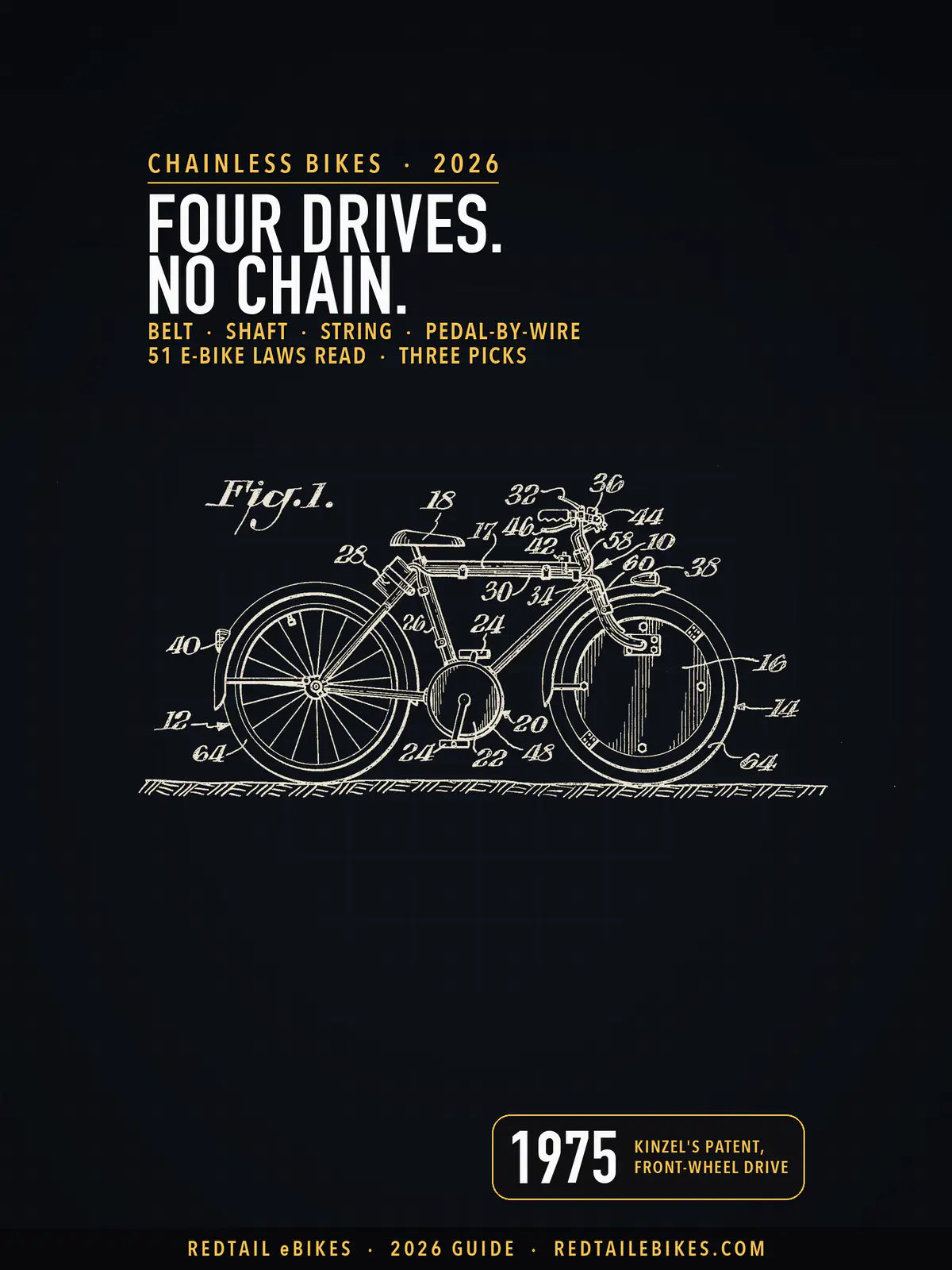
| 1975 | Augustus B. Kinzel of La Jolla, California, patents a cycle whose "manually powered generator" feeds a wheel motor, with front-wheel drive and no chain | U.S. Patent 3,884,317 |
| 1995 to 1997 | Andreas Fuchs and colleagues study a series-hybrid drive from 1995 and run a working model in an ordinary upright bicycle | Fuchs, Human Power eJournal |
| 2012 | Mando and designer Mark Sanders release the Footloose, a folding series-hybrid e-bike | Lane Motor Museum |
| 2018 | Germany's KBA warns dealers selling chainless series hybrids as pedelecs | LEVA-EU |
| 2021 | Schaeffler shows Free Drive at Eurobike in Friedrichshafen | Schaeffler tomorrow |
| 2022 | The European Commission says a chain "is irrelevant" to type approval | Commission forum minutes |
| 2023 | Free Drive enters fleet production | Schaeffler, February 15, 2023 |
| 2026 | ICE offers CIXI's PERS on US-spec trikes; Niche Mobility shows its ADTS prototype | ICE, Electrek |

Kinzel's 1975 drawing: generator at the cranks, motor in the front wheel, no chain. Drawing: U.S. Patent 3,884,317.
Kinzel's patent names several features today's makers advertise. Its stated objects include "front wheel and/or rear wheel drive" and "continuously variable speed operation", in a design "which eliminates the conventional sprocket chain mechanical drive", and it lets the motor "act as a brake". Our history of the electric bike in America starts with an 1895 patent.

The 1898 patent's shaft drive: crank to rear hub, no chain. Drawing: U.S. Patent 610,277.
What AI answers get wrong about chainless bikes
We put ten questions to an AI search engine on September 28, 2026. Three answers were wrong in ways that matter to a buyer, and a fourth left out half of the finding it quoted.
- "Chainless e-bikes usually have less weight than electric bikes with chains." The makers' own figures add a 3.5 to 3.7 kg generator, and CIXI's lightest complete kit weighs 11.7 kg.
- "You can still pedal the bike" with a dead battery. Stated as true of every system. CIXI says its PERS can; Electrek reports that Niche's prototype does not move when the system is off.
- Legal "as long as it has fully functional pedals". Utah's definition requires a bike that works "without the use of the electric motor", and three states build the e-bike on a bicycle driven "through a belt, chain, or gears".
- The right numbers, half the finding. One answer quoted the thesis's best simulated efficiencies, about 75% on the flat and 62% with a hill, without the same thesis's finding that on flat ground without stops a series hybrid is never faster than a chain bike.
Where buyers get caught out
These are the six places a chainless listing can mislead you before you buy, each answered above in the maker's or the statute's own words.
- "Chainless" in a listing can mean any of four drives. Ask which one before you compare it with a pedal-by-wire review.
- "No chain" does not mean no maintenance. Brakes, tires and bearings still wear, and the drive's electronics come from one maker.
- The pedal feel is made by software. Schaeffler's generator holds "constant pedal resistance"; ride one before you buy, if a dealer can arrange it.
- Automatic gearing is the benefit, efficiency is the price. A 100 W rider with no battery help rides about a fifth slower on the flat in our model.
- A flat battery is a different problem on each system. Get the maker's answer in writing.
- A class label is the maker's claim. Your state's definition decides, and Utah's words strain against a pedal-by-wire bike.
Chain now or chainless later?
In 2026, unless a recumbent trike from an ICE dealer suits you, the answer is a chain e-bike now, chosen for the benefit you wanted from chainless. Pedal-by-wire suits fleets, recumbent trikes and early adopters with a dealer nearby.
| If you want | Pedal-by-wire offers | What to buy today |
|---|---|---|
| The least upkeep | No chain to lube or replace | A single-speed hub-motor bike with no derailleur: the Qiolor TIGER JR |
| To haul cargo in town | Stop-and-go efficiency, reverse, fleet durability | A long-tail cargo e-bike: the Eunorau G30-CARGO 2.0 |
| A stable trike | Chainless drive on ICE recumbents | An upright electric trike: the Addmotor Triketan M-330 |
| All-wheel drive | Front and rear motors fed by wire, as Kinzel's patent allowed in 1975 | A dual-motor e-bike; our dual-motor guide reads each state's motor cap first |
| A bike with no chain at all | ICE's PERS trikes, about $10,500 at one US dealer | Nothing on our shelf yet |
Our e-bike motor guide explains hub motors and torque sensors, and our hub-drive e-bike guide matches hub motors to riders and terrain.
Three picks for what chainless promises
None of the three is chainless. Each delivers one of the reasons people want a chainless bike, on a conventional drive and at a price you can check today. All three are sold as 20 mph bikes on their makers' own pages; prices and stock were read from our store and the makers on September 28, 2026. Our brand profiles cover each maker: Qiolor, Eunorau and Addmotor.
Least upkeep: Qiolor TIGER JR

Qiolor TIGER JR
$899 · maker's list $1,399No derailleur to adjust. A single-speed 500 W hub-motor bike, shipped by Qiolor "as a Class II e-bike, equipped with pedal assist and throttle" with a default top speed of 20 MPH; keep that default on public roads and paths. Qiolor rates it for a 400 lb maximum load, and it weighs 87 lb.
Its $899 is price-matched to Qiolor's own US store, and Shop Pay can split it into 4 interest-free payments of $224.75. We ship it free in the contiguous US, and warranty claims come to our US support team.
Cargo in town: Eunorau G30-CARGO 2.0

Eunorau G30-CARGO 2.0
$1,699For the school run and the grocery haul. This long-tail carries a 440 lb total payload on Eunorau's own figures, with a 48V 500W motor, a 20 MPH maximum speed, UL certification and an optional second battery. Eunorau lists it as Class 2, "Speed limited Unlockable"; locked, it stays Class 2. Its 7-speed derailleur is the upkeep you trade for gears on hills, and our G30-CARGO review has the fit and load numbers.
Price-matched at $1,699 to Eunorau's own US store, it ships free in the contiguous US, and Shop Pay can spread it over 12 monthly payments of $153.35 at 15% APR.
Three wheels: Addmotor Triketan M-330

Addmotor Triketan M-330
$2,399 · maker's list $2,999Three wheels without the recumbent price. The pedal-by-wire machine you can order today is a trike; this is the upright, chain-drive kind. Addmotor lists a 750W rear-drive motor, a 48V 20Ah Samsung battery, UL 2271 and 2849 certification, a "350+100 LBS" payload capacity and a 20 mph top speed. Its 750 W motor sits at the federal line, which reads "less than 750 watts"; our 750 W guide shows how each state words that line.
Its $2,399 is price-matched to Addmotor's own store. Ours ships free in the contiguous US with US support, and Shop Pay offers 12 monthly payments of $216.53 at 15% APR.
Hauling more than one bag? Pedal-by-wire's first fleet customer builds cargo vehicles. Our cargo range runs from long-tails to three-wheel haulers, every one shipped free in the lower 48 with US support.
See all cargo e-bikesThe bottom line
Buy a chain e-bike now, and choose it for the reason you wanted chainless. Pedal-by-wire is real, in fleets and on ICE's trikes, but it costs a fifth or more of your pedaling when the battery is off and a few watt-hours a mile when it is on, and its legal footing in the US rests on definitions that never mention it.
If you want the least upkeep, pick a single speed: buy the TIGER JR, $899. If you want cargo or three wheels, those machines ride well on a chain today: buy the G30-CARGO, $1,699 or buy the Triketan M-330, $2,399. If you want the future, watch Free Drive, CIXI and Niche; the thesis math says they make the most sense in town, with a battery doing the work and regeneration catching the stops.
What's next. Watch for a US statute, rule or ruling that names a series-hybrid e-bike, and for a two-wheel pedal-by-wire model from Free Drive, CIXI or Niche at a US dealer. Our 2026 e-bike technology guide rates nine other concepts and prototypes, from gearbox motors to bikes that talk to cars.
Tell us how you ride and we will tell you which of our bikes gets you closest.
Why buy from us
Every figure about our bikes on this page is verified against the maker's own published specification, and the three picks' prices match their makers' on September 28, 2026. Shipping is free on every electric bike within the contiguous United States, and orders are prepared and dispatched within one to three business days, according to our shipping policy.
Support is US-based, by phone or email, before and after you buy, and a warranty claim on any of the three comes to us rather than to a factory inbox.
With Shop Pay, the $899 TIGER JR could be split into 4 interest-free payments of $224.75 every 2 weeks. The G30-CARGO comes to 12 monthly payments of $153.35 at 15% APR, and the Triketan M-330 to 12 monthly payments of $216.53 at 15% APR.
Rates from 0-36% APR. Payment options through Shop Pay Installments are subject to an eligibility check and are provided by these lending partners: affirm.com/lenders. Options depend on your purchase amount, and a down payment may be required. State notices to consumers: affirm.com/licenses.
Three bikes, three reasons, free shipping. Each pick is sold as a 20 mph e-bike on its maker's own page and comes with US support. Pay over time with Shop Pay at checkout.
Choose your bikeFrequently asked questions
Are there bikes without chains?
Yes. Belt-drive, shaft-drive, string-drive and pedal-by-wire bikes all exist, and chainless bicycles date to at least 1898, when a US patent described "the class of chainless or gear-driven safety-bicycles". Belt drives are the kind US shoppers search for most, and pedal-by-wire, where the pedals turn a generator, is the newest.
How does a chainless bike work?
A belt or shaft bike carries your pedal power to the wheel mechanically, through a toothed belt or a driveshaft with bevel gears. A pedal-by-wire bike turns your pedaling into electricity at a generator and sends it through wires to a hub motor, with a controller setting the resistance and a battery storing any surplus.
Are chainless bikes any good?
It depends on the drive you choose. A belt was within about a watt of a chain at 100 W in Friction Facts' laboratory comparison. A pedal-by-wire bike with its battery off carries you about a fifth slower on the flat in our model, and wins back ground only in stop-and-go riding with regenerative braking.
How much is a chainless bike?
The one pedal-by-wire machine we found at a US dealer, ICE's Adventure trike with CIXI's PERS, was listed at $10,500 plus $400 shipping on September 28, 2026. If what you want is less upkeep, the single-speed Qiolor TIGER JR, a chain bike with no derailleur, is $899.
Is pedal-by-wire the future of the bicycle?
For e-bikes in towns and fleets, possibly; for bikes you pedal hard, not soon. The Lyon thesis found a series hybrid needs above 61% efficiency to keep pace with any chain bike in stop-and-go town riding, and its best simulated design reached 73% on the flat. On flat roads without stops, though, it "n'est jamais plus rapide": it is never faster.
Is a digital drive bike actually digital?
The power is electrical, and only the control is digital. Your pedaling becomes electric current in a generator, and a computer decides how much reaches the motor. Makers call the drive "Bike-by-Wire" or "cycle by wire", Electrek calls it pedal-by-wire, and engineers call it a series hybrid.
Does pedal-by-wire mean pedaling twice as hard?
No. The losses are about 28 to 36% of your power, and our model puts a 100 W rider about 22% slower on flat ground with no battery help, and about 36% slower up a 5% grade. With the battery assisting, the difference shrinks to a few watt-hours of battery per mile.
Can you ride a pedal-by-wire bike with a dead battery?
Some systems let you, and some do not. CIXI says that with PERS "power flows directly from the generator to the motor" when the battery runs out; Electrek reports that Niche's prototype does not move when the system is off. Ask the maker in writing before you buy.
Can I fix a chainless drive myself on the road?
Plan on the maker's network rather than a roadside fix. A pedal-by-wire generator, motor or controller is part of one maker's system, sold to bike makers and fleets, so parts and repairs come through that maker. Before a long ride far from a dealer, ask the maker what a fault on the road would mean for the system you are buying.
Does a chainless bike weigh more?
A pedal-by-wire one does. The generator alone weighs 3.5 kg on ICE's trikes and 3.7 kg in CIXI's catalog, and CIXI's lightest complete two-wheel kit weighs 11.7 kg.
Can a digital drive bike have front-wheel drive?
Yes, and a 1975 patent planned for it. Kinzel's design lists "front wheel and/or rear wheel drive" among its objects. On our shelf, the dual-motor e-bikes put a motor in each wheel on a conventional drive; check the combined wattage against your state's line first.
Is a chainless e-bike legal in the US?
On our reading, it fits the words of 33 of the 49 US e-bike definitions, and the other 16 are arguable or strained. Federal law asks for "fully operable pedals", which a pedal-by-wire bike has. Utah requires a bike "fully operable as a bicycle without the use of the electric motor", which it is not, and California, New York and Oklahoma define a bicycle as driven "through a belt, chain, or gears".
Where can I buy a pedal-by-wire bike in the US?
If you want one today, ICE offers CIXI's PERS drive on four recumbent trikes, with a US-spec system it has speed tested to 20 mph. One US dealer, Utah Trikes, listed the ICE Adventure with PERS at $10,500 on September 28, 2026, marked "Currently Out of Stock". Schaeffler's Free Drive is sold to makers and fleets, and Niche's ADTS is a prototype.
Is a belt drive bike worth it?
If a quiet, clean drive on a single speed or hub gear matters more to you than a wide gear range, it can be. The efficiency cost is small: about a watt at 100 W in Friction Facts' comparison, and on a hub-motor e-bike only your share of the power passes through the belt.
How we verified this guide, in detail
The efficiency model. We solve the Martin et al. power equation for steady speed, with the chain at 97.698% and the pedal-by-wire path at 64%, 68% and 72%, plus Tournon's 5 W for control electronics.
The rider and machine are Tengattini and Bigazzi's measured e-bike means (106.3 kg, 0.614 m², 0.0103, from seven riders), with their hybrid-bike means (91.1 kg, 0.579 m², 0.0079, from 181 riders) as a second case; the pedal-by-wire bike carries a 3.7 kg generator. The model checks its power equation against a hand calculation before it reports.
The legal census. The pedal clause of every e-bike definition is quoted from the legislature's text and checked word for word against the saved copy before the table is built. The third column of the table is our reading.
Our shelf. We read the drivetrain lines of all 216 bike and trike listings live on redtailebikes.com on September 28, 2026, out of 706 active products. None describes a belt, shaft or pedal-by-wire drive; 68 name no drivetrain at all.
The corpus. The page cites 95 sources, every one retrieved and read on or before September 28, 2026: 71 statutes, regulations, patents and official records, 14 makers' and institutions' own pages, 5 scholarly works and 5 journalistic or creator reports.
The source register
Every source on this page is graded by who published it: official records first (T1), then makers and institutions writing about themselves (T2), scholarly work (T3), and journalism or creators (T4), cited only for what they report.
| Source | Tier | What it supports | Read |
|---|---|---|---|
| U.S. Code, 15 U.S.C. § 2085 | T1 statute | Federal e-bike definition | Sep 28, 2026 |
| eCFR, 16 CFR 1512.8 | T1 regulation | Federal bicycle rule, drive-chain requirement | Sep 28, 2026 |
| 50 state legislatures and the D.C. Council | T1 statute | Every state e-bike definition; California § 231, New York § 102, Oklahoma § 1-104, Utah §§ 41-1a-201, 41-1a-202, 41-6a-1115.5, 41-12a-301, 41-12a-302, 53-3-202, 63I-1-241 and 76-3-301 | Sep 28, 2026 |
| Federal Register document search; CPSC 2024 advance notice on e-bikes | T1 official index and agency notice | No federal document on a series-hybrid e-bike; the drive-chain requirement e-bikes meet today | Sep 28, 2026 |
| European Commission, DG GROW | T1 agency record | The 2022 series-hybrid position | Sep 28, 2026 |
| USPTO patents 610,277 and 3,884,317 | T1 official record | Chainless drives of 1898 and 1975 | Sep 28, 2026 |
| Schaeffler, Heinzmann, CIXI, ICE, Niche Mobility | T2 maker | System specifications and status | Sep 28, 2026 |
| Qiolor, Eunorau, Addmotor | T2 maker | Pick specifications and prices | Sep 28, 2026 |
| Utah Trikes | T2 dealer listing | US listing and price for the ICE Adventure with PERS | Sep 28, 2026 |
| Lane Motor Museum; Red Dot | T2 institutional record | Mando Footloose | Sep 28, 2026 |
| Martin et al. 1998; Tengattini and Bigazzi 2018 | T3 peer-reviewed | Power model, chain efficiency, rider and bike resistance | Sep 28, 2026 |
| Tournon 2020 (doctoral thesis); Fuchs 2008; Kyle and Berto 2001 | T3 scholarly | Series-hybrid thresholds and history; chain efficiency | Sep 28, 2026 |
| LEVA-EU | T4 trade association | The 2018 German warnings, cited for what it reports | Sep 28, 2026 |
| Electrek; CYCLINGABOUT | T4 journalistic | Niche prototype report; belt and string drive accounts; the video's estimate, each cited for what it reports | Sep 28, 2026 |
Limitations
Here is what this page could not settle, and the event that would settle each item, so you know when a fact here may change.
- No US ruling on pedal-by-wire. No statute we read and no Federal Register document addresses a series-hybrid e-bike, so the legal readings in the table's third column are ours. Expires on the first statute, rule or ruling that addresses one.
- The three "belt, chain, or gears" states are the ones found. The base "bicycle" definition was confirmed in the state code for California, New York and Oklahoma; it was not read at a primary source in every other state, so three is a floor, not a count. Expires when all 51 base definitions are read at the legislatures' own sites.
- The efficiency model is steady-state. It leaves out regeneration, stops, starts and wind, and its main case rests on seven e-bike riders in a Vancouver field study, checked against the same study's 181 hybrid-bike riders. Expires when a measured pedal-by-wire drive efficiency is published.
- Generator and motor efficiency are bracketed. CIXI's "Higher than 80%" is the maker's rating; the 85% figure is Tournon's reading of the best machines' peak. No maker published a full-system efficiency curve we could read. Expires when one does.
- Tournon's results are for a supercapacitor bike. His thresholds and optimized designs store energy in supercapacitors, and a battery system's losses differ. Expires when a battery-based study is published.
- Belt lifespan is not covered. The belt maker's own figures were not reachable on September 28, 2026 and no archived copy exists, so this page gives belt life no figure. Expires on a successful read.
- The AI answers quoted come from one AI search engine on September 28, 2026. Other engines refused automated questions that day. Expires at the next panel run.
- The search-suggestion harvest was not saturated for YouTube's long tail; the web-search question set was. Expires at the next harvest.
- Prices and stock are those read on September 28, 2026 and change often. Expires at each price change.
- Utah's July 1, 2027 date in § 41-6a-102 is about motorcycles. Utah Code § 41-6a-102 carries the note "Affected by 63I-1-241 on 7/1/2027". Utah Code § 63I-1-241(2) repeals subsection (39), on motorcycle "lane filtering", on that date; the e-bike definition in subsection (21)(a) is unchanged. On September 28, 2026 this page briefly listed that date as a change to watch for Utah's e-bike definition. Expires if Utah amends subsection (21).
- Utah's categories are our reading. Whether a pedal-by-wire bike is an electric assisted bicycle, a motor assisted scooter or a motor vehicle in Utah turns on its design, and no Utah agency has classified one; the consequences under If Utah's definition does not fit are the code's words as read on September 28, 2026. Expires when Utah classifies a pedal-by-wire bike; re-read §§ 41-6a-1115.5 and 53-3-202 on May 5, 2027, when their next versions take effect.
References
Every source below was retrieved and read on September 28, 2026, unless another date is stated; each link opens the cited document itself, so you can check any figure.
- U.S. Congress. 15 U.S.C. § 2085, Low-speed electric bicycles, § 2085(b) (Pub. L. 107-319). https://www.govinfo.gov/content/pkg/USCODE-2024-title15/pdf/USCODE-2024-title15-chap47-sec2085.pdf Accessed September 28, 2026.
- U.S. Consumer Product Safety Commission. 16 CFR part 1512, Requirements for bicycles, §§ 1512.2(a), 1512.8, 1512.9(a) (eCFR, current). https://www.ecfr.gov/current/title-16/chapter-II/subchapter-C/part-1512/subpart-A/section-1512.8 Accessed September 28, 2026.
- Office of the Federal Register. Document search: "series hybrid" bicycle, "pedal-by-wire", "bike-by-wire", "chainless" "electric bicycle" and three related terms, zero results each, control query "low-speed electric bicycle" returning 7. https://www.federalregister.gov/documents/search?conditions%5Bterm%5D=%22series+hybrid%22+bicycle Accessed September 28, 2026.
- U.S. Consumer Product Safety Commission. Electric Bicycles; Advance Notice of Proposed Rulemaking; Request for Comments and Information, Federal Register document 2024-05472, background on 16 CFR part 1512 requirements (March 15, 2024). https://www.federalregister.gov/documents/2024/03/15/2024-05472/electric-bicycles-advance-notice-of-proposed-rulemaking-request-for-comments-and-information Accessed September 28, 2026.
- European Commission, DG GROW. Minutes, 12th Meeting of the Forum for the Exchange of Information on Enforcement (E03652), item 6 (meeting February 17, 2022; minutes dated June 1, 2022). https://www.dropbox.com/s/hbbbf1e0f3gpz6b/Minutes%20for%20ExpReg%20-%20Clean%20updated%20version.pdf?dl=0 Accessed September 28, 2026.
- Kinzel, A. B. Electrically Powered Cycle, U.S. Patent 3,884,317, abstract and Fig. 1 (filed March 5, 1974; issued May 20, 1975). https://image-ppubs.uspto.gov/dirsearch-public/print/downloadPdf/3884317 Accessed September 28, 2026.
- O'Connor, E. J., and Knowles, E. R. Bicycle Gear, U.S. Patent 610,277, specification and drawings (filed May 12, 1897; issued September 6, 1898). https://image-ppubs.uspto.gov/dirsearch-public/print/downloadPdf/0610277 Accessed September 28, 2026.
- Tournon, E. Conception optimale d'un vélo à architecture hybride série et à base de supercondensateurs, doctoral thesis, Université de Lyon, NNT 2020LYSE1304, abstract and printed pp. 113–115, 122–124 and 188 (2020). https://theses.hal.science/tel-03120708 Accessed September 28, 2026.
- Martin, J. C., Milliken, D. L., Cobb, J. E., McFadden, K. L., and Coggan, A. R. Validation of a Mathematical Model for Road Cycling Power, Journal of Applied Biomechanics 14(3):276–291, chain drive efficiency (1998). https://collections.lib.utah.edu/dl_files/b4/8e/b48ef26086091662c561e673d7bd990d77868437.pdf Accessed September 28, 2026.
- Tengattini, S., and Bigazzi, A. Y. Physical characteristics and resistance parameters of typical urban cyclists, Journal of Sports Sciences 36(20):2383–2391, Table 4 (2018). https://civil-reactlab.sites.olt.ubc.ca/files/2022/11/Tengattini_2018_Physical-characteristics-and-resistance-parameters-of-typical-urban-cyclists.pdf Accessed September 28, 2026.
- Kyle, C. R., and Berto, F. The mechanical efficiency of bicycle derailleur and hub-gear transmissions, Human Power no. 52, beginning p. 3 (Summer 2001). https://www.ihpva.org//HParchive/PDF/hp52-2001.pdf Accessed September 28, 2026.
- Fuchs, A. Series Hybrid Drive-System: Advantages for Velomobiles, Human Power eJournal, components section (April 27, 2008). https://hupi.org/HPeJ/0015/SeriesDriveHybridVelomobiles.pdf Accessed September 28, 2026.
- Schaeffler. Less chain, more flexibility, tomorrow magazine (September 2021). https://schaeffler-tomorrow.com/en/article/less-chain-more-flexibility Accessed September 28, 2026.
- Schaeffler. Fleet start for Schaeffler's chainless drive for e-cargo bikes, press release (February 15, 2023). https://www.schaeffler.com/en/media/press-releases/press-releases-detail.jsp?id=87897088 Accessed September 28, 2026 (archived copy of October 18, 2025).
- Heinzmann. Free Drive System, system page (undated). https://www.heinzmann-electric-motors.com/en/system-solutions/freedrive Accessed September 28, 2026.
- CIXI. PERS KIT Catalog 2026 (2026). https://static.cixi.life/b640d507-7a00-48be-bb3d-068150745b86-PERS-Catalog-2026.pdf Accessed September 28, 2026.
- CIXI. PERS technology, product page (undated). https://www.cixi.life/pers-technology Accessed September 28, 2026.
- ICE (Inspired Cycle Engineering). PERS - Chainless E-Assist Pedalling System, product page (undated). https://www.icetrikes.co/products/pers-chainless-e-assist-system Accessed September 28, 2026.
- Utah Trikes. ICE Adventure - PERS Trike - Chainless Pedaling System, dealer listing (undated). https://www.utahtrikes.com/PROD-11624026.html Accessed September 28, 2026.
- Niche Mobility. ADTS, home page (2026). https://niche-mobility.com/ Accessed September 28, 2026.
- Toll, M. This new 'pedal-by-wire' e-bike motor wants to revolutionize electric bikes, Electrek (April 23, 2026). https://electrek.co/2026/04/23/this-new-pedal-by-wire-e-bike-motor-wants-to-revolutionize-electric-bikes/ Accessed September 28, 2026.
- Lane Motor Museum. Mando Footloose – 2012, collection record (undated). https://www.lanemotormuseum.org/collection/bicycles/item/mando-footloose-2012/ Accessed September 28, 2026.
- Red Dot. Mando Footloose, Product Design 2013 award record (2013). https://www.red-dot.org/project/mando-footloose-31859 Accessed September 28, 2026.
- LEVA-EU. EU Commission finally confirms: Series Hybrid Cycles are EPACs excluded from L-category (February 21, 2022). https://leva-eu.com/eu-commission-finally-confirms-series-hybrid-cycles-are-epacs-excluded-from-l-category/ Accessed September 28, 2026.
- CYCLINGABOUT (Denham, A.). Are Belt Drivetrains More Efficient Than Chain Drivetrains? (Lab Testing), reporting Friction Facts' 2016 comparison (undated). https://www.cyclingabout.com/belt-drivetrain-efficiency-lab-testing/ Accessed September 28, 2026.
- CYCLINGABOUT (Denham, A.). Are Chainless String Drive Bicycles a Genius or Terrible Idea? (2023). https://www.cyclingabout.com/are-chainless-string-drive-bicycles-a-genius-or-terrible-idea/ Accessed September 28, 2026.
- CYCLINGABOUT (Denham, A.). Are Chainless Digital Drive Bicycles The Future of Cycling?, video (November 15, 2022). https://www.youtube.com/watch?v=r-Zyp6jX0HM Accessed September 28, 2026.
- California Legislature. Vehicle Code § 231 (amended by Stats. 2021, ch. 311). https://leginfo.legislature.ca.gov/faces/codes_displaySection.xhtml?lawCode=VEH§ionNum=231 Accessed September 28, 2026.
- California Legislature. Vehicle Code § 312.5, subd. (a)(1). https://leginfo.legislature.ca.gov/faces/codes_displaySection.xhtml?lawCode=VEH§ionNum=312.5 Accessed September 28, 2026.
- New York State Senate. Vehicle and Traffic Law § 102. https://www.nysenate.gov/legislation/laws/VAT/102 Accessed September 9, 2026.
- Oklahoma State Courts Network. 47 O.S. § 1-104, subsection A. https://www.oscn.net/applications/oscn/DeliverDocument.asp?CiteID=81890 Accessed September 13, 2026.
- Utah Legislature. Utah Code § 41-6a-102, subsections (21)(a) and (50). https://le.utah.gov/xcode/Title41/Chapter6A/41-6a-S102.html Accessed September 28, 2026.
- Utah Legislature. Utah Code § 63I-1-241, Repeal dates: Title 41, subsection (2) (effective May 6, 2026). https://le.utah.gov/xcode/Title63I/Chapter1/63I-1-S241.html Accessed September 28, 2026.
- Utah Legislature. Utah Code § 41-6a-1115.5, subsection (8)(d) (the version effective May 5, 2027 keeps the words quoted). https://le.utah.gov/xcode/Title41/Chapter6A/41-6a-S1115.5.html Accessed September 28, 2026.
- Utah Legislature. Utah Code § 41-1a-201, subsections (1)–(2). https://le.utah.gov/xcode/Title41/Chapter1A/41-1a-S201.html Accessed September 28, 2026.
- Utah Legislature. Utah Code § 41-1a-202, subsection (2)(a)(xv). https://le.utah.gov/xcode/Title41/Chapter1A/41-1a-S202.html Accessed September 28, 2026.
- Utah Legislature. Utah Code § 41-12a-301, subsections (2)(a) and (5)(d). https://le.utah.gov/xcode/Title41/Chapter12A/41-12a-S301.html Accessed September 28, 2026.
- Utah Legislature. Utah Code § 41-12a-302, subsections (3)–(4). https://le.utah.gov/xcode/Title41/Chapter12A/41-12a-S302.html Accessed September 28, 2026.
- Utah Legislature. Utah Code § 53-3-202, subsections (1) and (9)(a) (subsection (11)(a) in the version effective May 5, 2027). https://le.utah.gov/xcode/Title53/Chapter3/53-3-S202.html Accessed September 28, 2026.
- Utah Legislature. Utah Code § 76-3-301, subsection (1)(e). https://le.utah.gov/xcode/Title76/Chapter3/76-3-S301.html Accessed September 28, 2026.
- Minnesota Revisor of Statutes. Minn. Stat. § 169.011, subd. 27. https://www.revisor.mn.gov/statutes/cite/169.011 Accessed September 28, 2026.
- Texas Legislature. Transportation Code §§ 664.001–664.002. https://statutes.capitol.texas.gov/Docs/TN/htm/TN.664.htm Accessed September 28, 2026.
- Qiolor. TIGER JR, product page. https://qiolor.com/products/tiger-jr Accessed September 28, 2026.
- Eunorau. G30-CARGO, product page. https://eunorau-ebike.com/products/g30-cargo Accessed September 28, 2026.
- Addmotor. Triketan M-330 eTrike, product page. https://www.addmotor.com/products/m-330-p7 Accessed September 28, 2026.
- Redtail eBikes (first-party data). Drivetrain census of 216 bike and trike listings, 706 active products read September 28, 2026; chain vs pedal-by-wire efficiency model, computed September 28, 2026; US demand harvest and Semrush US pull, September 28, 2026. Methods in how we verified this guide, in detail.
Share:
Electric Mopeds in the USA (2026): 17 Bikes, Real Math
Eunorau META275 1.0 Review 2026: 65 N·m, $1,699