
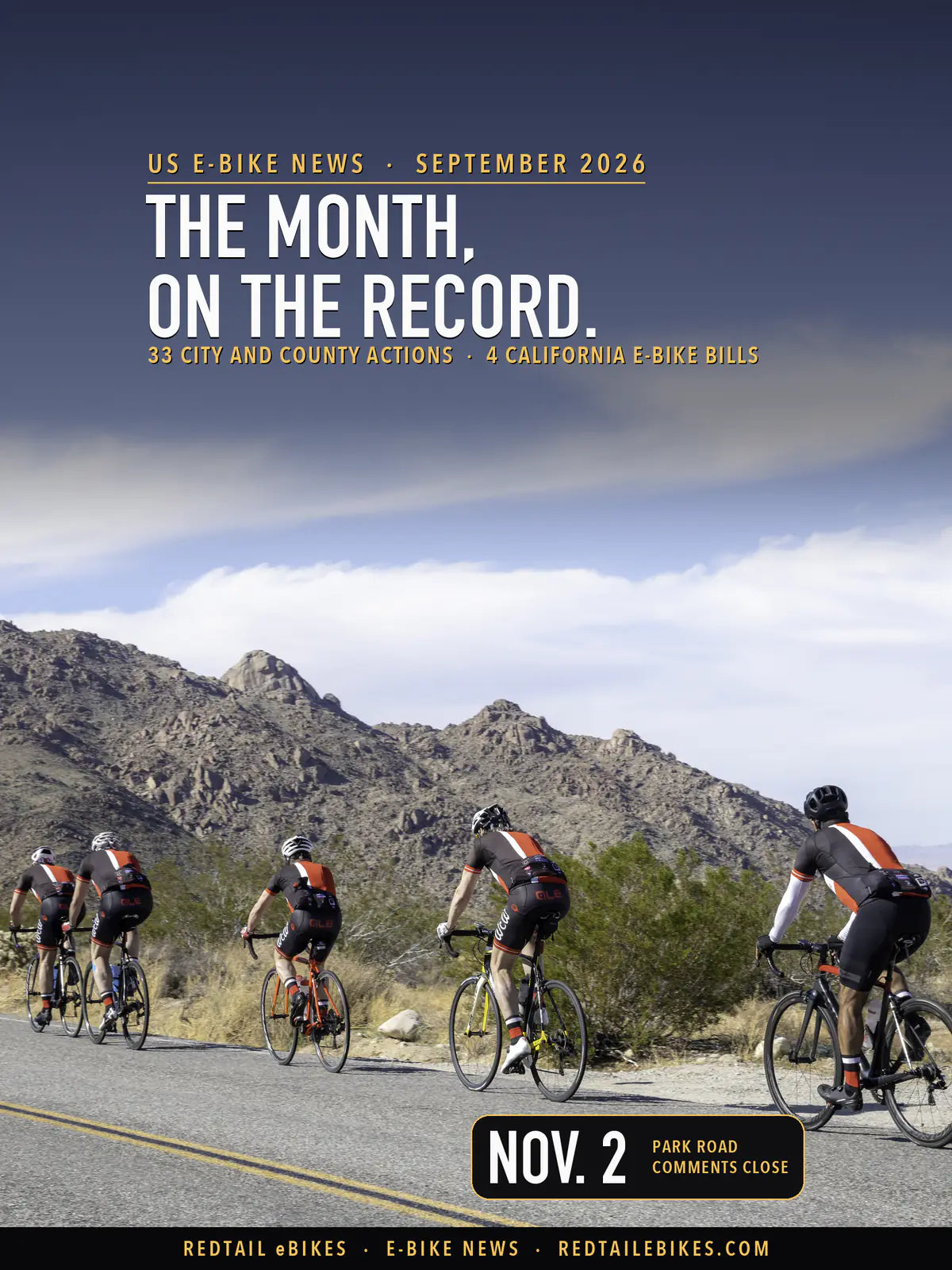

September 2026 brought a federal proposal to open park roads to e-bikes, four signed California e-bike bills and 33 local actions we read at the governments' own records. Cover: cyclists on Park Boulevard in Joshua Tree National Park, a public-domain National Park Service photograph (NPS / Emily Hassell, 2017), the sky darkened behind the type.
Quick answer. In September 2026 the National Park Service proposed letting e-bikes onto park roads by default (comments close November 2), California signed four e-bike bills, and 33 US cities and counties adopted, advanced or brought into force e-bike rules, 11 of them age lines or youth helmet rules. No September CPSC recall used the word e-bike.
Shopping this fall? Every e-bike we sell ships free to the contiguous United States, and our buying guide walks through class, motor and battery before you choose. Check your state's rules first on our e-bike law hub.
See every e-bike we sellHow we verified this report
We counted 5,851 distinct e-bike headlines in US news searches for September 1 to 30, 2026, then went to each government's own record: the Federal Register, Congress's bill files, state legislatures, and city and county minutes, ordinances and notices. A story appears below only when that record confirms it. News reports led us to the records; they are not cited as proof.
Written and verified by Milad Ghobadibeygvand, BScN (Western University, 2014), October 16, 2026: method, limits.
By Milad Ghobadibeygvand, BScN (Western University, 2014), Redtail eBikes. Last verified October 16, 2026. Corrections: support@redtailebikes.com.
In this record
This record runs from federal agencies to state legislatures to town councils, and every section links the document that settles each line, so you can check any claim before you rely on it.
- What changed: September's e-bike news in nine records
- Federal lands: parks, forests and refuges
- Congress: one bill moved
- California signs four bills
- New York City and New York State
- Other states: Michigan, New Jersey, Florida, Connecticut
- Cities and counties: 33 actions on the record
- Safety record: recalls, injuries and a parent poll
- Money: rebates, vouchers and a buyback
- Reported in September, dated elsewhere
- What takes effect next
- Before you buy or ride: what changes for you
- Frequently asked questions
- How we verified the records
- Limitations
- Sources
What changed: September's e-bike news in nine records
Nine records carried most of the month's weight: a park road proposal and a park micromobility rule, a refuge rule, a Forest Service comment period, a Senate farm bill, four California laws, a county vote to pursue lawsuits against sellers and a New York City hearing. Each row links the document that settles it.
| Date | What happened | Record |
|---|---|---|
| Sept. 1 | The National Park Service proposed allowing bicycles and e-bikes on park roads open to public motor vehicles | 91 FR 56095 |
| Sept. 1 | Fish and Wildlife Service refuge rule confined e-bikes at Mississippi's Theodore Roosevelt NWR Complex to maintained roads, trails, levees and similar routes | 91 FR 56290 |
| Sept. 11 | NPS rule on powered micromobility devices took effect; it does not cover e-bikes | FR Doc. 2026-16388 |
| Sept. 15 | San Diego County supervisors voted to pursue lawsuits against sellers of electric motorcycles marketed as e-bikes | Minute Order No. 19 |
| Sept. 20 | California signed SB 501, which adds e-bike-size batteries to its battery recycling program | Governor's update |
| Sept. 23 | Comments closed on the Forest Service plan to stop treating Class 1 e-bikes as motor vehicles on bike trails | 91 FR 54686 |
| Sept. 24 | A Senate farm bill reached the calendar with an e-bike ban for Shawnee National Forest special management areas | S. 5526 |
| Sept. 30 | California signed SB 1167, AB 2346 and AB 2595 on e-bike labels, speeds and child riders, in force from January 1, 2027 | Governor's release |
| Sept. 30 | The New York City Council heard 23 e-bike, e-scooter and moped bills | Council release |
Federal lands: parks, forests and refuges
Three federal agencies touched e-bike access in September: the Park Service proposed opening park roads, the Forest Service closed comments on Class 1 e-bikes on bike trails, and the Fish and Wildlife Service narrowed where e-bikes go at a Mississippi refuge complex. The park proposal is open for your comment until November 2.
National parks: e-bikes on park roads by default
The National Park Service proposed a rule on September 1 that would open park roads to bicycles and e-bikes without a park-by-park decision. The proposed text of 36 CFR 4.30(a) reads: "The use of bicycles and electric bicycles is allowed on park roads and in parking areas that are otherwise open for motor vehicle use by the general public."

Mobile Volunteer Patrol members ride the Shark Valley loop in Everglades National Park during training. Photo: Zito Rojas / National Park Service, public domain.
Today's rule works the other way. Under current § 4.30(i), e-bike use "may be allowed," and the superintendent "will designate" where. Trails would still need a superintendent's designation under the proposal, and a full rulemaking would still be required for significant designations and for routes that have "never been improved by artificial or processed materials."
Comments go through docket NPS-2026-0166 on regulations.gov until 11:59 p.m. Eastern on November 2, 2026, per the Federal Register notice. If you want your view on the record, file it through that docket before the deadline. The Park Service announced the proposal in an August 31 release.
Separately, the Park Service's final rule on powered micromobility devices, published August 12, took effect September 11. It covers devices such as e-scooters and leaves e-bikes under their own bicycle rules.
At First State National Historical Park in Delaware, comments on a proposed bicycling regulation for the Brandywine Valley trails closed September 28. The proposal's background states that "Class 1 and class 3 electric bicycles are allowed in the same locations where traditional bicycles are allowed. Class 2 electric bicycles are not allowed on the trail network."
National forests: Class 1 e-bikes and the motor vehicle line
The Forest Service's notice of intent, published August 24, proposes exempting Class 1 e-bikes from motor-vehicle treatment under 36 CFR 212.51(a) and 261.13 on National Forest System trails open to bicycles. Its environmental impact statement will also study an alternative that keeps Class 1 e-bikes classed as motor vehicles.

Riders on a trail in the Dakota Prairie Grasslands, part of the National Forest System, in September 2023. Photo: USDA Forest Service, Northern Region, public domain.
Comments closed September 23. The Federal Register notice listed 134,377 comments on the docket when we checked on October 16, 2026. Until a final rule takes effect, nothing changes for you on the ground: an e-bike on a National Forest System trail is still treated as a motor vehicle.
Wildlife refuges: a Mississippi complex narrows e-bike access
The Fish and Wildlife Service's 2026–2027 refuge hunting and fishing rule, published September 1 and effective August 31, answered comments about e-bikes at Theodore Roosevelt National Wildlife Refuge Complex in Mississippi. Before the rule, the agency wrote, e-bikes "are allowed to go anywhere across the NWR" (91 FR 56303).

The Panther Swamp National Wildlife Refuge sign in the May 2011 floods. Panther Swamp is one of the refuges in the Theodore Roosevelt National Wildlife Refuge Complex, where the September rule's e-bike change applies. Photo: U.S. Fish and Wildlife Service, public domain.
The agency's response states the new line: "All traditional bikes and e-bikes (in pedal-assist mode) must stay on maintained roads, trails, turnrows, fire lanes, power lines, pipelines, levees/earthen dams/dikes, or designated ATV/utility-type vehicle (UTV) trails." If you hunt or fish there, keep your e-bike to those routes.
The same rule prints e-bike conditions for hunters and anglers at other refuges, among them Bald Knob and Cache River in Arkansas and Lower Rio Grande Valley in Texas. For federal land rules by agency, our public land e-bike guide sets them side by side.
For riders: the park road proposal is a proposal. Until a final rule takes effect, each park's superintendent still decides where e-bikes go, and the park's own website or compendium is the place to check before you ride.
Congress: one bill moved
One bill with e-bike text took a step in September. The Senate Agriculture Committee reported S. 5526, the Agricultural Act of 2026, on September 24, and it went onto the Senate calendar as Calendar No. 683.
Its Section 8407 deals with Shawnee National Forest in Illinois. In the bill's special management areas, "the use of motor vehicles, including over-snow vehicles and e- bikes, in the Special Management Areas shall be prohibited," except for administrative use, emergency response, authorized roads to trailheads, inholdings, cemeteries or campgrounds, and off-road access needed for habitat management.
A reported bill is not law; it still needs a Senate vote, the House and a signature, so if you ride in Shawnee, nothing changes yet.
We checked every bill introduced in September, not only the ones with "e-bike" in the title. GPO's bill-status files list 735 House and Senate bills introduced that month.
GPO had published text for 727 of them, and none names e-bikes; the eight without text carry titles unrelated to e-bikes. No September bill in those files would ban e-bikes nationally.
California signs four bills
California's governor signed four e-bike-related bills in September, the last three on September 30. Those three carry no urgency clause, so they take effect on January 1, 2027, the first January 1 after a 90-day period from enactment under the state constitution.
September 30: labels, speeds and child riders
The governor's September 30 release lists SB 1167 (Blakespear), AB 2346 (Wilson and Berman) and AB 2595 (Papan) among the public safety bills signed that day.
- SB 1167, from January 1, 2027, widens the list of vehicles that "are not electric bicycles under this code and shall not be advertised, sold, offered for sale, or labeled as electric bicycles or 'e-bikes'"; the list starts with "A vehicle with motor power of more than 750 watts." It also bars selling or installing an e-bike classification label anywhere but a physical retailer or bicycle repair shop, and it requires a disclosure in all advertising, online and social media included, for electric mopeds, motor-driven cycles and off-highway electric motorcycles (Legislative Counsel's Digest).
- AB 2346, from January 1, 2027, lets local agencies post speed limits on bicycle paths and multiuse trails, sets a prima facie 10 mph speed limit on sidewalks, and has sellers disclose in writing, "at or before the point of sale," items including each e-bike's class, maximum speed, continuous and peak wattage, and age and helmet rules, with a recommendation that riders under 16 go no faster than 15 mph. Every Class 2 e-bike "manufactured, sold, or offered for sale on or after January 1, 2029" must carry a speedometer, with front and rear lamps on every e-bike from the same date (bill text).
- AB 2595, from January 1, 2027, creates the San Mateo Electric Bicycle Safety Pilot Program: a local authority within San Mateo County, or the county in unincorporated areas, "may, by ordinance or resolution, prohibit a person under 12 years of age from operating a class 1 or 2 electric bicycle," with warnings for the first 60 days and a $25 fine after that (bill text).
The motor limit in the e-bike definition itself does not change: California's code defines an e-bike motor as one that "does not exceed 750 watts of power" (Vehicle Code § 312.5).
One SB 1167 section starts a year later. It rewrites Health and Safety Code § 26303, the state's rule against renting out an e-bike unless the battery "has been tested by an accredited testing laboratory," and, per the bill's digest, adds mopeds and off-highway electric motorcycles; the section "shall become operative on January 1, 2028."
September 20: e-bike batteries join the recycling program
The governor's September 20 update lists SB 501 (Allen) among the bills signed. The author's office describes it as adding "medium sized batteries, such as those in electric bikes and outdoor lawn equipment" to California's existing loose-battery producer-responsibility program (Senator Allen's legislation page). The Senate's August 30 daily summary records the bill as enrolled and presented to the governor that evening.
Our California e-bike law guide covers the state rules a rider meets today, including the class and age rules that stand until the new laws begin.
For California buyers: the four bills leave the definition's 750-watt line where it is. Their label, advertising and equipment rules start January 1, 2027 or later, and until then today's code governs what you can buy and how you ride.
Buying in California? Start with a motor rated at or below 750 watts and working pedals, the two things California's definition checks. Our buying guide explains how class and motor rating shape your choice.
Read the e-bike buying guideNew York City and New York State
New York acted at two levels in September: the City Council heard 23 bills on e-bikes, e-scooters and mopeds on September 30, and a state Senate bill would bar the sale of e-motos. Neither has become law.
The New York City Council's committees on transportation and infrastructure, consumer and worker protection, and public safety held a joint hearing on September 30 on 23 bills about e-bikes, e-scooters and mopeds, per the Council's release.
Citing city data, the Council's release says the first six months of 2026 "saw 738 injuries and 13 fatalities of e-bike riders, compared to 601 injuries and 10 fatalities over the same period in 2025." A hearing is not a vote, so if you ride in the city, none of the 23 bills applies unless it becomes law.
In Albany, Senate Bill S10700 (Gonzalez) was referred to the Rules Committee on September 14. Its summary says it "Regulates the sale of E-motos and electric off-highway motorcycles," and its sponsor memo says it would "prohibit the sale of E-motos" and "prohibit deceptive selling practices." It would add three sections to the General Business Law and amend Vehicle and Traffic Law § 511-c.
Two New York towns adopted their own rules the same month: Mount Pleasant on September 22, and Salina, whose record gives both September 14 and September 28. Both appear in the local table. Our New York e-bike law guide explains the state's three classes and where each may ride.
Other states: Michigan, New Jersey, Florida, Connecticut
Michigan: a statewide floor for young riders, proposed
Senator Jim Runestad introduced SB 1156 on September 10, and it went to the Committee on Transportation and Infrastructure. As introduced, it provides that "An individual less than 14 years of age shall not operate an electric bicycle on a public road, sidewalk, or trail" (introduced text).
Under the introduced text, riders "older than 14 years of age but less than 18 years of age" could ride if they wear a helmet and a parent has given written permission or is supervising. If your child is under 14, the bill as introduced would bar them from operating an e-bike on Michigan's public roads, sidewalks and trails.
Three Michigan communities' own rules were adopted or took effect the same month: Bloomfield Township's, Beverly Hills's and Berkley's. If you live in one of them, the local table links your town's record. See our Michigan e-bike law guide.
New Jersey: one permit change, per a legislator
Assemblyman Michael Inganamort's office said on September 4 that the Motor Vehicle Commission will let 16-year-olds hold a motorized bicycle permit and a learner's permit at the same time (release). We did not find a Motor Vehicle Commission notice saying the same, so this rests on the legislator's account; if your teenager is 16, confirm it with the commission first. Our New Jersey e-bike law guide covers the state's classes.
Florida: state forest trails, effective October 20
The Florida Forest Service filed an amendment to Rule 5I-4.006 on September 30 that takes effect October 20, 2026 (rule notice). Class 1 e-bikes may go where bicycles go; Class 2 and Class 3 e-bikes stay off designated trails and may use only designated roads open to licensed traffic, so if you ride a Class 2 or Class 3 bike in a state forest, plan your route on those roads.
Four Florida local governments adopted rules in September; they are in the local table. Our Florida e-bike law guide has the statewide picture.
Connecticut: the 750-watt line moved on October 1
Since October 1, 2026, Connecticut's definition counts a motor of "not more than seven hundred fifty watts," the wording Public Act 26-24, section 26, approved May 27, wrote into C.G.S. 14-1(31). A motor rated at exactly 750 watts now fits, which it did not before the change. Our Connecticut e-bike law guide explains the classes.
Cities and counties: 33 actions on the record
We read the government's own minutes, ordinance, notice or bulletin for each row below. Find your town, then open its record before you rely on any summary, ours included. Twenty-seven are September decisions, four are earlier measures that took effect in September, and two are September votes that moved a measure forward without finishing it.
Two patterns run through the table. Eleven of the 33 rows set an age line or a youth helmet rule, and at least five places added a parent-responsibility or impound clause, which puts the penalty on the parent or on the device. One town moved the other way: Ingleside voted on first reading to drop the under-13 rule it adopted in August.

The 33 actions came from 18 states. California led with six and Florida followed with four; the other 23 were spread across 16 states, 11 of them with one each.
| Date | Place | What the record shows | Record |
|---|---|---|---|
| Sept. 1 | Mandan, N.D. | Ord. 1489 adopted on second consideration 4-0, in force on publication: helmets under 18; no Class 3 under 16; under 12 only supervised in designated areas | Minutes |
| Sept. 1 | Salt Lake County, Utah | Chapter 11.33 adopted unanimously for unincorporated trails: 20 mph cap; Class 2 off natural-surface trails; Class 3 off both path types; $150 penalty | Minutes |
| Sept. 1 | Fort Atkinson, Wis. | Final reading of Chapter 94 changes for e-bikes and scooters, adding parental responsibility | Minutes |
| Sept. 3 | Winters, Calif. | Ord. 2026-07 took effect 30 days after its Aug. 4 adoption: no riding in parks, playgrounds, school grounds or the Creek Walk unless posted | Ordinance |
| Sept. 4 | Granby, Conn. | Town notice: "E-bikes are no longer permitted within Town parks" | Notice |
| Sept. 8 | Goddard, Kan. | Ord. 1053 adopted 5-0; e-bikes off roads posted above 45 mph; impound with a $100 fee | Minutes |
| Sept. 8 | St. Augustine Beach, Fla. | Ord. 2026-06 on electric mobility devices passed final reading unanimously | Minutes |
| Sept. 8 | Bismarck, N.D. | Ord. 6680 amended after a hearing: age 12 for Class 1 and 2 and scooters, 16 for Class 3; tiered fines; impound | Minutes |
| Sept. 8 | Watertown, S.D. | Ord. 26-30, covering e-bikes as personal conveyances, approved on second reading | Minutes |
| Sept. 8 | Columbus, Neb. | Ord. 71.015 approved on third reading, per the city | City news |
| Sept. 8 | Lander, Wyo. | Ord. 2026-2 passed second reading 6-0 as amended; third reading was on the Oct. 13 agenda | Draft minutes |
| Sept. 14 | Pottsville, Pa. | Ord. 953 enacted: no riders under 16 on pedalcycles with electric assist or e-scooters; $25 fine | Ordinance |
| Sept. 14 | Bloomfield Township, Mich. | Six-month moratorium on e-bike riding under 16 on township property and rights of way | Notice |
| Sept. 14 | St. Charles Parish, La. | Ord. 26-9-5 adopted 7-0 as amended: helmets under 17 on Class 1 and 2 e-bikes and for all Class 3 riders; devices capable of more than 28 mph need a license, insurance, registration and a helmet; $50 helmet fine | Ordinance |
| Sept. 15 | Mentor, Ohio | Three ordinances, effective immediately: helmets for all e-bike riders, passenger limits, a warning before passing | City notice |
| Sept. 15 | North Platte, Neb. | Ord. 4258 on bicycles, e-bikes and e-scooters passed third reading 8-0 | Minutes |
| Sept. 15 | Huntersville, N.C. | E-bike ordinance adopted 5-0: class limits on roads, sidewalks and paths; helmets under 18 | Minutes |
| Sept. 15 | Perrysburg, Ohio | Ords. 48-2026 and 49-2026 approved 7-0, the second creating e-bike registration | Minutes |
| Sept. 15 | Beverly Hills, Mich. | Ord. 396 adopted 7-0 in draft minutes: no e-moto on a public road under 16; lights and a mirror on e-motos | Draft minutes |
| Sept. 15 | Murrieta, Calif. | Ord. 637-26 adopted 4-0 with a parent-responsibility section; in force 31 days after adoption | City notice |
| Sept. 15 | San Diego County, Calif. | Supervisors voted 4-1 to pursue legal action against sellers marketing electric motorcycles as e-bikes | Minute order |
| Sept. 16 | Escondido, Calif. | Ord. 2026-07 adopted 4-1: riders under 12 barred from Class 1 and 2 e-bikes; in force 60 days after adoption | Ordinance |
| Sept. 16 | Berkley, Mich. | Ord. O-11-26, adopted 7-0 on Aug. 17, took effect 30 days after adoption under its Section 5 | Minutes |
| Sept. 21 | Fort Thomas, Ky. | Ord. O-09-2026 passed second reading 5-0: no e-bike on sidewalks or crosswalks with the motor engaged, with one exception | Ordinance |
| Sept. 22 | Jacksonville, Fla. | Ord. 2026-0570-E enacted: e-bikes capped at 15 mph on sidewalks and shared-use paths | Ordinance |
| Sept. 22 | Mount Pleasant, N.Y. | Local Law 7 approved: helmets at 16 and 17; no one 16 or older may knowingly let a child under 16 ride | Local law |
| Sept. 22 | Riverbank, Calif. | Ord. 2026-005 on unsafe riding in parks, trails, sidewalks and streets passed second reading 5-0 | Minutes |
| Sept. 22 | Ingleside, Texas | First reading, 7-0, of a change removing the August rule that riders under 13 be supervised on streets | Draft minutes |
| Sept. 23 | Winter Park, Fla. | Ord. 3376-26 adopted 5-0: riders under 16 need a safety certificate from an approved course | Minutes |
| Sept. 23 | Hilliard, Ohio | Ord. 26-17, passed Aug. 24, took effect: helmet rules, parental responsibility, impounding | Bulletin |
| Sept. 25 | Long Beach, Calif. | ORD-26-0022 took effect: no Class 3 e-bike on any sidewalk; 15 mph sidewalk limit, 5 mph near pedestrians | Ordinance |
| Sept. 28 | Salina, N.Y. | Local Law 12 adopted after a Sept. 28 hearing (the clerk's certification says Sept. 14): no e-bikes on designated streets, paths and sidewalks from 8 p.m. to 6 a.m., none for riders under 16 | Local law |
| Sept. 29 | Orange County, Fla. | Ord. 2026-19 adopted 7-0, rewriting county rules for e-bikes and other micromobility devices | Roll call |
Four rules worth reading in full
Salina's curfew. Salina's Local Law 12, adopted in September, bars Class 1, 2 and 3 e-bikes, motorized scooters and similar devices from the town's designated streets, bicycle paths and lanes, sidewalks and trail network "between the hours of 8:00PM and 6:00AM," and bars riders under 16 from them at any time (Local Law 12 of 2026).
The town clerk sent it to New York's Department of State on September 29 with a letter saying the board adopted it on September 28, after that day's public hearing; her certification on the same filing says it was passed on September 14. The law takes effect upon posting, publication and filing with the Secretary of State.
Winter Park's course. Winter Park's Ordinance 3376-26 "requires riders under the age of 16 to obtain a safety certificate by completing an approved course," and the minutes say citations will wait for an education period (September 23 minutes). On September 9 the commission had raised the first micromobility fine to $35, with a class in place of payment, and later offenses to $75. If your child is under 16, the course comes first.
Huntersville's timing. Huntersville's minutes cite North Carolina Session Law 2026-46 and its new local-authority section, 160A-300.2, as the town's authority (September 15 minutes). That section arrives in the session law's section 19, whose subsection (f) says "This section becomes effective December 1, 2026" (Session Law 2026-46).
Ingleside's reversal. Ingleside adopted Ordinance 2026-19 on August 25, with a rule that riders under 13 be supervised on public streets. On September 22 the council approved on first reading an ordinance "removing the minimum-age parental-supervision requirement for persons under thirteen years of age" while keeping the state's Class 3 age rule; the city manager said it takes effect only after a second reading (draft minutes, October 13 packet).
Heard in September, not yet adopted
- West Haven, Conn.: the council amended its Chapter 80 ordinance on September 14, letting e-bikes use designated boardwalk bike lanes "only by human-powered pedaling," held a public hearing on September 28 with no public speakers, and then held the ordinance (September 28 minutes).
- Newport, R.I.: "Bicycle Related Ordinances" were on the September 16 council agenda. The attached draft requires a helmet for any operator or passenger "twenty (20) years of age or younger" on an electric bicycle (agenda attachment). The minutes were not posted when we checked.
- Nampa, Idaho: a first reading of rules for e-bikes, e-motos and e-scooters was on the September 21 agenda, with the three-reading rule waived for all ordinances that night (agenda). The minutes were not posted.
- Tarpon Springs and Palmetto Bay, Fla.: both put ordinances on September agendas for second reading: Tarpon Springs' Ordinance 2026-15 on the safe operation of electric bicycles, on its September 8 agenda, and Palmetto Bay's regulations for micromobility devices, on its September 14 agenda. Neither had posted minutes for those meetings.
- Schenectady, N.Y.: a council committee discussed "E-Bikes & Motorized Scooters: Safety, Compliance, and Enforcement" and a draft ordinance on September 8 (agenda packet).
For families: age rules now differ a few miles apart. Mandan (adopted September 1) and Bismarck (amended September 8) set 12 for Class 1 and 2 and 16 for Class 3; Pottsville bars riders under 16 from pedal-assist bikes outright; Winter Park requires a course under 16. Read your own town's rule before a child rides.
Riding where the rules just changed? Match the class to your town's rule before you buy: our buying guide explains what each class allows, and every e-bike we sell ships free to the contiguous United States.
Shop commuter and city e-bikesSafety record: recalls, injuries and a parent poll
Recalls: none named an e-bike in September
We read every recall the Consumer Product Safety Commission posted with a September 2026 date through its public recall database, 50 in all. None names an e-bike or electric bicycle in its title, product, description or hazard fields, and none of the 14 product safety warnings CPSC listed for September does either.
The same search does find the e-bike terms in a known CPSC warning, so the zero is in the records, not in the search. Three of the 50 recalls covered bicycle helmets: 26749, 26785 and 26789.
One September recall reaches e-mountain bikes without using the word. Recall 26746 covers "Certain Mondraker mountain bicycles equipped with ONOFF S9 Carbon MTB handlebars," about 177 sold in the US. Several model lines it lists appear under "E-BIKES" on Mondraker's own US site, and the maker's recall notice lists models too; if you own one, check your model against both lists.
Injuries and a parent poll
The C.S. Mott Children's Hospital National Poll on Children's Health published "E-bikes: Unsafe or uncertain?" on September 21. It is based on 1,234 parents of children 11 to 18 from an Ipsos survey of 2,027 parents in July 2026, with a margin of error of plus or minus 1 to 3 points.
Only "1 in 10 parents want a ban on e-bikes," the Mott report says, while parents back helmet requirements, clearer markings of where to ride and age rules. The New York City Council's release, cited above, gave the city's own injury counts.
Money: rebates, vouchers and a buyback
Atlanta, Cleveland and New Orleans opened e-bike rebate rounds in September, and the Orange County, California district attorney held a buyback. If you hope to use a rebate, each program sets its own income tiers, and Cleveland and New Orleans pay through participating local bike shops.
| City | What opened | Record |
|---|---|---|
| Atlanta | $1 million round, more than 400 rebates of up to $1,600 by income, by lottery; applications September 8 to 22 | Atlanta Regional Commission |
| Cleveland | Pilot of 100 point-of-sale rebates: $500 standard, $1,500 for income-qualified households; applications from September 1 | City of Cleveland |
| New Orleans | First phase of 100 rebates (50 at $1,200, 50 at $600), from a $3.8 million EPA grant, with a required online safety course; registration from September 28 | City of New Orleans |
In Orange County, California, the district attorney's office held its first e-bike and e-moto buyback at Angel Stadium on September 13 (media advisory). A county supervisor's bulletin reported "nearly 1,000" devices surrendered (bulletin).
Reported in September, dated elsewhere
Several stories that ran in September happened earlier or later, and one mixed up the place. The dates below come from each story's own record, so you can tell what is new this month and what is not.
| Reported in September | What the record says |
|---|---|
| Kids' e-bike injuries "up 7.5-fold" | The figure is from Truveta Research's July 6 post on e-bike and e-scooter emergency visits under 18, January 2023 to May 2026 |
| North Carolina's new e-bike law | Signed July 7, 2026 as S.L. 2026-46; its e-bike section takes effect December 1, 2026 |
| Illinois's new e-bike law | Governor approved SB 3484 on August 26, 2026 as Public Act 104-0854; "This Act takes effect January 1, 2027" |
| Berkley, Mich., sidewalk ban | Adopted August 17; it took effect September 16 under its 30-day clause (minutes) |
| Chico's Bidwell Park trail limits | The park commission's item was on its August 31 agenda; the city council's agendas from September 1 to October 6 carry no e-bike item |
| Hampton Township, Mich., park ban | Adopted August 10, per the September 8 minutes |
| "Beverly Hills approves e-bike limits" | Beverly Hills, Michigan, not California (draft minutes) |
| Urban Arrow cargo e-bike recall | CPSC recall 27004 is dated October 1 (CPSC record) |
What takes effect next
The dates below run from Connecticut's October 1 change to California's 2029 equipment rules. Each comes from the law's own text, or for California's three new laws from the state constitution's rule for when a statute starts, so you can plan a purchase or a ride around them.

The same nine dates as the table below, in order.
| Date | What | Record |
|---|---|---|
| Oct. 1, 2026 | Connecticut's definition counts a motor of not more than 750 watts, Public Act 26-24 § 26 | Public Act |
| Oct. 16, 2026 | Murrieta's Ord. 637-26, on the 31st day after its September 15 adoption | Ordinance |
| Oct. 20, 2026 | Florida Forest Service e-bike rule for state forests | Rule notice |
| Nov. 2, 2026 | Comment deadline, NPS park road proposal | 91 FR 56095 |
| Nov. 15, 2026 | Escondido's under-12 rule, 60 days after adoption | Ordinance |
| Dec. 1, 2026 | North Carolina's e-bike classes and local authority, S.L. 2026-46 § 19 | Session law |
| Jan. 1, 2027 | California's SB 1167, AB 2346 and AB 2595; Illinois's Public Act 104-0854 | State constitution · Public Act |
| Jan. 1, 2028 | Battery testing for rented e-bikes, mopeds and off-highway electric motorcycles from January 1, 2028, Health and Safety Code § 26303 as rewritten by SB 1167 | Bill text |
| Jan. 1, 2029 | Class 2 speedometers and e-bike lamps under AB 2346 | Bill text |
Before you buy or ride: what changes for you
If you ride in a park, check the park, not the proposal. The NPS rule is open for comment, and until a final rule takes effect each superintendent's designations control.
If you buy in California, read the motor rating and the label. From January 1, 2027, a machine with "motor power of more than 750 watts" may not be sold or labeled as an e-bike under SB 1167, and under AB 2346 the seller must give you the bike's class, maximum speed and wattage in writing at or before the sale.
If you have a rider under 16 at home, look up your town before your county or state. September's local rules set ages at 12 and 16 depending on the place, helmet rules reach riders up to 17, and several hold the parent responsible or impound the device.
If you ride a 750-watt e-bike in Connecticut, the October 1 change in Public Act 26-24 brought exactly-750-watt motors inside the state's definition.
If you are shopping now, start with the ride: commuter and city e-bikes for streets and paths, folding e-bikes for trains and apartments, and cargo e-bikes for kids and groceries. Check the class against your town's rule before you buy.
Why buy from Redtail
Every e-bike we sell ships free within the contiguous United States, and you can reach our US support team at (213) 444-4020 or support@redtailebikes.com before or after you buy. At checkout you can pay with Shop Pay, Apple Pay, Google Pay or a major card, and our how buying works page sets out shipping, returns and discounts when you're ready.
Ready for fall riding? Our fall picks list class, motor rating and the rules that matter for each bike, and every e-bike we sell ships free to the contiguous United States with US support.
See our fall e-bike picksFrequently asked questions
What is the new e-bike law in California?
Governor Newsom signed SB 1167, AB 2346 and AB 2595 on September 30, 2026 (release), and SB 501 on September 20. From January 1, 2027, the three tighten what may be sold or labeled as an e-bike, require a written disclosure of class, speed and wattage at sale, allow posted speed limits on paths, set a 10 mph sidewalk limit and start a San Mateo County under-12 pilot. SB 501 adds e-bike batteries to battery recycling.
What e-bikes are legal in California?
California defines an e-bike as a bicycle with fully operable pedals and a motor that "does not exceed 750 watts of power," in Class 1, 2 or 3 (Vehicle Code § 312.5). From January 1, 2027, SB 1167 lists vehicles that are not e-bikes and may not be sold or labeled as one, starting with any vehicle with motor power of more than 750 watts.
Are e-bikes allowed in national parks?
Today, yes where the superintendent has designated them, so check the park's own page before you ride; the current rule says e-bike use "may be allowed." The September 1 NPS proposal would allow e-bikes by default on park roads and parking areas open to public motor vehicles. Comments close at 11:59 p.m. Eastern on November 2, 2026.
Will e-bikes be banned?
No national ban was proposed in September. The federal proposals moved toward more access on park roads and Forest Service bike trails. The one federal ban in the record is a bill provision for Shawnee National Forest special management areas, and September's local bans covered places such as parks, school grounds and sidewalks, night hours on designated streets, or riders under a set age, rather than e-bikes as a whole.
Is there a recall on electric bikes?
None of the 50 CPSC recalls dated September 2026 uses the word e-bike. Recall 26746 covers Mondraker mountain bicycles with ONOFF S9 Carbon MTB handlebars, and several of its model lines appear under "E-BIKES" on Mondraker's US site. CPSC recall 27004, for Urban Arrow cargo e-bikes, is dated October 1.
Is there a tax credit for electric bikes?
Not at the federal level. None of the 15 bills in this Congress whose text names e-bikes has become law, and only S. 5526 had a September action, for its Shawnee provision. If you live in Colorado, a state program takes $225 off a qualified e-bike at participating retailers, as of October 16, 2026 (Colorado Energy Office).
Why are new e-bike laws focusing on younger riders?
The records point to crashes and complaints involving minors. Goddard's August 25 minutes describe devices "being operated at speeds exceeding 20 miles per hour, predominantly by children without adult supervision or helmets." Eleven of September's 33 local actions set an age line or a youth helmet rule, and at least five added parent responsibility or impound. If you have a young rider, your town's rule is the one to read first.
Are e-bikes illegal in NYC?
No. New York State law sets three e-bike classes (see our New York e-bike law guide), and New York City's Council is weighing 23 bills on e-bikes, e-scooters and mopeds after its September 30 hearing. The state bill S10700 targets e-motos, which it would bar from sale, and electric off-highway motorcycles, not e-bikes.
When do the new e-bike laws come in?
It depends on the law and where you ride. Connecticut's change took effect October 1, Florida's state forest rule takes effect October 20, North Carolina's e-bike section December 1, 2026 (Session Law 2026-46), and California's three September 30 laws and Illinois's Public Act 104-0854 January 1, 2027. California's AB 2346 speedometer and lamp rules apply to e-bikes sold from January 1, 2029.
How we verified the records
Every row on this page traces to a government's own document. The method below is how 5,851 headlines became the records you can open from each row, and what we did when a record could not be reached.
Census. We pulled US e-bike coverage for each day of September from Google News (1,011 searches, including one per state per week) and from GDELT, then removed repeats: 5,851 distinct headlines. We grouped local stories by the place and the action.
Records. For each story we went to the government's own record: Federal Register documents, GPO bill files, state legislature pages and governor's releases, and each city's agenda system (CivicPlus, CivicClerk, Granicus, Legistar, PrimeGov, CivicWeb) for the minutes or ordinance. Scanned PDFs were read with OCR, and handwritten dates on one ordinance were read by eye.
Rule. A row is listed only when the record confirms it. Where a city's record could not be reached or did not exist yet, the story is left out and counted in Limitations. Checked October 16, 2026.
Limitations
Eight limits apply to this record. Each says what the counts cover and what they do not, so you can judge how far to rely on them.
- The local list is not every action in the country. It covers local actions reported in September coverage that we could confirm at a government record. Of 57 places we looked up, 33 are listed, 18 are left out (dated elsewhere, not yet decided, unreachable or not a council action) and 6 are described as heard or on an agenda.
- Nine of them could not be checked. Their sites refused our requests or posted no September record we could find: North Baltimore, Ohio; Pittsford, N.Y.; Carrollton, Ga.; Kirkwood, Mo.; Lake Oswego, Ore.; Matthews, N.C.; Sheridan, Ark.; Rossford, Ohio; and Maricopa County, Ariz. News reported actions in several of them; we did not list those.
- Proposals were not checked one by one. About 126 September stories described proposals rather than adoptions. We list the proposals we read at the record and do not claim the rest.
- Some minutes are drafts. Lander's, Ingleside's and Beverly Hills's September minutes were drafts when we read them, and a council can correct a draft when it approves it.
- Miami Beach and Panama City Beach are not listed. Coverage said Miami Beach approved new rules; its September 10 minutes show the parks ordinance "not reached" and moved to October 14. Panama City Beach's own page lists rules "in effect," but its adoption record refused our requests.
- The CPSC zero covers September-dated records. A recall dated October 1 or later is outside it, and a recall that does not use the words e-bike or electric bicycle would not be caught.
- Counts change. The Forest Service comment count and the NPS docket keep moving; ours are as of October 16, 2026.
- This page expires with the month. It describes September 2026. Laws that took effect after September 30 are named in What takes effect next only when their own text sets the date.
Sources
Source register. T1: federal and state law, regulations, bills and agency records; city and county ordinances, minutes and notices. T2: a legislator's release (New Jersey), a maker's recall notice (Mondraker), a university poll (Mott Poll) and a health-data company's research post (Truveta Research). Our first-party datasets: the September census and the local ledger, both kept in this page's research folder.
- National Park Service. "Bicycle Use in Park Areas," proposed rule, 91 FR 56095, FR Doc. 2026-17902, September 1, 2026. federalregister.gov. Accessed October 16, 2026.
- National Park Service. "National Park Service proposes rule to expand bicycle and e-bike access in national parks," August 31, 2026. nps.gov. Accessed October 16, 2026.
- Electronic Code of Federal Regulations. 36 CFR 4.30, Bicycles. ecfr.gov. Accessed October 16, 2026.
- National Park Service. "Powered Micromobility Devices," final rule, FR Doc. 2026-16388, August 12, 2026. federalregister.gov. Accessed October 16, 2026.
- National Park Service. First State National Historical Park, bicycling, proposed rule, FR Doc. 2026-15406, July 30, 2026. federalregister.gov. Accessed October 16, 2026.
- U.S. Forest Service. "Travel Management; National Forest System," notice of intent, 91 FR 54686, FR Doc. 2026-17211, August 24, 2026. federalregister.gov. Accessed October 16, 2026.
- U.S. Fish and Wildlife Service. "National Wildlife Refuge System; 2026-2027 Station-Specific Hunting and Sport Fishing Regulations," 91 FR 56290, at 56303, September 1, 2026. federalregister.gov. Accessed October 16, 2026.
- U.S. Senate. S. 5526, Agricultural Act of 2026, reported in Senate, Calendar No. 683, September 24, 2026, Sec. 8407. govinfo.gov. Accessed October 16, 2026.
- Office of the Governor of California. Signing release, September 30, 2026 (SB 1167, AB 2346, AB 2595). gov.ca.gov. Accessed October 16, 2026.
- Office of the Governor of California. "Governor Newsom issues legislative update 9.20.2026" (SB 501). gov.ca.gov. Accessed October 16, 2026.
- California Legislature. SB 1167 (Blakespear), Vehicles: electric bicycles, enrolled text. leginfo.legislature.ca.gov. Accessed October 1, 2026.
- California Legislature. AB 2346 (Wilson, Berman), Vehicles: electric bicycles and speed limits, enrolled text. leginfo.legislature.ca.gov. Accessed October 1, 2026.
- California Legislature. AB 2595 (Papan), San Mateo Electric Bicycle Safety Pilot Program, enrolled text. leginfo.legislature.ca.gov. Accessed October 1, 2026.
- California Legislature. Vehicle Code § 312.5. leginfo.legislature.ca.gov. Accessed September 24, 2026.
- California Constitution, Article IV, § 8(c)(1), effective date of statutes. leginfo.legislature.ca.gov. Accessed October 1, 2026.
- Senator Benjamin Allen. Legislation, SB 501 Battery Recycling. sd24.senate.ca.gov. Accessed October 16, 2026.
- California State Senate. Senate Daily Summary, August 30, 2026. senate.ca.gov. Accessed October 16, 2026.
- New York City Council. Press release, September 30, 2026, joint hearing on 23 bills. council.nyc.gov. Accessed October 16, 2026.
- New York State Senate. S10700 (Gonzalez), 2025-2026 session. nysenate.gov. Accessed October 16, 2026.
- Michigan Legislature. Senate Bill 1156 of 2026, bill page and introduced text. legislature.mi.gov. Accessed October 16, 2026.
- New Jersey Assembly Republicans. Assemblyman Inganamort release, September 4, 2026. njassemblygop.com. Accessed October 16, 2026.
- Florida Department of Agriculture and Consumer Services, Florida Forest Service. Notice of change, Rule 5I-4.006. flrules.org. Accessed October 16, 2026.
- Illinois General Assembly. SB 3484 bill status and Public Act 104-0854, approved August 26, 2026. ilga.gov. Accessed October 16, 2026.
- Connecticut General Assembly. Public Act 26-24 (Substitute Senate Bill 413), § 26, approved May 27, 2026. cga.ct.gov. Accessed October 1, 2026.
- North Carolina General Assembly. Session Law 2026-46 (House Bill 1094), § 19. ncleg.gov. Accessed October 16, 2026.
- U.S. Consumer Product Safety Commission. Recall records dated September 1-30, 2026, via saferproducts.gov. saferproducts.gov. Accessed October 16, 2026.
- Mondraker. ONOFF S9 handlebar recall notice (US). mondraker.com. Accessed October 16, 2026.
- C.S. Mott Children's Hospital National Poll on Children's Health. "E-bikes: Unsafe or uncertain?" Vol. 50, Issue 2, September 21, 2026. mottpoll.org. Accessed October 16, 2026.
- Truveta Research. "E-bike and e-scooter injuries are rising rapidly among children and adolescents," July 6, 2026. truveta.com. Accessed October 16, 2026.
- Atlanta Regional Commission. City of Atlanta e-bike rebate program returns, September 3, 2026. atlantaregional.org. Accessed October 16, 2026.
- City of Cleveland. Pilot e-bike rebate program release, August 24, 2026. clevelandohio.gov. Accessed October 16, 2026.
- City of New Orleans. E-bike rebate bulletin, September 28, 2026. content.govdelivery.com. Accessed October 16, 2026.
- Orange County District Attorney. E-bike buyback media advisory, September 2026. ocdistrictattorney.gov. Accessed October 16, 2026.
- County of San Diego Board of Supervisors. Minute Order No. 19, September 15, 2026. sdcounty.legistar1.com. Accessed October 16, 2026.
- Colorado Energy Office. E-bike tax credit. energyoffice.colorado.gov. Accessed October 16, 2026.
- City and county records for each row of the local table and the heard list: ordinances, minutes, notices and bulletins, linked where each is cited. Accessed October 16, 2026.
Share:
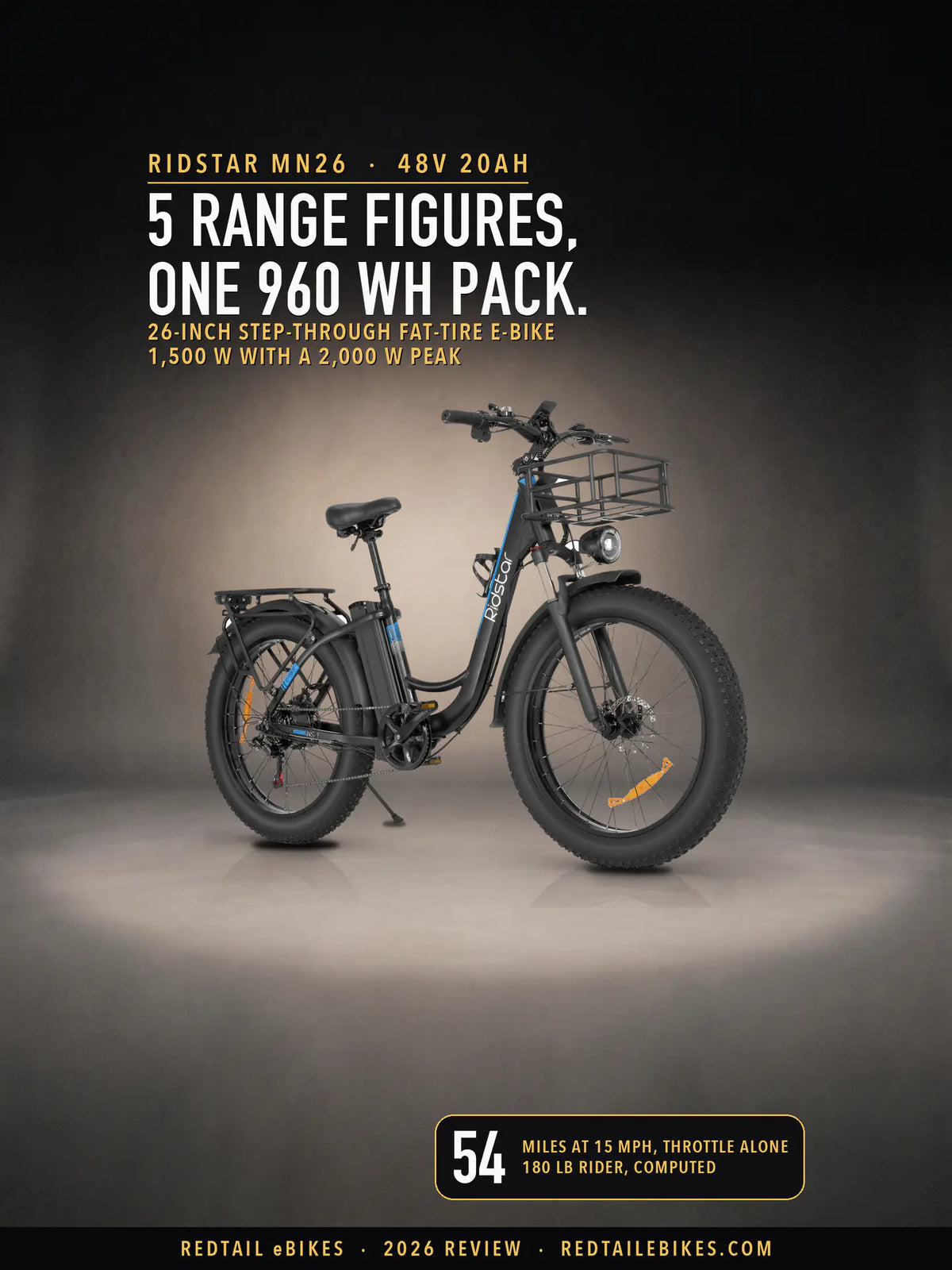
Ridstar MN26 Review: 5 Range Figures, One 960 Wh Pack
eBike Shops in Maryland (2026): 65 Verified Stores