
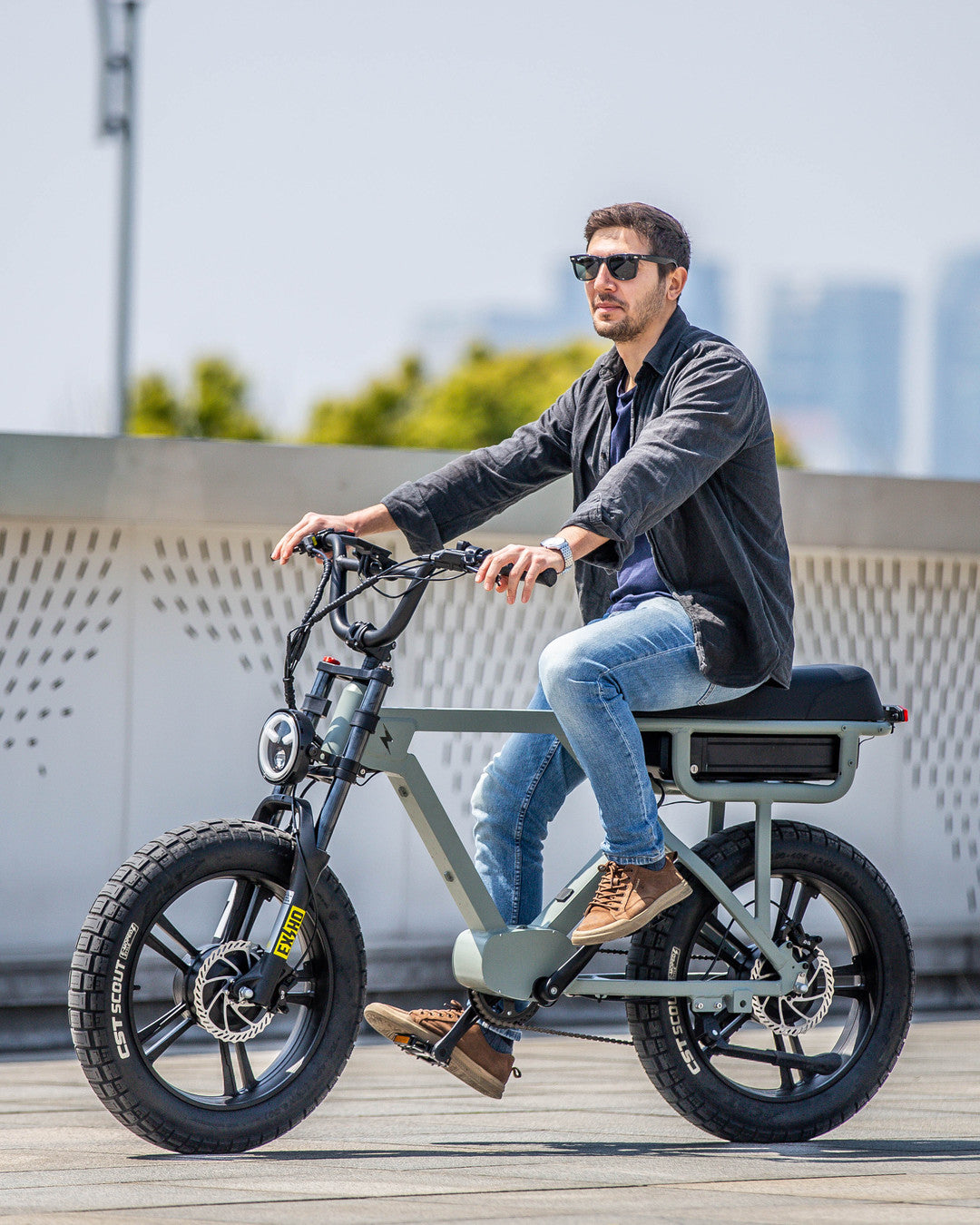


Under the 750 W ceiling · 20 mph class 2 · 28 mph class 3
924 cities counted, 479 codes read

Quick Answer: Ohio ebike laws treat a class 1, 2 or 3 e-bike as a bicycle (no license, no registration, no insurance) provided the motor is under 750 watts and the bike has working pedals. Class 3 riders must be 16 or older and wear a helmet at every age. On any sidewalk in Ohio, the motor must be off.
Ohio's e-bike law took effect on March 8, 2019, from one act, and the section that holds its riding rules has changed once since, on April 15, 2021. That did not stop at least four pages ranking for this search on August 24, 2026 from reporting a May 2026 path law that does not exist.
We read the statute, the pending bills, both federal-land rule sets, and the codified ordinances of every Ohio municipality we could reach (479 of 924) to build the guide we would want handed to us at a traffic stop.
Shopping with Ohio's line in mind? Before you compare anything else, find the motor rating on the listing: Ohio's three classes stop short of 750 watts, so a bike rated at exactly 750 is outside them. Every e-bike we sell ships free within the contiguous United States.
Shop commuter e-bikesIn this guide
- How we verified this guide
- The 30-second answer
- Ohio ebike laws: what counts as a legal e-bike here
- Do you need a license, plate or insurance in Ohio?
- Age and helmets: what class 3 changes
- Where can you ride an e-bike in Ohio?
- The sidewalk rule: motor off, statewide
- The May 21, 2026 law that does not exist
- The 750-watt line, and what your bike becomes above it
- The label, the speedometer, and the modification rule
- State parks and ODNR land
- Cuyahoga Valley and the Towpath
- Every municipality we checked
- The towns that wrote their own rules
- What do Ohio's biggest cities add?
- Fines and enforcement
- Not an e-bike: mopeds, scooters, e-motos
- Can you get a DUI on an e-bike in Ohio?
- Rebates: Columbus, Cleveland and the statewide blank
- What is actually pending: H.B. 948 and S.B. 477
- Our own catalog, screened against Ohio law
- Ohio against its neighbors
- The 60-second self-check: your Ohio compliance checklist
- If you are stopped: the police-stop playbook
- Why buy an Ohio e-bike from Redtail
- Limitations, and when this page expires
- Source register
- Frequently asked questions
- References
- The bottom line
How we verified this guide
Every statutory claim here was read in the Ohio Revised Code at codes.ohio.gov, the General Assembly's official publisher, on August 24, 2026.
The e-bike definitions were verified a second time against the enrolled text of Am. Sub. H.B. 250 (132nd General Assembly), the act that created them.
Pending legislation was read at legislature.ohio.gov rather than from news coverage.
The local layer comes from full-text searches of 479 municipal codes on American Legal Publishing (443 Ohio clients) and Municode (36), run August 24, 2026, with every flagged section read in its published code. The municipal denominator (924 active incorporated places) is the U.S. Census Bureau's 2025 Gazetteer count.
Park rules come from the Ohio Department of Natural Resources' own e-bike page and the Cuyahoga Valley National Park Superintendent's Compendium, approved April 7, 2026.
Last verified: August 24, 2026 by Milad Ghobadibeygvand, BScN (Western University, 2014), Redtail eBikes editorial. Next scheduled re-verification: February 2027, or sooner on any event in the expiry list.
Read again on October 10, 2026: the two pending bills, the Columbus and Cleveland rebates, the license-points rule, the dates of H.B. 250, Cleveland Metroparks' trail rule, the lighting and e-scooter sections, and the screen of our own catalog.
Corrections: content@redtailebikes.com. If a rule on this page no longer matches the section it links to, the section wins, and we want to know.
The 30-second answer
Ohio treats a class 1, 2, or 3 electric bicycle as a bicycle. No license, no registration, no insurance (R.C. 4511.52). The motor must be under 750 watts — under, not up to (R.C. 4511.01(TTT)–(VVV)). Class 1 and 2 are welcome on bike paths unless the local authority says otherwise; class 3 is the reverse — barred from paths off the road corridor unless someone says yes.
Nobody needs a helmet on a class 1 or 2 under state law, at any age. On a class 3, everyone does — operator and passenger, no age cutoff (R.C. 4511.522(D)(2)), and nobody under 16 may drive one.
The sidewalk rule is easy to miss: an e-bike may be on a sidewalk only with the motor off (R.C. 4511.711(A)). Pedal it or push it.
The trap to walk in knowing: the "new Ohio e-bike law effective May 21, 2026" that at least four pages ranking for this search reported on August 24, 2026 was never enacted. It is a bill sitting in a House committee, misread as a statute. Section 4511.522 has not changed since April 15, 2021: the section's own version history says so.
Ohio's rules by situation
| Your situation | What Ohio law says | Source |
|---|---|---|
| A class 1 or 2 on a street or in a bike lane | Allowed, with a bicycle's rights and duties | § 4511.52(A) |
| A class 3 on a street | Allowed for an operator 16 or older, with a helmet on the operator and every passenger | § 4511.522(D) |
| A class 1 or 2 on a bike or shared-use path | Allowed unless the path's owner prohibits it by resolution, ordinance or rule | § 4511.522(C)(1) |
| A class 3 on a bike or shared-use path | Barred unless the path is within or adjacent to a highway, or its owner authorizes class 3 | § 4511.522(C)(2) |
| Any class on a mountain-bike, hiking, equestrian or other natural-surface trail kept for nonmotorized use | Barred unless the trail's owner authorizes it | § 4511.522(C)(3) |
| A sidewalk | Only with the motor off; Columbus bars bicycles and mobility devices from its sidewalks | § 4511.711(A), C.C.C. § 2173.10 |
| A rider under 16 | May operate a class 1 or 2; on a class 3, only as a passenger on one built to carry one | § 4511.522(D)(1) |
| License, registration, plate, insurance | None for a class 1, 2 or 3 | § 4511.01(B), § 4501.01(B) |
| A motor rated at 750 W or more, or a throttle that assists past 20 mph | Outside every class, which makes the machine a motorcycle: endorsement, registration, plate and insurance | § 4511.01(C), (TTT)–(VVV) |
| Riding after dark | A white front lamp, a red rear reflector and a red rear lamp | § 4511.56(A) |
| A path, age or helmet ticket | A minor misdemeanor, with a fine of up to $150, on a first offense, and no license points | § 4511.522(E), § 2929.28, § 4511.52(B) |
| Riding impaired | An OVI under § 4511.19, which the no-points rule does not cover | § 4511.52(D) |
| ODNR state park land | All classes on roads; class 1 and 2 on paved or gravel bike trails; class 1 alone on natural-surface trails open to bicycles; none at Scioto Trail State Forest | ODNR |
| Cleveland Metroparks | Class 1 and 2 on the All Purpose Trail and on bicycle paths, mountain-bike trails included; no class 3 on any of them | § 373.01 |
| The Towpath in Cuyahoga Valley National Park | Class 1 and 2, never on the throttle alone, at 15 mph or less | Compendium |
Ohio ebike laws: what counts as a legal e-bike here
An Ohio electric bicycle is a bicycle with fully operable pedals and an electric motor of less than 750 watts, in one of three classes, and a machine that misses any part of that definition is not an e-bike here, whatever the listing called it. The definitions live in R.C. 4511.01, divisions (SSS) through (VVV), effective in their current form September 30, 2025.
| Class | The statute's test | Motor cut-off | Throttle? |
|---|---|---|---|
| Class 1 | "provides assistance only when the rider is pedaling" — (TTT) | 20 mph | No |
| Class 2 | "may provide assistance regardless of whether the rider is pedaling" — (UUU) | 20 mph | Yes |
| Class 3 | "provides assistance only when the rider is pedaling" — (VVV) | 28 mph | No |
Three details in that table decide real purchases. The wattage ceiling is less than 750: a motor rated at exactly 750 W nominal sits outside all three definitions, and 750 W is the most common rating on our own shelf: 75 of the 223 e-bikes we sell.
The cut-offs govern assistance rather than speed: you may pedal a class 1 downhill past 20 mph, the motor simply cannot help. And class 3 is pedal-assist only (§ 4511.01(VVV)), so a throttle working past 20 mph puts the machine outside every class.
Ohio law also says what an e-bike is, structurally (§ 4511.01). Division (G) folds it into "bicycle" — "a pedal-powered vehicle upon which a human operator sits, including an electric bicycle." Division (B) excludes it from "motor vehicle." Division (H) excludes it from "moped." Every downstream consequence on this page — no license, no plate, path access, the works — flows from those three sentences.
Takeaway
Check the spec sheet before the paint color: fully operable pedals, a motor of less than 750 watts, and assist that stops at 20 mph, or at 28 mph if it works only while you pedal. Those three lines are the whole legal test in Ohio (§ 4511.01), and the class label the maker must fix to the frame (§ 4511.522(A)(1)) is where you read them. Start with our commuter e-bikes.
Do you need a license, plate or insurance in Ohio?
For a legal class 1, 2, or 3 e-bike, Ohio requires no driver's license, no registration, no plate, and no insurance — at any age, in any city. The traffic rules that bind bicycles bind e-bikes identically (R.C. 4511.52(A)).
A violation on one puts no points on your driver's license: section 4511.52(B) says a rider "shall not have any points assessed" under R.C. 4510.036, unless the charge is impaired riding under § 4511.19 (division (D); see below).
A source of the confusion is worth naming. Ohio licenses motorized bicycles — mopeds — under R.C. 4511.521: a probationary moped license at 14–15, helmet and rear-view mirror under 18, one rider only.
None of it applies to you. R.C. 4511.01(H) closes the door in six words: a moped "does not include an electric bicycle." When someone tells you an e-bike needs a moped license here, they are quoting the wrong section, and hundreds of village codes reprint that moped section.
What you do need is on the bike rather than in your wallet: the manufacturer's class label, and a speedometer if it is a class 3 (§ 4511.522(A)(1), (B)(3)). Both are covered below.
Age and helmets: what class 3 changes
State law sets no age floor and no helmet rule for class 1 and class 2 e-bikes: a twelve-year-old on a class 2 breaks no Ohio statute, helmet or not. Class 3 flips both switches at once: no one under 16 may operate one, and every operator and every passenger must wear a helmet meeting CPSC or ASTM standards, with no age cutoff (R.C. 4511.522(D)).
Two edges of subsection (D) are easy to miss. An under-16 rider may legally ride as a passenger on a class 3 built to carry one — the ban covers operating only ((D)(1)). And the helmet duty has no adult exemption.
A 45-year-old on a class 3 with no helmet is committing a minor misdemeanor (§ 4511.522(E)); the same rider on a class 2 is committing nothing. Ohio's class 3 helmet rule reaches every age, where Michigan and Indiana release riders at 18 (comparison below). Our accessories range carries helmets; for a class 3, check that the one you choose names CPSC or ASTM on its label, because that is the standard (D)(2) sets.
Local government can add floors state law does not have, and a few Ohio suburbs have: Bay Village now requires helmets under 18 on every class, and Bexley bars children under 12 from class 1 machines. Both are in the local table.
Takeaway
Buying for a teenager? Under 16, the legal ceiling in Ohio is class 1 or class 2. A 20-mph step-through commuter keeps a 14-year-old inside the statute in all 88 counties.
On a cargo e-bike built to carry passengers, a rider under 16 may come along even on a class 3, in a helmet (§ 4511.522(D)). Of the 64 bikes on our cargo shelf, 6 clear Ohio's line on their published figures.
For younger riders, four of the six bikes in our kids' range are rated 180 to 350 W; the other two are an electric dirt bike and a motorbike, so check each listing's top speed and pedals against the rules above — and our Florida and New Jersey guides show how differently two states treat the same teenager.
Where can you ride an e-bike in Ohio?
On any Ohio road where a bicycle may go, all three classes may go — an e-bike rider holds a bicycle's full right to the roadway, bound by the same rules (R.C. 4511.52(A)). Paths are where the classes split, and the statute's design is worth thirty seconds, because it decides every trailhead argument in the state.
R.C. 4511.522(C) draws three defaults:
| Surface | Class 1 & 2 | Class 3 | Who can flip it |
|---|---|---|---|
| Bike-only or shared-use path | Open by default — "is permitted... unless" the authority "prohibits" — (C)(1) | Closed by default, unless the path runs "within or adjacent to a highway" — (C)(2) | County, township, municipality, local authority, or state agency, "by resolution, ordinance, or rule" |
| Natural-surface, mountain-bike, hiking, or equestrian trail | Closed by default — all three classes — (C)(3) | Closed by default | Same list — authorization must be affirmative |
| Roadway and bike lane | Open | Open | Standard traffic authority |
So the honest answer to "can I ride the rail-trail?" under § 4511.522(C) is: a class 1 or 2, yes, unless that trail's owner has posted or enacted a ban; a class 3, only if the trail hugs a road or the owner has said yes. The Great American Rail-Trail crosses Ohio, and our guide to it sets out the e-bike rules state by state along the route.
Single-track is off the table for everyone until the land manager opens it. The state default on dirt is no, a polarity at least four ranking pages had backwards on August 24, 2026.
Sidewalks have their own statute, and it has its own section below. Check your city in our table before assuming either way. Where a sidewalk rule exists for bicycles, it binds e-bikes too, because an e-bike is a bicycle under R.C. 4511.01(G).
One more line worth knowing exists: none of the path restrictions apply to law-enforcement officers on duty ((C)(4)), so the officer riding the prohibited trail is not your precedent.
Is there an e-bike speed limit in Ohio?
Ohio's e-bike section sets no speed limit of its own (§ 4511.522). The class definitions cap only how fast the motor may help: 20 mph, or 28 on a class 3 (§ 4511.01(TTT)–(VVV)). The limits that bind you on a path or a sidewalk come from whoever runs it.
Cuyahoga Valley National Park holds every bicycle to 15 mph on its trails (Compendium). Swanton's village paths are 15 mph (§ 72.12), and Bexley allows e-bikes on the sidewalks of four streets only under 10 mph, and under 5 near pedestrians (§ 474.18).
S.B. 477, introduced on October 7, 2026, would add a statewide 10 mph limit with the motor engaged on the shared-use paths and trails where e-bikes are allowed. It had not been referred to a committee as of October 10, 2026, so the limit is a proposal.
The sidewalk rule: motor off, statewide
Riding an e-bike on an Ohio sidewalk with the motor engaged is illegal statewide, and has been since H.B. 250 took effect on March 8, 2019. This is no local by-law and no grey area: it is a line inside the state's own sidewalk statute. R.C. 4511.711(A), effective in its current form April 15, 2021:
The operative sentence: "No person shall drive any vehicle, other than a bicycle or an electric bicycle if the motor is not engaged, upon a sidewalk or sidewalk area except upon a permanent or duly authorized temporary driveway."
The exception in § 4511.711(A) is doing all the work. An ordinary bicycle may use a sidewalk; an electric bicycle may use one only with the motor off.
Take assist and you are driving a vehicle on a sidewalk — a minor misdemeanor, rising to a fourth-degree misdemeanor with one prior traffic offense inside a year and a third-degree with two (§ 4511.711(B)). Police riding e-bikes on duty are exempt by name; you are not.
This works because an electric bicycle is a vehicle in Ohio (§ 4511.01(A)) even though it is not a motor vehicle. The general prohibition catches it; the carve-out releases it only when the motor is idle.
Georgia's sidewalk statute opens with almost the same sentence as Ohio's — "no person shall drive any vehicle upon a sidewalk or sidewalk area except upon a permanent or duly authorized driveway" (O.C.G.A. § 40-6-144), and then carves it out completely differently, and Wisconsin writes a third version. Three states, three different answers to one question:
| State | The sidewalk rule | Who may ride on the sidewalk |
|---|---|---|
| Ohio | § 4511.711(A): no vehicle on a sidewalk, with one carve-out | A bicycle, or an e-bike with the motor off |
| Georgia | O.C.G.A. § 40-6-144, the same opening sentence | Nobody over 12, and only where the city has passed an ordinance |
| Wisconsin | Wis. Stat. § 346.94(1): barred by default | Riders the city permits, with no motor-off condition at all |
The same section (§ 4511.711(A)) also contains a preemption clause worth knowing before any argument with a city:
The clause: "Nothing in this section shall be construed as prohibiting local authorities from regulating the operation of bicycles or electric bicycles within their respective jurisdictions, except that no local authority may require that bicycles or electric bicycles be operated on sidewalks."
So a city may ban you from its sidewalks — Columbus does, citywide, for bicycles and "mobility devices" alike (C.C.C. § 2173.10). A city may not force you off the road and onto them. If a local ordinance tells you to ride the sidewalk, the state has already voided that instruction.
We found this rule restated locally in 377 of the 443 Ohio municipal codes we searched on American Legal — the "driving upon sidewalks, tree lawns or curbs" section of the Ohio Basic Code carries the identical motor-engaged carve-out and the identical police exception.
Takeaway
The practical rule for every Ohio sidewalk: pedal it or push it. Assist off, you are a bicycle and may be there. Assist on, you are a vehicle and may not.
Riding Ohio's rail-trails and paths? Class 1 and 2 bikes may use Ohio's bike paths unless the path's owner bars them, so on our commuter shelf, look for a listing that shows a motor rated under 750 W and assist that stops at 20 mph. Questions about any bike go to our US support team by email, before or after you order.
Browse commuter e-bikesThe May 21, 2026 law that does not exist
On August 24, 2026, at least four pages ranking for this exact search stated that "effective May 21, 2026" — a date that appears nowhere in § 4511.522 — Ohio opened paved trails to class 1 and 2 e-bikes and limited natural-surface trails to class 1. No such law exists. We checked three ways, and each one alone is decisive.
First, the statute's own record. Every section of the Revised Code lists its amendment history. Section 4511.522's version list ends at April 15, 2021 — House Bill 295, 133rd General Assembly. There is no 2026 version.
Second, the bill behind the confusion. House Bill 948 (136th General Assembly, Reps. Andrea White and Kevin D. Miller) is real — introduced May 19, 2026 and referred to the House Transportation Committee May 20, 2026, where it sits as of October 10, 2026, with no action on its status page since.
"May 21, 2026" is the day after that committee referral. A referral date is not an effective date.
Third, the substance is backwards even as a prediction. We read all twelve pages of H.B. 948 as introduced: it adds a retailer education leaflet, state-produced training videos, and a Department of Public Safety study. It does not touch path access. And current law does not "limit natural-surface trails to class 1" — (C)(3) closes dirt trails to all three classes unless the land manager opens them.
A bill referred to committee on May 20 became "law effective May 21" on at least four pages ranking for this search. The statute's own version history says otherwise.
We flag this at length because the error is load-bearing: a rider who believed the phantom version would think class 1 belongs on every MTB trail in Ohio by right. Under the real (C)(3), that ride is a minor misdemeanor unless the trail's manager has said yes.
The 750-watt line, and what your bike becomes above it
Cross 750 watts and Ohio does not shrug — it reclassifies. The chain runs through four definitions in R.C. 4511.01, and it ends at motorcycle.
Walk it. A motor at 750 W or above fails (TTT)–(VVV), so the machine is not an electric bicycle, and not being one means it is not a bicycle under (G) either.
It cannot be a moped: (H) requires a gasoline engine measured in "cubic centimeters piston displacement" and expressly excludes electric bicycles. The motor vehicle definition in (B) excludes "motorized bicycles, electric bicycles" — an exclusion our over-750W machine no longer qualifies for.
What remains is (C): a motorcycle is "every motor vehicle... having a seat or saddle... designed to travel on not more than three wheels... without regard to weight or brake horsepower."
The same chain closes in the registration title: R.C. 4501.01 divisions (B), (L), and (ZZ) run the identical excludes-and-captures sequence. A motorcycle needs a motorcycle endorsement, registration, a plate, and insurance, the paperwork of a motor vehicle.
The named trap: a speed limiter does not fix wattage. The definition tests what the motor is — "an electric motor of less than seven hundred fifty watts" — not how fast the firmware lets it push you. A 1,000 W motor software-capped to 20 mph is still a 1,000 W motor, still outside every class.
The same logic answers the Sur-Ron question: an electric dirt bike without fully operable pedals, or with a motor rated at 750 W or more, is a motorcycle under this chain, and if you ride one unplated on an Ohio street, you collect equipment, license and registration violations at once. Our electric dirt bike guide answers the street-legal question for all 51 US jurisdictions.
Takeaway
Shopping in Ohio: filter to a nominal rating under 750 W before you compare anything else, because that is the number the statute reads. If a listing in our full range does not print one, ask us before you buy.
Riding dirt in Ohio? Mountain-bike, hiking and other natural-surface trails kept for nonmotorized use are closed to every class unless the trail's owner opens them, and ODNR opens its own to Class 1 alone. On a listing, read two things before you add it to your cart: a motor rated under 750 W, and assist that works only while you pedal.
See mountain e-bikesThe label, the speedometer, and the modification rule
Since January 1, 2020, Ohio has required manufacturers and distributors to "permanently affix a label, in a prominent location, to each electric bicycle", stating its class, top assisted speed and motor wattage (R.C. 4511.522(A)(1)). Class 3 machines must also carry a speedometer in miles per hour ((B)(3)). Manufacturers must build class 1 and 3 motors to stop when pedaling stops, and class 2 motors to stop on brake or switch ((B)(2)).
What happens if you modify your e-bike in Ohio?
The modification rule is subtler than the internet's version of it. Subsection (A)(2) does not ban de-restricting a bike outright — it bans changing the top assisted speed "unless the person also modifies the label" to match.
Read that alongside the definitions and the trap closes anyway. Unlock a class 2 to assist at 28 mph and no honest label saves it, because a throttle machine assisting past 20 mph fits no Ohio class. The label rule forgives honest re-labeling inside the class system; it does not create a fourth class for unlocked bikes.
On a secondhand bike, the label tells you what the bike was built as, and only an owner who relabeled it honestly tells you what it became. Ask the seller whether the speed setting was ever changed: a bike that keeps assisting past its class's cut-off is outside every class, whoever changed it.
What this means at the shop counter: the label on the frame settles the class, so a listing that names no class and no wattage is a question to ask before you pay. We screened our own store on this line, and the results are below.
What lights does an e-bike need at night in Ohio?
From sunset to sunrise, and whenever you cannot make out people and vehicles 1,000 feet ahead, your e-bike needs three things (§ 4511.56(A), § 4513.03(A)):
- A white front lamp, on the bike or on you, visible from 500 feet ahead and 300 feet to the sides.
- A red rear reflector, visible from 100 to 600 feet behind in a car's low beams.
- A red rear lamp, steady or flashing, visible from 500 feet. A red lamp that also works as the reflector can replace it.
No red light may face forward and no white light backward, a bell is optional but a siren or whistle is barred, and the bike needs an adequate brake on any street (§ 4511.56(B)–(D)). Each is a minor misdemeanor, rising with prior offenses the way the path rules do ((E)).
State parks and ODNR land
The Ohio Department of Natural Resources has used the authority R.C. 4511.522(C) gives it, and its rule is narrower than the state default on dirt and broader on pavement. From ODNR's own e-bike page, read August 24, 2026:
| Where | Which classes | Note |
|---|---|---|
| ODNR roads | All three | Treated as ordinary bicycles |
| Paved or gravel trails intended for bikes | Class 1 and 2 | The hard-surface rail-trail answer |
| Natural-surface trails where bikes are allowed | Class 1 only | Class 2 and 3 excluded |
| All-purpose vehicle (APV) trails | Class 1 | |
| Scioto Trail State Forest | None | E-bikes banned outright |
| Anywhere bicycles are banned | None | The e-bike inherits the bicycle's ban |
Two things to take from that table. ODNR is one of the authorities that affirmatively authorized class 1 on natural-surface trail, so state-park singletrack is one of the few places in Ohio where an e-MTB is unambiguously legal, and only as a class 1.
Scioto Trail State Forest is a flat exception with no class carve-out. If that is your local forest, the answer is no. Everywhere else ODNR allows bicycles on dirt, a class 1 is the bike to shortlist, and our electric mountain bike guide starts with the spec that decides where you can ride.
North Carolina's state parks show the reverse order: they publish a Class 1 and Class 2 trail rule while the state's own statute has no classes until December 1, 2026. Ohio's ODNR table sits under a statute that already defines all three classes, using the authority § 4511.522(C) gives it.
If you are hunting for somewhere to ride rather than something to ride, our trail finder, shop directory and the California, Texas, Florida and New York trail atlases cover the practical side, and Meet the Mercers introduces the fictional family our guides use to show the rules happening to someone.
Ohio's metro park districts are separate governments with their own rules under R.C. Chapter 1545, and they do not all agree with ODNR or each other. Cleveland Metroparks codifies its rules in its own published code; Holmes County's Millersburg-administered trail writes them into a village ordinance (below). Before a first ride on any metro park system, read that district's rule.
Cleveland Metroparks shows how far a district can move from the state's defaults (§ 373.01, read October 10, 2026). It admits class 1 and 2 e-bikes to its All Purpose Trail and to paths set aside for bicycles, "including mountain bike trails".
The district bars class 3 from every bicycle and shared-use path, with no exception for a path beside a road. And it keeps all three classes off hiking, equestrian and other natural-surface trails historically reserved for nonmotorized use.
Cuyahoga Valley and the Towpath
Cuyahoga Valley National Park is federal land, so R.C. 4511.522 does not reach it — access runs on 36 C.F.R. § 4.30 and the superintendent's discretion under subsection (i). The current Superintendent's Compendium, approved April 7, 2026, permits class 1 and class 2 e-bikes on the Ohio & Erie Canal Towpath Trail and four named connectors: Carriage Trail Connector, Hale Farm Connector, Hemlock Creek Trail, and Stanford House Connector.
Three rules ride along with that permission:
- 15 mph speed limit for all bicycles on trails that allow them (36 C.F.R. § 4.30(d)).
- Throttle-only riding is prohibited. The compendium requires that the motor not be used to move the bike without pedaling, except where motor vehicles are allowed. So a class 2 is welcome on the Towpath and its throttle is not — you may own the throttle, you may not ride on it here.
- East Rim mountain-bike trails exclude class 2 and class 3 by name. Read with the compendium's rule that e-bikes are allowed wherever traditional bicycles are (its section (i)), that leaves class 1 permitted on East Rim, the opposite of the state's default-closed rule on natural surface, because federal authority governs here.
Takeaway
Riding the Towpath on a class 2? Pedal. Your bike is legal there; riding on the throttle alone is not.
Every municipality we checked
Ohio has 924 active incorporated places — 253 cities and 671 villages (U.S. Census Bureau, 2025 Gazetteer Files, places, national). We searched the full text of every Ohio municipal code hosted on the two commercial platforms that serve this state, on August 24, 2026:
| Platform | Ohio clients searched | Result |
|---|---|---|
| American Legal Publishing | 443 | 8,935 hits on "electric bicycle" alone |
| Municode | 36 | 803 hits across nine terms |
| eCode360 / General Code | 0 | No Ohio index exists — ecode360.com/OH returns 404 |
| Total codes searched | 479 of 924 (51.8%) | 445 municipalities unresolved |

445 Ohio municipalities are not on either platform and we could not read their codes. They are unresolved rather than clear — we are not telling you those towns have no e-bike rule, only that we could not check it against the 924-place denominator.
The 8,935 figure needs explaining, because on its own it overstates how many towns regulate e-bikes. American Legal publishes the Ohio Basic Code, a model code hundreds of villages adopt nearly verbatim, so most of those hits are the state's own sentences reprinted locally with "the Municipality" swapped in.
Instead of reading 8,935 near-identical documents, we extracted the legally operative parameters from every hit — wattage, ages, speeds, path polarity, licensing, registration — and compared them against the state's values. Anything that differed, and anything drafted in non-state vocabulary, was read in full in its published code.
That screen converged on 16 deviating and 26 custom-drafted provisions across 20 municipalities, plus three on Municode. Every one was then read at source.
Then we ran a second, different screen over the same corpus, searching for regulatory verbs — license, register, helmet, age floor, sidewalk prohibition, posted speed — rather than differing numbers.
We ran it because a parameter screen cannot see a rule the state has no parameter for. It found real provisions the first screen missed, including Shaker Heights' bicycle license and under-14 roadway rule.
Both screens are reported here, and the second one existing at all is the honest measure of the first one's limits. Four boilerplate classes were identified and confirmed by reading both variants of each: the moped licensing section (R.C. 4511.521 mirror, 880 hits), the motor-vehicle definition, the slow-moving-vehicle emblem chapter, and chapter tables of contents.
In all four, "electric bicycle" appears only inside an exclusion, which is why a naive keyword count of Ohio ordinances is off by two orders of magnitude.
The towns that wrote their own rules
Ten Ohio municipalities have enacted e-bike provisions that go beyond restating state law. Every row below was read in the municipality's own published code on August 24, 2026, and four were enacted in the last twelve months, which tells you where this is heading.
| Municipality | What it adds | Enacted | Source |
|---|---|---|---|
| Bay Village | Extends the state's motor-off rule from sidewalks to paths, trails and public ways; class 3 banned from all of them; helmets under 18 on every class (§§ 377.06, 377.17) | Ord. 25-99, 2025-11-03 | Bay Village Ch. 377 |
| Bexley | E-bikes banned from sidewalks except Main, Broad, S. Drexel and Livingston, and there only under 10 mph (under 5 mph near pedestrians); no one under 12 on a class 1 (§ 474.18) | current code | Bexley § 474.18 |
| Swanton | Village paths: class 1 and 2 permitted, class 3 prohibited unless posted otherwise, 15 mph path limit; fines $100 / $200 / $400 (§ 72.12) | Ord. 2026-13, 2026-07-20 | Swanton § 72.12 |
| Avon Lake | Every resident's e-bike must be licensed with a decal attached before riding any sidewalk, street or bike path (§§ 474.10–474.14) | Ord. 25-129, 2025-06-23 | Avon Lake Ch. 474 |
| Twinsburg | Registration required with the Chief of Police; plate/decal removal and registering a stolen e-bike are offenses (§§ 373.16–.17) | current code | Twinsburg Ch. 373 |
| Millersburg | Holmes County Trail: motorized vehicles banned except class 1 and class 2 e-bikes by name — class 3 excluded by omission; trail hours 5 a.m.–10 p.m. (§ 377.01) | current code | Millersburg § 377.01 |
| Middleburg Heights | Class 3 under-16 ban restated locally; sidewalk/path section of its own (§§ 474.06, 474.16) | Ord. 2026-1, 2026-01-13 | Middleburg Hts Ch. 474 |
| Athens | Shared-fleet permit regime — permitted operators, fleet size floors and caps, CPSC low-speed definition for every fleet e-bike (Ch. 11.12) | current code | Athens Ch. 11.12 |
| South Euclid | Shared motorized scooter and bicycle operation chapter (§ 311.06) | current code | South Euclid § 311.06 |
| Shaker Heights | Bicycle license required of residents and visitors alike; no one under 14 on the roadway where a sidewalk is available; business-district sidewalk restrictions set by the Chief of Police (§§ 1173.11, 1173.12) | current code | Shaker Heights Ch. 1173 |
Two of these deserve attention out of proportion to their size. Avon Lake requires a license for your bicycle — an ordinance dating to 1962, amended in June 2025 specifically to add "electric bicycle" to its text. The city looked at e-bikes and chose to sweep them in.
And Bay Village took the state's sidewalk rule and extended it to every path and trail in the village, then closed all of them to class 3 outright — the broadest motor-off rule we found in Ohio.
The verb screen also found something no guide to Ohio e-bike law we have seen reports: 48 Ohio municipalities license or register bicycles, and the recently amended ones — Avon Lake in June 2025, Twinsburg, Shaker Heights — name electric bicycles expressly.
Whether any given city still issues the tags is a question the code cannot answer; the obligation is printed either way.
The pattern worth noticing: the four newest enactments (Swanton, Bay Village, Avon Lake, Middleburg Heights) all restrict, and three of the four restrict where you ride rather than what you ride. Ohio's local layer is not arguing about wattage. It is arguing about pavement, which paths, which sidewalks, and who has to be licensed to use them.
What do Ohio's biggest cities add?
Ohio's six largest cities add little to the state's e-bike law. Each row below reflects a full-text search of that city's published code on August 24, 2026.
| City | E-bike-specific rule? | What actually governs you |
|---|---|---|
| Columbus | No class-based ordinance | Sidewalk riding banned citywide (§ 2173.10); e-bikes fall under it as "mobility devices" (§ 2101.186). State law governs paths and classes |
| Cleveland | Defines "E-Bike" itself (§ 401.152), mirroring the state classes; runs a shared-vendor permit chapter (Ch. 517) | State law for riding; city permit law for fleets |
| Cincinnati | None found for e-bikes | Micromobility/e-scooter rules only (Emer. Ord. 228-2021); state law governs your e-bike |
| Dayton | Definitional only — "Bicycle. Includes motorized bicycle and electric bicycle except where specifically excluded" (Ch. 74) | State law, with e-bikes folded into every bicycle rule |
| Akron | None found | State law |
| Toledo | None found — its §§ 301.23 and 373.10 are moped mirrors | State law |
Columbus is the finding here. The state's largest city has no class-based e-bike ordinance at all, yet § 2173.10 bans sidewalk riding across the whole city, so riding on a sidewalk, which state law allows with the motor off, is a minor misdemeanor there (§ 2173.10(c)), while classes, ages, helmets and trails are left entirely to the state.
Columbus also carries an unresolved wrinkle we are naming rather than smoothing over. Its own definition of "Bicycle" (§ 2101.04, last amended July 26, 2021) still reads "propelled solely by human power" — it never adopted the state's 2019 language folding e-bikes into "bicycle." Its "E-Bike" definition (§ 2101.115) dates from a 2018 shared-scooter ordinance and describes no classes.
So whether a Columbus bicycle-specific ordinance reaches your e-bike turns on whether "mobility device" catches it. We found no Columbus case or guidance resolving that, and we will not invent one: treat the sidewalk ban as applying to you, because § 2173.10 names mobility devices expressly.
Fines and enforcement
Every path and age violation in the state e-bike section is a strict-liability minor misdemeanor — meaning your intent is irrelevant, and "I didn't know the trail was closed to class 3" is not a defense. R.C. 4511.522(E) says so in terms, and it escalates on repeats.
| Violation | First offense | With one prior predicate traffic offense in a year | With two or more |
|---|---|---|---|
| Riding a class 3 on a prohibited path ((C)(2)) | Minor misdemeanor | Misdemeanor of the 4th degree | Misdemeanor of the 3rd degree |
| Any class on natural-surface trail ((C)(3)) | Minor misdemeanor | 4th degree | 3rd degree |
| Under-16 operating a class 3 ((D)(1)) | Minor misdemeanor | 4th degree | 3rd degree |
| No helmet on a class 3, any age ((D)(2)) | Minor misdemeanor | 4th degree | 3rd degree |

A minor misdemeanor in Ohio carries a fine up to $150 and no jail (R.C. 2929.28); a fourth-degree misdemeanor reaches $250 and up to 30 days (R.C. 2929.24). Local penalties stack on their own schedule — Swanton's path fines run $100, then $200, then $400 within twelve months.
For your driver's license: no license points, with one exception (§ 4511.52(B), (D)). R.C. 4511.52(B) bars assessing points against any license for a violation committed on a bicycle or e-bike, and division (D) takes impaired riding under § 4511.19 out of that rule.
For anything short of an OVI, a citation costs you money but no points, and a court may order a bicycling-skills course instead of, or on top of, the fine (§ 4511.52(C)).
Not an e-bike: mopeds, scooters, e-motos
Four kinds of machine can look alike in Ohio, and each carries its own legal definition. The whole taxonomy, from the statute:
| Machine | Ohio's definition | License? | Where the rules live |
|---|---|---|---|
| Electric bicycle | Pedals + electric motor under 750 W, three classes | No | R.C. 4511.522 |
| Motorized bicycle / moped | Pedalable, ≤50cc piston displacement, ≤1 bhp, ≤20 mph — "does not include an electric bicycle" | Yes — probationary at 14–15, helmet under 18, one rider | R.C. 4511.521 |
| Low-speed micromobility device | The e-scooter category; excluded from "vehicle" entirely | No | R.C. 4511.01(A) |
| Motorcycle | Motor vehicle, seat or saddle, ≤3 wheels, "without regard to weight or brake horsepower" — where an over-750W e-bike lands | Yes, plus registration, plate, insurance | R.C. 4511.01(C), 4501.01(ZZ) |
Read the moped row closely. A gas-engine definition measured in cubic centimeters cannot describe an electric motor, so no electric machine of any wattage is ever a moped in Ohio (§ 4511.01(H)).
A 2,000 W machine does not "become a moped." It becomes a motorcycle — a heavier legal category with much harder paperwork. If the appeal is the moped silhouette rather than the wattage, our cruiser and moped-style e-bikes give you the look; read each listing's motor rating, because a motor rated at 750 watts or more puts the bike outside Ohio's class system.
For the machines sold as electric mopeds, our electric moped guide covers the license, registration and insurance question.
Are electric scooters allowed on bike paths in Ohio?
Yes, unless the local authority has banned them. Ohio's e-scooter category, the low-speed micromobility device, is a device under 100 pounds with handlebars whose motor cannot push it past 20 mph on level pavement (§ 4511.01(WWW)). State law lets one run on streets, sidewalks, shared-use paths and bike lanes (§ 4511.514(A)).
On one, you keep to 20 mph, yield to every pedestrian, signal before passing one, and at night carry a white front lamp and a red rear reflector ((B), (D)). Nobody under 16 may rent one ((C)), and cities, counties, townships, park and recreation districts, and ODNR divisions with the director's approval may restrict or ban them ((F)).
That sidewalk permission belongs to the scooter category. An electric bicycle is defined on its own (§ 4511.01(SSS)), and the sidewalk statute releases it only with the motor off.
Can you get a DUI on an e-bike in Ohio?
Yes, and Ohio wrote it deliberately. R.C. 4511.52(D) carves § 4511.19 — the OVI statute — out of the no-points and skills-course provisions that otherwise soften bicycle enforcement. The rest of the traffic code treats an e-bike rider gently. Impaired operation is the exception the legislature wrote in.
Ohio's OVI statute reaches anyone who "operate[s] any vehicle" while impaired, and R.C. 4511.01(A) puts an electric bicycle squarely inside "vehicle" — "every device, including a bicycle, motorized bicycle, and an electric bicycle."
So an OVI on an e-bike is an OVI, and the license consequences that follow a conviction follow you here too, even though the ride needed no license at all. If you assume the bike is the safe way home from the bar, you have this backwards.
Rebates: Columbus, Cleveland and the statewide blank
Ohio has no statewide e-bike rebate, voucher, or tax credit that we could locate as of August 24, 2026, and we searched for one under the names people use in search: "ohio ebike voucher," "ohio e bike tax credit," and "ohio e-bike incentive program" all appeared in Google's autocomplete on August 23, 2026.
We found no program page on any Ohio state agency site. Label that honestly: we found nothing, which is not the same as an agency confirming nothing exists. If a program launches, this page is wrong until we update it.
What does exist is municipal. The Columbus Resident E-Bike Subsidy Program (columbusebikes.com, read August 24, 2026) offers income-tiered discounts to Columbus residents:
| Requirement | The program's terms |
|---|---|
| Residency | City of Columbus resident |
| Age | 18 or older |
| Income | Household income under $150,000/year |
| The bike | New, class 1, 2 or 3, minimum $999 retail before discount |
| Where | In person, through one of six partnering local bike shops |
| Amount | Income-tiered; highest tiers for SNAP/Medicaid participants |
| Delivered so far | 646 subsidies in the first three phases, $500–$1,400 each (program FAQ, read October 10, 2026) |
| Status | Closed. The application "launched on August 12, 2024 and is now closed" |
City employees are excluded. Whether a fourth phase opens is unresolved — we found no announcement either way, and the program page states only that the current window is closed.
Cleveland ran a pilot in 2026. Its E-Bike Rebate Program took applications from September 1 to 22, 2026 (City of Cleveland). Bike Cleveland, the city's partner in it, describes "one of 100 rebates" and says winners are picked "through a random drawing conducted by an independent third-party vendor", because more applicants were expected than rebates (Bike Cleveland).
The award is $500, or up to $1,500 for an income-qualified resident, and the city's list of what it buys starts with "A new Class 1 or Class 2 e-bike", bought at a participating shop in Cuyahoga County within 60 days of approval. Class 3 is not on that list, and the window closed on September 22.
Note the eligibility line that matters to a buyer: both programs pay only at a participating local shop, so a folding commuter or trike you buy online from us is outside both, whatever it costs. Our Ohio e-bike shop directory lists every storefront we verified selling e-bikes, by region and town.
For which machine actually clears the wattage line above, our Columbus buying guide screens the whole shelf against it and adds the city's own 20 mph mobility-device cap, block-by-block grades, and a rider-balance question this page does not cover.
What is actually pending: H.B. 948 and S.B. 477
Two e-bike bills are live in the 136th General Assembly as of October 10, 2026, and the first is the bill behind the May 2026 misreading. House Bill 948 — "Regards electric bicycle operation, education, and traffic safety" — was introduced by Representatives Andrea White and Kevin D. Miller on May 19, 2026 and referred to the House Transportation Committee on May 20, 2026. Its status page lists no action after that referral.
If it passed tomorrow, here is everything it would change (text as introduced, 12 pages, read in full):
- A leaflet at the point of sale. New § 4511.522(A)(3) would bar selling an e-bike at retail without giving the buyer an ODOT-written educational pamphlet.
- State-published rider education. A new subsection (F) would require ODOT, with the Department of Public Safety, to maintain a plain-language summary of Ohio e-bike law, produce explainer videos, publish both, and distribute a leaflet distinguishing e-bikes from mopeds, motor-driven cycles, off-highway motorcycles, motorcycles and mini-bikes.
- A study, with a deadline. The Director of Public Safety would have 30 days to begin studying whether the Revised Code's vehicle classifications still describe what people actually buy, and three months to report to the Governor and legislative leaders.
- Conforming edits to §§ 4507.11 and 4508.02 (driver examinations, training schools).
It changes no riding rule. No class, no wattage, no age, no helmet, no path. No Ohio statute on trail access has changed in 2026: § 4511.522's version history ends at April 15, 2021.
The second bill would change riding rules. Senate Bill 477, introduced by Senator William P. DeMora on October 7, 2026 and not referred to a committee as of October 10, would "revise the law regarding electric bicycles, low-speed micromobility devices, and electric personal assistive mobility devices" (text as introduced, 45 pages). Its new provisions include:
- Registration. A new § 4503.184 says that six months after it takes effect, "no person shall operate an electric bicycle" on a public road or highway unless it is registered with the registrar of motor vehicles, for "a license fee of twenty-five dollars", with the sticker "in plain view on the head tube". The owner and every authorized rider would need a driver's, motorized-bicycle or motorcycle license or a temporary permit, or an approved "electric device safety course" (new § 4508.081). Riding unregistered would be a minor misdemeanor, and after two prior convictions a court could impound the bike for up to 30 days.
- Passengers. "No person who is under eighteen years of age shall operate an electric bicycle while carrying a passenger", and riders aged 18 to 20 could not carry a passenger under 12 (new § 4511.522(D)(1)(c)-(d)).
- Young riders and rentals. "No person who is fourteen or fifteen years of age shall operate a class 3 electric bicycle" ((D)(1)(b)), and no one under 18 could rent an e-bike ((D)(3)).
- A path speed limit. "No person shall operate an electric bicycle with the motor engaged at a speed greater than ten miles per hour" on the shared-use paths and trails where e-bikes are authorized ((D)(4)).
- Impoundment. After two or more prior violations of § 4511.522, a court could impound the bike for up to 30 days (new (F)).
It also rewrites the existing age and helmet lines in § 4511.522(D)(1) and (D)(2) and amends six other sections. Like H.B. 948, it is only a proposal, and nothing in it applies to you today.
Is Ohio banning e-bikes?
No. Neither bill would ban them. H.B. 948 changes no riding rule, and S.B. 477 would attach conditions to riding one: registration, a license or an approved safety course, age limits on passengers and rentals, and a 10 mph limit with the motor on along shared-use paths. As of October 10, 2026, H.B. 948 sat in committee and S.B. 477 had not been referred to one.
How Ohio's e-bike law got here
| Date | What happened | Source |
|---|---|---|
| November 27, 2018 | Am. Sub. H.B. 250 goes to the Governor, the House having agreed to the Senate's amendments on November 14 | Status |
| March 8, 2019 | H.B. 250 takes effect: the three classes, § 4511.522 and the motor-off sidewalk rule | Status, § 4511.522 |
| January 1, 2020 | The label duty begins: class, top assisted speed and wattage on each e-bike from makers and distributors | § 4511.522(A)(1) |
| April 15, 2021 | H.B. 295 amends § 4511.522 and the sidewalk statute, and writes the e-scooter rules of § 4511.514 | § 4511.522, § 4511.514 |
| August 12, 2024 | Columbus opens its e-bike subsidy application | Program |
| September 30, 2025 | § 4511.01, where the classes are defined, takes its current form under H.B. 96 | § 4511.01 |
| April 7, 2026 | Cuyahoga Valley National Park approves the compendium that admits class 1 and 2 to the Towpath | Compendium |
| May 19, 2026 | H.B. 948 is introduced, and referred to House Transportation the next day | H.B. 948 |
| September 1–22, 2026 | Cleveland's pilot rebate takes applications | City of Cleveland |
| October 7, 2026 | S.B. 477 is introduced | S.B. 477 |
Our own catalog, screened against Ohio law
We screened every e-bike on our live storefront against R.C. 4511.01's definitions on October 10, 2026: 223 listings, each read on its own specification table by script against the statutory tests. We publish the result because a store that sells nationally into a state whose line is less than 750 watts should be able to say how much of its own range clears it.
| Verdict | Count | Share |
|---|---|---|
| Meets Ohio's definition on published specs | 21 | 9.4% |
| Outside Ohio's definition | 167 | 74.9% |
| Cannot tell from the listing | 35 | 15.7% |

Why 167 fall outside, each counted once. 84 publish a motor figure above 750 W. 71 fail on a single word: they are rated at exactly 750 W, nothing else on the listing is wrong, and Ohio's definition says less than seven hundred fifty watts.
Another 9 fail on speed or throttle alone, a throttle that keeps pushing past 20 mph or a top speed past 28, and 3 have no pedals, so they were never bicycles.
Two of the 21 that clear the line carry two 500 W motors, and since Ohio's definition speaks of "an electric motor", they are a question the statute does not answer. Our dual-motor guide found the same singular motor in every one of the 49 US jurisdictions that define an e-bike.
The 35 we cannot call print neither a motor rating nor a top speed in their specification table, or print one without the other.
128 of the 223 listings print no class designation anywhere on the page. R.C. 4511.522(A)(1) makes class, top assisted speed and wattage a mandatory permanent label on the bike, so the label on the frame is where you settle it; a missing class in our copy says nothing about the bike's own label.
Which of our shelves clear the line
Each shelf below was read on its listings' own specification tables on October 10, 2026; a bike can sit on more than one shelf.
| Shelf | Bikes | Meet Ohio's definition | Outside it | Cannot tell |
|---|---|---|---|---|
| Commuter and city | 33 | 9 | 19 | 5 |
| Fat-tire | 67 | 4 | 57 | 6 |
| Mountain | 35 | 3 | 29 | 3 |
| Folding | 25 | 3 | 16 | 6 |
| Cargo | 64 | 6 | 51 | 7 |
| Trikes | 28 | 3 | 24 | 1 |
| Cruiser and moped-style | 27 | 1 | 25 | 1 |
| Kids | 6 | 0 | 1 | 5 |
Start with the commuter shelf: 9 of its 33 bikes clear the line on their published figures, the highest share of any shelf.
Takeaway
If you are buying to ride legally in Ohio, ignore peak-watt marketing and read the nominal figure — our e-bike buying guide explains where that number hides on a spec sheet, and our motor guide explains why nominal and peak differ so widely — the statute reads the motor's rating, and 750 W nominal is already one watt too many.
Ohio against its neighbors
Cross a state line on the same bike and the rules change under you. Every row below was read in that state's own code during our national survey (August 19, 2026) and re-checked for Ohio on August 24.
| State | Framework | Motor ceiling | Class 3 helmet | Class 3 age floor |
|---|---|---|---|---|
| Ohio | 3-class | <750 W | Every age, operator and passenger | 16 |
| Pennsylvania | No classes — "pedalcycle with electric assist" | ≤750 W, plus a 100 lb limit | No e-bike rule (under 12 on any pedalcycle) | 16 to operate any e-assist pedalcycle |
| Michigan | 3-class | ≤750 W | Under 18 | 14 |
| Indiana | 3-class | ≤750 W | Under 18 | 15 |
| West Virginia | 3-class | <750 W | Under 15, any class | None stated |
| Kentucky | No e-bike statute at all | — | None in state law | None in state law; 16 if the bike fits the scooter definition |
Three things to know before you cross the border. Ohio's class 3 helmet rule is the strictest in the region because it never expires with age — Michigan and Indiana release you at 18.
Pennsylvania is the only neighbor with a weight limit, so a heavy fat-tire bike that is legal in Ohio can fail there on pounds alone.
And Kentucky has no e-bike statute at all, which is not permission: it means your machine falls under general vehicle definitions written before e-bikes existed. One of them, the "electric low-speed scooter" in KRS 189.010(26), is wide enough that a 20 mph e-bike can meet every element — and it carries a 16-and-over rule on highways and bike paths.
Our national comparison carries all 51 jurisdictions in one table, and our Pennsylvania guide covers the one neighbor that measures your bike in pounds, with our Pennsylvania shop directory listing verified stores across that state. For how other states handle the same questions, see Illinois — whose sale-standard law has no Ohio equivalent — Minnesota, Colorado, New York, Texas, Washington, Connecticut, Florida, California and New Jersey.
The 60-second self-check: your Ohio compliance checklist
Run these seven before your next Ohio ride. Six are answered by looking at the bike; the seventh is answered by looking at the ground.
- Nominal motor rating under 750 W? Not peak. Not "750 W max." Under 750, or you are riding a motorcycle in the eyes of R.C. 4511.01.
- Fully operable pedals? No pedals, no class, no bicycle — anywhere in Ohio.
- Which class, and does the bike say so? Look for the permanent label with class, top assisted speed and wattage (§ 4511.522(A)(1)).
- Class 3? Then: rider 16 or older, helmet on the operator and every passenger, speedometer fitted. All three, every ride, every age.
- Has anyone modified the assist speed? If yes, the label must match the new reality, and if the change pushed it past its class, the label cannot save it.
- Where are you riding today — pavement, dirt, or sidewalk? Paved shared-use path: class 1 and 2 by default. Natural surface: nobody, unless the land manager said yes. Sidewalk: motor off, statewide (§ 4511.711), and in Columbus, not at all.
- Whose land is it? ODNR, a metro park district, a national park, and a village each set their own path rules under the same statute, and only one of them has to have said no.
If you are stopped: the police-stop playbook
If an officer stops you, the questions follow the rules above: your class, your motor, your helmet and where you were riding. What to have and what to say:
- Know your class and your wattage before you are asked. "It's a class 2, 500 watts nominal" answers the question the statute asks; "it's just an e-bike" does not.
- The label is your evidence. Point at it. It is the record the statute requires (§ 4511.522(A)(1)).
- No license, registration or insurance is required for a class 1, 2 or 3 (R.C. 4511.52), and if the moped rules come up, § 4511.01(H) says a moped "does not include an electric bicycle."
- No points can be assessed on your driver's license for an e-bike violation other than impaired riding (§ 4511.52(B), (D)). Short of an OVI, a ticket costs you a fine and no points.
- On a sidewalk, the question is the motor rather than the bike. § 4511.711(A) permits an e-bike there with the motor disengaged. And no local authority may require you to ride the sidewalk.
- Path disputes are local questions. Ask which resolution, ordinance or rule closed the path — § 4511.522(C) requires one to exist before class 1 and 2 can be excluded from a shared-use path.
- Impairment is the exception. § 4511.19 applies to you in full. Nothing above helps there.
Why buy an Ohio e-bike from Redtail
The screen is done for you, one listing at a time. We read every e-bike we sell against Ohio's definition (R.C. 4511.01) on its own specification table, so you can start from the 21 that clear the line on their published figures. If the bike you want is one we cannot call, write to support@redtailebikes.com and we will answer from the maker's own figures.
Shipping costs you nothing. Every e-bike we sell ships free within the contiguous United States, to any Ohio address.
Help stays in the United States. Email our US support team before you order or once the bike arrives.
Pay when you're ready. Pay by card, or with Shop Pay, which lets an eligible order be spread over installments; how buying from Redtail works sets out the rest.
The rebates are the exception. Columbus's and Cleveland's rebates pay only at participating local shops, so a bike bought online from us qualifies for neither; our Ohio shop directory lists the stores near you.
Limitations, and when this page expires
We would rather show you the edges of our own work than let you assume there are none.
Coverage
- We read the codes of 479 of Ohio's 924 municipalities (51.8%). The other 445 are unresolved — not clear. They are not hosted on either commercial platform we could search, and their rules may differ from anything on this page.
- Townships and counties are not in our sweep. R.C. 4511.522(C) names counties and townships as path authorities alongside municipalities, and Ohio has 88 counties and 1,308 townships with active governments (Census Bureau, 2025 Gazetteer). Their path resolutions are outside this survey.
- Metro park districts (R.C. Ch. 1545) are separate governments. We read Cleveland Metroparks and the Holmes County Trail rule. Other districts — Columbus and Franklin County, Summit, Five Rivers, Toledo Area — are not covered here.
Method
- Our first local screen classified search hits by extracting statutory parameters and reading everything that deviated — and it missed real ordinances, because a rule the state has no parameter for (a bicycle license, an under-14 roadway ban) shows no deviation to detect. A second screen searching for regulatory verbs caught those. We report both because two screens finding different things is evidence that a third would find more. Sections classified as state-mirroring were sampled rather than universally read.
- The 48-municipality bicycle-licensing count is what the codes say rather than what city halls do. We did not confirm that any of these programs still issues tags.
- The catalog screen reads each listing's own specification table, so a figure printed only elsewhere on the page is not counted. A listing that omits a class or a wattage there is scored "cannot tell", a finding about our copy, never about the bike.
- No search-volume figure appears on this page. Our keyword data for Ohio is outside its freshness window, so we publish none rather than a stale one.
- The catalog figures moved on October 10, 2026. The August 24 screen read the whole product page, where text about other models sits beside each bike's own figures, so some listings were scored on another model's motor; the October 10 screen reads each listing's own specification table.
- Two dates for H.B. 250 in the code's own record. The version lists for §§ 4511.01 and 4511.711 date the version carrying H.B. 250's text October 29, 2018, a version the Legislative Service Commission presents as a composite of several acts. H.B. 250's status page gives its effective date as March 8, 2019, as § 4511.522's version list does, so this page dates H.B. 250's changes March 8, 2019; until October 10, 2026 it dated the sidewalk rule to 2018.
Expiry conditions — this page ages on named events
- H.B. 948 moving out of House Transportation, or S.B. 477 being referred to a committee. Both were checked October 10, 2026. S.B. 477 is described from its text as introduced; its rewrite of the age and helmet lines in § 4511.522(D)(1) and (D)(2) is named, not summarized, because the copy retrieved does not show which words it strikes.
- The 136th General Assembly's session end, when pending bills die and any new e-bike bill starts over.
- The next Cuyahoga Valley Superintendent's Compendium revision (current version approved April 7, 2026) — federal trail access can change without any change in Ohio law.
- A fourth phase of the Columbus subsidy, a second round of Cleveland's rebate, or any statewide program launching.
- Any new municipal ordinance in the nine towns above, or in the 445 we could not read.
We re-verify this page at least every six months. Corrections: content@redtailebikes.com.
On corroboration, stated plainly. Most rows in this page's citation ledger carry the value
SOLE-PUBLISHER rather than a second link. That is not a gap: for the authoritative words of a
statute there is no independent second publisher — the legislature publishes its own text. Where a
second, independent retrieval was genuinely available we recorded it, and the ledger shows which
rows have one.
Source register
| Source | Tier | What it supports | Accessed |
|---|---|---|---|
| Ohio Revised Code § 4511.01 | T1 — primary official | Definitions: classes, bicycle, vehicle, moped, motor vehicle, motorcycle | 2026-08-24 |
| Ohio Revised Code § 4511.522 | T1 | Label, manufacture, path access, age, helmet, penalties | 2026-08-24 |
| Ohio Revised Code § 4511.52 | T1 | Rules of the road, no points, OVI carve-out | 2026-08-24 |
| Ohio Revised Code § 4511.521 | T1 | Moped licensing (what does not apply to e-bikes) | 2026-08-24 |
| Ohio Revised Code § 4511.711 | T1 | The sidewalk motor-off rule and the local-authority preemption clause | 2026-08-24 |
| Ohio Revised Code § 4501.01 | T1 | Registration-title definitions; the motorcycle chain | 2026-08-24 |
| Ohio Revised Code §§ 2929.24, 2929.28 | T1 | Misdemeanor penalties | 2026-08-24 |
| Am. Sub. H.B. 250, 132nd G.A. (enrolled) | T1 | Second independent retrieval of the class definitions | 2026-08-24 |
| H.B. 948, 136th G.A. (as introduced + status) | T1 | Pending legislation, sponsors, referral date, contents | 2026-08-24; status 2026-10-10 |
| S.B. 477, 136th G.A. (as introduced + status) | T1 | The second pending bill: sponsor, introduction date, its registration, passenger, rental, path-speed and impoundment provisions | 2026-10-10 |
| ODNR state park e-bike rules | T1 | State park and forest trail access | 2026-08-24 |
| Cuyahoga Valley NP Superintendent's Compendium | T1 | Towpath and East Rim access, 15 mph limit | 2026-08-24 |
| U.S. Census Bureau, 2025 Gazetteer Files (places) | T1 | The 924-municipality denominator | 2026-08-24 |
| Municipal codes: Bay Village, Bexley, Swanton, Avon Lake, Twinsburg, Millersburg, Middleburg Heights, Athens, South Euclid, Columbus, Cleveland, Cincinnati, Dayton, Akron, Toledo | T1 — each municipality's own published code | Every local rule stated above | 2026-08-24 |
| Columbus Resident E-Bike Subsidy Program | T2 — primary institutional | Program terms, eligibility, status | 2026-08-24 |
| Ohio Revised Code §§ 4511.56, 4513.03 | T1 | Lights, reflectors and brakes after dark | 2026-10-10 |
| Ohio Revised Code § 4511.514 | T1 | The e-scooter (low-speed micromobility device) rules | 2026-10-10 |
| Cleveland Metroparks Traffic Code § 373.01 | T1 — the district's own published code | Metroparks trail access by class | 2026-08-24; 2026-10-10 |
| H.B. 250, 132nd G.A., status page | T1 | When H.B. 250 went to the Governor and took effect | 2026-10-10 |
| City of Cleveland, E-Bike Rebate Program; Bike Cleveland | T1; T3 | Cleveland's 2026 pilot: dates, awards, the bikes it covers and the drawing | 2026-10-10 |
| Redtail live storefront listing data | T2 | The 223-bike catalog screen, each listing's own specification table | 2026-10-10 |
No T5 source (aggregator, law-firm marketing, competitor retailer, or AI summary) is cited anywhere on this page. Where competitor pages are discussed, they are the subject of a finding rather than a source for one.
Frequently asked questions
Are electric bikes legal in Ohio?
Yes. Ohio recognizes class 1, 2 and 3 electric bicycles and treats them as bicycles (R.C. 4511.01(G)). The motor must be under 750 watts and the bike must have fully operable pedals. No license, registration or insurance is required.
Are electric bikes street legal in Ohio?
Yes, on any road where a bicycle may ride. R.C. 4511.52(A) applies the traffic code to e-bikes exactly as it applies to bicycles, so you have a bicycle's right to the roadway and a bicycle's obligations at every intersection.
Can you ride electric bikes on bike trails in Ohio?
On paved and shared-use paths, class 1 and class 2 may ride unless the authority controlling that path has prohibited them; class 3 may not, unless the path runs within or adjacent to a highway or has been expressly authorized (R.C. 4511.522(C)). On natural-surface and mountain-bike trails the default is closed to all three classes.
Are e-bikes allowed on Ohio state park trails?
On ODNR land: all three classes on roads, class 1 and 2 on paved or gravel bike trails, and class 1 only on natural-surface trails where bicycles are allowed. E-bikes are banned entirely at Scioto Trail State Forest, and are never allowed where bicycles are not (ODNR, read August 24, 2026).
Are e-bikes allowed on sidewalks in Ohio?
Only with the motor off. R.C. 4511.711(A) prohibits driving any vehicle on a sidewalk other than "a bicycle or an electric bicycle if the motor is not engaged." Riding under power on a sidewalk is a minor misdemeanor. Columbus bans bicycles and mobility devices from sidewalks citywide regardless.
Do you need a license to ride an e-bike in Ohio?
No. No driver's license, registration, plate or insurance is required for a class 1, 2 or 3 e-bike. The licensing rules in R.C. 4511.521 govern mopeds — and R.C. 4511.01(H) says a moped "does not include an electric bicycle." A handful of cities, including Avon Lake and Shaker Heights, do require a municipal bicycle license.
Does Ohio have an e-bike helmet law?
For class 3, yes and it applies at every age: R.C. 4511.522(D)(2) requires the operator and every passenger to wear a CPSC- or ASTM-standard helmet. There is no state helmet requirement for class 1 or class 2 at any age. Some cities add their own — Bay Village requires helmets under 18 on every class.
What is the minimum age to ride an e-bike in Ohio?
There is no state age floor for class 1 or class 2. No one under 16 may operate a class 3, though an under-16 rider may ride as a passenger on one built for passengers (R.C. 4511.522(D)(1)). Bexley bars under-12s from class 1 machines, and Shaker Heights keeps under-14s off the roadway where a sidewalk is available.
Is a 1000W e-bike legal in Ohio?
Not as an e-bike. All three Ohio classes require a motor of "less than seven hundred fifty watts," so a 1,000 W machine fails all three class tests, falls outside "bicycle," and cannot be a moped — which leaves it a motorcycle under R.C. 4511.01(C), needing an endorsement, registration, plate and insurance.
Is a 750W e-bike legal in Ohio?
Only if the rating is genuinely below 750 watts. The statute says "less than seven hundred fifty watts," so a motor rated at exactly 750 W nominal sits outside all three class definitions. On our own shelf, that one word is the only thing keeping 71 of our 223 listings out of the classes: they carry a 750 W rating and pass every other test.
Are throttle e-bikes legal in Ohio?
Yes, as class 2 — a throttle is what defines the class. The limit is speed rather than the throttle: a class 2 must stop assisting at 20 mph. A throttle machine that assists past 20 mph fits no Ohio class, and a class 3 is pedal-assist only by definition.
Can a 13-year-old ride an e-bike in Ohio?
On a class 1 or class 2, yes — Ohio sets no minimum age for those classes, and no helmet requirement either. On a class 3, no: the operator must be at least 16. Local rules can be stricter, so check your city before assuming.
Do I need insurance for an e-bike in Ohio?
No. Ohio requires financial responsibility for motor vehicles, and R.C. 4511.01(B) excludes electric bicycles from that definition. Bikes above 750 W are a different matter — as motorcycles, the full insurance and registration regime applies.
Can you get a DUI on an e-bike in Ohio?
Yes. An electric bicycle is a "vehicle" under R.C. 4511.01(A), and Ohio's OVI statute reaches anyone operating a vehicle while impaired. R.C. 4511.52(D) deliberately excludes § 4511.19 from the protections that otherwise soften bicycle enforcement.
What are the penalties for breaking Ohio's e-bike laws?
Path and age violations under R.C. 4511.522(E) are strict-liability minor misdemeanors — a fine up to $150 — rising to a fourth-degree misdemeanor ($250, up to 30 days) with one prior traffic offence within a year, and third-degree ($500, 60 days) with two. None of these puts points on your driver's license; an OVI on an e-bike is the exception.
Did Ohio's e-bike law change in 2026?
No. R.C. 4511.522 has not been amended since April 15, 2021, as its own version history shows. Pages reporting a change "effective May 21, 2026" have mistaken H.B. 948's committee referral date for an enactment; that bill is still in the House Transportation Committee and would change no riding rule if passed.
Are Sur-Ron and Talaria e-motos legal on Ohio roads?
Only if the model has fully operable pedals and a motor rated under 750 watts, the same test every e-bike faces in Ohio. A machine that fails either is outside the classes and lands in the motorcycle category: endorsement, registration, plate and insurance. Read the model's own specification for both before you ride one on a road.
Is there an Ohio e-bike rebate?
We found no statewide rebate, voucher or tax credit as of August 24, 2026 — searched for, though not confirmed by an agency. Two city programs, both closed: Columbus's paid $500–$1,400 toward a new class 1, 2 or 3 bike of $999 or more, bought in person at a partner shop; Cleveland's 2026 pilot paid $500, or up to $1,500, toward a new Class 1 or 2 bike from a participating Cuyahoga County shop.
Does Ohio have a "no chase" law for bikes?
We could not find one. Searching the Ohio Revised Code we located no statute barring police from pursuing a bicycle, an e-bike or a dirt bike; pursuit policy in Ohio is set by individual departments rather than by statute, so far as our search of the Code reached. We are labelling this a failure to find rather than an absence — if a provision exists, we want the citation.
Are e-bikes allowed on the Ohio & Erie Canal Towpath Trail?
Yes for class 1 and class 2, under the Cuyahoga Valley National Park Superintendent's Compendium approved April 7, 2026 — but the motor may not propel the bike without pedalling, and the speed limit for all bicycles is 15 mph. Class 3 is not permitted.
References
All sources retrieved 2026-08-24 unless otherwise stated. Deposit copies of every page below are held in this project's research archive.
- Ohio General Assembly. "Ohio Revised Code § 4511.01 — Traffic laws - operation of motor vehicles definitions." Divisions (A), (B), (C), (G), (H), (SSS)–(VVV). Effective 2025-09-30 (H.B. 96, 136th G.A.). https://codes.ohio.gov/ohio-revised-code/section-4511.01
- Ohio General Assembly. "Ohio Revised Code § 4511.522 — Electric bicycles; labels; compliance with federal regulations; permitted use; violations." Divisions (A)–(E). Effective 2021-04-15 (H.B. 295, 133rd G.A.). https://codes.ohio.gov/ohio-revised-code/section-4511.522
- Ohio General Assembly. "Ohio Revised Code § 4511.52 — Bicycles and electric bicycles - issuance of ticket - points not assessed." Divisions (A)–(D). Effective 2019-03-08 (H.B. 250, 132nd G.A.). https://codes.ohio.gov/ohio-revised-code/section-4511.52
- Ohio General Assembly. "Ohio Revised Code § 4511.711 — Driving on sidewalk." Divisions (A)–(B). Effective 2021-04-15 (H.B. 295, 133rd G.A.). https://codes.ohio.gov/ohio-revised-code/section-4511.711
- Ohio General Assembly. "Ohio Revised Code § 4511.521 — Operation of motorized bicycles." Divisions (A)–(F). Effective 2021-04-12 (S.B. 68, 133rd G.A.). https://codes.ohio.gov/ohio-revised-code/section-4511.521
- Ohio General Assembly. "Ohio Revised Code § 4501.01 — Motor vehicles definitions." Divisions (B), (L), (ZZ). Effective 2025-06-30. https://codes.ohio.gov/ohio-revised-code/section-4501.01
- Ohio General Assembly. "Ohio Revised Code § 2929.28 — Financial sanctions - misdemeanor." Fine schedule. https://codes.ohio.gov/ohio-revised-code/section-2929.28
- Ohio General Assembly. "Ohio Revised Code § 2929.24 — Definite jail terms for misdemeanors." https://codes.ohio.gov/ohio-revised-code/section-2929.24
- Ohio General Assembly, 132nd. "Amended Substitute House Bill Number 250" (enrolled act creating § 4511.522 and the class definitions). Sent to the Governor 2018-11-27; effective 2019-03-08 (reference 35). https://search-prod.lis.state.oh.us/api/v2/general_assembly_132/legislation/hb250/05_EN/pdf/
- Ohio General Assembly, 136th. "House Bill 948 — Regards electric bicycle operation, education, and traffic safety," as introduced, 12 pp. Introduced 2026-05-19; referred to House Transportation 2026-05-20; no later action on its status page as of 2026-10-10. https://www.legislature.ohio.gov/legislation/136/hb948
- Ohio Department of Natural Resources, Division of Parks and Watercraft. "Electric Bicycles (E-bikes)" — state park e-bike rules. Undated page. https://ohiodnr.gov/rules-and-regulations/rules-and-regulations-by-division/state-parks-and-watercraft/ohio-state-park-rules/ebikes
- National Park Service, Cuyahoga Valley National Park. "Superintendent's Compendium." Approved 2026-04-07; authority 36 C.F.R. § 4.30. https://www.nps.gov/cuva/learn/management/superintendents-compendium.htm
- U.S. Census Bureau. "2025 Gazetteer Files — Places (National)." Ohio active incorporated places, FUNCSTAT = A; N = 924. Vintage 2025. https://www.census.gov/geographies/reference-files/time-series/geo/gazetteer-files.2025.html
- City of Columbus. "Columbus City Codes," Title 21 Traffic Code §§ 2101.04, 2101.115, 2101.186, 2101.195, 2101.59, 2173.01, 2173.10. https://library.municode.com/oh/columbus/codes/code_of_ordinances
- City of Bay Village. "Codified Ordinances," Chapter 377 §§ 377.06, 377.16, 377.17 (Ord. 25-99, passed 2025-11-03). https://library.municode.com/oh/bay_village/codes/code_of_ordinances
- City of Bexley. "Codified Ordinances," § 474.18 Electric Bicycles. https://codelibrary.amlegal.com/codes/bexley/latest/overview
- Village of Swanton. "Code of Ordinances," § 72.12 Parks and Shared-Use Paths; § 72.99 Penalty (Ord. 2026-13, passed 2026-07-20). https://codelibrary.amlegal.com/codes/swanton/latest/overview
- City of Avon Lake. "Codified Ordinances," Chapter 474 §§ 474.10–474.14 (Ord. 132-62, passed 1962-10-22; Ord. 25-129, passed 2025-06-23). https://codelibrary.amlegal.com/codes/avonlake/latest/overview
- City of Twinsburg. "Codified Ordinances," Chapter 373 §§ 373.16–373.17. https://codelibrary.amlegal.com/codes/twinsburg/latest/overview
- Village of Millersburg. "Codified Ordinances," § 377.01 Holmes County Trail prohibitions, rules, and regulations. https://codelibrary.amlegal.com/codes/millersburg/latest/overview
- City of Middleburg Heights. "Codified Ordinances," §§ 474.06, 474.16 (Ord. 2026-1, passed 2026-01-13). https://codelibrary.amlegal.com/codes/middleburghtsoh/latest/overview
- City of Shaker Heights. "Codified Ordinances," Chapter 1173 §§ 1173.02, 1173.11, 1173.12, 1173.13, 1173.18. https://codelibrary.amlegal.com/codes/shakerhts/latest/overview
- City of Athens. "Code of Ordinances," Chapter 11.12 Shared Active Transportation; Chapter 7 Traffic. https://library.municode.com/oh/athens/codes/code_of_ordinances
- City of South Euclid. "Codified Ordinances," § 311.06 Operation of shared motorized electronic scooters and bicycles. https://codelibrary.amlegal.com/codes/southeuclid/latest/overview
- City of Cleveland. "Codified Ordinances," §§ 401.152 E-Bike, 517.01 Shared Mobility Device and Bicycle Vendor. https://codelibrary.amlegal.com/codes/cleveland/latest/overview
- City of Columbus. "Columbus' Resident E-Bike Subsidy Program — Program Details." Application launched 2024-08-12; closed as of retrieval. https://www.columbusebikes.com/program-details
- Ohio General Assembly, 136th. "Senate Bill 477 — Revise law regarding electric bicycles, other mobility devices," as introduced, 45 pp. Introduced 2026-10-07; not referred to a committee as of 2026-10-10. https://www.legislature.ohio.gov/legislation/136/sb477
- City of Cleveland. "Cleveland E-Bike Rebate Program." Applications September 1–22, 2026. https://www.clevelandohio.gov/city-hall/office-mayor/sustainability/programs-resources/ebikes · retrieved 2026-10-10
- Bike Cleveland. "Cleveland E-Bike Rebate Program," August 2026. https://www.bikecleveland.org/bike-cle/news/cleveland-e-bike-rebate-program/2026/08/ · retrieved 2026-10-10
- First-party dataset. Redtail eBikes, Ohio legal product screen of 223 live e-bikes, each listing's own specification table read October 10, 2026 against R.C. 4511.01(SSS)-(VVV); dataset and scripts committed with this page's research. The listings: https://redtailebikes.com/collections/all-ebikes
- Ohio General Assembly. "Ohio Revised Code § 4511.56 — Bicycle signal devices." Divisions (A)–(E). Effective 2019-03-08 (H.B. 250, 132nd G.A.). https://codes.ohio.gov/ohio-revised-code/section-4511.56 · retrieved 2026-10-10
- Ohio General Assembly. "Ohio Revised Code § 4513.03 — Time for lighted lights on motor vehicles." Division (A). Effective 2009-10-16. https://codes.ohio.gov/ohio-revised-code/section-4513.03 · retrieved 2026-10-10
- Ohio General Assembly. "Ohio Revised Code § 4511.514 — Low-speed micromobility devices." Divisions (A)–(F); definition at § 4511.01(WWW). Effective 2021-04-15 (H.B. 295, 133rd G.A.). https://codes.ohio.gov/ohio-revised-code/section-4511.514 · retrieved 2026-10-10
- Cleveland Metroparks. "Traffic Code," § 373.01 Code application to bicycles, divisions (a)(1)–(a)(4). https://codelibrary.amlegal.com/codes/clevelandmetroparks/latest/clevelandmetroparks_oh/0-0-0-3378 · retrieved 2026-08-24 and 2026-10-10
- Ohio General Assembly, 132nd. "House Bill 250 — Status." Sent to the Governor 2018-11-27; effective 2019-03-08. https://www.legislature.ohio.gov/legislation/132/hb250/status · retrieved 2026-10-10
- U.S. Census Bureau. "2025 Gazetteer Files — County Subdivisions (Ohio)." Townships with FUNCSTAT = A: 1,308; counties: 88. https://www2.census.gov/geo/docs/maps-data/data/gazetteer/2025_Gazetteer/2025_gaz_cousubs_39.txt · retrieved 2026-10-10
The bottom line
Ohio is one of the easier states in which you can ride an e-bike legally, and one of the easiest to shop for badly. The riding rules are permissive: no license, no plate, no insurance, no helmet on a class 1 or 2 at any age, and bike paths open by default to class 1 and class 2.
The shopping rules are where Ohio bites, because the definition says less than 750 watts and exactly 750 is the rating printed most often on our own listings.
So the decision reduces to this. Ride paved paths and streets, and a class 1 or 2 bike with a motor under 750 W is legal on both across the state — remembering that every Ohio sidewalk wants the motor off, and Columbus wants you off it entirely.
Ride dirt, and the answer is a class 1 — ODNR opened natural-surface trail to class 1 alone, and the state's default there is closed to everyone else. Our mountain and off-road e-bikes and fat-tire e-bikes are where that search starts.
Buying for someone under 16? The ceiling is class 2. And if a listing does not print its nominal wattage and its class, ask before you buy, and read the label on the frame when the bike arrives.
If you are still choosing a bike, our brand comparison, where-to-buy guide and the brand profiles for Eunorau, Addmotor, VTUVIA, Aventon, Lectric and Super73 are the next reads, and how US e-bike law got here explains why the 750-watt number exists at all.
For the bikes themselves, our commuter picks mark every pick rated at 750 W as "on the line", which in Ohio means outside the classes, and our winter guide starts from the ground under your tires in January.
The last word goes to the thing that started this page: check the statute's own version history before you believe a date. Ohio's path rules have not changed since April 15, 2021, no matter what a search result says.
Image credit: the cover is Carol M. Highsmith's photograph of the Ohio Statehouse (Library of Congress, LCCN 2010630390; no known restrictions on publication), extended with Nano Banana Pro on Playcut to add sky and the grounds at its left; the Statehouse is the photograph's own detail, and two office towers' signs were removed, one crown band painted plain. The cover type is set in-house; the charts are drawn from this page's figures.


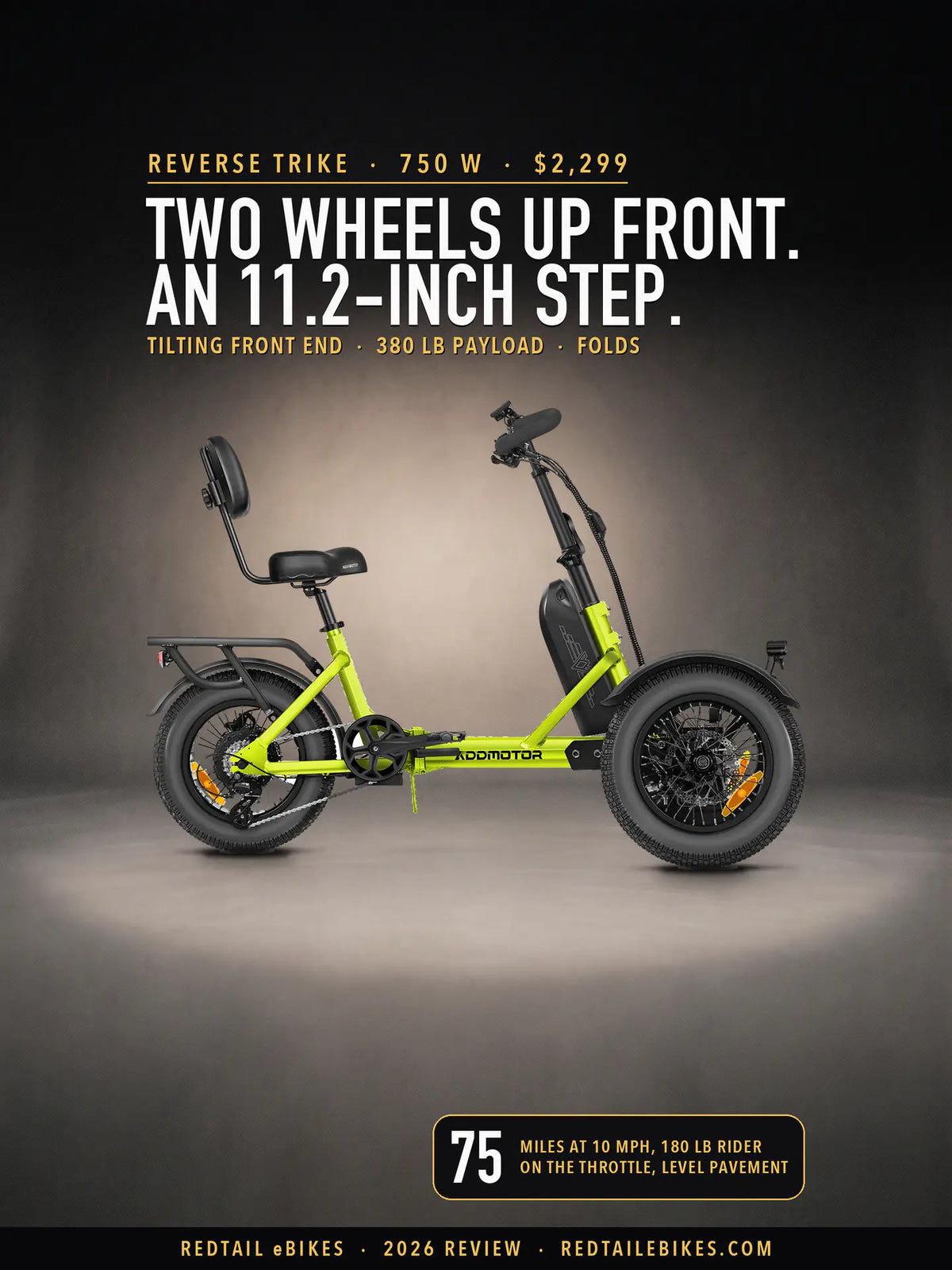
Share:
Massachusetts eBike Laws (2026): There Is No Class 3
North Carolina eBike Laws (2026): 3 Classes Dec 1