


The Lectric XP 3.0, read from Lectric's own archived product page and manuals on October 5, 2026: its range by speed, hill, load and cold, its fit by your height, the 2023 brake recall, the parts Lectric still sells, and the folders we sell in its place.
Quick Answer The Lectric XP 3.0 was Lectric's $999 folding fat-tire e-bike from November 2022 until the XP4 replaced it in May 2025: 500 W, a 500 Wh battery, 64 lb, and 28 mph in its Class 3 setting. At 15 mph on the throttle, 180 lb aboard on level pavement at 77 °F, our model gives 30 miles.
Lectric no longer sells it new but still sells its batteries, a $249 hydraulic brake kit, tires and a charger. Buying one used? Bikes sold from November 1, 2022 to May 6, 2023 have recalled brakes, and Lectric replaces them for any owner.
For a new folder from a brand we sell, our matches are the Samebike CY20 Pro at $599, the Eunorau META20 and the VTUVIA SX20, free to the lower 48.
How we verified this 2026 review. Lectric no longer lists the XP 3.0, so on October 5, 2026 we read its archived product page, its two manuals, Lectric's posts and help center, the CPSC's recall record and the parts Lectric sells. Range comes from a published physics model on Lectric's figures, fit from the US Army's measurements of 6,068 bodies, and our three bikes were read at their makers and on our store that day. We do not sell Lectric.
By Milad Ghobadibeygvand, BScN (Western University, 2014), Redtail eBikes. Verified October 5, 2026. Part of our Lectric eBikes profile, with our Lectric XP4 review, the Lectric return policy guide and every Lectric dealer by state.
The Lectric XP 3.0 on paper
The XP 3.0 is a folding e-bike on 20 × 3 inch tires with a 500 W rear hub motor, a 48 V battery of 10.4 Ah or, as a $140 option, 14 Ah, and a 330 lb payload. The rows below are Lectric's own, from its product page as the Wayback Machine captured it on March 16, 2025, 51 days before Lectric introduced the XP4.
| Spec | XP 3.0 | XP 3.0 Long-Range |
|---|---|---|
| Price on Lectric's page, Mar 16, 2025 | $999 | $1,139 (a $140 battery option) |
| Motor | 500 W rear hub, 1,000 W peak | same |
| Torque | 55 Nm | same |
| Battery | 48 V, 10.4 Ah (500 Wh) | 48 V, 14 Ah (672 Wh) |
| Range Lectric states | up to 45 miles | up to 65 miles |
| Weight | 57 lb + 7 lb battery | not on the page we read |
| Payload | 330 lb | same |
| Charger, included | 2 A, 4 to 6 hours | same |
| Folded | 37 × 18 × 28 in (L × W × H) | same |
Lectric announced it on October 31, 2022 as "the industry's first fully-foldable eBike designed to carry two people", with a rear rack rated for 150 lb, 180 mm disc brakes and 50 mm of front suspension. By October 10, 2024 Lectric wrote that "more than 200,000 riders have chosen it" and called it "the best-selling eBike in America".
The page lists five assist levels and a half-twist throttle, a front oil suspension fork, "11-28 tooth, 7-geared freewheel" gearing, Slime in the tires, and certification to UL 2849 for the bike and UL 2271 for the battery, in the spec tab's own words. It folds at the stem and the frame to 37 × 18 × 28 inches.
Lectric's documents differ on three small figures, and each pair is printed here. The page lists the bike unfolded at 66 inches long, while the parts drawing in its user manual (page 14) reads 67. The page lists "180mm hydraulic disc brakes", and the drawing labels the rotor 160 mm.
The third is the weight limit. The page and the manual (page 40) give a "total maximum payload" of 330 lb, the rack 150 lb of it, while Lectric's post on weight capacities of May 30, 2024 says the XP 3.0 "supports up to 275 lbs". Plan on the lower figure if you are near it, and ask Lectric which applies to your bike.
Is the XP 3.0 still sold, and what replaced it
No: Lectric's store no longer sells the XP 3.0 new, and the XP4, which Lectric introduced on May 6, 2025, took its place at the same $999. As of October 4, 2026, Lectric's product feed, US sitemap, compare page and store search list no XP 3.0 bike, while each lists the XP4, as our Lectric profile records.
The address that sold the XP 3.0 Black, lectricebikes.com/products/xp-black, now sells the XP4 Tempest Grey. Lectric introduced the XP4 on May 6, 2025, and its own comparison lists what changed, in its words:
| Lectric's row | XP 3.0 | XP4 |
|---|---|---|
| Pedal-Assist Sensor | Cadence sensor | Proprietary in-house designed torque sensor, allowing for natural and intuitive pedaling |
| Gearing | 11-28 Tooth, 7-Speed Shimano Tourney TZ | 11-32 Tooth, 8-speed Shimano Altus with below-the-bar trigger shifter |
| Motor | 500W (1000W peak) with 55Nm torque | 500W rear hub-motor (1092W Peak) with 55Nm torque. Features M24 Stealth technology allowing for a quieter motor experience without sacrificing power |
| Battery | XP 3.0: 10.4Ah lithium-ion battery with up to 45 miles of range; XP 3.0 Long-Range: 14Ah lithium-ion battery with up to 65 miles of range | XP4: 10.4Ah lithium-ion battery with up to 50 miles of range; XP4 750: 17.5Ah lithium-ion battery with up to 85 miles of range |
| Keyless Riding | Key required to ride and located under the bottom of the battery | Turn your battery on and off with the push of a button, and start riding without having the key in the battery |
| Turn Signals | N/A | Rear brake activated light and turn signals with updated button pad controls |
| Fast Charging Capability | N/A | Compatible with optional 5-Amp Charger, decreasing charging times by 60%. |
For an owner thinking of trading up, the XP4's gains are in how it rides and charges: a torque sensor, eight gears, keyless starting, turn signals and a 5 A charger option, on the same 500 W motor and 10.4 Ah battery. Its stated range rises from 45 to 50 miles. Our Lectric XP4 review computes both XP4 versions' range by speed and hill.
One part does not carry over: Lectric's XP4 spare battery is "NOT compatible with the XP 1.0, XP 2.0, or XP 3.0 due to the new key position". The XP 3.0's own batteries are still on sale, in the parts table.
How far the XP 3.0 goes: range by speed, hill, load and cold
On the throttle at 15 mph, the standard XP 3.0 covers about 30 miles in our model, and about 20 at 20 mph, for 180 lb aboard on level pavement at 77 °F. Lectric's manual (page 31) prints the test behind its figures: flat ground, few stops and bumps, no cargo, little wind, about 75 °F, a 20 mph top speed, a rider of about 180 lb, tires at about 30 psi and the 10.4 Ah battery.
On that test the manual gives up to 25 miles on pure throttle or mostly at assist 5, up to 35 mostly at assist 3 and up to 45 mostly at assists 1 and 2. The tables below work out the rides it leaves out: other speeds, climbs, loads and temperatures.
Read your own ride in three steps:
- Start from your usual speed in the speed table.
- If you pedal, use the effort table; if you climb, the hills table.
- Correct for your weight and the season with the load and cold tables.
Each figure is computed from published physics and Lectric's specifications, with its conditions beside it. The formula shows the arithmetic, and Limitations lists each assumption.
How much does speed cost the XP 3.0? Miles at each speed
Speed costs range fast: on the throttle the XP 3.0 covers about 43 miles at 10 mph and about 20 at 20 mph. Pushing air takes power in proportion to the cube of your speed, so the top few miles per hour cost the most battery. Conditions: 180 lb aboard, level pavement, 77 °F, still air.
| Speed, flat | Per mile | Full charge | With 25% kept |
|---|---|---|---|
| 10 mph | 11.6 Wh | 43 mi | 32 mi |
| 12 mph | 13.4 Wh | 37 mi | 28 mi |
| 15 mph | 16.9 Wh | 30 mi | 22 mi |
| 18 mph | 21.5 Wh | 23 mi | 17 mi |
| 20 mph | 25.3 Wh | 20 mi | 15 mi |
Keep a quarter of the pack in reserve and plan on 22 miles at 15 mph. The throttle stops at 20 mph in the Class 2 and Class 3 settings and is off in Class 1, per the table in Lectric's manual (page 36), so riding faster than 20 means pedal assist in the Class 3 setting.
Does pedaling or the gears stretch the battery?
Pedaling does: an easy 75 W of your own at 15 mph takes the XP 3.0 from 30 miles to 49 in the model. At a steady speed the motor supplies only what your legs do not, so each watt you add is a watt the battery keeps.
The XP 3.0 assists from a cadence sensor, per Lectric's comparison, and its PWR programming assists "up to a certain power level for each PAS setting", per the archived spec tab. The manual's first range tip (page 31) is "Ride at a lower PAS level". Its seven gears set your cadence and leave the hub motor's speed alone.
| Speed, flat | Motor only | You add 75 W | You add 150 W |
|---|---|---|---|
| 15 mph | 30 mi | 49 mi | 118 mi |
| 18 mph | 23 mi | 32 mi | 49 mi |
| 20 mph | 20 mi | 25 mi | 35 mi |
Conditions: 180 lb aboard, level pavement, 77 °F. With the motor off, 75 W of pedaling moves the bike at about 9.2 mph and 150 W at about 13.3 mph in the same model, so at 15 mph a steady 150 W leaves the motor little to add, and the 118 miles is mostly your legs.
What does a climb cost?
An 8% grade at 10 mph empties a full XP 3.0 battery in about 4 miles on the throttle, or about 6 if you add an easy 75 W, for 180 lb aboard at 77 °F. Each 1,000 feet of climbing on a 4% grade at 10 mph costs about 179 Wh on the throttle, more than a third of the 499.2 Wh pack.
| Grade, at 10 mph | Per mile, motor only | Full charge, motor only | Full charge, you add 75 W |
|---|---|---|---|
| 2% | 28 Wh | 18 mi | 33 mi |
| 4% | 49 Wh | 10 mi | 15 mi |
| 6% | 78 Wh | 6 mi | 9 mi |
| 8% | 120 Wh | 4 mi | 6 mi |
On a 10% grade the model's motor cannot hold 10 mph on the throttle alone; with 75 W from you it holds the speed at 132 Wh a mile. At 12 mph on 8%, only a steady 150 W of your own keeps the pace, at 70.5 Wh a mile.
Lectric's manual warns (page 25) that under "continuously high loads at low speed when riding up hills or carrying loads, parts of the motor can reach high temperatures", and its range tips (page 31) say to "Use lower PAS levels and pedal when climbing hills".
How much do your weight and your load cost?
Each extra 50 lb costs about 2 to 3 miles at 15 mph on the flat, and on an 8% climb it decides whether the motor holds 10 mph. Lectric rates the XP 3.0 for 330 lb of rider and cargo together, the rack for 150 lb of that and each passenger foot peg for 39 lb, in its manual (page 40). Conditions: throttle only, 77 °F.
| You plus your load | 15 mph flat, throttle | 20 mph flat, throttle | 8% climb, 10 mph |
|---|---|---|---|
| 100 lb | 34 mi | 22 mi | 8 mi |
| 130 lb | 32 mi | 21 mi | 6 mi |
| 180 lb | 30 mi | 20 mi | 4 mi |
| 220 lb | 27 mi | 19 mi | past the model's motor |
| 260 lb | 26 mi | 18 mi | past the model's motor |
| 330 lb | 23 mi | 16 mi | past the model's motor |
Where a row reads "past the model's motor", the comparable Bafang motor in the model cannot hold 10 mph up 8% at that weight: pedal, or slow down. Limitations item 2 explains why the model's motor can understate Lectric's.
How much range does winter take?
At 32 °F the XP 3.0 goes about 23 miles at 15 mph on the throttle, against 30 at 77 °F, in the model. Cold cells give up part of their stored energy, in McMaster University's LG cell data, and the bracketed figures carry the spread across the cell studies read.
| Air | Pack energy vs 77 °F | 15 mph flat, throttle |
|---|---|---|
| 95 °F | 99% | 31 mi |
| 77 °F | 100% | 30 mi |
| 68 °F | 98% | 28 mi |
| 50 °F | 93% | 25 mi |
| 41 °F | 91% | 24 mi |
| 32 °F | 89% (80–93) | 23 mi (21–24) |
| 14 °F | 82% (40–83) | 21 mi (10–21) |
Lectric names no cell maker for the XP 3.0, so the model uses a typical cell, LG's 18650HG2. Its manual (page 45) says to charge only between 32 °F and 113 °F and to run the battery between 32 °F and 104 °F for its best service life, so the 14 °F row describes a ride outside Lectric's limits.
Do tires and posture matter?
Rolling resistance swings the range by about 8 miles at 15 mph, from 27 to 35, across the fat tires on Bicycle Rolling Resistance's drum. Lectric prints no rolling-resistance figure for its puncture-resistant 20 × 3 tires, so the model takes the median of ten fat tires the lab measured and shows the lowest and highest beside it.
| Rolling resistance (flat, throttle) | 15 mph flat, throttle | 20 mph flat, throttle |
|---|---|---|
| 0.0070, lowest of ten | 35 mi | 22 mi |
| 0.0105, median, used | 30 mi | 20 mi |
| 0.0126, highest of ten | 27 mi | 18 mi |
Lectric ran its range test at about 30 psi, its manual's parts drawing (page 14) marks the tire "20x3in, 30 PSI", and its pre-ride checklist (page 9) keeps the pressure "within the recommended pressure range printed on the tire sidewall". A mountain-bike crouch adds about a mile at 15 mph over sitting upright, by Tengattini and Bigazzi's measured drag areas.
Lectric's 45 and 65 miles, as a steady ride
Lectric's "up to 45 miles" works out to 11.1 Wh a mile, which the model reaches at 9.3 mph on the throttle alone or at 15.6 mph with you adding an easy 75 W. A steady 150 W from you holds 18.5 mph at the same cost. All three are for 180 lb aboard on level pavement at 77 °F.
| Claim | Per mile | Motor only | You add 75 W | You add 150 W |
|---|---|---|---|---|
| 45 mi | 11.1 Wh | 9.3 mph | 15.6 mph | 18.5 mph |
Lectric's manual test is the one set of its figures with the conditions stated. Its "up to 25 miles" of pure throttle, with the top speed set to 20 mph, about 180 lb aboard and about 75 °F, compares with 19.5 miles at a steady 20 mph in the model, which reaches 25 miles at a steady 17 mph.
Lectric's long-range battery post of February 13, 2024 gives throttle-only figures of up to 20 miles on the standard pack and up to 30 on the Long-Range, where the manual says up to 25 for the standard pack; both are Lectric's. The Long-Range pack holds 672 Wh, 1.35 times the standard's 499.2, and Lectric's 65 miles is 1.44 times its 45.
The range formula, worked through
A battery's range is its energy divided by the cost of each mile, and each mile costs the power to roll, to push air and to climb, divided by your speed and by the motor's and battery's losses. The power at the rear wheel follows Martin and colleagues' 1998 model:
P = v × [ m × g × (Crr × cos θ + sin θ) + ½ × ρ × CdA × v² ]
Here v is your speed, m the mass of rider, cargo and bike, g gravity and θ the slope; Crr is the tires' rolling resistance, ρ the air's density and CdA the drag area your body and the bike present.
| Input | Value used | Where it comes from |
|---|---|---|
| Bike | 64 lb, 499.2 Wh | Lectric's archived spec tab |
| Rolling resistance (Crr) | 0.01054 | Bicycle Rolling Resistance, fat tires |
| Drag area (CdA) | 0.64 m² | Tengattini and Bigazzi, 2018, upright riders |
| Air density (ρ) | 1.184 kg/m³ at 77 °F | U.S. Standard Atmosphere, 1976 |
| Motor | 80% at its rating | Bafang OEM workbook, 2021, RM G0H0 |
| Battery losses | 4.0% at 15 mph | Arango, Lopez and Ceren, 2021 |
| Reserve kept | 25% | Schmitt, Decker and Doppelbauer, 2019 |
One ride, worked through: the XP 3.0 at 15 mph on the flat on the throttle, 180 lb aboard.
- Mass. 180 lb of rider and 64 lb of bike are 110.68 kg.
- Rolling. Speed × mass × gravity × rolling resistance; 15 mph is 6.7056 m/s, so 6.7056 × 110.68 × 9.807 × 0.01054 = 76.7 W.
- Air. ½ × air density × drag area × speed cubed: ½ × 1.184 × 0.64 × 6.7056³ = 114.2 W.
- At the wheel. 76.7 W + 114.2 W = 190.9 W.
- The motor. Lectric publishes watts and torque but no efficiency, so the model uses Bafang's RM G0H0 hub at its 80% floor, rebased to 48 V, 500 W and Lectric's 28 mph. At this load it runs at 78.35% and draws 190.9 ÷ 0.7835 = 243.7 W.
- The battery. At this current the pack passes on 96.03% of what its cells give, so the cells supply 243.7 ÷ 0.9603 = 253.8 W.
- Per mile. 253.8 W ÷ 15 mph = 16.9 Wh a mile.
- Range. 48 V × 10.4 Ah = 499.2 Wh, and 499.2 ÷ 16.92 = 29.5 miles on a full pack; keep a quarter and plan on 22.1.
Lectric prints no wheel diameter, so the model uses 21.53 inches, measured for the same 20 × 3.0 tire on another maker's drawing (Limitations item 3).
Want more distance from a folder than the XP 3.0's 30 miles at 15 mph? The Eunorau META20 carries 720 Wh, and its own model gives 45 miles on the same ride. Email us your route and we will check it against the META20's tables before you order.
See the META20's 720 WhWill the XP 3.0 fit you? Saddle, standover and reach
Lectric sized the XP 3.0 for riders from 5'0" to 6'4", in one size, with the saddle 32 to 42 inches above the ground and a 24 inch standover. Those are the figures on its archived size guide, for the step-over frame.
To check your fit:
- Compare your height with Lectric's 5'0" to 6'4".
- Measure your inseam barefoot, floor to crotch, and read your saddle height in the saddle table.
- Confirm it with the heel check on your first ride.
How high should my saddle go?
About 35.6 inches from the pedal axle to the saddle's top for a typical 5'8" rider, with the crank in line with the seat tube, and about 41.0 inches at 6'4". That is 109% of the inseam, the method Peveler and colleagues (2005) note has lab measurements of economy behind it, applied to the 6,068 bodies of the US Army's ANSUR II survey.
| Your height | Typical inseam | Saddle top to pedal axle | At 106% | At 110.4% |
|---|---|---|---|---|
| 5'0" | 27.1–29.7 in | 31.0 in | 30.2 in | 31.4 in |
| 5'2" | 28.0–31.1 in | 32.2 in | 31.3 in | 32.6 in |
| 5'4" | 29.1–32.2 in | 33.3 in | 32.3 in | 33.7 in |
| 5'6" | 30.2–33.5 in | 34.5 in | 33.6 in | 34.9 in |
| 5'8" | 31.1–34.3 in | 35.6 in | 34.6 in | 36.0 in |
| 5'10" | 32.2–35.5 in | 36.8 in | 35.8 in | 37.3 in |
| 6'0" | 33.2–36.7 in | 38.1 in | 37.0 in | 38.6 in |
| 6'2" | 34.3–37.5 in | 39.3 in | 38.2 in | 39.8 in |
| 6'4" | 36.3–39.1 in | 41.0 in | 39.9 in | 41.6 in |
The inseam column holds the middle 90% of the survey's riders at each height; the saddle columns use each height's median inseam. With your own inseam, multiply it by 1.09. Lectric's 32 to 42 inches is measured from the ground, and converting it needs a crank length and bottom-bracket height its page does not give, so measure from the pedal.
Can I put my feet down at a stop?
Yes, at every height Lectric lists: the typical inseam at 5'0" is 28.4 inches, above the 24 inch standover. The table counts how many of 100 ANSUR II riders at each height clear it barefoot.
| Your height | Typical inseam | Clear the step-over, of 100 |
|---|---|---|
| 5'0" | 28.4 in | 100 |
| 5'2" | 29.5 in | 100 |
| 5'4" | 30.5 in | 100 |
| 5'6" | 31.7 in | 100 |
| 5'8" | 32.6 in | 100 |
| 5'10" | 33.8 in | 100 |
| 6'0" | 34.9 in | 100 |
| 6'2" | 36.0 in | 100 |
| 6'4" | 37.6 in | 100 |
The figure is the step-over frame's, from Lectric's archived size guide. Lectric also sold a Step-Thru 3.0 with its own page and size guide (Limitations item 4).
How upright will I sit?
Lectric's figures do not fix your lean. Its size guide puts the grips 45 to 48 inches above the ground and lists a "Handlebar Reach" of 18.5 to 20 inches without saying where that is measured from. It prints no seat angle or bottom-bracket height either, so the lean for your body cannot be computed from its figures.
What the spec tab does say is that the "telescoping handlebar stem allows riders to reach a wide range of heights", and the bar is 25 inches wide.
How much weight rests on my wrists?
Not computed here: the load on your hands depends on where the grips sit relative to the saddle, and Lectric's figures do not place them. What its size guide prints is the grips' height above the ground, 45 to 48 inches, on a telescoping stem.
For scale, Carahalios (2015) measured 10 racing cyclists on an ergometer, hands on road-bike brake hoods, and found 15% of their body weight on the stem. The XP 3.0's grips sit in a place Lectric's figures do not locate, so that 15% belongs to road bikes only.
How do I set the saddle when it arrives?
Use the heel check on page 20 of Lectric's manual: "Sit on the seat", "Place one heel on a pedal" and turn the crank until that pedal is down, the crank arm parallel to the seat tube. "If your hips must rock for your heel to reach the pedal, the seat is too high"; if your knee bends there, it is too low.
In Peveler and colleagues' comparison of 19 cyclists, the heel method put the knee within the recommended 25 to 35 degrees for 70% of them. Clamp the post, ride a block and move it a quarter inch at a time, always past the minimum insertion mark the manual (page 20) tells you to respect.
The fit arithmetic
Saddle top to pedal axle = 1.09 × inseam, with the crank in line with the seat tube. A 5'8" rider with the survey's median inseam at that height, 32.64 inches (32.6 in the standover table), gets 1.09 × 32.64 = 35.6 inches. From the crank axle, LeMond's 88.3% gives 28.8 inches.
The saddle table's two right-hand columns run from 106%, the bottom of the range Ferrer-Roca and colleagues (2012) call recommended, to 110.4%, the top of the range their own equation proposes.
| Input | Value | Source |
|---|---|---|
| Rider heights | 5'0" to 6'4" | Lectric's archived size guide |
| Standover | 24 in, step-over frame | Lectric's archived size guide |
| Seat to ground | 32 to 42 in | Lectric's archived size guide |
| Crank length | not published | the spec tab's Drivetrain row names an 11-28 freewheel only |
| Saddle formula | 109% of inseam | Peveler et al., 2005 |
| Bodies | 6,068 measured adults | ANSUR II |
Shopping for a folder that fits you, new? Send us your height and inseam and we will answer in writing before you pay; our SX20 review gives that step-through folder's saddle height by inseam.
See the SX20's fitHow fast the XP 3.0 goes, its class, and where you may ride
The XP 3.0 left the factory as a Class 2 bike, 20 mph on the throttle and on assist, and a setting lifts pedal assist to 28 mph for Class 3 while the throttle stays at 20. Lectric's manual prints the three settings on page 36 and says the bike "ships with a maximum speed set at 20 miles per hour".
Its Class 3 label sits under the Class 2 label on the frame, and the manual asks you to peel it into view if you change the speed. Its warning comes first (page 37): "ALWAYS check your local laws and regulations to determine if it is lawful to ride Class 3 eBikes on public roads before increasing your bicycle's top speed."
The three classes are defined in state law, so where the 28 mph setting may go depends on your state. California's Vehicle Code § 312.5(a)(3) defines a class 3 bike as one "that ceases to provide assistance when the bicycle reaches the speed of 28 miles per hour, and equipped with a speedometer".
Section 21213 bars riders under 16 from class 3 bikes and requires a helmet of every class 3 rider and passenger on a street, bikeway, or public bicycle path or trail. Under § 21207.5(b), the authority over an equestrian, hiking or recreational trail "may prohibit, by ordinance, the operation of an electric bicycle or any class of electric bicycle on that trail".
Lectric's own age floor is printed twice, differently. Its product page and the warning tag on the bike, pictured in the manual (page 13), say "Must be 18 years of age or older"; the manual's safety page (page 7) says "Bicycles are only for use by persons 16 years of age and above". Both are Lectric's; the higher one is the safer reading.
Bottom line Keep an XP 3.0 in its Class 2 setting until you have read your state's class rules, the rule for your trail and the rider's age. Our state law guide covers each state.
The brakes and the 2023 recall
XP 3.0s sold from November 1, 2022 to May 6, 2023 have mechanical disc brakes under recall, and Lectric replaces them free for whoever owns the bike now. The CPSC's recall 23-789 of September 7, 2023 covers about 45,000 units across six XP 3.0 models, sold at lectricebikes.com "for between $1,000 and $1,200".
Its stated hazard: the calipers "can fail resulting in loss of control, posing crash and injury hazards to the rider". The CPSC record lists four reports of lost braking power, two with injuries that "involved cuts, scrapes and a broken bone". Lectric's help center gives the mechanism: "when the brakes are improperly adjusted, the brake cable actuator arm can over-rotate, dislocating parts and causing the brake calipers to fail".
To check a bike, Lectric's recall page asks for the order number and the serial number "engraved on the head tube". Its recall line is 877-479-5422, or email contact@lectricebikes.com; the recall page lists Tuesday to Friday, 9 AM to 4 PM Pacific, and Lectric's help article Monday to Friday, 8 AM to 8 PM Eastern.
A registered owner receives a brake kit "Within 2-6 weeks", and the CPSC record adds "up to $100 towards the cost to install".
The same page settles the used-bike case: "Lectric eBikes will replace any brakes affected by this recall, regardless of whether the rider is the original owner." Bikes bought outside those dates, per the page, are not in the recall.
Later XP 3.0s carry hydraulic brakes. By March 16, 2025 its page listed "180mm hydraulic disc brakes" with "motor inhibitors", and Lectric publishes a separate manual for each brake version on its manuals page.
For a mechanical-brake XP 3.0, Lectric sells a hydraulic brake upgrade kit at $249: front and rear Nutt hydraulic brakes, pre-bled, each with a brake line, levers with motor inhibitors, and a front wheel with the rotor installed. Its swap instructions apply to that kit only.
Parts Lectric still sells for the XP 3.0
Lectric still sells batteries, brakes, tires, pads and a charger for the XP 3.0, each listed as available on its US store on October 5, 2026. The prices and the "fits" column are Lectric's, from each part's own listing.
| Part | Price | Fits, in Lectric's words |
|---|---|---|
| Hydraulic brake upgrade kit | $249 | XP 3.0 and Step-Thru 3.0 with mechanical brakes |
| Spare battery, 500 Wh | $350 | step-over XP 1.0, 2.0, 3.0 |
| Step-Thru spare battery, 500 Wh | $350 | Step-Thru 1.0, 2.0, 3.0 |
| Long-Range battery, 672 Wh | $575 | step-over XP 2.0, 3.0; XP Lite 2.0 |
| Step-Thru Long-Range battery, 672 Wh | $575 | Step-Thru 2.0, 3.0 |
| Two 20 × 3 in tires | $100 | XP 2.0 and 3.0, both frames |
| Charger, 1-pin | $69 | XP 1.0 to 3.0, both frames |
| Four brake pads, Type D | $40 | XP 3.0 with hydraulic brakes |
Two cautions from the same listings. The XP4's batteries do not fit, by Lectric's notice, "due to the new key position", and the step-over and Step-Thru packs are separate parts. The Long-Range packs hold 48 V and 14 Ah (672 Wh), and the standard spares 10.4 Ah (500 Wh), each "Certified to UL 2271".
The 1-pin charger lists a 54.6 V, 2.0 A output and fits every XP from 1.0 to 3.0 on both frames. The XP 3.0's page quoted 4 to 6 hours for a full charge on the 2 A charger that came with it.
Buying a used XP 3.0: what to check
Check five things before you pay: the brake recall, the battery's size and age, the key and charger, the warranty's end date, and the asking price against a new bike.
- The recall. Ask for the order date. If the bike was sold new between November 1, 2022 and May 6, 2023, ask whether Lectric's brake kit was fitted; if it was not, you can register it yourself, as the new owner, through Lectric's recall page.
- The brakes. Hydraulic brakes have a brake line to each caliper, as Lectric's upgrade kit lists; cable-pulled calipers are the mechanical set.
- The battery. Read its label: 10.4 Ah is the standard pack, 14 Ah the Long-Range. A new one costs $350 or $575 from Lectric, and an XP4 pack will not fit.
- The key and the charger. The XP 3.0 needs its key to ride, per Lectric's comparison: "Key required to ride and located under the bottom of the battery". A replacement 1-pin charger is $69.
- The warranty. Lectric's warranty runs "for the one (1) year period commencing on the original delivery date of such eBike to the first Owner", and claims come from "the then-current Owner". An XP 3.0 first delivered before October 5, 2025 is past it today.
- The price. Lectric listed it new at $999 on March 16, 2025; the XP4 is $999 new today.
The arithmetic for a tired one: a new $350 battery and the $249 brake kit come to $599, the price of a new Samebike CY20 Pro from us, whose warranty claims come to us.
Weighing a used XP 3.0 against a new folder? A tired one's new battery and brake kit cost $599 together at Lectric; the Samebike CY20 Pro costs the same, new, with 624 Wh and warranty claims that come to us.
Look at the $599 CY20 ProBottom line Pay for a used XP 3.0 only after the recall, battery and key checks, and price in a $350 battery if the pack is tired.
Three folding bikes we sell in its place
For a new folder in the XP 3.0's shape from a brand we sell, three fit: the Samebike CY20 Pro at $599, the Eunorau META20 at $1,699 and the VTUVIA SX20 at $1,299. Each was read at its maker and on our store on October 5, 2026, and each range figure runs that bike's own saved model on the XP 3.0's terms: 15 mph on the throttle, 180 lb aboard, 77 °F.
The Samebike CY20 Pro, for the XP 3.0's price minus $400
| Spec | Lectric XP 3.0 | Samebike CY20 Pro Spoked |
|---|---|---|
| Price | $999 (2025) | $599 |
| Battery | 500 Wh | 624 Wh |
| Range at 15 mph, throttle only | 30 mi | 39 mi |
| Range at 20 mph, throttle only | 20 mi | tops out at 19.9 mph |
| Top speed | 28 mph (Class 3 setting) | 19.9 mph |
| Weight, with battery | 64 lb | 68.3 lb |
| Payload | 330 lb | 330 lb |
| Tires | 20 x 3.0 in | 20 x 3.0 in |
Samebike CY20 Pro (spoked wheel)
$599 · maker's list $899The CY20 Pro is a new folder in the XP 3.0's shape: a 20-inch frame on 20 × 3.0 inch tires, a 500 W motor with an 800 W peak and a 48 V 13 Ah battery, 624 Wh, per Samebike's page. It carries more battery than the XP 3.0's standard 500 Wh.
That buys 39 miles at 15 mph on the throttle in its model against the XP 3.0's 30. It gives up the 28 mph setting: Samebike lists 32 km/h, 19.9 mph. Its payload matches the XP 3.0's 330 lb, at 68.3 lb.
Our CY20 Pro review has its range by speed and hill. Prefer White? Buy the White CY20 Pro.
Price-matched to Samebike's US store on October 5, 2026 · Free shipping to the lower 48 · US support, with your warranty claims sent to us · Shop Pay: 4 interest-free payments of $149.75

Samebike's photograph of the CY20 Pro in Black, with the folding front basket it lists as a free accessory; the corner badge is Samebike's.
The Eunorau META20, for the farthest ride
| Spec | Lectric XP 3.0 | Eunorau META20 |
|---|---|---|
| Price | $999 (2025) | $1,699 |
| Battery | 500 Wh | 720 Wh |
| Range at 15 mph, throttle only | 30 mi | 45 mi |
| Range at 20 mph, throttle only | 20 mi | 31 mi |
| Top speed | 28 mph (Class 3 setting) | 20 mph |
| Weight, with battery | 64 lb | 63.4 lb |
| Tires | 20 x 3.0 in | 20 x 3.0 in |
Eunorau META20
$1,699The META20 is a folder in the XP 3.0's shape with a torque sensor, which the XP 3.0 lacks, and a bigger pack: hydraulic brakes, 20 × 3.0 inch tires and 500 W with 55 N·m, in Eunorau's spec rows, on 720 Wh. Its model gives 45 miles at 15 mph on the throttle, 15 more than the XP 3.0's.
Eunorau lists an optional second 15 Ah battery, with up to 100 miles on the pair, and the bike weighs 63.4 lb, under the XP 3.0's 64.
Weigh your load first: its payload is 286 lb, where the XP 3.0 is rated for 330. Our META20 review works through that limit, and the listing offers five colors.
Eunorau's own US price as of October 5, 2026 · Ships free in the lower 48 · warranty claims come to us, and we coordinate the repair · Shop Pay: $153.35 a month over 12 months at 15% APR

Eunorau's own photograph of the META20 in Alpine White.
The VTUVIA SX20, for a step-through on 4-inch tires
| Spec | Lectric XP 3.0 | VTUVIA SX20 |
|---|---|---|
| Price | $999 (2025) | $1,299 |
| Battery | 500 Wh | 672 Wh |
| Range at 15 mph, throttle only | 30 mi | 37 mi |
| Range at 20 mph, throttle only | 20 mi | 26 mi |
| Top speed | 28 mph (Class 3 setting) | 20 mph |
| Weight, with battery | 64 lb | 70 lb |
| Payload | 330 lb | 330 lb |
| Tires | 20 x 3.0 in | 20 x 4.0 in |
VTUVIA SX20
$1,299 · maker's list $1,599The SX20 trades the XP 3.0's step-over frame for a step-through and its 3-inch tires for 20 × 4.0 inch ones. VTUVIA's page lists a 48 V 750 W rear motor with "Torque 85 Nm" and a torque sensor that "feels the pressure on your pedals".
Its 672 Wh matches the XP 3.0 Long-Range's pack size. It holds 20 mph as its top speed, where the XP 3.0's Class 3 setting reaches 28, and it carries the same 330 lb.
Our SX20 review shows how it folds and computes its range. Red, Cream White and Silvery are also on our listing.
The price VTUVIA's US store charged on October 5, 2026 · Delivered free in the contiguous US · we take your warranty claim and handle the fix · Shop Pay: $117.25 a month over 12 months at 15% APR

VTUVIA's photograph of the SX20 in Teal Blue, on its 20 × 4.0 inch tires.
Bottom line The CY20 Pro is the XP 3.0's shape for $599 with more battery; the META20 goes farthest at 15 mph in our model; the SX20 is the step-through on 4-inch tires.
Buying one of these from us
We do not sell Lectric, and we have no showroom: we sell other makers' e-bikes online, with US support that answers fit and range questions in writing before you pay. Every e-bike ships free within the contiguous United States, and if one will not power on, will not charge or shows an error code, the claim comes to us and we coordinate the repair or replacement.
Read our return terms before you order: our refund policy takes a bike back unopened in its factory-sealed box when you ask within 72 hours of delivery, less a 15% restocking fee and the return shipping. How buying works here walks through an order step by step.
Green flags, and who the XP 3.0 fits
Five things in the XP 3.0's favor, each beside the rider who should read another bike, and where.
| In its favor | Who should read another bike |
|---|---|
| A 330 lb payload and a 150 lb rack that took a passenger kit | A rider who wants it new, with a warranty: the CY20 Pro at $599 |
| A 28 mph Class 3 setting with the throttle held at 20 | A rider who wants a torque sensor: the META20 |
| 30 miles at 15 mph on the throttle in our model, 65 claimed on the Long-Range | A rider who wants a step-through on 4-inch tires: the SX20 |
| Batteries, brakes and tires still sold by Lectric | A rider over 6'4", above Lectric's listed range: our e-bike finder checks your height against the bikes we carry |
| A recall remedy for every owner, first or later | A rider choosing a folder by weight for stairs: our folding guide compares the ones we sell |
Frequently asked questions
Is the Lectric XP 3.0 discontinued?
Yes. Lectric's store no longer sells the XP 3.0 new; the XP4, introduced on May 6, 2025, replaced it at the same $999. Lectric still sells XP 3.0 batteries, a hydraulic brake kit, tires and a charger.
How much does the Lectric XP 3.0 weigh?
64 lb: Lectric's page gave "Total bike weight is 57lbs with the 7lb battery removed". It folds to 37 × 18 × 28 inches.
How fast can the Lectric XP 3.0 go?
28 mph on pedal assist in its Class 3 setting, and 20 mph on the throttle in its Class 2 and Class 3 settings. It ships set to 20 mph, as a Class 2 bike, per Lectric's manual (page 36).
Is the Lectric XP 3.0 a Class 3 e-bike?
It can be. It ships as Class 2, and a display setting raises pedal assist to 28 mph for Class 3; Lectric's manual tells you to check your state and local rules before you change it.
How far can the Lectric XP 3.0 go on one charge?
About 30 miles at 15 mph on the throttle in our model, with 180 lb aboard on level pavement at 77 °F, or 49 if you pedal an easy 75 W. Lectric states up to 45 miles on the standard battery and 65 on the Long-Range.
Does the Lectric XP 3.0 have hydraulic brakes?
Later ones do: by March 2025 Lectric's page listed 180 mm hydraulic disc brakes. Bikes sold from November 1, 2022 to May 6, 2023 have mechanical brakes under recall, and Lectric sells a $249 hydraulic upgrade kit for them.
Is there a recall on the Lectric XP 3.0?
Yes: CPSC recall 23-789 of September 7, 2023 covers the mechanical disc brake calipers on XP 3.0s sold from November 1, 2022 to May 6, 2023. Lectric replaces them free for any owner; its recall line is 877-479-5422.
What is the difference between the Lectric XP 3.0 and the XP4?
Lectric's comparison shows the XP4 adding a torque sensor in place of the cadence sensor, eight gears in place of seven, keyless starting, turn signals and a 5 A charger option. Both use a 500 W motor and a 10.4 Ah battery; Lectric states 50 miles for the XP4 and 45 for the XP 3.0.
What battery fits the Lectric XP 3.0?
Lectric's Legacy XP spare batteries: 500 Wh at $350 or the 672 Wh Long-Range at $575, each in a step-over and a Step-Thru version. The XP4's batteries do not fit, because of the new key position.
How long does the Lectric XP 3.0 take to charge?
4 to 6 hours on the 2 A charger that came with it, per its product page. Lectric's manual says to charge only between 32 °F and 113 °F.
What tire pressure does the Lectric XP 3.0 use?
Lectric's range test used about 30 psi, and its manual's parts drawing marks the 20 × 3 tire "30 PSI"; the manual's checklist keeps you within the range printed on the tire sidewall.
Is the Lectric XP 3.0 waterproof?
No figure for the whole bike: its page called the electrical components "IP-65 rated" for "greater water and dust resistance". The manual warns never to expose the charger "to rain or wet conditions".
Does the Lectric XP 3.0 have cruise control?
Yes. Hold the minus button while twisting the throttle, per Lectric's manual (page 39), and the bike holds the speed that throttle position would give.
Does the Lectric XP 3.0 have a torque sensor?
No: it uses a cadence sensor, per Lectric's own comparison with the XP4, which added the torque sensor.
What size rider fits the Lectric XP 3.0?
Lectric lists riders from 5'0" to 6'4". For a typical inseam at 5'8", 32.6 inches, set the saddle's top about 35.6 inches from the pedal axle; with your own inseam in inches, multiply it by 1.09.
Is the Lectric XP 3.0 still under warranty?
Only within a year of its first delivery: Lectric's warranty runs one year from the original delivery date to the first owner, and the current owner may claim within that time with proof of ownership.
Is a used Lectric XP 3.0 worth buying?
At the right price, after the checks: confirm the recall work on a bike sold between November 1, 2022 and May 6, 2023, the battery's size and age, and the key and charger. A new battery and brake kit cost $599 together at Lectric, the price of a new CY20 Pro from us.
The bottom line
The XP 3.0 was a strong $999 folder, and a good used one still does what it did: 30 miles at 15 mph on the throttle in our model, 28 mph in its Class 3 setting, a 330 lb payload, with batteries and brakes still on Lectric's shelf. Check the recall dates, the battery and the key before you pay, and remember that its warranty is over unless the bike first shipped within the last year.
If you would rather buy new from a brand we sell, the CY20 Pro gives you more battery than the XP 3.0 for $599, the META20 the longest ride of the four bikes here in our model, and the SX20 a step-through on 4-inch tires.
All three are price-matched to their makers' own US stores on October 5, 2026, ship free to the lower 48, and send a warranty claim to us. Buy the CY20 Pro in Black for $599, buy the META20 in Alpine White for $1,699, or buy the SX20 in Teal Blue for $1,299.
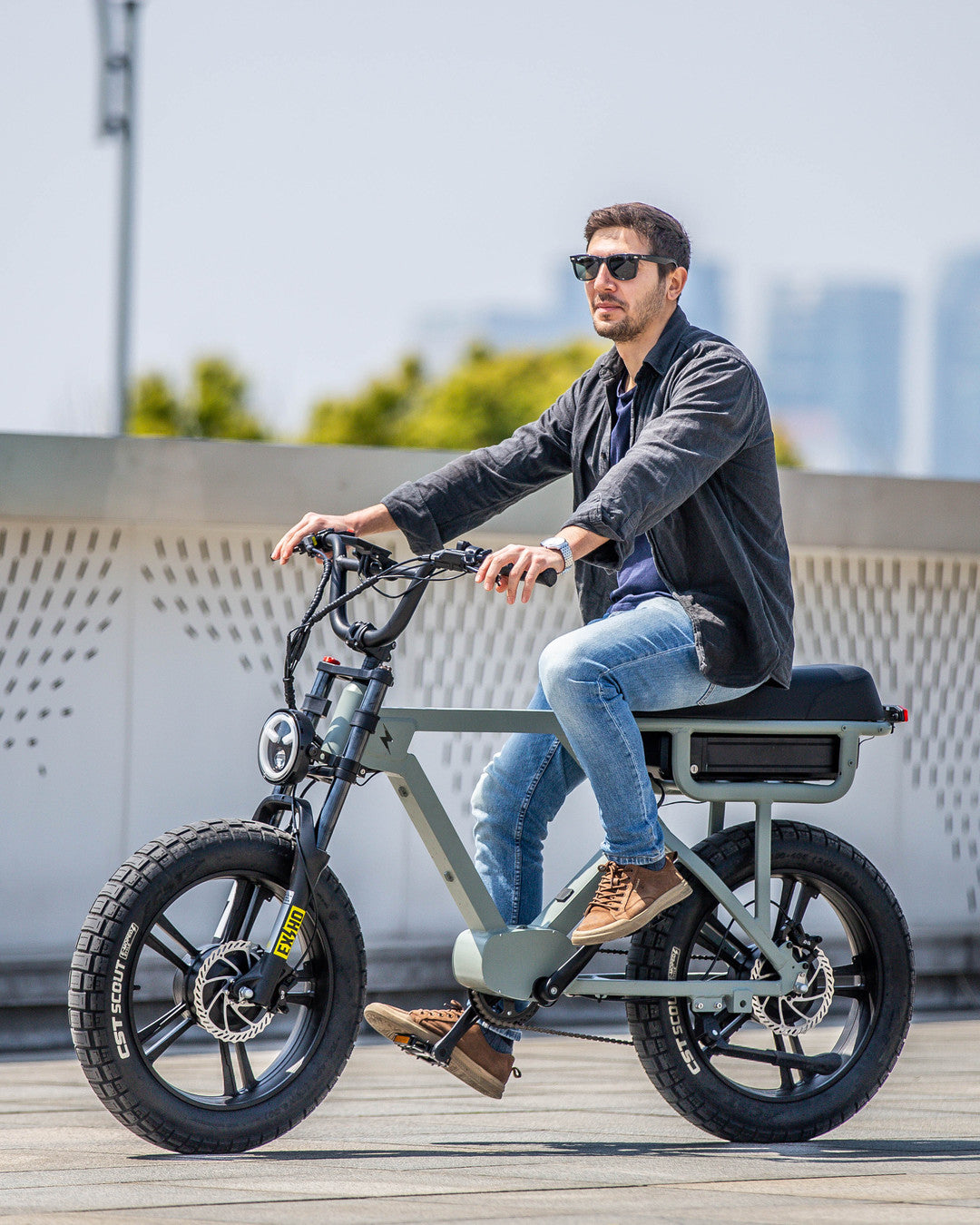
Image credit: the cover's lakeside was generated on Playcut (playcut.ai) around two bikes from the cards below; each is its maker's own photograph, placed whole at one uniform scale without Samebike's corner badge or the studio floor shadows, and the type is set in Playcut Brush. The card photos are the makers', cropped, scaled and set on white. No bike is redrawn, and no Lectric photograph appears.
Limitations
Every figure on this page holds under the conditions stated beside it. These are the read dates and assumptions behind them.
- The XP 3.0's figures come from an archived page. Lectric no longer lists the model, so its specifications, size guide and price are from Lectric's product page as the Wayback Machine captured it on March 16, 2025, with its two manuals and its posts; the parts and their prices were read on Lectric's store on October 5, 2026.
- The motor in the range model is a comparable. Lectric publishes the XP 3.0's watts and torque but no efficiency or speed curve, so the model uses a Bafang hub at Bafang's 80% floor and Lectric's 500 W; its 1,000 W peak is not used, so a climb marked "past the model's motor" may be within the real motor's reach for a short stretch.
- The wheel diameter is borrowed. Lectric prints none; the model uses 21.53 inches, measured for the same 20 × 3.0 tire on Samebike's drawing of the CY20 Pro.
- The Step-Thru frame's figures are not printed. The Step-Thru 3.0 had its own product page; the archive refused our requests for its copy on October 5, 2026, so its standover is not given, and the fit section is the step-over frame's.
- The Long-Range battery is not modeled. The page we read prints its pack, 14 Ah and 672 Wh, and Lectric's 65 miles, but not its weight, so the range tables are for the standard battery.
- The tire's rolling resistance is a bracket. The model uses the median of ten fat-bike tires measured at 26 × 4.0 inch and 12 psi, not the XP 3.0's 20 × 3 at 30 psi, and shows the spread across them.
- The cold figures use a representative cell. Lectric names no cell maker for the XP 3.0; the brackets carry the spread across the cell studies read.
- Lectric's documents disagree in six places, and each pair is printed: 66 or 67 inches long, 180 or 160 mm rotors, 330 or 275 lb, 25 or 20 miles on pure throttle, a minimum rider age of 18 or 16, and two sets of recall-line hours.
- The fit figures are population figures. They come from the ANSUR II survey of US Army personnel aged 17 to 58; measure your own inseam, and use the heel check as the final word.
- Lectric does not place the grips. It prints no seat angle, bottom-bracket height or crank length, and its "Handlebar Reach" of 18.5 to 20 inches does not say where it starts, so lean and wrist load are not computed.
- The 109% saddle formula is a first setting. Shoes, the saddle itself and how you ride move it; the heel check on your first ride decides.
- The range figures are computed from physics and published inputs. Wind, stops, starts and rough surfaces are outside the model, and each costs range.
- This review expires when Lectric's shelf changes. A change to the XP 3.0 parts Lectric sells, to its recall remedy or to its warranty terms would date it; we re-read them at every touch.
- We sell e-bikes that compete with Lectric's. The three we name are ours; their figures were read at their makers on October 5, 2026, and your own Shop Pay offer is the one shown at checkout.
Source register
The publishers behind every link on this page, grouped, with the tier of each.
| Source | Tier | What it supports |
|---|---|---|
| Lectric eBikes, the XP 3.0's product page as the Wayback Machine holds it | T2 | Price, battery options, motor, weight, payload, size guide, charging, brakes, certification and the age disclaimer |
| Lectric eBikes, its XP 3.0 user manual | T2 | The range test and its conditions, class settings, cruise control, payloads, charging temperatures, the heel check, the tire check and the rider-age statements |
| Lectric eBikes, its posts | T2 | The XP 3.0's launch, its battery figures, its weight capacity statement and the XP4 that replaced it |
| Lectric eBikes, help-center articles | T2 | The recall's mechanism, the brake-swap kit and the manuals page |
| Lectric eBikes, its store's recall, warranty and parts pages | T2 | The recall dates, hotline and remedy; the warranty period; the parts and their compatibility |
| California law | T1 | California's class 3 definition, its age and helmet rule and its trail rule |
| US Consumer Product Safety Commission | T1 | Recall 23-789: the models, units, dates, prices, hazard, injuries and remedy |
| Peer-reviewed and standards sources for the range model | T1 | The road-power equation, rolling resistance, drag area, air density, motor and battery losses, cold-cell energy and the reserve |
| Sources for the fit model | T1 | The saddle formula and its recommended range, the heel method, the US Army's body measurements and the hand-load yardstick |
| The makers of the three bikes we sell beside it | T2 | Each alternative's motor, battery, tires, torque sensor and options |
| Playcut | T2 | Credited as the cover's tools; not a source of any fact |
References
Every source cited above, numbered, with the date it was read.
- Lectric eBikes, XP 3.0 Black Electric Bike (product page, as the Wayback Machine captured it), price block; battery options; Size Guide tab; Specifications tab; Features; the footnotes and the age disclaimer. web.archive.org. Retrieved October 5, 2026.
- Lectric eBikes, Introducing: The Lectric XP 3.0, the post's date line and its body. lectricebikes.com. Retrieved October 5, 2026.
- Lectric eBikes, 5 Reasons Why The XP 3.0 is America's Best Selling eBike!, the opening paragraph. lectricebikes.com. Retrieved October 5, 2026.
- Lectric eBikes, User Manual, Lectric XP 3.0 and XP Step-Thru 3.0, hydraulic-brake version, v1.5, pp. 7, 9, 14, 20, 25, 31, 36-37, 39-40, 45 and 48; the warning tag pictured on p. 13. cdn.shopify.com. Retrieved October 5, 2026.
- Lectric eBikes, Understanding Weight Capacities When Buying an eBike, the XP 3.0 line. lectricebikes.com. Retrieved October 5, 2026.
- Lectric eBikes LLC, Introducing The All-New Lectric XP4, the post's date line, May 6, 2025. lectricebikes.com. Retrieved October 5, 2026.
- Lectric eBikes LLC, XP4 Feature Upgrades: Our Most Advanced XP Yet, the XP 3.0 vs XP4 table: sensor, gearing, motor, battery, keyless riding, turn signals, fast charging. lectricebikes.com. Retrieved October 5, 2026.
- Lectric eBikes LLC, XP4 Spare Battery (product page), the compatibility notice. lectricebikes.com. Retrieved October 5, 2026.
- Bafang, OEM Workbook 2021, PDF p.23, MOTORS table, H640 column (RM G0H0.750.DC / RM G0H0.1000.DC): n0, nT, rated voltage, rated power, efficiency. bafang-e.com. Retrieved October 3, 2026.
- McMaster University (Kollmeyer et al.), Mendeley Data, LG 18650HG2 Li-ion Battery Data and Example Deep Neural Network xEV SOC Estimator Script, the 0.5C discharge files at each temperature. doi.org. Retrieved October 4, 2026.
- Bicycle Rolling Resistance (Jarno Bierman), Fat Bike Tires Test Results, 'Rolling Resistance 12 psi (default)' column, the 26 x 4.00 rows. bicyclerollingresistance.com. Retrieved September 25, 2026.
- Journal of Sports Sciences (Taylor & Francis), Physical characteristics and resistance parameters of typical urban cyclists (Tengattini S, Bigazzi AY), the drag-area table by bicycle type. civil-reactlab.sites.olt.ubc.ca. Retrieved October 4, 2026.
- Lectric eBikes, New Long-Range Battery, the XP 3.0 and XP 3.0 Long Range paragraphs. lectricebikes.com. Retrieved October 5, 2026.
- Journal of Applied Biomechanics (Human Kinetics), Validation of a Mathematical Model for Road Cycling Power (Martin JC, Milliken DL, Cobb JE, McFadden KL, Coggan AR), J Appl Biomech 14(3):276-291, the model equations. collections.lib.utah.edu. Retrieved October 4, 2026.
- NOAA, NASA, US Air Force, U.S. Standard Atmosphere, 1976 (NOAA-S/T 76-1562; NASA TM-X-74335), the sea-level density relation. ntrs.nasa.gov. Retrieved October 4, 2026.
- World Electric Vehicle Journal (MDPI), Arango I, Lopez C, Ceren A. Improving the Autonomy of a Mid-Drive Motor Electric Bicycle Based on System Efficiency Maps and Its Performance, the efficiency results and Eq. 40. mdpi-res.com. Retrieved October 4, 2026.
- IEEE / EPE'19 ECCE Europe (Karlsruhe Institute of Technology authors), Schmitt M, Decker S, Doppelbauer M. Measuring and Characterization of a Pedal Electric Cycle (Pedelec) on a Full System Test-Bench, the range-test method section. publikationen.bibliothek.kit.edu. Retrieved October 4, 2026.
- Journal of Exercise Physiology Online (American Society of Exercise Physiologists), Peveler W, Bishop P, Smith J, Richardson M, Whitehorn E. Comparing Methods For Setting Saddle Height In Trained Cyclists. JEPonline 8(1):51-55, Methods (the Hamley and LeMond paragraph); Results (the 25-35 degree accuracies, n=19). asep.org. Retrieved September 26, 2026.
- U.S. Army Natick Soldier Research, Development and Engineering Center, 2012 Anthropometric Survey of U.S. Army Personnel (ANSUR II), public data release 2017, public data files (male 4,082 rows, female 1,986 rows); TR15-007 tables. army.mil. Retrieved September 26, 2026.
- University of Colorado Boulder (MS thesis), Carahalios A. An Analysis of the Bicycle-Rider Interface Forces in Stationary Road Cycling (MS thesis, Department of Integrative Physiology, University of Colorado), abstract: baseline 2 W/kg, 90 rpm, hoods; 10 USAC Category 3 or better riders. scholar.colorado.edu. Retrieved September 25, 2026.
- Journal of Strength and Conditioning Research (NSCA), Ferrer-Roca V, Roig A, Galilea P, Garcia-Lopez J. Influence of saddle height on lower limb kinematics in well-trained cyclists: static vs. dynamic evaluation in bike fitting. J Strength Cond Res 26(11):3025-9; doi 10.1519/JSC.0b013e318245c09d, abstract. pubmed.ncbi.nlm.nih.gov. Retrieved September 25, 2026.
- California Legislature, California Vehicle Code § 312.5, subdivision (a)(3). leginfo.legislature.ca.gov. Retrieved October 4, 2026.
- California Legislature, California Vehicle Code § 21213, subdivisions (a) and (b). leginfo.legislature.ca.gov. Retrieved October 4, 2026.
- California Legislature, California Vehicle Code, § 21207.5(b). leginfo.legislature.ca.gov. Retrieved October 4, 2026.
- US Consumer Product Safety Commission, Lectric Ebikes Recalls Disc Brake Calipers Sold on Lectric E-Bicycles Due to Crash and Injury Hazards (Recall Alert) (recall 23-789), Hazard; Remedy; Units; Incidents/Injuries; Sold At; Importer(s); Manufactured In; Recall number. cpsc.gov. Retrieved October 4, 2026.
- Lectric eBikes, Product Recall: XP 3.0 Mechanical Brake Calipers, the article's second paragraph. help.lectricebikes.com. Retrieved October 5, 2026.
- Lectric eBikes LLC, Brake Recall, the recall notice, its model list and its FAQ on sold bikes. lectricebikes.com. Retrieved October 5, 2026.
- Lectric eBikes LLC, User Manuals, the list of manuals: the XP4's and the XP 3.0's two (hydraulic and mechanical). help.lectricebikes.com. Retrieved October 5, 2026.
- Lectric eBikes, XP 3.0 Hydraulic Brake Upgrade Kit (product page), price; compatibility; what's in the box; product specifications. lectricebikes.com. Retrieved October 5, 2026.
- Lectric eBikes, XP 3.0 Mechanical Brakes to Hydraulic Brakes Swap, the article's first paragraph. help.lectricebikes.com. Retrieved October 5, 2026.
- Lectric eBikes, Lectric Battery Charger - 1 Pin (product page), price; compatibility; product specifications. lectricebikes.com. Retrieved October 5, 2026.
- Lectric eBikes LLC, Lectric eBikes Manufacturer's Limited Warranty, the Warranty Period and the Warranty Claims clauses. lectricebikes.com. Retrieved October 5, 2026.
- Samebike, CY20 PRO Spoked Wheel Portable Commuter Powerful Peak 800W Electric Bike (product page, US store), the specification list (battery, motor and peak, top speed, tires, weight, payload) and the price block. us.samebike.com. Retrieved October 5, 2026.
- Eunorau (US store), META20 1.0 (product page, US store), specification rows; highlight strip; price block; variant stock. eunorau-ebike.com. Retrieved October 5, 2026.
- VTUVIA (US store), VTUVIA SX20 Antelope Step-Thru Folding Fat Tire Electric Bike 750 Watt (product page), specification rows; highlight strip; price block; variant stock. vtuviaebike.com. Retrieved October 5, 2026.
- Lectric eBikes, Legacy XP Spare Battery (product page), price; compatibility; the XP4 notice; product specifications. lectricebikes.com. Retrieved October 5, 2026.
- Playcut, Playcut, the closing image-credit line. playcut.ai. Retrieved October 5, 2026.
- Playcut, Claude Code Image Generation, Free - Playcut Brush, the closing image-credit line. playcut.ai. Retrieved October 5, 2026.

Share:
VTUVIA E-Cozy Trike Review 2026: 14.8-in Step, $2,099