


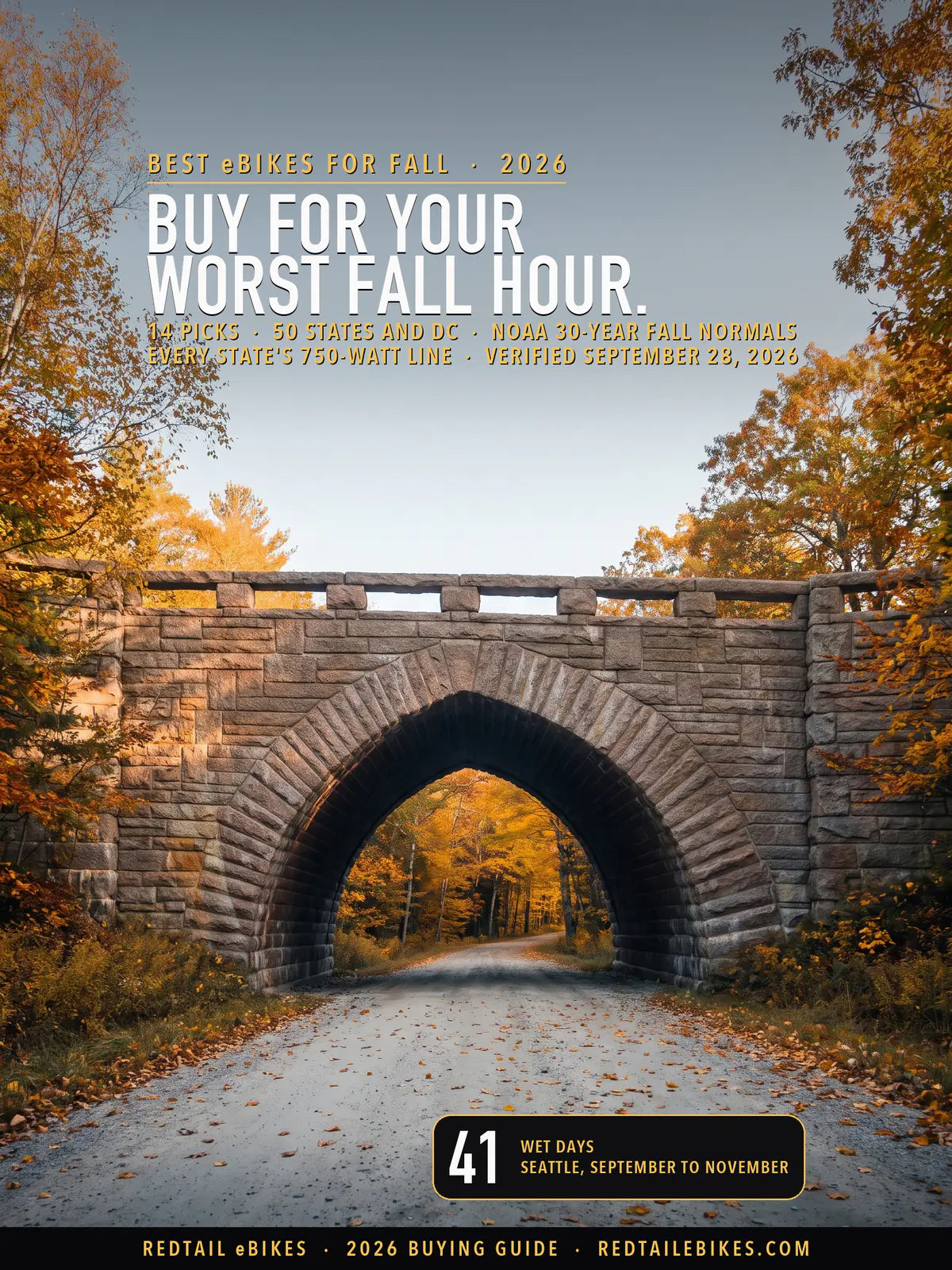
14 picks · 7 brands · 50 states and DC, each measured · NOAA 30-year fall normals · every state's 750-watt line · $599 to $2,099 · every deciding spec read off the maker's own US page on September 28, 2026
The best e-bike for fall is the one built for your state's fall: enough range left on your coldest commuting morning, tires and brakes for wet leaves, lights for the ride home after the clock change, and a motor your state counts as an e-bike.
Quick answer. Buy for your state's worst fall hour. At 15 mph, a Fargo ride at November's average 7 a.m. temperature keeps 74% of the range a calm, flat 77°F day gives (48% into the wind); Honolulu keeps 95%. Seattle averages 41 wet days, September to November. And 20 states draw the e-bike line below 750 watts (19 from October 1).
So the answer splits five ways, by the fall you ride:
- A dark, wet, cold commute: the VTUVIA Zeal LT7, $1,099. Fenders, a rear rack, Logan hydraulic brakes on 180 mm rotors, a 120 lux headlight, and a maker page that says it is "built to the IP67-rated standard." Under $600, the Samebike CY20 Pro, $599, folds to carry indoors.
- Hills, headwinds and long miles: the VTUVIA CMB 8-Speed, $1,399. A 500 W mid-drive with 175 N·m, an e-bike in 48 jurisdictions. For the biggest battery, the Qiolor TIGER RE, $1,399, at 48V 35Ah (1,680 Wh).
- Early snow, wet leaves and gravel: the VTUVIA SF20H, $1,299, on 20 × 4.0 fat tires. Where your state stops the e-bike line below 750 W, the 500 W Qiolor TIGER JR, $899, rides the same tire width.
- Three wheels for slick roads: the 350 W DWMEIGI MG708 Hera, $1,499, or the 750 W VTUVIA E-Cozy, $2,099, with reverse and a 14.8-inch step.
- Private land and routes open to motor vehicles: the Freesky Ranger Air M-540, $1,299, two motors and 4,000 W peak, for days at or above 32°F, the floor in Freesky's own manual. It is outside every state's e-bike definition, and this guide treats it that way.

A generated autumn scene of the Eagle Lake Bridge on Acadia National Park's carriage roads in Maine, drawn from the National Park Service's own photograph. The rest of the guide measures the fall you ride.
| Price tier | The pick | Price | Fall job | An e-bike under state law in |
|---|---|---|---|---|
| Under $1,000 | Samebike CY20 Pro | $599 | Dark, wet, cold commute | 48 jurisdictions |
| Under $1,000 | Qiolor TIGER JR | $899 | Commute, snow where 750 W is out | 48 jurisdictions |
| $1,000 to $1,500 | VTUVIA Zeal LT7 | $1,099 | Dark, wet, cold commute | 48 jurisdictions |
| $1,000 to $1,500 | VTUVIA CMB 8-Speed | $1,399 | Hills, headwinds, long miles | 48 jurisdictions |
| $1,500 and up | Qiolor NOVA | $1,599 | Early snow, leaves, gravel | 28 jurisdictions (29 from October 1) |
| $1,500 and up | VTUVIA E-Cozy | $2,099 | Three wheels | 28 jurisdictions (29 from October 1) |
Last verified September 28, 2026. Every motor rating, battery, weight, load, rider height, brake, light and water statement below was read off the manufacturer's own US page on September 28, and every price, stock level and buy link was read off our store and checked against the maker's own price that day.
Every fall figure comes from a 30-year climate normal, a federal elevation model, a census survey or a statute, and the data behind every table is published with this guide.
By Milad Ghobadibeygvand, BScN (Western University, 2014), Redtail eBikes. Corrections: support@redtailebikes.com.
How we verified this guide
Every recommendation here is computed from published records, and each data file is published with the guide.
- The bikes. Motor, battery, weight, rated load, rider height, tires, brakes, lights and the maker's water statement for each pick, read off the maker's US page on September 28, 2026; price and stock read off our store and checked against the maker's own price the same day (the 14 picks' data).
- The weather. The NOAA 1991–2020 U.S. Climate Normals at the weather station of the commercial-service hub airport nearest each state's most populous city, within 40 km: the hourly normals for 7 a.m. temperature and wind (NOAA's hours are local standard time), the monthly normals for wet days and snowfall, and the annual normals for the first freeze (the 51-jurisdiction model). One station describes a state's largest city, never its mountains or coast, and every state row is written as that city.
- The ground. Slope measured on the U.S. Geological Survey's 3D Elevation Program 1-arc-second model in a 10 km box around each state's three most populous cities, weighted by their Census 2024 population estimates.
- The commute. Travel time to work and the bicycle's share from the Census Bureau's American Community Survey 2024 tables (1-year for states, 2020–2024 5-year for cities).
- The lanes. Separated paths and painted lanes mapped in OpenStreetMap inside a 10 × 10 km box on each state's principal city. A volunteer map is a floor, never an audit, and the tables say so.
- The light. Sunset and the end of civil twilight on October 31, November 1 and November 30, 2026 from the U.S. Naval Observatory's sun and moon service, in each city's own time zone.
- The law. Each state's e-bike definition read in the statute itself, and every pick screened against its motor, speed and throttle limbs (the 14 × 51 legal matrix).
- The physics. Range at each state's fall morning computed with the Martin et al. (1998) road-load power model, upright-rider drag and rolling resistance from Tengattini and Bigazzi (2018), tire rolling resistance against temperature from Rothhämel (2023), and cold battery capacity from McMaster University's LG 18650HG2 cell test data.
- The pictures. Every bike and trike is its maker's own photograph, placed at one uniform scale into an outdoor fall scene generated around it with Nano Banana Pro on Playcut, and no scene claims a real place; the cover scene was generated the same way, drawn from the National Park Service's own photograph of the Eagle Lake Bridge.
Every assumption in the arithmetic is numbered under Limitations, and every source is in the citation ledger.
In this guide
- The best eBikes for fall, by the ride you do
- Picks: dark, wet, cold commute · hills, headwinds, long miles · early snow, leaves, gravel · three wheels · private land · all 14 at a glance
- Your state: all 50 states and DC, measured
- The fall, piece by piece: range · cold batteries · rain · wind · hills · dark evenings · snow
- The law: the 750-watt line in every state
- Where fall riders get caught out · Is fall a good time to buy? · Storing for winter · The fall checklist · Why buy here
- The honest ledger · Limitations · FAQ · Bottom line · References
The best eBikes for fall, by the ride you do
The best e-bike for fall depends on the ride: the VTUVIA Zeal LT7 ($1,099) for a wet commute that ends in the dark, the CMB 8-Speed ($1,399) for hills and headwinds, the SF20H ($1,299) for first snow and gravel, and a trike if you no longer trust your balance on slick roads. Find your ride below, then check your state's row for the weather and the law.
| Your fall | Your pick | What decides it |
|---|---|---|
| A wet commute that ends in the dark | Zeal LT7, $1,099 | Fenders, rack, Logan hydraulic brakes, 120 lux headlight |
| A mild, flat fall on a tight budget | CY20 Pro, $599 | Folds to 88 × 49 × 85 cm to charge and store indoors |
| Hills or steady headwinds | CMB 8-Speed, $1,399 | A 175 N·m mid-drive through 8 gears, 500 W |
| Long, cold, windy miles | TIGER RE, $1,399 | 1,680 Wh, the biggest pack of the picks that are e-bikes under state law |
| First snow, frost and gravel | SF20H, $1,299 | 20 × 4.0 fat tires, folds; the TIGER JR where 750 W is out |
| Deep snow, sand, a heavy load | NOVA, $1,599 | 20 × 5.0 tires, a 450 lb maximum load |
| Balance you no longer trust on slick roads | Hera, $1,499, or E-Cozy, $2,099 | Three wheels; a MG1703 trike sits between them at $1,999 |
| A farm, a ranch or a trail open to motor vehicles | Ranger Air, $1,299 | Two motors, 4,000 W peak; outside every e-bike definition |
Every state also gets a first pick from its measured fall, by one rule applied the same way to all 51: snow first, then a sub-freezing morning or early frost, then hills, then wind or long commutes, then rain or early dark, and a pick is only offered where that state's own e-bike definition admits it. The state tables show each result and the reason.
Each pick below carries the maker's own figures, the fall it suits, who it is wrong for, and a buy link at the maker's own price.
See the 14 picks by fallBest e-bikes for a dark, wet, cold fall commute
The rider. You ride to work on pavement from September into December. In 19 states the fall averages 27 or more wet days, and in 10 states civil dusk on November 30 comes at or before 4:55 p.m., so the ride home is a night ride by Thanksgiving (the 51-jurisdiction model).
What decides it. Fenders that keep road spray off you and the drivetrain, a headlight you can see by, brakes that bite on wet pavement, a maker who says what the bike tolerates in the rain, and a battery you can carry inside, because the two maker manuals here that give a charging range, Freesky's and VTUVIA's E-Cozy manual, both put its floor at 0°C (32°F). The cold-battery section runs the rest.
All three picks here are rated under 750 W, and each is an e-bike in 48 jurisdictions. The three exceptions are New Jersey, whose P.L.2025, c.285 puts a throttle-equipped bike outside its low-speed e-bike definition, and Alaska and Kentucky, which have no definition at all (the law section).
Budget: Samebike CY20 Pro Spoked Wheel, $599

Samebike's own photograph of the CY20 Pro in black, set into a generated outdoor fall scene: 500 W, 624 Wh, and a fold to 88 × 49 × 85 cm.
Samebike publishes a 500 W motor with 800 W peak, a removable 48V 13Ah battery, a 32 km/h (19.9 mph) top speed, 20 × 3.0 tires, mechanical disc brakes, a 31 kg (68.3 lb) weight and a 150 kg (330.7 lb) payload. It folds to 880 × 490 × 850 mm without its basket, so it comes inside to charge and dry.
On the rain question, Samebike's own answer on that page is that "the entire bike meets the IP64 standard, including the motor, battery and display," and that "riding in heavy rain may affect battery life and reduce traction, so please be careful and try to avoid riding in the rain." Its 48V 13Ah pack holds 624 Wh.
It is the first pick in the seven states where the model finds no snow, early frost, steep ground, strong wind, long commutes, frequent rain or early dark: Arizona, Kentucky, Louisiana, Mississippi, New Mexico, North Carolina and South Carolina (the state picks).
Who it is wrong for. A commute you cannot move off rainy days, which Samebike itself asks riders to try to avoid: the Zeal LT7 below carries fenders, hydraulic brakes and VTUVIA's own IP67 statement. Steep grades belong to the CMB and its mid-drive.
Add the Samebike CY20 Pro to your cart · full specification and photos
Samebike's own price, $599 against its $899 list, in Black or White, shipped free in the lower 48, with warranty claims coordinated by us. With Shop Pay, four interest-free payments of $149.75.
Mid: Qiolor TIGER JR, $899

Qiolor's own photograph of the TIGER JR in black, set into a generated outdoor fall scene: 500 W, 20 × 4.0 tires and a 160 lux headlight.
Qiolor publishes a rated 48V 500 W motor (750 W peak) with 63 N·m, a 48V 15Ah battery, a 400 lb maximum load, an 87 lb net weight, CHAOYANG 20 × 4.0 fat tires, plastic fenders front and rear, and a 48V 10W, 160 lux headlight with a horn and turn signals. It ships as a Class 2 e-bike with a 20 mph default, sized for riders 5'1" to 5'9".
Qiolor's page describes the brakes two ways: its spec table lists hydraulic disc brakes on 180 mm rotors front and rear, and its feature text reads "Mechanical disc brakes provide consistent, strong stopping power." Email us before you order and we will ask Qiolor which brake your bike ships with.
At 4.0 inches, its tires are the widest of the three commute picks: Samebike lists the CY20 Pro's at 3.0 inches and VTUVIA the Zeal LT7's at 2.6. Qiolor's page calls the bike "suitable for riding through creeks, mud, and snow," asks riders to "avoid prolonged or intentional immersion in water," and warns against pressure washers.
It is also the snow and cold pick where a 750 W motor falls outside the state's definition: Maine, New Hampshire, Vermont and Wyoming (the state picks).
Who it is wrong for. Riders over 5'9", the top of Qiolor's recommended height. The Zeal LT7 fits 5'3" to 6'2", and the CMB fits 5'1" to 6'1".
Add the Qiolor TIGER JR to your cart · full specification and photos
Qiolor's own price, $899 against its $1,399 list, in black or blue, shipped free in the lower 48, with US support from us. With Shop Pay, four interest-free payments of $224.75.
Luxury: VTUVIA Zeal LT7, $1,099

VTUVIA's own photograph of the Zeal LT7 in Lemon Yellow, set into a generated outdoor fall scene: fenders, a rack and Logan hydraulic brakes as they ship.
Everything a wet commute needs comes in the box. VTUVIA publishes a 48V 500 W rear hub (750 W peak) run by its V-Adapt torque sensor at 65 N·m, a 48V 13Ah (624 Wh) battery, dual Logan hydraulic disc brakes on 180 mm rotors, and a 48V 10W, 120 lux LED headlight with a rear light.
Plastic fenders and a rear rack come included, and VTUVIA gives a 62 lb weight with them fitted, a 350 lb total capacity and a 5'3" to 6'2" rider range.
VTUVIA's page says the bike "is built to the IP67-rated standard, making it suitable for riding through creeks, mud, and snow," then asks riders to avoid "prolonged or intentional immersion in water" and never to use a pressure washer.
It is the first pick in Michigan, Ohio and Rhode Island, whose falls are wet, and in Nevada, where civil dusk in Las Vegas comes at 4:54 p.m. on November 30 (the state picks).
Who it is wrong for. Commutes that climb hard: its 65 N·m is 37% of the CMB's 175 N·m, and the CMB drives through its gears for $300 more. Riders from 5'1" to 5'3" fit the CMB too.
Add the VTUVIA Zeal LT7 to your cart · full specification and photos
VTUVIA's own price, $1,099 against its $1,299 list, in Lemon Yellow or Olive Green, shipped free in the lower 48. With Shop Pay, from $99.19 a month over 12 months at 15% APR.
The picks above suit most wet commutes. Your state's row shows how cold, wet and dark your own fall runs, and which pick the numbers point to.
Find your state's pickBest e-bikes for hills, headwinds and long fall miles
The rider. Your fall ride climbs, or pushes into wind, or simply runs long. The model flags 17 states and DC for steep ground around their three largest cities, 18 states for fall wind, and 18 states and DC for commutes that average 26.5 minutes or more each way (the 51-jurisdiction model).
What decides it. Torque through gears for the climbs, battery watt-hours for the wind and the distance, and your state's motor line. Into the wind, range falls hard: at 15 mph on a November morning at Fargo's average 7 a.m. temperature, riding straight into its average fall-morning wind, a charge covers 48% of the distance it covers on a calm, flat 77°F day (the wind section).
The two picks here split that job and cost the same. The mid-drive is rated at 500 W, an e-bike in 48 jurisdictions. The long-range pick is rated at 750 W, an e-bike in 28 jurisdictions until September 30 and in 29 from October 1, when Connecticut's limit changes from "fewer than" 750 watts to "not more than" (the law section; the 14 × 51 legal matrix).
For hills: VTUVIA CMB 8-Speed, $1,399

VTUVIA's own photograph of the CMB 8-Speed in its Dark Blue finish, set into a generated outdoor fall scene: a 500 W mid-drive with 175 N·m.
VTUVIA publishes a 48V 500 W mid-drive motor (820 W peak) with cadence and torque sensors and 175 N·m, a 48V 14.4Ah (691.2 Wh) LG battery, an 8-speed drivetrain and dual Logan hydraulic disc brakes on 160 mm rotors. The battery carries UL 2271 certification and the e-bike system UL 2849.
A 48V 10W, 150 lux headlight, a rear light, aluminum alloy fenders and a rear rack come included, with a 60 lb weight as equipped, a 300 lb total capacity and a 5'1" to 6'1" rider range.
A mid-drive turns the crank, so the motor climbs through the same eight gears you do, and a 500 W rating, an e-bike in 48 jurisdictions, can publish 175 N·m: more than twice the 85 N·m of the TIGER RE, SF20H, NOVA and E-Cozy hubs, and the MG1703's 80 N·m.
VTUVIA's page lists the tires at 26 × 2.6 inches in one place and 26 × 2.4 in its spec table; ask us which your order carries.
It is the first pick in 19 jurisdictions (18 from October 1): 12 for steep ground, from Seattle to West Virginia, where 70.6% of the ground around its three largest cities slopes more than 10%, and seven where wind or long commutes meet a state line below 750 W, six from October 1, when Connecticut's line moves (the state picks).
Who it is wrong for. Riders taller than 6'1", the top of VTUVIA's range, and anyone who wants the biggest battery on flat, windy ground: the TIGER RE below carries 2.4 times the watt-hours for the same money, where your state admits a 750 W motor.
Add the VTUVIA CMB 8-Speed to your cart · full specification and photos
VTUVIA's own price, $1,399 against its $1,899 list, in Dark Blue or Metallic Silver, shipped free in the lower 48. With Shop Pay, from $126.27 a month over 12 months at 15% APR.
For headwinds and long miles: Qiolor TIGER RE, $1,399

Qiolor's own photograph of the TIGER RE in black, set into a generated outdoor fall scene: 750 W and a 48V 35Ah battery option.
This is the battery pick. Qiolor publishes a 750 W motor that "peaks at 1100W with 85Nm torque," a 48V 35Ah battery option, a 98 lb bike weight with that battery, a 400 lb maximum load, 20 × 4.0 INNOVA fat tires and dual-piston hydraulic brakes, sized for riders 5'1" to 5'9". At 48 volts, 35 amp-hours is 1,680 Wh, 2.4 times the CMB's 691.2 Wh.
Qiolor quotes "up to 130 miles" for the 35Ah pack. The range section shows what your own fall morning does to whatever a pack covers on a calm, warm day.
It is the first pick in nine states whose falls are windy or whose commutes run long, from Massachusetts and Wisconsin to Oklahoma and Virginia, and in Connecticut too from October 1 (the state picks).
Who it is wrong for. Riders in the 20 states (19 from October 1) whose statute stops below 750 W, for whom the CMB is the answer. In New Jersey its throttle puts it outside the definition. Riders over 5'9", the top of Qiolor's recommended height, and anyone carrying a 98 lb bike up stairs.
Add the Qiolor TIGER RE to your cart · full specification and photos
Qiolor's own price for the 35Ah version, $1,399 against its $2,099 list, in black or tiger yellow, shipped free in the lower 48. With Shop Pay, from $126.27 a month over 12 months at 15% APR.
Under $1,000, the nearest fit for rolling ground is the TIGER JR above, a 500 W hub with 63 N·m; for steep climbs, save for the CMB.
The mid-drive that is an e-bike in 48 jurisdictions and climbs through eight gears, with fenders, rack and a 150 lux light included.
Buy the CMB 8-Speed for $1,399Best e-bikes for early snow, wet leaves and gravel
The rider. Your fall ends in frost and the first snow. Nine states average five inches or more of snow from September through November at or near their principal city's airport, led by Anchorage at 18.6 inches and Cheyenne at 14.4, and 11 states either average a 7 a.m. November reading at or below freezing or see their median first 32°F night by October 20 (the 51-jurisdiction model).
What decides it. Tire width for float and grip on snow, frost and loose gravel, brakes you can modulate on a slippery surface, fenders, and a battery that starts its ride warm (the cold-battery section).
All three picks here are rated at 750 W: an e-bike in 28 jurisdictions until September 30 and 29 from October 1 (the 14 × 51 legal matrix). In Maine, New Hampshire, Vermont and Wyoming, whose statutes stop below 750 W, the 500 W TIGER JR rides the SF20H's 20 × 4.0 tire size.
Budget: VTUVIA SF20H, $1,299

VTUVIA's own photograph of the SF20H in black, set into a generated outdoor fall scene: 20 × 4.0 fat tires on a bike that folds.
VTUVIA publishes a 48V 750 W rear hub (1,200 W peak) with 85 N·m, a 48V 14Ah (672 Wh) LG battery with UL 2271 certification, 20 × 4.0 fat tires and dual Logan hydraulic disc brakes on 180 mm rotors. It folds to 39.3 × 29.92 × 18.9 inches, and its system carries UL 2849.
A 48V 5W, 130 lux headlight with a brake light, plastic fenders and a rear rack come included, with a 60 lb weight as equipped, a 330 lb total capacity and a 5'3" to 6'2" rider range.
VTUVIA's page gives it the same IP67 statement as the Zeal LT7: "suitable for riding through creeks, mud, and snow," with immersion and pressure washers excluded. That is the fall case in one bike: fat tires, full fenders and a maker who names snow.
It is the first pick in seven of those nine snowy states: Alaska, Colorado, Minnesota, Montana, North Dakota, South Dakota and Utah (the state picks). Alaska may carry extra shipping charges or be excluded under our shipping policy, so ask us before you order.
Who it is wrong for. Riders in the states whose statute stops below 750 W, who should read the TIGER JR, and heavy loads: the NOVA next is rated to 450 lb.
Add the VTUVIA SF20H to your cart · full specification and photos
VTUVIA's own price, $1,299 against its $1,399 list, in Black or White, shipped free in the lower 48. With Shop Pay, from $117.25 a month over 12 months at 15% APR.
Mid: Qiolor NOVA, $1,599

Qiolor's own photograph of the NOVA in black, set into a generated outdoor fall scene: 750 W and the widest tires on this page.
Qiolor publishes a rated 48V 750 W rear hub (1,200 W peak) with 85 N·m, a 48V 15Ah battery that charges in about 7 hours, a 95 lb net weight, a 450 lb maximum load, 20 × 5.0 tires, four-piston hydraulic disc brakes on 203 mm front and 180 mm rear rotors, and dual hydraulic rear shocks. Its 48V 15Ah pack holds 720 Wh.
At 5.0 inches, its tires are the widest any maker on this page lists, and its 450 lb maximum load is the highest of the two-wheel picks here. Qiolor's page calls it "suitable for riding through creeks, mud, and snow," with the same warnings on immersion and pressure washers as its TIGER models.
Who it is wrong for. Anyone who has to lift it: at 95 lb it is the heaviest two-wheeler here after the 98 lb TIGER RE, apart from the private-land machines. Riders in the states whose statute stops below 750 W should read the TIGER JR.
Add the Qiolor NOVA to your cart · full specification and photos
Qiolor's own price, $1,599, shipped free in the lower 48, with warranty claims coordinated by us. With Shop Pay, from $144.32 a month over 12 months at 15% APR.
Luxury: DWMEIGI MG1703, $1,999

DWMEIGI's own photograph of the MG1703 trike in white, set into a generated outdoor fall scene: 750 W and three fat tires.
Three fat tires and a low step. DWMEIGI publishes a 750 W Bafang motor with "max torque 80NM," a 48V 18.2Ah battery, a 20 mph top speed, fenders and a rear rack, front and rear baskets with 58 liters of storage, and a rider height of 5'2" to 6'3". At 48 volts, 18.2 amp-hours is 873.6 Wh.
The same page gives two weight figures: riders "less than 330lbs," and "a max weight of 400lbs." Its product card on DWMEIGI's home page adds KENDA 20 × 4.0 tires.
DWMEIGI describes the tires as fit for "wet stones, muddy trails, beaches or snowy mountains," and its safety notes on the same page ask riders to "avoid riding in damp conditions, rain etc as this may affect operation or possibly damage the bicycle electronics," while its manual says the trike "can be used in the rain" as long as it is not submerged.
Read together: a trike for frost and dry cold days, parked under cover when it rains or snows. For wet snow and slush, the SF20H above carries VTUVIA's IP67 statement and full fenders.
Who it is wrong for. Wet-snow and rainy falls, by DWMEIGI's own instruction, and riders in the states whose statute stops below 750 W. For three wheels there, the 350 W Hera is an e-bike in 48 jurisdictions.
Add the DWMEIGI MG1703 to your cart · full specification and photos
DWMEIGI's own price, $1,999 against its $2,499 list, in White, shipped free in the lower 48. With Shop Pay, from $180.43 a month over 12 months at 15% APR.
Fat tires, fenders, a rack and hydraulic brakes on a bike that folds into a car trunk, for the fall that ends in snow.
Buy the SF20H for $1,299Best three-wheel e-bikes for slick fall roads
The rider. You want the fall without the balance question: wet leaves at the curb, a frosted driveway, a stop on a slope. A trike stands on its own at a stop, so a slick patch where you put your foot down is not a test.
What decides it. A low step, a parking brake, fenders, and a motor your state counts as an e-bike. The three trikes on this page make a price ladder: the Hera at $1,499, the MG1703 from the snow picks at $1,999, and the E-Cozy at $2,099.
Budget: DWMEIGI MG708 Hera, $1,499

DWMEIGI's own photograph of the Hera in blue, set into a generated outdoor fall scene: 350 W, full-wrap fenders and a parking brake.
DWMEIGI publishes a 350 W motor, a removable 36V 13Ah battery, a 15 mph top speed, a 330 lb load rating, KENDA 24 × 2.125-inch tires with full-wrap fenders, a rear rack and a parking brake. Its page gives two ranges, "40 Miles" in its header and "up to 25 miles under pure electric mode" in its description; the second is the one to plan a throttle-only ride on.
At 350 W it is the only three-wheeler here that is an e-bike in 48 jurisdictions, including the 20 states (19 from October 1) whose statute stops below 750 W (the 14 × 51 legal matrix).
DWMEIGI's safety notes ask riders to "avoid riding in damp conditions, rain etc as this may affect operation or possibly damage the bicycle electronics," while its manual adds that the trike "can be used in the rain" as long as it is not submerged; plan it for dry fall days and park it under cover.
Who it is wrong for. Hills and headwinds, on 350 W and 15 mph, and rainy commutes by DWMEIGI's own instruction. Where your state admits 750 W, the E-Cozy below brings 85 N·m and hydraulic brakes.
Add the DWMEIGI Hera to your cart · full specification and photos
DWMEIGI's own price, $1,499, in Blue or Red, shipped free in the lower 48. With Shop Pay, from $135.30 a month over 12 months at 15% APR.
Luxury: VTUVIA E-Cozy, $2,099

VTUVIA's own photograph of the E-Cozy in Forest Green, set into a generated outdoor fall scene: 750 W, reverse and a 14.8-inch step.
Its page adds a 14.8-inch step-through, 20 × 3-inch tires, a 95 lb weight with the rack and fenders, a 450 lb total capacity and a 5'1" to 6'3" rider range, and its spec table lists the frame as foldable.
Reverse earns its place in the fall: it backs a 95 lb trike out of a wet driveway or a leaf-covered parking space under power. VTUVIA's page calls the trike "suitable for riding through creeks, mud, and snow," with immersion and pressure washers excluded.
Who it is wrong for. Riders in the 20 states (19 from October 1) whose statute stops below 750 W: the Hera above is the three-wheeler for them. In New Jersey both trikes carry a throttle, which puts them outside its e-bike definition.
Add the VTUVIA E-Cozy to your cart · full specification and photos
VTUVIA's own price, $2,099, in Forest Green, Ruby Red, Pearl White or Lavender Purple, with a suspension-seatpost version at $2,199, shipped free in the lower 48. With Shop Pay, from $189.45 a month over 12 months at 15% APR on the $2,099 version.
Three wheels, a parking brake and full-wrap fenders on a 350 W trike that is an e-bike in 48 jurisdictions.
Buy the Hera for $1,499Best fall machines for private land and motorized trails
The rider. Harvest runs, a hunting lease, fence lines on a ranch, a trail open to motor vehicles: fall ground under wet leaves, with a load to carry and no bike path in sight.
What decides it. Power and battery for the load and the distance, fat tires and suspension for ruts the leaves hide, and the law.
At their published figures, none of these four clears any of the 49 e-bike definitions (48 states and DC): each fails on the motor ceiling, the speed ceiling, or both, and Alaska and Kentucky have no definition to meet (the legal matrix). They belong on private land and on routes where a motor vehicle may go, under whatever your state requires of one there.
Budget: Riding'times GT33, $899

Riding'times' own photograph of the GT33, set into a generated outdoor fall scene: a 31 mph machine for private land.
Riding'times publishes a 31 mph maximum speed, a removable 48V 27Ah battery, a 330 lb maximum load, a 105 lb net weight, an IPX4 water-resistance rating, a front hydraulic double-wishbone shock and a 5'1" to 6'3" recommended height. At 48 volts, 27 amp-hours is 1,296 Wh.
The page gives the motor two ways: "750W Rated" on its catalog card and "MOTOR: 1350W" in its tech specs.
Its manual sets the whole vehicle's ambient range at −10°C to 40°C (14°F to 104°F) and warns that water or ice on the battery connector can burn the battery out, so keep the connector dry before you fit the pack.
In IPX4, the 4 is the liquids numeral, on the International Electrotechnical Commission's scale from 0 (no protection) to 9.
Who it is wrong for. Anyone who needs to ride it on a road or path as an e-bike: at 31 mph it is outside every definition, whatever its motor rating. For road commuting, read the Zeal LT7.
Add the Riding'times GT33 to your cart · full specification and photos
Riding'times' own price for the single-battery GT33, $899 against its $1,999 list, shipped free in the lower 48. With Shop Pay, four interest-free payments of $224.75.
Mid: Samebike RS-A02 Plus, $1,199

Samebike's own photograph of the RS-A02 Plus in black, set into a generated outdoor fall scene: 1,200 W, 816 Wh and a frame that folds.
Samebike publishes a 1,200 W motor with 1,800 W peak and "100+Nm" of torque, a removable 48V 17Ah battery, a 45 km/h (28 mph) maximum speed, hydraulic disc brakes, full suspension, 20 × 4.0 fat tires and a 150 kg (330.7 lb) payload, and it folds. Its 48V 17Ah pack holds 816 Wh.
On water, Samebike's page says "the entire bike meets the IP54 standard, the motor, battery and display is the IP64," and its RS-A02 Plus manual asks owners to avoid "prolonged exposure to the sun or rain."
Who it is wrong for. Riders who want the most battery for long fall days on the land: the X7 Pro carries nearly four times the watt-hours.
Add the Samebike RS-A02 Plus to your cart · full specification and photos
Samebike's own price, $1,199 against its $1,699 list, in Black, White, Navy, Dark Green or Gray, shipped free in the lower 48. With Shop Pay, from $108.22 a month over 12 months at 15% APR.
Mid: Freesky Ranger Air M-540, $1,299

Freesky's own photograph of the Ranger Air M-540 in black, set into a generated outdoor fall scene: two motors and a 1,200 Wh battery.
Two motors for two driven wheels. Freesky publishes two 2,000 W hub motors front and rear (4,000 W peak) with 105 N·m each, 210 N·m together, a 48V 25Ah (1,200 Wh) battery, a 34 mph top speed and a 400 lb load capacity. Its battery is certified to UL 2271 and the bike to UL 2849.
Freesky lists 26 × 4-inch fat tires, four-piston hydraulic disc brakes on 180 mm rotors, a 120 mm fork and a 180 mm coil rear shock, a 95 lb weight and a rider range of 5'3" to 6'8".
Freesky's FAQ says all its bikes ship limited to 20 mph and that to go faster "you will need to obtain a license, license plates, and insurance for your eBike." At its published two 2,000 W motors and 34 mph top speed, it sits outside every state's e-bike definition (the legal matrix).
The fall limit is in Freesky's own manual: the machine "is not intended to be used and stored at ambient temperatures less than 0°C (32°F)," and the battery is charged only between 0°C and 40°C (32°F and 104°F).
In six states, November's average 7 a.m. temperature is at or below freezing: Alaska, Minnesota, Montana, North Dakota, South Dakota and Wyoming (the 51-jurisdiction model). There, store it where it stays above freezing and ride it once the day warms.
Who it is wrong for. Dawn rides in those six states, by Freesky's own limit, and anyone who must lift 95 lb into a truck alone.
Add the Freesky Ranger Air M-540 to your cart · full specification and photos
Freesky's own price, $1,299, in Black, Blue, Gray or Green, shipped free in the lower 48, with warranty claims coordinated by us. With Shop Pay, from $117.25 a month over 12 months at 15% APR.
Luxury: Tesway X7 Pro, $1,549

Tesway's own photograph of the X7 Pro in black, set into a generated outdoor fall scene: a rated 1,000 W motor and 3,120 Wh.
The distance pick. Tesway publishes a rated 52V 1,000 W motor with 2,000 W peak and 100 N·m, a 52V 60Ah battery, a 32 mph top speed with a 16 mph default and 20 × 4.0 Kenda tires. At 52 volts, 60 amp-hours is 3,120 Wh.
Tesway also lists four-piston hydraulic brakes front and rear on 230 mm rotors, a 120 mm dual-crown fork with rear suspension, front and rear fenders, a headlight, a brake-sensing taillight and a 350 lb (160 kg) maximum payload. Its page gives the bike's weight as 106 lb in one table and 110 lb (50 kg) in another.
Tesway quotes 200 miles on pedal assist and 170 miles on the throttle alone. Its X5/X7 Pro manual is plain about the season: if the bike will not run because the "temperature is too low," warm the battery above 0°C (32°F), and after a ride in rain or snow "bring the E-bike inside and use a clean, dry towel to eliminate any wetness."
Who it is wrong for. Steep ground: the Ranger Air's two motors publish 210 N·m against the X7 Pro's 100 N·m.
Add the Tesway X7 Pro to your cart · full specification and photos
Tesway's own price, $1,549 against its $2,399 list, in Black or Blue, shipped free in the lower 48. With Shop Pay, from $139.81 a month over 12 months at 15% APR.
Before a fall ride on federal land, read which Forest Service, BLM and Park Service routes admit which machines.
Check public-land rulesAll 14 fall e-bikes at a glance
Every price is the maker's own, read on September 28, 2026, and every legal count comes from screening the pick's published motor, speed and throttle figures against each state's statute (the 14 × 51 legal matrix).
| Pick | Price | Fall job | An e-bike under state law in |
|---|---|---|---|
| Samebike CY20 Pro Spoked Wheel | $599 | Dark, wet, cold commute | 48 jurisdictions |
| Qiolor TIGER JR | $899 | Dark, wet, cold commute | 48 jurisdictions |
| VTUVIA Zeal LT7 | $1,099 | Dark, wet, cold commute | 48 jurisdictions |
| VTUVIA CMB 8-Speed | $1,399 | Hills, headwinds, long miles | 48 jurisdictions |
| Qiolor TIGER RE | $1,399 | Hills, headwinds, long miles | 28 jurisdictions (29 from October 1) |
| VTUVIA SF20H | $1,299 | Early snow, leaves, gravel | 28 jurisdictions (29 from October 1) |
| Qiolor NOVA | $1,599 | Early snow, leaves, gravel | 28 jurisdictions (29 from October 1) |
| DWMEIGI MG1703 | $1,999 | Early snow, leaves, gravel | 28 jurisdictions (29 from October 1) |
| DWMEIGI MG708 Hera | $1,499 | Three wheels | 48 jurisdictions |
| VTUVIA E-Cozy | $2,099 | Three wheels | 28 jurisdictions (29 from October 1) |
| Riding'times GT33 | $899 | Private land, motorized routes | none of the 49 definitions: private land and routes open to motor vehicles |
| Samebike RS-A02 Plus | $1,199 | Private land, motorized routes | none of the 49 definitions: private land and routes open to motor vehicles |
| Freesky Ranger Air M-540 | $1,299 | Private land, motorized routes | none of the 49 definitions: private land and routes open to motor vehicles |
| Tesway X7 Pro | $1,549 | Private land, motorized routes | none of the 49 definitions: private land and routes open to motor vehicles |
Each maker on this list has more on our shelves: VTUVIA · Qiolor · Samebike · DWMEIGI · Riding'times · Freesky · Tesway.
Your state's fall, measured: all 50 states and DC
Fall is a different season in each state: at 15 mph and November's average 7 a.m. temperature, a charge keeps 74% of its calm, flat 77°F range in Fargo and 95% in Honolulu. Each row describes the state's most populous city, from the NOAA station at its commercial-service hub airport. How to read it:
- First pick, and why: the rule in the finder, with the condition that decided it. A pick is offered only where the state's e-bike definition admits it.
- 7 a.m. in November: the 1991–2020 hourly normal at 7 a.m. local standard time, averaged over November's 30 days.
- Wet days (Sep–Nov): the average number of days from September through November with at least 0.01 inch of precipitation.
- Range kept at that hour: the share of a calm, flat, 77°F sea-level ride's range that the same charge covers at 15 mph at that temperature, at the station's elevation, in the fall's average 7 to 8 a.m. wind, averaged over every heading. The figure in parentheses rides straight into that wind.
Shipping is free across the lower 48 states. Alaska and Hawaii may carry extra charges or be excluded under our shipping policy, so ask us before you order. The full model, with wind, first freeze, snowfall, steep ground, dusk and commute time for every row, is published with this guide.
Northeast
The wet corner of the country: seven of these nine states average 27 or more wet days in the fall, led by Vermont at 37.6 at Burlington. Portland, Maine, is the coldest November morning here at 35.3°F and has the earliest civil dusk measured anywhere on November 30, at 4:38 p.m. Boston is the windiest, and a Boston ride straight into its fall-morning wind keeps half its range (the 51-jurisdiction model).
| State (city measured) | First pick, and why | 7 a.m. in November | Wet days (Sep–Nov) | Range kept at that hour (into the wind) |
|---|---|---|---|---|
| Connecticut (Bridgeport) | CMB · long commutes; from October 1, TIGER RE | 41.5°F | 28 | 79% (55%) |
| Maine (Portland) | TIGER JR · cold | 35.3°F | 31 | 79% (58%) |
| Massachusetts (Boston) | TIGER RE · wind | 41.5°F | 30 | 78% (50%) |
| New Hampshire (Manchester) | TIGER JR · cold | 36.6°F | 31 | 80% (63%) |
| New Jersey (Newark) | None of the 14 as sold: every pick carries a throttle (P.L.2025 c.285) | 42.5°F | 27 | 79% (54%) |
| New York (New York) | CMB · wind | 45.4°F | 26 | 79% (51%) |
| Pennsylvania (Philadelphia) | CMB · hills | 43.1°F | 27 | 80% (56%) |
| Rhode Island (Providence) | Zeal LT7 · rain | 40.1°F | 29 | 79% (56%) |
| Vermont (Burlington) | TIGER JR · snow | 35.5°F | 38 | 79% (56%) |
New Jersey names no pick: every one of the 14 carries a throttle, and New Jersey's 2025 amendment makes a throttle-equipped bike a motorized bicycle that must be registered, licensed and insured. Our New Jersey page walks through it.
Midwest
The windy middle: 10 of these 12 states sit in the top third for fall wind. Fargo has the lowest range kept of all 51 cities, 74% at a November morning and 48% into the wind, and the earliest median first freeze, on September 30. Minneapolis and Sioux Falls average 7.6 inches of snow before December, and Fargo 8.0 (the 51-jurisdiction model).
| State (city measured) | First pick, and why | 7 a.m. in November | Wet days (Sep–Nov) | Range kept at that hour (into the wind) |
|---|---|---|---|---|
| Illinois (Chicago) | CMB · wind | 38.3°F | 30 | 79% (53%) |
| Indiana (Indianapolis) | TIGER RE · wind | 38.5°F | 27 | 80% (57%) |
| Iowa (Des Moines) | TIGER RE · cold | 34.2°F | 25 | 78% (53%) |
| Kansas (Wichita) | CMB · wind | 38.5°F | 19 | 79% (52%) |
| Michigan (Detroit) | Zeal LT7 · rain | 37.3°F | 31 | 79% (56%) |
| Minnesota (Minneapolis) | SF20H · snow | 30.8°F | 27 | 77% (53%) |
| Missouri (Kansas City) | CMB · wind | 38.1°F | 23 | 79% (53%) |
| Nebraska (Omaha) | TIGER RE · wind | 33.4°F | 21 | 78% (53%) |
| North Dakota (Fargo) | SF20H · snow | 25.7°F | 25 | 74% (48%) |
| Ohio (Columbus) | Zeal LT7 · rain | 39.0°F | 29 | 81% (63%) |
| South Dakota (Sioux Falls) | SF20H · snow | 28.4°F | 22 | 77% (53%) |
| Wisconsin (Milwaukee) | TIGER RE · wind | 36.3°F | 29 | 78% (52%) |
South
The long-commute region: 9 of these 17 jurisdictions average 26.5 minutes or more to work. November mornings stay above 39°F at every Southern airport measured, and West Virginia stands apart: the coldest November morning in the region at 39.4°F, the wettest fall at 30.1 days, and the steepest ground in the country, 70.6% of it sloping more than 10% around its three largest cities (the 51-jurisdiction model).
| State (city measured) | First pick, and why | 7 a.m. in November | Wet days (Sep–Nov) | Range kept at that hour (into the wind) |
|---|---|---|---|---|
| Alabama (Huntsville) | CMB · hills | 45.0°F | 23 | 83% (64%) |
| Arkansas (Little Rock) | CMB · hills | 45.5°F | 23 | 83% (64%) |
| Delaware (Wilmington) | TIGER RE · long commutes | 43.1°F | 27 | 80% (56%) |
| District of Columbia (Washington) | CMB · hills | 44.2°F | 25 | 81% (58%) |
| Florida (Jacksonville) | CMB · long commutes | 53.9°F | 27 | 87% (69%) |
| Georgia (Atlanta) | CMB · hills | 46.7°F | 22 | 84% (60%) |
| Kentucky (Louisville) | CY20 Pro · mild fall (no state e-bike definition) | 42.3°F | 26 | 82% (63%) |
| Louisiana (New Orleans) | CY20 Pro · mild fall | 57.0°F | 24 | 86% (61%) |
| Maryland (Baltimore) | TIGER RE · long commutes | 40.9°F | 26 | 81% (63%) |
| Mississippi (Jackson) | CY20 Pro · mild fall | 47.7°F | 22 | 84% (68%) |
| North Carolina (Charlotte) | CY20 Pro · mild fall | 43.7°F | 23 | 83% (66%) |
| Oklahoma (Oklahoma City) | TIGER RE · wind | 42.5°F | 20 | 81% (53%) |
| South Carolina (Charleston) | CY20 Pro · mild fall | 50.6°F | 24 | 84% (62%) |
| Tennessee (Nashville) | CMB · hills | 43.5°F | 25 | 83% (64%) |
| Texas (Houston) | CMB · long commutes | 54.7°F | 24 | 87% (67%) |
| Virginia (Virginia Beach) | TIGER RE · long commutes | 49.1°F | 26 | 82% (56%) |
| West Virginia (Charleston) | CMB · hills | 39.4°F | 30 | 83% (74%) |
West
The widest spread of any region: Anchorage averages 23.4°F at 7 a.m. in November and 18.6 inches of fall snow, Honolulu 73.3°F and none. Seattle's 41 wet days lead the country and Las Vegas's 5.0 are the fewest; Cheyenne's 11.6 mph fall wind is the strongest measured (the 51-jurisdiction model).
| State (city measured) | First pick, and why | 7 a.m. in November | Wet days (Sep–Nov) | Range kept at that hour (into the wind) |
|---|---|---|---|---|
| Alaska (Anchorage) | SF20H · snow (no state e-bike definition) | 23.4°F | 36 | 74% (56%) |
| Arizona (Phoenix) | CY20 Pro · mild fall | 54.9°F | 7 | 89% (69%) |
| California (Los Angeles) | CMB · hills | 56.6°F | 6 | 88% (71%) |
| Colorado (Denver) | SF20H · snow | 32.8°F | 16 | 86% (59%) |
| Hawaii (Honolulu) | CMB · hills | 73.3°F | 24 | 95% (68%) |
| Idaho (Boise) | CMB · hills | 34.9°F | 20 | 84% (64%) |
| Montana (Billings) | SF20H · snow | 31.2°F | 21 | 80% (52%) |
| Nevada (Las Vegas) | Zeal LT7 · early dark | 49.1°F | 5 | 88% (68%) |
| New Mexico (Albuquerque) | CY20 Pro · mild fall | 36.9°F | 14 | 89% (69%) |
| Oregon (Portland) | CMB · hills | 43.8°F | 39 | 82% (63%) |
| Utah (Salt Lake City) | SF20H · snow | 35.1°F | 20 | 85% (61%) |
| Washington (Seattle) | CMB · hills | 43.1°F | 41 | 81% (60%) |
| Wyoming (Cheyenne) | TIGER JR · snow | 30.9°F | 21 | 85% (56%) |
The range column is one number. The next section takes it apart: cold cells, dense air, stiff tires and wind, each one computed.
See how fall cuts rangeHow much range does an e-bike lose in fall?
Between 5% and 26% at a 7 a.m. November ride in the 51 cities measured, and up to 52% riding straight into the morning wind. The share a charge keeps depends on four things that change with the season, and each one is computed here from a published figure (the 51-jurisdiction model).
- Cold cells give up energy. In McMaster University's LG 18650HG2 cell tests, discharged at a steady current that would empty it in two hours, a cell at 0°C (32°F) delivers 89.2% of the energy it delivers at 25°C (77°F), 82.4% at −10°C (14°F) and 66.5% at −20°C (−4°F).
- Cold air is denser. Air density rises as temperature falls at the same pressure, under the U.S. Standard Atmosphere gas law: at 32°F it is 9.2% denser than at 77°F, and aerodynamic drag rises with it.
- Tires roll stiffer. Rolling resistance rises by about 0.9% for every degree Celsius cooler. Rothhämel (2023) measured close to 1% per degree on a 42 mm bicycle tire between +5°C and +25°C; the model uses 0.9%, and below +5°C it holds the +5°C value rather than extrapolate.
- Wind adds to your air speed. The airport's wind is measured 10 meters up; at an upright rider's 1.2 meters over open ground it is 63.5% as strong, on the log-wind profile with the World Meteorological Organization's reference roughness of 0.03 m. Riding into it, drag climbs with the square of the air speed over you.
The ride behind every figure is one stated scenario: 15 mph, a 180 lb rider on a 65 lb bike with 10 lb aboard, sitting upright, with drag and rolling figures for that posture from Tengattini and Bigazzi (2018), on the Martin et al. road-load model. Motor and drivetrain losses are held equal on the warm day and the fall one, so they cancel out of the share.

The same charge covers 74% of its warm-day distance on a Fargo November morning and 95% in Honolulu; every other state sits between, in the tables above.
The share turns a battery's watt-hours into the pack it rides like. At Fargo's November morning, the TIGER RE's 1,680 Wh rides like 1,243 Wh on a calm 77°F day, and the Zeal LT7's 624 Wh like 462 Wh. In Honolulu the same LT7 rides like 593 Wh (the 51-jurisdiction model).
Two things push the other way, and the model leaves both out. A battery that spent the night indoors starts its ride warmer than the air, so its first miles beat the table. And a sheltered street sees less wind than an open airport field, so the into-the-wind figure in parentheses is the exposed route: a bridge, a lakefront, a road across open land.
Does cold weather affect an e-bike battery?
Yes, in two ways. A cold cell delivers less of its stored energy, and a cold battery must not be charged: both maker manuals here that give a charging range, Freesky's and VTUVIA's E-Cozy manual, put its floor at 0°C (32°F).

Below freezing the loss accelerates: a cell at 14°F delivers 82.4% of its warm energy, and at −4°F only 66.5%.
The manuals' own cold limits, in their own numbers:
| Maker (manual) | Lowest use temperature | Charging range | Storage |
|---|---|---|---|
| Freesky (Ranger Air M-540) | 0°C (32°F) | 0°C to 40°C (32°F to 104°F) | Dry, at 10°C to 25°C (50°F to 77°F) |
| VTUVIA (E-Cozy) | −10°C (14°F) | 0°C to 45°C (32°F to 113°F) | Indoors; for long storage, battery out of the frame and recharged monthly |
| Tesway (X5/X7 Pro) | Warm the battery above 0°C (32°F) if the bike will not run | Not stated as a range | Fully charged, recharged every month, in a cool place |
| Riding'times (GT33) | −10°C (14°F), for the whole vehicle | Not stated as a range | Indoors; the battery at room temperature, charged to about 40% to 60% |
In six states, November's average 7 a.m. temperature is at or below freezing: Alaska (23.4°F at Anchorage), North Dakota (25.7°F), South Dakota (28.4°F), Minnesota (30.8°F), Wyoming (30.9°F) and Montana (31.2°F) (the 51-jurisdiction model). A battery left on an unheated porch there spends the morning below every charging floor in the table, so bring it inside the night before.
No state's November morning averages 14°F or colder, the use floor in VTUVIA's E-Cozy and Riding'times' GT33 manuals, but a cold snap can, and the normals are averages.
The habits that follow from the manuals: charge indoors, start the ride with a battery that slept indoors, and in storage never leave it empty. Tesway says to charge it fully and recharge it every month, VTUVIA to recharge it at least once a month, and DWMEIGI's manual not to leave it "in a fully discharged state for long periods of time." Our winter storage section covers the months you do not ride.
Takeaway
Plan your fall range on a cold commuting morning, riding into the wind: at 15 mph and November's average 7 a.m. temperature, that leaves 48% of a calm, warm day's range in Fargo and 68% in Honolulu. Bring the battery in the night before, and charge it only above freezing.
Can you ride an e-bike in the rain?
Mostly yes, within limits each maker sets. VTUVIA and Qiolor call their bikes suitable for creeks, mud and snow, DWMEIGI's manual says its trikes can be used in the rain, and Samebike asks CY20 Pro riders to try to avoid it (the 14 picks' data).
VTUVIA, Qiolor, DWMEIGI and Tesway each warn against submerging the bike or its battery, and Riding'times says the GT33 is not designed for wading.
| Pick | What the maker says about water |
|---|---|
| CY20 Pro | FAQ: IP64 for the whole bike, and "try to avoid riding in the rain"; its manual lists IP54 |
| Zeal LT7, CMB, SF20H | "Built to the IP67-rated standard ... suitable for riding through creeks, mud, and snow"; no immersion, no pressure washer |
| TIGER JR, TIGER RE, NOVA | "Suitable for riding through creeks, mud, and snow"; no immersion, no pressure washer |
| E-Cozy | "Suitable for riding through creeks, mud, and snow"; its manual says store it indoors and never spray it with water |
| MG1703, Hera | Page and manual: "avoid riding in damp conditions, rain etc"; the manual also says it "can be used in the rain; however, it must not be submerged in water or puddles" |
| GT33 | IPX4; manual: take extra care in wet conditions, "not designed for wading," store it indoors |
| RS-A02 Plus | IP54, with the motor, battery and display at IP64; manual: avoid "prolonged exposure to the sun or rain" |
| Ranger Air | Manual: charge and store the bike and battery in a dry location |
| X7 Pro | Manual: no high-pressure water; after rain or snow, bring it in and dry it |
Fenders come included on eight of the picks: the Zeal LT7, CMB, SF20H, TIGER JR, E-Cozy, MG1703, Hera and X7 Pro (the 14 picks' data).
The IP codes are the International Electrotechnical Commission's: two numerals, the first for solid objects from 0 to 6, the second for liquids from 0 to 9, with the test conditions set out in IEC 60529. The liquids scale ends at 9, high-pressure hot water from different angles, and even the makers who state IP67 ask you not to submerge the bike.
Rain is where the fall differs most between states. Nineteen states average 27 or more wet days from September to November, led by Seattle at 41.0, Portland, Oregon, at 38.5 and Burlington, Vermont, at 37.6; Las Vegas averages 5.0 and Los Angeles 5.7 (the 51-jurisdiction model).

Seattle's fall averages 41.0 wet days in 91; Las Vegas's, 5.0.
Can you leave an e-bike out in the rain? Not by any of these manuals. VTUVIA's E-Cozy manual and Riding'times' GT33 manual say to store it indoors when not in use, and Freesky's to charge and store it in a dry location.
Tesway's manual says to avoid parking it outside in rain or snow, DWMEIGI's not to expose it "to sunlight or rain for a long time," and Samebike's to avoid "prolonged exposure to the sun or rain." A shed or garage counts, and so does a folding bike in a hallway.
After a wet ride, Tesway's manual says to bring the bike inside and dry it with a clean towel, and DWMEIGI's that a wet plug or socket must be dried completely before use.
Takeaway
For a wet fall, fenders and your maker's own water statement decide it: ride through rain where your maker allows it, never through standing water, dry the charging port before you plug in, and store the bike indoors.
How does wind affect an e-bike ride?
Riding into the wind is the costliest heading of a fall ride, because drag grows with the square of the air moving over you, and into a headwind you move through your own speed plus the wind's.
Fargo's fall-morning wind averages 10.2 mph at the airport's 10-meter sensor, about 6.5 mph at a rider's height on open ground. Ride into it at 15 mph and 21.5 mph of air crosses the bike, 2.05 times the drag of still air (the 51-jurisdiction model).
So on a Fargo November morning a charge covers 74% of its calm, warm-day distance averaged over every heading, and 48% riding straight into the wind (the 51-jurisdiction model).
The five windiest airports in the fall, at their 10-meter sensors:
| City | Fall wind, all hours (10 m) | Range kept into the morning wind |
|---|---|---|
| Cheyenne, WY | 11.6 mph | 56% |
| Fargo, ND | 11.1 mph | 48% |
| Wichita, KS | 11.1 mph | 52% |
| Boston, MA | 10.9 mph | 50% |
| New York, NY | 10.7 mph | 51% |
Cheyenne blows hardest and still keeps more than Fargo: its airport sits at 1,867.8 m, where the fall air averages 18% thinner than Fargo's, and thinner air drags less (the 51-jurisdiction model).

The curve holds temperature and elevation fixed to isolate the wind; the table's figures add each city's own cold and altitude, which is why Cheyenne, high and thin-aired, keeps more than Fargo.
Two picks answer wind. The TIGER RE brings 1,680 Wh, so even the 48% it keeps straight into Fargo's morning wind rides like 803 Wh on a calm, warm day, more than the CMB's whole 691.2 Wh pack, where your state admits 750 W (the 51-jurisdiction model).
The CMB drives through eight gears, so you can shift down and keep a steady cadence into the wind, and it is an e-bike in 48 jurisdictions (the 14 × 51 legal matrix).
Are electric bikes good for hills?
Yes, within their torque, and the fall question is how steep your own ground is. The model measures it: the share of the land around each state's three largest cities that slopes more than 10%, on the U.S. Geological Survey's 1-arc-second elevation model, weighted by each city's population.
West Virginia leads by a distance at 70.6%, then Hawaii at 35.0%, Washington at 26.6%, Oregon at 25.7% and Montana at 25.6%. Florida and Louisiana sit at 0.6% (the 51-jurisdiction model).

West Virginia's ground is steeper than anywhere else measured by a factor of two, and Florida's is nearly flat.
How a motor meets a hill depends on where it sits. A hub motor's torque is at the wheel. A mid-drive's is at the crank, and it passes through the bike's gears to the wheel, so a low gear multiplies it on a climb the way it multiplies your legs.
The CMB is the hill pick for that reason: 175 N·m at the crank through eight gears, on a 500 W rating that is an e-bike in 48 jurisdictions (the 14 picks' data).
Among the hub picks, four of the five 750 W models publish 85 N·m each and the MG1703 80 N·m; the Zeal LT7 publishes 65 N·m and the TIGER JR 63 N·m. On private ground, the Ranger Air's two motors publish 210 N·m together (the 14 picks' data).
On a steep street under wet leaves, shift to a lower gear before the grade and climb with smooth, steady power.
Is it safe to ride an e-bike after dark in the fall?
Riding after dark takes lights you can see by and be seen by, and the fall's change is when the dark arrives. At 2 a.m. on Sunday, November 1, 2026, daylight saving time ends under 15 U.S.C. § 260a, and overnight the same clock-time ride home loses an hour of daylight.
In the U.S. Naval Observatory's sun times, sunset on the clock comes 60 to 63 minutes earlier on November 1 than on October 31 in 49 of the 51 cities measured: Seattle goes from 5:53 p.m. to 4:51 p.m., Boston from 5:39 p.m. to 4:37 p.m. The two exceptions are Phoenix and Honolulu: Hawaii and most of Arizona do not observe daylight saving time (the 51-jurisdiction model).

Overnight, sunset moves 60 to 63 minutes earlier on the clock in 49 of 51 cities; Phoenix and Honolulu keep their evenings.
By November 30, civil dusk, when the sun sits 6 degrees below the horizon and the last useful daylight ends, comes at 4:38 p.m. in Portland, Maine, the earliest of the 51 cities (U.S. Naval Observatory sun times).
Boston and Manchester follow at 4:44 p.m., Providence at 4:47 p.m. and Burlington at 4:48 p.m.; Honolulu's is the latest, at 6:12 p.m., and Atlanta's is 5:56 p.m. (the 51-jurisdiction model).
Across the season the day shrinks most in the north: from September 1 to November 30, Anchorage loses 484 minutes of daylight, Seattle 277 and Fargo 269, while Honolulu loses 96 (the 51-jurisdiction model).

Ten states reach civil dusk by 4:55 p.m. on November 30; Honolulu's comes at 6:12 p.m.
The picks' published headlights, where the maker gives a figure in lux:
| Pick | Headlight, as the maker publishes it | Rear |
|---|---|---|
| TIGER JR | 48V 10W, 160 lux, with a horn | Brake light and turn signals |
| CMB 8-Speed | 48V 10W, 150 lux | 48V rear light |
| SF20H | 48V 5W, 130 lux | Brake light |
| Zeal LT7 | 48V 10W, 120 lux | 48V rear light |
The table compares lux figures only, so three lights sit outside it: the E-Cozy's front and rear LEDs, the X7 Pro's headlight with a horn and a brake-sensing taillight, and the NOVA's headlight, which Qiolor rates at 340 ± 30 lumens.
Lux measures the light landing on the road at a set distance and lumens the total a lamp puts out, so a lux figure and a lumen figure cannot be compared, and the lamps in the table are compared only with each other.
In the ten states where civil dusk comes by 4:55 p.m., a 5 p.m. finish means a commute home in the dark, so a charged light and a reflective layer become part of the ride.
Are e-bikes good in snow?
For the first light snow of the fall, yes, on wide tires and from a maker who names snow; deep, heavy snow is a job for the widest tires here and a slower pace. Nine states average five inches or more of snow from September through November at or near their principal city's airport (the 51-jurisdiction model):
| City | Fall snow, Sep–Nov | Median first 32°F night |
|---|---|---|
| Anchorage, AK | 18.6 in | October 1 |
| Cheyenne, WY | 14.4 in | October 1 |
| Billings, MT | 11.3 in | October 7 |
| Fargo, ND | 8.0 in | September 30 |
| Sioux Falls, SD | 7.6 in | October 6 |
| Minneapolis, MN | 7.6 in | October 18 |
| Salt Lake City, UT | 7.5 in | October 31 |
| Denver, CO | 6.9 in | October 9 |
| Burlington, VT | 6.0 in | October 15 |

Anchorage's fall brings 18.6 inches; every one of these nine sees its median first freeze by October 31.
Ten of the picks' own pages name snow. VTUVIA calls the Zeal LT7, CMB, SF20H and E-Cozy "suitable for riding through creeks, mud, and snow," Qiolor says the same of the TIGER JR, TIGER RE and NOVA, and DWMEIGI calls the MG1703's tires fit for "snowy mountains."
Samebike lists "Snow Road" among the CY20 Pro's surfaces and says of the RS-A02 Plus that "whether it's snow, beach, road, or flat mud," the wide tires keep it stable.
Tire width is the lever. The NOVA's 20 × 5.0 is the widest here, then the 4.0-inch tires on the TIGER JR, TIGER RE, SF20H, MG1703, RS-A02 Plus and X7 Pro, and the Ranger Air's 26 × 4 (the 14 picks' data). In the four snowy or cold states whose statute stops below 750 W, Maine, New Hampshire, Vermont and Wyoming, the 500 W TIGER JR keeps the four-inch tire inside the definition.
Snow brings the cold with it, and the cold costs range before the snow does: the cold-battery section has the numbers, and Tesway's manual adds the simplest rule, to bring the bike in and dry it after every ride in snow.
The 750-watt line in every state
Whether a pick is an e-bike where you ride comes down to a few words in your state's statute. Twenty states define the e-bike motor as "less than" or "fewer than" 750 watts, and a motor rated at exactly 750 W is not less than 750 W; Connecticut leaves that group on October 1, 2026, when Public Act 26-24, section 26 changes its section 14-1 words to "not more than," leaving 19.
So the five picks rated under 750 W, the CY20 Pro, TIGER JR, Zeal LT7, CMB and Hera, are e-bikes in 48 jurisdictions. The five rated at 750 W, the TIGER RE, SF20H, NOVA, MG1703 and E-Cozy, are e-bikes in 28 until September 30 and in 29 from October 1. The four private-land machines clear none (the 14 × 51 legal matrix).

A 750 W motor is outside the first group's 20 definitions; from October 1, Connecticut's change makes it 19.
Three states sit outside that arithmetic:
- New Jersey. Its 2025 amendment defines the low-speed electric bicycle by pedal-only assistance that stops at 20 mph and sets no wattage figure, so every pick here, each with a throttle, falls outside it and into the motorized-bicycle category, which New Jersey requires you to register, license and insure. Our New Jersey page has the detail.
- Alaska and Kentucky. Neither vehicle code defines an electric bicycle (AS 28.90.990; KRS 189.010), so there is no e-bike test to meet, and a bike is classed as whatever the code's other definitions make it. Our Kentucky page reads that code.
Cold, wind and hills all ask more of a motor, and in 20 states (19 from October 1) a 750 W rating is already past the line. The table below quotes each statute's own words.
| State | A sub-750 W pick (CY20 Pro, TIGER JR, Zeal LT7, CMB, Hera) | A 750 W pick (TIGER RE, SF20H, NOVA, MG1703, E-Cozy) | What the statute says about the motor |
|---|---|---|---|
| Alabama | an e-bike | outside the definition | “electric motor of less than 750 watts” (Ala. Code § 32-1-1.1(16)) |
| Alaska | no definition to meet | no definition to meet | no e-bike definition in the vehicle code (AS 28.90.990(a)(20)-(22)) |
| Arizona | an e-bike | outside the definition | “electric motor of less than seven hundred fifty watts” (A.R.S. § 28-101(28)) |
| Arkansas | an e-bike | outside the definition | “less than seven hundred fifty watts” (Ark. Code § 27-51-1702) |
| California | an e-bike | an e-bike | “does not exceed 750 watts of power” (Cal. Veh. Code § 312.5) |
| Colorado | an e-bike | an e-bike | “not exceeding seven hundred fifty watts” (C.R.S. § 42-1-102(28.5)) |
| Connecticut | an e-bike | outside until Sep 30; an e-bike from Oct 1 | “fewer than seven hundred fifty watts” (C.G.S. § 14-1(13)-(15)) until September 30, 2026, and “not more than” from October 1 (P.A. 26-24 § 26) |
| Delaware | an e-bike | an e-bike | “less than or equal to 750 watts” (21 Del. C. § 101(18)) |
| District of Columbia | an e-bike | an e-bike | sets no wattage figure: “A motor incapable of propelling the device at a speed of more than 20 miles per hour” (D.C. Code § 50-2201.02(11A)) |
| Florida | an e-bike | outside the definition | “electric motor of less than 750 watts” (Fla. Stat. § 316.003(23)) |
| Georgia | an e-bike | an e-bike | “power output of not more than 750 watts” (O.C.G.A. § 40-1-1(15.3)) |
| Hawaii | an e-bike | an e-bike | “electric motor of no more than seven hundred fifty watts” (HRS § 291C-1 as amended by Act 259 (2026) § 9) |
| Idaho | an e-bike | outside the definition | “electric motor of less than seven hundred fifty (750) watts” (Idaho Code § 49-106(1)) |
| Illinois | an e-bike | outside the definition | “electric motor of less than 750 watts” (625 ILCS 5/1-140.10) |
| Indiana | an e-bike | an e-bike | “power output not greater than seven hundred fifty (750) watts” (IC 9-13-2-49.2) |
| Iowa | an e-bike | an e-bike | “that produces not more than seven hundred fifty watts” (Iowa Code § 321.1(36A)) |
| Kansas | an e-bike | outside the definition | “electric motor of less than 750 watts” (K.S.A. 8-1489) |
| Kentucky | no definition to meet | no definition to meet | no e-bike definition in the vehicle code (KRS 189.010) |
| Louisiana | an e-bike | outside the definition | “electric motor of less than seven hundred fifty watts” (La. R.S. 32:1(95)) |
| Maine | an e-bike | outside the definition | “electric motor of less than 750 watts” (29-A M.R.S. § 101(22-B)) |
| Maryland | an e-bike | an e-bike | “motor with a rating of 750 watts or less” (Md. Code Transp. § 11-117.1) |
| Massachusetts | an e-bike | an e-bike | “electric motor of 750 watts or less” (M.G.L. c.90 § 1) |
| Michigan | an e-bike | an e-bike | “electric motor of not greater than 750 watts” (MCL 257.13e) |
| Minnesota | an e-bike | an e-bike | “power output of not more than 750 watts” (Minn. Stat. § 169.011 subd. 27) |
| Mississippi | an e-bike | outside the definition | “electric motor of less than seven hundred fifty (750) watts” (Miss. Code Ann. § 63-3-103) |
| Missouri | an e-bike | outside the definition | “electric motor of less than 750 watts” (RSMo § 301.010(15)) |
| Montana | an e-bike | an e-bike | sets no wattage limit (MCA § 61-8-102(7)) |
| Nebraska | an e-bike | an e-bike | “Not exceeding seven hundred fifty watts of power” (Neb. Rev. Stat. § 60-611) |
| Nevada | an e-bike | an e-bike | “electric motor which produces not more than 750 watts” (NRS 484B.017) |
| New Hampshire | an e-bike | outside the definition | “electric motor of less than 750 watts” (RSA 259:27-a) |
| New Jersey | outside: a throttle makes it a motorized bicycle | outside: a throttle makes it a motorized bicycle | sets no wattage figure: “ceases to provide assistance when the bicycle reaches the speed of 20 miles per hour” (P.L.2025 c.285; R.S. 39:1-1) |
| New Mexico | an e-bike | an e-bike | “an electric motor not exceeding seven hundred fifty watts of power” (NMSA 1978 § 66-1-4.5) |
| New York | an e-bike | outside the definition | “electric motor of less than seven hundred fifty watts” (N.Y. VTL § 102-c) |
| North Carolina | an e-bike | an e-bike | “electric motor of no more than 750 watts” (G.S. 20-4.01(7a)); the same words carry into the three classes that take effect December 1, 2026 (S.L. 2026-46 § 19) |
| North Dakota | an e-bike | an e-bike | “seven hundred fifty or fewer watts” (N.D.C.C. § 39-01-01(19)) |
| Ohio | an e-bike | outside the definition | “electric motor of less than seven hundred fifty watts” (R.C. 4511.01(SSS)-(VVV)) |
| Oklahoma | an e-bike | an e-bike | “power output of not more than seven hundred fifty (750) watts” (47 O.S. § 1-104(B)) |
| Oregon | an e-bike | an e-bike | sets no wattage limit since HB 4103 of 2024; its classes are defined by speed and assist (ORS 801.258) |
| Pennsylvania | an e-bike | an e-bike | “rated at not more than 750 watts” (75 Pa.C.S. § 102) |
| Rhode Island | an e-bike | an e-bike | “rated not more than two (2) (S.A.E.) horsepower” (R.I. Gen. Laws § 31-1-3(g)) |
| South Carolina | an e-bike | an e-bike | “electric motor of no more than 750 watts, or one horsepower” (S.C. Code § 56-1-10(29)) |
| South Dakota | an e-bike | an e-bike | “an electric motor of seven hundred fifty watts or less” (SDCL 32-20B-9) |
| Tennessee | an e-bike | outside the definition | “electric motor of less than seven hundred fifty (750) watts” (Pub. Ch. 823 (2016), § 2, codified at T.C.A. § 55-8-301) |
| Texas | an e-bike | outside the definition | “an electric motor of fewer than 750 watts” (Tex. Transp. Code § 664.001) |
| Utah | an e-bike | an e-bike | “power output of not more than 750 watts” (Utah Code § 41-6a-102(11)-(13)) |
| Vermont | an e-bike | outside the definition | “electric motor of less than 750 watts” (23 V.S.A. § 4(45)-(46)) |
| Virginia | an e-bike | an e-bike | “electric motor with an input of no more than 750 watts” (Va. Code § 46.2-100) |
| Washington | an e-bike | an e-bike | “power output of no more than 750 watts” (RCW 46.04.169) |
| West Virginia | an e-bike | outside the definition | “electric motor of fewer than 750 watts” (W. Va. Code § 17C-1-70) |
| Wisconsin | an e-bike | an e-bike | “electric motor of 750 watts or less” (Wis. Stat. § 340.01(15ph)) |
| Wyoming | an e-bike | outside the definition | “electric motor of less than seven hundred fifty (750) watts” (W.S. 31-1-101(a)(xxxiv)) |
The words above are the motor limb only. Each definition also sets speed and throttle limbs, and every row was screened against each pick's published speed and throttle as well as its motor. Age, helmet and local rules sit elsewhere in each state's code, and your state's page, linked in the table, reads them.
Takeaway
Before you buy a 750 W bike, read your state's motor words: in 20 states (19 from October 1) “less than” or “fewer than” 750 watts puts a 750 W motor outside the definition, while the five picks under 750 W are e-bikes in 48 jurisdictions.
The complete guide to choosing an e-bike, from class and motor to battery, fit and law, with every figure verified.
Read the full buying guideWhere fall riders get caught out
In fall the traps sit at the checkout and the charger as well as on the road: a 750 W motor that 20 states (19 from October 1) do not count as an e-bike, a battery charged on a freezing porch, and a range plan built on a warm-day number. Each trap below names the number or the source behind it.
- The 750-watt trap. A 750 W motor sounds like the fall answer for cold and hills, and in the 20 states (19 from October 1) whose statute says "less than" or "fewer than" 750 watts, a bike rated at 750 W is not an e-bike at all. Read your state's row in the law table before you buy power.
- The Connecticut calendar trap. Until September 30, 2026, a 750 W bike is outside Connecticut's definition; from October 1 it is inside, so check the date on anything you read about Connecticut's line.
- The New Jersey throttle trap. Every pick here has a throttle, and a throttle puts a bike outside New Jersey's low-speed e-bike definition since its 2025 amendment.
- The porch-charging trap. In six states the average November morning is at or below freezing, and both manuals here that state a charging range put the floor at 32°F. A battery that spent the night outside should warm up indoors before it charges.
- The November 1 trap. Sunset on the clock comes 60 to 63 minutes earlier overnight in 49 of the 51 cities, so a ride home that ended before sunset on Friday, October 30, can end after sunset on Monday, November 2. Charge the lights on Sunday.
- The warm-day range trap. Read any range figure as a warm-day number: a 15 mph November morning in Fargo keeps 74% of calm, warm-day range, 48% into the wind. Plan the longest fall ride on the lower number.
- The open-porch parking trap. Every manual that addresses it says to store the bike indoors or somewhere dry, and a season of rain on a porch is what they rule out.
- The pressure-washer trap. Fall mud tempts the hose. Tesway's manual says not to clean with high-pressure water streams, VTUVIA's E-Cozy manual not to spray the bike down, DWMEIGI's not to use a steady stream from a hose, Riding'times' GT33 manual not to use high pressure, and VTUVIA's and Qiolor's product pages rule out pressure washers. VTUVIA and DWMEIGI describe a cloth and a mild detergent instead, and Freesky's maintenance table says to wipe the frame with a cloth.
- The dawn-ride trap on the Ranger Air. Freesky's manual sets 32°F as the lowest temperature for use and storage, so in the six sub-freezing-morning states it is an afternoon machine.
- The Alaska and Hawaii shipping trap. Our free shipping covers the lower 48; Alaska and Hawaii may carry extra charges or be excluded, so ask us before you order.
Is fall a good time to buy an e-bike?
It is a good time to buy the right bike. On September 28, 2026, every one of the 14 picks sold here at its maker's own US price, and 10 of them at less than the maker's own list price, among them the X7 Pro at $1,549 against $2,399, the TIGER RE at $1,399 against $2,099 and the GT33 at $899 against $1,999 (the 14 picks' data).
This page makes no forecast about later prices; it publishes today's, and they match the makers'. What the season does settle is riding time. In nine states the fall averages 65°F or warmer at the principal city's airport, led by Honolulu at 80.0°F and Phoenix at 77.3°F, and there fall is a riding season (the 51-jurisdiction model).
In the north the fall is short. Fargo's median first freeze is September 30 and Anchorage's October 1 (the 51-jurisdiction model), so a bike bought now may see a few weeks of fall riding before winter storage, and the storage section below is part of the purchase.
How do you store an e-bike for winter?
Indoors, dry, and with the battery charged. Keep it at or above 32°F, Freesky's floor for storage and the point where both charging ranges in these manuals begin, and top the battery up monthly. The makers' manuals agree on the shape of it and differ on the numbers:
- Keep it inside and dry. VTUVIA's E-Cozy manual and Riding'times' GT33 manual say to store it indoors when not in use; Freesky's to charge and store the bike and battery in a dry location; Tesway's and DWMEIGI's to keep it out of rain.
- Keep the battery at a mild temperature. Freesky gives a band, 50°F to 77°F (10°C to 25°C), and sets 32°F as the floor for storage at all.
- Never store it empty. Tesway says to charge the battery fully before storage and recharge it every month; VTUVIA to take it out of the frame for long storage and recharge it at least monthly; DWMEIGI not to leave it "in a fully discharged state for long periods of time"; Riding'times to keep the GT33's pack at room temperature, charged to about 40% to 60%.
- Charge it indoors. Both charging ranges in the manuals start at 32°F, and DWMEIGI's manual calls its charger "designed for indoor use only."
A cool closet or a heated garage meets every one of those. An unheated shed in Minneapolis, where the average November morning is 30.8°F, can sit below Freesky's storage floor.
The fall riding checklist
Before you buy, read your state's row and its motor words; once you ride, plan on the lower range figure and charge above 32°F; for winter, store the bike inside with a charged battery. Two of the ten steps come before checkout, seven belong to the riding months and one to storage.
- Find your state's row in the state tables: temperature, wet days, range kept and first pick.
- Read your state's motor words in the law table before you choose a 750 W bike.
- Take the lower range figure for your longest ride, the one into the wind.
- Charge indoors, above 32°F, and bring the battery in overnight on cold nights.
- Fit fenders if your bike did not come with them, and check that your light is charged every Sunday.
- Reset your commute plan for November 1, when sunset moves an hour earlier on the clock.
- Test both brakes on the first wet ride before you need them at speed.
- Shift to a low gear before you reach a leaf-covered climb, not on it.
- Dry your bike and its charging port after rain or snow, and never pressure-wash it.
- For winter, store it inside, keep the battery charged, and top it up monthly.
Why buy your fall e-bike here
Every pick here sells at its maker's own US price, ships free across the lower 48 and has its warranty claims coordinated by us, and Shop Pay can spread the cost: 3 or 4 interest-free payments on the three picks under $1,000, or 3, 6 or 12 monthly payments at 15% APR on the eleven from $1,000 up.
- The maker's own price. Every pick's price was checked against the maker's US store on September 28, 2026, and matched.
- Free shipping across the lower 48. Under our shipping policy, every electric bike ships free in the contiguous United States.
- Pay over time with Shop Pay. Read from each pick's product page on September 29, 2026: four interest-free payments of $149.75 on the $599 CY20 Pro, and from $99.19 a month over 12 months at 15% APR on the $1,099 Zeal LT7. Every card above prints its own pick's plan.
- Warranty claims come to us. Under our refund policy, a bike that will not power on, will not charge, shows an error code or has a faulty part is covered under the manufacturer's warranty, and we coordinate the repair or replacement.
- A pick screened for your state. Every bike on this page was read against each state's e-bike definition, and the state tables say where each one is an e-bike and where it is not.
Questions before you order go to support@redtailebikes.com.
Fenders, a rack, Logan hydraulic brakes and a 120 lux light, ready for a wet, dark commute, at VTUVIA's own price.
Buy the Zeal LT7 for $1,099The honest ledger
What a fall e-bike earns you, and where the fit runs out, with the pick to read instead.
What the right fall e-bike delivers
- A commute that keeps going when the car would sit in traffic, on fenders and a headlight rated from 120 to 160 lux on the four picks whose makers give a lux figure.
- Range you can plan on: the state tables give the share of a warm day's range your own November morning keeps, and the figure in parentheses for the ride into the wind.
- A bike that is an e-bike where you live: every pick was screened against every state's definition, and the five picks under 750 W are e-bikes in 48 jurisdictions.
- Three wheels for anyone who would rather not balance on wet leaves, from $1,499.
Where the fit ends, and which pick to read instead
- In the 20 states (19 from October 1) whose statute stops below 750 W, the TIGER RE, SF20H, NOVA, MG1703 and E-Cozy are outside the definition: read the CMB, TIGER JR or Hera.
- In New Jersey, none of the 14 is a low-speed e-bike as sold, because each carries a throttle.
- A dawn ride below freezing on the Ranger Air is outside Freesky's own operating floor; ride it once the day warms, or choose one of the commute picks for the morning ride.
- A rainy commute on the MG1703 or Hera runs against DWMEIGI's instruction to avoid damp conditions: the Zeal LT7 or SF20H come with VTUVIA's IP67 statement and fenders.
- A steep, leafy climb on a 500 W rear hub: the CMB's mid-drive climbs through its gears.
- Against our own interest: if your fall commute is short, flat and dry, the bike you already own with fenders and a good light may be all the season asks, and we would rather say so than sell you a motor you do not need.
Limitations
Thirteen limits on what this page could establish, numbered so each can be checked against the data published with it.
- Every figure is verified against the maker's published specification and recomputed. Motor, torque, battery, weight, rated load, rider height, tires, brakes, lights and water statements were read on each maker's US page on September 28, 2026, and prices and stock on our store the same day. Where a maker states a figure two ways, both are printed: on the product pages, the CMB's tires, the TIGER JR's brakes, the MG1703's weight limits, the Hera's range, the X7 Pro's weight and the GT33's motor; between page and manual, the CY20 Pro's IP code and DWMEIGI's rain guidance.
- One station describes each state. Every state row is its most populous city, measured at the NOAA station of its commercial-service hub airport within 40 km, and says nothing about the state's mountains or coast. NOAA publishes no first-freeze date for the Los Angeles and Honolulu stations.
- Normals are 30-year averages. A given November can be colder, wetter or windier than the 1991–2020 normal, and a cold snap can go below every average in the tables.
- The range figure is one scenario. A 180 lb rider on a 65 lb bike with 10 lb aboard, upright, at a steady 15 mph on level ground, with motor and drivetrain losses held equal on the warm and fall days. A heavier load, a faster pace, hills and stops all change the absolute distance; the share is what the page reports.
- The cells are assumed at air temperature. A battery that slept indoors starts warmer and does better for its first miles, so the table is the cold case.
- The cold-cell figures come from one cell type. McMaster's LG 18650HG2 data at a two-hour discharge rate; other cells and faster discharges differ.
- The tire coefficient is measured above freezing. Rothhämel's measurements run from +5°C to +25°C, and the model holds the +5°C value below that rather than extrapolate.
- The wind is the exposed case. Airport wind is measured over open ground; a sheltered street sees less, so the figure in parentheses is a bridge or a lakefront, not a tree-lined block.
- Steep ground is terrain, not road grade. The share is land sloping more than 10% in 10 km boxes around each state's three largest cities, weighted by population; streets are often graded gentler than the hills they cross.
- The bike-infrastructure counts in the published data are a floor. OpenStreetMap is a volunteer map, and its coverage differs between cities.
- The legal screen reads the definition, not every rule. Each pick's published motor, speed and throttle were screened against each state's e-bike definition, read on September 24, 2026; age, helmet, local and public-land rules were not screened. Connecticut's wording changes on October 1, 2026; North Carolina's definition takes on three classes on December 1, 2026, under S.L. 2026-46, section 19, keeping its 750-watt words; and New Jersey's 2025 amendment governs throttle bikes there.
- The cold guidance comes from the makers' manuals. The tables draw on the Freesky, VTUVIA E-Cozy, Tesway, DWMEIGI, Samebike and Riding'times GT33 manuals. Qiolor's cold and storage guidance is not in them, and the Qiolor picks' water statements come from their product pages.
- Sun times are for 2026. Sunset and civil dusk are the U.S. Naval Observatory's for each city's GNIS point, on the dates shown, in local time.
Expiry conditions. Re-check this page after October 1, 2026, when Connecticut's wording changes, and after December 1, 2026, when North Carolina's classes take effect; when any state amends its e-bike definition; when a maker changes a published motor, battery, load or water statement, or a pick sells out; and when NOAA publishes its next set of climate normals.
In the ordinary course the prices are re-verified monthly, and the next scheduled re-verification is October 28, 2026.
Frequently asked questions
What is the best e-bike for fall?
For most fall commutes, the VTUVIA Zeal LT7 at $1,099: fenders, a rack, hydraulic brakes, a 120 lux headlight and VTUVIA's IP67 statement, and an e-bike in 48 jurisdictions. If your fall is hilly or windy, the VTUVIA CMB 8-Speed's 175 N·m mid-drive; if it ends in snow, the VTUVIA SF20H's fat tires, or the TIGER JR where your state stops below 750 W.
Does cold weather affect e-bike batteries?
Yes. In McMaster University's LG 18650HG2 tests, a cell at 32°F delivers 89.2% of the energy it gives at 77°F, and 82.4% at 14°F. Add denser air, stiffer tires and the morning wind, and a 15 mph ride at November's average 7 a.m. temperature keeps between 74% of calm, warm-day range in Fargo and 95% in Honolulu, averaged over every heading.
Can you leave an e-bike battery in the cold?
Not to charge it. Both maker manuals here that give a charging range set the floor at 32°F, and Freesky's sets 32°F as the floor for storage too. If you live where November mornings fall below freezing, bring the battery inside overnight, let a cold one warm up before charging, and start your ride with it warm.
Can e-bikes get wet?
Yes, within the limits your bike's maker sets. VTUVIA says its Zeal LT7, CMB and SF20H are built to the IP67 standard, Samebike gives the CY20 Pro IP64 on its page and IP54 in its manual, and VTUVIA, Qiolor, DWMEIGI and Tesway each warn against submerging the bike or its battery. Dry a wet plug or socket completely before you charge, as DWMEIGI's manual says.
Can you ride an e-bike in the rain?
Several of these makers say you can: VTUVIA and Qiolor call their bikes suitable for creeks, mud and snow, DWMEIGI's manual says its trikes can be used in the rain, and Riding'times asks for extra care in wet conditions. Samebike asks CY20 Pro riders to try to avoid rain, and DWMEIGI also asks riders to avoid damp conditions, so check your bike's own statement in the rain table.
Can you leave an electric bike in the rain?
No. VTUVIA's and Riding'times' manuals say to store the bike indoors, Freesky's to store it in a dry location, and Tesway, DWMEIGI and Samebike each warn against leaving it out in rain. If you must park it outside for a work shift, cover it, and bring it in and dry it when you get home.
Are e-bikes good in snow?
For light early snow, yes, if you ride wide tires and choose a bike whose maker names snow. The NOVA's 20 × 5.0 tires are the widest here, and the SF20H, TIGER JR, TIGER RE and MG1703 run 4.0 inches. Nine states average five inches or more of fall snow, led by Anchorage at 18.6 (the 51-jurisdiction model).
How does wind affect an e-bike ride?
Drag grows with the square of the air moving over you, so a headwind costs more range than its speed suggests. Into Fargo's average fall-morning wind, a 15 mph ride keeps 48% of calm, warm-day range, against 74% averaged over every heading (the 51-jurisdiction model). If your fall mornings are windy, the TIGER RE's 1,680 Wh or the CMB's gears are your answer.
Are electric bikes good for hills?
Yes, within their torque. A mid-drive like the CMB puts 175 N·m through the bike's gears, and four of the five 750 W hub picks publish 85 N·m at the wheel, the MG1703 80 N·m. Your own ground decides how much you need: 70.6% of the land around West Virginia's three largest cities slopes more than 10%, and 0.6% of Florida's (the 51-jurisdiction model).
Is it safe to ride an e-bike at night?
It takes lights you can see by and be seen by, and in the fall what changes is the hour your ride home turns dark. Sunset comes about an hour earlier on the clock after November 1, and by November 30 civil dusk arrives at or before 4:55 p.m. in 10 states. The TIGER JR's 160 lux headlight is the brightest lux figure any of these makers publishes.
When is the best time to buy an e-bike?
When the bike fits your season and your state's law, and the price is the maker's own. On September 28, 2026, every pick here sold at its maker's US price and 10 of the 14 below the maker's list price (the 14 picks' data). If you live in one of the nine warm-fall states, fall is a riding season; in the north, plan your winter storage.
How do you keep an e-bike battery warm in winter?
Keep your battery indoors overnight and between rides, and carry it inside to charge. A battery that starts your ride at room temperature delivers more of its energy for its first miles than one that sat outside, and Tesway's manual says to warm a cold battery above 32°F if the bike will not run.
How should you store an e-bike battery for winter?
Keep yours charged, indoors and dry. Tesway says to charge it fully and recharge it every month, VTUVIA to take it out of the frame and recharge it at least monthly, and Freesky to keep it between 50°F and 77°F. DWMEIGI warns against leaving it fully discharged for long periods.
The bottom line
Buy for your state's worst fall hour, not its average day. For a wet, dark commute, the Zeal LT7 at $1,099 comes ready for it; for hills and headwinds, the CMB 8-Speed at $1,399, an e-bike in 48 jurisdictions; for early snow, the SF20H at $1,299, or the TIGER JR at $899 where your statute stops below 750 W.
For three wheels, the Hera is an e-bike in 48 jurisdictions, and for private land the Ranger Air brings two motors for days at or above freezing. Whatever you choose, check your state's row first: the fall you ride and the law you ride under are both in it.
The mid-drive that is an e-bike in 48 jurisdictions, with fenders, a rack and a 150 lux light, at VTUVIA's own price and shipped free in the lower 48.
Order the CMB 8-Speed, $1,399Image credit: the cover scene and the outdoor fall scenes behind each pick were generated with Nano Banana Pro on Playcut, and the cover's type was set in-house; the cover's place, the Eagle Lake Bridge in Acadia National Park, is drawn only from features the National Park Service's own pages name, and every bike and trike on this page is its maker's own photograph, placed at one uniform scale.
Source register
Every source in the references below sits in one of five tiers, and this page cites only the top two: primary law and government data, and makers, standards bodies and peer-reviewed science.
| Tier | What it is | Where it is used on this page |
|---|---|---|
| T1 — primary law, regulator and government data | each state's e-bike statute, the U.S. Code, NOAA's climate normals, the U.S. Naval Observatory's sun times, the U.S. Geological Survey's elevation model, the Census Bureau's population and commute tables, the Department of Transportation, and the first-party datasets built from them and published with this guide | every legal statement, the state tables, every temperature, wet-day, wind, snow, freeze, slope, commute and daylight figure |
| T2 — manufacturer, standards body and peer-reviewed | the makers' own US product pages and manuals, the International Electrotechnical Commission, the World Meteorological Organization, NASA's Standard Atmosphere, and peer-reviewed studies and datasets | every specification, water statement and cold limit on every pick, the IP-code explanation, the wind height, and the physics and battery inputs |
| T3 — reference collections and volunteer data | OpenStreetMap, used only in the published dataset's infrastructure columns | the mapped bike lanes in the published model, as a floor |
| T4 — secondary | none cited | — |
| T5 — aggregators, forums, AI summaries | never cited on this page; forum threads and AI answers were read only to find the questions riders ask | — |
References
Each entry gives the source, its publisher and the part of it the page relies on, in the order it first appears. The ledger with every retrieval date, archive copy and corroborating source is published with this guide.
- U.S. Climate Normals — NOAA National Centers for Environmental Information; the 1991-2020 normals product and its documentation. Retrieved September 28, 2026.
- Hourly Normals 1991-2020, station access files — NOAA National Centers for Environmental Information; HLY-TEMP-NORMAL hour 07 in November; HLY-WIND-AVGSPD for September 1-November 30 and hours 07-08. Retrieved September 28, 2026.
- Monthly Normals 1991-2020, station access files — NOAA National Centers for Environmental Information; MLY-PRCP-AVGNDS-GE001HI and MLY-SNOW-NORMAL, months 09-11. Retrieved September 28, 2026.
- Annual/Seasonal Normals 1991-2020, station access files — NOAA National Centers for Environmental Information; ANN-TMIN-PRBFST-T32FP50. Retrieved September 28, 2026.
- 3D Elevation Program (3DEP) elevation image service — U.S. Geological Survey; 1-arc-second elevation, 10 km boxes around each city's GNIS point. Retrieved September 28, 2026.
- City and Town Population Totals: 2020-2024 (Vintage 2024), sub-est2024.csv — U.S. Census Bureau; POPESTIMATE2024 by incorporated place. Retrieved September 28, 2026.
- American Community Survey 2024 table-based summary file, 1-year data — U.S. Census Bureau; tables B08013, B08301, B08303. Retrieved September 28, 2026.
- OpenStreetMap copyright and license — OpenStreetMap Foundation; the ODbL license under which the counts are republished. Retrieved September 28, 2026.
- Astronomical Applications API, one-day sun and moon data — U.S. Naval Observatory; rstt/oneday: sunset and end of civil twilight. Retrieved September 28, 2026.
- Martin, Milliken, Cobb, McFadden & Coggan (1998), Validation of a mathematical model for road cycling power — Journal of Applied Biomechanics (Human Kinetics); 14(3):276-291, the power equation. Retrieved September 28, 2026.
- Tengattini & Bigazzi (2018), Physical characteristics and resistance parameters of typical urban cyclists — Journal of Sports Sciences (Taylor & Francis); 36(20):2383-2391, Table 4. Retrieved September 28, 2026.
- Rothhämel (2023), On rolling resistance of bicycle tyres with ambient temperature in focus — International Journal of Vehicle Systems Modelling and Testing (Inderscience); 17:67-80, Table 4 (42-559 tire, +5 to +25 C; -0.97% per K at 500 kPa). Retrieved September 28, 2026.
- Kollmeyer et al., LG 18650HG2 Li-ion Battery Data, version 2 — McMaster University (Mendeley Data); 0.5C discharge tests by temperature. Retrieved September 28, 2026.
- Playcut image generation service — Playcut; image credit. Retrieved September 28, 2026.
- Ranger Air M-540 instruction manual (English) — Freesky; Instructions pertaining to risk (not used or stored below 0 C or above 40 C; charging 0-40 C); pre-ride checklist (charge and store bike and battery in a dry location, 10-25 C); maintenance table (wipe the frame with a cloth). Retrieved September 28, 2026.
- E-Cozy user manual — VTUVIA; Moving and storage instructions (use not below -10 C; charging 0-45 C; store indoors when not in use); battery storage (long storage: battery out of the frame, recharged at least monthly); maintenance cleaning (mild detergent on a cloth; do not spray the bike down with water). Retrieved September 28, 2026.
- P.L.2025, c.285 (amending R.S. 39:1-1) — New Jersey Legislature; the definitions of low-speed electric bicycle and motorized bicycle. Retrieved September 24, 2026.
- Samebike CY20 Pro Spoked Wheel product page (US store) — Samebike; the specification table, feature blocks and FAQ as rendered on the date accessed. Retrieved September 28, 2026.
- Qiolor TIGER JR product page (US store) — Qiolor; the specification table, feature blocks and FAQ as rendered on the date accessed. Retrieved September 28, 2026.
- VTUVIA Zeal LT7 product page (US store) — VTUVIA; the specification table, feature blocks and FAQ as rendered on the date accessed. Retrieved September 28, 2026.
- VTUVIA CMB 8-Speed product page (US store) — VTUVIA; the specification table, feature blocks and FAQ as rendered on the date accessed. Retrieved September 28, 2026.
- Qiolor TIGER RE product page (US store) — Qiolor; the specification table, feature blocks and FAQ as rendered on the date accessed. Retrieved September 28, 2026.
- VTUVIA SF20H product page (US store) — VTUVIA; the specification table, feature blocks and FAQ as rendered on the date accessed. Retrieved September 28, 2026.
- Qiolor NOVA product page (US store) — Qiolor; the specification table, feature blocks and FAQ as rendered on the date accessed. Retrieved September 28, 2026.
- DWMEIGI MG1703 product page (US store) — DWMEIGI; the specification table, feature blocks and FAQ as rendered on the date accessed. Retrieved September 28, 2026.
- DWMEIGI home page, US store — DWMEIGI; the MG1703 product card, '3 Wheel Fat Tire Electric Trike' (Motor Power 750W 80 N.M; Battery 48V18.2Ah; Tires KENDA 20''*4.0). Retrieved September 28, 2026.
- MG1703 user manual — DWMEIGI; safety (can be used in the rain but never submerged; avoid riding in damp conditions, rain etc; never spray the bike directly); cleaning (damp sponge, no steady direct stream from a hose); battery (not left fully discharged). Retrieved September 28, 2026.
- DWMEIGI MG708 Hera product page (US store) — DWMEIGI; the specification table, feature blocks and FAQ as rendered on the date accessed. Retrieved September 28, 2026.
- MG708 Hera user manual — DWMEIGI; safety (can be used in the rain but never submerged; avoid riding in damp conditions, rain etc; never spray the bike directly; do not expose it to sunlight or rain for a long time); cleaning (damp sponge, no steady direct stream from a hose, mild detergent); battery (not left fully discharged; a wet plug or socket dried completely before use); charger designed for indoor use only. Retrieved September 28, 2026.
- VTUVIA E-Cozy product page (US store) — VTUVIA; the specification table, feature blocks and FAQ as rendered on the date accessed. Retrieved September 28, 2026.
- Riding'times GT33 product page (US store) — Riding'times; the specification table, feature blocks and FAQ as rendered on the date accessed. Retrieved September 28, 2026.
- GT33 user manual — Riding'times; safety (extra care in wet conditions; not designed for wading; water or ice on the battery connector can burn the battery out); page 6 (the ambient temperature for the entire vehicle is -10 C to 40 C, read from the page image); warning (store indoors when not in use); battery 4.3.7 (store at room temperature, charged to about 40-60%); maintenance and cleaning (water or mild detergent; do not use high pressure). Retrieved September 28, 2026.
- Ingress Protection (IP) ratings — International Electrotechnical Commission; the two numerals and their scales. Retrieved September 28, 2026.
- Samebike RS-A02 Plus product page (US store) — Samebike; the specification table, feature blocks and FAQ as rendered on the date accessed. Retrieved September 28, 2026.
- RS-A02 Plus user manual — Samebike; specifications table (IP54); warnings (avoid prolonged exposure to sun or rain). Retrieved September 28, 2026.
- Freesky Ranger Air M-540 product page (US store) — Freesky; the specification table, feature blocks and FAQ as rendered on the date accessed. Retrieved September 28, 2026.
- Tesway X7 Pro product page (US store) — Tesway; the specification table, feature blocks and FAQ as rendered on the date accessed. Retrieved September 28, 2026.
- X5/X7 Pro user manual — Tesway; safety notes (no high-pressure water streams; after rain or snow, bring it inside and dry it with a clean towel; do not park outside in rain or snow); battery (do not immerse; charge fully and recharge monthly in storage, in a cool place); troubleshooting ('Temperature is too low', warm the battery above 0 C). Retrieved September 28, 2026.
- U.S. Standard Atmosphere, 1976 (NASA-TM-X-74335) — NASA / NOAA / U.S. Air Force; the sea-level pressure, gas constant and pressure-altitude relation. Retrieved September 28, 2026.
- Guide to Instruments and Methods of Observation (WMO-No. 8), Volume I, 2023 edition — World Meteorological Organization; Volume I, section 4.2, Roughness. Retrieved September 28, 2026.
- CY20 Pro user manual — Samebike; specifications table (IP54); warnings (avoid prolonged exposure to sun or rain). Retrieved September 28, 2026.
- 15 U.S.C. 260a, Advancement of time or changeover dates — U.S. Government Publishing Office; subsection (a). Retrieved September 28, 2026.
- Daylight Saving Time — U.S. Department of Transportation; the list of places that do not observe it. Retrieved September 28, 2026.
- Public Act 26-24 (Senate Bill 413) — Connecticut General Assembly; section 26, amending C.G.S. 14-1. Retrieved September 24, 2026.
- C.G.S. § 14-1(13)-(15) — Connecticut legislature (official publisher); C.G.S. § 14-1(13)-(15). Retrieved September 24, 2026.
- AS 28.90.990(a)(20)-(22) — Alaska legislature (official publisher); AS 28.90.990(a)(20)-(22). Retrieved September 24, 2026.
- KRS 189.010 — Kentucky legislature (official publisher); KRS 189.010. Retrieved September 24, 2026.
- Ala. Code § 32-1-1.1(16) — Alabama legislature (official publisher); Ala. Code § 32-1-1.1(16). Retrieved September 24, 2026.
- A.R.S. § 28-101(28) — Arizona legislature (official publisher); A.R.S. § 28-101(28). Retrieved September 24, 2026.
- Ark. Code § 27-51-1702 — Arkansas legislature (official publisher); Ark. Code § 27-51-1702. Retrieved September 24, 2026.
- Cal. Veh. Code § 312.5 — California legislature (official publisher); Cal. Veh. Code § 312.5. Retrieved September 24, 2026.
- C.R.S. § 42-1-102(28.5) — Colorado legislature (official publisher); C.R.S. § 42-1-102(28.5). Retrieved September 24, 2026.
- 21 Del. C. § 101(18) — Delaware legislature (official publisher); 21 Del. C. § 101(18). Retrieved September 24, 2026.
- D.C. Code § 50-2201.02(11A) — District of Columbia legislature (official publisher); D.C. Code § 50-2201.02(11A). Retrieved September 24, 2026.
- Fla. Stat. § 316.003(23) — Florida legislature (official publisher); Fla. Stat. § 316.003(23). Retrieved September 24, 2026.
- O.C.G.A. § 40-1-1(15.3) — Georgia legislature (official publisher); O.C.G.A. § 40-1-1(15.3). Retrieved September 24, 2026.
- HRS § 291C-1 as amended by Act 259 (2026) § 9 — Hawaii legislature (official publisher); HRS § 291C-1 as amended by Act 259 (2026) § 9. Retrieved September 24, 2026.
- Idaho Code § 49-106(1) — Idaho legislature (official publisher); Idaho Code § 49-106(1). Retrieved September 24, 2026.
- 625 ILCS 5/1-140.10 — Illinois legislature (official publisher); 625 ILCS 5/1-140.10. Retrieved September 24, 2026.
- IC 9-13-2-49.2 — Indiana legislature (official publisher); IC 9-13-2-49.2. Retrieved September 24, 2026.
- Iowa Code § 321.1(36A) — Iowa legislature (official publisher); Iowa Code § 321.1(36A). Retrieved September 24, 2026.
- K.S.A. 8-1489 — Kansas legislature (official publisher); K.S.A. 8-1489. Retrieved September 24, 2026.
- La. R.S. 32:1(95) — Louisiana legislature (official publisher); La. R.S. 32:1(95). Retrieved September 24, 2026.
- 29-A M.R.S. § 101(22-B) — Maine legislature (official publisher); 29-A M.R.S. § 101(22-B). Retrieved September 24, 2026.
- Md. Code Transp. § 11-117.1 — Maryland legislature (official publisher); Md. Code Transp. § 11-117.1. Retrieved September 24, 2026.
- M.G.L. c.90 § 1 — Massachusetts legislature (official publisher); M.G.L. c.90 § 1. Retrieved September 24, 2026.
- MCL 257.13e — Michigan legislature (official publisher); MCL 257.13e. Retrieved September 24, 2026.
- Minn. Stat. § 169.011 subd. 27 — Minnesota legislature (official publisher); Minn. Stat. § 169.011 subd. 27. Retrieved September 24, 2026.
- Miss. Code Ann. § 63-3-103 — Mississippi legislature (official publisher); Miss. Code Ann. § 63-3-103. Retrieved September 24, 2026.
- RSMo § 301.010(15) — Missouri legislature (official publisher); RSMo § 301.010(15). Retrieved September 24, 2026.
- MCA § 61-8-102(7) — Montana legislature (official publisher); MCA § 61-8-102(7). Retrieved September 24, 2026.
- Neb. Rev. Stat. § 60-611 — Nebraska legislature (official publisher); Neb. Rev. Stat. § 60-611. Retrieved September 24, 2026.
- NRS 484B.017 — Nevada legislature (official publisher); NRS 484B.017. Retrieved September 24, 2026.
- RSA 259:27-a — New Hampshire legislature (official publisher); RSA 259:27-a. Retrieved September 24, 2026.
- NMSA 1978 § 66-1-4.5 — New Mexico legislature (official publisher); NMSA 1978 § 66-1-4.5. Retrieved September 24, 2026.
- N.Y. VTL § 102-c — New York legislature (official publisher); N.Y. VTL § 102-c. Retrieved September 24, 2026.
- G.S. 20-4.01(7a) — North Carolina legislature (official publisher); G.S. 20-4.01(7a). Retrieved September 24, 2026.
- Session Law 2026-46 (Senate Bill 46), ratified July 2, 2026 — North Carolina General Assembly; section 19(a), rewriting G.S. 20-4.01(7a); section 19(f), effective December 1, 2026. Retrieved August 25, 2026.
- N.D.C.C. § 39-01-01(19) — North Dakota legislature (official publisher); N.D.C.C. § 39-01-01(19). Retrieved September 24, 2026.
- R.C. 4511.01(SSS)-(VVV) — Ohio legislature (official publisher); R.C. 4511.01(SSS)-(VVV). Retrieved September 24, 2026.
- 47 O.S. § 1-104(B) — Oklahoma legislature (official publisher); 47 O.S. § 1-104(B). Retrieved September 24, 2026.
- ORS 801.258 — Oregon legislature (official publisher); ORS 801.258. Retrieved September 24, 2026.
- 75 Pa.C.S. § 102 — Pennsylvania legislature (official publisher); 75 Pa.C.S. § 102. Retrieved September 24, 2026.
- R.I. Gen. Laws § 31-1-3(g) — Rhode Island legislature (official publisher); R.I. Gen. Laws § 31-1-3(g). Retrieved September 24, 2026.
- S.C. Code § 56-1-10(29) — South Carolina legislature (official publisher); S.C. Code § 56-1-10(29). Retrieved September 24, 2026.
- SDCL 32-20B-9 — South Dakota legislature (official publisher); SDCL 32-20B-9. Retrieved September 24, 2026.
- Tennessee Public Chapter No. 823 (2016) — Tennessee Secretary of State (official publisher of the Public Acts); section 2, the definitions of the new part. Retrieved September 24, 2026.
- Tex. Transp. Code § 664.001 — Texas legislature (official publisher); Tex. Transp. Code § 664.001. Retrieved September 24, 2026.
- Utah Code § 41-6a-102(11)-(13) — Utah legislature (official publisher); Utah Code § 41-6a-102(11)-(13). Retrieved September 24, 2026.
- 23 V.S.A. § 4(45)-(46) — Vermont legislature (official publisher); 23 V.S.A. § 4(45)-(46). Retrieved September 24, 2026.
- Va. Code § 46.2-100 — Virginia legislature (official publisher); Va. Code § 46.2-100. Retrieved September 24, 2026.
- RCW 46.04.169 — Washington legislature (official publisher); RCW 46.04.169. Retrieved September 24, 2026.
- W. Va. Code § 17C-1-70 — West Virginia legislature (official publisher); W. Va. Code § 17C-1-70. Retrieved September 24, 2026.
- Wis. Stat. § 340.01(15ph) — Wisconsin legislature (official publisher); Wis. Stat. § 340.01(15ph). Retrieved September 24, 2026.
- W.S. 31-1-101(a)(xxxiv) — Wyoming legislature (official publisher); W.S. 31-1-101(a)(xxxiv). Retrieved September 24, 2026.
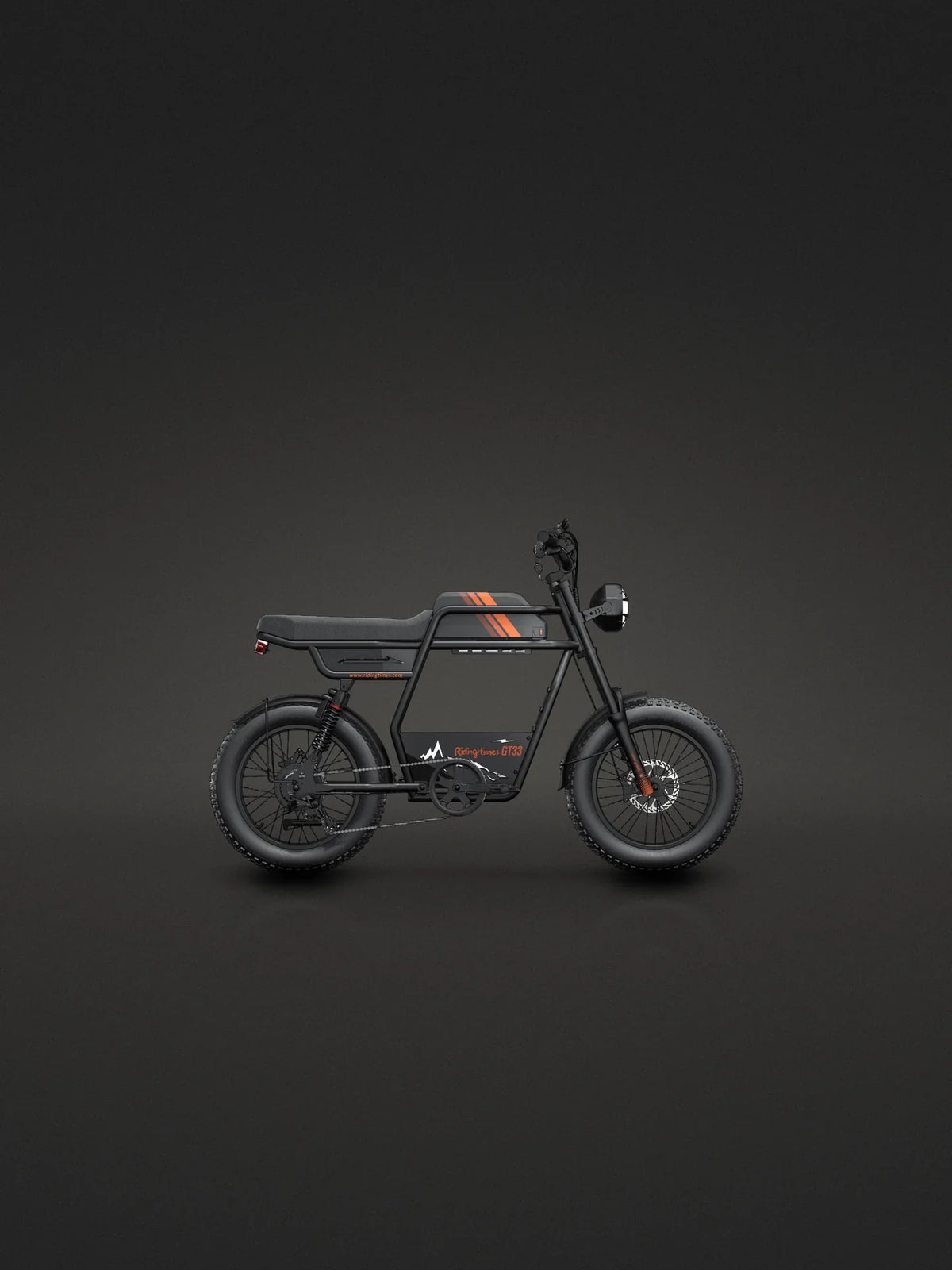
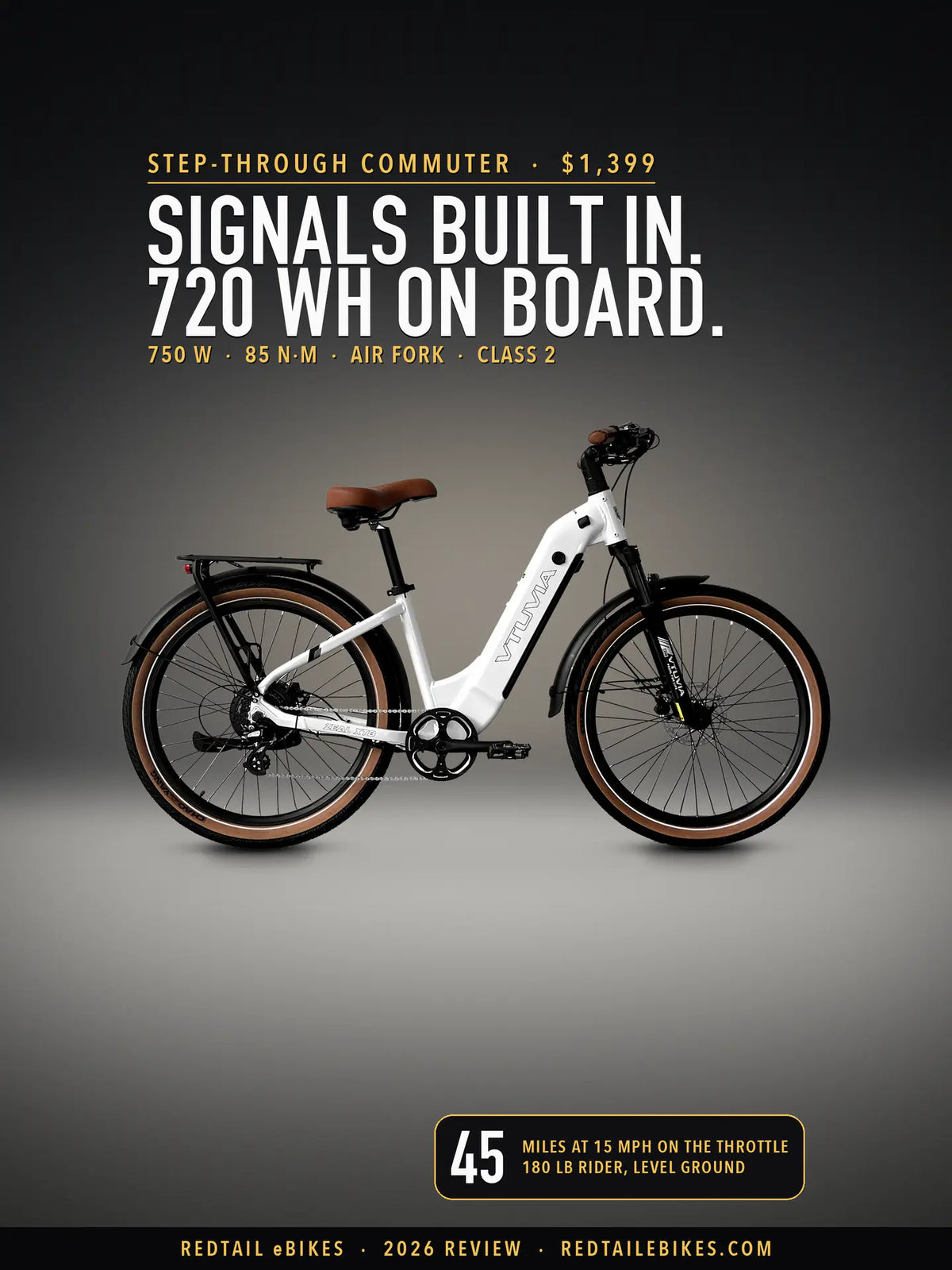
Share:
Smartravel eBikes 2026: 6 Models, 0 Recalls
Bike Shops in Visalia, CA: 2 Verified eBike Stores