
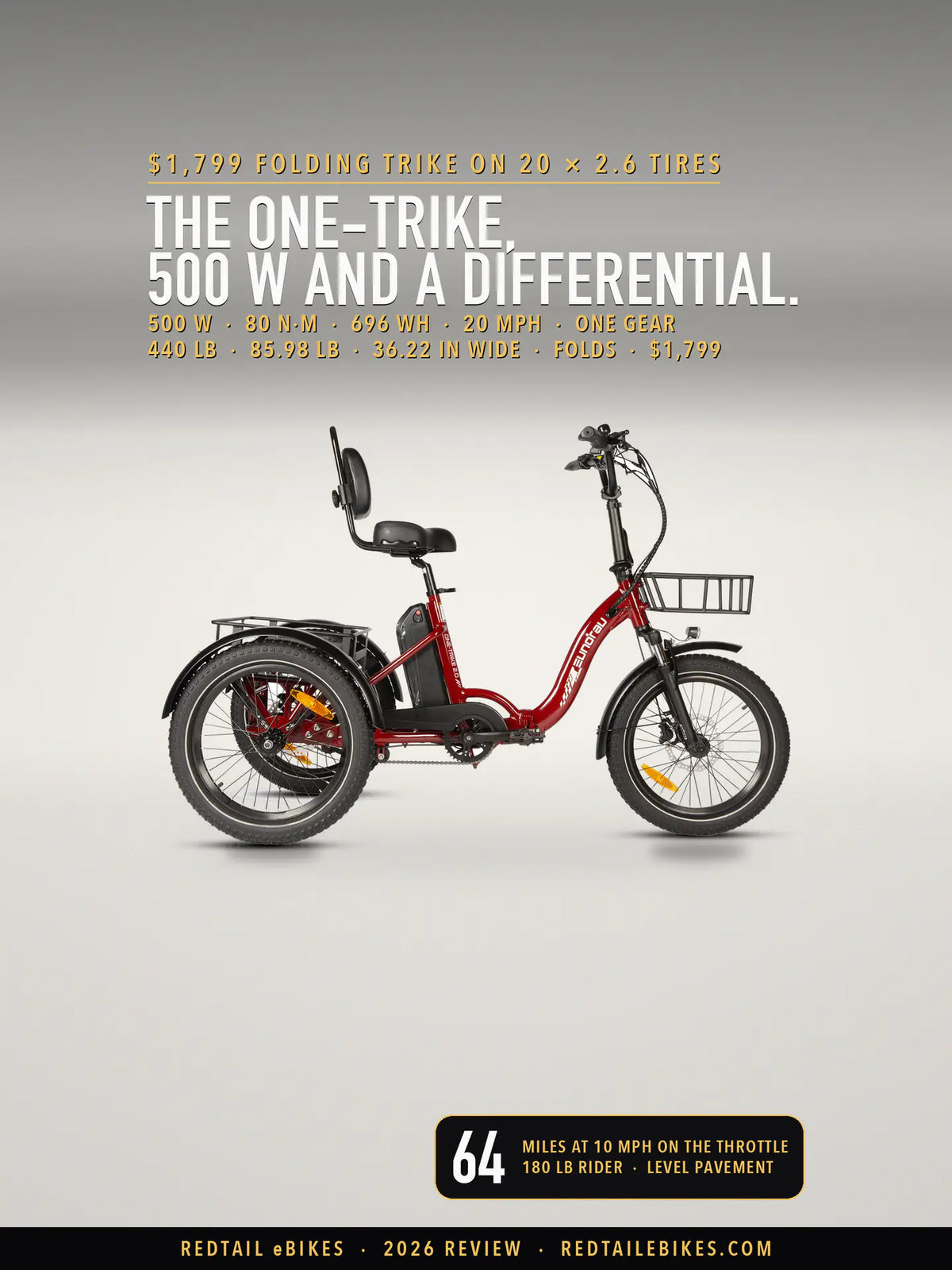
85.98 lb · 20 × 2.6 knobby tires · 48V 500 W rear-drive motor with a differential · 80 N·m · one gear · 696 Wh · 20 mph · 440 lb payload · 36.22 in wide · folds · $1,799 in Deep Crimson, Dark Charcoal or Snow White · ridden on camera · verified September 30, 2026
Quick Answer — This Eunorau ONE-TRIKE review covers the ONE-TRIKE 2.0, an 85.98 lb, $1,619 folding trike on 20 × 2.6 tires with a 500 W rear-drive motor, a rear differential, 80 N·m and a 696 Wh pack, rated for 440 lb. On the throttle over level pavement, a 180 lb rider gets about 64 miles at 10 mph.
At 15 mph that ride comes to about 44 miles (the speed table). Eunorau lists riders from 5'2" to 6'1", the saddle sets from 32.3 to 38.6 inches, and at 36.22 inches wide it is wider than a 32-inch doorway. Its printed 500 W, throttle, 20 mph and three wheels sit inside the e-bike definition of 39 of 51 jurisdictions (the law section).
$1,799 in Deep Crimson, Dark Charcoal or Snow White, all three orderable on September 30, 2026. Delivery to the lower 48 is free, Shop Pay splits the price over 3, 6 or 12 months, and if a covered part fails we take the warranty claim to Eunorau for you.
Buy it in Deep CrimsonTakeaway
- About 64 miles a charge for a 180 lb rider at 10 mph on the throttle over flat pavement, 44 at 15 mph, and 40 at 10 mph with the full 440 lb aboard (the range tables).
- Three wheels and a differential, which in Eunorau's FAQ "allows the two rear wheels to rotate at different speeds while turning" (the drive section).
- One gear, so pedal at trike pace: 75 pedal strokes a minute at 10 mph and 113 at 15, where the throttle does the work (the gear section).
- A saddle that suits inseams from 27.1 to 33.2 inches at the fit formula, which covers most riders from 5'2" to 5'8" (the fit section).
- 36.22 inches wide and 85.98 lb, folding to 124 × 92 × 110 cm: measure your doorway first (the frame section).
- Inside the e-bike definitions of 39 of 51 jurisdictions; New York's is capped at 36 inches wide, and five states write their definitions on two wheels (the law section).
What's on this page
Twenty-seven sections: who it suits, our ride on camera, the frame and its fold, the drive and the differential, how far it goes, what it carries, how three wheels ride, whether it fits you, what the law calls it, owning it, and the verdict.
- Who the ONE-TRIKE is for
- We rode the ONE-TRIKE
- How we verified this Eunorau ONE-TRIKE 2.0 review
- Eunorau ONE-TRIKE specifications
- The frame, the fold and the width
- The rear-drive motor and the differential
- One gear, the brakes and the controls
- ONE-TRIKE or NEW-TRIKE
- How far the ONE-TRIKE goes
- What the 440 lb payload covers
- Riding three wheels: corners, slopes and stops
- Will the ONE-TRIKE fit you?
- The Mercer fit test
- What the law calls it: 500 W, a throttle and three wheels
- Charging and battery care
- Where Eunorau prints a figure two ways
- Has it been recalled?
- Is it UL certified?
- Warranty, and who handles a claim
- Buying it from us
- The honest ledger
- Who should buy it
- Before you buy: the checklist
- Limitations of this review
- The source register
- Frequently asked questions
- The bottom line
Who the ONE-TRIKE is for

The Deep Crimson as Eunorau photographed it, on a light studio sweep we built around the photograph for the card. The $1,799 and 500 W are the listed figures, and the range section works out the 64 miles.
It is for the rider who wants the pedals and the throttle of an e-bike without balancing at a stop: errands with a front and rear basket, neighborhood loops, a ride that starts and stops without a foot down, between 5'2" and 6'1" in the window Eunorau lists.
Eunorau's own FAQ puts it this way: "designed for riders who value added stability, comfort, and cargo capacity for everyday trips", adding in the same answer that it "is an electric trike—not a medical mobility device".

A rider on the Deep Crimson, in Eunorau's own outdoor photograph; Eunorau does not say where it was taken.
The frame steps through low, the saddle carries a backrest, and behind it a rack sits over a rear axle whose differential lets the two rear wheels turn at their own speeds in a corner.

The Dark Charcoal from the chain side, photographed by Eunorau: the low step-through, the backrest, both baskets and the pack behind the seat tube.
Taller than about 5'9", after more pack, or needing seven gears for hills? A different trike of ours may be the better buy. Our NEW-TRIKE review covers Eunorau's other trike, with a saddle that sets to 40.2 inches, seven speeds and a 960 Wh pack, and if two wheels will do, our MAX-CARGO review covers Eunorau's long-tail for loads and children.
440 lb payload · 500 W · 80 N·m · 696 Wh · folds · 20 × 2.6 tires. Dark Charcoal here; the same trike comes in Snow White and Deep Crimson, $1,619 each, delivered free anywhere in the contiguous states.
Buy it in Dark CharcoalWe rode the ONE-TRIKE through fall color
We rode a Deep Crimson ONE-TRIKE 2.0 on camera for eight minutes on gravel, sand and pavement. The video shows how it rides; the figures on this page come from Eunorau's documents, the statutes and the arithmetic shown.

On power, the rider is direct. At 1:26: "It's proven itself that it can climb easy. I have not struggled yet for power."
After the sand at 2:32 and partway up the short climb from 2:51, the rider adds at 2:58: "It's got so much power." How steep a hill it takes at your weight is in the hills section.
The walkaround that opens the video shows the rear drive, the hydraulic disc brakes, the half-twist throttle, the adjustable handlebar, the fold, and a basket at each end, "both included with tons of room" (0:56).
Why a trike, in the rider's words. From 3:40 the rider asks you to imagine you could not ride a bicycle, then at 3:45: "This is allowing me to come to a place that otherwise I would need to get assistance from other people to come to."
At 5:03, at a park the rider had meant to visit for a while: "with the car, you always think about, oh, I'll do it another time". On the trike, at 5:11: "Might as well check it out."
Three figures in the narration, set against Eunorau's documents. At 0:19 the rider calls the motor a 500 W rear hub drive; Eunorau's rows call it a 500 W "Rear-Drive Motor", which turns the rear wheels through the differential (the drive section). At 1:00 the rider gives the payload as 440 or 400 lb; Eunorau rates it at 440 lb (the payload section).
At 1:34 the pack is given as 48 volts and 15 amp-hours; Eunorau's rows give 48V 14.5Ah, the 696 Wh every range figure here works from (the specifications).
Before you leave the pavement, know the trike's scope. Eunorau scopes it to paved roads, bike paths and moderately uneven surfaces, with extra caution on loose ones (riding three wheels); check a path's posted rules before you ride it, and see the law section for what your state's code calls a three-wheeler.
The trike in the video is the Deep Crimson, $1,619. It costs the same in Snow White or Dark Charcoal; we deliver free to any of the lower 48 states, and Shop Pay plans run 3, 6 or 12 months.
Buy the Deep Crimson we rodeHow we verified this Eunorau ONE-TRIKE 2.0 review
Every specification is Eunorau's, read on September 26 and again on September 30, 2026 from the ONE-TRIKE's product page, its product record, its geometry table and drawing, and its FAQ; each figure that needs arithmetic is recomputed. Where Eunorau prints a figure two ways, the conflicts table shows both.
The range and fit sections end with their formulas and inputs (range, fit); the fit is measured on Eunorau's geometry drawing after its scale reproduced four of the table's published dimensions. The law section screens all 51 jurisdictions on the motor, the throttle, the speed, the wheel count and the width, and the Limitations date each screen and store read.
This review is ridden (the ride). We sell the ONE-TRIKE; the honest ledger routes each rider it suits less well to one of ours that suits them better. The author is Milad Ghobadibeygvand, BScN (Western University, 2014); send corrections to corrections@redtailebikes.com.
Eunorau ONE-TRIKE specifications
Each figure below is Eunorau's, as its page and record printed it on September 26 and 30, 2026.
| Specification | Published figure |
|---|---|
| Price | $1,799 in Deep Crimson, Dark Charcoal or white, Eunorau's own price on September 30, 2026 |
| Motor | 48V 500 W rear-drive motor, 80 N·m torque |
| Differential | "Rear Differential" |
| Throttle | half-twist throttle, in the product record |
| Controller | 48V 20A |
| Battery | 48V 14.5 Ah — 696 Wh (our arithmetic: 48 × 14.5) |
| Range | "Up to 50 Miles" |
| Maximum speed | 20 mph; "Class 2 Speed limited Unlockable" in the highlights |
| Payload | 440 lb |
| Weight | 85.98 lb |
| Rider height | 5'2"–6'1" |
| Frame | 6061 aluminum alloy, folding |
| Drivetrain | single speed, 18T freewheel, 38T chainring, 165 mm forged alloy cranks |
| Brakes | hydraulic disc levers with a motor cutoff switch; 180 mm rotors |
| Fork | Eunorau suspension fork, 40 mm travel |
| Tires | 20 × 2.6 |
| Display | LCD, UART protocol; pedal assist levels 0 to 5 |
| Lights | LED headlight; integrated brake taillight |
| Saddle | comfort saddle with backrest, seat to ground 32.3 to 38.6 in |
| Stem | "Adjustable stem for comfort, Folding (31.8mm clamp diameter)" |
| Charger | "US Standard 2.0A Smart Charger" |
| Shipping box | 103 × 65 × 74 cm |
| UL | "UL CERTIFIED: Yes" in the highlights |
Eunorau prints the frame as a table beside its drawing:
| Dimension | Eunorau's ONE-TRIKE figure |
|---|---|
| A · Seat tube | 440 mm (17.3 in) |
| B · Reach | 420 mm (16.5 in) |
| C · Head tube | 140 mm (5.5 in) |
| D · Chain stay | 518 mm (20.4 in) |
| E · Bracket height | 270 mm (10.6 in) |
| F · Wheelbase | 1,190 mm (46.85 in) |
| G · Top tube | 550 mm (21.7 in) |
| H · Stack | 468 mm (18.4 in) |
| I · Total length | 1,731 mm (68 in) |
| J · Weight | 39 kg (85.9 lb) |
| K · Max width | 920 mm (36.22 in) |
Eunorau's "Dimensions & Rider Fit" table on the ONE-TRIKE page, read on September 26 and 30, 2026, with the inch figures as Eunorau prints them.
The frame, the fold and the width
The ONE-TRIKE is 36.22 inches across the rear axle, so check each door on your route home first: the 2010 ADA Standards require an accessible door to give 32 inches of clear width, measured with the door open 90 degrees, and 36 inches where the opening runs more than 24 inches deep (§ 404.2.3). A doorway built to those minimums is narrower than the trike.
Eunorau's FAQ says the same in its own words: the trike "remains wider than a regular folding bike", its unfolded width is approximately 36.2 inches, and you should "measure your doorway, storage area, and vehicle cargo space" before buying.
The frame and the stem fold, per the same FAQ, to 124 cm long, 92 cm wide and 110 cm tall in Eunorau's folded-size drawing: shorter and lower, and exactly as wide, since the rear axle sets the width.

Folded, as Eunorau photographed and measured it: 124 cm long, 92 cm wide, 110 cm tall. The width does not change: the rear axle keeps its full 92 cm.
At 85.98 lb, lifting it into a car's cargo space is a two-person job for most people; Eunorau's product FAQ puts it at "approximately 86 lbs".

The Dark Charcoal from behind, photographed by Eunorau: both rear wheels on the one axle, the rear rack and the fenders.
The rear-drive motor and the differential
Eunorau rates the motor at 500 W with 80 N·m of torque and puts it at the rear, driving through a differential that its FAQ describes plainly: it "allows the two rear wheels to rotate at different speeds while turning. This helps reduce wheel skipping and tire scrub, making corners feel smoother and more controlled." In a turn the outer rear wheel travels farther than the inner one, and the differential lets it.
Eunorau's record lists a half-twist throttle, which moves the trike with no pedaling, and the LCD sets five levels of pedal assist. The range model holds the motor to the 500 W and 80 N·m Eunorau prints and to its 20 mph top speed (the formula).

The drivetrain, cropped from Eunorau's drive-side studio photograph of the Dark Charcoal: the chainring, the chain and the rear drive unit between the rear wheels.
At 10 mph over flat ground the model's motor turns out 5.0 N·m at the wheels and draws 106.2 W; up a 12% street with 440 lb aboard, the grade asks more than the model's 80 N·m can turn, and your legs join in (the hills section).
One gear, the brakes and the controls
The ONE-TRIKE has one gear: a 38-tooth chainring on an 18-tooth single-speed freewheel, turned by 165 mm forged alloy cranks. Each turn of the cranks moves it 3.57 meters, which is why the range section prints pedaling figures only up to about 13 mph.
The brake levers are hydraulic, with a motor cutoff switch, on 180 mm discs, per the spec rows; the feature copy names "Logan hydraulic disc brakes, using mineral oil" (the conflicts table).

The cockpit, cropped from Eunorau's drive-side photograph of the Dark Charcoal: the grip and levers, the folding stem and the front basket.
The rest, from Eunorau's page and record:
- The fork: "Eunorau suspension fork, 40 mm travel", which Eunorau says absorbs "bumps and shocks from uneven terrain".
- The display: an LCD on the UART protocol, showing battery, mileage, speed, lights, assist level "and turning", in Eunorau's words.
- The lights: an LED headlight and an integrated brake taillight.
- The battery switch: "a switch on the battery", which Eunorau credits with "easy control over power flow".
- The seat: a padded saddle whose backrest height adjusts.

The saddle and backrest, cropped from Eunorau's photograph of the Dark Charcoal; the backrest's height adjusts on its own post.
ONE-TRIKE or NEW-TRIKE
Eunorau builds two trikes and we sell both: the ONE-TRIKE at $1,619 with a 500 W motor at the rear and a differential, and the NEW-TRIKE 2.0 at $1,699 with a 500 W motor in the front wheel, seven speeds and a bigger pack. Both carry 440 lb and both fold.
| Model | Motor | Pack and gears | Saddle to ground | Price |
|---|---|---|---|---|
| ONE-TRIKE 2.0 | 500 W rear drive, 80 N·m | 696 Wh, 1 gear | 32.3–38.6 in | $1,619 |
| NEW-TRIKE 2.0 | 500 W front, 80 N·m | 960 Wh, 7 speeds | 32.7–40.2 in | $1,699 |
Each figure from that model's page at Eunorau (ONE-TRIKE, NEW-TRIKE 2.0), read on September 30, 2026, when both of our prices matched Eunorau's; the NEW-TRIKE 2.0's price re-read October 18, 2026, when it matched again.
Pick the ONE-TRIKE for the lower price, the differential at the rear, and a saddle range that suits most riders from 5'2" to 5'8".
Pick the NEW-TRIKE if you are taller, since its saddle reaches 40.2 inches; for hills you want to pedal up, with seven Shimano speeds; or for the longer range of its 48V 20Ah pack. Eunorau's NEW-TRIKE rows also list a parking brake (our NEW-TRIKE review). Both trikes sit in our electric trikes collection with the other three-wheelers we carry, and our Eunorau collection holds every Eunorau we sell.

The Deep Crimson from the front, photographed by Eunorau: the basket, the fork and the low step-through.
How far the ONE-TRIKE goes, and how much of it is your legs
On the throttle alone over level pavement, a 180 lb rider gets about 64 miles at 10 mph and 44 at 15 mph from the 696 Wh pack; with the full 440 lb aboard, the 10 mph ride comes to about 40. Keep 15% in reserve, the top of the "10-15%" band Eunorau's FAQ gives for recharging, and those two rides plan at 54 and 37 miles.
Each figure in this section is computed by one saved model of the trike, built from Eunorau's 48V 500W rear-drive motor with 80 N·m, its 20 mph top speed, its 85.98 lb weight and its 48V 14.5Ah pack, with the road physics set out in the formula below.
Three steps get you to your own number:
- Find your usual speed in the first table; 10 mph is a relaxed neighborhood pace, 15 mph a brisk errand.
- Add what you carry and where you ride: the weight table runs from 100 lb to the full 440 lb, the hills table prices each grade, and the climb table says how fast the trike holds each one.
- Plan on the "15% kept" column, and mind the single gear: above about 13 mph the pedals turn faster than riders were measured choosing, so the throttle carries those speeds.
How far does it go at my speed?
Slow down and the range stretches: 64 miles at 10 mph become 30 at the 20 mph top speed, because the air you push through costs power with the cube of your speed (Martin et al., 1998).
| Speed, flat | Per mile | Full charge | With 15% kept |
|---|---|---|---|
| 8 mph | 9.6 Wh | 72 mi | 62 mi |
| 10 mph | 10.9 Wh | 64 mi | 54 mi |
| 12 mph | 12.6 Wh | 55 mi | 47 mi |
| 15 mph | 15.9 Wh | 44 mi | 37 mi |
| 18 mph | 20.0 Wh | 35 mi | 30 mi |
| 20 mph | 23.3 Wh | 30 mi | 25 mi |
Throttle only, a 180 lb rider on level pavement, still air at 77 °F, one 696 Wh pack. "With 15% kept" stops at the top of the 10 to 15% recharge band in Eunorau's FAQ.
Your own pedaling adds most at trike pace. The model shares each speed between your legs and the motor:
| Speed, flat | Throttle only | Easy pedaling (75 W) | Steady pedaling (150 W) |
|---|---|---|---|
| 10 mph | 64 mi | 315 mi | legs alone |
| 12 mph | 55 mi | 134 mi | legs alone |
| 15 mph | 44 mi | — | — |
| 18 mph | 35 mi | — | — |
| 20 mph | 30 mi | — | — |
One 696 Wh pack, a 180 lb rider, level ground. Easy pedaling is 75 W at the cranks, steady pedaling 150 W.
At 10 mph the trike needs 82.5 W at the wheel (Martin et al., 1998), so an easy 75 W leaves the pack only 2.2 Wh a mile to find, hence the 315 miles, and a steady 150 W carries it with no motor at all ("legs alone"). A dash marks a speed where the single gear asks more than 100 pedal turns a minute (the gear section).
Riding with the motor off, the same road-power equation puts a 180 lb rider on the 85.98 lb trike at about 9 mph on 75 W, the pedals turning at about 70 a minute, and 13 mph on 150 W, at about 101.
Which gear saves battery?
There is one gear, Eunorau's 38-tooth chainring on an 18-tooth freewheel, so your road speed sets how fast your feet turn: each crank revolution moves the trike 3.57 meters. At 10 mph that is 75 pedal strokes a minute; at 15 mph it is 113, and at 20 mph, 150.
| Road speed | Pedal cadence on the 38/18 gear | Pedaling figures on this page |
|---|---|---|
| 6 mph | 45 rpm | printed |
| 8 mph | 60 rpm | printed |
| 10 mph | 75 rpm | printed |
| 12 mph | 90 rpm | printed |
| 13 mph | 98 rpm | printed |
| 15 mph | 113 rpm | not printed |
| 18 mph | 135 rpm | not printed |
| 20 mph | 150 rpm | not printed |
Pedal revolutions a minute on the 38/18 gear over a 20 × 2.6 tire, 538 mm across on its 406 mm bead seat (the formula). "Printed" marks the speeds where this page shows a pedaling figure.
How fast do people choose to pedal? Marsh and Martin (1997) measured it: trained cyclists and runners "maintained PC between 90 and 100 rpm at all power outputs", while less-trained riders chose "approximately 80 rpm at 75 W" and 65 rpm at 175 W. On this gear, 80 rpm arrives at 10.6 mph and 100 rpm at 13.3 mph.
| Your ride | Throttle only | Easy pedaling (75 W) | Steady pedaling (150 W) |
|---|---|---|---|
| 10 mph, flat | 10.9 Wh | 2.2 Wh | 0.0 Wh |
| 15 mph, flat | 15.9 Wh | — | — |
| 12 mph, 4% grade | 46.1 Wh | 35.1 Wh | 25.2 Wh |
| 12 mph, 8% grade | — | — | 64.6 Wh |
Watt-hours drawn from the 696 Wh pack per mile, a 180 lb rider in calm air, pedaling measured at the cranks. A dash marks either a pedaling figure past 100 rpm or a pace the model's 500 W motor cannot hold on that grade; at 10 mph on the flat a steady 150 W needs nothing from the pack.
So pedal at trike pace, and let the throttle carry the brisk miles. Your legs cut the draw most below about 13 mph: an easy 75 W takes the 10 mph ride from 10.9 to 2.2 Wh a mile, and on a 4% street at 12 mph from 46.1 to 35.1.
How much do hills cost, and how steep a hill can it climb?
On the throttle at a steady 10 mph, each 1,000 feet of climbing costs the pack about 163 Wh on a 4% grade and 182 Wh on a 6% grade, on top of what the same miles take on the flat. Raising a 180 lb rider and the 85.98 lb trike through 1,000 feet takes about 100 Wh at the wheel; the balance goes as heat in the motor and the pack.
| Grade | Per mile, throttle | Full charge, throttle | Full charge, easy pedaling |
|---|---|---|---|
| 2% | 26 Wh | 26 mi | 45 mi |
| 4% | 45 Wh | 15 mi | 22 mi |
| 6% | 69 Wh | 10 mi | 13 mi |
One 696 Wh pack, a 180 lb rider holding 10 mph up each grade, calm air. From 8% the model's 500 W motor cannot hold 10 mph for this rider, so the table stops at 6%.
Steeper streets are climbed slower, and the next table gives the fastest steady pace the model holds on each grade with the throttle alone:
| Grade | 180 lb aboard | 260 lb aboard | 440 lb aboard |
|---|---|---|---|
| 4% | 14.9 mph | 12.7 mph | 9.2 mph |
| 6% | 12.0 mph | 9.8 mph | 6.7 mph |
| 8% | 9.9 mph | 7.9 mph | 5.3 mph |
| 10% | 8.3 mph | 6.5 mph | 4.3 mph |
| 12% | 7.1 mph | 5.5 mph | not on the throttle alone |
Throttle only, calm air, the 85.98 lb trike plus the weight aboard. At 12% with 440 lb the grade asks more than the model's 80 N·m can turn at the wheel at any speed, so it takes your legs as well, at walking pace.
Eunorau's product FAQ says the ONE-TRIKE handles "paved roads, bike paths, and moderately uneven surfaces" and asks for "extra caution on steep hills, loose surfaces, and side slopes".
Does my weight change the range?
Yes, and on a trike you load for errands it is worth pricing: at 10 mph on the throttle, 180 lb of rider and cargo goes 64 miles, 260 lb goes 54, and the full 440 lb goes 40.
The 8% column shows where the load bites hardest. At 10 mph up that grade the model's motor holds 130 lb of rider and cargo for 10 miles, and from 180 lb it asks for more than 500 W at the wheel; slow to the climb table's pace or pedal with it.
| You plus your load | 10 mph flat, throttle | 15 mph flat, throttle | 8% climb, 10 mph |
|---|---|---|---|
| 100 lb | 77 mi | 50 mi | 12 mi |
| 130 lb | 71 mi | 47 mi | 10 mi |
| 180 lb | 64 mi | 44 mi | past the model's motor |
| 220 lb | 58 mi | 41 mi | past the model's motor |
| 260 lb | 54 mi | 39 mi | past the model's motor |
| 350 lb | 46 mi | 35 mi | past the model's motor |
| 440 lb | 40 mi | 31 mi | past the model's motor |
Rider and cargo on the 85.98 lb trike, one 696 Wh pack, calm air. Eunorau's product FAQ calls the 440 lb "the combined weight of the rider, cargo, and any installed accessories", so the trike's own weight sits outside it. "Past the model's motor" marks a climb that needs more than Eunorau's 500 W at the wheel.
Does cold weather drain the battery?
Yes: the 10 mph throttle ride of 64 miles comes to about 50 at 32 °F and 45 at 14 °F. At freezing the cells give about 89% of the energy they give at 77 °F, the air is 9% denser to push, and the tires roll 18% harder (Rothhämel, 2023).
| Air | Pack energy vs 77 °F | 10 mph flat, throttle |
|---|---|---|
| 95 °F | 99% | 67 mi |
| 77 °F | 100% | 64 mi |
| 68 °F | 98% | 60 mi |
| 50 °F | 93% | 54 mi |
| 41 °F | 91% | 51 mi |
| 32 °F | 89% (80–93) | 50 mi (45–52) |
| 14 °F | 82% (40–83) | 45 mi (22–45) |
Throttle only at 10 mph, a 180 lb rider on level pavement, one 696 Wh pack. The central figures follow McMaster University's LG HG2 cell measurements with the cells at air temperature; at 32 °F and 14 °F the spans show where other published cell data fall (Limitations).
Do the tires cut range?
They matter: from a commuter tread to a harder-rolling knobby, the 10 mph ride spans 72 to 51 miles, and Eunorau names knobby tread for the rear wheels.
No drum or road test of Eunorau's 20 × 2.6 tire turned up, so the model uses the rolling resistance measured across 138 everyday riders on knobby tires, set between those riders' commuter-tire average and the knobby average one standard deviation up.
| Rolling resistance | 10 mph flat, throttle | 15 mph flat, throttle |
|---|---|---|
| 0.0074 · commuter tires, 273 everyday riders | 72 mi | 48 mi |
| 0.0092 · knobby tires, 138 everyday riders (used) | 64 mi | 44 mi |
| 0.0131 · knobby tires, one standard deviation up | 51 mi | 37 mi |
Level pavement, throttle only, a 180 lb rider and one 696 Wh pack. Each coefficient is the rolling drag as a fraction of the weight on the tires, from Tengattini and Bigazzi's coast-down measurements.
Eunorau's 50 miles, as a ride
Eunorau's "Up to 50 Miles" on the 696 Wh pack is, in the model, a 180 lb rider holding 13.3 mph on the throttle across level ground: 13.9 Wh a mile, all of the pack. Eunorau's page prints the figure in its highlights, its range row and its product record.
Ride slower and you pass it; carry a full load, ride into winter or climb and the weight, cold and hills tables say by how much.
Plan on 85% of your row, which leaves 15% in the pack: the 64 miles at 10 mph become 54, and the 44 at 15 mph become 37.
Plan on 85% of your row, pedal at trike pace, and give hills time. On top of the flat miles, allow about 163 to 182 Wh for each 1,000 feet you climb at 10 mph on the throttle. A 180 lb rider plans 54 miles at 10 mph and 37 at 15 mph on one charge, and from 8% the trike climbs at the climb table's pace.
At 10 mph a 180 lb rider plans 54 flat miles on one charge, $1,799 in any of three colors. This button orders the Deep Crimson; Dark Charcoal and Snow White are the same price. Send your route, your weight with cargo and your hills to support@redtailebikes.com, and we will run your ride through this model.
Buy the Crimson for errandsHow the range tables are computed
Each row starts with the power needed at the rear wheels to hold one steady speed. Martin and colleagues validated this equation against road measurements in 1998:
Wheel power = v × [ m × g × (Crr × cos θ + sin θ) + ½ × ρ × CdA × v² ]
Here v is the speed, m the rider, cargo and trike together, g gravity, θ the grade's angle, Crr the rolling resistance (0.0092 is drag at 0.92% of the weight on the tires, the knobby-tire field average), ρ the air's density and CdA the drag area of rider and machine. On three wheels the rolling term acts on the whole weight, whichever wheels carry it.
Four steps carry that wheel power back to the cells:
- Pedaling passes through the chain at 97.7% (Martin et al., 1998), and the motor makes up the rest; a pedaling figure is printed only up to 100 pedal turns a minute on the single gear.
- The motor takes its curve from a motor with published figures, Bafang's RM G0H0: 510 rpm unloaded, 426 rpm at its rated point, efficiency "≥ 80" percent. The model sets that curve at the ONE-TRIKE's 48 V and 500 W at the driven wheels, fits the unloaded speed at 22.6 mph so a 180 lb rider on the throttle reaches Eunorau's 20 mph, and caps the torque at Eunorau's 80 N·m.
- The pack loses part of its energy inside itself; on the 48 V pack Arango, Lopez and Ceren measured, that comes to 3.0% at 10 mph on the throttle.
- Watt-hours a mile are the cells' watts divided by the speed, and miles are the 696 Wh, reduced for the energy cold leaves in the cells, divided by the watt-hours a mile.
| Input | Value used | Where it comes from |
|---|---|---|
| Trike | 85.98 lb | Eunorau's specification |
| Rider and cargo | 180 lb; the weight table runs 100 to 440 lb | 440 lb is Eunorau's payload |
| Pack | 48 V × 14.5 Ah = 696 Wh | Eunorau's specification |
| Motor | 500 W at 48 V, 22.6 mph unloaded, 80% at the rated point, torque capped at 80 N·m | Bafang OEM workbook 2021, RM G0H0, set to Eunorau's figures |
| Driven wheels | 21.18 in across: the 406 mm bead seat of a 20-inch tire plus twice 2.6 in | Sheldon Brown's tire-sizing table and Eunorau's tire row |
| Gear | 38-tooth chainring, 18-tooth freewheel: 3.57 m a crank turn | Eunorau's specification |
| Pedaling cadence | printed up to 100 rpm, the top of the 90 to 100 rpm trained riders chose | Marsh and Martin, 1997 |
| Rolling resistance | 0.0092, 138 everyday riders on knobby tires | Tengattini and Bigazzi, 2018 |
| Drag area | 0.640 m², 37 everyday riders on upright cruisers | Tengattini and Bigazzi, 2018 |
| Chain | 97.7%, your pedaling only | Martin et al., 1998 |
| Pack losses | 3.0% at 10 mph, more on climbs | Arango, Lopez and Ceren, 2021 |
| Air | 77 °F at sea-level pressure, 1.184 kg/m³ | U.S. Standard Atmosphere, 1976 |
| Cold | the share of a cell's energy left at each temperature | McMaster University's LG HG2 cell data |
| Reserve | 15% kept in the pack, the top of the FAQ's "10-15%" | Eunorau's FAQ |
The 10 mph ride, worked through: level pavement, throttle only, a 180 lb rider. The tires take 48.7 W and the air 33.8 W, 82.5 W at the wheels together.
At 10 mph the 21.18-inch wheels turn 158.7 times a minute. The motor model (1.275 N·m per amp, a 0.607 Ω winding and 0.55 A drawn unloaded, each derived from Bafang's published figures at 48 V) turns out 5.0 N·m on 4.4 A, 78% efficient at this light load.
The motor draws 106.2 W and the cells, covering the pack's own losses, give 109.4 W: 10.9 Wh a mile at 10 mph (10.94 before rounding), so 696 ÷ 10.94 comes to 63.6 miles, or 54.1 with 15% kept.
The model against the figures it was built from:
| Check | Published figure | This model |
|---|---|---|
| Road physics, Martin and colleagues' worked example | 45.7 W for the tires and the grade, 158.8 W for the air | 45.7 W and 158.8 W |
| The comparable motor at its rated point | at least 80% efficient | 80% |
Martin and colleagues' own case (Appendix I: 90 kg on a 0.3% grade at 8.36 m/s) and the RM G0H0's rated point from Bafang's workbook.
What the 440 lb payload covers
Eunorau rates the ONE-TRIKE at 440 lb, and its FAQ defines the figure: "the combined weight of the rider, cargo, and any installed accessories", so the trike's own 85.98 lb sits outside it. The same answer asks you to "distribute cargo evenly and keep heavier items low and centered".
Picture a 220 lb rider with 40 lb of groceries across both baskets: 260 lb, with 180 lb of the rating to spare. At 10 mph on the throttle that ride covers about 54 miles on one charge, where a 180 lb rider alone covers 64 (the weight table).

The white trike from the chain side, in Eunorau's photograph; Eunorau calls the color "Cloud white" and our listing "Snow White".
The rear rack is a place for cargo, and a child needs a seat. Eunorau's feature copy calls the rear section "a strong cargo rack ideal for carrying a child or pet".
How a child may ride is a matter of state law; California's statute is one example: a passenger rides "upon or astride a separate seat attached thereto", and one "four years of age or younger, or weighs 40 pounds or less" needs a seat that retains them and shields them from the moving parts (Cal. Veh. Code § 21204(b)). Count any seat, the child and the baskets inside the 440 lb.
Riding three wheels: corners, slopes and stops
Three wheels stand on their own, and Eunorau's FAQ sets out the trade: they "provide a stable platform when starting, stopping, and riding at lower speeds. However, a trike handles differently from a bicycle and does not lean naturally into turns." Its advice follows: "New riders should practice in a flat, open area and slow down before cornering."
The same FAQ scopes the terrain: "paved roads, bike paths, and moderately uneven surfaces", "not intended for aggressive off-road riding", with "extra caution on steep hills, loose surfaces, and side slopes".
Before the first real ride, then: an empty parking lot, a few slow figure-eights, braking to a stop from 10 mph, and corners taken at a walking pace before a riding one. Load heavy items low in the baskets, and on a sideways slope keep your speed down.

The white trike from the front, in Eunorau's photograph: the basket, the fork, the backrest and the rear wheels behind.
Three wheels for stops without a foot down, $1,619 in any color. Snow White on this button; Deep Crimson and Dark Charcoal are a click away. Tell us about the ride you have in mind at support@redtailebikes.com and we will answer before you order.
Buy it in Snow WhiteWill the ONE-TRIKE fit you?
Eunorau lists riders from 5'2" to 6'1", and its saddle sets from 32.3 to 38.6 inches off the ground, which at the usual fit formula suits a barefoot inseam from 27.1 to 33.2 inches: every rider we modeled from 5'2" to 5'4" can set the saddle where the formula puts it, 72 of 100 at 5'8" and 27 of 100 at 5'10".
Riders above that set the saddle at the top of its post and ride with more bend at the knee than the formula asks; the saddle table gives each height its share. Getting on means stepping over a frame that dips to 14.7 inches, you lean 16 to 19 degrees toward the grips, and with your back relaxed your hands hold about 15 to 18 percent of your weight.
Each row is computed for the 6,068 people measured in the US Army's anthropometric survey, with the saddle at 109% of inseam above the pedal axle, on the frame as Eunorau drew it.
Three steps to your own fit:
- Measure your inseam barefoot: stand against a wall with a hardcover book pressed up between your legs like a saddle, and measure from the floor to the book's top edge.
- Find your height in the saddle table and check your inseam against that row's span; a longer inseam behaves like the row above.
- Finish the setting on the trike, with the knee angle and heel check further down.
How high should the saddle go?
The formula puts it 109% of your inseam above the pedal axle, and Eunorau's range covers that for most riders from 5'2" to 5'8": at 5'6" the median rider's saddle sits 37.0 inches off the ground, inside the listed 32.3 to 38.6, while at 5'10" the median asks for 39.2.
Published practice runs from 106% to 110.4% of inseam (Ferrer-Roca et al., 2012); Peveler and colleagues measured the knee angle the 109% rule gives.
On the ONE-TRIKE that distance becomes a height off the ground through Eunorau's 165 mm cranks, a crank axle 10.4 inches up on the drawing and a seat post leaning back at 71 degrees.
| Your height | Typical inseam | Saddle height, median rider | At 109% | At 106% |
|---|---|---|---|---|
| 5'2" | 28.0–31.1 in | 34.8 in | 100 of 100 | 96 of 100 |
| 5'3" | 28.7–31.6 in | 35.3 in | 100 of 100 | 100 of 100 |
| 5'4" | 29.1–32.2 in | 35.8 in | 100 of 100 | 100 of 100 |
| 5'5" | 29.7–32.6 in | 36.3 in | 99 of 100 | 100 of 100 |
| 5'6" | 30.2–33.5 in | 37.0 in | 93 of 100 | 99 of 100 |
| 5'7" | 30.7–33.9 in | 37.5 in | 86 of 100 | 97 of 100 |
| 5'8" | 31.1–34.3 in | 38.0 in | 72 of 100 | 93 of 100 |
| 5'9" | 31.7–34.8 in | 38.5 in | 53 of 100 | 84 of 100 |
| 5'10" | 32.2–35.5 in | 39.2 in | 27 of 100 | 69 of 100 |
| 5'11" | 32.9–36.1 in | 39.7 in | 11 of 100 | 43 of 100 |
| 6'0" | 33.2–36.7 in | 40.3 in | 6 of 100 | 22 of 100 |
| 6'1" | 33.9–37.2 in | 41.1 in | 2 of 100 | 7 of 100 |
| 6'2" | 34.3–37.5 in | 41.5 in | 0 of 100 | 3 of 100 |
The saddle height off the ground the 109% formula gives the median rider at each height, and how many riders of 100 at that height can set it inside Eunorau's listed 32.3 to 38.6 inches at 109% and at 106%. Bodies from ANSUR II, women and men together, on the frame as Eunorau's drawing shows it.
From about 5'9" up, the saddle table is your row to read before ordering: past a 33.2-inch inseam the formula's height sits above the listed 38.6 inches, and at 106%, the low end of published practice, the post covers inseams to 34.2. Eunorau's window runs to 6'1"; taller riders in it ride with the saddle at its top and more knee bend than 109% gives.
Can I step on and off easily?
Yes: the step-through frame dips to 14.7 inches off the ground on Eunorau's drawing, and at 5'2" 95 of 100 riders clear it by 13.4 inches or more. On three wheels you do not balance at a stop, so the step-over height is the one that counts, and the ONE-TRIKE's product FAQ puts it plainly: "Three wheels provide a stable platform when starting, stopping, and riding at lower speeds."
| Your height | Typical inseam | Clearance over the frame |
|---|---|---|
| 5'2" | 29.5 in | 13.4 in or more for 95 of 100 riders |
| 5'3" | 30.1 in | 14.1 in or more for 95 of 100 riders |
| 5'4" | 30.5 in | 14.4 in or more for 95 of 100 riders |
| 5'5" | 31.0 in | 15.1 in or more for 95 of 100 riders |
| 5'6" | 31.7 in | 15.6 in or more for 95 of 100 riders |
| 5'7" | 32.2 in | 16.1 in or more for 95 of 100 riders |
| 5'8" | 32.6 in | 16.5 in or more for 95 of 100 riders |
| 5'9" | 33.1 in | 17.0 in or more for 95 of 100 riders |
| 5'10" | 33.8 in | 17.6 in or more for 95 of 100 riders |
| 5'11" | 34.3 in | 18.2 in or more for 95 of 100 riders |
| 6'0" | 34.9 in | 18.5 in or more for 95 of 100 riders |
| 6'1" | 35.6 in | 19.2 in or more for 95 of 100 riders |
| 6'2" | 36.0 in | 19.7 in or more for 95 of 100 riders |
Barefoot inseam minus the 14.7-inch low point of the step-through, measured on Eunorau's drawing: the clearance 95 of 100 riders at each height have or exceed. Eunorau prints no standover figure for the ONE-TRIKE.
Will I feel cramped, or stretched out?
Neither, at the bar setting Eunorau drew: the median rider leans 16 degrees from upright at 5'2" and 17 at 6'1" to reach the grips, the most being 19 degrees from 5'8" to 5'10". On the drawing the grips sit 13.7 to 16.4 inches ahead of the crank axle and 29.7 to 31.1 inches above it.
| Your height | Lean from upright, median rider | Across saddle and grip positions |
|---|---|---|
| 5'2" | 16° | 9–22° |
| 5'3" | 16° | 9–22° |
| 5'4" | 17° | 10–23° |
| 5'5" | 17° | 11–23° |
| 5'6" | 18° | 11–24° |
| 5'7" | 18° | 12–24° |
| 5'8" | 19° | 13–24° |
| 5'9" | 19° | 13–24° |
| 5'10" | 19° | 13–24° |
| 5'11" | 18° | 13–24° |
| 6'0" | 18° | 12–23° |
| 6'1" | 17° | 12–23° |
| 6'2" | 17° | 11–22° |
Lean from vertical for the median rider on the frame as drawn: the smallest trunk angle at which a straight arm reaches the grips from where the sit bones rest. The span covers the saddle's sit zone and the grip's extent on the drawing.
Eunorau fits an "Adjustable stem for comfort, Folding" (its spec rows); raising it lifts the grips toward you and sits you more upright.
How much weight goes on my hands?
About 15% of your body weight with your back relaxed, rising to 18% at 5'8" to 6'0". That meets or passes the yardstick of ten road racers pedaling on the hoods, 15% on the stem (Carahalios, 2015), so on a long ride raise the adjustable stem a notch.
| Your height | Share of your weight, back relaxed | Median rider's weight | On each hand |
|---|---|---|---|
| 5'2" | 15% (11–18%) | 139 lb | about 10 lb |
| 5'3" | 15% (12–18%) | 144 lb | about 11 lb |
| 5'4" | 16% (12–19%) | 147 lb | about 12 lb |
| 5'5" | 16% (13–19%) | 157 lb | about 13 lb |
| 5'6" | 17% (13–19%) | 166 lb | about 14 lb |
| 5'7" | 17% (14–20%) | 172 lb | about 15 lb |
| 5'8" | 18% (14–20%) | 179 lb | about 16 lb |
| 5'9" | 18% (14–20%) | 185 lb | about 16 lb |
| 5'10" | 18% (15–20%) | 192 lb | about 17 lb |
| 5'11" | 18% (15–20%) | 196 lb | about 17 lb |
| 6'0" | 18% (14–20%) | 204 lb | about 18 lb |
| 6'1" | 17% (14–20%) | 206 lb | about 18 lb |
| 6'2" | 17% (13–19%) | 216 lb | about 17 lb |
The share of body weight the hands carry with a relaxed back, from each body's segment weights (Clauser et al., 1969); the span covers the sit zone and the grip, and the weight column is the survey's median at each height.
Treat each row as the most your hands take: a core that holds your trunk up carries part of it. Padded gloves help as well; among 36 experienced cyclists they lowered the pressure over the ulnar nerve by 10 to 28% (Slane et al., 2011).
How do I set the saddle when it arrives?
Aim for a knee bent 25 to 35 degrees with the pedal at the bottom of its stroke (Peveler et al., 2007). The quickest route is the heel check: heel on the lower pedal, raise the saddle until that leg just straightens. For 19 trained cyclists it landed inside that knee range 70% of the time, more often than either inseam formula (Peveler et al., 2005).
With the trike parked on level ground, loosen the seat clamp, set the height by the heel check, and tighten the clamp before you ride. The backrest sets separately: Eunorau's feature copy describes "the adjustable backrest height".
How we computed fit
Three rules give every fit row: the saddle sits 1.09 inseams above the pedal axle, the lean is the smallest trunk angle that lets a straight arm reach the grip, and the hand load is the share of upper-body weight that lean passes to the bars.
A worked case: a 5'8" rider with a 32.6-inch inseam, the survey's median at that height. The saddle goes 35.6 inches from the pedal axle, which is 29.1 from the crank axle once the 165 mm crank is taken away (LeMond's 88.3% of inseam gives 28.8).
From a crank axle 10.4 inches up, along the 71-degree post, that puts the saddle top 38.0 inches off the ground, just inside Eunorau's 38.6.
| Input | Value | Source |
|---|---|---|
| Rider bodies | 6,068 (4,082 men, 1,986 women) | US Army ANSUR II |
| Saddle formula | 109% of inseam; range 106–110.4% | Peveler et al., 2005; Ferrer-Roca et al., 2012 |
| Saddle range | 32.3–38.6 in from the ground | Eunorau's specification; the drawn saddle stands at 33.3 in |
| Crank length | 165 mm | Eunorau's specification |
| Crank axle height | 10.4 in (10.4–10.6) | measured on the drawing; Eunorau's geometry lists 270 mm, the high end |
| Seat post angle | 71.2° (70.4–72.0°) | measured on Eunorau's drawing, fitted along both edges of the post |
| Grip center | 13.7–16.4 in ahead, 29.7–31.1 in above the crank axle | measured on Eunorau's drawing |
| Step-through low point | 14.7 in | measured on Eunorau's drawing; no standover is published |
| Segment weights | head and trunk 58.0%, each arm 4.9% of body weight | Clauser et al., 1969 |
Eunorau's geometry drawing is a side elevation with its own dimension lines, and it serves better than a photograph of a trike, where the near rear wheel sits closer to the camera than the front one. Before a point was read, its scale was checked against Eunorau's table:
| Dimension | Eunorau lists | Measured on its drawing | Gap |
|---|---|---|---|
| chain stay | 20.4 in | 20.1 in | −1.2% |
| bracket height | 10.6 in | 10.4 in | −2.3% |
| total length | 68.1 in | 66.6 in | −2.3% |
| top tube | 21.7 in | 21.9 in | +1.2% |
| reach | 16.5 in | 18.0 in | +8.8% |
| stack | 18.4 in | 19.3 in | +4.9% |
Scale from the drawing's F line against the published 1,190 mm (46.85 in) wheelbase. The chain stay, bracket height, total length and top tube land within 3.5%; the reach and stack lines do not, and set nothing here. The drawn tires are smaller than a 20 × 2.6 tire, so the ground is the end of the drawing's bracket-height line.
Across the survey's bodies the two saddle formulas agree: over all 6,068, LeMond's route plus a 165 mm crank comes to 108.4% of inseam from the pedal, beside the 109.2 ± 0.9% measured in trained cyclists (Peveler et al., 2005). The hand figure stays a ceiling, its only measured anchor those road racers at a far lower posture.
From 5'2" to 5'8", the listed saddle range covers most riders in your row. Pick Dark Charcoal here, or Snow White or Deep Crimson at the same $1,619. At 5'9" or taller, email your height and inseam to support@redtailebikes.com and we will run them through this model before you order.
Buy the Dark Charcoal trikeThe Mercer fit test
Each machine we review is held up against one family, the Mercers; every verdict reads a figure Eunorau prints, or the fit model's row at that person's height on the frame as Eunorau drew it.
The inputs: Eunorau's 5'2"–6'1" window, the listed saddle range of 32.3 to 38.6 inches, the saddle heights in the saddle table, the 440 lb payload, the 85.98 lb weight, the 36.22 inch width, and the law in the next section.
| Member | Verdict | The number behind it |
|---|---|---|
| Ruth Kowalski, 61, 5'5" | Inside Eunorau's window, and the listed saddle range fits. | The median rider at 5'5" sets the saddle 36.3 inches off the ground, and 99 of 100 riders at 5'5" can set it where the formula asks. |
| Maya Torres, 32, 5'6" | Inside the window and the saddle range for most riders her height. | 37.0 inches at 5'6", and 93 of 100 riders at 5'6" fit the listed range at 109%. |
| Dana Mercer, 45, 5'7" | Inside both; the errand rider, with both baskets. | 37.5 inches at 5'7"; with 60 lb of shopping on a 160 lb rider, 220 lb in all, the trike covers 58 miles at 10 mph on the throttle (the weight table). |
| Frank Kowalski, 63, 5'10" | Inside the window; the saddle sits at its top for most riders his height. | 39.2 inches asked at 5'10", above the listed 38.6; 27 of 100 riders at 5'10" fit at 109% and 69 of 100 at 106%. The NEW-TRIKE's saddle reaches 40.2. |
| Cole Mercer, 16, 5'11" | Inside the window, with the saddle at its top; age rules for a throttle trike are your state's, in our state guide. | 39.7 inches asked at 5'11", and 11 of 100 riders at 5'11" fit at 109%; 43 of 100 at 106%. |
| Jack Mercer, 48, 6'1" | At the top of Eunorau's window; read the saddle table first. | 41.1 inches asked at 6'1", and 2 of 100 riders at 6'1" fit at 109%; the NEW-TRIKE's 40.2-inch saddle top is the closer match. |
| Ivy Mercer, 12 | Not as a rider. | Eunorau lists riders from 5'2"; the trike has one seat, so a passenger rides only on a seat fitted for one (the payload section). |
Ruth, Maya and Dana ride the ONE-TRIKE with the saddle where the formula puts it; Frank, Cole and Jack sit inside Eunorau's window with the saddle at its top and more bend at the knee. Ivy's turn comes on a machine made for her size.
From 5'2" to 5'8", the listed saddle range suits most riders in your row. The Deep Crimson is on this button, with Dark Charcoal and Snow White at the same $1,619, and every one ships free to the contiguous states.
Buy a ONE-TRIKE for the familyWhat the law calls it: 500 W, a throttle and three wheels
On September 30, 2026 we set the ONE-TRIKE's printed figures against the electric-bicycle definition of every state and the District of Columbia, and they sit inside 39 of them. The figures are a 500 W motor, a throttle, 20 mph, three wheels and 36.22 inches of width.
Federal law writes three wheels in: under 15 U.S.C. § 2085(b) a low-speed electric bicycle is "a two- or three-wheeled vehicle with fully operable pedals and an electric motor of less than 750 watts (1 h.p.)".
State definitions are not all written that way. Five write an e-bike on two wheels, directly or through the state's own definition of a bicycle, one of them New Jersey, whose definition also admits assistance only while the rider pedals; New York caps an e-bike at 36 inches wide; and four leave the wheel count unsettled.
Alaska and Kentucky define no electric bicycle at all. The count is the same on October 1, 2026, when Connecticut's amended wattage takes effect, because its wheel count stays unsettled.
| State | What decides it | Where it is written |
|---|---|---|
| Alabama | an e-bike is “A bicycle equipped with fully operable pedals”, and a bicycle is a device “having two tandem wheels” | Ala. Code § 32-1-1.1(4), (16) |
| Idaho | an e-bike is “a bicycle”, and a bicycle is “every vehicle propelled exclusively by human power … having two (2) tandem wheels” | Idaho Code § 49-103(1), § 49-106(1) |
| Montana | “a vehicle on which a person may ride that has two tandem wheels” | MCA § 61-8-102(7) |
| New Jersey | “a two-wheeled vehicle with fully operable pedals and an electric motor that provides assistance only when the rider is pedaling” | P.L.2025, c.285, amending R.S. 39:1-1 |
| New York | “A bicycle which is no more than thirty-six inches wide”; the ONE-TRIKE is 36.22 inches wide | N.Y. Veh. & Traf. Law § 102-c |
| Rhode Island | “a two-wheel (2) vehicle” | R.I. Gen. Laws § 31-1-3(g) |
| Arkansas (not settled) | an e-bike is “a bicycle equipped with fully operable pedals”, and whether a three-wheeler counts as a bicycle there could not be read (Limitations) | Act 956 of 2017, codified at Ark. Code § 27-51-1702 |
| Connecticut (not settled) | an e-bike is “a bicycle equipped with operable foot pedals”, and § 14-1's definitions include no “bicycle” | C.G.S. § 14-1 |
| Missouri (not settled) | an e-bike is “a bicycle”; § 307.180 counts “two parallel wheels and one or two forward or rear wheels”, but only “As used in sections 307.180 to 307.193” | RSMo § 301.010(15), § 307.180 |
| Vermont (not settled) | an e-bike is “a bicycle equipped with fully operable pedals”, and § 4 defines no “bicycle” | 23 V.S.A. § 4(46)(A) |
The six jurisdictions whose definitions leave the ONE-TRIKE's printed figures out, and the four where the statute's text leaves the wheel count open, each with its own words, from our three-limb screen of all 51 on September 30, 2026: the motor, speed and throttle limbs from our rule table, then the wheel count and the width.
Outside a state's definition, its code governs the trike as whatever other vehicle it names, and the statute in each row is where to read which. Our state guide links each state's own page, among them New York's and New Jersey's.
In the three-class states, a throttle that carries the trike to 20 mph and no further makes it Class 2. California writes the class as a motor "that may be used exclusively to propel the bicycle, and that is not capable of providing assistance when the bicycle reaches the speed of 20 miles per hour" (Cal. Veh. Code § 312.5(a)(2)), and its code counts a bicycle as a device "having one or more wheels" (§ 231).
Two things to look up before you order: your state's wheel count and, in New York, the width. Across 39 of 51 jurisdictions the ONE-TRIKE's printed figures sit inside the e-bike definition; in New York the 36.22-inch width is past its 36-inch line, and five states write their definition on two wheels.
What Eunorau's "Class 2" label means here
The ONE-TRIKE's highlight strip reads "Class 2 Speed limited Unlockable", and its record prints "Maximum Speed : 20MPH under speed limited/locked" beside a half-twist throttle. This review screens the trike on those printed figures, which the class wording quoted above reads as Class 2. A setting that assists past 20 mph leaves that wording, and your state's rules for faster machines apply instead.
Charging and battery care
The ONE-TRIKE comes with a 2.0 A charger, and at 2 A the 696 Wh pack takes about 6.4 hours from empty; Eunorau's FAQ puts a full charge on its bikes at "between 3-8 hours" depending on the battery and charger. Eunorau's 48 V charger listing prints "Output Voltage: 54.6V", so 2 A delivers 109.2 W; the charger's slowdown near full is left out of that figure.
The pack carries a switch of its own, and Eunorau's general FAQ asks for a pack stored longer than two weeks to sit "in a cool, dry place with a 70%-80% charge remaining", with recharging while 10 to 15% remains. It says Eunorau batteries "typically last 5-6 years" and "still deliver more than 80% of their original capacity after 500 charge cycles".
Where Eunorau prints a figure two ways
Eunorau describes the ONE-TRIKE on its product page, in its product record, in its geometry table and drawing, and in a July 13, 2025 launch post on its blog. The last column gives the figure this review works from wherever two of those differ.
| Specification | What Eunorau prints, and where | This review uses |
|---|---|---|
| Motor | a 500 W "Rear-Drive Motor" in the rows; "Mid-Drive Motor with Strong Torque Output" in the July 2025 post | the rows' rear-drive motor |
| Range | "Up to 50 Miles" on the page; "a maximum range of 130+ miles" with an "Optional Dual Battery" in the post | the page's 50 miles (the model) |
| Tires | "20" x 2.6" Tires" in the rows; "All-Terrain Fat Tires" in the post | 20 × 2.6, with knobby-tire field data in the model |
| Parking brake | "Parking Brake System" in the post; "Hydraulic disc levers with motor cutoff switch" in the rows | the rows' brake levers |
| Brakes | "EUNORAU design 180 mm disc brakes" in the rows; "Logan hydraulic disc brakes" in the feature copy | 180 mm hydraulic discs, the sizing both allow |
| Model | "ONE-TRIKE 2.0" on the page; one line of the post reads "ONE-TRIKE 3.0" | ONE-TRIKE 2.0 |
| Weight | "85.98 lbs" in the rows; 39 kg (85.9 lb) in the geometry table's J row | 85.98 lb |
| White color | "Cloud white" on Eunorau's page; "Snow White" on our listing | the same trike, two names |
| Display | "LCD Display, UART Protocol" in the rows; "YL-81F Display" in the record | an LCD on UART |
| Reach and stack | 420 mm and 468 mm in the table; the drawing's lines measure about 457 mm and 491 mm | the drawing's measurements (the fit formula) |
| Warranty | "2-Year Limited Warranty" on the page's banner; 10 years on the frame and 24 months on the battery, motor and electrical parts in the policy | the policy, the longer frame term |
Eunorau's page and record as read on September 26 and again on September 30, 2026, with no change between the two reads; the July 13, 2025 post as read on September 30, and the warranty policy on September 26.
Has it been recalled?
No federal recall names Eunorau or the ONE-TRIKE. The check ran on September 30, 2026: both names went through the title, description and product-name fields of the CPSC's recall database, a control query showed each field answering, and the 51 recalls titled as an electric bicycle, e-bike or electric scooter were each read for either name.
The CPSC's warning listing, all 373 rows read on September 30, 2026, names a control brand twice and neither Eunorau nor the ONE-TRIKE.
Is it UL certified?
The highlight strip on Eunorau's ONE-TRIKE page reads "UL CERTIFIED: Yes". Two standards cover an e-bike's electrics: UL 2849, for the whole electrical system, and UL 2271, for the battery. If your building, a senior community or an insurer asks for the certificate itself, note it on your order and we will request it from Eunorau.
Warranty, and who handles a claim
Coverage by part under Eunorau's warranty policy, as read on September 26, 2026:
| Component | Coverage |
|---|---|
| Frame | 10 years |
| Battery | 24 months |
| Motor | 24 months |
| Electrical components | 24 months |
The policy names Eunorau Bikes as "a Nevada corporation", covers US purchases made from August 1, 2023, and covers manufacturing defects in the parts Eunorau fitted (the policy).
Three conditions come with it (the policy): cover for "the original purchaser", "Product Registration right after the purchase", and an "E-bike check-up by a Eunorau specialist or dealer after the first year of use"; wear parts and labor fall outside it. Our Eunorau brand profile sets these terms beside the rest of the range.
Buy the ONE-TRIKE from us and a warranty claim is ours to run. Send a photo and a line about what failed; we take it to Eunorau and follow it until the part reaches you.
Buying it from us
| What we say | The document behind it |
|---|---|
| $1,619 in Deep Crimson, Dark Charcoal and Snow White | Our listing, November 3, 2026 |
| Eunorau's own price is also $1,799 | Eunorau's page, September 30, 2026 |
| All three colors orderable | Our listing, September 30, 2026 |
| Shop Pay: 3, 6 or 12 monthly payments at 15% APR | Our listing's plan table, September 30, 2026 |
| We file the warranty claim | Eunorau's warranty terms, plus our own handling |
| Free shipping in the contiguous US | Our shipping policy |
The value case in numbers. Through Shop Pay, $1,799 becomes 12 payments of $162.37, 6 of $313.09 or 3 of $614.72, each at 15% APR, the plans our listing offered on September 30, 2026.*
*Rates from 0-36% APR. Payment options through Shop Pay Installments are subject to an eligibility check and are provided by these lending partners: affirm.com/lenders. Options depend on your purchase amount, and a down payment may be required. State notices to consumers: affirm.com/licenses.
Why buy it here. The same $1,799 Eunorau charged on September 30, 2026, free delivery to the lower 48, Shop Pay installments, US support by email, and a warranty claim we carry to Eunorau for you.
Choosing between the ONE-TRIKE and the NEW-TRIKE? Email your height, inseam, state, what you carry and your steepest street to support@redtailebikes.com, and we will tell you plainly which trike suits you.
The honest ledger
Green flags
- A rear differential, which Eunorau says lets the rear wheels "rotate at different speeds while turning" to cut "wheel skipping and tire scrub" (the drive section).
- 440 lb for rider, cargo and installed accessories, with the 85.98 lb trike counted apart, and a basket at each end (the payload section).
- About 64 miles at 10 mph on the throttle for a 180 lb rider, and a legs-alone pace near 9 mph on an easy 75 W (the range tables).
- A frame and stem that fold to 124 × 92 × 110 cm, a backrest saddle and a step-through that dips to 14.7 inches (the frame section).
- Hydraulic disc levers with a motor cutoff, a 40 mm suspension fork, an LED headlight and a brake taillight (the parts section).
- $1,799, Eunorau's own price on September 30, 2026, in three colors (buying from us).
- Ridden on camera: eight minutes on gravel paths, through sand and up a short climb, with the rider's words on its power.
Red flags: where it is the wrong trike, and what to do
- Taller than about 5'9", or a long inseam: read the saddle table, then our NEW-TRIKE review; the NEW-TRIKE 2.0's saddle sets to 40.2 inches.
- Hills you want to pedal up: one gear spins out past about 13 mph and climbs at the climb table's pace; the NEW-TRIKE has seven speeds (the hills section).
- A doorway, gate or path narrower than the trike's 36.22 inches: measure first; the fold keeps the 92 cm width (the frame section).
- Riding in New York, or in a state that defines an e-bike on two wheels: read the law section and your state's own page before you ride on its roads.
- Longer days than about 54 planned miles at 10 mph: pedal at trike pace, where an easy 75 W stretches one charge far (the range tables).
- Two riders: the ONE-TRIKE has one seat; for a child, fit a seat made for one and read your state's passenger rule (the payload section).
Who should buy it
Range and fit at a glance. About 64 miles at 10 mph on the throttle for a 180 lb rider on the flat, 54 with 260 lb aboard and 40 at the full 440 lb; Eunorau's window runs 5'2" to 6'1", and the saddle table gives each height its share.
Buy the ONE-TRIKE if you are 5'2" to about 5'8", want three wheels for stops and errands, ride at trike pace on paved streets and paths, have a door wider than 36.22 inches, and live where your state's definition takes in a three-wheeler, for $1,619.
Take the NEW-TRIKE 2.0 instead if you are taller, want gears for hills, or want a bigger pack and a parking brake.
Skip it if the trike has to go up stairs or through a narrow gate: at 85.98 lb and 36.22 inches across, it lives on the ground floor.
Deep Crimson here, or Snow White, or Dark Charcoal. Shop Pay can spread it over 12 months, shipping to the lower 48 costs you nothing, and we handle any warranty claim.
Buy the Deep Crimson, $1,619Before you buy: the checklist
Nine checks: the first five decide whether the ONE-TRIKE is your trike, and the last four get the order and the first week right.
- ☐ Measure every doorway, gate and garage opening on your route home, door open, against 36.22 inches.
- ☐ Look up your state's e-bike definition for the wheel count, and in New York the width; our state guide is the first stop.
- ☐ Measure your inseam barefoot and find your row in the saddle table; from 5'9" read the note beneath it.
- ☐ Add up rider, cargo and accessories against the 440 lb; the 85.98 lb trike sits outside it.
- ☐ Carrying a child? Budget for a seat made to attach to the rack, and read your state's passenger rule.
- ☐ Plan your longest ride at 10 mph on the throttle: one charge plans 54 miles for a 180 lb rider on the flat.
- ☐ A full charge at 2 A takes about 6.4 hours, so plan the first evening around it.
- ☐ Ride slow figure-eights and stops in an empty lot before the street, as Eunorau's FAQ advises.
- ☐ Look the carton over before the driver pulls away, and if anything is damaged, send us photos within 48 hours.
Limitations of this review
Twenty limits on this review, each numbered and tied to the section it qualifies.
- The ONE-TRIKE's specifications are Eunorau's figures from its page, record, geometry table and FAQ, recomputed wherever arithmetic enters. The exceptions are our range and fit models, the jurisdiction screen and our store terms, set out below. The review is ridden once, on camera (the ride), and holds no log of that ride's distance, speeds, temperature, rider weight or date.
- Every range row is one steady speed on one grade in still air. Stops, starts and headwinds cost more, and a trike on errands stops often; a tailwind costs less.
- Eunorau prints the motor, the range, the tires, a parking brake, the brakes, the model number, the weight, the white color's name, the display, the reach and stack, and the warranty more than one way (the conflicts table); the review works from the figure named there.
- The charging hours are arithmetic from the 2.0 A charger and the 54.6 V Eunorau prints for its 48 V charger, and leave out the charger's slowdown near full.
- The jurisdiction screen sets the printed 500 W, throttle, 20 mph, three wheels and 36.22-inch width beside each definition as our rule table, our wheel-count reading and the statutes stood on September 30, 2026. It reads the definitions only, leaves passenger and age rules to each state, and is not legal advice.
- Four jurisdictions are left unsettled on the wheel count. Connecticut's § 14-1 and Vermont's § 4 define no "bicycle"; Missouri's wheel-counting definition is written for §§ 307.180 to 307.193 only; and whether Arkansas's code counts a three-wheeler as a bicycle could not be read, because the official code is published through LexisNexis public access, which did not answer on September 29 or 30, 2026.
- The recall search ran on September 30, 2026 across three fields of the CPSC database, each shown working by a control query, and across the 51 recalls whose titles name an electric bicycle, an e-bike or an electric scooter, a floor rather than the whole database, since a recall titled by a brand name alone escapes a title search; the warning listing's 373 rows were read the same day. Neither names Eunorau or the ONE-TRIKE.
- Our price, orderability and Shop Pay terms come from our own listing; the payments are its plan table for $1,799 at 15% APR, read September 30, 2026.
- The motor model is a comparable, not a measurement of this motor. Eunorau prints the ONE-TRIKE's 48 V, 500 W and 80 N·m and a "Rear-Drive Motor" feeding a differential; the curve is Bafang's RM G0H0 geared hub, set at the driven wheels, with the unloaded speed fitted so a 180 lb rider reaches Eunorau's 20 mph and no faster.
- The differential's own gear losses are not published and not modeled, so every range figure is an upper bound for that reason.
- No drum or road measurement of the ONE-TRIKE's 20 × 2.6 tire was found. The tables use the knobby-tire field average of 138 everyday riders, bracketed by their commuter-tire average and the knobby average one standard deviation up.
- The drag area is the upright cruiser figure of 37 everyday riders; no field measurement of a trike's drag area was found, and the baskets and the wider rear add frontal area the model does not count.
- Eunorau names no cell maker for the ONE-TRIKE's pack, so the cold rows use McMaster's measured LG HG2 as the central line, bracketed by Samsung's 35E data sheet and Casado et al., 2025.
- The pedaling figures stop at 100 pedal turns a minute, the top of the band trained riders chose in Marsh and Martin's 1997 study; less-trained riders chose lower, so an easy pace for you may sit below the table's pedaling speeds.
- No ride of the ONE-TRIKE to empty, with its speed and load stated, was found in print, so the chain from wheel to pack is checked link by link against its sources, with no whole-ride figure to test it against.
- The fit tables use the bodies of US Army personnel. ANSUR II measured 6,068 soldiers aged 17 to 58 in 2010 to 2012; how inseam varies at a given height should carry over to civilians, while the exact spread may not.
- The fit is measured on Eunorau's geometry drawing, whose scale reproduces the chain stay, bracket height, total length and top tube within 3.5%. Its reach and stack lines disagree with the table, and its tires are drawn under a 20 × 2.6 tire's size, so the ground is taken at the drawing's bracket-height line; Eunorau prints no seat angle, grip position or standover, so all three are measured there.
- Treat the saddle formula as a first setting. Among 19 trained cyclists, the inseam formulas put 55 to 65% inside the 25 to 35 degree knee range and the heel check 70% (Peveler et al., 2005); finish the setting on the trike.
- The payload section quotes California's statute as one example and does not screen every state's passenger, helmet or age rule.
- The ADA figures describe accessible doors, not every door. Many doors are wider or narrower than those minimums, which is why the page asks you to measure. Until September 30, 2026 this page worked from Eunorau's rows alone; the range, fit and law sections now compute each ride, each rider and each state. Expiry: re-verify if Eunorau changes the motor, pack, speed setting, payload, rider window, geometry or width, if our price moves, if any state's definition changes, or if our ride video is edited or replaced.
The source register
What this review rests on, by tier and by what each source supports: Eunorau's pages, record, table, drawing, photographs, FAQ and post, the statutes and federal standards, the CPSC's lists, the published measurements under both models, our own datasets, and our own ride on camera.
| Source | Tier | Used for |
|---|---|---|
| Eunorau ONE-TRIKE product page and product record, read September 26 and 30, 2026 | T2 — manufacturer primary | Every specification, the feature copy, the FAQ, the geometry table and drawing, the folded size, the photographs |
| Eunorau's NEW-TRIKE 2.0 page | T2 — manufacturer primary | The family table |
| Eunorau's July 13, 2025 ONE-TRIKE post | T2 — manufacturer primary | The conflicts table |
| Eunorau's FAQ, warranty policy and 48 V charger listing | T2 — manufacturer primary | Battery life, storage, charging and reserve; the warranty terms; the charger's voltage |
| 15 U.S.C. § 2085(b) · Cal. Veh. Code §§ 231, 312.5, 21204 · the ten state statutes in the class table · AS 28.90.990 · KRS 189.010 | T1 — statute | The federal and state definitions, the class wording, the passenger rule |
| 2010 ADA Standards § 404.2.3 | T1 — federal standard | Accessible door clear widths |
| Our 51-jurisdiction rule table, wheel-count reading and three-limb screen | First-party dataset, disclosed | The screen of September 30, 2026 |
| CPSC recall database · CPSC warning listing | T1 — federal agency | The recall and warning screens of September 30, 2026 |
| Bafang OEM workbook 2021, RM G0H0 column | T2 — component maker primary | The comparable motor's speeds, rating and efficiency |
| Martin et al., 1998 · Tengattini and Bigazzi, 2018 · Arango, Lopez and Ceren, 2021 · Marsh and Martin, 1997 | T1 / T2 — peer-reviewed | Road power, chain efficiency, riders' drag area and tire rolling resistance, pack losses, chosen cadence |
| McMaster HG2 data · U.S. Standard Atmosphere, 1976 · Rothhämel, 2023 · Samsung 35E data sheet · Casado et al., 2025 | T1 / T2 — measured data, federal reference, peer-reviewed | Cell energy by temperature and its bracket; air density; rolling resistance by temperature |
| US Army ANSUR II · Peveler et al., 2005 and 2007 · Ferrer-Roca et al., 2012 · Carahalios, 2015 · Clauser et al., 1969 · Slane et al., 2011 | T1 / T2 — federal survey, peer-reviewed | The 6,068 bodies, the saddle formulas and knee target, the heel check, the hand-load yardstick, segment weights, glove padding |
| Sheldon Brown's tire-sizing table | T3 — reference | The 406 mm bead seat of a 20-inch tire |
| Our ONE-TRIKE listing and shipping policy | First party | Price, colors, orderability, Shop Pay terms, shipping |
| Redtail Electric Bikes USA, our ride on the ONE-TRIKE, October 3, 2026 | First party — our own recorded ride | The ride section: how the trike handled gravel, sand and a short climb, in our rider's words |
| The ONE-TRIKE range model, fit model and drawing measurement | First-party computation, every input and its source in the section's own table | The range and fit sections |
Frequently asked questions
Is the Eunorau ONE-TRIKE 2.0 a good electric trike?
For a rider from 5'2" to about 5'8" who wants three wheels for errands at trike pace, it is a well-equipped $1,799 trike: a rear differential, hydraulic disc levers, 440 lb of payload and a frame that folds. You get about 64 miles on a charge at 10 mph on the throttle at 180 lb, and taller riders or hilly routes point to the NEW-TRIKE (the family section).
Do electric trikes tip over?
Eunorau's FAQ points to the two places a trike needs care: it "does not lean naturally into turns", so slow down before corners, and it asks for "extra caution on steep hills, loose surfaces, and side slopes". Load heavy items low and centered, and practice in an open lot first (the handling section).
Are electric trikes safe for seniors?
Three wheels remove the balancing at a stop, which Eunorau describes as "a stable platform when starting, stopping, and riding at lower speeds"; its FAQ also says the ONE-TRIKE "is an electric trike—not a medical mobility device". Your saddle height and the width of your doors are the fit checks to make first (the fit section).
What does a rear differential do on an electric trike?
It lets the two rear wheels turn at different speeds through a corner, the outer one covering more ground; Eunorau says it helps "reduce wheel skipping and tire scrub". On the ONE-TRIKE the 500 W rear-drive motor works through it (the drive section).
Does the Eunorau ONE-TRIKE fold?
Yes: Eunorau's FAQ says "the frame and stem fold", and its folded-size drawing reads 124 cm long, 92 cm wide and 110 cm tall. The width stays 92 cm because the rear axle keeps its span, and the trike weighs about 86 lb (the frame section).
Will the ONE-TRIKE fit through my door?
Only if the opening is wider than 36.22 inches with the door open. The 2010 ADA Standards require 32 inches of clear width at an accessible door, so a doorway built to that minimum is too narrow; measure yours first (the frame section).
How far does the ONE-TRIKE go on a charge?
About 64 miles at 10 mph on the throttle from the 696 Wh pack if you weigh 180 lb and ride flat pavement, and about 44 at 15 mph. With the full 440 lb aboard your 10 mph ride comes to about 40, and keeping 15% in reserve your 10 mph plan is 54 (the range tables).
How fast does an electric trike go?
The ONE-TRIKE's top speed is the 20 mph Eunorau prints, reached on the throttle; in the model a 180 lb rider on the flat settles right at 20. Pedaling past about 13 mph asks for more than 100 pedal strokes a minute on its single gear (the gear section).
Can an electric tricycle go uphill?
Yes, at a pace set by the grade: in the model your 500 W trike holds 14.9 mph up a 4% street with 180 lb aboard, 9.9 mph up 8% and 7.1 mph up 12%. With the full 440 lb a 12% grade takes your legs as well (the hills section).
How much weight can the Eunorau ONE-TRIKE carry?
440 lb of you, your cargo and any installed accessories, per Eunorau's FAQ, with the trike's own 85.98 lb outside that figure. At the full 440 lb your 10 mph throttle ride on one charge covers about 40 flat miles (the weight table).
Can you carry a child on an electric trike?
Only on a seat made for one, where your state allows it. Eunorau calls the rear rack "ideal for carrying a child or pet", and California, for one, requires a separate seat attached to the vehicle and a retaining seat for a child four or younger or 40 lb or less (the payload section).
Are electric trikes street legal?
Where the state's e-bike definition takes in three wheels. On September 30, 2026 the ONE-TRIKE's printed figures sit inside 39 of 51 jurisdictions; New York caps an e-bike at 36 inches wide, and five states write their definitions on two wheels (the law section).
Do you need a license for an electric trike?
That depends on your state's definition. Where it takes in the ONE-TRIKE's 500 W, throttle, 20 mph and three wheels, your state's e-bike rules apply; where it does not, the state's code governs the trike as another vehicle, and the statute in the class table shows which.
Is an electric trike better than a mobility scooter?
They do different jobs, and Eunorau's own FAQ draws the line: the ONE-TRIKE "is an electric trike—not a medical mobility device". It has pedals, a throttle, 20 mph and two baskets, and your legs join in below about 13 mph (the gear section).
What height is the Eunorau ONE-TRIKE for?
Eunorau lists riders from 5'2" to 6'1", and its listed saddle range, 32.3 to 38.6 inches off the ground, suits a barefoot inseam from 27.1 to 33.2 inches. At 5'6" with the survey's median inseam your saddle sits about 37.0 inches up; from 5'9" most riders set it at its top, so check your row in the saddle table.
Does the ONE-TRIKE have fat tires?
Its rows print 20 × 2.6 tires, knobby at the back in Eunorau's feature copy; Eunorau's July 2025 post calls them "All-Terrain Fat Tires". This review works from the rows' 20 × 2.6 (the conflicts table).
What is the difference between the Eunorau ONE-TRIKE and the NEW-TRIKE 2.0?
The drive, the gears, the pack, the saddle range and the price; both carry 440 lb and both fold. Your ONE-TRIKE has a 500 W rear-drive motor with a differential, one gear, 696 Wh and a 38.6-inch saddle top for $1,799; the NEW-TRIKE a 500 W front motor, seven speeds, 960 Wh and a 40.2-inch saddle top for $1,999 (the family table).
How much does an electric trike cost?
The ONE-TRIKE is $1,799 in any of three colors, the same as Eunorau's own price on September 30, 2026; the NEW-TRIKE 2.0 is $1,999. Shop Pay splits your $1,799 into 3 payments of $614.72, 6 of $313.09 or 12 of $162.37 at 15% APR (the buying section).
Is Eunorau a good brand?
Eunorau names its parts and publishes its terms: on the ONE-TRIKE, a rear differential, hydraulic disc levers, a 40 mm fork, a 10-year frame warranty and a "UL CERTIFIED: Yes" mark. Our Eunorau brand profile covers the full range.
Where are Eunorau bikes made?
Eunorau's FAQ says its bikes are "designed in the U.S. and manufactured in Shanghai", with a team in Shanghai inspecting each one before it ships.
The bottom line
The Eunorau ONE-TRIKE 2.0 is a 500 W rear-drive trike with a differential, rated to 440 lb: a $1,619 folding three-wheeler on 20 × 2.6 tires with a backrest saddle, a basket at each end and one gear, inside the e-bike definitions of 39 of 51 jurisdictions.
A 180 lb rider gets about 64 miles at 10 mph on the throttle, 44 at 15, and 40 at 10 mph with the full 440 lb aboard.
Buy it for stops without a foot down and errands at trike pace, from 5'2" to about 5'8", with a door wider than 36.22 inches. If you are taller, read our NEW-TRIKE review first.
Dark Charcoal on this button; Deep Crimson and Snow White cost the same. Free shipping in the contiguous US, Shop Pay from $162.37 a month, and warranty claims we carry for you.
Buy the ONE-TRIKE, $1,619References
The documents behind this page's figures and rules, with the publisher, the title, the part cited and the date it was read; 1 to 40 are numbered by where the page first relies on each, and 41 is our own ride.
- Eunorau. ONE-TRIKE 2.0 — product page and product record: highlights, specification rows, the feature copy, the product FAQ, the "Dimensions & Rider Fit" table and the gallery. eunorau-ebike.com/products/one-trike; product record one-trike.json. Retrieved September 26, 2026 and re-read September 30, 2026 with no change to any row; deposit copies archived.
- Eunorau. ONE-TRIKE geometry drawing (dimension lines A to K, and the folded size, L 124 cm, W 92 cm, H 110 cm), published as an image beside the "Dimensions & Rider Fit" table. eunorau-ebike.com/products/one-trike. Retrieved September 26, 2026; deposit copy archived, and its dimension lines, post and grip measured September 30, 2026.
- U.S. Department of Justice. 2010 ADA Standards for Accessible Design, § 404.2.3 Clear Width: "Door openings shall provide a clear width of 32 inches (815 mm) minimum", and 36 inches for openings more than 24 inches deep. ada.gov. Retrieved September 30, 2026; deposit copy archived.
- Eunorau. NEW TRIKE 2.0 Foldable City Model 500W Front Motor, product page: the specification and component rows (the 48V 20Ah pack, the front motor, seven speeds, the parking brake, the saddle's height to ground) and the price, $2,499 when retrieved and $1,999 when Eunorau's catalog was re-read on October 18, 2026. eunorau-ebike.com/products/new-trike-2-0. Retrieved September 26, 2026 and re-read September 30, 2026 with no change; the price re-read October 18, 2026 (research/ebike-black-friday-deals/census_20261018/feeds/eunorau-ebike_com_p1.json); deposit copies archived.
- Eunorau. EUNORAU EBIKES FAQ: battery life ("5-6 years"; "more than 80% of their original capacity after 500 charge cycles"), the 10-15% recharging and 70%-80% storage advice, the 3-8 hour charging range, and where the bikes are made. eunorau-ebike.com/pages/faqs. Retrieved September 26, 2026; deposit copy archived.
- Eunorau. 48V3A 1.0 US/CA Ebike Fast Charger: output voltage 54.6 V. eunorau-ebike.com. Retrieved September 26, 2026; deposit copy archived.
- Eunorau. Introducing the All-New ONE-TRIKE 2.0: Stability, Power, and Capacity (blog post, July 13, 2025): its motor, range, tire and parking-brake descriptions. eunorau-ebike.com/blogs/news. Read September 30, 2026; deposit copy archived.
- Eunorau Bikes. 24-Month+ Limited Warranty: coverage periods, requirements, exclusions and the issuing entity. eunorau-ebike.com/pages/warranty. Retrieved September 26, 2026; deposit copy archived.
- Redtail eBikes. ONE-TRIKE 2.0 store record (redtailebikes.com/products/eunorau-one-trike-2): the three colors, price, orderability and the Shop Pay plan table; and our shipping policy. Read September 30, 2026.
- Affirm. Lending partners. affirm.com/lenders. The lenders behind Shop Pay's installment plans, named in Shopify's installment terms.
- California Legislative Information. Cal. Veh. Code § 21204, subsection (b). leginfo.legislature.ca.gov. Read September 28, 2026 through a text proxy of the code page; deposit copy archived. Added by Stats. 2009, Ch. 594 (SB 527), effective January 1, 2010.
- US Government Publishing Office. 15 U.S.C. § 2085 — Low-speed electric bicycles, subsection (b): "a two- or three-wheeled vehicle with fully operable pedals and an electric motor of less than 750 watts (1 h.p.)". govinfo.gov. Retrieved September 28, 2026; deposit copy archived.
- The state legislatures of Alabama, Idaho, Montana, New Jersey, New York, Rhode Island, Arkansas, Connecticut, Missouri and Vermont. Each state's electric-bicycle definition and the bicycle definition it rests on, at the section linked in this page's class table: the wheel count, the width limit and the assist rule, each quoted from a deposit copy. Read between August 19 and September 30, 2026 for the three-limb screen of September 30, 2026.
- Alaska State Legislature. AS 28.90.990(a)(20)-(22). akleg.gov. Retrieved September 26, 2026. No electric-bicycle definition.
- Kentucky Legislature. KRS 189.010. apps.legislature.ky.gov. Retrieved September 26, 2026. No electric-bicycle definition.
- Redtail eBikes editorial desk. The 51-jurisdiction rule table, its wheel-count reading and the ONE-TRIKE screen. Every US state and DC: the motor, speed and throttle limbs from the rule table, the wheel count read to each state's bicycle definition, and the width limit where a definition sets one; screened September 30, 2026 on the published 500 W, throttle, 20 mph, three wheels and 36.22 inches: inside the definition in 39, outside in 6, not settled in 4, no definition in 2.
- California Legislative Information. Cal. Veh. Code §§ 231 and 312.5, subsections (a) and (a)(2): a bicycle "having one or more wheels", and the Class 2 wording. § 312.5; § 231. Retrieved September 26 and 28, 2026.
- U.S. Consumer Product Safety Commission. SaferProducts recall database. saferproducts.gov/RestWebServices/Recall. Screened September 30, 2026 for "Eunorau" and "ONE-TRIKE" on the RecallTitle, RecallDescription and ProductName fields, each proved live by a control query, and across the 51 recalls whose titles carry one of eight electric-bicycle, e-bike or electric-scooter terms, unioned; screens archived.
- U.S. Consumer Product Safety Commission. Product safety warning listing (complete CSV). cpsc.gov. Read September 30, 2026: 373 warnings, 2 naming the control brand, none naming Eunorau or the ONE-TRIKE; deposit copy and screen archived.
- UL Standards & Engagement (standards body; context only). UL 2849 and UL 2271. Retrieved August 29, 2026.
- Bafang. Workbook OEM 2021, MOTORS table, RM G0H0 column: rated voltage, n0, nT, maximum torque and efficiency. bafang-e.com. Retrieved September 23, 2026; deposit copy archived.
- Martin, J. C., Milliken, D. L., Cobb, J. E., McFadden, K. L. and Coggan, A. R. Validation of a Mathematical Model for Road Cycling Power. Journal of Applied Biomechanics 14(3):276–291 (1998), Eq. 14 and Appendix I; doi 10.1123/jab.14.3.276. collections.lib.utah.edu. Retrieved September 23, 2026.
- Tengattini, S. and Bigazzi, A. Y. Physical characteristics and resistance parameters of typical urban cyclists. Journal of Sports Sciences 36(20):2383–2391 (2018), Table 4 (rolling resistance by tire type; drag area by bicycle type); doi 10.1080/02640414.2018.1458587. civil-reactlab.sites.olt.ubc.ca. Retrieved September 23, 2026.
- Arango, I., Lopez, C. and Ceren, A. Improving the Autonomy of a Mid-Drive Motor Electric Bicycle Based on System Efficiency Maps and Its Performance. World Electric Vehicle Journal 12(2):59 (2021), Eq. (40); doi 10.3390/wevj12020059. mdpi-res.com. Retrieved September 23, 2026.
- Marsh, A. P. and Martin, P. E. Effect of cycling experience, aerobic power, and power output on preferred and most economical cycling cadences. Medicine and Science in Sports and Exercise 29(9):1225–1232 (1997); doi 10.1097/00005768-199709000-00016. pubmed.ncbi.nlm.nih.gov. Abstract retrieved September 30, 2026 through NCBI E-utilities; deposit copy archived.
- Kollmeyer, P. et al. LG 18650HG2 Li-ion Battery Data. Mendeley Data v2, McMaster University; doi 10.17632/b5mj79w5w9.2 (0.5C discharge files, recomputed). doi.org. Retrieved September 23, 2026.
- Samsung SDI. Specification of Product INR18650-35E, Ver. 1.1 (July 9, 2015), § 7.5 Temperature Dependence of Discharge Capacity. enerpower.de. Retrieved September 23, 2026.
- Casado, S. et al. Evaluation of commercial Li-Ion 18650 battery cells for deep space applications. Journal of Power Sources 638:236552 (2025), Table 3; doi 10.1016/j.jpowsour.2025.236552. doi.org. Retrieved September 23, 2026.
- NOAA, NASA and US Air Force. U.S. Standard Atmosphere, 1976 (NOAA-S/T 76-1562), sea-level pressure and the composition of dry air. ntrs.nasa.gov. Retrieved September 23, 2026.
- Rothhämel, M. On rolling resistance of bicycle tyres with ambient temperature in focus. International Journal of Vehicle Systems Modelling and Testing 17:67–80 (2023), Tables 1 and 4; doi 10.1504/IJVSMT.2023.132317. inderscience.com. Retrieved September 23, 2026.
- Sheldon Brown and John Allen (Harris Cyclery). Tire Sizing Systems, the ISO/E.T.R.T.O. chart: "20 x 1.5-20 x 2.125 | 406 mm". sheldonbrown.com. Retrieved September 28, 2026; deposit copy archived.
- U.S. Army Natick Soldier Research, Development and Engineering Center. 2012 Anthropometric Survey of U.S. Army Personnel (ANSUR II), public data release (4,082 men, 1,986 women). army.mil. Retrieved September 25, 2026.
- Peveler, W., Bishop, P., Smith, J., Richardson, M. and Whitehorn, E. Comparing Methods for Setting Saddle Height in Trained Cyclists. Journal of Exercise Physiology Online 8(1):51–55 (2005). asep.org. Retrieved September 25, 2026.
- Ferrer-Roca, V., Roig, A., Galilea, P. and García-López, J. Influence of saddle height on lower limb kinematics in well-trained cyclists: static vs. dynamic evaluation in bike fitting. Journal of Strength and Conditioning Research 26(11):3025–3029 (2012). pubmed.ncbi.nlm.nih.gov. Retrieved September 25, 2026.
- Carahalios, A. An Analysis of the Bicycle-Rider Interface Forces in Stationary Road Cycling. MS thesis, University of Colorado (2015). scholar.colorado.edu. Retrieved September 25, 2026.
- Clauser, C. E., McConville, J. T. and Young, J. W. Weight, Volume, and Center of Mass of Segments of the Human Body, AMRL-TR-69-70 (1969). ntrs.nasa.gov. Retrieved September 25, 2026.
- Slane, J., Timmerman, M., Ploeg, H. L. and Thelen, D. G. The influence of glove and hand position on pressure over the ulnar nerve during cycling. Clinical Biomechanics 26(6):642–648 (2011). pubmed.ncbi.nlm.nih.gov. Retrieved September 25, 2026.
- Peveler, W. W., Pounders, J. D. and Bishop, P. A. Effects of saddle height on anaerobic power production in cycling. Journal of Strength and Conditioning Research 21(4):1023–1027 (2007). pubmed.ncbi.nlm.nih.gov. Retrieved September 25, 2026.
- Redtail eBikes editorial desk. ONE-TRIKE range model. The computation set out in the range section of this review: Martin et al.'s power model with Bafang's RM G0H0 shape set to Eunorau's 48 V, 500 W, 80 N·m and 20 mph at the driven wheels, on a 21.18-inch 20 × 2.6 wheel and the knobby-tire field average, with pedaling printed to 100 rpm on the 38/18 gear; run September 30, 2026. First-party computation; every input and its source in its inputs table.
- Redtail eBikes editorial desk. ONE-TRIKE fit model and drawing measurement. Eunorau's geometry drawing, scaled by its published wheelbase line and checked against six published dimensions (four within 3.5%, two recorded as the table's conflicts with the drawing), the seat post fitted along both edges, then every ANSUR II body through the saddle formulas, the lean and the hand load, within Eunorau's listed saddle range; September 30, 2026. First-party computation; every input and its source in its inputs table.
- Redtail Electric Bikes USA. I Rode a 500W Folding eTrike Through Fall Color | Eunorau. YouTube, published October 3, 2026: our own ride on the ONE-TRIKE 2.0 in Deep Crimson, 8:05, on gravel paths, through sand, up a short climb and along paved paths. youtube.com. Retrieved October 4, 2026; the narration read in YouTube's caption track and two transcripts of the original file.


Share:
Aventon Level 3 Review 2026: Range, Fit, 2 Alternatives
Bike Shops in Costa Mesa CA: 7 Verified eBike Stores