
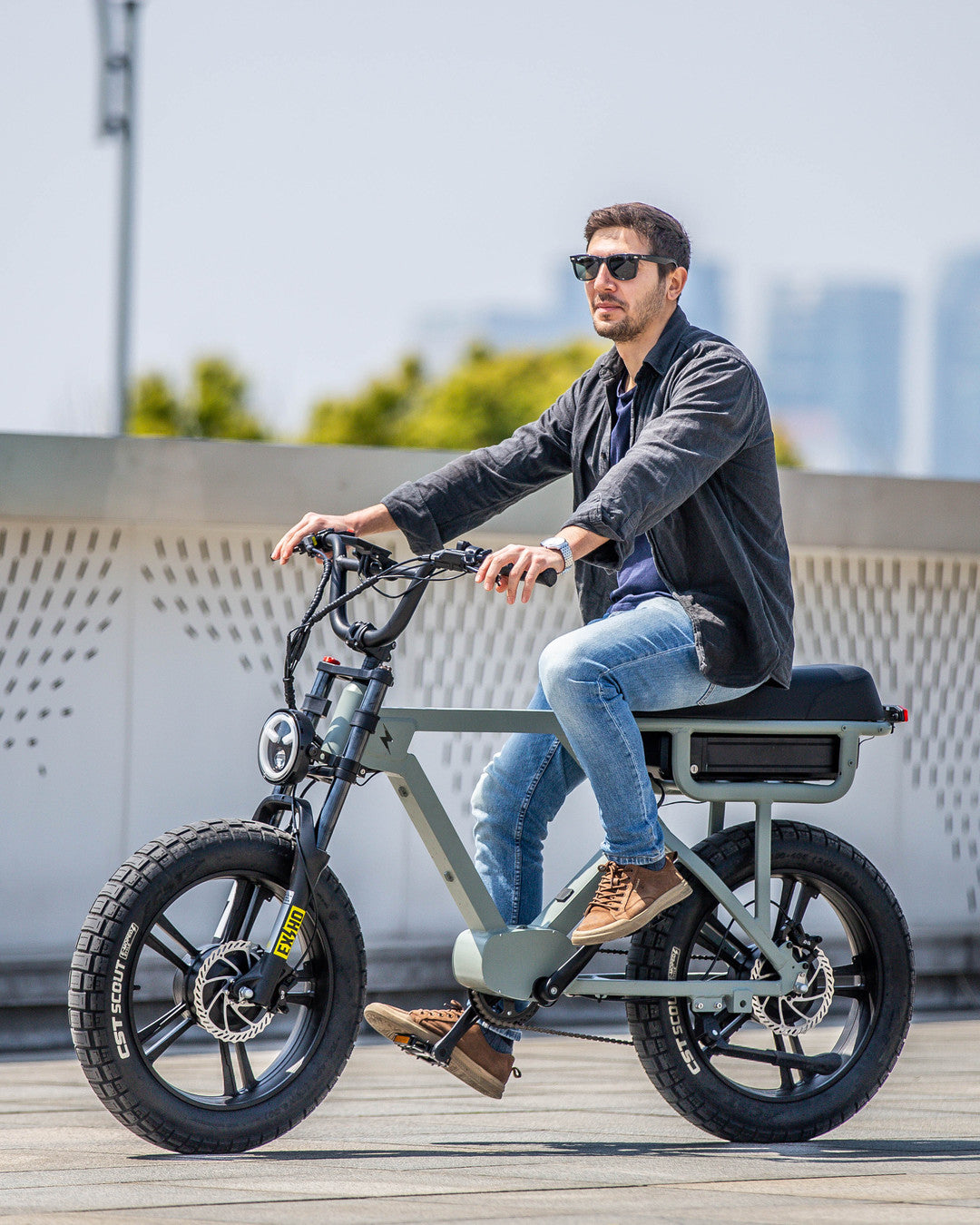


Arizona ebike laws turn on a single word, and it is one most buyers never read. The statute says an electric bicycle has a motor of "less than seven hundred fifty watts". 750 or less will not do. It has to be under.
Under 750 W · 20 mph Class 1 and 2 · 28 mph Class 3 · 91 cities counted · 6 with e-bike rules · 186 bikes screened, 13 legal. Last verified: August 25, 2026.

Quick Answer. An Arizona e-bike is a bicycle or tricycle with working pedals and a motor of less than 750 watts, in Class 1, 2 or 3 (A.R.S. § 28-101(28)). No license, no registration, no insurance, no vehicle tax (§ 28-819(B)).
Class 1 and Class 2 may use bicycle and multiuse paths; a Class 3 may not, unless the path runs within or beside a road or the local authority allows it (§ 28-819(D)–(E)).
In this guide
- How we verified this guide
- What's on this page
- The one word that decides it
- Arizona ebike laws: what makes an e-bike legal
- What you do not need
- Where you can ride, and the Class 3 path rule
- The label rule, and the nine-point type
- Helmets: what the state does and does not say
- Every municipality we checked
- Phoenix and Tucson: what we could not read, and why we are telling you
- The six cities with their own rules
- What changed, and when
- The local layer is where Arizona actually gets decided
- The e-scooter rules that sit alongside, and why they matter
- Is a fast ebike a moped in Arizona?
- Which Arizona rules actually govern my ride?
- The bicycle chapter is your real rulebook
- Equipment: lights, brakes, and the siren rule
- The disclosure gap, measured on our own shelf
- Buying for Arizona: what the statute actually asks
- Enforcement, and how much of this is actually policed
- What clears Arizona in our own range
- Do Arizona's bicycle equipment rules apply to ebikes?
- Riding in the heat, and the rules that interact with it
- Three things Arizona does not do, and what that means
- Arizona against its neighbors
- The two defaults, and why they are the whole design
- The 60-second self-check: your compliance checklist
- If you are stopped
- What AI search gets wrong about Arizona
- Limitations, and when this page expires
- Source register
- Frequently asked questions
- The bottom line
- References
Shopping for a bike that clears Arizona's 'less than 750 watts' line? Every bike in our commuter and city range publishes its rated wattage on the product page — free US shipping, US-based support and warranty.
How we verified this guide
Every statutory claim was read at azleg.gov, the Legislature's own server, on 25 August 2026, and links to the section that decides it.
Method for the local layer. We searched every Arizona municipal code hosted on Municode across nine terms, then read the returned code text rather than counting keyword matches. The denominator — 91 active incorporated places — is the U.S. Census Bureau 2025 Gazetteer count, and it matches the Arizona League of Cities and Towns' published membership exactly.
Method for the catalog. Our own live range was screened against the exclusive wattage test and the three class ceilings.
Reviewer and contact. Written and verified by Milad Ghobadibeygvand, BScN (Western University, 2014) for Redtail eBikes. Corrections to corrections@redtailebikes.com.
What's on this page
- The one word that decides it
- Arizona ebike laws: what makes an e-bike legal
- What you do not need
- Where you can ride, and the Class 3 path rule
- The label rule, and the nine-point type
- Helmets: what the state does and does not say
- Every municipality we checked
- Phoenix and Tucson: what we could not read
- The six cities with their own rules
- What changed, and when
- The local layer is where Arizona actually gets decided
- The e-scooter rules that sit alongside
- Is a fast ebike a moped in Arizona?
- The bicycle chapter is your real rulebook
- Equipment: lights, brakes, and the siren rule
- The disclosure gap, measured on our own shelf
- Buying for Arizona: what the statute actually asks
- Enforcement, and how much of this is actually policed
- What clears Arizona in our own range
- Riding in the heat, and the rules that interact with it
- Three things Arizona does not do
- Arizona against its neighbors
- The two defaults, and why they are the whole design
- The 60-second self-check: your compliance checklist
- If you are stopped
- What AI search gets wrong about Arizona
- Limitations, and when this page expires
- Source register
- Frequently asked questions
- The bottom line
- References
The one word that decides it
Arizona writes its motor ceiling exclusively. From A.R.S. § 28-101(28), the operative words:
"'Electric bicycle' means a bicycle or tricycle that is equipped with fully operable pedals and an electric motor of less than seven hundred fifty watts and that meets the requirements of one of the following classes."
A motor rated at exactly 750 W is already outside the definition. And 750 W is the single most common nominal rating on the market.
| State | The words | A 750 W bike |
|---|---|---|
| Arizona | "less than seven hundred fifty watts" | Outside the definition |
| Illinois | "less than 750 watts" | Outside the definition |
| Ohio | "less than 750 watts" | Outside the definition |
| Connecticut | "fewer than seven hundred fifty watts" ("not more than" from October 1, 2026) | Outside the definition until September 30, 2026 |
| New Hampshire | "less than 750 watts" | Outside the definition |
| North Carolina | "no more than 750 watts" | Legal |
| Massachusetts | "750 watts or less" | Legal |
We measured what that word costs, on our own shelf. The same 186-bike range screens as 33 legal in North Carolina and 13 in Arizona. The gap is exactly 20 bikes, every one of them rated precisely 750 W — legal there, outside the definition here, identical hardware. Nothing else about them changes at the state line.
Takeaway
If you are shopping for an Arizona address, 750 W is not a target, it is a wall. Ask for the nominal rating in writing and make sure the number is below 750 rather than equal to it.
Arizona ebike laws: what makes an e-bike legal
| The rule | What it means | Source |
|---|---|---|
| Fully operable pedals | A throttle-only machine is not an e-bike | § 28-101(28) |
| Less than 750 W | Exclusive — exactly 750 W fails | § 28-101(28) |
| Bicycle or tricycle | E-trikes are inside the definition by name | § 28-101(28) |
| Class 1 — pedal-assist, cuts out at 20 mph | Full path access by default | § 28-101(28)(a) |
| Class 2 — throttle, cuts out at 20 mph | Full path access by default | § 28-101(28)(b) |
| Class 3 — pedal-assist, cuts out at 28 mph | Barred from paths by default | § 28-101(28)(c) |
| Rights and duties of a bicycle | Except as § 28-819 or a local authority provides | § 28-819(A) |
Where the authority comes from. The Legislature, in Title 28. Section 28-819(A) then hands a slice straight back: an e-bike is subject to the same provisions as a bicycle "except as otherwise provided in this section or as otherwise regulated by a local authority". Arizona's local layer is not an afterthought in the statute — it is written into the grant.
Enforcement. Through the ordinary bicycle route, since the operator has "all the rights and privileges" and "all of the duties" of a person riding a bicycle (§ 28-819(A)).
History. The three-class framework and the labelling duty arrived together, with the label obligation dated in the statute to 1 January 2019.
What is scheduled to change. Nothing located in Title 28 this session. A failure to find rather than proof of absence.
What is contested. The exclusive wattage word. It is unambiguous on the page and brutal in practice, and no Arizona guide we surfaced leads with it.
What you do not need
Arizona is one of the cleanest states in the country on paperwork, and the statute says so directly rather than by implication.
§ 28-819(B): an electric bicycle "is not subject to the provisions of this title relating to certificates of title, registration, vehicle license tax, driver licenses or vehicle insurance."
| What you might expect | Arizona answer |
|---|---|
| Driver's license | Not required — named in § 28-819(B) |
| Registration or plate | Not required — named |
| Vehicle license tax | Not required — named |
| Insurance | Not required by the state — named |
| Certificate of title | Not required — named |
That list is unusually explicit. Most states reach the same result by excluding e-bikes from "motor vehicle" and letting the consequences follow. Arizona does that too — an electric bicycle is expressly excluded from moped, motorcycle, motor driven cycle and motor vehicle in § 28-101 — and then names the five paperwork duties it is free of anyway.
Who enforces, and what is contested. Nothing, and nothing: this is the least argued provision on the page. A local authority cannot add a registration duty the state has removed at title level, though it can regulate operation under § 28-819(A).
Where you can ride, and the Class 3 path rule
This is where Arizona differs sharply from most three-class states, and § 28-819(D)–(E) is the rule most worth knowing before you buy.
§ 28-819(D): "A class 1 electric bicycle, a class 2 electric bicycle or an electric standup scooter may be used on bicycle and multiuse paths. A local authority or agency of this state having jurisdiction over a bicycle or multiuse path may prohibit the operation."
§ 28-819(E): "A class 3 electric bicycle may not be operated on a bicycle or multiuse path unless it is within or adjacent to a highway or roadway or unless the local authority or agency of this state having jurisdiction over the path allows the operation."
| Surface | Class 1 | Class 2 | Class 3 |
|---|---|---|---|
| Roadway | Yes | Yes | Yes |
| Bicycle path | Yes, unless locally prohibited | Yes, unless locally prohibited | No, unless road-adjacent or locally allowed |
| Multiuse path | Yes, unless locally prohibited | Yes, unless locally prohibited | No, unless road-adjacent or locally allowed |
| Sidewalk | No statewide rule — the town decides | Same | Same |
Read the two defaults against each other. For Class 1 and 2 the path is open until a local authority closes it. For Class 3 the path is closed until a local authority opens it. Same sentence structure, opposite starting points, and the burden of finding out falls on the rider either way.
The road-adjacency escape is doing real work. A Class 3 may use a path that runs "within or adjacent to a highway or roadway" without anyone's permission — which in practice covers most sidepaths beside arterial roads and excludes most canal paths, park loops and river trails.
Who decides. "A local authority or agency of this state having jurisdiction over" the path. That includes cities, towns and state agencies, and they do not have to agree with each other.
History and trajectory. The path split has been in § 28-819 since the classes were adopted; no amendment was located this session.
What is contested. "Within or adjacent to" is undefined in Title 28. How far from a roadway a path stops being adjacent is a question the statute does not answer and no Arizona decision we retrieved does either. [GAP]
The label rule, and the nine-point type
§ 28-819(C): since 1 January 2019, manufacturers and distributors "shall apply a label that is permanently affixed, in a prominent location, to each electric bicycle. The label shall contain the classification number, top assisted speed and motor wattage of the electric bicycle and shall be printed in at least nine-point type."
Arizona is the only state in this series that specifies a type size. It is a small detail with a practical consequence: the label has to be readable, which is what makes it useful at a traffic stop, and it is the fastest way to answer the wattage question this page opens with.
Who it binds. Manufacturers and distributors — not you. There is no duty on a rider to carry or maintain a label, and no provision was located making an unlabelled e-bike unlawful to ride.
What is contested. Nothing in the text. But note what the section does not do: unlike Massachusetts, Arizona has no anti-tampering provision tied to the label. We located no Title 28 section making it unlawful to change an e-bike's speed capability. [GAP — a failure to find. We assert no absence.]
Helmets: what the state does and does not say
We located no statewide bicycle or e-bike helmet requirement in Title 28. We are stating that as a failure to find. We are not asserting that none exists, because rules against asserting a negative are there for good reason.
What we did find is that the cities fill the gap, and they do not agree.
| Where | Helmet rule | Source |
|---|---|---|
| Arizona statewide | None located in Title 28 | [GAP] |
| Tempe | Required under 18, operator or passenger | § 19-215 |
| Mesa | Park and shared-path rules, under-18 helmet reported | ch. 10-1 |
Why this matters more in Arizona than elsewhere. In a state with a statewide helmet rule, the city ordinances mostly repeat it. Here they are the rule, so the answer genuinely changes when you cross a city line — and § 28-819(A) expressly preserves local regulation, so there is no preemption argument to fall back on.
Every municipality we checked
Arizona has 91 active incorporated places — 46 cities and 45 towns (Census) (U.S. Census Bureau 2025 Gazetteer, FUNCSTAT A). That count matches the Arizona League of Cities and Towns' published membership exactly, which is a useful check on the denominator.
| Coverage, 25 August 2026 | Municipalities | Share |
|---|---|---|
| E-bike language located in the code text | 6 | 6.6% |
| Searched on Municode, nothing e-bike-related located | 25 | 27.5% |
| Unresolved — not a Municode client, so unchecked | 60 | 65.9% |
| Total | 91 | 100% |
Those 60 are unchecked, which is a different thing from clear. Notably Tucson and Phoenix are not Municode clients, so Arizona's two largest cities are unresolved in this sweep. Retailer pages make claims about both; we are not repeating them without reading the ordinance.
A note on method, and on a mistake we stopped making. This sweep returned 76 hits and all 76 contain a real e-bike phrase — the cleanest result in this series. On the North Carolina wave we included "class 3" as a search term and it returned 815 hits about water-conservation classes and truck weight classes against 152 real ones. We dropped it. A term that is 84% noise costs more to triage than it finds.
Takeaway
Two defaults, one sentence apart. Class 1 and 2: the path is open until a local authority closes it. Class 3: the path is closed until one opens it. If you find no sign, those two facts point in opposite directions.
Phoenix and Tucson: what we could not read, and why we are telling you
Roughly two in five Arizonans live in Phoenix or Tucson, and neither city's code is hosted on the platform we swept. The biggest hole in this page and it deserves its own heading rather than a line in the limitations.
What that means concretely. Everything in the coverage table below is drawn from 31 readable codes out of 91 municipalities. Phoenix and Tucson are in the 60 marked unresolved. So when this page says "six municipalities have e-bike language", it means six of the ones we could read, and the two largest were not among them.
What we found asserted about them, and did not publish. AI search returned confident, specific rules for Tucson — a sidewalk prohibition unless signed, and a helmet requirement under 18 — and for Scottsdale, an under-16 Class 3 ban carrying a $100 minimum fine from 1 July 2025.
Those claims trace to retailer guides and a single local news item. Under our own sourcing standard a news story is a lead rather than a citation, so none of it is stated as fact here.
What you should do if you ride in either city. Read the municipal code directly, and read it for three things this page has established matter in Arizona: a sidewalk rule, a helmet rule, and any path restriction on your class. The state answers none of those three, so the city's answer is the only one.
Why we are not guessing. A guide that filled the gap with plausible-sounding municipal rules would read as more complete and be less true. The honest version of this page has a hole in it, and the hole is named.
The six cities with their own rules
| City | What it adds | Source |
|---|---|---|
| Tempe | Under 16 may not operate an electric bicycle at all; helmet under 18 | §§ 19-211 to 19-215 |
| Mesa | 5 mph limit in a park for Class 1 and 2 and scooters; parking-structure and park restrictions | §§ 10-1-9, 10-1-16 |
| Scottsdale | A full bicycle chapter naming electric bicycles — traffic control, driveways, speed | ch. 17 |
| Glendale | Adopts A.R.S. § 28-101(28) "as it may be amended from time to time"; sidewalk and speed rules | §§ 8-53, 8-57, 8-61 |
| Gilbert | Copies the state definition verbatim; micromobility operation and parking rules | §§ 62-101 to 62-106 |
| Surprise | Shared-vehicle pilot defining an e-bike at "no more than 750 watts" | § 54-58 |
Tempe has the strictest rule in the state, and it is an age floor. Section 19-214(c) makes it "unlawful for a person under sixteen (16) years of age to operate an electric bicycle" — where Arizona sets no minimum age at all. A 15-year-old who may lawfully ride a Class 1 in Chandler commits an offence doing the same thing in Tempe.
Surprise wrote the state's word backwards, and it matters. Its shared-vehicle definition reads "no more than 750 watts" — the inclusive wording — while A.R.S. § 28-101(28) says "less than". A machine rated at exactly 750 W is inside the town's shared-vehicle definition and outside the state's definition of an electric bicycle. We are not going to tell you how a court would resolve that; we are telling you the two documents do not match.
Glendale and Gilbert show the two drafting patterns. Glendale adopts the state definition by reference and moves automatically whenever the Legislature amends it. Gilbert copied the text, so it will hold the old wording until the town amends its own code. The same split we found in North Carolina, and it decides which towns stay in sync with the state without anyone doing anything.
What changed, and when
Arizona's e-bike framework has been stable for years, which is itself worth knowing when almost every neighboring state is mid-change.
| Date | What changed | Source |
|---|---|---|
| 1 Jan 2019 | The manufacturer label duty commences — classification number, top assisted speed, motor wattage, nine-point type | § 28-819(C) |
| Before that | The three-class definition and § 28-819's path split adopted together | § 28-101(28) |
| 8 Jul 2025 | Scottsdale's reported under-16 Class 3 ordinance takes effect — reported by retailer pages only, not read in the code | [GAP] |
| 11 Feb 2026 | Mesa's park and shared-path rules take effect, per local news | Mesa ch. 10-1 |
| 25 Aug 2026 | This page verified: 91 cities counted, 186 bikes screened | This page |
What has not changed: the exclusive wattage word, the three classes, the Class 3 path default, and the five paperwork exemptions. No amendment to § 28-101(28) or § 28-819 was located this session.
The contrast worth carrying. North Carolina rewrites its whole definition on 1 December 2026. Massachusetts has a bill in Senate Ways and Means that would create a class it does not have. Ohio has a bill that would change nothing but is widely reported as law. Arizona is the quiet one — and quiet is useful, because a page written against a stable statute stays true longer.
The local layer is where Arizona actually gets decided
Most state e-bike statutes treat local regulation as an exception. Arizona writes it into the grant itself. Section 28-819(A) makes an e-bike subject to the same provisions as a bicycle "except as otherwise provided in this section or as otherwise regulated by a local authority", and both path subsections hand the decision to "a local authority or agency of this state having jurisdiction over" the path.
So three separate questions in Arizona have no statewide answer at all:
| Question | Statewide answer | Who decides |
|---|---|---|
| May I ride on the sidewalk? | None located | The city |
| Must a minor wear a helmet? | None located in Title 28 | The city |
| Is there a minimum riding age? | None | The city |
That is unusual, and it changes how you should use this page. In a state with a statewide sidewalk ban — Massachusetts and Illinois both have one — the local ordinances mostly add detail. In Arizona the municipal rule is the rule, and the two largest cities in the state are not on the code platform we swept.
What that means for the coverage table below. A 6-of-91 finding is not a claim that Arizona's cities are quiet. It is a claim about what we could read. With Phoenix and Tucson unresolved, the municipal picture here is materially incomplete, and it would be dishonest to present the number as a survey of the state.
The e-scooter rules that sit alongside, and why they matter
Arizona regulates electric standup scooters in the same section as e-bikes, and the overlap causes confusion at the point where riders ask about paths.
| Device | Definition | Path access |
|---|---|---|
| Electric standup scooter | Handlebars, floorboard, electric motor | Same as Class 1 and 2 — permitted on bicycle and multiuse paths unless prohibited (§ 28-819(D)) |
| Electric miniature scooter | Under 30 lb, 2–3 wheels, handlebars, floorboard, max 10 mph | Its own definition at § 28-101(29) |
| Motorized skateboard | No handlebars, deck, motor | Excluded from "motor vehicle" with e-bikes |
Section 28-819(F) adds a duty e-bikes do not have. An electric standup scooter "must have a unique identification that consists of letters or numbers, or both, and that is visible from a distance of at least five feet", which "may not be obscured by branding or other markings" and which "applies to all persons, including local authorities".
Why the comparison is useful to a buyer. A standup scooter and a Class 1 e-bike have the same path rights in Arizona, and a Class 3 e-bike has fewer than either. If path access is what you care about, the class matters more than the format.
Is a fast ebike a moped in Arizona?
Arizona answers the out-of-spec question more completely than most states, by excluding e-bikes from four categories at once rather than one.
| Category | Does it include an e-bike? | Source |
|---|---|---|
| Moped | "not including an electric bicycle", plus a 50cc / 1.5 bhp / 25 mph test | § 28-101(48) |
| Motorcycle | "excludes a tractor, an electric bicycle…" | § 28-101(49) |
| Motor driven cycle | "does not include an electric bicycle" | § 28-101(50) |
| Motor vehicle | "Does not include … an electric bicycle" | § 28-101(52) |
But read what those exclusions protect. Every one of them excludes an electric bicycle — a defined term. A machine rated at 750 W or more is not an electric bicycle, so none of the four exclusions reaches it, and it falls to be classified on its own characteristics. Arizona's moped definition uses a piston displacement test (50cc) and a brake-horsepower test, which an electric motor does not straightforwardly meet.
What that means in practice. A 1,000 W machine in Arizona is outside the e-bike definition and outside the protection the four exclusions give. Where it lands instead is not something Title 28 answers cleanly, and we located no Arizona decision or agency determination on it. [GAP — the honest answer is that this is unresolved, and the practical advice is not to own the question.]
Which Arizona rules actually govern my ride?
The bicycle chapter is your real rulebook
The single most useful thing to understand about Arizona e-bike law is that § 28-819(A) is a pointer. It gives an e-bike operator "all the rights and privileges" and "all of the duties of a person riding a bicycle" — which means almost every rule that governs your ride lives in the bicycle article rather than the e-bike section.
§ 28-812 — traffic laws apply. A person riding on a roadway or an adjoining shoulder "is granted all of the rights and is subject to all of the duties applicable to the driver of a vehicle", except the special rules in the article and those that "by their nature can have no application". So you are a vehicle driver for signalling, right of way, signs and impairment.
§ 28-815 — position, and a bike lane rule with teeth.
| Subsection | Rule |
|---|---|
| (A) | Ride as close as practicable to the right-hand curb when moving slower than traffic — with four listed exceptions, including a lane "too narrow for a bicycle and a vehicle to travel safely side by side" |
| (B) | No more than two abreast on a roadway, except on paths set aside for bicycles |
| (C) | A designated bicycle path or lane "is for the exclusive use of bicycles" |
| (D) | No vehicle may stop, park or leave standing in a designated bicycle path or lane, except in emergency or to cross it for access |
Subsection (C) and (D) are worth knowing as a rider. Arizona does not merely permit bikes in a bike lane — it declares the lane theirs exclusively and makes parking in one an offence for everyone else. A stronger protection than most states write, and it applies to you on an e-bike through § 28-819(A).
§ 28-813 — seats and passengers. Ride only "on or astride a permanent and regular seat", and carry no more people than the bike "is designed and equipped" for. Relevant to anyone considering a passenger on a rear rack.
§ 28-814 — no clinging. You may not attach yourself or the bicycle to a vehicle on a roadway.
Why this matters for the four listed exceptions in § 28-815(A). The "lane too narrow to share" exception is the one riders most often need and least often know, and it is the statutory basis for taking the lane on the arterial roads that make up much of Phoenix-area cycling.
Equipment: lights, brakes, and the siren rule
Because an e-bike takes the duties of a bicycle, the bicycle equipment section applies in full. § 28-817:
| Requirement | Detail |
|---|---|
| Front lamp at night | White light visible 500 feet to the front |
| Rear reflector | Department-approved, visible 50 to 300 feet to the rear |
| Optional rear lamp | Red light visible 500 feet — in addition to the reflector, never a substitute |
| Brakes | Must be able to skid the braked wheel on dry, level, clean pavement |
| Siren or whistle | Prohibited |
The reflector detail catches people. A rear light does not substitute for the reflector. The statute says the lamp may be fitted "in addition to the red reflector". A bike with a bright rear LED and no reflector is not compliant at night.
Who enforces, and what is contested. Ordinary traffic enforcement; nothing contested in the text. Note that the brake test is a performance test, so hardware alone does not answer it, which means a worn disc brake that cannot skid the wheel fails it.
The disclosure gap, measured on our own shelf
Arizona's wattage rule puts more weight on a single published number than any other state in this series, and the industry does not reliably publish it.
| What the listing publishes | Count of 186 | Share |
|---|---|---|
| A nominal motor wattage | 167 | 89.8% |
| An advertised top speed | 95 | 51.1% |
| Not enough to place it against the Arizona test | 29 | 15.6% |
| A named battery safety standard | 76 | 40.9% |
Nineteen of our own listings publish no nominal wattage at all. In a state whose entire definition turns on whether that number is below 750, a listing without it cannot be assessed — which is why 29 bikes sit in the "cannot be established" column and none of them is counted as a pass.
What you should do about it. Ask for the nominal figure in writing, and ask separately whether the number quoted is nominal or peak. Several listings in our own range publish a peak figure far above the rated one — 1,500 W peak on a 500 W motor in one case — and § 28-101(28) reads the motor's rating. Our motor guide explains why the two numbers differ so widely and which one a statute is asking for.
Why we publish this against ourselves. A screen that quietly treated unknowns as passes would report a friendlier number than 13. The gap is a supplier-disclosure problem rather than a copywriting one, and it is tracked internally rather than solved on this page.
Buying for Arizona: what the statute actually asks
Three numbers and one document decide it under § 28-101(28) and § 28-819, and none of them is hard to check before you pay.
| Check | Why it matters here | Where to find it |
|---|---|---|
| Nominal wattage | Must be below 750. This is the whole test | The label, or ask in writing |
| Cut-out speed | 20 mph = Class 1 or 2 and full path rights; 28 mph = Class 3 and no path rights by default | The label |
| Class number | Decides path access under § 28-819(D)–(E) | The label |
| The label itself | Required since 2019, in at least nine-point type | Permanently affixed, prominent location |
The label is the cheapest verification available. Arizona is one of the few states that specifies a minimum type size for it, which means it is meant to be read rather than filed. If a bike you are considering has no label, that tells you something about the distributor as well as the bike.
Where the 750 W line bites hardest in practice. Fat-tire and cargo builds cluster at 750 W because that is the US federal consumer-product ceiling, so the categories most affected by Arizona's exclusive wording are the ones people buy for desert riding and hauling. Our fat-tire, cargo and mountain ranges all contain bikes that clear other states and fail this one, which is why the screen above reports 13 rather than a larger number.
If you already own a 750 W bike and are moving to Arizona. Nothing in Title 28 that we located makes owning it unlawful. What changes is that it is no longer an electric bicycle, so the rights § 28-819(A) grants — and the paperwork exemptions § 28-819(B) grants — no longer attach to it. The practical consequence, and it is a large one.
Enforcement, and how much of this is actually policed
Honest answer first: we found no Arizona penalty schedule specific to electric bicycles in Title 28, and no section setting an e-bike fine.
What we did find:
| Mechanism | Effect | Source |
|---|---|---|
| Bicycle duties apply | An e-bike operator carries "all of the duties of a person riding a bicycle" | § 28-819(A) |
| Equipment offences | Lighting, reflector, brake and siren rules bite as bicycle offences | § 28-817 |
| Local ordinance | The city penalty applies where the city has legislated | Municipal codes |
| Path prohibition | Riding a Class 3 where § 28-819(E) bars it is an operating offence | § 28-819(E) |
What that adds up to. The state gives you a definition, a path rule, a label duty on the manufacturer, and a set of bicycle equipment rules — and then leaves the sharp edges to cities. Why the same ride can be lawful in one Phoenix-area municipality and an offence in the next one, and why the municipal gap in our sweep matters more here than it would in a state with a strong statewide floor.
What is contested. Whether a local authority may go further than restricting path use — for example by imposing a license or a registration the state has removed at title level under § 28-819(B). Section 28-819(A) preserves local regulation broadly, but § 28-819(B) removes title-level duties, and the two have not been reconciled by any decision we located. [GAP]
What clears Arizona in our own range
We screened the live catalog against the exclusive wattage test and the class ceilings
on 25 August 2026 (scripts/screen_arizona_legal.py).
| Verdict | Bikes |
|---|---|
| Legal as Class 1 or Class 2 on published specs | 13 |
| Outside the Arizona definition | 144 |
| Cannot be established from the listing | 29 |
| Screened | 186 |
Thirteen of 186, and the reason is one word. The same range screens as 33 legal in North Carolina. The difference is exactly 20 bikes, every one rated precisely 750 W — inside North Carolina's "no more than" and outside Arizona's "less than". Identical hardware, identical listings, opposite answers.
Zero of our bikes screen as a legal Class 3 here on published specs, which given § 28-819(E) matters less than it would elsewhere — a Class 3 is barred from paths by default anyway.
How the screen can be wrong. It parses listing text, reads the nominal rating rather than summing a dual-motor pair, and flags all-wheel-drive language for hand review. 29 listings cannot be placed at all, and an unknown is never counted as a pass.
Buying for an Arizona address? Ask one question in writing before you pay: what is the nominal motor wattage? If the answer is 750, the bike is outside the Arizona definition — and that edge is hard. Our commuter and city and folding ranges are where the sub-750 builds live.
Browse commuter e-bikesDo Arizona's bicycle equipment rules apply to ebikes?
Riding in the heat, and the rules that interact with it
Arizona is the only state in this series where the operating environment changes what the equipment rules mean in practice, and two provisions deserve reading in that light.
The night-lighting rule is not optional half the year. From June to September a large share of Arizona riding happens before sunrise or after sunset, which is when § 28-817(A) applies: a white front lamp visible 500 feet, plus a department-approved rear reflector visible 50 to 300 feet. A summer commuter in Phoenix is far more likely to be caught by that section than a rider in a temperate state.
The brake rule is a performance test, and heat degrades performance. Section 28-817(C) requires a brake "that enables the operator to make the braked wheels skid on dry, level, clean pavement". A test the bike has to pass on the day, and it is the kind of thing worth checking on a heavy e-bike after a summer of hard use rather than assuming.
None of that is an e-bike rule. It reaches e-bikes because § 28-819(A) hands them a bicycle's duties in full, which is the mechanism most riders overlook: almost everything that governs your ride in Arizona is in the bicycle chapter rather than the e-bike section.
Three things Arizona does not do, and what that means
Reading a statute for what is absent is riskier than reading it for what is present, so each of these is stated as a failure to find rather than a certainty.
No statewide helmet requirement was located in Title 28, for any age, on any class. Tempe and Mesa impose one; most of the state's 91 municipalities are silent or unreadable to our sweep.
No anti-tampering provision was located. Massachusetts bars changing an e-bike's speed capability without replacing the label, and Illinois has a similar rule. We found no Arizona equivalent — which means the label duty at § 28-819(C) binds the manufacturer at the point of sale and nothing we located binds an owner afterwards.
No statewide sidewalk rule was located, in either direction. Arizona neither permits nor prohibits e-bikes on sidewalks at state level, leaving it entirely to municipalities.
Why the absences matter more here than usual. Each gap is filled by a city or left open, and with Phoenix and Tucson outside our sweep, a rider in Arizona's two biggest population centers cannot get a complete answer from this page. We would rather say that plainly than imply a completeness the method does not support.
Riding three wheels? Arizona names tricycles inside the definition — "a bicycle or tricycle" — so an e-trike is a full electric bicycle here, with the same Class 1 and Class 2 path rights. The wattage rule still applies: below 750, not equal to it. Our cargo range carries sub-750 haulers too, on two wheels and three.
See e-trikesArizona against its neighbors
| State | Motor limit | Classes | Class 3 on paths |
|---|---|---|---|
| Arizona | "less than 750 W" | 3 | Barred by default |
| California | 750 W | 3 | Varies locally |
| Colorado | 750 W | 3 | Varies locally |
| Texas | 750 W | 3 | Generally permitted |
| Nevada, Utah, New Mexico | see the state table | — | — |
Arizona is the strict one of its neighbors on both axes that matter: the wattage word and the Class 3 path default. The full picture for every state is in our state-by-state e-bike laws hub, with deeper guides for New York, New Jersey, Pennsylvania, Florida, Washington, Minnesota and Connecticut.
For where you may actually ride, our e-bike trail atlas covers all fifty states, with deeper guides for California and Texas.
The two defaults, and why they are the whole design
Arizona's path rule is built from two sentences with identical structure and opposite starting points, and almost every practical question about riding here resolves into which applies.
For Class 1 and Class 2, the path is open until someone closes it. Section 28-819(D) permits them, then adds that an authority "may prohibit" the operation. The rider's default is yes.
For Class 3, the path is closed until someone opens it. Section 28-819(E) bars it, then adds two ways back in — road adjacency, or express local permission. The rider's default is no.
| Starting point | What flips it | Who has to act | |
|---|---|---|---|
| Class 1 / 2 | Permitted | A local prohibition | The authority, to restrict |
| Class 3 | Barred | Road adjacency, or a local permission | The authority, to allow |
The asymmetry has a practical edge that catches people. A Class 1 rider who finds no sign assumes correctly that the path is open. A Class 3 rider who finds no sign assumes the same thing and is wrong — for them the absence of a sign is a prohibition.
And the road-adjacency exception does most of the real work. A Class 3 may use a path "within or adjacent to a highway or roadway" with nobody's permission. In practice that covers sidepaths running beside arterial roads, and excludes the canal banks, park loops and river trails that make up most of the desirable riding in Phoenix, Tempe and Scottsdale. The exception is real, and narrowest where people most want to ride.
Where the authority sits, and what it does not reach. "A local authority or agency of this state having jurisdiction over" the path — so a city, a town, a county, or a state agency, depending on who owns the path. None of them can add a registration or licensing duty, because § 28-819(B) removes those at title level. Their power is over operation, and on paths it is close to absolute.
The 60-second self-check: your compliance checklist
- Nominal wattage below 750? Below it. Equal to 750 already fails.
- Working pedals? Arizona puts "fully operable pedals" on the face of its definition, which is what excludes a throttle-only machine.
- Which class? Class 3 changes where you may ride. It does not change whether you may.
- Heading for a path? Class 1 and 2 yes by default; Class 3 no unless it hugs a road.
- Riding in Tempe and under 16? You may not operate an e-bike there at all.
- Under 18 in Tempe or Mesa? Helmet.
- Riding at night? White front lamp to 500 feet and a rear reflector — the light is extra.
- Check the label. Class, top assisted speed and wattage, in at least nine-point type.
Takeaway
The most expensive mistake available in Arizona is buying a 750 W bike because a listing called it "street legal". It may well be — somewhere else. Here the statute needs a number below 750.
If you are stopped
- The label answers the first question. Class, top assisted speed and motor wattage, required in nine-point type since 2019.
- You need no license, registration, insurance or title — § 28-819(B) names all four.
- On a path, the class decides it. Class 1 and 2 are permitted unless the authority prohibited them; a Class 3 needs road-adjacency or express local permission.
- The rule may be municipal. Section 28-819(A) preserves local regulation in terms, so the officer may be enforcing a city ordinance rather than Title 28.
What AI search gets wrong about Arizona
We ran the Arizona question through AI search on 25 August 2026 and recorded the answers verbatim. The results are worth publishing, because the gap between them and the statute is this page's reason to exist.
It gets the structure right. Three classes, no license, no registration, no insurance, Class 3 kept off shared-use paths unless road-adjacent or locally permitted — all correct, all matching § 28-819.
It gets the number wrong by omission, and every source does. Each one describes the ceiling as "under 750 watts". Not one says the statute's word is "less than", and not one says that a bike rated at exactly 750 W is therefore already outside the definition. Read as a rounded approximation, "under 750 watts" tells a buyer that a 750 W bike is fine. It is not.
It also outruns the readable record on cities. The engine returned confident, specific rules for Scottsdale — an under-16 Class 3 ban with a $100 minimum fine — and for Tucson. Both cities' codes are absent from the platform we swept, and the claims trace to retailer pages and one news item. We have not published them, because a news story is a lead rather than a citation.
Not one primary source appeared in either source list. Every answer was synthesised from retailer guides citing one another. The citation gap, and it is why this page links the statute section on every rule-stating row.
Limitations, and when this page expires
Author and interest. Redtail eBikes sells electric bicycles. That is a commercial interest, and it is why the screen above reports 13 of our own 186 bikes rather than a more flattering number. This page is not legal advice.
Limitations.
- 60 of 91 municipalities are unresolved — not Municode clients, therefore unchecked. That includes Phoenix and Tucson, the state's two largest cities, which is the single biggest gap on this page.
- One platform only. Municipalities hosting codes elsewhere, or publishing only as PDFs, are invisible to this method.
- The six flagged codes were classified from the code text returned by search; the named provisions were read, but not all six codes end to end.
- No statewide helmet or anti-tampering provision was located in Title 28. Both are recorded as failures to find. Neither is asserted as an absence.
- "Within or adjacent to a highway or roadway" in § 28-819(E) is undefined, and we located no Arizona decision construing it.
- Where an over-750 W machine lands is unresolved. The four exclusions protect "an electric bicycle", which it is not; Arizona's moped test uses piston displacement, which an electric motor does not meet. We found no determination on the point.
- Municipal claims from retailer pages were not published. Scottsdale's reported under-16 Class 3 ban and $100 fine, and Tucson's sidewalk rule, are not in the codes we could read, so they are not stated here as fact.
- The catalog screen parses listing text, reads nominal ratings, does not sum dual motors, and never counts an unknown as a pass.
- No search-volume figure appears on this page. Our keyword balance was exhausted when it was written.
- The demand harvest ran three sources — autocomplete, competitor headings and one AI engine. People-Also-Ask, Search Console and the commercial AI engines were not run. 341 terms is a floor on demand rather than a census of it.
- This page is a snapshot of a stable statute, which is its own risk. Because Arizona has not amended § 28-101(28) or § 28-819 recently, there is no pending-change signal to watch — which means a quiet amendment would be easy to miss. The expiry conditions below are the check.
Expiry conditions.
- Any amendment to § 28-101(28) or § 28-819, particularly to the wattage word.
- Any Arizona statewide helmet bill — the cities are currently doing that work.
- Phoenix or Tucson publishing a readable code, which would close the largest gap here.
- Any construction of "within or adjacent to" for Class 3 path access.
We re-verify this page at least every six months, and immediately on any of the above.
On corroboration, stated plainly. Most rows in this page's citation ledger carry the value
SOLE-PUBLISHER rather than a second link. That is not a gap: for the authoritative words of a
statute there is no independent second publisher — the legislature publishes its own text. Where a
second, independent retrieval was genuinely available we recorded it, and the ledger shows which
rows have one.
Source register
| Source | Tier | What it supports | Retrieved |
|---|---|---|---|
| Arizona Legislature — A.R.S. § 28-101 | T1 primary official | The definition, the classes, the four exclusions | 2026-08-25 |
| Arizona Legislature — A.R.S. § 28-819 | T1 | Rights and duties, no-paperwork list, label rule, path rules | 2026-08-25 |
| Arizona Legislature — A.R.S. § 28-817 | T1 | Lights, reflector, brakes, siren | 2026-08-25 |
| Municode Library — Arizona code libraries | T1 | The municipal sweep and every local rule cited | 2026-08-25 |
| U.S. Census Bureau — 2025 Gazetteer Files | T1 | The 91 denominator | 2026-08-25 |
| Redtail eBikes catalog via Shopify Admin API | T2 | The first-party screen | 2026-08-25 |
No tier-five source is cited anywhere on this page, for anything.
Frequently asked questions
Are ebikes legal in Arizona?
Yes, if the motor is less than 750 watts and the bike has fully operable pedals and meets one of the three classes (A.R.S. § 28-101(28)).
Are 750W ebikes legal in Arizona?
No. Arizona requires a motor of "less than seven hundred fifty watts", so a bike rated at exactly 750 W is already outside the definition. The same bike is legal in North Carolina and Massachusetts.
Do you need a license for an electric bike in Arizona?
No. Section 28-819(B) says an e-bike is not subject to the title's provisions on driver licenses — along with registration, title, vehicle license tax and insurance.
Do you have to register an ebike in Arizona?
No — registration is one of the five things § 28-819(B) names expressly.
Do you need insurance for an ebike in Arizona?
Not from the state. Vehicle insurance is named in the § 28-819(B) exclusion list.
Is a helmet required for ebikes in Arizona?
We located no statewide requirement in Title 28. Several cities impose one — Tempe requires a helmet under 18 — so the answer depends on where you are riding.
Are there age restrictions for ebikes in Arizona?
Not statewide. But Tempe makes it unlawful for anyone under 16 to operate an electric bicycle (§ 19-214), which is the strictest age rule we found in the state.
Can you ride a Class 3 ebike on a path in Arizona?
Generally no. Section 28-819(E) bars a Class 3 from a bicycle or multiuse path unless the path is within or adjacent to a highway or roadway, or the local authority allows it.
Can you ride a Class 1 or Class 2 ebike on a path in Arizona?
Yes by default. Section 28-819(D) permits them on bicycle and multiuse paths, but the authority with jurisdiction may prohibit it.
Can you ride an ebike on the sidewalk in Arizona?
There is no statewide rule either way — it is a municipal question, and the cities differ.
Does an ebike need a label in Arizona?
Yes, and the duty is on manufacturers and distributors. Since 1 January 2019 the label must show classification number, top assisted speed and motor wattage, "printed in at least nine-point type" (§ 28-819(C)).
What happens if my ebike is over 750 watts in Arizona?
It stops being an electric bicycle, so the exclusions from moped, motorcycle, motor driven cycle and motor vehicle no longer protect it. Where it lands instead is genuinely unresolved — Arizona's moped test uses piston displacement, which an electric motor does not meet.
Are ebikes allowed in Arizona state parks and on trails?
Path and trail access is decided by the authority with jurisdiction under § 28-819(D)–(E). Check the managing agency before you ride; our trail atlas covers the national picture.
Do local ebike rules differ within Arizona?
Yes, and § 28-819(A) preserves that in terms. We found e-bike language in six municipal codes, and they range from a 5 mph park limit to an outright under-16 operating ban.
What are the lighting requirements for an ebike in Arizona?
A white front lamp visible 500 feet and a rear red reflector visible 50 to 300 feet. A rear red lamp is allowed in addition to the reflector, not instead of it (§ 28-817).
Can an ebike have a siren in Arizona?
No. Section 28-817(B) prohibits operating a bicycle equipped with a siren or whistle, and an e-bike takes a bicycle's duties.
Does Arizona have an ebike rebate?
None was located in this session. That is a failure to find. We are not asserting there is none.
Is an ebike a motor vehicle in Arizona?
No. Section 28-101(52) expressly excludes an electric bicycle from "motor vehicle", as do the moped, motorcycle and motor driven cycle definitions.
Which Arizona cities have their own ebike rules?
Six in the codes we could read: Tempe, Mesa, Scottsdale, Glendale, Gilbert and Surprise. Phoenix and Tucson are not on the platform we swept and remain unchecked.
What are the penalties for breaking ebike laws in Arizona?
Through the bicycle enforcement route at state level. Municipal penalties vary by ordinance, and we did not read all six codes end to end.
The bottom line
Buy below 750 watts, and know your class before you head for a path. Those two habits cover almost everything Arizona asks of you.
If you commute on roads: any compliant class is legal, with no license, registration, insurance or title. Arizona is genuinely easy here — our commuter and city, folding and cargo ranges are where the sub-750 builds concentrate, and all e-bikes lists everything we stock.
If you ride dirt or sand: mountain and fat-tire builds cluster at 750 W because that is the federal consumer ceiling, so check the rating twice — and on-sale is worth scanning against the same number.
If you ride paths and canal routes: buy a Class 1 or Class 2. A Class 3 is barred from paths by default, and the road-adjacency exception will not cover the canal and park routes most Phoenix and Tucson riders actually use.
If you are comparing across state lines: the 750 W bike that is legal in North Carolina is outside the definition here. We measured it — 20 bikes in our own range, same hardware, opposite answers.
Buying rather than checking the law? Where to buy an electric bike compares every route, best e-bike brands ranks the ones worth knowing, and the buying guide, first e-bike guide and suspension guide cover what the statute does not.
Verified brand profiles: Ridstar, Himiway, Velotric, Aventon, Lectric and Super73. If a test ride would settle it, eBike shops in Arizona maps the 41 counters we verified across the state, eBike shops near me explains how to judge a store, and Meet the Mercers explains who does this research.
Questions about a specific bike or a specific city? Talk to us — we answer with the section number, and we say so when we do not know.
References
- Arizona State Legislature. "Arizona Revised Statutes § 28-101 — Definitions," subdivisions (28), (48), (49), (50), (52). Accessed 25 Aug 2026. https://www.azleg.gov/ars/28/00101.htm
- Arizona State Legislature. "A.R.S. § 28-819 — Electric bicycles; electric standup scooters," (A)–(F). Accessed 25 Aug 2026. https://www.azleg.gov/ars/28/00819.htm
- Arizona State Legislature. "A.R.S. § 28-817 — Bicycle equipment," (A)–(C). Accessed 25 Aug 2026. https://www.azleg.gov/ars/28/00817.htm
- Arizona State Legislature. "A.R.S. § 28-812 — Applicability of traffic laws to bicycle riders." Accessed 25 Aug 2026. https://www.azleg.gov/ars/28/00812.htm
- Arizona State Legislature. "A.R.S. § 28-815 — Riding on roadway and bicycle path; bicycle path usage," (A)–(E). Accessed 25 Aug 2026. https://www.azleg.gov/ars/28/00815.htm
- Arizona State Legislature. "A.R.S. § 28-813 — Riding on bicycles." Accessed 25 Aug 2026. https://www.azleg.gov/ars/28/00813.htm
- Arizona State Legislature. "A.R.S. § 28-814 — Clinging to vehicle." Accessed 25 Aug 2026. https://www.azleg.gov/ars/28/00814.htm
- Municode Library. Codes of Ordinances for Tempe, Mesa, Scottsdale, Glendale, Gilbert and Surprise, Arizona. Accessed 25 Aug 2026. https://library.municode.com/az
- U.S. Census Bureau. "2025 Gazetteer Files — Places, National." Vintage 2025. Accessed 25 Aug 2026. https://www2.census.gov/geo/docs/maps-data/data/gazetteer/2025_Gazetteer/
Share:
Freesky Wild Cat Ultra A-340 Review: 3000W Step-Thru
Michigan E-Bike Laws (2026): 533 Cities Checked