
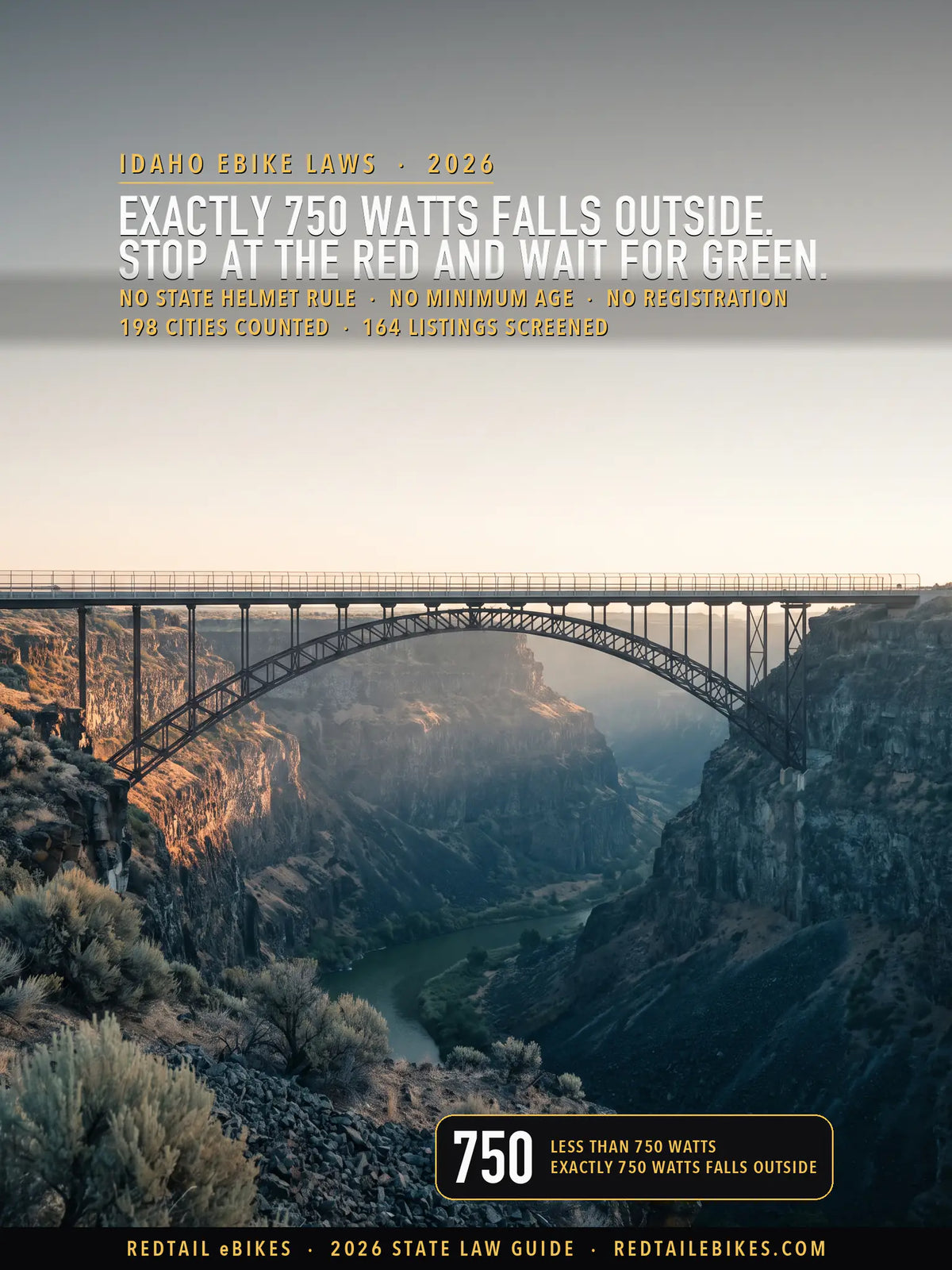

Idaho invented the rolling stop, and then declined to give e-bike riders all of it. It also drew its wattage line one word tighter than most of the country: § 49-106(1) says less than 750 watts, so the most common rating on an American spec sheet sits on the far side of it.
198 cities counted · 164 listings screened · 41 bikes at exactly 750 W · less than 750 W is the line · no state helmet rule at any age · no minimum age · no registration · the rolling stop at stop signs
Author: Milad Ghobadibeygvand, BScN (Western University, 2014), Redtail eBikes. Corrections: support@redtailebikes.com. Last verified: September 11, 2026.
Quick Answer
An electric-assisted bicycle is legal in Idaho with no license, no registration, no plates, no insurance, no state helmet rule and no minimum age. One line decides everything: Idaho Code § 49-106(1) says less than 750 watts, so a motor rated at exactly 750 watts is already outside the definition.
That word matters more here than in most states. Idaho gives e-bike riders the famous rolling stop at stop signs, but the red-light half of the same statute names only bicycles and human-powered vehicles. And a machine over the wattage line does not become a moped or a motorcycle in Idaho — it falls into a gap the legislature tried and failed to close in 2026.
Verified against the Idaho Statutes on 11 September 2026.
In a hurry? Three bikes on our shelf clear both limbs of Idaho's definition — $599, $1,399 and $3,999, all Class 2 at 20 mph. The cheapest is the Samebike CY20 Pro, and every one ships free to any Idaho address.
In this guide
- Idaho ebike laws start with one word in the definition
- The 750-watt line, and the machine one watt over it
- The Idaho Stop, and the place it stops
- License, registration, insurance: none of them
- Helmets: no state rule, and one city that disagrees
- How old you have to be
- Where you may ride
- The label on the frame
- What it costs if you get it wrong
- What changed on 1 July 2026
- Boise, and the three boxes it sorts you into
- The rest of Idaho: what the cities actually say
- Trails worth planning around
- If you ride beyond Idaho
- Rebates and incentives
- The Idaho checklist, before you buy
- Which bikes clear Idaho's line
- Where every rule on this page comes from
- Why buy an Idaho-legal e-bike from us
- Limitations
- The bottom line
- Frequently asked questions
- Sources
Idaho ebike laws start with one word in the definition
Idaho uses the three-class system, and it writes the classes into the definition itself rather than into a separate section. Idaho Code § 49-106(1) defines an "electric-assisted bicycle" as "a bicycle equipped with fully operable pedals and an electric motor of less than seven hundred fifty (750) watts and that meets one (1) of the following requirements."
Those requirements are the three classes. A Class 1 has a motor "that provides assistance only when the rider is pedaling and ceases when the rider stops pedaling or when the bicycle reaches the speed of twenty (20) miles per hour." A Class 2 has a motor "that may be used exclusively to propel the bicycle" and cuts out at 20 mph. A Class 3 assists only while pedalling and ceases at 28 mph.
Read the sentence as the conjunction it is. The machine has to clear the wattage ceiling and land inside one of the three classes. A bike that does 33 mph on its motor meets none of the three, whatever its motor is rated at, so the wattage never gets to matter.
Two consequences follow that catch people out. A throttle caps you at 20 mph, because Class 3 is pedal-assist only and Class 2 stops at 20. And on a modern bike the class is usually a setting rather than a fixed property — more on that in the checklist.
The 750-watt line, and the machine one watt over it
Idaho writes its ceiling exclusively. "Less than seven hundred fifty (750) watts" means a motor rated at exactly 750 watts falls outside the definition altogether. Plenty of states write the same number the other way — "not more than 750 watts", "750 watts or less" — and in those states the identical bike is legal.
Across all fifty states and the District of Columbia, each read at its own published code on 11 September 2026, 20 of the 51 write the ceiling exclusively and 24 write it inclusively; the remaining seven set no 750-watt test at all. Connecticut moves to the inclusive side on 1 October 2026, so if you are comparing guidance written last year, check the date on it before you trust the number.
Idaho is in the exclusive group. Neighbouring Oregon sets no wattage test at all, while Utah and Nevada put the same 750-watt motor inside the line.
Exactly 750 watts is also the single most common number on an American spec sheet. Of the 164 two-wheel pedal bikes on our own shelf, 41 are rated at exactly 750 watts — a quarter of them, on the wrong side of Idaho's line and the right side of most other states'.
What does a 750-watt e-bike become in Idaho?
Follow this one carefully, because Idaho's answer is not the answer most states give.
In most states a bike that misses the e-bike definition lands in the next category down — a moped, a motor-driven cycle, something with a registration form attached. Idaho's neighbouring definitions all sit in § 49-114, and every one of them expressly carves an electric-assisted bicycle out:
| Category | What § 49-114 requires | Why a 1,000 W pedal bike does not land there |
|---|---|---|
| Motorcycle | "meets the federal motor vehicle safety standards as originally designed"; "does not include … an electric-assisted bicycle" | consumer e-bikes are not built to FMVSS |
| Motor-driven cycle | "five (5) brake horsepower or less as originally manufactured that meets federal motor vehicle safety standards"; excludes mopeds and electric-assisted bicycles | same FMVSS limb |
| Moped | "wheels less than twenty (20) inches in diameter" and, on its electric limb, "two (2) wheels or three (3) wheels with no pedals" | fails the wheel limb and the pedal limb |
| Motorbike | an off-highway vehicle under § 67-7101; "does not include an electric-assisted bicycle" | wrong category entirely |
So the machine is carved out of the e-bike definition by one watt, and carved out of everything else by a safety standard it was never built to and a wheel size it does not have.
A municipal legislature reads it the same way. Defining its own category for exactly these machines, Boise City Code says:
E-MOTO: A two or three-wheeled vehicle propelled in part or wholly by an electric motor exceeding seven hundred fifty (750) watts, or capable of a top speed of more than twenty-eight (28) miles per hour. Based on these characteristics, E-motos are not E-bikes as defined by Idaho Code or this Code, and do not fall within any other motorized vehicle definition within Title 49, Chapter 1 of the Idaho Code.
Did Idaho try to fix the 750-watt gap in 2026?
In the 2026 session, House Bill 880 would have amended § 49-106 to say that "electric-assisted bicycle" "shall not include" a machine with "an electric motor of seven hundred fifty (750) watts or more", one that keeps assisting past 30 mph, or one without operable pedals — and that such vehicles "shall be required to be licensed, registered, and insured in order to be driven on public highways."
Its bill record shows it reported out of committee on 16 March 2026, taken off General Orders the next day and referred back to Transportation & Defense. It did not pass, and it is not law. The gap it was written to close is still open.
For a buyer the practical effect is simple. If the sticker says 750 watts or more, you are not buying an electric-assisted bicycle in Idaho, and there is no clean alternative category waiting for you.
Buy under the line instead — the three bikes that clear it start at $599, and all three are Class 2 at 20 mph, which is what both the Greenbelt and the Trail of the Coeur d'Alenes admit.
The word that decides Idaho is "less". A bike rated at 749 watts is an electric-assisted bicycle here. One rated at 750 is not.
Idaho makes that easy to confirm: since 2019 § 49-727 has required the class, top assisted speed and wattage to be printed on the frame itself, so the sticker on the bike settles the question. Start with the three that clear the line, or browse the commuter range and the full range. Free shipping to any Idaho address, a US-based warranty, US support and Shop Pay instalments at checkout.
See the e-bikes that clear Idaho's lineRead the nominal rating, not the marketing. Below 750 watts and inside one of the three classes, you may ride wherever bicycles may ride under § 49-725. At exactly 750 watts you are not, and Idaho has no next category down to put you in.
The Idaho Stop, and the place it stops
Idaho invented the rolling stop. Idaho Code § 49-720, added to the code in 1988 and amended in 2005 and 2019, is the reason "the Idaho Stop" is a phrase in every other state's cycling debate. The statute has two halves, and e-bike riders are named in only one of them.
Subsection (1), stop signs. "A person operating a bicycle, human-powered vehicle, or an electric-assisted bicycle approaching a stop sign shall slow down and, if required for safety, stop before entering the intersection." After slowing or stopping and yielding, the rider "may cautiously make a turn or proceed through the intersection without stopping." E-bikes are named. You get the rolling stop.
Subsection (2), red lights. "A person operating a bicycle or human-powered vehicle approaching a steady red traffic control light shall stop before entering the intersection and shall yield to all other traffic. Once the person has yielded, he may proceed through the steady red light with caution." Electric-assisted bicycles are not named here.
And "bicycle" cannot quietly absorb them, because Idaho defines it narrowly. § 49-103(1): "'Bicycle' means every vehicle propelled exclusively by human power upon which any person may ride, having two (2) tandem wheels, and except scooters and similar devices." A bike with a motor is not propelled exclusively by human power.
Two honest readings, and the advice that survives both
The asymmetry was written in a single act. House Bill 76 of 2019, which became Session Law ch. 84, amended § 49-720 at section 6 — inserting ", or an electric-assisted bicycle" into subsection (1) while reproducing subsection (2) unchanged — and created § 49-725 at section 7 of the same bill.
That matters because § 49-725 cuts the other way. It says a rider of an electric-assisted bicycle "shall be afforded all the rights and privileges and be subject to all of the duties and safety requirements as the rider of a bicycle."
So there are two defensible readings, and Idaho has not settled between them:
Reading one — no red-light privilege. Subsection (2) names bicycles, "bicycle" means human-powered only, and reading § 49-725 to hand over the privilege anyway would make the express insertion into subsection (1) pointless. Courts avoid readings that make statutory words redundant.
Reading two — the privilege carries. Section 49-725 is a general grant of every right and privilege a bicycle rider has, the red-light rule is one of those privileges, and the subsection (1) insertion was simply belt-and-braces drafting.
We are not going to pretend this is resolved. The advice that is lawful under either reading: on an e-bike in Idaho, stop at the red and wait for green.
Under reading one you have no choice. Under reading two you had to stop and yield anyway, and waiting costs a few seconds. The rolling stop at stop signs is yours either way — that one is in the text.
When House Bill 500 swept "electric-assisted bicycle" into three more rules-of-the-road sections in 2026, it did not touch § 49-720. The asymmetry survived the most recent rewrite of the surrounding law.
The rolling stop is yours in the text; the red light is not. § 49-720(1) names electric-assisted bicycles at stop signs. Subsection (2) does not name them at red lights, and § 49-103(1) defines a bicycle as human-powered only. Section 49-725 grants an e-bike rider every privilege a bicycle rider has, which points the other way, and Idaho has not settled it. Stop and wait for green — lawful on either reading.
License, registration, insurance: none of them
Idaho Code § 49-726 is unusually clean. "Electric-assisted bicycles are not subject to the provisions of section 49-301, Idaho Code, relating to driver's licenses. An electric-assisted bicycle and any person operating an electric-assisted bicycle are not subject to the provisions of this title relating to financial responsibility, driver's licenses, titles, registration, and license plate requirements."
Five exemptions in one sentence: no license, no proof of financial responsibility, no title, no registration, no plates.
The same section then adds a hook that catches people out. An electric-assisted bicycle "shall be considered a motor vehicle to the extent required by 23 U.S.C. 154" — the federal open-container statute. Idaho is one of a small handful of states that writes that hook into its e-bike section at all; Maine is another.
In plain terms: for drinking-and-riding purposes, treat the bike as if it were a car. The exemptions above buy you freedom from paperwork, not from impaired-driving law.
Helmets: no state rule, and one city that disagrees
The state imposes no helmet requirement on e-bike riders, at any age. Hailey does — anyone under 18 on an e-bike there must wear one. If you ride the Wood River Valley, read the local layer before you decide what goes on your child's head.
The word "helmet" appears nowhere in Title 49, Chapter 7 — the chapter that governs bicycles and electric-assisted bicycles, all 27 sections of it.
Idaho does have an under-18 helmet law. It sits in § 49-666 and it reads: "No person under eighteen (18) years of age shall ride upon or be permitted to operate a motorcycle, motorbike, utility type vehicle or an all-terrain vehicle unless … he is wearing … a protective safety helmet."
That contrast is worth holding onto. Idaho has an under-18 helmet law. It attaches to motorcycles and off-highway machines rather than to electric-assisted bicycles. Cross the wattage line and you are shopping in a category where helmet law starts to apply.
A city may still impose its own rule, which is what the local layer is for.
How old you have to be
There is no minimum age anywhere in Idaho's e-bike chapter — no floor for Class 1, none for Class 2, and none for Class 3. The same complete reading of Chapter 7 that returned no helmet duty returns no age limb either.
Most states that bother with an age rule attach it to Class 3, on the theory that 28 mph is the part worth gating. Idaho attaches nothing.
So a parent deciding whether a teenager should be on a Class 3 in traffic is making that call on judgement, because chapter 7 does not make it for them. If the answer is no, a Class 2 capped at 20 mph is the same bike with the top end taken off — which is what all three of our picks are.
Where you may ride
Two sections carry the answer, and they say close to the same thing.
§ 49-725: "Subject to the provisions in this chapter, electric-assisted bicycles may be ridden where bicycles are permitted to travel, unless excluded by local ordinance or by signage posted by the public agency with jurisdiction after notice by inclusion on a governing board agenda."
§ 49-728 repeats it and names the case everybody asks about: e-bikes "may be used in places where bicycles are permitted to travel including but not limited to multiuse paths", subject to the same exclusion.
So the statewide default is permissive, and it is permissive for all three classes. Idaho draws no class distinction on paths at state level.
Can a sign alone close a path to e-bikes in Idaho?
Read the exclusion language again: a path can be closed to e-bikes "by local ordinance or by signage posted by the public agency with jurisdiction after notice by inclusion on a governing board agenda."
A sign on its own is not the whole test. The statute ties the sign to a procedural step — the item has to have gone on a governing board's agenda first. That is a real constraint on how a land manager closes a path, and it is why the local layer in Idaho is worth checking city by city rather than assumed from the state default.
Chapter 7 also carries the ordinary bicycle equipment rule. § 49-723 requires a light "visible from a distance of at least five hundred (500) feet to the front" and a rear reflector at night. That section says "every bicycle" rather than every e-bike, and it reaches you through § 49-725's instruction that an e-bike "shall be subject to all the safety requirements of a bicycle."
The label on the frame
§ 49-727 has been in force since 1 September 2019: manufacturers and distributors "shall apply a label that is permanently affixed, in a prominent location, to each electric bicycle," and it "shall contain the classification number, top assisted speed, and motor wattage of the electric bicycle, and shall be printed in arial font in at least 9-point type."
This is the most useful sentence in the chapter for a buyer, because it turns the legal question into a physical one. The three facts Idaho law cares about — class, top assisted speed, motor wattage — are required to be printed on the bike. Find the label before you buy and you have checked your compliance in about four seconds.
What it costs if you get it wrong
§ 49-729: "A violation of applicable provisions in this chapter or in chapter 6, title 49, Idaho Code, by a rider of an electric-assisted bicycle shall be an infraction."
An infraction, not a misdemeanour. That is the ceiling for the riding rules in this guide. It is not the ceiling for the impaired-driving hook in § 49-726, and it says nothing about what happens if your machine was never an electric-assisted bicycle to begin with.
What changed on 1 July 2026
House Bill 500 passed the House 68–0–2, was signed by the Governor on 16 March 2026, became Session Law chapter 24, and took effect 1 July 2026 under its own emergency clause.
It wrote "electric-assisted bicycle" into three sections that previously named only bicycles and human-powered vehicles:
| Section | What it now covers |
|---|---|
| § 49-615 | every driver of a motor vehicle "shall exercise due care to avoid colliding with … any operator or rider of a human-powered vehicle, bicycle, or electric-assisted bicycle" |
| § 49-714 | e-bike riders have "all of the rights and all of the duties applicable to the driver of any other vehicle" under chapters 6 and 8 |
| § 49-715 | seat and passenger rules, including carrying a child in a carrier or sling |
None of it changed the definition, the wattage line or the path rules. The 2025 and 2024 sessions produced no bicycle or e-bike legislation at all — neither year's subject index carries a bicycle entry.
Boise, and the three boxes it sorts you into
About one in six Idahoans lives in Boise, and Boise does not simply copy the state. Its code builds three categories where the state has one, and the thresholds are not the state's thresholds.
| Boise category | Motor | Speed | Where it may go |
|---|---|---|---|
| E-scooter | 500 W or less | incapable of more than 15 mph | per the city's e-mobility guidance |
| Electric power-assisted bicycle (E-bike) | not more than 750 W | incapable of more than 20 mph | streets, bike lanes, sidewalks, crosswalks, pathways, the Greenbelt |
| E-moto | more than 750 W | or capable of more than 28 mph | public streets and highways only, licensed, titled and insured |
Three differences from the state definition are worth your attention before you buy.
Boise's ceiling is inclusive where Idaho's is exclusive. The city writes "a power output of not more than seven hundred fifty (750) watts"; the state writes "less than".
So a bike rated at exactly 750 watts is an e-bike in Boise's chapter and is not an electric-assisted bicycle under Idaho Code. Where the two disagree, the state definition decides whether you are riding a bicycle in the eyes of Idaho law.
Boise's own definition caps at 20 mph. A Class 3 is lawful across Idaho, and it does not meet Boise's definition of an e-bike at all. The city's guidance is explicit about what follows: Class 3 machines are not allowed on the Boise River Greenbelt, on sidewalks, in crosswalks, or in bike lanes. They are allowed on public streets and highways.
Boise adds a duty the state has nowhere. Its definition requires a motor that "disengages or ceases to function when the vehicle's brakes are applied."
One more definitional detail does real work. Boise defines "bike path" as "a completely separate right-of-way designated primarily for use by bicycles, E-bikes, E-scooters, or pedestrians, including but not limited to the Greenbelt." Any rule about bike paths reaches the Greenbelt automatically.
If you ride the Foothills, that is a separate set: "Foothills trails" are the Ridge to Rivers paths on city-owned land, and the city publishes roughly 52 miles of motorized trail and primitive road open to e-bikes and e-motos.
The rule the third box actually carries
Boise City Code 6-13-3, adopted 30 June 2026 and in force immediately, is where the e-moto category stops being a definition and starts being a consequence. An e-moto on a public road "shall be treated as a motor vehicle that must obtain a motor vehicle license, title, and insurance to be operated on public streets and highways within the City." Then the clause that matters most:
"Any E-moto that cannot obtain vehicle licensing, title, and insurance from the state of Idaho is prohibited from operating on any public roadway or highway within the City."
Put that beside the state-law gap and the consequence is concrete. A pedal machine rated above 750 watts is not an electric-assisted bicycle in Idaho, and by Boise's own account it fits no other category in Title 49 chapter 1. Our reading is that such a machine cannot then be licensed, titled or insured in Idaho, which is the condition the next clause turns on.
In Boise, that makes it prohibited on every public road in the city. The same section adds that e-motos "are always prohibited from operation on City sidewalks, pathways, and bike paths", and are permitted only on city trails designated for motorcycles or other motor vehicles.
The penalty is not the state's. Where Idaho Code § 49-729 makes an e-bike violation an infraction, a violation of Boise's section — other than the general traffic-laws-apply subsection — "shall be guilty of a misdemeanor."
Where each class may go, at a glance
| Where | Class 1 | Class 2 | Class 3 | Over 750 W |
|---|---|---|---|---|
| Idaho roads and highways | yes | yes | yes | no category in Idaho law |
| Idaho multiuse paths (state default) | yes | yes | yes | not an e-bike |
| Idaho sidewalks (state default) | yield to pedestrians, obey signs | yield to pedestrians, obey signs | yield to pedestrians, obey signs | not an e-bike |
| Boise streets and bike lanes | yes | yes | streets only | streets only, and only if it can be licensed and insured |
| Boise River Greenbelt | yes | yes | no | no |
| Boise sidewalks and crosswalks | yes | yes | no | no |
| Boise pathways | yes | yes | no | no |
| Ridge to Rivers motorized trails | yes | yes | yes | yes, where designated |
| Trail of the Coeur d'Alenes | yes | yes | absent from the allowed list | absent from the allowed list |
| Coeur d'Alene trails and paths | yes, 15 mph | yes, 15 mph | yes, 15 mph | its Motor Vehicle ban does not reach it either |
| Hailey, under 18 | helmet required | helmet required | helmet required | not an e-bike |
| Federal land in Idaho | agency decides | agency decides | agency decides | agency decides |
Local rules can be stricter than the state default and never looser, so the state row is the ceiling on your freedom and the city row is the one that decides your ride.
Boise sorts every electric machine into one of three boxes, and only the middle one reaches the Greenbelt. A Class 1 or Class 2 under 750 watts gets the streets, the bike lanes, the sidewalks, the crosswalks, the pathways and the Greenbelt. A Class 3 gets the streets. An e-moto gets the streets only if it can be licensed and insured.
If you want the box that opens everything, that is a sub-750-watt bike set to 20 mph — the three we would pick, or the wider commuter range. Free shipping to any Idaho address, a US warranty and US support.
See the Class 2 bikes that clear Boise's rulesThe rest of Idaho: what the cities actually say
Idaho has 198 incorporated cities, a count taken from two independent U.S. Census products that agree exactly — the 2025 Gazetteer places file filtered to active governments, and the SUB-EST2024 population estimates filtered to incorporated places.
Current to 11 September 2026:
| Status | Cities |
|---|---|
| Municipal code read in full, no e-bike rule found | 92 |
| Local e-bike rule found and verified | 2 |
| E-bike terms found, verification of a local rule still open | 6 |
| Not yet resolved — no online code route located | 87 |
| Not yet resolved — the code host lists the city but publishes no code | 11 |
| Total | 198 |
Those 100 resolved cities hold 82.9% of Idaho's incorporated population. The 98 unresolved are counted here rather than folded into the "none found" column, because a city nobody has read is not a city without a rule.
Hailey requires a helmet under 18, and Idaho does not
The Wood River Valley is the part of Idaho that has thought hardest about e-bikes, and Hailey has the rule that will surprise you:
Hailey Ordinance No. 1358, adopted 23 February 2026, reads: "All operators and passengers of e-bikes and alternative electric mobility devices (excluding bicycles exclusively propelled by human power) under the age of eighteen (18) years of age shall wear a properly fitted protective helmet."
Read the parenthesis. A child on a pedal bicycle in Hailey needs no helmet; the same child on an e-bike does.
Hailey also requires equipment — "No person shall operate a bicycle, e-bike, or alternative electric mobility device without the following equipment" — including an audible warning device audible at 100 feet, and it bans sirens and whistles. The helmet duty and the equipment rules arrived together in Ordinance No. 1358, which amended the city's bicycle and e-bike chapter in February 2026.
Coeur d'Alene excludes e-bikes from its motor-vehicle ban
Coeur d'Alene prohibits driving "a Motor Vehicle upon any Trail, Bicycle Lane, Bicycle Path, Pedestrian Path, or Multi-Use Path" under § 4.40.050(A), and it caps path speed at fifteen miles per hour "unless a lower speed is appropriately posted". The chapter's opening recital lists electric-assisted bicycles among the machines that can damage trails, which reads alarming — but the definitions section is what governs, and it says the opposite:
"MOTOR VEHICLE: Every Vehicle which is self-propelled … but not including Electric Vehicles, Electric-Assisted Bicycles, or Electric Personal Assistive Mobility Devices."
So the motor-vehicle prohibition does not reach an electric-assisted bicycle. Coeur d'Alene adopts the state's three-class definition word for word, including "less than seven hundred fifty (750) watts", which means the same wattage line decides the question there as everywhere else in Idaho. Ride the paths at 15 mph or under, and slower where a sign says so.
Six more cities to read before you ride
Emmett, Ketchum, Kuna, Lewiston, Meridian and Nampa each use e-bike terms in their codes. Ketchum has a chapter titled "Bicycles, human propelled vehicles, e-bikes, alternative electric motored vehicles, OPDMDs, wheelchairs and motorized vehicles"; Nampa a section headed "eBike and eScooter regulations"; Meridian a rule about leaving a bike unattended in a travel lane.
Each is a city to check before you ride there rather than a city known to restrict.
In Kellogg the state rules are the rules: its code reprints Idaho's definitions verbatim without attaching a local rule to them. Fruitland and New Plymouth mention "motorized bicycles" only inside a noise ordinance, which has nothing to do with e-bikes.
Trails worth planning around
The Trail of the Coeur d'Alenes. Idaho's flagship rail-trail runs 73 paved miles from Mullan to Plummer and is managed by the Idaho Department of Parks and Recreation. Its own page states: "Class 1 and 2 E-Bikes are allowed on the trail." The allowed-use list reads "walking, in-line skating, bicycling (including Class 1 and 2 E-bikes), skateboarding, Nordic skiing and snowshoeing."
Note the shape of that carefully. Class 1 and Class 2 are named as allowed. Class 3 is absent from the allowed-use list — the page's separate "uses not allowed or prohibited" list names hunting, firearms and horses, and does not mention Class 3 at all. Plan on Class 1 or 2 for this trail.
The Boise River Greenbelt. Class 1 and Class 2 are allowed. Class 3 is not, along with sidewalks, crosswalks and bike lanes.
Ridge to Rivers. E-bikes and e-motos may use trails and roads that allow motorized vehicles — about 52 miles of them.
Across all three, the pattern is the same, and it is the single most useful planning fact in this guide: the places Idahoans most want to ride admit Classes 1 and 2, and Class 3 is either barred or unlisted.
Riding out of state changes the answer. Washington writes its ceiling inclusively and excludes machines built to be reconfigured past the limits, which Idaho does not; the state-by-state table has the row for wherever you are heading.
In Idaho the class is a setting, and on paths it decides where you may go. The Boise River Greenbelt and the Trail of the Coeur d'Alenes both admit Class 1 and Class 2 and stop at Class 3. On a bike whose limiter is adjustable, the class you are riding is the one currently set.
If you ride beyond Idaho
Idaho's exclusive ceiling is not the rule everywhere, and a bike that is legal on one side of a state line can be outside the definition on the other. The state-by-state table carries every row; these are the neighbours Idaho riders cross into most.
| State | Where its 750-watt line sits | Guide |
|---|---|---|
| Idaho | less than 750 W — exactly 750 is outside | this page |
| Oregon | no wattage test at all since 2024 | Oregon e-bike laws |
| Washington | no more than 750 W, and it excludes machines built to be reconfigured | Washington e-bike laws |
| Utah | not more than 750 W — exactly 750 is inside | Utah e-bike laws |
| Nevada | not more than 750 W | Nevada e-bike laws |
| Montana | no wattage test; a 20 mph speed test instead | the national table |
| Wyoming | less than 750 W, like Idaho | the national table |
| California | does not exceed 750 W | California e-bike laws |
| Colorado | not exceeding 750 W | Colorado e-bike laws |
| Arizona | less than 750 W | Arizona e-bike laws |
Riders heading further afield can read Texas, Florida, New York, Illinois, Ohio, Michigan, Minnesota, Pennsylvania, North Carolina, Georgia, Tennessee, Virginia, Maryland, Massachusetts, Connecticut, New Hampshire, Maine, Vermont, Wisconsin, Indiana, Iowa, Missouri, Kansas, Alabama, South Carolina, New Jersey and Hawaii.
If you are still choosing a bike rather than a route, the electric bike buying guide walks the decision from the other end, and where to buy covers the purchase itself.
Rebates and incentives
Idaho has no state e-bike rebate, voucher or tax credit.
The U.S. Department of Energy's Alternative Fuels Data Center publishes every Idaho incentive, law and programme it tracks: 15 entries — four state incentives, three utility programmes and eight laws and regulations. Not one mentions bicycles, electric bicycles, e-bikes or micromobility.
Avista's Idaho rebate page lists rebates for heat pumps, insulation, windows and water heaters. Bicycles are not among them.
If that changes, it will change at the utility level first, which is where every state programme in this series started.
The Idaho checklist, before you buy
Seven checks settle whether a bike is legal in Idaho and where it can go, and every one can be done from the spec sheet and the label before you pay for anything. Work down them in order.
- Read the label. Since 1 September 2019 the class number, top assisted speed and motor wattage have to be printed on the bike in at least 9-point Arial. Those are the three facts Idaho law turns on.
- Check the wattage against "less than 750." Exactly 750 is outside the definition. If the spec sheet says 750 W, it is over Idaho's line even though it is under most other states'.
- Ask which figure you are reading. Nominal and peak are different numbers, and the statute does not say which one it means. See Limitations.
- Decide the class you actually need. A throttle caps you at 20 mph. Class 3 buys you 28 mph on the road, is barred from the Greenbelt, and is absent from the Trail of the Coeur d'Alenes allowed-use list.
- Set the limiter, and know where it is set. On most current bikes the class is a setting. Set it to 20 mph and both flagship paths open up.
- Stop at red lights. The rolling stop at stop signs is yours in the text. The red-light half of the statute is not settled.
- Check your city, especially in Boise, Coeur d'Alene, Hailey, Ketchum, Meridian and Nampa.
Which bikes clear Idaho's line
Fifteen of the 164 two-wheel pedal bikes on our shelf clear both limbs of § 49-106(1) — the wattage ceiling and the class limb. Three are worth naming, at three price points. Every figure below is the manufacturer's own published specification.
Samebike CY20 Pro
$599500 W nominal · 32 km/h (19.9 mph) · Class 2 · folding 20-inch · $599 against Samebike's own $899 list
The cheapest way under Idaho's line on our shelf. Samebike publishes the motor at 500 W and the peak at 800 W, both figures as they appear on its own specification, and Idaho's ceiling is written against the motor's rating.
Samebike's own specification puts maximum speed at 32 km/h, which is 19.9 mph — inside the 20 mph cut-off that makes it a Class 2 under § 49-106(1)(b). Class 2 is what the Boise River Greenbelt and the Trail of the Coeur d'Alenes both admit, so the two rides most Idahoans want are open on the bike as it arrives.
It folds, which is the right answer for a Greenbelt commute that ends at a desk or in an apartment hallway — the rest of the folding range is built the same way.
Free shipping to any Idaho address, a US-based warranty and US-based support.
Qiolor TIGER JR
$1,399500 W rated · 20 mph default · Class 2 · full-size commuter
Qiolor publishes it as "Rated 48V 500W(Peak 750W)", with a default maximum speed of 20 mph — a Class 2 as delivered, and a second brand for a rider who wants a full-size frame rather than a fold.
Qiolor also notes the speed setting "can be adjusted according to user preferences", which is the point the checklist makes: in Idaho your class is the setting you are riding, so leave it at 20 and the Greenbelt and the Trail of the Coeur d'Alenes stay open.
The retro build is the reason to pick it over the fold — a bike you leave outside a coffee shop rather than carry upstairs. More like it in the commuter range.
Ships free, carries a US warranty, and Shop Pay instalments are available at checkout.
Eunorau URUS 2.0
$3,999500 W Bafang M600 mid-drive · 20 mph as shipped · full suspension
The one for Ridge to Rivers. Boise publishes roughly 52 miles of motorized trail and primitive road open to e-bikes, and this is the bike built for it: a 48V 500 W Bafang M600 mid-drive with full suspension. Eunorau's spec grid gives the maximum speed as 20 mph and its description block as 28 mph; at 500 W it clears Idaho's wattage test either way, and the limiter is what decides your class.
Mid-drive matters on the Foothills in a way it does not on the Greenbelt — the motor works through the gears on a sustained climb instead of fighting it at the hub. If you want the float of a wider tire on decomposed granite, the fat-tire range is the other way to ride the same trails, and the full range carries every rating on its spec line.
At 500 W it clears Idaho's exclusive ceiling on the manufacturer's own published rating, the same as the two cheaper picks. What you are paying for is the suspension and the drivetrain rather than a bigger motor — which in Idaho would be the wrong thing to buy.
Free shipping anywhere in Idaho, a US-based warranty, US-based support, and Shop Pay instalments at checkout.
All three ship free in the US, and all three are under Idaho's exclusive 750-watt ceiling on the manufacturer's own published rating.
Where every rule on this page comes from
| Source | Tier | What it supports here | Read |
|---|---|---|---|
| Idaho Statutes, Title 49 ch. 1 definitions (Idaho Legislature) | T1 | the definition, the classes, the Idaho Stop, the exemptions, the label, path access, penalties | 11 Sep 2026 |
| Title 49, chapter 7 index | T1 | the 27-section denominator behind the helmet and age negatives | 11 Sep 2026 |
| 2019 H0076 / Session Law ch. 84 | T1 | the amendment direction in § 49-720 that a codified section cannot show | 11 Sep 2026 |
| 2026 H0500 / Session Law ch. 24 | T1 | what changed on 1 July 2026, and its effective date | 11 Sep 2026 |
| 2026 H0880 | T1 | the bill that would have closed the category gap, and did not pass | 11 Sep 2026 |
| Idaho Legislature session indexes, 2023–2026 | T1 | that no bicycle or e-bike bill appears in 2023, 2024 or 2025 | 11 Sep 2026 |
| Boise City Code | T1 | the three-box scheme, the e-moto definition and 6-13-3 | 11 Sep 2026 |
| Hailey Ordinance No. 1358 | T1 | the under-18 helmet duty and the equipment rules | 11 Sep 2026 |
| Coeur d'Alene Municipal Code ch. 4.40 | T1 | that its motor-vehicle ban excludes electric-assisted bicycles | 11 Sep 2026 |
| City of Boise e-mobility guidance | T2 | which classes reach the Greenbelt, and the Ridge to Rivers mileage | 11 Sep 2026 |
| Idaho Dept of Parks and Recreation | T1 | the Trail of the Coeur d'Alenes allowed-use list | 11 Sep 2026 |
| U.S. DOE Alternative Fuels Data Center | T1 | that no Idaho incentive covers bicycles | 11 Sep 2026 |
| U.S. Census Bureau Gazetteer + SUB-EST2024 | T1 | the 198-city denominator, confirmed twice | 11 Sep 2026 |
| Manufacturer specifications — Samebike, Qiolor, Eunorau | T2 | the motor and speed figures behind each pick | 11 Sep 2026 |
| Redtail first-party datasets — the 51-jurisdiction watt-word map and the Idaho product screen | T1 (ours) | the 20/24/7 split and the 60-at-750 W count | 8 & 11 Sep 2026 |
No tier-5 source is cited anywhere on this page.
If your ride ends indoors, the fold is the feature. Every bike in our folding range and our cargo range carries its nominal motor rating on the spec line, so the Idaho question is answered before you add to cart.
Free shipping to any Idaho address, a US-based warranty, US-based support and Shop Pay instalments at checkout.
See the folding e-bikes that fit Idaho's ruleIf none of the three is the shape you want, the full range carries its nominal motor rating on every spec line, and the cargo range and the fat-tire range are where to look if the Greenbelt commute involves a child seat or a week's shopping. Everything in the commuter range and the folding range ships free to any Idaho address.
Why buy an Idaho-legal e-bike from us
You are reading the only guide that screened a real shelf against both limbs of Idaho's definition rather than quoting the wattage line and stopping. It is the same screen we run before we list anything, which is why the three picks above are the three we would put a friend on.
Every bike ships free to any Idaho address. Your warranty and your support are US-based, so a claim is a phone call in your own time zone rather than an email to another continent. Shop Pay instalments are available at checkout, and the price you see is the price you pay.
If a listing you are looking at anywhere does not publish its motor rating, email us and we will get it from the maker before you buy. Idaho's whole rule turns on that number, and you should not have to guess it.
Limitations
Every guide in this series publishes what it does not know, with the condition that would settle it.
- Nominal or peak? The statute does not say. § 49-106(1) says "an electric motor of less than seven hundred fifty (750) watts" without stating whether that is the continuous rating or the peak. It matters: a bike rated 500 W nominal can peak at 800 W or more. Read as nominal — the convention the industry uses and the reading applied throughout this guide — the picks above clear comfortably. Read as peak, some machines rated well under the line would sit above it. We located no Idaho authority resolving it, and H0880, which spoke of motors of "750 watts or more", died in committee. Resolved when an Idaho court, the Idaho Transportation Department or the legislature addresses which figure the section means.
- The red-light question is genuinely unsettled. Set out in full above. Resolved when an Idaho court or the legislature reconciles § 49-720(2) with § 49-725.
- 98 of 198 cities are unresolved. 87 have no online code route we have located, and 11 sit on a code host that lists the city but publishes no code. They are counted in the coverage table rather than folded into "none found". Resolved as those codes come online or a state-level ordinance filing search is established.
- Hunting and Idaho Fish and Game rules are not covered here. E-bike access on wildlife management areas and during hunts is set by a separate body of rule that this guide has not read. Check with Idaho Fish and Game before planning a hunt around an e-bike.
- Federal land is a separate layer. Much of Idaho is national forest and BLM land, where access is set by the managing agency rather than by Idaho Code. Check the specific unit.
- Class is frequently a setting. Where a bike ships speed-limited and can be reconfigured, the class you are riding is the one currently selected. Idaho has no equivalent to Washington's exclusion for machines built to be reconfigured past the limits, so an adjustable limiter does not by itself put a bike outside § 49-106(1).
What would age this page
This guide expires on named events rather than on a calendar.
It needs re-reading when the Idaho Legislature adjourns a session having passed any bicycle or e-bike bill; when an Idaho court or the Idaho Transportation Department states whether § 49-106(1)'s 750 watts is the nominal or the peak rating; or when a court or the Legislature reconciles § 49-720(2) with § 49-725 on the red-light question.
It also ages when a bill closing the over-750-watt category gap is enacted; when Boise, Hailey or Coeur d'Alene amends the ordinances quoted here; when the Idaho Department of Parks and Recreation changes the Trail of the Coeur d'Alenes allowed-use list; or when any Idaho utility launches an e-bike rebate.
The bottom line
Idaho is one of the friendliest states in the country to ride an e-bike in, and one of the fussiest about what counts as one. No license, no registration, no plates, no insurance, no state helmet rule and no age floor — and a wattage line drawn one word tighter than almost anywhere else.
So the whole decision comes down to a number and a setting. Buy a bike whose motor is rated below 750 watts, set the limiter to 20 mph, and Idaho opens up: the roads, the multiuse paths, the Boise River Greenbelt and all 73 miles of the Trail of the Coeur d'Alenes.
If you want this settled in one click, start with the three bikes that clear both limbs of § 49-106(1) — $599, $1,399 and $3,999, one folding commuter, one full-size commuter and one full-suspension trail bike, all Class 2 at 20 mph.
Every one ships free to any Idaho address with a US-based warranty, US support and Shop Pay instalments at checkout. If a listing you are looking at anywhere does not publish its motor rating, email us and we will get it from the maker before you buy.
Start with the three that clear Idaho's lineFrequently asked questions
Are e-bikes legal in Idaho?
Yes. An electric-assisted bicycle — pedals, a motor of less than 750 watts, and one of the three classes — may be ridden wherever bicycles are permitted, including multiuse paths, unless a local ordinance or properly noticed signage excludes it.
Do bicycles have to stop at stop signs in Idaho?
No, and neither do e-bikes. Section 49-720(1) names bicycles, human-powered vehicles and electric-assisted bicycles: slow down, stop if safety requires it, yield, and you may proceed without a full stop.
Can I treat a red light as a stop sign on an e-bike in Idaho?
Treat the answer as no. Subsection (2) of the same statute gives that privilege to "a bicycle or human-powered vehicle", and Idaho defines a bicycle as propelled exclusively by human power. Section 49-725 points the other way, and the question is unsettled. Stopping and waiting for green is lawful on either reading.
Do I need a license or registration for an e-bike in Idaho?
No. Section 49-726 exempts electric-assisted bicycles from driver's licenses, financial responsibility, titles, registration and plates. It does treat them as motor vehicles for the federal open-container rule.
Does Idaho have an e-bike helmet law?
Not at state level, at any age. All 27 sections of Title 49, Chapter 7 were read in full and the word "helmet" does not appear; Idaho's under-18 helmet rule sits in § 49-666 and attaches to motorcycles, motorbikes, UTVs and ATVs. A city may set its own rule, and Hailey does: anyone under 18 on an e-bike there must wear a properly fitted helmet, while a child on a pedal bicycle need not.
Is there a minimum age to ride an e-bike in Idaho?
Not in the statute — no age floor for any of the three classes.
Are Class 3 e-bikes legal in Idaho?
Yes on the road statewide. But Class 3 is shut out of the Boise River Greenbelt, Boise sidewalks, crosswalks and bike lanes, and it is not on the allowed-use list for the Trail of the Coeur d'Alenes.
Are e-bikes allowed on the Trail of the Coeur d'Alenes?
Class 1 and Class 2 are, in the Idaho Department of Parks and Recreation's own words. Class 3 is not among the allowed uses.
What are the Boise Greenbelt e-bike rules?
Class 1 and Class 2 may use it. Class 3 may not, nor may e-motos — Boise's category for anything over 750 watts or capable of more than 28 mph.
Is there an Idaho e-bike rebate?
No. The Department of Energy's Alternative Fuels Data Center lists 15 Idaho incentives, laws and programmes, and none covers bicycles or e-bikes.
What happens if my e-bike is over 750 watts in Idaho?
It is not an electric-assisted bicycle, and it does not become a moped, motorcycle or motor-driven cycle either — each of those definitions expressly excludes e-bikes and carries a federal safety-standard or wheel-size limb a consumer e-bike does not meet.
In Boise it is an "e-moto", which must be licensed, titled and insured and may not use paths, sidewalks or bike lanes. If you want the paths, fifteen bikes on our shelf clear Idaho's line.
What is the Idaho Stop, and why is it called that?
Idaho was the first state to let cyclists treat a stop sign as a yield, and other states copied it under Idaho's name. The rule lives in § 49-720, and its stop-sign half names electric-assisted bicycles expressly.
Did Idaho e-bike law change in 2026?
Yes, on 1 July. House Bill 500, Session Law chapter 24, wrote "electric-assisted bicycle" into the due-care, rights-and-duties and seating sections. It left the definition, the wattage line and the path rules alone.
Do I need a motorcycle license for a fast electric bike in Idaho?
If the machine is an electric-assisted bicycle, no — § 49-726 exempts it. If it is over the wattage line it is not an e-bike, and Idaho's motorcycle and motor-driven cycle definitions both require compliance with federal motor vehicle safety standards that a consumer e-bike does not meet.
Is a 1,000W e-bike street legal in Idaho?
Not as an electric-assisted bicycle. It exceeds § 49-106(1)'s ceiling and fits none of the other categories in the vehicle code. In Boise it is an e-moto, and one that cannot be licensed, titled and insured may not use any public roadway in the city. A sub-750-watt Class 2 avoids the whole question — see which bikes clear Idaho's line.
Are electric scooters covered by these rules?
No. Idaho defines an electric personal assistive mobility device separately in § 49-106(2), and an electric-assisted bicycle must have fully operable pedals. Boise runs a separate e-scooter category capped at 500 W and 15 mph.
Can I ride an e-bike on Idaho sidewalks?
Idaho's sidewalk section, § 49-721, requires a rider to yield to pedestrians and bars sidewalk riding wherever official traffic-control devices prohibit it — and it reaches e-bike riders through § 49-725. Beyond that the answer is local. Boise permits Class 1 and Class 2 on sidewalks and bars Class 3, and bars e-motos entirely.
Do I have to register my e-bike with the city of Boise?
No city registration is required to ride. Boise's rules govern where each category may go rather than requiring a permit for an e-bike.
Are e-bikes allowed on Idaho singletrack and mountain-bike trails?
It depends on the land manager. On Boise's Ridge to Rivers network the city publishes about 52 miles of motorized trail and primitive road open to e-bikes. Much of Idaho is national forest or BLM land, where the managing agency sets access rather than Idaho Code.
What should I check before buying an e-bike in Idaho?
The label. Since 1 September 2019 § 49-727 has required the class number, top assisted speed and motor wattage to be printed on the frame in at least 9-point Arial — the three facts the law turns on, in one place.
How we verified this
Every rule on this page was read at the Idaho Legislature's own publication of the Idaho Statutes, and a copy of each section was archived on the date shown. Where a figure is a count — 27 sections, 20 jurisdictions, 198 cities, 196 listings — it was produced by a script over a named dataset and recomputed for this page, not carried over.
Bill texts were read as enrolled and confirmed against the Legislature's own bill-status record, so that an act's effective date rests on two retrievals rather than one. Municipal provisions were located by reading each city's published code in full rather than by searching it, because a search box that finds nothing and a code that contains nothing are different things. Where a city's code could not be retrieved, that city is reported as unresolved.
Where a claim rests on the Idaho Code or on Idaho session law, the Idaho Legislature is the sole publisher of both, so a second retrieval means a second surface at the same publisher — the enrolled bill beside the codified section, or the bill-status record beside the bill text — and the ledger marks those rows as such rather than pretending to an independent second publisher.
The catalog figures come from a screen of every live bike listing against both limbs of § 49-106(1), with each decisive specification re-read at the manufacturer's own published page.
Corrections: support@redtailebikes.com.
Sources
- Idaho Code § 49-103, Definitions — B (bicycle). Idaho Legislature. Read 11 Sep 2026. https://legislature.idaho.gov/statutesrules/idstat/Title49/T49CH1/SECT49-103/
- Idaho Code § 49-106, Definitions — E (electric-assisted bicycle; classes). Read 11 Sep 2026. https://legislature.idaho.gov/statutesrules/idstat/Title49/T49CH1/SECT49-106/
- Idaho Code § 49-114, Definitions — M (moped; motorcycle; motorbike; motor-driven cycle). Read 11 Sep 2026. https://legislature.idaho.gov/statutesrules/idstat/Title49/T49CH1/SECT49-114/
- Idaho Code § 49-615, Drivers to exercise due care. Read 11 Sep 2026. https://legislature.idaho.gov/statutesrules/idstat/Title49/T49CH6/SECT49-615/
- Idaho Code § 49-666, Motorcycle, motorbike, UTV and ATV safety helmets and seatbelts. Read 11 Sep 2026. https://legislature.idaho.gov/statutesrules/idstat/Title49/T49CH6/SECT49-666/
- Idaho Code § 49-714, Traffic laws apply to operators or riders. Read 11 Sep 2026. https://legislature.idaho.gov/statutesrules/idstat/Title49/T49CH7/SECT49-714/
- Idaho Code § 49-715, Riding on human-powered vehicles, bicycles, or electric-assisted bicycles. Read 11 Sep 2026. https://legislature.idaho.gov/statutesrules/idstat/Title49/T49CH7/SECT49-715/
- Idaho Code § 49-720, Stopping — Turn and stop signals. Read 11 Sep 2026. https://legislature.idaho.gov/statutesrules/idstat/Title49/T49CH7/SECT49-720/
- Idaho Code § 49-723, Light and reflector required at night. Read 11 Sep 2026. https://legislature.idaho.gov/statutesrules/idstat/Title49/T49CH7/SECT49-723/
- Idaho Code § 49-725, Rights and duties of electric-assisted bicycles. Read 11 Sep 2026. https://legislature.idaho.gov/statutesrules/idstat/Title49/T49CH7/SECT49-725/
- Idaho Code § 49-726, Insurance, licensing, and registration. Read 11 Sep 2026. https://legislature.idaho.gov/statutesrules/idstat/Title49/T49CH7/SECT49-726/
- Idaho Code § 49-727, Labeling. Read 11 Sep 2026. https://legislature.idaho.gov/statutesrules/idstat/Title49/T49CH7/SECT49-727/
- Idaho Code § 49-728, Path use by electric-assisted bicycles. Read 11 Sep 2026. https://legislature.idaho.gov/statutesrules/idstat/Title49/T49CH7/SECT49-728/
- Idaho Code § 49-729, Violation. Read 11 Sep 2026. https://legislature.idaho.gov/statutesrules/idstat/Title49/T49CH7/SECT49-729/
- House Bill 76 (2019), Electric-assisted bicycles, use and labeling, Session Law ch. 84. Bill text read 11 Sep 2026. https://legislature.idaho.gov/sessioninfo/2019/legislation/H0076/
- House Bill 500 (2026), Session Law ch. 24, signed 16 Mar 2026, effective 1 Jul 2026. Enrolled bill text, SECTIONS 1–4, read 11 Sep 2026. https://legislature.idaho.gov/wp-content/uploads/sessioninfo/2026/legislation/H0500.pdf — bill-status record: https://legislature.idaho.gov/sessioninfo/2026/legislation/H0500/
- House Bill 880 (2026), Electric-assisted bicycle, definition. Did not pass. Enrolled bill text amending § 49-106, read 11 Sep 2026. https://legislature.idaho.gov/wp-content/uploads/sessioninfo/2026/legislation/H0880.pdf — bill-status record: https://legislature.idaho.gov/sessioninfo/2026/legislation/H0880/
- 23 U.S.C. § 154, Open container requirements. U.S. Government Publishing Office. Read 11 Sep 2026. https://www.govinfo.gov/content/pkg/USCODE-2024-title23/html/USCODE-2024-title23-chap1-sec154.htm
- Boise City Code, e-mobility chapter: definitions of electric power-assisted bicycle, e-moto, e-scooter, bike path and foothills trails, and the operative rules at 6-13-3. Read 11 Sep 2026. https://codelibrary.amlegal.com/codes/boise_id/latest/boise/0-0-0-89100
- Boise City Code, traffic code definitions (electric power-assisted bicycle). Read 11 Sep 2026. https://codelibrary.amlegal.com/codes/boise_id/latest/boise/0-0-0-6373
- City of Hailey, Ordinance No. 1358, adopted 23 February 2026 — mandating helmet use by minors on e-bikes and alternative electric mobility devices, and amending the city's bicycle and e-bike chapter. Read 11 Sep 2026. https://codelibrary.amlegal.com/codes/haileyid/latest/hailey_id/0-0-0-23746
- Coeur d'Alene Municipal Code § 4.40.050 and chapter 4.40 definitions. Read 11 Sep 2026. https://codelibrary.amlegal.com/codes/coeurdaleneid/latest/coeurdalene_id/0-0-0-21713
- Coeur d'Alene Municipal Code, chapter 4.40 definitions (Motor Vehicle; Electric-Assisted Bicycle). Read 11 Sep 2026. https://codelibrary.amlegal.com/codes/coeurdaleneid/latest/coeurdalene_id/0-0-0-21656
- City of Boise, E-Bikes, E-Scooters & E-Motos. Read 11 Sep 2026. https://www.cityofboise.org/programs/bike-safety-and-education/e-mobility/
- Idaho Department of Parks and Recreation, Trail of the Coeur d'Alenes. Read 11 Sep 2026. https://parksandrecreation.idaho.gov/state-park/trail-of-the-coeur-dalenes/
- U.S. Department of Energy, Alternative Fuels Data Center, Idaho laws and incentives. Read 11 Sep 2026. https://afdc.energy.gov/laws/all?state=ID
- U.S. Census Bureau, 2025 Gazetteer Files — Places. Retrieved 11 Sep 2026. https://www.census.gov/geographies/reference-files/time-series/geo/gazetteer-files.html
- U.S. Census Bureau, SUB-EST2024: Annual Estimates of the Resident Population for Incorporated Places. Retrieved 11 Sep 2026. https://www2.census.gov/programs-surveys/popest/datasets/2020-2024/cities/totals/sub-est2024.csv
Image credit: cover photograph generated with Playcut and composited in-house. The Perrine Bridge's features were verified at the Idaho Transportation Department and Visit South Idaho before the image was made.


Share:
Best Electric Bikes Denver: All 78 Neighborhoods
Himiway A7 Pro Review 2026: 130 N·m, 720Wh, $2,599