

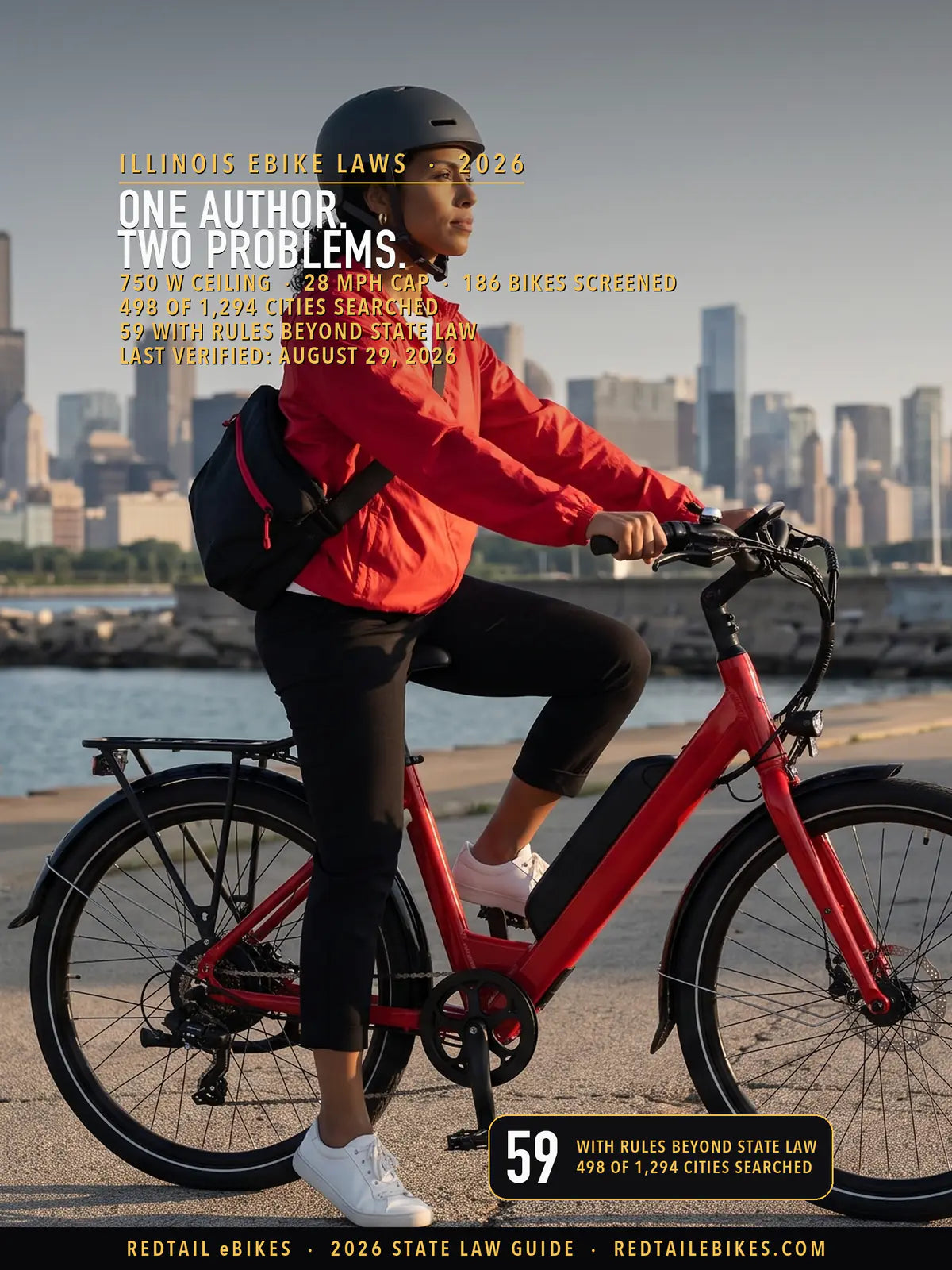
Illinois ebike laws have one author and two problems. The General Assembly wrote them once, in 2017, and has not touched them since. The state's suburbs got tired of waiting.
Between June 2025 and July 2026 dozens of Illinois villages passed their own e-bike ordinances, and they do not agree with each other about age, about paths, or about whether you need a driver's license. A law signed on 26 August 2026 (P.A. 104-0854) erases every one of them on 1 January 2027.
This guide separates the four layers that actually decide whether your ride is legal in Illinois: the state statute, the seller law that took effect in January 2026, the local ordinance where you live, and the land manager who owns the trail under your tires.
750 W ceiling · 28 mph cap · 498 of 1,294 cities searched · 59 with rules beyond state law · 186 bikes screened · 0 helmet rules in the entire Illinois Vehicle Code. Last verified: August 29, 2026.
Quick Answer. An Illinois e-bike is a bicycle with working pedals and a motor of less than 750 watts, in one of three classes. No license, no plate, no registration, no insurance and no helmet are required by the state. Roads and bike lanes yes; bike paths unless the local authority says no; sidewalks never. Class 3 riders must be 16.

The word that decides it is "less." A motor rated at 750 watts flat is already outside Illinois's definition, and 750 W is the single most common nominal rating in our own catalog: 45 of the 142 models that publish one.
In this guide
- How we verified this guide
- The 30-second answer
- What's on this page
- Illinois ebike laws: what makes an e-bike legal here
- What you do not need: license, plate, insurance, helmet
- Where you can ride, and the sidewalk rule everyone breaks
- The 750-watt line, and what your bike becomes above it
- The label, the speedometer, and the tampering loophole
- New since 1 January 2026: the UL 2849 sale law
- State parks and IDNR trails
- Chicago's own rules
- Cook County Forest Preserves: 250 miles of trail, one class banned
- Every municipality we checked
- The suburban patchwork, town by town
- Municipal registration: the power nobody knows Illinois grants
- Fines and enforcement
- Not an e-bike: scooters, mopeds, e-motos
- Can you get a DUI on an e-bike in Illinois?
- Rebates: what Illinois offers, and what it does not
- What changes on 1 January 2027
- What we found when we screened our own catalog
- Illinois against its neighbors
- Our picks: what actually clears Illinois in our own range
- The 60-second self-check: your Illinois compliance checklist
- If you are stopped: the police-stop playbook
- Limitations, and when this page expires
- Source register
- Frequently asked questions
- The bottom line
- References
Illinois leaves path access to local authorities, so the class you buy decides where you are welcome. Every bike in our commuter and city range states its class — free US shipping, US-based support and warranty.
How we verified this guide
Every legal claim below was retrieved from the issuing body's own publication on 22 August 2026 — and the enactment of Public Act 104-0854 on 29 August 2026 — each linked to the section that decides it. Nothing here rests on a summary, an aggregator, or another retailer's page.
Corpus. This page cites 89 distinct sources, and every one of them was retrieved and read in this session; the machine-readable ledger behind them is committed with the article. Eighteen refused a direct automated request — American Legal Publishing, the Illinois Secretary of State, the Forest Preserves of Cook County and two village sites answer 403 or time out to a script — and were read through a print view or a reader proxy instead.
A 403 is a wall, never a dead page, and each of the eighteen was confirmed by reading its text. One host defeated every route we tried, the Indiana General Assembly's current-edition server, so the Indiana row in the neighbour table uses the 2022 edition published by the Indiana Professional Licensing Agency and says so on the page.
Method for the state layer. We downloaded the complete text of the Illinois Vehicle Code from the General Assembly, split it into its 2,011 numbered sections, and searched every one. Every count in this guide is produced that way rather than asserted, and the script behind it is published alongside.
Method for the local layer. We searched 595 Illinois municipal code libraries across the three platforms that host them, using nine search terms including Illinois's own statutory phrase, and we recorded three outcomes per municipality rather than two. A town we could not search is listed as unresolved, never as clear.
Reviewer and contact. Written and verified by Milad Ghobadibeygvand, BScN (Western University, 2014) for Redtail eBikes. Corrections to corrections@redtailebikes.com; we correct in public and date the correction.
Last verified: August 29, 2026. This page states its own expiry conditions at the end, and one of them has already landed.
The 30-second answer
Quick Answer — in Illinois, a low-speed electric bicycle is a bicycle with working pedals and a motor of less than 750 watts, in one of three classes: 20 mph pedal-assist, 20 mph throttle, or 28 mph pedal-assist. You need no license, no plate, no registration and no insurance from the state, and no helmet at any age.
You may ride on roads and in bike lanes, and on bike paths unless the authority that owns the path says otherwise. You may never ride on a sidewalk. Only a Class 3 carries a state age minimum, and it is 16. (625 ILCS 5/1-140.10, 5/11-1517.)
The trap that catches people: "under 750 watts" is exclusive in Illinois. A motor rated at 750 W flat is already outside the definition, and 750 W is the most common nominal rating in our own catalog: 45 of the 142 models that publish one.
Cross into Wisconsin and the same bike is legal, because Wisconsin's statute says "750 watts or less" (Wis. Stat. § 340.01(15ph)). One word, one state line, two different answers. Arizona writes it Illinois's way too, and pairs it with a Class 3 path ban Illinois does not have. North Carolina writes it the other way — "no more than 750 watts" — so the 750 W bike that fails here passes there.
Ohio writes it Illinois's way — "less than 750 watts" in all three class definitions — so the bike that fails here fails there too. Massachusetts writes it the inclusive way too — "750 watts or less" — so the same bike that fails here passes there, and fails again on speed if it assists past 20 mph.
Takeaway
Check the label on your down tube before anything else. Illinois requires the manufacturer to print the class, the top assisted speed and the motor wattage on a permanent label (§ 11-1517(c)). If that label reads 750 W, your bike is not a low-speed electric bicycle in Illinois.
Shopping while you read? Our commuter and city e-bikes and folding e-bikes are the two categories where sub-750 W motors are still the norm.
What's on this page
- Illinois ebike laws: what makes an e-bike legal here
- What you do not need: license, plate, insurance, helmet
- Where you can ride, and the sidewalk rule everyone breaks
- The 750-watt line, and what your bike becomes above it
- The label, the speedometer, and the tampering loophole
- New since 1 January 2026: the UL 2849 sale law
- State parks and IDNR trails
- Chicago's own rules
- Cook County Forest Preserves: 250 miles of trail, one class banned
- Every municipality we checked
- The suburban patchwork, town by town
- Municipal registration: the power nobody knows Illinois grants
- Fines and enforcement
- Not an e-bike: scooters, mopeds, e-motos
- Can you get a DUI on an e-bike in Illinois?
- Rebates: what Illinois offers, and what it does not
- What changes on 1 January 2027
- What we found when we screened our own catalog
- Illinois against its neighbors
- Our picks: what actually clears Illinois in our own range
- The 60-second self-check: your Illinois compliance checklist
- If you are stopped: the police-stop playbook
- Limitations, and when this page expires
- Source register
- Frequently asked questions
- The bottom line
- References
Illinois ebike laws: what makes an e-bike legal here
An Illinois e-bike is legal when it satisfies one definition and one operating section. The definition lives at 625 ILCS 5/1-140.10 and the operating rules at 625 ILCS 5/11-1517. Both were enacted by Public Act 100-209 and took effect on 1 January 2018. Neither has been amended since.
The operative words are worth reading rather than paraphrasing. Section 1-140.10 defines a low-speed electric bicycle as "a bicycle equipped with fully operable pedals and an electric motor of less than 750 watts that meets the requirements of one of the following classes," and closes by stating that such a bicycle "is not a moped or a motor driven cycle" (§ 1-140.10).
| The rule | What it actually means | Source |
|---|---|---|
| Pedals must be "fully operable" | A throttle-only machine with vestigial pedals is not an e-bike here | § 1-140.10 |
| Motor "less than 750 watts" | 749 W passes; 750 W does not | § 1-140.10 |
| Class 1 — assist only while pedaling, cuts out at 20 mph | The default for paths and trails everywhere in the state | § 1-140.10(a) |
| Class 2 — throttle allowed, cuts out at 20 mph | Legal statewide, but the first class local paths shut out | § 1-140.10(b) |
| Class 3 — assist only while pedaling, cuts out at 28 mph | Needs a speedometer and a rider aged 16 or over | § 1-140.10(c), § 11-1517(b), (h) |
| Class 2 motor must cut out when you brake | Classes 1 and 3 must cut out when you stop pedaling | § 11-1517(d) |
| The bike must meet CPSC 16 CFR 1512 | The federal bicycle construction standard, incorporated by reference | § 11-1517(b) |
| A low-speed electric bicycle is a "bicycle" | Every bicycle rule in the Code reaches it unless § 11-1517 says otherwise | § 1-106 |
Where the authority comes from. The General Assembly holds the traffic power; § 11-1517 is its exercise of it, and § 11-208(a)(8) is the slice it hands to local authorities (625 ILCS 5/11-208). Home rule units draw a second, wider power from Article VII, § 6 of the Illinois Constitution, and the Illinois Supreme Court construes it liberally — the Village of Oak Park cited that line of authority by name in the recitals to its own 2026 e-bike ordinance.
Enforcement. Article XV violations carry no bespoke penalty, so the Vehicle Code's default applies: a petty offense on a first or second conviction, and a Class C misdemeanor on a third within one year (§ 16-104). Parents are on the hook too; § 11-1501(b) makes it unlawful for a parent or guardian to "authorize or knowingly permit" a child to violate the article (§ 11-1501).
History. Before P.A. 100-209, Illinois had no e-bike category at all. The same act created the low-speed gas bicycle at § 11-1516, which is why the two are so often confused, including by the state's own safety page.
What is scheduled to change. P.A. 104-0854 adds one sentence to § 1-140.10: "Any electric bicycle that is not a low-speed electric bicycle shall be considered a motor driven cycle for purposes of this Code" (P.A. 104-0854 (SB 3484), enrolled text). Until that date the gap described next is live; from 1 January 2027 it is closed.
What is contested. The statute never says what a machine becomes when it fails the definition. It is not a "motor vehicle" — § 1-146 expressly excludes low-speed electric bicycles from that term (§ 1-146) — and the Secretary of State's own micromobility page states the position plainly: "Illinois currently has no laws governing e-bikes and other micromobility devices that exceed 28 mph" (Illinois Secretary of State, retrieved 22 August 2026). Closing that gap is the stated purpose of the Act described below.
What you do not need: license, plate, insurance, helmet
Illinois asks nothing of an e-bike rider that it does not ask of a cyclist. No driver's license, no registration, no plate, no insurance, no helmet, no minimum age except on a Class 3. Each of those answers comes from a specific statutory exclusion that we read, rather than from an empty search result.
| What you might expect | Illinois answer | Why |
|---|---|---|
| Driver's license | Not required by the state | § 6-101 reaches only a "motor vehicle"; § 1-146 excludes e-bikes from that term (§ 6-101, § 1-146) |
| Registration or plate | Not required | Chapter 3 registration attaches to vehicles of a type required to be registered (§ 3-401) |
| Liability insurance | Not required | § 7-601 requires it for "a motor vehicle designed to be used on a public highway" (§ 7-601) |
| Helmet, any age, any class | Not required by the state | See the measured finding below |
| Minimum age, Class 1 and Class 2 | None in state law | § 11-1517(h) sets an age only for Class 3 |
| Minimum age, Class 3 | 16 to operate; under 16 may ride as a passenger | § 11-1517(h) |
Who enforces the absence. Nobody, which is the point. A police officer has no state section to write you up under for riding unlicensed, unregistered, uninsured or bare-headed on a low-speed electric bicycle. The stop that does happen is almost always a local ordinance stop, and § 11-1509 gives an officer an independent power to inspect the bicycle itself (§ 11-1509).
How it got this way. The exclusions are older than e-bikes. Section 1-146's carve-out for low-speed electric bicycles was written into the motor-vehicle definition by P.A. 96-125, effective 1 January 2010, eight years before Illinois had a three-class system at all (§ 1-146).
What is scheduled to change. P.A. 104-0854 leaves all four exclusions in place for low-speed electric bicycles, and from 1 January 2027 adds license, title, registration and insurance duties only for the machines above the class ceilings (P.A. 104-0854 (SB 3484), enrolled text).
What is unsettled. Insurance is the live question. Nothing requires it, and nothing provides it: a homeowner's or renter's policy may or may not treat an e-bike as covered property or covered liability, and Illinois law does not decide the point. Ask your insurer in writing before you assume either way.
Is there a helmet rule anywhere in the Illinois Vehicle Code?
We did not assume Illinois has no helmet law. We searched for one across the entire Vehicle Code. In 3,599,136 characters of statute retrieved from the General Assembly on 22 August 2026, the word "helmet" appears once, at § 11-1403.3, and it permits intercom helmets rather than requiring any. The phrase "protective headgear" also appears once, at § 11-208(e), where it forbids a unit of local government from requiring motorcycle helmets.
Read that second one carefully, because it cuts the other way for e-bikes. The home-rule limitation in § 11-208(e) covers motorcycles and nothing else. An Illinois municipality is therefore free to require e-bike helmets, and Batavia does: its code bars anyone under 16 from operating or riding as a passenger on a low-speed electric bicycle without a protective helmet (Batavia City Code § 6-12-3).
Takeaway
The state will not ticket you for riding without a helmet. Your village might. Check your own municipal code before you decide the question is settled, and see the town-by-town section below.
Where you can ride, and the sidewalk rule everyone breaks
Section 11-1517 answers the question in three sentences, and the third one surprises people (§ 11-1517(e)-(g)). Roads and bike lanes: yes, anywhere bicycles are allowed. Bike paths: yes, unless the authority with jurisdiction over that path prohibits your class. Sidewalks: no, never, any class, anywhere in Illinois.
The exact words of § 11-1517(g) are: "A person may not operate a low-speed electric bicycle on a sidewalk."
That is the inverse of Illinois's rule for ordinary bicycles. Section 11-1512 lets a person ride a bicycle along a sidewalk and bars it only "where such use of bicycles is prohibited by official traffic-control devices" (§ 11-1512). So on the same stretch of concrete, a pedal bike is presumptively welcome and an e-bike is presumptively banned.
| Surface | Class 1 | Class 2 | Class 3 | Source |
|---|---|---|---|---|
| Roadway, street, alley | Yes | Yes | Yes | § 11-1517(e) |
| Marked bike lane | Yes | Yes | Yes | § 11-1517(e) |
| Bike path | Yes unless the local authority prohibits | Yes unless prohibited | Yes unless prohibited | § 11-1517(f) |
| Sidewalk | No | No | No | § 11-1517(g) |
| IDNR property | Only on a posted bicycle trail, a road, or a parking lot | Same | Same | 17 Ill. Adm. Code 110.165 |
| Controlled-access highway or expressway | No | No | No | Illinois Secretary of State |
Where the authority comes from. Two sections hand the local layer its power: § 11-1517(f) itself, which conditions path access on what the authority with jurisdiction has done, and § 11-208(a)(8), which lets a local authority regulate e-bike operation on the streets under its jurisdiction (§ 11-208).
How the sidewalk rule got there. It arrived with the classes. P.A. 100-209 wrote § 11-1517 as a single package in 2017, sidewalk ban included, and the subsection has not been amended since (§ 11-1517).
What is scheduled to change. P.A. 104-0854 keeps the sidewalk ban word for word and narrows who may close a path.
Section 11-1517(f) today lets a "municipality, county, or local authority" prohibit a class on a bicycle path; the Act strikes those words and substitutes "State agency," then hands the power back to park districts, forest preserve districts, conservation districts and transit districts through a separate "Notwithstanding subsection (i)" clause. A village loses that power; a park district keeps it (P.A. 104-0854 (SB 3484), enrolled text).

A marked bike lane is the one surface every class of Illinois e-bike may use without asking anyone. The sidewalk four feet to the right is off limits to all three.
The word doing the work in § 11-1517(f) is "prohibits." A path is open to you by default and closes only when the authority that owns it acts. That single word is why the local layer below matters more in Illinois than in a preemption state such as Texas, where § 551.106 takes the power away from cities entirely — see our Texas e-bike laws guide for the contrast.
Enforcement, and who does it. A sidewalk violation is a petty offense under § 16-104 unless your municipality has written its own penalty, and many have. Chicago wrote a Class 3-specific sidewalk offense into MCC § 9-52-020(d).
What is contested here. Chicago's § 9-52-120(a) makes the city's bicycle rules apply to e-bikes "except as provided in" four listed sections, and § 9-52-020 is one of the four. Read alone, that leaves the city's sidewalk permissions untouched by the e-bike article, while state § 11-1517(g) still bans every class from every sidewalk.
Our reading is that the state ban governs and the city rule adds a separate Class 3 offense on top; we label that as our reading of two texts rather than as a quotation from either.
The 750-watt line, and what your bike becomes above it
A 1,000-watt bike is not an illegal e-bike in Illinois. It is not an e-bike at all under § 1-140.10, and the statute does not say what it is instead. That gap is the most consequential thing on this page for anyone shopping the high-power end of the market.
Work through the definitions in order. Section 1-140.10 requires a motor of less than 750 W. Section 1-146 excludes low-speed electric bicycles from "motor vehicle" and says nothing about a machine that is not one.
Section 1-145.001 then defines "motor driven cycle" as "every motorcycle and every motor scooter with less than 150 cubic centimeter piston displacement including motorized pedalcycles" (§ 1-145.001). A displacement test, and an electric motor has no displacement to measure.
The Secretary of State says the same thing in plainer words: "Illinois currently has no laws governing e-bikes and other micromobility devices that exceed 28 mph. Many of these devices have motors that exceed 750 watts and can travel well beyond 28 mph — in some cases over 50 mph" (Illinois Secretary of State, Micromobility in Illinois, retrieved 22 August 2026).
Takeaway
Peak wattage is marketing; nominal wattage is the legal number. If a listing gives you "750 W nominal, 1,500 W peak," the figure that decides your status in Illinois is 750, and 750 fails. Ask the seller for the nominal rating in writing before you buy.
Who decides, and who enforces. The General Assembly set the number and no agency may move it; there is no Illinois rulemaking power over the definition. Enforcement is indirect and that is the practical problem: an officer cannot read wattage off a moving bicycle, so in practice the 750 W line bites at the point of sale, at an insurance claim, and after a crash.
How the number was chosen. Illinois took 750 W from the federal construction standard its own § 11-1517(b) incorporates by reference, 16 CFR 1512, and then wrote the ceiling as "less than" rather than "not greater than" (§ 11-1517(b)). That single drafting choice is the whole of the difference with Wisconsin and Indiana.
What is scheduled to change. P.A. 104-0854 keeps 750 W and keeps "less than," and adds the missing consequence: from 1 January 2027, above the line the machine is a motor driven cycle — a valid driver's license and mandatory insurance to ride it, and a certificate of title for one purchased new on or after that date (P.A. 104-0854 (SB 3484), enrolled text).
How to find the number before you buy. Nominal wattage is a published spec, so the check is reading rather than guessing. Our brand profiles record what each manufacturer actually states, for brands we sell and brands we do not: Ridstar, Himiway, Velotric, Aventon, Lectric and Super73, with the six set side by side in our best e-bike brands comparison.
Those are reports on what a brand publishes, and only one of the six is a brand we recommend. Where a motor sits in the drivetrain matters too, and the e-bike motor guide explains why a mid-drive rated at 500 W can out-climb a 750 W hub.
Where the municipalities went instead. Several Illinois towns filled the state's gap themselves by inventing a category. Batavia's code defines an "e-moto" as a motor driven cycle, minibike or pocket bike "with an electric motor with a power output exceeding seven hundred fifty (750) watts" (Batavia City Code § 6-12-1).
Hickory Hills defines a "high-speed electric bicycle" as one "capable of reaching speeds in excess of 28 miles per hour" (Hickory Hills § 41.34). Wheaton calls the same thing an "out-of-class electric vehicle" (City of Wheaton). Three towns, three names, one hole in the state statute.
The label, the speedometer, and the tampering loophole
Illinois requires a permanent label on every low-speed electric bicycle, and almost nobody reads it. Since 1 January 2018 every manufacturer and distributor must affix a label, "in Arial font in at least 9-point type," carrying the class number, the top assisted speed and the motor wattage (§ 11-1517(c)).
A Class 3 needs one more thing: "a speedometer that displays the speed the bicycle is traveling in miles per hour" (§ 11-1517(b)). No other class does.
Now the loophole. Illinois does not ban tampering. It bans tampering without relabeling (§ 11-1517(c)). The sentence reads: "No person shall knowingly tamper or modify the speed capability or engagement of a low-speed electric bicycle without replacing the label required under this subsection (c)."
Read it literally and a rider who derestricts a bike and prints a new accurate label has complied with § 11-1517(c). Read it alongside § 1-140.10 and that same rider has taken the machine out of the definition altogether, because the new label will read above 20 or 28 mph.

This is the label § 11-1517(c) requires: class number, top assisted speed, motor wattage, Arial 9-point or larger. Check it before you buy rather than after a traffic stop.
Who the duty falls on, and who enforces it. The labeling duty runs against "every manufacturer and distributor," not against you, and the tampering sentence runs against "no person." A breach is a petty offense under § 16-104 unless a municipality has written its own penalty, and several have.
Since when. The label duty began on 1 January 2018, the day P.A. 100-209 took effect, so any e-bike first sold in Illinois since then should carry one (§ 11-1517(c)). Bikes imported privately, or bought used from out of state, frequently do not.
What is scheduled to change. P.A. 104-0854 leaves § 11-1517(c) intact (P.A. 104-0854 (SB 3484), enrolled text). The tampering sentence survives in the same form, loophole included.
Compare Connecticut, which put an anti-configurability test on the face of its statute and disqualifies a bike that can be modified at all — see our Connecticut e-bike laws guide. Illinois did not go there, and the difference is a real one for anyone buying a bike advertised with an "unlockable" speed limiter.
Municipalities noticed the gap. Prospect Heights bars operating any e-bike on a city right-of-way "with a battery or motor that has been altered or modified from the manufacturer's specifications, or where the battery or motor specifications are removed, disguised, or omitted" (Prospect Heights § 10-18-2).
Naperville went at it from the other end. Its code makes it a prohibited act to operate an e-bike "without a label clearly identifying the accurate e-bike class" (Naperville § 11-4-7-4, Ord. 25-133, 3 December 2025).
New since 1 January 2026: the UL 2849 sale law
This is the newest Illinois e-bike law and the one almost nobody has written about. The Micromobility Fire Safety Act, 815 ILCS 361, Public Act 104-414, took effect on 1 January 2026 and makes it unlawful to sell an uncertified e-bike in Illinois.
Section 15(a) is worth quoting in full because retailers are still catching up with it:
"No person shall manufacture, distribute, sell, lease, rent, offer for sale, offer for lease, or offer for rent a low-speed electric bicycle unless the electrical drive system for the low-speed electric bicycle has been tested by an accredited testing laboratory and found:"
"(i) before January 1, 2028, to comply with ANSI/CAN/UL Standard 2849 or EN Standard 15194; or (ii) on or after January 1, 2028, to comply with ANSI/CAN/UL Standard 2849." — 815 ILCS 361/15(a)
That is 815 ILCS 361/15(a), in full.
| What the Act does | Section | Applies to |
|---|---|---|
| Drive system must pass UL 2849 or EN 15194; UL 2849 only from 1 Jan 2028 | § 15(a) | Sellers, lessors, renters, distributors, manufacturers |
| Traction battery must pass UL 2271, UL 2849 or EN 15194; UL 2271 or 2849 from 1 Jan 2028 | § 15(c) | Same |
| "Accredited testing laboratory" means ISO/IEC 17065 or 17025 accreditation from an IAF member body | § 10 | Definition |
| No assembling or selling a traction battery built from cells pulled out of used lithium-ion batteries | § 20 | Anyone |
| Violation is an unlawful practice under the Consumer Fraud Act, enforced by the Attorney General | § 25 | Enforcement |
Where the authority comes from. This is not traffic law. The Act sits in Chapter 815, Business Transactions, and borrows its teeth from the Consumer Fraud and Deceptive Business Practices Act rather than from the Vehicle Code, which is why the Attorney General rather than a police officer enforces it.
Who it binds. Sellers. Not riders. Nothing in § 15 makes it unlawful to own or ride an uncertified bike you already have, and nothing in it gives a police officer a roadside power over you. It is a consumer-protection statute enforced by the Attorney General's office.
The history behind it. The Act's own findings section records the reason: the U.S. Consumer Product Safety Commission received reports from 39 states of at least 208 fires or overheating events tied to e-bikes and personal e-mobility devices in 2021 and 2022, causing 19 deaths, and New York City legislated first in 2023 (815 ILCS 361/5).
What is unsettled. The Act does not say who must hold the certificate, how a buyer verifies it, or what a compliant listing looks like. There is no state registry of certified models. In practice the burden falls on the buyer to ask, which is why we ran the screen on our own catalog below and published the result whichever way it fell.
Ask any seller, including us, one question in writing before you buy in Illinois: has this model's drive system been tested to UL 2849 or EN 15194 by an ISO-accredited laboratory? If the answer is not a clear yes with the standard named, keep asking. Browse the full range or contact us and we will pull what the manufacturer publishes for any model you name.
See the full e-bike rangeState parks and IDNR trails
On land owned, leased or managed by the Illinois Department of Natural Resources, your e-bike is welcome in exactly three places and nowhere else. The rule is 17 Ill. Adm. Code 110.165, last amended at 45 Ill. Reg. 12553 effective 24 September 2021.
It names e-bikes directly (110.165). It is unlawful to ride "a bicycle or low-speed electric bicycle as defined by Section 1-140.10 of the Illinois Vehicle Code" on Department property "except upon a roadway designated for vehicular use, parking lot, or posted bicycle trail." Speed is capped at 20 mph on any road, path or trail, and 10 mph in any parking area.
| IDNR rule | Detail | Source |
|---|---|---|
| Where you may ride | Vehicular roadway, parking lot, or a posted bicycle trail only | 110.165(a) |
| Class distinctions | None. All three classes are treated identically | 110.165 |
| Speed on trails | 20 mph unless otherwise posted | 110.165(b) |
| Speed in parking areas | 10 mph unless otherwise posted | 110.165(c) |
| Rulemaking authority | State Parks Act, State Forest Act, Civil Administrative Code | Part 110 authority note |
Enforcement. Part 110 is written in the language of offenses: each subsection begins "it shall be unlawful," and IDNR conservation police enforce it on Department land. The Part draws its authority from the State Parks Act, the State Forest Act and the Civil Administrative Code (Part 110 authority note).
History. The current text arrived in the September 2021 amendment that swept the whole Part (45 Ill. Reg. 12553); before it, the rule spoke only of "bicycles" and said nothing about electric ones.
What is contested. Part 110 draws no line between the classes, which means a 28 mph Class 3 is permitted on a posted state trail while the same machine is banned across every Cook County forest preserve. Whether the department intends that result is not addressed anywhere in the Part.
A gap worth knowing about. IDNR's public-facing Biking Opportunities page lists dozens of state trails and, as retrieved on 22 August 2026, contains zero occurrences of the words "electric" or "e-bike." A rider planning a trip from that page would never learn that 110.165 exists. We report that as a failure of the agency's own signposting rather than as an absence of rules.
What is scheduled to change. The act described below writes express e-bike rulemaking authority for IDNR into the Vehicle Code itself, which tells you the department's current authority rests on the general parks statutes rather than on anything e-bike specific.
For a state-by-state view of who controls which trail, see our e-bike trails atlas and the worked examples in California e-bike trails and Texas e-bike trails, where the land-manager layer decides the answer in the same way it does here.
Chicago's own rules
Chicago has three e-bike provisions of its own, and one of them exists nowhere else in America. If you are buying rather than looking the law up, our Chicago buying guide screens our whole shelf against the definition below and measures all 77 community areas. They sit in Chapter 9-52 of the Municipal Code.
§ 9-52-120, low-speed electric bicycles (added 10 April 2019). It applies the city's bicycle rules to e-bikes with four listed exceptions, requires compliance with 16 CFR 1512 and the state label rule, repeats the class cut-out requirements, and sets the Class 3 age at 16 (MCC § 9-52-120).
§ 9-52-020(d), sidewalks. "No person may ride a Class 3 low-speed electric bicycle upon any sidewalk." The subsection singles out Class 3; the statewide ban at § 11-1517(g) still covers all three (MCC § 9-52-020).
§ 9-52-125, low-speed electric delivery bicycles (added 7 October 2020). This is the distinctive one. No delivery e-bike may operate in Chicago "without approval by the Commissioner that a prototype of such bicycle meets the requirements applicable to such bicycle in this Code and rules promulgated by the Commissioner." It may only be used for bicycle messenger services, only by a licensed bicycle operator, and never on a sidewalk (MCC § 9-52-125).
| Chicago rule | Effect | Adopted |
|---|---|---|
| § 9-52-120 | E-bikes follow bicycle rules; Class 3 rider must be 16+ | Coun. J. 10 Apr 2019 |
| § 9-52-020(d) | Class 3 barred from every sidewalk, as a city offense | Coun. J. 10 Apr 2019 |
| § 9-52-040(d) | Passing on the right is permitted — except on a Class 3 | Coun. J. 10 Apr 2019 |
| § 9-52-125 | Delivery e-bikes need prototype approval from the Commissioner | Coun. J. 7 Oct 2020 |
| § 9-52-130 | CDOT may designate parking for low-speed electric mobility devices | Coun. J. 10 Apr 2019, amended 14 Oct 2021 |
| MCC § 9-52-020(c) | No bicycles of any kind on Lake Shore Drive | Coun. J. 12 Jul 1990 |
Where Chicago's power comes from. Chicago is a home rule unit under Article VII, § 6 of the Illinois Constitution, and § 11-208(a)(8) separately authorizes any local authority to regulate e-bike operation on its own streets (§ 11-208).
Enforcement. Chicago Police enforce Title 9, and the delivery-bicycle rules run through the Commissioner of Transportation's own approval process rather than through a traffic stop (MCC § 9-52-125).
What is scheduled to change. The city's own rules, on 1 January 2027: P.A. 104-0854's new § 11-1517(i) is written as an exclusive state power that no home rule unit may exercise concurrently. The Chicago Park District layer below survives it — the Act expressly leaves park, forest preserve, conservation and transit districts their authority over their own paths (P.A. 104-0854 (SB 3484), enrolled text).
The Lakefront Trail, checked properly. Several guides state that Class 3 e-bikes are banned from Chicago's Lakefront Trail. We retrieved the Chicago Park District Code, Chapter 7 (Rev. 09/2025), which is the chapter governing use of park property, and searched it: it mentions bicycles sixteen times and low-speed electric bicycles zero times. We found no Park District prohibition.
Under § 11-1517(f) a bike path stays open unless the authority with jurisdiction prohibits your class, so on the text we could retrieve, all three classes are permitted on the Lakefront Trail. If the Park District has adopted a rule outside its published Code, we could not locate it, and we will correct this page the day someone sends us the citation.
Riding in the city? Our commuter and city e-bikes and cargo e-bikes collections are built for this kind of riding. Our NYC shop guide shows how another dense-city rulebook compares.
Buying in person instead? Start with our guides to finding a good e-bike store and to where to buy online. The shop directories for Denver, Portland, Los Angeles and San Diego show what a well-run shop looks like.
Cook County Forest Preserves: 250 miles of trail, one class banned
The Forest Preserves of Cook County manage roughly 200 miles of paved trail and nearly 200 miles of unpaved trail across the Chicago region (Forest Preserves of Cook County), and they run the clearest e-bike rule in Illinois. Class 1 and Class 2 are welcome on bicycle trails. Class 3 is banned outright, everywhere on District property.
The rule came in with Ordinance 21-0202, adopted 13 April 2021 and effective 1 May 2021, which rewrote Title 4, Chapter 3 as "Bicycles and Ebikes" (Ordinance 21-0202). It is codified today at Forest Preserve District of Cook County Code § 4-3-1 and restated on the District's own bicycling page, retrieved 22 August 2026.
| Forest Preserves rule | Detail | Source |
|---|---|---|
| Class 1 and Class 2 | Permitted on bicycle trails only, and nowhere else on District land | § 4-3-1(B)(1) |
| Class 3 | "No person may operate any Ebike-Class 3 or Class 3 low-speed electric bicycle" | § 4-3-1(B)(12) |
| Single track | No e-bike of any class without the General Superintendent's authorization | § 4-3-1(B)(2) |
| Speed | 15 mph unless a lower limit is posted | § 4-3-1(B)(8) |
| Electric scooters, unicycles, hoverboards | Prohibited | § 4-3-1(B)(13) |
| Gas-powered bicycles | Prohibited | § 4-3-1(B)(14) |
| Helmets | Recommended only; the 2021 amendment struck the old under-14 mandate | § 4-3-1(C) |
| Penalty | Not less than $75 and not more than $500 per offense | § 4-3-1(B)(16) |
Why the District had the power. Section 11-1517(f) hands the decision to "the municipality, county, or local authority with jurisdiction" over the path. A forest preserve district manages its own trails, so the District is that authority — and the same sentence is what lets a village close a village path.
What changed, and in which direction. The 2021 ordinance was a liberalization, not a crackdown (Ordinance 21-0202). Before it, § 4-3-1.B barred "any electric or electric assisted bicycle capable of exceeding a speed of fifteen (15) miles per hour" from the entire District, which caught every Class 1 and Class 2 machine sold. The amendment opened the trails to Classes 1 and 2 and drew the line at Class 3 instead.
What is scheduled to change. Very little, and that is the interesting part. P.A. 104-0854's preemption expressly carves out "park districts, forest preserve districts, conservation districts, and transit districts," which may still "regulate the use of low-speed electric bicycles upon any bicycle path under its jurisdiction" (P.A. 104-0854 (SB 3484), enrolled text). The Class 3 ban survives the reform that erases the village ordinances around it.
What is contested. The District's ordinance defines "Ebike" to mean only Class 1 and Class 2 machines and then bans "any Ebike-Class 3 or Class 3 low-speed electric bicycle." A Class 3 ridden with the assist switched off is still a Class 3 by its label, so on the text the ban is absolute. We are not aware of a District interpretation saying otherwise.
Takeaway
If you ride the Cook County preserves, buy Class 1 or Class 2. A Class 3 is lawful on the road and unlawful on roughly 400 miles of Cook County trail, and no amount of riding it slowly changes that: the ban is on the machine's class, not on your speed.
Every municipality we checked
Illinois has 1,294 active incorporated municipalities — 978 villages, 300 cities and 16 towns. The count comes from the U.S. Census Bureau's 2025 Gazetteer Files (active places only), and it is matched to the digit by the Illinois Municipal League, which describes itself as "the formal voice for all 1,294 cities, villages and towns in Illinois."
Between them, the three commercial platforms that host Illinois municipal codes carry 595 code libraries: 254 on Municode, 302 on American Legal Publishing and 39 on eCode360. After removing counties, townships, transit agencies and special districts, those libraries resolve to 498 of the 1,294 municipalities. We searched every one of them for nine terms, including Illinois's own statutory phrase.
| Coverage, 22 August 2026 | Municipalities | Share |
|---|---|---|
| Codified e-bike language located | 157 | 12.1% |
| Searched on a platform, nothing located | 341 | 26.4% |
| Unresolved — no searchable code found, so unchecked | 796 | 61.5% |
| Total | 1,294 | 100% |
Those 796 are not clean. They are unchecked, and saying so is the entire point of publishing the split. Most are small villages that publish no code on any of the three platforms; some publish a PDF on their own website, and some publish nothing at all.
What do those 157 municipal codes actually do?
Finding the phrase in a code is not the same as finding a rule. Plenty of Illinois towns name low-speed electric bicycles only to copy the state's definition into their own definitions chapter. So we retrieved the full chapter text for every municipality whose hit matched Illinois's statutory phrase on American Legal — 230 documents — and classified only those we could read in full.
| Bucket | Municipalities | What it means |
|---|---|---|
| Local rule beyond state law | 59 | Adds an age, a path or park ban, a registration duty, a helmet mandate, a speed cap or a local penalty |
| Definition only | 22 | Names e-bikes but adds nothing the Vehicle Code does not already do |
| Not characterized | 62 | Located, but only through short search fragments — not enough text to say what it does |
| Unread | 14 | Flagged by search; full text not retrieved |
We then tried to refute our own classifier. A seeded random sample was drawn and every characterized municipality in it was read by hand against the retrieved code text. Of 11 municipalities checked, 8 confirmed and 3 did not — a 73% agreement rate, close to the 27.5% error rate this project measured on an unverified California sweep in 2026.
Every error ran the same way: the classifier under-called local rules. So treat 59 as a floor, not a count. The hand-check behind that figure is published with this guide.
What we could not do. A code platform indexes the codified code. Wheaton adopted an e-bike ordinance on 6 April 2026 and returned zero platform hits, because its ordinance had not been codified when we searched. A platform "nothing located" therefore means "nothing in the codified code as published today," and this page says so rather than rounding it to "no rule."
The suburban patchwork, town by town
Fourteen months, dozens of village boards, and no two answers alike. Every rule below was read in the municipality's own code or enacted ordinance, and every one is linked.
| Municipality | What it adds beyond state law | Adopted | Source |
|---|---|---|---|
| Hoopeston | Every e-bike owner must register with the city, $5 a year, sticker affixed; no riding on any roadway without a valid driver's license | Ord. 2025-16 | § 10.43.020 |
| Morton Grove | Operator must be 16 and hold a valid driver's license unless directly supervised by a parent; impoundment for wilful and wanton operation | Ord. 25-23, 12 Aug 2025 | § 5-14-2 |
| Hickory Hills | No person without a valid driver's license may ride an e-bike on any public street; defines "high-speed electric bicycle" above 28 mph | — | § 41.34 |
| Glen Ellyn | All three classes 16+ — "a person who is under the age of sixteen (16) may not operate a Class 1, 2 or 3 low-speed electric bicycle"; sidewalk use prohibited village-wide | Ord. 7186, 28 Apr 2025; Ord. 7261, 9 Feb 2026 | § 9-8-3(N) and the Village's summary |
| Naperville | Defines an "e-motor" as any device over 750 W, without operable pedals, or capable of sustained speeds over 28 mph, and bans it from streets, bike lanes, parks, paths and sidewalks unless titled and registered; label offense; parking rules | Ord. 25-133, 3 Dec 2025 | § 11-4-7-1, -4 |
| Buffalo Grove | Class 2 and Class 3 barred from Village-owned bike paths and parks; no e-bike on sidewalks | Ord. 1 Dec 2025 | § 10.26.020 |
| Mount Prospect | Class 2 or Class 3 rider must be 16 unless accompanied by a parent; e-motos need lights, mirror, horn, speedometer and brake lights | Ord. 6809, 7 Oct 2025 | § 23.122 |
| Park Ridge | Class 1 or Class 2 rider must be 14+, Class 3 16+ | — | § 13-4-3 |
| Harwood Heights | Class 3 prohibited on any public or private street, sidewalk, parking lot, bike path or park; and no one under 16, or without a valid driver's license, may ride any class on public property | — | § 10.56.075 |
| Batavia | Helmet required under 16, rider or passenger; reckless-operation offense; e-moto category above 750 W | — | § 6-12-3 |
| Palos Heights | Hard 20 mph cap on any bicycle or e-bike; e-bikes only on streets and designated city trails; Class 3 16+ | — | Ch. 72 |
| Countryside | Class 3 only on streets, and barred from every multi-use path; both hands on the bars; no phone in hand | — | § 5-6 |
| Prospect Heights | Local operating-under-the-influence offense covering bicycles and e-bikes; altered-motor ban; label duty | — | § 10-18-2 |
| Canton | Class 3 rider 16+, passenger 14+; registration chapter with fees | — | § 9-13 |
| Evanston | Makes weight a class test: a Class 1 or Class 2 must weigh less than 125 pounds, and one at or above 125 lb is a Class 3 by definition — a rule the state does not have | — | § 10-1-3 |
| Schaumburg | All e-bike and e-scooter riders 16+; e-bikes above 20 mph must ride on-street; lights required at night | — | Village of Schaumburg |
| Roselle | Under-16 riders may use a Class 1 or 2 on pedal power only; e-bikes barred from sidewalks; Class 1 only on Park District trails | 23 Jun 2025 | Village of Roselle |
| Oak Park | New Article 12 covering e-bikes, e-scooters and mobility devices, enacted under home rule | Ord. 26-150, 28 Jul 2026 | Ordinance 26-150 |
| Westmont | Dedicated article: location restrictions, impoundment, equipment | Mar 2026 | § 78-600 to 78-606 |
| Vernon Hills | An ordinance that adds nothing: "An operator of an electric bicycle shall adhere to state law" | Ord. 2025-107, 16 Sep 2025 | § 22-394 |
Where the power comes from. Every rule above rests on one of two grants: § 11-208(a)(8) for a non-home-rule village, and Article VII, § 6 for a home rule unit. Oak Park's ordinance sets out the chain in its own recitals, citing the Constitution and the Illinois Supreme Court's liberal construction of home rule powers.
Enforcement. These are ordinance violations, which means administrative adjudication and a local fine rather than a criminal court, plus impoundment where the village has taken that power. Roselle publishes both routes on its own page (Village of Roselle).
History, compressed into fourteen months. Ten of the twenty rows in the table carry an establishable adoption date: eight name a 2025 ordinance and three name a 2026 one, Glen Ellyn appearing in both because it amended twice. Nothing in state law changed in that window; what changed was the number of e-bikes on suburban paths.
What is scheduled to change. All of it. P.A. 104-0854's § 11-1517(i) preempts every rule in the table that applies to a public street or a village path, leaving only the park-district and forest-preserve carve-out standing (P.A. 104-0854 (SB 3484), enrolled text).
What is contested. Whether some of these ordinances are valid today. A driver's-license requirement for a bicycle is a long way from "regulating the operation of bicycles," and the Vehicle Code's own § 11-208(b) makes several categories of local traffic regulation ineffective until signs give reasonable notice. We found no Illinois decision testing an e-bike ordinance, and we flag the question rather than answer it.
Glen Ellyn's is worth reading closely. Glen Ellyn's § 9-8-3(N) bars anyone under 16 from operating "a Class 1, 2 or 3 low-speed electric bicycle as set forth in Section 11-1517(h) of the Illinois Vehicle Code" (§ 9-8-3(N)).
Section 11-1517(h) sets 16 only for a Class 3. The village rule is stricter than the section it cites, which § 11-208(a)(8) allows, and which means a rider who reads the state law alone will get Glen Ellyn wrong.
Read that table twice and the problem announces itself. In Park Ridge a 14-year-old may ride a Class 2; six miles away in Glen Ellyn the same child may not ride any class.
In Morton Grove, Hoopeston and Hickory Hills an adult needs a driver's license to ride a bicycle with a motor. In Vernon Hills the village passed an ordinance that changes nothing at all.
This is the "confusing patchwork of local rules" the Secretary of State's office says its legislation exists to replace (Illinois Secretary of State, 15 April 2026). On the evidence in this table, the description is fair.
Municipal registration: the power nobody knows Illinois grants
Most riders have never read the sentence that follows. Illinois expressly authorizes your city to make you register and license your e-bike, and to charge you for it.
Section 11-208(a)(8) lets local authorities regulate "the operation of mobile carrying devices, bicycles, low-speed electric bicycles, and low-speed gas bicycles, and requiring the registration and licensing of same, including the requirement of a registration fee" (625 ILCS 5/11-208).
Towns use it. Hoopeston's ordinance requires every owner of a low-speed electric bicycle in the city to register it, furnish the make and serial number, pay $5 a year and display a sticker; a resident under 18 needs written parent or guardian consent to register (Hoopeston § 10.43.020). Our sweep found registration or licensing language in the e-bike chapters of Canton, Glendale Heights, Countryside, Hinsdale, Mattoon, Paris and Prospect Heights as well.
Enforcement. A registration ordinance is enforced like any other village ordinance, and Hoopeston pairs it with a license requirement in the same chapter, so an unregistered rider is exposed on two counts rather than one (Hoopeston § 10.43.020).
History. The registration power is old. Section 11-208(a)(8) has authorized local bicycle registration for decades; what changed was the addition of "low-speed electric bicycles, and low-speed gas bicycles" to the same subsection, which is how a 1950s bicycle-license sticker scheme became an e-bike rule.
What is scheduled to change. P.A. 104-0854 amends § 11-208 and adds the flat preemption at § 11-1517(i), ending municipal e-bike registration on 1 January 2027 (P.A. 104-0854 (SB 3484), enrolled text).
Compare the alternative. Pennsylvania's § 6101 preempts most local e-bike rules and backs the preemption with a Liquid Fuels funding penalty; Texas § 551.106 does much the same. See Pennsylvania e-bike laws and Texas e-bike laws. Illinois chose the opposite design and then left it alone for eight years, which is how 1,294 municipalities came to hold 1,294 independent answers.
What is contested. Nothing in § 11-208(a)(8) says whether a municipality may require registration of a bike merely ridden through it rather than owned there, and none of the ordinances we read answers the question. A rider crossing three villages on one commute has no way to know how many registrations they owe. We could find no Illinois decision on the point, and we label that as a gap rather than as an answer.
Fines and enforcement
The state's numbers are small and its multipliers are not, and local penalties are often larger than the state's (§ 16-104).
| Violation | Penalty | Source |
|---|---|---|
| Any Article XV violation, first or second conviction | Petty offense: minimum fine $75, maximum $1,000 | § 16-104, 730 ILCS 5/5-4.5-75 |
| Third or subsequent conviction within one year | Class C misdemeanor: up to 30 days | § 16-104, 730 ILCS 5/5-4.5-65 |
| Letting your child break the rules | Unlawful for the parent or guardian | § 11-1501(b) |
| Riding in the Cook County Forest Preserves against the bike ordinance | $75 to $500 per offense | FPDCC § 4-3-1(B)(16) |
| Roselle citation | At least $35, plus possible adjudication hearing; police may impound or release the device to a parent | Village of Roselle |
| Selling an uncertified e-bike | Unlawful practice under the Consumer Fraud Act, Attorney General enforcement | 815 ILCS 361/25 |
Where the penalty comes from. Article XV states offenses but sets no penalties, so § 16-104 supplies the default for the whole Vehicle Code, and 730 ILCS 5/5-4.5-75 supplies the fine range for a petty offense. Local fines rest on the municipality's own ordinance power.
History. The $75 floor and $1,000 ceiling for petty offenses were set by P.A. 91-357, effective 29 July 1999, and have not been indexed since (730 ILCS 5/5-4.5-75).
What is scheduled to change. P.A. 104-0854 does not amend § 16-104, so the state penalty structure survives the reform intact (P.A. 104-0854 (SB 3484), enrolled text).
What is contested. Whether a village may impound a bicycle at all is not settled by any section we located. Section 11-208(a)(8) authorizes regulation, registration and licensing; it does not mention seizure, and none of the impound ordinances we read cites a specific enabling section for it.
Impoundment is the real risk. Several Illinois villages take the bike as well as the fine. Morton Grove authorizes impoundment for wilful and wanton operation (§ 5-14-3); Westmont, Prospect Heights and Countryside all carry impound powers in their e-bike articles. A $75 petty offense and a towed bicycle are not the same event.
Who enforces. Municipal police for local ordinances, and any police officer for the Vehicle Code. Section 11-1509 lets a uniformed officer stop a bicycle and inspect it on reasonable cause to believe it is unsafe or not equipped as required (§ 11-1509).
Not an e-bike: scooters, mopeds, e-motos
Four machines get mistaken for e-bikes in Illinois, and each is governed by a different section of the same definitions article (§ 1-140.11 onwards). Getting this wrong is how a rider ends up needing a license they do not have.
| Machine | Illinois category | The rule | Source |
|---|---|---|---|
| Low-speed electric scooter | Its own category: under 100 lb, 2–3 wheels, floorboard, max 10 mph | Only lawful in a municipality, park district, forest preserve district or conservation district that has affirmatively authorized it | § 1-140.11, § 11-1518 |
| Low-speed gas bicycle | Pedals plus a petrol motor under 1 hp or 15 cc, under 20 mph | Rider must be 16+; 20 mph ceiling; no sidewalks | § 1-140.15, § 11-1516 |
| Moped | A motor driven cycle reaching 20–30 mph with 2 bhp or less | Titled, registered, licensed as a motor vehicle | § 1-148.2 |
| Motor driven cycle | Motorcycle or motor scooter under 150 cc, including motorized pedalcycles | Full motorcycle equipment rules apply | § 1-145.001, § 11-1404 |
| "E-moto" above 750 W and 28 mph | No state category at all | The gap the Secretary of State describes | Illinois Secretary of State |
Where the categories come from, and who enforces them. All five sit in the Vehicle Code's own definitions article, so a misclassification is enforced by any police officer under the section that matches the machine — and for a moped or motor driven cycle that means the license, title, registration and equipment provisions all at once, including the eye-protection rule at § 11-1404.
History. The scooter category is the newest: § 1-140.11 was written by P.A. 103-899, effective 9 August 2024, and the low-speed gas bicycle definition by P.A. 103-706, effective 1 January 2025 (§ 1-140.11, § 1-140.15). Illinois has been adding one category a year and still has no category for the fastest machines.
What is scheduled to change. P.A. 104-0854 repeals § 11-1518 outright and replaces the scooter category with a broader "electric micromobility device" defined at a new § 1-117.6, covering electric skateboards, unicycles and scooters up to 28 mph (P.A. 104-0854 (SB 3484), enrolled text).
What is contested. The "motor driven cycle" definition at § 1-145.001 is written in cubic centimeters, a unit an electric motor does not have. Reading an electric machine into that category is an inference today, not a statutory instruction. From 1 January 2027 it stops being one: P.A. 104-0854 rewrites § 1-145.001 to cover "an electric motor with a nominal power rating of greater than 750 watts but less than or equal to 8,000 watts" expressly (P.A. 104-0854 (SB 3484), enrolled text).

The first has fully operable pedals and a motor under 750 watts. The other has neither, and Illinois has no category for it at all.
The contrast between the scooter section and the e-bike section is the tell. Section 11-1518 says a low-speed electric scooter is lawful in a jurisdiction only if that jurisdiction authorizes it; § 11-1517(f) says an e-bike may use a bike path unless the jurisdiction prohibits it. Same legislature, opposite defaults, three sections apart.
Can you get a DUI on an e-bike in Illinois?
The statute does not settle this one, so the layering below is deliberate.
What the sources say. Section 11-501(a) applies to a person who drives or is in actual physical control of "any vehicle" (§ 11-501). Section 1-217 defines "vehicle" as every device by which a person may be transported on a highway, "except devices moved by human power" (§ 1-217). Section 1-146 excludes low-speed electric bicycles from "motor vehicle" — and says nothing about "vehicle" (§ 1-146).
Our reading, labeled as ours. An ordinary bicycle is moved by human power and falls inside the § 1-217 exception. An e-bike is not moved by human power alone. On the face of the definitions, an e-bike can therefore be a "vehicle," and § 11-501 can reach it.
We are not aware of an Illinois appellate decision applying § 11-501 to a low-speed electric bicycle, and we did not retrieve one; treat this as a reading of the statutes rather than as settled law.
What the legislature thinks. In May 2026 the House attached Floor Amendment No. 3 to SB3336, which would have provided that the DUI requirements "do not apply to low-speed electric bicycles and low-speed gas bicycles" (SB3336 bill status).
You do not draft an exemption from a statute that plainly does not apply. That amendment did not survive: the package that passed both chambers, SB3484, amends seventeen sections of the Vehicle Code and § 11-501 is not among them (P.A. 104-0854 (SB 3484), enrolled text).
Who would enforce it, and how. Section 11-501 is enforced by any police officer, and the implied-consent scheme at § 11-501.1 attaches to a person who "drives or is in actual physical control of a motor vehicle" — a narrower phrase than § 11-501's "any vehicle," which is a second reason the answer is not clean.
History. Section 1-217's "devices moved by human power" exception is one of the oldest phrases in the Code, carried over from the pre-1991 recodification. It was written for bicycles in a world with no electric ones, and it has not been revisited since.
Locally, it is already settled in some places. Prospect Heights makes it a village offense to operate a bicycle or a low-speed electric bicycle "while under the influence of alcohol or any drug," with no statutory ambiguity to argue about (§ 10-18-2).
Takeaway
Do not test this one. Whatever the state answer turns out to be, several Illinois municipalities have already written their own impaired-riding offense, and a crash while impaired brings civil liability regardless of which section a prosecutor picks.
Rebates: what Illinois offers, and what it does not
Illinois runs a state electric-vehicle rebate worth up to $4,000, and an e-bike can never qualify for it (415 ILCS 120/10). Not an oversight in the paperwork; it is the statutory definition.
The Electric Vehicle Rebate Act, 415 ILCS 120/10, defines an eligible "electric vehicle" as one that is "legally permitted to drive on all public roadways, including interstate highways," and expressly excludes "electric vehicles with a maximum speed below 45 miles per hour." A 28 mph Class 3 fails both tests. The rebate itself, $2,000 for an eligible applicant since 1 July 2025 with a further $2,000 for low-income applicants, is at § 27.
| Program | Covers e-bikes? | Status, 22 Aug 2026 | Source |
|---|---|---|---|
| Illinois EPA Electric Vehicle Rebate | No — excluded by the 45 mph floor | Open for qualifying vehicles | 415 ILCS 120/10, /27 |
| Bike Chicago (CDOT) | Gives away pedal bicycles only | Distributions each spring and summer, subject to funding | City of Chicago |
| A statewide e-bike rebate | Does not exist | No Illinois statute creates one; we found none in the Compiled Statutes | Illinois Compiled Statutes |
Who administers it. The Illinois Environmental Protection Agency runs the rebate under 415 ILCS 120/27, and the fund behind it is fed by a $20 annual user fee that the Secretary of State collects from fleet registrants in the Chicago-area Covered Area (§ 35). The scheme is funded by drivers and spent on drivers.
History. The Act was rewritten by P.A. 102-662, effective 15 September 2021, as part of the Climate and Equitable Jobs Act package; the 45 mph exclusion has been in the definition since that rewrite.
What is scheduled to change. The rebate steps down to $1,500 on 1 July 2028 under § 27(a)(3). Nothing in P.A. 104-0854 touches the Electric Vehicle Rebate Act, so the exclusion of e-bikes survives the micromobility reform (P.A. 104-0854 (SB 3484), enrolled text).
What is contested. The 45 mph floor was written to exclude neighborhood electric vehicles and golf carts, and it catches e-bikes as a side effect rather than as a stated policy. No Illinois document we retrieved explains why the fastest legal e-bike is treated the same way as a golf cart.
We looked for a statewide e-bike incentive and did not find one. That statement covers what we searched: the Illinois Compiled Statutes and the Illinois EPA's rebate statute. It is not a guarantee that no municipal or utility program exists anywhere in the state. If your utility or village runs one, we would like the link.
For states that do fund e-bikes directly, see Colorado e-bike laws, Minnesota e-bike laws and Washington e-bike laws, all of which run real programs with real money.
What changes on 1 January 2027
The law that rewrites Illinois e-bike rules top to bottom has been signed (P.A. 104-0854). None of it reaches you until 1 January 2027, so nothing on the rest of this page changes for the remainder of 2026 — and the municipal patchwork set out earlier on this page now has an expiry date.
SB3484 of the 104th General Assembly passed both houses on 1 June 2026 (the Senate concurring in the House amendment 48–7), was sent to the Governor on 30 June 2026, and was approved on 26 August 2026 as Public Act 104-0854, effective 1 January 2027 (bill status). The signature was not strictly necessary.
Under Article IV, § 9(b) of the Illinois Constitution, "any bill not so returned by the Governor within 60 calendar days after it is presented to him shall become law," and sixty days from 30 June was 29 August 2026 — so the package was becoming law with or without it. That matters for one practical reason: there is no veto to argue about and no amendatory version to wait for. What the enrolled text says is what takes effect.
| Under P.A. 104-0854 | Today | From 1 Jan 2027 | Section |
|---|---|---|---|
| Class 1 and Class 2 minimum age | None | 15 | 11-1517(h) |
| Class 3 minimum age | 16 | 16, unchanged | 11-1517(h) |
| Carrying a passenger | No rule | Operator must be 18 unless the passenger is a sibling, stepsibling, child or stepchild | 11-1517(h) |
| Machines over 750 W | No category | "Any electric bicycle that is not a low-speed electric bicycle shall be considered a motor driven cycle" | 1-140.10 |
| Riding a motor driven cycle | Unsettled | A valid driver's license is required, and mandatory insurance applies | 11-1403.4(d), (l) |
| A motor driven cycle on a path | Unsettled | Barred from every sidewalk, bicycle lane, bicycle path, shared-use path and off-road bicycle trail | 11-1403.4(b) |
| Motor driven cycle equipment | No rule | Speedometer in mph, a VIN, federal safety standards; tampering with the speed capability prohibited | 11-1403.4(g) |
| Local rules on motor driven cycles | Permitted | Preempted by a second, separate home-rule denial | 11-1403.4(k) |
| Local e-bike ordinances | Broadly permitted under 11-208(a)(8) | Preempted. "no unit of local government, including a home rule unit, may regulate low-speed electric bicycles" | 11-1517(i) |
| Park, forest preserve, conservation and transit districts | Path authority under 11-1517(f) | Keep it, by express carve-out | 11-1517(f) |
| IDNR | Rules under the parks statutes | Express Vehicle Code authority to make e-bike rules | 11-1517(f) |
| Adaptive electric bicycles | Not defined | New definition; treated as a bicycle when ridden by a person with a mobility disability | 1-101.15 new |
| Low-speed electric scooters | Section 11-1518 | Repealed, replaced by a new "electric micromobility device" framework | 11-1518 rep. |
| DUI | Unsettled (see above) | Still unsettled — § 11-501 is not amended | P.A. 104-0854 (SB 3484), enrolled text |
Subsection (i) is the one to read twice. It is written as "a denial and limitation of home rule powers and functions under subsection (h) of Section 6 of Article VII of the Illinois Constitution, and is an exercise of exclusive State power which may not be exercised concurrently by a home rule unit."
Every village ordinance in the table above loses its footing on the same morning, except to the extent it regulates a park district's or forest preserve's own land.
Under what power. Subsection (i) is drafted as an exercise of the General Assembly's authority under Article VII, § 6(h) of the Illinois Constitution, which lets the legislature declare a subject an exclusive State power by a three-fifths vote.
SB3484's own rolls clear it: the Senate passed it 55–0 on 15 April 2026 and the House 84–16 on 1 June 2026, with "3/5 Vote Required" recorded against that House reading, and the Senate then concurred in the House amendment 48–7 (bill status).
Enforcement, once it lands. The new duties for machines above the class ceilings are title, registration, license and insurance duties, which means the Secretary of State rather than a village hall becomes the enforcing body for the fastest machines (P.A. 104-0854 (SB 3484), enrolled text).
What is contested about it. Preemption of this width is rarely uncontested, and the Illinois Municipal League was named by the Secretary of State's office as a stakeholder in the package (Illinois Secretary of State, 15 April 2026). What happens to a village ordinance adopted in 2026 and never repealed is a question the act does not answer in terms; on its face the ordinance simply stops being enforceable.
The near miss. A twin bill, SB3336, carried the same package, passed the Senate 54–0 on 15 April 2026 and the House 80–30 on 27 May 2026, and then died on the concurrence calendar on 2 July 2026 under Senate Rule 3-9(b) (SB3336 bill status). Illinois came within one procedural vote of doing this twice.
What we found when we screened our own catalog
We ran Illinois's own tests against the bikes we sell, on the day this page was written, and we are publishing the result however it came out. The screen and its full output are published with this guide.
| Our catalog against Illinois law | Models | Share of 186 |
|---|---|---|
| Meets § 1-140.10 on published specs | 16 | 8.6% |
| Falls outside § 1-140.10 on published specs | 113 | 60.8% |
| Cannot be established from the published specs | 57 | 30.6% |
| Listing names UL 2849 or EN 15194 for the drive system | 4 | 2.2% |
| Listing names UL 2271, UL 2849 or EN 15194 for the battery | 16 | 8.6% |
Two honest readings of that table, and they are different readings.
On the definition. The 113 are overwhelmingly 750 W machines. In Wisconsin, Indiana and most of the country they are ordinary Class 2 e-bikes; in Illinois the word "less" puts them outside the definition. The Illinois statute meets an industry that standardised on 750 W, which is why this page leads with the word "less."
On the certification columns. Four listings naming UL 2849 or EN 15194 is a disclosure finding, not a compliance finding. A drive system may well be certified and simply not described in the listing text.
We are not saying 182 models are uncertified; we are saying our own listings do not tell an Illinois buyer what 815 ILCS 361/15 now makes relevant, and that is on us to fix rather than on the reader to guess. That work is under way.
Takeaway
Before you buy any e-bike for Illinois use, get two things in writing: the nominal motor wattage, and whether the drive system was tested to UL 2849 or EN 15194 by an ISO-accredited laboratory. Those two answers decide whether the bike is an e-bike here and whether it could lawfully be sold to you. Ask us — we will send you what the manufacturer publishes, including when the answer is "they do not publish it."
Illinois against its neighbors
A single word separates Illinois from Wisconsin, and it is worth a hundred dollars of motor.
| State | Motor limit, as written | Inclusive or exclusive | Source |
|---|---|---|---|
| Illinois | "an electric motor of less than 750 watts" | Exclusive — 750 W fails | 625 ILCS 5/1-140.10 |
| Wisconsin | "an electric motor of 750 watts or less" | Inclusive — 750 W passes | Wis. Stat. § 340.01(15ph) |
| Indiana | "an assistive, electric motor with a power output not greater than seven hundred fifty (750) watts" | Inclusive — 750 W passes | IC 9-13-2-49.2 (2022 edition) |
| Iowa | "an electric motor that produces not more than seven hundred fifty watts" — changed from "less than" on 1 July 2026 | Inclusive since 1 July 2026 | 2026 Iowa Acts ch. 1053 amending Iowa Code § 321.1(36A) |
| Missouri | "an electric motor of less than 750 watts" | Exclusive | RSMo § 301.010(15) |
| Kentucky | No definition of "electric bicycle" in the traffic chapter's definitions section | Not applicable | KRS 189.010 |
Two caveats on that table, stated rather than buried. The Indiana row comes from the 2022 edition of the Indiana Code published by the Indiana Professional Licensing Agency, because the General Assembly's current-edition host refused automated retrieval. The definition was added by P.L.206-2019 and we found no evidence of later amendment, but the vintage is 2022.
The Kentucky row reports what KRS 189.010 contains, retrieved 22 August 2026. It is not a claim that no Kentucky statute anywhere mentions e-bikes.
For the full national picture, our state-by-state e-bike laws hub carries all fifty states in one table, and the individual guides for New York, California, Florida and New Jersey show how differently four large states answered the same questions.
Our picks: what actually clears Illinois in our own range
Most of the market fails this state on one word, and our shelves are not an exception. Of the 186 live bikes we screened on 22 August 2026, 16 meet § 1-140.10 on published specs. Two further filters cut that list down again, and both are worth applying yourself.
Filter one: the brands we are willing to recommend. We recommend seven brands and no others — Eunorau, Samebike, Ridstar, Eahora, Vtuvia, Qiolor and Riding'times. Applied to the 16, that leaves 12 machines — 11 Eunorau and one Samebike.
Vtuvia, on the shelf since September 19, 2026, contributes two: the 500 W CMB 8-Speed and the 500 W Zeal LT7 clear the ceiling, and its 750 W and 1,000 W models are rated at or above it. Every Eahora, Qiolor, Riding'times and Ridstar model in the catalog is rated at or above 750 watts nominal and is therefore not a low-speed electric bicycle in Illinois (§ 1-140.10). The statute does that work for us.
Filter two: can you actually buy it today. The one Samebike that clears Illinois, the $759 RS-A01Pro, shows zero units across all four colors on tracked inventory as of 23 August 2026. It is a real bike and a legal one; it is not a purchase this week.
Which leaves this page in an honest and slightly awkward position: one approved brand has Illinois-legal stock right now, so the same caveat applies to both picks below. We would rather say that than pad the list with a brand the statute rules out.
Takeaway
For a buyer, the most useful thing on this page is a question rather than a model name: what is the nominal wattage, and has the drive system been tested to UL 2849 or EN 15194? Ask it of us and of anyone else. A seller who cannot answer both in writing is a seller who has not read 815 ILCS 361/15.
The commuter pick

Sub-750 W, 20 mph, torque sensor. The class-legal end of the market is smaller than the marketing suggests.
Eunorau META275 1.0 City eBike — $1,699. For the Chicago or collar-county commuter who wants one bike that is legal everywhere they ride.
Eunorau rates it at a 48V/500W high-torque hub motor with a 20 mph top speed (Eunorau product page, specs pulled 2026-08-13). Two numbers matter here and both are on the right side of the line: 500 W clears the "less than 750 W" test with room to spare, and a 20 mph ceiling puts it in Class 1 or Class 2 territory rather than Class 3.
That last point is the one people miss. A Class 3 is lawful on Illinois roads and banned across every Cook County forest preserve trail (FPDCC § 4-3-1(B)(12)), barred from Village-owned paths in Buffalo Grove (§ 10.26.020(D)(2)), and off every path in Countryside (§ 5-6-5). A 20 mph machine sidesteps all of it.
| What Eunorau publishes | Figure |
|---|---|
| Motor | 48V / 500 W high-torque hub |
| Battery | 13 Ah; manufacturer range 35–65 miles |
| Top speed | 20 mph |
| Brakes | Hydraulic disc, 180 mm |
| Drivetrain | Shimano 9-speed freewheel, torque sensor |
| Tires | CHAOYANG city 27.5 × 3.0 |
| Payload | 286 lb |
| Frame | 6061 aluminum alloy |
| Warranty | Frame 10 years · battery, motor and electricals 24 months |
Sourced from Eunorau's own product page, pulled 2026-08-13; blanks are specs Eunorau does not publish, and we do not fill them in.
The caveat, and it cuts against us. Eunorau does not publish a UL 2849 or EN 15194 test result for this drive system, and neither does our listing. Since 1 January 2026 815 ILCS 361/15(a) has required that testing for a lawful Illinois sale.
We are not telling you the bike fails the Act, because an undisclosed certificate is not a missing one. We are telling you the disclosure is absent, that we found it on our own page, and that the listings are being corrected.
Look elsewhere if you want serious off-road riding; this is set up for road and path. And if you want a Class 3, buy it knowing where it cannot go.
The stability pick, for a different rider

Three wheels, one 500 W motor, and no balancing at a stop light. The class rules apply to trikes exactly as they do to two-wheelers.
Eunorau NEW-TRIKE 2.0 Foldable Electric Trike — $2,499. For the rider who wants stability at a standstill — and for anyone carrying loads that would unbalance a two-wheeler.
The legal analysis is identical to the META275's, because Illinois draws no trike distinction: § 1-106 defines a bicycle as a device "with 2 or more wheels," so a low-speed electric trike is a low-speed electric bicycle with one extra wheel (§ 1-106). One 500 W motor, 20 mph — comfortably inside § 1-140.10 on both numbers.
| What Eunorau publishes | Figure |
|---|---|
| Motor | 500 W, 80 N·m |
| Battery | 20 Ah; manufacturer range 60–100 miles |
| Top speed | 20 mph |
| Brakes | Hydraulic 180 mm, motor cut-off sensor, parking brake |
| Drivetrain | Shimano 7-speed |
| Payload | 440 lb |
| Rider height | 5'1"–6'1" |
| Warranty | Frame 10 years · battery, motor and electricals 24 months |
Sourced from Eunorau's own product pages, pulled 2026-08-13. The same UL 2849 / EN 15194 disclosure caveat applies here as to the META275: neither the manufacturer nor our listing names the standard, and we say so rather than wait to be asked.
The one we rejected, and why it matters
We had a third machine approved for this page and pulled it ourselves. The Eunorau FAT-AWD 3.0 is all-wheel-drive: its published specification is a front 500 W hub motor plus a rear 500 W hub motor — 1,000 watts combined.
Section 1-140.10 defines a low-speed electric bicycle as one equipped with "an electric motor of less than 750 watts." Whether that singular phrase measures each motor or the pair is a question no Illinois statute, rule or decision we retrieved answers.
A machine that is at best contested under the definition does not belong among the picks on a page about the definition. That is the whole standard, applied to our own shelf. If the dual-motor question is ever settled — P.A. 104-0854 does not touch it — we will revisit.
Riding somewhere other than Chicago? The class question follows the surface rather than the city. Start from where you will actually ride — street only, village path, or forest preserve trail — and let that pick the class before the brand.
Browse commuter e-bikesThe 60-second self-check: your Illinois compliance checklist
Run this before you ride in Illinois. Every line traces to a section above.
- Read the label on the down tube. Class number, top assisted speed, motor wattage, Arial 9-point or larger. No label means no proof of class.
- Is the wattage under 750 rather than at 750? At 750 you are outside § 1-140.10.
- Do the pedals work? Illinois writes "fully operable pedals" into the definition itself, so a bike that cannot be pedalled is not a low-speed electric bicycle here.
- Class 3? Check for a speedometer, and check the rider is 16 or over.
- Never the sidewalk. All three classes, everywhere in Illinois.
- Check the village as well as the state. Age, path bans, driver's license and registration rules are all local in Illinois today.
- Check the land manager. IDNR posts its trails; Cook County Forest Preserves bans Class 3 outright; park districts set their own rules.
- Buying? Ask for the nominal wattage and the UL 2849 or EN 15194 status in writing.
Not sure which class fits where you ride? Start with Class 1 and Class 2 commuter models if your route uses paths or forest preserve trails. Our e-bike buying guide explains how motor type changes the answer.
Unpaved county trail, hauling children, or carrying a bike up three flights in Lincoln Park? Three different machines: fat-tire, cargo and folding. For a lower step-over, look at electric trikes and cruiser and moped-style models. Mountain e-bikes are the ones to check twice against the Cook County single-track rule, and the sale collection is where to start on a budget.
Browse commuter e-bikesIf you are stopped: the police-stop playbook
Illinois gives an officer a specific power over bicycles (§ 11-1509), so a police stop on an e-bike is usually about one of four things. Knowing which one saves the argument.
- The inspection power is real. Section 11-1509 lets a uniformed officer require you to stop and submit the bicycle to an inspection on reasonable cause to believe it is unsafe or not equipped as required (§ 11-1509).
- Show the label. It answers class, speed and wattage in one glance, and it is the document the statute itself asks for.
- Know which layer you are in. A sidewalk stop is state law. An age or driver's-license stop is almost certainly a village ordinance, and you can ask which section.
- A local ordinance ticket usually goes to administrative adjudication, away from criminal court. Roselle publishes both the fine floor and the hearing process (Village of Roselle).
- Impoundment is a separate outcome from a fine. Several villages authorize it; ask whether the bike is being held and under which section.
- A Vehicle Code conviction can reach your driving record. Roselle's own page warns that convictions for Illinois Vehicle Code violations are reported to the Secretary of State.
Limitations, and when this page expires
Author and interest. Redtail eBikes sells electric bicycles. That is a commercial interest in the subject of this page, and it is why the catalog screen reports the numbers that cut against us alongside the ones that do not. This page is not legal advice.
Data limitations.
- The municipal denominator is a Census vintage. 1,294 is the 2025 Gazetteer count of active incorporated places. Municipalities incorporate and dissolve; the figure will drift.
- 796 municipalities are unresolved, meaning unchecked. They are 61.5% of the state and the largest single limitation on this page.
- Platform search reads codified code. An ordinance adopted recently but not yet codified returns no hit. Wheaton is the worked example.
- The local-rule split is machine-classified. 59 is a floor. Our own hand-check confirmed 8 of 11 characterized municipalities; every miss under-called a local rule.
- 62 municipalities are "not characterized" because only search fragments were retrievable for them, and 14 more were flagged but unread.
- The catalog screen parses listing text. A specification absent from a listing is recorded as unknown, never as a failure, and never as a pass.
- The Indiana comparison uses a 2022 code edition, because the current-edition host refused automated retrieval.
- The Kentucky row reports one section only, KRS 189.010, and no more of that state's statute book.
- We found no Illinois case law applying § 11-501 to an e-bike, and we did not have access to a comprehensive Illinois case-law database in this session. The DUI section is labeled as our reading throughout.
- The Chicago Park District finding is a failure to find, and never proof of absence. We searched the published Code chapter that governs park use.
- Eighteen of the 89 cited URLs answer 403 or time out to an automated request. Each was read another way and confirmed from its text; the raw status of every URL is committed.
- Four figures on this page were corrected on 29 August 2026. The deck previously read "1,294 cities checked · 157 with local rules"; 498 of the 1,294 municipalities have a searchable code and were searched, e-bike language was located in 157 of them, and 59 carry a rule beyond state law. The ordinance-age sentence previously read "six in 2025 and four in 2026"; ten of the twenty rows carry an establishable date, eight naming a 2025 ordinance and three a 2026 one. The three-fifths passage previously proved the threshold with SB3336's roll calls; SB3484's own are Senate 55–0 and House 84–16. And four citations to Article VII of the Illinois Constitution pointed at a page publishing Article IV.
- This page described SB3484 as pending until 29 August 2026. It was signed on 26 August 2026 as Public Act 104-0854, and the passages describing the 2027 changes now state them as enacted rather than proposed. No rule that applies today changed.
- No municipal ordinance here is quoted from a news report. Where a village's own website is the only source we retrieved, the table says so by linking it.
Expiry conditions, with dates.
- 26 August 2026 — passed. SB3484 was signed as Public Act 104-0854, three days inside the sixty-day constitutional deadline. The 1 January 2027 table is now enacted law rather than a forecast, and this page was updated on 29 August 2026 to say so.
- 1 January 2027 — P.A. 104-0854's effective date. On that morning the municipal table on this page stops describing enforceable rules for public streets and paths, and this page needs rewriting rather than updating.
- 1 January 2028 — EN 15194 stops satisfying 815 ILCS 361/15; UL 2849 becomes the only route for a drive system.
- The 104th General Assembly's next session — any new public act touching 625 ILCS 5/11-1517 or 815 ILCS 361.
- Rolling — municipal ordinances. Three of the twenty in our table name an ordinance adopted after 1 January 2026.
We re-verify this page at least every six months, and immediately on any of the events above.
On corroboration, stated plainly. Most rows in this page's citation ledger carry the value
SOLE-PUBLISHER rather than a second link. That is not a gap: for the authoritative words of a
statute there is no independent second publisher — the legislature publishes its own text. Where a
second, independent retrieval was genuinely available we recorded it, and the ledger shows which
rows have one.
Source register
Every source we relied on, graded by authority. No tier-five source is cited anywhere on this page, for anything.
| Source | Tier | What it supports | Retrieved |
|---|---|---|---|
| Illinois General Assembly — Illinois Compiled Statutes, 625 ILCS 5 | T1 primary official | Every state statutory claim | 2026-08-22 |
| Illinois General Assembly — 815 ILCS 361 (P.A. 104-414) | T1 | The sale and battery certification rules | 2026-08-22 |
| Illinois General Assembly / JCAR — 17 Ill. Adm. Code Part 110 | T1 | IDNR trail rules | 2026-08-22 |
| Illinois General Assembly — SB3484/P.A. 104-0854 and SB3336 bill status and enrolled text | T1 | Everything about the 2027 changes, and the 26 Aug 2026 approval | 2026-08-29 |
| Illinois Legislative Reference Bureau — Illinois Constitution, art. IV | T1 | The 60-day veto window | 2026-08-22 |
| Illinois Secretary of State — Micromobility in Illinois; Bicycle Rules of the Road; press release of 15 Apr 2026 | T1 | The regulatory gap above 28 mph; agency guidance | 2026-08-22 |
| Illinois Department of Natural Resources — Biking Opportunities | T1 | The absence of e-bike guidance on the trail page | 2026-08-22 |
| U.S. Census Bureau — 2025 Gazetteer Files; 2020–2024 subcounty population estimates | T1 | The 1,294 denominator | 2026-08-22 |
| Municipal codes on American Legal Publishing, Municode and eCode360 | T1 | Every local ordinance cited | 2026-08-22 |
| Forest Preserve District of Cook County — Ordinance 21-0202 and codified Title 4 ch. 3 | T1 | The Class 3 ban | 2026-08-22 |
| Chicago Park District — Code chapter 7 (Rev. 09/2025) | T1 | The Lakefront Trail finding | 2026-08-22 |
| Wisconsin, Iowa, Missouri, Kentucky legislatures; Indiana Code 2022 edition | T1 | The neighbor comparison | 2026-08-22 |
| Municipal websites (Glen Ellyn, Schaumburg, Roselle, Wheaton, Buffalo Grove, Morton Grove) | T2 primary institutional | Local rules where the ordinance text was not separately retrievable | 2026-08-22 |
| Illinois Municipal League | T2 | Independent corroboration of the 1,294 count | 2026-08-22 |
| Redtail eBikes catalog via Shopify Admin API | T2 | The first-party screen | 2026-08-22 |
Eighteen of the 89 cited URLs refuse a direct automated request and were read another way, each confirmed from its own text. They are every American Legal Publishing section, read through the code host's own print view; the four Illinois Secretary of State pages; the Forest Preserves of Cook County site; and the Morton Grove and Schaumburg village pages.
One JCAR section-viewer URL also answered 403, so the whole-Part view was used instead. The
live status of every cited URL is committed at
research/citations/illinois-ebike-laws/link_check_20260823.json.
Frequently asked questions
Do I need a license to ride an e-bike in Illinois?
Not from the state. A low-speed electric bicycle is expressly excluded from "motor vehicle" at § 1-146, and the license requirement at § 6-101 reaches only motor vehicles. Your city is another matter: Hoopeston, Hickory Hills and Morton Grove each require a driver's license to ride an e-bike locally.
How old do you have to be to ride an e-bike in Illinois?
State law sets one age: 16, and only for a Class 3 (§ 11-1517(h)). There is no state minimum for Class 1 or Class 2. Local ordinances fill the gap in different places at different numbers, from 14 in Park Ridge to 16 in Glen Ellyn, Naperville and Schaumburg.
Can you ride an e-bike on the sidewalk in Illinois?
No. Section 11-1517(g) says "a person may not operate a low-speed electric bicycle on a sidewalk," and it makes no exception for any class or any age (§ 11-1517).
Is a helmet required for e-bikes in Illinois?
Not by the state. We searched the entire Illinois Vehicle Code and found no headgear mandate of any kind. Some municipalities do require one; Batavia requires a helmet for anyone under 16 riding or carried on an e-bike (Batavia § 6-12-3).
Are 750W e-bikes legal in Illinois?
A motor rated at exactly 750 W is not. Section 1-140.10 requires "an electric motor of less than 750 watts," which is exclusive (§ 1-140.10). 749 W passes. Wisconsin and Indiana both write the limit inclusively, so the same bike changes status at the state line.
Is a 1000W e-bike legal in Illinois?
No, and the more useful answer is that it is not an e-bike at all. It falls outside § 1-140.10, and the Secretary of State's own page states that Illinois "currently has no laws governing e-bikes and other micromobility devices that exceed 28 mph" (Illinois Secretary of State).
Do I need insurance for an e-bike in Illinois?
Not from the state. The mandatory insurance section applies to "a motor vehicle designed to be used on a public highway" (§ 7-601), and an e-bike is not a motor vehicle here.
Do e-bikes have to be registered in Illinois?
Not by the state. But § 11-208(a)(8) expressly lets a municipality require registration and licensing "including the requirement of a registration fee" (§ 11-208), and Hoopeston charges $5 a year for the sticker.
Can I ride a Class 3 e-bike on Illinois bike paths?
It depends entirely on who owns the path. State law permits it unless the authority with jurisdiction prohibits it (§ 11-1517(f)). The Cook County Forest Preserves prohibit Class 3 across their whole system, and several villages prohibit it on their own paths.
Are e-bikes allowed in Illinois state parks?
Yes, on a posted bicycle trail, a roadway designated for vehicles, or a parking lot, and nowhere else on IDNR property. The speed limit is 20 mph on trails and 10 mph in parking areas (17 Ill. Adm. Code 110.165).
Are e-bikes allowed on the Chicago Lakefront Trail?
We located no Chicago Park District rule restricting any class. The Park District Code chapter governing use of parks, revised September 2025, does not mention low-speed electric bicycles. Under § 11-1517(f) that leaves the path open by default. If the District publishes a rule elsewhere, we will correct this page.
What is the Micromobility Fire Safety Act?
An Illinois law in force since 1 January 2026 that makes it unlawful to sell, lease or rent a low-speed electric bicycle unless its drive system has been tested by an ISO-accredited laboratory to UL 2849 or EN 15194 (815 ILCS 361/15). It binds sellers rather than riders.
Can I still ride an e-bike that is not UL 2849 certified?
Yes. The Act restrains manufacture, distribution, sale, lease and rental. It says nothing about owning or riding, and it is enforced by the Attorney General as a consumer-protection matter (815 ILCS 361/25).
Can you get a DUI on an e-bike in Illinois?
The statute does not answer it cleanly. Section 11-501 reaches "any vehicle," and § 1-217 excludes only devices moved by human power, which an e-bike is not. We could not find an Illinois appellate decision on the point. Several villages, including Prospect Heights, have written their own impaired-riding offense rather than wait for one.
Does Illinois have an e-bike rebate?
No. The state's Electric Vehicle Rebate Act excludes vehicles with a maximum speed below 45 mph, which rules out every class of e-bike (415 ILCS 120/10).
What are the fines for breaking Illinois e-bike law?
A state Article XV violation is a petty offense: minimum $75, maximum $1,000, rising to a Class C misdemeanor on a third conviction within a year (§ 16-104, 730 ILCS 5/5-4.5-75). Local fines vary; the Cook County Forest Preserves charge $75 to $500.
What is SB3484 and when does it take effect?
It is the micromobility package that passed both houses on 1 June 2026, went to the Governor on 30 June 2026, and was signed on 26 August 2026 as Public Act 104-0854. It takes effect on 1 January 2027 (bill status). Nothing in it changes how you ride for the rest of 2026.
Will local e-bike ordinances still apply in 2027?
Not from 1 January 2027. P.A. 104-0854's new § 11-1517(i) states that "no unit of local government, including a home rule unit, may regulate low-speed electric bicycles," and declares itself an exclusive state power (P.A. 104-0854 (SB 3484), enrolled text).
Park, forest preserve, conservation and transit districts keep authority over their own paths (§ 11-1517(f)).
Is it illegal to derestrict an e-bike in Illinois?
The statute bans tampering with the speed capability "without replacing the label" required by § 11-1517(c). Replacing the label with an accurate one satisfies that sentence — and takes the machine outside § 1-140.10, because the new label will read above the class ceiling.
How many Illinois towns have their own e-bike rules?
We located codified e-bike language in 157 of Illinois's 1,294 municipalities, read the full chapter text for 81 of them, and found a rule going beyond state law in 59. That 59 is a floor: our own hand-check found the classifier under-calling local rules.
The bottom line
Buy for the strictest layer you will actually ride in, and in Illinois that is almost never the state.
If you ride in Chicago or the collar counties: a Class 1 or Class 2 with a nominal motor under 750 W (§ 1-140.10) is the machine that works everywhere — city streets, village paths, and all 400 miles of Cook County Forest Preserve trail. A Class 3 is lawful on the road and locked out of roughly 400 miles of Cook County forest preserve trail.
If you ride downstate: the state rules are probably the only ones that apply to you, but check your village code before you assume it. Registration and driver's-license ordinances turned up in small cities as readily as in wealthy suburbs.
If you are buying right now: get the nominal wattage and the UL 2849 or EN 15194 answer in writing. Those two facts decide whether your bike is an e-bike in Illinois and whether it could lawfully be sold to you here.
And watch the calendar. P.A. 104-0854 was signed on 26 August 2026, so the patchwork in this guide disappears on 1 January 2027 and one statewide rulebook replaces it, with a 15-year-old floor for Class 1 and Class 2 and a real category for the machines above 750 W. That is a better law than the one Illinois has had. Until New Year's Day, the village line still decides.
Questions about a specific model or a specific village? Talk to us — we answer with the section number, and we say so when we do not know. If you want to know who writes these pages, meet the family we ride with and read who we are.
References
- Illinois General Assembly. "Illinois Vehicle Code," 625 ILCS 5/1-106, 1-140.10, 1-140.11, 1-140.15, 1-145.001, 1-146, 1-148.2, 1-217, 3-401, 6-101, 7-601, 11-208, 11-501, 11-1501, 11-1509, 11-1512, 11-1516, 11-1517, 11-1518, 16-104. Various effective dates, latest P.A. 104-141 eff. 1 Jan 2026. Accessed 22 Aug 2026. https://www.ilga.gov/legislation/ILCS/details?ActID=1815&ChapterID=49
- Illinois General Assembly. "Micromobility Fire Safety Act," 815 ILCS 361/1, 5, 10, 15, 20, 25, 99. P.A. 104-414, eff. 1 Jan 2026. Accessed 22 Aug 2026. https://www.ilga.gov/Documents/legislation/ilcs/documents/081503610K15.htm
- Illinois General Assembly. "Unified Code of Corrections," 730 ILCS 5/5-4.5-65, 5-4.5-75. Accessed 22 Aug 2026. https://www.ilga.gov/Documents/legislation/ilcs/documents/073000050K5-4.5-75.htm
- Illinois General Assembly. "Electric Vehicle Rebate Act," 415 ILCS 120/10, /27. P.A. 102-662, eff. 15 Sept 2021. Accessed 22 Aug 2026. https://www.ilga.gov/Documents/legislation/ilcs/documents/041501200K10.htm
- Joint Committee on Administrative Rules. "17 Ill. Adm. Code Part 110 — Public Use of State Parks and Other Properties of the Department of Natural Resources," § 110.165. Amended at 45 Ill. Reg. 12553, eff. 24 Sept 2021. Accessed 22 Aug 2026. https://www.ilga.gov/agencies/JCAR/EntirePart?titlepart=01700110
- Illinois General Assembly. "Bill Status of SB3484, 104th General Assembly." Last action 26 Aug 2026: Governor approved; Public Act 104-0854; effective 1 Jan 2027. Accessed 29 Aug 2026. https://www.ilga.gov/legislation/BillStatus.asp?DocNum=3484&GAID=18&DocTypeID=SB&LegID=163258&SessionID=114 https://my.ilga.gov/Legislation/BillStatus?GAID=18&DocNum=3484&DocTypeID=SB&Print=1
- Illinois General Assembly. "SB3484 Enrolled, 104th General Assembly," LRB104 20544 LNS 34021 b. Accessed 22 Aug 2026. https://www.ilga.gov/legislation/104/SB/10400SB3484enr.htm
- Illinois General Assembly. "Bill Status of SB3336, 104th General Assembly." Last action 2 July 2026. Accessed 22 Aug 2026. https://my.ilga.gov/Legislation/BillStatus?GAID=18&DocNum=3336&DocTypeID=SB&Print=1
- Illinois Legislative Reference Bureau. "Illinois Constitution, Article IV — The Legislature," § 9. Accessed 22 Aug 2026. https://lrb.ilga.gov/Commission/lrb/con4.htm 9a. Illinois Legislative Reference Bureau. "Illinois Constitution, Article VII — Local Government," § 6. Accessed 29 Aug 2026. https://lrb.ilga.gov/Commission/lrb/con7.htm 9b. Illinois General Assembly. "Public Act 104-0854" (SB 3484, 104th General Assembly), approved 26 Aug 2026, effective 1 Jan 2027. Enrolled text accessed 29 Aug 2026. https://www.ilga.gov/legislation/104/SB/10400SB3484enr.htm
- Illinois Secretary of State. "Micromobility in Illinois." Page published 5 Aug 2026. Accessed 22 Aug 2026. https://www.ilsos.gov/departments/drivers/traffic-safety/micromobility-in-illinois.html
- Illinois Secretary of State. "Illinois Senate Unanimously Passes Giannoulias E-Bike Bill," 15 Apr 2026. Accessed 22 Aug 2026. https://www.ilsos.gov/news/2026/april-15-2026-illinois-senate-unanimously-passes-giannoulias-e-bike-bill.html
- Illinois Secretary of State. "Illinois Bicycle Rules of the Road," publication DSD A143. Accessed 22 Aug 2026. https://www.ilsos.gov/content/dam/publications/pdf_publications/dsd_a143.pdf
- Illinois Secretary of State. "Bicycle and Pedestrian Safety." Accessed 22 Aug 2026. https://www.ilsos.gov/departments/drivers/traffic-safety/bikepedsafety.html
- Illinois Department of Natural Resources. "Biking Opportunities." Accessed 22 Aug 2026. https://dnr.illinois.gov/recreation/biking.html
- U.S. Census Bureau. "2025 Gazetteer Files — Places, National." Vintage 2025. Accessed 22 Aug 2026. https://www2.census.gov/geo/docs/maps-data/data/gazetteer/2025_Gazetteer/2025_Gaz_place_national.zip
- Illinois Municipal League. "About IML." Accessed 22 Aug 2026. https://www.iml.org/about-us
- Forest Preserve District of Cook County. "Ordinance 21-0202 — Bike Ordinance," adopted 13 Apr 2021, eff. 1 May 2021. Accessed 22 Aug 2026. https://mcclibraryfunctions.azurewebsites.us/api/ordinanceDownload/14548/1087527/pdf
- Forest Preserves of Cook County. "Bicycling." Accessed 22 Aug 2026. https://fpdcc.com/things-to-do/bicycling/
- Chicago Park District. "Chicago Park District Code — Chapter 7," Rev. 09/2025. Accessed 22 Aug 2026. https://www.chicagoparkdistrict.com/media/39051/download?inline=
- City of Chicago. "Municipal Code of Chicago," §§ 9-52-020, 9-52-040, 9-52-120, 9-52-125, 9-52-130. Accessed 22 Aug 2026. https://codelibrary.amlegal.com/codes/chicago/latest/chicago_il/0-0-0-2645788
- City of Batavia. "Batavia City Code, Chapter 12 — E-Mobility Vehicles," §§ 6-12-1 to 6-12-3. Accessed 22 Aug 2026. https://codelibrary.amlegal.com/codes/bataviail/latest/batavia_il/0-0-0-30774
- City of Hoopeston. "Hoopeston Code," § 10.43.020, Ord. 2025-16. Accessed 22 Aug 2026. https://codelibrary.amlegal.com/codes/hoopeston/latest/hoopeston_il/0-0-0-12798
- City of Hickory Hills. "Hickory Hills Code," § 41.34. Accessed 22 Aug 2026. https://codelibrary.amlegal.com/codes/hickoryhillsil/latest/hickoryhills_il/0-0-0-6757
- City of Prospect Heights. "Prospect Heights Code," § 10-18-2. Accessed 22 Aug 2026. https://codelibrary.amlegal.com/codes/prospecthtsil/latest/prospecthts_il/0-0-0-18524
- Village of Mount Prospect. "Village Code," §§ 23.121–23.122, Ord. 6809, 7 Oct 2025. Accessed 22 Aug 2026. https://codelibrary.amlegal.com/codes/mtprospectl/latest/mtprospect_il/0-0-0-30731
- Village of Glen Ellyn. "Bicycle, E-bikes, and Scooter Regulations," amended Feb 2026. Accessed 22 Aug 2026. https://www.glenellyn.org/870/Bicycle-E-bikes-and-Scooter-Regulations
- Village of Schaumburg. "E-Bike and E-Scooter Ordinance." Accessed 22 Aug 2026. https://www.villageofschaumburg.com/government/transportation/bicycles/e-bike-and-e-scooter-ordinance
- Village of Roselle. "Personal Use Vehicles and E-Bikes," ordinance adopted 23 Jun 2025. Accessed 22 Aug 2026. https://www.roselle.il.us/323/Personal-Use-Vehicles-and-E-Bikes
- City of Wheaton. "E-bikes and Related Rules," ordinance approved 6 Apr 2026. Accessed 22 Aug 2026. https://www.wheaton.il.us/1412/E-bikes-and-Related-Rules
- Village of Buffalo Grove. "Bike Patrol & Wheeled Mobility Safety," Ch. 10.26 adopted 1 Dec 2025. Accessed 22 Aug 2026. https://www.vbg.org/406/Bike-Patrol-Wheeled-Mobility-Safety
- Village of Morton Grove. "New E-Bike & Scooter Ordinance," Ord. 25-23, 12 Aug 2025. The village retired this page; cited to the Internet Archive capture of 18 May 2026, which carries the ordinance text and the age rule verbatim. The operative code sections are at reference 44. Accessed 22 Aug 2026. https://web.archive.org/web/20260518004016/https://www.mortongroveil.org/e-bikes/
- City of Chicago. "Bike Chicago." Accessed 22 Aug 2026. https://www.chicago.gov/city/en/sites/bike-chicago/home.html
- Wisconsin State Legislature. "Wis. Stat. § 340.01(15ph) — Electric bicycle." Accessed 22 Aug 2026. https://docs.legis.wisconsin.gov/document/statutes/340.01%2815pm%29
- Indiana Professional Licensing Agency. "Title 9 — Indiana Code, 2022 edition," IC 9-13-2-49.2. Accessed 22 Aug 2026. https://www.in.gov/ipac/files/Title-9-Indiana-Code-2022.pdf
- Iowa Legislature. "Iowa Code § 321.1(36A) — Low-speed electric bicycle." Accessed 22 Aug 2026. https://www.legis.iowa.gov/docs/code/321.1.pdf
- Missouri Revisor of Statutes. "RSMo § 301.010(15) — Electric bicycle." Accessed 22 Aug 2026. https://revisor.mo.gov/main/OneSection.aspx?section=301.010
-
Kentucky Legislature. "KRS 189.010 — Definitions for chapter," eff. 15 July 2026. Accessed 22 Aug 2026. https://apps.legislature.ky.gov/law/statutes/statute.aspx?id=57661
-
Village of Oak Park. "Ordinance 26-150 — An Ordinance Amending the Oak Park Village Code Regarding E-Bikes, E-Scooters, and Motorized Mobility Devices," approved 28 July 2026. Accessed 22 Aug 2026. https://codelibrary.amlegal.com/codes/oakparkil/latest/oakpark_il/0-0-0-39941
- City of Canton. "Canton City Code," ch. 9-13 — Low-speed electric bicycles and low-speed gas bicycles. Accessed 22 Aug 2026. https://codelibrary.amlegal.com/codes/cantonil/latest/canton_il/0-0-0-14622
- City of Countryside. "Countryside City Code," § 5-6-5 — Location restrictions. Accessed 22 Aug 2026. https://codelibrary.amlegal.com/codes/countrysideil/latest/countryside_il/0-0-0-45208
- City of Palos Heights. "Palos Heights Code of Ordinances," ch. 72 — Low-speed electric bicycles and mobility devices. Accessed 22 Aug 2026. https://codelibrary.amlegal.com/codes/palosheights/latest/palosheights_il/0-0-0-78392
- City of Park Ridge. "Park Ridge Code of Ordinances," § 13-4-3 — Operation. Accessed 22 Aug 2026. https://library.municode.com/il/park_ridge/codes/code_of_ordinances?nodeId=ART13TR_CH4BISKELMODE_13-4-3OP
- City of Naperville. "Naperville Municipal Code," § 11-4-7-4 — Prohibited acts, Ord. 25-133, 3 Dec 2025. Accessed 22 Aug 2026. https://library.municode.com/il/naperville/codes/code_of_ordinances?nodeId=TIT11MOVETR_CH4BISKROSKNESKKEOOOTMODE_11-4-7-4PRAC
- Village of Morton Grove. "Morton Grove Municipal Code," §§ 5-14-2 and 5-14-3, Ord. 25-23, 12 Aug 2025. Accessed 22 Aug 2026. https://library.municode.com/il/morton_grove/codes/code_of_ordinances?nodeId=TIT5MOVETR_CH5-14MODRSCELBI_S5-14-2OPELBIELSCNGHVETOVE
- Village of Buffalo Grove. "Buffalo Grove Municipal Code," § 10.26.020 — Acts designated; prohibited, adopted 1 Dec 2025. Accessed 22 Aug 2026. https://library.municode.com/il/buffalo_grove/codes/code_of_ordinances?nodeId=TIT10VETR_CH10.26MIOTVE_10.26.020ACDERO
- City of Evanston. "Evanston City Code," § 10-1-3 — Definitions. Accessed 22 Aug 2026. https://library.municode.com/il/evanston/codes/code_of_ordinances?nodeId=TIT10MOVETR_CH1GETRPR_10-1-3DE
- Village of Harwood Heights. "Harwood Heights Municipal Code," § 10.56.075 — Personal motorized transport. Accessed 22 Aug 2026. https://library.municode.com/il/harwood_heights/codes/code_of_ordinances?nodeId=TIT10VETR_CH10.56MIRU_10.56.075PEMOTR
- Village of Vernon Hills. "Vernon Hills Code of Ordinances," § 22-394, Ord. 2025-107, 16 Sept 2025. Accessed 22 Aug 2026. https://library.municode.com/il/vernon_hills/codes/code_of_ordinances?nodeId=COOR_CH22TRMOVE_ARTVBIMOPE_S22-394ELBIPERERE
- Village of Westmont. "Westmont Code of Ordinances," § 78-605 — Location restrictions. Accessed 22 Aug 2026. https://library.municode.com/il/westmont/codes/code_of_ordinances?nodeId=COOR_CH78TRVE_ARTXIIIBIELBIELSCOTELMODE_S78-605LOREOPBILEEELBILEEELSC
- Village of Glen Ellyn. "Glen Ellyn Municipal Code," § 9-8-4 — Location restrictions. Accessed 22 Aug 2026. https://library.municode.com/il/glen_ellyn/codes/code_of_ordinances?nodeId=TIT9TR_CH8BILEEELBIPEMODE_9-8-4LORE
- Forest Preserve District of Cook County. "Code of Ordinances," § 4-3-1 — Operation of bicycles and ebikes. Accessed 22 Aug 2026. https://library.municode.com/il/cook_county/codes/code_of_ordinances?nodeId=TIT4MOVETR_CH3BIEB_4-3-1OPBIEB
- City of Mount Prospect. "Mount Prospect Village Code," §§ 23.121 and 23.122, Ord. 6809, 7 Oct 2025. Accessed 22 Aug 2026. https://codelibrary.amlegal.com/codes/mtprospectl/latest/mtprospect_il/0-0-0-30750
- Illinois General Assembly. "Illinois Vehicle Code," 625 ILCS 5/11-501.1 — implied consent. Accessed 22 Aug 2026. https://www.ilga.gov/Documents/legislation/ilcs/documents/062500050K11-501.1.htm
- Illinois General Assembly. "Electric Vehicle Rebate Act," 415 ILCS 120/35 — user fees. Accessed 22 Aug 2026. https://www.ilga.gov/Documents/legislation/ilcs/documents/041501200K35.htm
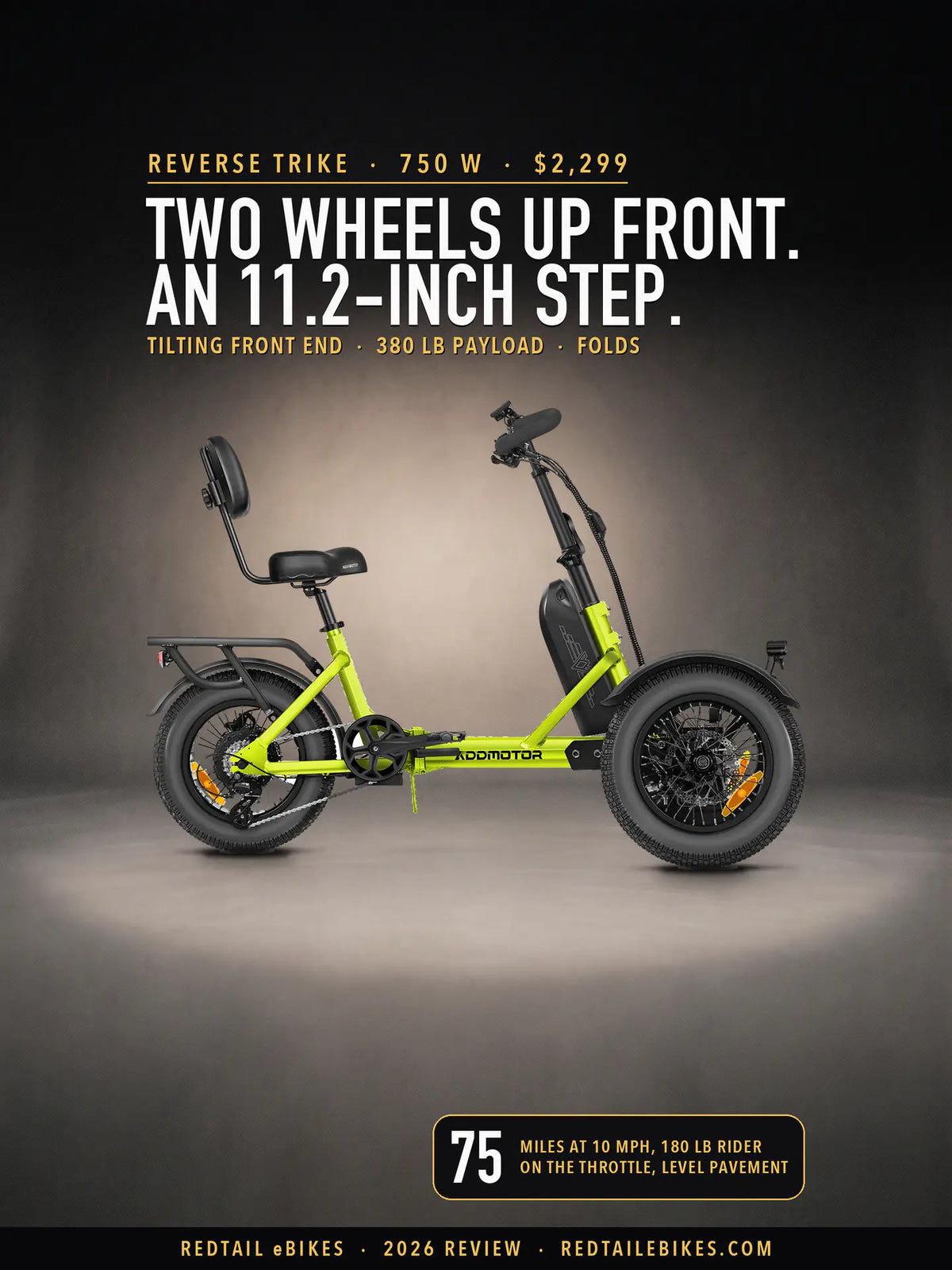
Share:
eBike Suspension: 34 Systems, 651 Bikes Measured
Massachusetts eBike Laws (2026): There Is No Class 3