



Quick Answer
Almost every e-bike sold in the US in 2026 runs on lithium-ion cells: the US Consumer Product Safety Commission's 2026 proposed battery rule says micromobility batteries "typically use cylindrical lithium-ion cells, often size 18650 or 21700."
The first production e-bikes on record ran on lead-acid, then nickel-cadmium and nickel-metal hydride, and Yamaha's own record dates its first lithium-ion model to 2004; China's e-bikes stayed mostly lead-acid through the 2000s. Sodium-ion is already on two-wheelers in China, and solid-state cells are still prototypes.
The reason the chemistry changed is weight. On the makers' own datasheets, the cells for a 960 Wh battery (the median size across the 222 bikes we sell) weigh about 9 lb in lithium-ion and about 90 lb in lead-acid drained at an e-bike's pace. The full arithmetic is in the weight section.
Buying rather than reading? Every listing in our e-bike collection that names a battery chemistry names lithium-ion, and 81 of our 222 e-bikes name UL 2849 or UL 2271 certification. Every one ships free in the contiguous US, with US support.
See every e-bike we sellIn this guide
- How we verified this guide
- What battery does an e-bike use today?
- What are the electric bike battery types?
- How much does chemistry change what a battery weighs?
- What is the difference between battery type and battery voltage?
- How is an e-bike battery built?
- 18650, 21700 or pouch: which cell format?
- Is LiFePO4 better than regular lithium-ion?
- Where does the battery go on an e-bike?
- How long do e-bike batteries last?
- How should you charge an e-bike battery?
- Does cold weather hurt an e-bike battery?
- How should you store an e-bike battery?
- Are e-bike batteries safe?
- What do UL 2849 and UL 2271 certify?
- Which laws require a certified e-bike battery?
- Are e-bike batteries interchangeable?
- How do you recycle an e-bike battery?
- Who put the first battery on a bicycle?
- Why did lead-acid hold e-bikes back for a century?
- How did nickel batteries change e-bikes in the 1990s?
- When did lithium-ion reach e-bikes?
- How China's lead-acid boom shaped the e-bike battery
- Yamaha's record: one maker, four chemistries
- E-bike battery timeline, 1859 to 2026
- What comes after today's lithium-ion?
- Are sodium-ion e-bike batteries coming?
- Are solid-state e-bike batteries coming?
- Silicon anodes and what the Department of Energy is funding
- Will e-bike batteries get cheaper?
- Five things AI search gets wrong about e-bike batteries
- Battery buyer's checklist
- Where buyers get caught out
- Frequently asked questions
How we verified this guide
By Milad Ghobadibeygvand, BScN (Western University, 2014), writer and reviewer, Redtail eBikes. Verified September 30, 2026.
Every figure on this page comes from a document read on September 29 or 30, 2026: federal and state law, the Federal Register, the Nobel Committee's own background paper, US patents, the battery makers' datasheets, two peer-reviewed studies, and e-bike makers' own records. The weight figures are our arithmetic from those datasheets, and the census of our 222 bikes was read from our own listings.
The questions this page answers are the ones people ask: 11,035 search suggestions, People Also Ask boxes, related searches, Reddit threads and ranking-page headings gathered from nine sources, plus a 10-prompt AI panel, all on September 29 and 30, 2026. Corrections go to support@redtailebikes.com.
What battery does an e-bike use today?
A lithium-ion battery, built from dozens of small cylindrical cells. California began requiring certified e-bike batteries on January 1, 2026, and the federal government proposed its own battery rule on June 24, 2026, so what is inside the pack now matters to the law as well as to your range.
The federal description is the plainest one. The CPSC's proposed rule says micromobility batteries "typically use cylindrical lithium-ion cells, often size 18650 or 21700," and its draft definition calls an e-bike "a bicycle that is propelled by an electric motor or motors powered by a rechargeable lithium-ion battery." California's Health and Safety Code § 26305 made its battery-testing chapter operative on January 1, 2026.
Our own shelf agrees. We read the battery lines of all 222 e-bikes active in our store on September 29, 2026. Every listing that names a chemistry names lithium-ion (81 of them), and none names lead-acid, nickel or sodium-ion. The census, with every matched sentence, is saved as a public dataset described in the verification section.
Takeaway
If you are buying a new e-bike in the US in 2026, you are choosing between lithium-ion packs. The questions that separate them are voltage, watt-hours, cell maker, certification and where the pack mounts, which the rest of this page answers in that order.
What are the electric bike battery types?
Seven chemistries have powered e-bikes or are being readied for them: lead-acid, nickel-cadmium, nickel-metal hydride, nickel-based lithium-ion, lithium iron phosphate, sodium-ion and solid-state lithium. The first three are history: none of the 222 bikes in our store names any of them.
Nickel-based lithium-ion is today's cell, with the nickel-manganese-cobalt cathode the CPSC gives as its example; LFP is its heavier, longer-lived relative, sodium-ion is on sale on two-wheelers in China, and solid-state lithium is still in prototypes.
The table reads each chemistry against what it means for a rider. Specific energy (watt-hours per kilogram of cell) decides how heavy the battery is for the range you get, and it comes from each maker's datasheet or, where marked, an independent laboratory measurement.
| Chemistry | Years on e-bikes | Specific energy (one real cell) | What it means for you |
|---|---|---|---|
| Lead-acid | Yamaha's first PAS, 1993; most of China's e-bikes in the 2000s | 34.6 Wh/kg; 23.5 at a one-hour drain (Panasonic LC-P127R2P) | Heavy; usable energy falls when you ride hard |
| Nickel-cadmium | Yamaha PAS from 1995 | 44.1 Wh/kg (Panasonic P-180SCR, handbook p. 24) | Lighter than lead; Yamaha paired it with a new charger that had a refresh function |
| Nickel-metal hydride | Yamaha PAS 1997 to 2003 | 82.6 Wh/kg (Panasonic HHR-450A) | Nearly twice nickel-cadmium's energy per pound, about a third of lithium-ion's |
| Lithium-ion with nickel-based cathodes (such as NMC) | Lithium-ion from Yamaha's 2004 PAS; the cathode the CPSC gives as its example today | 231.4 to 247.7 Wh/kg (Molicel P45B, Panasonic NCR18650BF) | The lightest pack for a given range |
| Lithium iron phosphate (LFP) | No bike in our store names it | 88 to 105 Wh/kg measured; 108.6 on A123's sheet | More cycles, more weight |
| Sodium-ion | Chinese two-wheelers since December 2023 | 124 to 128 Wh/kg measured (Bischof et al., 2024) | Cathodes without cobalt and with little nickel; heavier than lithium-ion |
| Solid-state lithium | Prototypes; mass production dated 2028 by one maker | No production e-bike cell to measure | The next step if the claims hold |
"LiFePO4 versus lithium-ion" sounds like a choice between two kinds of battery, and it is not one. LFP is a lithium-ion cell with an iron-phosphate cathode, and the Nobel Committee's background paper lists "the olivine material LixFePO4 (LFP)" among the cathodes that came out of John Goodenough's group.
How much does chemistry change what a battery weighs?
Up to tenfold. The cells for a 960 Wh battery, the median size on the 153 bikes in our store that state watt-hours, weigh 3.9 to 4.1 kg (8.5 to 9.1 lb) in today's nickel-based lithium-ion, 11.6 kg (25.6 lb) in nickel-metal hydride, and 40.8 kg (90.0 lb) in lead-acid drained over an hour.
The method is one line of arithmetic per chemistry: a cell's nominal voltage times its capacity gives its energy, and energy divided by its weight gives watt-hours per kilogram. Every input is printed on the maker's own sheet; where a sheet prints two figures, the rated capacity and the maximum weight are used.

Cells only, for the same 960 Wh. The case, the battery management board and the wiring add weight to every row.
| Chemistry and cell | Energy per cell | Cell weight | Wh/kg (our arithmetic) | Maker states | Cells for 960 Wh |
|---|---|---|---|---|---|
| Lead-acid, Panasonic LC-P127R2P, 20-hour rate | 12 V × 7.2 Ah = 86.4 Wh | 2.50 kg | 34.6 | not stated | 27.8 kg (61.2 lb) |
| Lead-acid, same block, 1-hour rate | 12 V × 4.9 Ah = 58.8 Wh | 2.50 kg | 23.5 | not stated | 40.8 kg (90.0 lb) |
| Nickel-cadmium, Panasonic P-180SCR | 1.2 V × 1.8 Ah = 2.16 Wh | 49 g | 44.1 | not stated | 21.8 kg (48.0 lb) |
| Nickel-metal hydride, Panasonic HHR-450A | 1.2 V × 4.2 Ah = 5.04 Wh | 61 g | 82.6 | not stated | 11.6 kg (25.6 lb) |
| LFP, A123 ANR26650M1-B | 3.3 V × 2.5 Ah = 8.25 Wh | 76 g | 108.6 | not stated | 8.8 kg (19.5 lb) |
| Lithium-ion, Panasonic NCR18650BF | 3.6 V × 3.2 Ah = 11.52 Wh | 46.5 g | 247.7 | 248 | 3.9 kg (8.5 lb) |
| Lithium-ion, Molicel INR-21700-P45B | 3.6 V × 4.5 Ah = 16.2 Wh | 70 g | 231.4 | 242 | 4.1 kg (9.1 lb) |
The lead-acid block is a standby battery built for backup power, the closest lead-acid unit with a full rate table on its maker's sheet, so it stands for the chemistry rather than for any e-bike pack. Panasonic's sheet gives 7.2 Ah drained over 20 hours and 4.9 Ah drained over one hour.
California's Vehicle Code § 312.5 allows an e-bike motor that "does not exceed 750 watts of power" (as amended by SB 1271). A motor at that limit would drain a 720 Wh pack in 0.96 hours at full power (720 ÷ 750, our arithmetic), so the one-hour row is the fair comparison for hard riding.
Molicel states 242 Wh/kg, above our 231.4, which divides by the sheet's maximum weight of 70 g; Panasonic's 248 matches our figure. For LFP and sodium-ion there is an independent laboratory figure: Bischof and colleagues at Germany's ZSW and KIT measured commercial LFP 18650 cells at 88 to 105 Wh/kg and sodium-ion cells at 124 to 128 Wh/kg.
A lead-acid label overstates what you get on a bike. On the Panasonic sheet the same block delivers 32% less energy drained over one hour than over twenty (4.9 Ah against 7.2 Ah), and the label quotes the twenty-hour figure.
What is the difference between battery type and battery voltage?
Type is the chemistry inside each cell; voltage is how many cells are wired end to end. A lithium-ion cell sits at about 3.6 to 3.7 volts, so a 48-volt pack is roughly thirteen cells in series, and the chemistry sets the voltage of each cell while the pack designer sets the count.
The federal primer states both halves. The CPSC proposal says manufacturers reference a lithium-ion cell "by its nominal value (typically 3.7 volts direct current (VDC))," from a maximum of "typically 4.2 V" to a minimum of "typically 2.5 V." The Panasonic and Molicel sheets print 3.6 V nominal, the same 4.2 V charge and the same 2.5 V cutoff.

A 36 V e-bike pack from the CPSC's proposed rule: 10 cells in series, 4 strings in parallel, 10.4 Ah, 374.4 Wh.
The CPSC's Figure 7 shows the arithmetic on a real pack: "User replaceable eBike battery pack, 10S4P, 36 V DC (nominal), 10.4 Ah, 374.4 Wh." Ten cells in series at 3.6 V make 36 V. Four strings in parallel multiply the amp-hours. And 36 V × 10.4 Ah gives the 374.4 watt-hours printed on the label, which is the number that sets range.
| What the label says | What it measures | How to compare two bikes |
|---|---|---|
| Volts (36, 48, 52, 60) | Cells in series × about 3.6 V | Higher voltage delivers the same power at lower current; it says nothing about range alone |
| Amp-hours (Ah) | Charge the pack holds | Only comparable between packs of the same voltage |
| Watt-hours (Wh) | Volts × amp-hours: the energy | The one number that compares range across any two bikes |
Across the 206 bikes in our store that state a voltage, 169 run at 48 V, 18 at 52 V, 11 at 60 V and 8 at 36 V. The watt-hours run from 353 to 4,800, with a median of 960.
Do not read a higher voltage as a bigger battery. A 36 V, 20 Ah pack (720 Wh) and a 48 V, 15 Ah pack (720 Wh) hold the same energy, and the one to compare is the watt-hour figure.
Our long-range guide turns watt-hours into miles for a given ride, and our e-bike motor guide takes up what 36 V and 48 V change at the motor.
How is an e-bike battery built?
An e-bike battery is a box of identical cells wired in series and parallel, watched by a small computer called the battery management system (BMS) that disconnects the cells when voltage, current or temperature leaves the maker's limits. The cells store the energy; the BMS decides when it is safe to use it.

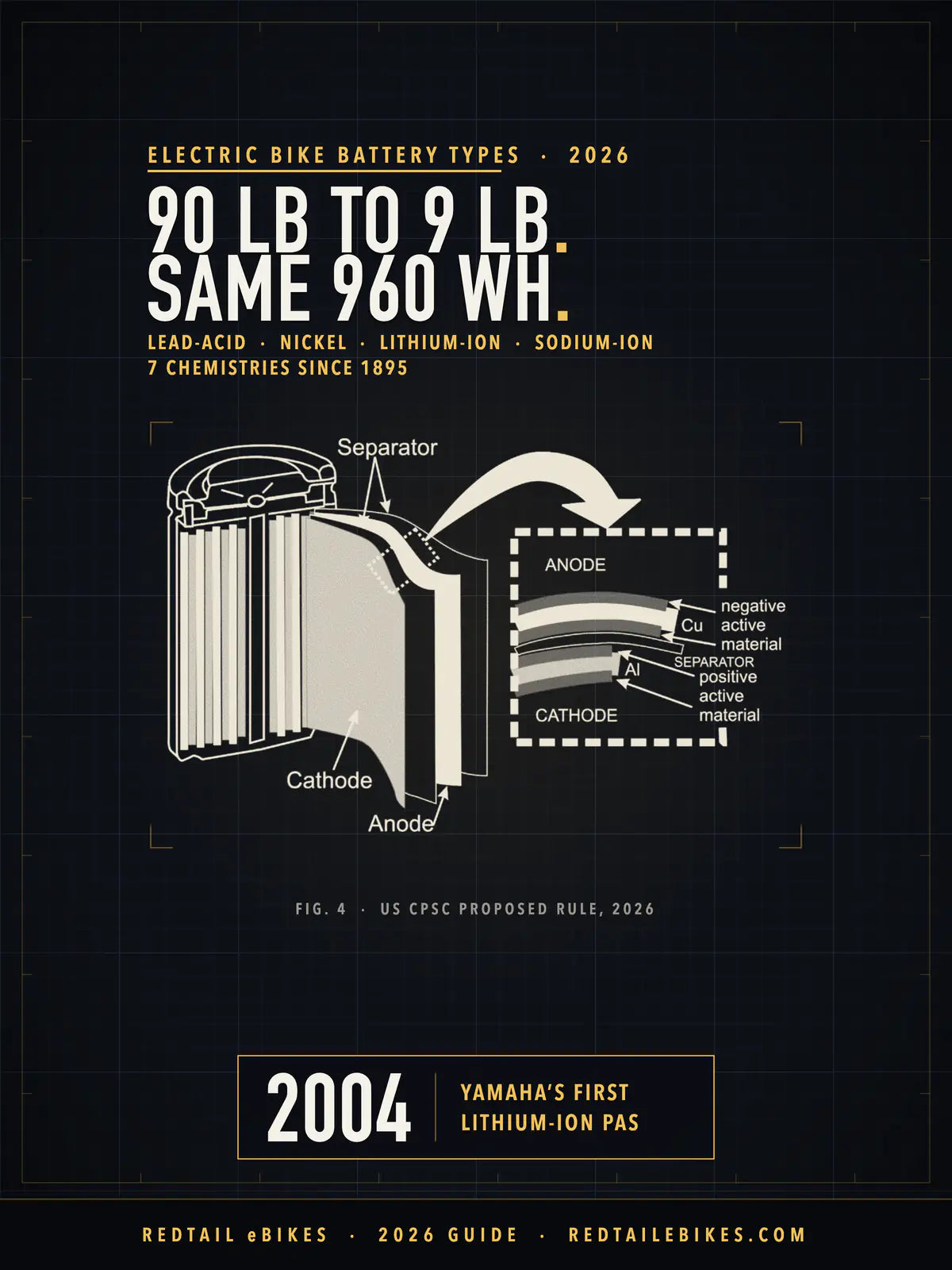
Inside one cell: two coated metal foils and a separator, rolled like a jelly roll. The CPSC notes the layers are not drawn to scale.
Each cell has a positive electrode, a negative electrode, a separator and an electrolyte. In the CPSC's words, the anode "typically consists of a copper (Cu) sheet coated with a thin layer of negative active material, such as a graphite compound," the cathode is an aluminum sheet coated with a material "such as lithium nickel manganese cobalt oxide," and the separator is "a thin, porous, plastic sheet."
The same document explains the pack. It describes "an assemblage of individual lithium-ion cells connected electrically in series and parallel," named by count: "a 20-cell, 10S2P battery has ten cells connected in each series ( i.e., '10S') and two parallel series ( i.e., '2P')." The BMS then compares each reading "to the cell manufacturer's specified limits" and cuts the circuit when one is exceeded.
"A BMS, however, cannot stop thermal runaway events caused by manufacturing defects in the battery cell itself, such as contaminants, electrode or separator layer misalignment, damaged separator, or folded or torn electrodes."
That is why the CPSC proposal weighs the cells alongside the electronics: it says the risk of thermal runaway "can be mitigated by using high quality cells and monitoring and protection circuitry provided by the electrical system, including such subsystems as the BMS."
Takeaway
Read three things on any battery: the watt-hours (range), the cell maker (quality), and the certification with the laboratory's name (safety). A pack that states all three has told you most of what matters.
18650, 21700 or pouch: which cell format?
Most e-bike packs use cylindrical 18650 or 21700 cells, named for their size in millimeters; a few use flat pouch cells. The 21700 is the larger cylinder, and on the two maker sheets read for this page it holds about 16 Wh against about 11.5 Wh for the 18650, so fewer cells make the same pack.

Figure 5 of the CPSC proposal: an 18650 cell (left) and a 21700 cell (right).
The names are dimensions. The CPSC puts it plainly: "Size 18650 cells are nominally 18 mm in diameter and 65 mm tall; size 21700 cells are nominally 21 mm in diameter and 70 mm tall." Panasonic's NCR18650BF holds 11.52 Wh at rated capacity; Molicel's P45B holds 16.2 Wh, about 41% more in a can about 50% heavier (70 g against 46.5 g).
In our store's listings, 33 bikes name 21700 cells, 5 name 18650 cells and 15 name pouch cells (two listings name both 21700 and pouch options); the rest do not say. All 15 pouch-cell listings come from one maker's long-range family, Eahora's e-bikes, with packs from 960 to 4,800 Wh. The CPSC's primer describes cylindrical cells and "prismatic cells, which are wound concentrically but are flat."
| Format | Size | Energy on the maker sheet read here | Found in our listings |
|---|---|---|---|
| 18650 | 18 × 65 mm | 11.52 Wh (Panasonic NCR18650BF) | 5 bikes |
| 21700 | 21 × 70 mm | 16.2 Wh (Molicel P45B) | 33 bikes |
| Pouch | Flat, sized to the pack | Varies by design | 15 bikes |
Is LiFePO4 better than regular lithium-ion?
It depends on what you value: LFP is rated for more cycles, while nickel-based lithium-ion carries more than twice the energy per pound. On an e-bike, where every pound is pedaled uphill, weight usually decides it, and none of the 222 bikes in our store names LFP in its listing.
The cleanest comparison comes from one cell maker selling both. EVE Energy lists its C33 LFP cell at "Nominal Cycles(times) 2500" and its 21700 50E nickel (NCM) cell at "Nominal Cycles(times) 1000," with the NCM cell at "264" Wh/kg. A123's LFP cell sheet rates ">1,000 cycles" at a 20 A discharge to 100% depth of discharge.
On weight, independent measurement settles it. Bischof et al. (2024) measured commercial LFP 18650 cells at 88 to 105 Wh/kg, less than half the 231 to 248 Wh/kg on the nickel-based sheets. For the 960 Wh median pack that is roughly 9 to 11 kg of LFP cells against 4 kg of nickel-based ones.
LFP came out of the same laboratory as the cobalt cathode. The Nobel Committee's background paper credits Goodenough's group with "the olivine material LixFePO4 (LFP)," which "is limited by a somewhat lower potential versus Li+/Li than LixCoO2, but has high stability and can be used at high charging rates."
The lower potential shows on the sheets: 3.3 V nominal on A123's and 3.2 V on EVE's, against 3.6 V on the Panasonic and Molicel sheets.
Watch the charger if you consider an LFP pack: it and a nickel-based pack can both be sold as "48 V" and still need different chargers. The sheets read here charge nickel-based cells to 4.2 V and A123's LFP cell to 3.6 V, so each pack needs the charger built for its own chemistry.
Want more range rather than a different chemistry? Our long-range guide matches battery size in watt-hours to the distance you ride, and every bike in it ships free in the contiguous US.
Read our long-range guideWhere does the battery go on an e-bike?
On the down tube, inside the down tube, on a rear rack, or behind the seat tube, and the choice is older than it looks: Ogden Bolton's US patent of 1895 hung the battery in the frame. What decides it for you is whether the pack comes off the bike, because a removable pack can be charged indoors and swapped for a spare.
The federal primer gives the trade in one sentence. "A battery pack may be fixed-in-place (non-replaceable), or it may be replaceable by the user," the CPSC proposal says, and "Removable batteries allow users to ride the product with minimal downtime, because users can charge an extra battery while using the product."
The idea is old. Ogden Bolton's US Patent 552,271 of 1895 describes "a battery suspended therefrom," the frame, and Hosea Libbey's US Patent 596,272 of 1897 fed its batteries from "a tank, reservoir, or hollow seat E, of saddle form."
Yamaha's 1995 PAS C brought a detachable battery to a production model, giving owners "the choice to charge it while it was still mounted on the bicycle or removing it to be brought indoors for charging." Bosch's first battery, from 2011, came as a "Frame or rack battery."
| Where it mounts | Earliest record read for this page | What to check before you buy |
|---|---|---|
| In or on the frame | Bolton's 1895 patent, "a battery suspended therefrom" | Whether it locks, and whether it comes off for charging |
| Detachable from the frame | Schnepf's 1899 patent: "detachably supported in the forward inside portion of the frame" | A spare you can charge while riding the other |
| Rear rack | Bosch's first battery, 2011: "Frame or rack battery" | Where the weight sits on the bike you will ride |
| A second battery | 45 listings in our store mention one | Whether the second pack is included or sold separately |
In our store's listings, 38 bikes call the battery "removable" or "detachable," and 45 mention a second or dual battery. How the battery's position shapes the frame is shown in our frame-types guide.
Are there standards for battery mounts? UL 2849 tests the mount: in the CPSC's summary, "Section 14 of UL 2849-20 requires that components that are mounted on the eBike be subjected to the vibration test in section 38 of the standard." That is a safety test, and the summary describes no shared size that would let one maker's pack fit another's frame.
How long do e-bike batteries last?
The cell ratings read for this page run from 1,000 to 2,500 cycles, depending on chemistry, and a battery also ages with time and heat whether you ride or not. The number that matters for you is years of your riding: 1,000 full cycles is almost three years of one full charge a day, or about ten years of two a week.
The ratings come from the sheets. EVE rates its 21700 nickel-based cell at "Nominal Cycles(times) 1000" and its C33 LFP cell at 2,500; A123 rates its LFP cell at ">1,000 cycles" at a 20 A discharge to empty; Yadea claims "up to 1,500 cycles at room temperature" for its sodium battery.
EVE's pages do not state the test conditions behind "nominal cycles," while A123 states its own (20 A, 100% depth of discharge), so the ratings compare within one maker better than across makers.
| Battery | Rated life | Source |
|---|---|---|
| Nickel-based lithium-ion cell (EVE 21700 50E) | 1,000 nominal cycles | EVE Energy |
| LFP cell (EVE C33) | 2,500 nominal cycles | EVE Energy |
| LFP cell (A123 ANR26650M1-B) | >1,000 cycles at 20 A, 100% depth | A123 datasheet |
| Sodium-ion (Yadea, company claim) | Up to 1,500 cycles | Yadea release, January 8, 2025 |
| Lead-acid e-bike battery in China | One to two years, or up to 10,000 km | Cherry, Weinert and Yang, 2009 |
Time counts too. Bosch's battery guide separates "calendar aging" from "cyclical aging" and says the battery "ages faster when exposed to high temperatures or when stored at low or high states of charge." The years-of-riding figures above are our arithmetic (1,000 ÷ 365 = 2.7 years; 1,000 ÷ 104 = 9.6 years) and assume every charge is a full cycle, which most top-ups are not.
Read a cycle rating as the maker's test result under its own conditions. It does not tell you how far your bike will go after that many charges, so treat it as a comparison between cells rather than a countdown.
How should you charge an e-bike battery?
Use the charger that came with the bike, charge where you are present and awake, and charge above freezing and out of direct sun. More than half of the lithium-ion micromobility incidents in the CPSC's count began while a battery was plugged in, and every rule below comes from that record.
The CPSC's count is the reason. Of 227 incidents from 2019 through 2023 in its proposed rule, "120 incidents (53 percent) occurred while the product was plugged in charging, including 18 fatalities (46 percent), 102 injuries (56 percent), and 73 non-injury incidents (53 percent)." The figures cover e-bikes, e-scooters and other micromobility products together.
The CPSC's own consumer advice is short: "Always be present when charging micromobility products. Never charge them while sleeping or when you are not at home," and "Only use the charger provided with or recommended by the manufacturer of your micromobility device." Bosch's guide adds: "Charge the battery at an ambient temperature between 32°F and 104°F (0°C and 40°C). Avoid direct sunlight."
- Use the bike's own charger. Between January 1, 2023 and May 16, 2024 the CPSC received "156 reports of fire and thermal incidents involving 'universal' chargers for micromobility products."
- Charge above freezing. The CPSC puts "the typical safe range for cell surface temperatures during charging" at "between 0 °C and 45 °C."
- Wake a stored battery gently. The CPSC reports "several fire incidents involving the charging of a micromobility product battery after an extended period of disuse."
- Unplug when full. The CPSC's advice is to "unplug the device when done."
Takeaway
Charge with the bike's own charger, in a room with a smoke detector, while you are home and awake, and above freezing. Those four habits address the charging patterns in the CPSC's incident record.
Does cold weather hurt an e-bike battery?
Cold reduces what a battery can deliver while it is cold, and charging below freezing risks damaging the cells, so ride in the cold and charge in the warm. The effect is measured on every sheet read here; the size of it depends on the chemistry.
Lead-acid shows the effect most plainly. Panasonic's sheet gives the block's capacity at the 20-hour rate as 100% at 77°F (25°C), 85% at 32°F (0°C) and 65% at 5°F (-15°C).
Lithium-ion sheets set temperature limits instead: Panasonic's NCR18650BF allows charging from 10 to 45°C and discharge from -20 to 60°C, and Molicel's P45B charging from 0 to 60°C and discharge from -40 to 60°C.
Bosch's guide calls winter garage temperatures harmless to a stored battery and adds that "a cold battery delivers less power." Sodium-ion's makers lead with cold: Yadea claims "a discharge retention rate of over 92% at -20°C", and CATL says its Naxtra car battery "retains 90% usable power at -40°C." Both are company claims.
A battery brought in from a freezing garage can be colder than its cells' lower charging limit: 0°C (32°F) on Molicel's sheet and in the CPSC's typical range, and 10°C (50°F) on Panasonic's. Let it warm to room temperature before you plug it in. Our fall riding guide computes range at each state's average fall-morning temperature.
How should you store an e-bike battery?
Partly charged, dry, cool and away from anything that burns. Bosch says a charge between 30 and 60% is ideal for storage, and its guide asks you to check the battery for visible damage before charging.
Bosch's guide says to "Store the battery in a dry place protected from the weather. Ideally in a well-ventilated room with a smoke detector, away from heat sources or highly flammable materials," and "For storage, a charge level between 30 and 60% is ideal." The CPSC counts 23 incidents in which a product "unexpectedly caught fire" while "being stored or resting in open space," with four deaths.
Batteries drain on the shelf: Panasonic's lead-acid sheet shows 91% of capacity left after three months at 77°F and 82% after six. The CPSC links some fires to charging "after an extended period of disuse," and explains that a cell drained below its minimum voltage can suffer damage that "may result in overheating and cell failure during each subsequent charge cycle."
Are e-bike batteries safe?
For e-bike riders the larger risk is traffic, and battery fires are a small share of deaths: of 310 e-bike deaths known to CPSC staff from 2017 through 2024, the staff name "motor vehicle accidents and control issues" as the top hazards, and 19 came from battery fires. The fires that do happen are severe, which is why the charging rules above matter.
The CPSC's April 2026 staff report says: "Out of the 310 fatalities, 19 were associated with 13 incidents of lithium-ion battery-related fires." Its proposed rule explains why they are severe: tests by the Navy's Carderock Division "demonstrated that cell burn temperatures during thermal runaway can exceed 1000 °C (1832 °F)," and heat from one failing cell "may initiate thermal runaway in adjacent cells."
| Pattern in the CPSC's 227 incidents, 2019 to 2023 | Incidents | Deaths |
|---|---|---|
| While plugged in charging | 120 | 18 |
| Stored or resting | 23 | 4 |
| Aftermarket battery or charger | 17 | 2 |
| Homemade battery | 4 | 3 |
| After contact with water | 3 | 1 |
All micromobility products together, from the CPSC's proposed rule, 91 FR 38162. Five of the CPSC's nine patterns are shown; the nine add to 227.
New York City shows how fast the record can change. The City Council's 2024 release quotes 268 battery fires and 18 deaths in 2023; the FDNY commissioner's later figures, reported by amNY and by UL Standards & Engagement, are six deaths in 2024 and one in 2025. ULSE credits the certification law; the FDNY commissioner, quoted by amNY, credited "enhanced public education, inspection efforts, and greater community engagement," and the counts alone cannot separate the causes.
The mistake is reading the fire record as a verdict on every lithium-ion battery. The CPSC's patterns point at specific causes you can avoid: aftermarket and "universal" chargers, homemade and modified packs, water damage, and charging while no one is awake to notice.
What do UL 2849 and UL 2271 certify?
UL 2849 certifies an e-bike's whole electrical system (battery, charger, motor, controller and wiring tested together) and UL 2271 certifies a battery pack on its own. A bike certified to UL 2849 has had its battery tested inside that system; a replacement pack sold separately falls under UL 2271.
The standards are young. The CPSC records that UL 2271 "was first published in December 2013" for battery packs "for use in light electric-powered vehicles (LEVs)," and UL 2849 in "January 2020" as a national standard for "the electrical system safety of eBikes." California's Health and Safety Code § 26300 defines the "complete electrical system" to include "drive units, batteries, battery management systems, interconnected wiring, charging systems, and power inlets."
The CPSC does not think the standards go far enough on their own. The Commission "preliminarily determines that the applicable voluntary standards are inadequate to fully address the risks of injury from associated hazards," and proposes adding a "tamper-resistant battery enclosure," a "post-discharge charge test" and a "reverse polarity test" to them.
| Standard | What it covers | When it starts to matter to you |
|---|---|---|
| UL 2849 | The e-bike's whole electrical system | Buying a complete e-bike |
| UL 2271 | A battery pack | Buying a spare or replacement pack |
| UL 2272 | Scooters, hoverboards, e-unicycles | Other micromobility, not e-bikes |
| EN 15194 | The European e-bike standard | Accepted in California and New York State law; not named in New York City's |
In our store, 81 of the 222 e-bikes name UL 2849 or UL 2271 in the listing (70 name each; most name both), and 5 more name EN 15194. "UL certified" on a listing is a claim until you can see the laboratory's name.
New York City's § 20-610(e) requires the lab's "logo, wordmark, or name" on the online listing itself, and California's § 26304 requires sellers to provide "a true and accurate copy of the test report" on request.
Which laws require a certified e-bike battery?
As of September 30, 2026, no federal law requires it: the CPSC has proposed a rule, and the comment period closed on August 24, 2026. California has required tested batteries for sale since January 1, 2026, New York State since October 9, 2024, and New York City since September 16, 2023. This section quotes those four texts and is not a survey of all 50 states.
| Jurisdiction | The rule, in its own words | Standards named | Penalty | In force |
|---|---|---|---|---|
| Federal (proposed) | "each eBike must comply with all provisions of ANSI/CAN/UL 2849:2020," with added requirements (91 FR 38162) | UL 2849, UL 2271, UL 2272 | None until a final rule | Proposed; 180 days after a final rule |
| California | No sale "unless the storage battery for the electric bicycle has been tested by an accredited testing laboratory" (HSC § 26302(a)) | UL 2849 or EN 15194 | None stated in the chapter | January 1, 2026 (§ 26305); rentals January 1, 2028 |
| New York State | No sale of a lithium-ion battery for "a bicycle with electric assist" unless "certified by an accredited testing laboratory" (Gen. Bus. Law § 495-a) | UL 2849, UL 2271 or EN 15194 | Up to $500, then up to $1,000 | October 9, 2024 |
| New York City | No sale of "a powered bicycle" unless its electrical system is certified (Admin. Code § 20-610(a)) | UL 2849; batteries UL 2271 | $0 first, then up to $2,000 | September 16, 2023; amended September 25, 2024 |
The federal authority is the Consumer Product Safety Act: the CPSC "proposes this NPR under sections 7 and 9 of the Consumer Product Safety Act (CPSA)." It proposes "an effective date of 180 days after publication of the final rule in the Federal Register," and the Federal Register listed no final rule as of September 30, 2026; the newest CPSC entry matching it is the regulatory agenda of August 14, 2026.
California's chapter was added by Stats. 2024, Ch. 791 (SB 1271). It directs the State Fire Marshal to adopt fire-code rules (§ 26301), requires the testing lab's name and standard to be "permanently affixed directly on the electric bicycle or its electrical system" (§ 26302(e)), and requires sellers to hand over "a true and accurate copy of the test report" on request (§ 26304). The chapter, read in full (§§ 26300 to 26305), states no penalty of its own.
New York's law is Chapter 195 of 2024 (A4938-D), signed July 11, 2024, taking effect "on the ninetieth day after it shall have become a law," which falls on October 9, 2024. It reaches "second-use" batteries, meaning packs "assembled, refurbished, repaired, repurposed or reconditioned using cells removed from used batteries," and district attorneys, county attorneys and the corporation counsel enforce it.
New York City's law was amended by Local Law 50 of 2024, which added the online-listing rule, three-year records and the power to seal a shop after three violations in three years.
Takeaway
Read together, the three laws in force share one rule: no e-bike battery may be sold unless an accredited laboratory has tested or certified it, and each names UL 2849. California and New York State also accept EN 15194, and New York State and New York City name UL 2271 for batteries.
What is unsettled is the chemistry. The CPSC's draft defines an e-bike as one "powered by a rechargeable lithium-ion battery," and the proposal, read in both its Federal Register and printed editions, never mentions sodium-ion. Whether a final rule would reach a sodium-ion e-bike is our open question, not one the document answers.
Our California and New York law guides cover the riding rules in each state, and our 50-state guide sets out how every state and the District of Columbia defines an e-bike, with its helmet, age and path rules.
Are e-bike batteries interchangeable?
Not freely. A replacement battery has to match the bike's voltage, connector, polarity, mount and charger, and the CPSC ties mismatched chargers and aftermarket packs to fires, while New York law applies its certification rule to rebuilt packs. The safe replacement is the maker's own pack or one the maker confirms fits.
The CPSC is specific about why. For chargers, "It is critical that the charger output voltage and current match the rating of the micromobility product battery to prevent damage to the internal charging circuits or the battery, which can pose a risk of fire," and "the voltage polarity of the charger connector must match the polarity of the micromobility product charging connector to mitigate the risk of damaging the cells and posing a risk of fire," the proposal says.
The CPSC counts 17 incidents with aftermarket batteries or chargers, with two deaths.
What about battery connector types? The CPSC's documents treat the connector as a matter of fit and polarity rather than of brand: its proposal adds a "reverse polarity test to prevent damage to the battery pack" from a reversed connection. Its consumer advice is to use "a replacement or secondary battery pack that has been tested and approved to work safely with your device and has been confirmed to be suitable for your device by the device manufacturer."
A pack that fits the plug is not proof that it fits the bike. It can share the connector and still differ in voltage, in cell quality or in certification, and New York's § 495-a applies its certification rule to "second-use" batteries built from reused cells.
Takeaway
Replace a battery with the maker's own pack, or one the maker confirms in writing, with a UL 2271 certification you can see, and charge it only with the charger made for it.
How do you recycle an e-bike battery?
Take it to a battery recycler or a household hazardous waste site, never the trash or the recycling bin. The e-bike industry's own program, run by Call2Recycle, takes e-bike batteries at participating shops, and the EPA's handling advice is to tape the terminals and bag each battery.
The EPA says lithium-ion batteries "should NOT go in household garbage or recycling bins" and "SHOULD be taken to separate recycling or household hazardous waste collection points," with the advice to "tape battery terminals and/or place lithium-ion batteries in separate plastic bags." The CPSC's consumer page says the same: "Never throw lithium batteries into the trash or general recycling."
Call2Recycle's program page, on a site that now carries the name The Battery Network, describes "the first U.S. industry-wide, voluntary e-bike battery recycling program," built with "more than 60 bicycle industry leaders," and lists drop-off locations on its locator.
Federal rules follow the battery on the way: 49 CFR § 173.185(a)(1) requires each lithium cell or battery shipped to be "of the type proven to meet the criteria in part III, sub-section 38.3 of the UN Manual of Tests and Criteria," and the EPA "recommends that businesses consider managing Li-ion batteries" under the universal waste rules of 40 CFR part 273.
A damaged pack is a different case from a worn one. The EPA says to contact "the battery or device manufacturer for specific handling information" if a lithium-ion battery is damaged.
Who put the first battery on a bicycle?
The earliest US patent for a battery-driven bicycle read for this page is Ogden Bolton's No. 552,271, published December 31, 1895, and it hangs "a battery suspended therefrom" in the frame. The rechargeable battery it could draw on was older: the Nobel Committee dates the lead-acid battery to Gaston Planté's demonstration of 1859 to 1860.
The Nobel Committee's scientific background for the 2019 chemistry prize sets the start line: Volta "presented his famous 'pile' around 1800," and the lead-acid battery "was studied by Wilhelm J. Sinsteden as early as 1854 and demonstrated by Gaston Planté in 1859–1860," as "the first so called secondary battery that could be recharged." Every e-bike battery since is a descendant of that idea.
Three patents from the 1890s put a battery on a bicycle. Bolton's of 1895 wires "a battery suspended therefrom" to its motor. Hosea Libbey's, published December 28, 1897, supplies its batteries "with the exciting fluid, such as diluted sulfuric acid, from a tank, reservoir, or hollow seat E, of saddle form." J. Schnepf's, published June 13, 1899 under the title "Automobile", makes the battery removable: it "is detachably supported in the forward inside portion of the frame."
Libbey's patent also holds the first assist modes on record, done with the battery rather than electronics. It divides the battery with a partition so that "only one half of said battery may be used on level roads and both halves employed when climbing a hill."
The patents name the fluid and the frame; none of the three names the plate chemistry, so what kind of cells they had in mind is not on the page. The story of the machines themselves is in our history of electric bikes.
Remember that a patent is an idea on paper. None of these three shows that a machine was built, sold or ridden, and the first production e-bike with a chemistry on record came almost a century later.
Why did lead-acid hold e-bikes back for a century?
Weight. A lead-acid battery stores about a seventh of the energy per kilogram of today's lithium-ion cells, and it gives up about a third of that when drained as hard as a motor drains it. Yamaha's PAS of 1993, which Yamaha describes as the world's first electrically assisted bicycle, still ran on lead and weighed 31 kg with a 20 km range.
The arithmetic is in the weight section: 34.6 Wh/kg for lead-acid at a 20-hour drain and 23.5 at a one-hour drain, against 231.4 to 247.7 Wh/kg for the nickel-based lithium-ion sheets. The idea survived the gap. Jesse Tucker's US Patent 2,514,460, filed May 7, 1946 and granted July 11, 1950, still places "a battery 26 mounted at a suitable point on the vehicle."
Yamaha's own record gives the first production figures. Yamaha Motor Japan's history of the PAS (read in its July 20, 2019 archived copy) lists the first model, sold regionally from November 1, 1993, with a lead battery (鉛), a range of 20 km per charge, a weight of 31 kg and a charging time of about 10 hours.
The first model's price is ¥149,000 on that Japanese page and ¥134,000 on Yamaha's global collection page; we print both.
Yamaha's development story explains the timing. "The 1980s saw the introduction of more compact, high-performance batteries and computers," Yamaha writes, and it was "not until April 1988 that development began" on the power-assist approach, in its own history. The first battery was still lead; the electronics were new.
How did nickel batteries change e-bikes in the 1990s?
They cut the weight and the charging time. Yamaha moved its PAS from lead to nickel-cadmium in 1995 and to nickel-metal hydride by 1997, and in ten years the bike went from 31 kg and about 10 hours of charging to 22 kg and about 1.8 hours. In the US, the Department of Energy was backing nickel-metal hydride for electric cars from 1991.
Yamaha's record of the 1995 PAS C: "a new detachable nickel-cadmium battery. Lighter than conventional lead batteries, this battery was also less susceptible to changes in ambient temperature, provided stabler current, and had a higher cycle life, i.e., the number of repeated charges and discharges before performance dropped dramatically." Nickel-cadmium brought a new chore, the memory effect, and the 1999 PAS Royal added "an automatic refresh function to prevent battery memory effect."
In the US the push came from cars. The Department of Energy records that "In 1991, under a cooperative agreement with The U.S. Department of Energy (DOE), the United States Advanced Battery Consortium (USABC) initiated development of nickel-metal-hydride (NiMH) battery technology," and that GM Ovonic's cells doubled the driving range of GM's 1999 EV1 and S-10 pickups.
The same nickel-metal hydride chemistry reached American e-bike plans. Energy Conversion Devices, which ran its battery business through an "approximately 91%- owned subsidiary, Ovonic Battery Company," told the SEC in its fiscal 1999 annual report that "In February 1998, EV Global Motors and the Company announced a strategic alliance to cooperate in further development and commercialization of light-power-assist EVs."
The same filing names Sanyo, Walsin, Sanoh and Nan Ya as licensees for "two- and three-wheeled vehicles," with Honda among Sanoh's customers for "electric scooters and bicycles."
When did lithium-ion reach e-bikes?
Lithium-ion was developed between 1973 and 1985 and first sold in 1991; Yamaha put it into its PAS in 2004, and Bosch's first e-bike battery in 2011 was lithium-ion. The Nobel Committee's account of the chemistry runs through three laureates, and Yamaha's account of its bike puts the gain at 32% more capacity for 25% less weight than nickel-metal hydride of the same size.
The Nobel Committee's background paper gives the chain. M. Stanley Whittingham proposed lithium intercalation electrodes "as early as 1973" at Exxon, and "A working, rechargeable battery was subsequently demonstrated in 1976." Lithium metal grew dendrites that could short the cell, "a potential fire hazard," and "the commercial development of such batteries essentially came to a halt." John Goodenough's group at Oxford found the cobalt-oxide cathode in "1979/1980."
Akira Yoshino of Asahi Kasei completed the cell in 1985 with a carbon anode, and he tested its safety by dropping a weight on it: the new cells "were damaged without causing any fires or explosions, whereas batteries based on anodes of lithium metal reacted more violently." The committee's press release calls that 1985 cell "the first commercially viable lithium-ion battery."
It went on sale in 1991. The popular edition says that in 1991 "a major Japanese electronics company started selling the first lithium-ion batteries," and the scientific paper records "an energy density of ~80 Wh/kg" for that first battery, about a third of the 231 to 248 Wh/kg on today's sheets read for this page.
Takeaway
Lithium-ion took 18 years from Whittingham's first proposal (1973) to its first sale (1991), and 13 more to reach a production e-bike (Yamaha, 2004). The energy per kilogram of the cells has about tripled since that first battery, from about 80 Wh/kg to 231 to 248 on today's sheets.
Yamaha's record dates its first lithium-ion PAS to 2004: "Compared to a nickel-metal hydride battery of the same size, the lithium-ion battery boasted 32% more capacity and was a whopping 25% lighter," with "no disadvantageous memory effect." Bosch's first e-bike battery followed in 2011: lithium-ion, "288 Wh power," "Charging time: approx. 2.5 hours." The median battery across the bikes in our store today is 960 Wh.
The common slip is calling 1991 the year lithium-ion was invented. It is the year the first cells went on sale; the Nobel Committee dates the first commercially viable cell to 1985, and the research to 1973.
How China's lead-acid boom shaped the e-bike battery
China's e-bike market grew on lead-acid, and in 2025 its regulator made more room for it. Annual e-bike sales in China rose from 40,000 in 1998 to 10 million in 2005, and a 2009 study put about 95% of them on lead-acid batteries.
The growth figures are peer reviewed. Weinert, Ma and Cherry, in Transportation (2007), report that "Annual electric bike (e-bike) sales in China grew from 40,000 in 1998 to 10 million in 2005." Weinert and Burke put the market at "nearly 16 million bike/yr in 2006" and called valve-regulated lead-acid "the dominant e-bike battery type."
Cherry, Weinert and Yang, in Transportation Research Part D (2009), give the batteries. Bicycle-style e-bikes "typically use 36 V battery systems, on average weighing 14 kg"; scooter-style ones use 48 V "weighing 18 kg"; "The lead content of electric batteries is 70% of the weight"; and a battery lasts "one to two years, or up to 10000 km," so "an electric bike could use five batteries in its life."
Citing Jamerson and Benjamin (2007), the three authors put lead-acid under "Approximately 95% of electric bikes in China."
Regulation then pushed on weight. China's national standard GB 17761-2018 took effect April 15, 2019, and its 55 kg weight limit, in the words of the Guangzhou industry bureau's explainer of the 2024 revision, left lead-acid bikes with a range of "只能达到40公里左右" (only about 40 km).
The 2024 revision went the other way for lead. GB 17761-2024, published December 31, 2024 and in force September 1, 2025, "将铅蓄电池车型的重量限值放宽至63 kg" (relaxes the weight limit for lead-acid models to 63 kg), and the same explainer reports that a survey of nearly 130,000 people found twice as many buyers preferring lead-acid as lithium.
Our reading of that record: China's regulator is making room for lead-acid rather than phasing it out, so the switch to lithium there is a market choice still in progress.
Yamaha's record: one maker, four chemistries
Yamaha's own model history is the cleanest record of the chemistry changes on a production e-bike, because one maker built every model in it. Each row below is Yamaha's own figure; the whole bike changed along with the battery, so read the weight and charging columns as the record of a product line, not a controlled test of chemistry alone.
| Year | Model | Battery | Range per charge | Bike weight | Charging time | Launch price |
|---|---|---|---|---|---|---|
| 1993 | PAS | Lead-acid | 20 km | 31 kg | About 10 h | ¥149,000 |
| 1995 | PAS C | Nickel-cadmium | 20 km | 29 kg | About 4.5 h | ¥149,000 |
| 1997 | New PAS | Nickel-metal hydride and nickel-cadmium | 30 km | 27 kg | About 3.5 h | ¥99,800 |
| 1999 | PAS Royal | Nickel-metal hydride and nickel-cadmium | 30 km | 27 kg | About 2.5 h | ¥89,800 |
| 2001 | PAS Smile | Nickel-metal hydride and nickel-cadmium | 30 km | 25 kg | About 2.5 h | ¥69,800 |
| 2003 | New PAS | Nickel-metal hydride | 37 km | 22 kg | About 1.8 h | ¥69,800 |
| 2004 | New PAS Lithium | Lithium-ion | 34 km | 22.4 kg | About 2 h | ¥89,800 |
| 2006 | PAS Lithium | Lithium-ion | 34 km | 23.2 kg | About 2 h | ¥94,800 |
| 2009 | PAS Lithium S | Lithium-ion | 39 km | 24.2 kg | About 2 h | ¥104,800 |
| 2018 | PAS With | Lithium-ion | 56 km | 26.0 kg | About 3.5 h | ¥118,800 |
Source: Yamaha Motor Japan, PAS 25th anniversary history (archived copy of July 20, 2019), 26-inch city models; range is Yamaha's standard-mode figure and price is the launch retail price including battery and charger. Years pair the table's rows with the page's own dated slides, and four of them are confirmed on Yamaha's global history. Four later models (2011 to 2017) are in our saved dataset.

1993 to 2003: three chemistries and 9 kg off the bike. On lithium-ion, range and weight rose again.
Charging time fell fastest, from about 10 hours in 1993 to 1.8 by 2003.
After lithium-ion arrived, the table shows range growing while weight did not fall further, and Yamaha describes its own approach of those years as "adding more electric motor power to make riding uphill easier or adding larger-sized batteries to provide longer running distance per charge in answer to such needs, but this naturally made the weight of the bike heavier and the look of it less like a bicycle."
E-bike battery timeline, 1859 to 2026
The dates below are the ones the primary record supports, each linked to the document that states it. Where a date is a patent, it is the date the patent was published, which is not evidence that a machine was built.
| Date | What happened | Source |
|---|---|---|
| 1859–1860 | Planté demonstrates the rechargeable lead-acid battery | Nobel Committee background |
| December 31, 1895 | Bolton's bicycle patent: "a battery suspended therefrom" | US 552,271 |
| December 28, 1897 | Libbey divides the battery into halves for flat and hill | US 596,272 |
| June 13, 1899 | Schnepf's detachable battery | US 627,066 |
| 1973–1976 | Whittingham proposes and demonstrates a rechargeable lithium battery | Nobel Committee background |
| 1979/1980 | Goodenough's cobalt-oxide cathode | Same |
| 1985 | Yoshino's first commercially viable lithium-ion cell | Nobel press release |
| 1991 | First lithium-ion batteries on sale; DOE-backed USABC starts nickel-metal hydride work | Nobel popular edition; DOE |
| November 1, 1993 | Yamaha PAS on sale regionally, lead-acid | Yamaha Japan |
| 1995 | Detachable nickel-cadmium battery (PAS C) | Yamaha global |
| February 1998 | EV Global and Energy Conversion Devices alliance on nickel-metal hydride | SEC 10-K |
| 1998 to 2005 | China's e-bike sales rise from 40,000 to 10 million a year | Weinert et al., 2007 |
| 2004 | Yamaha's first lithium-ion PAS | Yamaha global |
| 2011 | Bosch's first e-bike battery, 288 Wh | Bosch product history |
| December 2013 | UL 2271 battery standard first published | CPSC, 91 FR 38162 |
| January 2020 | UL 2849 e-bike electrical-system standard | CPSC, 91 FR 38162 |
| September 16, 2023 | New York City requires certified e-bikes and batteries | NYC Admin. Code § 20-610 |
| December 14, 2023 | TAILG announces sodium-ion two-wheelers | TAILG |
| October 9, 2024 | New York State battery certification law takes effect | Gen. Bus. Law § 495-a |
| January 8, 2025 | Yadea launches sodium battery two-wheelers | Yadea release |
| September 1, 2025 | China's GB 17761-2024 in force, lead-acid weight limit 63 kg | SAMR record |
| January 1, 2026 | California's battery-testing law operative | HSC § 26305 |
| June 24, 2026 | CPSC proposes a federal lithium-ion battery rule | 91 FR 38162 |
What comes after today's lithium-ion?
Three paths are in motion, at very different stages: sodium-ion is already on two-wheelers in China, solid-state lithium is in prototypes with mass production dated to 2028 by one maker, and silicon-rich anodes are a Department of Energy research program. None of the three is in a bike in our store today.
The Department of Energy's battery roadmap frames the ceiling. Its Vehicle Technologies Office overview puts "Graphite/Layered Cathode" cells at a "Practical Energy: 150 Wh/kg" and "Silicon Anode with High-Voltage Cathode" at "Practical Energy: 300 – 400 Wh/kg," with lithium metal, lithium-sulfur and lithium-air as "Long Term Research" at a "Theoretical Energy: 3000 Wh/kg."
DOE's 150 Wh/kg for graphite cells sits below the 231 to 248 Wh/kg on the 2026 cell sheets read here; the roadmap slide does not say whether it counts cells or packs, or which year's cells, so read the two figures as separate sources.
| Path | Stage on September 30, 2026 | What it promises | What is unresolved |
|---|---|---|---|
| Sodium-ion | On sale in China since December 2023 | No cobalt, little nickel, claimed cold performance | Energy per kilogram near LFP, below today's nickel-based cells |
| Semi-solid and solid-state lithium | Prototypes; ProLogium dates mass production to 2028 | Less or no flammable liquid electrolyte | No certified e-bike pack yet |
| Silicon-rich anodes | Department of Energy research program | 300 to 400 Wh/kg in DOE's roadmap | Cycle life and capacity fade, in DOE's own words |
Watch the stage column. A maker's plan can slip, and a chemistry that works in a car or a laboratory still has to pass the same certifications as any e-bike pack before it reaches one.
Some changes come from the drive rather than the cell. A chainless pedal-by-wire bike turns the rider's pedaling into electricity, and our chainless-bike guide computes the extra battery that costs: about 13% more at 20 mph on the flat for a 100 W rider in its central case.
Are sodium-ion e-bike batteries coming?
They are already on two-wheelers in China, and independent tests of commercial cells put them near LFP in energy per kilogram. TAILG announced sodium-ion two-wheelers on December 14, 2023 and Yadea launched sodium models on January 8, 2025. None of the 222 bikes in our store names sodium-ion.
TAILG announced on December 14, 2023 that its "luxury e-bikes will be the first to feature sodium-ion batteries, and they will initially be available in China," and that its "first electric two-wheelers with sodium-ion battery technology are now available." Yadea's January 8, 2025 release claims "an energy density of 145 Wh/kg" and "a cycle life of up to 1,500 cycles at room temperature."
For cars, CATL announced its Naxtra cell on April 21, 2025 at "175Wh/kg," and on February 5, 2026 CATL and Changan unveiled what they call "the world's first mass-production passenger vehicle" on sodium-ion.
| Sodium-ion figure | Wh/kg | Who says so |
|---|---|---|
| Commercial 18650 cell, measured | 128 | Bischof et al., 2024, independent laboratory |
| Commercial 26700 cell, measured | 124 | Same study |
| Yadea two-wheeler battery | 145 | Company claim; cell or pack not stated |
| CATL Naxtra car battery | 175 | Company claim |
The chemistry explains the trade. Sodium does not work with the graphite anode lithium cells use: in Bischof et al., graphite "has to be replaced by hard carbon, since sodium cations only intercalate to a very minor extent into graphite," and the cathodes "do not contain cobalt and only limited nickel concentrations." The same study found the measured cells "at least comparable" to high-power LFP cells at 88 to 105 Wh/kg.
For a 960 Wh pack, the measured 124 to 128 Wh/kg means about 7.5 to 7.7 kg of cells, against about 4 kg in today's nickel-based lithium-ion (our arithmetic). The CPSC's proposed rule, read in its Federal Register and printed editions, defines an e-bike as one powered by "a rechargeable lithium-ion battery" and never mentions sodium-ion.
Are solid-state e-bike batteries coming?
Not in any bike in our store. ProLogium, the solid-state maker that named e-bikes among its targets at CES in January 2026, dates the start of mass production at its French plant to 2028. Semi-solid-state cells, a step between today's liquid electrolyte and a solid one, are covered in our e-bike technology guide.
ProLogium's CES 2026 release lists "e-bikes" among the applications for its platform and says its Dunkirk plant expects "construction expected to begin in 2026 and mass production to start in 2028." Those are the company's plans, and its two releases read for this page report cell and module results and no certified e-bike pack.
The appeal is the electrolyte. The CPSC states that "Lithium-ion battery electrolytes are flammable, unlike water-based electrolytes used in other types of rechargeable batteries such as lead-acid or nickel-metal hydride batteries," and that the heat of thermal runaway "ignites the flammable electrolyte." A solid electrolyte removes that liquid; whether finished packs deliver the safety claimed is what certification testing will show.
Silicon anodes and what the Department of Energy is funding
Anodes that add silicon to graphite store more charge per gram, and the Department of Energy funds research to push them further; the obstacle, in DOE's own words, is cycle life. DOE's target for silicon-anode cells is "1,000+ mAh/g & 350+ Wh/kg," above the 231 to 248 Wh/kg on today's e-bike cell sheets.
DOE's 2023 program review lists the targets and the problem side by side: "1,000+ mAh/g & 350+ Wh/kg," with "Large first-cycle irreversible loss" and "Low cycle and calendar life / High capacity fade" as the challenges. Independent measurement shows the direction: in Bischof et al., commercial cells with silicon/graphite anodes sit above the trend line for specific energy, "owing to the higher specific capacity of such composites compared to neat graphite anodes."
For a rider, silicon is the path that could shrink the battery rather than change its chemistry: the same lithium-ion pack, lighter for the same range, if the cycle-life problem DOE names is solved.
Will e-bike batteries get cheaper?
Car batteries have, dramatically: the Department of Energy estimates that a car's lithium-ion battery pack cost $1,415 per kilowatt-hour in 2008 and $139 in 2023, a 90% fall in 2023 dollars. The series covers car packs built at scale, and e-bike packs are not in it.
DOE's Fact of the Week #1354 (August 5, 2024) says the pack cost "declined 90% between 2008 and 2023 (using 2023 constant dollars)," at "$139/kWh on a usable-energy basis for production at scale of at least 100,000 units per year," and attributes the fall to "improvements in battery technologies and chemistries, as well as improvements in manufacturing and increases in production volume."
The car figure shows the direction of cell costs; it is not an e-bike battery price. The median battery across the bikes in our store is 960 Wh, just under one kilowatt-hour.
Five things AI search gets wrong about e-bike batteries
Ten common e-bike battery questions, put to an AI search engine on September 29, 2026, drew answers that cited no primary source, and five errors recurred. Each is listed with the record that corrects it.
- "The weight problem was solved in 1991 with the invention of the lithium-ion battery." 1991 is the year of the first sale; the Nobel Committee dates the first commercially viable cell to 1985 and the research to 1973 (Nobel press release).
- LiFePO4 treated as something other than lithium-ion. LFP is a lithium-ion cathode, listed by the Nobel Committee among the materials from Goodenough's group.
- A garbled chemistry. One answer listed "lithium-manganese (LiMg204)"; the manganese cathode is written LiMn2O4 in Bischof et al. (2024).
- "There are no national or international statistics on how often e-bikes or e-scooters catch on fire." The CPSC publishes a national count: 227 lithium-ion incidents and 39 deaths across micromobility products from 2019 through 2023 (91 FR 38162).
- UL 2849 described only as "a voluntary US safety standard." Certification is required for sale in California, New York State and New York City (the laws section).
Battery buyer's checklist
Eight questions to answer from the listing before you buy, in the order they matter for range, safety and fit. The battery is one part of the bike, and our electric bike buying guide sets it beside the motor, the frame and the price.
- Watt-hours. Volts × amp-hours. Compare this number, not the voltage, when you compare range.
- Voltage. 36, 48, 52 or 60 V; a replacement pack must match the bike's own.
- Cell maker. Samsung, LG, Panasonic, Molicel or another named maker, stated in the listing.
- Certification, with the lab's name. UL 2849 for the bike's system, UL 2271 for a separate pack; in New York City the lab's name must appear on the online listing.
- Removable or fixed. A removable pack charges indoors and can be swapped for a spare.
- The charger. The one made for the pack, and a spare from the same maker if you need two.
- Temperature limits. The charging range on the maker's sheet or manual; every sheet read for this page puts the lower limit at freezing or above.
- Recycling route. A shop in Call2Recycle's program or your household hazardous waste site, for the day the pack wears out.
Takeaway
If a listing answers the first four questions, you can compare it with any other bike on the page. If it cannot tell you the watt-hours or the certification, ask before you buy.
Where buyers get caught out
The same few misunderstandings recur in the questions people ask about e-bike batteries. Each has a primary source that settles it.
- Comparing volts instead of watt-hours. A 36 V, 20 Ah pack and a 48 V, 15 Ah pack both hold 720 Wh.
- Treating "LiFePO4" and "lithium-ion" as rivals. LFP is one lithium-ion cathode, with more cycles and more weight.
- Believing a lead-acid label at e-bike speed. Panasonic's sheet gives 32% less energy over one hour than over twenty.
- Trusting "UL certified" without a lab's name. New York City's § 20-610(e) requires the name on the listing; California's § 26304 gives you the test report on request.
- Using a "universal" charger. The CPSC logged 156 fire and thermal incidents with them between January 1, 2023 and May 16, 2024.
- Reading a patent as a product. The 1890s patents show ideas; the first production e-bike with a battery chemistry on record is Yamaha's lead-acid PAS of 1993.
The bottom line
The e-bike battery of 2026 is lithium-ion, and 131 years of the record explain why: the same 960 Wh that took about 90 lb of lead-acid cells, drained at an e-bike's pace, takes about 9 lb of nickel-based lithium-ion. The weight problem is solved, and what separates one pack from another now is cell quality and certification, which is where the 2026 law has gone.
Compare packs by watt-hours, and read the listing for the cell maker and a UL 2849 or UL 2271 certification you can check.
Charge each pack with its own charger while you are home and awake, store it part-charged in a dry room with a smoke detector, and recycle it through a battery program when it wears out. Watch sodium-ion and solid-state, but do not wait for them: neither is in any bike in our store, and the CPSC's proposed rule is written for lithium-ion.
Ready to choose? Every e-bike in our store ships free across the contiguous US, orders are dispatched within one to three business days, and our US support team answers before and after you buy.
Shop e-bikes with free shippingFrequently asked questions
What type of batteries do e-bikes use?
Lithium-ion, almost always in cylindrical 18650 or 21700 cells, as the CPSC's proposed rule describes. Every listing in our store that names a chemistry names lithium-ion. Earlier e-bikes used lead-acid, nickel-cadmium and nickel-metal hydride, and sodium-ion is on sale on two-wheelers in China.
What are the different types of electric bike batteries?
Seven chemistries: lead-acid, nickel-cadmium, nickel-metal hydride, nickel-based lithium-ion, lithium iron phosphate, sodium-ion and solid-state lithium. On the makers' own sheets they run from 23.5 Wh/kg (lead-acid drained over an hour) to 247.7 Wh/kg (nickel-based lithium-ion), which is why lithium-ion won.
How long do e-bike batteries last?
The cell ratings read for this page run from 1,000 to 2,500 cycles depending on chemistry. At one full charge a day, 1,000 cycles is about 2.7 years; at two a week, about 9.6 years. Heat and storage at full or empty charge age a battery faster, according to Bosch.
Is LiFePO4 better than lithium-ion for an e-bike?
LiFePO4 is a lithium-ion chemistry, rated for more cycles (2,500 against 1,000 on EVE's two cells) but measured at 88 to 105 Wh/kg against 231 to 248 on the nickel-based cell sheets. On an e-bike you pedal uphill, that is more than twice the cell weight for the same range.
What is the difference between battery type and battery voltage?
Type is the chemistry inside each cell; voltage is the number of cells in series times about 3.6 V each. A 48 V pack is roughly 13 lithium-ion cells in series. Neither tells you range: watt-hours (volts × amp-hours) does.
Are e-bike batteries interchangeable?
Not freely. A replacement must match the bike's voltage, connector, polarity, mount and charger, and the CPSC recorded 17 incidents with aftermarket batteries or chargers, with two deaths. Use the maker's own pack or one the maker confirms fits.
Are e-bike batteries safe?
Battery fires are a small share of e-bike deaths: 19 of 310 known to CPSC staff from 2017 through 2024. Use a certified pack with its own charger, charge while you are home and awake, and never use a homemade or modified pack.
Why do e-bike batteries catch fire?
A cell that overheats can enter "thermal runaway," a self-sustaining reaction that ignites its flammable electrolyte, and the heat can spread to the cells beside it, according to the CPSC. Its incident record points to charging, aftermarket chargers, homemade packs and water damage.
Can you overcharge an e-bike battery?
The battery management system is built to prevent it: the CPSC says "The BMS stops charging when cells reach their full capacity so that they do not become overcharged." The CPSC still advises you to unplug the device when done and to use only the charger made for it.
When should I charge my e-bike battery?
When you are home and awake, above freezing, with the bike's own charger, following the CPSC's advice. Bosch recommends charging at 32°F to 104°F (0°C to 40°C), out of direct sunlight.
How should I store my e-bike battery?
Part-charged, between 30 and 60%, in a dry room with a smoke detector and away from heat sources, as Bosch's battery guide recommends. Before charging a battery that has sat for months, check it; the CPSC links some fires to charging after long disuse.
Does cold weather affect e-bike battery range?
Yes. A cold battery delivers less power, Bosch says, and Panasonic's lead-acid sheet shows capacity at 85% at 32°F and 65% at 5°F. Lithium-ion cells also have a lower charging limit, 0°C on Molicel's sheet and 10°C on Panasonic's, so warm the battery before charging.
What are e-bike batteries made of?
Each lithium-ion cell has a copper foil coated with a graphite compound, an aluminum foil coated with a cathode material such as lithium nickel manganese cobalt oxide, a porous plastic separator and an electrolyte solvent, as the CPSC describes. A pack adds a battery management system, wiring and a case.
What is a BMS on an e-bike?
The battery management system watches each cell's voltage, current and temperature and disconnects the pack when any leaves the cell maker's limits. The CPSC notes it "cannot stop thermal runaway events caused by manufacturing defects in the battery cell itself," which is why cell quality matters too.
Do all e-bikes have lithium batteries?
Every listing in our store that names a battery chemistry names lithium-ion, and the CPSC's proposed rule defines an e-bike as one powered by "a rechargeable lithium-ion battery." Lead-acid e-bikes are still sold in China, where a 2024 standard relaxed their weight limit to 63 kg.
What was the first e-bike battery?
The earliest US e-bike patent read for this page, Ogden Bolton's of 1895, calls for "a battery suspended therefrom" without naming its chemistry. The first production e-bike with a battery chemistry on record is Yamaha's PAS of 1993, with a lead-acid battery, 31 kg and a 20 km range.
What is the future of e-bike batteries?
Sodium-ion is on sale in China, solid-state lithium is in prototypes with ProLogium dating mass production to 2028, and the Department of Energy targets silicon-anode cells at 350 Wh/kg or more. Today's nickel-based lithium-ion reaches 231 to 248 Wh/kg on the sheets read here.
Are solid-state batteries available for e-bikes?
Not in any bike in our store. ProLogium dates the start of mass production at its French plant to 2028, and its releases report cell and module results rather than a certified e-bike pack. Semi-solid-state cells, a step between, are covered in our technology guide.
How much does an e-bike battery weigh?
Cells alone for the 960 Wh median pack across our store weigh about 3.9 to 4.1 kg (8.5 to 9.1 lb) in nickel-based lithium-ion, before the case and electronics. The same energy in lead-acid, drained over an hour, would need about 40.8 kg (90 lb).
Do I need a UL-certified e-bike battery?
In California, New York State and New York City, the law bars the sale of an e-bike battery that an accredited laboratory has not certified or tested; the rule binds the seller. There is no federal requirement yet; the CPSC proposed one on June 24, 2026. Elsewhere, a certification that names its laboratory is the evidence that a pack was tested.
How we verified this guide, in detail
Every figure about a battery on this page is verified against the maker's published specification or a primary record, and every computed figure is recomputed from the numbers printed in its source. Every quotation was checked word for word against a saved copy of its source on September 29 or 30, 2026.
- The sources. 61 sources are cited: 31 official records (federal, state and city law, the Federal Register, federal agencies, US patents, an SEC filing and China's standards registry), 21 publications by makers and institutions about their own products, 8 scholarly or standards-body works, and 1 news report. The ledger behind this page holds 75 claims, 22 of them load-bearing, each with a second retrieval or a stated single publisher.
- The archive. 58 of the 61 sources carry a public archived copy. Five further sources could not be read on September 29 or 30, 2026 and are not relied on: two ScienceDirect articles, an Oxford Academic article on China's e-bike standard, LegiScan's national bill search and the Department of Transportation's lithium battery page.
- The census of our bikes. The battery lines of all 222 e-bikes active in our store were read from our own listings on September 29, 2026, matching chemistry words, named cell makers, cell formats, certifications and mounting words on word boundaries, with the sentence behind every match saved. A count is what the listings state: an empty field means a listing does not say, never that a bike lacks it. The census will be recomputed at every update.
- The weight arithmetic. For each chemistry, one real cell's nominal voltage times its capacity, divided by its weight, all as printed on the maker's datasheet, using the rated capacity and maximum weight where a sheet prints two. Cells-only weight for a pack is the pack's watt-hours divided by that figure, and it leaves out the case, the electronics and the wiring.
- The Yamaha record. Yamaha Motor Japan's model table was read in its archived copy of July 20, 2019, and that copy is the one cited: the live page refused automated reads on September 29, 2026 and no longer exists (HTTP 404 on October 1, 2026). Its rows carry no years; the page's own slide images are named by year in the same order, and four of those years are confirmed independently on Yamaha's global history.
- The questions. The questions this page answers come from 11,035 search suggestions, People Also Ask boxes, related searches, Reddit threads and ranking-page headings gathered from nine sources on September 29 and 30, 2026, and from a 10-prompt panel run on one AI search engine; the other engines could not be reached from our tools. Search volumes are Semrush's, US database, September 30, 2026.
Corrections go to support@redtailebikes.com, and every correction is dated in the Limitations below.
The source register
Every source is graded by who published it: official records first (T1), then makers and institutions writing about themselves (T2), scholarly work and standards bodies (T3), and journalism (T4), cited only for what it reports.
| Source | Tier | What it supports | Read |
|---|---|---|---|
| Safety Standard for Lithium-Ion Batteries Used in Micromobility… | T1 official record | Cell and pack basics, incident counts, standards history, the proposed federal rule | 2026-09-29 |
| The 30th anniversary of the Yamaha e-Bike… | T2 maker or institution, about itself | Yamaha chemistry changes 1995 to 2004 | 2026-09-29 |
| Valve-Regulated Lead Acid Batteries: Individual Data Sheet, LC-P127R2P | T2 maker or institution, about itself | Lead-acid capacity, weight and temperature | 2026-09-29 |
| Health and Safety Code § 26305, Operative date | T1 official record | California operative dates | 2026-09-29 |
| TAILG Launches Advanced Sodium-Ion Battery Technology in China | T2 maker or institution, about itself | First sodium-ion two-wheelers, 2023 | 2026-09-29 |
| Evaluation of commercial 18650 and 26700 sodium-ion cells and… | T3 scholarly or standards body | Measured sodium-ion and LFP specific energy | 2026-09-29 |
| Nickel Cadmium Batteries Technical Handbook '02/'03, Summary… | T2 maker or institution, about itself | Nickel-cadmium cell figures | 2026-09-29 |
| 電動アシスト自転車の歴史はヤマハPASから… | T2 maker or institution, about itself | Yamaha model-by-model record, 1993 to 2018 | 2026-09-29 |
| Ni-MH Technical Handbook, Industrial Batteries for Professionals… | T2 maker or institution, about itself | Nickel-metal hydride cell figures | 2026-09-29 |
| Product Data Sheet, Model INR-21700-P45B, version 1.2 | T2 maker or institution, about itself | Lithium-ion 21700 cell figures | 2026-09-29 |
| Specifications for NCR18650BF (lithium-ion cell data sheet) | T2 maker or institution, about itself | Lithium-ion 18650 cell figures | 2026-09-29 |
| Nanophosphate High Power Lithium Ion Cell ANR26650M1-B, data sheet… | T2 maker or institution, about itself | LFP cell figures and cycle rating | 2026-09-29 |
| Scientific Background on the Nobel Prize in Chemistry 2019… | T3 scholarly or standards body | Lithium-ion history 1973 to 1991; lead-acid origins | 2026-09-29 |
| SB 1271, Electric bicycles, powered mobility devices, and storage… | T1 official record | SB 1271 text and the 750 W definition | 2026-09-29 |
| C33 Cylindrical LFP Cell product page | T2 maker or institution, about itself | LFP cycle rating | 2026-09-29 |
| 21700 50E Cylindrical NCM Cell product page | T2 maker or institution, about itself | Nickel-based cell cycle rating | 2026-09-29 |
| O. Bolton Jr., Electrical Bicycle, US Patent 552,271 | T1 official record | Bolton's 1895 frame battery | 2026-09-29 |
| H. W. Libbey, Electric Bicycle, US Patent 596,272 | T1 official record | Libbey's 1897 divided battery | 2026-09-29 |
| Product history (drive units and batteries by year of release) | T2 maker or institution, about itself | Bosch's first battery, 2011 | 2026-09-29 |
| Yadea Launches Sodium Battery Electric Two-Wheelers, Leading a… | T2 maker or institution, about itself | Sodium-ion two-wheeler claims, 2025 | 2026-09-29 |
| Comparative environmental impacts of electric bikes in China… | T3 scholarly or standards body | China lead-acid battery weights and life | 2026-09-29 |
| Bosch eBike Battery Guide (EN-US) | T2 maker or institution, about itself | Charging, storage and ageing advice | 2026-09-29 |
| Micromobility: E-Bikes, E-Scooters and Hoverboards… | T1 official record | Consumer charging, replacement and disposal advice | 2026-09-30 |
| CPSC Urges Consumers to Not Buy or Use "Universal" Chargers with… | T1 official record | Universal-charger incidents | 2026-09-30 |
| Naxtra Battery Breakthrough & Dual-Power Architecture… | T2 maker or institution, about itself | Sodium-ion car battery claims, 2025 | 2026-09-29 |
| Micromobility Products-Related Deaths, Injuries, and Hazard Patterns… | T1 official record | E-bike deaths by cause, 2017 to 2024 | 2026-09-29 |
| Press release, October 9, 2024 (lithium-ion battery enforcement laws) | T1 official record | New York City 2023 fire counts | 2026-09-29 |
| FDNY Reports 67% Decrease in Battery Fire Deaths | T4 journalism | New York City fire deaths, 2024 | 2026-09-29 |
| Deaths From NYC E-Bike Fires Fell to One in 2025 – Two Years After UL… | T3 scholarly or standards body | New York City fire deaths, 2025 | 2026-09-29 |
| Health and Safety Code § 26300, Definitions… | T1 official record | California definitions | 2026-09-29 |
| New York City Administrative Code § 20-610, Sale, lease, and rental… | T1 official record | New York City certification rule and penalties | 2026-09-30 |
| Health and Safety Code § 26304, Test reports on request | T1 official record | California test reports on request | 2026-09-29 |
| General Business Law § 495-a, Sale of lithium-ion batteries and… | T1 official record | New York battery certification rule and penalties | 2026-09-30 |
| Health and Safety Code § 26302, Sale of electric bicycles and storage… | T1 official record | California sale rule for e-bike batteries | 2026-09-29 |
| Document search: Consumer Product Safety Commission, "lithium-ion"… | T1 official record | Status of the federal rule on September 30, 2026 | 2026-09-29 |
| Health and Safety Code § 26301, State Fire Marshal regulations | T1 official record | California State Fire Marshal rules | 2026-09-29 |
| A04938-D (same as S00154-F): summary, actions and text; signed chap.… | T1 official record | New York bill history and effective date | 2026-09-29 |
| Mayor Adams, Speaker Adams Announce New Enforcement Powers to Prevent… | T1 official record | New York City 2024 enforcement laws | 2026-09-29 |
| E-bike Program | T2 maker or institution, about itself | E-bike battery recycling program | 2026-09-29 |
| Used Lithium-Ion Batteries | T1 official record | Disposal and handling advice | 2026-09-29 |
| Drop-off Locations (locator) | T2 maker or institution, about itself | Recycling drop-off locator | 2026-09-29 |
| 49 CFR 173.185, Lithium cells and batteries | T1 official record | Shipping lithium batteries (UN 38.3) | 2026-09-29 |
| 40 CFR part 273, Standards for Universal Waste Management | T1 official record | Universal waste rules for batteries | 2026-09-29 |
| J. Schnepf, Automobile, US Patent 627,066 | T1 official record | Schnepf's 1899 detachable battery | 2026-09-29 |
| 1993 PAS (PA26-A), Communication Plaza collection | T2 maker or institution, about itself | Yamaha 1993 PAS specification | 2026-09-29 |
| J. D. Tucker, Wheel Motor Unit, US Patent 2,514,460 | T1 official record | Tucker's 1946 wheel-motor battery | 2026-09-29 |
| Our Stories 35: Developing the PAS | T2 maker or institution, about itself | Yamaha development start, 1988 | 2026-09-29 |
| Commercial Success: Nickel-Metal-Hydride Batteries, High Energy… | T1 official record | Nickel-metal hydride development from 1991 | 2026-09-29 |
| Form 10-K for the fiscal year ended June 30, 1999 | T1 official record | EV Global alliance and NiMH licensees | 2026-09-29 |
| Press release: The Nobel Prize in Chemistry 2019 | T3 scholarly or standards body | The first commercially viable cell, 1985 | 2026-09-29 |
| Popular Science Background: They developed the world's most powerful… | T3 scholarly or standards body | First lithium-ion sales, 1991 | 2026-09-29 |
| The transition to electric bikes in China: history and key reasons… | T3 scholarly or standards body | China e-bike sales 1998 to 2005 | 2026-09-29 |
| Lead-acid and Lithium-ion batteries for electric bikes in China… | T3 scholarly or standards body | China market size 2006; lead-acid dominance | 2026-09-29 |
| GB 17761-2018, Safety technical specification for electric bicycle… | T1 official record | China's 2018 e-bike standard dates | 2026-09-29 |
| 读懂《电动自行车安全技术规范》(GB 17761—2024) (explainer of GB 17761-2024), items 8… | T1 official record | China's lead-acid weight limit and survey | 2026-09-29 |
| GB 17761-2024, Safety technical specification for electric bicycle… | T1 official record | China's 2024 e-bike standard dates | 2026-09-29 |
| ProLogium Marks 20th Anniversary at CES 2026, Unveils Breakthrough… | T2 maker or institution, about itself | Solid-state plans and 2028 date | 2026-09-29 |
| BAT343: Silicon and Intermetallic Anode, 2023 Annual Merit Review | T1 official record | Silicon-anode targets and challenges | 2026-09-29 |
| BAT343: Silicon and Intermetallic Anode Portfolio Strategy Overview | T1 official record | DOE battery roadmap energy figures | 2026-09-29 |
| CATL and CHANGAN Launch World's First Mass-Production Sodium-Ion… | T2 maker or institution, about itself | Sodium-ion passenger car, 2026 | 2026-09-29 |
| FOTW #1354: Electric Vehicle Battery Pack Costs for a Light-Duty… | T1 official record | Car battery pack cost, 2008 and 2023 | 2026-09-29 |
Limitations
This page could not settle the items below. Each names the event that would settle it, so you know when a fact here may change.
- The census reads our listings. Our listing is one representation of each maker's product, and the maker's own page is the authority where they differ; 171 of the 222 listings name no cell format. Expires at each catalog change; recomputed at every update.
- Each chemistry is represented by one or two real cells. Other cells of the same chemistry print other figures, and a finished pack weighs more than its cells. The lead-acid block is a standby battery, the closest unit with a full rate table on its maker's sheet. Expires when a maker publishes an e-bike traction datasheet with a rate table.
- The LFP laboratory figures are for high-power cells. Bischof et al. describe their LFP comparison cells as designed for high power; LFP cells designed for energy may measure higher. Expires with a published measurement of energy-optimized LFP cells.
- Sodium-ion energy figures from Yadea and CATL are company claims, and neither states whether it is a cell or a pack figure. Expires with an independent measurement of either product.
- The federal rule is a proposal. Its text and dates can change before a final rule. Re-read the Federal Register monthly (docket CPSC-2025-0012); expires on publication of a final rule.
- The law section quotes three codes and one proposal. It is not a survey of all 50 states and the District of Columbia, and other states may have battery-certification laws. Expires when a 50-state survey is published here.
- The CPSC's incident counts cover all micromobility products, and the staff report says it has not been reviewed or approved by the Commission. Expires at the next staff report.
- New York City's 2024 and 2025 fire-death counts are the FDNY commissioner's figures as reported by amNY and UL Standards & Engagement, not read in an FDNY release. Expires when the FDNY's own figures are published and read.
- Yamaha's two pages print different 1993 prices (¥149,000 in Japan, ¥134,000 on the global page); both are shown. Expires if Yamaha corrects either page.
- Two datasheets are distributor-hosted copies: Panasonic's 2002 nickel-cadmium handbook (Digi-Key) and A123's LFP cell sheet (BatterySpace). The nickel-cadmium table is printed sideways and was read from the rendered page image. Expires when the makers' own copies are found.
- The Department of Energy's cost series covers car packs, not e-bike packs. Expires with a published e-bike battery cost series.
- Dates for new chemistries are the makers' plans. ProLogium's 2028 and the sodium-ion launches can move. Re-read ProLogium on January 1, 2028.
- The AI panel ran on one engine on September 29, 2026. Expires at the next panel run.
References
Every source below was retrieved and read on September 29 or 30, 2026, as stated; each link opens the cited document itself, so you can check any figure.
- U.S. Consumer Product Safety Commission. Safety Standard for Lithium-Ion Batteries Used in Micromobility Products and Electrical Systems of Micromobility Products (notice of proposed rulemaking), 91 FR 38162, Docket No. CPSC-2025-0012, proposed § 1265.1 definitions; summary; proposed § 1265.2(b); § I.B; effective date; DATES; § II.B.1; § II.B.2; § II.B.2, § II.B.4, § III.C.10; § II.B.3; § II.B.3 and Figure 7; § II.B.4; § II.B.6; § II.D and § IV.A; § III.B-C; § III.D (June 24, 2026). https://www.federalregister.gov/documents/2026/06/24/2026-12749/safety-standard-for-lithium-ion-batteries-used-in-micromobility-products-and-electrical-systems-of Accessed 2026-09-29. Archived copy.
- Yamaha Motor Co., Ltd. The 30th anniversary of the Yamaha e-Bike (e-Bike Systems history, 1993-2022), 1995, 1999, 2004 and 2013 entries (undated). https://global.yamaha-motor.com/business/e-bike-systems/30th/ Accessed 2026-09-29. Archived copy.
- Panasonic (Panasonic Industrial Devices, North America). Valve-Regulated Lead Acid Batteries: Individual Data Sheet, LC-P127R2P, Specifications; Characteristics table (August 2005). https://api.pim.na.industrial.panasonic.com/file_stream/main/fileversion/3551 Accessed 2026-09-29. Archived copy.
- California Legislature (Legislative Counsel). Health and Safety Code § 26305, Operative date, § 26305 (added by Stats. 2024, Ch. 791 (SB 1271)). https://leginfo.legislature.ca.gov/faces/codes_displaySection.xhtml?lawCode=HSC§ionNum=26305. Accessed 2026-09-29. Archived copy.
- TAILG. TAILG Launches Advanced Sodium-Ion Battery Technology in China, release text (December 14, 2023). https://www.tailg.com/newsinfo-193.html Accessed 2026-09-29. Archived copy.
- K. Bischof, V. Marangon, M. Kasper, A. Aracil Regalado, M. Wohlfahrt-Mehrens, M. Hölzle, D. Bresser, T. Waldmann; KIT repository (CC BY 4.0). Evaluation of commercial 18650 and 26700 sodium-ion cells and comparison with well-established lithium-ion cells, Journal of Power Sources Advances 27 (2024) 100148, § 1 and § 3, Fig. 4a (available online May 17, 2024). https://publikationen.bibliothek.kit.edu/1000171390/153016016 Accessed 2026-09-29. Archived copy.
- Matsushita Battery Industrial Co. (Panasonic); copy hosted by distributor Digi-Key. Nickel Cadmium Batteries Technical Handbook '02/'03, Summary Specification Tables p. 24 (P-180SCR), p. 24 Summary Specification Tables, Cycle Use (February 2002). https://media.digikey.com/pdf/Data%20Sheets/Panasonic%20Batteries%20PDFS/Ni%20Cd%20Catalog%202002-03%20v1.pdf Accessed 2026-09-29. Archived copy.
- Yamaha Motor Co., Ltd. (Japan). 電動アシスト自転車の歴史はヤマハPASから (PAS 25th anniversary history, 26-inch city model table), history table (軽快車で振り返るヤマハPASの歴史) (undated 25th-anniversary page; archived July 20, 2019). https://web.archive.org/web/20190720235430/https://www.yamaha-motor.co.jp/pas/campaign/25th/index.html Accessed 2026-09-29. Archived copy.
- Panasonic Industry Europe. Ni-MH Technical Handbook, Industrial Batteries for Professionals (HHR-450A data sheet), HHR-450A data sheet (2022 (FY2021 edition)). https://industry.panasonic.eu/storage/custom-upload/Energy%20&%20Building/Batteries/Secondary%20Batteries/Nickel%20Metal%20Hydride%20Batteries/Panasonic%20Ni-MH%20Batteries%20Handbook.pdf Accessed 2026-09-29. Archived copy.
- E-One Moli Energy Corp. (Molicel). Product Data Sheet, Model INR-21700-P45B, version 1.2, Cell and physical characteristics (undated). https://www.molicel.com/wp-content/uploads/INR21700P45B_1.2_Product-Data-Sheet-of-INR-21700-P45B-80109.pdf Accessed 2026-09-29. Archived copy.
- Panasonic (Panasonic Industrial Devices, North America). Specifications for NCR18650BF (lithium-ion cell data sheet), Specifications table (undated). https://api.pim.na.industrial.panasonic.com/file_stream/main/fileversion/3446 Accessed 2026-09-29. Archived copy.
- A123 Systems, Inc.; copy hosted by distributor BatterySpace. Nanophosphate High Power Lithium Ion Cell ANR26650M1-B, data sheet MD100113-02, Technical data (2012). https://www.batteryspace.com/prod-specs/6610.pdf Accessed 2026-09-29. Archived copy.
- The Royal Swedish Academy of Sciences, Nobel Committee for Chemistry (O. Ramström). Scientific Background on the Nobel Prize in Chemistry 2019: Lithium-Ion Batteries, pp. 1-10 (October 9, 2019). https://www.nobelprize.org/uploads/2019/10/advanced-chemistryprize2019.pdf Accessed 2026-09-29. Archived copy.
- California Legislature. SB 1271, Electric bicycles, powered mobility devices, and storage batteries (chaptered text, Stats. 2024, Ch. 791), incl. Vehicle Code § 312.5 as amended, SEC. 2 (Veh. Code § 312.5(a)); § 26303(h) (2024 (chaptered)). https://leginfo.legislature.ca.gov/faces/billTextClient.xhtml?bill_id=202320240SB1271 Accessed 2026-09-29. Archived copy.
- EVE Energy Co., Ltd. C33 Cylindrical LFP Cell product page, Specifications (undated). https://www.evemall.eu/consumer-battery/cylindrical-lfp-cell/c33135-1 Accessed 2026-09-29. Archived copy.
- EVE Energy Co., Ltd. 21700 50E Cylindrical NCM Cell product page, Specifications (undated). https://www.evemall.eu/consumer-battery/cylindrical-ncm-cell/21700-50e Accessed 2026-09-29. Archived copy.
- U.S. Patent Office (USPTO image record). O. Bolton Jr., Electrical Bicycle, US Patent 552,271, specification, p. 1 (December 31, 1895). https://image-ppubs.uspto.gov/dirsearch-public/print/downloadPdf/0552271 Accessed 2026-09-29. Archived copy.
- U.S. Patent Office (USPTO image record). H. W. Libbey, Electric Bicycle, US Patent 596,272, specification (December 28, 1897). https://image-ppubs.uspto.gov/dirsearch-public/print/downloadPdf/0596272 Accessed 2026-09-29. Archived copy.
- Robert Bosch GmbH, Bosch eBike Systems. Product history (drive units and batteries by year of release), Battery, year of release 2011 (undated). https://www.bosch-ebike.com/us/service/product-history Accessed 2026-09-29. Archived copy.
- Yadea Group (release distributed by PR Newswire, "News provided by Yadea"). Yadea Launches Sodium Battery Electric Two-Wheelers, Leading a Revolution in the Electric Mobility Industry, release text (January 8, 2025). https://www.prnewswire.com/news-releases/yadea-launches-sodium-battery-electric-two-wheelers-leading-a-revolution-in-the-electric-mobility-industry-302345708.html Accessed 2026-09-29. Archived copy.
- C. R. Cherry, J. X. Weinert, X. Yang; University of California eScholarship. Comparative environmental impacts of electric bikes in China, Transportation Research Part D 14 (2009) 281-290 (author manuscript), § 2.2 (2009). https://escholarship.org/content/qt16k918sh/qt16k918sh.pdf Accessed 2026-09-29. Archived copy.
- Robert Bosch GmbH, Bosch eBike Systems. Bosch eBike Battery Guide (EN-US), Charging; Storing; Care (undated). https://www.bosch-ebike.com/fileadmin/EBC/Service/Downloads/Akku_Guide/Akku_Guide/Bosch-eBike-Battery-Guide-EN-US.pdf Accessed 2026-09-29. Archived copy.
- U.S. Consumer Product Safety Commission. Micromobility: E-Bikes, E-Scooters and Hoverboards (Micromobility Information Center), After the Ride (undated). https://www.cpsc.gov/Safety-Education/Safety-Education-Centers/Micromobility-Information-Center Accessed 2026-09-30. Archived copy.
- U.S. Consumer Product Safety Commission. CPSC Urges Consumers to Not Buy or Use "Universal" Chargers with Micromobility Products Due to Fire Hazard, release text (September 5, 2024). https://www.cpsc.gov/Newsroom/News-Releases/2024/CPSC-Urges-Consumers-to-Not-Buy-or-Use-Universal-Chargers-with-Micromobility-Products-Due-to-Fire-Hazard Accessed 2026-09-30. Archived copy.
- Contemporary Amperex Technology Co., Ltd. (CATL). Naxtra Battery Breakthrough & Dual-Power Architecture (Super Tech Day release), release text (April 21, 2025). https://www.catl.com/en/news/6401.html Accessed 2026-09-29. Archived copy.
- U.S. Consumer Product Safety Commission, Directorate for Epidemiology (J. Tark). Micromobility Products-Related Deaths, Injuries, and Hazard Patterns: 2017-2024, E-Bikes summary, p. 2 (April 2026). https://www.cpsc.gov/s3fs-public/Micromobility_Products-Related_Deaths_Injuries_and_Hazard_Patterns_2017-2024.pdf Accessed 2026-09-29. Archived copy.
- New York City Council. Press release, October 9, 2024 (lithium-ion battery enforcement laws), Assemblymember Rajkumar quotation (October 9, 2024). https://council.nyc.gov/press/2024/10/09/2710/ Accessed 2026-09-29. Archived copy.
- amNY. FDNY Reports 67% Decrease in Battery Fire Deaths, article text (January 9, 2025). https://www.amny.com/news/fdny-progress-reducing-lithium-ion-battery-fires/ Accessed 2026-09-29. Archived copy.
- UL Standards & Engagement. Deaths From NYC E-Bike Fires Fell to One in 2025 – Two Years After UL Standards Written Into Law, At a Glance (April 21, 2026). https://ulse.org/insight/deaths-from-nyc-e-bike-fires-fell-to-one-in-2025-two-years-after-ul-standards-written-into-law/ Accessed 2026-09-29. Archived copy.
- California Legislature (Legislative Counsel). Health and Safety Code § 26300, Definitions (Chapter 23, Battery Standards for Electric Bicycles, Powered Mobility Devices, and Storage Batteries), § 26300(a), (d) (added by Stats. 2024, Ch. 791 (SB 1271); operative January 1, 2026). https://leginfo.legislature.ca.gov/faces/codes_displaySection.xhtml?lawCode=HSC§ionNum=26300. Accessed 2026-09-29. Archived copy.
- New York City Council, via American Legal Publishing (the city's official code host). New York City Administrative Code § 20-610, Sale, lease, and rental of powered bicycles, powered mobility devices, and storage batteries, § 20-610(a), (c), (e), (f), (i) (L.L. 2023/039 eff. September 16, 2023; amended L.L. 2024/050 eff. September 25, 2024). https://codelibrary.amlegal.com/codes/newyorkcity/latest/NYCadmin/0-0-0-206432 Accessed 2026-09-30. Archive: none made; saved as a local research deposit.
- California Legislature (Legislative Counsel). Health and Safety Code § 26304, Test reports on request, § 26304 (added by Stats. 2024, Ch. 791 (SB 1271)). https://leginfo.legislature.ca.gov/faces/codes_displaySection.xhtml?lawCode=HSC§ionNum=26304. Accessed 2026-09-29. Archived copy.
- New York State Senate (Open Legislation). General Business Law § 495-a, Sale of lithium-ion batteries and second-use lithium-ion batteries, § 495-a(1)(a), (2) (most recent revision October 11, 2024). https://www.nysenate.gov/legislation/laws/GBS/495-A Accessed 2026-09-30. Archived copy.
- California Legislature (Legislative Counsel). Health and Safety Code § 26302, Sale of electric bicycles and storage batteries, § 26302(a), (c)(2), (e)(1) (added by Stats. 2024, Ch. 791 (SB 1271); operative January 1, 2026). https://leginfo.legislature.ca.gov/faces/codes_displaySection.xhtml?lawCode=HSC§ionNum=26302. Accessed 2026-09-29. Archived copy.
- Office of the Federal Register. Document search: Consumer Product Safety Commission, "lithium-ion" micromobility, newest first, search results, newest first (live search). https://www.federalregister.gov/documents/search?conditions%5Bagencies%5D%5B%5D=consumer-product-safety-commission&conditions%5Bterm%5D=%22lithium-ion%22+micromobility&order=newest Accessed 2026-09-29. Archived copy.
- California Legislature (Legislative Counsel). Health and Safety Code § 26301, State Fire Marshal regulations, § 26301 (added by Stats. 2024, Ch. 791 (SB 1271)). https://leginfo.legislature.ca.gov/faces/codes_displaySection.xhtml?lawCode=HSC§ionNum=26301. Accessed 2026-09-29. Archived copy.
- New York State Assembly. A04938-D (same as S00154-F): summary, actions and text; signed chap. 195 of 2024, Actions; § 2; § 495(2) (signed July 11, 2024). https://nyassembly.gov/leg/?default_fld=&leg_video=&bn=A04938&term=2023&Summary=Y&Actions=Y&Text=Y Accessed 2026-09-29. Archived copy.
- New York City Department of Consumer and Worker Protection. Mayor Adams, Speaker Adams Announce New Enforcement Powers to Prevent Sale of Dangerous, Uncertified Lithium-Ion Batteries (release 041-24), release text (October 9, 2024). https://www.nyc.gov/site/dca/news/041-24/mayor-adams-speaker-adams-new-enforcement-powers-prevent-sale-dangerous- Accessed 2026-09-29. Archived copy.
- Call2Recycle, Inc. (The Battery Network). E-bike Program, program page (undated). https://www.call2recycle.org/e-bikes/ Accessed 2026-09-29. Archived copy.
- U.S. Environmental Protection Agency. Used Lithium-Ion Batteries, Information for Consumers; Information for Businesses (last updated March 20, 2026). https://www.epa.gov/recycle/used-lithium-ion-batteries Accessed 2026-09-29. Archived copy.
- Call2Recycle, Inc. (The Battery Network). Drop-off Locations (locator), locator (undated). https://www.call2recycle.org/locator/ Accessed 2026-09-29. Archived copy.
- U.S. Department of Transportation, Pipeline and Hazardous Materials Safety Administration (eCFR). 49 CFR 173.185, Lithium cells and batteries, § 173.185(a)(1) (current (eCFR)). https://www.ecfr.gov/current/title-49/subtitle-B/chapter-I/subchapter-C/part-173/subpart-E/section-173.185 Accessed 2026-09-29. Archived copy.
- U.S. Environmental Protection Agency (eCFR). 40 CFR part 273, Standards for Universal Waste Management, §§ 273.2, 273.8 (current (eCFR)). https://www.ecfr.gov/current/title-40/chapter-I/subchapter-I/part-273 Accessed 2026-09-29. Archived copy.
- U.S. Patent Office (USPTO image record). J. Schnepf, Automobile, US Patent 627,066, specification (June 13, 1899). https://image-ppubs.uspto.gov/dirsearch-public/print/downloadPdf/0627066 Accessed 2026-09-29. Archived copy.
- Yamaha Motor Co., Ltd. 1993 PAS (PA26-A), Communication Plaza collection, specification line (undated). https://global.yamaha-motor.com/showroom/cp/collection/pas_pas_pa26-a/ Accessed 2026-09-29. Archived copy.
- U.S. Patent Office (USPTO image record). J. D. Tucker, Wheel Motor Unit, US Patent 2,514,460, specification (July 11, 1950 (filed May 7, 1946)). https://image-ppubs.uspto.gov/dirsearch-public/print/downloadPdf/2514460 Accessed 2026-09-29. Archived copy.
- Yamaha Motor Co., Ltd. Our Stories 35: Developing the PAS, story text (undated). https://global.yamaha-motor.com/stories/history/stories/0035.html Accessed 2026-09-29. Archived copy.
- U.S. Department of Energy, Office of Energy Efficiency and Renewable Energy. Commercial Success: Nickel-Metal-Hydride Batteries, High Energy Storage for Electric Vehicles, Background; Commercialization (January 2006). https://www1.eere.energy.gov/vehiclesandfuels/pdfs/success/nimh_batteries.pdf Accessed 2026-09-29. Archived copy.
- Energy Conversion Devices, Inc., filed with the U.S. Securities and Exchange Commission. Form 10-K for the fiscal year ended June 30, 1999, Item 1, Business (filed September 28, 1999). https://www.sec.gov/Archives/edgar/data/0000032878/000003287899000028/0000032878-99-000028.txt Accessed 2026-09-29. Archived copy.
- The Royal Swedish Academy of Sciences. Press release: The Nobel Prize in Chemistry 2019, press release text (October 9, 2019). https://www.nobelprize.org/prizes/chemistry/2019/press-release/ Accessed 2026-09-29. Archived copy.
- The Royal Swedish Academy of Sciences. Popular Science Background: They developed the world's most powerful battery, text (October 2019). https://www.nobelprize.org/uploads/2019/10/popular-chemistryprize2019.pdf Accessed 2026-09-29. Archived copy.
- J. Weinert, C. Ma, C. Cherry; Springer, Transportation vol. 34. The transition to electric bikes in China: history and key reasons for rapid growth, Transportation 34:301-318 (abstract), Abstract (March 13, 2007). https://link.springer.com/article/10.1007/s11116-007-9118-8 Accessed 2026-09-29. Archived copy.
- J. X. Weinert, A. F. Burke; record by U.S. DOE Office of Scientific and Technical Information. Lead-acid and Lithium-ion batteries for electric bikes in China: Implications on the future growth of electric-drive vehicles, eceee 2007 Summer Study (abstract record), Abstract (July 1, 2007). https://www.osti.gov/etdeweb/biblio/20949427 Accessed 2026-09-29. Archived copy.
- State Administration for Market Regulation (SAMR) and Standardization Administration of China. GB 17761-2018, Safety technical specification for electric bicycle (standard record; status: abolished), standard record (published May 15, 2018; in force April 15, 2019). https://openstd.samr.gov.cn/bzgk/std/newGbInfo?hcno=72969DAA3DA5795AD2163528FF57166C Accessed 2026-09-29. Archived copy.
- Guangzhou Municipal Bureau of Industry and Information Technology. 读懂《电动自行车安全技术规范》(GB 17761—2024) (explainer of GB 17761-2024), items 8 and 14, items 8 and 14 (January 10, 2025). https://gxj.gz.gov.cn/hd/cjwt/zcjd/content/post_10076705.html Accessed 2026-09-29. Archive: none made; saved as a local research deposit.
- State Administration for Market Regulation (SAMR) and Standardization Administration of China. GB 17761-2024, Safety technical specification for electric bicycle (standard record; status: current), standard record (published December 31, 2024; in force September 1, 2025). https://openstd.samr.gov.cn/bzgk/std/newGbInfo?hcno=32E5D633E04B67FB241D100CA2A4A41D Accessed 2026-09-29. Archived copy.
- ProLogium Technology Co., Ltd. ProLogium Marks 20th Anniversary at CES 2026, Unveils Breakthrough Superfluidized All-Inorganic Solid-State Battery Results, release text (undated in page text (CES 2026)). https://prologium.com/prologium-marks-20th-anniversary-at-ces-2026-unveils-breakthrough-superfluidized-all-inorganic-solid-state-battery-results/ Accessed 2026-09-29. Archived copy.
- U.S. Department of Energy, Vehicle Technologies Office (B. Cunningham). BAT343: Silicon and Intermetallic Anode, 2023 Annual Merit Review, Silicon Anodes: Key Technical Results (June 13, 2023). https://www1.eere.energy.gov/vehiclesandfuels/downloads/2023_AMR/bat343_cunningham_2023_o.pdf Accessed 2026-09-29. Archived copy.
- U.S. Department of Energy, Vehicle Technologies Office (B. Cunningham). BAT343: Silicon and Intermetallic Anode Portfolio Strategy Overview, VTO R&D Materials Roadmap slide (undated). https://www.energy.gov/cmei/vehicles/articles/silicon-and-intermetallic-anode-portfolio-strategy-overview Accessed 2026-09-29. Archived copy.
- Contemporary Amperex Technology Co., Ltd. (CATL). CATL and CHANGAN Launch World's First Mass-Production Sodium-Ion Passenger Vehicle, release text (February 5, 2026). https://www.catl.com/en/news/6720.html Accessed 2026-09-29. Archived copy.
- U.S. Department of Energy, Vehicle Technologies Office. FOTW #1354: Electric Vehicle Battery Pack Costs for a Light-Duty Vehicle in 2023 Are 90% Lower than in 2008, article text (August 5, 2024). https://www.energy.gov/eere/vehicles/articles/fotw-1354-august-5-2024-electric-vehicle-battery-pack-costs-light-duty Accessed 2026-09-29. Archive: none made; saved as a local research deposit.


Share:
Eunorau R1 Review 2026: 72 V Dirt Bike, 50 Mi at 30 MPH
Bike Shops in Orange, CA: 2 Verified eBike Stores