

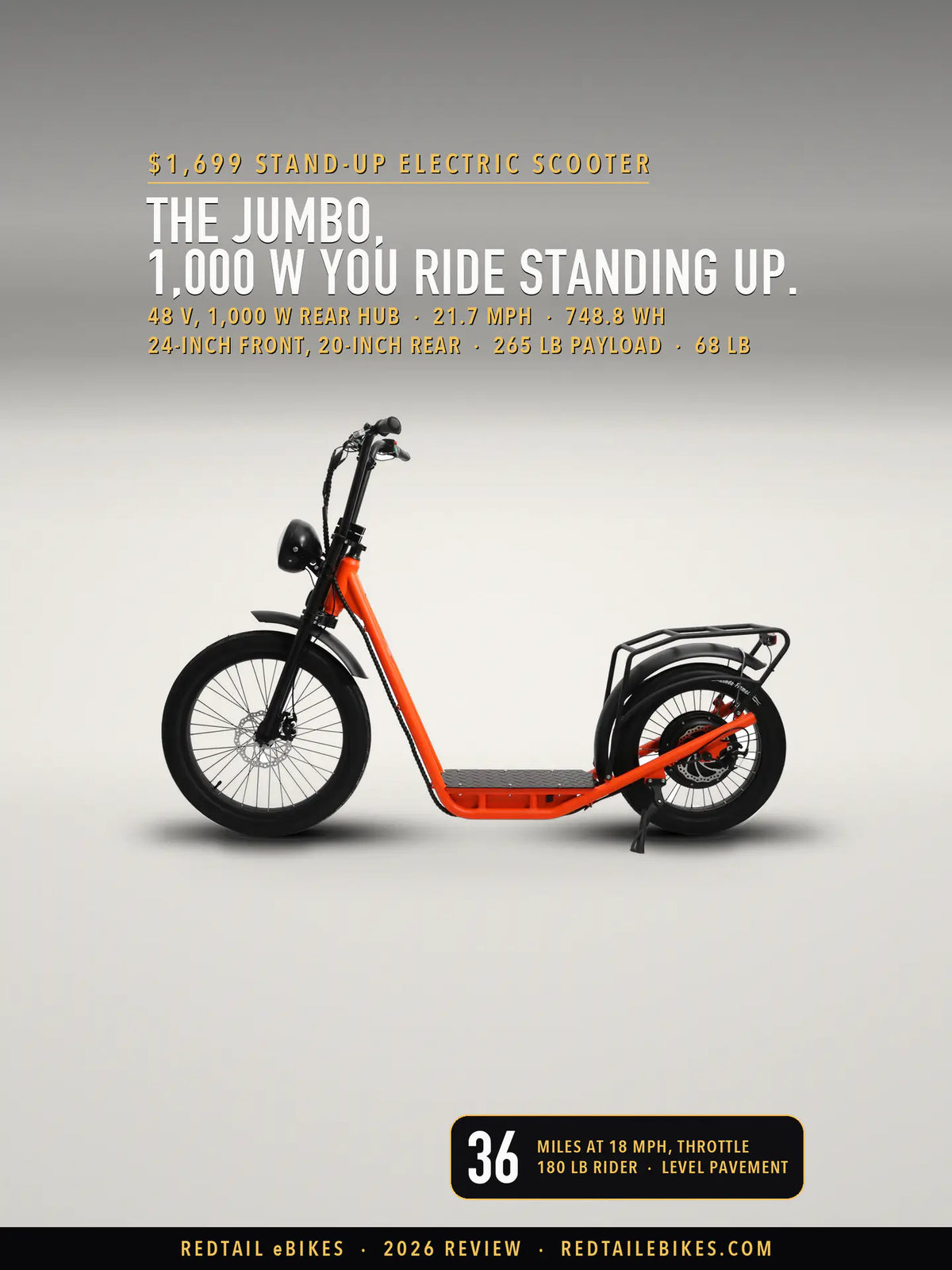
68 lb · 48 V, 1,000 W rear hub, 70 N·m · 748.8 Wh pack · 21.7 mph · standing deck, no pedals, no seat · deck 8.3 in · bar top 46.5 in · 24 x 3.0 front, 20 x 3.0 rear · 265 lb payload · $1,699 · verified October 2, 2026
Quick Answer: The Eunorau JUMBO is a $1,699 stand-up electric scooter: a 48 V, 1,000 W rear hub, a 748.8 Wh pack and a standing deck between 24-inch front and 20-inch rear wheels, with no pedals or seat, at 68 lb. Our model gives a 180 lb rider about 36 miles a charge at a steady 18 mph on level pavement.
Eunorau rates it at 21.7 mph and 19 to 25 miles, and prints a bar top 46.5 inches up: every rider from 5'4" to 6'4" in the Army's ANSUR II survey holds the grips standing straight (the fit section). Both colors could be ordered on October 2, 2026, at Eunorau's own price.
Its printed 1,000 W and 21.7 mph on the throttle sit outside all 49 e-bike definitions in US state and DC law, so your state's vehicle code decides what it is and where it rides (the law section).
Orange or Black, each $1,699, the price Eunorau charges, and both were in stock on October 2, 2026. Our checkout ships it free, Shop Pay splits it into 3, 6 or 12 monthly payments, and if a covered part fails we take the claim to Eunorau for you.
Buy the JUMBO in OrangeTakeaway
- About 36 miles at a steady 18 mph and 55 at 12 mph on the 748.8 Wh pack for a 180 lb rider on level pavement, and about 32 at 20 mph; Eunorau prints 19 to 25 miles (the range tables).
- A 1,000 W rear hub with 70 N·m: in the model it climbs an 8% grade at 18.0 mph with 180 lb aboard and 14.8 mph at the full 265 lb (the hill table).
- Real wheels under a standing deck: a 24 x 3.0 front and a 20 x 3.0 rear, TEKTRO disc brakes with a motor cutoff at each lever, a rack, fenders, a headlight and a taillight (the parts section).
- Bars that suit most adults standing: from 5'4" to 6'4" the bar top falls 2.0 to 10.1 inches below the median elbow (the bar table).
- Not an e-bike under any state's definition: its 21.7 mph on the throttle is past every e-bike throttle limit in the 49 that define one (the law section).
What's on this page
Twenty-three sections: who the JUMBO suits, how we verified it, Eunorau's figures, the drive and brakes, the deck and frame, the JUMBO beside a seated Eunorau at the same price, range, load, fit, the law, ownership and the verdict.
- Who the JUMBO is for
- How we verified this Eunorau JUMBO review
- Eunorau JUMBO specifications
- The 1,000 W hub, the throttle and the brakes
- The deck, the rack and the frame
- JUMBO or a seated Eunorau at the same price
- JUMBO range: how far 748.8 Wh carries you
- What the 265 lb rating covers
- Sizing the JUMBO to your body
- The Mercer fit test
- Where the law puts the JUMBO
- Charging and caring for the pack
- Recall check for the JUMBO
- Does the JUMBO carry a UL mark?
- The warranty, and who files the claim
- Why buy the JUMBO from us
- The honest ledger
- Who should buy the JUMBO
- Before you order: the checklist
- Limitations of this review
- The source register
- Frequently asked questions
- The bottom line
Who the JUMBO is for

Eunorau's own photograph of the JUMBO in Orange, set on a pale studio floor we built around it for this card. The $1,699 and the 1,000 W hub are Eunorau's figures; the range section computes the 36 miles.
The JUMBO is for an adult who wants to ride standing up on big wheels: short trips across town, a campus or a neighborhood, with a rack for a bag. Eunorau calls it a "heavy-duty stand-up electric scooter" and writes that "It's built for riders who want more punch and cargo capability than a typical kick scooter, without stepping up to a full seated e-bike" (Eunorau's JUMBO page).

The JUMBO in Orange from the left, as Eunorau photographed it: the bars and round headlight up front, the deck low between the wheels, the rack and fender over the 20-inch rear.
Eunorau prints a weight of 68 lb, a payload of 265 lb and a top speed of 21.7 mph, on a 24 x 3.0 front tire and a 20 x 3.0 rear. There is no seat and nothing to pedal; your feet stay on the deck and one hand works the throttle.
A rider who wants to sit has the META26 at the same $1,699, a 500 W e-bike with pedals and a saddle (our META26 review). One who carries more than 265 lb of rider and load has the MAX-CARGO, rated to 440 lb (our MAX-CARGO review).
48 V · 1,000 W · 70 N·m · 748.8 Wh · 21.7 mph · 68 lb · Black, $1,699. Orange costs the same, and delivery to the lower 48 is on us.
Get the JUMBO in BlackHow we verified this Eunorau JUMBO review
Every specification is Eunorau's, from the JUMBO product page, its product record and its geometry drawing, read September 26, 2026 and again on October 2. Arithmetic is recomputed here, and the store facts come from our own listing and checkout read the same day.
Each model section closes with its formula and its full list of inputs (range, fit), and the range rests on Martin and colleagues' road-power model. The JUMBO's printed figures are screened against the e-bike law of all 51 jurisdictions, and the Limitations date every screen and read.
We sell the JUMBO, and the honest ledger sends each rider it suits less well to a machine of ours that fits; our reviews hub lists every review we have published. Written by Milad Ghobadibeygvand, BScN (Western University, 2014); send corrections to corrections@redtailebikes.com.
Eunorau JUMBO specifications
Each row is a figure Eunorau publishes for the JUMBO, from the page and its record, read September 26 and October 2, 2026.
| Specification | Published figure |
|---|---|
| Price | $1,699 in Orange or Black, the same as Eunorau's price on October 2, 2026 |
| Motor | "48V1000W Rear Motor with max 70N.m torque" |
| Maximum speed | 21.7 mph |
| Battery | 48 V, 15.6 Ah lithium: 748.8 Wh (our arithmetic: 48 × 15.6) |
| Range | "Up to 19~25 MI / 30 KM ~ 40 KM" |
| Charger | "US standard 2.0A smart charger" |
| Controller and display | 48V controller; "CDC6 LCD display" |
| Throttle | "Half twist throttle" |
| Brakes | "TEKTRO disc brake with Motor Cutoff switch"; "TEKTRO Disc Brake+E-ABS" |
| Tires and rims | 24 x 3.0 front, 20 x 3.0 rear, on 24 x 1.5 and 20 x 1.5 inch alloy rims |
| Fork and frame | "Sturdy & steady dual-shoulder fork"; aluminum alloy frame |
| Lights | "6V-60V LED Headlight"; taillight |
| Seat, folding, tools | "Saddle: No"; "Foldable: No"; "Tool: Included" |
| Weight | 68 lb |
| Payload | 265 lb (120 kg) "Total Payload Capacity" |
| Box | 170 × 30 × 85 cm |
| UL | "UL CERTIFIED: Yes" among the highlights |
The dimensions on Eunorau's JUMBO geometry drawing:

Eunorau's drawing of the JUMBO: 2000MM long, 1180MM to the top of the bars, the rack at 650MM and the deck at 210MM. The same three heights and the length appear in the "Dimensions & Rider Fit" block on its page.
The 1,000 W hub, the throttle and the brakes
The JUMBO drives its 20-inch rear wheel with a 48 V hub that Eunorau rates at 1,000 W and 70 N·m, and you control it with a half-twist throttle at the bar.
With no pedals, the throttle is the only way to call on the motor. Eunorau's feature copy says the motor "offers continuous 1000 watts of power for quicker acceleration" (Eunorau's JUMBO page).

The rear of the Orange JUMBO, cropped from Eunorau's photograph: the hub motor and disc rotor in the 20-inch wheel, under the rack and fender.
In our model that hub holds the printed 21.7 mph on level pavement with a 180 lb rider and climbs an 8% grade at about 18.0 mph (the climbing table). Eunorau's motor row does not say whether the hub is geared or direct drive.
Both brakes are TEKTRO discs, and Eunorau lists each lever as a "TEKTRO disc brake with Motor Cutoff switch". Eunorau lists the rotors as "TEKTRO Disc Brake+E-ABS" (the JUMBO's spec rows).
Asked whether a battery charges "when pedaling and/or braking", Eunorau's FAQ answers that "Currently only MAX-CARGO and JUMBO apply this function". The JUMBO has no pedals, so on it the function can only come from braking; Eunorau prints no figure for how much it returns.

The cockpit, cropped from Eunorau's photograph: the bars, levers and switch pod above the round headlight.
The "CDC6 LCD display" shows "battery life, speed and distance" and has "push mode", which Eunorau describes as "a feature to use in the circumstance of pushing the bike uphill" (Eunorau's JUMBO page). The headlight runs off the main pack and switches on and off at the handlebar control pad; the taillight sits in the rear fender.
The deck, the rack and the frame
You ride on a flat checker-plate deck whose top sits 8.3 inches off the ground, between the wheels, with a rack and fender behind you. Eunorau describes it as an "Extra-Large Standing Deck" that is "significantly larger than those found on standard scooters, giving riders more room to adjust their stance" (Eunorau's JUMBO page).

The deck, cropped from Eunorau's photograph: a checker plate bolted to the orange frame.
Eunorau's feature copy says the fenders come with "an integrated taillight", and that "if you ever need to carry some extra gear" you can "strap on the rear rack" (Eunorau's JUMBO page). Its dimensions put the rack's top 650 mm (25.6 in) off the ground; Eunorau prints no separate load figure for the rack.

The Orange JUMBO from the rear quarter, in Eunorau's photograph: the rack, fender and taillight behind the deck.
The frame is aluminum alloy, and Eunorau lists "Foldable: No". The JUMBO is 2,000 mm (78.7 in) long and ships in a 170 × 30 × 85 cm box, so measure your hallway, elevator or car before it arrives.
JUMBO or a seated Eunorau at the same price
At $1,699 you can stand on the JUMBO or sit on the META26, a 500 W e-bike with pedals; the JUMBO trades the seat and the gears for twice the rated motor power. Each row is Eunorau's figure from the JUMBO page or the META26 page, read October 2, 2026.
| JUMBO | META26 | |
|---|---|---|
| How you ride | standing on a deck | seated, with pedals |
| Motor | 48 V, 1,000 W rear hub, 70 N·m | 48 V, 500 W rear hub, 55 N·m |
| Top speed | 21.7 mph | 20 mph |
| Battery | 48 V, 15.6 Ah | 48 V, 15 Ah, a second pack optional |
| Payload | 265 lb | 286 lb |
| Weight | 68 lb | 68.4 lb |
| Tires | 24 x 3.0 front, 20 x 3.0 rear | 26 x 3.0 |
| Gears | none | 7-speed SHIMANO |
| Price at Redtail | $1,699 | $1,699 |
Eunorau's figures, both pages read October 2, 2026; our prices from our own listings the same day.
Pick the JUMBO if you want to step on and go, with more motor and no pedaling; pick the META26 if you want a seat, gears and the choice to pedal. Our META26 review computes its range and fit from Eunorau's figures, as this page does.
Standing, 1,000 W, 21.7 mph: the Orange JUMBO for $1,699, or the Black. Prefer to sit? The META26 sells for the same money.
Choose the Orange JUMBOJUMBO range: how far 748.8 Wh carries you
In our model of the JUMBO, a 180 lb rider holding a steady 18 mph on level pavement spends about 20.6 Wh a mile and runs the 748.8 Wh pack flat after about 36 miles; at 12 mph the same charge lasts about 55 miles, and at 20 mph about 32. Eunorau prints 19 to 25 miles, a band the model reaches on a steady climb rather than on the flat (Eunorau's band, as a ride).
Every row holds one speed on smooth, level ground with no stops. City riding adds starts, lights and corners, so treat each row as the most one charge returns at that pace.
The model is built from Eunorau's own figures: a 48 V, 1,000 W rear hub with 70 N·m, a 48V/15.6Ah pack, a 68 lb machine, a 20 x 3.0 rear tire and a 21.7 mph top speed. The formula section lists each input beside its source.
Find your own figure in three steps:
- Pick your cruising speed in the first table; 18 mph sits just under the JUMBO's printed 21.7.
- Count your hills and your load: the grade rows run from 2% to 15%, and the weight rows from 100 lb to the 265 lb rating.
- Hold back 15% of the pack, and plan city trips shorter than the row.
How far does the JUMBO go at each speed?
Pace sets the range: about 62 miles at 10 mph, 45 at 15 mph and 32 at 20 mph, because the power needed to push you through the air climbs with the cube of your speed (Martin et al., 1998).
| Speed, flat | Per mile | Full charge | With 15% kept |
|---|---|---|---|
| 8 mph | 10.8 Wh | 70 mi | 59 mi |
| 10 mph | 12.0 Wh | 62 mi | 53 mi |
| 12 mph | 13.7 Wh | 55 mi | 47 mi |
| 15 mph | 16.7 Wh | 45 mi | 38 mi |
| 18 mph | 20.6 Wh | 36 mi | 31 mi |
| 20 mph | 23.7 Wh | 32 mi | 27 mi |
Throttle only (the JUMBO has no pedals), a 180 lb rider standing on the deck, level pavement, still air at 77 °F, the full 48V/15.6Ah pack. The last column keeps 15% in reserve, the top of the 10 to 15% that Eunorau's FAQ says a pack should hold when it goes on charge.
Going from 15 mph to 20 mph costs about 29% of the miles. The model reaches the printed 21.7 mph on the flat with a 180 lb rider; the table stops at 20 mph, the fastest round speed under it.
One speed, one motor: where the hub works best
The JUMBO has no gears and nothing to pedal, so your throttle hand is the only control on range: the modeled hub turns 70% of the pack's power into wheel power at 8 mph, 76% at 12 mph and 83% at 20 mph. Eunorau's spec rows list a "Half twist throttle" and no shifter.
| Speed, flat | Motor efficiency | Power at the rear wheel | Per mile |
|---|---|---|---|
| 8 mph | 70% | 59 W | 10.8 Wh |
| 10 mph | 73% | 86 W | 12.0 Wh |
| 12 mph | 76% | 121 W | 13.7 Wh |
| 15 mph | 79% | 192 W | 16.7 Wh |
| 18 mph | 82% | 291 W | 20.6 Wh |
| 20 mph | 83% | 375 W | 23.7 Wh |
The modeled motor at a steady pace on level pavement, a 180 lb rider, throttle only. Motor efficiency is the wheel's power over the power the motor draws; the last column adds the pack's own losses.
In the model the hub is least efficient at low speed, so the slow rows spend more of the pack for each watt that reaches the wheel. Eunorau prints no riding modes or speed caps for the JUMBO, so no per-mode miles are given.
How much do hills cost, and how fast does it climb?
At a steady 10 mph, each 1,000 feet of climbing adds about 127 Wh on a 4% grade and 156 Wh on a 10% grade to what level ground would use. Raising a 180 lb rider and the 68 lb JUMBO 1,000 feet takes about 93 Wh at the wheel; motor and pack losses make up the rest.
| Grade | Per mile, throttle | Full charge, throttle |
|---|---|---|
| 2% | 25 Wh | 30 mi |
| 4% | 39 Wh | 19 mi |
| 6% | 55 Wh | 14 mi |
| 8% | 73 Wh | 10 mi |
| 10% | 94 Wh | 8 mi |
| 12% | 118 Wh | 6 mi |
| 15% | 164 Wh | 5 mi |
A 180 lb rider at a steady 10 mph up each paved grade, throttle only, the full pack, still air.
The fastest steady pace the hub holds on each grade, at three loads:
| Grade | 130 lb aboard | 180 lb aboard | 265 lb aboard |
|---|---|---|---|
| 4% | 20.7 mph | 20.4 mph | 19.8 mph |
| 6% | 20.2 mph | 19.7 mph | 17.5 mph |
| 8% | 19.7 mph | 18.0 mph | 14.8 mph |
| 10% | 18.3 mph | 15.9 mph | 12.7 mph |
| 12% | 16.5 mph | 14.1 mph | 11.1 mph |
Throttle only, still air, the 68 lb JUMBO plus each column's load, the motor held to its 1,000 W rating and to the 70 N·m Eunorau prints. The 265 lb column is the full payload rating.
With 180 lb aboard, the model climbs an 8% grade at about 18.0 mph and a 12% grade at 14.1 mph; at the full 265 lb, the 8% grade drops to about 14.8 mph. Eunorau's display copy describes a push mode, "a feature to use in the circumstance of pushing the bike uphill" (the JUMBO page); the model counts motor power alone, with no push from your foot.
Does rider weight change the range?
On the flat, weight costs little: at 12 mph the pack carries 130 lb about 60 miles and the full 265 lb about 47, while holding 10 mph up an 8% grade it carries 130 lb about 13 miles and 265 lb about 7.
| You plus your load | 12 mph flat, throttle | 18 mph flat, throttle | 8% climb, 10 mph |
|---|---|---|---|
| 100 lb | 64 mi | 40 mi | 16 mi |
| 130 lb | 60 mi | 39 mi | 13 mi |
| 180 lb | 55 mi | 36 mi | 10 mi |
| 220 lb | 51 mi | 35 mi | 8 mi |
| 260 lb | 48 mi | 33 mi | 7 mi |
| 265 lb | 47 mi | 33 mi | 7 mi |
You and what you carry on the 68 lb JUMBO, the full pack, still air. The 265 lb row is Eunorau's "Total Payload Capacity", which counts the rider and the load and not the machine.
Does cold weather cut the range?
Ride at 32 °F and the 55 miles at 12 mph fall to about 44; at 14 °F, about 40. Cold cells give back about 89% of their 77 °F energy at 32 °F, the air is 9% denser and the tires roll 18% harder (Rothhämel, 2023).
| Air | Pack energy vs 77 °F | 12 mph flat, throttle |
|---|---|---|
| 95 °F | 99% | 57 mi |
| 77 °F | 100% | 55 mi |
| 68 °F | 98% | 52 mi |
| 50 °F | 93% | 47 mi |
| 41 °F | 91% | 45 mi |
| 32 °F | 89% (80–93) | 44 mi (39–46) |
| 14 °F | 82% (40–83) | 40 mi (19–40) |
12 mph on level pavement, throttle only, a 180 lb rider, the full pack. The middle column is McMaster University's measured LG HG2 cell; Eunorau names no cell maker for the JUMBO's pack, so the brackets at 32 °F and 14 °F carry the other published cell data (Limitations).
Store and charge the pack indoors in winter: in the cell data behind the cold rows, the energy a cell gives back falls as it cools.
Do the 3-inch tires cut range?
Eunorau names no maker, tread or casing for the JUMBO's 24 x 3.0 front and 20 x 3.0 rear tires, so the model rolls on the median of ten wide tires measured on Bicycle Rolling Resistance's drum; across the lightest and heaviest of the ten, 12 mph gives about 50 to 65 miles.
| Rolling resistance | 12 mph flat, throttle | 18 mph flat, throttle |
|---|---|---|
| 0.0070 · the lowest of ten fat tires | 65 mi | 41 mi |
| 0.0105 · the median of ten fat tires (used) | 55 mi | 36 mi |
| 0.0126 · the highest of ten fat tires | 50 mi | 34 mi |
A 180 lb rider on the throttle over level pavement, from a full pack. Each figure is a rolling-resistance coefficient: 0.0105 means a drag of 1.05% of the weight on the tires.
Eunorau's spec rows print no tire pressure for the JUMBO, so the model takes the drum's own test pressure for every row.
Eunorau's 19 to 25 miles, as a ride
Eunorau's range row reads "Up to 19~25 MI / 30 KM ~ 40 KM", which spends 39.4 Wh a mile at 19 miles and 30.0 Wh a mile at 25. On level pavement the model's heaviest row, a steady 20 mph, takes 23.7 Wh a mile (Eunorau's JUMBO page).
A steady climb gets there. At 10 mph a 2% grade takes 25 Wh a mile and a 4% grade 39 Wh, so a route that climbs most of the way lands inside Eunorau's band; stops and starts, which the model leaves out, also cost miles. Eunorau does not print the rider's weight, speed or route behind its figure.
The model's drag figure comes from seated riders (Tengattini and Bigazzi, 2018). Run as a bracket for a standing rider, with that drag area raised by one standard deviation of the same sample, the 36 miles at 18 mph become about 31 (the drag-area note).
For planning, take Eunorau's 19 to 25 miles for a hilly or stop-and-go route and the model's 36 miles for a flat, steady one at 18 mph. Each 1,000 feet of climbing costs about 127 to 156 Wh at 10 mph, and a 15% reserve turns 36 miles into 31.
One 748.8 Wh charge, about 36 model miles at a steady 18 mph for a 180 lb rider. This button buys the Orange; the Black is the same price. Email your weight, your route and its hills to support@redtailebikes.com and we will run your commute through this model.
Order the JUMBO in OrangeHow the range figures are computed
The model begins with the power the rear wheel needs to hold one speed, from the road-power equation Martin and colleagues checked against riders on real roads in 1998:
Wheel power = v × [ m × g × (Crr × cos θ + sin θ) + ½ × ρ × CdA × v² ]
Here v is the speed, m the mass of rider, load and machine, g gravity, θ the grade's angle, Crr the tires' rolling-resistance coefficient, ρ the air's density and CdA the drag area of rider and machine.
From the wheel back to the cells:
- The hub. The model copies the published curve of Bafang's RM G0H0, 510 rpm with no load and 426 rpm at its rated load, rated "≥ 80" percent efficient, wound for 48 V and 1,000 W, with its no-load speed set so the JUMBO tops out at Eunorau's 21.7 mph. The rated point falls at 19.5 mph.
- The motor's limits. No pace is held above 1,000 W, and the wheel torque stops at 70 N·m.
- The pack. Some energy is lost inside the pack itself: 3.1% at 12 mph, from the measurements Arango, Lopez and Ceren made on a 48 V pack.
- Miles. Divide the cells' output by the speed for watt-hours a mile, then divide the 748.8 Wh, less what cold takes, by that for the miles.
| Input | Value used | Where it comes from |
|---|---|---|
| Machine | 68 lb | Eunorau's weight row |
| Rider and load | 180 lb; the weight rows run to 265 lb | Eunorau's 265 lb "Total Payload Capacity" on the JUMBO page |
| Pack | 48 V × 15.6 Ah = 748.8 Wh | Eunorau's battery row |
| Motor | 1,000 W at 48 V, 21.7 mph top speed, 80% at the rated point, 70 N·m | Bafang OEM workbook 2021, RM G0H0, set to Eunorau's figures |
| Drive wheel | 21.98 in across, the 20 x 3.0 size's nominal diameter | a 406 mm bead seat from Sheldon Brown's tire-sizing table plus twice 76.2 mm |
| Rolling resistance | 0.0105, the median of ten wide tires on the drum | Bicycle Rolling Resistance |
| Drag area | 0.640 m², upright cruiser riders | Tengattini and Bigazzi, 2018 |
| Pack losses | 3.1% at 12 mph, more on climbs | Arango, Lopez and Ceren, 2021 |
| Air | 77 °F at sea-level pressure, 1.184 kg/m³ | U.S. Standard Atmosphere, 1976 |
| Cold | each temperature's share of a cell's energy | McMaster University's LG HG2 cell data |
| Reserve | 15% held back, the top of Eunorau's "10-15%" | Eunorau's FAQ |
A worked ride: 180 lb on the deck, the throttle at a steady 12 mph on level pavement. Rolling costs 62.4 W and the air 58.5 W, a total of 120.9 W at the rear wheel.
The 21.98-inch drive wheel turns 183.5 times a minute at 12 mph. The modeled hub, at 1.282 N·m per amp, 0.304 Ω and 1.10 A with no load (the comparable's curve wound for 48 V and 1,000 W), gives 6.3 N·m on 6.0 A, 76% efficient at this light a load.
The hub draws 158.9 W; with the pack's internal losses (Arango, Lopez and Ceren, 2021) the cells supply 164.0 W, or 13.7 Wh a mile (13.67 before rounding). 748.8 ÷ 13.67 is 54.8 miles, and 46.6 with 15% kept.
What the model is checked against:
| Check | Published figure | This model |
|---|---|---|
| Road physics, Martin and colleagues' worked example | 45.7 W for the tires and the grade, 158.8 W for the air | 45.7 W and 158.8 W |
| The comparable's rated point | at least 80% efficient | 80% |
| Eunorau's own range figure | 19 to 25 miles | 36 miles at a steady 18 mph on the flat; 19 miles holding 10 mph up a 4% grade |
The first check is Appendix I in Martin and colleagues (90 kg, a 0.3% grade, 8.36 m/s); the second, the RM G0H0's rated point in Bafang's workbook; the third sets the model against the one range figure Eunorau prints for the JUMBO, which is not an independent measurement (Limitations).
What the 265 lb rating covers
Eunorau rates the JUMBO's "Total Payload Capacity" at 265 lb, and its towing guide defines payload as "the rider and anything carried on the bike itself": you and your load, with the 68 lb machine on top. A 180 lb rider has 85 lb left for a bag on the rack (Eunorau's JUMBO page; Eunorau's towing and payload guide).
Load costs range and climbing speed. At the full 265 lb the model goes about 47 miles at 12 mph on the flat and climbs an 8% grade at about 14.8 mph (the weight table).
If you and your load come to more than 265 lb, the MAX-CARGO is rated to 440 lb (Eunorau's MAX-CARGO page; our MAX-CARGO review).
Sizing the JUMBO to your body
On Eunorau's printed figures the top of the JUMBO's handlebar stands 38.2 inches above its deck. For the median 5'8" rider in the US Army's ANSUR II survey, that puts the bar top 4.6 inches below the elbow, so you hold the grips standing straight with the elbows bent about 70°; every rider in the survey from 5'4" to 6'4" holds them that way.
With no seat and no pedals, the JUMBO fits by one measure: where the bars meet your arms when you stand on the deck. Eunorau publishes the deck height, the bar height and the rack height on its JUMBO geometry drawing, and no rider-height window.
The rows come from ANSUR II's 6,068 measured soldiers, women and men, one inch of height at a time from 5'0" to 6'4".
Your fit in three steps:
- Measure your elbow height standing barefoot with your arms hanging: the floor to the point of your elbow is the number.
- Find your height in the bar table and compare your elbow with that row's median; the JUMBO's bar top sits 38.2 inches above the deck you stand on.
- Stand on the deck in your riding shoes the day it arrives and hold the grips with both feet flat (the setup steps).
Is there a seat, and where do you stand?
There is no seat: Eunorau's spec rows read "Saddle: No", and you ride standing on a deck whose top sits 210 mm (8.3 in) off the ground. The figures below are the four Eunorau prints on its geometry drawing and dimensions block, converted to inches.
| Dimension | Eunorau's figure | In inches |
|---|---|---|
| Top of the deck, from the ground | 210 mm | 8.3 in |
| Top of the handlebar, from the ground | 1,180 mm | 46.5 in |
| Top of the rack, from the ground | 650 mm | 25.6 in |
| Total length | 2,000 mm | 78.7 in |
| Top of the handlebar, from the deck | the two figures above | 38.2 in |
Eunorau's printed figures: "TOTAL LENGTH 2000mm", "MAX HEIGHT 1180mm" and "RACK HEIGHT 650mm" in its "Dimensions & Rider Fit" block, and "210MM" beside the deck on its drawing. The last row is the bar top less the deck. The drawing draws its 1180MM line to the top of the grips.
How high is the step onto the deck?
The deck's top is 8.3 inches up, so mounting is one short step, and at a stop you put a foot down from 8.3 inches. There is no frame to swing a leg over: the deck runs between the wheels below the bars (Eunorau's drawing).
The rack behind you stands 650 mm (25.6 in) high. Load it so nothing hangs over the deck where your back foot goes.
Where do the bars sit against your elbows?
From 5'4" to 6'4", the bar top falls below the median rider's elbow by 2.0 to 10.1 inches, so every rider in the survey at those heights holds the grips with the upper arms hanging and the elbows bent between 81° and 48°. Shorter riders meet the bars higher on the arm: at 5'1" the median elbow is level with the bar top.
| Your height | Elbow, median | Bar top vs elbow | Bend, median | Upright, of 100 |
|---|---|---|---|---|
| 5'0" | 37.7 in | 0.5 in above | 92° | 19 |
| 5'1" | 38.2 in | level | 90° | 53 |
| 5'2" | 39.0 in | 0.8 in below | 86° | 91 |
| 5'3" | 39.6 in | 1.4 in below | 83° | 98 |
| 5'4" | 40.2 in | 2.0 in below | 81° | 100 |
| 5'5" | 40.8 in | 2.7 in below | 78° | 100 |
| 5'6" | 41.5 in | 3.3 in below | 76° | 100 |
| 5'7" | 42.1 in | 3.9 in below | 73° | 100 |
| 5'8" | 42.8 in | 4.6 in below | 70° | 100 |
| 5'9" | 43.3 in | 5.2 in below | 68° | 100 |
| 5'10" | 44.1 in | 5.9 in below | 65° | 100 |
| 5'11" | 44.8 in | 6.6 in below | 62° | 100 |
| 6'0" | 45.5 in | 7.3 in below | 59° | 100 |
| 6'1" | 46.1 in | 8.0 in below | 56° | 100 |
| 6'2" | 46.7 in | 8.5 in below | 54° | 100 |
| 6'3" | 47.7 in | 9.5 in below | 50° | 100 |
| 6'4" | 48.3 in | 10.1 in below | 48° | 100 |
ANSUR II bodies, women and men, barefoot. Elbow height is shoulder height less upper-arm length; the bar top is 38.2 inches above the deck. Elbow bend is 0° with the arm straight and 90° with the forearm level, measured with the upper arm hanging. Upright counts the riders who hold the bars standing straight: their bar top falls between their elbow and their closed hand with the arm hanging straight.
Taller riders hold the bars with straighter arms: the bend drops from 81° at 5'4" to 56° at 6'1" and 48° at 6'4". A bend near 90° puts your forearms level; a smaller one angles them down to the grips.
At 5'0" the median bar top sits 0.5 inches above the elbow, and 19 riders of 100 that height reach it with the upper arms still hanging. The rest lift the forearms above level to hold the grips.
How much weight goes through my hands?
Standing on the deck, your weight goes down through your feet, so the share on the bars is not computed for a standing rider. For scale, seated road racers on the hoods put about 15% of their weight through the stem in Carahalios, 2015; a standing scooter rider's position is a different one, so that figure describes a road bike only.
Eunorau lists no suspension for the JUMBO, only a "Sturdy & steady dual-shoulder fork" and 3-inch tires (the spec rows), so the bars pass road bumps to your hands. On rough pavement, padded gloves help: in 36 experienced cyclists, padding cut the pressure over the ulnar nerve in the palm by 10 to 28% (Slane et al., 2011).
Setting it up on delivery
Before the first ride, stand on the deck in the shoes you will ride in, feet flat and one ahead of the other, and hold both grips. If your hands meet the grips with your elbows bent and your back upright, the bars suit you.
Check both brake levers before rolling: Eunorau lists "TEKTRO disc brake with Motor Cutoff switch" (the JUMBO's spec rows), so with the wheel lifted, squeeze each lever and confirm the motor stops pushing. Then try the half-twist throttle at walking pace in an open lot before the street.
How the fit figures are computed
Two subtractions build the table: the bar top less the deck gives the bar's height above your feet, and your shoulder height less your upper-arm length gives your elbow's. No saddle formula applies, since there is no seat or pedal to set one from.
Take a 5'8" rider with the survey's median elbow height for that height, 42.8 inches: the bar top at 38.2 inches is 4.6 inches lower. With a median forearm of 13.4 inches from elbow to the center of the grip, the forearm drops 4.6 inches over its length, an elbow bend of about 70°.
| Input | Value | Source |
|---|---|---|
| Deck top | 210 mm (8.3 in) | the "210MM" label on Eunorau's JUMBO geometry drawing |
| Bar top | 1,180 mm (46.5 in) | "MAX HEIGHT 1180mm" in Eunorau's dimensions block |
| Rack top | 650 mm (25.6 in) | "RACK HEIGHT 650mm", the same block |
| Bodies | 6,068 US Army soldiers, women and men | ANSUR II |
Eunorau's studio photographs were tried as a check on the printed heights. Scaled by the printed 2,000 mm length, they put the rack within 2.4% of its 650 mm, but the bars, photographed at an angle the scale cannot correct, read higher than the printed 1,180 mm, so the printed figures alone build the table (Limitations).
From 5'4" to 6'4", every rider in the survey holds the JUMBO's bars standing straight. This button orders the Black at $1,699, or pick Orange at the same price. Under 5'2"? Email your height and elbow height to support@redtailebikes.com before you order.
Order the JUMBO in BlackThe Mercer fit test
The Mercers are the family every review on this site is measured against. Each verdict reads a figure Eunorau prints or the fit model's row for that rider's height.
The inputs: the bar top 38.2 inches above the 8.3-inch deck, the 265 lb payload, the 68 lb machine, and the law in the law section. Eunorau prints no rider-height window for the JUMBO.
| Member | Verdict | The number behind it |
|---|---|---|
| Ruth Kowalski, 61, 5'5" | Holds the bars standing straight, forearms close to level. | At 5'5" the bar top is 2.7 inches below the median elbow, a 78° bend; 100 of 100 riders hold it standing straight. |
| Maya Torres, 32, 5'6" | Holds them standing straight, forearms angled a little down. | 3.3 inches below the median elbow at 5'6", a 76° bend. |
| Dana Mercer, 45, 5'7" | Standing straight, with a slightly deeper downward angle than Maya. | 3.9 inches below the median elbow at 5'7", a 73° bend. |
| Frank Kowalski, 63, 5'10" | Standing straight with straighter arms; he checks the grips on delivery. | 5.9 inches below the median elbow at 5'10", a 65° bend. |
| Cole Mercer, 16, 5'11" | Fits by height; whether he may ride a 1,000 W scooter at 16 is his state's rule, which this page does not screen. | 6.6 inches below the median elbow at 5'11", a 62° bend. |
| Jack Mercer, 48, 6'1" | Standing straight with the straightest arms of the family. | 8.0 inches below the median elbow at 6'1", a 56° bend. |
| Ivy Mercer, 12 | Not her machine. | Eunorau's store asks every visitor to confirm "Are you 18 years old or older?" before it shows the catalog, and the age rules for a motorized scooter are each state's. |
Every adult in the family holds the JUMBO's bars standing straight, and the bend tells them apart: near level for Ruth, angled down for Jack. Before the first ride, each stands on the deck in riding shoes and grips the bars (the setup steps).
One JUMBO fits the whole adult family from 5'5" to 6'1" standing up. This button buys the Black; the Orange is priced the same, with free delivery in the lower 48.
Buy the Black JUMBOWhere the law puts the JUMBO
We screened the JUMBO's printed 1,000 W, 21.7 mph and throttle against the e-bike law of all 51 jurisdictions on October 2, 2026: all 49 that define an e-bike leave it out, and Alaska and Kentucky define none. The throttle speed settles it everywhere: 48 of the 49 let a throttle move an e-bike only to 20 mph, and New Jersey's definition admits assistance only while the rider pedals.
In 44 of the 49 the motor rating excludes it as well, because each writes a 750-watt line into its definition. Rhode Island's line is a motor "rated not more than two (2) (S.A.E.) horsepower" (R.I. Gen. Laws § 31-1-3), and the District of Columbia, Montana, New Jersey and Oregon set no power figure. Our R1 review runs the same screen on Eunorau's pedal-less 4,000 W dirt bike.
The federal product-safety definition starts with pedals. 15 U.S.C. § 2085(b) defines a low-speed electric bicycle as "a two- or three-wheeled vehicle with fully operable pedals and an electric motor of less than 750 watts (1 h.p.)". The JUMBO has no pedals: Eunorau's spec rows list no crank, chainring or pedal, and its photographs show a deck where a bicycle's cranks would be.

Eunorau's outdoor photograph of the JUMBO in Orange; Eunorau does not name the place.
Outside the e-bike definitions, your state's vehicle code decides what the JUMBO is and where you may ride it; this page screens the e-bike definitions only. Our 50-state e-bike law hub sets each state's e-bike rules side by side. Before your first ride on a public street, look up your state's rules for motorized scooters and mopeds, or email us your state and we will send you the section that applies.
On October 2, 2026, the JUMBO's printed 21.7 mph on the throttle sat outside all 49 e-bike definitions in the states and DC, and its 1,000 W outside 44 of them; Alaska and Kentucky have no definition. Read your own state's scooter and moped rules before you ride on a road.
Charging and caring for the pack
Eunorau lists the JUMBO's charger as a "US standard 2.0A smart charger" and prints no charge time on the JUMBO page. Its FAQ says a full charge takes "between 3-8 hours" depending on the battery and charger (Eunorau's FAQ), and on the META26 the same 2.0 A charger and a 48V 15Ah pack carry "Battery Charging Time: 5 - 7 hours" (the META26 page).
A full JUMBO pack holds 748.8 Wh, about 0.75 kWh (Eunorau's battery row). A 12-mile ride at a steady 18 mph draws about 247 Wh from the cells in the model (the speed table), roughly a third of the pack.

The JUMBO in Black, in Eunorau's photograph, with the Eunorau name on the down tube.
Eunorau's FAQ, written for all its packs, says charging with 10 to 15% left "will significantly extend their lifetime", and to store a pack that will sit more than two weeks "in a cool, dry place with a 70%-80% charge remaining". It writes that its batteries "typically last 5-6 years" and keep "more than 80% of their original capacity after 500 charge cycles". Our battery guide explains the lithium chemistries inside packs like this one.
Recall check for the JUMBO
No federal recall names Eunorau or the JUMBO. On October 2, 2026 we searched every text field of all 10,027 records in the CPSC's recall database for both names, with a control brand returning its own recall in the same run.
The name "Eunorau" matched no record in the CPSC's list. The word "Jumbo" matched 16, and we read each one: jumbo crayons, snow globes, roasting pans, water-bead toys, a racing team's paint scheme on a road bike, and other products, none of them an Eunorau or a scooter.
We also read all 373 rows of the CPSC's list of product safety warnings the same day. A control brand matched two rows; Eunorau and the JUMBO matched none.
Does the JUMBO carry a UL mark?
Eunorau's JUMBO page lists "UL CERTIFIED: Yes" in its highlights. UL 2272 covers "the electrical drive train system including the battery system" of "electric powered scooters and other devices", and UL 2271 a battery pack on its own. If your building or insurer needs the certificate, ask with your order and we will request it from Eunorau.
The warranty, and who files the claim
Eunorau's warranty policy, read September 30, 2026, sets these terms:
| Component | Coverage |
|---|---|
| Frame | 10 years |
| Battery | 24 months |
| Motor | 24 months |
| Electrical components | 24 months |
The policy is issued by Eunorau Bikes, "a Nevada corporation", and covers Eunorau products bought in the US from August 1, 2023 (the policy). The JUMBO page's banner reads "2-Year Limited Warranty", the same 24 months the policy gives the battery, motor and electrical parts.
It excludes damage from "abnormal use (including but not limited to stunt riding, racing or other similar activities not consistent with the intended use of the products)". It also asks that "You are the original purchaser", for "Product Registration right after the purchase", and for an "E-bike check-up by a Eunorau specialist or dealer after the first year of use" (the policy); our Eunorau brand profile compares the terms across the range.
Buy the JUMBO from us and we file and follow the claim. Email us a photo and a sentence on what went wrong; we take it to Eunorau and stay on it until the part reaches your door.
Why buy the JUMBO from us

The Orange JUMBO from the front quarter, in Eunorau's photograph: the round headlight and the 24-inch front wheel.
| What we tell you | Where it comes from |
|---|---|
| $1,699 in Orange or Black | Our listing, October 2, 2026 |
| Eunorau's own price is $1,699 too | Eunorau's JUMBO page, October 2, 2026 |
| Both colors can be ordered | Our listing, October 2, 2026 |
| Shop Pay in 3, 6 or 12 monthly payments at 15% APR | The plan table on our listing, October 2, 2026 |
| Delivery to the contiguous US is free: our checkout's "Free U.S. Shipping" rate is $0.00 for the JUMBO | Our checkout's delivery profile and shipping policy, October 2, 2026 |
| We run the warranty claim | Eunorau's warranty terms, handled by us |
The value case in numbers. Our listing's plan table on October 2, 2026 offered the $1,699 as 3 payments of $580.55, 6 of $295.68 or 12 of $153.35, all at 15% APR.*
*Rates from 0-36% APR. Payment options through Shop Pay Installments are subject to an eligibility check and are provided by these lending partners: affirm.com/lenders. Options depend on your purchase amount, and a down payment may be required. State notices to consumers: affirm.com/licenses.
Why order it here. Eunorau's own $1,699 on October 2, 2026, free delivery, Shop Pay plans, US support by email, and a warranty claim we carry to Eunorau for you.
The Orange JUMBO for 12 payments of $153.35 with Shop Pay at 15% APR, or $1,699 at once. The Black costs the same; your delivery is free and we handle any warranty claim.
Check out the Orange JUMBOThe honest ledger
Green flags
- A 1,000 W rear hub with 70 N·m: in the model it climbs an 8% grade at 18.0 mph with 180 lb aboard (the hill table).
- 748.8 Wh in the pack: about 36 miles at a steady 18 mph and 55 at 12 mph in the model (the range tables).
- Big 3-inch tires on a 24-inch front and a 20-inch rear, with TEKTRO disc brakes and a motor cutoff at each lever (the parts section).
- A rack, fenders, a headlight and a taillight come on it (the deck section).
- An 8.3-inch step onto the deck and a bar top that suits riders from 5'4" to 6'4" standing straight (the fit section).
- Eunorau's own $1,699, in both colors on October 2, 2026 (why buy from us).
Red flags: where it is the wrong machine, and what to do
- You want to sit down: the META26 is $1,699 with a saddle, pedals and 7 gears (the comparison).
- You want a machine that meets your state's e-bike definition: the JUMBO sits outside all 49; the META26 is a 500 W e-bike with pedals and a 20 mph top speed, and our META26 review screens it state by state.
- You and your load come to more than 265 lb: the MAX-CARGO is rated to 440 lb (our MAX-CARGO review).
- You stand under 5'2": the bar top meets your elbow or sits above it (the bar table); send us your height and elbow height first.
- You need it to fold: Eunorau lists "Foldable: No" and a 2,000 mm length; email us your space and we will tell you which of our folding models fits it.
Who should buy the JUMBO
The figures that decide it. About 36 miles at a steady 18 mph and 55 at 12 mph for a 180 lb rider on the flat, 47 at 12 mph with the full 265 lb; an 8% climb at 18.0 mph with 180 lb aboard; a bar top that riders from 5'4" to 6'4" hold standing straight.
Buy the JUMBO if you want to ride standing up on big wheels, with 1,000 W behind you, a rack and lights, on trips your state's scooter or moped rules allow, you stand about 5'2" or taller, and you and your load come to 265 lb or less, at $1,699.
Choose the META26 instead if you want a seat and pedals at the same price, and the MAX-CARGO if you carry more. Our Eunorau brand profile covers the rest of the range, and our Eunorau collection lists every Eunorau model on our shelf.
The Black JUMBO, $1,699, or the Orange for the same. Spread it over 12 months with Shop Pay; delivery is free, and so is our work on any warranty claim.
Check out with the JUMBOBefore you order: the checklist
Eight checks: four to confirm the JUMBO is your machine, four for the order and its first week.
- ☐ Look up your state's rules for motorized scooters and mopeds on the roads you will ride (the law section).
- ☐ Measure your elbow height standing and find your row in the bar table: the bar top sits 38.2 inches above the deck.
- ☐ Total your weight and your load against 265 lb.
- ☐ Measure where it will live: it is 2,000 mm (78.7 in) long and does not fold.
- ☐ Plan your longest trip from Eunorau's 19 to 25 miles on hills and the model's 36 miles at a steady 18 mph on the flat.
- ☐ Charge it on arrival on the 2.0 A charger Eunorau supplies.
- ☐ Stand on the deck in your riding shoes, grip the bars, then check both brakes and their cutoff switches.
- ☐ Check the box for damage while the driver is still there, and send us photos within 48 hours if anything arrived broken.
Limitations of this review
Eighteen limits, numbered and tied to the section each one qualifies.
- The specifications are Eunorau's, from the JUMBO's page, record and geometry drawing, its FAQ, its towing guide and its warranty policy; arithmetic is recomputed. The range and fit models, the jurisdiction screen and our store terms are ours, each described below.
- Every range row is one steady speed on one paved grade in still air. City trips add starts, stops and corners, all of which cost more than these rows, so each row is the most a charge can return at that pace.
- The motor model borrows a comparable's published curve. Eunorau prints 48 V, 1,000 W and 70 N·m; the model uses the shape of Bafang's RM G0H0 wound for 48 V and 1,000 W, with its no-load speed set at Eunorau's 21.7 mph, and holds no pace above 1,000 W.
- The drag area is the upright cruiser riders' figure from Tengattini and Bigazzi, 2018, measured on seated riders. We found no field measurement of a standing scooter rider's drag; with the figure raised by one standard deviation of the same sample, the 36 miles at 18 mph become about 31 and the 55 at 12 mph about 49.
- Eunorau names no maker, tread or casing for either tire, so the model rolls on the median of ten wide tires on a laboratory drum, with the lightest and heaviest of the ten as the bracket in the tire table.
- The drive wheel's diameter is the 20 x 3.0 size's nominal 558.4 mm; Eunorau prints no outer diameter.
- The cold rows use McMaster's measured LG HG2 cell as the center line, bracketed in the cold table by Samsung's 35E data sheet and Casado et al., 2025; Eunorau names no cell for the JUMBO's pack.
- We found no published ride of a JUMBO to an empty pack with its speed, load and route stated, so the model is set only against Eunorau's own 19 to 25 miles, which it reaches on a steady climb rather than on the flat.
- The screen sets the printed 1,000 W, 21.7 mph and throttle beside each state's e-bike definition as our rule table and the statutes stood on October 2, 2026. It reads the motor, speed and throttle limbs only, and it is not legal advice.
- Each state's motorized-scooter, moped and motor-driven-cycle rules are not screened on this page: licensing, registration, age, helmet and where you may ride differ by state.
- The recall screen ran on October 2, 2026 over every text field of the 10,027 records in that day's copy of the CPSC recall database, shown working by a control brand; the warning listing's 373 rows were read the same day.
- Our price, stock, Shop Pay terms and shipping rate come from our own listing and checkout, read October 2, 2026; the page claims price parity with Eunorau's own page on that date.
- The fit table uses the bodies of US Army personnel, 6,068 soldiers measured barefoot in 2010 to 2012; riding shoes raise your elbow by their sole, which puts the grips a little lower on your arm than the table shows.
- Elbow height is computed as shoulder height less upper-arm length, with the upper arm hanging straight down; ANSUR II measures both standing, and a rider who leans forward meets the bars lower on the arm. The forearm length runs from the back of the elbow to the center of a gripped dowel, so each bend figure is an approximation.
- The bar figure is the top of the handlebar, Eunorau's printed "MAX HEIGHT 1180mm"; your hand closes around the grip just below it, and Eunorau prints no grip diameter or bar width, so no lean or hand load is computed.
- Eunorau's studio photographs, scaled by its printed 2,000 mm length, read the rack within 2.4% of its 650 mm but draw the bars higher than the printed 1,180 mm (1,261 to 1,375 mm across two photographs and the drawing), with the two grips at different heights in the frame. The camera angle cannot be corrected from one view, so the fit table runs on the printed figures; if your JUMBO's bars sit higher, every row shifts toward taller riders.
- The 210 mm deck figure is the label beside the deck on Eunorau's drawing; scaled by the drawing's own length, it marks the deck's top surface.
- Eunorau's "E-ABS" is quoted and not interpreted: its page does not say what the system does. Its FAQ names the JUMBO among the models whose battery charges "when pedaling and/or braking"; no figure is printed for it, so the range model counts no energy returned by braking, which would add to the rows on a route with descents and stops. Expiry: re-check if Eunorau changes the motor, the pack, the speed, the dimensions, the payload or the price, or if a state's e-bike definition changes.
The source register
What this review rests on, by tier and by use: Eunorau's page, record, drawing, FAQ, guide and policy, the statutes, the CPSC's lists, the measurements behind both models, and our own datasets.
| Source | Tier | Used for |
|---|---|---|
| Eunorau JUMBO product page and product record, read September 26 and October 2, 2026 | T2 — manufacturer primary | Every specification, the feature copy, the geometry drawing, the colors, the photographs |
| Eunorau's META26 and MAX-CARGO pages; FAQ; towing and payload guide; warranty policy | T2 — manufacturer primary | The comparison table; battery care; the payload definition; the warranty terms |
| 15 U.S.C. § 2085 · R.I. Gen. Laws § 31-1-3 | T1 — statute | The federal product definition; Rhode Island's horsepower line |
| Our 51-jurisdiction rule table and the JUMBO screen | First-party dataset, disclosed | The screen of October 2, 2026 |
| CPSC recall database · CPSC warning listing | T1 — federal agency | The recall and warning screens of October 2, 2026 |
| Bafang OEM workbook 2021, RM G0H0 column | T2 — component maker primary | The comparable motor's speeds, rating and efficiency |
| Martin et al., 1998 · Tengattini and Bigazzi, 2018 · Arango, Lopez and Ceren, 2021 · Bicycle Rolling Resistance | T1 / T2 — peer-reviewed, laboratory | Road power, drag area, pack losses, rolling resistance |
| McMaster HG2 data · Samsung 35E data sheet · Casado et al., 2025 · U.S. Standard Atmosphere, 1976 · Rothhämel, 2023 | T1 / T2 — measured data, maker data sheet, federal reference, peer-reviewed | Cell energy by temperature and its bracket; air density; rolling resistance in the cold |
| Sheldon Brown's tire-sizing table | T3 — reference table | The 20-inch bead seat |
| US Army ANSUR II · Carahalios, 2015 · Slane et al., 2011 | T1 / T2 — federal survey, thesis, peer-reviewed | The 6,068 bodies, the measured weight on a road bike's bars, glove padding |
| Our JUMBO listing and shipping policy | First party | Price, colors, stock, Shop Pay terms, shipping |
| The JUMBO range model and fit model | First-party computation, each input and its source in the section's own table | The range and fit sections |
Frequently asked questions
Is the Eunorau JUMBO worth it?
If you want to ride standing up with real power, the JUMBO gives you a 1,000 W hub, a 748.8 Wh pack, big 3-inch tires, a rack and lights at 68 lb for $1,699. Our model carries a 180 lb rider about 36 miles at a steady 18 mph; check first that your state's scooter or moped rules allow it where you ride (the law section).
How fast does a 1000W electric scooter go?
Eunorau rates the JUMBO's 1,000 W at 21.7 mph, and our model holds that speed on level pavement with you at 180 lb. Up an 8% grade it holds about 18.0 mph with 180 lb aboard and 14.8 mph at the full 265 lb (the hill table).
How far does a 1000W electric scooter go on one charge?
If you weigh 180 lb and hold a steady 18 mph on the flat, the JUMBO's 748.8 Wh pack goes about 36 miles in our model, and about 55 at 12 mph. Eunorau prints 19 to 25 miles, the figure to plan with if your route climbs or stops often (the range tables).
Is a fat tire electric scooter street legal?
For the JUMBO, the answer is your state's vehicle code: its printed 21.7 mph on the throttle sits outside all 49 state and DC e-bike definitions. Look up your state's motorized-scooter and moped rules before you ride on a street, or email us your state (the law section).
Do electric scooters need to be registered?
It depends on your state: the JUMBO sits outside every e-bike definition, so your state's scooter, moped or motor-vehicle rules decide registration, licensing and age. This page does not screen those rules; your state's motor vehicle agency publishes them (the law section).
Can you ride an electric scooter on the road?
Where you may ride the JUMBO is set by your state's vehicle code and your city's rules, since it is not an e-bike under any state's definition. Check which streets, lanes and paths your state opens to motorized scooters before your first ride (the law section).
What is the weight limit on the Eunorau JUMBO?
265 lb for you and what you carry, Eunorau's "Total Payload Capacity"; the 68 lb machine is not part of it. At 180 lb you have 85 lb left for a bag on the rack, and at the full 265 lb the model goes about 47 miles at 12 mph (the load section).
How much electricity does it take to charge the JUMBO?
A full JUMBO pack holds 748.8 Wh, about 0.75 kWh, and your 12-mile ride at a steady 18 mph uses about 247 Wh of it in the model. Eunorau's FAQ puts a full charge at "between 3-8 hours" depending on the battery and charger, and on the META26 the same 2.0 A charger is rated "5 - 7 hours" for a 15 Ah pack (the charging section).
Does the Eunorau JUMBO have a seat?
No: Eunorau's spec rows read "Saddle: No", and you ride standing on the deck. If you want to sit, the META26 costs the same $1,699 and has a saddle and pedals (the comparison).
Electric scooter with a seat or an electric bike?
If you want a seat, Eunorau's seated choice at the JUMBO's price is an e-bike: the META26, with pedals, 7 gears and a 500 W hub. The JUMBO gives you the 1,000 W motor and the standing deck instead (the comparison).
Is the JUMBO the right size for an adult?
For most adults, yes: if you match the median 5'8" rider, your elbow sits 42.8 inches above your feet and the bar top 4.6 inches below it, an elbow bend of about 70°, and every rider in the survey from 5'4" to 6'4" holds the grips standing straight. Below 5'2" the bar top meets the elbow or sits above it (the bar table).
What size are the JUMBO's wheels?
A 24 x 3.0 tire in front and a 20 x 3.0 in back, on 24 x 1.5 and 20 x 1.5 inch alloy rims. The 1,000 W hub drives the 20-inch rear wheel (the specifications).
How big is the JUMBO's battery?
48V/15.6Ah, which is 748.8 Wh. It is the pack behind every row in the range tables: about 36 miles for you at a steady 18 mph if you weigh 180 lb.
Is the JUMBO a kick scooter?
Eunorau titles it a "Stand up Motor Kick Scooter": you stand on the deck and the 1,000 W hub moves you on the throttle. Its display has a push mode for walking it uphill (the parts section).
How much does the Eunorau JUMBO cost?
$1,699 in Orange or Black on October 2, 2026, the same as Eunorau's own price. With Shop Pay you can spread it over 12 payments of $153.35 at 15% APR, and your delivery is free (why buy from us).
The bottom line
The Eunorau JUMBO puts 1,000 W, a 748.8 Wh pack and big 3-inch tires under a standing deck for $1,699: about 36 miles at a steady 18 mph for a 180 lb rider, and bars that riders from 5'4" to 6'4" hold standing straight. Read your state's scooter rules first, then ride it.
If you want a seat for the same money, the META26 is the one; if you carry more than 265 lb, the MAX-CARGO.
Orange here, or Black, each $1,699. Free delivery, Shop Pay from 12 payments of $153.35, and a warranty claim we carry for you.
Start my JUMBO orderReferences
Every document behind the figures and rules on this page, numbered in the order the page first leans on it, with its publisher, title, the part cited and the date we read it.
- Eunorau. JUMBO — product page and product record: highlights, specification and component rows, the "Dimensions & Rider Fit" block, the geometry drawing, the feature copy, the variants and their prices, and the studio and outdoor gallery. eunorau-ebike.com/products/jumbo; product record jumbo.json. Retrieved September 26, 2026 and re-read October 2, 2026; deposit copies archived.
- Eunorau. META26 product page and record: the 48V 500W hub with 55 N·m, the 48V 15Ah pack, 20 mph, 286 lbs payload, 68.4 lbs, the 26 x 3.0 tires, the 7-speed SHIMANO drivetrain, the saddle and the "Battery Charging Time: 5 - 7 hours" on its 2.0 A charger. eunorau-ebike.com/products/meta-26-1. Retrieved October 2, 2026; deposit copies archived.
- Eunorau. MAX-CARGO product page: the "Total Payload Capacity: 440 lbs" row. eunorau-ebike.com/products/max-cargo. Retrieved September 26, 2026; deposit copy archived.
- Martin, J. C., Milliken, D. L., Cobb, J. E., McFadden, K. L. and Coggan, A. R. Validation of a Mathematical Model for Road Cycling Power. Journal of Applied Biomechanics 14(3):276–291 (1998), Eq. 14 and Appendix I; doi 10.1123/jab.14.3.276. collections.lib.utah.edu. Retrieved September 23, 2026.
- Bafang. Workbook OEM 2021, MOTORS table, RM G0H0 column: rated voltage, n0, nT, maximum torque and efficiency. bafang-e.com. Retrieved September 23, 2026; deposit copy archived.
- Arango, I., Lopez, C. and Ceren, A. Improving the Autonomy of a Mid-Drive Motor Electric Bicycle Based on System Efficiency Maps and Its Performance. World Electric Vehicle Journal 12(2):59 (2021), Eq. (40); doi 10.3390/wevj12020059. mdpi-res.com. Retrieved September 23, 2026.
- Bicycle Rolling Resistance. Fat-bike tire tests, ten 26 x 4.00 tires at 12 psi on the drum. bicyclerollingresistance.com. Retrieved September 25, 2026; deposit copy archived.
- Tengattini, S. and Bigazzi, A. Y. Physical characteristics and resistance parameters of typical urban cyclists. Journal of Sports Sciences 36(20):2383–2391 (2018), Table 4 (drag area by bicycle type, cruiser bicycles n = 37); doi 10.1080/02640414.2018.1458587. civil-reactlab.sites.olt.ubc.ca. Retrieved September 23, 2026.
- Brown, S. Tire Sizing Systems, the ISO bead-seat diameter of a 20-inch tire, 406 mm. sheldonbrown.com/tire-sizing.html. Retrieved September 28, 2026; deposit copy archived.
- Kollmeyer, P. et al. LG 18650HG2 Li-ion Battery Data. Mendeley Data v2, McMaster University; doi 10.17632/b5mj79w5w9.2 (0.5C discharge files, recomputed). doi.org. Retrieved September 23, 2026.
- Samsung SDI. Specification of Product INR18650-35E, Ver. 1.1 (July 9, 2015), § 7.5 Temperature Dependence of Discharge Capacity. enerpower.de. Retrieved September 23, 2026.
- Casado, S. et al. Evaluation of commercial Li-Ion 18650 battery cells for deep space applications. Journal of Power Sources 638:236552 (2025), Table 3; doi 10.1016/j.jpowsour.2025.236552. doi.org. Retrieved September 23, 2026.
- NOAA, NASA and US Air Force. U.S. Standard Atmosphere, 1976 (NOAA-S/T 76-1562), sea-level pressure and the composition of dry air. ntrs.nasa.gov. Retrieved September 23, 2026.
- Rothhämel, M. On rolling resistance of bicycle tyres with ambient temperature in focus. International Journal of Vehicle Systems Modelling and Testing 17:67–80 (2023), Tables 1 and 4; doi 10.1504/IJVSMT.2023.132317. inderscience.com. Retrieved September 23, 2026.
- Eunorau. EUNORAU EBIKES FAQ: battery life ("5-6 years"; "more than 80% of their original capacity after 500 charge cycles") and the 10-15% recharging and 70%-80% storage advice. eunorau-ebike.com/pages/faqs. Retrieved September 26 and 30, 2026; deposit copies archived.
- Eunorau. Hunting Ebike Trailer Guide: How Much Gear Can You Tow (blog post, May 31, 2026): "Payload covers the rider and anything carried on the bike itself." eunorau-ebike.com/blogs/news. Retrieved September 24, 2026; deposit copy archived.
- U.S. Army Natick Soldier Research, Development and Engineering Center. 2012 Anthropometric Survey of U.S. Army Personnel (ANSUR II), public data release (4,082 men, 1,986 women): stature, acromial height, acromion-radiale length and forearm-center-of-grip length. army.mil. Retrieved September 25, 2026.
- Carahalios, A. An Analysis of the Bicycle-Rider Interface Forces in Stationary Road Cycling. MS thesis, University of Colorado (2015). scholar.colorado.edu. Retrieved September 25, 2026.
- Slane, J., Timmerman, M., Ploeg, H. L. and Thelen, D. G. The influence of glove and hand position on pressure over the ulnar nerve during cycling. Clinical Biomechanics 26(6):642–648 (2011). pubmed.ncbi.nlm.nih.gov. Retrieved September 25, 2026.
- The state legislatures of the 44 states that write a 750-watt line into their electric-bicycle definitions. Each state's electric-bicycle definition, at the section our 51-jurisdiction rule table cites, with its own boundary word for the motor and its speed and throttle limbs. Read for the boundary-word census of September 24, 2026 and re-screened October 2, 2026.
- Rhode Island General Assembly. R.I. Gen. Laws § 31-1-3(g): "an electric motor rated not more than two (2) (S.A.E.) horsepower". webserver.rilegislature.gov. Read for the census of September 24, 2026; deposit copy archived.
- Council of the District of Columbia. D.C. Code § 50-2201.02(11A), the motorized-bicycle definition and its 20 mph motor limb. code.dccouncil.gov. Read for the census of September 24, 2026; deposit copy archived.
- Montana Legislature. MCA § 61-8-102(7), the electrically assisted bicycle and its 20 mph limb. mca.legmt.gov. All Title 61 sections read September 23, 2026; deposit archived.
- New Jersey Legislature. P.L. 2025, c. 285, amending R.S. 39:1-1: the electric bicycle's assistance works only while the rider pedals and ceases at 20 mph, and the definition names no wattage. pub.njleg.gov. Read for the census of September 24, 2026; enacted text archived.
- Oregon Legislature. ORS 801.258, the three classes of electric assisted bicycle, as amended by 2024 c.12 § 1. oregonlegislature.gov. Read for the census of September 24, 2026; deposit copy archived.
- Alaska State Legislature. AS 28.90.990(a)(20)-(22). akleg.gov. Retrieved September 26, 2026. No electric-bicycle definition.
- Kentucky Legislature. KRS 189.010. apps.legislature.ky.gov. Retrieved September 26, 2026. No electric-bicycle definition.
- Redtail eBikes editorial desk. The 51-jurisdiction rule table, its boundary-word census, and the JUMBO screen. Every US state and DC, each row carrying its statutory citation; screened October 2, 2026 on the published 1,000 W, 21.7 mph and throttle: outside 49, no definition in Alaska and Kentucky, the throttle limb excluding it in all 49 and the power limb in 44. First-party dataset.
- U.S. Government Publishing Office. 15 U.S.C. § 2085, Low-speed electric bicycles, subsection (b), the definition. govinfo.gov. Retrieved October 2, 2026; deposit copy archived.
- U.S. Consumer Product Safety Commission. SaferProducts recall database. saferproducts.gov/RestWebServices/Recall, the complete record set of October 2, 2026 (10,027 records), every text field searched for "Eunorau" and "Jumbo" with a control brand; the 16 "Jumbo" records read one by one. saferproducts.gov. Screens archived.
- U.S. Consumer Product Safety Commission. Product safety warning listing (complete CSV). cpsc.gov. Read October 2, 2026: 373 warnings, 2 naming the control brand, none naming Eunorau or the JUMBO; screen archived.
- UL Standards & Engagement (standards body; context only). UL 2272, Electrical Systems for Personal E-Mobility Devices, § 1.1 scope, and UL 2271. Retrieved October 2, 2026 and August 29, 2026; the UL 2272 page archived.
- Eunorau Bikes. 24-Month+ Limited Warranty: coverage periods, requirements, exclusions and the issuing entity. eunorau-ebike.com/pages/warranty. Retrieved September 26 and 30, 2026; deposit copies archived.
- Redtail eBikes. JUMBO store record (redtailebikes.com/products/eunorau-jumbo): the two colors, prices, stock and the Shop Pay plan table; the META26 price; the delivery profile's "Free U.S. Shipping" rate; and our shipping policy. Read October 2, 2026.
- Affirm. Lending partners. affirm.com/lenders. The lenders behind Shop Pay's installment plans, named in Shopify's installment terms.
- Redtail eBikes editorial desk. JUMBO range model. The computation set out in the range section of this review: Martin et al.'s power model with Bafang's RM G0H0 curve wound for Eunorau's 48 V and 1,000 W, its no-load speed set at Eunorau's 21.7 mph, capped at 70 N·m, on the 68 lb machine, the 20 x 3.0 drive wheel and the median wide tire on the drum; Eunorau's 19 to 25 miles mapped to a ride; run October 2, 2026. First-party computation; every input and its source in its inputs table.
- Redtail eBikes editorial desk. JUMBO fit model. Every ANSUR II body's elbow height set against the bar top Eunorau prints, 38.2 inches above its printed deck, one inch of height at a time from 5'0" to 6'4"; Eunorau's photographs were read as a check on the printed heights and did not reproduce them within 3.5%; October 2, 2026. First-party computation; every input and its source in its inputs table.

Share:
The History of Electric Bikes in America (1895-2026)
Bike Shops in Menifee CA: 2 Verified eBike Stores