
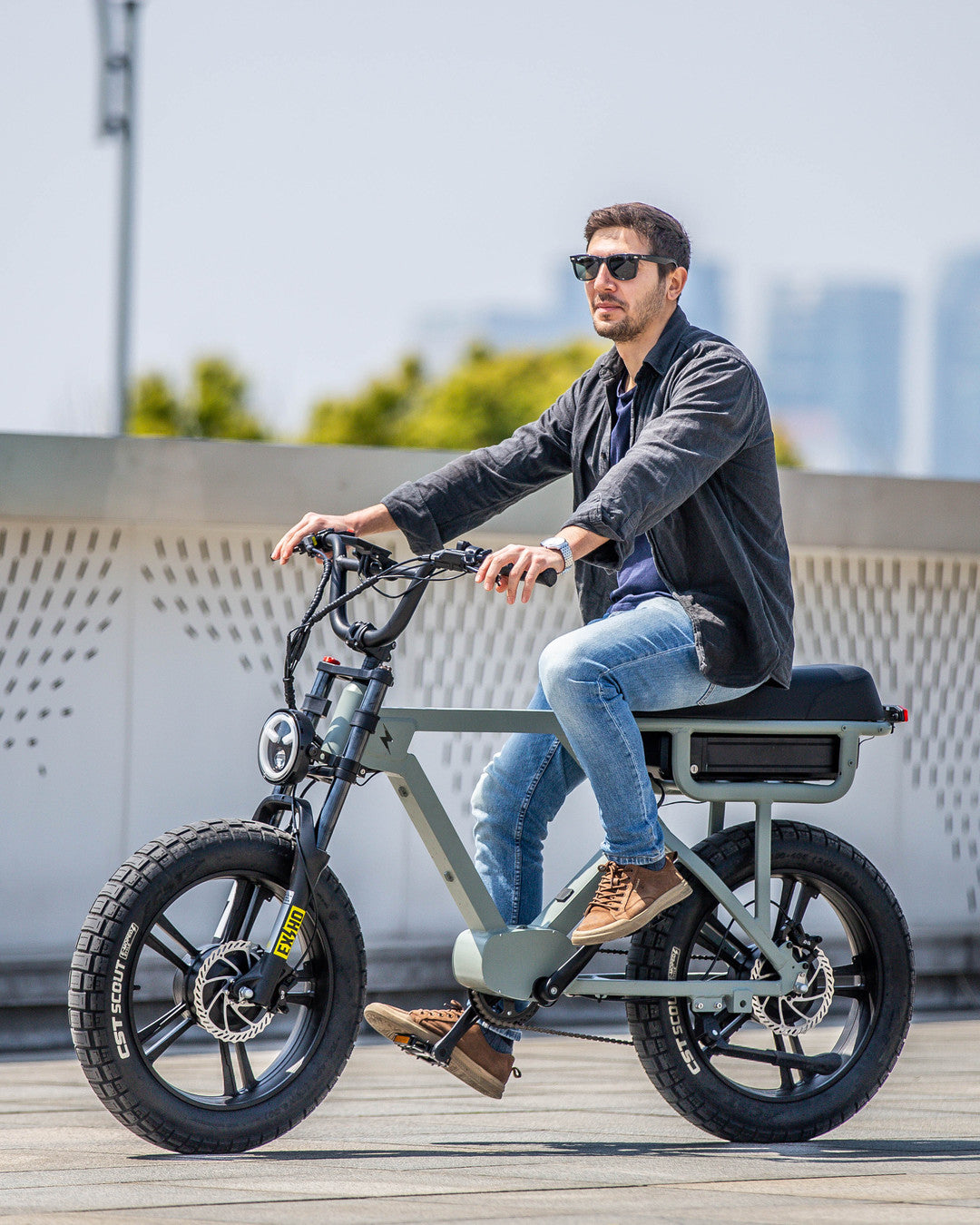


Eight machines from $949, chosen for the rider and the ground rather than the spec sheet. Every ranked competitor's page pulled and recorded, the federal wattage line quoted from the statute, and one table that answers the street-legal question for all 51 US jurisdictions.
What we measured, updated 2026-08-29: 51 states screened · 28 mph is the field's floor · 750 W is the federal line · 8 picks from $949 · 15 machines checked · 1 of 15 evidences pedals · 3 of 15 not buyable today
Quick Answer: An electric dirt bike is an off-highway machine. It sits past the 750-watt line that federal law draws at 15 U.S.C. § 2085, so it is not a bicycle in any state. Ride it on private land, OHV parks and designated motor-vehicle trails. The 2026 field runs 28–70 mph at $949–$13,000+.
Our eight picks span that whole ladder, and every one comes with free shipping in the lower 48, US support and a warranty claim we file for you.
Small format: the Riding'times GT54 at $949 and the GT54 Pro at $1,299. The sweet spot: the GT73 and GT73 Pro. The Eunorau S1 fits the in-between rider with a published 4'9"–5'10" range, and the 72V trio — R1 Compact, R1 and R1+ — answers the Sur-Ron class.
Want the biggest numbers in the catalog first? The two machines on our shelf publishing an 8,000 W peak are in our 8000W e-bike guide, which reads California's eMoto rule against a dirt bike with no pedals.
Browse the whole range in our e-bike collection — prices verified on our store 2026-08-29. Rather see one in person? Our verified US store directory covers 727 storefronts.
How we verified this guide
We read every one of these machines the same way you would if you had a free week: open the maker's own product page, write down only what it actually publishes, and check the law against the government's text rather than anybody's summary of it. The method below is that week, written down.
By Milad Ghobadibeygvand, BScN (Western University, 2014), Redtail eBikes. Corrections: articles@redtailebikes.com.
Verified 2026-08-24, picks and prices re-verified 2026-08-29. We pulled the product page of every machine ranked by the three top "best electric dirt bike" lists on the US Google results — 15 machines — and recorded what each maker's own page does and does not publish. We retrieved the federal e-bike definition at the US Government Publishing Office and the land-agency rules at the eCFR.
Every bike we recommend was screened against the electric-bicycle statute of all 50 states plus DC, each statute linked in the table below. The corpus: 26 sources consulted, 24 retrieved and read in full, 2 recorded as not fully retrievable, both named in the Limitations section.
The questions this page answers were harvested, never invented: 189 demand rows from three source types (Semrush's question and keyword reports, Google autocomplete, and the headings of the ranked pages), 27 answered here and the rest logged with named drop reasons in the committed demand ledger. Prices and stock flags were last verified August 29, 2026.
Correction, August 24, 2026: our first draft cited Solar Scooters' E-Clipse at a product URL that returned a 404 on the pre-publish link check. The citation now points to the live page found in the maker's own sitemap, which also renders a price the earlier page did not. Corrections: articles@redtailebikes.com.
In this guide
- What the law calls an electric dirt bike
- The 15 machines we checked
- Our picks, matched to rider and terrain
- The smaller dirt bikes
- All eight side by side
- Where you can actually ride
- Street legal? All 51 jurisdictions
- Where buyers get caught out
- Electric vs gas
- What it costs
- The pre-purchase checklist
- FAQ
- Why buy your dirt bike here
- The bottom line
What the law calls an electric dirt bike (and why it matters before you spend a dollar)
In May 2026, Juiced Powersports announced a 60-mph electric dirt bike for $2,499 — a price that would have bought you a bicycle-shaped 750W commuter two years earlier, as covered by Electrek on 2026-05-13. Buy the wrong machine, though, and you own a vehicle you cannot ride where you planned to ride it. This guide walks one decision: which size and price tier fits you, and where the law lets you use it.
Start with the definition, because everything else follows from it. Federal law, at 15 U.S.C. § 2085(b) (retrieved at the Government Publishing Office 2026-08-22), defines the low-speed electric bicycle that gets treated like a bicycle. The operative words:
"fully operable pedals and an electric motor of less than 750 watts"
The full test in § 2085(b) adds a speed limb: less than 20 mph on motor power alone, on a paved level surface, with a 170-lb rider. Congress added the section in December 2002 by Pub. L. 107-319, handing product-safety authority to the Consumer Product Safety Commission.
An electric dirt bike fails that test on purpose. Of the 15 machines ranked by the top three "best electric dirt bike" lists, 14 publish a top speed in their own page text, and every one of them is 28 mph or higher — our census of 2026-08-24, method two sections down.
Pedals are the quieter half of the test, and they decide more than buyers expect. In the same 15-machine census, just one maker's catalog evidences operable pedals — Heybike sells OEM pedals for its V1. The other 14 product pages say nothing about pedals at all, because these are footpeg machines. Where those machines may actually be ridden, agency by agency and state by state, is the geography section of our 4000W e-bike guide.
No pedals means the machine cannot be a low-speed electric bicycle at any wattage, in any state whose definition mirrors the federal one. And 49 of 51 US jurisdictions define e-bikes, per the state table below.
If you already ride private land or an OHV park, that settles it: you want the off-highway machine. The eight we recommend start at $949, and every one comes with free shipping in the lower 48, US support, a warranty claim we file for you, and Shop Pay Installments at checkout. Every dirt bike we stock is in our electric dirt bike collection.
Jump to the eight picksThe land agencies carry their own version of the line. The Bureau of Land Management's regulation at 43 CFR § 8340.0-5(j) (retrieved 2026-08-24) defines an e-bike with "fully operable pedals and an electric motor of not more than 750 watts," then defines the three assist classes.
Read the two federal texts together and you find a genuine oddity. Congress wrote "less than 750 watts"; the BLM wrote "not more than 750 watts." For a machine built at exactly 750W the two texts point in different directions, and we found no authority resolving it.
Ignore that gap for the machines on this page. Every one of them is 2,000W and up, where both texts agree that you are not riding a bicycle. The two machines we sell that publish a rated 5,000 W system, and the states where each one may be ridden, are in our 5000W e-bike guide.
One wrong assumption catches more buyers in this category than any other: a "street-legal kit" — mirrors, lights, a horn — does not make an off-highway machine street legal. Street status comes from what your state's vehicle code classifies the machine as (California's § 312.5 is typical), which turns on motor power, speed capability and equipment certifications set at manufacture, not on accessories added later.
A handful of makers sell genuinely road-certified trims: NIU's XQi3 Street publishes a 30-mph on-road version, per NIU's own page, retrieved 2026-08-24. Everything else in this guide is an off-highway vehicle, and we recommend it as one.
What could change this picture is worth naming with dates. Section 2085(c) leaves the CPSC standing authority to write new e-bike requirements, and none had been promulgated as of our 2026-08-24 retrieval.
On the land side, the BLM's e-bike definitions entered 43 CFR part 8340 in its 2020 rulemaking, the most recent movement in that part. We found no pending federal bill redefining the category. State definitions, which do move, are dated in the state table below.
Takeaway
Buy an electric dirt bike as what it is: an off-highway machine. The federal e-bike ceiling in 15 U.S.C. § 2085(b) is less than 750W, under 20 mph on motor alone, with operable pedals — and every machine in this guide runs past all three limbs by design. Plan your riding around private land, OHV areas and designated trails, and it delivers everything it promises.
The 15 machines we checked — what their own pages don't say
Before recommending anything, we pulled the product page of every machine ranked by the top three "best electric dirt bike" lists on the US Google results (RiderGuide, VORO Motors, Qronge, all fetched 2026-08-24). From each maker's own machine-readable page text we recorded four things: top speed, power figure and its basis, seat height, and any mention of pedals.
The population is all 15 ranked machines, covered 15 of 15. The dataset and the script that recomputes every figure in this section are committed in our public research folder.
The census, one row per machine, from each maker's own page on 2026-08-24:
| Machine | Page price | Top speed (their text) | Power (their text) | Rated figure? | Seat height | Buyable today? |
|---|---|---|---|---|---|---|
| Heybike V1 (ranked as "Villain") | $1,299 sale | 45 mph (Mode 3) | none in page text | — | "taller" — no number | Yes |
| Aptum VM1 | $1,199 sale | 28 mph | 2000W peak | Peak only | not in text | Yes |
| Sur-Ron Ultra Bee HP | not in text | 59 mph | 21 kW peak | Peak only | 35.8 in | Yes |
| Sur-Ron Light Bee X | not in text | 46.6 mph | 3,000W rated / 6,000W peak | Yes | 32.6 in | Yes |
| Sur-Ron Light Bee 2 | US MSRP not yet published | 55.9 mph | 24 kW, basis unstated | Unstated | 32.7 in | Pre-order |
| Juiced Nomadix | $2,499 start | 60 / 70 mph | 8 kW / 15 kW, basis unstated | Unstated | not in text | Pre-order (Sept 2026) |
| NIU XQi3 | $3,999 | 30 road / 51 off-road | 3,500W rated | Yes | 34.45 in | Yes |
| Solar E-Clipse 2.0 | not in text | 70 mph | 15 kW peak | Peak only | not in text | Listed |
| Altis Sigma | $4,799 | 63 / 80+ mph | 23–25 kW peak | Peak only | 33–35 in | Yes |
| E Ride Pro 4.0 | $4,999 | 60 mph | 7 kW rated / 18 kW peak | Yes | 32.7 in | Yes |
| Rawrr Mantis X Pro | $2,999–4,089 tiers | 65 mph | 15 kW peak | Peak only | 33.9 in | Yes |
| Stark Varg MX | not as own line | not in text | 60/80 hp, 360V nominal | Yes | 37.8 in | Yes |
| Qronge X5 Spark | $2,499.99 | 65 mph | 6,000W, basis unstated | Unstated | not in text | Out of stock |
| Qronge X1 Spark L | $1,399.99 | 50 mph | 4,500W, basis unstated | Unstated | not in text | Yes |
| HappyRun G300 Pro | $1,799 | 50 mph | 3,000W rated / 6,500W peak | Yes | not in text | Yes |
Every row read from the maker's or named distributor's own page on 2026-08-24; deposit copies of every page are archived in our research folder. "Not in text" means the figure did not appear in the page's machine-readable text at our retrieval — not a claim that it exists nowhere.
Four findings from those rows change how you should read every ranking, including ours. First, only 5 of 15 makers publish a rated power figure the way Sur-Ron does for the Light Bee X — five publish peak-only and four give a wattage with no basis at all, so most advertised watt numbers on this market cannot be compared with each other.
Second, only 8 of 15 publish a numeric seat height — from the Light Bee X's 32.6 in to the Stark Varg's 37.8 — on machines where standover decides whether a smaller rider can hold the bike up at a stop.
Third, 3 of the 15 ranked machines could not actually be bought on the day we checked: the Light Bee 2 and Juiced Nomadix are pre-orders and the Qronge X5 was out of stock. Fourth, two of the three ranking sites are retailers ranking stock they sell, and one ranks its own house brand first and second.
The census also caught the small stuff a buyer would trip on. Heybike's "Villain," the machine two of three lists rank, is now titled V1 on Heybike's own store — same bike, new name, easy to mistake for a different model.
And the Aptum VM1's distributor page says 28 mph while RiderGuide's review of the same machine reports a 36.5-mph GPS measurement. We record both and count the maker's own figure, but a gap that size between page and pavement is worth knowing before you buy any machine in this class.
Our picks: eight machines matched to rider and terrain
Our range covers this category with eight machines from two makers, and we matched each to the rider it actually fits rather than ranking them against each other. Prices are our live store prices, verified 2026-08-29; specs are the figures each maker publishes, as shown on our product pages.
Two disclosures first, in plain sight. These are bikes we sell — this is a store's guide rather than an independent lab's. And our house rules limit recommendations to our approved brands; among those, only Riding'times and Eunorau build dirt bikes, so this module spans those two makers and says so rather than padding the list.
To rank machines against your own body, the e-bike finder opens here set to private land and dirt trails: enter your state, height and weight, and it sets aside any machine whose maker's rider height or payload leaves you out before it ranks the rest.
The small-format entry point: a 2,000W-peak hub motor and 290 N·m of published torque on 14"/12" wheels, the same mini format the segment's most-ranked machine uses. Riding'times' own page prints two top speeds, 40 mph in its specification table and 39 in its title and FAQ, and we quote the lower figure.
At 106.5 lb net with a 220-lb max load it is the machine in our range a teenager or smaller adult can actually pick up off the ground. Our GT54 review sets its seat and pegs against 6,068 measured bodies and works out its range at your weight and speed.
 106.5 pounds of machine on 14-inch rubber. For a 5-foot rider, that number matters more than any watt figure on this page.
Riding'times GT54 Pro
$1,299The GT54's frame with the GT73 Pro's punch: a 3,000W-peak motor, the same published 338 N·m of torque, and a 50-mph manufacturer top speed from a 60V 25Ah (1,500 Wh) battery — the maker's own figures — still on the 14"/12" mini format with a 220-lb max load.
For $350 over the GT54 it buys the biggest speed jump anywhere on this page. The caveat scales with it: 50 mph on a 14-inch front wheel is an experienced rider's machine, whatever its size suggests. Our GT54 Pro review maps its range to each speed gear and its fit to your height.
 Same small frame, twice the pace. The GT54 Pro is the machine you buy for the second season rather than the first.
Riding'times GT73
$1,499The center of the range: a 2,400W-peak hub motor (rated 1,200 W in Riding'times' 2025 comparison), 126 N·m, a 37-mph manufacturer top speed, full-size 19" dirt tires and a dual battery pack rated to a 330-lb max load. Riding'times' own page states UL 2849 compliance for the dual pack — one of the few certifications anyone in this category names. Our GT73 review works out its range and fit.
It undercuts the census's mid-field ($2,999–$4,999) by half while giving up top-end speed to them. If your riding is trails rather than track, that is a trade in your favor.
 The GT73's 19-inch front wheel is the visible line between mini and full-size in this category.
Riding'times GT73 Pro
$1,999The GT73's frame with the power turned up: a 3,000W-peak motor (rated 1,500 W in the same 2025 comparison), a published 338 N·m of torque and a top speed of 46 mph in the specification table, 50 in the headline strip, from a 60V 18Ah dual pack (the maker's own figures), with a 330-lb max load — the highest published payload of our eight.
Of every machine in our census that beats those numbers, none is priced under $2,999. The caveat mirrors the pick: at 123 lb and up to 50 mph it is emphatically not a first machine for a new rider. Our GT73 Pro review sets its bench against your inseam and prices its range gear by gear.
 The GT73 Pro. Same frame as the GT73 — the difference is 338 newton-meters trying to leave the line.
Eunorau S1 Dirt Bike
$1,699Eunorau prints a rider-fit range of 4'9"–5'10" and a seat height of 710 mm (27.9 in) on its own spec sheet, which sits between the GT54's published 4'2"–5'9" and the ranges of the full-size machines, which start at 5'2". A 60V 4,800W-peak mid motor, 150 N·m, a 43-mph top speed, and a 60V 30Ah battery, 1,800 Wh by our arithmetic.
A FASTACE 203mm-travel fork does the suspension work; we cover why travel figures matter in our suspension guide. Eunorau's spec strip for the S1 reads "UL CERTIFIED: Yes"; if your building or insurer needs the certificate itself, ask us before ordering and we will request it.
 Eunorau prints a fit range on the S1's spec sheet — 4'9" to 5'10" — with a 710 mm seat height and a 220 lb load capacity.
Eunorau R1 Compact
$3,750The full R1 drivetrain (a 72V 4,000W mid-drive, 55-mph top speed and a 35Ah battery) on the frame Eunorau sells as the R1-17, its "agile" build for youth and adults. Same price as the R1, so the choice is purely fit.
If the standard R1's full-size stance is the one thing keeping a smaller rider off a 72V machine, this is the answer. The power caveat from the R1 applies unchanged — this is not a step-down model, only a smaller one.
 The R1 Compact. Every number matches the R1 beside it — the frame is the only spec that changed.
The one for riders cross-shopping the Light Bee class: a 72V 4,000W mid-drive (the maker's page carries the same figure), a 55-mph top speed, a 35Ah battery, regenerative braking in sport mode and a 4-hour charge on the included 72V/10A charger, at 130 lb.
The census's comparable 72V machines run $2,999–$4,999 and mostly publish peak-only figures; the R1's published spec set is fuller than most of them. Caveat: 130 lb is heavy — fine on dirt, awkward on stairs or a hitch rack.
 The R1 in silver. The mid-drive sits where a gas engine would, which is why it balances like a motorcycle rather than a bicycle.
Eunorau R1+
$4,499The top of our ladder: a 72V 5,000W mid-drive and a 59-mph manufacturer top speed from a 40Ah Samsung-cell battery (the maker's own page carries the figures). That battery is the largest on this page, census machines included.
Against the census's comparable machines, the R1+ undercuts the $4,999 E Ride Pro 4.0 while publishing a bigger battery. Caveat: at this speed and price you are shopping motorcycle-grade protective gear too, and it is not optional.
 The R1+. Forty amp-hours at 72 volts — more stored energy than anything else on this page.
 72 volts and a mid-drive. This is the tier where the census's $4,400–$6,000 machines live.
Every GT-series machine, with the maker's own spec table and our honest-fit notes on each listing.
See the full Riding'times rangeSizing: matching a smaller dirt bike to a teen or smaller adult
The size question decides more purchases in this category than power does, and the industry serves it badly: only 8 of the 15 ranked machines publish a numeric seat height, and those that do cluster between 32.6 and 37.8 inches (the Ultra Bee HP sits at 35.8) — tall for anyone under about 5'6". If the rider is a teenager or a smaller adult, start from format, not from watts.
The mini format is the honest answer for most smaller riders (the mountain and off-road collection holds the pedal-assisted alternatives if a full dirt bike is too much machine, and our electric mountain bike guide ranks twelve of them by the kind of ground you ride).
Machines on 14"/12" wheels — the GT54 in our range, the Heybike V1 and Aptum VM1 in the census — put the seat meaningfully lower than the 19"-wheel class and cut 20–60 lb of machine weight.
The GT54 weighs a published 106.5 lb against the census's 123–195 lb full-size field. A rider who can flat-foot the machine and lift it off themselves is a rider who gets to make mistakes safely.
Between the minis and full size, the Eunorau S1 occupies the slot the market mostly ignores: full dirt-bike suspension travel with a published 4'9"–5'10" fit range and a published 710 mm (27.9 in) seat height, both on Eunorau's own sheet. That seat sits nearly five inches below the lowest figure in the ranked field.
One honest note: Eunorau's own page titles the S1 a kids' dirt bike. At a 43-mph unlocked top speed, we recommend it for teens and smaller adults, and suggest parents use the speed limiting before a younger rider does.
If you are buying for a child rather than a teenager, our parents' guide to e-bikes for kids and teens starts from the pedals test and the age rule in all 51 US jurisdictions, only nine of which restrict a Class 1 or 2 at all.
Two more size-first options sit in our eight. The GT54 Pro keeps the small 14"/12" format but runs to a maker-stated 50 mph: the right second machine, and the wrong first one. And the R1 Compact puts the full 72V drivetrain on the smaller frame Eunorau sells as the R1-17 for youth and adults, so a smaller rider no longer has to choose between fit and the top power class.
For a parent buying for a growing teen, that printed range plus the S1's limitable speed is the closest thing this category has to a sizing guarantee.
Sizing a first machine for a teen or a smaller adult? The S1 is the one we point most parents at, and it ships free in the lower 48 with the speed limiting set before it leaves us if you ask. Too much bike for your rider? The GT54 at $949 is the smaller, slower starting point.
See the Eunorau S1 The S1 in orange. Full-travel suspension on a frame sized for riders from 4'9" — the combination almost nobody else builds.
Two cautions belong in any smaller-rider purchase. Every machine in this section still screens as an off-highway vehicle — size does not change legal class, and the where-to-ride rules below apply at 39 mph just as they do at 55.
And if the rider is a child rather than a teen, this page is the wrong page. Whatever any maker's marketing says, we do not recommend 39–55 mph machines for children — the kids' segment deserves its own guide, and this is not it.
Takeaway
Size by format first: 14"/12" wheels and ~106 lb (GT54, $949) for teens and riders under about 5'6"; the S1 ($1,699) with its published 4'9"–5'10" fit range for the in-between build; 19" wheels only when the rider can flat-foot a 33-inch-class seat. Weight the rider can lift beats watts the rider can't control.
All eight side by side
One table, every published number, no grades. Each figure is the maker's own, as carried on our product pages, re-verified 2026-08-29 (the Riding'times rows at Riding'times' own pages on 2026-09-26, with both figures where the maker prints two); where a maker does not publish a figure the cell says so, because a blank sold as a spec is how this category misleads.
| Pick | Price | Motor (maker's basis) | Mfr. top speed | Battery | Weight / max load | Best for |
|---|---|---|---|---|---|---|
| GT54 | $949 | 2,000W peak, hub | 39–40 mph | 27 Ah | 106.5 lb / 220 lb | Teens, smaller adults, first machine |
| GT54 Pro | $1,299 | 3,000W peak, hub | 50 mph | 60V 25Ah (1,500 Wh) | 102.5 lb / 220 lb | Fastest small format, experienced riders |
| GT73 | $1,499 | 2,400W peak, hub | 37 mph | dual pack, UL 2849 | 116 lb / 330 lb | Full-size trail riding |
| GT73 Pro | $1,999 | 3,000W peak, hub | 46–50 mph | 60V 18Ah ×2 | 123 lb / 330 lb | Power and payload per dollar |
| Eunorau S1 | $1,699 | 4,800W peak, 60V mid-drive | 43 mph | 60V 30Ah | 152 lb / 220 lb; fit 4'9"–5'10", seat 710 mm | Smaller riders who want range |
| R1 Compact | $3,750 | 72V 4,000W, mid-drive | 55 mph | 72V 35Ah | Smaller frame (maker's R1-17) | Smaller riders in the 72V class |
| Eunorau R1 | $3,750 | 72V 4,000W, mid-drive | 55 mph | 72V 35Ah | 130 lb / 220 lb | The 72V class, full-size |
| Eunorau R1+ | $4,499 | 72V 5,000W, mid-drive | 59 mph | 72V 40Ah Samsung | 150 lb / 220 lb | The flagship |
Ask us about any figure in this table and we will put the question to the maker before you order.
Where you can actually ride: the federal map
The positive answer, up front: an electric dirt bike is legal to ride on private land with the owner's permission everywhere in the country, on the state OHV riding areas nearly every state operates, and on federal land wherever the managing agency has designated the route or area for motor vehicles.
The machine bought as an off-highway vehicle and ridden as one has a large, real map. How each federal agency draws its part, each rule linked to the regulation itself.
| The rule | What it actually means for your dirt bike |
|---|---|
| 43 CFR § 8340.0-5 defines "off-road vehicle" and sorts BLM land into open, limited and closed areas | On BLM's 245 million acres, ride in open areas freely; in limited areas only per the posted limits; in closed areas not at all. Check the field office's map before hauling out |
| 43 CFR § 8341.1(d): no ORV may be operated "in violation of State laws and regulations relating to use, standards, registration, operation, and inspection" | Your state's OHV registration and equipment rules follow you onto federal land — a state violation becomes a federal one there |
| 43 CFR § 8341.1(a)–(b): working brakes required; excessive noise prohibited | Electric machines pass the noise test by construction — one genuine advantage over gas on access |
| 43 CFR § 8340.0-7: violations carry "a fine of not more than $1,000 or imprisonment for not longer than 12 months, or both" | The enforcement teeth, quoted so you know they exist |
| 36 CFR § 212.51: National Forest motor vehicle use is allowed only on routes "designated by vehicle class" | In National Forests, the Motor Vehicle Use Map (MVUM) for that forest is the law — a trail not on it is closed to your machine |
| 36 CFR § 4.10: in National Parks, off-road operation only on routes designated by special regulation | Treat National Parks as closed to dirt bikes unless a park's own regulation says otherwise — few do |
The chain of authority behind that table is short and worth knowing. Executive Order 11644 of February 8, 1972 (37 FR 2877) ordered every federal land agency to designate where off-road vehicles may go. The BLM's part 8340 and the Forest Service's part 212 travel-management rules are the standing implementations, and the National Park Service's § 4.10 cites the order directly (all three retrieved at the eCFR, 2026-08-24).
The practical consequence runs through § 8341.1(d): even on federal land, your state's OHV rules are part of the test, which is why the state layer below matters twice.
What the federal map does not settle is state OHV registration: which states require registering an off-highway machine, at what fee, with what stickers. That layer varies by state, this page has not researched it, and we say so in the Limitations section rather than guessing. Your state's street rules, meanwhile, are already mapped in our 50-state e-bike law hub and its state pages.
Takeaway
Ride private land, state OHV areas, BLM open areas, and MVUM-designated Forest Service routes. Before the first haul-out: pull the BLM field-office map or the forest's MVUM, and check your state's OHV registration rules — § 8341.1(d) makes them apply on federal land too.
Is an electric dirt bike street legal? All 51 jurisdictions, one table
The short answer is no — not as a bicycle, and that is a property of the whole category rather than any one machine. We screened all five of our picks against the electric-bicycle statute of every US state plus DC on 2026-08-24, using each machine's own published wattage and top speed read at its most favorable figure.
The result was unanimous. In all 49 jurisdictions that define an electric bicycle, every ranked-class dirt bike falls outside the definition, and Alaska and Kentucky publish no definition at all. The census machines' published specs meet the same result — 28-mph-and-up top speeds clear every state's assisted ceiling.
Falling outside the e-bike definition does not make a machine illegal; it makes it something else — an off-highway vehicle, a motor-driven cycle, a motorcycle. Each state's vehicle code decides which (Texas's Chapter 664 is one example), with street-use consequences to match.
That classification question is the one our state law pages walk through for street riding, so start with yours: California, Texas, Florida, New York, New Jersey, Washington, Colorado, Minnesota, Pennsylvania and Connecticut, plus the national hub.
Every row in the table below links the state's own definition, so you can read the operative text yourself. The middle column is each state's ceiling for what does count as an e-bike — useful shorthand for how far past it a 2,000–4,800W, 37–55 mph machine runs.
| State | The state's e-bike ceiling | Where a ranked electric dirt bike lands | Definition |
|---|---|---|---|
| Alabama | 3-class · 750 W · 28 mph assisted | Outside the e-bike definition; rides as an off-highway machine | Ala. Code § 32-1-1.1(16) |
| Alaska | No statutory e-bike definition | No state e-bike test exists; the machine is whatever the general vehicle code makes it | AS 28.90.990(a)(20)-(22) |
| Arizona | 3-class · 750 W · 28 mph assisted | Outside the e-bike definition; rides as an off-highway machine | A.R.S. § 28-101(28) |
| Arkansas | 3-class · 750 W · 28 mph assisted | Outside the e-bike definition; rides as an off-highway machine | Ark. Code § 27-51-1702 |
| California | 3-class · 750 W · 28 mph assisted | Outside the e-bike definition; rides as an off-highway machine | Cal. Veh. Code § 312.5 |
| Colorado | 3-class · 750 W · 28 mph assisted | Outside the e-bike definition; rides as an off-highway machine | C.R.S. § 42-1-102(28.5) |
| Connecticut | 3-class · 750 W · 28 mph assisted | Outside the e-bike definition; rides as an off-highway machine | C.G.S. § 14-1(13)-(15) |
| Delaware | 3-class · 750 W · 28 mph assisted | Outside the e-bike definition; rides as an off-highway machine | 21 Del. C. § 101(18) |
| District of Columbia | single-tier · no watt cap · 20 mph assisted | Outside the e-bike definition; rides as an off-highway machine | D.C. Code § 50-2201.02(11A) |
| Florida | 3-class · 750 W · 28 mph assisted | Outside the e-bike definition; rides as an off-highway machine | Fla. Stat. § 316.003(23) |
| Georgia | 3-class · 750 W · 28 mph assisted | Outside the e-bike definition; rides as an off-highway machine | O.C.G.A. § 40-1-1(15.3) |
| Hawaii | 3-class · 750 W · 28 mph assisted (Act 259, since July 15, 2026) | Outside the e-bike definition, and since July 15, 2026 a "high-speed electric device" unless registered as a moped or motor vehicle — barred from every public roadway, bicycle lane, path and sidewalk | Act 259 (2026) §§ 1, 9 |
| Idaho | 3-class · 750 W · 28 mph assisted | Outside the e-bike definition; rides as an off-highway machine | Idaho Code § 49-106(1) |
| Illinois | 3-class · 750 W · 28 mph assisted | Outside the e-bike definition; rides as an off-highway machine | 625 ILCS 5/1-140.10 |
| Indiana | 3-class · 750 W · 28 mph assisted | Outside the e-bike definition; rides as an off-highway machine | IC 9-13-2-49.2 |
| Iowa | 3-class · 750 W · 28 mph assisted | Outside the e-bike definition; rides as an off-highway machine | Iowa Code § 321.1(36A) |
| Kansas | 3-class · 750 W · 28 mph assisted | Outside the e-bike definition; rides as an off-highway machine | K.S.A. 8-1489 |
| Kentucky | No statutory e-bike definition | No state e-bike test exists; the machine is whatever the general vehicle code makes it | KRS 189.010 |
| Louisiana | 3-class · 750 W · 28 mph assisted | Outside the e-bike definition; rides as an off-highway machine | La. R.S. 32:1(95) |
| Maine | 3-class · 750 W · 28 mph assisted | Outside the e-bike definition; rides as an off-highway machine | 29-A M.R.S. § 101(22-B) |
| Maryland | 3-class · 750 W · 28 mph assisted | Outside the e-bike definition; rides as an off-highway machine | Md. Code Transp. § 11-117.1 |
| Massachusetts | 2-class · 750 W · 20 mph assisted | Outside the e-bike definition; rides as an off-highway machine | M.G.L. c.90 § 1 |
| Michigan | 3-class · 750 W · 28 mph assisted | Outside the e-bike definition; rides as an off-highway machine | MCL 257.13e |
| Minnesota | 4-category · 750 W · 28 mph assisted | Outside the e-bike definition; rides as an off-highway machine | Minn. Stat. § 169.011 subd. 27 |
| Mississippi | 3-class · 750 W · 28 mph assisted | Outside the e-bike definition; rides as an off-highway machine | Miss. Code Ann. § 63-3-103 |
| Missouri | 3-class · 750 W · 28 mph assisted | Outside the e-bike definition; rides as an off-highway machine | RSMo § 301.010(15) |
| Montana | single-tier · no watt cap · 20 mph assisted | Outside the e-bike definition; rides as an off-highway machine | MCA § 61-8-102(7) |
| Nebraska | 3-class · 750 W · 28 mph assisted | Outside the e-bike definition; rides as an off-highway machine | Neb. Rev. Stat. § 60-611 |
| Nevada | 3-class · 750 W · 28 mph assisted | Outside the e-bike definition; rides as an off-highway machine | NRS 484B.017 |
| New Hampshire | 3-class · 750 W · 28 mph assisted | Outside the e-bike definition; rides as an off-highway machine | RSA 259:27-a |
| New Jersey | 3-category · no watt cap · 20 mph pedal-assist only | Outside the e-bike definition; rides as an off-highway machine | P.L.2025 c.285; N.J.S.A. 39:4-14.3q |
| New Mexico | 3-class · 750 W · 28 mph assisted | Outside the e-bike definition; rides as an off-highway machine | NMSA 1978 § 66-1-4.5 |
| New York | 3-class · 750 W · 25 mph assisted | Outside the e-bike definition; rides as an off-highway machine | N.Y. VTL § 102-c |
| North Carolina | single-tier · 750 W · 20 mph assisted | Outside the e-bike definition; rides as an off-highway machine | G.S. 20-4.01(7a) |
| North Dakota | 3-class · 750 W · 28 mph assisted | Outside the e-bike definition; rides as an off-highway machine | N.D.C.C. § 39-01-01(19) |
| Ohio | 3-class · 750 W · 28 mph assisted | Outside the e-bike definition; rides as an off-highway machine | R.C. 4511.01(SSS)-(VVV) |
| Oklahoma | 3-class · 750 W · 28 mph assisted | Outside the e-bike definition; rides as an off-highway machine | 47 O.S. § 1-104(B) |
| Oregon | 3-class · no watt cap · 28 mph assisted | Outside the e-bike definition; rides as an off-highway machine | ORS 801.258 |
| Pennsylvania | single-tier · 750 W · 20 mph assisted | Outside the e-bike definition; rides as an off-highway machine | 75 Pa.C.S. § 102 |
| Rhode Island | 3-class · 1,492 W · 28 mph assisted | Outside the e-bike definition; rides as an off-highway machine | R.I. Gen. Laws § 31-1-3(g) |
| South Carolina | single-tier · 750 W · 20 mph assisted | Outside the e-bike definition; rides as an off-highway machine | S.C. Code § 56-1-10(29) |
| South Dakota | 3-class · 750 W · 28 mph assisted | Outside the e-bike definition; rides as an off-highway machine | SDCL 32-20B-9 |
| Tennessee | 3-class · 750 W · 28 mph assisted | Outside the e-bike definition; rides as an off-highway machine | T.C.A. § 55-8-301 |
| Texas | 3-class · 750 W · 28 mph assisted | Outside the e-bike definition; rides as an off-highway machine | Tex. Transp. Code § 664.001 |
| Utah | 3-class + programmable · 750 W · 28 mph assisted | Outside the e-bike definition; rides as an off-highway machine | Utah Code § 41-6a-102(11)-(13) |
| Vermont | 3-class · 750 W · 28 mph assisted | Outside the e-bike definition; rides as an off-highway machine | 23 V.S.A. § 4(45)-(46) |
| Virginia | 3-class · 750 W · 28 mph assisted | Outside the e-bike definition; rides as an off-highway machine | Va. Code § 46.2-100 |
| Washington | 3-class · 750 W · 28 mph assisted | Outside the e-bike definition; rides as an off-highway machine | RCW 46.04.169 |
| West Virginia | 3-class · 750 W · 28 mph assisted | Outside the e-bike definition; rides as an off-highway machine | W. Va. Code § 17C-1-70 |
| Wisconsin | 3-class · 750 W · 28 mph assisted | Outside the e-bike definition; rides as an off-highway machine | Wis. Stat. § 340.01(15ph) |
| Wyoming | 3-class · 750 W · 28 mph assisted | Outside the e-bike definition; rides as an off-highway machine | W.S. 31-1-101(a)(xxxiv) |
Ruleset compiled from each state's statute at its official publisher, corroborated 2026-08-21 for our review system and re-used here; screen run 2026-08-24 by screen_dirt_fleet.py with each bike's specs re-verified against its live page at run time. Alaska and Kentucky rows state an absence we verified at the source, not an assumption.
A state is the sole authoritative publisher of its own code: rows whose second reading came from that same publisher are recorded as sole-publisher corroboration in our citation ledger, which is the honest description of how statutes are verified.
The moment that classification clicks, the buying decision simplifies. You are not shopping for a loophole; you are shopping for the machine whose size, power and price fit the riding you have real access to. That is what the eight picks are matched against.
Where buyers get caught out
Every category has a place where good buyers make the same mistake, and this one has five. We consolidated them here rather than sprinkling warnings through the page.
The street-legal-kit myth. Covered above, and repeated because it is the expensive one: lights and mirrors do not change a machine's legal class. If you need street travel between trails, budget for a trailer or a truck bed instead of a kit.
California shows how firmly that gate is shut, and where it gets strange for electric machines. The DMV requires an off-highway motorcycle to carry "an emission label affixed to the vehicle indicating certification by the manufacturer for on-highway use" before it can convert to street or dual registration, verified by a DMV employee (Vehicle Industry News 2003-11, implementing California Air Resources Board rules from January 1, 2004).
An electric dirt bike carries no emission label of any kind, and we found no published departmental procedure addressing what that means for an electric conversion. We are naming that gap rather than guessing at it. If a dealer or a listing tells you a specific electric machine can be registered for the street in your state, ask which form and which section, and call your own DMV before you pay.
Peak watts sold as comparable numbers. Our census found 5 of 15 makers publishing peak-only figures and 4 more publishing wattage with no basis at all. A "6,000W" machine may carry a 3,000W rated motor; a "2,000W" figure may be the same motor measured differently.
Compare machines only on figures with a stated basis, and treat every unlabeled watt number as marketing until the maker says otherwise. Our 6000W e-bike guide takes that problem apart at the tier where it bites hardest.
Rankings that include machines you cannot buy. Three of the 15 machines ranked "best" of 2026 were pre-orders or out of stock on 2026-08-24. A ranking that includes a September ship date is a wishlist. Check the buy button before you fall for the spec sheet.
The missing seat height. Seven of 15 ranked machines publish no numeric seat height, on vehicles whose stated heights run 32.6–37.8 inches. If the rider cannot flat-foot the machine, no spec rescues the purchase. Where the number is missing — on our listings too — ask before ordering; we put the question to the maker on request.
Insurance and battery paperwork. An off-highway machine is typically outside auto policies and inside none by default; if you ride OHV parks, check whether your homeowner's or a standalone OHV policy covers it. And if your building or insurer requires a UL-listed battery, ask for the certification document by model before you order — our own listings state UL 2849 compliance only where the maker states it, and say so plainly where it does not.
Electric vs gas dirt bike: the honest comparison
The 140-per-month searchers asking this question deserve numbers rather than vibes, so here is the comparison at the tier where the two actually compete. A comparable entry gas dirt bike (a 125–250cc four-stroke trail machine) runs $3,500–$5,500 new before fees; our full-size electric picks run $1,499–$3,750, verified on our store 2026-08-24.
| Dimension | Electric (this page's class) | Gas (entry trail class) |
|---|---|---|
| Purchase price | $949–$3,750 (our range, live prices) | typically $3,500–$5,500 new |
| Running cost | Charge at home; no fuel, oil, filters, valve checks | Fuel, oil, air filters, valve clearances, carb/injection service |
| Noise | Passes 43 CFR § 8341.1(b)'s noise rule by construction; neighbor- and access-friendly | Sound is the #1 driver of riding-area complaints and closures |
| Refueling | Hours to recharge (R1: published 4 h on its 72V/10A charger) | Minutes to refuel — the honest gas win |
| Range per session | Battery-bound; second pack extends it | Effectively unlimited with a fuel can |
| Cold starts, storage | None; batteries prefer indoor storage | Carbs gum, batteries sulfate, fuel stales |
| Powerband | Full torque from zero rpm — flattering to new riders | Clutch and revs to manage — a skill and a joy of its own |
| Legal class | Off-highway vehicle (this whole page) | Off-highway vehicle — same map, same rules |
The legal row is the one buyers miss: going gas does not buy street legality either. Both machines live on the same off-highway map, so the choice is really about noise, maintenance appetite and refuel-versus-recharge. For riding within an hour of home on private land or OHV parks, electric's silence is a genuine access advantage; for all-day backcountry loops far from outlets, gas's five-minute refuel still wins.
What it costs: from $899 to $13,000
The 2026 price ladder, assembled from the census pages and our own store on 2026-08-29, sorts into four honest tiers. Entry minis run $949–$1,399 — our GT54 at $949, the census's Aptum VM1 at $1,199 and Heybike V1 at $1,299.
The value tier runs $1,299–$1,999: our GT54 Pro at $1,299, GT73 at $1,499, S1 at $1,699 and GT73 Pro at $1,999, with the census's Qronge X1 L and HappyRun G300 Pro in the same band.
The 72V performance tier runs $2,499–$4,999: the census's Nomadix, Rawrr, Light Bee X, Altis Sigma and E Ride Pro, and our own R1 Compact and R1 at $3,750 with the R1+ at $4,499. Above that, the $6,000–$13,000+ class (Ultra Bee HP, Stark Varg) is competition machinery.
Budget past the sticker. A quality helmet, boots, knee and chest protection run $300–$600 — non-negotiable at 37–55 mph on dirt. Transport is the quiet cost: an off-highway machine legally reaches the trail in a truck bed, on a trailer, or on a hitch carrier rated far above bicycle carriers, because these machines weigh 101–195 lb across this page.
And the "how much does one cost" question that 260-plus searchers a month ask has a clean answer. A real, buyable, full-size machine starts around $1,400–$1,500 in 2026, and the $500 listings feeding that hope are children's toys in adult marketing.
Every listing carries the maker's own published specs, the disclosure gaps named, and live pricing.
Browse every electric dirt bike we stockThe pre-purchase checklist
Seven checks, in the order that saves the most money. A machine that passes all seven is a purchase you will not have to walk back.
- Gear first, then machine — helmet, boots and armor from our accessories range or anywhere reputable; $300–$600 buys real protection.
- Confirm where you will actually ride — a specific place with a name: whose private land, which OHV park, which BLM field-office map or forest MVUM. "Somewhere" is how machines end up on resale sites.
- Check your state's OHV registration rules — and remember 43 CFR § 8341.1(d) applies them on federal land too. Street rules live in our state law pages.
- Fit before power: the rider flat-foots the seat and can lift the machine. Published seat heights in this class run 32.6–37.8 in; machine weights 101–195 lb.
- Demand a basis for every watt figure — rated or peak, stated by the maker. Unlabeled numbers compare nothing.
- Verify the buy button — in stock, today, at the listed price. Three of fifteen ranked machines failed this check on 2026-08-24.
- Ask for battery certification by model if your household insurance or building requires it; get the document, not the adjective.
- Price the kit honestly: protection gear ($300–$600) and transport before the first ride rather than after.
Frequently asked questions, straight from the search data
Every question below is a real US search query from our 2026-08-23 keyword pull, answered from the sources on this page.
Are electric dirt bikes street legal?
No — not as bicycles, anywhere in the US. Every machine in this class exceeds the federal low-speed e-bike test of 15 U.S.C. § 2085(b) and all 49 state definitions we screened on 2026-08-24. They are off-highway vehicles: legal on private land, OHV areas and designated trails, per the federal map above.
Can you make an electric dirt bike street legal?
Adding lights and mirrors does not change the machine's legal class — that is set by what your state's vehicle code makes of its power, speed and manufacture certifications. A few makers sell factory road-certified trims (NIU's XQi3 Street is the census's example).
Whether a non-certified machine can be converted is decided state by state. In California the answer turns on a label applied at the factory: the DMV requires an off-highway motorcycle to carry "an emission label affixed to the vehicle indicating certification by the manufacturer for on-highway use" before it converts to street or dual registration (DMV Vehicle Industry News 2003-11). See the trap section.
Do you need a license for an electric dirt bike?
Not for off-highway riding on private land in general, though state OHV programs vary on age and safety-certificate requirements for public riding areas — check your state's OHV page before a park visit, because 43 CFR § 8341.1(d) applies those rules on federal land too. Street riding is a different question entirely, because there the machine needs a street classification first; our 50-state hub covers what each state licenses.
How fast does an electric dirt bike go?
Across the 15 machines ranked by 2026's top lists, every published top speed falls between 28 and 70 mph (our census, 2026-08-24) — the span running from the Aptum VM1's 28 to the Solar E-Clipse 2.0's 70. Our own eight run 37–59 mph by their makers' figures. Real speed varies with rider weight, terrain and battery state — treat every top-speed figure as a ceiling rather than a cruising speed.
What is the fastest electric dirt bike?
Among the 15 ranked machines, the highest maker-published top speed in page text is the Solar E-Clipse 2.0's 70 mph, with the Juiced Nomadix 15kW trim's claimed 70 mph on pre-order. The Stark Varg MX publishes 80 hp but no top speed in its page text — motocross machines are geared for track, and the census counts only what makers publish.
How much does an electric dirt bike cost?
Real, buyable machines in 2026: $949–$1,399 for minis, $1,399–$1,999 for value full-size, $2,499–$4,999 for the 72V performance class, $6,000+ for competition machinery — every figure from maker pages like Rawrr's and Altis's and our store, 2026-08-29. Add $300–$600 for protective gear and a transport plan before the first ride.
What is the cheapest electric dirt bike worth buying?
In our range, the GT54 at $949 — a published 2,000W peak in the mini format. In the census, the $1,199 Aptum VM1 is the cheapest ranked machine. Below roughly $900, listings stop being dirt bikes and start being toys with dirt-bike styling; check wheel size and net weight before believing a price.
Can you build an electric dirt bike with $1k?
You can buy one nearly there — the GT54 is $949 — which is why we would not build at that budget. A DIY conversion needs a donor frame, motor, controller and, most expensively, a battery; a safe name-brand 60V pack alone approaches the whole budget — and it is the one part where certification matters most (UL 2849 is the standard to ask for). Build for the joy of building, buy for the riding.
What is the best electric dirt bike for adults?
For most adult riders, the GT73 Pro at $1,999: full-size 19" format, published 338 N·m and 46 to 50 mph, and a 330-lb max load, at half the price of the census's mid-field. Riders wanting the 72V class step to the R1 at $3,750. "Best" is fit, though — the side-by-side table is the honest answer.
What is an electric pit bike?
The small-format class: 14"/12" wheels, lower seats, 100–110 lb — the GT54's format, named for pit-paddock runabouts. In 2026 the pit/mini class is where the market's real growth is; two of the census's three sub-$1,400 machines, the Aptum VM1 and Heybike V1, are minis. For smaller riders it is the right first machine rather than a lesser one.
Is an electric dirt bike an e-bike?
Legally, no. An e-bike (low-speed electric bicycle) must have operable pedals, under-750W power and a sub-20-mph motor-only speed under 15 U.S.C. § 2085(b); dirt bikes exceed all three by design. That is why e-bike rules like our motor guide covers do not apply to these machines.
Are electric dirt bikes street legal in California?
No — California's e-bike definition at Veh. Code § 312.5 caps assists at 750W and 28 mph, and this class exceeds both. California's street rules, and where Class 1–3 e-bikes can go instead, are mapped in our California e-bike laws guide.
Are electric dirt bikes street legal in Texas or Florida?
No in both, for the same definitional reason: Texas caps e-bikes at 750 W under Transp. Code § 664.001 and Florida at 750 W under § 316.003. Texas street rules are in our Texas guide and Florida's in our Florida guide; both states run large OHV programs where these machines are at home.
Are electric dirt bikes street legal in New Jersey or Massachusetts?
No as e-bikes in either. New Jersey's three-category law is covered in our New Jersey guide. Massachusetts does not yet have a published Redtail guide of its own; its definition is linked in the state table above, and a dirt bike's off-highway status there matches the federal map everywhere else on this page.
Electric vs gas dirt bike — which is cheaper to run?
Electric, decisively, on running costs: home charging replaces fuel, oil, filters and valve services, and the comparison table itemizes it — with the noise advantage backed by 43 CFR § 8341.1(b)'s excessive-noise rule. Gas keeps two real wins — minutes-long refueling and unlimited range with a fuel can. Purchase price now favors electric too at the entry tiers.
How far can an electric dirt bike go on a charge?
Makers in our census publish 31–99 miles depending on speed and battery size, always measured at gentle speeds — the Light Bee 2's own page states 67 miles at 24.85 mph but 99 at 15.53 mph, which tells you how much speed bends range. Plan real trail sessions around half the brochure figure and you will rarely be surprised.
Why buy your electric dirt bike here
Three things come with the machine, not with the brochure. You get free shipping anywhere in the contiguous United States, so the price you read is the price you pay. Support answers in US hours, from the people who read the statutes quoted on this page. And when a warranty claim arises, filing it is our job rather than yours.
Shop Pay Installments split the purchase at checkout if you would rather not pay at once. Delivery arrives by freight, so inspect the crate while the driver is still there and photograph anything wrong within 48 hours — do that and a transit claim becomes ours to chase, not yours. The full terms, including the 72-hour window for an unopened change-of-mind return, are on our refund and return policy.
The bottom line
An electric dirt bike is the rare purchase where the legal fine print, once read, makes the machine better: freed from bicycle ceilings, it is faster, torquier and simpler than any street-legal e-bike, in exchange for living on the off-highway map of private land, OHV parks and designated trails. Buy by fit and honest specs — published figures, stated bases, a seat the rider can flat-foot — and the category delivers what it promises.
Start from riding you actually have access to — the whole Eunorau line and Riding'times range are stocked — then match the tier: GT54 ($949) or GT54 Pro ($1,299) in the small format, GT73 ($1,499) or GT73 Pro ($1,999) for full-size trail work, S1 ($1,699) for smaller riders who want range, and the 72V trio — R1 Compact and R1 ($3,750), R1+ ($4,499) — when the Sur-Ron class is the shopping list.
Every machine ships free in the lower 48 with US support and warranty, and returns run under our posted return policy. If anything on this page raises a question about fit, certification or where you plan to ride, email us before ordering rather than after — support@redtailebikes.com answers pre-sale questions with the maker's documents rather than sales copy. There is no hurry: the trail will still be there next week, and so will we.
Limitations and expiry
Seven things bound what this guide can tell you, and each one is a fact about our record rather than about any machine on it. Read them before you treat a cell in the tables above as the last word, and re-check the dated ones if you are reading this months after the verification date.
- Author interest. Redtail eBikes sells the eight recommended machines. Every recommendation is limited to our approved-brand range; the census of competitors reports their makers' own published figures without scoring them.
- Census scope. The 15-machine census measures what appeared in each page's machine-readable text at our 2026-08-24 retrieval. Specs baked into images or JavaScript tabs were not counted; a "not in page text" cell is a statement about the page, never about the machine.
- Test basis. All specifications on this page are maker-published figures (spec-verified); we have not instrumented or ridden the census machines.
- Electric conversion is an open question rather than a settled no. California's conversion rule is written around an emission label (VIN 2003-11), a concept that does not apply to an electric machine; we found no published procedure resolving it, and we did not survey the other 50 jurisdictions' conversion rules. Treat the conversion question as state-specific and unresolved here.
- State OHV registration layer unresearched. Which states require OHV registration for these machines, at what fee, is not covered here; the state table addresses e-bike definitions only.
- One price unretrieved. Sur-Ron USA renders prices outside its pages' machine-readable text, so those cells say so rather than carrying a searched figure. (Solar Scooters' price was recovered on re-check — see the correction note below.)
- Massachusetts. Asked about in real queries and linked in the state table, but no dedicated Redtail guide is published yet (one is drafted and unpublished; we do not link unpublished pages).
Expiry conditions — this page ages on named events: any state amending its e-bike definition (the table's per-row statutes govern); the CPSC exercising its § 2085(c) authority; BLM or USFS travel-rule changes to 43 CFR 8340 or 36 CFR 212; the Juiced Nomadix and Sur-Ron Light Bee 2 leaving pre-order (September 2026 per their pages); and our own stock and pricing, verified 2026-08-24 and re-verified at each republish.
Source register
Every source behind this page is graded here by tier, so you can weigh a claim by where it came from before you act on it. Tier 1 is the government or the maker publishing its own text; nothing graded T5 is cited anywhere on this page.
| Source | Tier | What it supports | Accessed |
|---|---|---|---|
| US Government Publishing Office (15 U.S.C. § 2085) | T1 | Federal e-bike definition, quoted | 2026-08-22 |
| eCFR — 43 CFR part 8340 (BLM) | T1 | BLM definitions, area rules, state-law incorporation, penalties | 2026-08-24 |
| eCFR — 36 CFR § 212.51 & § 212.1 (USFS) | T1 | National Forest designation by vehicle class (MVUM) | 2026-08-24 |
| eCFR — 36 CFR § 4.10 (NPS) | T1 | National Park off-road closure default | 2026-08-24 |
| 51 state e-bike statutes (each linked in-row) | T1 | The state table; ruleset corroborated 2026-08-21 | 2026-08-24 |
| 15 maker/distributor product pages (census) | T2 | Every census cell; deposits archived | 2026-08-24 |
| Redtail product pages (8 picks) | T2 | Pick prices and specs | 2026-08-29 |
| Semrush US database exports | T2 | Search-volume and question figures | 2026-08-23 |
| Electrek (Nomadix launch report) | T4 | Category-price context only, never load-bearing | 2026-08-24 |
| RiderGuide / VORO / Qronge list pages | T4 | What the market ranks (population definition); their claims reported as theirs | 2026-08-24 |
No T5 source (aggregator, law-firm blog, AI summary) is cited anywhere on this page.
References
The full bibliographic record for every source cited above, each one linked to the deepest page that carries the language quoted and to an archived copy taken at retrieval. Dates are the day we read them.
- US Congress, "15 U.S.C. § 2085 — Low-speed electric bicycles," enacted by Pub. L. 107-319 (Dec. 4, 2002), United States Code 2023 ed.; accessed 2026-08-22. govinfo.gov · archive
- Bureau of Land Management, "43 CFR Part 8340 — Off-Road Vehicles," §§ 8340.0-5, 8340.0-7, 8341.1, current ed.; accessed 2026-08-24. ecfr.gov
- US Forest Service, "36 CFR § 212.51 — Designation of roads, trails, and areas," current ed.; accessed 2026-08-24. ecfr.gov
- US Forest Service, "36 CFR § 212.1 — Definitions," current ed.; accessed 2026-08-24. ecfr.gov
- National Park Service, "36 CFR § 4.10 — Travel on park roads and designated routes," current ed., implementing E.O. 11644 of Feb. 8, 1972 (37 FR 2877); accessed 2026-08-24. ecfr.gov
- President of the United States, "Executive Order 11644 — Use of off-road vehicles on the public lands," Feb. 8, 1972, 37 FR 2877 (3 CFR 1971–1975 Comp., p. 666); accessed 2026-08-24. archives.gov
- The 51 state electric-bicycle definitions linked individually in the state table, each at its state's official publisher; ruleset corroborated 2026-08-21, re-verified in use 2026-08-24.
- The 15 census product pages linked individually in the census table, each the maker's or named distributor's own page; accessed 2026-08-24, deposit copies committed.
- Riding'times and Eunorau specifications as published on redtailebikes.com product pages; accessed 2026-08-24, re-verified with the three additional models 2026-08-29.
- Micah Toll, "Juiced launches 60+ MPH electric dirt bike for $2,499…," Electrek, 2026-05-13; accessed 2026-08-24. electrek.co
- Semrush US database, exact-match keyword and question exports, pulled 2026-08-23 (
electric-dirt-bike-us_20260823.csv, questions export same date); provenance files committed.


Share:
Riding'times eBikes (2026): 6 Models, 0 Recalls
Samebike M20-III Review 2026: Two Motors for $1,499