


By Milad Ghobadibeygvand, BScN (Western University, 2014) — Redtail eBikes. Specifications read at every maker's own page, prices and stock read on the live store, all verified September 9, 2026.
189 bikes measured · 95 bikes qualified · 21 picks · 7 brands · 11 commuter needs · $599 to $2,599
Quick answer. The best commuter electric bike ships with the commute fitted: hydraulic brakes, a torque sensor, fenders, a rack and lights, inside the federal 750-watt line. For most riders, the Velotric Discover 2 at $1,699 (why); on a budget, the Eunorau META275 1.0 at $1,399 (why). Other picks cover hills, rain, stairs, trains and groceries.
21 picks across 7 brands, every one buyable today with a working cart link, or jump straight to the picks. Free shipping to the lower 48, US support, and a warranty we handle for you.
Shop every commuter e-bike we sellKey facts
- 189 e-bikes on our own shelf measured; 95 qualified for a commuter slate across 8 brands, 7 of which made the 21 picks, every decisive figure read at the maker.
- The federal line: a motor of less than 750 W, a motor-only top speed of less than 20 mph, working pedals (15 U.S.C. § 2085(b)); 20 of the 21 picks sit inside it on the maker's rating, 11 of them on the line at exactly 750 W, and 1 sits outside it with its paperwork note.
- The average US work trip was 13.4 miles one way in the 2022 National Household Travel Survey; a round trip is 26.8 miles.
- A full charge of a 720 Wh battery costs about 13¢ at the June 2026 US residential average of 18.34¢ per kWh (EIA Table 5.6.A).
- Free US shipping, US support and warranty handling, and Shop Pay installments at checkout.
How we verified this guide
Every figure that decides a pick was read at the manufacturer's own product page on September 8, 2026, re-read on September 9, and recomputed. Watt-hours come from the maker's voltage and amp-hours where it states those rather than a total, price and stock from the live store the same day, and every cart link was followed to a checkout.
Where a maker's page carries a compare table beside its spec table, the pick's own column was read.
Sources consulted: 10 external documents, federal, agency and standards bodies, and 21 maker product pages, 31 in all: 30 retrieved and read in full, and the Tiger RL's specification read from a saved copy of its page, noted in the limitations.
| What was read | Where | When |
|---|---|---|
| Every figure that decides a pick | the maker's own product page, the pick's own column where a compare table sits beside the spec table | September 8, 2026, re-read September 9 |
| Watt-hours | the maker's voltage and amp-hours where it states those, otherwise its published total | the same read |
| Price, stock and every cart link | the live store, each cart link followed to a checkout | September 9, 2026 |
| The shelf census behind every count | 189 active listings, 140 buyable, 95 eligible after the screens in the limitations | September 8, 2026 |
| The questions this page answers | 5,772 search phrasings from 6 sources, 823 in question form | before a section was outlined |
| Trip lengths, commuting, electricity, car costs, rain, gravity | NHTS 2022, ACS 2024, EIA, AAA 2025, NOAA 1991–2020 normals, NIST | linked where each is used |
| Watt-hours per mile | 93 of the 189 listings on our shelf that publish both battery and range | our own arithmetic, recomputed after every edit |
The shelf census behind every count is our own: 189 active e-bike listings on redtailebikes.com, 140 buyable on the day, 95 eligible for a commuter slate after the screens named in the limitations. Field coverage is stated with every share, because a count over a field the makers leave blank is no count at all.
The questions this page answers were collected before a section was outlined: 5,772 unique search phrasings from 6 sources, 823 of them in question form. The sources were Google autocomplete with the US surface enforced, the DuckDuckGo, YouTube and Bing suggest surfaces, the headings of the 26 pages ranking for the topic, Google Trends and our own Search Console, archived Reddit threads, and 12 questions put to an AI search engine.
Of the 823 question-form phrasings, 21 are answered under a heading on this page, 16 in the questions section and 5 inside the sections they belong to. 629 more repeat one of those in other words. The remaining 176 ask something this page does not cover, and the demand ledger names every one with its reason: a brand we do not stock, a bike-share service, an ownership how-to, or a question that belongs to another guide.
Google's People-Also-Ask panel could not be retrieved for this topic, so its questions are not in that count.
The population figures are federal and linked where they are used: the 2022 National Household Travel Survey for trip lengths, the Census Bureau's 2024 American Community Survey for how Americans get to work, the Energy Information Administration for the price of electricity, AAA's 2025 driving-cost study for the car, NOAA's 1991–2020 climate normals for rain days, and NIST's standard gravity for the climbing arithmetic.
The watt-hours-per-mile figures are our own, computed from the makers' published battery and range claims across the 93 of the 189 listings on our shelf that publish both: 12.0 Wh per mile across all of them, and the 11.8 used for range planning here across the 37 rated 750 to 999 W.
In this guide
- The ride to work, measured
- The 750-watt line: what street-legal means on every pick
- The commuter checklist: six things that matter, four that don't
- The daily commuter
- Under $1,500: the ladder
- Torque-sensor commuters
- Lightweight
- Long range and cargo
- Hills
- Rain and winter
- Comfort
- Folding
- Three wheels
- Moped-style looks
- Above the line
- How far it goes: range for the US commute
- The full 21-bike comparison
- What commuting by e-bike costs
- Where commuters get caught out
- The honest ledger
- Why buy it here
- Questions commuters ask
- The bottom line
- Where to read next
- Limitations, and when this page goes stale
- Primary sources
The ride to work, measured: what a commuter electric bike search actually asks for
The trigger is usually a number on a bill: a parking permit renewal, a transit pass, an insurance letter. The Census Bureau counted 165.4 million American workers in 2024, and 803 thousand of them cycled to work, 0.49 percent; 22.0 million worked from home and 114.5 million drove alone.
The stakes of choosing wrong are a bike that migrates to the garage while the car stays on the road. The calculation this page walks you through is the one the search data asks for: which need is yours, and which machine on a real shelf answers it.
What US commuters search for is measurable. Of the 5,772 unique phrasings harvested for this page, the largest themes are the commute itself (2,737 phrasings), city and urban riding (2,080 phrasings), which one to choose (779 phrasings), folding and transit (417 phrasings), how the assist feels (278 phrasings), then price, weight and stairs, hills.
The sections below follow the order a buyer decides in, from the need to the price to the feel of the assist and on to the storage and the terrain, rather than the size of each theme, and every pick is matched to one of them.
| You are searching for | What you actually need | Where it is on this page |
|---|---|---|
| best commuter electric bike | one road-legal bike that handles the whole week without an excuse | The daily commuter |
| commuter ebike under 1000, under 1500 | the lowest real price that still includes brakes, lights and a rack | Under $1,500 |
| commuter ebike torque sensor | assist that answers how hard you pedal, with no surge at the light | Torque-sensor commuters |
| lightweight electric bike stairs | a bike you can carry, published weight first | Lightweight |
| long range commuter ebike, groceries | 700 Wh or more and a rack rated for the load | Long range and cargo |
| best commuter ebike for hills | torque and motor position before the wattage badge | Hills |
| electric bike in the rain, winter | fenders, lights and an IP rating from the factory | Rain and winter |
| comfortable commuter ebike suspension | something sprung between the road and your hips | Comfort |
| folding commuter ebike, train | a published folded size and the transit agency's own rule | Folding |
| electric trike for errands | three wheels, hydraulic brakes and a basket | Three wheels |
| moped style ebike | the look, inside the bicycle definition | Moped-style looks |
| fastest, most powerful commuter ebike | the honest answer, with the paperwork | Above the line |
52 commuter and city e-bikes on the shelf today, every one with free shipping to the lower 48 and US support.
Browse every commuter and city e-bike we sellThe 750-watt line: what street-legal means on every pick
Buy inside the federal definition and you are buying a bicycle in the eyes of federal law, and outside it your state's motor-vehicle rules apply, because the line sits at 750 watts and 20 mph on the motor alone.
Federal law defines a low-speed electric bicycle as "a two- or three-wheeled vehicle with fully operable pedals and an electric motor of less than 750 watts (1 h.p.), whose maximum speed on a paved level surface, when powered solely by such a motor while ridden by an operator who weighs 170 pounds, is less than 20 mph" (15 U.S.C. § 2085(b)).
The Consumer Product Safety Commission's bicycle regulation repeats the definition word for word at 16 CFR § 1512.2(a)(2).
That definition governs what may be sold as a bicycle. How you may ride it is state law.
Our 50-state e-bike law atlas quotes every state's section and counts them.
| How your state sorts e-bikes | States | What the rule says |
|---|---|---|
| Three classes | 42 | Class 1 assists only while you pedal, to 20 mph; Class 2 adds a throttle, to 20 mph; Class 3 assists while you pedal, to 28 mph |
| A single 20 mph definition | 4 | one e-bike class, with no throttle distinction |
| Every e-bike licensed | 1 (New Jersey) | registration and a license for every e-bike |
| No e-bike statute | 2 (Alaska, Kentucky) | no state definition; local rules and the federal sale definition apply |
Read the two words "less than" slowly, because 750 W is the commonest nameplate on the American market. Of the 44 jurisdictions that set a wattage ceiling, 24 write it as "not more than" 750 watts, so a motor rated at exactly 750 W is inside the definition there, and 20 copy the federal "less than", which puts the same motor one watt outside; the atlas's watt-word table quotes each statute.
The legal-line column on every card. ✔ means the maker publishes a rated motor of 750 W or less and a top speed of 28 mph or less on pedal assist, the Class 3 ceiling; where the rating is exactly 750 W the column says "on the line", because that is where the statutes disagree.
✘ means the maker publishes a rating above 750 W or a speed above 28 mph, which is outside the low-speed electric bicycle definition and follows your state's motor-vehicle rules. 9 of the 21 picks are rated under 750 W, 11 at exactly 750 W, and 1 above it, listed in its own section with the note.
The trap that catches buyers here is the speed limiter. A 20 mph setting in the display does not bring a 1,200 W motor inside the definition, because the statute reads the motor's rating rather than the number on the screen. The reverse is also true: a 750 W bike set to 28 mph is a Class 3 bicycle in a three-class state, and the atlas table lists each state's default for where a Class 3 may ride.
Is a Class 3 e-bike legal to ride on the road for commuting?
In the 42 three-class states a Class 3 bicycle is legal on the road and in on-street bike lanes. The limits fall on sidewalks and shared paths, set state by state and often by the city, and some states add a minimum age and a helmet rule for Class 3: California requires a rider to be 16 and helmets at every age on a Class 3, quoted on our California e-bike laws page.
7 of the picks here publish a 28 mph ceiling; the Velotric ones among them ship at 20 mph and are adjusted by the rider across the three classes on the maker's own page, so the class you ride is the class you set.
Takeaway
Read the rating on the motor and the published top speed before anything else. A motor of less than 750 W and less than 20 mph on the motor alone is a bicycle under federal law; 28 mph on pedal assist is the Class 3 ceiling in 42 states; above either line, your state's motor-vehicle rules apply, and no display setting changes that.
The commuter checklist: six things that matter, four that don't
The spec sheet leads with the numbers that sound biggest, and the ones that decide whether a bike survives your commute sit in the footnotes. The whole filter follows, measured across the 95 eligible bikes on our shelf, with the denominator beside every share.
Six things that matter
- Fenders, rack and lights from the factory. 47 of the 95 eligible bikes publish factory fenders, 37 publish an included rack and 89 publish lights; 41 publish nothing either way about fenders. On our own parts shelf the 2 bike fender kits in stock sell for $79 to $88 and the 4 rear racks for $59 to $89, before an evening of fitting, so a bike that ships without them is not the cheaper bike.
- The sensor type. 48 of the eligible bikes publish a torque sensor, 19 publish a cadence sensor and 28 publish neither; by price, 5 of the 21 bikes under $1,500 publish a torque sensor, 28 of the 52 between $1,500 and $2,499, and 15 of the 22 at $2,500 and up. A torque sensor is the difference you feel at every red light; a cadence sensor is fine on a flat route and is why the budget picks cost what they do.
- Weight, against your actual building. 59 of the eligible bikes publish a weight. The lightest is 39 lb, the median is 85 lb, and 37 are over 80 lb. Ground-floor storage makes 80 lb irrelevant; a walk-up makes every pound past 60 a daily argument for the car.
- Watt-hours before miles. 80 of the eligible bikes publish a battery in watt-hours or in the volts and amp-hours to compute one; the median is 810 Wh and 67 carry 700 Wh or more. The makers' own battery and range claims imply 11.8 Wh per mile on the 750 to 999 W bikes on our shelf, so the average 26.8-mile round trip needs about 316 Wh before hills, wind and cold.
- Payload, under the ceiling. Payload is you, your clothes, your bag and the groceries. The picks span 280 to 505 lb; check the number against your weight plus 30 lb of cargo.
- Upright geometry and a frame you can step through. 32 of the eligible bikes publish a step-through frame, and our step-through guide covers the frame question on its own. Weight on the saddle rather than the wrists, and a mount that works in work clothes.
Four things that don't matter for a city commute
Top speed. City traffic stops you long before 28 mph matters, and above it you are not buying a bicycle. Long-travel suspension. A 100 mm fork is trail equipment; 2.5 to 3.0 inch tires at moderate pressure absorb a curb.
Wattage as a power proxy. A 500 W mid-drive with 130 N·m out-climbs a 750 W hub with 65 N·m on any real grade. Submersion-grade waterproofing. A published IP rating is the maker's own statement of what it will stand behind in water, graded by IEC 60529; rain is the low end of that scale and you commute through weather, not rivers.
One thing the checklist above will not tell you: certification
New York City requires an e-bike sold, leased or rented there to be certified to UL 2849, and its battery to UL 2271, under Local Law 39 of 2023 (NYC Department of Consumer and Worker Protection). UL 2271 is the battery standard; UL 2849 covers the whole electrical system, charger and controller included.
No other city writes it that sharply yet, and landlords and insurers are copying the language. 9 of the 21 picks publish a certification on the maker's own page, and each of those cards names which. If your building or your city asks for one, ask us before you order and we will get the certificate from the maker.
Do I need fenders and a rack on a commuter e-bike?
Yes, if you ride in weather or carry anything, and the cheapest way to have them is to buy a bike that publishes them as included. The makers' own spec tables on the 21 picks show fenders included on 16 and a rack included on 15; the cards say which, and where a maker sells them as an accessory the card says that too. On our own parts shelf the two together run $79 plus $59 at the least.
Takeaway
Before you pick: confirm fenders, rack and lights ship in the box, decide whether torque-sensor feel is worth the money on your route, plan the battery on watt-hours for your round trip, and check the payload against you plus cargo. Those four checks eliminate most bad purchases.
The daily commuter: one bike for the ride to work
Most people reading this page want one machine that does the whole week: the ride in, the ride home, a grocery stop, and a Saturday that has nothing to do with work. These three do that at three prices, drawn from the commuter and city collection. What put them here is what they ship with, read at the makers' own pages: hydraulic brakes, a torque sensor, lights, and fenders and a rack from the factory.
Also fits this need, listed under another section: Eunorau META24 City eBike ($1,699, under lightweight) · Himiway A7 Full Suspension Commuter eBike ($1,799, under torque-sensor commuters) · Himiway D5 Pro Mid-Drive All-Terrain eBike ($1,899, under hills) · Velotric GoMad ($1,999, under long range and cargo) · Velotric Nomad 2 ($1,999, under comfort).
Eunorau META275 1.0 City eBike · $1,399 ✔

| Motor | Battery | Sensor | Weight | Payload | Torque | Legal line |
|---|---|---|---|---|---|---|
| 500 W, hub | 624 Wh | torque | 68.3 lb | 286 lb | 65 N·m | ✔ bicycle |
Who it is for. The rider who wants the complete commuter kit for under $1,500. The ride. A flat to rolling city commute of 5 to 12 miles each way, on pavement, every weekday.
What decides it. Eunorau publishes a torque sensor, hydraulic disc brakes, a 9-speed Shimano drivetrain, fenders, a rear rack and lights on this bike at $1,399, and a 500 W motor with 65 N·m that ships at the 20 mph Class 2 setting. The 48V 13Ah battery is 624 Wh, which covers the average round trip with margin on a flat route. At 68.3 lb it is a ground-floor bike, and the published rider window is 5'6" to 6'1".
From the factory: fenders, rack, lights.
Who should read another pick. Read the Hills pick if your route climbs; 65 N·m through a hub is a flat-city figure. Read the T1ST under Lightweight if the bike sleeps upstairs; it is 29 lb lighter.
Best budget daily commuter: 500 W, 624 Wh, 68.3 lb, torque sensor, hydraulic brakes, 286 lb payload, verified at Eunorau's own page and buyable today. Free shipping to the lower 48, US support, a warranty we handle for you, and Shop Pay installments at checkout.
Velotric Discover 2 · $1,699 ✔

| Motor | Battery | Sensor | Weight | Payload | Torque | Legal line |
|---|---|---|---|---|---|---|
| 750 W, hub | 705.6 Wh | torque | 63 lb | 440 lb | 75 N·m | ✔ bicycle, 750 W on the line |
Who it is for. The rider who wants one bike that covers the whole week without an excuse. The ride. A 5 to 15 mile commute with lights, cargo and the occasional weekend ride, on pavement.
What decides it. Velotric publishes a 750 W hub motor with 75 N·m, a switchable torque and cadence sensor, a 48V battery of 705.6 Wh, Tektro hydraulic disc brakes on 180 mm rotors, aluminum full fenders, a MIK HD rear rack rated to 66 lb, a 130 lux headlight, a rear light carrying the brake indicator and the turn signals, an IPX6 rating and a 440 lb load rating, at 63 lb and $1,699.
It ships at 20 mph and adjusts to 28 mph across Classes 1, 2 and 3.
From the factory: fenders, rack, lights.
Certified. Velotric publishes UL 2271, the battery standard, on this model.
What the cart button adds. The Regular / Cherry Crimson. Velotric publishes these fits: Regular 4'11"–5'9"; Large 5'6"–6'4". The other options are on the product page.
Who should read another pick. If the whole budget is under $1,500, the META275 1.0 above is the answer. Read the A7 Pro below if your route climbs; a mid-drive at 130 N·m is a different machine on a grade.
Velotric Discover 2
$1,699Best daily commuter for most riders: 750 W, 705.6 Wh, 63 lb, torque sensor, hydraulic brakes, 440 lb payload, verified at Velotric's own page and buyable today. Free shipping to the lower 48, US support, a warranty we handle for you, and Shop Pay installments at checkout.
Himiway A7 Pro Commuter eBike · $2,599 ✔

| Motor | Battery | Sensor | Weight | Payload | Torque | Legal line |
|---|---|---|---|---|---|---|
| 500 W, mid-drive | 720 Wh | torque | 77 lb | 300 lb | 130 N·m | ✔ bicycle |
Who it is for. The commuter who wants a mid-drive, full suspension and every accessory fitted, and will pay for it once. The ride. A 10 to 20 mile commute on rough pavement with hills, year round.
What decides it. Himiway publishes an Ananda 500 W mid-drive with 130 N·m and a torque sensor, a Samsung or LG 48V 15Ah battery of 720 Wh, Shimano MT200 hydraulic brakes, an SR Suntour X1 fork with 120 mm of travel, a DNM rear shock, fenders, a rear rack and lights, at 77 lb and $2,599. The published payload is 300 lb and the rider window 5'3" to 6'5". It is the most complete sheet in the guide.
From the factory: fenders, rack, lights.
Who should read another pick. Read the Discover 2 above if your route is flat and smooth; you would not use the fork or the mid-drive, and it costs $900 less. Read the Three wheels section if 77 lb on two wheels is more than you want to hold up at a light.
Best daily commuter, no compromises: 500 W, 720 Wh, 77 lb, torque sensor, hydraulic brakes, 300 lb payload, verified at Himiway's own page and buyable today. Free shipping to the lower 48, US support, a warranty we handle for you, and Shop Pay installments at checkout.
Takeaway
The spec that catches daily commuters is the accessory line. On our own parts shelf a fender kit runs $79 to $88 and a rear rack $59 to $89, before an evening of fitting, so a lower sticker without them is not always the lower price.
Under $1,500: the ladder
The question arrives as a price and the answer is several bikes, each listed under the need it serves, so the ladder below lists every pick under $1,500 in one place with its section beside it.
Under $1,500 the honest answer is a ladder rather than a single bike, because the cheap machines on this shelf are folders and light city bikes that each win a different need. Of the 95 eligible bikes, 21 sell for under $1,500 and 9 for under $1,000. Every listed pick under $1,500 is here, cheapest first, 5 rungs in all.
| Price | Bike | Listed under | What it publishes | Legal line |
|---|---|---|---|---|
| $599 | Samebike CY20 Pro Folding Commuter Electric Bike, Solid Wheel | Folding | 500 W, 468 Wh, mechanical brakes, torque | ✔ bicycle |
| $1,299 | Velotric Fold 1 | Rain and winter | 750 W, 608 Wh, hydraulic brakes, cadence | ✔ bicycle, 750 W on the line |
| $1,399 | Eunorau META275 1.0 City eBike | The daily commuter | 500 W, 624 Wh, hydraulic brakes, torque | ✔ bicycle |
| $1,399 | Velotric T1ST | Lightweight | 350 W, 352.8 Wh, hydraulic brakes, torque | ✔ bicycle |
| $1,499 | Velotric Tempo | Torque-sensor commuters | 350 W, 374 Wh, hydraulic brakes, torque | ✔ bicycle |
A "1,500 W peak" folder at $999 can be a fine machine and still publish no rated wattage at all, and without a rating no verdict on the federal line is possible. The ladder above carries only bikes whose makers publish a rating.
5 of this page's picks sell for under $1,500; the full guide carries nine, across every riding style.
Read the full under-$1,500 guideTorque-sensor commuters: assist that answers your legs
A torque sensor measures how hard you press the pedal and adds power in proportion, so the bike answers your legs instead of waiting for the cranks to turn.
Across the 95 eligible bikes on our shelf, 48 publish a torque sensor and 19 a cadence sensor; 28 publish neither. By price, 5 of the 21 bikes under $1,500 publish one, 28 of the 52 between $1,500 and $2,499, and 15 of the 22 at $2,500 and up. These two carry a published torque sensor and hydraulic brakes at two prices.
Two picks, because these are the two that publish a torque sensor and hydraulic brakes at a price below the section above.
Also fits this need, listed under another section: Eunorau META20 Folding eBike ($1,699, under folding) · Eunorau META24 City eBike ($1,699, under lightweight) · Eunorau META275 1.0 City eBike ($1,399, under the daily commuter) · Himiway A7 Pro Commuter eBike ($2,599, under the daily commuter) · Himiway D5 Pro Mid-Drive All-Terrain eBike ($1,899, under hills) · Velotric Discover 2 ($1,699, under the daily commuter) · Velotric GoMad ($1,999, under long range and cargo) · Velotric Nomad 2 ($1,999, under comfort).
Velotric Tempo · $1,499 ✔

| Motor | Battery | Sensor | Weight | Payload | Torque | Legal line |
|---|---|---|---|---|---|---|
| 350 W | 374 Wh | torque | 39 lb | 330 lb | 45 N·m | ✔ bicycle |
Who it is for. The rider who wants a bicycle that happens to have a motor, light enough to carry and honest enough to pedal. The ride. A 5 to 10 mile commute on pavement with stairs or an elevator at either end.
What decides it. The Tempo weighs 39 lb on Velotric's own sheet, with a 350 W hub motor at 45 N·m, a switchable torque and cadence sensor, Shimano hydraulic brakes on 180 mm rotors, a UL 2271-certified 374 Wh battery and a 330 lb load rating at $1,499. It ships at 20 mph and adjusts to 28 mph. Velotric sells the Tempo's fenders and rear rack as accessories, so add them if you ride in weather.
Read at Velotric's own page.
From the factory: lights. Sold separately by the maker: fenders, rack.
Certified. Velotric publishes UL 2271, the battery standard, on this model.
What the cart button adds. The Mid-Step / Regular / Forest Evergreen. Velotric publishes these fits: Mid-Step Regular 4'10"–5'5"; Mid-Step Large 5'3"–5'11"; High-Step Regular 4'11"–5'8"; High-Step Large 5'6"–6'4". The other options are on the product page.
Who should read another pick. Read the A7 next to it if you carry cargo or ride on broken pavement; 374 Wh and 45 N·m are a flat-route budget. Read the T1ST under Lightweight if you want the same weight without a throttle. The fuller case for and against a throttle on a commute is in our pedal assist vs throttle comparison.
Velotric Tempo
$1,499Best budget torque-sensor bike: 350 W, 374 Wh, 39 lb, torque sensor, hydraulic brakes, 330 lb payload, verified at Velotric's own page and buyable today. Free shipping to the lower 48, US support, a warranty we handle for you, and Shop Pay installments at checkout.
Himiway A7 Full Suspension Commuter eBike · $1,799 ✔

| Motor | Battery | Sensor | Weight | Payload | Torque | Legal line |
|---|---|---|---|---|---|---|
| 750 W, hub | 720 Wh | torque | 84 lb | 400 lb | 70 N·m | ✔ bicycle, 750 W on the line |
Who it is for. The commuter who rides far on rough streets and wants the rack, the fenders and the shock fitted. The ride. A 10 to 20 mile commute on patched pavement, with cargo, year round.
What decides it. Himiway publishes a 750 W hub motor with 70 N·m and a switchable torque and cadence sensor, a 48V 15Ah battery of 720 Wh, Shimano MT200 hydraulic brakes on 180 mm rotors, full-coverage alloy fenders, a MIK-compatible rack, 120-lux integrated lights with a brake indicator, and a 400 lb load rating, at 84 lb and $1,799.
The published rider window is 5'1" to 6'3"; it ships at 20 mph and is switchable between Classes 1, 2 and 3.
From the factory: fenders, rack, lights.
What the cart button adds. The Midnight Blue / Regular. Himiway publishes these fits: Regular 5'1"–6'3"; Large 5'3"–6'1". The other options are on the product page.
Who should read another pick. Read the A7 Pro under the daily commuter if your hill needs the mid-drive's 130 N·m. Our full Himiway A7 Pro review puts that 130 N·m against every commuter on our shelf that publishes a torque figure. Read the META24 under Lightweight if 84 lb is more bike than your storage allows; it publishes the same kit at 61.7 lb.
Best torque-sensor commuter with suspension: 750 W, 720 Wh, 84 lb, torque sensor, hydraulic brakes, 400 lb payload, verified at Himiway's own page and buyable today. Free shipping to the lower 48, US support, a warranty we handle for you, and Shop Pay installments at checkout.
Takeaway
A cadence sensor is not a fault. On a flat route it is invisible, and it is why the budget picks cost what they do. It is the stop-and-go route with a dozen lights that makes the torque sensor worth the money.
Lightweight: the bike you carry up the stairs
Weight is a storage question before it is a riding question. Of the 95 eligible bikes, 59 publish a weight at the maker; the lightest is 39 lb, the median is 85 lb, and 37 of them are over 80 lb. Only 3 publish 50 lb or less.
If your bike sleeps up a flight of stairs, these are the two that make that a daily habit: the lightest bike on the shelf, and the lightest one that ships with the whole commuter kit fitted. In Dallas, where 43.5% of reported bike thefts happen on apartment property, our Dallas e-bike guide makes that the case for carrying the bike inside.
Also fits this need, listed under another section: Eunorau META20 Folding eBike ($1,699, under folding) · Velotric Discover 2 ($1,699, under the daily commuter) · Velotric Tempo ($1,499, under torque-sensor commuters).
Velotric T1ST · $1,399 ✔

| Motor | Battery | Sensor | Weight | Payload | Torque | Legal line |
|---|---|---|---|---|---|---|
| 350 W | 352.8 Wh | torque | 39 lb | 330 lb | 40 N·m | ✔ bicycle |
Who it is for. The rider who carries the bike up a staircase every day. The ride. A 5 to 12 mile commute on pavement with a walk-up at one end.
What decides it. Velotric publishes 39 lb for the T1ST, the lightest figure on our shelf, with a 350 W hub motor at 40 N·m, a torque sensor, Tektro hydraulic disc, 160 mm rotors, a 60-lux integrated headlight and a 36V, 352.8 Wh, UL 2271-certified battery at $1,399. The published top speed is 28 mph on pedal assist with no throttle. Velotric sells a fender pack for the T1 series as an accessory and lists the frame as rack-compatible.
From the factory: lights. Sold separately by the maker: fenders.
Certified. Velotric publishes UL 2271, the battery standard, on this model.
What the cart button adds. The Regular / Lava. Velotric publishes these fits: Regular 4'11"–5'9"; Large 5'6"–6'4" (our store sells the Regular).
Who should read another pick. Read the META24 below if you carry cargo or ride in weather; it ships with fenders, a rack and lights for 22.7 lb more. Read the Tempo under torque-sensor commuters if you want the same 39 lb with a removable battery.
Velotric T1ST
$1,399Best lightweight commuter: 350 W, 352.8 Wh, 39 lb, torque sensor, hydraulic brakes, 330 lb payload, verified at Velotric's own page and buyable today. Free shipping to the lower 48, US support, a warranty we handle for you, and Shop Pay installments at checkout.
Eunorau META24 City eBike · $1,699 ✔

| Motor | Battery | Sensor | Weight | Payload | Torque | Legal line |
|---|---|---|---|---|---|---|
| 500 W, hub | 720 Wh | torque | 61.7 lb | 286 lb | 55 N·m | ✔ bicycle |
Who it is for. The rider who wants fenders, a rack, lights and a torque sensor on the lightest bike that ships with all of them. The ride. A flat to rolling commute of 5 to 15 miles on pavement, with stops and a rack load.
What decides it. At 61.7 lb on Eunorau's sheet, the META24 is the lightest bike on our shelf that publishes a torque sensor, hydraulic brakes, fenders, a rear rack and lights all included. It runs 24 by 3.0 inch wheels, which lower the saddle, with 180 mm hydraulic disc brakes, a 48V 15Ah battery of 720 Wh and a 286 lb payload at $1,699. The 500 W motor delivers 55 N·m and ships at 20 mph, Class 2.
The published rider window is 5'3" to 6'2".
From the factory: fenders, rack, lights.
Who should read another pick. Read the T1ST above if the staircase is the whole problem; it is 22.7 lb lighter. Read the Hills pick if your commute climbs; 55 N·m is a flat-city torque.
Eunorau META24 City eBike
$1,699Best lightweight commuter with the full kit: 500 W, 720 Wh, 61.7 lb, torque sensor, hydraulic brakes, 286 lb payload, verified at Eunorau's own page and buyable today. Free shipping to the lower 48, US support, a warranty we handle for you, and Shop Pay installments at checkout.
Takeaway
A folding hinge adds weight. If your staircase is the problem and your hallway is not, a light rigid frame carries better than a heavier folder.
Long range and cargo: the 30-mile round trip and the groceries
The average American work trip was 13.4 miles one way in the 2022 National Household Travel Survey, so a round trip is 26.8 miles, and a round trip is what the battery has to cover on a cold morning with a headwind and a stop at the store.
Battery is sold in watt-hours, and on our own shelf the makers' published battery and range figures imply a median of 11.8 Wh per mile across the 37 bikes rated 750 to 999 W that publish both. At that rate the average round trip needs about 316 Wh, and a 700 Wh pack leaves margin for hills, headwind, cold and a detour to the store.
These two carry 700 Wh or more and a rack from the factory, and the cargo collection holds the rest of the rack-first shelf.
The A7, listed under torque-sensor commuters, and the Nomad 2 under comfort also carry 700 Wh and a factory rack if neither of these two fits your budget.
Also fits this need, listed under another section: Himiway A7 Full Suspension Commuter eBike ($1,799, under torque-sensor commuters) · Himiway D5 Pro Mid-Drive All-Terrain eBike ($1,899, under hills) · Velotric Discover 2 ($1,699, under the daily commuter) · Velotric Nomad 2 ($1,999, under comfort).
Addmotor Foldtan M-160 Folding eBike · $1,599 ✔

| Motor | Battery | Sensor | Weight | Payload | Torque | Legal line |
|---|---|---|---|---|---|---|
| 750 W, hub | 960 Wh | torque | 81.6 lb | 280 lb | — | ✔ bicycle, 750 W on the line |
Who it is for. The rider with a 30-mile round trip who does not want to charge every night. The ride. A 15 to 20 mile commute each way on pavement, with a rack load.
What decides it. Addmotor publishes a 48V 20Ah battery of 960 Wh, the largest in the guide under $1,600, with a 750 W hub motor, a torque sensor, mineral-oil hydraulic disc brakes, front and rear lights and a detachable alloy rack rated to 55 lb, at 81.6 lb and $1,599. The frame folds to a published 34.1 by 20.9 by 28.3 inches, the published payload is 280 lb, and the published top speed is 20 mph.
From the factory: rack, lights.
Who should read another pick. Read the GoMad below if you carry a passenger or a real load; its rack rating is 176 lb to this bike's 55. Read the Lightweight section if the bike sleeps upstairs; it is 81.6 lb.
Best budget long-range commuter: 750 W, 960 Wh, 81.6 lb, torque sensor, hydraulic brakes, 280 lb payload, verified at Addmotor's own page and buyable today. Free shipping to the lower 48, US support, a warranty we handle for you, and Shop Pay installments at checkout.
Velotric GoMad · $1,999 ✔

| Motor | Battery | Sensor | Weight | Payload | Torque | Legal line |
|---|---|---|---|---|---|---|
| 750 W | 801.6 Wh | torque | 77 lb | 500 lb | 85 N·m | ✔ bicycle, 750 W on the line |
Who it is for. The rider whose bike is also the car: groceries, a child seat, a passenger. The ride. A 10 to 15 mile commute with a heavy rack load or a passenger, on pavement.
What decides it. Velotric publishes a 500 lb total payload with a 176 lb rating on the MIK HD rear rack, a 750 W hub motor with 85 N·m, a switchable torque and cadence sensor, a 48V battery of 801.6 Wh, Tektro hydraulic brakes, full fenders, lights with turn signals and a 100 mm RST fork, at 77 lb and $1,999. The published top speed is 28 mph.
Velotric builds it in one size and publishes a fit window of 5'0" to 6'3".
From the factory: fenders, rack, lights.
Certified. Velotric publishes UL 2271, the battery standard, on this model.
What the cart button adds. The GoMad Only / Dark Amber. The other options are on the product page.
Who should read another pick. Read the Foldtan M-160 above if range matters more than the rack; it carries 158 Wh more for $400 less. Read the Nomad 2 under Comfort if the load is you on broken pavement rather than cargo; it carries 505 lb to this bike's 500, with a sprung seatpost.
Velotric GoMad
$1,999Best cargo commuter: 750 W, 801.6 Wh, 77 lb, torque sensor, hydraulic brakes, 500 lb payload, verified at Velotric's own page and buyable today. Free shipping to the lower 48, US support, a warranty we handle for you, and Shop Pay installments at checkout.
Takeaway
Range on a spec sheet is measured at the lowest assist level on flat ground. Plan on the watt-hours rather than the miles, and expect a winter morning to take a third of them.
Hills: torque over wattage
What moves a bike up a grade is torque at the wheel rather than the wattage badge on the motor. A mid-drive multiplies its torque through the gears you shift; a hub motor delivers its torque directly, so its published newton-meter figure is the number to read.
The arithmetic is plain. Climbing lifts weight against gravity at a rate of weight times grade times speed, with gravity at NIST's standard 9.80665 m/s² (CODATA).
A 250 lb rider-and-bike combination on a 6 percent grade at 12 mph needs about 357 W just to climb, before rolling and air resistance, at NIST's standard gravity. That is close to half a 750 W motor's rating spent on the hill alone, before rolling and air resistance, which is why the gearing of a mid-drive matters more than the badge.
Of the eligible bikes, 13 publish a mid-drive and 67 publish a torque figure at all. No bike inside the federal definition on our shelf publishes more torque than the pick here, and only the A7 Pro matches it.
Seven hub-motor picks on this page also publish 80 N·m or more, the FLASH LITE ST at 92 down to the ONE-TRIKE 2.0 at 80, and the comparison table lists every figure. A hub motor delivers that torque directly, so read it against the grade you actually climb.
Also fits this need, listed under another section: Himiway A7 Pro Commuter eBike ($2,599, under the daily commuter) · Velotric GoMad ($1,999, under long range and cargo) · Velotric Nomad 2 ($1,999, under comfort).
Himiway D5 Pro Mid-Drive All-Terrain eBike · $1,899 ✔

| Motor | Battery | Sensor | Weight | Payload | Torque | Legal line |
|---|---|---|---|---|---|---|
| 500 W, mid-drive | 960 Wh | torque | 79 lb | 400 lb | 130 N·m | ✔ bicycle |
Who it is for. The commuter whose ride home is a climb and who wants the assist to feel like strong legs. The ride. A 10 to 20 mile commute with sustained grades, mixed pavement and the odd gravel shortcut.
What decides it. Himiway publishes a 500 W mid-drive with 130 N·m and a torque sensor, a figure no bike inside the federal definition on our shelf beats and only the A7 Pro matches, with a 48V 20Ah battery of 960 Wh, Tektro hydraulic brakes, lights, and a fender kit and rear rack included at no charge, on 26-inch fat tires at 79 lb and $1,899.
The mid-drive puts that torque through a 9-speed Shimano freewheel, so the gear you choose sets the climb. The published payload is 400 lb and the rider window 5'3" to 6'5".
From the factory: fenders, rack, lights.
Who should read another pick. Read the Discover 2 under the daily commuter if your route is flat and your building has stairs; it is 16 lb lighter and does the same job. Read the A7 Pro if you want the mid-drive with suspension at both ends.
Best hill commuter: 500 W, 960 Wh, 79 lb, torque sensor, hydraulic brakes, 400 lb payload, verified at Himiway's own page and buyable today. Free shipping to the lower 48, US support, a warranty we handle for you, and Shop Pay installments at checkout.
Takeaway
A 750 W badge on a 60 N·m hub motor climbs worse than a 500 W mid-drive with 130 N·m. Compare torque and motor position before the wattage.
Rain and winter: the all-weather commuter
If your all-weather commute is a Chicago one, our Chicago guide measures what that actually costs: 17.8% of hours at or below freezing over ten years, and a March headwind worth a 7.8% grade on flat ground.
Seattle averages 156 days a year with measurable rain and Phoenix 33, in NOAA's 1991 to 2020 climate normals. A commuter that rides through weather needs full fenders and lights from the factory before anything else, and an ingress-protection rating on the electrics tells you what the maker will stand behind.
Dry is its own weather. Our Phoenix guide measures ten years of hourly readings there and finds 11.5% of hours at or above 100 °F, which changes what a commuter needs long before it changes what one costs.
Of the eligible bikes, 47 publish factory fenders and 43 publish an IP rating. The pick here publishes fenders, lights, a rack, an IPX6 rating and hydraulic brakes for under $1,300, and the fat-tire collection is where the wide-tire all-weather machines live.
The Discover 2, listed under the daily commuter, publishes the same fenders, lights and IPX6 rating on a rigid frame if you would rather not have a folder.
Also fits this need, listed under another section: Himiway A7 Full Suspension Commuter eBike ($1,799, under torque-sensor commuters) · Velotric Discover 2 ($1,699, under the daily commuter) · Velotric GoMad ($1,999, under long range and cargo) · Velotric Nomad 2 ($1,999, under comfort).
Velotric Fold 1 · $1,299 ✔

| Motor | Battery | Sensor | Weight | Payload | Torque | Legal line |
|---|---|---|---|---|---|---|
| 750 W | 608 Wh | cadence | 63 lb | 440 lb | 70 N·m | ✔ bicycle, 750 W on the line |
Who it is for. The rider who commutes in rain and wants fenders, lights and a rack fitted at the factory for under $1,300. The ride. A 5 to 15 mile commute in weather, on pavement, with a trunk or a closet at the far end.
What decides it. Velotric publishes steel full-coverage fenders, a rear rack integrated with the frame and rated to 120 lb, a 60 lux headlight, an IPX6 rating on the bike, a 750 W hub motor with 70 N·m, a cadence sensor, hydraulic disc brakes on 180 mm rotors and a 608 Wh battery, at 63 lb and $1,299.
The published payload is 440 lb, the frame folds to 37.8 by 19.7 by 33.5 in, and the rider window is 4'9" to 6'5". It ships at 20 mph and adjusts to 28 mph across Classes 1, 2 and 3.
From the factory: fenders, rack, lights.
Certified. Velotric publishes UL 2849, the whole-system standard, on this model.
Who should read another pick. Read the META20 under Folding if you want the torque sensor with the same kit; that is what its extra $400 buys. Read the D5 2.0 under Comfort if your weather comes with potholes and you want suspension at both ends.
Velotric Fold 1
$1,299Best all-weather commuter: 750 W, 608 Wh, 63 lb, cadence sensor, hydraulic brakes, 440 lb payload, verified at Velotric's own page and buyable today. Free shipping to the lower 48, US support, a warranty we handle for you, and Shop Pay installments at checkout.
Takeaway
The IP code has two digits and the second one is water: IPX4 is splashing water, IPX5 and IPX6 are jets, IPX7 is immersion, under IEC 60529. A rating on the battery is not a rating on the display or the motor, and no rating covers leaving the bike out overnight.
Comfort: suspension for streets that rattle you
If your streets are patched, potholed and frost-heaved, the part that decides whether you arrive rattled is the part between the road and your hips. Something sprung under the saddle matters more than a front fork, and tire volume does the rest. These two answer it in two ways at one price: one with a rear shock, one with a suspension seatpost and the full commuter kit fitted.
The A7 and A7 Pro, listed under torque-sensor and daily commuters, publish suspension at both ends too, if you want the shock with a mid-drive.
Also fits this need, listed under another section: Himiway A7 Full Suspension Commuter eBike ($1,799, under torque-sensor commuters) · Himiway A7 Pro Commuter eBike ($2,599, under the daily commuter).
Velotric Nomad 2 · $1,999 ✔

| Motor | Battery | Sensor | Weight | Payload | Torque | Legal line |
|---|---|---|---|---|---|---|
| 750 W, hub | 705.6 Wh | torque | 75 lb | 505 lb | 90 N·m | ✔ bicycle, 750 W on the line |
Who it is for. The rider who arrives rattled, carries cargo, and wants the fenders, the rack and a sprung saddle fitted at the factory. The ride. A 5 to 15 mile commute on cracked, patched pavement, with a load, in any weather.
What decides it. Velotric publishes an RST hydraulic fork with 100 mm of travel and a lockout, a suspension seatpost, fenders, a MIK HD rear rack rated to 66 lb, a 130 lux headlight and a rear light with turn signals built into the rack, and a 505 lb load rating, all pre-installed.
Behind that sits a 750 W hub motor at 90 N·m, a switchable torque and cadence sensor, Tektro hydraulic brakes on 203 and 180 mm rotors, a 705.6 Wh battery and an IPX6 rating, on 26 by 4.0 tires at 75 lb and $1,999. It ships at 20 mph and adjusts to 28 mph.
From the factory: fenders, rack, lights.
Certified. Velotric publishes UL 2849, the whole-system standard, on this model.
What the cart button adds. The Step-Thru / Regular / Cranberry. Velotric publishes these fits: Step-Thru Regular 5'2"–5'11"; Step-Thru Large 5'10"–6'5"; High-Step Regular 5'2"–5'11"; High-Step Large 5'10"–6'5". The other options are on the product page.
Who should read another pick. Read the D5 2.0 next to it if you want a rear shock rather than a sprung seatpost; it publishes 130 mm of rear travel to this bike's sprung post, at 17 lb more.
Velotric Nomad 2
$1,999Best comfort commuter with the full kit: 750 W, 705.6 Wh, 75 lb, torque sensor, hydraulic brakes, 505 lb payload, verified at Velotric's own page and buyable today. Free shipping to the lower 48, US support, a warranty we handle for you, and Shop Pay installments at checkout.
Himiway D5 2.0 Full-Suspension Fat-Tire eBike · $1,999 ✔

| Motor | Battery | Sensor | Weight | Payload | Torque | Legal line |
|---|---|---|---|---|---|---|
| 750 W, hub | — | torque | 92 lb | 400 lb | 90 N·m | ✔ bicycle, 750 W on the line |
Who it is for. The rider who commutes through broken pavement and wants the bike to absorb it at both ends. The ride. A 10 to 20 mile commute on rough streets, year round.
What decides it. Himiway publishes a 750 W hub motor with 90 N·m, switchable torque and cadence modes, hydraulic disc brakes, a 100 mm fork and a 130 mm rear shock, and a rear rack, on 26-inch fat tires at 92 lb and $1,999. The published top speed is 28 mph, the payload 400 lb, and the rider window 5'1" to 6'5". Himiway sells the D5 2.0 fender kit as a separate part, so add it for weather.
From the factory: rack, lights. Sold separately by the maker: fenders.
Certified. Himiway publishes UL 2271, the battery standard, on this model.
What the cart button adds. The Midnight Blue / Step-thru / 26". Himiway publishes these fits: 26-inch 5'1"–6'5" in step-through and step-over; 20-inch 4'11"–6'3" in step-through. The other options are on the product page.
Who should read another pick. Read the Nomad 2 above if you want the fenders fitted at the factory rather than added. Read the Fold 1 under Rain and winter if your weather is rain without the potholes; it is 29 lb lighter and $700 less.
Best full-suspension commuter: 750 W, 92 lb, torque sensor, hydraulic brakes, 400 lb payload, verified at Himiway's own page and buyable today. Free shipping to the lower 48, US support, a warranty we handle for you, and Shop Pay installments at checkout.
Takeaway
Rear suspension tuned for trail speed does nothing for posture, and posture is where most commuter soreness starts. Raise the bars before you buy the shock.
Folding: for the train, the trunk and the small apartment
A folder earns its hinge in three places: a commuter-rail car, a car trunk that finishes the last leg, and an apartment with nowhere else to put it. Of the eligible bikes, 24 publish a folding frame. These two cover $599 to $1,699 and each one's maker publishes its folded size; the Fold 1, listed under rain and winter, and the Foldtan M-160 under long range are folders too.
The whole folding shelf is one click away. One rule before the bike: the transit agency's. TriMet in Portland allows a folding bike inside its buses and trains "even when all designated bike spaces are full", while a standard-size bike rides "only if there's room in one of the designated bike spaces" (TriMet, Bikes on TriMet).
Read your own agency's page before you buy a folder for the train; the rule is theirs, and it is the folded size that earns the exception.
Also fits this need, listed under another section: Addmotor Foldtan M-160 Folding eBike ($1,599, under long range and cargo) · Velotric Fold 1 ($1,299, under rain and winter).
Samebike CY20 Pro Folding Commuter Electric Bike, Solid Wheel · $599 ✔

| Motor | Battery | Sensor | Weight | Payload | Torque | Legal line |
|---|---|---|---|---|---|---|
| 500 W | 468 Wh | torque | 68.3 lb | 330 lb | 50 N·m | ✔ bicycle |
Who it is for. The rider whose commute ends on a train or in a trunk and whose budget ends at $600. The ride. A 3 to 8 mile leg to a station or a car, on pavement.
What decides it. Samebike's US page publishes a 500 W hub motor with an 800 W peak and 50 N·m, a 36V 13Ah battery of 468 Wh, mechanical disc brakes, a front suspension fork, front and rear lights, and fenders and a folding basket as included accessories, at 68.3 lb and $599. Its description names a torque sensor, which the card prints as Samebike's own word for it.
The frame folds to a published 34.6 by 19.3 by 33.5 inches without the front basket, the published payload is 330 lb, and the published top speed is 19.9 mph.
From the factory: fenders, basket, lights.
Who should read another pick. Read the META20 next to it if you want hydraulic brakes and a torque sensor on the spec sheet; that is what the extra $1,100 buys. Read the T1ST under Lightweight if you carry it rather than roll it; it is 29 lb lighter.
Best budget folder: 500 W, 468 Wh, 68.3 lb, torque sensor, mechanical brakes, 330 lb payload, verified at Samebike's own page and buyable today. Free shipping to the lower 48, US support, a warranty we handle for you, and Shop Pay installments at checkout.
Eunorau META20 Folding eBike · $1,699 ✔

| Motor | Battery | Sensor | Weight | Payload | Torque | Legal line |
|---|---|---|---|---|---|---|
| 500 W, hub | 720 Wh | torque | 63.4 lb | 286 lb | 55 N·m | ✔ bicycle |
Who it is for. The rider who wants a folder that rides like a full-size commuter. The ride. A 5 to 15 mile commute with a fold into a trunk, a train or an apartment.
What decides it. Eunorau publishes a torque sensor, hydraulic disc brakes, fenders, a rear rack and lights on the META20, with a 500 W motor at 55 N·m, a 48V 15Ah battery of 720 Wh and a 286 lb payload, at 63.4 lb and $1,699. It folds to what Eunorau gives as approximately 41.3 by 30.7 by 22 inches, ships at 20 mph, and the rider window is 5'1" to 6'1".
From the factory: fenders, rack, lights.
Who should read another pick. Read the Fold 1 under Rain and winter if $400 matters more than the torque sensor; it publishes the same fenders, rack and lights with a cadence sensor. Read the T1ST under Lightweight if the fold is really about the stairs; it is 24 lb lighter.
Eunorau META20 Folding eBike
$1,699Best torque-sensor folder: 500 W, 720 Wh, 63.4 lb, torque sensor, hydraulic brakes, 286 lb payload, verified at Eunorau's own page and buyable today. Free shipping to the lower 48, US support, a warranty we handle for you, and Shop Pay installments at checkout.
Takeaway
Weight is the folder's hidden spec. A 63 lb folder folds for storage rather than for carrying; if you will lift it onto a train every day, read the lightweight section first.
Three wheels: the errand trike
A trike solves the two moments where two wheels fail some riders: the stop, and the load. Nobody balances at a light, and a week's groceries ride in a basket rather than on your back. The federal survey puts the average shopping trip at 5.8 miles, which is trike distance.
Of the eligible bikes, 21 are trikes, and these three, from three makers, publish hydraulic brakes and a payload of 380 lb or more; every trike we sell is on the electric trikes collection.
Eunorau ONE-TRIKE 2.0 Rear-Drive Electric Trike · $1,799 ✔

| Motor | Battery | Sensor | Weight | Payload | Torque | Legal line |
|---|---|---|---|---|---|---|
| 500 W, hub | 696 Wh | — | 85.98 lb | 440 lb | 80 N·m | ✔ bicycle |
Who it is for. The rider who wants three wheels, a real payload and a frame that folds into a garage corner. The ride. Errands and a short commute of 3 to 10 miles, on pavement, with a load.
What decides it. Eunorau publishes a 500 W rear-drive motor with 80 N·m through a rear differential, hydraulic disc brakes with motor cut-off, lights, full fenders, a cargo rack, a 440 lb total payload and a folding frame, with a 48V 14.5Ah battery of 696 Wh at 85.98 lb and $1,799. It ships at 20 mph and the published rider window is 5'2" to 6'1".
From the factory: fenders, rack, lights.
Who should read another pick. Read the Spytan 2 next to it if you want the two wheels in front, which is steadier on gravel. Read the Nomad 2 under Comfort if you are steady on two wheels and want a 440 lb payload without the width.
Best budget errand trike: 500 W, 696 Wh, 85.98 lb, hydraulic brakes, 440 lb payload, verified at Eunorau's own page and buyable today. Free shipping to the lower 48, US support, a warranty we handle for you, and Shop Pay installments at checkout.
Addmotor Spytan 2 Front Wheel eTrike · $2,199 ✔

| Motor | Battery | Sensor | Weight | Payload | Torque | Legal line |
|---|---|---|---|---|---|---|
| 750 W | 960 Wh | speed | 126 lb | 380 lb | — | ✔ bicycle, 750 W on the line |
Who it is for. The rider who wants the stability of two wheels up front and a basket they can see. The ride. Errands and a short commute of 3 to 10 miles, on pavement or packed gravel.
What decides it. Addmotor publishes a 750 W rear-drive motor, a 48V 20Ah battery of 960 Wh, a front rack rated to 80 lb inside a 380 lb total, a rear rack, dual headlights, a folding frame and a published top speed of 20 mph, at 126 lb on its spec table and $2,199; its current page describes hydraulic disc brakes with 180 mm rotors. The two front wheels put the basket where you can see it.
The rider window on Addmotor's spec table is 4'9" to 5'9".
From the factory: fenders, rack, lights.
Certified. Addmotor publishes UL 2271, the battery standard, on this model.
Who should read another pick. Read the Triker next to it if you want a torque sensor on the spec sheet. Read the ONE-TRIKE above if the budget is $400 tighter.
Best two-front-wheel trike: 750 W, 960 Wh, 126 lb, speed sensor, hydraulic brakes, 380 lb payload, verified at Addmotor's own page and buyable today. Free shipping to the lower 48, US support, a warranty we handle for you, and Shop Pay installments at checkout.
Velotric Triker · $2,499 ✔

| Motor | Battery | Sensor | Weight | Payload | Torque | Legal line |
|---|---|---|---|---|---|---|
| 750 W | 804 Wh | torque | 85.8 lb | 500 lb | 90 N·m | ✔ bicycle, 750 W on the line |
Who it is for. The rider who wants a trike that feels like a modern e-bike: torque sensor, lights, turn signals, a seat that adjusts every way. The ride. Errands and a commute of 5 to 12 miles, on pavement.
What decides it. Velotric publishes a 750 W hub motor with 90 N·m and a switchable torque and cadence sensor, a 48V 16.75Ah battery, which is 804 Wh, a 500 lb payload, hydraulic brakes with a parking brake, fenders, a rear rack, a 130 lux headlight and a 12 mph default speed adjustable to 20, at 85.8 lb and $2,499. The published rider window is 4'10" to 6'5", the widest in the trike section.
From the factory: fenders, rack, lights.
Certified. Velotric publishes UL 2271, the battery standard, on this model.
Who should read another pick. Read the Spytan 2 if you want two wheels in front. Read the ONE-TRIKE if 85.8 lb is more trike than your garage corner takes; it folds and weighs about the same.
Velotric Triker
$2,499Best trike, no compromises: 750 W, 804 Wh, 85.8 lb, torque sensor, hydraulic brakes, 500 lb payload, verified at Velotric's own page and buyable today. Free shipping to the lower 48, US support, a warranty we handle for you, and Shop Pay installments at checkout.
Takeaway
A trike is wider than a door and heavier than a bike; measure the gate and the garage before you order, and expect to park it rather than lift it.
Moped-style looks, still a bicycle
The moped silhouette is a real search, and the law reads the motor and the speed rather than the silhouette. Both picks here are sold by their makers inside the federal low-speed electric bicycle definition: a rated motor of 750 W and a default assisted speed of 20 mph. They look like something else and ride to work like a bicycle; the cruiser and moped collection carries the whole style.
TIGER RL Electric Cruiser Bike · $1,599 ✔

| Motor | Battery | Sensor | Weight | Payload | Torque | Legal line |
|---|---|---|---|---|---|---|
| 750 W, hub | 624 Wh | — | 87 lb | 400 lb | 85 N·m | ✔ bicycle, 750 W on the line |
Who it is for. The rider who wants a cafe-racer silhouette and a bicycle's paperwork. The ride. A 5 to 15 mile city commute, flat to rolling, on pavement.
What decides it. Qiolor publishes a rated 750 W motor with an 85 N·m figure and a 1,200 W peak, a 48V 13Ah battery of 624 Wh, Logan hydraulic disc brakes, plastic front and rear fenders, a 160-lux integrated headlight with a horn, a 400 lb payload and a Class 2 setting, at 87 lb and $1,599. The rear rack is an option. The published rider window is 5'1" to 5'9".
From the factory: fenders, lights. Sold separately by the maker: rack.
Who should read another pick. Read the FLASH LITE ST next to it if you want a step-through and four-piston brakes. Read the torque-sensor section if the feel of the assist matters; Qiolor describes this one as a "1:1 Intelligent Pedal Assistant System".
Best moped-style commuter: 750 W, 624 Wh, 87 lb, hydraulic brakes, 400 lb payload, verified at Qiolor's own page and buyable today. Free shipping to the lower 48, US support, a warranty we handle for you, and Shop Pay installments at checkout.
Eunorau FLASH LITE ST Step-Thru eMoped · $1,899 ✔

| Motor | Battery | Sensor | Weight | Payload | Torque | Legal line |
|---|---|---|---|---|---|---|
| 750 W, hub | 832 Wh | — | 82 lb | 440 lb | 92 N·m | ✔ bicycle, 750 W on the line |
Who it is for. The rider who wants the moped look, a step-through frame and a battery that goes the distance. The ride. A 10 to 20 mile commute, flat to rolling, on pavement.
What decides it. Eunorau publishes a 52V 750 W rear motor with 92 N·m, a 52V 16Ah LG-cell battery of 832 Wh, four-piston hydraulic disc brakes front and rear, integrated front and rear lights, a 440 lb payload and a 20 mph Class 2 default, at 82 lb and $1,899. The published rider window is 4'8" to 6'4", among the widest in the guide. Fenders and a rack are sold separately.
From the factory: lights.
Who should read another pick. Read the Tiger RL next to it if fenders from the factory matter. Read the torque-sensor section if the feel of the assist matters; Eunorau's spec line for this one reads "12-Magnet Dual-Hall Sensor".
Best step-through moped-style commuter: 750 W, 832 Wh, 82 lb, hydraulic brakes, 440 lb payload, verified at Eunorau's own page and buyable today. Free shipping to the lower 48, US support, a warranty we handle for you, and Shop Pay installments at checkout.
Takeaway
A keyed ignition and a long saddle change nothing legally. What changes your status is a published rating above 750 W or a speed above 28 mph, and the next section is where those live.
Above the line: the power commuter and its paperwork
"Fastest" and "most powerful" are real searches, and the answer is that a machine rated above 750 W or assisted past 28 mph is outside the federal low-speed electric bicycle definition. On our shelf 30 of the 95 eligible bikes sit above that line. The fastest road-styled machine among them is below, with the paperwork it needs before it is ridden.
Every road-styled machine above the line with hydraulic brakes on this shelf is an Eahora, and one brand cannot fill a three-pick section.
Eahora Romeo Pro Moped-Style Electric Bike · $1,899 ✘

| Motor | Battery | Sensor | Weight | Payload | Torque | Legal line |
|---|---|---|---|---|---|---|
| 1200 W, hub | 2880 Wh | cadence | 124.6 lb | 330 lb | 120 N·m | ✘ outside the definition |
Who it is for. The rider who asked for the fastest thing on the page and wants the paperwork explained before the order. The ride. A long, fast commute on roads where a machine outside the bicycle definition is registered and insured.
What decides it. Eahora publishes a 1200 W motor with a 1,600 W peak and 120 N·m, a 48V 60Ah battery of 2880 Wh, the largest in the guide by a factor of three, hydraulic brakes with motor cut-off, a 100 mm hydraulic fork and an air rear shock, fenders and lights, at 124.6 lb and $1,899. Eahora states the top speed as "28+ mph(35Mph) for both pedal-assist and throttle", and the payload as 330 lb.
Under 15 U.S.C. § 2085(b) a motor rated above 750 W is outside the low-speed electric bicycle definition, so your state's registration, plate, license and insurance rules apply before it is ridden on a road.
From the factory: fenders, lights. Sold separately by the maker: rack.
License note. Rated above 750 W, so outside the federal low-speed electric bicycle definition. Our 50-state atlas counts 46 states where a bicycle inside the definition needs no license, registration or insurance; a machine outside it is registered, plated, licensed and insured under your state's motor-vehicle rules, so read your state's page before ordering.
Who should read another pick. Read the Hills pick if what you actually want is the climb without the plates; a 130 N·m mid-drive inside the definition does that. The published rider window is 5'6" to 6'4".
The power commuter, outside the bicycle definition: 1200 W, 2880 Wh, 124.6 lb, cadence sensor, hydraulic brakes, 330 lb payload, verified at Eahora's own page and buyable today. Free shipping to the lower 48, US support, a warranty we handle for you, and Shop Pay installments at checkout.
Takeaway
A 20 mph limiter set in the display does not bring a 1,200 W motor back under the definition. The rating on the motor is what the statute reads.
How far it goes: range for the US commute
Plan the battery on watt-hours and your own round trip rather than on the mileage in the listing. The 2022 National Household Travel Survey puts the average to-and-from-work trip at 13.4 miles, against 12.6 miles for all trips and 5.8 miles for shopping (Table 3-3).
Across our own shelf, 93 of the 189 active listings publish both a battery capacity and a range claim. Dividing one by the other gives the consumption the maker's own numbers imply: a median of 12.0 Wh per mile across all of them and 11.8 Wh per mile on the 37 bikes rated 750 to 999 W.
Those claims are measured at the lowest assist level on flat ground, so treat them as the floor of what you will use.
How far can I realistically expect to commute on an electric bike?
On the makers' own figures, a 720 Wh commuter covers about 61 miles at 11.8 Wh per mile and about 41 miles once you hold back a third for cold, wind and a detour; that is a 26.8-mile average round trip with a day in hand. A 600 Wh pack covers the average round trip and little else in winter, and a 960 Wh pack covers two days of it.
Do electric bikes work in cold weather?
The bike rides and the battery gives less. The closest published measurement to a bike's situation is the Department of Energy's: with no cabin heater running, an electric vehicle's range at 20°F is about 12 percent lower than at 75°F, and its efficiency about 8 percent lower (fueleconomy.gov). Cold cells also accept a charge more slowly.
So the winter plan is the watt-hour margin in the table above and a battery that charges indoors. Every pick here with a removable battery says so on its maker page; the T1ST charges on the bike.
Takeaway
Buy the battery for February, not July. Take your round trip, multiply by 11.8 Wh per mile, add a third, and buy the pick that publishes at least that.
The full 21-bike comparison
Every number below was read at the maker's own product page on September 8 and 9, 2026, and the price on our store the same days. ✔ is a bicycle under the federal definition, with "750 W on the line" marking a nameplate at exactly the federal figure; ✘ is outside the definition. A dash means the maker does not publish that figure.
| Bike | Price | Motor | Battery | Sensor | Weight | Payload | Torque | Legal line |
|---|---|---|---|---|---|---|---|---|
| Samebike CY20 Pro Folding Commuter Electric Bike, Solid Wheel | $599 | 500 W | 468 Wh | torque | 68.3 lb | 330 lb | 50 N·m | ✔ bicycle |
| Velotric Fold 1 | $1,299 | 750 W | 608 Wh | cadence | 63 lb | 440 lb | 70 N·m | ✔ bicycle, 750 W on the line |
| Eunorau META275 1.0 City eBike | $1,399 | 500 W | 624 Wh | torque | 68.3 lb | 286 lb | 65 N·m | ✔ bicycle |
| Velotric T1ST | $1,399 | 350 W | 352.8 Wh | torque | 39 lb | 330 lb | 40 N·m | ✔ bicycle |
| Velotric Tempo | $1,499 | 350 W | 374 Wh | torque | 39 lb | 330 lb | 45 N·m | ✔ bicycle |
| Addmotor Foldtan M-160 Folding eBike | $1,599 | 750 W | 960 Wh | torque | 81.6 lb | 280 lb | — | ✔ bicycle, 750 W on the line |
| TIGER RL Electric Cruiser Bike | $1,599 | 750 W | 624 Wh | — | 87 lb | 400 lb | 85 N·m | ✔ bicycle, 750 W on the line |
| Velotric Discover 2 | $1,699 | 750 W | 705.6 Wh | torque | 63 lb | 440 lb | 75 N·m | ✔ bicycle, 750 W on the line |
| Eunorau META24 City eBike | $1,699 | 500 W | 720 Wh | torque | 61.7 lb | 286 lb | 55 N·m | ✔ bicycle |
| Eunorau META20 Folding eBike | $1,699 | 500 W | 720 Wh | torque | 63.4 lb | 286 lb | 55 N·m | ✔ bicycle |
| Himiway A7 Full Suspension Commuter eBike | $1,799 | 750 W | 720 Wh | torque | 84 lb | 400 lb | 70 N·m | ✔ bicycle, 750 W on the line |
| Eunorau ONE-TRIKE 2.0 Rear-Drive Electric Trike | $1,799 | 500 W | 696 Wh | — | 85.98 lb | 440 lb | 80 N·m | ✔ bicycle |
| Himiway D5 Pro Mid-Drive All-Terrain eBike | $1,899 | 500 W mid-drive | 960 Wh | torque | 79 lb | 400 lb | 130 N·m | ✔ bicycle |
| Eunorau FLASH LITE ST Step-Thru eMoped | $1,899 | 750 W | 832 Wh | — | 82 lb | 440 lb | 92 N·m | ✔ bicycle, 750 W on the line |
| Eahora Romeo Pro Moped-Style Electric Bike | $1,899 | 1200 W | 2880 Wh | cadence | 124.6 lb | 330 lb | 120 N·m | ✘ outside the definition |
| Velotric GoMad | $1,999 | 750 W | 801.6 Wh | torque | 77 lb | 500 lb | 85 N·m | ✔ bicycle, 750 W on the line |
| Velotric Nomad 2 | $1,999 | 750 W | 705.6 Wh | torque | 75 lb | 505 lb | 90 N·m | ✔ bicycle, 750 W on the line |
| Himiway D5 2.0 Full-Suspension Fat-Tire eBike | $1,999 | 750 W | — | torque | 92 lb | 400 lb | 90 N·m | ✔ bicycle, 750 W on the line |
| Addmotor Spytan 2 Front Wheel eTrike | $2,199 | 750 W | 960 Wh | speed | 126 lb | 380 lb | — | ✔ bicycle, 750 W on the line |
| Velotric Triker | $2,499 | 750 W | 804 Wh | torque | 85.8 lb | 500 lb | 90 N·m | ✔ bicycle, 750 W on the line |
| Himiway A7 Pro Commuter eBike | $2,599 | 500 W mid-drive | 720 Wh | torque | 77 lb | 300 lb | 130 N·m | ✔ bicycle |
What commuting by e-bike costs
The purchase price is the whole cost conversation; the running cost is measured in cents. A 720 Wh battery holds 0.72 kWh, and at the June 2026 US residential average of 18.34¢ per kilowatt-hour a full charge costs about 13¢ (EIA Electric Power Monthly, Table 5.6.A). A 600 Wh pack costs 11¢ to fill and a 960 Wh pack 18¢. Charging every workday for a year on a 720 Wh commuter is about $33.
Against that, AAA's 2025 Your Driving Costs study puts the average cost of owning and operating a new vehicle driven 15,000 miles a year at $11,577, and fuel alone at 13.00¢ per mile. At the survey's 26.8-mile round trip, five days a week and fifty weeks a year, the fuel alone is about $871 a year; the e-bike's electricity for the same miles is about $14.
How much does it cost to charge an e-bike compared to driving to work?
About 13¢ for a full 720 Wh charge at the US residential average, against 13.00¢ per mile in fuel for the average new car. Over a year of average commutes that is roughly $14 of electricity against $871 of gasoline, before insurance, parking and depreciation, which AAA counts inside its $11,577 annual total. Our what an e-bike costs guide runs the purchase side.
Takeaway
Twenty-two workdays of charging a 720 Wh commuter cost about $2.90, less than the $3.15 AAA paid for a gallon of regular in its 2025 study. The decision is the purchase price and whether the bike fits the commute, and the sections above are that decision.
Where commuters get caught out
Every trap below is the mirror of a checklist item, and each one names the published number that would have caught it before the order went in, so a buyer can check a listing against this list in five minutes.
- The accessory line. A bike sold without fenders and a rack is $79 plus $59 short of a commuter on our own parts shelf, before fitting. The cards say which picks ship with them.
- The peak-watt badge. A peak figure is not a rating. A machine that publishes only a peak cannot be placed on the federal line; ask for the rated wattage before you order.
- The mileage claim. Range is measured at the lowest assist on flat ground. Watt-hours are the number and the range table is the arithmetic.
- The weight you did not check against the building. 37 of the 59 eligible bikes that publish a weight are over 80 lb. Measure the staircase before the bike.
- The fit window. Every pick's card carries the maker's published rider-height range for the size the cart button adds. A bike outside your window is the wrong bike however good it is.
- The class you set. A 750 W pick set to 28 mph is a Class 3 bicycle in the 42 three-class states, and the atlas table lists each state's default for sidewalks and shared paths and its age floor, where one exists.
The honest ledger
What these picks do well is on the left, and on the right is who each section is wrong for and which of our other guides serves that rider better.
| What these picks do well | Who each section is wrong for, and where to read instead |
|---|---|
| 20 of the 21 picks publish hydraulic brakes; the $599 folder publishes mechanical discs, which is part of what $599 buys. The brand shelves behind them are Velotric, Eunorau, Himiway, Addmotor, Samebike, Qiolor and Eahora. | A rider whose weight plus 30 lb of cargo passes a pick's published payload should read our heavy-rider guide first. |
| 15 of the 21 publish a torque sensor. | A rider who wants exercise from the bike should read the adults buying guide, which treats the pedaling question on the evidence. |
| 20 of 21 sit inside the federal definition on the maker's own rating. | A rider whose commute is off-road or on private land should read the electric mountain bike guide; nothing here is a trail bike. |
| No federal recall names any of the seven brands here: each was checked against the Consumer Product Safety Commission's SaferProducts.gov recall service on September 9, 2026, with a positive control run first to prove the search was answering. Every price was checked on the live store the same day and every cart link fetched. | A rider over 6'5" or under 4'9" should read the tall riders guide and the frame types guide; the published windows here top out at 6'5". |
| The slate spans 7 brands and no brand supplies more than a third of it; the whole shelf is on all e-bikes, and the on-sale collection carries what moved that week. | A rider who wants a machine outside the bicycle definition on purpose should read the electric mopeds guide, which is built around the paperwork. |
Why buy it here
Every pick on this page ships free to the lower 48 states, is supported from the US, and carries a warranty we administer with the maker on your behalf, so a claim is an email to us rather than a form on a supplier's site. Shop Pay installments are offered at checkout on every one.
Our how buying works page covers shipping, assembly, returns and the programs for military and first responders in full, and our best place to buy page compares the routes.
Every pick verified buyable today · free shipping to the lower 48 · US support and warranty handling · Shop Pay installments.
Shop commuter and city e-bikesCommuting in a hill city is its own problem. The guide to the best electric bikes for San Francisco works out what California's 750-watt ceiling actually buys you on a grade.
Questions commuters ask
Are e-bikes good for daily commuting?
Yes, when the bike ships as a commuter: hydraulic brakes, fenders, a rack and lights from the factory, and a battery sized to your round trip. The average US work trip was 13.4 miles one way in the 2022 National Household Travel Survey, and every pick on this page covers that distance each way on its maker's published battery.
13 of the 21 picks publish all three fittings included, and the daily commuter section is the place to start.
What is the best commuter e-bike under $1,000?
On our shelf, the only pick under $1,000 is the Samebike CY20 Pro at $599: a 500 W folder with a 468 Wh battery, mechanical disc brakes, fenders, a basket and lights, published by Samebike's US page.
9 of the 95 eligible bikes sell for under $1,000; of the other 8, 2 publish mechanical rather than hydraulic brakes; 5 sit outside the federal definition on the maker's published rating or top speed and belong to the electric mopeds guide; 1 publish no rated wattage, so no verdict on the federal line is possible. Our under-$1,000 guide treats them on their own terms.
Torque sensor or cadence sensor for stop-and-go traffic?
A torque sensor, if the route has a dozen lights. It measures how hard you press and answers in proportion, so the bike moves off the instant you do. 48 of the 95 eligible bikes on our shelf publish one, and 15 of the 21 picks do. A cadence sensor is fine on a flat, open route and is why the budget picks cost less; the torque-sensor section carries the share by price.
What is the lightest electric bike I can carry up apartment stairs?
The Velotric T1ST publishes 39 lb, the lightest figure on our shelf, with a torque sensor and hydraulic brakes at $1,399; the Velotric Tempo publishes the same weight with a removable battery. Across the 59 eligible bikes that publish a weight, the median is 85 lb and only 3 are 50 lb or under, so a light bike is a deliberate purchase.
What is the best folding electric bike for a train commute?
The Eunorau META20 at $1,699: a torque sensor, hydraulic brakes, fenders, a rack, lights and a published folded size of 41.3 by 30.7 by 22 inches. The Samebike CY20 Pro at $599 is the budget answer. Check the agency's own rule first: TriMet in Portland lets a folding bike aboard even when its bike spaces are full, and a full-size bike only when a space is free.
What is the best commuter e-bike for hills?
The Himiway D5 Pro: a 500 W mid-drive with 130 N·m and a torque sensor, a figure no bike inside the federal definition on our shelf beats, with fenders, a rack and lights fitted.
The A7 Pro carries the same motor with suspension at both ends for $700 more. Compare the newton-meter figure and the motor position before the wattage badge: a 750 W hub at 65 N·m climbs worse than a 500 W mid-drive at 130.
Can I ride an electric bike in the rain to work?
Yes, on a bike that publishes fenders and lights, and with an ingress-protection rating on the electrics as the maker's own statement of what it will stand behind. 47 of the 95 eligible bikes publish factory fenders and 43 publish an IP rating. Dry the charging port before you plug in, bring the battery indoors, and read the rain and winter section for the pick built for it.
How fast does an electric city bike go?
20 mph on the motor alone is the federal ceiling for a bicycle (15 U.S.C. § 2085(b)), and 28 mph on pedal assist is the Class 3 ceiling in the 42 states that use the three-class system. 7 of the 21 picks publish a 28 mph ceiling, and the Velotric ones among them ship at 20 mph and are adjusted by the rider.
Every other pick inside the definition publishes 20 mph or less, and the one machine above the line publishes 35, with the paperwork note its own section explains.
Above either line a machine is outside the bicycle definition, and the power commuter on this page carries that paperwork note.
Are commuter electric bikes worth it?
On running cost, yes without argument: a full 720 Wh charge costs about 13¢ at the June 2026 US residential rate (EIA Table 5.6.A), against 13.00¢ a mile in fuel for the average new car in AAA's 2025 study, so a year of average round trips is roughly $14 of electricity against $871 of gasoline. The real question is the purchase price and whether the bike fits the commute, which the sections above settle.
What should I know about e-bike laws for commuting?
The federal definition sets what may be sold as a bicycle: a motor of less than 750 W, less than 20 mph on the motor alone, working pedals. Your state sets where you may ride it and at what age.
On our 50-state atlas, 42 states use three classes, four use a single 20 mph definition, New Jersey licenses every e-bike, and Alaska and Kentucky have no statute. A motor rated above 750 W is outside the definition and follows your state's motor-vehicle rules.
Can I take an electric bike on the train?
Usually, under the agency's own rule on size, hours and batteries, and the rule is theirs to set. TriMet in Portland allows a folding bike inside its buses and trains "even when all designated bike spaces are full" and a standard-size bike "only if there's room in one of the designated bike spaces" (TriMet).
Read your agency's page before you buy a folder for the train; the folding section lists the picks whose makers publish a folded size.
Do electric bikes work on hills?
Yes, and the number that decides how well is torque at the wheel. Climbing costs weight times grade times speed: a 250 lb rider-and-bike on a 6 percent grade at 12 mph needs about 357 W against gravity alone at NIST's standard gravity, so a mid-drive that multiplies its torque through the gears out-climbs a hub of the same wattage. The hills section carries the pick with the highest torque inside the definition.
Are electric bikes street legal?
A bicycle inside the federal definition is a bicycle in 46 states with no license, registration or insurance, on our 50-state atlas; New Jersey licenses every e-bike, and Alaska and Kentucky have no statute.
A motor rated at exactly 750 W sits inside the definition in the 24 jurisdictions that write the ceiling as "not more than" and outside it in the 20 that copy the federal "less than". 20 of the 21 picks here sit inside the line on the maker's own rating.
Can you ride an electric bike on the sidewalk?
It depends on the state and often on the city, and the answer is not in the federal definition. Our 50-state atlas carries each state's default for paths, trails and sidewalks in its table, and its city section explains why the local code decides most sidewalk questions. A Class 3 bicycle is the one most often kept off shared paths, so read the row for your state before you set that speed.
How much does a good commuter e-bike cost?
On our shelf the picks run $599 to $2,599, and the median price of the 95 eligible bikes is $1,899. The complete kit, a torque sensor, hydraulic brakes, fenders, a rack and lights, starts at $1,399 with the META275 1.0; $1,699 buys the Discover 2 with a bigger battery; the under-$1,500 ladder lists every pick below that line.
Does UL 2849 certification make one commuter e-bike safer than another?
It is the difference between a maker testing the battery and a maker testing the whole electrical system. UL 2271 covers the battery pack; UL 2849 covers the bike's electrical system end to end, charger and controller included.
It is also a rule where you live. New York City requires an e-bike sold, leased or rented there to be certified to UL 2849 and its battery to UL 2271, under Local Law 39 of 2023, enforced by the Department of Consumer and Worker Protection.
Landlords and insurers elsewhere increasingly ask for the same paperwork. 9 of the 21 picks publish a certification on the maker's own page and their cards say which. Ask us before you order if your building or city requires one, and we will get the certificate from the maker.
How do I secure an electric bike?
Bring what you can indoors and lock what you cannot. The battery is the expensive part and the part a thief can carry: every pick here except the T1ST publishes a removable pack, so it comes upstairs with you.
For the frame, our own shelf carries a folding e-bike lock at $89 and a U-lock at $59. If the bike itself has to live outside your door, the folders are the picks worth reading first: the CY20 Pro, the META20 and the Fold 1 each publish a folded size that fits a hallway or a closet.
What is the best electric trike for city errands and groceries?
Three, from three makers, in the three wheels section: the Eunorau ONE-TRIKE 2.0 at $1,799 with a 440 lb payload and a folding frame, the Addmotor Spytan 2 at $2,199 with two wheels in front and an 80 lb front rack, and the Velotric Triker at $2,499 with a torque sensor and a 500 lb payload. All three publish hydraulic brakes.
The bottom line
Twenty-one bikes is a shelf; your commute needs one. Answer three questions and the page collapses to a row: where the bike sleeps, what your route does, and how far you actually ride.
For most people that row reads Velotric Discover 2, $1,699, with the commute already fitted. On a budget it reads META275 1.0 at $1,399. For a hill it reads the Himiway D5 Pro, 130 N·m through a mid-drive.
For a staircase it reads the T1ST at 39 lb. For a train it reads the META20. For rain it reads the Fold 1, and for groceries the GoMad.
For streets that rattle you it reads the Nomad 2, and for a stop without a wobble it reads the ONE-TRIKE 2.0.
- Samebike CY20 Pro Folding Commuter Electric Bike, Solid Wheel · add to cart at $599 · full listing
- Velotric Fold 1 · add to cart at $1,299 · full listing
- Eunorau META275 1.0 City eBike · add to cart at $1,399 · full listing
- Velotric T1ST · add to cart at $1,399 · full listing
- Velotric Tempo · add to cart at $1,499 · full listing
- Addmotor Foldtan M-160 Folding eBike · add to cart at $1,599 · full listing
- TIGER RL Electric Cruiser Bike · add to cart at $1,599 · full listing
- Velotric Discover 2 · add to cart at $1,699 · full listing
- Eunorau META24 City eBike · add to cart at $1,699 · full listing
- Eunorau META20 Folding eBike · add to cart at $1,699 · full listing
- Himiway A7 Full Suspension Commuter eBike · add to cart at $1,799 · full listing
- Eunorau ONE-TRIKE 2.0 Rear-Drive Electric Trike · add to cart at $1,799 · full listing
- Himiway D5 Pro Mid-Drive All-Terrain eBike · add to cart at $1,899 · full listing
- Eunorau FLASH LITE ST Step-Thru eMoped · add to cart at $1,899 · full listing
- Eahora Romeo Pro Moped-Style Electric Bike · add to cart at $1,899 · full listing
- Velotric GoMad · add to cart at $1,999 · full listing
- Velotric Nomad 2 · add to cart at $1,999 · full listing
- Himiway D5 2.0 Full-Suspension Fat-Tire eBike · add to cart at $1,999 · full listing
- Addmotor Spytan 2 Front Wheel eTrike · add to cart at $2,199 · full listing
- Velotric Triker · add to cart at $2,499 · full listing
- Himiway A7 Pro Commuter eBike · add to cart at $2,599 · full listing
You do not have to decide today or alone. Every bike ships free, every warranty claim comes to us, and the how buying works page states the return window in plain language. The commute you keep is the one that fits.
Where to read next
Commuting in Los Angeles is its own problem, because the grade changes what the bike has to be: best e-bikes for Los Angeles measures all 114 city neighborhoods and routes each one to a pick.
New York City is the opposite problem, a flat city with a stricter statute and a 15 mph street cap: best e-bikes for New York City measures all 262 neighborhoods and every street block, and matches them to the bikes that clear the state's 750-watt line.
If your question is narrower than this page, one of the guides below answers it in full; every one is live, and each link says what the page it opens will tell you.
- Electric bike buying guide: the decision framework this page assumes, from motor to warranty.
- Best folding e-bikes: every folder on the shelf by its folded size.
- Electric trikes for adults: the full three-wheel comparison.
- Best electric mopeds: machines outside the bicycle definition, with the paperwork explained.
- Best electric bikes under $1,500 and under $1,000: the budget ladders.
- Electric bikes for adults: choosing by your body, your place and your use; step-through e-bikes for the frame question.
- Electric bikes for seniors and for heavier riders.
- Your first electric bike: the questions before the spec sheet.
- E-bike motors explained, hub-drive e-bikes and e-bike suspension.
- Fat tire versus regular tire and frame types and fit.
- Best 750 W e-bikes, 1,000 W e-bikes and dual-motor e-bikes: the power tiers.
- What an electric bike costs and how buying works.
- US e-bike laws by state, with the big commuter states: California, New York, Illinois, Washington, Texas, Florida and Oregon.
- Reviews of picks on this page, from our reviews hub: the META20, the META24, the ONE-TRIKE 2.0, the FLASH LITE ST and the Romeo Pro.
- Shops near you: e-bike stores near me, Portland, New York City and Los Angeles.
- Best e-bike brands and the brand pages for Eunorau, Velotric and Himiway.
Limitations, and when this page goes stale
These are the limits of the data behind this page and the named events that will age it, numbered so a reader can cite one, and a correction to any of them is published here and dated.
Who wrote this and why.
- Redtail eBikes sells every bike on this page. The picks are chosen by published fit within the brands we stock, and no brand supplies more than a third of them.
- The 21 picks were chosen from the 95 bikes that qualified. The other 94 listings were screened out, some by more than one screen, and the screens are these: not buyable on the day (49), held out for reasons on our side (26), titled as a motorbike (12), one maker's off-road range (10), kids' bikes (9), and a maker-source ruling (7).
The data.
- Every specification is the manufacturer's published figure, read at the maker's own page on September 8, 2026 and re-read on September 9, 2026, and recomputed where it is derived from voltage and amp-hours. A figure a maker does not publish is printed as a dash.
- The Himiway D5 2.0's battery capacity is not stated on Himiway's page, so that cell is blank. The Velotric Triker's watt-hours are computed from the 48 V and 16.75 Ah its table publishes, as every other pack on this page is.
- The Qiolor Tiger RL's page did not answer a scripted fetch, which is logged as could-not-look rather than as a read; the saved copy used here carries its full specification table, and every Tiger RL figure on this page was read from that table.
- Samebike's US and EU storefronts publish different pages; the US page is the one cited and was re-read on September 10, 2026. The CY20 Pro's torque sensor is named in that page's description and not in its spec table, and the card says so. The same page prints 55+ N·m in its product subtitle and 50+ N·m in a feature panel, prints both 540 Wh and 36V 13Ah for its battery, and lists a front fork in its specification table beside a feature panel describing dual suspension; the lower torque figure, the volts times amp-hours and the specification table are what this page prints, and the other figures are recorded in the citations ledger.
- Addmotor publishes more than one figure for the Spytan 2's top speed and weight; the specification table's are printed here, and the alternatives are recorded in the citations ledger.
- Where a maker publishes two figures for the same thing, the lower or the specification table's is printed and the other is recorded in the citations ledger. The Himiway D5 2.0's lights are stated in Himiway's own words on its page rather than in a specification row.
- Velotric product pages set a compare table beside the specification table, so a neighbouring model's column sits alongside the pick's own on the Fold 1, T1ST and Discover 2 pages. Every figure printed here is the pick's own column, read against its spec table on September 9, 2026.
- The watt-hours-per-mile figures are floors derived from the makers' own battery and range claims across 93 of the 189 listings on our shelf: 12.0 Wh per mile across all of them, and the 11.8 used for the range planning here across the 37 rated 750 to 999 W.
- Prices and cart links are the live store's on September 9, 2026 and move; the product page is final.
- Google's People-Also-Ask panel could not be retrieved for this topic, so its questions are not in the 823 counted. The AI-search panel was run on one engine. Semrush returned no units on the day, so no search-volume figure appears on this page.
- Rider-height windows are the makers' own, per size. Where a maker sells two sizes, the card names the size the cart button adds and the other size is on the product page.
- The federal definition governs what may be sold as a bicycle; road rules are state law, and the atlas quotes each state's section. A 750 W nameplate sits on the line, inside it in 24 jurisdictions and outside it in 20, and the atlas's watt-word table names each.
Expiry. This page goes stale on the earliest of: a price or specification change on any pick's maker page; the next EIA Electric Power Monthly (the June 2026 rate is superseded monthly); the 2025 ACS 1-year release, due September 2026, which supersedes the 2024 table used here; the next NHTS publication; and any state enacting or amending a three-class statute after September 9, 2026. Re-verification is due by March 9, 2027 at the latest.
Primary sources
Every source below is a full record: the issuing body, the document's own title, the pinpoint that decides the claim, the date it was issued, the date we read it, the stable link and the archive copy, so that a stranger can find it again if every link on the internet changed tonight.
- United States Code. "15 U.S.C. § 2085, Low-speed electric bicycles". subsection (b). Issued 2002-12-04 (Pub. L. 107-319). Accessed 2026-09-08. https://www.govinfo.gov/content/pkg/USCODE-2023-title15/html/USCODE-2023-title15-chap47-sec2085.htm. Archive: Wayback snapshot taken 2026-09-09. Tier T1.
- Consumer Product Safety Commission (Code of Federal Regulations). "16 CFR § 1512.2 Definitions". paragraph (a)(2). Issued current eCFR text, read 2026-09-08. Accessed 2026-09-08. https://www.ecfr.gov/current/title-16/chapter-II/subchapter-B/part-1512/section-1512.2. Archive: web.archive.org refused a save; deposit copy held, see the citations ledger. Tier T1.
- Federal Highway Administration, Oak Ridge National Laboratory. "Summary of Travel Trends: 2022 National Household Travel Survey". Table 3-3, Average Person Trip Length by Trip Purpose, 2022 row; Table 7-1. Issued 2024. Accessed 2026-09-08. https://nhts.ornl.gov/assets/2022/pub/2022_NHTS_Summary_Travel_Trends.pdf. Archive: Wayback snapshot taken 2026-09-09. Tier T1.
- U.S. Energy Information Administration. "Electric Power Monthly, Table 5.6.A Average Price of Electricity to Ultimate Customers by End-Use Sector, by State". U.S. Total, Residential, June 2026. Issued 2026-08 release. Accessed 2026-09-08. https://www.eia.gov/electricity/monthly/epm_table_grapher.php?t=epmt_5_6_a. Archive: Wayback snapshot taken 2026-09-09. Tier T1.
- AAA Newsroom. "AAA: New Vehicle Costs Drop to $11,577 (Your Driving Costs 2025)". annual cost, fuel cents per mile, gasoline price per gallon, 15,000 miles per year. Issued 2025-09. Accessed 2026-09-08. https://newsroom.aaa.com/2025/09/aaa-new-vehicle-costs-drop-to-11577/. Archive: web.archive.org refused a save; deposit copy held, see the citations ledger. Tier T2.
- U.S. Census Bureau. "American Community Survey 2024 1-year estimates, Table B08301 Means of Transportation to Work". United States row, B08301_E001, E003, E010, E018, E019, E021 (table-based summary file). Issued 2025-09. Accessed 2026-09-08. https://www2.census.gov/programs-surveys/acs/summary_file/2024/table-based-SF/data/1YRData/acsdt1y2024-b08301.dat. Archive: Wayback snapshot taken 2026-09-09. Tier T1.
- NOAA National Centers for Environmental Information. "U.S. Climate Normals 1991–2020, annual normals by station". annual normals, ANN-PRCP-AVGNDS-GE001HI, stations USW00024233 Seattle Tacoma Intl AP and USW00023183 Phoenix Sky Harbor Intl AP. Issued 2021. Accessed 2026-09-08. https://www.ncei.noaa.gov/access/services/data/v1?dataset=normals-annualseasonal&stations=USW00024233,USW00023183&dataTypes=ANN-PRCP-AVGNDS-GE001HI. Archive: web.archive.org refused a save; deposit copy held, see the citations ledger. Tier T1.
- TriMet (Tri-County Metropolitan Transportation District of Oregon). "Bikes on TriMet". 'Bringing your bike on the bus or train' and 'Folding bikes' paragraphs. Issued undated, read 2026-09-08. Accessed 2026-09-08. https://trimet.org/bikes/. Archive: Wayback snapshot taken 2026-09-09. Tier T1.
- International Electrotechnical Commission. "IEC 60529:1989+AMD1:1999+AMD2:2013, Degrees of protection provided by enclosures (IP Code)". publication record: designation, title and scope (the classification table itself is behind the IEC paywall and was not retrieved). Issued 2013 consolidated edition. Accessed 2026-09-08. https://webstore.iec.ch/en/publication/2452. Archive: Wayback snapshot taken 2026-09-09. Tier T1.
- U.S. Department of Energy and U.S. Environmental Protection Agency. "Fuel Economy in Cold Weather". 'When the cabin heater is not used, EV fuel economy is 8% lower at 20°F than at 75°F. Driving range is about 12% lower.'. Issued undated, read 2026-09-09. Accessed 2026-09-08. https://www.fueleconomy.gov/feg/coldweather.shtml. Archive: Wayback snapshot taken 2026-09-09. Tier T1.
- New York City Department of Consumer and Worker Protection. "Micromobility Notices: safety standards for powered bicycles, powered mobility devices and their storage batteries". 'Powered bicycles, such as e-bikes must be certified' to UL 2849; storage batteries to UL 2271 (Local Law 39 of 2023). Issued Local Law 39 of 2023, notice read 2026-09-09. Accessed 2026-09-08. https://www.nyc.gov/site/dca/about/micromobility-notices.page. Archive: web.archive.org refused a save; deposit copy held, see the citations ledger. Tier T1.
- U.S. Consumer Product Safety Commission. "SaferProducts.gov recall service (RestWebServices/Recall)". RecallTitle query for each of the seven brands, 2026-09-09; positive control 'Peloton' returned 5 records, so a zero is a searched zero. Issued queried 2026-09-09. Accessed 2026-09-08. https://www.saferproducts.gov/. Archive: web.archive.org refused a save; deposit copy held, see the citations ledger. Tier T1.
- NOAA National Centers for Environmental Information. "U.S. Climate Normals 1991-2020, product landing page". the annual-normals product this page's station figures are drawn from. Issued 2021. Accessed 2026-09-08. https://www.ncei.noaa.gov/products/land-based-station/us-climate-normals. Archive: web.archive.org refused a save; deposit copy held, see the citations ledger. Tier T1.
- National Institute of Standards and Technology. "CODATA Value: standard acceleration of gravity". numerical value 9.806 65 m s⁻² (exact). Issued CODATA 2022. Accessed 2026-09-08. https://physics.nist.gov/cgi-bin/cuu/Value?gn. Archive: Wayback snapshot taken 2026-09-09. Tier T1.
- Addmotor. "Addmotor Foldtan M-160 Folding eBike product page". Specification table, read label by label. Undated. Accessed 2026-09-08, re-read 2026-09-09. https://www.addmotor.com/products/foldtan-m-160. Archive: Wayback snapshot taken 2026-09-09. Tier T2 (the maker's own publication).
- Addmotor. "Addmotor Spytan 2 Front Wheel eTrike product page". spec table for weight and battery; current feature module for brakes; page header for top speed. Undated. Accessed 2026-09-08, re-read 2026-09-09. https://www.addmotor.com/products/spytan. Archive: Wayback snapshot taken 2026-09-09. Tier T2 (the maker's own publication).
- Eahora. "Eahora Romeo Pro Moped-Style Electric Bike product page". Specification table, read label by label. Undated. Accessed 2026-09-08, re-read 2026-09-09. https://www.eahoraebike.com/products/eahora-romeo-pro. Archive: Wayback snapshot taken 2026-09-09. Tier T2 (the maker's own publication).
- Eunorau. "Eunorau META275 1.0 City eBike product page". Specification table, read label by label. Undated. Accessed 2026-09-08, re-read 2026-09-09. https://eunorau-ebike.com/products/meta-275-1. Archive: Wayback snapshot taken 2026-09-09. Tier T2 (the maker's own publication).
- Eunorau. "Eunorau META24 City eBike product page". Specification table, read label by label. Undated. Accessed 2026-09-08, re-read 2026-09-09. https://eunorau-ebike.com/products/meta-24-1. Archive: Wayback snapshot taken 2026-09-09. Tier T2 (the maker's own publication).
- Eunorau. "Eunorau META20 Folding eBike product page". Specification table, read label by label. Undated. Accessed 2026-09-08, re-read 2026-09-09. https://eunorau-ebike.com/products/meta-20-1. Archive: Wayback snapshot taken 2026-09-09. Tier T2 (the maker's own publication).
- Eunorau. "Eunorau ONE-TRIKE 2.0 Rear-Drive Electric Trike product page". Specification table, read label by label. Undated. Accessed 2026-09-08, re-read 2026-09-09. https://eunorau-ebike.com/products/one-trike. Archive: Wayback snapshot taken 2026-09-09. Tier T2 (the maker's own publication).
- Eunorau. "Eunorau FLASH LITE ST Step-Thru eMoped product page". Specification table, read label by label. Undated. Accessed 2026-09-08, re-read 2026-09-09. https://eunorau-ebike.com/products/flash-lite-st. Archive: Wayback snapshot taken 2026-09-09. Tier T2 (the maker's own publication).
- Himiway. "Himiway A7 Pro Commuter eBike product page". Specification table, read label by label. Undated. Accessed 2026-09-08, re-read 2026-09-09. https://himiwaybike.com/products/himiway-a7pro-commuter-ebike. Archive: Wayback snapshot taken 2026-09-09. Tier T2 (the maker's own publication).
- Himiway. "Himiway A7 Full Suspension Commuter eBike product page". Specification table, read label by label. Undated. Accessed 2026-09-08, re-read 2026-09-09. https://himiwaybike.com/products/himiway-a7-commuter-ebike. Archive: Wayback snapshot taken 2026-09-09. Tier T2 (the maker's own publication).
- Himiway. "Himiway D5 Pro Mid-Drive All-Terrain eBike product page". Specification table, read label by label. Undated. Accessed 2026-09-08, re-read 2026-09-09. https://himiwaybike.com/products/all-terrain-electric-bike-d5pro. Archive: Wayback snapshot taken 2026-09-09. Tier T2 (the maker's own publication).
- Himiway. "Himiway D5 2.0 Full-Suspension Fat-Tire eBike product page". compare table, 26-inch column; maker prose for lights. Undated. Accessed 2026-09-08, re-read 2026-09-09. https://himiwaybike.com/products/d5-2. Archive: Wayback snapshot taken 2026-09-09. Tier T2 (the maker's own publication).
- Qiolor. "TIGER RL Electric Cruiser Bike product page". Specification table, read label by label. Undated. Accessed 2026-09-08, re-read 2026-09-09. https://qiolor.com/products/tiger-rl. Archive: Wayback snapshot taken 2026-09-09. Tier T2 (the maker's own publication).
- Samebike. "Samebike CY20 Pro Folding Commuter Electric Bike, Solid Wheel product page". spec table; description for the torque sensor. Undated. Accessed 2026-09-08, re-read 2026-09-09. https://us.samebike.com/products/cy20-pro-portable-commuter-powerful-500w-electric-bike. Archive: Wayback snapshot taken 2026-09-09. Tier T2 (the maker's own publication).
- Velotric. "Velotric Discover 2 product page". spec table (the compare table beside it lists the Discover 3). Undated. Accessed 2026-09-08, re-read 2026-09-09. https://www.velotricbike.com/products/velotric-discover-2. Archive: Wayback snapshot taken 2026-09-09. Tier T2 (the maker's own publication).
- Velotric. "Velotric Tempo product page". Specification table, read label by label. Undated. Accessed 2026-09-08, re-read 2026-09-09. https://www.velotricbike.com/products/velotric-tempo-city-ebike. Archive: Wayback snapshot taken 2026-09-09. Tier T2 (the maker's own publication).
- Velotric. "Velotric T1ST product page". spec table (the compare table beside it lists the Tempo). Undated. Accessed 2026-09-08, re-read 2026-09-09. https://www.velotricbike.com/products/velotric-t1st-ebike. Archive: Wayback snapshot taken 2026-09-09. Tier T2 (the maker's own publication).
- Velotric. "Velotric GoMad product page". Specification table, read label by label. Undated. Accessed 2026-09-08, re-read 2026-09-09. https://www.velotricbike.com/products/velotric-gomad-utility-ebike. Archive: Wayback snapshot taken 2026-09-09. Tier T2 (the maker's own publication).
- Velotric. "Velotric Fold 1 product page". spec table (the compare table beside it lists the Fold 1 Plus). Undated. Accessed 2026-09-08, re-read 2026-09-09. https://www.velotricbike.com/products/velotric-fold-1. Archive: Wayback snapshot taken 2026-09-09. Tier T2 (the maker's own publication).
- Velotric. "Velotric Nomad 2 product page". spec table and size guide; FAQ for the pre-installed fenders, rack and seatpost. Undated. Accessed 2026-09-08, re-read 2026-09-09. https://www.velotricbike.com/products/velotric-nomad-2. Archive: Wayback snapshot taken 2026-09-09. Tier T2 (the maker's own publication).
- Velotric. "Velotric Triker product page". Specification table, read label by label. Undated. Accessed 2026-09-08, re-read 2026-09-09. https://www.velotricbike.com/products/velotric-triker. Archive: Wayback snapshot taken 2026-09-09. Tier T2 (the maker's own publication).
- Redtail eBikes (first-party dataset). "Commuter shelf census, September 8, 2026": 189 active listings, 140 buyable, 95 eligible; field coverage stated per share. research/urban-commuter/shelf-census_20260908.csv. Tier T2, first-party, labeled.
- Redtail eBikes (first-party dataset). "Implied watt-hours per mile from makers' published battery and range claims": 93 of 189 active listings publish both; median 12.0 Wh/mi overall, 11.8 Wh/mi on 750–999 W bikes. scripts/numbers_commuter.py over the shelf census. Tier T2, first-party, labeled.
- Redtail eBikes (first-party dataset). "Parts shelf, fender kits and rear racks, September 9, 2026": 8 bike fender and rack listings on /collections/accessories, of which 2 fender kits and 4 rear racks were in stock and are the ranges quoted; minimum variant price. research/urban-commuter/parts-shelf_20260909.csv. Tier T2, first-party, labeled.
- Redtail eBikes (first-party dataset). "Demand harvest, September 8, 2026": 5,772 unique phrasings from 6 sources, 823 in question form. keywords/harvest/best-commuter-electric-bikes_20260908.csv. Tier T2, first-party, labeled.


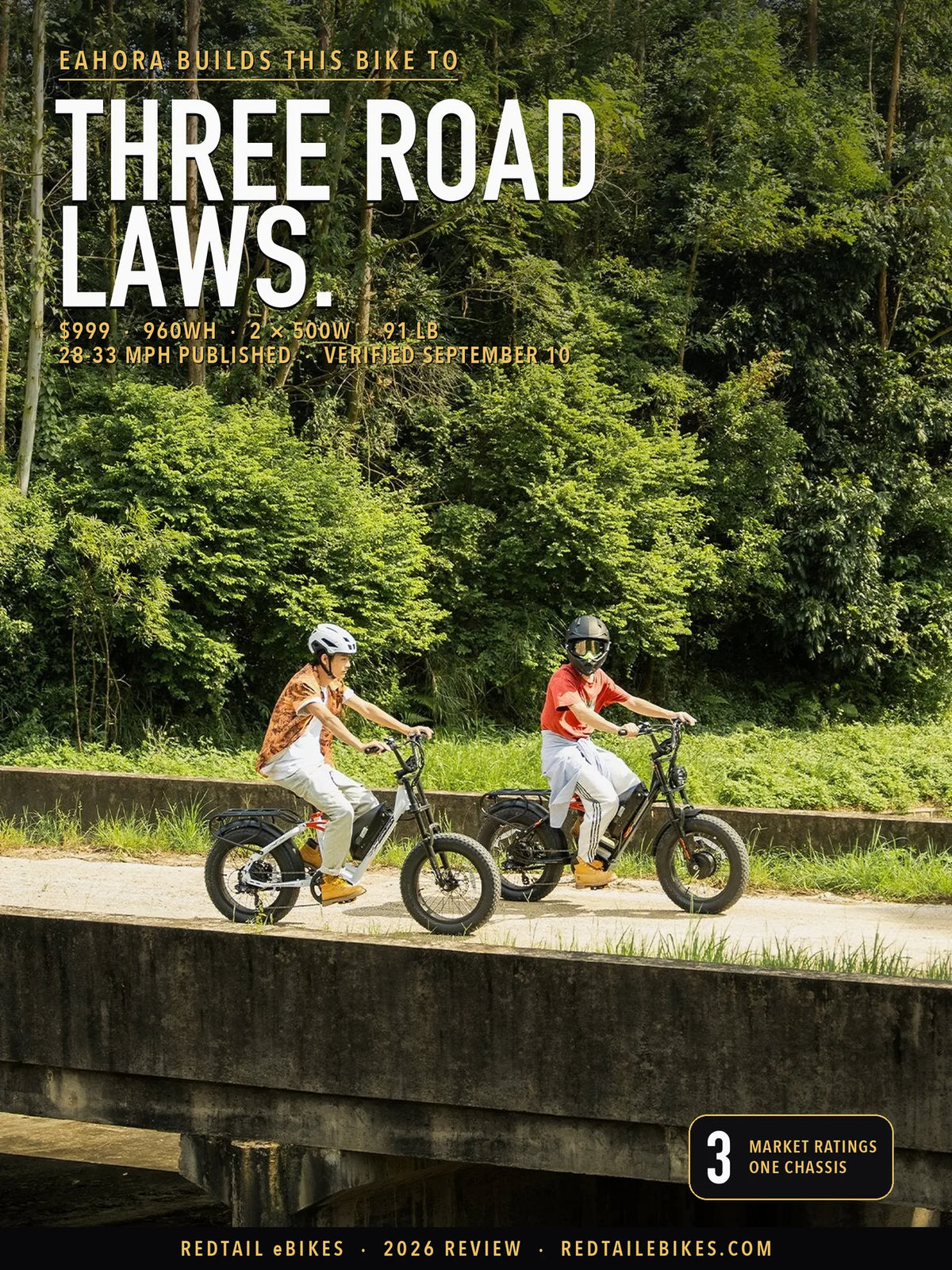
Share:
Eunorau S1 Review 2026: 43 MPH Claim, 37 Measured
Eahora Juliet Long-Range Review 2026: 2,880Wh, Smallest